SOL DE MEDIAN CHE
july 2017 . No. 7 - ANCHORAGE, ALASKA
Bilingual edi t ion
Tráfico laboral, la esclavitud moderna Las barreras de lenguaje y el desafío de la integración social vuelven a los inmigrantes particularmente vulnerables
K
Por Gabriela Olmos
arla vivía en la ciudad mexicana de Guadalajara. Recién había terminado la universidad y apenas había conseguido su primer empleo. Estaba tan mal pagada que no podía sobrevivir sin el apoyo de sus padres. Al ver su situación, un conocido de la familia le propuso un trato: le pagaría un boleto de avión y su estancia en Alaska, si Karla accedía a trabajar en su restaurante. También le ofreció un salario que ella no supo si era generoso o no, pues no conocía el costo de la vida en Alaska. Pero pensó que, como tenía el hospedaje garantizado, podría ahorrar una buena parte de ese dinero. Parecía un buen trato, así que aceptó. Días después Karla recibió su boleto de avión y se embarcó rumbo a Anchorage. Llevaba en su bolso el número telefónico de la persona que debía contactar y la dirección de una casa donde la hospedarían. Karla durmió allí dos noches. Era el puente de Memorial Day, así que no le pareció extraño que la casa estuviera desocupada y que la única señal que recibiera de su empleador fuera la llamada de un chofer que le pedía estar preparada porque la llevaría a Homer. Allí estaba el restaurante donde debía trabajar durante el verano. Los siguientes meses fueron complicados: Karla se integró al equipo de trabajo del restaurante y se instaló en la pequeña casa compartida que el empleador proveía para los trabajadores venidos de otras tierras. Era un sitio pequeño en el que podría vivir mientras ahorraba un poco. Pasó el primer mes y Karla no recibió un centavo de lo acordado. Le preguntó a su empleador por su dinero, y la respuesta fue que ella debía cubrir el costo del pasaje y pagar por su hospedaje, así que no había dinero que darle. Al contrario, ella aún le debía mucho, pues el boleto
6
no era barato. Un par de meses después, Karla recibió su primer pago. Mientras tanto, además de cubrir su turno en el restaurante, tuvo que emplearse limpiando casas para cubrir sus gastos. Al final del verano, después de algunas complicaciones más, regresó a su país con algo de dinero en su bolsa. Ésta es la historia de Karla, aunque cambiamos su nombre por razones de seguridad. Ahora ella está a salvo de vuelta en Guadalajara. Tuvo suerte, pues muchas de las historias que comienzan así desembocan en tráfico laboral, definido por el Trafficking Victim Protection Act de 2000 como “el reclutamiento, alojamiento, transporte, provisión u obtención de trabajo o servicios de una persona, por medio del uso de la fuerza, de fraude o de coerción con el propósito de servidumbre involuntaria, peonaje, trabajo por deudas o esclavitud”. La IOM (International Organization for Migration), agencia de la Organización de las Naciones Unidas, explica que los inmigrantes son particularmente vulnerables al tráfico laboral por “las barreras del idioma, el reto de la integración social, y los empleadores, patrones y proveedores de servicios sin escrúpulos que sacan provecho del limitado conocimiento que tienen los inmigrantes sobre las condiciones locales y de su reducido poder de negociación. Muchos inmigrantes son incapaces de acceder a los servicios públicos o al sistema de justicia, o no quieren hacerlo, aunque tengan derecho a ello”. Por lo regular, el tráfico laboral se da cuando alguien “controla el sustento de una persona; es decir, el dinero y el techo bajo el que vive”, porque así se vuelve sencillo para el empleador “ejercer presión sobre estos puntos para controlar sus vidas”, explicó Jeremy Applegate, investigador de horas y salarios del Department of Labor and Workforce Development, durante un foro sobre el tema en Covenant House el pasado 10 de mayo. El investigador añadió que “en general los casos remitidos al Departamento del Trabajo corresponden a gente cuyo idioma principal no es el inglés”. Y agregó que esto sucede porque los inmigrantes “a veces no tienen la habilidad para
¿Puedo solicitar asilo en los Estados Unidos? Can I file for asylum in the USA?
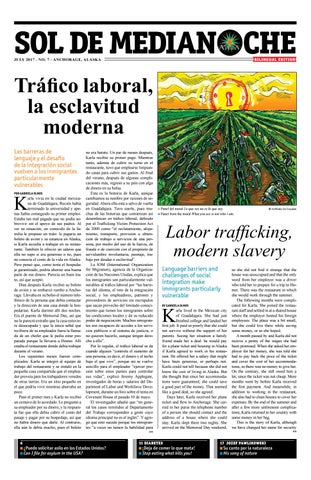
» Panel del mural Lo que ves no es lo que soy. » Panel from the mural What you see is not who I am.
© ArtWorks for Freedom
Labor trafficking, modern slavery Language barriers and challenges of social integration make immigrants particularly vulnerable
K
By Gabriela Olmos
arla lived in the Mexican city of Guadalajara. She had just finished college and landed her first job. It paid so poorly that she could not survive without the support of her parents. Seeing her situation a family friend made her a deal: he would pay for a plane ticket and housing in Alaska if Karla agreed to work in his restaurant. He offered her a salary that might have been generous, or perhaps not. Karla could not tell because she did not know the cost of living in Alaska. But she thought that since her accommodations were guaranteed, she could save a good part of the money. That seemed like a good deal, so she agreed. Days later, Karla received her plane ticket and flew to Anchorage. She carried in her purse the telephone number of a person she should contact and the address of a house where she could stay. Karla slept there two nights. She arrived on the Memorial Day weekend,
11 Diabetes
¡Deja de comer lo que mata! Stop eating what kills you!
so she did not find it strange that the house was unoccupied and that the only word from her employer was a driver who told her to prepare for a trip to Homer. There was the restaurant in which she would work through the summer. The following months were complicated for Karla. She joined the restaurant staff and settled in at a shared house where the employer hosted his foreign employees. The place was a bit small, but she could live there while saving some money, or so she hoped. A month passed by and Karla did not receive a penny of the wages she had been promised. When she asked her employer for her money, she was told she had to pay back the price of the ticket and cover the cost of her accommodations, so there was no money to give her. On the contrary, she still owed him a lot, since the ticket was not cheap. More months went by before Karla received the first payment. And meanwhile, in addition to working in the restaurant, she also had to clean houses to cover her expenses. By the end of the summer and after a few more unforeseen complications, Karla returned to her country with some money in her bag. This is the story of Karla, although we have changed her name for security
17 Jozef Pawlikowski
Su canto por la naturaleza His song of nature
2
ju ly 2017
SO L DE MEDIAN OC HE
AN C HORAGE, AL ASK A
» Paneles del mural Lo que ves no es lo que soy. » Panels from the mural What you see is not who I am.
comunicarse con las autoridades, o provienen de culturas en las que la ley no está necesariamente de su lado, o puede ser comprada por quienes tienen dinero. ¿Qué quiere decir esto? Que puede ser comprada por sus jefes”. El aislamiento social es un factor que propicia este abuso. Justo por ello, las víctimas “fácilmente son convencidas de que la ley es un peligro para ellas”. En el clima político en el que vivimos, muchos inmigrantes se sienten inseguros sobre su estatus migratorio, y aunque no tengan nada qué temer, pueden sentir miedo. Con el tiempo, quien vive en condiciones de explotación comienza a ver el abuso como algo natural, advirtió Applegate: “Cuando has sido explotado desde que eras adolescente, ni siquiera sabes que estás siendo explotado cuando llegas a los treinta. Lo que se necesita es un cambio de mentalidad”. El investigador fue claro: “Lo mejor que podemos hacer es advertir a la gente cuáles son sus derechos, enseñarles qué caminos existen para cuestionar a quienes los explotan, y hacerles saber que están siendo explotados”. El tráfico laboral ha permanecido invisible, aseguró Applegate, porque “generalmente la gente que lo practica es enjuiciada por otros delitos. Hay cualquier cantidad de crímenes asociados con el tráfico laboral, como el lavado de dinero”. Además, es difícil detectar el tráfico laboral, porque “¿dónde está la línea que divide las malas prácticas laborales del fraude, el uso de la fuerza y la coerción que caracterizan el tráfico humano? Yo no sé si tengo una respuesta clara”. Las víctimas de tráfico laboral pueden pensar que su problema no tiene solución. Sin embargo, la abogada Lara Nations, del despacho Nations Law Group, asegura que hay alternativas para los inmigrantes que se encuentran en esa situación. Muchos de ellos, dijo en entrevista, “pueden aplicar a una visa T. Después de cooperar con una investigación, el Departamento de Policía puede certificar que esta persona ayudó con cierto proceso. No tiene que haber un juicio. No necesariamente el explotador debe acabar en la cárcel para que el inmigrante reciba este beneficio”. La visa T es válida por tres años y hacia el final de ese periodo la persona puede solicitar residencia permanente en los Estados Unidos. Cuando la víctima de tráfico laboral es menor de edad, puede solicitar que sus padres entren en el proceso de la visa T. Si es un adulto con familia, también su esposa o sus hijos pueden entrar a la petición.
© ArtWorks for Freedom
Por las circunstancias de vida de los inmigrantes traficados, no es sencillo que tramiten este tipo de visa sin ayuda profesional. Un abogado de inmigración puede apoyarlos con soluciones migratorias y laborales sin poner en riesgo la seguridad de las víctimas. Nations señaló: “parte de mi trabajo en estos casos es asegurarme que la persona esté en una situación segura; es decir, que ya no esté viviendo en ninguna propiedad del empleador”. La abogada también busca facilitarle la recuperación de sus documentos, en caso de que éstos hayan sido retenidos por el empleador. Y ayuda a las víctimas a “acceder a ciertos servicios que hay en nuestra comunidad para salir de esta situación”. Los procesos de trámite de visa pueden durar meses. Por eso, en ocasiones los abogados pueden tramitar a través del FBI o de otra agencia federal de seguridad un permiso de trabajo conocido como Continued Presence. Nations aseguró que “esto es clave, porque con este documento la persona puede trabajar en cualquier compañía que lo quiera contratar. Con esto la persona puede pagar por sus cosas y rentar un departamento. Y no tendrá que depender más de su empleador”. “Es importante que se le haga justicia a la persona afectada, pero también que cobre lo que se le debe”, señaló la abogada y agregó que ése es un proceso que se tiene que gestionar en el Departamento del Trabajo y esto se lleva de manera independiente al trámite migratorio. La abogada enfatizó: “no se tiene que esperar a que el problema se vuelva grande para denunciar”. A las primeras señales de que algo no está bien se puede llamar a un abogado. Y agregó que “la consulta con un abogado es confidencial”. De modo que lo que una víctima de tráfico laboral revele en este contexto está seguro, y no tiene por qué llegar a oídos de su empleador.
Sol de Medianoche is a bimonthly publication of the Latino community in Anchorage, Alaska (907) 891 2636 | www.soldemedianochenews.org | info@soldemedianochenews.org Publisher: Sol de Medianoche Editorial Board | Editor: Gabriela Olmos Graphic Design: Manelik Guzmán | Advertising: Danny Esparza, Lina Mariscal Thank you to our contributors: Indra Arriaga, Lauren Horn, Lorena Medina Martínez, Nicolás Olano, Dayra Valades, Itzel Yarger Zagal. Sol de Medianoche is published by Sol de Medianoche Co. The contents are copyright 2017 by Sol de Medianoche Co. No portion may be reproduced in whole or in part by any means including electronic retrieval systems without the express written permission of the publisher. ISSN (print) 2473-6880 | ISSN (online) 2473-6899.
© ArtWorks for Freedom
reasons. She was lucky to return home because many of the stories that begin this way led to labor trafficking, which the Trafficking Victim Protection Act of 2000 defines as “the recruitment, harboring, transportation, provision, or obtaining of a person for labor or services, through the use of force, fraud, or coercion for the purposes of subjection to involuntary servitude, peonage, debt bondage, or slavery.” The IOM (International Organization for Migration), a UN agency, explains that immigrants are particularly vulnerable to labor trafficking because of “language barriers, challenges of social integration, and unscrupulous employers, landlords, and service providers who take advantage of their limited knowledge of local conditions and reduced bargaining power. Many migrants are unable or unwilling to access social services and the justice system even if they are entitled to do so.”
Labor trafficking usually occurs when someone is “controlling a person’s livelihood, meaning their money and their shelter,” because traffickers use “these pressure points to manipulate them,” explained Jeremy Applegate, Wage and Hour Investigator for the State’s Department of Labor and Workforce Development, during a forum at Covenant House on May 10. “By and large, people that we see in our office who are being manipulated in those sorts of ways are persons whose primary language is not English,” Applegate said. And he added that this happens because immigrants “One, sometimes lack the ability to communicate with law enforcement or Two, may come from a culture in which law enforcement is not necessarily on their side, or law enforcement can be bought by the people who have money, and who is that, normally? Their boss.” Social isolation is another factor that
Nations Law Group
ABOGADOS DE INMIGRACIóN / IMMIGRATION ATTORNEYS
Con más de 15 años de experiencia trabajando con casos de inmigración, estamos listos para ayudarle a sus amigos y familia con cualquier necesidad en el área de inmigración.
With more than 15 years of experience handling immigration matters we are ready to help you, your friends and family with your immigration needs.
Tomamos casos de:
We handle the following cases:
Deportación / Remoción Asilo Residencia por matrimonio Perdones DACA / DAPA Apelaciones de Inmigración Representacion en Corte
Deportation / Removal Asylum Residence via marrriage Waivers DACA / DAPA Immigration Apeals Representation in Court
www.nationslawak.com
907 7700909
Info@nationslawak.com
july 2 017
A N C HO R AG E , A L A SK A
encourages this abuse. It is the reason why people who find themselves in this situation “are easily convinced that law enforcement is a danger to them.” Especially in the current political climate, victims of trafficking fear for their immigration status, and sometimes even if they have a safe immigration status, they question it. Over time, people who live under exploitative conditions begin to see abuse as natural, Applegate warned: “When you’ve been exploited since the time you were a teen, you don’t even know you’re being exploited when you’re 30. It is a culture that we need to change.” The investigator was clear about what should be done. “The best thing that we can do with labor trafficking is to let people know what their rights are, what avenues they have to challenge those persons who are exploiting them, to let them know that they are being exploited.” Labor trafficking has remained invisible, said Applegate, because generally people who practice it “are prosecuted for something else. There are any numbers of crimes that have been associated with labor trafficking such as money laundering.” In addition, it is difficult to trace because “Where is the line between bad business practices and the force, fraud, and coercion aspects of human trafficking? I do not know if I have a clear answer.” Victims of labor trafficking may think that their problem has no solution. However, attorney Lara Nations of Nations
Law Group says that there are alternatives for immigrants who are in such a situation. In an interview she explained that many of them “can apply for a T visa. When an immigrant cooperates with an investigation, the Police Department can certify that this person helped with the process. It does not have to be a trial. The trafficker does not have to end up in jail for the immigrant to receive this benefit.” The T visa is valid for three years, and near the end of that period, the holder can apply for a permanent residence in the United States. When the victim of labor trafficking is a minor, they can ask for their parents to enter the T visa process. Adults can also include their spouse and children in their application. Due to the life circumstances of trafficked immigrants, it may not be easy for them to apply for this type of visa without legal help. An immigration attorney can assist them with immigration and labor concerns without endangering their safety. Nations said, “Part of my job in these cases is to make sure the person is in a safe situation; that he is no longer living on any property of the employer.” The attorney also seeks to facilitate the recovery of the victim’s documents, in case the employer has retained them. And they help them to “use services in our community to get out of this situation.” The visa process can take months. For this reason, lawyers may sometimes file a work permit known as Continued Pres-
3
© ArtWorks for Freedom.
S O L DE ME DIA N O C H E
» Panel del mural Lo que ves no es lo que soy. » Panel from the mural What you see is not who I am.
ence through the FBI or another Federal Police Department. Nations believes that “this is key, because with this document the person can work in any company that wants to hire them. With this, they can pay for their things and rent an apartment. And they will not have to rely more on their former employer.” “It is important that the affected persons are served justice, but also that they receive the money the employer owes them,” stated the attorney and she added that this process must be managed in the
Department of Labor and it is carried out in a separate procedure to the immigration process. The lawyer emphasizes, “One does not have to wait until the problem grows very large before asking for help.” At the first signs that something is not right, victims should call a lawyer. And she adds, “Consultation with a lawyer is confidential.” So what a victim of labor trafficking reveals in this context is safe, and will not come to the ears of their employers.
ju ly 2017
SO L DE MEDIAN OC HE
AN C HORAGE, AL ASK A
Nota editorial
¿Cómo ser un aliado de los inmigrantes? Guía para los bienintencionados por SDMN
E
stados Unidos es una nación construida a partir de la fuerza creativa de quienes han venido de otras tierras. John F. Kennedy escribió sobre ello en su libro póstumo Una nación de inmigrantes. Ahí, Kennedy dice: “En la comunidad que ha dejado el inmigrante tenía un sitio fijo. Podía seguir con el oficio o el negocio de su padre; podía sembrar la tierra de su padre o la porción que le correspondía tras dividirla con sus hermanos. Sólo con un talento y una iniciativa excepcionales podía romper el molde que la vida había acuñado para él. Tal molde no existía en su nuevo mundo. Así que una vez que había roto con su pasado, excepto por los lazos sentimentales y la herencia cultural, tendría que confiar en sus habilidades. Estaba obligado a responder al futuro y no al pasado”. Más adelante Kennedy nos deja ver cómo en esta inventiva de los inmigrantes radica la fuerza que ha llevado a los Estados Unidos a ser un país líder en materias política y económica. Pese a que en estos tiempos una ola de rechazo amenaza a los inmigrantes, muchos americanos valoran las contribuciones que los inmigrantes hacemos a los Estados Unidos. Y muchos quieren mostrar su solidaridad. Como inmigrantes, les agradecemos su preocupación, y les compartimos algunas consideraciones para hacer más efectiva su mano amiga: 1. Conózcanos. Al hacerlo, descubrirá cuál es la mejor manera de contribuir con nuestras comunidades. Como inmigrantes tenemos otra cultura, muchas veces otra religión, nuestras familias y nuestras sociedades se organizan de manera distinta. No somos mejores, ni peores; somos diferentes. Por esta diferencia nacen muchas confusiones. Hay algunos no-inmigrantes que piensan que lo que es bueno para ellos es bueno para nosotros, y no siempre es así. 2. Permítanos aprender. Por difícil que sea navegar en un país distinto al que nos vio nacer, los inmigrantes debemos aprender a hacerlo. Debemos hacernos cargo de nuestra vida y aprender a construir nuestros sueños, y la única forma en que lo podemos aprender es haciéndolo. Una guía que nos enseñe cómo navegar será muy bienvenida. Sin embargo, necesitamos ser dueños de nuestro destino.
ilustración / Illustration: Archivo / Archive.
4
editorial Note
How to be an ally to immigrants A guide for the well-intentioned
T
by SDMN
he United States is a nation built on the creative strength of people born in other countries. John F. Kennedy discussed this in the posthumously published A Nation of Immigrants. He wrote: “In the community he had left, the immigrant usually had a fixed place. He could carry on his father’s craft or trade; he would farm his father’s land, or that small portion
3. Comprenda que, además de los problemas naturales de la vida, muchos miembros de nuestra comunidad tienen dificultades migratorias que los vuelven más vulnerables. Aprender un poco de los procesos migratorios le puede ayudar a comprender la situación de algún inmigrante. Frente a un problema un inmigrante suele estar más solo que alguien que nació y ha vivido en el país desde siempre. Por eso, antes de involu-
of it that was left to him after it was divided with his brothers. Only with the most exceptional talent and enterprise could he break out of the mold in which life had cast him. There was no such mold for him in the New World. Once having broken with the past, except for sentimental ties and cultural inheritance, he had to rely on his own abilities. It was the future and not the past to which he was compelled to address himself.” Later on, Kennedy describes how immigrants’ inventiveness is the force that helped make the Unit-
crar a los inmigrantes en causas políticas, sea responsable y piense en lo mucho que algunos inmigrantes tienen qué perder. 4. Permítanos compartir nuestra cultura con usted. Cuando los inmigrantes usamos los trajes tradicionales de nuestros países no estamos disfrazados. En nuestras tradiciones hay un legado de conocimientos que nos hace ser quienes somos hoy. Seguimos ceremonias reli-
ed States into a world leader in its politics and economy. Though these days immigrants face a wave of rejection, many Americans still value the contributions of those who came from other lands, and want to show their solidarity. But they do not always know the way to do it. As immigrants, we thank them for their concern, and to make their helping hands more effective we suggest the following guidelines: 1. Get to know us. By doing this you
giosas o cívicas de nuestros países de origen porque son parte de nuestra historia. Al practicarlas, honramos a nuestros antepasados y damos continuidad a su legado. 5. La mejor forma de apoyarnos es en lo cotidiano, ayudándonos a crecer mutuamente. Tejer una sociedad en la que todos tengamos un lugar es responsabilidad de todos.
S O L DE ME DIA N O C H E
july 2 017
A N C HO R AG E , A L A SK A
Uno siempre lleva consigo un pedazo de su tierra Recomendaciones consulares para ciudadanos peruanos
S
Por SDMN
» Panel del mural Lo que ves no es lo que soy. » Panel from the mural What you see is not who I am. © ArtWorks for Freedom
will see what is the best way to contribute to our communities. As immigrants we have another culture; often another religion; our families and our societies may be organized differently. We are neither better nor worse. We are different. Much confusion may arise from this difference. There are some non-immigrants who think that what is good for them is good for us, and it is not always so. 2. Let us learn. As difficult as it is to navigate a country other than that of our birth, immigrants must learn to do so. We must plan our lives and learn to build our dreams, and the only way we can learn is by doing so. A guide showing us how to navigate our challenges might be very welcome. However, we need to be the masters of our fate. 3. Understand that, in addition to the natural problems of life, many members of our community have immigration difficulties that make them more vulnerable. Learning more about the immigration process may help you empathize with someone’s situation. When faced with a problem, an immigrant may feel more alone than someone who was born and has lived in the country since birth. Before engaging immigrants in political causes, please be responsible and think about how much they might have to lose. 4. Let us share our culture with you. When immigrants use the traditional dresses of our countries, we are not wearing mere costumes. Our traditions carry a legacy of knowledge that makes us who we are today. We follow religious or civic ceremonies from our countries of origin because they are part of our history. By practicing them, we honor our ancestors and give continuity to their legacy. 5. The best way to support immigrants is through simple, dayto-day acts in which we help one another grow. Weaving a society in which we each have a place is the responsibility of us all.
egún el estimado de su consulado, alrededor de 300 ciudadanos peruanos residen en Alaska. Muchos de ellos se congregan el 28 de julio para celebrar la independencia de su Madre Patria o se unen a la procesión del Señor de los Milagros en octubre. En la visita del consulado móvil del Perú en Anchorage, el vicecónsul Luis Andrés García Román recomendó a todos ellos que en la actual crisis migratoria no olviden que el consulado tiene “una política de puertas abiertas y de comunicación directa con los conciudadanos peruanos. Siempre les pedimos que tengan en consideración la necesidad de mantener al día sus documentos peruanos, que no tengan temor alguno en acercarse al consulado, y que sepan que cuentan con nosotros para cualquier duda o consulta”. Ya que el gobierno peruano admite la doble nacionalidad, García Román sugirió a los peruanos no dejar de registrar a sus hijos como ciudadanos del Perú, para que en caso de alguna emergencia puedan entrar a su país con todos los derechos de un ciudadano. Para ello se necesita que al menos uno de los padres sea ciudadano peruano, y que esté presente al momento del registro. También es necesario entregar una copia de su Documento Nacional de Identidad (DNI), una copia de una identificación oficial si alguno de sus progenitores no es peruano y el acta de nacimiento del menor. Cumplidos estos requisitos, se genera una partida de nacimiento peruana para el menor y después se le tramita el DNI. García Román recordó a sus connacionales que en casos de emergencia por procesos de deportación, el Consulado tramita salvoconductos, que son documentos de viaje que se expiden en un día y que permiten a los ciudadanos entrar al Perú en caso de que no cuenten con un pasaporte. Para solicitar éste y otros servicios consulares los teléfonos son (415) 362-5185, (415) 362-5647 y (415) 362-7136. En caso de emergencia se puede llamar al (415) 215-6668 las 24 horas del día. Finalmente el vicecónsul alienta a sus connacionales a nunca sentirse lejos del Perú, pues “uno en el lugar del mundo en que esté siempre lleva consigo un pedazo de su tierra”.
You always carry a piece of your land with you
Consular recommendations for Peruvian citizens
T
By SDMN
he Peruvian consulate estimates that about 300 Peruvian citizens reside in Alaska, many of whom congregate on July 28 to celebrate the independence of their mother country, or join the procession of the Lord of Miracles in October. When the mobile consulate of Peru came to Anchorage last June 10, Vice-Consul Luis Andrés García Román reassured Peruvians that in the current immigration crisis they “should not forget that the Consulate has a policy of open doors and direct communication with fellow Peruvians. We always ask them to keep their Peruvian documents up to date, to not fear speaking with the Consulate, and to know that we are available for any questions.” Since the Peruvian government permits dual citizenship, García Román suggests that Peruvians be sure to register their children as citizens of Peru. In case of an emergency, the children could then enter their country with all
the rights of citizens. For this procedure it is necessary that at least one of the parents is a Peruvian citizen. Peruvian parents must be present at the time of registration. It is also necessary to provide a copy of their National Identity Documents (DNI), a copy of a legal ID (if one parent is not Peruvian), and the child’s birth certificate. Once these requirements are fulfilled, a birth certificate is generated for the child and then a DNI will be issued. García Román reminds his compatriots that in emergencies due to deportation proceedings, the Consulate will issues a “safe-conduct,” a travel document that can be ready in one day and allows citizens to enter Peru if they do not have a passport. To request these and other consular services, the telephone numbers are (415) 362-5185, (415) 362-5647 and (415) 362-7136. In case of emergency you can call (415) 215-6668 24 hours a day. Finally, the Vice-Consul encouraged his compatriots to never feel far from Peru, for “wherever in the world where one is, one always carries a piece of one’s land.”
Elegir donde usted vive es un
derecho. ESCANEAR AQUÍ PARA MÁS INFORMACIÓN
La discriminación en materia de vivienda está mal. La discriminación por motivos de raza, color, religión u origen nacional es ilegal. La única forma de intervenir es si usted la reporta. Visita www.hud.gov/fairhousing o llama a la línea directa de HUD 1-800-669-9777 (English/Español)
Un mensaje de servicio público del Departamento de Vivienda y Desarrollo Urbano de los Estados Unidos en asociación con la Alianza Nacional de Equidad de Vivienda. La Ley Federal de Equidad de Vivienda prohíbe la discriminación por motivos de raza, color, religión, origen nacional, sexo, tipo de familia o discacapacidad. Para más información, visite www.hud.gov/fairhousing.
5
6
ju ly 2017
SO L DE MEDIAN OC HE
AN C HORAGE, AL ASK A
InmigraciÓn
¿Puedo solicitar asilo en los EU?
Una guía sobre quién puede aplicar para este beneficio Por Nicolás Olano Abogado de inmigración
Los primeros cuatro puntos son bastante claros. Vale la pena esclarecer el último. Un “grupo social particular” es uno que: 1) La sociedad en que se encuentra distingue (grupos indígenas, por ejemplo), 2) Sus miembros tienen una singularidad que no pueden, ni deben cambiar (por ejemplo, preferencia sexual o género con el que se identifican) y 3) Está definido con una característica singular (no todo el mundo cabe en ese grupo). Si la persecución se dio o puede darse por uno de los motivos anteriores, le pregunto (aguántenme esto tiene su razón de ser): “¿Quién quiere maltratarlo y por qué?” Si el perseguidor es el gobierno o una persona o grupo al que el gobierno no puede controlar (por ejemplo, la guerrilla de las FARC en Colombia) o no quiere hacerlo (por ejemplo, grupos paramilitares), entonces podemos comenzar a mirar con más detenimiento las posibilidades de solicitar asilo en los Estados Unidos. Si me responde “no” a una de estas preguntas, le pregunto: “¿Alguien que esté en su misma situación (un familiar, un conocido, un compañero de trabajo), ha sido víctima de persecución
Foto / Photo: Archivo / Archive.
“¿P
uedo solicitar asilo en los Estados Unidos?” es una pregunta que los abogados de inmigración escuchamos con frecuencia. Cuando un cliente la hace, mi respuesta siempre es otra pregunta: “¿Tiene usted miedo de volver a su país, sin importar el motivo?” Si la respuesta es un rotundo “no”, entonces la respuesta es simple: “No puede pedir asilo”. (Aunque, continúe leyendo, ese “no” puede cambiar.) En cambio, si la respuesta es “sí”, de inmediato le hago otra pregunta: “¿Por qué tiene miedo de volver a su país?” Si la persona me responde: “Porque sufrí de persecución o temo que me persigan si vuelvo a mi país”, ¿adivinen qué? Viene otra pregunta: “¿Qué quiere decir que ‘sufrió persecución’?” Si lo que le pasó al cliente es algo que ante la ley puede considerarse como persecución sigue otra pregunta: “¿Por qué se dio (o se puede dar) la persecución? Aquí me detengo si el cliente me dice una de cinco opciones: “Fui o puedo ser perseguido por: 1) Mi sexo (por ser hombre o mujer), 2) Mi religión (por ser judío, musulmán, cristiano, u otro culto en conflicto en cierto país), 3) Mi nacionalidad (por ser irlandés, ucraniano, etcétera), 4) Mi raza (por tener ascendencia africana, hispana, u otra raza que no sea bien vista en su país), o 5) Porque pertenezco a un” grupo social particular”.
immigration
Can I file for asylum in the US? A guide to eligibility By Nicolás Olano Immigration attorney
“C
an I file for asylum in the United States” is a question that immigration attorneys hear frequently. When a client poses it, I usually answer with another question: “Are you afraid to return to your country, no matter what?” If their answer is a resounding “No,” then it is simple, “You cannot ask for asylum.” (But continue reading: that “No” may change.) On the other hand, when the answer is “Yes,” I introduce another question: “And why are you afraid to return to your country?” If the person answers, “Because I was persecuted or I fear that someone will persecute me if I return to my country,” guess what? I follow with another question. “What do you mean by persecution?” If what happened to the client is something that can be considered as persecution under the law, there is yet another question: “Why did the persecution happen?” I stop asking questions if the client tells me one of the five possible reasons that make someone eligible for asylum. “I was or will be persecuted for: 1) My gender (for being a man or woman), 2) My religion (for being a Jewish, Muslim, Christian, or any other cult in conflict within a certain country),
en su país por uno de los motivos anteriores?” Cuando hago esta pregunta muchos clientes se dan cuenta que pueden tener un caso de asilo. La solicitud de asilo se debe de presentar dentro del primer año que la persona llega a los Estados Unidos, pero existen excepciones. Por eso la determinación de si puedo pedir asilo en los Estados Unidos debería tomarse con un abogado que tenga amplia experiencia en manejar estos casos. ¡Y por amplia experiencia quiero decir más de 50 casos! Recuerde: ésta es una columna informativa. Si tiene dudas sobre si califica o no para solicitar asilo, hable con un abogado de inmigración.
3) My citizenship (for being Irish, Ukrainian, et cetera) 4) My race (for having an African, Hispanic or any other ancestry that is not well seen in your country), or 5) Because I am a member of a ‘particular social group.’” The first four points are quite clear, but the last is worth clarifying. A “particular social group” is one which: 1) Is distinguished within the society hosting it (for example, certain native groups), 2) Has a characteristic that they cannot and should not change (for example, sexual orientation or gender identification), and 3) Is defined by a particular trait that not everyone has. If the persecution is caused for one of the reasons above, I ask (be patient, these questions have a reason): “Who wants to mistreat you and why?” If the persecutor is the government or a person or group that the government cannot control (for
example, FARC guerrilla in Colombia), or does not want to control (for example, paramilitary groups), then we can start to consider requesting asylum in the United States. If the client answers “No” to one of these questions, I ask, “Is (or was) anyone in a situation similar to yours (a relative, an acquaintance, a co-worker) the victim of persecution in your country for one of the reasons above?” While answering this question, many immigrants realize that they may apply for asylum. Asylum should be requested within a year of the person’s arrival in the United States, but there are exceptions. That is why the determination of whether one can seek asylum in the United States is a question that should be taken to an attorney who has broad experience in handling such cases. (And by broad experience I mean more than 50 cases.) Remember that this is an informational column. If you have questions about whether you qualify for an asylum, talk to an immigration lawyer!
Coffee at the Library Z. J. Loussac Public Library
El café sabe mejor con un libro
Coffee tastes better with books
3600 Denali St, Anchorage, 99503 +1 907-343-2975
S O L DE ME DIA N O C H E
july 2 017
A N C HO R AG E , A L A SK A
7
Datos sobre inmigración
Rompiendo esquemas Por Lorena Medina Martínez
E
Algunos datos a tomar en cuenta: » La mayoría de la población hispana en Estados Unidos es nacida en Estados Unidos de América. » Desde 2013, India y China son los países que lideran la inmigración legal e indocumentada hacia Estados Unidos, seguidos en tercer lugar por México. » Los trabajadores inmigrantes no le quitan el trabajo a los ciudadanos estadounidenses. De hecho, no sólo no despojan de sus empleos a los ciudadanos americanos; los inmigrantes crean nuevas fuentes de empleo, elevan la economía a través del consumo de bienes y, de acuerdo con cifras del Pew Research Center, en 2014 los inmigrantes indocumentados representaban el cinco por ciento de la fuerza de trabajo del país. » Hay quien asume que los inmigrantes no quieren aprender inglés. Sin embargo, muchos inmigrantes se ven en la necesidad de aprender dicho idioma para poder trabajar, estudiar, atender responsabilidades en las escuelas de sus hijos, atender citas médicas, pagar impuestos, y cumplir tareas domésticas, como ir de compras al supermercado. » Hay quienes propagan la falsa idea de que los inmigrantes son las peores personas en sus países de origen. Sin embargo, de acuerdo con cifras del FBI, la población inmigrante, legal o indocumentada, es detenida y encarcelada en cifras mucho menores que ciudadanos nacidos en el país. » Como parte de las políticas del actual gobierno se habla de la construcción de un muro entre Estados Unidos y su vecino del sur para detener la inmigración indocumentada. Más allá de detener la inmigración, la construcción de dicho muro pondría en riesgo especies en peligro de extinción
Foto / Photo: Archivo / Archive.
l Pew Research Center estima que en los Estados Unidos hay 11 millones de habitantes indocumentados. La creencia popular reza que estos inmigrantes son hispanos, y en su mayoría mexicanos. Pero esta percepción es equivocada. La inmigración a los Estados Unidos comenzó en el siglo XVI, cuando exploradores españoles ocuparon tierras en los estados de California, Óregon, Nuevo México y Luisiana. Durante el siglo XVII, inmigrantes ingleses llegaron al país en búsqueda de mejores oportunidades de vida. A partir de ese momento y hasta nuestros días, la migración sigue siendo la principal fuente de población y de riqueza tanto cultural como económica del país.
immigration by the numbers
Breaking Stereotypes T
by Lorena Medina Martínez
he Pew Research Center estimates that in the United States there are 11 million undocumented inhabitants. According to popular belief these immigrants are mainly Hispanic, and mostly Mexican, but this is not true. Immigration to the US began during the sixteenth centu-
ry, when Spanish explorers occupied lands in what are now the states of California, Oregon, New Mexico and Louisiana. In the seventeenth century, English immigrants arrived in the country in search of better life opportunities. From that moment until today, immigration continues to be the main source of population and wealth both cultural and economic in the country.
Some facts to consider: » The majority of the Hispanic population in the United States is born in the US. » Since 2013, India and China are the leading countries for legal and undocumented immigration to the United States, followed by Mexico. » Immigrant workers do not take away American citizens’ jobs. In fact, not only do they not “take” those jobs, immigrants create new jobs. They stimulate the economy through the consumption of goods, and according to the Pew Research Center, in 2014 undocumented immigrants accounted for only five percent of the country’s workforce. » Some people assume that immigrants do not want to learn y lastimaría la economía de la región. »E l Pew Research Center afirma que la mitad de la población indocumentada entró al país con documentación válida como permisos de trabajo, visas de
English. However, many immigrants find themselves in need of learning the language in order to work, study, interact with their children’s schools, attend medical appointments, pay taxes, and perform daily living tasks such as buying groceries. » Some spread the false idea that immigrants are the worst people in their countries of origin. However, according to FBI estimates, immigrants, whether legal or undocumented, are detained and imprisoned in much smaller numbers than nationals born in the country. » Regarding the wall that the current administration wants to build between the United States and its southern neighbor: whatever its turista o de estudiante. Y excedieron el límite de su estancia legal. » De acuerdo con estadísticas de población del sitio web migrationpolicy.org, se calcula que
effect on unauthorized immigration, it would endanger species at risk of extinction endemic to that region and damage the region’s economy. » According to the Pew Research Center, approximately half of the undocumented population do not enter the country by crossing the border. Instead they visit the US with valid documentation such as work permits, tourist or student visas, and exceed the limits of their visas. » In Alaska only, according to 2015 population statistics from the website migrationpolicy.org, the total of legal and undocumented immigrants of Asian origin is 32,697; Hispanic origin, 10,556; and European origin 9,045. en Alaska, hacia el 2015, los orígenes de los tres principales grupos de inmigrantes legales e indocumentados era la siguiente: origen asiático 32,697; origen hispano 10,556 y origen europeo 9,045.
ju ly 2017
SO L DE MEDIAN OC HE
AN C HORAGE, AL ASK A
publirreportaje / sponsored content
Hola nuevamente,
Vamos a continuar aprendiendo cómo vender o comprar una casa. El primer paso y el más importante es el financiamiento. En esta etapa tendrás que escoger un tipo de préstamo. Hay varios tipos de préstamo y cada uno es diferente en cuanto a la cantidad de dinero que se tiene que dar para el enganche o los requisitos que debe tener la propiedad. Hay enganches del 0% hasta el 25% dependiendo del puntaje en el crédito o el tipo de compra, de que seas comprador por primera vez o inversionista. El financiamiento más recomendado para compradores por primera vez es el FHA. Sólo se puede dar un préstamo de este tipo a la vez. También es necesario que ocupes la propiedad para la cual recibes el préstamo como tu residencia principal. Por lo mismo, la casa tiene que estar en condiciones habitables y aceptables. En un financiamiento CONVENCIONAL los requisitos son más flexibles. No es necesario que vivas en la propiedad, la compra puede ser una inversión. El enganche es diferente, comienza en 1% y puede llegar a ser de hasta un 25% por ser considerado una inversión. Con este tipo de financiamiento, es posible comprar casas que necesiten reparaciones o renovaciones a un mejor precio. Existen financiamientos para casa que necesitan mucho trabajo. Para los famosos Fixer uppers está el REHAB LOAN. Hay varias formas de usar estos financiamientos. 1. Haciendo el trabajo uno mismo. 2. Contratando a un profesional para que haga las reparaciones. También hay financiamientos para veteranos llamados VA, los cuales no piden que se dé un enganche. Este financiamiento se creó con el objetivo de ayudar a obtener una vivienda digna a todos los que han protegido este país. Existen programas que ayudan con el enganche a personas que lo necesiten. El profesional que revise tus finanzas puede orientarte en cuanto a los beneficios que puedes obtener. Él te dirá a qué oficina ir dependiendo del programa de ayuda que solicites y te orientará en torno a cómo hacer una solicitud con tus respectivos documentos. Si tienes alguna pregunta o necesitas ayuda para comprar o vender llámame o envíame un mensaje de texto Gracias a todos por sus llamadas. ¡Hasta la próxima!
Hello again,
We are going to continue to learn about buying and selling a home. The first step and the most important is financing. At this stage you will need to pick the type of financing; there are various types of loans and each one requires a different down-payment. There are down-payments of 0-25% depending on your credit score or type of loan such as first-time home buyer or investment property. The financing most commonly known for home buyers is the FHA, which is a loan given one time as a new home buyer; you cannot have multiple FHAs at the same time. It is also important to note that you must occupy the residence. For this reason, the home must be in good condition. With a CONVENTIONAL loan the requirements become more flexible: It is not required to live in the property; the property can be an investment; and the down-payment is anywhere from 1-25%. With this type of loan you can purchase a home that may need investments or replacements for typically a better price. There is a special loan type for those famous “fixer uppers” that may require extensive amount of work, this would be a REHAB LOAN. There are various forms of using this loan, doing the work yourself or hiring a professional to do the work. If you have served in the US Military there is an option for a veteran loan or a VA loan for which no down-payment is required. The purpose of this loan is to help those who have served our country attain a good home. If down-payments are a problem, there is also assistance available. The financial professional helping you with a loan can point you in the right direction for which benefits you may qualify for.
Until next time! Please do not hesitate to call or text me with any questions that you may have about buying or selling your home.
Evanjelina González Jack White Realtor 907-787-9178
Foto / Photo: APD.
8
El APD y su compromiso con los residentes de Anchorage El estatus migratorio de los residentes “simplemente no es un problema” Por SDMN
“P
or lo general nuestros oficiales no se fijan en el estatus migratorio de las personas cuando hacen su trabajo”, aseguró el capitán Justin Doll, nuevo jefe del Anchorage Police Department (APD) cuando Sol de Medianoche le preguntó por los desafíos a los que se enfrentará en su nueva posición. Doll llegó a Alaska en 1985. Estudió la secundaria en Anchorage y después se graduó de Economía en UAA, hizo una maestría en Administración Pública en UAS, y realizó entrenamientos en la Academia Nacional del FBI. Conoció el trabajo del APD durante su juventud temprana, pues algunos de sus amigos trabajaban ahí. Más adelante, cuando Doll era empleado del aeropuerto, descubrió que había vacantes en el APD, ingresó su solicitud y fue seleccionado. “Disfruté formar parte de la Academia, pero una vez que me tocó estar en las calles como patrullero, amé profundamente mi trabajo”. Además de haber sido patrullero, Doll se ha desempeñado como supervisor de una unidad de tráfico, miembro del equipo SWAT, técnico en bombas, y comandante de las Unidades de Detectives de Homicidio y Robo / Asalto. Doll recuerda con particular afecto los veranos en que patrullaba la ciudad en motocicleta y asistía a eventos comunitarios en las escuelas primarias. En esa proximidad con la gente Doll descubrió que la labor del Departamento de Policía es mucho más que vigilar por el cumplimiento de la ley: hay que estar cerca de la gente. “Como agencia hemos estado en la posición de esforzarnos por varios años para dar respuesta a las necesidades básicas de emergencia de la ciudad, en cuan-
to a atender llamadas y asuntos por el estilo”, dice, y añade que el APD debe tratar de “comenzar a cambiar la mentalidad de nuestros oficiales para que sepan que está bien tomarse un poco de tiempo para resolver los problemas de los residentes”. Doll explica que por el momento la cultura en el APD es “ir tan rápido como sea posible”, y que trabajará por reducir la primacía de la velocidad para que los oficiales se detengan a investigar cuáles son las preocupaciones en materia de seguridad de los habitantes cada colonia. Desde la perspectiva de Doll, estos contactos con los residentes sirven para construir la confianza. La diversidad cultural y étnica de Anchorage es un desafío que el APD se toma con seriedad: “Es importante escuchar. Las personas tienen diferentes antecedentes y preocupaciones distintas. El propio Anchorage es muy variado porque es tan extenso. Los problemas de quienes viven en Muldoon no son los mismos de los que tienen quienes viven en el centro. Incluso el clima cambia en las distintas partes de la ciudad. La mejor forma de abordar esta diversidad es estando consciente de ella y escuchando las preocupaciones de la gente”. Al ser los encargados de la seguridad de una comunidad tan diversa, los oficiales del APD están acostumbrados a tratar con gente de diferentes orígenes y no suelen perfilar a la gente para detenerla, asegura Doll. “He trabajado aquí por más de veinte años y nunca he visto que esto se dé”, agrega y concluye que esta práctica es “tan ajena a la forma en que la agencia funciona, que los oficiales ni siquiera lo piensan”. Doll deja claro: “Queremos que cada residente se sienta seguro de reportar crímenes al Departamento de Policía”, porque en el día a día de quienes laboran en el APD el estatus migratorio de los residentes de Anchorage “simplemente no es un problema”.
S O L DE ME DIA N O C H E
july 2 017
A N C HO R AG E , A L A SK A
9
The immigration status of residents “is just not an issue”
“O By SDMN
n a regular basis, our officers don’t consider immigration status when they’re going on their duties,” says Captain Justin Doll, new Chief of the Anchorage Police Department (APD), when Sol de Medianoche asks him about the challenges he will face in his new position. Doll arrived in Alaska in 1985. He studied high school in Anchorage, then graduated in Economics from UAA, earned a master’s degree in Public Administration at UAS, and conducted trainings at National Academy of FBI. He learned about APD in his early youth, when some of his friends worked in the agency. Later, while working at the airport, Doll discovered that APD was recruiting. He filed his application and was selected. “The Academy, I enjoyed it; but once I got on the street and actually was a Patrol Officer, I really loved the job.”
In addition to being a Patrol Officer, Doll has served as Traffic Unit Supervisor, SWAT Team Member, Bomb Technician, and Commander of the Homicide and Robbery / Assault Detective Units. Doll remembers with affection the summers where he patrolled the city on a motorcycle and attended community events in elementary schools, where he discovered that the work of APD is much more than law enforcement; one has to be close to the people. “We’ve been in a position for quite a few years as an agency where it’s really difficult just to meet the basic emergency needs of the city, as far as a call for services and things like that,” he says, and adds that APD should start “changing minds here, so officers understand that it’s okay to spend a little bit more time trying to solve problems for the residents.” Doll explains that for the time being the APD culture is to “go as fast as possible,” and that he will work to reduce the importance of speed so that officers stop to investigate the security concerns of each neighborhood. From Doll’s perspective, these contacts with residents serve to build trust.
Foto / Photo: APD.
APD’s commitment to Anchorage residents
» Edificio Central de APD. » APD Headquarters.
The cultural and ethnic diversity of Anchorage is something APD acknowledges and takes seriously. “It is important to listen. People come from different backgrounds, and have different concerns. Anchorage itself is very different because it is so spread out. The issues that you have living in Muldoon are not the same as those of those living Downtown. Even the weather is different all over town. Just being aware that there are a lot of differences and listening to what people’s concerns are is the best way to address that.” Being responsible for the safety of
such a diverse community, APD officers are accustomed to dealing with people of different backgrounds and do not profile people to stop them, says Doll. “I’ve been here for over twenty years and I’ve never seen it here,” he adds, concluding that this practice is “so foreign to the way the agency works, that officials do not even think about it.” Doll makes clear that they “want every resident to feel safe reporting crimes to the Police Department,” because in the day-to-day work of APD the immigration status of the residents “is just not an issue.”
10
j uly 2017
SO L DE MEDIAN OC HE
AN C HORAGE, AL ASK A
SALUD
¡Deja de comer lo que mata!
Por Itzel Yarger-Zagal
S
i usted se encuentra en una habitación con diez alaskeños, lo más probable es que uno de ustedes tenga diabetes, y otro esté en alto riesgo de contraer esta enfermedad. La Asociación Americana de Diabetes advierte que en Alaska hay 68,500 diabéticos y 96,000 prediabéticos, lo cual quiere decir que tienen altas probabilidades de desarrollar diabetes. Además, se estima que hay muchas personas afectadas sin saberlo. De hecho, en 2010 un investigador aseguró que la diabetes es la plaga del siglo XXI. Cuando una persona tiene diabetes su cuerpo no logra procesar la comida que consume. Esto puede suceder por muchas razones, incluyendo la herencia, una dieta saturada en azúcar refinada y carbohidratos, y la falta de actividad física. Esta enfermedad afecta significativamente a la comunidad latina debido a tendencias genéticas. En muchas familias, al final de la jornada laboral queda poco tiempo para cocinar y resulta tentador acudir a comidas rápidas y pre-cocinadas. Liliana, prediabética, nos cuenta que su madre y su abuela eran diabéticas; por eso, ella y sus hijos decidieron “dejar de comer lo que les mata”. Después de haber migrado a los Estados Unidos su dieta empezó a incluir mucho pan, pasta y helados. Pero al darse cuenta que ella era prediabética, Liliana decidió cambiar las pastas por guisados de verduras y el jugo procesado por licuados verdes crudos (apio, espinaca, nopal y piña). Y aunque es difícil por los horarios, Liliana trata de hacer espacio para que la familia practique alguna actividad física como caminar o jugar en el parque. Sin embargo, en los inviernos de Alaska Liliana y su familia optan por unirse al gimnasio familiar en YMCA. Ahí, sus hijos juegan basquetbol, ella baila zumba y su hija practica la natación. Una prueba anual de sangre permite saber si alguien se encuentra en riesgo de contraer diabetes, y esto ayuda a evitar daños irreparables, como la ceguera, amputaciones o enfermedades renales. Aunque la diabetes puede NO mostrar síntomas, hay algunas señales de alerta: » Frecuentes ganas de orinar » Pérdida de peso inexplicable » Sed insaciable » Lesiones en la piel que tardan en curar » Hambre constante » Piel seca y comezón » Cansancio » Hormigueo en las pies » Visión borrosa » Acumulación de grasa en la parte abdominal. El Centro para el Control y Prevención de Enfermedades recomienda hacerse los siguientes exámenes por lo menos una vez al año:
» Prueba A1C que mide los niveles de glucosa » Prueba para medir el colesterol » Examen completo de los pies » Chequeo dental: dientes y encías » Examen completo de los ojos »E xámenes de sangre y de orina para ver si tiene algún problema con los riñones. Éstos son algunos recursos en Anchorage que pueden ayudar a controlar la diabetes: » Centro Regional de Administración de Salud del Hospital Regional de Alaska. El programa Taking Control ofrece una serie de clases de educación grupal durante siete semanas. La próxima clase comienza el 26 de julio y las sesiones serán los martes de 6:00 a 8:00 pm. La siguiente serie será los viernes de 9:00 a 11:00 am comenzando en septiembre 8. Para integrarse, se requiere una orden del médico y un compromiso para asistir a la serie completa. Para más información comuníquese al Health Management Center al (907) 264-1383.
Asociación Americana de la Diabetes www.diabetes.org www.diabetes.org/es/?loc=superfooter
»P rovidence Diabetes & Nutrition Center ofrece una clase de dos horas diseñada específicamente para personas con prediabetes. Esta clase proporciona consejos prácticos y herramientas para ayudar a prevenir o retrasar la aparición de diabetes tipo dos. La cuota de inscripción es de $50.00 y se requiere preinscripción. Para más información comuníquese con el Centro de Diabetes y Nutrición al (907) 212-7982. » Children’s Hospital en Providence tiene un grupo de apoyo para padres y tutores de niños con diabetes. El grupo se reúne el primer martes de cada mes, de 6:00 a 7:30 pm, en la sala de Aspen, en el sótano del hospital principal. Para más información, póngase en contacto con Susan Nash al (907) 212-3395. Es importante estar atentos a las ferias de la salud, ya que son una gran oportunidad para hacerse los exámenes de azúcar en sangre a bajo costo.
Centros para el Control de Enfermedades y Prevención de los EE.UU. www.cdc.gov/diabetes/home/index.html www.cdc.gov/diabetes/spanish/index.html Programa de Educación Nacional de la Diabetes www.ndep.nih.gov www.niddk.nih.gov/health-information/informacion-de-la-salud
Foto / Photo: Archivo / Archive.
Prevenir, tratar y controlar la diabetes
S O L DE ME DIA N O C H E
health
july 2 017
A N C HO R AG E , A L A SK A
11
Stop eating what kills you
Prevent, treat, and control diabetes
I
» Blurred vision » Accumulation of fat in the abdominal area.
By Itzel Yarger-Zagal
Although diabetes may NOT show symptoms, there are some warning signs: » An urge to urinate frequently » Unexplained weight loss » Extreme thirst » Skin lesions that take a long time to heal » Constant hunger » Dry and itchy skin » Tiredness » Tingling feet
The Center for Disease Control and Prevention recommends taking the following tests at least once a year: » A1C test to measure glucose levels » Cholesterol test » Complete examination of the feet » Dental checkup: teeth and gums » Complete examination of the eyes » Blood and urine tests to see if you have any problems with your kidneys. Here are some resources in Anchorage that can help you manage your diabetes: »A laska Regional Hospital Health Management Center. The Taking Control program is a series of group education classes offered for seven weeks. The next class will begin on July 26 on Tuesdays from 6:00 to 8:00 pm. The next series will begin on September 8 and on Friday from 9:00 to 11:00 am. It requires doctor’s referral and a commitment to attend the complete series. Contact the Health Management Center at 907-264-1383. »P rovidence Diabetes & Nutrition Center is offering a two-hour class designed specifically for people with pre-diabetes. This class will provide practical tips and tools to help prevent or delay the onset of Type 2 diabetes. The registration fee is $50.00 and pre-registration is required. Contact the Diabetes & Nutrition Center at 907-212-7982. »C hildren’s Hospital at Providence has a diabetes support group for parents and guardians of children with diabetes. The group meets the first Tuesday of each month, from 6:00 to 7:30 pm. in the Aspen Room in the basement of the main hospital campus. For more information, contact Susan Nash at 907-212 3395. Finally, watch for health fairs. They are a great opportunity to have the blood sugar test performed at low cost.
American Diabetes Association www.diabetes.org www.diabetes.org/?loc=superfooter US Centers for Disease Control and Prevention www.cdc.gov/diabetes/home/index.html www.cdc.gov/diabetes/index.html National Diabetes Education Program www.ndep.nih.gov www.niddk.nih.gov/health-information/information-health
Foto / Photo: Archivo / Archive.
f you are in a room holding ten Alaskans, the odds are one of you is at very high risk for diabetes, and another already has it. According to the American Diabetes Association in Alaska 68,500 people have diabetes and 96,000 are pre-diabetic, which places them at very high risk of developing the full-blown disease. Even more people may have these conditions, but are unaware of them. As a leading researcher named it in 2010 diabetes is the plague of the 21st century. A person has diabetes when their body cannot process the food they eat. This can happen for several reasons, including heredity, a diet saturated in refined sugar and carbohydrates, and lack of physical activity. It is especially prevalent in the Latino community due in part to genetics. In many families, at the end of the workday there is little time for cooking, and it is tempting to have fast food and pre-made meals. Liliana, a pre-diabetic, tells us that her mother and grandmother were diabetics, so she and her children decided to “stop eating what kills you.” After immigrating to the US, their diet began to include a lot of bread, pasta, and ice cream. But when she learned that she was pre-diabetic she decided to exchange the pasta for vegetable stews, and processed juice for raw green smoothies (celery, spinach, cactus leaves and pineapple). Although their schedules make it difficult, Liliana tries to leave time for physical activity with the family such as walking or playing in the park. However, in the winters of Alaska Liliana and her family choose to join the YMCA family gym. There, her children play basketball, she dances zumba and her daughter practices swimming. An annual blood test can tell you if you are at risk of diabetes, and help avoid irreparable damage, such as blindness, amputations, and kidney disease.
12
j uly 2017
SO L DE MEDIAN OC HE
AN C HORAGE, AL ASK A
arte y tradiciones
Una marca de identidad triqui Los indígenas de México tejen símbolos en sus huipiles
Fotos / Photos: Itzel Yarger-Zagal.
Por Itzel Yarger-Zagal
L
as mujeres indígenas de México tejen sus huipiles (vestidos) con el alma. Margarita Bautista vive en Anchorage y usa su huipil en ocasiones especiales. Orgullosamente cuenta que ella lo tejió en tres semanas, pero que hacer un huipil triqui puede tomar hasta un año o más. Las triquis heredan de sus madres y sus abuelas la tradición del tejido en telar de cintura (la tejedora se sienta en un extremo del telar y amarra el otro a un árbol). Casi todos los diseños del huipil triqui tienen algún simbolismo. El cuello en su forma circular representa los rayos del sol (que es la cabeza de la mujer que porta el huipil) y los listones de colores que cuelgan del cuello son el arcoíris. Todo el huipil simboliza el ciclo de la mariposa. El motivo central o figura madre está formado por varias barras de colores que simbolizan los capullos. Las figuras que lo rodean incorporan el rastro de la mariposa volando. El resto de las líneas representan la metamorfosis de oruga a mariposa. La parte blanca de abajo simboliza la muerte, pero es seguida por otra parte roja, lo que lleva a pensar que la vida y la muerte son parte del mismo ciclo. El huipil forma parte de los momentos más especiales de las mujeres triquis. Margarita relata que en la celebración de una boda se hace el cambio de huipil, que es cuando las mujeres forman un círculo alrededor de la novia, le ayudan a ponerse su nuevo huipil y la llenan de collares, listones y flores en su cabello. El huipil y las tradiciones triquis han migrado con las mujeres y sus familias. Los hijos de los migrantes triquis en su gran mayoría son trilingües, ya que han conservado su lengua triqui, y también aprenden español e inglés. Sin embargo, la lengua sigue siendo un reto para los que llegan a los Estados Unidos, al igual que aprender a manejar y encontrar buenas oportunidades de trabajo.
Margarita es famosa por su comida y sus tortillas que son del tamaño de dos manos juntas. Hace poco su hija se graduó de la escuela primaria y ella ofreció una celebración con pozole, taquitos de carne, salsa, pastel y flores. La celebraciones, dicen los triquis, son la mejor oportunidad para juntar a familiares y amigos. Algunas de las nuevas generaciones triquis que están creciendo en los Estados Unidos adoptan su cultura con alegría y honor al
mismo tiempo que la reinterpretan y la transforman. Esto sucede con el huipil tradicional, pues a veces sus lienzos son cosidos a manera de blusa corta e incluso como blusa estraple. De cualquier manera el huipil triqui ha sobrevivido a las embestidas de la colonialización y ahora a la globalización, pues más que una prenda, es un símbolo de dignidad y resistencia. Llevado a la manera tradicional o en alguna de sus transformaciones, el huipil sigue siendo una marca de la identidad triqui.
Fiesta
Fiesta
¡Entretenimiento, música, bailes, juegos, comida, actividades infantiles y
Entertainment, music, dancing, games, food, children activities, and
mucha diversión!
LOTS OF FUN!
bajo el sol de medianoche
under the Midnight Sun
August 12 | Cuddy Family Midtown Park | 201 E 40th Ave, Anchorage | For information: (907) 223-5544, (907)330-7222
S O L DE ME DIA N O C H E
july 2 017
A N C HO R AG E , A L A SK A
13
Tradition and art
A signature of Triqui identity Mexican natives weave symbols into their huipiles By Itzel Yarger-Zagal
M
However, language remains a challenge for those arriving in the United States, on top of learning how to drive and finding good job opportunities. Margarita is well known for her food. Her tortillas are the size of two hands held together. Her daughter recently graduated from elementary school and Margarita held a celebration full of pozole, meat taquitos, salsa, cake, and flowers. Celebrations, the Triquis say, are the best opportunity to bring family and friends together. Some of the new Triqui generations growing in the United States embrace their culture with joy and honor while reinterpreting and transforming it. Such is the case with the huipil; the textiles with which the traditional huipil is made are so worn in the style of blouses and even as strapless tops. The Triqui huipil has survived the ambushes of colonization, and now globalization, because it is more than a piece of cloth. It is a symbol of dignity and resistance. Whether made traditionally, or transformed, the huipil is a signature of Triqui identity.
Foto / Photo: Archivo / Archive.
exican native women weave their huipiles (dresses) with their souls. Margarita Bautista lives in Anchorage and wears her huipil on special occasions. She proudly proclaims that she made her huipil in three weeks, but it can take a year or more to weave a Triqui huipil. The tradition of back strap weaving—where the weaver sits on one end of the loom and the other is tied to a tree—is passed down from their mothers and grandmothers. Most of the designs in the huipil are symbolic. The pattern of the collar represents the rays of the sun (which is meant to be the head of the woman wearing the huipil), and the colored ribbons hanging from the collar form a rainbow. The whole garment symbolizes the cycle of the butterfly. The central design, or mother figure, is formed from several bars of colors, symbolizing cocoons. The surrounding figures incorporate the trail of the butterfly in flight. The rest of the lines represent the metamorphosis from caterpillar to butterfly. The white part below stands for death but is followed by another red part, symbolizing the cycle of rebirth after death. The huipil is part of the most special moments of Triqui women. Margarita explains that in the celebration of a wedding there is a change of huipil, which is when the women form a circle around the bride, help her put on her new huipil, and adorn her with necklaces, ribbons, and flowers for her hair. The huipil and the Triqui traditions have migrated with the women and their families. The Triqui children are mostly trilingual, since they keep their language, and also learn Spanish and English.
Mujeres triqui / Triqui women.
Fotos / Photos: Itzel Yarger-Zagal.
14
j uly 2017
SO L DE MEDIAN OC HE
AN C HORAGE, AL ASK A
Jozef Pawlikowski y su canto por la naturaleza “Me preocupan el cambio climático, la tala inapropiada de la selva y los problemas ambientales generados por las compañías que se aprovechan de los países pobres” Por Gabriela Olmos
Naturaleza muerta con frutas / Still life with fruits, 2015. Óleo sobre tela / Oil on canvas.
Fotos cortesía de / Photos courtesy of: Jozef Pawlikowski.
J
ozef Piotr Pawlikowski nació en Iquitos, un pequeño poblado en la Amazonía peruana. Cuando era niño el río Amazonas cruzaba por el boulevard de su ciudad. Jozef recuerda que era tan caudaloso que una vez “se llevó como una cuadra y media de la ciudad”. Después nos cuenta que para evitar esos deslaves la gente construía barreras que el río también se llevaba. Así que decidieron desviar su cauce. El Amazonas todavía cruza muy cerca de la ciudad, pero ya no la destruye. En este espacio de negociación constante con la naturaleza, Jozef vivió sus primeros 16 años. Luego se mudó a Lima a estudiar en la universidad. Era la década de 1980, una época en la que el terrorismo asolaba el Perú. Dice Jozef: “Había mucha violencia y luego vino la crisis económica”. Su expresión se torna sombría: “Viví un par de experiencias aterradoras y decidí regresar a Iquitos”. De vuelta en casa, muy pronto comenzó a trabajar en el restaurante de su madre. Desde niño pintaba a la menor provocación, pero fue en ese periodo de reencuentro con la selva cuando vendió sus primeras obras. Dice Jozef que solía colgar sus pinturas en el restaurante. “Las personas que llegaban las apreciaban y a veces las compraban”. Pero el amor se llevaría a Jozef muy lejos. En el Amazonas, Jozef administraba la flota de cruceros de la familia. En uno de ellos, La Turquesa, cobijado en las entrañas de su selva amiga conoció a quien sería su esposa, Shelly, nacida en Anchorage. Tras varios viajes internacionales de visitas se casaron, y Jozef cambió el calor del trópico por el hielo boreal.
Nosotros / We, 2015. Óleo sobre tela / Oil on canvas.
Como tenía experiencia en la industria de la hospitalidad, muy pronto Jozef comenzó a trabajar en hotelería en Anchorage; también se empleó en una tienda de venta al menudeo. “Estaba ocupado todo el tiempo. No encontraba espacio para la universidad, ni para pintar”. Después de varios años, Shelly lo impulsó a retomar ambos mundos: “entonces comencé a estudiar Artes y Ciencias en UAA”. Jozef tenía estudios de psicología en la Universidad Ricardo Palma. Así que se interesó por vincular sus dos horizontes académicos y un día quisiera ofrecer terapia del arte. “Me gusta transmitir algún tipo de alternativa, para que las personas vean que siempre pueden encontrar un camino. En todo momento estamos rodeados de problemas, pero la experiencia del arte nos deja ver que siempre hay una salida”, explica el pintor. Y añade que para él la creación artística “siempre ha sido un desahogo, una salida”. Incluso dice que de niño cuando se sentía atribulado le gustaba “garabatear sus pensamientos”. “Para mis bosquejos y para mis garabatos uso solamente lapicero”, dice Jozef cuando se le pregunta sobre sus técnicas. “Ahora trabajo en acrílico y óleo. Anteriormente mezclaba acuarela con témpera, esmaltes para automóvil, lijas de colores y tinta”. De primera instancia pareciera que la experiencia de pintar en Alaska es muy distinta que la del Amazonas. Pero Jozef supo encontrar en
este rincón del continente “la tranquilidad de mi ciudad cuando era niño”. Él relata que “la gente de la selva, como toda sociedad, a veces se muestra de forma caótica”. Y comenta que justo por ese caos natural, “la Amazonía ha sido abandonada por los gobiernos de Perú. Ha crecido de forma desorganizada. Se ha vuelto desbordante. Hubo una época en la que se volvió tierra de los cárteles de droga”. La vida cotidiana se ha vuelto muy distinta a la de la selva de su infancia. En cambio, Alaska le parece un sitio “pacífico e inspirador”. Y esta calma le permite evocar su selva personal: recientemente expuso en una muestra colectiva en el Alaska Humanities Forum una serie de piezas en la que pintó “toques de la Amazonía, como las victorias regias y las frutas tropicales, mezclados con cerámica de una tribu de la zona: los shipibo”. Pero en sus pinturas sobre la selva no sólo se escuchan los ecos de la nostalgia. Resuena en ellas también un canto de batalla: “siempre pinto piezas que hablan del hombre en su relación con el entorno. Quiero hablar del vínculo con la naturaleza también como un asunto social. Me preocupan el cambio climático, la tala inapropiada de la selva y los problemas ambientales generados por las compañías que se aprovechan de los países pobres”. A través de esta pregunta Jozef tiende un puente entre el Amazonas y el Ártico, dos regiones del planeta devastadas por la depredación humana.
S O L DE ME DIA N O C H E
july 2 017
A N C HO R AG E , A L A SK A
Naturaleza muerta con calabazas / Still life with squashes, 2015. Óleo sobre tela / Oil on canvas.
Jozef Pawlikowski and his song of nature “I am worried about climate change, large-scale logging of the jungle, and environmental problems generated by companies exploiting poor countries” By Gabriela Olmos
J
ozef Piotr Pawlikowski was born in Iquitos, a small town in the Peruvian Amazon. When he was a child, the Amazon River ran under the city’s main street. He remembers flooding so heavy that “the river swept away like a block and a half of the city.” Hoping to avert further catastrophes, he says, people of the city built flood-control barriers, but the river carried them away also. So they decided to divert it. The Amazon still runs very close to the city, but no longer destroys it. Jozef spent his first 16 years in this place of constant negotiation with nature. Later he moved to Lima to study at the university. This was during the 1980s, when terrorism ravaged Peru. Jozef says: “There was a lot of violence, and then came the economic crisis.” Jozef’s expression turns dark. “I lived through a couple of terrifying experiences and decided to return to Iquitos.” Back at home, he worked at his mother’s restaurant. Since his childhood he had painted at the slightest provocation, but it was during this reunion with the jungle that he sold his first works. Jozef says he used to hang his paintings in the restaurant. “The people who arrived appreciated them and sometimes bought them.” But love would soon take Jozef far away.
In the Amazon, he managed the family’s fleet of tourboats. On La Turquesa, surrounded by his friend the jungle, he met Shelly, who was born in Anchorage. After several international visits they married, and Jozef exchanged the heat of the tropics for boreal ice. With his experience in the hospitality industry, Jozef started work in an Anchorage hotel. Soon after, he secured a second job in a retail store. “I was busy all the time. I did not find space for the university, or to paint.” After some years, Shelly urged him to retake both academic and art worlds. “Then I started to study Arts and Sciences in UAA.” Jozef had already studied psychology at Ricardo Palma University. So he became interested in linking his two worlds, and he hopes to one day offer art therapy. “I like to convey some kind of alternative, so that people can see that they can always find a way. At all times we are surrounded by problems, but the experience of art lets us see that there is always an exit,” explains the painter. And he adds that for him, art “has always been an outlet.” He even says that as a child when he felt troubled he liked to “scribble his thoughts.” “For my sketches and for my doodles I use only a pen,” says Jozef when asked about his techniques. “Now I work in acrylic and oil. Previously I mixed watercolor with tempera, and even automotive enamels, colored sandpaper, and ink.” At first sight, it might seem that the expe-
15
rience of painting in Alaska is very different from that of the Amazon. But Jozef found in this corner of the continent “the tranquility of my city when I was a child.” He says that “people of the jungle, like any society, may suddenly show themselves in a chaotic way.” Because of that natural chaos, “the Amazon has been abandoned by successive governments of Peru. It has grown disorganized. It has become overwhelming. It became a land of drug cartels.” Everyday life is now very different from that of the jungle of his childhood. By comparison, Alaska looks like a “peaceful and inspiring” place. And this calm allows Jozef to evoke his personal jungle: in a recent collective show at the Alaska Humanities Forum he exhibited a series of pieces in which he painted “touches of the Amazon, such as the flowers known as royal victories and tropical fruits mixed with ceramics of the Shipibo, a native tribe of the region.” But in his paintings on the jungle you hear not only the echoes of nostalgia. There is also a battle cry in them. “I always paint pieces that speak of man in his relationship with the environment. I want to talk about the link with nature as a social issue. I am worried about climate change, large-scale logging of the jungle, and environmental problems generated by companies exploiting poor countries.” Jozef uses this question to bridge the Amazon and the Arctic, two regions of the planet quite devastated by human predation.
16
j uly 2017
SO L DE MEDIAN OC HE
AN C HORAGE, AL ASK A
» http://www.scottygomezfoundation.com/
estrellas latinas en alaska
Algunas veces sólo hace falta una oportunidad
Carlos y Scotty Gómez comparten con los niños de Alaska sus sueños de hockey Por SDMN
D
urante su infancia, cuando sufría para conseguir una pelota o practicar algún deporte, Carlos Gómez no podía imaginar que su hijo Scott llegaría a ser un deportista olímpico. Tampoco habría soñado que él estaría al frente de una organización que acerca a más de 100 niños al deporte. “Amo a mis niños; me siento orgulloso de ellos”, dice cuando evoca a los jóvenes atletas que han podido jugar hockey gracias a la Scotty Gómez Foundation. Carlos Gómez viene de una familia de inmigrantes. Sus padres llegaron a los Estados Unidos con el programa bracero y dos de sus hijos nacieron en Modesto, California. Carlos fue uno de ellos. Al poco tiempo de que él nació, sus padres fueron deportados, así que creció en México, entre la ciudad fronteriza de Tijuana y Puerto Vallarta. La mala fortuna tocó de nuevo a su puerta y su padre murió cuando él tenía diez años. Su madre no podía ocuparse sola de sus diez hijos, así que Carlos terminó por mudarse con una tía en San Diego. Ella lo matriculó en la prima-
ria, y Carlos comenzó a forjarse su vida de este lado de la frontera. Un par de años después, tras el terremoto de 1964, el hermano mayor de Carlos se mudó de Los Ángeles a Alaska para trabajar en la industria de la construcción. “Como entre los latinos siempre se sigue al hermano mayor, yo vine en 1968, y luego en 1969, durante las vacaciones de verano. En 1972, cuando salí de la escuela, me vine para acá definitivamente”, recuerda. A los 23 años se casó con una colombiana que tenía entonces 18 años. Tuvieron tres hijos. Scotty, el segundo, comenzó a jugar hockey a los cuatro años. “Como Scott fue mi único varón y yo crecí sin padre, traté de despertarle el amor a los deportes, que a mí me encantan”. Practicar deportes de invierno es caro. Carlos recuerda: “Cuando empezaba la temporada de Scott todos teníamos que apretarnos el cinturón por el costo del hockey. Pero como padre, si un hijo o hija es de los mejores, uno le busca”. Sin embargo, nunca les faltó el apoyo de la comunidad: el Boys and Girls Club le donó su primer equipo y a lo largo de su infancia más de una persona les mostró su solidaridad.
Don Carlos nos disciplina hasta a los papás”. Señora Martínez, mamá de David, jugador de los Borregos.
La disciplina era importante para Carlos: “Le decía a Scott: ‘este mundo está lleno de gente ignorante, y tú no vas a ser uno de ellos; está lleno de gente borracha, y tú no vas a ser uno de ellos’”. Scott entendió el mensaje: desarrolló su talento, y jugó 16 años en las grandes ligas. Nunca jugó en las ligas menores. Ganó dos veces la Stanley Cup, y ahora se ha iniciado como entrenador de los New York Islanders. Cuando Scott ya era una figura profesional del hockey y Carlos se retiraba de la industria de la construcción, decidieron buscar la manera de dar de vuelta a la comunidad algo de lo que generosamente recibieron de ella cuando Scott hacía sus pininos en el hielo. Primero apoyaron al Boys and Girls Club con una beca de 50,000 dólares para que los niños jugaran hockey. Tiempo después, en 2012, abrieron la Scotty Gómez Foundation y fundaron su equipo, los Borregos. “En ese momento iba yo a la misa en español para anunciar la Fundación, y veía a muchos chiquillos que se parecían a Scott”, recuerda Carlos y asegura que al mirarlos sintió la confianza de saber que estaba haciendo lo correcto. La Scotty Gómez Foundation atiende a 175 niños que pagan sólo la mitad de lo que cobran otros equipos. El resto de los gastos de los jugadores se solventa a través de fundraisers, que Carlos organiza y en los que todos los chicos participan. La mayoría de los jugadores de los Borregos son de origen hispano, nativos, samoanos o de alguna otra minoría, aunque Carlos señala que él prefiere que no se piensen a sí mismos como minorías, para que no se sientan en desventaja. “No quiero que los traten como si fueran inferiores”, dice Carlos consciente de que hay personas que ejercen estas prácticas. “Mis chiquillos son buenos; sólo necesitaban una oportunidad”, agrega orgulloso.
S O L DE ME DIA N O C H E
july 2 017
A N C HO R AG E , A L A SK A
17
alaska latino stars
Sometimes you just need an opportunity Carlos and Scotty Gómez share dreams of hockey with Alaskan children By SDMN
Fotos cortesía de / Photos courtesy of: Carlos Gómez.
D
uring his childhood, when he struggled to get a ball or practice any sport, Carlos Gómez never imagined that his son Scott would become an Olympic athlete. Neither did he dream that he himself would one day head an organization helping more than 100 children into sports. “I love my children, I am proud of them,” he says, thinking of the young athletes and graduates who have played hockey thanks to the Scotty Gómez Foundation. Carlos Gómez comes from a family of immigrants. His parents came to the United States with the bracero program and two of their children—one being Carlos—were born in Modesto, California. Shortly thereafter, his parents were deported, and Carlos grew up in the Mexican bordertown of Tijuana and the coastal village of Vallarta. Misfortune darkened his door again when he was ten and his father passed away. His mother realized then that she could not take care of her ten children alone, so Carlos was sent to live with an aunt in San Diego. She enrolled him in elementary school, and Carlos began to make his life on this side of the border. Barely two years later, after the earthquake of 1964, Carlos’s older brother moved from Los Angeles to Alaska to work in the construction industry. “Since Latinos always follow the older brother, I came in 1968, and then in 1969, during the summer holidays. In 1972, when I left school, I came to stay indefinitely,” he recalls. At age 23 he married a Colombian who was then 18 years old. They had three children. Scotty was born second, and began playing hockey at age four. “As Scott was my only son and I grew up without a father, I tried to awaken in him the love of sports, which I greatly enjoy.” Practicing winter sports is expensive, Carlos recalls. “When Scott’s season started, we all had to tighten our belts for the cost of hockey, but as a parent, if a son or daughter is the best in something, you find your way to help them.” However, they never lacked the support of the community: the Boys and Girls Club donated Scotty’s first equipment, and in various ways, others lent their support while Scotty was a child. Discipline was important to Carlos: “I would tell Scott: ‘This world is full of ignorant people, and you’re not going to be one of them; it’s full of drunk people and you’re not going to be one of them.’” Scott understood the message: he developed his talent, and he played 16 years in the major leagues, having skipped the minor leagues. He won the Stanley Cup twice, and just recently started as a coach for the New York Islanders.
» Miembros de la familia que es la Scotty Gomez Foundation. » Part of the Scotty Gomez Foundation Family.
Don Carlos disciplines even the parents.”
When Scott was a professional hockey player and Carlos was retired, they both looked for a way to give back to the community something of what it had shown them when Scott first stepped onto the ice. First they gave the Boys and Girls Club a $50,000 scholarship for children to play hockey. A year later, in 2012, they created the Scotty Gómez Foundation and launched their team, the Rams. “At that time I went to the Spanish mass to announce the Foundation, and I saw many kids who looked like Scott,” recalls Carlos and says that when he looked at them, he felt confident that he was doing the right thing.
The Scotty Gómez Foundation serves 175 children who pay only half of what other teams charge. The rest of the players’ expenses are defrayed through fundraisers that Carlos organizes and in which all the children participate. Most Rams players are Hispanic, Native, Samoan, or members of other minorities, although Carlos prefers that they do not think of themselves as minorities, since he does not want them to feel disadvantaged. “I do not want them to be treated as if they were inferior,” says Carlos, aware that some people might see them that way. “My children are good; they just needed an opportunity,” he adds proudly.
Mrs. Martínez, Mother of Rams player David.
» http://www.scottygomezfoundation.com/
18
july 2017
SO L DE MEDIAN OC HE
AN C HORAGE, AL ASK A
Lo que ves no es lo que soy ArtWorks for Freedom, una coalición de artistas activistas contra el tráfico humano Por Gabriela Olmos
© ArtWorks for Freedom
¿C
uántas personas han sido sometidas a trabajos forzosos para que tú puedas tener acceso a lo necesario y algunas cuantas comodidades? El sitio slaveryfootprint. org responde a esta pregunta. De acuerdo con el cálculo de este portal, una persona de clase media con una vida modesta en los Estados Unidos consume bienes que emplean la explotación y el abuso laboral de alrededor de 30 personas alrededor del mundo. El sitio web busca crear conciencia sobre este crimen global, y hace un llamado a la acción. (Para leer más sobre el tráfico laboral, véase “Tráfico laboral, la esclavitud moderna”, en la primera plana de esta edición).
» Panel del mural Lo que ves no es lo que soy. » Panel from the mural What you see is not who I am.
What you see is not who I am ArtWorks for Freedom, a coalition of artist activists against human trafficking
H
By Gabriela Olmos
ow many people’s labor has been forced and coerced so that you can have access to necessities and enjoy a few comforts? The website slaveryfootprint.org answers this question. According to the website’s estimate, the lifestyle of a middle-class person in the US is made possible by abusive labor exploitation of 30 people around the world. The website seeks to raise awareness of and inspire action against this global crime. (For more about labor trafficking, read “Labor Trafficking, Modern Slavery,” on the front page of this issue.) ArtWorks for Freedom, an organization founded in 2011 by photographer Kay Chernush, has this same mission. In 2005, Chernush began to explore different forms of human trafficking under a contract with the US government. The State Department had hired her as a photographer for their investigations into trafficking in persons, and sent her to Asia and Europe to document this grim reality. “I was gripped and haunted by the faces of the people I was photographing, and by their stories,” says Chernush. Their fate so overwhelmed her that she “decided to use my photographs to try to make a difference in the counter-trafficking arena.” Soon she began to work with non-governmental organizations fighting against trafficking in Ghana, Brazil, France, Italy, and the Netherlands. After immersing herself in the subject, her photography changed. Chernush
began to produce images that were “fairly abstract and non-representational,” a departure from the photojournalistic approach she started with. “Documentary style photography was not really adequate to tell their stories because it would seem like re-exploitation of the victims.” In the Netherlands of 2009, Chernush worked with survivors of sex trafficking who suggested that she exhibit the work. “They felt very empowered. We ended up making a big outdoor exhibit in the main square of The Hague, in front of the Parliament.” This exhibition toured five Dutch cities, including Amsterdam and Rotterdam. The exhibition was inspiring not only for those who had been victims of trafficking, but also the general public. “So I thought, ‘If photography can be that powerful, what about inviting other artists to contribute with their creative vision, to use their creative imagination to address this global problem?’” This was the origin of ArtWorks for Freedom as a nonprofit organization in the United States. It has become, in Chernush’s words, a “coalition of artist-activists committed to ending human trafficking and modern slavery.” Since then Chernush and ArtWorks for Freedom have presented photography exhibits, films, plays, and dance performances. They have also aired the debate through roundtables and public walks in parks. “This is a global problem; we have to act locally,” Chernush says when asked about the philosophy behind ArtWorks for Freedom. She explains that wherever ArtWorks for Freedom goes it seeks to work with local institutions to fulfill its mission.
What you see is not who I am is one of the projects born in this spirit of collaboration. Chernush heard about the Groundswell Community Mural Project in Brooklyn, New York, which offers mural painting workshops to atrisk teenagers. After giving a workshop on the subject, Chernush was thrilled to see the first sketches produced by these young artists, who at 17 or 18 began contributing to the fight against modern slavery. “We wanted them to think creatively and not in the cliché imagery that we see in the media,” Chernush emphasizes. The young artists created a twelve-panel mural featuring three themes: sex trafficking, domestic servitude, and farming exploitation. The mural is movable and can tour as an exhibition. The work of these young artists gives testimony to their commitment to combat all forms of human trafficking. When the mural panels were finished, Dakota Storm Austin said “I have learned that there is a struggle in each and every corner of this earth. I have also learned that there are many people that have no clue about human trafficking, and I used to be one of them. While I was working with this group of outspoken and multi-talented artists I came to realize that it takes more than one voice to change the world. And it is not just in the actions of a vast group of people that can help solve a problem, but it is in the vast knowledge of the problem. In order to change something, you must know what it is that you are looking to change and educate those around you about it.” The images of pages 1 through 4 and 18 are part of the project What you see is not who I am.
Esta misma misión tiene la organización ArtWorks for Freedom, fundada en 2011 por la fotógrafa Kay Chernush. En 2005 Chernush comenzó a explorar los diferentes tipos de tráfico humano como parte de un proyecto de trabajo con el gobierno de los Estados Unidos. El Departamento de Estado la había contratado como fotógrafa para sus investigaciones sobre tráfico de personas, y la mandaron a documentar esta amarga realidad a Europa y Asia. “Estaba estremecida y pasmada por los rostros y las historias que tenía que fotografiar”, dice Chernush y asegura que la realidad le pareció tan desbordante que “decidí que lo que quería hacer era usar mi fotografía para hacer una diferencia en la arena del combate al tráfico laboral”. Muy pronto comenzó a trabajar con organizaciones no gubernamentales que luchaban contra el tráfico en Ghana, Brasil, Francia, Italia y Holanda. Tras este periodo de inmersión en la problemática del tráfico laboral su manera de fotografiar cambió. Chernush comenzó entonces a producir un tipo de imagen “bastante abstracta, en lugar de ser sólo una representación”. Este estilo se desarrolló para alejarse del primero que era más parecido a un fotorreportaje. “La fotografía documental me empezó a parecer poco adecuada para contar sus historias porque era como reexplotar a las víctimas al mostrar su imagen”. En la Holanda de 2009, Chernush trabajó con sobrevivientes de tráfico sexual, quienes le sugirieron que armara una exposición. “Se sentían muy empoderados. Terminamos haciendo una muestra de gran formato a la intemperie, en la plaza central de La Haya, frente al Parlamento”. Esta muestra se presentó en cinco ciudades holandesas, incluyendo Ámsterdam y Rotterdam. Aquellas exposiciones resultaron inspiradoras no sólo para quienes habían sido víctimas de tráfico, sino también para el público en general. “Así que pensé: ‘si la fotografía puede ser tan poderosa, ¿por qué no invitar a otros artistas a contribuir con su visión creativa, a usar su imaginación creativa para responder a este problema global?’” Éste fue el origen de ArtWorks for Freedom, una organización sin fines de lucro, radicada en los Estados Unidos, que se ha convertido, en voz de Chernush, en “una coalición de artistas activistas comprometidos a luchar contra el tráfico humano y la esclavitud moderna”. Desde entonces Chernush y ArtWorks for Freedom han presentado muestras de fotografía, películas, obras de teatro y espectáculos de danza. También han abierto la discusión y han trabajado por la concienciación en torno al problema en mesas de debate y caminatas en los parques. “Éste es un problema global; debemos actuar localmente”, dice Chernush cuando se le pregunta por la filosofía que hay detrás de ArtWorks for Freedom, y explica que en los sitios en los que ArtWorks for Freedom hace puerto trata de colaborar con instituciones locales para cumplir su misión.
S O L DE ME DIA N O C H E
july 2 017
A N C HO R AG E , A L A SK A
What you see is not who I am es uno de los proyectos que fue fruto de este espíritu de colaboración. Chernush había escuchado del Groundswell Community Mural Project en Brooklyn, Nueva York, que ofrecía un taller de pintura mural para adolescentes en situaciones vulnerables. Tras ofrecer un taller en la materia, Chernush comenzó a ver las primeras piezas producidas por estos jóvenes artistas, quienes a sus 17 o 18 años ya estaban contribuyendo a luchar contra la esclavitud moderna. “Queríamos que pensaran con creatividad y no con las imágenes clichés que veían en los medios”, enfatiza Chernush. Los jóvenes crearon un mural de doce paneles divididos en tres temas: tráfico sexual, explotación doméstica y explotación en campos agrícolas. El mural resultado de este proyecto es desmontable y puede viajar como una exposición. El trabajo de estos jóvenes artistas da testimonio de su compromiso por combatir todas las formas del tráfico humano. Cuando los paneles del mural estaban terminados, Dakota Storm Austin, uno de ellos, dijo: “He aprendido que se libra una batalla en cada esquina de la tierra. También he aprendido que hay personas que no tenían idea del tráfico humano. Yo era uno de ellos. Mientras trabajaba con este grupo de artistas abiertos y talentosos me di cuenta que hace falta más de una voz para cambiar el mundo. Y que las acciones de un grupo grande de personas no son suficientes para resolver un problema. Hace falta que se comprenda el problema. Para cambiar algo, hay que entender qué es lo que quieres cambiar y educar sobre el asunto a quienes te rodean”. Las imágenes de las páginas 1 a 4 y 18 forman parte del proyecto What you see is not who I am.
Orgullosamente latino En Alaska, más de una docena
Tras una exitosa carrera en las
de latinos trabajan como comunicadores en estaciones de radio y televisión locales. En diciembre de 2016 se graduaron cinco oficiales latinos de la Academia de Policía de Anchorage El parque Javier de la Vega, en la calle 56 de Anchorage, fue nombrado en honor de un latino nacido en Guadalajara, Jalisco, México. De la Vega era ingeniero, organizador comunitario y jugador de soccer.
ligas mayores, el jugador de hockey mexico-norteamericano Scotty Gómez se inició en junio de 2017 como entrenador de los New York Islanders. En Alaska se practican danzas tradicionales de Colombia, Perú, Ecuador, México y República Dominicana. Y con ello se mantienen vivas las tradiciones latinoamericanas. E n 2010, la gastronomía mexicana fue reconocida por la Unesco (United Nations
Educational and Cultural Organization) como Patrimonio Cultural Inmaterial de la Humanidad. Se pueden disfrutar platillos mexicanos auténticos en más de 40 restaurantes en Alaska. L a Bahía de Córdova fue nombrada así por el explorador hispano Salvador Fidalgo en 1790 en honor al capitán general de la Armada Española, Luis de Córdova. D urante la misma travesía Salvador Fidalgo nombró la ciudad de Valdez en homenaje al ministro de Marina Antonio de Valdés.
major leagues, in June 2017, Mexican-American hockey player Scotty Gomez became coach of the New York Islanders. Folk dances from Colombia, Peru, Ecuador, Mexico, and the Dominican Republic are performed in Alaska’s public spaces, keeping Latin American traditions alive. In 2010, Mexican gastronomy was recognized by Unesco (United Nations Educational, Scientific and Cultural Organization) as a World
Intangible Cultural Heritage. Authentic Mexican dishes can be enjoyed at more than 40 restaurants in Anchorage. T he Bay of Cordova was named by the Spanish explorer Salvador Fidalgo in 1790, in honor of Luis de Córdova, an eighteenth century Captain of the Spanish Navy. D uring the same voyage, Salvador Fidalgo named Port Valdez to honor Minister Antonio de Valdés of the Spanish Navy.
Proudly Latino In Alaska, more than a dozen
Latinos work professionally at local radio and television stations. In December 2016, five Latino officers graduated from the Anchorage Police Academy. Javier de la Vega Park on 56th Street in Anchorage, was named in honor of a Latino from Guadalajara, Jalisco, Mexico, who was an engineer, community organizer, and soccer player. After a successful career in the
19
20
j uly 2017
SO L DE MEDIAN OC HE
AN C HORAGE, AL ASK A
Una recompensa a la disciplina y el talento Poeta latina recibe beca artística de la Rasmuson Foundation por Lorena Medina Martínez
Fotos / Photos: Lauren Horn, Itzel Yarger-Zagal.
S
iempre con la sonrisa a flor de piel y con un resplandor de alegría en la mirada; su mente siempre hurgando historias de vida que expresar en su poesía; siempre en busca de justicia para todo aquel que pudiera necesitarla. Ideales tan elevados no se construyen de un día para otro; para ello, tuvo que aprender del contexto histórico de los necesitados, tuvo que estudiar y adquirir discernimiento, y tuvo que desarrollar una intuición sobre lo humano. Todos estos ideales tomaron forma en su mente, y ahora es recordada por ayudar a sus semejantes. Itzel Yarger-Zagal nació en el poblado mexiquense de Tepetlixpa. En 2013, tras varios años de estudiar y trabajar en otras partes, llegó a Anchorage. En esta ciudad de inmigrantes cobró conciencia de las identidades mestizas y decidió retratarlas en su poesía. Este año, Rasmuson Foundation la reconoció con su Literary Project Award, una beca que apoya a la comunidad artística del estado de Alaska. Para su emisión de becas 2017, la Rasmuson Foundation recibió un total de 450 solicitudes de artistas especializados en diferentes campos de las artes. Cada proyecto fue revisado por un panel nacional de reconocidos y experimentados artistas. Sólo 34 solicitantes lograron el reconocimiento a su esfuerzo. Gracias a esta beca, Itzel Yager-Zagal escribirá un libro bilingüe de poemas en torno a las experiencias de los migrantes radicados en Alaska.
» Becados Rasmuson 2017. » Rasmuson grantees 2017.
Itzel Yarger-Zagal
Discipline and talent rewarded Rasmuson Foundation grants a Latina an Individual Artist Award
historical context of people’s problems, to study and discern, and to develop an intuition into the human condition. Those ideals took shape in her heart, and she is always remembered for her helping hand. Itzel Yarger-Zagal was born in the Mexican town of Tepetlixpa. In 2013, after some years spent studying and working elsewhere, she arrived in Anchorage. In this city of immigrants, she became aware of blended identities. She decided to portray them through her poetry.
By Lorena Medina Martínez
T
here is always a smile on her face and a look of joy. She always searches for life stories that she can express in her poetry, and always seeks to claim justice for those in need. Her high ideals were not built overnight; she had to learn about the
Palagrama
9
This year, the Rasmuson Foundation awarded her with a Literary Project Award, a fellowship supporting the artistic community of Alaska. For its 2017 grants, the Foundation received 450 applications from artists in different fields. A national panel of renowned and experienced artists reviewed each project. Only 34 applicants were recognized for their effort. Itzel Yarger-Zagal will use her fellowship to write a bilingual book of poems on immigration experiences in Alaska.
10
11
1 3 2
1
2 4
6
7
12 9
5
3
4
10
13 8 11
5
13
6 14
12
14
8
15
15
RESPUESTAS / answers: 1. Cuba, 2. ARGENTINA, 3. GUATEMALA, 4. PANAMÁ, 5. méxico, 6. colombia, 7. venezuela, 8. uruguay, 9. costa rica, 10. ecuador, 11. chile, 12. belice / Belize, 13. perú, 14. jamaica, 15. Brasil / brazil.
7