34 place financière
Private Banking
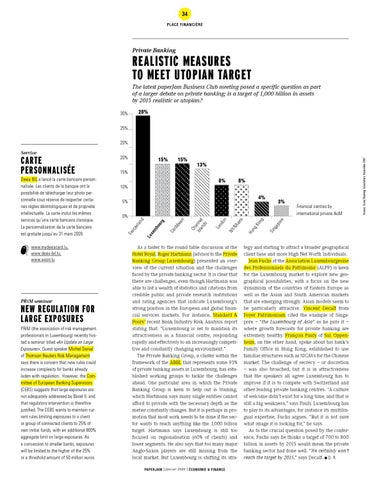
Realistic measures to meet utopian target The latest paperJam Business Club meeting posed a specific question as part of a larger debate on private banking; is a target of 1,000 billion in assets by 2015 realistic or utopian? 28%
30% 25%
www.mydexiacard.lu, www.dexia-bil.lu, www.axion.lu
PRiM seminar
New regulation for large exposures PRiM (the association of risk management professionals in Luxembourg) recently hosted a seminar titled «An Update on Large Exposures». Guest speaker Michel Dorval of Thomson Reuters Risk Management says there is concern that new rules could increase complexity for banks already laden with regulation. However, the Committee of European Banking Supervisors (CEBS) suggests that large exposures are not adequately addressed by Basel II, and that regulatory intervention is therefore justified. The CEBS wants to maintain current rules limiting exposures to a client or group of connected clients to 25% of own initial funds, with an additional 800% aggregate limit on large exposures. As a concession to smaller banks, exposures will be limited to the higher of the 25% or a threshold amount of 50 million euros.
15%
15%
13%
15%
8%
8%
10%
4%
5%
3%
Sin
ga
po
re
g Ho
ng
Ko n
i
on
iam /M NY
nd Lo
Ch a Isl nne an l ds
an be rib
ou mb xe
Financial centres by international private AuM
Lu
Ca
rg
d
0% an
Dexia BIL a lancé la carte bancaire personnalisée. Les clients de la banque ont la possibilité de télécharger leur photo personnelle sous réserve de respecter certaines règles déontologiques et de propriété intellectuelle. La carte inclut les mêmes services qu’une carte bancaire classique. La personnalisation de la carte bancaire est gratuite jusqu’au 31 mars 2009.
20%
itz erl
Carte personnalisée
Sw
Service
As a taster to the round table discussion at the Hotel Royal, Roger Hartmann (advisor to the Private Banking Group Luxembourg) presented an overview of the current situation and the challenges faced by the private banking sector. It is clear that there are challenges, even though Hartmann was able to list a wealth of statistics and citations from credible public and private research institutions and rating agencies that indicate Luxembourg’s strong position in the European and global financial services markets. For instance, Standard & Poors’ recent Bank Industry Risk Analysis report stating that: “Luxembourg is set to maintain its attractiveness as a financial centre, responding rapidly and effectively to an increasingly competitive and constantly changing environment.” The Private Banking Group, a cluster within the framework of the ABBL that represents some 95% of private banking assets in Luxembourg, has established working groups to tackle the challenges ahead. One particular area in which the Private Banking Group is keen to help out is training, which Hartmann says many single entities cannot afford to provide with the necessary depth as the metier constantly changes. But it is perhaps in promotion that most work needs to be done if the sector wants to reach anything like the 1,000 billion target. Hartmann says Luxembourg is still too focused on regionalisation (60% of clients) and lower segments. He also says that too many major Anglo-Saxon players are still missing from the local market. But Luxembourg is shifting its strapaperjam | Janvier 2009 | ÉconomIE & Finance
tegy and starting to attract a broader geographical client base and more High Net Worth Individuals. Jean Fuchs of the Association Luxembourgeoise des Professionnels du Patrimoine (ALPP) is keen for the Luxembourg market to explore new geographical possibilities, with a focus on the new dynamism of the countries of Eastern Europe as well as the Asian and South American markets that are emerging strongly. Asian models seem to be particularly attractive. Vincent Decalf from Foyer Patrimonium cited the example of Singapore – “the Luxembourg of Asia” as he puts it – where growth forecasts for private banking are extremely healthy. François Pauly of Sal. Oppenheim, on the other hand, spoke about his bank’s Family Office in Hong Kong, established to use familiar structures such as SICAVs for the Chinese market. The challenge of secrecy – or discretion – was also broached, but it is in attractiveness that the speakers all agree Luxembourg has to improve if it is to compete with Switzerland and other leading private banking centres. “A culture of welcome didn’t exist for a long time, and that is still a big weakness,” says Pauly. Luxembourg has to play to its advantages, for instance its multilingual expertise, Fuchs argues. “But it is not sure what image it is looking for,” he says. As to the crucial question posed by the conference, Fuchs says he thinks a target of 700 to 800 billion in assets by 2015 would mean the private banking sector had done well. “We certainly won’t reach the target by 2015,” says Decalf. D. R.
Source: Swiss Banking Association, December 2007
20%