Interview
Trina Bediako, CEO, New Horizons Baking Co “We are all in the people business”
Cooling and freezing
This vacuum is everything
Water in baking
The most underestimated ingredient





Interview
Trina Bediako, CEO, New Horizons Baking Co “We are all in the people business”
Cooling and freezing
This vacuum is everything
Water in baking
The most underestimated ingredient

Catalina Mihu, Editor-in-chief
Your commments or suggestions are always appreciated: e-mail: mihu@foodmultimedia.de
In the next few years, everyday social rituals will increasingly erode, leading to a decline in genuine human connection. Every day social interactions will fade; exchanges about small events in the city, from the Uber driver, will become scarce. Flavor or style advice from a salesperson will no longer be a part of our everyday, and even necessary conversations, such as health recommendations from a physician, will increasingly move into the digital space.
This deficit creates an opportunity for brands to establish a liaison and even be the connection symbol (just think pizza! On this topic, we’ve collected some new, interesting developments in this issue). Mintel highlights solitude and self-care as some of next year’s defining consumer trends, as it concludes, simply, that, “Genuine human connection will become a luxury”. Loneliness, usually observed in older generations, is creeping in on younger people, too – a paradox of today’s social-media-driven hyperconnectivity. Mintel named this opportunity, ‘The rise of the singles’, a trend it sees in several European countries.
Brands are beginning to respond to the need for connection through various campaigns and initiatives that either facilitate human interaction or acknowledge the new consumer priorities, the researcher observes. Both strategies offer opportunities: interacting with an AI chat or digital platform offers great convenience and privacy; but, providing the choice for consumers to also easily connect with people for services and to feel that they belong to a community is smart (and comprehensive) marketing.
As the consumer identities and worldviews shift, our industry thankfully remains a close-knit community. Especially after two years of imposed isolation, connections have become more meaningful, in-between and within organizations. New Horizons Baking Co, for instance, has crystallized its company culture around its people and how they work together. In an organization with an effective culture, people and business units are aligned. Trust is strong. People communicate, collaborate, and solve problems. They innovate, manage change, and pursue continuous improvement. They produce superior results,’ the Northwalk, Ohiobased bakery underlines in its culture playbook. An interview with Trina Bediako, New Horizons’ CEO, is featured in this issue, a truly interesting conversation in our series highlighting women in leadership roles in our industry. “We work in the people business,” she acknowledges.
As we are approaching the time of the year when people traditionally come together as a family, group, community, or same-belief tribe, I would like to wish everyone, on behalf our our team at f2m, a joyful holiday season, with meaningful interactions and laughter, and an excellent start to 2026. Happy New Year, everyone!
Catalina Mihu

”WE ARE ALL IN THE PEOPLE BUSINESS”
Trina Bediako is the CEO and second-generation head of New Horizons Baking Co, a family-owned business since 1995. She has been working in the industry for 23 years and is now spearheading her company on an accelerated growth path, with a new bakery built this year.
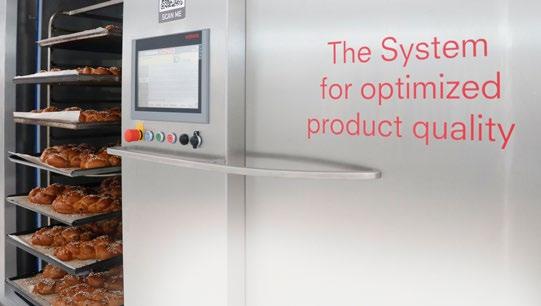
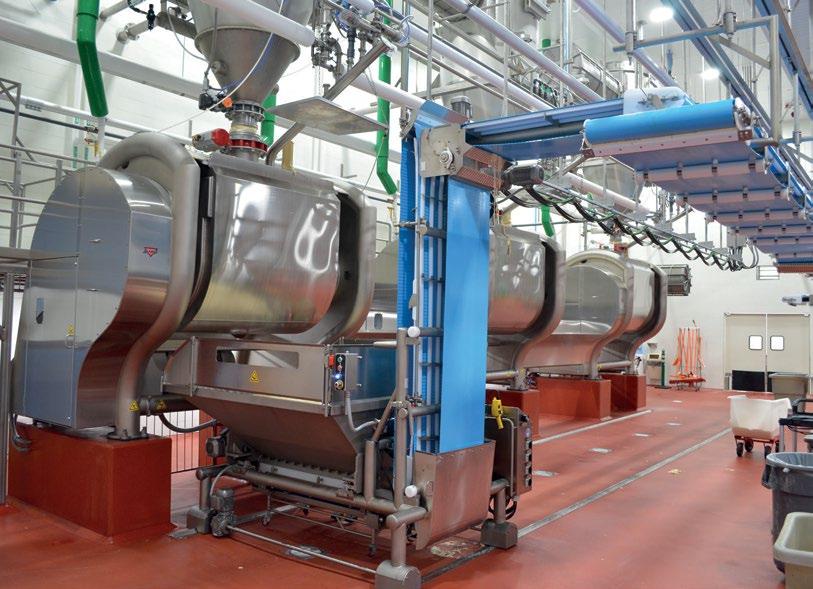
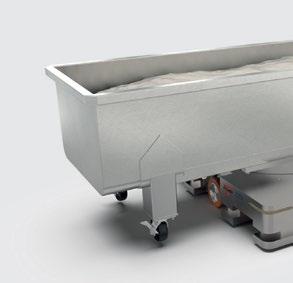
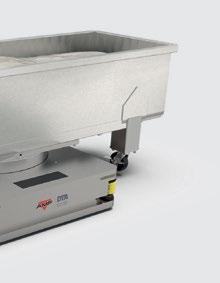
A vacuum may usually be understood as a space entirely devoid of any matter, but it’s quite the opposite of emptiness when it comes to vacuum technology in bakery. What remains, in this case, is the perfectly baked and cooled bread and snack, ready to eat, with considerably improved properties – achieved in a fraction of the time and energy.

WATER IN BAKING: THE MOST UNDERESTIMATED INGREDIENT
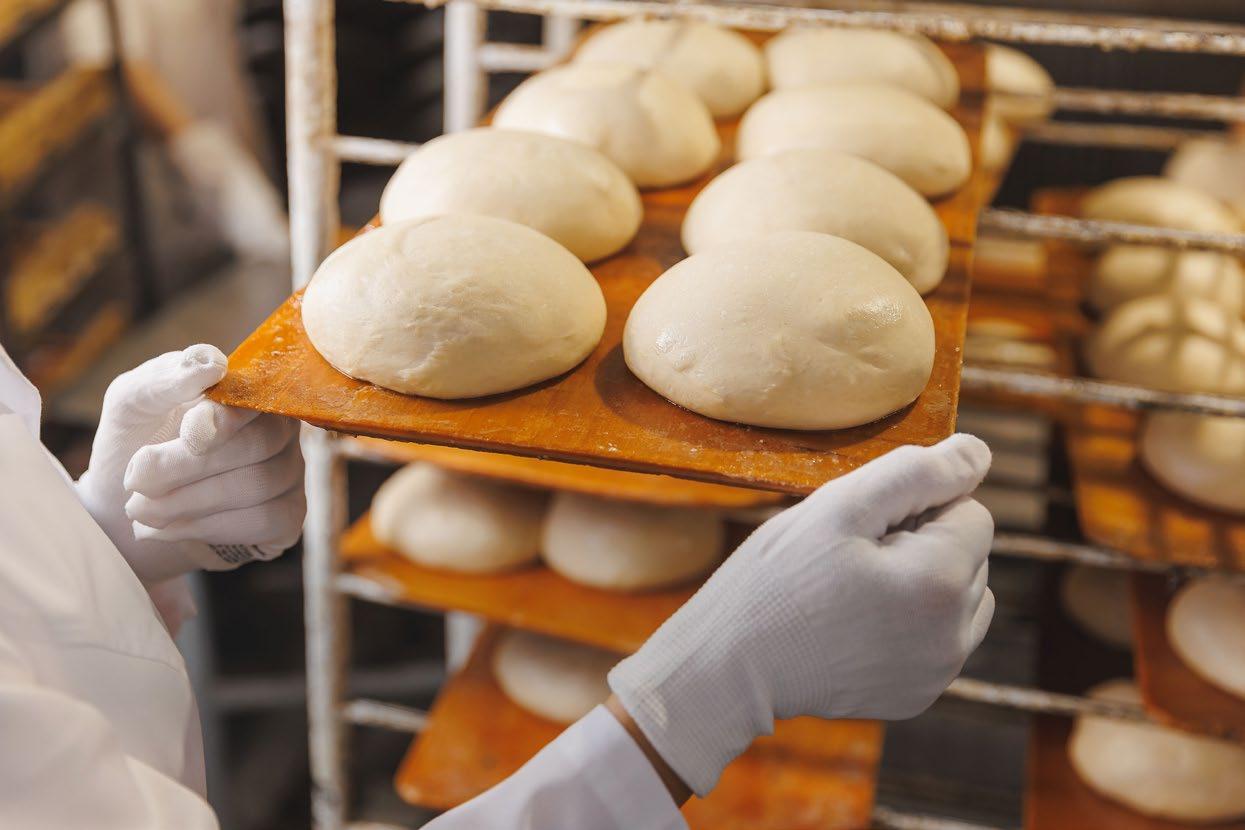
For most consumers, bread is ‘flour, yeast, salt’. Professionals know better: between 50%-60 % of a bread dough, by mass, is water.
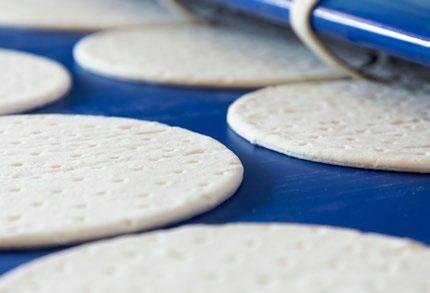
Successful launches and production efficiency rely on automated systems. For industrial pizza production, Swiss specialist RONDO developed the ASTec Pizza Line for 24/7 operations, for big to even bigger production setups.
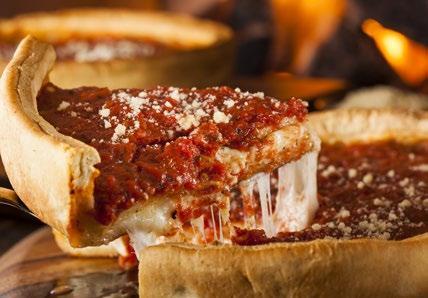
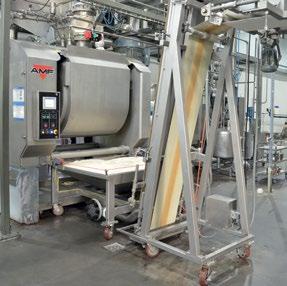
AMF’s pizza production systems can process either cut, molded, or pressed pizza, in any shape and size, according to this extensive, case-by-case research.
THREE COMMON MISCONCEPTIONS ABOUT CLEANING AND SANITATION
And how you can address them at your facility.
WOMEN IN LEADERSHIP ROLES
06 Trina Bediako, CEO, New Horizons Baking Co: “We are all in the people business” PIZZA, PART I
14 RONDO: Pizza, any way you like it!
16 AMF Bakery Systems: Pizza perfect PASTRIES
20 HUG Bakery, Switzerland: “We create convenience”
COOLING AND FREEZING
24 KOENIG: This vacuum is everything
HYGIENE, SAFETY
28 Ecolab: Three common misconceptions about cleaning and sanitation SCIENCE
32 Grainar: Water in baking: the most underestimated ingredient
38 CSM Ingredients: Reformulation, for better or even better


Trina Bediako is the CEO and second-generation head of New Horizons Baking Co, a family-owned business since 1995. She has been working in the industry for 23 years and is now spearheading her company on an accelerated growth path, with a new bakery built this year.

“Define and know your purpose. Why in the world are you doing this every day? If you’re here each and every day, you need to be clear about why you’re here and know your worth, know your true value, because if you do not, no one else will. And be bold enough to express it and understand that everybody may not like it all the time, but it’s important that you live it, exemplify it, and keep your head up about it.”
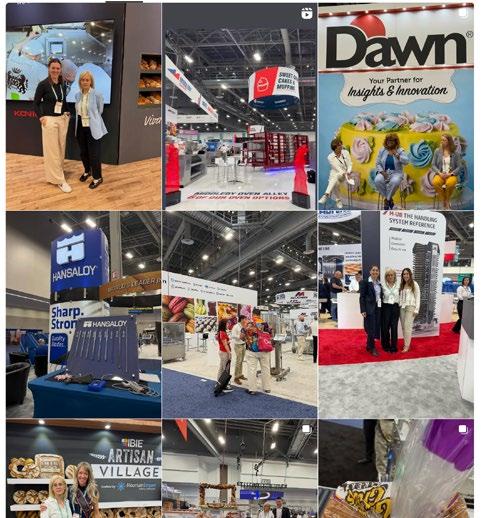
+ The moment you hear Trina Bediako speak, you feel compelled to meet her and learn about her experiences, the people she leads at New Horizons Baking Co, and her perspective on the baking business. She graciously granted BBI an interview moments after I first heard her speak, at Dawn Foods’ women's networking event, organized at IBIE.
“We are all in the people business,” she told the audience at the panel. “The president of my company and I have a joke that says, we wish we could just make buns and muffins, right? It would be so much easier. But we need people to do that, and we’ve got to take care of them. And as leaders, I’ve learned that who we are is how we lead, and the importance of being self-aware.”
Always New Horizons: “Our biggest growth has occurred under my leadership”
Catalina Mihu: Thank you for joining an impromptu conversation! After hearing your presentation, I would love to learn more about your journey in bakery.
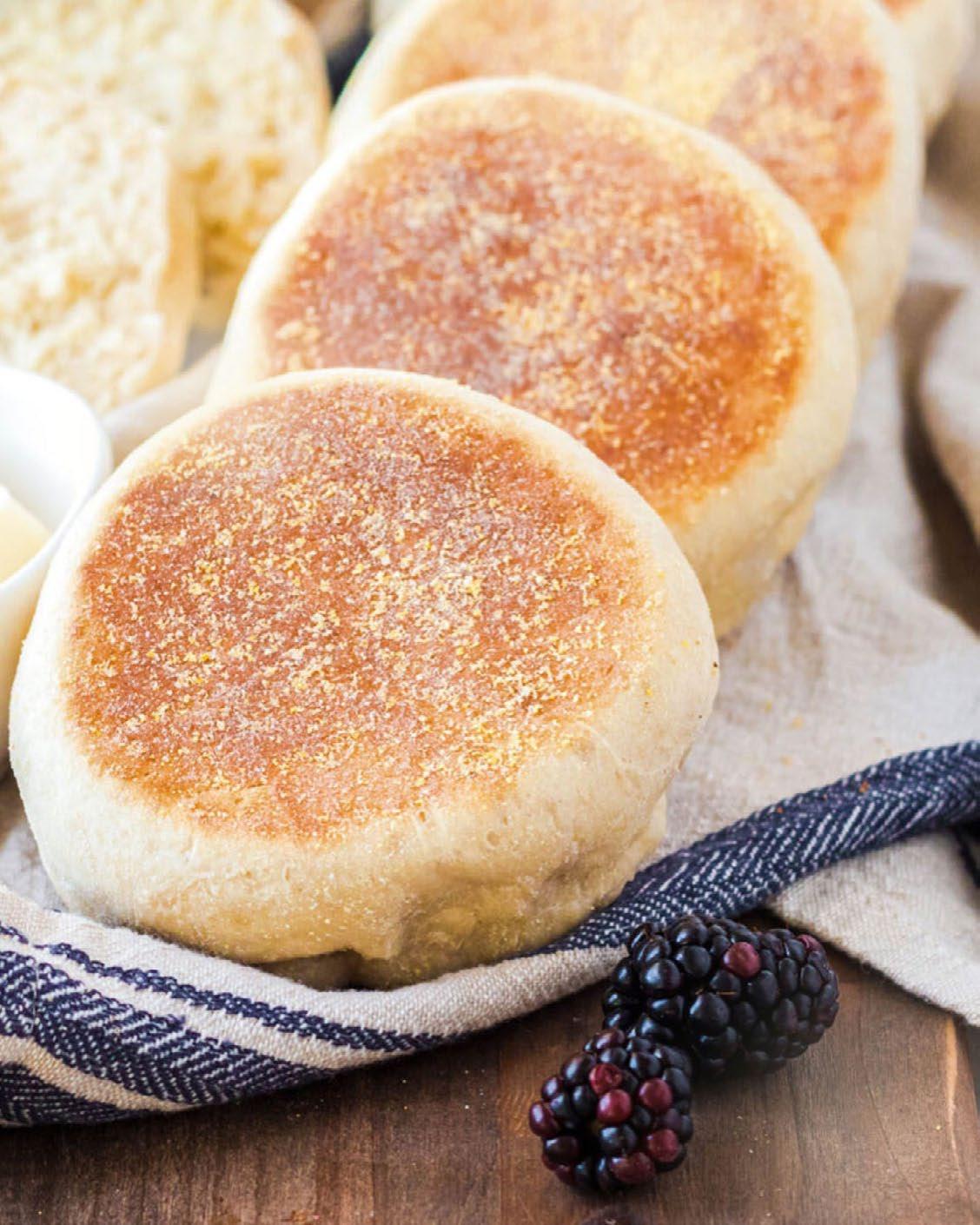
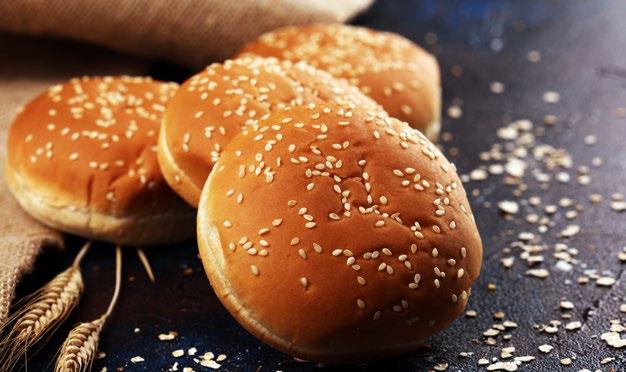
Trina Bediako: New Horizons Baking Co produces hamburger buns and English muffins. That's our primary focus. We have customers such as McDonald’s and Starbucks and Dunkin’.
My father, Tim Brown, has 60 years in the industry. He started out with a company called Continental Bread, which produced the Wonder Bread brand in Buffalo, New York. He was a route salesman and a hard worker. Along the way, people supported his growth, so he got promoted often, which meant that I lived in a different state every major grade because he kept accepting new and bigger positions. He was a supervisor, sales manager, general manager, regional sales manager, regional vice president, corporate vice president, and director of sales at Continental Baking Company. That was my first ‘footprint’, watching him work hard, not denying an opportunity, putting God first and always taking care of the family, while pushing forward.
My father worked for Continental Baking for 30 years; when he took an early retirement in ’95, he purchased two McDonald’s bakeries, one in Indiana and one in Ohio, with two partners. He had the least equity, but he ran the business. And McDonald’s wanted more minority suppliers. The plan was always for our family to buy out the other partners, which we did.
I’ve spent the first 16 years learning the business, working with him, and learning all the departments, since my background was in telecommunications. I didn’t know anything about bakery. In 2002, when I started at New Horizons, there

were two bakeries, 185 employees, and three production lines. And 95% of our business was McDonald’s. Today, 23 years later, there are five facilities, over 750 people working here, and about 16 different production lines. In the past seven years, I’ve been in the most senior positions, president , COO and now CEO. Today, we have four vertical business units: we have bakeries that produce just for McDonald’s and bakeries that produce for other customers, like Starbucks and Dunkin’, Great Value, Walmart and Pepperidge Farm. We also have a transportation company that delivers a portion of our business. And we have two acquisitions – two ingredient companies that specialize in dry ingredients and liquid ingredients. The acquisitions were made under my leadership. And our biggest growth has occurred under my leadership.
“As leaders, I’ve learned that who we are is how we lead, and the importance of being self-aware.”
Trina Bediako, CEO, New Horizons Baking Co
My father took a step back from the business in 2014, when my mother passed. He hired someone else to run the business: a man that we knew, a smart businessman, but he was not a baker. He was a banker. In 2017, my father gave me an opportunity to step up. At that time, we had some financial challenges, and I had to build a team. At one point within my first year, three of my executives left.
Mihu: What was your position in the company at that time?
Bediako: I was president, navigating a tough time. I became the COO also because the COO left. And they each left for different reasons, but it’s hard not to look at yourself and consider why the people around you choose to leave. Since

then, two of them have come back to the company, and the third wanted to, but we didn't have a position available. Over the last five years, we’ve grown exponentially. And we’re not stopping: in the last 18 months, we’ve added two facilities to our business. One joined through the acquisition of the dry and liquid ingredient companies –Coalescence NHB and Graffiti Foods, which we put under one roof, and rebranded. Instead of two separate companies, they are now New Horizons Food Solutions, with customers such as McCormick and Kellogg’s, for dry products like pepper and sugar packets, energy drinks and vitamixes. It makes liquid ingredients such as liquid soups, sauces and dips, and ingredients used in bakeries, from mixes to seasonings and inclusions. It’s running well! We also added a new bakery – a 155,000 square feet facility with a high-speed hamburger bun line that produces 8,000 dozen buns an hour. By comparison, it is a couple thousand dozen per hour bigger than many of our bakery counterparts. This big line started producing products in March of this year. In that same building, we have a frozen pancake line for Jimmy Dean breakfast pancake sandwiches. We make blueberry and maple bits pancakes that are made into breakfast sandwiches. It has an inline freezer, the coolest equipment! It’s exciting. Both new businesses are in Columbus, Ohio.
Mihu: How do the family values drive this growth?
Bediako: My father, who is now 80 years old and lives here, in Las Vegas, is still on board as an advisor and can see how we continue his legacy into the second generation and beyond. We run the company in a way that allows him to enjoy his retirement comfortably, but he stays connected to the company and is active in the strategy planning. He visits each facility annually. Two of my three adult children
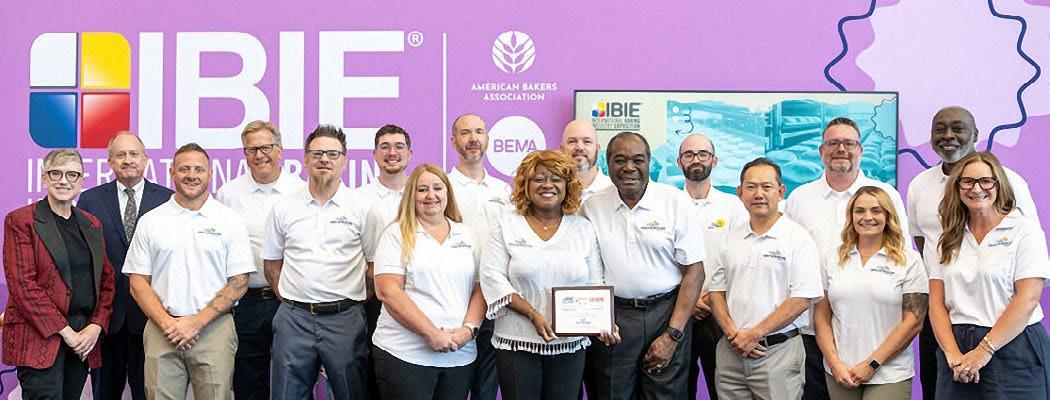
also work for the business. As a family, we are always looking at what’s the next step for us.
I am grateful to be in this role, and I'm grateful to have organizations and support from the industry – and from people like you. It means a lot for me to be in this role, which allows me to make a difference in places that may not have received proper attention, and I take my responsibility seriously.
Mihu: Having started from a point where the company was struggling, what was the first thing that you did to start turning things around? What did your initial plan look like? Bediako: The first thing I did was get a good team, because the truth is that no leader does it alone! I picked people who were diverse in skill set, experience, gender and age, because people bring their experiences to the table. I needed a strong team because I’m not the finance person, for instance; so I needed a CFO I could entrust with the role. As a leader, you’ve got to have great people around you, but you need to understand what they’re each doing; because if you don’t understand that, you can be easily led astray and have your business suffer for it. Spending time with people who understand the things that aren’t in your field of specialty helps. And asking questions helps – you can’t be afraid to ask questions, even if people don’t always like that. If they get uncomfortable, I explain to them that my questions are not because I don’t trust them, but because I want to understand what happens in my business. I don’t have to know it all, but I have to have a good sense of it. And I’m grateful that I have a good awareness of it. The company has been growing fast, and we have multiple locations, so I don’t see everybody who gets hired; but, when I know someone has recently joined, I want to know who they are, I want to know who is running my business. I will set up a one-on-one so I can just say hello, talk with them and get a feel for their personality and intent, see their face, and make a first impression. So, setting up the team was the most important thing. Getting to know our stakeholders was very important, too. When I
first became President of the company, I heard things like: ‘she’s green’, ‘she doesn’t really know what she is doing’, or ‘she’s just Tim's daughter’ – not ‘Trina, the leader of the company’.
Mihu: And what does your role feel like now?
Bediako: At the end of the day, my dad can relax in Vegas because he looks at the numbers every month and there’s money in the bank, and there’s financial growth, and there’s a panel or two, or an article that says you’re doing well. When he comes to a convention like this, and someone says, ‘I saw your daughter’, he can feel there’s a growing and well-maintained legacy. I’m the oldest of three children. Both of my siblings have worked for the company at different times. If I do well, if we do well, this could go on for as long as we choose.
“In 2002, when I started at New Horizons, there were two bakeries, 185 employees, and three production lines. And 95% of our business was McDonald’s. Today, 23 years later, there are five facilities, over 750 people working here, and about 16 different production lines.”
Trina Bediako,
CEO, New Horizons Baking Co
Have you heard the phrase old money and new money? We don’t come from a wealthy family. We’re just honest, hardworking people who have been blessed and were fortunate to make a bit of a mark. And we’ll continue to do that. I want that to be available for my children, my nieces and nephews , my grandchildren and the family generations I will never know.
Equally important, whenever I leave the company, I want my employees to be better off than when I came. And when they retire, I want them to have 401k and money in the
bank. I don’t want them to have to get a second job after retirement because they didn’t manage. To support them, we teach them about managing their finances. We try to bring a lot to the table so that people can live balanced lives. It’s all about the people being responsible for the task they are entrusted with.
This applies to everyone, including the people hired now, in leadership roles. Yes, I need you to be strong in operations, and you must know how to lead, but you’ve got to be able to listen to people, direct them and teach them. Everything has grown much more complex over the years, because the industry has changed, the workforce is different, so we also have to look at it through a different lens.
Mihu: You don’t want to be perceived as just your father’s daughter. How do you want to be seen?
Bediako: I say that carefully. I don’t want that to be the title before my name. I love my father and I wouldn’t be here without him giving me an opportunity, but I want to be recognized for what I bring to the table and I believe that, today, I am. But, part of that had to come with me acknowledging something: here is what I accomplished, and here is proof. And then keep pushing.
Mihu: You mentioned that finance wasn’t your strong suit when you joined. What skill set do you think helped you to get to where you are now?
Bediako: I am flexible; I can deal with change, and I care about people. The business is important to me. I am a bit of an overachiever, so I work hard. I'm committed. And when I came to the business, 23 years ago, I was a young mother with three children, married. I didn't know anything about baking. But I always try to give my best to anything that's in front of me. And over the years, the industry has become mine. I’m a leader, an organizer and a planner. Sometimes, I overextend all these things. But my dad gave me an opportunity. This is my family business. I have to represent it well.
Mihu: It only starts to be a family business when the second generation joins in, right?
Bediako: It starts building with the second, and it gets really complicated with the third and fourth, I think. I have two siblings I love, but we all have different feelings about the business, and we have different roles and different levels of commitment, and that’s okay. I tell this to my family members all the time. You don’t have to be in the
family business. If you don’t want to, if it’s not your thing, that’s okay. I have three children. Two of them work for the company. The third, my daughter, lives in California, and she’s married and happy where she is. She doesn’t want to be a part of the business and that’s fine. But if you do work for the company, you’ve got to bring it. You’ve got to be in 100%. And that’s where it feels complicated right now, when family members might want to come in because they think it's something that they are entitled to and not necessarily earned. They must earn it. My dad made me work for 16 years before we’d even talk about me being president. And the truth was, I wasn’t ready before that. But I wanted that role and I made certain he knew it!
Mihu: Did you feel you weren't ready?
Trina Bediako, New Horizons Baking Co
Trina Bediako is the CEO of NHB Holdings LLC and its subsidiaries. She is the second-generation owner of the company. Her father, Tim Brown, serves as the Chairman. The Brown family has owned the business for 30 years and Trina Bediako is committed to its success and legacy. During her 23 years as an NHB employee, she has served in several corporate positions, including Director of Human Resources, Vice President of Sales, President, and now CEO. In her current position, Bediako manages all the initiatives and programs related to Sales, Quality and Operations. She has led the management team through recordbreaking growth and earnings.
Bediako completed undergraduate studies at the University of Connecticut with a major in Marketing and a minor in Spanish. She has received manufacturing and business training at the American Institute of Baking (AIB), Kellogg School of Management, and Wharton School of Business. She currently serves on the following boards: Ronald McDonald House Charities, American Bakers Association, McDonald’s U.S. Supplier Advisory Council, McDonald’s Bakery Council, the McDonald’s Supplier Network, and the Huntington Bank Cleveland Advisory Board. Accolades – In 2021, Trina Bediako received the Ernst & Young
Bediako: By the time I got to the 16th year, I was ready. But leading up to it, I thought I could do this because I wanted to do this. Well, no, there’s so much to learn before you can actually lead the business. So in our family, we talk about it, to understand everyone’s expectations. And then, your work proves who you are. You don’t have to walk around and say you’re the owner. You don’t have to act like you’re better than everyone. Do the work, and no one can deny your worth.
Mihu: But all the hard work can often still go unrecognized. Especially so for women.
Bediako: There are all sorts of levels of recognition, but it starts with you. Did I do a good job? Did I do my best? Does it make a difference? And is there proof? How do I know these answers? The company’s grown. There’s more money
Entrepreneur of the Year Regional Award for Michigan and Northwest Ohio; Women Presidents Organizations' 50 Fastest Women Led Businesses Award in 2024; and in 2025, the YWCA Women of Achievement Award, and the Huntington Bank Smart Woman Award.
The New Horizons Baking Family
New Horizons is a female-led, minority-owned company with a diverse workforce, family-owned since 1995. The strong relationships this team has fostered have solidified our reputation as a highly ethical company that adds value with customers, suppliers, industry associations, and other bakers.
Part of the NHB family of companies, New Horizons Baking Co produces soft sandwich buns and English Muffins for the world’s most recognizable quick service restaurants. New Horizons serves an expanding market of over 2,000 restaurants across Ohio, Kentucky, Indiana, Michigan, and western Pennsylvania, US. Genesis Baking Company, also part of the NHB Family of Brands, produces custom English muffins and soft rolls.
The NHB provides baked goods, foods, blends, mixes, and formulations – all backed by a team of experts and food scientists and industry innovators.

in the bank. My employees are satisfied. The customers are happy. I did a good job. As for general recognition, it would be nice if it was given more freely, but guess what? I did a good job, regardless. All you can do is keep going. The more we want from others, the more disappointed we may be.
Mihu: What was your first role when you joined, and what was the moment when you realized you loved the industry and you wanted to grow in it?
Bediako: I started in human resources. And for me, that was good because I got to learn about each facility and I got to meet the people right away. When did the needle turn? When I became president and started to have a seat at the table, to make decisions and then see those decisions bring positive results. That’s when it started to ‘click’. Now, I just can’t imagine it not being a part of my life. There must be a balance, though. My husband works for the company, two of my children work for the company, my brother, and a sister-in-law; we have to remember to have a relationship balance. When I come home from work, we don’t talk about the business at dinner. My husband and I don’t even ride to work together so that we can give each other brain space. It’s the same with my children; I can’t be everywhere all the time, but I have faith, I have a good sense of what’s going and where.
When I don’t understand something, that’s when I start asking my questions. Because I’m a leader and I call myself an active CEO. I am not just a pretty face. I’m not just Tim's daughter. I’m not just going to sit around and show up for interviews. I'm making a change. I’m making decisions. I provide the vision and I provide all I can to my team to execute. I’m not confused. On occasion, I’ll poke into a department when I think something’s not right and get involved to help find a solution (and not to point any fingers). If you don’t want me poking around your department, then you need to manage it a little better (she smiles).
Mihu: What does it take for you to start to look into more details around different departments?
Bediako: I have strong department heads and leaders and I let them lead. I make my vision clear and allow them to lead. So, it’s not about micromanaging. In my role, I have to be able to see that things are moving as they should. Women, we have rights! You have the right to speak up if you want to express your opinion; you have the right to disagree, and manage with logic, not emotions.
Mihu: What would you consider your hardest professional ‘battle’, as a woman?
Bediako: I try not to focus too much on the stereotypes we could get caught up in. I am a black woman, yes. It’s what I've always been. I work hard and I’m a businesswoman. That’s worth remembering more. The industry is male-dominated; it’s white male-dominated. I respect that, but it doesn’t deter or intimidate me.
From my perspective, it’s about doing the work, and making a difference – to be seen. Some acknowledge it and some don’t. But I can say I’ve given my best. That has got to mean something. We have to value ourselves. Yes, it’s hard, and so what? Don’t spend a whole bunch of time talking about how hard it is. Move on and do your best. Be a Mentor. Have a Mentor – male and female. Get to know other women. Join peer groups. Talk to people you can trust. Your performance proves who you are.
Mihu: How do you assess when and what is a good opportunity for growth? How did New Horizons, as a supplier to a single company (McDonald’s), grow its network, for example?
Bediako: We knew that it didn’t make a lot of sense to only have one customer, to have all the buns in one basket. When I first came on board, McDonald’s had a bakery council of about 12 US bakers, all family-owned businesses. Now, probably half of them are private equity owners. Things are changing. So we’re always looking to see what's next. For example, Tyson Foods, who was already a customer of ours for English muffins, asked if we could produce pancakes for them. We had never produced pancakes before, but we learned. We researched and figured that the process was similar to English muffins. We worked together as a team on this project and now we’re making beautiful pancakes for them.
Mihu: What did that mean for you? Did you need to hire new people, invest in new equipment?
Bediako: All of that. We had to buy a new facility; it’s a multi-million dollar project. It’s a different process, which includes an inline freezer, since the product is frozen before it’s packaged, whereas buns and muffins are first packaged and then frozen. The equipment includes a unit counter to ensure that 230 pieces of frozen pancakes go in each box. There are a lot of great technologies there. Before any of these, we put down a business plan, of course, and assessed the costs and revenues.
With a new bun line and the pancake line installed, we’re on an accelerated growth path for the rest of the year. It’s about continuous improvement.
In 2025, New Horizons Baking Co opened its fourth bakery in Columbus, a 155,000 sq ft production facility. A high-speed bun production line was installed at the new location, followed by the company’s first pancake line.
The technology line-up at the new facility includes:
+ An air management glycol system, and a heat recovery system
+ AMF Bakery Systems mixing, makeup, proofer, oven, packaging equipment
+ A Campbell Systems dust collection solution
+ A Capway depanner
+ Fred D. Pfening Co. ingredient handling technology and silos
+ A Newsmith pan cleaner
+ Spraying Systems – glaze spraying system
The pancake line comprises:
+ CPM griddle
+ FPS freezer
+ Pattyn case packing
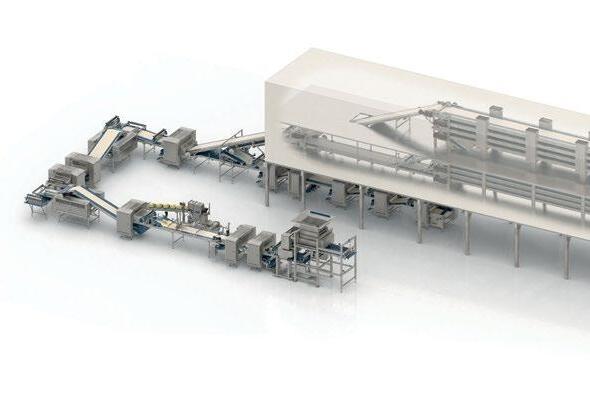
+ Rademaker system integration
That being said, my vision cannot outgrow my staff skills. I can’t just keep throwing new things at them. It’s unfair and not sustainable. So we continue training them. We created a people engagement team, a group of four people who assess the training needs, department by department. They help facilitate the culture, provide the resources, so people can get what they need to receive the change. We’ve adjusted working schedules, too. In one of our facilities, for example, people work 10-hour shifts, four days a week. Our corporate office does three 12-hour shifts, so 36 hours, and they are off four days. That has increased productivity and improved morale. When my father worked, they had six- to seven-day work weeks. That doesn’t work anymore. We listened to the people and met them where they are. Alternative scheduling has been well received and successful.
Mihu: What’s next? And how do you prepare for scenarios where the environment might not support growth?
Bediako: Growth is not just optimism; there’s also a lot of cautiousness involved. We take a degree of calculated risk, of course. COVID taught us that you just can’t sit around and wait, though. We’ll assess the risk, but we have to grow, so I’m not afraid of taking controlled, educated risks. And you’re also limited by how much profit you have and by what the banks will support. So if I can't afford plan A, then I need to do something different – sell, sell, sell!
Mihu: How is your leadership style compared to that of your father?
Bediako: He’s more risk-averse. And although he has a wonderful personality and is so good with people, the business has forced us to be more attuned on a different
level, and to identify the changes in the food industry. That’s part of the reason we acquired an ingredient company. It’s food manufacturing, but it isn’t bread: everything you eat has to have a flavor. And the world is not just round and brown hamburgers anymore. People’s palates have changed. They’re eating differently. It’s spices and seasonings now, and we wanted be a part of it, so we had to get involved.
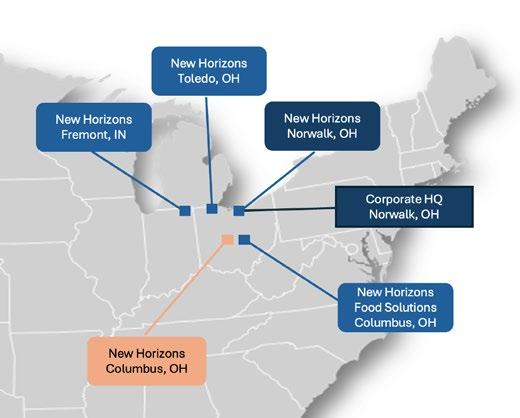
Mihu: What does your production facility map look like today?
Bediako: We have facilities in Ohio and Indiana: one in Norwalk, Ohio, Toledo, Ohio, two in Columbus, Ohio, and one in Fremont, Indiana. We manufacture our McDonald’s products as far north as Brampton, Ontario, and all the way down the East Coast to Georgia. And for our non-McDonald’s ranges, they are produced all the way to the West Coast. My home, my corporate office is in Norwalk, Ohio. I travel to our offices; I need to make sure they’re working well. I just love the progress. I love the growth. We were around a USD 30 million business when I came in. It's now grown to USD 200 million. We went from two facilities to five and from 185 employees to over 750. There’s been a lot of growth, and it's been controlled growth.
Mihu: Are you considering expanding your portfolio?
Bediako: Maybe, but it has to be the right product at the right time. We’re all about growth; it’s the right thing to continue in business. Inflation tells you clearly that you’d better be growing if you want to be able to pay your bills. We don’t deny this in any way; on the contrary, we totally agree with it!
Mihu: Thank you for a very inspiring conversation! +++
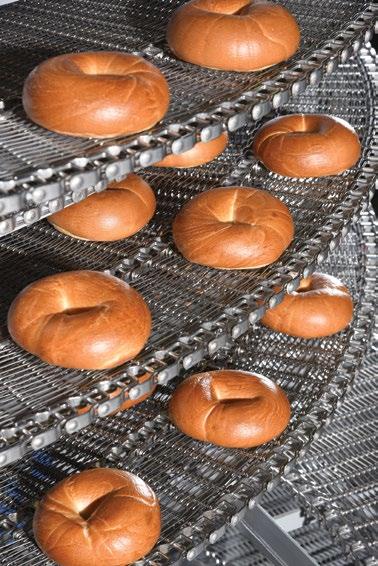

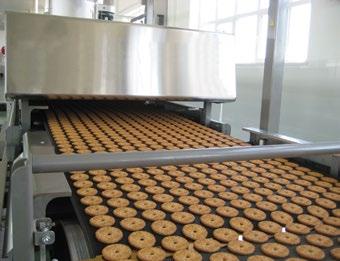
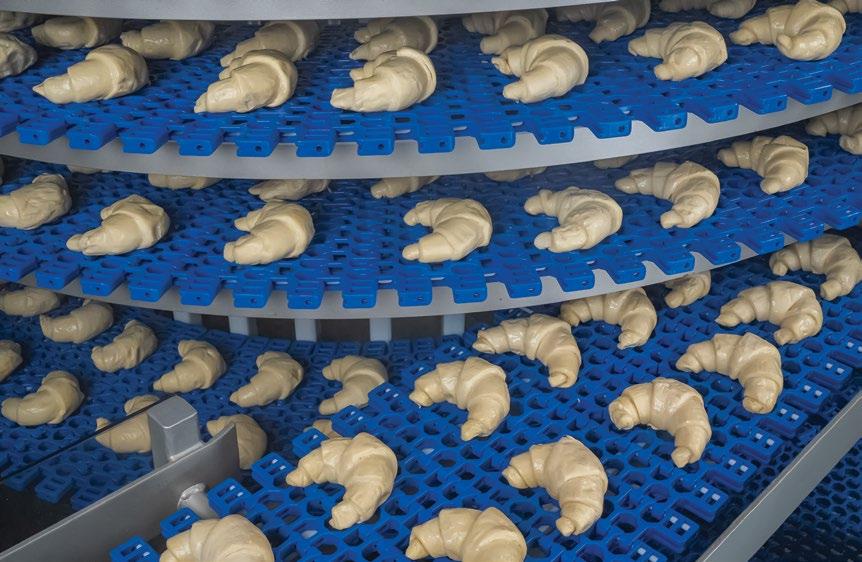
DEPENDABLE BELTS FOR CONSISTENT PERFORMANCE
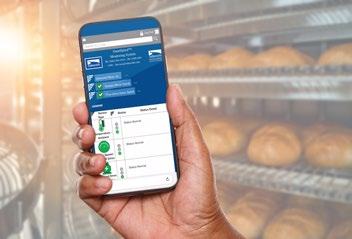
SMARTSPIRAL
Take the downtime out of production with real-time spiral performance monitoring.
Ashworth Factory Service experts for installation, troubleshooting, and maintenance of your belting system.
LEARN HOW WE CAN HELP SCAN THE CODE
A beloved staple for eating out and at-home ordering, pizza is moving with the times. And so is the entire manufacturing process behind each fresh-out-of-the-oven slice.

+The worldwide pizza market size was worth USD 272.40 billion in 2024. It is expected to grow to USD 282.91 billion by the end of 2025 and reach USD 409.50 billion by 2032. While North America is the established driver of this growth (with a market share of 38.83% in 2024, according to research by Fortune Business Insights), American-style pizza is only one in a multitude of exciting offerings that speak to consumers around the globe.
Pizza offerings are very much attuned to the times as product innovation reflects today’s favorites. There’s a pizza product for everyone’s taste buds, diet needs and values: from pizza to pinsa, vegetarian and vegan to gluten-free, locallysourced and ethically-produced, from the evergreen flavors to gourmet, unusual and conversation-sparking varieties, frozen or ready to eat, with all kinds of crusts.
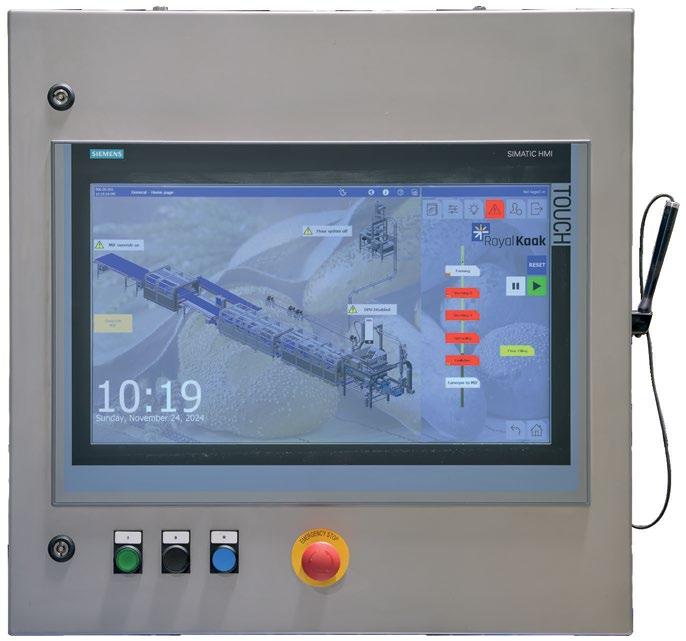
This growing popularity spells opportunity for pizza makers. For successful launches and production efficiency, they rely on automated systems. For industrial pizza production, Swiss specialist RONDO developed the ASTec Pizza Line for 24/7 operations, for big to even bigger production setups – in terms of volume as well as product diversity. It can make not only different pizza products, but also all sorts of pizza snacks, pizza baguettes and more. The possible product range includes round, oval and square pizza, focaccia, pinsa, pressed pizza and calzone – all with unique dough recipes, including gluten-free. RONDO observes three dominant industry trends in pizza making today: increased production capacity, artisanal quality, and – last but not least - the growing popularity of pinsa ranges.
Automation for optimized efficiency is built in: designed for flexible and easy operation in industrial environments, this line dedicated to pizza production guides the operator via its HMI by clearly indicating which tools to use and at
which station to install them. In this way, a smooth and accurate configuration is ensured for each product made on the line. For convenience, the ASTec Pizza focuses on providing maximum support to operators during product changeovers. “The main assistance comes from the HMI, which allows users to save an unlimited number of recipes. With a single click, all line parameters, such as speed and thickness, are automatically adjusted to produce the new product,” explains Nicola Zangrande, Product Manager, RONDO.
“This satellite head configuration enables a gentler yet more effective reduction curve, minimizing stress on the dough.”
Nicola
Zangrande, Product Manager, RONDO
The ASTec pizza line range offers various widths, tailored according to specific production and layout demands. In any case, large-volume production is possible: with lines measuring 1,500 mm in width, up to 5 tons of pizza can be produced per hour, for example.
Process optimization is not the only priority for this system. Equally important is hygiene, which is not only built into its design, but it is also part of its name: ASTec stands for ‘Advanced Sanitary Technology’. To match any sanitation protocols, the line can be supplied in both wash-down and dry-cleaning versions. “The washable version is designed to withstand high-pressure water cleaning, ensuring optimal hygiene standards where required,” RONDO highlights. The R&D regularly upgrades the line for improvements in cleaning, sanitation, and ease of use.
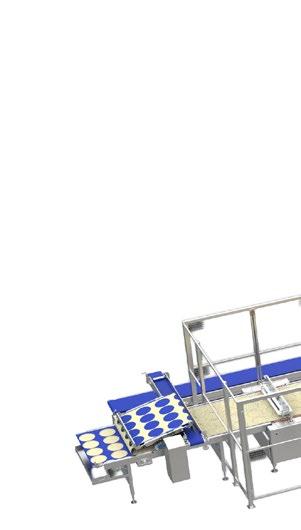
Paired with the MIDOS (Multiple Industrial Dough System), the pizza system forms the dough band without using any flour and oil, as the dough band former also features Advanced Sanitary Technology (ASTec). This design is the latest innovation from RONDO, incorporated in the MIDOS stress-free dough band former. Zangrande explains: “MIDOS can handle pre-proofed doughs, fully preserving the work done during mixing and pre-proofing stages. It also excels with highly hydrated doughs and, depending on the type of flour used, can reach hydration levels of up to 85% (water content).”
The MIDOS’ rollers for processing the dough band are optimized – in both size and positioning. Working with four independently driven rollers, a homogenous dough band is produced gently and consistently, which helps preserve the gluten networks within the dough and control product weight with a high degree of accuracy. For convenience, it is designed to work with any dough feeding system.
Once the dough band is formed, the other machines in the ASTec line take over, adjusting the dough to the desired width and thickness. The satellite unit handles the thickness reduction of the dough sheet, which can be significant. RONDO takes pride in the design of its high-performance satellite unit, which features a head equipped with 16 rollers, each measuring 76 mm in diameter: “This configuration enables a gentler yet more effective reduction curve, minimizing stress on the dough.” The final dough thickness is thoroughly controlled and maintained in the desired size by using multiple calibrators, which are adjusted according to the target thickness and production speed.
The ASTec Pizza Line covers all the bases for the exact pizza base intended: the weight and size of the pizza bases will always be 100% accurate, since each piece is obtained by stamping. Each pie is now ready to receive sauces and toppings. RONDO regularly collaborates with suppliers of equipment for stages before or after the sheeting process, to ensure the ASTec Pizza Line will seamlessly integrate any application/topping units, such as tomato sauce depositors, mozzarella dispensers and any systems that dispense ingredients of various textures and consistencies, which can range from mushrooms, ham, olives, and more (even pineapple). RONDO highlights how the integration works: “All interconnections and synchronization
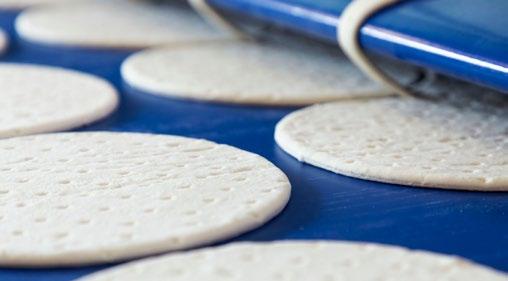
In October 2025, RONDO organized a two-day seminar at its RONDO Dough-how Center in Schio, Italy. The workshop combined theoretical insights with hands-on, practical guides. The differences between sourdough and yeast dough production were analyzed, with a focus on all key processing steps in pizza production. The agenda featured expert-led sessions from a group of process and technology specialists:
+ Pizza technology, Professor Franco Antoniazzi (Parma University)
+ Mixing process
+ Pizza sheeting and shaping process (RONDO)
+ Tomato dosing and spreading/topping/slicing
+ Baking process
+ Live demo of pinsa product processing at the RONDO Dough-how Center
between machines are managed by the PLC, ensuring smooth and efficient operation across the entire line.”
The entire process, from the initial handling of raw materials to packaging finished products, can be automated for a mouth-watering range of high-quality pizza products. Efficiency and convenience in the process are key.
Meeting high hygiene standards, the ASTec line covers the entire range of pizza and pinsa varieties. Only fast, recipedriven changeovers to run different recipes on this highcapacity system, which was designed for ease of operation. The dough and product consistency, respectively, are ensured. +++
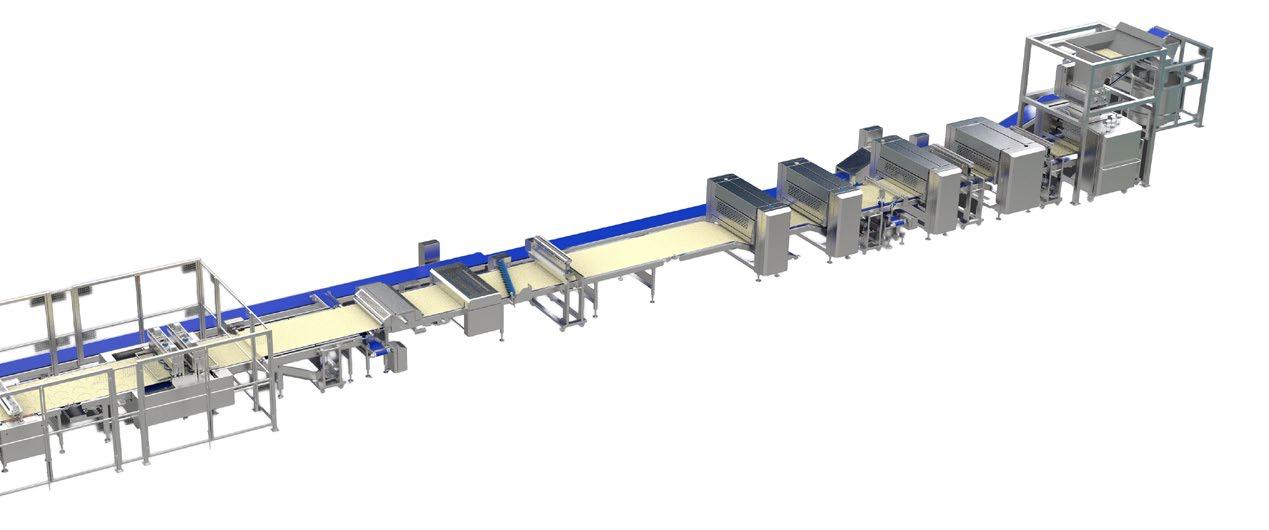
The washable version of the ASTech Pizza Line is designed to withstand high-pressure water cleaning, ensuring optimal hygiene standards where required.”
Nicola Zangrande, Product Specialist, RONDO
Pizza is an ever-popular mainstay, everywhere around the world, at any time of the day. Its reign over eating and snacking times is bolstered by continuous innovation. Exciting, new assortments and flavor combinations are backed by innovation in the pizza production area.
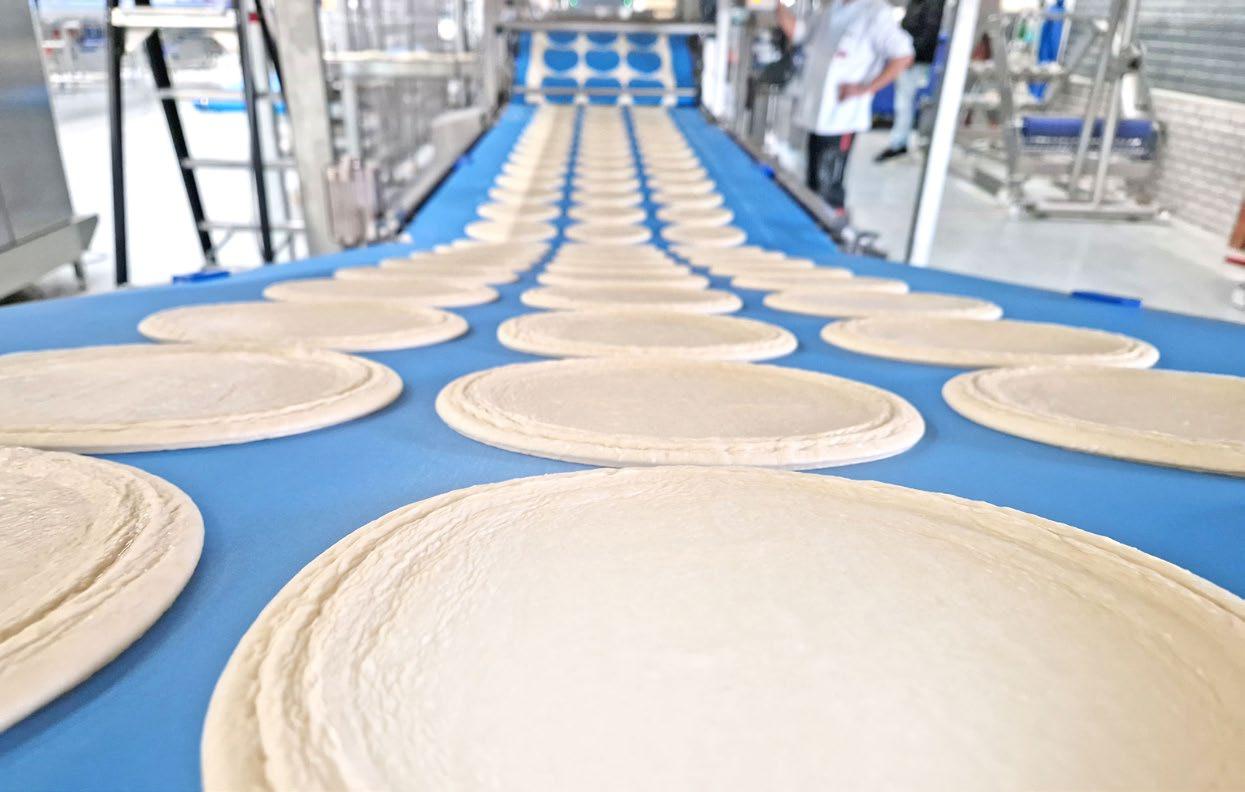
+Ever-growing consumer interest, pizza chain going global, customization becoming more popular than ever, as well as technology advances, particularly in automation and AI, and labor shortages in in industry: these are all factors shaping the pizza market. Opportunity awaits, as long as the manufacturing process is at its most efficient, which has a unique meaning for each production facility.
Dedicated lines for industrial production take all these trends into consideration in their design and upgrades, along with flexibility for new and upcoming shifts in materials, flavors and styles. AMF Bakery Systems also invests significant time into gaining a comprehensive understanding of each bakery and their operation setup, product portfolio, their goals and estimated volumes. Their current and future plans also play an important role in determining their exact needs and how they should be reflected in the design of a pizza line. AMF’s pizza production systems can process either cut, molded, or pressed pizza, in any shape and size, according to this extensive, case-by-case research. Custom parameters will include the width of the system, the mixing and sheeting capacity, proofing times and the pressing speed, the types of toppings required, baking times, and more. The product diversity it supports is endless, for pizza and pizza crusts: “Anything is possible, thin or thick crust, ‘airy’ textures, more solid high rims, or docked for a plain low budget pizza. We see trending demand in high rim, Neapolitan pizza style products with an artisan look, baked on a stone floor tunnel oven,” AMF reveals.
The common denominator in all pizzas, regardless of segment, assortment, or part of the world, is the dough ball. No two dough types are created equal, but consistent quality in each case is a must. It largely contributes to the outcome of the final product, so every step in obtaining the exact pizza dough ball intended is carefully fine-tuned.
“Anything is possible, thin or thick crust, ‘airy’ textures, more solid high rims, or docked for a plain low budget pizza. We see trending demand in high rim, Neapolitan pizza style products with an artisan look, baked on a stone floor tunnel oven.”
AMF Bakery Systems specialists
We hear the saying, ‘It’s all in the dough’ a lot in the industry. This is especially true for pizza production. Everything plays a role in achieving the desired dough texture and final product, respectively – from mixing the right ingredients, including the use of water, yeast, oil, or sourdough; then the resting and proofing variables, up to the gentle sheeting and shaping of the dough. “Adding sourdough works great as a relaxer for sheeting pizza dough,” points out Jeroen Mulder, Master Baker at the AMF Innovation Center in the Netherlands.

‘Automation’ is the keyword in dough making and handling. AMF dough dividers and rounders can be used to process dough balls automatically by mid-size and industrial bakeries, with a throughput ranging from 10 to 800 pieces per minute.
The latest AMF Flex extrusion dividing and rounding systems for pizza dough balls can offer one of three different standard makeup configurations, to match different production setups. The dough is divided into individual portions and rounded by a sanitary belt rounder into balls of dough with identical shape, consistency and weight. AMF Flex also supports direct deposit/dividing of the dough, so that pieces of dough are portioned, divided and delivered directly into trays for automated pressed pizza processing.
For a complete pizza system, AMF Fusion technology covers mixing and dough handling, with equipment including sanitary batch mixers, fermentation rooms, and dough handling systems, all set up to maximize dough control
over each processing step. For sheeting, the AMF Tromp low-stress sheeting lines offer gentle dough handling, which is essential to produce artisan pizza quality.
When making pizza with doughs that have up to 55 % water absorption, the Extruded (EX) Sheeting Line by AMF Tromp handles high-volume production, with the flexibility to produce a wide range of products, with consistent dough sheet characteristics. For recipes that require strictly low-stress handling, the Stress-free (SF) Sheeting Line can be used for the high-speed production of products with up to 65 % water absorption. For pizza bases, this means the crusts obtained have a light, open-grain structure.
This can be achieved without the use of oil, which is a distinct advantage of Tromp systems, AMF highlights. Costs and time spent cleaning are also saved by saving any excess flour when the sheet has reached the appropriate thickness; it is brushed off and collected. “Excess flour can even
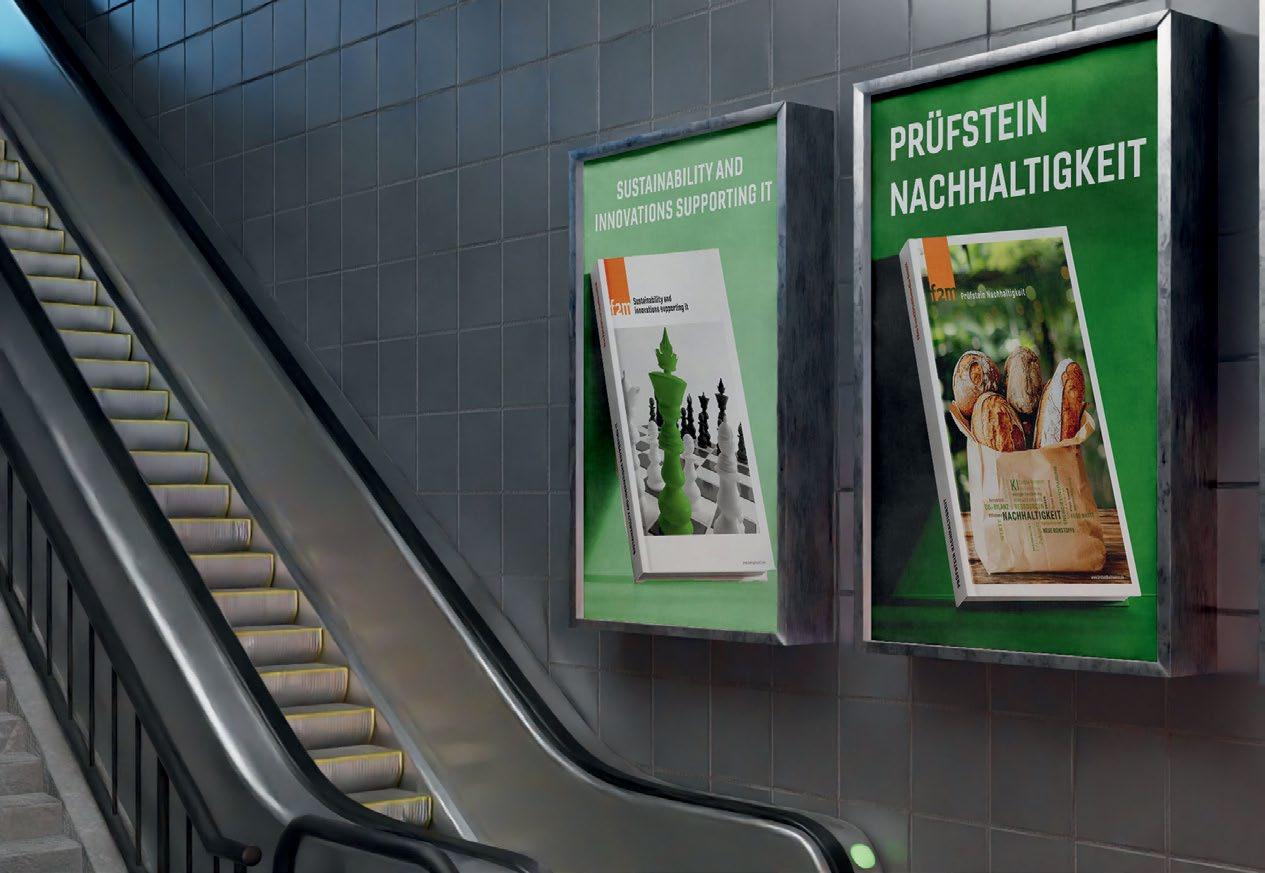
book series
Title: Sustainability touchstone
(Prüfstein Nachhaltigkeit)
Publication: 2024
Language: German 200 pages , 49 €*
Price including VAT, for printed and digital copies. Shipping costs are not included.
be reused,” AMF’s specialists underline how they design sustainable pizza systems that also focus on hygiene.
Depending on the product lineup required, AMF Tromp and AMF Flex lines are suitable solutions for pressed pizza. Pizza pressing not only determines its shape, but also the crust and bite of the base.
AMF’s automated pressing systems and adjust all process parameters, from the amount of dough to the size and thickness of the pizza base. There are several pressing techniques to choose from, and AMF technology can offer all of them. Each brings distinct results in look, taste, texture and mouthfeel, providing the flexibility for a very wide variety in pizza production.
Depending on the pizza styles to be made and their intended crust characteristics, dough pressing can be automated as follows:
+ Cold pressing
Lighter, airy types of pizza crusts can be achieved with this method, in a wide range of diameters and thickness levels.
• Dough balls can be pressed cold, in a pan, or on a belt
• Dough sheets are cold-pressed directly on the belt (Neapolitan-style pizza is made in this way).
+ Hot pressing
This technique replicates hand-crafting pizza, with similar results.
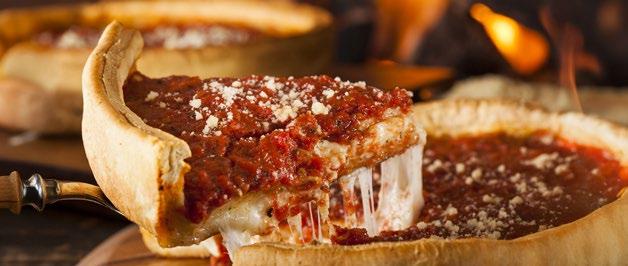
• Dough balls can be hot-pressed in a pan; deep-dish pizza pies with a rim, such as Chicago-style specialties, are made in this way, for example.
• Dough pieces/balls, or dough sheets can be hot-pressed directly on the conveyor belt.
From recent installations made throughout the world, AMF observes some trending pizza specialties: “Our recent success stories are for pizza lines pressed on a belt, cold, creating a high rim. The Neapolitan pizza is a trending product all over Europe and the US,” the specialist highlights.
Pizza pressing has been improved, in methods and automated technology, so that higher speeds and output
volumes can now be reached. “Pressing multiple products at once in a baking tray is more popular, as it has a higher output. Our conveying systems provide complete handling of trays, depanning, tray storage, cleaning and re-entering them on a line using robot or gantry stackers,” AMF explains.
Trending new products like Neapolitan pizza have been the focus for the latest technology improvements designed by AMF, as well as latest-generation developments, including AI. The smart applicator and quality control vision systems, for example, already incorporate AI-driven mechanisms. “At iba, we launched our cooperation with QING, which has a lot of traction in pizza applications. Our vision-driven AI systems will be able to analyze products for spots, defects, size irregularities, or whether toppings are uniformly applied,” AMF illustrates. QING‘s STAQ Quality Control System can now be included in AMF production lines. This Vision AI-powered inspection system analyzes every bakery product in real time, checking for shape, size, and surface characteristics. Products falling out of the acceptable parameters can be rejected from the line, before wasting valuable toppings like cheese, or the energy that goes into baking them when they are to be discarded. “Sustainable solutions and new AI technology are used to improve pizza quality and minimize waste on the line,” AMF adds.
The systems are developed with the needed degree of flexibility, having in mind variables for all processing steps. Anything can be accommodated with dedicated settings, from the size and thickness of the product to the speed of the line, the toppings and topping combinations, through to baking times. Once a recipe is established, it is stored to automatically set up each optimized process
The Dutch specialists conclude: “Pizza production is an art, but it is also a science, which we master very well at AMF Bakery Systems.” The company can offer pizza lines, from mixing through to baking and freezing. Including sauce and cheese topping systems by AMF Tromp, complete pizza production systems can achieve production capacities of up to 10,000 pieces per hour (depending on the size of the product). Given the vastness of the types of end products, perfecting production with all possible settings along the line is an entire process of its own. Testing can be carried out at AMF’s Innovation Center, where recipes can be developed and scaling up production can be finetuned. Different kinds of baking technologies can also be trialed there for each product, including direct- or indirect-fired tunnel ovens, electric or hybrid ovens, or stone floor ovens. The expansive, exciting diversity of pizza options is met with a corresponding range of flexible, smart solutions for optimized processing. +++


Stay in the know, with the industry-first, open-access virtual library!
Valuable in-depth information about everything baking, always with you. The f2m resource library is now open!

“We
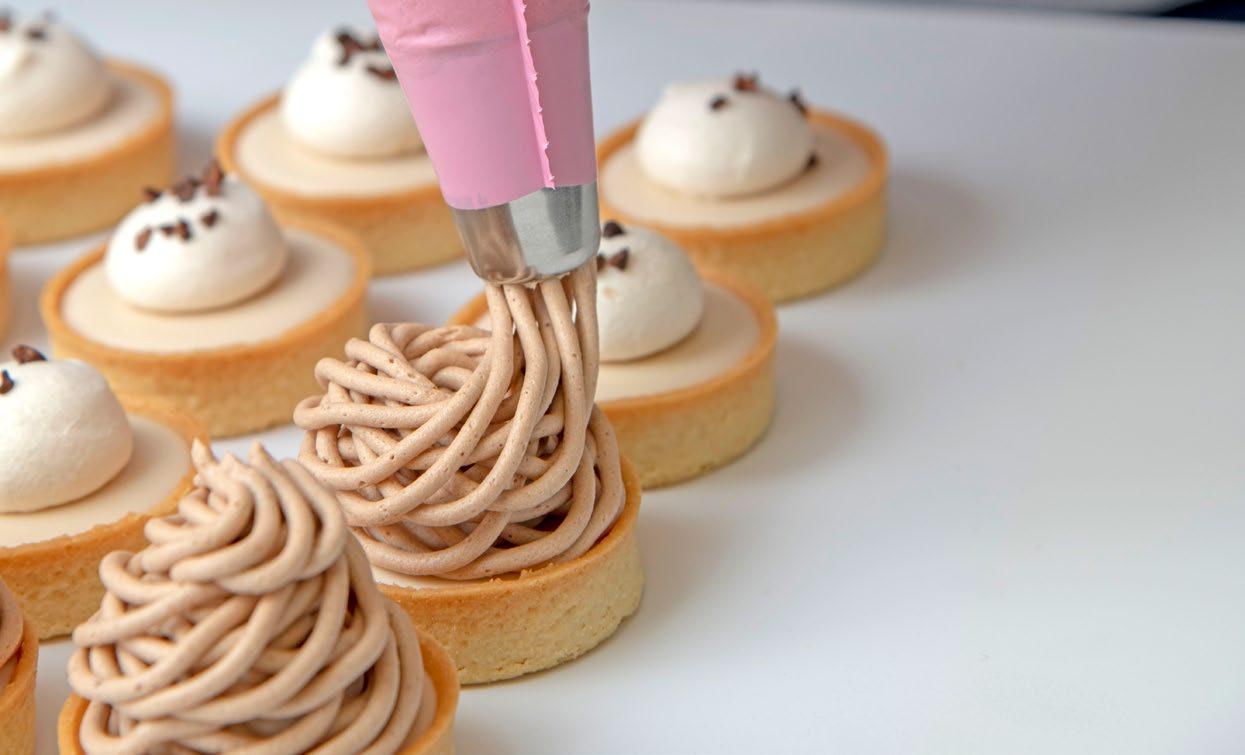
Tartlets are a growth driver for Swiss pastry manufacturer HUG. The increase in demand is also linked to the shortage of skilled workers in the catering and bakery sectors.
By Helga Baumfalk
+To meet growing demand, HUG launched a new production line in spring 2025 and now manufactures over 100 million tartlets per year. Compared to 2023, output has thus increased by a third.
Anna Hug, co-managing director of HUG AG, sees the shortage of skilled workers in the catering and bakery sectors as a key driver of growth. “The shortage of skilled workers is not only noticeable in Europe, but globally. As a result, complex products such as tartlets are no longer produced in-house but purchased from outside suppliers. We therefore still see great potential for development in many regions. On the other hand, we are living in extremely turbulent times. Ultimately, the positive development of the tartlet business as a whole is also linked to general travel activity and the staging of major events, congresses, and general socializing habits. We have no direct influence on this.”
The company offers 60 different sweet and savory snack tartlets, e.g., made from dough with olives and rosemary or tomatoes and basil. The sweet varieties include various shortcrust and chocolate dough options. Together, these two types account for the majority of sales.
HUG has been producing tartlets since the 1970s. The products in the ‘Classic Line’ are part of the first generation and have the typical slanted pastry edge. Many customers prefer these classics. For the pastry manufacturer, they
“The shortage of skilled workers is not only noticeable in Europe, but globally. As a result, complex products such as tartlets are no longer manufactured in-house, but purchased from outside suppliers.”
Anna Hug, Co-Managing Director, HUG AG
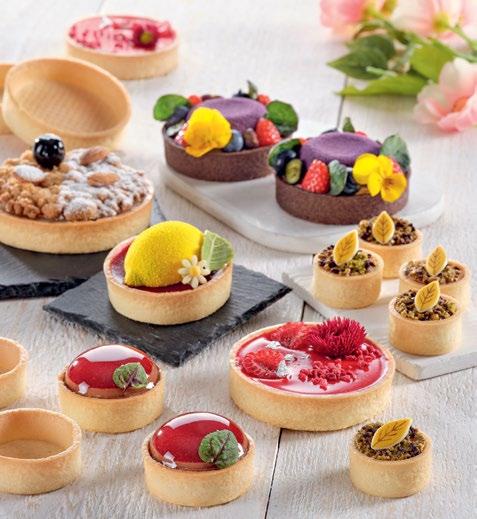
remain an important mainstay in the portfolio, even though there have been further developments in the meantime. “Our Filigrano tartlets have vertical pastry edges,” reports Anna Hug. “And they have thinner walls than almost all other tartlets on the market.” This results in a unique dough-to-filling ratio. This isn’t so easy to achieve. “It took a lot of investment in precision machinery, a great deal of know-how and patience before we were even able to produce them,” she notes.
Challenges arise not only from the shape, but also from the recipe. “The snack tartlets contain less sugar,” explains the managing director. “This allows the gluten structure to develop better. This, in turn, means that these doughs have fewer tolerances during production across several process steps.”
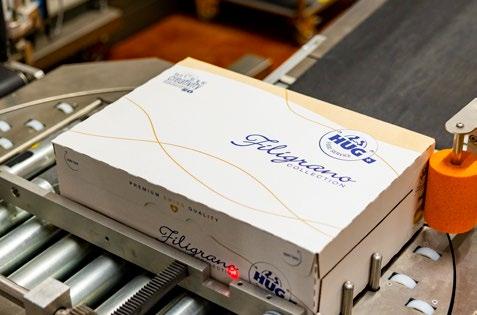
Packaging is no less demanding. A sophisticated concept is needed to ensure that the tartlets arrive at the customer without breaking. “The creation and handling of such packaging for industrial production is a demanding and
complex process. It is often a long road, but one we are happy to take if it means we can create convenience and prevent food waste,” Hug says.
Unlike others, HUG does not freeze its tartlets, but stores them at room temperature. “Even after that, the tartlets are never frozen throughout the entire supply chain until they
HUG produces tartlets at its bakery at its headquarters in Malters, near Lucerne in Switzerland. Nine lines are installed here. Two are dedicated to tartlets; the other five produce Wernli brand biscuits and DAR-VIDA brand whole grain crackers.
Tartlets are produced in two shifts, six days a week, in over 20 different shapes. The products are mainly sold to the catering and hotel industry in Switzerland, but above all abroad. “Over two-thirds of production is exported,” reports Anna Hug, co-managing director at HUG. Customers in over 30 countries are supplied, including airlines such as Emirates in Dubai, renowned casinos in Las Vegas/ USA, Disneyland in Paris/France, soccer clubs such as Manchester City in the UK, and the venerable Royal Albert Hall in London.
The new line
The new highly automated tartlet line at the Malters bakery is 139 m long in total. It consists of a tray washing system, tray magazine, kneader, a punching machine for shaping, a continuous oven with different heating zones, cooling sections for product cooling, a spraying system in which fat glaze is applied to the pastry molds so that they do not become soggy later when filled by customers, and the packaging area with robots that place the finished pastries in PET blisters, where the blisters are then packed in tubular bags and cartons and automatically palletized.
Because HUG produces tartlets in 60 different varieties, tray logistics require ample space. Around 7,500 trays in 20 different sizes are in circulation. Loaded with the tartlet dough pieces, they pass through the oven, are cleaned above the line after forming, and then return to the beginning of the process.
reach the end user,” underlines Anna Hug. This makes a decisive difference, as “This enables chefs, pastry chefs, and bakers to freeze our tartlets after filling them. In this way, entire buffets can be prepared days in advance, which can be a great advantage in times of staff shortages.” Packaged in foil and outer cartons, the tartlets have a shelf life of 14 months from the date of production.
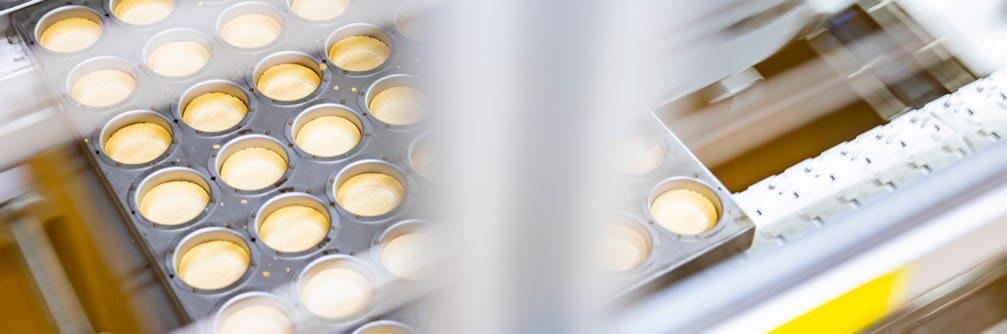
“It took significant investment in precision machinery, a great deal of expertise, and patience before we were able to produce our Filigrano tartlets with vertical edges.”
Anna Hug, Co-Managing Director, HUG AG

According to the managing director, what customers really care about when it comes to tartlets is the quality in terms of taste and stability when filled. The optimal dough/filling ratio is also crucial. Anna Hug emphasizes: “The round shape has remained by far the most popular for years because it is the classic tartlet format. In terms of size, we sell the most small tartlets, both savory and sweet, which are used as accompaniments to aperitifs or for dessert buffets.” The bestsellers in the range, she says, are the round dessert tartlets from the Filigrano line, which are 3.8 cm in diameter and made with Swiss butter.
In terms of sales, the US is the most important market for HUG’s tartlet business, followed by European countries where Western European pâtisserie culture is widespread, such as France, Italy, the UK, and Germany. Hug: “But we are also reaching the Middle East and Asia more and more.”
Tartlettes are used in all segments of the catering industry, from Michelin-starred restaurants to catering services. “Internationally,” says Anna Hug, “the largest volumes go to upscale restaurants in the hotel, event, and convention
HUG was founded in 1877 as a bakery in Lucerne and is still family-owned today, now in its fifth generation. Anna Hug and Marianne Wüthrich Gross jointly manage the company. It has two locations in Malters and Willisau (both in the canton of Lucerne), where around 450 employees work. HUG AG is best known for its retail brands HUG (for the original Zwieback), Wernli (for biscuits such as Choco Petit Beurre) and DAR-VIDA (for crackers). In addition, the company’s HUG Food Service division offers a range of products for the catering industry, which also includes tartlets.
sectors. We’re talking about huge hotels or casinos in Las Vegas, Dubai, or Singapore, where events with thousands of participants take place. Airlines and cruise ship caterers also use large quantities of tartlets. In addition, we also serve industrial customers and supermarket chains, which use our tartlets to make fresh fruit tarts in their in-store bakeries.”
Tartlets are versatile. That's what makes them so appealing. “There are virtually no limits to the creativity of the user when it comes to filling them,” reports Hug, referring to the slogan the company came up with to market its products: “We love your creativity!”. Nevertheless, they are most often used to make classic desserts. Sweet variations include all kinds of fruit/berry tarts, tarte au citron, pastel de nata, and Linzer tarts, while savory variations include quiche Lorraine.
“Most customers fill their tartlets by hand using piping bags or dosing funnels,” observes Anna Hug. The Swiss pastry-maker’s tartlets can also be filled with dough and then baked again, which extends the range of applications beyond cold fillings to add another dimension. +++
In the 2024 financial year, the Swiss biscuit manufacturer increased its sales by 4% to CHF 131 million compared to the previous year. Retail sales in Switzerland rose by 8.5% and food service sales by 4.5%. HUG generated more than CHF 51 million in the food service business. According to the company, this represents a record achievement and a breakthrough of a magical threshold. In Switzerland, growth was broadly based across various product groups and customers. The DAR-VIDA and Wernli brands also recorded the strongest growth here. However, the largest product group and biggest growth driver are tartlets.






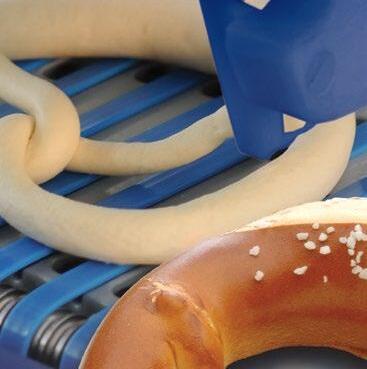
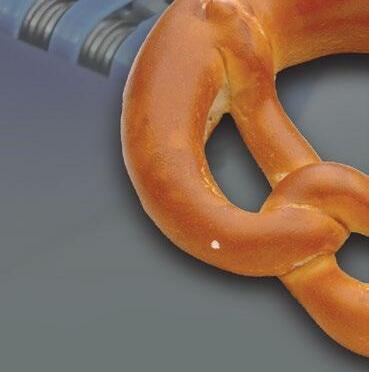








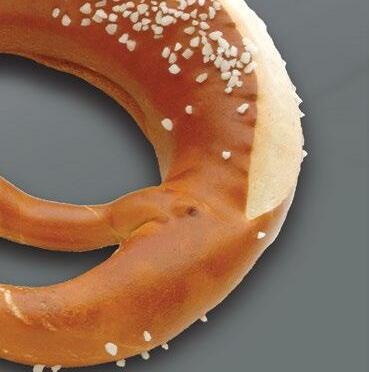

A vacuum may usually be understood as a space entirely devoid of any matter, but it’s quite the opposite of emptiness when it comes to vacuum technology in bakery. What remains, in this case, is the perfectly baked and cooled bread and snack, ready to eat, with considerably improved properties – achieved in a fraction of the time and energy. The process is everything.
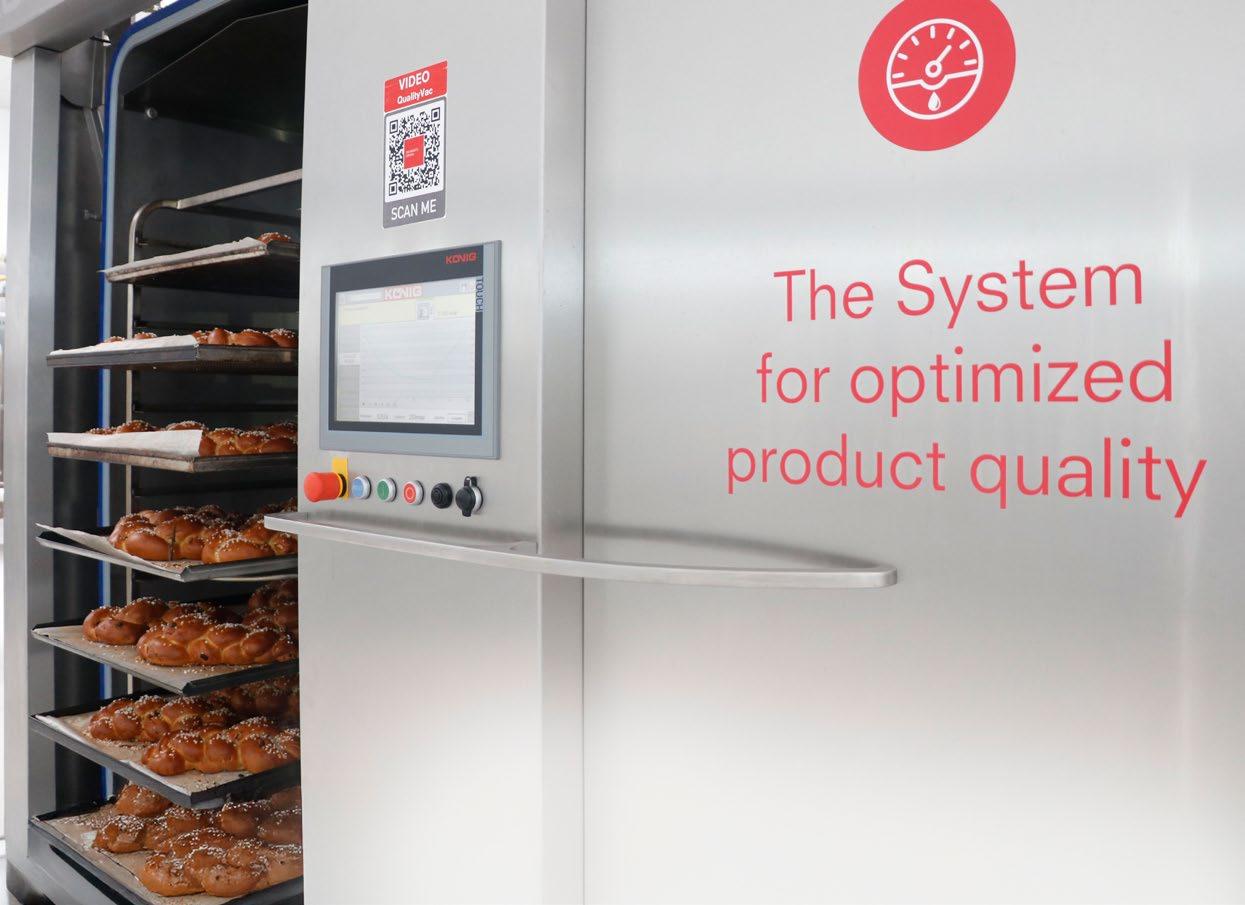
+Particularly suitable for parbaked products, vacuum technology can cool breads, small baked items and pastries in a matter of minutes, while also stabilizing them for further use. The vacuum cooling process results in products with improved qualities and supports notable process optimization in terms of shorter baking times, reduced processing times and higher flexibility in the use of resources.
Cooling baked goods rapidly not only saves time, but it also comes with numerous other important benefits. It extends the microbiological shelf life of products, which drastically reduces contamination risks. Decreasing both pressure and temperature swiftly greatly reduces the window where mold or other bacteria could form – the 60°C to 30°C range, which applies to baked goods and other cooked items such as puddings, rice, or pasta. Furthermore, vacuumpacked products stay fresh much longer, as the crust contains more water than standard baked products. Products produced by vacuum conditioning not only have a longer shelf life at room temperature, but they are also crispier, more stable, and have a larger volume than frozen products. By cooling products in a controlled environment, inside the vacuum system, any fluctuations that occur in the ambient temperature are entirely eliminated. “This makes the production processes in the entire bakery more stable,” Koenig highlights.
In addition to improving product quality and extending shelf life, vacuum conditioning offers another decisive advantage when it comes to baking: it shortens the process. The extremely rapid cooling also means that bread achieves the necessary cutting firmness more quickly. This, in turn, allows the subsequent stages, such as packaging and delivery, to be carried out earlier.
Moreover, baked products that are frozen after vacuum conditioning can be consumed immediately after thawing and retain a crunchy crust and fluffy, airy crumb. This is particularly suitable for baguettes, brioche products with decorative sugar, bread rolls, pizza dough, or Mediterranean pastries (e.g., flatbread), according to Koenig specialists.
The rapid pressure drop that occurs during vacuum cooling causes moisture within the crumb to evaporate instantly. “This internal movement of steam does not just cool the
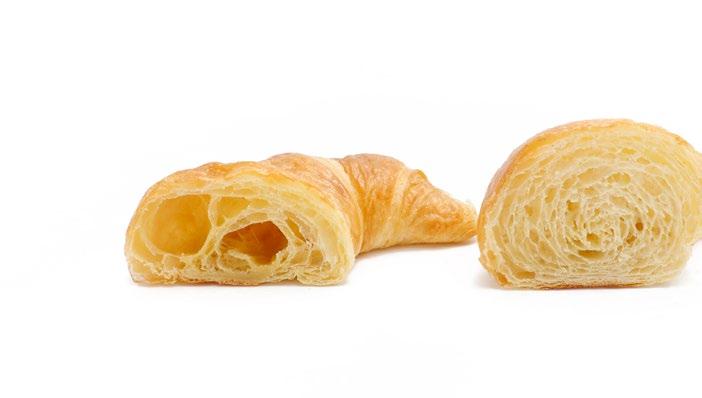
product – it also helps carry volatile aroma compounds from the surface deep into the interior. As a result, flavors are distributed more evenly throughout the baked good. Instead of aroma escaping into the air during traditional cooling, the vacuum process effectively ‘locks in’ these desirable notes, creating a more intense and harmonious flavor profile,” Koenig’s specialists underline. The result: vacuum-cooled bakery products with a richer and more intense taste, thanks to their enhanced stability, appealing volume, and the absence of wrinkles or ‘waist’ formation. The products present an open crumb structure and a pleasantly short bite.
The Austrian company developed its own vacuum cooling technology, packed into the QualityVac system. It can be designed with space for one to three racks and requires compressed air, fresh water, wastewater and electricity for its working principle: “The physical law that water boils at lower and lower temperatures as pressure decreases is the scientific basis for vacuum conditioning. The process utilizes this effect by extracting the energy required for the process from the product in the form of heat. Therefore, the product cools down in a very short time and is stabilized at the same time,” Koenig explains the concept.
A rack trolley with partially baked products is moved into the vacuum chamber, where the pressure is reduced employing vacuum pumps. The falling pressure causes water to evaporate, in the process cooling the products within a few minutes. The great news is that interim storage in the production facility does not require temperature-controlled enclosures; products can be kept at room temperature and can be baked to completion days or even weeks later, with virtually no loss of quality. An ideal scenario for in-store baking, for instance.
The QualityVac system can cool down products in the minimum amount of time: depending on the product, or the desired end humidity, 65 kg can be cooled in just 90 seconds, Koenig illustrates. Time is not the only factor vacuum technology improves; so is space: depending on the number of racks desired, the system needs only 5 to 12.5 sqm, which also includes the pump system. “Using a vacuum cooling system cuts operational floor space requirements by 50 to 70 %, removing the need for bulky cooling racks or spiral coolers,” Koenig observes. To achieve this compact footprint and operate in it comfortably, the QualityVac features a sliding door. What’s more, the door is adjustable, so it can be configured to slide from either side, according to the space requirements of each facility.
baking time. “Applied before baking, vacuum conditioning effectively replaces part of the second baking phase,” Koenig underlines. This makes the crust begin to turn brown considerably faster, reducing the remaining baking time by 20 to 40 % compared to conventional methods – a time that can be used to load the oven with the next products waiting to be baked. The QualityVac's reinforced construction allows it to operate a very powerful vacuum pump, achieving faster vacuum curves and further shortening overall process times. The higher pump capacity also ensures the target end humidity is reached significantly faster.
“Using a vacuum cooling system cuts operational floor space requirements by 50 to 70 %, removing the need for bulky cooling racks or spiral coolers.” Koenig specialists
In addition, the QualityVac is insulated with high-quality stone wool to minimize heat loss. The plate heat exchanger and water system are fully insulated with insulation panels and insulation tubing, so heat and humidity in the enclosure are completely controlled.
Koenig designed the vacuum cooling system to be ready to use within days of arrival at the facility. Altogether, the company allots 10 days on-site for installation, commissioning, and expert training, to ensure the system and processes are set to match the specific production needs of the operation. It comes as a complete solution, which can include features such as a cold water unit.
Koenig can also provide a floor-level model, which uses the same chamber and has an additional tray installed underneath. This version features a floor drain to allow water to be conveniently removed.

During the vacuum conditioning process, baked goods lose crust moisture considerably, meaning that it no longer needs to be evaporated while baking, effectively decreasing the
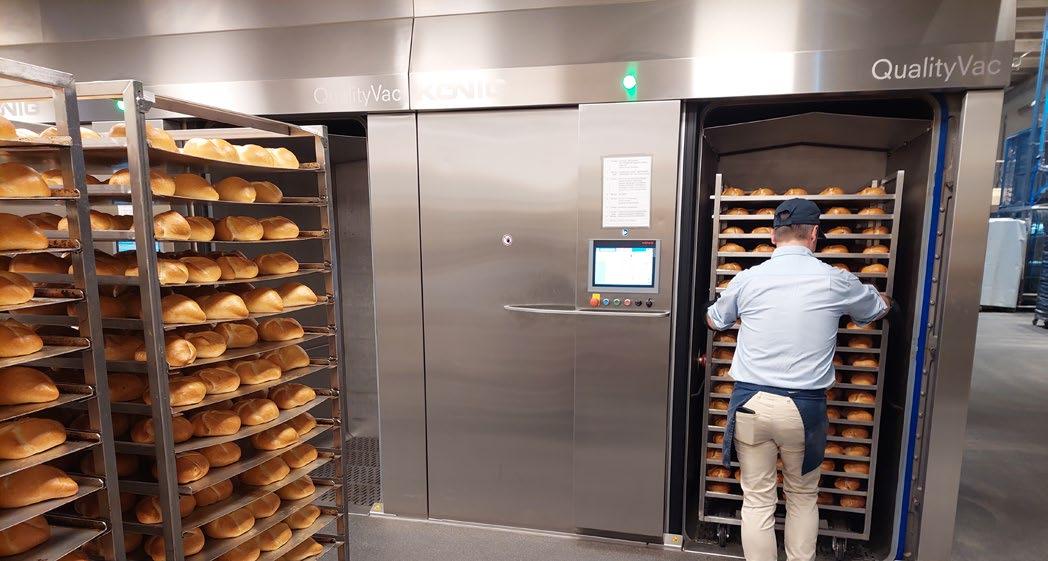
It’s also easy to operate, via its touch screen menus, with 50 program steps built in, which can be saved for custom programs. Koenig offers training for operator teams, as well as remote maintenance, so its specialists can inspect a unit in real time if needed. All vacuum curves can be fully customized and freely programmed. Moreover, the chamber is equipped with integrated lighting for convenient operation.
The QualityVac incorporates operational safety features, which extend the intervals between service appointments. For example, its screw pump, which is the ‘vacuum generator’ as it traps and compresses gas between screw rotors, is built with ceramic-coated compressor screws to prevent the compressor unit from rusting and getting blocked, which could be caused by condensate. In any case, the screw pump can be easily removed for maintenance. “It provides higher system availability and a longer service life, as the ceramic coating prevents overheating, eliminates radiant heat, and minimizes heat transfer. This significantly enhances the durability of the entire installation,” the system’s developer details.
For safety, the vacuum chamber is equipped with two emergency stop buttons. One of them is located on the outside of the control panel, and the other inside the vacuum chamber. “In an emergency situation, these emergency stops can be confirmed. All processes within the vacuum chamber stop immediately,” Koenig explains.
Maintenance needs are also optimized: “The robust chamber construction ensures long-lasting, corrosion-free operation,” Koenig points out. So much so, that the QualityVac is
designed for virtually maintenance-free operations. In the machine’s maintenance manuals, Koenig recommends controlling components such as seals, the pneumatic unit, drive components and checking the gearboxes for leaks, monthly.
The specialists point out: “Its chamber-integrated heat exchanger is our own in-house development. The plate heat exchanger allows full access for maintenance and cleaning; and no component replacement is required even after extended operation.” For easy cleaning, the system features a removable stainless-steel grate.
The pump is operated oil-free, for an extra step in safety and hygiene. Its self-balancing screw design ensures the lowest possible vibration level and low-sound operation. Additionally, the screws are manufactured from a singlepiece casting, eliminating any gaps. “This makes an ingress of process fluids or particles impossible and thus, corrosion and deposition are prevented.”
Koenig currently offers a rack-based solution, which can be provided as a single rack and can go up in operating volume to three racks. The R&D has not stopped with these customizable models, as futher automation is in the works for large-scale operations, the company reveals. “We are already developing a fully automated industrial system for continuous vacuum cooling. This tunnel-style setup eliminates waiting times entirely and ensures a seamless, uninterrupted production flow. The reason for this development is that we see an increasing demand for fully automated processes,” Koenig anticipates. +++
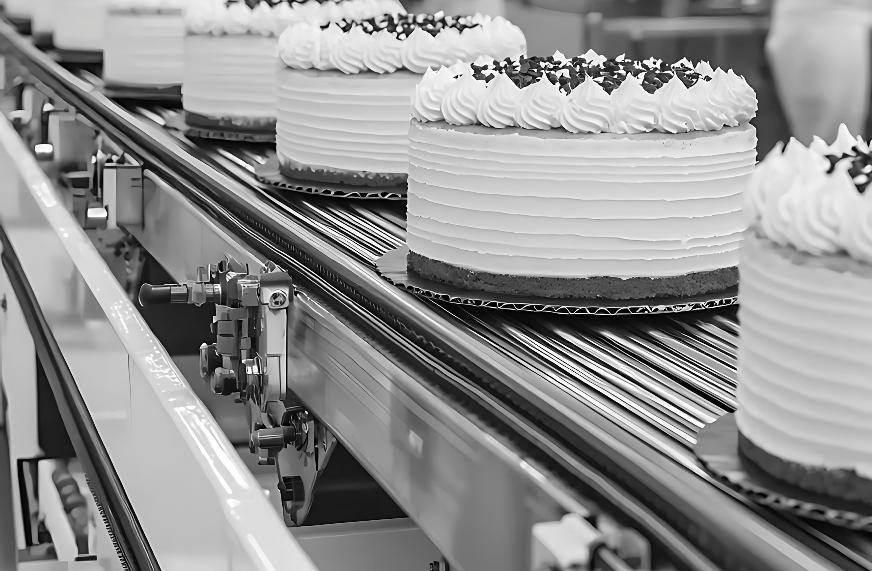
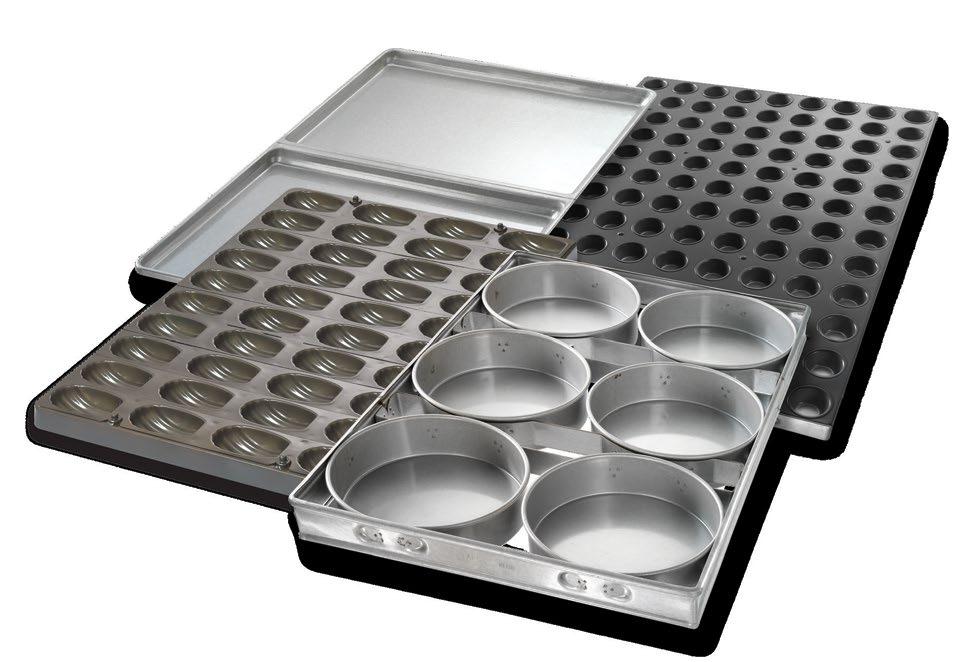


Achieve consistent product quality and increase efficiency with custom muffin and cake trays. Choose from a range of materials, mould types, and coatings designed to improve release, reduce waste, and extend the life of your bakeware.

And how you can address them at your facility.
By Rich Walsh, PhD, Senior Staff Scientist, Ecolab
+Safe, delicious baked goods begin with the basics: high-quality ingredients prepared in a clean and sanitary setting. But even in diligently run industrial baking environments, persistent misconceptions can undermine essential food safety and product quality. Without intending to, these facilities can allow microorganisms and residual soils to impact the safety and efficiency of their operations – not because they’re negligent, but simply because they believe that they have no other choice, or they are unaware of advances made to support and improve their specific industry.
That’s overly limited thinking: A better, safer approach to industrial baking is possible. I’ve been helping industrial bakeries improve their cleaning and sanitation protocols for more than 18 years. Here are three of the most common misconceptions/encounter in my work.
“Our final product is cooked at high temperatures, which eliminates the common food safety risks associated with other types of food and beverage facilities.”
Yes, most bacteria are killed at temperatures exceeding 74°Celsius (165°F). But don’t mistake this biological reality for a comprehensive approach to food safety in baking environments.
“The risk of contamination with Salmonella and/or Listeria can only be controlled, not fully eliminated. But too often, taking a ‘business as usual’ approach to pathogen control leaves industrial bakeries with persistent cleaning and sanitation gaps that can expose them to unnecessary risks.”
Dr. Rich Walsh, Senior Staff Scientist, Ecolab
The truth is that several food safety risks persist, even if the food is subjected to high temperatures during preparation. Cross-contamination during handling can reintroduce contaminants onto finished goods. Neglected environmental risks can encourage the spread of pathogens like Salmonella and Listeria. And pest-related contamination is not addressed in the baking process.
Luckily, all of these risks can be mitigated through a robust cleaning and sanitation program. To improve existing protocols, begin by identifying harborage and niche ‘hotspots’ within your operation that may be difficult to clean and sanitize. You’ll find them everywhere: floor drains, overhead structures, cracks in floors and walls, hard-to-reach
equipment components, hollow conveyor rollers; the list goes on and on.
Once you’ve identified these hotspots, work with production teams to devise a Master Sanitation Plan. This may look like more frequent cleaning in certain areas, but it should also include frequent environmental testing that flags little problems and gives you a chance to prevent their evolution into big problems.
“Water is essential to cleaning and sanitation processes; therefore, there’s no getting around water-related risks.”
For cleaning, water is an extraordinary substance, as it can act as a solvent, it can be heated to help liquify and move fats or oils, it is residue-free (hardness level notwithstanding), it is very practical for safety considerations, to mention just a few attributes. With such versatility, it’s nearly impossible to fully eliminate the role of water in cleaning and sanitation. However, there are proven and effective application strategies you can employ to vastly reduce water-related microbial risks within your facility.
As much as possible, prevent moisture from being introduced into dry areas. If moisture is a necessity for cleaning, develop procedures to control the path it takes throughout your facility, with special emphasis on avoiding practices that lead to moisture buildup in harborage areas that can shelter and foster bacterial growth.
In essence: if it’s dry, keep it dry. No more defaulting to hosing down equipment just because it’s an easy cleaning method. New product offerings from Ecolab, such as Dry-San Trio or CSD15, help to minimize and control water application and eliminate rinses between cleaning and sanitization steps. Investing in dry cleaning chemistries means soils can be safely broken down without a rinse step. These chemistries tend to deliver value above and beyond food safety: because they contribute to the streamlining of cleaning and sanitation processes, they often help boost uptime and lower costs related to equipment dry times from residual water used in cleaning, as well as energy use, as they are ready-to-use products and do not rely on high-temperature water for the cleaning.
The key to enforcing these process improvements is approaching water management as a cultural mindset. From operators to supervisors to business leaders, all team members should have a collective culture around the mandate to drive water out of operations as much as possible.
“There’s no way to fully eliminate the risk of Salmonella, Listeria, and other non-public health organisms such as yeasts and molds. The control strategies we’ve been using for years are as good as it’s going to get.”
This part is true: The risk of contamination with Salmonella and/or Listeria can only be controlled, not fully eliminated. But too often, taking a ‘business as usual’ approach to pathogen control leaves industrial bakeries with persistent cleaning and sanitation gaps that can expose them to unnecessary risks. One of the greatest but frequently overlooked risks stems from outside the facility: raw ingredients. Salmonella can survive for months under the right conditions and can infect someone with a dose as low as 15-20 cells. This threat must be met with a spirit of continuously improving cleaning and sanitation processes, so as to minimize the risk of fostering the microbes in the first place and potentially resulting in contamination in or on the product package. By reviewing a supplier’s sanitation practices and reviewing a facility’s own sanitation practices while storing raw materials before use, the risks can be identified and minimized as much as possible.
Making sure the good manufacturing practices set in place are airtight is key: control traffic by segregating and limiting access to high-risk areas; place handwashing stations strategically to prevent cross-contamination; adopt a crossfunctional approach to sanitary design to ensure that key equipment purchasing decisions are informed by sanitary design principles. Define the reasons for facility organization and policies, and back them up with data to validate performance, as well as lending itself to an ongoing verification program to demonstrate that the validation is being adhered to.
The environmental monitoring program should also be strengthened. Technology and expert analysis can be leveraged to create a heat map of high-risk areas. Every
team member should have easy access to escalation procedures in the event of nonconformance, ensuring that further testing takes place to vector out and locate the source of contamination.
Thwarting Listeria, Salmonella, or spoilage organisms is very much a battle against an unseen foe. But with the right processes, systematic and appropriate application of cleaning and sanitizing chemistries, and insights gleaned from a robust environmental monitoring program, a baking facility can dramatically reduce the risk of contamination and set itself on a path to continuous improvement and the best quality product possible.
There is no one-size-fits-all approach to cleaning and sanitation in industrial baking. Every company, every facility, every process comes with its own unique requirements. But there are useful frameworks that industrial bakeries can use to triage their challenges and formulate their approaches. I like to recommend the 4x4 Sanitation Model,
Dr. Rich Walsh has over 15 years’ experience enhancing food safety for the food processing industry. He completed his Ph.D. in Analytical Chemistry from Iowa State University and holds B.A. degrees in Chemistry and Biochemistry from the University of Colorado at Boulder.
In addition to developing innovations in antimicrobials for Ecolab’s Food and Beverage Division, he provides field support for the application of antimicrobials by consultation, on-site auditing and best practice application, and seminars on cleaning and sanitation as it relates to food safety in food production. Dr. Walsh works with Ecolab customers to provide antimicrobial performance assessments on customer products, to assist in optimizing operating parameters and minimizing waste. He routinely serves
which breaks down the four key factors that shape a cleaning and sanitation solution:
+ Mechanical action: The physical force required to remove soils or contaminants
+ Time: How long it takes for a chemical solution to work (contact time) or how long it takes to complete a cleaning and sanitation process
+ Chemistry: Matching each cleaning and sanitation challenge with an optimized chemical solution
+ Temperature: Tweaking, optimizing, or making a given process safer by altering the temperature.
Industrial bakeries that do not routinely review their cleaning and sanitation programs run the risk of finding their fail point the hard way, either with severely diminished shelf-lives due to spoilage organisms, or a worstcase scenario of having a product test positive for a pathogenic organism, which is publicly disclosed. By addressing the above misconceptions and preparing and enacting a Master Sanitation Plan, industrial bakeries can chart a course for more reliable hygiene, more consistently high-quality products and better business. +++

as an Ecolab representative at industry association meetings focused on best practice policies for food safety, and with members of industry, academia, and government agencies, served on a focus group tasked with providing validation guidelines for FSMA compliance for the produce industry, and has authored several peer-reviewed articles on the topic of antimicrobials as applied to food, as well as contributions to industry journals for establishing best practices in food safety.
Dawn Foods launched two cookie mix concepts aimed to meet both industry and consumer needs. The new developments come in response to rising demand for reduced sugar products and the heightened cocoa prices. Two reduced sugar cookie mixes were introduced (plain and chocolate), with 30% less sugar compared to similar products in the portfolio. In addition, a cost-efficient chocolate cookie mix is also available, starting from October 2025 – a high-quality solution with a rich chocolate flavor, made with Rainforest Alliance-certified cocoa.
In line with insights from Dawn’s Global Bakery Trends unveiled at iba in Düsseldorf, the company has developed two new reduced sugar cookie mixes that are palm oil-free and designed for longer shelf-life. As part of the Dawn Balance ® portfolio, these products reflect the rising call for indulgence with balance. With the new solutions, bakers can offer cookies that are both appealing and aligned with modern dietary expectations.
“Cookies remain one of the most versatile and profitable categories in the bakery industry, but businesses today need solutions that address both economic realities and changing consumer preferences,” said Marie Frigo, Category Marketing Manager DRY, at Dawn Europe & AMEAP. “With these new mixes, we’re transforming consumer insights into

Grupo Bimbo named Alejandro Rodriguez Bas as its new CEO. He joined the company in 2021 and currently serves as President of Barcel Global and a member of the Executive Committee. Bas succeeds Rafael Pamias Romero, who stepped down earlier this year to address personal and health matters. The new CEO holds a degree in Electromechanical and Industrial Engineering from Universidad Panamericana and an MBA from Harvard. His career spans multinational companies across various geographies, including ten years at PepsiCo, where he served as CEO for the Australia and New Zealand region, among other markets. He later served as CEO of Grupo LALA in Mexico, Vice President at C&S Wholesale Grocers, and CEO of Acosta Sales and Marketing in the United States. +++
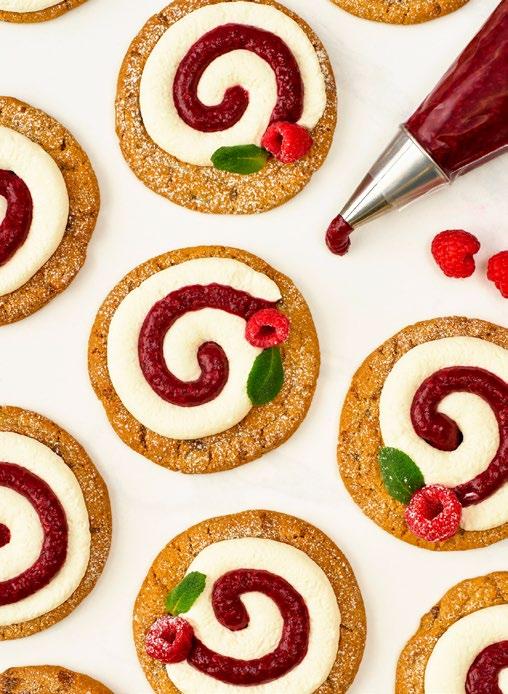
practical innovations that help our customers stay ahead, boost efficiency and unlock new opportunities for growth.” Dawn has already increased its better-for-you solutions by 44.5% since 2021, and aims for a 50% growth by 2025.

Ditsch launched a new bitesized concept of its renowned pretzels, called Pretzel Bites. They are baked according to the original pretzel recipe – crispy on the outside, and soft on the inside, and target a young, trend-oriented audience. The new creation meets consumer demand for snacks that are easy to share and customize. They come with sweet and savory toppings: sweet options such as CinnaVanilla with cinnamon and sugar, Salted Caramel, or Rainbow Drops with mango–passion fruit sauce; and savory creations such as Hot Dog Style with crispy onions and pickles or Asia Fusion with peanut and sriracha sauce, mango cubes, and chili threads.
“Our Pretzel Bites can be prepared in no time and are ready to eat within a few minutes. This allows us to create a diverse take-away range that works from breakfast through to dinner,” says Sebastian Kayser, CEO Food Service B2C at the Valora Group. “Because pretzel products are more than just tradition.” +++

For most consumers, bread is ‘flour, yeast, salt’. Professionals know better: between 50 - 60% of a bread dough, by mass, is water.
By Dimitrios Argyriou, Food Scientist, Managing Director, GRAINAR
+Water is not just a neutral carrier. It is a reactive, structured, and highly dynamic component that influences dough rheology, fermentation behavior, baking performance, product volume, texture, flavor development, and shelf life. In other words, if you do not understand your water, you do not fully understand your product.
This article looks at water from a baking-science perspective: its quality, its behavior in dough, its transformations in the oven, and its central role in freshness and safety.
Chemically, water is H 2O. In practice, the water that flows into a bakery is never just pure H 2O:
+ It contains dissolved minerals (calcium, magnesium, bicarbonates, sulphates, etc.).
+ It may carry trace organic substances and gases.
+ It is involved in three physical states during processing:
o ice (frozen dough),
o liquid water (mixing, fermentation, baking),
o and vapor (oven spring, crust formation, drying).
Inside dough or batter, water is also not all the same:
+ Bound water is strongly associated with molecules such as proteins, starch, sugars and salts. It no longer behaves like ‘free’ water and has a much lower mobility.
+ Loosely bound and free water form the continuous phase where solutes are dissolved, reactions occur, and microbes can grow.
Bakers never see these distinctions, but they are behind critical phenomena such as gluten development, starch gelatinization, stickiness, crumb softness, and staling.
2. Water quality: more than just ‘potable’
In most industrial bakeries, incoming water is municipal ‘drinking water’. It is already treated and monitored for safety. However, the fact that water is potable does not mean it is optimal for baking.
We can think of water quality in four dimensions: Microbiological
Water used in food production must be free from pathogens. Disinfection (usually by chlorination, ozonation, or UV) is standard in municipal systems.
For bakers, microbiological safety is normally covered by local authorities. Problems arise mainly when:
+ The bakery uses its own well or a local source,
+ Or when maintenance fails – e.g., contamination of storage tanks or pipes.

“Water
activity is, conceptually, the ‘effective’ water available for reactions and microbial growth.”

In such cases, the bakery itself becomes responsible for regular testing (indicator organisms like coliforms and E. coli) and appropriate treatment.
Chemical composition and hardness
From a baking perspective, this is often the most important aspect. Hard water contains significant amounts of calcium and magnesium salts, while soft water contains very little of these ions.
Their impact:
+ Moderate hardness (approx. 50–100 ppm as CaCO 3) is generally favorable for breadmaking.
+ Ca²+ and Mg²+ ions strengthen gluten, help gas retention, and support yeast nutrition.
+ Very soft water may lead to weak, sticky dough and poor gas retention.
+ Very hard water may over-strengthen the gluten network and slow down fermentation, producing a tight crumb and reduced volume.
Water softening technologies (ion exchange, reverse osmosis) solve scaling and equipment problems, but they may strip water of minerals essential for optimal dough performance. In such cases, bakers may need to:
+ Adjust formulations (e.g., salt and improver dosage),
+ Or re-introduce specific ions (e.g., via mineral blends or yeast foods).
Taste and off-flavors
Chlorine, some organic contaminants, or extreme mineral profiles can impart noticeable off-tastes. In most products, the flavour impact is subtle; in high-hydration doughs and long-fermented products such as sourdough, or focaccia, it becomes more evident.
Regulatory framework
Globally, drinking water is controlled through national laws and guided by organizations such as the WHO. For bakers, the practical takeaway is simple:
Dimitris
Agryriou,
Food Scientist, Managing Director, Grainar
+ Use only water that meets local drinking-water standards.
+ If a bakery operates using its own water source, it must be treated and monitored as if it were a small ‘water utility’ for the bakery.
Once water meets the flour, its role becomes structural, not just functional.
Hydration of starch and pentosans
Wheat flour starch granules and pentosans (arabinoxylans) are strongly hydrophilic:
+ Starch granules slowly absorb water, swelling as water penetrates the granule structure.
+ Pentosans bind multiple times their own weight in water, strongly affecting dough viscosity and water absorption.
This early hydration stage determines dough consistency –one of the core ‘levers’ bakers use to tune dough machinability and final crumb structure.
Gluten formation and protein functionality
Proteins in wheat flour (gliadins and glutenins) require water to:
+ Hydrate and unfold,
+ Move and interact,
+ Form a continuous gluten network that traps gas.
The balance is delicate: too little water will lead to underhydrated proteins, a tight dough, and, respectively a poor volume. Conversely, adding too much water will weaken the structure, resulting in sticky dough, with a risk of collapsing.
Minerals (Ca² +, Mg² +), pH, and mixing energy all interact with hydration to define the final gluten network. Water is the medium that allows these interactions to occur.
Water, solutes and osmotic effects
In dough, water dissolves:
+ Sugars (for yeast and Maillard reactions),
+ Salts (NaCl, baking soda, etc.),
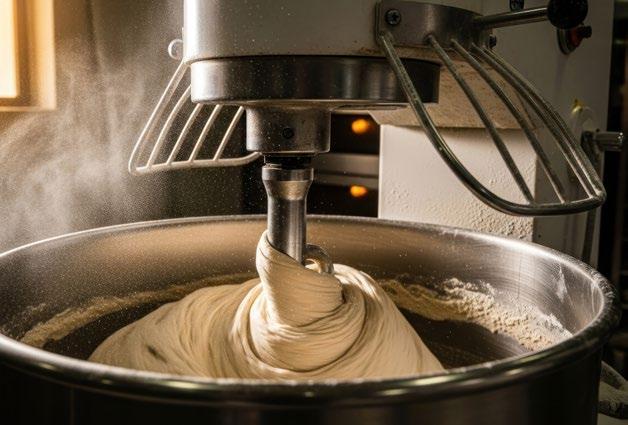
+ Organic acids (sourdough, improvers),
+ Small proteins and peptides.
The resulting solution has a certain osmotic pressure. High osmotic pressure – usually found in sweet doughs, due to a high concentration of sugar and salt, for instance – slows water influx into yeast cells and can stress them, reducing fermentation speed. The control of water and solute concentration is therefore directly linked to fermentation performance.
Hydrophilic, hydrophobic and emulsifiers
Water does not mix with fats on its own. This is where emulsifiers and amphiphilic molecules, such as lecithin in egg yolk or mono- and diglycerides, come into play, where the hydrophilic part interacts with water, while the hydrophobic part interacts with fats.
These molecules:
+ Help disperse fats in the dough,
+ Stabilize gas bubbles,
+ Interact with starch to retard retrogradation and delay staling.
Again, the functionality is mediated by water. Without water, the hydrophilic region of these molecules cannot organize and do its job.
When dough enters the oven, the behavior of the water it contains drives almost every major transformation during the baking proces.
From liquid to vapor: oven spring and crust
As the temperature rises:
1. Water in the dough heats up and approaches 100°C.
2. The vapor pressure inside gas cells increases sharply.
3. Steam expansion contributes to oven spring, together with expanding CO 2
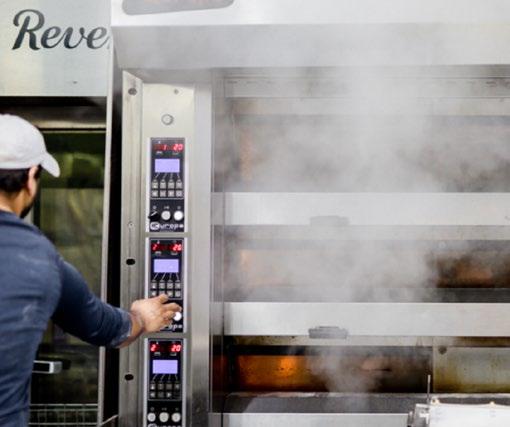
4. Near the surface, water evaporates faster than it can be replaced from the interior. As a result, a dry crust forms.
The rate at which water is driven off the surface – influenced by oven temperature, air flow, humidity and steam injection – determines:
+ Crust thickness and color,
+ Shine and blistering,
+ The balance between crispness and chewiness.
Starch gelatinization and protein denaturation
Two key temperature ranges are critical:
+ Starch gelatinization (~60–80°C in dough, depending on water and solutes):
Starch granules absorb water, swell, and lose their crystalline structure, forming a gel that sets the crumb structure.
+ Protein denaturation and gluten setting (~80–95°C): Gluten proteins lose their native conformation and form a more rigid network.
Both transitions depend on the availability and mobility of water. Limited water (as in cookies) can prevent extensive gelatinization, producing a short, crumbly texture. High water availability (high-hydration breads) allows full gelatinization, giving open, elastic crumbs.
Water in alternative baking technologies
In microwave baking, the energy couples mainly with water molecules:
+ Water heats first, resulting in rapid internal heating.
+ Surface temperatures often remain below those achieved in conventional ovens, meaning there will be poor browning, limited flavour development, and different moisture gradients.
Understanding how water absorbs and redistributes microwave energy is key to developing formulations and processes that can deliver acceptable quality under these conditions.
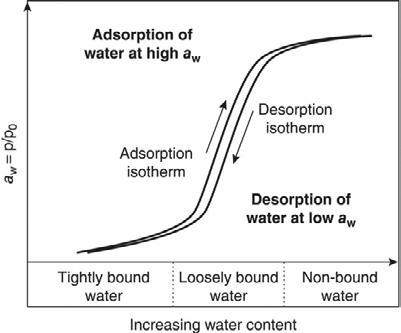
Source: Chieh PCC. Water. In: Zhou W, editor. Bakery Product Science and Technology. 2nd ed. Hoboken (NJ): Wiley-Blackwell; 2014. p. 266.
Total water content is only part of the story. For microbial stability and texture, water activity (a v) is more important.
Water activity is, conceptually, the ‘effective’ water available for reactions and microbial growth. It is related to the vapor pressure of water in a product relative to pure water at the same temperature.
Typical ranges:
+ Fresh bread, with a high a v (>0.94), is microbiologically perishable and requires short shelf life or protective packaging.
+ Semi-moist cakes and pastries have an intermediate a v , which makes mold growth possible; preservatives, packaging and hygiene are critical in this case.
+ Dry crackers, biscuits, crispbreads, with a low a v (<0.6), are microbiologically stable, but extremely sensitive to moisture uptake from the environment (loss of crispness).
Bakers manage water activity by combining:
+ Formulation (sugars, salts, polyols, humectants),
+ Baking profile (how much moisture is driven off),
+ Cooling and packaging (how quickly products are sealed, permeability of films),
+ Storage conditions (temperature and ambient humidity).
Along the moisture sorption isotherm, the same product composition can behave differently during drying (desorption) and moisture uptake (adsorption). This hysteresis explains why a biscuit once softened by poor packaging rarely returns to its original crispness, even if re-dried.
For a bakery technologist or production manager, the science of water translates into a series of practical control points:

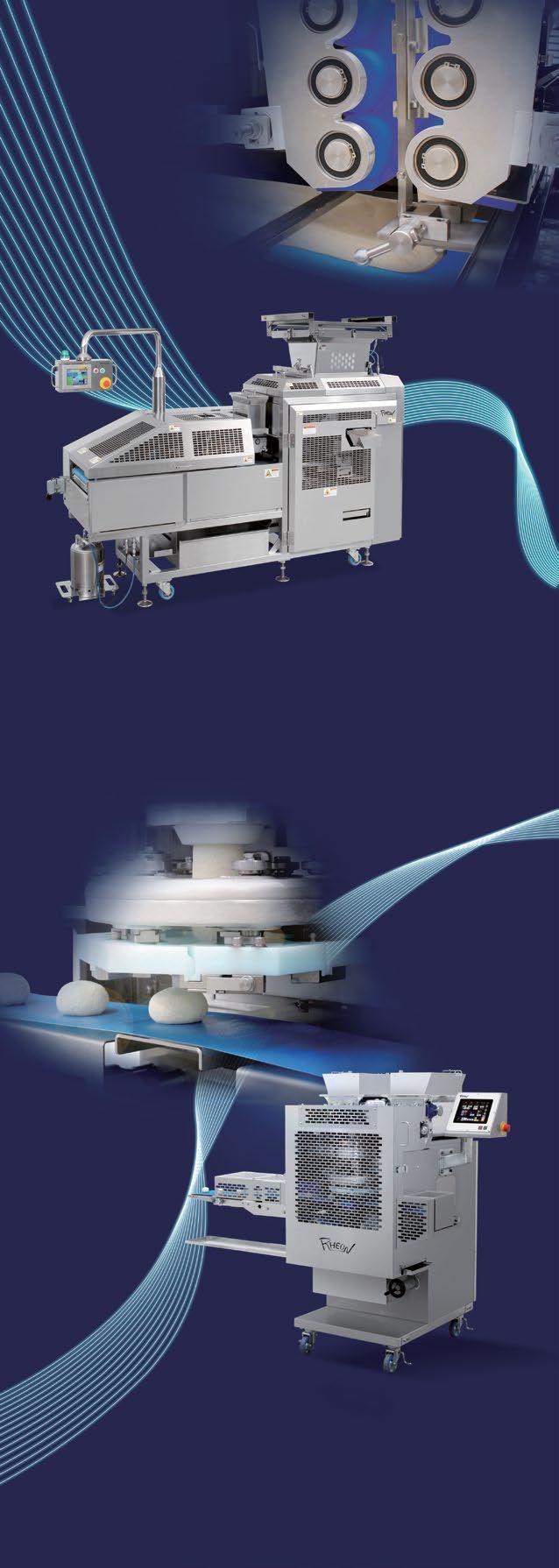





1. Know your water source:
+ Monitor hardness periodically.
+ Be cautious when changing site, drilling new wells, or installing softeners/reverse osmosis.
+ Record water temperature; seasonal changes may require process adjustments.
2. Match water hardness to product style:
+ For bread and rolls, moderately hard water usually gives the best balance of gluten strength and fermentation behavior.
+ Very soft or very hard water may require recipe or process corrections (salt, improvers, fermentation time).
3. Control water temperature and addition:
+ Use water temperature as a key parameter to achieve consistent dough temperature across seasons.
+ Keep accurate records of water absorption for each flour lot; small changes can significantly affect dough handling and volume.
4. Think ‘bound’ vs ‘free’ water when troubleshooting:
+ Sticky doughs, poor mixing tolerance, inconsistent proofing, or unexpected staling often relate to how water is being distributed among starch, proteins, pentosans, sugars, and fats – not just how much water you added.
References
5. Use water activity as a design too:
+ Target specific a v ranges for bread, cake, biscuit, and filled products.
+ Combine process (baking time/temperature, cooling) and packaging choices to hit that target reliably.
6. Integrate water into your quality system.
+ Include water checks (hardness, temperature, conductivity, microbiology if relevant) in your HACCP and quality plans.
+ Train teams to understand water as an ingredient with specification – not just ‘what comes from the tap.’
Water is often treated as a background condition in baking –something to adjust until the dough ‘feels right’. Modern baking science shows that it deserves a much more central place.
From molecular interactions with starch and proteins, through phase transitions in the oven, to water activity and shelf life, water is the invisible driver of structure, flavor, and freshness. For bakeries facing ever-tighter specifications, longer distribution chains, and pressure to reduce waste, treating water as a strategic ingredient – not a commodity – is no longer optional. It is a competitive advantage. +++
1. Cauvain, S.P. & Young, L.S. (2007). Technology of Breadmaking (2nd ed.). Springer. A comprehensive treatment of water’s roles in mixing, fermentation, baking, and product quality.
2. Pyler, E.J. & Gorton, L.A. (2010). Baking Science & Technology (4th ed.). Sosland Publishing. Classic industry reference; includes practical guidance on water hardness and dough performance.
3. Sluimer, P. (2005). Principles of Breadmaking: Functionality of Raw Materials and Process Steps. AACC International. Focused explanations of how water interacts with flour components and process steps.
4. Mondal, A. & Datta, A.K. (2008). Bread baking—A review. Journal of Food Engineering, 86(4), 465–474. Integrates heat/mass transfer with structure setting; extensively discusses water’s role in baking dynamics.
5. Wagner, M.J., Lucas, T., et al. (2007). Water transport in bread during baking. Journal of Food Engineering, 78(4), 1087–1096. Foundational on moisture migration, vapour pressure, and crumb setting.
6. FDA (2014). Water Activity (aw) in Foods (Inspection Technical Guide). U.S. Food & Drug Administration. Clear definitions and regulatory context for a_w thresholds.
7. Barbosa-Cánovas, G.V., Fontana, A.J., Schmidt, S.J., & Labuza, T.P. (Eds.). (2007/2020). Water Activity in Foods: Fundamentals and Applications (1st/2nd ed.). Wiley/IFT Press. Definitive handbook on a_w, isotherms, and shelf-life design.
8. WHO (2022). Guidelines for Drinking-water Quality (4th ed., updated). World Health Organization. Global benchmark for potable water used in food production.
9. Courtin, C.M. & Delcour, J.A. (2002). Arabinoxylans and endoxylanases in wheat flour bread-making. Journal of Cereal Science, 35(3), 225–243. Explains how AX and xylanases influence water distribution, dough handling, and loaf volume.
10. Zhou, W. (Ed.). (2014). Chapters “Water” and “Baking” in Bakery Products Science and Technology (2nd ed.). Wiley-Blackwell. Up-to-date textbook chapters linking water properties to product structure and processing.
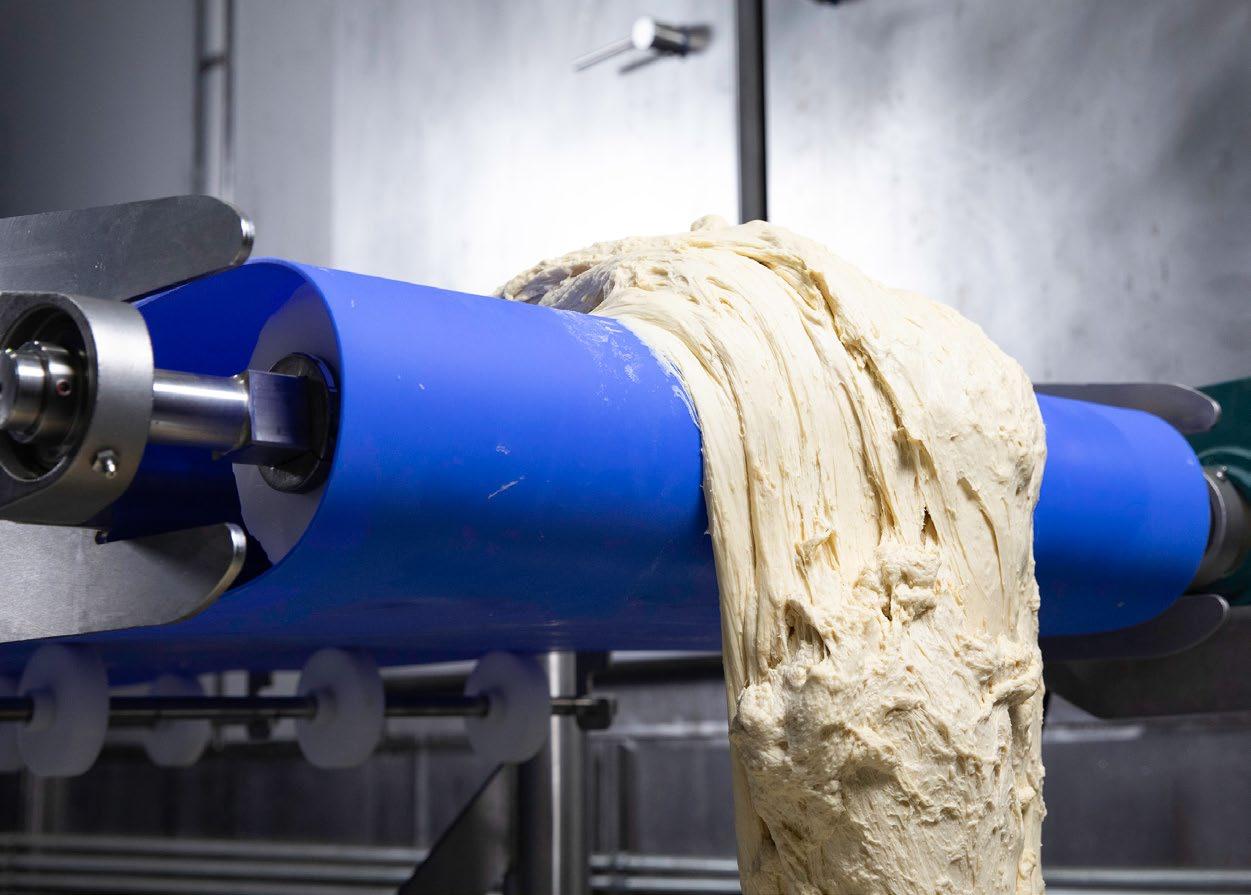
With the release of Intralox® LugDrive™ Series 8140 belting in A23 material, bakeries can now upgrade to the strongest, most hygienic belt available for raw dough-handling applications.
For more about the superior dough handling capabilities of LugDrive S8140 belting in A23, visit www.intralox.com/industries/food/bakery
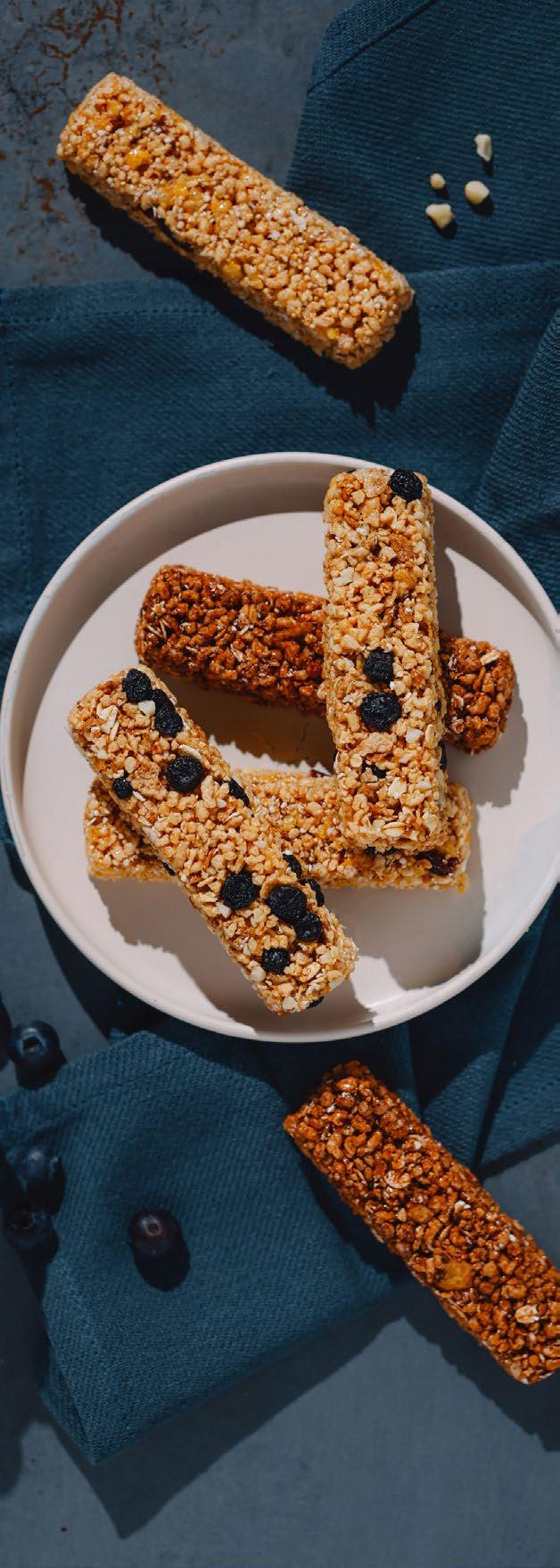
Whether lowering ingredients such as sugar or salt, or adding others – fibers, proteins, or more, reformulating products for a better nutritional profile essentially means creating a new product with its own optimum processing parameters.
+Bakery products are often associated with ingredients to be avoided in healthy diets. Anything from carbohydrates, sugar, or salt, as well as concerns about preservatives, can drive consumers away. This is particularly challenging for the category of sweet bakery products as a whole, with the culprit being in the segment’s name: specialties are often high in sugar, which spells bad news for consumer preferences and concerning production cost efficiency. An unbalanced fat profile is often an occurrence in sweets, too – in terms of both quantity and quality. “It’s not just about the amount of fat, but, above all, the type of fat used – for example, the ratio of saturated to unsaturated fats,” bakery specialists from CSM Ingredients explain.
Similar concerns apply to the savory segment, where salt is under scrutiny for products such as sandwichies or filled specialties. Here, there is some catching up to do, compared to bread: “In the traditional bread segment, many producers have already adapted, reducing salt levels in response to consumer demand and local government recommendations or national guidelines encouraging reformulation,” the ingredient specialist observes.
CSM Ingredients undertakes reformulation projects, finding and developing solutions in collaboration with its customers, particularly in the areas of sugar and fat reduction. On a case-by-case basis, products are analyzed, together with the production process and the target nutritional goals, which usually start with a sugar reduction of at least 30 %. A solution often used for sugar reduction is Meltec ® , the company reveals. This fiber-based solution can replace up to 50% of sugars and syrups. Such fiber-based ingredients have no impact on the product’s established texture, mouthfeel, or shelf life.
Solutions to reduce the fat ratio in recipes can also be developed: “We support customers in replacing high-saturatedfat margarines with SlimBake,” CSM Ingredients explains. SlimBake is a clean-label, fat-reduced emulsion that can be used for bakery and fine pastry products. With it, the product’s fat content can be reduced by 30 %, while maintaining the taste and texture of conventional formulations.
“Thanks to the clean technology used, our micro proteins are ideal for clean label formulations, as we exclusively employ proprietary physical and mechanical processes – a significant advantage for both producers and consumers.”
Emanuele Pizzigalli, Chief Research and Innovation Officer, CSM Ingredients Group
Consumer priorities, operational efficiency, sustainability and nutritional recommendations and regulations –these are all factors that drive reformulation to improve the nutritional profiles of baked goods. Making changes to existing recipes, with an established production process, is not without challenges – especially when the target is to be able to claim or maintain a clean label. While the nutritional profile needs to be improved, the product must also remain appealing: taste, texture and appearance must stay the same.
“The main challenge is that when you modify a recipe – by adding an ingredient or reducing others – you are essentially creating a new product, both in terms of formulation and composition,” CSM Ingredients points out. Using ingredients such as fibers and proteins must be done with no impact on the baked goods’ sensory qualities: “That’s the real challenge,” the experts highlight. To accomplish this, the company offers several ingredients. A newly-developed solution is a new type of micronized protein systems – Micro Protein, a solution based on pea proteins with a very fine granulometry, neutral taste, and minimal impact on the structure and flavor of the finished product. It was launched in 2024 by HIFOOD, a specialist in advanced ingredients primarily of natural origin (and a part of CSM Ingredients). They are also with a clean label, and boast a protein content of 70 %. The Micro Protein was among the most innovative ingredients acknowledged at the World Congress of Food Science and Technology, where it was ranked among the finalists for this category award, as well as winning the award for Most Innovative Process. “Being a powdered ingredient, it can be used much like flour,” explained Emanuele Pizzigalli, Chief Research and Innovation Officer, CSM Ingredients group. “Moreover, thanks to the clean technology used, our micro proteins are
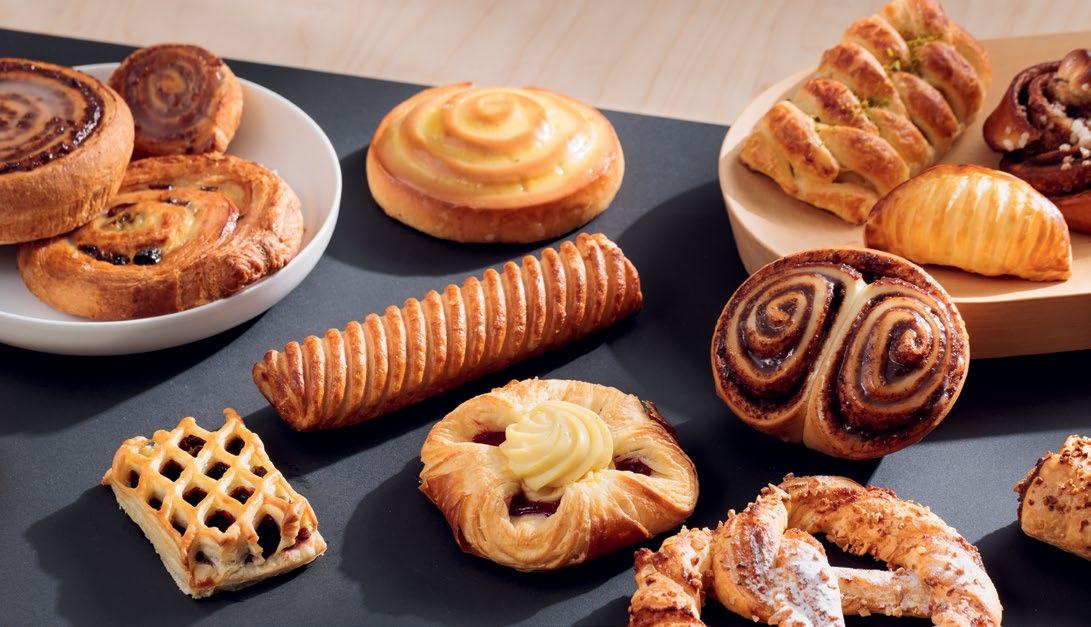
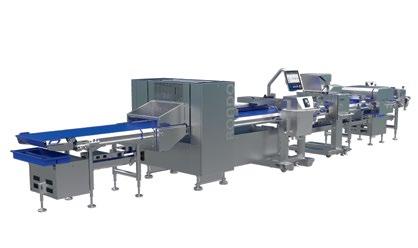
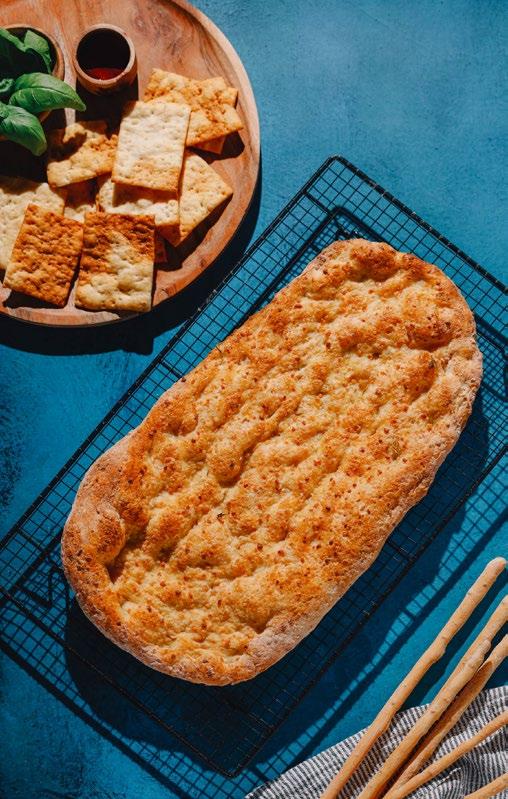
Clean-label bakery and fine pastry
Introduced in 2024, SlimBAKE is an emulsion that can be used to reduce the fat content in bakery products by 30%. It allows industrial bakers to keep both the original recipe and the production processes unchanged while adding the claim ‘reduced fat content’ on pack in accordance with EU regulations. It also provides end consumers with taste in a light product, with the full sensory experience for croissants, Danish pastries and puff pastries. The new emulsion, which can be used for ambientpacked products and frozen baked goods, is available in two variants: butter-based and vegetable-based (for vegan-friendly products).
Added proteins
HIFOOD’s Proteios textured vegetable proteins are designed for boosting protein in baked goods and plant-based alternatives. In addition, CSM Ingredients’ high-protein mixes can be used to enrich bread and baked goods, while Vitalfood’s ready-to-use protein creams are suitable for fine pastry and bakery applications, for enhanced nutritional values. CSM Ingredients, HIFOOD and Vitalfood are showcasing their innovations together at Fi Europe, held in Paris from December 2 to 4, 2025, as part of Nexture holding.
ideal for clean label formulations, as we exclusively employ proprietary physical and mechanical processes – a significant advantage for both producers and consumers.”
Sometimes, a different taste or texture is a desired outcome when the result improves on the original recipe. This can be observed when developing protein- or fiber-enriched products. HIFOOD's Proteios textured vegetable proteins can be added to the dough to achieve a new, crunchy texture. “This delivers an unexpected taste experience to customers while also improving the nutritional profile of products, such as bread rolls and croissants, while preserving the clean and simple labels that modern consumers expect,” the specialist explains. Similarly, the “Meltec ® ingredient can be used for sugar reduction while maintaining – or even improving – freshness as well as increasing the fiber content in recipes,” CSM Ingredients adds.
Other times, multiple benefits can be achieved with several ingredient replacements in a single product. For example, sugar reduction can be achieved by using fiber-based ingredients, which not only lower sugar and calorie content but also increase fiber levels. The resulting products can be labeled as ‘high in fiber’. Similarly, “When developing highprotein products, increasing protein content naturally reduces the relative share of carbohydrates and sugars, leading to a better overall nutritional balance, CSM Ingredients illustrates.
CSM Ingredients Technical Application Managers – food technologists, pastry chefs and bakers – provide detailed guidelines and technical documentation to support the use of such functional ingredients. On-site technical support is also provided, to help fine-tune recipes.
In addition, ready-to-use mixes simplify product development – particularly for artisan bakers, as they require minimal additional ingredients to perfect recipes consistently. They can cater to a wide range of products with improved nutritional profiles, including gluten-free specialties. CSM Ingredients develops free-from solutions in collaboration with HIFOOD.
This gluten-free range “offers excellent taste, technical performance, and ease of use for bakery and fresh pasta applications, with a high level of customization,” CSM Ingredients explains. “This flexibility is one of our key strengths: leveraging our Group’s broad technological capabilities, we can design ingredient systems suitable for any type of product and nutritional target,” Pizzigalli highlights.
To develop new solutions, the group works with an open innovation approach, with external partners and, above all, within Nexture – its own integrated platform, which was developed to combine the industrial and technological expertise of CSM Ingredients Group and Italcanditi Group. +++
Introducing the new 893 C.
Closing up to 120 bags per minute with state-of-the-art motion control, ethernet, and wireless communications, the speedy 893 C Automatic Bag Closing Machine has efficiency baked right in. LEARN MORE AT KWIKLOK.COM


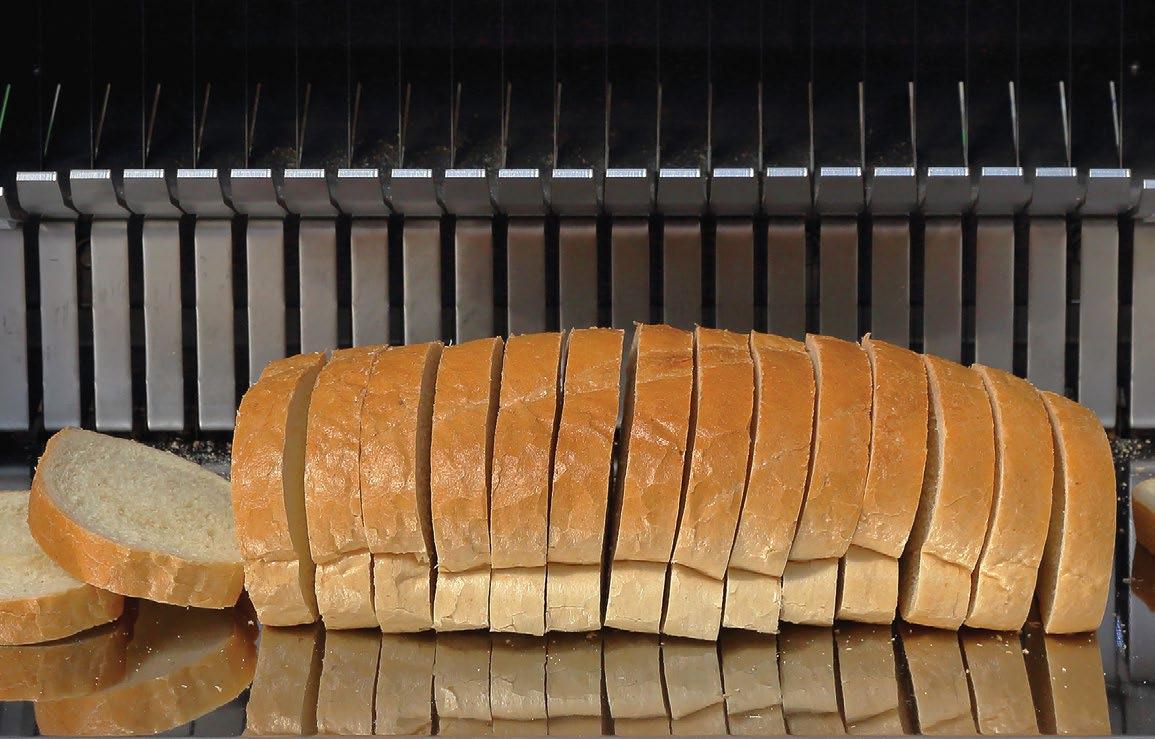
The Emmi Group is acquiring The English Cheesecake Company Ltd., a premium cheesecake brand in the British retail trade. Founded as a family business in 2000, the British company generated sales of around GBP 23 million in the past financial year and is represented in all major retail chains in the UK.
The English Cheesecake Company specializes in high-quality cheesecakes based on traditional British recipes, sold in retail and foodservice. Its portfolio includes classic cheesecakes, vegan and frozen delights, together with snack formats that have made a name for themselves amongst true dessert lovers.
“The bolt-on acquisition increases our presence in the fastgrowing premium cheesecakes segment and contributes to the global indulgence megatrend. This represents a further step towards advancing our strong market position in the global premium desserts market and creating synergies within our portfolio”, says Didier Boudy, EVP Emmi Desserts.
“While the cheesecake offering of the Mademoiselle Desserts Group is strongly positioned in the British food service market, The English Cheesecake Company’s retail business is the ideal extension to the distribution strategy,” the group details its acquisition strategy. The new brand complements its portfolio and opens the door to a potential expansion beyond the UK’s borders. +++
PUBLISHING HOUSE
baking+biscuit international is published six times a year.
Single copies may be purchased for EUR 15. Subscription rates are EUR 75 per annum. Students (with valid certification of student status): EUR 40. (All rates include postage and handling, but not VAT).
Cancellation of subscription must be presented three months prior to the end of the subscription period in writing to the publishing company. Address subscriptions to the above stated distribution department.
Claims will not be accepted for any copies not received or lost copies due to reasons being outside the responsibility of the publishing company. This magazine, including all articles and illustrations, is copyright protected. Any utilization beyond the tight limit set by the copyright act is subject to the publisher’s approval.
Online dispute resolution in accordance with Article 14 Para. 1 of the ODR-VO (European Online Dispute Resolution Regulation): The European Commission provides a platform for Online Dispute Resolution (OS), which you can find at http://ec.europa.eu/consumers/odr
Valid advertising price list: 2025
Food2Multimedia GmbH Schoolkoppel 27 21449 Radbruch, Germany +49 4178 244 9797 www.foodmultimedia.de
EDITOR EMERITUS
Hildegard M. Keil hildegard_keil@t-online.de
PUBLISHER
James Dirk Dixon dixon@foodmultimedia.de
EDITOR-IN-CHIEF
Catalina Mihu mihu@foodmultimedia.de
EDITOR
Helga Baumfalk baumfalk@foodmultimedia.de
COPY EDITOR
Annie Dixon annie.dixon@foodmultimedia.de
SUBSCRIPTIONS Viktoria Usanova usanova@foodmultimedia.de DISTRIBUTION vertrieb@foodmultimedia.de
ADVERTISING Dirk Dixon dixon@foodmultimedia.de
SOCIAL MEDIA
Annie Dixon annie.dixon@foodmultimedia.de
LAYOUT/GRAPHIC
Leinebergland Druck GmbH & Co. KG Industriestr. 2a, 31061 Alfeld (Leine), Germany
IT IT Consulting BRUNK
Felix Brunk, felix@brunk-net.de

Production efficiency optimization
Predictive maintenance capabilities
Automated analytics
KPI monitoring with smart alerts
Intelligent, actionable reporting