
International Research Journal of Engineering and Technology (IRJET) e-ISSN: 2395-0056
Volume: 12 Issue: 06 | Jun 2025 www.irjet.net p-ISSN: 2395-0072
International Research Journal of Engineering and Technology (IRJET) e-ISSN: 2395-0056
Volume: 12 Issue: 06 | Jun 2025 www.irjet.net p-ISSN: 2395-0072
Vrishank Malik1, Raj Shah1, Lavanya Kundurthy1, and Hemant N. Joshi1,2
1Tara Innovations LLC, East Hanover, New Jersey, USA 2Founder, Tara Innovations LLC, hemantjoshi@tarainnovations.com
Abstract - Cement production is a highly water-intensive process that negatively contributes to freshwater depletion amid the growing global freshwater scarcity. This study explores the feasibility of using seawater as a sustainable alternativetofreshwaterinconcreteconstructionandaimsto reduce concrete’s heavy dependence on rapidly depleting water resources. Accordingly, we conducted unique experimentstoanalyzetheeffectsofseawaterconcentrations, salts, surfactants, and polymers on curing, strength, and durability to determine the optimal formulation: 40% seawater, 60% freshwater, and 1% magnesium chloride. The ideal formulation discovered appears to be associated with a faster curing rate. The findings of this research suggest that concrete quality can be maintained while conserving freshwater by replacing a portion of freshwater with seawater.Ourapproachnotonlyaddresseswaterscarcitybut also aims to mitigate the environmental concerns from desalination and cement manufacturing.
Key Words: Cement, Concrete, Seawater, Water, Curing, Hardness.
Water is essential for both Earth and humans because it supportslife.About70%ofEarth’ssurfaceiscoveredwith water,andabout97.5%ofthetotalwaterisseawater.Outof theremaining2.5%thatisfreshwater,asignificantportion is locked in glaciers and ice caps or buried underground, leaving less than 1% of Earth's total water available for humanuse.Thehumanpopulationwas2billionin1930and is currently about 8.2 billion. The human body has an averageof60%water.Therefore,iftheaveragebodyweight is55kg,wehave33kgofwatertrappedinourbody.Thus, more water gets locked in human bodies as the global populationincreases,reducingthetotalavailablewaterfor consumption.
To meet the water demands of 8.21 billion people and a greater number of mammals, birds etc., seawater must be convertedintofreshwater. Plentyofseawaterisavailable. However,thedesalinationprocessishighlyenergy-intensive and expensive. According to a Bloomberg report, about 15,000kilowatt-hoursofpowerareusedforeverymillion gallons of freshwater produced1. This high energy consumption contributes to carbon emissions and global warming.Secondly,accordingtoastudypublishedinScience
oftheTotalEnvironmentin2018,producingapproximately 95 million cubic meters of freshwater generates 141.5 million cubic meters of brine (water containing high concentrations of salt), a harmful waste product2. High amountsofbrinecancausesevereenvironmentaldamage whendischargedintooceansorotherbodiesofwater,asits high salinity can disrupt marine ecosystems and harm aquaticlife.
Theissuesrelatedtotheshortageoffreshwaterintheworld are particularly relevant to the construction industry, as cement production relies on freshwater. Over the years, cementproductionhasexperiencedadramaticincreasedue to global industrialization and urbanization. In the early 1900s,globalcementproductionwasrelativelymodest:in 1950, global production was approximately 80 million metrictons3.By1980,globalcementproductionsurgedto about 800 million metric tons4. This increase was further accelerated by the construction booms in developing countries and the rise of modern infrastructure. By 2010, global cement production had surpassed 3 billion metric tons annually. Today, cement production levels have continuedtorise,exceeding4billionmetrictonsannually5 , 6 Demolition of thousands of buildings in recent wars has increasedthedemand forcement. Also,wehavea limited supply of lime and silica, the two major components of cement.
While this growth reflects cement’s critical role in construction and modern life, it also underscores the associated environmental challenges, specifically high carbon emissions and water usage. On average, it takes about1,200to1,500litersofwatertoproduceonemetric ton of cement. This water is used for processes such as cooling, mixing, and curing. Therefore, producing the requiredamountofcementannually(4billionmetrictons) wouldrequirebetween4.8and6trillionlitersofwater.This means that every year, cement production uses between 0.045% and 0.057% of Earth’s total water supply, highlightingthecriticalityofthisissue.
Cementproductionnotonlyexhaustsasubstantialamount of water, but also relies on freshwater, which is often producedbydesalination.If50%ofthefreshwaterusedfor cementundergoesthedesalinationprocess(aconservative
International Research Journal of Engineering and Technology (IRJET) e-ISSN: 2395-0056
Volume: 12 Issue: 06 | Jun 2025 www.irjet.net p-ISSN: 2395-0072
estimation), then around 4.5 billion cubic meters of brine and 6 million metric tons of carbon dioxide would be generatedannually.
Thehydrationofcementisacomplexchemicalreactionthat further depletes the amount of freshwater in concrete productiontoconstructcommercialbuildings,bridges,and more7
Beforedetailingtheprocessofhydration,it’simportantto understand the composition of cement7,8. Cement is composed of basic compounds including calcium oxide (CaO),silicondioxide(SiO2), aluminumoxide(Al2O3),iron oxide(Fe2O3),water(H2O),andthepolyatomicion,sulfate (SO3).Thesecompoundsarederivedfromburninglimestone and clay together. The materials are blended, after which gypsum (containing calcium sulfate dihydrate, or CaSO₄· 2H₂O) is added to the mixture. After being cooled, the mixtureisfinelygranulatedtoproducecement7,8
Cementisconvertedtoconcretethroughhydration.During thisprocess,thecompoundsincement,suchastricalcium aluminate, form chemical bonds with water molecules to become hydration products. Reaction of water with tricalcium silicate (Ca3SiO5) contributes to the cement’s initialdurability,andthereactionofwaterwithdicalcium silicate (Ca2SiO4) provides long-term strength8. Moreover, the reaction of water with tricalcium aluminate and Tetracalciumaluminoferritehelpsintheinitialsettingofthe cement. The hydration process is crucial, and an optimal water-to-cement ratio must be used to ensure the production of firm concrete. Excessive water reduces the concrete’sstrength,whileminimalwaterleadstodry,brittle concretethatcannotbeshaped8.Afterdeterminingthisratio, cement,water,andtheaggregate(asolid,chemicallyinert structurelikesandorcoarserock)aremixedtodevelopa concretepaste,whichislefttocure.
Thehydrationreactionbetweentricalciumsilicateandwater isprovidedbelow:
Thetricalciumsilicatereactswithwatertoproducecalcium ions,hydroxide(OH-)ions,andheat(measuredinkilojoules, or kJ). The calcium hydroxide crystallizes (i.e., develops a crystallatticestructure)whilecalciumsilicatehydrate(CSH) beginstoform,contributingtothecement’sinitialstrength. This process continues as long as water is present and compounds in the cement have not undergone hydration. Dicalcium silicate produces less heat when reacting with water, reflecting the compound’s decreased reactivity comparedtotricalciumsilicate8
ThelimitedsupplyoffreshwateronEarthandtheincreasing globalpopulationrequiresasustainablesolutionforcement production. The large amount of seawater can be used to produceconcrete,amethodusedbyancientcivilizations.
Particularly, the Ancient Romans prepared concrete with naturalmineraladmixturesandseawater9.Theydevelopeda recipeofvolcanicash,lime,andamineralcalledaluminum tobermorite, whichformeda strongconcretewhenmixed withseawater9
Inareview,Suetal.summarizedanin-depthknowledgeof using many additives in concrete formation10. Like the Romans, modern society can develop innovative and sustainable concrete formulations. Although most studies indicatethatseawaterhasnotbeenadoptedintheUnited Statesduetoconcernsoverthecorrosionofreinforcingsteel and long–term durability, seawater in concrete is a promising alternative to the traditional use of freshwater, and its significance is being re-evaluated in the context of contemporary water challenges. Although stainless steel undergoescorrosionreaction,thealkalineenvironmentof concretegeneratesathinoxidelayer(passivatinglayer)on thesteelandreducesthecorrosionrate.Wehavetostudy theeffectofelectrolytesongeneratingordisturbingsucha passivatinglayeronsteel.Corrosionisan electrochemical reactionandneedsenergy.Onecanalsoincludecorrosion inhibitors.Onecanalsocoatstainlesssteelwithcorrosion resistantcoatings.
Despiteitshistoricaluse,theinfluenceofseawaterincement andconcreteproductionhasbeenrelativelymarginalover thecenturies.Thisisbecausethecompositionofseawater canhavevaryingeffectsonconcreteandtheenvironment. Water makes up 96.5% of seawater, while the remaining 3.5%consistsofdissolvedsalts,primarilysodiumchloride, along with other ions such as magnesium, calcium, potassium,sulfate,bicarbonate,andbromide.Seawateralso contains trace elements, dissolved gases, organic compounds, nutrients, and microbes. These additional components can alter the chemical environment within concrete, affecting its microstructure, potential durability, and resistance to environmental stressors. Understanding theseinteractionsiscrucialforoptimizingtheperformance ofseawaterconcreteinvariousapplications.
Yet many components of seawater benefit concrete production. For instance, high chloride concentrations in seawater accelerate the hydration process in cement, enhancing the concrete’s initial strength (as seen by the earlierproductionofCSHgel).Theionsweakenthecement’s passivatinglayer(composedofhydrationproductssuchas CSH) and expedite the breakdown of these products to heightenthespeedofhydration11.Thismaymakeseawater
International Research Journal of Engineering and Technology (IRJET) e-ISSN: 2395-0056
Volume: 12 Issue: 06 | Jun 2025 www.irjet.net p-ISSN: 2395-0072
cementasuperioroptionforconcreteproduction,creating strongerconcreteinlesstime.BasedonthearticlebySuet al.10,itisnotjustinorganiccomponents,butotherbiological productsintheseawaterthatcanmakeconcretestronger andlong-lasting.
Overall,seawater’suseincementcanrevolutionizecement production by avoiding or reducing the use of valuable freshwater.Freshwaterisalimitedresource,andtraditional concrete production demands substantial amounts approximately 180liters of freshwaterpercubicmeter of concrete.Ontheotherhand,seawaterisabundant,covering about 70% of the Earth’s surface. Utilizing seawater for cement hydration can substantially reduce pressures on freshwater resources and benefit regions grappling with waterscarcity.Futureresearchcanconfirmorrefutethese findingstoinstituteseawaterasasustainablealternativefor cementproduction.
WepurchasedTop’NBondConcreteproducedbySakreteof NorthAmerica,LLC.Ourresearchfocusedondetermining the rate of weight loss due to the evaporation of water duringthecuringprocessandevaluatingthehardnessofthe concreteproduced.
Ineachbatchofconcrete,wemixed50gramsofcementwith 25 grams of water; additional materials such as salts, surfactants, and polymers were measured based on batch requirements. The concrete was left to cure at room temperature, and the weight of the cement was recorded regularly.Inthefirstexperiment,concretepreparedusing tapwaterwascomparedto thatmadewithseawater.The seawater-based concrete demonstrated greater hardness. The graph (Figure 1) displays the weight of the cement /water sample during curing. The cement samples containing tap water and seawater lost about 30.5% and 25.0% weight, respectively. This suggests that the electrolytes present in seawater may have contributed to greater water retention during the curing process. The weightlossstoppedafterabout200hours,or8days.
Inanotherstudy,variousmixturesofseawateranddistilled waterwereprepared.Morethan30%ofseawatermixtures producedhardercement.Largeamountsofelectrolytesin concretemayhaveadeleteriouseffect,andtherefore,itwas decidedtouseamixtureof40%seawaterwith60%distilled waterinfurtherexperiments.
Anotherexperimentcombineddistilledwaterwith0%,1%, 2.5%, and 4% sodium chloride to prepare concrete. A correlationwasobservedbetweenthehardnessofconcrete and percent sodium chloride in water more sodium chloride produced harder concrete. During the first 100 hours,thepercentweightlossperhourwasobservedtobe about 0.125. The percent weight loss per hour was 0.16 whenweusedtapwater.
In yet another experiment, 1% Rheomax, Alcomer, and cocomidopropylhydroxysultainewereaddedtotapwater. These polymers and surfactants did not help reduce the curingtimeorincreasethehardnessoftheconcreteblock. More work is needed to determine the effects of other polymers/starches/surfactantsonconcreteproperties.
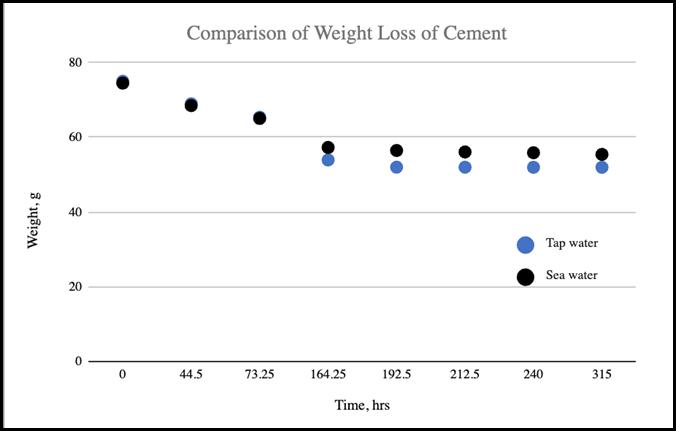
Figure 1: Effect of freshwater on the rate of weight loss during curing of concrete.
Asseawatercontainsvarioussalts,theeffectofindividual saltsonthepropertiesofconcretewasevaluated(Table 1). Wetriedtomakeadentintheconcretewiththebackofa paintbrush to assess the concrete’s strength at regular intervals. At the end of the experiment, the hardness was examined by tapping with a metal bar or sound of the concretewhenthecontainerwastappedonthehardsurface orbreakingtheconcreteblockwithahammer.
Ourdatashowedthatcoppersulfateandzincchloridehave littleeffectontheconcrete.Incontrast,calcium,magnesium, iron,andbariumsaltsmadetheconcreteharder.Inanother experiment, calcium silicate and synthetic silica made the concretesoft,highlightingtheseelectrolytes’varyingeffects onconcrete’sdurability.
Inthefollowingexperiment,amixtureof40%seawaterand 60% distilled water was prepared. This mixture was developed to determine if mixing seawater with distilled water improved concrete strength compared to using seawater or distilled water alone. We tested the effects of additionalsodiumchloride,ferricchloride,calciumchloride, andmagnesiumchlorideonthiscombination.Wehadtwo control samples without the salts (these samples only contained40%Seawater+60%DistilledWater).Thecontrol samples seemed softer than all other samples (Table 2), whiletheelectrolytesmadetheconcreteharder.Inthecase ofmagnesiumchloride,thewaterlossoftheformulationwas highercomparedtoothersamples.Thus,thereseemstobea positiveeffectofseawateranddistilledwateronthequality ofconcrete,andadditionalsaltssuchasmagnesiumchloride mayhelpfurther.
International Research Journal of Engineering and Technology (IRJET) e-ISSN: 2395-0056
Volume: 12 Issue: 06 | Jun 2025 www.irjet.net p-ISSN: 2395-0072
We calculatedthe percent weightloss perhourfor all the samplesduringthefirst100hours.Overall,thevalue was about0.18%to0.2%perhourforallthesamplescontaining seawaterorelectrolytes. Additionally,theformulationsof cementcontaining40%seawaterhadsimilardurabilityto thefreshwaterformulation.
Table 1: Effect of various electrolytes on the concrete properties
to organic matters present in the seawater. More work is neededinthisarea.
Table 2: Effect of various salts on the quality of concrete produced using a mixture of 40% Seawater and 60% distilled water.
25 40%SW+60%DW+ 0.5%NaCl 29.1 Hard,dent possible
26 40%SW+60%DW+ 1%FeCl3 29.2
Hard,nocracks, dentpossible
28 40%SW+60%DW+ 1%CaCl2 28.0 Hard,nocrack
29 40%SW+60%DW 29.6
30 40%SW+60%DW, 0.1%MgCl2 35.1
Veryhard,littledent
Slightlysofter, slightdent possible
Hard,slightdent possible 31 40%SW+60%DW+ 0.2%MgCl2 39.2
32 40%SW+60%DW+ 0.5%MgCl2 36.4
Notveryhard,dent possible
Hard,slightdent possible
Veryhard,dent notpossible
27 40%SW+60%DW+ 1%MgCl2 40.7 Veryhard
33 40%SW+60%DW 28.5
Slightlysofter, dentpossible
DW= Distilled water, L= Loss, SW = Seawater
Aftertestingdifferentcementcompositionsandinputs,we foundthatusing40%seawaterwithdistilledwateryielded equally good or improved concrete compared to that prepared using freshwater. Notably, the composition containing 40% saltwater, 60% distilled water, and 1% magnesium chloride achieved improved hardness while offeringafastercuringtime.Thetotalpercentweightloss wasgreaterinsamplescontainingmagnesiumchlorideina solventmixturewith40%seawaterand60%distilledwater.
The quality of concrete produced in various batches was examined by the cracks formed on the top, the amount of freecement fromtheconcreteslab,thesoundof concrete whentappedonahardsurface(thistestisverypromising), andtheamountofforceneededtobreaktheconcreteblock usingahammer.
Thepositiveeffectofseawateronthepropertiesofconcrete maynotsolelybeduetoitselectrolytecontents,butalsodue
DW= Distilled water
Despite of advantages, usage of seawater in concrete as drawbackstoo.Seawater’scomposition,mainlyelectrolytes, can have adverse effects on concrete. The accelerated hydration process reduces the workability of cement and weakenstheconcrete’ssteelreinforcements.Beinganatural product,thecompositionofseawater(organicandinorganic contents)indifferentregionsisvariable.Ifwestartusingthe seawaterinconstruction,thecompositionofseawatermust bemonitoredcarefully.
Apartialreplacementoffreshwaterwithseawatertomake concrete will make cement production more sustainable. This not only conserves freshwater resources but also reduces the carbon footprint associated with the energyintensive processes required to source and produce freshwaterviadesalination.
The energy–intensive desalination process that converts seawater to freshwater continues to degrade the environment, resulting in greater carbon emissions and global warming. Partially replacing freshwater with seawaterforindustrialusemayhelpcombatthisissue.Our research implements seawater as an innovative partial alternative to traditional freshwater to produce concrete. Not only does seawater provide a sustainable partial alternativetofreshwater,butitalsoresultsinmoreefficient production of concrete. The particular formulation we # Sample Description
International Research Journal of Engineering and Technology (IRJET) e-ISSN: 2395-0056
Volume: 12 Issue: 06 | Jun 2025 www.irjet.net p-ISSN: 2395-0072
developedwith40%saltwater,60%distilledwater,and1% magnesium chloride resulted in better curing times and efficiency,makingseawaterapromisingpartialreplacement forfreshwater.Ourresearchstudiedtheeffectsofdifferent concentrations of polymers and surfactants, water types, salts, and seawater dilutions to determine an optimal mixture. Future studies can further our understanding of seawater usage in concrete, developing new formulations thatimprovecuring timesandconcrete quality(including corrosion prevention of reinforced steel) to protect our environment. Attention must be paid to prevent the corrosion of reinforcing steel used in the concrete blocks, which are prepared using a mixture of seawater and tap water.
References
1.Herndon,A.(n.d.).EnergyMakesUpHalfofDesalination Plant Costs: Study. Business. https://www.bloomberg.com/news/articles/2013-0501/energy-makes-up-half-of-desalination-plant-costs-study
2.Jones,E.,Qadir,M.,vanVliet,M.T.,Smakhtin,V.,&Kang, S.-M.(2019).Thestateofdesalinationandbrineproduction: A global outlook. Science of the Total Environment, 657, 1343-1356. https://doi.org/10.1016/j.scitotenv.2018.12.076
3. Mineral commodity summaries 2019. (2019). Mineral CommoditySummaries.https://doi.org/10.3133/70202434
4. World Cement Production Statistics. (2020). World Cement Association. World Cement Association. https://www.worldcementassociation.org/
5.CementTechnologyRoadmap2009.(n.d.).International Energy Agency, 1-36. International Energy Agency. https://iea.blob.core.windows.net/assets/897b7ad9-200a4314-b870-394dc8e6861a/CementTechnologyRoadmapCarbonEmissionsReductionsupto2050.pdf
6. Global Cement Production. (n.d.). International Energy Agency. Retrieved February 10, 2025, from https://www.iea.org/energy-system/industry/cement?
7. Composition of cement. (n.d.). Penn State Engineering. Retrieved March 8, 2025, from https://www.engr.psu.edu/ce/courses/ce584/concrete/libr ary/construction/curing/composition%20of%20cement.ht m
8. Concrete: Scientific Principles. (n.d.). Illinois Materials Science and Engineering. Retrieved March 8, 2025, from https://matse1.matse.illinois.edu/concrete/prin.html
9. Witze, A. (2017). Seawater is the secret to long-lasting Roman concrete. Nature, 1-3. Nature. https://www.nature.com/articles/nature.2017.22231.pdf.
10.Z.Su,Z.Yan,K.Nakashima,C.Takano,andS.Kawasaki; Naturally derived cements learned from the wisdom of ancestors: A literature review based on the experience of ancient China, India and Rome; Materials 2023, 16(2), 603;https://doi.org/10.3390/ma16020603
11.Saxena,S.,&Baghban,M.H.(2023).Seawaterconcrete:A critical review and future prospects. Developments in the Built Environment, 16, 100257. https://doi.org/10.1016/j.dibe.2023.100257



Hemant N. Joshi, Ph.D., MBA is the Founder of Tara Innovations LLC, New Jersey, USA. He is passionate about developing formulations.
Lavanya Kundurthy, BE is the Research Scientist at Tara InnovationsLLC,NewJersey,USA.
Vrishank Malik was a Senior at The Academy for Mathematics, Science & Engineering in Rockaway,NJ.Nextyear,heplans to major in Environmental Engineering at Cornell University to further his passion for transitioningEarthtoasustainable future.

Raj Shah was a Senior in the Magnet Program forMath and ScienceatMorrisHillsHighSchool. He is going to pursue the premedicine track at University of North Carolina. He looks forward to furthering his passion for medicineandservingpatientsasa physician.