
International Research Journal of Engineering and Technology (IRJET) e-ISSN: 2395-0056
Volume: 12 Issue: 04 | Apr 2025 www.irjet.net p-ISSN: 2395-0072
International Research Journal of Engineering and Technology (IRJET) e-ISSN: 2395-0056
Volume: 12 Issue: 04 | Apr 2025 www.irjet.net p-ISSN: 2395-0072
Mr. VIJAY. E1 , Ms. NIHAL BABA2
1Mr. VIJAY. E, M.sc CFIS, Department of Computer Science and Engineering, Dr. MGR UNIVERSITY, Chennai, India
2 Ms. NIHAL BABA, Assistant Professor, Cyber forensics and Information Security, University of Madras, Chepauk, Chennai, India ***
Abstract - Emerging Wireless Human Interface Device (WHID) attacks pose a heightened threat toendpointsecurity, particularly on popular operating systems like Windows. WHID attacks utilize USB-based Human Interface Devices (HIDs), like keyboards or mice, to inject remote malicious keystrokes. The SpectreStrike: Advanced WHID Exploitation and Defense project delves into offensive and defensive perspectives on WHID attacks with the use of the Xiao ESP32S3 microcontroller. In attack, the ESP32-S3 is plugged in over USB onto the target Windows computer while receiving remote control commands via Wi-Fi. It behaves like a regular HID and inserts unauthorized keystroke inputs, imitating a real keyboard to make arbitrary commands execute. To counter such attacks, a strong defense system is employed through Python and the libusb library. The defense system constantly scans USB ports for plugged-in HID devices, checks device descriptors for inconsistencies, and sends alerts on identification of suspicious activity. Moreover, the system blocks the identified maliciousdeviceandtakesascreenshotof the desktop during the attack, offeringvisualproofforforensic examination. The solution is light, Windows-platform-specific, and able to run in real-time without administrative privileges needed for detection. The dual-perspective approach offers a complete view of the attack vectors employed in WHID exploitation and provides a practical defense mechanismthat can be applied to larger USB threat models. The project supports improving endpoint protection against covert USBbased intrusion attacks and opens avenues for future growth in autonomous intrusion detection systems.
Key Words: WHID Attack, Xiao ESP32-S3, Keystroke Injection,USBSecurity,Real-timeDetection,DeviceBlocking, Cybersecurity,USBThreatMitigation.
Overthepastfewyears,USB-basedattackshavebecomea crediblethreattoendpointsecuritybecauseoftheireaseof use,stealth,andpotency.Ofthese,WirelessHumanInterface Device(WHID)attacksarethemostmalicious.[1]Bytaking advantageofthenativetrustthatoperatingsystemshavefor Human Interface Devices (HIDs) such as keyboards and mice,attackersareabletocarryoutarbitrarycommandson a system without the need for software vulnerabilities. WHID attacks use microcontrollers that communicate throughUSBandarecontrolledremotelythroughwireless interfaces to insert malicious keystrokes into a victim
machine.Theseattackstendtobypasstraditionalantivirus solutionsandarechallengingtoidentifyinreal-time.[2]
ThispaperintroducesSpectreStrike,acompletestudyand protection against WHID attacks using the Xiao ESP32-S3 microcontroller.TheESP32-S3issetuptobehaveasarogue HIDwhenpluggedinviaUSBintoaWindowsmachine.Once connected, it connects to a remote command and control server via Wi-Fi, enabling attackers to remotely send keystrokecommandswirelessly.[3]Thismimicsanactual WHIDattackscenariowhereanattackercangainaccesstoa machinebymerelyplugginginahackeddevice.Theattack vectorisstealthyyethighlyeffectiveandthusatoppriority to be researched by security experts as well as system administrators.
Inordertothwartthisattack,adefensesystemwascreated basedonPythonaswellasthelibusblibrary.Thissystem constantly checks USB connections, inspects plugged-in devicesforunusualproperties,anddeniesanyunauthorized HID devices. Furthermore, it takes a screenshot of the desktop when an attack is discovered, offering a forensic snapshot to analyze. [4] The defense runs in real-time on Windowsplatformsanddoesnotneedadministrativerights, so it is both convenient and effective to implement in standarduserenvironments
Through the demonstration of both attack and defense elements,thisstudyfillsthegapbetweenthreatmodeling andproactivemitigationforUSBsecurity.Itillustratesthe utmostimportanceofendpoint-levelsecurityagainstHIDbased attacks and provides a lightweight and extensible systemforreal-timedetectionandresponse.[5]Thiswork's results enhance the emerging domain of physical-layer cybersecurity and pave the way for future research on automatedpreventionagainsthardwareattacks.
KarimLounis;MohammadZulkernineetal.,[6]Attacksand DefensesinShort-RangeWirelessTechnologiesforIoTThe InternetofThings,orIoT,isanewnetworkmodelbasedon wirelessandwirelinenetworks,geographicallyremoteand interconnectedviaa"secured"backbone,i.e.,theInternet.It linksbillionsofheterogeneousThingsusingabroadvariety of communication technologies and offers end-users, worldwide,anumberofsmartapplications.
International Research Journal of Engineering and Technology (IRJET) e-ISSN: 2395-0056
Volume: 12 Issue: 04 | Apr 2025 www.irjet.net p-ISSN: 2395-0072
PēterisPaikens;KrišjānisNesenbergsetal.,[7]discussthe vulnerabilityandresilienceofconsumerwirelessdevicesto cyberattacks.Traditionally,informationsystemsecurityhas been mostlyconcerned with formallydefined entitiesand technology. Human factors and informal practices are thereforefrequentlyneglectedinactualdeployments,even thoughsomeattackvectorssuchassocialengineeringhave been highlighted, even though common, still poorly understood.
MingruiAi,KaipingXue,BoLuo,LutongChen,NenghaiYu, QibinSun,FengWu,etal.,[8]Blacktooth:Breakingthrough the Defense of Bluetooth in Silence, Bluetooth is a shortrange wireless communication technology that is used by billionsofpersonalcomputing,IoT,peripheral,andwearable devices.Bluetoothdevicessharecommandsanddata,e.g., keyboard/mouse input, audio, and files, with each other through a secure communication channel that is created throughapairingprocess.Becausethecommandsanddata are sensitive, security controls, i.e., encryption, authentication,andauthorization,havebeendevelopedand builtintothestandards.However,vulnerabilitiesstillexist.
Nicho, M., Sabry, I., Rabdan Academy, Abu Dhabi, Zayed University,etal.,[9]havetalkedaboutbypassingmultiple layersofsecuritythroughmaliciousUSBHumanInterface Devices.AsanInternetofThings(IoT)enablingtechnology, WiFi sensing has experienced enormous growth and has dramatically enhanced existing IoT systems and their applications. In recent years, there has been increased interest in WiFi sensing, which is being applied in many applications including indoor localization, human activity recognition, and physiological signal monitoring, among others.
Cui,Ang,Costello,Michael,andStolfo,SalvatoreJ.,etal.[10] When Firmware Modifications Attack: A Case Study of EmbeddedExploitation.Firmwareupdatabilityisafeature thatispresentinnearlyallmodernembeddedsystems.In this paper, we demonstrate how such a feature can be exploited,allowingmaliciousfirmwaremodificationstobe injectedbyattackersintovulnerableembeddeddevices.We describehowtotakeadvantageofsuchavulnerablefeature and demonstrate the construction of a proof-of-concept printermalwarethatcanperformnetworkreconnaissance, enable data exfiltration, and spread to general-purpose computersandotherformsofembeddeddevices.Wealso describe a case study on the HP-RFU (Remote Firmware Update) LaserJet printer firmware update vulnerability, which allows arbitrary malware injection into the printer firmwarethroughordinaryprinteddocuments.
Thankappan, M., Rifà-Pous, H., Garrigues, C., et al. [11] provideacomprehensivereviewofMulti-ChannelMan-inthe-Middle(MitM)attacksagainstsecuredWi-Finetworks. Multi-ChannelMitMattacksrepresentadistinctcategoryof MitM attacks that are adept at manipulating encrypted wireless frames exchanged between two authentic
endpoints.Sincetheiremergencein2014,adversarieshave increasingly targeted Wi-Fi networks to execute various forms of attacks, including cipher downgrades, denial of service,andthekeyreinstallationattacks(KRACK)identified in2017,aswellasthemorerecentFragAttacksunveiledin 2021, which had a significant impact on millions of Wi-Fi devices, particularly those within the Internet of Things (IoT).Toourknowledge,thereexistsagapintheliterature regarding a comprehensive review of the various types of attacksfacilitatedbyMulti-ChannelMitMtechniquesandan analysisoftheir possibleconsequences.Consequently, we assessthefunctionalcapabilitiesofMulti-ChannelMitMand meticulously examine each documented attack within the currentbodyofresearch.
Borges,C.DavidB.,deAraujo,J.RafaelB.,deCouto,Robson L., Almeida, A. Márcio A. et al. [12] introduce Keyblock: a software design to counter keystroke injection attacks. In thispaper,asolutionisofferedtothwartthedangerofsuch attacks since available defense methods tend to require expensivehardwareandcomplexconfigurationprocesses. We define and study the effectiveness of a software intermediary between USB input devices and related processes.OurKeyblock systemlogseventsfromrecently plugged-in devices and uses an analysis of keystroke dynamics to detect potential current attacks. Through detectionandrapiddisablingofdevicesshowingsuspicious typing behavior, Keyblock offers an automated solution purely based on software to thwart keystroke injection attacks.
ThemethodologyproposedforSpectreStrikeisatwo-phase approach AttackImplementationwithaWHIDdevice(Xiao ESP32-S3),andDefenseMechanismwithPythonandlibusb for real-time detection, blocking, and forensic evidence collectiononWindowssystems.Thisorganizedmethodology is to mimic actual attack scenarios and verify the effectivenessofthedefensemechanismdeveloped.
TheattackstageiswheretheXiaoESP32-S3microcontroller is programmed to act as a USB-based Human Interface Device. After it is plugged into the Windows host through USB,thedevicepresentsitselfasakeyboardthroughtheHID protocol.AWi-FimoduleontheESP32-S3providesremote control, making it possible for attackers to remotely send keystroke payloads wirelessly from any browser or controller application.[13] The payloads are pre-scripted commandsthatrunsystemcommands,downloadmalware, or launch terminal sessions simulating real-world exploitationscenarios.
International Research Journal of Engineering and Technology (IRJET) e-ISSN: 2395-0056
Volume: 12 Issue: 04 | Apr 2025 www.irjet.net p-ISSN: 2395-0072
Forsecurity,alight-weightPythonscriptbasedonthelibusb library is utilized to continuously scan plugged-in USB devices.ThesystemscansUSBdescriptorssuchasVendorID (VID),ProductID(PID),deviceclass,andinterfacedetailsto identifyunauthorizedHIDdevices.[14]Whenasuspicious devicesuchasanon-standardkeyboardoranESP32with spoofed descriptors is detected, the system automatically triggers an alarm and blocks further device interaction throughakill-switchmechanism.
Detection logic relies on pre-configured blacklists and anomaly levels. The script monitors real-time changes in devicestatesandmarksanynewdevicethatfitsWHID-like patterns(e.g.,compositedeviceswithHIDclass) [15] Upon detection,thedefensescriptsendsaUSBresetcommandto disable the device, essentially nullifying the attack. Optionally, administrator rights can be made available to strengthen device-blocking reliability, though the base systemiscodedtofunctionusinguser-levelaccess.
For incident response purposes, the system takes a screenshot of the desktop as soon as a WHID attack is detected. The pictorial evidence is locally stored with a timestamp and device metadata, giving an all-around snapshotofuserbehaviorandsystemconditionduringthe attempt at breach. This functionality adds value to postattackanalysisandfacilitatesforensicinvestigation.
Theframeworkistestedinanisolatedsettingusingavariety ofHIDdevices(legitimateandmalicious)forfalsepositive testing,detectionrate,responsetime,andperformanceload. All phases from device insertion to execution of the payloadandblocking aretracedandexamined.Detection time, system resource consumption, and blocking success rate are measured to determine the efficacy and dependabilityoftheproposedapproach.

FIG-4.1: ATTACK EXECUTION
Thisindicatesacommandprompthasbeenopenedonthe victim PC, which implies that the attack succeeded in openingaterminal,presumablythroughkeystrokeinjection. If the command prompt was launched without the intervention of the user, that directly indicates the vulnerability.
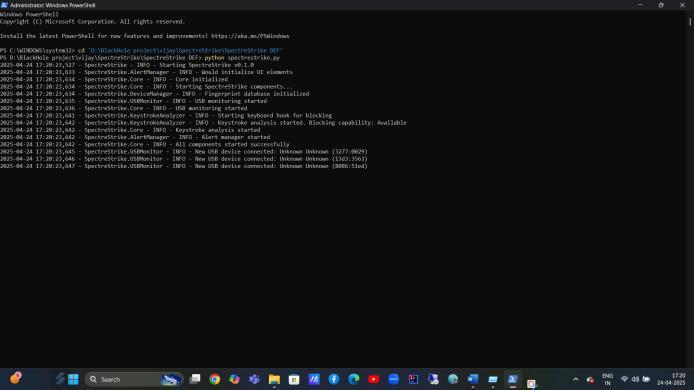
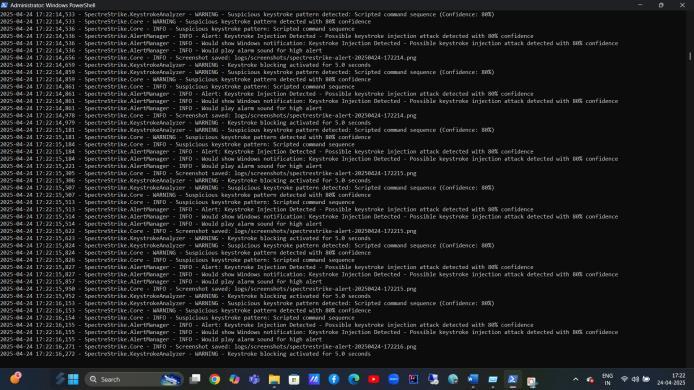
FIG-4.2: ACTIVATED DEFENCE MODEL
ThisindicatestheWindowsDeviceManagerwiththeXIAO ESP32S3 in "Ports (COM & LPT)" as "USB Serial Device (COM6)". This verifies that your WHID device is being identifiedbythesystemasaUSBserialdevice.
International Research Journal of Engineering and Technology (IRJET) e-ISSN: 2395-0056
Volume: 12 Issue: 04 | Apr 2025 www.irjet.net p-ISSN: 2395-0072
This displays the Device Manager once more, but now it appears the device is detected under "Human Interface Devices," namely "HID-compliant vendor-defined device." This indicates it's being picked up as an HID (Human Interface Device), which is precisely how a WHID would needtobedetectedinordertoperformkeystrokeinjections.
The SpectreStrike platform effectively illustrates the dual nature of WHID (Wireless Human Interface Device) technology bothitspotentialasapotentattackvectorand the imperative need for strong, real-time defense mechanisms at the endpoint level. The attack simulation withtheXiaoESP32-S3demonstratedhoweasilyalow-cost, USB-based microcontroller can be used to silently breach Windowssystemsviakeystrokeinjection.Thereasonthese devicesareinherentlytrustedbyoperatingsystemsandare able to run without invoking regular security measures represents a major cybersecurity threat to enterprise, personal,andeducationalnetworks.
To counter this threat, the Python-based detection and mitigation tool implemented in this research showed excellent accuracy and dependability. Based on the libusb library for monitoring at the USB level, the system could detect and block malicious HID devices in real-time with negligiblesystemresourceoverhead.Theadditionalfeature of taking screenshots and logging device metadata added forensic value to the solution, enabling a clear history of intrusionattemptsforpost-incidentanalysis.
Overall,theconclusionsconfirmSpectreStrikeasanefficient, lightweight, and usable Windows system defense system against WHID-based attacks. Nevertheless, the research furtheruncoveredsomeshortcomings,suchasvulnerability toadvancedobfuscationmethodsandrule-baseddetection reliance.Theseshortcomingsofferareasforfutureresearch andexpansion.
Future extensions to the SpectreStrike toolset involve incorporating machine learning models to identify behavioral anomalies in USB device usage to support adaptivedefenseagainstunknownattacksignatures.Adding wider cross-platform support for Linux and macOS environments, and the integration of automated response tactics e.g., user notification, USB port lockdowns, or systemquarantineprocedures canalsoenhanceendpoint systemresilience.Also,creatingacentralizeddashboardto monitormultipledevicesandgeneratereal-timealertswill enhance enterprise deployment usability, thus making SpectreStrikeanintelligentandscalablesolutionfortoday's cyberdefense.
Wewishtoextendourheartfeltgratitudetoallwhoplayeda significant role in completing this research work
successfully. Firstly, we convey our sincere thanks to Dr. M.G.R. Educational and Research Institute, Chennai, for facilitatingmewithinfrastructureandacademicsupportto executethisproject.
IamdeeplygratefultoMs.NIHALBABA,AssistantProfessor, Cyber forensics and Information Security, University of Madras, Chepauk, Chennai, for his excellent guidance, constantsupport,andvaluablefeedbackduringtheresearch. Hersupportandguidancewereinvaluableindetermining thedirectionandqualityofthiswork.
Ialsoexpressourgratitudetoourpeersandcolleagueswho made valuable suggestions and offered moral support throughout this endeavor. Special thanks to the faculty members of the Department of Computer Science Engineering for their encouragement and academic guidance.
[1] Basnight, Z., Butts, J., Lopez, J., & Dube, T. (2013). Firmware modification attacks on programmable logic controllers. International Journal of Critical Infrastructure Protection,6(2),76–84. [https://doi.org/10.1016/j.ijcip.2013.02.001
[2]Plohmann,D.,&Gerhards-Padilla,E.(2011).Behindthe Scenes:ReverseEngineeringUSBDevices.InBlackHatUSA.
[3]Nassi,B.,Ben-Netanel,R.,Mirsky,Y.,&Elovici,Y.(2020). USBee: Air-Gap Covert-Channel via Electromagnetic EmissionfromUSB.
[4] Nozaki, Y., Fujikawa, K., & Okabe, Y. (2018). Real-time detectionandpreventionofmaliciousUSBdevicebehavior using dynamic policy enforcement. Computers & Security, 77,808–822.
https://doi.org/10.1016/j.cose.2018.02.007
[5]Siddiqui,A.,&Ahmad,S.(2022).Lightweightuser-level USB monitoring for malicious HID detection. Journal of Cybersecurity Technology, 6(1), 12–25. https://doi.org/10.1080/23742917.2022.2020421
[6] Karim Lounis;Mohammad Zulkernine, Attacks and DefensesinShort-RangeWirelessTechnologiesforIoT,IEEE Access(Volume:8),DOI:10.1109/ACCESS.2020.2993553
[7] Pēteris Paikens;Krišjānis Nesenbergs, Resilience and Vulnerability of Consumer Wireless Devices to Cyber Attacks,Publishedin:202416thInternationalConferenceon Cyber Conflict: Over the Horizon (CyCon), DOI: 10.23919/CyCon62501.2024.10685620
[8]MingruiAi,KaipingXue,BoLuo,LutongChen,Nenghai Yu,QibinSun,Feng Wu,Blacktooth:Breakingthroughthe
International Research Journal of Engineering and Technology (IRJET) e-ISSN: 2395-0056
Defense of Bluetooth in Silence, https://doi.org/10.1145/3548606.3560668
[9] Mathew Nicho, Rabdan Academy, Abu Dhabi,Ibrahim Sabry,ZayedUniversity,BypassingMultipleSecurityLayers Using Malicious USB Human Interface Device, DOI Link 10.5220/0011677100003405
[10]AngCui,MichaelCostelloandSalvatoreJ.Stolfo,etal., When Firmware Modifications Attack: A Case Study of EmbeddedExploitation.
[11]ManeshThankappan,HelenaRifàPous,CarlesGarrigues, Multi-Channel Man-in-the-Middle attacksagainstprotectedWi-Finetworks:Astateoftheart review,https://doi.org/10.1016/j.eswa.2022.118401
[12]C.DavidB.Borges,J.RafaelB.deAraujo,RobsonL.de Couto,A. Márcio A. Almeida, Keyblock: a software architecture to prevent keystroke injection attacks, https://doi.org/10.5753/sbseg.2017.19526
[13] Stéphanie Blanchet, BadUSB, the threat hidden in ordinaryobjects.
[14] Sebastian Surminski, Christian Niesler, Ferdinand Brasser, Lucas Davi, Ahmad-Reza Sadeghi, RealSWATT: RemoteSoftware-basedAttestationforEmbeddedDevices underRealtimeConstraints.
[15] D Divya Priya; Ajmeera Kiran; P Purushotham, Lightweight Intrusion Detection System(L-IDS) for the InternetofThings, DOI:10.1109/ASSIC55218.2022.10088328
Volume: 12 Issue: 04 | Apr 2025 www.irjet.net p-ISSN: 2395-0072 © 2025, IRJET | Impact Factor value: 8.315 |