
International Research Journal of Engineering and Technology (IRJET) e-ISSN: 2395-0056
Volume: 12 Issue: 07 | JUL 2025 www.irjet.net p-ISSN: 2395-0072
International Research Journal of Engineering and Technology (IRJET) e-ISSN: 2395-0056
Volume: 12 Issue: 07 | JUL 2025 www.irjet.net p-ISSN: 2395-0072
1PG student, Dept. of Structural Engineering, M.G.M college of Engineering, Maharashtra, India
2 Professor, Dept. of Structural Engineering, M.G.M college of Engineering, Maharashtra, India
3 HOD, Dept. of Structural Engineering, M.G.M college of Engineering, Maharashtra, India
Abstract - This research paper investigates the effect of varying structural ductility and response reduction factor (R) values on the seismic performance of a mid-rise reinforced concrete (RC) building. The response reduction factor accounts for the inherent energy-dissipating capacity of structural systems and directly influences the seismic forces considered in design. To explore this, a G+13 (14-storey) RC building was modeled and analyzed using the response spectrum method as per IS 1893 (Part 1): 2016, with different structural ductility configurations and corresponding Rvalues.
Four structural models were considered in this study: Model 1 representing a fully ductile structure, Model2with non-ductile beams and ductile shear walls, Model 3 with partial ductility (either beams or shear walls non-compliant), and Model 4 with both non-ductile beams and shear walls. The R-values applied for analysis were 5.0, 4.5, 4.0, and 3.0, respectively. Each model was evaluated based on key seismic performance parameters including storey displacement, storey drift, storey shear, and lateral load distribution.
The results indicate that decreasing structural ductility and associated R-values lead to increasedseismicdemandinterms of base shear and member forces, while overall displacements and drifts are reduced. Fully ductile systems exhibit greater lateral flexibility but lower seismic forces duetohigherenergy dissipation, whereas non-ductile systems attract higher base shear but demand morereinforcement andstiffersections. The study emphasizes the critical role of structural ductility in achieving an optimal balance between seismic safety and structural economy, especially in mid-rise RC buildings designed in high seismic zones.
Key Words: Responsereductionfactor,storeydisplacement, storeydrift,storeyshear,lateralloads.
The seismic performance of reinforced concrete (RC) structuresislargelyinfluencedbytheircapacitytodeform inelastically while maintaining structural integrity. This deformationcapacity,knownasductility,allowsstructures to dissipate seismic energy through controlled cyclic behavior, reducing the forces transmitted to critical structural components. In modern earthquake-resistant
design, the concept of ductility is embedded in the formulation of the response reduction factor (R), which modifiesthedesignseismic forcesbasedonthestructural system’sexpectedenergydissipationcapabilities.
AsperIS1893(Part1):2016,highervaluesoftheresponse reduction factor are assigned to systems with superior ductile detailing, such as special moment-resisting frames andwell-confinedshearwallsystems.Conversely,systems lackingproperductiledetailingareassignedlowerR-values, resultinginhigherdesignbaseshearandmoreconservative memberdesign.Therationaleisstraightforward:structures withgreaterductilitycanabsorbmoreenergyandareless likely to fail suddenly during ground motion, thereby justifyingareductioninseismicforces.
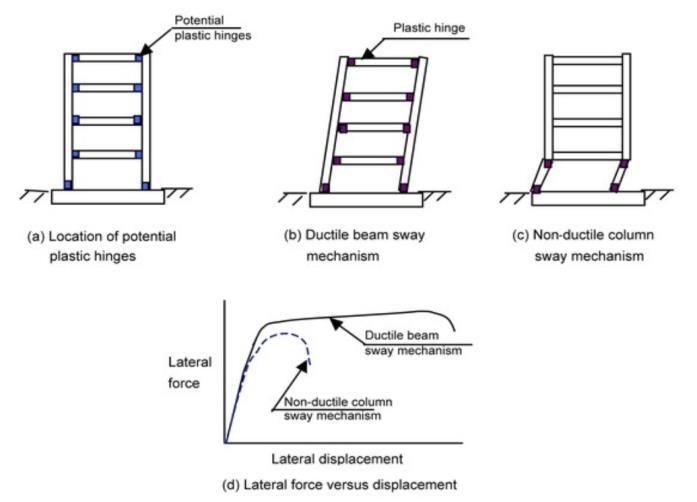
TheconceptualdiagrampresentedinFigure1highlightsthe contrasting behavior of structural systems under cyclic seismic loading. Ductile structures exhibit wide, stable hysteresisloopsthatrepresentsignificantenergyabsorption andresidualstrengthafterrepeatedloadcycles.Non-ductile structures,ontheotherhand,displaynarrow,steeploops indicativeofbrittlefailure,withlittlecapacitytodissipate energy. Partially ductile configurations fall between these extremes, often showing reduced energy dissipation and early degradation in strength and stiffness. These visual differencesdirectlycorrelatewiththetheoreticalbasis for varyingR-valuesindesign.
International Research Journal of Engineering and Technology (IRJET) e-ISSN: 2395-0056
Volume: 12 Issue: 07 | JUL 2025 www.irjet.net p-ISSN: 2395-0072
In real-world construction, inconsistencies in ductile detailing especially in beams and shear walls can lead to partialornon-ductilebehavior,deviatingsignificantlyfrom design assumptions. Such deviations can result in underestimatedseismicdemand,unsafeperformance,and increased risk of structural failure during an earthquake. Understanding how different levels of ductility impact structural response parameters like storey displacement, inter-storeydrift,storeyshear,andlateralloaddistribution isessentialforensuringbothsafetyandeconomyinmid-rise RCbuildings.
To assess the influence of ductile detailing and varying energydissipationcapacitiesonseismicperformance,amidrise residential structurewasselectedandanalyzedusing nonlineardynamicprocedures.Thestructuremodelledisa G+13 RCC framed building, designed as per Indian codes. Theprimaryobjectivewastoevaluatehowdifferentlevelsof ductility, represented by response reduction factors (Rvalues),affectkeyseismicresponseparameters.
ThebuildingisassumedtobelocatedinSeismicZoneIV,as per IS 1893 (Part 1): 2016, with a basic wind speed of 44 m/sconsideredasperIS875(Part3):2015.Structural analysiswasperformedusingETABS2018,andtheseismic demand was calculated using the response spectrum method.Allmaterialsandgeometricalpropertieswerekept constant across the models, while only the ductility level (andhencetheR-value)wasvaried.
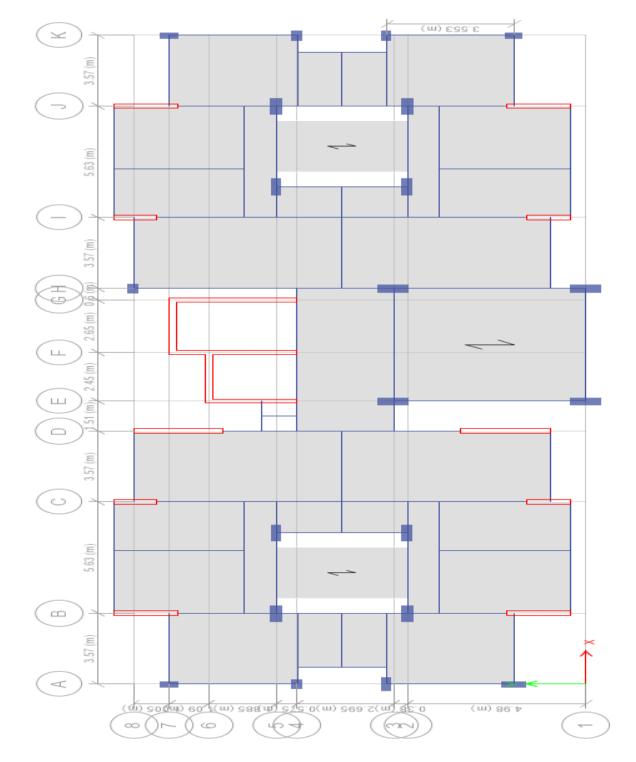
2:Floorplan
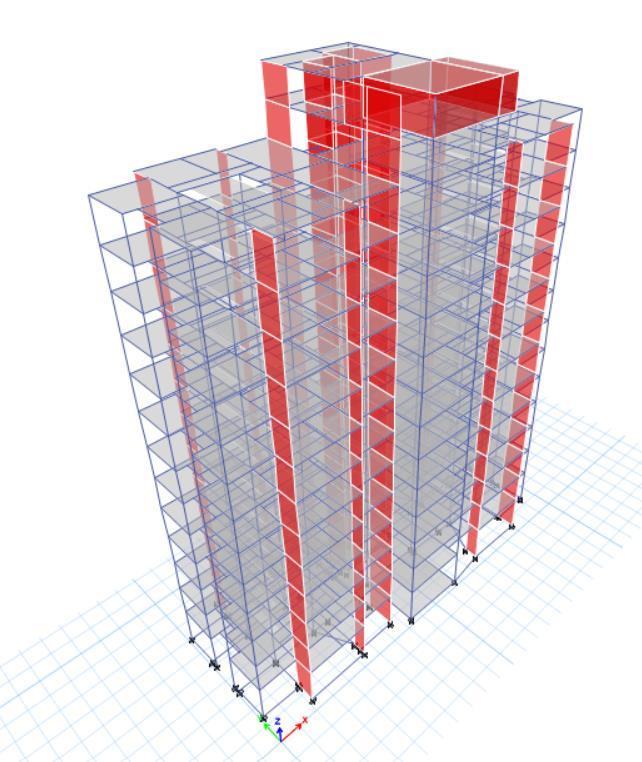
3:3Dplan
To simulate different real-world detailing scenarios, four modelswerecreatedwithvaryingcombinationsofductile andnon-ductileelements.Thedetailsareasfollows:
Model1:FullyDuctileStructure(R=5.0)
Thismodelfollowscompleteductiledetailingforbothbeams and shear walls in accordance with IS 13920: 2016. It represents a best-case scenario where maximum energy dissipation is expected during seismic excitation. The assignedresponsereductionfactorisR=5.0,asperIS1893 (2016)forductilemoment-resistingframeswithshearwalls.
Model2:DuctileSW,Non-DuctileBeams(R=4.5)
Inthisconfiguration,onlytheshearwallsaredetailedasper IS13920,whilebeamsfollowconventionaldetailingwithout seismicconsiderations.TheR-valueusedis4.5,whichwas listedintheIS1893:2002versionforpartiallyductiledual systems, although not mentioned in the latest code. This modelreflectspartialcomplianceoftenseeninconstruction practice.
Model3:PartiallyDuctileSystem(R=4.0)
Thismodelassumeseitherbeamsorshearwallslackductile detailing,butnotboth.Itsimulatesascenarioofincomplete implementationofseismicdetailing,whichmayarisedueto constructionerrorsorlackofcodeawareness.AnR-valueof 4.0 is adopted, reflecting intermediate energy dissipation capacity.
Model4:Non-DuctileStructure(R=3.0)
Thismodelassumesnoductiledetailingineitherbeamsor shearwalls,withstandarddetailingasperIS456:2000.The
International Research Journal of Engineering and Technology (IRJET) e-ISSN: 2395-0056
Volume: 12 Issue: 07 | JUL 2025 www.irjet.net p-ISSN: 2395-0072
structureexhibitsbrittlebehaviorunderseismicloadsandis assigned an R-value of 3.0, resulting in maximum seismic forces. It represents unsafe or outdated construction practices.
Eachofthesefourmodelswassubjectedtothesameload combinations and boundary conditions. The seismic responsewasevaluatedbycomparingparameterssuchas storey displacement, storey drift, base shear, and overall lateraldeflection,tounderstandthestructuralimplications ofdetailingqualityandcorrespondingR-values.
Upon completion of the structural analysis in ETABS, a comprehensive set of seismic response parameters was extractedforallfourbuildingmodelsunderconsideration. The analysis focused on evaluating critical factors suchas storeydisplacement,storeydrift,baseshear,andmaximum lateral deflection, which are crucial in determining the seismic behavior and overall performance of mid-rise structures.
To capture the full scope of structural behavior, these responseparameterswereevaluatedindependentlyinboth theXandYdirections,reflectingthebidirectionalnatureof seismic excitations. This directional analysis allows for a clearerunderstandingofhoweachstructuralconfiguration reactsunderlateralforcesindifferentorientations,whichis especiallysignificantinreal-worldseismicscenarioswhere buildingsarerarelysubjectedtoforcesinonlyonedirection.
For a consistent baseline, Model 1 representing a fully ductile structure designed with the highest response reductionfactor(R=5.0)asperIS1893:2016 wastaken as the reference model. The subsequent models, namely Model2(non-ductilebeamswithductileshearwalls),Model 3 (partial ductility: either beams or shear walls noncompliant), and Model 4 (non-ductile beams and shear walls),wereanalyzedwithreducedductilityprovisionsand correspondinglowerRvalues,includingR=4.5 (asperIS 1893:2002),R=4.0,andR=3.0.
The results for each model were then compared against Model 1, both in terms of absolute values and in terms of percentageincreaseordeviationfromthebenchmark.This comparison highlights how deviations from full ductile detailing can significantly influence seismic performance, increasingvulnerabilityincertainstructuraldirections.
Separate comparative tables were prepared for the XdirectionandY-directionresponses,detailingthemaximum valuesforeachseismicparameter,alongwiththepercentage growth or change with respect to Model 1. These tables provideaclearvisualizationofhowthereductioninductility andtheassociateddecreaseintheresponsereductionfactor leads to progressively higher seismic demands on the structure.
Thisdirectionalandmodel-wisecomparativeanalysisforms thecoreofthestudy,underscoringtheimportanceofproper ductiledetailingandrationalselectionofresponsereduction factorsinseismicdesign.
Table 2 ComparisonofresultsinX-direction
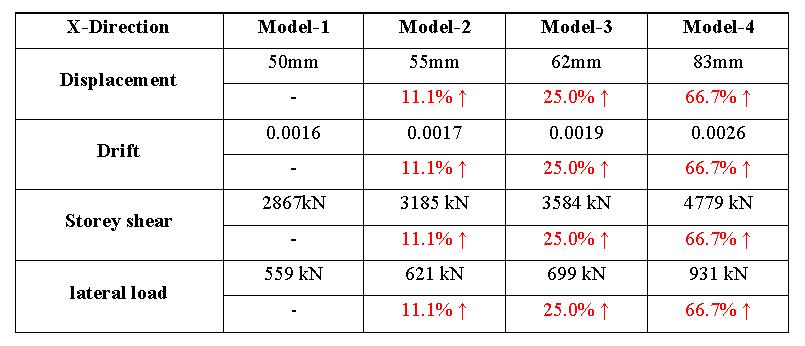
Table 2 ComparisonofresultsinX-direction
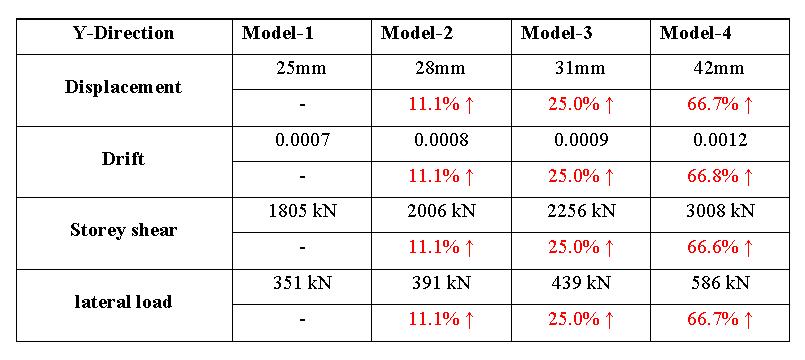
Fromthedatapresentedintheabovetables,itcanbeseen that all three modified models demonstrated a noticeable increaseinthevaluesofthefourkeystructuralparameters whencomparedtothebaselineModel1.Specifically,Model 2 showed a uniform rise of approximately 11% in all parameters, while Model 3 exhibited a more pronounced increaseof25%.Model4,ontheotherhand,experiencedthe highest growth, with all four parameters increasing by around 66.7%. It is important to highlight that this percentagegrowthtrendremainedconsistentinboththeX andYdirections,indicatingthattheobservedvariationwas notdirection-dependentbutratherauniformeffectacross thestructuralbehavior.
Inconclusion,theanalysishighlightsthatreducedductility in structural elements significantly affects the seismic responseofabuilding.Whencomparedwiththefullyductile baseline Model 1, all three modified models showed a notableincreaseinkeystructuralperformanceparameters. Model 2, with non-ductile beams and ductile shear walls, demonstrated an approximate 11% increase across all parameters.Model3,featuringpartialductility,exhibiteda more substantial rise of around 25%, indicating higher
International Research Journal of Engineering and Technology (IRJET) e-ISSN: 2395-0056
Volume: 12 Issue: 07 | JUL 2025 www.irjet.net p-ISSN: 2395-0072
susceptibility to seismic effects. The highest increase was observed in Model 4, where both beams and shear walls werenon-ductile,resultinginanaverageescalationof66.7% inseismicresponses.
ThesevariationswereconsistentlyobservedinbothXandY directions,indicatingthattheimpactofreducedductilityis uniformandnotdirection-dependent.Thisstudyreinforces the importance of adhering to full ductile detailing as per code provisions, as even partial non-compliance can significantlycompromiseastructure'sseismicperformance.
[1] IS456:2000 – PlainandReinforcedConcrete–Codeof Practice(FourthRevision)
[2] IS 1893 (Part 1):2016 – Criteria for Earthquake ResistantDesignofStructures–GeneralProvisionsand Buildings
[3] IS 13920:2016 – Ductile Detailing of Reinforced ConcreteStructuresSubjectedtoSeismicForces–Code ofPractice
[4] IS875(Part1):1987 – CodeofPracticeforDesignLoads (OtherthanEarthquake)forBuildingsandStructures–DeadLoads
[5] IS875(Part2):1987 – CodeofPracticeforDesignLoads (OtherthanEarthquake)forBuildingsandStructures–ImposedLoads
[6] IS1893:2002 – CriteriaforEarthquakeResistantDesign ofStructures