
International Research Journal of Engineering and Technology (IRJET) e-ISSN: 2395-0056
Volume: 12 Issue: 07 | Jul 2025 www.irjet.net p-ISSN: 2395-0072
International Research Journal of Engineering and Technology (IRJET) e-ISSN: 2395-0056
Volume: 12 Issue: 07 | Jul 2025 www.irjet.net p-ISSN: 2395-0072
Nitin Patil1 , Prof. U. L. Deshpande2
1 P.G. Student, Government College of Engineering, Karad, Satara, Maharashtra, India. 2 Professor, Dept. of Civil Engineering, Government College of Engineering, Karad, Satara, Maharashtra, India
Abstract - As the demand for sustainable and eco-friendly construction materials continues to grow, this study explores aninnovative approach to improving both the environmental footprint and durability of road infrastructure. Specifically, it investigates howcombiningRecycledAsphaltPavement(RAP) with bio-basedadditives like algaeandstarchcancreatemore resilient and sustainable bituminous mixes. RAP, which contains agedaggregates andbindersreclaimedfromexisting asphalt layers, offers a promising alternative to virgin materials but often suffers from reduced flexibility and bonding capability. To address these issues, renewable additives are introduced algae for itsplasticizingeffectsand starch for its strength-enhancingproperties. Through a series oflaboratory tests, the researchexamineshowthesematerials impact the physical, chemical, andmechanicalperformanceof the mix, focusing on key factors such as stiffness, rutting resistance, fatigue life, and moisture susceptibility. Beyond performance, the study highlights significant environmental and economic benefits: reducing construction waste, conservingnatural resources, loweringcarbonemissions,and cutting material costs. Ultimately, this work aims to offer a practical, cost-effective, and sustainable solution for modern pavement construction, bridgingthegapbetweenengineering needs and environmental responsibility.
Keywords Recycled Asphalt Pavement (RAP), flexible Pavement, Bio-based additives, Aggregate Replacement, mix design, Marshall test.
In this study, bituminous concrete mixes were developed usingvaryingproportionsofReclaimedAsphaltPavement (RAP)at10%,30%,and50%.Specimenswerepreparedfor eachmixandtestedforMarshallStabilitytoevaluatetheir structural integrity. The mix demonstrating the highest stability was further analyzed through Indirect Tensile Strength (ITS) testing to assess its resistance to cracking. Additionally, an economic analysis was conducted to estimate the potential cost savings associated with using RAPinpavementconstruction.
Asphaltrecyclingstandsoutasaneffectiveandsustainable methodforpavementrehabilitation,offeringanalternative toconventionalapproachessuchasoverlayingorcomplete reconstruction. The process involves the reuse of aged
asphaltmaterialfromdeterioratedpavements,whichcanbe partiallyorfullyintegratedintonewmixes.Whenexecuted withproperdesignandqualitycontrol,asphaltrecyclingcan deliver considerable long-term advantages. These include theconservationofnon-renewableresources,reductionin constructionwasteandlandfillusage,andsignificantenergy savings.Italsominimizesconstruction-relateddisruptions, enhancespavementsmoothness,andreducesoverallcosts. Moreover,recyclingallowsfortheoptimizationofmaterial properties by adjusting aggregate gradation and binder content.
Thisapproachisespeciallyvaluableinregionswherehighqualitymaterialsarescarceortransportationdistancesare considerable.Notably,whenproperlyengineered,recycled hotmixasphaltcanmatchtheperformanceofconventional mixes,makingitapracticalandenvironmentallyresponsible choiceformodernroadconstruction.
Most existing studies focus on low RAP content (typically below30%),withlimiteddataontheperformanceofhigher RAPcontent(30%–50%)inbituminousconcretemixes.
ThereisalackofintegratedstudiesthatcorrelateMarshall Stability results with other performance indicators like IndirectTensileStrength(ITS)toassesslong-termpavement performance.
Environmental benefits of RAP usage are frequently discussed qualitatively, with a shortage of quantitative assessmentstosupportsustainabilityclaims.
Many studies are conducted under controlled laboratory conditions, with limited emphasis on the practical applicabilityandscalabilityofRAPuseinfieldconditions.
1. To Design and preparation of bituminous mixes withvaryingpercentagesofRAP(10–50%)andbioadditives(2–10%).forachievingabalancebetween performance,cost-effectiveness,andenvironmental benefits.
International Research Journal of Engineering and Technology (IRJET) e-ISSN: 2395-0056
Volume: 12 Issue: 07 | Jul 2025 www.irjet.net p-ISSN: 2395-0072
2. To assess the effect of RAP and bio-additives on pavement performance parameters such as stability, fatigue resistance, rutting, and moisture susceptibility.
3. Toprovideinsightsintothefeasibilityoflarge-scale adoption of RAP and bio-additives in bituminous mixdesign.
4. Develop a test section using the optimized mix designandmonitorperformanceunderreal-world conditions.
5. Assessenvironmentalimpacts,includingresource conservation and reduction of carbon footprint. Perform life-cycle cost analysis for economic feasibility.
In this project, we are focused on designing a bituminous concrete(BC)mixsuitableforuseasawearingcourse.The goalistodeterminetheappropriatequantitiesofbitumen andaggregatesthatsatisfy bothgradationandvolumetric requirements, especially when incorporating reclaimed asphaltpavement(RAP).
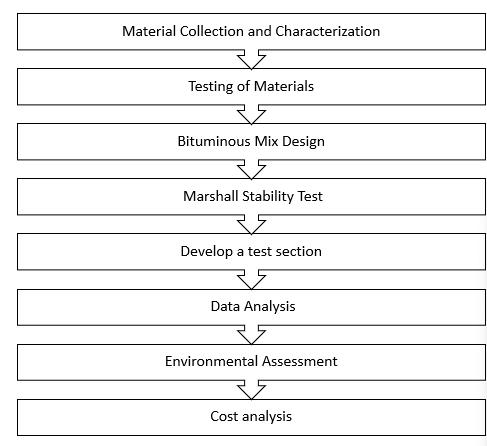
The mix design process was conducted in two phases. Initially, virgin materials were used to develop a baseline mixusingtheMarshallMixDesignmethodwithmid-range gradation.Inthesecondphase,RAPwasblendedwithvirgin aggregates in varying proportions to meet the desired gradationfortheBCmix.
Theoverallprocedureinvolvedfourkeysteps:analysingthe individual gradation of aggregates, replacing part of the virgin mix with RAP, preparing the test specimens, and conducting tests to evaluate their performance. (Prepare bituminousmixeswith: RAP content:10%,20%,30%,40%, and 50%. Bio-additives: 2%, 4%, 6%, 8%, and 10% (by weightofbinder).
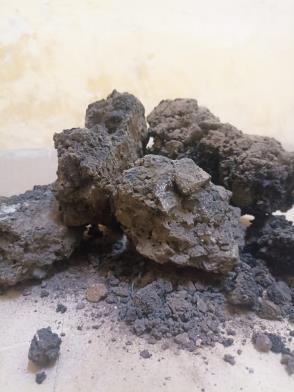
SizeRange:5–20mm
Specificgravity:2.4(byPycnometer)
TheFlakyIndexis10.46%.<15%
ElongationIndexis2.15%
WaterAbsorption:1.5%–3.0%(higherdueto agedbindercoatingandmicro-porosity)
International Research Journal of Engineering and Technology (IRJET) e-ISSN: 2395-0056
Volume: 12 Issue: 07 | Jul 2025 www.irjet.net p-ISSN: 2395-0072
ForBituminousmixthematerial
BinderGrade:VG-30
OptimumBitumenContent:5-6%
Bitumen(VG-30) 52
CoarseAggregates 616.2
FineAggregates 331.8
TotalMix:1000kg
5.2
Table no:1 Marshall Test Results for Virgin Specimen
Fromthetestscarriedoutbyvariouspercentagebitumen containsaboveresultsshowsthatoptimumbitumencontain is5.2%
Optimum Bitumen Content: 5.2%
(IScodereferredformixdesignareIRC:SP:135-2022, IRC:105-1988,IS:2720,IS:1206)
4.3. MIX DESIGN WITH 10% REPLACEMENT
Mix Proportions (for 1000Kg with 10% RAP replacement by WEIGHT):
1. Replace10%ofaggregateweightwithRAP:
1. RAP=10%of945=94.5kg.
2. VirginAggregates=945-94.5=850.5kg.
2. Dividevirginaggregateweightamongcoarse aggregates,fineaggregates,andfiller:
1. CoarseAggregate(60%of850.5)=510.3 kg.
2. FineAggregate(30%of850.5)=255.2 kg.
3. MineralFiller(10%of850.5)=85.0kg.
4.4 MIX DESIGN WITH
Mix Proportions (for 1000Kg with 20% RAP replacement by weight):
1. Replace20%ofAggregateWeightwithRAP:
1. RAP=20%of945=189kg.
2. VirginAggregates=945-189=756kg.
2. DistributeVirginAggregateWeight:
1. CoarseAggregate(60%of756)=453.6kg.
2. FineAggregate(30%of756)=226.8kg.
3. MineralFiller(10%of756)=75.6kg.
4.3 MIX DESIGN WITH 30% REPLACEMENT
Mix Proportions (for 1000Kg with 30% RAP replacement by weight):
1. Replace30%ofAggregateWeightwithRAP:
1. RAP=30%of945=283.5kg.
2. VirginAggregates=945-283.5=661.5kg.
2. DistributeVirginAggregateWeight:
1. CoarseAggregate(60%of661.5)=396.9 kg.
2. FineAggregate(30%of661.5)=198.45kg.
3. MineralFiller(10%of661.5)=66.15kg.
4.4 MIX DESIGN WITH 40% REPLACEMENT
Mix Proportions (for 1000Kg with 40% RAP replacement by weight):
1. Replace40%ofAggregateWeightwithRAP:
1. RAP=40%of945=378kg.
2. VirginAggregates=945-378=567kg.
2. DistributeVirginAggregateWeight:
1. CoarseAggregate(60%of567)=340.2kg.
2. FineAggregate(30%of567)=170.1kg.
3. MineralFiller(10%of567)=56.7kg.
4.5 MIX DESIGN WITH 50% REPLACEMENT
Mix Proportions (for 1000Kg with 50% RAP replacement by weight):
1. Replace50%ofAggregateWeightwithRAP:
1. RAP=50%of945=472.5kg.
2. VirginAggregates=945-472.5=472.5kg.
International Research Journal of Engineering and Technology (IRJET) e-ISSN: 2395-0056
Volume: 12 Issue: 07 | Jul 2025 www.irjet.net p-ISSN: 2395-0072
2. DistributeVirginAggregateWeight:
1. CoarseAggregate(60%of472.5)=283.5 kg.
2. FineAggregate(30%of472.5)=141.75kg.
3. MineralFiller(10%of472.5)=47.25kg.
5.1. Bitumen Testing
Thesetestsassessthepropertiesofbitumen
Property
Hardness & Softness
Table no: 2 Results of Bitumen Test
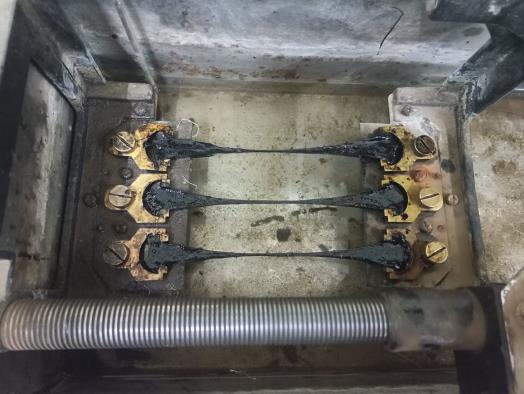
5.2 Ductility Test of Bitumen
Objective: To measure the extent to which bitumen can stretch before breaking – an indicator of its elastic and adhesiveproperties.
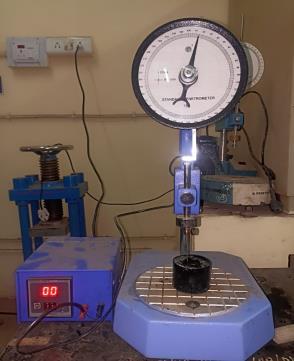
5.3. Penetration Test of Bitumen
Objective:Tomeasurethehardnessorsoftnessofbitumen bydeterminingthedepthastandardneedlepenetratesinto thesampleunderspecificconditions.
5.4 Marshall Stability and Flow Test:
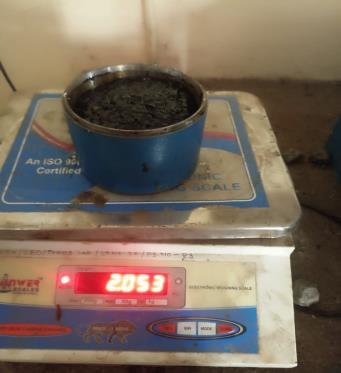
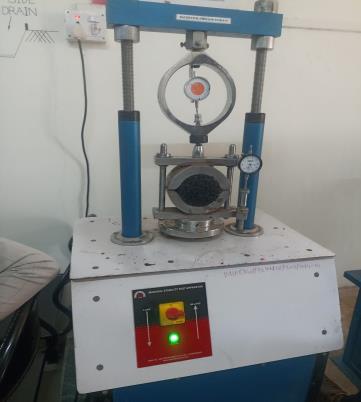
Purpose: To determine the stability (resistance to deformation) and flow (deformation under load) of the bituminousmixture.
Significance: Assesses the overall strength, durability, and performanceofthemixundertypicaltrafficloads.
5.5 Moisture Susceptibility Tests:
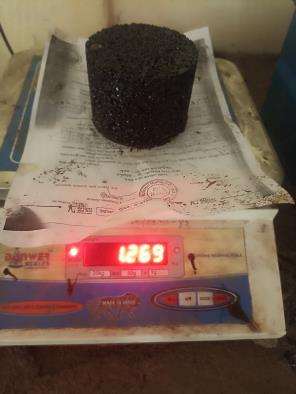
Purpose: To evaluate the moisture resistance of the mix, whichisessentialforpreventingstrippingorlossofbinder adhesionduetowater.
International Research Journal of Engineering and Technology (IRJET) e-ISSN: 2395-0056
Volume: 12 Issue: 07 | Jul 2025 www.irjet.net p-ISSN: 2395-0072
Significance: Ensures the mixture’s durability in moist environmentsandevaluatestheeffectivenessofbio-based additivesinimprovingmoistureresistance.
6. RESULTS
6.1 Marshall Test Results for Virgin Specimen
The bitumen mix of 10% RAP replacement and Bioadditives(starch):2%,4%,6%,8%,and10%(byweightof binder).
5.2
Table no:3
Chart No :3
6.3 Mix Properties for 20% RAP
The bitumen mix of 20% RAP replacement and Bioadditives(starch):2%,4%,6%,8%,and10%(byweightof binder).
International Research Journal of Engineering and Technology (IRJET) e-ISSN: 2395-0056
Volume: 12 Issue: 07 | Jul 2025 www.irjet.net p-ISSN: 2395-0072
Bitume n (+ biobase d additiv es)
Table no:6 Marshall Test Results for 30% RAP
Table no:5 Marshall Test Results for 20% RAP
30%RAPRAP+2%BBARAP+4%BBARAP+6%BBARAP+8%BBARAP+10%BBA
Chart No :5
6.5 Mix Properties for 40% RAP
The bitumen mix of 40% RAP replacement and Bioadditives(starch):2%,4%,6%,8%,and10%(byweightof binder).
+Bio Based Additive s(gm)
Chart No :4
6.4 Mix Properties for 30% RAP
The bitumen mix of 30% RAP replacement and Bioadditives(starch):2%,4%,6%,8%,and10%(byweightof binder).
Bitumen +Bio Based Additive
Table no:7 Marshall Test Results for 40% RAP
International Research Journal of Engineering and Technology (IRJET) e-ISSN: 2395-0056
Volume: 12 Issue: 07 | Jul 2025 www.irjet.net p-ISSN: 2395-0072
1.Stability Performance:
FromtheMarshalltestscarriedouttheresultsshowsthat the stability of 40% replacement RAP with 6% Bio-based additives(starch)isoptimisticreplacementofaggregatefor flexiblepavement.
2.Mechanical Properties and Durability:
Chart No :6
6.6 Mix Properties for 50% RAP
The bitumen mix of 40% RAP replacement and Bioadditives(starch):2%,4%,6%,8%,and10%(byweightof binder).
Bitumen +Bio Based Additive s(gm)
Table no:7
Althoughtherewasagradualdecreasein stability and flow withincreasingRAPcontent,andbio-basedadditivesmixes with up to 10–50% RAP and 2-10% Bio-based additive (Starch) retained sufficient mechanical strength for pavementapplications.
3.Optimal Replacement and Climate Consideration:
The performance across varying RAP levels suggests that 40% RAP with6%Bio-basedadditive(Starch)issuitablein mostclimates,especiallywhere flexibility, thermal stress resistance, and sustainability arepriorities.
4.Environmental Benefits: ThereuseofRAPinpavement has significant environmental advantages,including:
Divertingwastefromlandfills,
Reducingthedemandforvirginaggregates,
Loweringthecarbonfootprintofpavement production.
1. Zaumanis, M., Mallick, R. B., & Frank, R. (2014). RejuvenatorSelectionforHighRAPContentAsphalt Mixes. Journal of Materials in Civil Engineering, 26(5),04014014.
2. Solaimanian, M., & Kennedy, T. W. (1993). PredictingtheFatigueLifeofAsphaltMixes. Journal of the Association of Asphalt Paving Technologists, 62,1–25.
3. Garcia, A., Schlangen, E., & van de Ven, M. (2019). Algae-DerivedOilsasRejuvenatorsinRAPAsphalt Mixes. Construction and Building Materials, 215, 763–771.
4. Hossain, Z., Zaman, M., & Tarefder, R. (2020). Evaluation of Starch-Modified Asphalt Binders. TransportationResearch Record, 2674(1),425–437.
5. Huang, B., Shu, X., & Li, G. (2005). Laboratory InvestigationofFatigueCharacteristicsofRecycled Asphalt Mixtures. Journal of Materials in Civil Engineering, 17(6),508–516.
Chart No :7
International Research Journal of Engineering and Technology (IRJET) e-ISSN: 2395-0056
Volume: 12 Issue: 07 | Jul 2025 www.irjet.net p-ISSN: 2395-0072
6. Xiao, F., Amirkhanian, S. N., & Lee, J. S. (2017). Effects of Bio-Based Additives on RAP Mixtures. Journal of Cleaner Production, 165,1120–1130.
7. Mogawer, W. S., Bonaquist, R., & Austerman, A. J. (2012). Performance Characteristics of High RAP and Bio-Additive Mixtures. Road Materials and Pavement Design, 13(3),553–564.
8. Ghabchi, R., Zaman, M., & Sebaaly, P. E. (2018). Moisture Damage Evaluation of Asphalt Mixes Containing RAP and Bio-Based Rejuvenators. Construction and Building Materials, 168,84–92.
9. Jahromi, S., & Khodaii, A. (2009). Starch-Modified AsphaltforPerformanceImprovement. Construction and Building Materials, 23(6),2868–2875.
10. Goh, S. W., You, Z., & Palik, D. (2011). Mechanical Performance of RAP Modified by Bio-Based Rejuvenators. Construction and Building Materials, 25(5),2921–2928.
11. Tarefder,R.,&Zaman,M.(2017).Incorporationof bio-based additives in asphalt mixtures. Transportation Research Record: Journal of the Transportation Research Board, 2630, 1-9.
12. Xiao,F.,Amirkhanian,S.N.,&Shen,J.(2013).RAP performanceenhancementusingalgae-basedoils. Journal of Materials in Civil Engineering, 25(11), 1675-1682
13. Kim,Y.R.,&Lee,C.(2014).Evaluationofrecycled asphaltpavement(RAP)inhotmixasphaltmixtures usingbio-basedadditives. JournalofTransportation Engineering, 140(3), 04014004
14. Ali, S., & Zhang, L. (2016). Performance of starchmodified asphalt binder with recycled asphalt pavement. Journal of Materials in Civil Engineering, 28(3), 04015185.
15. Wang, H., & Li, J. (2018). Enhancement of asphalt pavement durability using RAP and bio-based additives. Journal of Cleaner Production, 196, 509520.
16. Zhang,X.,&Chen,W.(2017).Effectofbio-basedoils ontherheologicalpropertiesofasphaltwithRAP. Journal of Materials in Civil Engineering, 29(4), 04017122.
17. Glover, C. J., & Mahboub, M. (2019). "The Use of Recycled Asphalt Pavement (RAP) in Hot Mix Asphalt: A Review." International Journal of Pavement Engineering, 20(3),236-244.
18. Fwa,T.F.,&Tan,K.S.(2016)."EffectofRecycled AsphaltPavement(RAP)onAsphaltPavement Performance:AReview." International Journal of Pavement Engineering, 17(1),45-
19. Gopal, M. R., et al. (2018). "Recycled Asphalt PavementintheConstructionofSustainableRoads: EnvironmentalandEconomicBenefits." Journal of Cleaner Production, 174,1474-1483.
20. Cui, C., & Sun, J. (2018). "Improvement in the PerformanceofBituminousMixesbytheAddition ofAlgaeExtracts." Journal of Materials Science, 53, 2022-2031.
21. Huang,Y.,etal.(2017)."LaboratoryEvaluationof RecycledAsphaltPavementandStarchAdditivesfor Asphalt Mix Performance." Road Materials and Pavement Design, 18(4),922-933.
22. Arias, J., et al. (2017). "Starch as an Additive for AsphaltMixes:PerformanceandDurability." Journal of Materials in Civil Engineering, 29(6),04017035.
23. Tian, Y., et al. (2019). "Development of HighPerformance Asphalt Mixes Using RAP and BioBasedAdditives." JournalofCleanerProduction, 238, 117885.
24. Chou,Y.,&Liu,P.(2016)."TheEffectofStarchon the Physical Properties of Asphalt Pavement." Materials Journal, 113(2),253-264.
25. Zhao, X., et al. (2021). "Evaluation of Recycled Asphalt Pavement Modified with Bio-Based Additives for Improved Pavement Performance." International Journal of Pavement Engineering, 22(10),1338-1351.
26. Glover, C. J., & Mahboub, M. (2019). "The Use of Recycled Asphalt Pavement (RAP) in Hot Mix Asphalt: A Review." International Journal of Pavement Engineering, 20(3),236-244.
27. Duarte,S.F.,etal.(2019)."PerformanceofModified Bitumen with Algae Extracts as Bio-Additives." Construction and Building Materials, 210,498-506.
28. Awasthi, A., et al. (2020). "Sustainable Pavement DesignUsingRecycledAsphaltPavementandAlgaeBasedAdditives." Materials ScienceandEngineering B, 263,114871.
29. Zhang, L., et al. (2017). "Use of Starch-Based Additives for Enhancing Bituminous Mixes Performance." Construction and Building Materials, 150,1056-1064.
International Research Journal of Engineering and Technology (IRJET) e-ISSN: 2395-0056
Volume: 12 Issue: 07 | Jul 2025 www.irjet.net p-ISSN: 2395-0072
30. Barreto, S. M., et al. (2019). "Recycled Asphalt Pavement: A Sustainable Material for Road Construction." Journal of Environmental Management, 232,689-701.
31. Sarkar,S.,&Seshadri,R.(2018)."EffectofBio-Based AdditivesinAsphaltBinder." Journal ofMaterials in Civil Engineering, 30(7),04018104.
32. Cheng,Z.,etal.(2020)."AComparativeStudyofthe EffectsofAlgae-BasedAdditivesontheDurabilityof Asphalt Mixes." Road Materials and Pavement Design, 21(2),237-250.
33. Nouri, S., & Behnia, B. (2021). "Evaluation of Modified Bituminous Mixtures Using Algae AdditivesforEnhancedPerformance." Construction and Building Materials, 295,123303.
34. Khan, M. I., & Hossain, S. (2020). "Impact of BioBased Additives on the Rheological Properties of AsphaltBinders." Transportation Research Record, 2674(3),54-65.
35. Fwa, T. F., & Tan, K. S. (2016). "Effect of Recycled Asphalt Pavement (RAP) on Asphalt Pavement Performance: A Review." International Journal of Pavement Engineering, 17(1),45-
36. Gopal, M. R., et al. (2018). "Recycled Asphalt PavementintheConstructionofSustainableRoads: EnvironmentalandEconomicBenefits." Journal of Cleaner Production, 174,1474-1483.
37. Cui, C., & Sun, J. (2018). "Improvement in the PerformanceofBituminousMixesbytheAddition ofAlgaeExtracts." Journal of Materials Science, 53, 2022-2031.
38. Zhou, L., et al. (2021). "The Influence of Algae AdditivesonthePerformanceofAsphaltMixtures." Construction and Building Materials, 284,122812.
39. Huang,Y.,etal.(2017)."LaboratoryEvaluationof RecycledAsphaltPavementandStarchAdditivesfor Asphalt Mix Performance." Road Materials and Pavement Design, 18(4),922-933.
40. Xie, X., et al. (2020). "Exploring the Use of AlgaeBased Additives to Improve the Stability of Bituminous Binders." Construction and Building Materials, 241,118070.
41. Aslani,F.,&Amini,H.(2019)."EffectsofRecycled AsphaltPavementontheMechanicalPropertiesof BituminousMixes." Materials, 12(8),2431.
42. Baskaran,S.,&Selvakumar,A.(2018)."Performance of Asphalt Mixes with Bio-Based Additives." Materials and Structures, 51(4),88.
43. Fu, P., & He, Q. (2016). "Effects of Bio-Based AdditivesontheThermalandRheologicalBehavior ofAsphaltBinder." Fuel, 178,205-213.
44. Arias, J., et al. (2017). "Starch as an Additive for AsphaltMixes:PerformanceandDurability." Journal of Materials in Civil Engineering, 29(6),04017035.
45. Tian, Y., et al. (2019). "Development of HighPerformance Asphalt Mixes Using RAP and BioBasedAdditives." JournalofCleanerProduction, 238, 117885.