
International Research Journal of Engineering and Technology (IRJET) e-ISSN: 2395-0056
Volume: 12 Issue: 07 | Jul 2025 www.irjet.net p-ISSN: 2395-0072
International Research Journal of Engineering and Technology (IRJET) e-ISSN: 2395-0056
Volume: 12 Issue: 07 | Jul 2025 www.irjet.net p-ISSN: 2395-0072
Dr. P. P. Tapkire 1 , Mr. Harshvardhan S. Ambure 2 , Mr. Atul S. Chandanshive3
1 H.O.D. Civil Dept., N.B. Navale Sinhgad College of Engineering, Solapur, Maharashtra, India-413255
2 Research Scholar at N.B. Navale Sinhgad College of Engineering, Solapur, Maharashtra, India-413255
3 Lecturer Civil Dept., Solapur Education Society’s Polytechnic Solapur, Maharashtra, India-413002
Abstract - Inthisstudy,acomparative dynamicanalysis of composite, RCC, and steel frames was conducted using structural analysis software such as ETABS or ANSYS. The models incorporated bracing systems to assess seismic and wind performance, with key parameters including natural frequency, damping characteristics, mode shapes, displacement, and base shear. Composite materials were chosen for their high strength-to-weight ratio and corrosion resistance,whilebracingwasusedtoenhancelateralstability.
The study followed time-history analysis methods under dynamic loading conditions. Results indicate that braced composite frames outperform RCC and steel frames by exhibitinglowerdisplacements,higherenergydissipation,and reduced seismic response times. RCC frames, although structurally strong, showed brittleness and heavier mass, whereas steel frames demonstrated increased lateral sway without adequate bracing. Composite frames with bracing provided an optimal balance between weight efficiency and dynamicperformance.Thestudyhighlightstheeffectivenessof integrating composite materials with bracing systems for enhanced seismic resilience, structural stability, and costefficiency in modern building design.
Key Words: Dynamic Analysis, RCC Frame, Lateral Displacement,CompositeMaterialFrame,ETABS/ANSYS, EnergyDissipation
This study examines the dynamic behavior of different structural systems Reinforced Cement Concrete (RCC), steel,andcompositeframes highlightingtheirsuitability formodernhigh-riseconstruction.RCC,madebyreinforcing concrete with steel, is widely used for its compressive strength,durability,andfireresistance,butislimitedbyits heavy weight, low tensile strength, and labor-intensive construction. Steel structures, composed of prefabricated elements,offerfasterconstruction,betterstrength-to-weight ratios,andflexibility,butrequireongoingmaintenancedue to corrosion and vulnerability to high temperatures. With increasing urbanization and the need for taller, more resilient buildings, composite structures combining the benefitsofbothsteelandconcrete aregainingpopularity. Thesesystemsofferimprovedseismicperformance,reduced
constructiontime,andstructuralefficiency,especiallywhen integrated with bracing systems. The study conducts a comparative dynamic analysis using tools like ETABS or ANSYS to evaluate the performance of these three frame types under seismic and wind loads, ultimately recommending composite braced frames as the most effective solution for dynamic stability and construction efficiencyinhigh-risebuildings
To compare the building frame with RCC, Steel and CompositeMaterialwithdynamicanalysis
1)ToanalysebuildingframeswithvariousheightsofSteel, RCC structure with Static and Dynamic Analysis with differenttypesofbracings.
2)ToanalysebuildingframeswithvariousheightsofSteel, RCC composite structure with Static and Dynamic Analysiswithdifferenttypesofbracings.
3)Comparisonofresultsisproposedtocarryoutbasedon theresultsofdynamicanalysis.
4)Itisproposedtopreparedimensionlesschartsforvarious consideredparameters.
The rapid growth ofurbanpopulationsand the increasing need for high-rise, earthquake-resistant buildings have driven significant advancements in structural engineering. Among various structural systems, Reinforced Cement Concrete (RCC), structural steel, and steel-concrete compositeframesarewidelyanalyzedfortheirperformance underdynamicloadingconditionssuchasearthquakesand strongwinds.Recentstudiesonmid-tohigh-risebuildings (G+9 to G+30 storeys) using structural analysis tools like ETABS indicate that steel-concrete composite frames offer notableadvantagesovertraditionalRCCandsteelsystems. Theseincludereducedaxialforces,storeydrift,displacement, and overall self-weight, along with improved bending momentandshearforcebehavior.Furthermore,composite structures enable faster construction, greater material efficiency, and enhanced cost-effectiveness. As a result,
International Research Journal of Engineering and Technology (IRJET) e-ISSN: 2395-0056
Volume: 12 Issue: 07 | Jul 2025 www.irjet.net p-ISSN: 2395-0072
compositeframes,particularlywhendesignedwithbracing systems,areincreasinglyfavoredfortheirsuperiorseismic performance and structural stability in modern high-rise construction
Contributionsofresearchersarepresentedasfollows,
Panchal, D. R., and P. M. Marathe (2011) [1] Acomparative studywas conductedonthreetypesofstructural systems: steel-concretecomposite,puresteel,andreinforcedcement concrete(RCC)buildings.AG+30storeycommercialbuilding modelwasusedfortheanalysis,withthestructurelocatedin SeismicZoneIV.Theequivalentstaticmethodwasapplied, andETABSsoftwarewasutilizedforthestructuralanalysis. The results showed a reduction in axial forces in the columns byapproximately34%inthesteelstructureand 5%inthecompositestructure.Basedonthesefindings,the studyconcludesthatsteelstructuresaremoreefficientfor high-risebuildingscomparedtoRCCandcompositesystems.
Prajapati, Baldev D., and D. R. Panchal (2013) [2] This studyfocusedontheanalysisanddesignproceduresusedto evaluate a symmetric high-rise building (G+30 storeys) subjected to wind and earthquake forces. Three structural systems RCC,steel,andsteel-concretecompositebuildings with shear walls were considered for their lateral forceresisting capabilities. Using ETABS software, a total of 21 differentstructural modelswereanalyzedanddesignedto assesstheirperformanceunderseismicandwindloads.The findings indicate that the steel-concrete composite system offersthemosteffectivesolutionamongthethreeforhighriseconstruction.
ShobharamandImranSyedKaleemAfroughZaidi(2020)
[3] This study investigates the performance of reinforced concrete, steel, and steel-concrete composite frames in a multi-storeybuilding.A3DmodelofaG+9storeybuilding located in Seismic Zone IV was analyzed, with all three structural systems designed for the same gravity loads. Reinforced concrete elements were designed following IS: 456-2000,whilecompositesectionsweredesignedusingthe AmericanstandardAISC:360-10.Beamandcolumnsections varied according to the structural system RCC, steel, or composite while a uniform reinforced concrete slab was usedacrossallmodels.Loadcombinationswereappliedas perIS:1893-2002,andtheentirestructurewasmodeledand analyzed using the response spectrum method in ETABS 2015.Aparametriccomparisonoftheresultsshowedthat the steel-concrete composite frame outperformed both reinforcedconcreteandsteelframesintermsofstructural performance
Umesh Rajendra Tubachi and Manohar. K., et.al. (2019) [4] Thisstudypresentsananalysisofsteel-concretecomposite structures and compares their performance with conventional RCC structures. A G+30 high-rise regular buildingwasconsideredfortheanalysis,whichwascarried
out using ETABS software. The structural behavior was evaluatedunderstatic,dynamic,andwindloadingconditions. Comparative results were presented through graphical representations. For the composite structure, American design standards were followed, while Indian codes were used for the RCC structure. The findings revealed that the compositestructuredemonstratedlowerdeadload,reduced storey drift, less displacement, and smaller torsional momentscomparedtotheRCCstructure,makingitamore favorableoptionformodernconstructionpractices
A.S.MahajanandL.G.Kalurkar.,et.al.(2016) [5] Thisstudy compared the performance of high-rise steel-concrete composite and RCC buildings using ETABS 2015 software. TheanalysiswasconductedonaG+20multi-storeybuilding, withthecompositestructuredesignedaccordingtoAmerican standardsandtheRCCstructurebasedonIS456:2000.The objectivewastoevaluateseismic performanceandoverall structural efficiency by examining parameters such as bendingmoment,shearforce,baseshear,structuralweight, timeperiod,andcost.Responsespectrumanalysiswasused toassessseismicbehavior.Theresultsdemonstratedthatthe composite structure not only ensures stability, safety, and habitability but also offers advantages in terms of construction time and cost. Overall, the composite model outperformed the RCC structure across all evaluated parameters
Shweta A. Wagh, Dr. U. P. Waghe (April 2014) [6] Inthis study,fourmulti-storeycommercialbuildings G+12,G+16, G+20,andG+24 wereanalyzedusingETABS2013software. Design calculations and cost estimations were performed using MS Excel. The results were used to compare the performanceofRCCandsteel-concretecompositestructures. Thestudyconcludedthat:1.Thedisplacementincomposite structures is almost double that of RCC structures, though stillwithinpermissiblelimits.2.Shearforceandaxialforce were found to be higher in RCC structures compared to compositestructures.
UmeshP.Patil ,Suryanarayana(June2015) [7] Astudywas carried out to compare the seismic performance of G+15 storey buildings constructed using reinforced cement concrete(RCC)andcompositestructuralsystems,utilizing ETABS2013foranalysis.Bothtypesofbuildingsincludeda soft storey at the ground level and were modeled for conditionsinseismiczoneIIIwithmediumsoil.Theanalysis involvedboththeEquivalentStaticMethodandtheResponse Spectrum Method, focusing on parameters such as storey drift, self-weight, bending moments, and shear forces. The findings showed that composite structures generally performed better than RCC structures. Storey drift was reducedby10%inthesoftstoreyofcompositemodels,while other storeys showed up to a 70% reduction using the Equivalent Static Method and a 50% reduction using the ResponseSpectrumMethod.Compositestructuresalsohad about 10% less self-weight compared to RCC. In terms of
International Research Journal of Engineering and Technology (IRJET) e-ISSN: 2395-0056
Volume: 12 Issue: 07 | Jul 2025 www.irjet.net p-ISSN: 2395-0072
bending moments, there was an 11% reduction in the Xdirection for composites, although the Y-direction experienced a 70% increase. Similarly, shear forces were 16% lower in the X-direction for composite buildings, but 65%higherintheY-direction.Overall,thestudyconcluded that composite structures offer improved seismic performance, particularly in terms of reduced weight and lateral displacement, although variations in directional responsesshouldbeconsideredindesign.
3. Research Methodology
3.1 Flow of Research Work
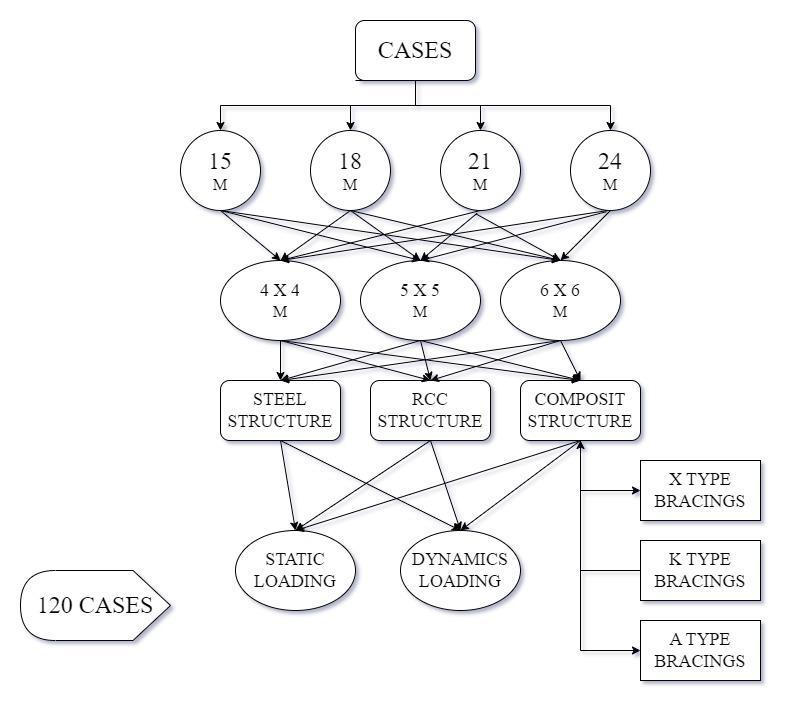
Figure 3.1: Flow of Research Work
3.2 Types of structures
Structurescanbeclassifiedbasedonthematerialsusedand the system of load transfer. In this study, three major structural types have been analyzed - Steel Structures, Reinforced Cement Concrete (RCC) Structures, and Composite Structures. Each has its own characteristics, advantages, and limitations in terms of strength, stiffness, weight,andconstructionmethods.
Types of Structures Considered:
3.2.1 Steel Structure
Entireframeincludingbeamsandcolumnsismade ofstructuralsteel.
Steel structures are known for high strength-toweight ratio, flexibility, and speed of construction
Suitable for tall buildings due to their lighter weightandabilitytoresistlargelateralloads.
Lessdeadloadleadstoreducedfoundationsize.
However,theyrequire fireproofing andaremore susceptible to corrosion if not properly maintained.
3.2.2 RCC (Reinforced Cement Concrete) Structure
Usesconcretewithembeddedsteelreinforcement toresisttension.
Commonly used in medium- to high-rise buildings duetogoodcompressiveandmoderate tensilestrength.
RCC structures are durable, fire-resistant, and widely adopted inconstruction.
However, they are heavier, which increases base shearandfoundationloadinseismiczones.
Slower construction speed compared to steel structures.
3.2.3 Composite Structure
Combinesthebenefitsofboth steel and concrete byusingsteelsections(e.g.,beams,columns)with concreteslabsorencasements.
Compositeactionincreases stiffness, strength,and ductility,makingitidealfor seismicperformance.
Reducescross-sectionalsizeofstructuralelements, providingmore usable floor space
Bracing systems (A-type, K-type, and X-type) are often introduced to enhance lateral load resistance
3.2.4 Bracing Systems in Composite Structures
Tofurtherimprovetheperformanceofcompositebuildings under lateral loads (like earthquakes), three types of bracingsareincorporated:
A-Type Bracing:Offersgoodstiffnessandreduces lateral displacement, generally effective in moderate-risebuildings.
International Research Journal of Engineering and Technology (IRJET) e-ISSN: 2395-0056
Volume: 12 Issue: 07 | Jul 2025 www.irjet.net p-ISSN: 2395-0072
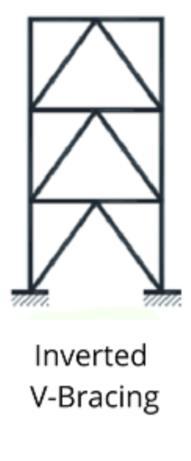
Figure No. 3.2 A-Type Bracing
K-Type Bracing: Often used for aesthetic integration, but may transfer loads inefficiently undersomeconditions.
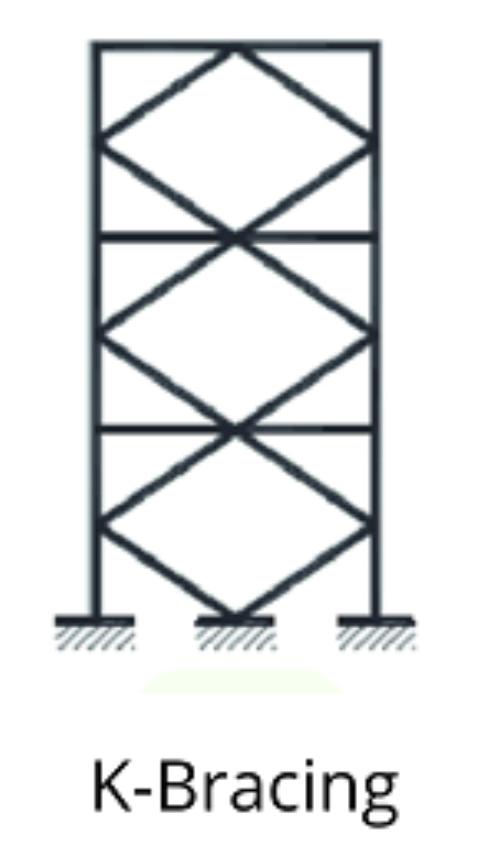
Figure No. 3.3 K-Type Bracing
X-Type Bracing:Excellentinresistingbothtension andcompression,andprovideshighlateralstiffness andstrength.
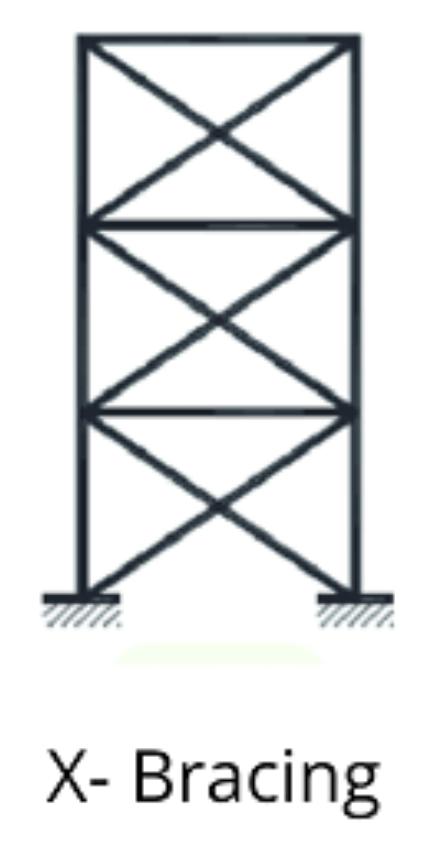
Figure No. 3.4 X-Type Bracing
Structural analysis is essential to predict the behavior of buildingsundervariousloadssuchasdeadload,liveload, andlateralforces(especiallyseismicloads).Inthisproject, suitable analytical methods are applied to evaluate the response of different structural systems (Steel, RCC, and Composite) under seismic conditions. The methods are selected based on accuracy, applicability, and code recommendations.
3.3.1 Equivalent Static Method (Linear Static Analysis)
This is a simplified seismic analysis technique recommendedbyIS1893(Part1):2016forregular, low-tomid-risebuildings.
In this method, the earthquake load is calculated usingseismicparametersandappliedasa lateral static force ateachfloorlevel.
Assumeslinearelasticbehaviorofthestructure.
Suitableforbuildingsupto40mheightinSeismic ZoneIV(asconsideredinthisproject).
Stepsinclude:
o Calculationofseismicweight
o Determinationofbaseshear
o Distributionofbaseshearacrossbuilding height
Used due to its simplicity and computational efficiency,especiallyforparametriccomparisons.
3.3.2 Modal Analysis (Response Spectrum Method) (optional extension if needed)
Maybeusedifirregularitiesinmassorstiffnessare present.
This method considers dynamic characteristics (natural frequencies and mode shapes) of the building.
More accurate than static methods for tall or irregular structures
Uses response spectrum curve asperIS1893to calculate lateral forces for different vibration modes.
However, in this study, the Equivalent Static Method is primarily used due to regular building geometry.
International Research Journal of Engineering and Technology (IRJET) e-ISSN: 2395-0056
3.3.3 Load Combinations
Theanalysisincludesthefollowing load combinations as perIS456andIS1893:
1.5(DL+LL)
1.2(DL+LL±EQX)
1.2(DL+LL±EQY)
1.5(DL±EQX)
1.5(DL±EQY)
0.9DL±1.5EQX
0.9DL±1.5EQY
(DL=DeadLoad,LL=LiveLoad,EQX/EQY=EarthquakeLoad in X/Y directions)
3.3.4 Software Used
ETABS (Extended 3D Analysis of Building System)
o Widely used for modeling, analysis, and designofmultistoreybuildings.
o Supports both linear static and dynamic analysis.
Allows easy modeling of different structural systems and bracingconfigurations.
5.1 General
Thestudycomprehensivelyinvestigatesthreemaintypesof structuralsystems:steel,reinforcedcementconcrete(RCC), and composite structures, with a special emphasis on compositestructuresthatincorporatethreedistincttypesof bracings. These bracing systems, previously detailed in earlierchapters,playacrucialroleinenhancingthelateral stabilityandseismicperformanceofhigh-risebuildings.To evaluate the structural behavior under various configurations,theresearchconsidersthreedifferentspan sizes - 4x4m,5x5 m,and6x6m - alongsidefourdifferent buildingheights:G+15,G+18,G+21,andG+24storeys.This combination of span and height variations allows for a broaderunderstandingofhowstructuraltypeandgeometry influence key performance metrics such as displacement, axialforce,andstoreydrift.Theresultsarediscussedinthis chapterwithclarityanddetail,usingappropriategraphical representationstofacilitatecomparisonandinterpretation. Thissystematicapproachenablesadeeperinsightintothe
efficiency and suitability of each structural system under differentdesignconditions
4.2 Comparison of deformation in all type of structure
In this sub-point, the deformation results have been discussedforvariousstructureswithdifferentspanvalues.
Thecomparisonofthedeformationofallspansanddifferent heightsfollowedbyalltypeofstructuresisdiscussedbelow.
4.2.1 Comparison of deformation of 4X4 type of structure
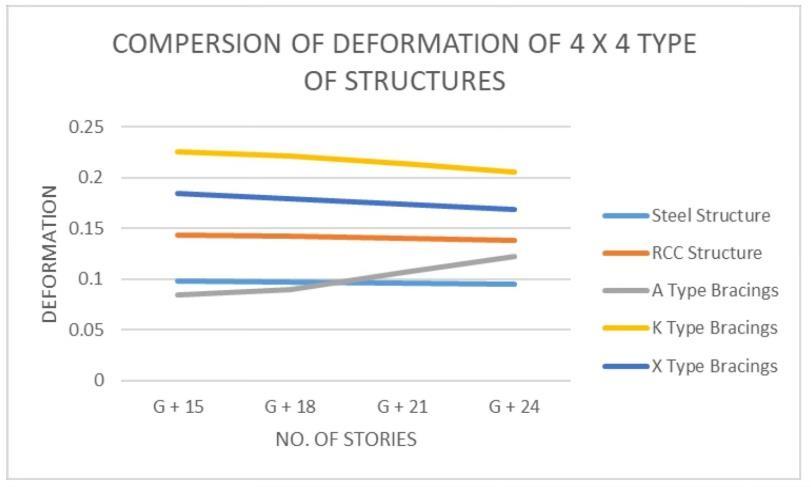
followingaretheobservationhasbeen
Asweobserve,steelstructuresexhibittheleastdeformation amongvarioustypesofstructures.Theyshowamaximum deformation of 0.1m for a G+15 building height and experienceareductionindeformationasthebuildingheight increasestoG+24.
In contrast, reinforced concrete (RCC) structures exhibit higherdeformationcomparedtosteelstructures,whichalso reducesasthebuildingheightincreases.
In this scenario, type bearings demonstrate the minimum deformationamongallstructures,followedbyanincreasein deformationasthebuildingheightincreases.
On the other hand, K-type bracing shows the highest deformationamongalltypesofstructures,whichgradually reducesasthebuildingheightincreases.
Volume: 12 Issue: 07 | Jul 2025 www.irjet.net p-ISSN: 2395-0072 © 2025, IRJET | Impact Factor value: 8.315 | ISO 9001:2008
International Research Journal of Engineering and Technology (IRJET) e-ISSN: 2395-0056
Volume: 12 Issue: 07 | Jul 2025 www.irjet.net p-ISSN: 2395-0072
4.2.2 Variation of deformation for class A and class AA loading for 40m span
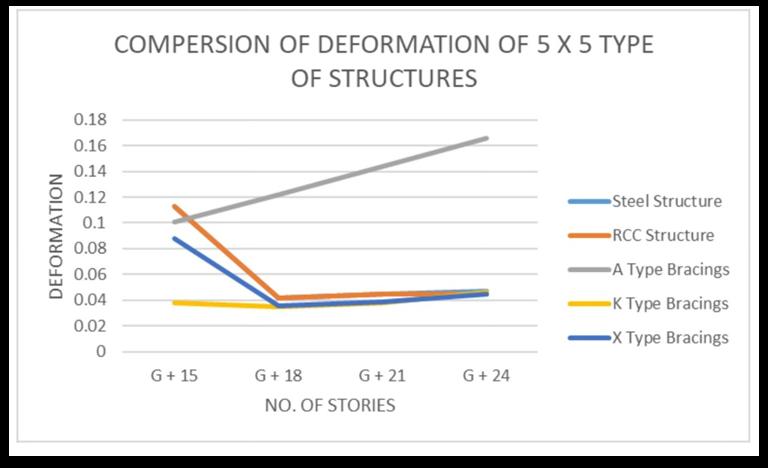
Graph no. 2 Comparison of deformation of 5x5 Type of structure
Followingobservationsarenoted
As we observe, steel and RCC structures exhibit similar deformationpatternsacrossvariousheightconsiderations. Interestingly, they exhibit minimum deformation as the weightincreases.
On the other hand, a specific type of bracing exhibits the maximum deformation values among all other types of structures.Themaximumdeformationvaluesitshowsare around0.17mforaG+24heightofthestructure.
In contrast, the K-type bracing shows the minimum deformation values among all other types of structures. It exhibits 0.04m of deformation for a G+15 height, and the deformationslightlyincreasesastheheightofthestructure increases.
Lastly, for the X-type bracing, the deformation values are nearlysimilartothoseofthesteelandRCCstructures.
4.2.3 Comparison of deformation of 6x6m type of structure
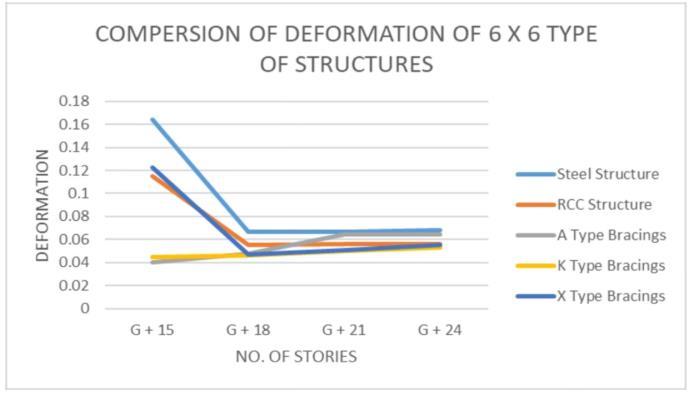
Graph no.3 Comparison of deformation of 6X6m Type of structure
Followingobservationsarenoted
As we observe from graph No. 3, the deformation in all buildingsismostlysimilar.
Forabuildingwithaheightof15floors,thesteelstructure showsthehighestdeformation.
Ontheotherhand,theRCCstructureandtheX-typebracing structureexhibitsimilardeformationvaluesforallbuilding heights.
In contrast, the K-type bracing and the A-type bracing structures show the minimum deformation for a building withaheightof15floors.However,astheheightincreases, thedeformationgraduallyincreases,reachingamaximumof 0.06m
4.3 Comparison of share forces in all type of structure
In this sub-point, the shear force results for various structureswithdifferentspanvalueshavebeendiscussed. Thecomparisonoftheshearforceforallspansanddifferent heights across various types of structures is presented below,
4.3.1 Comparison of shear force of 4mx 4m type of structure
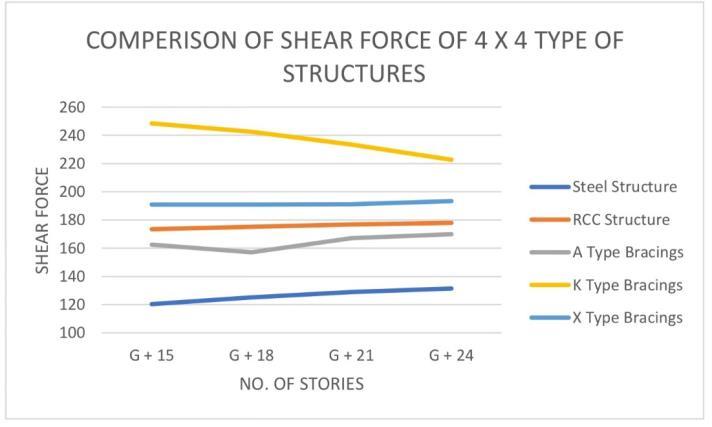
no.4 Comparison of shear force of 4mx4m Type of structure
Followingobservationsarenoted
Steel structures exhibit the lowest share force values comparedtoothertypesofstructures.ForaG+15building, theshareforceofasteelstructureisnotedas120kN,andit graduallyincreasesastheheightincreases.
RCCstructuresshowashareforceofaround180kN,andit slightlyincreasesastheheightincreases.
TypebracingsexhibitalowershareforcecomparedtoRCC structuresandfollowasimilarpatternofincreasingshare forcewithheight.
International Research Journal of Engineering and Technology (IRJET) e-ISSN: 2395-0056
Volume: 12 Issue: 07 | Jul 2025 www.irjet.net p-ISSN: 2395-0072
X-typebracingsshowaslightlyhighershareforcecompared toRCCstructuresandalsoincreasewithheight.
Ktypebracingexhibitsthemaximumshareforceamongall typesofstructures.ForaG+15building,theshareforceofa KIbracingisaround250kN,anditslightlydecreaseswith height.
4.3.2 Comparison of shear force of 5mx5m type of structure
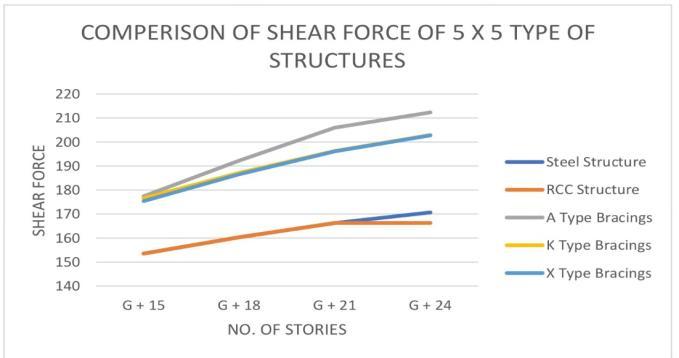
Graph no.5 Comparison of shear force of 5mX5m Type of structure
Followingobservationsarenoted
Steelstructuresandstructureswithsimilardesignsexhibit similarshareforcevalues,asdepictedinthegraph.Asthe heightincreases,theshareforcevaluesalsorise.
A type of bracing system exhibits the highest share force valueinbuildingswithdimensionsof5mx5m.Themaximum shareforcevalueforaG+24buildingisnotedas210kn.
X-typeandK-typebracingsystemsdisplayasimilarshare forcepatternastheheightincreasesinthistypeofstructure. Theairforcevaluealsoincreases.
Forthisspanthemaximumstressesinrectangularsection recorded almost 2 times lower than that of trapezoidal sectionforAAclassloading.
4.3.3 Comparison of shear force of 6mX6m type of structure
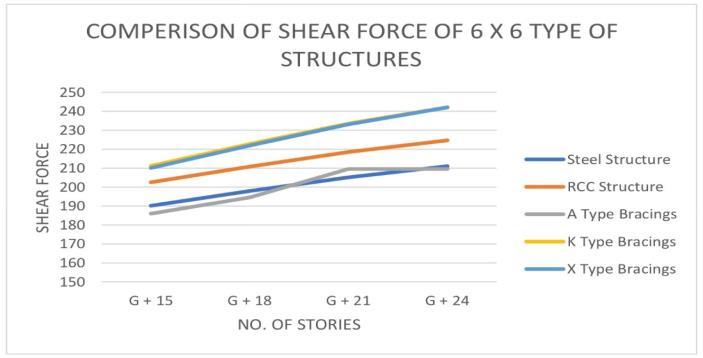
Graph no.6 Comparison of shear force of 6mx6m Type of structure
Followingobservationsarenoted
A6mx6mbuildingwithasteelstructureandatypebracing structureexhibitsasimilarshareforcepatternasshownin thegraph.Theshareforceincreasesasthebuilding’sheight increases.
The reinforced concrete structure (RCC) structure shows slightly higher share force values compared to the steel structureandthetypebracingstructure.However,itfollows a similar pattern, with the share force increasing as the building’sheightincreases.
Both the X-type and K-type bracing structures display similar share force values across all building heights. The share force values increase as the building’s height increases.
4.4 Comparison of bending movement in all type of structure
In this sub-point, the bending moment results for various structureswithdifferentspanvalueshavebeendiscussed. The comparison of the bending moment for all spans and different heights across various types of structures is presentedbelow,
4.4.1 Comparison of bending movement of 4mx4m type of structure.
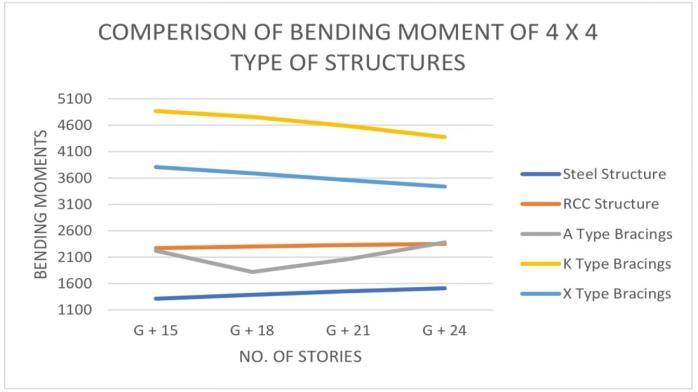
Graph no.7 Comparison of bending moment of 4m X 4m Type of structure
Followingobservationsarenoted
Foursteelstructureshaveveryminimumbendingmoment values.Thebendingmomentslightlyincreasesina4mx4m typeofbuildingastheheightincreases.
RCC values show a slight increase in bending movement comparedtosteelstructuresandexhibitauniformpattern of bending moment values as the height of the structure increases.
InthecaseofA-typebracingforaG+15heightofbuilding, thebendingmovementvaluesaresimilartothoseofanRCC
International Research Journal of Engineering and Technology (IRJET) e-ISSN: 2395-0056
Volume: 12 Issue: 07 | Jul 2025 www.irjet.net p-ISSN: 2395-0072
structure for the same height. However, it gradually increasesastheheightincreasestoG+18height.
X-typebracingsprovide3700knmofbendingmovementfor smallerheightsandgraduallyreduceastheheightincreases.
K-type bracings exhibit the maximum bending moment among all types of structures. In this case, the bending movementreducesastheheightofthestructureincreases.
4.4.2 Comparison of bending movementof5mX5mtype of structure.
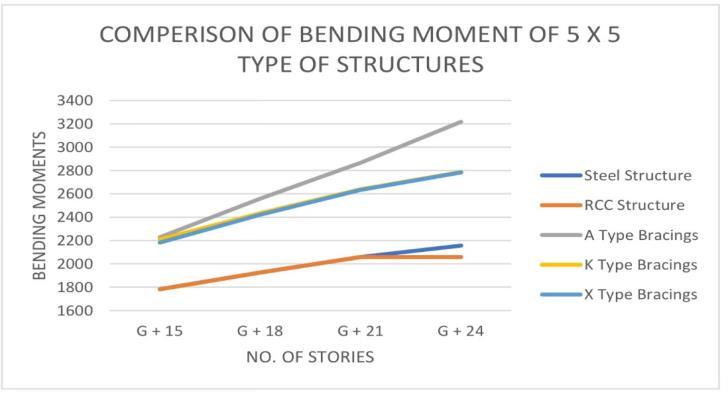
Graph no.8 Comparison of bending moment of 5m X 5m
Type of structure
Followingobservationsarenoted
Steel and RCC structures exhibit similar bending moment values,whichgraduallyincreasewiththebuilding’sheight.
BracingtypesKandXexhibitaconsistentbendingmoment patternacrossallheights,withthemomentincreasingasthe heightrises.
In contrast, A type of bracing demonstrates the highest bendingmomentvaluesatthehighestbuildingheights.
4.4.3 Comparison of bending movementof6mX6mtype of structure
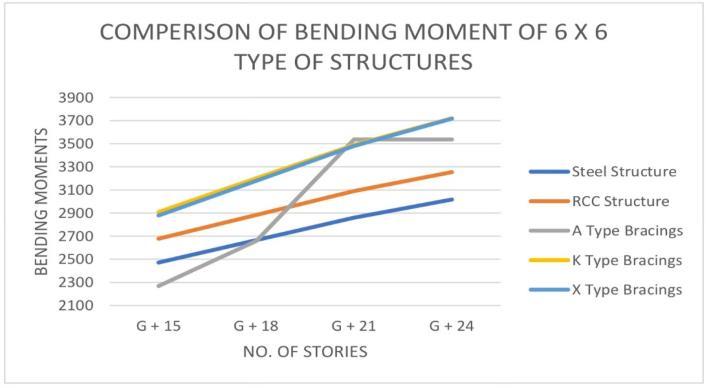
Graph no.9 Comparison of bending moment of 6m X 6m
Type of structure
Followingobservationsarenoted
Steelstructuresexhibitminimumbendingmomentvalues across all heights,except forbuildings witha height of 15 floorsormore.
Insuchcases,reinforcedconcretestructures(RCCs)showa slightincreaseinbendingmomentvaluescomparedtosteel structures,andthebendingmomentvaluesincreaseasthe heightofthestructureincreases.
Bracing types K and X exhibit similar bending moment values throughout the entire building. However, A type of bracingshowsa significantdifferencein bendingmoment valuesbetweenlowandhighheightsofthebuilding.
4.5 comparison of axial forces in all type of structure
In this sub-point, the axial force results for various structureswithdifferentspanvalueshavebeendiscussed. Thecomparisonoftheaxialforceforallspansanddifferent heights across various types of structures is presented below,
4.5.1 Comparison of axial forces of 6m X 6m type of structure.
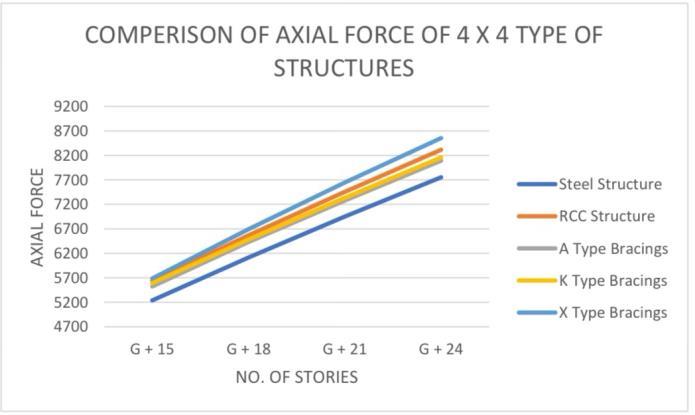
Graph no.10 Comparison of axial forces of 6m X 6m Type of structure
Followingobservationsarenoted
Steelstructuresexhibitthelowestaxialforcevaluesinthis type of building, and their height increases, leading to an increaseinthevalueofaxialforces.
Similarly,atypeandKtypeofbracingsshowsimilaraxial force values and experience an increase as the building heightincreases.However,theaxialforcevaluesinthiscase areslightlyhigherthanthoseinthesteelstructure.
Incontrast,theRCCstructureshowsaveryslightincreasein axialforcecomparedtothesteelstructureandbenefitsfrom bothatypeandKtypeofbracings.Thepatternofaxialforce
International Research Journal of Engineering and Technology (IRJET) e-ISSN: 2395-0056
Volume: 12 Issue: 07 | Jul 2025 www.irjet.net p-ISSN: 2395-0072
increase is similar to the previous cases, with the force increasingasthebuildingheightincreases.
Finally,theXtypeofbracingsexhibitsthehighestaxialforce values in this scenario and follows a similar behaviour patternasthepreviouscases.
4.5.2 Comparison of axial forces of 5m X 5m type of structure.
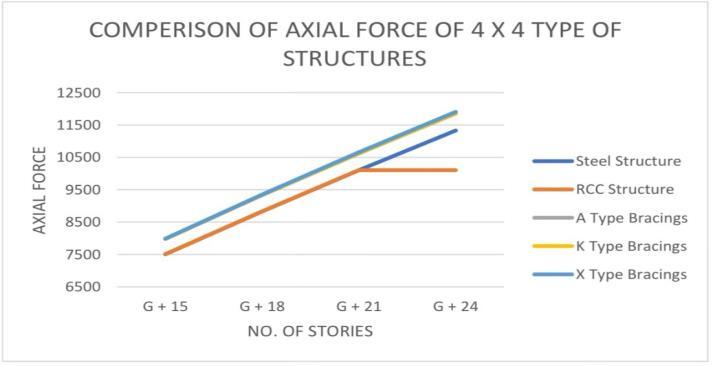
Graph no.11 Comparison of axial forces of 6m X 6m Type of structure.
Followingobservationsarenoted
SteelandRCCstructuresexhibitsimilaraxialforcevaluesin 5mx5mtypeofbuildings.
BracingtypesA,K,andXalsoshowsimilaraxialforcevalues in this type of building structure, which increases as the buildingheightincreases.
4.5.3 Comparison of axial forces of 6m X 6m type of structure
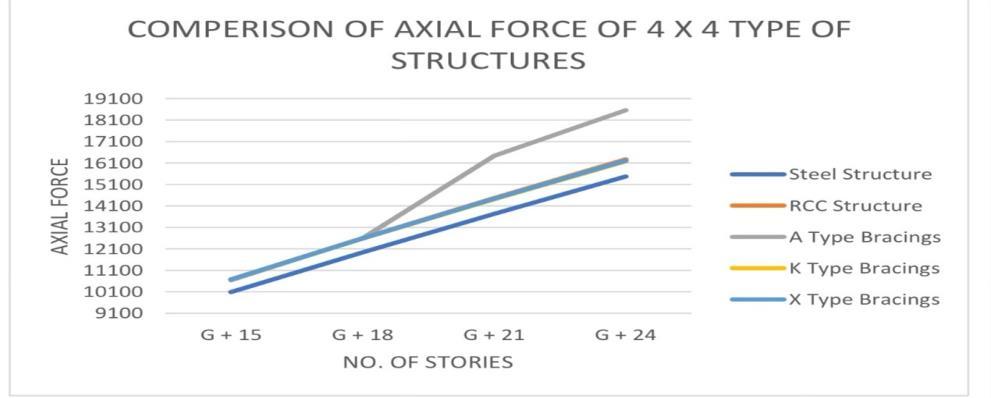
Graph no.12 Comparison of axial forces of 6m X 6m Type of structure
Followingobservationsarenoted
Steel structures exhibit minimum axial force values in 6mx6mstructures,whileaxialforceincreasesastheheight increases.
Similarly, RCC structures (K and X types) show similar results, which are slightly higher than those of steel structures.
Incontrast,A-typebreathingstructuresexhibithigheraxial forcevaluesacrossallheightsofthebuilding.
Thisstudypresentsacomparativeanalysisofsteel,RCC,and compositeframeswithA,K,andX-typebracings,focusingon theimpactofstructuraltype,spansize(4×4m,5×5m,6×6 m),andbuildingheight(G+15toG+24)onkeyperformance parameters such as deformation, shear force, bending moment,andaxialforce.Resultsshowthatsteelstructures consistentlyexhibittheleastdeformation,bendingmoments, andaxialforces,indicatingsuperiorstiffnessandefficiency. Composite frames with A-type bracing perform better at lower heights, while K-type bracing generally results in higher deformation and internal forces. Shear force and bending moments increase with building height across all systems, with K-type bracing showing the highest values, particularly in 4×4 and 5×5 spans. X-type bracing offers a balancedperformance,withresultssimilartoRCCandsteel in most configurations. Axial forces were lowest in steel framesandhighestincompositeframeswithX-typebracing. Overall,steelstructuresofferoptimalperformanceinterms of stiffness and force resistance, while composite frames with suitable bracing provide a viable alternative for dynamicloadconditionsintallerbuildings.Theselectionof structuraltypeandbracingconfigurationshouldbebasedon thedesiredbalancebetweenstrength,deformationcontrol, andheightefficiency
[1] Panchal,D.R.,andP.M.Marathe."ComparativeStudy ofRCC,steelandcomposite(G+30storey)building." NirmaUniversity,Ahmedabad,India(2011).
[2] Prajapati, Baldev D., and D. R. Panchal. "Study of seismicandwindeffectonmultistoreyRCC,steeland compositebuilding."InternationalJournalofAdvances inEngineering&Technology6,no.4(2013):1836.
[3] Shobharam and Imran Syed Kaleem Afrough Zaidi (2020) “Parametric Seismic Study of Steel-Concrete CompositeFrames”InternationalJournalforModern TrendsinScienceandTechnology,6(9):24-30,(2020).
[4] Umesh Rajendra Tubachi, Manohar. K (2019) InternationalJournalofEngineeringAppliedSciences andTechnology,2020Vol.5,Issue5,ISSNNo.24552143, Pages 229-234 Published Online September 2020.
International Research Journal of Engineering and Technology (IRJET) e-ISSN: 2395-0056
Volume: 12 Issue: 07 | Jul 2025 www.irjet.net p-ISSN: 2395-0072
[5] Mahajan A.S., L.G. Kalurkar. (September 2016) –“AnalysisofCompositeStructures”Vol.No.4,IssueNo. 09,pages:254-263,ISSN:2348-7550.
[6] ShwetaA.Wagh,Dr.U.P.Waghe“ComparativeStudyof R.C.CandSteelConcreteCompositeStructuresG+12, G+16,G+20,G+24”InternationalJournalofEngineering ResearchandApplicationsVol.4,Issue4,April2014.
[7] UmeshP.Patil,Suryanarayana,“AnalysisOfG+15RCC And Composite Structure Having A Soft Storey At GroundLevelByResponseSpectrumAndEquivalent Static Methods Using Etabs 2013”, International Research Journal of Engineering and Technology (IRJET),Volume:02Issue:03,June-2015
BIOGRAPHIES

Mr. Harshvardhan S. Ambure
B.E.(Civil),MTech(Civil-Structure) (pursuing)ResearchScholaratN.B. Navale Sinhgad College of Engineering,Solapur,Maharashtra, India

Mr. Atul S. Chandanshive
Working as Lecturer in, Civil Engineering, Solapur Education Society’s Polytechnic, Solapur, Maharashtra, India. Graduated in civil engineering and did masters in structure from Solapur University,andhavingexperience ofmorethan4yearsinteachingas wellasinindustry

Dr. Pradeep. P. Tapkire
Working as Head of Department, Civil Engineering, N. B. Navale Sinhgad College of Engineering, Solapur, Maharashtra, India. Graduatedincivilengineeringand did masters in structure from ShivajiUniversity,Ph.D.fromS.P. Pune University and having experienceofmorethan18years inteachingaswell asinindustry. PG recognized teacher of Solapur University. Has selected as Board of Study Member for Solapur University,Solapur.Guided22PG studentsand16areworkingunder theguidance.HandledIITMCband radar installation project as structural and execution expert. Nominatedasmemberfordistance learning syllabus formation committee IGNOU, Delhi. Also worked as committee member to identify centers for IGNOU for distance learning courses. Receivedappreciationawardfrom ULTRATECH, Cement Solapur for contributioninM-sandProject.
2025, IRJET | Impact Factor value: 8.315 |