
International Research Journal of Engineering and Technology (IRJET) e-ISSN: 2395-0056
Volume: 12 Issue: 07 | Jul 2025 www.irjet.net p-ISSN: 2395-0072
International Research Journal of Engineering and Technology (IRJET) e-ISSN: 2395-0056
Volume: 12 Issue: 07 | Jul 2025 www.irjet.net p-ISSN: 2395-0072
Chandan Moulick1 , Anurag Kewat2 , Sangita Dutta3
1CSE department, Parul University, Vadodara, India
2 CSE department, Parul University, Vadodara, India
3 CSE department, Parul University, Vadodara, India
Abstract - Parentsaregettingmoreconcernedabouttheir children’s online activities as the use of cell phones and the internet increases. In response to these concerns, many parental control apps have been developed to enable parents to monitor their children's digital behavior. [1] [2] This looks atthe functions ofparentalcontrolapplications,howwellthey govern kids’ internet behavior, and any potential effects on kid development. Parents who use parental control applications to keep a check on their kids’ internet habits participated in the study. The findings revealed that content filtering, app banning, time management, and location tracking are among the parental control apps’ most popular functions. The majority ofparents thought these tools were useful for controlling their kids’ online behavior. However, several parents claimed that using these apps led to arguments and problems with trust between them and their kids. Theresearchadditionallylookedathowparentalcontrol applications might affect a child’s well-being.Theresultsimply that excessive usage of these apps may result in helicopter parenting, which might impede kids’ growthinautonomyand decision-making abilities. Also, using these apps could give parentsafalsefeelingofsecurity,causingthemtorelyonlyon technologyratherthanhavingopenandsincereconversations with their kids about internet safety. In general, parental control apps can be useful for regulating kids’ internet behavior. The long-term consequences of parental control applications on child development need to be further investigated.
Key Words: Android Studio, Figma, Google Map, Firebase, Postman, Parental control (PC), Parental Control Application (PCA)
1.INTRODUCTION
Parentalcontrol(PC)appsaredesignedtohelpparents monitor and manage their children’s internet and device usage.ThespecificdetailsofaPCappcanvarydependingon the app’s features and capabilities, but some common featuresinclude.Thisfeatureallowsparentstoblockaccess to specific websites, apps, and content that they deem inappropriateorharmfulfortheirchildren.Parentscanset limits ontheamountof time their children spend ontheir devicesandalsoestablishschedulesfordeviceusage.Parents alsocanrestrictaccesstospecificappsandgamesontheir
children’sdevices.SomePCappsincludeGPStrackingfeatures thatallowparentstomonitortheirchildren’slocationinrealtime. Besides Parents can monitor their children’s social mediaaccountsandreceivealertsifthereareanysuspicious activitiesorinappropriatecontent.Parentscanviewtheweb browsinghistoryoftheirchildren’sdevicestoensuretheyare not accessing any inappropriate content. Parental control applications need to be made more user-friendly and effectiveinordertoincreaseparentalinvolvementintheir children'suseofdigitalmedia.AccordingtoAmbarsarietal.'s research,parentalcontroltools'usabilityaspectssignificantly affecthow well theyprotectchildren from negative online impacts.[14]It’simportanttonotethatwhileparentalcontrol appscanbehelpfulinmanagingchildren’sdeviceusage,they should notbe a substitute for parental supervision and communication. Parents should also talk to their children about responsible online behavior and set clear rules and boundaries.
Inaneradefinedbyubiquitousdigitaltechnology,parents facethecriticalchallengeofsafeguardingtheirchildrenfrom exposuretoage-inappropriatecontent,mitigatingexcessive screen time, preventing cyberbullying and online harassment, and fostering responsible digitalbehavior, all whilerespectingtheirchildren’sprivacyandindependence. Theneedforaneffectiveparentalcontrolapplicationarises from the pressing necessity to provide parents with comprehensive tools and resources to ensure their children’sonlinesafety,whilealsopromotingabalancedand educationaluseofdigitaldevices.
The scope of a Parents Control Application (PCA) generallyreferstotherangeoffeaturesandfunctionalities that the application provides to parents to monitor and controltheirchildren’sdigitalactivities.Thespecificscopeofa parent control application may vary depending on the softwareandthesettingsthatareselectedbytheuser.The scopeofparentcontrolapplicationscanvarydependingon thespecificneedsandconcernsofparents.Someparentsmay only need basic content filtering and time management features, while others may require more advanced monitoringandtrackingcapabilities.Ultimately,thescopeof
International Research Journal of Engineering and Technology (IRJET) e-ISSN: 2395-0056
Volume: 12 Issue: 07 | Jul 2025 www.irjet.net p-ISSN: 2395-0072
a parent control application should be determined by the parentsbasedontheirindividualneedsandconcerns.
The aim of a PCA is to provide parents with a tool to monitorandcontroltheirchildren’sdigitalactivities.Theaim ofaparentalcontrolapplicationistoempowerparentswith thetoolsandfeaturesnecessarytoensureonlinesafetyand responsibleuseoftechnologybytheirchildren.Itseeks to create a secure and age-appropriate digital environment, enablesparentstosetscreentimelimits,blockinappropriate content, monitor online activities, and receive alerts for potential online risks. Additionally, these applications aim tofosteropencommunicationbetweenparentsandchildren about responsible online behavior, ultimately promoting a balanced and healthy relationship with technology in an increasinglydigitalworld.
Modernparentsnegotiateunfamiliarwatersintheir children’sonlineexperiencesastheyenterthedigitalworld, wheretheinternet’swideexpanseunfoldswithpromiseand hazard.Thedemandforsmartandeffectiveparentalcontrol softwareisgreaterthaneverasourkidseasilynavigatethe interconnectedweb.Inthisliteraturereview,weembarked on a journey through the changing landscape of parental controltechnologies,investigatingnotonlytheircapabilities in protecting our digital natives but also examining the complexdancebetweenprotectingandempoweringthenext generationintheconstantlyexpandingdigitaluniverse.
[4] ” Design and implementation of application using voice control over smartwatch ” R. Devi, N. Prabhakaran [2016]IEEE.Thepaperconcludesthattheproposedsystem canprovidea moreuser-friendlyandefficientsmartwatch userexperience,withpotentialapplicationsinvariousfields, suchashealthcare,sports,andentertainment.
[7] ” Research on android componentsecurity testing method for mobile application in powersystem” Guo Jing, Huang Wei, Wang Ziying, and Zhou Chao [2019] IEEE. Accordingtothestudy,theproposedtestingstrategycanhelp improvethesecurityofAndroidmobileapplicationsusedin the power system domain and can be used to develop comparable security testing methods for other domains. Power mobile applications are classified into two types: integrated development applications and independent developmentapplications.Acomprehensivesecuritytesting techniqueforpubliccomponentsisproposedforintegrated development applications, taking into account common component vulnerabilities. A component function flow analysis-based security testing method for private components is proposed for independent development applications.Thetestingschemeandpracticesareintended to detect security problems in Android components as
rapidly as possible and to give technical support for early safetyreviews.Thestudyalsomentionsfutureresearchinto automatedsecuritytesting.
[8] ” Mobile Application based tracking using GPS and GSM.”MayankKumarJarwal,AbhimanyuBarun,Arshpreet Singh, and Akanksha Srivastava [2022] IEEE. The authors proposeamobileapplication-basedtrackingsystemthatuses GPSandGSMtechnologiestotrackthelocationandstatusof powersystemassets.
[11]”Athena:AMobileBasedApplicationforWomen’s Safety with GPS Tracking and Police Notificationfor Rizal Province ” Ester Denise G. Vinarao, MichelleNicole B. de Guzman, Edward A. Fernandez, Danica Jane Quije [2019] IEEE. The purpose of this paper is to create a Mobile ApplicationforWomen’sSafetywithGPSTrackingandPolice Notification,whichwillsolvetheissueofwomen’ssafetyby deliveringreal-timeSMSnotification,GPStracking,anddirect emergency calls to neighboring police stations. The paper identifies the need for a system thatcan help improve the safety of women, given the increasing number of crimes againstwomenincertainareas.UsingtheAgile technique, theresearchensuresadaptabilityandpromptcompensation of functional software when developing the mobile application. The system has capabilities like direct police calls, SMS notifications, video and image capture, GPS trackingduringemergencies,andvideoandimagecapture. Thesystemthatwascreatedhasdemonstrateditsabilityto processthevariouselementsincludedinthestudy’sscope andconstraints.
[12] ” Beyond Parental Control: Designing Adolescent Online Safety Apps Using Value Sensitive Design ” Karla Badillo-Urquiola, Chhaya Chouhan, Stevie Chancellor, Munmun De Choudhary, and Pamela Wisniewski [2019] IEEE. The paper examines the designof teenage internet safetyappsusingaValueSensitiveDesignmethodologyto preventandmitigateonlinedangers.Thestudyinvestigates thefeasibilityofcreatingmoreyouth-centricinternetsafety features byinvolving kidsasstakeholders and addressing valueissuesbetweenteensandparents.Thedebatescenter onthesignificanceofbetteringparent-teencommunication, teen autonomy and privacy, and parental support in the creationofparentalcontrolapps.Thereportdiscussesthe findingsandmakesdesignsuggestionsforparentalcontrol apps to better balance parental control with teen selfregulation. The research has practical implications for teenage internet safety, including the requirement for developmentallyappropriatedesignsandtheuseofdesign charrettesasapedagogicaltoolforinvolvingstudentsinthe designprocess.Overall,thearticlediscussesthesignificance oftreatingteensasstakeholders,balancingparentalcontrol withteenautonomy,anddevelopingfeaturesthatincrease parent-teencommunicationandsupportwhile guaranteeing onlinesafety.
International Research Journal of Engineering and Technology (IRJET) e-ISSN: 2395-0056
Volume: 12 Issue: 07 | Jul 2025 www.irjet.net p-ISSN: 2395-0072
Parentalcontrolsoftwareprovidesavarietyoffunctions. Itassistsparentsinmonitoringandmanagingtheirchildren’s onlineactivities.Withchildren’sincreaseduseoftechnology, parentalcontrolapplicationshavebecomeacrucialtoolfor ensuring children’s online safety. These apps can assist parents in restricting access to specific websites, blocking inappropriate information, setting time limits, and monitoring their children’s online behavior. There are variousparentalcontrolappsamongthemostpopularare: Qustodio:Ithasfeatureslikecontentscreening,screentime management,socialmediamonitoring,andlocationtracking. It is well-known for its powerful web filtering and userfriendlyUI.Parentsfinditusefulforregulatingscreentime and blocking unsuitable content. Users often praise its dependabilityandeaseofuse.Somemayfindthepremium feature pricing to be a bit high. Norton Family Premier: Norton Family Premier includes content filtering, time tracking,locationtracking,andappmonitoring.Itisusefulfor blocking hazardous content and tracking children’s online activities. Users have complimented its capacity to keep youngsters safe online. However, some users have experiencedoccasionaltroubleswithappbanningonspecific devices.KasperskySafeKids:KasperskySafeKidsprovides contentscreening,timemanagement,appusagemonitoring, andGPStracking.Itiswell-knownforitsdependablecontent screening and location tracking. Users value its tracking precisionandcapacitytolimitscreentime.Someusershave reported slight issues in configuring some functions. FamilyTime:FamilyTimeoffersapprestrictions,geofencing, screen timecontrol,andSOS notifications.It is effectivein monitoringandmanagingchildren’sdeviceusage.Usershave praiseditssimplicityandeffectiveness.However,someusers have encountered minor technical difficulties. Bark: Bark focuses on scanning messaging and social media sites for potential dangers and notifying parents of questionable information. It works well at spotting potentially harmful contentandwarningparents.Userslauditscapacitytoassist in shielding kids from online hazards. The alarms, though, couldoccasionallybetoomuchforsomeparents.Mobicip: Mobicipprovidesscreentimecontrol,contentscreening,and appusagetracking.Itissuccessfulinpreventingunsuitable contentandcontrollingscreentime.Userslauditsintuitive UI and effective content screening. Some people have mentioned small concerns about some websites not being blocked.
[13] “Impactofdigitalmediaonchildrenandthechanging roleofthefamily”GopalVasanth,S.AnurekhaThiyagarajan, Deborah Raj, and Aditya Raghavan [2021] IEEE. Digital mediahasbecomeanimportantaspectofchildren’slives, withusagerisingfrom10percenttoover90percentamong childrenundertheageoffour.Theimpactofdigitalmedia on children is a contentious issue in society, with both
positive and negative consequences. While academic applicationsandSkypecanhelpchildrengainnewabilities, therearealsoconcernsregardingtheirpersuasiveimpact on children’s psychological behavior. Changes in sleep cycles,concentration,recallspan,exposuretodesirableand unpleasantcontent,andlossofconfidentialityofpersonal content are all risks of digital media. Excessive usage of mobiledevicesbyparentsdemonstratesalackofabilityto spendqualitytime with theirchildren,resultinginsocial anxietyandalackof socialskills.Childrenandteenagers are often passiveviewers because they lack the maturity andexperiencerequiredtoproperlyanalyzethematerialthey are exposed to. The essay argues that parents should be involved in the media’s sharing of content with their childrenandthatmediaoutletsshouldwelcomeinputfrom engagedaudiencesinordertomodifytheirtechniquesand content.Withchildrenstilldependingontheirparentsand lookingtothemforguidance,theimportanceofthefamilyin anageofmediainvasionisdiscussed.
Emerging technologies can complicate parental control applications by introducing additional platforms, communication channels, and ways for children to access content.Hereareafewupcomingtechnologiesthathavethe potential to disrupt traditional parental control methods: EncryptedMessagingApps:Thegrowingusageofencrypted messaging apps like WhatsApp and Signal makes it impossibleforparentalcontroltoolstomonitorthecontentof messagesandcalls.Encryptionensuresthateventheservice providercannotaccessthecontent,whichcanbe worrying for parents attempting to safeguard their children from cyberbullyingoronlinepredators.VirtualPrivateNetworks (VPNs):Userscangetaroundcontentfiltersandgeographical limitationswithVPNs,whichmakesitdifficultforparental control software to properly ban or monitor websites and material.Childrencanviewblockedcontentsecretlybyusing VPNs. Dark Web and Hidden Services As kids gain more digitalknowledge,theymightinvestigatethehiddenservices andthedarkweb,whicharenotindexedbystandardsearch engines. Access to such concealed content is frequently difficult to find andrestrict using parental control tools. Virtualreality(VR)andaugmentedreality(AR)technologies provide users with immersive experiences that transport themtonewdigitalworlds.Parentalcontrolappsmayhave troublemanagingandsupervisingtheseexperiencesbecause theytypicallyrequirespecifichardwareandsoftware.AIand Machine Learning: Although AI and machine learning can enhancethefunctionalityofparentalcontrolapps,theyalso present difficulties. Children might pick up tricks to get around detection measures, like getting around content filters and employing chatbots to mimic real discussions. PrivacyConcerns:Newprivacyrulesmayrestricttheamount ofinformationthatmonitoringandparentalcontrolappscan gather,whichwouldreducetheirutility.It’sgettingharder
International Research Journal of Engineering and Technology (IRJET) e-ISSN: 2395-0056
Volume: 12 Issue: 07 | Jul 2025 www.irjet.net p-ISSN: 2395-0072
andhardertostrikeabalancebetweenprotectingchildren andprotectingpersonalinformation.
1.1 Methodology
Developing a parental control application involves a systematic methodology to ensure its effectiveness and user-friendliness.Itbeginswithathoroughassessmentof parentalneedsandconcerns,followedbyclearlydefining application goals and specifying the required features. Designinganintuitiveuserinterfaceforbothparentsand children is essential, with a focus on ease of use. The developmentphaseencompassesprogramming,database integration,andrigoroustestingtoensurereliabilityand security. Compliance with privacy regulations and data security measures are paramount. User education materials are created to guide parents, and ongoing customer supportis provided. monitoring, updates, and innovation ensurethat theapplication remains effective and aligned with evolving technology trends. This comprehensive methodology ensures that the parental control Continuous application empowers parents to protect their childreninthedigital agewhilerespecting privacyandusabilityconsiderations.
Parentalcontrolapplicationsandtoolsaredesignedto helpparentsmonitorandmanagetheirchildren’sonline activities and screen time. These tools typically offer features like content filtering, time management, and activity monitoring. The specific tools and technologies usedforparentalcontrolapplicationscanvary,buthere aresomecommonelements:
Software Used: Android Studio, Figma, Google Maps, Firebase,Postman
Router-BasedControls:Somemodernrouterscomewith built-inparentalcontrolfeatures. Theseallowparentsto manage internet access for all devices connected to the home network. Popular router brands like Netgear and Asusofferssuchfunctionalities.
Mobile Device Features: Android devices have built-in parentalcontrolfeaturesthatcanbeconfiguredbyparents. These features allow you to set screen time limits, filter content,andtrackappusage.
Third-PartyAppsforMobileDevices:Inadditiontobuilt-in features,youcaninstallthird-partyparentalcontrolapps on smartphones and tablets. These apps offer more extensivecontroloverappsandcontent.
Content Filtering: Parental control tools often include content filtering to block websites and apps with
inappropriatecontent.Theycanusepredefinedcategories orallowparentstocreatecustomfilters.
Time Management: Time management features allow parents to set limits on the amount of screen time their children have each day. This can include specific time periodsfordeviceuse.
ActivityMonitoring:Manyparental controltoolsprovide activity logs and reports, allowing parents to see what websites their children have visited, what apps they’ve used, and how much time they’ve spent on various activities.
Control and Notifications: Parents can often control and monitortheirchildren’sdevicesremotelythroughaweb dashboardormobileapp.Theycanreceivenotificationsor alerts for specific events, like when a child attempts to accessablockedwebsite.
Geofencing: Someparental control apps offer geofencing features, allowing parents to set up virtual boundaries. Theyreceivenotificationswhentheirchildentersorleaves theseareas.
SocialMediaMonitoring:Someadvancedparentalcontrol apps offer social media monitoring, allowing parentsto tracktheirchild’sactivityonsocialnetworks.
CyberbullyingandPredatoryContentAlerts:Certaintools canalsodetectandalertparentstopotentiallyharmfulor predatoryonlinebehavior.
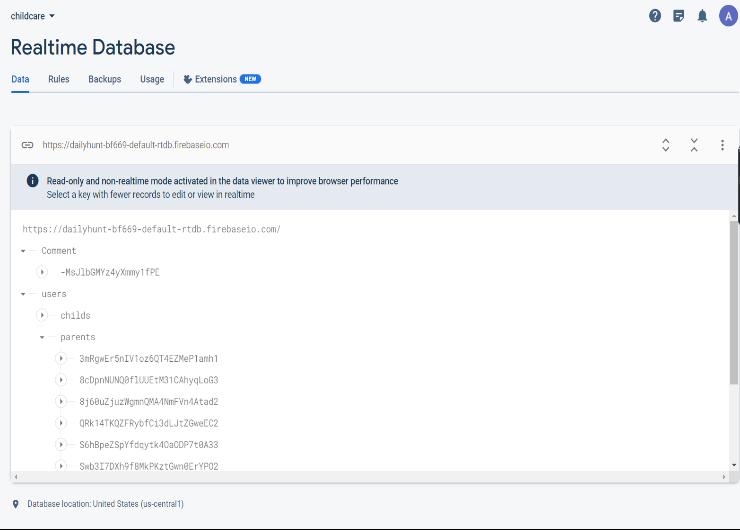
The data stored and managed by a parental control applicationtypicallyincludesvariouspiecesofinformation relatedtotheapplication’sfunctionalityanditsusers(the parentsandtheirchildren).Herearesomecommontypes ofdatathatmaybestoredbyaparentalcontrolapplication:
UserAccounts:Parentalcontrolappsoftenrequireparents to create user accounts. User account data may include usernames,emailaddresses,andhashedpasswords.
ChildProfiles:Parentscancreateprofilesforeachchildthey wanttomonitor.Childprofiledatamayincludethechild’s name,age,andprofilepicture.
DeviceInformation:Informationaboutthechild’sdevice(s) maybestored,includingdevicenames,types(e.g.,Android phoneortablet),anduniqueidentifiers(e.g.,deviceIDor IMEI).
Settings and Preferences: Parental control apps store parents’ settings and preferences, such as screen time limits, app blocking rules, website filtering criteria, and geofencingparameters.
International Research Journal of Engineering and Technology (IRJET) e-ISSN: 2395-0056
Volume: 12 Issue: 07 | Jul 2025 www.irjet.net p-ISSN: 2395-0072
Usage Data: These apps often collect data on the child’s deviceusage,including:
• Screentimestatistics,suchasthetotaltimespentonthe device.
• Appusagedata,indicating whichappswereusedand forhowlong.
• Browsinghistory,listingvisitedwebsites.
• Locationdata,whengeofencingisenabled.
• Deviceactivitylogs,includingattemptedappaccesses andblockedcontent.
NotificationsandAlerts: Recordsofnotificationsand alerts sent to parents, including the content and timestamps.
1.4 Flow
3.2:StateDiagram
3.3:DFDLevel0and1
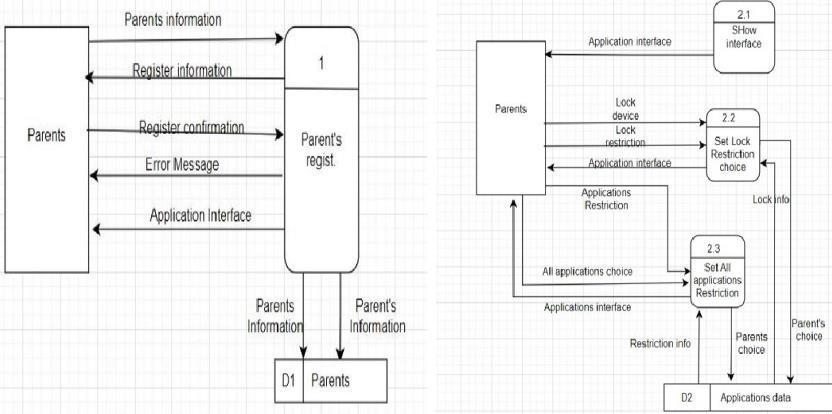
Frontend (Client-side): User Interface (UI): The frontend is theuser-facing part of the application that parentsinteractwithontheirowndevices.Itincludesthe graphical user interface where parents can configure settings, view reports, and make decisions about their child'sdeviceusage.
Device Management: The frontend allows parents to addandmanagetheirchild'sdevices,oftenbyinstallinga companion app on each child's device. Parents can configuresettings,setupmonitoring,anddefinerulesfor eachdevice.
Settings and Controls: The front end provides a set of options and controls that parents can use to define parameters for their child's device usage. This includes settingtimelimits,blockingspecificappsorwebsites,and configuringcontentfilters.
Real-Time Monitoring: Many parental control apps offer real-time monitoringcapabilities.Parentscan view their child’s device activity, such as which apps are currently beingusedandthewebsitesbeingvisited.
ReportsandAnalytics:Thefrontendgeneratesreportsand analyticsbasedonthedatacollectedfromthechild’sdevice. Parentscanviewscreentimereports,appusagestatistics, webbrowsinghistory,andotherrelevantinformation.
Notifications:Thefrontendcansendnotificationsandalerts toparentswhenspecificeventsoccur,suchaswhenachild exceedsscreentimelimitsorattemptstoaccess blocked content.
UserAuthentication:Toensuresecurity,parentstypically need to log in or authenticate themselves to access the parentalcontrolapp’sfrontend.
Volume: 12 Issue: 07 | Jul 2025 www.irjet.net p-ISSN: 2395-0072
Backend (Server-Side): Data Storage: The backend stores configuration settings, user profiles, device information, andactivity data collected from the child’s device.Thisdataistypicallystoredinasecuredatabase.
DataProcessing:Thebackendprocessesthedatacollected fromchilddevices,suchasscreentime,appusage,andweb history,togeneratereportsandanalytics.
RulesEngine:Thebackendenforcestherulesandsettings definedbyparents.Itcontrolswhichappscanbeaccessed, whichwebsitesareallowedorblocked,andthetimingof usagelimits.
User Management: User accounts, profiles, and device associationsare managedon the backend. Thisincludes addingorremovingchilddevices,updatingparentprofiles, andhandlingauthentication.
Notifications: The backend is responsible for sending notifications and alerts to parents’ devices based on predefinedtriggersandevents.
Security and Privacy: The backend must ensure data securityandprivacybyimplementingrobustencryption, access controls, and compliance with relevant data protectionregulations.
Scalability: Parental control applications often need to scaletheir backend infrastructure to support a growing numberofusersanddevices.
APIs and Communication: The frontend communicates withthebackendthroughAPIs(ApplicationProgramming Interfaces) to send and receive data. This allows for synchronizationandreal-timeupdates.
User interface: The application needs to have a userfriendlyinterfacethatallowsparentstoeasilynavigateand customizethesettings.Theinterfaceshouldbeintuitiveand provideclearinstructionsforparentstosetupandmanage theapplication.Contentfiltering:Theapplicationshouldhave acontentfilteringfeaturethatallowsparentstoblockaccess to inappropriate websites, apps, and content. Thefiltering feature can be based on categories such as violence, pornography,orgambling,oritcanbecustomizedbasedon specific websites or keywords. Time management: The applicationshouldallowparentstosettimelimitsontheir children’sdeviceusage.Thisfeaturecanenableparentstoset specifichoursortimerangesduringwhichtheirchildrencan accessthedevice.Monitoringandreporting:Theapplication should provide parents with real-time monitoring and reportingfeaturesthatallowthemtotracktheirchildren’s deviceusageandonlineactivities.Themonitoringfeaturecan
include tracking browsing history, app usage, andlocation tracking.Remotemanagement:Theapplicationshouldallow parents to manage their children’s devices remotely, includingsettinguptheapplication,modifyingsettings,and monitoringactivities.Compatibility:Theapplicationshould becompatiblewithdifferentdevicesandoperatingsystems, includingsmartphones,tablets,andcomputers.Security:The applicationshouldensurethesecurityofthedatacollected andtransmitted,andprotectagainstunauthorizedaccessor hacking.
Parental control applications are designed to help parents monitor and manage their children’s online activities, ensuring their safety and responsible use of digitaldevicesandtheinternet.Theseapplicationstypically offer various platform roles for parents to control and customize their children’s online experiences. Here are commonplatformroles and features found in parental control applications:
Parental Dashboard/Administrator: The parent serves as theadministratoroftheparentalcontrolapplication.Access to the parental dashboard, where they can configure settingsandviewreportsontheirchild’sonlineactivities. Setupandmanageprofilesforeachchildordevice.
ContentFiltering:Controloverwhatcontentisaccessibleto children,includingwebsites,apps,andgames.Setfiltering levelsbasedonageappropriatenessorspecificcategories (e.g.,violence,adultcontent,socialmedia).
TimeManagement:Setdailyorweeklyscreentimelimits foreachchild.Scheduledeviceusagetimes,suchasbedtime or studyhours.Receivenotificationswhentimelimitsare exceeded.
AppandGameControls:Blockorrestrictaccesstospecific apps or games. Monitor app usage and receive alerts for newlyinstalledapps.
SocialMediaandMessagingMonitoring:Monitorchildren’s socialmediaaccountsandmessagingappsforinappropriate content or cyberbullying. Receive alerts for suspicious onlinebehavior.
LocationTracking:Trackthelocationofachild’sdevicein real time.Set up geofencing alerts to receive notifications when achildentersorleavesadesignatedarea.
Remote DeviceLocking and Wiping: In case of a lost or stolendevice,parentscanremotelylockorwipethedevice toprotectsensitivedata.
EmergencyContactandSOSFeatures:Providechildrenwith aquickwaytocallforhelpinemergencies.Receivealertsif yourchildactivatesanSOSfeatureontheirdevice.
International Research Journal of Engineering and Technology (IRJET) e-ISSN: 2395-0056
Volume: 12 Issue: 07 | Jul 2025 www.irjet.net p-ISSN: 2395-0072
Notifications and Alerts: Receive alerts for specific activitiesorevents,suchasaccessingblockedcontentor attemptingtodisabletheparentalcontrolapp.
Password and PIN Management: Set up and manage passwords or PINs to access parental control settings, ensuringtheyremainsecure.
SafeSearch:Enforcesafesearchsettingsonsearchengines tofilteroutexplicitcontent.
1.2 Algorithms
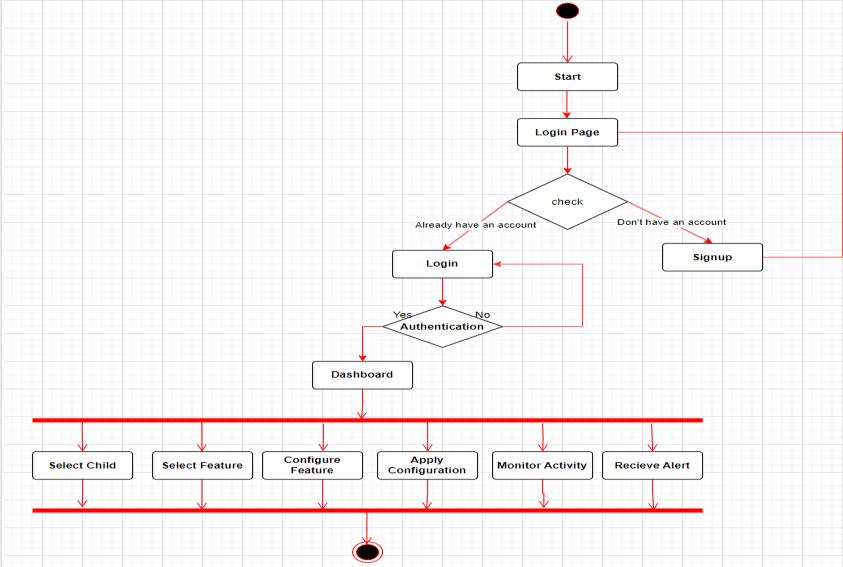
Step1:Start
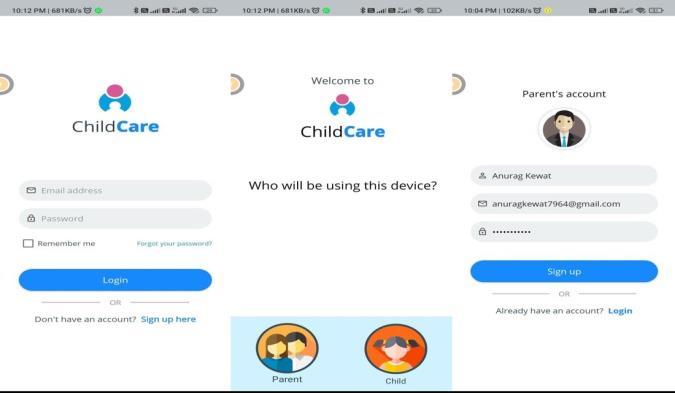
Step2:EnterUserIdandPassword
Step2.1:Ifuserwantstocreateanewaccount
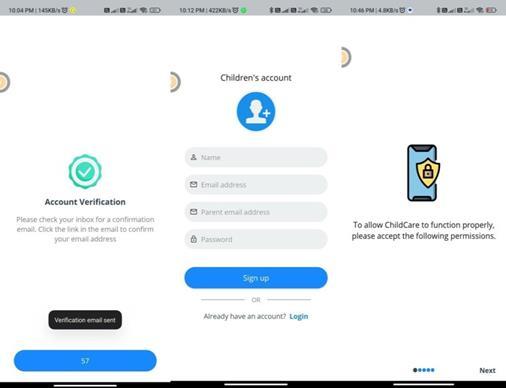
Step2.2:Click onNewAccounttolettheusercreate newaccount
Step3:ifselectisLoginthen,
Step3.1:Askstheusertologinintotheaccount
Step3.2:ifuserLoginintoaccountthen,
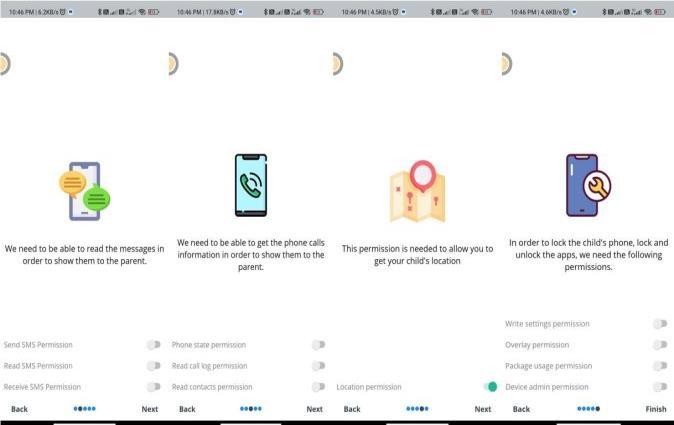
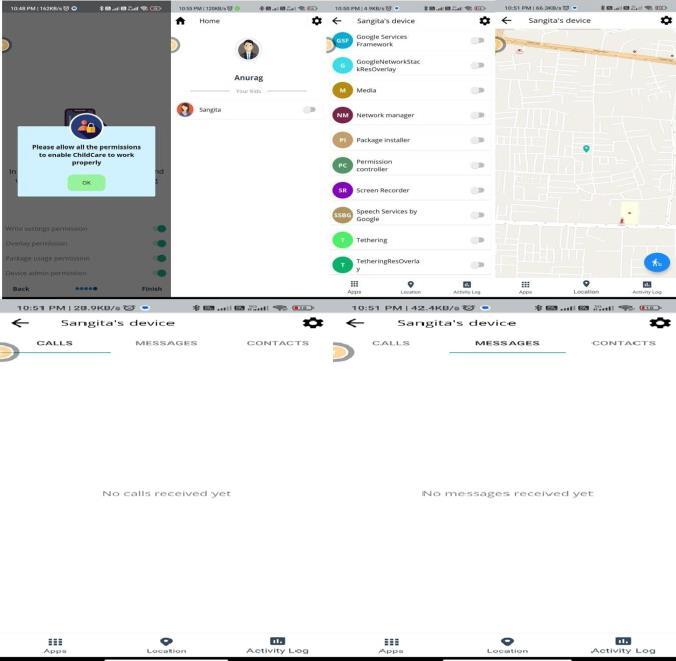
Step 3.3: Navigate to the tracking page and asks user tochoosetheoption
Step4:Selecttheparticularchildtotrack
Step5:Selectwhattheuserwishestotrack (Messages, Callsetc.)
Step 6: Displays the particular information of the relatedservice.
Step7:ifuserLogininfailedthen,
Step7.1:Gotostep8
Step8:Stop
1.3 Output
International Research Journal of Engineering and Technology (IRJET) e-ISSN: 2395-0056
Volume: 12 Issue: 07 | Jul 2025 www.irjet.net p-ISSN: 2395-0072
The study examined the effectiveness and impact of a parental control tool for monitoring children's online activity. Our findings show that the program effectively blocked access to unsuitable content while also providing parents with detailed activity reports. However, effectiveness varied greatly depending on age group and usageconditions.
Our research indicates that parental control software is useful,butitshouldbeusedinconjunctionwithamoreallencompassingstrategythatprioritizesopencommunication andawarenessofonlinesafety.Morecomplexalgorithmsand features that can grow with the child are important, the report says, in order to keep tech-savvy people from circumventingthem.Furthermore,customizablesettingsand user-friendlyinterfacesarecrucialtoensurethatparentscan use these devices efficiently even in the absence of considerabletechnicalknowledge.
Future research should look at the long-term impact of parental control apps on children's digital behavior and parent-child interactions. Researchers may investigate the how these apps affect their digital literacy and autonomy. Furthermore, research into the development of more powerful AI-powered parental control tools that can dynamically adjust to both the child’s behavior and the changingdigitalenvironmentwouldbeadvantageous.
Althoughparentalcontrolappshavenumerousbenefits,they alsobringupethicalissueswithprivacyandautonomy.Overobservation can undermine parents' and kids' trust. It is imperativeforparentstostrikeabalancebetweenensuring the safety of their children and preserving their privacy. Developersmustprioritizedatasecurityandtransparencyto protectuserinformation.
Parental control apps can help establish a safe online environment for children to explore and learn while minimizing exposure to inappropriate content, cyberbullying,oronlinepredators.Thesetoolsallowparents to monitor and restrict their child's online activities. By accessing many valuable features such as screen time, content filtering, location tracking, and app usage monitoring, parents can provide a safe and secure digital environment to their children. However, parents are responsible for ensuring that their child’s personal information is protected while using these apps. It can be achieved by choosing reputable parental control applications,configuringsettingstocollectonlynecessary data,limitingdatasharing,andeducatingchildrenononline privacy.
[1] "OntheDevelopmentofAdvancedParentalControl Tools,"W.Fuertes,K.Quimbiulco,F.GalárragaandJ.L. García-Dorado,20151stInternationalConferenceon Software Security and Assurance (ICSSA), Suwon, Korea(South).[2015]IEEE
[2] "Social network monitoring application for parents with children under thirteen," P. Santisarun and S. Boonkrong, 2015 7th International Conference on Knowledge and Smart Technology (KST), Chonburi, Thailand.[2015]IEEE
[3] ”ApproachesforSMSencryptionanduseraccounts verification” Mugahed Izzeldin Osman Hajahmed IP and MobilePS Core Huawei Technologies Co.,Ltd. Khartoum, Sudan Kamal Eldein Mohamed Osman IP and Mobile PS Core HuaweiTechnologies Co.,Ltd. Khartoum,SudanOmerTajalsirMohammedAliSenior Mobile Developer Uniforms for Integrated Solutions Khartoum,Sudan.[2020]IEEE
[4] ”Design and implementation of application using voicecontroloversmartwatch”R.Devi,N.Prabhakaran .[2016]IEEE
[5] ”Automated Voice Controlled Car Using Arduino withCamera”Dr.C.ThirumaraiSelviProfessor,ECESri Krishna College of Engineering and Technology Coimbatore, India N Anishyiwa UG Scholar ECE Sri Krishna College of Engineering and Technology Coimbatore, India G.Ashok Karthi UG Scholar,ECESri Krishna College of Engineering and Technology Coimbatore, India K.Darshan UG Scholar,ECE Sri Krishna College of Engineering and Technology Coimbatore,India.[2021]IEEE
[6] ”GPS-basedMobileCross-platformCargoTracking System with Web-based Application” Abdalbasit Mohammed Qadir Department of Computer Science UniversityofSulaimani Sulaimani,IraqPeterCooper Department of Computer ScienceSHSU Texas, USA. [2020]IEEE
[7] ”Research on android component security testing methodformobile application in power system” Guo Jing, Huang Wei,WangZiying, andZhouChao.[2019] IEEE
[8] ”Mobile Application based tracking usingGPS and GSM ” Mayank Kumar Jarwal, Abhimanyu Barun, ArshpreetSingh,andAkankshaSrivastava.[2022]IEEE
[9] ”Home Appliances Controlling through Smart TV SettopBoxwithScreen-MirroringRemoteController” Junghak Kim, Seungchul Kim, Sangtaick Park, and Jinwoo Hong Next Generation Smart TV Research
International Research Journal of Engineering and Technology (IRJET) e-ISSN: 2395-0056
Volume: 12 Issue: 07 | Jul 2025 www.irjet.net p-ISSN: 2395-0072
Department Electronics and Telecommunications Research InstituteDaejeon, Republic ofKorea.[2013] IEEE
[10] ”ImplementationandAnalysisofPluggableAndroid Applications” Amit Singhai, Ramaswamy S. Ramanujam,JoyBose,VandanaKumariWebSolutions SamsungRDInstituteIndiaBangalore,India[2015]IEEE
[11] ”Athena:AMobileBasedApplicationforWomen’s Safety with GPS Tracking and Police Notification for RizalProvince”EsterDeniseG.Vinarao,MichelleNicole B. de Guzman, Edward A.Fernandez, Danica Jane V. Quije.[2019]IEEE
[12] ”Beyond Parental Control: Designing Adolescent OnlineSafetyAppsUsingValueSensitiveDesign”Karla Badillo-Urquiola,ChhayaChouhan,StevieChancellor, MunmunDeChoudhary,andPamelaWisniewski.[2019] IEEE
[13] ”Impact of digital media on children and the changingroleofthefamily”GopalVasanth,S.Anurekha Thiyagarajan, DeborahRaj, and Aditya Raghavan. [2021]IEEE
[14] “UsabilityofParentalControlApplicationFeatures ToProtectChildrenFromNegativeInternetImpactBy Using MAGIQ Approach” (Case Study In Indonesia) Ambarsari, Erlin Windia & Herlinda, Herlinda & Daengs, Gsachmad & Prasetya, Rendi & Herfina, Herfina(CaseStudyInIndonesia).[2018]
[15] ”GUI Screen-Sharing Smart Remote Control for Smart TV UserInterface” Seungchul Kim, Sangtaick Park, and Jinwoo Hong Next Generation Smart TV Research Department Electronics and Telecommunications Research Institute Daejeon, RepublicofKorea[2013]IEEE
[16] ”Internet-enabled Access Control System using a Mobile Application” Alexandru Agape Faculty of Automatic Control andComputer Engineering “Gheorghe Asachi” Technical Universityof Iasi Iasi, RomaniaMihaiPostolacheFacultyofAutomaticControl and Computer Engineering “Gheorghe Asachi”Technical University of Iasi Iasi, Romania [2018]IEEE
[18] ”Smart-PhoneApplicationasTVRemoteController” DusanZivkov,BojanMajstorovic,TihomirAndjelic,Mile Davidovic,Djordje Simic RT-RK Computer Based SystemsLLC,NoviSad,Serbia[2012]IEEE
[19] ”MobileAppforWalletTrackingusingGPSTracker” Hawa Mohd Ekhsan Faculty of Computer and Mathematical SciencesUniversiti Tenologi MARA Cawangan Perlis Kampus Arau, Mohamad Arif Asraf Zainudin Faculty of Computer and Mathematical Sciences Universiti Tenologi MARA Cawangan Perlis KampusArau,JiwaNorisHamidFacultyofComputer andMathematicalSciencesUniversitiTenologiMARA CawanganPerlisKampusArau[2021]IEEE
[20] ”Development of Real-time Tracking and Control Mobile Robot using Video Capturing Feature for Unmanned Applications ” P.Velrajkumar Faculty of Engineering and Technology Multimedia University Malaysia S.Solai Manohar Department ofEEE Anna UniversityIndiaAravindCVSchoolofEngineeringUCSI UniversityMalaysiaA.DarwinJoseRajuDepartmentof EEER.ArshadDepartmentofEEESt.Xavier’sCatholic College of Engineering India St. Xavier’s Catholic CollegeofEngineeringIndia[2010]IEEE
[21] ”Research and Implementation of Mobile Application SecurityDetection Combining Static and Dynamic”ZhouZiqiang,SunChanghua,LuJiazhong,Lv fengmaoStateGridZhejiang Electric PowerResearch Institute, Hangzhou City, Zhejiang Province, 310006, China[2018]IEEE
[22] ”ResearchonAndroidComponentSecurityTesting MethodforMobileApplicationinPowerSystem”Guo Jing Power grid technology center state grid Jiangsu electricpowerCO.LID.researchinstituteNanjing,China ,Huang Wei Power gridtechnology center state grid Jiangsu electric power CO.LID.research institute Nanjing, China , wang Ziying Power grid technology center state grid Jiangsu electric power CO.LID.research institute Nanjing, China , Zhou Chao PowergridtechnologycenterstategridJiangsuelectric powerCO.LID.researchinstituteNanjing,China,Jiang HaitaoPowergridtechnologycenterstategridJiangsu electric power CO.LID.research institute Nanjing, China[2019]IEEE
[17] ”Permission Management Method for Before and AfterApplications the Update in Android-based IoT Platform Environment” In-Kyu Park, Jin Kwak DepartmentofComputerEngineering,AjouUniversity, Industry-University Cooperation, 260 Worldcup-ro, Yeongtonggu,Suwon,si, Gyunggi-do, 16499,South Korea.,DepartmentofCyberSecurity,AjouUniversity, Industry-University Cooperation, 260 Worldcup-ro, Yeongtonggu,Suwon,si,Gyunggi-do,16499,SouthKorea. [2018]IEEE