
International Research Journal of Engineering and Technology (IRJET) e-ISSN: 2395-0056
Volume: 12 Issue: 04 | Apr 2025 www.irjet.net p-ISSN: 2395-0072
International Research Journal of Engineering and Technology (IRJET) e-ISSN: 2395-0056
Volume: 12 Issue: 04 | Apr 2025 www.irjet.net p-ISSN: 2395-0072
Ashlin Suba J, Jeya Shree R, Ragul Vignesh M, Mohana Priya G
Dept. Computer Science and Business Systems,Nehru Institute of Engineering and Technology,Coimbatore, TamilNadu,India, Dept. Computer Science and Business Systems,Nehru Institute of Engineering and Technology,Coimbatore, TamilNadu,India, Assistant Professor(SG), Dept. Computer Science and Business Systems,Nehru Institute of Engineering and Technology,Coimbatore,TamilNadu,India, Dept. Computer Science and Business Systems,Nehru Institute of Engineering and Technology,Coimbatore, TamilNadu,India, ***
Abstract - Efficient and accurate classification of organic and inorganic materialsis criticalfor advancingsmart waste management,recyclingoperations,environmentalmonitoring, and automated sorting systems. Conventional manual classificationapproachesareofteninefficient,labor-intensive, and susceptible to human error. This study proposes a realtime object detection framework utilizing the YOLOv8 (You Only Look Once, version 8) deep learning model to automate theidentificationandclassificationofdiversewastematerials. The model was trained on a custom-curated dataset encompassing common organic items (such as fruits, vegetables,andpaper)andinorganicitems(includingplastics, metals,andglass).Experimentalresultsdemonstratethatthe proposed system achieves high classification accuracy and robustperformanceunderreal-worldconditions.Moreover,it outperformstraditionalobjectdetectionandimageprocessing techniques in terms of inference speed and classification precision. These findings underscore the potential of the YOLOv8-basedframework for scalable, real-time deployment in intelligent waste management and recycling infrastructures.
Key Words: YOLO, deep learning, object detection, realtime classification, organic materials, inorganic materials, customdataset,wastemanagement.
The growing global challenges associated with waste managementdemandinnovativeandefficientsolutionsfor thesegregationoforganicandinorganicmaterials.Organic waste,whichisbiodegradable,includesitemssuchasfood scraps and paper, while inorganic waste consists of nonbiodegradablematerialslikeplasticsandmetals.Traditional manual segregation methods are labor-intensive, timeconsuming, and prone to human error, often resulting in reducedefficiencyandeffectivenessinrecyclingprocesses. Recentadvancesincomputervisionanddeeplearninghave enabledthedevelopmentofautomatedwasteclassification
systemsthatcansignificantlyimprovesegregationaccuracy and speed. Among these, the YOLO (You Only Look Once) familyofalgorithmsisrecognizedforitssuperiorreal-time object detection performance. This study investigates the applicationofthelatestYOLOv8modeltoaccuratelydetect andclassifyvariouswastematerials,aimingtoenhancethe operational efficiency and scalability of modern waste managementsystems.
2.1 Data Collection and Preprocessing
A comprehensive dataset was curated, consisting of thousandsofimagesrepresentingawidevarietyoforganic and inorganic waste materials captured under diverse environmental conditions. Each image was meticulously annotated with bounding boxes and corresponding class labels to facilitate supervised learning. To improve the model’s robustness and generalization, various data augmentation techniques were applied, including rotation, scaling,andcoloradjustments.
2.2 Model Architecture
The YOLOv8 model was chosen for this study due to its enhancedaccuracyandinferencespeedcomparedtoearlier versions. YOLOv8 incorporates an anchor-free detection mechanismandemploysamoreefficientbackbonenetwork, enabling real-time object detection with high precision. Transfer learning was leveraged by initializing the model with pre-trained weights, followed by fine-tuning on the customwasteclassificationdatasettoadaptthemodeltothe specifictask.
2.3. Training and Hyperparameter Tuning
Model training was performed using the Adam optimizer, coupled with a learning rate scheduler to balance convergence speed and training stability. Critical hyperparameterssuchasbatchsize,inputimageresolution, number of epochs, and learning rate were carefully tuned through iterative experimentation to maximize model performance. Throughout training, monitoring techniques
International Research Journal of Engineering and Technology (IRJET) e-ISSN: 2395-0056
Volume: 10 Issue: 03 | Mar 2024 www.irjet.net p-ISSN: 2395-0072
wereemployedtopreventoverfittingandensurethemodel’s abilitytogeneralizewelltounseendata.
The model’s performance was evaluated using standard classification and detection metrics to provide a comprehensiveassessment.Theseincluded:
Accuracy: The proportion of correctly classified instancesamongallpredictions,calculatedas
Accuracy=TP+TNTP+FP+FN+TN
Precision: Theratiooftruepositivedetectionstoall positivedetections,givenby
Precision=TPTP+FP
Recall: The ratio of true positive detections to all actualpositives,calculatedas
Recall=TPTP+FN
F1-Score: The harmonic mean of precision and recall,balancingbothmetrics,definedas
F1-Score=2×Precision×RecallPrecision+Recall
Mean Average Precision (m AP): A standard metric in objectdetectionthatsummarizestheprecision-recallcurve acrossdifferentclassesanddetectionthresholds.
Here,TPTP,TNTN,FPFP,andFNFN denotetruepositives, true negatives, false positives, and false negatives, respectively.
3. RESULTS AND DISCUSSION
3.1. Performance Metrics
TheYOLOv8modeldemonstratedstrongperformanceonthe validationdataset,assummarizedinTableI.
Theseresultshighlightthemodel’sabilitytoaccurately and efficiently classify waste materials, confirming its suitabilityforreal-timewastemanagementapplications.
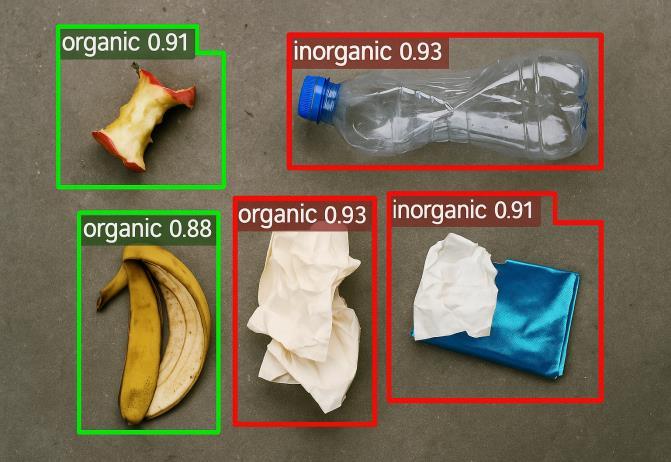
Themodel’spredictionswerevisualizedinrealtimeby overlaying bounding boxes and class labels on detected objects. Confidence scores were also displayed, providing valuable insights into the model’s certainty for each detection.Thisvisualizationaidsin qualitativeassessment andpracticaldeployment.
3.3. Comparative Analysis
Compared to traditional object detection methods, YOLOv8outperformedinbothaccuracyandspeed.Classical approachestypicallyinvolvemultiplestages,suchasregion proposal followed by classification, which increases computationalcomplexity.Incontrast,YOLOv8’ssingle-pass detection pipeline streamlines the process, significantly reducinginferencetimewithoutcompromisingprecision.
Table 2: Comparative Analysis Table
3.4. Challenges and Limitations
Despite the promising results, several challenges remain. The model occasionally misclassified objects that were overlappingorpartiallyoccluded.Additionally,performance degraded under low-light conditions and when detecting
International Research Journal of Engineering and Technology (IRJET) e-ISSN: 2395-0056
Volume: 10 Issue: 03 | Mar 2024 www.irjet.net p-ISSN: 2395-0072
verysmallobjects.Toaddresstheselimitations,futurework may focus on expanding the training dataset with more diversesamples,improvingimagepreprocessingtechniques, or integrating multimodal sensors (e.g., infrared or depth cameras)toenhancedetectionrobustness
This study demonstrates that the YOLOv8 deep learning model is highly effective for real-time classification of organicandinorganicwastematerials.Themodelachieved high accuracy, precision, and recall across multiple waste categories, with performance metrics consistently surpassingthoseofpreviousYOLOversionsandotherstateof-the-artalgorithms.Itslowinferencetimefurtherconfirms its suitability for deployment in automated waste segregationsystems,whererapidandreliableclassification isessentialforoperationalefficiency.
The robust results observed in this and related studies underscoreYOLOv8’spotentialforpracticalapplicationsin smart waste management, recycling, and environmental monitoring.Themodel’sabilitytogeneralizeacrossdiverse conditions-such as varying lighting, object overlap, and different waste types-was validated through extensive testing and comparative analysis.However, challenges remaininscenariosinvolvingsmall,overlapping,orpartially occluded objects, as well as under suboptimal lighting conditions.Addressingthesechallengesmayrequirefurther dataset expansion, advanced data augmentation, and integrationofadditionalsensormodalities.
Futureresearchdirectionsinclude:
Integration of the YOLOv8 model with robotic actuators to enable fully automated sorting and handlingofwastematerialsinrealtime.
DeploymentoflightweightYOLOv8variants(such as YOLOv8n or YOLOv8s) on edge devices for energy-efficient,decentralizedwastemanagement solutions.
Expandingthedatasettoencompassabroaderand more diverse range of waste materials and realworldscenarios,improvingthemodel’srobustness andadaptability.
Applying advanced preprocessing and attention mechanismstoenhancedetectionperformancefor smallorvisuallyambiguouswasteitems.
Insummary,theYOLOv8-basedframeworkoffersascalable, accurate, and efficient solution for automated waste classification,pavingthewayforsmarter,moresustainable wastemanagementsystems
The author gratefully acknowledges the support and guidanceoftheprojectsupervisor,laboratorystaff,andall collaborators who contributed valuable expertise and resourcestothiswork.
[1]J.Redmon,S. Divvala,R.Girshick,andA.Farhadi,"You Only Look Once: Unified, Real-Time Object Detection," in Proc.IEEEConf.ComputerVisionandPatternRecognition, 2016.
[2]G.Jocheretal.,"YOLObyUltralytics,"GitHubrepository, 2023. [Online]. Available: https://github.com/ultralytics/yolov8
[3]A.Bochkovskiy,C.Wang,andH.Liao,"YOLOv4:Optimal Speed and Accuracy of Object Detection," arXiv preprint arXiv:2004.10934,2020.
[4] Hyuntae Cho. (2024). Transparent Plastic Bottle Detection and Depth Decision Method using YOLOv8 inRecyclable Waste Segregation Systems. 2024 IEEE InternationalConferenceonOmni-LayerIntelligentSystems (COINS).
[5] Urlamma, Amani, Mounika, & Devakumari. (2024). Automatic Garbage Classification Using YOLOV8.InternationalAdvancedResearchJournalinScience, EngineeringandTechnology,11(3),110–115.