
Volume: 12 Issue: 07 | Jul 2025 www.irjet.net
2395-0072
Volume: 12 Issue: 07 | Jul 2025 www.irjet.net
2395-0072
Diyaan Ankit Shah1, Om Kunal Shah2, Shivang Mukesh Mandvia3
1Student, Narayana CO Andheri Campus, Andheri East, Mumbai, Maharashtra, India
2Student, Kapol Vidyanidhi International School, Kandivali, Mumbai, Maharashtra
3 Mentor, Mumbai, Maharashtra, India
Abstract - Semi-paralysis is a condition characterized by muscle weakness and diminished motor function, where individuals retain some sensation and partial control over the affected muscles. The objective of this project is to developadevice thatisboth user-friendlyandcost-effective. For patients with semi-paralysis who struggle to express their needs, we have developed a system that facilitates communication through gestures. This innovative solution enables patients to effectively convey their messages to caregivers or designated individuals, enhancing their ability to interact and receive timely assistance. The system primarily operates using Internet of Things (IoT) technology.
Key Words: Hemiparesis,Monoplegia,ADXL345 accelerometer,Rehabilitation support,Mobile application integration,Internet of Things (IoT),I2C communication (usedbyADXL345)
1.INTRODUCTION
Partial paralysis, also known as paresis, is a condition marked by muscle weakness and impaired movement, where individuals retain a certain degree of control over the affected muscles. Unlike complete paralysis, which results in total loss of muscle function, paresis allows for partial movement and strength, though the extent of control varies by individual. This condition can significantly impact daily activities and mobility, depending on the severity and location of the muscle weakness.
Causes of semi-paralysis include nerve damage, trauma, stroke, illness, and various neurological diseases. The severity of paralysis depends on the extent of muscle function loss and can result in a range of symptoms, such as:
● Muscleweakness
● Impairedmovement
● Lossofsensation
● Numbness
Patients affected by semi-paralysis often require assistance from caregivers to perform routine tasks. Paralysiscanpresentinseveralforms,including:
● Hemiparesis(weaknessononesideofthebody)
● Monoplegia(affectingasinglelimb)
● Diplegia(bothsidesofthebody,usuallylegs)
● Paraplegia,Quadriparesis,and
● FacialWeakness
Our project focuses specifically on Hemiparesis, Monoplegia,andFacialWeakness.
According to a survey conducted by the Christopher and Dana Reeve Foundation, 1 in every 50 individuals is affected by some form of paralysis. In response to this growingconcern,wehavedevelopedParaRing,awearable ringequippedtodetectmotion.Whenspecificgesturesor movements are detected, the ring transmits the corresponding data to a mobile application. After researching common finger movement patterns among patients,weareabletoidentifyspecificsymbolsusingthe ADXL345accelerometer.
Semi-paralyzedindividualsoftenstruggletocommunicate their needs, leading to unaddressed concerns and daily challenges. Without effective tools, they must rely on others to interpret their needs an unreliable and inefficientmethod
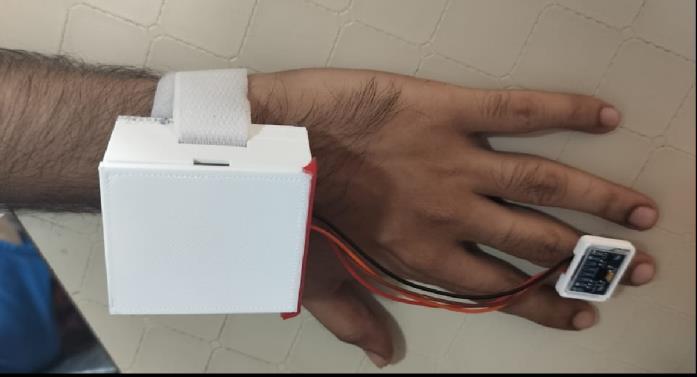
ParaRing:Agesture-basedcommunicationaiddesignedto bridge the gap between patients and caregivers. By automatically detecting movements and translating them into actionable signals, ParaRing alerts caregivers in realtime, ensuring prompt assistance and improving overall patientcare.
Volume: 12 Issue: 07 | Jul 2025 www.irjet.net p-ISSN:2395-0072
2. System Architecture
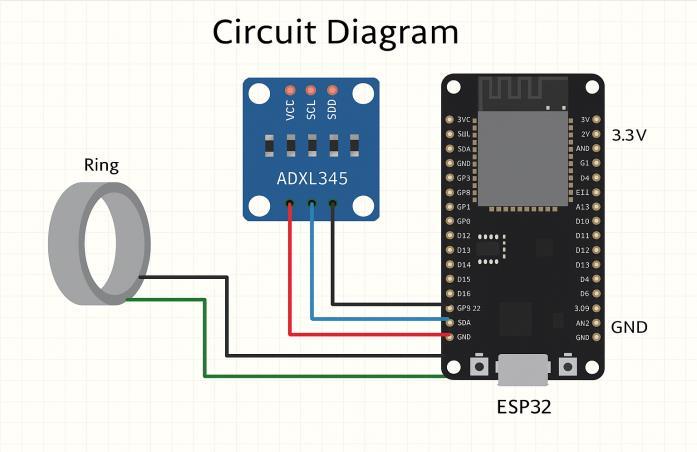
ADXL345 Accelerometer: Crucial for detecting and interpreting patient gestures. It tracks movement accuratelyandprovidesinstantfeedbacktothesystem.
ESP32 Microcontroller: Acts as the brain of ParaRing, handling data processing and ensuring seamless wireless connectivitybetweentheringandthemobileapplication.
2.1 Hardware Components
● ESP32 –IoTmicrocontrollerforwirelesstransmission
● ADXL345 –3-axisaccelerometer
● Battery –3.7VLi-ioncoincell
● Silicone Ring Shell –Housingtheelectronics
2.2 Software Stack
● ArduinoIDE
● FirebaseRTDB
● MITAppInventorApp
● Wi-FiCommunicationProtocol
3. Working Principle
The ParaRing works by continuously tracking finger movements using a 3-axis accelerometer (ADXL345) placed within a wearable ring. It interprets motion along theXandYaxestorecognizespecificgesturesmadebythe patientandcommunicatesthoseasalertsusingIoT.
The system monitors the ring’s orientation and detects movementthresholdsthatcorrespondtobasicneeds:
● A leftward flick (positive X-axis movement) is interpretedasarequestforwater
● A rightward flick (negative X-axis movement) signalsthepatientishungry
● An upward hand movement (positive Y-axis value)isinterpretedasanemergencyhelprequest
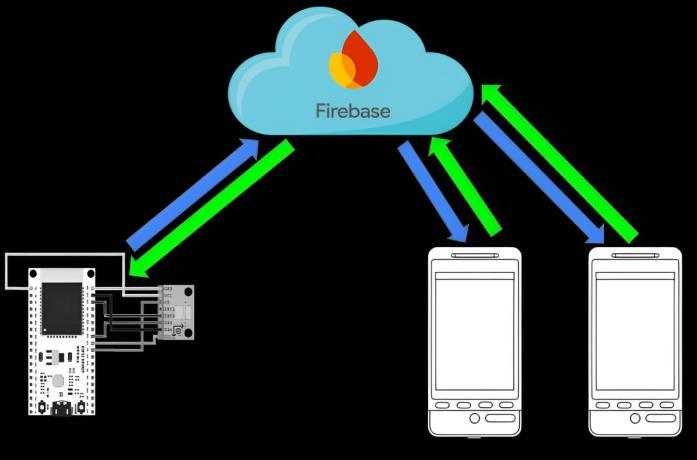
Onceagestureisdetected,theringsendsanalertsignalto a Firebase Realtime Database. Each type of gesture is loggedintoaseparatecategory:
● Waterrequest→storedasxlcount
● Hungerrequest→storedasxrcount
● Emergency→storedasycount
These values are instantly updated in the Firebase databaseandcanbeaccessedviaamobileapplicationbya caregiver. This ensures real-time response and improves thequalityofassistanceprovidedtothepatient.
After a caregiverattendsto thepatient,thesystemallows the alert to be reset remotely via the mobile app. To do this,theappsends a special value(the number 92)to the alerttagfieldinFirebase.
Whentheringreceivesthissignal,itautomatically:
● Resetsthealerttagbackto0
● Clears all previous gesture values (water, hunger, emergency)
● Preparesthesystemtodetectnewalerts
Thisensures:
● Thesystemavoidsrepeatingthesamealert
● Caregiversreceiveonlynew,relevantinformation
● The device remains ready for continuous use without manualreset
Table -1: Testingandresults
Testingandresults
Conditions Response Time Accuracy Notes
Indoor,1m ~0.8s 100% Instantdelivery Through1wall ~1.2s 96% Minordelay HospitalRange ~1.5s 93% StillHighly reliable
Table -2: Advantagesoverexisting systems
Advantagesoverexisting systems Feature CallBell Smartwatch ParaRing
GestureDetection No No Yes
FirebaseIntegration No No Yes
LightweightWearable No No Yes
AffordableBuild No No Yes
CaregiverAppReady No No Yes
International Research Journal of Engineering and Technology (IRJET) e-ISSN:2395-0056
Volume: 12 Issue: 07 | Jul 2025 www.irjet.net p-ISSN:2395-0072
6. System Flowchart and Circuit Diagram
8. Future Scope
The ParaRing system is designed to empower individuals withpartialparalysisbyallowingthemtorequesthelpfor essential needs such as food, water, and mobility
assistance.Byimprovingpatientindependence,it reduces the burden on caregivers and enhances the overall caregivingexperience.
The device is cost-effective, lightweight, and portable, making it suitable for real-world deployment. As future engineers, it is our responsibility to develop and advance suchtechnologiesto better support andimprove the lives ofindividualslivingwithpartialparalysis.
[1] Sharana Basavaraj, B., Yadav, S. K., Prajwal, K. S., Dheeraj, S., & Sachin, D. (2022). IOT based paralysis patient health monitoring system. International Research JournalofEngineeringandTechnology(IRJET),9(7),[page numbers if available]. https://www.irjet.net/archives/V9/i7/IRJET-V9I7295.pdf
[2] IEEE Editorial Style Manual for Authors (PDF) Institute of Electrical and Electronics Engineers. (2018). IEEEeditorialstylemanualforauthors(Version11.12.18). IEEE Periodicals Transactions/Journals Department. https://journals.ieeeauthorstg.ieee.org/wpcontent/uploads/sites/7/IEEE-Editorial-Style-ManualforAuthors.pdf
[3] Mishra,A.,Momin,A.,Nirala,A.,&Yeole,V.(2022).Eye blink and hand gesture detection for aid of paralyzed patients. International Research Journal of Engineering andTechnology(IRJET),9(4),[pagenumbersifavailable]. https://www.irjet.net/archives/V9/i4/IRJET-V9I4517.pdf
)



StudentName:DiyaanAnkitShah Grade:9th
School Name: Narayana CO AndheriCampus
StudentName:OmKunalShah Grade:10th
School Name: Kapol Vidyanidhi InternationalSchool
Mentor Name : Shivang Mukesh Mandvia