
International Research Journal of Engineering and Technology (IRJET) e-ISSN: 2395-0056
Volume: 12 Issue: 07 | Jul 2025 www.irjet.net p-ISSN: 2395-0072
International Research Journal of Engineering and Technology (IRJET) e-ISSN: 2395-0056
Volume: 12 Issue: 07 | Jul 2025 www.irjet.net p-ISSN: 2395-0072
Nikita Kolekar1 , Prof. U. L. Deshpande2
1 P.G. Student, Government College of Engineering, Karad, Satara, Maharashtra, India. 2 Professor, Dept. of Civil Engineering, Government College of Engineering, Karad, Satara, Maharashtra, India. ***
Abstract - This study explores the potential of Tire-Derived Aggregate (TDA), a recycled material from scrap tires, as a sustainable alternative in pavement construction. TDA’s unique properties, such as high resilience, lightweight design, and excellent drainage capabilities, offer promising solutions to common pavement issues like cracking, rutting, and water damage. The research compares TDA’s performance against traditional aggregates in sub-base and base layers, focusing on key metrics like load-bearing capacity, durability, and environmental impact. To better understand its benefits, the study develops a modified pavement design framework using advanced modeling techniques like finite element analysis, alongside empirical-mechanistic methods. Field tests further assess TDA’s performance under real-world conditions, with data collection over time providing insights into its long-term effectiveness. This research not only highlights the environmental benefits of using TDA, such as reducing waste tire stockpiles and lowering greenhouse gas emissions, but also explores its economic potential, with cost savings derived from reduced reliance on virgin materials and longer pavement lifespans. Ultimately, the findings position TDA as a transformative material for road construction, offering a sustainable, cost-effective, and resilient solution for modern infrastructure needs, and demonstrating how recycling can play a critical role in creating a greener, more sustainable future.
Keywords Tire-Derived Aggregate (TDA), Rigid Pavement, Aggregate Replacement, mix design.
Pavementdesignisacrucialelementincivilengineering,as it directly influences the performance, durability, and sustainabilityofroadinfrastructure.Traditionally,materials like natural aggregates and bitumen have been the go-to components for constructing pavements. However, with growingconcernsaboutthedepletionofnaturalresources, risingconstructioncosts,andtheincreasingvolumeofwaste materials, there's an urgent need for alternatives. One promisingsolutionisTireDerivedAggregate(TDA),made fromshredded,discardedtires.Thisinnovativematerialnot onlyhelpsreducetirewaste,whichcontributessignificantly to landfills, but also decreases the demand for natural aggregates.TDA’slightweightandflexiblepropertiesmakeit anattractivechoice, allowingfor thinner pavementlayers andloweroverallweight,improvingtheefficiencyofroad
structures. It also offers mechanical advantages, such as better drainage, reduced cracking, and enhanced thermal performance. Moreover, TDA’s ability to reduce thermal expansionandnoisemakesitanenvironmentallyfriendly optionthatbooststhedurabilityandsustainabilityofroads. Despite these advantages, optimizing TDA for widespread use requires understanding its behavior under various environmentalandloadconditions.
ThisstudyseekstoexplorethepotentialofTDAinpavement design by evaluating its mechanical, thermal, and environmental properties, comparing its performance to traditional materials, and assessing its cost-effectiveness. TheaimistodeterminewhetherTDAcanimprovepavement integrity, load-bearing capacity, water drainage, and longevity, while also providing economic savings in both construction and long-term maintenance. By examining TDA’sroleincreatingmoresustainable,durable,andcostefficient road infrastructure, this research aligns with the globalpushforgreenerconstructionpracticesandaddresses both the growing challenge of tire waste and the need for optimizedroadmaterials.
The previous work done with TDA is the replacementof5-10%withM30concrete
Lack of studies on the durability and long-term behaviour of TDA in pavements under various environmentalconditionsandtrafficloads.
Need for researchon the ideal proportionofTDA withothermaterialsfordifferentpavementtypesto achieveoptimalstrength,flexibility,anddurability.
Insufficientresearchonthepotentialenvironmental risks (e.g., leaching of contaminants) and sustainabilityofTDAinpavementapplications
1.Prepare a mix design with 10-30% TDA replacement enhances crack resistance, fatigue performance, and moistureresistance.
2.To determine the influence of TDA on the mechanical properties(strengths,durability)ofpavements.
International Research Journal of Engineering and Technology (IRJET) e-ISSN: 2395-0056
Volume: 12 Issue: 07 | Jul 2025 www.irjet.net p-ISSN: 2395-0072
3.Providinginsightsintooptimalreplacementpercentages formaintainingpavementintegrityinvariousclimates.
4.ExaminetheenvironmentalbenefitsofusingTDA.Assess the potential of TDA replacement to reduce the environmental footprint of pavements while maintaining performance.
4.Methodology
ThemethodologyforoptimizingpavementdesignwithTireDerived Aggregate (TDA) is a step-by-step approach that focusesonunderstandinghowTDAaffectstheperformance of pavements. First, TDA and traditional aggregates are collected and tested for key characteristics like density, strength,andpermeability.
mix designs are calculated by replacing traditional aggregateswithvaryingamountsofTDA 10%,20%,and 30% The materials used in the concrete mix, including OrdinaryPortlandCement(OPC)grade53,fineaggregates (crushedsand),andcoarseaggregates(crushedgranite),are alltestedtoensuretheymeetthenecessarystandards.
TheOPCcementshowsgoodhydrationpotentialwithonly 3.49%ofthematerialremainingona90-micronsieve.The coarse aggregates have a moderate impact resistance and low abrasion loss, both of which are good for the mix. However, the aggregates have a higher percentage of elongated particles (25%), which might affect the workabilityandstrengthoftheconcretemix.
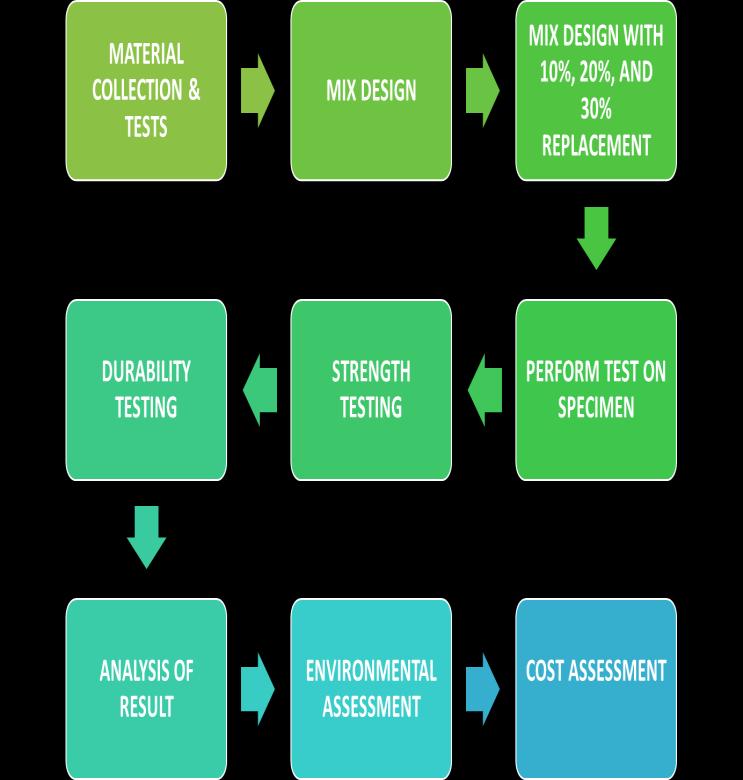
Flowchart no:1
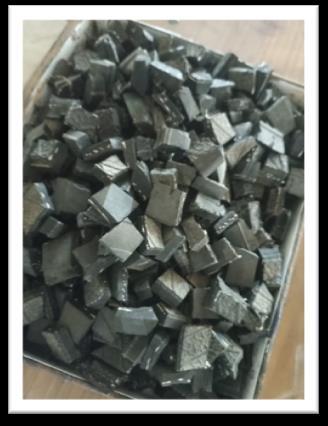
Fig. no :1 TDA
SizeRange:10–30mm
Specificgravity:1.15(byPycnometer)
TheFlakyIndexis10.46%.<15%
ElongationIndexis2.15%
4.2. MIX DESIGN
FinalApproximateMixProportionsM45(for1m³of concrete):
Cement:392kg
Water:149kg
CoarseAggregate:1223kg(SSD-Saturated SurfaceDry)
FineAggregate:729kg(SSD)
Admixture(Superplasticizer):3.1kg(ifused)
Water-CementRatio:149/392=0.38
1: 1.85: 3.11: 0.38
(Mix design by is code method, IS code referred for mix designareIRC:44,IRC:58,IRC:15,IS:10262)
4.3. MIX DESIGN WITH 10% REPLACEMENT
(AssumptionsforTDA:
Specific Gravity of TDA: We'll assume a specific gravity of 1.15 for the tire-derived aggregate. This can vary, so it's crucialtoobtaintheactualvalueforyourTDAsource.
Water Absorption of TDA: TDA typically has low water absorption. We'll assume 0% for simplicity in this initial calculation.However,it'sgoodpracticetocheckthisforyour specificTDA.
SizeofTDA: We'll assumetheTDAiswithina similarsize rangeasthecoarseaggregateit'sreplacing(e.g.,aportionof the20mmfraction).)
International Research Journal of Engineering and Technology (IRJET) e-ISSN: 2395-0056
Volume: 12 Issue: 07 | Jul 2025 www.irjet.net p-ISSN: 2395-0072
Mix Proportions (for 1 m³ of concrete with 10% TDA replacement by volume):
Cement:392kg
Water:149kg
NaturalCoarseAggregate(SSD):1096kg(rounded)
Tire-DerivedAggregate(SSD):51kg(rounded)
FineAggregate(SSD):729kg
Admixture(Superplasticizer):3.1kg(ifused)
Water-CementRatio:0.38
4.4 MIX DESIGN WITH 20% REPLACEMENT
Mix Proportions (for 1 m³ of concrete with 20% TDA replacement by volume):
Cement:392kg
Water:149kg
NaturalCoarseAggregate(SSD):975kg
Tire-DerivedAggregate(SSD):102kg
FineAggregate(SSD):729kg
Admixture:3.1kg
Water-CementRatio:0.38
4.3 MIX DESIGN WITH 25% REPLACEMENT
Mix Proportions (for 1 m³ of concrete with 25% TDA replacement by volume):
Cement:392kg
Water:149kg
NaturalCoarseAggregate(SSD):911kg
Tire-DerivedAggregate(SSD):127.5kg
FineAggregate(SSD):729kg
Admixture:3.1kg
Water-CementRatio:0.38
4.4 MIX DESIGN WITH 30% REPLACEMENT
Mix Proportions (for 1 m³ of concrete with 30% TDA replacement by volume):
Cement:392kg
Water:149kg
NaturalCoarseAggregate(SSD):848kg
Tire-DerivedAggregate(SSD):153kg
FineAggregate(SSD):729kg
Admixture:3.1kg
Water-CementRatio:0.38
5. TESTS
5.1. Strength Testing
Thesetestsassesstheload-bearingcapacityoftheblocks.
Compressive Strength Test
Evaluate the block's ability to resist crushing loads.(IS516:1959)
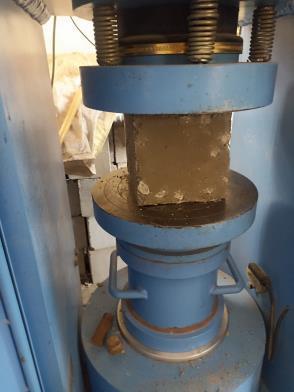
Fig. no :2 CompressiveStrengthTest
Flexural Strength Test
Measuretheblock'sabilitytoresistbendingor tensilestress.(IS516:1959)
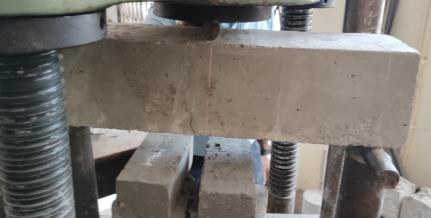
Fig. no :3 FlexuralStrengthTest
Splitting Tensile Strength Test
Assess the block's resistance to tensile stress indirectly.(IS5816:1999)
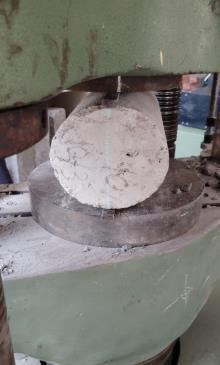
no :4 SplittingTensileStrengthTest
2. Durability Testing
Thesetestsensuretheblockscanwithstandenvironmental andoperationalstresses.
Compressive Strength Test
Evaluate the block's ability to resist crushing loads.(IS516:1959)
Volume: 12 Issue: 07 | Jul 2025 www.irjet.net
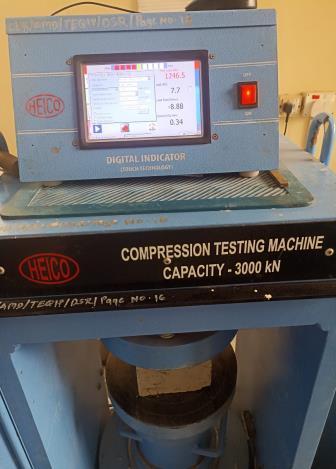
no :5 CompressiveStrengthTest
Water Absorption Test
Evaluate porosity and potential degradation fromwateringress.(IS456:2000)
6.1 Compressive Strength Test
Table no:1 Compressive Strength Test
Table no:4 Compressive Strength Test
Table no:5 Compressive Strength Test
Chart No :2 Compressive Strength Test
6.2 Flexural Strength Test (Concreteflexuralstrength
compressive strength.)
Table no:2 Compressive Strength Test
Table no:6 Flexural Strength Test
Table no:3 Compressive Strength Test
Table no:7 Flexural Strength Test
International Research Journal of Engineering and Technology (IRJET) e-ISSN: 2395-0056
Volume: 12 Issue: 07 | Jul 2025 www.irjet.net p-ISSN: 2395-0072
Table no:8 Flexural Strength Test 25%TDA 3Days 7Days 28
Table no:9 Flexural Strength Test
30%TDA 3Days 7Days 28Days Sample1(Mpa)
Chart No :3 Flexural Strength Test 6.2 Split Tensile Strength Test
No :4 Average results of split tensile test
1.Strength Performance:
Fromthestrengthtestscarriedouttheresultsshowsthat the compressive strength of 25 % replaced concrete is optimisticreplacementofaggregateforrigidpavement.
2.Mechanical Properties and Durability:
Although there was a gradual decrease in compressive, flexural, and tensile strengths with increasing TDA content,mixeswithupto 10–30% TDA retainedsufficient mechanicalstrengthforpavementapplications.
3.Optimal Replacement and Climate Consideration:
The performance across varying TDA levels suggests that 10–20% TDA issuitableinmostclimates,especiallywhere flexibility, thermal stress resistance, and sustainability arepriorities.
4.Environmental Benefits: The reuse of scrap tires in concrete has significant environmental advantages, including:
Divertingwastefromlandfills,
Reducingthedemandforvirginaggregates,
Loweringthecarbonfootprintofconcreteproduction.
1. Humphrey, D. N., & Blumenthal, M. (2010). TireDerived Aggregate as a Lightweight Fill Material.
International Research Journal of Engineering and Technology (IRJET) e-ISSN: 2395-0056
Volume: 12 Issue: 07 | Jul 2025 www.irjet.net p-ISSN: 2395-0072
Journal of Geotechnical and Geoenvironmental Engineering, 136(9),1191–1202.
2. Edil, T. B., Bosscher, P. J., & Eldin, N. N. (2004). DevelopmentandApplicationsofShreddedWaste Tire as a Lightweight Aggregate. Waste Management, 24(5),563–574.
3. Bosscher, P. J., Edil, T. B., & Eldin, N. N. (1997). ConstructionandPerformanceofaTireShred–Sand MixtureasaHighwayEmbankmentBaseMaterial. Transportation Research Record, 1577(1),79–85.
4. Reddy, K. R., Saichek, R. E., & Kumar, R. (2019). Performance Evaluation of Asphalt Mixtures Containing Recycled Tire Rubber. Journal of Materials in Civil Engineering, 31(7),04019135.
5. Mashiri, M. S., Humphrey, D. N., & Valicenti, J. (2020). Mechanical and Durability Properties of Tire-DerivedAggregateinPavementApplications. Construction and Building Materials, 230,116975.
6. Ahmad,Z.,Raza,A.,&Bukhari,K.(2021).Economic and Environmental Assessment of Using TireDerived Aggregates in Road Construction. EnvironmentalScienceandPollutionResearch,28(8), 9790–9801.
7. Huang,B.,Shu,X.,&Wang,Y.(2014)."UseofTireDerived Aggregate in Pavement Design: Performance and Sustainability Benefits." ConstructionandBuildingMaterials,66,387-394.
8. Vasudevan, S., & Palaniappan, S. (2012). "TireDerived Aggregate as a Sustainable Construction Material." International Journal of Pavement Engineering,13(6),429-440.
9. Zhao, J., & Cheng, T. (2016). "Performance Evaluation of Pavements Using Tire-Derived Aggregates."JournalofTransportationEngineering, 142(8),04016040.
10. Mahmoud,M.E.,&Eid,M.S.(2013)."Experimental Study on the Use of Recycled Rubber in Asphalt Concrete Pavement." Transportation Research Record: Journal of the Transportation Research Board,2327,85-93.
11. Jafari, S., & Moini, A. (2018). "Optimization of AsphaltPavementPerformanceUsingTire-Derived Aggregate." Construction and Building Materials, 180,49-58.
12. Boon, M., & Sposito, G. (2017). "Sustainability of Tire-DerivedAggregateinPavementConstruction." Resources,Conservation&Recycling,123,96-104.
13. Danziger,M., &Geyman,D. (2012)."Evaluationof Tire-Derived Aggregate in Highway Pavements: Structural and Environmental Benefits." Transportation Research Part D: Transport and Environment,17(7),478-485.
14. Sabbagh, H. S., & Yusoff, N. (2015). "Mechanical Properties of Pavement Mixes with Tire-Derived Aggregate and Asphalt Binder." International JournalofPavementEngineering,16(5),419-427.
15. Chen,M.,&Wang,H.(2014)."ApplicationofWaste Tire Rubber in Asphalt Pavement: A Review." JournalofMaterialsinCivilEngineering,26(2),175182.
16. Hu, X., & Yin, X. (2013). "Using Tire-Derived AggregateinFlexiblePavementDesign."Journalof Sustainable Construction Materials and Technologies,8(1),35-45.
17. Sadeghi, S., & Alavi, S. (2018). "The Feasibility of Using Tire-Derived Aggregate in Asphalt Mixes." Transportation Research Record: Journal of the TransportationResearchBoard,2672(11),12-22.
18. Khatri,S.,&Soni,A.(2017)."Tire-DerivedAggregate in Pavement Design: A Case Study from India." JournalofConstructionandBuildingMaterials,143, 201-210.
19. Bhaskar,P.M.,&Shukla,S.(2015)."EffectsofTireDerived Aggregate on Pavement Properties: A ComparativeStudy."ConstructionMaterialsJournal, 37(6),159-167.
20. Fang,H.,&He,Z.(2014)."SustainabilityAssessment of Tire-Derived Aggregate in Asphalt Pavement." JournalofEnvironmentalManagement,146,31-39.
21. Bouldin, S., & McDonald, S. (2013). "Influence of Tire-Derived Aggregate on the Durability of Pavement."RoadMaterialsandPavementDesign, 14(1),109-116.
22. Sha,A.L.,&Zhang,D.(2016)."FieldPerformanceof PavementsContainingTire-DerivedAggregate:Case Studies."TransportationGeotechnics,8,49-58.
23. Elham,N.,&Karami,M.(2017)."UseofTire-Derived AggregateforPavementSub-bases:Structuraland Environmental Benefits." Environmental EngineeringScience,34(4),343-352.
24. Subramaniam,V.,&Maran,R.(2015)."Performance EvaluationofPavementLayersUsingTire-Derived Aggregate."JournalofCivilEngineeringMaterials, 7(3),274-282.
2025, IRJET | Impact Factor value: 8.315 | ISO 9001:2008
International Research Journal of Engineering and Technology (IRJET) e-ISSN: 2395-0056
Volume: 12 Issue: 07 | Jul 2025 www.irjet.net p-ISSN: 2395-0072
25. Moeini,A.,&Shabani,S.(2014)."Performanceand EnvironmentalBenefitsofTire-DerivedAggregate inPavementApplications."EnvironmentalImpact AssessmentReview,49,14-22.
26. Gokhale,S.,&Agarwal,P.(2019)."TheRoleofTireDerivedAggregateinPavementDesign:AReviewof MechanicalandEnvironmentalProperties."Waste Management,89,116-124.
27. Siddique, R., & Khatri, R. (2017). "Tire-Derived Aggregate in Pavement Materials: A Review of Potential Benefits and Challenges." Waste and BiomassValorization,8(5),1791-1799.
28. Zhou,Y.,&Zhang,H.(2016)."ExperimentalAnalysis oftheUseofTire-DerivedAggregateinPavement Materials." Pavement Engineering Journal, 20(6), 552-559.
29. Murali, S., & Mohan, A. (2017). "Tire-Derived Aggregate: A Sustainable Material for Pavement Construction."ConstructionandBuildingMaterials, 157,263-270.
30. Malik,F.,&Misra,S.(2014)."EffectofRecycledTireDerived Aggregate on the Durability of Asphalt Pavement." Journal of Building Materials and Structures,3(4),73-80.