Making Of Economical Plastic Tiles Using Plastic Waste

Page 1

International Research Journal of Engineering and Technology (IRJET)

e-ISSN: 2395-0056

Volume: 09 Issue: 06 | June 2022

p-ISSN: 2395-0072

www.irjet.net

Making Of Economical Plastic Tiles Using Plastic Waste 1SOURABH

JADHAV, 2RAVINDRA SANGALE, 3SUJEET GUPTA, 4PRAMOD PATIL, 5Prof. RACHANA VAIDYA

1234UG

Student , Civil Engineering Department , Alard College Of Engineering And Management, Savitribai Phule Pune University, Pune, India 5Assistant Professor, Department Of Civil Engineering, Alard College Of Engineering And Management, Savitribai Phule Pune University ,PUNE ---------------------------------------------------------------------***--------------------------------------------------------------------mould inserts. These recyclable plastics can be used to make Abstract – plastic tiles.

Population growth, , and rising living standards as a result of technological advances have contributed to an increase in the amount of solid waste produced by industry, mining, and domestic and agricultural activities. Modern life cannot be imagined without plastic. In today's lifestyle, we see plastic everywhere like toys, TVs, water bottles, cell phones, etc. The waste generated by plastic is huge and waste disposal takes more than 300 years, so to help the environment and use plastic in our project we will be more focused. Many international promoters and inspectors have recently been working on the right to recycle waste in an environmentally and economically sustainable manner. The use of solid waste in construction materials is one such new initiative. The use of floor tiles in construction is designed for attractive, protective and aesthetic purposes. Tiles have a certain level of impact doubt. Low tiles are expected to support many types of load, some of which may not be stable but impact loads also occur. Plastic tiles absorb less water compared to traditional tiles. Various researchers have tried to turn solid waste into beneficial systems, with a high degree of efficiency, as a way to reduce solid waste collection.

2) METHODOLOGY A collection of plastic waste for recycling was collected in moving yards. Manually sorting each type of plastic waste was separated from one another and unnecessary items were removed from the trash, such as water bottles and solid plastic items. Use only polythene bags and heavy plastic bags. Cutting various waste plastic is also ground into smaller pieces. Washing plastic bags were also washed to remove cement, paper labels, dirt and any remnants of the product they previously contained. The melting process was done by melting a plastic bag that was placed in a pot and placed in a furnace. The furnace was hot and the melting point and time of melting were recorded. First, the plastic waste melted at 170oC, 155oC, 120oC and 60oC; this was to select the right melting point. LDPE is easy to dissolve and is available in large quantities so it is easily liquid. After melting mix 50% fly ash and stabilizing agent to get a proper bond with plastic and tighten quickly. After mixing apply the two different compounds to the soil to compare the 50% plastic effect in the pipe with 65 in the other compound and press the compound to the ground to avoid air leakage in the pipe leave the soil at room temperature for 2 hours to stabilize. After two hours remove the soil the plastic pipe is shaped like a ceramic pipe. To get that plastic fully stained keep that pipe at room temperature.

Key Words: plastic, plastic waste, plastic tile recycles and Reuse. 1) INTRODUCTION The development of the Pune Garbage Working Model has helped achieve a high level of recycling of plastic waste. About 50 per cent of the plastic waste generated is collected and recycled, SWACH waste collectors are included in the door-to-door waste collection. Recyclable data (including plastic waste) is automatically sealed by garbage collectors in waste disposal, shack filters, open spaces or wherever they can find a place.PVCpipes0.08cement bags (Rafiya) 0.18BikeseatsandRubberTubes1. (Kadak) 1.38Styrofoam (Tharmocol) 2.11Whitehighgradefilmplastic (LD) 2.42ThickPETbottles (Kadkadi) 5.34MilkBag (DoodhPishvi) 7.17, HDPEholders.H HDPEholders.6Mixedfilmplastic (LD) 2.42Thkk . ) 47.76 Reusable plastics include organic plastics, emulsion plastic, plastic wrap paper, and polycarbonate. The most well-known recyclable plastics include stick film and

© 2022, IRJET

|

Impact Factor value: 7.529

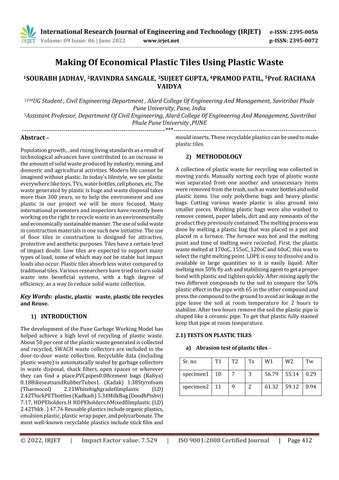
2.1) TESTS ON PLASTIC TILES a) Abrasion test of plastic tiles –

|

Sr. no

T1

T2

Ts

W1

W2

Tw

specimen1

10

7

3

56.79

55.14

0.29

specimen2

11

9

2

61.32

59.12

0.94

ISO 9001:2008 Certified Journal

|

Page 412


Turn static files into dynamic content formats.
Create a flipbook
Issuu converts static files into: digital portfolios, online yearbooks, online catalogs, digital photo albums and more. Sign up and create your flipbook.
Making Of Economical Plastic Tiles Using Plastic Waste by IRJET Journal - Issuu