International Research Journal of Engineering and Technology (IRJET) e-ISSN: 2395-0056

Volume: 09 Issue: 12 | Dec 2022 www.irjet.net p-ISSN: 2395-0072
International Research Journal of Engineering and Technology (IRJET) e-ISSN: 2395-0056
Volume: 09 Issue: 12 | Dec 2022 www.irjet.net p-ISSN: 2395-0072
 Om Prakash Pal1
1M.tech, Department of Civil Engineering, Millenium college of Technology & Science, Bhopal(M.P), India ***
Abstract - Most of the reinforced concrete (RC) residential buildings situated in earthquake prone areas are not seismically designed. To prevent disaster due to future earthquakes, these deficitstructuresneedtoberetrofitted. The present thesis discussesabout thestructuralbehaviorandgain in strength of RC column re strengthened by using three retrofitting techniques: RC jacketing, fiber reinforcedpolymer (FRP) wrapping and steel jacketing. The objectiveofthisstudy is to discuss the difference in structurebehaviorofRCCcolumn after retrofitting by, RC jacket, three different types of CFRP and steel jacketing by comparing their demand-capacityratio (DCR) and inter-story drifts. In this study, a typical G+1 RC residential structure located in North-East region of India (seismic Zone-V according to IS1893:2016) is modeled numerically and analyzed linear dynamically. All the real parameters corresponding to this location such as soil type, topology, seismic zone etc. are considered. IS 875 (part-1 and part 2):1987 has been referred for application of loads and IS1893(part-1):2016 forseismic analysis. RC columns thatare seismically deficit are then retrofitted withRCjacketing,CFRP andsteel jacketing and the comparative study on their behavior against earthquake is done. RC jacket is designed according to IS 456 and IS 15988, CFRP is designed according to ACI440.2R-17 and steel jacket based on existing literatures. CFRP was found to be more efficient among all three retrofitting techniques for enhancement of capacity of RC column. RC jacking gave best results for reduction in interstory drift ratios of structure
Key Words: Retrofitting design, RC jacketing, FRP wrapping, steel jacketing, Response Spectrum Analysis.
Almosteveryonehasheardofconcreteandknowsthatitisa material that is used in the construction of various structures such as multi-story buildings, flyovers, and bridges,andthatconcreteisnothingmorethanamixtureof binding material, fine aggregates, and coarse aggregates mixed with the appropriate amount of water. Reinforced cementconcrete(RCC)isaversatilematerialthatiswidely employedinmostprojectsaroundtheworld.However,its performanceduringearthquakesorseismicforceshasraised a number of concerns in the minds of many researchers. Earthquakes can cause reinforced concrete structures to collapse, resulting in the loss of lives as well as massive economiclosses.ThemajorityofstructuresinIndiacannot withstand even minor seismic or earthquake loading. It is
critical for RC constructions to have the lateral resistance capacityagainstbrittlebreakdownduringseismicactivity. Buildingsthatarenotearthquakeresistantandwerebuilt usingnon-seismiccodesofpracticearevulnerabletoseismic excitations. Because RC buildings are expensive to reconstruct and demolish, upgrading a small portion of structural components and the building can be a viable methodforassuringthesafetyofstructureandpeople.
RC-jacketingismostlyusedprocessforstrengtheningof reinforcedconcretecolumns.Ithasbeenstudiedbyanumber of researchers for its effectiveness in strengthening weak structures and restoring their load carrying capacity. Accordingtoastatisticalstudyconductedtoinvestigatethe ways utilized to strengthen various concrete structures damagedbyanearthquakein1985,RC-jacketingwasoften used as a reinforcing strategy. When it comes to the structuralqualitiesofRCjacketing,thismethodcanincrease stiffnesswhileimprovingstrengthandductility.Itimproves theoverallbehaviorofthatstructurewhilealsoincreasing the strength and ductility of the target part. It was also proved that via RC jacketing, a strong beam weak column may be transformed into a weak beam strong column. Furthermore,theRC-Jacketingmethodcanboostadamaged column'sstrengthbythreetimesitsoriginalvalue.Asimilar studyonRCframesdiscoveredthatthelateralstrengthwas five times that of the original frame. The RC-Jacketing technique,ontheotherhand,issimpleandrequiresextreme cautionwhenitcomestosurfacedrying;otherwise,thejacket cansplit.
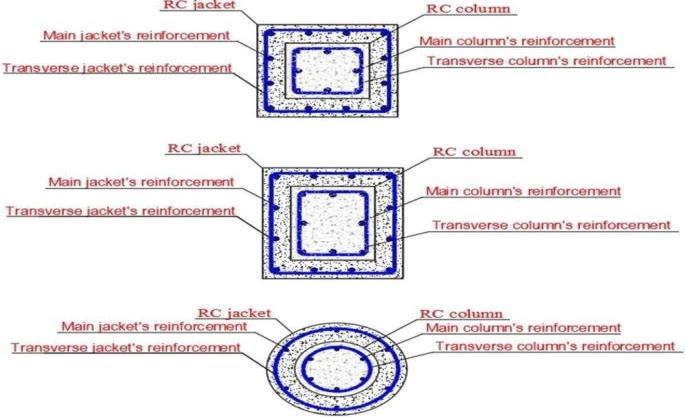
Fig -1: RCjacketedRCcolumnwithdifferentcross-section
International Research Journal of Engineering and Technology (IRJET) e-ISSN: 2395-0056
Volume: 09 Issue: 12 | Dec 2022 www.irjet.net p-ISSN: 2395-0072
In recent years, Fiber Reinforced Polymer (FRP) has gainedpopularityforretrofittingorreinforcingreinforced concrete structural parts. It's a composite material consistingapolymermatrixandnaturalorsyntheticfibers. Carbon,aramid,glass,basalt,andavarietyofotherfibers, includingpaper,wood,asbestos,andnaturalfibers,haveall beenemployed.Aspreviouslystated,aramidfibers,atypeof synthetic fiber, are employed in this experimental studyDespite of the fact that there are a few researches evaluating the confinement efficiency of various FRPs on reinforced concrete columns on the basis of serviceability and strength. This thesis focuses on the application of Carbon Fiber Reinforced Polymers (CFRP) to improve the compressionbehaviorofpreloadedRCcolumns.
with the use of rectangular flat steel jackets. Expansion anchorboltswereusedtosecurethejackettothecolumn. Thestudy'sgoalwastodeterminehoweffectivethistypeof jacketing is at improving column seismic performance. Undercyclicloading,threelargescalecolumnsweretested. It was discovered that strengthening columns with steel jackets and expansion anchor bolts improved their cyclic behavior
SakinoK.etal(2000)offeredareport(basedonseveral studiesdoneinJapan),ontheseismicbehaviorofthesquare reinforcedconcretecolumnsretrofittedusingsteel jackets. The load bearing and deformation capabilities of the retrofittedRCcolumnsarethefocusoftheirreport.Themain itemsstudiedinthisreportare:(1)stress-straincurvemodel for concrete confined by the steel jacket, (2) methods to evaluateshearstrengthandultimatebendingstrengthofthe retrofitted reinforced concrete columns, and (3) a design formula for prediction of the deformation capacity of retrofittedcolumns.
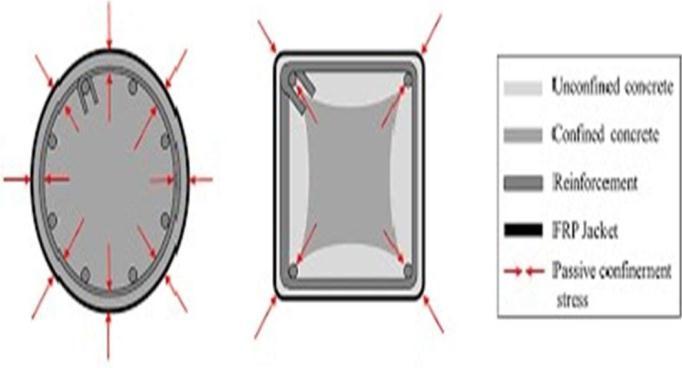
Fig -2: ARCCcolumnwithFRPlaminates
1.Strengthrelatedchecksofeachcomponentofthestructure willbeperformedmanuallyasperguidelinesprovidedinIS 1893(Part1):2016.
2.TheentirestructuretobemodeledinETABS2018asper theactualsiteconditions,i.e.soiltype,loads,earthquakezone, buildingarchitectureandetc.
3.LoadsonthestructurewillbeappliedasperIS875:1987 andseismicanalysisasperIS1893(part-1):2016.
4.Themodelwillbethenanalyzedlineardynamically(RSA) for the defined load combinations for the checks and optimizationsofthestructuralmember.
5.Thecriticalmemberswillbethenmodifiedindividuallyin order to obtain the required strength under the action of seismicloads.
6.Comparisonoftheresultsofallthreeretrofittingmethods.
GhobarahA.etal(1997)presentedanexperimentalstudyof failuremodesofnon- ductileRCcolumnsre-strengthened
Kaliyaperumal G. et al (2009) studied the influence of jacketing on the performance and flexural strength of RC columns.Slantsheartestswerefirstperformedtoinvestigate theinteractionbetweentheoldandnewconcrete.Second, columnspecimenswereputtothetesttoseehowstrongthey were.Third,theductility(orenergyabsorption)andenergy dissipationofbeam-columnjointsub-assemblagespecimens wereinvestigated.Analyticalstudieswereconductedinorder toforecastthetrialoutcomes.Themomentversuscurvature curvesandtheaxialloadversusmomentinteractioncurves fortheretrofittedRCcolumnswerepredictedusinglamellar techniqueandasimplifiedtechniqueofanalysis.
MohsenS.etal(2013)(basedonLamandTangmodel) workedfortheverificationofthethemodelofFRPconfined columns in SAP2000, which calculates the material parameters of wrapped reinforced concrete columns. The techniqueformodellingandassigningspecializationsisgiven incontext,andtheanalysisresultshavebeencomparedto literaturetodeterminethedependabilityofanalysis.ForFRP confinedRCcolumnswithandwithoutreferencetoACI-440 regulationsfortherectangularandthecircularsection,the allowed range of difference according to SAP2000 (2009) guidelineiscontrolled.Aninvestigationoftheperformanceof FRPwrappedcolumnsrevealedthatyieldiscomparableto thatofthetypicalRCcolumns,butductilityandpost-yieldare different.
TarabiaA.M.etal(2014)conductedanexperimentalstudy ontencolumn’sspecimensthatareaxiallyloadedtillfailure. Themajorgoalsofhisworkweretoinvestigatethebehavior andeffectivenessofRCsquarecolumnsreinforcedwithsteel stripsandangles(steelcage).Thekeyresearchedparameters in his paper were the spacing of strips, grout material betweencolumnsidesandsteelangles,sizeofthesteelangle,
International Research Journal of Engineering and Technology (IRJET) e-ISSN: 2395-0056
Volume: 09 Issue: 12 | Dec 2022 www.irjet.net p-ISSN: 2395-0072
Table -2: DCRofcolumnswrappedwithCFRP-2
RCcloumnsselectedforretrofittinghavebeendesigned asdescribedinlastchapterandthenmodelledandanalyzed lineardynamicallyoncomputersoftware.Columnsarebeen retrofittedusingallthreemethodsbyreferringthestandard codesasspecifiedinlastchapter.ResultsofDCRofparticular columns obtained after analysis has been tabulated in this section.
Col. No. Unique name Floor Existing DCR No. of layersof DCR after wrapping
C6 33 1st 9.201 18 1.084
C6 35 Terrace 6.919 5 1.692
C7 17 1st 7.008 20 1.06
C7 19 Terrace 5.805 8 1.397
C10 41 1st 6.465 36 0.66
C10 43 Terrace 4.978 2 2.309
DCR(demandcapacityratio)ofcolumniscalculatedfor everyindividualloadcombinationusedfordesign.Theload combinationhavingmaximumvalueofDCRiscritical load combination.
C12 65 1st 9.094 31 0.733
C12 67 Terrace 6.133 9 0.805
ForcalculationofDCR,alltheloadsactingoncolumnare evaluated. Vertical loads include DL, SIDL and LL. Lateral loadsareseismicloadsinbothXandYdirections.Baseshear (calculatedinsection3.4)isthendistributedoneachfloor with respect to proportion of weight of that floor. These distributedbasesheararelateralearthquakeforcesinXand Ydirections.
C15 61 1st 9.08 15 1.167 C15 63 Terrace 6.073 8 0.178 C19 53 1st 8.805 29 0.661 C19 55 Terrace 6.385 8 1.11
Table 3: DCRofcolumnswrappedwithCFRP-HM60
Col.No. Unique name Floor Existing DCR No.of layersof DCRafter wrapping
Alltheseloadsarethensubstitutedinloadcombinations forcalculationofthatloaddemandofcolumn.Ratioofthis demandandcapacityistermedasDCR
Table -1: DCRofcolumnswrappedwithCFRP-1
Col. No. Unique name Floor Existing DCR No. of layersof DCR after wrapping
C6 33 1st 9.201 13 1.073
C6 35 Terrace 6.919 6 1.202 C7 17 1st 7.008 14 1.062
C7 19 Terrace 5.805 10 .0971 C10 41 1st 6.465 25 .669
C10 43 Terrace 4.978 6 1.205
C12 65 1st 9.094 21 0.726
C12 67 Terrace 6.133 6 1.085
C15 61 1st 9.08 17 0.85
C15 63 Terrace 6.073 7 1.031
C19 53 1st 8.805 20 0.668
C19 55 Terrace 6.385 6 1.072
C6 33 1st 9.201 12 1.125
C6 35 Terrace 6.919 4 1.566 C7 17 1st 7.008 13 1.119
C7 19 Terrace 5.805 6 1.312 C10 41 1st 6.465 24 0.689 C10 43 Terrace 4.978 2 1.707 C12 65 1st 9.094 21 0.739
C12 67 Terrace 6.133 6 1.095 C15 61 1st 9.08 10 1.213
C15 63 Terrace 6.073 5 1.278 C19 53 1st 8.805 19 0.699 C19 55 Terrace 6.385 6 1.075
Based on the of results obtained by linear dynamic analysis of retrofitting techniques of RC column, following conclusionscanbemade-
RC jacketing it is observed to be more effective than FRP and steel jacketing forenhancementof stiffness
CFRPprovedtobebestofallthethreeinreduction ofDCRofcolumns
International Research Journal of Engineering and Technology (IRJET) e-ISSN: 2395-0056
Volume: 09 Issue: 12 | Dec 2022 www.irjet.net p-ISSN: 2395-0072
Inter-storeydriftofRCstructurehasbeenreduced effectively just by restrengthening of six out of nineteencolumns.
Inter-storey drift of structure can be reduced to satisfy criteria of IS codes (0.004 timesof storey height)byrestrengtheningofkeyframemembers.
RC jacket increases the dead load on columns belowand effects nearby area duringexecution.
RC jacket increases crossection area resulting in increasing of self weigth of structure,hence the adjacentcolumnsalsogeteffectedbyitsincreased load. Therefore, this increased load should be consideredduringitsdesign.
[1] IS 1893 (part 1): 2016, Indian Standard “Criteria for Earthquake Resistance design of structures”, “Part-I : General provision and buildings, (Fifth Revision)”, BureauofIndianStandards,NewDelhi.
[2] Rasheed H.A., ‘Strengthening Design of Reinforced ConcretewithFRP”.BocaRatonCRCPress,2014.
[3] IS 456-2000, Indian Standard Plain and Reinforced ConcreteCodeofPractice.BureauofIndianStandards, NewDelhi,2000.
[4] IS15988:2013,SeismicEvaluationAndStrengthening OfExistingReinforcedConcreteBuildings–Guidelines, BureauofIndianStandards,NewDelhi,2013
[5] ATC - 40 (1996), Seismic evaluation and retrofit of concretebuildings,vol1,ReportNoSSC96-01
[6] British Standards Institution. BS EN 1994-1-1:2004. Eurocode 4: Design of compositesteel and concrete structures - Part 1-1: General rules and rules for buildings.BSI2005.
[7] Tarabia A.M., Albakry H.F. 2014 “Strengthening of RC columns by steel angles and strips” Alexendria Engineering Journal Volume 53, Issue 3, September 2014,Pages615-626