International Research Journal of Engineering and Technology (IRJET) e-ISSN: 2395-0056

Volume: 09 Issue: 12 | Dec 2022 www.irjet.net p-ISSN: 2395-0072
International Research Journal of Engineering and Technology (IRJET) e-ISSN: 2395-0056
Volume: 09 Issue: 12 | Dec 2022 www.irjet.net p-ISSN: 2395-0072
2
Abstract - Online social media have developed into a significant informational resource for many individuals in recent years. The abuse of the media to distribute fake news multipliedalongwiththegrowthinsocialnetworkusage.The accuracy of automated approaches is constrained by the semantic nature of the contents and frequently necessitates manual intervention. Online social networks generate enormous amounts of data, making it computationally difficult to perform the operation in real time. This study suggestsaframeworkforspottingfalsecontentthatdrawson machine learning and natural language processing (NLP) ideas.Theproposedmethodwouldmakeitpossibletostopthe dissemination of false material on the Twitter network. The Artificial Learning (ML)
Key Words: AdaBoost, Web content, Fake news, SVM, KNN
Oneofthemorewell-knownmicrobloggingplatformsis Twitter. Real-time news dissemination is made possible through Twitter. Tweets, or brief communications with a characterlimitof140,aretheprimarymeansofinformation disseminationonTwitter.Byfollowingsomeone,thesystem enables one to subscribe to their tweets. Retweeting the tweets one has received, it enables speedy information distribution.Asaresultoftheabilitytosubmittweetsfrom mobile devices like smartphones, tablets, and even SMS, Twitter has become the go-to informational platform for many consumers. Twitter is a medium for easily disseminating false information because of these features [1].
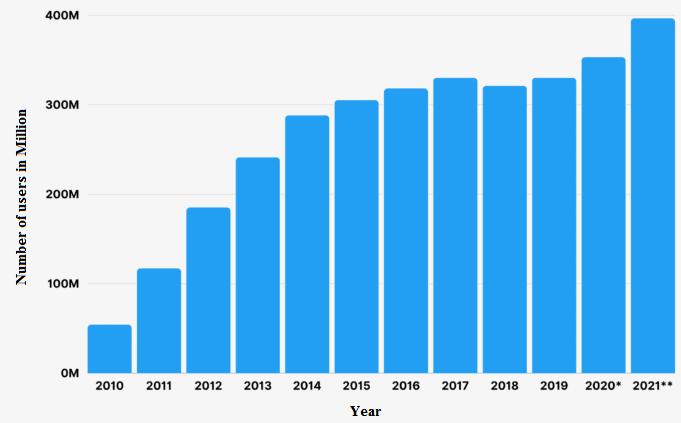
The accompanying figure [2] shows how there were moremediaconsumersbetween2010and2021.Oneofthe most popular social networking services is Twitter. A significant portion of users now view Twitter as a global platform for news dissemination, opinion sharing, and interpersonalinteraction.Asaresult,thereisthepotential forusingsuchalargevolume,highspeedspikeofTwitter data generated every second for important analytical and interpretativeapplications.
It has become extremely popular to spread incorrect information using Internet communication methods. With the advent of social networks, every user is now a selfpublisher, without editing, fact-checking, or any sort of responsibility.Formillionsofusers,seeingthefactsontheir screen serves as proof that the material is accurate even whenitisdeliveredwithoutauthority.Thebook'sdiscussion of the use of technology by individuals to encourage lies, deception,fraud,spincontrol,andpropagandahascometo passasaresultofthemisuseofonlinesocialnetworkslike Twitter. It can be difficult and fraught with traps for both noviceandseasonedInternetuserstovalidatetheinfoon theweb.
International Research Journal of Engineering and Technology (IRJET) e-ISSN: 2395-0056
Volume: 09 Issue: 12 | Dec 2022 www.irjet.net p-ISSN: 2395-0072
This has to be adequately discovered. Only a small number of organizations verify the accuracy of the news before publishing it. Many data sets are being manually detectedasfraudulent,yettheycannotbemanuallyaccepted or removed because of the sheer volume. Therefore, the news content should be qualified using an automatic approach. The suggested method could create a way to determine whether a certain tweet is phony or original basedonthewords,phrases,relevantsources,andtitle.The followingcontributionsaremadetothisbodyofresearch:
• An automated system for determining whether popularTweetsarerealorfraudulent,
•Thispaperevaluatesthesuggestedmodel'spredictive performance,demonstratingthemodel'sefficacy.
• A three-dataset alignment that captures accuracy judgmentsforbothtrueandfalsetweets.
EmmaCuevaetal.,proposedaneffectivemodeltoidentify thefakenewsspreadonTwitterthroughtheuseofArtificial Intelligence (AI). To assess the effectiveness of different networksatidentifyingfakenews,theanalysisspecifically lookedatLongShortTermMemory(LSTM),GatedRecurrent Unit (GRU), and Natural Language Processing (NLP) networks.Datawascleanedupandthenutilizedtodevelop AIsystems.TheNLPmodelwastheonlyversionthatcould recognise comedy as false news, despite the fact that all threemodelsweresuccessfulinrecognisingfakenewswith highaccuracy.ThisiswhyitwasdecidedthattheNLPmodel wasthebestoptionforspottingbogusnewsonTwitter[3].
SreeJagadeeshMalla etal.,investigatedCOVID-19fakedata from various social media platforms such as Twitter, Facebook,andInstagram.Theauthorshavetestedvarious deeplearningmodelsontheCOVID-19fakedataset.Finally, deep learning models like BERT, BERTweet, AlBERT, and DistlBERTperformedworsethantheCT-BERTandRoBERTa models. Using the multiplicative fusion method, the proposed ensemble deep learning architecture beat CTBERTandRoBERTaontheCOVID-19falsenewsdataset.The multiplicativeproductofthefinalpredictionvaluesofCTBERTandRoBERTawasusedtoassesstheperformanceof the suggested model in this technique. This method eliminatesthedrawbackoftheinaccuratepredictionnature of these CT-BERT and RoBERTa models. With 98.88% accuracyanda98.93%F1-score,thesuggestedarchitecture beatsbothwell-knownMLandDLmodels[4].
Phayung Meesad et al., proposed a framework for robust Thai fake news detection. Information retrieval, natural language processing, and machine learning are the framework'sthreecoreparts.Ithastwophases,including the phase where data is collected and the phase where a
value:
machine-learningmodel isbuilt.Inordertoextractuseful features from web data, they used natural language processing techniques to examine data that they had collected from Thai online news websites utilizing webcrawlerinformationretrieval.Theychoseanumberofwellknown machine learning models for classification for comparison,includingNaiveBayesian,LogisticRegression, K-NearestNeighbor,MultilayerPerceptron,SupportVector Machine, Decision Tree, Random Forest, Rule-Based Classifier,andLongShort-TermMemory.Theyimplemented anautomaticonlinewebapplicationforfakenewsdetection afterthecomparativeanalysisofthetestsetrevealedthat LongShort-TermMemorywasthebestmodel[5].
Diaz-GarciapresentedasolutionbasedonTextMiningthat triestofind whichtext patternsarerelatedtotweetsthat refer to fake news and which patterns in the tweets are related to true news. To test and validate the results, the system faces a pre-labeled dataset of fake and real tweets during the U.S. presidential election in 2016. In terms of results,interestingpatternsareobtainedthatrelatethesize and subtle changes of the real news to create fake news. Finally,differentwaystovisualizetheresultsareprovided [6].
A user-friendly interface and a PYTHON software were employed to implement the system. Twitter datasets are employedinthissystemtogettheexperimentalresults.
TotestthegivendatasetusingMLclassificationmethods,a PythonscriptutilizingtheScikit-learnmodulewascreated. Thisscriptaccuratelyidentifiedthegivendataasbelonging tothe"real" and"fake" classesoftheTwitterdataset.The Scikit-learnmodulewaschosenbecausePythonisoneofthe most widely used programming languages for scientific computing and contains a large selection of scientific libraries.
Having a thorough and trustworthy dataset is necessary before beginning the opinion mining process. Twitter media could be used to gather the required data. This study used a Twitter dataset about metformin and related branded medications to create a classification algorithm. Twitter provides customers with a streaming ApplicationProgrammingInterface(API)thatenablesthem tocollectdatainreal-timeaccesstheTwitterStreamingAPI, you must first obtain your Twitter API keys (API key, API secret,Accesstoken,andAccesstokensecret).The"Tweepy" libraryfilesareusedtoaccesstheTwitterStreamingAPIand retrieve Twitter data. This utility makes it simple to communicate between computer programmes and web services.R-Toolwasusedinthisstudytoextractdatafrom recentlypostedtweetsbyusers.
International Research Journal of Engineering and Technology (IRJET) e-ISSN: 2395-0056
Pre- Processing : To get decent results while analyzing tweets,itiscrucialtousetextpretreatmenttechniques[8]. The preprocessing stage involves a number of stages, including,
• URL Removal: Opinion analysis has nothing to do with URLs. Therefore, for successful analysis, URLs should be deletedfromthetweets.
•LowercaseTextConversion:Tweetswillcontaintextthat combines upper- and lower-case letters [6]. As a result, Twitterdata ischangedto lowercasemaking itsimpler to analyze
• User name Removal: Nearly every sentence in a Twitter texthasausername.Thereisnoopinionintheirpresence. Therefore,removingitduringthepre-processingstageisa crucialstep.
Removing the Punctuations (#, @, etc,): Punctuationsdonotshareanycontributiontoward analyzing the opinion of a person. Hence, they should be removed to make the analysis process easy.
Itisverycommonalgorithmtotransformtextintoa meaningfulrepresentationofnumberswhichisusedtofit machine algorithm for prediction [10]. TF-IDF is a weight metric which determines the importance of word for that document.
Term Frequency measures number of times a particular term t occurred in a document d. Frequency increaseswhenthetermhasoccurredmultipletimes.
TFprocessessimplythefrequencyofaword/term’t ’ present in dataset. Some terms like stop words occur multiple times but may not be useful. Hence Inverse Document Frequency (IDF) is used to measure term’s importance
RemoveBlankspaces: Thisstepisusedtoremove the unwanted blank space which helps for the tokenizationofthetweets.
Tokenization: Tokenization means breaking the sentenceintowords.
Removingstopwords: Theproposedmethodloads a complete list of English stop words that is gathered in Python programming language and removesittoreducethecomputationalload.
The above equations are tried to explain mathematical concept behind the all process like tf-idf calculationbyusingTermFrequencyandInverseDocument Frequency. Usually TfidfVectorizer consider overall documentweightageofaword.Itaidsusinallocatingwith maximum occurrence words. TfidfVectorizer weights the wordcountsbyameasureofhowoftentheyappearinthe documents. It is text vectorization based on the Bag of words(BoW)model.ThismethoddoeswellthantheBoW model as it considers the significance of the word in a dataset(textdata).
Lemmatization: This step aims to remove inflectionalendingsonlyandtoreturnthebaseor dictionary form of a word, which is known as the lemma.
Machinelearningstudiesthewaysinwhichcomputersmay learnfromdata.Computerprogrammesthatautomatically recognize complicated patterns and provide informed conclusionsfromdataareamajorfieldofresearch.
Stemming: Itreferstoabasicexperimentalprocess thatchopsofftheendsofwords.
A feature extraction method is used to decrease unintended fluctuations in the twitter data and prevent computationally expensive operations in order to make efficient use of the learning system. Enhancing the robustnessofafeaturetypicallyrequireslessworkfromthe classifier to improve the effectiveness of the classification system.Theprocessoffeatureextractionbeginswithabase set of measured (preprocessed) data and creates derived valuesthataremeanttobeuseful.Thistechniquespeedsup thenextlearningphasesand,insomesituations,improves humaninterpretations[9]
OpinionminingissolvedbyMLalgorithmsasatypicaltext classification problem using scientific features. We have a collectionoftrainingrecordsD=X1,X2,...,Xn,eachofwhichis labeled with the classes "A" and "B." The features in the testingrecordareconnectedtooneoftheclasslabelsbythe classification model. Next, a class label is predicted for a particularinstance(features)ofanunknownclassusingthe model. The existence of labeled training documents is a prerequisite for supervised learning methodologies [11].
Inthisstudysystem,theclassificationprocedureis carriedoutusingasupervisedmachine-learningmodel.The learningalgorithmexaminesthepractisedataandgenerates aninferredfunctionthatmaybeappliedtothemappingof
Volume: 09 Issue: 12 | Dec 2022 www.irjet.net p-ISSN: 2395-0072 © 2022, IRJET | Impact Factor value: 7.529 | ISO 9001:2008 Certified Journal | Page86
International Research Journal of Engineering and Technology (IRJET) e-ISSN: 2395-0056
Volume: 09 Issue: 12 | Dec 2022 www.irjet.net p-ISSN: 2395-0072
unknowabledata(testingdata).Asaresult,inthebestcase scenario,thealgorithmwillbeabletoaccuratelyidentifythe class labels for instances that are not visible, such as legitimate tweets, which are labelled as 0, and fraudulent tweets,whicharelabelledas1..
•TheKNNalgorithmiscrucialtomachinelearning systems.Itfallsunderthecategoryofsupervisedlearning and has a wide range of uses in pattern recognition, intrusiondetection,andotherfields.TheseKNNsareusedin situations with realistic outcomes when non-parametric techniquesarerequired[12].
Thesemethodsdon'tmakeanyassumptionsabout how data is distributed. The KNN approach divides the correlatives in the given dataset into clusters that can be identifiedbyacertaintrait.Themainbenefitofthisstrategy is that it produces comparable results for comparable trainingdata.Fortheinputpopulation,theclosestvaluethat canclassifyallorsomeofthesamplesisfound.
SVM is a supervised learning model that is generated for binary classification in both linear and nonlinear forms. Usually, datasets are nonlinearly inseparable, thus the main goal of the SVM method is to catch the finest available surface to make a separation between positive and negative training feature samples dependingontheexperimentalthreat(trainingsetalsotest set error) reduction principal. This method can try to describe a decision boundary with the hyper-planes in a high-dimensional feature space. This hyperplane distinguishesthevectorizeddatainto2classesalsofindsan outcometotakeadecisiondependingonthissupportvector [13].
Quinlan's DT classifier is one of the most wellknownMLtechniques.A"DT"iscreatedwithleafnodesand "decision nodes." Each decision node has a number of branches,eachofwhichcontainstheresultsofthetest"X," andisrelatedtoatest"X"overasingleelementoftheinput data.Eachleafnodedenotesagroupthatistheresultofa case'sdecision[14].
Thefundamentaltenetofensembleresearchisthat,in manycases,acombinationofclassifierswillresultinmore accurateandstablepredictionsthanasingleclassifier.This is especially true when using neural networks, where the componentclassifiersarepronetoinstability.Eventhough theuseofensemblesinMLresearchisstillrelativelynew,it is well established that ensembling will enhance the
performanceofunstablelearners.Whenvariousindividual learners are combined to form only one learner then that particulartypeoflearningiscalledensemblelearning[15].
Unstablelearnersarelearnerswheresmallchangesinthe trainingdata canproducequitedifferentmodelsandthus different predictions. Thus, a ready source of diversity AdaBoost
In classification algorithms, each one has its own advantageand disadvantage.So,AdaBoost withEnsemble SVM-KNN algorithm is compared with above-mentioned algorithmstoachievethehighestaccuracythanothers[16]. The working mechanism of the proposed algorithm is explainedinthebelowsection. Inproposedtechnique,K nearestneighbortechniquefindsthedistancebetweentest sampleandtrainingsample.AnimportanttaskofKNNisto findouttheneighborsfirst,andthenitwillclassifythequery sampleonthemajority classofits nearest neighbors.The proposedKNN-SVMensembleclassificationapproachcanbe used effectively for pancreatic cancer detection with low computational complexity in the training and detection stage. The lower computational complexity property is gained from KNN classification approach that does not requiretheconstructionoffeaturespace.KNNalgorithmhas beenusedintheproposedhybridapproachKNN-SVMasthe first step in the pancreatic tumor detection, and then the SVM method is employed in the second stage as a classificationengineofthishybridmodel.
Adaboost is an iterative boosting approach to improvetheclassificationofweakclassifiers.Attheinitial stage,theAdaboostalgorithmwillallocatevariantweightsto eachobservations.Afterafewiteration,theweightimposed on the misclassified observations will increase, and vice versa,thecorrectlyclassifiedwillhavelesserweights.The weightsontheobservationsaretheindicatorsastowhich class the observation belongs to, thus lower the misclassification of the observations while extremely improvetheperformanceoftheclassifiersatthesametime. That mainly aims at reducing variance, boosting is a techniquethatconsistsinfittingsequentiallymultipleweak learnersinaveryadaptiveway:eachmodelinthesequence is fitted giving more importance to observations in the datasetthatwerebadlyhandledbythepreviousmodelsin thesequence.
Thispartprovidesadetailedexplanationoftheexperiment's methodology and reviews the outcomes of the algorithms usedinthisstudytodeterminethemosteffectivemethodfor detecting fake news on Twitter in terms of feature extraction.Twitterreal-timedatasetswereusedtoconduct thetests.
International Research Journal of Engineering and Technology (IRJET) e-ISSN: 2395-0056
Volume: 09 Issue: 12 | Dec 2022 www.irjet.net p-ISSN: 2395-0072
Donald Trump-related Twitter datasets are downloaded fromTwitterandusedinvariousteststodetermineifuser tweetsarephonyorreal.Thissectiongoesintofurtherdetail about how the data is gathered, how the features are selected,andhowtheyaredividedfortrainingandtesting when using a machine learning classifier to predict fake news.
The experimental environment is a 64-bit macOS system,Intel2.6GHz8-core i7CPU,16GB2400MHzDDR4 memory, Radeon Pro 560X 4GB GPU. The compilation environment is Python 3, and NLP processing system is selectedasthemachinelearningframework.Varioussteps involvedinthissystemareasexplainedasfollows.
Step1:Createtwitteraccount
Step2:Nowwehavetoauthenticatewithtwitterbyusing consumerKey,consumerSecret,accessToken,accesSecret.
Step3:Fetchingtweetsfromtwitterandsavingtweetsinto csvfiles
Step4:Thereislotofnoiseinthecollecteddatalike“@”“/” “:”“##”,whichhastoberemovedfromthedata,therefore datacleaning/pre-processingisrequired.
Step5:Surplusdataispresentinthepreprocesseddata,but usingthisgivendataasitis,maynotproducedesiredoutput as data contains irrelevant items which makes it tough to handle. So it is always suggested to feature extraction processwhichcanusedforclassificationprocess.
Step6:Supervisedmachinelearningtechniquesusedtotake labeled data, which already have categorized in to the availableclasses.That’swhyweneedtoassignlabelsuchas “0”or“1”tothereviewsaccordingtotheircharacteristics.
Step7:Finally,classificationalgorithmsareimplementedto predictthefakeorrealtweetsaboutDonaldtrump.
Applyingtextpreprocessingstepsbeforeanalyzing thetweetsisveryimportantforachievinggoodresults.The purposeofthepreprocessingistoilluminatetheinputdata for further analysis. The following table illustrated the outputofpre-processing,
•Intheproposedsystem,thepredictionaccuracy hasbeenassessedbasedonthevarioustrainingmessages that are then optimized by the glow worm swarm optimizationalgorithm.Theaccuracyattainedusingvarious feature selection techniques for the SVM algorithm is displayedinthefollowingtable.
The proposed technique is evaluated with other techniques by measuring the following evaluation parameters[15],
Accuracy:Itisthepercentageoftestsettuplesthat arecorrectlyclassifiedbytheclassifier.
Precision: It is the ratio of predicted positive exampleswhichreallyarepositive
Recall or sensitivity: it measures how much a classifiercanrecognizepositiveexamples
Fmeasure:Itistocombineprecisionandrecallinto asinglemeasure.
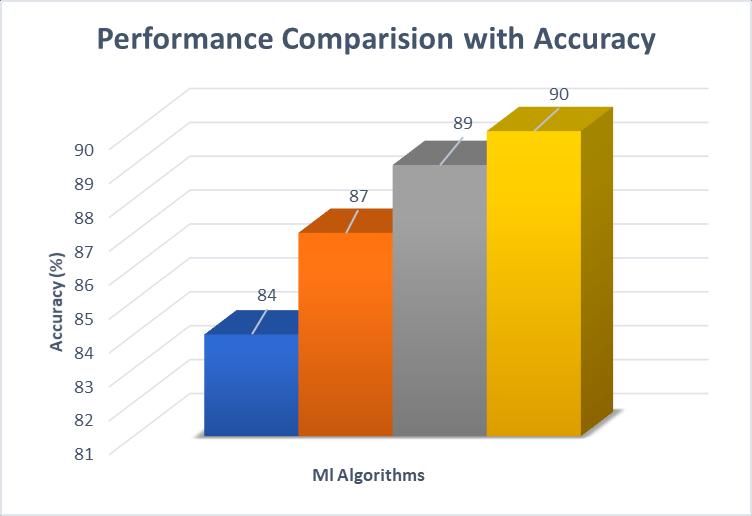
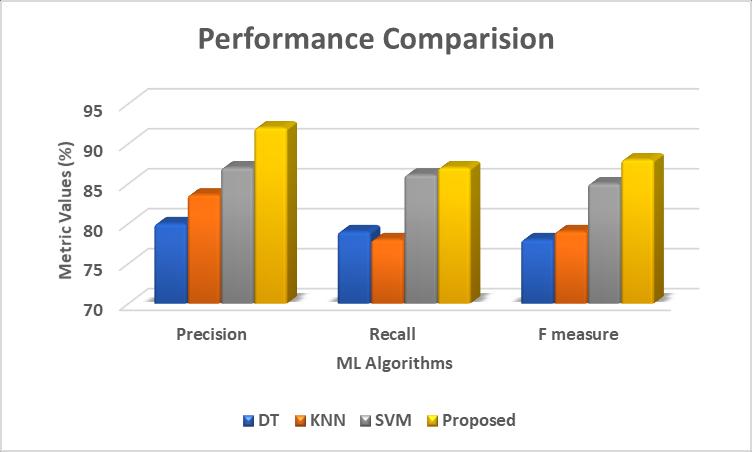
Fromthebelowtableandfigures,itisobservedthat proposedfeatureextractiontechniquehavehighestvalues whencomparedwithTF-IDFandN-Gramsalgorithmsforthe SVM classification. The precision, recall and F1-Score obtainedbydifferenttechniquesareshowninbelowfigures respectively.
Table1.ComparisonofProposedModelwithSVM AlgorithmsusingAccuracyvalue
Table: Performance comparison of various machine learning with various evolution parameters
International Research Journal of Engineering and Technology (IRJET) e-ISSN: 2395-0056
Algorithm Precision Recall F measure
DT 80 79 78
KNN 83.6 78 79
SVM 87 86.1 85
Proposed 92 87 88
1. Kumar, K.P.K., Geethakumari, G. Detecting misinformation in online social networks using cognitivepsychology.Springer,Hum.Cent.Comput. Inf.Sci.4,14(2014).
2. https://www.statista.com/topics/1164/socialnetworks/#topicHeader__wrapper
3. E.Cueva,G.Ee,A.Iyer,A.Pereira,A.RosemanandD. Martinez, "Detecting Fake News on Twitter Using Machine Learning Models," 2020 IEEE MIT Undergraduate Research Technology Conference (URTC), 2020, pp. 1-5, doi: 10.1109/URTC51696.2020.9668872.
4. Malla,S., Alphonse, P.J.A. Fake or real news about COVID-19?Pretrainedtransformermodeltodetect potential misleading news. Springer, Eur. Phys. J. Spec.Top.(2022).
5. Meesad, P. Thai Fake News Detection Based on InformationRetrieval,NaturalLanguageProcessing andMachineLearning.Springer,SNCOMPUT.SCI.2, 425(2021).
The above figure clearly shows accuracy of the proposed algorithm has a maximum accuracy when compared with the other ML techniques. Classification performance of the proposed classifier is better than the otherclassifiersanditisillustratedfromtheresultsinabove tables. The proposed classifier yields better classification accuracy,becauseithasaregularizationparameter,which avoids over-fitting. Above Table exhibits the performance metricscomparisonofthevariousclassifiers,forfake/real caserespectively.
Inrecentyears,duetotheboomingdevelopmentof online social networks, fake news for various commercial andpoliticalpurposeshasbeenappearinginlargenumbers andiswidespreadintheonlineworld.Animportantgoalin improvingthetrustworthinessofinformationinonlineweb contentistoidentifyfakenewstimely.Theproposedsystem was developed to classify the real or fake data in twitter dataset. In this work various steps are involved for this process such as data collection, preprocessing, feature extraction and classification. The Precision, Recall and F1 scoremetricsareappliedtofindthebestMLapproachfor classification.Inamoreextensive,thisresearchproposesa novel ensemblemachinelearningalgorithmforfakenews detectioninwebcontenttoincreasetheaccuracyandreduce misclassificationrate.
6. Diaz-Garcia J.A., Fernandez-Basso C., Ruiz M.D., Martin-Bautista M.J. (2020) Mining Text Patterns overFakeandRealTweets.In:LesotMJ.etal.(eds) Information Processing and Management of Uncertainty in Knowledge-Based Systems. IPMU 2020. Communications in Computer and InformationScience,vol1238.Springer,Cham.
7. M. Čišija, E. Žunić and D. Đonko, "Collection and SentimentAnalysisofTwitterDataonthePolitical Atmosphere," 2018 14th Symposium on Neural NetworksandApplications(NEUREL),2018,pp.15.
8. E. Nugraheni, "Indonesian Twitter Data Preprocessing for the Emotion Recognition," 2019 InternationalSeminaronResearchofInformation TechnologyandIntelligentSystems(ISRITI),2019, pp.58-63.
9. R. S. Karan, K. K. Shirsat, P. L. Kasar and R. Chaudhary,"SentimentAnalysisonTwitterData:A New Aproach," 2018 International Conference on CurrentTrendstowardsConvergingTechnologies (ICCTCT),2018,pp.1-4.
10. K.U.Manjari,S.Rousha,D.SumanthandJ.Sirisha Devi, "Extractive Text Summarization from Web pagesusingSeleniumandTF-IDFalgorithm,"2020 4th International Conference on Trends in
Volume: 09 Issue: 12 | Dec 2022 www.irjet.net p-ISSN: 2395-0072 © 2022, IRJET | Impact Factor value: 7.529 | ISO 9001:2008 Certified Journal | Page89
International Research Journal of Engineering and Technology (IRJET) e-ISSN: 2395-0056
Volume: 09 Issue: 12 | Dec 2022 www.irjet.net p-ISSN: 2395-0072
ElectronicsandInformatics(ICOEI)(48184),2020, pp.648-652.
11. Janiesch, C., Zschech, P. & Heinrich, K. Machine learning and deep learning. Springer, Electron Markets31,685–695(2021).
12. Alotaibi, A.S. Hybrid Model Based on ReliefF AlgorithmandK-NearestNeighborforErythematoSquamousDiseasesForecasting.ArabJSciEng47, 1299–1307(2022).
13. Goswami M., Sebastian N.J. (2022) Performance Analysis of Logistic Regression, KNN, SVM, Naïve BayesClassifierforHealthcareApplicationDuring COVID-19. In: Raj J.S., Kamel K., Lafata P. (eds) InnovativeDataCommunicationTechnologiesand Application.LectureNotesonDataEngineeringand Communications Technologies, vol 96. Springer, Singapore.
14. Ligthart,A.,Catal,C.&Tekinerdogan,B.Systematic reviewsinsentimentanalysis:atertiarystudy.Artif IntellRev54,Springer,4997–5053(2021).
15. Priya Iyer, K.B., Kumaresh, S.: Twitter sentiment analysis on coronavirus outbreak using machine learningalgorithms.Eur.J.Molecul.Springer,Clin. Med.07(03),2663(2020)
16. Luo, S., Dai, Z., Chen, T. et al. A weighted SVM ensemble predictor based on AdaBoost for blast furnace Ironmaking process. Appl Intell 50, Springer,1997–2008(2020).
2022, IRJET | Impact Factor value: 7.529 | ISO 9001:2008 Certified Journal