Construction and validation of Self-esteem Scale

Page 1

International Research Journal of Engineering and Technology (IRJET)

e-ISSN: 2395-0056

Volume: 09 Issue: 10 | Oct 2022

p-ISSN: 2395-0072

www.irjet.net

Construction and validation of Self-esteem Scale M.Christu Raj 1, T. Tamizhselvan 2 1Ph.D.,

Research Scholar, Department of Education, Annamalai University, Annamalainagar-608002, e.mail: christuraj@gmail.com 2Associate Professor, Department of Education, Annamalai University, Annamalainagar-608002, e.mail: tamizhbrinda@gmail.com ---------------------------------------------------------------------***--------------------------------------------------------------------students Cuddalore, District of Tamilnadu, India. The next Abstract - A likert type scale to measure the self-esteem of

step in the construction and validation of Self-esteem scale after pilot study is to find out ‘t’ value of each statement which forms the basis for item selection in order to build up the final scale.

high school level students developed. The pilot study conducted with 100 sample and 25 statements. The liker type scale calls for graded response to each statement on a five-point scale ranging from “Strongly Agree” to “Strongly Disagree”. The points are usually denoted by “Strongly Agree (SA)”, “Agree (A)”, “Undecided (UD)”, “Disagree (DA)” and “Strongly Disagree (SDA)”. The different points on the scale are assigned different arbitrary weights. For example, 4,3,2, 1 and 0 in the order of “Strongly Agree” response to “Strongly Disagree” response for the positive statements. Here the “Strongly Agree” response bears a weight of 4. The total scores for an individual can be obtained by adding his / her scores for all the individual items. The ‘t’ value calculated for the all the 25 items and the items with value higher than 1.75 were retained. Thus the final scale contains 21 statements.

Key Words:

The liker type scale calls for graded response to each statement on a five-point scale ranging from “Strongly Agree” to “Strongly Disagree”. The points are usually denoted by “Strongly Agree (SA)”, “Agree (A)”, “Undecided (UD)”, “Disagree (DA)” and “Strongly Disagree (SDA)”. The different points on the scale are assigned different arbitrary weights. For example, 4,3,2, 1 and 0 in the order of “Strongly Agree” response to “Strongly Disagree” response for the positive statements. Here the “Strongly Agree” response bears a weight of 4. The total scores for an individual can be obtained by adding his / her scores for all the individual items.

Self-Esteem, High school students,

Then 25% of the subjects (high) with the highest total scores and 25% of subjects (low) with the lowest total scores were sorted out for the purpose of item selection. The high and low groups thus selected formed the criterion groups and each group was made up of 25 high school students.

Construction

1. INTRODUCTION Academic performance (Serrano, Mérida, & Tabernero, 2016); emotional intelligence (Rodrguez, 2012); school success and socioeconomic level (Muoz, 2011); stress and coping (Verduzco, Gómez, & Duran, 2004); Many studies have highlighted the importance of self-esteem as a learning catalyst in the context of education (Villarroel, 2001) and as a critical component in schoolchildren's self-construction. As the investigator decided to develop a new tool to measure the Self Esteem, it is decided to construct and validate a selfesteem scale. The first step in the construction of the likerttype scale is the collection of a large number of statements to the object under study. 25 statements revealing the Self Esteem of Students were collected from the following sources: (i)

Teachers

(ii)

Related books and

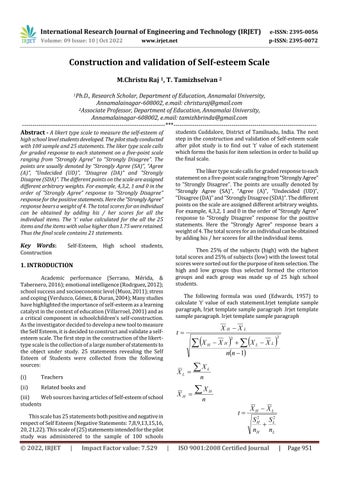
The following formula was used (Edwards, 1957) to calculate ‘t’ value of each statement.Irjet template sample paragraph, Irjet template sample paragraph .Irjet template sample paragraph. Irjet template sample paragraph

t

Impact Factor value: 7.529

H

X

L

XH 

XH

   X 2

nn  1

|

L

XL

2

n

X

H

n

t

This scale has 25 statements both positive and negative in respect of Self Esteem (Negative Statements: 7,8,9,13,15,16, 20, 21,22). This scale of (25) statements intended for the pilot study was administered to the sample of 100 schools

|

 X

XL 

(iii) Web sources having articles of Self-esteem of school students

© 2022, IRJET

XH XL

XH  XL S H2 S L2  nH nL

ISO 9001:2008 Certified Journal

|

Page 951


Turn static files into dynamic content formats.
Create a flipbook
Issuu converts static files into: digital portfolios, online yearbooks, online catalogs, digital photo albums and more. Sign up and create your flipbook.