Estimation of Prediction for Heart Failure Chances Using Various Machine Learning Algorithms
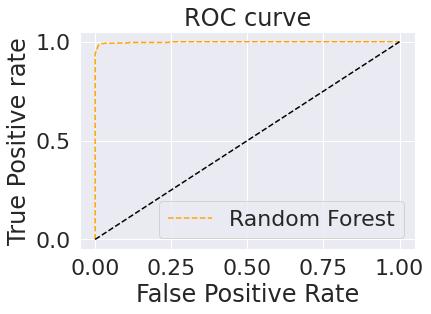
Ashwin Chavan1 , Bhairavi Chitnavis2, Poorva Wadkar3, Md. Ubaid Khan4Abstract- Thehumanheartiscertainlythemostimportant organinourbody.Ourbodycannotfunctionnormallyifour heart cannot circulate enough blood to all our internal organs.Abnormalitiesinpumpingbloodcausesheartfailure. Thoughthetermwascoinedinthe17thcenturyitremainsa globalpandemicaffectingover26millionpeopleworldwide. Hence predicting this deadly disease beforehand can do wondersforanindividual astheycanlookafter theirhealth andfitness.Medical professionalsfinditdifficulttocomeup with a scalable solution to predict the chances of heart failure. This is where advanced technologies like Machine learning can be used. With the help of Machine learning models, we can estimate if a person has chances of heart failureinthecoming10years.Inthisstudy,weuseavariety of machine learning methods to accurately predict heart failure. Here, we examined a dataset on heart failure that includedsignificantpertinentmedicaldataon4238patients. We have included the most crucial factors which play an important role in predicting if a person has chance of suffering from heart failure. We have implemented prediction models using various machine learning classification Algorithms. According to the findings of our study, in contrast with different machine learning algorithms,RandomForesthadthegreatestAccuracy=96% as well as AUC = 99% when estimating the likelihood that patientswouldexperienceheartfailure.
Keywords: Random Forest, machine learning model, heart failureprediction,DiseasePrediction,Accuracy
I. INTRODUCTION-
Since a few years ago, the prevalence of cardiovascular diseaseshasbeenrisingquicklythroughouttheworld.Even though these diseases have been identified as the leading cause of death, they have also been identified as the most controllableandpreventablediseases.Heartstrokeismostly broughtonbyarteryobstruction.Ithappenswhentheheart cannoteffectivelypumpbloodthroughoutthebody.
One of the major contributing factors to developing heart diseaseishighbloodpressure.Accordingtoareport,35%of people worldwide had hypertension between 2011 and
2014,whichisariskfactorforheartdisease.Likethis,other variables like obesity, poor nutrition, high cholesterol, and insufficient exercise can result in heart disease. As a result, prevention is essential. It's essential to comprehend heart diseases to prevent them. The fact that almost 47% of fatalities take place outside of a hospital shows how frequentlywarningsignsaredisregarded.
Thediagnosisofheartconditionsisabigbarrier.Findingout ifsomeonehasaheartconditionornotmightbedifficult.
Even though there are devices that can forecast heart disease,theyareeitherprohibitivelyexpensiveorinefficient atpredictingthelikelihoodofheartdiseaseinpeople. There has been extensive research done in this field because, according to a World Health Organization (WHO) report, only 67% of cardiac diseases can be predicted by medical professionals.InruralareasofIndia,thereisaseriouslackof access to hospitals and high-quality medical care. Only 58% of doctors in urban areas and 19% in rural areas have medicaldegrees,accordingtoa2016WHOreport.
To anticipate any heart disease in people, machine learning may be a promising option. Heart disorders are a serious challenge for medical science. Neural networks, decision trees,KNNs,andothermethodscanbeusedtoforecastheart disorders.WewilllearnhowtoutilizeRandomForesttofind the accuracy for heart disease later in this study. Additionally,itdemonstrateshowMLwillhelpusfightheart diseaseinthefuture.
II. RELATED WORK -

Theliteratureisfullofresearchstudieson utilizingmachine learning to diagnose cardiac problems. Here is a basic overviewofthat.
According to a study by Montu Saw, Tarun Saxena, Sanjana Kaithwas, Rahul Yadav, and Nidhi Lal that was released in January2020andtitled"EstimationofPredictionforGetting Heart Disease Using Logistic Regression Model of Machine Learning," they achieved 87% accuracy using the logistic regression technique. According to their research, men tend
to be more susceptible to cardiovascular disease than women. Heart disease is also influenced by aging, daily cigarette consumption, and systolic blood pressure. The likelihood of CHD is not significantly altered by total cholesterol.TheamountofHDLinthetotalcholesterolvalue may be the cause of this. The effects of glucose are equally insignificant. More data and the use of additional machine learningmodels,theysaid,mightenhancethemodel[1].
A further study entitled "Heart failure survival prediction using machine learning algorithm: Am I Safe from Heart Failure?" is also available. Muntasir Mamun, Afia Farjana, Miraz Al Mamun, Md Salim Ahammed, and Md Minhazur Rahman published this in 2022. They said that LightGBM, whichhasanexcellentaccuracy(85%)withAUC(93%),was the machine learning model that performed most successfully in their situation. The least reliable model, DecisionTree,scored73.21%[2].
Aleyna Nur Karaoglu, Hasan Caglar, Ali Degirmenci, and Omer Karal published a study in 2021 titled "Performance Improvement with Decision Tree in Predicting Heart Failure".ThreedifferentMLmethodsarebeingconsideredin this study to forecast heart failure survival among patients. Here, the classification algorithms Decision Tree, KNN, and Logistic Regression are used. According to the testing findings, the Decision Tree algorithm scores optimum in terms of accuracy at84.48%, and precision at79%with an F1-scoreof82%[3]
A study titled "Heart Disease Prediction Using Random Forest Algorithm" was released in March 2022 by Kompella SriCharanandKolluruSSNSMahendranath.Byevaluating the accuracy scores of Decision Tree, Random Forest, SVM, Ada boost, and Gradient Boosting algorithms, the study determined the most effective machine learning method for theidentificationofheartillnesses.Theoutcomeshowsthat the Random Forest algorithm, which has an accuracy rating of 92.16% in the forecasting of heart disease, is the most effective.Theliteraturedemonstratesthatthereis,aboveall, roomforimprovementandmorepotentialforthemodel[9].
In the paper "Heart Disease Diagnosis Using Data Mining Technique", by Sarath Babu, Vivek EM, Famina KP, Fida K, Aswathi P, Shanid M, and Hena M, multiple attributeswere incorporated in K-means algorithms, MAFIA algorithm, as well as Decision tree classification, applying a data mining techniqueforthetreatmentofheartdisease.Theyconcluded that Decision Tree possesses greater effectiveness by employing 14attributes, after applying generalized linear models[8].
In another study with the title "Predictions in Heart Disease Using Techniques of Data Mining "Published by Monika
GandhiandDr.ShailendraNarayanSingh,theirmethodsuse concealed patterns to find the best course of action for organizationsprovidinghealthcare[10].
III. DATASET INFORMATION-
We have used the dataset from previous cardiovascular research of people living in the Massachusetts town of Framingham which is available on the Kaggle website. The objectiveoftheprojectistopredictwhetherthepatienthas a 10-year risk of developing future coronary heart disease (CHD)[11]. This dataset contains a total of 4238 medical records of heart patients who were monitored throughout their therapy. The profile of each patient contains a total of 16medical features.All thefeaturesareexplainedinTABLE I.
TABLEI
Datasetattributenamesandinformation
Attribute names (Feature variables)
Male
Age
Education
currentSmoker
cigsPerDay
BPMeds
prevalentStroke
prevalentHyp
Diabetes
totChol
sysBP
diaBP
BMI
heartRate
glucose
TenYearCHD[Target]
Attributeinformation
MaleorFemale
Patient’sAge
0: Less than High School and High School degrees, 1: College DegreeandHigher
Whether a patient is a current smokerornot
PerdayCigaretteintake
BloodPressuremedications
CurrentStrokes
CurrentHypertension
Whether the patient has diabetesornot
Patient’sTotalCholesterolLevel
Systolicbloodpressure
Diastolicbloodpressure
BodyMassIndex
Heartrateofthepatient
Patient’sGlucoseLevel
If the patient has heart disease ornot(binary)
In this dataset total of 15 features are independent and 1 target feature is dependent. age, education, currentSmoker, cigsPerDay, BPMeds, prevalentStroke, prevalentHyp, diabetes, totChol, sysBP, diaBP, BMI, heartrate, and glucose
are independent features. Whereas TenYearCHD is a target variable.
IV. METHODOLOGY-
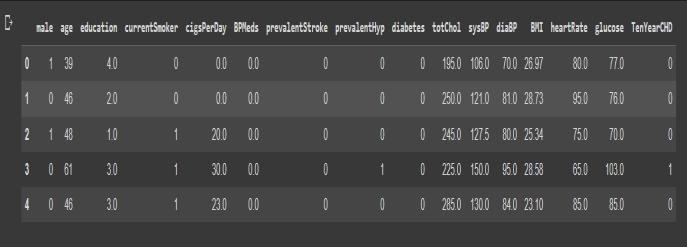
The first step in model building is data collection or data extraction followed by dataset pre-processing. Fig. 1 shows thefirst5recordsofthedataset.
Fig1:Dataset
Oncethedatasetiscleaned andtransformedinto theproper format, classifiers like Logistic Regression, Random Forest, Support Vector Machine, Kernal-Support Vector Machine, and LightGBM are employed for training and testing on the dataset. k-fold cross-validation is used to compute the performanceofthemodel.Finally,allmodelswereevaluated and compared to find the best model for heart failure prediction.
Dataset pre-processing
The dataset has been pre-processed by different Feature Engineering and Feature selection techniques. Inside Feature Engineering wehaveperformed Exploratory Data Analysis,
Identifying Numerical and Categorical Features
Finding Missing Values
Detecting Outlier
Data Cleaning
Also, the Imbalanced Dataset is Balanced and Outliers are removed.
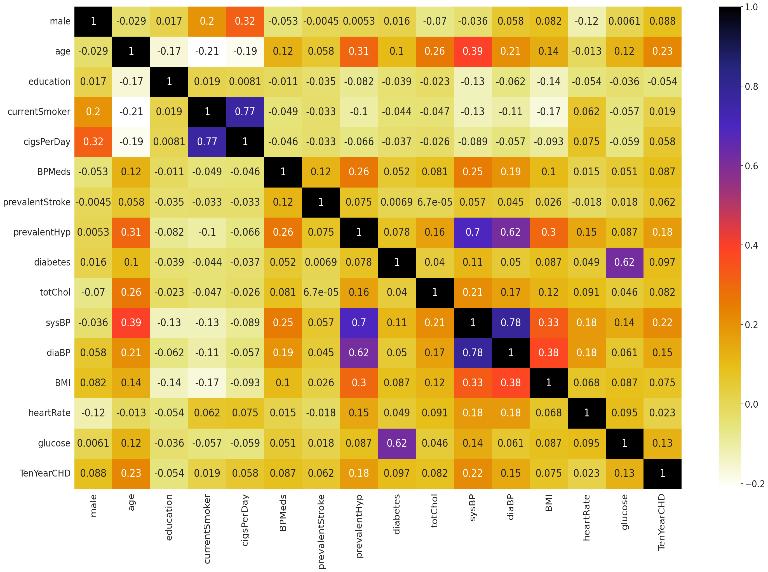
Inside Feature selection, we have analyzed the Correlation betweenallthefeatureswiththehelpHeatmapshowninFig. 2
Correlationmatrixoftheheartfailuredataset
Validation method
InMachineLearningCross Validationisusedtoevaluatethe performance of a trained model on unseen data. We have selected the K-fold cross-validation method for our dataset. Heredatasampleisdividedinto10folds,i.e.,k=10.
Model Development
We have developed total of 5 machine-learning models with algorithms like Logistic Regression, Random Forest, Support Vector Machine, Kernal-Support Vector Machine, and LightGBM. By training them with our pre-processed dataset, we compared their performance based on different Evaluation Metrics. Out of 5 models, we found that the model with the Random Forest algorithm is performing well in prediction.
Model Evaluation
We have evaluated our all models based on the following metrics,
Accuracy
ConfusionMatrix
Precision
Recall
F1Score
AUC-ROC
V. RESULT AND DISCUSSION-
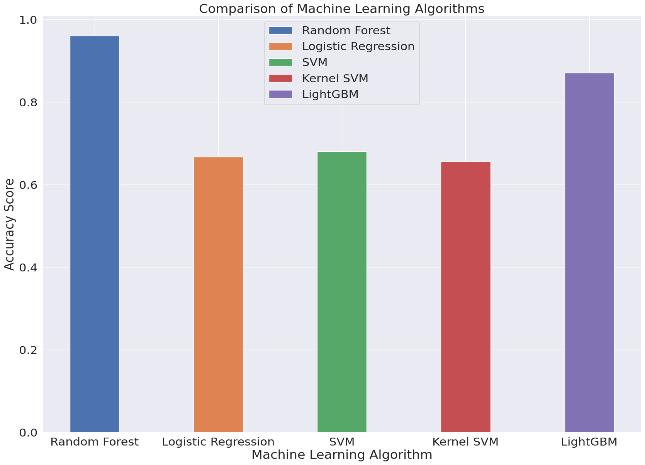
Table 2 compares the performance results for the chosen machine learning algorithms, including LightGBM, Random Forest, Support Vector Machine, and Kernal Support Vector Machine. Following that, we examined the model's performance,asdepictedinFigure3.
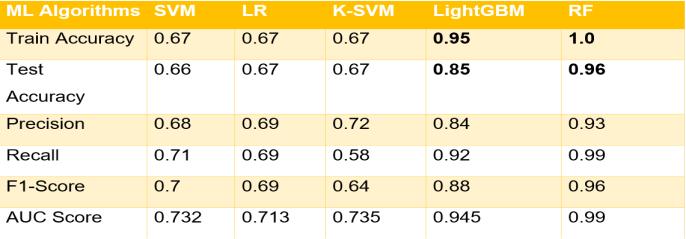
We have listed the Train Accuracy, Test Accuracy, Precision, Recall, and F1-Score data in Table 2 for tracking model performance. After studying the dataset, it is seen that men have a high risk of heart disease than women. After inspecting the dataset more it is seen that the increase in factors like age, cigsPerDay, and heartrate shows high chancesofanincreaseinheartdisease.
Whichhadanaccuracyof87%.Itcanbesaidthattheoverall performance of Random Forest in terms of Accuracy and AUCScoreisgoodcomparedtootheralgorithms.
VI. CONCLUSION-
AccordingtotheobservationinFigure3,RandomForesthas the best accuracy (96%), whereas SVM has the lowest accuracy (66%). In addition, LightGBM has also performed well with an accuracy of 85%. And from Figure 4, it is seen thattheROCCurveofRandomForestisgoodandcloseto1.0 whichtellsusthatourmodelisgood.
Finally,itcanbesaidthattheaimoftheprojectiscompleted asithasbeatentheexistingsystemresults
Heart problems may become more prevalent than they are now to a maximal level. Heart conditions are challenging. Unfortunately, this sickness claims the lives of many people each year. Manually calculating the likelihood of developing heart disease based on the above-mentioned risk factors is challenging. Thissoftwarecananticipateheart problemsfor any non-medical employee, which will save doctors time. Thefactthatthisworkonlyappliesclassificationtechniques andalgorithmstothepredictionofheartdiseaseisoneofits main shortcomings. To increase the precision of heart disease prediction, implementation is still a work in progress.
VII. FUTURE WORK
The future scope of heart disease prediction using machine learning is very promising, and there are several areas wherethistechnologycanmakeasignificantimpact.
Wearable devices and other sensors can collect real-time dataonaperson'sheartrate,bloodpressure,andothervital signs. Machine learning algorithms can be used to analyze thisdataandprovidereal-timealertstodoctorsandpatients if any concerning trends or abnormalities are detected. Nowadays most of the data is computerized and everything isonthecloudwhichcanbeaccessed,analyzed,andusefor model training. Again, we can use advanced techniques and algorithms which help to make predictions in less time complexityandwithmoreaccuracy.
VIII. REFERENCES-
[1] M. Saw, T. Saxena, S. Kaithwas, R. Yadav and N. Lal, "Estimation of Prediction for Getting Heart Disease Using Logistic Regression Model of Machine Learning," 2020 International Conference on Computer Communication and Informatics (ICCCI), Coimbatore, India, 2020, pp. 1-6, doi: 10.1109/ICCCI48352.2020.9104210.
[2]M.Mamun,A.Farjana,M.A.Mamun,M.S.Ahammed and M. M. Rahman, "Heart failure survival prediction using machine learning algorithm: am I safe from heart failure?" 2022 IEEE World AI IoT Congress (AIIoT), Seattle, WA, USA, 2022,pp.194-200,doi:10.1109/AIIoT54504.2022.9817303.
[3] A. N. Karaoglu, H. Caglar, A. Degirmenci, and O. Karal, "PerformanceImprovementwithDecisionTreeinPredicting Heart Failure," 2021 6th International Conference on ComputerScienceandEngineering(UBMK),Ankara,Turkey, 2021, pp. 781-784, doi: 10.1109/UBMK52708.2021.9558939
[4] T. P. Pushpavathi, S. Kumari, and N. K. Kubra, "Heart Failure Prediction by Feature Ranking Analysis in Machine Learning," 2021 6th International Conference on Inventive Computation Technologies (ICICT), Coimbatore, India, 2021, pp.915-923,doi:10.1109/ICICT50816.2021.9358733.
[5]C.DeSilvaandP.Kumarawadu,"PerformanceAnalysisof Machine Learning Classification Algorithms in the Case of Heart Failure Prediction," 2022 International Wireless Communications and Mobile Computing (IWCMC), Dubrovnik, Croatia, 2022, pp. 1160-1165, doi: 10.1109/IWCMC55113.2022.9824214.
[6]D.Mehta,A.Naik,R.Kaul,P.Mehta,andP.J.Bide,"Death by heart failure prediction using ML algorithms," 2021 4th Biennial International Conference on Nascent Technologies in Engineering (ICNTE), Navi Mumbai, India, 2021, pp,-15,doi:10.1109/ICNTE51185,2021.9487652.
[7] X. Sang, Q. Z. Yao, L. Ma, H. W. Cai, and P. Luo, "Study on survival prediction of patients with heart failure based on support vector machine algorithm," 2020 International Conference on Robots & Intelligent System (ICRIS), Sanya, China, 2020, pp. 636-639, doi: 10.1109/ICRIS52159.2020.00160.
[8]S.Babuetal.,"Heartdiseasediagnosisusingdatamining technique," 2017 International Conference of Electronics, Communication and Aerospace Technology (ICECA), Coimbatore, India, 2017, pp. 750-753, doi: 10.1109/ICECA.2017.8203643.
[9] K. Sri Charan,K.S S N S Mahendranath, M.Thirunavukkarasu,' Heart Disease Prediction Using RandomForestAlgorithm',InternationalResearchJournalof Engineering and Technology (IRJET),Volume: 09 Issue: 03 Mar2022,e-ISSN:2395-0056,p-ISSN:2395-0072
[10] M.Gandhi and S.N. Singh,"Predictionsinheart disease using techniques of data mining," 2015 International Conference on Futuristic Trends on Computational Analysis andKnowledgeManagement(ABLAZE),GreaterNoida,India, 2015,pp.520-525,doi:10.1109/ABLAZE.2015.7154917.
[11]https://www.kaggle.com/datasets/captainozlem/frami ngham-chd-preprocessed-data
IX. Biographies–
Ashwin Chavan, Final Year BE Student, DepartmentofComputerEngineering,Dr.D. Y. Patil College of Engineering, Ambi, Pune, Maharashtra,India

Bhairavi Chitnavis, Final Year BE Student, DepartmentofComputerEngineering,Dr.D. Y. Patil College of Engineering, Ambi, Pune, Maharashtra,India


Poorva Wadkar, Final Year BE Student, DepartmentofComputerEngineering,Dr.D. Y. Patil College of Engineering, Ambi, Pune, Maharashtra,India
Md. Ubaid Khan, Final Year BE Student, DepartmentofComputerEngineering,Dr.D. Y. Patil College of Engineering, Ambi, Pune, Maharashtra,India