PROGRESSIVE COLLAPSE ANALYSIS OF REINFORCED CONCRETE STRUCTURES WITH FLAT SLAB CONSIDERING EFFECTS OF GEOMETRICAL (HORIZONTAL and VERTICAL) IRREGULARITIES.
S. Girme1, Dr. Atul B. Pujari21Post graduate student of K J college of engineering and management research, pune Maharashtra, india 2Associate Professor Department of civil engineering, KJ College of Engineering & Management research, pune411048, India.

***
Abstract -This paper presents Progressive Collapse analysis(PCA) of Reinforced Concrete Structures with Flat slab considering effects of geometrical (horizontal & vertical) Irregularities. Progressive collapse failure starts with local damage and extend up to whole structure. Flat slab buildings are more prone to progressive collapse than moment frame buildings, its behavior to resist progressive collapse must be examined. Since absence of beams to redistribute load due to get more effect after removing columns. The current analytical research assesses the progressive collapse behavior of ten story RC flat slab building by Equivalent frame method. for study purpose five model considered they are RCC rectangular flat slab, flat slab having excessive opening, Re-entrant corner, mass irregularity and vertical geometrical irregularity by conducting Linear static progressive collapse analysis and dynamic PCA as per GSA guidelines (2016) and then result compared This research explores the different plans for column removal situation in each model, unlike earlier studies where only one building model considered. Corner, edge and interior columns of each building model are analyzed by using static and dynamic PCA method. The results are analyzed for each case, in terms of demand capacity ratio (DCR) at critical sections, vertical joint displacement and chord rotation at column removal locations and thus sensitivity of building to progressive collapse is calculated accordance with relevant acceptance criteria consigned in DOD guidelines (2009).
Key Words: Progressive collapse, flat slab, vertical joint displacement, DCR, Chord rotation, GSA, DOD, local damage, static linear analysis, Time history, Dynamic analysis, ETABS
1. INTRODUCTION
Thecollapseofloadcarryingstructuralelementmayleadto progressivecollapseasapartorwholestructure.According toGSA2016guidelines,progressivecollapseisdefined as extentofdamageorcollapsethatisdisproportionatetothe magnitudeoftheinitiatingevent.Theprogressivecollapse initiates, when one or more load carrying members are removed.Whenoneormoreloadcarryingelementsremove chainreactionoffailuresstructurestart.Theguidelinesof
the GSA and DoD suggested the Alternate Path Method (APM) for progressive collapse analysis where a single columninthegroundlevelisassumedtobeunexpectedly missingandanalysesarecarriedouttoassesstheabilityof theweakenedstructuretopassthroughthemissingcolumn. TheAPMfocuseson thevertical deflectionofthebuilding afterthecolumnhasbeensuddenlyremoved.Thecollapsing structure seeks for alternative load path continuously for prevent progressive attention collapse and survive. Traditional design work not considered extreme loading conditions.Previouslysomeexperiencesgrabofstructural engineer’s attention Ronan point apartment building, Alfred.P.Murrahbuilding,skylineplaza,worldtradeCentre. Based on the type of collapse occur, progressive collapse divided into pancake-type, zipper-type, domino-type, section-type,instability-typeandmixedtypecollapse.The purposeofthisstudyistoanalyzetheeffectofgeometrical irregularRCflatslabsforprogressivecollapse.progressive collapseanalysiswhereasinglecolumninthegroundlevel is assumed to be unexpectedly missing and analyses are carriedouttoassesstheabilityoftheweakenedstructureto pass through the missing column. PCA is classified as Pressure load- Internal gas explosion, Blast load, Extreme wind pressure and another type is Impact Load- Aircraft impact,Vehicularcollision,Earthquakeinthisstudyanalyses behaviorofbuildingundercolumnlossatgroundfloor.
1.2 OBJECTIVE OF WORK
Tostudya10storyRCCrectangularflatslabhavingexcessive opening, Re-entrant corner, mass irregularity and vertical geometricalirregularitytypestructuremodelspreparedto simulateacolumnlosseventandcheckresultsintermsof DCRandchordrotationandverticaljointdisplacementby usingGSAandDODguidelines.Andunderstandbehaviourof buildingundercriticalcolumnlossscenariosbyusingstatic anddynamicPCAmethod.
2. Description of analytical model
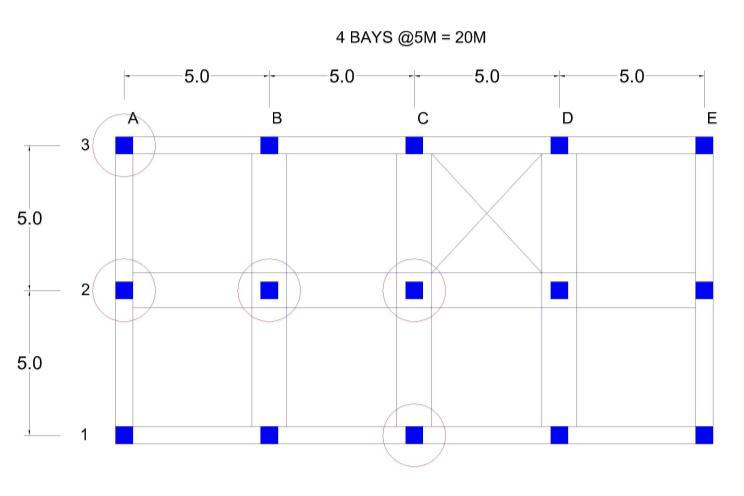
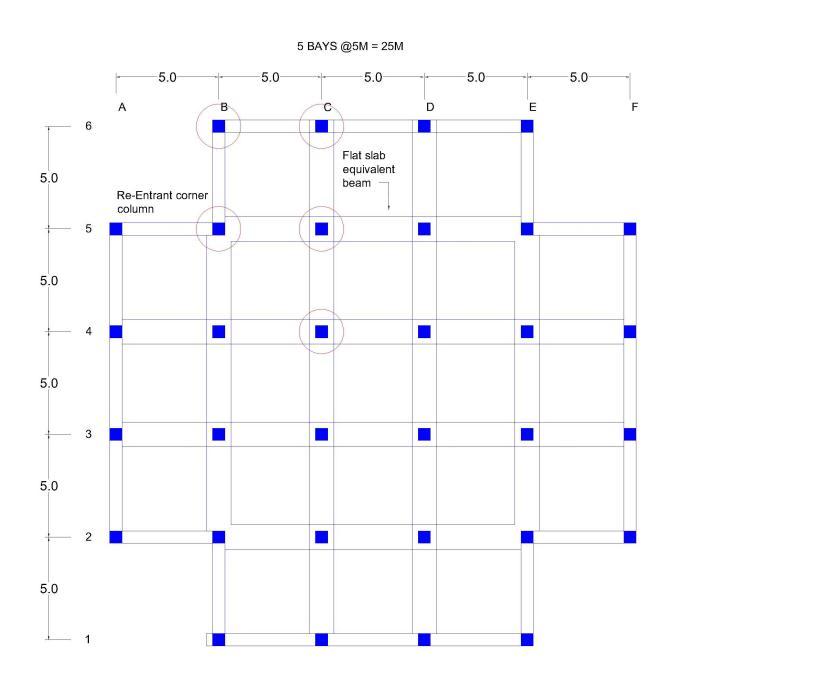
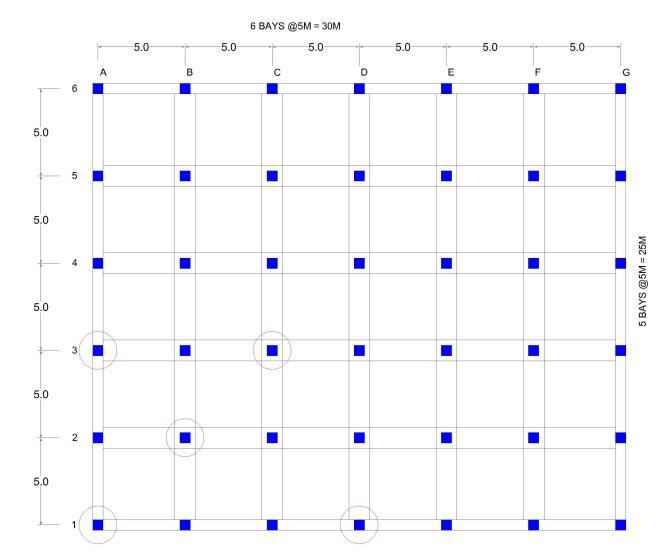
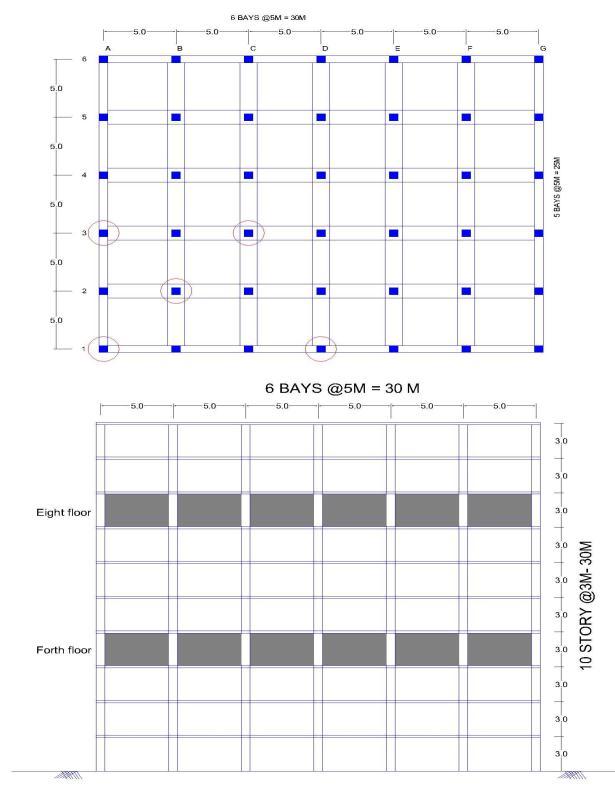
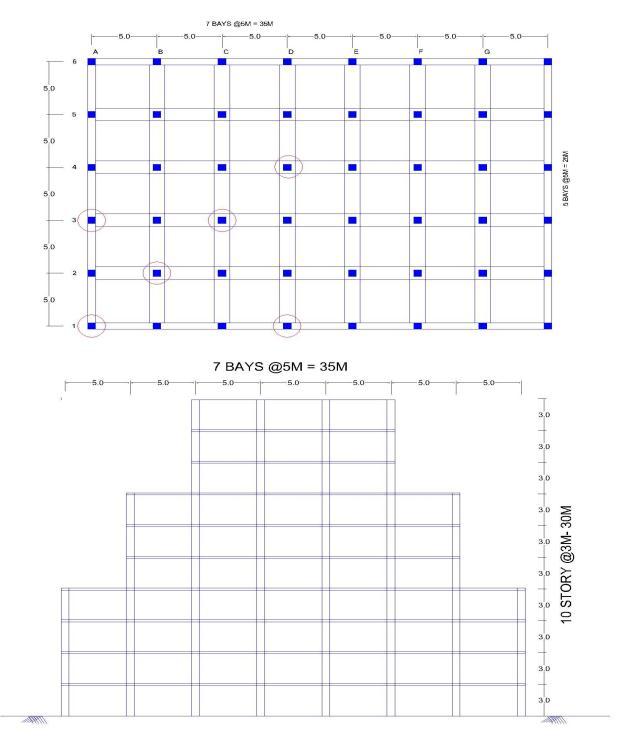
Thefirstmodelregularrectangular6×5baysof5mspanfor onebay,secondmodel5×5baysof5mspanplusshapeReentrantcornersplan,thirdmodel4×2baysof5mfloorslab
haveexcessiveopeningatedgeofslab,forthmodelof7×5 bays of 5m span in plan having vertical geometrical irregularityonbothside,andfifthmodelof6×5baysof5m spaninplanhavemassirregularityat4th and8th storey.As shownfig1,2,3,4and5respectively.Allmodelsconsidered 3m floor to floor height of each story as total 10 storeys constructed in zone 3, medium soil, damping ratio 5% by usingETABSsoftware.FlatslabismodelledusingEquitant frame method. Thickness of the flat slab is considered as 200mm.foreachbuilding,theinteriorandexteriorflatslab beam are of size 1200×200 mm and 600×200 mm, Respectively.Thebuildingshavethesameplanthroughout theentireheight.Thecolumnsizeistakenas600×600mm andAliveloadof4.0kN/m^2andasuperimposeddeadload 2.0kN/m^2consideredincludingpartition,mechanicaland plumbingload,Isappliedtothefloors.Thegradeofconcrete as M30 and steel is Fe500. The building is designed for gravityloadaccordingtoIS456:2000fortakingPCAresult AsperIS1893-2016irregularitiesconsideredmodel2ReentrantcornerhaveoffsetAandlengthofthatdirectionL, A/L>0.15formodel3openinglocatedalongedge>10%of floor slab area. For model 4 and 5 vertical geometrical irregularitiesonbothsideoffsetA>0.25Loneachsideand massirregularitymassatparticularstory>2timesofthat adjacentstoreyrespectively.
Notations.
GSA GeneralServicesAdministration
DoD DepartmentofDefense
Δ JointverticalDisplacementatcolumn removallocation
θ ChordRotationatcolumnremoval location
CC CornerColumn
REC Re-entrantcolumn
ECS Shortedgecolumn
ECL Longedgecolumn
IC Interiorcolumn
3. ANALYSIS METHODOLOGY
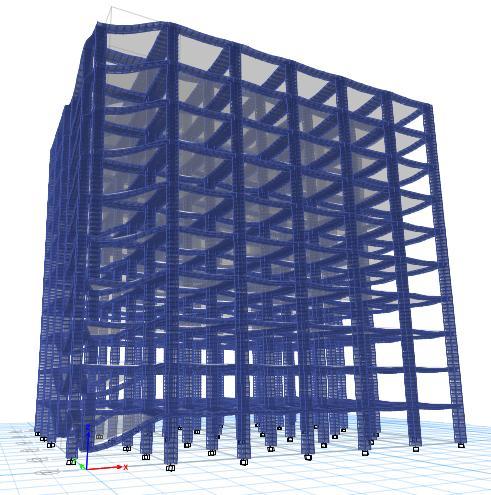
The cases of removal of column at ground floor level as shown in plan view indicating circle around column in fig no1,2,3,4and5aswellspecimendeflectedshapeofbuilding inasshowninfig6 Theeffectofgeometricalirregularities oneachmodelcolumnremovalDCRvaluestakenatnearby criticalcolumntheDCRshouldnotexceed2forrectangular buildingandotherfourirregularbuilding1.5otherwise,they consideredassusceptibletoprogressivecollapseasbeing severelydamagedasperGSAguideline.Thecalculationof connectionrotationatcolumnremovallocationdetermined inaframeviathechordrotation.Andvaluesofthischord rotation compared with permissible plastic rotation angle accordingtoGSAandDODrecommendations.
DCR= Qud/Qce
Where, Qud = Acting force computed in the component (shear,moment,axialforce),
Qce = Expected ultimate, unfactored capacity of the component.
Chord rotation, θ = Δ / L
Where,θ=chordrotation(plasticrotationangle)in radians,Δ=verticaldisplacement,andL=lengthof member.
3.1 Static analysis procedure is as follows
1. As per GSA guidelines Remove corner column, edge columnandinteriorcolumnalternatelyfromtheground storeyasshowninFig1,2,3,4and5highlightedredcircle
2. TwoloadcombinationswhichfollowtheGSAguideline forthepresentationofthegravityloadsareused.Aload combinationof(1.2DL+0.5LL)isusedforgravityloads
forfloorspacesonthesidefromremovedcolumnand 2(1.2DL+0.5LL)foradditionalgravityloadsforfloor spaces over the removed column. To account for dynamiceffects,afactorof2.0isprovidedintheStatic analysisasa dynamicmagnificationfactorasperGSA guideline.
3. Perform static analysis as per GSA using the software
ETABS
4. Demand Capacity Ratio (DCR) of sectional forces of critical columns in the ground storey nearby removal column and vertical displacements at the top of removedcolumnsareevaluatedforthespecificcolumn removalcase.
5. Incaseoftheremovalofcolumnsinthegroundstorey, the responses of critical neighboring columns are evaluatedandresultscomparewithguidelinevalues.
3.2 Dynamic analysis procedure is as follows inthisprocessinvolvestheremovalofcolumnsinreal-time, whichinnatelyaccommodatesamplificationfactors,inertia and damping forces. This analysis has the key benefit of beingabletoaccountforthedynamicamplificationeffects. In this paper, the dynamic progressive collapse analysis procedure,showninFig7.isbriefedasfollows:
1.Thegravityloadingof1.2DL+0.5LLisuniformlyapplied intheentirespanoftheframeaccordingtoGSAguidelines.
2. Prior to the removal of the column, its reaction force is determined.
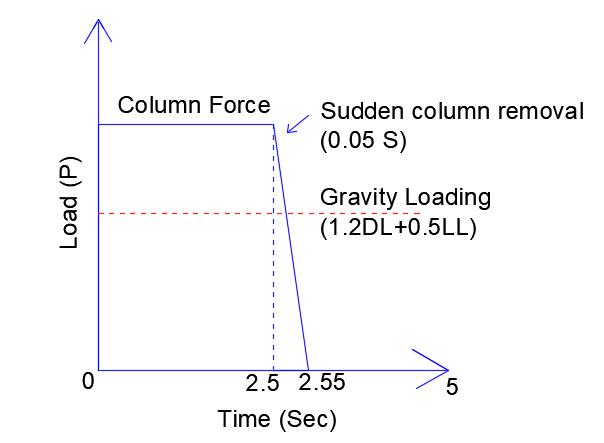
3.Thecolumnisremovedandreplacedbyaforce(P)equal andoppositetoitsreactionforce.Thisreflectstheoriginal casewherethecolumnisstillinplaceandcarriesthegravity loads.
4.Tosimulatetheconditionsofdynamiccolumnremoval, the member force (P) is suddenly removed using a timehistorystepfunctionasshowninFig7.
5. The member force is applied till 2.5 sec. so that the structurereachesastablecondition,andfinally,theforceis suddenly removed. The total time of dynamic analysis is considered as 5.0 s, which is adequate to evaluate the maximumresponseandattainasteady-stateunder5%of dampingratio.Thegravityloadsremainunchangeduntilthe endoftheanalysistime.
6. The time over which a column is lost, in a real bomb explosion,isveryshort.Thecolumnremovaltimeshouldbe lessthan1/10ofthenaturalperiodassociatedwithvertical vibrationasrecommendedbyDoD.Inthisstudy,thecolumn removal time is hence taken as 0.05 s, which indicates a
instantaneousremoval.Thedynamiceffectsofthecolumn removaltimecloseto0.05swouldresultinadversedynamic effects.
7.PerformdynamicanalysisasperGSAusingthesoftware ETABS.
8. EvaluatetheresultsintermsofDCRofsectionalforcesof criticalcolumnsandverticaldisplacementsatthetopofthe removedcolumn,wheredemands,aswellasdisplacements, are taken as the peak values (absolute maximum) of responsesfromthecalculatedtimehistoryresponses.
cornercolumn(CC),edgecolumn(EC)andinteriorcolumn (IC)aredynamicallyremovedalternatemanner,i.e.onlyone columnisremovedatonetimenowcarryingoutdynamic progressivecollapseanalysis,theabovediscussed1–8steps are followed. The results of dynamic analysis are then comparedwiththatofstaticanalysis
4. RESULTS AND DISCUSSION
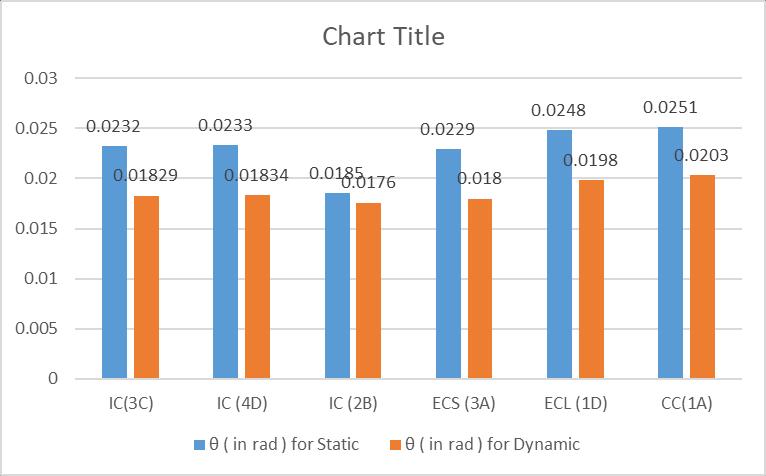
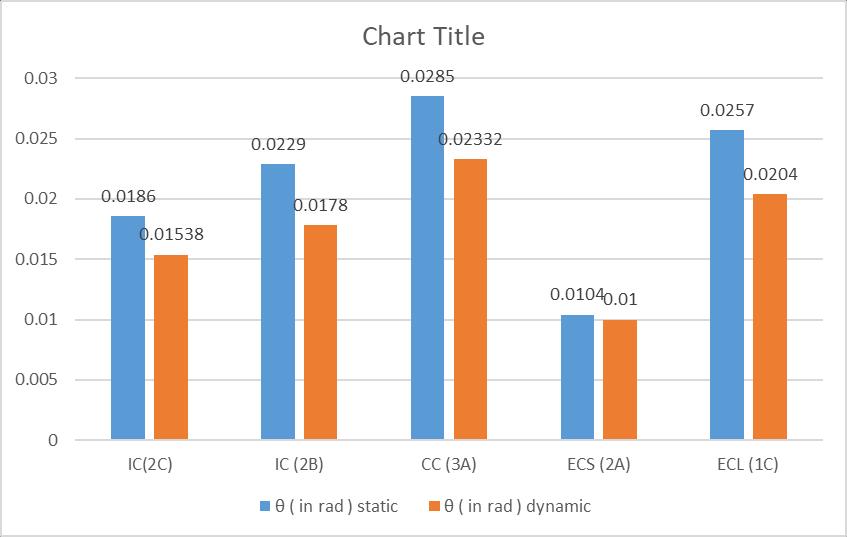
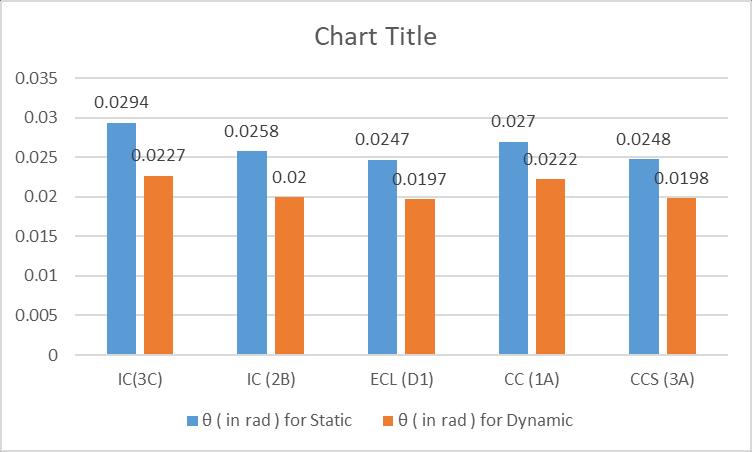
The responses of columns 3B,3D,2C and 4C are evaluated whenInteriorcolumn(3C)isremovedingroundfloorincase no 1. in the scenario of removal of LONG edge external column ECL (D1) the responses of columns 1C,1E,2D are evaluatedincaseno1.Likesamewayforallcases(1to5) corner column (CC), short edge column (ECS), long edge column(ECL),Interiorcolumn(IC),Re-entrantcolumn(REC) removedongroundfloor.Theresponsesofadjacenttothe removedcolumnareevaluatedasshownintableno1,2,3,4 and 5 for case no 1,2,3,4 and 5 respectively as there DCR valuesexceedthelimit1.5forirregularstructureand2for regularstructurethendevelopmentofprogressivecollapseis consideredasperGSAguidelines.TheVerticalDisplacement calculated at joint where column is removed and Chord rotation value kept it below the 0.05 (rad) for flat slab structureatthelocationofremovalofcolumn,definedasper GSAandDODguideline. verticaldisplacement(Δ)andchord rotation(θ)atlocationofremovalofcolumnresultsforall casesshownintableno6.
thepredictedresultsalsoindicatethatthebuildingwouldnot be prone to progressive collapse neither statically nor dynamically.
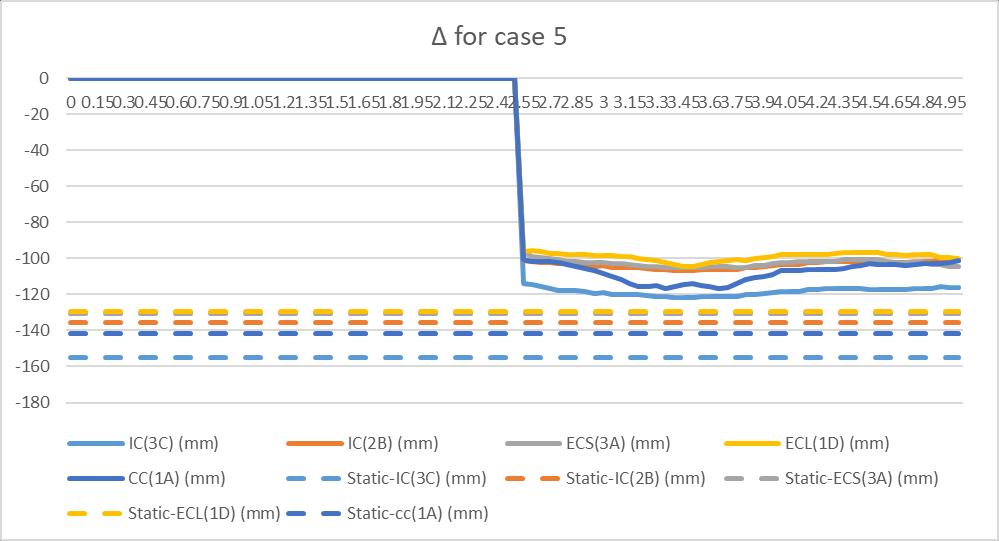
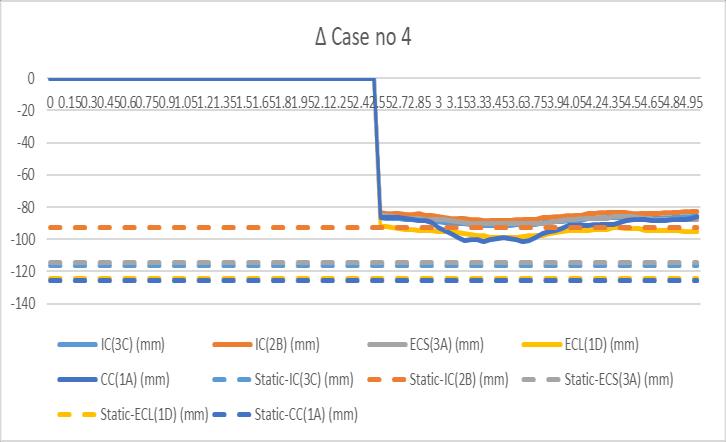
Verticaldisplacementtimehistoryoftopofremovedcolumns whenthecolumnsCC,ECandICareinstantaneouslyremoved at t =2.5 sare shown in Figs. 8–12, respectively. It canbe observedfromthetimehistoryresponsethattimet=0.0sto t = 2.5 s demonstrate a period for achieving static equilibrium.Then,thecolumnsCC,ECandICarealternately removed at time t = 2.5 s in 0.05 s to account for instantaneousremoval.Afterthat,timet=2.55stot=4.5 s showsthedisplacementcycleduetodynamicbehavior.And fromtimet=4.55stot=50sshowsaperiodforstabilizing thevibration.Themaximumverticaldisplacementsatthetop of removed columns for static analysis are also shown as constantdottedlinesfordifferentsimulationbuildings.The analysisresultsshowedthatboththeDCRofsectionalforces andtheverticaldisplacementsattopofremovedcolumnsare greater for static analysis than for dynamic analysis. This could be attributed to the fact that the static analysis is performedbyamplifyingthegravityloadsbyafactorof2.0 followingtherecommendationsofGSAwhiletheun-factored gravityloadsareusedindynamicanalysis.Itseemsthatthe staticanalysisleadstoconservativeresults.
Table -1: DCRofcriticaladjacentcolumns(axialforce) whenparticularcolumnasperGSAguidelineremovedfor caseno1,rectangularbuilding.
CASENO1:rectangularbuilding
Table -2: DCRofcriticaladjacentcolumns(axialforce) whenparticularcolumnasperGSAguidelineremovedfor caseno2, Re-entrantbuilding.
NO2:horizontalirregularity,Re-entrantbuilding
Table -3: DCRofcriticaladjacentcolumns(axialforce) whenparticularcolumnasperGSAguidelineremovedfor case3,floorslabhaveexcessiveopening. CASENO3:horizontalirregularityflatslabhavingexcessive opening
Table -4: DCRofcriticaladjacentcolumns(axialforce) whenparticularcolumnasperGSAguidelineremovedfor studiedverticalGeometricalirregularityonbothside irregularities
CASENO4:studiedverticalGeometricalirregularityon bothside
Table -6: verticaljointdisplacement(Δ)andchord rotation(θ)atthelocationofremovalofcolumn.
Table -5: DCRofcriticaladjacentcolumns(axialforce) whenparticularcolumnasperGSAguidelineremovedfor Massirregularitybuilding.
DCR sample calculation for case 1, corner column(1A) removal condition.
DCR= Qud/Qce
Where,
Qud = Acting force computed in the component (shear, moment,axialforce),
Qce = Expected ultimate, un-factored capacity of the component.
DCR<2FortypicalstructuralconfigurationandDCR<1.5 Foratypicalstructuralconfiguration.Thecurrentcaseno1 rectangular building having removal of corner column at groundfloor(1A)studymodelismadetypicalasshowninfig no6adjacentcolumnofthat(1A)columni.e.,(2A)haveaxial load3929KN
Qud=3929KNfromsoftware
Qce=PU=0.4FCK(AC)+0.67FY(ASC)
=0.4x30x(600x600)+0.67x500x(360000-ASC)
=ASC,20mmdim12nobarand25mmdim4noofbarsused for600mmsquarecolumn,
=ASC, (3.1415/4 x 20^2 x12) +( 3.1415/4 x25^2 x4) = 5733.40mmsquare
=(4.251x10^6)+(1.92x10^6)
QCE=6171kilonewton
DCR=3929/6171
DCR=0.636< 2OK.
Chord rotation sample calculation for case 1, corner column(1A) removal condition.
Chord rotation θ = Δ / L
Where,θ=chordrotation(plasticrotationangle)inradians, Δ=verticaldisplacement,andL=lengthofmember. Verticaljointdisplacementvalue135.89mmasshowninfig. no 6 as per GSA guideline for load combination 2(1.2DL+0.5LL)
θ=135.89/5000
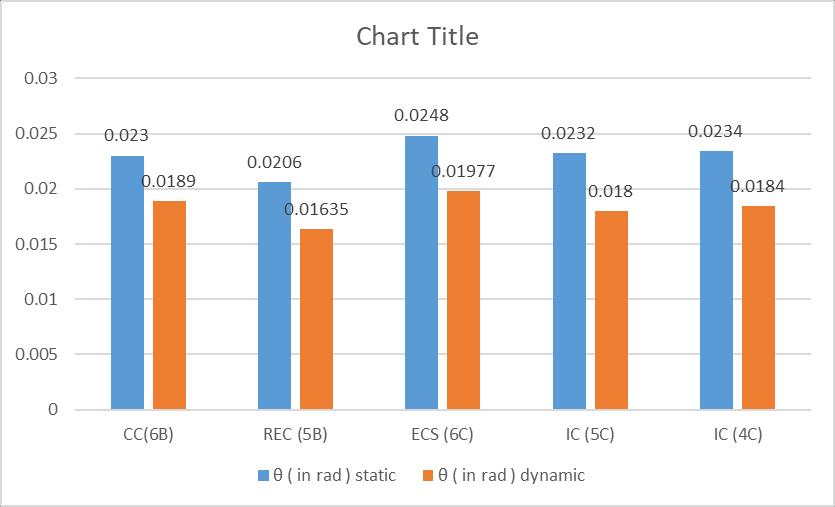
θ=0.027rad.<0.05rad
okasperDODguidelineforflatslab.
Whenthecornercolumn(CC)isinstantaneouslyremoved,a reductionof15.4%onaverageisobservedintheDCRofthe sectional forces of the critical column, when compared to thoseinstaticremovalscenario.Similarly,whentheECand IC columns are instantaneously removed, a reduction rangingfrom16.18to20.4%onaverageisobservedinthe DCR of sectional axial forces of corresponding critical columnswhencomparedtothoseinstaticremovalcase.In addition,whenCC,ECandICareinstantaneouslyremoved, theabsolutemaximumverticaldisplacementsΔCC,ΔECand ΔIC show a reduction of 19.11%, 18.52% and 20.29% on average,respectively,whencomparedtothoseinthecaseof staticremovalofcolumns.
Table -7: AveragePercentagechangeinDCR&vertical jointdisplacementinstaticanddynamicremovalcases.
Average Percentage change of DCR in static and dynamic removal case for axial forces
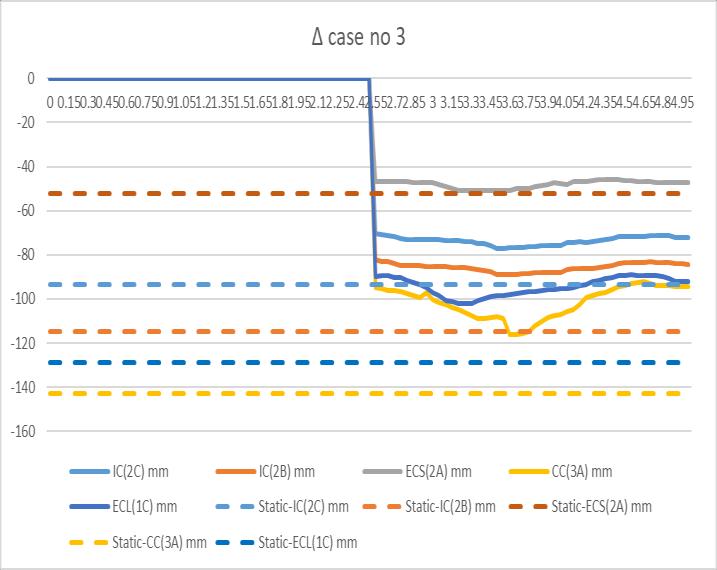
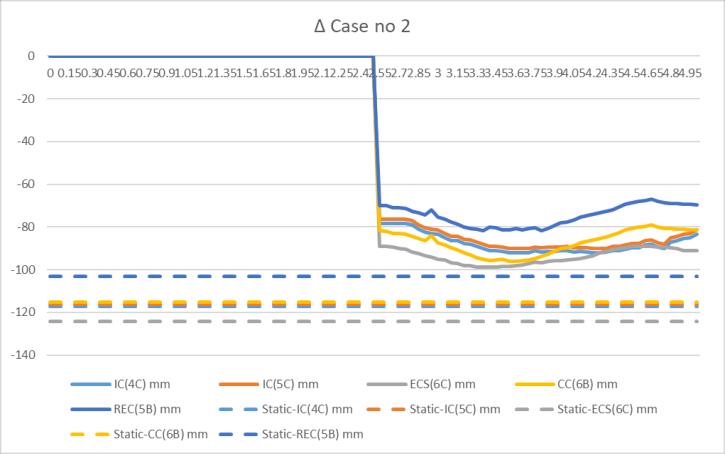
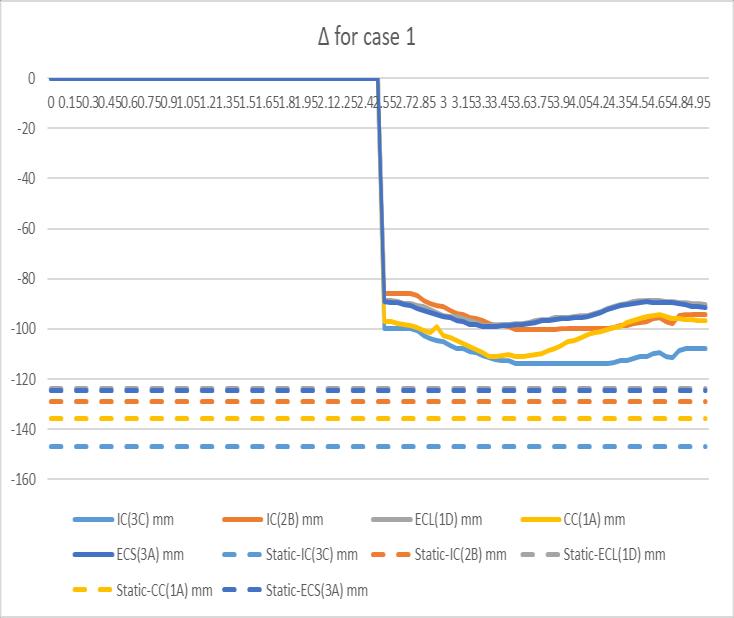
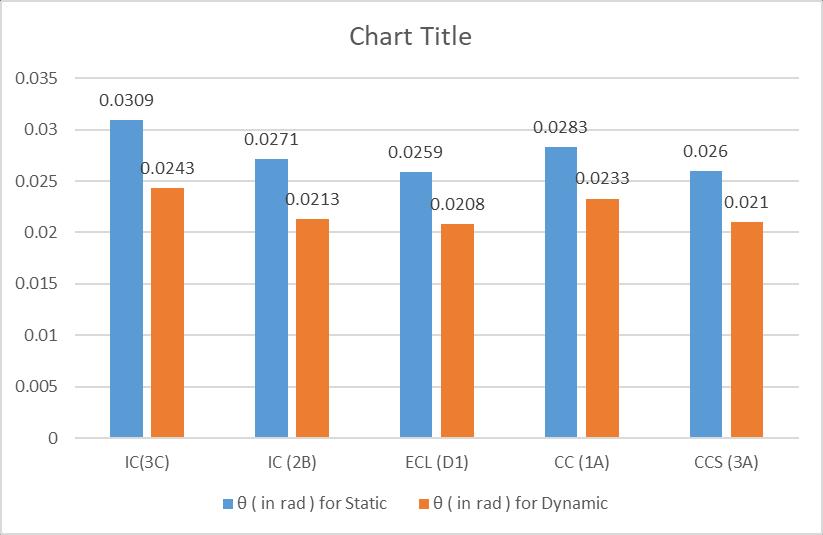
Average Percentage change of Vertical joint displacement in static and dynamic removal case for axial forces
following assumptions have been used in the analytical models:(1) The floor loads (other than self-weight) are appliedsimplyontheflatslabbeamsconformingtothearea method(2)Supportconditionsareconsideredasfixedatthe base.and(3)Gainofyieldstrengtharisingfromthehighrate ofstrainingowingtoinstantcolumnlossisignored.
5. CONCLUSIONS
The joint displacement and Chord rotation at column removallocationsareevaluatedwhendifferentlocations of column on each building removes the finding indicatesthestudiedflatslabismorevulnerableincase ofcornerColumnremovethanedgecolumns.
Joint Displacement and Chord Rotation values are inverselyproportionaltoprogressivecollapseresistance as chord rotation decreases, Progressive Collapse Resistanceincreases.
The numerical results showed that both the DCR of sectionalforcesandtheverticaldisplacementsattopof removedcolumnsaregreaterforstaticanalysisthanfor dynamic analysis. The application of dynamic
magnification factor to the static analysis leads to conservativeresults.
When the corner column (CC) is instantaneously removed,areductionof15.4%onaverageisobservedin the DCR of the sectional forces of the critical column, when compared to those in static removal scenario. Similarly, when the EC and IC columns are instantaneously removed, a reduction ranging from 16.18 to 20.4% on average is observed in the DCR of sectionalaxialforcesofcorrespondingcriticalcolumns when compared to those in static removal case. In addition, when CC, EC and IC are instantaneously removed,theabsolutemaximumverticaldisplacements ΔCC,ΔECandΔICshowareductionof19.11%,18.52% and20.29%onaverage,respectively,whencomparedto thoseinthecaseofstaticremovalofcolumns.
The Irregular Structure also sustains progressive collapseeffectafterremovalofcolumnsAlternately,and theeffectofflatslabonPCAisveryinfluentialbecause theexistenceofflatslabafterremovalofcolumndoes not experience overall collapse, but some structural elements collapse. Load distribution after removal of columnthroughnearbycriticalcolumnisdone,Column DCR<1.5forirregularandDCR<2FORregularstructure, giveslimitofsafetymember.
The result values of vertical joint displacement and chord rotation and DCR is taken as per GSA load combination.buildingisdesignedforseismicallyforces hence seismically designed building columns have inherentabilitytoresistprogressivecollapse.
ThepurelyRCregularflatslabstructuralsystemisless vulnerablethanirregularflatslabstructurebecausethe ductilityofthesestructuralsystemisgenerallylimited bythedeformationcapacityofslabcolumnconnection. i.e., penetration force in the slab at the connections, which should retain its load bearing capacity when column removes adjacent column get additional load andthisisrelatedwithmaximumdisplacementandDCR arelessthan2aswellchordrotationislessthan0.05in allcasesthereforeadjacentallmembersaresafe.
Vertical joint displacement(Δ) value is directly proportionaltochordrotation(θ),maximumvalueofΔ and θ on internal column(IC) in case no 1 they are geometricalregularbuildingandincaseno5theyhave sameplanascase1onlymassirregularon4th and8th floorforcase5.Otherthanthiscasesapproximatelymax values get in case of corner column removal in all remainingcases(CC)
DCR values for column adjacent to removal column maximumwhencentralInternalcolumnremoves,then another Internal column, edge column of longer side,
then edge column on shorter side, and finely corner column.
As the structural response depends on degree of irregularity,type,locationthosefactorneedtobetaken carewhiledesigninganystructure.Thiswouldhelpin incorporating irregularities in structures without compromisingtheirperformance.
SomeFlatslabonthegroundfloorofabuildingwhen the critical column and inner sides of a building are removediscollapsedbutdoesnotaffectthefloorabove, becausetheloadontheupperfloormovestoaflatslab systemonthegroundfloorofthebuilding.Theirregular buildingstructuredidnotcollapseaftertheremovalof the column. In general, if the structures are designed and detailed with an adequate level of continuity, redundancy,andductilitycandevelopalternativeload pathswhichinreturnpreventsthelossofanindividual memberandpreventprogressivecollapse
ACKNOWLEDGEMENT
TheauthorsacknowledgemyprojectguideDrAtul.B.Pujari, Associate professor in Civil Engineering, KJ’s Educational Institute KJ College of Engineering and Management Research Pune, Maharashtra, India for providing the necessaryfacilitiesandguidanceforthecompletionofthis researchwork.
REFERENCES
[1] GSA,DesignguidelinesfornewfederalOfficebuilding andmajormodernizationprojects,ProgressiveCollapse Analysis,TheUSgeneralserviceadministration,2016.
[2] UFC, Unified Facilities Criteria (UFC), Design of building to resist progressive collapse. The USA DepartmentOfDefense.
[3] Sivq naveen, Nimmy Mariam Abraham, anitha kumara.,(2018)“Analysisof irregularstructureunder earthquack loads” Ravindra nagar, Vinay Agrawal, SuyashGarge.,(2020)“progressivecollapsebehaviorof reinforcedconcreteflatslabbuildingsubjecttocolumn failureindifferentstorys”
[4] Zabihullah,Priyankasingh,Mohammadzamir.,(2020) “Effects of (vertical and horizontal) geometrical irregularitiesonseismicresponseofrcstructures”
[5] suyashGarg,VinayAgarwal,Ravindranagar.,(2021)“ Sustainability assessment of methods to prevent progressivecollapseofrcflatslabbuilding”
[6] Suyash Garg, Vinay Agrawal and Ravindra Nagar “Improvedprogressivecollapseresistanceofirregular
reinforcedconcreteflatslabbuildingsunderdifferent cornercolumnfailures”
[7] P. olmati, J. sagseta, D.cormie, A.E.K. jones., (2016) “Simplifiedrealibilityanalysisofpunchinginreinforced concreteflatslabbuildingunderaccidentalactions”
[8] D. z. yankelevsky, Y.s.karinski, V.r.feldgun., (2020) “Dynamicpunchingshearfailureofrcflatslabcolumn connectionundercollapseslabimpact”
[9] Silpa g, Yamini sreevalli., (2020) “A review of progressive collapse of reinforced concrete flat slab structure”
[10] JustinMRussell,JohnSOwenandImanHajirasouliha .,(2018)“Nonlinearbehaviorofreinforcedconcreteflat slabafteracolumnlossevent”
[11] S.M.Marjanishvili,P.E.,M.ASCE.,(2013)“Progresive analysisprocedureforprogressivecollapse”
[12] Dario Coronelli a, Marco Lamperti Tornaghi b, Luca Martinelli a, Francisco-Javier Molina b, Aurelio Muttoni….etcandall.,(2021)“testingof full scaleflat slabbuildingforgravityandlateralloads”
[13] Saeed Sarvari, M. Reza Esfahani.,(2020) “an experimentalstudyonpostpunchingbehaviorofflats
[14] RashaT.S.Mabrouk, AmrBakr,HanyAbdalla.,(2017) “ Effect of flexural and shear reinforcement on the punchingbehaviorofreinforcedconcreteflatslab.
[15] Szczepan wolinski., (2017) “Robustness and vulnerabilityofflatslabstructuresNiramjanChaudhary, nitin verma., (2020) “Seismic behavior of flat slabs in multistorybuildings.
[16] J.M. Russella, J.S. Owenb , I. Hajirasoulihac., (2019) “dynamic column loss analysis of reinforced concrete flatslab”
[17] KaiQiana,Yun-HaoWengb,BingLic.,(2018)“impact oftwo columnmissingondynamicresponseof rc flat slabstructures”
[18] Colingurley.,(2008)differencesbetweenprogressive collapseandearthquakeresistance.
[19] Khajaateequddin,waseemsohail.,(2019)hasanalysed Effects of irregularity shape on flat slap multistory buildingunderlateralloadingusingetabs.
[20] UsersguideETABS2016,Integratedbuildingdesign software.Computersandstructuresinc,Berkely2016
[21] Is 456:2000, plain and reinforced concrete- code of practice,bueroofIndianStanders,newdelhi2000
BIOGRAPHIES
Shantnoo Shamkant girme is a PG student of structural Engineering at civil engineering department, KJs Educational Institute,kjcollegeofEngineering and management research, pune, Maharashtra.

1’st Author
DR Atul B. Pujari is working as Associate Professor in civil engineering Department, KJs EducationalInstitute,kjcollegeof Engineering and management research,pune,Maharashtra

Author Photo