To Conduct Fluid Structure Interaction & Test The Feasibility Of Metal Matrix Composite For Journal Bearing
Student Name*, Dr. Shaileah Gupta**, Prof. Gouraw Beohar***
* Sujeet Kumar Panika, Department of Mechanical Engineering, SHRIRAM INSTITUTE OF TECHNOLOGY, JABALPUR MP.
** Prof. Gouraw Beohar, Department of Mechanical Engineering, SHRIRAM INSTITUTE OF TECHNOLOGY, JABALPUR MP.
Abstract: The journal bearings are used in various engineering components, combustion engines and turbines. The current research reviews the existing work in design and analysis of journal bearings. The type of materials for journal bearings, fluid type is assessed by various scholars and presented in the current review. Different researchers have conducted study on journal bearings using experimental and numerical techniques is presented.
Key Words: Journal Bearing, FSI

1. INTRODUCTION:
Journal bearings are a common engineering component that can be found in practically any machine. To achieve great efficiency and dependability, combustion engines andturbinesrelyalmostentirelyonjournalbearings[1].
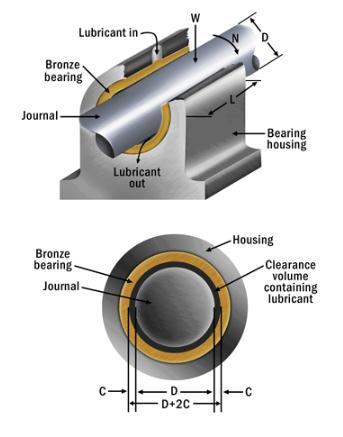
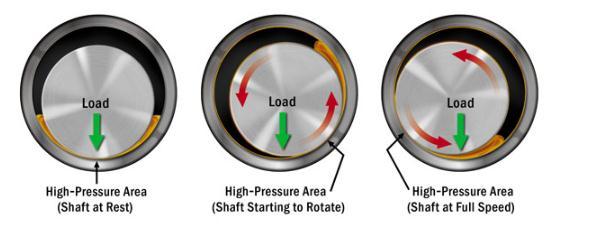
A radial bearing consists of a rotating shaft (link) and a fixed housing, as shown in Figure 2. A hydrodynamic film isformedbetweenthemovingsurfacesoftheshaftandthe moving surfaces of the housing to carry the load. Because the operating surfaces of such bearings are completely separatedbyalubricatingfilm,thecoefficientoffrictionis kept low, around 0.005, and bearing failure is rare, occurringonlyafterimproperhandling.[2].
2. LITERATURE REVIEW
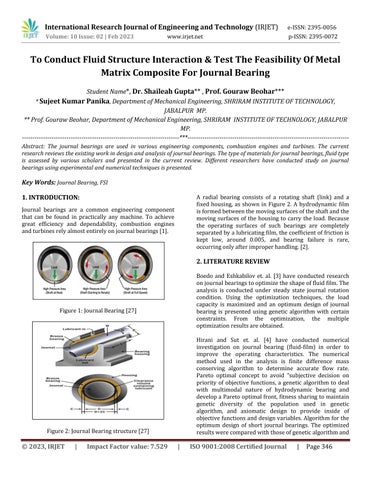
Figure1:JournalBearing[27]
Boedo and Eshkabilov et. al. [3] have conducted research onjournalbearingstooptimizetheshapeoffluidfilm.The analysis is conducted under steady state journal rotation condition. Using the optimization techniques, the load capacity is maximized and an optimum design of journal bearing is presented using genetic algorithm with certain constraints. From the optimization, the multiple optimizationresultsareobtained.
Hirani and Sut et. al. [4] have conducted numerical investigation on journal bearing (fluid-film) in order to improve the operating characteristics. The numerical method used in the analysis is finite difference mass conserving algorithm to determine accurate flow rate. Pareto optimal concept to avoid “subjective decision on priority of objective functions, a genetic algorithm to deal with multimodal nature of hydrodynamic bearing and developaParetooptimalfront,fitnesssharingtomaintain genetic diversity of the population used in genetic algorithm, and axiomatic design to provide inside of objectivefunctionsanddesignvariables.Algorithmforthe optimum design of short journal bearings. The optimized resultswerecomparedwiththoseofgeneticalgorithmand
successivequadraticprogramming.Alltheresultshavethe same tendency. The artificial life algorithm only uses the function value and doesn’t need derivatives calculated analytically or numerically and so it has a strong possibilityforbeingusedforotheroptimizationproblems” [4].
An analysis of lubricated conformal contact is performed by Cupillard et al [5] to study the effect of surface texture on bearing friction and bearing capacity using computational fluid dynamics. The work focuses on a radial bearing with several dimples. Two- and threedimensional bearing geometries are considered. The full Navier-Stokes equations are solved under steady-state conditions with a multiphase flow cavitation model. The coefficient of friction can be reduced by introducing a textureofsuitablegeometry.Thiscanbeachievedeitherin the region of maximum hydrodynamic pressure for a bearing with a high eccentricity ratio or just beyond the maximum film for a bearing with a low eccentricity ratio. At low eccentricity ratios, a further increase in pressure duetosurfacetexturewasdemonstrated.
Bhuptani and Prajapati [6] performed an evolutionary optimization methodology for a solid journal bearing. The effectofminimizationoftemperaturerise,minimizationof oil flow, minimization of weighted sum of oil flow and temperature rise, and linear combination of minimization of oil flow and power loss under various constraints are demonstrated. The results lead to the recommendation to usesimultaneous minimizationofoilflowandpower loss. Pareto-optimal concepts are used to help a win-win situation between power loss and oil flow. Optimization studies are performed with three design variables. An orthogonal array is used to select and set the values of design variables and tolerances. The results show that oil viscosity is the most important. Therefore, special attention should be paid to the viscosity of the lubricant whendesigningthebearings.
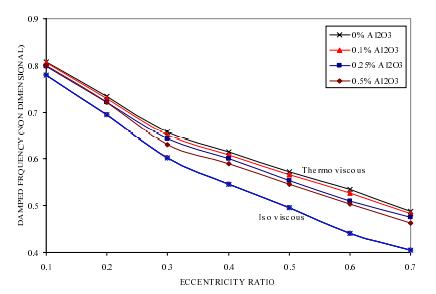
Kalakada et al [7] have conducted research on performance of journal bearing using experimental techniques. In the research the performance of journal bearing is evaluated under static and dynamic loading conditions. From the analysis, the load capacity, end leakage and frictional force is evaluated for different nanofluids i.e. copper oxide (CuO), cerium oxide (CeO2) and aluminum oxide (Al2O3). The research findings have shownthatperformancecharacteristicsofjournalbearing is not affected by presence of nanofluids. However, significantchangesareobservedforthermoviscouscaseas showninfigure3.
Kangoetal[8]haveconductedexperimentalinvestigation onjournalbearingswithdifferentshapesofmicrocavities. In the research, the effect of cavity width, cavity depth on bearing surface is evaluated. The research findings have shown that the negative texture has significant effect on improving lubricant film thickness and with reduction in frictionforce.
Han and Fu et. al. [9] have conducted research on plain journal bearing using experimental techniques. The experimental testing is conducted to evaluate the effect of micro-grooves on performance of journal bearing. The misaligned bearing,plainbearingarebothanalysedinthe research.
Li et al. [10] established the nonlinear transient hydrodynamic force model based on a new structured meshmovementalgorithm.Theyfoundthatthedifference between the linear and nonlinear hydrodynamic forces of multiple grooves water-lubricated journal bearings was considerable.
Machadoetal.[11]haveconductedbothexperimentaland numerical investigationon journal bearingto evaluatethe effectofoilfilmforces.Thelinearapproximationisdoneto determine its validity for the system operating under specific conditions. The numerical results are in close agreement with the experimental findings for nonlinear bearings.
Zhang et al. [14] have conducted numerical investigation on journal bearing using finite length model. The analysis is conducted to obtain the oil pressure distribution. The effect of different operational parameters on the oil film forces are presented. The “dynamic coefficients are another expression of fluid-induced force of journal
bearing, which can be integrated in the coefficient matrix ofmotionequationsforrotor-bearingsystem”[14].
Yang et al. [15] have conducted analytical study on tilting padbearingtoevaluatedampingcoefficientsanddynamic stiffness. The novel analytical method is proposed by the researcher to overcome ill conditioned matrix. The coefficient damping is evaluated for circular journal bearing[16].
Li et al. [17] have conducted numerical investigation on journal bearing using techniques of Computational Fluid Dynamics (CFD) tool. From the CFD tool, the dynamic coefficients of journal bearings are evaluated. The results obtained from CFD analysis are compared with experimental findings. The stiffness and damping coefficientsofjournalbearingarethenevaluated[18-20].
Tala-Ighil and Fillon et. al. [21] have conducted numerical investigation on journal bearing using finite difference method. From the research the effect of texture presence andabsenceoffrictioncharacteristicsofjournalbearingis evaluated. The research findings have shown that by texturingthebearingsurface,thethermaleffectisfoundto beincloseagreementwithexperimentaldata.
Chen et al. [22] have conducted research on aerostatic journal bearing using experimental techniques. The analysisisconductedusing Reynolds equation to evaluate the aerostatic properties. The effect of geometric propertieslikewaviness,misalignmentandmanufacturing errors on structural characteristics of journal is also evaluated[23-25].
Zhouetal.[26]haveconductednumericalinvestigationon journal bearing to using simulation package. The analysis involved secant method to determine the efficiency and staticperformanceofjournalbearing.
3. CONCLUSION
Proper design of journal bearing is vital for proper functioning of various machine components. Various researches are conducted to determine the factors affectingloadcapacity,attitudeanglethresholdspeedand damped frequency of journal bearing. Different optimizationstudiesareconductedbyvariousresearchers and its shown that minimizing oil flow could cause increaseintemperature.Theeffectofdifferentoperational parameters, design parameters on journal bearing is evaluated.
REFERENCES
[1] Gwidon W. Stachowiak. Engineering Tribology. United Kingdom.Butterworth-heinemannVol.14pp.26-31,2017.
[2]F.M.Meng.L.Zhang.Y.Liu.Effectofcompounddimple ontribologicalperformancesofjournalbearing.TribolLett Vol12,pp.55-61,2015
[3]Boedo,S.andEshkabilov,S.L. Optimalshapedesignof steadily loaded journal bearings using genetic algorithms. STLETribologyTrans.,Vol.46,Issue1,134-143,2003.
[4] Hirani, H., and Suh, N.P., Journal Bearing Design Using Multi Objective Genetic Algorithm and Axiomatic Design Approaches, J. Tribology International, Vol. 38, pp 481–491,2005.
[5] S Cupillard, S Glavatskih, and M J Cervantes, “Computational fluid dynamics analysis of a journal bearing with surface texturing”, Proceeding of the Institution of Mechanical Engineering, Part J: Journal of EngineeringTribology,Vol.222,Issue2,pp97-107,2008.
[6]BhuptaniKirankumarM.,“AbriefreviewonOptimum DesignofAJournalBearingsforI.C.Engine”,International Journal of Engineering Research & Technology, Vol. 4, Issue4,2012.
[7] K. B. Kalakada, P. N. Kumarapillai, R. K. Perikinalil, “Analysis of Static and Dynamic Performance Characteristics of THD Journal Bearing Operating Under Lubricants Containing Nanoparticles”, International Journal of Precision Engineering and Manufacturing Vol. 13,No.10,pp.1869-1876,2012
[8] S. Kango, D. Singh · R.K. Sharma, “Numerical investigation on the influence of surface texture on the performanceofhydrodynamicjournalbearing”Mechanica, Vol.47,pp469-482,2012
[9] Han Y, Fu Y. Comparison of hydrodynamic characteristics between circumferential and transversal microgrooved journal bearings. Lubr Sci 2019;31(7):285
98.
[10] Li Q, Zhang S, Wang Y, Xu W, Wang Z, Wang Z. Dynamic characteristics of water-lubricated journal bearings-Part 1: full 3D transient hydrodynamic force modelsusingstructuredmeshmovementalgorithm.Mech Ind2019;20(4):404.
[11] Machado TH, Alves DS, Cavalca KL. Discussion about nonlinear boundaries for hydrodynamic forces in journal bearing.NonlinearDyn2018;92(4):2005–22.
[14] Zhang Y, Hei Di, Liu C, Guo B, Lu Y, Müller N. An approximate solution of oil film forces of turbulent finite lengthjournalbearing.TribolInt2014;74:110–20.
[15] Lihua Y, Huiguang Li, Lie Yu. Dynamic stiffness and damping coefficients of aerodynamic tilting-pad journal bearings.TribolInt2007;40(9):1399–410.
[16] Chen C, Jing J, Cong J, Dai Z. Identification of dynamic coefficients in circular journal bearings from unbalance response and complementary equations. Proc Inst Mech EngPartJ:JEngTribol2019;233(7):1016–28.
[17] Li Q, Zhang S, Ma L, Xu W, Zheng S. Stiffness and damping coefficients for journal bearing using the 3D transient flow calculation. J Mech Sci Technol 2017;31(5):2083–91.
[18] Dyk Š, Rendl J, Byrtus M, Smolík L. Dynamic coefficients and stability analysis of finite-length journal bearings considering approximate analytical solutions of theReynoldsequation.TribolInt2019;130:229–44.
[19] Weimin W, Lihua Y, Tiejun W, Lie Y. Nonlinear dynamic coefficients prediction of journal bearings using partialderivativemethod.ProcInstMechEng,PartJ:JEng Tribol2012;226(4):328–39.
[20] Merelli CE, Barilá DO, Vignolo GG, Quinzani LM. Dynamic coefficients of finite length journal bearing. Evaluationusingaregularperturbationmethod.IntJMech Sci2019;151:251–62.
[21] Tala-Ighil N, Fillon M. A numerical investigation of both thermal and texturing surface effects on the journal bearingsstaticcharacteristics.TribolInt2015;90:228–39
[22] Chen X, Mills JK, Bao G. Static performance of the aerostatic journal bearing with grooves. Proc Inst Mech Eng,PartJ:JEngTribol2020;234(7):1114–30.
[23]WangX,XuQ,WangB,ZhangL,YangH,PengZ.Effect ofsurfacewavinessonthestaticperformanceofaerostatic journalbearings.TribolInt2016;103:394–405.
[24] Wang X, Zhou L, Huang M, Yue X, Xu Q. Numerical investigation of journal misalignment on the static and dynamic characteristics of aerostatic journal bearings. Measurement2018;128:314–24.
[25] Cui H, Wang Y, Yue X, Huang M, Wang W. Effects of manufacturing errors on the static characteristics of aerostatic journal bearings with porous restrictor. Tribol Int2017;115:246–60.
[26]ZhouW,WeiX,WangL,WuG.Asuperlineariteration method for calculation of finite length journal bearing’s static equilibrium position. R Soc Open Sci 2017;4(5):161059. doi: https://doi.org/10.1098/rsos.161059
[27] Determining Proper Oil Flow to Journal Bearings (machinerylubrication.com)