International Research Journal of Engineering and Technology (IRJET) e-ISSN: 2395-0056

Volume: 10 Issue: 01 | Jan 2023 www.irjet.net p-ISSN: 2395-0072
International Research Journal of Engineering and Technology (IRJET) e-ISSN: 2395-0056
Volume: 10 Issue: 01 | Jan 2023 www.irjet.net p-ISSN: 2395-0072
1,2,3,4 Student, 5 Professor, Dept. of Computer Engineering, Vishwakarma Institute of Technology, Maharashtra, India ***
Abstract - The Traffic Sign Recognition System, abbreviated to TSRS, could be useful in autonomous, i.e., self-driving cars which is one of the most booming technologies in the domain of transportation, artificial driver aid, trafficsurveillance,and traffic safety. To handle traffic-related challenges, it is vital to recognize traffic signs. There are twoaspectstothetrafficsign recognition system: localization (or detection) and recognition. The traffic sign from the input image is located and recognized by constructing a rectangle area in the localization section. The rectangle box then offered the result for which traffic sign is positioned in that particular region in the recognition part. We describe the implementation of ML algorithms for traffic sign detection and recognition in this paper. In this paper, we compared the accuracies obtained from implementing various machine learningalgorithmssuch as KNN, multinomial logistic regression, CNN and random forest. The practical purpose of detecting and recognizing the correct meaning of traffic signs is a bit difficult. For real time object (traffic signs) detection the YOLO model has been used. This helps to detect traffic signs while the vehicle is in speed. This feature will definitely help the technologies of autonomous vehicles for detection, recognition and interpretation of traffic signs in real time.
Key Words: KNN,Imagerecognition,LogisticsRegression, YOLOv4,CNN,IOU,SOTA,ROI
Analysisoftrafficsignsisaverycrucialtopicinthefieldof computervision(CV)andintelligentprogramming(artificial intelligence).TheTrafficsignsalongtheroadsaredesigned toinstructandinformthedriversofthecurrentstatusand otherextraimportantinformationontheroad.
Traffic signs hold an important place in the road traffic systems.Themainfunctionofthetrafficsignsistoshowcase the contents that must be noticed in the current road sections, to prompt the drivers in front of the road the dangeranddifficultyintheenvironment,towarnthedriver to drive at the predefined speed, to provide a favorable guarantee for safe driving. Hence, the detection and recognitionoftrafficsignsisaveryimportantresearchfield, which is of great significance to prevent road traffic accidents and protect the personal safety of drivers. Autonomousvehiclesaregettingmorepopulardaybyday
and all leading automobile companies are competing to produce the most efficient and secure automobile. Some companiesworkingintheautonomoustransportfieldare Tesla,Cruise,Ford,Waymo,etc.Trafficsignrecognitionand detectionareimportantfunctionsthatmustbeperformedby anautonomousvehicle.Detectingthetrafficsignsinvolves locatingthesignfromitssurrounding.Recognitioninvolves the actual classification of the detected sign. These two operationscomeundertheImagedetectionandrecognition fieldofAI&ML.Trafficsignrecognitionanddetectiongives theautonomousvehiclealotofinformationabouttheroad conditions like turns, speed breakers, construction work goingon,etc.andallofthisinformationcanhelpthecarto make decisions regarding changing speeds, stopping, directionchange,etc.Efficientdetectionandrecognitioncan ensure a smooth and, more importantly, safe ride for the passengers.Forthis,theautonomousvehiclesareequipped withseveralcameraswhichconstantlymonitortheroadfor trafficsigns.
Inrecenttimes,in-depthlearningmethodshaveprovedhigh performances and results for many tasks such as image classification. In this paper, we have discussed the implementationof4algorithmsnamelyKNN,multinomial logistic regression, random forests, and CNN, for the detection of traffic signs from their images. And also discussed the object detection algorithm i.e Yolo v4 for trafficsignsdetectionfromdifferentclassesofimages.These algorithmscomeunderthesupervisedlearningparadigmof ML in which the algorithm is trained upon a dataset to predict/classifythetestdata.
In this paper, we discuss the implementation of four ML algorithms viz. KNN, multinomial logistic regression, CNN andrandomforestsforthesakeoftrafficsigndetectionand recognition.
IlkayCinaretal.intheirpaper[1]mentionthatitiscritical that the traffic signs used to maintain traffic order be understoodbyvehicles.Trafficsignsadheretointernational standards,allowingdriverstolearnabouttherouteandthe surroundingswhileontheroad.Toincreasetrafficsafety, traffic sign recognition technologies have lately been installedinautomobiles.Machinelearningapproachesare
International Research Journal of Engineering and Technology (IRJET) e-ISSN: 2395-0056
Volume: 10 Issue: 01 | Jan 2023 www.irjet.net p-ISSN: 2395-0072
employedinpictureidentification.Theauthorofthisstudy hasadatasetof1500photosof14distincttrafficsignsthat are commonly seen on Turkey's roadways. Convolutional neuralnetworksfromdeeplearningarchitectureswereused to extract picture features in this dataset. The 1000 characteristics acquired were categorized using machine learning techniques' Random Forest approach. This categorizationtechniqueyieldedasuccessrateof93.7%.
Mehdi Fartaj and Sedigheh Ghofrani in their paper [2] mentionedthatAroboticcarthatautonomouslytravelson roadways must identify traffic signs. Because most traffic road signs are blue and red, we initially employ the HueSaturation- Intensity (HSI) color space for color-based segmentation in this article. The road signs are identified accuratelyusingcrucial geometrical properties.Following segmentation,itistimetoclassifyallidentifiedroadsigns. Weuseandcomparetheperformanceofthreeclassifiersfor this purpose: distance to border (DTB), FFT sample of signature,andcodematrix.Forthefirsttime,weapplythe codematrixasanefficientclassifierinthispaper.Although theacquiredaccuracyusingcodematrixishigheronaverage than the two mentioned classifiers, the major benefit is simplicityandhencelowerprocessingcost.
David Soendoro and Iping Supriana in their paper [3] mentionedthatTorecognisetrafficsigns,thisstudypresents asystemthatcombinestheColor-basedMethodwithSVM. The color-based method using CIELab + hue was chosen becauseitproducesgoodresultswhenitcomestolocalizing traffic signs. It is initially used to convert the picture to a binary format. The binary picture is then processed with cannytogetmoreaccuratetrafficsigndetectionresults.The preprocessedpictureistestedfortrafficsignshapeusingthe Ramer-Douglas-Peuckermethod,whichwillestimateeach closed object form in the preprocessed image. When it detectsaclosedobject,itisimpossibletoidentifyoccluded andconnectedroadsigns.
Nazmul Hasan et al. in their paper [4] mentioned TSRS (Traffic Sign Recognition System) might be useful in selfdrivingcars,artificialdriverassistance,trafficsurveillance, and traffic safety. To address traffic-related challenges, traffic sign recognition is required. The traffic sign recognitionsystemisdividedintotwocomponents:location and recognition. In the localization section, a rectangular rectangle is used to find and identify the traffic sign zone. Followingthat,intherecognitionsection,therectanglebox offered the result for which traffic sign is placed in that specific region. In this research, we offer a method for recognisingtrafficsigns.Weworkedon12differentsignsfor traffic sign detection and identification. To do this, we employedSupportVectorMachineandConvolutionalNeural Networkseparatelytoidentifyandrecognisetrafficsignals.
Akshata V. S. and Subarna Panda in their paper [5] mentionedthattheirstudydiscussesareal-timesystemfor both recognition and classification of traffic signs. This
model is three-staged, the first step of which is picture segmentation,thesecondstageisthedetection/localization ofthetrafficsign,andthelaststageistheclassificationphase that is based on the input image. The color enhancement techniqueisused to extractred patchesinthepicture. To identify the content of the traffic signs collected, Convolutional Neural Networks (CNN) are used for detection,classification,andidentification.Introduction:In recentyears,theprimaryaimofAdvancedDriverAssistance System (ADAS) has been to give the driver with critical informationconcerningtrafficsignalsandwarningsignson theroadahead.
ZsoltT.Kardkovacsetal.intheirpaper[6]mentionedthat TrafficSignRecognition(TSR)isoneofthemostessential background research issues for allowing self-driving vehicles.Thereisnotimeforelaboratetransformationsor advanced image processing algorithms in autonomous drivingsystems;instead,theydemandasolidandreal-time understanding of a scenario. This requirement becomes more difficult to accomplish in a city-like setting, since varioustrafficsigns,advertisements,parkedcars,andother movingorbackgroundelementscomplicatedetection.While various solutions have been published, they have all been testedonhighways,inthecountryside,oratextremelylow speeds. In this work, we provide a brief summary of the majordifficultiesandknownsolutionstotheseproblems,as well asa genericmethodto addressreal-timeconcernsin metropolitanareas.
L.Breimaninhispaper[7]mentionedthatRandomforests areatreepredictorcombinationinwhicheachtreeisreliant on the values of a random vector sampled separately and withthesamedistributionforalltreesintheforest.Asthe number of trees in a forest grows enormous, the generalizationerrorapproachesalimit.Thegeneralization error of a forest of tree classifiers is determined by the strengthoftheindividualtreesintheforestaswellastheir association.Usingarandomselectionoffeaturestodivide each node produces error rates that are comparable to Adaboostbutmoreresilienttonoise.
Mr. Jean de Dieu TUGIRIMANA et al. in their paper [8] mentioned that many years ago, the convolutional neural networkwasusedtoidentifyandrecogniseroadtrafficsigns (CNN). CNN has played an important role in the field of computer vision, and a variant of CNN has proven to be successful in classification tasks across multiple domains; however, CNN has two drawbacks: one is its failure to considerimportantspatialhierarchiesbetweenfeatures,and the other is its lack of rotational invariance. They further discuss the use of CapsNet (or Capsule Network) to recognizeandclassifyroadtrafficsigns.
International Research Journal of Engineering and Technology (IRJET) e-ISSN: 2395-0056
Volume: 10 Issue: 01 | Jan 2023 www.irjet.net p-ISSN: 2395-0072
Table -1: TableforAccuraciesofimplementedalgorithms inthereviewedpapers
Accuracies of algorithms in the reviewed papers
Paperno. SVM CNN CapsuleNetwork 1 NA NA 97.60% 2 98.2% NA NA 3 NA 97% NA 4 96.40% 98.33% NA 5 96% NA NA
Datasets used:
1. Thefirstdatasetisdownloadedandextractedfrom the German Traffic Sign Recognition Benchmark (GTSRB), a multi-class, single-image classification challengewhichwasgivenin2011atthe(IJCNN) InternationalJointConferenceonNeuralNetworks [10]. It contains more than 50,000 images. Over 12,000 images are available for testing and over 39,000imagesareavailablefortraining.Atotalof 43 classes are available. Figure 1. shows some imagesfromthisdataset.
2. Theseconddatasetcontains877imagesofvarious different unique classes for the objective of road signrecognition.Boundingboxannotationsinthe PASCAL VOC format and four classes are such as trafficlight,stop,speedlimitandcrosswalk. (a) (b)
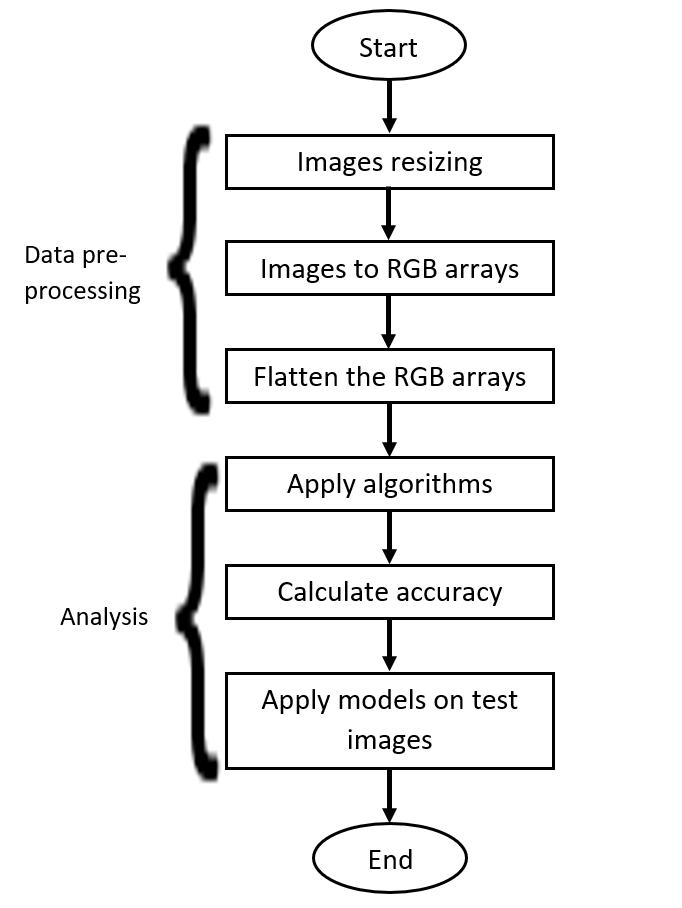
Fig -2:Flowchartfortrafficsignrecognition
Data pre-processing:
1. Image resizing: Theimageshaddifferentsizesso tomaketheirsizesthesametheywereresizedto 30x30pixels.
2. Convert images to RGB arrays: Eachoftheimages wereconvertedintoamatrixwitheachelementof the matrix being a tuple of the RGB values of the pixelspresentintheimage.
3. Flattening the matrices: Thesematriceswerethen flattened,i.e.reducedtoone-dimensionalarrays,so that classification algorithms can be applied to them.
Analysis:
1. Apply algorithms:
Algorithmsappliedforimagerecognition:
(c)
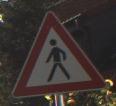
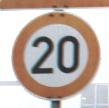
Fig -1:Someimagesfromthefirstdataset:(a)20km/h speedlimitsign,(b)Pedestriancrossingsign,(c)Wild animalcrossingsign
a. K-Nearest Neighbors (KNN): KNN is an algorithmofmachinelearningthatcanbeused forbothregressionandclassificationprocesses. It always checks the labels for a selected numberofdata pointsaroundthetargetdata point,tomakepredictionsabouttheclassthe
International Research Journal of Engineering and Technology (IRJET) e-ISSN: 2395-0056
Volume: 10 Issue: 01 | Jan 2023 www.irjet.net p-ISSN: 2395-0072
datapointfallsinto.KNNisarelativelysimple butpowerfulalgorithm,andforthosereasons, itisoneofthemostpopularmachinelearning algorithms
b. Multinomial logistic regression: Logistic regression, like all regression analysis, is a predictiveanalysis.Itisusedtodefinedataand to explain the relationship between single binary dependent variables and one or more independent variables, ordinal, interval, or ratio-levelindependentvariables.Multinomial logistic regression is an extended version of logistic regression that can be used for classificationpurposeswhenthedatahasmore thantwoclasses.
c. Random forest: Random forests are a set of treepredictorsinwhichthevaluesofarandom vector, gathered independently and with the samedistributionforalltreesintheforest,are used to anticipate each tree's behavior [1]. A random selection (without replacement) is madefromtheinstancesinthetrainingsetto construct each tree. They vote for the most popularclassonceahugenumberoftreeshave been created. Random Forest algorithm is useful for both regression and classification. The number of trees used is 100 in our experiment.
d. Convolutional Neural Networks (CNN): CNN is used for all artistic situations to learn indepth neural network algorithms in many image-related tasks. Inside the convolution layer convolution captures image location information by implementing the kernel function. CNN contains input, output, and hidden layers. The hidden layer also contains layers which are convolutional, pooling, fully connected,andnormalizationlayers.Wehave usedAdamoptimizationandcategoricalcrossentropylossfunctioninourexperiment.
(Theabovefouralgorithmsareimplementedonthe firstdatasetfortrafficsignrecognitiononly.)
2. Calculate Accuracy: The formula for accuracy is mentionedinthe“Resultsanddiscussions”section ofthispaper.
3. Applying the models on test images.
You Only Look Once (YOLO V4): YOLO v4 is a SOTA(state-of-the-art)real-timeObjectDetection model.YOLOisaone-stagedetector.Oneofthetwo primary cutting-edge techniques for the task of objectdetectionthatprioritizesinferencespeedsis
the one-stage method. The classes and bounding boxes for the entire image are predicted in onestagedetectormodels;theROI(RegionofInterest) isnotchosen.Animageandtheactualvaluesforthe boundingboxesareprovidedasinput.
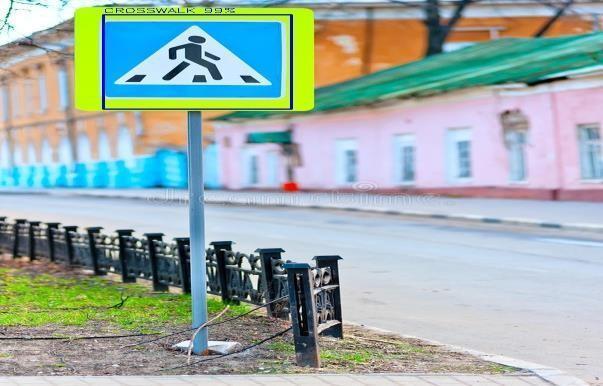
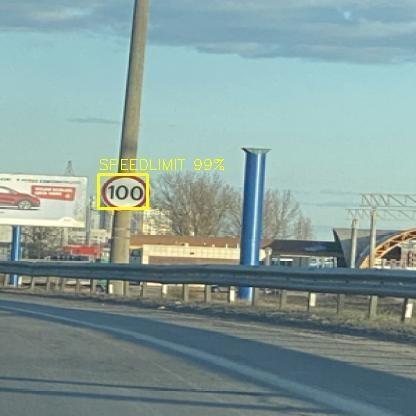
Theentireinputimageispartitionedintoasquare grid,andeachobjectisdetectedinthegridcellthat containsitscenter.TheBboundingboxesandthe correspondingconfidenceratingswillbepredicted foreachgridcell.Thisratingshowshowaccurate the box is and how certain the model is that the objectisinsidethebox.IOUofpredictedvaluesand thegroundtruthvaluesoftheboundingboxisthe Confidencescore.TillnowwehavetestedYolov4 on only 4 classes of images i.e., Crosswalk, stop, trafficsignals,speedlimit.Fig-3,Fig-5,Fig-6and Fig-7aresomeresultantimagesofaboveclasses.
(Theabovealgorithmisimplementedonthesecond dataset for both localization / detection and recognitionoftrafficsigns.)
International Research Journal of Engineering and Technology (IRJET) e-ISSN: 2395-0056
Volume: 10 Issue: 01 | Jan 2023 www.irjet.net p-ISSN: 2395-0072
98.93% are obtained. The categorical cross entropy loss functionisusedinthemodel.MethodssuchasEarlyStopping andReduceLRonPlateauareemployedtoprovideanefficient andoptimaltrainingprocedure.TheEarlyStoppingmethod examinesthevalueofthelossfunctionandwaits12epochs beforehaltingifthevalueofthemodelperformancemetrics beingmonitoreddoesnotimprove.
Theaccuracyofthemodeliscalculatedusingformula:
Acc=(TP+TN)/(TP+TN+FN+FP)
Where:

TP=TruePositive
TN=TrueNegative
FN=FalseNegative
FP=FalsePositive
According to the above formula we have calculated the accuracy for various models. The True Positive and True Negativeelementsareaddedtogetherinthenumeratorof Accuracyformula,andalloftheconfusionmatrixentriesare addedtogetherinthedenominator.TruePositivesandTrue Negatives are the items on the main diagonal of the confusionmatrix,whichrepresenttheitemsthatthemodel properlyidentified.Thedenominatoradditionallytakesinto accountalltheelementsthatthemodelmistakenlyclassified thatarenotonthemaindiagonal.[9]

Accuracy:
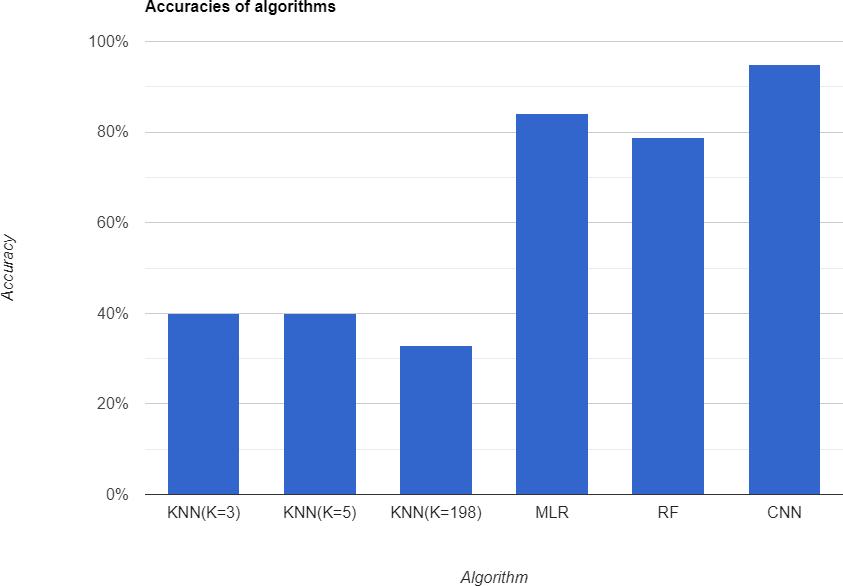
Thecalculatedaccuraciesforeachalgorithmareshownin Fig-4Thebargraphhelpstocomparetheperformancesof thealgorithms.
Duringthetrainingphase,theproposedCNNmodelemploys an Adam optimizer. It is a very successful optimization strategyfordeepneuralnetworktrainingthatcombinesthe benefits of AdaGrad (Adaptive Gradient Algorithm) and RMSProp(RootMeanSquarePropagation)Afterevaluating themodelontestdata,alossof5.56% andanaccuracyof
Through this paper we demonstrated the efficiency of different algorithms in detecting and recognizing Traffic signs. Traffic sign recognition systems are an important aspect that autonomous vehicles use to make a decision based on the detected sign. An efficient TSRS helps to providetheriderwithsmooth,safeandhalt-lessdriving.The experiment consequences of this paper display that the Convolutional neural network is an effective method for imageclassificationandrecognition.Itmakesitalotsimpler for the researcher to work on it due to its simple architecture,andahigh-performanceclassifierforatough and lot-complicated task like traffic sign recognition. As mentionedearlier,theKNN,MultinomialLR,Randomforests andCNNfailtorecognizethesignwhenthetrafficsigninthe image is titled or the sign is not the majority part of the image.Thiscanbehighlyineffectualinreallifescenariosin whichtheimageofthetrafficsignwillnotalwaysbestraight andwillhaveseveralotherthingsinthebackground.Thus, YOLOv4isimplementedforlocalizationofthesignfromits surroundings. However, since YOLOv4 is implemented on theseconddatasethavingonly4classes,itsefficiencycan’t becomparedtotherestofthethreealgorithms.Ourfuture plans include implementation of YOLOv4 and other
International Research Journal of Engineering and Technology (IRJET) e-ISSN: 2395-0056
localizationalgorithmsonalargerdataset.Theotherthree recognition algorithms will be then implemented on the traffic-sign-containing-sub-imagegivenbythelocalization algorithmsandthenacombinedanalysiscanbedone.
[1] I.Cinar,Y.S.Taspinar,M.MustafaandM.Koklu,“Feature Extraction and Recognition on Traffic Sign Images” (2020)
[2] M.FartajandS.Ghofrani,“TrafficRoadSignDetection andClassification”(2012)
[3] D.SoendoroandI.Supriana,“TrafficSignRecognition with Color-based Method, Shape-arc Estimation and SVM”(2011)
[4] N. Hasan, T. Anzum and N. Jahan, “Traffic Sign Recognition System (TSRS): SVM and Convolutional NeuralNetwork”(2020)
[5] V.S.AkshataandS.Panda,“Trafficsignrecognitionand classification using convolutional neural networks” (2019)
[6] Z. T. Kardkovacs, Z. Paróczi and E. Varga, “Real-time TrafficSignRecognitionSystem”(2011)
[7] L. Breiman, “Random Forests”, Machine Learning 45 (2001),pp.5–32.
https://doi.org/10.1023/A:1010933404324
[8] J. de D. Tugirimana, J. Rulinda, K. L. Tresor and A. Nzaramba,“Roadtrafficsigndetectionandclassification using Capsule Network”, International Journal of Scientific & Engineering Research Volume 9, Issue 8, ISSN2229-5518(August2018)
[9] G. Margherita, B. Enrico and V. Giorgio, “Metrics for Multi-ClassClassification:anOverview”(2020)
https://doi.org/10.48550/arXiv.2008.05756
[10] J.Stallkamp,M.Schlipsing,J.SalmenandC.Igel,“Manvs. computer:Benchmarkingmachinelearningalgorithms fortrafficsignrecognition,”NeuralNetworks,Volume 32(2012),pp.323-332,ISSN0893-6080.
https://doi.org/10.1016/j.neunet.2012.02.016
Volume: 10 Issue: 01 | Jan 2023 www.irjet.net p-ISSN: 2395-0072 © 2022, IRJET | Impact Factor value: 7.529 | ISO 9001:2008 Certified Journal |