International Research Journal of Engineering and Technology (IRJET) e-ISSN: 2395-0056

Volume: 10 Issue: 01 | Jan 2023 www.irjet.net p-ISSN: 2395-0072
International Research Journal of Engineering and Technology (IRJET) e-ISSN: 2395-0056
Volume: 10 Issue: 01 | Jan 2023 www.irjet.net p-ISSN: 2395-0072
1
2
Abstract - There are many models to characterize the behavior of the heat exchangers encountered in many industries. Shell andTube heat exchangers are having special importanceinboilers,oilcoolers,condensers,andpre-heaters. Theyarealsowidely usedinprocessapplicationsaswellasthe refrigeration and air conditioning industry. The robustness and medium weighted shape of Shell and Tube heat exchangers make them well suited for high pressure operations. In this present work, three types of fluids are considered such as water, SiO2 and Al2O3 nano particles. Thermal properties of different volume of concentration of nanoparticlesarecalculated theoreticallytorun theanalysis. CATIA software is usedto create the model and analysis have beenperformedinsolidworksflowsimulationsoftware.From theCFDresults,overallheattransfer,effectivenessandfriction factor are calculated and compared with respect to the velocity.
2o3,CATIAsoftware,CFD
Usingpassivetechniquesinordertoenhanceheattransfer characteristicsinheatexchangerasbeenaninterestingtopic for scientists and researchers during recent decades. Numericalandexperimentalstudieshavebeenconductedin ordertoimproveheattransferredbythesetechniques.The demand of reduction of the cost and dimensions of heat exchanger has motivated the searchers to investigate different ways ofheattransfer enhancement.Passiveheat transferenhancementtechniquesaremostlypreferreddue to their simplicity and applicability in many applications. Furthermore,inpassivetechniques,thereisnoneedofany externalpowerinputexcepttomovethefluid.
Treatedsurfacesareheattransfersurfacesthathaveafine scale altercation to their finish or coating. The altercation couldbecontinuousordiscontinuous,wheretheroughness ismuchsmallerthanwhataffectssingle-phaseheattransfer and they are primarily used for boiling and condensation duties
***
Rough surfaces are generally surface modifications that promoteturbulenceintheflowfield,primaryinsinglephase flows and do not increase the heat transfer surface area. Their geometric features range from random sand-grain roughness to discrete three dimensional surface protuberances.
Extended surfaces more commonly referred to as finned surfaces provide an effective heat transfer surface area enlargement. Plain fins have been used routinely in many heat exchangers. The newer developments, however have ledtomodifiedfinnedsurfacesthatalsotendtoimprovethe heat transfer coefficients by disturbing the flow field in additiontoincreasingthesurfacearea.
Displaced enhancements devices are inserts that are used primarilyinconfined forced convectionandthey improve energytransportindirectlyattheheatexchangesurfaceby displacingthefluidfromtheheatedorcooledsurfaceofthe ductwithbulkfluidfromthecoreflow.
Swirl flow devices produce and superimpose swirl or secondaryrecirculationontheaxialflowinachannel.They includehelicalstriporcoredscrew-typetubeinserts,ducts, andvariousformsofaltered(tangentialtoaxialdirection) flowarrangements,andtheycanbeusedforsingle–phase aswellastwo-phaseflowsCoiledtubesarewhatthename suggests, and they lead to relatively more compact heat flows in either a dilute phase (gas-solid suspensions) or densephase(fluidizedbeds).Vortices,whichpromotehigher heattransferheatcoefficientsinsinglephaseflowsaswellas inmostregionsofboiling.
Surface tension devices consist of wicking or grooved surfaces, which direct and improve the flow of liquid to boilingsurfacesandfromcondensingsurfaces.
Additivesforliquidsincludetheadditionofsolidparticles, soluble trace additives, and gas bubbles in single–phase flows, and gas bubbles in single –phase flows, and trace additives ,which usually depress the surface tension of liquid,forboilingsystems.
Additivesforgasesincludeliquiddropletsorsolidparticles, whichareintroducedinsingle-phasegasflowsin eithera
International Research Journal of Engineering and Technology (IRJET) e-ISSN: 2395-0056
Volume: 10 Issue: 01 | Jan 2023 www.irjet.net p-ISSN: 2395-0072
dilute phase (gas-solid suspensions) or dense phase(fluidizedbeds).
Mechanical aids are those that stir the fluid by mechanicalmeansorbyrotatingthesurface.Themore prominent examples include rotating tube heat exchangers and scraped-surface heat and mass exchangers.
developedinordertoevaluatetheheattransfercoefficient of the coil. In this study, analysis was done for both the constant wall temperature and constant wall heat flux boundary conditions. The Nusselt numbers that were obtained were found to be highest on the outer coil and lowest in theinner side.Variousnumerical analyseswere donesoastorelatethecoilparameterstoheattransfer.The coil parameters like the diameters of the pipes, the Pitch CircleDiametershavesignificanteffectontheheattransfer andtheeffectofthepitchisnegligible.
Surfacevibrationhasbeenappliedprimarily,ateither loworhighfrequency,insingle phaseflowstoobtain higherconvectiveheattransfercoefficients.
Fluid vibration or fluid pulsation, with vibrations ranging from 1.0 Hz to ultrasound (~1.0MHz), used primarily in single–phase flows, is considered to be perhaps the most practical type of vibration enhancementtechnique.
Electrostaticfieldswhichcouldbeintheformofelectric ormagneticfields,oracombinationofthetwo,fromdc or ac sources, can be applied in heat applied in heat exchangesystemsinvolvingdielectricfluids.Depending ontheapplication,theycanpromotegreaterbulkfluid mixingandinduceforcedconvection(corona“wind”)or electro-magneticpumpingtoenhanceheattransfer
Injection,usedonlyinsingle–phaseflow,pertainstothe methodofinjectingthesameoradifferentfluidintothe main bulk fluid either through a porous heat transfer interfaceorUpstreamoftheheattransfersection.
DanielFlórez-Orrego,WalterArias,DiegoLopezandHector Velasquez[1]haveworkedonthehelicalcoilheatexchanger. Thestudyshowedtheflowandtheheattransferintheheat exchanger.Anempiricalcorrelationwasproposedfromthe experimental data for the average Nusselt number and a deviation of 23% was found. For the helical coils an appreciable velocity vector components in the secondary flow was seen, even though the contours of velocity were similar.Thestudyshowedthatsomeofthedeviationsand errors were due to the non-uniform flame radiation and condensed combustion products which modified the conditionsoftheconstantwallheatfluxassumptions.The correlationsfortheNusseltnumbervalueswerenottotally reliable.Therewasnoproperdataavailablefortheeffectof thetaperinthelocalNusseltnumberandalsotheeffectof curvature ratio, vertical position and the pitch of the heat exchanger’s. S. Jayakumar:[2] observed that the use of constantvaluesforthe transferandthermal properties of the fluid resulted in inaccurate heat transfer coefficients. Based on the CFD analysis results a correlation was
J.S.Jayakumar,S.M.Mahajani,J.C.Mandal,RohidasBhoi[3] studiedtheconstantthermalandtransportpropertiesofthe heat transfer medium and their effect on the prediction ofheattransfercoefficients.Arbitraryboundaryconditions werenotApplicableforthedeterminationofheattransfer for a fluid-to-fluid heat exchanger. An experimental setup wasmadeforstudyingtheheattransferandalsoCFDwas used for the simulation of the heat transfer. The CFD simulationresultswerereasonablywellwithintherangeof the experimental results. Based on both the experimental andsimulationresultsacorrelateonwasestablishedforthe innerheattransfercoefficientLeongetal.,[4]attemptedto investigatetheheattransfercharacteristicsofanautomotive carradiatorusingethyleneglycolbasedcoppernanofluid numerically. Thermal performance ofan automotive car radiatoroperatedwithnanofluidhasbeencomparedwitha radiatorusingconventionalcoolants.Vajjhaetal.,[5]have beennumericallystudiedathree-dimensionallaminarflow and heat transfer with two different nano fluid, Al2O3 and CuO, in the ethylene glycol/water mixture circulating throughtheflattubesofanautomobileradiatortoevaluate theirsuperiorityoverthebasefluid.Convectiveheattransfer coefficient along the flat tubes with the nano fluid flow showed considerable improvement over the base fluid. Peyghambarzadehetal.,[6]haverecentlyinvestigatedthe applicationofAl2O3/waternanofluidsinthecarradiatorby calculatingthetubesideheattransfercoefficient.Theyhave recorded the interesting enhancement of 45% comparing withthepurewaterapplicationunderhighlyturbulentflow condition.Intheotherstudy,Peyghambarzadehetal.have used different base fluids including pure water, pure ethylene glycol, and their binary mixtures with Al2O3nanoparticlesandonceagainitwasprovedthatnano fluidsimprovesthecoolingperformanceofthecarradiator extensively. Eastman et al., [7] found that a “nano fluid” consistingofcoppernanometer-sizedparticlesdispersedin ethylene glycol has a much higher effective thermal conductivity than either pure ethylene glycol or ethylene glycol containing the same volume fraction of dispersed oxidenanoparticles.Thermalconductivityofethyleneglycol can be increased by 40 % for a nano fluid consisting of ethyleneglycolcontainingapproximately0.3vol.%Cunano particles of mean diameter <10 nm. Eastman et al., [10] found that a “nano fluid” consisting of copper nanometersized particles dispersed in ethylene glycol has a much higher effective thermal conductivity than either pure
International Research Journal of Engineering and Technology (IRJET) e-ISSN: 2395-0056
Volume: 10 Issue: 01 | Jan 2023 www.irjet.net p-ISSN: 2395-0072
ethylene glycol or ethylene glycol containing the same volumefractionofdispersedoxidenanoparticles.Thermal conductivityofethyleneglycolcanbeincreasedby40%for a nano fluid consisting of ethylene glycol containing approximately0.3vol.%Cunanoparticlesofmeandiameter <10 nm.Peyghambarzadeh et al., [11] have used two differentwaterbased(CuOandFe2O3)nanofluidatdifferent air and liquid velocities and liquid inlet temperatures to measureoverallheattransfercoefficientsintheautomobile radiator. They have concluded that overall heat transfer coefficient increases while the liquid inlet temperature decreasesandenhanceswithincreasingtheliquidflowrate and the air flow rate. Also, found that increasing the concentration of nanoparticles enhances the overall heat transfercoefficientespeciallyforFe2O3/waternanofluid. Naraki et al., [12] found that thermal conductivity of CuO/waternanofluidsmuchhigherthanthatofbasefluid water. He found that the overall heat transfer coefficient increases with the enhancement in the nano fluid concentration from 0 to 0.4 vol. %. Conversely, the implementation of nano fluid increases the overall heat transfer coefficient up to 8% at nano fluid concentration of0.4vol.%incomparisonwiththebasefluid.Singhetal., [13], have determined that the use of high-thermal conductivenanofluidinradiatorscanleadtoareductionin thefrontalareaoftheradiatorbyupto10%.Thisreduction inaerodynamicdragcanleadtoafuelsavingsofupto5%. Theapplicationofnanofluidalsocontributedtoareduction offrictionandwear,reducingparasiticlosses,operationof components such as pumps and compressors, and subsequentlyleadingtomorethan6%fuelsavings
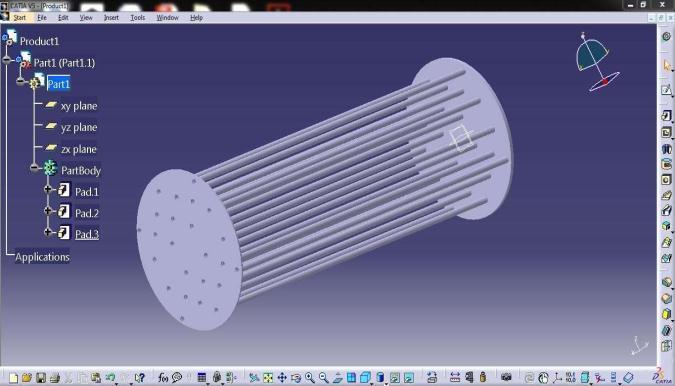
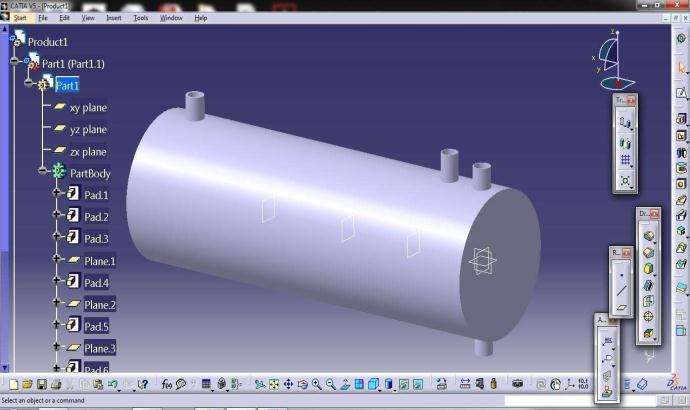
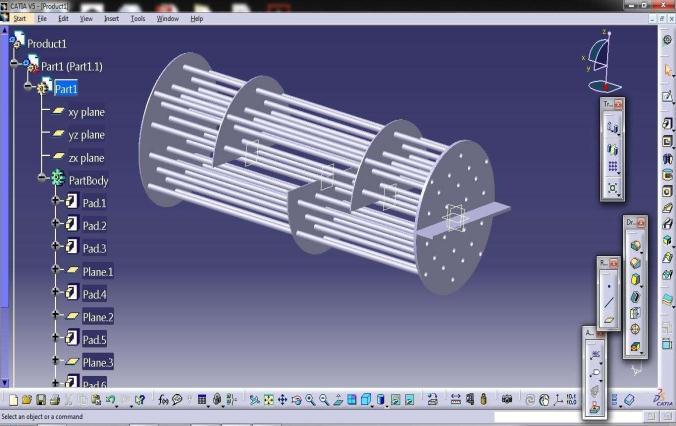
TocreatetheheatexchangerCATIAV5-6R2015softwareis used.Heretheheatexchangermainlyconsistsoftwoparts, they are, one is pipes, second one shell, All these are individualcomponents
Fig.2:coldandhotfluidseparateplate
Fig.1:Extrudedpartofcircularpipes
Fig.3.3:shellandpipeassemblycreatedinCATIA
The total assembly for in line arrangement of tubes is imported to SOLIDWORKS FlowsimulationfromCATIAas showninfig
Somepresumptionshavebeenconsideredduringthecourse ofcalculations,suchastheshellinletwatertemperatureis assumed to be constant value of 55ºC and speed taken as 0.116m/sec, respectively, expect for the part in which the effect ofchanges in the conditions of theinlet air has been investigated. Mass flow rate of the coolant (nano fluid) is assumedtobedifferentspeedssuchas0.2,0.4,0.6,0.8and
International Research Journal of Engineering and Technology (IRJET) e-ISSN: 2395-0056
Volume: 10 Issue: 01 | Jan 2023 www.irjet.net p-ISSN: 2395-0072
1m/secanditsinputtemperaturehasbeenconsidered 30ºC. Alltheinvestigationshavebeencarriedoutinthedomainof 0to5%ofvolumefractionofnanoparticles.
If we increase the velocity of the fluid, outer pipe outlet temperaturealsodeceases.Aswellaseffectiveness,overall heattransferofheatexchangerincreaseslinearlyandfriction factor reduces continuously. Three volumes of concentrations, Al2O3, SiO2 nano particles are mixed with waterandsentthroughouterpipe.
Effectiveness and overall heat transfer has increased if we usedthenanoparticles.Frictionfactorisslightlydecreased innanoparticles.Ifweincreasethevolumeofconcentration, performance of heat transfer also increases. When we compare Al2O3and SiO2 nano particles, effectiveness and overallheattransferinAl2O3ismoretothatofSiO2.InAl2O3, whenvolumeofconcentrationisincreasedfrom1%to3%, 22% overall heat transfer is improved, likewise; from 3%, 33%ofheattransferisincreased.
comparingwithSiO2,Al2O3 has56moreoverallheattransfer andeffectiveness.Fromtheaboveresults,waterwithAl2O3


The above graph shows between velocity and effectiveness. The velocity is shown in x- direction and effectivenessiny-direction.Inthegraphthevelocitystarts from0.2andtheeffectivenessstartsfrom0.75andstartedto increase on 0.4 of velocity and 0.2 of effectiveness. When thereisaneffectivenessof0.21ithasthevelocityof0.6.With of increase of velocity increase of 0.8 there is a gradual increaseof0.22ofeffectiveness.Withtheincreaseof0.23of effectivenesstheincreaseofvelocitywillbeThegraphshown intheaboveisaboutoverallheattransferinrelatedtothe velocity.Theoverallheattransferisshowntheabovegraphis iny-directionandthevelocityisinx-direction.Thegraph hereshowsthegradualincreaseofoverallheattransferwith respect to that of the velocity. With the velocity of 0.2 the overallheattransferis1320.Whenthevelocityisincreased to0.4theoverallheattransferis1400.Withtheoverallheat transferof1445thevelocitywillbe0.6.Underthevelocityof 0.8theoverallheattransferis1500.Ifthevelocityisincrease to1theoverallheatfactoris1548.
Inthispresentwork,shellandtubeexchanger analysis has been performed using different fluids with respecttovariousvelocities.Initiallytotalgeometricmodel iscreatedinCATIAsoftwarebyconsideringalldimensions frompreviousreviewedarticle.Here55degreecentigrade temperature has taken as inlet of shell and 30 degrees centigrade for tubes. In this work, inside fluid velocity is taken as a constant i.e. 1m/sec and outerfluid velocityis changingfrom0.16m/secto1m/sec.
There are different nano particles available in the market, usingthose,wecanimprovetheperformance.Byincreasing the coil diameter, we can analyze the performance. Pitch value
nanoparticlesispreferredasoptimumfluidstoimprovethe performanceoftubeintubehelicalcoilheatexchangers. andouterdiameterofcoilarevariedandthesetypeof heatexchangerperformancecanbeincreased.
[1]KotcherlaSriharsha,VenkataRameshMamillaandM.V. Mallikarjun”StrengthAnalysisofTubetoTubeSheetJointin ShellandTubeHeatExchanger”
[2] Hardik.B.Patel, N.S.Mehta “OPTIMUM INLET TEMPERATURESINSHELLANDTUBECONDENSERUSING EXERGYMETHOD”
[3]PrashantSharma,SPSRajput,MukeshPandey”Energy destructionanalysisofX-typ
[4].Naraki,M.,Peyghambarzadeh,S.M.,Hashemabadi,S.H., Vermahmoudi,Y.,“Parametricstudyofoverallheattransfer coefficient of CuO/water nanofluids in a car radiator”, InternationalJournalofThermalSciences,Vol.66,2013,pp. 82-90.
[5] Singh, D., Toutbort, J., Chen, G.,“Heavy vehicle systems optimization merit review and peer evaluation”, Annual Report,ArgonneNationalLaboratory,2006.
[6]Hwang,Y.,Lee,J.K.,Lee,C.H.,Y.M.Jung,Y.M.,Cheong,S. I., Lee, C. G., “Stability and Thermal Conductivity CharacteristicsofNanofluids”,Thermo chimicaActa,2007, pp:
International Research Journal of Engineering and Technology (IRJET) e-ISSN: 2395-0056 Volume: 10 Issue: 01 | Jan 2023 www.irjet.net p-ISSN: 2395-0072
[7] Mintsa, H. A., Roy, G., Nguyen, C. T., Doucet, D., “New temperaturedependentthermalconductivitydataforwater basednanofluids”,InternationalJournalofThermalSciences,
[8]Yu,W.,France,D.M.,Smith,D.S.,Singh,D.,Timofeeva,E. V., Routbort, J. L.,“Heat transfer to a silicon carbide/water nanofluid”,InternationalJournalofHeatandMassTransfer”, Vol.52,Issue16,2009,pp.3606-3612.
[9] Kim, D., Kwon, Y., Cho, Y., Li, C., Cheong, S., Hwang, Y., “Convectiveheattransfercharacteristicsofnanofluidsunder laminar and turbulent flow conditions”, Current Applied Physics,Vol.9,Issue2,2009,pp.119-123.
[10] PonnusamySelvakumar, sivansuresh, “Enhancing performanceofaradiatorofelectroniccoolingsystemusing carbon nanotubes as a base fluid”. IEEE, vol52pp-46734680,2012.
[11]Yu,W.,France,D.M.,Smith,D.S.,Singh,D.,Timofeeva,E. V., Routbort, J. L.,“Heattransfer to a silicon carbide/water nanofluid”,InternationalJournalofHeatandMassTransfer”, Vol.52,Issue16,2009,pp.3606-3612.
[12]Kim, D., Kwon, Y., Cho, Y., Li, C., Cheong, S., Hwang, Y., “Convectiveheattransfercharacteristicsofnanofluidsunder laminar and turbulent flow conditions”, Current Applied Physics,Vol.9,Issue2,2009,pp.119-123.