
International Research Journal of Engineering and Technology (IRJET) e-ISSN:2395-0056
Volume:12Issue:06 |Jun 2025 www.irjet.net p-ISSN:2395-0072
International Research Journal of Engineering and Technology (IRJET) e-ISSN:2395-0056
Volume:12Issue:06 |Jun 2025 www.irjet.net p-ISSN:2395-0072
AshviniKurhe
kurheashvini3@gmail.com
SakshiChandre dipakchandre1978@gmail.com
Abstract
SnehaThete
snehathetethete@gmail.com
KomalDandge Komal.dandge@gmail.com
This paper talks about how wearable health monitoring systems have improved over time. These devices could only check one health signal,butnow they can track many things atonce and are much smarter and cheaper.Over the years, these systems have become smaller, more accurate, and packed with more features. For example, modern smartwatches like the Apple Watch can track heart rate, breathing, walking, and even send health alerts. Today’s smartphones can also measure things like body temperature, heart rate, calories burned, stress levels, and more using apps. They can even connect with doctors through mobile networks or the internet (IoT). One of the most advanced systems today is called WISE, which uses small body sensors and the internet to monitor health from anywhere. In the future, these wearable devices will become even more powerful and connected.
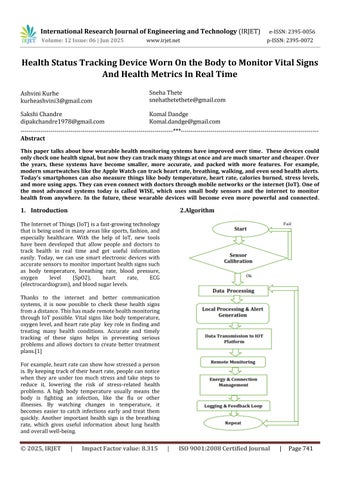
TheInternetofThings(IoT)isafast-growingtechnology thatisbeingusedinmanyareaslikesports,fashion,and especially healthcare. With the help of IoT, new tools have been developed that allow people and doctors to track health in real time and get useful information easily. Today, we can use smart electronic devices with accuratesensorstomonitorimportanthealthsignssuch as body temperature, breathing rate, blood pressure, oxygen level (SpO2), heart rate, ECG (electrocardiogram),andbloodsugarlevels.
Thanks to the internet and better communication systems, it is now possible to check these health signs fromadistance.Thishasmaderemotehealthmonitoring through IoT possible. Vital signs like body temperature, oxygenlevel,andheartrateplay keyroleinfindingand treating many health conditions. Accurate and timely tracking of these signs helps in preventing serious problems and allows doctors to create better treatment plans.[1]
Forexample,heartratecanshowhowstressedaperson is.Bykeepingtrackoftheirheartrate,peoplecannotice when they are under too much stress and take steps to reduce it, lowering the risk of stress-related health problems. A high body temperature usually means the body is fighting an infection, like the flu or other illnesses. By watching changes in temperature, it becomes easier to catch infections early and treat them quickly. Another important health sign is the breathing rate, which gives useful information about lung health andoverallwell-being.
International Research Journal of Engineering and Technology (IRJET) e-ISSN:2395-0056
Volume:12Issue:06 |Jun 2025 www.irjet.net p-ISSN:2395-0072
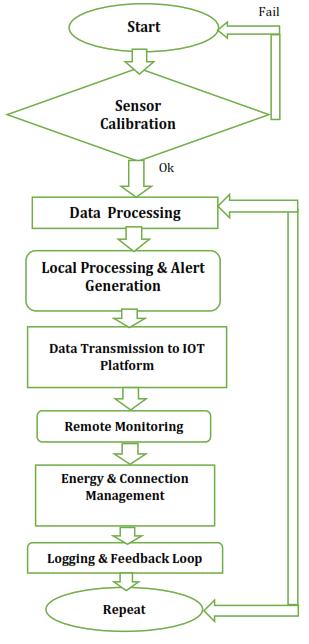
1 Initialization
Power on the wearable device .Initialize all connected sensors (e.g., heart rate, temperature, SpO₂, accelerometer).Establish connection with the IoT module (e.g.,Wi-Fi,Bluetooth,orLoRa).
2.SensorCalibrationandSelf-Check
Perform sensor calibration if required. Run a selfdiagnostic check for sensor functioning and connectivity. Displaystatus(OK/FAIL)foreachcomponent.
3. DataPreprocessing
Filter raw signals to remove noise (e.g., using a low-pass filter).Normalize data for standard range representation. Detectanomaliesorspikesusingthresholdlogicormoving average.
4. Local Processing and Alert Generation Analyze preprocesseddata:
Check if any health parameters exceed safe limits. If abnormal conditions are detected (e.g., high fever, low SpO₂),triggeranalert.Generateavibrationorsoundsignal tonotifytheuserlocally(ifrequired).
5. DataTransmission toIoTPlatform
Packagehealthdataintoastructuredformat(e.g.,JSON or MQTT payload).Securely transmit the data to a cloud serverormobileappviatheIoTmodule.
6.Remote Monitoring
Enable visualization via dashboards (e.g., real-time charts).Allowremoteaccessbyhealthcareprofessionalsor caregivers.
7.EnergyandConnection Management
Monitor battery status and enable power-saving mode if needed. If connection is lost then reconnect it. Send alerts totheuserifthebatteryisloworsensormalfunctions.
8.LoggingandFeedbackLoop
Save periodic data logs locally or remotely for long-term analysis. Update firmware or configuration settings remotelyifneeded.
9.Repeat
Continue data acquisition and monitoring in a loop until thedeviceisturnedoff.
3.Block Diagram



Sensor Layer Processing Unit Communication Module Power Supply User Interface Cloud Storage & Analytics



Wearable health monitoring system is designed to continuously monitor vital health parameters and transmit the data to healthcare providers or cloud storageforreal-timeanalysisandlong-termtracking.
1.SensorLayer
These sensors are responsible for collecting physiologicaldatafromtheuser:
Heart Rate Sensor: Measures the user's heartbeats per minute.
TemperatureSensor:Monitorsbodytemperature.
SpO₂Sensor:AnSpO₂sensorisusedtomeasurethelevel ofoxygensaturationintheblood
2.ProcessingUnit
Microcontroller (e.g., ESP32, Arduino Nano): Aggregates andprocessessensordata.
Analog-to-DigitalConverter(ADC):Convertsanalogform fromsensorstodigitalform.
3.CommunicationModule
Handles data transmission to external devices or cloud services:
Wi-Fi Module (e.g., ESP8266): Enables wireless data transmission.
Bluetooth Module (e.g., HC-05): Allows short-range communicationwithsmartphonesortablets.
4.PowerSupply
Providesnecessarypowertothesystemcomponents: Rechargeable Battery: Supplies power to the entire system.
Power Management Circuit: A power management circuit is responsible for maintaining a stable voltage
International Research Journal of Engineering and Technology (IRJET) e-ISSN:2395-0056
Volume:12Issue:06 |Jun 2025 www.irjet.net p-ISSN:2395-0072
level and distributing electrical power efficiently to variouscomponentsofasystem
5.UserInterface
Displaysreal-timedataandsystemstatustotheuser: OLED/LCDDisplay:Showsvitalsignsandalerts.
LED Indicators: Provide visual cues for system status (e.g.,batterylow,datatransmission).
6.CloudStorage&Analytics
Stores and analyzes the collected data for long-term monitoring:
CloudServer:Receivesdatafromthewearabledevice.
Data Analytics Platform: Processes data to identify healthtrendsandanomalies.
4. System Requirement
4.1 Hardware Requirements
Microcontroller/ MicroprocessorUnit
Low-power, compact unit (e.g., ESP32, Arduino Nano, or ARM Cortex-M series) Integrated WiFi/Bluetooth for IoT communication Adequate GPIOpinsforsensorconnections
Sensors
HeartRateSensor(e.g.,MAX30102 Orpulsesensor)BodyTemperature
SensorSpO₂Sensor(e.g., MAX30100/30102)MotionSensor (e.g.,MPU6050accelerometerand gyroscope)
CommunicationModule
Built-inorexternalmodulefor wirelessdatatransmissionWi-Fi (ESP8266/ESP32),Bluetooth(HC05/HC-06),LoRaorZigBeefor long-rangeoptions
PowerSupply
RechargeableLi-ionorLi-Pobattery (3.7V)Batterymanagementsystem (BMS)forsafechargingand discharging.
Display Unit(Optional)
OLEDorLCDscreenforlocalhealth datadisplay
Vibration Motor/ Buzzer(Optional)
Forlocalalertnotificationsincaseof abnormalreadings
Enclosure
Sweat-proof,lightweight,flexible materialsuitableforwearables
4.2Software Requirements
EmbeddedSoftware
Programmingenvironment:Arduino IDE,PlatformIO,orESP-IDFRealTimedataacquisitionandprocessing codeSensordriverlibraries,Error handlinganddatavalidation
IoTCommunicationProtocols
MQTT/HTTP/CoAPforcloud communicationTLS/SSLsupportfor securedatatransfer
CloudPlatform
Support for real-time data visualization and remote access Things peak, Blynk, Firebase, or AWS IoT CoreDatabaseforstoringuserhealthrecords
Mobile/Web Interface(Optional)
Android/iOS app or web dashboard for real-time monitoringPushnotificationsforcriticalalerts
4.3Functional Requirements
Accurate real-time monitoring of biometric parameters
Wireless data transmission to cloud or mobile device
Useralertsystemforabnormalhealthconditions
Securestorageandvisualizationofhealthrecords
Continuousoperationwithpoweroptimization
5. System Development
5.1 System Architecture
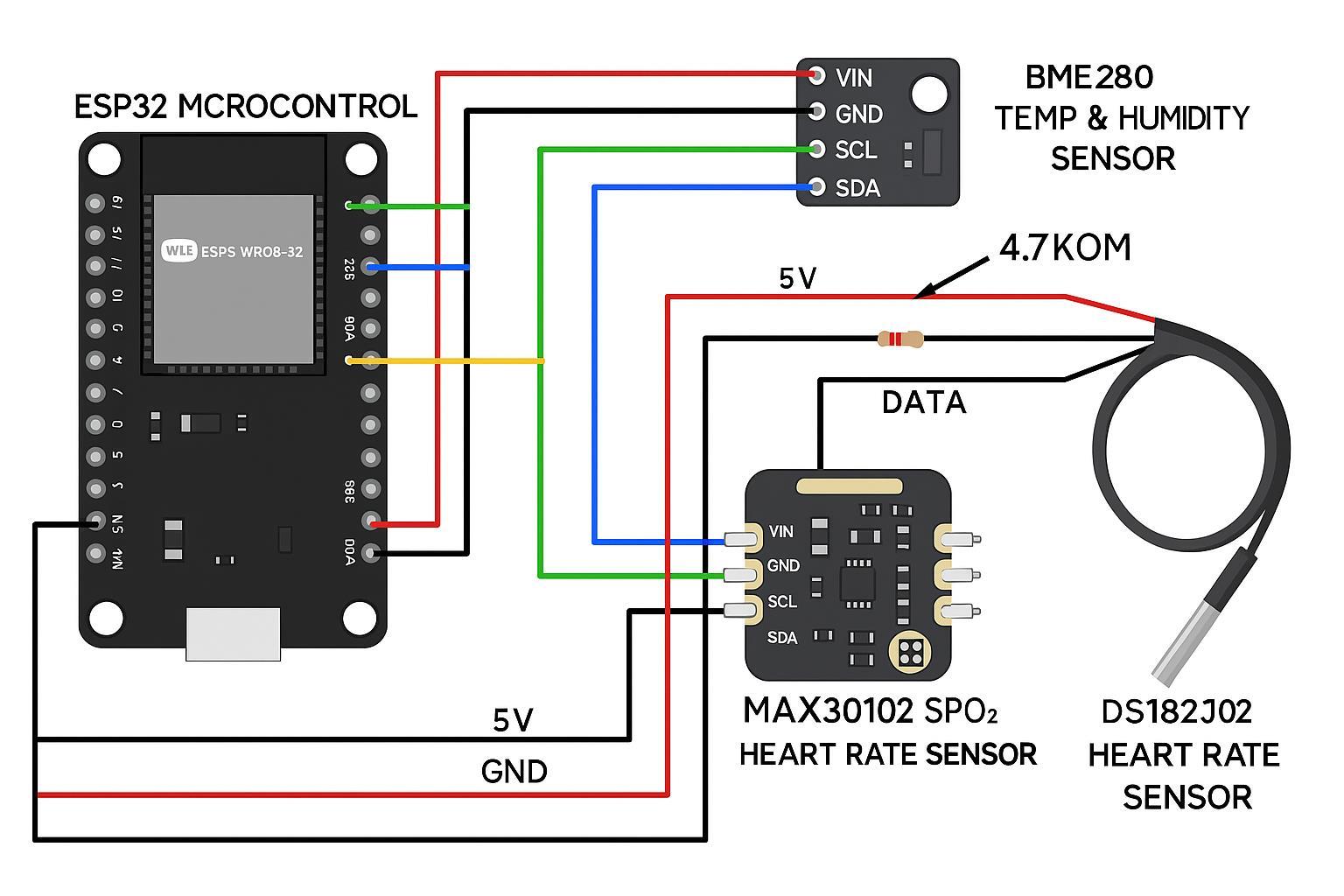
The wearable health monitoring system is structuredaroundtheESP32microcontroller,which servesasthecentralprocessingandcommunication unit. This microcontroller is responsible for acquiring sensor data, processing it, and transmitting the results to external devices or platforms. The architecture includes three primary sensors: the BME280 for measuring ambient
International Research Journal of Engineering and Technology (IRJET) e-ISSN:2395-0056
Volume:12Issue:06 |Jun 2025 www.irjet.net p-ISSN:2395-0072
temperature and humidity, the MAX30102 for capturing heart rate and blood oxygen levels, and the DS18B20 for precise body temperature sensing. These sensors are connected to the ESP32 using digital communication protocols, primarily I2C for the BME280 and MAX30102, and a single-wire interfacefortheDS18B20,whichisstabilizedwitha pull-up resistor. Power is distributed from a common 3.3V and 5V supply depending on the requirements of each sensor. The ESP32 reads and interprets the sensor data and can wirelessly transmit this information via its built-in Wi-Fi or Bluetoothmoduleforreal-timemonitoring,alerts,or cloud storage. This modular and low-power architecturemakesitsuitableforcompact,wearable applications in health tracking and remote diagnostics.
5.2 WorkingProcedure
1.Power Supply Activation
The system is powered using a battery or USB source, supplying 3.3V or 5V to the ESP32 microcontrollerandsensors.
2.Sensor Initialization
Once powered, the ESP32 initializes all connected sensors including the MAX30102 (heart rate and SpO₂), BME280 (temperature and humidity), and DS18B20 (body temperature).
3.DataCollection
The MAX30102 detects pulse and blood oxygen level using optical signals.The DS18B20 captures skin/body temperature via a digital one-wire interface.The BME280 monitors ambient temperature and humidity using I2C communication.
4.DataProcessing
The ESP32 reads sensor outputs, filters any noise, and formats the data into meaningful healthmetrics.
5. Data Display (Optional)
If a display (like OLED) is connected, the ESP32 shows real-time sensor values for user reference.
6.Wireless Communication
The ESP32 sends processed data via Wi-Fi or Bluetooth to a mobile app, cloud server, or monitoringplatform.
7.Continuous Monitoring
This cycle repeats continuously, enabling realtime, non-stop health tracking in a compact, wearableformat.
International Research Journal of Engineering and Technology (IRJET) e-ISSN:2395-0056
Volume:12Issue:06 |Jun 2025 www.irjet.net p-ISSN:2395-0072
5.3Code
#include<Wire.h>
#include<Adafruit_BME280.h>
#include<OneWire.h>
#include<DallasTemperature.h>
#include"MAX30105.h"
#defineONE_WIRE_BUS15
Adafruit_BME280bme; OneWireoneWire(ONE_WIRE_BUS); DallasTemperatureds18b20(&oneWire); MAX30105max30102;
voidsetup(){
1. Cloud Connectivity
Real-time syncing of health data to cloud platforms for remote access by doctors or family.
2. Emergency AlertSystem
Automatic alerts (SMS/call) to emergency contactsifabnormalreadingsaredetected.
3. GPSIntegration
Track patient location during emergencies for fasterresponse.
4. Improved SensorTechnology
Use of flexible, skin-friendly, and more accurate sensorsforenhancedusercomfort.
5. BatteryOptimization
Longer battery life and use of solar or kinetic chargingmethodsforextendeduse.
6. Mobile AppSynchronization
Real-time health monitoring through connected smartphoneappswithtrendtracking.
7. DataSecurity &Encryption
Strong data protection to ensure user privacy duringtransmissionandstorage.
8. Multi-ParameterMonitoring
voidloop(){ ds18b20.requestTemperatures(); floatbodyTemp=ds18b20.getTempCByIndex(0); floatenvTemp=bme.readTemperature(); floathumidity=bme.readHumidity(); longirValue=max30102.getIR();
Serial.print("Body Temp: "); Serial.print(bodyTemp); Serial.println("°C"); Serial.print("Ambient Temp: "); Serial.print(envTemp); Serial.println("°C");
Serial.print("Humidity: "); Serial.print(humidity); Serial.println("%"); Serial.print("IRSignal:");Serial.println(irValue);
Serial.begin(115200); Wire.begin(); bme.begin(0x76); ds18b20.begin(); max30102.begin(); max30102.setup(); } delay(2000); }
Expansion to include ECG, blood pressure, hydrationlevel,andstressdetection.
9. CompactandLightweightDesign
Further miniaturization to make the device morediscreetandwearablelikeapatchorband.
Thefuturescopeofwearablehealthmonitoringsystems is vast and continuously expanding as technology advances. These systems are expected to become more intelligent, compact, and integrated into daily life. With improvements in sensor accuracy and the incorporation ofAI,futuredeviceswillnotonlymonitorhealthbutalso predictmedicalconditionsbeforesymptomsappear.The integration with telemedicine platforms will allow remoteconsultationsandcontinuouspatientmonitoring, reducing hospital visits. Additionally, personalized health tracking, data sharing with doctors in real time, and increased accessibility to rural or underserved populations will transform healthcare into a more
proactive and preventive model. These devices will also play a crucial role in sports science, elderly care, and
International Research Journal of Engineering and Technology (IRJET) e-ISSN:2395-0056
Volume:12Issue:06 |Jun 2025 www.irjet.net p-ISSN:2395-0072
chronic disease management, making health monitoring moreefficientanduser-friendly
8.Conclusion
The development of a wearable health monitoring systemrepresentsasignificantadvancementinpersonal healthcare technology. By combining compact sensors with powerful microcontrollers like the ESP32, this system enables continuous tracking of vital health parameterssuchasheartrate,bodytemperature,oxygen saturation, and environmental conditions. It empowers individualstomonitortheirhealthinreal-timeandshare critical information with healthcare providers remotely. The system is not only cost-effective and portable but also scalable for future enhancements. With increasing demand for preventive and remote healthcare, such wearable solutions are poised to become an essential partofeverydayhealthmanagement.
References
[1] J. Wan, and A. A. H. Al-awlaqi, "Wearable IoT enabled real-time[45] health monitoring system", J. Wireless Com. Network2018,p.298,2018.
[2] M.W.Woo,J.Lee,andK.Park,"AreliableIoTsystem for personal[46] healthcare devices", Future Gener. Comput. Syst., vol. 78, pp.
[3] A.M. Rahmani, S. Bayramov, and B. Kiani Kalejahi, “Internet of things applications: opportunities and threats,”WirelessPers.Commun.vol.122,no.1,pp.451476,2022.
[4] G. Sreetha and G. Santhiya, “SAFE-ACID: A Novel Security Assessment Framework for Iot Intrusion Detection Via Deep Learning,” International Journal of DataScienceandArtificialIntelligence,vol.02,no.01,pp. 20-26,2024.
[5] Y.Li,R.Huang,J.Zhu,Y.Teng,B.Liu,Z.Lyu,T.Chen, Y. Li, Y. Li, R. Huang, and Y. Li, “Bacterial Infection,” In Radiology of Infectious and Inflammatory Diseases-Vol. 3:HeartandChest,pp.33-60,2023.
[6] M. Alshehri, “Blockchain-assisted internet of things framework in smart livestock farming,” Internet of Things,vol.22,pp.100739,2023.
[7] S.Zafar,N.Iftekhar,A.Yadav,A.Ahilan,S.N.Kumar, and A. Jeyam, An IoT method for telemedicine: Lossless medical image compression using local adaptive blocks. IEEE Sensors Journal, vol. 22, no.15, pp. 15345-15352, 2022.
[8] K. Paul Joshua and A. Jenice Prabhu, “Efficient Data SearchandRetrievalinCloudAssistedIotEnvironment,” International Journal of Data Science and Artificial Intelligence,vol.02,no.01,pp.01-06,2024.
[9] A. Barua, M.A. Al Alamin, M.S. Hossain, and E. Hossain,“Securityandprivacythreatsfor bluetoothlow energy in iot and wearable devices: A comprehensive survey,”IEEEOpenJ.Commun.
[10] M.R. Rashel, M. Islam, S. Sultana, M.T. Ahmed, T.M.N.U. Akhund, and J.N. Sikta, “Internet of Things platform for advantageous renewable energy generation,” In Proceedings of International Conference on Advanced Computing Applications: ICACA 2021, pp. 107-117,2022.
[11]A.K.Pandey,andW.Patel,“ASmartVehicleControl Remotely using Wifi,” In 2022 11th International Conference on System Modeling & Advancement in ResearchTrends(SMART),pp.1185-1191,2022.
[12] N.D. Mai, H.T. Nguyen, and W.Y. Chung, Deep Learning-based Wearable Ear-EEG Emotion RecognitionSystemwithSuperletsbasedSignal-to-Image Conversion Framework. IEEE Sensors Journal. 2024.