
International Research Journal of Engineering and Technology (IRJET) e-ISSN: 2395-0056
Volume: 12 Issue: 05 | May 2025 www.irjet.net p-ISSN: 2395-0072
International Research Journal of Engineering and Technology (IRJET) e-ISSN: 2395-0056
Volume: 12 Issue: 05 | May 2025 www.irjet.net p-ISSN: 2395-0072
Nouran Y.Mohamed 1
1Sanitary and Environmental Engineering Institute (SEI), Housing and Building National Research Center (HBRC), Egypt ***
Abstract - This research presents an environmentally friendly method for synthesizing silver nanoparticles (AgNPs) by utilizing garlic extract in conjunction with a silvernitratesolution.Thegarlicextractactedasareducing agentandastabilizerinthesynthesisprocess.Theformation ofAgNPswasfirstidentifiedbythecoloredchangesofthe reaction mixture, from colorless to orange, and then eventuallytoadarkbrowncoloration.Theconfirmationof the synthesis and some properties of the resulting nanoparticles was made by various analytical techniques. TheUV-Visspectroscopicanalysis exhibited a maximum absorption between 435 nm, which indicated AgNPs. FTIRanalysisidentifiedfunctionalgroups(hydroxyl,amide, and polysaccharides) involved in the reduction and stabilization of AgNPs. XRD confirmed a crystalline face-centered cubic (FCC) structure,whileTEMrevealedsphericalparticlessized10–30nm. Thiseco-friendlymethodoffersa simple, efficient, and sustainable alternative for producing AgNPs with desirablepropertiesforenvironmentalapplications.
Key Words: (Environmental remediation; climate action; biocompatible agent; nanotechnology;agriculture waste;silvernanoparticles:greenchemistry.
Thereisconsiderableinterestinthescientificcommunity regarding silver nanoparticles because they have distinct physical and chemical properties compared to their bulk materialcounterparts.Withinthedimensionrangeof1-100 nanometers,suchnanoparticlesfabricatedhaveoutstanding properties, such as antimicrobial effectiveness, electrical conductivity, and even optical responsiveness. Their nanoscaledimensionscreateanextraordinarilyhighratioof surface atoms to internal atoms, allowing a dramatic enhancement in their interaction with microbial cell membranes andcatalyzingreactions[1-5].
recent years, green synthesis has emerged as a promising approachfortheproductionofsilvernanoparticles(AgNPs), offering a sustainable and environmentally friendly alternativetoconventionalchemicalandphysicalmethods. Thismethodutilizesbiologicalentities,suchasplantextracts, bacteria, fungi, and even waste products, tomediate the reductionofsilverionsintonanoparticles.Amongthese,the useofplantextractshasgarneredsignificantattentiondueto itsaccessibility,cost-effectiveness,andtheabilitytoscaleup productionprocesses[6].
Garlic(Alliumsativum),inparticular,hasproventobean effectivereducingandstabilizingagentinthegreensynthesis ofsilvernanoparticles.Richinbioactivecompoundssuchas allicin,flavonoids,andthiolgroups,garlicextractfacilitates thereductionofsilverionsandinfluencestheparticlesize andshapeofthesynthesizednanoparticles.[7,8]
Synthesisnotonlyminimizestheuseofharmfulchemicals but also complements the global pursuit of sustainable development. The generated AgNPs exhibit unique physicochemical properties, offering a broad spectrum of applications.
The silver nanoparticles were characterized byvarious analysis techniques. The crystallographic structure of the synthesizednanoparticleswasdeterminedbyXRD,whileUVVis spectroscopy was used to obtain information on the optical characteristics. The elemental composition was studiedbyEDX,whichprovidedafullprofileofthechemical compositionofthenanoparticles[9].
These analytical methods ensure the efficacy of the synthesis process, paving the way for their application in medicine,electronics,andenvironmentalscience.
Garlicplaysacrucialroleinthegreensynthesisofsilver nanoparticles, offering an eco- friendly and sustainable alternative to conventional chemical methods. Its use in nanoparticle synthesis capitalizes on the rich organic compoundspresentingarlic,suchasallicin,flavonoids,and sulfur-containingcompounds,whichactasnaturalreducing andstabilizingagents.Thesebioactivecompoundsfacilitate thereductionofsilverions(Ag+)toelementalsilver(Ag0), formingnanoparticlesintheprocess.
This reduction process is not only efficient but also reducestheneedforhazardouschemicalstraditionallyused in nanoparticle synthesis, minimizing environmental and health-related risks. Moreover, garlic's inherent biocompatibility and biodegradability make it an ideal candidate for medical and pharmaceutical applications of silvernanoparticles,asitenhancestheirantimicrobial and therapeuticproperties.
This eco-friendly approach eliminates the need for hazardous chemicals typically employed in conventional nanoparticle synthesis processes, making it a favorable alternativeinnanotechnologicalapplications[12].
International Research Journal of Engineering and Technology (IRJET) e-ISSN: 2395-0056
Volume: 12 Issue: 05 | May 2025 www.irjet.net p-ISSN: 2395-0072
Garlic (Allium sativum) is a highly efficient biological agentforthegreensynthesisofAgNPs.Garlicextractcontains potent bioactive compounds such as allicin, flavonoids, polyphenols, and sulfur compounds(thiosulfates and thiol groups). These reduction and stabilization capabilities are critical in the process of nanoparticle formation. Bioactive componentsnotonlyhavethecapabilitytoreducesilverions (Ag+) to metallic silver (Ag), but also cap the formed nanoparticlestopreventagglomeration.Allicin,theprincipal activecompoundingarlic,containssulfur-functionalgroups withenergeticreducingproperties,andtheflavonoidsand polyphenols also contribute reduction and stabilization functions.
SomeoftheexistingchallengesinthesynthesisofAgNP fromgarlicincludeachievingfinesizecontrol,nanoparticle stability for long periods, standardization of synthesis protocols to achieve reproducible results, and a full comprehension of the complex reduction mechanisms. Advances have been made in the modification of reaction conditions,suchastemperature,pH,extract concentration, and reaction time, to adjust nanoparticle shape and size distribution.Progresshasalsobeenmadeinhybridmethods where garlic is blended with other natural extracts to generatesynergiesthatpromotenanoparticlecharacteristics.
The rich phytochemistry of garlic not only aids in the reduction process but also stabilizes the resulting nanoparticles.Compoundssuchasthiosulfates,flavonoids, and polyphenols contribute to capping and prevent agglomeration,ensuringthestabilityanduniformityofthe nanoparticles. This inherent stability is crucial for maintainingthefunctionalpropertiesofsilvernanoparticles, which include antimicrobial, anti- inflammatory, and anticanceractivities[13].
The use of garlic as a bioreductant is not only costeffectivebutalsoefficient,astheprocesscanoftenoccurat room temperature and neutral pH, reducing energy consumption and minimizing the environmental impactof nanoparticleproduction.Moreover,thesynthesisprocessis straightforward, allowing for simple scalability from laboratory to industrial levels. Overall, garlic provides a potent,natural,andsustainableoptionforthesynthesisof silvernanoparticles,showcasingthepotentialforintegrating traditional knowledge with advanced technological applications[14,15].
Theprimaryobjectiveofthisstudyistodevelopagreen synthesis method for AgNPs using garlic extract and to evaluate their potential applications in environmental remediation.
In summary, garlic serves as a versatile and environmentally benign agent in the synthesis of silver nanoparticles, driving forward the field of green nanotechnology by marrying the benefits of nature with
advanced material science, and leading to innovative solutionsacrossarangeofapplications[16].
Themajorreagentsandmaterialsusedduringthiswork included analytical-grade silver nitrate provided by Merck andethanolfromtheCHEM-LABCompany.Freshgarlicbulbs used for the extract were procured from the market. Throughout the experimental process, deionized water servedastheprimarysolventandcleaningagent.Toensure experimentalintegrity,alllaboratoryequipmentunderwent thoroughcleaning with deionized water, followed by oven drying,priortouse.
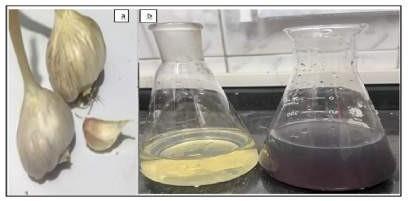
Thefreshgarlicbulbswerecleanedwithdeionizedwater toremovethedirtonthesurface,thenair-driedtoremove excess moisture. The extraction was done with 50 g of crushed garlic, which was subjected to Soxhlet extraction with200mlofethanolina20:1solvent-to-solidratiounder controlledheatingat50°Cuntilthecompleteevaporationof ethanol yielded a concentrated crude extract. The product wastransferredintoamberglassbottlesandstoredat4°C untilfurtheruseinthesynthesisofnanoparticles.
2.3 CharacterizationofSilverNanoparticles
2.4 UV-Vis spectroscopy
Spectroscopic analysis was used to describesilver AgNPs. TheUV-visiblespectrometer(T70+PGInstrumentLtd,United Kingdom)detectsthereductionofsilverionsfrom Ag+toAg withinwavelengthsof300–600nm.
International Research Journal of Engineering and Technology (IRJET) e-ISSN: 2395-0056
Volume: 12 Issue: 05 | May 2025 www.irjet.net p-ISSN: 2395-0072
Measurements were made using a Bruker VERTEX 80 (Germany) spectrometer, with a platinum-diamond ATR accessoryintherangeof4000-400cm⁻;.Themeasurements were performed at room temperature using a spectral resolutionof4cm⁻;andarefractiveindexof2.4.
X-ray diffraction was performed to determine the structureofthestudiedAgNPs.Thesamplesweredriedat 60°C,groundtopassa75µmsieve,andthepreparedsamples wereanalyzedbyXRDtechniqueusingaPhilipsX-rayvertical diffractometer,type PW 1373, Holland. The analysis was conducted using a Ni-filter and Cu-Kα(λ=1.5405Å)at40 kVand40mA.
2.5.2 Transition Electron Microscope (TEM)
TEMwasmeasuredusingHR-TEM,JEM-2100,Jeol,Japan, operatedat200kV.
3. Results and Discussions
3.1 Characterization of Silver Nanoparticles
3.1.1 UV-Vis spectroscopy
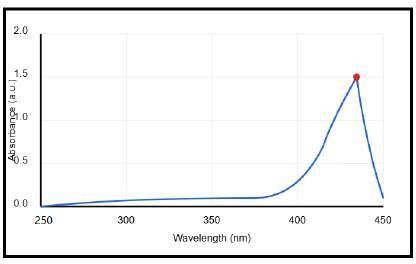
UV-Visspectroscopyreflectedtheplasmonicpropertiesof the silver nanoparticles. The SPR of silver nanoparticles is characterizedbyaclearabsorptionpeakintheregionof435 nm,asdepictedinFigure2.Theexactpositionandshapeof thispeakdependonvariousfactors,suchasthesize,shape, anddistributionofthesilvernanoparticles,andthedielectric constantofthesurroundingmedium.[17]
TheUV-visiblespectralanalysisconfirmedthesuccessful synthesis of silver nanoparticles using garlic extract and silvernitrate,asindicatedbythepresenceofacharacteristic absorptionpeakintheUV-visiblespectrum.
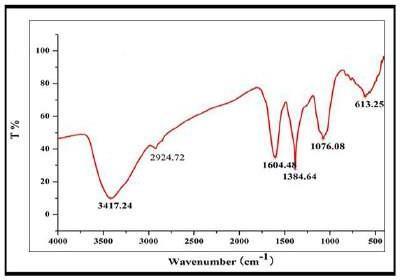
Fouriertransforminfraredspectroscopywasusedforthe identification of the functional groups present on the synthesized silver nanoparticles, as shown in Fig. 3. Characteristic absorption bands were seen to occur at the concerned wavenumber positions in the spectrum. Strong spectralfeaturesat3417.24and2924.72cm⁻;confirmedthe presence of hydroxyl groupsfrom phenolic and carboxylic acids.Wenoticedasharppeakat1604.48cm⁻;,whichwe canattributetothepresenceoftheamideIgroupinpeptide structures. Further spectral analysis revealed a band at 1384.64 cm⁻;, characteristic of in-plane O-C-H bending withincarbohydrateandflavonestructures.Otherpeaks,at 1076.08cm⁻;and613.25cm⁻;,showedthepresenceofC-O stretching and C-H bonding in aromatic structures. This spectral profile, therefore, provides evidence for the involvementofphytochemicalsinplantextractbothforthe reductionandsurfacestabilizationstepsduringthesynthesis [18].
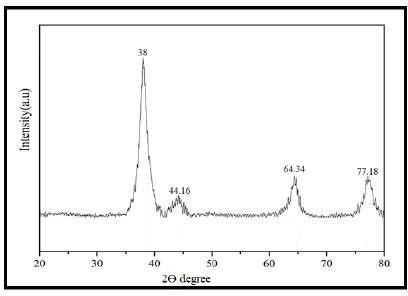
XRDanalysisshowedfourcharacteristicdiffractionpeaks atabout2θ=38.00°,44.16°,64.34°,and77.18°,whichare typical for the FCC structure of silver. Thus, the relatively broad nature of these peaks signifies the nanoscale dimensions of these particles, as expected for small crystalline nanoparticles, while the crystallographic plane correspondingto(111)relatestothestrongestintensitypeak observedintherecordeddiagram,inferringthattheAgNPs producedarecrystallineFCC[19].
International Research Journal of Engineering and Technology (IRJET) e-ISSN: 2395-0056
Volume: 12 Issue: 05 | May 2025 www.irjet.net p-ISSN: 2395-0072
The TEM analysis consistently showed that the silver nanoparticles synthesized using garlic extract and silver nitratewereinthenanoscalerange,withsphericalshapes and nanoparticles size grow in the range of 10 to 30 nm. These characteristics are important for determining the properties and potential applications of the synthesized silvernanoparticles,asshowninFigure5[20].
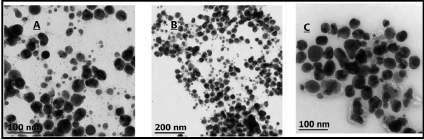
-5:
Together, these characterization techniques confirm the successful synthesis of silver nanoparticles with the desiredpropertiesusinggarlicextract[21,22].
Tobettercontextualizeourfindings,wehavecompileda comprehensivesummaryofthekeycharacterizationresults inTable1, whichillustratestheessential propertiesofthe garlic-mediatedAgNPssynthesizedinthisstudy.
Table 1: Summary of Key Characterization Results for Garlic-MediatedSilverNanoparticles
UV-Vis Spectroscopy
FTIR Spectroscopy
Absorption peak at435 nm
Peaksat3417.24, 2924.72,1604.48, 1384.64,1076.08, and 613.25 cm⁻¹
XRDPeaks at 2θ = 38.00°, 44.16°, 64.34°,and77.18°
TEM Spherical particleswith sizerange11nm
Confirmsformationof AgNPs through surface plasmonresonance
Indicatesinvolvement of hydroxyl, amide, carbohydrate, and aromatic functional groupsinreductionand capping
Confirmsface-centered cubic crystalline structureofAgNPs
Revealsmorphology and size distribution suitable for environmental applications
pH 5.6
Compared to other plant-mediated synthesis methods reportedintherecentliterature,ourgarlic-extractmethod hasseveraladvantages.AscanbeseenfromTable2,garlicmediated synthesis produces AgNPs with comparable or superiorproperties tothosesynthesizedusingotherplant extracts.
Table2:ComparativeAnalysisofAgNPsSynthesized UsingDifferentPlantExtracts
Plant Extract
Morphology Reference
garlic (current study) 11 Spherical Currentwork
Aloevera 15-30 Spherical Vanlalveniet al.(2021)
Neem 10-35 Spherical, irregular Devi et al. (2020)
Lemon 25-50 Spherical, irregular Zheng et al. (2023)
Greentea 20-40 Quasispherical Laib et al. (2023)
ThemechanisticpathwayforthegreensynthesisofAgNPs using garlic extract involves some of the crucial bioactive constituentsincoordination.Allicin(diallylthiosulfinate),the primarybioactivecomponentpresentingarlic,playsacrucial roleinthereductionprocess. The thiosulfinate group (S(O)-S-) in allicin possesses strong reducingproperties,
International Research Journal of Engineering and Technology (IRJET) e-ISSN: 2395-0056
Volume: 12 Issue: 05 | May 2025 www.irjet.net p-ISSN: 2395-0072
which catalyze the reduction of Ag⁺ ions to Ag:. The reaction can berepresentedas:
R-S(O)-S-R' + Ag⁺ → R-S-S-R' + Ag° + oxidation product
Furthermore, organosulfur compounds, such as diallyl disulfide and diallyl trisulfide, also contribute to the reduction process through their sulfhydryl (-SH) groups, which have a strong metal ion affinity. Flavonoids and polyphenols in garlic extract are accountable for both the reduction and stabilization processes. These molecules containhydroxyl(-OH)groupsthatarecapableofdonating electrons for silver ion reduction while simultaneously forming coordinating bonds with the surface of freshly synthesizedsilvernanoparticles.
Stabilization is brought about primarily due to the cappingofthenanoparticlesbyproteinsandpolysaccharides in garlic extract. Capping is aided by FTIR analysis, as the band at 1604.48 cm ¹ signifies involvement by proteins throughamidelinkages, whereasthebandat1076.08cm⁻; signifies involvement by polysaccharides through C- O linkages. This multi-layer organic shell prevents agglomeration through steric and electrostatic repulsion, resulting in the astonishing stability of the AgNPs synthesized.
Thetemperature-dependentsynthesiskineticsobserved in our research (optimum temperature 80°C) could be attributedtoanincreasedfrequencyofcollisionsbetweenthe silverionsandreducingagentsatelevatedtemperatures,and totheenhancedextractionofbioactivecompoundsfromthe garlicmatrix.Thecolortransitionfromcolorlesstoorange and, finally, dark brown is a visible indication of the progressivereductionofthesilverionsandtheformationof morestableandconcentratedAgNPs.
This mechanistic understanding describes not only the greensynthesismechanismbutalsothesynergisticactionof more than one bioactive compound contained in garlic extract,whichisresponsibleforthecontrolledsynthesisof stable AgNPs with a preferred morphology and size distributionforenvironmentalapplications.
Thisstudysuccessfullydemonstratedthegreensynthesis of silver nanoparticles (AgNPs) using garlic extract, with comprehensivecharacterizationconfirmingtheirnanoscale size,sphericalmorphology,crystallinestructure,andsurfacefunctionalized stability. The use of garlic extract as both a reducingandcappingagentoffersaneco-friendlyandcosteffectiveapproachtonanoparticlesynthesis.
ThesynthesizedAgNPsexhibitpropertiesthatmakethem highly promising for a range of practical applications, including antimicrobial coatings, catalytic processes, and
environmentalcleanupeffortssuchaswaterpurificationand pollutant degradation. Their small size and stable surface chemistryenhancetheirfunctionalityinthesefields.
Further studies should focus on evaluating the antimicrobial efficacy of these AgNPs under real-world conditions, particularly in environmental remediation and healthcare settings. In addition, it is crucial to investigate their potential cytotoxicity and ecological impact on nontarget organisms to ensure safe deployment. Long-term stability,scalabilityofthesynthesisprocess,andintegration intocompositematerialsshouldalsobeexploredtoexpand theirindustrialandenvironmentalapplications.
Futureresearchinthefollowingsignificantareasmustbe undertaken:
1- Comprehensive assessment of the antimicrobial propertiesoftheseAgNPsagainstawiderangeof pathogens,includingmultidrug-resistantbacteria.
2- Acritical evaluation of their performance in real environmental remediation conditions, particularlyregardingthedegradationofemerging contaminantsinwastewater.
3- Investigatingtheirpotentialtoxicitytonon-target organisms is crucial for their safe application in environmentalsystems.
4- Optimizationofthesynthesisconditionstoachieve a controlled size distribution and enhanced stabilityfortargetapplications.
5- Synthesis of composite materials incorporating these AgNPs is proposed for enhanced functionality in catalytic and antimicrobial applications.
1 H. Wang et al. / Colloids and Surfaces A: Physicochem.Eng.Aspects256(2005)111–115 doi:10.1016/j.colsurfa.2004.12.058
2 Gharari,Z.;Hanachi,P.;Sadeghinia,H.;Walker,T.R. Eco-Friendly Green Synthesis and Characterization of Silver Nanoparticles by Scutellaria multicaulis Leaf Extract and Its Biological Activities. Pharmaceuticals 2023, 16, 992.https://doi.org/10.3390/ph16070992.
3 Kumari Jyoti, Punyasloka Pattnaik and Tej Singh Green Synthesis of Silver Nanoparticles Using Sustainable Resources and their Use as AntibacterialAgents:AReviewVolume14,Issue 1, 2021 . DOI:10.2174/2666145413666201207204617
International Research Journal of Engineering and Technology (IRJET) e-ISSN: 2395-0056
Volume: 12 Issue: 05 | May 2025 www.irjet.net p-ISSN: 2395-0072
4 P.Wilson1,S.Venkateshwari;InternationalJournal for Research in Applied Science & Engineering Technology (IJRASET) ISSN: 2321-9653; IC Value:45.98; SJ Impact Factor: 7.538 Volume 10 Issue VII July 2022https://doi.org/10.22214/ijraset.2022.45843.
5 L. David and B. Moldovan, “Green synthesis of biogenicsilvernanoparticlesforefficientcatalytic removalofharmfulorganicdyes,”Nanomaterials, vol.10,no.2,2020,doi:10.3390/nano10020202
6 M. del Carmen Travieso Novelles et al., “Biosynthesisoffluorescentsilvernanoparticles fromLeeacoccinealeavesandtheirantibacterial potentialities against Xanthomonas phaseoli pv phaseoli,” Bioresour. Bioprocess., vol. 8, no. 1, 2021,doi:10.1186/s40643-020-00354-2
7 S.AneesAhmadetal.,“Bactericidalactivityofsilver nanoparticles:Amechanisticreview,”Mater.Sci. Energy Technol., vol. 3, pp. 756–769, 2020, doi: 10.1016/j.mset.2020.09.002
8 S.Jebril,R.KhanfirBenJenana,andC.Dridi,“Green synthesis of silver nanoparticles using Melia azedarach leaf extract and their antifungal activities: Invitroandinvivo,”Mater.Chem. Phys.,vol.248,no.December2019,2020,doi: 10.1016/j.matchemphys.2020.122898
9 DittaSA,YaqubA,UllahR,TanvirF(2021) Evaluationofaminoacidscappedsilver nanoconjugatesforthealteredoxidativestress andantioxidantpotentialinalbinomice.JMater Res.https://doi.org/10.1557/s43578-02100427-8
10 R.Ullah,A.Yaqub,S.A.Ditta,F.Tanvir,M.Bilal,S. Ali & K. M. Anjum; Synthesis of silver nanoparticlesandtheiruseinthedegradationof methylene blue dye and evaluation of in vitro antioxidant activity: a step toward sustainability;2024;International Journal of Environmental Science and Technology https://doi.org/10.1007/s13762-024-05782-7.
11 Ditta SA, Yaqub A, Ullah R, Tanvir F (2021) Evaluation of amino acids capped silver nanoconjugates for the altered oxidative stress andantioxidantpotentialinalbinomice.JMater Res. https://doi.org/ 10.1557/s43578-02100427-8
12 VanlalveniC,LallianrawnaS,BiswasA,SelvarajM, ChangmaiB,RokhumSL.Greensynthesisofsilver nanoparticles using plant extracts and their antimicrobial activities: a review of recent
2025, IRJET | Impact Factor value: 8.315 | ISO
literature. RSC Adv. 2021;11(5):2804-2837. doi:10.1039/D0RA09941D
13 Eid MM. Characterization of Nanoparticles by FTIR and FTIR-Microscopy. Handb Consum Nanoproducts. Published online 2021:1-30. doi:10.1007/978-981-15-6453-6_89-1
14 Zheng T, Ouyang S, Zhou Q. Synthesis, characterization,safetydesign,andapplicationof NPs@BC for contaminated soil remediation and sustainable agriculture. Biochar 2023 51. 2023;5(1):1-31.doi:10.1007/S42773-022-001983
15 LaibI,DjahraAliB,BoudebiaO.Greensynthesisof silver nanoparticles using Helianthemum lippii extracts (Hl-NPs): Characterization, antioxidant and antibacterial activities, and study of interaction with DNA. J Organomet Chem. 2023;986. doi:10.1016/j.jorganchem.2023.122619
16 DeviM,DeviS,SharmaV,RanaN,BhatiaRK,Bhatt AK.Greensynthesisofsilvernanoparticlesusing methanolic fruit extract of Aegle marmelos and their antimicrobial potential against human bacterial pathogens. J Tradit Complement Med. 2020;10(2):158-165 doi:10.1016/J.JTCME.2019.04.007
17 AliMH,AzadMAK,KhanKA,RahmanMO,Chakma U, Kumer A. Analysis of Crystallographic StructuresandPropertiesofSilverNanoparticles Synthesized Using PKL Extract and Nanoscale Characterization Techniques. ACS Omega. 2023;8(31):28133-28142. doi:10.1021/ACSOMEGA.
18 Mihailović V, Srećković N, Nedić ZP, et al. Green Synthesis of Silver Nanoparticles Using Salvia verticillata and Filipendula ulmaria Extracts: Optimization of Synthesis, Biological Activities, andCatalytic Properties.Molecules.2023;28(2). doi:10.3390/MOLECULES28020808
19 Patel SG, Patel NK. Biogenic synthesis of silver nanoparticles and investigation of antibacterial activity from leaves of Duranta erecta. Egypt J Agric Res. 2023;101(1):4-12. doi:10.21608/EJAR.2022.151716.1252
20 Raj S, Trivedi R, Soni V. Biogenic Synthesis of SilverNanoparticles,CharacterizationandTheir Applications-AReview.Surfaces.2021;5(1):67-90. doi:10.3390/SURFACES5010003
International Research Journal of Engineering and Technology (IRJET) e-ISSN: 2395-0056
Volume: 12 Issue: 05 | May 2025 www.irjet.net p-ISSN: 2395-0072
21 Hou T, Guo Y, Han W, et al. Exploring the BiomedicalApplicationsofBiosynthesizedSilver NanoparticlesUsingPerillafrutescensFlavonoid Extract: Antibacterial, Antioxidant, and Cell Toxicity Properties against Colon Cancer Cells. Molecules. 2023;28(17). doi:10.3390/MOLECULES28176431
22 AsifM,YasminR,AsifR,AmbreenA,MustafaM, Umbreen S. Green Synthesis of Silver Nanoparticles (AgNPs), StructuralCharacterization,andtheirAntibacterial Potential. Dose-Response. 2022;20(2):1-11. doi:10.1177/15593258221088709
BIOGRAPHIES

Over ten-years of scientific career in Sanitary&environmentalInstitute(SEI) at Housing and Building National ResearchCenter(HBRC)withacademic excellence and scientific success certificate. Experience gained from several projects in field of water and wastewateranalysisandwaterquality assessment, Lecturer director in differenttrainingcourses.Theresearch interestscovertreatmentofwaterand wastewaterusingdifferenteco-friendly and law cost environmental materials includingbiological,chemical,physical andmathematicalmodeling
2025, IRJET | Impact Factor value: 8.315 |