
International Research Journal of Engineering and Technology (IRJET) e-ISSN: 2395-0056
Volume: 12 Issue: 05 | May 2025 www.irjet.net p-ISSN: 2395-0072
International Research Journal of Engineering and Technology (IRJET) e-ISSN: 2395-0056
Volume: 12 Issue: 05 | May 2025 www.irjet.net p-ISSN: 2395-0072
Yashashvi Appaji Patil Data Science
Usha Mittal Institute of Technology, Mumbai, Maharashtra
Riya Rajesh Prajapati Data Science
Usha Mittal Institute of Technology, Mumbai, Maharashtra
Mohan Bonde HOD of Data Science
Usha Mittal Institute of Technology,
Mumbai, Maharashtra ***
Abstract “The measure of life is not its duration but its donation.” Organ donation is a vital medical practice involving the transfer of organs and tissues from one individual to another in critical need. With thegrowing gap between the number of patients awaiting transplants and the limited availability of donated organs, the importance of organ donation has become more pronounced than ever. The demand for organs continuestorise,whilethesupplyremainssignificantly low. This imbalance underscores the urgent need to increase awareness and participation in organ donation programs.Living donorsplay akeyrole,often donating a kidney or part of the liver, while deceased donors can contribute essential organs such as the heart, lungs, kidneys, pancreas, and intestines. A successful transplant depends heavily on accurate donor-recipient matching, making organ donation a highly specialized field. However, despite its significance, public understanding of the process remains limited. Misconceptions, ethical concerns, and widespread myths contribute to scepticism and hesitation among potential donors. Addressing these barriers through education, awareness campaigns, and transparent communication is essential. Encouraging informed participation and building trust within the community are crucial steps toward bridging the gap between organ supply and demand. By fostering a cultureofdonation,healthcaresystemscanmovecloser to saving more lives and improving the overall effectivenessoforgantransplantationprograms
Keywords Organ donation, public awareness, Misconceptions,Registrationprocess.
Organ donation is a life-saving medical procedure whereinorgansortissuesaretransplantedfromadonor either living or deceased into a recipient suffering from end-stageorgan failureor irreversible damage.Thisact of donation has the potential to save multiple lives and significantly improve the quality of life for affected individuals.
Pooja Varma Data Science
Usha Mittal Institute of Technology, Mumbai, Maharashtra
The history of organ transplantation dates back to the early 20th century, with a major milestone occurring in 1954 when the first successful kidney transplant was performed between identical twins. Another landmark moment came with the development of immunosuppressive drugs in the 1960s, which made transplants viable even when there were genetic differences between donor and recipient. These advancements greatly increased transplant success rates andexpandedthescopeoforgantransplantation.
To ensure ethical practices and prevent illegal activities, several countries introduced legislation to regulate organ donation. The United States enacted the Uniform Anatomical Gift Act in 1968, and India followed withtheHumanOrganTransplantationActin1994.These laws have helped foster transparency and build public trustinthedonationsystem.
Despite technological and medical advances, a significant gap persists between the number of patients needing organ transplants and the availability of donated organs. Living donors can donate a kidney or a portion of the liver, while deceased donors can contribute multiple organs such as the heart, lungs, kidneys, pancreas, intestines, and various tissues. However, successful transplantation relies heavily on compatibility between donorandrecipient,makingthematchingprocesscomplex andcritical.
Public misunderstanding, misinformation, and ethical concerns continue to hinder wider participation in organ donation. Myths and misconceptions often lead to confusion and hesitation among potential donors. Therefore, raising awareness and promoting accurate knowledge is essential to encourage informed choices and activeparticipation.
A dedicated and informative website can serve as an effective platform to address these challenges. By offering clear, accessible information and an intuitive interface, such a platform can help users understand the organ donation process, register as donors, and engage with the systemconfidently.
International Research Journal of Engineering and Technology (IRJET) e-ISSN: 2395-0056
Volume: 12 Issue: 05 | May 2025 www.irjet.net
This section includes citations to all the relevant past literature that uses various techniques for the Organ Donationwebsite
A Decentralized and Cooperative Approach to Organ Donation Management Using Ethereum Blockchain (2024), see[1]
This study leverages Ethereum blockchain technology to enhance transparency, security, and efficiency in organ donation management through smart contracts and decentralizedapplications.Itensuresdataintegrity,donorrecipient matching, and privacy protection using SHAbased cryptographic algorithms and secure hashing.The tamper-proof storage mechanism strengthens trust and sustainability.However, challenges remain in untested smart contracts and scalability due to data constraints, indicating the need for further exploration of its feasibility inlarge-scaleimplementations.
Secure Data Protection for Organ Donation Using Blockchain Technology (2024), see [2]
This study explores the role of blockchain technology in ensuring secure, private, and transparent organ donation transactions through encryption, which enforces immutability.Key features include controlled access, restricted modifications, and faster transaction execution.By regulating donors and aligning with legal frameworks, the system enhances scalability and trust.Integration with the Data Encryption Standard further strengthens security and data integrity.However, challenges persist intermsof development costs, technical complexities, scalability, and regulatory compliance, highlighting the need for further advancements before widespreadadoption.
Enhancing Organ Donation Through Blockchain Technology (2024), see [3]
This study explores how blockchain improves the organ donation process by leveraging decentralization, transparency, and smart contracts.Key advancements include decentralized identity management, data encryption, AI integration, and real-time tracking via IoT, ensuringsecurityandefficiency.Thesystemreducesfraud, preserves privacy, and promotes ethical practices.However, challenges such as regulatory barriers, datasecurityconcerns,andtechnologicalcomplexityhinder widespread adoption.Additionally, scalability limitations, interoperability issues, and high implementation costs make the integration of electronic health records (EHRs) particularlydifficultforsmallerhealthcarefacilities.
“Securing Organ Donation Using Blockchain see [4]”
This methodology employs blockchain to establish a decentralizednetworkofconnectingdonorswithrecipients intransparentandsecureways.Itincludessmartcontracts, RFID tags for tracking organs, and a hospital management interface.The system improves efficiency and facilitates
p-ISSN: 2395-0072
monitoringthroughmachine-to-machinecommunicationas well as through the automated verification of processes alongthewaytotransplantation.However,dependencyon technology, possible failures with technology, and the simple fact that people don't accept changes easily in the current health system may affect the implementing and adoptingoftheproposedmethodology.
“Blockchain-BasedManagementforOrganDonationand Transplantation [5]”This paper discusses a blockchainbased organ donation and transplantation framework based on automation by smart contracts, stages of interaction between the donor and recipient, and multiagent systems. Adoption of scanning technology for tracking and use of non-blockchain solutions further enhanced system efficiency. Compared with traditional approaches, this method underscores improved transparency, accountability, and scalability to eradicate some of the critical inefficiencies in organ donation management.Incompleteblockchainimplementation,fuzzy organ matching criteria, and dependence on secure transplantation centers are amongst the challenges. Moreover, a lack of front-end application usability and deficiencies in its transparency show vulnerabilities to unwanted malicious practices are to be worked upon in futureimprovements
“Online Organ Donation Using Blockchain [6]”The private Ethereum blockchain shall be used to frame an organ donation framework to promote security, transparency, and efficient operation. Approaches that would be supportive in the implementation are multispecialist platforms, workflow optimization, and public awareness campaigns. Challenges, including high complexity in implementation, resistance from the stakeholders,and issuesofprivacy, mayalsodeter uptake. Other scalability problems, regulatory barriers, anda need for technical literacy only exacerbate organizational adoptionproblems.Inaddition,thereisariskofmisuseby authorized participants that require robust security arrangements to protect the system's integrity and thus instilltrust
“Organ Donation – Current Indian Scenario [7]” The National Organ and Tissue Transplant Organization (NOTTO)hasimprovedorganutilizationinIndia,especially inhearttransplants.TheTransplantationofHumanOrgans Act (1994) provides a legal framework, including brain deathcertification.However,India’sorgandonationrateis only 0.26 per million, far lower than Spain’s 35.3. Myths, lack of awareness, and no centralized registry hinder donations. Better hospital coordination, awareness campaigns, and government support are needed to close the demand-supply gap. Simplifying donation procedures and educating the public can significantly boost organ availability
“Organ Donation Awareness [8]” Organ donation rates in Turkey remain low, with only 472 cadaver donors
International Research Journal of Engineering and Technology (IRJET) e-ISSN: 2395-0056
Volume: 12 Issue: 05 | May 2025 www.irjet.net p-ISSN: 2395-0072
recorded in 2018 despite 1,969 brain death cases. The majority of transplants (70%) come from living donors, contrasting with countries like England, where 80% are from cadaver donors. Over 22,000 patients await kidney transplants, and nearly 7,000 die annually while waiting, highlighting the urgent need for awareness and participation. Misconceptions about brain death, cultural concerns, and legal consent requirements contribute to hesitancy. Strengthening public awareness campaigns, addressing misinformation, and improving healthcare coordination are key to increasing donation rates and savinglives.
“OrgandonationinIndiaandNursesasachangetolead inOrganDonation:ScoopingReviewofOrganDonation[9]” India's organ donation rate remains critically low at 0.34 per million, far behind countries like Spain (35.3) and the USA(26).Publicawarenessislimited,withmisconceptions and cultural beliefs discouraging donation. Nurses play a crucial role in educating families, influencing consent, and bridging communication gaps in hospitals. The opt-in consent system further slows donations compared to optout models used elsewhere. Barriers include legal complexities, family reluctance, and limited healthcare infrastructure. Strengthening nursing education, policy reforms, and targeted awareness campaigns can significantlyimprovedonationratesandsavelives.
This website is designed to improve public understanding and awareness about organ donation. It provides a user-friendly platform where individuals can learn more about the organ donation process, register as donors,andtracktheirdonationstatus
A. System Architecture:
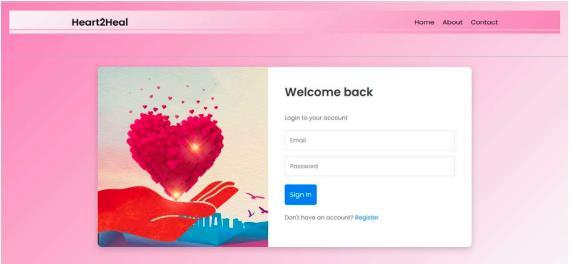
Fig1shows aloginpage that servesas the gatewayfor users to access a Organ Donation platform (Heart2Heal) Existing users can log in using their email and password, gainingentrytotheirpersonalizedaccounts.Newuserscan register, creating an account to join the community. The page suggests a service offering resources or connections relatedtoOrganDonation.The"About"and"Contact"links imply further information and support options are available
B. User Interface Design:
Fig 2 shows Registration form for Organ Donation website Users are prompted to select their role (Donor,Recipient,Admin)andprovidepersonaldetails likefullname,email,phone,andpasswordtocreatean account. Users are prompted to select their role (Donor,Recipient,Admin)andprovidepersonaldetails likefullname,email,phone,andpasswordtocreatean account. The page enables new users to register and contributetothesuccessfulOrganDonationprocess.
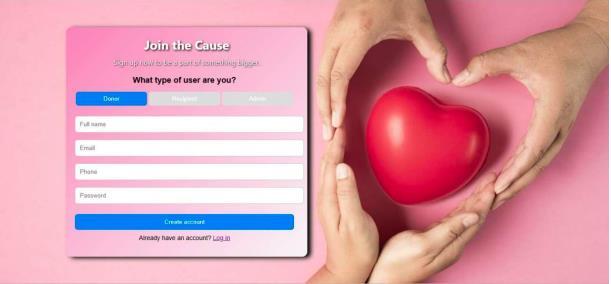
Fig2: Registrationform
Fig3showsthedonordashboardsfor"Heart2Heal,"an organdonationplatform,welcominguserin theirspecified role (Donor, Receiver) It provides an overview of India's donation activity, displaying total donations, pending donations, and lives saved. Users can initiate organ donationsthroughthe"DonateanOrgan" buttonandtrack the status of their donations via "Check Donation Status." The "Helpful Resources" section offers access to FAQs, donationguidelines,andtipsforsuccessfuldonations.
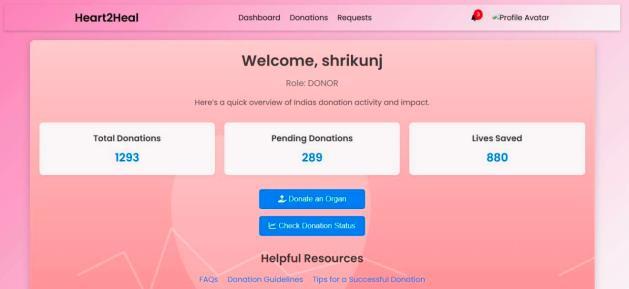
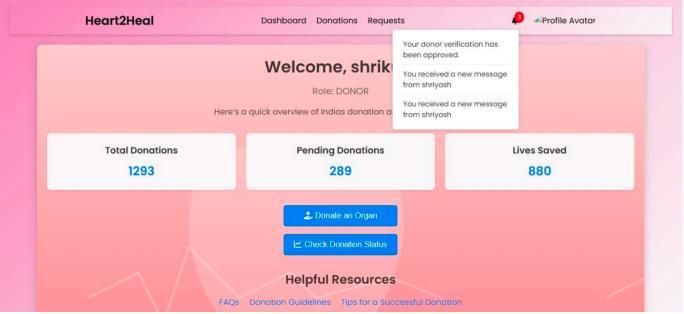
Fig4:NotificationBar
International Research Journal of Engineering and Technology (IRJET) e-ISSN: 2395-0056
Volume: 12 Issue: 05 | May 2025 www.irjet.net p-ISSN: 2395-0072
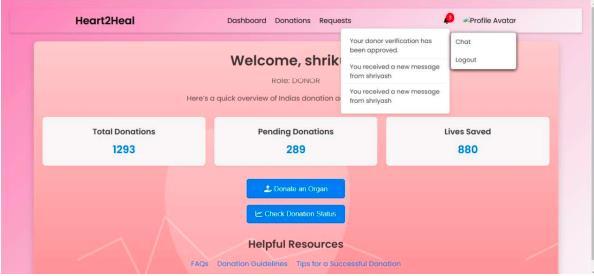
The dashboardacts as a central hub for donors to manage their contributions and stay informed about the impact of theiractions.
C. Database Schema:
Fig.4.2showsthatthefirstquery,SHOWTABLES,lists the tables present in the organ database. These include chats, likely for storing communication between users; donors,containinginformationaboutindividualswillingto donateorgans;matches,whichtrackssuccessfulorpending pairings between donors and recipients; notifications, for systemalertsand messages;recipients,holding data about individuals in need of organ transplants; users, which stores user account information; and verification, possibly intendedfortrackingverificationprocesses.
The SELECT * FROM users query displays user details. We see columns for id, email, password (hashed for security), phone, and role. The role column indicates whetherauserisaDONOR,RECIPIENT,orADMIN.
The SELECT * FROM donors query shows information about donors. Columns include donor_id, address, blood_type, dob (date of birth), email, status (likely verification status), emergency_contact, full_name, gender, legal_consent, lifestyle_habits, medical_history, and organ_type.Weseeexamplesofdonordata,includingblood types,contactinformation,andorgantypestheyarewilling todonate.
TheSELECT*FROMrecipientsquerydisplaysrecipient information,includingrecipient_id,blood_type,organ_type, status(likelyindicatingtheurgencyorverificationstatusof therecipient'srequest),anduser_id.
Finally, the SELECT * FROM matches query shows a singleentryinthematchestable.Thistabletrackspairings betweendonorsandrecipients,withcolumnsformatch_id, status(e.g.,pending),donor_id,andrecipient_id.
The notifications table in this database serves as a central hub for managing communication and updates within the organ donation system. Each row in this table representsaspecific messageornotificationdeliveredtoa user.
Thenotification_idcolumnactsasauniqueidentifierfor each message, ensuring that no two notifications are the same.Themessagecolumnstorestheactualcontentofthe notification, providing details about events, updates, or communications. For instance, we see messages like "You received a new message from raj," indicating direct communication between users. Other messages, such as "Your donor verification has been approved," convey importantstatusupdatesrelatedtothedonationprocess.
The status column likely indicates whether a notification has been read or acknowledged by the user. A valueof"0"mightsignifyanunreadorpendingnotification, while other values could represent different states. The timestamp column records the exact date and time when the notification was generated, providing a chronological record of events. This helps in tracking the sequence of actionsandcommunications.
Finally, the user_id column links each notification to a specific user in the system. This ensures that notifications are delivered to the correct individuals. By using foreign keys, the system maintains referential integrity, linking notificationstoexistingusers.
Fig 6 shows the "Donate an Organ" page initiates the donation process. Prospective donors fill out a form with personal details: full name, date of birth, gender, phone number, email, and address. They specify the organ they wishtodonate(e.g.,kidney)andtheir bloodtype.Medical historyandlifestylehabitsarealsorecorded.
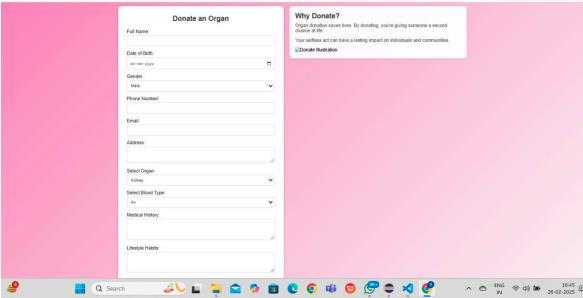
Fig6:DonoranOrganpage
A "Why Donate?" section highlights the impact of organ donation, emphasizing saving lives and contributing to communities.
After submission, the information is likely processed to assess donor suitability and initiate further steps like medical evaluations and matching with potential recipients. The process aims to facilitate informed and responsibleorgandonation.
Fig7showsthe"DonationStatus"pageprovidesaclear overview of a donor's current standing within the organ
International Research Journal of Engineering and Technology (IRJET) e-ISSN: 2395-0056
Volume: 12 Issue: 05 | May 2025 www.irjet.net p-ISSN: 2395-0072
donation system. It immediately informs the user about thespecificorgantheyhavecommittedtodonating,inthis case, a "Heart," and their corresponding "Blood Type," whichis"A+."Crucially,itdisplaysthe"VerificationStatus" as "Verified," indicating that the donor's eligibility has been confirmed through the necessary procedures. However, the "Matching Updates" section revealsthat"No matches found yet," meaning a suitable recipient has not been identified at this time. This status is likely to change asthesystemactivelysearchesforacompatiblematch.
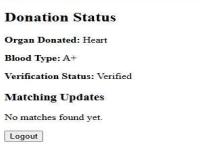
Fig7:Donationstatuspage
Finally,thepresenceofa"Logout"buttonallowstheuser tosecurelyexittheplatform,ensuringprivacyandcontrol over their account. This page serves as a concise and informativesummaryofthedonor'sprogress,highlighting both their verified status and the ongoing search for a recipient.
Fig 8 shows that the page is an Verification Screen (Admin dashboard), evident from the "Welcome, riya" message and the clear separation of donor and recipient verifications. The dashboard shows "Pending Donor Verifications: 0" and "Pending Recipient Verifications: 2". This indicates there are no donor applications awaiting verification, but two recipient applications need attention. Ittellsrecipientdetailstwo pendingrecipientapplications aredisplayed
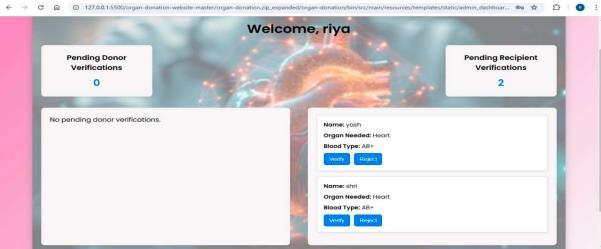
For each recipient, the admin has two options Verify (Approves the recipient's application), adding them to the pool of eligible recipients. Reject (Denies the recipient's application, likely due to ineligibility or incomplete information.). The admin wouldreview the details of each recipient, potentially checking additional information not
visibleonthisscreen.Afterconfirmingtheireligibility,the adminwouldclickeither"Verify"or"Reject".
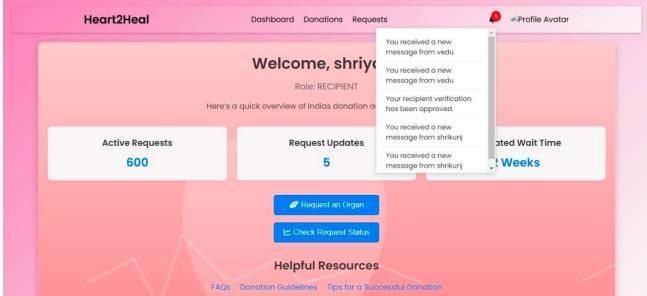
Fig9ShowsRequestsScreen,thisdashboardprovides "shriy," a "RECIPIENT," with an overview of their organ donationrequestonthe"Heart2Heal"platform.Itdisplays "ActiveRequests:600,"indicatingthenumberofrecipients awaitingorgans,and"RequestUpdates:5,"showingrecent activity related to their request. An obscured "Estimated Wait Time" suggests a timeframe for organ availability. A notification pop-up informs "shriy" of new messages from "vedu" and "shrikunj," as well as the approval of their recipient verification. Buttons allow them to "Request an Organ" or "Check Request Status," and a "Helpful Resources" section offers FAQs and guidelines. This interface provides transparency and facilitates managementoftheirorgandonationrequest.
Fig 3, Fig 4 and Fig 5 shows Donor dashboards showcase the "Heart2Heal" platform's dashboard, designed to provide a comprehensive overview of its performance and impact. The first image displays key metrics, with "Total Donations" hovering around 1293, "Pending Donations" near 289, and "Lives Saved" around 880. These figures demonstrate the platform's effectiveness in facilitating organ donations and its direct positive impact on saving lives. The second image adds a notification pop-up, indicating the system's ability to provide real-time updates to users, such as verification approvals and new messages. This highlights the platform's focus on communication and user engagement. The third image further reveals user interface elements, showcasing a profile avatar dropdown with options for "Chat" and "Logout." This indicates the platform's commitment to providing communication tools and ensuring user account security. Collectively, these images illustrateasystemthatnotonlyeffectivelymanagesorgan donations but also prioritizes user experience, communication,andsecurity,ultimatelycontributingtoits overallimpactinsavinglives.
International Research Journal of Engineering and Technology (IRJET) e-ISSN: 2395-0056
Volume: 12 Issue: 05 | May 2025 www.irjet.net p-ISSN: 2395-0072
Heart2Heal represents an important step in making organdonationmoreaccessibleandefficient.Ourplatform brings together donors, recipients, and medical professionalsinonesecurespace.Theuser-friendlydesign makesiteasyforanyonetoregisterasadonor,tracktheir donation status, and communicate with others in the system,whileourintuitivedashboardensuresaccessibility forusersofalltechnicalbackgrounds.
Meanwhile, the secure verification workflow maintains the integrity of the sensitive medical matching process. We'vefocusedoncreatingasystemthat'sbotheasytouse and secure. The verification process ensures that all information is accurate, while the messaging feature allows for direct communication between everyone involved.
Theorgandonationwebsitehasstrongpotentialforfuture development aimed at improving its effectiveness and reach.Keyenhancementsincludeintegrationwithnational health systems like NOTTO or UNOS for real-time organ availabilityandlegalcompliance.TheadoptionofAI-based matching can optimize donor-recipient compatibility based on medical urgency and location, increasing transplantsuccess rates.Additionally,developingamobile application will enhance accessibility, enabling users to register and receive updates on the go. Collaborating with NGOs and volunteers can further amplify awareness and boost donor registrations, making the platform more impactfulandcommunity-driven.
[1] Sheela, P. M., H. N., N. A., T. "A Decentralized and Cooperative Methodology For Organ Donation Management Based on Ethereum Blockchain," Journal of Cognitive Human-Computer Interaction, vol. , no. , pp. 08-17, 2023. DOI: https://doi.org/10.54216/JCHCI.060101
[2] Beena G Pillai, Madhurya J A, Dayananda lal N and Jeena Jecob, An Effective Protection of Data for Organ Donation using BlockChain Technology. International Journal of Electrical Engineering and Technology, 11(5), 2020, pp. 73-82 doi: https://www.doi.org/10.34218/IJEET.11.5.2020.008
[3] Ms. Nishigandha Nimbaji Pawar and Dr. Nilesh R. Wankhade (2023) ‘Survey paper on :"Organ donation using blockchain"’, International Journal of Advanced Research in Science, Communication and Technology, pp.134–141.doi:10.48175/ijarsct-14015.
[5] Hawashin,Diana & Jayaraman,Raja & Salah,Khaled & Yaqoob, Ibrar & Simsekler, Mecit Can Emre & Ellahham, Samer. (2022). Blockchain-Based ManagementforOrganDonation andTransplantation. IEEEAccess.10.1-1.10.1109/ACCESS.2022.3180008.
[6] R. Kothawade, R. Nikam, H. Khandelwal, P. Sharma, and V. V. Waykule, "Online Organ Donation Using Blockchain," Int. J. Res. Appl. Sci. Eng. Technol. (IJRASET), vol. 10, no. XI, pp. 1996, Nov. 2022. www.ijraset.com
[7] Nallusamy, Senthilkumar; Shyamalapriya, 1; Balaji, 1; Ranjan, 1; Yogendran, 1. “Organ Donation – Current Indian Scenario”. Journal of the Practice of Cardiovascular Sciences 4(3):p 177-179, Sep–Dec 2018.|DOI:10.4103/jpcs.jpcs_59_18
[8] C.AlanandH.A. Kurt,"OrganDonationAwareness," J. Sci. Perspect., vol. 3, no. 1, pp. 59-62, 2019, doi: 10.26900/jsp.3.009
[9] M.Kumar,S.Dhawan,A.Chaudhary,S.Dwivedi,andC. A. Kumari, "Organ donation in India and Nurses as a changetoleadinOrgan”.
[4] A. Kulshrestha, A. Mitra, and Amisha, "Securing Organ Donation using Blockchain," Proc. of a Conference, 2020. https://api.semanticscholar.org/CorpusID:232109448