
International Research Journal of Engineering and Technology (IRJET) e-ISSN: 2395-0056
Volume: 12 Issue: 07 | July 2025 www.irjet.net p-ISSN: 2395-0072
International Research Journal of Engineering and Technology (IRJET) e-ISSN: 2395-0056
Volume: 12 Issue: 07 | July 2025 www.irjet.net p-ISSN: 2395-0072
Evan Suputra1 , I Gusti Ngurah Kerta Arsana2 , Silvia Gabrina Tonyes3 , Ni Nyoman Pujianiki4 , I Gusti Agung Adnyana Putera5, I Putu Gustave Suryantara Pariartha6
1PG Student, Civil Engineering Study Program, Udayana University, Badung, Bali, Indonesia
2Asst. Professor, Environmental Engineering Study Program, Udayana University, Badung, Bali, Indonesia
3Asst. Professor, Doctor of Engineering Science Study Program, Udayana University, Badung, Bali, Indonesia
4Professor, Magister of Civil Engineering Study Program, Udayana University, Badung, Bali, Indonesia
5Asst. Professor, Civil Engineering Study Program, Udayana University, Badung, Bali, Indonesia
6Asst. Professor, Civil Engineering Study Program, Udayana University, Badung, Bali, Indonesia
Abstract - Nusa Penida District is experiencing an increasing need for clean water along withpopulationgrowth and tourism, but the drinking water distribution systemisstill highly dependent on the Guyangan spring which requires many pumps and electrical energy. This study aimstoplanthe development of a drinking water distribution network by utilizing the potential of the Penida spring and interconnecting it with the existing system in Guyangan to improve technical and economic efficiency. The methods used include an analysis of water needs of 113.34 liters/second (equivalent to 3,572,342 m³ peryear),networkplanningusing ARCGIS and hydraulic simulation with QEPANET, and an evaluation of economic feasibility based on NPV, IRR,andBCR indicators. The results show that the interconnection network is able to distribute water from the Penida spring to 11 villages in the central and western regions of Nusa Penida, reducing the operational load of pumps, and increasing the coverage of water services. The economic analysis was conducted on four scenarios related to water prices and subsidies on investment. The water price per cubic meter was obtained at Rp. 3000 which is determined by considering the initial investment costs, annual operational costs, project duration, and interest rates (discount rates) With positive NPV results, IRR approaching or exceeding the interest rateof 8%, and BCR > 1, this indicates that the SPAM network development project is feasible. Therefore, the development of this gravity-based SPAM network interconnection system can be an efficient and sustainable solution for clean water supply in Nusa Penida.
Key Words: drinking water system supply, Penida spring, networkinterconnection,EPANET,economicfeasibility
1.INTRODUCTION
The most basic necessity for all living things is water. Climate change, development activity, and population growth are the main causes of scarcity. High rates of populationincreaseandclimatechangehavedecreasedthe amount, quality, accessibility, and availability of water to
meethumanneeds.Waterdistributionsystems(WDS)are designedtoprovidewaterinsufficientquantitiesandatthe requiredqualitywithoutcompromisingfuturecapacityand standards. The issues of drought, climate variability, pollution, climate change, and urban population development have led to the emergence of various and interconnected water delivery systems [1]. The accomplishment of the Sustainable Development Goals (SDGs) is at danger due to inadequate water, which also posessaincreasedhazardstohumanhealth,foodproduction, energy generation, economic development, and poverty reduction. The government must guarantee that the communityhasaccesstosafeandreasonablypricedclean drinking water in order to meet SDG number 6, which focusesoncleanwaterandadequatesanitation[2].
The management and distribution of water to billions of peopleinneedisacrisisthatcontributestotheglobalwater crisis in addition to water shortages. There are much less water resources available globally, necessitating focused effortstomanagewatereffectivelyandefficiently.Theuseof sporadicsupplies,typicallydeterminedbynecessityrather than design, is one of the most popular strategies for reducingwaterdemand[3].Thesustainableaspectofwater supplyincludesthreemainobjectives:economic,social,and environmentalfactorsrelatedtothefunctionaluseofwater, aswellasthemanagementofcleanwaterandwastewater. Water is mostly used for domestic purposes, such as drinking, cooking, bathing, and cleaning; secondly, for industrial purposes in energy production and manufacturing; and thirdly, for agricultural purposes in irrigation[4].
The exploitation of springs on Nusa Penida Island necessitates complicated infrastructure and significant funding, so the operational system is carried out collaboratively by the Central Government, the Bali Provincial Government, and the Klungkung Regency Government. The Central Government, through the Bali PenidaRiverBasinCenter,theBaliProvincialGovernment, through the Regional Technical Implementation Unit for DrinkingWaterManagement,andtheKlungkungRegency
International Research Journal of Engineering and Technology (IRJET) e-ISSN: 2395-0056
Volume: 12 Issue: 07 | July 2025 www.irjet.net p-ISSN: 2395-0072
Government, have appointed the Local Water Company, currentlyknownas"PerumdaAirMinumPancaMahottama," astheoperator.Thismanagementiscarriedoutinasingle system,beginningwiththeembankmentofspringsasraw water,routingwaterfromtheintaketanktothereservoir, and delivering drinking water to clients. This system is knownastheDrinkingWaterSupplySystem(DWSS)[5].A waterdistributionsystemisanintegratednetworkofwater sources,pipes,andhydrauliccontrolmodulessuchasvalves, regulator pumps, and reservoirs that transport water for finalusageunderstandardpressure[6,7].Thistechniqueis accomplishedbyoperatingpumps,mainandservicepipes, storagetanksorreservoirs,andassociatedequipmentunder pressureinaclosedsystem[8].
The DWSS development aims to build, expand, and/or improve physical (technical) and non-physical systems (institutional, management, financial, community participation,andlegal)inacompleteunittoimplementthe provision of drinking water to the community in a better condition in accordance with Indonesian Government Regulation Number 16 of 2005 [9]. Given Nusa Penida Island's limestone mountainous topography, transferring drinking water from coastal sources to residential areas necessitatesseveralpumpingoperations.Forinstance,the Guyangan DWSS system necessitates five pumping processes. The use of several pumps in the distribution systemnotonlyraisespowerprices,butalsoincreasesthe danger of operational disruptions caused by mechanical breakdowns,aswellasthecarbonfootprintofenergyuse. Therefore,astrategicandtechnologicalstrategyisneededto createaDWSSnetworkinterconnectionsystemtodistribute a portion of the supply from the Penida springs to the Guyangan area, thereby reducing pumping load and enhancingoverallsystemefficiency[10].
In light of this, the purpose of this study is to assess the technicalfeasibilityandoperationalbenefitsofconnecting thePenidaspringreservoirstonumerousreservoirsinthe Guyangansysteminordertoimprovetheefficiencyofclean waterdistributionintheNusaPenidaregion.
Clean water is a basic human requirement that must be fulfilledinasustainablemanner.Thesupplyanddistribution ofcleanwaterposesignificantissues,particularlyinisland locationssuchasNusaPenida,KlungkungRegency,Bali.As theislandexperiencessubstantialvisitorgrowth,strainon theregion'sDWSSgrows[11].
Asakarstisland,NusaPenidaIsland,whichdoesnothavea year-round river, has several springs, particularly on the southernslopes,includingPenidaSpring(Sakti),Guyangan Spring,SeganingSpring,TembelingSpring,TabuananSpring, AntapanSpring,WatesSpring,AngkelSpring,andToyaPakeh Spring [12]. Two springs have been used in the form of a DWSS: Penida Spring (potential: 181.7 l/s) and Guyangan Spring (potential: 172.07 l/s). When considering the vast potential of springs that have yet to be fully used, such as
Penida Spring (potential 181.7 l/s), raw water production from Guyangan Spring (potential +172.07 l/s) is only 20 lt/second. Raw water reserves from Penida Spring and GuyanganSpringthathavenotbeenusedremainsignificant (306.77l/s).PenidaSpringislocatednearCrystalBayBeach, butGuyanganSpringissituatedonanextremelysteepcliff 220metersbelowgroundlevel[13].
NusaPenida'swatersupplysystemcurrentlyreliesontwo main sources:the Penida spring and the Guyanganspring. Bothsourcesarecriticaltoaddressingthecommunity'sand other stakeholders' clean water needs. According to data fromtheKlungkungRegionalWaterCompanyandtheDWSS developmentmasterplan,theGuyanganspringiscurrently equippedwithsevenreservoirsandfivetosixpumpsthat distribute water to various distribution zones in Nusa Penida'swesternandcentralareas[14].
Ontheotherside,thePenidasprings,whichhavesignificant dischargepotential,onlyhavetworeservoirsandhaveyetto becompletelyutilizedforregionaldistribution.Thisshows an imbalance in resource usage between the two systems, affectingtechnicalandeconomicefficiency,particularlythe Guyangansystem'shighpumpingcosts[15].
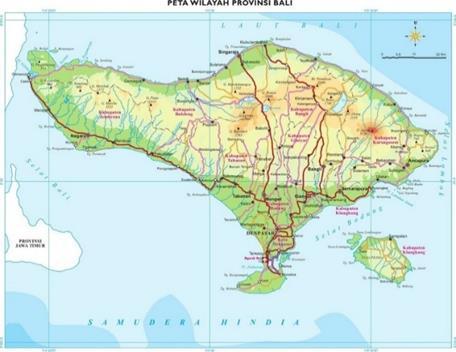
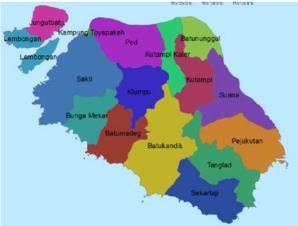
ThisinvestigationwascarriedoutinNusaPenidaDistrict, KlungkungRegency,BaliProvince,Indonesia.NusaPenidais adistrictinKlungkungRegency,BaliProvince,withanarea of 202,838 km2 and a population of 63,468. Nusa Penida Districthasthreeislands:NusaPenidaIsland,whichhasan areaof191,462km2,NusaLembonganIsland(8,688km2), andNusaCeninganIsland(2,688km2).NusaPenidaIslandis locatedinthecoordinateSL08o40'18.9"-08o50'10.8"andES 115o26'47.6"-115o37'41.8"[16].
ThisstudyisbasedonIndonesianandinternationalnational norms and/or criteria. Water demand planning factors includedomesticandnon-domesticwatersupplystandards, waterloss,andchangesindemand[17].NusaPenidaDistrict isclassifiedasasmallcity,hencethefollowinghomewater consumption is planned: 130 liters/person/day, unit consumption (HU) of 30 liters/person/day, non-domestic waterconsumptionof600liters/unit/day,20%waterloss, maximum day factor of 1.15%, peak hour factor of 1.75%, and 90% projected service coverage. Meanwhile, the non-
International Research Journal of Engineering and Technology (IRJET) e-ISSN: 2395-0056
Volume: 12 Issue: 07 | July 2025 www.irjet.net p-ISSN: 2395-0072
domestic water demand is estimated to be 15-30%. Furthermore, the transmission and distribution pipeline planningcriteriaarebasedonIndonesianMinisterofPublic WorksandPublicHousingRegulationNo.27/PRT/M/2016, whichincludesaflowvelocityof0.6m/s,aminimumwater pressureof1atm,andamaximumpressuredeterminedby thepipespecifications.
Furthermore, population growth forecasts are initially computedusingthreemethods:arithmetic,geometric,and leastsquares[18].
ArithmeticMethod: Pn=Po(1+r.n) (1)
GeometricMethod: Pn=Po(1+r)n (2)
LeastSquareMethod:Pn=a+b(n) (3)
WherePnisthepopulationinyearn,Poisthepopulationin the first year, r is the populationgrowth rate (%), n isthe projectionyear,anisaconstant,andbisthelinearregression coefficient. The standard deviation is calculated after applying the three procedures described above. After calculating with these three approaches, the standard deviationforeachmethodiscalculated.Theapproachwith the smallest standard deviation is used to calculate populationprojections.Basedonthepopulationprojection data, the expected water demand is computed for both household and non-domestic usage using the study area criteria.
The pipe diameter is determined by the amount of water discharged and may be computed using the continuity equation:
Q=A.v=¼d2.v (4)
where,Qistheflowrate(m3/s),Aisthepipecross-sectional area (m2), disthe diameter(m),andv isthe flowvelocity (m/s).
Apumpunitmoveswaterfromalowertankorreservoirtoa higher reservoir. In pump design and selection, the pump discharge (Q)and head (Hp) must be determined. Head is definedasthespecificenergyperunitweightoffluid.Pump headismadeupofpotentialenergy,flowpressureenergy, kineticenergy,andenergylossesfromthepipesystem.Asa result,therearefourtypesofheads:static,pressure,velocity, andfriction[19].
Hp=(z2-z1)+(p2-p1)/(g)+(v22-v12)/(2g)+Hf (5)
WhereHpisthetotalpumphead(m),zistheelevation(m), pisthepressure(N/m2),visthevelocity(m/s), isthefluid density (kg/m3), g is the gravitational acceleration (m/s2), andHfistheheadlossduetofriction(m).
Next,thequantityofpumppowerneededis:
SHP=(.g.Q.Hp)/p (6)
Pmot =SHP/mot (7)
WhereSHPisshafthorsepower(watt),Pmot isthepowerof theelectric motordrivingthepump(watts), p isthetotal efficiencyofthepump(%),and mot istheefficiencyofthe electricmotor(%).
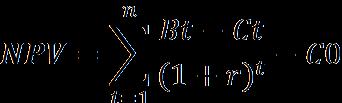
Economic analysis is the process of comparing costs and advantages to determine whether a business will be profitable over its existence. When we try to optimize, we either reduce resource consumption and costs or increase profitandsystemperformance.Inreality,money,time,and resources are typically limited; so, operations require optimization[20].NetPresentValue(NPV)isaneconomic feasibilityresearchmethodthattakesintoaccountthetime valueofmoneytodetermineaproject'snetbenefits.Ifthe NPV is positive, the project is deemed viable because it is expected to generate net profits. Conversely, if the NPV is negative, the project is notpracticable because the overall costsoutweighthebenefits[21].
(6)
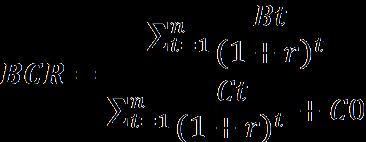
WhereBtisthebenefitinyeart,Ctistheoperatingcostin yeart,C0istheinitialinvestmentcost,risthediscountrate, andtisyeart.
Furthermore, the Benefit-Cost Ratio (BCR) is an economic evaluationtoolthatcomparesthepresentvalueofaproject's total benefits to its total costs. The BCR shows how much benefitisachievedforeveryunitofcostincurred.IftheBCR exceeds one, the project is regarded viable because the benefitsoutweighthecosts.Conversely,iftheBCRislessthan one,theprojectisnotfeasiblesincethecostsoutweighthe benefits. (7)
The Internal Rate of Return (IRR) is then used to assess a project'sefficiencyandprofitability.ThehighertheIRR,the better the project's profitability. The IRR assists decisionmakersindeterminingthefeasibilityofaprojectinrelation toabenchmarkinterestrateortheminimumexpectedrateof return(alsoknownasthediscountrate).IftheIRRismore than the benchmark interest rate, the project is regarded financially viable because the returns exceed the cost of capital.Incontrast,asmallerIRRindicatesthattheprojectis unprofitable.
Themethodofconnectingpipesdeterminestheconfiguration of a water distribution system. The most popular fundamental configurations are serial, branch, loop, and combination [22]. A serial configuration is basic, with no loopsorbranching.Aserialconstructionisconstrainedbyits high construction and maintenance expenses [23]. A branching configuration consists of two or more serial configurations. The primary restrictions include sporadic water demand, potential system contamination, low
International Research Journal of Engineering and Technology (IRJET) e-ISSN: 2395-0056
Volume: 12 Issue: 07 | July 2025 www.irjet.net p-ISSN: 2395-0072
reliability, and silt accumulation [24]. A loop arrangement consistsofdemandpoints(nodes)thatcanacceptwaterfrom morethanonesource.Thistechnologyismostlyutilizedin urban/industrialregionstoensureappropriatedistribution andhighdependability[25].Thisstudymakesuseofahybrid arrangement. The circular layout is the system's major feature,withsupplyprovidedatthearea'speripheryviaa numberofbranches.
TheprocessthatwillbeusedforthethesisisdepictedinFig2.
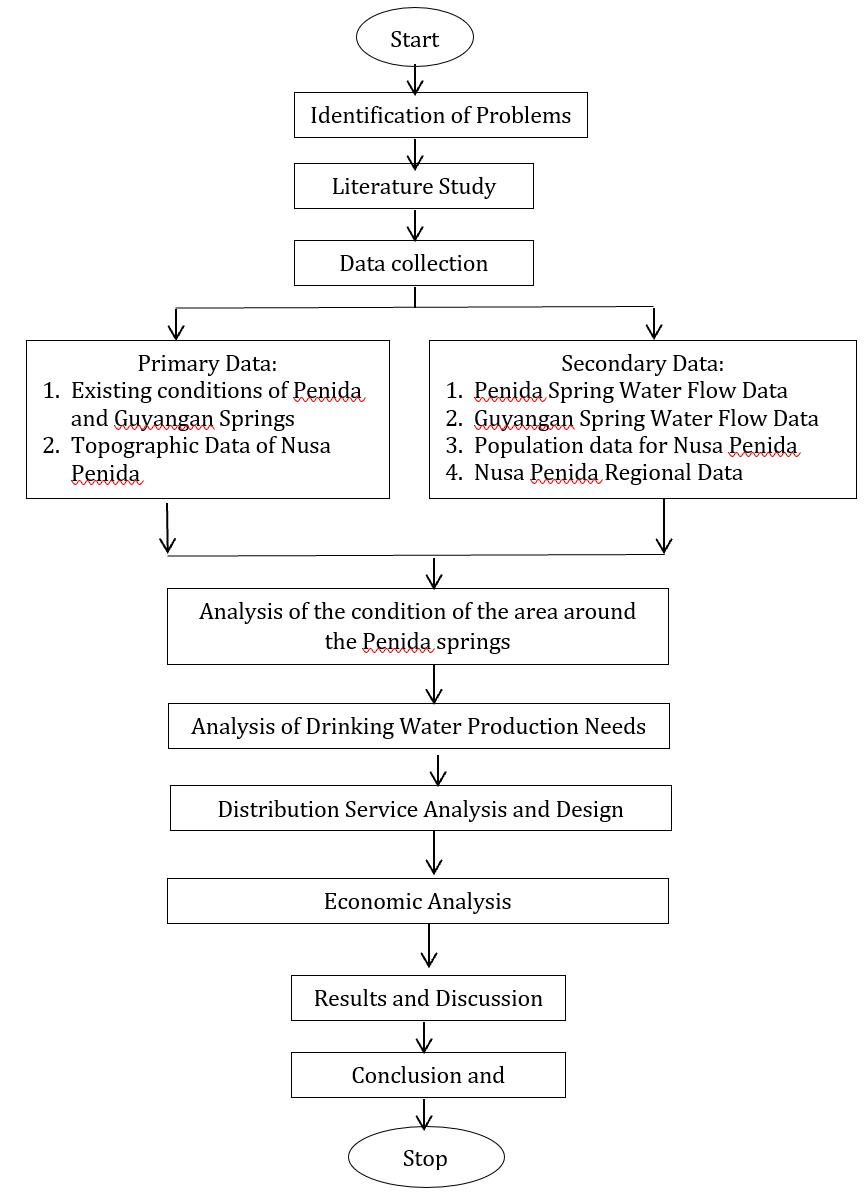
Fig -2:Methodology
3. RESULTS AND DISCUSSION
3.1 Existing Overview of
To supply the water needs of the Nusa Penida District community, the Nusa Penida RDWC uses two primary springs: Penida Spring and Guyangan Spring. As stated in Table 1, the current clean water coverage of RDWC Nusa Penidais59.44%.TheothertwovillagesonNusaCeningan and Nusa Lembongan, called Jungutbatu and Lembongan Villages, get their water from seawater via Sea Water ReverseOsmosis(SWRO). Table -1: RDWCNusaPenidaServiceCoverage
ThePenidaRawWaterSupplySystemdrawsfromthePenida SpringinSaktiVillage,whichemergesnearCrystalBayBeach onNusaPenida.ThePenidaSpringservessixvillages;Sakti, Toyapakeh,Ped,KutampiKaler,Batununggul,andSuana.The Penida SPAB transmission flow system employs a combinationofpumpsandgravity.Waterintheinundation areaischanneledtotank1locatednorthofthereservoirvia a0.8mdiameterconcretepipewithalengthof190m,and thenpumpedtoreservoir1(roundreservoir)withacapacity of1500m3.Waterisgravity-fedfromthecircularreservoirto SaktiVillage,thentoreservoir2withacapacityof200m3, where it is dispersed to Toyapakeh Village, Ped Village, Kutampi Kaler Village, Batununggul Village, and Suana Village. Gravity is used throughout the entire distribution system. Under current conditions, the Penida spring may produceadischargeof70literspersecond.
TheGuyanganRawWaterSupplySystem,ontheotherhand, drawswaterfromtheGuyanganSpringinBatukandikVillage. GuyanganSpringisaspringthatemergesfromarockycliff neartheSegaraKidulTemple.TheGuyanganSpringsupplies eight villages, including Bungamekar, Batumadeg, Batukandik, Klumpu, Kutampi, Pejukutan, Sekartaji, and Tanglad.TangladandPejukutan,ontheotherhand,continue tobecutofffromwaterfromtheGuyanganSpring.Thisis becausetheflowratetotheGuyanganR-6remainsextremely low, at 3 liters per second. Furthermore, the Nusa Penida WaterCompany isrestructuringthedistributionpipesinthe
International Research
Volume: 12 Issue: 07 | July 2025 www.irjet.net
twovillagessothattheymaybeusedtodistributewaterthis year.
The population projections are calculated using three approaches. The populationprojection methods employed include mathematical, geometric, and least squares. The populationdatausedtoconstructtheforecastsspansthelast fouryears,from2021to2024.Thesmallestdeviationwill determinewhetherstrategyisutilized.Todemonstratethe proceduretobeutilized,thiscomputationwillbeperformed onSaktiVillage.Thecalculationiscarriedoutusingeachof thethreeapproachesdiscussedabove.
Afterperformingcalculationsusingthethreemethods,the standard deviation of the arithmetic method was 47, the geometricmethodwas55,andtheleastsquaresmethodwas 74. Based on the calculation results, the lowest standard deviation was obtained from the arithmetic method. Therefore, the method used to calculate population projections uses the arithmetic method. The results of the populationprojectioncalculationforthenext15yearsusing thearithmeticmethodcanbeseenintheTable-2.
Table -2: PopulationProjectionofNusaPenidaDistrict
No Village
A predicted water demand estimate is required on Nusa Penida Island, which includes population, household, nondomestic, total water demand, water loss, average water demand,maximumwaterdemand,andpeakhourdemand. CleanwateruseintheNusaPenidaareaissetat120gallons perpersonperday.Theprojectedwaterdemandsareshown inTable-3.
Table -3: ProjectedwaterdemandsonNusaPenidaisland
ThePenidaspringwaternetworkservessixvillages:Sakti, Toyapakeh,Ped,KutampiKaler,Batununggul,andSuana,as showninFig-3.TheGuyanganspringwaternetworkfeeds eightvillages:Bungamekar,Batumadeg,Batukandik,Klumpu, Kutampi, Pejukutan, Sekartaji, and Tanglad, as shown in Figure4.Basedonestablishedserviceareas,theRDWChas yet to fully serve two villages, Tanglad and Pejukutan,
International Research Journal of Engineering and Technology (IRJET) e-ISSN: 2395-0056
Volume: 12 Issue: 07 | July 2025 www.irjet.net p-ISSN: 2395-0072
indicatinginadequateserviceintheselocations.Thisisseen in theinefficient distribution ofservice regions, where the use of Penida spring water remains suboptimal when comparedtoGuyanganspringwater.
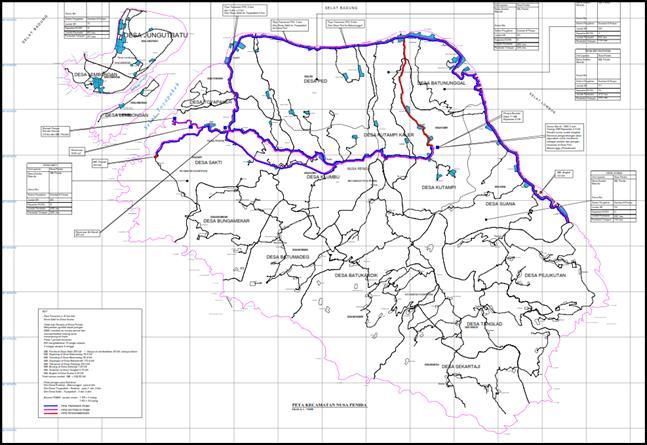
Fig-3:PenidaSpringServiceArea
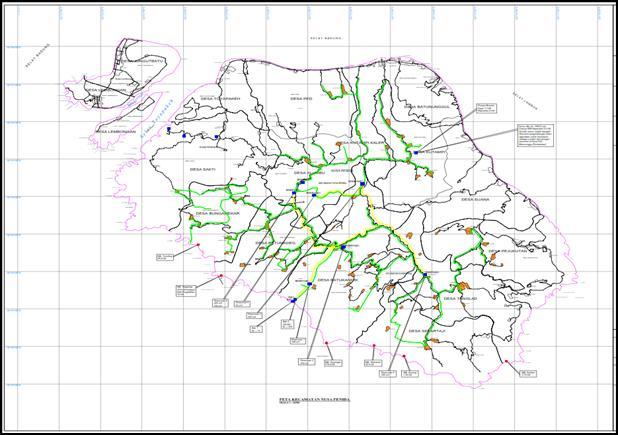
Fig-4:GuyanganSpringServiceArea
TheuseofPenida'sspringsdemandstobedevelopeddueto their easier access compared to Guyangan's. At Guyangan, severalpumpingstagesarerequiredtochannelthewaterto thereservoir.Thesepumpingstagesrequiremoreelectrical energy,whichwillimpactthewaterbillchargedbythelocal watercompany.
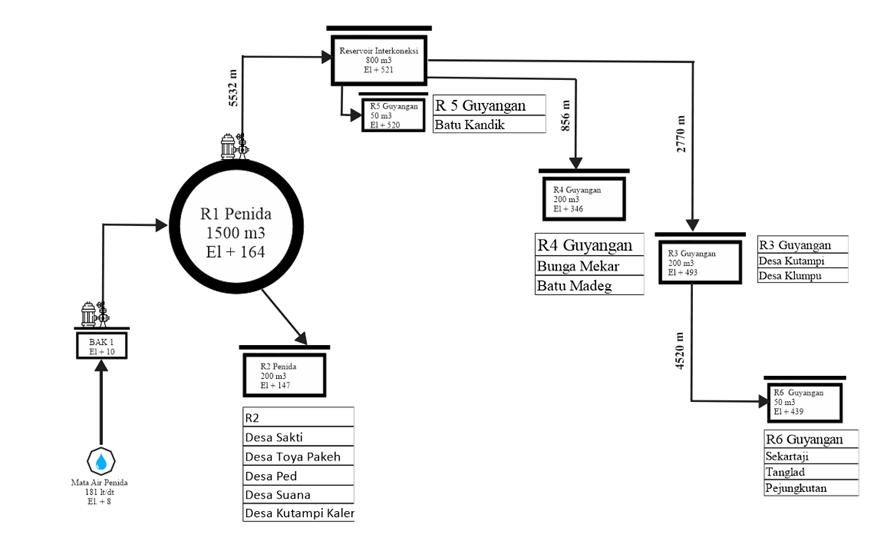
Penidaspringhasaroundreservoirwithacapacityof1,500 m3,whichservessixvillages:Sakti,Toyapakeh,Ped,Kutampi Kaler,Batununggul,andSuana.Meanwhile,GuyanganSpring usessevenreservoirsplacedthroughouttheserviceregionto meet water demands, although the typical distribution systemusepumps.Penidaspringcanstillhelpflowwaterto GuyanganreservoirsR-3,R-4,andR-6,whicharenowbeing pumpeduptofivestages.TosatisfythedemandsofR-3,R-4, andR-6Guyangan,apumpsystemwillbeinstalledfromR1 Penida to R-4 Guyangan, followed by pumps R-3 and R-6 using a gravity system. Gravity will deliver water to each village,andareservoirwillbebuiltineachvillagetogivea
certainpressureaswellastoassistmanagementifregulated byvillagezoning.
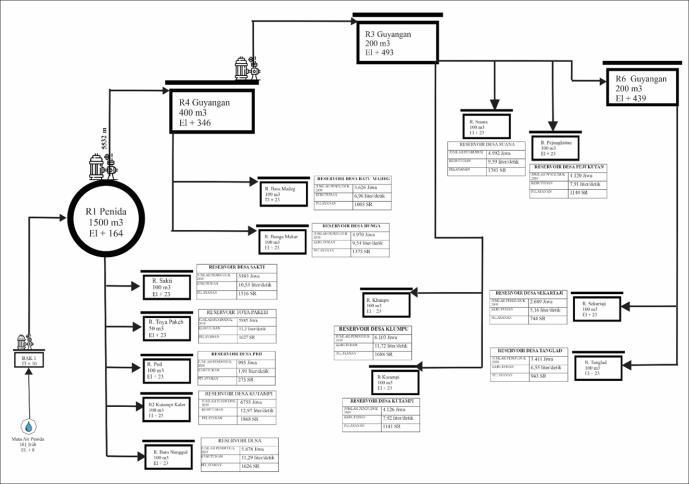
With these adjustments, the Penida spring will service 13 villages: Sakti, Toya Pakeh, Ped, Kutampikaler, Suana, Batumadeg,BungaMekar,Klumpu,Pejungkutan,Sekartaji, andTangladVillage.Withthisinterconnection,eachservice village's water demands must be recalculated in order to produce appropriate outcomes based on the service area. Table-4showsthecomputationofwaterdemandsinthe13 villages,aswellasthenumberofSRs,assumingthateachSR serves5people.
Table -4: WaterDemandsofPenidaSpringServiceArea
International Research Journal of Engineering and Technology (IRJET) e-ISSN: 2395-0056
Volume: 12 Issue: 07 | July 2025 www.irjet.net p-ISSN: 2395-0072
Theestimationsarebasedonthemaximalwaterdemand. ThePenidaspringwaterproductioncapacityiscurrently70 literspersecond,andwithatotaldemandof113.34liters persecond,thewaterdemandinthePenidaserviceareawill stillbe43.34literspersecondintheplannedyear,asshown inTable-4.
The Penida spring service region, which will have a 43.34 liters/secondlossintheplannedyear,posesachallengethat necessitatestransmissionnetworkoptimization.Thisplan's optimizationentailsmodifyingtheserviceareatousemore appropriatespringsourcesbasedoneachvillage'sdistance andelevation.TheanalysisresultsaresummarizedinFig-6.
To obtain a comprehensive overview of the economic feasibility of developing a Drinking Water Supply System (DWSS) utilizing Penida springs in Nusa Penida District, a four-scenario analysis was conducted. The first scenario calculated the total investment costs required to build a drinkingwaterdistributionsystem,withoutanythird-party financing intervention. This scenario assumed a water selling price of IDR 3,000 per cubic meter. The second scenariostillconsideredallinvestmentcostcomponentsbut assumedawatersellingpriceofIDR4,000percubicmeter. The third scenario simplifies the investment burden by reducingthecostofthereservoirandmainpiping,namely R1Penida,R3Guyangan,R4GuyanganandR6Guyanagn,as asimulationofconditionsiftherearefundingassistanceor subsidies from the government, but still maintains operationalandmaintenancecostswithawatersellingprice in this scenario of 3,000 IDR per cubic meter. The fourth scenariousesthesameinitialinvestmentcostsasthethird scenariobutwithahigherwatersellingprice,namely4,000 IDRpercubicmeter.
Inconductinganeconomicfeasibilityanalysis,itisnecessary to calculate the investment value in this distribution, so a budgetplanismadeforcostsandoperational-maintenance cost every year. From the recapitulation, the investment valueis75,023,681,000IDR,andtheannualoperationaland
maintenancecostsare3,491,910,488IDR,foraperiodof20 years, by assuming an initial water price of 3,000 IDR, according to the current RDWC water price. In order to determinetheeconomicfeasibility,theNPV,BCR,andIRR methodsareconducted
Tocalculateeconomicfeasibility,variabledataare:
Cost:
-Construction(IDR) 75,023,681,000
-M&O(IDR/year) 3,491,910,488
Benefit:
-WaterPrice(IDR/m3) 3,000;4,000;
-WaterDemands(liters/people/day)130
-WaterDemands(m3/year) 3,574,393
-Waterloss10% 3,216,954
-Benefit(IDR/year) 9,650,861,647
InterestRateLevel 8%
Duration(year) 15
Then,theanalysisisconductedforeachscenario.
The first scenario yields an NPV of -20,615,228,959 and a BCRof0.725%.SinceNPV<0andBCR<1,thisinvestmentis deemedunfeasible.Furthermore,thesecondscenarioyields anNPVof18,238,217,041andaBCRof1.099%.SinceNPV >0andBCR>1,thisinvestmentisdeemedfeasible.Then,the thirdscenarioyieldsanNPVof7,483,899,522andaBCRof 1.504%.SinceNPV>0andBCR>1,thisinvestmentisalso deemedfeasible.Finally,thefourthscenarioyieldsanNPVof 46,337,345,522andaBCRof2.28%.SinceNPV>0andBCR >1,thisinvestmentisalsodeemedfeasible.
Forinstance,calculationofBenefitsandCostsresultsforthe thirdscenariowereobtainedasinTable-5.Furthermore,the analysisofthefourscenariosissummarizedinTable-6.
Table-5: CalculationofBenefitsandCostsforthefirst scenario
Then,byusingEq.6,7and8,thefollowingresultsareasin Table-6.
Table -6: EconomicAnalysisResults
Scen ario Water Price (IDR)
I 3,000 (20.615.228 .959) 3,34 0,73 Rejected
II 4,000 7.483.899.5 22 9,54 1,10 Accepted
III 3,000 18.238.217. 041 15,20 1,50 Accepted
IV 4,000 46.337.345. 522 24,91 2,28 Accepted
Although there are three scenarios (II, III, IV) with economically feasible results, the selection of the best scenarioisnotonlydeterminedbythevalueofthefeasibility indicator,butmustalsoconsiderthecommunity'sabilityto paythewaterprice.Technicalandeconomicfeasibilitymust bebalancedwithsocialaspects,sothescenariowithawater priceofIDR3,000/m³(scenarioIII)isamorerealisticchoice tobeimplementedbecauseitstillproducesgoodfeasibility indicatorsdespiteusingalowerpriceandlighterinvestment. Thus, scenario III can be considered the optimal choice, considering cost efficiency and community purchasing power.
1. Basedontheresultsofplanningandprojectionofwater needs,thenumberofhouseholdconnectionsthatcanbe served in Sakti Village is 1516 SR, Toya Pakeh Village 1627SR,PedVillage275SR,BatununggulVillage1625 SR,KutampiKalerVillage 1868SR,Suana Village1380 SR, Kutampi Village 1141 SR, Klumpu Village 1687 SR, PejungkutanVillage1140SR,BungaMekarVillage1374 SR,BatumadegVillage1002SR,SekartajiVillage744SR, TangladVillage943SR
2. The development of the water distribution network is carriedoutfromthePenidaSpringwhichispumpedto R1-Penida witha pumpheadof180,forthevillagesof Sakti,ToyaPakeh,Ped,BatununggulandKutampikaler distributed from R1-Penida to each Village Reservoir withagravitysystem,thenR1-Penidaalsointerconnects R4-Guyangan with a pump head system of 200, where R4-Guyangan also distributes the Bungamekar Village ReservoirandBatuMadegVillagewithagravitysystem, thencontinuesfromR-4GuyangantoR-3Guyanganwith apumpsystemusingapumpheadof180,R3-Guyangan also distributes the Suana Village Reservoir, Kutampi Village, Klumpu Village, and Pejungkutan Village. Then fromR3-GuyanganitisdistributedtoR-6Guyanganwith a gravity system, where R-6 distributes water to the SekartajiandTangladVillageReservoirs.
3. Thepriceofwaterpermetercubicisobtainedataprice of 3,000 IDR which is determined by considering the initialinvestmentcosts,annualoperationalcosts,project duration, and interest rate (discount rate). With a positiveNPVresult,theIRR approachesorexceedsthe interest rate of 8%, and BCR > 1 indicates that this Drinking Water Supply System (DWSS) network developmentprojectisfeasible.
TheauthorswouldliketoexpresstheirgratitudetothePost Graduated of Civil Engineering Study Program, Faculty of Engineering,UdayanaUniversity.
[1] Waite,M.2010.SustainableWaterResourcesintheBuilt Environment. IWA Publishing: London. http://www.iwapublishing.com/news/sustainabilitywater-supply.
[2] Njora, B. & Yılmaz, H. 2021. Evaluation of Water Accessibility, Distribution, Water Use Policies and Management in Kenya. Int. Journal of Water ManagementandDiplomacy,issue3,June152021.
[3] Vairavamoorthy,K.,Akinpelu,E.,Lin,Z.&Ali,M.2001. Design of sustainable system in developing countries. Proceedings of World Water and Environmental Resources Challenges, Environmental and Water
International Research Journal of Engineering and Technology (IRJET) e-ISSN: 2395-0056
Volume: 12 Issue: 07 | July 2025 www.irjet.net p-ISSN: 2395-0072
ResourcesInstituteofASCE,Orlando,Florida.20-24May 2001.
[4] Fayomi,O.S.I. Olukanni,D.O. FayomiG.U.AndJoseph, O.O. 2017. In situ assessment of degradable carbon effusion for industrial waste water treatment, Cogent Engineering 2017, 4: 1291151 http://dx.doi.org/10.1080/23311916.2017.1291151
[5] Awe, O.M. Okolie, S.T.A. and Fayomi, O.S.I. 2019. OptimizationofWaterDistributionSystems:AReview. JournalofPhysics:ConferenceSeries1378022068,pp. 1-13.https://doi:10.1088/1742-6596/1378/2/022068.
[6] Ostfeld,A.2001.ReliabilityAnalysisofRegionalWater Distribution Systems. Elsevier Science Ltd., Urban Water, vol. 3, pp. 253-260. https://doi.org/10.1016/S1462-0758(01)00035-8
[7] Walski T.M., Chase, D.V., Savic, D.A., Grayman, W., Beckwith, S. and Koelle, E. 2003. Advanced Water Distribution Modelling and Management. Bently InstitutePress.
[8] Savic,D.,Mala-jetmarova,H.,andSultanova,N.(2018). History of Optimization in Water Distribution System Analysis. Water Science & Technology: Water Supply, vol. 15, no. 2, pp. 224-235. https://doi.org/10.2166/ws.2014.115
[9] Rozaq,Z.A.&Iqbal,R.2019. OptimalizationOfWater DistributionNetworkUsingDistrictMeterArea(DMA) EstablishmentatPDAMKabupatenPasamanBaratUnit SimpangAmpek.JurnalTeknikLingkunganVolume25 Nomor2,Oktober2019,Hal.19-32.
[10] Septiariva,I.Y.,etal.2021.StrategyandMasterPlanfor Water SupplyandDomesticWastewater inKlungkung Regency, Bali. IOP Conf. Series: Materials Science and Engineering 1096(1):12058, pp. 1-11. http://dx.doi.org/10.1088/1757899X/1096/1/012058.
[11] Sudipa, W., et al. 2020. Land and Water Carrying Capacity in Tourism Area of Nusa Penida, Bali. International Journal of Scientific Research and Management (IJSRM), Vol. 8, No. 2, pp. 145-161. DOI: 10.18535/ijsrm/v8i02.fe01.
[12] BWS Bali – Penida. 2021. SID Penyediaan Air Baku di PulauNusaPenidaKabupatenKlungkung,
[13] Ariantana, K, et al. 2023. Analisis Kelayakan Ekonomi PengoperasianSistemPenyediaanAirMinum(SPAM)Di Pulau Nusa Penida - Kabupaten Klungkung. ECOTROPHIC, Vol. 17, No. 2, pp. 188-201. http://dx.doi.org/10.24843/EJES.2023.v17.i02.p03
[14] Keputusan Menteri Pekerjaan Umum dan Perumahan RakyatRepublikIndonesia,Nomor767/KPTS/M/2019 tentangRencanaPengelolaanSumberDayaAirWilayah Sungai Bali – Penida. https://sda.pu.go.id/assets/uploads/files/2019_Rencan a%20PSDA%20WS%20Bali-Penida.pdf
[15] Harmayani,K.D.,Konsukartha,G.M.,Arsana,I.G.N.K. 2015.AnalisisPotensiSumberDayaAirdiNusaPenida. Seminar Nasional Sains dan Teknologi (SENASTEK2015),Kuta,Bali,Indonesia,29–30Oktober2015.
[16] BPS-StatisticsofKlungkungRegency.2024.Klungkung Regency in Figures. BPS-Statistics of Klungkung Regency,Vol.47.ISSN0215-5591.
[17] JICA. 2015. Japan International Cooperation Agency Report Water Use and Demand. https://openjicareport.jica.go.jp/pdf/11634243_04.pdf
[18] Vanella, P., Deschermeier, P. and Wilke, C.B. 2020. An Overview of Population Projections-Methodological Concepts,InternationalDataAvailability,andUseCases. MDPI: Forecasting, Vol. 2, pp. 346–363; doi: http://dx.doi.org/10.3390/forecast2030019
[19] Volk,M.2014.PumpCharacteristicsandApplications. 3rd ed.,CRCPress,London
[20] Yang X.S. and Koziel, S. 2011. Computational Optimization and Application in Engineering and Industry.Springer,Germany.
[21] Chan S. Park. 2013. Fundamental of Engineering Economics,3rd ed.,Pearson,England
[22] Trifunovic, N. 2020. Introduction to Urban Water Distribution, Volume I, 2nd Ed, CRC Press, Taylor & Francis Group, London, UK. https://doi:10.1201/9781003049852
[23] Dongre, A. 2016. Optimization of Water Distribution Network - A Review. IJSTE - International Journal of Science Technology & Engineering, vol. 2, no. 09, pp. 269-272.
https://www.ijste.org/articles/IJSTEV2I9095.pdf
[24] Lejano,R.P.2006.Optimizingthelayoutanddesignof branchedpipelinewaterdistributionsystems.Irrigation andDrainageSystems.Springer,vol.20,no.1,pp.125–137.https://doi.org/10.1007/s10795-006-3140-4
[25] Swamee, P. K., & Sharma, A. K. 2008. Design of water supplypipenetworks.JohnWiley&Sons.