
International Research Journal of Engineering and Technology (IRJET) e-ISSN: 2395-0056
Volume: 12 Issue: 04 | Apr 2025 www.irjet.net p-ISSN: 2395-0072
International Research Journal of Engineering and Technology (IRJET) e-ISSN: 2395-0056
Volume: 12 Issue: 04 | Apr 2025 www.irjet.net p-ISSN: 2395-0072
Siddhesh Agone1, Siddhesh Sondkar2 , Biswajit Behera3, Sumit Ghodke4
Prof. Nilesh Shinde, Dept. of Mechanical Engineering, Datta Meghe College of Engineering Airoli, Maharashtra, India
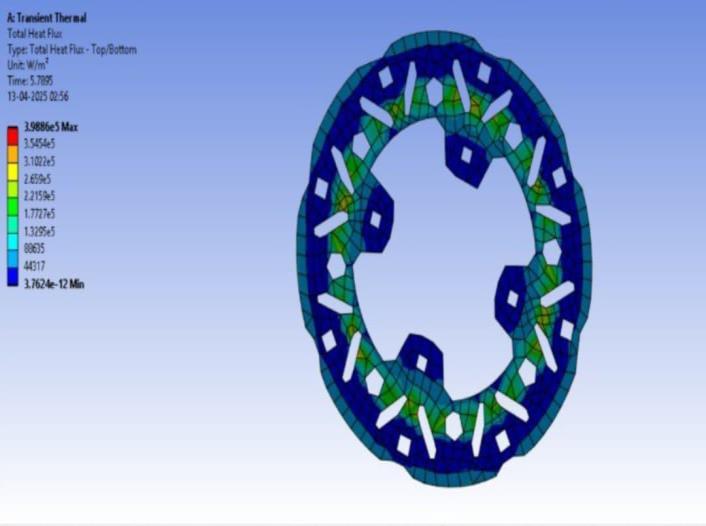
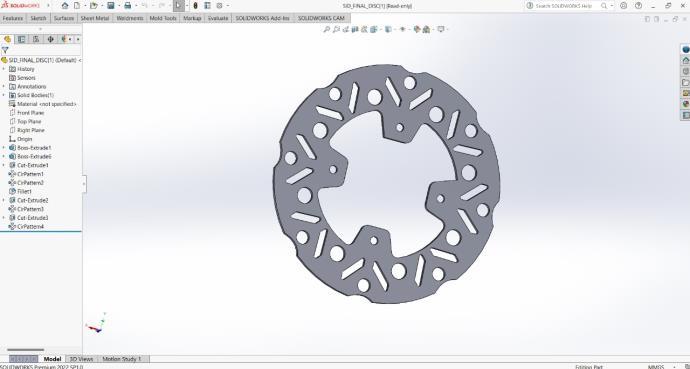
Abstract - This report contains a brief overview of the braking system for an (All-terrain vehicle) ATV. Brakes play a crucial role in vehicles by helping to slow down, stop, or keep them stationary. Among modern braking systems, brake discs are key, especially in automobiles. The biggest challenge with brake discs is controlling the heat generated during braking. If this heat isn’t adequately dissipated it can cause the disc to heat up or cool down too quickly, leading to thermal stress and, in extreme cases, failure. In this study, we will explore the use of stainless steel material for brake discs, given its promising frictional properties and ability to conduct heat efficiently and lightweight properties. A disc brake rotor model for the all-terrain vehicle was simulated using ANSYS software for thermal analysis. We calculated heat flux, and kinetic energy and studied how pressure and frictional forces act on the brake material. The goal is to understand how these forces affect braking performance and how design changes like disc design for better heat dissipation, and a change in pedal ratio will improve driver reach. Material selection and material differentiation of material is also included in the report. The end of the report contains the calculations and iteration based on which we have designed the system
Key Words: Hydraulic braking system, All terrain vehicle, Disc (rotor), Pressure switch
Braking is one of the most important aspects of vehicle safetyandperformanceithastheabilitytostoporslow downavehiclesafelywhichultimatelydefinesavehicle’s control and reliability. The braking system is not just a mechanical necessity but also a safeguard, a lifesaving featurethateveryvehicledependson.
Abrakingsystemservesthreefundamentalpurposes:To reducevehiclespeed,tobringthevehicletoacomplete haltatadesiredpoint,andmostimportantly,toprevent accidentsbyprovidingthedriverwithcompletecontrol over the motion of the vehicle. This is achieved by convertingthevehicle’skineticenergyintoheatenergy through friction, then the heat is dissipated into the atmosphere.Whilethisenergytransformationmayseem simple, it involves complex mechanical and thermal processes that must be carefully managed to ensure efficiency,consistency,andsafety.
In this research, we present a design analysis and fabricationofahydraulicbrakingsysteminanall-terrain
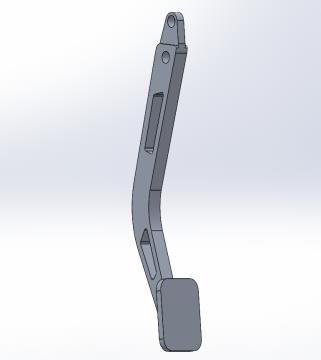
vehicle(ATV)featuringabrakerotorofstainlesssteel,an independentpressureswitch(oneswitchfortherearand one switch for front), newly designed brake pedal. The dualpressureswitchwithenhancedsafetybyintroducing a fail-safe mechanism; if one switch malfunctioned the other remains functional, thereby reducing the risk of totalfailure.
Ourapproachisforbothperformanceandreliability.The useofahydraulicbrakingsystemwillreducepedaleffort, whileadiscbrakewillhavehigherheatdissipationand consistent braking force under varying conditions. This paper contains conceptualization, design methodology, componentselection,materialselection,andperformance analysis of the braking system, to contribute safer and more efficient braking technologies in automotive engineeringall-terrainvehicles.
ReddyS.andVenkateshG.performedananalysisofthe inboardandoutboardbrakingsystemsinrear-wheeldrive ATVs.Theanalysishascontainedtestingunderheavy-duty trail conditions. The result showed that inboard brakes suffered slightly delayed response time due to drive train backlash.
Patel R. and Mehta S. conducted a study analyzing the performance of hydraulic disc brakes used in off-road vehicles, especially focusingon all-terrain vehicles (ATVs). Theirresearchtargetedbrakingforcedistributionacrossthe front and rear wheels under different terrain conditions UsingsimulationtoolslikeANSYSand SolidWorksmotion, Authors analyze brake pressure, stopping distance, and dynamicload transfer. Results showed thatdual hydraulic switches withpressure distribution provide bettercontrol andreducestoppingtime,especiallyonslopesandunstable surfaces.
KhanM.A.andPatelN.didacomparativestudyonbrake discmaterialssuchascastiron,stainlesssteel,andcarbon ceramiccompositesusedinthehydraulicbrakingsystemof ATVs. The materials were evaluated based on thermal conductivity,wearresistance,andweight.Throughthermal structuralFEAandlab-basedweartesting,thestudyfound thatcarbonceramiccompositeshadhigherheatresistance andlessweightbutatahighercost,whilecastironischeaper buthasthehighestthermaldeformation.Stainlesssteelisa balancedoptionwithmoderateweightandgoodcorrosion resistance,makingitidealforoff-roadconditions.
International Research Journal of Engineering and Technology (IRJET) e-ISSN: 2395-0056
Volume: 12 Issue: 04 | Apr 2025 www.irjet.net p-ISSN: 2395-0072
Whenyoupressthebrakesinavehicle,you’reusingasystem thatincreasestheforceofyourfootjustlikeusingalongstick toliftsomethingheavy.Thisishowhydraulicbrakeswork: they let you stop a fast-moving vehicle with only a small effort.Mostmodernvehiclesusetwinhydrauliccircuitsfor safety.Whentwomastercylindersareworkingtogetherthen at any condition one fails the other can still control the brakes.Thesystemisdesignedindifferentways:sometimes onecircuithandlesthefrontbrakesandtheothertherear,or bothcircuitsmaycontrolallfourwheelsinasplitpatternjust tomakesurethatatleastsomebrakingisalwaysavailable. Duringsuddenorhardbraking,alotofthevehicle’sweight shiftsforward.Thistakesweightofftherearwheels,which makesthemmorelikelytolockupandcausethevehicleto skidespeciallydangerousathighspeedsoronslipperyroads. That’swhyrearbrakesaremadeslightlylesspowerfulthan the front ones, to avoid this issue. To help with this even more,manyvehicleshaveapressure-limitingvalve.Itworks automatically and senses when you're braking hard. If the pressure gets too high enough to lock the rear wheels it reduces the flow of brake fluid to them, helping maintain balance and control. In advanced vehicles, you’ll also find Anti-lockBrakingSystems(ABS).Thesesystemsusesensors tocheckhowfasteachwheelisspinning.Ifanywheelstarts to lock up, ABS quickly releases and reapplies the brakes manytimespersecondsothewheelskeeprotatingandthe vehiclestaysundercontrol.
3. METHODOLOGY
InthisprocessallOEM(originalequipmentmanufacturers) Products are compared concerning one another. The comparison is made on various data collected with benchmarkingbasedonsustainability,availability,cost,and properties.
Table1forRotorMaterial
conductivity(W/ m.K)
Strength(MPa)
1. Stainless steel gives the best balance of performance,reliability,andcost-effectiveness.
2. Stainless steel offers higher mechanical strength thanaluminumandcastiron
3. Corrosionresistanceandmagneticproperties.
International Research Journal of Engineering and Technology (IRJET) e-ISSN:
Volume: 12 Issue: 04 | Apr 2025 www.irjet.net p-ISSN: 2395-0072
Table2forBrakeFuel
1. DOT-4performsbetterunderheavybrakingor off-roadconditions
2. DOT-4hasabalanceincost,performance,and availability.
3. DOT-4istheidealfluidforATVswithmoderateto highstress.
4. CALCULATIONS
Mass 285kg
Deacceleration 0.8g=7.848
Step1:DynamicLoadTransfer(DLT)
DLT=m.a.h/L=285*7.848*0.5588/1.4732 =848.40N
Step2:LoadonTire
LoadonFrontTire=(weight*x)+DLT=(285*9.81*0.4)+ 848.40 =1966.74N
LoadonRearTire=(weight*x)-DLT= 9.81(285*0.6)848.40=829.11N
Step3:WheelTorqueoneachwheel
Front=μroad&tire*loadonfront*tireradii*1/2= 0.7*1966.74*0.2921*1/2 =201.06Nm
Rear = μroad&tire * load on rear * tire radii *1/2= 0.7*829.11*0.2921*1/2=84.764Nm
Step4:Pressureinlines
ForceonMasterCylinder=250*7=1750N
Assume Master Cylinder Area = A = π/4*(0.0175) 2 = 0.0002405m2
P=F/A=1750/0.0002405
=7367824.56N/m2
Step5: ClampingForce
On Front=Pressure* π/4*(Dcaliper)2*No.Of Piston = 7367827.56* *(0.030)2*2=10416.02N
On Rear = Pressure* π/4*(Dcaliper)2*No. Of Piston = 7367827.56* *(0.030)2*2=10416.02N
Step6:BrakingTorque
Front=ClampingForce*μpad&tire*Reff=10416.02*0.35*0.0715 =260.66Nm
Rear=ClampingForce*μpad&tire*Reff=10416.02*0.35*0.0715= 260.66Nm
BrakingTorque>WheelTorque,thevehiclewillcometo rest.
Mount’s Calculations:-
ForceonMasterCylinder’sMount= ForceonPedalx PedalRatio=250*7=1750N
*Kineticenergyforvehicle:-1/2*m*v2
m=285kg
v=60km/hr=16.67m/s
x=0.6=staticloadfactorfortherearaxle
K.E.=1/2*m*v2*x
=1/2*285*16.672*0.6
=23759.50J
*Stoppingtimeforvehicle:-
v=u+at
0=16.67+(-0.8*9.81)*t
t=16.67/7.848
=2.12sec
*BrakingPower(HeatFlow):-
Pb=K.E./t=23759.50/2.12=11207.311W
*HeatFlux:-
Q=Pb/A
A=Areasweptbypads,m2
International Research Journal of Engineering and Technology (IRJET) e-ISSN: 2395-0056
Volume: 12 Issue: 04 | Apr 2025 www.irjet.net p-ISSN: 2395-0072
Q=11207.311/0.016244
Q=689935.42W/m2
Stoppingdistance
S=u2/2*a*s = 11.112 /2*(0.8*9.81) =7.86m
5. CONCLUSIONS
Usingtheabovecalculationsandknowingtheadvantagesof stainlesssteel420seriesrotorscomparedtoothermaterials is sustainable. The heat dissipation of the rotor is good enough to withstand all types of terrain conditions. The Numerical evaluation of the braking system confirms that effectivevehicledecelerationwithinasafestoppingdistance, systemiscapableofbringingthevehicletorestefficiently. Furthermore, using DOT-4 brake oil having good performance with durability and optimal combination of bothSS420rotorandDOT-4brakeoil.Overall,thesystem design ensures reliable performance under real-world brakingconditions
6. REFERENCES
William F. Milliken, Douglas L. Milliken, Race Car Vehicle Dynamics, Society of Automotive Engineers, Inc. 400commonwealthDrive,Warrandale,PA15096-0001.
Limpert Rudolf "Brake Design and Safety", Society of AutomotiveEngineers,Warrandable,Inc,PA,USA,1992
V.B. Bhandari, Design of Machine Elements, third edition, McGrawHillEducation,India,2010.
RudolfLimpert“Brakedesignandsafety”
Design,FabricationofBrakingSystemforATVauthoredby Thiagu S.M, Varun N., Lokeshwaran R. focuses on the thermo-mechanical behavior of brake discs during brakingphases.
BIOGRAPHIES


Mr.SiddheshRameshAgone BachelorofEngineering,Studentof Mechanical Department, Datta Meghe College of Engineering, Airoli,NaviMumbai.
Mr.SiddheshSureshSondkar BachelorofEngineering,Studentof Mechanical Department, Datta Meghe College of Engineering, Airoli,NaviMumbai.



Mr.BiswajitBasantaBehera BachelorofEngineering,Studentof Mechanical Department, Datta Meghe College of Engineering, Airoli,NaviMumbai.
Mr.SumitKishorGhodke BachelorofEngineering,Studentof Mechanical Department, Datta Meghe College of Engineering, Airoli,NaviMumbai.
Prof. Nilesh Limbraj Shinde Professor in Mechanical Department, Datta Meghe College of Engineering, Airoli, Navi Mumbai.