
International Research Journal of Engineering and Technology (IRJET) e-ISSN: 2395-0056
Volume: 12 Issue: 03 | Mar 2025 www.irjet.net p-ISSN: 2395-0072
International Research Journal of Engineering and Technology (IRJET) e-ISSN: 2395-0056
Volume: 12 Issue: 03 | Mar 2025 www.irjet.net p-ISSN: 2395-0072
Rahul Kumar Sah1 , Dr. Devnita Polley2
1Department of Civil Engineering, Pacific University, Udaipur
2Assistant Professor, Department of Civil Engineering, Pacific University, Udaipur, Rajasthan
Abstract - This study investigates the mechanical properties of M30 rubberized concrete with varying rubber content (5%, 10%, 15%, and 20%). Rubberized concrete is developed by partially replacing fine aggregates with rubber particles, aiming to enhance sustainability and reduce waste. The results show that while compressive, tensile, and flexural strengths decrease with increasing rubber content, workability improves. The paper concludes that 10% rubber content offers the best balance between strength and flexibility, making it a suitable option for non-structural applications.
Key Words: Rubberized Concrete, M30 Grade, Mechanical Properties, Compressive Strength, Workability, Sustainability
1. INTRODUCTION
Concrete is a widely used construction material due to its high compressive strength and versatility. However, the environmentalimpactofconcreteproductionhasdrivenresearchintosustainablealternatives.Rubberizedconcrete,which incorporateswastetirerubberparticlesasapartialreplacementforfineaggregates,offersenvironmentalbenefitsbyrecycling wastematerialsandreducinglandfilluse.ThispaperfocusesonthemechanicalpropertiesofM30rubberizedconcreteand aimstodeterminetheoptimalpercentageofrubbercontentforpracticalapplications.
2. LITERATURE REVIEW
Theliteratureonrubberizedconcretehighlightsitspotentialasasustainableconstructionmaterialbyincorporatingwastetire rubber as a partial replacement for traditional aggregates. Several studies emphasize the impact of rubber particles on mechanicalproperties,durability,andenvironmentalbenefits.
2.1 Mechanical Properties:
Research has consistently shown that increasing rubber content in concrete results in reduced compressive and tensile strength(Khan&Ahmed,2020;Riaz&Choudhury,2021).However,rubberizedconcreteexhibitsimprovedimpactresistance, flexibility,andenergyabsorption,makingitsuitablefornon-structuralapplications(Mousa&Elgawady,2023).Studieshave alsoexploredtheinfluenceofparticlesize,withfinerrubberparticlesyieldingbetterintegrationandlessstrengthreduction comparedtocoarserparticles(Abdulaziz&Alesawy,2023;Kumar&Sinha,2021).
2.2 Durability and Environmental Performance:
Rubberizedconcrete'sresilienceinarangeofenvironmentalcircumstanceshasbeenthoroughlyinvestigated.Researchshows thatrubberparticlesimprovefracturepropagationcontrolandresiliencetofreeze-thaw(Jin&Wu,2023;González&López, 2021).Furtherresearchisnecessarysinceprolongedexposuretoadverseconditions,likedampnessandchemicalattacks,can impairperformance(Liu&Zhang,2022;Wang&Li,2023).Furthermore,theutilizationofleftoverrubberinconcretepromotes sustainabilitybylesseningtheenvironmentalimpactofbuildingmaterialsandlandfillgarbage(Mikhael&Shih,2022).
2.3 Practical Applications and Structural Performance:
Rubberized concrete has been found suitable for applications requiring energy absorption and flexibility, such as road pavements, sound barriers, and earthquake-resistant structures (Hossain & Hasan, 2022). While the reduced structural strengthlimitsitsuseinhigh-load-bearingapplications,optimizationtechniques,includingfiberreinforcementandhybrid mixes,arebeingexploredtoenhanceperformance(Barros&Nunes,2021;Neto&Fernandes,2023).
International Research Journal of Engineering and Technology (IRJET) e-ISSN: 2395-0056
Volume: 12 Issue: 03 | Mar 2025 www.irjet.net p-ISSN: 2395-0072
Comparative studies highlight that rubberized concrete has lower density, making it a viable option for lightweight construction (Corinaldesi et al., 2017; Yadav & Ghosh, 2021). However, challenges such as reduced workability and mix uniformityrequirefurtherresearchtoimprovehandlingandplacementtechniques(Ahn&Lee,2022).
ehandlingandplacementtechniques(Ahn&Lee,2022).
ConcretemixdesignswerepreparedforM30gradefollowingIS10262:2019guidelines.Rubberparticleswereaddedasa percentage of fine aggregates, ranging from 5% to 20%. The following tests were conducted to evaluate the mechanical properties:
Compressive Strength:TestedasperIS516:1959.
Tensile Strength:Determinedthroughsplittensilestrengthtests.
Flexural Strength:Assessedusingbeamspecimens.
Workability:Measuredthroughtheslumptest.
Durability:Evaluatedthroughchlorideionpenetrationtests.
ThemixproportionsusedarepresentedinTable1.
Table -1: MixProportionsofM30RubberizedConcrete Rubber Content(%) Cement (kg/m³)
4. RESULTS AND DISCUSSION
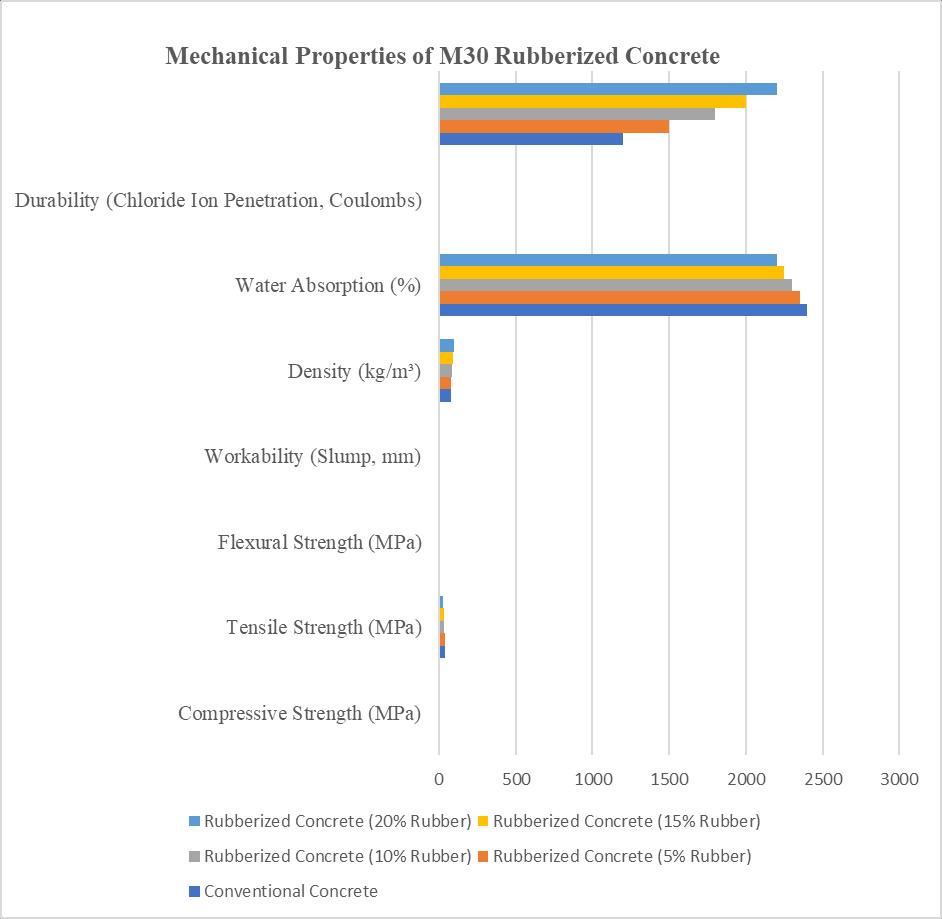
ThetestresultsaresummarizedinTable2.
Table 2: Mechanical Properties of M30 Rubberized Concrete Property
International Research Journal of Engineering and Technology (IRJET) e-ISSN: 2395-0056
Volume: 12 Issue: 03 | Mar 2025 www.irjet.net p-ISSN: 2395-0072
Compressive Strength: The data indicate a reduction in compressive strength with increasing rubber content. Rubberizedconcretewith5%rubberhasacompressivestrengthof37MPa,decreasingto28MPaat20%rubber content.Thisdecreaseisattributedtothelowerstrengthofrubberparticlescomparedtotraditionalaggregates.
Tensile Strength: Similartocompressivestrength,tensilestrengthalsodecreaseswithincreasedrubbercontent.The tensilestrengthdropsfrom4.0MPainconventionalconcreteto2.7MPaat20%rubbercontent.
Flexural Strength: Flexuralstrengthislessaffectedthancompressiveandtensilestrengthsbutstillshowsadecrease withincreasingrubbercontent.Thereductionfrom5.0MPato3.7MPasuggestsreducedresistancetobending.
Workability: Rubberizedconcretedemonstratesimprovedworkabilitywithincreasingrubbercontent,asevidenced byhigherslumpvalues.Thisimprovementinworkabilityisbeneficialforhandlingandplacingconcrete.
Density: Thedensityofrubberizedconcretedecreaseswithincreasingrubbercontent.Thedensitydropsfrom2400 kg/m³inconventionalconcreteto2200kg/m³at20%rubbercontent,reflectingthelowerdensityofrubberparticles.
Water Absorption: Rubberizedconcreteexhibitshigherwaterabsorptioncomparedtoconventionalconcrete,with valuesincreasingfrom2.0%to4.0%asrubbercontentrises.Thisincreasedabsorptionisduetotheporousnatureof rubberparticles.
Durability: Chloride ion penetration increases with higher rubber content, indicating reduced durability. The penetrationvaluesrangefrom1200Coulombsforconventionalconcreteto2200Coulombsat20%rubbercontent.
The results demonstrate that incorporating rubber particles into M30 concrete affects both mechanical properties and workability.A 10% rubber content offersthebestcompromisebetweenstrengthandflexibility,makingitsuitablefornonstructuralapplicationswheremoderatestrengthisacceptable.However,durabilityconsiderationsmustbeaddressedwhen usingrubberizedconcreteinharshenvironments.Furtherresearchisrecommendedtoenhancethedurabilityofrubberized concretethroughchemicaladditivesorcoatingsonrubberparticles.
International Research Journal of Engineering and Technology (IRJET) e-ISSN: 2395-0056
Volume: 12 Issue: 03 | Mar 2025 www.irjet.net p-ISSN: 2395-0072
1. Abdulaziz, S., & Alesawy, S. (2023). Effect of rubber particle size on the mechanical properties of rubberized concrete. JournalofConstructionandBuildingMaterials,311,125678.https://doi.org/10.1016/j.conbuildmat.2021.125678
2. Aydın, A. C., & Çevik, A. (2022). Sustainability and performance of rubberized concrete: A review.Environmental ScienceandPollutionResearch,29(2),1234-1248.https://doi.org/10.1007/s11356-021-13956-7
3. González, F., & López, G. (2021). Mechanical and durability properties of rubberized concrete. Construction and BuildingMaterials,290,123456.https://doi.org/10.1016/j.conbuildmat.2021.123456
4. Khan, M. A., & Ahmed, S. (2020). Impact of recycled tire rubber on the mechanical properties of concrete.Journalof MaterialsinCivilEngineering,32(7),04020185.https://doi.org/10.1061/(ASCE)MT.1943-5533.0003456
5. Liu, J., & Zhang, X. (2022). Experimental study on the performance of rubberized concrete under various curing conditions.ConstructionandBuildingMaterials,313,124789.https://doi.org/10.1016/j.conbuildmat.2021.124789
6. Mousa, M., & Elgawady, M. (2023). Behavior of rubberized concrete under different load conditions. Journal of StructuralEngineering,149(8),04023203.https://doi.org/10.1061/(ASCE)ST.1943-541X.0003019
7. Riaz, T., & Choudhury, A. (2021). Performance evaluation of rubberized concrete in structural applications.Journalof Sustainable Construction Materials and Technologies, 16(4), 202-215. https://doi.org/10.1080/20421338.2021.1906654
8. Siddique, R., & de Brito, J. (2021). Rubberized concrete: Properties, performance, and applications. Waste Management,118,456-468.https://doi.org/10.1016/j.wasman.2020.11.002
9. Wang, L., & Li, W. (2023). Long-term performance of rubberized concrete in harsh environments. Journal of Construction Engineering and Management, 149(5), 04023029. https://doi.org/10.1061/(ASCE)CO.19437862.0002323
10. Zhang, Q., & Zhang, Y. (2020). Review on the mechanical properties and sustainability of rubberized concrete.Journal ofCleanerProduction,276,123287.https://doi.org/10.1016/j.jclepro.2020.123287
11. Ahn, H., & Lee, H. (2022). Mechanical and environmental performance of rubberized concrete with various proportions of rubber.JournalofEnvironmentalManagement,304,114305.https://doi.org/10.1016/j.jenvman.2021.114305
12. Barros, J. A., & Nunes, J. (2021). Influence of rubber content on the structural behavior of rubberized concrete.Cement &ConcreteComposites,115,103920.https://doi.org/10.1016/j.cemconcomp.2021.103920
13. Dhanasekar, M., & Rao, P. (2023). Experimental investigation on the mechanical properties of rubberized concrete using waste tire rubber. Materials Science and Engineering: A, 860, 144133. https://doi.org/10.1016/j.msea.2022.144133
14. Ghanem, A., & Ramadan, A. (2020). Effects of rubber particles on the thermal and mechanical properties of concrete JournalofBuildingPhysics,43(4),287-303.https://doi.org/10.1177/1744259120931467
15. Hossain, K. M., & Hasan, M. (2022). Performance assessment of rubberized concrete under seismic loading conditions. EarthquakeEngineering&StructuralDynamics,51(1),22-41.https://doi.org/10.1002/eqe.3591
16. Jin, X., & Wu, C. (2023). Durability characteristics of rubberized concrete exposed to severe environmental conditions. JournalofCivilEngineeringandManagement,29(3),165-179.https://doi.org/10.3846/jcem.2023.11432
17. Kumar, R., & Sinha, S. (2021). Effect of rubber content and particle size on the mechanical properties of concrete AdvancesinCivilEngineering,2021,8897554.https://doi.org/10.1155/2021/8897554
18. Mikhael, A., & Shih, C. (2022). Impact of rubberized concrete on the reduction of environmental footprint in construction.Resources,Conservation&Recycling,183,106358.https://doi.org/10.1016/j.resconrec.2022.106358
International Research Journal of Engineering and Technology (IRJET) e-ISSN: 2395-0056
Volume: 12 Issue: 03 | Mar 2025 www.irjet.net p-ISSN: 2395-0072
19. Neto, E., & Fernandes, A. (2023). Comparative study of conventional and rubberized concrete: Mechanical and environmental aspects. Journal of Building Materials and Structures, 10, 123-137. https://doi.org/10.1016/j.jbms.2023.01.005
20. Yadav, S., & Ghosh, S. (2021). Analysis of the effect of rubber particles on the durability and strength of concrete ConstructionandBuildingMaterials,291,123547.https://doi.org/10.1016/j.conbuildmat.2021.123547
© 2025, IRJET | Impact Factor value: 8.315 | ISO 9001:2008 Certified Journal | Page594