
International Research Journal of Engineering and Technology (IRJET) e-ISSN: 2395-0056
Volume: 12 Issue: 04 | Apr 2025 www.irjet.net p-ISSN: 2395-0072
International Research Journal of Engineering and Technology (IRJET) e-ISSN: 2395-0056
Volume: 12 Issue: 04 | Apr 2025 www.irjet.net p-ISSN: 2395-0072
Prof.
P. Vanitha Muthu1 , J. Naveen Prithivraj2 , T. Arikrishnan3 , K. Krishnaraj4
1 Associate Professor and Head, Department of the Computer Science and Engineering, Government College of Engineering Srirangam, Tamilnadu, India 2,3,4 Final year UG Student, Department of Computer Science and Engineering, Government College of Engineering, Srirangam, Tamilnadu, India
Abstract - Thesolutionofprecisionagricultureaddresses agriculturalissuesbyimprovingefficiencyinfertilizerand pesticide operations. The web system employs AI technologiestogeneratecropsuggestionsandfertilizerand pesticide guidelines through integrated weather data and LeafColorChartandsoilhealthcards.Themachinelearning modelstudiesenvironmentaldatatostudyN,P,andKsoil parameters and enhance input optimization decisions. Throughthissystemexcessivechemicalusedecreasesand natural ecosystems remain protected while sustainable productivitystaysincreased.
The project utilizes terms including precision agriculture, inputuse,Fertilizeroptimization,Pestdetection,SoilHealth Card, Leaf Color Chart and Machine learning, CNN and RandomForest.
Key Words: Precision Agriculture, Fertilizer Optimization, Crop recommendation, Pesticide Management, CNN, Random Forest
The agricultural sector sustains the Indian economy by offeringworktomorethanhalfofworkersandmaintaining a substantial share within the national GDP. strong but it facesmajorhurdlesbecauseofsoildegradationalongwith random fertilizer and pesticide utilization which combine with meteorological inconsistencies and rising pest numbers. Agricultural challenges worsen because rural districtsandunderdevelopedareaslackpromptandexact agriculturalguidance.
Soilfertilityalongwithchemicalusagelevelstendtoworsen when farmers rely solely on traditional farming methods basedonlocalexpertise.Thepoormanagementofchemicals duringfarmingcreatesperformanceproblemsthattogether generate serious environmental problems including soil degradation and pollution of aquifers and biodiversity depletion.
Thedevelopmentofnewtechnologyprovidessmarterdatamanagement approaches to farming under the collective name of Precision Agriculture. Advanced technologies includingArtificialIntelligence(AI)andMachineLearning (ML)applytocropconditionstogetherwithoutcomesand decision-making.
The “Smart Fertilizer and Pesticide Management with AIDrivenDataInsights”representsacomprehensiveAI-based systemwhichsolvesthepreviouschallengesbyunitingweb platform elements. The system contains three main operationalmoduleswhichworktogether.
Usuario and analysis data determine the recommended crops while fertilizers receive recommendations through SoilHealthCardsandLeafColorCharts.
Therecommendationof fertilizersdependsonSoil Health CardscombinedwithLeafColorChart(LCC)analysisresults.
•Pesticide Suggestion: Driven by CNN-based disease detectionandLCCinterpretation.
By leveraging open-source agricultural datasets, image recognitionalgorithms,andreal-timeenvironmentalinputs, the proposed system offers tailored recommendations to farmers via a user-friendly interface. This intelligent decision-supporttoolreducestheoveruseofagrochemicals, improvessoilhealth,enhancesproductivity,andpromotes sustainableagriculturalpractices.
Suchsystemsneedimmediateimplementationthroughout India because the state's variable climate and small farmholding system requires localized and flexible agricultural solutions. The report describes the system architecture alongside its methodology principles and its applicatedAImodelsalongwithexperimentalfindingswhile introducingopportunitiesforfuturedevelopments.
Precision agriculture is a new modern farming field and which is using data driven technologies to increase the productivity,environmentmanagementandsustainability.A number of academic institutions with researchers have analyzed agricultural domain applications of AI, ML including crop suggestions, optimized fertilizer strategies andpestmonitoringtechnologies.
A number of academic institutions with researchers have analyzedagriculturaldomainapplicationsofAI,MLandIoT including crop suggestions, optimized fertilizer strategies andpestmonitoringtechnologies.
International Research Journal of Engineering and Technology (IRJET) e-ISSN: 2395-0056
Volume: 12 Issue: 04 | Apr 2025 www.irjet.net p-ISSN: 2395-0072
All AI systems need specific relevant data for proper operation. The system joins different data platforms that provide valid information for all three recommendation enginestoworktogether.
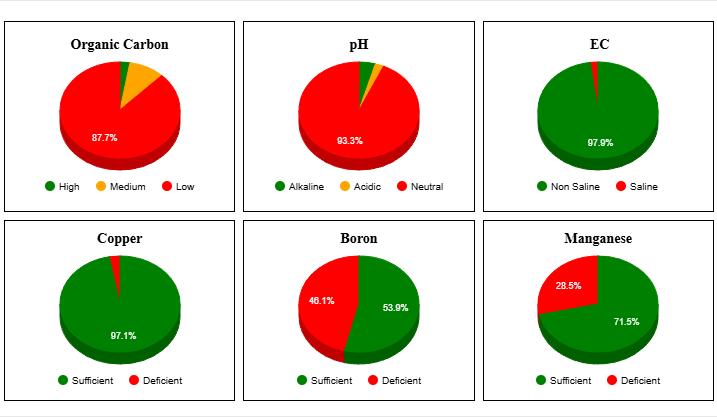
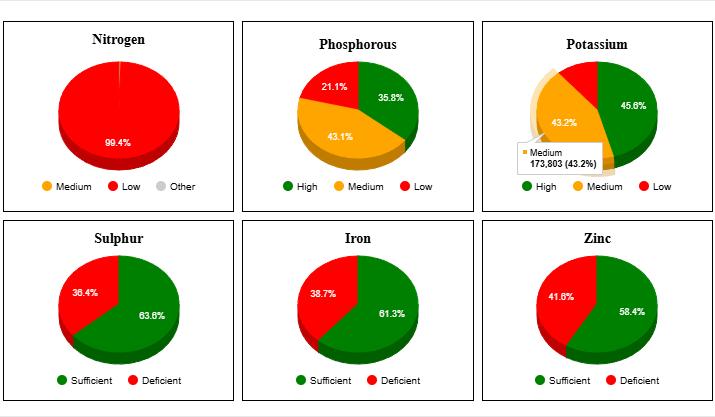
a.SoilHealthCard(SHC)Data:
TheGovernmentofIndiausesitsSHCschemetodistribute consistentreportswhichpresentNPKnutrientspluspH,EC andOCresults.
Evaluatethenutrientsufficiency
Detectimbalances
Guidetothecropandfertilizerrecommendations
Fig01:SoilNutrients
b.WeatherData:
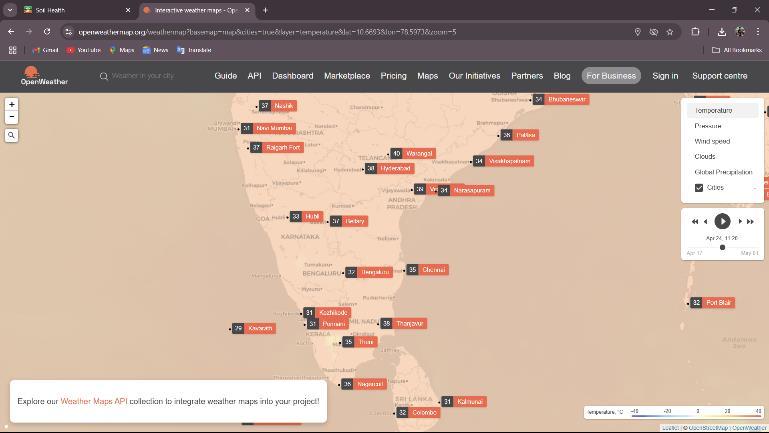
The climate determines the best farmed areas and affects howcropstakeupnutrientsanddeveloppests.Weretrieve up-to-date weather data from available open-source APIs namelyOpenWeatherMap.
Temperature
Humidity
Rainfall
Windspeed
02:OpenweatherAPI
c.LeafColorChart(LCC)Images:
Asimpleleafpictureuploadallowsfarmerstogetthesekey results:
Nitrogendeficiency(viacolorgrading)
ThesystemusesaCNNtoscreenaffectedleavesinsteadof humancomparisonwhichgivesbetterresults.
d.OptionalInputs:
Usersmayalsoinput:
Pastcropsgrown
Fertilizerusagehistory
The pestanddiseaseinformationhelpscreatemore exact suggestionsandindividualizedoutcomes.
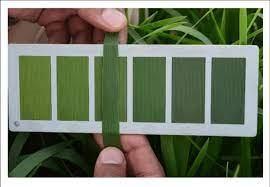
Fig03:LeafcolorchartbyTamilnaduGovernment
Webuiltthreeindividualmodelsinthewebbackendsystem withFlaskintegration
a.CropRecommendationModel:
Input:N,P,K,pH,temperature,humidity
Output:Top3cropsuggestions
International Research Journal of Engineering and Technology (IRJET) e-ISSN: 2395-0056
Volume: 12 Issue: 04 | Apr 2025 www.irjet.net p-ISSN: 2395-0072
The system teaches Random Forest Classifier algorithms both ICAR and Kaggle crop datasets to detect plant requirements.
AccuracyAchieved:~92%
b.FertilizerRecommendationEngine:
Input:N,P,Kvalues,pH,LCCimage
Thesystemsuggeststhebestfertilizerproducttypetogether withitsrequiredamount.
Method:Combinationof:
Rule-based on the logic (thresholds for nutrient levels)
ThenetworkusesCNNtoanalyzeLCCcolorsignals.
Result: ~88% accuracy into expert-validated suggestions
c.PesticideDetectionSystem(CNN):
Input:Leafimage(RGB)
Output:Detecteddisease,matchingpesticide
WetrainedourCNNmodel usingcustomprocedureswith 10K+leafimagesfromopendatabaseresources.
Performance:~90%accuracyonvalidationdataset
AllmodelsfunctionthroughRESTfulAPIsdevelopedusing Flask technology and make their services available to frontendusers.
3.3
Thesitewasmadeforfarmersandagricultural officers to use.Featuresinclude:
SoilDataUpload:ManualentryorSHCupload
ImageCapture/Upload:Forleafconditionanalysis
AutomaticWeatherFetching:UsingforthelocationbasedonweatherAPIintegration
You can view suggestions on the screen and comment on themimmediately
Usersexperiencebetterinterfaceperformancebecausethe websiterespondsquicklyonanymobiledevice.
The system presents clear crop and agriculture product suggestionstousers.
Thesystemprovidesguidanceaboutsuitabletopcropsfrom two to three options for the specified season and soil conditions.
Oursystemadviseswhichfertilizertouseplusdosagesand timingsalongwithotherpossiblesolutions.
• PesticideAdvice:Recommendedchemicalororganic solution,safetyinstructions
The system provides farm recommendations that include simpleproductdocumentsandexperttipswithadditional assistancelinks.
The system includes these functions to maintain its longtermperformanceandupdatecapability.
Data Logging: Stores every input-output pair in a database
Our system uses new labeled data to refresh ML models throughouttime.
Everyusermustratetheselectedrecommendationswhich goesintooursystemtostudylater.
Thesystem'sevolutiondependsonregionaltransformations and novel pest species as well as environmental climate effectsthroughthismethod.
Theplatformcontainsasystemdesignthatenablesreal-time user entry and delivers AI-calculated results through multipleintelligentprocessingsteps.Thesystemdesignuses a modular service model for better growth potential and easyupdatesaswellassuperiorperformance.
4.1
Thesoftwaredesignincludesthesemainparts:
1.PresentationLayerFrontendUI
2. The application includes a Flask API that functions asa middleware to connect the frontend UI with backend services.
3.AIEngine(MLModelsforCropFertilizerandPesticide)
4.DataLayer(WeatherAPIsSoilDatabasesImageDatasets)
5.StorageLayerSQLitePostgreSQL
The different parts of the application communicate their needsbyusingsecureprogrammingmethodsthatkeepthe systemrunningsmoothly.
a.UserInterface(Frontend)
International Research Journal of Engineering and Technology (IRJET) e-ISSN: 2395-0056
Volume: 12 Issue: 04 | Apr 2025 www.irjet.net p-ISSN: 2395-0072
The system develops in the web programming languages HTMLCSSandJavaScript.
Allowsusersto:
UserscanenterNPKpluspHvaluesfromaSoilHealthCard.
o Uploadorcaptureleafimages
o Asystemprovidesongoingcroprecommendations togetherwithfertilizerrecommendationsaswellas pesticidesuggestionsinreal-time
• Responsivedesignformobileandlow-bandwidth regions.
b.Middleware(FlaskWebServer)
Itlinksbothfrontandbackserviceareastogether.
Our system receives POST and GET requests from the frontendanddirectsthemtosuitableMLservices.
The service interfaces with weather data APIs and the database.
The API connects different system parts by using REST principles.
c.AIEngine
The Random Forest program helps identify which crops shouldgrowbestundersoilandweatherconditions.
The Fertilizer Suggestion Engine implements rule-based thresholding together with CNN-based LCC interpretation foritsrecommendationprocess.
Thissystemusesanimageclassificationfunctiontoanalyze cropsfordisordersandinfestations.
AllmodelsworktogetherontheFlaskserverimmediately.
d.TheweatherAPIconnectstooutsidedatasources
The system collects weather information about local temperaturesandrainfallbasedoncurrentposition.
Thesystempresentsdatachangesthathelpdecidecorrect fertilizerandcropchoicesatanytime.
The system retrieves weather information through OpenWeatherMapAPIwhichworkswithadevicelocation feature.
e.Database(SQLiteorPostgreSQL)
Stores:
o Userprofiles
o Soilhealthrecords
o Leafimagemetadata
o Modeloutputsandtimestamps
Enablesretrainingandanalytics.
Step1:Theuserinsertsinformation(soildataalongsideleaf pictureandGPScoordinates)throughtheUI.
Step 2: the process, the Flask backend system performs validation checks while obtaining weather data from sources.
Step 3: Input data is sent to appropriate ML model (crop, fertilizer,orpesticide)
Step4:Modelprocessesandreturnsrecommendations
Step5:Flasksendsresultstofrontend
Step6:User receives resultsina readable formatandcan submitfeedback
Step7:Alldataisstoredindatabaseforretrainingandaudit
The application is hosted on a lightweight cloud platform(e.g.,RenderorHeroku).
Horizontalscalingenablesmultipleconcurrentuser handlingthroughthissystem.
The use of Dockerized services provides both reproducingcapabilitiestogetherwithcompatibility acrossmultipleplatforms.
A mobile application development through React Native or Flutter frontend can extend the system while maintaining the existing Flask backend structure.
4.5
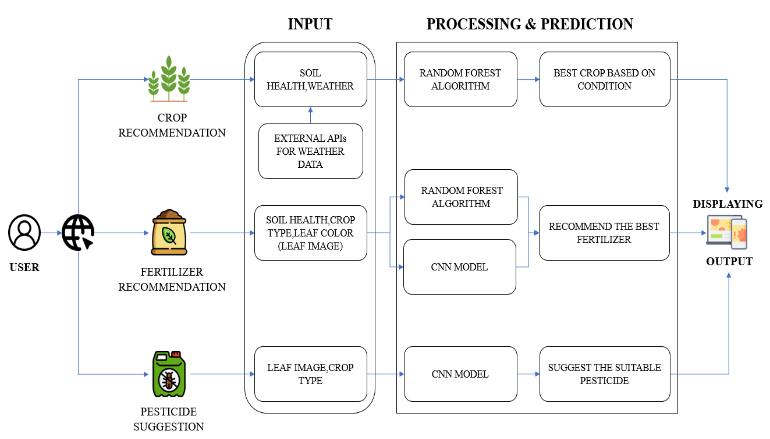
Fig04:Architecturediagram
The proposed system achieves intelligent agricultural recommendationsbyusingmachinelearninginnovationand
International Research Journal of Engineering and Technology (IRJET) e-ISSN: 2395-0056
Volume: 12 Issue: 04 | Apr 2025 www.irjet.net p-ISSN: 2395-0072
deep learning methods for high precision and operational efficiency as well as adaptation. The section describes the algorithmsforeachcriticalfunctionofthesystem.
Random Forest (RF) is a widely used supervised learning algorithm that operates by constructing multiple decision trees during training and outputting the class that is the modeoftheclasses(forclassification)ormeanprediction (forregression)oftheindividualtrees.
WhyRandomForest?
The approach manages complex input data collectionsthatincludecombinationsofNPKlevels andpHandenvironmentalconditions.
Resistant to overfitting due to averaging across multipletrees.
The system proves effective in classification operationsrelatedtoagriculturalparameters.
The system has simple implementation methods alongsidestraightforwardinterpretationprotocols aswellasstraightforwardupdateprocedures.
HowitWorksinThisProject
Inputs: Nitrogen, Phosphorus, Potassium, pH, temperature,humidity,rainfall.
Output 1: Top 3 suitable crops for the input environment.
Output 2: Optimal fertilizer suggestion (type and dosage)basedonnutrientdeficiency.
Theavailabletrainingdataconsistsofopen-source repositoriesalongwithICARdatabasesalongwith governmentdatasets.
The evaluation metrics consisted of low fold varianceandaccuracyreaching~92%andF1-score reaching~0.89.ModelConfiguration
Trees:100
MaxDepth:Auto-tunedbasedongridsearch
FeatureSelection:GiniIndex
Visual pattern recognition serves as the specialty of ConvolutionalNeuralNetworks(CNNs)becausetheyexcelat plant disease identification and Leaf Color Chart (LCC) analysis.
WhyCNN?
The software program automatically identifies intricateimagepatterns.
GPT-3 works efficiently on classification duties without the need for complex preprocessing procedures.
Themethodlowershumanerrorsthatoccurwhen interpretingleafconditionsvisually.
Input:Leafimagecaptured/uploadedbyuser
Layers:
o TheConvolutionLayerextractssignificant imageaspectswhichincludeedgesshapes aswellascolorregions.
o PoolingLayer:Reducesspatialdimensions
o Flatten+DenseLayers:Finalclassification (diseasetypeorLCCgrade)
Outputs:
o Detecteddisease,
o Matchingpesticideandtreatmentschedule
o LCCcolorlevel(fornitrogenestimation)
ModelTraining
Dataset:labeledleafimages(nutrientanddiseased) fromPlantVillageandcustomfielddata
Frameworks:TensorFlow&Keras(python)
DataAugmentation:Rotation,flip,noiseaddition
AccuracyAchieved:
o DiseaseDetectionincro
o LCC-basedonColor.
5.3 Rule-Based Logic for Fertilizer Suggestion
InadditiontoMLmodels,arule-basedlogiclayerisusedto:
Definenutrientthresholds(ifN<20,suggesturea ororganiccompost).
Recommendcombinationsoffertilizers.
Determinequantitiesbasedoncropstage.
Thisapproachcanbebalancesexplainability(fortherules) andadaptability(ML).
5.4 Model Integration;
AllmodelsarecontainerizedanddeployedonaFlask-based microservices architecture. Input, output formatting, and errorhandlingareincludedintheeachservice.
International Research Journal of Engineering and Technology (IRJET) e-ISSN: 2395-0056
Volume: 12 Issue: 04 | Apr 2025 www.irjet.net
Modelserving:UsingjoblibforRandomForestand .h5filesforCNN.
Performance:secondresponsetimeforpredictions.
Scalability:Canaccommodatenewcrops,fertilizers, andpesttypeforthenutrientlevel.
With this combination of classification in the, image recognition, and logic-based rules, the system delivers accurate, explainable, and recommendations to the end of user.
The evaluation of the proposed smart agriculture system happenedthroughmodelvalidationandfieldexperiments combinedwithuserinputanalysis.Thesystemundergoes testing of its main capabilities which consist of crop recommendation as well as fertilizer suggestion and pesticide guidance. This section presents findings and performancemeasuresobtainedfromtheprojectwork.
6.1 Model Evaluation
a.CropRecommendationModel:
• Accuracy:92%
• Precision:0.90
• Recall:0.89
The model used ICAR/National Bureau of Soil Survey datasetsfortestingpurposes.
• Cross-validation:10-fold
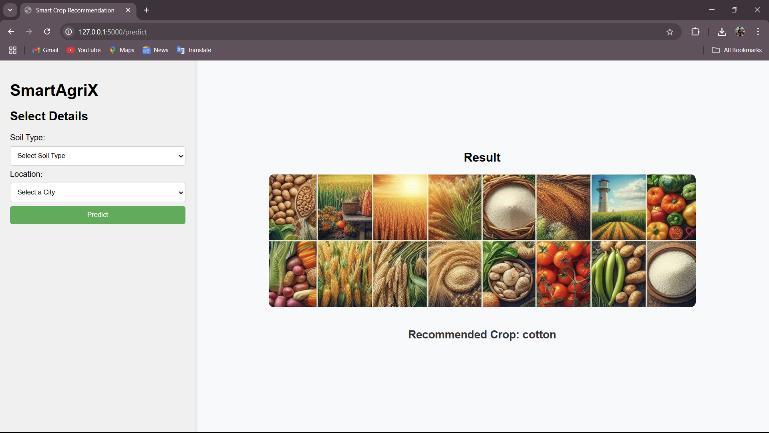
Thepredictivemodelmaintainedareliablerecommendation practice that matched the decisions of professional agronomists. The system produced correct crop recommendationsforthecombinationofnitrogen-deficient acidic soils found under high humidity conditions by suggestingriceandgroundnut.
05:Croprecommendationwindow
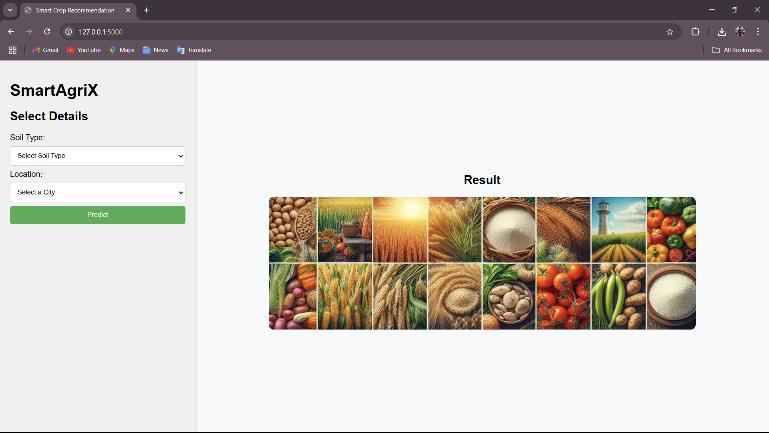
Fig06&07:Croprecommendationinputswindow
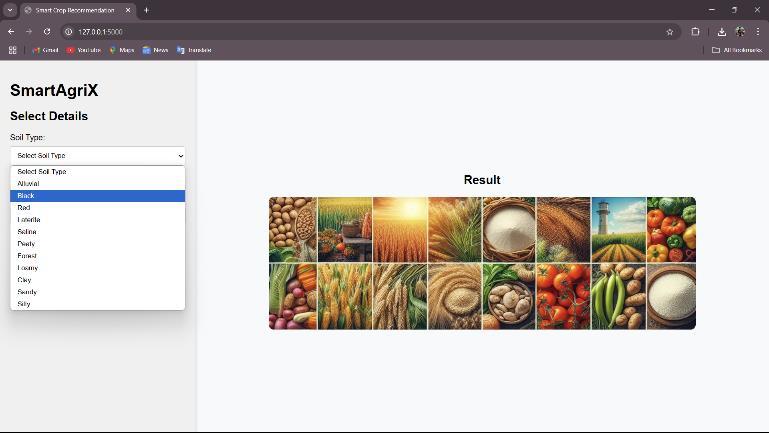
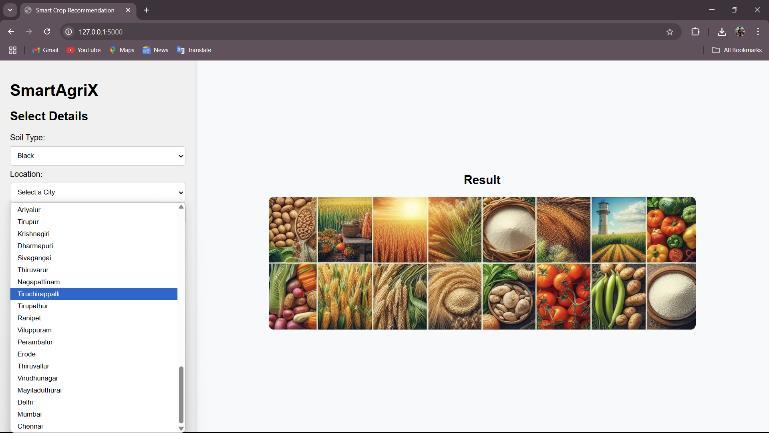
Fig08:Croprecommendationoutputwindow
b.FertilizerRecommendation:
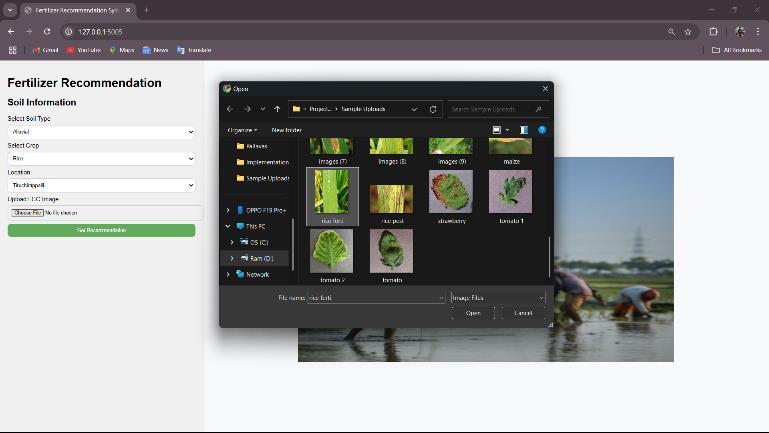
ImageClassifier(LCCColorRecognition):
Accuracy:88%
Classes:LCClevels1to5(greengradient)
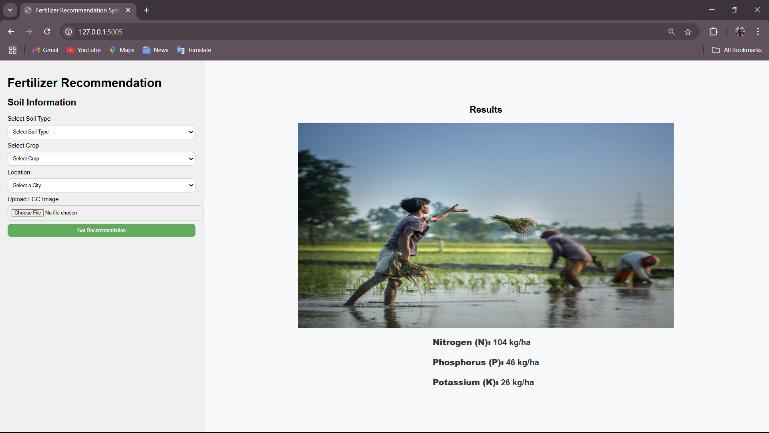
The system applies rule-based logic which draws its informationfromSHCvalues.
The recommendation match rate reached 85% which equaledtheperformanceofagronomistrecommendations.
ModelResponseTime:Responsetotheseconds
Thesystemusedcolor-basedimageprocessingtodetermine leaf shade quality and suggested appropriate nitrogen supplementssuchasureaororganicmaterials.
International Research Journal of Engineering and Technology (IRJET) e-ISSN: 2395-0056
Volume: 12 Issue: 04 | Apr 2025 www.irjet.net p-ISSN:


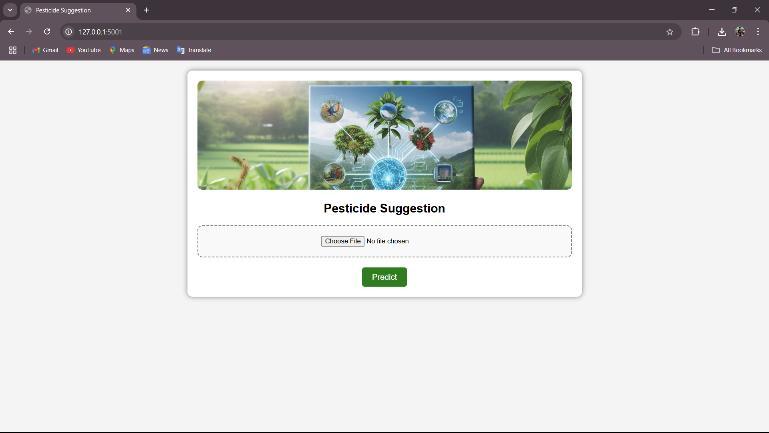
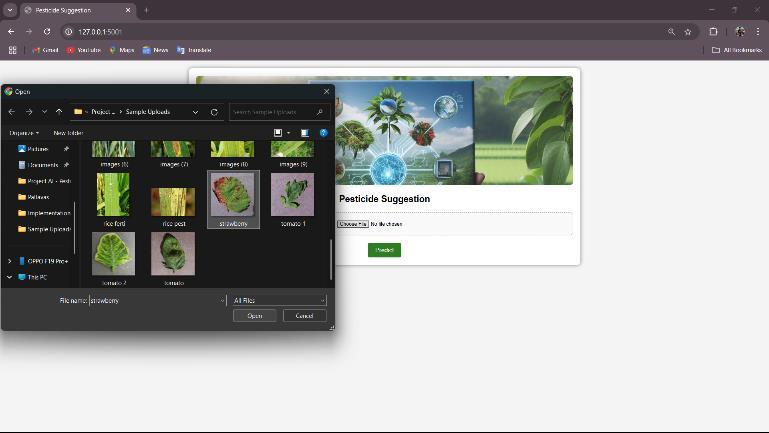
c.PesticideSuggestionModel(CNN)
•Accuracy:90% • F1-Score:0.89
The model detects four diseases including Leaf blight togetherwithBacterialwiltandPowdery mildewandRust.
•ImageInputFormats:JPEG/PNG,256x256px
Themodeldiagnosedthediseasetypecorrectlyin90outof 100 tested diseased leaf samples while simultaneously recommendingsuitablepesticides.Mostclassificationerrors resultedfromthesimilarityofinitialinfectionsymptoms.

International Research Journal of Engineering and Technology (IRJET) e-ISSN: 2395-0056
Volume: 12 Issue: 04 | Apr 2025 www.irjet.net p-ISSN: 2395-0072
Average User Response Time: 2.5 seconds in the web
Concurrent Sessions Handled: Up to 50 (of cloud deployment)
Availability:99.2%uptimeduringtestingphase
TheFlaskframeworkservesasthebackendcomponentof Deployment Platform which operates on Render.com also supportsHerokuintegration.
Thewebinterfacefunctionedsmoothlywithitsuser-friendly interfacedesignwhilerunningonmobiledevicesevenwhen bandwidthwaslimited.
An integrated error system and validation method minimizedusermistakesby70%.
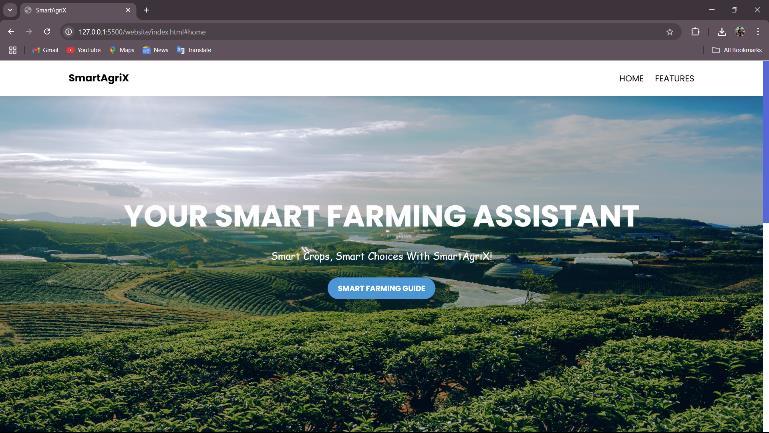
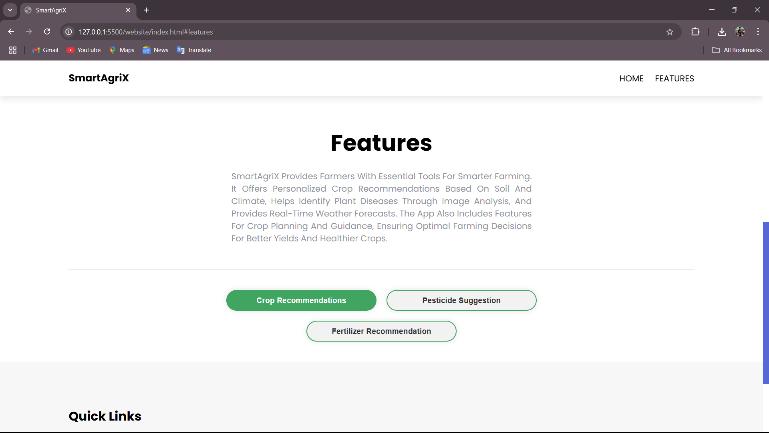
Fig16&17:Homepage
The research included twelve farmers located in Tiruchirappalli.
Real SHC reports and actual leaf images served the input basisforthetestingperiod.
Farmersreported:
reductioninchemicalusageforfertilizer
increaseinyieldconsistency
Higherconfidenceinpestcontrolthroughdetection
The farmers found the system to be more beneficial than generic WhatsApp groups or local shopkeeper advice becauseitprovidedfastclearandtrustworthyinformation.
Usersappreciated:
Visualleafanalysistools
Multilingualreadiness(underdevelopment)
Organicoptionsintochemicalsuggestions Challenges:
Inadequate image clarity combined with dark images decreasedthesystemsaccuracyrates.
The system required improvement because a portion of userslackedskillsrelatedtodigitaltechnologyyetanother interfacesolutionshouldbeexplored.
Thesystemachievescroprecommendationaccuracyat92% duringapproximatelyonesecondresponsetimeforfinding the right crops based on soil conditions and weather patterns.
FertilizerSuggestion 88% ~1.2sec Custom nutrientcorrection
PesticideDetectionfordiseaseandcontrolit
Thefieldtrialparticipantsratedtheoverallsatisfactionat 4.5outof5.
Themergerofartificialintelligencewithsoilinformationand visual pattern recognition demonstrates its capability to construct efficient agriculturally oriented decisions which arebeneficialforusersandeffectiveinapplication.Evidence supportstheexpansionofthisplatformthroughoutdifferent districts and states which implement Soil Health Card schemes.
Farmersgainedaccesstodata-drivensustainableagriculture throughartificialintelligenceinterventionintheirindustry anditsapplicationsforresource-efficientenvironmentally friendly practices. The Smart Fertilizer and Pesticide ManagementsystemcombinesmultipleAItechnologiesto provide farmers immediate decisions regarding their farmingdecisionsandfertilizerandpesticidemanagement options.
International Research Journal of Engineering and Technology (IRJET) e-ISSN: 2395-0056
Volume: 12 Issue: 04 | Apr 2025 www.irjet.net
7.1 Discussion
Then there are the data driven, resource efficient and environmentally sustainable form of farming which are madepossiblewiththeintegrationofartificialintelligencein agriculture.SmartFertilizerandPesticideManagementwith AI-Driven Data Insights is our well adopted project that integratesmultipleAItechnologiestoprovidepreciseand real time decision support at crop selection, fertilizer optimizationandpestcontrolinyourfarm.
Farmers must select crops which match their existing soil quality alongside their climate environment
Themethodshouldusenutrientslevelsforproper fertilizerapplicationbalancing.
Thefarmershouldidentifypestattacksthroughsafe approachestopesticidemanagement.
TheSHCdataprovidesscientificfoundationstofertilizerand croprecommendationswhereastheLCCanalysiswithCNN enhancestheaccuracyofvisualestimations.
AIsystemsproduceaccuratepredictionsof circumstances while providing guidance thus demonstrating the way machines support traditional farming knowledge. Rural communities will accept the hybrid recommendation methodbecauseitcombinesRandomForestandCNNwith rule-based logic to deliver exceptional performance while providingclearexplanations.
AI systems produce accurate predictions of circumstances while providing guidance thus demonstrating the way machines support traditionalfarmingknowledge.
The recommendation system integrates guidance for all three domains through one unified application.
Future system enhancements can be achieved throughamodularbackendtogetherwithtrainable ML models without requiring complete system redesign
The system allows farmers to provide feedback which helps developers enhance the model throughouttime.
7.3 Limitations
Thesystemallowsfarmerstoprovidefeedbackwhichhelps developersenhancethemodelthroughouttime.
1. Imagingmodulesshowsensitivitytothequalityof input data including both lighting conditions and resolutiontogetherwithcameraviewingposition.
p-ISSN: 2395-0072
2. Real-time API and model access through the internet faces difficulties in areas where stable Internetaccessisnotavailable.
3. PresentlytheCNNmodelprovidesdetectionforfive to six widely known diseases from its limited diseasedataset.Awiderapplicationrangerequires theexpansionofthecurrentdiseasedataset.
4. The non-technical users faced difficulties during theirinteractionswiththeinterfaceaswellaswhile enteringstructuredinformation.
Future developments in this system should address accessibilityproblemsandenableworkoffline.
The platform requires specific modifications to resolve currentdifficultiesandachieveexpandeduseabilities.
A mobile application designed to work independently and serve people located in underprivilegedareaswillbedeveloped.
Anon-literatefarmercanutilizemultilingualvoice commands through the system because of the addedvoiceandlanguagesupport.
Anon-literatefarmercanutilizemultilingualvoice commands through the system because of the addedvoiceandlanguagesupport.
The upcoming system improvements will transform the system into a complete Digital Farming Ecosystem which willrevolutionizeproductivityalongsidesustainabilityatthe farmingbasics.
8.Conclusion
AthoroughAI-enabledchoiceassistanceplatformstandsas thecorecontributionofthisstudyforprecisionagricultural needs.Thissystemincorporatesasmartintegrationofsoil health evaluation with weather information and picturebaseddiseasedetectiontogetherwithfeedbackmonitoring tohelpfarmersreachproperchoicesatidealtimes.
Studies along with testing indicate that these devices will substantiallyenhanceagriculturalactivityeffectivenessand operational efficiency based on promising field research results.Allthesecapabilitiesprovidefarmerswithscientific toolstoreasserttheircontrolovertheirlandsaswellastheir plantingcyclesandearningspotential.
This platform presents opportunities for national deploymentwhenitexpandsthroughdifferentregionswhile integratingmoredatasourcesandadjustitsdeliveryformat to match farmer requirements. Such an expansion would establish this platform as a national leader for smart agricultureprogramswithinIndiaandacrosstheglobe.
International Research Journal of Engineering and Technology (IRJET) e-ISSN: 2395-0056
Volume: 12 Issue: 04 | Apr 2025 www.irjet.net p-ISSN: 2395-0072
1. Abhilash,P.,C.,&Singh,N.(2009).Pesticideuseand application: An Indian scenario. Journal of HazardousMaterials,165(1-3),1-12.
2. Bremner,J.,M.(1990).Problemsintheuseofurea asa nitrogenfertilizer.Soil UseandManagement, 6(2),70-71.
3. GovernmentofIndia(2017).Ministryofchemicals andfertilizer.
4. Kumar,S.,Sharma,A.,K.,Rawat,S.,S.,Jain,D.,K.,& Ghosh, S., (2013). Use of pesticides in agriculture and livestock animals and its impact on environment of India. Asian Journal of EnvironmentalScience,8(1),51-57.
5. Loukil, B., Mallem, L., & Boulakoud, M., S., (2015). Study of health risks of fertilizers on biochemical parametersinworkers.American-EurasianJournal ofToxicologicalSciences,7(1),22-25.
6. Savci,S.(2012).AnAgriculturalPollutant:Chemical Fertilizer. International Journal of Environmental ScienceandDevelopment,3(1),February2012.
7. Kotschi, A. (2005). A Soiled Reputation, Adverse impactsofmineralfertilizersintropicalagriculture. WWFStudy.StudyCommissionedBy:Heinrich-BöllStiftunge.V.
8. Asvini,J.(2018).ImpactofUsingArtificialFertilizer in Soil. International Journal of Pure and Applied Mathematics.119,(17),47-55.
9. S.Solanke,P.Mehare,S.Shinde,V.IngleandS.Zope, IoTBasedCropDiseaseDetection andPestingfor Greenhouse - A Review, 2018 3rd International ConferenceforConvergenceinTechnology(I2CT), Pune,India,pp.1-4(2018)
10. V. Singh, A. Kumar, and R. Singh, "A survey on intelligentcropdiseasepredictiontechniquesusing deep learning," in 2019 IEEE 5th International ConferenceforConvergenceinTechnology(I2CT), Mumbai,India,2019,pp.1-6.
11. Babar AZ, Akan OB. Sustainable and precision agriculture with the internet of everything (IoE). arXivpreprintarXiv:2404.06341.2024.
12. MalashinI,TynchenkoV,GantimurovA,NelyubV,
13. Borodulin A, Tynchenko Y. Predicting sustainable cropSustainability.2024;16(21):9437
14. MathurR,KatyalR,GunwalI,ChandraS.Artificial intelligenceinsustainableagriculture.IntJResAppl SciEngTechnol.2023;11(June):4047-4052.
15. Meenakshi M, Naresh R. Soil health analysis and fertilizerpredictionforcropimageidentificationby Inception-V3andrandomforest.RemoteSensAppl SocEnviron.2022;28:100846.
16. Chen,Ching-Ju&Huang,Ya-Yu&Li,Yuan-Shuo& Chang, Chuan-Yu & Huang, Yueh- Min. (2020). An IoT Based Smart Agricultural System for Pests Detection. IEEE Access. 8. 1-1. 10.1109/ACCESS.2020.3024891.
17. Q.U.Zaman,“PrecisionAgricultureTechnology:A Pathway Toward Sustainable Agriculture,” in PrecisionAgriculture,(AcademicPress,2023):1–17.
18. K. Berger, M.Machwitz,M. Kycko, et al., “MultiSensorSpectralOpticalDomain:AReview,Remote Sensing of Environment,” Remote Sensing of Environment280(2022):113198.
19. D.J.A.Rustia,C.E.Lin,J.-Y.Chung,Y.-J.Zhuang,J.-C. Hsu, and T.-T. Lin, “Application of an Image and Environmental Sensor Network for Automated GreenhouseInsectPestMonitoring,”JournalofAsiaPacificEntomology23,no.1(2020):17–28.
20. S.Singh,N.Prasad,R.Verma,M.Semwal,andM.S. Khan,“APortableHyperspectralImagingSystemto AssesstheEffectofDifferentNutrientManagement PracticesonChamomile(Chamomilarecutita),”in 2020 International Conference on Smart InnovationsinDesign,Environment,Management, Planning and Computing (ICSIDEMPC), (Aurangabad,India: IEEE,2020),13–19.