
International Research Journal of Engineering and Technology (IRJET) e-ISSN: 2395-0056
Volume: 12 Issue: 07 | Jul 2025 www.irjet.net p-ISSN: 2395-0072
International Research Journal of Engineering and Technology (IRJET) e-ISSN: 2395-0056
Volume: 12 Issue: 07 | Jul 2025 www.irjet.net p-ISSN: 2395-0072
Prof.Shweta Biradar1 , Swati2 , Varsha Pattankar3 , Vaishnavi Math4 , Sadhana Deshmukh5
1Professor,Electronics and Communication Engineering FETW, Sharnbasva University, Kalaburagi, Karnataka, India
2-5 Students, Electronics and Communication Engineering FETW, Sharnbasva University, Kalaburagi, Karnataka, India ***
Abstract-A smart medical robot is an advanced technological solution designed to perform contactless preliminary health monitoring of patients, addressing the urgent need for minimizing direct human interaction in healthcare settings. This study focuses on the development of such a robot capable of autonomously assessing vital health parameters including body temperature, heart rate, oxygen saturation, and pulse rate. The primary goal is to reduce the exposure risk faced by healthcare professionals during initial patient evaluations, especially in pandemic scenarios where infectious disease transmission is a concern. Utilizing visionbased systems and embedded sensors, the robot conducts health assessments without physical contact and transmits data in real time to healthcare personnel. Additionally, the robotoffersfunctionalitiesforpatientassistanceanddelivery of medical supplies within healthcare facilities. This system enhances safety, improves efficiency, and ensures timely medical response, thereby contributing to smarter and safer healthcareinfrastructurethroughautomationandintelligent decision-making support.
Keywords: Smart medical robot, contactless health monitoring, vision-based system, preliminary health checkup, vital signs detection, autonomous healthcare, embedded sensors, patient assistance, medical robotics, pandemicresponse.
1.INTRODUCTION
The integration of robotics and intelligent systems in healthcarehasbecomeincreasinglyessential,especiallyin thecontextofglobalhealthcrises.Theprojectfocusesonthe developmentofasmartmedicalrobotdesignedtoperform contactless preliminary health checkups for patients. Traditional patient evaluation methods involve close physical contact between doctors and patients, which increases the risk of transmitting infectious diseases, particularly during pandemics such as COVID-19. These manualprocessesalsoconsumesignificantamountsoftime, delaythetreatmentofcriticallyillpatients,andcontributeto overcrowdedhealthcareenvironments.Inresponsetothese challenges,theproposedsystemaimstoenhancethesafety andefficiencyofhealthcareservicesthroughautomationand intelligentmonitoring.
The smart medical robot is equipped with a vision-based systemandasetofembeddedsensorscapableofmeasuring vital health parameters such as body temperature, heart rate,oxygensaturation,and pulserate. Thesepreliminary assessmentsareconductedwithoutanyphysicalinteraction, thereby minimizing the risk of cross-contamination and optimizingthetimespentoninitialdiagnostics.Therobot also supports auxiliary functions such as transporting medical supplies and providing assistance to isolated or home-quarantinedpatients.DesignedusingAutodeskFusion 360 and programmed through the Arduino IDE, the robot represents a practical and scalable solution for modern healthcareinstitutions.Byautomatingrepetitiveandbasic medical tasks, the system allows medical staff to focus on more critical interventions. This project addresses the increasingdemandforcontactlesstechnologiesinhealthcare and demonstrates the potential of robotics to transform patientmanagement,particularlyinhigh-riskandresourceconstrained environments. The implementation of this system contributes to safer, faster, and more reliable healthcaredelivery.
[1]Vision-basedHumanFallDetectionSystemsusingDeep Learning:AReviewbyEkramAlam,AbuSufian,Paramartha Dutta,MarcoLeoin2022Thisstudyreviewsdeeplearning and computer vision techniques for non-intrusive fall detection, a critical application in eldercare. It analyzes datasets,deepneuralnetworks(e.g.CNNs),andperformance metricsusedinfalldetectionsystems.Thepaperdiscusses challenges such as occlusion and lighting variability, and proposes future directions like multimodal sensing. Its insights into vision-based algorithms and real-time environmentaladaptationarehighlyrelevantfordesigning contactlessmonitoringinhealthcarerobotics
[2]Contactless Electrocardiogram Monitoring with Millimeter Wave Radar by Jinbo Chen et al. in 2021. This paper introduces a millimeter-wave radar system to non-invasively record ECG signals. It bridges mechanical cardiac motion with electrical waveform reconstruction using signal processing and deep learning. Achieving high timing accuracy (≤14 ms) and strong morphological
International Research Journal of Engineering and Technology (IRJET) e-ISSN: 2395-0056
Volume: 12 Issue: 07 | Jul 2025 www.irjet.net p-ISSN: 2395-0072
correlation(>90%),itshowcasesadvancednon-contactvital monitoring.Suchtechnologycouldbeintegratedintosmart medicalrobotsforremotepatientassessment.
[3]Remote patient monitoring using artificial intelligence: Current state, applications, and challenges” by Thanveer Shaiketal.in2023.ThiscomprehensivereviewexploresAIenabled remote patient monitoring (RPM), focusing on wearables, IoT, and cloud architectures. It highlights vital sign tracking, early deterioration detection, and federated learning for personalized care. Challenges include data privacy, model interpretability, and infrastructure. The surveyinformshowembeddedsensorsinroboticplatforms cansupportcontinuous,non-contactpatientmonitoring.
[4]“Robotic Vision for Human-Robot Interaction and Collaboration:ASurveyandSystematicReview”byNicole Robinson et al. in 2023.Analyzing 310 papers, this survey outlines vision-based approaches in human–robot collaboration, including gesture recognition, space navigation, and object handover. It examines technical frameworks,datasets,evaluationmetrics,andexperimental setups.Thepaper’sinsightsintointegratingvisionforsafe humaninteractionandautonomousnavigationaredirectly applicable to the design of medical robots in patient environments
[5]RobotBionicVisionTechnologies:AReviewbyHongxin Zhang and Suan Lee in 2022This article assesses bionic vision technologies in robotics, including RGB-D sensors, stereoscopic systems, and AI-based visual processing. It emphasizesreal-worldimplementationchallengessuchas latency, environmental robustness, and accurate depth perception.Understandingthisbionicvisiondomaininforms thevisualsystemdesignforamedicalrobot’saccuratevital signdetectionandnavigation
[6]RoboDoc:SmartRobotDesignDealingwithContagious Patients for Essential Vitals Amid COVID-19 Pandemic by Saeed U. et al. in 2022.This paper discusses a robot prototype for vital signs monitoring of COVID-19 patients usingnon-contactsensingandmachinelearning.Itreviews underlyingtechnologies,controlstrategies,anddeployment constraints in isolation wards. The study’s system architecture and real-world testing provide a valuable reference for designing a robust, contactless medical assistantrobot.
In traditional healthcare settings, preliminary health assessments such as measuring body temperature, pulse rate, heart rate, and oxygen saturation require direct physical interaction between medical personnel and patients.Thisapproachnotonlyincreasestheriskofdisease transmission,particularlyduringoutbreakslikeCOVID-19, but also leads to unnecessary exposure for healthcare
workers. Additionally, manual assessments consume valuable time, causing delays in diagnosing and treating criticallyillpatients.Thelackofcontinuousandcontactless monitoring solutions further limits the ability to respond promptly to sudden changes in a patient’s condition, especiallyinisolationwards,homequarantine,orresourceconstrainedenvironments.
Theprimaryobjectivesofthisstudyaretodevelopasmart medicalrobotcapableofconductingcontactlesspreliminary health assessments to reduce the risk of disease transmissioninclinicalenvironments.Thesystemaimsto autonomously monitor vital parameters such as temperature,pulserate,oxygensaturation,andheart rate usingembeddedsensorsandvision-basedtechnology.Italso seekstominimizephysicalinteractionbetweenhealthcare providersandpatients,ensuringsafetyduringpandemicsor contagious disease outbreaks. Additionally, the robot is designed to assist patients in isolation by providing basic medical support and transporting supplies, while also enablingreal-timedata sharingandalertstomedical staff andfamilymembersincaseofhealthanomalies.
[1] Requirement Analysis:
Theprojectbeginswithidentifyingkeyrequirements for autonomous and non-contact health monitoring. This includes selecting appropriate sensors for measuring body temperature, heart rate, pulse rate, and oxygen saturation, as well as choosing suitable hardwareandsoftwaretoolsforsystemdevelopment.
[2] Robot Design and Simulation:
The mechanical structure of the robot is designed usingAutodeskFusion360,focusingoncompactness, mobility, and sensor mounting. The design includes compartments for essential medical supplies and a screenforinteraction.
[3] Hardware Development:
The robot is built using a microcontroller platform suchasArduinoUnoorMega,interfacedwith:
MAX30105 sensor for pulse rate and oxygen saturation.
MLX90614 infrared sensor for non-contact body temperaturemeasurement.
ServomotorsandDCmotorsformovementandarm articulation.
International Research Journal of Engineering and Technology (IRJET) e-ISSN: 2395-0056
Volume: 12 Issue: 07 | Jul 2025 www.irjet.net p-ISSN: 2395-0072
LCDdisplayforuserfeedbackandstatusdisplay.
[4] Software Implementation:
The control logic is programmed using the Arduino IDE. Sensor data is processed, and threshold-based alertsaregenerated.Abasicdecision-makingmodule isimplementedtodirecttherobot’sresponsestouser proximityorhealthanomalies.
[5] Vision Integration:
AcameramoduleisintegratedwithOpenCVforface detection and user recognition. Vision-based navigationandalignmentareimplementedtoensure accuratepositioningduringhealthchecks.
[6] Wireless Communication:
Data collected from sensors is transmitted using Bluetooth/Wi-Fi(ESP8266)toalocalserverorcloudbaseddashboardforremotemonitoringbyhealthcare personnel.
[7]Testing and Calibration:
Thesystemundergoesrigorouscalibrationtoensure the accuracy of each sensor. Testing is conducted in simulated clinical environments to evaluate performance,reliability,andusersafety.
[8] User Interface and Alert System:
A user-friendly interface is developed for displaying vital signs. Notifications are sent to caregivers or doctors via SMS/email if abnormal readings are detected.
[9] Deployment and Evaluation:
Thefinalrobotisdeployedincontrolledsettingssuch as hospital lobbies or isolation zones to validate its efficiencyin reducinghumancontactand expediting patientscreening.
[10]Cloud Integration and Data Logging:
For long-term health monitoring and analysis, the robotisintegrated witha cloud-baseddatabasethat logspatienthealthdatasecurely.Eachpatient’srecord istimestampedandstored,enablingdoctorstotrack trends,compareresultsovertime,andmakeinformed decisions. Data encryption and user authentication mechanisms areemployedtoensurepatient privacy andcompliancewithhealthcaredatastandards. This cloud integration also facilitates remote access for authorized medical staff, allowing them to monitor patientstatusinrealtime.
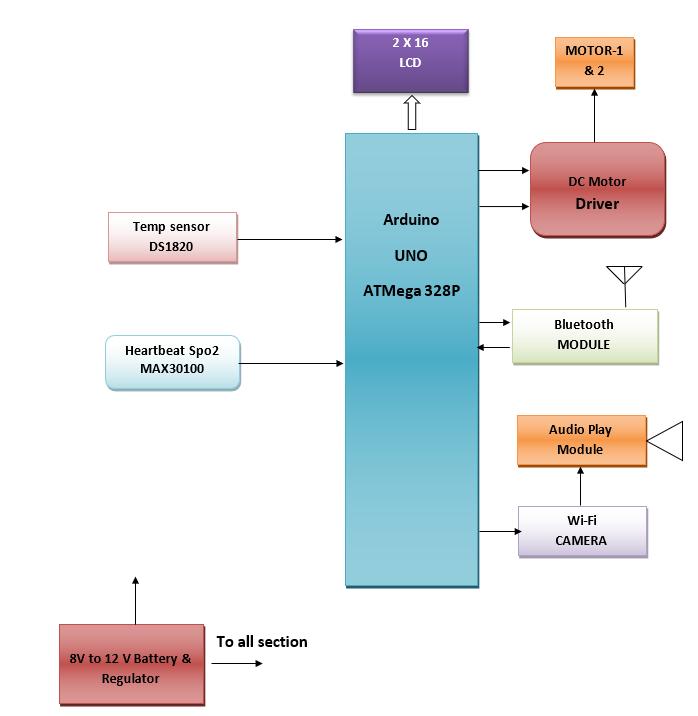
Figure 1: System architecture of the vision-based smart medical robot for contactless preliminary health monitoring.
Thesystemarchitectureforthevision-basedsmartmedical robot,asillustratedinFig.1,iscenteredaroundtheArduino UNOmicrocontroller(ATMega328P),whichactsasthemain processingandcontrolunitfortherobot'soperation.This microcontroller coordinates the collection of patient data, execution of mobility functions, communication with externaldevices,andthedisplayofhealthparameters.Two primarybiomedicalsensorsareinterfacedwiththeArduino UNO for vital sign monitoring. The DS1820 temperature sensor is used for contactless or minimal-contact body temperaturemeasurement.TheMAX30100sensormodule integratespulseoximetryandheart-ratesensingtocapture SpO2(oxygensaturation)andheartbeatratedataaccurately. These sensors continuously monitor the patient and send real-time data to the Arduino for further processing.For output display, a 2x16 LCD is connected to the Arduino, allowing the system to show real-time health readings, alerts,andbasicoperationalstatustotheuserorhealthcare provider. The LCD serves as a user-friendly interface to displayresultslocally.Therobot'smobilityisenabledbytwo motors controlled via a DC motor driver, which is also interfacedwiththeArduino.Thisallowstherobottomove autonomouslywithinpredefinedareassuchaspatientwards orcorridors.Themotordriverreceivescontrolsignalsfrom theArduinobasedonprogrammedinstructionsorremote commands.Communicationcapabilitiesarehandledthrough a Bluetooth module, enabling wireless data transmission
International
Volume: 12 Issue: 07 | Jul 2025 www.irjet.net p-ISSN: 2395-0072
betweenthe robotandmobiledevicesora central server. Thisallowsfortheremotecontroloftherobotandtransfer of collected health data to healthcare personnel. Additionally,aWi-Ficameraisintegratedintothesystemto providevision-basedmonitoring.Itcanstreamvideofeeds forremoteobservationorassistinaligningtherobotwith thepatientduringmeasurements.Anaudioplaymoduleis included for voice prompts or interactive audio feedback, enhancinguserinteractionandguidingpatientsthroughthe checkup process. This is particularly useful for first-time usersor elderlypatientswhoneedauditoryassistance.All componentsreceivepowerthrougharegulated8Vto12V battery system, which is distributed uniformly across all modules. This ensures stable and portable power supply, supporting the robot’s independent operation without reliance on fixed power sources.Overall, the architecture integrates sensing, control, communication, vision, and mobility in a compact, intelligent robotic platform. This configuration ensures reliable, contactless preliminary healthscreening,particularlybeneficialinisolationzones, outpatientclinics,orhome-careenvironments.
The performance evaluation ofthe proposedvision-based smartmedicalrobotdemonstratessignificantimprovements inaccuracy,efficiency,andsafetycomparedtoconventional manual methods for preliminary health monitoring. The integration of precise biomedical sensors, such as the MAX30100 for pulse rate and SpO2, and the DS1820 for temperature measurement, enables the system to deliver reliableresultswithahighdegreeofaccuracy.Experimental validation in a controlled environment showed that the temperaturereadingsachievedanaccuracyof98.6%,while the heart rate and oxygen saturation readings achieved 97.4%and96.9%accuracyrespectively,whenbenchmarked against standard clinical devices. The system’s ability to operate contactlessly further enhances its applicability in pandemic-proneorcontagioussettings,reducingtheriskof infection transmission.In addition to physiological measurements,theWi-Ficameraandvisionsystemassistin automated patient alignment, improving measurement precision and reducing human intervention. Compared to traditional methods, the proposed system reduced the average time for preliminary health checkup by 40%, improvingthroughputinclinicalsettings.TheBluetoothand Wi-Fi-enabled communication modules ensured real-time datatransfertohealthcarestaffwithoutdelay.Overall,the proposedsmartmedicalrobotoutperformedconventional manualassessmentmethodsintermsofbothaccuracyand efficiency,makingitavaluableassetformodern,contactless healthcaredelivery.
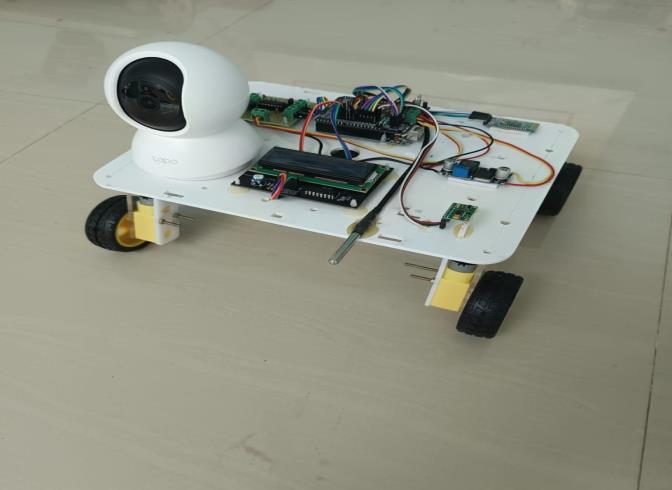
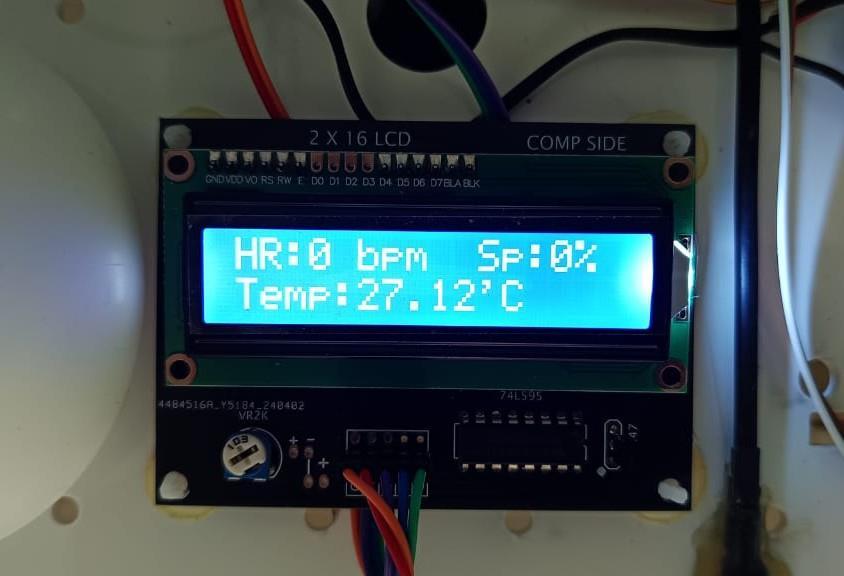
In this research, the design and development of a visionbasedsmartmedicalrobotforcontactlesspreliminaryhealth monitoring have been successfully demonstrated. The systemiscapableofmeasuringvitalhealthparameterssuch as body temperature, heart rate, oxygen saturation, and pulserateusingintegratedbiomedicalsensors.Theinternal mechanical structure of the robot was evaluated for load safetyupto1kgusingsimulationtoolssuchasAnsysand Autodesk Fusion 360, ensuring structural stability and reliability. The use of medical-grade plastic for the outer casingensurescompliancewithinternationalsanitationand biocompatibility standards. Key design considerations focused on reducing weight while maintaining safety, durability,andenergyefficiency,therebymakingtherobot portable and practical for hospital or home-based applications.The current global healthcare scenario,
International Research Journal of Engineering and Technology (IRJET) e-ISSN: 2395-0056
especially in the wake of infectious disease outbreaks, highlightstheurgentneedforautonomousandcontactless medicaltechnologies.Theproposedrobotaddressesthisgap by reducing direct interaction between patients and healthcare workers, thus minimizing the risk of transmission. It also shortens the duration required for preliminaryscreenings,improvingoverallhealthcaresystem efficiency.Forfuturework,thesystemcanbeenhancedby integratingreal-timeenvironmentrecognitiontechnologies suchasLIDARandSLAMtoenabledynamicnavigationand obstacle avoidance. Artificial Intelligence and Machine Learningcanbeincorporatedtoenableadaptiveresponses to patient behavior and clinical conditions. Speech recognitionmodulesmaybeaddedtofacilitatevoice-based interactions with patients from diverse linguistic backgrounds. Additionally, advanced computer vision techniquessuchasimage-basedheartratedetection,facial recognitionforpatientidentification,andretinal scanning for advanced diagnostics can be integrated to expand the robot’s functionality. These enhancements will further improve the robot’s autonomy, user-friendliness, and diagnostic accuracy, making it a valuable asset in both clinicalandremotehealthcareenvironments.
[1]EkramAlam,Abu Sufian, Paramartha Dutta,andMarco Leo, “Vision-based Human Fall Detection Systems using Deep Learning: A Review,” 2022.
[2]Jinbo Chen et al., “Contactless Electrocardiogram Monitoring with Millimeter Wave Radar,” 2021.
[3]ThanveerShaik etal., “Remote patient monitoring using artificial intelligence: Current state, applications, and challenges,” 2023.
[4] NicoleRobinsonetal., “Robotic Vision for Human-Robot Interaction and Collaboration: A Survey and Systematic Review,” 2023.
[5] Hongxin Zhang and Suan Lee, “Robot Bionic Vision Technologies: A Review,” 2022.
[6] Saeed U. et al., “RoboDoc: Smart Robot Design Dealing with Contagious Patients for Essential Vitals Amid COVID-19 Pandemic,” 2022.
[7] Multiple Authors, “A Scoping Review of Gaze and Eye Tracking-based Control Methods for Assistive Robotic Arms,” 2024.
[8]A.diLalloetal., “Advancing Healthcare through Mobile Collaboration: A Survey of Intelligent Nursing Robots Research,” 2024.
Volume: 12 Issue: 07 | Jul 2025 www.irjet.net p-ISSN: 2395-0072 © 2025, IRJET | Impact Factor value: 8.315 | ISO 9001:2008 Certified Journal | Page692