
International Research Journal of Engineering and Technology (IRJET) e-ISSN: 2395-0056 p-ISSN: 2395-0072

Volume: 12 Issue: 06 | June 2025 www.irjet.net

A STUDY ON THE INFLUENCE OF MINERAL ADMIXTURES AND POLYPROPYLENE FIBER ON THE STRENGTH AND SORPTIVITY OF SELF-COMPACTING CONCRETE
Vibhashree N1 , S Bhavanishankar2
1 Post Graduate Student, Dept. of Civil Engineering, University of Visvesvaraya College of Engineering (UVCE), Bengaluru, Karnataka, India.
2 Associate Professor, Dept. of Civil Engineering, University of Visvesvaraya College of Engineering (UVCE), Bengaluru, Karnataka, India
Abstract - This study explores the influence of mineral admixtures and polypropylene fibers on the fresh properties, mechanical strength, and sorptivity of self-compacting concrete (SCC). Eight SCC mixes were designed, four with quaternary blends of Ordinary Portland Cement (OPC), Fly Ash (FA), Ground Granulated Blast Furnace Slag (GGBS), and Silica Fume (SF), and four with an additional 0.2% polypropylene fiber by weight of binder. A constant waterto-binder ratio of 0.32 was maintained. The control mix contained 100% OPC, while in other mixes, 50% of OPC was replaced with mineral admixtures (SF fixed at 10%, FA and GGBS varied at 10%, 20%, and 30%). Fresh concrete behavior was assessed using slump flow, J-ring, L-box, and V-funnel tests. Mechanical properties were evaluated through compressive, split tensile, and flexural strength at various curing ages. Durability was analyzed via sorptivity testing. Results indicated that FA improved workability, while polypropylene fibers marginally reduced it. Higher GGBS content enhanced both strength and durability. Fiber inclusion contributed to lower sorptivity due to improved crack resistance and matrix densification. The findings confirm that the combined use of mineral admixtures and fibers can significantly enhance SCC performance and longterm durability.
Key Words: Self-compacting concrete, Supplementary Cementitious Materials (SCMs), Fly Ash (FA), Ground Granulated Blast Furnace (GGBS), Silica Fume (SF), PolypropyleneFiber(PPF),Durability,Sorptivity.
1.INTRODUCTION
To address both strength and durability concerns, the incorporation of supplementary cementitious materials (SCMs) such as fly ash (FA), ground granulated blast furnace slag (GGBS), and silica fume (SF) has gained momentum. These mineral admixtures help refine pore structure, reduce permeability, and enhance mechanical properties. Their synergistic use in quaternary blends allows for balanced performance in both fresh and hardenedstates.
Alongside SCMs, polypropylene fibers (PPF) are used to control microcrackingandplasticshrinkage.These fibers improve internal cohesion and act as crack arresters, enhancing both structural integrity and moisture resistance.TheircombinedusewithSCMsoffersaholistic approachtooptimizingSCC.
This study investigates the influence of mineral admixtures and polypropylene fibers on the fresh properties, strength behavior, and sorptivity-based durability of SCC, aiming to develop an optimized mix withsuperiorperformancecharacteristicsforsustainable andlong-lastingconcretestructures.
2.OBJECTIVES
Primaryobjectivesofthestudyare;
1.Todevelopaself-compactingconcrete(SCC)mixbased ontheprinciplesoutlinedintheOkumuramethod.
2. To examine the workability and mechanical performanceofSCCinbothfreshandhardenedstates.
3. To analyze how the inclusion of polypropylene fibers and various mineral admixtures (SCMs) affects the strengthcharacteristicsofSCC.
4. To evaluate the durability performance of SCC by measuring its sorptivity, emphasizing the material’s resistancetowateringress.
5. To compare mixes with and without fibers to determine their effectiveness in reducing water absorptionandimprovingperformance.
3.MATERIALS
• Cement: Ordinary Portland Cement (OPC) 43 grade conforming to IS 269:2015 was used as the primary binder due to its favorable strength and setting properties.
•
Self-compacting concrete (SCC) represents a major advancement in concrete technology, capable of flowing and compacting under its own weight without external vibration. This unique property enables SCC to easily fill complex formworks and densely reinforced sections, making it a preferred material in modern construction for improving placement quality, surface finish, and construction efficiency. Although SCC offers excellent workability, its long-term performance depends significantly on strength development and resistance to environmental deterioration. One key durability parameter is sorptivity-the rate at which concrete absorbs water through capillary action. High sorptivity can lead to moisture ingress, steel corrosion, and reduced service life.


International Research Journal of Engineering and Technology (IRJET) e-ISSN: 2395-0056 p-ISSN: 2395-0072
Volume: 12 Issue: 06 | June 2025 www.irjet.net
Fine Aggregate:Manufacturedsand(M-sand)conforming to Zone II as per IS 383:2016 was used. It ensured adequateflowabilityandpackingdensity.
Coarse Aggregate: Crushed granite aggregates of 20 mm and 12.5 mm size were blended to achieve a balance betweenstrengthandself-compactability.
Water: Clean potable water was used for mixing and curing, ensuring no contaminants interfered with hydrationordurability.
Mineral Admixtures:
• Fly Ash (ClassF)perIS3812(Part1):2003improved workabilityandlong-termstrength.
• GGBS (Ground Granulated Blast Furnace Slag) as per IS 16714:2018 enhanced durability and reduced heat ofhydration.
• Silica Fume, meeting IS 15388:2003, was added to refinemicrostructureandreducepermeability.
Chemical Admixture: A polycarboxylate ether (PCE) based superplasticizer (Glenium SKY 8233) was used to achieve desired flow and cohesion without increasing watercontent.
Polypropylene Fibers: RECRON-3S fibers of 12 mm length were added at 0.2% by binder weight in selected mixestoimprovecrackresistanceandreducesorptivity. All materials were tested for their physical and chemical propertiesandcompliedwithrelevantIndianStandardsto ensureoptimalperformanceinSCC.
4.MIX DESIGN AND METHODOLOGY
The mix designfor Self-CompactingConcrete (SCC)in this study follows the Okamura and Ozawa method, which emphasizes achieving self-compactability through optimized powder content, low water-to-binder ratio, and adequate superplasticizer dosage without causing segregation.
4.1 MIX PROPORTIONS
AtotalofeightSCCmixesweredeveloped.Thecontrolmix (Mix 1) utilized 100% Ordinary Portland Cement (OPC), while Mixes 2 to 4 incorporated quaternary blends comprisingFlyAsh(FA),GroundGranulatedBlastFurnace Slag (GGBS), and Silica Fume (SF). The proportion of SF was fixed at 10%, while FA and GGBS were varied (10%, 20%, and 30%) to replace 50% of OPC. Mixes 5 to 8 mirrored Mixes 1 to 4 but included 0.2% polypropylene fibers (PPF) by weight of binder. A constant water-tobinderratioof0.32wasmaintainedforallmixestoensure SCCcharacteristics.
4.2 MIXING PROCEDURE
Concretespecimenswerepreparedinapanmixerusinga consistent sequence. First, fine and coarse aggregates were dry-mixed thoroughly. OPC and the selected mineral admixtures (FA, SF, and GGBS) were then added and blended until uniform in color. For fiber-reinforced mixes, PPF was added gradually and mixed for an additional 2 minutes to ensure uniform distribution.
Waterwasdividedintotwoparts:approximately60%ofthe total water was added initially. The remaining 40% was mixed with a superplasticizer (Master Glenium SKY 8233) andthenaddedtoimproveflowabilityanddispersion.
4.3 WORKABILITY AND STRENGTH CHARACTERISTICS
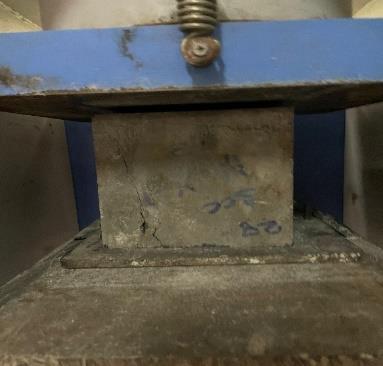
Fresh concrete was tested for flow characteristics using Slump Flow, T500, V-Funnel, L-Box, U-Box, and J-Ring tests,inaccordancewithEFNARCguidelines.Theconcrete was then cast into moulds without vibration and demouldedafter24hours.Curingwasdoneincleanwater for7,28,and56days.
MechanicalstrengthtestsfollowedISstandards:
• Compressive Strength: 150 mm cubes as per IS 516:1959
• SplitTensileStrength:150mm×300mmcylindersas perIS5816:1999
• Flexural Strength: 100 mm × 100 mm × 500 mm prismsasperIS516:1959
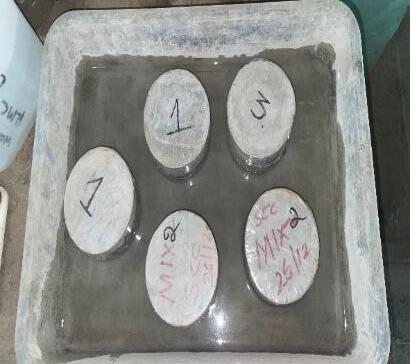
Durability was evaluated through Sorptivity testing, followingtheproceduresoutlinedinASTMC1585
5.RESULTS AND DISCUSSION
5.1 FRESH PROPERTIES OF SCC
The fresh properties of the SCC mixes were evaluated using standardized EFNARC test methods. Parameters including slump flow diameter, T500 flow time, V-funnel flow time, L-box blocking ratio, U-box height difference, and J-ring tests were assessed to determine the filling ability, viscosity, passing ability, and resistance to segregation.
MIX-3 50%OPC+10% SF+20%FA +20%GGBS
50%OPC,+10% SF+10%FA +30%GGBS
50%OPC, +10%SF+30%FA +10%GGBS +0.2%PPF
MIX-3 PPF
MIX-4 PPF
50%OPC, +10%SF+20%FA. +20%GGBS +0.2%PPF
50%OPC,+10%SF +10%FA +30%GGBS +0.2%PPF
Table9.1 FlowPropertiesofSCC
International Research Journal of Engineering and Technology (IRJET) e-ISSN: 2395-0056 p-ISSN: 2395-0072
Volume: 12 Issue: 06 | June 2025 www.irjet.net
The slump flow values ranged between 605 mm and 720 mm. Mix-2 showed the highest flow (720 mm), classifying it under SF2 per EFNARC, suitable for normal structural elements. The inclusion of polypropylene fibers slightly reducedflowduetoincreasedcohesion.
T500 flow time values ranged from 3.3 to 6.1 seconds, indicating moderate viscosity across all mixes. Mixes with fly ash exhibited lower T500 times, contributing to improved flow due to the spherical shape and fineness of particles.
V-funnel times for all mixes remained within EFNARC limits,rangingfrom7to14.5seconds.Mixeswithoutfibers flowed faster, while those with PPF showed delayed flow, demonstratingthefibers'influenceonviscosity.
L-boxblockingratiosvariedbetween0.78and0.91.Higher ratios were observed in mixes with fly ash, indicating better passing ability, whereas fiber-reinforced mixes exhibited slightly reduced values due to enhanced cohesion.
TheU-boxtestshowedthelowestheightdifference(9mm) for Mix-2, indicating excellent filling ability, while the highest was recorded for Mix-1PPF (25 mm), reflecting increasedobstructionduetofiberaddition.
J-ring test results ranged from 510 mm to 670 mm in slumpvalues,withMix-2achievingthebestpassingability due to high fly ash content and lowest blocking height (6 mm). Fiber-reinforced mixes consistently showed reduced slump and increased blocking heights, confirming the influence of fibers on increasing cohesion and flow resistance.
5.2 MECHANICAL PROPERTIES OF SCC
5.2.1 COMPRESSIVE STRENGTH
The compressive strength of all SCC mixes increased progressivelyoverthecuringperiodsof7,28,and56days.
Mixes incorporating supplementary cementitious materials (SCMs) like fly ash, silica fume, and GGBS exhibited higher long-term strength due to enhanced pozzolanic activity and matrix densification. Notably, the addition of 0.2% polypropylene fiber (PPF) further improved compressive strength by controlling microcrack formation and enhancing stress distribution. Among all
mixes, Mix-4PPF recorded the highest strength at 56 days (55.70 MPa), outperforming the control mix (Mix-1) by a significant margin The results confirm that the synergistic effect of SCMs and PPF contributes to superior strength developmentinSCC.
CompressiveStrength



SplitTensileStrength



The split tensile strength of SCC improved progressively with curing age for all mixes. The incorporation of supplementary cementitious materials (SCMs) enhanced matrix refinement and bonding, while polypropylene fibers (PPF) contributed to better crack resistance and stress transfer.At56days,Mix-4PPFachievedthehigheststrength (4.75 MPa), followed closely by Mix-3PPF (4.25 MPa), confirming the benefit of fiber inclusion. Among non-fiber mixes, Mix-4 (3.95 MPa) performed best due to the synergistic effect of GGBS and silica fume. Fiber-reinforced
International Research Journal of Engineering and Technology (IRJET) e-ISSN: 2395-0056 p-ISSN: 2395-0072
Volume: 12 Issue: 06 | June 2025 www.irjet.net
mixes consistently outperformed their counterparts across all curing intervals, with percentage improvementsrangingfrom8%to20%.
These results demonstrate that combining SCMs with PPF significantlybooststhetensileperformanceanddurability ofSCC.
5.2.3 FLEXURAL STRENGTH OF SCC
Table 5.2.3 Flexural strength of SCC



Figure 5.2.3 Flexural strength of SCC
Flexural strength increased progressively with curing age for all SCC mixes. The inclusion of supplementary cementitious materials (SCMs) such as GGBS and silica fume improved matrix densification and load-bearing capacity,whilepolypropylenefibers(PPF) enhancedcrack resistance and toughness. At 56 days, Mix-4PPF exhibited the highest flexural strength (7.85 MPa), reflecting a 17.34% improvement over its non-fiber counterpart. Among mixes without fibers, Mix-4 showed superior strength (6.69 MPa) due to optimal SCM synergy. Overall, PPF-modified mixes outperformed corresponding control mixes by 8–17% across all curing ages, confirming the combined benefit of fibers and mineral admixtures in improvingflexuralperformanceandlong-termdurability.
5.3 SORPTIVITY – BASED ASSESSMENT OF DURABILITY
This section evaluates the durability performance of SelfCompacting Concrete (SCC) mixes through sorptivity
testing, which measures water absorption due to capillary action. The focus is on how supplementary cementitious materials (SCMs) and polypropylene fibers (PPF) influence wateringressresistance.
5.3.1
Cumulative Sorptivity Results
The sorptivity (I in mm) was calculated from cumulative waterabsorptiondataatvarioustimeintervals.Thegraph below illustrates the trend of sorptivity with respect to √time(min)forallmixes.
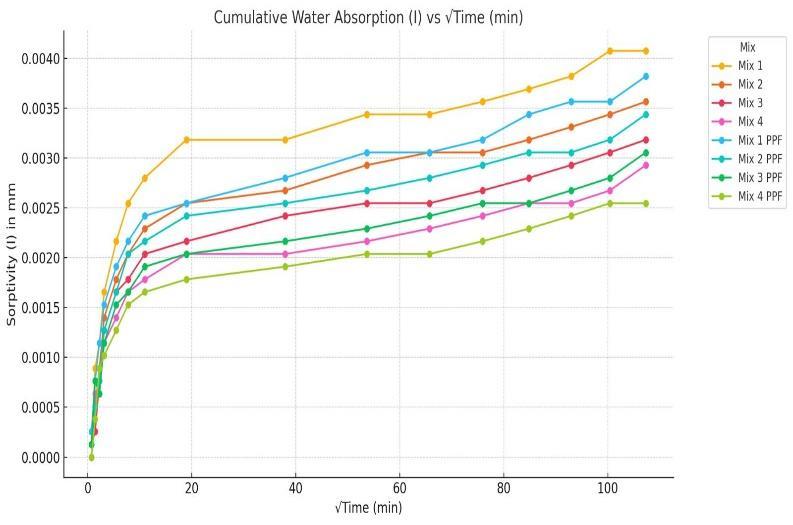
Figure 5.3.1 Sorptivity (I in mm) vs √Time for All
Mixes
Initially, all mixes exhibited steep increases in sorptivity, indicating rapid water uptake due to capillary suction. Over time, the rate of absorption slowed down as the pores became saturated. Mixes with SCMs and PPF showednoticeablyreducedwateringress.
Amongtheplainmixes:
Mix 1 (100% OPC) recorded the highest sorptivity, reflectingpoorresistancetowaterpenetration.
Mix 4, with high GGBS content, showed the lowest sorptivity among plain mixes due to its denser microstructure.
WiththeinclusionofPPF:
All mixes demonstrated further reductions in sorptivity.
Mix 4 PPF had the lowest sorptivity overall, confirming that the combination of SCMs and fibers offersthebestresistancetowaterabsorption.
MIX-4 PPF 0.00221
Table 5.3.1 Sorptivity (I) in mm at 8 days
Sorptivity decreased with the use of SCMs due to improvedmatrixdensificationandrefinedporestructure.
International Research Journal of Engineering and Technology (IRJET) e-ISSN: 2395-0056 p-ISSN: 2395-0072
Volume: 12 Issue: 06 | June 2025 www.irjet.net
Additionof0.2%PPFfurtherreducedwaterabsorption byblockingcapillarypathsandbridgingmicrocracks. The best performance was observed in Mix 4 PPF, highlighting the synergy between GGBS and fiber reinforcement.
5.3.2 Correlation of Sorptivity with Strength
Durability and mechanical performance in SCC are interrelated. Sorptivity reflects the ease of moisture ingress,whichaffectstheconcrete'sinternalstructureand long-termstrength.
5.3.2.1 Sorptivity v/s Compression strength
Table 5.3.2.1 Sorptivity v/s Compressive Strength (56 Days)
A strong inverse correlation is observed between sorptivity and compressive strength. Mixes with lower sorptivity values, such as Mix 4 PPF (0.00221 mm), achieved higher compressive strength (55.70 MPa). This relationshiphighlightsthatreducedwaterabsorptiondue torefinedporestructureachievedthroughSCMsandPPF increases matrix density, reduces internal voids, and enhances strength development. In contrast, higher sorptivity in Mix 1 (0.00407 mm) indicates a porous structure with limited hydration efficiency, resulting in lowerstrength.
5.3.2.2 Sorptivity v/s Split Tensile Strength
Table 5.3.2.2 Sorptivity v/s Split Tensile Strength (56 Days)
Splittensilestrengthimproveswithdecreasingsorptivity, indicatingenhancedcrack resistanceinmixeswithbetter durability. For example, Mix 4 PPF, with the lowest sorptivity (0.00221 mm), achieved the highest tensile strength (4.75 MPa). This suggests that a denser microstructure restricts capillary pores and crack
initiation, while fibers bridgemicrocracks,improving tensile performance. In contrast, Mix 1, with higher sorptivity, shows limited cohesion and lower tensile strength (3.30 MPa).
5.3.2.3 Sorptivity v/s Flexural Strength
Table 5.3.2.3 Sorptivity v/s Flexural Strength (56 Days)
Lowersorptivityvaluescontributetohigherflexuralstrength duetoimproved moistureresistanceand matrix refinement. Mix 4 PPF, having the lowest sorptivity (0.00221 mm), recorded the highest flexural strength (7.85 MPa). This improvement is attributed to the combined action of SCMs reducing pore connectivity and PPF enhancing toughness. Mixes with higher sorptivity, such as Mix 1, displayed reduced flexural capacity due to poor pore structure and absenceofcrack-bridgingmechanisms.
6. CONCLUSION
This study investigated the influence of supplementary cementitious materials (SCMs) such as fly ash, silica fume, and GGBS along with polypropylene fibers (PPF), on the performance of self-compacting concrete (SCC). The
International Research Journal of Engineering and Technology (IRJET) e-ISSN: 2395-0056 p-ISSN: 2395-0072
Volume: 12 Issue: 06 | June 2025 www.irjet.net
• TheSCCmixesdesignedusingOkumuraandOzawa’s method exhibited satisfactory flow characteristics and met EFNARC criteria. SCMs improved workability through better particle packing and secondary hydration, while fiber inclusion slightly reduced flowability due to increased internal resistance.
• Among all mixes, Mix-2 (10% SF, 30% FA, 10% GGBS) showed the best workability. The addition of fibers marginally reduced flow but retained acceptableSCCcharacteristics.
• Compressive strength increased with higher GGBS content and fiber inclusion. Mix-4 PPF (30% GGBS, 10% FA, 10% SF, 0.2% PPF) recorded the highest compressivestrength(55.70MPa)at56days.
• Split tensile and flexural strengths also improved with fiber reinforcement. Fibers enhanced crack resistanceandmatrixcohesion,leadingtosignificant post-crackstrengthgain.
• Sorptivity results confirmed that mixes with SCMs and fibers had reduced water absorption, indicating improved durability. Mix-4 PPF recorded the lowest sorptivity (0.00221 mm), reflecting its dense microstructure and superior resistance to water ingress.
• A clear inverse relationship was observed between sorptivity and strength parameters. Lower water absorption was associated with higher compressive, tensile,andflexuralstrengths,highlightingtheroleof microstructural refinement in improving both durabilityandmechanicalperformance.
• The combined effect of SCMs and PPF led to optimized SCC mixes with balanced workability, strength, and long-term durability. Mix-4 PPF emerged as the most effective composition for structural applications requiring high strength and reducedpermeability.
7. REFERENCES
[1] S. Alsheikh, “Study of Sorptivity of Self-Compacting Concrete with Different Chemical Admixture,” Global JournalofResearchinEngineering,vol.13,no.E5,pp. 1–11,2013.
[2] P. R. da Silva and J. de Brito, “Fresh-state performance of self-compacting concrete with recycled aggregates and fly ash,” Journal of Materials in Civil Engineering, vol. 27, no. 8, p. 04014218,2015.
[3] O. A. Mohamed and O. F. Najm, “Compressive strength and stability of sustainable self-consolidating concrete containing fly ash, silica fume, and GGBS,” Frontiers of Structural and Civil Engineering,vol.11,no.4,pp.406–411,2017.
[4] S.M.Akid,S.Hossain,M.I.U.Munshi,M.M.A.Elahi, M.R.Sobuz,V.W.Y.Tam,andM.S.Islam,“Assessing the influence of fly ash and polypropylene fiber on fresh, mechanical and durability properties of
concrete,” Journal of King Saud University –EngineeringSciences,vol.35,no.7,pp.474–484,2021.
[5] Narendra Kumar and G. Vinod Kumar, “Study on Combined Effects of Fly Ash, GGBS and Advanced Nanomaterials on the Properties of SCC,” Journal of TheInstitutionofEngineers (India):SeriesA,vol.103, no.4,pp.1259–1270,2022.
[6] S. Arunchaitanya and S. Dey, “Sorptivity and rapid chloride ion penetration of self-compacting concrete using fly ash and copper slag,” AI in Civil Engineering, vol.2,no.1,Article4,2023.
[7] P. Smarzewski, “Effect of polypropylene fibers on mechanical and rheological properties of selfcompacting concrete with high volume of ground granulated blast furnace slag,” Construction and BuildingMaterials,vol.368,p.130403,2023.
[8] S. K. Velumani and S. Venkatraman, “Assessing the impact of fly ash and recycled concrete aggregates on fibre reinforcedselfcompactingconcretestrengthand durability,”Processes,vol.12,no.8,p.1602,2024.
[9] Zaini, R. Nugroho, and S. Raman, “Water absorption and sorptivity behavior of high-strength SCC containing pozzolanic blends,” International Journal of Concrete Structures and Materials, vol. 18, Article 25, 2024.
[10] EFNARC,TheEuropeanGuidelinesforSelf-Compacting Concrete: Specification, Production and Use, European Federation of National Associations Representing Concrete,2005.
[11] ASTM C1585-13, Standard Test Method for Measurement of Rate of Absorption of Water by Hydraulic-Cement Concretes, ASTM International, 2013.