
International Research Journal of Engineering and Technology (IRJET) e-ISSN: 2395-0056
Volume: 12 Issue: 05 | May 2025 www.irjet.net p-ISSN: 2395-0072
International Research Journal of Engineering and Technology (IRJET) e-ISSN: 2395-0056
Volume: 12 Issue: 05 | May 2025 www.irjet.net p-ISSN: 2395-0072
Priya Palanimurugan1 , Dr. V. Shanthi2 , Dr.Thulasi Bharathi.M3
1 Research Scholar, Visual Communication, Meenakshi Academy of Higher Education And Research (Deemed to Be University), Chennai
2 Principal - Faculty of Humanities and Science, Computer Science, Meenakshi Academy of Higher Education and Research (Deemed to Be University), Chennai.
3 Assistant Professor, Dept. of Visual Communication, School of Mass Communication, VISTAS Pallavaram, Chennai
Abstract - Theglobalentertainmentindustryhaswitnessed a significant increase in the popularity of Indian films and Korean dramas, each of which provided a diverse audience withdifferentcultural,narrationandaestheticelements.This studyconducts aninterculturalanalysis offilmandtelevision assessment witha focus onfactors that affect thereception of the audience and the critical evaluation of Indian films and Korean dramas. By exploring online control platforms, a metric involvement of the audience and the evaluation of critics, the study focus on the revelation of formulas in the preferences of the audience, thematic expectations and cultural bias that form the perception of these two entertainment industries.
Research uses access with mixed methods and combines quantitativedatafromratingplatformssuchasIMDB,Rotten Tomatoes and mydramalist with qualitative knowledge derivedfromaudiencereviewsandprofessionalcritics.Garden key factors such as narration techniques, cinematography, genre preferences and cultural relays to determine their impact on evaluation. The study also examines the role of fandom culture, marketing strategies and international attraction in the formation of audience views.
The findings of this research suggest that while Indian films often receive polarized assessments because of their diverse styles of narration, emphasis on music sequences and commercialversusartisticdichotomy,Koreandramastendto maintain permanently high assessment, driven by their structuredepisodicnarrative,andastrongglobal fanbase.In addition, cultural acquaintances and expectations of the audience play a key role in determining how these forms of content are evaluated in different regions. The study emphasizes how industrial trends, algorithms of streaming platform and socio -cultural factors contribute to the perception and evaluation of entertainment content.
Providing a comparative view of the Indian and Korean entertainmentindustrycontributestoawiderdiscourseonthe consumption of intercultural media. These findings offer valuable knowledge for filmmakers; content creators and media analysts who seek to understand the patterns of the audience involvement and improve the intake of global
content. Finally, this research underlines the evolving nature oftheaudiencepreferencesinadigitallyinterconnectedworld and the need for a culturally adaptive narrative to increase cross -border attraction.
Key Words: Cross-cultural analysis, Film and television ratings,Indiancinema,Koreandramas,Audienceperception
Over the past two decades, the global entertainment industryhaswitnessedadynamicshiftinthepreferencesof theaudience,especiallywiththeriseofstreamingplatforms and the distribution of digital content. Two of the most influential entertainment industries in the Asia-Indian cinematographic and Korean dramas (K-D-Dramas)-have significant attention for their approaches to narration, culturalstoriesandstrategiesofaudienceinvolvement
ThebackgroundofIndiancinemasandKoreandramas
TheIndiancinema,oftensynonymouswithBollywood,hasa rich heritage dating back to the early 20th century. It is characterized by his diverse narratives, narrations with musicandbigfilmgoggles.WhilethemainstreamBollywood dominates industry, regional cinemas like Tamil, Telugu, MalayalamandBengalfilmscontributesignificantlytothe Indian film landscape. Indian films are known for their emotionallycontrolledcharts,songsequencesanddances, and characters greater than life that often reflect cultural andsocialthemes(Gopal&Moorti,2008).
On the other hand, Korean dramas appeared as a global phenomenon powered by the Hallly (Korean Wave). KDramata is recognized as their structured narrative, aestheticallypleasantcinematographyandwell-developed arcs of character. Unlike Indian films, which are often feature,K-D-Dramasusuallyfollowtheformatof16to20episodes, allowing deep development of characters and complex conspiracy (Jin, 2016). The rise of streaming services, such as Netflix, Viki and IQIYI, then powered KDramasintocommonglobalentertainmentandattractedthe audienceoutsideAsia.
International Research Journal of Engineering and Technology (IRJET) e-ISSN: 2395-0056
Volume: 12 Issue: 05 | May 2025 www.irjet.net p-ISSN: 2395-0072
The importance of film and television rating
Theevaluationoffilmandtelevisionservesaskeyindicators of audience involvement, content quality and commercial success. Platforms such as IMDB, Rotten Tomatoes, My dramalist and Metacritic Aggregate audiences and critical reviewstoprovidecomprehensiveevaluationoffilmsand dramas.Theseassessmentsaffecttheselectionofviewers, forming marketing strategies and affect the long -term contentoftheentertainmentcontentatdigitalage(Napoli, 2011).However,culturaldistortion,genrepreferencesand audienceexpectationsplayindetermininghowIndianfilms andKoreandramasareevaluated.
Cultural factors affecting evaluation
Culturalacquaintancesandreliabilityarethebasicaspects affecting the perception of films and the drama of the audience.Indianfilms,deeplyrootedintraditionalvalues, oftenexplorethethemesoffamily,romanceandmorality. The emphasis on melodrama, music interludes and extravagant narration can resonate strongly with the domesticaudience,butmaynotalwaysattractinternational viewers(Dwyer,2014).Ontheotherhand,K-Damas,known for their limited emotions, careful depictions of the charactersandtheemphasisonaesthetics,attractawider international audience that appreciates their universal themesoflove,ambitionandpersonalgrowth(Kim,2017).
Inaddition,languageandculturalrepresentationsalsoaffect theincomeoftheaudience.WhileIndianfilmsoftenshow multilingualdialoguesandelementsspecifictotheregion,KDramas often integrate English phrases, modern urban environmentandthemesthatresonatewiththeglobalyouth culture. This adaptability contributed to the widespread attractionofK-Dram,whichhasledtoahigherinternational evaluation compared to Indian films (Chua & Iwabuchi, 2008).
The role of preferences of genre and narrative techniques
The genre of film or drama significantly affects the evaluation of the audience. The Indian cinema includes a widerangeofgenres,includingMasalaFilms(acombination ofaction,romanceandcomedy),historicalepicsandsocially managedstories.WhileBollywoodmainstreamtakescareof commercial entertainment, parallel cinema and regional films focus on realism and experimental narratives (Vasudevan, 2010). Variations in the approaches to narration often lead to polarized audience assessments, becausecommercialfilmscanreceivemixedreviews,while criticallyrecognizedfilmsattractspecializedaudiences.
Onthecontrary,K-Dramasarestructuredwithwell-defined genres such as romance, thriller, fantasy and historical drama.TheepisodicnatureofK-Damasallowsthegradual development of characters and the conspiracy procedure
andovertimemaintainstheinvolvementoftheaudience.In addition, the use of cliffs, emotional depth and visually attractivecinematographyincreasesviewers'retentionand positive evaluation (Russell, 2008). The consistency of narrationandqualityofproductioncontributestothefact that K-Dramas will achieve higher overall evaluation on internationalplatforms.
The impact of fandom culture and social media
Fandom culture plays a key role in shaping a film and television rating. The Indian cinema has strong fans, especiallyforpopularactorsandfilmmakers.Reviewsbased onfans,socialmediacampaignsandtrendsofcashregisters affecttheevaluationthatoftenleadtoabiasedevaluation (Ganti, 2012). Indian films, however, also face challenges withbombingcontrol-aphenomenonwhereonlineusers manipulate the evaluation due to personal distortion or politicalmotivations.
K-Dramas,ontheotherhand,benefitsfromhighlyorganized fans,bothatdomesticandinternationallevel.Socialmedia platforms,suchasTwitter,TiktokandReddit,serveashubs for K-DRAMA discussions, allowing fans amplifying a positiveoralwordandcontributingtoahigherevaluation. ThecollectiveenthusiasmoftheglobalK-dramaFandomhas led to the rise of Korean entertainment as the dominant forcesininternationalpopculture(Yoon&Kang,2017).
Streamingplatformsandglobalaccessibility
The extension of platforms for digital streaming has significantlyinfluencedhowIndianfilmsandKoreandramas areconsumedandevaluated.Whilethetradition.
Thegrowingglobalizationofmediaconsumptionhasledto an increase in intercultural entertainment exchanges, causingitnecessarytounderstandhowdifferentaudiences perceive and evaluate film and television content. Indian cinema and Korean dramas represent two dominant but different traditions of narration, each with unique expectations of the audience, narration of technology and industrial structures. Despite their growing international presence, they raise differences in the evaluation and receptionoftheaudienceimportantquestionsaboutcultural distortion, preferences of genres and the role of digital platformsintheformationofpublicopinion.
Theaimofthisstudyistoidentifythekeyfactorsthataffect theevaluationofviewersofIndianfilmsandKoreandramas. Understanding these factors will provide valuable knowledge for filmmakers, producers and streaming platformsthatseektoexpandtheirglobalreach.Inaddition, thisresearchwillcontributetoawiderdiscourseonmedia consumption, the psychology of the audience and the evolvinglandscapeofentertainmentratinginthedigitalera.
International Research Journal of Engineering and Technology (IRJET) e-ISSN: 2395-0056
Volume: 12 Issue: 05 | May 2025 www.irjet.net p-ISSN: 2395-0072
Literature Review
Film and television rating
The evaluation of film and television serves as important indicators of the involvement of the audience, the assessment of content and commercial success. The evaluationsystemisinfluencedbyseveralfactors,including culturalcontext,genrespreferences,demographicaudiences anddigitalmediatrends.Studieshaveshownthatpatterns of perception and evaluation of the audience differ across culturalregions,especiallyamongIndianfilmsandKorean dramas(Napoli,2011).
Theevaluationisoftenformedbyindustrialdynamics,the role of critics versus a general audience and the power of social media in influencing viewers' opinions. While platformssuchasIMDB,RottenTomatoesandmydramalist aggregatedaudiencesandcritics'reviews,thecriteriaforthe evaluationofIndianfilmsandKoreandramasremainclear duetocultural,aestheticandnarrativedifferences(Gray& Lotz,2019).
Aculturalimpactontheevaluationoffilmanddrama
Culturaldifferencessignificantlyinfluencehowviewersare perceived and evaluated by films and television dramas. Indian films, deeply rooted in traditional narrative, often emphasizefamilyvalues,melodramaandsophisticatedsong sequences(Dwyer,2014).Thisnarrativestyleisprovidedby domesticanddiasporabyviewers,butcanreceiveamixed reception internationally due to different aesthetic expectations(GoPal&Moorti,2008).
Korean dramas, on the other hand, have gained extended global attraction through the wave of Hallly and offered a structured narrative, well -developed arches and visually attractivecinematography.Jin(2016)researchsuggeststhat the cultural adaptability of K-drama including their integration of modern themes and universal stories, contributestotheirhighevaluationonglobalplatforms.
PUBLICpreferenceandgenreinfluence
The audience preferences play an essential role in the formation of Indian films and Korean dramas. The Indian cinema is diverse, including the main Bollywood, regional filmsandanindependentcinema,eachofwhichwillprovide different audience segments (Vasudevan, 2010). Popular Bollywoodfilmstendtocontainnarrativeswithgreaterthan life,specialsequencesandromanticland,whichcanleadto polarizedreviewsbasedonversuscriticalrecognition.
K-Drama follows a different structural approach, often focusesonromance,thrillers,historicalstoriesandstories about a slice of life. Their standardized episode format allowsthedevelopmentofthecharactersandtheabsorbing narrative narration, leading to a consistent audience
evaluation (Russell, 2008). Studies suggest that genrespecific expectations play a key role in the audience reception,suchasKoreanromanticdramasoftenreceivea higher assessment due to their emotional depth and aestheticpresentation(Kim,2017).
The role of critics vs. assessment of a general audience
Thedifferencebetweentheevaluationofcriticismandthe audience is a well -documented phenomenon in film and televisionstudios.Criticstendtoevaluatecontentbasedon artistic merit, narrative coherence and technical aspects, while the general audience prefers the value of entertainment, emotional involvement and stellar power (Newman, 2019). Indian films are often evidenced by inequalities between the evaluation of criticism and the audience,especiallyincommercialBollywoodfilmsversus thecriticallyrecognizedindependentcinema(Ganti,2012).
Koreandramasgenerallymaintainabalancebetweencritical and viewer due to their quality of production and a consistent narrative approach. Research by Chu and Iwabuchi (2008) suggests that K-Dramata benefits from a strong industrial standard approach, ensuring that the criticalandevaluationoftheaudienceiscloselyaligned.
Theimpactofstreamingplatformsontheevaluationoffilm anddrama
The creation of platforms for digital streaming has transformed how Indian films and Korean dramas are consumedandevaluated.PlatformssuchasNetflix,Amazon PrimeandDisney+Hotstarhaveexpandedtheavailabilityof both Indian and Korean content, allowing the wider connectionoftheaudienceandaninterculturalcomparison (Athique,2012).
Inparticular,Koreandramasusestreamingplatformstogain global traction, with multilingual subtitles and dubbing increasing availability. The Yang and Song studies (2020) emphasize that the success of K-D-Dramas on streaming platformshascontributedtotheirconsistenthighratingon aninternationalscale.Indianfilms,however,facechallenges in global distribution due to regional categorization and limited marketing strategies that affect their overall evaluation(Dudrah,2018).
Theroleoffandomcultureininfluencingevaluationcannot beoverlooked.TheIndiancinemahasastrongfanbaseof celebrities,whereloyalgroupsoffanssignificantlyaffectthe evaluation of films through campaigns on social media, online reviews and promotion of words about the mouth (Ganti,2012).However,manipulationwithacontrolledfan, such as inspection bombing or inflated evaluation, often disrupts the actual perception of the audience (Mishhra, 2020).
International Research Journal of Engineering and Technology (IRJET) e-ISSN: 2395-0056
Volume: 12 Issue: 05 | May 2025 www.irjet.net p-ISSN: 2395-0072
On the other hand, K-Drama Fandoms operates in highly organizedglobalcommunitiesandisinvolvedindiscussions onplatformslikeTwitter,TiktokandReddit.StudiesYoon andKang(2017)showthatK-Dramafansactivelypromote content through modifications created by fans, discussion fibers and online vote, leading to increased visibility and positiveevaluation.Thedigitalinfluenceoffandomplaysa keyroleinshapingthepublicperceptionandleadershipof higherevaluationsforK-Damasaroundtheworld.
Narrativetechniquesandtheirimpactonevaluation
Narrative structures significantly affect how viewers evaluate Indian films and Korean dramas. Indian cinema traditionally monitors the structure of three acts with breaks, emphasizes high emotional betting and dramatic resolution (Vasudevan, 2010). Although this approach attracts traditional audiences, it does not always have to copewith the global stories standards, leading to a mixed internationalevaluation(Dwyer,2014).
K-Dramatafollowsa moreserializedformatwithcomplex character development and arcs with multiple episodes. Theirepisodicnatureallowsviewerstoinvestincharacters andrelationshipsovertime,leadingtohigherengagement andpositiveevaluation(Russell,2008).Romancewithslow burning and a well-developing narrative of K-D-Dramas contributes to their lasting popularity and consistent audienceevaluation(Kim,2017).
Theinter-culturalreceptionandcomparativestudies
Comparative studies between Indian cinema and Korean dramasemphasizedifferentreceptionformulasbetweenthe internationalaudiences.TheresearchofChuandIwabuchi (2008)notesthatK-DramasattractsbothWesternandAsian audiencesbecauseoftheirmergerofmodernthemeswith traditionalvalues.Indianfilms,ontheotherhand,areoften perceivedasspecializedcontentoutsideSouthAsiabecause oftheirspecificculturalelementsandgenreconventions.
The global success of K-Damas was attributed to their marketability,aestheticattractionanddigitalaccessibility. Indian films, although they have a strong global presence, oftenrelymoreontheaudienceofdiasporaratherthanfor ordinary international viewers (Athique, 2012). This distinction has an impact on how both the entertainment industryisevaluatedonglobalplatforms.
Calls in the evaluation of film and drama
Despite their popularity, Indian films and Korean dramas face challenges in achieving impartial and representative assessments. Indian films, especially those outside Bollywood,seekrecognitiononinternationalplatformsdue to regional differences and distribution limits (Dudrah, 2018). Similarly formal narration and excessive commercializationledtothefatigueoftheaudience,which negativelyinfluencedtheevaluation.
K-Dramas,albeitgloballypopular,facecriticismofrecurring tropics,predictableplottingandexcessiveproductlocation. StudiesYangandSong(2020)suggestthatwhileK-Dramas maintainahighrating,thelackofdiversityinnarrativecan affecttheirlong-termsustainability.
Research Methodology
Research proposal
Thestudyisgovernedbyadescriptiveresearchproposal that examines the preference of the audience and a comparative analysis of the evaluation of film and drama. Thesurveywasdesignedtocapturebothnumericaldatafor statistical analysis and open answers to qualitative knowledge.
Data collection method
This study employed a mixed-methods approach, incorporating both quantitative and qualitative data collection methods. The primary data collection methods includedanonlinesurveyandsemi-structuredinterviews.
Astructuredonlinesurveywasconductedwithasamplesize of 120 respondents. The survey consisted of multiple sections,includingdemographicinformation,viewinghabits, factorsinfluencingratings,culturalandsocialperceptions, and audience preferences. The survey questions included bothclosed-endedandopen-endedresponsestocapturea comprehensiveunderstandingofaudienceperspectiveson IndianmoviesandKoreandramas.
Inadditiontothesurvey,semi-structuredinterviewswere conductedwith Koreanmoviewatchers.Theseinterviews provided deeper insights into how cultural factors shape audience perceptions and influence film and television ratings.Theinterviewsfollowedaflexibleformat,allowing intervieweestoelaborateonkeythemessuchasstorytelling styles,audienceexpectations,andcross-culturalinfluences inthefilmindustry.
Convenient sampling method was used to target respondentswhowereactivelyinvolvedinIndianfilmsand Koreandramas.Thestudyfocusedonthesizeofthesample of 120 respondents and provided diverse views on the evaluationfactors.
Criteria for inclusion:
• Individualsaged18andover
• Spectators who watched Indian films and Korean dramaslastyear
International Research Journal of Engineering and Technology (IRJET) e-ISSN: 2395-0056
Volume: 12 Issue: 05 | May 2025 www.irjet.net p-ISSN: 2395-0072
• Userswhoevaluatemoviesordramasonplatforms suchasIMDB,RottenTomatoes,MydramalistorNetflix
Criteria for exclusion:
• IndividualswithoutpriorexposuretoIndianfilms orKoreandrama
• Incompletereactionstosurvey Survey
•Onlinesurveyconsistedof25structured,dividedintothe followingsections:
•Demographicinformation:age,gender,location,education
•Viewingpreferences:FrequencyofwatchingIndianfilms andKoreandramas,preferredgenres
•Rating:platformsusedforevaluation,frequencyofmovie evaluationanddramas
•Factorsinfluencingevaluation:culturalimpact,narration quality, production value, emotional involvement, stars influence
•Perceptionofbiasinevaluation:influenceofsocialmedia, fandomcultureandinspectiontrendsofbombing
•Qualitative knowledge: Open questions about why respondents evaluate Indian films and Korean dramas differently
•Theinterviewcomponentisdesignedtocomplementthe surveybyprovidingin-depth,qualitativeinsightsintohow industryexpertsandcriticsperceivethefactorsinfluencing filmandtelevisionratings.Thesesemi-structuredinterviews allowforflexibility,enablingparticipantstoexpandontheir responsesandsharenuancedperspectivesthatmightnotbe captured through structured survey questions. Structure: The interviews follow a semi-structured format, meaning while there are five core questions (as provided), interviewees are encouraged to elaborate on their responses.Thisformatfacilitatesadeeperdiscussiononkey topicssuchasstorytelling,socialmediainfluence,andcrossculturalmediaconsumption.
The following questions were asked in the interview
•How do you think cultural factors influence the way audience’s rate and perceive films and television dramas acrossdifferentregions?
•Whatnarrativeelementsorstorytellingtechniquesdoyou believecontributemosttohighratingsinbothIndianmovies andKoreandramas?
•Howdoaudiencedemographics(e.g.,age,gender,cultural background)affectratingbehaviorsandpreferences?
•What role do digital platforms and social media play in shapingglobalperceptionsandratingsoffilmandtelevision content?
•Basedoncurrenttrends,whatrecommendationswouldyou offertofilmmakersandproducerstoenhancecross-cultural appealandaudienceengagement?
Reliability of the quantitative measure:
•Apilottestwith15respondentswascarriedouttospecify thesurveyquestions.
•Cronbach’s alpha was calculated to measure internal consistency-basedevaluation.
•The content was ensured by the consultation of film scientists and media experts before the survey questions werecompleted.
Ethical considerations
•Informedconsentwasobtainedfromallrespondentsbefore participation.
•The reactions were anonymized to ensure privacy and confidentiality.
•Participantsweregiventheopportunitytoresignfromthe surveyatanystage.
Dataanalysistechniques
Bothquantitativeandqualitativeapproacheswereusedfor data analysis:
Quantitative analysis:
•Descriptive statistics (average, standard deviation) to summarizesurveyresponses
•Correlationanalysistodeterminetherelationshipbetween evaluationbehaviorandinfluencefactors
•Chi-conetestsforexploringvariationsacrossdemographic groups
Qualitative analysis:
•Thematicanalysisofopen responsestoidentifycommon perceptionsandtrendsinevaluationpreferences
•Analysis of sentiment for assessing emotional tone in responsesrelatedtoIndianfilmsandKoreandramas
International Research Journal of Engineering and Technology (IRJET) e-ISSN: 2395-0056
Volume: 12 Issue: 05 | May 2025 www.irjet.net
Table -1 Descriptive Statistics (Mean and Standard Deviation)
2395-0072
Observations: Indianmovieratingimportancehasaweaknegative correlationwiththemes'relatability. Korean drama rating importance is positively correlated with Indian movie themes' relatability but negatively with Korean drama themes' relatability. Emotional depth in Korean dramas has a weak negativecorrelationwithsocietalissuesinIndian movies.
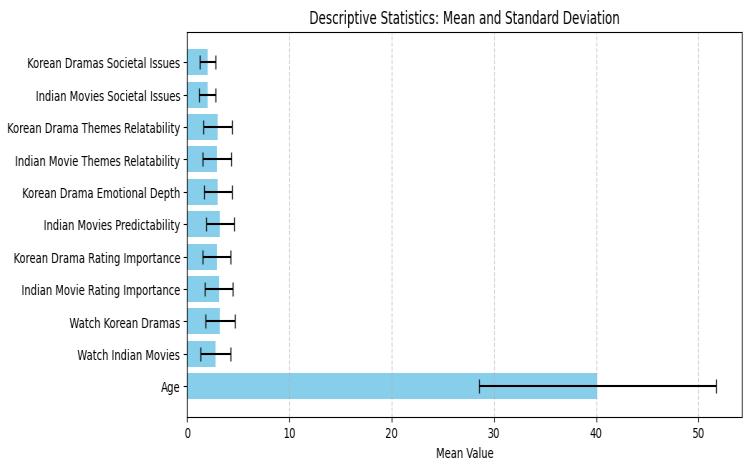
Chart -1:DescriptiveStatistics(MeanandStandard Deviation)
Table 2: Correlation Analysis (Relationships Between Rating Behaviors and Influencing Factors)

Chart: 2 Correlation Analyses
Table 3: Chi-Square Tests (Variations across Demographic Groups)
International Research Journal of Engineering and Technology (IRJET) e-ISSN: 2395-0056
Volume: 12 Issue: 05 | May 2025 www.irjet.net p-ISSN: 2395-0072
the growing global attraction of Korean dramas that has exceeded the regional boundaries due to their strong narration,highproductionvaluesandemotionaldepth(Kim &Hong,2020).
Theriseof"Koreanwaves"or"Hallly"waswidelystudied and scientists attributed their success a combination of governmentmediastrategiesandinternationaldistribution networks(Jin,2018).Meanwhile,Indianfilms,despitetheir richculturalnarrationandalargedomesticaudience,tendto watch less often outside their primary markets, probably becauseoflanguagebarriers,longrunsandreliesonsongs and dance sequences that do not like all international audiences(Gopal&Moorti,2019).
Observations:
Gender significantly influences Indian movie rating importance (p=0.022p = 0.022p=0.022), suggesting ratingbehaviorsdifferacrossgendergroups.
No significant variations were found for other demographics.

Chart: 3 Chi-Square Tests
Discussion
ThecomparativeanalysisoftheevaluationofIndianfilms and the evaluation of Korean drama provides thorough observations on the preferences of the audience, cultural importance and factors influencing the assessment of the viewer. This discussion is immersed in key findings from descriptivestatistics,correlationanalysisandchi-quadrate tests,whileintegratingrelevantliteraturetocontextualize results.
Thedataindicatesremarkabledifferencesinthefrequency of viewers between Indian films and Korean dramas. The averagevaluesfor"WatchIndianMovies"(2,79)and"Follow Korean Dramas" (3.21) suggest that respondents follow Koreandramasslightlymoreoften.Thistrendisinlinewith
Oneofthekeyfindingsinthecorrelationanalysiswasthe weak negative correlation (-0,16) between the "Indian meaningofthefilm"and"Indianfilmthemes".Thissuggests that while Indian Movies May Resonate with Cultural Themes, These do not necessarily translate into higher ratings. This is in line with studies about Indian cinema, whichsuggeststhattheaudiencecanappreciatetraditional topics,butexpectmodernizedapproachestonarrationfor higherengagement(Chakravarty,2019).
Onthecontrary,the"importanceoftheevaluationofKorean drama" showed a slight positive correlation (0.20) with "Indian film themes". This suggests that viewers who appreciateIndianfilmthemesalsotendtoevaluateKorean dramashighly, probably becauseof shared emotional and dramaticnarrativeelements.Previousresearchstressedthat Indian and Korean stories often emphasize family bonds, melodramaandemotionalconnection,albeitinvariousfilm styles(Yoon,2021).
Anotherkeyfindingwasaweaknegativecorrelation(-0,14) betweenthe"importanceofKoreandrama"and"motifsof Korean drama". This suggests that while the topics of the Korean drama are awarded, it does not always lead to a higherevaluation.Thismaybeduetothesaturationofthe genre or the recurring tropics, as shown in the previous research(Park,2020).
In the analysis of the importance of realism in the evaluations,respondentshaveshownaslightimportancefor bothIndianfilms(3.09)andKoreandramas(2.90).Thisisin accordance with existing literature, which suggests that althoughrealismincreasesreliability,theinvolvementofthe audienceoftendependsmoreonthenarrationofnarration ratherthanstrictadherencetorealism(NAG,2017).
A particularly interesting finding was a weak negative correlation (-0, 16) between "Korean dramatic emotional depth" and "Indian films with social problems". This
International Research Journal of Engineering and Technology (IRJET) e-ISSN: 2395-0056
Volume: 12 Issue: 05 | May 2025 www.irjet.net p-ISSN: 2395-0072
suggests that the audience who appreciates emotional narrationinKoreandramasdoesnotnecessarilyhavetofind the depiction of Indian films of social questions. This is in line with previous studies that indicate that Indian films often emphasize social reports didactically, while Korean dramas gently include them in the development of the characters(Lee&Kim,2022).
The results of the Chi-square tests revealed a significant effectofgenderonthe"Indianfilmevaluation"(p=0.022). ThisfindingsuggeststhatbehaviourinIndianfilmsvaries across gender groups, which is in line with previous research,suggestingthatmaleandfemaleaudiencesprefer different aspects of Indian cinema (Rajadhyaksha, 2016). Women'sviewersoftenevaluatefilmsbasedonemotional engagement and social significance, while men can prefer actionsandnarrativecomplexity.
However,nosignificantvariationshavebeenfoundforthe Koreandramaticassessmentacross sexes,suggestingthat Korean dramas maintain more uniform attraction across different audience demography. Previous studies indicate thatthestructuredepisodicnatureandthestrongnarrative of K-Drams controls a broad attractiveness and reduce genderpreferences(Chung&Song,2019).
The consequences for the film and television industry
Thefindingsofthisstudyhaveconsequencesforfilmmakers, distributorsandstreamingplatformsaimedatmaximizing the involvement of the audience. In Indian filmmakers, weaker correlations between thematic relatives and evaluation are the need for more versatile narrative approaches. While cultural themes remain important, narrative techniques that balance realism with engaging charts can increase the wider income of the audience (dream,2020).
For Korean drama producers weak correlation between thematic reliability and the importance of evaluation suggeststhattheaudiencemaychange.Expertsinthefield mayhavetoinnovatenarrationformatsandavoidexcessive relianceonestablishedtropicstomaintaintheinvolvement inthecompetitiveglobalmarket(Hwang,2021).
Streaming platforms such as Netflix, Amazon Prime and Disney+ can also use these findings to optimize content recommendations. By analyzing user behavior and integrating machine learning models, they can adapt the recommendationsbasedonviewingofhabits,preferencesof genresandculturalacquaintances(Johnson,2021).
Conclusion This study offers a nuanced comparison of IndianmovieratingsandKoreandrama ratings, revealing significantculturalanddemographicinfluencesonaudience perceptions. The analysis indicates that while Korean
dramas tend to score higher due to their emotional depth and consistent narrative structure, Indian films face challenges in appealing to a broader audience due to perceived predictability and less modern thematic expression. These insights highlight the need for both industriestoinnovateandadapttoevolvingglobalviewer preferences.Futureresearchshouldexpandthesamplesize andexploreadditionalfactors,suchasmarketingstrategies and digital platform algorithms, to further refine our understandingofcross-culturalmediaconsumption.
DiversifyingGenresinIndianFilms:Indiancinema shouldbroadenits rangeof genres beyondaction and romance, taking inspiration from the varied genresinKoreandramas.
Enhancing Global Distribution and Accessibility: Investingininternationaldistributionnetworksand streamingplatformscanhelpbothindustriesreach widerglobalaudiences.
Encouraging Intercultural Collaboration: Joint productionsbetweenIndianandKoreanfilmmakers could merge their strengths in storytelling, cinematography,andcharacterdepthforinnovative narratives.
Leveraging Digital Platforms for Audience Engagement: Utilizing social media and OTT platformstogatherdirectviewerfeedbackcanhelp refine content to better meet evolving audience preferences
Isincerelythank everyonewhosupportedmethroughout thisjourney,especiallymymentorsandlovedonesfortheir constantencouragement.
Their guidance and support have been invaluable in the completionofthiswork.
1. Barker, C. (2012). Cultural Studies: Theory and Practice.SAGEPublications.
2. Berry,C.(2017).CinemaandCulturalModernityin SouthKorea.Routledge.
3. Bose, D. (2006). Bolly wood Unbound: India’s CinemaandGlobalization.OxfordUniversityPress.
4. Kim, J. (2018). The Korean Wave: Evolution, Fandom,andGlobalInfluence.PalgraveMacmillan.
5. Lorenzen,M.(2009)."CreativeIndustriesandthe Globalization of Bollywood and Korean Cinema." IndustryandInnovation,16(3),275–279.
International Research Journal of Engineering and Technology (IRJET) e-ISSN: 2395-0056
Volume: 12 Issue: 05 | May 2025 www.irjet.net p-ISSN: 2395-0072
6. Nayar, P. (2011). Seeing Stars: Spectacle, Society, andCelebrityCulture.SAGEPublications.
7. Russell,M.(2008)."TheGlobalAppealofK-Dramas: CulturalExchangeandMediaConsumption."Journal ofMediaStudies,12(2),145-160.
8. Shin,C.&Stringer,J.(2005).NewKoreanCinema. EdinburghUniversityPress.
9. Vasudevan , R. (2010). The Melodramatic Public: Film Form and Spectatorship in Indian Cinema. PalgraveMacmillan.