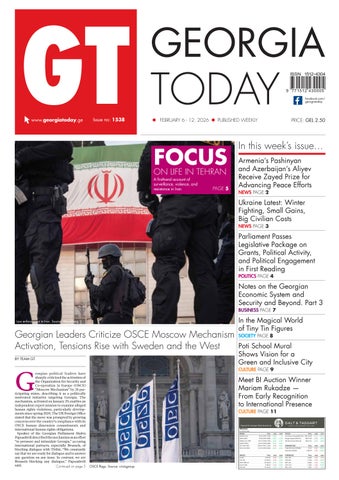
issue#1538

Page 1


Georgian Leaders Criticize OSCE Moscow Mechanism Activation, Tensions Rise with Sweden and the West

eorgian

In this week’s issue...

Armenia’s Pashinyan and Azerbaijan’s Aliyev Receive Zayed Prize for Advancing Peace Efforts

Ukraine Latest: Winter Fighting, Small Gains, Big Civilian Costs

Parliament Passes Legislative Package on Grants, Political Activity, and Political Engagement in First Reading

4

Notes on the Georgian Economic System and Security and Beyond. Part 3

In the Magical World of Tiny Tin Figures

Poti School Mural Shows Vision for a Green and Inclusive City

Meet BI Auction Winner Mariam Rukadze — From Early Recognition to International Presence

enforcement in Iran. Source: Bloomberg

Railway Infrastructure Works Underway on

Kvishkheti–Khashuri Section

Railway infrastructure works are currently underway on the Kvishkheti–Khashuri section, announced Georgian Railways.

The company reports that around 200 personnel, along with heavy machinery, are involved in the works.

As part of the project, Director General of Georgian Railways Lasha Abashidze inspected the ongoing activities on site.

Capital repairs are being carried out along a three-kilometer stretch of railway track. Upon completion, train speeds on this section of the central railway corridor will increase to 100 km/h.

The upgrade is expected to reduce travel times for both passenger and freight trains. By the 2026 summer season, it will already be faster to travel between Tbilisi and Batumi by train.

Abashidze said railway infrastructure improvements are actively progressing across the country. These works aim to increase train speeds while also improving passenger comfort, the statement said.

Serious Violations Found in Veterinary Clinics during State Inspections in Tbilisi

State inspections conducted by the Tbilisi Department of the National Food Agency, together with specialists from the Veterinary Control Division, have uncovered critical violations in a number of veterinary clinics across the capital.

The agency stated that 20 veterinary facilities were inspected as part of routine state control measures. Violations were identified in eight clinics, including both limited liability companies and individual operators. Among the establishments mentioned were ‘New Veterinary Clinic’ ‘Vet.Art,’ ‘Zaravet,’ ‘Vetcenter Zooplaza,’ ‘Vet Hospital,’ and several others operating under individual or corporate registration.

The most serious breaches involved improper sterilization of medical instruments which led to the suspension of operations at two clinics. Inspectors also documented violations related to vaccine storage standards, the use of unregistered, expired or unsuitable veterinary medicines, and the provision of services without proper registration in the Economic Activities Registry. Financial penalties were imposed on the operators responsible for these infringements.

The National Food Agency emphasized that state supervision of veterinary clinics, veterinary pharmacies and pet stores is carried out on an ongoing basis.

Approximately 1,500 veterinary-controlled facilities are scheduled for inspection nationwide this year.

The agency urged the public to report any suspected violations to the Ministry of Environmental Protection and Agriculture’s hotline at 1501.

Georgia Launches 9.2 million GEL Tenders for Alazani Riverbank Reinforcement in Signagi

The Roads Department has issued four public tenders totaling 9.2 million GEL for riverbank reinforcement works along the Alazani River in eastern Georgia’s Signagi municipality. The planned works will be implemented in four locations across three districts of the Milari area and in the village of Erisimedi. The department stated that the projects address ongoing erosion

Armenia’s Pashinyan and Azerbaijan’s Aliyev Receive Zayed Prize for Advancing Peace Efforts

Armenian Prime Minister Nikol Pashinyan and Azerbaijani President Ilham Aliyev have been awarded the Zayed Prize in recognition of their efforts to advance peace between Armenia and Azerbaijan, following years of conflict and heightened tensions in the South Caucasus. Organizers said the two leaders were honored for their consistent commitment to promoting dialogue, strengthening bilateral cooperation, and contributing to long-term regional stability. Armenian media reported that the award also includes a substantial cash prize. It was announced in January that Pashinyan and Aliyev had been named laureates of the prize, with the award ceremony

taking place in Abu Dhabi on February 4. The awards were presented by the President of the United Arab Emirates, Sheikh Mohammed bin Zayed Al Nahyan.

The leaders of Armenia and Azerbaijan appeared on stage together to thank the organizers for the recognition.

The award comes against the backdrop of renewed diplomatic engagement between Yerevan and Baku after decades of hostility centered on the NagornoKarabakh conflict. Following Azerbaijan’s military operation in the region in 2023 and the subsequent departure of the ethnic Armenian population, both governments have stated that the territorial dispute has effectively been resolved, opening the door to broader peace negotiations.

In recent months, Armenia and Azerbaijan have reported progress toward a comprehensive peace treaty, including agreement on key principles such as

mutual recognition of territorial integrity and sovereignty based on existing borders. The sides have also taken steps toward border delimitation and demarcation, and have discussed reopening regional transport and economic links that were severed during years of conflict.

While a final peace agreement has yet to be signed, international mediators and regional actors have pointed to a noticeable reduction in large-scale hostilities and an increase in direct bilateral talks. The Zayed Prize jury said the joint award underscores the importance of sustained political will and leadership in overcoming entrenched conflicts and fostering reconciliation.

The Zayed Prize recognizes initiatives and leadership that support peace, reconciliation, and constructive international engagement, highlighting efforts that contribute to stability not only between states but across entire regions.

Human Rights Watch: Georgia’s Human Rights Record Sharply Deteriorated in 2025

along the river which poses risks to both the stability of the riverbed and the safety of nearby land and infrastructure.

The Alazani River holds strategic importance as its riverbed forms part of the natural border between Georgia and Azerbaijan. As a result, the department emphasized that the reinforcement works are not only environmentally necessary but also critical for protecting the border zone.

The total estimated cost of the projects amounts to 9,205,249 GEL and will be financed from the state budget. The Roads Department noted that the tenders are currently open, with the deadline for bid submissions set for March.

Georgia’s human rights situation significantly worsened in 2025, shows Human Rights Watch’s World Report 2026. In the report, Human Rights Watch says the deterioration followed the adoption of sweeping legislation by the ruling Georgian Dream party, which it says was aimed at dismantling the country’s vibrant civil society and silencing critical media. The report also states that Georgian authorities excessively interfered with largely peaceful protests. According to Human Rights Watch, these actions con-

During a protest in Tbilisi. Source: Radio Tavisupleba

tradict Georgia’s international human rights commitments, particularly regarding freedoms of expression, assembly, and association, as well as principles of equality and non-discrimination.

Human Rights Watch warns that the developments raise serious concerns about the overall direction of democratic governance and fundamental rights protections in the country.

Files. Source: CPD Online College
GT
Laying train tracks in central Georgia. Source: 1TV
Armenian Prime Minister Nikol Pashinyan and Azerbaijani President Ilham Aliyev were awarded the Zayed Prize. Source: FB

Ukraine Latest: Winter Fighting, Small Gains, Big Civilian Costs

This past week in Ukraine followed a grimly familiar pattern. On the ground, Russia kept pushing forward in small, grinding steps, taking villages here and there rather than attempting dramatic breakthroughs. In the air, it returned to largescale missile and drone strikes, especially against Ukraine’s energy system, after a brief pause tied to US-backed diplomacy. Ukrainian officials say Moscow used that lull not to de-escalate, but to reload.

The result is a war defined less by sweeping movements on maps and more by steady attrition: incremental advances, mounting civilian hardship, and both sides trying to strengthen their hand ahead of negotiations without giving up anything essential.

SLOW ADVANCES, CONSTANT PRESSURE

Russia announced a string of modest territorial gains across several fronts. At the end of January, Russian state media said troops had taken three villages in Zaporizhzhia and Donetsk regions, followed days later by another reported capture in southeastern Zaporizhzhia. Reuters could not independently confirm these claims, but they fit a broader trend: Moscow is probing Ukrainian defenses, widening footholds where it can, and forcing Kyiv to respond across many pressure points at once.

Further north, Russia also claimed to

have taken a village in Ukraine’s Sumy region, underscoring that the northern border remains active. The goal there appears less about major advances and more about keeping Ukrainian forces stretched, threatening supply routes, and preventing Kyiv from shifting troops south and east.

For civilians near these fronts, the effects are immediate. Reuters reporting from southeastern Ukraine described villages emptying out as Russian forces “lurch forward.” Shelling intensifies, drones become constant, transport links fail, and people leave; not because a line on a map has officially shifted, but because daily life becomes impossible.

Often, civilian evacuation is the first visible sign that the tactical situation is worsening.

WINTER STRIKES HIT HARD

The most consequential events of the week came from the sky. After what had been described as a temporary pause in attacks on energy infrastructure, Ukrainian officials say Russia launched a massive combined strike: hundreds of drones and dozens of missiles in a single overnight assault.

According to Reuters, the barrage damaged energy facilities and residential areas as temperatures dipped to around minus 20 degrees Celsius. At least a dozen people were injured, and an evening strike in Zaporizhzhia killed two 18-year-olds and wounded nine others. In Kyiv, more than 1,100 apartment buildings were left without heat.

In Kharkiv, authorities described large numbers of residents enduring freezing apartments after power and heating

facilities were hit.

President Volodymyr Zelensky framed the strikes as both a humanitarian weapon and a political message. He accused Russia of exploiting the pause to prepare a renewed assault designed to freeze cities, exhaust repair crews, and weaken Ukraine’s position ahead of talks. Even the details of the supposed moratorium became contested: Russia said it had already expired; Ukraine said it was meant to last several more days. The episode showed how fragile and unenforced such arrangements are.

CIVILIANS STILL

PAYING THE PRICE

Frontline towns continued to suffer deadly strikes. On February 4, Ukrainian officials said shelling and aerial bombs hit a market area in Druzhkivka, killing at least seven people and injuring eight more. Russia did not comment, and both sides deny deliberately targeting civilians. Still, incidents like this remain a stark feature of life near the front, where populated areas sit within range of artillery, bombs, and drones. The rhythm is brutally consistent: pressure on the ground, deep strikes on infrastructure, and civilians caught in between.

UKRAINE

QUIETLY STRIKES BACK

Ukraine’s own long-range attacks into Russia continued, though with far less spectacle than Russia’s barrages. Russian officials reported civilian deaths from Ukrainian drone strikes in the Belgorod region. Beyond the border areas, Ukraine has kept targeting oil

refineries and fuel infrastructure; part of a broader effort to disrupt Russia’s ability to sustain high-tempo operations. These strikes don’t usually lead to immediate changes at the front, but analysts see them as an attempt to slowly complicate Russia’s war economy.

SMALL GAINS, NO BREAKTHROUGHS

Measured week to week, the territorial picture barely moves—but it does move. According to Russia Matters’ weekly assessment based on ISW data, Russia gained about 29 square miles of Ukrainian territory between January 27 and February 3. Ukraine, meanwhile, maintained a small foothold, around four square miles, inside Russia’s Kursk and Belgorod regions.

These figures underline the reality of this phase of the war: villages and fields change hands, not cities. The biggest shocks are felt not on maps, but in homes when the power goes out.

TALKS CONTINUE, FIGHTING DOESN’T

Diplomacy ran alongside the violence rather than replacing it. Reuters reported that Ukrainian and Russian officials completed what Ukraine called a “productive” first day of US-backed talks in Abu Dhabi. The focus was on practical issues, but the core disagreements remain untouched: Russia’s demands for territorial concessions versus Ukraine’s refusal to give up land it still controls, along with unresolved questions about security guarantees and major sites like the Zaporizhzhia nuclear plant.

Kremlin officials have also signaled

that territory is only part of their demands, reinforcing the sense that negotiations face long odds.

AIR DEFENSE BECOMES URGENT AGAIN

With Russia’s renewed strike campaign, air defense took center stage in international support. Sweden and Denmark announced a joint plan to buy and deliver Tridon air defense systems to Ukraine, worth about $290 million. Ukraine also said it was working with RTX to speed up Patriot missile deliveries and deepen industrial cooperation. Estonia prepared a new aid package focused on drones and counter-drone systems, reflecting how unmanned systems now dominate the battlefield above and behind the front lines.

THE PATTERN HOLDS

Taken together, the week looks much like the months before it. Russia presses forward inch by inch while using missile and drone strikes to target heat, electricity, and morale in the depths of winter. Ukraine absorbs those blows, tries to hold the line, applies limited pressure inside Russia, and scrambles for faster air-defense resupply. Talks continue, but the fundamentals—territory, security guarantees, and the use of civilian infrastructure as leverage— remain unresolved.

Unless Ukraine’s air defenses can be strengthened faster than Russia can assemble large strike packages, the coming weeks are likely to follow the same harsh equation: small changes on the battlefield, and outsized suffering in the cities.

Parliament Passes Legislative Package on Grants, Political Activity, and Political Engagement in First Reading

With 82 votes in favor and 10 against, Parliament has adopted, at the first reading, a legislative package initiated by the Georgian Dream parliamentary faction. Once enacted, the package will introduce new restrictions and prohibitions related to grants, political activity, and political engagement.

The amendments affect the following laws: the Law on Grants, the Criminal

Code, the Administrative Procedure Code, the Code of Administrative Offenses, the Organic Law on Political Associations of Citizens, and the Law on the State Audit Office.

Under the proposed amendments to the Law on Grants, the definition of a “grant” is significantly expanded. A grant will be understood as any funds transferred in monetary or in-kind form by any person to any other person, which are used or may be used—based on belief or intent—to influence the authorities of Georgia, state institutions, or any segment of society through activities aimed at shaping, implementing, or changing

Steve Witkoff: Russia and Ukraine Agree on Exchange of 314 Prisoners

Russia and Ukraine have reached an agreement on the exchange of 314 prisoners, said Steve Witkoff, the US President’s special representative.

In a post on X, Witkoff said the exchange will mark the first such agreement in five months.

“This will be the first exchange of this kind in five months. This outcome was achieved through detailed and productive peace negotiations. While significant work still lies ahead, steps like this dem-

onstrate that sustained diplomatic engagement delivers real results and supports efforts to end the war in Ukraine,” Witkoff wrote.

He added that discussions between the parties will continue and that further progress is expected in the coming weeks.

Witkoff also expressed gratitude to the United Arab Emirates for hosting the talks and to Donald Trump for his leadership, which he said had made the agreement possible.

The announcement comes amid ongoing international diplomatic efforts aimed at facilitating humanitarian measures and advancing negotiations between Russia and Ukraine.

Georgia’s domestic or foreign policy. The definition also includes activities deriving from the political or public interests, approaches, or relationships of a foreign government or a foreign political party.

Receiving such a grant will be permitted only with the prior approval of the Government of Georgia.

The law also introduces the concept of a legal entity of another state whose activities substantially involve issues related to Georgia. Such entities will be allowed to receive grants only after obtaining prior consent from the Georgian government. As explained by the Georgian Dream faction, for example, an organization registered abroad but substantially operating in Georgia will be required to apply to the Georgian government for permission to receive funding. Failure to do so will result in criminal liability.

A grant will also include funds transferred in monetary or in-kind form in exchange for the provision of technical assistance, including the sharing of technologies, specialized knowledge, skills, expertise, services, and/or other forms of support. Georgian Dream faction says if a foreign actor hires experts in Georgia in exchange for payment, such funds will be considered a grant and will require prior government approval.

If a representative office, branch, or subdivision of a non-resident legal entity receives a grant—including from the legal entity of which it is a branch— prior consent from the Georgian government will be required. Under the

draft law, receiving a grant without such consent will result in administrative liability in the form of a fine amounting to double the value of the illegally received grant.

Amendments are also introduced to the Criminal Code. Under the draft, violations of the rules established by the Law on Grants will result in criminal liability, punishable by a fine, community service ranging from 300 to 500 hours, or imprisonment for up to six years.

An aggravating circumstance is added to Article 194 of the Criminal Code, under which money laundering carried out for the purpose of engaging in political activity related to Georgia will be punishable by imprisonment for nine to twelve years. Criminal liability will also be imposed on senior officials of political parties who violate the Organic Law on Political Associations of Citizens—specifically by accepting foreign funding. Such violations will be punishable by a fine, community service of 300 to 500 hours, or imprisonment for up to six years.

External lobbying is also criminalized.

Specifically, the direct or indirect transfer of money, securities, other property, property benefits, or any other advantage to a foreign citizen or legal entity in exchange for engaging in political activity related to Georgia will be punishable by a fine, community service of 300 to 500 hours, or imprisonment for up to six years.

Changes related to restrictions on political party membership are introduced in the Organic Law on Political Associations of Citizens. The draft law defines grounds for the inadmissibility

of political party membership. In particular, a person employed under a labor contract by an organization that has received more than 20% of its annual income from a foreign source will be prohibited from being a member of a political party for a period of eight years.

The State Audit Office will be responsible for monitoring the financial activities of political party members.

The term “having a declared electoral purpose” is replaced with “having a declared party-political purpose,” and its scope is expanded. All restrictions applicable to political parties under the legislation will also apply to entities with a declared party-political purpose. In cases of receiving foreign funding, criminal liability is established for both the leadership of political parties and entities with a declared party-political purpose.

The legislative package also introduces amendments concerning the public political activity of business entities. Changes to the Code of Administrative Offenses establish a new administrative offense for business entities engaging in public political activity unrelated to their core business operations. In such cases, the State Audit Office will impose a fine of 20,000 GEL, and 40,000 GEL for repeated or subsequent violations. At the same time, as decided during the first-reading deliberations, these provisions will be revised so that, in cases of repeated political activity by business entities, criminal liability will be imposed instead of administrative liability.

Human Rights Committee to Consider Legislative Package Making Legal Aid Service Accountable to Prime Minister

The Parliamentary Committee on Human Rights Protection and Civil Integration will consider today, at the first reading, a legislative package that would fundamentally change the institutional status of Georgia’s Legal Aid Service, making it accountable to the Prime Minister.

Under the current legislation, the Legal Aid Service operates as an independent body, is not subordinated to any branch of government, and is accountable solely to Parliament. The proposed amendments, however, would place the Service under the authority of the executive branch, significantly altering its governance and oversight mechanisms.

Based on the draft law, the Legal Aid Service would become an institution accountable to the Prime Minister, rather than Parliament. The head of the Service would no longer submit an annual activity report to Parliament; instead, reporting obligations would shift to the Prime Minister. In addition, the Prime Minister would be granted the power to appoint and dismiss the Director of the Legal

Aid Service.

The legislative package also proposes substantial changes to the procedure for appointing and dismissing the Director, as well as to the structure and composition of the Service’s governing collegial body — the Legal Aid Council.

CHANGES TO THE LEGAL AID COUNCIL

Under the existing law, the Legal Aid Council consists of nine members, representing a balance of professional and institutional stakeholders:

• three members elected by the Executive Council of the Bar Association;

• three members appointed by the Public Defender (Ombudsman);

• one member elected by the Legal Aid Bureaus from among bureau lawyers;

• one member nominated by the Minister of Justice from among Ministry of Justice employees;

• one member appointed by the High Council of Justice from among its nonjudge members.

The proposed amendments would reduce the Council from nine to seven members and significantly revise its composition. Under the bill submitted to Parliament, the new Council would include:

• two members — the Chairs of the Parliamentary Committees on Legal Issues and on Human Rights Protection and Civil Integration;

• one member — the Secretary of the High Council of Justice;

• one member — the Prosecutor General;

• one member — the Head of the Government Administration;

• one member — the Public Defender;

• one member — the Chair of the Bar Association.

The terms of Council members would be directly linked to the duration of their respective official positions, rather than fixed, independent mandates.

The draft law stipulates that the current Director of the Legal Aid Service will have their mandate terminated on May 1, 2026, with compensation equivalent to three months’ salary. The mandates of the existing members of the Legal Aid Council will terminate earlier, on April 1, 2026.

Following the formation of the new Council, it will be required, within two weeks, to select a candidate for Director of the Legal Aid Service and submit the nominee to the Prime Minister of Georgia for appointment.

The authors and initiators of the legislative package are members of the ruling party, Georgian Dream. Initiators claim that the proposed reforms aim to increase the effectiveness of the Legal Aid Service, strengthen administrative oversight, and improve coordination between the Service and the executive branch.

The proposed changes have already drawn attention due to their potential impact on the institutional independence of the Legal Aid Service, which plays a key role in ensuring access to justice for socially vulnerable groups.

Georgian parliament. Source: Imedi News
Steve Witkoff. Source: Reuters

Life in Tehran under Fear: A Firsthand Account of Surveillance, Violence, and Resistance

Icannot tell you my full name because if I do, they will look for me, find me, and take me, just as they have done with so many others and their families. Those who escape and speak to the international press are still at risk. So, I am Samira, and I live in Tehran.

The mood on the streets is heavy and tense. People don’t talk loudly anymore, they only whisper. They look around before speaking, but there is anger simmering beneath the silence. Shops are open, so some areas feel normal, like the district we live in, but only for a few hours. Then, suddenly, security forces appear, everything freezes, and people dart to their homes like rats.

Is it safe? No. It depends on where you are, what time it is, and, honestly, your luck. Plainclothes security agents are everywhere. You recognize them by the way they shuffle about and watch people, who cannot fake their posture. Unlike everyone else, they do not seem afraid; they move around like nothing is happening. That is a clear giveaway.

Checkpoints are set up on major roads, especially at night. Police and Basij, the paramilitary volunteer militia within the Islamic Revolutionary Guard Corps, stop people at random, check phones, and scroll through Telegram, Instagram and WhatsApp. If they see protest videos, slogans, or even messages criticizing the government, you will be taken. You won’t

even have a chance to notify anyone. Your family will only know something has happened if you do not come home that evening. Then they will have to search for you for days, without any official information.

Just like that, my friend was arrested and disappeared for weeks, no phone call, no information. Another friend was beaten during a protest, several ribs broken, and was too terrified to go to the hospital. Many families remain desperately quiet, fearing that speaking out will only make things worse.

If you look at your neighbors, whose child has been taken while yours hasn’t, and you see the condition in which that child is returned, if they are returned at all, and nothing has changed in the country, you think: maybe I won’t risk the safety of my family. Maybe I will stay quiet, no matter how bad it is. Even those who have been released come back changed, muted, terrified of the slightest noise. Many others are still missing. My neighbor Ali has been gone for two weeks. We don’t know where he is. His parents pray and weep day and night, hoping he is at least alive and detained, not dead.

I have seen people beaten into a bloody pulp with batons, dragged into vans from my window. You do not forget those sounds, the screaming, the shots, the chaos. Even those not protesting are exposed simply by being outside.

About Trump’s declaration that help was on the way, people here reacted with mixed emotions. Some felt a small sense of hope; others were very skepti-

cal. We have heard so many promises before, all of them empty. People want real pressure on the regime, not words of encouragement or statements of condemnation.

You ask me if people believe that thousands of protesters have been killed. We do not just believe it: we know it. We may not know the exact numbers, but we know the regime lies through its teeth. We have seen too many deaths with our own eyes, funerals held in secret,

Gakharia: Accusations against Me Are Coordinated with Russia and the Occupation Regime

Giorgi Gakharia, chair of the party Gakharia for Georgia and former Prime Minister of Georgia, has stated that the accusations brought against him are politically motivated and coordinated with Russia and the occupation regime. Gakharia was responding to remarks made by Igor Kochiev, head of the socalled South Ossetian “delegation,” who expressed hope that a Georgian police post near the village of Uista would be dismantled.

“At today’s meeting of the Incident Prevention and Response Mechanism (IPRM), the Tskhinvali occupation regime once again voiced its expectation that the Chorchana checkpoint — installed under my leadership to prevent further occupation — will be removed by the Georgian Dream government,” Gakharia wrote on social media.

He stressed that the checkpoint, located on Georgian-controlled territory, served to protect Georgian land from illegal seizure and to safeguard the local population from creeping occupation.

“The accusations against me related to the Chorchana case amount to political persecution and represent a direct attack on Georgia’s territorial integrity

and sovereignty. These actions are clearly coordinated with Russia and the occupation regime,” Gakharia stated.

Earlier, summarizing the 130th meeting of the IPRM, Igor Kochiev reiterated that there was “hope” the Georgian police checkpoint near the South Ossetian village of Uista would be dismantled.

“Among the issues we raised is the illegal presence of a Georgian police checkpoint on South Ossetian territory, near the village of Uista. So far, no breakthrough has occurred, but there is some hope that we will be able to persuade the Georgian side and that this checkpoint will be removed,” Kochiev was quoted by media outlets as saying.

families forced to remain silent. The government hides information, but I know of three neighbors of mine who were killed by the regime, and there are more who lived down the same street.

The regime’s claim that protesters will be publicly hanged was meant to terrify us, and it worked. My first reaction was fear; real, physical fear. I went cold imagining that something like that could happen to us or someone close to me. Then came anger and contempt. The regime

wants to show that it has no limits. Well, we know that, we know there is no rock bottom to how low they will fall. Is the crackdown working? In the short term, yes. In the long term, no. You cannot stay silent forever. That is how it feels here: fear mixed with rage, silence mixed with resistance. We pray that God helps us and that our children will see a better Iran. We do not want them to endure even one-tenth of what we face every day.

Georgian Leaders Criticize

OSCE Moscow Mechanism Activation, Tensions Rise with Sweden and the West

He emphasized that the Georgian government has nothing to hide and is prepared to cooperate with international institutions, noting that no international body has formally requested access to investigative materials. Papuashvili also rejected reports alleging the use of chemical weapons in Georgia, calling such claims “false and historically unfounded,” and criticized Poland for leading the initiative, accusing its government of political bias due to prior support for former President Mikheil Saakashvili.

Parliamentary majority leader Irakli Kirtskhalia echoed these criticisms during a plenary session on February 3. He described the activation of the Moscow Mechanism as “yet another clear example of a foreign country’s interference in Georgia’s internal affairs” and accused Sweden of hypocrisy. Kirtskhalia highlighted Sweden’s rising crime, gang violence, hate-motivated incidents, and economic stagnation, arguing that the country should focus on its own challenges rather than “problems that do not exist in Georgia.”

He also criticized Sweden for awarding a Freedom Prize to Georgian demonstrators, including those involved in violent protests, calling it “another gross and unfriendly act of interference in Georgian politics.” Swedish MP Gustaf Göthberg dismissed

Kirtskhalia’s claims as “entirely unfounded,” stating that Sweden’s recent crime statistics reflect ongoing reforms and that democratic practices in Sweden contrast with alleged government actions in Georgia, including suppression of protests and the use of chemical weapons.

Sweden has historically been a key partner for Georgia but suspended direct cooperation following the disputed 2024 parliamentary elections. Officials have indicated that cooperation would resume once Georgia returns to its EU integration path.

Elene Khoshtaria, a leader of the Coalition for Change, described the activation of the Moscow Mechanism as a “highly serious and significant signal,” interpreting it as a first step toward punishing the ruling Georgian Dream party over alleged use of chemical agents during crackdowns on protests. She stressed that such measures are deliberate and carefully considered by international institutions, and reflect both opposition efforts and public protest.

The OSCE mechanism follows the 2024 activation of the Vienna Mechanism by 38 states, aimed at seeking information and expressing concern over Georgia’s human rights record. OSCE participating states have called on Georgian authorities to cooperate fully with the expert mission, noting that such engagement would signal goodwill and readiness for constructive dialogue.

Law enforcement in Iran. Source: Reuters
OSCE sign. Source: CaucasusWatch
Giorgi Gakharia. Source: FB

Georgia’s Annual Inflation Reaches 4.8%

in January 2026

The National Statistics Office of Georgia (GeoStat) reports that Georgia’s annual inflation rate stood at 4.8% in January 2026. On a monthly basis, consumer prices rose by 1.2% compared to December.

Core inflation, which excludes volatile items, increased by 2.4% year-on-year while core inflation excluding tobacco reached 2.1%, indicating moderate underlying price pressures.

Food and non-alcoholic beverages were the primary drivers of inflation, with prices rising by 10.6% annually and contributing 3.55 percentage points to the overall rate. Significant increases were recorded in fish prices (20.5%), fruit and grapes (16.9%), bread and cereals (14.3%), sugar and confectionery (10.2%), meat (9.7%) and coffee, tea and cocoa (9.4%).

‘Inter

Full

Prices also rose notably for vegetables, dairy products, oils and fats and nonalcoholic beverages.

Healthcare costs increased by 8.3%, adding 0.68 percentage points to annual inflation. Higher prices were observed across hospital services, medical products and equipment and outpatient care.

Prices for miscellaneous goods and services rose by 7.4%, contributing 0.35 percentage points. The sharpest increases within this category were seen in personal effects, insurance services and personal care.

The restaurants and hotels sector also saw substantial price growth of 8.1%, reflecting higher costs for both accommodation and catering services. Meanwhile, prices for alcoholic beverages and tobacco increased by 3.5%, largely due to higher tobacco prices.

Overall, January’s inflation dynamics point to strong pressure from food and service-related costs.

Rao’ Moves to Acquire

Ownership of Telasi via GEL 51 million Tender Offer

Russian energy company ‘Inter Rao’ has announced plans to consolidate full ownership of Georgia’s electricity distribution company ‘Telasi’ by acquiring all remaining minority shares. The initiative was disclosed through a formal tender offer published in the legislative bulletin and on Telasi’s official website.

‘Inter Rao’ currently controls 75.1% of Telasi via Netherlands-based Silk Road Holdings B.V. The remaining 24.52% stake is held by Georgian company Best Energy Group which operates under CBS Holding. Through the tender offer, ‘Inter Rao’ seeks to increase its holding to 100%, effectively becoming Telasi’s sole shareholder.

Under the terms of the offer, each ‘Telasi’ share is priced at GEL 1.82, valuing the transaction at approximately GEL 51 million for 27,985,461 shares. The

Georgia and Azerbaijan Launch Regular Block Train Linking Poti and Baku Ports

Georgia and Azerbaijan have launched a special block train service connecting the ports of Poti and Baku, a move expected to significantly reduce cargo transit times between the two hubs and enhance regional logistics efficiency. The arrival of the first block train at the Poti terminal was marked by an official ceremony attended by senior representatives of

Georgian Railways stated that the block train will operate on a regular schedule, simplifying container transportation and accelerating transit along the route. The service will transport containers by rail between Poti and Baku, including the return movement of empty containers, easing pressure on road infrastructure and reducing environmental impact.

The initiative is also expected to improve the safety and efficiency of container shipments along the Middle Corridor, the route more attractive and competitive for international cargo owners.

Georgian Railways Director General Lasha Abashidze said that fixed schedules and clearly defined tariffs will allow cargo owners to plan shipments more effectively, knowing in advance when containers will arrive in Poti and when they will be returned. He added that the new service is expected to generate additional revenue for Georgian Railways. The block train will follow the Batumi–Poti–Tbilisi–Apsheron–Sumgait–Alat route. As part of the project, Georgia and Azerbaijan are offering cargo owners a simplified ‘terminal-to-door’ logistics service.

Official Data Show Food Prices Continued to Rise in January

Based on the official data released by National Statistics Office of Georgia (Geostat), food prices in Georgia increased again in January 2026 compared to the previous month.

valuation was conducted by KPMG Georgia which confirmed that the proposed price is not lower than the highest price paid by the company for Telasi shares during the previous six months.

Shareholders intending to sell their shares must submit a written acceptance to Telasi’s central office no later than March 31, 2026, by 18:00. The company will review submissions and make final decisions between April 1 and April 7, with settlement and completion of purchases scheduled for April 24. ‘Silk Road Holdings B.V.’ has reserved the right to withdraw the tender offer at any stage, both before and after the acceptance deadline.

If the transaction is completed as planned, ‘Inter Rao’ will gain full control over Telasi. The move comes shortly after the conclusion of a prolonged tariff arbitration dispute between ‘Inter Rao’ and the Georgian government. On December 24, 2025, the arbitration ruling went in favor of ‘Inter Rao’, obliging the Georgian state to pay $139 million in compensation.

Public discussion around food prices intensified on December 24, 2025, when Prime Minister Irakli Kobakhidze released a video announcing an investigation into price formation. Following this, the Georgian Dream government carried out a series of activities related to pricing, including meetings with representatives of retail chains and distributors. The State Security Service also conducted inspections at the offices of retail chains and seized financial documentation. In parallel, supporters of Georgian Dream promoted the narrative on social media that food prices in supermarkets had significantly decreased as a result of government actions.

However, the latest official data published by Geostat confirm that food prices continued to rise in January compared to December.

In January 2026, monthly inflation in Georgia stood at 1.2%, while annual inflation reached 4.8%.

The main driver of monthly inflation was price growth in the food and nonalcoholic beverages group. Prices in this category increased by 2.9%, contributing 0.96 percentage points to overall monthly inflation.

Significant monthly price increases were recorded in the following food subgroups:

* Vegetables and garden produce: +12.5%

* Fruit and grapes: +5.9%

* Milk, cheese and eggs: +3.5%

* Sugar, jam and other sweets: +2.8%

* Coffee, tea and cocoa: +2.6%

* Fish and seafood: +1.8%

* Oils and fats: +1.5%

* Meat and meat products: +1.4%

* Bread and bakery products: +0.2%

At the same time, prices declined for mineral and spring water, non-alcoholic beverages and natural juices by 0.5%.

Prices in the healthcare group rose by 2.4%, contributing 0.2 percentage points to overall inflation. Increases were recorded in medical products, equipment and devices (+4.5%), as well as outpatient medical services (+0.1%).

The prices of miscellaneous goods and services increased by 2.9%, contributing 0.15 percentage points to the overall index. Growth was mainly observed in insurance (+8.5%), personal items not elsewhere classified (+3.5%), financial services (+2.6%) and personal hygiene (+2.3%).

In contrast, prices in the clothing and footwear group decreased by 4.3%, reducing monthly inflation by 0.2 percentage points. Clothing prices fell by 4.8%, while footwear prices declined by 3.4%.

As for annual inflation, Geostat reports that the largest impact came from food and non-alcoholic beverages, where prices increased by 10.6%, contributing 3.55 percentage points to annual inflation.

On an annual basis, food price increases were recorded in the following subgroups:

* Fish and seafood: +20.5%

* Fruit and grapes: +16.9%

* Bread and bakery products: +14.3%

* Sugar, jam and other sweets: +10.2%

* Meat and meat products: +9.7%

* Coffee, tea and cocoa: +9.4%

* Vegetables and garden produce: +8.8%

* Oils and fats: +8.7%

* Milk, cheese and eggs: +8.6%

* Mineral and spring water, non-alcoholic beverages and natural juices: +6.8%

Healthcare prices rose by 8.3% yearon-year, contributing 0.68 percentage points to annual inflation. Price increases were recorded in hospital services (+9.0%), medical products, equipment and devices (+8.3%), and outpatient medical services (+7.7%).

Prices for miscellaneous goods and services increased by 7.4%, adding 0.35 percentage points to the overall index. The largest increases were observed in personal items not elsewhere classified (+37.9%), insurance (+8.5%) and personal hygiene (+4.2%).

Prices in hotels, cafes and restaurants rose by 8.1%, contributing 0.26 percentage points to annual inflation. Increases were recorded both in accommodation services (+10.2%) and catering services (+7.8%).

Prices in the alcoholic beverages and tobacco group increased by 3.5%, contributing 0.23 percentage points to annual inflation, mainly driven by a 6.6% rise in tobacco prices.

Opening of the new service. Source: 1TV
Georgian and Azerbaijani Railways.
Telasi's office. Source: IPN

Notes on the Georgian Economic System and Security and Beyond. Part 3

Ihave spoken and written many times in the past about Georgia’s system of economic security. Therefore, I will not repeat what has already been said and will voice only a few additional considerations.

Quite often, the strength and resilience of an economy are measured by gross domestic product. However, this is a rather superficial metric and, as a result, creates a misleading perception of the prospects for economic development. Thus, boasting about statistical figures may respond to political expediency, but the real foundations of economic strength lie in the following:

(a) productivity of production;

(b) innovation;

(c) the condition of the consumer market;

(d) energy self-sufficiency;

(e) finance; and

(f) fiscal policy.

It is precisely through the objective measurement of these parameters, and not merely through a “large” or “increased” GDP expressed in numbers, that a country’s realistic ability to overcome, or at least postpone over time, an economic, and not only economic, crisis can be assessed.

It should also be taken into account that covering up the vulnerability of the economy through fiscal stimulation, the so-called mobilization of revenues (including increasing taxes, fees, or fines), has only a temporary effect. The problem does not disappear; by being postponed in time, it only becomes more acute.

Clearly, a full description of the policies required for an economic break-

through, which is the main determinant of our country’s leap from the third tier to the first, goes beyond the scope of this article. However, I will outline from the outset several necessary preconditions for such a breakthrough, namely:

• identifying priority sectors for public and private investment, sectors capable of delivering real, leap-like development;

• modernization of production potential: a country that cannot produce at least a few categories of goods for domestic and external consumption is extremely vulnerable to economic and geo-economic shocks;

• maximizing, as far as possible, the reduction of dependence on imports, at least in terms of basic essential products needed during crisis periods;

• increasing the competitiveness of Georgian companies, at a minimum at the regional level, with priority given to companies considered so-called “national champions” (for entry and establishment in external markets). For this purpose,

I even consider it appropriate to subsidize them with a fixed annual percentage of GDP;

• transforming into a technologically advanced country: in the modern world, modern technology is equivalent to making a claim on the future;

• direct or indirect targeted subsidies, whether in the form of cheap credit, tax incentives, or other instruments. When discussing an economically selfsufficient policy for Georgia, which is a prerequisite for economic security, one of the state’s functions is to support the creation of so-called “deep infrastructure” (not to be confused with the notoriously familiar “deep state”!). Global practice shows that “deep infrastructure” carries significant weight in competition among both global and regional centers. Clearly, for our country’s competitiveness and for moving from the category of a developing country to that of a

developed one, forming a Georgian version of deep infrastructure is a priority.

In simple terms, such infrastructure consists of two main and supporting components:

• one is a complex of physically existing, interconnected service structures (the base needed for innovation, a powerful energy system, a digital network, and others); and

• the other is appropriate professional knowledge related to the management of business and operational processes, the purpose of which can be simply formulated as:

– knowing how to do things; and

– knowing how to do them better than they are done.

Alongside the “statism” approach mentioned in the previous article, which concerns the positioning of the state in economic processes and the correct bal-

ance between the state and the market, it is also necessary to say what the state should not do.

From this perspective, a long list could be made, but the most important point is that artificial privileges must not be created for state-owned companies or for businesses connected or closely associated, in one form or another, with political figures. In addition to undermining healthy competition, this approach will work against the interests of these companies themselves, since it:

(a) reduces their efficiency;

(b) leads to illusory, supposedly “business successes” based on transactions rather than real performance;

(c) suppresses innovation and entrepreneurial spirit within them;

(d) turns them into insolvent entities in the not-so-distant future.

It is also essential to note that a well-

functioning, qualified, and goal-oriented economic system fosters increased optimism in business circles, which directly affects both the present state of the economy and future prospects. At the same time, and this is extremely important, a stable middle class will be formed as a result of correct economic policy, which is one of the guarantees of stability of processes not only in the economy but also in politics.

In relevant circles, the phenomenon of the so-called “Asian Tigers” is well known, when South Korea, Singapore, Hong Kong, and Taiwan achieved an economic miracle through rapid development. With the appropriate political will, societal consolidation, and maximum concentration on competence, why should it be impossible for us, citizens of Georgia, to set such a leap as our own ambition?

Georgia Promotes Middle Corridor, Investment Opportunities, and Record Tourism Growth at World Governments Summit in Dubai

FB

Georgia used the World Governments Summit 2026 in Dubai to send a clear message to global partners: the country is ready to play a bigger role in connecting markets, attracting investment, and welcoming visitors. Prime Minister Irakli Kobakhidze told world leaders, investors, and business executives that Georgia wants to work together to build resilient global supply chains through the Middle Corridor, a route he described as both practical and adaptable in today’s complex geopolitical environment.

the UNWTO.

Speaking during plenary sessions and investment discussions, Kobakhidze said Georgia’s unique position between Europe and Asia allows it to serve as a vital transport and connectivity hub for seven landlocked countries across the Caucasus, the Caspian region, and Central Asia. He stressed that long-term prosperity comes from cooperation, not division, and that Georgia is committed to creating “bridges” — economic, logistical, and political — that help trade move predictably across continents. The Prime Minister also highlighted Georgia’s growing appeal to international investors, pointing to strong momentum in real estate, hospitality, and the fast-developing IT sector. He cited the USD 6.6 billion Eagle Hills

urban development project as a powerful example of investor confidence, noting that early sales results show strong trust in Georgia’s economic direction. Kobakhidze added that the energy sector is another key draw, with government plans to nearly triple electricity generation capacity by 2035 through hydropower and renewable energy projects.

During his official visit to the United Arab Emirates, Kobakhidze held a series

of bilateral meetings aimed at deepening economic and political ties. His visit coincided with the World Governments Summit, where he delivered a keynote address and joined a roundtable discussion on the future of global investment, accompanied by a high-level Georgian government delegation.

On the sidelines of the summit, Kobakhidze met with Shaikha Nasser Al Nowais, Secretary-General of the United Nations World Tourism Organization,

congratulating her on her election and reaffirming Georgia’s close partnership with the organization. Discussions focused on the country’s tourism growth, with officials noting that Georgia welcomed more than 5.5 million international visitors in 2025 — the highest number on record. The two sides also discussed steps to further develop Georgia’s diverse tourism offering, and Kobakhidze invited Al Nowais to visit Georgia.

Being economically self sufficient. Source: Lythouse
A roundtable discussion on the future of investment at the World Governments Summit 2026. Source: FB
PM Kobakhidze with Shaikha Nasser Al Nowais, Secretary-General of

In the Magical World of Tiny Tin Figures

There is an absolutely enchanting petite realm of miniature tin figures right in the heart of our beautiful capital city—7 Dadiani Street, off Freedom Square. I could hardly believe my eyes when I saw what I saw at the Yota Royal Gallery. The place is an unlikely little basement of a typical old downtown Tbilisi building, with a slight smell of moisture and stairs and walls asking for refurbishment, but packed with amazing samples and illustrations of world history and the valuable annals of Sakartvelo. Nothing like this exists in the country, or possibly in the world! As an idea, I would only compare it with the celebrated Madame Tussauds Museums around the globe.

On top of the accumulated wide-scope historical lore, thousands of uncannily sculpted minuscule figures of renowned personalities of international fame, masterful art, subtle design, knowledgeable graphics, and architectural phantasy— the place astonishes a visitor with the titanic labor invested in this outstanding project, created with knowledge, skill, love, and self-sacrifice. The collection is not simply interesting and attractive. It is also truly educating and terribly entertaining. Once you are there, you want to stay there forever.

According to the great Russian scientist I.P. Pavlov, collecting is not merely a hobby, but a specialized, intellectual, and scientific effort that allows for the discovery of new, previously unfamiliar knowledge. Indeed, you leave the place not just pleasantly impressed, but truly

Torch Time

Imust admit, Lamproba caught me off-guard this year. The Svan holiday commemorating a military victory with burning birch torches is counted a certain number of days from Orthodox Easter. This year it fell on February 1. Fortunately, I was able to call a good friend and neighbor in my village of Etseri, and ask him to make me three extra torches, which I could not do from Tbilisi. He obliged. This autumn, though, I must make my own!

Then I put out a call for interested male friends in Tbilisi to join me on a trip up to Etseri for the event. Two answered, Georgians. We combined the trip with loading and planned distribution of about 100 gift boxes for children from the Samaritan’s Purse charity, and then really had a good thing going. One of the guys drove us up in his truck, the closed back full of the boxes.

To my surprise, the road up from Jvari into Svaneti remained free of snow and ice the whole way to Etseri. Usually, at least our last little steep zigzag up from

Pari is less clean. But we didn’t even need shovel or chains or anything, although we had them. The truck also handled our snow-covered last 1 km from the main road to my house with ease. Then we had some shoveling to do just to open the gate and make a space to drive in. But it’s been a gentler winter so far, with less snow and cold than when I did this a year ago. Then, you could walk into my yard over the fence, the snow was that high. This year, definitely not. We were soon parked. I turned on the electricity, got a fire going in the big Svan stove, and we retired to bed early, knowing that the alarm must go off at 7 tomorrow morning.

I had picked up my three torches soon after arriving, and left them upside down overnight in a bucket of diesel to be easier to light. This worked well, especially as by tradition the top ends are split to dry them out better and keep a fire more easily. We walked into the predawn darkness with our flames, feeling the powerful symbolism of what we were doing. Falling snow did not hamper us, although it is unusual on this day, along with temperatures only just below freezing. I shot some video clips on my phone. 10 minutes later we arrived at our ham-

packed with newly acquired knowledge that could someday prove to be very useful in life. This is why, I would say, not one child in town should be left without having visited this fairylike minispot in the land.

Most of these tin figures are soldiers of various ranks and nationalities. World history has preserved the story of Brothers Maurice and William of Orange, the brilliant Dutch military strategists, who used the silver soldiers, deployed on a table, to rehearse the order of battle, which helped them defeat the Spanish military, thus winning the independence of their country. Since the past of humankind qualifies as the history of wars, the usage of toy soldiers was quite common in many national combative cultures, including that of the Egyptian pharaohs.

The exhibit at the Yota Royal Gallery is a subtle replica of the famous historical episodes of that kind. The entire show is staggering, nested in a copious exhibit window and illuminated accordingly. I can’t imagine a better ancillary educational material than this wonderful gallery. If I were the current Georgian educators, who are so eager to reform the system, I would put the spot into the middle- and high-school curriculum and give schoolchildren a chance to go through this secular educational communion. Learning history by means of having fun and acquiring knowledge at the same time—especially because the pleasure is totally free of charge—is something really practicable. Wouldn’t this be a truly contemporary educational endeavor?

The mini-tin-soldiering, as entertainment and the method of battle rehearsing, has a long history in various coun-

tries. As a matter of fact, there is no room in a regular newspaper article to reminisce about it in black and white, but for those who might get interested, the Internet is literally infested with relevant material. By the way, this is not a business, not even a small one, but it needs to be maintained for the interested people to have access to it, so breaking even is the dream of the current owners.

In the finale, I would rather introduce the family who has created this miracle and is taking care of it now: Grigol (Grisha) Robakidze is the author of the idea, designer, and architect of this miraculous exhibit; his wife Irma is his dedicated assistant in all the matters that be; and his mother Nana is a brilliant bilingual custodian and guide whose profuse knowledge of history makes the visit to the Gallery a genuine piece of pleasure, mixed with knowledge of history, unobtrusively and benevolently presented in thirty minutes at most.

The family is ready to give up the Gallery in favor of the State of Georgia, as an auxiliary academic instrument for the reformed education system of the country, provided the government finds a better and safer place for it. Grigol is ready to be the honorary director of the Gallery, asking for zero remuneration. The proposal seems quite rational. What is now left is the potential deal to be signed.

My verbal storage and content have become totally Trumpesque, which, hopefully, is more or less forgivable. In a word, a deal between the Yota Royal Gallery and the Government of Georgia should comfortably fit into the ongoing process of the much-talked-about educational reform in the country. A deal is a deal is a deal!

let of Iskari’s designated bonfire spot, and sure enough, the conical-shaped fire was already burning, a handful of local men already there to greet us. They are always glad when someone makes a special trip for Lamproba, and I do this yearly. My two Georgian friends were experiencing this for the first time, but at least there was no language barrier between them and the Svans, of course. They acquitted themselves very well, getting to know my neighbors and joining in with me in the praying for each family in the hamlet in turn, holding up three little round ceremonial loaves of bred and facing the rising sun but praying to the Big God, as I had been told was proper years ago here.

I also shot 20 or so still frames on my digital camera. But I have long known that trying to get good video and stills at the same event is tricky for one person: there is too much distraction. I got a few useable shots, but nothing spec-

tacular. My neighbors declared that, of all the guests I have brought to Lamproba the last few years (usually foreigners with little Georgian), these two were the best. After a few hours, we went back home, rested, and as the snow had stopped for a bit, unloaded the gift boxes from the truck into the house.

The next morning, one of my visiting friends had a sudden family issue to deal with, so we dug the truck out of the new snow and I sent them off on their long journey back to Tbilisi. Several of the teachers offered to help me distribute the boxes to all the children, an offer I gratefully accepted. It’s a bit chaotic for one person to handle alone. I am here for a week still, so we are getting this done.

I was also able to attend Qiqoba, the feast which happens two days after Lamproba. Here, too, we echoed our prayers for village families, and ate and drank together. And the singing! I told them it was better than any concert-hall experi-

ence. You can find the Qiqoba video on my Facebook page (www.facebook.com/ anthony.tony.hanmer).

Every Lamproba is different, yet the same thread of ritual runs through them, originating from a time unknown to the present, right across Svaneti, and indeed everywhere where Svans live. It’s a joyful time, a community time, and this is when and where I feel most at home, in deep winter, in the darkness pierced by torchlight as dawn approaches, with my friends. Grateful.

Tony Hanmer has lived in Georgia since 1999, in Svaneti since 2007, and been a weekly writer and photographer for GT since early 2011. He runs the “Svaneti Renaissance” Facebook group, now with over 2000 members, at www.facebook.com/groups/ SvanetiRenaissance/ He and his wife also run their own guest house in Etseri: www.facebook.com/hanmer.house.svaneti

The author in the museum
Photo by the author
Photo by the author

Poti School Mural Shows Vision for a Green and Inclusive City

Anewmuralhasbeenunveiled on the wall of Poti’s 12th Public School, offering a visual interpretation of the city’s aspirations for a greener, more inclusive future. The artwork was created by well-known Georgian street artist Gamez in collaboration with school students, placing young people at the center of a broader conversation about sustainable urban development.

The mural depicts a vision of Poti shaped by green spaces, inclusive infrastructure, innovation, technology and a lifestyle that balances human needs with environmental protection. Through its imagery, the artwork presents the city not only as it is today but as it aims to become, environmentally responsible, socially inclusive and forward-looking.

Often described as the language of cities, wall art reflects collective concerns, ideas and ambitions. In this case, the mural serves as a public statement of

Snow, Silence, and the Ethics of Looking: Iranian Cinema Arrives in Tbilisi

In early February, Tbilisi tends to move at a different tempo. The city’s hills grow quieter, its cafés slightly more introspective, its cultural institutions more alert to gestures that require attention rather than noise. It is into this season of softened perception that CinExpress in Cinema House introduces a compact yet resonant retrospective of Iranian cinema, curated by Lika Glurjidze, Nini Shvelidze, Alexandre Gabelia, and Giorgi Javakhishvili. All screenings are presented in the original languages with English subtitles, reinforcing the retrospective’s openness to an international, non-Georgian-speaking audience. Iranian cinema has always travelled well. Its grammar—minimalist, morally alert, resistant to spectacle—has crossed borders with unusual ease, perhaps because it never confuses intimacy with insignificance. What this Tbilisi retrospective proposes is not a survey of masterpieces for their own sake, but a study in attention: to childhood, to ethical hesitation, to social pressure rendered visible through the smallest gestures. The opening night belongs to Abbas Kiarostami’s Where Is the Friend’s House? (1987), a film whose apparent simplicity remains one of the most radical acts in modern cinema. An eight-year-old boy, a misplaced notebook, a village mapped by obligation rather than geography. In Georgia—where cinema audiences have long been trained to read moral weight in everyday movement—Kiarostami’s film lands with particular clarity. This is cinema that insists responsibility begins

before ideology, before adulthood, before explanation. It is an ethics learned by walking.

The following evening shifts the terrain from rural pathways to industrial ruins with Amir Naderi’s The Runner (1984). Set in Abadan, amid the detritus of war and oil economy, the film introduces Amir, an orphan surviving in the shell of a tanker. Movement here is no longer moral wandering but physical necessity. Running becomes both survival tactic and metaphysical act. The film’s raw kinetic energy stands in productive tension with Kiarostami’s contemplative pacing, outlining two poles of Iranian cinema: stillness as inquiry, motion as resistance.

Saturday’s dense sequence unfolds like a compressed history of Iranian cinema’s global ascent. Majid Majidi’s Children of Heaven (1997) returns to childhood, but now framed through deprivation managed with grace. Shoes become currency, secrecy becomes love, and poverty is neither romanticized nor instrumentalized. The film’s emotional precision explains its enduring international appeal; it trusts sentiment without surrendering dignity.

From there, Mohsen Makhmalbaf’s A Moment of Innocence (1996) turns cinema back onto itself. Half autobiographical, half reenactment, the film stages memory as negotiation. Violence is neither denied nor simplified; instead, it is examined through the ethics of representation. In a Georgian context—where the question of how to narrate political pasts remains sharply contested— Makhmalbaf’s reflexive approach feels especially current.

The afternoon continues with Jafar Panahi’s Crimson Gold (2003), a film

whose quiet rage accumulates with devastating effect. Through the daily routes of a pizza deliveryman, Tehran reveals itself as a geography of humiliation structured by class. Luxury here is not aspiration but provocation. The final act’s tragic inevitability feels less like plot than consequence—social inequality translated into narrative pressure.

Sunday opens with animation, though nothing about Marjane Satrapi and Vincent Paronnaud’s Persepolis (2007) is escapist. The black-and-white aesthetic strips ideology down to its emotional residue. Revolution appears not as abstraction but as interruption: of childhood, of music, of private space. For a Georgian audience with lived memories of ideological reformatting, Persepolis reads as both memoir and warning.

Recent Iranian cinema enters the program with Panah Panahi’s Hit the Road (2021), a road movie that understands displacement as emotional condition rather than logistical event. The family at its center performs normalcy with increasing strain, humor masking dread. Silence becomes the film’s most articulate language. It is a work acutely aware of inheritance—stylistic, political, familial—without being trapped by it.

The retrospective concludes with Asghar Farhadi’s A Separation (2011), arguably the most internationally recognized Iranian film of the last two decades. Yet its power remains undiminished. The film’s domestic dispute expands into a moral labyrinth where truth fractures under pressure. No character is innocent, none entirely culpable. Farhadi’s genius lies in constructing drama as ethical density. In Tbilisi, where legal, familial, and moral responsibilities frequently collide, A Separation feels less like foreign cinema and more like a mirror angled slightly differently.

What unites this program is not nationality but a shared refusal of spectacle. Iranian cinema here is presented as a cinema of consequence—where every decision carries weight, where silence is meaningful, where the political emerges through the personal without announcement. Cinema House, by offering the films in their original languages with English subtitles and free admission, frames the retrospective as a public act rather than a curated luxury.

In the current Georgian cultural landscape—marked by urgency, protest, and a search for ethical vocabulary—this retrospective performs a quiet but insistent function. It reminds us that cinema can be both modest and radical, that looking carefully remains a political act, and that sometimes the most subversive gesture is simply to follow a child down a dusty road until responsibility comes into focus.

Poti’s commitment to sustainability and inclusivity, translating urban values into a shared visual narrative.

The initiative was implemented as part of an urban art collaboration supported by Denmark and the United Nations Development Programme (UNDP), within the framework of UNDP’s regional City Imaginarium campaign. The project encourages citizens, especially young people, to reimagine their cities through creativity and participation.

The mural is a part of a broader regional project, ‘Green Future, Rights and Stability: Promoting Inclusive and Green Development through Accountable Governance in the EU Eastern Neighbourhood,’ implemented by UNDP with funding from the Government of Denmark. Running from 2024 to 2027, the project focuses on Georgia and Moldova to strengthen environmental governance and promote climate-smart economic development. Approximately USD 4.29 million is allocated for activities in Georgia, USD 4.27 million for Moldova and USD 2.2 million for enhancing regional cooperation between the two countries.

Leuville Mayor Highlights Near Completion of Georgian Estate Restoration

The traditional annual mayoral ceremony (Cérémonie de vœux) was held in Leuville-sur-Orge, France where Mayor Éric Brévent addressed residents and guests, placing special emphasis on the significance of the Georgian Estate restoration project.

In his remarks, the mayor noted that the comprehensive rehabilitation of the historic Georgian property is nearing completion. Restoration works on the château, library and several pavilions have largely been finalized, while the Georgian restaurant ‘Oda’ has entered its final phase of development.

Mayor Brévent expressed gratitude to the Government of Georgia and the estate’s local administration for organizing numerous events at the château and for keeping the site open to the residents of Leuville. He emphasized the cultural bond between the two countries, stating that while Leuville and Georgia

speak different languages, they share a common cultural heritage.

The Georgian Estate in Leuville-surOrge holds deep historical significance for both Georgia and France. Acquired in 1922 by the Government of the First Democratic Republic of Georgia following the Soviet occupation, the estate became a place of exile for Georgian political leaders, intellectuals and their families. For decades, it served as a vital center for preserving Georgian culture, language and national identity abroad. Today, the ongoing restoration of the estate reflects a renewed commitment to safeguarding this shared heritage and transforming the site into a living cultural and historical landmark for future generations.

The ceremony was attended by members of the municipal council, representatives of the local administration, cultural and civic organizations and residents of the municipality. Also present were Tamar Kvaratskhelia, head of the Georgian Academy of Leuville, and Teona Melitauri, the local manager of the Georgian Estate.

Students in front of the mural. Source: UNDP Georgia
Mayor Éric Brévent at the Cérémonie de vœux. Source: 1TV
Shot from the movie Hit the Road (2021)

Listening against the Grain: How Georgia’s Cultural Life Learned to Breathe in Constrained Spaces

In Georgia, contemporary music rarely arrives alone. It enters the room accompanied by context— political, social, existential. A concert here is almost never just a concert; it is a gathering, a checkpoint, sometimes a rehearsal for civil courage.

Over the past few years, as public space has narrowed and institutional language has grown brittle, sound has become one of the few remaining elastic materials. It bends, absorbs pressure, and survives where declarative speech risks fracture.

Within this fragile ecosystem, the Swiss–Georgian festival Close Encounters has evolved from a niche experimental platform into something closer to a cultural instrument: a way of testing how much openness is still possible.

Founded in 2005 by pianist and curator Tamriko Kordzaia together with composer and performer Tobias Gerber, Close Encounters was never designed as a representational project. Its original impulse was disarmingly simple: place Georgian and Swiss musicians—often unfamiliar with each other’s scenes, habits, and assumptions—into the same

working conditions and see what kind of music, friction, or misunderstanding might emerge. What followed over two decades was not stylistic synthesis but a sustained practice of encounter: club electronics brought into conservatory halls, post-Soviet avant-garde works resurfacing beside live coding, improvisation coexisting with strict compositional systems.

The 2026 edition of the festival, unfolding between March and May in Zurich, Chur, and Winterthur, might appear geographically distant from Georgia. Yet it is inseparable from the country’s current reality. The festival’s own materials speak openly about the changed political and social landscape, about increasing authoritarian pressure, intimidation, and the precarious position of artists working in Georgia today. In this context, Close Encounters functions as an external extension of Georgia’s cultural bloodstream—a space where ideas, bodies, and sounds can circulate with slightly less friction, then return transformed.

What distinguishes Close Encounters from many European contemporary music festivals is its refusal of stylistic hygiene. There is no unifying aesthetic, no brandable sound. Instead, the 2026 program reads like a catalogue of unsta-

ble formats—opera that behaves like a laboratory, games that act as scores, installations that remember, ensembles that operate as stressed systems. This lack of uniformity is not curatorial indecision; it is a position. In a time obsessed with legibility and ideological alignment, the festival insists on complexity.

The opening concert at MOODS makes this clear from the first gesture. Homo Freq, an electroacoustic opera project by Tiko Gogoberidze, Nasi Chavchavadze, and Lisa Kereselidze, treats opera less as genre than as soft architecture. Voices slip between extended technique and electronic mediation; the cello dissolves into processed resonance; form remains deliberately porous. Opera’s traditional authority—of narrative, hierarchy, spectacle—is quietly dismantled. What replaces it is a platform for experimentation, where fragility becomes a compositional parameter rather than a weakness.

The same evening introduces Zugzwang by Swiss composer Tomas Korber, a large ensemble work whose title— borrowed from chess—describes a situation in which every possible move worsens one’s position. Saxophones, piano, cello, percussion, sampler, and electronics are locked into feedback systems that demand constant reaction. The music unfolds as a tense ecology of decisions, where agency is unavoidable and neutrality impossible. Without a single explicit political reference, the piece reads unmistakably as a model of life under pressure.

At Kunstraum Walcheturm, the festival pivots toward environment and interface. Giorgi Koberidze’s sound installation MurMur uses handmade clay bells as loudspeakers, creating an intimate acoustic space shaped by loss, decay, and preservation. Sound here does not dominate; it seeps, vibrates, and risks breaking. In sharp contrast—but deep conceptual kinship—comes Alexandre Kordzaia’s Speedrun, a videogame concert-performance in which every action within a custom-built 2D game generates musical material. Player, performer, and composer collapse into a single unstable

role, turning agency itself into a sonic question.

The Chur program at Postremise recombines these works into new constellations, reinforcing Close Encounters’ belief that meaning emerges through recontextualization. Ensemble KIOSK appears here as a hybrid organism—part music theatre, part object-based sound laboratory. Their Swiss premiere of Giwi’s Dream by Georgian composer Zura Dzagnidze introduces a custom-built instrument assembled from springs, blades, rubber bands, and everyday materials. Domestic debris becomes resonant infrastructure, a subtle reminder of how Georgian experimental music has long learned to build futures from leftovers.

The residency presentation at Zeughaus 4 foregrounds process over product.

Tiko Gogoberidze’s work unfolds as an open workshop, exposing compositional thinking as provisional, collective, and unfinished. In a cultural economy increasingly obsessed with polished outcomes and instant visibility, this insistence on unfinishedness feels quietly radical.

The festival concludes at Kulturfeilerei with Stones & Pillars, an evening that interweaves works by female composers from Georgia, Armenia, Azerbaijan, and Iran with electroacoustic transformations by the Zurich trio u /r. The Caucasus here is neither exoticized nor flattened into geopolitical symbolism. It emerges instead as a dense field of com-

positional intensity—contradictory, highenergy, and structurally rigorous. These works refuse to illustrate identity; they insist on proximity.

Taken as a whole, the Close Encounters 2026 program reads like a manual for cultural survival. Roles remain unstable: opera behaves like an installation, games function as scores, ensembles operate as feedback systems. This instability mirrors the lived experience of Georgia’s cultural scene today—adaptive, networkbased, and alert. As public institutions grow cautious and ideological pressure increases, culture migrates sideways into independent spaces, festivals, radios, and temporary alliances.

Close Encounters does not promise salvation. It offers something subtler and more durable: circulation. It keeps channels open—between countries, scenes, generations, and modes of listening. In a moment when political language hardens and futures are increasingly scripted elsewhere, the festival insists that sound can still travel, mutate, and return changed.

To listen to these concerts—whether in Zurich, Chur, or Winterthur—is to hear Georgia thinking aloud. Not heroically, not nostalgically, but attentively. In this context, listening itself becomes a civic act. And Close Encounters, twenty years after its founding, remains one of the few spaces where that act is still allowed to unfold in full complexity.

Exhibition on European Travelers’ Journeys to the East Opens at National Library’s Book Museum

An exhibition exploring the legendary journeys of European travelers to Eastern countries has opened at the Book Museum of the National Library of Georgia.

The temporary exhibition, displayed alongside the museum’s permanent collection, features rare 19th- century editions printed in various European languages. The books are drawn from the National Library’s rare collections fund.

The exhibition highlights how the routes of European travelers heading east often passed through Georgia—a fact specifically noted in several publications. Among them is a book by traveler Freigang, published in 1817, titled “Journey to the Caucasus and Georgia.”

The displayed works recount travelers’ observations and experiences in countries and regions such as Turkey, Syria, Egypt, Kabul, Korea, and beyond, offering European perspectives on the East during the period.

Visitors’ attention is drawn to the rich illustrations accompanying the texts. The publications stand out for their highquality printing and engravings, many of which are hand-colored. The vibrant hues characteristic of the East have been remarkably well preserved, adding to the exhibition’s visual impact. The display also includes maps depicting the countries and regions visited by the authors.

In parallel with this exhibition, visitors to the Book Museum can explore the permanent display, which includes the first Georgian printed books, editions published by King Vakhtang VI, the personal library of Ilia Chavchavadze, and a unique collection of editions of The Knight in the Panther’s Skin.

Exhibition venue: Book Museum, National Library of Georgia – 3 Gudiashvili Street, Tbilisi

Opening hours: The Book Museum follows the general working hours of the National Library of Georgia.

Visitors are advised to check current opening hours in advance, as they may vary on weekends or public holidays. Entry: Admission is free.

Poster 2026 // Fragment
Close Encounters 2025 @ Mutant Radio, Tbilisi (Foto: Dima Chikvaidze)

Meet BI Auction Winner Mariam Rukadze — From Early Recognition to International Presence

Mariam Rukadze is a Georgian contemporary artist whose work has been part of BI Auction’s community spotlight since 2016, when she participated in their project showcasing young Georgian artistic talent.

“Mariam started participating in our very first auctions in 2016, and when she applied for our competition in 2022, she was already recognized and being

followed by collectors,” says Bengü Akçardak Küçük, Co-Founder of BI Auction.

Mariam’s artistic practice is closely tied to social, existential, and human questions of her time. Over the years, her works have entered private collections and gained visibility both in Georgia and internationally, marking her as a strong and thoughtful voice in contemporary art.

HOW DID WINNING THE BI AUCTION COMPETITION IN 2022 CHANGE YOUR CAREER?

For me, art cannot be separated from

COMMERCIAL DEPARTMENT

Commercial Director: Iva Merabishvili

Marketing Manager: Natalia Chikvaidze

EDITORIAL DEPARTMENT:

Editor-In-Chief: Katie Ruth Davies

time and environment — it reflects the era in which it is created. Over the years, I have won the BI Auction Competition several times, and between 2017 and 2022 my works gained strong recognition and entered private collections. These experiences expanded my artistic presence both in Georgia and internationally. Each new project became a step forward, while the auction process itself felt like a continuation of the artwork beyond the studio — giving it movement and life.

HOW DO YOU EVALUATE

THE CURRENT SITUATION OF ART AND ARTISTS TODAY?

Contemporary art exists in a state of constant tension and dialogue. Despite challenges, artists today are deeply engaged with social and existential realities, seeking meaning, responsibility, and honest reflection within their work.

WHAT IS YOUR UPCOMING PROJECT?

I am currently preparing a conceptual solo exhibition focused on existential questions and the human condition in a rapidly changing world. Alongside this, I continue developing M Art Studio, a space dedicated to teaching and sharing artistic experience with the next generation.

Journalists: Ana Dumbadze

Vazha Tavberidze

Tony Hanmer

Nugzar B. Ruhadze

Ivan Nechaev

Mariam Razmadze

Layout: Misha Mchedlishvili

Photographer: Aleksei Serov

The Role of the Daughter of

SPONSORED CONTENT

The Daughter of Zion highlighting themes of restoration, salvation, and her role.

Zechariah 2:10 mentions God coming to live among the Daughter of Zion.

Zechariah 9:9 calls the Daughter of Zion to rejoice because her righteous and saving king is coming.

Zephaniah 3:14 is an exhortation for the Daughter of Zion to sing and rejoice.

Micah 4:13 speaks of the Daughter of Zion being empowered to conquer.

Isaiah 62:11 declares to the Daughter of Zion that her salvation is coming.

Zephaniah 3:15 states that the Lord has removed judgments and enemies, and is in the midst of Israel, removing fear.

Micah 4:8 refers to the return of former dominion and kingship to the Daughter of Jerusalem.

Zechariah 2:11 describes many nations joining the Lord and becoming His people, with God living among them.

Isaiah 52:1 calls for Zion and Jerusalem to awaken and put on strength and beautiful garments.

Zechariah 9:10 speaks of the removal of instruments of war and a king who will speak peace to the nations and rule from sea to sea.

Micah 4 suggests the Daughter of Zion is empowered to conquer and has former dominion restored to her. Zechariah 2 and 9 associate her with the coming King who brings peace and takes a central role in the new kingdom.

The prophetic promise found primarily in Zephaniah 3 and Zechariah 2 & 9, where the "Daughter of Zion" (the covenant people/Church) is instructed to rejoice because the King of Zion (Jesus Christ) is dwelling directly within her, transforming her from a captive/mourner into a victorious bride.

10 Verses for In-Depth Understanding

Zephaniah 3:14 (The Command): Commands the Daughter of Zion to sing, shout, and rejoice with all her heart. This is because God is about to completely reverse her situation.

Zephaniah 3:15 (The Presence): States that the Lord has removed her punishments and is in her midst, promising an end to evil. His presence provides protection and removes condemnation.

Zephaniah 3:17 (The Nature of the King): Describes the Lord in her midst as mighty, a savior who rejoices over her with joy and singing, and rests in His love. This portrays the King as a victorious and intimate warrior.

Zechariah 2:10 (The Promise): Reiterates the call to sing and rejoice because the Lord promises to come and dwell in her midst. This signifies God moving His dwelling place among His people.

International Relations & Communications

Sofia Bochoidze E: sbochoidze@georgiatoday.ge

Website Editor: Katie Ruth Davies

Webmaster: Sergey Gevenov

Circulation Managers: David Kerdikashvili

David Djandjgava

ADDRESS

22 Janashia Str. Tbilisi, 0179, Georgia

Zechariah 9:9 (The Humility of the King): Calls for great rejoicing because her King is coming, righteous and victorious, yet humble and riding on a donkey. He brings peace and complete victory.

Isaiah 62:11 (The Result of His Coming): Declares that the Lord is proclaiming to the world that her Savior is coming with His reward. The King brings blessings to those who wait for Him.

Micah 4:8 (The Restoration): Promises that her former dominion and kingship will be restored to the Daughter of Jerusalem. This signifies the restoration of dignity and power lost through sin.

Isaiah 12:6 (The Outcry): Instructs the inhabitants of Zion to cry out and shout because the great Holy One of Israel is in her midst. The King's presence makes her secure and worthy of praise.

Matthew 21:5 (The Fulfillment): Directly quotes the prophecy, stating that her king is coming, humble and mounted on a donkey. This confirms the prophecy's fulfillment in Jesus.

Revelation 21:2-3 (The Consummation): Depicts the new Jerusalem coming down, where God's dwelling place is with humanity, and He will dwell with them. This represents the final, permanent union of the Daughter of Zion with the King.

STEP-BY-STEP INSTRUCTIONS FOR SPIRITUAL SIGHT

To "see" the King in your midst is to move beyond intellectual knowledge to a faith-based perception of His presence and work.

Step 1: Purify the Heart (Repentance) Action: Confess sins and embrace your new identity as a royal daughter, releasing past shame.

Step 2: Cultivate Deep Communion (Prayer & Worship)

Action: Engage in deliberate worship, thanking God for His presence as a way to invite it.

Step 3: Meditate on the "King in Your Midst"

Action: Reflect on Zephaniah 3:17 daily, visualizing the King's love and joy over you.

Step 4: Shift Focus from Circumstances to the Invisible Action: Practice focusing on "things above" and ask how God is working in difficult situations.

Step 5: Trust the "Lowly" King Action: Look for God's power in humility and peace, recognizing that He comes gently, not forcefully.

Step 6: Keep a Spiritual Journal Action: Record spiritual insights and moments to help you recognize God's guidance.

Step 7: Act in Faith (Shout and Rejoice) Action: Rejoice aloud in praise, even when you feel discouraged, as an act of faith in the King's presence.

Tel.: +995 32 229 59 19 E: info@georgiatoday.ge F: GeorgiaToday

ADVERTISING & SUBSCRIPTION

+995 577 72 52 61

E-mail: marketing@georgiatoday.ge

Reproducing material, photos and advertisements without prior editorial permission is strictly forbidden. The author is responsible for all material. Rights of authors are preserved. The newspaper is registered in Mtatsminda district court.

Reg. # 06/4-309

Mariam Rukhadze. Source: IG

Turn static files into dynamic content formats.

Create a flipbook