Issue no: 1534
• JANUARY 9 - 15, 2026 • PUBLISHED WEEKLY
FOCUS ON GEORGIAN TRADITION Georgia celebrates Christmas and New Year with feasts and processions
PAGE 9 AND 11
PRICE: GEL 2.50
In this week’s issue... Tbilisi’s New Year Townlet to Remain Open until January 14 NEWS PAGE 2
Ukraine Latest: Russia Presses in Donetsk as Both Sides Trade Deep Strikes on Energy and Logistics NEWS PAGE 3
Maduro Captured in US Raid, Georgia Weighs Diplomatic Fallout POLITICS PAGE 4
Telasi Plans GEL 85 million Investment in Tbilisi Power Grid in 2026 BUSINESS PAGE 6
Red Fedora Diary's Essential Guide to Tbilisi’s Museums
Photo by Ezz Gaber
SOCIETY PAGE 8
Ice Baby Venezuela, Trump, and the Return of Power Ice SOCIETY PAGE 9 Politics: Insights from Historian Georg Eickhoff A New Year Begins with Matchmakers: Victor Dolidze’s “Keto and Kote” Opens 2026 with Operatic Joy
INTERVIEW BY VAZHA TAVBERIDZE
I
n his interview with Radio Free Europe’s Georgian Service, historian and political analyst Georg Eickhoff takes us inside one of the most dramatic geopolitical moves in recent memory: the extraction of Venezuela’s Nicolás Maduro and the rise of Delcy Rodríguez as acting president. Drawing on years of experience in Ukraine, the Middle East, and Latin America— and close ties with Venezuelan democratic leaders—Eickhoff explains what really happened, why it matters, and what it could mean for the world. From the challenges of rebuilding Venezuela’s oil industry to the high-stakes chess game between the US, China, and Russia, Eickhoff offers a historian’s perspective on a world where raw power politics is making a comeback. He also warns that Europe, long removed from the frontlines of global strategy, now faces a test of its own relevance—and its survival may depend on how it responds. Continued on page 5
CULTURE PAGE 10
The Breath Between Tears CULTURE PAGE 11 Prepared for Georgia Today Business by
DĂƌŬĞƚƐ Ɛ ŽĨ ϬϳͲ:ĂŶͲϮϬϮϲ
WƌŝĐĞ
ǁͬǁ
ŵͬŵ
^dK <^
WƌŝĐĞ
ǁͬǁ
' KZ' ϬϰͬϮϲ
ϵϵ͘ϮϬ ;zdD ϱ͘ϱϲйͿ
нϬ͕Ϭй
нϬ͕Ϯй
>ŝŽŶ &ŝŶĂŶĐĞ 'ƌŽƵƉ ; ' K >EͿ ' W ϵϭ͘Ϭϱ
ͲϮ͕ϭй
ͲϬ͕ϳй
'Z /> ϬϲͬϮϴ
KE ^
ϵϰ͘ϳϯ ;zdD ϲ͘ϯϳйͿ
нϬ͕ϯй
нϬ͕ϯй
'ĞŽƌŐŝĂ ĂƉŝƚĂů ; ' K >EͿ
' W ϯϬ͘ϴϬ
ͲϬ͕ϲй
нϴ͕ϭй
d ĂŶŬ 'ƌŽƵƉ ;d ' >EͿ
' W ϯϵ͘ϮϬ
Ͳϯ͕ϰй
ͲϮ͕ϵй
WƌŝĐĞ
ǁͬǁ
' '' ϵ ϭͬϮ W ZW
ϭϬϰ͘ϯϴ ;zdD ϴ͘ϴϭйͿ
ͲϬ͕ϭй
нϬ͕ϭй
^><Z , ϬϵͬϯϬ
ϭϬϬ͘ϵϰ ;zdD ϳ͘ϮϲйͿ
нϬ͕Ϯй
нϬ͕Ϯй
d ϴ͘ϴϵϰ W ZW
ϭϬϬ͘ϱϭ ;zdD ϭϭ͘ϬϳйͿ
ͲϬ͕Ϭй
ͲϬ͕ϭй
KDDK /d/ ^
d ϭϬ ϭͬϰ W ZW
ϭϬϲ͘ϯϳ ;zdD ϵ͘ϬϮйͿ
нϬ͕Ϭй
нϬ͕ϳй
ƌƵĚĞ Kŝů͕ ƌĞŶƚ ;h^ΨͬďďůͿ 'ŽůĚ ^ƉŽƚ ;h^ΨͬK Ϳ
/E / ^
ŵͬŵ
ϱϵ͕ϵϲ
Ͳϭ͕ϱй
Ͳϱ͕ϵй
ϰ ϰϱϲ͕ϰϳ
нϯ͕Ϯй
нϲ͕Ϯй
WƌŝĐĞ
ǁͬǁ
ŵͬŵ
hZZ E / ^
WƌŝĐĞ
ǁͬǁ
^W ϱϬϬ
ϲ ϵϮϬ͕ϵϯ
нϭ͕ϭй
нϬ͕ϳй
h^ ͬ ' >
Ϯ͕ϲϵϯϳ
ͲϬ͕ϭй
ͲϬ͕Ϯй
&d^ ϮϱϬ
ϮϮ ϴϴϬ͕ϴϭ
нϭ͕ϴй
нϯ͕ϳй
hZ ͬ ' >
ϯ͕ϭϰϱϮ
ͲϬ͕ϳй
нϬ͕Ϭй
Kt :KE ^ ϯϬ
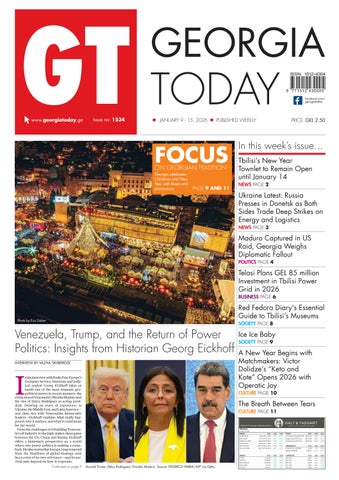
Donald Trump; Delcy Rodríguez; Nicolás Maduro. Source: FEDERICO PARRA/AFP via Getty
ŵͬŵ
ŵͬŵ
ϰϴ ϵϵϲ͕Ϭϴ
нϭ͕ϵй
нϮ͕Ϯй
' W ͬ ' >
ϯ͕ϲϯϬϬ
ͲϬ͕Ϭй
нϬ͕ϵй
ZƵƐƐĞůů ϮϬϬϬ
Ϯ ϱϳϱ͕ϰϮ
нϯ͕ϴй
нϮ͕ϭй
hZ ͬ h^
ϭ͕ϭϲϳϱ
ͲϬ͕ϲй
нϬ͕ϯй
&d^ ϭϬϬ
ϭϬ Ϭϰϴ͕Ϯϭ
нϭ͕Ϯй
нϯ͕ϵй
' W ͬ h^
ϭ͕ϯϰϱϴ
ͲϬ͕ϭй
нϭ͕Ϭй
2
NEWS
GEORGIA TODAY
JANUARY 9 - 15, 2026
Georgia Building Resilience: Early Warning Systems Protect Communities from Climate Disasters SOURCE: UNDP GEORGIA
The 2025-2026 Tbilisi New Year Market. Source: 1TV
Tbilisi’s New Year Townlet to Remain Open until January 14 BY TEAM GT
T
bilisi’s festive New Year Townlet will continue welcoming visitors until January 14, Kakha Kaladze, Mayor of Tbilisi, announced during a Facebook Live address. The Mayor noted that the decision to extend the operation period was driven by strong public interest and high engagement from both residents and local entrepreneurs. The New Year Townlet was initially scheduled to operate until January 7. “We had previously announced that the New Year Townlet would operate until January 7. However, there is great demand from the public and entrepreneurs,” Kaladze said. “First of all, I would
like to thank them for their cooperation.” Kaladze noted that the extended schedule will allow visitors to continue enjoying a wide range of festive activities, including live performances, concerts, fairs, and various cultural and entertainment events organized throughout the holiday space. “As a result, we decided to extend its operation until January 14. Various activities—performances, concerts, fairs, and more—will continue. We are looking forward to meeting you there,” the mayor stated. The New Year Townlet has become one of Tbilisi’s central holiday attractions, drawing thousands of residents and tourists during the winter season. The space has also served as an important platform for small businesses, artisans, and food vendors, contributing to seasonal economic activity in the capital.
A
s climate impacts grow stronger around the world, countries that can anticipate multiple hazards and warn their communities early are able to act before disasters strike. In Georgia, building such systems is becoming a reality. Monitoring data from weather stations, satellites, and other sources are collected on a single platform and processed to provide timely forecasts. These forecasts help authorities and communities prepare for floods, landslides, droughts, and other hazards. International expert George Karagiannis has been working closely with Georgia’s National Environmental Agency, Emergency Management Service, and other partners to review early warning protocols and share best practices. This effort is part of UNDP Georgia’s climate program, implemented with support from the Green Climate Fund and the governments of Switzerland and Sweden. Over seven years, the program—cofinanced by Georgia with US$38 million—aims to reduce the risks that climate change poses to people, livelihoods, and infrastructure. The program includes four projects: expanding Georgia’s early warning system, strengthening climate adaptation, supporting communities to cope with climate risks, and continuing capacitybuilding efforts. Together, these projects improve how data is collected, analyzed, and used, and make sure communities understand and act on warnings. Already, Georgia has made significant progress. The country joined the European Centre for Medium-Range Weather Forecasts in 2021 and formed a partnership with the European Meteorological Network in 2025. Of 154 planned moni-
Monitoring at a weather station. Source: UNDP/Gela Bedianashvili
toring stations, 143 are already in place, including weather and agriculture stations. A new upper-air monitoring system in Poti is about to start operating, and the Georgian Climate Service for Agriculture is supporting over 1,000 users in pilot regions. Geological monitoring stations now track landslide-prone areas, and detailed hazard and risk maps have been developed for river basins across the country. Communities are also at the center of this work. Local disaster management plans have been adopted in several municipalities, and community-based risk management programs are helping people take action—planting trees, clearing riverbeds,
and building small protective structures. Priority flood-protection infrastructure is being constructed in high-risk areas, while awareness campaigns and training have reached thousands, including young people in climate-focused programs. Scholarships and educational opportunities are also helping students pursue studies in environmental sciences and sustainable development. Through these efforts, Georgia is creating a system that not only predicts hazards but empowers people to respond. By combining technology, planning, and community action, the country is learning to live with climate risks more safely and confidently.
month inflation declined by 0.2%, indicating the start of a gradual normalization process. More importantly, the National Bank reports that long-term inflation expectations remain well anchored below the official 3% target. Main underlying indicators support this assessment. Core inflation, which excludes food, energy, and tobacco products, stood at approximately 1.6% in December. Service inflation, often viewed as the best reflection of longterm inflation trends, also remained
below target at 2.5%. Sopromadze noted that the NBG regularly publishes several macroeconomic scenarios, with the central forecast serving as the primary reference for monetary policy decisions. This baseline scenario had anticipated that inflationary pressures would begin to ease toward the end of the year. Looking ahead, the National Bank expects inflation to continue moderating, with average inflation projected at 3.5% in 2026.
Georgia Moves to Curb Plastic Bottle Use Georgia’s Inflation Shows Signs of Stabilization with Phased Regulation as Long-term Expectations Stay Below Target BY MARIAM RAZMADZE
T
amta Sopromadze, Head of the NBG’s Macroeconomics and Statistics Department, stated that inflation in Georgia is beginning to stabilize in line with the National Bank of Georgia’s (NBG) central forecast. Data for December show that annual inflation reached 4.0%, while month-on-
Discarded plastic bottled on the ground. Photo: Bali Discovery.
BY MARIAM RAZMADZE
T
he Ministry of Environmental Protection and Agriculture has begun consultations with the private sector on a draft regulation to limit the sale and use of beverages packaged in plastic bottles. The proposed changes were presented during a working meeting with business representatives by First Deputy Minister Nino Tandilashvili and Deputy Ministers Solomon Pavliashvili and Zurab Ezugbaia. The ministry stated that the initiative is designed to strengthen Georgia’s environmental policy while introducing practical support mechanisms that allow businesses to gradually adjust to the new requirements. Officials stressed that the regulation will be implemented in stages to avoid sudden disruption to the market.
Deputy Minister Solomon Pavliashvili explained that the reform prioritizes reducing plastic consumption in the food and beverage sector. Under the current draft, restrictions would first apply to budget-funded organizations before being extended to restaurants, catering services and other hospitality businesses. Business representatives welcomed the consultative approach. Levan Vefkhvadze, Executive Director of the Georgian Business Association, said that reducing plastic use requires consistent, carefully planned steps. He emphasized that new rules should strike a balance between environmental goals and the interests of businesses and consumers. The draft regulation focuses specifically on the procurement and sale of beverages in plastic bottles by public institutions and the hospitality sector. The ministry pointed out that continued consultations will accompany the finalization process.
Logo of NBG. Photo: Commersant.
NEWS
GEORGIA TODAY JANUARY 9 - 15, 2026
3
Ukraine Latest: Russia Presses in Donetsk as Both Sides Trade Deep Strikes on Energy and Logistics COMPILED BY ANA DUMBADZE
F
ighting across Ukraine this week stayed defined by a familiar pattern: Russia sustained pressure on multiple axes in the east and south, seeking incremental gains around key hubs in Donetsk Oblast, while Ukraine leaned heavily on drones and precision strikes to disrupt Russian logistics and fuel networks deep behind the line. The heaviest ground pressure continued to sit around the Pokrovsk area and the broader Kostyantynivka–Druzhkivka tactical zone, where Russian forces have been trying to widen breaches and probe for infiltration opportunities, while Ukraine reported localized countermovements and limited advances on parts of the front. In Donetsk Oblast, the fight around Pokrovsk remained one of the week’s central battlegrounds. Ukrainian reporting and independent assessments described intense daily assault activity with Russia attempting to press from multiple directions—toward and within the Pokrovsk area and along the surrounding settlements—while Ukraine mounted localized counterattacks and held the line under sustained pressure. Ukrainian forces were assessed to have made limited advances north of Pokrovsk, including in areas around Rodynske, reflecting continued efforts to blunt Russian approaches and complicate attempts to widen the salient. Just east of that, Russia’s operational emphasis appeared increasingly tied to the Kostyantynivka–Druzhkivka tactical area—part of the broader push to threaten and eventually encircle key
Ukrainian urban strongpoints. Independent assessments this week referenced Russian advances and infiltration efforts around the H-20 highway line near Yablunivka, with reports of attempted deeper penetration into southeastern Kostyantynivka. Ukrainian forces, for their part, continued to report ongoing engagements across the direction, including pressure linked to Russian attempts to exploit winter conditions and reduced drone visibility for small-group assaults and infiltration. Further north in the Kupyansk area, Ukraine was assessed to have made a marginal advance within Kupyansk itself earlier in the week, while Russian forces continued attacks toward and around the city and nearby villages. The Kupyansk sector remains strategically important because it anchors Ukrainian defenses in northeastern Kharkiv Oblast and helps protect approaches deeper into the region; Russia’s continued attempts here suggest Moscow is still trying to keep Ukraine stretched along multiple fronts rather than concentrating solely on Donetsk. On the northern border axis, assessments also pointed to Russian advances in Sumy Oblast, including movement in the Yunakivka area northeast of Sumy City. While this does not represent a dramatic breakthrough, it reinforces a steady Russian objective: keep pressure on border regions, force Ukraine to allocate manpower to defensive depth, and maintain the threat of expanded operations that complicate Ukrainian planning. In the south, the Hulyaipole direction again drew attention. Russian forces were assessed to have advanced in and around Hulyaipole, with geolocated indicators suggesting a Russian pres-
ence and movement deeper into northern parts of the town, alongside indications of infiltration-style activity that may not immediately change control lines but can degrade Ukrainian reararea security and targeting teams. Ukrainian reporting has described Hulyaipole as contested—often a “gray zone” dynamic where small groups move in poor weather, attempt to strike drone operators and artillery crews, and test the defense for weak seams. While territorial movement remained incremental, the week’s most disruptive events for civilians came from the air war—especially the renewed focus on energy and critical infrastructure during deep winter. On January 7–8, Russian strikes caused near-total power disruption in parts of southeastern Ukraine, with Dnipropetrovsk and Zaporizhzhia regions reported as “almost completely without electricity,” forcing critical infrastructure onto backup power and leaving large numbers of residents without reliable heat and water amid plunging temperatures. Ukrainian officials and emergency services described intensive repair efforts under continued threat, while local authorities warned residents to prepare for extended outages and rely on generators where possible. Earlier in the week, Russia also struck Kharkiv with missiles that damaged energy infrastructure and contributed to a rising casualty toll from attacks on the city. A separate strike on January 2 was reported to have killed at least two people and injured dozens in Kharkiv, underscoring how the winter strike campaign continues to blend pressure on energy systems with heavy civilian harm in dense urban areas. Kyiv and the surrounding region were
also hit. A Russian attack overnight into January 5 resulted in the first reported civilian deaths in the capital area this year, according to Ukrainian authorities, including fatalities in Kyiv and in the Fastiv district southwest of the city, along with damage that contributed to local power disruptions. Ukraine’s long-range response remained focused on Russia’s fuel, energy, and ammunition networks. Russian authorities reported a notable escalation in Ukrainian drone activity, including claims that Moscow has been targeted daily since the start of the year—an operational tempo that, if sustained, is designed to force Russia into constant air-defense expenditure and impose economic and logistical costs. Ukraine and independent assessments also highlighted strikes on oil depots and refineries, including incidents in regions such as Belgorod and Krasnodar. One strike ignited a fire at an oil depot in Belgorod Oblast, with local officials reporting no casualties there, while other Ukrainian drone activity earlier targeted industrial and energy facilities across multiple regions. On the Russian side of the casualty ledger, Ukrainian drone strikes in border regions produced confirmed civilian deaths this week. Reuters reported that a Ukrainian drone attack in Belgorod struck a vehicle, killing one man and injuring a woman and a four-year-old child. Other reporting, including AP, also described additional fatalities in Russia’s border regions amid the broader spike in cross-border drone activity. In Russian-occupied parts of Ukraine, Moscow also accused Ukraine of causing mass casualties in a New Year’s Day drone strike on a hotel/café area in the
occupied Kherson region, alleging at least 24 killed; Ukraine did not confirm the claim in that reporting. Diplomatically, the week was marked by intensified talks in Paris around potential post-war security guarantees— efforts that run in parallel to continued fighting rather than replacing it. France, the UK, Ukraine and the United States participated in “Coalition of the Willing” discussions, and a formal statement issued via the EU Council framed the talks around “robust security guarantees” to underpin a durable peace, indicating that planning is moving beyond general political support toward defined mechanisms. UK Prime Minister Keir Starmer said any deployment of British troops to Ukraine after a peace agreement would be subject to a parliamentary vote, reinforcing that the concept under discussion is structured as a post-ceasefire security architecture rather than direct frontline combat deployment. Reuters also cited details attributed to the Paris discussions describing potential “military hubs” and protected facilities to support Ukraine’s defense needs after a ceasefire—language that highlights a growing emphasis on deterrence and regeneration of Ukrainian forces, not just emergency resupply. International support this week therefore looked less like a single headline weapons package and more like a tightening web of security planning while winter strike pressure continues. Canada’s recently announced multi-billion support, focused on economic stabilization rather than immediate battlefield supplies, remains part of the broader picture of sustaining Ukraine’s state capacity through a prolonged war and winter infrastructure crisis.
4
POLITICS
GEORGIA TODAY
JANUARY 9 - 15, 2026
Maduro Captured in US Raid, Georgia Weighs Diplomatic Fallout BY TEAM GT
V
enezuela is in turmoil after a dramatic US military operation that captured President Nicolás Maduro and sent him to New York to face federal charges, including drug trafficking. His wife, Cilia Flores, suffered a head injury during the raid, while Maduro sustained a leg injury. Both have pleaded not guilty. The Venezuelan government says the operation was devastating. Interior Minister Diosdado Cabello reported that 100 people were killed, including Venezuelan military personnel, and Cuban officials said some of their military and intelligence officers stationed in Venezuela were also among the dead. Much of Maduro’s security service, authorities said, was killed “in cold blood.” The army has so far released a partial list naming 23 of those killed. The United States has defended the operation as necessary to hold Maduro accountable and to disrupt alleged narco-trafficking networks. But the intervention has raised legal questions and sparked international concern, with the United Nations and several governments questioning the legality of US forces operating on foreign soil without regional consent. The crisis in Venezuela has also reverberated in Georgia, where the events have taken on a diplomatic and political dimension. Georgia’s Ministry of Foreign Affairs said the government is closely monitoring developments in Caracas, expressing hope that the political upheaval could lead Venezuela to reconsider its previous decision to recognize Abkhazia and South Ossetia, the two regions Georgia considers occupied by Russia. In a statement, Tbilisi said, “Considering that the Venezuelan authorities, in gross violation of international law, recognized the occupied regions of Georgia as independent states,
Nicolas Maduro and his wife, Cilia Flores, in handcuffs after landing in Manhattan, New York, on January 5. Photo by XNY/Star Max/GC Images
we express hope that recent events will lead to the cancellation of this illegal decision, in accordance with Georgia’s national interests and international legal principles.” The de facto authorities in Abkhazia responded quickly. Odisei Bigvava, the so-called deputy foreign minister, said the region “does not view international recognition as an end in itself.” He emphasized that Abkhazia’s focus is on strengthening local institutions, socioeconomic development, security, and expanding diplomatic contacts “based
on mutual respect and equality.” He also insisted that support from Russia and other friendly states contributes to stability without replacing “the will of the local population.” Bigvava dismissed Georgia’s references to a policy of non-recognition, arguing that such statements lack legal grounds and do not foster a constructive regional atmosphere. At the same time, he said Abkhazia is “ready to carefully and responsibly consider any signals that indicate a desire for a more pragmatic and realistic approach to regional pol-
icy” and reaffirmed commitment to peaceful coexistence and dialogue with interested states, including Georgia. Meanwhile, in Tbilisi, the political fallout of the US moves in Venezuela has been intense. Shalva Papuashvili, speaker of the Georgian Parliament, used the Venezuelan crisis to argue that Europe can no longer be relied upon as a guarantor of international order. “The minutes-long operation in Venezuela confirmed that the European Union, as a guarantor of international order and a global geopolitical player, no longer
exists,” he wrote. His comments drew a sharp rebuke from opposition politician Salome Samadashvili of the Lelo-Strong Georgia party, who accused the ruling party of treating Georgians as “ignorant people” while enriching billionaire Bidzina Ivanishvili’s regime. She wrote on social media, “The servants of Ivanishvili’s provincial autocracy are afraid to say anything about Trump… Trump conducted a special operation in Venezuela, Maduro is being tried in New York, and Papuashvili is still cursing Brussels.”
“Where There Is Violence, the EU Flag Flies,” Says Georgian Parliament Speaker BY TEAM GT
S
Shalva Papuashvili. Source: IPN
peaking to journalists this week, Speaker of Parliament Shalva Papuashvili sharply criticized the European Union’s role in Georgia, linking it to societal discord and even violence. “Where there is violence, the EU flag flies; where there is hatred, the EU flag flies,” Papuashvili said, responding to a statement from former President Mikheil Saakashvili that Georgia “will soon celebrate Christmas on December 25, rather than January 7, as ‘the majority of Christian countries’ do.” According to Papuashvili, statements like Saakashvili’s are intended to stir division within society. “This is an attempt to introduce as many disagreements as possible into society, and it comes from outside. We have seen NGOs that are actively spreading this ideology. They focus on numerology, insisting that society should not agree on December 25, January 7, or May 8 or 9. You may recall that last year, under the leadership of the EU ambassador, May 9 was not even congratulated to the Georgian people. 300,000 people died
to liberate Europe from fascism, and on May 9 they held a ‘Europe Day’ without inviting any of the people they fund. They did not even congratulate the Georgian people or say thank you.” Papuashvili went on to describe EU activities in Georgia as “harmful practices aimed at creating confrontation, introducing hatred, and fostering violence.” “All of this is harmful external interference, which previous US administrations also practiced, spending millions for this purpose. The new administration completely changed this policy and exposed these harmful practices. Today, the EU in Georgia is precisely engaged in this harmful practice—creating confrontation, introducing hatred, and promoting violence. Notice this: where there is violence, the EU flag flies; where there is hatred, the EU flag flies. Where there is anger and personal attacks, there the EU flag is present. This is disgraceful— equating themselves with violence, hatred, and even Molotov cocktails, which, I remind you, the EU funded. We want to change this. Brussels must change its policy. Otherwise, it will collapse itself. We do not want to be dragged into that civilizational abyss where Brussels is taking the EU today.”
POLITICS
GEORGIA TODAY JANUARY 9 - 15, 2026
5
Venezuela, Trump, and the Return of Power Politics: Insights from Historian Georg Eickhoff Continued from page 1
A BARRAGE OF QUESTIONS - WHAT EXACTLY HAPPENED, WHERE ARE WE NOW, AND WHAT’S NEXT? What happened was that the dictator Nicolas Maduro and his wife, who is also a veteran politician with great influence over him as well, were extracted in a stunning military operation that impressed public and military experts alike. Militaries worldwide, and other countries that would want to try to accomplish something like this—take out presidents—the president of Russia definitely would like to do this in Ukraine, and he cannot. He tried and he failed. So President Trump is competing with these kinds of people, and he managed to do so. But where are we now? He helped to install the vice president as acting president, Ms. Delcy Rodriguez, together with her brother; again, it's like a family business, both long-time Maduro loyalists, key members of his team. So we have continuity in this dictatorship now, with the support of the American government, although the American government says we have leverage over them. Mr. Trump said we run the country. The Secretary of State Rubio was asked what that meant exactly, and he explained a little bit more technically, but not in too much detail. Well, we have leverage. We tell them what they shall do. And this is not very convincing, because the rhetoric around the swearing-in ceremony for Rodriguez yesterday was decidedly anti-American, as it has been for decades now—this has become a time-honored Latin American tradition. Mrs. Rodriguez speaks Venezuelan Spanish with a Cuban accent; Venezuelans perceive that she speaks more with Cubans than with Venezuelans, and her message was—give us Maduro back. The belief within the Chavista movement, which might be 10–20% of the population, is still that Maduro will come back. Trump made a big mistake, because now we have a global hero called Maduro. This had a galvanizing effect. And of course, in many countries of the world, everybody who dislikes Mr. Trump amplifies that messaging. What is next? Mr. Trump says “this government will obey me.” It doesn't look like that yet; how will Mrs. Rodriguez balance obeying Trump with retaining her followers in her own country? She is now forced to say one thing and do the opposite.
WHAT DO THE US DEMANDS ENTAIL? They want stability; they want public order at a low cost. They are not able to establish it themselves. Trump has to find somebody who ensures security and safety and the conditions to rebuild the oil industry. And, obviously, the big thing
is to deny the use of Venezuelan oil by China and others—but basically, it’s against China. Venezuelan oil production is very low at the moment. It’s a third of what it was historically, due to mismanagement and many reasons. But in the future, in five years, in ten years, it should be possible to bring Venezuelan oil back to the market. It’s an uphill battle; it’s not easy to rebuild the Venezuelan oil industry. And now the pledge there is—apparently Mrs. Rodriguez promised Mr. Trump that they will rebuild the oil industry and that American industries will be very involved. Now you have to look at that from a geopolitical point of view. America is an exporting country; it doesn’t need Venezuelan oil. What it needs is to make sure there is no scenario in which China can get this oil. This is the big picture. Much like with Greenland, Trump’s goal is to avoid having the resources—minerals in Greenland, oil in Venezuela—available to China in this upcoming conflict that seems to be all but inevitable. We are heading to a bipolar world. China will eat up Russia, because Russia is spending its energy in Ukraine and will fail. This is China’s bet on the Russian war against Ukraine and Europe: that they will lose the war and fall into the hands of China. And China will colonize Russia and use its energy and resources, and this will be the base for the conflict with the US in 10 or 15 years. Mr. Trump is preparing for this big conflict and wants to have access. So this current government in Venezuela—the life expectancy of the Maduro issue is counted in days. The issue of oil, however, should be counted in decades.
WHY DID THE WHITE HOUSE BET ON A MADURO VP, AS OPPOSED TO THE OPPOSITION, WHICH WOULD PROBABLY ALSO CATER TO ITS EVERY WHIM? Trump himself used the word respect. He said that the opposition leader, Maria Corina Machado, does not have the respect that is needed. Whose respect are we talking about? Obviously, the respect of the armed forces of Venezuela. I think it’s a misjudgment by Washington. I am not sure whether Mrs. Rodriguez will have it, and for how long, because she has to obey Mr. Trump now. The armed forces of Venezuela are highly corrupt and very limited in their capacity. Their military capacity is very low, as we saw: the personal security of Mr. Maduro was Cuban. Thirty-two Cuban officers from his personal security were killed during the extraction. Cuba admitted this for the first time, because they had been denying that they were in Venezuela, but now you have 32 acknowledged casualties. As for the opposition, there is strong support for Mrs. Machado on a small institutional and organizational base.
And among the diaspora—9 million Venezuelans are living outside Venezuela, most of them because they fled the regime. Of course, there is also a proletarian diaspora, people who walked. Some of them walked from Venezuela to Chile. Some perished in the desert to the north of Chile. Others walked to Brazil or Colombia, and all of them—the rich and the poor in the diaspora—number 9 million. The question now is: who can provide the political framework that is necessary to ensure stability and rebuild the oil industry? The Trump administration’s first bet is continuity of the dictatorship. Many oil countries are run not by democracies, but by authoritarian governments. But will this be enough for Venezuela? Or, rather, will Ms. Rodriguez be able to deliver? And this is the space in which Mrs. Machado will maneuver. She will continue to offer Washington what she sees as the better option for its hemispheric policy. She would love to be aligned with Trump, if he is willing to align with her. Mrs. Rodriguez and Mrs. Machado are, in a sense, competing to offer this: an alignment of Venezuela, including its oil industry, with US hemispheric policy.
LET'S LOOK AT WORLDWIDE IMPACT OF WHAT HAPPENED IN VENEZUELA. WHO ARE THE WINNERS AND LOSERS OF ALL OF THIS? The big loser is China, as the world is preparing for the big conflict between China and the US. China is eating up Russia, and the United States is distancing itself from Europe. The big winner is the US. The success of the operation in Venezuela was more visible and decisive than the earlier bombing of Iran’s nuclear facilities. They wanted to extract the president, they managed it, and he is in a prison in New York right now. This is a big message: “If we want to do something, international law, UN outcries, and such don’t matter.” This is a return to pure power politics—not even realism; it was just a demonstrative show of force, of military capability and skill. So Mr. Xi and Mr. Putin see this guy in Washington doing things that they cannot do. Trump is telling the world, “I can do whatever I want to do.” This is a different world than a year ago, with Biden negotiating Ukraine in Minsk, or whatever.
DOESN’T THIS ALSO UNTIE THE HANDS OF OTHERS WORLDWIDE, THAT DEEM THEMSELVES GREAT POWERS, TO TRY AND PULL SOMETHING SIMILAR? THEY WILL ACT MORE BRAZENLY, THEY WILL BE LESS WARY OF CONSEQUENCES. Putin tried that in Georgia in 2008 and was told to stop near Tbilisi. Then he tried Ukraine. He was imagining something quick: take Kyiv, kill Zelensky, take
Georg Eickhoff. Source: Dernbach & Eickhoff
the airport in Hostomel. It was a crushing defeat, and then the SVO turned into a quagmire for him. I lived for three years in Russian-occupied Luhansk, working for the OSCE. What I see is that Russia will be defeated in Ukraine. It will not obtain its war aims there. China has a different approach. They are very articulate in their will to reunify China, to conquer Taiwan. And they will try. It’s just that the time has not come yet. They will evaluate what the United States is doing now, this hemispheric policy that Trump symbolizes through Venezuela. Talking about Greenland is kind of an invitation to tell China, try and do it with Taiwan, if you dare. But that’s what Putin already tried and failed. So I don’t buy the argument that Xi and Putin needed Trump’s example to be bad now. No, they were bad before.
DOES IT CHANGE THE RULES OF HOW THE GREAT GAME AMONG GREAT POWERS IS PLAYED? No, this is not new. This happened a lot in the 20th century. It happened a lot in the 19th century. We are just going back to something that happened before. And we know that Mr. Xi—the Chinese—think in centuries. The new tsar of Russia thinks in centuries. Trump is a bit different. He tries to do something similar. He might not think in decades, but he puts gold in his office. This is his substitute for imperial attire. These imperial attitudes have become the norm again, and the smaller countries will have to adapt. For me, as a German, the key question is: what will the European Union do? It’s still an open question. The national security strategy paper of the US says, well, Europe somehow is over. I don’t think it’s over, but it has to get its job done now—defense, but also productivity, fertility, all these things. Europe is an old and tired society, and now it has received this wake-up call. What happened in Venezuela, what will happen in the next days in Greenland—Europe has to wake up. It has to
define whether countries like Georgia and Ukraine are important and relevant for Europe. I’m convinced they are, because Europe will only survive in this conflict between China and the US if it uses its soft power, if it builds its prosperity, if it understands the foundations of its own prosperity. And this means that it has to be an ally of Georgia, Ukraine, and other countries under threat, like Moldova.
WHAT AWAITS UKRAINE, GEORGIA, MOLDOVA, ARMENIA, JUST TO LOOK AT RUSSIA’S NEIGHBORHOOD, WHAT IT CONSIDERS ITS EXCLUSIVE “SPHERE OF INFLUENCE”? This will be a realignment of many countries. There are some countries that have little choice because they don't have an alternative and a neighbor, but not everything is about territory. I see a big, big task for Europe to offer an alternative of culture, freedom, modernity, prosperity to the rest of the world.
AND IF IT’S NOT ABLE TO, OR FAILS? If Europe cannot get the job done—then that means the return to the old order. For centuries, one country and nation would be a colony of others. We have not had even one century without colonialism as the dominant scheme of interaction between states. We will go back to it. I think there was an over-optimism about democracy and freedom for decades, and now we pay the price because we didn’t understand the foundations of freedom and democracy, which are, among other practical things, defense and the cost of defense, paying taxes for defense, and enlisting or carrying the burden of mandatory military service. As a historian by training, I know that war is the normal state, not peace; colonialism is the norm, not freedom. So all these things—prosperity, freedom, national self-determination—require a lot of work. And if you don’t do it, you don’t have it. They are not guaranteed.
Parliament Speaker: US Withdrawal Confirms Venice Commission’s Transformation Into Political Instrument BY TEAM GT
P
arliament Speaker Shalva Papuashvili has stated that the United States’ decision to withdraw from dozens of international organizations further demonstrates the collapse of the post-World War II international order and reinforces Georgia’s long-standing criticism of the Venice Commission, which he claims has shifted from a legal advisory role to a political one. Speaking on the matter, Papuashvili noted that Washington’s decision to exit 66 international organizations, citing
their inefficiency and lack of practical value, signals a broader crisis within global governance institutions. “The United States’ withdrawal from 66 organisations once again confirms what we have been saying for some time – that the international order established after the Second World War, with its network of international bodies, is no longer functioning properly,” Papuashvili said. “Discussions within these organisations have been disrupted, and their credibility has been eroded. When the United States itself justifies its withdrawal by calling them useless and wasteful, this indicates a serious degradation of their role and purpose.” Addressing the Venice Commission
specifically, Papuashvili argued that the body, formally known as the European Commission for Democracy through Law and operating under the Council of Europe, has deviated from its original mandate of providing impartial constitutional and legal expertise. “Instead of producing professional, legally grounded assessments, the Venice Commission increasingly issues political opinions that align with specific agendas,” he said. “This is particularly evident in its recent reports on Georgia, where political conclusions have replaced objective legal analysis. We have raised these concerns directly with the Commission during official meetings.” Papuashvili added that this shift is
especially troubling given Georgia’s status as a member state of the Council of Europe. “It is deeply concerning that an institution created to offer neutral legal guidance has effectively turned into a political commentator driven by political motives,” he stressed. The Parliament Speaker claimed that the US decision to withdraw from the Venice Commission further supports Georgia’s criticism. “When the United States itself labels the Commission as useless and wasteful, it only reinforces our assessment that the Venice Commission has strayed far from its core mission,” he said. For context, US President Donald Trump recently signed a presidential
memorandum initiating the withdrawal of the United States from 66 international organizations, including the Venice Commission. The move was justified by the administration as part of a broader effort to reduce spending on institutions deemed ineffective or contrary to US interests. US Secretary of State Marco Rubio commented on the decision via social media, stating: “We will stop subsidizing globalist bureaucrats who act against our interests.” The decision has sparked debate internationally, particularly among European institutions, where concerns have been raised about the future role and legitimacy of long-standing international bodies amid shifting global power dynamics.
6
BUSINESS
GEORGIA TODAY
JANUARY 9 - 15, 2026
Telasi Plans GEL 85 million Investment in Tbilisi Power Grid in 2026
Free trade agreement poster. Photo: Jargon Josh.
Georgia Expands Free Trade Network as Export Growth Exceeds Targets BY MARIAM RAZMADZE
G
eorgia has established free trade agreements with 46 countries and one administrative entity, providing preferential access for approximately 87% of the country’s exports, Deputy Minister of Economy Genadi Arveladze said. Existing agreements include major partners such as the European Union, China, Hong Kong and the United Arab Emirates, giving Georgian producers access to a combined consumer market estimated at USD 2.3 billion. The government says it is actively working to further expand this network. Arveladze stated that Georgia has recently held two rounds of negotiations with the Gulf Cooperation Council which could open access to an additional mar-
ket worth around USD 60 million. Preparations are also in progress to launch free trade talks with Serbia, while negotiations with Israel are planned for 2026. Talks with South Korea have already been concluded, with legal procedures now in progress. These prospective agreements could unlock more than USD 130 million in new export opportunities for Georgian businesses. In parallel, the Ministry of Economy continues to support exporters through the ‘Enterprise Georgia’ program, which focuses on increasing international visibility and strengthening market presence for Georgian products. As a result of these efforts, exports grew by more than 10% year-on-year during the first 11 months of 2025, surpassing annual targets. Export diversification has also improved, with Georgian goods shipped to 134 countries. Growth was recorded in 70 markets while exports doubled or more in 20 countries.
Georgia Braces for Higher Sunflower Oil Import Costs as Russia Raises Export Duties
Photo: Telasi.
BY MARIAM RAZMADZE
E
lectricity distribution company Telasi will invest GEL 85 million in the development and modernization of Tbilisi’s power grid in 2026, the company’s General Director Sergei Kobtsev announced at a year-end briefing. The investment program will focus on rehabilitating and upgrading existing infrastructure and will not include the costs of connecting new customers.
Telasi reported that total investments reached GEL 355 million over 2024–2025, with the 2025 program largely dedicated to large-scale reconstruction and network upgrades. Main projects included the construction of the new high-voltage Krtsanisi substation and the complete modernization of the Tabakhmela and Orkhevi substations which play a critical role in supplying electricity to central and rapidly expanding areas of Tbilisi. The Krtsanisi substation, built with an investment of more than GEL 24 million, has a capacity of 50 MW and was developed to meet growing electricity demand
driven by the city’s expansion. The facility is expected to improve power quality and enable new connections across the Ortachala–Krtsanisi–Tabakhmela corridor. Meanwhile, the full reconstruction of the Tabakhmela substation increased its capacity to 80 MW and enhanced system reliability through the installation of modern equipment. Following the completion of these projects, Telasi stated that it has fully fulfilled the requirements set by the Georgian National Energy and Water Supply Regulatory Commission (GNERC) under its 2022 and 2023 decisions.
Sunflower plant and sunflower oil with the backdrop of nature. Photo: Kraft Chemical.
BY MARIAM RAZMADZE
G
eorgia is likely to face higher costs for sunflower oil imports starting January 2026 after Russia’s decision to increase export duties on the product. Russian media, based on the comments made by Ministry of Agriculture, report that the export duty on sunflower oil will rise by 36.5%, from 8,214.5 rubles per ton in December to 9,298.6 rubles per ton in 2026. In contrast, Russia will abolish the export duty on sunflower meal, reducing it to zero for the first time since October 2022. The new rates are based on updated indicative prices used in the duty calculation formula: USD 1,200.2 per ton for sunflower oil, up from USD 1,169.5 a month earlier and USD 195.7 per ton for sunflower meal, down from USD 210.9. Under Russia’s system, the duty is set at 70% of the difference between the indicative price and a fixed base price, calculated using average market prices over a one-month period. The floating export duty mechanism
for sunflower oil was introduced in September 2021 and initially calculated in US dollars before being converted to rubles in July 2022. The base price is set at 82,500 rubles per ton for oil and 15,875 rubles per ton for meal. In August 2024, the Russian government extended the duty regime until September 2026 and later prolonged it further through August 31, 2028. Russia remains Georgia’s primary supplier of sunflower oil, making these changes particularly significant for the Georgian market. Import data indicate that costs were already rising in 2025. In the first 11 months of the year, Georgia imported 40,147 tons of sunflower oil. Although volumes declined by 3.5% yearon-year, the total value of imports increased markedly. Imports from Russia accounted for 33,155 tons worth USD 50.25 million, compared with 36,315 tons valued at USD 37.5 million during the same period a year earlier. Georgia also sources smaller quantities of vegetable oil from Ukraine, Azerbaijan and the United Arab Emirates but Russia continues to dominate supply, leaving domestic prices sensitive to Russian export policy.
Georgian Lari banknotes and coins. Photo: Caucasus Watch.
Georgian Banks Expected to Earn GEL 3.3bn in 2025 BY MARIAM RAZMADZE
O
n December 30, the Banking Association of Georgia reported its projections that commercial banks in Georgia were on track to post a combined profit of around GEL 3.3 billion by the end of 2025. The sector had already generated GEL 2.98 billion in profit during the first 11 months of the year, a 4% increase com-
pared with the same period of 2024. With profit taxes accounted for, the banking system was expected to close the year with even stronger financial results, supported by improved return on equity and positive performance of Georgian bank shares on the London Stock Exchange. Asset growth remained strong, rising by approximately 10% in the first 11 months, with double-digit growth expected for the full year. This expansion was driven primarily by loan growth, particularly in retail and corporate lending. In November, corporate loans grew
faster than lending to small and mediumsized enterprises and microbusinesses, reflecting strong demand from larger companies. Another notable trend was the continued decline in dollarization across both loans and deposits. David Rusia, Analytical Director of the Banking Association, said that measures aimed at reducing reliance on foreign currency lending are delivering results and are expected to remain a policy priority in 2026, in line with recommendations from international rating agencies such as Moody’s.
BUSINESS
GEORGIA TODAY JANUARY 9 - 15, 2026
7
Georgia to Introduce New State Support Measures for Hydropower Projects Rustavi Azot plants. Photo: Rustavi Azot.
ADB Approves $50 million Loan for Energy-efficient Fertilizer Modernization in Georgia BY MARIAM RAZMADZE
Hydropower plant. Photo: Bankwatch.
BY MARIAM RAZMADZE
G
eorgia’s government plans to introduce additional state support instruments for large-scale hydropower projects regarded as strategically important for the country’s energy security, officials disclosed following a meeting with energy sector representatives on December 30. Economy Minister Mariam Kvrivishvili informed industry participants that major projects such as the Namakhvani, Nenskra, and Khudoni hydropower plants,
as well as the Enguri Pumped Storage Plant, are expected to qualify for enhanced state backing. The initiative ensures long-term investment in projects considered critical at the national level. Giorgi Abramishvili, Chairman of the Supervisory Board of the Georgian Renewable Energy Development Association (GREDA), said the government hinted that support could take the form of preferential tariffs or other assistance mechanisms formalized through memorandums with investors. While specific terms have not yet been disclosed, Abramishvili noted that the private sector is awaiting a comprehensive government plan that will outline priorities,
engagement rules and eligibility criteria. The upcoming plan is also expected to clarify which companies will benefit from penalty reductions and under what conditions. The Ministry of Economy has indicated that the detailed framework will be presented by early February. In the interim, the government has already decided to waive accumulated state penalties for renewable energy developers, totaling approximately GEL 1 billion. Following the cancellation of these penalties, private companies will be allowed to set revised project timelines based on their individual development stages and project scope.
Georgia’s Bakery Imports Rise Nearly 16% in 2025 as Exports Gain Momentum
T
he Asian Development Bank (ADB) has approved a $50 million loan to JSC Rustavi Azot, also known as Rustavi Azot Indorama, to support the modernization of its fertilizer production facilities in Georgia. The financing will be used to introduce energyefficient technologies aimed at reducing emissions and improving industrial efficiency. The project focuses on lowering energy consumption in fertilizer manufacturing while supporting more sustainable agricultural practices. ADB stated that the
Insurers Renew Push for ‘Top-up’ Health Insurance as 2017 Rule Draws Criticism BY MARIAM RAZMADZE
G
eorgia’s insurance sector has renewed calls for the introduction of so-called ‘top-up’ health insurance packages, arguing that a 2017 regulation continues to distort the market and limit access to healthcare. Under the current rule, individuals who purchase private medical insurance lose their entitlement to state-funded universal healthcare. The Insurance Association says this provision has significantly reduced demand for private insurance and discouraged citizens from supplementing public coverage with additional services. Davit Khechinashvili, head of the Insurance Association, said the regulation has
Bakery goods. Photo: Pastry Arts Magazine.
BY MARIAM RAZMADZE
G
eorgia increased its imports of bread and bakery products in the first 11 months of 2025, reflecting steady growth in domestic demand. Between January and November, the country imported 31,449 tons of bakery goods worth $97.6 million, as the official trade data shows. This represents a 15.9% increase in import value and a 4.6% rise in volume compared to the same period of 2024
when imports totaled $84.2 million and 30,065 tons. Russia remained Georgia’s largest supplier, accounting for 10,303 tons of bakery products valued at $22.8 million. Turkey ranked second with imports worth $15 million (4,506 tons), followed closely by Ukraine at $14.4 million (4,984 tons). Other notable suppliers included Poland, Bulgaria, Azerbaijan, Italy, Germany, Romania and Belarus. At the same time, Georgian bakery exports recorded strong growth. During the same 11-month period, exports reached $7.4 million and 2,049 tons, a 26.6% increase in value and a 34.1% rise in vol-
ume year-on-year. Armenia was the leading destination for Georgian bakery products, importing $2.4 million worth (439 tons). Azerbaijan followed with $2.3 million (1,004 tons) while Uzbekistan ranked third at $1.2 million (251 tons). Smaller export volumes were shipped to Russia, Israel, Iraq, Turkey, the United States, Latvia and New Zealand. Overall, the data show that while Georgia remains heavily reliant on imports to meet domestic demand for bakery goods, exports are expanding rapidly, particularly to neighboring and regional markets.
initiative aligns with Georgia’s Vision 2030 development agenda and its Nationally Determined Contribution commitments on climate action. ADB’s Country Director for Georgia, Lesley Bearman Lahm, said the bank’s support reflects its broader strategy of strengthening green and low-carbon technologies in the private sector. She noted that the project is consistent with ADB’s country partnership strategy which prioritizes the transition to a more sustainable and integrated economy. The investment is expected to enhance the competitiveness of Georgia’s fertilizer industry while contributing to national decarbonization goals and longterm environmental sustainability.
Photo: Business North Carolina magazine.
led to a loss of private-sector clients and created an unfair system. Insurers are seeking permission to offer supplementary, or top-up, insurance within the existing public healthcare framework and are awaiting a response from the Ministry of Health. Khechinashvili noted that around half of the population, children, pensioners and persons with disabilities, can retain universal coverage even if they buy private insurance. In contrast, the remaining half, which includes the most economically active and tax-contributing citizens, automatically loses state coverage once they purchase private insurance. He argued that this discourages formal insurance uptake and reduces overall access to medical services. The Association states the current policy often forces people to pay out of pocket for services not covered by the universal program.
8
SOCIETY
GEORGIA TODAY
JANUARY 9 - 15, 2026
Red Fedora Diary's Essential Guide to Tbilisi’s Museums EXTRACT FROM BAIA DZAGNIDZE'S BLOG: RED FEDORA DIARY
M
useums in Tbilisi offer a clear and engaging way to understand Georgia’s story — from ancient civilizations and ethnographic traditions to Sovietera history and modern cultural shifts. Whether you’re curious about archaeology, winemaking, folklore, or the city’s artistic heritage, these museums add depth to any visit. Whenever I want a deeper look at my own country or simply need a quiet escape on a cold or rainy day, I find myself stepping into one of Tbilisi’s small or big museums. They’re easy to pair with the main sights and activities around the city, so you can blend them into your plans without much effort.
TBILISI WINE MUSEUM The Tbilisi Wine Museum is one of the most interesting places to visit in Tbilisi if you want to understand Georgia’s 8,000-year winemaking tradition. Set in the former river entrance of the old caravanserai, this underground space displays ethnographic and archaeological items connected to Georgian wine culture. You’ll see qvevri clay vessels, satsnakheli wine presses, drinking bowls, and tools once used to stir or clean qvevri, along with a bottle of one of the earliest locally produced wines. Most objects here are replicas of originals held at the Georgian National Museum or the Vani Archaeological Museum-Reserve, but the guided tour (included in your ticket) still gives an excellent overview of UNESCO-listed qvevri winemaking customs. The walls are lined with archival photos of old Tbilisi, turning the visit into a fun little challenge — try guessing the landmark or street before checking the caption. There’s also an optional on-site wine tasting, and the museum is connected to Archive, a restaurant serving Georgian dishes in a cozy, atmospheric setting.
ART MUSEUM OF GEORGIA Recently reopened in a new space accessed from Lado Gudiashvili Street, the Art Museum of Georgia, or Shalva Amiranashvili Museum of Fine Arts, is one of the top things to do in Tbilisi if you’re interested in Georgian art. The museum spans three floors and is divided into three main sections; therefore, plan for around 1:30–2 hours, especially if you enjoy scanning the QR codes for extra audio and text explanations.
MEDIEVAL GEORGIAN RELIEF SCULPTURE The ground-floor hall is striking with its dark walls, lighting, and dramatic layout. It displays facades and interiors of Christian churches through figurative reliefs and ornamental motifs. Since the Orthodox tradition avoids full sculpture, Georgia developed its own rich relief-carving style, as shown here in pieces dating from the 5th to the 12th centuries. You’ll find masterpieces from Bolnisi Sioni, Ateni, Tserovani, Sapara, and Tsebelda (in Abkhazia). One highlight is the centrally placed altar of Satkhe Church from Kvemo Kartli, dating to 1171, featuring St. George and St. Theodore and an inscription in curvy Asomtavruli script. The altar fragments from Shiomghvime and the replica of the column top from Bagrati Cathedral are also remarkable.
GEORGIAN ART FROM 1900 TO 1930 The third-floor exhibition explores a
Art Palace exterior
vibrant period when Georgian artists blended European and Russian artistic movements with local themes and folklore. Many studied in St. Petersburg, Munich, Moscow, or Paris, and their influence is evident in their styles. This is where you’ll see works by Niko Pirosmani, Lado Gudiashvili, and David Kakabadze, along with pieces by Elene Akhvlediani, Kirill Zdanevich, and Shalva Kikodze. The panorama paintings by Pirosmani I hadn’t seen before were a highlight for me — especially his Rtveli (wine harvest) scenes. Kakabadze’s famous Imereti — My Mother, featured on the 10 GEL banknote, is displayed here as well. The Paris and Luxembourg landscapes painted by Akhvlediani and Kikodze also offer a lovely glimpse into early 20thcentury Europe from a Georgian perspective.
PAOLO VENEZIANO TO WASSILY KANDINSKY The top floor reflects Dimitri Shevardnadze’s vision of creating a Georgian “Louvre” that connected local art with works from culturally related regions. Many of the paintings and sculptures were acquired through private collections, including those of Princess Elizabeth Orbeliani and the Romanov Palace in Likani, near Borjomi. This hall brings together Western and Eastern European fine art from the early Renaissance to Modernism — landscapes, still lifes, religious scenes, and genre paintings by Paolo Veneziano, Guido Reni, Bernardo Daddi, Honoré Daumier, Auguste Rodin, and more. The biggest surprise for me was seeing Lucas Cranach’s The Procuress (The Inappropriate Couple) — something I didn’t expect to find in Tbilisi at all.
ART PALACE The Georgian State Museum of Theatre, Music, Cinema, and Choreography — better known as Art Palace — holds one of the most impressive collections of cultural heritage in the country. The building itself is a masterpiece designed by architect Paul Stern, blending Islamic and Gothic elements into one striking facade. Thanks to its romantic backstory, it’s also one of the more charming museums in Tbilisi for couples who enjoy places with a bit of history and drama. In 1882, German Prince Constantine Oldenburg fell in love with Agraphina Japaridze, the wife of Georgian nobleman Dadiani of Samegrelo, after meeting her in Kutaisi. Despite the circumstances, the Prince confessed his feelings, and the two eventually settled in Tbilisi. He commissioned this palace as a grand gesture of admiration — a gift that still stands as one of the city’s most beautiful buildings. With more than 300,000 items in its
collection, Art Palace is the only museum of its kind in the Caucasus, dedicated to the development of Georgian theater, cinema, ballet, folk music, opera, and even circus arts. Exhibitions also give a glimpse into the lifestyle of the aristocracy during that era. If you’re curious about the creative side of Georgian history, this museum is a must. Manuscripts from writers and poets, film scripts, costume designs, posters, gramophone records, and stage outfits reveal how the arts evolved over generations. In addition to Georgian collections, the museum also features Persian miniatures, French engravings, and old Tbilisi paintings, adding another layer to its already diverse exhibits.
ELENE AKHVLEDIANI HOUSE MUSEUM Elene Akhvlediani is one of my favorite Georgian painters, and her house museum is one of those Tbilisi museums if you enjoy early 20th-century art and intimate creative spaces. I’ve always loved her landscapes of Tbilisi, Sighnaghi, Telavi, Paris, Prague, and other cities — each one full of warmth and character. Akhvlediani was a modernist painter, graphic artist, and stage designer. She studied at the Tbilisi Art Academy before moving to Paris, traveling through Italy along the way. Her Parisian Views series captures the city as it looked in the early 20th century, while her later works focus heavily on Georgian urban landscapes, especially Telavi, Kutaisi, and Tbilisi, after returning home. Her house museum displays a beautiful mix of graphic works, oil paintings, theatrical sketches, caricatures, personal archives, photographs from her time in Paris, and even her workstations. She frequently hosted exhibitions and creative evenings here, turning her home into a gathering place for writers, artists, and musicians of her era. There is no signage next to the artworks, but printed information and QR codes accompany each group of paintings so you can learn more about the techniques and materials she used.
MERAB KOSTAVA MEMORIAL HOUSE-MUSEUM The newly renovated Merab Kostava Memorial House-Museum, located just above Rustaveli Metro, is one of the most meaningful additions to the city’s museum scene. Merab Kostava (1939–1989) was a poet, musician, musicologist, and one of the leading dissidents of the Soviet era. Alongside Zviad Gamsakhurdia (later the first president of Independent Georgia), he became a central figure in Georgia’s peaceful national-liberation movement during the late 1980s.
The three-floor museum is exceptionally well laid out, with English signage, digital screens, and detailed explanations that guide you through Kostava’s life, activism, and the broader political climate of the time. The basement level is especially striking — recreated as a prison cell to reflect the 10 years he spent in Soviet prisons across Russia and Georgia. This space displays his letters, telegrams, personal items, and documents from his imprisonment. The upper floors explore his intellectual work and wide-ranging talents as a pianist, philosopher, translator, and writer. From essays and manuscripts to music records and personal belongings, you get a clear sense of his creative world. The final floor focuses on the National Liberation Movement and his death in 1989, with footage from pro-independence rallies and an emotional wall filled with condolence telegrams sent from all over Georgia. If you want a deeper understanding of Georgia’s modern history, I highly recommend taking the guided tour — it adds valuable context to both Kostava’s legacy and the era’s struggle for independence.
steps, and you’ll find it on your left.
STALIN UNDERGROUND PRINTING HOUSE Most people don’t expect to find a secret underground printing press hidden in the middle of Avlabari, which makes this one of the most unusual spots for history lovers. From 1903 to 1906, this ordinary-looking house operated as an illegal printing press run by Georgian Marxists — including a young Joseph Stalin. Revolutionary materials were printed here in Georgian, Russian, and Armenian, then smuggled across the Caucasus and Europe to support early socialist movements. The press was concealed beneath the house and accessed through a deep well that led to a narrow tunnel — a risky setup that operated for several years until a police raid shut it down in 1906. The original structure was destroyed soon after, but later reconstructed as a museum. Today, the building is in a somewhat deteriorated state, but it’s still a fascinating place to visit if you enjoy niche history and offbeat museums.
WRITERS HOUSE OF GEORGIA
MUSEUM FOR THE HISTORY OF GEORGIAN MEDICINE
Writers House of Georgia is not only one of my favorite buildings in the Sololaki neighborhood, but also my favorite mansion museum to get a real sense of how the bourgeoisie lived at the beginning of the 20th century. The house once belonged to David Sarajishvili, a chemist, philanthropist, and businessman who brought the cognacmaking technique to the Caucasus after studying in France. His name still appears on Georgian brandy bottles today. Deeply connected to Georgian literature and friends with many writers of his era, Sarajishvili devoted the building to them in his will. Today, the property functions partly as a museum and partly as a boutique hotel, with the seasonal Litera restaurant set in its courtyard. The building itself is a masterpiece of Art Nouveau architecture, with wood as its main decorative element. The groundfloor living and dining room has a magnificent ceiling, and the wooden staircase with a stained-glass window is one of the most beautiful corners of the house. The second floor includes rooms dedicated to Sarajishvili’s life and memorabilia, as well as a newly created Museum of Repressed Writers, opened in 2023. This small but powerful exhibition honors Georgian writers who were censored, persecuted, or executed during the Soviet era, especially in 1937. Archival photos — some censored with black paint — letters, poems, and digital info boards trace the story of repression, censorship, and the literary movements of the Georgian SSR, including the Tsisperqantselebi (The Blue Horns). One room, believed to be Sarajishvili’s bedroom, has an ornate Oriental-style ceiling and displays his personal items, his wife’s beautifully preserved dress, and porcelain with his initials. There’s also a short animated film about the events and gatherings he hosted here, which gives a charming glimpse into Tbilisi’s early 20th-century cultural life. Before leaving, step into the courtyard and look closely at the terrace mosaic designed specifically for Sarajishvili by Villeroy & Boch. And if the Litera café is open, stop for a coffee — the atmosphere is wonderfully calm. Finally, don’t miss the bathroom on the ground floor. It has one of the most distinctive details in the entire house: a green sink with a fish-shaped face. Once you enter the main hallway and walk up the stairs, turn right, continue a few
I didn’t expect much before visiting this museum, but it turned out to be one of the most fascinating ones if you enjoy unusual themes and well-curated exhibitions. Spread over two floors, it tells the story of medicine in Georgia from ancient times to the present day. Opened in 1963, it was the first museum of its kind in the Soviet Union. The exhibition begins with the ancient Kingdom of Colchis and the figure of Medea, known in mythology for her potions, poisons, cosmetics, and sedatives made from local herbs. Her knowledge is often linked to the early foundations of medicinal practice worldwide. The museum has excellent signage in both English and Georgian, and the rooms are thoughtfully arranged. You’ll find manuscripts and objects documenting Georgia’s healing mineral waters, endemic medicinal plants, ancient surgical techniques, and even tools connected to kisa scrubbing traditions at Tbilisi’s sulfur baths. Several trephined skulls displayed on the first floor show evidence of advanced surgical practices dating back to the end of the 4th millennium BCE. Other items include ancient needles, bronze measuring cups for drugs and poisons, forceps, medicine vessels, bandages, and even prostheses made from dog bones. One of my favorite sections highlights Georgian folk medicine in Khevsureti and Tusheti, documented during 40 expeditions in the late 19th century. It includes recipes, spells, traditional surgical instruments, and portraits of prominent healers from those regions. The second floor covers the Renaissance to modern periods, featuring manuscripts, herbarium samples, a recreated doctor’s office, and a large pharmacy cabinet. Two striking anatomical and brain moulages brought from France in 1919 stand at the center of the room. There are also archival photos of old pharmacies in Tbilisi and beautifully preserved pharmaceutical labels. Although the museum is very informative on its own, I left wishing I had taken a guided tour for an additional 20 GEL — it would have added even more context to an already impressive visit. *** Check out the blog RedFedoraDiary to discover more museums and quirks of this beautiful country.
SOCIETY
GEORGIA TODAY JANUARY 9 - 15, 2026
9
In the Wake of the New Year Elation BLOG BY NUGZAR B. RUHADZE
N
othing is plain and trivial in Sakartvelo, and on top of that peculiarity of our life in this land, we usually celebrate Christmas and the New Year twice. Not once, as the rest of the civilized world does, but twice! And the reason for that uniqueness of our social behavior should be the fact that we want to be a part of both worlds—the new, modern Western and the old, traditional Eastern—which is not bad in principle. This might even be geopolitically winsome, because the fact of natural belonging to both worlds gives us a better chance of survival and prosperity. Oh, I didn’t mean to be carried away with political scrutiny of the season, but, you know, in our politically overcharged time, one is always tickled with a bizarre penchant to politicize every bit of human existence. Going back to our post–New Year feelings and stance, Georgia is branded as a place of a protracted celebratory and jovial atmosphere, within which the focus is concentrated on family cohesion and togetherness, all of us being adamant about seeing the New Year in at home, in the company of our immediate family members, and then, if necessary, going out and having fun in a different company—better or worse—of others. The fête that lasts for several (no exaggeration!) weeks will culminate in Orthodox Christmas and the so-called Old New Year—toasts, hugs, kisses, smiles, open hearts, overloaded festive tables, glitter-
A New Year table. Source: georgia.travel
ing streets, rifle shots, fireworks, and cracker sounds all over the place again! Kill me if you want, but I will never say, even at gunpoint, whether this is good or bad. Not my business to be judgmental in the days of national felicity! This is what tradition is asking of us, and we all go for it pleasurably and with a genuine sense of gratification. We will never go for a single-day event. The excitement will extend well into January, with cities remaining decorated until around the 15th of the month. Here are the calendrical events that follow:
Bedoba—the 2nd of January—known as the Day of Fate, which is well thought out as something exceedingly imperative. Georgians believe that the events and mood experienced on Bedoba set the tone for the entire year, so people strive to be happy, peaceful, and surrounded by loved ones. It is a day for joy, eating sweets, and general positivity. In a word, what you do or the way you behave that day will brand the entire prospective year. To put it in simpler language, Bedoba is the day that determines our fate, when we want to be very
careful, correct, and right, so that our correctness and righteousness stick for the rest of the year and determine whatever success is in store for us in the juststarting new year. The next important day on the calendar is Orthodox Christmas—January the 7th—a religious holiday when believers attend church services and light candles. The day is also marked by the large public charity procession called Alilo, where participants parade through the streets collecting donations for those in need. The third and last significant date, fol-
lowing New Year’s Day, is the so-called Old New Year—January 14—celebrated according to the Julian calendar. This day offers one last chance for families to gather, exchange good wishes, and enjoy traditional foods and drinks before the holiday season fully concludes. That said, judging by cultural disposition and the accompanying atmosphere, the general mawkishness develops into a ubiquitous feeling, and the post–New Year sentiment—warmth, hope, and devotedness—becomes overwhelming. And last but not least, a core Georgian value—hospitality—is elevated to the acme during this time, with guests being treated as gifts from God, and with a strong emphasis on strengthening family bonds over abundant feasts—the supras—that are embellished with toasts and endless kudos and sincere benevolence for each other. There is a collective feeling of optimism and a longing for rekindling, with heartfelt wishes for health, happiness, and prosperity in the coming year. The exceptional tradition of the Mekvle, the first person to cross a home’s threshold after midnight, adds a coating of hopeful anticipation, as a well-chosen visitor is believed to bring good fortune. In essence, the moods in Georgia in post–New Year time are far from a sudden standstill after celebrations. Rather, they are a sustained embrace of joy, tradition, and shared hope for a sweet and prosperous year. In a word, it feels so good that traditionalism is not dying in this blessed, gorgeous land called Sakartvelo, and that eternal hope is sparkling as a sure token that life is wonderful, no matter what.
Ice Ice Baby BLOG BY TONY HANMER
O
ne of the added bonuses of being back in Svaneti during winter is, of course, winter itself, a thing hardly touching Tbilisi at all by comparison. This recent, ‘Rustavi 2’ TV channel-inspired return to our village and house gave us a wonderful chance both to reconnect with friends there during the Christmas season, and also for me to reunite with ice, snow and water and get many new photos of these phenomena. Once the forecast brief snowfall was done, skies cleared for practically our whole week there, which sent nighttime temperatures to as low as -13 degrees C. Plenty cold enough for morning shooting while everything was still frozen, once the sun came up after 9 am. I remember an early quote describing the work of one of my favorite science fiction writers: something like “The universe might be pretty strange, but it’s going to have a tough time outdoing Greg Egan.” Now I can beg to differ. The forms I am seeing in mere ice, not the endless but consistently 6-fold symmetries of
snowflakes, are about as diverse as anything I can imagine, and beyond that, too. Mostly organic as opposed to “regularly” geometric; reminding me of microscopic creatures, such as viruses or bacteria. The places I get to see ice’s wonders include: stream edges where there is stillness instead of fast flow. Puddles. Frost on car windows. Accumulations of ice from splashing stream water. These three types of location give me all the strangeness and wonder I can handle. Two atoms of H and one of O (the water molecule) provide unending fantasy, especially when they freeze. Sunlit ice gives vastly different results from ice in shade; so I wait for the sun to come up and work its contrast-adding magic, although I can shoot the same scene in both conditions, to compare. However, once the sun IS on the ice, my clock is ticking down to melting. I usually look out for forms of other things in the ice, and am never disappointed. Creatures real or imaginary, cute or monstrous, are always ready to be found. Textures and patterns are another favorite. But many times I find myself making up names: Bubble Fish. Winter is Coming (Ice Zombie). I also realize that the greater turbulence of
Photo by the author
river- or stream-edge ice gives far more variation to its forms than ice in ponds or puddles, although these stiller-water ices still manage to be infinitely rich too. A “smaller” infinity? I suppose that the best written descriptions of what I find will be poetry rather than prose; it’s that exotic and wild. But maybe the pictures, each worth a thousand words minimum, are enough. A new thing I was trying this time was very long exposures of flowing stream water contrasting with still ice. For this I needed two things I rarely use: a neutral density filter, and a tripod. The filter lets me shoot exposures of 30 seconds, or longer if I want though this is plenty. The tripod keeps the camera absolutely steady during these long shots, so that the still elements remain sharp (I can hand-hold for a sharp shot down to about 1/8 second with. short, light lens; not more). So: compose the scene with camera on tripod, and lock its position. Focus, and lock that. Carefully screw the filter on, not changing focus in the process. And shoot. I usually make multiple exposures, because the scene is often too contrasty
not to either blow out the highlights or lose the shadows into solid black. Then, on Photoshop, I combine these differently exposed frames for what’s called HDR: high dynamic range. Finally, though I do leave a color version of the scene for reference, convert it to my preferred black and white, and adjust the contrast. Done. This long-exposure process is quite intensive, with all its steps, and I was experimenting to see how things would turn out, with a few pieces I’m pleased with and a few failures from which to learn. The ice detail photography is much simpler: 4 hand-held shots, combined and enlarged in Photoshop, turning 24 megapixels into an astounding 96 or so for huge printing if I want it, then again conversion to monochrome from color. But these workflow descriptions do little to convey the sheer wonder, which I should mostly let speak for itself. Although I am mostly (in the detailed, close-up ice shots) dealing with flat planes, to which I try to make the camera’s sensor parallel for sharp focus everywhere, I still worry use another “com-
putational photography” technique. This is called focus stacking, where usually a tripod-mounted series of frames, with only their focus changed, are combined in Photoshop. With focus stacking, it is essential that the subject be perfectly still for the series of frames; and use of a tripod helps ensure this. But my 2x enlargement, described in the previous paragraph, depends on NOT having tripod-mounted frames. My hand-held shots do have the auto-focus changing slightly for each, due to slight body and camera movement between shots. These combine nicely to give me more in focus, at the tiny distances I am using for these macro pieces. Enjoy, and Merry Christmas! Tony Hanmer has lived in Georgia since 1999, in Svaneti since 2007, and been a weekly writer and photographer for GT since early 2011. He runs the “Svaneti Renaissance” Facebook group, now with over 2000 members, at www.facebook.com/groups/ SvanetiRenaissance/ He and his wife also run their own guest house in Etseri: www.facebook.com/hanmer.house.svaneti
10
CULTURE
GEORGIA TODAY
JANUARY 9 - 15, 2026
A New Year Begins with Matchmakers: Victor Dolidze’s “Keto and Kote” Opens 2026 with Operatic Joy REVIEW BY IVAN NECHAEV
T
he New Year at the Tbilisi Opera and Ballet Theater began with a gesture of confidence: the reopening of the season through Victor Dolidze’s ‘Keto and Kote.’ This choice carried weight. The opera occupies a paradoxical place in Georgian culture— deeply loved, widely quoted, endlessly recognizable, and yet staged with surprising rarity even at home. To begin the year with it signaled an embrace of clarity, humor, and musical intelligence as guiding principles for what follows. For international audiences, ‘Keto and Kote’ enters the repertory as a discovery. For Georgian listeners, it returns as a familiar voice whose precision remains intact. This production approached the work as living theater, presenting it with trust in its craft and respect for its internal logic. Premiered in 1919, Keto and Kote crystallizes a specific urban imagination. Its lineage runs through the world of Tbilisi’s theatrical folklore, where matchmakers govern social choreography and marriage unfolds as strategy, ritual, and performance. The story circles two young lovers navigating a network of intermediaries—chief among them the two elderly matchmakers, Barbale and Babusi—figures who command authority through experience rather than power. Dolidze’s achievement rests in shaping this material into an operatic organism that breathes conversational rhythm. The libretto moves with the cadence of spoken Georgian, and the music listens attentively. Comedy here functions as a mode of knowledge. Every joke carries sociological density. The score resists decorative folklore. Dolidze constructs his musical grammar from intonation patterns, rhythmic asymmetries, and melodic curves derived from urban speech. Arias unfold as expanded conversations; ensembles behave like social negotiations in sound. Harmonically, the opera inhabits a flexible tonal world enriched by modal inflections. These shifts illuminate character psychology rather than scenic color. Rhythmic articulation carries much of the dramatic energy: syncopations suggest hesi-
Photo by the author
tation, anticipation, and cunning. Orchestration favors translucence, allowing text to remain legible while instrumental lines comment quietly from the margins. Comic timing operates structurally. Phrases stretch and contract with the elasticity of dialogue. Pauses speak. Cadences arrive with human timing rather than architectural inevitability. This attentiveness to temporal nuance gives the opera its enduring freshness. At the podium, Revaz Takidze shaped the evening with authority grounded in listening. The orchestra moved as a responsive ensemble, sustaining buoyancy while preserving detail. Tempi reflected the inner pulse of the drama; articulation sharpened humor; lyricism unfolded with restraint. The reading trusted Dolidze’s balance between wit and warmth, allowing the score’s intelligence to guide the room. As Kote, Armaz Darashvili shaped his role through articulate phrasing and
supple lyricism. His performance prioritized clarity of intention, allowing charm to arise from musical line rather than effect. Mariana Beridze offered a Keto of vocal warmth and emotional agency, sustaining lyrical flow while maintaining dramatic alertness. The supporting cast enriched the social fabric. Vakhtang Jashiashvili as Prince Levan and Manana Lordanishvili as Maro grounded the narrative with vocal authority and stylistic poise. Legi Imedashvili, Irakli Mujiri, and Tamaz Saginadze animated the operatic community with rhythmic precision and characterful presence. The evening’s gravitational center emerged through the matchmakers. Irina Aleksidze (Barbale) and Irina Sherazadishvili (Babusi) embodied lived knowledge. Their performances carried layers of irony, care, and calculation, rendered through vocal color and timing refined to near chamber-music intimacy.
These figures articulated a collective memory, speaking through music shaped by decades of theatrical wisdom. Beginning the season with Keto and Kote reframed celebration as attentiveness. The opera affirms a cultural idea of joy grounded in precision and empathy. Its humor reveals social mechanisms; its music preserves the sound of a city thinking aloud. Such qualities explain the work’s enduring place in popular affection and the sense of injustice sur-
rounding its infrequent appearances. This New Year’s opening restored the opera to its natural habitat: a shared space where intelligence and pleasure coexist without friction. Keto and Kote spoke fluently to those who know every turn and to those encountering it for the first time. The result felt quietly definitive—a reminder that operatic tradition can renew itself through works that understand how people listen, speak, and live together.
CULTURE
GEORGIA TODAY JANUARY 9 - 15, 2026
11
Walking Christmas: Inside Georgia’s Alilo Procession on January 7 BLOG BY SALOME IASHVILI
E
very year on January 7, something quietly powerful happens in Tbilisi. The city slows down, traffic stops, and hundreds of people step into the streets not to protest or celebrate a victory, but to walk together in faith. This is Alilo, Georgia’s traditional Christmas procession, and it remains one of the most moving days of the year. The procession begins at First Republic Square, where families, clergy, and children start to gather long before the walk begins. This year it is also the location of the Tbilisi Christmas Market, adding a special touch of magic to the scene. Priests in flowing vestments stand beside parents pushing strollers; children dressed as angels hold candles that drip wax onto their gloves. The word “Alilo”— a Georgian form of Alleluia—is heard in quiet rehearsals of hymns that will soon
echo through the streets. Alilo dates back centuries, rooted in early Christian traditions that commemorated the birth of Christ not behind church walls, but out in the open, among the people. In Georgia, the procession became a way to turn Christmas into something visible and shared—an act of faith that moves through the city rather than staying still. At its heart is a simple message: joy means little if it isn’t shared. From First Republic Square, the procession flows toward Freedom Square, gradually growing in size. More people join along the way, some crossing themselves as the icons pass, others just walking silently, taking it all in. Among the children is a crafted elephant with riders. The usual sounds of Tbilisi fade, replaced by chanting, church bells, and the soft rhythm of footsteps. The city feels different, especially so this year: gentler, more connected. The final destination is the Holy Trinity Cathedral (Sameba), its golden dome vis-
ible long before the procession reaches it. The route itself feels symbolic, linking the civic center of the capital to its spiritual heart. By the time the crowd arrives, the sense of unity is unmistakable. One of the most important parts of Alilo isn’t immediately visible, though: throughout the procession, people donate food, sweets, clothing, and toys. These gifts are later distributed to those in need—orphans, the elderly, struggling families. It’s a reminder that Christmas in Georgia is not only about celebration, but responsibility. Alilo was suppressed during the Soviet era, when public religious expression was forbidden. Its revival in the 1990s marked more than the return of a tradition; it was a reclaiming of identity. Today, Alilo continues to evolve, but its essence remains unchanged. For many young Georgians like myself, Alilo is more than history or ritual. It’s a rare moment when the city walks as one—quietly, purposefully—toward something bigger than itself.
Photo by Ezz Gaber
The Breath Between Tears THE DAUGHTER OF ZION
The "Daughter of Zion" is a powerful and complex biblical metaphor for the city of Jerusalem and the people of Israel, personified as a woman in an intimate covenantal relationship with God. Prophets used this image to convey messages of judgment for disobedience, calls for repentance, and promises of future restoration and joy.
BIBLICAL VERSES FOR REFLECTION
in distress, and the ultimate promise of comfort and restoration for the Daughter of Zion (a poetic personification of Jerusalem/Israel).
SPONSORED CONTENT
T
he phrase "the breath between tears" is not a direct biblical quotation, but a modern poetic expression used in spiritual reflection to describe a moment of pause, hope, or divine presence amidst profound sorrow. The concept aligns with biblical themes of suffering, the presence of God
SPIRITUAL ANALYSIS OF "THE BREATH BETWEEN TEARS" "The breath between tears" can be spiritually analyzed as: 1) A Space of Divine Presence: In deep grief, when one feels they have forgotten how to pray, this "breath" represents the subtle, constant presence of God hold-
COMMERCIAL DEPARTMENT
Commercial Director: Iva Merabishvili Marketing Manager: Natalia Chikvaidze EDITORIAL DEPARTMENT:
GEORGIA TODAY
Editor-In-Chief: Katie Ruth Davies
ing them and breathing through them; 2) The Transition from Despair to Hope: It is the internal moment of surrender or trust that occurs after the initial wave of sorrow (tears) but before the full realization of hope or comfort. It is where human limitation meets divine possibility; 3) Resilience and Perseverance: This "breath" signifies the inner strength and resilience, often divinely given, that allows a person to continue through trials, even when their soul faints.
These 10 verses explore the themes of suffering, tears, God's presence, and the restoration of the Daughter of Zion: Jeremiah 4:31 - This verse vividly describes the "Daughter of Zion gasping for breath" in her anguish during impending judgment, highlighting the intensity of her suffering: "For I heard a cry as of a woman in labor, anguish as of one giving birth to her first child, the cry of the daughter of Zion gasping for breath, stretching out her hands, ‘Woe is me! I am fainting before murderers.’" Lamentations 1:2 - Jerusalem is personified as a woman weeping bitterly at night with no one to comfort her, illustrating deep sorrow and abandonment: "She weeps bitterly in the night, with tears on her cheeks; among all her lovers, she has no one to comfort her; all her friends have dealt treacherously with her; they have become her enemies." Lamentations 2:18-19 - The people are urged to cry out to the Lord persistently, letting their tears flow like a river, emphasizing the need for heartfelt repentance and prayer in distress: "Their heart cried out to the Lord. O wall of the daughter of Zion, let tears run down like a river day and night; give yourself no relief, your eyes no rest. Arise, cry out in the night..." Psalm 6:6 - The psalmist expresses deep personal sorrow, describing his bed being flooded with tears, showing how
the righteous bring their full grief to God: "I am weary with my moaning; every night I flood my bed with tears; I drench my couch with my weeping." Psalm 56:8 - This verse speaks of God's intimate awareness of our suffering, collecting every tear: "You have kept count of my tossings; put my tears in your bottle. Are they not in your book?" Psalm 119:136 - David's tears are a sign of his passion for God's righteousness, indicating sorrow over sin and disobedience: "Streams of tears flow from my eyes, for your law is not obeyed." Isaiah 25:8 - This prophetic verse offers hope for future comfort and the end of sorrow for God's people: "He will swallow up death forever; and the Lord GOD will wipe away tears from all faces, and the reproach of his people he will take away from all the earth, for the LORD has spoken." Isaiah 52:2 - This is a call to the captive Daughter of Zion to rise up and shake off her bondage, looking toward restoration: "Shake yourself from the dust and arise; be seated, O Jerusalem; loose the bonds from your neck, O captive daughter of Zion." Zechariah 9:9 - A prophecy of joy for the Daughter of Zion at the coming of her King (Messiah), shifting the focus from lament to exultation: "Rejoice greatly, O daughter of Zion! Shout aloud, O daughter of Jerusalem! Behold, your king is coming to you; righteous and having salvation is he, humble and mounted on a donkey, on a colt, the foal of a donkey." Revelation 21:4 - This New Testament scripture echoes Isaiah's promise, a final vision of a future state where all pain and tears are permanently removed by God: "He will wipe away all tears from their eyes, and death shall be no more, neither shall there be mourning, nor crying, nor pain anymore, for the former things have passed away."
Journalists: Ana Dumbadze Vazha Tavberidze Tony Hanmer Nugzar B. Ruhadze Ivan Nechaev Mariam Razmadze
ADDRESS International Relations & Communications 22 Janashia Str. Sofia Bochoidze Tbilisi, 0179, Georgia E: sbochoidze@georgiatoday.ge Tel.: +995 32 229 59 19 Website Editor: E: info@georgiatoday.ge Katie Ruth Davies F: GeorgiaToday
Layout: Misha Mchedlishvili
Webmaster: Sergey Gevenov
Photographer: Aleksei Serov
Circulation Managers: David Kerdikashvili David Djandjgava
ADVERTISING & SUBSCRIPTION
+995 577 72 52 61 E-mail: marketing@georgiatoday.ge
Reproducing material, photos and advertisements without prior editorial permission is strictly forbidden. The author is responsible for all material. Rights of authors are preserved. The newspaper is registered in Mtatsminda district court. Reg. # 06/4-309