Issue no: 1532
• DECEMBER 19 - 25, 2025 • PUBLISHED WEEKLY
PRICE: GEL 2.50
In this week’s issue... The Independent Names Georgia among Top Travel Destinations for 2026 NEWS PAGE 2
EU Council Presidency Says Georgia’s EU Accession Process Has Effectively Stalled POLITICS PAGE 4
Mary Dejevsky on the Ukraine Peace Talks: “Negotiations Are Not Necessarily Doomed”
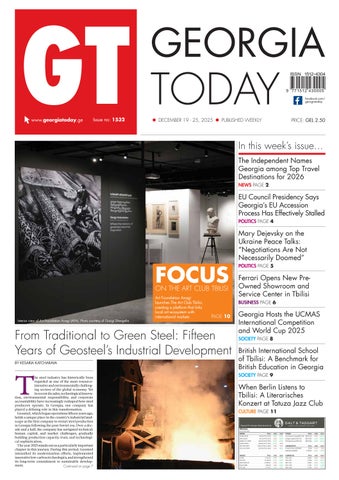
FOCUS ON THE ART CLUB TBILISI
Interior view of Art Foundation Anagi (AFA). Photo courtesy of Giorgi Shengelia
Art Foundation Anagi launches The Art Club Tbilisi, creating a platform that links local art ecosystem with international markets
POLITICS PAGE 5
Ferrari Opens New PreOwned Showroom and Service Center in Tbilisi BUSINESS PAGE 6
PAGE 10
Georgia Hosts the UCMAS International Competition and World Cup 2025
From Traditional to Green Steel: Fifteen Years of Geosteel’s Industrial Development British International School SOCIETY PAGE 8
BY KESARIA KATCHARAVA
T
he steel industry has historically been regarded as one of the most resourceintensive and environmentally challenging sectors of the global economy. Yet in recent decades, technological innovation, environmental responsibility, and corporate accountability have increasingly reshaped how steel producers operate. In Georgia, one company has played a defining role in this transformation. Geosteel, which began operations fifteen years ago, holds a unique place in the country’s industrial landscape as the first company to restart steel production in Georgia following the post-Soviet era. Over a decade and a half, the company has navigated technical, human capital, and market challenges, gradually building production capacity, trust, and technological sophistication. The year 2025 stands out as a particularly important chapter in this journey. During this period, Geosteel intensified its modernization efforts, implemented innovative low-carbon technologies, and strengthened its long-term commitment to sustainable development. Continued on page 7
of Tbilisi: A Benchmark for British Education in Georgia SOCIETY PAGE 9
When Berlin Listens to Tbilisi: A Literarisches Konzert at Tatuza Jazz Club CULTURE PAGE 11 Prepared for Georgia Today Business by
DĂƌŬĞƚƐ Ɛ ŽĨ ϭϳͲ ĞĐͲϮϬϮϱ
WƌŝĐĞ
ǁͬǁ
ŵͬŵ
^dK <^
ǁͬǁ
ŵͬŵ
' KZ' ϬϰͬϮϲ
ϵϵ͘Ϭϯ ;zdD ϱ͘ϲϭйͿ
нϬ͕Ϭй
нϬ͕ϰй
>ŝŽŶ &ŝŶĂŶĐĞ 'ƌŽƵƉ ; ' K >EͿ ' W ϵϮ͘ϲϬ
ͲϬ͕ϵй
нϭϴ͕Ϯй
'Z /> ϬϲͬϮϴ
KE ^
ϵϰ͘ϯϭ ;zdD ϲ͘ϱϭйͿ
ͲϬ͕Ϭй
нϬ͕Ϯй
'ĞŽƌŐŝĂ ĂƉŝƚĂů ; ' K >EͿ
' W Ϯϵ͘ϵϱ
нϭ͕ϰй
нϮϬ͕ϴй
d ĂŶŬ 'ƌŽƵƉ ;d ' >EͿ
' W ϰϬ͘ϲϱ
нϮ͕ϵй
нϴ͕ϳй
WƌŝĐĞ
ǁͬǁ
ϭϬϰ͘ϰϰ ;zdD ϴ͘ϳϵйͿ
нϬ͕ϭй
нϬ͕Ϯй
^><Z , ϬϵͬϯϬ
ϭϬϬ͘ϴϮ ;zdD ϳ͘ϮϵйͿ
нϬ͕ϭй
ͲϬ͕Ϭй
d ϴ͘ϴϵϰ W ZW
' '' ϵ ϭͬϮ W ZW
ϭϬϬ͘ϲϱ ;zdD ϭϭ͘ϬϰйͿ
ͲϬ͕Ϭй
ͲϬ͕Ϭй
KDDK /d/ ^
d ϭϬ ϭͬϰ W ZW
ϭϬϱ͘ϱϰ ;zdD ϵ͘ϭϬйͿ
ͲϬ͕ϭй
нϬ͕ϲй
ƌƵĚĞ Kŝů͕ ƌĞŶƚ ;h^ΨͬďďůͿ 'ŽůĚ ^ƉŽƚ ;h^ΨͬK Ϳ
/E / ^
WƌŝĐĞ
WƌŝĐĞ
ŵͬŵ
ϱϵ͕ϲϴ
Ͳϰ͕ϭй
Ͳϳ͕Ϭй
ϰ ϯϯϴ͕ϯϯ
нϮ͕ϲй
нϳ͕ϯй
ǁͬǁ
ŵͬŵ
hZZ E / ^
WƌŝĐĞ
^W ϱϬϬ
ϲ ϳϮϭ͕ϰϯ
ͲϮ͕ϰй
нϬ͕ϳй
h^ ͬ ' >
Ϯ͕ϲϵϱϮ
ͲϬ͕Ϭй
ͲϬ͕ϰй
&d^ ϮϱϬ
ϮϮ ϭϲϰ͕ϳϲ
нϭ͕ϱй
нϮ͕Ϯй
hZ ͬ ' >
ϯ͕ϭϲϰϰ
нϬ͕ϯй
ǁͬǁ
нϬ͕ϵй
ŵͬŵ
Kt :KE ^ ϯϬ
ϰϳ ϴϴϱ͕ϵϳ
нϭ͕ϯй
ͲϬ͕ϰй
нϮ͕ϴй
' W ͬ ' >
ϯ͕ϲϬϰϭ
ͲϬ͕ϭй
ZƵƐƐĞůů ϮϬϬϬ
Ϯ ϰϵϮ͕ϯϬ
ͲϮ͕ϲй
нϲ͕ϰй
hZ ͬ h^
ϭ͕ϭϳϰϭ
нϬ͕ϰй
нϭ͕ϯй
&d^ ϭϬϬ
ϵ ϳϳϰ͕ϯϮ
нϭ͕Ϯй
нϭ͕Ϭй
' W ͬ h^
ϭ͕ϯϯϳϲ
ͲϬ͕ϭй
нϭ͕ϳй
2
NEWS
GEORGIA TODAY
DECEMBER 19 - 25, 2025
New 8 km Section Opens on Samtredia–Grigoleti Expressway Photo: Wander-Lush.
Georgia Opens Winter Ski Season: Bakuriani’s Kokhta Slopes to Launch on December 20 BY MARIAM RAZMADZE
G
eorgia’s winter ski season will officially begin on December 20, when the Mountain Trails Agency (MTA) under the Ministry of Economy and Sustainable Development opens the Kokhta ski area in Bakuriani. The agency stated that the Kokhta Plateau cable car and ski slope will be available daily from 10:00 to 17:00. This marks the first operational ski area of the 2025–2026 winter season. Preparations are ongoing at other major resorts. In Bakuriani, artificial snowmaking is actively underway at the Didveli and Mitarbi ski areas, with phased openings planned from December 27. The same date is set for the activation of cable cars in Gudauri, Mestia and Goderdzi while ski slopes at these resorts will open gradually depending on weather conditions and snow coverage. From December 27, Gudauri and Kobi cable cars, including Soliko, Gudauri, Kobi, Pirni and Truso, will begin operating. At the Hatsvali ski area in Mestia,
the Zuruldi cable car will also become operational, with Hatsvali and Tetnuldi slopes opening in stages. Additionally, the Zanka cable car will launch at the Goderdzi resort on the same date. The Mountain Trails Agency announced that ski pass sales for Bakuriani will start on December 20 at the Kokhta ticket office only. Online ticket sales will begin on December 23. The 2025–2026 winter season holds particular significance for Georgia as the country will host the Freeride World Tour for the third time. The event will take place in Svaneti, on Mount Tetnuldi, between February 22 and 28, within a designated weather window. Fifty elite riders will compete, placing Georgia among six exclusive host countries alongside France, Spain, Switzerland, Austria and the United States. The Mountain Trails Agency emphasized that hosting the Freeride World Tour is vital for increasing the international visibility of Georgia’s mountain resorts and for promoting winter sports and tourism. In recent years, Georgia has successfully hosted World Cup stages in ski cross, snowboard cross and moguls.
The Samtredia–Grigoleti expressway. Source: 1TV
BY MARIAM RAZMADZE
A
new 8-kilometer, four-lane section of the Samtredia– Grigoleti expressway has been opened to traffic, significantly improving connectivity along one of Georgia’s main transport corridors. The newly operational Lanchkhuti–Lesa segment is now accessible to all vehicles. Georgia’s Ministry of Infrastructure stated that the opened section includes three parallel bridges and two transport interchanges serving Lanchkhuti and
Lesa. These infrastructure elements are designed to enhance traffic flow and safety along the route. The Samtredia–Grigoleti highway is a 52-kilometer international-standard motorway being constructed in four separate sections. At present, the second and fourth sections are fully operational while construction continues on the first section. Works are also actively in progress on the remaining six kilometers of the third, 12-kilometer-long, section. The Ministry reports that construction on the third section has progressed substantially, with stone columns and drainage layers already completed. Road surfacing and bridge construction are
currently in progress. The third section of the expressway passes through the Guria region and bypasses the populated areas of Lanchkhuti city and the villages of Gvimbalairi, Kvemo Chibati and Nigoeti. Once fully completed, the motorway is expected to increase transport capacity, improve road safety and ensure uninterrupted transit connectivity of international importance. Construction of the third section is being financed through a loan from the European Investment Bank (EIB) along with state co-financing. The total funding allocated for this section amounts to GEL 324.6 million.
week, strengthening travel links between the two countries. The first flight was welcomed at Tbilisi International Airport with an official event attended by Deputy Foreign Minister Alexander Khvtisiashvili, Airports Association Director General Levan Moseshvili, TAV Georgia General Manager Tea Zakaradze as well as representatives of the Civil Aviation Agency and SCAT Airlines. Officials pointed out that Kazakhstan is a strategic partner for Georgia, playing an important economic and transit-logistics role within the Middle Corridor. Shymkent
is now the fifth Kazakh city connected to Georgia by direct flights this year. Currently, air traffic between Georgia and Kazakhstan is served by three airlines: Air Astana and SCAT Airlines from Tbilisi International Airport and FlyArystan from Kutaisi International Airport. Passenger traffic between the two countries continues to grow. Over the past 11 months, Georgian airports handled more than 304,000 passengers traveling between Georgia and Kazakhstan, an increase of 10% compared to the same period last year.
The Independent Names Georgia among Top Travel New Direct Flights Connect Shymkent and Tbilisi Destinations for 2026 BY MARIAM RAZMADZE
G
eorgia’s Airports Association announced that Kazakh airline SCAT Airlines has launched its first direct flight between Shymkent and Tbilisi, making a new addition to air connections between Georgia and Kazakhstan. The inaugural flight carried 166 passengers in both directions. The new route will operate twice a
Małgorzata Gosiewska: We Cannot be Partners with a Russian Spy – We Need Swift Action and Sanctions against Ivanishvili Tbilisi. Georgia Travel
BY MARIAM RAZMADZE
G
eorgia has been named among the best travel destinations for 2026 by the British publication The Independent, emphasizing the country’s growing appeal to international tourists. The recognition was announced by Georgia’s National Tourism Administration. The Independent stated that Georgia appears on its travel list alongside globally popular destinations such as Mallorca, the United States and South Korea. Travel expert Lauren Taylor, writing for the outlet, notes that Georgia is attracting increasing attention from travelers, particularly from Europe. One of the main drivers of this growing popularity is improved air connectivity. Budget airline EasyJet launched direct flights from London to Tbilisi this year, with additional routes to Georgia scheduled to begin in 2026. These
developments are making the country more accessible to international visitors. The article highlights Tbilisi’s unique character, pointing to its green parks, cobblestone streets in the historic Old Town and famous sulfur baths. Beyond the capital, Georgia offers ancient monasteries and cathedrals, including Gelati Monastery in Kutaisi, a UNESCO World Heritage Site. Georgia’s cultural richness is further enhanced by its culinary traditions and winemaking heritage. As noted in the article, the country is home to the world’s oldest wine industry, dating back 8,000 years. Quoting Tom Barber, co-founder of a major tourism company, the publication emphasizes that travelers consistently describe Georgia as an exceptional destination. With expanding flight options, a rich cultural landscape and increasing international recognition, Georgia is positioned to become one of Europe’s most sought-after travel destinations in the coming years.
BY TEAM GT
M
ember of the European Parliament Małgorzata Gosiewska has called for swift action and sanctions against Georgian billionaire Bidzina Ivanishvili, stating that Europe cannot treat him as a partner. “We cannot be partners with a Russian spy. We need swift action and sanctions against Ivanishvili; otherwise, we will see even more aggression,” Gosiewska said. Speaking as both a Polish citizen and a supporter of Georgia, Gosiewska said she recognizes the warning signs of repression. “I still remember the smell of tear gas, and I speak as a friend of Georgia — a Georgia that is being stolen not by tanks, but by deception,” she noted. MEP claimed that the situation in Georgia should not be viewed as a political crisis but as a criminal one. She accused the authorities of using chemical sub-
MEP Małgorzata Gosiewska
stances against students protesting with EU flags and criticized the government for ignoring repeated European resolutions calling for the release of former President Mikheil Saakashvili. “Saakashvili remains imprisoned because he is Putin’s personal enemy. His continued detention is a demonstration of loyalty to the Kremlin,” Gosiewska said.
She also pointed to actions taken by the United States, noting that Washington has already imposed sanctions on Ivanishvili and openly identified him as a Russian national exerting control over Georgia to undermine its sovereignty. “We cannot be partners with a Russian spy,” Gosiewska reiterated. “Without swift action and sanctions against Ivanishvili, we will see further aggression.”
NEWS
GEORGIA TODAY DECEMBER 19 - 25, 2025
3
Ukraine Latest: Kupiansk Counterattack, Pokrovsk Street Fighting, and a Renewed Energy War COMPILED BY ANA DUMBADZE
U
kraine’s forces ended the week with a rare moraleboosting tactical success in the northeast, even as Russia maintained pressure along the Donetsk axis and stepped up long-range strikes aimed at damaging Ukraine’s power and heating systems as winter deepened. Across the frontline, the fighting remained defined by slow, intense infantry assaults, localized mechanized pushes, and extensive use of drones and guided bombs. Both sides continued to strike targets deep in each other’s rear areas. The most notable development occurred around Kupiansk in the Kharkiv region. Ukrainian troops reportedly regained control of nearly 90% of the city, pushing Russian forces out of much of the urban area. Russia disputed the claim, and independent verification has been difficult due to restricted access and contested reporting. Still, Kupiansk stood out as one of the few areas where Ukrainian reports suggest a successful counterattack and regained territory. If maintained, this push could complicate Russian efforts to stabilize their positions west of the Oskil River and ease pressure on Ukrainian logistics in the northeast. Even small gains here carry political significance, as President Zelenskyy has emphasized that battlefield momentum influences Ukraine’s leverage in diplomacy. In Donetsk, the fighting remained centered around the Pokrovsk–Myrnohrad area, characterized more by urban attrition than decisive breakthroughs. Ukrainian forces reported repelling unusually
large mechanized assaults in and around Pokrovsk earlier in the week—an escalation from the smaller infantry tactics Russia has often used to slowly advance. Analysts suggest that even if Russia captures more of Pokrovsk, it is unlikely to trigger an immediate collapse across the theater. Instead, the risks for Ukraine are cumulative: loss of defensive depth, attrition of experienced units, and an increasingly challenging operational map that could shape international perceptions of the war. Beyond Pokrovsk, Russia continued to press across the wider Donetsk “fortress belt.” Historical patterns suggest that capturing major urban centers takes months, and Russian advances often come at high cost and slow pace, even when Ukrainian lines are under strain. The week’s fighting was dominated by heavy shelling, drone strikes, and repeated probing attacks rather than a single decisive maneuver. For Ukraine, the challenge remains balancing the need to hold key positions against preserving combat power, with tactical withdrawals sometimes necessary to avoid encirclement and trade space for time. The air and energy war was another key storyline. On December 13, a largescale Russian strike caused major blackouts in Odesa and surrounding areas, affecting over a million households. Ukrainian officials said the attack involved more than 450 drones and 30 missiles, primarily targeting southern energy infrastructure, and caused disruptions to electricity and water supplies, along with multiple injuries. The strike reflects a familiar Russian winter strategy: targeting power generation and transmission infrastructure to force rolling outages, disrupt industry, and strain civilian morale. UN monitors reported that ris-
Ukraine's President Volodymyr Zelensky self-records a video in front of a sign that reads 'Kupiansk.' Source: Ukrainian Presidential Press Service/Handout via REUTERS
ing long-range attacks are a significant factor in increased civilian casualties this year. Other Russian strikes highlighted the proximity of the frontline to populated areas. In Zaporizhzhia, guided aerial bombs hit residential areas and infrastructure, injuring dozens, including a child. Similar attacks across multiple regions have caused civilian casualties despite Ukraine’s air defenses intercepting many incoming threats. The cumulative effect has been a rhythm of disruption: emergency repairs, localized heating failures, strained municipal services, and repeated calls for more air-defense systems. Ukraine, meanwhile, continued and sometimes escalated its long-range strike campaign against Russian fuel and logistics targets, aiming to disrupt supply
chains and raise the cost of Russia’s war effort. On December 17, Russian authorities reported a fire at the Slavyansk refinery following a drone incident, part of a broader pattern of Ukrainian attacks on refineries, depots, and infrastructure. Other drone strikes have also caused casualties inside Russia, including attacks in Rostov and Saratov regions that killed and injured civilians. These cross-border operations carry political weight: Moscow frames them as justification for retaliatory strikes, while Kyiv sees them as legitimate actions to hinder Russia’s war capability. Diplomatically, efforts continued to explore a framework for ending the war, but core territorial disputes remain unresolved. Talks in Berlin involved Ukrainian, American, and European negotiators, but Ukraine has consistently rejected
recognizing occupied territories as Russian, while Russia continues to maintain maximalist demands. President Putin emphasized that Russia would seek to expand its gains if talks fail, while Zelenskyy urged European partners to use frozen Russian assets to support Ukraine’s defense, highlighting the financial stakes of prolonging the war. International military support for Ukraine also continued, focusing on air defense, sustainment, and co-production to address the demands of winter and long-term combat. Kyiv announced new defense agreements with Germany totaling roughly €1.2 billion, including support for Patriot systems, while Germany approved major defense contracts. The UK also highlighted its role in strengthening Ukraine’s air defenses ahead of winter.
4
POLITICS
GEORGIA TODAY
DECEMBER 19 - 25, 2025
EU Council Presidency Says Georgia’s EU Accession Process Has Effectively Stalled BY MARIAM RAZMADZE
T
he EU Council Presidency published its conclusions on enlargement this week, including an assessment of Georgia’s EU accession path. The document was issued on behalf of the Presidency after the proposed draft received support from 26 EU member state delegations while one delegation withheld support, preventing full consensus. In the conclusions, the Council reiterates its strong support for the European aspirations of the overwhelming majority of the Georgian population. However, it states that the current actions of the Georgian authorities fall short of the standards and expectations placed on an EU candidate country. As the text stated, the Council expresses serious concern over what it describes
as a broad democratic backsliding in Georgia. This includes setbacks in democracy, human rights and the rule of law, as well as the adoption of repressive legislation that undermines fundamental rights and freedoms. The Council also highlights the political instrumentalization of the judiciary, persecution of opposition figures, arbitrary arrests of protesters and journalists and the continued shrinking of civic space. The Council further condemns the spread of disinformation and anti-EU narratives by the Georgian authorities, calling for such practices to end. It notes with regret that Georgia has backslide across the nine reform steps on which EU candidate status was granted, concluding that the country’s accession process has effectively come to a standstill until authorities demonstrate a clear commitment to reversing course and returning to the EU integration path. As initial steps toward re-engagement, the Council calls on the Georgian author-
EU and Georgia flags. Embassy of Georgia
ities to release all arbitrarily detained politicians, journalists and activists; repeal repressive legislation; adopt democratic, comprehensive and sustainable reforms in line with European integration principles; and cease aggressive rhetoric directed at the EU, EU ambas-
sadors and the Head of the EU Delegation. Despite its criticism, the Council reaffirms the European Union’s support for Georgia’s sovereignty, independence and territorial integrity within its internationally recognized borders. It underlines
the EU’s continued commitment to peaceful conflict resolution and its policy of non-recognition and engagement, including through the EU Monitoring Mission in Georgia. The conclusions also express regret over Georgia’s ongoing non-compliance with recommendations outlined in the seventh visa suspension mechanism report. The Council urges the authorities to fulfil these recommendations promptly and meet visa liberalization benchmarks without delay. Finally, the Council reiterates its strong expectation that Georgia align more closely with the EU’s Common Foreign and Security Policy, particularly by joining EU restrictive measures against Russia and Belarus in response to Russia’s war against Ukraine. It calls on the Georgian authorities to avoid actions or statements that contradict EU foreign policy positions while encouraging continued cooperation to prevent the circumvention of EU sanctions.
GYLA Submits Amicus Curiae Brief to Constitutional Court on Lawsuit Seeking Ban of Opposition Parties
A Georgian polling station. Source: IPN
Parliament Approves New Version of Election Code in Final Reading BY TEAM GT
G
eorgia’s Parliament has approved the draft of a new version of the Election Code in its third and final reading. The legislation was initiated and authored by Georgian Dream MPs Archil Gorduladze, Tornike Cheishvili, Aleksandre Tabatadze, Davit Matikashvili, Rati Ionatamishvili, Aluda Gudushauri, Tengiz Sharmanashvili, Guram Macharashvili, and Akaki Aladashvili. One of the key changes introduced by the new electoral legislation is the abolition of polling stations abroad for parliamentary elections. Georgian citizens residing overseas will no longer be able to vote at foreign polling stations, as parliamentary elections—similar to municipal elections—will now be conducted exclusively within Georgia. The revised code also limits the nomination of candidates by political parties. Under the new rules, parties will be allowed to nominate only their own members in both parliamentary and municipal elections. The nomination of non-party candidates will be permitted solely through initiative groups.
The legislation further clarifies regulations on photo and video recording at polling stations. According to the adopted draft, individuals authorized to be present at polling stations, as well as those entitled to attend election commission sessions, will be allowed to take photographs, but without audio recording. Changes are also introduced to the rules on expulsion from polling stations on election day. Individuals expelled from a polling station will be barred from entering any other polling station, and the election administration will keep a record of such cases. In addition, the candidate registration process is being simplified. The requirement to submit a registration card is being removed. Instead of submitting both a registration card and a declaration of party affiliation, candidates will now only be required to complete a consent form to participate in the elections, which will include information on residency requirements and party affiliation. The new Election Code also introduces restrictions on election commission membership. Individuals with criminal convictions, including those sentenced by a court to pay a fine, will be prohibited from serving as members of election commissions.
Constitutional Court. Source: IPN
BY TEAM GT
T
he Georgian Young Lawyers Association (GYLA) has submitted an amicus curiae brief to the Constitutional Court of Georgia regarding a constitutional lawsuit filed by members of Parliament seeking the banning of several opposition political parties. The lawsuit calls for the prohibition of the following parties and political groupings: “Unity – National Movement,” “Coalition for Change – Gvaramia, Melia, Girchi, Droa,” and “Strong Georgia – Lelo, For People, For Freedom.” GYLA announced the submission of its legal opinion via social media, emphasizing the importance of the broader political environment in which the case is being considered. The organization, the amicus curiae brief analyzes international legal standards and Georgia’s national legislation concerning the most extreme form of restriction on freedom of association—
the banning of political parties. GYLA stresses that courts must consider not only the existence of an urgent public need but also the historical and political context in which such measures are proposed. Citing the jurisprudence of the European Court of Human Rights (ECtHR), GYLA notes that the review of party bans is taking place in a particularly challenging political environment. This context, the organization argues, is marked by the concentration of power in the hands of a single ruling party, the gradual erosion of democratic pluralism, the systematic narrowing of political opposition and civic space, and the instrumentalization of legal mechanisms for narrow partisan interests. The association also addresses the concept of “defensible democracy,” which is repeatedly referenced by the plaintiffs in the constitutional complaint. According to GYLA, defensible democracy refers to a democratic system’s ability to adopt preventive measures to protect itself from forces seeking to undermine democracy from within.
However, the organization emphasizes that this concept is valid only when the political system itself remains democratic in nature. “If a regime loses its democratic character and uses the concept of defensible democracy against political opponents, this theoretical framework loses its legitimacy and turns into a legal instrument of politically motivated repression,” GYLA states. The organization further recalls the ECtHR’s position that banning a political party constitutes the most severe restriction on freedom of association, and is permissible only as a last resort, in exceptional circumstances. Such a measure, GYLA argues, may only be justified by organized and deliberate actions aimed at dismantling the democratic order. The association says political parties cannot be held collectively responsible solely for individual statements or actions of certain members. Nor, it adds, can a party be banned simply because its ideas are unpopular or offensive to parts of society.
POLITICS
GEORGIA TODAY DECEMBER 19 - 25, 2025
5
Mary Dejevsky on the Ukraine Peace Talks: “Negotiations Are Not Necessarily Doomed” use Ukraine as a springboard further west. I think that is complete fiction. My view is that, for Russia, this is security that we're talking about; not going further than the end of the Donbas; which Russia sees as a security zone. It's for its own security. All this hype-talk of Russia going on to Kyiv and further west, it was clear from the 28 points that there was nothing about that. But again, it wasn't seen as a positive.
THE FACT THAT IT WASN’T WRITTEN DOESN’T MEAN THEY WON’T GO FURTHER WEST. IF RUSSIA TRULY INTENDED TO STOP AT DONBAS, WHY HAVEN’T THEY OFFERED TO RETURN OTHER ANNEXED TERRITORIES LIKE KHERSON OR ZAPORIZHIA? I think another reason Russia might want to settle, even if it doesn’t strictly need to, is the impact of Western isolation. While efforts to isolate Russia have largely failed globally, being shut out by the West still matters to them. Russia wants to be accepted as part of the European world—but as a great power—and that requires recognition from the US and Europe. You can sell energy to China or adjust your economy, but that doesn’t replace the acceptance Russia really seeks, and I think that’s a major factor.
Mary Dejevsky. Source: spiked
INTERVIEW BY VAZHA TAVBERIDZE
F
or Russia, this is security that we're talking about; not about going further west of Donbas. It’s about creating a security zone - says Mary Dejevsky, a columnist for The Independent and a former BBC World Service journalist, in an interview with Radio Free Europe/ Radio Liberty’s Georgian Service. Assessing the latest round of peace talks, Dejevsky argues that shifting positions and changing attitudes do not necessarily mean negotiations are doomed. She believes the rising cost of the war for Ukraine, growing mobilization fatigue, and pressure near the front are forcing difficult choices. Dejevsky also challenges the assumption that Moscow has no interest in a settlement, insisting that Russia’s calculations may be more complex than widely assumed.
WHAT HAVE WE LEARNED FROM THIS LATEST CHAPTER OF PEACE TALKS? WHERE DO WE STAND NOW? It all seems to change day to day. It’s not just the terms or the number of points shifting; the attitude of almost every party changes too. So it’s hard to say where we stand right now. Still, it seems to me that, despite the large gaps between everyone involved, we’re slowly getting closer.
WHY DO YOU THINK IT MIGHT WORK OUT, WHILE SO MANY OTHERS THINK IT'S DESTINED TO FAIL? Maybe I’m deluded and guilty of wishful thinking, but I do think it’s long past time for this conflict to end because of the
cost to Ukraine—nothing to do with being nice to Russia or thinking Russia needs to win. The cost to Ukraine has been rising and accelerating in recent months. That’s one reason I think these talks may not fail: Zelenski seems very hands-on, and has been sending relatively positive signals about wanting peace. Ukraine needs peace. The difficulties of mobilization, the measures being used to enforce it, and the number of people deserting or leaving the country rather than serving all point in that direction. This is a very different picture from the early months of the war, when there was a strong volunteer effort. The combination of declining willingness to fight and growing fatigue in areas closest to the fighting suggests Ukraine faces a hard choice: settle for terms that are inadequate and unjust, or fight on and risk ending up with an even worse deal. I also think Russia wants a deal, though many disagree. I’d argue Russia can fight much longer than Ukraine. When Russian officials recently said that if they don’t get a deal to their liking they’ll take the rest of Donbas by force, even if it takes time, I have little doubt they believe they can do that.
BUT THEY HAVEN'T BEEN ABLE TO DO THAT SINCE 2014. True, no, they haven't been able to do that. And their progress has been very slow, but I think in recent weeks it's accelerated, and if you look back at the state of the Ukrainian military, then maybe the next stage for Russia might actually be easier than it has been in the past.
THAT WOULD, IN ESSENCE, REQUIRE THE UKRAINIAN FRONT TO COLLAPSE. IS THAT WHAT YOU
EXPECT TO HAPPEN? I don’t have access to that level of detail, but I don’t think it can be ruled out. I was particularly disturbed by the first so-called 28-point plan—which, as everyone admits, wasn’t really a plan, just a list of points. When it came out, the immediate European reaction was “capitulation, capitulation,” which I think was completely wrong. It gave the wrong impression. The points called for a detailed, analytical response, because not all of them were negative for Ukraine. Instead, there was a knee-jerk reaction that it meant Russia was winning. I think that was mistaken—there were elements in those points that could have been meaningfully considered.
WHICH POINTS IN PARTICULAR? WHAT WOULD BE ONE SUCH POINT THAT WOULD HAVE OUTWEIGHED THOSE THAT WERE UNACCEPTABLE? I don't know that they would necessarily have outweighed them, but I think they were worthy of consideration. One of them was that even though it appeared to give Russia territory beyond what it currently occupies, there was a distinction drawn between de facto and de jure, which is the same distinction as was applied to the Baltic States by the Western world during the Soviet occupation, and I don't think Russia would be happy with that, and obviously Ukraine wouldn't be happy with it, but it's a very important distinction, and it leaves open the possibility of that land actually being returned. Another important distinction is the view that, from the very beginning, Russia's intention was to take over Ukraine, occupy the whole of Ukraine, and basically incorporate it into Russia. And from that stems the idea that Russia wants to
IN THAT CONTEXT, YOUR CLAIM THAT PUTIN WANTS A DEAL CLASHES WITH MANY RUSSIAN ANALYSTS WHO ARGUE HE CANNOT AFFORD ONE UNLESS IT AMOUNTS TO TOTAL VICTORY. THEY SEE ANY COMPROMISE AS POLITICALLY FATAL, WHILE YOU SUGGEST HE MAY STILL BE OPEN TO A DEAL INVOLVING SOME LEVEL OF COMPROMISE. At this point, Russia has red lines that are unacceptable to Kyiv. They may be acceptable to the US, but not to Europeans, creating a complete deadlock. Looking back to Istanbul, April 2022, and the Belarus talks just days after the invasion, the terms Russia was willing to accept—and which Kyiv was on the verge of agreeing to—are still very much the terms being discussed today. If there is any settlement, Russia’s red lines will stand. One is Ukraine’s neutrality—whether through NATO pledges not to invite Ukraine or Kyiv enshrining neutrality in its constitution—which is absolutely non-negotiable for Russia and, in my view, one of the reasons the war started. Between 1991 and 2014, Ukraine existed as an independent state alongside Russia, and despite events like the Orange Revolution and pro-Western presidents, its neutrality was maintained in the constitution. Another important issue for Russia is the status and protection of the Russian-speaking population, which is likely to remain a key point in any negotiation.
WHAT ABOUT THE SECURITY GUARANTEES? Security guarantees? Yes, I can quite understand why, for Ukraine, security guarantees are an absolute precondition, and also why European security guarantee is not sufficient. And so far, Kyiv has insisted on an American-backed security guarantee. I completely understand that, and we've seen shadows of this coming in and out of negotiations with the Americans, more recently, looking as though they're at least possibly
ready to agree to at least a backstop.
AMERICANS USED THE WORD ASSURANCES, WHICH IS A DIRECT ECHO FROM BUDAPEST MEMORANDUM. That’s true. But another aspect of security guarantees, which I think Trump understood from the start, is key: Russia’s invasion wasn’t mainly about territorial expansion but about what it saw as threats to its security, particularly Ukraine becoming an advanced position for the Western alliance. Now, that perception may or may not be accurate, but it drives Russia’s actions. Russia also links this to the breakdown and expiry of Cold War security structures, and it wants guarantees—like arms control agreements and limits on NATO expansion—that restore what it saw as protection. Unless you have a Russia that feels secure, you're not going to have security for Ukraine, because Russia is always going to see it as a potential threat.
DURING THE COLD WAR, DID THE SOVIET UNION SEE ITSELF AS SECURE—AND IF SO, DID THAT STOP PROXY WARS, REPRESSION IN THE WARSAW PACT, OR BRUTALITY AT HOME? I’M FROM A FORMER SOVIET REPUBLIC; MY PARENTS LIVED IT. SO HOW IS RESTORING THAT SYSTEM TO “MAKE RUSSIA FEEL SECURE” ANY DIFFERENT FROM CHAMBERLAIN’S APPEASEMENT? I understand we're going to have a completely new conversation about all this, how all of it will be arranged. But I was working for the BBC World Service in the 80s, and then the absolute rule was that Yalta was sacrosanct and that there should be no border changes. And, of course, all that changed with the fall of the Berlin Wall, and everything dissolved.
WE MAY HAVE TO AGREE TO DISAGREE, SO LET’S MOVE TO LEADERS: DO YOU REALLY SEE PUTIN MEETING ZELENSKY IN PERSON, EVEN TO SIGN A PEACE DEAL? I find that a stretch, I find that happening really difficult to imagine. The tragedy of this is that they did meet very, very early on, when Zelensky was newly elected. And I think they could have got along. And, you know, there are all sorts of reasons that we can look back and say why they didn't. I think it's very difficult for me to see the two of them signing anything that would be a peace agreement, or even being in the same room.
WHAT’S EUROPE’S PLAY IN ALL THIS? I find it very difficult watching the Europeans, because it seems to me that they're doing their absolute utmost to encourage Ukraine to fight on, to thwart any sort of peace agreement that might be brokered by the Americans. And at the same time, they don't have the strength, either the financial strength, or the military strength, or the political will, to support Ukraine in a way so that it would actually be able to win or enforce the terms that it wants. It's also a big mistake that the Europeans have been unable to present their own plan, and that they've absolutely refused to talk to Moscow. I think those are huge weaknesses. And I think it's a very negative reflection on European diplomacy.
6
BUSINESS
GEORGIA TODAY
DECEMBER 19 - 25, 2025
Ferrari Opens New Pre-Owned Showroom and Service Center in Tbilisi
The Ferrari Service Center in Tbilisi. Source: Ferrari
BY ANA DUMBADZE
F
errari has officially opened its first Official Ferrari Pre-Owned and Service Showroom in Georgia, marking the inauguration of Ferrari Tbilisi on December 19, 2025. The new showroom is operated by Nazar Group, which has been appointed as Ferrari’s official partner in the country, bringing more than four decades of experience in premium automotive sales and customer service. The opening represents a significant expansion of Ferrari’s presence in the Georgian market and introduces the brand’s latest dealership corporate identity. Ferrari Tbilisi is also the first location worldwide to debut Ferrari’s new corporate identity concept in a dedicated Ferrari Pre-Owned showroom, designed to enhance the customer experience through a blend of heritage, community and a seamless physical–digital environment. The new facility offers a range of Ferrari models certified under the Ferrari Approved program, which ensures that each pre-owned vehicle meets the brand’s
strict standards of quality, safety and authenticity. The updated showroom concept aims to provide a consistent and elevated customer journey across all touchpoints, strengthening long-term relationships between the brand and its clients in Georgia. Guests attending the opening ceremony were given an exclusive preview of the Ferrari 849 Testarossa, highlighting Ferrari’s ongoing commitment to innovation, performance and design excellence. The event was attended by Ali Nazar, owner of Nazar Group, and Reno De Paoli, Head of Ferrari Europe and Africa, underlining the strategic importance of the Georgian market and its growing potential in the luxury and high-performance automotive segment. Speaking at the inauguration, Ali Nazar said the opening of Ferrari Tbilisi represents more than a new showroom, describing it as a commitment to delivering Ferrari’s values through modern, meticulous and personalized service. Reno De Paoli noted that the partnership with Nazar Group reinforces Ferrari’s standards and vision in the region, emphasizing that clients will experience the brand’s excellence not only through
its cars, but through every interaction. Ferrari Approved is the brand’s official certification program for pre-owned vehicles and is available exclusively through Ferrari’s authorized service network. The program applies to Ferrari models up to 14 years old and includes more than 200 technical and aesthetic checks, verification of service history and detailed interior and exterior preparation. Certified vehicles are offered with factory warranty coverage of up to 24 months in select markets and roadside assistance, providing additional peace of mind to customers. Founded in Maranello, Italy, Ferrari is one of the world’s leading luxury brands, renowned for its sports cars, racing heritage and lifestyle products. The company is closely associated with its Formula 1 team, Scuderia Ferrari, the most successful team in the sport’s history. Nazar Group is a leading automotive group with a 46-year track record and a reputation for reliability and high customer satisfaction. In Georgia, the group delivers premium sales and aftersales services and maintains its operational headquarters in Baku, Azerbaijan, where it has represented Ferrari since 2004.
BUSINESS
GEORGIA TODAY DECEMBER 19 - 25, 2025
7
From Traditional to Green Steel: Fifteen Years of Geosteel’s Industrial Development Continued from page 1 Geosteel’s establishment marked a significant turning point for Georgia’s industrial sector. As the first company to restart steel production after the dissolution of the Soviet Union, Geosteel entered an environment characterized by limited industrial infrastructure, a shortage of skilled labor, and widespread skepticism toward locally manufactured steel products. The early years of operation were defined by persistence and long-term planning rather than immediate gains. Restarting steel production required not only physical assets but also the rebuilding of professional expertise, operational discipline, and confidence in domestic manufacturing capabilities. One of the most serious challenges faced by Geosteel during its initial years was the shortage of qualified professionals. Engineers, metallurgists, and experienced technicians were difficult to source within the local labor market. This gap posed a significant risk to operational stability and product quality. To overcome this challenge, Geosteel adopted a pragmatic and forward-looking approach. The company recruited individuals from unrelated professions and invested heavily in internal training programs. Employees were trained directly on-site, gaining practical experience in steel production processes, quality control, and plant operations. Over time, this approach proved effective. What began as a necessity evolved into a strategic advantage, resulting in the formation of a highly capable, loyal, and experienced workforce. The company’s emphasis on in-house skill development laid the foundation for its longterm operational resilience. Recognizing the ongoing challenges of sourcing skilled technical professionals in Georgia, Geosteel remains committed to internal training and professional development. Through structured in-house programs, employees receive continuous training that enhances their technical expertise and career growth. This long-term investment in human capital ensures operational continuity and supports the company’s modernization efforts. In parallel with workforce challenges, Geosteel faced skepticism from the construction sector and the general public. At the time, imported steel, particularly from Ukraine, was widely perceived as superior in quality. Convincing builders, architects, and developers to adopt locally produced steel required consistent performance and transparent quality assurance. Rather than relying on marketing alone, Geosteel focused on product reliability. Stakeholders were encouraged to test and evaluate the steel based on performance rather than origin. Gradually, perceptions began to shift. Customers recognized that Geosteel’s products met and in many cases exceeded the quality of imported alternatives. This growing confidence contributed to broader market effects, including a significant reduction in steel prices compared to the base year of 2010, benefiting the construction sector and the wider economy. The company’s early production phase was not without technical difficulties. Initial equipment issues affected efficiency, but these challenges were addressed promptly. Through continuous investment in plant upgrades and equipment modernization, Geosteel steadily increased its production output
year after year. Rather than pursuing rapid expansion, the company adopted a measured approach focused on stability, quality improvement, and long-term sustainability. This strategy ensured that capacity growth was aligned with technical capability and market demand. Among the many milestones in Geosteel’s fifteen-year history, 2025 represents a defining period. „During this year, the company accelerated its modernization agenda and implemented technologies that strengthened both operational efficiency and environmental performance. In 2025, We replaced several key pieces of plant machinery with newer, more efficient technologies. This modernization initiative was aimed at improving reliability, reducing energy consumption, and enhancing product consistency. The introduction of modern equipment allowed us to optimize production processes while maintaining its established quality standards. These upgrades also supported safer working conditions and reduced operational downtime, contributing to overall productivity gains“, - said Mr. Sajeev Balakrishnan, Geosteel General Director.
According to him, one of the most significant achievements of 2025 was the commissioning of the direct charging project. This technological advancement fundamentally changed the way billets are transferred within the production chain. Geosteel’s current strategic priority is to strengthen its presence in the growing domestic market. By focusing on local demand, the company aims to ensure reliable supply and maintain close relationships with Georgian customers. While domestic growth remains the primary focus, Geosteel continues to serve its existing export clients in neighboring countries. The company’s export strategy emphasizes stability and reliability rather than rapid expansion into new markets. Traditionally, billets are cooled after casting and later reheated in a billet reheating furnace before rolling a process that consumes substantial energy and generates carbon emissions. With direct charging, billets are transferred directly from the steel melting shop to the rolling mill while still hot, eliminating the need for reheating. The benefits of this innovation are substantial:
• Significant reduction in carbon emissions • Improved energy efficiency • Lower fuel consumption • Enhanced process integration The direct charging project represents a concrete step in Geosteel’s transition toward greener steel production, demonstrating how technological innovation can align environmental responsibility with operational efficiency. Environmental responsibility has been integral to Geosteel’s operational philosophy since its inception. In 2010, the company became the only steel plant in the region to commence operations with a modern fume exhaust system, setting a benchmark for environmental compliance within the industry. This early investment reflected management’s understanding that sustainable operations are essential not only for regulatory compliance but also for long-term competitiveness and community trust. Over the years, Geosteel has expanded its environmental initiatives beyond emission control. One of the most notable achievements has been the installation of rooftop solar panels on all factory sheds, supplemented by ground-mounted solar power plants. To date, the company has successfully commissioned approximately 11 MW of solar power generation capacity. This renewable energy is integrated into plant operations, reducing dependence on conventional power sources. Looking ahead, Geosteel has set an ambitious target to increase its solar generation capacity to 50 MW within the next few years. This initiative underscores the company’s long-term vision of transitioning toward cleaner energy and reducing its overall environmental footprint. In line with this strategy, Geosteel plans to commission an upgraded fume exhaust system in the coming year. This advanced system is expected to elevate emission control standards further, positioning the company’s operations ahead of many leading European steel plants in terms of environmental performance. Technological innovation has consistently been at the core of Geosteel’s management strategy. Current initiatives focus on renovating and refurbishing existing plants with energy-efficient technologies that enhance sustainability while improving operational effectiveness.
These projects are not isolated upgrades but part of a broader effort to modernize production systems in line with evolving industry standards. One of the most significant strategic investments underway is the erection of a new wire rod mill. This facility will allow Geosteel to diversify its product mix, enabling the company to respond more flexibly to market demands. The addition of wire rod products will broaden Geosteel’s offerings and enhance customer choice, reinforcing the company’s competitive position within the domestic market. The wire rod mill is scheduled for commissioning in 2026, marking a major milestone in the company’s next phase of growth. Geosteel’s is also well known to its approach to corporate social responsibility that is rooted in the principle of inclusive growth. The company believes that its success should contribute directly to the development of the communities in which it operates and to the progress of Georgia as a whole. This philosophy is reflected in a wide range of social initiatives, particularly in the city of Rustavi. Key CSR Initiatives in Rustavi, Geosteel’s social engagement includes: • Tree Planting Campaigns in schools, promoting environmental awareness among young people • Support for Vulnerable Groups, including children’s homes, old age homes, and socially vulnerable families • Promotion of Sports and Healthy Living through the construction of sports complexes and provision of sports equipment • Educational Infrastructure Development, including renovation of classrooms and libraries During the COVID-19 pandemic, Geosteel demonstrated exceptional social responsibility by operating its oxygen plant continuously to produce medical oxygen for the citizens of Georgia. This was done despite significant financial losses, underscoring the company’s commitment to public health during a national crisis. Over fifteen years, Geosteel has evolved from a pioneering steel producer into a modern industrial enterprise defined by technological innovation, environmental responsibility, and social engagement. The achievements of 2025 represent a critical step in this journey, highlighting the company’s transition from heavy metal production to green steel manufacturing. As Geosteel looks toward the future, its strategy remains grounded in sustainable growth, continuous improvement, and a deep commitment to the communities it serves. In doing so, the company continues to shape the future of Georgia’s steel industry with responsibility and resilience. The commissioning of the wire rod mill in 2026 will expand Geosteel’s product range and strengthen its market position. The upgraded fume exhaust system and expansion of solar power generation will further solidify Geosteel’s position as a leader in environmentally responsible steel production.
8
SOCIETY
GEORGIA TODAY
DECEMBER 19 - 25, 2025
Georgia Hosts the UCMAS International Competition and World Cup 2025 underscoring the country’s growing strength in advanced mental arithmetic education. More than a competition, the UCMAS International Competition and World Cup 2025 served as a celebration of intellectual potential, international unity, and the power of structured cognitive development. The event was organized by UCMAS Georgia under the leadership of Mrs. Sahar Harb, Franchise Owner of UCMAS in Georgia. The successful hosting of this global event once again highlighted Georgia’s rising role within the international education ecosystem.
COMPETITION FORMAT AND METHODOLOGY
UCIMAS Georgia
BY TEAM GT
T
he UCMAS International Competition and World Cup is part of a global educational tradition spanning more than 25 years, bringing together young talents from across continents through a shared commitment to cognitive development and academic excellence. Held annually in a different host country, the competition strengthens international educational ties and cultural exchange. The 2024 edition took place in India, 2025 was proudly hosted by Georgia, and the 2026 competition is scheduled to take place in Sri Lanka, underscoring the truly global nature of the UCMAS community. For participating countries, the event offers not only a competitive platform, but also international recognition, benchmarking of educational standards, and
a shared vision for nurturing future-ready minds. On December 6–7, 2025, Georgia proudly hosted the UCMAS International Competition and World Cup 2025 at SEU – Georgian National University, marking one of the largest and most prestigious educational events ever held in the Caucasus region. The international mental arithmetic competition brought together 1,500 students from 84 countries, and welcomed more than 4,000 guests, including educators, academic leaders, franchise representatives, and education officials from around the world. For two days, Georgia became a global center of cognitive excellence, innovation, and youth achievement. Among the highlights of the competition was the outstanding performance of Georgian students. Lasha-Giorgi Bregvadze earned the Champion title, while Sharbel Maroun Nehme, Ani Avetisova, Zura Palkhosadze, and Rati Samadashvili secured 1st Runner-Up positions.
Additional Georgian students from both Tbilisi and regional cities achieved 2nd and 3rd Runner-Up rankings, further
At the heart of the competition was the Visual Mental Arithmetic Challenge, where students were required to solve 200 arithmetic problems in just 8 min-
utes. These complex multi-digit tasks demanded exceptional levels of concentration, accuracy, speed, and mental endurance. The competition included several categories: Flash Cards Category – Arithmetic problems appeared on screen at extremely high speed, testing participants’ instant processing ability, reflexive memory, and visual agility. World Cup Category – A specialized, high-level abacus round designed exclusively for top international performers, representing the pinnacle of UCMAS training. Together, these categories assessed not only mathematical proficiency but also the broader neurocognitive framework of UCMAS, which emphasizes visualization, memory, multitasking, focus, and rapid decision-making.
LEVELS, AGE GROUPS, AND GLOBAL REPRESENTATION The competition featured 11 UCMAS levels, ensuring fair and accurate evaluation based on skill progression rather than age alone. Participants ranged from 5 to 20 years old, competing according to their certified UCMAS level. Students and guests traveled from Asia, the Middle East, Europe, Africa, and the Americas, transforming Georgia into a truly global meeting point for young intellectual talent and reinforcing the international reach of the UCMAS program. By hosting the UCMAS International Competition and World Cup 2025, Georgia demonstrated its capacity to organize world-class educational events and reaffirmed its position as an emerging hub for academic excellence, innovation, and youth development.
The Umpteenth Education Reform in Sakartvelo BLOG BY NUGZAR B. RUHADZE
W
hy is the term ‘Education Reform’ so easily and recurrently used in this country? The word is heard all over the place—in personal abodes and under open skies, in political campaigns and in media coverage, over internet platforms and in public discourse. What makes change in the field so indispensable and significant? The most simplified answer to this tricky question is that life itself goes through inevitable alterations, and so do the manmade systems accompanying it. Georgia has a long and complicated history of education that has gone through manifold metamorphoses, starting from ancient church schools and medieval academies like Gelati and Ikalto, and ending with the
Russian Empire’s literacy endeavors, the founding of Tbilisi State University, the creation of the Soviet Academy of Sciences, and finally the post-Soviet reforms focusing on modernization, quality, and international standards. And here we go once again: in the year 2025, Georgia has found itself in the middle of a new educational reform that is aiming at changing a plethora of things in the system, the enumeration of which wouldn’t make any sense here, because all is on public display. What we need to achieve in this particular piece is the overall justification of reforms in the realm of public enlightenment that occur once in a while in our lives. Education reform, in general, incorporates a diversity of exertions meant to ameliorate learning outcomes in schools of all levels, addressing the issues that have damaged the system during a certain period of time to the detriment of most students. The discussion on the topic of content
that makes learning high-quality will never end. The opinions to this end are as many as there might be volunteers to express themselves. And with such speedily altering technology—the AI and IoT in the first place—the scenery of education reform will have to move quickly with it. The focus in Georgia in this respect remains permanent: education reform means incessantly improving schools to create educated individuals and an educated society. Education reform directly impacts Georgian society’s future wits and goals; the plain reason for another reform in Sakartvelo is that our children need to be equipped with specific skills and knowledge that easily translate into wellbeing. To cut it short, the act of reforming the educational system should be taken for granted by our society for two main reasons: first, it periodically needs change, and second, it will work to the benefit of our youth, because a reform, in gen-
eral, serves progress. It must, at least! As I said, any educational system, including ours, is compelled to accept and implement change because there is an everlasting need to adapt to rapid societal, economic, and technological transformations. It is no big news that in Georgia we suffer from skill gaps, certain forms of inequality, and ubiquitous poor performance, and to handle these everpresent challenges, the consequently necessitated reform of the system has to take place, although no reform can work as a hundred-percent panacea, especially in our time of the fourth industrial revolution, which creates new pressures and challenges while trying to bring together physical, digital, and biological worlds with the help of oversophisticated robotics and various complicated cyber-physical efforts. The most significant among the crucial drivers of education reform in Georgia might be considered the fol-
lowing: economic demands requiring new skills like critical thinking, creativity, and digital literacy; societal shifts, including altering demographics and social needs, new academic priorities and approaches, climate change, and pandemics; technological advancement, modern personalized learning, performance differences, bias and discrimination in the means and ways of enlightenment, mismatch between traditional schooling and real-world demands; and global trends such as worldwide pressure for standardized testing, accountability, as well as core subject focus, and an accent on mastery and proficiency. In essence, education reforms are an incessant and unremitting round of attempts to repair systemic problems and prepare students for an ever-changing future, creating relentless pressure for updates. Thus, the timely implementation of education reform is definitely justified in Sakartvelo too.
EFES Georgia Honored with Special Award by UN Global Compact Network Georgia BY TEAM GT
O
n November 26, the 8th annual ceremony of the competition “Corporate Sustainability Award Business for SDGs” was held, organized by the UN Global Compact Network Georgia. In connection with the 25th anniversary of the UN Global Compact, EFES Georgia received the “Business for SDGs Special Recognition Award.” Since the launch of the competition, EFES Georgia has been actively involved in this initiative, sharing with the business sector and the public the steps taken
toward achieving the Sustainable Development Goals over many years, and is also a multiple-time winner of the Corporate Sustainability Award competition. “For EFES Georgia, corporate sustainability is a declared priority. For more than 17 years, we have been implementing various projects in the field of corporate responsibility. Accordingly, the awards we have received within the framework of the UN Global Compact Network Georgia programs are a recognition of our efforts in this field and show that we are moving in the right direction. This year, in connection with the 25th anniversary of the UN Global Compact, we were honored with a special award for the work we have carried out over the years, which makes us proud. In the
future, we will certainly continue and expand our activities to strengthen a decent work environment, support the economic growth of both the company and the country, and advance sustainable consumption and production.” - said Keti Zhvania, Public Relations and Digital Communications Manager of EFES Georgia. The event was opened by Salome Zurabishvili, Executive Director of the UN Global Compact Network Georgia, who spoke about the importance of business efforts and leadership in the process of achieving EU integration and the Sustainable Development Goals. In this context, she emphasized the role of the UN Global Compact and noted that the Corporate Sustainability Award compe-
tition serves, to some extent, as a benchmark for assessing the current situation - what goals the business sector has, what progress companies in Georgia are making in the field of sustainability, and how much importance they place on compliance with international standards. The event was attended by representatives of companies participating in the award competition, the diplomatic corps, international organizations, and member organizations of the UN Global Compact Network Georgia. The Corporate Sustainability Award ceremony was held within the framework of the “Leadership for Sustainable Development” project, funded by Sweden and organized by the UN Global Compact Network Georgia.
SOCIETY
GEORGIA TODAY DECEMBER 19 - 25, 2025
9
British International School of Tbilisi: A Benchmark for British Education in Georgia BY ANA DUMBADZE
T
he end of 2025 marks a defining moment for British education in Georgia. With renewed leadership, strengthened academic frameworks, and a sharpened commitment to global standards, the British International School of Tbilisi (BIST) is shaping a modern, human-centred educational landscape. BIST stands as Georgia’s most established fully British international school, delivering an education rooted firmly in British academic tradition. BIST offers a fully British experience supported by the Cambridge International curriculum, enabling students to develop academic rigour, research skills and global citizenship from early years through graduation. Its approach emphasises not only academic excellence, but also character, independence and a strong sense of purpose. BIST Director Robert Snowden highlights the school’s distinct identity within Georgia’s educational ecosystem: “BIST’s identity within the British school family in Tbilisi comes from being the most established, fully accredited by COBIS,
English-medium institution delivering a truly British international education,” he notes. “We are defined by high-quality teaching from fully internationally qualified, first language English-speaking staff, who bring strong pedagogy, high expectations and a commitment to holistic development. British education here is more than a curriculum; it is an approach rooted in critical thinking, collaboration, character formation and a global mindset.” With a student body representing more than 50 nationalities, BIST is proudly international, while remaining firmly British in its educational culture and values. At the same time, the school places strong emphasis on respecting and integrating the local context. Nearly 20% of students have Georgian heritage; Georgian language and culture are part of the curriculum, and local staff play a central role in school life. Cultural excursions and experiential learning deepen students’ understanding of Georgia’s history and landscape, reinforcing a balanced global–local identity. Academically, BIST students are exceptionally well prepared for global pathways. The school’s British curriculum, anchored by iGCSEs and A Levels, widely regarded as the gold standard of pre-university qualifications, fosters
deep subject knowledge, analytical thinking and academic discipline. Graduates are equipped to compete confidently for places at leading universities worldwide, supported by personalised guidance and a highly qualified university counsellor who oversees every stage of the application process. “We stress that while grades open the door, they do not secure admission,” Robert explains. “Through TEDx talks, leadership roles, work experience placements and co-curricular activities, such as guest speaker seminars and global competitions , students build the holistic skills and character qualities sought by top universities in the UK, Europe, North America and beyond.” BIST’s COBIS membership extends well beyond accreditation. Teachers benefit from high-level professional development, leadership programmes and international collaboration, ensuring that classroom practice remains dynamic, innovative and globally relevant. Students, in turn, gain authentic international exposure through workshops, university outreach, guest speakers and collaborative projects. From participating in global initiatives to travelling to international events such as the COBIS Primary Games, international engagement is embedded into everyday school life, building confidence, cultural understanding and ambition from an early age. Innovation and future-ready learning are core pillars of the BIST educational model. The school invests heavily in technology, robotics, AI and projectbased learning, with STEM integrated across the curriculum. Digital literacy is approached thoughtfully, emphasising responsible and informed use of emerging technologies. Students interested in advanced study can pursue iGCSE and A Level Computer Science, while creativity, debate, public speaking and leadership remain central to the learning experience. “We invest in technology not for convenience, but to deepen understanding and build the skills British education is designed to develop: critical thinking, creativity and collaboration,” Robert
BIST Director Robert Snowden
notes. “While AI will increasingly shape our lives, the human skills it cannot replicate remain essential.” As British education in Georgia continues to evolve, BIST stands as a clear benchmark for excellence, combining academic rigour, international perspective and respect for local identity. With its strong British foundations, global outlook and forward-thinking approach,
the school is not only preparing students for university success, but shaping confident, compassionate and responsible citizens ready to make a meaningful impact in Georgia and beyond. Contact Info for the online article: Admissions at BIST are open. To book a visit and experience life at BIST, please contact admissions@ bist.ge | +995 322 280 1919 | bist.ge
CULTURE
Following a Dog to the End of the Self: Lauren Grodstein Sends an American Woman to Georgia REVIEW BY IVAN NECHAEV
T
here is a particular kind of contemporary American novel that begins with competence and ends with disappearance. The protagonist has done everything correctly—built a marriage, maintained civility, become indispensable—and then wakes up one morning to discover that usefulness has replaced desire, and care has crowded out pleasure. A Dog in Georgia, Lauren Grodstein’s wry and searching new novel, understands this condition with unnerving clarity. Its great insight is that recovery rarely begins with therapy or confession. It begins with misdirection. Amy Webb, once a chef and now something closer to an auxiliary life-force, does not initially travel to Georgia in search of herself. She travels in pursuit of a dog. Angel, a stray in Tbilisi famous for escorting neighborhood children to school, has vanished. Amy has watched him obsessively on YouTube—an intimacy without reciprocity, devotion without risk. When Angel goes missing, Amy volunteers to find him. The decision reads as altruism, though Grodstein is too perceptive a novelist to let altruism remain unexamined. Amy’s marriage is
fraying. Her stepson has left for college. Her career has quietly evaporated. If she is no longer needed, who exactly is she? Grodstein sends her heroine to Georgia with admirable restraint. Tbilisi is neither fantasy nor therapy spa. It is a city shaped by memory, contradiction, hospitality, and exhaustion—a place where politics surface through food, architecture, and the authority of grandmothers who have survived enough ideologies to distrust optimism. The novel’s Georgian women, especially its post-Soviet matriarchs, function as living archives. They feed, judge, tease, remember. They are not warm abstractions. They are sharp social instruments. What A Dog in Georgia does particularly well—better than many novels preoccupied with reinvention—is refuse the language of reinvention altogether. Amy does not “find herself” so much as re-encounter her own appetite. Grodstein treats cooking as epistemology. To cook is to choose. To season is to assert preference. To eat is to participate in the world without apology. That Amy no longer cooks is not a quirky detail; it is the novel’s most damning diagnosis. Angel, meanwhile, remains missing for much of the book, an absence around which meaning organizes itself. Grodstein resists turning the dog into a tidy
metaphor. He is neither savior nor symbol. He is simply a creature whose quiet usefulness—walking children to school, asking for little—has made him beloved and disposable in equal measure. The novel’s interest lies less in whether Angel will be found than in what his disappearance permits Amy to notice: stray dogs without narratives, people without roles, desires without institutional permission.
Photo by the author
There is, inevitably, a man—mysterious, attractive, unresolved. There is also a teenager whose rebellion carries more coherence than adult compromise. Grodstein handles these figures with discipline. They are not solutions. They are provocations. This is a novel suspicious of transformation arcs and allergic to slogans. Change here arrives through texture: a meal prepared, a street climbed,
a question asked without immediately being answered. For a Georgian reader—or anyone attentive to how places are used in contemporary fiction—the novel’s greatest virtue may be its refusal to instrumentalize Georgia as a spiritual backdrop. Grodstein writes the country as a lived social system, complete with economic pressures, political fatigue, and the irreducible dignity of daily ritual. The book listens more than it explains. It trusts that culture is absorbed through proximity, not annotation. A Dog in Georgia is a winter book in the best sense: reflective without inertia, warm without sentimentality. It is a novel for readers who suspect that care has become compulsory, that self-erasure often masquerades as virtue, and that appetite—culinary, emotional, intellectual—remains one of the last reliable forms of truth. By the end, the question is no longer whether Amy will return home changed. The more interesting question is whether she will ever again confuse disappearance with goodness. Grodstein does not answer this outright. She leaves us, instead, with the image of a woman relearning hunger in a city that understands survival as a communal art. And somewhere nearby, a dog continues to walk.
10
CULTURE
GEORGIA TODAY
DECEMBER 19 - 25, 2025
Institution Building in Tbilisi: How Georgian Art Is Learning to Think Long-Term
At the founding reception of The Art Club Tbilisi. Photo courtesy of AFA
BY TEAM GT
T
bilisi’s art scene has been evolving rapidly in recent years, and the local art market is gradually entering a more professional and sustainable stage. The newly opened Art Foundation Anagi (AFA) has already emerged as a quiet but influential trendsetter, introducing institutional rigor and international standards to Georgia’s art market. Its latest initiative, The Art Club Tbilisi, marks a decisive step toward a broader shift in how Georgian art understands its place both at home and on the global stage. On a crisp December evening, the club’s official debut felt more like New York than Tbilisi. Against the shimmer of the city’s night lights, a private rooftop at the Park Home Vake complex brought together art collectors, business representatives, and enthusiasts, all drawn by the anticipation of something new. Membership certificates were formally presented, welcoming the inaugural members into an exclusive circle committed to promoting Georgian art and approaching collecting with a professional, structured perspective. Among the club’s first honorary members is Michael North, a capital markets
If you want to become an art collector, you must be systematic – Michael North. expert and former executive at leading international investment banks with more than three decades of experience. North also maintains a notable collection of works by Georgian artists. He has been visiting Georgia since 1997 and recalls being struck by how a small nation with a turbulent history had produced such a wealth of remarkable painters. "At that time, there were many prominent artists, but almost no market," he says. "They were trying to find collectors or investors, but the infrastructure simply didn’t exist. What I see today is very different." Over the years, North has closely followed developments in Tbilisi, observing the steady growth of exhibition audi-
ences and the increasing number of people engaging with art, learning, and exploring. While he is impressed by this emerging audience, he notes that the culture of belonging to art clubs or museum circles is still new in Georgia and requires further cultivation. The evolution, he emphasizes, is not merely aesthetic – it is about nurturing an intellectually curious public that thinks critically. "Modern art may seem difficult to understand, but it is a development of ideas, culture, and society, and an improvement in the understanding of life generally," he explains. "You encounter all aspects of life in the exhibitions. Art is also an element of society-building, and Georgia still needs this kind of societybuilding." When it comes to collecting, North is unequivocal: passion alone is not enough, particularly when art intersects with wealth. "If you want to become a collector, you must be systematic," he insists. "Instead of relying solely on personal preference, it’s essential to engage with galleries and seek professional advice. That guidance helps you understand what is appropriate, especially when collecting is linked to investment or wealth management." This emphasis on expertise and structure lies at the heart of Art Foundation Anagi’s broader vision. Observers at the
launch noted that, in a remarkably short time, the foundation has introduced new expectations and professional standards into Georgia’s art ecosystem. While Georgian art is increasingly stepping onto the global cultural stage, many argue that securing lasting international recognition will require institutional discipline, adherence to global standards, and sustained, long-term effort. Thea Goguadze-Apfel, co-founder of Art Foundation Anagi, echoes this view. She says, creating a collection of international value, demands far more than refined taste. “It requires professional vision, institutional expertise, and the right infrastructure,” she explains. Membership in The Art Club Tbilisi includes close collaboration with the foundation’s curators, grounded in research and scholarly practice and deep market expertise. The objective is not only to build private collections of international standing, but to ensure their professional management over time. According to the founders, such collaboration adds cultural and intellectual depth to private collections and ultimately enhances their financial value. The club itself forms part of a larger initiative known as AFA Creative Capital, conceived as Art Foundation Anagi’s first major long-term project. Creative Capital is envisioned as an inclusive community, extending beyond collectors to organisations, individuals, and younger generations. Its aim is to promote Georgian art and culture, establish art as a legitimate investment class, attract capital into the creative industries, and increase the creative economy’s share within Georgia’s broader economic landscape. The initiative is also designed to engage wealth management professionals, family offices, private collectors, and other stakeholders interested in art as both cultural and financial capital, reflecting a growing awareness of art’s role within sophisticated asset management strategies. These institutional developments unfold against the backdrop of a rapidly evolving local art scene. In recent years, Tbilisi has witnessed a surge of new galleries, many founded and led by a younger generation of dynamic, welleducated, and globally connected Georgian women gallerists. Their efforts have steadily increased the visibility of Georgian artists at major international art fairs and exhibitions. Yet, despite these advances, significant challenges remain, particularly in establishing robust legal frameworks, formalizing art investments, and introducing supportive tax incentives. The gallerists are clearly asserting their
Art is an element of societybuilding. Georgia still needs this kind of society-building – Michael North.
Our goal is to serve as a bridge between Georgia’s wellpreserved cultural past and its future, safeguarding its identity while fostering growth. This is the message our foundation carries and is built upon – Thea Goguadze-Apfel. influence. This year, a landmark moment arrived when London’s prestigious Bonhams staged the first-ever auction devoted solely to Georgian art. The event decisively freed Georgian artists from the long-standing, ambiguous post-Soviet categorization that had often lumped them together with Russian art. Beyond boosting the international visibility of Georgian creators, the auction has generated scholarly attention, heightened commercial interest, and opened new avenues for the global market to engage with Georgian works. The “decoupling” initiative was spearheaded by the same figures now driving what many describe as a Georgian “art market revolution” through Art Foundation Anagi. For Michael North, these developments place Georgia firmly within an international context. “In Paris, London, or Berlin, being part of such clubs is completely natural,” he says. “In Frankfurt, where I come from, I’m a member of the Städel Club. These communities matter; people value them deeply. I believe those who join The Art Club Tbilisi will be in very good hands, especially as international connections between clubs continue to grow.” With the launch of The Art Club Tbilisi, Georgia’s art market appears to be entering a more deliberate and professional phase, one defined less by individual enthusiasm and more by institutions capable of sustaining long-term cultural and economic value. While structural developments matter, the heart of Art Foundation Anagi lies in a larger vision. As Thea GoguadzeApfel notes: “Moving past the technical details, our goal is to serve as a bridge between Georgia’s well-preserved cultural past and its future, safeguarding its identity while fostering growth. This is the message our foundation carries and is built upon.”
CULTURE
GEORGIA TODAY DECEMBER 19 - 25, 2025
11
When Berlin Listens to Tbilisi: A Literarisches Konzert at Tatuza Jazz Club
Nino Kasradze, Beata Antikainen, Harry Frederick Keller Ward. Photo by the author
REVIEW BY IVAN NECHAEV
B
y the time the Karajan Academy of the Berlin Philharmonic musicians walked into Tatuza Jazz Club on December 17, Tbilisi had already done its part. The room was humming in that particular Georgian way—halfconversation, half-expectation, a collective understanding that something mildly improper was about to happen. Classical musicians in a jazz club. Spoken poetry threading through Shostakovich. A Tuesday evening behaving like a minor cul-
tural incident. Tatuza is not a place that encourages reverence. It encourages proximity. The chairs sit too close, the ceiling presses gently downward, and the audience listens with its shoulders, not just its ears. This is useful. Chamber music likes this kind of pressure. It straightens its posture. The trio from the Karajan Academy— violinist Harry Frederick Keller Ward, cellist Beata Antikainen, pianist Noora Tuulia Ylönen—played as people who understand that virtuosity is a private matter. Ward’s violin carried a nervous elegance, the sound of someone thinking in real time. Antikainen’s cello spoke
in longer sentences, physical and grounded. Ylönen, seated at the piano with Nordic composure, controlled the evening’s oxygen supply, opening and closing harmonic windows with surgical calm. At the center of the evening stood Nino Kasradze. She did not frame the concert. She entered it. Georgian texts in her voice carried weight, rhythm, density. Georgian, in a small room, behaves like a percussion instrument. Consonants land. Vowels stretch. Kasradze did not declaim; she calibrated. Her voice slipped into the music the way smoke enters a room—slowly, decisively, impossible to ignore. Shostakovich’s early Piano Trio,
already anxious and overaware, seemed to tense up in recognition. The music listened back. This is the advantage of mixing disciplines in a city that distrusts polite boundaries. Poetry here is never decorative; it arrives carrying history, irony, exhaustion, defiance. When Kasradze moved through texts by Paata Shamugia, Terenti Graneli, Paolo Iashvili, Zviad Ratiani, Titsian Tabidze, the words landed with the authority of lived experience. The trio absorbed this pressure gracefully. Nobody rushed. Nobody smoothed anything over. Wolfgang Rihm’s Fremde Szenen III appeared like a series of nervous thoughts written in sound. Fragmented, volatile, allergic to resolution. Kasradze’s spoken passages felt at home here. This was language and music recognizing each other as slightly unstable companions. The audience followed willingly. Silence grew attentive. The Silvestrov Bagatelles, delivered by Ylönen with an almost suspicious tenderness, acted as emotional palate cleansers that refused to cleanse anything. These were moments where time loosened its grip. The room leaned in. By the time Schumann’s Piano Trio in D minor arrived, the evening had already trained its listeners. Schumann sounded exposed, diaristic, intensely present. The Karajan Academy musicians played with confidence that avoided exhibitionism. Energy circulated. The jazz club held it all together, like a good editor who knows when to intervene and
when to disappear. Later that night, Rob Clearfield took the same stage with his quartet, and the room nodded in recognition. His music speaks fluent thought. Jazz here functioned as a continuation of the evening’s logic: form-aware, alert, conversational. Clearfield plays like someone assembling architecture in real time, leaving visible joints and open spaces. He will be back in Tbilisi repeatedly over the coming month, which feels appropriate. Some conversations deserve more than one night. Behind the evening stood David Sakvarelidze, whose curatorial presence remains unmistakable. Evenings like this one exist because someone insists they should. These concerts happen through a particular kind of cultural insistence: patient, intelligent, resistant to institutional fatigue. Sakvarelidze operates within academic music as a force of alignment, connecting musicians, spaces, and ideas that usually remain separated by habit. He understands that repertoire alone never creates an event; context does. What lingered after the sound faded was a sensation of alignment. European chamber discipline, Georgian language, contemporary jazz thinking—each element retained its identity while participating in a shared logic of listening. No synthesis was declared. None was necessary. On a December night in Tbilisi, a jazz club briefly behaved like a cultural laboratory. The experiment succeeded quietly. The audience noticed. That was enough.
Hi-Tech Rehearsal - Junior Eurovision 2025 BLOG BY TONY HANMER
T
his ain’t your grandparents’ Eurovision, 1970-something, when ABBA won and entered world fame, the biggest resulting act so to do in history. That was a far simpler world, in so many ways. This was the rehearsal for Junior Eurovision, hosted by Georgia, as last year’s winner and, by the way, record-breaking four-time champion, on December 12. The youth version of the adult singing competition is only 23 years old, but it’s become a marvel of an intersection of voice, choreography, lighting, projection, live and recorded TV, audience, and more. My wife and I had hoped to get tickets for the actual final, in Tbilisi, but those were unavailable online for hours on selling day and then suddenly were all gone. For standing room at the rehearsal the day before, however, at 15 lari a pop, we were in luck. Not so with my GEORGIA TODAY press accreditation, for which I applied in advance by email to Channel 1 TV station as instructed, and have been ignored for three days at time of writing. But the rehearsal spectacle, at least, we saw, and were dazzled by. I took numerous videos and stills on my cell phone, like everyone else. Big camera not allowed. 18 countries participated this year, quite a few of them small (Malta, North Mac-
Junior Eurovision 2025 rehearsal. Photo by the author
edonia, Albania, Cyprus), and quite a few large or mid-size ones missing (Great Britain, Germany, Scandinavia, most of Eastern Europe). Nice to see Ukraine in there. All of them spectacular in talent. I thought the Netherlands, France, Albania and Georgia were especially good, but it’s a tough call; tomorrow night (as I write this), the jury and public voting will decide it. Going back each day to the Press Accreditation Center has given no results. A number I was given to call regarding this, of the person in charge, cuts me off
COMMERCIAL DEPARTMENT
Commercial Director: Iva Merabishvili Marketing Manager: Natalia Chikvaidze EDITORIAL DEPARTMENT:
GEORGIA TODAY
Editor-In-Chief: Katie Ruth Davies
after a handful of rings. They did tell me, though, that there is some kind of prohibition on the general media getting accreditation for the event, with the Center being primarily to help foreign media, e.g. from the participating countries. And also that weeks in advance was the time to do this, not mere days. Oh well, that part does seem to be my fault. The past Georgia winners made appearances and sang, going back to the early 2000s (Bzikiebi’s young trio now adults!), as a further stimulus to this year’s much
younger singers. It’s obvious that not only a good voice, but stage presence, ability to dance to choreography and a good amount of self-confidence are all part of the talent package. Amazing to see in such tender years. (Later) As for the final and its winners: My wife and I both picked France, and she won, with Ukraine second and Georgia 3rd. The was from both the world vote and 18 participating jury vote accumulations. Lots of great talent on display, though. Every participant can go home proud. And so can the host Georgia,
which pulled the whole thing off without a hitch. We, and the audience, were dazzled. Tony Hanmer has lived in Georgia since 1999, in Svaneti since 2007, and been a weekly writer and photographer for GT since early 2011. He runs the “Svaneti Renaissance” Facebook group, now with over 2000 members, at www.facebook.com/groups/ SvanetiRenaissance/ He and his wife also run their own guest house in Etseri: www.facebook.com/hanmer.house.svaneti
Journalists: Ana Dumbadze Vazha Tavberidze Tony Hanmer Nugzar B. Ruhadze Ivan Nechaev Mariam Razmadze
ADDRESS International Relations & Communications 22 Janashia Str. Sofia Bochoidze Tbilisi, 0179, Georgia E: sbochoidze@georgiatoday.ge Tel.: +995 32 229 59 19 Website Editor: E: info@georgiatoday.ge Katie Ruth Davies F: GeorgiaToday
Layout: Misha Mchedlishvili
Webmaster: Sergey Gevenov
Photographer: Aleksei Serov
Circulation Managers: David Kerdikashvili David Djandjgava
ADVERTISING & SUBSCRIPTION
+995 577 72 52 61 E-mail: marketing@georgiatoday.ge
Reproducing material, photos and advertisements without prior editorial permission is strictly forbidden. The author is responsible for all material. Rights of authors are preserved. The newspaper is registered in Mtatsminda district court. Reg. # 06/4-309