Issue no: 1535
• JANUARY 16 - 22, 2026 • PUBLISHED WEEKLY
PRICE: GEL 2.50
In this week’s issue... Tbilisi Launches Market Survey for Metro Line 1 Extension and Two New Stations NEWS PAGE 2
FOCUS
Ukraine Latest: Security Guarantees and Long-Term Aid Take Shape as Fighting Grinds on across Fronts
ON GEORGIAN DREAM Stephen F. Jones on Georgia’s political dead end and the future of Georgian Dream
PAGE 5
NEWS PAGE 3
Injured, Silenced, and Counting the Dead: Iran Faces Its Deadliest Protests in Decades POLITICS PAGE 4
MAGI: Practical Solutions Where Safety, Functionality, and Design Meet BUSINESS PAGE 7
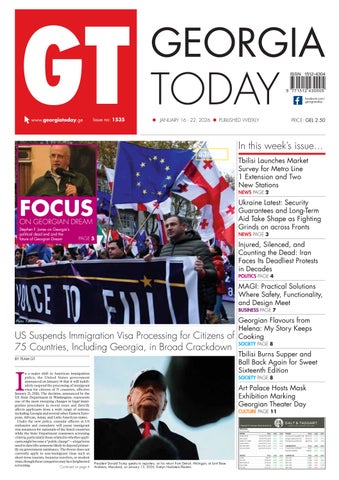
Georgian Flavours from Helena: My Story Keeps US Suspends Immigration Visa Processing for Citizens of Cooking Photo: Publika
75 Countries, Including Georgia, in Broad Crackdown BY TEAM GT
I
n a major shift in American immigration policy, the United States government announced on January 14 that it will indefinitely suspend the processing of immigrant visas for citizens of 75 countries, effective January 21, 2026. The decision, announced by the US State Department in Washington, represents one of the most sweeping changes to legal immigration procedures in recent years and directly affects applicants from a wide range of nations, including Georgia and several other Eastern European, African, Asian, and Latin American states. Under the new policy, consular officers at US embassies and consulates will pause immigrant visa issuances for nationals of the listed countries while the State Department reassesses screening criteria, particularly those related to whether applicants might become a “public charge”—a legal term used to describe someone likely to depend primarily on government assistance. The freeze does not currently apply to non-immigrant visas such as short-term tourists, business travelers, or student visas, though these categories may face heightened screening. Continued on page 4
SOCIETY PAGE 8
Tbilisi Burns Supper and Ball Back Again for Sweet Sixteenth Edition SOCIETY PAGE 8
Art Palace Hosts Mask Exhibition Marking Georgian Theater Day CULTURE PAGE 11 Prepared for Georgia Today Business by
DĂƌŬĞƚƐ Ɛ ŽĨ ϭϯͲ:ĂŶͲϮϬϮϲ
WƌŝĐĞ
ǁͬǁ
ŵͬŵ
^dK <^
WƌŝĐĞ
ǁͬǁ
ŵͬŵ
' KZ' ϬϰͬϮϲ
ϵϵ͘Ϯϰ ;zdD ϱ͘ϱϵйͿ
нϬ͕Ϭй
нϬ͕Ϯй
>ŝŽŶ &ŝŶĂŶĐĞ 'ƌŽƵƉ ; ' K >EͿ ' W ϵϯ͘ϱϬ
нϮ͕Ϯй
нϮ͕Ϯй
'Z /> ϬϲͬϮϴ
KE ^
ϵϰ͘ϳϬ ;zdD ϲ͘ϯϵйͿ
нϬ͕Ϯй
нϬ͕ϰй
'ĞŽƌŐŝĂ ĂƉŝƚĂů ; ' K >EͿ
' W ϯϭ͘ϰϬ
нϭ͕ϲй
нϱ͕ϰй
d ĂŶŬ 'ƌŽƵƉ ;d ' >EͿ
' W ϯϵ͘ϮϬ
ͲϬ͕ϯй
ͲϮ͕Ϭй
WƌŝĐĞ
ǁͬǁ
ŵͬŵ
ϲϱ͕ϰϳ
нϳ͕ϵй
нϳ͕ϭй
ϰ ϱϴϲ͕ϱϮ
нϮ͕Ϭй
нϲ͕ϳй
' '' ϵ ϭͬϮ W ZW
ϭϬϰ͘ϯϵ ;zdD ϴ͘ϴϯйͿ
нϬ͕Ϭй
ͲϬ͕Ϭй
^><Z , ϬϵͬϯϬ
ϭϬϭ͘ϬϮ ;zdD ϳ͘ϮϯйͿ
нϬ͕ϭй
нϬ͕ϯй
d ϴ͘ϴϵϰ W ZW
ϭϬϬ͘ϱϮ ;zdD ϭϭ͘ϭϭйͿ
нϬ͕Ϭй
ͲϬ͕ϭй
KDDK /d/ ^
d ϭϬ ϭͬϰ W ZW
ϭϬϲ͘ϳϴ ;zdD ϵ͘ϬϮйͿ
нϬ͕ϱй
нϭ͕ϭй
ƌƵĚĞ Kŝů͕ ƌĞŶƚ ;h^ΨͬďďůͿ 'ŽůĚ ^ƉŽƚ ;h^ΨͬK Ϳ
/E / ^
President Donald Trump speaks to reporters, on his return from Detroit, Michigan, at Joint Base Andrews, Maryland, on January 13, 2026. Evelyn Hockstein/Reuters
WƌŝĐĞ
ǁͬǁ
ŵͬŵ
hZZ E / ^
WƌŝĐĞ
ǁͬǁ
ŵͬŵ
^W ϱϬϬ
ϲ ϵϲϯ͕ϳϰ
нϬ͕ϯй
нϮ͕Ϭй
h^ ͬ ' >
Ϯ͕ϲϵϲϱ
нϬ͕ϭй
нϬ͕ϭй
&d^ ϮϱϬ
ϮϮ ϵϯϭ͕ϵϳ
нϬ͕ϲй
нϰ͕ϴй
hZ ͬ ' >
ϯ͕ϭϯϵϰ
ͲϬ͕ϯй
ͲϬ͕ϴй нϬ͕ϰй
Kt :KE ^ ϯϬ
ϰϵ ϭϵϭ͕ϵϵ
ͲϬ͕ϱй
нϭ͕ϱй
' W ͬ ' >
ϯ͕ϲϭϴϱ
ͲϬ͕ϲй
ZƵƐƐĞůů ϮϬϬϬ
Ϯ ϲϯϯ͕ϭϭ
нϭ͕ϵй
нϯ͕Ϯй
hZ ͬ h^
ϭ͕ϭϲϰϮ
ͲϬ͕ϰй
ͲϬ͕ϴй
&d^ ϭϬϬ
ϭϬ ϭϯϳ͕ϯϱ
нϬ͕ϭй
нϱ͕ϭй
' W ͬ h^
ϭ͕ϯϰϮϮ
ͲϬ͕ϲй
нϬ͕ϰй
2
NEWS
GEORGIA TODAY
JANUARY 16 - 22, 2026
Former Georgian Prime Minister Irakli Garibashvili Sentenced to Five Years in Prison, Fined 1 Million GEL
Photo of the missing dog. Photo: Dublin Live.
Rescued in Georgia, lost again: Search for a dog saved by Dublin couple BY MARIAM RAZMADZE
H
ailey, a dog rescued from dire conditions in Georgia by a Dublin couple has gone missing, prompting an appeal from her owner who says she cannot bear the thought of the animal returning to life on the streets. Klara Poleszuk and her partner, Ciaran, were travelling through Europe in June when they discovered four abandoned puppies on the outskirts of Tbilisi, Georgia’s capital. The animals were found inside a ditch near a derelict building, severely neglected and in critical condition.
All four puppies were suffering from dehydration, illness and malnutrition. Despite efforts to save them, three of the pups later died. One survived, becoming a symbol of what Poleszuk describes as a ‘miracle’ rescue. That surviving dog has now gone missing, dealing a heavy blow to the couple who say the entire purpose of the rescue was to give her a life away from danger and neglect. Poleszuk said she does not want Hailey’s story to end back on the streets, the same fate they believed they had helped her escape. Efforts are now in progress to locate the missing dog, as the couple appeals for help and information to ensure her safety and recovery.
Tbilisi Launches Market Survey for Metro Line 1 Extension and Two New Stations BY MARIAM RAZMADZE
T
he Tbilisi Transport Company has initiated an international market survey to assess the estimated cost of extending Metro Line 1 and building two new stations, a renewed effort to advance one of the capital’s largest transport infrastructure projects. The survey, published on the website of the Public Procurement Agency, covers a 5.2-kilometer extension of the metro network and is expected to place the project’s total cost in the hundreds of millions of US dollars. The planned expansion includes a 2.2-kilometer extension toward Gldani and a 3-kilometer extension toward Varketili. The project will be delivered under a Design-Build model under which the selected contractor will be responsible for both design and construction. The scope of work includes tunnels, station vestibules, escalator tunnels and installations, pas-
senger platforms and all related infrastructure suitable for five-car metro trains. Compared to an earlier market survey conducted in April 2025, which failed to attract sufficient interest, the current process introduces more flexible qualification requirements. Bidders or their subcontractors must now demonstrate completion of projects worth at least USD 50 million over the past three years, reduced from the previous USD 100 million threshold. In addition, participants must show experience in the design and construction of at least two metro lines or a minimum of ten metro stations, including escalator systems. Tbilisi Metro currently operates two lines comprising 23 stations over a total length of 27.3 kilometers. The Gldani– Varketili line includes 16 stations while the State University line consists of seven stations. The deadline for submitting responses to the market survey is February 27, 2025. Tbilisi City Hall has not yet issued an official statement regarding the next steps or the project timeline.
Georgia Makes Limited Progress on Anti-Money Laundering Safeguards, MONEYVAL Says BY TEAM GT
G
eorgia has made limited progress in strengthening its framework against money laundering and terrorist financing but still faces notable shortcomings, according to a follow-up report released Wednesday by MONEYVAL, the Council of Europe’s anti-money laundering monitoring body. The report, the fourth follow-up since Georgia’s mutual evaluation in September 2020, found some improvements in technical compliance with Financial Action Task Force (FATF) standards. However, MONEYVAL said the progress
was insufficient to upgrade Georgia’s ratings on targeted financial sanctions related to terrorism and terrorist financing, as well as proliferation financing. Georgia remains rated “partially compliant” with FATF Recommendations 6 and 7. The authorities did not seek reratings on other recommendations, the report said. Overall, out of 40 FATF recommendations, Georgia is rated compliant on seven, largely compliant on 24, partially compliant on eight, and non-compliant on one— relating to non-profit organisations. MONEYVAL noted that, in line with its rules of procedure, Georgia will no longer be subject to the fifth-round follow-up process, as the country’s next onsite mutual evaluation under the sixth round is scheduled for spring 2029.
Former Georgian Prime Minister Irakli Garibashvili. Source: REUTERS/Juan Medina
BY TEAM GT
F
ormer Georgian Prime Minister Irakli Garibashvili has been sentenced to five years in prison under a plea agreement with the Prosecutor’s Office of Georgia. In addition to the prison term, he was fined 1 million GEL, and funds obtained through criminal activity, including money seized during a search of his residence, will be confiscated and transferred to the state. According to the Prosecutor’s Office, Garibashvili admitted to committing the crime outlined in Part 3 of Article 194 of the Georgian Criminal Code and agreed to the terms of the plea agreement. The court has approved the agreement, formalizing the sentence
and associated penalties. Garibashvili’s case has attracted widespread attention in Georgia, as he is one of the country’s most prominent political figures to face serious financial crime allegations. Analysts and the public have closely followed the case, sparking debate about the scale and political context of anti-corruption efforts in Georgia. Garibashvili’s lawyer, Mikheil Shakulashvili, confirmed that his client has confessed, received a prison sentence, been fined, and had his vehicles confiscated. Garibashvili is currently being transferred to Rustavi Penitentiary No. 12. Shakulashvili added that items seized from Garibashvili’s residence included flash drives and $6.5 million, which have now been handed over to the state budget. The lawyer emphasized that Garibashvili did not testify against anyone and has no plans to do so. No additional charges
beyond the existing accusation have been discussed. Shakulashvili also clarified that the charges relate to money laundering and are not connected to Garibashvili’s official activities as Prime Minister. Regarding his business holdings, Shakulashvili stated that Garibashvili’s winery and factory will not be confiscated, noting that the investigation reviewed loan agreements showing that funds were used legitimately to purchase land, build a factory, and import and operate equipment. These loans continue to be repaid as scheduled. Additionally, none of the gold, watches, or other valuables seized during the investigation belonged to Garibashvili. Quoting Garibashvili, Shakulashvili said: “I work, I was the Prime Minister, but I have a separate business that I did not register, and that is why I received punishment.”
CENN: Guria Students Turn Innovation into Real-World Change Through EU-Backed “Green Guria” Ideathon BY TEAM GT
S
tudents from public schools across the Guria region are now seeing their innovative ideas brought to life, after winning teams from the Green Guria Ideathon began implementing their projects with real funding and community support. Held as part of the EU-funded “Green Guria – Supporting Local Democracy and Rural Development for Inclusive and Resilient Green Growth” project, the Ideathon aimed to promote problemsolving skills, project planning, and civic participation among young people in Guria’s Ozurgeti, Lanchkhuti, and Chokhatauri municipalities. The initiative, supported by the European Union, Global Platforms Georgia, and partners including the Young Pedagogues’ Union, engaged students from 22 schools and 24 teams who developed and pitched creative solutions to local social, environmental, and educational challenges. After rigorous evaluation by a professional jury, nine winning projects were selected for funding. Each winning school received a €1,000 grant to implement their idea, allowing students to move beyond the competition and into hands-on project execution. Winning themes reflect a broad range of community needs, from environmental sustainability and green technologies to education and rural tourism. Among the award-winning projects are: • Guturi Public School – natural habi-
Gurian schoolchildren. Source: CENN
tats project for landslide prevention • Chokhatauri Public School No. 1 – educational initiative Knowledge Guda • Lanchkhuti Public School No. 1 – natural science laboratory • Lanchkhuti Public School No. 3 – demonstration composting installation • Baileti Public School – preservation and revival of traditional weaving • City Hall Public School – Bike Energy, exploring sustainable energy generation • Daba Naruji Public School – Fog Garden green space innovation • Ozurgeti Public School No. 2 – Restart educational program • Ozurgeti Public School No. 4 – Stand Plan Guria community planning-focused effort
Organizers said the competition gave students not just funding, but mentorship and networking opportunities with local action groups and private sector partners to refine and develop their ideas. Schools now have three weeks to begin implementing their projects, encouraging environmental stewardship, community engagement, and practical skills among participants. The Green Guria project, running through December 2025, supports participatory local democracy, green growth, and inclusive rural development across Guria, aiming to empower youth, civil society, and vulnerable groups while improving economic and environmental outcomes.
NEWS
GEORGIA TODAY JANUARY 16 - 22, 2026
3
Ukraine Latest: Security Guarantees and Long-Term Aid Take Shape as Fighting Grinds on across Fronts COMPILED BY ANA DUMBADZE
T
he past week of the war followed a grimly familiar pattern—one that feels especially punishing in the depths of winter. Along the eastern and southern fronts, Russian and Ukrainian forces continued grinding infantry battles, while far from the trenches both sides escalated long-range strikes aimed at logistics, air defenses, and, most critically, energy infrastructure. As temperatures dropped, civilian hardship rose sharply. At the same time, diplomacy and foreign aid moved forward on parallel tracks, though neither slowed the pace of fighting. On the ground, the frontline barely shifted. Russian forces maintained steady pressure, particularly in Donetsk, where Moscow is still trying to claw out incremental gains around transport hubs and layered defensive positions. The fighting has relied less on dramatic breakthroughs and more on small assault units, heavy drone use, and persistent efforts to disrupt Ukrainian supply lines. These tactics have produced localized changes but no decisive operational collapse. Western and independent analysts continue to describe the war as deeply attritional, with drones playing an outsized role—not just in strikes and surveillance, but in making casualty evacuation and resupply increasingly dangerous. Progress, when it comes, is slow and costly in both manpower and equipment. The most consequential developments of the week came from the air. Overnight on January 12–13, Russia launched a major wave of missiles and drones across multiple regions of Ukraine, hitting both civilian sites and critical infrastructure,
including power generation facilities and substations. In the Kharkiv region, a strike hit a postal terminal, killing four civilians, according to Ukrainian officials and reporting summarized by analytical monitors. Ukrainian authorities said the attack combined ballistic missiles, cruise missiles, and a large drone swarm. Air defenses intercepted many of them, but not enough to prevent damage across numerous locations. Those strikes fed directly into the week’s defining civilian story: heat and power under strain in freezing weather. P resident Volodymyr Zelensky announced plans to declare a state of emergency in the energy sector, saying widespread damage required faster coordination, increased imports, and the rapid expansion of warming and charging centers. Kyiv and other cities faced rolling disruptions, and officials warned that repeated strikes—combined with subzero temperatures—were making repairs and stabilization increasingly difficult. Energy infrastructure was not just a strategic target but a daily source of hardship. Authorities reported significant outages after strikes on regional facilities, with crews racing to restore electricity and heating while warning that systems remained vulnerable. In Kryvyi Rih, local officials described a “massive” overnight drone attack that temporarily cut power to more than 45,000 subscribers and disrupted heating for hundreds of buildings. Repairs were completed within hours, and no casualties were reported in that incident, but it underscored how fragile basic services have become. Ukraine’s gas supply also came under scrutiny. Naftogaz leadership publicly pushed back against rumors of imminent gas restrictions, insisting that consum-
A residential building damaged after a Russian air strike in Kyiv, Jan. 9. Source: AP Photo/Efrem Lukatsky
ers would remain supplied despite repeated attacks on energy and gasrelated facilities. The statement highlighted Kyiv’s reliance on imports and emergency balancing to avoid the kind of widespread household rationing that Russian strikes appear designed to trigger. Ukraine, meanwhile, continued striking back. Kyiv maintained its campaign against Russian energy and logistics targets, aiming both to complicate Moscow’s war economy and to impose a sense of reciprocity for attacks on Ukrainian cities. In one widely reported case, a Ukrainian strike contributed to major power and water outages in Russia’s border city of Belgorod, leaving large numbers of residents without basic services in subfreezing weather. Separately, Ukrainian drone operations reportedly sparked a fire at an oil depot in Russia’s Volgograd region—part of a broader effort to hit fuel and refining infrastructure that Ukrainian officials link directly to Russia’s ability to sustain military operations. This strike-and-counterstrike pattern
continues to expand the war far beyond the trench lines. Russia’s long-range campaign increasingly blends missiles with massed drone waves designed to saturate air defenses and maximize system damage. Ukraine’s deep strikes focus on refineries, depots, and power-related sites that can create cascading economic and logistical effects. Analysts following these trends argue that Russia’s ability to deploy large numbers of relatively inexpensive drones has reshaped the battlefield, enabling sustained pressure on rear areas and making Ukrainian logistics and movement more dangerous. Civilian casualties remain difficult to verify in real time, but the week’s toll was clearly heavy. Ukrainian officials said four civilians were killed in the Kharkiv postal terminal strike. Earlier in the week, reporting on another large Russian barrage referenced fatalities in Kyiv as power and heating systems were damaged. The broader picture is bleak: recent international monitoring cited in reporting indicates that civilian casualties from strikes increased in 2025 com-
pared with previous years, reflecting the growing scale and destructiveness of long-range attacks. Alongside the violence, diplomacy continued. Zelensky said a bilateral security guarantees document with the United States was nearing completion and would require approval at the highest political level. He described it as central to postwar deterrence and to sustaining confidence as Russia continues missile and drone attacks. NATO Secretary General Mark Rutte, speaking in Brussels, echoed that focus, pointing to concrete discussions on robust security guarantees and signaling alignment between Europe and the US on readiness to provide them after any deal—language that suggests planning for a future settlement, even as battlefield dynamics show no sign of imminent de-escalation. European financial and military support also took a major step forward. The European Commission outlined a proposed €90 billion support loan for 2026– 2027, with roughly one-third earmarked for budget support and two-thirds for military needs. The goal is to keep Ukraine’s state functioning while funding defense procurement, reflecting Europe’s growing role in sustaining both the war effort and governmental resilience as the conflict drags into another winter. The United Kingdom announced a significant initiative as well. Under “Project Nightfall,” London plans to develop new ground-launched ballistic missiles to strengthen Ukraine’s deep-strike capabilities. The UK government said the concept targets a range beyond 500 kilometers with a substantial warhead, framing the effort as a response to continued Russian attacks and a way to bolster Ukraine’s deterrence and counterstrike options.
4
POLITICS
GEORGIA TODAY
JANUARY 16 - 22, 2026
Injured, Silenced, and Counting the Dead: Iran Faces Its Deadliest Protests in Decades BY TEAM GT
I
n the streets of Iran, grief and fear have become daily companions. Families mourn loved ones lost to bullets, hospitals overflow with the wounded, and citizens whisper through fractured communications to tell the world their suffering. Across the country, Iran is in the grip of its deadliest protests in decades, as a surge of anger over economic hardship and political repression meets a violent crackdown that has left over 2,500 dead. What began as demonstrations against soaring inflation and economic despair has escalated into an unprecedented confrontation with the state. Protesters in Tehran, Isfahan, Mashhad, and smaller cities have taken to the streets, demanding change, while Iranian authorities have responded with lethal force. Doctors and medical staff report seeing a deliberate pattern: security forces appear to be aiming at protesters’ heads and eyes. An ophthalmologist at a major Tehran hospital documented over 400 eye injuries caused by gunshots, leaving many permanently blind. “The wounds are unlike anything we’ve seen before,” one doctor told The Guard-
A protest in Iran. Source: Persian social media/euronews
ian. “These are not accidental. They are meant to maim, to terrify, to silence.” Hospitals are overwhelmed and doctors are struggling with shortages of medicine and medical supplies.
The death toll, reported by human rights activists, has now risen to at least 2,571, making these demonstrations the deadliest in Iran since the 1979 Islamic Revolution. Families trying to reach loved
ones after days of government-imposed communication blackouts describe desperate, fractured phone calls and frantic searches. The international response has been
intense. The United Kingdom condemned the “brutal killing” of protesters, while the United States sees rising tension in its rhetoric: former President Donald Trump has canceled all meetings with Iranian officials and encouraged protesters to “take over your institutions,” promising that “help is on the way,” without offering further details. Trump has also publicly entertained the possibility of military action, escalating fears of a wider conflict. Inside Iran, the government has framed the unrest as driven by foreign agents, signaling harsh reprisals for protesters, including fast-tracked trials and potential executions. Within this climate of fear, ordinary Iranians are documenting the crisis as best they can, using fleeting moments of connectivity to record stories of loss, resilience, and courage. From families shielding their children in bombed-out neighborhoods to young activists facing a grim choice between silence and defiance, the human cost of these protests is painfully tangible. While the death toll climbs, the protesters’ voices—often whispered over shattered phone lines or shouted through barricades—continue to demand what many in the country see as their most basic rights: safety, dignity, and a future free from fear.
US Suspends Immigration Visa Processing for Citizens of 75 Countries, Including Georgia, in Broad Crackdown Continued from page 1
Image source: AzerNews
US, Armenia Advance Strategic Transit Corridor Linking Azerbaijan to Nakhchivan BY TEAM GT
T
he United States and Armenia on Tuesday announced a framework for implementing a strategic transit corridor designed to boost regional trade and connectivity in the South Caucasus, marking a significant step forward following agreements reached at a White House peace summit in August. The announcement followed talks in Washington between US Secretary of State Marco Rubio and Armenian Foreign Minister Ararat Mirzoyan during which the sides reviewed progress on the corridor project and discussed broader avenues of US–Armenia cooperation, including regional stability, economic development, and infrastructure investment. The transit project, officially titled the Trump Route for International Peace and Prosperity (TRIPP), aims to connect mainland Azerbaijan with its Nakhchivan Autonomous Republic by passing through southern Armenia. The initiative is rooted in a declaration signed at the August White House Peace Summit by Armenian Prime Minister Nikol Pashinyan, Azerbaijani President Ilham Aliyev and US President Donald Trump.
Officials say the corridor is intended to facilitate the movement of goods and people while respecting Armenia’s sovereignty and jurisdiction, a point that has been central to political debates surrounding regional transit routes. The framework outlines initial steps for technical planning, security arrangements, and international oversight mechanisms, with the United States expected to play a coordinating and guarantor role. The project builds on long-standing discussions over reopening transport links in the South Caucasus following decades of conflict between Armenia and Azerbaijan. Proponents argue that improved connectivity could unlock economic growth, reduce regional isolation, and serve as a confidence-building measure between former adversaries. Critics, however, have raised concerns about security, political leverage, and the broader geopolitical implications of the route. US officials have framed TRIPP as part of a wider effort to promote peace, economic integration, and stability in the region, while Armenian authorities have emphasized that any transit arrangements must align with national law and regional agreements. Further negotiations and technical consultations are expected in the coming months as the parties move from political declarations toward implementation.
The policy applies to immigrants who would be on a path toward US lawful permanent residency and eventual citizenship. Officials stated that the suspension will remain in place “until the United States can ensure that new immigrants will not extract wealth from the American people”—a rationale grounded in concerns about public assistance use, labor market impacts, and national economic priorities. Countries covered by the visa processing suspension include nations from all inhabited continents, several of which have long histories of migration links with the United States. Among the affected are Afghanistan, Armenia, Azerbaijan, Brazil, Egypt, Iran, Nigeria, Russia, Somalia, Thailand, and Yemen, as well as Georgia and numerous others across Europe, Africa, Asia, and Latin America. Dual nationals holding passports from non-listed countries may still qualify for visas, and limited exceptions may apply in rare cases where applicants are adjudged to serve clear national interests of the United States. The announcement intensifies President Donald Trump’s immigration agenda, which has emphasized stricter border controls, enhanced vetting, and reduced avenues for legal immigration since he returned to the presidency in 2025. The new suspension builds on earlier expansions of travel bans and eligibility criteria for visas that have already resulted in tens of thousands of visa revocations and more stringent review standards. The visa freeze is rooted in long-standing provisions of US immigration law that permit consular officers to deny visas to individuals deemed likely to become a public charge. However, the current administration’s interpretation expands the factors that may be considered in such determinations, including income potential, health status, family composition, and likelihood of future
reliance on public benefits. The reassessment of these criteria is central to the policy, though the exact timeline for resuming normal processing remains unclear. The move has been met with mixed reactions both domestically and internationally. Supporters of the policy argue that it is a necessary step to ensure that immigrants entering the United States are financially self-sufficient and will not burden public systems. They contend that tightening eligibility will protect the American labor market and safeguard social services. Critics, however, see the decision as a broadly exclusionary strategy that undermines longstanding US immigration traditions and could harm diplomatic relations with countries impacted by the suspension. Experts have pointed out that immigrants—especially those who legally enter through established paths—tend to contribute robustly to the US economy and are statistically less likely to draw public benefits than native-born citizens. For prospective immigrants from Georgia, the suspension means that individuals planning to apply for US green cards will see their applications halted indefinitely unless they qualify under specific exemptions. This pause can affect family reunification cases, employment-based immigration pathways, and other longterm relocation plans. Advocates for immigrants in Georgia and other affected countries are urging US officials to clarify the criteria and timelines, emphasizing the hardship that prolonged uncertainty imposes on families and communities that have waited years for visa processing. Internationally, the broad scope of the policy has drawn concerns from governments whose citizens are affected. Several foreign ministries have stated they are seeking clarification from US diplomatic posts on how the suspension will be implemented on the ground and what, if any, opportunities exist for appeal or
review. Observers note that while the suspension does not explicitly apply to refugees, asylum seekers, or temporary visa categories, the overall ambivalence surrounding US immigration policy may deter travel and investment interest in the near term. In the days following the announcement, legal advocacy groups in the United States indicated they may challenge aspects of the policy, particularly its application to individuals who already have approved visa petitions or who have already undergone extensive background checks. These groups argue that the indefinite nature of the pause raises due-process questions and could contravene established international norms on migration and family rights, though legal scholars caution that administrative policies governing visas traditionally fall within wide executive discretion unless specific constitutional rights can be shown to be violated. The January 21 start date for the policy will see immediate effects on consular operations worldwide, with US embassies and consulates instructing officers not to schedule or complete immigrant visa interviews for nationals of the 75 listed countries. Applicants with visas already issued may still travel to the United States, but those awaiting adjudication or visa printing will find their cases delayed, with little indication yet of when normal processing might resume. The change underscores the Trump administration’s ongoing effort to reshape US immigration policy in a more restrictive direction, a trend that has expanded beyond border security and asylum rules into the broader landscape of legal migration and family-based immigration. Whether this policy will endure legal and diplomatic scrutiny, and how it might ultimately affect global migration patterns, remains a central question for both American policymakers and the millions of would-be immigrants whose futures now hang in uncertainty.
POLITICS
GEORGIA TODAY JANUARY 16 - 22, 2026
5
Stephen F. Jones on Georgia’s Political Dead End and the Future of Georgian Dream ize and mobilize in the regions, or to promote policies and ideas—particularly on economic and social issues—that resonate with the broader population. These are strategies the opposition has failed to develop. There is no real connection between the protest movement and the political parties, and some form of union between the two is necessary for things to work. That is not happening either.
INTERVIEW BY VAZHA TAVBERIDZE
I
n an interview conducted by Radio Free Europe’s Georgian Service, Stephen F. Jones—an expert on post-Communist societies in the former Soviet Union and Eastern Europe, and Chair of Russian and Eurasian Studies at Mount Holyoke College— offers a candid assessment of Georgia’s trajectory in 2025. He discusses the Georgian Dream government’s growing isolation from the West, the absence of a long-term political and economic strategy, the sustainability of authoritarian rule, and the limits of protest as the country navigates an increasingly uncertain future.
LET’S LOOK BACK AT 2025. WHAT DID IT BRING TO GEORGIA? It has been clear since 2022 that the Georgian Dream government has been moving in a different direction. In 2025, this simply intensified: Georgia’s isolation deepened in terms of its relationship with Western countries and the European Union. When I look at it, it seems that the Georgian government is heading toward something of a dead end. It doesn’t appear to have much of a strategy. I haven’t seen any strategy in 2025 beyond closing down civic space and continuing to broaden its relationships with nonWestern countries. This is the direction of Georgia’s foreign policy because it essentially has no other option right now.
IT MIGHT LOOK LIKE A DEAD END FROM THE PERSPECTIVE OF GEORGIA’S PRO-WESTERN ASPIRATIONS. BUT IS IT STILL A DEAD END IF THEY ARE WILLINGLY MOVING IN THAT DIRECTION? AND HOW FAR CAN THEY GO? You’re absolutely right. There are arguments to be made that Georgia—whether under Georgian Dream or any other government—should be expanding its relations with all countries. Unfortunately, the European Union has proven insufficiently supportive of Georgian society. Economically, it is damaging for Georgia that relations with Western countries have diminished, and in particular, the cost of ending the strategic partnership with the United States will have an adverse impact on Georgia’s prosperity. Now, the problem with “talking to everyone,” so to speak, is that this has always been the case for Georgia. It is a small country and historically has had to navigate between far larger powers, often compromising and negotiating with countries it would rather not have been allied with, but had no other choice. The problem now is that Georgia is making itself economically vulnerable. I’m not convinced that countries like China or the Central Asian states—if Georgia is looking to them for economic relations— are reliable, nor are some Arab countries, for that matter. More often than not, these kinds of loans and support come with strings attached, particularly with China. Georgia could quite easily find itself heavily indebted to China, and being indebted to China is a very different ordeal from being indebted to the EU.
HAD YOU PRESENTED THESE ARGUMENTS TO PM KOBAKHIDZE, I IMAGINE HE’D POINT TO THE DATA THEY’VE BEEN FLAUNTING AND SAY, “NO, YOU’RE WRONG, WE ARE ACTUALLY DOING WELL ECONOMICALLY.” WHAT WOULD BE YOUR COUNTERARGUMENT? I would not agree that the figures coming out of Georgian Dream point to a healthy economy. Much of the growth they boast about is dependent on illicit
In the short run, this may work. In the long term, I don’t see this government as sustainable. trade with Russia and helping it circumvent the sanctions regime. It’s impressive to promote six or seven percent GDP growth, but that’s not the real economy. This economy is heavily reliant on foreign direct investment—essentially injections of capital. FDI is very targeted and more often than not does not benefit the broader economic situation for ordinary Georgians. Ordinary Georgians are not going to be fooled by these GDP figures. And GDP is a very weak measure of economic health anyway. If the Georgian economy is to progress and improve—which is what government accountability means, working for its citizens—it must have a medium- and long-term economic strategy. None of that seems to exist under Georgian Dream.
IN THE 18 YEARS THAT GEORGIAN DREAM HAS BEEN IN POWER, HOW OFTEN DID YOU GET THE IMPRESSION THAT THESE WERE PEOPLE WITH A LONG-TERM STRATEGY OR SOME GRAND DESIGN IN MIND, RATHER THAN DAY-TO-DAY SURVIVAL? Well, I was never supportive of Saakashvili—well, initially I was, for the first years after the Rose Revolution. But to be fair to Saakashvili, history will likely show that he did have a vision. Of course, he was authoritarian, and even more so in his second term. His policies, such as education reform, were sometimes superficial and didn’t stimulate economic growth in the way he had hoped, although things did change dramatically. Georgian Dream came to power in opposition to Saakashvili—that was essentially its program. Everyone, quite naively, thought Ivanishvili would use his wealth to usher in some form of economic prosperity for Georgia. Instead, they continued Saakashvili’s policy of encouraging foreign direct investment. Looking at the statistics on poverty reduction, despite their claims, I don’t see any significant improvement. The same goes for unemployment. I can’t see a single shred of even the most basic strategy for what a small, middle-income country in the Caucasus should do to develop its economy beyond tourism— and it has to be something beyond that to fit into the global economy. As far as I can see, it has turned into a mafia economy. Businesses are clearly afraid to speak out. They want to keep close ties with the Georgian Dream government because there is no other way to survive.
THAT ALSO GIVES THEM LEVERAGE OVER EMPLOYMENT. ANYONE WHO WANTS A JOB HAD BETTER STAY QUIET. IF GD’S GOAL IS TO STAY IN POWER AS LONG AS POSSIBLE, IT SEEMS TO BE WORKING FOR NOW. Let’s see. There are classic definitions of how governments remain in power. You need some degree of legitimacy. Georgian Dream has that—it has support, particularly in the regions. It controls the executive branch and the police, which is extremely important. But it is a government isolated from the population. It doesn’t reflect people’s needs. It
WHAT DOES THAT LEAVE US WITH?
Stephen F. Jones. Source: caucasusstudies
sustains itself largely by providing subsidies in the regions, where people are afraid to raise their voices or oppose Georgian Dream because they are dependent on these programs. In the short run, this may work. In the long term, I don’t see this government as sustainable. It survives largely through intimidation and force, and that’s what it relies on, along with the economic mechanisms I mentioned earlier. You have a small group of politicians with no real opposition sitting in parliament, totally isolated. There’s no attempt to broaden legitimacy. They are simply holding on to power using the levers they control—not moving forward.
WE HAVE AT LEAST TWO EXAMPLES OF AUTHORITARIAN REGIMES IN THE REGION. IF GD WERE TO FOLLOW, FOR EXAMPLE, THE AZERBAIJANI MODEL—A GEORGIAN VERSION—WOULD THEY BE DESTINED TO FAIL? Good point. And we should understand that the Georgian Dream government is not stupid. It looks at other models and learns lessons from authoritarian regimes. But despite its control over security structures and finances, Georgia remains a very volatile environment that could spark some form of revolt. The protests have been going on for over a year now, and so far no revolution has happened. You could argue that this is optimism— perhaps empty optimism. But one of the major problems in dealing with this government is the opposition. There is no effective political party capable of mobilizing support against Georgian Dream. That’s a serious issue. When I was in Georgia, I wanted to show solidarity, of course. My sense from talking to people was that they didn’t know what to do next. There was no strategy there either. People need to understand how this government operates and how to adapt— to rethink and change their strategies. Taking to the streets is important and often inspiring, and it does demonstrate significant resistance potential. But it has to be thought through, modernized, and organized. The lack of hierarchy and leadership is one of the key weaknesses.
THE LAWS ARE BECOMING INCREASINGLY DRACONIAN. MORE PEOPLE ARE BEING JAILED, AND IT HAS BECOME EXPONENTIALLY EASIER TO
JAIL THEM. HOW BLEAK DOES THE FUTURE OF THE PROTESTS LOOK RIGHT NOW? It looks quite bad. Especially given that the Georgian Dream government—again, not stupid—has learned through trial and error how to manage crowds. At this point, it is more likely that any breakthrough will have to come from within Georgian Dream itself. This is often how regimes fall—not necessarily through grassroots action alone, although that is crucial, but through cracks and fissures from within. We can already see signs of this within Georgian Dream—Garibashvili being jailed, for example. There are clearly clans and groups competing for influence and fighting each other. These are early signs, but as Trotsky said, the tops of the trees are already swaying.
YOU CAN LOOK AT THE GARIBASHVILI CASE AS A SYMPTOM OF INFIGHTING, OR YOU CAN LOOK AT THIS ENTIRE ORDEAL AS THE GD TOP BRASS CLEANSING ITSELF. That’s true. Transitions like this are unpredictable. Revolution is always on a knife’s edge. A word that students of revolution often use is Fortuna—meaning it’s not something you can necessarily plan. Unfortunately, we seem to be in a position where we are waiting for some event, some spark, and it will probably come through a mistake Georgian Dream makes as it becomes increasingly isolated and paranoid, and starts listening only to itself. This happens in many cases when a government becomes isolated and inward-looking. It may seem in control right now, but in the longer term—given the lack of an economic strategy and its growing isolation on both foreign and domestic fronts—this looks unsustainable.
LET’S TALK ABOUT THE OPPOSITION. YOU’RE NOT ALONE IN PUTTING THE BLAME AT THEIR DOOR. HOW LARGE IS THAT BURDEN, AND WHAT COULD THEY REALISTICALLY HAVE DONE DIFFERENTLY? It’s a deeper problem. The toxic nature of UNM is clearly an issue. One of the major parties is unpopular with the population, and the others have been unable to unite around a single strategy, despite Zurabishvili’s attempts to bring everyone together. That failed. But this is not just a problem of today. Georgian political parties have long failed to organ-
Obviously, the protest movement needs to strategize more effectively and adapt to the authoritarian methods used by Georgian Dream. As for the political opposition, it is largely discredited. The fact that Ivanishvili holds such enormous power and wealth should not, in itself, result in an opposition that cannot organize effectively. They do have some resources, even if they are at a great disadvantage. This raises questions about leadership within the opposition parties, and about whether there is political space for a new party—though that would probably not work. It is a position of despair. There is no united voice connecting with Georgian citizens on key issues such as unemployment, prices, and other social problems. It’s a conundrum. I’m not sure anyone has clear solutions for the next step. This is also a long-term historical problem, rooted in party fragmentation and their weak position in Georgian society. It may be time for a degree of economic populism from the opposition. That may be the strategy that needs to be adopted. When facing an authoritarian regime that controls all the levers of power, you have to consider tactics that may not fit neatly within liberal-democratic frameworks. You have to find ways to reach broader layers of the population. You cannot rely solely on demonstrations.
LET’S LOOK AT WESTERN PRESSURE ON GD. SANCTIONS, ENGAGEMENT, ATTEMPTS TO BRING THEM BACK INTO THE FOLD—HAS THE WEST DONE ENOUGH? WHAT COULD IT HAVE DONE BUT DIDN’T? WHAT OPTIONS REMAIN? The EU's own organizational structure in terms of the need for full agreement among, you know, 27 different countries meant Hungary and Slovakia have had an outsized role when it comes to Georgia. And they haven’t been able to do much of what they wanted to do. There are ways around that, I believe, but you still have this big problem of needing consensus from Budapest and Bratislava. I don't think they've done enough, but I also don't really know what else they could do in terms of any sort of economic policy vis a vis Georgia. It's more or less a problem for the EU. And Georgian Dream is doing its best to create a negative image for itself, making it easier for the EU to say, well, we’ve offered to help, they aren’t interested. It’s their problem. And as for the United states, I think the agenda so full at the moment that there is not much space for Georgia. We’re facing our own problems, Trump is focused on things like Venezuela, Iran and getting a deal with Russia on Ukraine. Georgia is not on the horizon. You can't expect any systematic attention to Georgia from Trump, and he dominates foreign policy in the State Department. There are people in the State Department that are still working on Georgia. There is a Georgia desk there. But how do you get something on the President's desk that will draw his attention? He did obviously deal with the Armenian and the Azerbaijani issue but he's already forgotten about that. He can't even pronounce Azerbaijan properly. So it’s an extraordinary turnaround in the trajectory, historically, and to a large part of GD’s policies, of where Georgia has been on Washington’s “desks” in the last decades and where it is now.
6
BUSINESS
GEORGIA TODAY
JANUARY 16 - 22, 2026
Notes on the Georgian Economic System, and Security and Beyond. Part 2 ANALYSIS BY VICTOR KIPIANI, GEOCASE CHAIRMAN
T
he old economic (and not only economic!) order has come to an end, and any effort to revive it appears futile, at least for now and from today’s perspective. This statement inevitably brings another major question to the forefront: what type of economic system is truly effective both in overcoming accumulated challenges and in ensuring forward progress? Here too, operating with old “isms” and classifications is likely of little use. The decisive factor is rather the structure of relationships that helps us achieve tangible results. From this standpoint, it is evident that approaches in economics are converging, moving closer to one another, and, even if a precise “golden mean” has not yet been reached, there is at least a clear movement in that direction. Finding the right answer to this question is particularly important for us, because in designing a sound national economic system we must “catch several rabbits at once,” namely: • through the management of economic security, strengthen national security; • be able to manage ongoing internal and external economic crises; • activate a broad social compromise on key economic and social issues; and, at the same time, • move forward and modernize without losing the necessary pace. To accomplish these and other objectives, we must clarify our positions on a number of issues, including protectionism in economic policy and the role of the state, both of which, clearly, are acceptable within reasonable limits. From the same perspective, it is also necessary to reconsider to what extent capitalism itself helps us achieve the above goals. It should be noted that capitalism does not equate to a dogmatic or conservative approach. On the contrary, under capitalism, economic thought is in constant motion, searching for new directions of development and therefore does not imply stasis, or, as some would call it, “stability.” In general, what we are witnessing today is a critique of the previously dominant economic neoliberalism, as well as the rejection of a number of its principles. In particular, the supposed benefits of unlimited deregulation have become a subject of serious debate, as have the self-regulation of trade and supply chains, the complete independence of central banks, the disregard for state borders, and so on. These and other processes have largely contributed to the outflow of industrial potential from the First World to the Third, while also
Representing the global economy. Image source: brookings
posing new challenges for compact countries like ours in securing a proper place in the new global economic redistribution. Another defining feature of these processes has been the diminishing role of the state under laissez-faire relations, the ideology of the free market, an economy without state intervention, and the muting of its voice. This, in turn, has significantly fueled the challenges that led to the emergence of the so-called polycrisis, the multiplicity and simultaneity of crises, worldwide. Accordingly, the existing economic system became outdated, failed to withstand pressure, and broke down, thereby accelerating the time for change, reformatting, and the emergence of something new. From the perspective of Georgian national security, another lesson produced by global experience deserves particular attention. Specifically, practically unrestrained market instincts, which not only reshaped the balance of power between geopolitical and geoeconomic centers, have also led to a significant increase in inequality within societies. This, in turn, contributes to the rise of populism, radicalism, and extremism in domestic political life, all of which are directly linked to the resilience of security systems. It has become increasingly evident that continuing life as before is no longer possible, while cosmetic changes would only further aggravate the systemic crisis. It should also be noted that the alternative which is sometimes presented as a healthy replacement for harmful obsolescence represents yet another risky experiment. This alternative is essentially characterized by the politicization of the
economic market, whereas one of neoliberalism’s main dogmas was the maximum separation of politics from the economy. For greater clarity, a clear example of the politicization of the economy at this stage is the United States under the Trump administration, tightening of tariffs, interference in business processes, state acquisition of shares in private companies, and so on. However, fairness requires noting that the politicization of the American economy, in the form of economic autarky, had already begun during Biden’s presidency through the adoption of protectionist legislation aimed at infrastructure development. Europe is also attempting to develop along this line, although it is hindered by the problems briefly mentioned in the second part. The current situation has one major advantage: the dismantling of the old creates a qualitative opportunity to build something new. Naturally, time will show how fully and flawlessly this opportunity will be used. What is clear, however, is that within the mix of existing trends Georgia must develop its own optimal Georgian version of global “best practices,” one that suits us, benefits us, and serves us. When discussing trends in the contemporary economy, one clearly discernible reality stands out: the growing voice of the state in economic processes, its particular “return” or comeback to key economic matters. In practice, we are dealing with a new version of étatism, associated with the state’s expanding control over the economic rights and status of both ordinary citizens and business entities. This process, which, among other things, reso-
nates with economic autarky and the modern revival of nationalism, is still in a phase of development. This also means that a new equilibrium between, on the one hand, the state’s defining role in the economy and, on the other hand, a free market economy has yet to be clearly identified. Yet, the above-mentioned “return” requires an especially delicate approach. It is evident that, under today’s challenges, it would be practically reckless for the state to renounce its rightful place in the economy, just as stepping aside would amount to irresponsibility, since it would only deepen existing challenges. At the same time, the delicacy of the issue lies precisely in ensuring that the foundations of the market economy, its complex fabric, are not undermined; that human talent and labor are properly valued; and that the development and modernization of the state are actively supported. Clearly, addressing this complexity requires a high-order art, namely, a statesmanlike approach and way of thinking in economic policy. At the level of framework principles, such state-oriented thinking implies the following: 1. Clear, economically reciprocal relations with other states and non-state actors. One must clearly understand “what you give” and what becomes “yours” as a result of that exchange; 2. A correct understanding of the dynamics between government and business. Here, it must be fully recognized that the primary indicator of business success is profit. Accordingly, business interests and efforts are primarily directed toward maximizing profit; 3. Given this clear profit orientation of
business, the establishment by the state of appropriate incentive-based legislative frameworks. Their purpose is to bring the government’s policy agenda and business’s clearly understood market logic as close to each other as possible, thereby jointly promoting publicstate development. From this perspective, legislation should define rules of behavior for business entities so clearly that acting otherwise would simply not be in their interest. With the caveat that we are already operating under a new version of étatism, the role of the state, beyond the formulation and implementation of economic security policy, extends to the execution of key programs essential to national development. In my view, these programs should be directly and purposefully targeted at such segments as: (a) Diversification and intensification of trade; (b) Incentives and facilitation for attracting investment; (c) Issues related to external assistance. It is evident that, for a country in Georgia’s position, a development-oriented, coordinating role of the state would facilitate both leapfrogging and predictable progress simultaneously. I would further add that such state activism would have a contagious effect, both on the technocratic elite and on foreign partners, encouraging their more active participation in the country’s economy. As for the involvement of foreign partners, this could well take the form of an analogue to the so-called “Marshall Plan.” It should also be taken into account that any such program is largely linked to geopolitical affiliation, as was the case with Japan, South Korea, and Taiwan: all three cases formed part of the United States’ strategic approach in East Asia. It is noteworthy that globally, between USD 5 and 7 trillion annually, also representing approximately 5–7 percent of global GDP, is required to achieve sustainable development. Of this amount, an additional USD 4 trillion is needed by developing economies alone. Somehow, we must position ourselves among the recipients of these funds, and, ideally, among the frontrunners. Practice and experience also demonstrate that merely receiving funds is not sufficient for development-oriented national progress. It is precisely in such circumstances that the role of the state is, alongside attracting financial resources, to be able to: 1. Facilitate necessary social transformation; 2. Maintain commitment to long-term objectives; 3. Make difficult choices; 4. Enable breakthroughs based on knowledge and technology; 5. Ensure so-called “blended” financing, i.e., leveraging funds through a combination of loans, public–private partnerships, grants, and other sources.
PM Kobakhidze, UAE President Discuss Investment and Bilateral Cooperation BY TEAM GT
G
eorgian Prime Minister Irakli Kobakhidze met with the President of the United Arab Emirates, Sheikh Mohamed bin Zayed Al Nahyan, during his visit to Abu Dhabi. The Administration of the Government of Georgia announced that the meeting focused on the positive dynamics of bilateral relations between Georgia and the United Arab Emirates, underpinned by close political dialogue and growing
economic cooperation. In this context, particular emphasis was placed on the significance of Sheikh Mohamed bin Zayed Al Nahyan’s official visit to Georgia last year, which was described as a key milestone in further strengthening ties between the two countries. The sides also discussed opportunities to deepen cooperation in trade, economic, and investment sectors. Special attention was drawn to the historic $6.6 billion investment by the UAE-based company Eagle Hills in Georgia, which represents one of the largest foreign direct investments in the country’s his-
tory. The importance of the Tbilisi Dry Port project, implemented with UAE investment, was also highlighted, alongside the successful operations of other major Emirati investment companies in Georgia. The meeting took place within the framework of Prime Minister Kobakhidze’s participation in the Abu Dhabi Sustainability Week Summit, a global platform focused on sustainable development, clean energy, and innovation. The meeting was attended by Georgian Foreign Minister Maka Bochorishvili, Minister of Economy and Sustainable Development Mariam Kvrivishvili, Min-
Image: Government Administration
ister of Environmental Protection and Agriculture David Songulashvili, Minister of Justice Paata Salia, and Head of
the Government Administration Levan Zhorzholiani, the Government Administration said.
BUSINESS
GEORGIA TODAY JANUARY 16 - 22, 2026
7
MAGI: Practical Solutions Where Safety, Functionality, and Design Meet solutions were virtually non-existent in Georgia, seeing heating systems often left exposed to rain, frost, and mechanical damage, while visually disrupting residential and commercial spaces. MAGI approached the issue holistically—combining safety, durability, and design. The company’s cabinets are multifunctional: they can be used both as storage spaces and as protective enclosures for heating boilers and air-conditioning units. Special ventilation solutions, including grille and louver (“jalousie”) systems, ensure proper airflow, while shielding equipment from external damage.
QUALITY WITHOUT COMPROMISE Quality lies at the core of MAGI’s production philosophy. The company uses high-grade stainless metal, creating hermetically sealed, thermo-resistant cabinets designed to withstand extreme temperatures and humidity. A particularly important aspect of durability is MAGI’s painting process. Cabinets are coated using a special industrial system at 200°C, ensuring long-term resistance to environmental factors. “This technology guarantees that the cabinet maintains its original appearance for at least 15 years,” notes Dartsimelia. Such attention to detail positions MAGI products not as temporary fixes, but as long-term investments for homeowners, developers, and commercial clients alike.
PRODUCTION CAPACITY AND MARKET LEADERSHIP Nino Dartsimelia, General Manager of MAGI
BY ANA DUMBADZE
I
n today’s construction and renovation landscape, technical systems are no longer hidden out of sight: they are part of everyday living spaces. Heating boilers, airconditioning units, and utility equipment must be protected from external factors while remaining safe, accessible, and visually appealing. This is precisely where MAGI has established its expertise on the Georgian market. Operating since 2006, MAGI has become a trusted name in the production of thermo-resistant metal cabinets designed
to protect heating boilers and technical aggregates in all weather conditions, particularly during harsh winter temperatures. Nino Dartsimelia, General Manager of MAGI, notes that the company was founded in response to a clear and growing need. “We offer our customers an alternative and reliable solution for protecting heating boilers in any weather condition, especially during winter frost. At the same time, our products help make balconies and utility spaces more aesthetic and functional,” Dartsimelia explains.
IDENTIFYING A REAL MARKET NEED When MAGI entered the market, such
MAGI was the first company in Georgia to begin manufacturing this type of product locally, within its own production facilities. Today, the company operates four factories in Tbilisi and one in Batumi, a scale that allows it to meet the growing demand efficiently. Over the years, MAGI has signed contracts with numerous large and wellknown construction companies, further strengthening its position as a reliable industrial partner in the sector.
TAILORED SERVICE AND A CUSTOMERCENTERED APPROACH Beyond manufacturing, MAGI places strong emphasis on customer service and customization. Clients can contact the company via Facebook, Instagram, or direct phone lines. Once an order is initiated, a professional measurer visits the site—free of charge—to take precise measurements and discuss every detail with the client. Design elements such as size, layout, shelving, color, and overall configuration are agreed upon on-site. Once the order is finalized, production is completed within one week, after which MAGI’s installation team delivers and installs the cabinet. “Our main goal is for every customer to be satisfied with both the service and the quality,” says Dartsimelia. “This is the result of years of experience and tireless work, and it is what has brought us here and what continues to drive our growth.”
LOOKING TO THE FUTURE MAGI’s ambitions extend far beyond its current product line. The company has recently invested in modern, high-tech equipment, which is already installed and currently undergoing testing. “Very soon, we will be able to offer new products and solutions to our customers,” Dartsimelia reveals. “With these new technologies, our capabilities will expand—we will not be limited only to balcony cabinets.” The new equipment will simplify production processes, further improve quality, and significantly reduce delivery times. Most importantly, it will allow MAGI to introduce innovative solutions tailored to the evolving needs of its loyal customers.
A BRAND BUILT ON RELIABILITY With nearly two decades of experience, MAGI stands as a clear example of how local production, technical expertise, and customer-focused thinking can create lasting success. By continuously investing in quality, innovation, and service, the
company has secured its place as a dependable partner for both residential and commercial projects across Georgia. As MAGI continues to grow and diversify, its core philosophy remains unchanged: practical solutions where safety, functionality, and design meet.
8
SOCIETY
GEORGIA TODAY
JANUARY 16 - 22, 2026
Georgian Flavours from Helena: My Story Keeps Cooking
Georgian Flavours from Helena, on sale in Prospero's Book Shop, Tbilisi
BLOG BY HELENA BEDWELL
M
y fourth book is out — Georgian Flavours from Helena: Out Again — and it feels only right to return to the name that started it all. Georgian Flavours from Helena marked the debut of my very first cookbook, a name my readers instantly loved. So did I. It stood for simplicity, wit, authenticity, and recipes made with heart — for those who miss Georgian flavours, who crave them. The success of my first and second books, including my vegan and vegetarian editions, gave me the confidence to experiment further in my kitchen. This time, I pushed Georgian cuisine into new territory: gluten-free and lactose-free. And yes, it worked! Whether you’re in love with Georgia
or in love with a Georgian, food is what binds it all together. For most visitors, Georgian food becomes the most unforgettable experience of their journey. People often ask how those unique flavours and textures can be recreated back home. How do you explain to your family, your grandma, your friends, what you tasted in that tiny roadside restaurant? What was that dish called again? That’s exactly why I created this book. I know what it feels like to deeply miss something you once ate. This book helps you rediscover Georgian cooking using a mix of ingredients you may have carried home with you and those you can easily find in local supermarkets or farmers’ markets. If I managed to do this for 19 years, so can you. I left Georgia in 1998 and have been travelling the world ever since. No matter where I lived, whenever I cooked for family or guests, the request was always the same: “Can you make something Geor-
gian?” It wasn’t always easy. Cheese turned watery, garlic paste failed, flavours felt off. But with the tricks I learned from my family, I adapted. I substituted. I improvised. And slowly, I made it work. Good ingredients matter — but knowing how to work with what you have matters even more. That’s what I teach in my books. Many people assume Georgia is a meatheavy country, but historically that’s not true. Meat was reserved for celebrations and religious festivals. As a vegetarian myself, I love transforming famous Georgian meat dishes into vegetarian wonders. This book brings vegetarian and meat dishes together in harmony — because Georgian food is about sharing, not dividing. I’m the woman who made random British people in Suffolk and Norfolk fall in love with mchadi and khachapuri. I promise — you can do it too. My love for cooking comes from my family. From Vani, the land of legends, where Jason once came in search of the Golden Fleece. And from my Aunt Medea — the first feminist I ever knew. She worked full-time, yet kept her home warm, welcoming, and alive with food. I still remember her wiping flour from her ancient cookbook with her sleeve, children shouting for recipes, the smell of cheese bread baking on clay stones, preserves bubbling away, flour dust everywhere. Georgian kitchens were never tidy — they were alive. My father Tamaz was always busy, but whenever he had time, he was in the kitchen too, inventing dishes for friends. Our table was always ready, easily extended, waiting for guests. Georgian food has never been just about what’s on the plate — it’s about people, togetherness, bread and cheese shared, stories told, and always a reason to raise a glass. And now, it’s time for Georgian cooking to move forward.
My books are modern versions of Georgian cuisine. It’s time to modernise the way we cook. Georgia deserves to be part of the modern world. Fifteen-minute recipes, easy substitutions, flexible ingredients — these are no longer luxuries, they are necessities. Why? Imagine being a student craving walnut sauce but having none of the traditional ingredients. With my book, you don’t have to give up — you adapt. Because we are busy people. The world
today is ruthless. Time is short, budgets are tight, and spending less time in the kitchen while still eating beautifully is the key to enjoying life. Georgian food can be soulful and practical. Traditional and modern. And that’s exactly what my books are here to prove. GEORGIAN FLAVOURS FORM HELENA is printed by Prospero’s book publishing Prospero B and is available to buy at Prospero’s Book Store Tbilisi. Get your copy.
Georgian eggplant dish. Source: The author
Tbilisi Burns Supper and Ball Back Again for Sweet Sixteenth Edition BY FRAN HEALY
O
n February 7, the Sheraton Grand Tbilisi Metechi Palace Hotel will host the 16th staging of a Scottishthemed charity gala celebrating the life and legacy of the internationally celebrated 18th-century Scottish poet Robert Burns. Since it was first launched in 2010, the Burns Supper has raised many thousands of dollars annually for local charitable causes, firmly establishing itself as one of the most prominent fixtures on Tbilisi’s social calendar. The Georgian capital’s event proudly takes its place among the many Burns Suppers held worldwide—from Albuquerque to Arbroath, and from Wellington to Wick— which traditionally occur on or close to Burns’s birthday on January 25. A Burns Supper is known for its excellent food, generous refreshments, lively speeches, and Scottish country dancing, and the Tbilisi celebration delivers all of this in abundance, and more. The Tbilisi program also includes a live auction and a raffle offering a selection of impressive prizes. As in previous years, guests will be welcomed by the distinctive sound of Scottish bagpipes, performed by Jim Gray, who has previously played at the renowned Royal Edinburgh Military Tattoo. With authenticity woven throughout the evening, attendees can expect the ceremonial procession of the haggis—a classic Scottish dish—recitations of Burns’s poetry, and a series of traditional toasts, including the Selkirk Grace, the
Scottish dancing at the 2025 Burn's Night. Source: FB
Immortal Memory, the Address to the Lassies, and the Reply. A lavish four-course menu inspired by Scottish cuisine will be served, featuring haggis among its highlights. Adding further authenticity, live music will be provided by the Glencraig Band, who travel to Tbilisi each year. The band comprises Nicol McLaren on accordion, Jim Nichol on piano, and Maggie Adamson on fiddle. Led by McLaren, the trio will entice guests onto the dance floor for classic Scottish country dances such as the Gay Gordons, the Dashing White Sergeant,
and Strip the Willow. One of the evening’s central fundraising components—the charity auction— will once again take place, with Cliff Isaak presiding as auctioneer. As always, he will encourage spirited bidding on artworks and other valuable items, generating vital funds for the supported causes. This year, the Tbilisi Burns Supper and Ball will raise funds for the following organizations: Temi Community (caring for a wide range of vulnerable people) – www.temicommunity.org;
The International Women’s Association of Georgia (supporting small local organizations, families, and individuals for over 25 years) – www.iwa.ge; and Dog Organization Georgia (providing shelter for stray animals along with sterilization, vaccination and adoption programs) – dog.org.ge. “Each of the three charities we support is highly regarded and widely respected for the genuinely impactful work they carry out, so attendees can be certain that they’re contributing to causes of real value,” co-organizer Alastair Watt tells GEORGIA TODAY.
“When organizing an event of this magnitude, having complete confidence in the recipient organizations is essential, and we absolutely have that. Together, these causes span a broad range of needs, ensuring that the funds raised make a meaningful difference across many areas of Georgian society,” he adds. While the Tbilisi shindig follows a tried and trusted format, there has been some flexibility and innovation through the years. In particularly, recent editions have seen the inclusion of a celebrated opera singer and an internationally acclaimed country and western musician (both Georgian natives). And this year, Watt reveals, there may be one or two surprises in store: “We’re faithful to the format we inherited from the inimitable Fiona Coxshall in the last 2010s. She laid such classy and solid foundations that our job as successors has been to somehow match the high standards she set. I don’t think she’ll mind me claiming that we seem to have achieved that. “At the same time, we’ve kept things sufficiently fresh, adding a few little touches every year. I think our regulars appreciate that. They know it’ll be one of their best nights of the year, but they also know each supper has its own distinct flavor – and this year we have a couple of treats up our sleeve for the crowd,” he says. Tickets are selling quickly for what promises to be another memorable evening, and those wishing to attend are encouraged to act fast by emailing burnstbilisi@gmail.com to secure their place. Updates about the event can be found on the Facebook page Burns Supper & Ball Tbilisi and on the official website at www.burnstbilisi.com.
SOCIETY
GEORGIA TODAY JANUARY 16 - 22, 2026
9
From the Information Age to the Misinformation Age State University Station. Photo source: Wikipedia
Sixty Years Underground: How Tbilisi Learned to Think in Tunnels BY IVAN NECHAEV
C
Stuck in the misinformation age. Source: LabourMan Consultants
BLOG BY NUGZAR B. RUHADZE
A
couple of decades ago, we all witnessed the advent of the Information Age against the background of overwhelming frenzy about the opening of a new era in the life of our planet. Unprecedented access to knowledge, openness, and global connection was celebrated by an overly excited world. The promise of that unbelievable Age was enormous—the internet symbolized freedom of information and opportunity. For us, the astounded dwellers of Sakartvelo, it meant escaping decades of censorship and controlled narratives, gaining access to uncensored history, ideas, and global perspectives, and a chance for a small nation to have a voice in the world. Most importantly, information felt empowering, not exhausting. And behold, just one score of years was enough for us to find ourselves in the middle of the Misinformation Age, where truth is harder to identify, volume replaces accuracy, and technology can imitate reality itself. All of a sudden, anyone can publish anything instantaneously, spreading truth and lies equally fast; social media rewards emotion and outrage; the famous British adage that “the facts are sacred and the comments are free” is no longer true; artificial intelligence can now create fake images, voices, and videos and rewrite history convincingly, producing all kinds of experts and creating narratives of any form and content that do not actually exist. We have stopped asking, “Can I find this?” Instead, we are posing the question, “Is this real?”
Why does this appear to be particularly pertinent for us, the Georgians? Because we understand perfectly well how much power and what kind of connotation propaganda possesses. We have lived through many bitter years of it. We know exactly what it means when truth is manipulated for power, narratives are weaponized, and society is divided by manufactured stories. The danger today is more subtle—control does not come from quiet, but from clamor; fabrications do not ban truth, they simply choke it. As a consequence, new challenges are coming forth: we are no longer fighting for access to information; we are struggling to discern between what is true and what might be fake. How can we get out of this truly complex and awfully awkward situation? Could strong and practicable education help? It might. Let us say that powerful modern education must include critical thinking, media literacy, understanding social forces, assuming platform responsibility, thorough analysis of what sort of information we are dealing with, the discipline to pause before believing or sharing, and, of course, the ability to tell truth from lie. Too much, isn’t it? One lifetime might not be enough to keep up this kind of way of living and thinking. And here is the dilemma—could a primitive way of life, devoid of information and the gadgets thereof, be more pleasurable and rational? Who knows! A brief meditation on our own national perspective on truth might not hurt: Georgian indigenous culture values wisdom passed through generations; it appreciates oral tradition and endured experience; it praises faith, conscience, and personal responsibility; and it believes that technology should support human judgment, not replace it.
I would close these thoughts in a way that might fit rationally and compactly, without hurting anybody’s feelings or bothering anybody’s conscience: the Information Age, branded by the explosion of available data via the internet, personal computers, and mobile devices, taught us how to access information, while the Misinformation Age, with its sheer bulk of false, misleading, and fabricated content, demands that we learn how to recognize truth. Conclusively, the future belongs not to those who know the most, but to those who can tell the difference. The shift from the Information Age to the Misinformation Age means a changeover from simple admission to immense data to a realm infested with false information cooked up by social media and AI-generated content, all triggered by mammonish motives, making it uncannily tough to distinguish truth from lie, even challenging democratic stability, pursued by humankind for centuries and now becoming sucked into the quagmire of contemporary contaminated online content. The Information Age promised knowledge, whereas the current Misinformation Age flourishes on pathological, emotionally overcharged fictions, conducive to real-world repercussions for our health, national and international politics, and general social cohesion. Meanwhile, one needs to be versed in the drivers of the Misinformation Age, including technology, economics, politics, and social factors, which may save us from impacts such as erosion of trust and cognitive overload. How are we to navigate this new problematic era? Nothing will help except the above-mentioned. Take it as a recommendation if you wish, my good Georgians!
Georgia’s Exports and Trade Turnover Hit Record Levels in 2025 BY MARIAM RAZMADZE
V
akhtang Tsintsadze, Deputy Minister of Economy and Sustainable Development, stated that Georgia recorded historic highs in both exports and overall foreign trade turnover in 2025, as shown by a summary of annual trade results. Official data show that Georgian exports grew by 11.2% year-on-year, reaching $7.3
billion. At the same time, total foreign trade turnover surpassed $25.8 billion, the highest level on record. Trade dynamics remained strong at the end of the year. In December 2025 alone, exports increased by 22.5% compared to the same month in 2024, totaling $673.2 million. Imports also expanded, rising by 8.5% to $1.84 billion. As a result, trade turnover for December reached $2.52 billion, up 12% year-on-year. Commenting on the figures, Tsintsadze emphasized that supporting domestic production remains a main government
priority. The strategy focuses on meeting local demand with domestically produced goods while simultaneously strengthening Georgia’s export presence in international markets. The Deputy Minister stated that this objective is pursued through targeted state support programs for local producers and by leveraging free trade agreements to facilitate export growth. These measures, he said, are intended to enhance the competitiveness of the Georgian economy and increase the global reach of Georgian products.
ities usually celebrate their birthdays above ground— with speeches, orchestras, badly amplified optimism. Tbilisi chose a different register. On January 11, its metro turned sixty. No fireworks. No official hysteria. Just trains arriving on time, doors opening with a tired sigh, half a million people performing the city’s most disciplined daily ritual. The metro, that most unromantic of institutions, has always been Tbilisi’s secret intellectual. It does not argue. It does not persuade. It simply insists—on rhythm, proximity, continuity. Since its opening on January 11, 1966, it has taught the city how to move without performing itself. The first line—Didube to Rustaveli— was modest: six stations, one axis, a clear idea. Yet ideas, like tunnels, gain depth by extension. The metro became the first in the Caucasus, the fourth in the Soviet Union, and—more importantly—the first genuinely modern public space in Tbilisi that demanded equality as a condition of entry. Soviet modernity loved its grand gestures, but underground it preferred discipline. The early stations—Rustaveli, Marjanishvili,StationSquare,Nadzaladevi, Gotsiridze, Didube—were less about spectacle than about order. Their architecture proposed a civic ethic: move efficiently, share space, wait your turn. Rustaveli station, buried deep beneath the city’s main artery, still feels like a philosophical proposition. The escalator ride lasts just long enough to suspend thought, to force a pause between streetlevel chaos and underground consensus. You descend as an individual; you arrive as part of a temporary collective. Marjanishvili absorbs migration and commerce without commentary. Station Square compresses arrivals, departures, and economic anxiety into one continuous vibration. Didube, ever pragmatic, offers no illusions—only exits. Today the system runs on two lines— red and green, Akhmeteli–Varketili and
Saburtalo—like a reduced flag stripped of ideology. The last station, State University, opened in 2017, with a name that reads like a quiet declaration of values. Knowledge, movement, access. Announcements come in Georgian and English. Station names perform bilingual diplomacy. No one applauds this. It simply works. In a city where language often carries political weight, the metro treats communication as infrastructure rather than identity. Around 500,000 passengers move through this system daily. That number matters less than its composition. The metro remains one of the last spaces in Tbilisi where social hierarchy loses its vocabulary. Professors stand next to construction workers. Teenagers rehearse adulthood. Elderly women hold the city together with plastic bags and posture. The Tbilisi Metro has aged without embarrassment. Its surfaces show wear, its materials remember touch. In an era obsessed with renovation as spectacle, the metro offers a different aesthetic— maintenance as ethics. Nothing here pretends to be new. Everything insists on being reliable. This endurance feels Georgian in a way no monument ever could. It reflects a culture trained in survival rather than display, in continuity rather than reinvention. The metro does not narrate national identity; it hosts it, temporarily, between stations. Philosophers like to speak of the polis. Sociologists prefer systems. The metro belongs to both categories and obeys neither fully. It functions as an underground republic—governed by schedules, held together by tacit agreements, refreshed every three minutes by another arriving train. Its sixtieth birthday resists sentimentality. Nostalgia would be inappropriate. The metro was never designed to remember itself. Its task remains brutally contemporary: to carry the city forward without asking where it thinks it’s going. Down there, beneath political cycles and cultural arguments, the trains continue their work. Doors open. People enter. For a few stops, the city agrees with itself.
10
SOCIETY
GEORGIA TODAY
JANUARY 16 - 22, 2026
Georgia’s Calendar: A Country that Knows How to Cancel the Day BY IVAN NECHAEV
I
n much of contemporary Europe, the calendar functions as an administrative device—an unobtrusive grid designed to smooth labor flows and absorb stress quietly. Georgia treats the calendar differently. Here, it operates as a form of public prose. With 18 official public holidays, Georgia ranks first in Europe and sits comfortably within the global top ten, aligned with countries such as Colombia and India and trailing only the near-baroque excess of Nepal. This is a numerical fact, but it reads like a philosophical position. In Europe, no other state commits so fully, and so unapologetically, to the idea that time must periodically withdraw from usefulness. Georgia’s approach to public holidays is strikingly literal. A holiday is a holiday. If it falls on a weekend, it remains there. No transfers. No substitutions. No bureaucratic alchemy turning Saturday into Monday. The most eloquent passage in this calendar arrives in April 2026, when civic history and Christian ritual fuse into a single temporal block. From April 9 to April 13, the country enters five consecutive non-working days: Day of National Unity, Good Friday, Holy Sat-
urday, Easter, Easter Monday, the Day of Remembrance. This sequence resists the language of “long weekends.” It reads instead as a structured meditation—on state violence, death, burial, resurrection, and memory—unfolding without interruption. In cultures accustomed to compressing experience into digestible units, Georgia insists on duration. The full list of holidays functions as a compressed cultural autobiography. The New Year extends across two days, acknowledging that renewal resists punctuality. Christmas follows the Orthodox calendar, indifferent to Western synchronization. Mother’s Day on March 3 appears as a local insertion into a globalized calendar, stubbornly provincial in the best sense. Independence Day on May 26 avoids triumphalism, favoring restraint. Svetitskhovloba shifts the symbolic center of gravity away from the capital toward Mtskheta, where sacred narrative and political memory overlap with architectural certainty. Giorgoba, honoring Saint George, closes the year with a figure who operates simultaneously as saint, soldier, and national temperament. From a sociological perspective, Georgia’s holiday density functions as a quiet rebuke to the culture of permanent availability. Where late capitalism prizes flexibility, this calendar insists on fixity. Where burnout is treated as an indi-
The Liberty Square "Christmas Tree" 2022. Source: georgiantravelguide
vidual failure, interruption is mandated collectively. The economic byproducts—tourism, domestic mobility, service-sector surges—remain secondary. The primary effect is structural: citizens are periodically removed from circulation at the same time. Rest becomes synchronized.
It is easy to read Georgia’s calendar as an outlier, a relic shaped by saints’ days and historical anniversaries. Yet across Europe, debates over four-day workweeks, mental health, and the erosion of private time grow increasingly urgent. Georgia has bypassed the pilot programs.
Its calendar proposes no utopia. It offers something quieter and more durable: a shared agreement that certain days exceed utility. Eighteen times a year, the country stops—openly, collectively, and without explanation. In the current European climate, that restraint reads less like tradition and more like foresight.
An Unexpected Return properly, as this would mean a long, slow process to rejoin and then to empty all the sink fixtures in the house. So, getting water at least TO the house in a plastic hose which I could turn down to a trickle overnight, we used buckets for washing dishes and ourselves, flushing the toilet and so on. For a few days, it would suffice. Three electric heaters were enough for the part of the downstairs that we were using, augmented with cut up old fence slats which have been drying for some years, burning in the huge traditional Svan wood stove. Once that part of the house warmed up enough, we even had to go from two duvets each to one, which is quite comfortable. A selection of “feel good films” for the evenings, unlimited acceptable-speed Wi-Fi as needed, and good to go. Back to Tbilisi: our choices are a flight (luggage limit a miserly 15 kg, and takeoff uncertain until flying day), minivan all the way, or minivan to Zugdidi at midday, followed by an evening train to the capital. This was the one we opted
BLOG BY TONY HANMER
H
i, this is Rustavi 2 TV channel. We’re wanting to do a Christmas/New Year’s special in Svaneti. Might we include you in this, given your recent rise to popularity on Facebook? - came the call to my wife. After some discussion with them and me: “Sure! If we can fit it in between Sundays, and wait for some snow to beautify things, how’s that?” So they picked us up at about 9am on a Monday morning after snow, with more on the way, and drove us straight home, continuing on to Mestia for more shooting. The road up from Zugdidi was in better repair than we had left it in late October, making me think again about returning solo here in February for the Lamproba festival of burning torches, as I have been doing these last few years.
The next day at midday they reappeared, director, cameraman and driver, and we started our part. Santa suits… children playing Monopoly in Georgian… visiting housebound or alone people in our outfits with carols and sweets… Lali cooking local food and we eating together… interviews with both of us, the last interrupted only by the day’s second power failure, when it was already dark. I called our local electricity guy after 30 minutes, but before he could answer, it had come back. This meant that we could finish all the filming that day and release the crew. We decided to stay on another 6 days, to see everyone in our village that we could, as we miss people during the winters in Tbilisi. I was also delighted with the nights of -10 degrees C or so bringing plenty of puddle and stream ice to photograph, so much more than Tbilisi’s paucity of winter freezes can. It IS good to be back. We couldn’t reconnect the house water
for, as all-day minivan does get old, as we do. It gets us in to Tbilisi later, near midnight, but then we’ll just get a taxi from the railway station home. This seems to be the most comfortable option, allowing us to do final house re-winterizing the morning before we leave. If we took the morning minivan all the way to Tbilisi, we’d have to do almost all of this work the day before, plus have the cramped-up conditions for 8 or 9 hours. So, an easy choice. Thanks much Rustavi 2 TV, who filmed us so well and whose screen shots are in this article. Tony Hanmer has lived in Georgia since 1999, in Svaneti since 2007, and been a weekly writer and photographer for GT since early 2011. He runs the “Svaneti Renaissance” Facebook group, now with over 2000 members, at www.facebook.com/groups/ SvanetiRenaissance/ He and his wife also run their own guest house in Etseri: www.facebook.com/hanmer.house.svaneti
CULTURE
GEORGIA TODAY JANUARY 16 - 22, 2026
11
Georgia to be Represented at Eurovision 2026 by Junior Eurovision 2008 Winners “Bzikebi”
A mask on display. Source: Giorgi Kalandia/FB
Art Palace Hosts Mask Exhibition Marking Georgian Theater Day
Giorgi Shiolashvili, Mariam Tatulashvili, and Mariam Kikuashvili. Source: 1TV
BY TEAM GT
G
eorgia has selected the Junior Eurovision 2008 winning group Bzikebi as its representative for the Eurovision Song Contest 2026, based on a decision by the Georgian Public Broadcaster. The competition will take place in Vienna, the capital of Austria. The group consists of Giorgi Shiolashvili, Mariam Tatulashvili, and Mariam Kikuashvili, who first rose to national and international fame in childhood after winning the Junior Eurovision Song Con-
test in 2008. Their victory marked Georgia’s first-ever win in the history of Junior Eurovision. Bzikebi was formed in Tbilisi in 2008. Initially, the members participated individually in Georgia’s national selection for Junior Eurovision, but by decision of the jury, they were formed into a single group. At the time, Bzikebi were the youngest contestants in the competition, all aged just 10. After winning the national selection round in Tbilisi by a wide margin, the group went on to represent Georgia at the Junior Eurovision Song Contest in Limassol, Cyprus, performing sixth in the running order. Their song stood out for its
originality and high energy, generating strong international attention, and ultimately secured them first place. Following their victory, the group released the album Zabuzey, whose songs became widely popular among children across Georgia. After an approximately 18-year musical hiatus, Bzikebi are now returning to the stage with a renewed artistic vision and a contemporary creative style. Their participation in Eurovision 2026 marks both a comeback and the beginning of a new chapter in their musical career. Georgia will be represented by Bzikebi at the Eurovision Song Contest 2026 in Vienna with this refreshed concept and lineup.
BY TEAM GT
A
n exhibition dedicated to Georgian Theater Day has opened at the Art Palace, located at 6 Kargareteli Street in Tbilisi, bringing together theatrical, religious, and carnival masks from different eras and cultures in a single space. The exhibition presents masks associated with theatrical art, as well as ritual and carnival traditions, offering visitors a journey through centuries of cultural history. The displayed works reflect how
masks have been used across civilizations to express identity, transformation, symbolism, and performance, establishing them as one of the most universal cultural artifacts. The concept of the exhibition unites theatrical heritage from various cultures and highlights the mask not only as a stage element, but also as an object of religious, social, and symbolic significance. Art Palace announced that the exhibition will remain open until the end of February, allowing visitors interested in theater, culture, and visual arts to explore the rich symbolic language and historical evolution of masks throughout this period.
“Allelujah Between Tears”: Finding Praise, Faith, and Hope in the Midst of Suffering Psalm 56:8 highlights God's awareness and remembrance of our sorrows. Psalm 126:5 offers the hope that sorrow will lead to joy. Habakkuk 3:17-18 demonstrates rejoicing in God despite devastation. Acts 16:25 recounts Paul and Silas praising God in prison, resulting in deliverance. Romans 5:3-4 teaches that suffering produces endurance, character, and hope. Romans 8:28 assures that God works all things for good for those who love Him. 2 Corinthians 4:8-9 speaks of being afflicted but not destroyed through divine strength. 1 Thessalonians 5:16-18 is a direct command to rejoice always and give thanks in all circumstances. Revelation 21:4 describes the future hope where God will end all suffering and tears. peace into difficult situations.
SPONSORED CONTENT
T
BIBLICAL ANALYSIS OF PRAISE AMIDST SUFFERING
he phrase "Allelujah between tears" is not a direct biblical quotation, but it captures the deeply biblical concept of offering praise and maintaining faith in God amidst suffering and sorrow. This act of "sacrificial praise" is an intentional choice of the will that can transform one's perspective and invite God's presence and
The Bible encourages believers to give thanks in all circumstances, not necessarily for the circumstances themselves, but in them, recognizing God's sovereignty and unchanging character. This difficult obedience is a powerful spiritual discipline. Here are 10 verses that speak to this theme of praise and suffering: Psalm 34:1 suggests continually praising God.
COMMERCIAL DEPARTMENT
Commercial Director: Iva Merabishvili Marketing Manager: Natalia Chikvaidze EDITORIAL DEPARTMENT:
GEORGIA TODAY
Editor-In-Chief: Katie Ruth Davies
STEP-BY-STEP INSTRUCTIONS FOR TRANSFORMATION Praising God in pain is an active choice that helps shift focus from self and circumstances to God's nature and promises, facilitating transformation through the Holy Spirit. Acknowledge Pain: Be honest with God about your sorrow; He sees your tears. Choose to Praise: Make a conscious decision to praise God as an act of will, honoring Him regardless of circumstances.
Mother of Georgia. Source: georgiantravelguide
Shift Focus: Deliberately focus on God's character and sovereignty instead of your problems. Verbalize Praise: Speak your praise out loud. Meditate on Scripture: Use verses to reinforce truth and transform your mind. Remember Past Faithfulness: Recall times God has helped you to build trust for the present and future. Invite God's Presence: Praise invites God's presence into your situation. Combine Praise and Petition: Bring requests with thanksgiving, which leads to peace (Philippians 4:6-7).
Embrace Endurance: Understand this is a process that builds steadfastness and leads to spiritual maturity (James 1:2-4). Live with an Eternal Perspective: Remember that current difficulties are temporary compared to eternal glory. Prayer Warriors needed for our Leaders in Power. Daughter of Zion. Call 551154282 for your divine assignment. Bring "your" bottle of TEARS. We will meet January 17, 12pm, at The Mother of Georgia statue in Tbilisi. All are welcome.
Journalists: Ana Dumbadze Vazha Tavberidze Tony Hanmer Nugzar B. Ruhadze Ivan Nechaev Mariam Razmadze
ADDRESS International Relations & Communications 22 Janashia Str. Sofia Bochoidze Tbilisi, 0179, Georgia E: sbochoidze@georgiatoday.ge Tel.: +995 32 229 59 19 Website Editor: E: info@georgiatoday.ge Katie Ruth Davies F: GeorgiaToday
Layout: Misha Mchedlishvili
Webmaster: Sergey Gevenov
Photographer: Aleksei Serov
Circulation Managers: David Kerdikashvili David Djandjgava
ADVERTISING & SUBSCRIPTION
+995 577 72 52 61 E-mail: marketing@georgiatoday.ge
Reproducing material, photos and advertisements without prior editorial permission is strictly forbidden. The author is responsible for all material. Rights of authors are preserved. The newspaper is registered in Mtatsminda district court. Reg. # 06/4-309