Issue no: 1533
• DEC. 26 - JAN. 8, 2025/2026 • PUBLISHED WEEKLY
PRICE: GEL 2.50
In this week’s issue... Georgian Wine Expands US Presence through Retail Tastings NEWS PAGE 2
Papuashvili Accuses EU of Politicizing Visa-free Travel with Georgia POLITICS PAGE 4
Kaladze Welcomes Anti-Corruption Actions after Arrest of Former Security Chief POLITICS PAGE 5
FAO Completes First Training to Strengthen Viticulture and Food Safety
FOCUS
BUSINESS PAGE 6
ON NEW YEAR
Georgian New Year traditions
PAGE 8
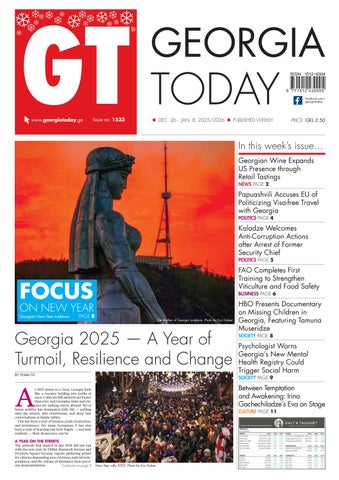
The Mother of Georgia sculpture. Photo by Ezz Gaber
HBO Presents Documentary on Missing Children in Georgia, Featuring Tamuna Museridze
Georgia 2025 — A Year of Psychologist Warns Georgia’s New Mental Turmoil, Resilience and Change Health Registry Could Trigger Social Harm SOCIETY PAGE 8
BY TEAM GT
SOCIETY PAGE 9
Between Temptation and Awakening: Irina Gachechiladze’s Eva on Stage
A
s 2025 draws to a close, Georgia feels like a country holding two truths at once. Cafés are full, airports are busier than ever, and Georgian wine and cinema are making waves abroad. Yet at home, politics has dominated daily life — spilling onto the streets, into courtrooms, and deep into conversations at family tables. This has been a year of tension, pride, frustration, and persistence. For many Georgians, it has also been a year of learning just how fragile — and how resilient — their democracy can be.
CULTURE PAGE 11 Prepared for Georgia Today Business by
DĂƌŬĞƚƐ Ɛ ŽĨ ϮϰͲ ĞĐͲϮϬϮϱ
KE ^
A YEAR ON THE STREETS The protests that started in late 2024 did not end with the new year. In Tbilisi, Rustaveli Avenue and Freedom Square became regular gathering points for citizens demanding new elections, judicial independence, and the release of detainees from previous demonstrations. Continued on page 5
WƌŝĐĞ
ǁͬǁ
ŵͬŵ
^dK <^
' KZ' ϬϰͬϮϲ
ϵϵ͘Ϭϳ ;zdD ϱ͘ϳϱйͿ
нϬ͕Ϭй
нϬ͕ϱй
>ŝŽŶ &ŝŶĂŶĐĞ 'ƌŽƵƉ ; ' K >EͿ ' W ϵϭ͘ϭϱ
Ͳϭ͕ϲй
нϲ͕ϯй
'Z /> ϬϲͬϮϴ
ϵϰ͘ϯϳ ;zdD ϲ͘ϱϭйͿ
нϬ͕ϭй
нϬ͕ϰй
'ĞŽƌŐŝĂ ĂƉŝƚĂů ; ' K >EͿ
' W ϯϬ͘ϰϬ
нϭ͕ϱй
нϭϮ͕ϰй
нϬ͕ϯй
d ĂŶŬ 'ƌŽƵƉ ;d ' >EͿ
' W ϰϬ͘ϭϱ
Ͳϭ͕Ϯй
нϰ͕ϯй
WƌŝĐĞ
ǁͬǁ
ϲϮ͕Ϯϰ
нϰ͕ϯй
Ͳϭ͕ϴй
ϰ ϰϳϵ͕ϰϮ
нϯ͕ϯй
нϴ͕ϯй
' '' ϵ ϭͬϮ W ZW
ϭϬϰ͘ϰϱ ;zdD ϴ͘ϴϮйͿ
нϬ͕Ϭй
^><Z , ϬϵͬϯϬ
ϭϬϬ͘ϴϰ ;zdD ϳ͘ϮϴйͿ
нϬ͕Ϭй
нϬ͕ϭй
d ϴ͘ϴϵϰ W ZW
ϭϬϬ͘ϲϰ ;zdD ϭϭ͘ϬϱйͿ
ͲϬ͕Ϭй
нϬ͕Ϯй
KDDK /d/ ^
d ϭϬ ϭͬϰ W ZW
ϭϬϱ͘ϵϲ ;zdD ϵ͘ϬϲйͿ
нϬ͕ϰй
нϬ͕ϲй
ƌƵĚĞ Kŝů͕ ƌĞŶƚ ;h^ΨͬďďůͿ 'ŽůĚ ^ƉŽƚ ;h^ΨͬK Ϳ
/E / ^
New Year rally 2025. Photo by Ezz Gaber
WƌŝĐĞ
ǁͬǁ
WƌŝĐĞ
ǁͬǁ
ŵͬŵ
ŵͬŵ
ŵͬŵ
hZZ E / ^
WƌŝĐĞ
ǁͬǁ
^W ϱϬϬ
ϲ ϵϯϮ͕Ϭϱ
нϯ͕ϭй
нϯ͕ϰй
h^ ͬ ' >
Ϯ͕ϲϵϱϯ
нϬ͕Ϭй
ͲϬ͕ϯй
&d^ ϮϱϬ
ϮϮ ϯϭϰ͕ϱϬ
нϬ͕ϳй
нϰ͕Ϯй
hZ ͬ ' >
ϯ͕ϭϳϱϳ
нϬ͕ϰй
нϮ͕Ϭй
ŵͬŵ
Kt :KE ^ ϯϬ
ϰϴ ϳϯϭ͕ϭϲ
нϭ͕ϴй
нϰ͕ϵй
' W ͬ ' >
ϯ͕ϲϰϬϭ
нϭ͕Ϭй
нϮ͕ϴй
ZƵƐƐĞůů ϮϬϬϬ
Ϯ ϱϰϴ͕Ϭϴ
нϮ͕Ϯй
нϱ͕ϱй
hZ ͬ h^
ϭ͕ϭϳϳϵ
нϬ͕ϯй
нϮ͕Ϯй
&d^ ϭϬϬ
ϵ ϴϳϬ͕ϲϴ
нϭ͕Ϭй
нϯ͕ϱй
' W ͬ h^
ϭ͕ϯϱϬϱ
нϭ͕Ϭй
нϯ͕ϭй
2
NEWS
GEORGIA TODAY
DECEMBER 26 - JANUARY 8, 2025/2026
Transparency International Georgia: 41 Steps Taken by Georgian Dream Toward Russia BY TEAM GT
Georgian wine and rapes. Source: Tour to Georgia
Georgian Wine Expands US Presence through Retail Tastings BY MARIAM RAZMADZE
G
eorgian wine is enhancing its footprint in the United States through a series of in-store tasting events across Massachusetts, targeting everyday consumers as well as wine enthusiasts. The initiative, supported by Georgia’s National Wine Agency and implemented by US-based partner Saperavi Brothers, has already reached 20 supermarkets and specialty wine retailers. Each tasting features five Georgian wine styles from three different producers, presented in dedicated promotional areas designed to introduce shoppers to the diversity and heritage of Georgian winemaking. The program launched in July and is scheduled to run through December, with a clear focus on growing sales while expanding Georgia’s export presence in the American market.
The United States continues to be one of the most strategically important destinations for Georgian wine. Since 2013, sustained marketing efforts backed by the National Wine Agency have significantly increased both consumer awareness and export volumes nationwide. Beyond retail tastings, Georgian wine promotion in the U.S. includes a broader, long-term strategy. In partnership with leading American marketing firm Colangelo & Partners, the Agency organises professional tastings for trade representatives and sommeliers, showcases Georgian wines at major international exhibitions and hosts wine tours in Georgia for media and industry professionals. To further support distribution and visibility, the National Wine Agency works closely with multiple U.S. importers and partners, including A.G Global Trade LLC, Saperavi Brothers, Vinoveli Inc., Corus Systems Inc., Georgian House of Greater Washington LLC and Big Sky Ranch Inc.
Wizz Air Carries 1.8 million Passengers from Kutaisi in 2025
T
ransparency International Georgia has published a report titled “41 Steps Towards Russia – One Year of Georgian Dream’s AntiEuropean Course,” outlining what it describes as a systematic shift away from Europe and toward Russia by the ruling Georgian Dream over the past year. The organization says Georgia’s European integration process has effectively stalled, democratic development has been seriously undermined, and the very idea of state independence has been put at risk. The report recalls November 28, 2024, when Prime Minister Irakli Kobakhidze announced that opening EU accession negotiations would be removed from the government’s agenda. Transparency International Georgia says this decision violated the Constitution and contradicted the will of the majority of Georgian society, marking a turning point that halted EU integration and accelerated democratic backsliding. The NGO argues that since the disputed parliamentary elections of October 26, 2024, the ruling party has taken deliberate steps to consolidate power and maintain political control, even at the cost of severing ties with Western partners. Based on the report, these actions serve the goal of keeping Bidzina Ivanishvili and Georgian Dream in power.
KEY FINDINGS OF THE REPORT Electoral manipulation: The 2024 parliamentary elections were neither free nor fair, with intimidation, vote-buying, misuse of state institutions, and violence, as documented by international observers including OSCE/ODIHR. Suppression of protests: Peaceful demonstrations in late 2024 were violently dispersed, with allegations of torture, excessive force, and the use of chemical agents. No officials have been held accountable. Political repression: The emergence of prisoners of conscience, imprisonment of opposition leaders, and criminal cases opened against political opponents on
Image source: TI Georgia
charges of crimes against the state. Attacks on media and civil society: Journalists have faced widespread violence and harassment, NGOs have been targeted through surveillance, frozen bank accounts, and restrictive “foreign agents” legislation. Anti-democratic legislation: Laws restricting assemblies, freedom of expression, media independence, and NGO activity have been repeatedly tightened, including the introduction of imprisonment for protest-related offenses. Institutional dismantling: The abolition of key democratic and oversight bodies, including the National Security Council, Anti-Corruption Bureau, Special Investigation Service, Civil Service Bureau, and NATO and EU Information Center. Judicial and parliamentary rollback: Reduced transparency in courts and the effective elimination of parliamentary
oversight over the executive branch. Foreign policy shift: Suspension of the strategic partnership with the United States, refusal of Western financial assistance, withdrawal from European platforms, and the expansion of Russian and Chinese economic influence. Russian-style governance: The report points to increased trade and tourism ties with Russia, the growing share of Russian capital in Georgia’s economy, and the creation of what it calls a Russian-style anti-Western propaganda system. Transparency International Georgia concludes that the cumulative effect of these 41 steps represents a deliberate departure from Europe and a convergence with Russian governance practices, warning that the consequences for Georgia’s democracy, sovereignty, and international standing are already visible.
Georgia Receives UNESCO Certificate for Inscribed Intangible Cultural Heritage Element BY MARIAM RAZMADZE
G A WizzAir jet. Source: 1TV
BY MARIAM RAZMADZE
W
izz Air continued to strengthen its presence in Georgia in 2025, operating nearly 6,800 flights from Kutaisi International Airport and carrying more than 1.8 million passengers. This represents a 6.5% increase in passenger traffic compared to the same period last year, showing sustained demand for the airline’s services in the country. During the year, the Hungarian lowcost carrier recorded over 1.5 million bookings, up 6.7% year-on-year while maintaining an exceptionally high average load factor of 99.7%. These figures reflect Wizz Air’s strong operational
performance and its leading position in the Georgian aviation market even as regional competition intensifies. Kutaisi remained at the core of the airline’s strategy in 2025. Wizz Air expanded its network with new direct routes to main European cities, including Lyon and Venice, with flights to Bratislava set to launch soon. The additions are designed to improve Georgia’s connectivity with the European Union and support both tourism and business travel. Since launching operations in Georgia in October 2012, Wizz Air has transported approximately 9 million passengers between Georgia and international destinations. The airline stated that its ongoing strategy prioritizes route expansion, customer-focused service and sustainability principles to ensure long-term, affordable access to Europe.
eorgiahasofficiallyreceived the certificate confirming the inclusion of ‘Georgian Wheat Culture: Traditions and Rituals’ in UNESCO’s Representative List of the Intangible Cultural Heritage of Humanity. The decision was adopted during the 20th session of UNESCO’s Intergovernmental Committee for the Safeguarding of Intangible Cultural Heritage, held in New Delhi, India. Officials say that UNESCO’s recognition illustrates the international importance of the traditional knowledge, practices and rituals associated with Georgian wheat — a cultural legacy shaped by centuries of work, craftsmanship and agricultural heritage. The listing also emphasizes the significance of Georgia’s endemic wheat varieties and the strong link between the country’s spiritual and material culture. The nomination, submitted by Georgia on 28 March 2024, successfully passed all evaluation stages. Earlier that year, on 27 March 2024, the Georgian government granted the element national significance status.
Ministry of Culture of Georgia reps receive the UNESCO certificate. Source: MoC
NEWS
GEORGIA TODAY
DECEMBER 26 - JANUARY 8, 2025/2026
3
Ukraine Latest: Russia Pushes on Donetsk Front as Both Sides Escalate Energy Strikes COMPILED BY ANA DUMBADZE
T
he past week saw Russia intensify its winter air campaign against Ukraine’s power system, while pressing hard along several frontline axes in the east, where incremental territorial changes continued to come at high cost. Ukraine, for its part, kept prioritizing deep strikes on Russian fuel and energy infrastructure—aiming to constrain Moscow’s logistics through refinery and depot disruptions—while also trying to stabilize key defensive lines under persistent Russian assaults. The result was a week defined by a familiar pattern: grinding ground combat around a handful of operational “hinge” areas, paired with large-scale drone and missile attacks designed to sap the other side’s capacity to fight and endure winter. On the battlefield, Russian forces maintained pressure across the broader Donetsk theater, where Moscow’s operational logic remains focused on widening and deepening advances toward major Ukrainian-held nodes that anchor the region’s defense network. Fighting was repeatedly described as heaviest in and around the Pokrovsk direction, where Russia has sought for months to chip away at Ukrainian positions and threaten road links that support the defense of the wider Donetsk line. Ukrainian reporting during the week continued to point to high daily engagement counts and intense clashes concentrated on that axis, reflecting the scale of Russian effort and the importance both sides attach to this sector. Further northeast, the Siversk area became one of the most consequential tactical storylines of the week. Independent assessments indicated that Russian
forces likely consolidated control over much of the town after prolonged fighting, with broader commentary framing this as a hard-won gain that could, if sustained, reshape local Ukrainian defensive geometry by pushing the contact line closer to other key settlements in the Donbas. While the exact situation on the ground remained fluid—as it often does in contested urban zones—multiple credible monitoring assessments converged on the view that Ukraine had been compelled to pull back from at least parts of Siversk under mounting Russian pressure. Elsewhere along the eastern front, Russia kept up attacks across a wide arc of directions rather than committing exclusively to a single breakthrough bid. That approach—continuous pressure, local penetrations when possible, and attempts to degrade Ukrainian reserves—was reflected in daily Ukrainian situation reports describing Russian assaults in numerous operational directions. Even when gains are measured in small villages or tree lines, the cumulative effect is to keep Ukrainian forces “busy everywhere,” complicating rotation schedules and stretching air-defense and counter-battery resources. Around the broader Donetsk urban belt, Russian efforts continued to be framed by the logic of inching closer to the interconnected defensive hubs that include the Kostyantynivka–Kramatorsk– Slovyansk area—without necessarily having the capacity to seize them quickly. Monitoring organizations highlighted how claims and counterclaims can sometimes outpace verifiable territorial change, but they also noted continued Russian attempts to expand footholds and push Ukrainian lines back in piecemeal fashion. In practical terms, that meant a week of repeated assaults, localized advances and withdrawals, and a continuing con-
test over positional advantage—especially where artillery, drones, and short-range assaults can create sudden, dangerous collapses in small sectors. While the ground war ground on, the week’s defining escalation came in the air and against energy infrastructure. Ukraine faced one of the largest aerial bombardments reported in recent months, as Russia launched a massive combined drone-and-missile strike that Ukrainian officials said involved well over 600 drones and dozens of missiles. The attack hit multiple regions and damaged critical infrastructure, triggering emergency power cuts and widespread outages during freezing weather. At least three civilians were reported killed, including a child, with additional injuries reported in some areas as strikes hit homes and other civilian objects alongside energy targets. This barrage followed other deadly overnight attacks earlier in the week. Reporting around December 21 described Russian drone strikes and bombardments that killed at least four people and injured more, again underscoring that Russia’s winter targeting strategy remains aimed at both Ukraine’s generating capacity and the distribution network needed to keep cities functioning. Beyond the immediate human toll, the strategic message is blunt: repeated disruption of electricity and heating is intended to strain public morale, complicate industrial output, and force Ukraine to divert scarce air-defense resources to protecting energy nodes spread across a vast country. Odesa—a recurring target because of its port facilities and logistics significance—was hit multiple times within a short window, with damage reported to port infrastructure and a vessel. While some reports said there were no casualties in certain Odesa strikes, the attacks reinforced that Russia continues to treat
Ukraine’s export and maritime logistics as a strategic target set, particularly when those routes intersect with energy and transport infrastructure. Ukraine’s response was not symmetrical in scale, but it was consistent in intent: persistent deep strikes aimed at Russia’s fuel production and storage network, as well as select military-logistics nodes. Early in the week, Ukraine confirmed a drone strike on the Slavyansk-on-Kuban oil refinery in Russia’s Krasnodar region, describing explosions and a fire at the facility and signaling—again—that Kyiv sees refinery disruption as a way to impose costs on Russia’s war economy and frontline sustainment. Later reporting described additional Ukrainian strikes hitting Russian targets including oil-related infrastructure and other military assets, part of a broader pattern of long-range attacks meant to stretch Russian air defenses and complicate the movement of fuel and materiel. By week’s end, further reports pointed to a Ukrainian strike that ignited a fire at a petrochemical facility in Russia’s Stavropol region—an episode that fit the same operational logic of targeting energy and fuel-adjacent industry. Public reporting did not consistently confirm casualties from this particular incident, but the event added to the mounting list of energy-sector disruptions Russia has had to manage far from the front. Alongside these headline strikes, the war’s human impact remained stark. In Ukraine, the confirmed civilian deaths this week were tied primarily to Russia’s aerial campaign, with fatalities including a child and multiple reports of injuries amid widespread power cuts and damage to homes. In Russia, while Ukrainian deep strikes continued to generate fires and disruptions at energy facilities, publicly verified casualty reporting was less consist-
ent and often fragmentary; in several cases, authorities or media accounts focused on damage and operational disruption rather than providing clear totals. Diplomatically, the week featured parallel efforts to explore pathways toward a ceasefire or framework agreement, even as battlefield realities suggested neither side is yet positioned to accept terms that would look like a strategic defeat. Reporting described continued contacts and meetings involving US intermediaries and delegations with Ukrainian and Russian counterparts, with discussion of draft documents touching on ceasefire concepts, security guarantees, and reconstruction—though without a clear breakthrough. Russia’s public posture remained hardline in many accounts, while Ukraine emphasized that any settlement must not reward aggression or lock in territorial losses without credible long-term security arrangements. International support for Ukraine also moved on several tracks. The European Union advanced additional measures aimed at constraining Russia’s ability to finance the war, including the expansion of sanctions targeting vessels associated with Russia’s “shadow fleet,” which Western governments argue helps Moscow keep oil revenues flowing despite restrictions. At the political level, EU leaders also moved to finalize a major financial package framed as support for Ukraine’s stability and defense capacity, even as internal debates continued about the best legal mechanisms for leveraging frozen Russian assets. Separately, Poland announced another military assistance package—reported as its 46th—valued at around €100 million, with delivery planned for early 2026, underscoring how neighboring states remain central pillars of practical support as the war moves into another winter.
4
POLITICS
GEORGIA TODAY
DECEMBER 26 - JANUARY 8, 2025/2026
Papuashvili Accuses EU of Politicizing Visa-free Travel with Georgia
Foreign Minister Maka Bochorishvili. Source: MFA
FM: EC Overlooks Areas where Georgia Excels, Remains Silent on Serious Concerns Elsewhere BY TEAM GT
G
eorgian Foreign Minister Maka Bochorishvili has criticized the European Commission for what she described as a selective and unbalanced approach in its assessment of Georgia. Speaking to journalists, Bochorishvili said that the European Commission’s evaluation deliberately excludes areas in which Georgia demonstrates tangible progress and strong performance compared to other countries. “When assessing Georgia, the European Commission’s report leaves out those spheres where the country is genuinely successful and presents a far more positive picture than many others,” she stated. Journalists asked the foreign minister to comment on reports that the European Commission had removed assessments related to corruption and human rights from its enlargement evaluation docu-
ments concerning Ukraine and Moldova. In response, Bochorishvili questioned the consistency of the Commission’s methodology. “If these issues are considered essential for candidate countries, why are they missing from the European Commission’s report?” she asked. Bochorishvili claimed that the same logic applies to Georgia’s assessment. She argued that the Commission omits positive developments in Georgia while also choosing silence in cases where the situation in other countries may be “alarmingly serious” across various dimensions. “This approach does not correspond to the standards the European Commission has historically upheld, nor to the principles that should guide the European Union’s policy,” Bochorishvili said. She added that flaws in the EU’s overall approach, as well as subsequent mistakes or misguided decisions, stem from inaccurate assessments and distorted priorities, the consequences of which, she noted, are already visible today.
Zurab Japaridze Released from Rustavi Prison
Shalva Papuashvili. Source: 1TV
BY TEAM GT
S
peaking to journalists about the potential suspension of visa-free travel with the European Union, Speaker of Parliament Shalva Papuashvili said that responsibility for such a development would not lie with the Georgian authorities. He sharply criticized the EU’s approach, arguing that it has become political and instrumental rather than legal or procedural. Papuashvili claimed that visa-free travel is increasingly being used by the EU as a political tool. He described this approach as part of what he called the “Estonization” of the EU’s foreign policy, claiming that European integration mechanisms are no longer driven by procedures or people-to-people engagement, but by political pressure. “In this context, it is difficult to rule
anything out,” Papuashvili said. “There are discussions about imposing restrictions, separating groups of people, and labeling them. For example, if certain officials or groups are required to obtain visas while others are not, visa-free travel could be suspended selectively. From a legal perspective, this amounts to segregation — treating different groups within a country differently. Europe has experienced such practices in the past. If Brussels is intent on leading Europe back toward this dark chapter, we can already see the trend: labeling so-called international ‘offenders’ without court rulings or due process, and imposing sanctions. This is what I mean when I say Brussels is steering the EU toward a civilizational dead end.” Commenting directly on the possibility of visa-free travel being suspended, Papuashvili said expectations of logic or fairness from Brussels are misplaced. “We should not expect reason or jus-
tice in Brussels’ decisions,” he stated. “For some time now, decisions have been guided by a political agenda rather than principles. Various issues are being used as leverage. Fortunately, the EU lacks the political maturity to cause serious damage to Georgia.” Papuashvili further claimed that previous attempts by EU representatives to influence Georgia’s internal political processes had failed, citing what he described as interference by ambassadors, foreign ministers, and EU officials during elections. He said those efforts were unsuccessful and contrasted them with the stance of the new US administration, which he claimed rejected such interference. “The EU now appears to be trying to act as a global enforcer,” Papuashvili added. “But it lacks both the qualifications and the capacity to inflict real harm. The Georgian people clearly understand the intentions of certain actors in Brussels toward Georgia.”
Latvian Prime Minister: Georgian People Must not Lose Hope BY TEAM GT
Zurab Japaridze. Source: FB
BY TEAM GT
Z
urab “Girchi” Japaridze, one of the leaders of the Coalition for Change opposition party, has been released from Rustavi Prison after spending seven months in detention. The news was announced on Japaridze’s official Facebook page. “Zurab Japaridze is free! The Penitentiary Service released him earlier
than the scheduled date, and he has already left Rustavi Prison,” the statement said. Japaridze was detained on May 22 inside a courtroom after being summoned to provide explanations to the Temporary Investigative Commission of the Parliament of Georgia, a session he did not attend. He was subsequently charged under Article 349 of the Criminal Code, which concerns failure to comply with a request of the Temporary Investigative Commission of the Parliament of Georgia.
T
he Georgian people should not lose hope, Latvian Prime Minister Evika Silina said in response to a question from Euroscope ahead of the European Council summit in Brussels. Silina emphasized that real power in Europe lies with society, stressing that Georgia is an integral part of Europe. She noted that Latvia, like Georgia, endured the Soviet period before gaining freedom through the will of its people. “No politician can make decisions instead of the people and society,” the Latvian Prime Minister said. “If society remains strong and does not lose hope,
Latvian Prime Minister Evika Silina. Source: IPN
it will succeed. I truly believe in this.” She underlined that lasting change comes from citizens themselves, adding
that collective determination and resilience are key to achieving freedom and success.
POLITICS
GEORGIA TODAY
DECEMBER 26 - JANUARY 8, 2025/2026
5
Georgia 2025 — A Year of Turmoil, Resilience and Change Continued from page 1 Some rallies drew tens of thousands of people, while others were smaller, nightly gatherings. The most serious clashes happened on 4 October 2025, the day of local elections that the opposition largely boycotted. Crowds marched toward Orbeliani Palace, calling for political change. Police blocked access, and clashes broke out. Authorities used water cannon and tear gas to disperse demonstrators. Several journalists were injured while covering the events, drawing criticism from press freedom organizations. Afterward, the government arrested several opposition figures, charging them with attempting to overthrow the constitutional order. Officials said the measures were necessary to maintain public order. Human rights groups warned that the crackdown threatened the right to peaceful assembly. By the end of the year, civil society groups were describing dozens of detainees as political prisoners. For many Georgians, the protests have been exhausting. Streets that once felt open now carry tension, and citizens have watched (or participated in) demonstrations with a mix of hope and fear for months.
AN ECONOMY THAT KEPT MOVING What made 2025 especially disorienting was that, economically, Georgia was doing well — and at the same time, many people were feeling the cost of daily life rising. Tourists arrived in record numbers. Georgia recorded around 4.3 million international visitors between January and September 2025, a rise of roughly 8 percent compared with the same period in 2024, with total visitors — including same-day arrivals — exceeding 6.1 million. Tourism revenue for the year was projected to reach around $4.5 billion. Flights were full. Hotels expanded. Wine exports grew. In Batumi, Kutaisi and Tbilisi, business owners spoke of a strong season. Restaurants stayed open late. New cafés appeared almost overnight. Georgian airports handled millions of passengers, many arriving from Europe and the Gulf — drawn by direct flights, affordable prices, and Georgia’s reputation for hospitality. The contrast was
clear: a country under political strain, yet economically alive. At the same time, prices at home were rising. By November, official figures showed Georgia’s annual inflation rate at about 4.8 percent, with food and nonalcoholic beverages among the largest contributors to that rise. Bread, vegetables, oils, and dairy products all cost noticeably more than in previous months, a change felt in markets and stores across the country. Officials acknowledged these pressures publicly. At a year-end economic briefing, a government spokesperson said: “We see that food prices have risen more quickly than overall inflation. We are monitoring the situation closely and are prepared to take steps to support households most affected by these increases.” That echoed comments from the National Statistics Office and the central bank, which has kept its key interest rate steady even as price pressures build. For many families, especially those on modest incomes, the rising cost of groceries and everyday goods was a regular topic of conversation — a reminder that headline economic success does not always translate into relief at the checkout counter.
WALKING THE DIPLOMATIC TIGHTROPE Looking back at 2025, Georgia navigated a complex and often tricky diplomatic landscape. While claiming a desire to maintain ties with Western allies, the ruling Georgian Dream government grew increasingly critical of the West, publicly denouncing what it saw as interference in domestic affairs and framing US measures, such as the MEGOBARI Act, as hostile. In parallel, the country also looked east, strengthening trade and economic connections with China and exploring partnerships with other nonWestern nations like Iran. These moves reflected a deliberate strategy to diversify partnerships, assert Georgia’s independence, and position the country as a key hub for trade and transit in the region. Closer to home, Georgia quietly played a role in promoting stability in the South Caucasus. The historic peace agreement between Armenia and Azerbaijan was welcomed in Tbilisi, and the country actively participated in talks with both neighbors to strengthen cooperation on trade, transport, and
shared regional challenges.
EDUCATIONAL SHIFTS In 2025, Georgia unveiled plans to reshape its schools and universities. For schools, the proposals include an 11-year system with an optional 12th grade, stricter rules like uniforms and phone limits, and more standardized textbooks. Meanwhile, in higher education, the government’s National Reform Concept proposes shortening degree cycles to a 3+1 model, centralizing financing and governance, and limiting international student admissions to state universities. Supporters say it modernizes education, while critics worry it may limit choice, autonomy, and Georgia’s connection to Europe. For now, it’s all on paper, but the ideas are already stirring debate about the country’s educational future.
continue to appear on major fashion stages in Europe. Model Mathilda Gvarliani had a standout year, walking for top fashion houses including Louis Vuitton, Chanel, Dior, and Gucci, and appearing in the 2025 Victoria’s Secret Fashion Show. She was also recognized by Models.com as Best Street Style (Women+) in their 2025 Readers’ Choice awards, highlighting her growing influence and visibility in global fashion. In Batumi, the Black Sea Music and Art Festival once again brought together Georgian and international artists, reinforcing the city’s role as a cultural center. At the end of the year, Tbilisi hosted the Junior Eurovision Song Contest, drawing young performers and delegations from across Europe and putting Georgia’s music scene in front of a broad audience.
CINEMA ON THE WORLD STAGE CULTURE THAT TRAVELS Where politics and finances divided the country, culture continued to unite it and promote Georgia abroad. Georgian wine remained one of the country’s strongest ambassadors. From wine fairs in Europe to tastings in North America and Asia, traditional qvevri wines and indigenous grape varieties continued to attract attention. For many producers, this year brought new export contacts and new audiences. Books, too, found their way onto international shelves. Publishers organized a collective presence at the annual Frankfurt Book Fair, presenting Georgian literature as both ancient and urgently contemporary — shaped by history, identity, and the struggles of the present moment. On stage, Georgian dance and music carried the same message. Touring ensembles reminded international audiences that Georgian culture is not just preserved — it is alive, evolving, and fiercely expressive. The Royal National Ballet of Georgia toured several European countries, while the Sukhishvili Georgian National Ballet continued its long tradition of international performances, showcasing the country’s rich dance heritage. In fashion, Georgian designers and models made significant strides internationally. Georgian labels, including Situationist, presented collections at events such as Paris Fashion Week, while designers like David Koma and Avtandil
In 2025, Georgian films won recognition abroad, giving Georgian storytelling a spotlight on the international stage. Dry Leaf, directed by Alexandre Koberidze, premiered in the main competition at the 78th Locarno Film Festival in Switzerland and won a Special Mention prize, marking a significant moment for Georgian cinema on the European circuit. The Men’s Land, a documentary by Mariam Khatchvani, won the Heart of Sarajevo award for Best Short Documentary Film at the 31st Sarajevo Film Festival. Both films drew praise for their depth and craft and helped attract fresh international attention to filmmakers from Georgia.
PRIDE ON THE FIELD If culture and economics gave Georgians reasons to celebrate, sport provided some of the clearest moments of unity and joy. At a year-end awards ceremony, the Ministry of Sports named Georgia’s best athletes of 2025, with fencer Sandro Bazadze taking Male Athlete of the Year and judoka Eter Liparteliani Female Athlete of the Year. The Georgian National Basketball Team was honored as Team Sport of the Year, and the Georgian Judo Team was named Team of the Year. But beyond titles, the numbers told their own story. Prime Minister Irakli Kobakhidze said Georgian athletes won a record 1,935 international medals in 2025, a haul described as “a year that brought tremendous success for our athletes and for our country.” Among the milestones he cited were the national
basketball team finishing among the top eight teams in Europe, ahead of traditional powers such as Spain and France, and the mixed national judo team becoming world champions for the first time. Kobakhidze also highlighted Georgia’s first gold medal at the Winter Olympic Festival, a world championship title in fencing, and the country’s first female world champion in judo as standout achievements.
UNFINISHED WORK It is clear that not everyone benefited equally from the year’s growth, and structural challenges remain going into 2026. Official statistics and outside assessments in 2025 pointed to uneven employment conditions even as overall unemployment edged down from earlier years; the unemployment rate was around 13–14 percent in 2025, a figure that, while improved from past highs, still sits well above many European countries. Economic forecasts noted that structural unemployment — particularly among youth — remained elevated, and that income inequality and outward migration continued to constrain opportunity for many Georgians. In rural villages and small towns, jobs remained scarce. Young people continued to look abroad for education and work. For families struggling to make ends meet, economic statistics sometimes felt distant from everyday reality. At a public forum in Tbilisi this year, an economist put it plainly: “Growth only matters if people feel it in their daily lives.” For many in Georgia’s regions, that daily life still includes long job searches, modest incomes and the sense that opportunity is unevenly shared.
LOOKING TOWARD 2026 As Georgia moves into 2026, the mood is cautious. There is pride in what the country has achieved — economically, culturally, internationally. There is also exhaustion from constant political confrontation and concern about where it might lead. For many Georgians, the hope is simple: stability without stagnation, growth without exclusion, and a political system that listens rather than reacts. Or, as a small business owner in Batumi put it near the end of the year: “We don’t want miracles. We want to feel safe, respected, and included. If we have that, we’ll do the rest ourselves.”
Kaladze Welcomes Anti-Corruption Actions after Arrest of Former Security Chief BY TEAM GT
T
bilisi Mayor Kakha Kaladze has commented on the arrest of former head of the State Security Service of Georgia (SSSG) Grigol Liluashvili, saying corruption is a global challenge and that the authorities support concrete action by law enforcement agencies. “Corruption is a challenge for the entire world, and the fight against it is extremely important,” Kaladze told journalists. He said he would refrain from further comment while the investigation is ongoing, noting that additional statements could harm the process. “In general, we welcome the fight against corruption. This is one of the most important directions,” Kaladze said. “If someone has committed a crime, appropriate actions will be taken.”
ARREST AND CHARGES Grigol Liluashvili, who headed the SSSG from 2019 to 2023, was arrested following joint operational and investigative actions
through his relative Sandro Liluashvili, generating approximately USD 1.365 million in alleged bribes. Investigators are also examining claims that certain call centers were linked to individuals financing opposition media outlets. Fourth episode: Liluashvili is accused of abusing his official position to protect Kakha Gvantseladze, former head of the Tbilisi City Hall Kindergarten Management Agency, in exchange for bribes obtained through kindergarten procurement contracts. Several additional agency employees have been charged in connection with this case.
by the Prosecutor General’s Office of Georgia and the State Security Service. Prosecutor General Giorgi Gvarakidze announced at a briefing that Liluashvili is accused of accepting bribes in several criminal cases currently under investigation. Prosecutors will apply to the court within the legally prescribed timeframe to seek pre-trial detention. Liluashvili has been charged under Article 338, Part 2(c) and Part 3(e) of the Criminal Code of Georgia—taking bribes in particularly large amounts by a group acting by prior agreement—an offense punishable by 11 to 15 years in prison.
SUMMARY OF ALLEGATIONS According to the Prosecutor’s Office, Liluashvili is accused of accepting bribes totaling USD 2.365 million and GEL 1.5 million across four alleged episodes. Two of the cases also implicate Romeo Mikautadze, former Deputy Minister of Economy and Sustainable Development, who has been detained. First episode (October 2022): Investigators allege that Liluashvili received USD 1 million from Turkish investor Chagatai Ulker through Mikautadze in exchange for lobbying the sign-
EVIDENCE AND ONGOING INVESTIGATION Grigol Liluashvili. Source: NSC
ing of a memorandum of understanding related to wind power plant construction. Second episode (February 2022): Through the same intermediary, Liluashvili is accused of demanding and extorting GEL 1.5 million from Giorgi Khazhalia, founder of Express Service
2008, in return for assistance in gasification tenders. Third episode (2021–2023): Despite a publicly declared state campaign against fraudulent call centers, dozens allegedly continued to operate in Georgia. Prosecutors claim some operated under Liluashvili’s protection
Prosecutors say hundreds of investigative actions have been conducted, including witness interviews and the seizure of video and audio recordings and other material evidence. The investigation is ongoing, and authorities say additional charges and arrests are possible. Gvarakidze said Georgian law enforcement agencies remain committed to combating corruption “to reduce it to a historical minimum.”
6
BUSINESS
GEORGIA TODAY
DECEMBER 26 - JANUARY 8, 2025/2026
FAO Completes First Training to Strengthen Viticulture and Food Safety BY MARIAM RAZMADZE
U
nder the EU- and Swedenfunded ENPARD IV program, the Food and Agriculture Organization of the United Nations (FAO) has completed the first cycle of its Training of Trainers (ToT) program in Georgia and has already launched a new round of training. The initiative is designed to enhance food safety standards and promote integrated vineyard management practices across the country. The program focuses on strengthening the technical knowledge and practical skills of viticulture professionals, combining classroom-based learning with hands-on vineyard activities. Two distinct groups of specialists participated in the recent training cycles. The first group consisted of 13 viticulturalists who completed a year-long ToT program. Their training included winter and green pruning practices, along with 11 theoretical modules covering integrated vineyard management. In addition, participants took part in a three-day practical training focused on soil assessment, irrigation planning, fertilization strategies and other essential vineyard management techniques. Alongside this, a second newly estab-
Grape harvest. Source: EHC2024.
lished group of 21 specialists participated in an intensive five-day program. This training concentrated on winter pruning, vine formation and grapevine physiology, providing participants with targeted technical knowledge in a condensed format. FAO representatives emphasized the broader significance of the initiative for Georgia’s wine sector. Tamari Otkhmezuri, FAO National Agronomy, Wine and Extension Specialist, emphasized that integrated vineyard management is critical for both environmental and finan-
Working on the vines. Source: FAO Georgia
cial sustainability and is a main step toward aligning Georgia’s wine industry with European Union standards. She noted that the Training of Trainers approach ensures long-term impact. FAO Program Manager Guido Agostinucci mentioned the importance of building technical capacity to enhance food safety and competitiveness in Georgia’s viticulture and wine sectors. He stressed that EU and Swedish support enables winemakers to adopt sustainable practices and comply with EU food safety requirements.
Denis Reiss, Program Officer for Sustainable Food Systems at the EU Delegation to Georgia, pointed out that ToT participants play a pivotal role in disseminating best practices. Positioned between European expertise and local knowledge, these specialists help promote sustainability and quality standards that respond to growing consumer demand. In addition to in-person training, FAO has supported the development of Georgian-language online video courses covering modern grapevine winter and green
pruning and vine formation techniques. Interested viticulturalists can still access these digital learning resources by completing a registration form. The ENPARD program has been supporting rural development in Georgia since 2013, with the goal of reducing rural poverty and strengthening agricultural potential. Since 2021, with added support from Sweden, ENPARD IV has placed a stronger emphasis on food safety, with FAO and the Czech Development Agency serving as the main implementers of this component.
Georgia Moves to Regulate Greenhouse Gas Emissions with New Law Proposal BY TEAM GT
T
Image source: UN Women Georgia
UN Women Study: Violence Against Women Carries Heavy Economic Costs for Georgia BY MARIAM RAZMADZE
A
new study found that the significant economic and social costs of violence against women in Georgia, stressing that insufficient prevention and response efforts place a burden not only on survivors but also on families, communities and the national economy. The research is based on a nationwide survey on violence against women conducted in 2022 by UN Women and the National Statistics Office of Georgia (Geostat), with support from the European Union and the second phase of the
program ‘Every Woman and Girl Counts.’ The study assesses the financial impact of violence, including lost productivity, healthcare expenses and broader social costs. It emphasizes that inadequate investment in prevention and response mechanisms leads to long-term economic losses and undermines social well-being. The findings addressed violence against women is not only a human rights obligation but also an economic necessity. Strengthening prevention policies and support services would reduce costs borne by individuals and society while contributing to sustainable development. The publication was prepared within the framework of UN Women’s ‘Every Woman and Girl Counts’ Phase II program.
he Government of Georgia has proposed a significant update to the country’s Law on Environmental Protection. For the first time, the draft law would create a formal system to regulate greenhouse gas emissions— including carbon dioxide (CO2)—and introduce a national framework for monitoring, reporting, and verification (MRV) of emissions across key sectors of the economy. The legislation, part of broader climate governance reforms, was presented to the Parliament’s Environmental Protection and Natural Resources Committee by Deputy Minister Zurab Ezugbaia. According to official summaries, the amendments are closely tied to Georgia’s obligations under the European Union Association Agreement and the Energy Community Treaty. The draft law specifically aims to align the country’s approach with the EU Emissions Trading System (ETS) and other related EU standards. Under the proposed rules, companies operating in sectors such as energy, heavy industry, construction materials, chemicals, and aviation would need official authorization for their greenhouse gas emissions. They would also be required to submit annual emissions reports, which must be verified by accredited bodies before being submitted to the relevant authorities. The legislation includes a transition period, with the MRV system set to be fully operational starting January 1, 2026. Initial authorizations will be free, but operators will face additional administrative and financial responsibilities related to monitoring and reporting. To implement the system, the National Environmental Agency plans to hire five new staff members, while the Environmental Supervision Department will add ten. Costs in 2025 will be covered by agency revenues, shifting to state budget funding from 2026 onward.
Regulating Greenhouse Gas emissions. Source: AP Images/European Union-EP
IMPLICATIONS FOR GEORGIA’S CLIMATE POLICY Experts in Tbilisi and Brussels view this move as a major step forward for Georgia’s climate governance. The country has been actively working on its international climate commitments, including the preparation of its First Biennial Transparency Report (BTR) submitted to the United Nations Framework Convention on Climate Change (UNFCCC). The 2024 BTR, along with the national greenhouse gas emissions inventory, details emissions trends from 1990 to 2022. While Georgia’s total emissions remain relatively modest, they have risen since the early 2000s as the economy grew. In 2022, total emissions were 20,096 Gg CO2 equivalent, with CO2 making up nearly two-thirds. The energy sector is the largest source of emissions, followed by industrial processes, agriculture, and waste. Georgia’s climate governance has also been strengthened through the National Energy and Climate Plan (NECP), adopted in 2024. The plan sets out greenhouse gas reduction targets—including conditional commitments to significantly cut emissions relative to 1990 levels—and details strategies for energy transition, emissions reduction, and decarbonization through 2030. Lawmakers have emphasized that cli-
mate-related legislation is essential not only for domestic policy, but also to align with European standards and meet Energy Community Treaty obligations. These agreements require robust systems to monitor and report greenhouse gas emissions, serving as a foundation for future climate actions and potential carbon pricing mechanisms.
WHY THE MRV SYSTEM MATTERS Experts agree that a strong MRV framework is key to Georgia’s climate strategy. Reliable, verifiable emissions data allow the government to track progress, develop targeted mitigation strategies, and engage credibly in international climate initiatives. A formal MRV system also lays the groundwork for future market-based approaches, such as emissions trading or carbon pricing. Overall, the proposed amendments are more than technical updates—they represent a strategic effort to increase transparency, accountability, and alignment with EU standards. The law would give businesses, investors, and international partners a clearer understanding of Georgia’s climate policy direction, complementing existing planning, reporting, and strategic climate initiatives, and paving the way for more comprehensive implementation in the years ahead.
BUSINESS
GEORGIA TODAY
DECEMBER 26 - JANUARY 8, 2025/2026
7
Georgia Steps Up Industrial Oversight to Tackle Air Pollution in Rustavi
Vake Park. Source: Georgian Holidays
Kaladze: Tbilisi to Complete Vake Park Cascade with Foreign Contractors BY MARIAM RAZMADZE
T
bilisi Mayor Kakha Kaladze has confirmed that the remaining rehabilitation works on the Vake Park cascade will be completed with the involvement of foreign contractors, after no Georgian company was found capable of carrying out the project to the required technical standards. Speaking at a session of the Tbilisi City Assembly, Kaladze said that while
the broader rehabilitation of Vake Park has been implemented in several phases and is largely finished, the cascade remains in critical condition. He noted that repeated efforts to identify a qualified local contractor were unsuccessful, making international expertise necessary. The mayor stated that Deputy Mayor Andria Basilia has been overseeing preparations for the next stage of the project, including coordination with foreign construction and design firms. The city expects this approach to ensure the full completion of the cascade reha-
bilitation in the coming years. The cascade project was initially tendered in March, with LLC Dagi emerging as the sole bidder and winning the contract for GEL 31.8 million, significantly below the municipality’s maximum budget ceiling of GEL 47 million. Despite this, the project has not been fully completed. Tbilisi City Hall has earmarked additional funding to finalize the works. Under the city’s preliminary 2026 budget, GEL 18 million has been allocated specifically for completing the Vake Park cascade rehabilitation.
Aging Fleet Puts Pressure on Georgian Railways, Report Shows
Photo: Wander-Lush.
BY MARIAM RAZMADZE
G
eorgia’s Ministry of Environmental Protection plans stricter inspections and industrial upgrades to improve air quality in Rustavi, as part of the national 2023–2025 air management strategy. The Ministry of Environmental Protection and Agriculture has announced tighter environmental controls on industrial activity in Rustavi following a high-level meeting with factory representatives focused on air quality challenges in the city. The meeting brought together Minister David Songulashvili, Deputy Minister Nino Tandilashvili, Rustavi Mayor Nino Latsabidze, members of Parliament and industry stakeholders. Discussions centered on reducing industrial emissions and addressing persistent pollution concerns affecting local residents. As a result, the Environmental Oversight Department will further intensify
inspections of industrial facilities operating in Rustavi. The ministry stated that major factories are already subject to continuous monitoring to ensure compliance with environmental regulations but enforcement efforts will now be strengthened. Deputy Minister Tandilashvili acknowledged that air quality indicators have shown some improvement in recent years but said unresolved problems remain, particularly related to unpleasant odors and localized pollution. She underlined the need for continued industrial modernization and the adoption of up-to-date environmental standards. The ministry emphasized that improving air quality in Rustavi is a core objective of Georgia’s 2023–2025 Atmospheric Air Quality Management Plan which targets emissions from industry, construction, and transport. Rustavi is currently served by a modern air monitoring station that provides round-the-clock data to the National Environmental Agency, supporting evidence-based regulation and enforcement.
Georgia’s Dairy Sector Struggles with Low Productivity and Rising Imports BY MARIAM RAZMADZE
A
TBC Capital report shows that Georgia’s dairy sector faces significant productivity challenges. The average milk yield in the country is only 4.7 liters per cow, compared with the European Union average of 22 liters, illustrating low efficiency in domestic production. The report highlights that local supply is insufficient to meet rising demand, resulting in a sharp increase in milk imports which rose from 7,500 tons in 2019 to 16,000 tons in 2025, primarily
A train engine. Source: Progress Rail
BY MARIAM RAZMADZE
G
eorgian Railways’ rolling stock is largely outdated, the company’s latest management report shows, emphasizing an urgent need for fleet modernization across both locomotives and freight wagons. The report states that the railway operates 91 active locomotives, nearly all of which were manufactured more than three decades ago. Specifically, 99% of locomotives are over 30 years old while 78% are more than 35 years old. Notably, Georgian
Railways does not operate a single locomotive that is under 20 years old. Freight wagons present a similar picture. Out of 4,088 wagons currently in service, 85% are over 30 years old, and 75% exceed 35 years of age. Only 8% of the wagon fleet is younger than 21 years, meaning the limited renewal of rolling stock in recent decades. The report also documents a significant contraction of the fleet over time. Since 2015, the number of freight wagons has declined by 42% while the number of active locomotives has fallen by 44%. This reduction further compounds capacity and efficiency challenges for the national railway operator.
In response, Georgian Railways has initiated steps toward modernization. In November, the company announced a GEL 20 million tender for the procurement of 120 new freight wagons. In parallel, negotiations are ongoing with the World Bank and the Asian Development Bank to secure financing for new locomotives and additional wagons. The state budget for next year earmarks GEL 325 million for railway-related investments, although specific allocations have not yet been disclosed. The Asian Development Bank has indicated that final approvals and detailed project information will be made public once decisions are finalized.
Dairy products. Source: Harvard Health
sourced from Poland, France, Russia and Belarus. In the first ten months of 2025, Azerbaijan accounted for 24% of imports, followed by Russia (18%) and France (16%). Imports of butter reached 6,800 tons while cheese imports exceeded 33,000 tons, with the EU supplying more than two-thirds of total cheese imports. TBC Capital notes that Georgia’s dairy sector suffers from a structural imbalance: domestic production has remained roughly stable at 570,000 tons from 2019 to 2024 while imports grew by approximately 50%, particularly after 2021. Cheese dominates consumption both in volume and value and demand for highvalue dairy products continues to grow.
8
SOCIETY
GEORGIA TODAY
DECEMBER 26 - JANUARY 8, 2025/2026
Gilotsav Akhal Tsels, Sakartvelo! BLOG BY NUGZAR B. RUHADZE
T
he New Year is almost here. It is time to look back, to refresh our minds about what the world has gone through in the departing year, and what Georgia’s part in all that has been. Frankly, looking back is a little scary, because these were twelve months of conflicts all over the world, the Russian-Ukrainian one being among the worst and fiercest of them. The incumbent American president claims to have resolved as many as eight of those conflicts, the rest of the world kind of doubting it, but biblically speaking, blessed are the believers. The Ukrainian conflict seems to be the harshest curse humanity has known since the Second World War. And there is no end to it in the foreseeable future, though peace-loving giants like Donald Trump would not desist from believing that peace in Ukraine is possible. What does Sakartvelo have to do with that bloody conflict? Nothing much! The only reasonable comment one could afford in this regard is this: there are politicians who would blame Georgia for refusing to get involved in the confrontation, for not opening a second front, but there are probably just as many, even more, who would validate Georgia’s abstention from war, justifying this by the current peaceful life in the republic, providing happiness, unity, prosperity,
and the fulfillment of dreams. Any mekvle (the first visitor in the New Year) would first of all wish peace to any household in Georgia, stepping over the threshold, and would add to it hope for a bright European future, especially for the youth. The most frequently used word on New Year’s Day is going to be Gaumarjos!, which is a single-word cheering toast, approximately meaning: let’s drink to life and happiness! And of course, Gilotsav Akhal Tsels! — Happy New Year! The typical Georgian Tamada (toastmaster) will not miss definite enthusiastic and high-flown toasts, nurturing national accord in the country, bringing togetherness and an end to all kinds of conflicts, whether international or internecine, certainly with special feelings for people in occupied Georgian lands, if the Tamada wants to be politically correct. Next, a good Tamada will toast the younger generation and wish them to thrive and promote a national demographic boom; if they are abroad, inspiring them to return home and start building the motherland’s future here, in Sakartvelo, not remotely from abroad, to bring progress to this beautiful land and introduce new Western standards if they are well versed in them. The next toast will probably be dedicated to general welfare, wishing that the upcoming year be full of triumphs, good fortune, a felicitous future, and the tripling of the nation’s potential to build a better life for its sons and daughters. The proud Tamada, a genuine patriot of
his or her country, will not miss a good, wordy toast praising the culture of Georgia, its traditions and hospitality, and celebrating love for the traditional family. The Tamada who knows what he or she is doing will never miss a toast commemorating our dead, especially the war heroes who succumbed to the attacks of Georgia’s enemies. In the end, the Gilotsav Akhal Tsels toast will sound again as the finale of the solemn get-together. That is the way Sakartvelo will see the New Year in — half happy and half depressed. Happy because the hope for a good, peaceful life is still alive, and depressed because in our time of belligerency and warmongering, anything could be expected to happen. Yet none of us wants to believe that the current hot conflict in the middle of Europe may someday extend to Georgia and shatter our valuable and painstakingly maintained serenity, affluence, and success. I don’t know how much a prayer helps, but the habitual Georgian practice of toast-making is another way to pray and ask the Almighty to take care of us, although we all know very well that God only helps those who help themselves. This popular proverb, emphasizing selfreliance and personal effort, originates from Aesop’s Fables of ancient Greece, but wherever it comes from, it fits our social, political, and economic reality so precisely that we can hardly wish for anything more accurate or wiser to optimally organize our lives. Let us turn it into our most practicable New Year resolution. Truly Western, isn’t it?
New Year on Rustaveli Avenue, Tbilisi, 2024. Photo by Mariam Avakova
Printing the 3rd Dimension which does it, in the Techno Park at the end of Innovation Street in Oqrokana, Mtatsminda, overlooking Tbilisi. Their material is plastics, and I found myself asking for help to first render my design on a computer’s 3D program, and then to print it (I had dabbled in such programs myself, and decided that yes, I can learn them, but the curve will be quite steep, and my patience currently short. Something for the future). This was my first ever venture into a 3D printing lab, and I was fascinated. No problem with rendering help, once I made myself understood! We did a tiny model, 5 mm on a side, first, then scaled this slightly up to 7 mm. The reason for this is that I have dreamed of a FRACTAL version of the logo too. This entails putting together 39 copies of that 7 mm logo, to make a 2nd-iteration one, 35 mm on a side, and then even another one, the largest size the machine can make, with 39 copies of the 2nd-iteration model, measuring 175 mm on a side. The 2nd iteration model took nearly an hour to print, due to its great intricacies, typical of fractals. And then, after numerous program and computer crashes while rendering the 3rd-iteration model onscreen, the time estimate for printing this 3rd-iteration monster came back. More than two days of continuous printing. Fractals can get ridiculously detailed in very little time. 3D printing (joined by 3D scanning) is a field which is growing very fast, too, with Photo by the author
BLOG BY TONY HANMER
I
n 1986, aged 19, I somehow won the logo competition for the Sculptors’ Association of Alberta, in Canada, of which I was also a founding member. I had put the letters “SAA” on three sides of a 5x5x5 cube, going with strict Euclidean geometry as was my wont as a budding logo designer. Problem was, on those three cube faces (which share a vertex), the result had an “Escher twist” in it, recognized by the Association’s president,
ironically making it IMPOSSIBLE to make this thing in three dimensions, the very space in which all sculpture lives. In spite of this, my logo was accepted and has been used ever since, an early coup for me. 20 years after making that design, in 2006, I was at the house of friends with children in Canada and, seeing a box of Lego parts, asked if I might tinker. Using all white pieces, I succeeded in slightly revamping the SAA logo: now its two Ss are on opposite sides, with the A still on top. This means that it no longer has the dimensional twist making it impossible in 3D. Also, it now has 180-degree rota-
tional symmetry on one axis, a further visual bonus in my aesthetics. I still have this promo-logo in my collection of bits and pieces. Ideally, it’s made of 39 smaller cubes in the original 5x5x5 cube space. Nicely, there does exist a flatter version of it too, which one can cut from a stiff piece of paper (think: business card) and assemble with only two folds into 3D. In short… I couldn’t get the Association to accept the new logo (there is a long story, but never mind). Well, I still have the design, and copyright over it. So, realizing that 3D printing in various media has arrived in Georgia, I asked and was directed to a place
all sorts of different materials and methods, some additive, some subtractive. Along with various plastics, there are metals, ceramics, stone, wood and more. It partly depends on your needs and budget. But it’s a very exciting industry, still in its youth, and every few months bringing new innovations and improvements. The printing lab on Mtastminda doesn’t leave its machines running overnight unsupervised, as there is a fire risk from using melted plastic. And I suspect that a print over such a long time is more than they’ve ever done before. But they’ve offered to make it in several sections, over a week or so, which I could then carefully glue together. We’ll see if I can do this. In the meantime, I’m dazzled by my introduction to 3D printing, typically wanting to fly before I can walk, and will end up with a fractal version of my logo, whether the SAA ever goes with it or not. It’s fun, and a learning process, if nothing else. Merry Christmas and a Happy New Year! Tony Hanmer has lived in Georgia since 1999, in Svaneti since 2007, and been a weekly writer and photographer for GT since early 2011. He runs the “Svaneti Renaissance” Facebook group, now with over 2000 members, at www.facebook.com/groups/ SvanetiRenaissance/ He and his wife also run their own guest house in Etseri: www.facebook.com/hanmer.house.svaneti
SOCIETY
GEORGIA TODAY
DECEMBER 26 - JANUARY 8, 2025/2026
9
Psychologist Warns Georgia’s New Mental Health Registry Could Trigger Social Harm
Film poster. Source: HBO
HBO Presents Documentary on Missing Children in Georgia, Featuring Tamuna Museridze BY TEAM GT
A doctor. Source: Healthmonix
BY MARIAM RAZMADZE
P
sychologist Jana Javakhishvili is raising concerns about Georgia’s newly adopted amendments to the Law on Mental Health, warning that the planned unified registry of individuals with mental health conditions, alcoholism, drug addictionmand toxicomania could have severe social consequences. Under the amendments, the Ministry of Labor, Health, and Social Protection will create and manage the database which must be fully operational by March 1,
2026 and will pull information from both state and private institutions. Javakhishvili notes that international data shows one in four people experience conditions such as anxiety, depression, PTSD or mild substance dependence at some point in life. In countries facing conflict, political pressures or economic instability, including Georgia, she says the rate can exceed 30%, meaning a significant share of the population may potentially fall under the criteria of the new registry. She warns that such a large-scale database could fuel discrimination, deepen social exclusion and discourage people from seeking treatment in an already
under-resourced mental health system. Instead of supporting recovery, she argues, the registry risks heightening anxiety, depression and even suicidal behavior by attaching stigma to those who seek help. Javakhishvili contrasts the initiative with Western approaches which prioritize expanding social protections, employment opportunities and community-based care. She draws parallels with Russia’s registry system, describing it as a model of social control rather than public health support and cautions that Georgia’s policy risks undoing years of progress in human rights and mental health reform.
H
BO has released a powerful new documentary examining the long-standing and largely unresolved issue of missing children in Georgia. The film, “Kidnapped Children”, is directed by Polish journalists Martyna Wojciechowska and Jowita Baraniecka, and centers on the investigative work and public advocacy of Georgian journalist Tamuna Museridze. The documentary delves into decades of disappearance cases involving Georgian children, many of which remain unresolved. Through firsthand testimonies from affected families, the film exposes systemic failures, institutional silence, and the absence of effective state
mechanisms to investigate and address the cases. A central focus is placed on Museridze’s years-long investigation into illegal adoptions, falsified birth records, and missing newborns, as well as her role in bringing public attention to the issue through journalism and civic activism. HBO announced that the film has already drawn significant attention across Europe, where it has been described as deeply disturbing and emotionally impactful. By combining investigative reporting with personal stories, the documentary highlights the human cost behind bureaucratic negligence and the enduring trauma experienced by families searching for their children. “Kidnapped Children” by Wojciechowska and Baraniecka has been available for streaming on HBO Max since December 12.
CULTURE
Architecture of Memory: Two Addresses Where Georgia Rehearses Its Future trained subjects, and the difference between the two becomes palpable in every rehearsal room, every laboratory, every informal gathering on the stairs. Power did not disappear. It learned to circulate.
BY IVAN NECHAEV
T
bilisi has always had a complicated relationship with its own buildings. Here, architecture rarely settles into a single meaning. Houses change functions the way people change political languages. Palaces become classrooms. Private yards turn into underground parliaments. Walls learn to listen. In 2025, the city reopened two spaces that had never truly been closed — only muted, partially forgotten, administratively paused. The National Palace and the Merab Kostava Memorial HouseMuseum returned to public life almost simultaneously, creating a rare moment of architectural dialogue. One speaks in the syntax of empire and institutions; the other whispers in the grammar of dissent, intimacy, and moral risk. Together, they form a map of Georgian modernity — fractured, layered, unresolved, alive.
THE NATIONAL PALACE: HOW POWER LEARNS TO EDUCATE The National Palace does not just stand on Rustaveli Avenue; it presides over it. Elevated on a stone plinth, adapting its façade to the slope of the city, the building performs a familiar nineteenth-century gesture: authority translated into geometry. Its origins are unapologetically imperial. Built and rebuilt across the early decades of Russian rule, reshaped by architects imported from the metropole, the palace was conceived as a visible lesson in governance. Classicism arrived in Tbilisi carrying a promise of order, hierarchy, clarity — a visual technology of control. Symmetry reassured. Corinthian pilasters disciplined the gaze.
MERAB KOSTAVA’S HOUSE: WHERE HISTORY REFUSES MONUMENTALITY
National Palace. Photo by the author
Arched galleries established rhythm where political certainty was still fragile. Yet history refused to behave politely. The same halls that once hosted governors and viceroys became the stage for one of Georgia’s most fragile triumphs: the declaration of independence in 1918. The flag raised above the palace did not erase its past; it complicated it. A few years later, the Red Army entered Tbilisi, and power changed hands again — quickly, brutally, efficiently. The building absorbed everything. Its most radical transformation arrived quietly in 1937, when the palace was converted into an educational center. The symbolism was almost perverse in its elegance: a former seat of authority repurposed as a factory of curiosity. Ballrooms turned into theaters. Salons
became classrooms. Ideology learned to disguise itself as pedagogy. Today’s restoration understands this paradox and chooses not to simplify it. The renewed National Palace does not sanitize its biography. It preserves the Renaissance gravitas of its interiors, the ornamental plasterwork, the imitation marble, the grand foyer that still remembers boots, speeches, silences. At the same time, it opens itself fully to children, teenagers, adults — thousands of bodies learning art, science, movement, performance. The building’s true achievement lies in its refusal to collapse into a museum of itself. It remains operational, inhabited, noisy. The past here does not dominate; it frames. The palace trains young citizens inside a structure that once
If the National Palace represents history written in stone, the Merab Kostava Memorial House writes history in pencil — intensely, nervously, personally. Located on Zandukeli Street, the house resists architectural spectacle. Its importance lies in accumulation rather than scale. It matters because life happened here with unusual density. Merab Kostava’s biography is inseparable from the late Soviet Georgian experience of moral resistance. Musicologist, poet, dissident, public intellectual — he belonged to a generation for whom culture functioned as an ethical weapon. His house became a node in a clandestine network of thought, publication, discussion, danger. The yard surrounding the house achieved almost mythical status long before the museum existed. Known simply as “Merab’s yard,” it operated as an informal university, a meeting place, a zone of intellectual fermentation. Long before independence became a political fact, it existed here as a shared intuition. The museum, founded in 1991, consciously rejected triumphalism. It never aimed to freeze Kostava into a heroic icon. Under the careful guardianship of his mother, Olgha Demuria-Kostava, it preserved texture: handwritten notes, personal letters, music records, underground magazines, photographs scarred by use. The recent rehabilitation enhances this ethos rather than diluting it. Expanded exhibition spaces, contemporary technology, proper storage for
tens of thousands of artifacts, and a renewed public yard allow the museum to function as a living archive. The space invites study, hesitation, return. It frames the national liberation movement as a process rather than a completed narrative. Here, independence appears as labor. Unlike monumental memorials that instruct visitors what to feel, Kostava’s house asks them to read, listen, connect fragments. The revolution remains unfinished — and that is precisely the point.
TWO ARCHITECTURES, ONE CITY THINKING ALOUD The simultaneous return of these two spaces signals a shift in Tbilisi’s cultural self-perception. The city appears increasingly willing to treat architecture as an intellectual medium rather than a decorative asset. These buildings do not offer comfort. They offer density. They demand time. The National Palace stages the long negotiation between authority and education, discipline and imagination. Kostava’s house preserves the fragile ecology of dissent, where private life and public responsibility intertwine. One teaches scale. The other teaches courage. Together, they outline a model of cultural development rooted in complexity rather than consensus. They acknowledge that Georgian history remains unresolved, emotionally charged, politically sensitive. Instead of smoothing contradictions, these spaces keep them visible. In a region where memory often becomes a battlefield, Tbilisi has chosen — at least in these two cases — to cultivate memory as practice. The doors are open. The buildings are speaking. The city is listening — perhaps more attentively than before. And that, in 2025, Tbilisi has reopened two buildings that remember too much to remain quiet.
10
CULTURE
GEORGIA TODAY
DECEMBER 26 - JANUARY 8, 2025/2026
Three Spaces, One Theology of Painting: How Merab Abramishvili Became the Axis of Georgia’s Artistic Year
Photo by the author
BY IVAN NECHAEV
E
very once in a while, an exhibition appears that does not merely present art, but recalibrates the cultural self-image of a city. Tbilisi is living through such a moment now. The simultaneous opening of Merab Abramishvili – Transparent Memory across three venues—ATINATI’s Cultural Center and Baia Gallery’s two exhibition spaces— feels less like a curatorial coincidence than a collective decision to finally speak in a grown-up voice about Georgian painting, its history, and its unresolved ambitions. This is not an anniversary show. Nor is it a commemorative gesture dressed up as scale. What we are witnessing is something rarer and more consequential: the consolidation of an artist into an intellectual, institutional, and symbolic axis around which the entire year’s cultural conversation begins to rotate. For decades, Georgian art has suffered from a particular kind of modesty—half inherited from Soviet cultural bureaucracy, half self-imposed after independence. Even major artists were shown cautiously, in fragments, as if too much confidence might provoke historical irony. The Abramishvili mega-exhibition breaks with this habit decisively. Three spaces. One curatorial narrative. A catalogue, a digital archive, lectures, collectors’ meetings, and full insurance coverage for a dispersed body of works. These details matter. They signal that Georgian art has stopped asking for permission to be taken seriously and has
begun constructing its own infrastructure of legitimacy. This is why the exhibition reads as an event rather than a display. It does not merely ask viewers to look; it asks institutions to commit. Merab Abramishvili has often been described in stylistic terms—religious painter, iconographic modernist, metaphysical fabulist. This exhibition quietly dismantles those shortcuts. Seen at scale, across three curatorial strategies, Abramishvili reveals himself as something more structurally ambitious: a painter of systems. At ATINATI’s Cultural Center, The Collector’s Choice presents a near-classical argument. Around forty works unfold as a continuous visual grammar, where gardens, animals, saints, and human figures circulate within a closed but infinitely renewable universe. Here, Abramishvili’s work reads almost musically, with themes returning in altered tonalities. The logic is cumulative rather than episodic. One painting does not explain the next; it deepens it. Baia Gallery’s dual spaces introduce productive friction. Multimedia elements, archival research, and digital extensions pull the paintings into historical time: the collapse of Soviet ideology, the ethical exhaustion of the late twentieth century, the reappearance of faith as an existential tool rather than a doctrinal one. Abramishvili emerges not as a solitary mystic but as a thinker negotiating cultural debris. The tension between these approaches is deliberate—and illuminating. ATINATI frames Abramishvili as a cosmology; Baia frames him as a case study in cultural survival. Together, they allow the
artist to resist both sanctification and reduction. Abramishvili belonged to the generation of the 1980s, a cohort that came of age as the Soviet narrative imploded. Many artists of that moment responded with irony, conceptual detachment, or political negation. Abramishvili chose something far less fashionable and far more dangerous: construction. His paintings do not protest the collapse of ideology. They simply replace it. Using levkas—a technique historically tied to medieval Georgian wall painting and iconography—Abramishvili does not imitate tradition so much as absorb its temporal logic. His surfaces feel ancient because they reject linear time. Paradise in his work is not a lost origin point; it is a recurring condition. Gardens regenerate. Animals circulate as metaphysical equals. Figures exist within a moral ecosystem rather than a narrative hierarchy. In sociological terms, Abramishvili offers what late modernity rarely does: a closed value system that does not feel authoritarian. His universe operates on coherence rather than control. Harmony functions as structure, not sentiment. This is precisely why his work resonates now. In a cultural climate exhausted by deconstruction, Abramishvili’s insistence on meaning feels quietly radical. One of the exhibition’s most significant achievements lies beyond aesthetics. ATINATI’s role as a collector and repatriator of Abramishvili’s works introduces a new ethical model into Georgia’s art ecosystem. These paintings, recovered from international auctions and private collections, return not as nationalist trophies but as shared intellectual property. Baia Gallery’s decades-long stewardship—research, exhibitions, Sotheby’s presentations, now a comprehensive digital platform—completes the institutional triangle. The collaboration between gallery, foundation, state-supported digital initiatives, and private insurers marks a threshold moment. Georgian art is no longer treated as fragile symbolism; it is treated as material history requiring protection, documentation, and long-term thinking. Even the fact that this is the first exhibition of such scale in Georgia to be fully insured as a unified corpus feels emblematic. Value here is not rhetorical; it is operational. The title Transparent Memory is deceptively precise. Abramishvili’s work does not monumentalize memory; it renders it permeable. His paintings function less
as recollections than as environments one enters. They produce the uncanny sensation of recognition without recollection—as if the viewer has been here before, somewhere between myth and childhood. This transparency is not softness. It is structural clarity. Abramishvili believes— visibly, insistently—in the possibility of coherence. In painting. In culture. In life’s continuity beyond historical rupture. This exhibition reveals what Georgian culture looks like when it abandons
defensive irony and allows itself seriousness at scale. Merab Abramishvili appears here not as a local master awaiting international validation, but as an artist whose internal logic feels urgently legible beyond borders. His work speaks fluently to a world searching—again—for systems of meaning that do not collapse under scrutiny. Three spaces. One painter. A city briefly aligned with its own depth. This is what cultural adulthood looks like.
CULTURE
GEORGIA TODAY
DECEMBER 26 - JANUARY 8, 2025/2026
11
Between Temptation and Awakening: Irina Gachechiladze’s Eva on Stage INTERVIEW BY KESARIA KATCHARAVA
experience through modern themes and forms, they may later discover the classical repertoire as well.
I
HOW WOULD YOU EXPLAIN THE MAIN THEME AND MESSAGE OF THIS OPERA?
rina Gachechiladze’s chamber opera Eva premiered at the Tbilisi State Conservatoire, offering a contemporary take on the story of Eve. The production focuses on the psychological and emotional journey of a woman alone in Paradise, exploring themes of desire, freedom, and self-awareness. With music by Josef Bardanashvili and a libretto by Jemal Adjiashvili and Alexander Parin, the opera combines a small ensemble of musicians with a cast of six performers, creating an intimate setting where every movement, sound, and pause contributes to the narrative. GEORGIA TODAY had the opportunity to sit down with Irina Gachechiladze to discuss Eva, learning about the creative choices behind the production, her approach to contemporary opera, her interpretation of the characters, and the ways in which she sought to bring this timeless story to life for a modern audience.
HOW DID THE IDEA TO STAGE THE OPERA EVA COME TO YOU? Eva is part of my long-term project dedicated to the development of contemporary opera in Georgia. I am particularly drawn to chamber formats, which allow intimacy, psychological depth, and a close dialogue between music, performer, and audience. This project has several aims: to support new voices in contemporary composition and libretto writing, and to create real opportunities for talented singers and musicians to participate in new opera productions. In today’s fastpaced world, people often feel they lack the time or emotional readiness for long traditional performances. Chamber opera, for me, is like a refined culinary experience, a concentrated, meaningful "bite" that leaves a strong aftertaste and food for thought. I believe opera subjects must speak to contemporary audiences, especially younger generations who may feel disconnected from 19th-century narratives. If they fall in love with the operatic
Eva is the inner journey of a woman through different stages of consciousness. It begins with longing and idealization, moves through loneliness, desire, and self-discovery, and ultimately reaches maturity and freedom. In this version of the myth, Eva is in Paradise without Adam, alone with her thoughts and emotions. The Snake is not an external enemy, but a projection of her inner voice: temptation, doubt, curiosity, and courage. The true "sin" is not tasting the forbidden fruit, but daring to think, to choose, and to take responsibility. Here, freedom itself becomes a punishable act. Eva fears divine punishment, yet she dares to leave Paradise and step into the unknown. This conflict between the comfort of obedience and the risk of freedom is profoundly human and deeply feminine. The opera ends on a positive note. Eva reunites with her love, transformed by experience. The color of blood-red fruit reappears in her final costume. Experience is not discarded; it is worn. It becomes her strength and her beauty.
WHAT WAS MOST IMPORTANT FOR YOU WHEN SHAPING THE CHARACTER OF EVA? I deeply relate to Eva. I do not believe a director can truly stage a character without a personal connection. Opera directing is a precise discipline: music comes first, then the libretto, then the performer. The director’s task is to unite all three so that the music can fully breathe through the singer. Eva is presented as a fully human figure rather than an archetype. Her physical and emotional language was shaped around the natural plasticity and emotional intelligence of mezzosoprano Irina Sherazadishvili. Her body awareness, acting skills, and sensitivity allowed us to create a character that feels alive, vulnerable, and emotionally exact. Eva needed to be complex, contradictory, fragile, rebellious, and strong at the same time. I wanted her to feel not like a mythological symbol but like a living woman experiencing fear, desire, tenderness, and transformation. Authenticity was essential.
Irina Gachechiladze’s chamber opera Eva premiered at the Tbilisi State Conservatoire. Source: The artist
COULD YOU TELL US ABOUT YOUR COLLABORATION WITH JOSEF BARDANASHVILI? I have known Josef Bardanashvili for over twenty-five years. We first met in Israel, where he had seen my earlier works, including my musical films shown at the Tel Aviv Cinematheque. When I began developing my contemporary opera project, collaborating with him felt inevitable. He generously supported the idea and offered his compositions, from which we shaped this chamber opera. Eva is built as a single narrative from three musical parts. The first and last are based on Jemal Adjiashvili’s poetic translations of ancient Jewish texts, while the central section, Eva’s dialogue with the Snake, uses a libretto by Alexander Parin. This text is philosophically bold, psychologically rich, and unafraid to address freedom, passion, and selfawareness. Working with Bardanashvili means listening deeply to the music and allowing it to define the spatial and dramatic logic. His work contains emotional truth, a sense of humor, and spiritual resonance while offering remarkable freedom to directors and performers. It was a rare and beautiful collaboration.
IMPORTANT FOR YOU? The venue, the Tbilisi State Conservatoire, played a decisive role in the scenography. Rather than neutralizing the space, I worked in dialogue with it. Wood, metal, and organ pipes became part of the visual language. Since the opera depicts an inner transformation rather than external events, the space had to be symbolic and abstract, minimal yet emotionally charged. Deconstructed metallic structures echoed the organ pipes, expanding the architecture into a psychological landscape. The forbidden fruits on the Tree of Knowledge of Good and Evil were given faces, so knowledge looks back at us. In the libretto, Eva speaks of tasting Adam’s flesh, and this unsettling imagery needed to exist visually as well. I see scenography as a score for the eye. Texture, light, shadows, fabric, and spatial geometry carry as much meaning as words or music.
HOW DO MINIMALISM AND SYMBOLISM BALANCE IN YOUR STAGING?
honesty, and precise emotional work. We explored the psychological motivation behind every gesture and musical phrase. In this production, musicians were not accompanists; they became characters, forces, and symbols. Opera brings together many languages: music, movement, space, psychology, and symbolism. The director is the only person who sees the entire landscape and unifies it into a living organism. Without strong directing, opera remains decorative; with it, opera becomes urgent, theatrical, and alive.
WHAT CHALLENGES AROSE DURING THE PREPARATION PROCESS? The main challenges were time and resources. Contemporary opera requires deep attention to detail, and in a small ensemble, every element must be exact. Balancing artistic ambition with practical limitations is always part of the process.
WHAT DOES PARTICIPATING IN THE CONTEMPORARY OPERA DEVELOPMENT PROJECT MEAN TO YOU?
Chamber opera is HOW DID YOU APPROACH like a refined THE INTERPRETATION OF THE It means taking responsibility for the SNAKE’S CHARACTER? cultural future of the country. culinary Contemporary opera is about releFor me, the Snake represents an inner HOW DID THE SMALL-ENSEMBLE vance and risk. It gives society a mirror voice rather than an external figure. This FORMAT INFLUENCE YOUR experience, a that reflects our current questions, led to the decision to assign the role to DIRECTING PROCESS? tensions, and hopes. New works keep a musician, the pianist, whose dialogue A small ensemble creates intimacy and concentrated, the entire artistic ecosystem alive, with Eva unfolds through sound rather demands absolute precision. Every gesincluding composers, performers, than physical action. ture, breath, pause, and silence becomes meaningful "bite" The Snake is not evil; it is a catalyst for meaningful. Nothing can hide. designers, and writers, ensuring that opera remains a living art form rather awakening. It is a psychological whisper This format allowed me to focus on that leaves a than a museum piece. that challenges certainty and invites psychological detail, fragility of relationcuriosity. It embodies both danger and ships, and the purity of vocal expression. strong aftertaste truth, temptation and liberation. That level of honesty is both demanding WHAT WAS THE WHAT EMOTIONS ARE YOU COLLABORATION WITH THE EXPERIENCING AS YOU LOOK Working with highly intelligent and and artistically powerful. and food for PERFORMERS LIKE, AND WHAT BACK AT THE PREMIERE? sensitive musicians allowed this philoREQUIREMENTS DID YOU SET? sophical idea to emerge organically WHICH SCENOGRAPHIC My work is complete. Now it belongs to thought DETAILS WERE MOST through music and stage action. I asked the performers for openness, the audience. COMMERCIAL DEPARTMENT
Commercial Director: Iva Merabishvili Marketing Manager: Natalia Chikvaidze EDITORIAL DEPARTMENT:
GEORGIA TODAY
Editor-In-Chief: Katie Ruth Davies
Minimalism gives space for imagination, and symbolism gives depth. I seek the point where these two meet, a clean stage filled with metaphor and emotional resonance. Every element must have a clear purpose. Costume transformations became emotional revelations, charting Eva’s journey from innocence to self-determination. Red, representing desire, memory, and experience, threaded through the production like a quiet heartbeat. Experience is never erased; it remains part of who we become.
Journalists: Ana Dumbadze Vazha Tavberidze Tony Hanmer Nugzar B. Ruhadze Ivan Nechaev Mariam Razmadze
ADDRESS International Relations & Communications 22 Janashia Str. Sofia Bochoidze Tbilisi, 0179, Georgia E: sbochoidze@georgiatoday.ge Tel.: +995 32 229 59 19 Website Editor: E: info@georgiatoday.ge Katie Ruth Davies F: GeorgiaToday
Layout: Misha Mchedlishvili
Webmaster: Sergey Gevenov
Photographer: Aleksei Serov
Circulation Managers: David Kerdikashvili David Djandjgava
ADVERTISING & SUBSCRIPTION
+995 577 72 52 61 E-mail: marketing@georgiatoday.ge
Reproducing material, photos and advertisements without prior editorial permission is strictly forbidden. The author is responsible for all material. Rights of authors are preserved. The newspaper is registered in Mtatsminda district court. Reg. # 06/4-309