Preliminary Georgian Investigation Rejects BBC Claim of WWI-era Chemical Use, Says Police Deployed Standard CS Tear Gas
Prof. Anthony Glees on Europe’s Future: Defending against Russia as U.S. Policy Shifts
5
Economic Policy and National Security Have Become Inseparable: Governments Must Adapt Accordingly. Part 1
Georgia to Write off GEL 1 billion in Fines for Renewable Energy Companies
PAGE 6
BY ANA DUMBADZE
Shivering Light, Drifting Time: Alexander Koberidze’s Dry Leaf as a Georgian Ritual of Seeing
Morning Light in Old Modes: Tbilisi Baroque Festival 2025
Georgia Approves Fasttracked Higher Education Reforms at First Reading
BY MARIAM RAZMADZE
Parliament has advanced a new set of higher-education reforms, approving fasttracked amendments to the Law on Higher Education at the first reading. The package, presented by Deputy Minister of Education, Science and Youth Zviad Gabisonia, passed with 77 votes in favor and 3 against. The initiative introduces changes to state financing rules and restructures degree programs at public universities. Under the
amendments, studies at higher educational institutions established by the Government of Georgia will become fully statefunded. The reform also shifts universities to a 3+1+1 model, allocating three years for a bachelor’s degree and one year each for master’s and postgraduate studies.
Alongside these structural changes, the legislation extends the deadline for developing the concept, model and standards of the planned online university. The government will now have until January 1, 2028 to finalize the framework.
Further discussion of the amendments will continue as Parliament moves toward the second and third readings.
200 Women Complete ‘Women in AI’ Training Program
BY MARIAM RAZMADZE
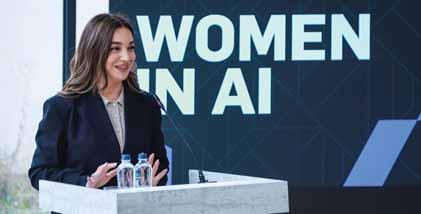
Anine-month training initiative to increase women’s participation in technology has concluded, with 200 women completing courses in artificial intelligence and web development. The ‘Women in Artificial Intelligence’ program was delivered through a partnership between UN Women and the Business and Technology University, supported financially by the European Union and the Government of Norway.
At the closing ceremony, graduates received certificates recognizing their newly acquired digital skills. The event brought together several international partners, including the EU Ambassador to Georgia, Paweł Herczynski, Norway’s Ambassador Bergliot Hovland, UN Women Georgia Country Representative Kaori Ishikawa, and BTU Rector Nino Enukidze.
Organizers pointed out that the program is part of broader efforts to expand opportunities for women in high-demand technology fields and improve gender balance within the country’s growing digital sector.
Georgia to Require Health Insurance for All Foreign Tourists Starting January 1, 2026
Georgia will soon require all international visitors to carry valid health and accident insurance in order to enter the country, based on amendments passed to the nation’s tourism laws. The requirement takes effect on January 1, 2026, the government has confirmed. Under the new regulation, travelers must present a policy valid for the entire duration of their stay — coverage must include at least US $5,000 for emergency outpatient care and US $30,000 for hos-
pitalization or inpatient treatment. Border officials will check insurance documentation at entry points, and those unable to show a valid policy may be denied entry.
The change reflects the Georgian government’s effort to improve visitor safety and reduce the risk of uninsured medical emergencies — a concern cited previously in relation to uninsured foreign visitors requiring urgent care.
As of now, there is no public announcement that travelers without insurance will face a fixed fine for arriving without it, although some media have reported such possibilities. Official guidelines emphasize denial of entry rather than fines.
Preliminary Georgian Investigation Rejects BBC Claim of WWI-era Chemical Use, Says Police Deployed Standard CS Tear Gas
BY TEAM GT
Georgia’s State Security Service (SSG) has released its preliminary findings into allegations that police used a World War I–era chemical weapon against protesters during last year’s anti-government demonstrations. While acknowledging that a chemical irritant was deployed, the agency insists that it was O-chlorobenzylidene malononitrile (CS gas) — a standard type of tear gas widely used in riot control — and not camite, the rare choking agent identified in a BBC investigation.
The BBC’s report, published last week, cited chemical weapons experts, medical evidence, and testimonies from Georgian special forces officers, claiming that law enforcement used camite, an early chemical-warfare compound last known to be used during World War I. If confirmed, the use of such a substance would constitute a serious violation of international law, including the Chemical Weapons Convention. The BBC report prompted domestic and international alarm, as well as calls for an independent investigation.
On Saturday, SSG Deputy Head Lasha Maghradze dismissed the allegations, stating that “CS gas was used according to necessity during ongoing rallies,” specifically referencing the night of 4–5 December 2024, when police confronted demonstrators protesting the government’s abrupt reversal on EU-aligned reforms. Maghradze did not address which substances, if any, were used before this date.
The timeline remains at the heart of the controversy.
Protests began on 28 November, as thousands gathered on Rustaveli Avenue after the government announced a pivot away from long-standing commitments
to European integration. The initial nights of the demonstrations were marked by aggressive police tactics, including the use of water cannons, which many participants reported to be mixed with an unknown chemical agent.
The night of 28–29 November is when multiple journalists and protesters reported unusual and severe chemical effects. Among them was OC Media’s Mariam Nikuradze, who said she was hit directly in the face by water from a water cannon. She described an intense burning sensation across her eyes, mouth, throat, and skin, calling it “completely different from the effects of pepper spray or tear gas.” After experiencing difficulty breathing, she sought emergency medical care.
Dozens of protesters similarly reported chemical burns, persistent coughing, and unusual respiratory symptoms. Medical workers who tended to injured demonstrators told local media that they encountered cases inconsistent with typical exposure to CS gas or pepper spray,
fueling speculation that another substance was used.
Following the BBC’s report, Georgia’s opposition parties, human rights groups, and several EU politicians demanded transparency, urging Tbilisi to allow independent international experts to verify the findings. The SSG’s preliminary assessment did not address whether external verification would be permitted, nor did it release chemical test results or forensic documentation.
The agency’s full investigative report is still pending. Meanwhile, the BBC has stated that it stands by its findings, highlighting that several specialists independently identified chemical signatures consistent with camite based on evidence gathered at the scene.
The controversy has now become a major political issue, not only domestically but internationally, raising questions about Georgia’s human rights record, its adherence to global armscontrol norms, and the credibility of its investigative institutions.
ECHR Grand Chamber Rules Georgia Violated Rights of Protesters and Journalists during June 2019 Dispersal
BY TEAM GT
The European Court of Human Rights has delivered a landmark Grand Chamber judgment in the case Tsaava and Others v. Georgia, finding that Georgian authorities used unjustified force in the violent dispersal of mass protests outside the Georgian Parliament on the night of 20–21 June 2019. The Court ruled that Georgia violated several provisions of the European Convention on Human Rights, including the prohibition of inhuman or degrading
treatment, freedom of expression, and freedom of assembly. The judgment, issued unanimously, found that 24 of the 26 applicants were subjected to inhuman or degrading treatment, and that the authorities failed to conduct an effective investigation into the events for more than five years.
It also found violations of freedom of expression for 14 applicants and freedom of assembly for 11 applicants, while determining that there had been no breach of Article 38, which concerns cooperation with the Court.
The case concerns one of the most politically charged episodes in recent Georgian history.
On 20 June 2019, nearly 12,000 people
gathered outside Parliament in Tbilisi after a Russian MP, Sergey Gavrilov, was allowed to sit in the Georgian Speaker’s chair and address an international parliamentary assembly in Russian. The incident provoked widespread outrage in a country that continues to endure Russian military presence on its territory following the 2008 war.
As the demonstration grew, the government deployed around 5,000 police officers. Late in the evening, clashes escalated when some protesters attempted to move toward the Parliament entrance. The authorities responded with tear gas, water cannons, and widespread use of rubber bullets. Many of those bullets were fired at close range and in some cases aimed at protesters’ heads, resulting in dozens of serious injuries and several cases of permanent eye damage. Journalists covering the demonstration were also struck despite being clearly identifiable as members of the press. In reviewing the events, the Grand Chamber found that the police used an unjustified degree of force, particularly through the indiscriminate firing of rubber bullets as a general crowd-control method. The Court emphasized that the authorities did not issue a clear and audible dispersal order or warn protesters that rubber bullets were about to be deployed. It also highlighted significant shortcomings in Georgian legislation regulating the use of such projectiles, noting the absence of adequate safeguards, clear rules, and proper supervision.
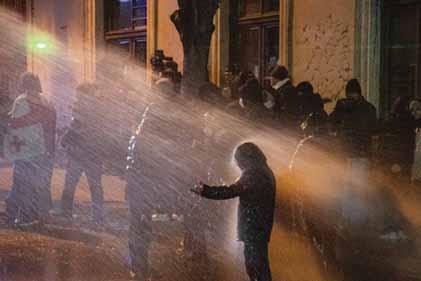
Police using water cannons against protesters in winter 2024.
Photo: Mariam Nikuradze/OC Media
A trainee. Source: UN Women Georgia
BY TEAM GT
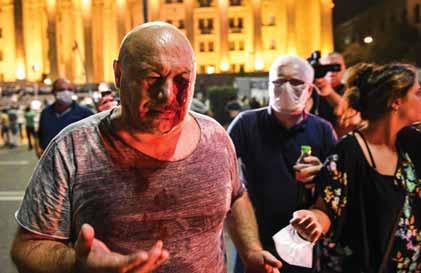
A man injured at the protest. Source: FB
Ukraine Latest: Grid Attacks, Front-Line Pressure, and Uncertain Peace Talks Define the Week
COMPILED BY ANA DUMBADZE
Russia’s war against Ukraine entered another winter week marked by heavy bombardment, fierce urban combat in Donetsk Oblast, and only minor territorial shifts, even as diplomacy and military-aid debates gathered pace in Washington, Brussels, and across Europe.
The fiercest fighting continued around Pokrovsk, the key logistics hub that has become the center of Russia’s slow-moving push in eastern Ukraine. Kyiv reported one of the largest mechanized assaults inside the city to date, with Russian forces deploying around 30 armored vehicles, cars, and even motorcycles in an attempt to penetrate deeper from the south. Ukraine says it retains control of the northern part of the city, where urban combat remains intense. Western analysts believe Russia may eventually take both Pokrovsk and nearby Myrnohrad, but only at significant cost and over a longer timeframe than Moscow anticipated.
Elsewhere along the Donetsk front, Russian forces continued pressing towards Slovyansk, Lyman, Chasiv Yar, and Toretsk. These axes have seen months of grinding Russian efforts aimed at widening gains following the earlier captures of Avdiivka and Chasiv Yar. Independent military assessments, however, noted no major territorial breakthroughs this week, reinforcing the picture of an offensive that trades personnel and machinery for only incremental ground.
While the frontline remained largely static, the air war escalated dramatically. Overnight on 5–6 December, Russia launched one of its largest combined drone-and-missile attacks in months,
firing more than 650 drones and 51 missiles in a single wave. Although most were intercepted, strikes still hit critical infrastructure in at least eight regions, forcing nuclear plants to reduce output, knocking out power and heating for hundreds of thousands, and damaging a major railway hub in Fastiv outside Kyiv. Energy infrastructure in Kyiv, Chernihiv, Lviv, Odesa, Zaporizhzhia, Dnipropetrovsk, Mykolaiv, and Kharkiv oblasts suffered “severe” damage. In Chernihiv, drones also struck a residential area. Ukrainian authorities reported at least eight people injured in the first wave alone, while subsequent strikes killed at least one civilian and wounded more than 15 across several cities. On 8 December, Russian shelling killed at least four civilians in Donetsk and Kherson regions and injured nearly 50 people. A UN briefing to the Security Council noted that dozens were injured and hundreds of thousands left without basic utilities following the massive 5–6 December barrage, warning that the intensifying strikes were undermining ongoing diplomatic contacts. Russia continued this pressure throughout the week. Kremenchuk, a major industrial and energy node in Poltava Oblast, was targeted repeatedly. A large attack earlier in the week damaged several energy facilities, and another strike on 11 December again hit local power infrastructure, sparking fires despite significant interception by Ukrainian air defenses. Kyiv warns that Moscow is once again attempting to systematically degrade the grid as winter deepens, a strategy reminiscent of the 2022–23 campaign. Ukraine, meanwhile, continued striking deep into Russian territory and waters.
On 5 December, a Ukrainian drone attack forced the Syzran oil refinery on the Volga River to halt crude processing, adding to the growing list of disrupted Russian
energy assets. Satellite imagery also confirmed major damage at the Livny oil depot in Oryol Oblast earlier in the month, where at least two fuel tanks were destroyed. These attacks form part of Kyiv’s long-running effort to disrupt Russia’s fuel supply and export routes. By early October, nearly 40 percent of Russia’s refining capacity had been temporarily taken offline at some point in 2025 due to Ukrainian strikes.
At sea, Ukraine escalated the campaign further. Naval drones struck the Dashan tanker—part of Russia’s so-called “shadow fleet” used for sanctioned oil shipments—as it sailed through Ukraine’s exclusive economic zone in the Black Sea. The drones caused critical damage to the vessel’s stern, marking the third Ukrainian strike on a shadow-fleet tanker within two weeks. Insurance premiums for ships in the region have already begun rising as a result.
Russia also faced intensified drone activity over its own territory. The defense ministry reported intercepting at least 287 Ukrainian drones this week, including around 40 near Moscow, causing major flight diversions. Russian officials claimed at least seven civilians were killed and dozens injured by Ukrainian strikes on border regions, though these figures have not been independently verified.
A particularly sensitive incident for Moscow occurred in Chechnya, where Ramzan Kadyrov confirmed that a Ukrainian drone hit a high-rise building in the Grozny-City complex near his residence. While reporting no casualties, Kadyrov vowed “a stern response” and linked subsequent Russian strikes to the incident. Independent reports suggest this was at least the third Ukrainian attack inside Chechnya recently, reflecting Kyiv’s expanding ability to reach deep into Russian territory.
Beyond the battlefield, the war’s spillover effects triggered a rare security emergency within NATO territory. Lithuania declared a national state of emergency after waves of meteorological-type balloons—some carrying contraband cigarettes—were launched from Belarus, repeatedly disrupting civil aviation and forcing the temporary closure of Vilnius airport. Lithuanian officials described the balloons, alongside a steep rise in drone incursions, as part of a hybrid campaign by Belarus, with over 600 balloons and around 200 drones detected this year. The emergency measure allows military involvement in border enforcement and movement restrictions in affected areas.
Diplomatically, progress remained uneven. In Washington, the US House of Representatives passed the 2026 National Defense Authorization Act, which allocates $400 million annually for Ukraine’s Security Assistance Initiative in 2026 and 2027, and limits any presidential attempt to reduce the US military footprint in Europe. Although the legislation still requires Senate approval, its passage signaled continued bipartisan willingness to support Kyiv.
In Brussels, NATO foreign ministers reaffirmed their long-term commitment to Ukraine’s security, highlighting ongoing work on multi-year assistance plans.
The European Commission, meanwhile, outlined several options to cover Ukraine’s financing needs in 2026–27, including a “reparations loan” backed by frozen Russian central-bank assets and new EU-level borrowing mechanisms. European Council President António Costa urged leaders to reach decisions this month to prevent a funding gap, especially with growing uncertainty around US politics. Yet analysts warn that overall militaryaid commitments have fallen significantly from earlier phases of the war. Many
European officials fear that Russia’s incremental advances in Donbas are being enabled not only by Moscow’s intensified efforts, but also by Western hesitation. Peace diplomacy remains fragile. A leaked US–Russia draft peace proposal, criticized for appearing to lock in Russian territorial gains, has been reworked following consultations with Kyiv, with US envoy Steve Witkoff expected to present the updated version to Vladimir Putin. President Volodymyr Zelensky and European leaders say they are preparing their own “refined” peace plan, insisting that any settlement must provide a “dignified peace” and avoid legitimizing aggression. UN and EU officials caution, however, that Russia’s escalating strikes against civilian and energy infrastructure directly contradict claims of readiness for meaningful negotiations.
Alongside the missiles, drones, and shifting frontlines, the human toll continues to rise. A recent UN report noted a sharp increase in civilian casualties between June and November 2025, with last month’s strike in Ternopil becoming the deadliest in western Ukraine since the full-scale invasion began. This week alone, dozens of civilians were killed and well over a hundred injured across Ukraine and Russia amid blackouts, infrastructure failures, and relentless bombardment. Taken together, the week’s developments reveal a conflict increasingly defined by long-range strikes and attritional pressure rather than dramatic territorial shifts. Russia continues battering Ukraine’s energy grid and pushing along the Donbas front, while Ukraine hits deeper into Russia’s oil infrastructure and shadow fleet. Diplomacy is active, funding debates are intensifying, yet with winter closing in, artillery, drones, and missiles still drown out any emerging peace proposals.
Georgia Moves Forward with Government City Plan on Arsenali Hill
BY MARIAM RAZMADZE
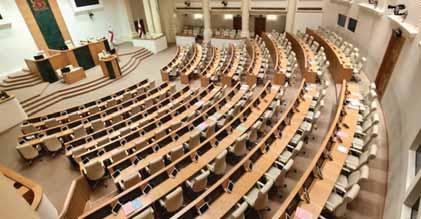
The Georgian government is moving ahead with plans to build a large administrative complex on Arsenali Hill, consolidating major state institutions into a single ‘government city.’ A design market survey, announced by the Municipal Development Fund, outlines the scope of the project, and marks the first formal step toward its development.
Prime Minister Irakli Kobakhidze explained that the relocation will include ministries, Tbilisi City Hall, the government administration and the Parliament. To support financing, the government is considering selling some of the existing ministry buildings once the relocation begins, a move Kobakhidze says
will stimulate economic activity in both the construction and investment sectors.
The government had initially examined Ortachala as a possible site, but ultimately chose Arsenali Hill where the state owns a 77-hectare land plot, one of the largest public land holdings in Tbilisi. The new complex is set to offer 282,750 m² of administrative and office space, along with at least 10,000 m² designated for events.
The project outlines that the new government city will house Tbilisi City Hall in a 59,900 m² building and the Parliament in a 31,350 m² facility. Additional office buildings will accommodate a wide range of ministries, including those responsible for Education, Economy, Environment, Infrastructure and Health.
The plan also foresees supporting structures and economic-use buildings to serve the relocated institutions.
ECHR Grand Chamber Rules Georgia Violated Rights of Protesters and Journalists during June 2019 Dispersal
Continued from page 2
The judges concluded that there was no evidence that the injuries sustained by protesters and journalists were an inevitable result of their own actions and that the police had acted in a manner incompatible with the principles of necessity and proportionality. Journalists, the Court stressed, should have been allowed to report safely and freely, and obstructing their work constituted a violation of their rights.
The Court further condemned the prolonged failure of Georgian authorities to carry out an effective investigation. More than five and a half years after the protest’s dispersal, domestic investigations have produced no meaningful findings regarding the ill-treatment of protesters or the identification of officers who used or ordered excessive force. No high-ranking officials have been held accountable. This failure, the Court ruled, represents a breach of the state’s procedural obligations under Article 3 of the Convention.
Although the Court acknowledged that the authorities may have had some grounds to disperse the demonstration— given its location directly in front of Parliament and the attempts by some protesters to force entry—the judges found that the manner of dispersal was unlawful and disproportionate. The use of rubber bullets without warning, the absence of a dispersal order, and the targeting of upper-body areas all contributed to the Court’s finding that the state’s response was not justified. The result was a set of violations of freedom of expression and assembly, as the applicants were prevented from participating peacefully in a political protest or, in the
Parliament Backs New Restrictions on Assemblies and Demonstrations at First Reading
BY TEAM GT
Parliament has approved, in a first reading and under an accelerated procedure, another set of amendments to the Law on Assemblies and Demonstrations, further tightening regulations on public gatherings. The draft introduces a new requirement for organizers to notify the Ministry of Internal Affairs (MIA) in advance when a rally is planned in a pedestrian area. It also prohibits the artificial obstruction of pedestrian pathways unless the size of the gathering makes it objectively unavoidable — mirroring the existing ban on blocking road traffic. The amendments passed with 79 votes in favor and 9 against. The bill was presented in both committee and plenary sessions by Archil Gorduladze, Chair of the Legal Affairs Committee.
Gorduladze claimed that the current law does not sufficiently ensure the balance between the right to assemble and the protection of the rights of others.
The proposed changes, he said, aim to address this gap. Under the draft, organizers must notify the Ministry of Internal Affairs instead of the municipal authorities. After receiving the notifi cation, the MIA would be authorized to suggest a different location or route if the planned form, location, or trajectory of the assembly is deemed to endanger public order, the functioning of state institutions, transport operations, or the free movement of people.
If participants in a spontaneous or planned assembly refuse to comply with the MIA’s proposed location or route and proceed with the original plan, they may face up to 15 days of administrative detention, while organizers may face up to 20 days. Repeated violations would carry criminal liability under Article 347
of the Criminal Code — including up to one year of imprisonment.
Gorduladze explained that if a gathering initially does not infringe on others’ rights but later causes violations, the MIA will issue a warning to participants. The assembly will not be immediately terminated, but individuals may face administrative penalties.
He added that if protesters massively block a roadway, the MIA will warn them and give them 15 minutes to clear it. If they fail to do so, the entire assembly will be declared unlawful, terminated, and participants will be held accountable — with penalties ranging from administrative detention of up to 15 days to criminal liability of up to one year. Individuals who block traffic alone by stepping onto the roadway will also be sanctioned, while those who do not obstruct movement or violate others’ rights will face no responsibility and may continue their protest in accordance with the law.
Georgia and UN Sign New Sustainable Development Cooperation Framework
2026–2030
case of journalists, from carrying out their professional duties.
In its judgment, the Grand Chamber also issued general measures, instructing Georgia to reform its legal and regulatory framework governing the use of rubber bullets. These measures include adopting clear rules on when such projectiles may be used, implementing strict safeguards to prevent misuse, and ensuring proper training and accountability mechanisms within the police force. These requirements are binding and will be monitored by the Committee of Ministers of the Council of Europe.
The events of 20–21 June 2019, widely referred to in Georgia as “Gavrilov Night,” had significant political consequences, contributing to changes in parliamentary leadership and fueling opposition movements that accuse the Georgian Dream government of authoritarian tendencies and a drift toward Moscow. The Court’s ruling adds new international weight to longstanding domestic criticism of police conduct and the government’s failure to ensure accountability. It also comes at a moment when Georgia is facing renewed scrutiny from European institutions over recent legislative initiatives that restrict freedom of assembly.
Human rights groups and the applicants’ representatives have welcomed the judgment as overdue recognition of the violations suffered by protesters and journalists more than five years ago. The Georgian government is expected to respond formally to the ruling in the coming days, and its implementation will likely become a test of Georgia’s commitment to human rights standards at a time of heightened political tension and growing concern over democratic backsliding.
BY TEAM GT
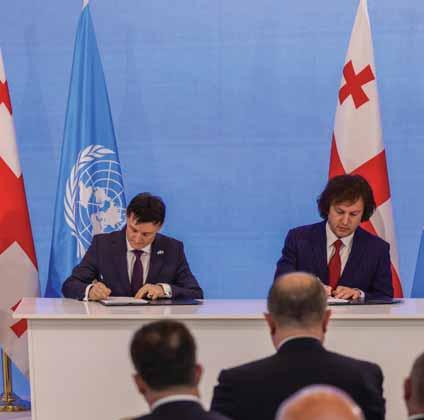
The Government of Georgia and the United Nations (UN) signed the United Nations Sustainable Development Cooperation Framework (UNSDCF) 2026–2030.
The new Cooperation Framework will guide the strategic partnership between the Government and the United Nations to advance sustainable development in Georgia in the next five years.
Under this umbrella, 21 UN agencies, funds and programs will work together to support Georgia in four key areas of cooperation: promoting inclusive economic growth and green transition; strengthening education, health, and social protection systems; advancing good governance, human rights, and social cohesion; and fostering peace and resilience across dividing lines.
The new Cooperation Framework was signed by Irakli Kobakhidze, Prime Minister of Georgia, on behalf of the Government of Georgia, and Didier Trebucq, UN Resident Coordinator in Georgia, on behalf of the UN Country Team.
In his opening remarks, Prime Minister Irakli Kobakhidze thanked the United Nations in Georgia for continued partnership and support. He reaffirmed the Government’s commitment to fostering sustainable development.
Speaking at the signing ceremony, Levan Zhorzholiani, Head of Administration of the Government, noted that the new Cooperation Framework is designed to contribute directly to the national development priorities.
“ Today marks a new milestone in over thirty years of long-standing, deep partnership between Georgia and the United Nations ,” said Didier Trebucq, UN
Resident Coordinator in Georgia. “The Cooperation Framework we sign today is a pledge we share with the Government of Georgia and all partners for decisive reforms to accelerate progress towards the Sustainable Development Goals. This cooperation framework offers a platform for action to work together. Its goal is to promote green and inclusive development, with the aim to reduce inequalities between urban and rural areas.”
The Framework was developed by the United Nations and the Government through an inclusive, participatory pro-
cess involving consultations with the civil society, private sector, youth representatives, academia, and development partners.
With an estimated budget of USD 262 million, the Framework will be implemented over five years through joint programs, innovative financing, and strengthened partnerships among national and international partners. The signing ceremony brought together representatives of the Government, United Nations, the diplomatic community, civil society organizations, private sector and other stakeholders.
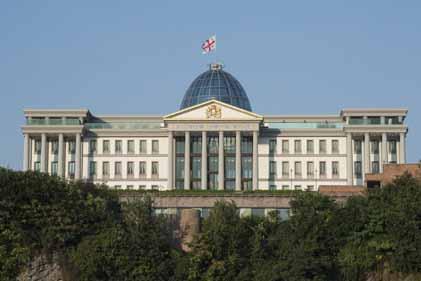
The former presidential palace. Source: Civil Georgia
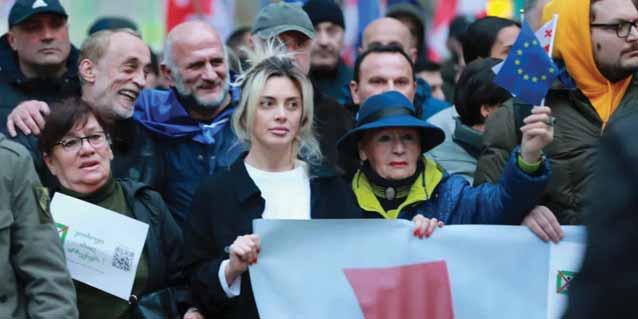
Protesters in Tbilisi in 2024.
Source: AP/ Zurab Tsertsvadze
Didier Trebucq and Irakli Kobakhidze sign the Cooperation Framework. Source: UN
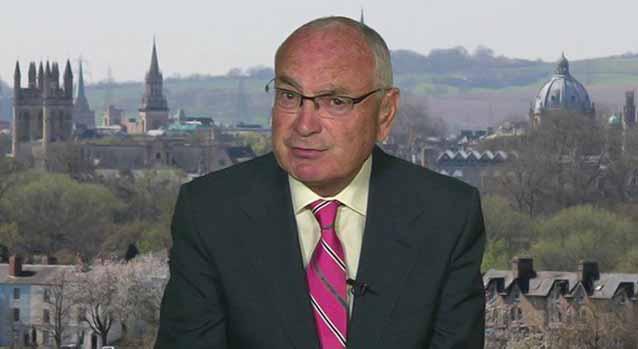
Prof. Anthony Glees on Europe’s Future: Defending against Russia as U.S. Policy Shifts
INTERVIEW BY VAZHA TAVBERIDZE
When my grandchildren reach adulthood, I fear they will either be under Russian rule or in a war against it, - Professor Anthony Glees, director of the Center for Security and Intelligence Studies (BUCSIS) at the University of Buckingham, issues a stark warning about Europe’s future. In an interview for Radio Free Europe’s Georgian Service, he analyzes the new U.S. security strategy, Europe’s faltering defense posture, Germany’s political dilemmas, and Ukraine’s increasingly perilous position.
AFTER THE RELEASE OF THE US NATIONAL SECURITY STRATEGY AND THE SUBSEQUENT SPEECH BY DEFENSE SECRETARY HEGSETH, MANY HAVE HERALDED IT AS AN OFFICIAL DECLARATION OF AN END TO THE UNIPOLAR WORLD ORDER – IS THAT SO?
Well, I think it's a more complicated paper than that kind of binary interpretation allows. What President Trump is saying is that by 2027 Europe needs to take the lead in its own defense, and that although the United States will be there in the background, by 2027, which is not far away, European security has got to be a European project, not an American project. And there are many people who rather agree with that view. And you know, it is unfortunate, perhaps, that that is the way the world is. We have got very used, ever since the fall of the Berlin Wall and the “end of history” attitudes that gripped us all, particularly in Western Europe, of not worrying too much about spending money on defense, because we wanted to develop social policy and give the money away in welfare. And once you start doing that, as UK politics shows right now, you can't stop doing it. So it's a very, very dangerous position.
The bottom line is, yes, we need to spend much more money on our defense, and we need to do the things that allow our defense to look credible, and that's not just about hardware, and it's not just about intelligence: it's also about the political will to defend our continent from Putin's aggression. So the document in that regard chimes with what I think is the correct view. Where the document is wrong, in my view, is to suggest that the aims of Putin's Russia and the aims of Trump's America are the same and should be the same.
NOTABLY, MOSCOW ALSO SAID THAT THE VISIONS ALIGN, WHICH WAS PROBABLY SOMETHING NOBODY WOULD HAVE EXPECTED IN DECADES PAST. Yes, and I think many Americans and many Republicans will, as time goes by, find that unacceptable, because, as everybody knows, Putin's regime is a regime of kleptocrats and oligarchs and has no sense of human dignity or human rights, or indeed respect for human life. Americans do not want to be aligned with those sorts of attitudes. Yes, they want to make money, they want to give everybody a chance, but on the whole, they don't like the sort of things that Putin has to do in order to stay in power. Where I think the security strategy is dangerously confused, however, is on the one hand saying yes, Europe must man up, must take much more control of its own security and defense, and cannot rely on the United States of America except as a possible backstop, and on the other hand, where the document says it wants to have “conservative governments” running Europe and opposition to the European Union. That is based on a complete misreading of the actual necessity. If you want a stronger Euro-
pean defense presence, as the President says he wants, then you also need to have a much stronger European political identity, which the President says he doesn't want- he says he will support parties who are actively supporting him. My strong suspicion is that these contradictions are to be laid at the door of Nigel Farage, who sees himself as the next British prime minister, and who is, on the one hand, obsessed by and consumed with a hatred for the European Union, but on the other understands, I think, that the EU could be a very powerful player between the United States and Russia. Farage and his friends may have been whispering into the ears of the State Department and the Oval Office that Europe needs to take the burden of defending itself off American shoulders, while also supporting politicians who believe in a weaker European Union. That simply doesn't work; it doesn't hack it. That is the message Germans and the French in particular will need to put to the State Department and to President Trump. And he’s mercurial — he's not just a Midas, he's also a Mercury, he's Quicksilver. He's not just gold. He holds a number of views that can't easily be amalgamated. In many respects, they're contradictory and confusing, yet they chime with what Trump calls “common sense.”
ON THAT MERCURIAL NATURE— HOW LIKELY IS THIS NEW DOCUMENT TO ENDURE? WILL WE ACTUALLY SEE IT ENFORCED, OR SHOULD IT BE VIEWED MORE AS A WISHLIST OF HOW THE WORLD OR THE US OUGHT TO WORK, ACCORDING TO PEOPLE LIKE ELBRIDGE COLBY AND OTHERS?
I can see no sign that it will not become policy. I can see no sign that the Democrats will be able to win the next presidential election and turn policy around. And the people I have spoken to who are in the governmental world are all working on the basis that the next President of the United States will be JD Vance, whose own policies mirror those put into that document. This is a new MAGA America. It's a 21st-century phenomenon in many ways. Yes, it harks back, it strikes chords. The more you know about American history in the 19th century, the more you can see that Trump speaks to tropes deeply embedded in American history. But the world in which Trump operates is very different from the 19th century, from the world where all the great powers tried to maintain peace — they failed, of course, with the First World War, but they tried. Now, particularly with Russia but also with China, you have revisionist regimes that are very different and very actively seeking conflict and confrontation.
WILL EUROPE REALISTICALLY BE ABLE TO DEFEND ITSELF ON ITS OWN BY 2027?
Well, I think it is feasible, definitely. It is feasible if we want to do it. At a micro level, you could do it. In the UK, the Chancellor of the Exchequer's golden rules could be changed to allow more borrowing. After all, defense spending is actually quite good for a country's economy in all sorts of ways — it boosts jobs and all these things. They could borrow more.
In 1940, during the Second World War, Britain borrowed vast amounts of money in order to ensure that it was armed, in order to defend itself against German aggression. The way it's being presented at the moment is a sort of welfare-versusdefense dichotomy, and that there's no money, nobody in Britain has any money, etc. I don't think that's true. I think there's a big black economy. There's a lot of money in this country. So we can afford to pay for more defense without necessarily giving up the National Health Service. If we don't want to give up the National Health Service, we can borrow. We can take out a loan from America,
Professor Anthony Glees
for example, in order to do this.
YOU’VE WRITTEN A BOOK ABOUT GERMANY REINVENTING ITSELF – WILL IT HAVE TO DO IT ONCE MORE? IS IT READY TO? DOES IT WANT TO?
The German situation is complex, and not just due to reunification. The farright threat mainly comes from eastern Germany, highlighting a systemic problem the country must address.
Then there are the serious errors made by Angela Merkel as chancellor, which Germany is still grappling with today. Chief among them was her inexplicable decision to phase out nuclear energy. Despite her scientific training, she acted unscientifically. If she feared a Fukushima-style disaster, she would know that most winds in Germany blow from the west, and France has numerous nuclear plants—so contamination would have been likely regardless. The decision was political, aimed at appealing to environmental voters, but it left Germany dependent on Russian oil and gas. It was a profoundly misguided move.
Another major blunder, which I criticized at the time, was taking in over a million migrants in 2015 about whom Merkel and the authorities knew very little. I’m not judging it on moral or humanitarian grounds—it may well have been right—but geopolitically, it was disastrous. It left ordinary Germans feeling overwhelmed by people from unfamiliar cultures. As I said then, she wasn’t playing by the rules; it even conflicted with NATO obligations, since all members are supposed to secure their borders. That’s why I call Germany a ‘hippie state’—for Germans, the rules didn’t seem to apply.
So that has been a really big problem for Germany. I don't think a further reinvention is needed, but I do think Germany is at a crossroads. The case for Europe and the European Union needs to be made even more strongly by Germany. It’s not so much a reinvention as a renewed push for Germany toward Europe—and that’s the only solution. Even in the UK, far more people now believe Brexit was a mistake than in 2016. The opportunity is there for Britain to help strengthen the European Union. It’s the only answer—for Herr Merz, for Viktor Orbán, for Monsieur Bardella. They may not like it, but Europe must be strengthened regardless.
LET’S LOOK AT THE UKRAINESHAPED ELEPHANT IN THE ROOM – WHAT DOES THIS NEW STRATEGY MEAN FOR UKRAINE, ESPECIALLY IN THE CONTEXT OF THE ONGOING PEACE EFFORTS?
Over a million Russians killed or maimed in Putin’s demented war against Ukraine tells you that he is a murderous killer with no respect for human life, whether
of Ukrainians or of his own people. That tells you all you need to know about the war criminal in the Kremlin. But the sad fact is that although the Russians cannot knock Ukraine out of the war, they appear to be winning.
What none of us understood was, first of all, that an American president would be so actively hostile to the idea of a sovereign Ukrainian state. Putin has whispered in Trump's ear repeatedly: Ukrainians are losers. They're losing. Ukraine is really part of Russia. This is a senseless, idiotic war. And Trump has come to believe that, despite the best efforts of Europe's finest diplomats.
So I think you will find that however much we hate saying this, the time has come for Zelensky to trade Donbas and other areas to Russia in return for a ceasefire and a guarantee of boots on the ground from France, Germany, and Britain, in order to make this palatable to Zelensky and the Ukrainian people, who, of course, do not want to do any of this.
DO GUARANTEES REALLY EXIST? EARLIER PROPOSALS OFFERED ONLY 'ASSURANCES,' RECALLING THE BUDAPEST MEMORANDUM. WHERE ARE THE GUARANTEES, AND WILL THEY MATERIALIZE?
Well, as Mark Twain once said, you should never make predictions, especially about the future. All we can really talk about is what the deal on the table is. And I think the deal on the table now is quite clear, and what Sir Keir Starmer, Macron, and Merz will say to Zelensky is: look, we hate this almost as much as you hate it, but there is no alternative. You get a better deal now than you will get six months from now, and many more people will be killed for a worse deal. And no president can do that. You've got to bite the bullet. And that will be literal, because it will be the end of Zelensky.
Now you’ll probably ask me: can Putin be trusted to stick to it? Of course not.
His track record is appalling. But what has changed — or what could change — is the leadership in Europe. Merkel was a very complicated figure. The first part of her political career was developed under the East German communist regime. If the Berlin Wall had not fallen, Frau Merkel — a gifted politician — would almost certainly have been in the East German Politburo. And there you had this very strong sense that Russia was your guardian. You were protected and made secure by them. Now there's a different leadership. Macron is different. And whoever emerges as the British leader will be there — even Kemi Badenoch.
YES, BUT MACRON WON'T BE AROUND FOR LONG. AND GERMANY, AS YOU’VE SAID, HAS QUITE AN UPHILL
STRUGGLE TO UNDO THE MISTAKES OF THE PAST. NONE OF THAT GIVES ZELENSKY ANY ASSURANCE OR ANY HOPE. He has none, and it keeps me awake at night. Quite genuinely, I'm kept awake at night by the fate awaiting the brave Ukrainian people, and consequently wider Europe as well. All the time we are seeing ordinary people in Europe — in Britain, France, Germany — acting like ostriches, sticking their heads in the sand because they don't want to hear what Putin has himself said about his primary wish to resurrect the geopolitical entity that was the Soviet Union. He has said he does not want the post1997 NATO states to continue being part of the Alliance. And once he has swallowed Ukraine, he will start subverting and swallowing all the post-1997 states — and we're talking about Poland too. It's not just the Baltic republics and the smaller ones. We're talking about really big and key players. That's what keeps me awake at night — that when my grandchildren come to adulthood, they will either be under Russian rule or in a war against it.
WHICH COUNTRY LOOKS MOST LIKELY TO BE THE NEXT TARGET FOR PUTIN’S MILITARY AGGRESSION? POLAND IS ONE OF THE BIGGEST AND BEST PREPARED — SURELY HE WOULD CHOOSE A WEAKER INITIAL TARGET? AND WHAT WOULD BE THE LIKELY EUROPEAN RESPONSE?
I see developments in the following terms: first, a ceasefire which gives Putin what he has captured on the battlefield — and then some — in return for the guns falling silent. The next stage will be peace; this could take a few years. While it is being negotiated, I believe Putin will return to his policy of subversion in Ukrainian politics, resorting to all the tricks in his evil toolbox — poison, subversion, etc.
Meanwhile, I expect him to start more intrusive subversive measures against the Baltic republics and Poland, and almost certainly more covert meddling in German politics, trying to destabilize Merz, and building not just on the eastern German pro-Russian culture, but perhaps trying to re-establish even older tropes between some in the German army and intelligence services and their Russian counterparts. This is all part of Putin's KGB playbook — slice by slice. Yet just because Putin wants this to happen, it does not follow that it has to happen. The Russians are not ten meters tall. We need to retaliate, like with like. If their MiG fighters willfully intrude on our airspace, we should shoot them down, and we should spell out our intention to do so now, before there are any further intrusions. A more muscular European NATO can deter Putin.
Economic Policy and National Security Have Become Inseparable: Governments Must Adapt Accordingly. Part 1
ANALYSIS BY VICTOR KIPIANI, CHAIRMAN, GEOCASE
At this stage of global development, national security and economic policy have become so deeply intertwined, that separating them is practically impossible. Modern states must confront an extremely wide range of challenges, many of which lie beyond their control. This makes the presence of flexible, capable, and highly competent governing institutions more crucial than ever.
THE AMERICAN PRECEDENT
Before pointing to specific issues or proposals, I need to set the stage and briefly turn to history. This historical prelude relates to the modern understanding of national security, an understanding that is highly multilayered, integrated, and, of course, includes economic security.
Before ‘security,’ in its broad sense, came to mean what it does today, political and academic thought had to undergo a natural evolution.
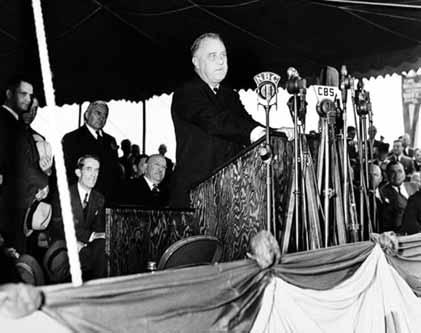
As early as 1937, US President Franklin Delano Roosevelt (during the opening of a new bridge in Chicago, no less) delivered one of his defining speeches on American foreign policy. That address became a cornerstone of the United States’ strategic approach, because it linked socio-economic welfare with national defense within a single doctrine of ‘national security.’
Simply framing these elements as interconnected radically transformed the US Department of Defense. It moved beyond the narrow concept of territorial defense, and began speaking about not only physical threats, but also economic and ideological ones.
As a result, the traditional understanding of ‘security’ changed its substance. It acquired a profound ideological dimension, detached itself from a specific geographic area, and took root in a global context.
From the American perspective, this global dimension was defined as the protection of the ‘American way of life,’ and any threat or challenge to that way of life was placed within a unified definition of ‘national security.’
The broadening of this concept was not without controversy, shaped as it was by different historical eras and events. Still, it is undeniable that the developments of 1937 set in motion a historical
process of rethinking national security— a process that has endured over time and has reached us with a larger, wider and, as it is often called, ‘integral’ meaning.
Such ‘integrality’ places at the foundation of the security system the strength of a country’s economy, its capacity for resilience, its ability to survive crises, and its inclination toward modernization and development in an autonomous mode.
Alongside this, the modernized version of national security emphasizes the active role of the state in economic processes (so-called ‘state activism’), which is especially visible against the backdrop of new types of risks.
Accordingly, the boundary between the state’s self-restraint and its intervention in the economy is often fluid. This, logically, is explained by the transition from the old global and economic order to a new one, a transition laden with uncertainty, unanswered questions, and ambiguity.
I will return to this delicate aspect of the economic-security nexus later.
For now, it is important to note that today’s economic system, which is shaped by multiple historical upheavals and periodic modifications, stands as a real load-bearing pillar of comprehensive security.
It is characterized by:
1. Providing the critical infrastructure of the economy;
2. Possessing autonomy (at least for an
acceptable duration) and resilience during crises;
3. Supplying essential services to its population; and
4. Ensuring secure and stable development, at least in the medium term. From this perspective, when forming and implementing state policy, those entrusted with authority and responsibility must communicate with domestic and external audiences using the most realistic scenarios, without ‘rose-tinted glasses.’
At a minimum, this requires:
1. Understanding that economic security reflects the balance of power in the region and globally;
2. Recognizing that economic security is inseparable from the art of compromise;
3. Acknowledging the existence of actors more powerful than oneself, which demands proper consideration and wellmanaged relations;
4. Maintaining close coordination with partners; and
5. Having the patience and ability to engage in the ‘long game.’
MODERN ECONOMIC WARFARE
When describing the modern economy, one could list many characteristics. I have spoken about several of them before, but here I want to highlight one aspect of the current trend: the growing ruthlessness, egoism, and voracious appetite of actors in economic relations, that is,
Georgia Approves 2026 Budget
BY MARIAM RAZMADZE
Security structures will receive higher funding as well. The Ministry of Defense is
the drive to secure their interests practically at any cost.
Leaving the literary flourishes aside, I would single out several aspects in particular.
First and foremost is the ‘militarization’ of the global economy. This is a clear shift from development-driven economic constructivism toward economic coercion.
In this sense, tools of pressure and ‘forced agreement’ are now widely used: sanctions, attacks on supply and logistics chains, export–import restrictions, etc.
One of the key system-shaping factors behind today’s disordered global economic environment is the US–China relationship. Here, too, the degree of interdependence between the American and Chinese systems is so high that any poorly calculated step by either party risks leading to ‘mutually guaranteed self-destruction.’
For this reason, it is no coincidence that the US and China have settled into a mode of so-called ‘managed instability’: each side escalates tensions up to an acceptable threshold, followed by de-escalation (a temporary pause or a ‘truce’) and then another round of escalation.
Naturally, such a relationship requires its own craft. As with nuclear deterrence and the logic of ‘mutually assured destruction,’ the risk of miscalculation—and thus serious consequences—in this ‘militarized’ economic rivalry between the US and China remains rather high.
Both sides, of course, possess their own arsenals of influence and coercion.
In the US case, the primary instruments are the dollar (which is still the world’s dominant reserve and settlement currency) and America’s critically important consumer market. It is extremely difficult for China to disregard these two advantages. In innovation, energy, and finance, the US economy still maintains a certain lead, although, given today’s challenges, and without proper structural reforms in the national economy, this advantage cannot be considered guaranteed in the medium or long term.
China, for its part, holds several advantages of its own, which it uses to bargain with the US: its rapidly growing tech industry, its leap forward in the green economy through heavy subsidization, and its near-exclusive dominance of rare-earth extraction and processing.
This is only a short outline of Beijing’s ‘trump cards,’ since China’s economy also faces numerous structural challenges that require deep and urgent reform.
BUSINESS
Relations among states today, shaped by national egoism and economic autarky, largely revolve around three sectors: communications, finance, and manufacturing.
From this perspective, the global ‘systemless system’ is driven far more by attack–defense tactics than by attempts to reconcile shared commercial interests. As is geopolitics, geo-economics too is hierarchical—the strong on top and the weak at the bottom—and is guided by the factor of dominance.
It is also increasingly evident that the old, classical categories of economic thought (capitalism vs. socialism, free market vs. planned economy, etc.) no longer neatly apply. States (and not only states) are significantly altering longestablished practices and approaches to the point that rigid classification within any economic school has become impossible.
Given the evolutionary nature of national economic systems, ‘mobile economic thinking’ is perhaps a more precise and flexible term than any doctrinal or conceptual label.
One visible result is a certain convergence of systems, and even ideologies, that once differed sharply.
While China’s model of active state involvement in economic life is no surprise, what is new is the desire of both the previous and current US administrations to introduce more statism, that is, more state intervention into the American economy. Moreover, personalism increasingly replaces healthy bureaucracy, and short-term goals take precedence over long-term objectives. From the standpoint of economic security and self-sufficiency, I want to touch separately on Europe, which is a particularly complex case.
Europe could become a highly influential geo-economic actor, but it suffers from a severe deficit of institutional capacity, which prevents it from fully mobilizing the resources at its disposal. Its predicament is compounded by the fact that its security remains heavily dependent on the United States—a dependence made even more uncomfortable by the unabashed mercantilism of the Trump administration in its quest to secure the best possible deals for America by any means.
Europe also struggles with a lack of unity in foreign (and other) policy areas. In short, the European case remains, for now, a clear illustration of a situation in which the goal exists, but the necessary means for achieving it do not.
BY MARIAM RAZMADZE
rime Minister Irakli Kobakhidze announced that Georgia will cancel around GEL 1 billion in accumulated fines and penalties owed by energy companies involved in renewable energy projects. The government says the measure is intended to remove financial barriers that have stalled development and to stimulate investment in the sector. Kobakhidze noted that debt relief will not be unconditional. Companies that fail to meet revised project deadlines or show signs of negligence will be required
to pay both future fines and the liabilities now being forgiven.
The Prime Minister stated that the initiative represents a new stage in Georgia’s energy policy, one focused on strengthening economic growth and energy independence through closer cooperation between the state and developers. Updated agreements and project timelines will be established to clarify obligations on both sides. Kobakhidze thanked the Ministry of Economy and Sustainable Development, led by Mariam Kvrivishvili, for preparing the decision, expressing confidence that companies will now be better positioned to advance renewable energy projects across the country.
Franklin D. Roosevelt, 32nd president of the United States, making a dedicatory speech at the Centennial Bridge over the Chicago River, 5 October 1937.
Source: Amazon
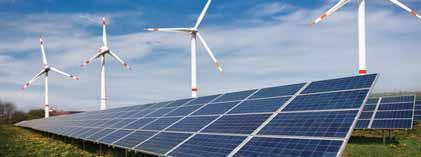
Turbines and panels. Source: Compare Electricity
35-Year Summary: 100 Business and Official Delegations from Israel
BY ANA DUMBADZE
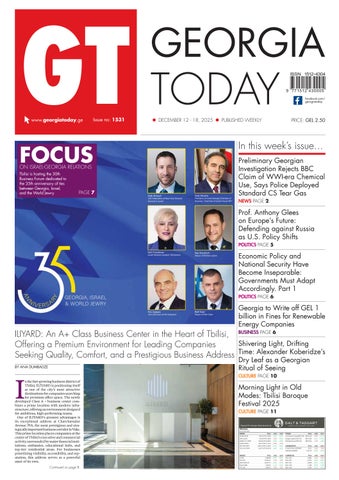
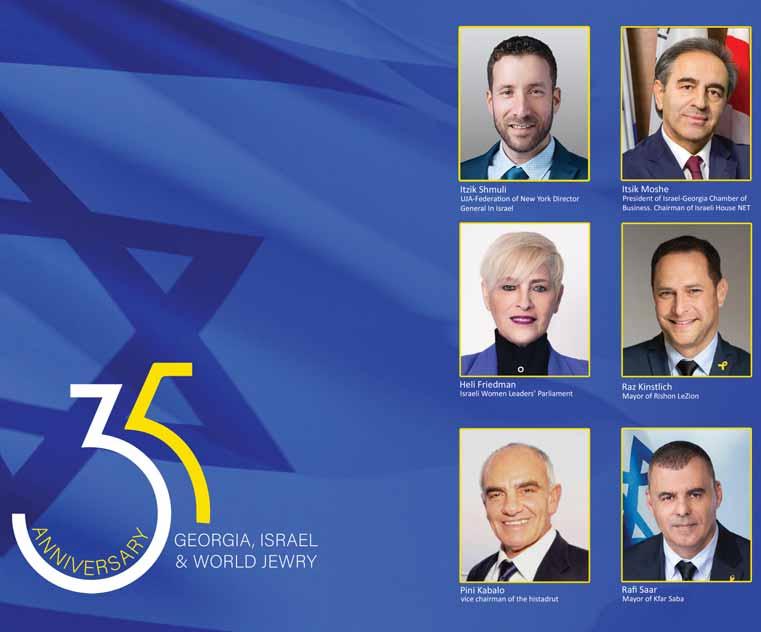
Tbilisi is hosting the 30th Business Forum dedicated to the 35th anniversary of ties between Georgia, Israel, and the World Jewry. The event is organized by the Israel-Georgia Chamber of Business and the Israeli House, two institutions that have spent years strengthening Georgia’s multifaceted relations with Israel and Jewish communities worldwide.
Among the guests are official representatives from Georgia and Israel — members of government, public figures, city mayors, international organizations, and around 100 business leaders from Israel, along with Georgian business executives.
Greetings from members of the Knesset will also be read at the opening ceremony.
This is far from the fi rst high-level delegation visit organized by the IsraelGeorgia Chamber of Business and the Israeli House. Both institutions are among the few — if not the only ones — that have enjoyed decades of consistent support from the Israeli government, the Knesset, and the country’s senior leadership, beginning 35 years ago with President Chaim Herzog, and continuing today with his son, the current President of Israel, Isaac Herzog.
The forum will summarize economic and business relations between Georgia and Israel, explore new tourism-sector plans between the two countries, and present new tourism projects. Guests will also be introduced to the Biblical Route of Jewish Cultural Heritage, implemented under the auspices of the Council of Europe and beginning in Georgia.
The opening ceremony will feature the lighting of the Hanukkah candle.
The multi-day forum will include
panel discussions and workshops on a range of topics, including:
• Prospects for increasing travel from Eastern European countries to Israel and strengthening bilateral tourism;
• Strategies for reaching 500,000 Israeli tourists annually traveling to Georgia;
• The work of the Israeli House in 27 countries and the opening of its central office in Jerusalem in 2026;
• Results of city-to-city twinning partnerships between Georgia and Israel, with several new pairings to be announced, including Akhmeta and Rishon LeZion;
• Strengthening international brands in the tourism industry;
• Rising interest from Israel’s fi lm industry in Georgia and upcoming productions (including a promo film screening);
• Presentation of a Georgian–Israeli startup as a successful model of joint innovation.
The Israel-Georgia Chamber of Business was the initiator behind a new bilateral economic cooperation plan developed during the global crisis. The plan focuses on expanding cooperation in agriculture, boosting Georgian exports to Israel and the Jewish diaspora, and developing new trade routes. With the Chamber’s direct involvement, several premium Georgian export products have already received internationally recognized Kosher certi fication, and this process continues.
A dedicated panel will focus on antisemitism, where Israeli guests will meet emerging Georgian leaders. The discussion will also examine how global cities can contribute to combating antisemitism, and how Jewish cultural heritage can serve as a tool for dialogue and cooperation among nations.
Parallel to the forum, an exhibition of artworks by Israeli painters and presentations of business projects will be held.
The event will be covered by Georgia’s leading television channels and the
Israeli press. The forum will highlight Georgia’s achievements over the past 35 years, its safe environment for tourists and investors, and its growing potential.
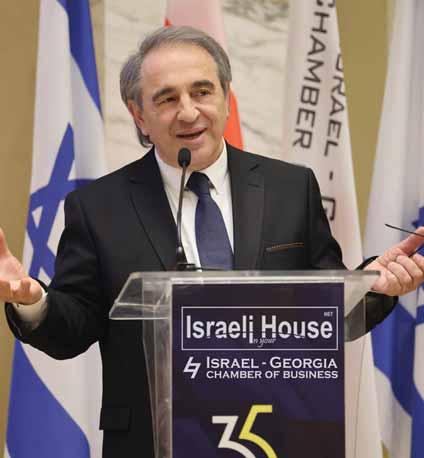
According to Itsik Moshe, President of the Israel-Georgia Chamber of Business and Chairman of the Israeli House, the organizations he has led over the years (the Jewish Agency for Israel, the Israel-Georgia Chamber of Business, and the Israeli House) serve two friendly nations — Georgia and Israel. This business forum, he says, is a joint preparation for the next 35 years.
Several joint projects will be signed
at the forum under the management of the international company Wyndham. Of fi cial representatives from Georgia and Israel will deliver remarks, and visiting Israeli guests will also attend presentations of business concepts intended to attract new interest.
Around 25 business meetings are planned.
According to Moshe, 35 years is enough time for both sides to form a clear vision, set goals for each other’s countries, and prepare to walk the path required to achieve them.
“Over these 35 years, the Chamber has proven that achieving results in any
field requires deep knowledge of the partner country, building strategy, and working consistently — the results follow quickly.
“Although I had hoped for even greater outcomes, Georgia today has received more than USD 5 billion in contributions from Israel (over 50% of it from tourism) — from a country constantly under attack by hundreds of millions of antisemites and by states that, despite not even sharing a border with Israel, still fi re thousands of rockets at it.
“Israel is — and will remain — a model for Georgia: compact, successful, and one of the world’s leading nations.
“In my view, Israel’s Hasbara, or public diplomacy, fully serves Georgia, because it enables Georgia to see the real Israel and work with it for mutual benefit,” Moshe says, adding: “In 2022, the attempted assassination organized by Iran’s Revolutionary Guard proved that my path — decades of public diplomacy — was and continues to be the right one.”
The Chairman of the Israeli House identi fies five people who signi ficantly in fluenced the creation of the new reality and strengthened bilateral ties:
• Professor Baruch Gouri, who, during the Soviet era, as head of the Jewish Agency for Israel’s representation, provided the foundational knowledge that shaped his worldview;
• Hilik Bar and David Bitan, former chairmen of the Israel-Georgia Friendship Group in the Knesset, with whom the direction of cooperation transformed — from “Georgian and Georgian-Jewish relations” to broader Georgia-Israel relations;
• Akram Hasson, whose support ensured large-scale backing for the Israeli House in the Knesset; • and Foreign Minister Eli Cohen, who—despite resistance from certain circles toward the Israeli House’s new working model—stood objectively beside the organization, opening doors to global institutions.
Empowering Entrepreneurs: EU Drives Growth and Jobs for Georgia’s SMEs
BY TEAM GT
Small and medium-sized enterprises (SMEs) are a cornerstone of Georgia’s economy, generating value, stimulating innovation, and providing significant employment. Recognizing this, the European Union has become a key partner in supporting these businesses through its EU4Business initiative. By offering access to finance, training, and regulatory support, the EU helps Georgian entrepreneurs scale up, become more competitive, and seize opportunities both locally and in European markets. This support is particularly relevant given Georgia’s deeper economic integration with the EU via the Deep and Comprehensive Free Trade Area (DCFTA), which opens up new export opportunities for local firms.
EU4Business in Georgia operates through three main pillars. Access to Finance provides concessional loans, microfinance, and grants via Georgian and partner banks. Business Development Services offer training, mentorship, strategic advice, and cluster support to improve SME management, operations,
and export readiness. The Business Enabling Environment pillar supports regulatory reform, policymaking capacity, and alignment with EU-business standards to create a more favorable ecosystem for growth. Together, these interventions help businesses modernize, expand, and become more resilient while fostering an inclusive and competitive market environment.
The impact of EU4Business is measurable and significant. According to the Citizens’ Summary 2025, in 2024 alone, 40,801 SMEs received support, generating an additional €261.4 million in income and creating 51,976 new jobs. Supported SMEs also recorded a 12.6% growth in turnover and a 12.6% increase in exports. At the same time, gender inclusion remains a focus, with 40.4% of businesses supported by EU4Business in Georgia being owned or managed by women.
Across 54 active projects with a combined budget exceeding €311 million, the EU has contributed to tangible economic development that strengthens both local communities and Georgia’s overall competitiveness in European markets.
The effects of this support are evident in the stories of individual entrepreneurs.
Eka Boqolishvili, a maker of traditional Georgian sweets, upgraded her machin-
ery with EU4Business support, enabling her to fulfill large export orders with consistent quality. Nino Ioseliani, founder of the textile startup Colours of Caucasus, benefited from EU-backed cluster support, which helped her scale and compete more effectively in international markets. Young entrepreneur Erna Pepanyan used an EU grant to develop her family’s guesthouse, noting that taking small steps and believing in her potential were key to her success. Others, like Irina Gloveli and Tekla Mamageishvili, leveraged advisory services to improve financial reporting and strategic planning, resulting in increased profits and business efficiency. Even small homebased ventures, such as Manana Chqareuli’s seamstress business, grew into sustainable enterprises with access to EU-associated financing.
Entrepreneurs also highlight the role of cluster networks, as George Mzhavanadze explained: “Through the cluster, we can consolidate resources and compete with experienced international companies … we are linking the Georgian companies … with similar clusters in Europe.”
Despite these successes, challenges remain. The EU Business Climate Report Georgia 2024 indicates that many com-
panies continue to face political uncertainty and workforce skill gaps, which could hinder long-term growth. Compliance with export standards, particularly for the EU market, also presents difficulties, requiring technical knowledge, certification, and capacity building. While women are well represented in advisory programs, access to finance for female entrepreneurs and rural business owners remains an area for further support.
The EU’s engagement with Georgian SMEs through EU4Business is more than financial aid; it is a long-term investment in economic resilience, competitiveness, and inclusion. By helping businesses improve their capacity, scale operations, and meet international standards, the EU is fostering growth and deepening Georgia’s economic ties with Europe. Looking forward, continued focus on sustaining the jobs created, expanding access to finance, strengthening export competitiveness, and supporting skills development will be crucial for ensuring that Georgian SMEs remain vibrant and globally competitive.
EU4BUSINESS SUPPORT: WHAT IT LOOKS LIKE IN GEORGIA EU4Business in Georgia is structured around three main pillars:
Access to Finance (A2F): The EU provides concessional loans, microfinance, and grants via Georgian and partner banks.
Business Development Services (BDS): SMEs receive training, mentorship, strategic advice, and cluster support to improve their management, operations, and export readiness.
Business Enabling Environment (BEE): The EU supports regulatory reform, policymaking capacity, and alignment with EU-business standards to create a more favorable ecosystem for growth. These interventions are especially relevant in light of Georgia’s deeper economic integration with the EU via the Deep and Comprehensive Free Trade Area (DCFTA), which opens up new export opportunities for local firms.
• 40,801 SMEs in Georgia received support in 2024. Together, they generated an extra €261.4 million in income and 51,976 new jobs. Turnover grew by 12.6%, and their exports increased by 12.6%.
• In 2024, there were 54 active EU-funded projects in Georgia, with a combined budget of over €311 million
• As of 2023, 40.4% of the businesses supported by EU4Business in Georgia were owned or managed by women.
Itsik Moshe
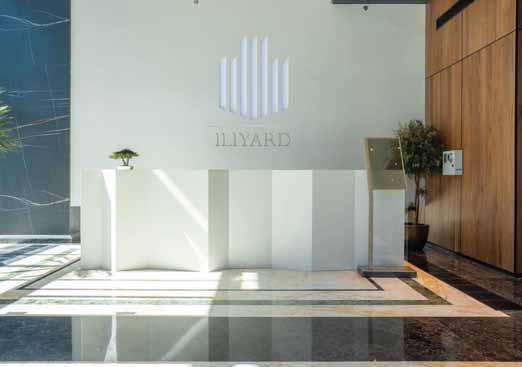
ILIYARD: An A+ Class Business Center in the Heart of Tbilisi, Offering a Premium Environment for Leading Companies
Seeking Quality, Comfort, and a Prestigious Business Address
Continued from page 1
WHO
ILIYARD IS BUILT FOR ILIYARD is particularly appealing to multinational corporations, embassies, financial institutions, professional services, and rapidly growing Georgian companies that operate with high standards. These organizations tend to value a prime business address, advanced engineering, strong infrastructure, and professional property management areas where ILIYARD places a strong emphasis.
As the team explains, the goal has always been to create a space that meets the expectations of tenants who look for international-level quality and consistency in their working environment.
FLEXIBLE, CUSTOMIZABLE OFFICE CONCEPTS
ILIYARD offers fully customizable office spaces, with layouts, finishes, and design elements tailored to reflect a company’s unique identity. Premium materials and refined craftsmanship ensure a sophisticated and comfortable working environment that meets modern business standards.
The building is fully completed and ready for tenants, with interior solutions designed to accommodate both functional needs and aesthetic preferences.
ILIYARD creates workspaces that are exceptional, bespoke, and aligned with the highest standards of A+ Class office design.
CONFERENCE FLOOR AND BUSINESS LOUNGE: BUILT FOR MODERN BUSINESS
The entire second floor is dedicated to conference and meeting facilities, spanning 600 square meters and featuring modern audiovisual systems and thoughtfully crafted interiors.
Companies can choose from a selection of well-appointed meeting rooms and boardrooms, each designed to pro-
vide comfort, efficiency, and a refined working atmosphere. High ceilings and abundant natural light create a calm, productive environment.
A stylish business lounge and an outdoor terrace offer elegant spaces for coffee breaks, informal discussions, or quiet moments between meetings com-
bining comfort, luxury, and functionality in one setting
A
LANDMARK DEFINED BY EXCLUSIVITY
Asked what sets ILIYARD apart from other business centers in Tbilisi, the developers highlight its exclusivity, an experience created through a combination of location, architecture, and high construction standards.
Premium-grade materials, refined finishing, panoramic city views, advanced engineering systems, and enhanced security all meet Class A + requirements. Positioned on Chavchavadze Avenue, one of Tbilisi’s most prestigious arteries, ILIYARD introduces a new benchmark for office functionality, comfort, and aesthetics.
Professional management and cuttingedge technologies complete the picture, forming one of the most distinguished business addresses in the city.
VISIBILITY & BRANDING OPPORTUNITIES
Beyond its workspaces, ILIYARD offers an additional advantage for companies seeking a stronger brand presence: a 50-square-meter digital advertising screen located in the central courtyard. Visible directly from Chavchavadze Avenue, one of the most high-traffic business areas in Vake, the screen is seen daily by executives, clients, and professionals moving through the district. This creates a valuable, high-impact branding opportunity within one of Tbilisi’s busiest corporate zones.
ROLE IN TBILISI’S BUSINESS FUTURE
ILIYARD stands as one of the defining anchors of Tbilisi’s modern business ecosystem. As demand grows for professional, technologically advanced, and service-oriented office environments, developments like ILIYARD are setting the pace for this transformation.
The project is expected to play an increasingly influential role in shaping expectations around workplace quality, tenant experience, and architectural standards- contributing to the evolution of Vake as a premier business dis-
trict, and elevating the wider corporate landscape of the city.
FUTURE DEVELOPMENT VISION
ILIYARD’s long-term roadmap includes expanding its lifestyle and hospitality offerings. One of the most anticipated additions is a branded fine-dining res-
taurant planned within the complex in a space envisioned for executive meetings, business lunches, and elegant social gatherings.
This next step will further strengthen the building’s identity as a full-service business destination rather than simply an office tower.
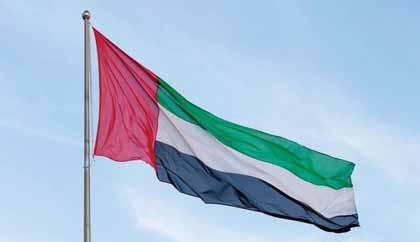
Following Directives of UAE President, UAE Announces $550 million for UN’s 2026 Global Humanitarian Overview
BY TEAM GT
Under the directives of President His Highness Sheikh Mohamed bin Zayed Al Nahyan, the UAE has announced a substantial pledge of US$550 million to support the UN’s Global Humanitarian Overview (GHO), which aims to raise US$33 billion in 2026 to support approximately 135 million people across 23 humanitarian operations worldwide, including programs supporting refugees and migrants.
The immediate focus of the appeal is to help protect the lives of up to 87 million people in need of urgent support with US$23 billion in funding.
The initiative reaffirms the UAE’s unwavering commitment to advancing international efforts to save lives and respond to disasters and crises affecting the most vulnerable populations globally.
This support underscores the vital role of the UAE in promoting multilateral humanitarian action and the nation’s close cooperation with UN agencies, including the United Nations Office for the Coordination of Humanitarian Affairs (OCHA), as well as with relief and development programs operating on the ground, to ensure timely access to aid
for those most in need, in line with His Highness’s directives emphasizing a rapid and effective response.
Reem bint Ebrahim Al Hashimy, Minister of State for International Cooperation, said, “The UAE continues its steadfast commitment to supporting global humanitarian efforts and working with our UN partners to ensure access to aid for those most impacted. This pledge embodies the directives of His Highness Sheikh Mohamed bin Zayed Al Nahyan and reflects our profound belief in the necessity of international solidarity in responding to urgent humanitarian appeals in an effective and sustainable manner that preserves human dignity and protects lives.”
Tom Fletcher, United Nations UnderSecretary-General for Humanitarian Affairs and Emergency Relief Coordinator at OCHA, welcomed the announcement, stating, “Our global appeal is about saving lives where shocks have hit hardest – and turning plans into real protection. The UAE’s rapid and generous backing of our 2026 plan sends a strong signal, focused on people who need it most. We must deliver an effective, innovative response that meets the moment.”
Dr. Tedros Adhanom Ghebreyesus, WHO Director-General, stated, “Warning signs of health system collapse manifest long before it occurs – outbreaks spread, malnutrition increases, and pre-
ventable deaths rise. However, when we come together, services can be restored and lives saved. I thank His Highness Sheikh Mohamed bin Zayed Al Nahyan and the UAE for their support, which will provide crucial humanitarian health care to millions in need.”
UNICEF Executive Director Catherine Russell stated, “UNICEF appreciates the UAE’s generous support, which will go a long way to save and improve the lives of children caught in humanitarian crises. Children are always the most vulnerable when a crisis strikes. As needs outpace funding, this is an especially critical time, building on UNICEF’s strategic partnership with the UAE.”
Filippo Grandi, United Nations High Commissioner for Refugees (UNHCR), welcomed the announcement, stating, “We value UAE’s strong commitment to humanitarian efforts.” He added: “While severe funding shortfalls present a significant challenge for millions of vulnerable forcibly displaced people, contributions from governments like the UAE allow UNHCR to enhance its response efforts and provide a glimmer of hope for those in need.”
Cindy McCain, World Food Program (WFP) Executive Director, stated, “As humanitarian needs soar and resources lag dangerously behind, the United Arab Emirates’ generous pledge is a lifeline that will help ensure urgent assistance reaches the people in greatest need. We thank the UAE for its humanitarian leadership in these unprecedented times. WFP stands ready to work with the UAE to ensure this desperately needed support reaches the millions facing acute hunger across the globe.”
This support builds on the strong strategic partnership between the UAE and the United Nations humanitarian system and reaffirms the UAE’s central role in addressing the most pressing humanitarian challenges, enhancing the international community’s ability to protect lives, and supporting stability in crisis-affected areas, in line with His Highness’s directives that reinforce the UAE’s leading approach to global humanitarian action.
The Upcoming Gen-Beta Drive
BLOG BY NUGZAR B. RUHADZE
Iam not quite sure if the name Mark McCrindle might ring all the bells in the world, but the guy is a fairly well-known social analyst, futurist, and demographer, trailing the most noticeable issues that occur in our weird times and all kinds of social trends that have an impact on our overstrained modern lives. It was he who, in the complicated and strenuous process of meticulous insights and profound analysis, baptized two generational cohorts, Alpha and Beta, although the terms are not fully recognized demographic phenomena like Gen Z or Millennial. Anyway, the Alphas were the subject of our recent piece. This time, the Betas will be the subject of our focus.
I encounter a lot of Alpha kids in my academic and social life in this country and, frankly, they make me think twice before I tell them anything that seems to me useful and wise to utter. Indeed, you don’t want to mess with them, because their seemingly childish minds are like a steel trap, and their behavior impresses with unbelievable precociousness. Our Alphas speak their own kind of Georgian, and they pick up foreign languages at a moment’s notice.
The Betas that are coming into life right now (they are and will supposedly be born between 2025 and 2039) are named after the second letter of the Greek alphabet and are thought to be the children of younger Millennials and Gen Z. The name has instigated controversy and criticism from some of the means
of mass communication, because the appellation “Beta” was taken as an insult, meaning someone who is weak or passive. Some suggest that another, more descriptive name might fit when time passes. This way or that way, professionals of the planet keep arguing about the name, character, and birth time frame of the generational cohort that will be sure to start making an immense difference before we know it.
Social generations characteristically span roughly fifteen years, and are shaped by major societal shifts and numerous expected and unexpected vicissitudes of life. If we believe what McCrindle is predicting, Generation Beta is going to be impacted by diminishing birth rates, and will probably make up around 16% of the world's population by the year 2035. The same prediction purports that Gen Beta is to reach 2.1 billion people, surpassing Gen Alpha's two-billion presumption. It is also suggested that Gen Beta will have a stronger appreciation for diversity than previous generations, and, certainly, it is expected that many members of Gen Beta will live to see the 22nd century.
And here is why these thoughts should make sense for this nation’s future and its successful spiritual stability, as well as its social well-being, demographic boost, and economic prosperity. None of this will happen to us unless Sakartvelo’s upcoming Gen Beta is in step with the rest of the world in terms of exceeding in numbers the previous generational cohorts. This must happen in Georgia. Must!
The prerequisites for this wistful thinking seem to be in place in this land: more and more married couples are picking
More Rust in Your Life
BLOG Y TONY HANMER
Ihave decided that there can never be too much rust. This is partly because it remains an endless source of images for me as a seer and photographer. Its mix of randomness and order just clicks with who I am as an artist, and with my worldview.
So, yes, I made another trip to the huge Soli steelyard in Tbilisi recently. It had been a year since my last trip there: much more than enough time for several important things to have changed.
For one, as this is a flourishing business, much steel had been bought by people needing it for construction and other purposes. Sizes range from about 30 cm on a side to about 2 by 8 m (sheets), with round or square tubes of similar dimensions. So, as pieces are bought, they uncover new ones underneath them.
This means that a) I can see things previously covered, and b) the weather can see them too: there is no roof here to shield from it. Of course, there has been rain, and snow, and simple humidity. All of this moisture has wrought its magic on the iron and steel receiving it, turning new blues red, orange, yellow. There are even some greens and purples mixed in, for which I don’t have enough scientific knowledge to explain.
up the courage to have over two kids, opportunities to provide for sustenance seem to be increasing, our children are adapting to modern technology with smarts and vigor, fearlessly immersing themselves in scientific novelties, thus creating the prerequisites for further national development; and on top of all that, their integration with the opportunities suggested by artificial intelligence is becoming firmer. The Georgian Gen Beta personalities will be more dynamic and adaptable than their predecessors, which allows for significant changes in roles, beliefs, and self-perception, based on experience, social interaction, readiness for personal growth, and not being enslaved to stiff definitions. This kind of social prospect might be predicated on the premise that the freedom-loving Georgian nation is welloriented in the notions, moods, and quirks of our contemporary life, and finally will find the way out of the current national quandaries. That’s going to be the main function of Georgia’s Gen Beta, which will soon be in tangible making. Those kids of the future will not have time or desire for stupid controversies, senseless polarization, ridiculous political recriminations, irrational media discussions, and meaningless disputes on social media: they will know what to do, and how to push the nation towards a guaranteed good life. The never-goingaway overwhelming rhetorical question in Sakartvelo – Is there a way out? – can only be answered by means of focusing on national-level decisive issues. Nobody will do this except Georgia’s Gen Beta, whose maturation for the great struggle is not too far away.
The main change I discovered in Soli’s office, however, is that the high-ranking man who used to call me “sidze” (son in law) passed away suddenly in September, while we were still in Svaneti. He had the same last name as my wife, Skirtladze, hence the connection. Sadly, she never got to meet him. After expressing my sorrow and condolences, and presenting the office staff with a new rust image to hang on the wall, I was of course allowed to roam the yard in search of more inspiration.
I have realized that a Japanese screen print artist has inspired some of the look I seek in my rust images: Tetsura Sawada. His prints combine layers of natural landscape elements and perfectly straight horizon lines. I, too, seek to keep straight
lines in my shots perfectly horizontal or vertical, and often find frames which seem like abstract landscapes, too. I have been fond of Sawada’s work since I first saw it in the 1980s, and hope someday to acquire an original screen prints of his, not merely a poster. It took me a couple of hours to explore. This time, I was using a special technique to allow my final images to be about four times the area of their shot pixel size. I’ll avoid the technical details here, but it starts with shooting several or many frames of the same thing, but handheld, not tripod-mounted. These are then combined in Photoshop in a particular way. Once again, I found myself thinking: could I ever BUY that particular large sheet of steel, for its wonderfully chaotic order of details? There are many practical details involved, never mind transporting such a thing off-site. It must be handled in such a way as to minimize any changes to its delicate surface, from there all the way home, and then installed in the same manner. But it’s heavy, too, so, better not to try to hang it on the wall. One would build a floor stand for it. Even dusting it would need to be done very carefully, with a feather duster. Ironic that something to strong as steel needs such care in handling: all because the rust on it is much more fragile. Once in place, it would then slowly continue to change over time, but now only due to moisture in the room (our breath, mostly). Hmmm.
Anyway, I came away with over 140 finished images, which is most satisfying. There has already been rain since that late-November visit, too… so, more awaits. I’ll get to it.
PS: Yes, I DO enhance the colors.
Tony Hanmer has lived in Georgia since 1999, in Svaneti since 2007, and been a weekly writer and photographer for GT since early 2011. He runs the “Svaneti Renaissance” Facebook group, now with over 2000 members, at www.facebook.com/groups/ SvanetiRenaissance/
He and his wife also run their own guest house in Etseri:
www.facebook.com/hanmer.house.svaneti
Shivering Light, Drifting Time: Alexander Koberidze’s Dry Leaf as a Georgian Ritual of Seeing
BY IVAN NECHAEV
The 26th Tbilisi International Film Festival unveiled a work that drifts through the screen with the weightless focus of a dream. Alexander Koberidze’s Dry Leaf arrives as a cinematic gesture shaped by tenderness toward the fragile structures of daily life. His new film expands the poetic grammar that has followed him since What Do We See When We Look at the Sky?, yet it forms an independent constellation with its own rhythm, its own musical pulse, and its own philosophy of looking.
Alexander Koberidze’s Dry Leaf enters contemporary cinema with the poised assurance of a film that trusts its viewers. Its three hours unfold with a calm, steady pulse, as if the world were revealing its details only to those willing to move at its tempo. A father travels across Georgia in search of his daughter, a photographer devoted to recording the country’s unassuming football pitches. The premise resembles a straightforward journey. The film grows into something far more intricate: a diary of gestures, a field atlas of memory, a meditation on landscapes where small movements illuminate entire emotional climates.
Koberidze shapes this world through observation. Each scene rests within a vibration of attention. A roadside café dissolves into an open field. A field becomes a village that feels stitched from light and dust. A corridor of faces appears like a soft pageant of everyday Georgian life. Narrative events drift through this geography with quiet authority. The film gathers people, places, and weather into a single slow-moving organism.
The director’s devotion to low-resolution imagery once again forms the heart of his method. Grain thickens the air. Edges blur until they become emotional zones rather than visual boundaries. A
match in progress gains the aura of a half-remembered dream. A landscape seen from the window acquires the tenderness of an old photograph. This aesthetic brings the viewer into a state of heightened receptivity. Texture becomes meaning; the uncertainty of outlines turns into a form of intimacy.
The father’s path feels like a pilgrimage through a country mapped through community memory rather than geography. Football fields emerge as civic organs that store collective histories. Weather-beaten goalposts, worn lines traced by countless hands, and patches of grass that have endured many seasons speak with the sincerity of testimonies. The faces encountered along the way— players, teenagers, elderly goalkeepers, singers, wanderers—form a polyphonic portrait of Georgia’s emotional terrain. Their stories appear without ceremony. Each anecdote enters the film like a small relic offered with open palms.
Koberidze’s sense of duration deepens this portrait. Time shifts into long, supple arcs. A ball rolling across uneven ground becomes a study in rhythm. A woman describing a match from years earlier becomes a vessel for memory.
The father’s pauses at village entrances
The Art Club Tbilisi Debuts with a Winter Rooftop Gathering
BY TEAM GT
The Art Club Tbilisi officially launched on December 6, with a private rooftop reception, bringing together art collectors, business leaders with an interest in art investment, art enthusiasts and other like-minded guests. The event introduced a new initiative of the recently established Art Foundation Anagi (AFA), which opened in September. With this debut, Georgia now has its first collectors’ club of this scale, marking an important moment for the country’s growing art scene.
The Art Club Tbilisi aims to establish a structured, globally aligned environment for collectors, art lovers, and art professionals. Inspired by leading international art ecosystems, the club presents itself as a contemporary cultural platform with ambitions to cultivate a more connected and well-informed art community in Georgia.
As the foundation noted during the launch, the establishment of a collectors’ club of this type and ambition is a notable step forward for Georgia. The initiative reflects a growing institutional mindset, demonstrating the capacity not only to adopt global practices but also to introduce new trends and set standards within the local scene.
The club brings together individuals and organizations committed to pushing Georgian art forward and strengthening its cultural and economic weight.
By creating a bridge between the busi-
ness community and the arts, members help position Georgian art within leading international artistic and investment circles. The aim is to boost its global visibility and investment appeal, while supporting sustainable growth and the development of creative talent at home.
One of the first honorary members of The Art Club Tbilisi, Michael North, a capital markets expert and former executive at major international investment banks, emphasized the importance of professional guidance in art collecting. He noted that platforms such as The Art Club Tbilisi – provide collectors with an informed and reliable pathway into art investment and collection management.
“If you want to become an art collector, you must be systematic. Instead of relying solely on personal preference, it is essential to engage with galleries and seek advice from professional experts. Their guidance helps you understand what is recommended for you – especially when collecting is connected to investment or wealth considerations. It is simply a better way,” he explained.
As Georgia continues to integrate more fully into global cultural and creative networks, the launch of The Art Club Tbilisi represents a significant step toward a more mature, professional, and internationally connected art market. The founders and first club members are confident that the club is well positioned to become an influential force in shaping local trends and strengthening Georgia’s presence on the international art stage.
the father’s encounters into a single emotional arc.
The sound design extends the composer’s work into a continuous auditory cartography. Outdoor scenes hum with distant machinery. The bounce of a ball creates a gentle percussive mantra. Winds carry murmurs from the edges of the frame. The acoustic world behaves like a woven fabric rather than a set of isolated environments.
Through this weaving, Georgia appears as a unified sensory field. Each location vibrates with the memory of another. A roadside pitch carries the trace of a distant village. A closed stadium gate echoes with the faint hum of a previous conversation. The sound team creates a world where place becomes a living instrument.
perceptual environment. A gust of wind that lifts the leaf carries the same ceremonial resonance as Viola’s slow ascents. Human figures share a sculptural calm. The city’s ambient soundscape forms a halo around each scene.
and dusty pitches carry a devotional quality. Viewers begin to sense the tonal shifts of afternoon light with unusual clarity. Every gesture expands into a small revelation.
Giorgi Koberidze’s score forms the emotional skeleton of Dry Leaf. Its presence glows through the film with remarkable restraint. The music arrives in long intervals, sometimes after stretches of ambient quiet, sometimes as a soft echo of what has just passed across the frame. The score moves like a parallel journey — a sonic itinerary woven beneath the father’s search.
Several musical elements anchor this world: sparse piano figures that resemble uncertain footsteps; long, elastic electronic pulses that follow the film’s slow temporal drag; strings that hover at the threshold of silence, creating a sensation of suspended breath, a faint folk aftertaste, present like a memory rather than a motif.
These materials form a shimmering acoustic environment. The music listens to the world. Its phrasing respects the rhythm of a drifting leaf, a child pausing before speaking, a goalkeeper adjusting his stance on an empty field. The score creates a sense of continuity that binds
Performance in Dry Leaf arises from presence rather than dramatic shaping.
Many of the film’s participants inhabit the frame with a natural grace that emerges from their biographies. The father’s quiet endurance forms a steady emotional anchor. The people he encounters speak with unguarded sincerity, offering fragments from their own lives with openness that feels earned rather than staged.
These encounters accumulate into a social portrait. A teenager recounts a local match with the clarity of a storyteller. An elderly goalkeeper stands by an empty net as if guarding a memory.
A passerby recognizes the father and shares a detail that may or may not aid his search. The film’s drama grows from these exchanges, each carrying the density of lived experience.
The kinship between Dry Leaf and the video works of Bill Viola becomes increasingly vivid as the film unfolds. Viola cultivates a visual grammar shaped by expanded time, hypnotic luminosity, and ritualized gesture. Water rises. Faces emerge from deep blue. Fire circulates with suppressed intensity. Each movement resembles a liturgical act. Koberidze’s film constructs a similar
Viola stretches time until emotion becomes a physical entity. Koberidze’s scenes lengthen until the viewer perceives the texture of everyday life with almost clairvoyant clarity. Duration becomes a spiritual material. Viola’s elements—water, fire, air—anchor his vision. Koberidze builds his entire cosmology on air currents and seasonal light. The leaf functions as an elemental protagonist, a small weather system with its own consciousness. Viola achieves transcendence through pure presence. Koberidze achieves a similar resonance through attention alone. The camera reveals an invisible architecture of feeling inside each gesture.
With Dry Leaf, Koberidze refines a cinematic language built from slowness and finely tuned perception. Duration becomes a vessel for revelation. Grain becomes a method for revealing the interior life of landscapes. Music becomes a gentle current that amplifies the film’s tenderness.
The film illuminates Georgia as a constellation of fields and faces, linked by stories that move across regions with the steady pace of weather. The composer’s album extends this constellation into the auditory realm. The score forms a map of almost tactile emotions, shaping the viewer’s memory of the film long after the screening ends.
The festival presentation introduced a work of unusual clarity and devotion. Dry Leaf expands the possibilities of contemporary Georgian cinema by offering a ritual of attention — a way of looking that allows the world to reveal its quiet radiance. Through this radiance, the film builds a space where landscapes speak, time breathes, and human presence becomes the primary material of meaning.
BFI Names Two Georgian Films among the Year’s Top 50
BY MARIAM RAZMADZE
Two Georgian films, ‘Dry Leaf’ and ‘April’, have been named among the 50 best films of the year by the British Film Institute’s prestigious publication, ‘Sight and Sound’. The magazine, known for its influential “Greatest Films of All Time” poll conducted every decade since 1952, highlighted both works in its annual selection. One of the recognized titles, ‘Dry Leaf’, funded by the Georgian National Film Center, comes from director Alexandre Koberidze, already well known for ‘What Do We See When We Look at the Sky?’. His new film, running 186 minutes and shot on an old mobile phone in heavily pixelated images, was described by Sight and Sound as an unexpectedly captivating achievement. The magazine’s editors praised the film’s unusual visual approach and its surreal narrative: a father searching rural Georgia for his missing daughter, a photographer who had been documenting football fields. He is accompanied by an invisible companion whose presence is treated as entirely ordinary. Yet Sight and Sound argues that Koberidze’s film stands apart from any retro homage. Its pixelated imagery, they say, creates a look that ‘movies have never had,’ a daring aesthetic shaped not by nostalgia but by a distinctive dream-like imagination. ‘April’ follows a Georgian obstetrician
whose professional life unravels after her reputation as someone who performs abortions draws scrutiny in a conservative rural community. As whispers grow into quiet hostility, she finds herself confronting moral, social and personal
pressures that blur the lines between duty and accusation. Kulumbegashvili builds the story with an atmosphere of suffocating tension, unfolding against the stark beauty of Georgia’s countryside.
A still from the film
Photo: Screen Daily.
Morning Light in Old Modes: Tbilisi Baroque Festival 2025
REVIEW BY IVAN NECHAEV
The Tbilisi Baroque Festival 2025 moves across the city with the steady pulse of a tradition that keeps discovering new chambers of its own architecture. The opening night with Shavnabada and the celebrated duet of Giulia Bolcato and Andreas Scholl established the ceremonial threshold; the days that followed opened a landscape shaped by visiting virtuosi, historically informed ensembles, and Georgian partners who treat the early-music repertoire as a living ecosystem rather than a curated archive. This edition carried an atmosphere of artistic concentration. Every program delivered an outlook, every guest illuminated a stylistic horizon, and every stage—large or intimate—offered the sense of a city learning to speak an older musical language with growing fluency.
LEILA SCHAYEGH AND THE HELSINKI BAROQUE ORCHESTRA: A NORTHERN PRECISION IN A GEORGIAN CHAMBER
The evening of November 9 introduced a northern refinement that shifted the festival’s axis into the pure geometry of Bach’s instrumental writing. Leila Schayegh guided the Helsinki Baroque Orchestra with a tone that carried both authority and buoyancy. Her violin led the ensembles with an unforced intensity, forming a kind of clear northern light within the Rustaveli Theater Small Stage.
Pauliina Fred’s flute brought an aerial line to the Orchestral Suite No. 2, landing gracefully in the Badinerie with a poise that transformed the miniature into a kind of signature gesture for the night. Aapo Häkkinen, at the harpsichord, shaped the Fifth Brandenburg’s keyboard part with sculptural clarity; the dialogue of soloists created an atmosphere of continuous motion. The Georgian audience responded to this balance of energy and emotional control with rare attentiveness. The evening outlined an international baroque vocabulary that has entered the festival as a natural register.
PAUL MCNULTY’S PIANOFORTE AND THE REDISCOVERY OF COLOR
Paul McNulty’s visit on November 12 shaped another major thread of this year’s edition: the fascination with timbre, instrument-making, and the physicality of sound. His introductory lecture offered a bridge between historical reconstruction and present-day listening practice.
Viviana Sofronitsky and Ana Kurdovanidze carried the momentum into performance. Their approach to C.P.E. Bach and Haydn placed articulation at the center of interpretation; every gesture of the pianoforte produced a microdrama of resonance. Mozart’s Rondo and the d-minor Fantasia unfolded with a lyrical transparency that resonated deeply in the hall. Beethoven’s Sonata quasi una Fantasia gained a different gravity on
McNulty’s instrument, turning the “Moonlight” into an exploration of texture and kinetic pulse.
The closing Mozart Concerto K.414, performed with Georgian Sinfonietta, created an image of partnership: international instrument makers, historically informed soloists, and a Georgian ensemble with a firm stylistic identity.
VALENTIN TOURNET’S TWO EVENINGS: THE VIOL, THE STAGE, AND THE CINEMATIC IMAGINATION
The arrival of Valentin Tournet on November 15 launched one of the festival’s most poetic chapters. His program ‘All the Mornings of the World’ aligned the viola da gamba with the filmic imagination of Corneau and the spectral lineage of Sainte-Colombe and Marais.
Tournet constructed a dramatic arc with almost ritual concentration. Les Pleurs emerged as an initiation; La Rêveuse became a suspended interior monologue;
the final Tombeau closed the evening with a gravity that carried the entire hall into silence.
Tournet’s second night on November 18 expanded the spectrum into French baroque orchestral color. Georgian Sinfonietta responded with refined attention: Lully’s ceremonial pulse, Boismortier’s luminous dance structures, Rameau’s harmonic delicacies, and Dauvergne’s elegant theatricality created a sequence that moved like an illuminated manuscript. The audience experienced French refinement through a modern Georgian lens.
DOROTHEE MIELDS AND CHRISTINE BUSCH: TWO PORTALS INTO BACH AND PURCELL
Dorothee Mields and Christine Busch shaped two evenings that formed the intellectual and emotional core of the festival.
The Bach cantata program on Novem-
ber 24 explored the “parody principle”— the Baroque practice of recontextualizing musical material—through a carefully assembled dramaturgy. Mields’s voice brought luminous stillness to “Schlummert ein” and a radiant clarity to “Jesus bleibet meine Freude.” Busch’s violin created a counter-line of expressive certainty. Diego Cantalupi’s theorbo added structural warmth, while Georgian Sinfonietta delivered articulate phrasing with a sense of stylistic belonging that marked a new level for the ensemble.
On November 27, Purcell entered the festival with theatrical exuberance. The sequence of masques, court dances, and instrumental fantasies created an anthology of the English baroque. Mields shaped lines from Dido and Aeneas with an inward resonance, while Busch illuminated the instrumental world of Purcell through a palette of refined bow strokes.
The program functioned as a gallery of London’s musical imagination across decades of stage practice.
COMMERCIAL DEPARTMENT
Commercial Director: Iva Merabishvili
Marketing Manager: Natalia Chikvaidze
EDITORIAL DEPARTMENT:
Editor-In-Chief: Katie Ruth Davies
Journalists: Ana Dumbadze
Vazha Tavberidze
Tony Hanmer
Nugzar B. Ruhadze
Ivan Nechaev
Mariam Razmadze
Layout: Misha Mchedlishvili
Photographer: Aleksei Serov
International Relations & Communications
Sofia Bochoidze E: sbochoidze@georgiatoday.ge
Website Editor: Katie Ruth Davies
Webmaster: Sergey Gevenov
Circulation Managers: David Kerdikashvili
David Djandjgava
FRANCESCO CERA:
A HARPSICHORD CARTOGRAPHER OF THE EUROPEAN BAROQUE
The festival’s final arc featured two major appearances by Francesco Cera, whose authority carried the festival into a culminating phase. His solo recital on November 30 mapped the European keyboard tradition with architectural clarity. Frescobaldi’s Recercare, Scarlatti’s Fuga, Handel’s G-major fugue, and a constellation of Bach’s preludes and fugues formed a polyphonic geography. Cera’s articulation foregrounded the structural intelligence of each piece, creating a lecture in sound rather than a stylistic tour.
On December 2, Cera returned as conductor, harpsichordist, and organist—roles that merged into a unified musical presence. Bach’s A-major Concerto unfolded with energetic pacing; Vivaldi’s L’Estro Armonico emerged with glowing string color; Handel’s Cuckoo and Nightingale offered a moment of pastoral brilliance. Cera shaped the ensemble as a single breathing organism, supported by Cantalupi’s grounded continuo line.
MAAYAN LICHT AND A FINALE OF VOCAL RADIANCE
The closing night on December 7 crowned the festival with the incandescent voice of Maayan Licht. His program created an arc across Venetian, Neapolitan, London, and Roman soundscapes. Vivaldi’s arias radiated with agile phrasing; Broschi’s “Son qual nave” delivered a cascade of virtuosic tension. Purcell’s Dido’s Lament gained a sense of suspended lament that settled over the hall with profound stillness. Handel’s final arias opened a triumphant ascent, highlighting Licht’s control, coloristic breadth, and expressive imagination. Georgian Sinfonietta accompanied with a cultivated baroque instinct and a clarity born from seasons of stylistic evolution.
A FESTIVAL THAT BUILDS A CITY’S INNER ARCHIVE
The 2025 edition shaped an early-music panorama with multiple artistic vectors: instrument makers as dramaturgs through McNulty’s contribution; stylish northern precision with Schayegh and the Helsinki Baroque Orchestra; French poetic introspection through Tournet; intellectual and vocal radiance in the Bach and Purcell evenings of Mields and Busch, a universal keyboard cartography through Cera, a final blaze of vocal virtuosity with Maayan Licht
The Tbilisi Baroque Festival now functions as a cultural infrastructure as much as an event. Its guests bring specialized traditions; its Georgian partners absorb and transform them; its audiences gain access to a repertoire that expands their sense of musical history. The city receives each edition as another chapter in the slow construction of an early-music culture with international alignment and local personality.
Tbilisi listens more deeply each year. The 2025 edition offered a season of mornings—each clear, each shaped by craft, each forming part of the city’s growing musical memory.
ADDRESS
22 Janashia Str. Tbilisi, 0179, Georgia
Tel.: +995 32 229 59 19
E: info@georgiatoday.ge F: GeorgiaToday
ADVERTISING & SUBSCRIPTION
+995 577 72 52 61
E-mail: marketing@georgiatoday.ge
Reproducing material, photos and advertisements without prior editorial permission is strictly forbidden. The author is responsible for all material. Rights of authors are preserved. The newspaper is registered in Mtatsminda district court.