THE GREAT WAR






















nally have all of the


✓ First walk-in tub available with a customizable shower
✓ Fixed rainfall shower head is adjustable for your height and pivots to o er a seated shower option
✓ High-quality tub complete with a comprehensive lifetime warranty on the entire tub
✓ Top-of-the-line installation and service, all included at one low, a ordable price


G
General discontent
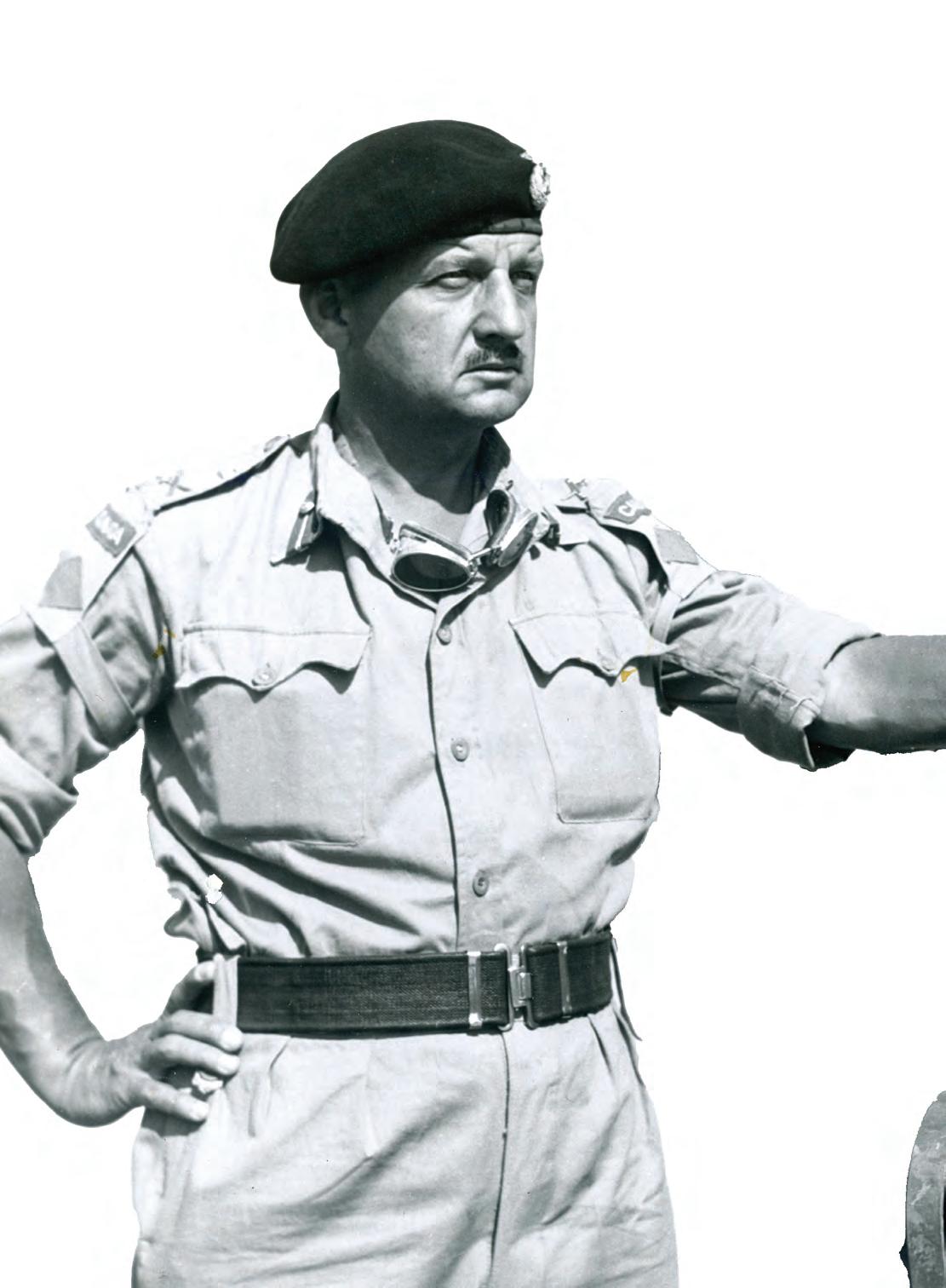
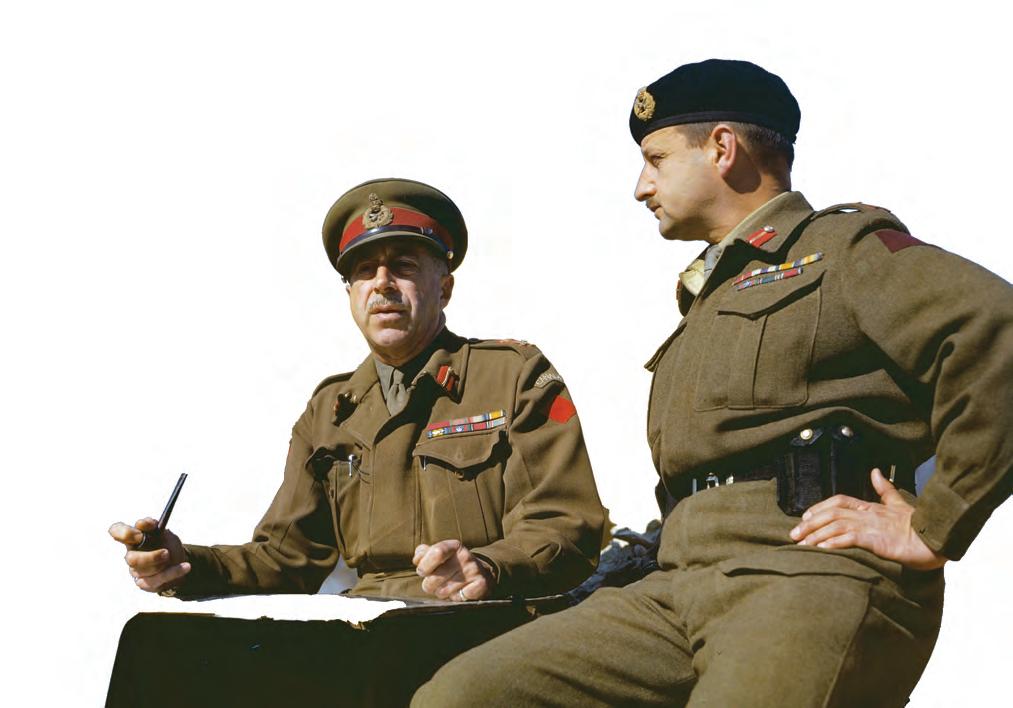
While in command of I Canadian Corps, Lieutenant-General Eedson L.M. Burns consults a map in Italy on Sept. 23, 1944. While a great military mind, he was notoriously disliked by his men and other officers.
See page 30


Features
24 THE HAPPY PILOT
A granddaughter learns the wartime secret(s) of the gruff former Royal Air Force flyer she knew growing up
By Kallan Lyons
30 DOWN BUT NOT OUT
A military man of high intellect but a lack of charm, Eedson L.M. (Tommy) Burns never stopped fighting
By J.L. Granatstein
36 LOST, NOW FOUND
How Canada’s once unknown war dead are being identified By Stephen J. Thorne
46 UNCLE HARVEY’S PHOTO ALBUM
Recollections of a cherished relative from a First World War scrapbook By
Stephen J. Thorne
54 A WIDOW’S WALK
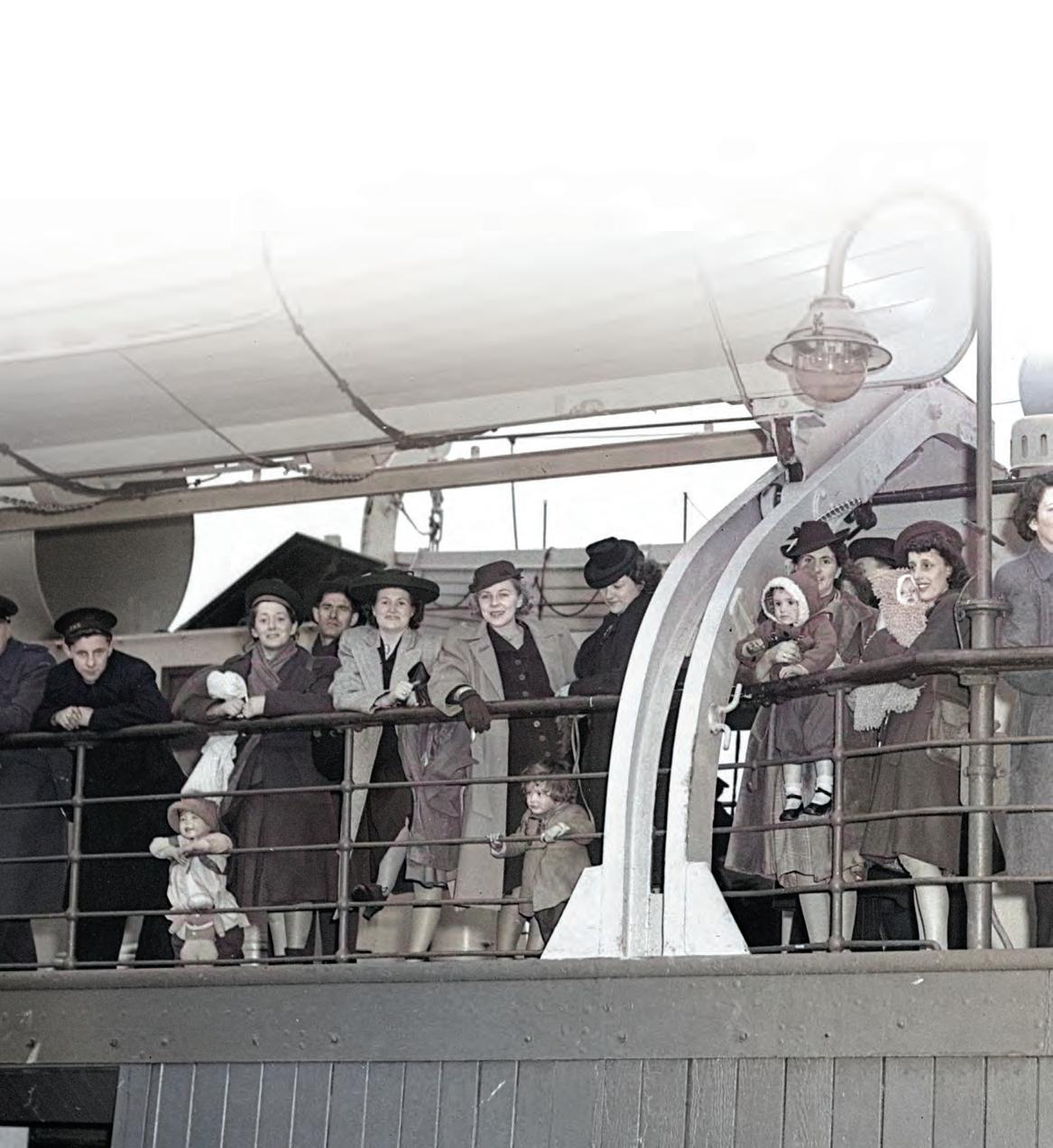
The story of a war bride of a Canadian soldier killed in action—and how she eventually lived a full life in Canada By
Stewart Hyson



THIS PAGE
War brides and their children en route to Canada from England in April 1944.
Lieutenant W.J. Hynes/DND/LAC/PA-147114 ON THE COVER
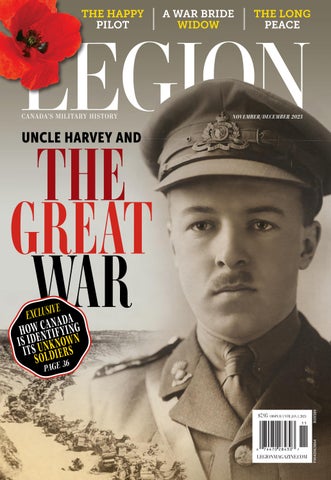
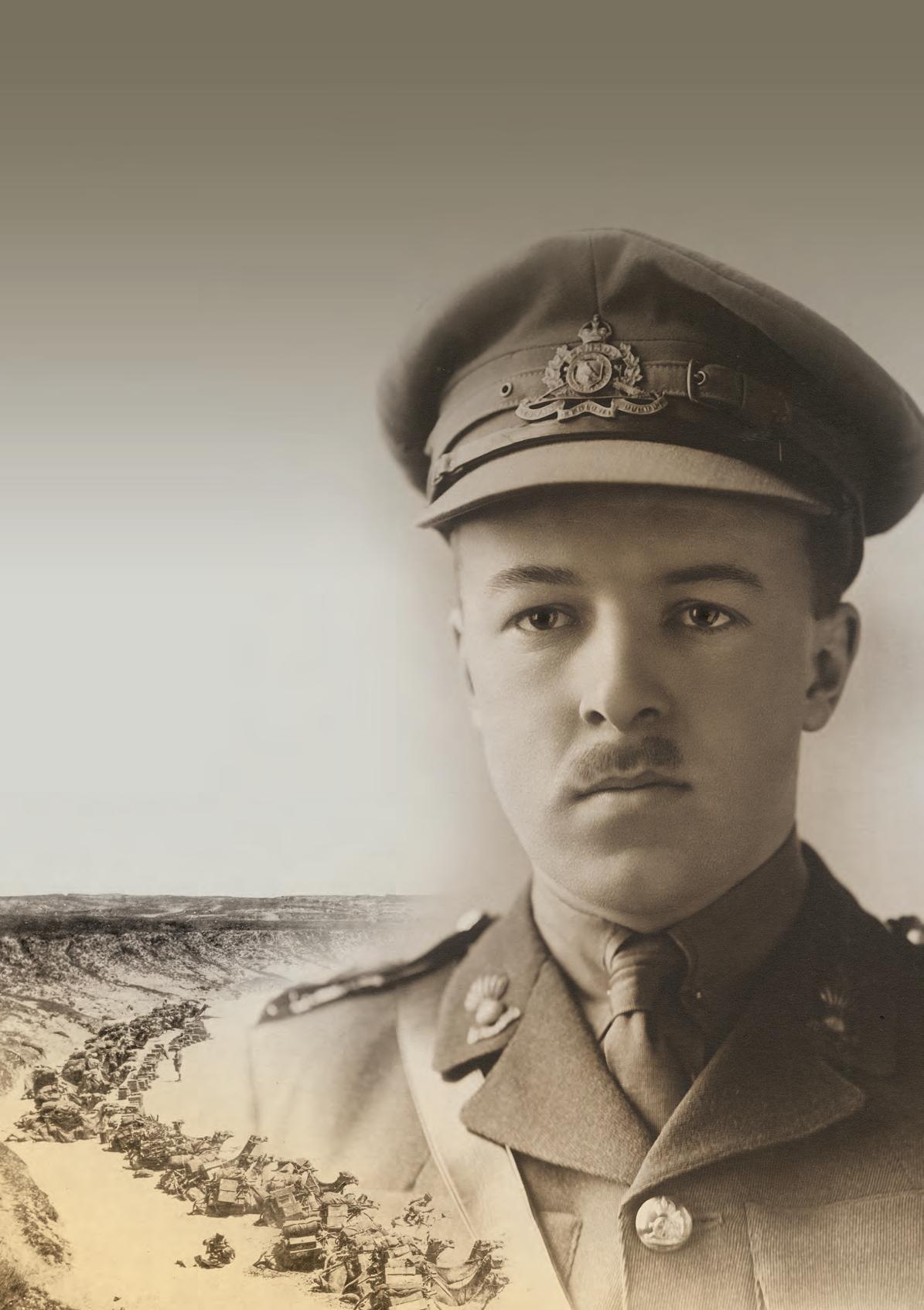
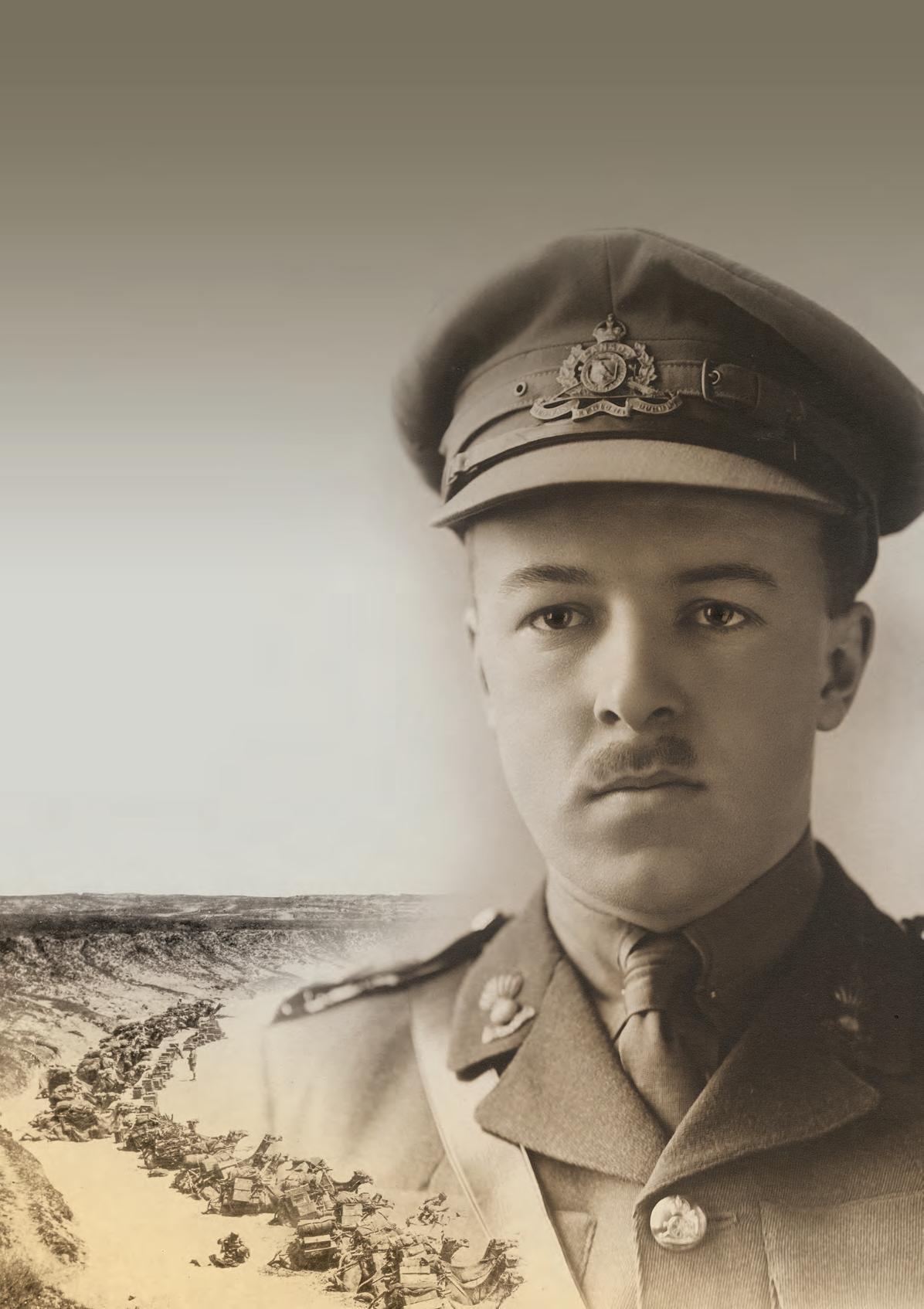
A wartime portrait of Harvey William Lawrence Doane, author Stephen J. Thorne’s great-uncle. He collected a trove of First World War images from his service in a cherished scrapbook. Courtesy Mary Doane
COLUMNS
18 MILITARY HEALTH MATTERS
Art direction By Paige Jasmine Gilmar
20 FRONT LINES
The myth of the "Long Peace" By Stephen J. Thorne
22 EYE ON DEFENCE
Playing politics By David J. Bercuson
44 FACE TO FACE
Should Canada have repatriated its war dead? By Stephen J. Thorne and Paige Jasmine Gilmar
88 CANADA AND THE NEW COLD WAR Treaty talk By J.L. Granatstein
90 HUMOUR HUNT Flag flap By John Ward


92 HEROES AND VILLAINS
Paul Triquet and the 90th Panzer Grenadier Division By Mark Zuehlke
94 ARTIFACTS
Street
By Paige Jasmine Gilmar 96
By Don Gillmor
Vol. 98, No. 6 | November/December 2023
Board of Directors
BOARD CHAIR Owen Parkhouse BOARD VICE-CHAIR Bruce Julian BOARD SECRETARY Bill Chafe DIRECTORS Tom Bursey, Steven Clark, Thomas Irvine, Berkley Lawrence, Sharon McKeown, Brian Weaver, Irit Weiser
Legion Magazine is published by Canvet Publications Ltd.
GENERAL MANAGER Jason Duprau

ADMINISTRATIVE
SUPERVISOR
Stephanie Gorin
ADMINISTRATIVE ASSISTANT
Lisa McCoy
ASSISTANT
ART DIRECTOR, CIRCULATION AND PRODUCTION MANAGER
Jennifer McGill
SENIOR DESIGNER AND PRODUCTION CO-ORDINATOR
Derryn Allebone
DESIGNERS
Sophie Jalbert Serena Masonde



Advertising Sales
CANIK MARKETING SERVICES
TORONTO advertising@legionmagazine.com
DOVETAIL COMMUNICATIONS INC mmignardi@dvtail.com
OR CALL 613-591-0116 FOR MORE INFORMATION

SENIOR DESIGNER AND MARKETING

Published six times per year, January/February, March/April, May/June, July/August, September/October and November/December. Copyright Canvet Publications Ltd. 2023. ISSN 1209-4331
Subscription Rates
Legion Magazine is $9.96 per year ($19.93 for two years and $29.89 for three years); prices include GST.
FOR ADDRESSES IN NS, NB, NL, PE a subscription is $10.91 for one year ($21.83 for two years and $32.74 for three years). FOR ADDRESSES IN ON a subscription is $10.72 for one year ($21.45 for two years and $32.17 for three years).
TO PURCHASE A MAGAZINE SUBSCRIPTION visit www.legionmagazine.com or contact Legion Magazine Subscription Dept., 86 Aird Place, Kanata, ON K2L 0A1 or phone 613-591-0116. The single copy price is $7.95 plus applicable taxes, shipping and handling.
Change of Address
Send new address and current address label. Or, new address and old address, plus all letters and numbers from top line of address label. If label unavailable, enclose member or subscription number. No change can be made without this number. Send to: Legion Magazine Subscription Department, 86 Aird Place, Kanata, ON K2L 0A1. Or visit www.legionmagazine.com. Allow eight weeks.
Editorial and Advertising Policy
Opinions expressed are those of the writers. Unless otherwise explicitly stated, articles do not imply endorsement of any product or service. The advertisement of any product or service does not indicate approval by the publisher unless so stated. Reproduction or recreation, in whole or in part, in any form or media, is strictly forbidden and is a violation of copyright. Reprint only with written permission.
PUBLICATIONS MAIL AGREEMENT NO. 40063864
Return undeliverable Canadian addresses to Legion Magazine Subscription Department 86 Aird Place, Kanata, ON K2L 0A1 | magazine@legion.ca
U.S. Postmasters’ Information
United States: Legion Magazine, USPS 000-117, ISSN 1209-4331, published six times per year (January/February, March/April, May/June, July/August, September/October, November/December). Published by Canvet Publications, 866 Humboldt Pkwy., Buffalo, NY 14211-1218. Periodicals postage paid at Buffalo, NY. The annual subscription rate is $9.49 Cdn. The single copy price is $7.95 Cdn. plus shipping and handling. Circulation records are maintained at Adrienne and Associates, 866 Humboldt Pkwy., Buffalo, NY 14211-1218. U.S. Postmasters send covers only and address changes to Legion Magazine, PO Box 55, Niagara Falls, NY 14304.
Member of CCAB, a division of BPA International. Printed in Canada.
We acknowledge the financial support of the Government of Canada. Version française disponible.
On occasion, we make our direct subscriber list available to carefully screened companies whose product or services we feel would be of interest to our subscribers. If you would rather not receive such offers, please state this request, along with your full name and address, and e-mail magazine@legion.ca or write to Legion Magazine, 86 Aird Place, Kanata ON K2L 0A1 or phone 613-591-0116.
Make the most of your Legion Membership
As a Legion Member, you take pride in the fact that your membership helps support and honour Canada’s Veterans.
Did you know that it comes with benefits you can use, too? Take advantage of all the benefits that come FREE with your membership.

Renew your membership to get all these benefits and more!
MemberPerks® unlocks $1000s in potential savings on offers and deals at stores and restaurants across Canada, including national chains, local businesses and online stores. Use the MemberPerks® app, print out coupons or shop online to save on electronics, travel, fashion, entertainment and so much more!
Your membership also gives you access to additional benefits, including:
• savings and deals from our Membership Partners
• a paid subscription to Legion Magazine
• exclusive members-only items at PoppyStore.ca



We shall not sleep
There’s a lot of desecration going around these days— of honour, of purpose, of memory. And politics, in their various forms, are at the root of it.
A genuine Canadian war hero died this past August, without the recognition many say he deserved. Instead of the Victoria Cross some expected he would receive for actions in Afghanistan, Jess Larochelle was awarded a Star of Military Valour. Badly wounded, Larochelle was key in suppressing an October 2006 Taliban attack (see “Obituaries,” page 68).
A campaign to review his decoration with the intent of upgrading it to a VC was rejected on a technicality: valour awards must be considered within two years of the related action. Canada began revamping its honours and awards system five decades ago aiming to distance it from its British roots. When the new decorations were unveiled, there was no VC. It was only after pressure from The Royal Canadian Legion and others that Ottawa
produced a Canadian version of the Commonwealth’s most-coveted valour decoration in 1993. But it has never been awarded, a victim of agenda. And a desecration of honour.
In this issue, David Bercuson (“Eye on Defence,” page 22) casts a critical eye on Canada’s military procurement system, which has for decades been plagued by delays, indecision, politics and patronage. Among the casualties: replacements for aged Sea King helicopters and the CF-188 Hornet.
In many cases, it appears an overemphasis on Canadian content rules have trumped practicality—and tend to have more to do with collecting votes than prioritizing national interests.
Writes Bercuson: “The real lesson: when the country’s leaders play politics with the defence procurement process, all Canadians lose.” A desecration of purpose.
In France, the Canadian National Vimy Memorial was defaced this past August by an apparent
environmental activist. The towering limestone monument on the site of Canada’s seminal victory at Vimy Ridge is considered an eloquent protest against war. It bears the names of 11,285 Canadians who died in France and have no known grave.
In Ottawa in 2022, the Tomb of the Unknown Soldier was blanketed by an American flag months after a protester danced on the grave and another urinated on the adjacent National War Memorial.
Such acts show blatant disregard for, and ignorance of the intent of, such monuments, whose messages are not to glorify war, but to honour the dead—and, in the case of the Vimy Memorial, to silently protest its waste and injustice.
The defacing of such memorials is a desecration of memory.
The answers? Education. Investment. Action. Canada needs a well-equipped and able-bodied military whose accomplishments and sacrifices are recognized and appreciated. As the plaque on the Vimy Memorial concludes of those who served, we must ensure “that their sacrifice will never be forgotten.” L
Newest partner promises affordable wireless services
Canada has among the most expensive wireless phone rates in the world. But members of The Royal Canadian Legion looking for affordable and reliable cell services have a new option to help limit such costs: the latest partner in the RCL’s exclusive Member Benefits Package (MBP), Red Wireless. A Rogers’ authorized dealer, Red Wireless boasts a team of dedicated experts who can advise you on the best smartphone and related plan. It also offers unlimited Canada-wide calling and texting plans starting as low as $20 per
month. And, if you’re a frequent traveller, Red has roaming options in more than 180 countries.
You can also bring your own device and still enjoy the 5G network and infinite data with no overage charges. Visit www.redwireless.ca/ legion or call 1-888-251-5488 to learn more.
The MBP also delivers discounts on wills, electric bikes, adjustable beds and related products, automotive repairs and consultation services, travel packages and specially designed travel insurance, online prescriptions, eyewear,
funerals and much more. Other MBP partners include Upper Canada Wills, Teslica, Ultramatic, Blowes and Stewart Travel, Pocketpills, IRIS Eyewear, Medipac Travel Insurance, belairdirect car and home insurance, HearingLife, Arbor Memorial, Canadian Safe Step Walk-in Tub Company and CHIP Reverse Mortgage. Combined, the continually growing group of MBP partners offer exclusive savings that can easily cover Legion membership dues— just one more bonus to joining the RCL. L
Rogers discount for Legion members
Legion members like you are looking for simple, affordable and reliable cell phone service designed with their needs in mind.
Look no further! As an endorsed Legion partner, Rogers is committed to providing affordable cell phone plans, smartphones, and tablets all on Canada’s largest 5G network.
Brought to you by Red Wireless - your exclusive Rogers dealer, our dedicated team of experts is here to help you select the right device and plan for your needs
Stay in touch with your loved ones with unlimited Canada-wide talk & text starting from $20/mo. or one of our affordable data plans to use your device on-the-go. If you often travel to the U.S. or escape the Canadian winter, pick our new Canada + U.S. plan, a perfect plan for Snowbirds
You can also travel seamlessly in 180+ countries with Roam like Home. No need to switch devices, SIM cards or get a temporary phone number.
Need a new device? Choose from Apple iPhone, Samsung and other brands and discover new affordable ways to get your device. Already have a device you love? No problem, bring your own device and enjoy our plans without commitment. With a fast and reliable 5G network, plans with unlimited calling, texting, and Infinite data with no data overages, as well as features like Spam Call Detect to notify you when you are receiving a spam call, you will never have to worry about your cell phone service.

This program is brought to you by Red Wireless - your exclusive Rogers dealer.
Sign up worry-free with no activation fee and our 30-day satisfaction guarantee
Call a dedicated Red Wireless expert at 1-888-251-5488 or visit us at www.redwireless.ca/legion

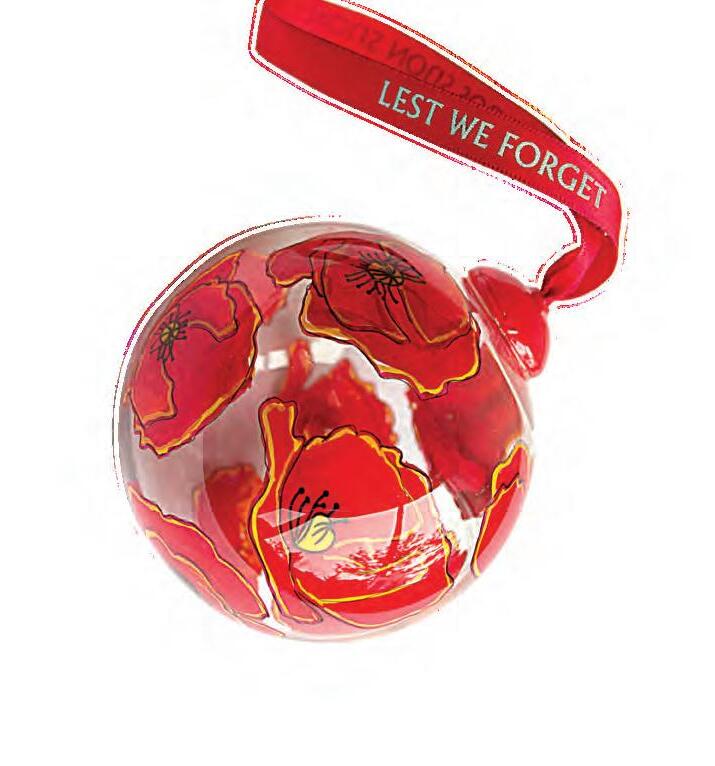
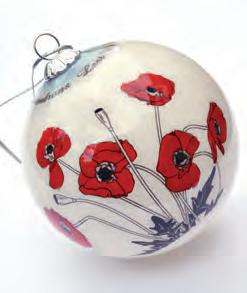
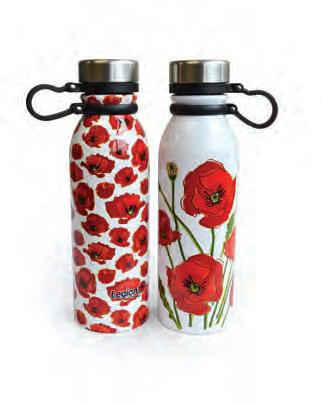
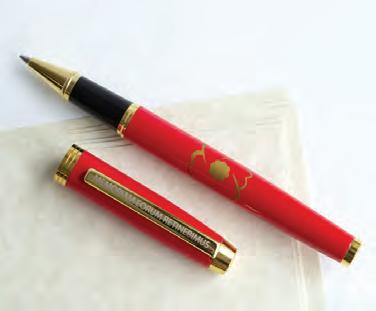


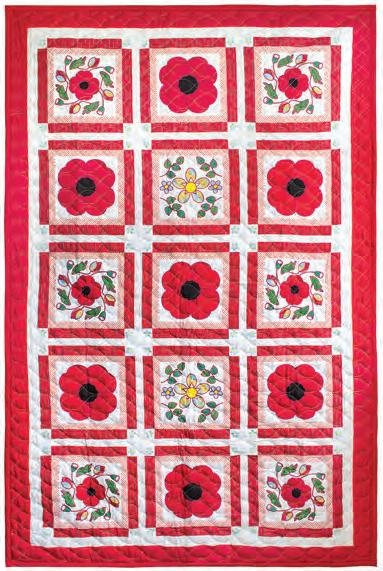


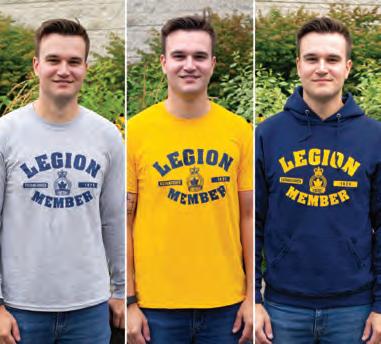
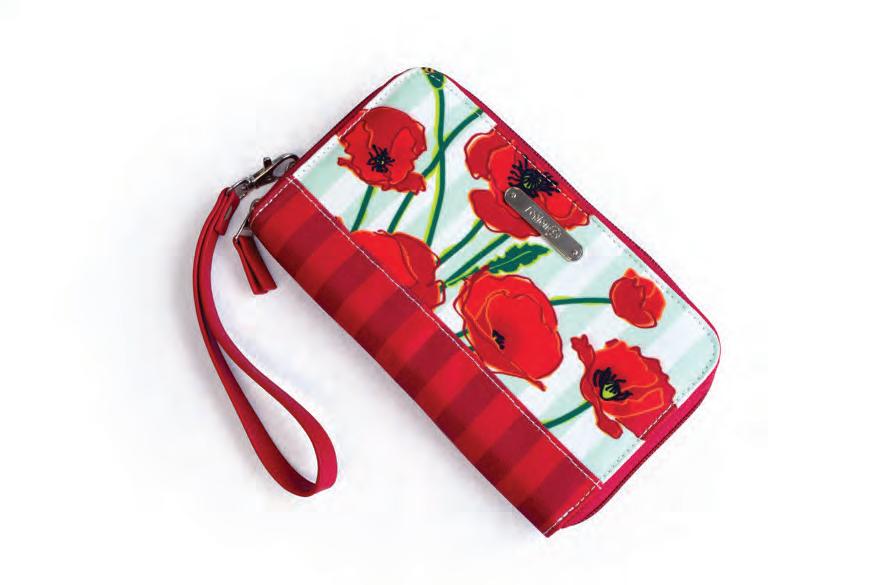


Glass Poppy Ornament in Velvet Box

I Light fantastic
received the September/ October issue of Legion Magazine and was most interested in the “Light my way” article. I was a convoy signalman during the Second World War attached to the Royal Navy. The Canadian navy followed the same protocols almost exactly.

Comments can be sent to: Letters, Legion Magazine , 86 Aird Place, Kanata, ON K2L 0A1 or emailed to: magazine@legion.ca
I remember receiving my very first message in a North Sea convoy from a destroyer
Lagging jets
I read with great interest David Bercuson’s article “Buyer beware” (Eye on Defence, September/ October) on a possible replacement for the CP-140 Aurora aircraft. Bercuson maintains that the P8 Poseidon, based on the Boeing 737-7, is widely used and is the safe choice for Canada. If a rapid decision was needed, I would agree.
However, is the Poseidon really the only choice? First, it’s an old airframe. Second, its sensor suite is an issue. I believe the reliability of the Bombardier Global makes it a better choice. It also has a military variant, having been selected as an early warning aircraft by both the United Arab Emirates and Sweden. The Global could also be fitted with the most modern sensor suite for surveillance-reconnaissance.
Bercuson mentions government subsidies to Bombardier, but these pale in comparison to U.S. financial support to Boeing. I appreciate Bercuson’s insights and I’m sure he would agree that no matter which aircraft is selected, the sensor suite must be top-of-the-line.
PIERRE ST-AMANT LEFAIVRE, ONT.
escort. I was inexperienced and nervous and made a mistake that cost our signal crew a weekend leave. I never guessed at a word after that.
I eventually got nicknamed “Steady light Smurthwaite” and by the end of the war, I considered myself an expert in sending and receiving messages by light in Morse code. We used Sperry searchlights for long distances, but mostly
It’s nice to see that the Aurora aircraft are going to be replaced. Kudos to the teams that have kept the aircraft in service for 40 years. I am disappointed, though, that we will be going through the same procurement process that causes delays in getting new equipment. No matter which aircraft the government decides to purchase, the taxpayer will be footing the bill.
The P8 seems to be proven in its abilities, but purchasing it would suggest to me that the government will reward companies that disrupt Canadian busi-
used Aldis lamps, which were convenient and movable. Our shore stations were later staffed by the Women’s Royal Navy Service—they were just as good, if not better, than the men. I imagine that today’s methods of communication will certainly mean that light signalling is a dying naval trade. Semaphore even more so.
STAN SMURTHWAITE ELMIRA, ONT.
nesses that compete with foreign companies. The purchase of the CH-148 helicopter may have had its problems, but it illustrates that the government can work with industry and make something that suits Canadian requirements. Canada has the capability to build it own equipment. The country needs to stay on top of its game when it comes to replacing aging military equipment. Many people may not like the idea of spending millions on military equipment, but think what the alternative could be.





If the P8 is chosen, the government should insist much of the aircraft is manufactured by Canadian companies. What better way to stimulate an economy than employing Canadians?
ROGER MAGARIAN REVELSTOKE, B.C.
Dress mess
What an outstanding read! (Canada and the New Cold War, September/October). As a retired chief warrant officer, it makes me proud that other people see the state of our military much the same way as I feel when it comes to our serving members. It’s hard to believe what they go through and still proudly and professionally serve our country. As author J.L. Granatstein indicated, how the folks in positions of power in Ottawa felt that the changes made in dress and appearance regulations would greatly increase recruitment is beyond me.
REX PITCHER
BEDFORD, N.S.
I completely agree with J.L. Granatstein on the new Canadian Armed Forces dress regulations. I live near 19 Wing Comox in B.C. and volunteer at the base, and I’m saddened by what I see of our soldiers in uniform, especially the length of hair for many of the men.
It’s a sloppy, unkept and unprofessional look. Is that what the image of Canada’s military on the world stage is to be now? Shame. And to allow coloured hair, men in skirts? Come on. This will do nothing to improve recruiting.
TED USHER
COURTENAY, B.C.
The greatest warrior
The feature story about Tecumseh in the September/ October issue (“The shooting star”) was great. After reading Killers of the Flower Moon and The Inconvenient Indian, I have become quite interested in the plight of Indigenous Peoples of North America. It’s sad to see what has happened to them as a result of colonization.
PAUL LEDUC
FENELON FALL, ONT.
Aw, shucks…
I am a new member of The Royal Canadian Legion living in Paris, Ont. My grandfather served Canada in an artillery unit in Belgium, Holland and Germany during the Second World War. I am proud of his service. I recently started getting Legion Magazine and have been pleasantly surprised by its quality. It’s full of excellent,


well-researched, thoughtful articles and features. And unlike many other magazines, it isn’t full of advertisements or image-heavy puff pieces. I’m proud to support the Legion and glad that there’s such a great editorial team producing such an excellent magazine.
JEREMY E. PARSONS PARIS, ONT.
Image conscious
It’s unfortunate that Gilbert Alexander Milne’s D-Day landing photo has become the iconic image of Canadians on D-Day (“The eyes of war,” July/August). It perpetuates a false understanding of the landings. On June 6, 1984, my father, Archie McQuade, escorted Prime Minister Pierre Trudeau on his tour of the beach at Bernièressur-Mer. Forty years earlier, Dad landed on the beach at 7:30 a.m., as a rifleman in ‘D’ Company of The Queen’s Own Rifles. When one of Trudeau’s assistants told the PM that this was where our troops landed with their bicycles, Dad immediately countered: “What the hell are you talking about? We didn’t have any goddamned bicycles! We fought!” The assistant started to challenge my father, but Trudeau stopped him, saying he wanted to hear what my dad had to say. Dad then told Trudeau what really happened that day.
RICHARD McQUADE
TORONTO
CLARIFICATION
In “Fighting the Monsters of Medak” (September/October), Mark E. Meincke was used as an independent source and was identified as a veteran and “a Canadian Forces’ advocate.” Any other interpretation of his service was not intended.


Communist troops of the North Korean People’s Army attack the South on June 25, 1950. They are in Seoul in less than a week. A United Nations coalition resolves to stop them, and
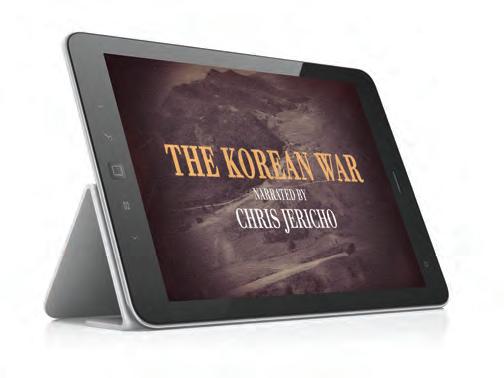
Canada joins what is, by any definition, a war. For three years, Canadians fight iconic battles on land, sea and in the air; 516 die and when the killing is over, the more than 26,000 survivors spend years fighting for recognition. They call it a “police action” and the “forgotten war,” but for those Canadians who fought in Korea between 1950 and 1953, neither time nor circumstance can erase the memories of what they saw, smelled and experienced in the hills and valleys around the 38th parallel and beyond.
Written by Stephen J. Thorne and narrated by Canadian wrestling legend Chris Jericho,
Get notified of all the latest updates on legionmagazine.com by signing up for our weekly e-newsletter at www.legionmagazine.com /en/newsletter-signup
watch the story of Canadian soldiers in Korea in Legion Magazine’s latest video in its Canadian Military Moments series, Korea: War without end. The video transports viewers to the Korean peninsula and its hillsides, and shows why this was indeed a war, what the Canadians accomplished, what they sacrificed, and the legacy of the conflict. Watch it at www.youtube.com/legionmagazine. And if you want to dive deeper into the “forgotten war,” get a copy of Canada’s Ultimate Story, Korea: The war without End at canadasultimatestory.com. L




3 November 1534

November
9 November 1918
German Kaiser Wilhelm II abdicates his throne in the closing days of the First World War and flees to Holland.
11 November 1918
The Allies sign an armistice with Germany near Compiègne, France, to end the First World War.
13 November 1942
King Henry VIII becomes Supreme Head of the Church of England following the passage of the Act of Supremacy by the U.K. Parliament.
4 November 1920
Airmail service begins between Canada and the U.S.
5 November 2006 Saddam Hussein is sentenced to death.
6 November 1861
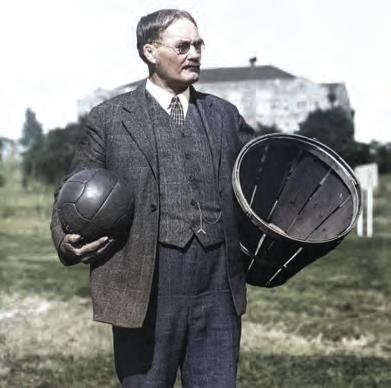
James Naismith, the inventor of basketball, is born in Almonte, Ont.
8 November 1939
An assassination attempt on Hitler in Munich fails, but eight die and 57 are wounded by the explosion meant to kill him.
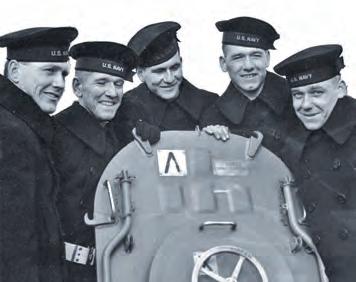
The five Sullivan brothers from Waterloo, Iowa, die after the cruiser USS Juneau sinks. The U.S. Navy subsequently changes its regulations to prohibit close relatives from serving on the same ship.
20 November 1945
The Nuremberg war crime trials of 24 former Nazi leaders begin.
14 November 1666
The first experimental blood transfusion, between dogs, takes place in Britain.
15 November 1985
The Anglo-Irish Agreement, aiming to quell conflict in Northern Ireland, is signed by British Prime Minister Margaret Thatcher and her Irish counterpart Garret FitzGerald.
17 November 1869
The Suez Canal is formally opened after more than 10 years of construction.
18 November 1477
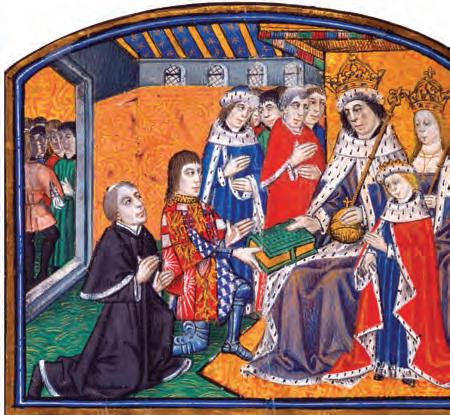
The Dictes and Sayengis of the Phylosophers is the first Englishlanguage book published in England.
19 November 1942
The Soviets begin a massive counteroffensive against the Germans at Stalingrad.

22 November 1943
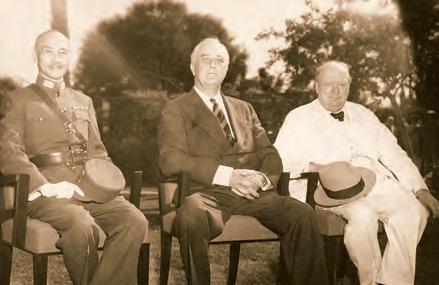
Chinese Nationalist leader Chiang Kai-shek, U.S. President Franklin D. Roosevelt and British Prime Minister Winston Churchill meet at the Cario Conference to discuss the war with Japan.
26 November 1917
After the National Hockey Association disbands, the Montreal Canadiens, Montreal Wanderers, Toronto Arenas, Ottawa Senators and Quebec Bulldogs form the National Hockey League.
30 November 1829
Two schooners pass from Port Dalhousie to Port Robinson in Upper Canada symbolically opening the Welland Canal and directly linking lakes Erie and Ontario.


December
3 December 1943
Of 400 casualties at Monte la Difensa in Italy, 27 Canadians die and 64 are wounded.
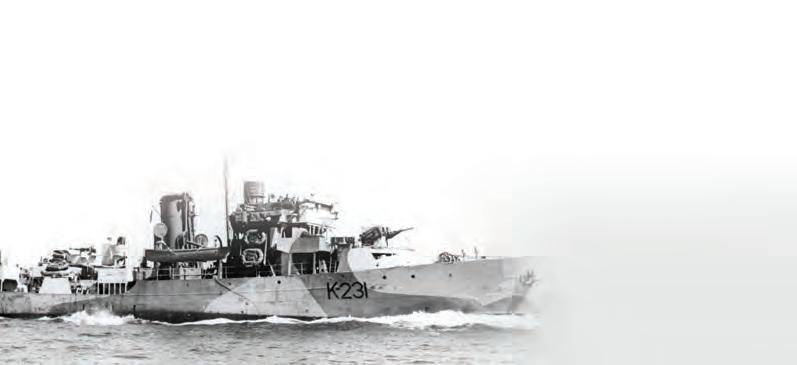
5 December 1812
HMS Plumper sinks in the Bay of Fundy; 42 lives are lost, along with gold and silver.
6 December 1907
Lieut. Thomas Selfridge makes Canada’s first recorded flight carrying a passenger on a heavier-than-air craft.
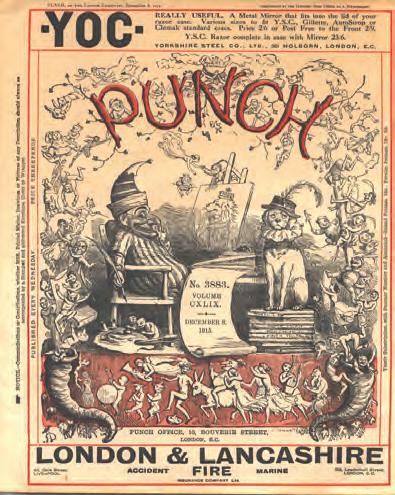
8 December 1915
Punch Magazine publishes “In Flanders Fields.”

11 December 1813
Bodies of women and children are found after U.S. forces burn the town of Newark (present-day Niagara-on-the-Lake, Ont.).
12 December 1942
The Knights of Columbus Hostel in St. John’s burns down, killing 99 and wounding 109. German sabotage is suspected.
14 December 1939
The Soviet Union is expelled from the League of Nations after invading Finland.
16 December 1941
The original HMCS Calgary is commissioned in Sorel, Que.

20 December 2019
The United States Space Force is founded as an armed branch of the military.
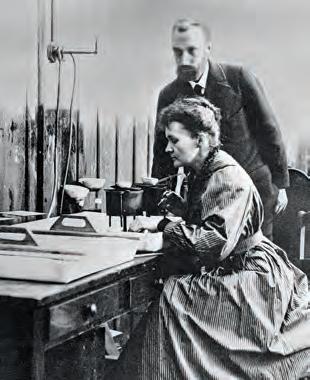
21 December 1898
Pierre and Marie Curie discover radium.

24 December 1968
Apollo 8 orbits the moon, becoming the first manned space mission to achieve the feat.
22 December 1775
The Continental Navy, forerunner to the U.S. Navy, appoints Esek Hopkins as commander-in-chief and its officers are commissioned.
25 December 1952
Queen Elizabeth II gives her first Christmas broadcast on BBC radio.
27 December 1831
Charles Darwin sets sail on HMS Beagle, beginning the voyage on which he would formulate his theory of evolution.
28 December 1918
For the first time, women are allowed to vote in Britain’s general election.
29 December 1940
Germany begins dropping incendiary bombs on London.
31 December 1857
Ottawa becomes capital of Canada.

By Paige Jasmine Gilmar
Artdirection
Enlisting the creative forces can be its own conscription crisis. To be imaginative is a state of existence, a life’s purpose. In many ways, it’s the opposite of the analytical, orderly way of armed forces’ thinking.
Alongside the results-driven culture of the military, being creative can be intimidating for soldiers and veterans. But with a job as nerve-fraying as serving in the Canadian Armed Forces, any outlet that relieves stress, from football to fingerpainting, can be welcome.
Chief Warrant Officer Chris Hennebery of The Royal Westminster Regiment felt something had to change when he saw Canadian Armed Forces’ members shy away from the prospect of art therapy.
“Serving for as long as I have, I’ve developed quite a family within my unit,” he said. “A lot of them were struggling.”
But rather than shrug off their struggle, the Vancouver-based reservist decided to use his
How one Canadian soldier is enlisting creativity to counter operational stress injuries
entrepreneurial knack and artistic skill to create the Veterans Artist Collective, a non-clinical art therapy program for veterans struggling with operational stress injuries (OSIs) such as post-traumatic stress disorder or traumatic brain injuries (TBIs).
“Working with your hands can be a great tool for mastering your mind,” said Hennebery, who holds a fine-arts degree. “There’s a form of soft therapy to it.”

Researchers have found that artistic activities can enhance mood and lower levels of cortisol, a “stress hormone.” Professionally guided art therapy, for instance, has been found to help reduce symptoms of PTSD and brain injuries, as well as aid in processing and clearing traumatic memories.
“Art therapy bypasses our usual judgments, filters and censoring that we often do when we talk,” art therapist Youhjung Son told Legion Magazine. “That’s why it’s often one of the best ways we can get in touch with the part of ourselves that we don’t even know, understand or suppress.”
Son also notes that art programs such as Hennebery’s collective can be better focused, more flexible and better tailored to people’s needs than formal art therapy.
“Shamans, guides, elders, medicine men and healers who used creative means to help people are not considered trained therapists,” noted
Son in her art therapy program’s blog, Thirsty for Art. “But are they not therapists in their own context?”
During the throes of the pandemic, Hennebery put his art initiative into motion, catering to a need further compounded by COVID’s psychological ramifications. His vision: a multi-day getaway in a peaceful location for veterans to break routines and bad habits using an artistic medium, specifically painting.
“We’re trying to get them to commit, to be immersed in it,” he said. “We take all the excuses away and just have that opportunity to be quiet, to concentrate and give themselves over to the process.”
Michael King, a master of plein-air, or painting in nature, facilitated the workshop, which was held at Honour Ranch, a mental-health retreat for CAF members and first responders dealing with OSIs, in Ashcroft, B.C.
Major
“[Veterans] are dealing with so much shit that if listening to me takes away that shit for five minutes, and then they can paint for another 10,” said King, “that’s a success.”
The collective’s first retreat was an absolute hit. And believing that the program could be more than a one-hit wonder, Hennebery dedicated himself to the program, sometimes ponying up the money to pay for retreats, cooking all the meals for attendees and even sleeping on the couch to fit an additional guest into one of the cabins.
“I really enjoyed myself and all the attendees did,” he said. “It was just brilliant.”
Still, Hennebery wanted to expand his initiative from painting to metal forging, hoping to boost male turnout since the art retreats were dominated mostly by women.
“When we think of creative practices, lots of guys say, ‘that’s not me. I was in the infantry. That’s not what we do,’” noted Hennebery, citing the importance of genderspecific health care, a characteristic that can heighten the effectiveness of some wellness services.
“Some of these guys say that the last time they did anything creative was when they were in elementary school. That’s why the axe-forging was really important.”
Joining forces with navy veteran Will Steed of The Forge Co. in Beaumont, Alta., Hennebery started an axe-forging retreat, which also showed promising results.
“We are seeing real, meaningful change,” he said. “And at the end of the day, I think that’s all we’re trying to achieve.”
The demand for retreats for both arts continues to build. Indeed, there’s currently a waiting list of 120 people. What accounts for the success? Hennebery recounted the journey of one attendee who had served in the infantry for eight years and was diagnosed with PTSD and TBI. “He had told me, ‘When I saw this [program], it literally
stopped me from deciding to take my own life.’ And he’s still axe forging.”
Hennebery plans to retire from the military in a year, hoping to replace “one service with another” by dedicating his time to expanding the collective to include creative writing and music programs. He also wants to
increase the number of attendees per retreat, as well as get consistent funding from government.
“We’re not trying to change the world,” Hennebery confessed. “We’re just trying to give some veterans and serving soldiers an opportunity to try something new.”

MEDIPAC TRAVEL INSURANCE
The myth of the “Long Peace”
Have the last seven decades really been a Pax Americana
Some historians describe the period between the end of the Second World War and now as the “Long Peace,” or Pax Americana, based on the fact there have been no major wars involving the great powers. Proxy wars, yes; “major” wars, no.
They qualify this by describing it as a time of “relative” peace, implying that the Cold War—four decades of living with the prospect of nuclear annihilation hanging over the planet—was a good thing and that regional conflicts are inconsequential.
As American as that might sound, the concept is not limited to our neighbours south of the 49th.
In 2012, the Norwegian Nobel Committee unanimously voted to award the European Union the Nobel Peace Prize for contributing to “the advancement of peace and reconciliation, democracy and human rights in Europe” for six decades.
This despite the bitter ethnically and religiously based wars that raged in Eastern Europe, notably the Balkans and Chechnya, after the collapse of the Soviet Union and communism in the 1990s. Never mind the Hungarian Revolution of 1956 or the Soviet invasion of Czechoslovakia in 1968—mere incidents, apparently.
According to the Council on Foreign Relations, a U.S.-based
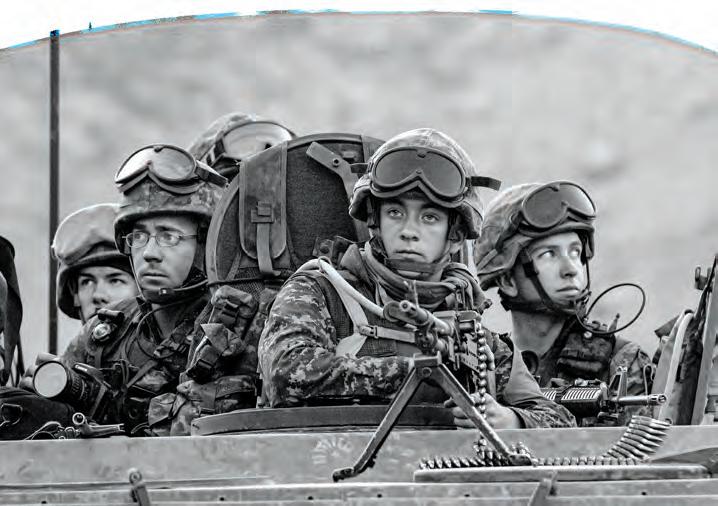
think tank, there are at least 26 hot wars and simmering conflicts in the world today, including the 20-month-old—some say nine-year-old—war in Ukraine; the potential powder keg developing over Chinese territorial claims in Taiwan and the South China Sea; and wars, civil wars and conflicts in Africa, the Middle East, the Indian subcontinent and Southeast Asia.
The Armed Conflict Location & Event Data Project, meanwhile, reported 19 countries met its criteria for high or extreme levels of conflict severity at the start of 2023. For the week of July 15, 2023, it recorded 2,350 incidents of political violence worldwide, including battles. And that was down 16 per cent from the previous week.
Some 21.3 million people currently serve in armed forces around the world (China tops the list at 2.4 million, followed by the U.S. at 1.4 and India at 1.3). Fourteen of the world’s 20 largest militaries are in developing nations.
Two billion people currently live in conflict-affected areas and climate change is creating new reasons to go to war.
Humanity’s penchant to fight and kill one another is at least as old as recorded history.
The New York Times reported in 2003 that humans had been entirely at peace for just 268 of the past 3,400 years, or an estimated eight per cent of humankind’s documented time on Earth, which spans about 5,000 years. Estimates of the total number of people killed
Canadian armoured reconnaissance troops patrol in the mountains west of Kabul in 2003.
in wars during that time vary widely between 150 million and a billion.
The Canadian perspective on war is often shaped by American policy and experience. Since 1946, up until at least the Donald Trump administration, the U.S. laid claim to the title of global police officer—the defender of democracy and human rights, even when the very exercise violated international law and human rights.
Between its founding in 1776 and 2020, America was at peace for just 15 years, according to one news outlet. It has been been involved in at least 105 wars and rebellions, four of which still involve U.S. forces: Niger, Syria, Somalia and Yemen. More than 650,000 Americans have died in combat.
The Americans currently have between 160,000 and 170,000
active-duty personnel deployed in “non-combat” roles in at least 36 countries, nearly 40,000 of whom are assigned to classified missions and an additional, undetermined number participating in actual wars—more, apparently, than we know.
A November 2022 report by New York University School of Law’s Brennan Center for Justice says the Americans have been involved in many more wars during the past 20 years than the Pentagon has disclosed to Congress.
“Afghanistan, Iraq, maybe Libya,” says the report by the law and policy think tank. “If you asked the average American where the United States has been at war in the past two decades, you would likely get this short list.
“But this list is wrong—off by at least 17 countries in which the United States has engaged
in armed conflict through ground forces, proxy forces, or air strikes. For members of the public, the full extent of U.S. war-making is unknown.”
And that includes American lawmakers. Congress’s understanding of its forces’ involvement in overseas wars, adds the 39-page report, is often no better than the public record. The U.S. defence department provides congressionally mandated disclosures and updates to a limited few.
“Sometimes, it altogether fails to comply with reporting requirements, leaving members of Congress uninformed about when, where, and against whom the military uses force. After U.S. forces took casualties in Niger in 2017, for example, lawmakers were taken aback by the very presence of U.S. forces in the country.”
Pax Americana, indeed. L

By David J. Bercuson
Playing Insights from a brief history of Canada’s military procurement processes
politics
In
1977, the Royal Canadian Air Force began to look for an aircraft to replace the three-decade-old CF-101B Norad interceptor and the CF-104 NATO fighter, whose lowlevel nuclear strike mission was being phased out. To do so, the government launched the “new fighter aircraft” competition under the direction of the future defence chief, Brigadier-General Paul Manson, then commanding officer of 441 Tactical Fighter Squadron. Manson was an energetic leader, outstanding pilot and superb administrator who quickly organized tests. The Aeronautical Engineering Test Establishment was responsible for overseeing the competition and the budget for the purchase was about $2.4 billion to procure between 130 and 150 aircraft, including two place-training aircraft. Five to eight top Canadian fighter pilots and radar operators
or navigators flew existing U.S. and European fighters and one plane that was still in development. Specifically, the options included: the Grumman F-14 Tomcat, a U.S. Navy swingwing, twin-engine fighter; the McDonnell Douglas F-15, a new U.S. Air Force twin-engine fighter; the Panavia Tornado, a twin-engine interceptor/ ground attack fighter developed by Italy, Britain and Germany; the French Dassault Mirage F1, a single-engine interceptor; the American General Dynamics F-16, a single-engine fighter; and the U.S. Navy’s prospective YF-17, a McDonnell Douglas fighter not yet in production, but eventually to be built as the F/A 18 Hornet. The latter—known in Canada as the CF-188 Hornet—was announced winner in 1980, three years after the competition began. The first aircraft arrived
in Canada in 1982, destined for decades of outstanding service.
The CF-188 procurement was not the only large defence purchase done without a hitch. When Canadian troops shifted their role in Afghanistan in 2003 to act as peace enforcers around the capital of Kabul, the Liberal government of Prime Minister Paul Martin purchased new M-777 howitzers, with a brace of GPS-guided shells, to shore up Canada’s longer-range capabilities.
In 2009, Conservative Prime Minister Stephen Harper’s government leased the Israeli-built Heron unmanned aerial vehicle under a license agreement with Canadian company MDA with no squabble at all. The Harper government subsequently initiated a purchase of four
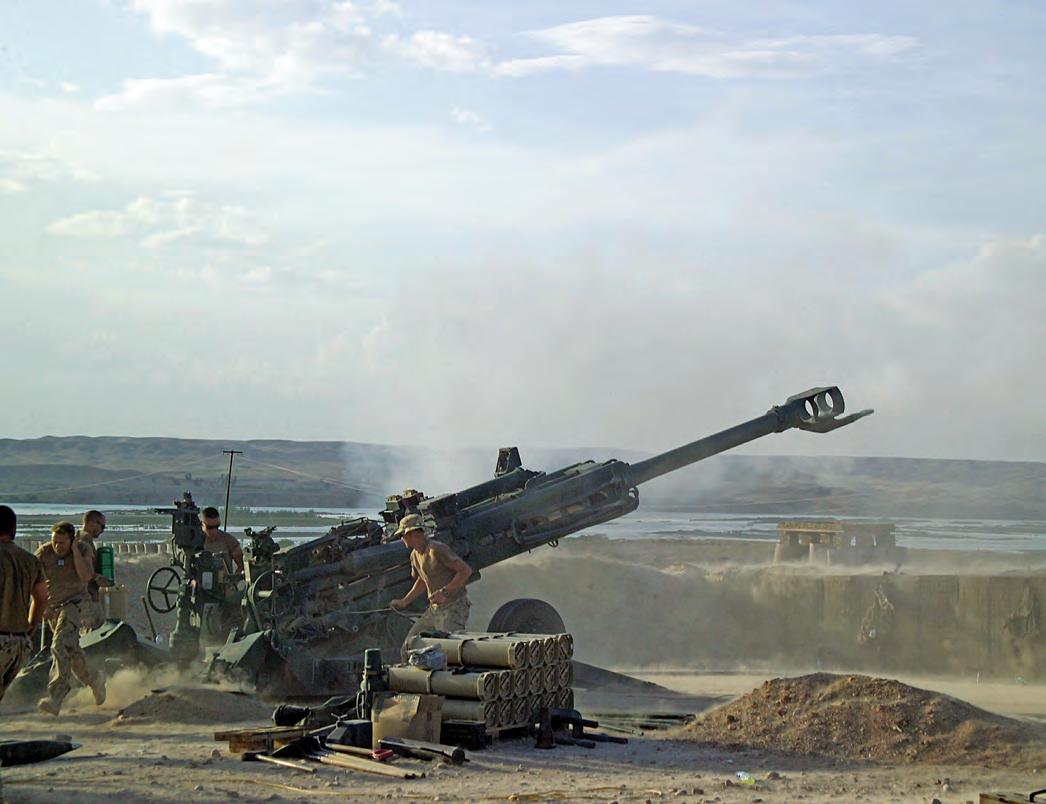
Canadian soldiers
(later five) Boeing Globemaster III heavy airlifters and, in 2007, leased 20 Leopard II tanks from Germany for service in Afghanistan, as well as 100 refurbished L eopard IIs from the Netherlands.
But in 2010 when the Harper government announced t hat it planned to purchase 65 L ockheed-Martin F-35 stealth fighters, opposition MPs began seriously questioning t he lack of competition for the expenditure. A report by t he auditor general on the matter, which considered t he still-in-development fighter a completed production aircraft, was released t wo years later and projected impossibly expensive costs for the purchase. In 2014, t he CBC's “The Fifth Estate” labelled t he aircraft a “turkey.” It was the final nail in the coffin. The plan was k illed by the same Harper government.
This past January, the government of Prime Minister Justin Trudeau, who had sworn Canada would not buy the F-35, decided to do just that—nine years after the original initiative died.
The F-35 situation is somewhat reminiscent of the plan to replace Canada’s Sea K ing helicopters, which began in 1986. It was killed by Jean Chretien’s Liberal government in 1993 only to be revived two years later. It ultimately dragged on until the replacement Sikorsky CH-148 Cyclone entered service in 2018—some 30 years after the process started.
What can Canadians conclude from these examples? When the country has its back to the wall in an international crisis—emphasis on crisis—federal governments of both political parties can move quickly to outfit the Canadian Armed Forces w ith equipment t hat’s needed.
Legion and Arbor Alliances
In the case of the CF-188, the Cold War was the motivating factor, along with the need to assure the U.S. that Canada would do its part to defend North A merica with the best aircraft available. Even supposedly antimilitary Prime Minister Pierre Trudeau knew that. Martin’s government needed no acute tactical thinking to buy M-777 howitzers when Canada pledged to keep the Taliban out of Kabul. A nd the Harper government acted quickly to acquire Heron drones, new Hercules tactical transports and buy and lease new tanks.
Too bad it quickly abandoned the F-35 purchase, only to have it re-emerge almost a decade later under Justin Trudeau’s government. The real lesson: when the country’s leaders play politics with the defence procurement process, all Canadians lose in the long run. L
happy The
By Kallan Lyons
A GRANDDAUGHTER LEARNS THE WARTIME SECRET(S) OF THE GRUFF FORMER ROYAL AIR FORCE FLYER SHE KNEW GROWING UP
Opilot
Courtesy Kallan Lyons
On a bitter cold evening in 1944, eight men took off from Royal Air Force station Foulsham in Norfolk, England, in a four-engine Handley Page Halifax heavy bomber and ascended 6,100 metres into the dark. Rear Gunner Bernard (Bernie) McNicholl sat silent and alone in his Perspex dome, scanning the sky for any sign of a flitting shadow. Three years prior, the 15-year-old was itching to finish high school in Montreal. Now he waited for the enemy to appear—poised to fire four Browning guns that protruded like stingers from the plane’s tail.
From his turret, McNicholl could usually spot enemy aircraft 350 metres away. Suddenly a crew member yelled: “Fighter coming in on us!”
O
“Corkscrew, starboard, go, go, go!” McNicholl roared into his headset. The bomber plummeted to the right and dove, rolling 60 degrees in the opposite direction before once again starting its ascent.
“What was that?” the pilot’s voice crackled over the intercom.
“There’s good news and bad news,” McNicholl replied.

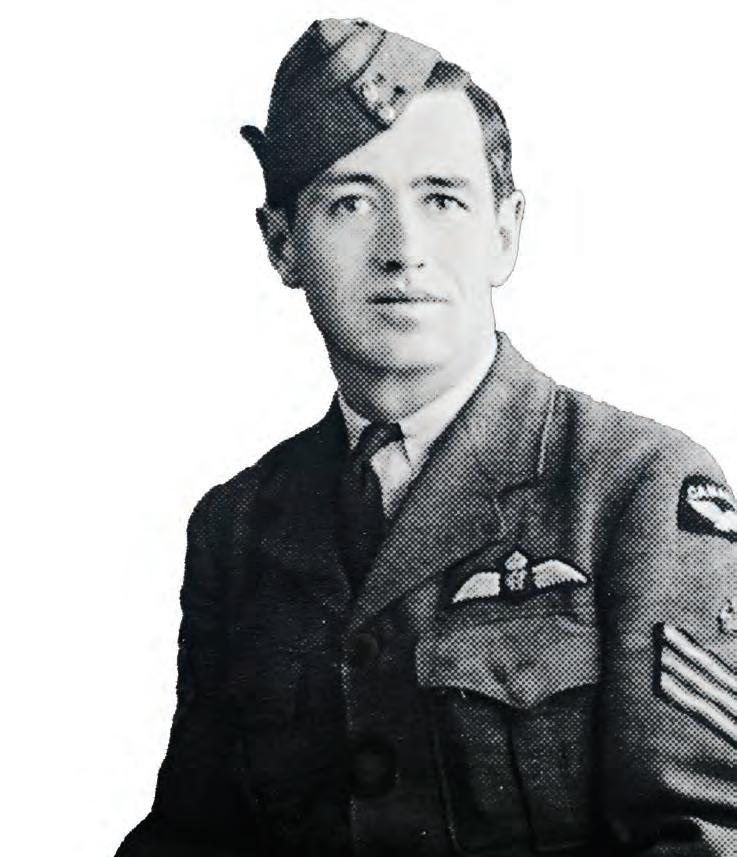
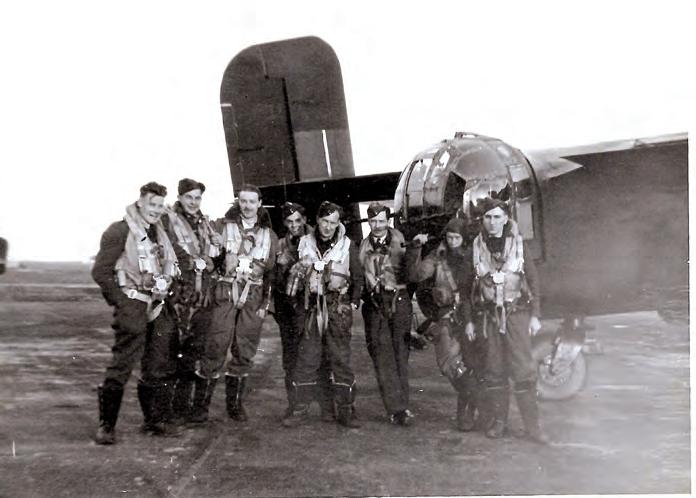
Arnold (Smitty) Smith (opposite page) served with the Royal Air Force during the Second World War. Flying Officer Smith is third from right with his crew in this wartime photo. Bernard (Bernie) McNicholl served with Smith as a rear gunner.
The good news: the Allied bomber had just flown by a German night fighter. The bad news: “The fighter pretty near crashed into us,” said McNicholl. “I bet you we were 10 feet apart.”
McNicholl and my grandfather Arnold Smith—“Smitty” to his crew and family—were among hundreds of Canadians who served with the Royal Air Force during the Second World War. I knew very little about my grandfather’s RAF career when I was growing up beyond the simple fact that he was a bomber pilot. So, in the fall of 2018, I drove from my home in Vancouver to Chilliwack, B.C., to visit then 92-year-old
McNicholl to learn more. (McNicholl died this past July.)
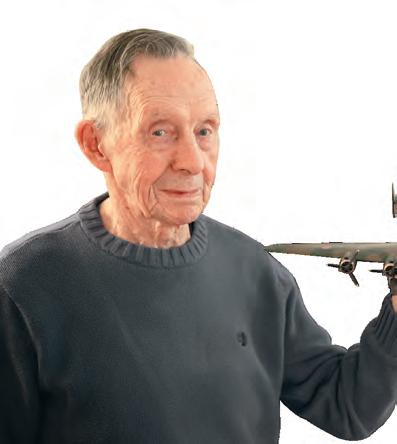
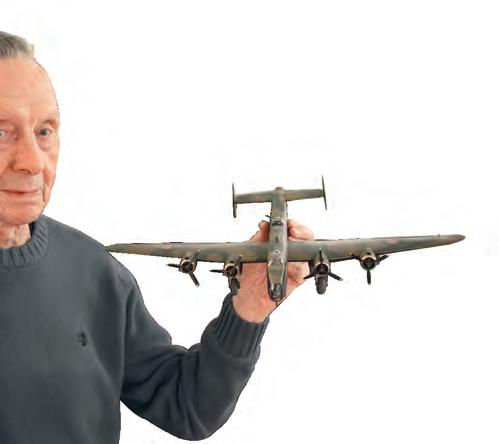
When I arrived at McNicholl’s home, a small, animated man swung open the door and ushered me inside. I had met him only once before, when I was a child, but he immediately felt like family. As we made our way to the living room, he grabbed something off the kitchen table to show me. It was a Halifax bomber model he had built.
McNicholl and Smitty met in Lossiemouth, Scotland, in early 1944. As the youngest crewman, McNicholl looked up to Smitty and the pair bonded quickly. Both had no siblings and had had difficult childhoods.

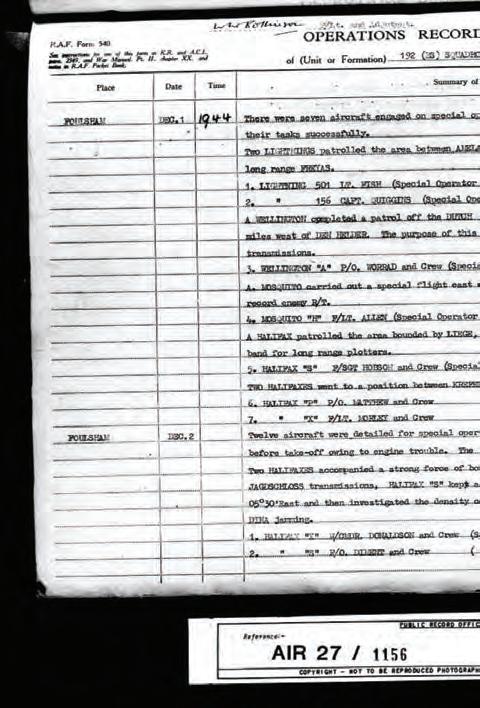
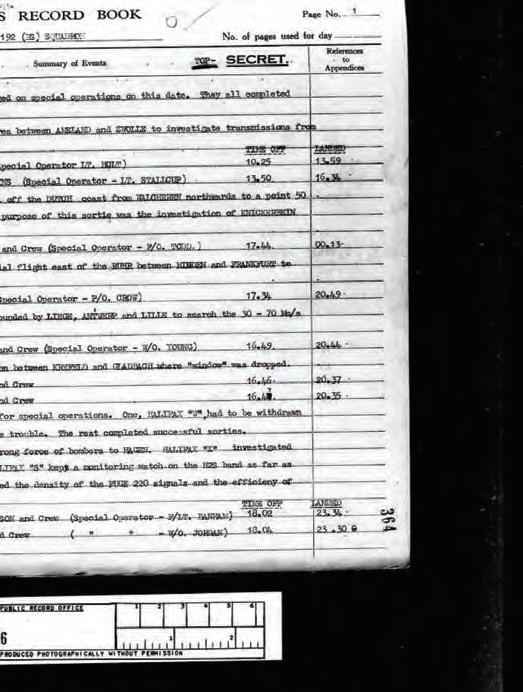
They flew with 192 Squadron in special duty RAF 100 Group on a top-secret mission: electronic warfare. Their plane carried very few bombs and gathered radar frequency, with a rotating eighth crew member who operated the equipment.
“Every crew thought they were the best crew, but we were, no argument there,” said McNicholl. “Because they used to pick us for the bad trips, too.”
McNicholl spoke highly of my grandfather, a “great low-level pilot” who had never flown a plane before the war. “Smitty didn’t panic,” said McNicholl. “Your grandfather could fly that aircraft like a fighter.”
Smitty, 30 at the time, was one of the eldest on board, and as confident in his aviation skills after less than two years of training as he was in carpentry, a trade he had practised since his teens. Never one to do anything half-heartedly, he was out to impress. Indeed, after meeting a Canadian Red Cross worker—who would become my grandmother— during a stopover in London, Smitty decided to put on a show.
“As we went by Croydon hospital, the ladies were hanging out the windows waving towels at him,” said McNicholl. “When I went by in the rear turret, I was looking up at them. That’s how low we were flying.”
The squadron’s mission was arguably more dangerous than that of many bomber crews, who would fly to a target, drop bombs and go home. After circling for hours collecting frequencies, the data was sent to a jamming squadron to block German radars. While readily scanning for fighters, McNicholl would turn the turret so that it would catch the wind and move the plane. Smitty would correct it to indicate he was awake. Good communication and reflexes were key to their survival. McNicholl says he owes his life to the way his shouted warnings were translated into action by his pilot.

Of course, the fact that McNicholl lived to share this tale is momentous: as is well-known, only 25 per cent of bomber crews completed a first combat tour of 30 missions. Remarkably, in June 1945, Papa’s special-ops crew completed, without a casualty, 30 top-secret missions over Germany.
In 1995, a largely intact RAF Halifax bomber was exhumed from the bottom of Lake Mjøsa in Norway and brought to Canada. The 25,000-kilogram plane had been sitting in its boggy grave for some 50 years when Canadian pilot Karl Kjarsgaard began its recovery.
“The Halifax was the most important airplane in [Canada’s] aviation history,” he told me during a visit to the Bomber Command Museum of Canada in Nanton, Alta. “The Lancaster has always got the glory as the beautiful bomber that did everything in World War II,” continued Kjarsgaard, also the museum’s curator. “But Canadians flew 70 per cent Halifax, 20 per cent Lancaster and 10 per cent Wellington.”
Most RAF bombers shot down by the enemy were attacked by night fighters from the rear or
underneath. There was and it was seen as the weak-
enemy plane had snuck up on them that near-fatal night in 1944.
If RAF crewmen weren’t killed in the air, they were likely to be seriously wounded in crashes or to become prisoners of war. Few in Bomber Command made it to the end of the war unscathed.
Despite the immense losses, Kjarsgaard said the Handley Page Halifax played a huge part in the Allied victory, even if it was overshadowed by the Lancaster heavy bomber. In part, the Merlin engine used in earlier Halifax models couldn’t provide enough horsepower for the plane to perform as designed, garnering it a poorer reputation. In 1942, however, the Halifax Mark III was powered by a Hercules engine and the bomber became a jack of all trades. While the Lancaster could carry more bombs, the new and improved “Halibag,” as it was affectionately known, was ideal for special operations— as assigned to 192 Squadron.
Kjarsgaard speculated that my grandfather’s crew survived thanks to a combination of chance, talent and teamwork. Still, there’s one thing he’s sure of: “Your family exists because of a Halifax.”

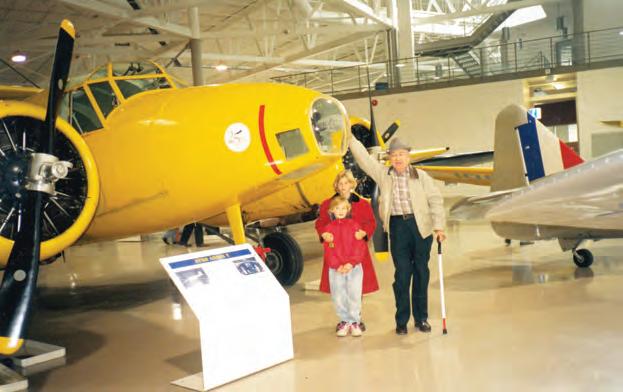
In 1997, my family took my grandfather to the Canadian Warplane Heritage Museum near Hamilton, Ont. I was 10 years old and didn’t fully appreciate the trip’s significance. In one photograph from the visit, my sister and I are standing next to my grandfather in front of an Avro Anson—a plane used for RAF training. My mother captured a rare moment that day: my grandfather— with his white cane in one hand, the other resting on the nose of the plane—grinning from ear to ear.
He was lauded a hero in his hometown of Centreville, N.B, a tiny village northwest of Fredericton, but my mother says her dad never talked about the war. She always knew, however, that he had a special bond with his crew. “The squadron was everything to him,” she told me. I couldn’t help feeling a twinge of jealousy when I heard that. I longed for the loving relationship my friends had with their grandfathers. Papa Smitty, as I called him, was impatient, short-tempered and extremely fastidious. I constantly tiptoed around him and was, admittedly, a bit scared of him. Even my mother found him intimidating.
As a teenager, when my mom would drive the family car, my grandfather would inspect it upon her return. He would insist she put the seat and mirrors back in the positions she had found them and park it so that the two front wheels sat in the little divots in their gravel driveway. She did her best to please him, but still felt that he didn’t trust her. One time, Smitty secretly put coins
“I know I can be a pilot. I’ve been driving a taxi for over a year and a half, and I haven’t killed anybody.”
on both sides of the dashboard, right up against the window. My mother never noticed until the day she returned home and was asked how fast she had been driving.
“You must have been going pretty darn fast,” she recounted him saying. “The coins are on the floor.
“I got to the point where I knew enough to put them back,” she recalled with a laugh, then paused. “I think of that now— he couldn’t have survived the war flying a Halifax bomber if he hadn’t been that precise.”
In 2005, the world’s first restored Halifax was unveiled by Kjarsgaard and his team at the National Air Force Museum of Canada in Trenton, Ont. Smitty, unfortunately, didn’t live long enough to see it. He died less than a year after our trip to Hamilton, at the age of 83.
“My personal tribute to the bomber boys is to save as many Halifaxes as I can,” said Kjarsgaard.
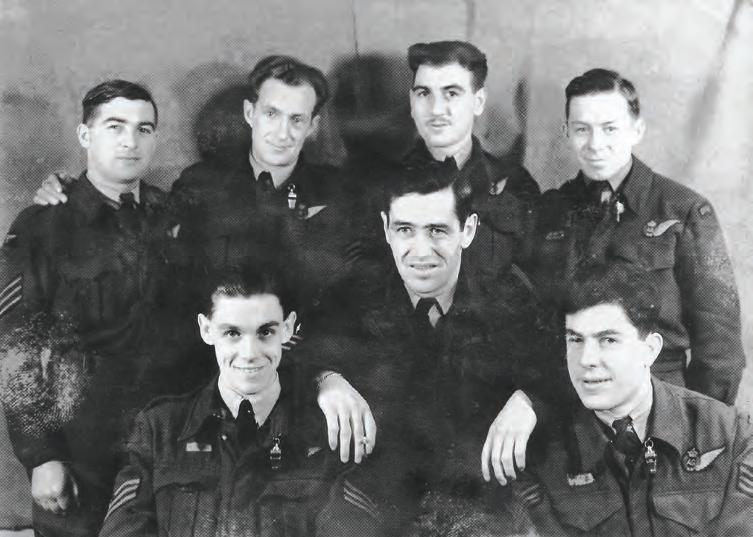
Smith met the women who would become his wife, a Canadian Red Cross worker, during a stopover in London. Smith (centre) with crewmen, including McNicholl (back right).

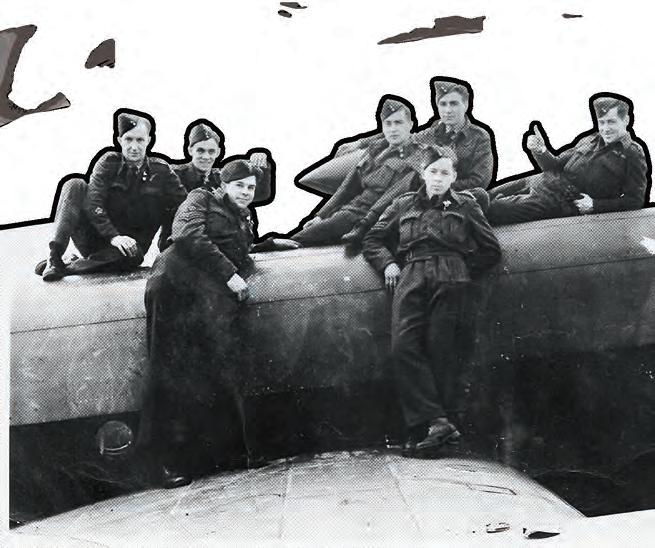
Arnold Smith never dreamt of becoming a pilot. Instead, he became a taxi driver, driving full speed from town to town picking up passengers. To avoid being drafted into the army or navy, the New Brunswick farm boy drove to Moncton, N.B., in the fall of 1942 and enlisted in the Royal Canadian Air Force.
I recently received a package from my mother that held the missing pieces to Smitty’s story. Inside were five compact disks with converted audio recordings from old tapes.
In the 1980s and ’90s, my uncle James Smith sat down with Smitty to capture his wartime memories. When I pressed play, my grandfather’s gruff voice filled my ears for the first time in more than 20 years.
“I said, ‘I want to be a pilot,’” he recalled. “They asked, ‘What makes you think you can be a pilot?’ I said, ‘I know I can be a pilot. I’ve been driving a taxi for over a year and a half, and I haven’t killed anybody.’”
Two weeks after he enlisted, Smitty was on a train to Montreal. He learned to fly on Wellingtons at No. 11 Elementary Flying Training School in Cap-de-Madeleine, Que. He was flown to Lossiemouth shortly before his 30th birthday and assigned the task of finding a crew. All he needed were six people to join him.
At the time, Smitty had recently injured himself in a bicycle mishap after a night at the pub and thought
“Every crew thought they were the best crew, but we were, no argument there.”
his banged-up appearance might deter others from wanting to fly with him. He stood idly by for a couple of days until wireless operator Reg Bastow approached him after deciding the other pilots looked too young. Next, they found mid-upper gunner John (Johnny) Matulack and bomb aimer Jack Martin, who, after a few too many drinks, had been left behind by his previous crew.
Meanwhile, aspiring pilot McNicholl had allegedly been grounded for being too dangerous and reckless (or possibly had to re-enlist because he was originally underage), and navigator Ed Moran
was even older than Smitty (most crews were in their late teens or early twenties). Unable to find a flight engineer, they picked up Jock Young at the next base. They were a band of misfits, made up of five Canadians, one Englishman and one Scotsman.
“If you want to take a chance it’s all right with me,” Smitty told them.
The crew trained on Halifaxes. When they finished in Lossiemouth, they were granted a seven-day leave before heading to London. But the leave was cancelled.
“Instead of going to London, we were put on another aircraft, a Lancaster—the first and only time I was near one—and flown to the squadron to which we were attached,” Smitty recalled. “And the thing that shook us up, we were an RAF squadron, instead of RCAF.”
During the big raids, Smitty’s Halifax was among a dozen other planes from 192 Squadron that were the first to fly out and the last to return.
“In one case we were over Berlin, and we circled for 35 minutes.
Just round and round. I think there was supposed to be 1,000 bombers,” said Smitty.
One night, while flying over France, he felt an unexpected bump. He asked the crew if they had seen anything, assuming they may have touched another aircraft. No one had a clue until Matulack shouted, “I think we lost our dingy.”
“When we got back we found out it was gone,” Smitty told my uncle. “And the rudder and the elevator both had been hit—must have been the CO2 bottle because they were both badly dented. Would have been a bad situation if it had inflated.”
As chance would have it, whether it was evading a freak accident,
Courtesy Kallan Lyons

fighting to stay awake through the thick fog or corkscrewing past a night fighter, Smitty knew he would make it to the end.
“In a way, it’s luck,” he said to my uncle, who asked how he managed to survive. “But I knew in my mind that I was not going to be killed in war, or even be made a prisoner. It’s self-confidence, that’s all.”
The first and last five trips were the most dangerous, he said. Back at the base, he remembers speaking to an Australian pilot in his squadron who told Smitty he feared he wouldn’t complete more than five trips. On the young man’s fifth mission, his plane was shot down and the crew all died.
“I told the boys all along: ‘We’re coming back tonight; we’re coming back every night.’ And after two or three trips, they believed me. I never had the least doubt in my mind.”
On May 8, 1945, the crew received their operational wings for surviving a full tour of operations.
Smitty wanted to join the military after the war, but by then he was too old. He went home to Centreville and worked as a customs officer until retirement. Meanwhile, McNicholl went on to have a lengthy military career. The aircrew reunited in Winnipeg every four years. Their duties remained top secret for decades after the war.
The Smitty from my childhood has few redeeming traits, but a couple of details upended what I thought I knew about my grandfather—one of which wasn’t caught on tape. Instead, I heard it from McNicholl: the squadron wanted to nominate Smitty for a Distinguished Flying Cross in recognition of his devotion while flying during active duty.
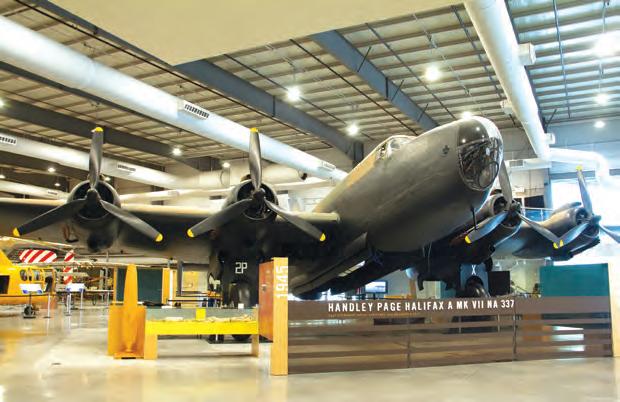
Smith and crew pose in a wartime image. He flew mostly Halifax bombers, similar to this one (left) at the National Air Force Museum of Canada in Trenton, Ont. The author and her sister during a 1997 visit with Papa Smitty to the Canadian Warplane Heritage Museum near Hamilton.
Out of the 20,354 DFCs awarded during the Second World War, 4,018 were awarded to RCAF members and 247 were awarded to Canadians in the RAF.
“He said no,” McNicholl told me, “not unless the whole crew gets it.”
The other item that stood out was from my uncle’s interviews with Smitty. When I finished them, I called him.
“I haven’t listened to those for a long time,” he said.
My uncle revealed that he had had very few conversations with his father throughout his life. He had been just as surprised as I was by what he learned in the recorded chats. I told him that by listening to Smitty’s stories, I felt like I understood him better.
“That was part of my hope with those tapes, too,” he said. “That other generations would have some sense of him.”
There is one moment in the recordings when my grandfather revealed a startling truth about himself, one that challenges the assumption that, were it not for the horrors of war, he would have lived a much happier life. The truth is, my grandfather yearned for the existence that most (people in combat) wanted to leave behind.
“The most exciting and happiest time of my life was in the service,” he admitted. “It was the last thing I wanted, was the war to end.” L

By J.L. Granatstein
NOT
DOWN but out
A military man of high intellect but a lack of charm, Eedson L.M.
(Tommy) Burns
never stopped fighting
“Things have reached a crisis here,” Major-General Christopher Vokes wrote a friend in England on Nov. 2, 1944. “Personally I am absolutely browned off. In spite of no able direction we have continued to bear the cross…. I’ve done my best to be loyal but goddamnit the strain has been too bloody great.” Vokes was the general officer commanding of the 1st Canadian Division in Italy, and the subject of his ire was the commander of I Canadian Corps, LieutenantGeneral Eedson L.M. Burns. Relations between Burns and his key subordinates had reached the breaking point, and Burns, soon relieved of command and reduced in rank to major-general,
was posted to rear area duties in Northwest Europe. How had matters reached this point?
Burns was 47 years old in 1944. Born in Montreal, he had attended Lower Canada College and entered the Royal Military College in August 1914 where he picked up the nickname Tommy, after the famed Canadian world heavyweight boxing champion of the time.
He did well academically in his first and only year at the college, but took a wartime commission in the Royal Canadian Engineers (RCE) as soon as he turned 18 in June 1915 and trained as a signals officer. He went to England with the 4th Division in August 1916, then to France.
Wounded twice, he was awarded the Military Cross for laying and repairing signal cables under heavy fire. By the end of the war, Burns was a staff captain attached to the 12th Infantry Brigade under its acting commander, Colonel J. Layton Ralston. “They say he looks more like 35 than 21,” his mother wrote to the commandant of the military college in 1919, an indication that Burns’ war experiences had weighed heavily.
Burns nonetheless stayed in the army, joining the tiny Permanent Force as a captain in the RCE. Quickly recognized as a comer, Burns became a major in 1927 and took the examinations for staff college, scoring the top mark among the Empire-wide applicants. He went to the British Army Staff College in Quetta, India (now Pakistan) in 1928-29. He was deemed “a very popular officer” with “a great sense of humour,” a “strong and imperturbable” character and an “ability to express himself well on paper.” Few others, however, would see a great sense of humour in Burns.
On his return home, he soon worked for Colonel Harry Crerar at National Defence Headquarters where he devised

new methods of aerial photography that mapped much of Canada, and for which he was promoted to lieutenant-colonel and made an Officer of the Order of the British Empire in 1935. Promotion was glacial in the interwar army, but Burns was on the fast track.
Tommy Burns was not only a soldier. As his Staff College assessment had noted, he expressed himself well on paper. In the 1920s, under the pseudonym Arlington B. Conway, he wrote articles on the military for Henry L. Mencken’s The American Mercury magazine. Mencken was a sharp critic of
their nostrils,” he wrote. “They look on the horse as a romantic symbol of personal superiority.”
Another article noted that it was impossible to develop initiative in infantrymen: “if the ranks of the infantry were filled with intelligent men, it is unlikely that they would long submit willingly to being used as it is intended to use infantry.”
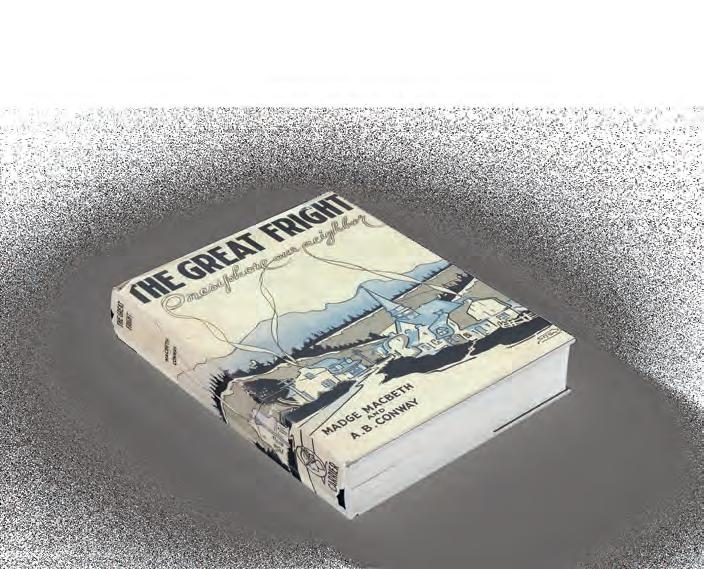
Burns’ writing was not limited to military subjects. He wrote short stories, a play and even a novel with Madge Macbeth, a well-known Ottawa writer. The Great Fright: Onesiphore Our Neighbor was published in 1929. The book, a part written in prose that was of fashion, attracted little notice. Using a pseudonym, Burns had hoped he would stay anonymous. Nonetheless, advertising for the novel used his photograph and name, but none in National Defence Headquarters noticed. Neither did reviewers or readers. Burns also frequently wrote articles and reviews for Canadian , the military’s semi-official journal.
Posted to Montreal in a senior staff role in 1938, published an
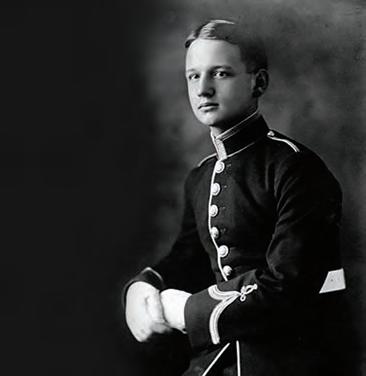
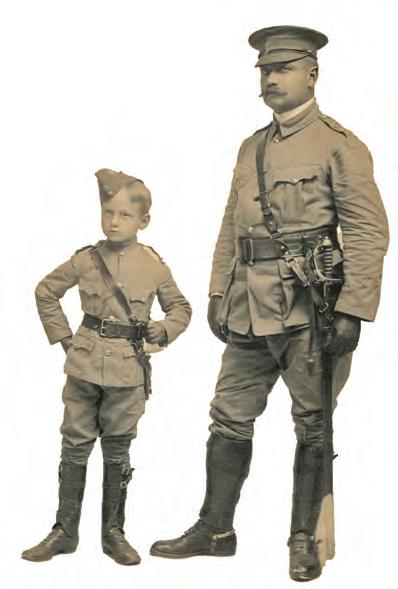
A young Burns poses with his father (opposite left). Later, he took command of I Canadian Corps in Italy (opposite right) in March 1944 from Lieutenant-General Harry Crerar (below, left). In 1929, Burns co-wrote a novel under the pseudonym A.B. Conway.
article on the use of tanks in battle that drew a spirited response from Captain Guy Simonds, another officer on the rise.
Burns called for a division to be made up of one armoured and two infantry brigades. Simonds argued that armour should be kept in reserve, not decentralized, and used when needed for a major attack. Their exchanges continued and were arguably the high point of interwar military thinking in Canada.
Soon after the first of these articles appeared, Burns was in England attending the Imperial Defence College, the route to high command. The coming war interrupted his course, and Burns moved to the Canadian High Commission, assisting future Governor General Vincent Massey and future Prime Minister Lester Pearson with military
matters until Crerar, now a brigadier, arrived to set up the Canadian Military Headquarters in Britain.
As his principal staff officer, Burns did the heavy lifting, and Crerar soon had him promoted to colonel and took him back to Canada when he became chief of the general staff. Again, Burns’ workload was massive, and he had arguments with Ralston, now defence minister. Ralston told one of his confidants that Burns and another staff officer were “as stupid as wooden Indians.”
That comment, however, did not dissuade Crerar who made Burns responsible for organizing the development of the army’s new armoured units, and Burns was frequently in Montreal overseeing the development of the Ram tank. Soon, he returned to England
Down but never out, Tommy Burns managed to overcome
as brigadier general staff of the Canadian Corps under LieutenantGeneral Andrew McNaughton, who was also satisfied with his work.
Two key Canadian wartime generals supported Burns, but his rise was disrupted when a letter he wrote was intercepted by military censors.
During his time in Montreal, Burns had had an extramarital affair. Short, pudgy and not particularly handsome, Burns nonetheless was substantially successful at seduction. But this missive to his mistress, while full of sappy love talk, also commented on politicians, war strategy and British generals, as well as referring to McNaughton’s opinions of a particular senior officer.
Burns was lucky to escape a court martial, but he was returned to Canada, sharply rebuked by Crerar and Ralston, and busted to colonel. Still, he was named officer administering of the Canadian Armoured Corps, a post that required frequent visits to Montreal—and his girlfriend.
Burns returned to England as brigadier general staff of the Canadian Corps under Lieutenant-General Andrew McNaughton.
Promoted to brigadier in early 1942, Burns took command of an armoured brigade in the still-forming 4th Canadian (Armoured) Division. He went with it to England in October.
His full redemption came in May 1943 when Burns, on the recommendations of Crerar and McNaughton, became a major-general and commander of 2nd Canadian Division. It was a difficult assignment as the division had been shattered in the abortive Dieppe Raid the previous August. In his nine-month stint in command, Burns made progress in rebuilding the division.
Favoured as he was by his superiors, not everyone was impressed with Burns. In mid1943, one of Ralston’s advisors wrote appraisals of senior officers overseas and was unflattering in his review of Burns.
“Exceptionally high qualifications but not a leader,” said the review. “Difficult man to approach, cold and most sarcastic. Has probably one of the best staff brains in the Army and whilst he will lead his Division
successfully he would give greater service as a high staff officer.”
That was exactly right.
In late 1943, Crerar took command of I Canadian Corps in Italy, and in January 1944, Burns became general officer commanding of the 5th Canadian (Armoured) Division, replacing Guy Simonds, who returned to Britain to command II Canadian Corps. Soon to replace McNaughton in Britain, Crerar wrote that “if Burns acts up to expectations he will undoubtedly be my recommendation for Corps Commander.”
Burns again had little time in his new post, certainly not enough to acquire experience in action.
The British believed that first-hand battle knowledge was key—and six weeks in command of the 5th was not enough time to get it. Burns nonetheless became Corps commander and acting lieutenantgeneral on March 20, 1944.
Lieutenant-General Oliver Leese, commander of the Eighth Army, was not pleased to have the untried I Canadian Corps in his group. He initially thought Burns satisfactory, but after the battle in May to crack the Hitler Line in Italy, he changed his mind. While the Canadian divisions had fought well, there were huge traffic jams that delayed the advance. Leese blamed Bert Hoffmeister’s 5th Division and Burns’ staff. He tried to have Burns replaced, ideally with a British general.
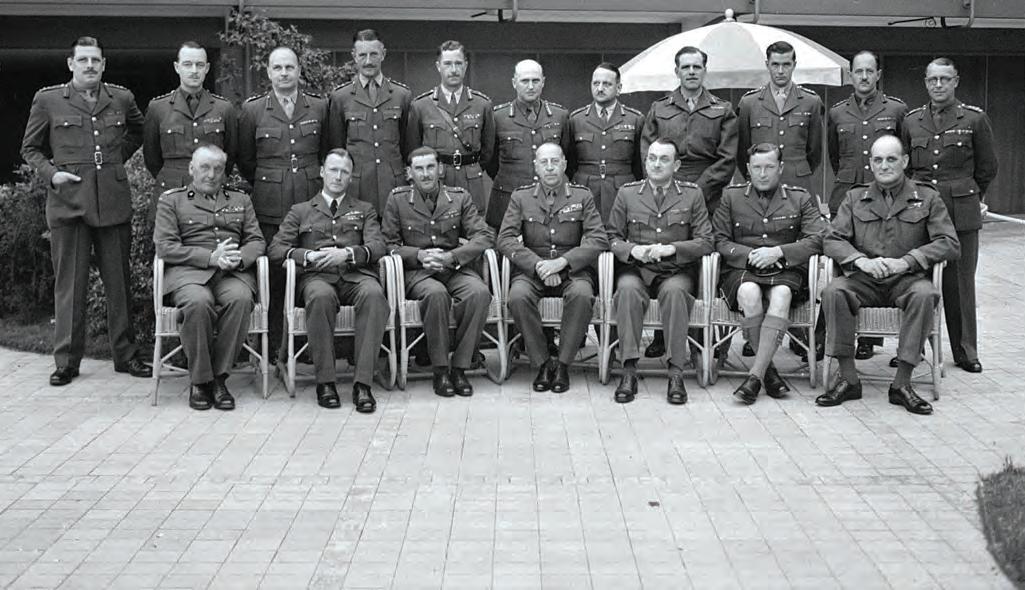
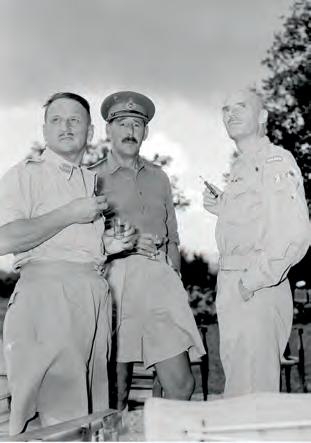
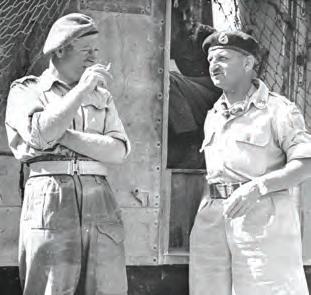
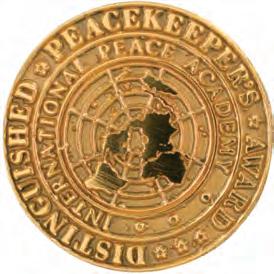
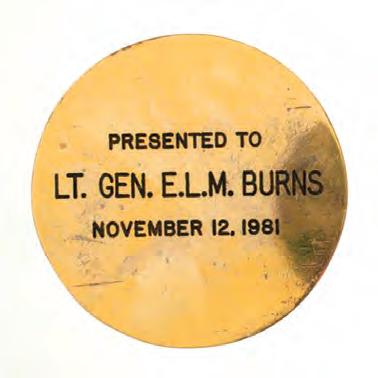
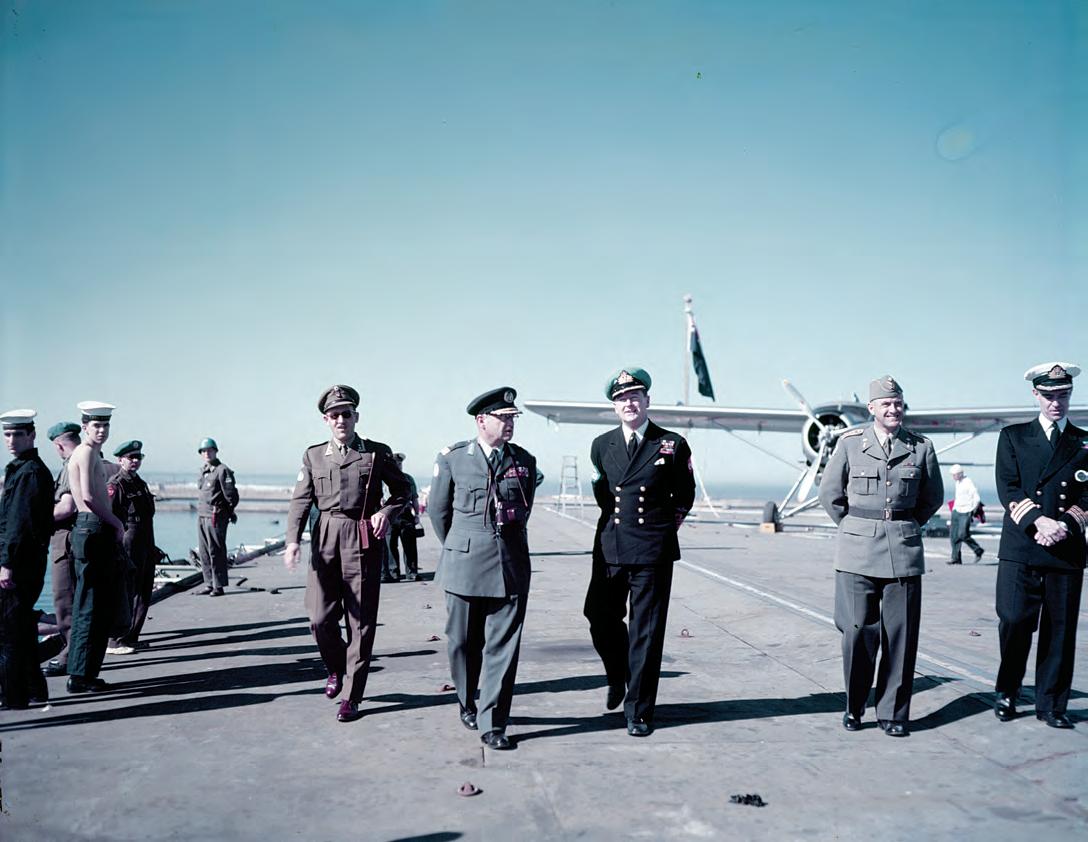
Generals of the 1st Canadian Army, including Burns (second row, fifth from right), sit for a group portrait in May 1945 (opposite top). Burns poses with British Lieutenant-General Oliver Leese and Polish Lieutenant-General Wladyslaw Anders and again with Major-General Christopher Vokes in Italy (opposite bottom). In the aftermath of the Suez Crisis, Burns (left) visits HMCS Magnificent in 1957 (bottom) while in command of the UN Emergency Force. He received the Distinguished Peacekeeper’s Award for that work.
“Neither Burns nor his Corps staff are up to Eighth Army standards,” wrote Leese. Still, Crerar remained a strong supporter and, after much palaver, Burns retained his position by replacing some of his staff. His division commanders, Vokes and Hoffmeister, were at first willing to continue to work with him, but by the autumn they had changed their minds.
Burns’ Corps had cracked the Gothic Line in Italy at the end of August 1944, arguably the most successful Canadian action of the war. But, his British superiors, his two division commanders and some of the Corps’ senior staff officers had had it with him. Still, Crerar again tried to save Burns. No one, however, could remember Burns smiling—the troops called
him “Smiling Sunray” in derision—and he could not inspire his subordinates. He was a sarcastic, dour personality who seemed to only criticize. Burns, said Vokes, “lacks one iota of personality, appreciation of effort or the first goddamn thing in the application of book learning to what is practical in war & what isn’t.”
Hoffmeister, meanwhile called the relationship intolerable and said he had lost all confidence in Burns. Burns had won major battles in the field, but his personality defects did him in. As Ralston’s confidant had presciently written a year earlier, Burns “will never secure devotion of his followers.”
His hand forced, Crerar replaced Burns with Charles Foulkes on Nov. 10.
Burns spent the rest of the war in minor posts in Northwest Europe. After the conflict, he joined the Department of Veterans Affairs, eventually becoming its deputy minister. He wrote a fine study of Canada's military workforce problems during the war and, in 1954, he was named to head the United Nations Truce Supervision Organization on the Arab-Israeli borders. Burns was in that job
during the 1956 Suez Crisis and, on the spot, was given command of the UN Emergency Force, the first large peacekeeping operation.
When the Egyptians objected to accepting Canadian infantry in the UN force because they were indistinguishable from the invading British—they wore the same uniforms, their regimental names were redolent of the Empire and their flag had the Union Jack in the corner—Burns persuaded Cairo to let Ottawa provide logistics and signals personnel instead.
That move was much appreciated by the federal government and in 1958 Burns was promoted to lieutenant-general. Two years later, he was made the government’s disarmament adviser. Burns died in 1985, his sacking in 1944 almost forgotten.
Down but never out, Tommy Burns managed to overcome his personality defects and achieved great success. He had served in the Great War with distinction, advanced through the Permanent Force in the interwar years, and served in high command during the Second World War. His postwar career and life were extraordinary. If he was cold and critical, his intelligence and drive shone through nonetheless. L
How Canada’s once unknown war dead are being identified
A view of the French village of Loos from a crater on Hill 70, where Harry Atherton was killed in action on Aug. 15, 1917. His fate was unknown until combat engineers clearing First World War munitions stumbled on the remains of a Canadian soldier. Authorities confirmed his identity in October 2021.
Lost,
now found
By Stephen J. Thorne
Captain Scott McDowell was just a young boy, eight or 10 years old, when he first heard the name Percy Bousfield, a great-great-uncle who went to sea at 14, sailed the world, then joined the army and died on the Western Front in 1916.
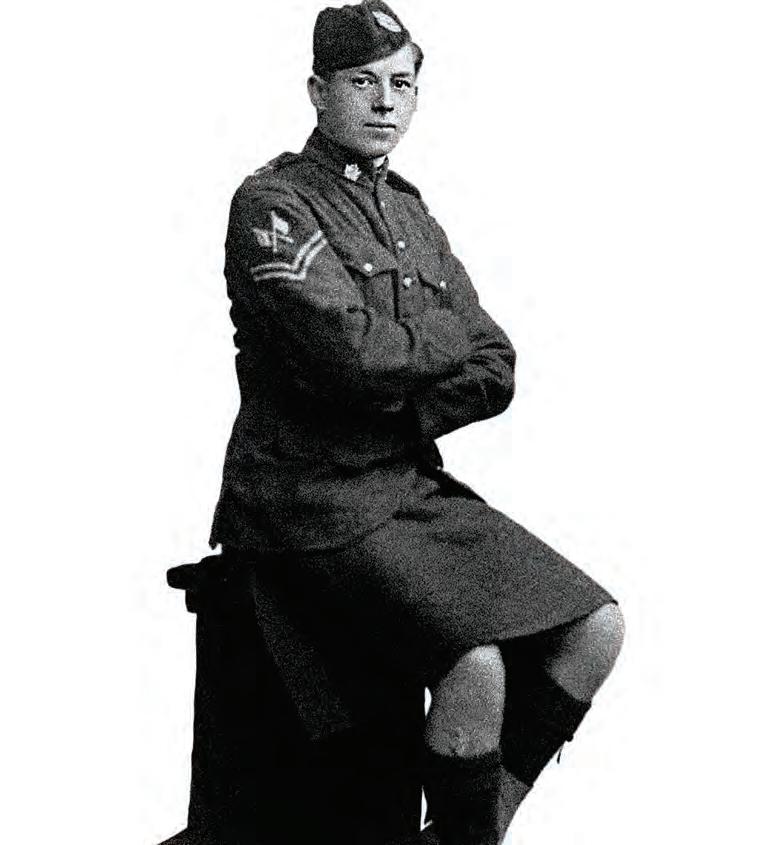
The remains of Corporal Bousfield, a 20-year-old signaller with the 43rd Battalion (Cameron Highlanders of Canada), were not accounted for, his last resting place unknown. But his legend lived on in family lore.
His maternal grandmother was
a Bousefield and McDowell heard the stories many times growing up, though he never knew investigators were searching for his relative. Or that he was an unknown soldier, his name among more than 54,000 missing British and Empire combatants listed on the Menin Gate memorial in Ypres, Belgium.
A career military intelligence officer, McDowell happened to have transferred to the Canadian Forces’ Directorate of History and Heritage as a war diaries officer in August 2022, working in a nondescript brick building in
Ottawa. Three months later, he and his colleagues were summoned to an all-hands town hall. It was during the meeting that senior staff coincidentally announced an investigation team had identified the grave of Corporal Frederick Percival Bousfield.
“The world stopped spinning for a moment,” McDowell told Legion Magazine. “I was like, ‘Oh, my gosh, that’s Percy.’ I was gobsmacked. The odds of it are effectively zero. It’s completely insane. I didn’t hear a single word the rest of the town hall.”
Corporal Frederick Percival Bousfield
Bousfield was killed at Mount Sorrel in Belgium on June 7, 1916. The hill in the Ypres Salient was taken from the Canadians, then recaptured during two weeks of intense fighting. Allied units sustained 8,430 casualties in 12 days.
“At the time he was off duty, but he was not content to be idle and despite the terrible hurricane of shells he was doing magnificent work in helping our wounded,” his one-time company captain, Horace John Ford, wrote Bousfield’s mother.
“It was while lifting one of his helpless comrades that a shell burst right at his feet, so you see
“The world stopped spinning for a moment. The odds of it are effectively zero. It’s completely insane.”
that brave lad experienced no pain whatever, and although his death is a grievous pain to his loved ones, yet they can glory and thank God for the manner of it. He was doing humane work to relieve suffering and doing it nobly and well and without fear or thought of reward.”
English by birth, Bousfield’s remains were buried in a temporary grave alongside others behind a cottage near the church in Zillebeke not far from where he died. It was marked by a simple wooden cross, which would be replaced by one of the now-familiar pale white or grey tombstones that adorn British and Empire war plots once the battlefield graves were relocated.
Thousands of similar temporary plots were hurriedly created on or near First World War battlefields. Given the stagnant nature of the fighting, they were often trodden over repeatedly, damaged by shellfire and flooded by rains. Many were overrun, first by advancing enemy and later by the Allies pushing eastward again. Plots were inevitably destroyed, and the locations of many registered and otherwise documented graves were obliterated.
So it was with Bousfield’s remains.
On Sept. 14, 1923, a headstone at Bedford House Cemetery, near Ypres, was recorded as “A Corporal of the Great War—Canadian Scottish—Known Unto God.” The remains had been transferred with others from Zillebeke the previous February. They were not identified, the date of death unknown, although the other graves were confirmed as Mount Sorrel casualties.
“I regret to have to inform you that although the neighbourhood South-East of Ypres, in which Corporal F. P. Bonsfield [sic] was reported to have been buried has been searched, and the remains of all those soldiers buried in isolated and scattered graves reverently reburied in cemeteries in order that the graves may be permanently and suitably maintained, the grave of this soldier has not been identified,” said a 1927 letter from what was then called the Imperial War Graves Commission, later the Commonwealth War Graves Commission.
And so, Percy Bousfield was lost, but not to memory. For a 20-yearold of his time, he had lived an

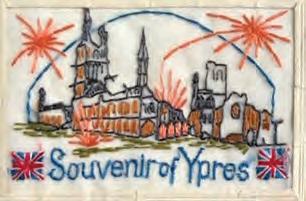

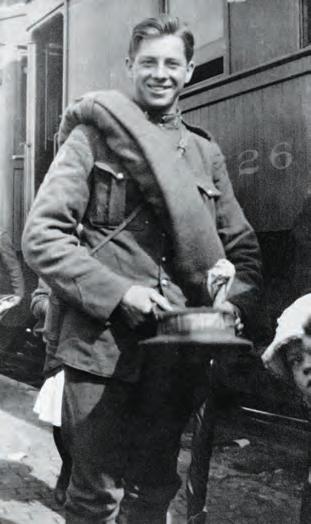
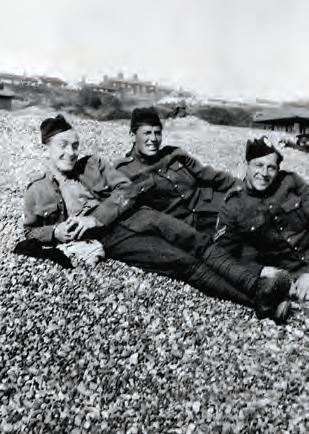
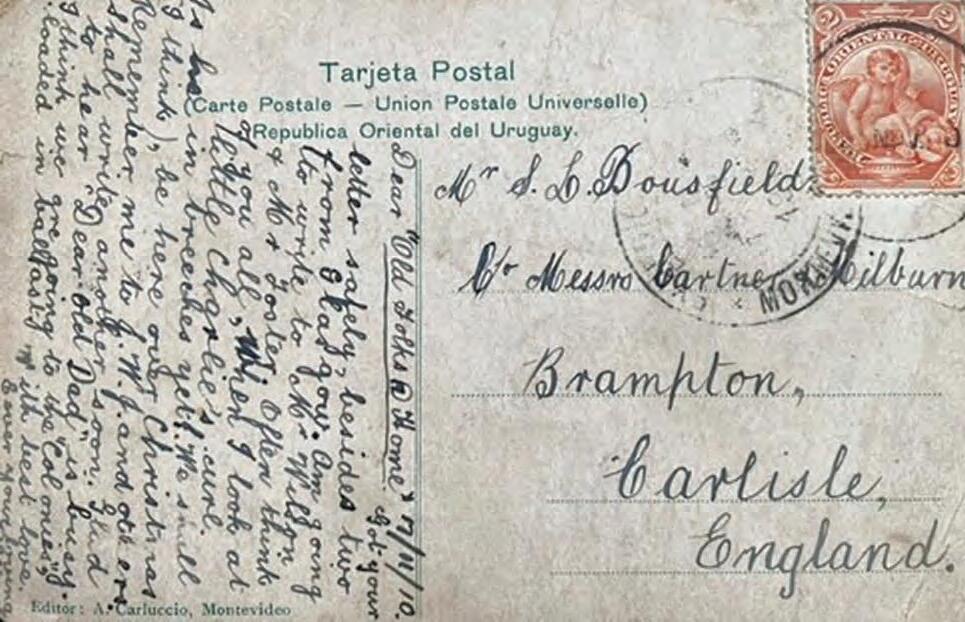
Frederick Bousfield’s memory has lived on in family lore. Pictures, postcards, letters and souvenirs from the former seaman are plentiful. Bousfield was sailing the world when his family immigrated to Canada from England in 1912 and settled in Winnipeg.
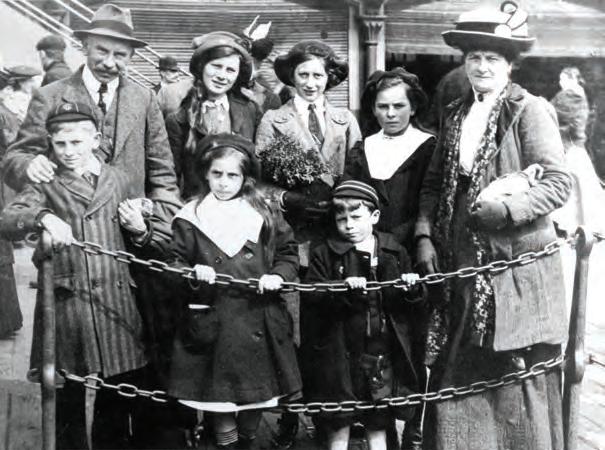

incredibly full and well-documented life and, for almost a century after, pictures, letters and tales of his adventures and his noble death circulated among his family.
Then in October 2019, the History and Heritage Directorate received a report from the commission detailing the potential identification of Grave 68, Row C, Plot 11 in Enclosure No. 4 at Bedford House.
The commission, which manages more than 1.1 million war graves in over 23,000 locations in 150 countries and territories, had received three “very in-depth reports” from independent researchers suggesting the grave was that of Corporal Frederick Percival Bousfield.
The directorate launched its own investigation involving the Canadian Forces Casualty Identification Program, the Forensic Odontology Response Team and the Canadian Museum of History. They reviewed war diaries, service records, casualty registers and grave exhumation and relocation reports. They concluded the grave could only be that of Corporal Bousfield. No other candidate matched the details of the partial identification.
Renée Davis is a civilian historian at History and Heritage and a principal researcher for the Casualty Identification Program. She and a small team of historians and co-op students conduct the research and analysis of graves cases, which differ significantly from the identification of found remains.
“Usually this is a headstone for an unknown, but for whatever reason there is a unit identifier or a date of death or anything along those lines that sparks [an independent researcher’s] interest,” she explained in an interview.
“And so, they start doing a bit of research and submit a report to the Commonwealth War Graves Commission.”
Marjorie Bousfield/Bousfield family archive (5); Mary
And so, Percy Bousfield was lost, but not to memory. For almost a century after, tales of his noble death circulated among his family.
The commission then conducts a preliminary analysis into the merits of each case and submits a report to the country involved, including the independent researcher’s findings, as well as their own, along with its recommendations.
It’s at this stage that Davis’s team steps in. They investigate and write the reports, making recommendations to Canada’s Casualty Identification Review Board on whether to positively identify gravestones. They do not conduct exhumations.
Davis said her team is able to positively identify two in 10 headstones that are brought to their attention. Eleven of the 46 identifications they’ve made so far were from grave markers, the rest from remains. The vast majority are First World War, in which there were a far greater proportion of missing in action than in WW II.
At this writing, the Casualty Identification Program had 40 active investigations involving remains and 38 involving graves.
“You feel very connected to these individuals in a very tangible way,” said Davis. “Sometimes the cases work out, like this one, and you feel absolutely wonderful.
“But other times, more often, there’s not enough to definitively say it is this person, and that can get a little gut-wrenching at times.”
No other candidate’s profile matched the sparse details of Bousfield’s.
“The family was so fortunate that Percy was a corporal because his stone identified him as a corporal, Canadian, and the records said he was with a

family historian, McDowell’s second-cousin Marjorie Bousfield. “So that really narrowed it down.
“If it had just said ‘Unknown Soldier,’ there’s no hope because there are so many. In Percy’s cemetery at Bedford House, there are [5,139 Commonwealth] graves, of which [3,011] are unidentified.
“It’s staggering. It’s really staggering.”
Marjorie Bousfield had traced her great-uncle’s life through his years as a seaman, interviewing his siblings, tracking the ships on which he had sailed and the farflung places he had visited, uncovering the pictures he had drawn (he was a sketch artist) and the letters and postcards he had written.
The family, she said, “had no idea that he was there” in the cemetery at Bedford House until the day McDowell sat down for the town hall at History and Heritage.
“I’m so sad that he never got to fully live his life,” she said. “And then the sadness increases because you multiply that by all those young men in the First World War—just incredible numbers. And you think of the effect it had on family members at home because he was just an absolutely loved brother.
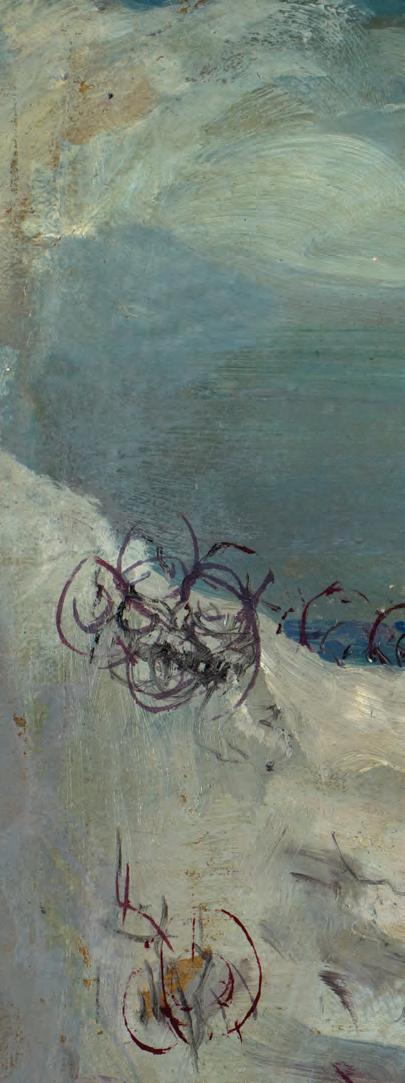
“And, for me, I feel happy. We’re not like families nowadays. When they get notification from the military, it’s only a really sad story. We already knew the fact of his death, so that sadness and tragedy isn’t there—the immediacy. And so, we can be happy that we know where he is.”
Unlike the missing recorded on the Canadian National Vimy Memorial in France, which remain unchanged even after one is identified, Bousfield’s name will be removed from the Menin Gate.
Private Harry Atherton
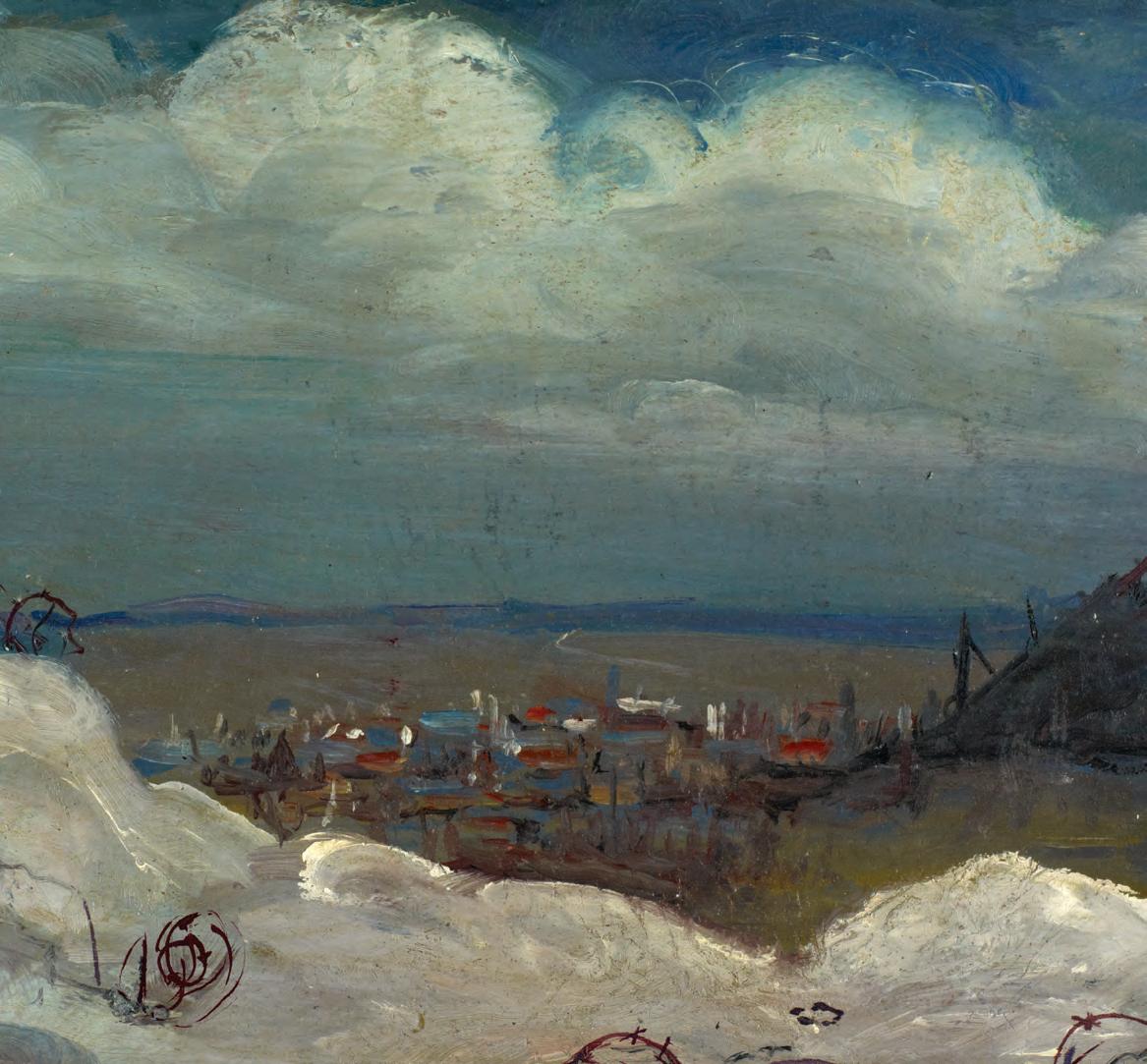
Harry Atherton was just 19 years old when he left the factories, foundries and collieries of his home in Tyldesley, an ancient mill town in the north of England, and came to forge a new life in Canada.
He couldn’t have found a spot much farther away, or much different, from his home, settling as he did in McBride, B.C., a Rocky Mountain village that, even in 2021, numbered just 588 people. It was 1913, a fortuitous time for a carpenter such as Atherton in a place like McBride.
Far from the Roman road that ran through his hometown where urbanization and industrialization took root in the 19th century, McBride was a new settlement located on Mile 90 of the Grand Trunk Pacific Railway. A train station was being built on what would become Main Street. The area was growing on the strength of agriculture, logging and the railroad.
Atherton, however, would never see much development past the little building with a platform and the sign “McBride.” A year after
A postcard Bousfield wrote to his parents as a 14-year-old seaman in 1910.
Marjorie Bousfield/Bousfield family archive; Mary Riter Hamilton/LAC/5067115
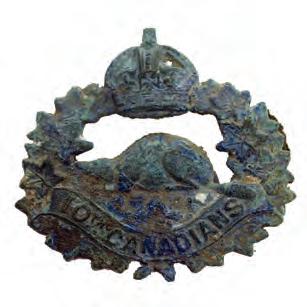
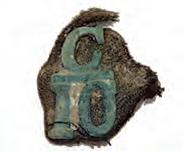
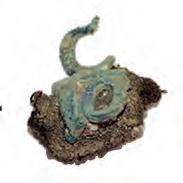

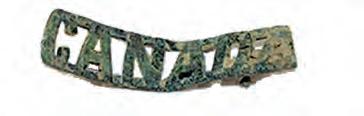

he arrived, a world war broke out in Europe, a war from which Atherton would never return.
In March 1916, Atherton, by then a 23-year-old tradesman, hopped the eastbound train for Edmonton, where he enlisted with the Canadian Expeditionary Force. By July, he was in France fighting on the Western Front with the 10th Canadian Infantry Battalion.
In August, Atherton headed for one of the bloodiest battles of the war, the Somme.
On Sept. 26, 1916, he was shot through the left thigh during the brutal fight for the German fortifications at Thiepval, one of the 10th Battalion’s 241 casualties. As many did in the mud and filth of wartime France, his wound turned septic. Atherton was hospitalized for 72 days before he was allowed to return to duty in March 1917.
It appears he missed the fighting at Vimy Ridge in April, but he
was back with the 10th by mid-May and fought at Hill 70 in August. It was there, on the outskirts of the French coal-mining town of Lens, that all four divisions of the Canadian Corps under LieutenantGeneral Arthur Currie met five divisions of the German 6th Army. It took 10 days to wrest the chalky hill from German hands.
Canadian and British guns fired almost 800,000 shells in the days before the attack. Advancing under the cover of a smokescreen and a creeping barrage, Canadian infantrymen fired, and faced, millions of machine-gun rounds.
The fighting would eventually come down to close-quarters, hand-to-hand, life-or-death desperation. Six Canadians were awarded Victoria Crosses for individual actions at Hill 70, and all but two involved bloody close-quarters fighting.
Atherton was reported wounded on the battle’s first day. Soon after, word spread that he was dead.
On July 11, 2017, a century after he died, combat engineers clearing old munitions found human remains near rue Léon Droux in Vendin-le-Vieil, north of Lens. They would turn out to be Atherton’s.
What happened to the 24-year-old private and how he disappeared will likely never be definitively known.
“To be honest, I don’t look for that,” said Sarah Lockyer, the forensic anthropologist who analyzed Atherton’s remains and wrote the investigation report. She’s the Canadian military’s casualty identification co-ordinator.
“The remains are stored typically in a location close to where they were discovered,” she said, explaining that she has seven to 14 days to analyze them and the focus is identification, not cause of death.
“So, it’s things that come from the biological profile—age estimation, height estimation, if there is something weird about the teeth
Atherton was reported wounded on the battle’s first day. Soon after, word spread that he was dead.
or is there like a healed f racture that maybe is in the personnel files and things like that.
“At the end of the day, they were killed in action, so they all died of war.”
More than 9,000 Canadians were killed, wounded or declared missing in action at Hill 70. The 1,300-plus missing there were among the highest of any Canadian battle of the war. Lockyer said 40 of the 41 sets of the remains her office was analyzing at the time she was interviewed were from the First World War, most from Hill 70. The other set of remains are from WW II.
Atherton’s cap badge (opposite left) with the 10th Battalion’s distinctive beaver-and-crown emblem, along with C10 collar badges and a brass Canada shoulder title found with his remains. The partially obscured identification disc (below) yielded confirmation of Atherton’s battalion and service number.
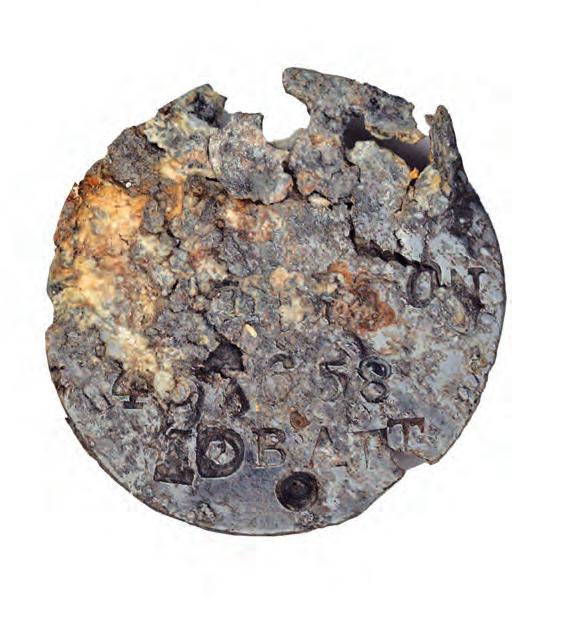
six Canadian VCs—Private Harry Brown, who was caught in a counterattack the day after Atherton was killed.
“There’s a lot of construction going on in that area and the remains are just kind of popping up everywhere,” said Lockyer.
Atherton’s 10th Battalion suffered 429 casualties at Hill 70, 71 of them with no known grave. The dead included one of the
The engineers who found Atherton’s remains also recovered several artifacts, including an identification disc and 10th Battalion insignias—a cap badge with the battalion’s distinctive beaver-andcrown emblem among them.
In time, the Canadian Forces Forensic Odontology Response Team, along with the Canadian Museum of History and the
Casualty Identification Review Board, went to work, applying historical, genealogical, anthropological, archeological and DNA analysis to the job.
The illegible identification disc, or dog tag, was sent to the Canadian Conservation Institute. After cleaning, BATT” was clearly visible across the bottom. There was also a partial service number, “4 – – 658,” and “ON” was visible near the disc’s upper right border. The soldier’s service number was 467658. Lockyer said Atherton’s relatives were difficult to track down. He had only one sister, who the anthropologist wasn’t sure had any children. The DNA donor and the next-of-kin were, in fact, two different people, she said.
“They’re both first cousins, four times removed—or something like that. They’re quite far away from Atherton. It happens with his family tree.”
Despite the hurdles, the investigators had confirmed by October 2021 that the remains, indeed, belonged to Atherton. They were buried with two others and full military honours in the Loos British Cemetery in Loos-enGohelle, France, this past June.
As is the practice for found Canadian soldiers recovered from French soil, Atherton’s name will remain with 11,285 others on the Vimy memorial. L

They fought together far from hearth and home; they died there together in unprecedented numbers. And there they were buried. Together, as it should be.
The cemeteries are scattered the world over: row on row of white stones, the distinctive Maple Leaf etched in many—a powerful tribute to, and incontrovertible evidence of, the role and sacrifices of Canadian combatants in two world wars.
The place names are synonymous with iconic battles of Canadian history, scenes of victory, defeat and sometimes both: Passchendaele, the Somme, Vimy, Cambrai, Hong Kong, Dieppe, Agira, Ortona, Normandy, Nijmegen. The list goes on.
In Europe alone, the numbers speak for themselves: 2,958 buried at Bretteville-Sur-Laize Canadian War Cemetery in Normandy; 2,610 at Groesbeek Canadian War Cemetery in the Netherlands; 2,048 at Beny-Sur-Mer Canadian War Cemetery. Nearly 3,000 First World War are commemorated in Canadian Cemetery No. 2 outside the French village of NeuvilleSt. Vaast, about six kilometres north of Arras, where the Canadian Expeditionary Force absorbed more than 30,000 casualties. More than 7,000 Canadians are
Should Canada have repatriated its war dead?
Stephen J. Thorne says NO
THE UNIMAGINABLE ATROCITY OF MASS KILLING AND ITS IMPLICATIONS FOR ALL OF HUMANKIND FAR OUTWEIGH THE WISHES OF ANY GRIEVING PARENT, SPOUSE OR CHILD.
buried in 30 Commonwealth War Graves Commission cemeteries surrounding the Canadian National Vimy Memorial on the ridge where Canada is said to have forged its place in the world.
There are big cemeteries that move visitors to tears, and little ones whose intimacy and simplicity touch one’s heart in ways never thought possible.
Ask a veteran why and how they fought and, when it came down to it—when the bullets were flying and the shells were falling and the din and the dead and the dying were all around—they will tell you: it wasn’t loved ones, high ideals or memorial-worthy pronouncements that motivated them. For many—most, most likely—it was
the lives of the men next to them and the innate conviction not to let their brethren down that moved them to stand firm and fight, even at the cost of their own young lives.
Forged in the maelstrom of lifeor-death struggle as they were, those bonds are unlike any other, in life or in death. So, there they should lie. Together—their undulating seas of white stones not simply a tribute, memorial or testament, but a profound outcry against the insanity of war, the one and only place where the mortality of youth is not the exception, but the rule.
The sheer scale of loss, the enormity of import, the unimaginable atrocity of mass killing and its implications for all of humankind far outweigh the wishes of any grieving parent, spouse or child.
Memorials are for the living. Memorials belong at home. The graves are for the dead. And it’s from these sprawling cemeteries and scattered plots in healed and healing lands, where the destruction and wounds of war are otherwise all but erased, that they speak to the living, reminding them of horrors past and the folly of forgetting the lessons of history.
Their message is imparted not in whispers, but in shouts— a chorus loud and forceful, yet oh so eloquent and clear. L

The tragedy of war was delivered to my grandmother’s doorstep on March 4, 1945. Lois Mae Gilmar had lost the love of her life, the fire of her spirit and her soonto-be husband, George Henry Lloyd. A Royal Canadian Air Force flying officer from Wingham, Ont., 19-year-old Lloyd’s plane had been shot down by enemy fire in Yorkshire, England.
Just days after his death, Lloyd was buried in the county’s Harrogate (Stonefall) Cemetery. No family consultation, no ceremony— just gone like most Canadians who died during the Second World War.
My grandmother, not to mention Lloyd’s family, was robbed of a funeral and burial, age-old rites that signal the beginning of emotional healing. She spent the rest of her life stagnated by grief, never able to move on.
Thousands of Canadians were buried overseas, and thousands more were prevented from mourning their loved ones—simply because of the British government’s First World War-era concern that wealthy families would have more readily repatriated their soldiers, thereby leading to a two-tier system of recognition for war dead.
Though the policy in Canada changed in 1970 to finally reflect the desire to repatriate Canadian
> To voice your opinion on this question, go to www.legionmagazine.com/FaceToFace
STEPHEN J. THORNE
is an award-winning journalist, editor, photographer and Legion Magazine staff writer. He has reported on the downfall of South African apartheid and from war fronts in Kosovo and Afghanistan.
PAIGE JASMINE GILMAR
is a Legion Magazine staff writer. She also founded and runs a mental health support service, Asking Jude, as well as its clinic internship program that helps post-secondary health-care students prep for further education.
Paige Jasmine Gilmar says YES
REPATRIATION WOULD HAVE PROVIDED AN EMOTIONAL RESOLUTION FOR MANY CANADIANS, AND EMPIRICALLY BASED RESEARCH CONFIRMS THIS.
Armed Forces members who die during military action, the damage was already done for those impacted by pre-1970 conflicts, creating inequities between families solely based on when their loved ones served.
While the original British Empire WW I grave-site plan was contentious, as the Commonwealth War Graves Commission’s Peter France told Legion Magazine in 2003, the U.S. government found a way to appease both sides. It assumed responsibility for honouring families’ wishes after both world wars, no matter how many soldiers died, how long ago they died or how much it would cost to repatriate them.
In light of this, the Canadian rationale that there wasn’t—or still
isn’t, since remains continue to be discovered—enough time, money or technology to repatriate graves on foreign soil is invalid. How could Canada afford the resources for war, but not the funding for those impacted by war?
Repatriation would have provided an emotional resolution for many Canadians, and empirically based research confirms this.
Grief psychologist Christy Denckla told U.S. National Public Radio in 2020 that, funerals are “fundamental to how we mourn…to how we expand the social safety net in times of vulnerability and loss.”
True, funerals can still be held without repatriating the dead, but health professionals note that seeing the body or having access to a grave often facilitates a healthy grieving process. If relatives are barred from this integral part of their recovery, they can develop associated negative emotions that can lead to conditions such as complicated grief or post-traumatic stress disorder. And during my grandmother’s time, therapy for such diagnosis was far from socially acceptable.
Honouring those who sacrificed their lives for their country by recognizing where their families wish to bury them should have always been a given right of military service. L
Recollections of a cherished relative from a First World War scrapbook
HarveyUncle's
album

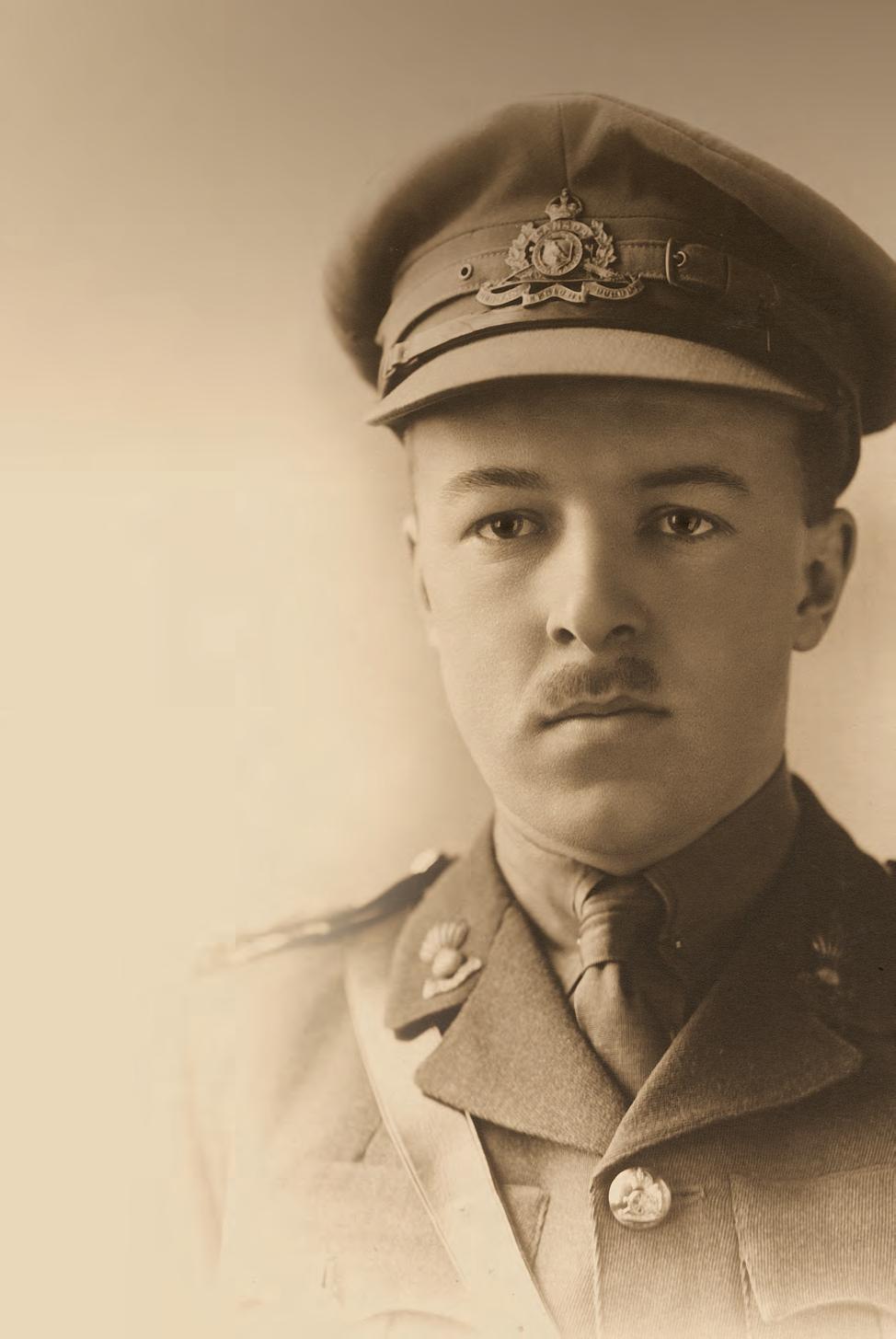
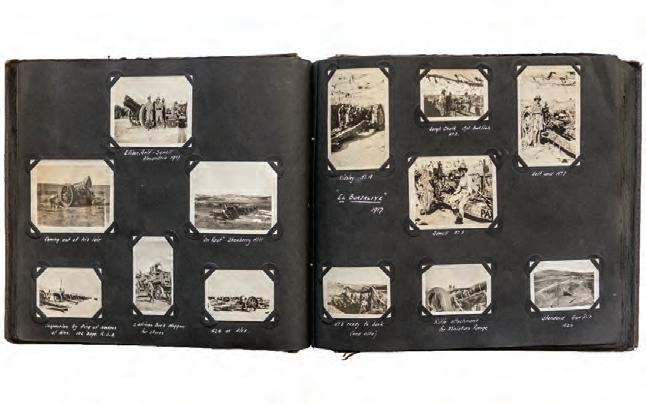
photo

Harvey Doane (left) signed on as a 24-year-old lieutenant with No. 10 (Halifax) Siege Battery. He carried this picture of his new bride in a cigarette case throughout his time overseas, calling her “my mascot.” A civil engineer, Doane would go on to nurture a love of the sea for the rest of his life.


By Stephen J. Thorne
I grew up surrounded by veterans of both world wars—my dad was a WW II air force medical officer, my mom a civilian navy decoder tracking convoys out of Sydney, N.S.; my Uncle Ike was a corvette lieutenant on the North Atlantic Run; Uncle Harry and my mom’s cousin-in-law Gordon had been Lancaster pilots; my oldest friend’s father, three doors away, was an army dentist overseas.
Early in my journalism career, I interviewed many First World War vets who, in the early-1980s, were younger and more plentiful than WW II vets are now.

Regardless of the war, they all tended to be reluctant storytellers, preferring not to relive the horrors of the bloodiest conflicts in recorded history. All, that is, except my Great-Uncle Harvey, who commanded a room with his old-world grace, charm and storytelling.
Harvey William Lawrence Doane was a civil engineer who, along with his father Francis (known as FWW, he was the Halifax city engineer) and younger brother William (Billie), had served for years in a militia unit—the 63rd Regiment, Halifax Rifles— before going on active duty with the Canadian Expeditionary Force.
After Billie was killed leading a company charge at the Somme, Harvey—a couple of months shy of his 25th birthday—enlisted as an artillery officer. Harvey and his bride Mildred Whitman were on their honeymoon at the time. He shipped out in March 1917 for England, then Egypt, Palestine and France. Meanwhile, at 49, FWW was by then already serving in the old country.
I remember my great-uncle 50 and 60 years after he returned from the war, a distinctive moustache, his thinning hair combed straight back, wearing a yacht club blazer and holding court, a Scotch in one hand and a loaded cigarette holder between the index and middle fingers of the other.
He and Aunt Mildred, whom he affectionately called “Skinny,” used to come occasionally for Sunday dinner—when the adults, and a somewhat discontented but dutiful little boy, along with whatever wandering older siblings deigned to be home at the time, would gather in the living room for aperitifs.
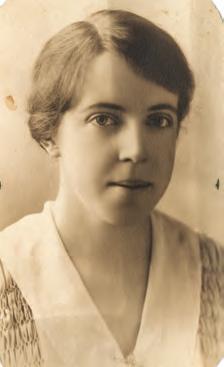
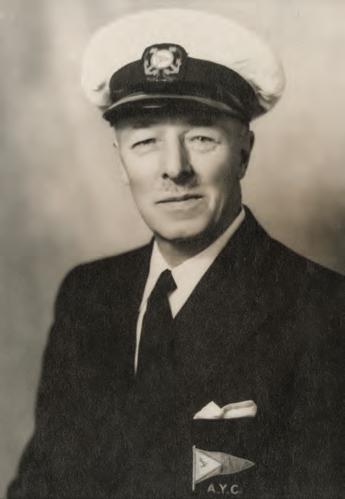
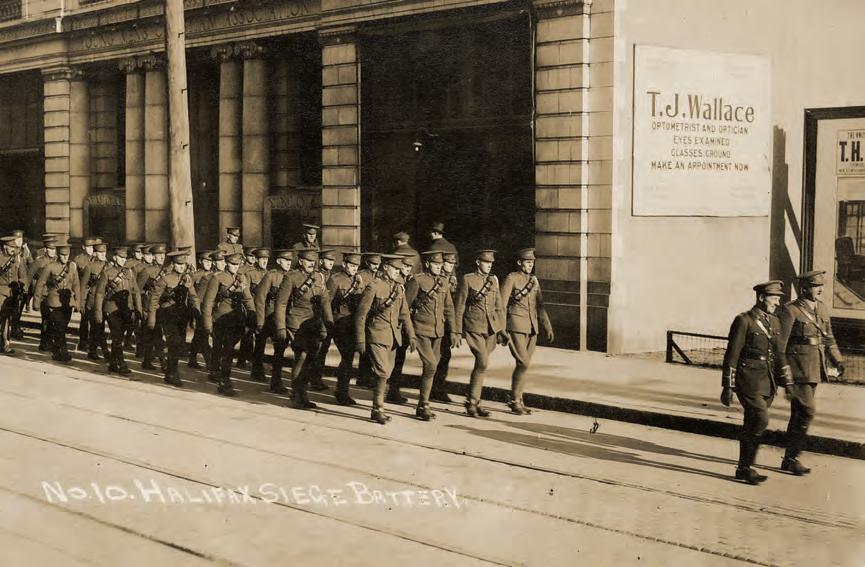

The stories ratcheted up once the formalities died down 20-30 minutes after the guests arrived and would continue through the meal, which took place in the dining room with my mom’s best linen tablecloth, matching napkins, polished silverware and china plates embellished with the Thorne red rose.
Though Uncle Harvey—his voice, his mannerisms, his sunbaked countenance—is still vivid in my heart and mind, his stories are but vague and distant memories, the tellings to young ears almost as long ago to me now as the war was to him then.
I do remember him relating the tale of some Arab tribesmen, I think they were, who wanted to serve with the British. His commander was reluctant, until one night the locals transplanted the entire contents of his tent, including his bed— with him in it, sleeping soundly. The CO awoke some hours later in the desert, outside camp. The tribesmen were hired.
Two years ago, perusing an “Old Black and White Photographs of Halifax, Nova Scotia” Facebook page, I stumbled upon a picture of my mom with Uncle Harvey and his parents. It had been posted by his granddaughter, Mary Doane, a second- or third-cousin I may have met when we were kids. There was another picture, too, of Harvey and Billie as children, hockey gear in hand, alongside their dad.
And thus began a correspondence, news of family albums filled with photographs, letters and old newspaper clippings, eventually leading to a cover story I wrote for this magazine about Billie (see “Hit so soon,” July/August 2021). But there was so much more in those albums, including Harvey’s photographs from the Middle East and the Western Front. And so, the stories came alive again in pictures.
Uncle Harvey signed on as a lieutenant with No. 10 (Halifax) Siege Battery, CEF, was promoted to captain and transferred to a reserve
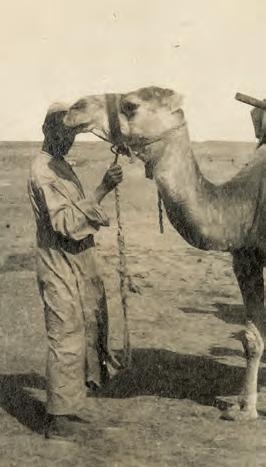
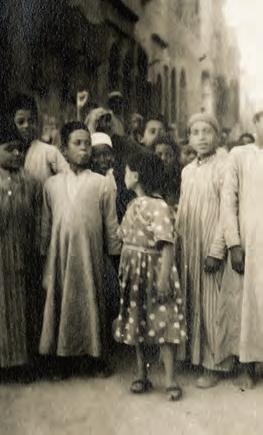


brigade for three months before he was seconded to a British unit— 420 Siege Battery, 102nd Heavy Artillery Group, Royal Garrison Artillery (RGA)—in June 1917. They made him an acting major.
As with so many other weapons of the First World War—machine guns, poison gas, flame-throwers, airplanes—artillery, replacing cannons, was new and deadly effective.
Artillery barrels were rifled, meaning they were machined inside with spiraling grooves that spun their breech-loaded, better-made shells (as opposed to muzzle-loaded cannon balls) like bullets. This made them fly straighter, farther and more accurately. Furthermore, the wheeled weapons themselves
Lieutenant Doane and Major Slater lead No. 10 on parade (above) in Halifax. Camels bring water up to 420 Siege Battery, Royal Garrison Artillery, in Gaza in 1917. Kids crowd a street in Alexandria, Egypt. Washday at the Doane dugout in Gaza (opposite, right). Doane’s service record.
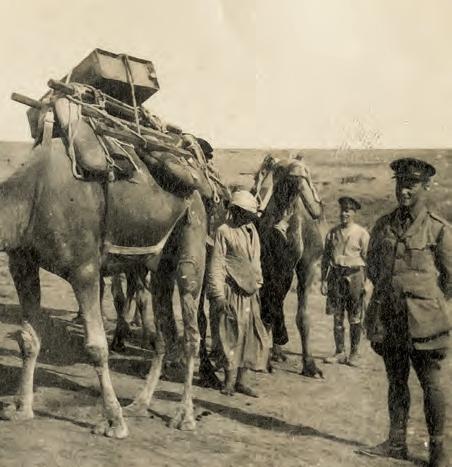
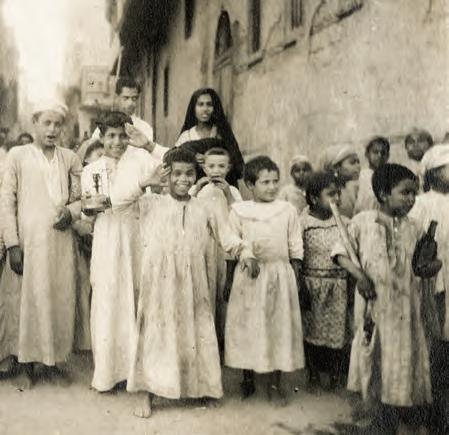
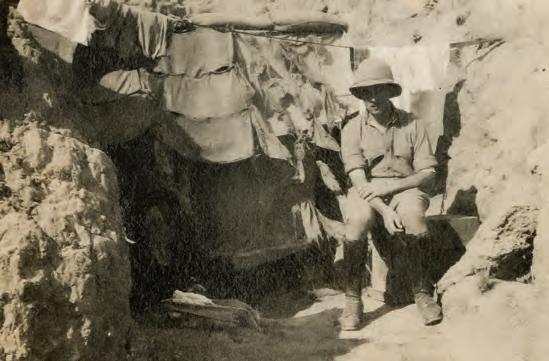
Harvey walked the newly liberated streets of Jerusalem, photographing the Damascus Gate, the Wailing


tended to be lighter and more mobile than their predecessors.
As British artillery tactics of the day developed, siege batteries were most often employed in destroying or neutralizing enemy artillery and hitting strongpoints, dumps, depots, roads and railways behind enemy lines. A battery would typically include five officers, 177 enlisted ranks, 17 riding horses and 80-some draft horses, along with three two-horse carts and 10 four-horse wagons.
Equipped with 6- and 8-inch howitzers, Harvey’s No. 420 unit would soon be fighting “Johnny Turk”—forces of the Germanyallied Ottoman Empire—in the Middle East. As it turned out,

Wall
and the golden Dome of the Rock.
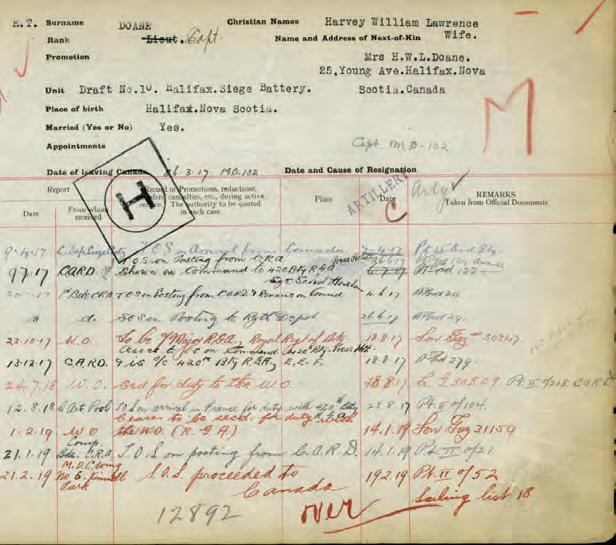
camels—which could carry heavy loads and cover more than 100 kilometres a day without water—came in handy, too. For this, they would have relied largely on the Egyptian Camel Transport Corps—a unit attached to the British army consisting of 170,000
camel drivers and 72,500 camels in some 2,000 companies.
Stretching from Turkey through present-day Syria, Iraq, Palestine and across the sprawling desert of the Arabian peninsula, the Middle East Campaign encompassed the largest territory of any
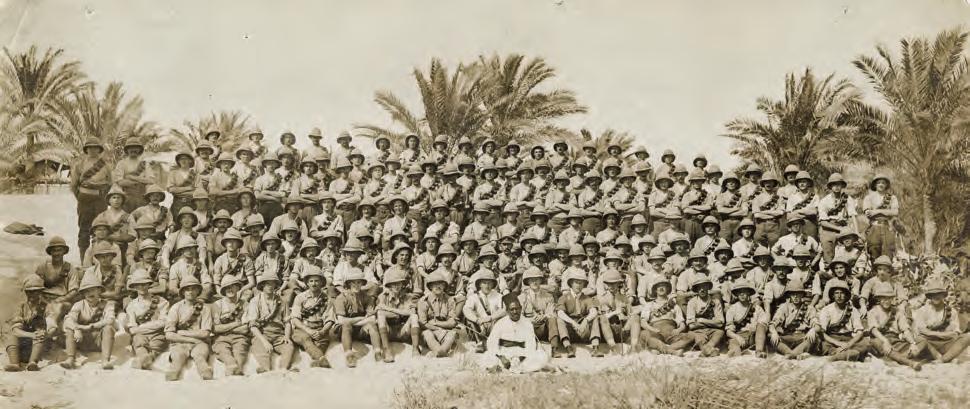
theatre in the war. After British forces twice failed to capture the Ottoman fort at Gaza, General Edmund Allenby took command of the Egyptian Expeditionary Force the same month Harvey and other reinforcements arrived in Egypt. The tide of war in the Middle East was about to change.
Harvey’s album traces his journey from training and parades in Halifax to visits with relatives in the old country and unit preparations in central England in the spring and summer of 1917. Official records of 420’s involvement in the battles of the Middle East Campaign, however, are sparse—the British national archive having apparently not yet digitized that part of the unit’s war diary—but Harvey appears to have been appointed officer
Though Uncle Harvey is still vivid in my heart and mind, his stories are but vague and distant memories.


commanding the battery soon after it arrived in Egypt in the swelter of mid-summer.
They were in Alexandria by September, living in tents and seeing the sites—Cairo, Luxor, Aswan, Philae. They then moved to dugouts in Gaza, where camel trains brought water and supplies and the 3,000-strong Imperial Camel Corps Brigade helped win key battles during the October-November march to Jerusalem: the Battle of Beersheba, the Third Battle of Gaza, and the Battle of Mughar Ridge.
By year’s end, the Allied advance—aided by an intrepid, brilliant and berobed British army lieutenant named Thomas Edward Lawrence and the Arab Revolt—had crossed the Sinai and entered Palestine. Allenby’s forces captured Jerusalem just before Christmas. Lawrence and his Arab fighters were all the while mounting hit-and-run attacks on supply lines, taking out trains and tying down thousands of Ottoman soldiers in garrisons throughout Palestine, Jordan and Syria.


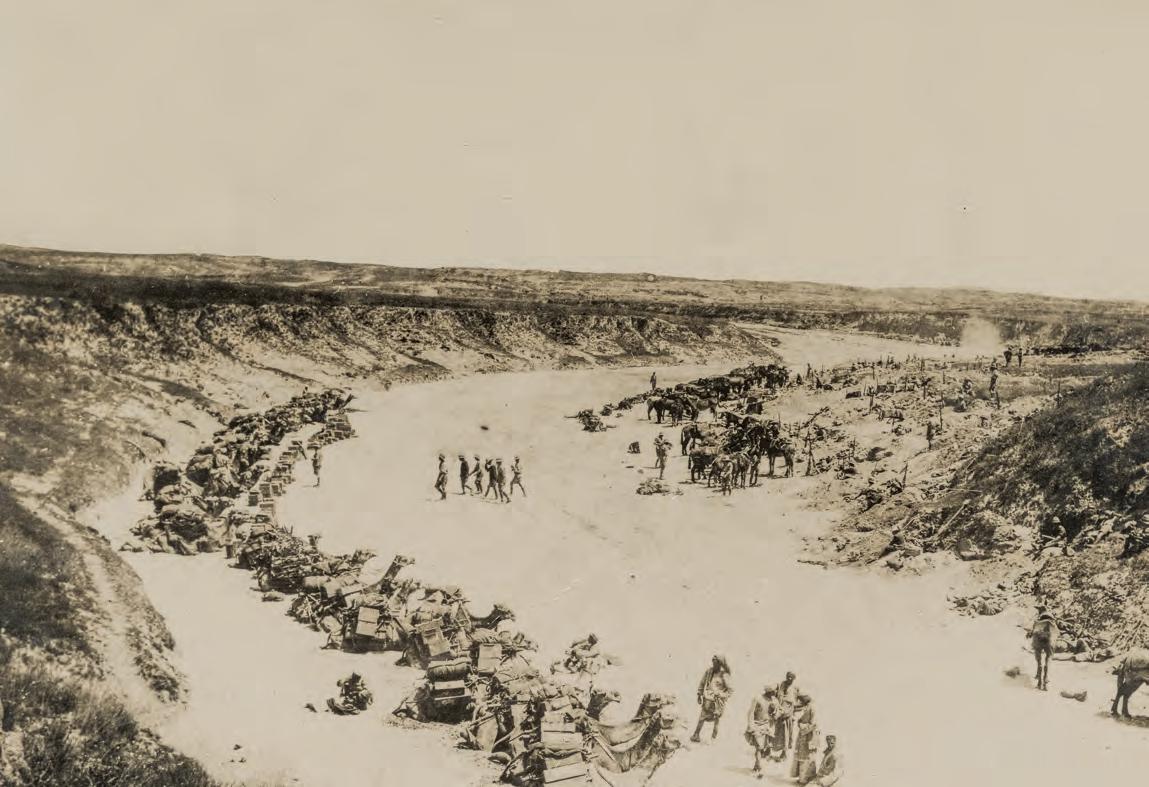
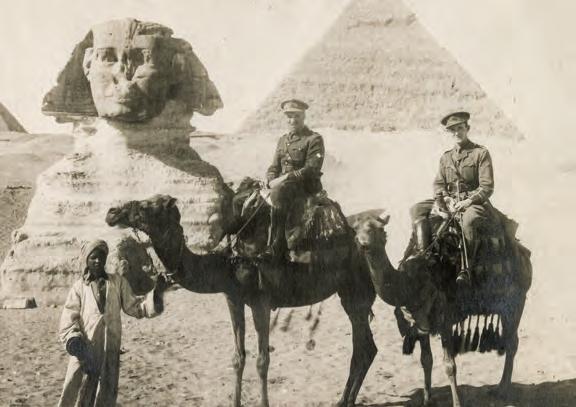

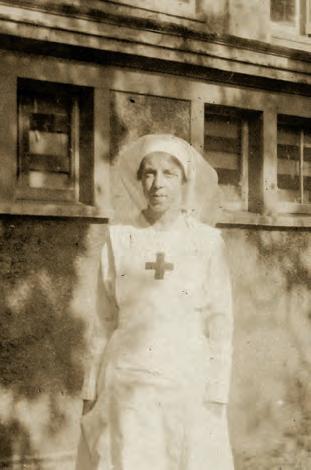

Harvey walked the newly liberated streets of Jerusalem, photographing the Damascus Gate, the Wailing Wall and the golden Dome of the Rock. There are pictures of the tribal peoples of the peninsula, horse-mounted Arab fighters, a burnt-out tank and a stack of artillery shells—“pills for Johnny Turk.” There’s a camel company formed up in a wadi for battle and images of daily life in desert dugouts and tents, laundry day and camel shearing, the unit telephone exchange and a menagerie of equipment—Caterpillars, cars, carts and artillery pieces of every description—stationary, in action and on the move.
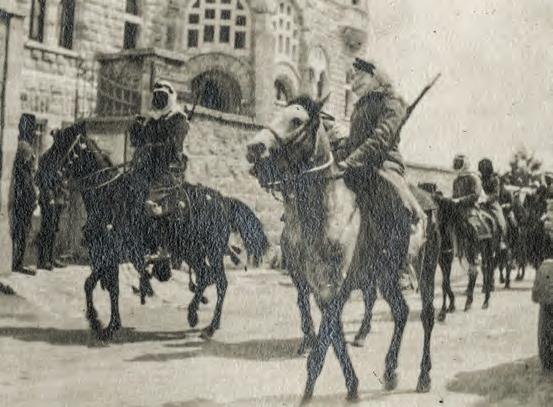
in Alexandria. A

a
company
with supplies prepares for a raid (opposite bottom). Doane (centre) and a colleague visit the Great Sphinx of Giza. Allied Arab fighters (above) enter liberated Jerusalem. Doane’s wife Mildred volunteered as a nursing assistant in Halifax.
There is also a picture of Allenby himself meeting with Arab leaders. It was in this December of 1917 that two ships collided in Halifax Harbour—the French cargo vessel Mont-Blanc, laden with high explosives, and the Norwegian ship Imo, carrying relief supplies for Belgium. Mont-Blanc caught fire and exploded, wiping out a large portion of the city in what was then history’s largest artificial explosion. Nearly 2,000 people were killed and 9,000 wounded, many of them blinded by shattered glass.
In the chaotic aftermath, Harvey’s bride Mildred and her sister, my paternal grandmother Katherine, volunteered as nursing assistants at the city’s Camp Hill veterans hospital. They both caught tuberculosis, along with my fouryear-old future dad Edward and his two-year-old brother, Arthur. They were all sent to Adirondack Cottage Sanitarium, a noted TB facility in Saranac Lake, N.Y. My grandmother and Arthur died. My dad lived to 90, despite a lifetime of lung issues. Aunt Mildred saw 87.
The Middle East Campaign well in hand, the 420th left the Sidi Bishr rest camp in Egypt by train on Feb. 5, 1918, boarded
HMT Ixion at Alexandria and set sail for France on March 3. They made port at Marseilles, where the battery unloaded their guns and stores from the ship and put them aboard trains bound for the front, or somewhere close to it. The men followed two weeks later. Spring 1918 has been described as the most critical period of the war for British and Empire forces. In the weeks before 420 arrived at their position outside Blairville in northern France—10 kilometres southwest of Arras and 50 kilometres northeast of Amiens—the Germans launched a massive attack designed to knock the British out of the war. It was called Operation Michael.
Fighting between March 21 and April 5, 1918, largely in the wasteland left by the 1916 Battle of the Somme, the predominantly British, Empire and French Allied forces would suffer some 250,000 casualties to the Germans’ 240,000.
Operation Michael failed to achieve its objectives and the German advance was reversed during the Second Battle of the Somme in August. The Allied victories would set the stage for the Hundred Days Offensive, spearheaded by troops of the CEF.
Doane’s 420 Siege Battery, Royal Garrison Artillery, (opposite top) gather for
photograph
camel
loaded

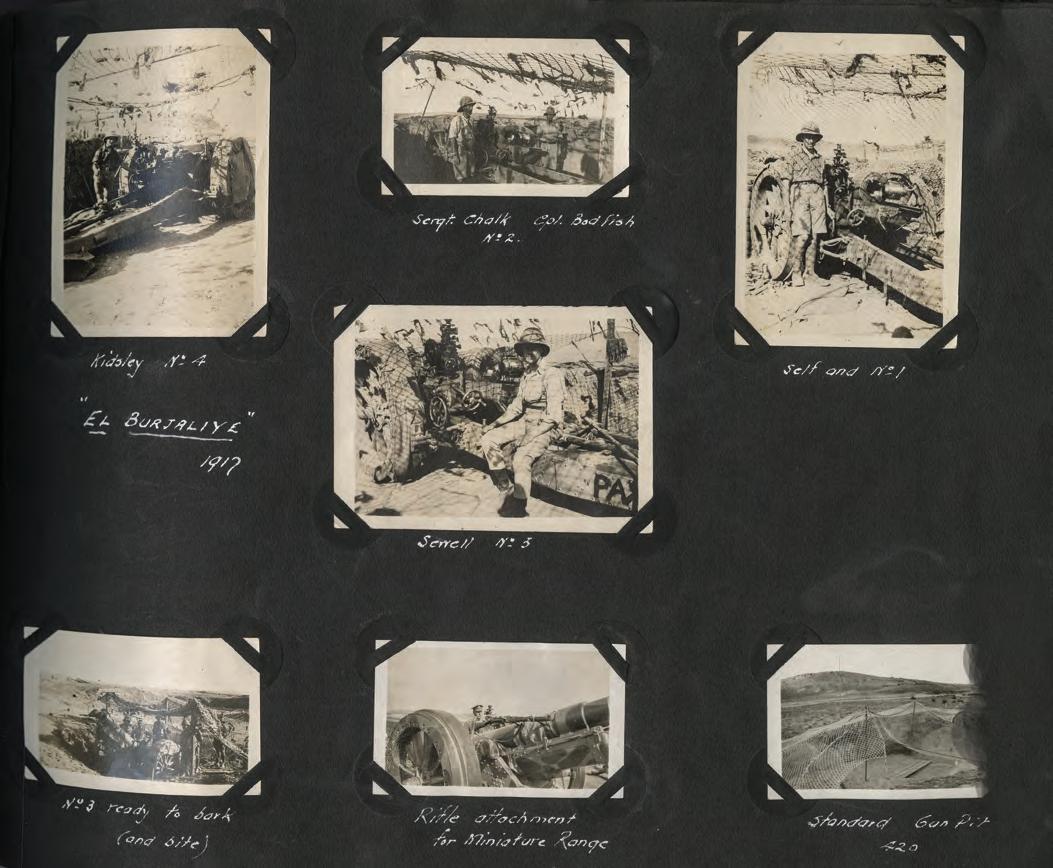
The handwritten unit war diary for May 1918, signed in pencil by “H.W.L. Doane, Maj, OC 420 Siege Battery RGA,” details relentless and exhausting preparatory work for what was to come.
“Parties proceeded to battery position near BLAIRVILLE by motor lorry and built gun pits, etc. Working day and night. Received 5 additional officers—total now 12.”
The single-page document describes logistics and challenges, calibrations and action. “Battery in action on counter battery and harassing work.” Their struggles were not limited to pounding— and taking a pounding from—the German enemy. The transition from a year in the sun-baked deserts of the Middle East to the
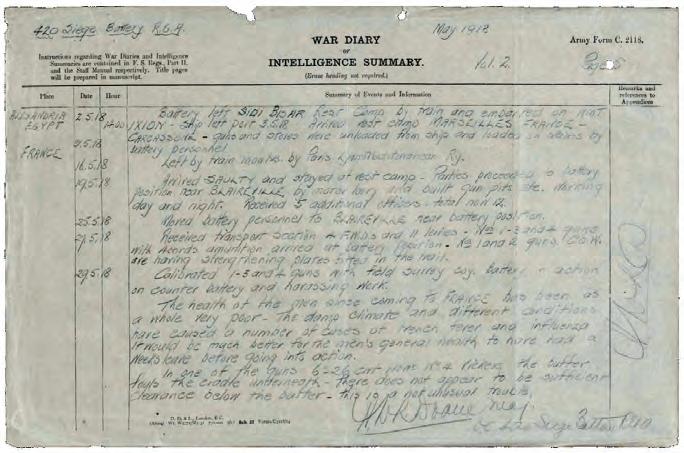
mud and misery of the Western Front had its own challenges.
“The health of the men since coming to FRANCE has been as a whole very poor,” Harvey wrote on May29.
“The damp climate and different conditions have caused a number of cases of trench fever and influenza.
“It would be much better for the men’s general health to have had a week’s leave before going into action.”
Harvey was transferred to the 123rd Siege Battery, RGA, on Oct. 26, 1918, the day after fighting ended in the Battle of the Selle, in
which it was a part. The British unit had served on the Western Front since it was formed in 1916, fighting at Arras, Passchendaele, Cambrai and through the opening victories of the Hundred Days.
Harvey would see them to their triumphant end.
The back half of his album is filled with personal and official photos of France—standing over his brother’s battlefield grave near Courcelette, the handwritten notation below the picture reading “he has given his life for his country so that others might be saved;” rows of captured German guns at Amiens; long
Scans by Shoebox Studio Ottawa/Harvey Doane/Album courtesy Mary Doane/ Doane Family Archive; The National Archives (Britain)

Doane’s eight-centimetre-thick album is filled with pictures and notations from Egypt, Gaza, Jerusalem and other parts of the Middle East theatre of war, as well as the Western Front.
As 420 commander, Doane went to bat for his exhausted and ill troops, who went from desert swelter to cold and mud in northern France. Captured German guns at Amiens, France, await their fate.
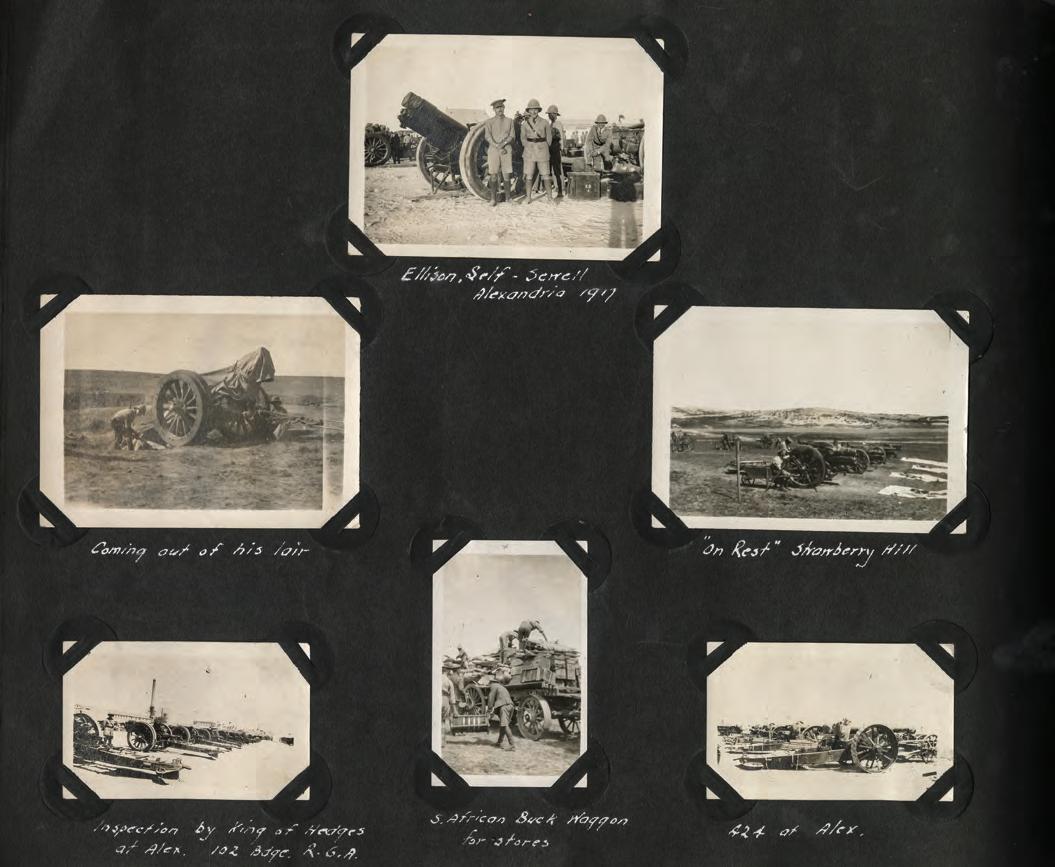
lines of German prisoners filing down roads littered with the shattered detritus of war bordered by “beautiful trees of Napoleon’s time,” battered and broken, every one.
He boarded a ship for Canada on Feb. 19, 1919, a 24-day trip. He and Mildred were married 63 years and had three kids. A gifted orator, he gave talks about his time overseas and emceed my first wedding at the yacht club where he was an honorary life member, delivering a devastating series of one-liners.
My brother Ted knew him best. When Ted was 12, Harvey and Mildred took him on a week-long
trip to Nova Scotia’s South Shore aboard their 13-metre cruiser Bluefin, which Harvey had converted from a Second World War patrol boat that had plied the Gulf of St. Lawrence on the lookout for U-boats. Harvey ate a raw egg every morning.
“Uncle Harvey was the ultimate gentleman,” said my brother, who fell overboard one morning while making his way forward to mop the dew off the decks. Harvey put the ladder over the side and when Ted climbed back aboard, our greatuncle looked him in the eye and said: “Now there’s a lesson for you—one hand for yourself and one hand for
the boat.” He may well have been talking about more than boats.
Uncle Harvey died in 1988, age 96. My daughter Kate— Katherine, named after her great-grandmother—was just seven at the time. We were living in Richmond Hill north of Toronto when her teacher called to say that she was crying because, she had told her, “Uncle Harvey died.”
Kate barely knew him, I thought. But it was her first encounter with death—and, for me, an ultimate appreciation of what an indelible impression Uncle Harvey had made on us all. L
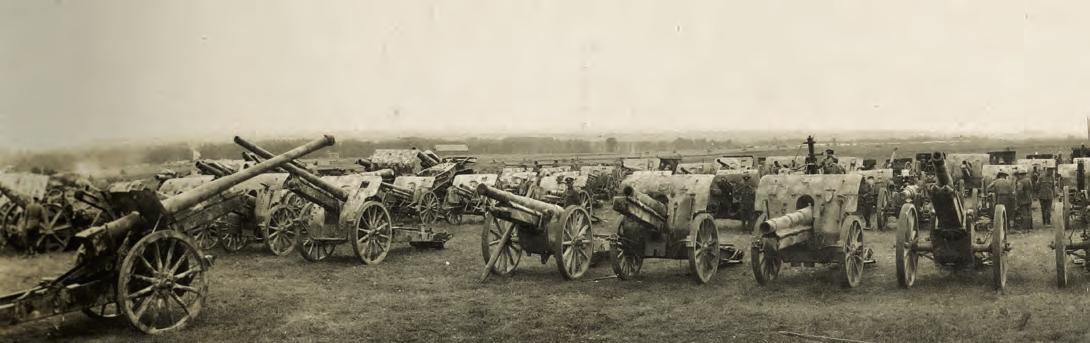



Stewart Hyson

A widow’s walk
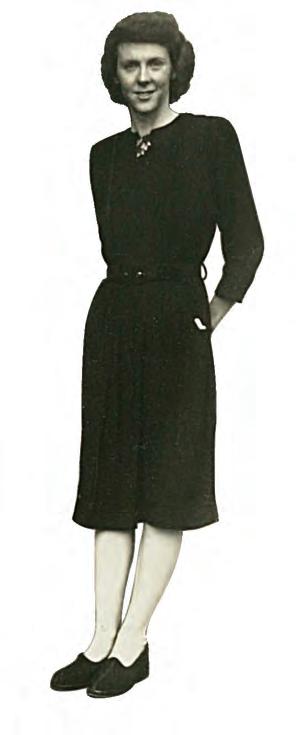


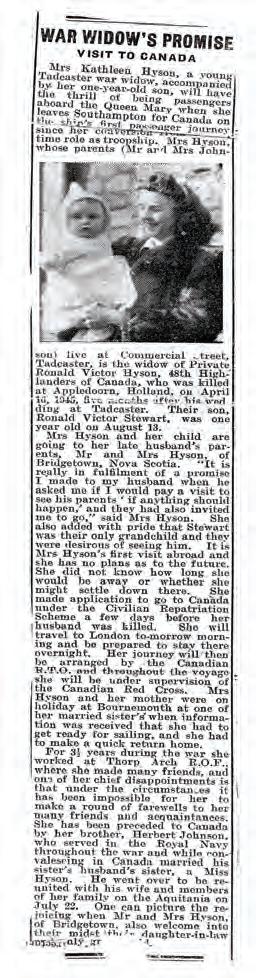

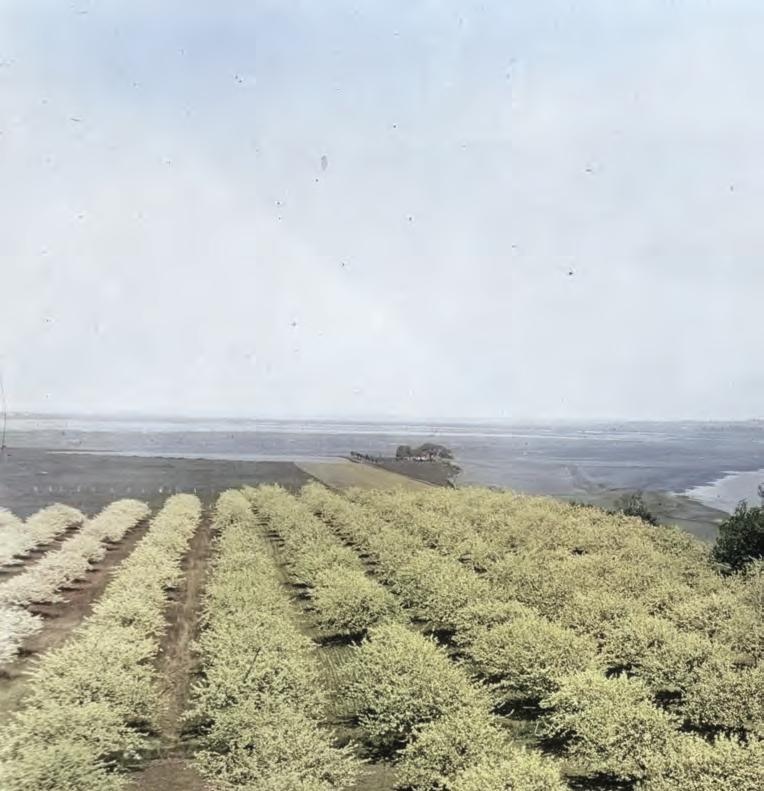
Kathleen Hyson immigrated to Canada as a war bride widow in 1946, moving to her late husband’s hometown of Bridgetown, N.S., in the Annapolis Valley (opposite bottom). She was interviewed by a British newspaper prior to the journey (opposite left).



The story of the war bride of a Canadian soldier killed in action—and how she eventually lived a full life in Canada
Stories about war brides travelling to Canada from the United Kingdom and other European countries following the Second World War are commonplace. But little is known about those war brides who happened to be
widows—women who had married a Canadian soldier, only to lose him before fighting ended. It’s believed fewer than five per cent of all war brides ended up in this circumstance. What was it like to be a war bride widow?
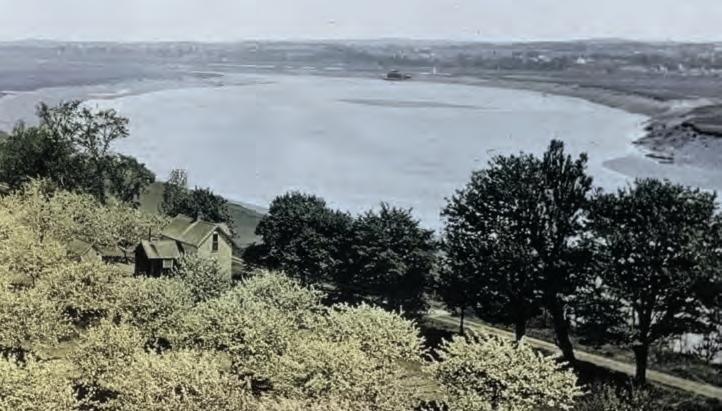
The widows likely shared much in common with their fellow war brides, yet in other respects, their lot was unique. Their lives were filled with loss and uncertainty rather than hopeful excitement for a future to be shared with new husbands and families in new homes overseas.
My mother Kathleen was a war bride widow, and she was interviewed by a reporter just before coming to Canada. The 1946 newspaper clipping makes for an informative source of details about her situation and the uncertainties that lay ahead—as enlightening as her own memories, filtered as they may be by the passage of time.

She fulfilled a promise to her husband that she would take their baby to see his parents in Bridgetown, N.S., after the war if something should happen to him.
Kathleen was born in August 1922 and raised in a working-class family in the small British town of Tadcaster. In early 1943, the British government recruited women her age for war-related service, and she found work making bombs and shells at Royal Ordnance Factory 8 in Thorp Arch, not far from her parents’ home. She met Canadian Private Ronald (Ron) Hyson around that time and they were wed on Nov. 3, 1944. Although Canadian Army

Routine Order 788 had officially dissuaded soldiers from marry ing while overseas, nearly 45,000 Canadian military personnel mar ried British women and another 3,000 married women from other European nations during the war. Following the marriage, Kathleen remained at her parents’ home in Tadcaster, where I was born in August 1945. Meanwhile, Ron returned to the battlefield with the 48th Highlanders of Canada. He was killed in action in the Netherlands


After the end of the war, life was gradually returning to normal. Kathleen was on vacation with me and her mother visiting a sister in Bournemouth, England, in August 1946, when a letter arrived saying that she should pack immediately for a voyage to Canada. Ottawa’s policy was to provide the wives and children of Canadian soldiers with a free trip to Canada for family reunification. This arrangement extended to war brides who had become widows. Kathleen returned to Tadcaster the same day to collect her belongings for the trip. She headed to London the next day for an overnight stay. War brides and their children who had been selected for the trip stayed at collectionpoint hotels in the city, then were transported the following morning via train to Southampton to catch the Queen Mary ocean liner.
Everything seemed to proceed at a breathtaking pace within a few days: notification, gathering in London and train departure for the ship. It was so quick that Kathleen bemoaned to the newspaper reporter that she had not had time to say goodbye to her mates at work. This fast and efficient pace was possible because much





of the preparatory paperwork had already been finalized. For starters, Kathleen had applied in early 1945 under the repatriation scheme for ship transport to Canada. It fulfilled a promise to her husband that she would take their baby to see his parents in Bridgetown, N.S., after the war if something should happen to him.
The Canadian Wives’ Bureau in London had also played a leading role in England by alerting every war bride to the regulations and facilitating the booking of hotels for the London stay and arranging for soldiers to assist the women in transporting luggage to the train and the ship. Thus, all had proceeded smoothly once the Queen Mary was ready to depart on Aug. 28, 1946.
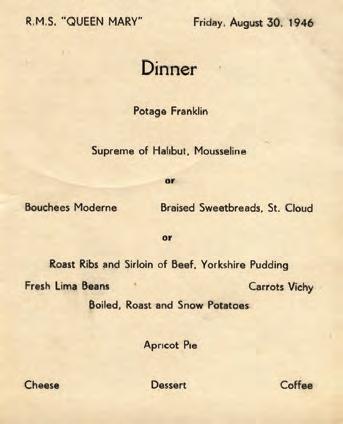
Despite the preparations, many were overwhelmed by the sight of the ship—by both its size and its legacy. Soldiers again assisted carrying light baggage aboard, while deckhands stored heavier luggage not required during the voyage in the ship’s holds. Accommodation attendants greeted the passengers on arrival and directed them to their assigned rooms. Members of the Canadian Red Cross were available to assist during the trip.
Some women found the ship’s shared quarters crowded. But others, especially those with children, saw benefit in companionship: the mutual support to keep an eye on the little ones during the long voyage. And they welcomed any helping hands in an age before disposable diapers, as the rooms were soon littered with washed nappies hanging to dry wherever space was available. Conversation, however, could be difficult for those who were widows. Most newlyweds were filled with excitement, enthused by the prospect of reconnecting with their husbands and starting life anew in Canada. It was hard, however, for my mother to partake in these joyous conversations. As she had earlier told the British reporter, except for a visit with her in-laws, she did not know how long her stay would be, and she had no future plans. Everything was uncertain.

There was one bright spot, however. Her older brother Herbert was to greet her on arrival in Nova Scotia. After he had seen action with the Royal Navy in the North Atlantic early in the war, he had taken a rest break in Nova Scotia. Herbert had stayed with Kempton and Grace Hyson (my father’s parents) and their family, prompting him to suggest later that my dad should take his breaks from the battle with his parents in Tadcaster. This led to Mom and Dad meeting. (And Herbert had married one of Ron’s sisters, Leila.)

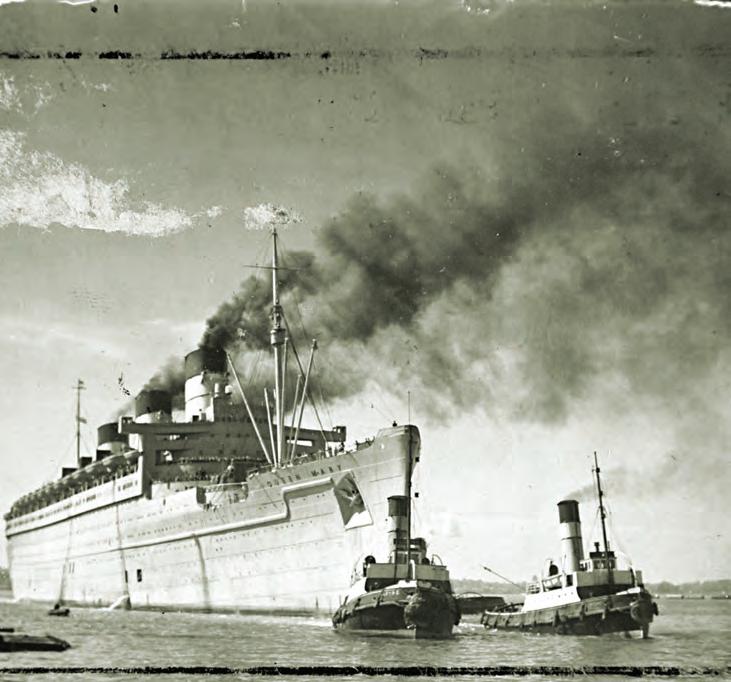
Other than this meeting, everything else on my mother’s horizon was cloudy. How long would she stay? Would she return to England? How would she get along with her in-laws? What about her finances? Where would she live or find a job? These questions haunted my mother during her voyage. Her worries were not helped by seasickness. After years of food rationing in England, most war brides were impressed by the variety and quantity of food available on the ship. But not my mother. Soon after departure, she was queasy. She could consume only saltine crackers to help settle her stomach. Cabin mates had to bring back the crackers for my mother because she found it difficult to walk on the moving ship to go to the cafeteria. My mother was not alone in this matter—Queen Mary
Kathleen and Ronald (Ron) Hyson were married on Nov. 3, 1944. Afterward, she lived in Tadcaster, England (opposite middle), and worked nearby making bombs at Royal Ordnance Factory 8 (opposite bottom). Kathleen and her one-year-old son Stewart left for Canada aboard RMS Queen Mary (left) in August 1946.
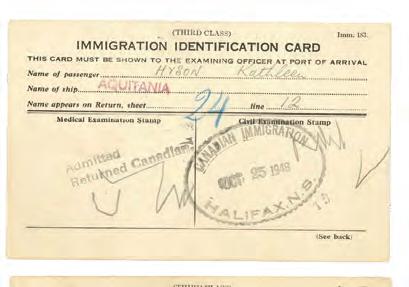



She was a young widow with no home of her own, no job and no prospects for the future.

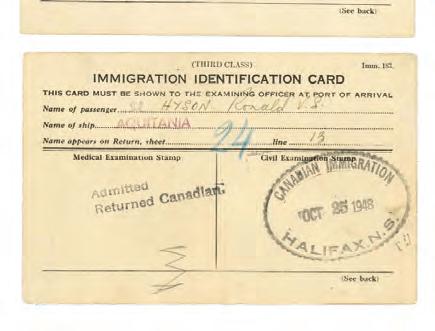
Red Cross workers help immigrant mothers and their children at Pier 21 in Halifax in 1948. After returning to England for a year, Kathleen and Stewart came back to Canada for good in 1948, as attested by their immigration identification cards.
had a poor reputation for its ability to handle heavy seas, even after the installation of stabilizers in 1958.
Her malaise was not helped when I contracted chicken pox. Being a widow and single mother, she had always had to look after me herself regardless of her own ailments. So, the ship’s limited medical staff provided my mother with calamine lotion to apply regularly to my skin to reduce the itching.
On arrival in Halifax at Pier 21, soldiers once again assisted in carrying luggage and small children off the ship. And Red Cross staff made certain that families caught the appropriate train to take them to their respective destinations across Canada. Fortunately, our train trip through southwestern Nova Scotia was relatively short, though it provided a memorable vista of the Annapolis Valley. Uncle Herbie greeted us in Bridgetown.
My mother’s seasickness soon disappeared, only to be replaced with the pangs of homesickness. It was not uncommon for war brides to miss their former lives, but some, like my mother, had it far worse than others. This was understandable. British and Canadian villages were worlds apart in terms of daily lifestyle. My mother was used to the compact lifestyle of small English towns where friends, shops, pubs and other amenities were within an easy stroll, with ready access by public transit for longer outings. Such features were absent at my grandparents’ home. They lived on a farm on the eastern edge of Bridgetown surrounded by apple orchards and pastureland. It was a considerable walk to the downtown shopping area, with no opportunity for my mother to develop friendships or find employment. This sense of isolation
grew worse, the passing weeks contributing to her homesickness.
My mother’s earlier words to the British reporter still echoed true. She was a young widow with no home of her own, no job and no prospects for the future. Feelings of loss ruled her all day long. It was not surprising, therefore, that she decided to return to her British roots and the familiarity of Tadcaster in August 1947. It was not long, however, before my mother realized that coming back to England had been a mistake. Homesickness is a poor guide in life—no way to advance. Despite her previous difficulties in Nova Scotia, back to Canada we went in October 1948. This time, my mother toughed-out her bouts of homesickness.
During her initial trip overseas, she had met her brother-in-law Merrill. They fell in love, and upon her return, they married on Feb. 5, 1949. My mother told me that I now had three fathers: God, my father killed in the war and my new dad. We settled in Hantsport, N.S., and I eventually welcomed three siblings to our family.
As we grew older, my mother shifted from a housewife role to operating a beauty salon in the mid-1960s. She later worked at the local Sears. She died in October 2015, 11 years after Merrill’s passing. She led an eventful life with its share of ups and downs. Yet, in its way, it was fulfilling, even if not the one she expected. L
Courtesy Stewart Hyson


By Stephen J. Thorne
By Paige Jasmine Gilmar
The 2023 Legion National Youth Track and Field Championships
By Stephen J. Thorne
By Michael A. Smith

if the Aug. 11-13 gathering of more than 900 diverse, talented and enthusiastic athletes wasn’t enough to reinforce the value of the Legion National Youth Track and Field Championships, two hammer throwers who cut their athletic teeth at the annual competition won world championships in August.
A week after the 2023 youth competition ended in Sherbrooke, Que., Nanaimo, B.C., native Ethan Katzberg, who competed in the Legion event at Brandon, Man., in 2017, and Richmond, B.C.’s Camryn Rogers, who participated at Surrey, B.C., in 2015 and Sainte-Thérèse, Que., in 2016 won at the Worlds in Budapest.
Katzberg is coached by Olympian Dylan Armstrong—another Legion Nationals athlete. Rogers was only the second Canadian woman to take gold at the Worlds, after twotime Canadian junior champion hurdler Perdita Felicien in 2003.
The list of Olympians who have participated in the Legion event is long and impressive—names such as 800-metre specialist
Melissa Bishop-Nriagu, sprinters Charmaine Crooks, Angela Bailey, Glenroy Gilbert and Aaron Brown, and pole vaulter Alysha Newman.
Wounded Afghanistan veteran and champion para-athlete Mike Trauner, named the first honorary chair of the Legion Nationals this year, said soccer and hockey garner the lion’s share of sponsorships and media attention in Canada.
“Track and field is definitely one of those sports that needs a little bit more help,” said Trauner, a double amputee who found a new life through sport, first as a paddler and now a cyclist aiming for the Paralympic Games in Paris in 2024.
“The kids need it,” he told Legion Magazine. “They need it as a stepping stone to become great athletes. The country just can’t expect athletes to kind of pop out of the ground and become great just because they’re born that way.
“Nobody’s born that way; you have to develop. So, the fact that the Legion supports this event and helps these youth athletes progress in their field—





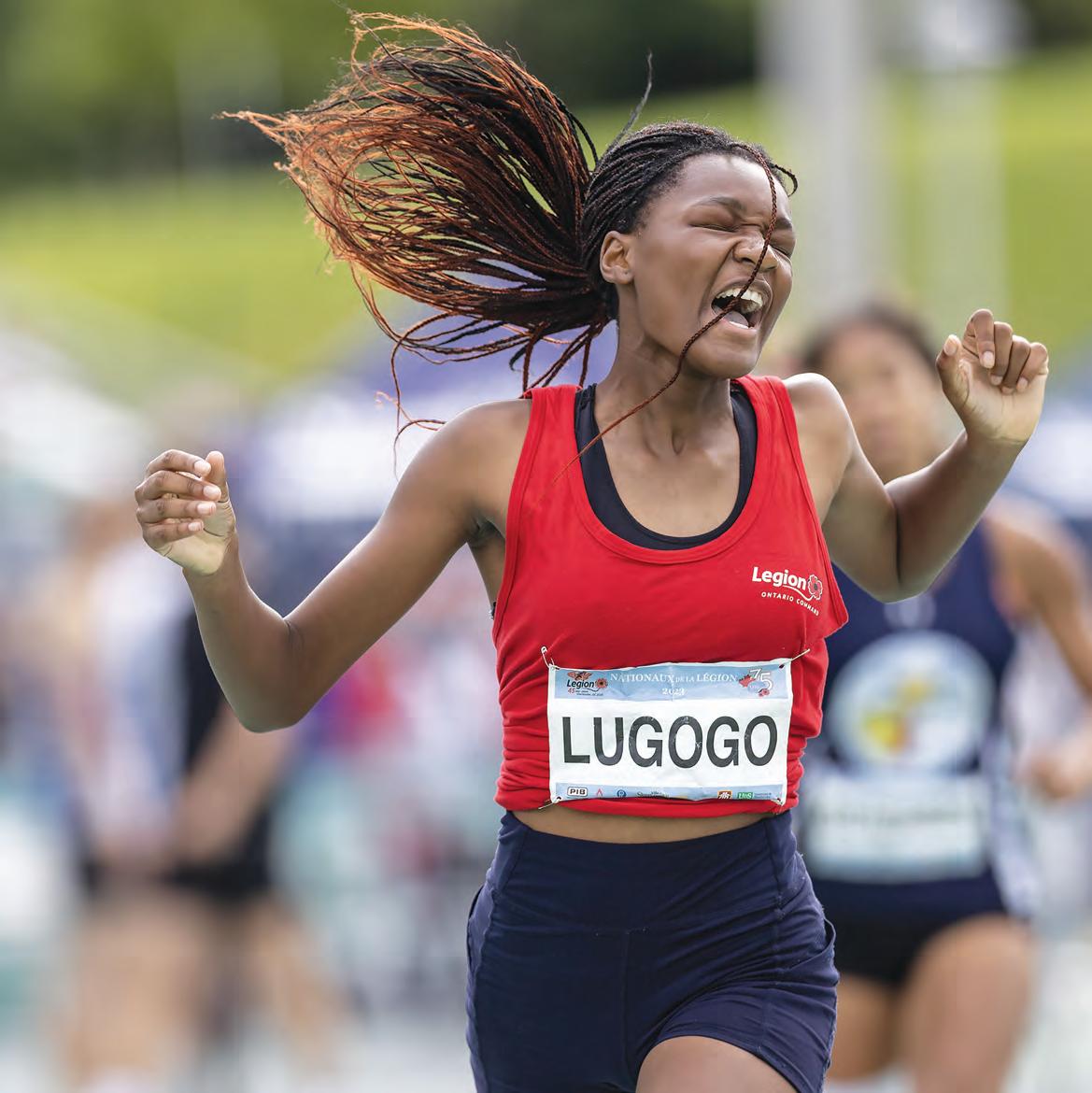

Zoe Unger of B.C./Yukon and Lena Eys of Laurel Creek Track Club in Kitchener-Waterloo, Ont., (above) finish second and third in the under-18 women’s 2,000-metre steeplechase. Nate Phillips of ManitobaNorthwest Ontario shakes the hand of Quebec’s Noah Fortier (left) after the under-18 men’s 3,000 metres. Liam Miller of Bolton, Ont., (opposite left) clears 4.45 metres to win the under-18 men’s pole vault, while Susan Hurtubise of B.C./Yukon wins the under-18 women’s event, clearing 3.40 metres.


The 2023 participants came from both Legion-sponsored programs and private clubs: 307 Legion athletes representing nine regions of The Royal Canadian Legion (Prince Edward Island did not send a team) and 629 club and unattached competitors.
Some 160 volunteers, 139 coaches and 62 officials made it happen. More than 300 medals were awarded, with Team Ontario taking 35, including 18 gold, and British Columbia/Yukon garnering 34. Quebec was third with 27.
At fourth in the overall medal standings, Flying Angels Academy out of Toronto
topped the open participants, with 13, including six gold.
The Legion’s largest single monetary investment annually, Sherbrooke marked “the return of The Royal Canadian Legion delivering values-based sport,” said senior program officer Steven Van Muyen.
Trauner, who delivered an inspiring address to Legionsponsored athletes before the competition began and mingled with them throughout, said people who haven’t participated in sport tend not to understand the value in the experience.
“It can have profound implications
on a young person’s life.”
Two under-16 athletes were awarded top honours at a Legion banquet following the event.
Hannah Gates of Saskatchewan earned the Leroy Washburn Award as the top female Legion athlete. Gates won gold in the 800 metres, 1,200 metres and the triple jump, as well a bronze anchoring her team’s 1,600-metre medley.
Caleb Pivin of Quebec received the Jack Stenhouse Award as the top Legion male athlete. Pivin won the pentathlon with 3,258 points. He also took gold in the 100-metre hurdles and bronze in the 4x100-metre relay. L

Hannah Gates of Saskatchewan (top) takes gold in the under-16 women’s 800 metres, clocking 2:12.24. She won two other events and captured third in another to receive the Leroy Washburn Award as the top female Legion athlete of the competition.
Lead Safwan El Mansati of the Ottawa Lions Track and Field Club and anchor Zachary Jeggo (bottom left) embrace after taking silver in the men’s 4x400-metre relay. Quebec’s 4x400-metre women’s relay team celebrates a silver medal.
For more pictures, check out the “Front Lines” blog at www.legionmagazine.com .

Scan a poppy, meet a veteran
IN THE NEWS
Holding back tears, Shelby Sutherland read: “She got a letter from her son saying, ‘I’m in Korea; I’m going to be okay; I’m going to be home soon.’ And then later that day, she gets a telegram that her son was actually killed two days ago.”
Sutherland, a co-ordinator for the poppy and remembrance division at The Royal Canadian Legion’s national headquarters, was relaying a story of Korean War veteran Robert Francis Arding. He was killed in action in 1952, just five days after his 18th birthday. She stumbled on Arding’s biography while researching for Poppy Stories, an interactive campaign launched in 2022 that connects people to the lives of veterans when they scan a poppy with a smartphone.
The initiative was created by the Legion and Toronto-based marketing company SALT XC to engender personal connections between Canadians and Remembrance Day by introducing
By Paige Jasmine Gilmar
them to fallen veterans. It was a direct response to the waning relevance of Remembrance Day in the lives of young Canadians with no relationship with a veteran or their experiences, most poignantly shown by dwindling military recruitment and languishing Legion membership despite continuing population growth.
“It’s different from being in a classroom and just learning all these statistics,” said Sutherland.
Accessing the stories is simple: just log onto www.poppystories.ca on a smartphone and point the camera at a lapel poppy. Within seconds, a photo and short story of a Canadian veteran is shown. The website also allows users to make a donation to the Legion’s poppy fund, which supports veterans in a variety of ways, such as help in accessing health and housing programs through Veterans Affairs Canada.
In its first year, Poppy Stories was viewed more than 20 million
times and generated 120,000 page views. The site was a particular hit with schools.
“Poppy Stories are an educational piece,” said Nicole Thomas, a program officer with the Legion’s poppy and remembrance division. “It’s a great tool to use to foster remembrance.
“You’re getting to understand that these veterans are people.”
Thomas and Sutherland hope the successes continue and are excited about a new theme for this year’s stories. While 2022 focused on veterans from the First and Second world wars and the Korean War, 2023 will celebrate Canadian peacekeepers in honour of the 75th anniversary of the first UN monitoring mission. In the coming years, Sutherland and Thomas also hope to expand the initiative by including multimedia features such as voice-overs.
“They’re powerful stories,” said Thomas said. “Poppy Stories is a way to bring the poppy to life.” L
Member Benefits Package change
EARL Fleet Vehicle Management is no longer a partner in The Royal Canadian Legion’s Member Benefits Package (MBP). The company will no longer be directly supporting the veteran services and programs of the Legion.
The discounts and benefits Legion members, their immediate
families and the organization itself have access to through the MBP are substantial and remain available from 13 companies. These include Upper Canada Wills, Teslica electric bikes, Ultramatic, Blowes and Stewart Travel, Pocketpills, IRIS Eyewear, Medipac Travel Insurance, belairdirect car and home
insurance, Red Wireless, Hearing Life, Arbor Memorial, Canadian Safe Step Walk-in Tub Company and CHIP Reverse Mortgage.
For more information on how you can access special offers from these businesses through the MBP, visit www.legionmagazine.com/ member-benefits-package. L
86th New Brunswick Provincial Command Convention
By Michael A. Smith
was a model assembly for the “model” town.
More than 170 people gathered at Oromocto Branch for a lively 86th New Brunswick Provincial Command Convention on Sept. 9-10 to set the post-pandemic future for local Legions. The colour party marched in, the doors closed and Dominion Treasurer Rick Bennett declared the meeting open.
“There were some difficult decisions to be made,” said President Daryl Alward in opening remarks. “But together we made them in the best interest of the Legion.”
He went on to thank volunteers and Legionnaires for their dedication and the hard work that helped branches power through challenges presented by the pandemic. He also acknowledged the tough loss of Portland Branch in Saint John and the fire that destroyed the Kennebecasis Branch building in Rothesay. The latter is now in a new building. But the core of Alward’s report, and much of the first day, focused on membership.
“Membership is everyone’s concern, and the numbers are down,” said Alward before pleading: “Please keep working to increase our membership because without members, we will not be functional.”
The president went on to praise the success of the command’s Commemorative History Booklet. Revenue generated from the project helps drive provincial Legion youth leadership programs and bursaries.
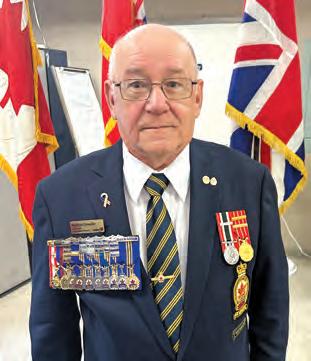
“MEMBERSHIP IS PUTTING ASSES IN THE CHAIRS IN YOUR BRANCH.”
Bennett, serving as the national command representative, echoed Alward’s comments about membership in his address to delegates.
“Membership is putting asses in the chairs in your branch,” he said. “That’s how you stay afloat… without branches we are nothing.
“I’m proud to be a member of a branch…it is so important for provincial commands to help the branches. They’re the most important thing.”
Bennett then asked those in the audience who were under 50 to stand. Only two rose.
“The Royal Canadian Legion is yours,” he told them. “Take hold of it, grasp it, run with it. Don’t listen to old buggers like me.” Bennett’s message was clear: more young members are needed and they are the future of the Legion.
Provincial Command First Vice Antonin Chevalier of Alfred Ashburne Branch in Gagetown followed Bennett with the Poppy and Remembrance Committee report. One notable item related to the Legion’s new biodegradable wreaths and crosses, with Chevalier having received some complaints that the items would discolour and smell bad.
“Dominion Command has gone to great lengths to ensure that this does not happen again,” said Chevalier. “If you have problems, send a report to command soon so it can be dealt with.”
Discussion followed Chevalier’s report about whether branches are using the poppy fund for its intended purpose. The first vice reminded delegates that branches must spend 80 per cent of their poppy fund each year. Letting it build to brag about its value doesn’t help veterans, he noted.
After longtime provincial treasurer Gary McDade passed away suddenly last April, Thea McEvoy of Miramichi Branch stepped in. She said McDade had left “big shoes to fill.” McEvoy reported that N.B. Command had $145,106 in its general fund at the end of 2022, down

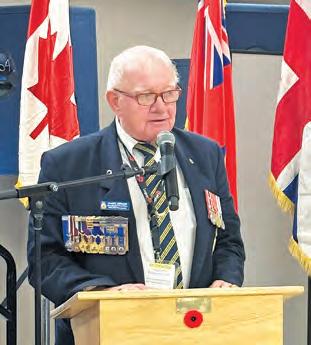
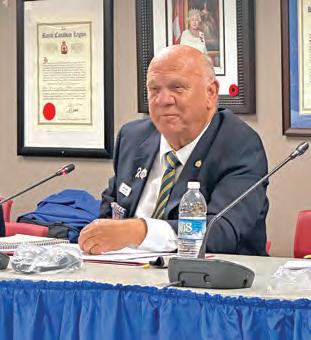
$46,030 from 2021. The Poppy Fund, meanwhile, had $32,906, while the Charitable Foundation had $185,918 and the Community Service Fund had $12,607. In total, provincial command had $376,537 as of Dec. 31, 2022, down from $447,613 the previous year.
National Legion sports championships resumed after two years and while New Brunswick teams had successful showings at the various events, helping to fund travel for their participation proved costly, especially as everything is getting more expensive.
Immediate Past President Terry Campbell of Peninsula Branch in Clifton Royal said changes will need to be made if provincial command plans to continue to support sending various teams. In response, delegates voted to raise the track and field travel budget from $700 to $1,500 to help offset
the increasing costs of airfare and hotels for athletes N.B. Command sends to the Legion National Youth Track and Field Championships.
Notably, delegates raised more than $10,000 from the floor for the Royal Commonwealth Ex-Services League.
One of the livelier moments of the meeting followed a presentation from Whitney McSheffery, a case manager with Veterans Affairs Canada. In a short question period following her remarks, many delegates expressed concerns about confusion over VAC benefits eligibility and the time it takes to get answers and access to them.
“If Veterans Affairs were any slower it would be in a coma,” shouted one frustrated delegate.
Delegates felt the 30 minutes allotted to McSheffery wasn’t sufficient, and after they demanded more time, she graciously returned to attempt to answer pressing concerns.
After a hearty lunch of sandwiches and soup and, for some, a side of beer, delegates were bused to the Oromocto Cenotaph where they were joined by Lieutenant Governor Brenda Murphy and her aide-decamp Robert Mackay for a brief remembrance ceremony. After the bugle sounded out and the colour party marched in, five wreaths were placed on the monument.
Back to business at the convention, elections for the new provincial executive were held. First, Tom Daigle of Moncton Branch and
Campbell were nominated for honorary president. Campbell, however, declined his nomination, so Daigle was acclaimed.
Campbell was subsequently nominated for president, along with Alward and Chevalier. Campbell again declined as did Alward, traditionally, though in dramatic fashion, shooting out of his seat to proclaim: “I’d have to be turned on stupid to run again.” And with that, Chevalier was acclaimed president.
Harold Defazio of Kennebecasis Branch in Rothesay, N.B., was likewise acclaimed as first vice, as were Earle Eastman of St. Croix Branch in St. Stephen as second vice, McEvoy as treasurer and Henry D’Eon of Lancaster Branch in Saint John as sergeant-at-arms.
The only contested race was for chair. Incumbent Geraldine Lefebvre of Oromocto Branch accepted her nomination, as did, in a surprising move, Terry Campbell. Accepting his nomination drew a loud murmur from the audience. Campbell came out on top.
The new executive complete, Chevalier said his role is “all about helping veterans.
“I don’t care about myself. I’ll get the help I need, but we need to make sure veterans get what they need.”
A Legionnaire for 23 years, Chevalier is a familiar face, which he believes will help get things done. His main goal as president? “Working together and making things better. We have to improve, and it takes time.” L

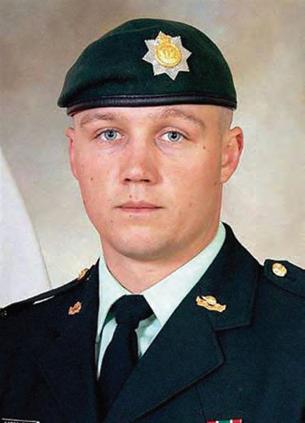
Wounded warrior Jess Larochelle, whose magnificent defence of a strongpoint in Afghanistan earned him Canada’s second-highest award for valour and spawned a campaign to upgrade it to a Victoria Cross, died on Aug. 30. He was 40.
“He was found in his shop and there wasn’t anything that could be done for him,” his brother Andrew wrote in a social media post from their home in Commanda Lake, Ont. “As per Jess’s wishes, there won’t be a funeral and services.
“We know one of Jess’s favourite things to do was to hang out by a campfire, and that he would appreciate it if you had one in his honour.”
A private with 9 Platoon, Charles Company, 1st Battalion, The Royal Canadian Regiment, Larochelle volunteered to man a perimeter observation post (OP) in the face of an impending attack by a numerically superior force of Taliban fighters.
Jess Larochelle 1982-2023
It was Oct. 14, 2006, and Larochelle had no sooner taken up his position than it was hit by a rocket-propelled grenade (RPG), throwing him several metres back and into the rear wall of the OP.
The concussive blast and the impact had knocked him out, broken his back, fractured two vertebrae in his neck, blown his right eardrum and detached his right retina. His spinal cord was intact, but he was peppered with shrapnel.
Larochelle regained consciousness and made his way to the position’s one surviving C6 machine gun. Two of his comrades were dead and pretty much the rest of his LAV III crew wounded by another RPG strike just a few metres away. Their armoured vehicle, the forward-most of several on site, along with its 25mm chain gun and machine gun, was disabled for most of the battle. Larochelle was alone up front, the point man as some 40 enemy fighters closed on his position.
Under heavy fire from AK-47s and RPGs, including 75mm munitions packed with cluster rounds, Larochelle fired continuously in short bursts, his gun barrel smoking and shell casings piling up around him.
He fired multiple rounds from his position’s cache of 15 disposable M72 rocket launchers—lifesavers and devastating killers.
By the time the remaining attackers withdrew an hour or so later, Larochelle was down to
two M72s and the last 100 of his 800 heavy machine-gun rounds. The ground outside his OP was littered with Taliban dead. He was restocked after he volunteered to remain at his post for the night.
“I don’t think you want to put somebody through that who hasn’t been through it before,” he told his platoon warrant.
Larochelle was awarded the Star of Military Valour, one of 20 presented to Canadians for actions in Afghanistan. He was unable to attend the ceremony at Rideau Hall and received his medal on the day he left the army, almost two years after the firefight.
“Although he was alone, severely injured, and under sustained enemy fire in his exposed position at the ruined observation post, he aggressively provided covering fire over the otherwise undefended flank of his company’s position,” said his citation. “His valiant conduct saved the lives of many members of his company.”
Efforts to have Larochelle’s award upgraded to the first-ever Canadian VC, spearheaded by the advocacy group Valour In the Presence of the Enemy and backed by a 15,000-name petition along with endorsements from at least three living VC recipients, failed on technical grounds.
The group’s founder, wounded Afghanistan veteran Bruce Moncur, remembers Larochelle as a “babyfaced 22-year-old with piercing blue eyes, nonchalant and unassuming.

“His story resonated with me for years and, there is nothing anyone can tell me, he deserves the highest medal of bravery,” said Moncur.
IN THE NEWS
The decision not to reconsider Larochelle’s award came down to a matter of timing. Nominations for bravery decorations must be submitted within two years. “So, the timelines for [Larochelle] are long-elapsed,” said LieutenantColonel Carl Gauthier, head of the military’s Directorate of Honours and Recognition.
Moncur said Valour In the Presence of the Enemy, which is lobbying for other reviews of valour awards, has not given up on Larochelle’s case.
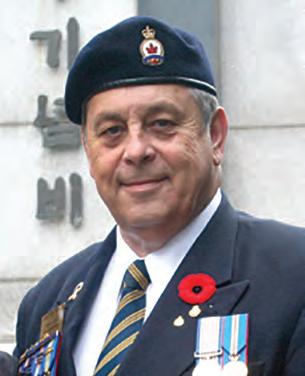
“In death our fight will not waiver,” he said.
Larochelle, the Sioux Lookout, Ont.-born son of military veterans, lived with pain and post-traumatic stress disorder for 17 years. He accepted the VC decision with humility. He had never asked for the most-coveted medal himself.
“Jess made it out to a small meeting with other veterans earlier this summer where he spoke of his being at peace with not receiving the Victoria Cross he so incredibly deserved,” said an online message from Blackbird Industries, a North Bay, Ont.-based marketing firm owned and operated by military veterans. “He said he appreciated
everyone’s efforts, but that his Star of Military Valour was enough.”
The former defence chief and face of the VC campaign, retired general Rick Hillier, called Larochelle’s death “the most tragic, the saddest news.”
“Jess was simply an incredible young man, a fiercely proud Canadian, and a true hero,” Hillier said. “Our country is lesser in his absence.”
Nearly 100 Canadians are among the 1,353 original VCs awarded across the British Empire until the 1990s, when Australia, followed by Canada and New Zealand, created their own. Canada is the only one of the three that has not awarded one. L
Cook 1941-2023
Michael Cook , former Royal Canadian Legion Dominion treasurer and chair of Canvet Publications Ltd., died this past May 22 at his home in Surrey, B.C. He was 81.
Cook was born in Vancouver, the grandson of a Cloverdale, B.C., pioneer family. He worked for 14 years with the City of Surrey before starting a 30-year career as a commercial agent for Shell Canada. A natural athlete, he played baseball, softball and basketball in his youth and was a champion golfer.
It was his prowess at baseball that first got him involved with the Legion, playing for the team at Cloverdale Branch in Surrey before he was even eligible to be
a member. His father having served in the Second World War, Cook joined after relatives of veterans were allowed membership. He rose through the ranks and became a life member at Cloverdale. He went on to serve in Pacific Command, now known as British Columbia/ Yukon Command. He was elected command president in 1999. In 2000, Cook was elected Dominion treasurer at the Dominion Convention in Halifax. He was subsequently appointed chair of Canvet, a position which, at the time, was traditionally filled by the treasurer. He remained in that role until it began being delegated to the first vice. Canvet, which publishes Legion Magazine,

Michael
expanded during his tenure, taking on external design projects and launching the Canada’s Ultimate Story special newsstand issues. In 2010, that series began with an exclusive edition on the First World War written by Canadian War Museum historian Tim Cook (no relation). Additional publications on the Second World War and the Korean War followed. The issues soon became so successful that Canvet established the series as a subscription magazine, publishing four times a year. Cook also represented the
Legion on a pilgrimage to mark the 55th anniversary of the ceasefire that ended the Korean War. On the trip, he remarked how surprised he was at the hospitality shown, and the appreciation the South Koreans had toward Canadians and their war contribution.
Cook remained dominion treasurer until 2014 when he did not seek re-election. After retiring from Shell, Cook was called back to the Legion as one of the trustees overseeing B.C./Yukon Command when it was facing financial challenges. The trustees
were successful and, in 2021, the command came out of trusteeship and elected new officers.
Devoted to community life, Cook also served as a volunteer firefighter and on the Cloverdale Board of Trade, the Surrey Rams Football Association, the Lower Fraser Valley Exhibition Association, the Surrey parks and recreation commission and the South Surrey Seniors Society.
He is survived by his wife of 56 years, Judy, son Michael Jr., daughter Parlee and two grandchildren. L
U.K. Nuclear Test Medal
Following the Second World War, the Canadian military participated in up to 29 U.S. and U.K. trials of above-ground nuclear weapons in the U.S., Australia and the South Pacific between 1946 and 1963. The tests provided training to about 700 Canadians, demonstrating the conditions caused by a nuclear war. These efforts led to the development of Canada’s nuclear energy industry and to important medical and scientific applications.
To further develop and augment the knowledge and experience Canadian trainees acquired, about 200 of them were also deployed to assist with decontamination at Ontario’s Chalk River nuclear
facility in 1952 and 1958. For decades, their exceptional service to Canada was not recognized. In 2008, their collective efforts were acknowledged and each individual, or a designated survivor, became eligible for an ex gratia payment of $24,000.
The timeline has since passed to apply for the payout, and it has been decades since Canada participated in nuclear-weapon testing. However, the important contribution qualifying individuals made to Canada and the U.K. is not forgotten. About 40,000 U.K. personnel took part in atomic and hydrogen bomb tests during this time, and it’s estimated that about 2,000 are
still living. Their service is now also recognized with the new Nuclear Test Medal, announced 70 years after the first trials.
The medal is available to individuals from other countries, such as Canada, who served at the locations where the U.K. atmospheric tests were conducted, including preparatory and cleanup periods, between 1952 and 1967. The application process will be conducted in conjunction with officials from the relevant country’s embassy or high commission.
To learn more about the medal, the eligibility criteria or to apply for it, visit https://www.gov.uk/ government/publications/nucleartest-medal-eligibility-criteria. L




SNAPSHOTS
Volunteering in the community
Legion branches donate more than $335,986 to their communities
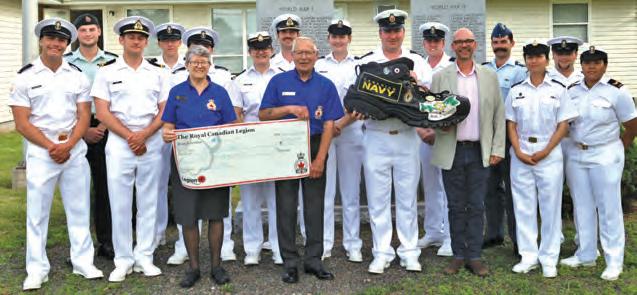
President Brian Rector and poppy chair Maxine Evans of Montague, P.E.I., Branch, accompanied by HMCS Charlottetown crew, donate $500 to the Make-A-Wish Foundation Canada. B. RECTOR
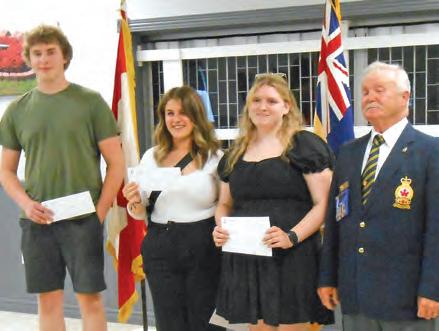
Poppy chair Grant Gay of O’Leary, P.E.I., Branch presents $300 bursaries to students Maggie Ann Gallant (left), Gracelyn Paugh and Keaira Clements. LYNDA CURTIS
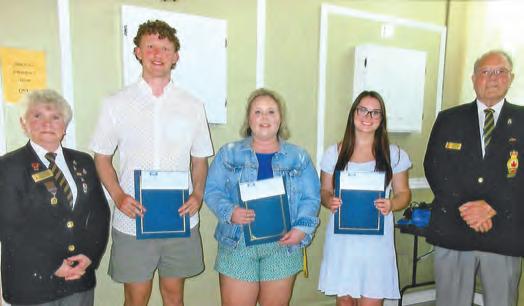
President LeRoy Gamble and vice-president Gayle Mueller of George Pearkes VC Branch in Summerside, P.E.I., present $1,000 bursaries to Benjamin Plourde, Jessica Praught and Emma Harris. K. GAMBLE
Jackie Doucette of Tignish, P.E.I., Branch presents $525 bursaries to students Declan Kinch (left), MacKenzie Trail and Daisy Kinch. LYNDA CURTIS
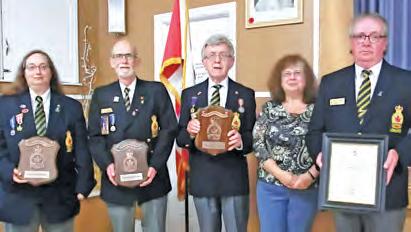
Borden-Carleton Branch in Borden, P.E.I., presents Legionnaire of the Year awards to Dawn Gradwell (left), Arthur Ranahan and Pieter and Daria Valkenburg, and Life Member Award to Brian O’Connor. KATHY HENRY
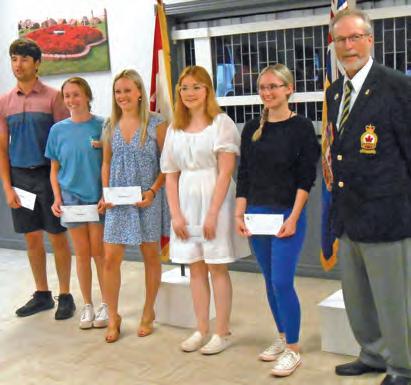
Poppy chair Alan Leard of Saint Anthony Branch in Bloomfield, P.E.I., presents $400 bursaries to students Patrick Shea (left), Claire Ashley, Ella Mae Hudson, Chloe Dawn Perry and Chloe Gallant.
Vice-President Susan Williams of P.E.I. Provincial Command presents a $1,000 bursary to student Chloe Gallant.
LYNDA
CURTIS
President Brian Rector of Montague, P.E.I., Branch presents the Cadet Medal of Excellence to Flt. Sgt. Caron of 327 Southern Kings air cadet squadron.
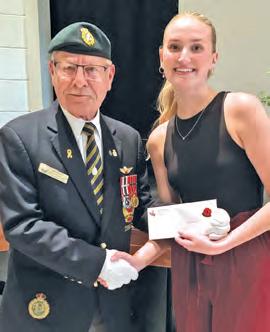
Kings County Zone Commander Brian Rector of P.E.I. Command presents a $1,000 bursary to Eden Boudreau of Montague Regional High School in Montague, P.E.I.
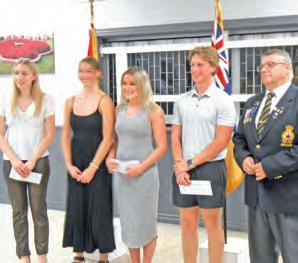
Brian Denis of Ellerslie, P.E.I., Branch presents $400 bursaries to students Jamie MacLeod (left), Amelia DesRoches, Ella Collins and Dylan Sapier. LYNDA CURTIS
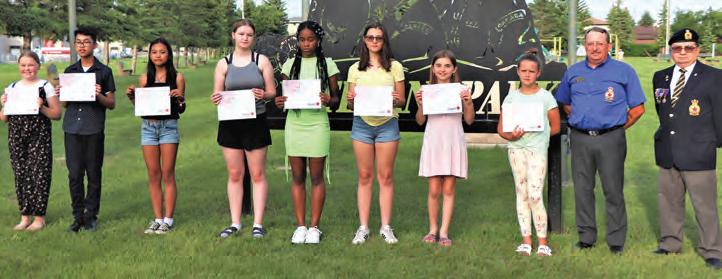
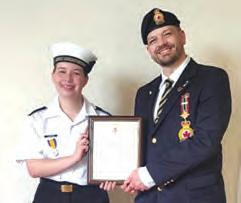
Sgt.-at-Arms Thomas Boxall of Fort Qu’Appelle, Sask., Branch presents the Cadet Medal of Excellence to Raina LaCroix of 346 Fort Qu’Appelle sea cadet corps.
First Vice Mark Matthews (right) and President Trevor Bancarz of Robert Combe VC Branch in Melville, Sask., present the winners of the poster and literary contests in Veterans Park. GERALD HACK

President Rob Driemel of Fort Rupert Branch in Port Hardy, B.C., donates $1,000 to the Port Hardy Harvest Food Bank.
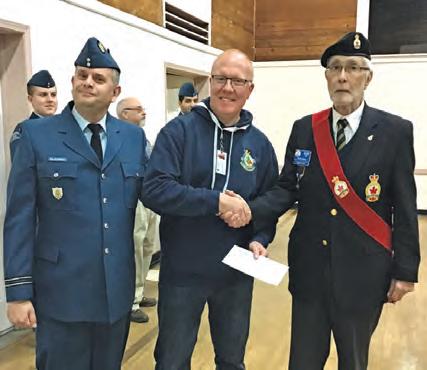
Sgt.-at-Arms Bob Ross (right) of Kelowna, B.C., Branch presents a $7,000 cheque to Capt. Greg Solomonides and sponsoring committee chair David Howell of the 43 Ogopogo air cadets.
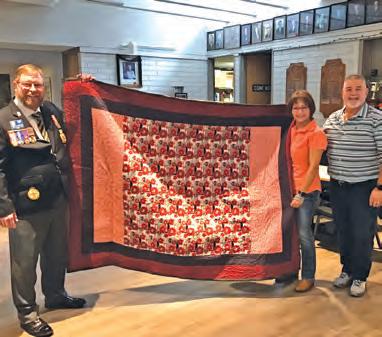
President Cory Schieman of Kelowna, B.C., Branch presents a Quilt of Valour to veteran Della Boucher, accompanied by her husband.

President Rob Driemel of Fort Rupert Branch in Port Hardy, B.C., donates $1,000 to Loaves and Fishes Community Food Bank.
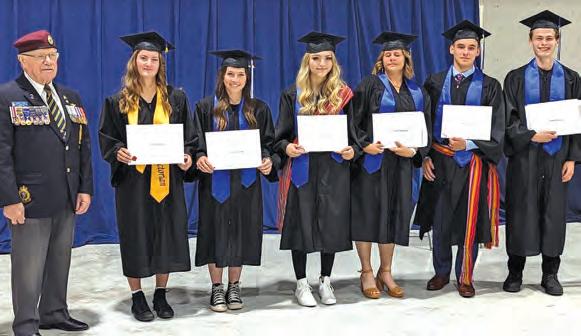
President Harvey P. Truax of Nakusp, B.C., Branch presents bursaries to 2023 graduating students of Nakusp Secondary School.
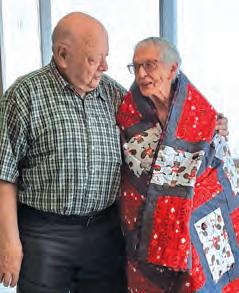
90-year-old veteran and cancer patient Mary Findlater of Okanagan Falls, B.C., Branch shows off her Quilt of Valour, accompanied by S.O. Bannister.
Second Vice Tim Murphy of Alberni Valley Branch in Port Alberni, B.C., presents $6,000 to president Dawna Sawyer of Wholesome Meals on Wheels Association.
President Sam Esopenko (right) and Nils Adamsson of Mount Arrowsmith Branch in Parksville, B.C., present a cheque for $2,330 to Lieut. Rob Schneider, Capt. Brenda Aumonier and sponsoring committee president Brie Sorensen of the 893 Beaufort air cadet squadron.
Past President Angus Stanfield of SVI Zone in Burnaby, B.C., presents $10,000 to South Vancouver Island Housing Society president Rod Hughes.
Veteran and Past President Ed Findlater of Okanagan Falls, B.C., Branch receives a Quilt of Valour.
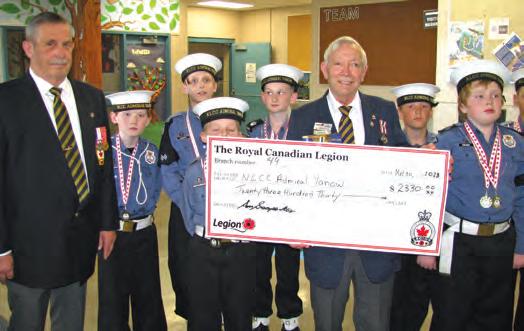
chair Rod
to 169
Cadet liaison Brian Kirby of Bowser, B.C., Branch presents cheques totalling $1,400 to CPO2 Anna Tulia of 296 Esquimalt sea cadet corp.
and President
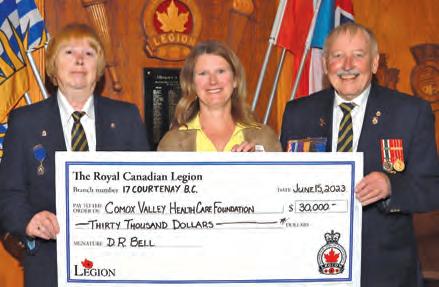
President Barbara Linton and poppy chair Dave Bell of Courtenay, B.C., Branch present $30,000 to the Comox Valley Healthcare Foundation director of partnerships and collaboration Rhonda Stevens for the purchase of cardiac equipment. The Courtenay Branch has contributed more than $250,000 to support local healthcare in the community.
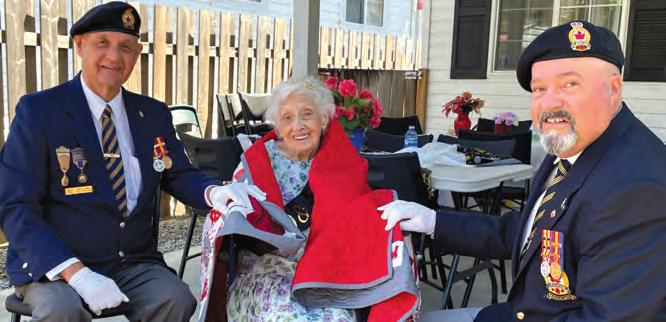
President Ian Williams and Second Vice Mike Bowcott of Hope,
present a
B.C., Branch
Quilt of Valour to Doris Nazar on her 100th birthday.
Poppy
Wilkins (left)
Sam Esopenko of Mount Arrowsmith Branch in Parksville, B.C., present $2,023
Admiral Yanow navy league cadet corps.
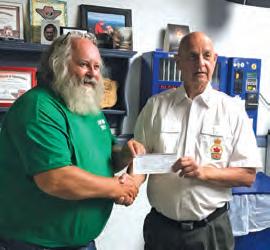
President Ian Williams of Hope, B.C., Branch presents $500 to the Military Police National Motorcycle Relay before the riders set off to Newfoundland.
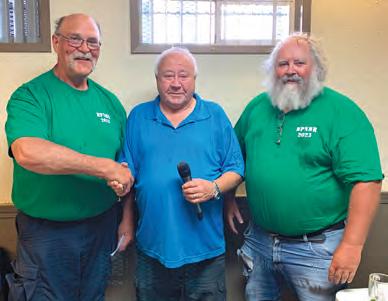
President Lyle Kent of K. Knudtson Branch in Osoyoos, B.C., presents $1,000 to chair Ray Lyver and Danny Lyver of the Military Police National Motorcycle Relay.
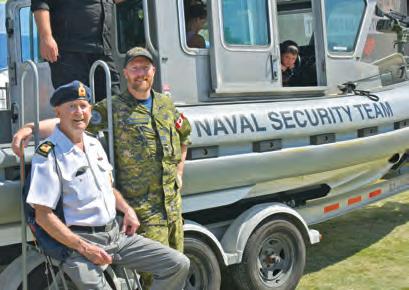
Al McNeil of Penticton, B.C., Branch greets Capt. Jamie Bois who visited with RCN’s Naval Security Team. The team showed off two vessels in Penticton Lake.
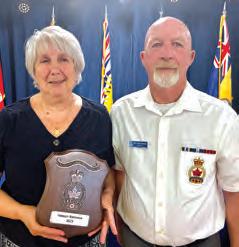
President Roy Buchanan of Alberni Valley Branch in Port Alberni, B.C., presents the Legionnaire of the Year award to Shirley Hartman.
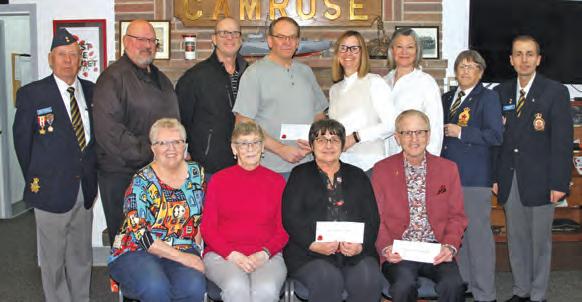
Vice-President Kerry Gretum (left), Marilyn Shipley and President Adrian Zinck of Camrose, Alta., Branch present donations to the Camrose Boys and Girls Club, the Camrose Minor Sports Association, STARS, the Camrose Hospice Society, the Rose City Handi-Van Society, Centra Cam Vocational Training Centre and the Camrose Adult Learning Council. CAMROSE BOOSTER NEWS DEPARTMENT
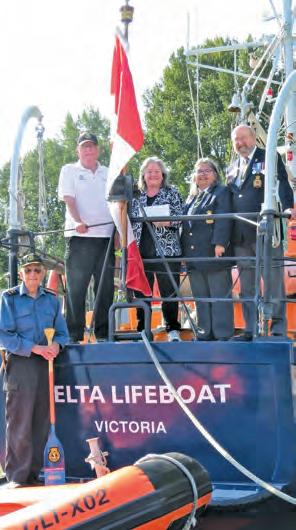
President Tanya McNeill and Past President Ken Harvey of Tsawwassen Branch in Delta, B.C., present $5,000 to officer-in-charge John Horton (left), Brian Cook and Jodie McDonald of the Canadian Lifeboat Institution for a refit on the Delta Lifeboat. In return, Tsawwassen Branch received thank-you paddles.
MARY HORTON
Logistics officer Lynnette MacKay (left), Joan Stachiw, Suzie Shaw, Jo-Anne Palvialok, Gladys Magega and President Trudy Ressler of Edmonton Ex-Servicewomen’s Branch celebrate women in the military at a conference in the Edmonton Garrison on International Women’s Day.
Carolyn MacDonald (left) and Sgt.-at-Arms Janet Axford of Bay Ridges Branch L.A. in Pickering, Ont., present the Legionnaire of the Year award to Jo-Anne Murray.

President Yvonne Glowacki (left) and Halina Wieclawek of Polish Veterans Branch in St. Catharines, Ont., decorate ‘Smile’ cookies at the local Tim Hortons. Proceeds go to Hotel Dieu Shaver Hospital.
Membership chair Laurie Ryan (left) and President Ernie Bremner of Fred Gies Branch in Kitchener, Ont., welcome new members.

Ontario Command President Derek Moore presents $108,000 to the Veterans Transition Network, represented by executive director Oliver Thorne, along with Marion Turmine of Quebec and Patrick Thomas of Ontario.
President Elizabeth Playford of Vic Fell Memorial Branch in Burk’s Falls, Ont., presents $500 bursaries to students Kris Tulson-Hunt and Adele Brooker.
President Anne McArthur of Coldwater, Ont., Branch presents $1,000 to 724 Midland Lions air cadet squadron, represented by sponsoring committee chair Kathy Hawkins and squadron CO Capt. Rosie D’Aguiar.
Second Vice Dave Evans (left) and President Brian Bielby of Fergus, Ont., Branch present $2,000 to the Belwood Lodge and Camp for the disabled, represented by campers Amanda Carron and Mike Patteson and camp leader Sophia Martin.
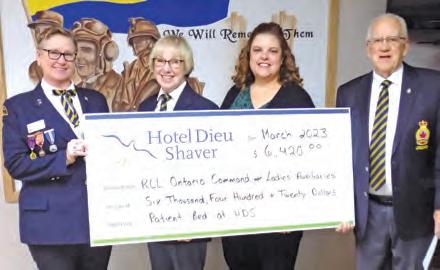
L.A. treasurer Angie Reid, President Trish Gander and Tom Lock of Merritton Branch in St. Catharines, Ont., presents $6,420 to Hotel Dieu Shaver Hospital on behalf of the Ontario Command Branches and L.A. Charitable Foundation. The hospital is represented by its senior development officer Kristina Manzi.
President Al Plume and First Vice Yves Bouchard of Trenton, Ont., Branch award Peggy Nancarrow with Legionnaire of the Year.
President Karen Thompson and Kelvin Hill of Magnetawan Branch in Dunchurch, Ont., present $10,360.90 to Whitestone Nursing Station, represented by nurse practitioner Teresa Weselaar and fundraising chair Marcella Sholdice.
Secretary Heather Atkins and President John Grozelle of Lt.-Col. John Foote VC Branch in Grafton, Ont., present Rowyn Doyle with provincial second-place awards for Junior essay in the poster and literary contests. Teacher Laurie Kernan (left) and Rowyn’s mother Charlene Doyle attend.
Wayne Cyrus and Steve Armstrong of Telephone City Branch in Brantford, Ont., present $6,500 to Brant Community Healthcare System Foundation on behalf of Ontario Command Branches and L.A. Charitable Foundation. Accepting the donation are foundation executive director Kari Wilson and associate director of development Crystal Godwaldt.
Ontario provincial L.A. sports chair Kelly Scott (left) and chair Brenda Deacon (right rear) present Claremonth, Ont., cribbage players Sue Grainger, Laureen Richarson, Lenora McKenzie and Ruth Murray with first-place honours in the provincial ladies tournament.
Steve Armstrong and Wayne Cyrus of Telephone City Branch in Brantford, Ont., present $7,250 to the Brant Community Healthcare System Foundation on behalf of Ontario Command Branches and L.A. Charitable Foundation. Accepting the donation are foundation executive director Kari Wilson and associate director of development Crystal Godwaldt.
Ray Pavlove (left) and Tom Traversy of Pioneer Branch in Parry Sound, Ont., present $12,235 to the Military Family Resource Centre in North Bay, Ont., represented by executive director Tessa Clermont.
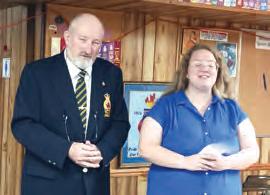
President Tony Goslinski of Fairbank Branch in Toronto presents $8,197.36 on behalf of the Ontario Command Branches and L.A. Charitable Foundation to Deanne Conder, representative of Belmont House seniors’ residence.
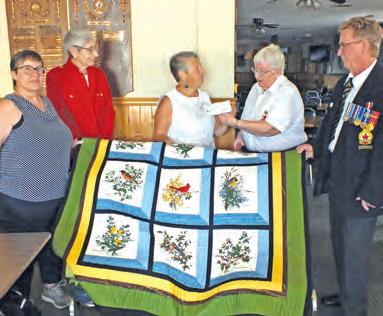
Bingo chair Fay Tait and Second Vice Rick Woodward of Elliot Lake, Ont., Branch present $2,000 to Quilts of Valour, represented by Ann Ralph (left), Monique Fourcaupot and Judy Millard.
President Frank Gosnell of Reg Lovell Branch in Glencoe, Ont., presents the Legionanaire of the Year award to Brian Vander Kwaak.
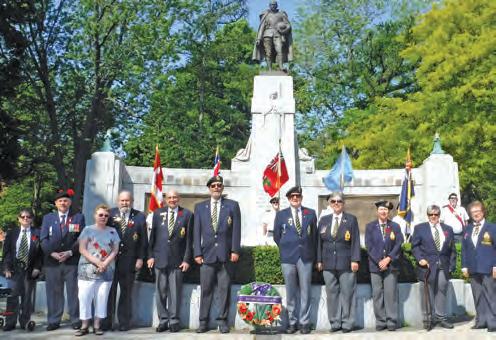
Oshawa, Ont., Branch members and colour party hold a memorial service for Decoration Day.
Third Vice Halina Jach and President Stan Howie of Polish Veterans Branch in Kitchener, Ont., present $5,060 to St. Mary’s General Hospital Foundation, represented by business development officer Calvin Carter, on behalf of the Ontario Command Branches and L.A. Charitable Foundation.
Merv Allum (left), Louie Dines and Keir Kitchen of Capreol, Ont., Branch present $4,000 to Maison McCulloch Hospice in Sudbury, represented by executive assistant Colette Pepin.
President Glen Hanley of Paisley, Ont., Branch presents $1,500 to the U7 baseball team and coach Nick Hindman.
Vice-President Donald Wolan (left) and President Ronald Butcher of Dunsdon Branch in Brantford, Ont., host Brantford-Brant MPP Will Bouma for a tour of their renovated facility, which includes a new kitchen floor, cooler, stair lift, security system, furnishings and cloak room counter. The Ontario Trillium Foundation contributed $96,700 for the reno.
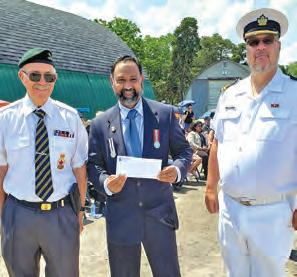
Second Vice Bob Elliott of Pte. Joe Waters Branch in Milton, Ont., presents $2,000 to 304 Chaudiere sea cadet corps, represented by Navy League president Don D’Souza (centre) and and CO Lieut. (N) Andrew Townley.
L.A. Sgt.-at-Arms Annamarie Kinsman of Port Elgin, Ont., Branch presents $5,000 to Owen Sound Hospital Foundation, represented by executive director Amy McKinnon.
Second Vice Sharon Maas of Port Elgin, Ont., Branch L.A. presents $5,000 for the Operation Service Dogs program to Ontario Command President Derek Moore.
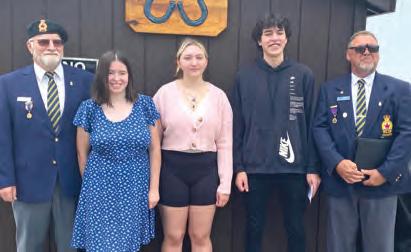
President David Boerrichter (left) and bursary chair Paul Strybosch of Brig.-Gen.
G.H. Ralston Branch in Port Hope, Ont., present $1,000 bursaries.
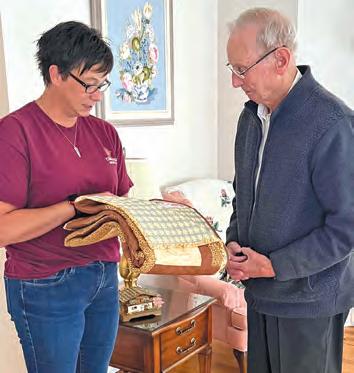
Richmond, Ont., veteran Oscar Clench receives a quilt from Quilts of Valour representative Shelly Lamothe.
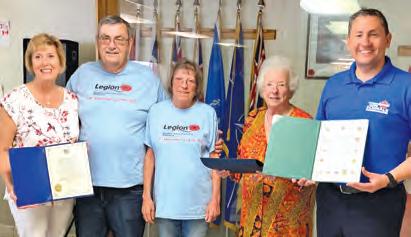
The Douglas Hatch Branch in Wilberforce, Ont., celebrates its 50th anniversary. Presenting commemorative certificates to Past President Bruce Rennie and President Janice Sorensen are Haliburton-Kawartha Lakes-Brock MPP Laurie Scott (left), Highlands East MPP Jan Simon and Haliburton-Kawartha Lakes-Brock MP Jamie Schmale.
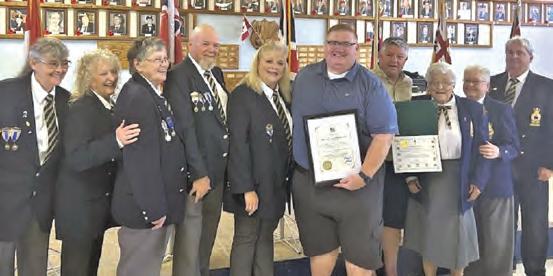
Parry Sound-Muskoka MPP Graydon Smith and MP Scott Aitchison present executive members from Sundridge, Ont., Branch with certificates marking the branch’s 75th anniversary.
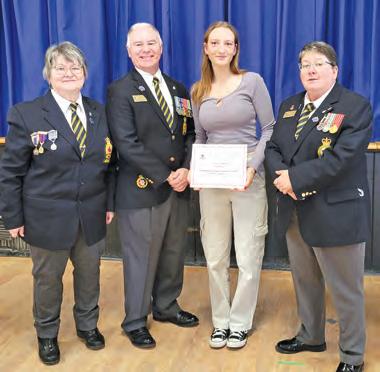
Youth education chair Ellen Johnston (left), First Vice Mike Ostafichuk and President Tracy Shultz of Stittsville, Ont., Branch congratulate Erin Dippel on winning Legion poem and essay contests.
First Vice Bryan Arsenault of Oshawa, Ont., Branch presents a $250 bursary to Ethan Merrifield.
C-1 youth education chair
Keith Vanderhoek and First Vice John Chatham of Ripley-Huron Branch in Ripley, Ont., present Cheyenne Collins with awards for her winning essay in the Legion literary contest regionally and third place nationally.
Second Vice Bob Elliott of Pte. Joe Waters Branch in Milton, Ont., presents $2,000 for the Navy League cadet corps Adventure, represented by Navy League Milton president Don D’Souza and the commanding officer, Lieut. (N) Shane Bernard.
Public relations chair Sharon Hope, honours and awards chair Diane Gottschalk and President Glen Hanley of Paisley, Ont., Branch present the Legion Media Award to the Paisley Advocate, represented by editor Gail Fullerton and reporter Patricia Smith.

After an event to raise funds to help fight brain cancer, its co-ordinators Leslie Hendrickson (left) and Fiona Bell are joined by St. George, Ont., Branch President Ed Hunter to present $35,185.07 to the Brain Tumour Foundation of Canada, represented by Eileen Quigg.
Sgt.-at-Arms Bob Thomson, President Jim Hemlin and First Vice Mary-Jo Gauthier of Kanata, Ont., Branch present $5,000 to Perley Health, represented by executive director Delphine Haslé.
President Shirley Chalmers of Harry Miner VC Branch in Clinton, Ont., presents $1,000 to Clinton Minor Baseball.
Past-President Greg Williams of Kitley-Toledo Branch in Toledo, Ont., presents $500 to Toledo Soccer Club co-chairs Emily Morrison (left) and Megan Simmon.
Former president Royden Johnson of Dr. W.C. (Bill) Little MM Branch in Barrie, Ont., presents $3,000 to the Barrie Food Bank, represented by client and volunteer experience manager Michelle Runge.
President Shirley Chalmers (left) and treasurer Sue Taylor of Harry Miner VC Branch in Clinton, Ont., present $1,500 to Super Strokers Junior Dragon Boating, represented by athlete Julia Chagnon.
Veterans service officer Stefan Wieclawek (left), President Yvonne Glowacki, Second Vice Bogdan Wilk and Third Vice Richard Bucko of Polish Veterans Branch in St. Catharines, Ont., welcome new members Martin Grzadka and Monika Wilk.
Diane Thorne, Sharon Cousins, Allan Pollard and Glenda Pollard of Goderich, Ont., Branch present $1,000 to Emilie Hogan for the Huron Women’s Shelter.
Sgt.-at-Arms Bob Thomson, President Jim Hemlin and First Vice Mary-Jo Gauthier of Kanata, Ont., Branch present $5,000 to Queensway Carleton Hospital Foundation, represented by its president and CEO Dr. Andrew Falconer.
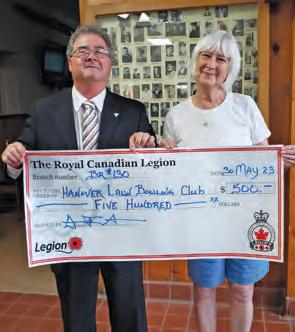
Hanover, Ont., Branch charitable foundation chair Don Butland presents $500 to Shirley Walker for the Hanover Lawn Bowling Club.
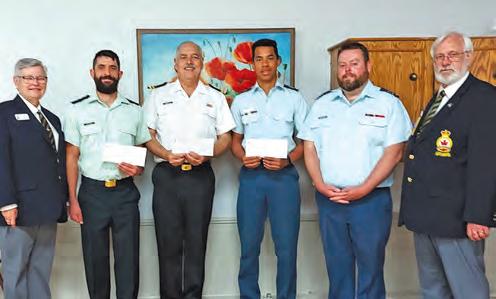
Mavis Williamson and President Marvin Plumadore of John McMartin Memorial Branch in Cornwall, Ont., present $2,000 each to army, sea and air cadet programs.
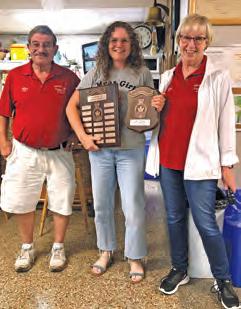
President Alex Verdile (left) and Past President Trish Gander of Merritton Branch in St. Catharines, Ont., present the Legionnaire of the Year award to Mati Percival.
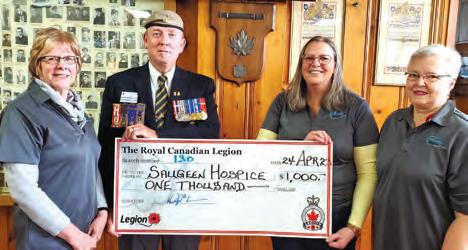
Hanover, Ont., Branch President Dan Haverson presents $1,000 for Saugeen Hospice-Hike, represented by volunteers Marilyn Newbiggin, Sylvia Stewart and Linda Klages.
Sgt.-at-Arms John Savaitzski of Jervis Bay Memorial Branch in Saint John, N.B., presents $5,000 to the area’s new RCAF 100 air force memorial park, represented by Greg Boudreau. H.E. WRIGHT
President Gary Bovard and treasurer Cheryl Broad of Hartland, N.B., Branch donate $500 to the Hartland Community Garden, represented by member Renée Crouse and administrator Jeff McKinney.
Victor Sears of Sackville, N.B., Branch presents bursaries to Koji Matthew Gates, recipient of the $500 Anthony Landry Memorial Bursary, and Liam Thomas Robert Price, recipient of the $1,000 Robert R. Hicks Memorial Bursary. HUGUETTE CHAMPAGNE
Mike Agar, Sgt.-at-Arms Charles Gabriel and Past President Rick McGinley of Jervis Bay Memorial Branch in Saint John, N.B., present $1,200 bursaries to Heather Totten and Casey Whitebone. Not present are students Lily McCain, Alyssa Anderson, Daniel Beckerton and Erika Delponte. H.E. WRIGHT
Thirty members of several Saint John, N.B., area Legion branches held a tribute service for the late Lt.-Gen. Lou W. Cuppens, the highest ranking New Brunswick member of the RCAF and a long-time veterans’ advocate. Mrs. Cuppens is front and centre.
President Leon Savoie and bursary chair Roger Ruddick of St. Croix Branch in St. Stephen, N.B., present St. Stephen High School students with $500 bursaries: Sadie Moffatt, Lauryn Cleghorn, Broden Bellis and Zachery Kinney. GERALDINE LEAVITT
John Duffy, Michael White, Wilmond Turbide and President Eugene Godin of Herman Good VC Branch in Bathurst, N.B.. present bursaries to Naomi Boudreau (the G. Harry Willett Memorial Bursary), Dina Duffy (the Phil Andrews Memorial Bursary), Chloe Le Breton (the A.M. McMurray Memorial Bursary), and Justin Roy (the Herman J. Good VC Memorial Bursary). GRAHAM WISEMAN
President Kathy Campbell and First Vice Bill Whites of Peninsula Branch in Clifton Royal, N.B., cut the cake on Canada Day.
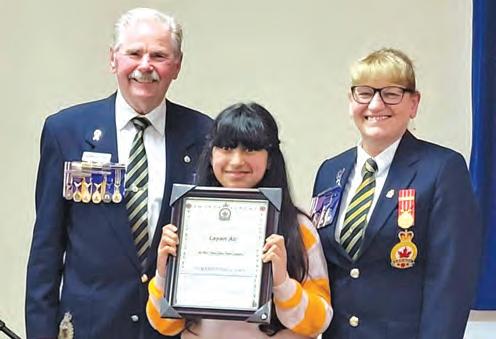
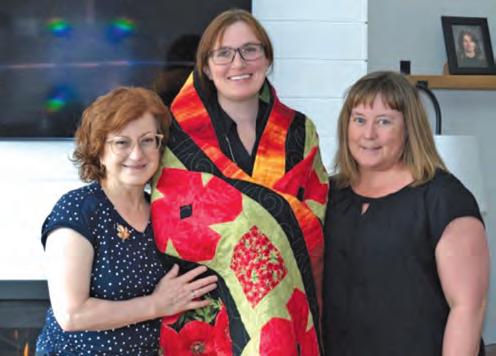
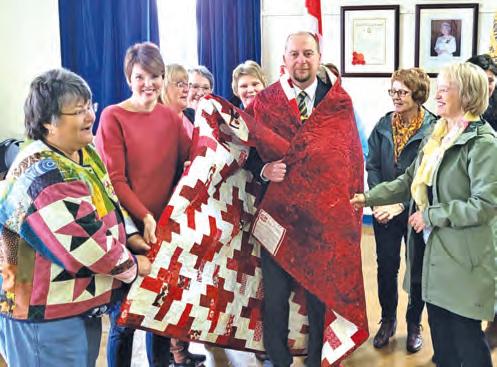
CORRESPONDENTS’ ADDRESSES
Send your photos and news of The Royal Canadian Legion in action in your community to your Command Correspondent. Each branch and ladies auxiliary is entitled to two photos in an issue. Any additional items will be published as news only. Material should be sent as soon as possible after an event. We do not accept material that will be more than a year old when published, or photos that are out of focus or lack contrast. The Command Correspondents are:
BRITISH COLUMBIA/YUKON: Graham Fox, 4199 Steede Ave., Port Alberni, BC V9Y 8B6, gra.fox@icloud.com
ALBERTA–NORTHWEST TERRITORIES: Bobbi McCoy, 2020 – 15 St. NW, Calgary, AB T2M 3N8, bobbi-mccoy@shaw.ca
SASKATCHEWAN: Tara Brown, 2267 Albert St., Regina, SK S4P 2V5, admin@sasklegion.ca
MANITOBA: George Romick, 320 Admiral Court, Thunder Bay, ON P7A 8B5, romickg@tbaytel.net
NORTHWESTERN ONTARIO: George Romick, 320 Admiral Court, Thunder Bay, ON P7A 8B5, romickg@tbaytel.net
ONTARIO: Mary Ann Goheen, Box 308, Gravenhurst, ON P1P 1T7, magoheen@sympatico.ca
QUEBEC: Mary-Ann Latimer, 105-2727 rue St. Patrick, Montreal, QC H3K 0A8, msmarts@bell.net
NEW BRUNSWICK: Harold Wright, 2-299 Main St., Saint John, NB E2K 1J1, foulis20@gmail.com
NOVA SCOTIA/NUNAVUT: James Leadbeater, 4129 New Waterford Highway, New Victoria, NS B1H 5T4, james.leadbeater@hotmail.com
PRINCE EDWARD ISLAND: John Yeo, 657 Rte. 19, Meadow Bank, PE C0E 1H1, islander657@yahoo.ca
NEWFOUNDLAND AND LABRADOR: Brenda Slaney, Box 5745, St. John’s, NL A1C 5X3, bslaney@nfld.net
DOMINION COMMAND ZONES: EASTERN U.S. ZONE, Gord Bennett, 803-190 Cedar St., Cambridge, ON NIS 1W5, Captglbcd@aol.com; WESTERN U.S. ZONE, Douglas Lock, 1531 11th St., Manhattan Beach, CA 90266, douglock@fastmail.com
Submissions for the Honours and Awards page (Palm Leaf, MSM, MSA and Life Membership) should be sent directly to Michael A. Smith, Legion Magazine, 86 Aird Place, Kanata, ON K2L 0A1 or magazine@legion.ca.
TECHNICAL SPECS FOR PHOTO SUBMISSIONS
DIGITAL PHOTOS—Photos submitted to Command Correspondents electronically must have a minimum width of 1,350 pixels, or 4.5 inches. Final resolution must be 300 dots per inch or greater. As a rough guideline, colour JPEGs would be between 0.5 megabytes (MB) and 1 MB.
PHOTO PRINTS—Glossy prints from a photofinishing lab are best because they do not contain the dot pattern that some printers produce. If possible, please submit digital photos electronically.
FRENCH INSERT—To receive a French insert of Legion Magazine content, please contact MagazineSubscriptions@legion.ca or call 613-591-3335.
President Bill Meadus and Past President Jackie Vokey of Clarenville, N.L., Branch present third place in the poster and literary contest to Layan Ali of Riverside Elementary.
St. John’s veteran Valerie Duggan receives a Quilt of Valour from representative Beverly McLean (left) and quilter Susan Snow.
Retired MWO Dale Benson of Clarenville, N.L., Branch is presented with a Quilt of Valour by the members of the Clarenville Seniors Quilting Group.














Saanich Peninsula Br., Sidney, B.C.
Lower

Lower Southampton Br., Nackawic, N.B.
Lower Southampton Br., Nackawic, N.B.
LONG SERVICE AWARDS
50 years


Lower Southampton Br., Nackawic, N.B.
Lower Southampton Br., Nackawic,

Lower Southampton Br., Nackawic,
Lower Southampton Br., Nackawic, N.B.


Lower Southampton Br., Nackawic, N.B.
Lower Southampton Br., Nackawic, N.B.
TRAIL GRUBERT Hudson Br., Que.
DON BERRY
JAMES MONTEITH
DAVID McGUIRE
IVAN DROST
KENNETH MOORE
WALTER NIXON Fillmore Br., Sask.
ART JACOBSON
CECIL STAIRS
N.B.
ROSS CARRUTHERS
MARTIN LAINE Eastview Br., Vanier, Ont.
LOUIS LAPRADE Trenton Br., Ont.
GUY PENNEY Carbonear Br., N.L.
GERALD CARTER Wynyard Br., Sask.
GORD CONVERY Bowmanville Br., Ont.
DONALD WHITE Whitby Br., Ont.
JUDITH (JUDY) GREEN Kamsack Br., Sask.
JOHN SHIFFLETT Trenton Br., Ont.
EDWARD M cGUIRE
Southampton Br., Nackawic, N.B.
DUNCAN McDONALD
Col. A.G. MacDonald Memorial Br., Alexandria, Ont.
SUSAN GLASIER
N.B.

DERK DUEMEYER
South Carleton Br., Manotick, Ont.
BRITISH COLUMBIA
MICHAEL G. HYKAWAY Okanagan Falls Br., B.C.
LOST TRAILS
ONTARIO
SUE McLEAN Kanata Br., Ont.
THE AMERICAN LEGION—The American Legion Calgary is open to U.S. servicemen and women and U.S. citizens who served with an Allied service. It meets every second Wednesday of the month at Forest Lawn Legion, 755 - 40th St. SE Calgary. For more information, email postcn20@hotmail.ca or call 403 230-4430.

GALLERY POSTERS
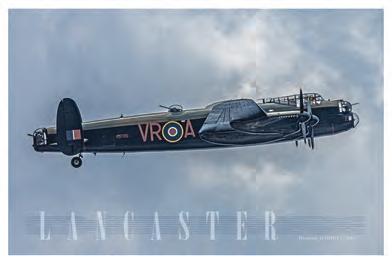
BASTARACHE Lower Southampton Br., Nackawic, N.B.
ROBERT PENNER Flin Flon Br., Man.
WALTER FEROLIE Kirkland Lake Br., Ont.
Whitby Br., Ont.
MIKE SAS Kamsack Br., Sask.
BRENDA GRANT Kanata Br., Ont.
KENNETH MOORE Lower Southampton Br., Nackawic, N.B.
KEN WELCH Grenfell Br., Sask.
Treaty talk
What’s next for Ukraine and NATO
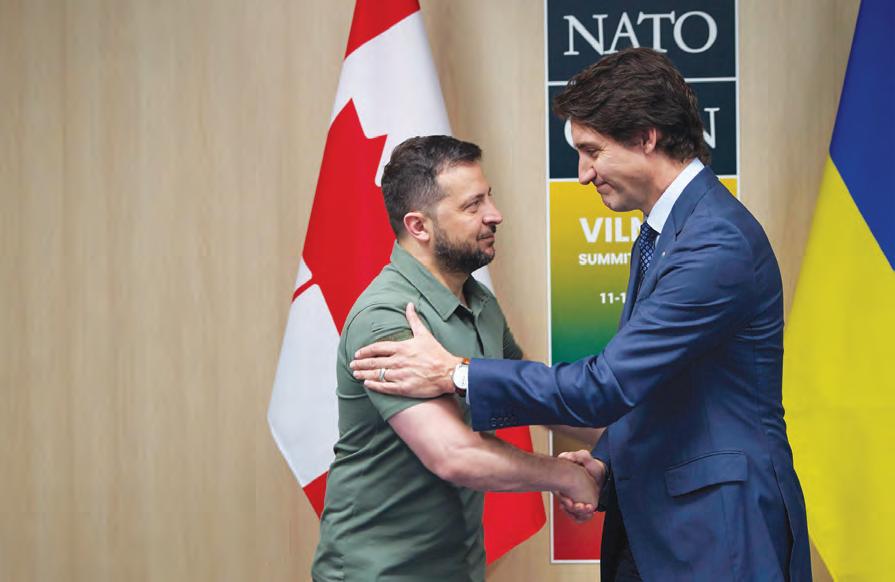
The Russian invasion of Ukraine has altered global politics. It led NATO members to give billions of dollars in military assistance to the defenders and, with some notable exceptions including Canada, to raise their national defence budgets substantially. It also prompted Finland and Sweden to abandon their historically neutral policies to seek security within NATO.
Chinese President Xi Jinping pledged his country’s support to Moscow, but has thus far done very little to help Russian President Vladimir Putin in his war of aggression. The vaunted Russian army has proven to be a poorly led horde, and Putin, unable to secure a quick victory and seize control of Ukraine, has resorted to a brutal war of destruction, rape and the slaughter of countless innocent men, women and children.
Still, the fight continues, its casualties huge, its outcome still uncertain. Will Ukraine seize a victory that regains all its territory? Will a Russian revival gain ground? Will it end in a stalemate? Will a negotiated armistice halt the conflict?
There is one certainty: if Ukraine survives as an independent state, it must receive further protection from Russian aggres-
sion. Back in 2002, Kyiv first called on NATO to allow it to join the organization; in 2008, after being nominated by Canada, Ukraine formally applied for NATO membership; and in 2019, five years after Russia had seized Ukraine’s Crimean Peninsula, Kyiv amended the country’s constitution to include its desire to join NATO (and the European Union). Ukraine wants in.
Clearly, as Ukrainian President Volodymyr Zelenskyy understands, NATO cannot admit the country while the war continues. Doing so would oblige the organization’s member nations to join the fight, bound by the treaty’s Article 5—a war against one is a war against all. Plus, NATO (and the EU) wants Ukraine to end the rampant political and corporate corruption in the country while moving quickly toward building a more transparent and democratic society.
Regardless, NATO members have loudly proclaimed that they want Ukraine to join them soon. As Latvian Prime Minister Krisjanis Karins stated bluntly: “The only chance for peace in Europe is when Ukraine will be in NATO.”
Moscow, however, claims that one reason for its invasion was the mere possibility of Ukraine joining the Western alliance,

and Russia threatened to use its nuclear weapons if Ukraine joined NATO. Putin evidently sees NATO as an existential threat to his country. With NATO members Estonia, Latvia, Lithuania and Poland bordering Russia, adding a well-armed Ukraine with a newly efficient army would massively increase Moscow’s concern.
NATO members realize this, of course, but they no longer fear Russian threats as they might have been before February 2022’s poorly executed invasion and the failed coup in late June. Moreover, unlike Putin, NATO knows that it doesn’t intend to start a war against Russia and has never even contemplated doing so. NATO was, and remains, a defensive alliance; adding Ukraine to the organization wouldn’t change that. Letting Kyiv join would, however, guarantee Western support for Ukraine in the face of any renewed Russian aggression.
Even so, Putin’s threats must be taken seriously. And it will take time for Ukraine to meet Western democratic standards. But is there a middle ground that can assure Kyiv of NATO support against further Russian attempts to swallow its people and territory whole in the meantime? There may be.
A few years before Putin took power in Moscow, Russia and Ukraine signed a Treaty on Friendship, Cooperation and Partnership that outlined the inviolability of their shared border and a respect for territorial integrity. So much for treaties, it seems, but some international agreements might be better for Ukraine. The U.S. and Britain, for instance, have offered bilateral security partnerships to Ukraine, but a firm treaty with G7 nations and NATO members would, of course, be even stronger.
The difficulty is, even if Ukraine wins the war and liberates all of its territory, it will remain a neighbour to “a very aggressive country” as Foreign Affairs Minister Mélanie Joly said this past April. For its part, Canada wants NATO to establish a clear path for Ukraine to achieve membership in the organization. This would include a formalized extension of support—in the form of training, equipment and defence commitments—for as long as the war continues. The NATO summit in
July did not offer a timetable for membership, but it did offer solid commitments.
Such a plan should go a substantial distance to easing Ukrainian fears of being abandoned by its allies if the conflict doesn’t end soon. Better still would be an agreement with the U.S. similar to that between the Americans and Israel. Under their Strategic Cooperation Agreement, any threat to Israel would lead the U.S. to provide military support as needed, including armed intervention. A promise of that sort to Ukraine would surely be enough to deter Moscow.
Ukrainian President Volodymyr Zelenskyy meets with Prime Minister Justin Trudeau during a NATO summit in Vilnius, Lithuania, in July 2023.
A FIRM TREATY WITH G7 NATIONS AND NATO MEMBERS WOULD, OF COURSE, BE EVEN STRONGER
.
The difficulty, however, is that American political support for Ukraine is not as strong as it is for Israel and, if Donald Trump were to win the 2024 U.S. presidential election, any promise might be scrapped. Indeed, there might be no support for Zelenskyy’s government. And if Trump wins, his continuing, almost inexplicable admiration for Putin could lead the U.S. to abandon support for Ukraine entirely. What would NATO members do then?
The Canadian government’s position seems clear. In a visit to Kyiv this past June, Prime Minister Justin Trudeau told Zelenskyy that, “We will be with [you] as much as it takes, for as long as it takes.”
He added that Ukraine’s resistance to the invaders was about “the future of us all. You are the tip of the spear that is determining the future of the 21st century.”
The G7 nations and several NATO members have made similar comments. Unfortunately, they aren’t binding.
Only bringing Ukraine into NATO is likely sufficient to guarantee the country’s independence. And NATO can’t let Kyiv into the alliance until the end of the current war and Ukraine’s further moves toward democratic reform. Trudeau is right—the future of the world is at stake in the Ukrainian fight for freedom. L
Flagflap
Bruce Stock , a retired major who served with the Princess Patricia’s Canadian Light Infantry (PPCLI) and now lives in London, Ont., shared a tale about a flag mishap. In April 1967 on the 50th anniversary of the Battle of Vimy Ridge, former Ontario premier Leslie Frost went to Vimy to present the town with the new Canadian Maple Leaf flag. He was escorted by a 50-man guard of honour from 2 PPCLI, a colour party and a band from the ordnance corps. He was introduced to an interested crowd and, holding a very large folded nylon flag in his arms, he walked to the microphone. Frost
warmly praised the two countries’ bond of mutual sacrifice and expressed his pride in presenting Vimy with the new national standard, during Canada’s centennial year. He gestured frequently as he spoke, while, unbeknownst to him, the slippery red and white nylon started to unfurl.
This happened directly in front of the honour guard and Stock’s alarm grew as the flag became a wiggly, squiggly, pile of static-charged laundry, which clearly resented being folded. The premier tried to tame the unruly banner, grabbing edges and pulling them back atop the slowly sliding pile. He then presented what looked like an armload of red and white laundry to the mayor of Vimy. That dignitary, somewhat shorter than the premier, found himself wrestling a slippery expanse of flag.
The honour of raising the flag had been given to an even-shorter gendarme who strode up and disappeared into the billowing cloud of nylon. He finally bundled it together and headed up to a second floor city hall balcony, which had no flagpole.
“I instinctively tensed as I wondered how the flag would be raised,” Stock recalled. “He quickly walked to one end of the balcony and started to tie an end of the flag to the rail. “‘Duh,’ I thought, it won’t be raised at all, he’ll simply hang it from the balcony!”
> Do you have a funny and true tale from Canada’s military culture? Send your story to magazine@legion.ca
As Stock watched, the officer tied off the banner and flipped it over the rail. Upside down.
Stock thought hard. “I started lifting my head up and down, suggesting ‘Look up’ in the hope that they would wonder what I was doing and start looking around.”
One dignitary finally figured out what was happening. “Pandemonium ensued, as people looked for the mayor, who looked for the gendarme, who scurried back up to the balcony.”
“After the flag was righted, we finally performed present arms as the colour party lowered its flags. And the band played the most stress-relieving and sweetest version of O Canada we had ever heard.”
A Saskatchewan boy who, in his telling “had never even been in a rowboat,” joined the Royal Canadian Navy in 1940. After his basic training he found himself aboard a corvette. On his first day, he was terribly sick.
“I asked this other guy if it always got this rough.”
That drew a laugh.
“We were still tied up to the dock.”
Another corvette veteran remembers the tossing and turning of the little anti-submarine vessels. “We used to say we had six square meals a day. Three going down and three coming up.”
A fellow who served in an infantry regiment in northwestern Europe remembers a day in the Netherlands when his unit was holding a house and facing a German line across a canal. A senior officer appeared unexpectedly and asked to be allowed to fire a machine gun, saying he had never done so. He was waved into place and directed toward a distant German position. He fired a burst and
THE
FLAG
BECAME A WIGGLY, SQUIGGLY, PILE OF STATICCHARGED LAUNDRY.
missed. Fired again and missed. A hole appeared in the plaster wall above his head.
“What hell was that?” he asked.
A private looked at him. “They are allowed to shoot back, sir.”
A Canadian who was a prisoner of war recalls being freed in the spring of 1945 as the Second World War wound down in Germany. One morning, the camp guards were simply gone. The PoWs cautiously began exploring the surrounding countryside. They came across an American unit moving east, which promptly arranged for their repatriation.
“The next day, I was in England. If we had been found by the British, I would probably still be there filling out paperwork.”
A Second World War veteran who was a sergeant in an armoured regiment shared a story about a wrong-headed officer who took him from command of a tank and sent him to a recce platoon. He figured orders were orders and pushed forward seeking the enemy. Soon, he and his comrades heard Germans moving toward them. They radioed in the news and were told to fall back quickly because of an incoming artillery strike.
The next morning, they went forward to assess the effectiveness of the barrage and found 14 dead cows. The sergeant was promptly returned to his tank. An observation from the ranks: the most dangerous man in the army is a lieutenant with a map. L
HEROES AND VILLAINS
By Mark Zuehlke
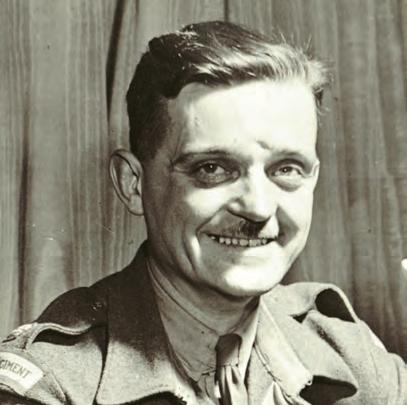
heroism in the face of Nazi resistance outside Ortona
earned him a Victoria Cross TRIQUET
&Captain Paul Triquet’s

OnTHE GULLY WAS TURNED, AN EPIC FIGHT WON
Dec. 10, 1943, the 1st Canadian Infantry Division’s advance on the Italian town of Ortona was blocked. For four days, a number of battalions were chewed up in unsuccessful attacks in the area the Canadians called The Gully. The 90th Panzer Grenadier Division was fully exploiting the geographic advantages provided by the deep ravine, the presence of which had been entirely missed by intelligence staff. On Dec. 14, however, the Canadians discovered the nearly fivekilometre-long gully could be outflanked where a three-storey, white stucco manor called Casa Berardi stood. Win the house and an advance along the Ortona-Orsogna road that paralleled the feature was possible.
it to drift out of the fight. Triquet managed to keep on track with seven Ontario Regiment tanks following. Triquet called the ensuing assault “one long cavalry.” His men pushed on despite significant casualties.
Just 200 metres short of the house, a severe barrage reduced the force to less than two dozen Van Doos and five tanks. “There are enemy in front of us, behind us, and on our flanks,” Triquet yelled. “There is only one safe place—that is on the objective.” By mid-afternoon, they gained the manor. By midnight, only 14 of the 22nd were still fighting when ‘D’ Company reinforcements arrived. German counterattacks the following day failed to dislodge the Canadians. The Gully was turned, an epic fight won.
“There is only one safe place— that is on the objective.”
—Captain Paul Triquet
At 7:15 a.m., Captain Paul Triquet of the Royal 22e Régiment led ‘C’ Company’s drive to the villa. The 33-year-old came from a long line of French military veterans. Lying about his age, Triquet had enlisted in the Van Doos at 17. A sergeant major in 1939, he received an officer’s commission shortly after the regiment deployed to Britain.
‘D’ Company advanced alongside ‘C,’ but incoming fire and the confusing terrain of vineyards and olive groves caused
Awarded the Victoria Cross, the government brought Triquet home to promote French Canadian involvement in the war. In Montreal, 300,000 people watched him paraded by in a car. He then toured the country for the 6th Victory Loan campaign. Deeply uncomfortable with the public relations role, Triquet desired to return to the Van Doos. After the war, he was promoted to lieutenant-colonel, but he struggled with alcoholism, owing to what he called “the noise of the mind.” Forced to retire in 1947, Triquet overcame his demons in the 1950s, then joined the reserves and retired as a brigadier in 1960. He died in 1980. L
&THE 90TH PANZER GRENADIER DIVISION
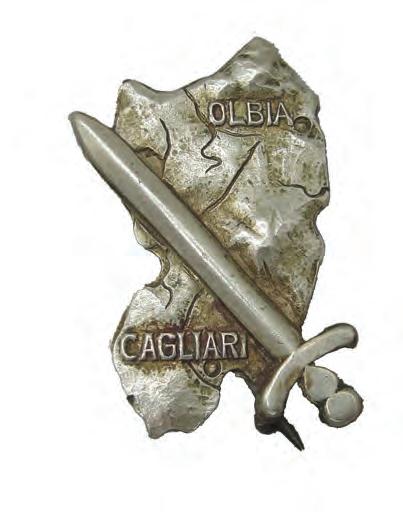

During the Canadian advance to Ortona across the Moro River and the Gully that started on Dec. 6, 1943, the opponent was the 90th Panzer Grenadier Division. Originally designated 90th Light Infantry Division, it had been one of the Afrika Korps’ finest units. All but destroyed in May 1943, it was rebuilt two months later as one of the new panzer grenadier divisions Hitler had ordered created after Stalingrad. Such divisions were highly mechanized in order to operate independently or alongside Panzer divisions.
Many of its soldiers had been serving since the September 1939 invasion of Poland. The 90th consisted of two infantry regiments of three battalions supported by a tank battalion, artillery regiment, anti-tank battalion and engineer battalion. Each infantry battalion was heavily equipped with 59 light and 12 heavy machine guns, three 7.5-centimetre antitank guns, six 8-centimetre mortars and four 12-centimetre mortars. The machine guns gave it tremendous firepower. Although its mandated strength was 14,000, in December 1943 it was well below that number.
From the Moro to The Gully, the 90th contested every bit of ground, meeting each advance with fierce counterattacks that cost both sides dearly. On Dec. 9, Generalleutnant Karl-Hans Lungershausen drew the division back to The Gully—the last bastion barring the way to Ortona. The following day,
he was notified that reinforcements from the 1st Fallschirmjäger Division were coming. Until they arrived, however, the 90th fought on.
The Gully perfectly suited the Panzer Grenadier Division. Showing on Canadian maps as nothing more than a thin line, it was almost five kilometres long from the sea to where it levelled out at Casa Berardi. It went from 300 metres wide at seaside to 80 metres at its westernmost extent. The average depth was 60 metres. Its slopes were steep.
The panzer grenadiers dug fighting pits at the top of the southern bank, as well as additional pits further downslope, which they sheltered in during the Canadian artillery barrage that preceded every battalion assault. When the guns ceased firing, the grenadiers rushed up the slope to engage their machine guns in the fighting pits. Doing so, they were able to defeat every frontal attack until Triquet’s Van Doos turned their flank.
The Sardinia Shield was worn by original members of the 90th Panzer Grenadier Division after it was formed on the Italian island in 1943.
THEY WERE ABLE TO DEFEAT EVERY FRONTAL ATTACK UNTIL TRIQUET’S VAN DOOS TURNED THEIR FLANK
Then the 90th pulled out. On Dec. 14, the war diarist of the 76th Panzer Korps of which 90th Division was part—wrote: “Enemy…in the exploitation of today’s success, presumably will take Ortona.” L
“Enemy…in the exploitation of today’s success, presumably will take Ortona.” —war diarist of 76th Panzer Korps
ARTIFACTS
By Paige Jasmine Gilmar
Street view
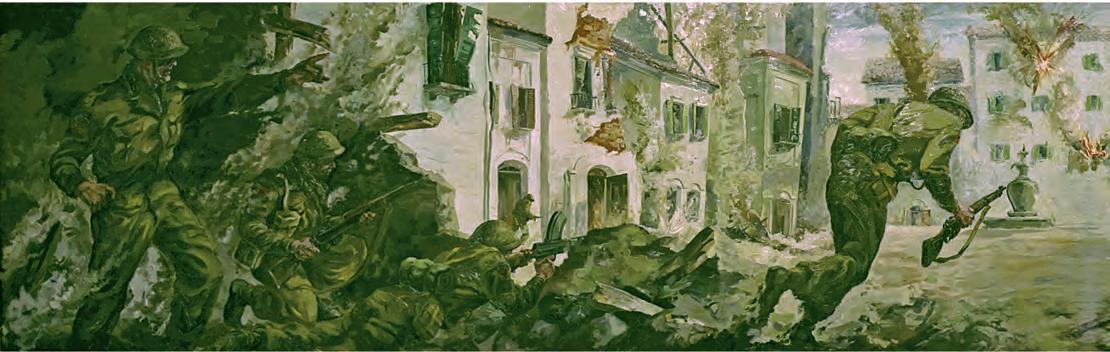
Artist Gerald Trottier’s massive tribute to the troops of the Battle of Ortona

“T
he price of Peace, borne by the brave— Is priceless…”
So goes part of the final stanza of George Elliott Clarke’s “At Ortona: An oratorio,” a poetic memorial of the blood, guts and glory of the Second World War’s Battle of Ortona. While lauded by CBC war correspondents as an example of Canadian heroism in the 1940s, the battle was largely forgotten.
The fight to push Nazi forces from the Italian town in December 1943 left more than 500 dead and nearly 2,000 more casualties, and featured dramatic house-to-house urban combat. It was Canada’s first stand-alone victory of the war. But as its 80th anniversary nears, Ortona remains, for many people, an obscure moment in Canadian history.
Painter Gerald Trottier, however, sought to commemorate the event in what was once thought to be Canada’s largest mural.
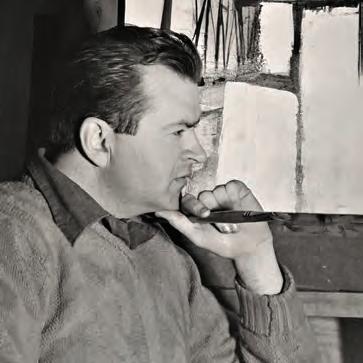
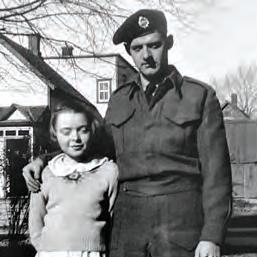
The Germans had made Allied movement difficult in the town, digging in along the Gustav Line while filling Ortona’s streets with debris.
The Canadians were left with no choice but to traverse cleared pathways, a German strategy that left them victim to MG-42 fire and booby traps.
Trottier, born in 1925 in Ottawa, received artistic instruction from renowned painter Ernest Fosbery, who was known as much for his stunning war art as he was for introducing Lord Beaverbrook to Canada’s most well-known art movement, the Group of Seven.
“[My father] was a renaissance man,” said Trottier’s daughter, Denise. “Not only in his art, but in his character.”
Trottier served briefly in the Royal Canadian Navy while Canadian soldiers funnelled into Ortona.
Having to improvise, the Canadians responded by using a tactic called “mouse-holing,” where they would blast the walls of adjoining houses to advance and, ideally, avoid German attack. In the midst of the Dec. 20-28 battle, Trottier’s older brother, Edward, was a tank driver.
Witnessing the psychological effects war had on his brother, Trottier sought to honour those who served in Ortona. An opportunity to do so would soon arise, his daughter said, by way of Fosbery’s referral.
Courtesy of Gordon Henderson’s family; Courtesy Denise Trottier
BY THE NUMBERS
8
Number of Gerald Trottier pieces in the National Gallery of Canada
18 Solo art exhibits by Trottier
6 Canadian postage stamps designed by Trottier
60
Approximate number of days to complete the Battle of Ortona mural
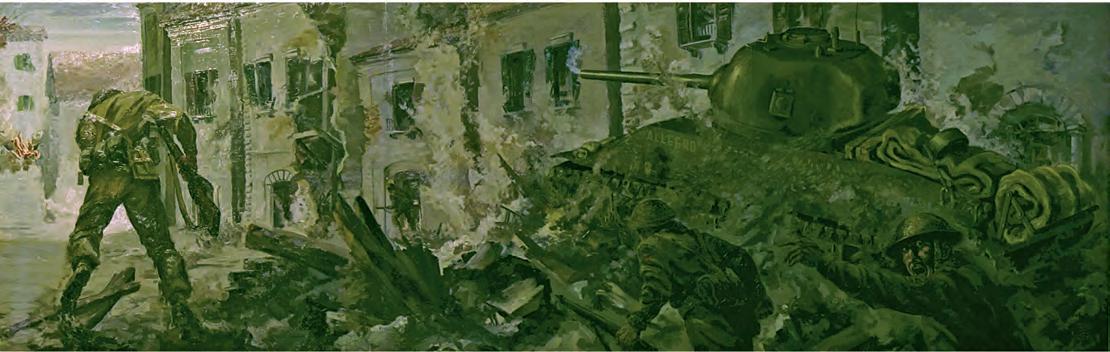
“You don’t have to be [a] historian to know this is a pretty important piece .”

At only 22 years old, Trottier was commissioned in 1945 by the 26 Central Ordnance Depot to paint a 14.6-metre-long, 2.4-metre-high mural. Using
This panoramic Battle of Ortona mural, painted by Gerald Trottier (opposite bottom and below, at work), now resides in Edmonton’s Prince of Wales Armouries. It was photographed by Gordon Henderson. Trottier’s brother Edward, with their sister Helen (opposite middle), was a tank driver during the fight.
photographs from the battle, along with his brother’s recollections, Trottier projected his charcoal outline of the painting onto a large canvas. Using oils to
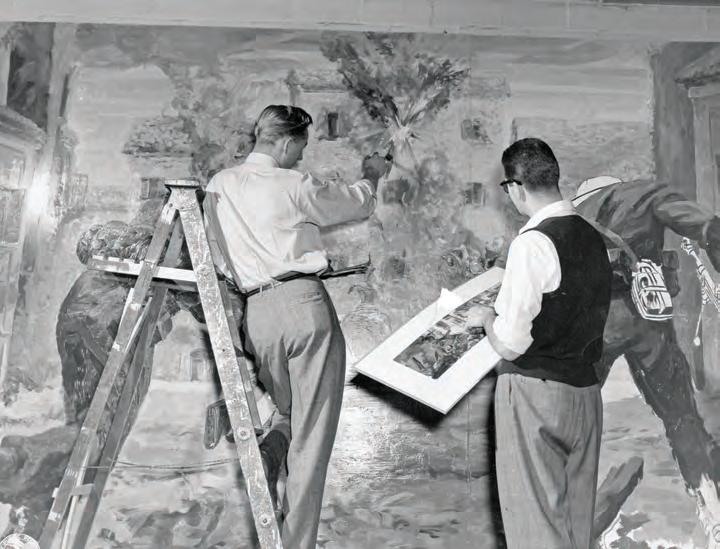
create moody shadows and vibrant blasts of colour, he, along with assistant John Parsons, painted the entire piece in two months.
In 1961, the Ordnance Depot presented the mural to The Loyal Edmonton Regiment, which played a key role in the Battle. It has been on display in the Prince of Wales Armouries ever since. Trottier’s masterwork—much like the Battle of Ortona itself—however, remains largely under-appreciated today.
“You don’t have to be [a] historian to know this is a pretty important piece,” said Denise.
“[But] it’s forgotten.”
Regardless, Trottier went on to have an illustrious career as an artist and educator, known for his “vigour and boldness”— and as one of the few artists to pay tribute to Ortona.
“Art influences us to think and remember,” Denise pointed out. “Art survives beyond.” L

By Don Gillmor
KING or CHAOS
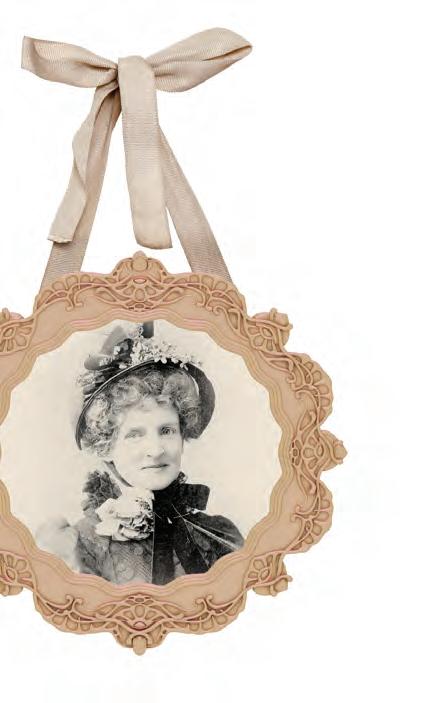
Mackenzie King poses with his dog, Pat, in 1940. King was a closet spiritualist who is believed to have often contacted his dead mother (above).
illiam Lyon Mackenzie King was Canada’s longest-serving prime minister— spending almost 22 years in office, his 1921-1930 term only paused for three months in 1926 when Arthur Meighen’s Conservatives formed the shortest-lived federal government in the country’s history. King returned in 1935, campaigning with the slogan “King or Chaos.” The electorate chose King, and he remained PM until finally retiring in 1948.
Frank Scott wrote a poem, “W.L.M.K.,” that criticized King’s penchant for inaction. (“We had no shape/Because he never took sides.”)
And it’s true that few politicians were able to inhabit the middle of the road like King. But supporters praised his steady hand, guiding the country through the last half of the Depression and the Second World War, introducing employment insurance, preserving its fragile national unity and increasing its independence from Great Britain.
King’s policies weren’t exciting, one historian noted, but they were largely successful.
King was dull and reliable, a lifelong bachelor with few friends. His outer life was politics. His inner life was more complicated.
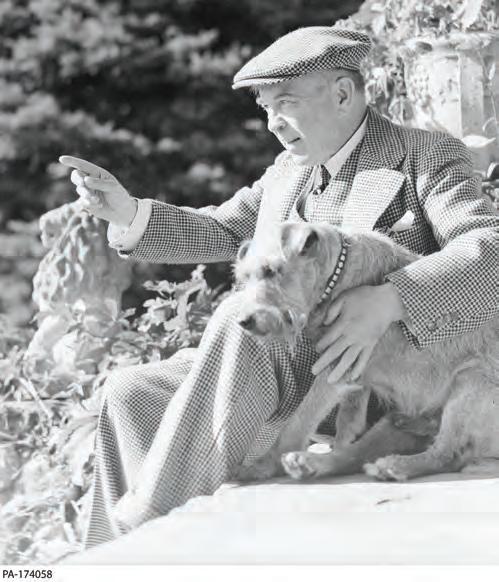
KING’S POLICIES WEREN’T EXCITING, ONE HISTORIAN NOTED, BUT THEY WERE LARGELY SUCCESSFUL
Find many more stories in our O Canada special issues, NOW available in our SHOP!



King kept a voluminous diary—some 50,000 pages—and it wasn’t until its posthumous publication that Canadians saw a glimpse of King’s occasionally bizarre private world.
King was a closet spiritualist, often consulting a Detroit medium named Etta Wriedt. Through Wreidt and other mediums, King contacted his dead mother, his closest relationship, and his deceased Irish terriers, each named Pat, a close second. He had conversations with Queen Victoria, Anne Boleyn, Leonardo da Vinci, Wilfrid Laurier and Philip the Apostle. He consulted fortune tellers, saw meaning in tea leaves, embraced numerology and participated in seances that involved “rapping,” where the
spirits spelled out responses by knocking on the table: one tap for A, two for B, etc. Thankfully, King rarely used these experiences to guide him in political matters. More often, they confirmed what he already thought, which would argue against their authenticity. King’s diaries also revealed some of his political miscalculations. After meeting Hitler in 1937, King believed that like himself, Hitler was a spiritualist. His “Mother’s spirit is I am certain his guide,” he wrote. “I believe the world will yet come to see a very great man—mystic, in Hitler.” (King wasn’t alone in this characterization: a British diplomat compared Hitler to Gandhi.) After their session, King concluded that war wasn’t imminent.
King’s oddities weren’t public knowledge during his tenure, and he remained popular, if not beloved, throughout it. His political skills were subtle, but he instinctively understood how to keep Canada together, a country perennially divided by geography, politics, language and culture. For 22 years, he was the still, some would say inert, centre of the national conversation. Through a medium, the deceased U.S. president Franklin D. Roosevelt advised King not to retire, that his country still needed him. But in 1948, King’s health was failing, and he announced his retirement. He died two years later. L






Rogers Preferred Program