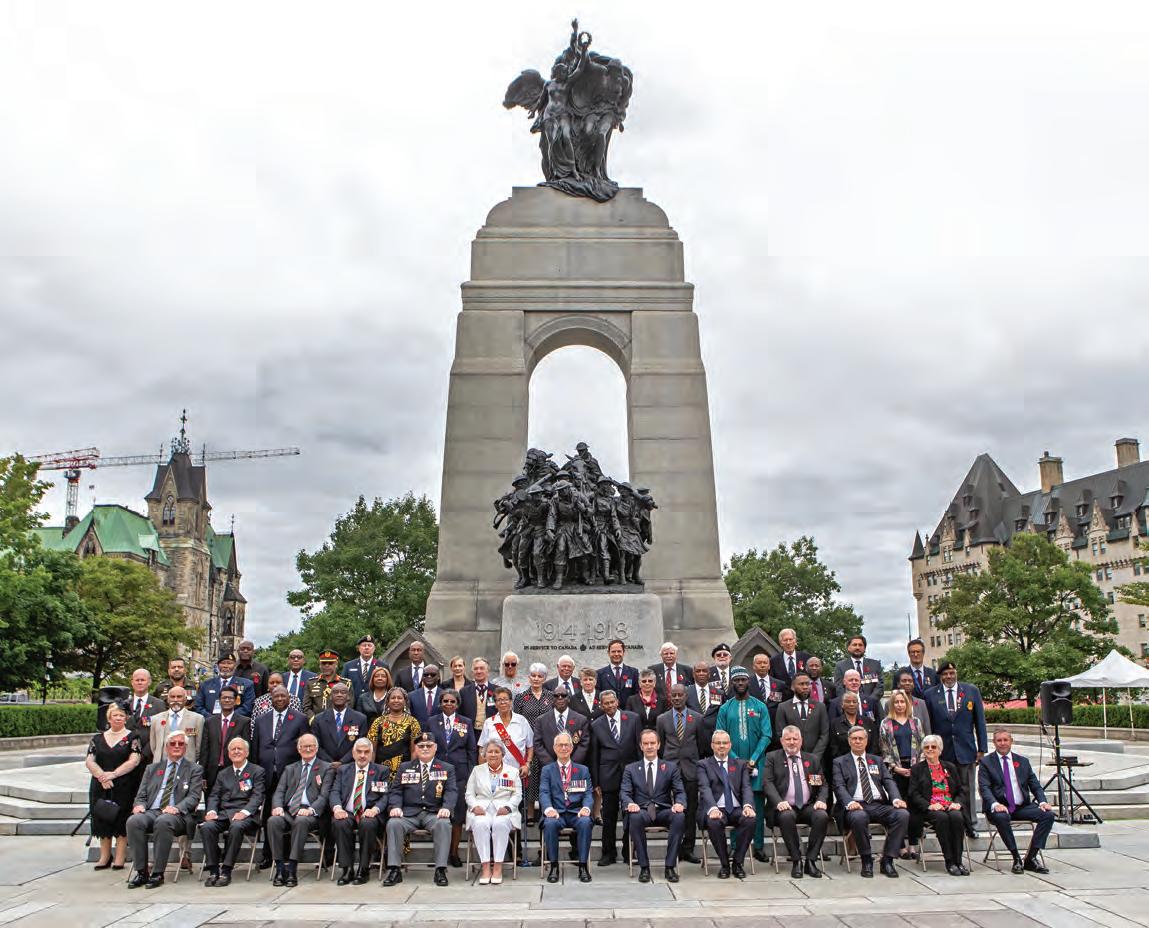
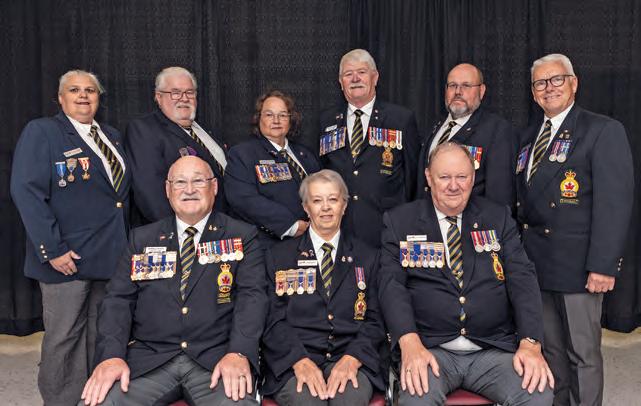
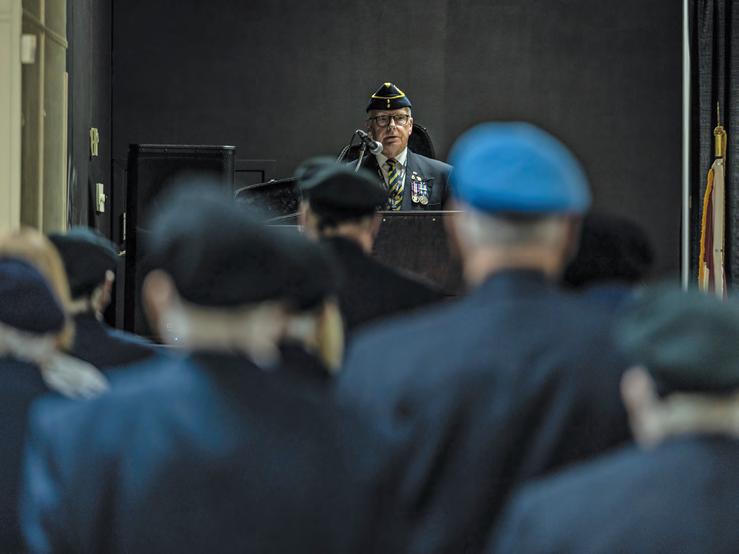
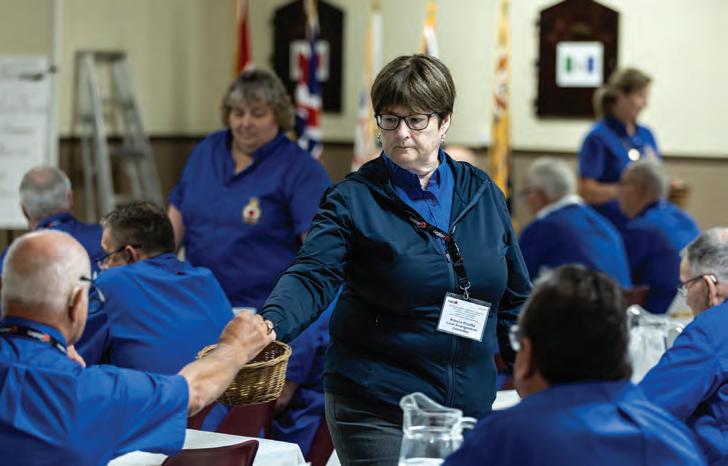
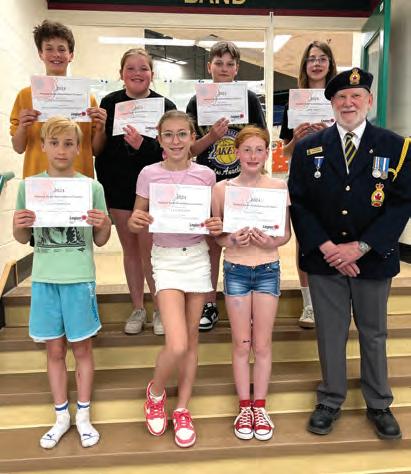
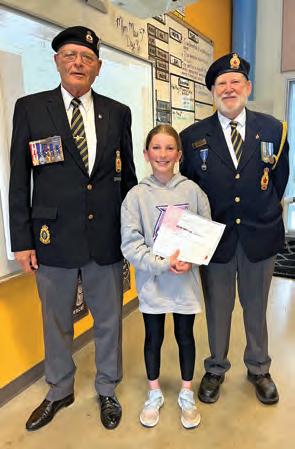
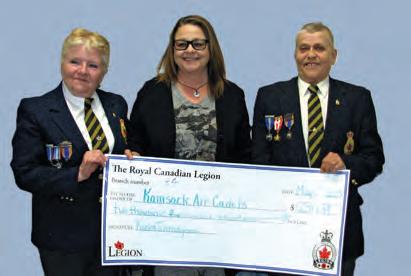
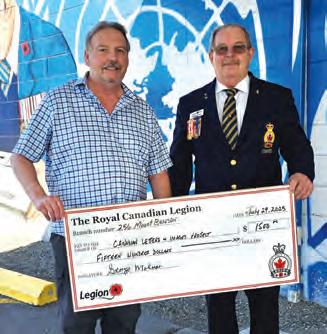
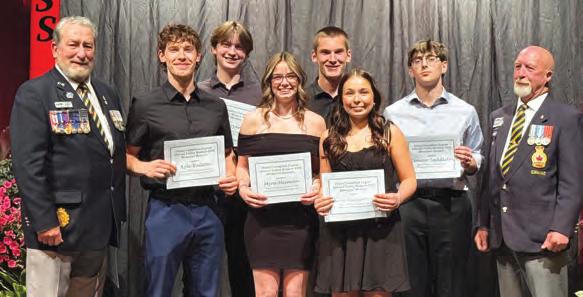
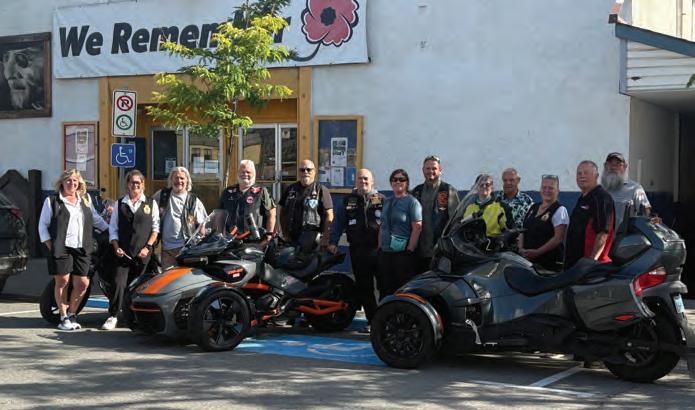
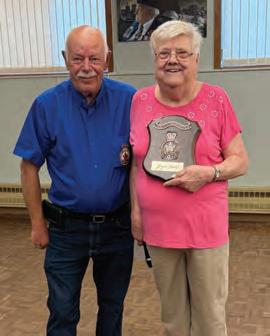
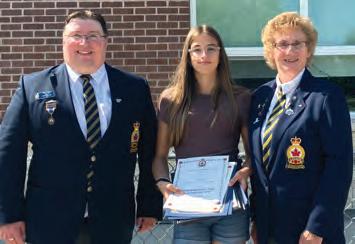
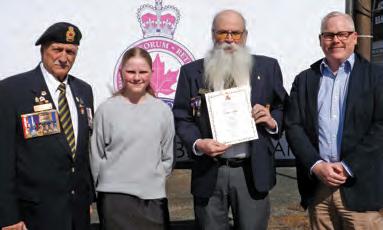
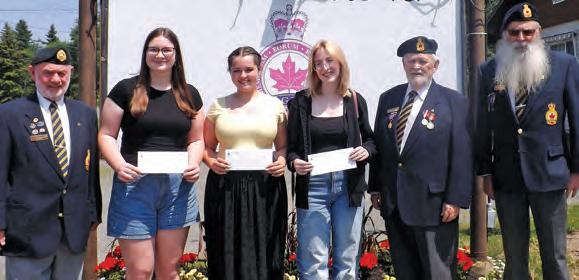
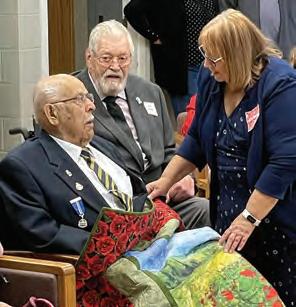
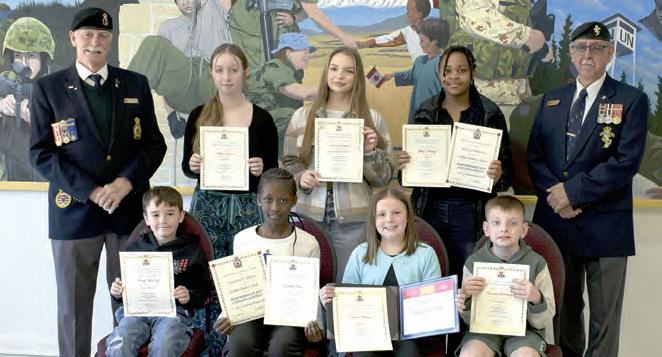
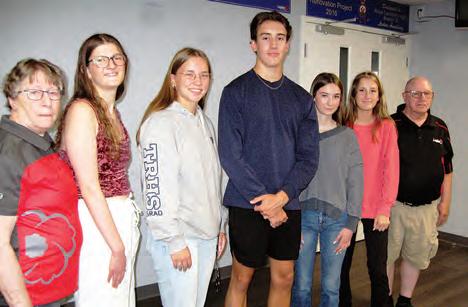
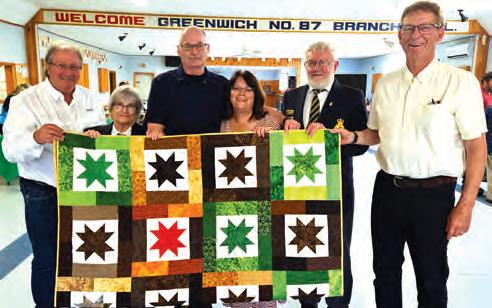
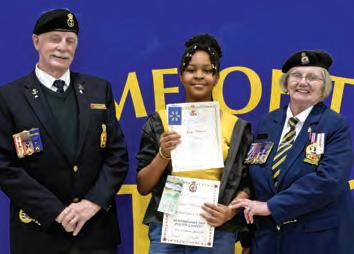
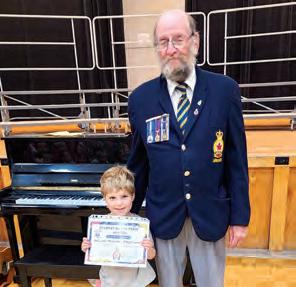
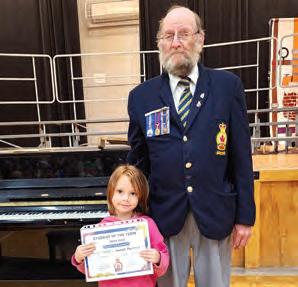
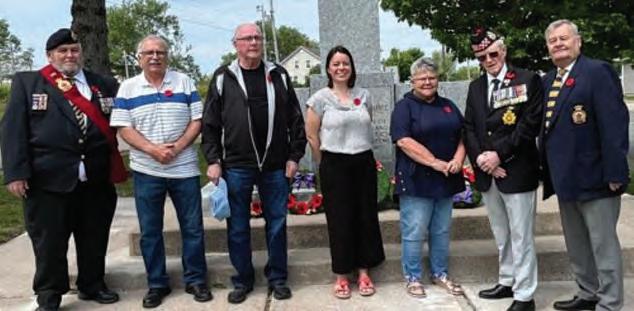
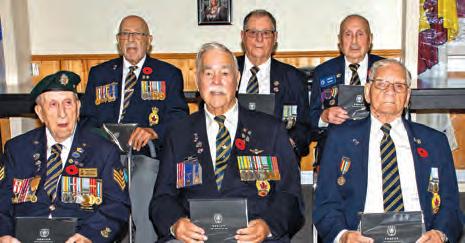
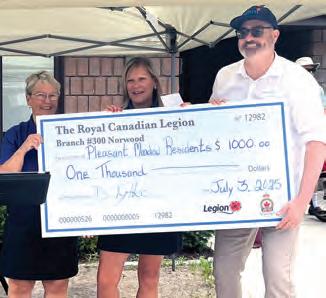
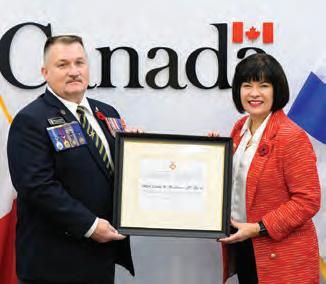
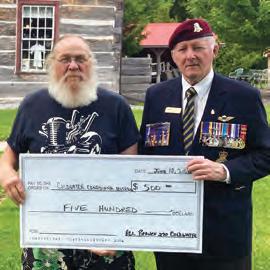
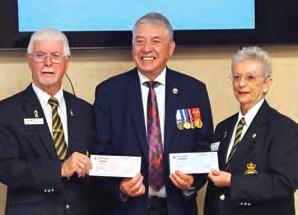
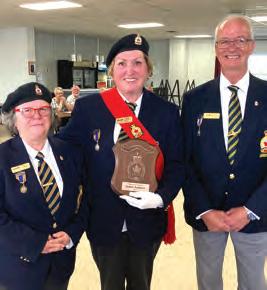
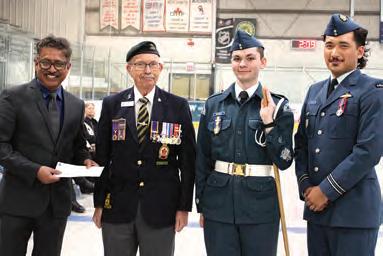
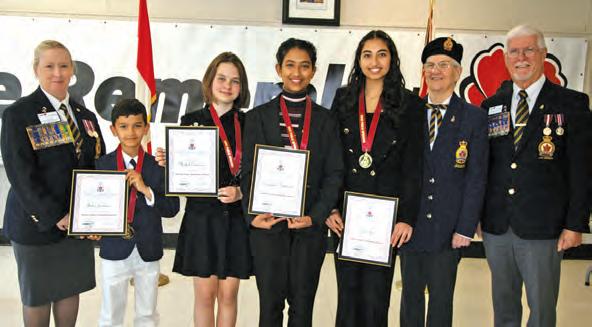
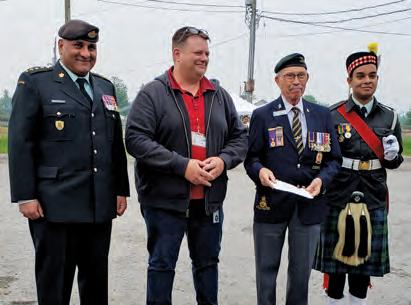
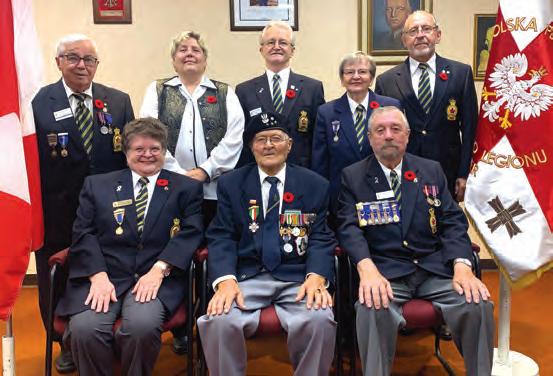
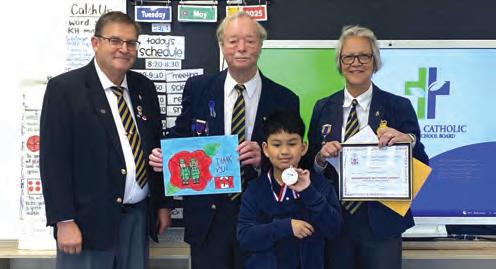
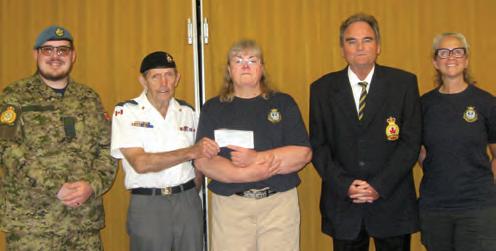
It’s because of members like you... that we receive letters like these:
“I can’t thank you enough for everything you did to make his last days and my life less stressful by coming to bat to help him receive deserved funding. Every penny went toward caregiving and other medical or travel expenses while he was alive and the last compassionate payment toward funeralhome expenses. I shall be indebted to you for the rest of my life.”
“Your hard work and perseverance on my behalf made it possible for me to receive a medical pension for on-going health issues. It has allowed me some peace of mind regarding my family’s well-being. In addition, the pension allows my wife and I to remain living in our own home and we are very grateful for that.”
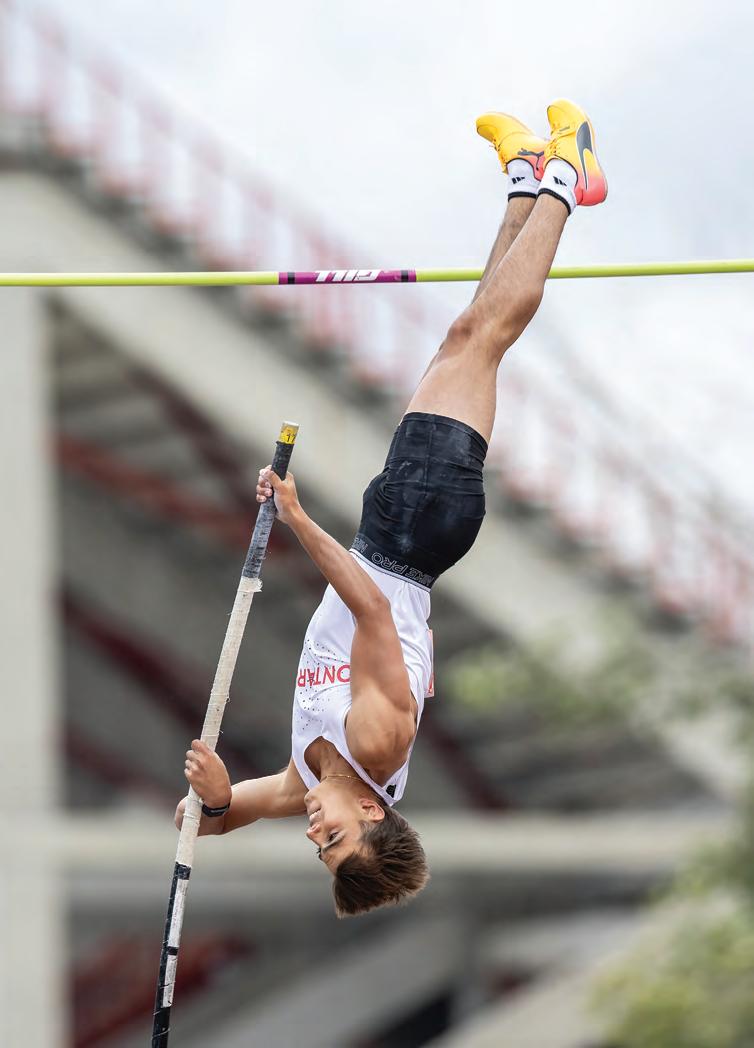
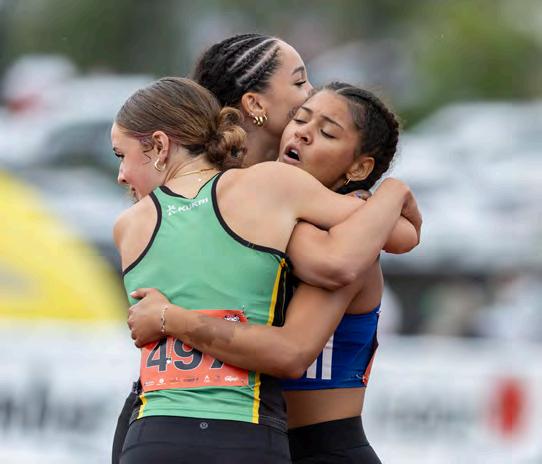
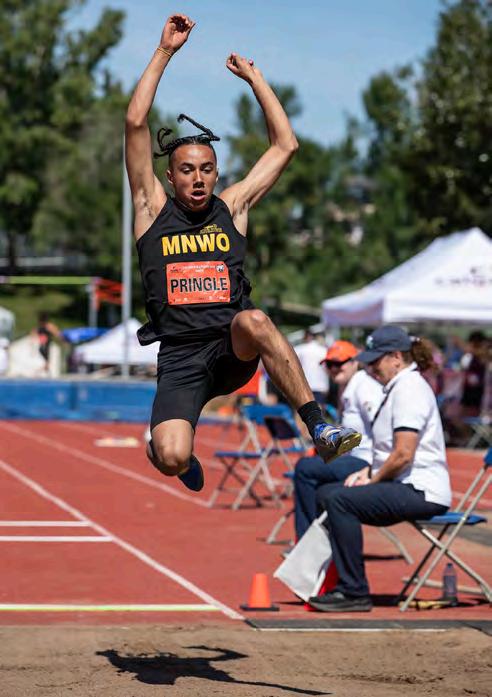
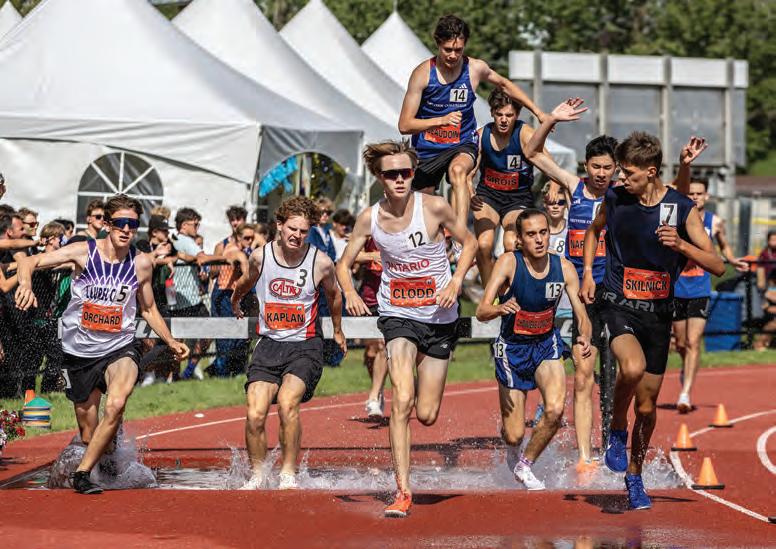
EYES ON THE PRIZE
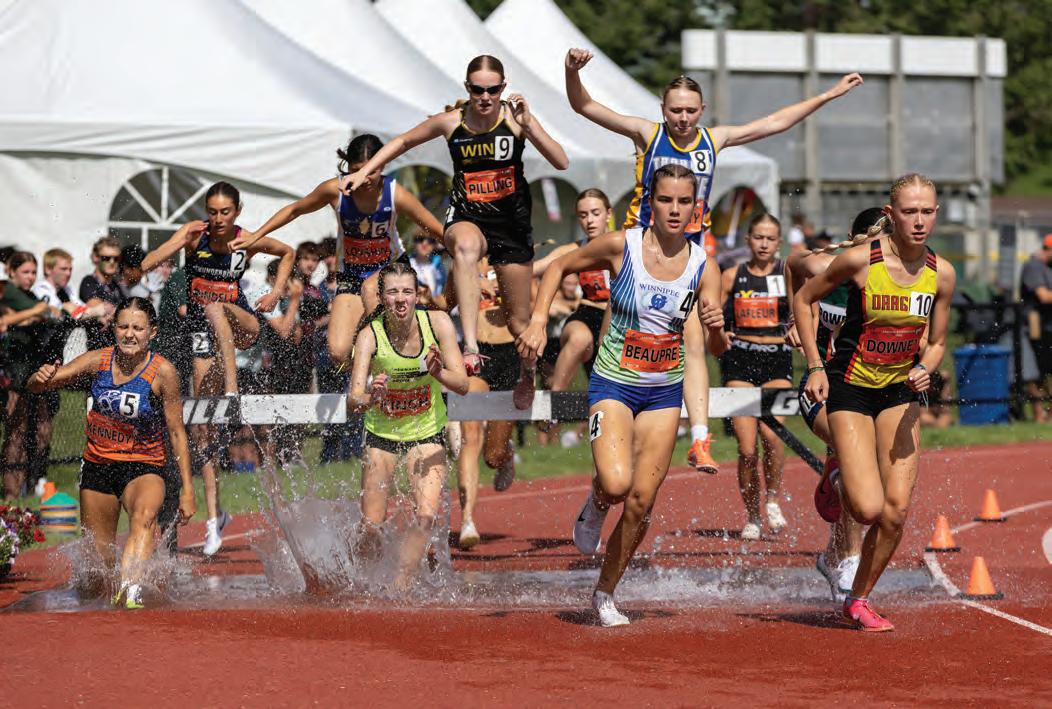
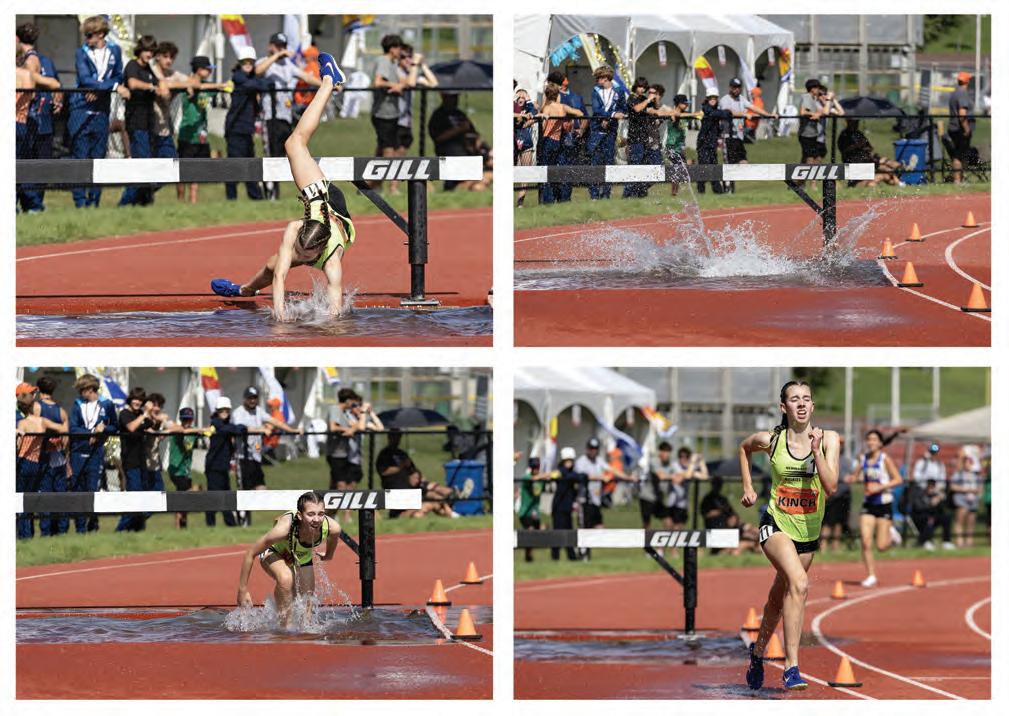
Bianka MacMillan of Ontario took silver in the U-16 women’s 200m hurdles and bronze in the 100m hurdles (pictured) at the 2025 Legion National Youth Track and Field Championships.
See page 82
Stephen J. Thorne/LM
Features
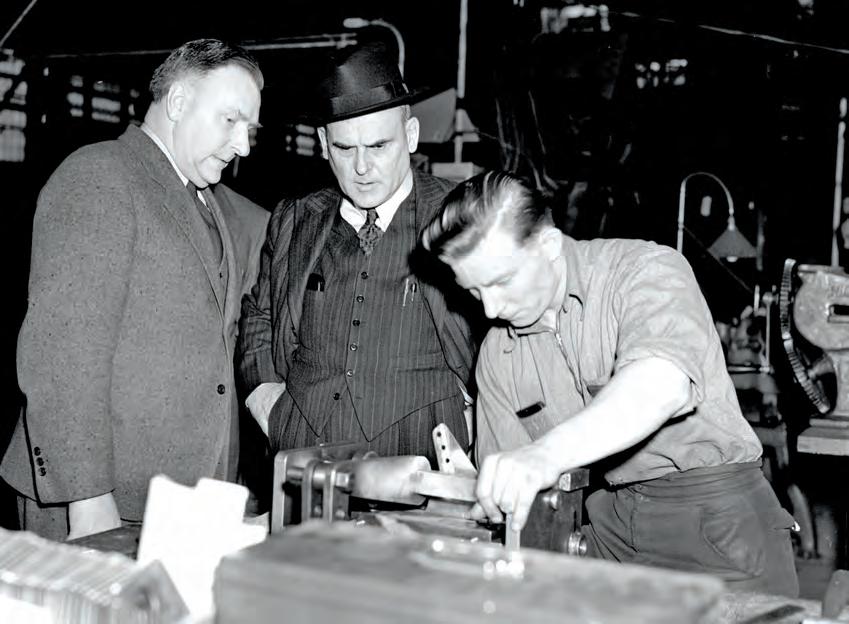
22 THE BADASS BAGPIPERS OF THE 16TH BATTALION
And the legendary lore of the wind instrument of war
By Stephen J. Thorne
30 MINESWEEPER MYSTERY
What happened to two First World War French warships in Lake Superior?
By Mark Bourie
38 FIRST KILLS
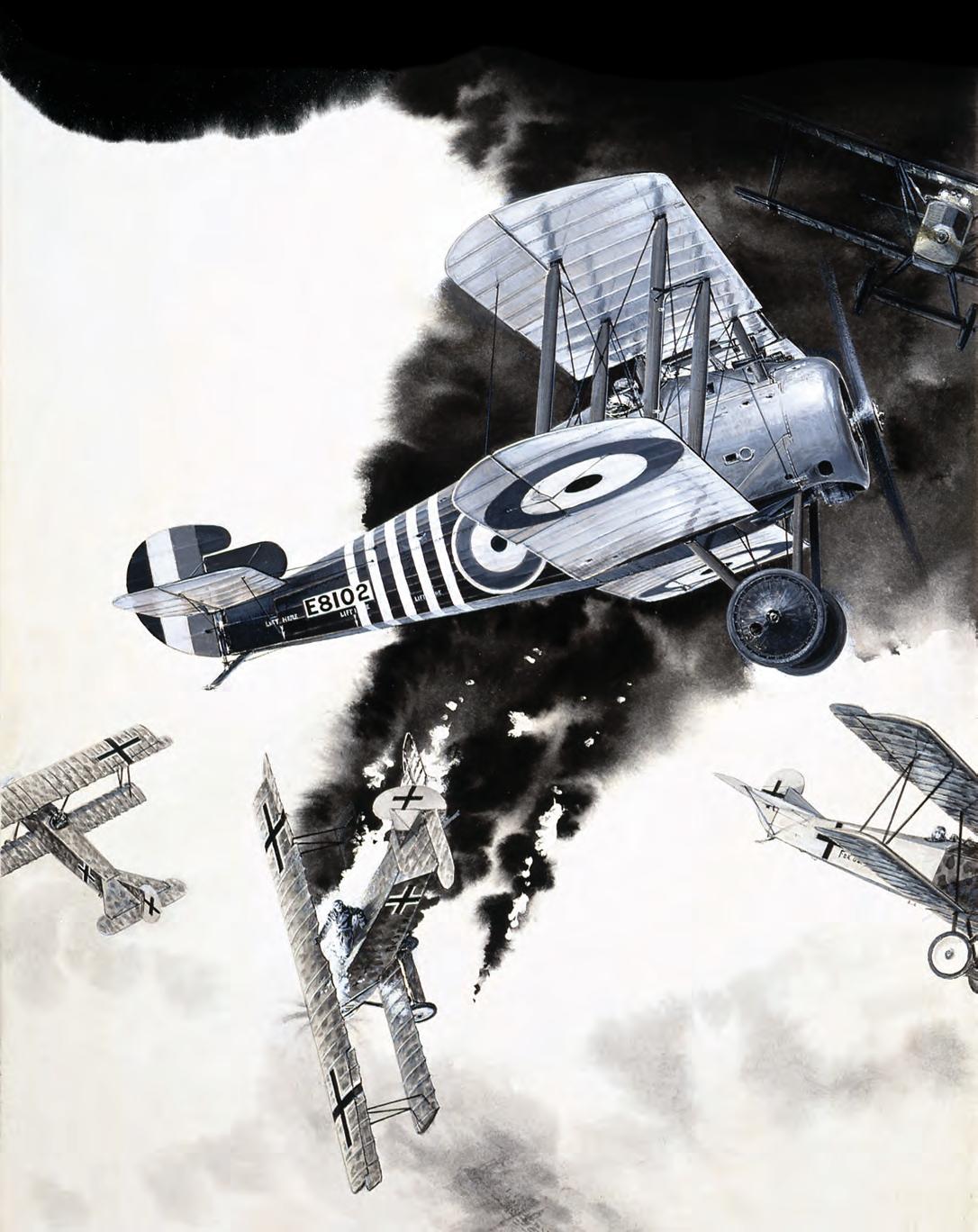
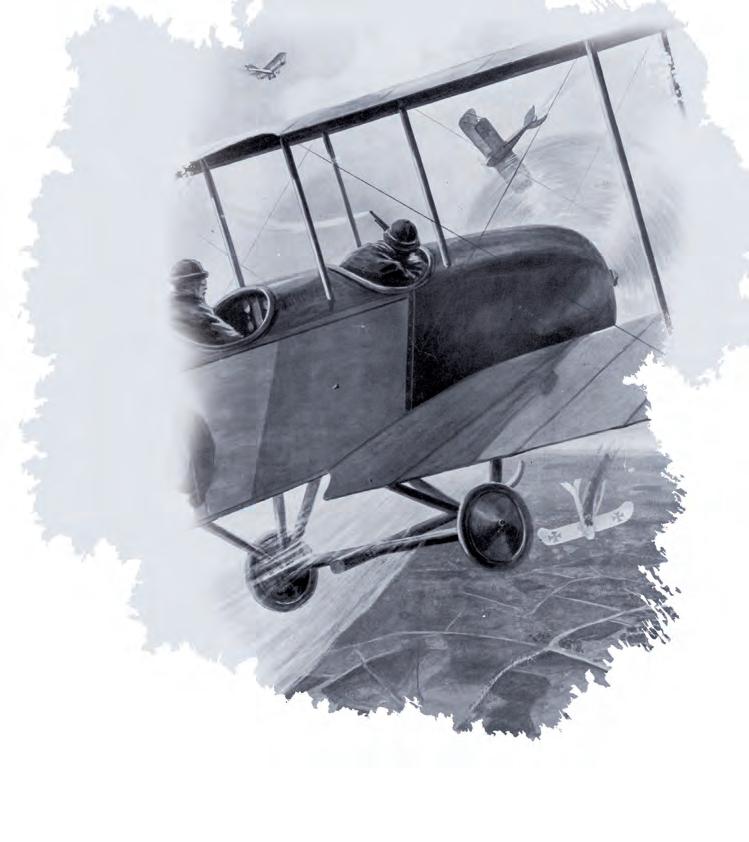
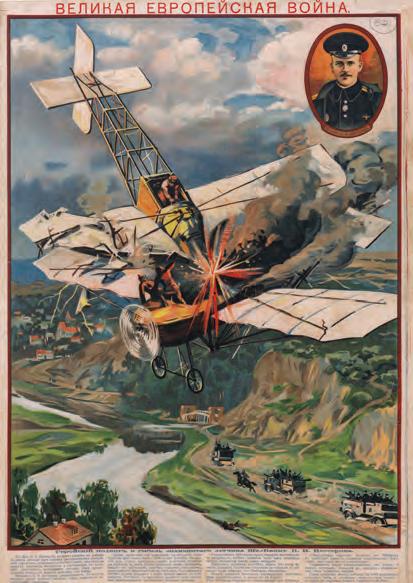
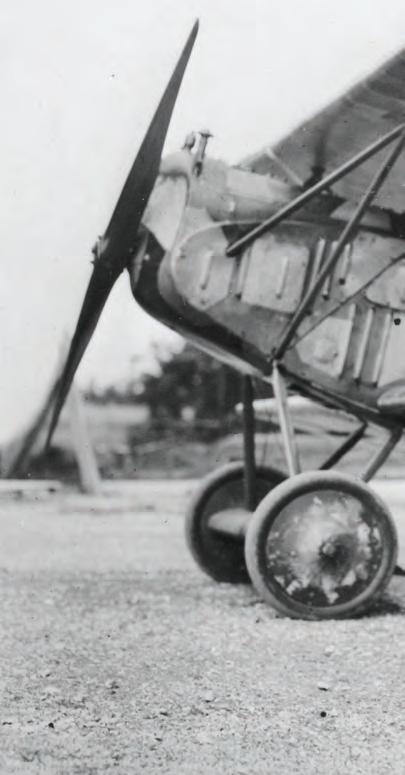
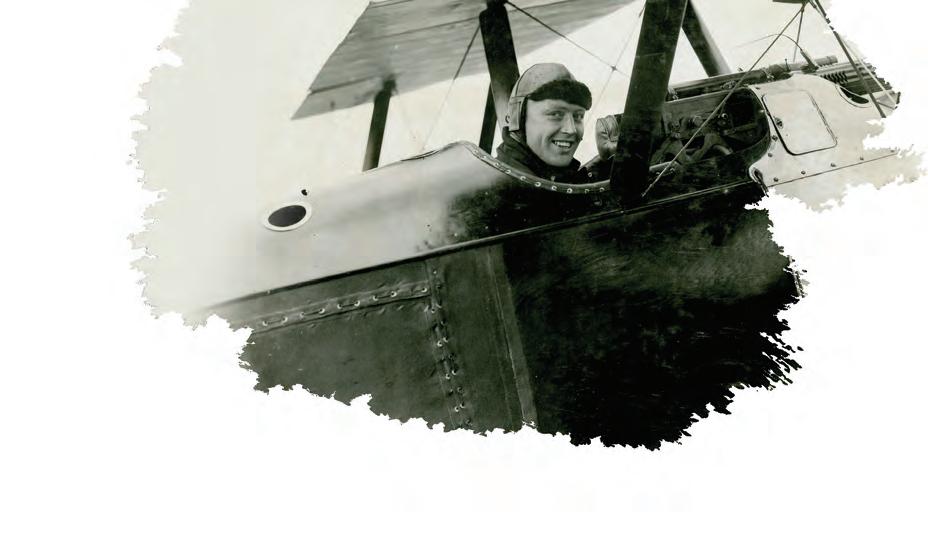
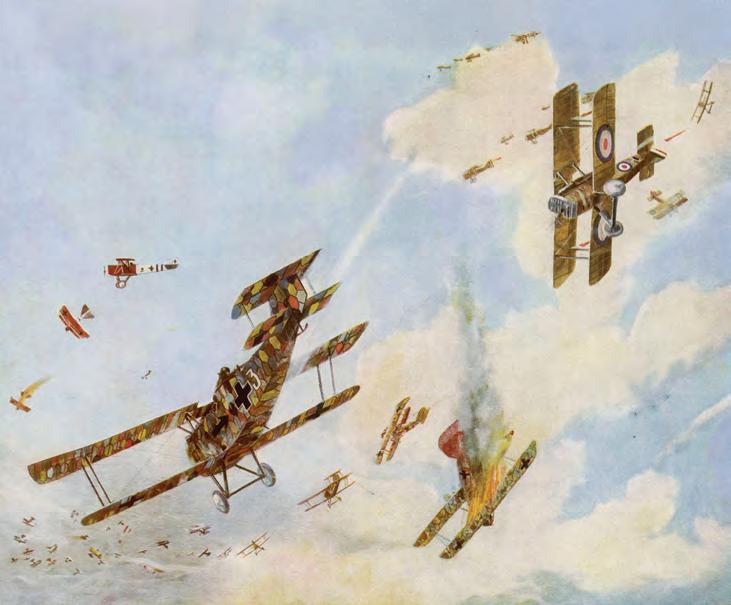
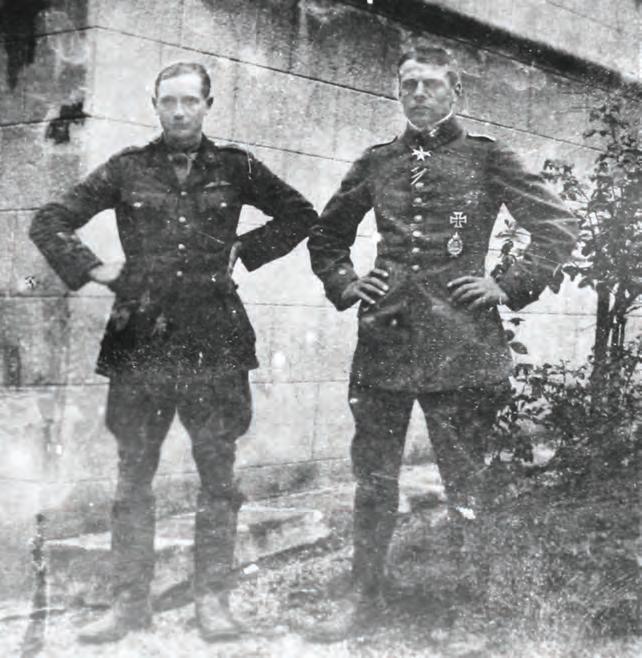
After the First World War, Canadians became some of the most renowned aerial aces. Here’s where it all began. By
Stephen J. Thorne
48 THE GREATEST OF THE GREAT
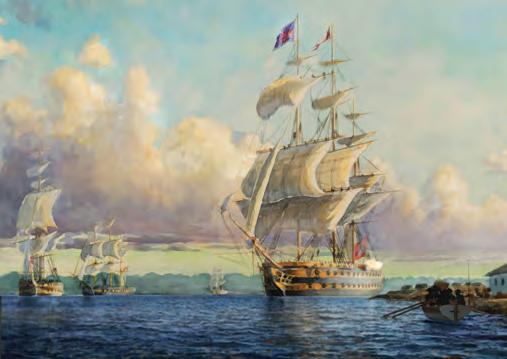
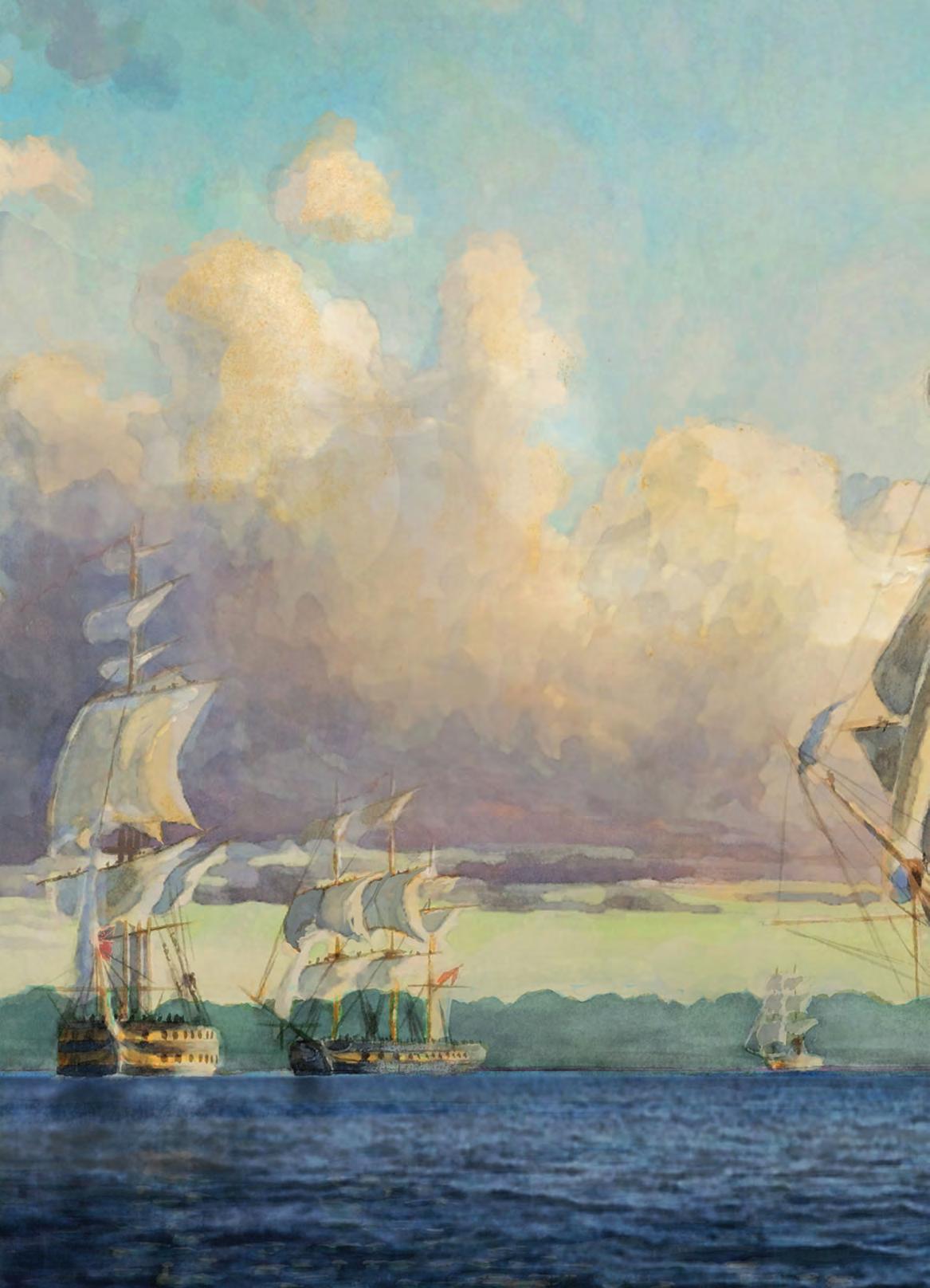
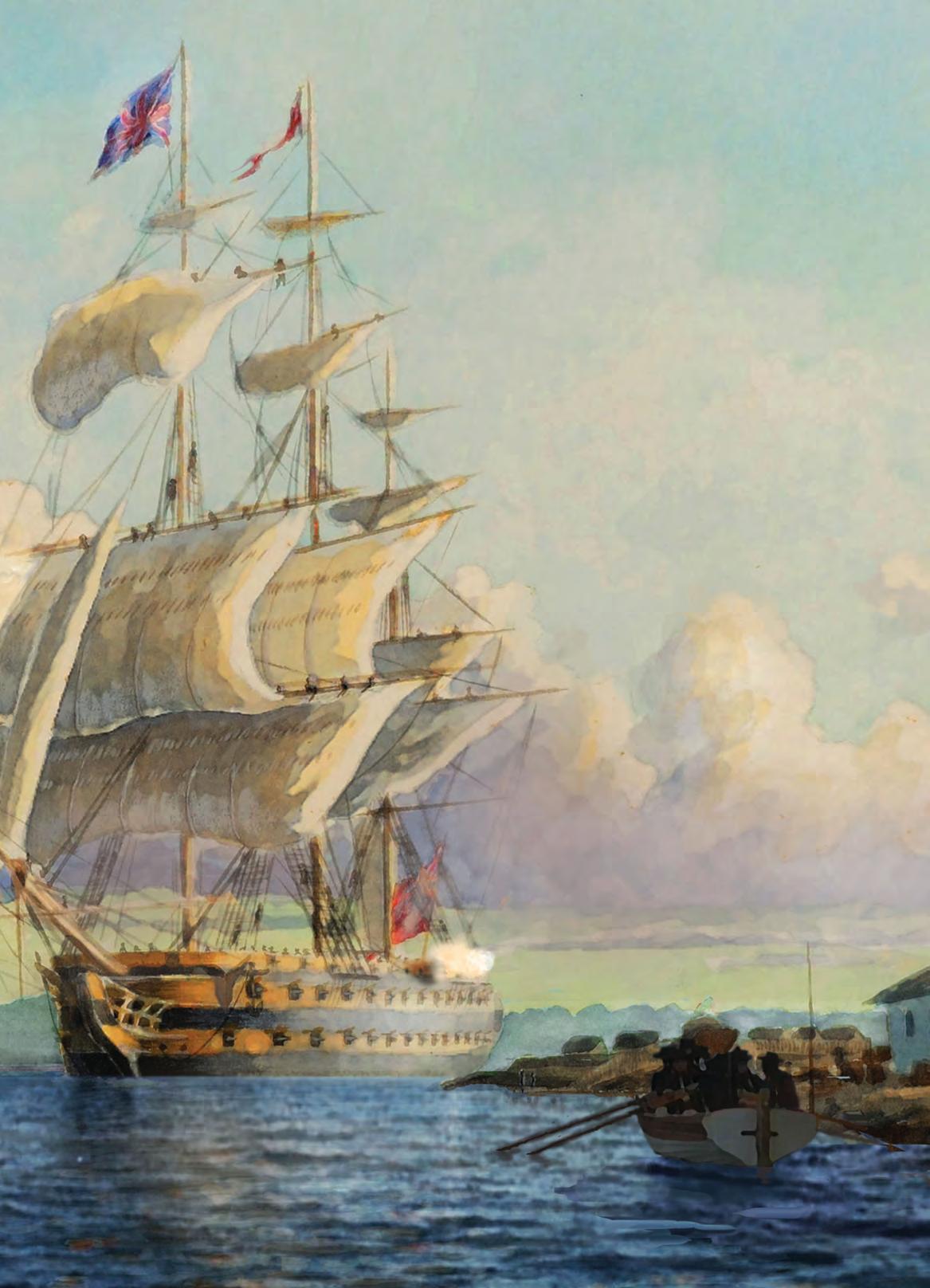
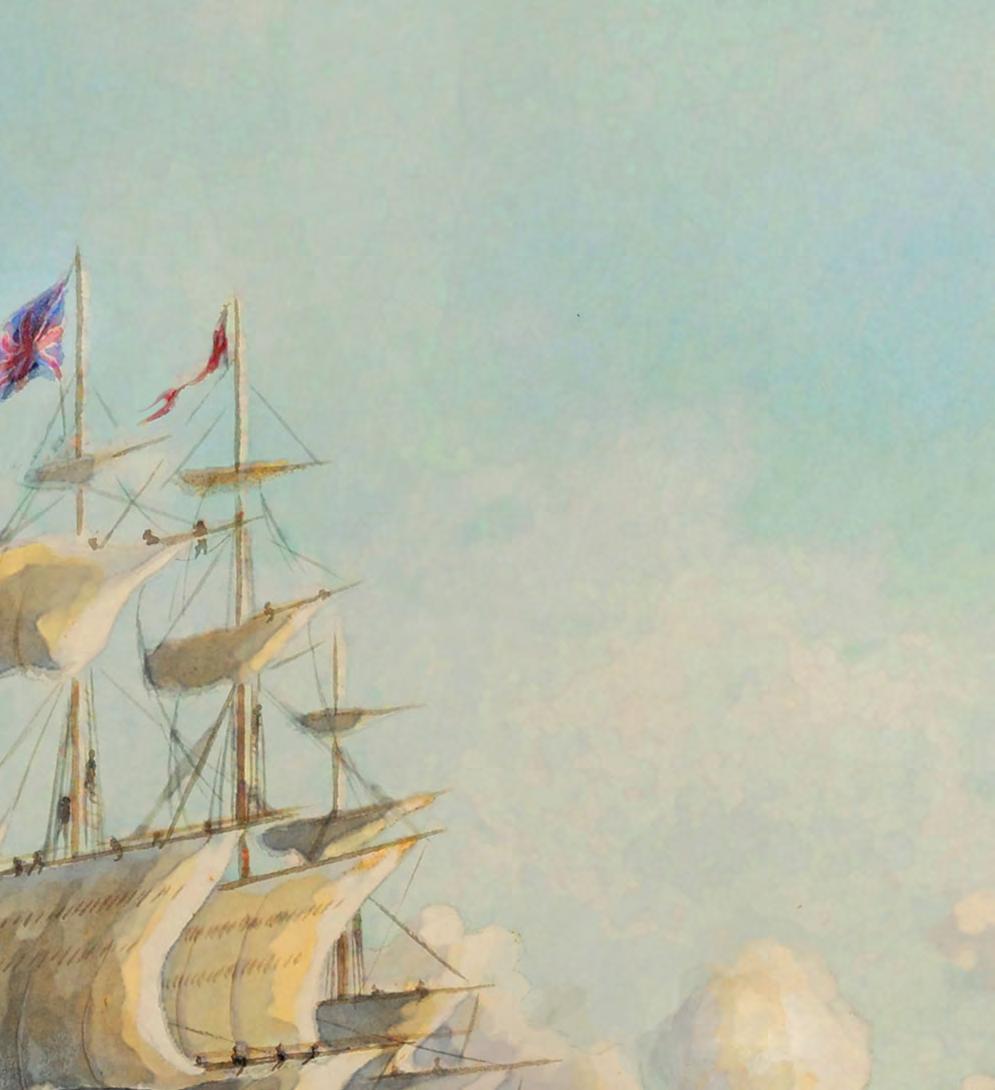
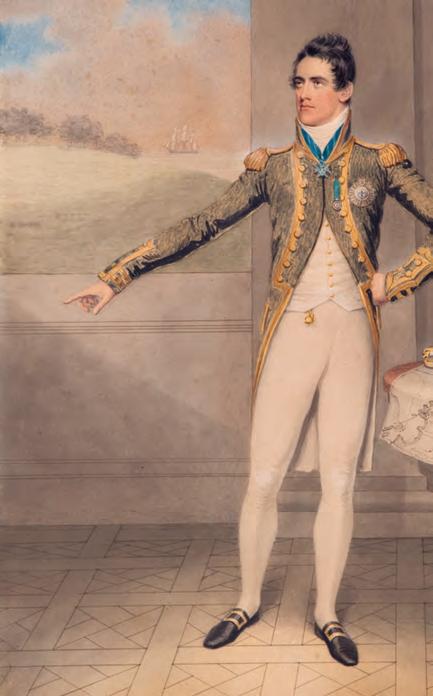
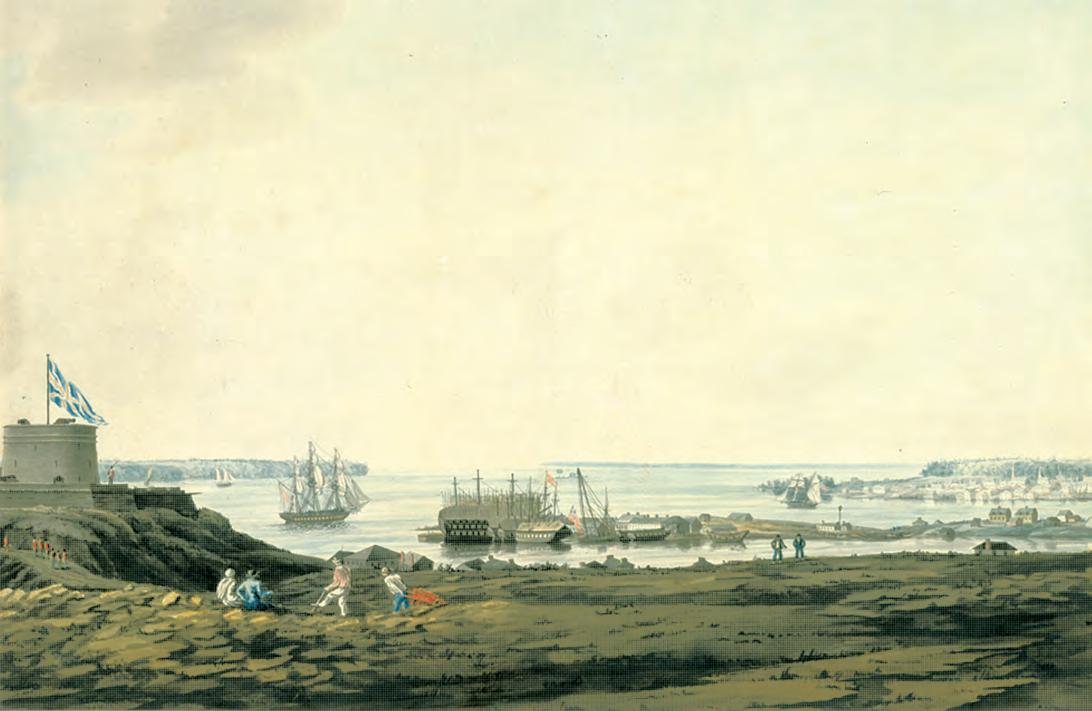
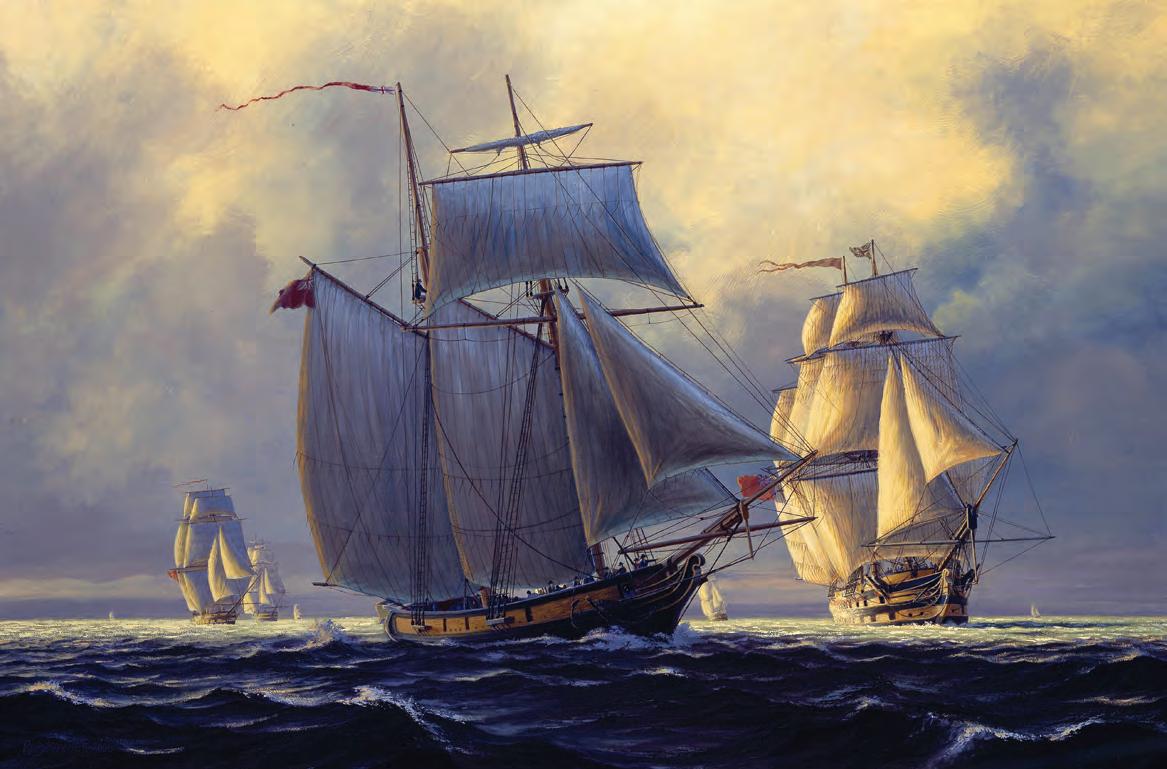
As the War of 1812 was winding down, Britain launched HMS St. Lawrence, a battleship bigger than any other to have plied the Great Lakes before By
Hugh Halliday
54 EVERYTHING EVERYWHERE ALL AT ONCE
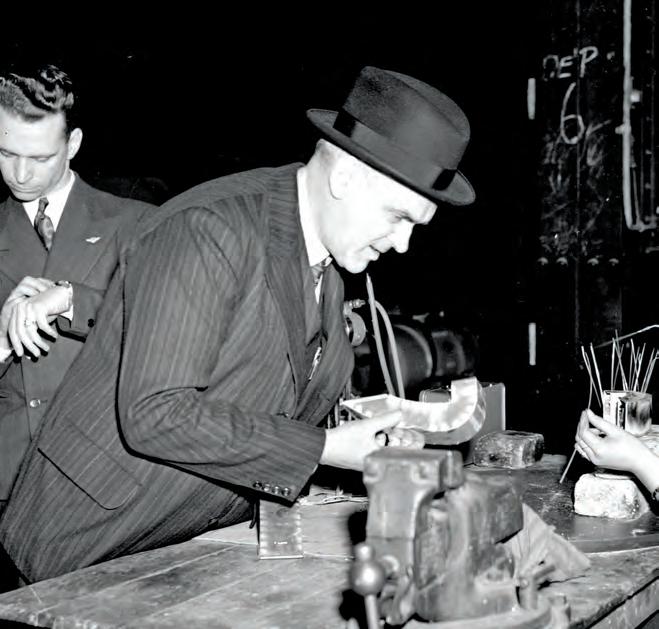
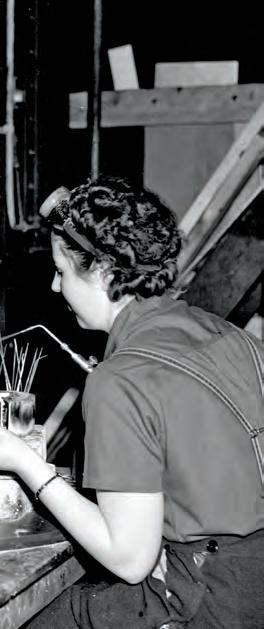
How C.D. Howe became Canada’s first minister of everything— and helped win WW II By Sharon
Adams
62 GOD REST YE WEARY GENTLEMEN
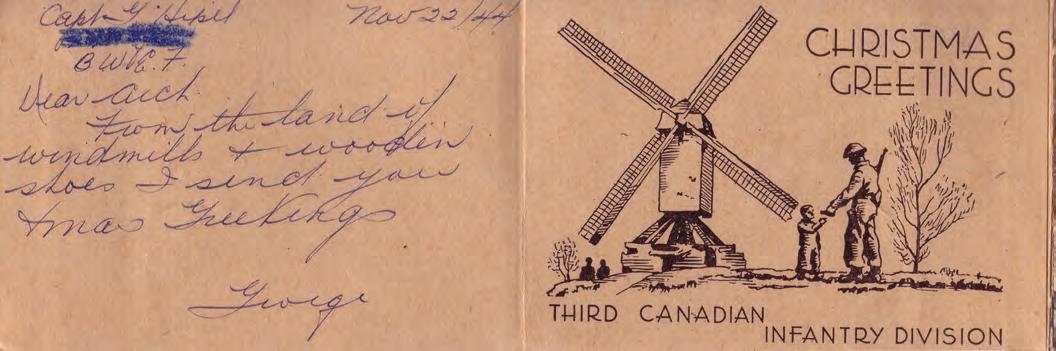
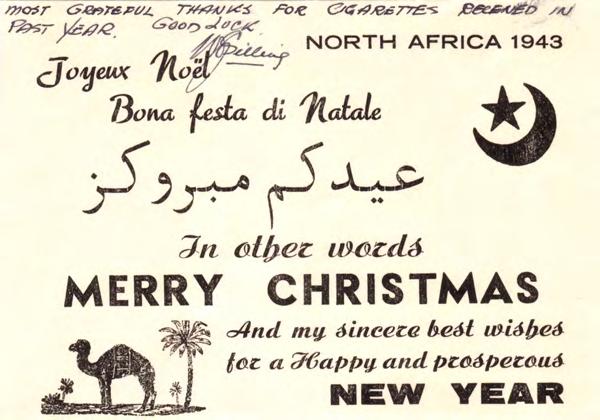
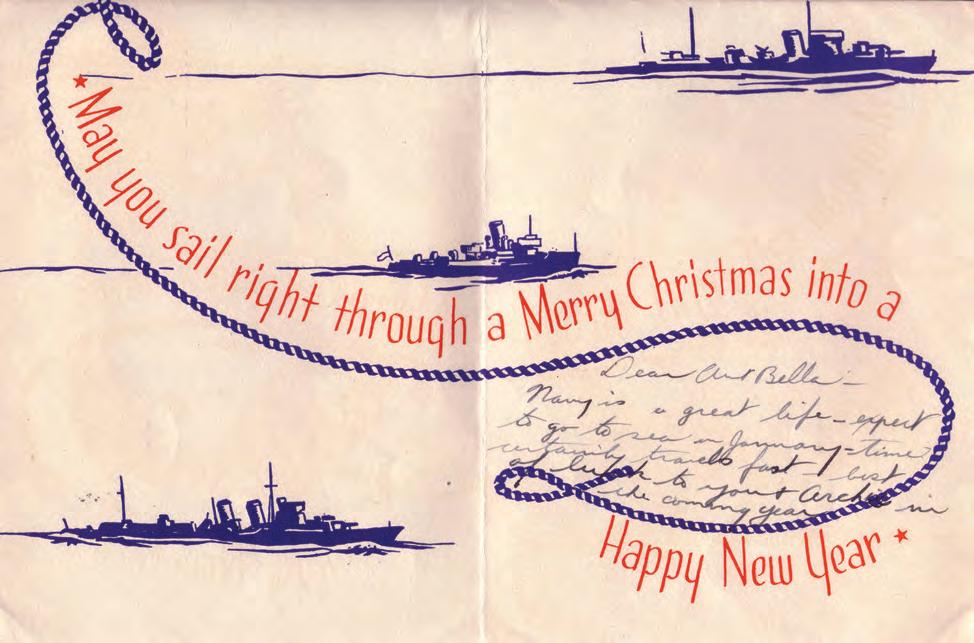
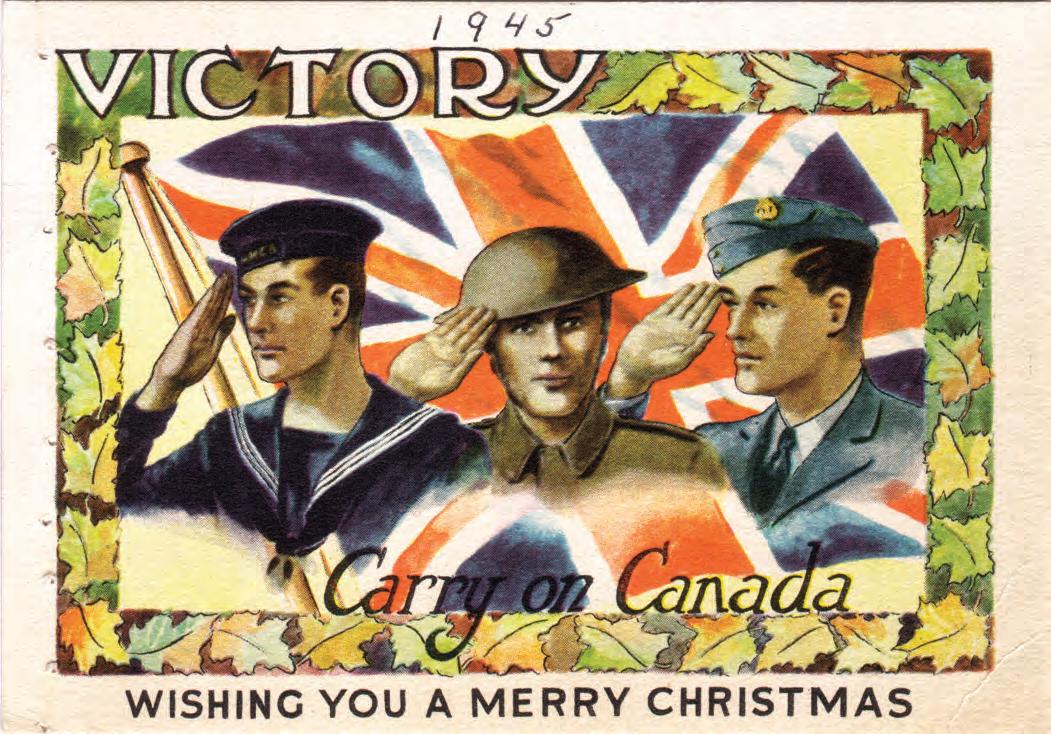
Reminiscences of four Second World War Christmases By Alex
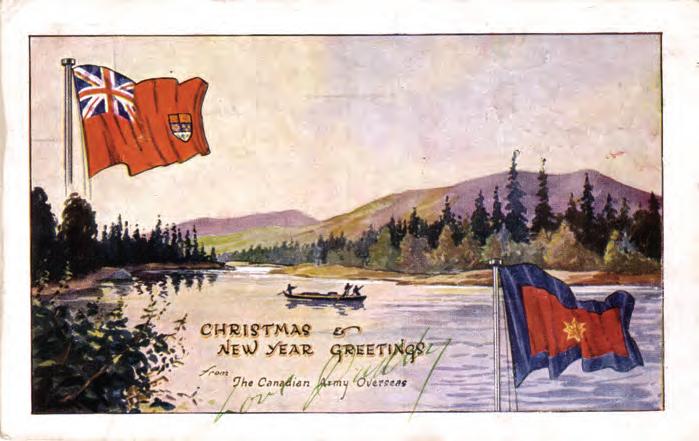
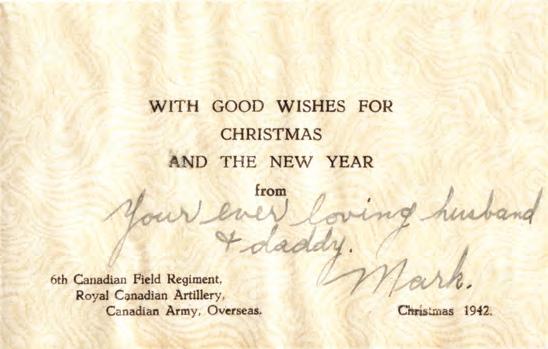
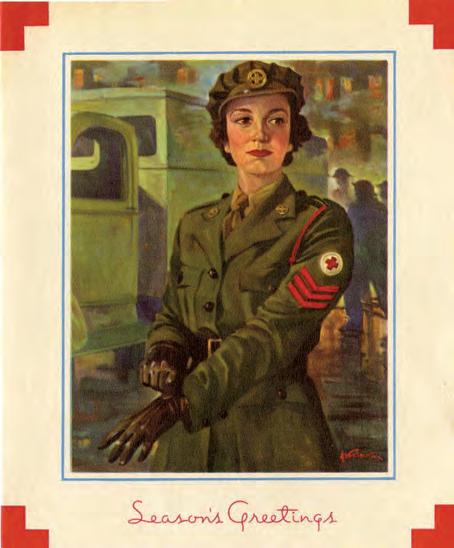
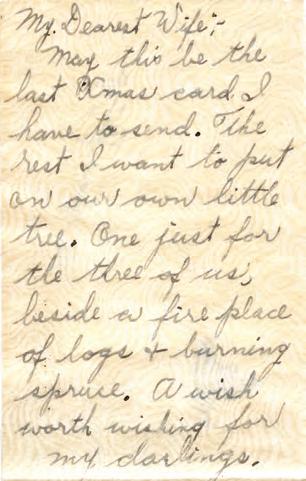
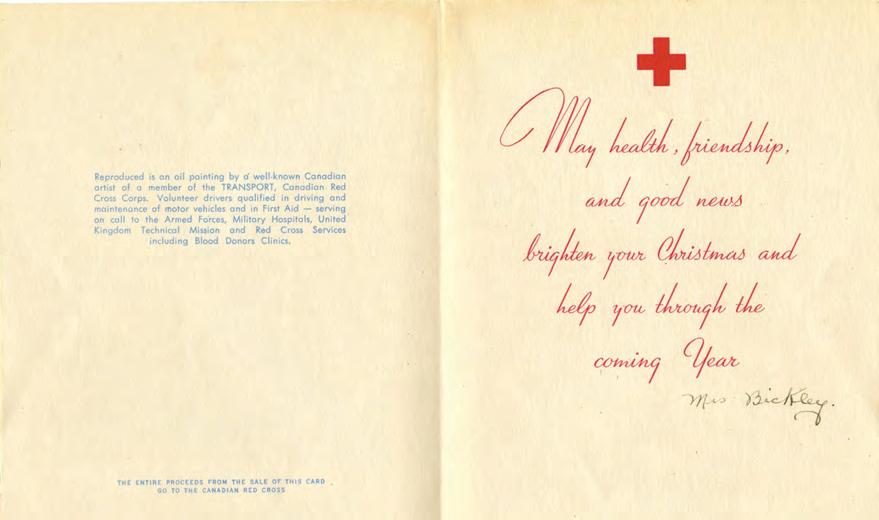
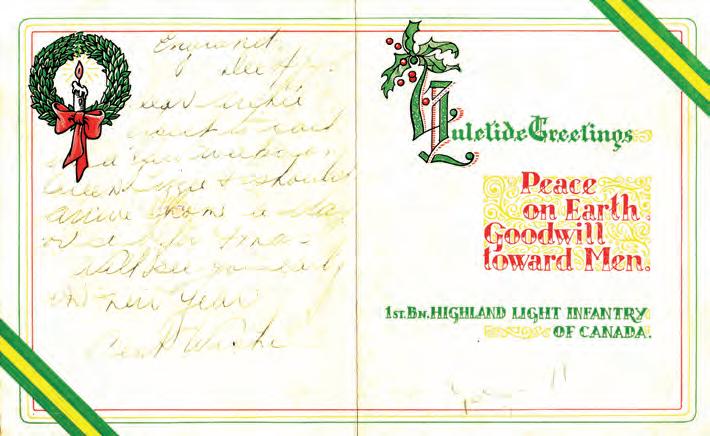
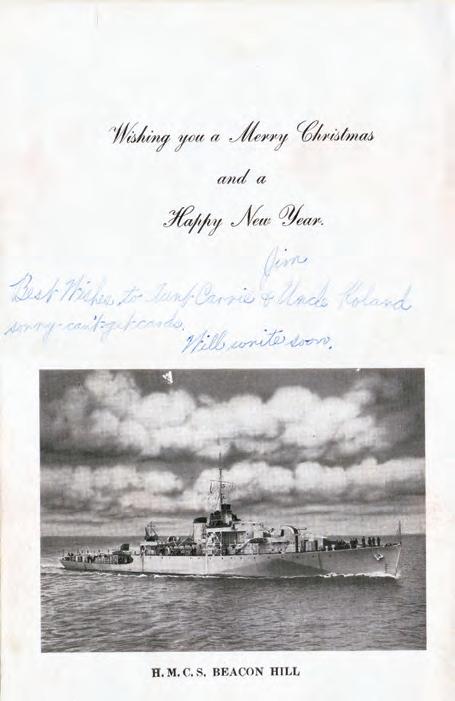
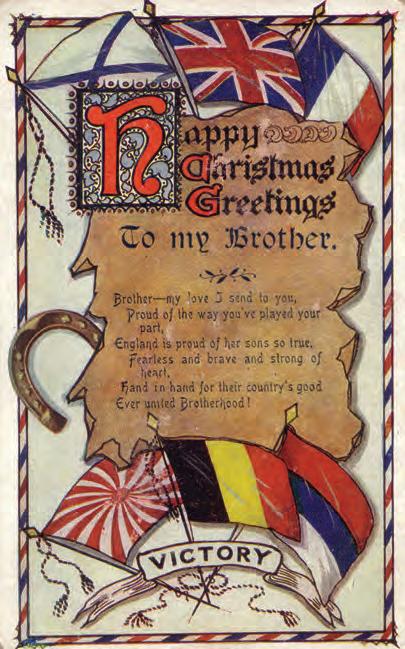
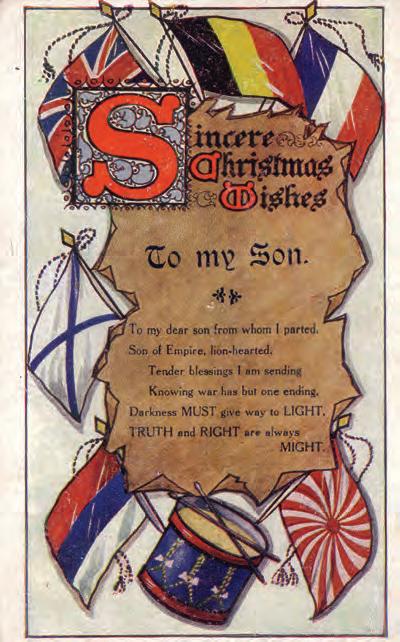
Sending season’s greetings back home from overseas
77 UNDAUNTED
Citing demand, The Royal Commonwealth Ex-Services League aims to continue its important work Words and pictures by Stephen J. Thorne
COLUMNS
THIS PAGE
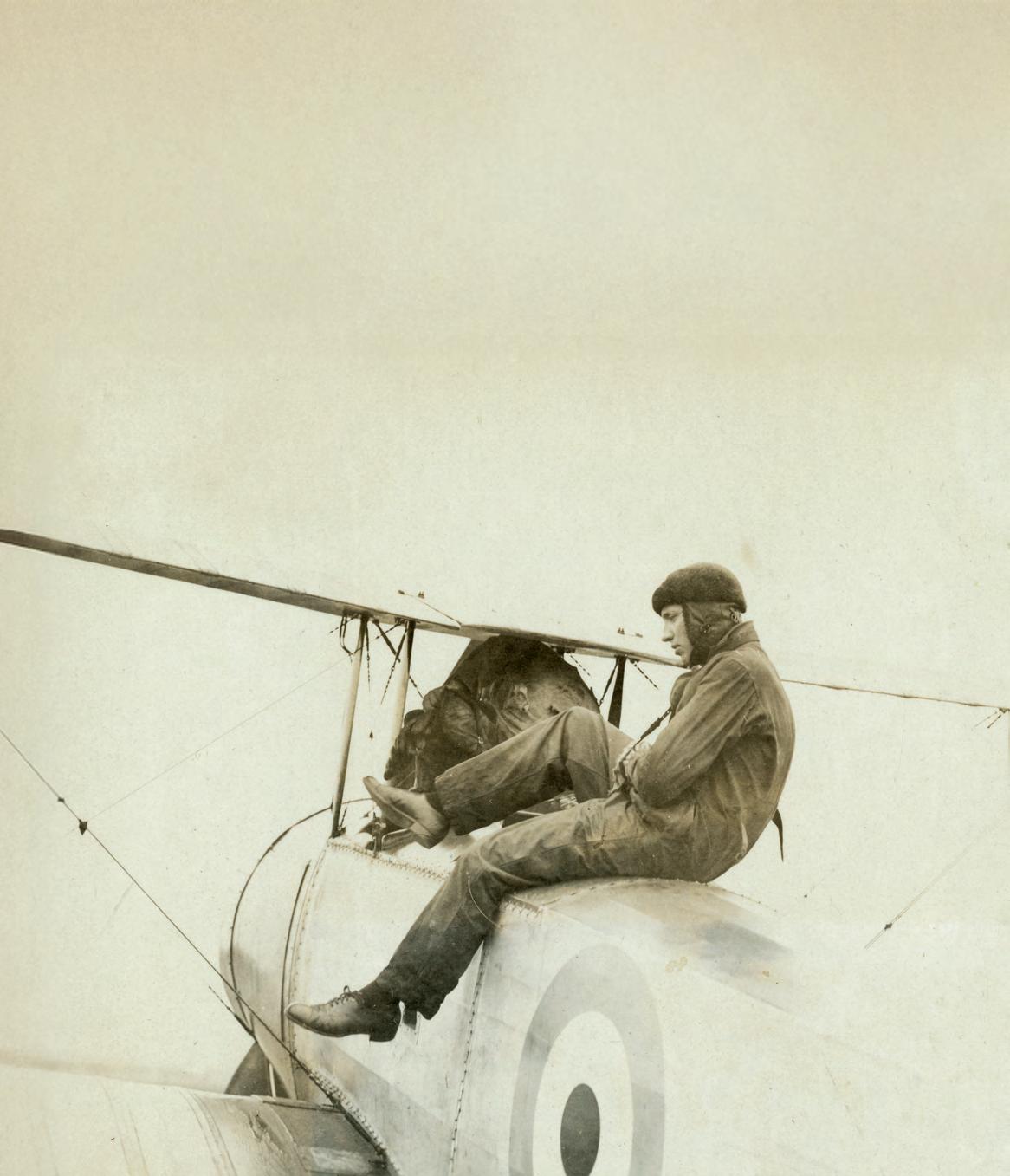
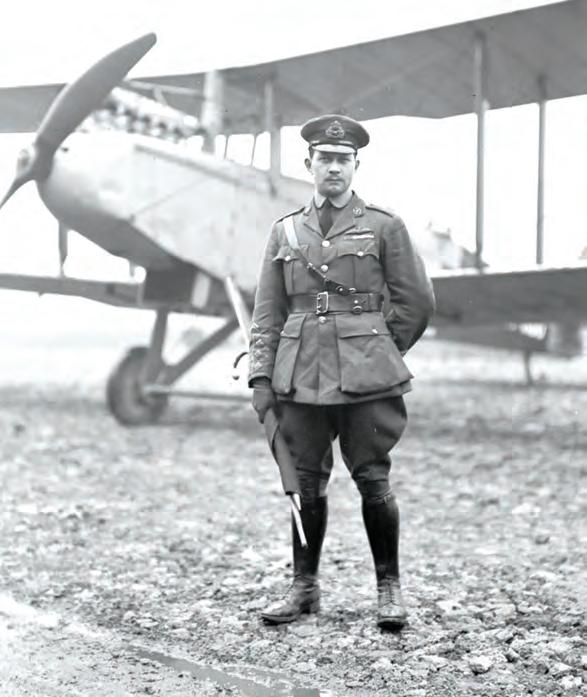
Canadian Great War ace and Victoria Cross recipient William Barker exits his aircraft in London in April 1919. CWM/19940003-540
ON THE COVER
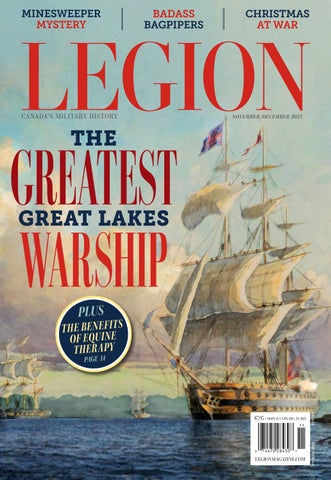
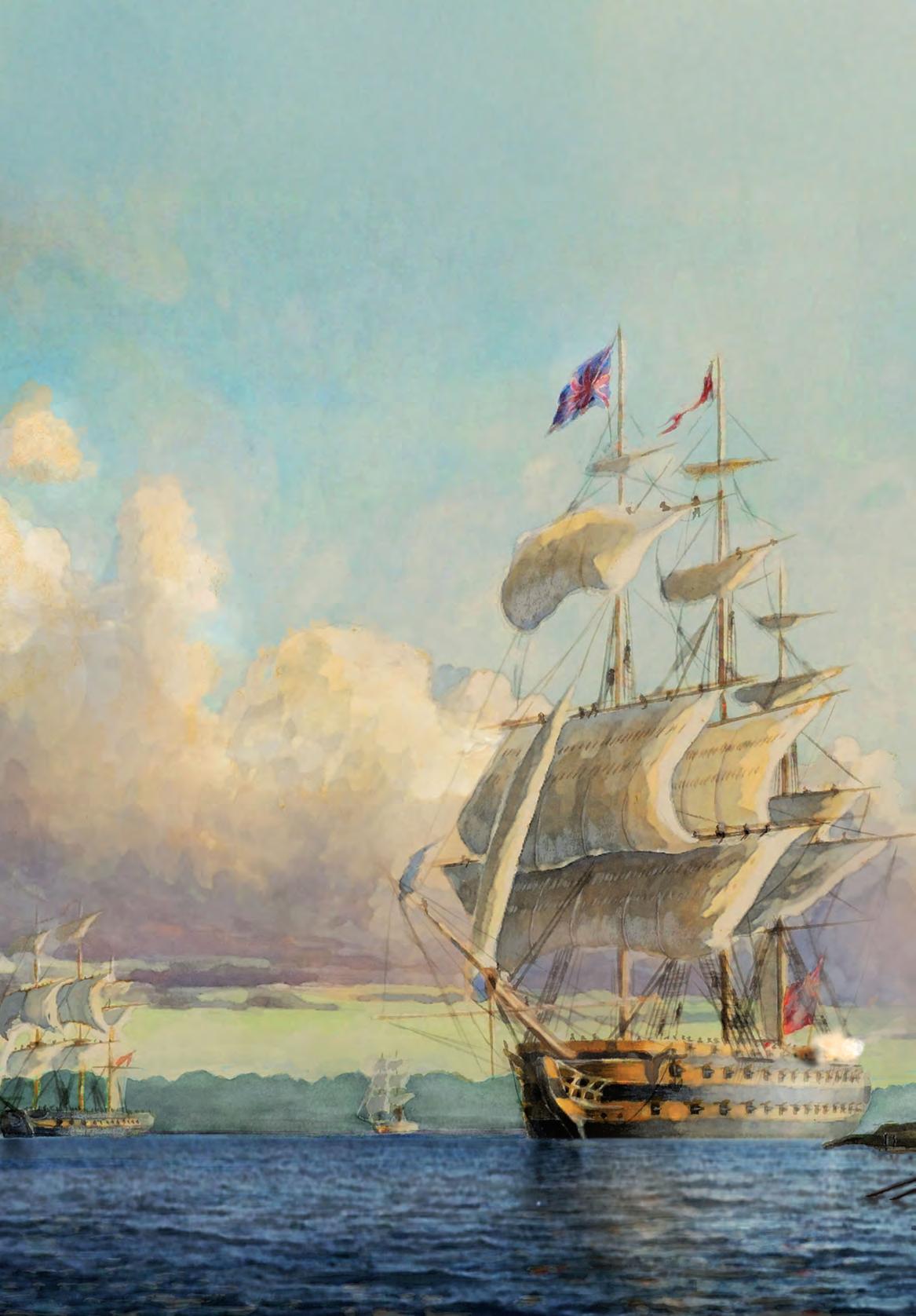
Artist Peter Rindlisbacher depicts HMS St. Lawrence with other British warships on Lake Ontario during the War of 1812.
Peter Rindlisbacher
David J. Bercuson
Should vintage warbirds still be flown?
Stephen J. Thorne and Alex Bowers
Board of Directors
BOARD CHAIR Sharon McKeown BOARD VICE-CHAIR Berkley Lawrence BOARD SECRETARY Bill Chafe
DIRECTORS Steven Clark, Randy Hayley, Trevor Jenvenne, Bruce Julian, Valerie MacGregor, Jack MacIsaac Legion Magazine is published by Canvet Publications Ltd.
MARLENE MIGNARDI marlenemignardi@gmail.com OR CALL 613-591-0116 FOR MORE INFORMATION
WEB
Ankush
Published six times per year, January/February, March/April, May/June, July/August, September/October and November/December. Copyright Canvet Publications Ltd. 2025. ISSN 1209-4331
Subscription Rates
Legion Magazine is $13.11 per year ($26.23 for two years and $39.34 for three years); prices include GST. FOR ADDRESSES IN NS, NB, NL, PE a subscription is $14.36 for one year ($28.73 for two years and $43.09 for three years). FOR ADDRESSES IN ON a subscription is $14.11 for one year ($28.23 for two years and $42.34 for three years).
TO PURCHASE A MAGAZINE SUBSCRIPTION visit www.legionmagazine.com or contact Legion Magazine Subscription Dept., 86 Aird Place, Kanata, ON K2L 0A1 Call 613-591-0116 or toll-free 1-844-602-5737. The single copy price is $7.95 plus applicable taxes, shipping and handling.
Change of Address
Send new address and current address label, or, send new address and old address. Send to: Legion Magazine Subscription Department, 86 Aird Place, Kanata, ON K2L 0A1. Or visit www.legionmagazine.com/change-of-address. Allow eight weeks.
Editorial and Advertising Policy
Opinions expressed are those of the writers. Unless otherwise explicitly stated, articles do not imply endorsement of any product or service. The advertisement of any product or service does not indicate approval by the publisher unless so stated. Reproduction or recreation, in whole or in part, in any form or media, is strictly forbidden and is a violation of copyright. Reprint only with written permission.
PUBLICATIONS MAIL AGREEMENT NO. 40063864
Return undeliverable Canadian addresses to Legion Magazine Subscription Department 86 Aird Place, Kanata, ON K2L 0A1 | magazine@legion.ca
U.S. Postmasters’ Information
United States: Legion Magazine, USPS 000-117, ISSN 1209-4331, published six times per year (January/February, March/April, May/June, July/August, September/October, November/December). Published by Canvet Publications, 866 Humboldt Pkwy., Buffalo, NY 14211-1218. Periodicals postage paid at Buffalo, NY. The annual subscription rate is $12.49 Cdn. The single copy price is $7.95 Cdn. plus shipping and handling. Circulation records are maintained at Adrienne and Associates, 866 Humboldt Pkwy., Buffalo, NY 14211-1218. U.S. Postmasters send covers only and address changes to Legion Magazine, PO Box 55, Niagara Falls, NY 14304.
Member of Alliance for Audited Media and BPA Worldwide. Printed in Canada.
We acknowledge the financial support of the Government of Canada. Version française disponible.
From time to time, we share our direct subscriber list with select, reputable companies whose products or services we believe may interest our subscribers. To opt out of receiving these offers, please send your request, including your full name and address, to magazine@legion.ca. Alternatively, you can write to Legion Magazine, 86 Aird Place, Kanata ON K2L 0A1, call 613-591-0116, or call toll-free 1-844-602-5737.
Stay. Save. Support.
Welcome to Legion Travel
Enjoy up to 50% off accommodations at more than one million hotels worldwide when you sign up*—and it’s FREE! That’s incredible savings for you, your family and your friends.
Plus, a portion of all proceeds from hotel bookings at Legion Travel assist The Royal Canadian Legion and its efforts to support Veterans.
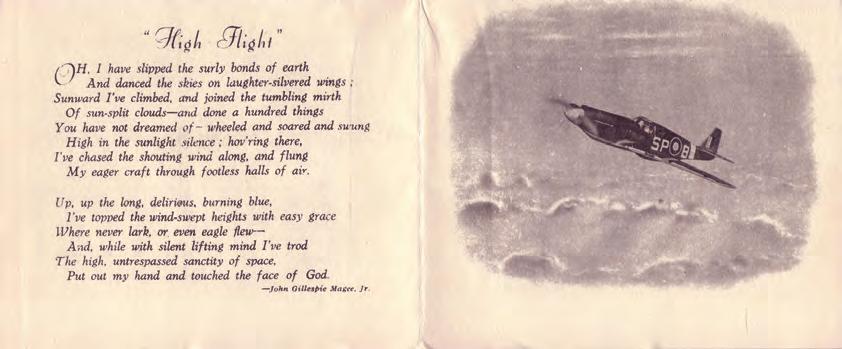
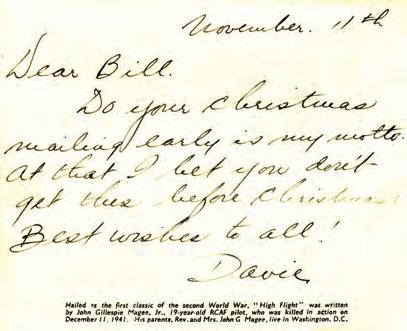
STAY, SAVE and SUPPORT—scan the QR code or visit legiontravel.ca/magazine today!
Free Membership
Sign up for instant access to amazing hotel deals with no hidden fees.
Exclusive Savings Travel in style or on a budget. Get access to up to 50% off hotels*, with our exclusive unpublished rates.
Travel Your Way
Book at over one million hotels in 155,000 cities in 220 countries. The world is your oyster.
Stop the famine in Gaza
“T
here is hunger in Gaza, and we have to say it loud and clear,” said Ohad Hemo, the Palestinian affairs correspondent for Israel’s most-watched news broadcast this past July. “I speak to Gazans daily. These are people who haven’t eaten in days,” Hemo continued. “The responsibility lies not only with Hamas, but also with Israel.” International affairs in the Middle East are, of course, a perennial powder keg. Support one side at your peril—the other will denounce you. Still, as likely all would agree, it is complicated. Israel had every right to respond to the deadly Oct. 7, 2023, terror attacks led by the militant, Gaza Strip-based Palestinian nationalist group Hamas. But, in ultimately starving Gazan civilians en masse as part of its response, Israel is no better than others through history who’ve weaponized civilian access to food. And this position isn’t antisemitic, nor is it pro-Hamas. Starving people—no matter their religion, culture, creed, etc.—is simply wrong.
STARVING PEOPLE—NO MATTER THEIR RELIGION, CULTURE, CREED, ETC.—IS SIMPLY WRONG.
Canadians are all too familiar with the Nazi-perpetrated Dutch Hunger Winter of 1944-1945, as this country’s troops liberated the starving Netherlands in the final throes of WW II. By May 1945, some 20,000 Dutch had died from the famine. It’s just one of history’s many examples. “Food has been used as a weapon of war across cultures for millennia, from ancient sieges to modern blockades of humanitarian aid,” wrote Reuters journalist
Maggie Michael in a September 2023 report on starvation as a war crime for the Global Investigative Journalism Network.
Starvation was first prohibited as a method of warfare in 1977. Twenty years later, the International Criminal Court passed a statute making it a war crime. International humanitarian law defines starvation as acts that deprive civilians of objects indispensable to their survival.
The UN officially declared a famine in Gaza on Aug. 22, 2025, estimating that more than 500,000 people were facing “catastrophic hunger conditions, while more than a million more are in a food emergency.” The UN declares famine in instances where there’s extreme food deprivation, acute malnutrition and starvation-related deaths.
In its related report, the UN indicated that 39 per cent of Gazans were going days without eating, and adults were regularly skipping meals to feed children. Still, malnutrition among kids was accelerating—in July, more than 12,000 children were identified as acutely malnourished, a sixfold increase since January. A quarter of those were suffering from severe acute malnutrition, the deadliest form. The UN estimated that some 43,000 kids were at risk of dying from malnutrition by June 2026.
Tom Fletcher, the UN’s under-secretary for humanitarian affairs and emergency relief co-ordinator, said the famine was a preventable man-made disaster. “Food stacks up at the borders because of systemic obstruction by Israel,” he said. “It is famine within a few hundred metres of food in fertile land.”
Canada, meanwhile, decried the situation. “Civilians…are dying because sufficient humanitarian assistance is not being allowed into Gaza,” said Secretary of State Randeep Sarai. “Israel…is failing to fulfil its obligations under international humanitarian law.
“We continue to call for an immediate and permanent ceasefire,” Sarai continued. “Hamas must release all hostages without delay and lay down their arms. This war must end now.”
Indeed. L
Modest proposals
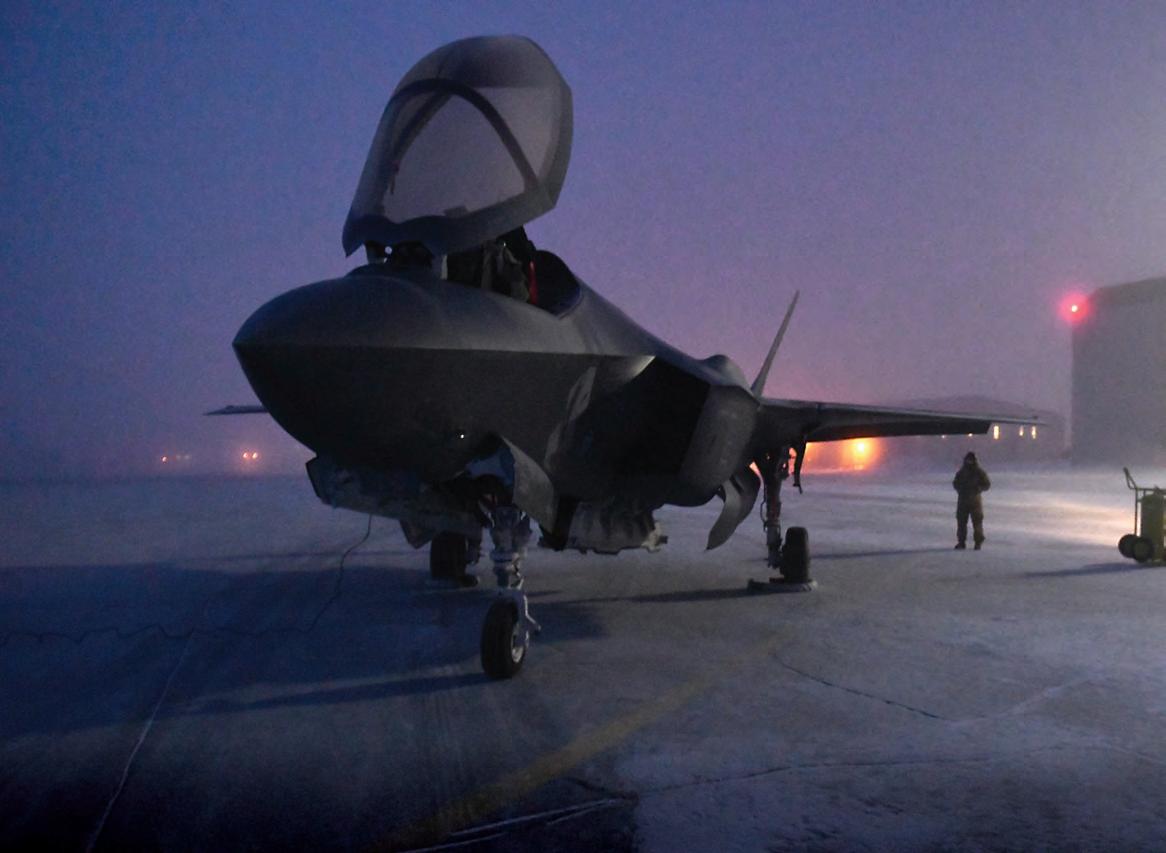
a retired member of the Canadian Armed Forces and a proud Canadian, I have been, and continue to be, concerned about the threats from the Trump administration (Eye on Defence, September/October, “Rebuilding, rearming”). My first concern is the purchase of the Lockheed Martin-produced F-35 fighter jets.
While the aircraft is highly advanced and exceptionally capable, it’s also extremely expensive, costly to maintain and the U.S. will maintain control over the operational software, spare parts and future maintenance. The purchase of the F-35 is counter to the government’s stated goal and the overwhelming consensus of most Canadians for a reduction in the CAF’s dependence on U.S. weapons and defence.
Capping the F-35 purchase to those already contracted and acquiring the remaining fighters from Saab for its Gripen aircraft would provide the air force with a jet designed to handle Canada’s climate at a much better cost. NATO allies’ Spain and Portugal have already withdrawn from the F-35 program citing the cost and draconian U.S. control
Powerful poster
I was blown over by Yuanxi Liu’s poster on page 2 of the September/ October issue (News, “2025 Legion Remembrance contest winners”). It hit my emotional button. Wow! I don’t believe a commercial artist could come close to the emotions stirred up by her images.
PAUL ULRICK MISSISSAUGA, ONT.
Comments can be sent to: Letters, Legion Magazine , 86 Aird Place, Kanata, ON K2L 0A1 or emailed to: magazine@legion.ca
policies for maintenance and parts and are seeking alternatives. Switzerland has also stated it’s seeking a more cost-effective and less stringent alternative to the U.S. F-35.
My second concern deals with the evergrowing wildfire threat to Canada and Canada’s commitment to meeting NATO’s defence-spending goals in the next 10 or so years. It’s well known that climate change will continue to exacerbate the frequency and severity of wildfires. Early and rapid response greatly enhances the chances of controlling fires. Water bombers have proven critical to accomplishing this, especially in remote areas. However, their availability in Canada is limited.
I suggest Canada procure, staff and operate a modest fleet of DHC-515 “Super Scooper” aircraft, which would substantially increase the country’s ability to fight wildfires. Along with fighting fires, the plane can also undertake search and rescue, maritime surveillance and remote cargo delivery. The purchase would also help meet the NATO goals.
After nearly 40 years in the CAF in numerous roles at various levels, I’m well aware of the military’s reluctance to change. However, these times of threats from the Trump administration and escalating international tensions demand new solutions. In the past, Canada’s military has shown it can move swiftly and efficiently to acquire new capabilities that benefit the country as a whole.
J.A. SUMMERFIELD WINCHESTER, ONT.
More bomb debate
I read Face to Face, July/August (“Did the U.S. need to drop the atomic bomb on Japan?”) from the perspective of my uncle, Sergeant Eddie Shayler, an infantryman in The Winnipeg Grenadiers, who became a slave labourer in Japan after the fall of Hong Kong in December 1941. To the end of his days, he believed that it was the
element of surprise and the shock of the result of the bombs that saved prisoners of war from almost certain mass executions had Allied land forces approached Japan. In his justifiably biased mind, the use of the atomic bombs was necessary.
I believe that war is inhumane and should be unnecessary. In this conflict, atrocities against civilians and PoWS occurred right from the start. If the objective was to stop the war and save American/Allied lives, the decision to use nuclear weapons was a stunning success.
KEN MOODY ST. DAVIDS,
ONT.
Regarding the letters about the dropping of the A-bombs on Japan (Letters, September/ October, “A-bomb debate”), and especially the opinion of the high school student, clearly the letter writers have not kept up to date with the latest historical research into the surrender of Japan.
Much to the surprise of Western historians (none of whom had access to Soviet and Japanese sources or could read both Russian and Japanese), the Japanese army actually refused
to surrender after the bombs were dropped. Consequently, the Japanese Emperor couldn’t surrender. It was the Soviet violation of their non-aggression treaty with Japan and the defeat of the Japan forces in Manchuria that opened the way for the Soviets to occupy the Japanese mainland.
Faced with this probability, the Japanese military and Emperor choose to surrender to the Americans. But it wasn’t an unconditional surrender and war crime trials such as those in Nuremberg were not to occur. These facts should put a different light on the Western perspective of the defeat of Japan.
KENNETH BICKLEY
OTTAWA
Spirits rise
I just wanted to thank Wendy van Leeuwen for the great article about the Spirit of Listowel (“Spirit squad,” May/June). Reading it was a reminder of the sacrifice and heroism of that generation. Dennis Varden was my grandfather, Clare my grandmother [the couple first on the scene of
a domestic B-24 crash mentioned in the story]. I have heard this tale first-hand from them and their children, including my father, their eldest child, who was six at the time. Seeing the story in print gave me a wonderful new perspective. And seeing a picture of my grandparents’ grave brought back a flood of memories.
GARY VARDEN
SARASOTA, FLA.
A reader retruns
In December 2024, I cancelled my subscription to Legion Magazine. I have now changed my mind. Thank you for a good magazine that brings back memories. Keep up the good work.
RALPH DORT
WEST KELOWNA, B.C. L
November
2 November 1869
As part of the Red River Resistance, Louis Riel and some 100 men seize Upper Fort Garry. The uprising helps lead to the creation of the province of Manitoba.
3 November 1997
Canada destroys its last stocks of landmines to increase awareness of its efforts to ban the weapon worldwide.
4 November 1914
Nurse Margaret Macdonald is appointed matron-in-chief of the Canadian Army Medical Corps. She is the first woman in the British Empire to hold the rank of major.
5 November 1942
The first members of the Canadian Women’s Army Corps arrive in Britain.
6 November 1917
Canada and Britain launch an assault to capture the ruined village of Passchendaele, Belgium.
7 November 1956
The first United Nations Emergency Force is created to end the Suez Crisis. Canada provides 1,000 personnel.
8 November 1944
The Battle of the Scheldt ends; by late in the month, the Scheldt River is cleared of mines and the crucial port of Antwerp opened to Allied shipping.
10 November 1812
The British fleet is driven into Kingston Harbour in Upper Canada as the U.S. navy gains control of Lake Ontario.
11 November 1931
Canada observes its first Remembrance Day; previously, Armistice Day was held on the first Monday in the week of Nov. 11.
12 November 2001
HMCS Vancouver departs San Diego, Calif., for the Persian Gulf as part of a U.S. battle group.
14 November 1775
U.S. Gen. Benedict Arnold and some 700 troops arrive in Quebec City intent on capturing it. The next day, his demand that the garrison surrender is ignored.
15 November 2009
Operation Hydra is launched. It is a Canadian-Afghan mission aimed at clearing insurgents from Nakhonay and Haji Baba villages in the Panjwaii district of Afghanistan.
21 November 1950
Twelve Korea-bound soldiers, all members of the Royal Canadian Horse Artillery, die in a train collision near Canoe River, B.C.; five more succumb to injuries in the following days.
22 November 1943
Group Cmdr. Clarence Dunlap is appointed commander of 139 Wing, Royal Air Force, becoming the only Royal Canadian Air Force officer to command an RAF operational unit.
23 November 1809
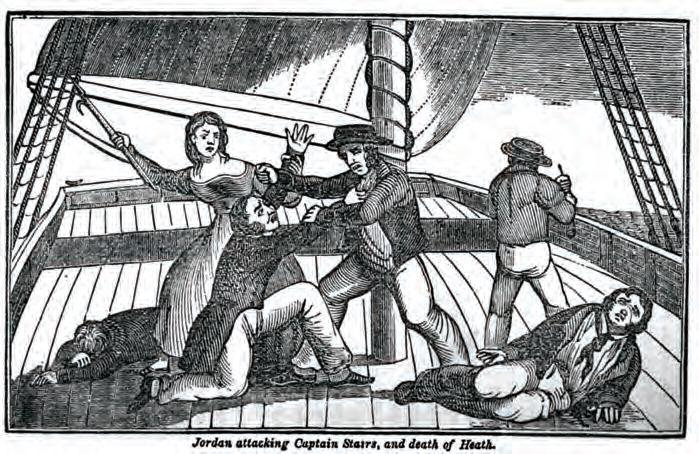
Convicted in Canada’s first piracy trial, Edward Jordan is hanged in Halifax.
December
6 December 1917
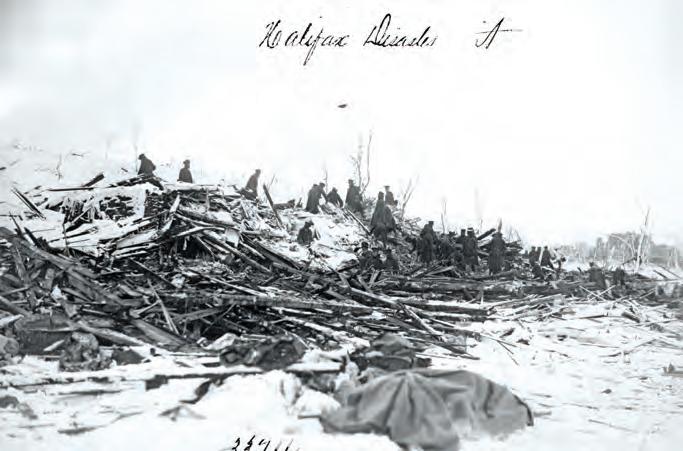
More than 1,600 are killed and 9,000 wounded after the explosion of a munitions ship in Halifax Harbour.
7 December 1941
Canada declares war on Finland, Hungary and Romania, as well as Japan, following its attack on Pearl Harbor, Hawaii.
8 December 1915
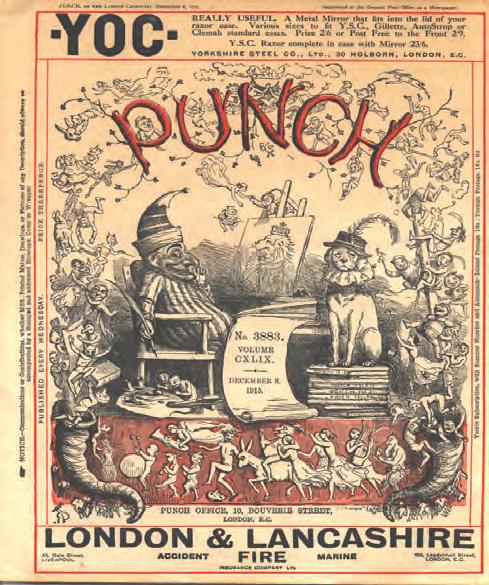
Punch magazine publishes “In Flanders Fields.”
18 December 1837
During the Upper Canada Rebellion, 18 Black men from Hamilton sign a “Loyal statement of people of colour” devoting themselves to British military service. They form a Black company that helps suppress the rebellion.
19 December 1941
In Hong Kong, Sgt-Maj. John Robert Osborn tosses back several Japanese grenades before throwing himself on one to save his company. He is posthumously awarded the Victoria Cross.
20 December 1943
Canadian forces begin their fight to capture the Italian town of Ortona in a battle renowned for its vicious street fighting.
23 December 1970
Prime Minister Pierre Trudeau announces that troops dispatched in response to the October Crisis will be withdrawn from Quebec on Jan. 4.
24 December 1914
An unofficial Christmas truce begins on the Western Front.
26 December 1943
Gen. Andrew McNaughton, commander of First Canadian Army, retires; shortly thereafter he becomes defence minister.
27 December 2001
Canada announces the deployment of two long-range surveillance and maritime patrol aircraft and some 200 air force personnel to the Persian Gulf.
28 December 1945
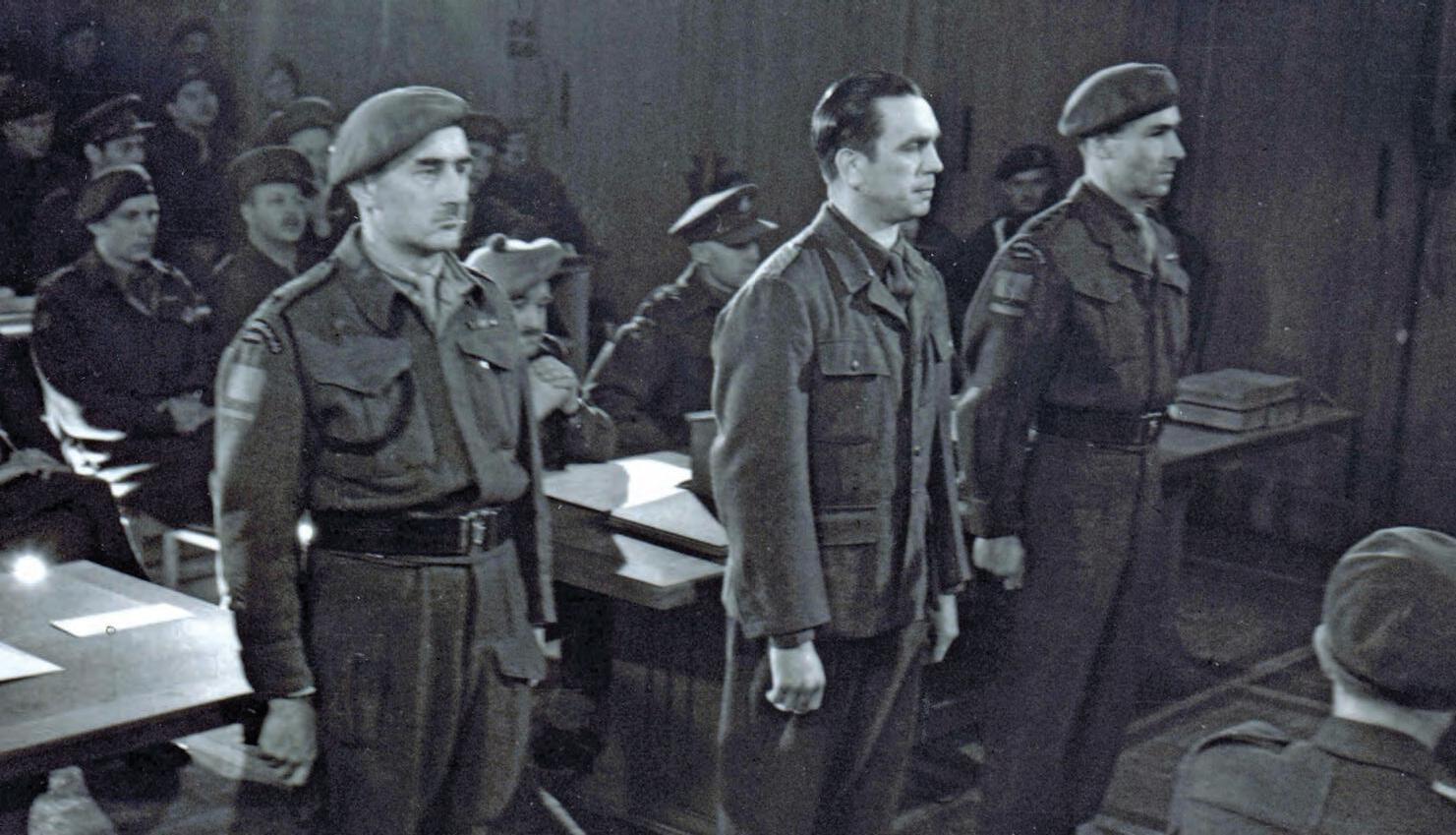
Brigadeführer Kurt Meyer is found guilty of war crimes at a Canadian military court in Germany for the murder of Canadian soldiers at Abbaye d’Ardenne, France.
16 December 2021
HMCS Winnipeg completes its deployment to the Indo-Pacific region on Operation Projection, an ongoing naval presence mission to promote peace and stability.
17 December 1917
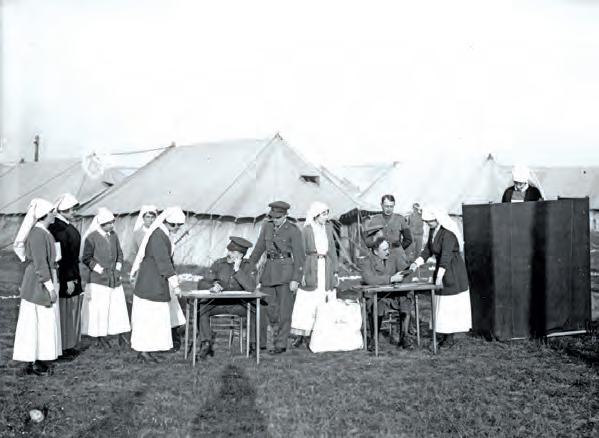
Military nurses and female relatives of Canadian soldiers are allowed to vote for the first time in a federal election.
31 December 1992
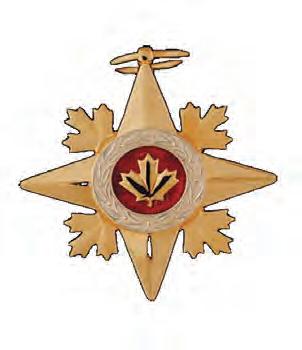
New Canadian military honours are established, including the Victoria Cross, the Star of Military Valour and the Medal of Military Valour.
By Alex Bowers
Horse power
How a Quebec equine therapy centre is supporting francophone veterans living with operational stress injuries
Samuel Embregts, a Canadian Armed Forces veteran whose service in Afghanistan left him with posttraumatic stress, recalled his first experience in the indoor arena.
“I got there,” he explained, “I met my therapist and the other person joining us, and they asked me to choose a horse that most appealed. I picked one, we went out into the enclosure—the building we did the therapy in—and they let the horse go. And then they just looked and said to me, “Off you go. Make a connection with them.’”
Except Embregts knew “nothing” about horses beyond safety procedures.
“I was not in the best mindset at t he time,” he remembered. “I was just coming out of depression. I think I was fairly stunned [in the arena]. I didn’t know what to do.”
It was, however, “part of the process,” noted psychoeducator and animal-assisted therapy expert Karine Boucher of ÉquiSens, a specialized equine facility located near Mirabel, Que., north of Montreal.
“We don’t answer questions as we want to see those real connections,” explained Boucher. “We want to see how [veterans] behave around horses because most
will act in much the same way as t hey act around other people.”
While there are “many types” of equine therapy, also known as equine-assisted therapy (EAT), the f undamental goal of all of them is to promote emotional growth and psychological healing through guided interactions between individuals and horses. There are no veterans riding at Équi-Sens; rather, the focus is on building the bond through other activities, from leading to grooming to feeding and more, all supervised and analyzed by qualified mental health and equine professionals.
“ YOU CANNOT BULLSHIT THE THERAPIST WITH A HORSE.”
The Quebec-based stable, which also supports civilian adults and children living with difficulties and conditions that might benefit from therapy, has worked with veterans for roughly the last decade of its 20-year existence. Its premise relies on the sensitivity of horses, recognizing their often-high perceptibility to human
emotions and body language. Therefore, many participants, including veterans, must engage in self-reflection and self-regulation to achieve the desired result.
“It’s the horse’s reaction that gives us intervention opportunities,” said Boucher. “That’s how we can discuss therapeutic things. If [a veteran] comes in and says, ‘I’m feeling so happy today,’ but the horse stays 100 feet away because of their high energy, that’s a sign. It’s harder for them to pretend that everything is well after that. It can be a confronting experience, and it’s different for each person.
“I can work with the same horse all day, have three clients, and I will see three different horse behaviours each time. It all depends on the energy of the client.”
Basically, added Embregts, “You c annot bullshit the therapist with a horse.
“I did a lot of therapy in an office for many years. I’m a smart guy, and I could easily sway the conversation with a psychologist or psychiatrist if its direction made me feel uncomfortable. I’d talk a little about suicide, then the checklist would come out and that would just completely stop the deeper discussion.”
“I couldn’t do that at Équi-Sens. I had to deal with the real stuff.”
Despite positive testimonies from CAF veterans such as Embregts, equine-assisted interventions are still considered a complementary form of treatment for former Canadian military personnel living with operational stress injuries. Research remains scarce, although the supportive scientific literature continues to grow.
A 2021 study spearheaded by Dave Blackburn of the Université du Québec evaluated the influence of EAT on 14 Quebec-based veterans “diagnosed with a post-traumatic disorder and/or depression disorder.” Participants identified three differences between work with horses and past clinical care,
50 per cent of whom recognized EAT’s “experimental/practical nature” as one such distinction.
Equally, 50 per cent believed that EAT “represents another way of approaching the problem and the presence of the horse in the intervention play a key role.” A third and final “majority” of 12 perceived it as an appropriate addition to conventional therapy, while all 14 reportedly held a “firm intention to continue equine-assisted therapy sessions and recommend it to their brothers in arms.”
Nevertheless, Blackburn conceded that the study had “some limitations,” not least that “with a sample size of 14 [mostly male, Quebec-based veteran] participants, the results presented cannot be generalized” for those with PTSD or depression.
Though the 60-year-old therapy technique might not resonate with all veterans, in other words, evidence alludes to a sizable proportion benefiting from its potential as an accompaniment— rather than an alternative—to traditional treatments, with an additional emphasis on the importance of qualified practitioners.
Blackburn has likewise broadened the scope of his research to a nationwide level as Équi-Sens is far from alone in its endeavours. Similar equine therapy centres have opened their arenas and pastures to veterans and first responders across the country, notably the Can Praxis program in Alberta. What sets Équi-Sens apart from others, however, is t hat “we were the first to offer equine therapy in French for veterans, at least to my knowledge,” remarked Boucher.
Embregts himself helps when circumstances permit. Now a peer support advocate for fellow francophone veterans embarking on their own rehabilitation journey, he has since developed grounding techniques in his personal interactions with horses.
But one horse, in particular, holds a special place in what Embregts’s psychiatrist classifies as his ongoing PSTD remission. “Eventually,” he said, “I met a horse with severe post-traumatic stress; he couldn’t be approached by anybody at all. There was no way to interact with him—and
yet he chose me for some reason.
“I decided to start taking care of that horse and try to teach him how to feel safer around humans. And at the same time, I learned how to feel safe around humans.
“He saved me as much as I saved him.”
By Stephen J.Thorne
Remembering Mynarski
A marker and a broken treeline stand today to recall a Victoria Cross action
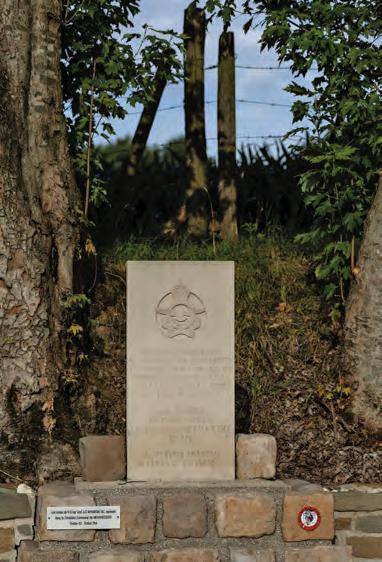
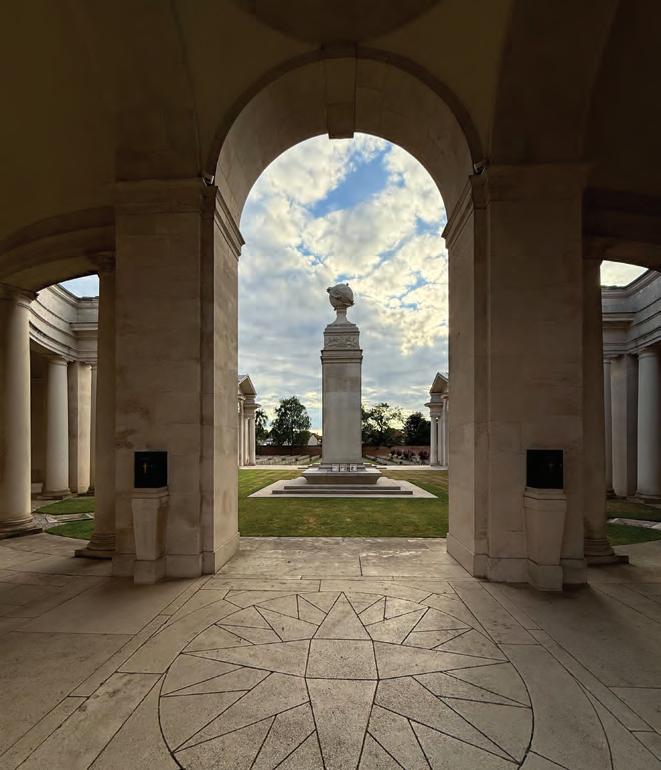
Nestled in a nondescript corner at the intersection of two pathways in the commune of Gaudiempré, southwest of Arras in northern France, there lies a stone marker commemorating the night in June 1944 that a Lancaster crashed in what is now the tree-lined cornfield behind it.
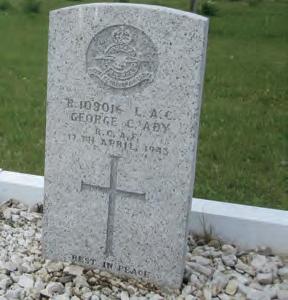
There were 7,377 Avro Lancasters built during the Second World War, 430 of them in Canada; 3,932 were lost. But this Lancaster, VR-A of 419 (Moose) Squadron, Royal Canadian Air Force, Tail No. KB726, was, as the stone notes, Andrew Mynarski’s Lancaster.
Pilot Officer Mynarski was the mid-upper gunner from Winnipeg who earned a posthumous Victoria Cross after desperately trying to save his trapped rear gunner from their crippled aircraft until flames forced him to jump. The rear gunner, PO Pat Brophy, miraculously survived the crash. On fire when he parachuted from the airplane, Mynarski did not.
The simple grey stone marker mounted on a little rock wall well off the beaten path reads (translated from French): “In the meadow behind the monument, the bomber…crashed on the night of 12-13 June 1944. In memory of Pilot/Officer Andy Charles Mynarski, 27 years, V.C.”
The area in the Pas-de-Calais department of France is better known for WW I casualty clearing stations during the 1917 battles around nearby Arras. While Great War memorials abound, Second World War memorials are less common here.
Launched six days after the D-Day invasion, it was the Mynarski crew’s 13th mission, this one to Nazi-occupied Cambrai, some 60 kilometres east of the crash site. While waiting to leave their base at RAF Middleton St. George in England, Mynarski is said to have found a four-leaf clover in the grass. He insisted that Brophy, his closest buddy in the seven-man crew, take it. They cleared flak over the coastline and were briefly “coned” by searchlights as they neared their objective, the Cambrai railyards, just around midnight that second Tuesday in June. They never made it. As they closed on the target, they were attacked from below and astern by a Junkers Ju 88 night fighter. Raked by cannon fire with major strikes on both port engines and the centre fuselage, a hydraulic fire engulfed the bomber. Down to two engines, the pilot, Flying Officer Arthur de Breyne of Saint-Bruno, Que., ordered the crew to bail out.
As Mynarski navigated his way through the notoriously difficult terrain of the Lancaster’s interior toward the rear escape door, he saw through the inferno that Brophy was struggling to get out of his jammed rear turret.
Mynarski immediately began scrambling through the flames and over the tail spar to his distressed crewmate. Once there, he used a fire axe to try to release the jammed turret before resorting to his bare hands in a last-ditch attempt to rotate it into a position where Brophy could crawl out. With Mynarski’s flight suit and parachute on fire, a resigned Brophy finally waved him away.
In an area best known for its WW I history and well off the beaten path, this small French memorial honours Pilot Officer Andrew Mynarski’s WW II Victoria Crossearning action.
A reluctant Mynarski crawled back through the flames to the door, paused, saluted, and reputedly said “Good night, sir”—his familiar nightly signoff to his friend—and jumped.
Brophy was the only member of the crew unable to exit the dying aircraft. Five left via the front escape hatch on the floor behind the cockpit. Mynarski was the only one to leave by the back door.
His descent was rapid; he and his parachute and shroud lines were badly burned. He came down hard and still on fire, though alive. French farmers found him and took him to a German field hospital where he died the next morning. He was buried in a local cemetery
Brophy was still trapped in the bomber when it crashed through the trees lining the
HONOUR
laneway next to the field. As the bomber began breaking apart, the impact cracked his turret open and flung him out. Brophy hit a tree and was knocked out.
The French Resistance hid four of the VR-A crew: Brophy, pilot de Breyne, navigator Robert Bodie and radio operator James Kelly. All but Brophy were spirited back to England shortly after the crash. Brophy stayed on and fought alongside the Resistance for three months. Two others— flight engineer Roy Vigars and bomb aimer Jack Friday—were captured and spent the rest of the war in a Stalag before they were liberated by American troops. It was only when Brophy returned to London in September 1944 that he learned of Mynarski’s death. In 1945, when the tail gunner was reunited with the rest of the crew, he finally revealed
the details of his last moments on the aircraft and of Mynarski’s valiant efforts to save him.
Today, a gap in the treeline down that laneway marks the spot where VR-A crashed through and into the field beyond.
Tucked away in a corner of a barn museum in nearby Auchonvillers, the location of a former WW I clearing station and detention centre, is the battered spinner from one of VR-A’s four engines. Museum owner Avril Williams bought it from a neighbour who had been using it as a flowerpot for 30-some years.
Mynarski, a Canadian legend, is memorialized with statues at RAF Middleton St. George, the Valiants Memorial in Ottawa, and elsewhere. He lies buried in the British Plot, Grave 40, at Méharicourt Communal Cemetery near Amiens, France. L
Poem by Kathleen Mills, Veteran Family member
David J. Bercuson
Breaking bad
The Canadian army continues to encounter racism and misogyny among its rank and file. Eliminating it is long overdue.
This past summer wasn’t a good one for the image of the Canadian Army, coming just after commitments were made by Prime Minister Mark Carney to increase Canadian defence expenditures to five per cent of the country’s gross domestic product by 2035. In quick succession this past July, Canadian soldiers were revealed to have engaged in internet chatter that was antisemitic, anti-immigrant, and misogynistic. Early in the month, the Ottawa Citizen detailed reports of a
now-defunct hateful Facebook group, the Blue Hackle Mafia, made up of members of The Cameron Highlanders of Ottawa (Duke of Edinburgh’s). It had some 200 participants espousing opinions seemingly opposed to everything that Canadian values are supposed to represent. Some Highlanders had also posted pictures of their genitals.
Meanwhile, days later, the RCMP arrested four suspects—two of them active soldiers—for plotting an armed revolt aimed at taking
territory in the Quebec City area and using it as a base for an antigovernment militia. They had a stockpile of 16 explosive devices, 83 firearms and accessories, some 11,000 rounds of ammunition, 130 magazines and four pairs of night-vision goggles.
Once again, the media has revealed soldiers of the Canadian army who appeared racist, dangerous and armed. The stories are reminiscent of some from 30 years ago.
In the early 1990s, members of 2 Commando, Canadian Airborne Regiment (CAR) at Canadian Forces Base Petawawa in Ontario filmed themselves engaging in racist behaviour, destroying the car of an officer and using military pyrotechnics to celebrate drunken parties in the wilderness near the base.
Sent to Somalia on a peace enforcement mission not long afterward, members of the unit killed several Somali civilians, including Shidane Arone, a teenager who had snuck onto the CAR base at Belet Huen, allegedly to steal helicopter parts for the black market. Two commandos beat Arone to death while he was in custody. This sparked the Somalia Affair, which embroiled the CAF in investigations into violent abuses in the military for almost a decade.
The problem with such behaviour is obvious: young men, armed by taxpayers, show racist and misogynist behaviour that demonstrates they’re a danger to other soldiers and to the Canadian public.
At least two recently completed studies—former Supreme Court justice Louise Arbour’s May 2022 report on sexual misconduct and
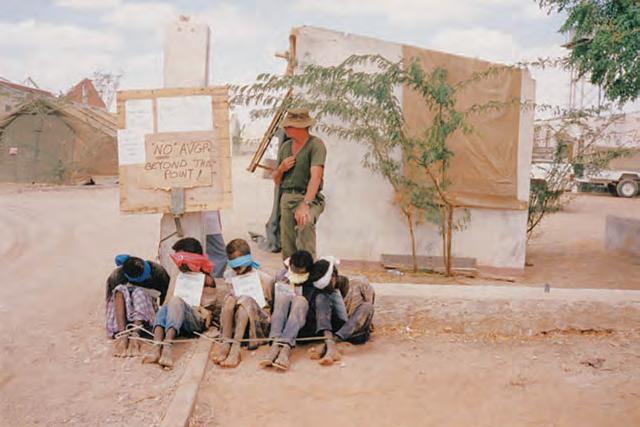
A member of the Canadian Airborne Regiment stands behind bound and blindfolded Somali civilians during a UN-backed humanitarian mission to the country in the early 1990s.
University of Alberta political scientist Andy Knight’s February 2025 paper on white supremacy— revealed similar behaviour. These latest findings support several studies conducted after the killing of Arone that also found racist behaviour in the military before, and during, the deployment to Somalia 30 years ago.
Canada’s military isn’t the only one facing such challenges. Similar cases have arisen in Britain, Australia and the U.S. In Canada, revelations of such abhorrent behaviour are typically followed by pledges at the highest level to crack down and take action. But it continues.
Militaries have long enticed young men (and young women, too) who appreciate weapons,
regimented discipline and adventure, and who sometimes behave in ways that would otherwise be unacceptable in civilized society. So, what can be done about it?
First, use testing to filter out as many of these individuals as possible, but understand that some will get through. From there, high command—all the way up to the minister—needs to treat these problems as seriously as any other the military may face. And never stop examining what goes on in the ranks.
Next, provide strong and continuing leadership in these matters—never relent. In his report, Knight suggested that the recruitment pool needs to be widened to include far more non-white Canadians.
Finally, such behaviour must be subject to harsh penalties. The army can follow the lead of professional sports. Several decades ago, Jim Bouton, a former pitcher for the New York Yankees and the Seattle Pilots, among others, wrote a memoir that revealed all sorts of terrible behaviour in Major League Baseball, including widespread use of drugs, racist behaviour and misogyny. Baseball, and subsequently other pro sports, eventually worked to reduce such behaviour and clean up their enterprises. They largely succeeded.
Surely there’s a lesson there for Canada’s military.
Read more on the Somalia Affair in David J. Bercuson’s 1996 book Significant Incident: Canada’s Army, the Airborne, and the Murder in Somalia. L
Korea:
The forgotten war Korea: The forgotten war sheds light on the third major war of the 20th century. Includes archival images, a timeline and five maps.
War Stories:
True stories from the First World War
When the First World War started in 1914, Canada’s population was less than 8 million, yet more than 620,000 enlisted. Many of the surviving soldiers share their stories in this special issue.
Crime: Canadian style
Take a trip to Canada’s seedy underbelly and meet the perpetrators of some of the country’s most notorious felonies and misdemeanors.
Victoria Cross
The most famous decoration for courage in the Western world, the Victoria Cross has been awarded to dozens of Canadians and the lore behind the VC is sprinkled with strange and heart-wrenching stories.
Battle of the Pacific: Courage in the Far East
Canada’s war in the Pacific began on Dec. 7, 1941, when Japanese aircraft attacked the U.S. navy base at Pearl Harbor, Hawaii.
Canada and the Second World War: The battles
Canadians played pivotal roles in many of the most important and costly conflicts of the Second World War. Includes large battle map.
Bringing the stories of Canada to life like never before
Liberating
Normandy: The road to victory
The Battle of Normandy was the beginning of the end of the Second World War in Northwest Europe.
O Canada: The history of our home and native land
O Canada tells our story from First Peoples through to our achievements in space. Intro by Canadian comedian and author Rick Mercer.
The march to victory: Canada’s final 100 days of the Great War
The Canadian Corps fought several great battles before Germany surrendered, ending “the war to end all wars.”
*Conditions apply. 40% off select back issues expires February 1, 2026.
Battle of the Atlantic
The Royal Canadian Navy played a pivotal role in this critical campaign, which raged on open and treacherous seas from September 1939 to May 1945.
Vimy: The birth of a nation
The hard-fought WW I Battle of Vimy Ridge is sometimes called “the birth of the nation.” In April 1917, the Canadian Corps fought together for the first time and achieved success where others had failed.
O Canada: The best of everything
Find out what really makes our country tick. Packed with Canadian people, places, wildlife, cities, culture, feats and innovations. Intro by Canadian comedian Ron James.
Twenty-five great Canadian aviators
From early birds to astronauts, every one of these nationally celebrated and lesserknown flyers has made important contributions to Canada’s aviation heritage.
The Royals: The fight to rule Canada
Everything you need to know about Canada’s royal heritage from the earliest kings and queens who dispatched explorers to the New World to the modern British monarchy.
Battle of Ortona
Late in 1943, Canadian troops attacked the German-held Italian city of Ortona. In fierce fighting, Canada pushed up Italy’s east coast and prevailed.
The Somme
The Somme examines the role of the Newfoundland Regiment and the Canadian Expeditionary Force in the First World War battle that took place in France from July 1 to Nov. 18, 1916.
World War I: True stories from Vimy to victory
More compelling stories from the First World War are told in memoirs by surviving Canadian soldiers.
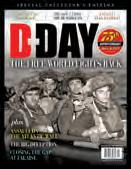
D-Day: The free world fights back It was the spring of 1944 and the Allies could not wait any longer. British, American and Canadian forces would land on five beaches on France’s Normandy coast in the early hours of June 6, 1944.
Canada’s Ultimate Story engages readers with captivating stories of Canadian events and fascinating people from our earliest days to present times and editions are filled with little-known facts and trivia relating to our great country.
War Photos
War Photos showcases the stunning images and rare photos from the men and women who went into battle with only a camera.
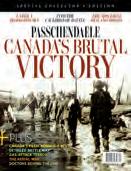
Passchendaele: Canada’s brutal victory
The Canadian Corps was thrust into a battlefield of mud and craters to help Allied forces in the Battle of Passchendaele— Canada’s third major victory of 1917.
O Canada: Discover your land Big land, bigger oceans, huge mountains, wide waterways and wildlife wilderness—Canada offers breathtaking vistas in every direction. Intro by Canadian comedian Cathy Jones.
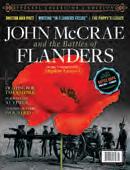
John McCrae and the Battles of Flanders
John McCrae was shaken by the battlefield death of a friend in May 1915, and wrote the poem “In Flanders Fields” in tribute. The poem remains today a renowned symbol of remembrance.
O Canada: How Canada was shaped by war and peace
Since the First Peoples arrived on this continent, the place that would be called Canada has been shaped by conflict and co-operation. The impacts of war and the bounties of friendship echo through the story of Canada.
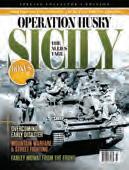
Operation Husky: The Allies take Sicily
On July 10, 1943, Canadian, British and American forces invade Sicily, a hot, mountainous, enemyoccupied island off Italy’s south coast. The Allied liberation of the continent has begun.
1945: Canada and the end of the Second World War
The year 1945 started with a massive German bomber attack on Allied airfields. But the Allies soon pushed back and Canadian troops led the advance into the Netherlands. The endgame was at hand.
How Canada conquered Vimy Ridge
The Great War had been raging for nearly three years by the time the Canadian Corps captured Vimy Ridge in April 1917. Many historians consider this important battle a defining moment for our country.
O Canada: 75+ of the most genuinely Canadian things
From the quirky to the revolutionary, Canadians take pride in distinctly Canadian people, places and things.
Canada’s great naval battles
The sea brought explorers, colonizers and navies from Europe to North America— as well as rivalries and wars. Join naval historian Marc Milner as he retraces Canada’s history—all from a nautical perspective.
Defining Battles of the War of 1812
British and American warships exchanged the first shots of the War of 1812 and for two-and-a-half years, the two sides waged war. The Americans thought taking Canada would be a cakewalk. It wasn’t.
RCAF 100: Celebrating the centennial of the Royal Canadian Air Force
The Royal Canadian Air Force emerges from 100 years as a respected protector and humanitarian presence in troubled skies the world over. The story is one of passion, promise and perseverance.
Canada and the brutal battles of the Somme
The Battle of the Somme lasted 141 days, from July 1 to Nov. 18, 1916. For the Canadian Corps, the Somme was a coming of age, setting the stage for their seminal victories to follow.
Battle of the St. Lawrence: U-boats attack It is 1942, and the U-boat war that has been raging in the North Atlantic spills into the Gulf of St. Lawrence and onto the river itself. For the first time since the War of 1812, lives are lost to hostile action in Canadian waters.
1944: Prelude to victory
The year 1944 begins well for the Allies after German defeats in Stalingrad, North Africa and Sicily. The war is far from over, but the Axis is clearly losing at last. It is time to strike what will prove to be the decisive blow in Europe.
Canada and the Great War: Liberation
In the final five weeks of the First World War, Canadian soldiers liberated more than 200 cities, towns and villages in France. “They were so glad to see us,” said one Canadian soldier, “they wept with joy.”
O Canada: Greatest Canadians
Whether artists or scientists, athletes or social activists, writers, explorers or innovators, greatness elevates us all. The greatest Canadians have come from all across this vast and beautiful country—all leaving their indelible mark on Canada.
Canada and the Scheldt Campaign
In September 1944, the Allies take the Belgian port at Antwerp. To get supplies into the city, Allied ships have to navigate the Scheldt, which is controlled by the enemy. The Canadians are given the job of driving the Germans out.
Sacred Canadian Sites of the World Wars
They are places big and small, hidden and magnificent, now quiet. They are where Canadians, and others, gave their all in the greatest conflicts ever fought. Battlefields still scarred by war. Cemeteries that testify to the losses. Landmarks that have survived history’s turmoil. These are the stories behind some of the most iconic sites in Canadian history, as told by historian John Goheen, who has guided tours through the battlefields and war cemeteries of Europe for 30 years.
1943: The Allies gain the advantage in the Second World War By 1943, Canada’s role and influence in the Second World War has so far been limited but with the invasion of Sicily, shifting fortunes in the Battle of the Atlantic and bombing successes over Germany, that is about to change.
O Canada: Canada and the world
To the eyes of many, the Great White North is the great conciliator. The objective third party. The voice of reason.
The peacekeeper. Now, Canada’s Ultimate Story explores some of these key connections, the impact Canada had on them and their impact on Canada.
Korea: The war without end Communist troops of the North Korean People’s Army attack the South on June 25, 1950. For three years, Canadians fight battles on land, sea and in the air; 516 die and when the killing is over, the more than 26,000 survivors spend years fighting for recognition.
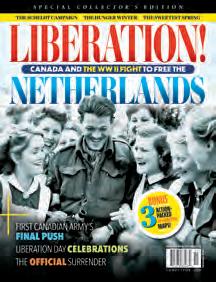
Liberation! Canada and the WW II fight to free the Netherlands
In fall 1944, Canadian troops led bitter fighting at the Scheldt to secure access to the vital port of Antwerp. In 1945, after five years of hardship and a harsh winter of starvation, the sufferings of the Dutch people finally ended.
THE BADASS BAGPIPERS OF THE 16TH BATTALION
And the legendary lore of the wind instrument of war
By Stephen J. Thorne
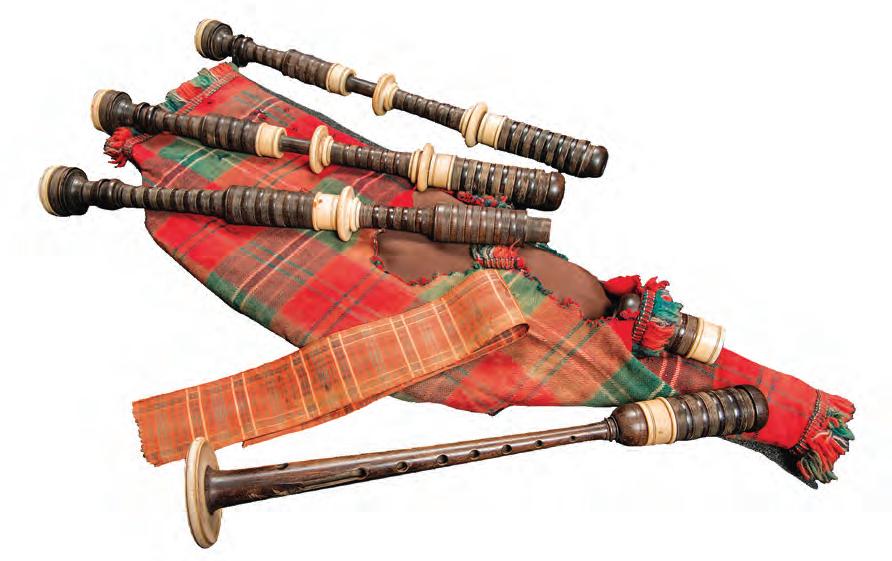
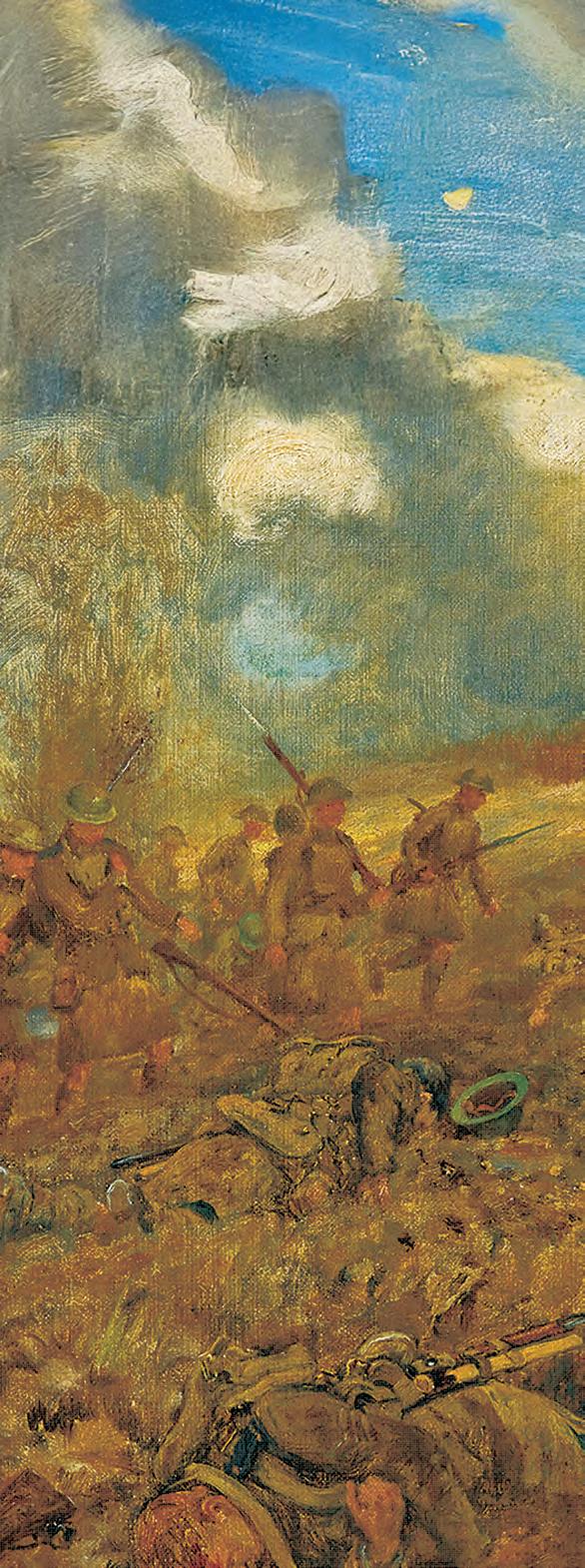
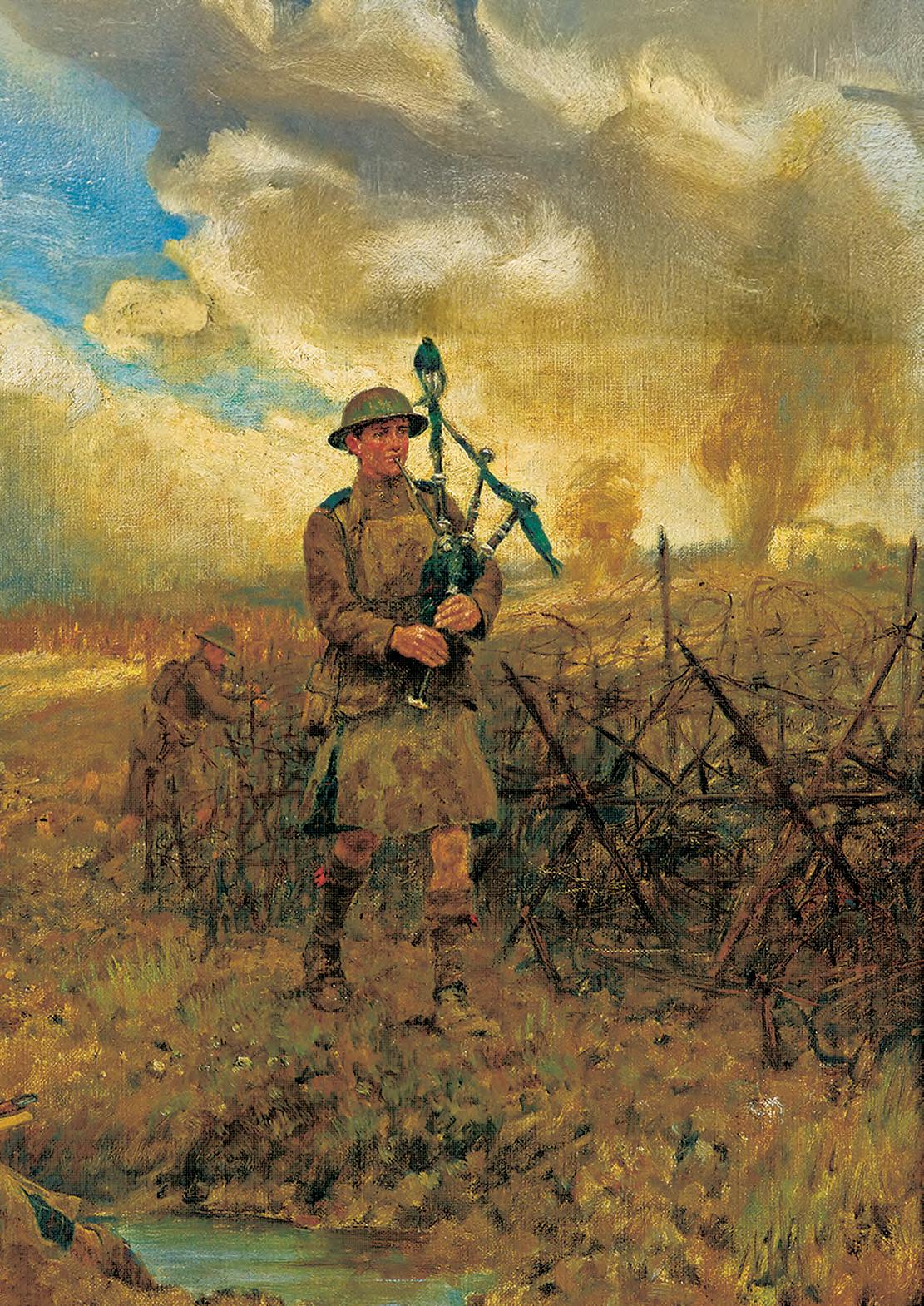
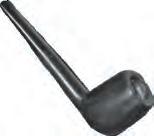
Artist James Prinsep Beadle depicts Piper James Richardson of the 16th Battalion (Canadian Scottish) in the notorious Regina Trench during WW I. His pipes ( above) were thought lost for 86 years until they were located in Scotland.
It
was Oct. 8, 1916, and the Battle of the Somme had been raging for more than three months. Allied forces were making their final push against fierce German defences dug in at Regina Trench on the heights overlooking France’s Ancre river valley.
The 16th Battalion (Canadian Scottish) was crossing more than 600 metres of no man’s land to its objective in the predawn hour, advancing in “long, snake-like lines…by the light of the bursting shells,” as one officer described it, when the men were stopped dead in their tracks.
“On coming in sight of the wire I ran on ahead and was astonished to see it was not cut,” recalled Sergeant-Major Arden Mackie, situated front and centre of the attack. “I tried to locate a way through but could find no opening.
“When the company came up the enemy started throwing bombs and opened r ifle fire.”
Mackie went to tell their company commander, Major George David Lynch of Winnipeg, to take cover in a nearby shell hole until he could track down some wire cutters. But Lynch, who had already been wounded in May, had been hit in the chest and died before Mackie could administer first aid.
The attack was stalled. The Scots had gone to ground. There seemed no way forward.
“Piper Jimmy Richardson came over to me at this moment and asked if he could help, but I told him our company commander was gone,” said the Scotland-born Mackie. “Things looked very bad and then it was that the piper asked if he would play his pipes— ‘Wull I gie them wind?’ was what he said.
“I told him to go ahead and as soon as he got them going I got what men I could together, we got through the wire and started cleaning up the trench.”
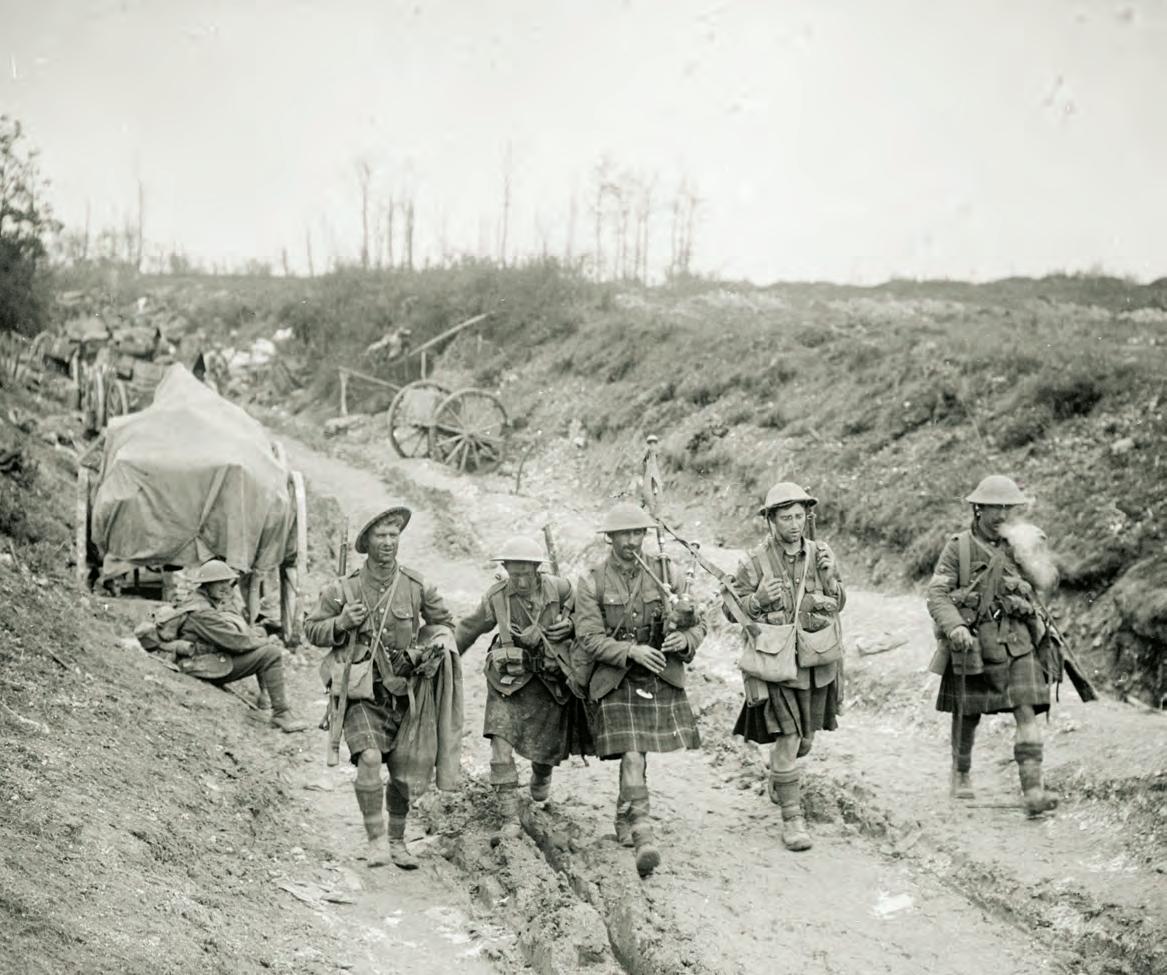
Bagpipes and the military have gone hand-in-hand into battle and otherwise for more than 400 years, historian Tim Stewart noted in his 2000 paper “Canadian Pipers at War, 1914-1918: An Inspired Tradition.”
Richardson was awarded the Victoria Cross posthumously on Oct. 8, 1916.
Non-Scots, he wrote, might at some point have had a hard time envisioning the value of bagpipes in war, but “their minds were changed after they witnessed the power of the bagpipes to motivate and inspire soldiers on the battlefield.”
The English tried to ban virtually every element of Scottish culture, including the bagpipes, after defeating Scotland’s Charles Edward Stuart (known as Bonnie Prince Charlie) at Culloden in 1746.
At his treason trial—one of many that took place after the battle—defendant John Reid claimed that, as a piper, he was a noncombatant and therefore not guilty. His English judge ruled, however, that since no Highland regiment ever marched without a piper, the pipes were an instrument of war. He concluded that Reid had borne arms against the king and should be hanged.
It was in the aftermath of this very battle, and such harsh judgements, that tens of thousands of uprooted Scots first brought themselves, and their culture, to what is now Eastern Canada. Back in Scotland, loyal Highland regiments were quelling the rebellion.
Two of these regiments, Montgomery’s Highlanders (77th) and Fraser’s Highlanders (78th), along with the Black Watch (42nd), served in North America—Fraser’s Highlanders exclusively in Canada, playing the “great war pipe of the north” at some of the most significant battles in the country’s history, including the siege and capture of Louisbourg in 1758 and of Quebec the following year.
Some Highland officers were offered land in Canada at the end of the Seven Years’ War in 1763. And during the American Revolution of 1775-1783, London issued orders to raise a Scottish regiment in Canada, the Royal Highland Emigrants.
Detachments were garrisoned at Quebec; Saint John, N.B.; Annapolis, N.S.; and Halifax, where Scottish heather has grown freely since Highland soldiers shook its seeds out of their bedrolls in what has since become Point Pleasant Park.
The pipes were integral to them all.
“It was this centuries-old tradition instilled in the descendants of those early Scottish settlers, combined with a sense of duty to country, that drove Scottish-Canadians to enlist when the call went out for men at the start of the First World War in 1914,” wrote Stewart.
“Pipers were once again summoned to their old proud post of duty and honour on the battle front.”
The point at which Private James (Jimmy) Cleland Richardson, a 20-year-old native of Bellshill, Scotland, began to play was “desperately critical,” says the battalion history. Major Lynch had told him to stay silent until he ordered him otherwise.
“Not a 16th man had got over the wire,” says the account, published in 1932. “The two waves had now merged.
“From the outside of the entanglements some of the men were bombing the German trench; others were trying to force a passage by beating down the wooden stakes, on which the wire was supported, with the butts of their rifles and trampling the wire under foot.”
Rifle fire from the opposing trench was “deadly accurate. It seemed as if the attacking troops to a man would become casualties.”
It was at this moment that Richardson— who had quit his job as an 18-year-old
RICHARDSON WASN’T THE FIRST, NOR WOULD HE BE THE LAST OF THE 16TH BATTALION PIPERS TO STAND OUT AND INSPIRE THEIR TROOPS ON THE BATTLEFIELD.
driller to enlist just six weeks after the British Empire went to war with Germany— began to play, marching fully exposed up and down the length of the wire for 10 minutes.
He was just five-foot-seven, 137 pounds, but evidently had mighty lungs.
“He was not originally detailed for the attack. He asked to be paraded before the Commanding Officer; and there pleaded so earnestly to be allowed to go into action that Colonel [Robert] Leckie finally granted him his wish.”
Richardson would be awarded a Victoria Cross for his actions that day— posthumously. His VC citation, published two years later in The London Gazette, said the company was already demoralized in the face of heavy casualties.
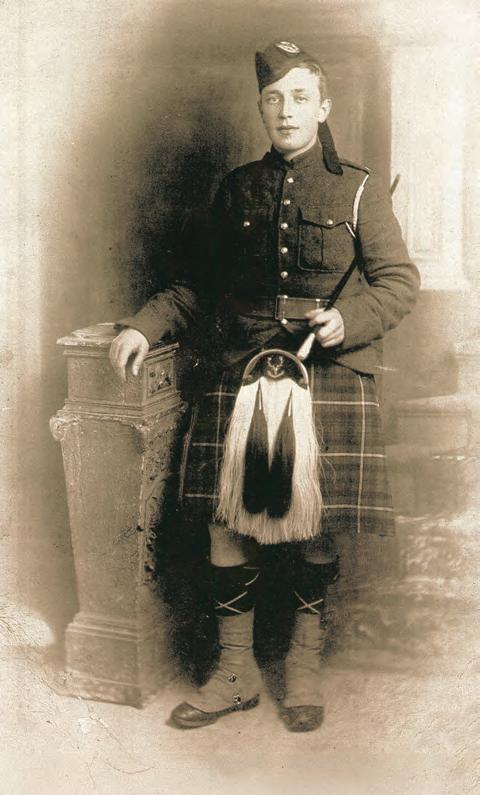
The earliest known photograph of Richardson (far right), as a cadet.
“Realising the situation, Piper Richardson strode up and down outside the wire playing his pipes with the greatest coolness,” it said. “The effect was instantaneous. Inspired by his splendid example, the company rushed the wire with such fury and determination that the obstacle was overcome and the position captured.”
Later, after joining “bombing operations” (a grenade attack) in which he and Mackie captured two Germans, Richardson was detailed to escort their prisoners and his wounded sergeantmajor back behind the Canadian line.
“After proceeding about 200 yards Piper Richardson remembered that he had left his pipes behind. Although strongly urged not to do so, he insisted on returning to recover his pipes. He has never been seen since.”
He was one of two 16th Battalion pipers, along with Corporal John Park, to die that day. Richardson’s remains weren’t found until 1920. He was buried at Adanac (Canada spelled backward) Military Cemetery northeast of Albert, France.
His bagpipes were believed lost in the Somme mud for 86 years until 2002, when the pipe major of The Canadian Scottish Regiment (Princess Mary’s) discovered that
Ardvreck School in Crieff, Scotland, had a set of bagpipes with the distinctive red, green and gold Lennox tartan used by the pipers of Richardson’s 16th Battalion.
As it turned out, a British army chaplain, Major Edward Yeld Bate, had found the pipes in 1917 and brought them home to the school where he taught. For decades, they served as a broken, stained and mud-caked reminder of an unknown piper from the Great War.
Andrew Winstanley of the Canadian Club and Pipe Major Roger McGuire investigated and eventually confirmed it was Richardson’s instrument. An anonymous donor subsequently purchased it on behalf of the citizens of Canada and it has been on public view in B.C. since 2006.
Richardson and his family had taken up residence in Chilliwack before the war. His father David was a local police chief, and Richardson had become a regular bagpipes competitor on the B.C. Highland games circuit, appearing in Vancouver, North Vancouver and Victoria. At the time his son was killed in action, Richardson’s father had three of his gold medals for piping.
Richardson wasn’t the first, nor would he be the last of the 16th Battalion pipers to stand out and inspire their troops on the battlefield.
The battalion’s past is rich with piper lore. During the Second Battle of Ypres in April 1915, 16th Battalion pipers James Thomson and William McIvor were severely wounded while playing the troops forward after the German gas attack at Saint Julien. Both later died.
Less than a month later, during a daring daylight assault at Festubert, pipers George Birnie and Angus Morrison stood atop the ruins of a farmhouse and played as the 16th advanced into a hail of machine-gun fire. Both were hit.
“As they fell, the sound from their drones trailed off and the sounds of battle were everywhere once more,” Stewart wrote.
At the Second Battle of Arras in September 1918, Pipe Major James Groat led troops over the top and through barbed wire under heavy machine-gun fire and amid hand-to-hand combat until he was wounded by shrapnel.
It had been his fifth time leading the battalion into battle, and he ended the war with a Distinguished Conduct Medal (DCM) and two Military Medals (MM) among his decorations.
“Groat was the soul of our pipers,” said his commanding officer, Lieutenant-Colonel Cyrus Peck, “full of zeal for the music; a grim, dark-visaged, silent man with a brave heart.”
The battalion history relates the stirring tale of Lance Corporal Alex MacGillivray, who piped his way into legend at Hill 70 in northern France on Aug. 16, 1917.
As the 16th prepared to go over the top against deeply entrenched, heavily defended German troops on the infamous rise north of Lens, the transplanted Scot told his company sergeant-major that he felt “anxious.”
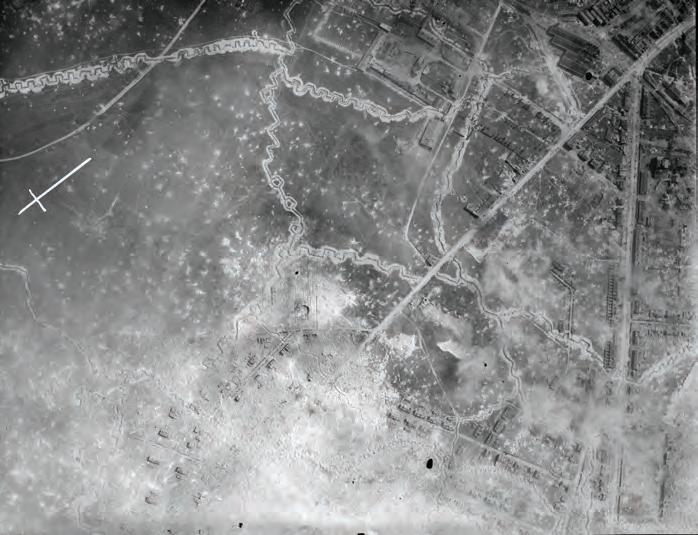
Aerial reconnaissance shows trench networks on the Western Front (left ). A piper of the 7th Battalion, Seaforth Highlanders (opposite), leads men of 26th Brigade during the Battle of the Somme.
“PIPER RICHARDSON STRODE UP AND DOWN OUTSIDE THE WIRE PLAYING HIS PIPES WITH THE GREATEST COOLNESS. THE EFFECT WAS INSTANTANEOUS. THE COMPANY RUSHED THE WIRE .”
He said he feared that, burdened as he was with his pipes and equipment, the company men might get out ahead of him and “bring disgrace on a Highland piper.”
“Well, if you think that way,” his non-commissioned officer told him, “ask the company commander to allow you to climb out before us.”
And, so, he did and, when the barrage opened, MacGillivray led off the advance, well ahead of the attacking wave, playing his pipes. His “gallantry,” says the battalion history, inspired more than his own 16th.
At the so-called “Blue Line,” where the brigade attack was reforming under fire before resuming its advance, MacGillivray continued to play up and down before the companies of the 16th. He then headed off in front of the neighbouring 13th Battalion (Royal Highlanders of Canada), where he made a “profound impression.”
“Just at this time,” says an account, “when all ranks were feeling the strain of remaining inactive under galling fire, and when the casualties had mounted to over 100, a skirl of the bagpipes was heard, and along the 13th front came a piper of the 16th Canadian Scottish.
“This inspired individual, eyes blazing with excitement, and kilt proudly swinging to his measured tread, made his way along the line, piping as only a true Highlander can when men are dying, or facing death, all around him.
“Shell fire seemed to increase as the piper progressed and more than once it appeared that he was down, but the god of brave men was with him in that hour, and he disappeared, unharmed, to the flank whence he had come.”
MacGillivray was among the men who ultimately overshot the objective. Well ahead of the rest, he was set upon by a German soldier. He dropped his pipes and dispatched his attacker. Afterward, he couldn’t find the coveted apparatus that the judge in that 18th century court had declared an instrument of war.
He was reluctant to return to battalion headquarters as ordered until his sergeantmajor promised he personally would look for the pipes, with their blackwood drones and ivory accoutrements, and take charge of them.
“IT WAS STUPID AS HELL… MEN FALLING ALL AROUND ME, FALLING DEAD…IT WAS BLOODY HORRIBLE …. [BUT] HEARING THE PIPES GAVE THE TROOPS COURAGE.”
“The sergeant-major found the pipes next morning about forty to fifty yards in front of the final objective,” says the battalion history. “He brought them back with him, but Alec McGillivray was not there to claim his beloved instrument.
“[He was] seen to start from the front line on his return journey and then disappeared entirely from view, probably blown to pieces by a shell.”
MacGillivray was posthumously awarded the Military Medal for “acts of gallantry and devotion to duty under fire.” His citation said he played his company over the parapet to the final objective, “upholding the finest traditions of Highland courage.”
“His supreme indifference to danger was undoubtedly the greatest inspiration to his comrades.”
MacGillivray’s remains were never identified. His name appears on the Canadian National Vimy Memorial alongside those of 11,284 other Canadian First World War soldiers killed in France whose ultimate resting place is unknown.
In all, pipers of the 16th earned a DCM, nine MMs and a VC during the Great War, all for piping in action.
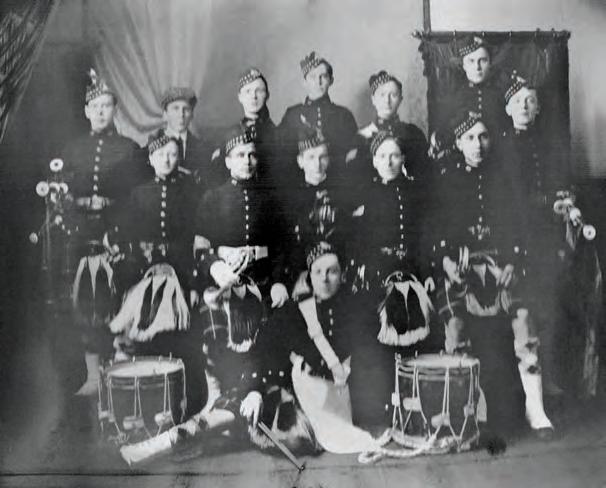
Stewart reports that more than 50 other Canadian battalions, from every province but Prince Edward Island, maintained pipers and drummers— and not all of them were Highlanders.
Pipers could be found in non-Highland units such as the 107th (Canadian Pioneer) Battalion; the 1st and 4th Canadian Mounted Rifles; the 224th (Canadian Forestry) Battalion; the 3rd, 5th and 6th Canadian Railway Troops; Toronto’s 208th (Canadian Irish) Battalion; and Princess Patricia’s Canadian Light Infantry, which advanced with nine pipers at Vimy Ridge.
Two pipers from the 25th Battalion (Nova Scotia Rifles), William Brand and Walter Telfer, were awarded Military Medals for playing their companies into battle at Vimy. Telfer lost his leg in the April 1917 fighting.
Indeed, virtually all battalions that had pipers suffered piper casualties.
“You were scared, but you just had to do it, they were depending on you,” Harry Lunan of the Gordon Highlanders, believed to be the last living WW I bagpiper, told Britain’s Sunday Express newspaper in 1993. “In the first assault [at High Wood], I played the tune ‘Cock o’ the North.’ I played my company over the bloody top, right into the German trenches.
“It was stupid as hell…Men falling all around me, falling dead…it was bloody horrible….[but] hearing the pipes gave the troops courage.”
The bagpiping of men to battle tapered off as WW I casualty rates soared (of some 2,500 wartime pipers spanning the British Empire, more than 500 were killed and another 600 wounded; specific Canadian figures don’t exist).
Among the last major battles of any war in which the pipes played a significant role was during the British 51st Highland Division’s opening assault at the Second Battle of El A lamein in North Africa on Oct. 23, 1942.
Each attacking company was led by a piper, playing pieces that would allow other units to recognize which Highland regiment they belonged to. The attack succeeded, but losses among the pipers were high, and it’s believed to have been the last time a British Highland unit used them during the Second World War.
Canadian-born William (Piper Bill) Millin, the personal piper to Simon Fraser, 15th L ord Lovat, was at the D-Day landing of the British 1st Special Service Brigade on Sword Beach in Normandy. At Lovat’s request, he marched up and down the beach playing his pipes under fire.
The British army had restricted bagpipes to rear areas by the Second World War. Lovat ignored these orders, however, and ordered the 21-year-old Millin to play. When his private demurred, citing regulations, Lord Lovat replied: “Ah, but that’s the English War Office. You and I are both Scottish, and that doesn’t apply.”
Millin played “Highland Laddie,” “The Road to the Isles” and “All the Blue Bonnets Are Over the Border” as his comrades fell around him on Sword Beach. Millin later related that he talked to captured German snipers who claimed they didn’t shoot him because they thought he had gone mad.
Company pipers of the Calgary Highlanders also played during the unit’s first battle in Normandy in July 1944, the last time they performed in WW II action.
The last time pipers led any unit into battle is believed to have been during the 1967 Aden Emergency in Yemen, when 1st Battalion, The Argyll and Sutherland Highlanders, was led into the rebeloccupied Crater district by their pipe major playing the regimental marches.
More recently, American Lyle Walker, a veteran of the 43rd Army Band, Nebraska National Guard, tells the story of a request from the mother of a soldier in Saudi Arabia. It was a few months before Desert Storm in 1991.
“Her son was a tank commander and wanted bagpipe music to play over his tank’s speakers,” Walker related on a bagpipe chat site.
The Omaha-based band recorded a c assette and sent it along.
“Several years later when tuning for a parade a young man approached us and identified himself as the tank commander we sent the tape to. He said his crew voted on playing the Omaha Band’s tape, so when the shooting started, he played our tape at full volume going into battle. He had quite a few stories he told us regarding that tape over a few ‘beverages’ after the parade.”
Added Walker: “I’ve never piped anyone into battle, but my music has.” L
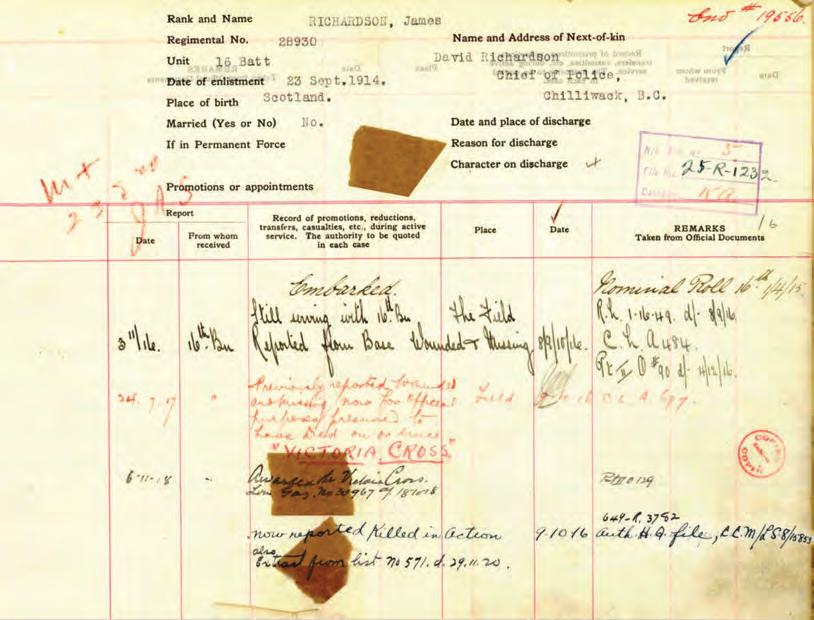
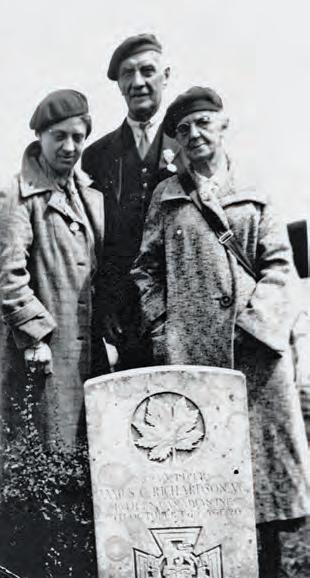
Richardson’s family at his grave in France’s Adanac Military Cemetery. The piper’s service record catalogues his disappearance and subsequent Victoria Cross.
LAC; David Boulding
By Mark Bourie
minesweepermystery
What
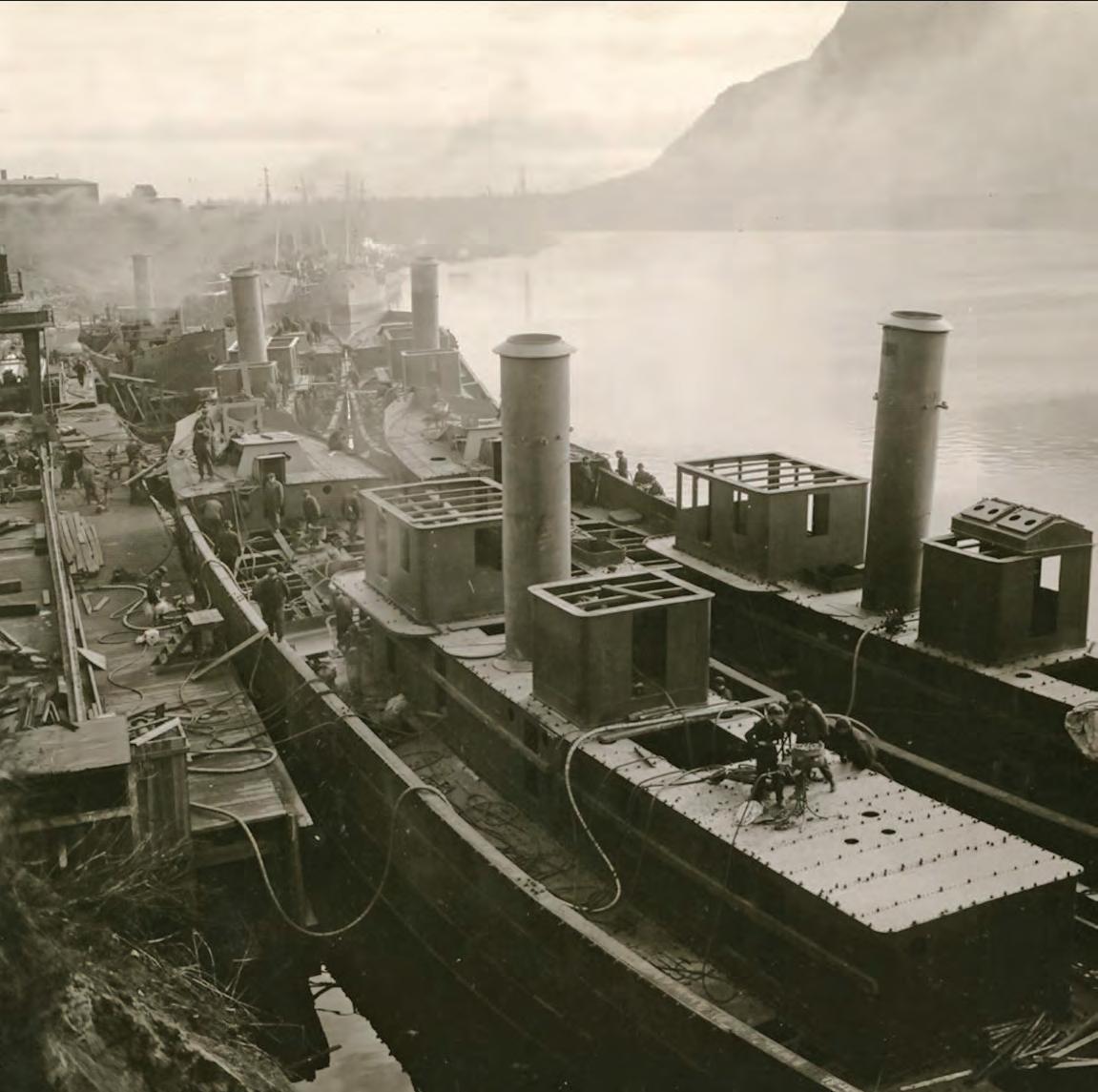
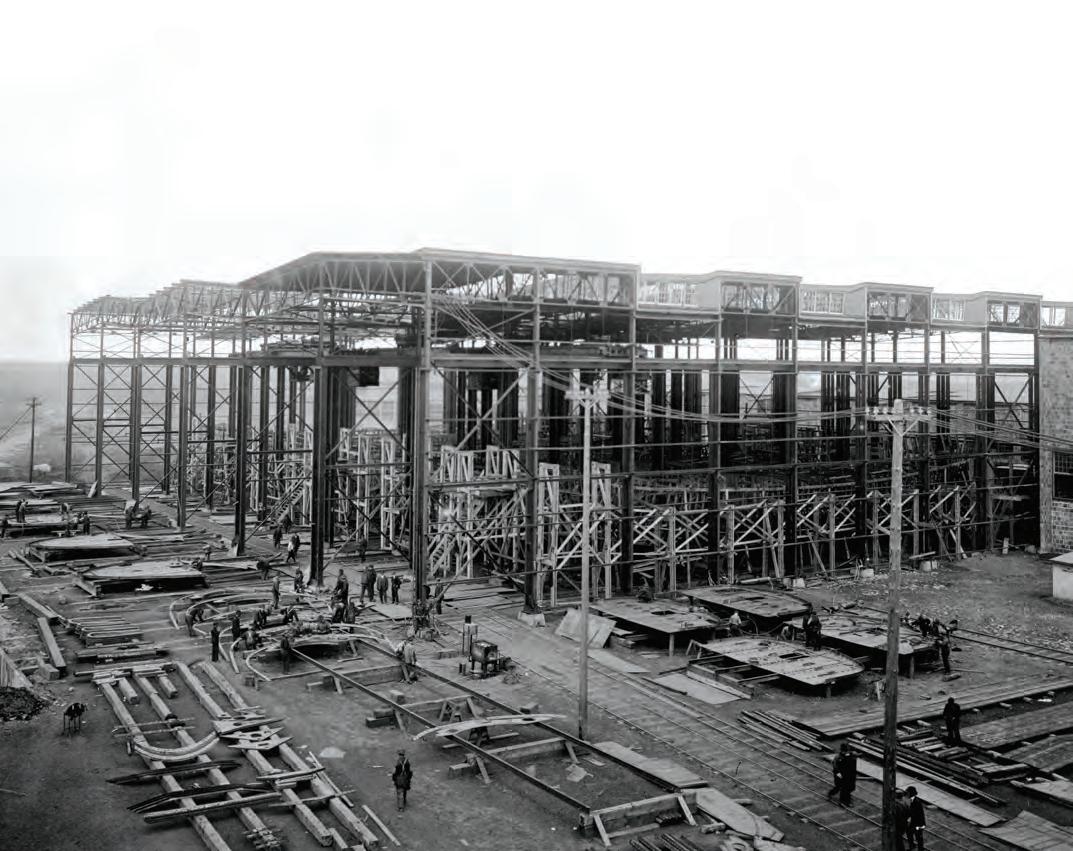
French minesweepers under construction in Fort William, Ont., in 1918 (present-day Thunder Bay).
happened to two First World War French warships in Lake Superior
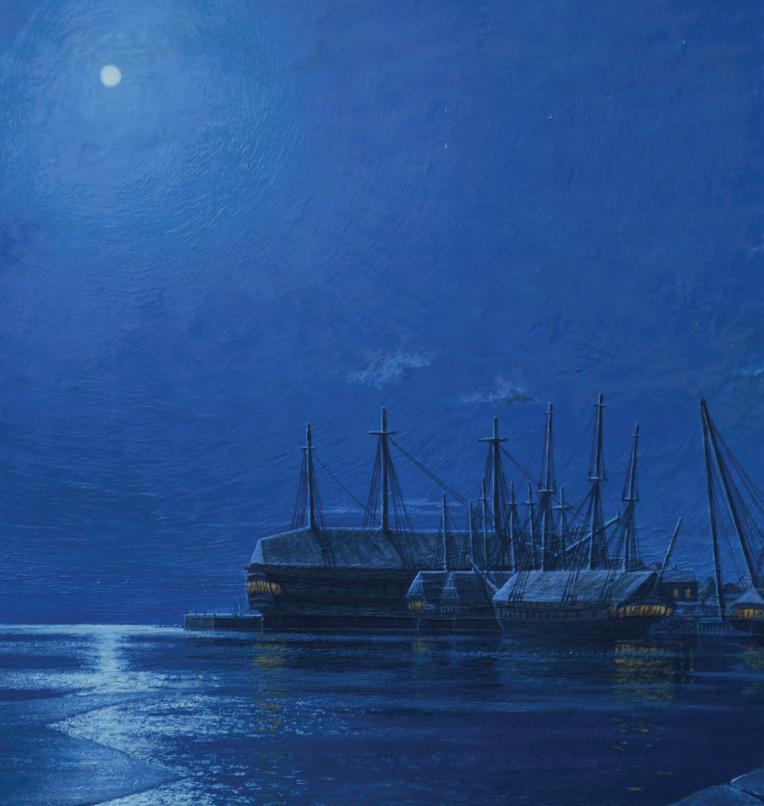
wrecks of two First World War-era French minesweepers lie somewhere on the bottom of Lake Superior, along with the 78 men who were aboard them. For more than a century, they’ve kept the secret of the greatest marine disaster on the world’s largest freshwater lake.
Here’s what’s known: three new French minesweepers sailed out of the twin cities of Port Arthur and Fort William (now Thunder Bay, Ont.) a couple of weeks after the 1918 Armistice, and only one was seen again. Why were French navy vessels challenging Lake Superior’s notorious gales of November?
By the third year of the war, the French were so desperate for shipbuilders that they turned to yards on the Great Lakes to build a dozen minesweepers. First, they tried Wisconsin’s Manitowoc Shipbuilding Company on Lake Michigan, north of Chicago. It was working at capacity and had to turn down the contract offer. In February 1918, executives of the nineyear-old Canadian Car and Foundry Company in Fort William, Ont.—known as Can-Car by locals—said they could do the job, if Manitowoc engineers helped.
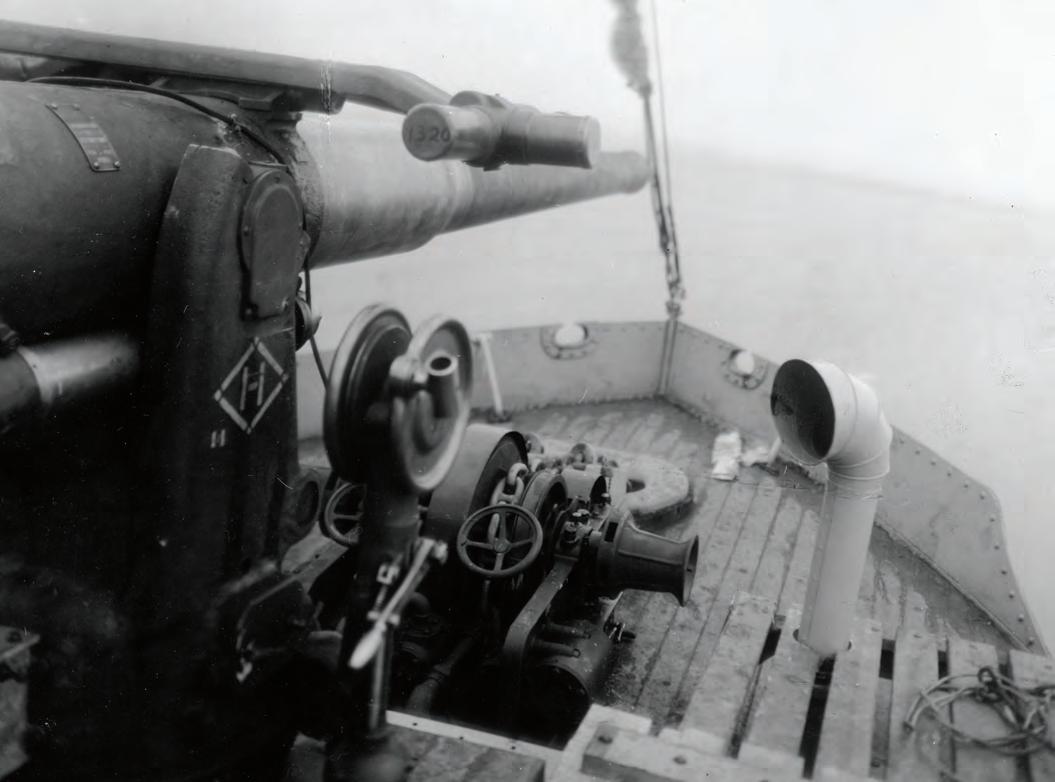
Each ship was armed with 4-inch guns in the bow and stern. The artillery had a range of about 20 kilometres.
France was to pay Can-Car, which normally built railway cars, $2.5 million for a ll 12 minesweepers.
In June 1918, as the war began to turn in favour of the Allies after the Germans’ last major offensive sputtered out, Can-Car workers laid the keel of Naravin, the namesake of the type. The ships were roughed out in Can-Car’s factory and moved on rail cars to the Kaministiquia River, about 500 metres away, to be completed.
The minesweepers looked like a cross between a navy patrol boat and a fishing trawler, with a single funnel and masts fore and aft. Forty-four metres long and six metres wide, each vessel was divided into four watertight compartments. Powered by coal-fired boilers turning twin screws, they could make 12 knots.
As the minesweepers were being built, the German army was collapsing. However, planning for the project started before the war showed any sign of ending—or that the Allies would be the winners. Still, it seems the French did give some thought to the minesweepers’ long-term use. It wasn’t a coincidence that they looked like big fishing trawlers. Crew members talked about their “fish holds,” suggesting the vessels would eventually be sold off as war surplus to deep-sea fishermen.
Four French officers supervised the project. French marines arrived in Fort William in September to outfit and arm the warships. One of their officers, Lieutenant Edmond Jean Marie Raoult, died in a wave of Spanish flu that hit the city that fall.
Even Can-Car executives later admitted the minesweepers were built in a hurry, without frills, but they denied the ships were so badly made that they couldn’t handle the Great Lakes.
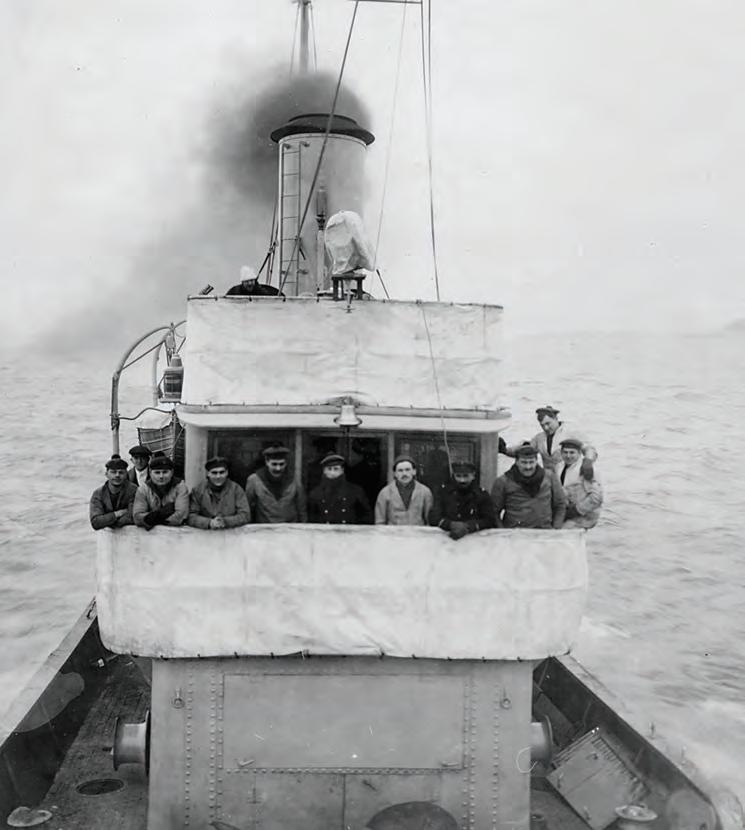
A finished French warship sets out on Lake Superior in November 1918.
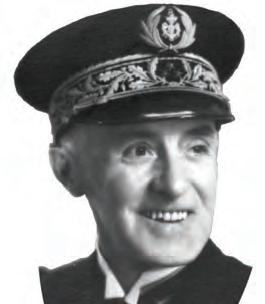
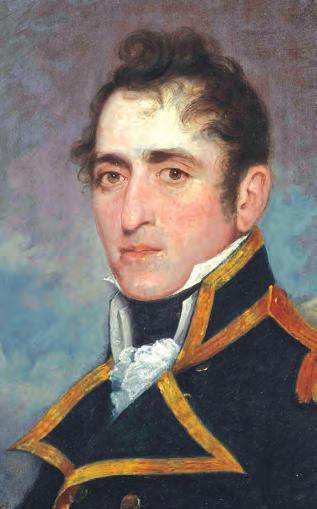
First Lieutenant Marcel Adrien Jean Leclerc (below ) commanded one of the last groups of French minesweepers to depart Fort William, Ont. The ships were built at Canadian Car and Foundry Company’s shipyards (bottom).
Six of the Navarin-class vessels were ready to sail by November 1918. By then, however, the war was over. Members of the French naval team probably just wanted to get home. But the ships were still needed to clear the many thousands of naval mines laid by all the belligerents in the Atlantic Ocean, and once winter set in, they and their crews would be stuck in northern Ontario until at least April 1919. Because the ships were completed late in the year, French officers had trouble finding experienced local captains
By the third year of the war, the French were so desperate for shipbuilders that they turned to yards on the Great Lakes to build a dozen minesweepers.
On the 23rd, well past the end of the commercial shipping season, the last group of t hree minesweepers steamed out of Fort William together. Inkerman was under the command of Captain François Mezou with Great Lakes’ Captain R. Wilson as his pilot. First Lieutenant Marcel Adrien Jean Leclerc skippered Sebastopol and was overall commander. Cerisoles had Captain Étienne Deude at the helm and Great Lakes’ skipper W.J. Murphy as pilot. Along with these officers, there were 74 French sailors and marines on Inkerman and Cerisoles. The fall gales were especially fierce in 1918. Making matters worse, the wind that day was blowing hard from the southwest, across the long western arm of Lake Superior that extends to Duluth, Minn. That meant the ships were buffeted along their sides as they sailed toward Sault Ste. Marie, Ont. If there was trouble, there would be little hope of rescue for the crews, especially since the French ships used a radio frequency that no one else on the Great Lakes monitored. Most of the voyage happened at night. There are conflicting stories about the departure time of the little fleet. It left illiam at noon or around 4 p.m. Either way, the captains and pilots had only a few hours of daylight. At that time of year, the sun
sets at about 5 p.m. and rises at 8 a.m. And snow squalls swept across the expedition.
No matter when they departed, the ships were in complete darkness when they sailed out of the lee of the islands off the north shore and headed into open water—what sailors called the graveyard of the Great Lakes. Once out of shelter, Inkerman, Sebastopol and Cerisoles encountered 80 km/h winds, nine-metre waves and snow squalls.
By 6:15 p.m., Leclerc on Sebastopol was considering turning back even though he was still sheltered by Isle Royale. Instead, he pressed on into the open lake and made for the south shore to shelter in the lee of the Keweenaw peninsula. He also had the choice of running back toward the north shore and taking shelter at the Canadian Pacific Railway coal docks at Jackfish, Ont., 200 kilometres east of Fort William. But the north shore was dangerous, with most of its small harbours unlit and their approaches peppered with rocks and islands.
the hold, flooding part of the engine room and nearly putting out the coal fires in the boilers. Without power, Sebastopol would have had no chance against the wind and waves.
Inkerman and Cerisoles overtook Sebastopol in the early evening. Still, all the French sailors were in for a night of terror. Exactly what happened on the lead ships as they were pounded by waves the size of houses and lashed by freezing spray, will likely never be known. But, some of the crew of Sebastopol later described the panic on their vessel.
French sailor Marius Mallor later wrote from Port Stanley, Ont., on Lake Erie: “Here I am after leaving Port Arthur, but you can believe me that I would have preferred to have remained there, because on the first night of our voyage, our boat nearly sank, and we had to get out the life boats and put on lifebelts but that is all in a sailor’s life. Three minutes afterwards the boat almost sank with all on board—and it was nearly ‘goodbye’ to anyone hearing from us again…. You can believe me, I w ill always remember that day. I can tell you that I had already given myself up to God.”
Mallor had good reason to be afraid. The scuppers couldn’t keep up with the cold water piling onto Sebastopol’s deck. It poured into
Leclerc wasn’t on the bridge. The French commander had gone to bed while the ships crossed the worst part of the lake and was trying to sleep when Sebastopol fell into a trough between two waves. He testified a month later that “the ship came to the left across the wave at an angle, reeled over and made a spoon under the wind. A second wave covered us on the starboard side, a fourth of the personnel on the deck stayed motionless and overwhelmed, the non-active men hastily left the sailors quarters and frantically got the life belts.”
Leclerc had learned through experience that while the Great Lakes might be inland seas, they can’t be sailed the same way. The lakes’ waves are much closer together and arrive more quickly than waves on the ocean. If a ship is caught in the narrow trough between big waves, a helmsman has little time to get the bow pointed back into the waves. Trapped in a trough, the ship can’t be steered and is simply tossed and flooded by the water.
As for Sebastopol’s terrified crew, the most their lifebelts could do was make their bodies easier to find. By late November, Lake Superior is barely above freezing.
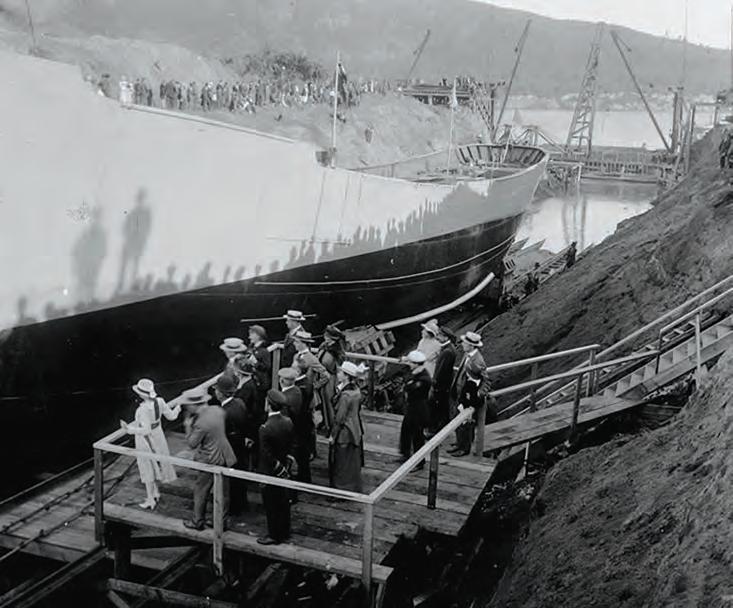
Leclerc was able to turn the ship into the waves and “restore order.” The near loss of Sebastopol was the fault of his Canadian captain, according to the French officer. French minesweeper Naravin is christened in Fort William, Ont., in July 1918.
For much of the night, Leclerc had sporadic radio contact with Inkerman and Cerisoles. By the time they got within 50 k ilometres of Manitou Island, off the northeast tip of Michigan’s Keweenaw pen insula, all three ships were taking in water. The storm kept building until midnight, when Leclerc caught sight of the lighthouses at Copper Harbor and Manitou Island.
At the crack of dawn the next morning, Leclerc dropped anchor in Bete Grise Bay, Mich. He sent messages in the French naval code to Inkerman and Cerisoles, but they weren’t answered. (Leclerc later testified the radios on all three ships were substandard and only worked intermittently, so he wasn’t worried at the time.) Still, he expected to see the other two ships sail through the snow squalls into calm water nearby. When they didn’t appear, he convinced himself they were heading to Sault Ste. Marie, Ont.
The local captains were sure Inkerman and Cerisoles were lost and wanted Leclerc to radio to the Canadian and U.S. coast guards for help. Leclerc refused, contemptuous of the Great Lakes’ skippers even though they were right.
Sebastopol was close to foundering. Instead of searching for the other vessels under his command, Leclerc headed east along the Michigan shore to Sault Ste. Marie, Ont., through snow squalls. Sebastopol cleared the locks there without Leclerc raising the alarm about Inkerman and Cerisoles. Another snowstorm hit Sebastopol on Lake Huron, and Leclerc had to run for shelter again. When Sebastopol reached Detroit on Nov. 28, he finally radioed the French Embassy in Washington that something might be amiss. Then he kept going.
Leclerc’s weather troubles, however, weren’t over. He had to find shelter on lakes Erie and Ontario and repair damage to his ship. Still, he ordered his vessel to hurry to Montreal, then to the Gulf of St. Lawrence
so he could get Sebastopol into the open ocean before the St. Lawrence River froze.
Leclerc handed Sebastopol over to a subordinate on Dec. 6. Two days later, he was back on Lake Superior in a tugboat, searching for the missing ships in Whitefish Bay northwest of Sault Ste. Marie. They checked the Canadian shore up to Cape Gargantua, then sailed to Michipicoten Harbour before returning to the Sault in mid-December.
As Leclerc started his search, news of the possible loss of the ships arrived in Fort William. A vessel agent, J.W. Wolwin, received a telegram from the U.S. Hydrographic Office in Duluth asking whether the minesweepers had turned back to their departure point. Within hours, the probable loss of Inkerman and Cerisoles was reported to the city’s newspapers and a separate search began. Still, city officials, including Fort William mayor Harry (Henry) Murphy, hinted that the two vessels may still have been sailing somewhere on the Great Lakes, under a shroud of censorship and official secrecy. Days before the disappearance was reported to the press, Murphy had been told Inkerman and Cerisoles hadn’t arrived at Sault Ste. Marie. Instead of initiating a search, the mayor and other city officials sat on the news and waited.
During the next few days, rumours swept Fort William and Port Arthur that the ships could have secretly passed the locks in Sault Ste. Marie without being registered because they were foreign naval vessels. Then there were reports that the two missing ships had been seen together in Whitefish Bay by the crew of the steamer Osler.
If anyone had survived the wrecks of Inkerman and Cerisoles, the official delays and the weather worked against them. It was winter and the days were short and the nights long. Tugboats searched the shoreline and islands of Superior’s north shore for the minesweepers, hoping they had taken shelter from the storm or had run aground. The tugs were taking a risk themselves in the big waves and the snow squalls. Experienced sailors said the only hope for the French ships was if they had been beached in some isolated place, which then, and now, describes most of Superior’s coast. Coves and natural harbours along both sides of the lake had been used by ships in trouble for years. But, they had also been
“I did not therefore come to a stop at the timid suggestions of my pilots who seemed uneasy about their fate, indeed I had never feared for my ship.”
the scene of some of the worst shipwrecks. And on the Canadian side, you could count the lit, inhabited ports on one hand.
People in Fort William and Port Arthur were curious about the missing ships, but the rest of the country wasn’t. The loss of the two French warships and all those sailors—the greatest loss of life in a Lake Superior marine disaster—barely made the papers at the time. By the following spring, when it was safe to resume the hunt for Inkerman and Cerisoles, no one in France, Canada or the U.S. cared enough to even bother to search for wreckage.
Instead, people involved in the construction project and the French naval team tried to avoid blame. Canadian authorities didn’t bother with any kind of investigation or inquiry. In fact, the only official government scrap of paper on the disaster in Library and Archives Canada says the vessels were lost on Lake Ontario.
On Christmas Eve 1918, the naval attaché of the French Embassy in Washington chaired a hearing in New York. Leclerc was the main witness. He tried to blame the Great Lakes’ captains who, he claimed, were afraid to sail out of sight of land, unable to predict weather and useful only “in rivers, canals.” He also accused Can-Car of building ships that were unstable in rough water.
In fact, Leclerc may have made his own ships top heavy: he had loaded the last three minesweepers differently than the nine built and sailed earlier. Leclerc had sent the ammunition earmarked for Inkerman, Sebastopol and Cerisoles ahead on an previous fleet, replacing it with some 30 tonnes of coal spread out on the bottom of the hold.
For his part, the local on Sebastopol said its stability seemed “ordinary.” Meanwhile, an inspector for Lloyds, which had insured the ships while they were outside the war zone, said he had watched the Can-Car workers build the ships, and they had done a good job.
The French vessels had 4-inch guns in the bow and stern.
Naravin floats in Lake Superior near Fort William, Ont., in Sept. 1918.
“The French minesweepers built at the Canadian Car and Foundry Company’s shipyards were structurally strong and seaworthy, and as perfect a type of boat that I have ever inspected,” Lloyds’ Peter Corkindale told a reporter.
“As well as myself, there were four inspectors from the French commission present while those boats were building. Lt. Garreau was one of them, and he will back up my statement that the minesweepers built at the car works were of the most seaworthy type and perfectly strong…. Some of the best boats ever built have been sunk in storms, and in this case it would only be fair for people to wait for the facts before rushing out with injurious rumours which are not backed by anybody in a position to know what they are talking about.”
(The 10 surviving Navarin-class ships were sold off in 1920, and one was still sailing 55 years later.)
People living along Lake Superior tried to solve the mystery. It’s an exaggeration that the lake never gives up its dead, but it does so unwillingly. The lake is cold and deep. Bodies don’t decompose quickly in the frigid water. And if a body does float, either because of decomposition or it’s in a life jacket, it’s likely no one will find it in the huge lake or along the thousands of kilometres of coastline.
A few years after the disaster, Charles Davieaux, the lighthouse keeper on Michipicoten Island, found a body washed up on the beach. He buried it without the kind of official inquiry and forensic testing we have today, so no one knows whether it came from the two French ships. A skeleton found years later near the little fishing village of Coldwell, on the north shore of Lake Superior, was buried in an unmarked grave.
Supposedly, bits of wreckage from the two ships were found and early in the December 1918 search, Cerisoles’ lifeboat was discovered near Grand Marais, Minn.
Better technology has made it easier to find Great Lakes’ shipwrecks and solve the inland seas’ mysteries. Still, Inkerman and Cerisoles elude searchers, who today are working harder to find the vessels than anyone did in the months after they were lost. Scientific expeditions searched for the minesweepers in 2009, 2015 and 2023.
During that last mission, a team working for the Expedition Unknown television series didn’t find Inkerman or Cerisoles, but they did stumble on the perfectly preserved wreck of the tugboat Satellite, lost in 1879.
Michigan-based shipwreck historian Tom Farnquist believes the vessels are close together northwest of the Keweenaw peninsula, but he hasn’t been able to find them.
“This is the Holy Grail of Lake Superior, to find two 155-foot brand spanking new minesweepers with 4-inch guns fore and aft,” said Farnquist. “One might have got into trouble and the other went to help it and was swamped when it turned its side into the wind. If we’re lucky, they’ll be close together.”
Wherever Inkerman and Cerisoles are, they still belong to the French navy, and the wrecks are war graves. L
O Canada: 6-Volume Set
kills First
By Stephen J. Thorne
Robert Bradford’s ink drawing depicts William Barker in his Sopwith Snipe earning a Victoria Cross on Oct. 27, 1918, over the Forêt de Mormal in France.
AFTER THE FIRST WORLD WAR, CANADIANS BECAME
SOME OF THE MOST RENOWNED AERIAL ACES. HERE’S WHERE IT ALL BEGAN.
Mention parasol and one might think of Mary Poppins floating among the chimneys of London or Impressionistic images of dainty Victorianera ladies at refined picnics and garden parties hiding their coiffed heads from the English sun.
A “light umbrella,” the Oxford English Dictionary calls it. Delicate. Fringed with lace.
In First World War Europe, however, the Morane-Saulnier Type L Parasol was a French-built, two-seat monoplane—originally a scout aircraft that, once fitted with a single machine gun, became the one of world’s first successful fighter aircraft.
And, unlike the parasol of Mary Poppins fame, it was a roughand rickety-looking one, at that. This garden party was anything but highbrow, and its attendees were certainly not dainty. But for the clouds in the skies over the Western Front, there was nowhere to hide from the sun or any other threat to life and limb. And there were many.
Captain Malcolm McBean Bell-Irving is credited with Canada’s first aerial victory of the Great War.
On Dec. 19, 1915, Captain Malcolm McBean Bell-Irving of the Royal Flying Corps—one of six Vancouver brothers enlisted in Empire forces (two others also flyers)—and his observer, a Brit
named Scott, encountered three of the more fearsome kind in the form of Deutsche Luftstreitkräfte aircraft, their type unknown.
Aged 23 at the time, he was somewhere between Lille, in northern France, and Ypres, in the south of Belgium, where the German advance to the sea had ground to a halt in fall 1914. A salient had formed around the medieval trading centre that the Allies would keep pretty much in check until the war’s end.
For a pilot of his time, BellIrving was seasoned and, the evidence suggests, unflappable. He had joined 1 Squadron at Netheravon, England, in October 1914—the first Canadian to join the RFC—and had flown his first reconnaissance mission over France the following March.
He was wounded for the first time within a month, over Hill 60.
He had survived at least one accident and several dogfights.
On this day, Bell-Irving shot down one of his foes and drove off the other two. He was wounded again, but continued to fly, and would be awarded the Distinguished Service Order, the first Canadian-earned decoration in the Royal Flying Corps.
“For conspicuous and consistent gallantry and skill during a period of nine months in France, notably on 19th December, 1915, between Lille and Ypres, when he successfully engaged three hostile machines,” reads his citation.
“The first he drove off, the second he sent to the ground in flames and the third nose-dived and disappeared.
“He was then attacked by three other hostile machines from above, but he flew off towards Ypres, and chased a machine he saw in that direction.”
More than 22,000 Canadians would go on to serve in the RFC, Royal Naval Air Service and, after April 1, 1918, the Royal Air Force. More than 13,000 were aviators— pilots, gunners or observers—while the rest served as ground crew. (A fledgling Canadian Air Force was assembled, but never got off the ground before the war ended.)
In those early days, wartime flight consisted of simple planes and balloons, used primarily in scouting and photographic mapping of enemy positions. The first crews of rival reconnaissance aircraft exchanged nothing more belligerent than smiles and waves. Soon, however, they began tossing grenades and even grappling hooks at each other.
The first recorded incident in which an aircraft was brought down by another involved an Austrian reconnaissance plane rammed on Sept. 8, 1914, by Russian Pyotr Nesterov on the Eastern Front. Both aircrews were killed in the dual crash.
Battling freezing cold, buffeted by unpredictable winds and weather in flimsy, relatively unreliable airframes, and increasingly threatened by their rivals’ incursions, pilots began firing handheld weapons— pistols and shotguns, mainly—at enemy aircraft, although they were rarely an effective means of attack.
Once, when Bell-Irving’s revolver misfired, he is said to have thrown the weapon at a German pilot, hitting him in the head.
On Oct. 5, 1914, French airman Louis Quenault became the first aviator to unleash machine-gun fire on an enemy plane, propelling aviation into a new era. The dogfights escalated into desperate struggles over the wastelands of strife-torn Europe, the daily stakes as high as any could be.
With a homeland so vast and wild, it was only natural that Canadians took to the skies early and often. The First World War— the first industrialized war—
THE FIRST WORLD WAR—THE FIRST INDUSTRIALIZED WAR— WOULD PROVE THE CATALYST THAT PROPELLED CANADA’S FLEDGLING AVIATION INDUSTRY TO NEW HEIGHTS .
would prove the catalyst that sent Canada’s fledgling aviation industry to new heights.
Like no other war before it, the Great War fostered unparallelled advances—in medicine, technology, weaponry, machinery and, perhaps more than any other field, aviation.
Just a decade after the Wright brothers achieved history’s first powered flight, the airplane had become a weapon of war and the focus of an arms race.
Warplanes started out as rudimentary aircraft with open cockpits and limited instrumentation. Pilots, quite literally, flew by the seat of their pants, without parachutes.
The aviation industry, however, was in rapid growth, in constant evolution, designs and performance improved with each new aircraft.
A 1914 woodcut print depicts action between Russian and Austrian aircraft (left ). Canadian aces William Barker and Billy Bishop pose by a captured Fokker D.VII (below ).
Canadian Raymond Collishaw (right ) notched 61 aerial victories with the Royal Naval Air Service during WW I. Fellow countryman Donald Roderick MacLaren (bottom right ) joined the Royal Flying Corps, recording 54 kills.
By early 1915, the British army reckoned it would need some 50 squadrons—700 planes. The British secretary of state for war, Horatio Herbert Kitchener, ordered it to double its request.
American historian Richard P. Hallion says there were more than 50 different aircraft designs during WW I, with five distinct technological generations. The combatants produced over 200,000 aircraft and even more engines. French industry alone accounted for a third of them.
new machines and replace casualties,” the BBC reported in 2014. “Although the [Royal Flying Corps] was relatively small, their ratio of losses was at least as high as in the infantry.
By war’s end, Allied nations were outproducing the Germans by nearly 5:1 in aircraft and better than 7:1 in engines. Britain was coming out with 31 times more planes a month than it had owned when the war started. The RAF was the first independent air service, and the largest.
“Pilots were needed in everincreasing numbers to fly the
“But there was never a shortage of volunteers either to fly as a pilot or as an observer. The romance of flying was an attractive proposition, it avoided the tedium of life in the trenches and offered a novel way of going to war.”
Flying with British units, Canuck aviators acquitted themselves exceptionally well in history’s first aerial confrontation between countries.
There were 171 Canadian flying aces between 1914 and
1918—airmen with five-plus aerial victories, or kills. Four of the Top 12 were Canadian, three Top 10: Billy Bishop with 72 kills; Raymond Collishaw (60); Donald McLaren (54); and, at No. 12, William Barker (50). Twenty-four Canadians scored 20 or more.
Canadian flyers were awarded at least 495 British decorations for gallantry, including three Victoria Crosses—Bishop and Barker among them—and 193 Distinguished Flying Crosses, plus nine bars.
Dogfights over the Western Front were furious affairs, conducted at close quarters, usually with decisive outcomes (right ). Captain Gerald Gibbs (opposite, left) and his observer pose with the German aircrew (centre) Gibbs shot down.
They were trailblazers and warriors who shared a mutual regard and respect, even camaraderie, with their mates and enemies alike. They were privileged to fight above and beyond the mud and misery of the trenches, and they knew it, albeit with the underlying acceptance that fiery death could come at any time.
Theirs was a singular experience, the scale and intimacy of which were unique in the annals of conflict. With it, a new chivalric tradition, vestiges of which persist to this day, was born.
Masters of the air in bare-bones, canvas-and-wood airplanes, they fought mano-a-mano, skill to skill, often just metres apart. And mostly chute-less.
As fighter squadrons were formed and aerial conflict escalated, aces emerged. Personalities emerged with them, recognizable by their distinct aircraft and markings: German Richthofen in his red Fokker triplane; Canadian Bishop in his Nieuport 17; American Rickenbacker with his “Hat-inthe-Ring” Nieuport 28.
They battled in freezing cold, buffeted by unpredictable winds and weather in flimsy, even delicate, airframes.
“Now a dogfight is rather an exciting game actually,” pilot Thomas Isbell of 41 Squadron, RFC, told the Imperial War Museums. “You’d dive onto the first Hun you come across, you open out your guns…and no sooner you’ve got your guns on him, someone else has got their guns on you.”
While lice-ridden soldiers wallowed in the rat-infested filth, cringing under artillery bombardments and awaiting the next dreaded order to go over the top, pilots at least had days flying the wild blue—and good food and a warm bed to go back to.
“YOU’D DIVE ONTO THE FIRST HUN YOU COME ACROSS, YOU OPEN OUT YOUR GUNS… AND NO SOONER YOU’VE GOT YOUR GUNS ON HIM, SOMEONE ELSE HAS GOT THEIR GUNS ON YOU .”
At night, they would engage in the drunken, bittersweet celebrations and tributes to their fallen brethren, the prospect of death or disfigurement lingering somewhere in the recesses of their collective consciousness, the price of a slight miscalculation, a moment’s loss of focus, or circumstances unforeseen. Over time, the latent stress would do its work, chipping away at their psyches.
In April 1917, the RFC’s worst month, the average life expectancy of an Allied pilot on the Western Front was 69 flying hours. Denied parachutes, many ensured they had enough ammunition to hasten the inevitable.
Those who flew belonged to an exclusive club whose members quickly came to understand the special place they occupied. The rare air above 10,000 feet brought on hypoxia, a potentially fatal high, but there were no borders, or dictums, up there among the clouds. They forged their own, unwritten, terms of engagement.
In the Roberto de Haro novel A Twist of Fate: Love and The Great War, the protagonist, a Louisiana Cajun named Quentin Norvell, describes the experience of flying in combat with the French Air Service during the First World War.
“There’s a bond between fighter pilots, even if we’re adversaries,”
he says. “You see, we share the same things, the deafening noise of the engine which blots out our hearing, the speed and maneuverability of our planes, the sensation of flight, and the single purpose of defeating your opponent.
“It all comes down to one man pitted against another, high above the ground, making instant decisions that determine success or failure, and often death. There’s not enough time to think about hate.
“The enemy pilot knows my purpose is the same as his. If I hate anything…it’s the need for us to fight and kill each other.”
Indeed, opposing airmen went to astonishing lengths to help each other in the First World War, even warning the other side of where they were about to drop bombs and sending photographs of graves when they buried enemy dead.
Diaries kept by a young pilot from Pembrokeshire, Wales, reveal how the camaraderie sometimes took precedence over hostilities, particularly between British and German flyers.
The notes taken by the 22-yearold Royal Naval Air Service pilot William David Sambrook suggest German adversaries warned their British enemies of where they planned to drop bombs.
Posted to Coudekerque airfield near Dunkirk, France, in 1916,
Sambrook’s diaries tell of almost daily bombing raids on German-held aerodromes, docks and Zeppelin sheds at Bruges and Zeebrugge in Belgium.
One day in May 1916, a colleague failed to return from a raid on the aerodrome at Ostend, Belgium. There were rumours that the missing airman had been recovered from the sea by a Belgian trawler.
A few days later, with still no confirmation of his fate, another airman flew over the German airfield and dropped a message asking if they had information about the missing pilot. His British colleagues received a prompt reply, also dropped from the air, confirming that the aircraft had been shot down over the sea.
“They said attempts had been made at rescue, but when the machine was brought in, the pilot was already dead,” Sambrook wrote. “He was buried with full military honours alongside two comrades at Marrakerke cemetery, Ostend. The message was accompanied by two photos of the funeral and the grave.
“There was also a message in German stating the name and place in German territory where our machines could land if they had engine trouble.”
Alan Wakefield, head of photographs at the Imperial War Museums, told London’s Daily Mail in 2014 that such cooperation was far more common among pilots than among those fighting the war on the ground.
“I know of cases where German pilots dropped notes and photographs of a crashed aircraft and its occupant, saying they’d buried him and asking for his name so they could make a headstone,” he said.
“In one instance, a German pilot dropped a note saying he was about to bomb an airfield and suggesting that those on the ground should get out of the way.”
Captain Gerald Gibbs, a British pilot who was awarded three Military Crosses in six months, received adulatory fan mail from two German airmen whom he captured, then took to lunch. It was signed “with chummy German airman greetings.”
Gibbs earned the Military Cross after capturing the plane and its two-man crew by disabling its engine and forcing them to land behind British lines in Macedonia.
“I came quite close, watching the observer in case he aimed his gun in my direction, and was amazed to see he was fluttering a white handkerchief,” Gibbs wrote later.
“He landed in a pretty good field as I circled round. I then landed alongside, jumped out with my revolver. The observer threw up but the tough little egg of a pilot looked surly.
“You can imagine how excited we were to get a German aircraft down intact with two live prisoners. We gave them lunch in our mess and then handed them over rather sadly to their escort.”
In a letter penned shortly afterward in March 1918, the German observer, Lieutenant Robert Walther, said: “Dear Captain! My pilot and I ask you quite warmly, if you might have the kindness to send us a few autographed pictures. They shall be a reminder of the
“I FETCHED THE ENGLISHMAN I HAD FORCED TO LAND FROM THE PRISONERS CLEARING DEPOT, TOOK HIM TO COFFEE IN THE MESS AND SHOWED HIM OUR AERODROME .”
brave and quixotic adversary in aerial combat, as well as of the comradely picture of your battalion.”
Gibbs described the note, which sold at auction in 2014 for more than $30,000, as “very nice.” It’s not known whether he honoured the request, but he dropped a letter over German lines to inform the enemy their two airmen were safe.
Shot down twice, Gibbs was credited with 10 aerial victories during the Mesopotamia Campaign in the Middle East. He once bombed a German aerodrome from 30 metres and strafed the hangars from six.
Gibbs also served in the Second World War. He died in October 1992 at 96.
In another WW I incident, Oswald Boelcke, a legendary air ace regarded as the father of the German air force and the
aviator who trained the famed Red Baron, formed an instant friendship with a British pilot he shot down near the Somme front in September 1916.
The Brit was Robert Wilson, a captain of 32 Squadron, RFC, forced to crash-land his aircraft behind enemy lines.
Boelcke followed him down but, rather than hold him at gunpoint and send him away for interrogation, he shook Wilson’s hand, took him for coffee in the mess, and gave him a tour of his aerodrome. It was Boelcke’s 20th aerial victory.
“When he went down, his machine was wobbling badly,” the German wrote later. “But that, as he told me afterwards, was not his fault, because I had shot his elevator to pieces.
“It landed near Thiepval—it was burning when the pilot jumped
German ace Oswald Boelcke (right) shot down British Captain Robert Wilson, then took his rival for coffee and a tour of his aerodrome.
out, and he beat his arms and legs about because he was on fire too.
“I fetched the Englishman I had forced to land—a certain Captain Wilson—from the prisoners clearing depot, took him to coffee in the mess and showed him our aerodrome, whereby I had a very interesting conversation with him.”
It wasn’t Boelke’s first act of chivalry. Seven months earlier, he had flown over British lines and dropped a letter informing Allied troops that he had visited one of their missing airmen, who was alive and safe in hospital.
After the war, Wilson described his encounter with Boelcke as “the greatest memory of my life, even though it turned out badly for me.”
A photograph of their encounter emerged in a German pilot’s photo album a century later—one of the last taken of Boelcke before he was killed in a mid-air collision with another German aircraft a month later.
“Flying in the First World War was almost like a gentleman’s club no matter which side you were on,” said Matthew Tredwin, an auctioneer who sold the album in 2016. “An unspoken camaraderie existed between Allied and German pilots.
“A lot of these men were celebrities of their time because what they did had a certain romance about it, even though it was deadly.”
Seven months after his first aerial victory, on June 20, 1916, Bell-Irving was wounded by anti-aircraft fire yet again, hit by shrapnel in the head. Half-blinded by blood, he steered for the nearest airfield and, feeling he couldn’t last, landed his Morane scout plane in a small field behind Allied lines. After giving orders for the safe delivery of his photos, he collapsed. His “pluck and skill saved his
observer,” said the citation for the Military Cross he earned that day.
He was transferred to Lady Ridley’s Hospital in London where he lay in and out of consciousness for three months. Bell-Irving’s wound, a piece of shrapnel in the brain that had temporarily affected both his sight and memory, kept him out of action for 18 months.
head wound saw him in a London hospital on May 23, 1918.
The doctor reported that BellIrving “only vaguely recalled me—suffering the tortures of hell from neuromats in the stump of his amputated leg.... Still the same charming person, however, despite his thoroughly drugged condition.”
By the time the aircrew who survived the Great War came home, many had caught the flying bug, or at least saw opportunity in an emerging industry that, in a country such as Canada, offered tantalizing new opportunities.
Once reactivated, he went to the School of Special Flying at Gosport, England, commanded by his brother, Alan Duncan Bell-Irving, for a refresher course. Impatient to get back to France, he talked his way into soloing on a Sopwith Camel and spun it into the ground from a left-hand turn. It was a typical mishap attributable largely to the plane’s stubby fuselage and the torque of its powerful rotary engine.
But Bell-Irving suffered further head injuries and lost his left leg above the knee after the accident. The American brain surgeon who had advised on his earlier
Bell-Irving eventually returned to Canada where he served as liaison officer with the RFC, responsible for all matters affecting Canadians who had been seconded from the army.
All six Bell-Irving brothers were decorated for valour. All but one, Major Roderick Ogle BellIrving, survived the war. Arthur, a c aptain, achieved ace status with seven aerial victories and served in WW II with the Royal Canadian Air Force. But not Malcolm.
He ended the war at the rank of major. He doesn’t appear in the list of Canadian aces and his total victories are unrecorded. He died June 11, 1942, in Oak Bay, B.C.
Between the wars, aircraft design continued to evolve, records were set and broken, early bush and float planes hit production lines, and the airplane began to open Canada’s vast hinterlands to easier exploration, exploitation and settlement.
Versions of a new Canadian military flying force came and went until, in 1924, a reconstituted CAF was granted royal sanction by King George V.
The RCAF was forged on a growing aviation culture of hinterland stick jockeys, airmail pilots, transport captains and high-flying adventurers. At its WW II peak, the RCAF was the world’s fourth largest air force, and had asserted itself as a respected, if not feared, hunter and protector. L
Great War aces Greatest
Manfred von Richthofen (Luftstreitkräfte-German Empire) 80 kills
René Fonck (Armée de l’Air-France) 75 kills
Billy Bishop (Royal Flying Corps/Royal Air Force-Canada) 72 kills
Ernst Udet (Luftstreitkräfte-German Empire) 62 kills
Mick Mannock (RFC-England) 61 kills
Raymond Collishaw (Royal Naval Air Service/RAF-Canada) 60 kills
James McCudden (RFC/RAF-England) 57 kills
Donald MacLaren (RFC/RAF-Canada) 54 kills
Andrew Beauchamp-Proctor (RFC/RAF-South Africa) 54 kills
Erich Loewenhardt (Luftstreitkräfte-German Empire) 54 kills
Georges Guynemer (Armée de l’Air-France) 53 kills
William Barker (RFC/RAF-Canada) 50 kills
The Arras Flying Services Memorial in northern France lists almost 1,000 Empire airmen who were killed on the Western Front and have no known grave, including 46 Canadians.
legionmagazine.com
Of
course vintage warbirds should be flown—as often as possible. And with gusto. To have it any other way but up is incomprehensible.
There is simply no comparable education to experiencing a RollsRoyce Merlin engine grumble to life, feeling its 12 pistons pound in your chest, inhaling the pungent fragrance of spent aviation fuel, or having your breath taken away as the most beautiful aircraft ever built, a Supermarine Spitfire Mk I X, performs a screaming, high-speed, low-level pass into a g raceful, banking climb toward a billowing cloudscape.
It’s living history. An adrenalineinducing, goosebump-producing moment that, even if you live it only once, will never leave you.
Standing at the end of the runway at the Rockcliffe Airport in Ottawa 25 years ago, I phoned my dad in Nova Scotia and told him, “listen to this.” Then I held the phone up as Michael Potter and his Spitfire passed 10 metres over my head and laid down a threepoint landing at the site where Great War ace William Barker met his end.
“Sounds like a Spit,” my father said some six decades after he last heard one while serving in Second World War fighter
Should vintage warbirds still be flown?
Stephen J. Thorne says YES
squadrons in England. Talk about goosebumps.
No textbook, no classroom lecture, no PowerPoint presentation, nor snippet of film could come close to imparting the impact of such a tactile, olfactory, auditory, visual experience.
To absorb the intimacy and fleeting nature of the era’s aerial combat; to contemplate the thin veneer of aluminum that stood between the crews who bombed Nazi-occupied Europe and the munitions that sought their imminent, terrifying deaths; to appreciate the vastness of the open sky and the tiny but oh-so-consequential place they had in it. These are the legacies of the world’s existing fleet of vintage warbirds.
THERE IS SIMPLY NO COMPARABLE EDUCATION TO HAVING YOUR BREATH TAKEN AWAY AS A SUPERMARINE SPITFIRE MK IX, PERFORMS A SCREAMING, HIGH-SPEED, LOW-LEVEL PASS .
Make no mistake, static displays have their place. In the Canadian Aviation and Space Museum there is a Messerschmitt Bf 109 (only about 14 are airworthy), its fuselage still riddled with bullet holes from its last encounter.
The museum has one of the world’s most extensive collections of First World War aircraft, including an original Sopwith Snipe of the type in which Barker earned a Victoria Cross on Oct. 27, 1918. Alongside it is an example of his primary foe that day, a Fokker D.VII, built by Fokker itself in 1918.
The museum’s Nieuport 12, built in 1915, is one of only two known to exist, and its Junkers J.I, the first production all-metal aircraft, is the only one of its kind.
Not everyone can make the t rek to the great aviation museums. So, bring the mountain to Mohammed.
Some 240 Spitfires survive today; at least 60 are airworthy. About 44 Hurricanes live on; 16 get off the ground. There are more than 300 P-51 Mustangs, half of them flying. Just two of 17 surviving Lancasters and about 10 of 45 B -17s are flyable.
For the memory of those who flew before, fly them. L
> To voice your opinion on this question, go to www.legionmagazine.com/FaceToFace
On
May 3, 2025, just ahead of VE-Day 80 commemorations, Spitfire MJ627 made an emergency landing in the U.K. hamlet of West Hythe. In a dramatic scene akin to the Battle of Britain—albeit devoid of dogfights—the former fighter of the Royal Canadian Air Force’s 441 Squadron skimmed through an English field after losing power, its tail angled toward the sky as its propeller lay twisted and warped.
This mechanical masterpiece, a veteran of the 1944 Operation Market Garden and other wartime sorties, sustained what appeared to be fixable damage, having lost its cockpit canopy mid-takeoff a year earlier. More importantly, both pilot and passenger, who “narrowly” missed a cluster of trees, walked away uninjured. They were the lucky ones.
It would be crude to list off every worldwide fatality from a vintage aircraft crash during the last two decades, but the list is extensive. In the U.S. alone, the National Transportation Safety Board has investigated at least 21 accidents involving WW II-era bombers, resulting in 23 deaths since 1982.
And that’s just the bombers, a proportion of them the iconic B-17 Flying Fortress.
STEPHEN J. THORNE
is Legion Magazine’s senior staff writer. He has been photographing vintage warbirds for more than a decade. His latest book is At War: Exploring Why and How We Fight
Concerns regarding the safety of t hese 80-year-old aircraft are not new, but they’re evidently increasing. In 2023, the U.S. Federal Aviation Administration ordered the temporary grounding of airworthy B-17s pending a detailed risk evaluation of structurally vital wing spars. In a probable coincidence, the directive came less than a year after a mid-air collision with a Flying Fortress that killed six in Texas.
ALEX BOWERS is Legion Magazine’s staff writer. A history writer with a passion for Canada’s military, Bowers has also written for U.K. publications, including History of War, All About History and Britain at War, among others.
safety, security and stability. But, if there are safety concerns about modern-day Boeings (the 737 family of airlines has had some 500-plus incidents in the last two years), what does that say about decades-old Boeing B-17s?
As the world’s last-surviving WW II veterans die, it’ll be artifacts—and, yes, these aircraft are artifacts—that keep their memories alive, together with those historians best suited to interpreting them.
To paraphrase (poorly) movie character Indiana Jones, they belong in a museum.
Of course, sometimes, perhaps even oftentimes, material integrity isn’t the issue. Regardless, be it mechanical fault or human error, these are preventable tragedies costing irreplaceable lives and planes (in t hat order). There’s no question that pilots, technicians and restorationists alike do everything within their power to ensure
I take no pleasure in writing this. I know the very hamlet where Spitfire MJ627 wrecked. I grew up just 35 minutes down the road from the “landing” site. There, marvelling at the Spitfires from Headcorn Aerodrome that soared through the skies, everentranced by that oh-so-beautiful hum of that Rolls-Royce Merlin engine, I always dreamt of sitting in the cockpit canopy, of feeling the rumbling vibrations through my fingertips, of breathing in the scent of aged paint and oil residue, and of feasting on the history I unerringly love. I still dream of it.
Perhaps I’m a hypocrite, but my point stands: human life comes fi rst. L
NO
Alex Bowers says
By Hugh Halliday
greatest of the The
great
As the War of 1812 was winding down, Britain launched HMS St. Lawrence, a battleship bigger than any other to have plied the Great Lakes before
Artist Peter Rindlisbacher depicts HMS St. Lawrence with other British warships on Lake Ontario during the War of 1812.
Peter Rindlisbacher
In May 1813, Commodore James Yeo ( top) assumed overall command of the Royal Navy on the Great Lakes. His American counterpart on lakes Erie and Ontario was Isaac Chauncey (middle). Artist Robert Irvine depicts the Kingston dockyard in 1815 (below ), likely similar to how it would have appeared during the war.
During the War of 1812, naval control of Lake Ontario was vital. An American victory on Lake Erie in September 1813 rendered the British positions around Sandwich (present-day Windsor, Ont.) untenable; a similar defeat on Lake Ontario would have endangered the British hold on the Niagara peninsula, while also threatening bases on the northern side of the lake.
From September 1812 until the end of the war in 1814, Commodore Isaac Chauncey directed the American naval effort on lakes Erie and Ontario. His headquarters were at Sackets Harbor, N.Y. Upper Canada’s naval defences, meanwhile, initially consisted of the Provincial Marine, an extension of the Quarter-Master-General’s Department, which combined transport and combat duties. In May 1813, however, the Royal Navy assumed responsibility for British lake warfare, with Commodore James Yeo exercising overall command on the Great Lakes and direct command on Lake Ontario. Yeo’s headquarters were at Kingston, long the chief naval base in Upper Canada.
Regardless, there were relatively few naval engagements on Lake Ontario during the war. The waterbody’s strategic importance was so great that neither commander was willing to risk an all-out battle that might cost him his fleet. Naval actions were limited to seizing schooners and bateaux belonging to opponents and occasional exchanges of c annon fire between warships that studiously avoided closing to effective range.
Both Yeo and Chauncey attempted to win the war in the shipyards by building ever-bigger vessels that might intimidate the enemy, even if their guns were never fired. Chauncey’s flagship in 1813 was
USS General Pike, armed with twenty-six 24-pounder cannons. In spring 1814, Yeo countered with HMS Prince Regent and HMS Princess Charlotte, the two ships mounting a total of fifty-four 24-pounder guns, thirty-six 32-pounders and eight 68-pounder carronades. By midsummer, though, Chauncey was back on top with USS Superior, boasting some 58 guns, and USS Mohawk with 42.
Yeo, however, had decided in winter 1813-14 to outstrip the Americans with one master stroke: HMS St. Lawrence, a regular ship-of-the-line or, in modern parlance, a battleship. It was the largest warship launched on the lakes during the war, larger even than HMS Victory, Admiral Horatio Nelson’s flagship at the 1805 Battle of Trafalgar.
Yeo hadn’t been authorized to build such a huge ship. But, he was a commander on an overseas station far removed from his superiors in London, which allowed him considerable latitude. No adverse comments were ever directed at him on this score.
In January 1814, advertisements began to appear in the newspapers of Upper Canada requesting unprecedented quantities of timber to be delivered to the Kingston dockyard. Early in February, similar ads called for “artificers wanting employment.”
On June 2, the Kingston Gazette carried another government plea, this one requesting 50 labourers and as many carpenters as could present themselves. Later that month, the call went out for “shipwrights and sawyers,” with promises of one month’s pay in advance.
Both attempted to win the war in the shipyards by building ever-bigger vessels that might intimidate the enemy, even if their guns were never fired.
The monster that took shape on the stocks was a three-deck vessel, displacing 2,305 tons. Its keel was 52 metres long, while the gun decks ranged up to 59 metres, and its beam was 16 metres. Originally planned for 102 guns, the armament was increased during construction and fitting until the vessel carried 112 guns: twentyseven 32-pounders, forty-one 24-pounders, three 68-pounder carronades and forty-one snub-nosed 32-pounder carronades.
To operate the ship, a crew of at least 640 officers and men was required. The Royal Navy was routinely short of men—the North American station could easily have absorbed 3,000 additional sailors—so, naval transports arriving at Quebec were skimmed for personnel to serve aboard St. Lawrence, while naval units on the upper Great Lakes were starved in favour of the great vessel. The pace of manning increased as construction progressed. On Sept. 8, 1814, the Montreal Gazette reported that 355 seamen had recently arrived, destined for Kingston.
On Sept.10, the vessel was launched, accompanied by a salute fired from the local batteries. The event came at an opportune time, for news was spreading of a British naval defeat on L ake Champlain, near Plattsburg, N.Y.
On land, British arms were receiving further reverses at Fort Erie. And a British victory at Lundy’s Lane (near present-day Niagara Falls, Ont.) had been so costly that it scarcely seemed like a win. The only completely satisfying war news was from the Atlantic seaboard, where a British expedition had burned Washington in late August. The launch of St. Lawrence, then, provided a cheerful tonic for the populace of the Canadas.
The ship, however, was far from ready for battle; it still had to be fitted with masts, sails, guns and the hundreds of small items needed to complete its interior and topside. This was complete by early October and the process of loading stores destined for the Niagara peninsula began.
It soon became evident, though, that St. Lawrence was too big to realize its full potential. Writing on Oct. 11, General George Prevost (commander-in-chief
Artist Peter Rindlisbacher depicts the Kingston dockyard on Christmas Eve 1814 (above). St. L awrence is centre, prepped for winter.
of British forces in North America) noted that the ship was drawing 6.4 metres of water with only a partial load— little more could be put aboard without causing the vessel difficulty entering or leaving lake harbours. Prevost was disappointed that St. Lawrence had been so late in completion, leaving little opportunity to exploit the Royal Navy’s newfound superiority.
Still, Yeo was confident that he could overpower any American warship. On Oct. 16, he sailed St. Lawrence in convoy with four other vessels. While Yeo was aboard as naval commander, St. Lawrence was under the charge of Captain Frederick Hickey. The task was to carry troops and supplies to the Niagara peninsula, a front from which American forces were withdrawing.
St. Lawrence arrived at Niagara on the 20th; the only major incident occurred the previous day, when lightning shattered the maintop gallant mast. Within five days the ship returned to Kingston. One further voyage followed, again delivering stores to Niagara and York, before the ship was laid up for the winter.
These transport duties were the only belligerent acts committed by the great ship. St. Lawrence was destined never to fire its guns in battle, for its very size was enough to send Chauncey’s vessels scurrying to port. “Our superiority on Lake Ontario, we believe, is no longer disputed by the American Commodore,” boasted the Kingston Gazette
While St. Lawrence didn’t encounter U.S. ships in action, it is believed that the enemy contemplated destroying the ship in Kingston while it was still being fitted out. According to some reports, an American midshipman named McGowan, accompanied by riverman William Johnson (the hero of the St. Lawrence or the pirate of the St. Lawrence, depending on which side was describing him) attempted to slip a small boat into Kingston’s Navy Bay, with the aim of attaching a mine (then called a torpedo) to St. Lawrence. The plan reportedly failed because the ship had sailed from Kingston one day before the proposed attack.
St. Lawrence marked the climax of what historian Thomas Raddall described as “an endless and largely bloodless war of carpenters and riggers on both sides of Lake Ontario.” American writer John K. Mahon referred to the naval building race as “grotesque.”
Such judgments may be unduly harsh. Yeo and Chauncey hadn’t simply supervised the construction of huge vessels, they had
It soon became evident that St. Lawrence was too big to realize its full potential. Still, Yeo was confident that he could overpower any American warship.
created major dockyards at the edge of a wooded frontier, with all the attendant facilities for rigging and provisioning their ships. Small armies of skilled shipwrights had been recruited, assembled and fed. Prodigious efforts had been made. Indeed, only five months elapsed between laying the keel and launching St. Lawrence.
During the building race, the respective commanders had gambled that uncured pine, cut from virgin forests, would be translated into durable warships. That they were correct in their judgment is proven by the subsequent durability of the hulls. Whatever the case, the Americans were determined not to relinquish naval superiority to Yeo. At Sackets Harbor, they laid down two super ships of their own: Chippewa (62 metres long, officially rated as a 74, but carrying closer to 130 guns) and New Orleans (65 metres long, 120130 guns). The British, in turn, laid down two more large ships, Wolfe and Canada, intended to carry 104 and 112 guns.
None of these ships was ever launched, though. The Treaty of Ghent, signed on Dec. 24, 1814, which effectively ended the war, made them redundant. Chippewa was broken up around 1833, and New Orleans rotted on the stocks, though it remained on the register of American naval vessels until 1883, when it was sold for scrap.
HMS St. Lawrence, however, was already afloat. Together with lesser warships, it rode at anchor in Kingston’s Navy Bay. Initially, the vessel was a social centre for the base. An elegant ball was held aboard on March 4, 1815, and on April 11, the officers entertained their old adversary, Chauncey, who was greeted with a 13-gun salute.
Peter Rindlisbacher depicts St. L awrence, under command of Captain Frederick Hickey (opposite top), on Lake Ontario surrounded by other British warships (opposite bottom).
Uncertain what to St. Lawrence, authorities took down its masts and boarded up the ship. A warehouse was built in 1819 to house its sails and rigging—the building survives today as part of the Royal Military College of Canada, where it has been known to cadets as the Stone Frigate.
Following the war, the 1817 Rush-Bagot Agreement virtually demilitarized the Great Lakes. The various warships in Kingston, built at great expense (St. Lawrence alone was reputed to have cost as much as 500,000 pounds) slowly deteriorated, ghostly skeletons, much commented on by t ravellers who passed through the city. Eventually, it was decided the ships would be sold. Newspapers announced that on Jan. 18, 1832, an auction would be held to dispose of St. Lawrence, Kingston, Burlington (formerly Princess Charlotte) and Montreal, the frames of Wolfe and Canada, and all the rigging from the completed ships. On the day, however, only St. Lawrence found a buyer—Robert Drummond, a Kingston ship owner, contractor and brewer, who paid 25 pounds for the hulk. The sails and rigging, sold separately, were considered far more valuable, accounting for most of the 1,400 pounds realized by the Crown.
HMS Canada was eventually dismantled on the stocks. On July 24, 1832, a violent thunderstorm reduced Wolfe to a pile of kindling. Most of the remaining warships were deliberately sunk in Navy Bay and nearby Hamilton or Deadman bays.
There’s no contemporary account of HMS St. Lawrence being towed from Kingston’s Royal Naval Dockyard. Moreover, its subsequent fate has been variously described. One story has it that it was blown ashore in a storm, coming to rest some five kilometres west of Navy Bay. Another account describes the ship as having been deliberately run aground at that same spot, to serve as a wharf for a distillery. Regardless, it’s clear the mighty warship came to an ignominious end. L
EVERYTHING EVERYWHERE ALL AT ONCE EVERYWHERE ALL AT ONCE
BY SHARON ADAMS
After the passenger ship Western Prince was torpedoed by a U-boat on Dec. 14, 1940, in the middle of the North Atlantic, 154 survivors scrambled into lifeboats.
Taking his turn bailing and rowing was Clarence Decatur (C.D.) Howe, leader of a Canadian delegation heading to Britain to discuss wartime supplies for the beleaguered country.
C.D. Howe at work: Edna Poirier presents him with the onemillionth projectile manufactured at Defence Industries Limited in SaintPaul l’Ermite, Que., in September 1944 (above); in an undated photo (left ); and in 1949 (opposite)
Howe, said Lord Beaverbrook, British minister of aircraft production, was “one of a handful of men of whom it can be said, ‘But for him the war would have been lost.’” The British ensured a safer return trip, sending Howe home aboard the battleship King George V.
Howe was the man of the hour in Canada’s—and Britain’s—hour of need, relying on experience and know-how gained during a long and varied career to shepherd Canada through the war and into peace.
Along the way he transformed Canada’s economic base from agriculture to industry.
As minister of munitions and supply, Howe organized his department along business lines and ran it like a chief executive officer, hiring top talent, cutting red
tape, and creating Crown corporation to fi ll supply and production gaps.
Born in the U.S., Howe trained as an engineer, gaining confidence in his abilities and developing the work ethic to propel him to success in academia, public service and as an entrepreneur. And that success was the foundation of a stellar two-decade political career.
Howe found job prospects limited by a recession after graduating from the Massachusetts Institute of Technology in 1907. He accepted a position teaching civil engineering at Dalhousie University in Halifax, taking out a loan to tide him over to his first paycheque.
Engineers, said Howe, “deal with concrete problems, where facts are facts and all else is error.” He had little patience for opinion and debate, and none for waffling, traits that would plague him throughout his political career.
In 1913, Howe took a job designing storage elevators for the Canadian Grain Commission. He travelled across the West learning about the grain trade, farmers and grain companies, railways and ports, prairie people and their politics. People appreciated his plain talk and orderly approach.
A First World War boom for grain farmers created a shortage of storage facilities. He seized the opportunity, forming C.D. Howe and Company in 1916 to supply grain elevators.
Howe was “one of a handful of men of whom it can be said, ‘But for him the war would have been lost.’”
That same year, he married Alice Worcester, whom he met while at university. The newlyweds established a home in Port Arthur, Ont., near Fort William (present-day Thunder Bay), the hub for Great L akes grain shipments, where land was cheaper—and not only for family homes.
Howe persuaded the Saskatchewan Grain Growers’ Association to also buy land in Port Arthur for its massive storage facility, which he would build. What followed, said Howe, used up his lifetime quota of worry. A fierce storm destroyed the half-completed project.
But, Howe refinanced, hired a crew of 300 to work around the clock, and the facility was ready for the season’s first grain shipment later that year.
“I lost my shirt,” he said of the project. But he cemented his reputation and his grateful client’s bonus made up for the losses.
Howe’s company prospered, expanding across Canada, then overseas, taking him with it more often than not. He designed more efficient grain elevators and automatic grain car unloaders, devised electrical building jacks that sped construction and mastered logistics. Howe became a consulting engineer and general contractor.
According to a family tale, after one business trip, wife Alice said: “Children, I’d like you to meet your father. You may not remember him.” Despite his frequent and long absences and often brutal working hours, the Howes were married 44 years and raised five children.
The Great Depression caused wheat prices to plummet and put Howe’s company on the ropes. Believing the Conservative government bungled the crisis, Howe agreed to run for the Liberal party in the 1935 federal election—in exchange for a cabinet post if elected; he was. He sold his company and moved his family to Ottawa.
Prime Minster Mackenzie King chose Howe to head the ministries of marine, railways and canals, to be combined into a new department of transport. Howe’s first trial by
In an April 1922 edition of Canadian Railway and Marine World, Howe wrote about his innovations for grain elevators and cars, including diagrams (above)
fire in the House of Commons was legislation replacing the seven harbour administrations with a National Harbours Board. Run under a patronage system, harbour administration “shows the most shocking betrayal of public trust,” he said. But members of both major parties liked dispensing plum harbour appointments to supporters.
The debate was long and rancorous. At one point, Howe said if the bill was wrapped up in red tape, “I will not administer it.” It passed, but with more amendments—and debate—than he liked.
Howe had “the air of a man who wants to get ahead with his job and would be deeply obliged to everybody if they would cut the cackle and let him get down to business,” wrote journalist Leslie Roberts in C.D.: The Life and Times of Clarence Decatur Howe Get down to business he did, creating and strengthening Crown corporations. He established the Canadian Broadcasting Corporation (CBC) and Trans-Canada Air Lines and put Canadian National Railways on the track to profitability.
Now was the time for Canada to spread its wings, though it was a decade behind other countries in civilian air service. Howe closed that gap by picking the brains of experts in other countries. Trans-Canada Air Lines was incorporated on April 10, 1937. Less than a year later, on March 6, 1938, coast-to-coast passenger service began, not least due to Howe’s hard work and determination.
“I reach a point in the development of a project,” Howe said later, “where I begin to think…it is the most important thing in the world.”
Canada’s air industry became particularly important during the Second World War, when some 16,000 aircraft were manufactured and 130,000 aircrew trained in the country under the British Commonwealth Air Training Plan.
But the nation entered that war unprepared. Though a department of
supply was created in 1939, it was unclear what supplies would be needed.
Howe had an inkling. In early 1938, the British War Office contracted 5,000 Bren guns from a Canadian manufacturer, and Canada tacked on 7,000 additional weapons for its defence department.
In September, a Maclean’s magazine article about the contract lit a media firestorm, raising questions about patronage and war profiteering. A royal commission investigated; its report sparked heated debate in the Commons. How could this facility, described in 1936 as a broken-down boiler factory, produce modern weapons?
Howe reported that he visited the plant himself, finding a new addition fitted with modern equipment to produce machine guns. And on a cost-plus basis. Debate over. Howe spoke with “stubbornness which stems from personal study,” wrote Roberts. He “repeatedly irritates opponents by telling them obliquely ‘I know what I’m talking about’ in a way which often suggests they do not….”
Appointed minister of munitions and supply on April 9, 1940, Howe immediately built a team with experience sourcing raw materials and supplies. He persuaded businesses to send their brightest executives to serve the country—and pay their salaries for the duration. Those salaries were
Howe visits the lines at a Fort William, Ont., aircraft factory (below ) and at the Canadian Arsenals Company optical plant in Toronto (opposite right ) in 1941.
augmented by a paltry sum to make it clear they were government employees. They were called dollar-a-year men.
“Once he had picked a man… he expected him to go away and get on with the job,” wrote biographer John D. Harbron. “‘Keep out of here and keep out of trouble,’ he would say.”
In total, Howe established 28 Crown corporations to ensure industry had what it needed, regardless of cost.
“We have no idea of the cost,” said Howe. “If we lose the war nothing will matter…. If we win the war the cost…will have been forgotten.”
Howe used his ministerial power, augmented by the War Measures Act, to find materials and fuel for wartime production: steel and lumber to build ships, aircraft, trucks and tanks; rubber for wheels; minerals for rifles and ammunition; kapok for lifebuoys and sleeping bags; silk for parachutes; and hundreds of other items for hundreds of other products.
Aside from parliamentary business, Howe “turned from one crisis to another,” in a parade of daily half-hour appointments, often working late into the night, wrote Robert Bothwell and William Kilbourn in their 1979 Howe biography. It seemed
Howe was everywhere, earning him the nickname Minister of Everything.
When victory was imminent, Howe was given a new post: minister of reconstruction. His job now was to help industry shift from pumping out military supplies to producing consumer and trade goods. It wasn’t an easy transition. Howe enjoyed wartime powers unsuited to peacetime democracy—and he did not want to give them up.
“His contemptuous attitude toward criticism and his determination to write his own rules brought the Opposition down on him in virtually every debate,” wrote Roberts.
In 1948, Howe, then minister of trade and commerce, sought power to grant export permits at his own discretion, resulting in an explosion “among the most violent of Howe’s parliamentary career,” observed Roberts. What was to prevent him from favouring friends and ruling against people he didn’t like? asked one opponent.
“The honourable Member has spoken from the sewer of his own mind!” thundered Howe. But he withdrew the request.
Howe’s star continued to climb. In 1951, he added the defence production ministry to his existing trade portfolio. A 1952 profile in Fortune magazine said Howe was the most powerful man
Howe speaks with workers at an aircraft plant in Fort William, Ont., in March 1941.
Howe had little patience for opinion and debate, and none for waffling, traits that would plague him throughout his political career.
in Canada, the prime minister’s right hand and a guru to private industry.
“Howe looks and acts like exactly what he is—a stocky, candid, unpretentious ‘engineering type’” so accustomed to making the right decisions he never had to put on airs or curb his tongue.
Canadian industry was now producing consumer and industrial goods, and the postwar economy was booming. Howe was enchanted by the idea of building a natural gas pipeline across the country, a massive project that would provide jobs for years, long-term economic benefit and reliable supply for Canada. But politics and economics threatened to turn it into a pipe dream.
Trans-Canada Pipe Lines, incorporated in 1951, was initially a syndicate of Canadian and U.S. businessmen, raising worries it would primarily serve American interests. The Canadian government was also leery of financing a for-profit enterprise.
Investors didn’t want to put up money until there were customers, and they worried it would be too expensive to build a pipeline across rugged northern Ontario. Customers didn’t want to sign contracts to buy gas until the line was built.
Howe’s hard work behind the scenes paid off. The federal and Ontario governments would build the Ontario line, recouping
their costs by selling it to the company when the line was making money.
Howe had one last hurdle, a chill on investment caused by the U.S. dragging its heels on approving natural gas imports from Canada. With workers and material on hand to start construction, Howe persuaded the federal government to advance start-up costs.
The bill authorizing financing and construction was introduced on May 8, 1956, and needed to be passed by June 6 or the construction season would be lost. A furious debate ensued: public versus private ownership; public money backing profit-making enterprise; concerns over American control; backroom deals. The Liberal government invoked closure, limiting debate four times.
“Parliament was turned into a madhouse— a scene of angry, confused and shouting members,” wrote Howe biographer Harbron. The government was criticized as arrogant. Future prime minister John Diefenbaker called the once minister of everything a dictator.
Nevertheless, the bill passed on June 6. Work began the next day. Trans-Canada Pipe Lines repaid Canada for building the line in February 1957. By October 1958, the pipeline stretched from Alberta to Montreal. But by then, Howe was minister of nothing; he lost his seat along with 63 of his Liberal colleagues in the 1957 election.
Howe died of a heart attack on New Year’s Eve 1960, aged 74. L
AND
Beaver Mug
Yes I am from Canada Show them all how nice you are... until they annoy you. Sorry. ONLY
Assorted candle stacks
Stack packs of nine exclusive tealight candles. Sourced, made and poured in Canada. each ONLY 1399 *
Let me chew on this Quality, 96-sheet notebook with debossed cover and wood grain texture finish.
5.7" x 8.46" each ONLY
Silk Scarf Grace in Flight
In shades of dusty blues, earthy browns and black— with pops of gold and silver—this 100% silk scarf is a perfect neutral accent for any outfit. Artwork by a Canadian artist. each 4899 *
Hand poured in Canada with yummy scents of cooked butter, roasted nut, cinnamon, cloves, sweet caramel and creamy vanilla. Organic soy wax burns clean. 16 oz. Classic Tin each ONLY
Crew Socks
Birds of Canada
Calling all Canadian bird lovers! These socks are made in partnership with Sock Rocket. For each pair produced, three pairs are donated to agencies across Canada providing clothing to Canadian veterans. Adult M/L 7-12
Includes a week-in-view quotes, time zone map
Bistro Mug
Hold on. Let me overthink this. Sip in style with this classic bistro mug—the perfect accompaniment to your morning routine or busy workplace. 16 oz.
Discover the many stylish ways to wear your scarf with a scarf ring. Never underestimate the power of a great accessory.
Springtime Blooms Scarf
Our Canadian All-Stars Mug will have you celebrating Canada and hockey all year long. 16 oz.
Beautiful year-round, our Springtime Blooms Silk Scarf showcases tulips, a symbol of freedom and Canada’s enduring connection to the Netherlands.
34.5" x 34.5"
God rest ye weary gentlemen
Reminiscences of four Second World War Christmases
By Alex Bowers
Platoon Sergeant George MacDonell of Stratford, Ont., realized that Christmas Day 1941, only his 20th holiday season, bout to become his “last day on earth.”
Hong Kong was lost. It was evident to the imminently victorious Japanese force that had begun its attack on the British colony 17 days earlier. It was evident to t he battered defenders, including The Winnipeg Grenadiers and MacDonell’s own Royal Rifles of Canada—the latter now holed up on the Stanley peninsula to t he south. And it was especially evident to MacDonell himself, who, along with two other platoons from ‘D’ Company, was to participate in an apparent final stand.
The recently hardened veteran mustered his troops for what he perceived to be an “idiotic” assault on the enemy-controlled Stanley village farther north. Worse, the roughly 35 men of 18 Platoon would do so by crossing open ground without artillery support. MacDonell laid out the odds, yet “not a single soldier objected.”
After wolfing down a Christmas lunch of depleted rations—of bully beef and hard tack washed down with water— the Canadians were thrust into a maelstrom of mortar and small-arms fire toward their first objective, a local graveyard.
Canadian soldiers head to the front line on Christmas in 1917 (opposite). Platoon Sergeant George MacDonell (above). A Great War Christmas time propaganda poster (left ).
After wolfing down a Christmas lunch of depleted rations, the Canadians were thrust into a maelstrom of mortar and small-arms fire toward their first objective.
Canadian infantrymen sit down to Christmas dinner near Ortona, Italy, in 1943 (opposite bottom). Lieutenant Wilf Gildersleeve (opposite top) played carols for fellow Canadians that holiday on the organ at a nearby church.
There, Japanese soldiers used tombstones for cover as MacDonell’s force charged ahead with bayonets fixed.
“For the first time,” said the platoon commander, “I saw the Japanese run in terror” toward a row of thick-walled bungalows.
It wouldn’t last.
An attempt to dislodge the enemy devolved into vicious hand-to-hand fighting. MacDonell then found himself leading not one, but two platoons as casualties mounted. While regrouping and reorganizing the survivors, he spied Japanese reinforcements, seemingly assuming their troops still controlled the cemetery, making for the position. The Canadians cut down half their number in seconds, the other half escaping before retreating toward an underground garage.
MacDonell’s men followed close behind— boys, really, from Quebec, Ontario and the Maritimes, once raised on stories of Christ’s nativity and the spirit of goodwill. There would be no goodwill here, nor peace. Not when so many, and soon so many more, had sacrificed their lives protecting a godforsaken island so far from their festive-filled homes, families and loved ones.
For the cornered Japanese, not that their Canadian pursuers likely knew, it wasn’t Christmas Day but Taishotenno-sai, a commemoration marking the 1926 passing of Emperor Taishō. Now, they were dutiful servants of his
son and heir, Emperor Hirohito, an a llegiance that sealed their fate.
“We just walked down the road and hosed them with our automatic weapons,” said MacDonell as quoted in author Nathan Greenfield’s tome The Damned: The Canadians at the Battle of Hong Kong and the POW Experience, 1941-1945. “We killed every single one of them.”
Despite a minor victory amid the carnage, the Canadian positions were becoming increasingly untenable. Newly dead and wounded littered the site when MacDonell learned of Japanese flanking efforts, prompting him to order a withdrawal of all fit and able-bodied men. Those who couldn’t walk were, regrettably, left behind. The sergeant and a comrade chose not to join and instead covered the evacuation until enemy shots rang out from the direction of t heir supposed escape route to the rear.
Both shot blindly and ran for a shallow drainage ditch. Crawling through the muck and water, they felt the thud of bullets hitting the bank mere inches above them. A machine-gunner added to the cacophony, the weapon’s bursts carefully monitored by the duo in order to judge when it required reloading. When t he moment came, they ran again.
MacDonell and the fellow non-commissioned officer of 17 Platoon returned to what was left of the Royal Rifles. Their suicidal attack ordered by British Brigadier Cedric Wallis had achieved little other than adding 26 killed and 75 wounded on their numbers.
At around 3:15 p.m., the British garrison’s General Christopher Maltby ordered all defenders to formally capitulate. The surrender announcement took hours to reach Wallis’s East Brigade, initially met by refusal as the junior commander continued acting on previous orders to “hold to the last.” Only in the early hours of Dec. 26, Boxing Day to many defenders, did Wallis finally, and belatedly, concede defeat.
The Battle of Hong Kong cost an estimated 4,413 Allied casualties, 2,113 of whom were killed in action. Of those, the formerly 1,975-strong ‘C’ Force, including The Winnipeg Grenadiers and Royal Rifles, suffered 290 fatalities before the surrender. A further 264 Canadians would die in Japanese captivity under terrible conditions.
MacDonell laid down his arms, received permission to bury the dead, and started
Day 1 of his three-and-a-half-year imprisonment. Like scores of his compatriots, the sergeant was destined to be shuffled between several filthy, primitive, disease-ridden prisoner-of-war camps—both in Hong Kong and Japan itself—where the Canadians and their allies endured beatings, torture, enslavement and borderline starvation.
“To keep from going mad, I tried to escape the misery of the present by daydreaming,” wrote MacDonell in his 2002 biography One Soldier’s Story. “I tried to relive my life with my wonderful mother and my father,” not least the memory of better Christmas mornings, warmly recalling “all the joyous experiences I had shared with my parents, grandparents, uncles and aunts, cousins and friends at home.”
MacDonell had been wrong about his impending demise on Dec. 25, 1941, but he might still have wondered if he would ever be free to enjoy such festive delights again.
Lieutenant Wilf Gildersleeve of North Vancouver sat at the church organ of Santa Maria di Costantinopoli. There, on Dec. 25, 1943, the ferocious Battle of Ortona raged beyond the nave’s scarred walls. Death and destruction against a fanatical German defence showed few signs of abating. And, as Canadians tried to celebrate their fifth Christmas at war, the 27-year-old resolved himself to play on.
Why exactly, Gildersleeve had brought a hymn book with him from B.C. to Europe, not least to an Italy in flames, he had never been entirely certain. Perhaps it had been to remind him of once accompanying the choir in his local congregation. Perhaps, somehow, in some strange, unknowable way, it was for the very moment at hand.
Private Maurice White was in action in Ortona, Italy, on Christmas Day 1943, inflicting casualties, which he later said “bothers me so much.”
The signal officer’s Christmas carols filled the air as comrades of his own Seaforth Highlanders of Canada gathered. The plan—should circumstances permit—was to have each forward rifle company rotate out of the urban fighting and into the semiruined church for a seasonal lunch. The melodies of “Silent Night” would play to the sounds of mortar strikes, artillery bombardments and machine-gun fire outside.
From 11 a.m., attendees from ‘C’ Company nevertheless found festive cheer among the rubble as they savoured every bite, every minute, of their first two-hour respite.
“The setting for the dinner was complete,” the regimental war diarist wrote of the scene, “long rows of tables with white table cloths, and a bottle of beer per man, [with] candies, cigarettes, nuts, oranges and apples and chocolate bars providing the extras.” Added to that was the large main course, an offering of “Soup, Pork with apple sauce, cauliflower mixed vegetables, mashed potatoes, [and] gravy.”
Finally, to conclude the feast fit for a king—and fitter still for soldiers weary of meagre rations—a dessert of “Christmas pudding and minced pie” ensured that everyone was to be well fed as officers honoured tradition by serving the ranks.
Canadians would die, too, amid the merrymaking. Seaforth Highlander Lieutenant Dave Fairweather, serving in ‘D’ Company, had previously expressed fears about there being “too much beer and liquor available” at the church. Despite limits on ale, free-flowing wine left him concerned that drunken battlefield mistakes could end “in disaster.” Leading his platoon out from the last rotation at 7 p.m., a shell landed among them. Fairweather counted one killed and two wounded.
Not every Seaforth soldier would attend for that precise reason.
When one six-man section received permission to partake in the festivities, their leader, 29-year-old Private Ernest (Smokey) Smith of New Westminster, B.C., revoked the consent.
“I don’t know what goes through the minds of those people who are in charge of this,” said the future Victoria Cross recipient, “but people are going to get killed going to that dinner and others are going to die coming back from it.”
Smith maintained that his demands prevented preventable tragedies.
Notwithstanding the evident stakes, for most Canadians, their brief stint at Santa Maria di Costantinopoli was the closest they would ever get to glad tidings in Ortona.
That sentiment was not lost on Gildersleeve, who continued playing the organ for hours, even after his fingers started to ache, acutely aware that it could be worse. Equally, he was acutely aware that many comrades had enjoyed their last supper.
While the Seaforth Highlanders weren’t alone in the battle, they were alone in the meal. Elsewhere in Ortona’s ruined streets, men of The Loyal Edmonton Regiment were lucky if they could wolf down cold pork chops delivered to them at the front.
Loyal Eddie Private Maurice White, observing a piazza from a hole knocked out of a house attic space, was afforded not only meat but mashed potatoes and a bottle of beer. With his weapon trained on the town square, the 18-year-old infantryman had been counting his blessings when a German appeared in his sights.
“I had to shoot him on Christmas Day,” he remembered decades later. “That bothers me so much.”
The Dec. 20-28, 1943, Battle of Ortona would be dubbed Little Stalingrad. A bloody house-to-house clash endured by men with minimal experience in urban warfare, the Canadians ultimately prevailed at a horrendous cost: no fewer than 2,339 casualties, 502 of whom were killed (including in the Moro River Campaign that preceded the street fighting itself). No authoritative figure exists for German fatalities, although upward of 100 unburied bodies were identified following liberation. Ortona’s residents suffered more than 1,300 deaths in the crossfire.
But the victory also represented yet another wave in the Allies’ turning tide.
Gildersleeve would see his old congregation again—albeit via the liberation of the Netherlands, where he would meet his Dutch wife. In the meantime, with the Seaforth
dinner over, he stretched his tired fingers, replaced his helmet and walked outside.
“When the last man of the Battalion reluctantly left the table to return to the grim realities of the day,” penned the Seaforth war diarist of the conviviality, “there was an atmosphere of cheer and good fellowship in the church. A true Christmas spirit.
“No one had looked for a cel ebration this day, December was to be another day of hard ship, discomfort, fear and danger, another day of war. The expression on the faces of the dirty bearded men as they entered the building was a reward that those responsible are never likely to forget.”
Flight Sergeant Jean Cauchy of Lévis, Que., piloting a crippled Halifax Mark III bomber above Nazi Germany on the afternoon of Dec. 24, 1944, had a Christmas concert to get back to. He was supposed to be singing in the choir. How could he let his 425 (Alouette) Squadron ensemble and its radio broadcasters down?
Having lost one engine to enemy flak, however, and with ordnance still in the aircraft’s compromised bomb bay, there was no telling if he would make it home at all.
The 20-year-old flyer kept his cool at the controls, maintaining altitude at the cost of reduced speed. Below, German anti-aircraft guns persevered in trying to knock the Halifax out of the sky, a barrage that appeared to follow it across much of wartorn Europe. Not that Cauchy could do much about it. Act too aggressively in evasive manoeuvres, and the bomb still on board might detonate; sustain the same trajectory and risk being a sitting duck.
Severe damage to the right wing effectively made the decision for him as the plane, unable to align with the other bombers in the formation, gradually fell away.
It was about then that Flying Officer Joseph J.P. L’Esperance’s voice came over the intercom. Rather than prolong their ordeal by attempting to make their distant Yorkshire base, the navigator urged Cauchy to divert to the nearer RAF Rivenhall in southeast England. There would almost certainly be no Christmas performance, alas, but what
did that matter if they couldn’t escape with their freedom and lives?
It was a gift enough for Cauchy, who wasted no time in changing course.
Cauchy savoured another ale, opened a tin of Spam for an impromptu Christmas dinner, and thanked God for the chance to revile it.
Enemy flak became increasingly sporadic before petering out as the bomber approached the English Channel. Somewhere down there, Allied ground forces, including the men of First Canadian Army, were dismantling Hitler’s so-called thousand-year Reich piece by piece, battle by battle, amid the worst European winter in 50 years. Somewhere down there, far out in frigid waters, Canadian sailors were overcoming the greatly diminished threat of the U-boat menace.
More importantly for Cauchy and his crew, somewhere down there, not much farther now, was the British coastline and a ready and waiting airfield beyond.
The pilot had already switched off the intercom to silence his comrades’ anxieties. Cauchy needed to concentrate if he was going to land the aircraft with its volatile cargo intact. Slowly, steadily, he lined himself up with the runway, brought down the wheels, and hoped for a Christmas miracle in which rubber settled onto grass.
Cauchy breathed a sigh of relief as he touched ground. The plane’s ordnance remained secure, the three surviving engines were safe to disengage, and the semi-deserted airfield was a sight for sore eyes. All that was left was to sate dry mouths.
Pilot Jean Cauchy
led a bombing run over Germany on Christmas Eve 1944.
the merchant navy) died on Christmas Day while serving Canada. Of those, 50 lost their lives during the First World War, 16 through the interwar years and 10 from 1945 to 1994. The 112 remaining fatalities occurred during the Second World War: one in 1939; three in 1940; 40 in 1941 (of which 35 took place in Hong Kong); 10 in 1942; 38 in 1943 (26 of which relate directly to fighting at Ortona and Moro River in Italy); and 20 in 1944.
Canadian soldiers savour Christmas dinner near Ortona, Italy, in 1943.
The Canadians visited a local pub, content to be served by a “beautiful red-headed English woman.” When a later effort to locate a midnight mass turned out to be in vain—a mystified priest had explained that blackout conditions had forbade such occasions for years—Cauchy instead savoured another ale, opened a tin of Spam for an impromptu Christmas dinner, and thanked God for the chance to revile it.
As for his missed choir performance, there was always next year.
Former prisoner George MacDonell had previously promised his men they would be “home for Christmas.” n December 1945, his oath was about to be fulfilled.
The Hong Kong battle survivor, seated on a Canadian Pacific Railway train rolling eastward across the country, caught sight of his reflection in the carriage window, distracting him from familiar views of the scenery beyond. His face, still swollen from vitamin deficiency, carried the scars of his harrowing internment. Would his loved ones recognize him?
At least he would be afforded the opportunity to see them again, thought the 23-yearold veteran of the worst war in human history, a bloody conflict that had claimed some 45,000 Canadian lives. He, like Gildersleeve, like Cauchy, would be considered one of the luckier ones, whatever that meant. Certainly, in the case of post-traumatic stress disorder-inflicted MacDonell and countless others bearing the weight of their experiences, it was up for debate.
But he was alive, and his family, after some four years of uncertainty, knew that too as they gathered at Toronto’s Union Station to await his arrival. MacDonell had been in the process of bidding a final farewell to his men when his aunt and uncle—his surrogate parents since he was 13—approached him on the platform.
“My uncle walked up and suddenly there was almost silence as he put his big arms around me,” MacDonell recalled of the moment. “They had given up hope so long ago.” He then embraced his aunt, who, through tears, recognized him in an instant.
It was the week before Christmas, but there remained ample cause to celebrate the holidays early upon the family’s return to their three-storey Stratford, Ont., home. There, finally together in seasonal joy, they tucked into a “wonderful dinner” just like the ones MacDonell used to know, memories of which had sustained him through the darkest of days. There would be further difficult days ahead, of course, but those days would have to wait. Exhausted in more than one way, MacDonell excused himself following the festivities, “went to my room and collapsed into my bed.” L
O Canada: War and Hockey
Special Collector’s Edition
Hockey seeps into virtually every aspect of Canadian life. The military and its heritage are no exceptions. The game and the country’s armed forces have been tied since Canada’s earliest days, from one of the first games on record in 1886 to the droves of players, pro and amateur, who volunteered for the Great War. Still more exchanged hockey sweater for military uniform in the Second World War, and the pursuit of pucks has been a welcome distraction for those in service all along.
Sending season’s greetings back home from overseas
TSanta Claus exchanged his sleigh for a military-issue Jeep (above) on this Christmas card sent by a C anadian soldier serving in the occupation forces in Germany in December 1945. A card produced by the Salvation Army (below ), circa 1940, uses a scene from back home to wish “Christmas and New Year Greetings from the Canadian Army Oversees.”
he glow of the holiday season warmed Canada and its troops differently during wartime. In camps, hospitals and trenches, a world away from their loved ones back home, the best those serving in the First and Second world wars could do was send their Christmas wishes through the mail. From yuletide blessings to lighthearted cartoons to hopes of peace from war, here’s a selection of greeting cards Canadians sent from the front lines. L
“May this be the last Xmas card I have to send. The rest I want to put on our own little tree,” reads the start of a heartfelt holiday message ( top) from an unidentified gunner in the 6th Field Regiment, Royal Canadian Artillery, to his wife and child for Christmas 1942. “Season’s Greetings” from the transport division of the Canadian Red Cross Corps (left and below ), a volunteer group of women who drove and serviced motor vehicles and provided first aid overseas during the Second World War.
For Christmas 1944, Captain George Hipel of The Highland Light Infantry of Canada could only send a hurriedly written message on a simple, but poignant, card (bottom) as his division was fighting to liberate the Dutch in the throes of famine. The following year, with his unit back in England, Hipel sent a more jubilant greeting (below ), wishing “Peace on Earth, Goodwill toward Men.”
War, Memory and Popular Culture Archives and Ley and Lois Smith War, Memory and Popular Culture Collection/University of Western Ontario/Courtesy Wartime Canada
“Navy is a great life—expect to go to sea in January,” writes a sailor in the Royal Canadian Naval Volunteer Reserve in a colourful Christmas card (left and below ), likely sent in 1944. “Most grateful thanks for the cigarettes,” notes a Canadian soldier spending Christmas 1943 in North Africa in a card (above) sent to the Ontario-based Ingersoll Cream Cheese Company.
A celebration of victory adorns one of the last wartime Christmas cards ( above) sent by an unidentified soldier in 1945. “Sorry can’t get cards. Will write soon,” reads a quickly scrawled message for Christmas 1944 on a card (below ) sent from HMCS Beacon Hill, which escorted convoys in the North Atlantic.
A pair of typical First World War Christmas cards (right and below ), produced in England in 1916, were meant to be sent to sons and brothers serving overseas. The beloved 1941 sonnet “High Flight” by poet John Gillespie Magee Jr. punctuates this 1942 card (bottom) sent from the overseas headquarters of the Royal Canadian Air Force: “Oh, I have slipped the surly bonds of earth, And danced the skies on laughter-silvered wings.”
UNDAUNTED
Words and pictures by Stephen J. Thorne
First appointed in 2019,
CITING DEMAND, THE ROYAL COMMONWEALTH EX-SERVICES LEAGUE AIMS
TO CONTINUE ITS IMPORTANT WORK
Field Marshal The Lord Richards of Herstmonceux will continue as the organization’s grand president
TheRoyal Commonwealth Ex-Services League (RCEL) has been helping veterans in the Caribbean, Africa, Australasia and t he Indian subcontinent since 1921. Wars, and a commitment to underserved veterans throughout the Empire and Commonwealth, kept it going. The RCEL has provided support to hundreds of thousands of ex-service personnel and t heir spouses in the form of welfare grants for the equivalent of two meals a day. It has also provided pension advice, assisted with moves to other countries, traced lost relatives, and helped with money transfers and disability claims.
More than three million citizens of the Empire fought for king and country between 1914 and 1918;
The Royal Commonwealth Ex-Services League (below ) met in Ottawa for its 35th conference. Delegates from many of its member countries attended two memorial services at the National War Memorial. Delegates attending the sessions at Ottawa’s Château Laurier (opposite) decided to continue the RCEL’s work for up to a decade beyond its current mandate.
440,000 became casualties. Another 4.5 million from the Indian subcontinent, Africa and the Caribbean joined the fight between 1939 and 1945; 360,000 were killed, wounded or captured. Their governments didn’t always acknowledge their sacrifices and hardships. There was no shortage of need for such an organization in the farthest reaches of the Empire and, so, the RCEL stepped in. But the wars have mercifully become fewer and farther between, and evolving ties to Britain, its empire relegated to history have, with the passage of time, eroded the League’s client base. Indeed, its days appeared numbered the last time the RCEL’s 52 member organizations from 48 countries met in L ondon, England, in 2022.
At that time, it was responsible for some 4,580 pre-independence veterans and widows, the bulk of them in Pakistan, Uganda and Zimbabwe. It was estimated that some 3,600 beneficiaries would need support for up to five years, after which it was anticipated the RCEL would hold its last conference and wrap things up.
It secured a three-year funding extension—six million British pounds (about C$11 million)—for its veterans’ program from Britain’s Foreign, Commonwealth & Development Office, enabling the RCEL to aid veterans and their widows. The money is set to run out in March 2027.
A June-July 2025 conference, its 35th and possibly last, was held in Ottawa. But sources at the event told Legion Magazine that unanticipated developments inspired RCEL leadership to reconsider its expected demise.
After 104 years, word had apparently gotten out and new clients were emerging. Existing clients were living longer than expected. More than half its client base are widows. The demand suddenly wasn’t shrinking anymore; it was expanding.
So much so, that a pared-down RCEL now plans to ask the development office for 10 years’ worth of funding to take its programs through 2037. It will likely hold at least one more conference, probably in London, officials said.
A pared-down RCEL now plans to ask the development office for 10 years’ worth of funding to take its programs through 2037.
The Ottawa conference host, Royal Canadian Legion President Berkley Lawrence, a 33-year veteran of the Royal Canadian Corps of Signals, told the group assembled at the city’s stately Château Laurier hotel that the new course of action was making it difficult to plan with financing unconfirmed and the future uncertain. Lawrence called it “a moral obligation to continue the funding.”
“What would happen to our reputation as the RCEL and the British government if we stopped supporting our veterans?” he asked.
RCEL grand president, Field Marshal
The L ord Richards of Herstmonceux, assured delegates that leadership was confident Britain’s Labour government wouldn’t go against its core principles and decline the organization’s funding request.
“Just to reassure you,” said Richards, “we are ready to preserve this voice,” adding he is “reasonably confident” all will go as planned. He urged Lawrence to “exert similar influence” where he could.
The Royal Family have been strong supporters of the league. King Charles III succeeded his mother, the late Queen Elizabeth II, as its patron. Charles’ father, Prince Philip, was grand president for more than 40 years—and not just in name; he was a regular at working meetings. In 1982, the organization launched the Prince Philip Appeal for Commonwealth Veterans.
The Royal Canadian Legion has coordinated and assisted member organizations in the Caribbean through its RCEL Welfare Fund since 1966. It also provides an annual grant to the Curphey Home,
The conference host, Royal Canadian Legion President Berkley Lawrence, delivers a report on its work in the Caribbean.
a Jamaican veterans’ facility, and supplies nine Caribbean countries with remembrance materials, such as lapel poppies, each year.
Legionnaires across Canada likely know the RCEL best for the collections taken on its behalf at the provincial commands’ biennial conventions. The Legion president and executive director conduct welfare monitoring of RCEL activities in the Caribbean and make evaluation visits every two years. L
Accompanied by Air Cadet Sergeant Simon Wright, RCL president and military veteran Berkley Lawrence, a Newfoundlander whose grandfather was wounded at Beaumont-Hamel in 1916, places a wreath on Newfoundland's Memorial Day, July 1, 2025. The Legion’s partners in caring for Caribbean veterans and their spouses gather at the cenotaph.
“Just to reassure you, we are ready to preserve this voice.”
By Stephen J. Thorne
NEWS Legion Nationals produce record-breaking performances
By Stephen J. Thorne
he 47th Legion National Youth Track and Field Championships proved memorable, producing a pair of national record-breakers in heptathlete Lily Stroda from British Columbia/Yukon and sprinter Dennis Iriowen of Ontario.
Confronting a variety of weather in Calgary, from cold
and wet to hot and dry, Stroda turned in a dominating performance in the seven-event heptathlon. As she set out to defend her 2024 title, she swept all four events on the first day of competition—five total—and went on to break a 10-year-old record set by fellow-British Columbian Niki Oudenaarden.
Words and pictures by Stephen J. Thorne
Lily Stroda of B.C.-Yukon defended her Nationals U-18 heptathalon title in dominant style, amassing 5,573 points to break a 10-year-old national record set by fellow-British Columbian Niki Oudenaarden. Dennis Iriowen of Ontario celebrates a gold medalwinning 10.35 in the U-18 men’s 100m with T.J. Boussombo of Alberta-N.W.T.
Her 5,573 points were almost 1,000 ahead of her closest opponent. The spellbinding effort earned Stroda the LeRoy Washburn Award as the championships’ top female Legion athlete.
Iriowen set a national record of 20.84s in the U-18 men’s 200m and won the signature sprint, the 100m, with a time of 10.35. He received the Jack Stenhouse Award as top male Legion athlete of the championships.
A record 1,001 athletes, 331 of them Legion-sponsored, competed at the 2025 Nationals in Foothills Athletic Park next to McMahon Stadium, home of the CFL’s Calgary Stampeders.
Thirty-six Legion coaches and 119 registered open coaches guided their charges through 88 medal events. Dozens of volunteers and officials kept things moving efficiently along, in spite of a rainy and cold first day of competition (it started out at 11 C).
Over the years, the Nationals have become an incubator for Olympic athletes, notably in Paris, where 28 event alumni wore Canadian red and white, including bronze-medal pole vaulter Alysha Newman of London, Ont., and golden hammer
throwers Ethan Katzberg and Camryn Rogers, both B.C. natives.
For the Legion athletes, the adventure comes with added bonus. Each event marks a time in military history—this year, the 80th anniversary of the liberation of the Netherlands—and is accompanied by outside activities.
And there is Mike Trauner, who lost his legs to an improvised explosive device in Afghanistan. Serving his third year as the championships’ special ambassador, he told his inspiring story to a rapt audience while wife Leah, a lioness who couldn’t make the trip this year, described in a letter to the Legion athletes what life is like for a military spouse.
“Before he ever leaves, he tells you what to do, who to contact if he doesn’t come home,” she wrote. “You miss him at events, you miss the sound of his voice and the touch of his hands. You pray, day and night, every second of every minute that he will come home to you.
“When he finally comes home, you accept the nightmares, the outbursts. You accept that he may never be exactly the same person that he was before. You agree to be the glue that holds him together.…” L
In the U-18 women’s 800m (right), it was gold for Mary MacLean of Leduc, Que., Track Club (2:07.47), silver for Maya Markowska of Ontario (2:07.48), and bronze for Hannah Gates of Excel Athletika TFC in Regina (2:07.86). Elizabeth Tannis (middle) blazed to a 11.62 in the U-18 women’s 100m, taking the gold by just 5/100s. Olivia Downey (bottom) of Durham Dragons Athletics in Oshawa, Ont., won the U-18 women’s 2,000m steeplechase, clocking a 7:11.77. Ciara Faith McKenzie of B.C./ Yukon threw a 44.11 for gold in the U-18 women’s discus (opposite top). Robin Allard of Athlétisme Québec brings it home with a 1:57.14 in the U-16 men’s 800m. It was his third gold of the championships following wins in the 1,200m and 2,000m.
It was 1-2 Ontario as Christian Futo (left) cleared 4.80m to teammate Ben Leveck’s 4.60 in U-18 men’s pole vault. Avionne Dean (right) and teammate Jaylah Dennis celebrate a 1-2 finish in the U-16 women’s 100m with fifth place Ellie Walton of Coquitlam, B.C., (bottom left). Donovan Pringle of Manitoba-Northwestern Ontario took silver in the U-18 men’s long jump with a 6.43 effort (bottom right).
It’s tight now but Aiden Clodd of Ontario would go on to take the U-18 men’s 2,000m steeplechase in 6:01.63, 8s ahead of his nearest rival, Samuel Skilnick of Alberta-N.W.T.
Abigail Kinch of Ontario’s Newmarket Huskies Track Club took a spill on the last lap of the 2,000m U-18 women’s steeplechase and still held her bronze-medal position through the final 150 metres.
For more pictures, check out www.legionmagazine.com .
ONTARIO CONVENTION 68th Newfoundland and Labrador Convention
Newfoundland and Labrador convention meets in Happy Valley-Goose Bay
By Stephen J. Thorne
Newfoundland politics of any kind can be raucous, passionate affairs, their participants deeply entrenched in their various positions, their Mulligan stew of descendant-Irish, -Scottish and -English deliveries oratorical adventures of unparalleled proportions—and enthralling studies in evolved linguistics.
Whether parliamentary speaker or meeting chair, keeping order under such a gallimaufry of parlance and opinions is challenging at best, hopeless at worst.
It was against this traditional backdrop that the outgoing president of The Royal Canadian Legion in Newfoundland and Labrador, Gerald Budden, told 60 voting delegates attending its 68th biennial convention in the aptly named Happy Valley-Goose Bay in late August 2025 that getting along was key to, as Newfoundlanders say, “gettin’ ’er done.”
“We can achieve so much for our organization and our cause if we act as friends and comrades,” he said at the outset of the extended three-and-a-half-day meeting.
He needn’t have worried, if he was worried at all. Elevated by its congeniality, co-operation and ever-present humour, the convention went off without a hitch. Three key resolutions were
passed with nary a humph, enduring issues were addressed frankly and effectively, and a new executive was installed smoothly and efficiently, half of it by acclamation.
The acclaimed included Budden’s successor as provincial president, Janis Boone from Botwood Branch on the appropriately dubbed Bay of Exploits, whose priority remains the Legion’s core objective, veterans’ care—in this case, homeless vets, particularly.
“Not only just out on the street, but veterans who are
couch-surfing, staying with family and relatives and stuff,” she said. “We need to get these people into housing.
“Sometimes these veterans are too proud to come and ask for help. We need to reach out to them and somehow get them to come and get help, because there’s help available.”
She strongly supports youth education and the command’s annual pilgrimage in which 100 of the province’s youth visit war-related sites in Europe,
National President Berkley Lawrence (front left) poses with Newfoundland and Labrador Command’s new executive, including President Janis Boone (centre front) and Past President Gerald Budden (front right).
Chair
including the Beaumont-Hamel Newfoundland Memorial in France, where the Newfoundland Regiment was all but wiped out on Day 1 of the Battle of the Somme in 1916.
The student pilgrimage along the so-called Trail of the Caribou (the caribou is the Royal Newfoundland Regiment’s emblem), which has expanded more than tenfold since it began in the 1970s, has gotten a tremendous boost with provincial government funding.
“WE CAN ACHIEVE SO MUCH FOR OUR ORGANIZATION AND OUR CAUSE IF WE ACT AS FRIENDS AND COMRADES.”
In an encouraging sign, more than a third of the convention attendees—at least 22 of 65— were veterans, primarily peacekeepers and Afghanistan vets.
Afghanistan veteran Morgan Simmons of Pasadena Branch was elected first vice-president; William Morrison of Pleasantville Branch in St. John’s made a successful video pitch for second VP while deployed on peacekeeping duty in the Sinai; and RCMP veteran Law Power of Botwood Branch was returned as provincial chair.
Shirley Hodder of Burin Branch was returned for a fourth term as treasurer.
The convention was attended by representatives of just 20 of t he province’s 42 Legions, barely eclipsing the minimum 40 per cent needed for a quorum— a matter of affordability more than apathy. At 1.4 residents per square kilometre, Newfoundland and Labrador is Canada’s most
sparsely populated province— and a mong its most remote across its 405,720 square kilometres.
Only two of six districts fielded quorums to elect new commanders, voting in Petrina Smith of Happy Valley Branch in District 6 and veteran John Braye of Springdale Branch in District 4. The others were told to elect their new commanders pronto.
The delegates passed a resolution allowing them to represent branches other than their own as long as they are in the same district, though they cannot cast proxy votes. Another passed lowering the percentage of branches required for a convention quorum to 30 from 40.
While provincial membership numbers generally were encouraging (St. Anthony Branch, for example, went from 18 members to 50 in 2024, a 277.8 per cent increase), there were areas of concern.
District 3, which includes the Bonavista and Burin peninsulas, has lost or stood to lose three of its eight branches, including Catalina with just three active members
and Bonavista South in Lethbridge, where the average age of its 13 members is 97, the treasurer is 94 and the youngest member is 74.
“Some of our branches are struggling,” acknowledged Boone. “But t hat’s the way of the times, I find. It’s hard to get volunteers. A lot of our members are older and the younger ones have very busy lives.
“Financially, a lot of buildings are older, they need repairs and so on.”
In her 2024 financial report, Treasurer Hodder reported $392,466 in expenditures to just $360,013 in revenues, for a net loss of $32,453.
“This can’t continue,” she said.
And it won’t, said Dominion President Berkley Lawrence, who made the two-day drive and ferry ride to Goose Bay to represent his Carbonear Branch alongside wife Sarah.
“There’s a couple of things in here that won’t continue,” he said. “Our war memorial [Unknown Soldier] repatriation was $7,484 and we’ll never have that expense again. So, that comes off our $32,000 loss.”
Law Power, an RCMP veteran, keeps things moving at Newfoundland and Labrador’s 68th biennial convention.
He listed other expenses that could be pared down or eliminated, including costly special branch visits by provincial command staff and executives sent to solve problems he said could and should be addressed by the branches or districts themselves.
“There are things in here we could cut out with a little bit of attitude change,” he said.
SERVING
Despite such woes, the delegates exhibited incredible generosity, donating $14,100 to the Royal Commonwealth Ex-Services League efforts to support veterans and their spouses throughout the former Empire and Commonwealth; $5,600 to a fund for young athletes; and $21,000 to Heroes Mending on the Fly N.L., a veterans’ fly-fishing program.
Rowena Chubbs of the local arrangements committee collects ballots during voting at Newfoundland and Labrador’s biennial convention in Happy Valley-Goose Bay.
Budden closed out an epic run as president, shepherding the command out of the COVID-19 pandemic while negotiating and overseeing the installation of a sixth memorial on the Trail of the Caribou, this one at Gallipoli, Turkey, where the Newfoundland Regiment fought its first battles of WW I. He also presided over the restoration of the Newfoundland National War Memorial in St. John’s, and t he transfer and interment of the former dominion’s Unknown Soldier at the site in 2024. L
YOU SERVING YOU is written by Legion command service officers. To reach a service officer, call toll-free 1-877-534-4666, or consult a command website. For years of archives, visit www.legionmagazine.com
Making a successful claim
The Royal Canadian Legion’s veterans services’ security-cleared and professionally trained service officers submit and answer questions about disability claims, Veterans Affairs Canada decisions, various VAC benefits and programs, and provide representation at the Veterans Review and Appeal Board. One question service officers often receive from veterans and their families is: What does it take to make a successful disability claim to VAC? There’s often a misconception that there’s a secret formula to making a claim, or special keywords to use, but in reality, there isn’t. Successful VAC disability claims and appeals require certain fundamental factors that demonstrate the
extent to which a medical condition can be linked to service. Veterans services officers help clients ensure they include such key information when making a claim or an appeal. This includes:
• proof of service in the Canadian Armed Forces (regular or reserve) or with the RCMP;
• a current medical diagnosis of a permanent or chronic disability (six months or more), diagnosed by a qualified health-care professional and supported by evidence such as medical records, specialist reports or test results;
• proof that the diagnosis has some relationship to the claimant’s performance of duties or physical training during service, that it was worsened by service, or that it was a consequence of a nother entitled condition.
As an example, a veteran may have back pain for two weeks after rearranging furniture at home. If they made a related VAC claim, they would likely be denied because back pain is a symptom, not a diagnosis; it was temporary—for two weeks—and not chronic or permanent; and moving furniture isn’t considered a service duty or fitness activity.
So, when a veteran submits a claim or an appeal to VAC, remember that professional, well-trained and experienced service officers at the Legion’s national headquarters in Ottawa and in provincial commands across the country can help increase the chances of success. If you, a veteran friend or family member, would like expert assistance in navigating the process, contact veteransservices@legion.ca or call 1-877-534-4666 toll free. L
lake, we celebrate the beauty of the Canadian landscape and its countless lakes—more lake area than any other country in the world. Appealing shades of blue make this scarf an elegant accessory for any outfit.
Painted by Canadian artist Jennifer McGill.
34.5” x 34.5”
and a handy instruction booklet! Discover the many stylish ways to wear your scarf with a scarf ring. Never underestimate the power of a great accessory.
899 * Comes with an organza storage
Nearly 80 years ago, the artist’s grandmother planted peonies by her Nova Scotian porch. One single bloom stood out, vibrant pink against deep green leaves. Still blooming generations later, its colors live on in the painting now beautifully reimagined on this silk scarf.
Painted by Canadian artist Jennifer Morse.
34.5” x 34.5” each STARTING AT
Volunteering in the community
Darwin Dopson of
Branch presents certificates to Legion poster and literary contests winners from Balgonie Elementary School, including Jacob Barbour, Tatum Unser, Katie Glasser, Deacon Frombach, Carley Meier, Brody Robinson and Sadie Heidt.
Saskatchewan Command First Vice Anthony
and Darwin
present Emmerson Brocklehurst with a first-place certificate for her junior colour poster entry in the Legion poster and literary contests.
President
and
welcome visitors to their booth at an event celebrating the 100th anniversary of the community. KEITH ANDREWS
Regina
Walsh
Dopson
Cecile Andrews
Keith Andrews of Beechy, Sask., Branch
Lynn Bailie and Dianne Smutt of Kamsack, Sask., Branch present $2,517.28 to 633 Squadron Kamsack air cadets, represented by Rachel Martinuik. GORDON BROWN
First Vice Anthony Walsh and Darwin Dopson of Regina Branch present MacKenzine Hoffmeister with a secondplace certificate in the Legion poster and literary contests.
Past President LeRoy Gamble and President Gayle Mueller of George Pearkes VC Branch in Summerside, P.E.I., present $1,000 to Hospice PEI, represented by Nancy Marie Arsenault.
Saskatchewan Command Past President Keith Andrews, Saskatchewan Deputy Premier Jim Reiter, MLA Kim Meaden and Beechy, Sask., Branch President Cecile Andrews stand in front of the upgraded Beechy Community Hall. KEITH ANDREWS
Saskatchewan Command First Vice Anthony Walsh and Legionnaire Darwin Dopson present certificates to winners of the Legion poster and literary contests from Lakeview Elementary, including Rogue Thiry, Inez Demers, Sage Wilson, Alexis Jaegli, Charlotte Bailey and Sawyer Willy.
President James Meitl and First Vice Chris Ferguson of Sundre, Alta., Branch present winner certificates to local students for their entries in the Legion poster and literary contests. DICK CRUICKSHANK
President Linda Reed, William Wilson and First Vice Barry Maynard of High River, Alta., Branch dedicate the branch’s new veterans crosswalk.
Cynthia Malner-Charest of High River, Alta., Branch presents a $500 bursary to Graham Matthew Dees of Brant Christian School. CYNTHIA MALNER-CHAREST
Linda Lemery and Kim Salekin (right) of Heart Mountain Exshaw Branch in Exshaw, Alta., present $1,000 to the Palliative Care Society of the Bow Valley, represented by Dene Cooper and Marilyn Field. KIM SALEKIN
Sharkey of Fairview, Alta., Branch presents $5,000 to Valour Place representative Sylvie Keane. JIM SHARKEY
presents $1,500 to the Youth at Risk Development Program of the Calgary Policy Service, represented by Claire Enzie. DIANA
Jim
North Calgary Branch President Diana Ratcliffe (left)
RATCLIFFE
Slave Lake, Alta., Branch
President Terry Triskle presents a $500 bursary to Levi Lambert. CAROL BAKER
Slave Lake, Alta., Branch hosts a lunch stop, served by the 2890 Loyal Edmonton Regiment army cadets, for the 17th Annual Military Police National Motorcycle Relay and 2nd Annual Ride for Vision & Valour. CAROL BAKER
LINDA REED
to Oceanside Health Centre. Presenting the funds are President Rod Wilkins, First Vice Shona Rowe and L.A. President Sue Hodges.
Dave Joyce of Lynn Valley Branch in North Vancouver presents $5,000 to Lynn Valley Lions Club representative Mark Howard. The donation will assist local residents left unhoused after a fire at the Silverlynn Apartments.
ROXANA ALBUSEL
First Vice Dave Joyce of Lynn Valley Branch in North Vancouver presents $2,000 to the Lynn Valley Girl Guides, represented by leader Heather Giraud and two guides. ROXANA ALBUSEL
President George Molnar of Mount Benson Branch in Nanaimo, B.C., presents $5,000 to Nanaimo 55+ BC Games, represented by Diane Johnson.
President Roy Buchanan (right) and Tim Murphy of Alberni Valley Branch in Port Alberni, B.C., present a scholarship to Mirissa Burrows.
President George Molnar of Mount Benson Branch in Nanaimo, B.C., presents $1,500 to the Canadian Letters and Images Project, an online collection of wartime correspondence, represented by Stephen Davies.
President Roy Buchanan (right) and Tim Murphy of Alberni Valley Branch in Port Alberni, B.C., present bursaries to Kyle Ralston, Ryder Bryant, Myra
and Connor
Heiman, Riley Mitchell, Lauren Basingwaite
Saddleton, all of Alberni District Secondary School.
Merritt, B.C., Branch presents $1,100 to the Military Police National Motorcycle Relay.
New Westminster, B.C., Branch members present $5,000 to Dan’s Legacy, a youth counselling and support program.
President Bob McDiarmid of Courtenay, B.C., Branch presents member Joyce Smith with the Legionnaire of the Year award.
Brabant, Don Bateson, Darrin Schon, President Kristal Grenkie and Jenny Rosenburg of Bulkley Valley Branch in Smithers, B.C., present bursaries to Jaycee Hodson, Casey Rebagliati, Claire Schley and Kayma Bosch.
to RCSCC
Suzanne
Rob Gardener of Delta, B.C., Branch presents $2,397 to the 1867 Seaforth cadets, represented by Wendy Yamazaki, Capt. Dave Smith and CWO Sagar Tager.
Powell River, B.C., Branch presents $4,000 each
64 Malaspina, RCACC 22 Red Knights Squadron and RCACC 2781 Powell River cadets. CHRIS CARNALL
President Elaine Potter and Heather Begg of Penticton, B.C., Branch present Aria Linquist with a first-place certificate for her primary colour poster entry in the Legion poster and literary contests.
Manitoba-Northwestern Ontario Command representatives Edith Taylor and Nicole Young, assisted by Bernie Verreault of Norwood-St. Boniface Branch in Winnipeg, present three generations of veterans with Quilts of Valour. Receiving the quilts are Paul, Tony and Chris Vincent.
Manitoba-Northwestern Ontario Zone 62 Commander Kent Page and Margaret Skibo of Springfield Branch in Hazelridge, Man., present provincial-, district- and zone-level certificates to Violet Law for her junior colour poster entry in the Legion poster and literary contests.
Gladstone, Man., Branch celebrates its 90th anniversary. Honoured guests included MP Dan Mazier, Lt.-Gov. Anita Neville, MLA Jodie Bryam and Manitoba-Northwestern Ontario Command District 2 Commander Daryl Shipman.
President Ron Bourque, Danny Glendenning and Jason Moffat of Herman Good VC Branch in Bathurst, N.B., present Sophia Moffat with a provincial-level, second-place certificate for her entry in the Legion poster and literary contests. GRAHAM WISEMAN
Northumberland Kent, N.B., Deputy District Commander Stella Ward presents Vicki Dubois with a first-place certificate for her colour poster entry in the Legion poster and literary contests.
Graham Wiseman, Michael
of
and
present $1,000 bursaries to
President
White
First Vice Danny Glendenning
Herman Good VC Branch in Bathurst, N.B.,
Grace Lawson, Shelby Henry and Makayla Godin. GRAHAM WISEMAN
Maureen Holditch of Jervis Bay Memorial Branch in Saint John, N.B., presents a Quilt of Valour to Euclide Doucet, accompanied by his brother Ulysse.
and provinciallevel
student-of-the-term
Doug Penny of Middleton, N.S., Branch presents the pre-primary
certificate to William McLean. DOUG PENNY
Doug Penny of Middleton, N.S., Branch presents the primary student-of-the-term certificate to Daisy Prest. DOUG PENNY
Saint John, N.B., District Commander Jean Stevens and Deputy District Commander Ed Stansfield present Mary Ndubueze with branch-
first-place certificates for her junior colour poster entry in the Legion poster and literary contests. H.E. WRIGHT
Saint John, N.B., District Deputy Commander Ed Stansfield and Ernest Pothier of Lancaster Branch in Saint John present awards to district-level winners of the Legion poster and literary contests. H.E. WRIGHT
President Doreen Richards and First Vice Victor Sears of Sackville, N.B., Branch present bursaries to Alelia Miller, Grace Allen, Drew Paynter, Katherine Carr and Kiera McMann. ALF WALKER
President Wayne Makepeace (second from right), Warren Comeau, Karen MacDonald and Tom Paisley of Greenwich Branch in Westfield, N.B., present a Quilt of Valour to Melvin Clark, accompanied by his wife LeeAnn (centre).
President Frank Corbett (right) and members Lester Henry, Kenny Rose, Dave Grant, Susan Aucoin and Tom White of Allan MacDonald Memorial Branch in New Waterford, N.S., commemorate the 81st anniversary of D-Day with MLA Kendra Coombes (centre). GREG BOONE
Wedgeport, N.S., Branch presents local Korean War veterans with photo albums from the Embassy of the Republic of Korea during its 7th annual Korean War Armistice commemoration. Pictured are (front row) Nelson Deveau, Glendon Gavel and William Allen Richards; (back row) Weldon Francis, Normand Belliveau and Leslie Muise. PERCY J. COTTREA
Brenda Lamey and Julie English of Norwood, Ont., Branch present $1,000 to Pleasant Meadow Manor, a local long-term care facility.
Steven MacLennan of Whitney Pier Branch in Sydney, N.S., is presented with the Minister of Veterans Affairs Commendation by Ginette Petitpas Taylor. COURTESY VETERANS AFFAIRS CANADA
President Don Cubbidge and L.A. President Barb Noonan of Elora, Ont., Branch present $7,588 to The Foundation of Guelph General Hospital, represented by Deanne LeBlanc, Andrea de Jong and Jennifer Hogan.
John Greenfield and Jim Hogg of Bowmanville, Ont., Branch present $25,000 to the Bowmanville Hospital Foundation, represented by Mandy Greening.
Branch Historian Norm Marion (right) of the Legion in Coldwater, Ont., presents $500 to Coldwater Museum's President Richard Joliffe.
On behalf of the Ontario Command Branches and L.A. Charitable Foundation, Ontario Command President Lynn McClellan and Marg Emery present two cheques totalling $520,000 to Wounded Warriors Canada’s Operation Service Dog, represented by Phil Ralph.
Debbie Southorn of Coldwater, Ont., Branch is presented the Legionnaire of the Year award by branch President Anne Frankish and First Vice Kari Malmström.
President Bob Elliott of Pte. Joe Waters Branch in Milton, Ont., presents funds to 820 Chris Hadfield Squadron Royal Canadian air cadets, represented by sponsoring committee chair Donald Alva, WO1 Zachary Whitaker and Capt. Anthony Vukojevic.
Don Leyes and Shirley Chalmers of Harry Miner VC Branch in Clinton, Ont., present $1,000 to Clinton Minor Baseball, represented by Steve Prezscator and Jeff Ryan.
President Bob Elliot (second from right) and Jason Enair of Pte. Joe Waters Branch in Milton, Ont., present funds to 2990 Lorne Scots Army cadet corps, represented by Capt. Satish Tarachandra and CWO Ishaan Mittal.
Ontario Command Vice-President Crystal Cook, L.A. President Sharon Crown and then-first vice Lynn McClellan present Legion poster and literary contests award certificates to Asher Smoulders, Mabel Cameron, Sanjana Santhosh and Zoya Jham.
Waterloo, Ont., Branch members celebrate the 100th birthday of Second World War veteran Stan Howie (centre front).
Henry Adamowski, Stan Harrington and Laurie Beak of Gen. Nelles Branch in Niagara-on-the-Lake, Ont., present Ysmael Ross Millar with a district-level third-place certificate for his entry in the Legion poster and literary contests.
John Greenfield (second from left) and Jim Hogg of Bowmanville, Ont., Branch present $12,000 to the 172 Clarington air cadets, represented by Lt. Brendan Kelly, Catherine Lokietek and Joelle Kidd.
NEWS
ALBERTA
The Sundre Branch L.A. presented $5,000 to the Mountain View Emergency Shelter in Olds.
Cynthia Malner-Charest of High River Branch presented $500 scholarships to Hannah Carolyn Jerke of Notre Dame Academy and Halle Faith Turner of Highwood High School.
NEW BRUNSWICK
Junior L.A. of St. Croix Branch in St. Stephen presented $500 to the Lincourt Manor Nursing Home for its Adopt a Door program.
NOVA SCOTIA/NUNAVUT
Middleton Branch presented the Grade 3 student-of-the-term certificate to Eva Fancey and the Grade 1 student-of-the-year certificate to Chizitere Udeh.
ONTARIO
Pte. Joe Waters Branch in Milton presented funds to the Milton Navy League.
CORRESPONDENTS’ ADDRESSES
Send your photos and news of The Royal Canadian Legion in action in your community to your Command Correspondent. Each branch and ladies auxiliary is entitled to two photos in an issue. Any additional items will be published as news only. Material should be sent as soon as possible after an event. We do not accept material that will be more than a year old when published, or photos that are out of focus or lack contrast. The Command Correspondents are:
BRITISH COLUMBIA/YUKON: Graham Fox, 4199 Steede Ave., Port Alberni, BC V9Y 8B6, gra.fox@icloud.com
ALBERTA–NORTHWEST TERRITORIES: Donna Ganzon, 2020 – 15 Street NW Calgary, AB T2M 3N8, abnwtsubmissions@abnwtlegion.com
SASKATCHEWAN: Tara Brown, 2267 Albert St., Regina, SK S4P 2V5, admin@sasklegion.ca
MANITOBA: George Romick, 320 Admiral Court, Thunder Bay, ON P7A 8B5, romickg@tbaytel.net
NORTHWESTERN ONTARIO: George Romick, 320 Admiral Court, Thunder Bay, ON P7A 8B5, romickg@tbaytel.net
ONTARIO: Julie Stephens, 2 Malibu Lane, Fenelon Falls, ON K0M 1N0, juliestephenslegion25@gmail.com
QUEBEC: Ron Kappert, 105-2727 rue St. Patrick, Montreal, QC H3K 0A8, PR_RP@qc.legion.ca
NEW BRUNSWICK: Harold Wright, 2-299 Main St., Saint John, NB E2K 1J1, foulis20@gmail.com
NOVA SCOTIA/NUNAVUT: Mary Phillips, 319 East Broadway, South Bar, NS B1N 3J9, maryp7910@gmail.com
PRINCE EDWARD ISLAND: John Yeo, 657 Rte. 19, Meadow Bank, PE C0E 1H1, islander657@yahoo.ca
NEWFOUNDLAND AND LABRADOR: Brenda Slaney, Box 5745, St. John’s, NL A1C 5X3, bslaney@nfld.net
DOMINION COMMAND ZONES: EASTERN U.S. ZONE, Gord Bennett, 803-190 Cedar St., Cambridge, ON N1S 1W5, Captglbcd@aol.com; WESTERN U.S. ZONE, Douglas Lock, 1531 11th St., Manhattan Beach, CA 90266, douglock@fastmail.com
Submissions for the Honours and Awards page (Palm Leaf, MSM, MSA and Life Membership) should be sent directly to Legion Magazine, 86 Aird Place, Kanata, ON K2L 0A1 or branchnews@legion.ca.
TECHNICAL SPECS FOR PHOTO SUBMISSIONS
DIGITAL PHOTOS—Photos submitted to Command Correspondents electronically must have a minimum width of 1,350 pixels, or 4.5 inches. Final resolution must be 300 dots per inch or greater. As a rough guideline, colour JPEGs would be between 0.5 megabytes (MB) and 1 MB.
PHOTO PRINTS—Glossy prints from a photofinishing lab are best because they do not contain the dot pattern that some printers produce. If possible, please submit digital photos electronically.
FRENCH INSERT—To receive a French insert of Legion Magazine content, please contact MagazineSubscriptions@legion.ca or call 613-591-3335.
LONG SERVICE AWARDS
50 years
PALM LEAF
55 years
65 years
LIFE MEMBER AWARDS
ALBERTA-N.W.T.
LINDA REED High River Br. DOUGLAS DELORME St. Albert Br.
NEW BRUNSWICK
EUCLIDE DOUCET Jervis Bay Memorial Br., Saint John
ONTARIO
HENRY F. VERSCHUREN
Maj. W.D. Sharpe Br., Brampton
J. ROBERT WALSH
Maj. W.D. Sharpe Br., Brampton
DOUG ELLIS High River Br., Alta.
TED GARDENER Kamsack Br., Sask.
TERRY GLAWSON Hartney Br., Man.
GERALD FLETCHER Qualicum Beach Br., B.C.
ED DAIGLE Grant Crerar Br., Wabush, N.L.
BOB KOROLUK Kamsack Br., Sask.
JIM MOIR Hartney Br., Man.
JACK ROSSITER Qualicum Beach Br., B.C.
AL FOOTE Sunset Post Br., Victoria Harbour, Ont.
LES HILTON Kamsack Br., Sask.
JOANNE EASTMAN Hartney Br., Man.
LOU HOWE Sunset Post Br., Victoria Harbour, Ont.
DON M NAIR Onoway Br., Alta.
DON CADEAU Sunset Post Br., Victoria Harbour, Ont.
RICHARD M cCULLOUGH Onoway Br., Alta.
JOSEPH FRANCIS Fredericton Br.
GREG JASPER Hartney Br., Man.
MORLEY EASTMAN Hartney Br., Man.
JEAN LEVESQUE Whitney Pier Br., Sydney, N.S.
By J.L. Granatstein
Despite disdain for Trump, Canada would do well to stay allied with the U.S. military
New world
order
I’ma nationalist, but not anti-American. Nonetheless, the erratic, domineering U.S. president and his tariffs, and his repeated suggestion that Canada become the 51st state have tested that stance. So, too, has the American thirst for Canadian water as a remedy to drought in the southwest. Canada’s valuable rare earth minerals are similarly tempting the U.S. government and speculators. All this worries me. What can I do? For now, like so many of my compatriots, I won’t visit the U.S. and I have quite successfully stopped buying American fruit, vegetables and
other groceries. If I can’t find a Canadian alternative, I look for Mexican, Chilean, Peruvian or South African options—it’s good to increase trade with friendly countries. I don’t own property in the U.S., but many Canadians who do are selling it.
Of course, Prime Minister Mark Carney isn’t encouraging such actions, but he’s not discouraging them either. Very simply, Canadian public opinion is largely unhappy with the U.S., its president and its policies. A May 2025 Environics Institute survey found Canadians are now twice as likely to hold an unfavourable view of the U.S.
Aircrew ready an F-35 fighter jet at Thule Air Base in Greenland during a joint Canada-U.S. Norad operation in January 2023.
Still, Canadians shouldn’t cut off their noses to spite their faces. Canada and the U.S. share a continent and many Canadians have family or close friends living there who dislike the current administration’s actions as much they do. More importantly, Canada’s economy is heavily dependent on trade, and some three-quarters of it is with the U.S. And while some suggest Canada should increase trade with Britain, the European Union, Latin America or China, it’s not an easy feat.
Prime Minister John Diefenbaker tried to increase trade with the U.K. in the late 1950s and couldn’t do it. A little more
TO CANCEL THE F-35 ORDER AND INSTEAD BUY EUROPEAN FIGHTERS MIGHT PLEASE MANY CANADIANS, BUT IT WILL INFURIATE WASHINGTON AND THE U.S. MILITARY.
than a decade later, Pierre Trudeau’s government called for a “Third Option” to diversify trade and that, too, failed. Canadian manufacturers simply found that trade with the Americans was easier and more familiar, and they wouldn’t, or couldn’t, switch. That’s almost certainly still true. While Canada must try to diversify trade, it can’t expect to replace the U.S. as its key partner. Then there’s defence. Canada’s most important security arrangements are with NATO and as part of the North American Aerospace Defense Command. The U.S. contributes about one-sixth (15.8 per cent) of NATO’s annual budget, and if it quits the alliance or reduces its involvement, the Europeans— and Canada—will be forced to make up the difference. Russia is engaged in war with Ukraine, and if the former wins, the Baltic countries and Poland fear Moscow may invade them next. (In midSeptember, Poland claimed 14 Russian drone entered its airspace.) As fellow NATO members with Canada, that matters. Canada must do more with its partners. Equally crucial is Norad. Indeed, the continental security organization is of more immedi-
ate importance to Canada. It’s the country’s only joint defence arrangement with the U.S., and a critical part of the defence of both nations. Any attack on North America is still likely to be launched over the North Pole, and that requires fighter aircraft, missile defence and radars that can warn of any intruders.
Canada has agreed to consider joining a new U.S. missile defence system, update its radars and is acquiring 88 F-35 aircraft from the U.S. Only 16 of the fighter jets are paid for, however. In early August, reports indicated that a government review of the order recommended completing the entire purchase. The very thought of abandoning the new aircraft is a perfect example of cutting off one’s nose. The F-35 is widely considered the world’s best fighter jet, its electronics mesh seamlessly with Norad’s sensors, and Canadian manufacturers have been providing F-35 components for 20 years and have earned billions—and will continue to. To cancel the F-35 order and instead buy European fighters might please many Canadians, but it will infuriate Washington and the U.S. military.
As part of Prime Minister Carney’s June announcement to increase the country’s defence spending by more than $9 billion this year, National Defence indicated it would work “to diversify Canada’s defence partnerships beyond the United States.” Sure, buy less-expensive submarines from South Korea or air defence systems from
Poland, but the Canadian Armed Forces are used to employing American equipment, and the defence of the continent is shared. This will always be the case.
Purchasing most of the military equipment the CAF needs from U.S. defence manufacturers would be best, but Carney disagreed: “We should no longer send three-quarters of our defence capital spending to America.”
U.S. President Donald Trump was unlikely to be pleased. CAF leadership is also likely to be unhappy.
Then there’s Canada’s Arctic.
The Russians and the Chinese have been sending ships through the Arctic Ocean aided by huge icebreakers, seeking minerals, oil and other resources, sometimes close to Canadian waters. The country has no capacity to stop this and very little ability to even monitor it. There’s limited satellite coverage, just a few surveillance flights a month, a few hundred regulars from the C anadian Armed Forces, and several thousand lightly armed Canadian Rangers in the North.
The U.S. says this is far from adequate. It has a large military presence in Alaska (some 26,000 troops) and Trump has repeatedly threatened to annex Greenland— “We need Greenland very badly,” he said in May 2025. “We need that for international security.”
Of course, Trump’s administration hasn’t directly said it wants to acquire Canada’s Arctic, but the region is critical to U.S. defence. If Canada doesn’t defend its North properly, the Americans, in their own national interest, will. It’s in Canada’s national interest to protect it—if not, the c ountry could easily lose it.
Carney’s new defence plan is good, but the country can’t allow its citizens’ disdain for Trump to blind them to reality. Canadians want to be independent, but they must recognize that t hey live in the real world. L
of strength Feats
Itappears that the Canadian
Armed Forces may be in for a period of expansion. It should be remembered though, that however short CAF strength may have been in recent years, it’s nowhere near as low as it has been in the past.
For example, the Royal Canadian Navy currently has about 8,400 regulars, 4,100 reservists and 3,800 civilian staff, with more than three dozen vessels in service— and more coming. By late-summer 1913, with the First World War on the horizon, the navy had about 350 sailors. Attrition, including desertions, at the time was so bad that the navy laid up one of its two cruisers because there weren’t enough people to make a crew, while the other vessel spent long periods being repaired.
In 1939, just before the outbreak of the Second World War, the navy had some 1,800 regulars. The retired list had
nine officers subject to recall. The fleet consisted of six destroyers, five small minesweepers and two training vessels, one of them a sailing ship. Naval headquarters consisted of a rear admiral and nine staff housed in three small offices in a musty, old Ottawa office building. But the navy expanded dramatically during the war. By 1945, it had 95,000 personnel and the fleet included two cruisers, 17 destroyers, 68 frigates, 112 corvettes, 67 minesweepers and more than 100 smaller vessels.
Military bureaucracy can be odd, even in wartime. Louis Audette was a Montreal lawyer who joined the navy at the outbreak of the Second World. Since he was in his 30s, he was commissioned as an acting lieutenant, as he was thought to be too old for a sub-lieutenant.
His first ship was HMCS Saguenay, and he shifted to HMCS St. Francis after Saguenay was torpedoed and badly damaged in December 1940. Audette related a tale of how, after serving for a couple of years, he asked his captain on St. Francis for a watchkeeping certificate, attesting that he could stand a bridge watch alone. The commander refused, saying he didn’t feel an officer with only a couple of years of duty should have one.
Not long after, Audette was appointed to command HMCS Amherst, still without a certificate. In frustration, he went to the officer commanding the Newfoundland Escort Force and explained his problem.
“This is a very odd situation,” said the captain. “I think as commanding officer of the ship you had better go back and write to me, recommending this fellow, Audette, for his ticket.”
Audette did so and was granted his certificate.
Audette also recalled the story of a young seaman who let booze get the better of him at a ship’s dance while Amherst was refitting in Charlottetown. The sailor left the event and stole a city bus, which he proceeded to navigate through the streets, to the alarm of onlookers and other drivers.
He tried to cross a bridge, but lost control and firmly wedged the vehicle athwart the bridge. The crash jammed the bus door and trapped the culprit, who was only freed by a cutting torch.
Audette managed to extricate his crewman from civil authorities after promising to discipline him sharply, which he did. The kicker? After the war, the young man moved to Edmonton and became a bus driver.
One Canadian regimental commander developed a concern about “sock wastage” after complaints from quartermasters and reports from laundry units indicated that socks handed in for cleaning were often beyond washing or repair.
“As socks are becoming in short supply,” he wrote in a memo, “sub-unit commanders must impress upon their men the necessity of sock maintenance.”
There was no indication that soldiers would be given time away from the fighting to darn their socks.
ATTRITION, INCLUDING DESERTIONS, AT THE TIME WAS SO BAD THAT THE NAVY LAID UP ONE OF ITS TWO CRUISERS BECAUSE THERE WEREN’T ENOUGH PEOPLE TO MAKE A CREW.
Canadian soldiers in wartime were never noted for their strict attention to petty rules. In Italy in 1944, the commander of a Canadian artillery regiment issued the following order: “It has been observed that various types of unauthorized headdress have been taken into wear, such as bowler hats, top hats, straw hats, etc. This practice will cease immediately and in future, approved headdress only will be worn.”
These soldiers may have simply been following the example of their former commander, Bernard Montgomery, who was well known for odd bits of uniform. He wore a beret with several different regimental badges pinned to it and often sported corduroy trousers and a pullover in lieu of a regular uniform.
Canadians often go out of their way to embellish their reputations. A bomber squadron in India in 1944 included Royal Air Force and Royal Canadian Air Force crews. At a Christmas party one year, the senior Canadian officer was called on for a toast.
“Canadians,” he obliged, “are not noted as particularly good talkers. On the other hand, I believe we have a worldwide reputation as proficient drinkers. I proposed we now dispense with the former and concentrate on the latter.” L
By Mark Zuehlke
Had
Quebec fallen
to the Americans in 1775, Britain may have lost
Canada
CARLETON
GUY CARLETON
OnNov. 20, 1775, Britain’s governor in Canada, General Guy Carleton, reached Quebec City after abandoning Montreal and narrowly escaping capture by the Americans. The city was already under siege by about 700 volunteer militiamen commanded by Colonel Benedict Arnold. Chasing after Carleton from Montreal was a larger force led by Brigadier-General Richard Montgomery.
CARLETON REBUFFED ARNOLD’S DEMAND THAT THE GARRISON SURRENDER BY DISDAINING TO EVEN REPLY.
All that stood between the Americans ending the Empire’s control of Canada was Quebec City’s crumbling fortress walls and a mixed force of British regulars, sailors, marines and Canadien militia numbering about 1,800.
Carleton had little faith that the local populace was loyal, or that he could hold out until spring opened the St. Lawrence River to British shipping and reinforcement.
“I think our Fate extremely doubtful, to say nothing worse,” he wrote.
“I think our Fate extremely doubtful, to say nothing worse.”
—General Guy Carleton
Carleton was heartened by the Americans’ parlous state. True, Arnold had achieved complete surprise by marching 1,200 men through the largely uncharted valleys of Maine’s Kennebec and Chaudière rivers. But, the trek had proven gruelling.
Arnold had entered the wilderness on Sept. 29 following maps that promised a 290-kilometre route traversable in just
20 days. The rivers, however, were barely navigable and required many long portages. By the time Arnold reached Quebec City on Nov. 8 after covering 560 kilometres, he had lost 500 men to either death or desertion. His remaining men were malnourished, many were sick and their uniforms were in tatters. Montgomery’s troops, some 1,000 men, were in little better shape.
Carleton noted, too, that the Americans lacked a siege train, and their few artillery pieces couldn’t dent Quebec City’s fortifications. They could only try a direct attack. Carleton was perfectly willing to let them do so and to fight from behind the walls of the upper city—offering token resistance within Lower Town’s narrow streets. He rebuffed Arnold’s demand that the garrison surrender by disdaining to even reply.
On Dec. 31, Arnold and Montgomery attacked Lower Town from opposite flanks in a blinding snowstorm. Montgomery was shot dead when a small picket unleashed a flurry of musket and light artillery fire. His force—mostly New York militiamen— fled in disarray. Arnold, meanwhile, was wounded early on and his troops also failed to scale the upper city’s walls.
Early on Jan. 1, 1776, the Americans were defeated with about 400 men lost as prisoners and 100 killed or wounded. Carleton had held Quebec, and U.S. designs to win Canada, and thus achieve dominance over all of North America, were thwarted. L
ARNOLD
BENEDICT ARNOLD
“Our march has been attended with an amazing deal of fatigue,” Colonel Benedict Arnold wrote after emerging from the wilderness between Maine and Quebec City. “I have been much deceived in every account of the route, which is longer and has been attended with a thousand difficulties I never apprehended.”
Inaccurate maps showed the route through the Kennebec and Chaudière river valleys was much shorter than it actually was.
Arnold and his men had instead entered a nightmarish landscape. He wrote that his men hauled their bateaux over falls, up rapid streams, over carrying places, and marched through morasses, thick woods and over mountains. “Thus in about eight weeks we completed a march of near six hundred miles, not to be paralleled in history.”
Before him lay the daunting task of winning Quebec City. “If crowned with success…I shall think [the march] but trifling.”
Arnold’s force was one of two American columns that closed on Quebec City in November 1775. The other, led by Brigadier-General Richard Montgomery, approached from recently taken Montreal. Before setting out, Arnold had received a message from a spy named Thomas Walker promising that Canada would fall easily.
“The bulk of the people both English and [French] Canadians wish well to your cause,” Walker had written, “offering up their prayers…[that] your righteous
cause…will free us from those fears and apprehensions that rob us of our peace.”
After studying Quebec City’s defences and garrison, Arnold wrote George Washington. He reported “making all possible preparations to attack the city, which has a wretched motley garrison of disaffected seamen, marines and inhabitants; the walls are in a ruinous situation, and cannot hold out long.”
Arnold and Montgomery soon realized Quebec City would prove a tougher nut to crack than expected. Hoping to win Lower Town and then scale the upper city’s walls, the Americans attacked during a blizzard on Dec. 31.
ARNOLD AND MONTGOMERY SOON REALIZED QUEBEC CITY WOULD PROVE A TOUGHER NUT TO CRACK THAN EXPECTED
The assault was a fiasco. Blundering through the snowstorm, Montgomery was shot dead and most of his men fled. Arnold was also badly wounded. Although some of his men reached the walls, attempts to scale them were easily repelled. Quebec City held until reinforcements from Britain arrived on May 5, 1776. The American dream of annexing Canada was dashed.
Later, embittered by being passed over for promotion, Arnold turned against the U.S. in 1780 and fought for the British for the remainder of the American Revolutionary War. He died in Britain in 1801—his name synonymous in American culture with traitor. L
“If
crowned with success, I shall think [the march] but trifling.”
—Colonel Benedict Arnold
By Alex Bowers
Suzuki’ssword
In 1967, a Canadian WW II veteran returned a captured katana to its original owner
George Suzuki watched as 1,500 Japanese soldiers surrendered their arms.
Though VJ-Day had come and gone, a new conflict— the Indonesian National Revolution—was already taking hold in Sumatra. There, British forces, under whose authority the Canadian Suzuki served within intelligence, scrambled to evacuate old enemies—and their weapons sought by a nticolonial nationalists.
Clambering aboard Royal Navy vessels, defeated Japanese troops stacked rifles and ceded swords, leaving them in piles. It was then that one blade, a katana traditionally wielded by samurai warriors, caught Suzuki’s eye.
The reputably two-century-old antique, said to measure “about three feet long” (91 centimetres) in a North York Mirror article,
boasted an elaborate sharkskin hilt “ornamented with gold figures” and adorned with silk cording.
It was, thought Suzuki—a selfidentified Nisei (or a secondgeneration Japanese-Canadian)— an object of great beauty,
indeed a worthy souvenir to take home.
The army translator and broadcaster received permission to claim it as his own.
During the subsequent years, Suzuki had ample time to reflect
on the twists and turns his personal war had taken: Being forcibly uprooted from the B.C. coastal area with some 21,000 JapaneseCanadian civilians after the Dec. 7, 1941, Pearl Harbor attack; being one of approximately 4,000 such citizens sent to work on sugar beet farms, crowded into shacks and other farm buildings under dreadful conditions; and first being denied military service until late in the war, when a British captain recruited and deployed him within South East Asia Command.
WW II Japanese-Canadian veteran George Suzuki returns his Samurai sword war trophy to Japanese Vice-Consul Tamotsu Furuta in 1967 (top). Coverage of the event in a Toronto-area newspaper (opposite bottom left). During the war, Suzuki meets with fellow Japanese-Canadians who had fled to Singapore.
The sword of a samurai is handed down from father to son, but when the war ended, the whole tradition fell apart. I felt it would be better to return the sword.
1,500 Japanese soldiers who surrendered in George Suzuki’s presence
By 1967, however, Suzuki’s continued possession of the katana war prize had left him questioning whether it should remain so.
“The sword of a samurai is handed down from father to son,” he remarked in a newspaper interview, “but when the war ended, the whole tradition fell apart. I felt that since my wife Dorothy and I have no children, it would be better to return the sword to Japan.”
In honour of Canada’s centennial year, he resolved himself to track down its original owner.
Suzuki visited the Japanese consulate in Toronto, referring to the manufacturer name and location reportedly buried under the blade’s hilt to begin the search. Aided by expert investigations and Japanese newspaper advertisements, the Canadian veteran had his answer within six months: the katana once belonged to Shinzo Maeda
BY THE NUMBERS
91 Approximate and reputed length of Suzuki’s katana in centimetres
21,000 Estimated number of Japanese-Canadians forcibly removed from the B.C. coast area during WW II
of Tokyo, a former naval officerturned-business entrepreneur.
A four-foot (122-centimetre) letter, written in formal Japanese brush calligraphy, unfurled in Suzuki’s hands about four months later. In the missive, Maeda acknowledged that “I had never dreamed of getting my sword back.”
Despite neither sender nor receiver having the means to visit the other, with the katana’s handover due to occur by proxy, its once-and-future holder remained “extremely delighted.”
And, so it was, after maintaining the family heirloom for some 22 years, Suzuki finally relinquished it to Japanese Vice-Consul Tamotsu Furuta at a late-1967 ceremony, replaced by Maeda’s naval sword as a parting gesture of goodwill.
Once enemies, now friends, both had thus fulfilled a journey of reconciliation while, from Toronto to Tokyo, the katana embarked on its own journey home. L
4 Estimated length in feet of Shinzo Maeda’s letter to Suzuki
22 Years that Suzuki held the katana before returning it to its original owner
O CANADA
By Don Gillmor
THE NUREMBERG TRIALS
Artist Laura Knight depicts the Nuremberg Trials and the Second World War.
Long before the end of the Second World War, Allied leaders discussed what to do about German war crimes.
News of atrocities had already reached both British Prime Minister Winston Churchill and U.S. President Franklin D. Roosevelt.
which still had a functional prison facility, and its Palace of Justice was still intact. The first of the trials began on Nov. 20, 1945. Some of the top Nazi officials had already taken their own lives—Adolf Hitler, Joseph Goebbels, Heinrich Himmler and Walter Model among them. But 24 other senior Nazis faced trial, as did dozens of others. The judges and prosecutors were chosen from Great Britain, France, the U.S. and the Soviet Union.
The trials weren’t without controversy; the Germans felt they came with a predetermined outcome and were merely show trials. And the Soviets tried to attribute their own atrocities—including the massacre of thousands of Polish officers at Katyn forest—to the Germans. There was also no appeals process for those convicted. The trials were certainly flawed.
Harlan F. Stone, chief justice for the U.S., described the proceedings as a “high-grade lynching party.” He pointed out that the German invasion of Poland was ruled a war crime, while the Soviet invasion, which was arguably more brutal, wasn’t. The French were prosecuting Germans for abusing prisoners, while they abused German prisoners awaiting trial. The Americans, meanwhile, had just killed thousands of innocent civilians in Japan.
Find many more stories in our O Canada special issues, NOW available in our SHOP!
At the 1943 Tehran Conference, Soviet leader Joseph Stalin suggested executing 50,000-100,000 German officers and political leaders. Churchill was in favour of that for some of the highest-ranking Nazis, though not in the numbers Stalin wanted. In the end, the decision was made to hold legitimate trials with the accused represented by competent attorneys.
Berlin was supposed to be the site of the trials that would see Nazi leaders tried for war crimes, crimes against humanity, crimes against peace, and conspiracy to commit those crimes. But the city had been decimated by Allied bombing and, after the opening session, the trials were moved to Nuremberg,
The aim of the trials wasn’t just to bring war criminals to justice, but to act as a deterrent for future similar acts. And the trials were used to educate the German people, many of whom were unaware of the Nazi atrocities, or at least unaware of the scale. The word “genocide” had just been coined in 1944 to give a name to the Nazi slaughter of millions.
Prime Minister Mackenzie King observed the trials in person. He had visited Germany in 1937 and met some of the men who now stood accused. Hermann Göring, he noted, “had shrunk to almost half the size as I remember him.” Göring, along with 11 others, was sentenced to death, though he killed himself the night before his execution. Joachim von Ribbentrop was the first to be hanged. “I’ll see you again,” he whispered to the attending chaplain. Ultimately, despite their flaws, the Nuremberg trials were a catharsis for a world devasted by war. L