ART OF WARBIRDS 100 YEARS ANNIVERSARY COCAINE CONTROVERSY Planes join the fight
Publishing excellence since 1926
A WW I drug problem?
JANUARY/FEBRUARY 2026
CANADA & THE
PERSIAN GULF WAR PLUS
LEGIONMAGAZINE.COM
CoverNS_Jan Feb 2026 f.indd 1
PM40063864
$7.95 >DISPLAY UNTIL FEB. 23, 2026
R09389
CAN CANADA AND THE U.S. SURVIVE AS ALLIES? P. 94
2025-11-28 12:16 PM
Advertisement
For Many Canadians, Their Home Is Their Biggest Asset HomeEquity Bank is a proud partner of The Royal Canadian Legion.
Legion Members Receive a cash rebate of $5001 upon funding their CHIP Reverse Mortgage!
$500 CASH REBATE1
A HomeEquity Bank reverse mortgage solution can help Canadian homeowners 55 and better manage expenses and rising costs in their retirement years by unlocking the equity they have in their homes. Leverage a flexible financial solution Access up to 55%2 of the home’s value, in tax-free cash No Negative Equity Guarantee3 – Maintain title and ownership of your home
What a Reverse Mortgage Can Be Used For: Immediate needs Pay off debt or mortgage
Independence Boost income for daily expenses
Lifestyle Fund travel or home upgrades
Living Legacy Support family with major milestones
Get Your FREE, No Obligation Quote4, 1-888-285-5654, Call Today! 1Terms and conditional apply. Please visit www.chip.ca/legion for more information 2Terms and conditions apply. Please visit www.chip.ca/terms for more information 3Must abide by mortgage obligations, maintain property, pay taxes and homeowners insurance. As long as the clients meet their mortgage obligations, HomeEquity Bank guarantees that the amount they will have to pay on their due date will not exceed the fair market value of their home. If their home depreciates in value and the mortgage amount due is more than the gross proceeds from the sale of the property, HomeEquity Bank covers the difference between the sale price and the loan amount. The guarantee excludes administrative expenses and interest that has accumulated after the due date. Additional terms and conditions may also apply. 4All quotes are estimates based on the information available at the time quote is requested, and do not constitute a firm offer, binding contract, or guarantee of rates or services. Subject to HomeEquity's underwriting guidelines. Additional terms and conditions may also apply
LGE01_OC2.indd 4
2025-11-28 10:33 AM
CONTENTS
A member of the Canadian Army places a poppy on the Tomb of the Unknown Soldier following the 2025 National Remembrance Day ceremony. Melody Maloney/ Metropolis Studio
36
WHERE CANADA REMEMBERS The National War Memorial hosts its 85th annual ceremony in tribute to military sacrifice By Aaron Kylie
FEATURES
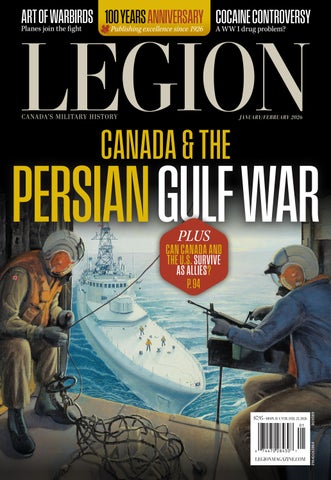
28 THE DESERT CATS, THE PACHYDERM PALACE AND IRAQ Cover story Canada in the Persian Gulf War By John Boileau
40 A MILITARY TOWN PAUSES
In Oromocto, N.B., a new generation musters to honour service By Alex Bowers
44 DRUG PROBLEM
54 RIOT ACTS
In Calgary—as in other communities across Canada— Great War tensions with German immigrants boiled over in 1916 By Sharon Adams
60 EN PLEIN AIR
Frank Johnston opened Canadians’ eyes to the marvel of the aeroplane during the Great War Words by Jason Pankratz
How the Canadian Expeditionary Force got wrapped up in a Great War cocaine controversy By Nate Hendley
49 CON AIR ON THE COVER Artist Ted Zuber depicts a Canadian contribution to the Persian Gulf War.
Illustrious in the sky, notorious on the ground: the wild life of RCAF flight instructor and ace Harold (Whitey) Dahl By Andy Sparling
Ted Zuber/CWM/19660062-005
JANUARY / FEBRUARY 2026
Pg01-02_Content 2026.indd 1
1
2025-11-26 9:02 AM
CONTENTS
BEHIND THE LINES
THE FRONT
24
10THEN & NOW
Images from Canada’s past and present
16THE BRIEFING
A Q&A with veteran George Beardshaw By Alex Bowers
18ON THIS DATE
Milestone events from January/February
20 THE VISUAL
Open-source intel
2HEROES 2 & VILLAINS
David W. Kendall and Stephen P. Hill and an Iraqi fast-patrol boat By Mark Zuehlke
24 ARTIFACT
Canada’s Ram tank By Alex Bowers
26 THE DISPATCH Letters of war
27 2
27 HUMOUR HUNT
90 MILITARY HEALTH MATTERS One step at a time By Alex Bowers
FRONT LINES Does not appear in this issue as Stephen J. Thorne is on leave
92 THE HISTORIAN
Who will fight for Canada? By J.L. Granatstein
94 ON WATCH
A consequential nation By Tim Cook
DEPARTMENTS
5EDITORIAL 6CONTRIBUTORS 7FEEDBACK 68 IN THE NEWS 78 SNAPSHOTS
$164,000 in Legion donations
96 EXIT STRATEGY
By Chris Chuckry
The lighter side of service
JANUARY / FEBRUARY 2026
Pg01-02_Content 2026.indd 2
2025-11-26 9:02 AM
Advertisement
SHOP L EGIONMAGA Z IN E.COM
It’s time to get cozy Maple Syrup Candle 16 oz. Classic Tin This iconic maple syrup candle has notes of cooked butter, roasted nut, maple, cinnamon, cloves, sugary sweet caramel and creamy vanilla. Hand poured in Canada. • • • • •
Smokeless, sootless, clean-burning All-natural Paraben-free organic soy wax Phthalate-, herbacide-, pesticide-free 100% unbleached cotton wick
Only
19
99*
Made in Canada!
Coast to Coast Candles Stack-packs of nine custom-made tealight candles. Sourced, made and poured in Canada. Available in three delightful varieties: • Northern Forest Trail • By the Lake Only 99* • Sunset Garden each
13
each
Made in Canada!
Calling all Canadian bird lovers!
Small Birds of Canada mug & sock set Small birds from across the country are found on these cozy socks and 14 oz. mug set. Socks are made in partnership with Sock Rocket. For every pair purchased, three pairs are donated to agencies providing clothing to Canadian veterans.
Only
Limited edition Order now
34
99* set
Wine Mugs Set of two Wine flies when you’re having fun Exclusive to the Shop, enjoy your favourite hot or cold beverage in these 12 oz. stainless steel tumblers. 4.625" x 3.5"
Only
4499*
Two-Toned Toque
Soft and warm, these two-toned, doublelayered knit toques with a faux-leather maple leaf tag are a Canadian classic. The generous brim can be worn folded up or down—choose your own style. No matter how you fold it, it’s sure to keep you cozy when the weather turns cold. Designed in-house and made in Canada. Exclusive to the Shop
Only
2599* each
set of two
SHOP NOW at legionmagazine.com/shop or CALL TOLL-FREE 1-844-602-5737 *+ tax and shipping
Pg3_FullPg_SHOP-AD-JF2026.indd 3
2025-11-26 12:03 PM
Advertisement
100%
OWNED, PRODUCED & PRINTED IN CANADA SINCE 1926
Big news! You can now get your copy of Legion Magazine in digital format.
Vol. 101, No. 1 | JANUARY / FEBRUARY 2026
Board of Directors
BOARD CHAIR Sharon McKeown BOARD VICE-CHAIR Berkley Lawrence BOARD SECRETARY Bill Chafe DIRECTORS Steven Clark, Randy Hayley, Trevor Jenvenne, Bruce Julian, Valerie MacGregor, Jack MacIsaac Legion Magazine is published by Canvet Publications Ltd. GENERAL MANAGER Jason Duprau ADMINISTRATION MANAGER Stephanie Gorin (on leave)
EDITOR Aaron Kylie
SALES/ADMINISTRATIVE ASSISTANT Lisa McCoy
SENIOR EDITOR Michela Rosano
ADMINISTRATIVE ASSISTANTS Chantal Horan Veronika Hughes ADMINISTRATIVE AND EDITORIAL CONTENT CO-ORDINATOR Matthew Ryan
SENIOR STAFF WRITER Stephen J. Thorne STAFF WRITER Alex Bowers
ART DIRECTOR, CIRCULATION AND PRODUCTION MANAGER Jennifer McGill SENIOR DESIGNER AND PRODUCTION CO-ORDINATOR Derryn Allebone SENIOR DESIGNER Sophie Jalbert
SENIOR DESIGNER AND MARKETING CO-ORDINATOR Diana Coote WEB DESIGNER AND SOCIAL MEDIA CO-ORDINATOR Ankush Katoch
DESIGNER Serena Masonde
Advertising Sales CANIK MARKETING SERVICES Nik Reitz advertising@legionmagazine.com Marlene Mignardi marlenemignardi@gmail.com Or call 613-591-0116 for more information Published six times per year, January/February, March/April, May/June, July/August, September/October and November/December. Copyright Canvet Publications Ltd. 2026. ISSN 1209-4331
Subscription Rates Legion Magazine is $13.11 per year ($26.23 for two years and $39.34 for three years); prices include GST. For addresses in NS, NB, NL, PE a subscription is $14.36 for one year ($28.73 for two years and $43.09 for three years). For addresses in ON a subscription is $14.11 for one year ($28.23 for two years and $42.34 for three years).
PLUS
browse the digita l archive
Scan to subscribe
To purchase a magazine subscription visit www.legionmagazine.com or contact Legion Magazine Subscription Dept., 86 Aird Place, Kanata, ON K2L 0A1 Call 613-591-0116 or toll-free 1-844-602-5737. The single copy price is $7.95 plus applicable taxes, shipping and handling.
Change of Address Send new address and current address label, or, send new address and old address. Send to: Legion Magazine Subscription Department, 86 Aird Place, Kanata, ON K2L 0A1. Or visit www.legionmagazine.com/change-of-address. Allow eight weeks.
Editorial and Advertising Policy Opinions expressed are those of the writers. Unless otherwise explicitly stated, articles do not imply endorsement of any product or service. The advertisement of any product or service does not indicate approval by the publisher unless so stated. Reproduction or recreation, in whole or in part, in any form or media, is strictly forbidden and is a violation of copyright. Reprint only with written permission. PUBLICATIONS MAIL AGREEMENT NO. 40063864 Return undeliverable Canadian addresses to Legion Magazine Subscription Department 86 Aird Place, Kanata, ON K2L 0A1 | magazine@legion.ca
U.S. Postmasters’ Information United States: Legion Magazine, USPS 000-117, ISSN 1209-4331, published six times per year (January/February, March/April, May/June, July/August, September/October, November/December). Published by Canvet Publications, 866 Humboldt Pkwy., Buffalo, NY 14211-1218. Periodicals postage paid at Buffalo, NY. The annual subscription rate is $12.49 Cdn. The single copy price is $7.95 Cdn. plus shipping and handling. Circulation records are maintained at Adrienne and Associates, 866 Humboldt Pkwy., Buffalo, NY 14211-1218. U.S. Postmasters send covers only and address changes to Legion Magazine, PO Box 55, Niagara Falls, NY 14304. Member of Alliance for Audited Media and BPA Worldwide. Printed in Canada.
legionmagazine.com or call toll-free
1-844-602-5737
4
We acknowledge the financial support of the Government of Canada. Version française disponible. From time to time, we share our direct subscriber list with select, reputable companies whose products or services we believe may interest our subscribers. To opt out of receiving these offers, please send your request, including your full name and address, to magazine@legion.ca. Alternatively, you can write to Legion Magazine, 86 Aird Place, Kanata ON K2L 0A1, call 613-591-0116, or call toll-free 1-844-602-5737. We begin by acknowledging that the land on which we gather is the traditional, unceded territory of the Anishinaabe Algonquin Peoples, who have been guardians of, and in relationship with, these lands since time immemorial. We further acknowledge and recognize that our work reaches across all First Nations territories, Métis Homelands and Inuit Nunangat.
JANUARY / FEBRUARY 2026
Pg04_Masthead V2.indd 4
2025-11-28 10:10 AM
EDITORIAL
OLD IS NEW
H
ow does it look? Regular readers of Legion Magazine may have already noticed the difference(s). This year, the publication is celebrating its 100th anniversary, and in conjunction with the milestone, it’s introducing a refreshed design and a few content updates. This space, too, typically dedicated to sharing an opinion of the editors, is shifting focus for just this issue to address the occasion. As such, I’d like to write personally as Legion editor. I have had the incredibly good fortune of forging a nearly threedecade career in the fickle Canadian magazine industry to date. I have now worked for four national publications, big and small, and am very proud that they all still exist, particularly given the challenges facing journalism, and especially magazines, these days. I have also celebrated significant anniversaries at each, but none bigger than this—100 years is an amazing accomplishment. There aren’t too many other Canadian publications with such longevity. And fewer still going so strong (Legion’s circulation is growing). What began as The Legionary in May 1926 as the “Official Organ of The Canadian Legion of the British Empire Services League,” eventually (in 1969) became Legion Magazine, dedicated to Canada’s military history. Of course, as much as some things have changed, many core elements have remained, perhaps most notably, covering important issues facing veterans. That will continue. As will all the publication’s great work. The redesign is our tribute to its staying power. There will be no navel-gazing anniversary issue. Instead, watch for a forthcoming book featuring incredible First World War stories from our archives.
The magazine’s evolution is exciting. And due. The last significant change to the design and content of Legion was introduced in 2016. Even a history magazine needs to keep its spark. So, your favourite columns and departments remain, though with a new look and, in some cases, in different parts of the magazine. You’ll still find regular missives by renowned historian J.L. Granatstein (“The Historian,” formerly “Canada and the New Cold War”) toward the back of the book; there you’ll now read all the columns, including “Front Lines” by beloved senior staff writer Stephen J. Thorne (though it’s missing in this edition as he’s on leave). The reader-favourite “On This Date” department remains near the front, but it’s joined there by mainstays “Heroes and Villains,” “Artifact” and “Humour Hunt.”
Even a history magazine needs to keep its spark. There are some new additions, too: a highlight Q&A interview (“The Briefing”) by staff writer Alex Bowers, an infographic department (“The Visual”), a regular guest-authored opinion column (“On Watch”), a punchy back-page department (“Exit Strategy”) and more. Of course, the feature section will remain as compelling as always, covering a range of stories about Canada in conflict from pre-Confederation to modern day. I hope, too, that you, our readers, will be as forthcoming as ever and share your opinions on the changes. The Legion Magazine team is thrilled with the work presented on these pages. Special kudos to senior designer Sophie Jalbert for her tireless efforts, under the guidance of art director Jennifer McGill, to reinvigorate how it looks. It’s an honour to be shepherds of a 100-year-old media brand and to make it feel as alive as ever.
JANUARY / FEBRUARY 2026
Pg05_Editorial.indd 5
5
2025-11-26 9:26 AM
CONTRIBUTORS
The HISTORIAN Long-time and frequent Legion Magazine contributor J.L. Granatstein is an award-winning author and historian. The former CEO of the Canadian War Museum has written more than 60 books. He is the recipient of the Governor General’s Award for Popular Media and the J.W. Dafoe Book Prize for writing that contributes to the understanding of Canada and its place in the world.
The PROF
The COLONEL
Jason Pankratz is a professor at Conestoga College in Kitchener, Ont., and a freelance writer. He has a doctorate in education and is a former vice-president and life member of Ontario’s Tillsonburg & District Historical Society and a member of the Varnavair Branch of The Royal Canadian Legion in Tillsonburg. His most recent book, Tillsonburg at 200, was published in April 2025.
John Boileau is a retired army colonel, having served in the Royal Canadian Armoured Corps for 37 years. A frequent Legion Magazine contributor, he has authored hundreds of articles and 15 books on Canadian general and military history, including Too Young to Die: Canada’s Boy Soldiers, Sailors and Airmen in the Second World War.
The JOURNO The work of Toronto-based journalist Nate Hendley can be read in the National Post, The Globe and Mail, Maclean’s and more. He has also written more than a dozen books, primarily in the true-crime genre, though his latest is Atrocity on the Atlantic: Attack on a Hospital Ship During the Great War.
Advertisement
6
JANUARY / FEBRUARY 2026
Pg06_Contributors.indd 6
2025-11-28 10:35 AM
FEEDBACK
Readers’ forum
MORE LOVE
her friend Margret Granger started knitting. Between the two of them, they made 24 sets, and our threeyear-old granddaughter tried them all on and told everyone that they were going to girls in Afghanistan. Ian Burke Powell River, B.C.
Stephen J. Thorne did a masterful job telling the story of Captain William A.P. Durie’s (illegal) repatriation to Canada following his overseas death and burial in the First World War (“Undying Love,” September/October 2025). It was of particular interest to me as Durie was with the 58th Battalion, Canadian Expeditionary Force, the same unit that my grandfather Lieutenant C.E. Little served with during the Great War. Jim Little Turner Valley, Alta.
Advertisement
MEDIPAC TRAVEL INSURANCE
®
For Canadians who are heading south this winter
GREAT YARN
It might seem unbelievable that women actually sent coded messages in the items that they knitted but the Germans certainly believed that they did (“A stitch in time,” September/October 2025). My father Reg Wellwood was captured in France in August 1944. He was taken to the hospital, and the Germans took all his belongings. Several days later, the Germans were retreating and left him in charge of all the patients, both Allied and German. And they returned his belongings, including, incredibly, his map of France. What they didn’t return was the tiny scarf his 12-year-old niece Evelyn from Merlin, Ont., had sent him. It was knitted out of wool scraps and the Germans were convinced it was a coded message. I wonder how long they spent trying to decipher that mess(age). Barbara Warnock Aylmer, Ont. I read the article “A stitch in time” with much interest. During the conflict in Afghanistan, my chief warrant officer was deployed there in 2005. As a project, his group worked on an orphanage for Afghan girls. My wife Rene kept in contact with him and asked if there was anything she could help with. Knowing she was a knitter, he asked if she could make a few toques and mitts for the children. My wife and
1-800-MEDIPAC 1-800-633-4722 • www.medipac.com Underwritten by Old Republic Insurance Company of Canada
2023MS Medipac ad Legion island 4.275x7.375.indd 1
Pg07-08 Feedback.indd 7
2023-07-12 11:56:47 AM
JANUARY / FEBRUARY 2026
7
2025-11-26 9:41 AM
Advertisement
GIRL POWER
I always enjoy Legion Magazine, but I especially appreciated the September/October 2025 edition with its focus on women’s contributions to military history. I was impressed by the diversity of stories: a Civil War spy, a determined reporter, quilters and knitters, and a formidable mother who wouldn’t take no for an answer. And Joan Fletcher’s story (“Command and control”) is incredible. I would like to add that the noble tradition of comfort brought by quilters continues to this day with the Quilts of Valour program. I am a grateful recipient of one. Bravo Zulu on a great magazine! Helga Rausch Kingston, Ont.
OH STOP
I am so glad I have a subscription to this wonderful magazine! Whoever is deciding what articles to include is doing an amazing job. The stories are fascinating and superbly written. Well done Legion Magazine! Dave Draper North Vancouver, B.C. I just wanted to thank you for this wonderful magazine. I bought this as a gift for my now 93-year-old father last year, and when I bring him each new issue he lights up. He pours over it, wanting to share it with others in his retirement home. It has brought him so much joy. He loves the stories, loves to share them and reminisce about his older brother who fought in WW II, and for that, I am so grateful to you and your team. Martha Thouless Burlington, Ont. Submissions for this department should be brief and to the point and shouldn’t exceed 200 words. They should be constructive and of general interest. They may be edited for brevity and clarity. The views expressed are those of the correspondents and publication of them does not necessarily constitute an endorsement by Legion Magazine.
8
JANUARY / FEBRUARY 2026
Pg07-08 Feedback.indd 8
2025-11-26 9:41 AM
Advertisement
ON WAR:
EXPLORING WHY AND HOW WE FIGHT In On War: Exploring Why and How We Fight, author Stephen J. Thorne, senior staff writer at Legion Magazine, draws on historical sources, veterans’ accounts, and his own experiences as a war correspondent and photojournalist as he explores conflict and war from multiple perspectives. Illustrated with some of the most profound conflict photography ever shot, On War is a unique and compelling read.
Order today!
By
STEPHEN J. THORNE
ONLY 3995 $
+ tax and shipping
CALL TOLL-FREE To order: 1-844-602-5737 Call toll-free 1-844-602-5737 or visit shop.legionmagazine.com
Pg9_SHOP-ONWAR-Iris-JF2026.indd 9
2025-11-28 10:58 AM
THEN & NOW
10
JANUARY / FEBRUARY 2026
Pg10-13_Then_Now.indd 10
Then
Tormentor4555/flickr.com
2025-11-26 2:26 PM
ICE AGE ← Tales of the notoriously frigid wintertime conditions during WW II convoy duty on the North Atlantic abound, yet few images encapsulate it as dramatically as this image of Royal Canadian Navy Flower-class corvette Brantford coated in ice.
JANUARY / FEBRUARY 2026
Pg10-13_Then_Now.indd 11
11
2025-11-26 2:26 PM
THEN & NOW
Now
GO WITH THE FLOE ← Arctic offshore patrol boat Margaret Brooke sits in an ice floe during ice sampling procedures conducted by civilians and the Royal Canadian Navy between Ellesmere Island and Greenland in the Arctic Ocean in March 2022.
12
JANUARY / FEBRUARY 2026
Pg10-13_Then_Now.indd 12
Combat Camera/Taylor Congdon/Canadian Armed Forces Photo
2025-11-26 2:26 PM
JANUARY / FEBRUARY 2026
Pg10-13_Then_Now.indd 13
13
2025-11-26 2:26 PM
Advertisement
Ford Dealers of Canada Announced as Official Partner for The Royal Canadian Legion’s Centenary Year The Royal Canadian Legion is proud to announce a national partnership with Ford Dealers of Canada in celebration of the Legion’s centenary year in 2026. This partnership joins two organizations rooted in service, community, and supporting Canadians from coast to coast. As part of the centenary celebration, Ford Dealers of Canada will serve as an Official Partner, anchored by a National Sweepstakes Campaign running through December 19, 2026. The sweepstakes will feature a brand-new Ford F-150 as the grand prize driving excitement, engagement, and national visibility throughout the anniversary year. But the partnership goes beyond the sweepstakes. Ford Dealers of Canada are deeply committed to honouring Veterans, supporting military families, and strengthening communities alongside the Legion during this historic milestone. This commitment will be highlighted through dedicated partnership creative across social, digital, print, and in-dealer channels. These efforts are designed to celebrate the people behind the Poppy, amplify the Legion’s mission, and demonstrate Ford’s ongoing dedication to giving back… not just during Remembrance, but year-round.
A partnership built on shared values
For a century, the Legion has supported Veterans, military families, and local communities. Ford and its dealer network share that same commitment, investing in community programs, supporting local causes, and showing up when Canadians need it most.
• Support membership and donations including the Poppy Campaign by amplifying Legion initiatives through dealer and marketing channels. • Increase Ford’s visibility across Legion print, digital, and in-person platforms during a milestone year.
Why Ford Dealers of Canada?
• A nationally trusted brand with deep community roots • Shared values of service, dedication, and supporting Canadians where they live and work • Strong alignment with the Legion’s legacy of honouring those who served
Dealers will also benefit from: • Co-branded marketing materials • Showroom engagement opportunities • Participation in local branch activations and events
Why This Partnership Matters • The Legion has 270,000+ members and 1,350 branches nationwide •N ational, regional, and local visibility through: • Legion Magazine • Digital + social media • In-branch and in-dealer presence
Together, the Legion and Ford Dealers of Canada will make 2026 a year of remembrance, celebration, and community impact — honouring the past while driving confidently into the next 100 years.
Through this partnership, Ford Dealers of Canada wil help: • Drive national awareness by aligning Ford with Canada’s most trusted Veteran-focused organization.
FordMemb-AdvertorialJF26_v3.indd 14
2025-11-28 10:16 AM
Advertisement
LEGION 100 WIN BIG GIVEAWAY
THREE WAYS LEGION MEMBERS CAN QUALIFY TO WIN A FORD F-150 STX!
Renew Your Membership for 2026-27
Shop the Legion’s store
Donate to the Poppy Fund
LEARN MORE Legion.ca/winbig
Branch Branch000 l City City
No purchase necessary, terms and conditions apply.
RCL_253114_Centenary_Full_Page.indd 1
2025-11-26 12:06 PM
THE BRIEFING
The Legion Magazine Q&A
WW II VETERAN GEORGE BEARDSHAW
G
eorge Beardshaw no longer recalls the dates, but he retains the memories. A proud 102-year-old veteran of the Second World War, he was born in Yorkshire, England, on Sept. 14, 1923. The story of how he came to serve Canada, however, isn’t a strictly happy one, having been one of some 100,000 young Britons, mostly of orphaned or impoverished backgrounds, sent to the Dominion between the 1860s and the 1940s as part of the Home Children scheme.
Advertisement
CANADA’S FIRST AND LEADING TOUR OPERATOR FOR CANADIAN GLOBAL BATTLEFIELDS
2026 TOURS REGISTRATION NOW OPEN WWW.THEBATTLEFIELDTOURS.CA 1 - 833 - 828 - TOUR (8687)
16
JANUARY / FEBRUARY 2026
Pg16-17_The Briefing V2.indd 16
By Alex Bowers
Beardshaw is believed to be the last living Home Child. He’s also the last of more than 25,000 program participants who fought for their new homeland in war. Partly motivated to serve, partly desperate to escape his labouring life, the long-retired corporal fought with The Queen’s Own Rifles of Canada through France, Belgium and the Netherlands prior to his capture in the final weeks of the conflict. Beardshaw recalled his formative years with Legion Magazine. On becoming a Home Child I remember a lot of stuff from the orphanages. I don’t remember anything about my family before I was taken to those homes when I was three years old. I had a brother living in Canada [near Tillsonburg, Ont.] and he wrote me a letter saying what a good time he was having. I thought it would be a nice place to go. Anyway, the school inspector came around one day and said, “How many of you boys would like to go to Canada.” Up went my hand. When I got to Toronto, they had a list of farmers who wanted youngsters. On that list, I saw Mr. and Mrs. Payne of Little Britain [Ont.]. Well, I came from Great Britain, so why not go to Little Britain? The farmer picked me up and drove me to their place. When his wife came over as I stepped out of the car, she eyed me up and down, and said: “Is that grease in your hair? I’m having none of that here.” So, as soon as I got there, that’s what it was like.
On farm life I was worked quite hard, but I wasn’t used to stepping on cow shit. One day while milking the cows, I got down there before [Mr. Payne]. When he finally got there, I’d already milked two of my [three] cows. To be nice, I said, “This cow isn’t giving as much milk as she used to.” Well, I guess he’d gotten out of the wrong side of bed because he said something like, “If you’d keep your mouth shut, she’d give a little more.” That did it for me. I quit milking the cow, threw the milk pail against the wall and said, “I’m going.” That’s why I left the farm. It was wartime by then. I tried to join the air force, but they said that I didn’t have enough education. I then figured I’d volunteer for the army. On returning to England in uniform I remember training at Camp Borden. But of course, we eventually went to England. When I heard the [D-Day] announcement, I remember it shook me a little, thinking “Oh, my God. It’s happening.” I was over there about a month later. In the meantime, our colonel said that nobody was getting leave. I said, “My mother doesn’t live too far from here.” So, he gave me three days’ leave to go and see her. Can you imagine? I hadn’t seen my mother since I was three, and here I was, knocking on her door in a Canadian Army uniform. I found her to be very quiet and gentle. My grandmother was also there. She sat me on her knee and rubbed her face against mine. I remember those whiskers.
St. Joseph’s Health Care London
2025-11-27 9:34 AM
READ MORE LEGION MAGAZINE Q&A INTERVIEWS IN ALEX BOWERS’ WEEKLY THE BRIEFING BLOG AT LEGIONMAGAZINE.COM/BRIEFING
On fighting at the front I remember getting closer to the front and hearing the guns firing. I thought to myself, “Another fine mess I’ve gotten myself into.” While we were fighting, [civilians] were in hiding somewhere else because they were letting us do our job. I didn’t see too much of them right in the front line. On becoming a prisoner of war I went down the road, one patrol on one side and another patrol back-a-ways. My boys reached our destination, where the bridge had been blown, and we couldn’t get across into the town [Deventer, Netherlands]. The Germans started shooting at us, and there was a house that I got into quickly, and there was a shell hole just outside that I could see from the house window. And there were
a couple of guys [Canadians] in there. I saw that one of the boys had been wounded, and the other guy died. Anyway, we finally gave up. [The Germans] took us into the woods, where there was a schoolhouse and we sat on the floor. The next morning, we were on our way to Aalsmeer [Netherlands]. We had to walk with the Germans watching over us. On the way, we heard Allied planes coming over, and the Germans were scared shitless. They all ran for the ditch. We had a laugh. When we got to Aalsmeer, we saw people looking out of their windows and waving at us. The Germans were pissed off at them. They put us in a complex. We were dirty and wet when we were taken prisoner, and we wore those clothes until we were released. We never had a shower or bath for 28 days.
On the end of the war News travels fast. The Canadians came from the south with their vehicles [and liberated the prisoners]. There was a big crowd [of civilians] who were singing the Canadian national anthem in English. On remembrance I think it’s sad to say that it’s been so long since the war ended, and people are apt to forget. But there are also some people out there who still remember. I can see that for myself just outside my window [in London, Ont.], where I look out and see the painting on the road that they’ve just done. Very touching. It’s of a soldier with the words, “Lest We Forget.” This interview has been edited for brevity and clarity.
Advertisement
JANUARY / FEBRUARY 2026
Pg16-17_The Briefing V2.indd 17
17
2025-11-28 10:36 AM
ON THIS DATE
Milestone events from January/February
January 2 January 1940 PO Selby R. Henderson and Wing Cmdr. John F. Griffiths are awarded the Distinguished Flying Cross, becoming the first Canadians decorated during the Second World War.
January 2010 A massive earthquake devastates Haiti, particularly its capital of Port-auPrince, killing about 220,000 people and leaving more than one million homeless. Canada sends troops to deliver humanitarian aid.
3-4 January 1951 In Korea, United Nations forces evacuate Seoul after it’s captured for the second time by North Korea.
5
January 1971 Bernard Lortie, brothers Paul and Jacques Rose, and Francis Simard are charged in the kidnapping and murder of Quebec Labour Minister Pierre Laporte during the 1970 October Crisis.
19
19 January 1943 Taking refuge in Canada, Crown Princess Juliana of the Netherlands gives birth to Princess Margriet in Ottawa. Following the liberation of the Netherlands in 1945, Princess Juliana sent Canada 100,000 tulip bulbs in gratitude, inspiring the annual Canadian Tulip Festival.
21 January 1944 The Royal Canadian Navy commissions River-class frigate New Waterford. It is assigned to Escort Group 6, and sails to Londonderry, Northern Ireland, in June. January 1916 Manitoba becomes the first province to give some women the right to vote and run for office.
12
28
8 January 1916 Allies complete their withdrawal from the Gallipoli peninsula. 9 January 1941 The Avro Lancaster prototype is flown for the first time at RAF Ringway in Cheshire, England. It would become the most successful Allied bomber of the Second World War. January 1920 The Treaty of Versailles takes effect, formally ending the First World War and establishing the League of Nations, with Canada as a founding member.
18
JANUARY / FEBRUARY 2026
Pg18-19_On This Date.indd 18
16 January 1991 The Persian Gulf War begins with an American-led coalition offensive against Iraq. It was the first conflict in which women in the Canadian Armed Forces could serve in combat roles.
29 January 1856 The Victoria Cross is instituted by Queen Victoria to acknowledge the bravery displayed by soldiers and sailors of all ranks during the Crimean War. 30 January 1933 Hitler becomes Germany’s chancellor, marking the start of the Nazis’ reign. 31 January 2006 Canada signs a five-year international commitment to support security, governance and development in Afghanistan.
10 2025-11-28 10:37 AM
9
VISIT LEGIONMAGAZINE.COM FOR MORE ON THIS DATE EVENTS
February 1943 The German army surrenders to the Soviets at Stalingrad, Russia, a pivotal turning point in the Second World War.
2
4 February 1915 Lieut. William Frederick Nelson Sharpe’s plane crashes during a Royal Flying Corps training exercise in England. He is the first Canadian military aviator to die during the Great War. February 1963 Prime Minister John Diefenbaker’s minority government is defeated in the House of Commons over its nuclear weapons policy. Liberal Lester B. Pearson is elected prime minister in April.
5
6 February 1813 Taking advantage of the frozen St. Lawrence River, U.S. army Maj. Benjamin Forsyth and his company cross into Canada to attack Brockville. 8 February 1980 Royal Canadian Air Force squadrons begin to deliver personnel and equipment to Zimbabwe-Rhodesia, now Zimbabwe, to help monitor the country’s election process.
10 February 1763 The Treaty of Paris is signed by Britain, France and Spain, formally ending the Seven Years’ War. France cedes its North American territories to Great Britain in the agreement. 12 February 1946 The last U-boat is scuttled in Operation Deadlight, the Royal Navy’s action to eliminate German submarines captured during WW II. 13 February 1874 Louis Riel is reelected as member of Parliament for Provencher in Manitoba. He is expelled from the House of Commons in April.
February 1916 The Battle of Verdun starts on the Western Front, one of the longest and bloodiest battles in modern history. 24 February 1942 Prime Minister Mackenzie King uses the War Measures Act to dispossess, forcibly relocate and detain people of Japanese ancestry.
Wikimedia (3); Bettmann/Getty; Logan Abassi/ UN; Bain News Service; Legion Magazine Archive; Lebrecht Music & Arts/Alamy/ERGHA3; LAC/2993542
Pg18-19_On This Date.indd 19
21
28 February 1838 Robert Nelson gathers roughly 300 Patriotes, mainly francophone members of the Parti canadien, in Vermont to invade Lower Canada, in the hopes of freeing it from British rule. His force is immediately pushed back into the U.S.
18
16 February 1940 The Royal Canadian Air Force’s 110 (Army Cooperation) Squadron begins its journey to Britain. It is the first of 48 squadrons to move overseas during WW II.
February 8
17 February 2011 Sgt. Joseph Poulin positions his tank to protect civilians, comrades and Afghan security forces during a road construction project in Afghanistan. This is the second of three actions that earned Poulin a Medal of Military Valour.
February 1900 The Battle of Paardeberg begins as Canadians attack a Boer army on the banks of the Modder River in South Africa.
JANUARY / FEBRUARY 2026
19
2025-11-26 9:47 AM
THE VISUAL
Open-source intel
WHO WON THE WAR?
D
onald Trump outraged a host of Allied nations in May 2025 when he claimed the U.S. “won World War 2” and should be celebrating the fact. He made the statement after a call with French President Emmanuel Macron who, he said, told him France was “celebrating our victory over the Germans.” “Every country I’ve spoken to in the last week is celebrating the war but us,” Trump said a week after VE-Day on May 8. “Isn’t that terrible?
Russia was celebrating, France was celebrating, everybody was celebrating but us. And we’re the ones that won the war.” The claim is dubious, at best, based on the key numbers—how many fought, what percentage of their populations did they represent, and how many died. Here are the comparative contributions and sacrifices among the Allied nations of WW II (virtually all numbers are approximated and debated). —Stephen J. Thorne
NUMBER WHO SERVED U.S.
FRANCE
AUSTRALIA
CHINA
GREECE
POLAND
16,000,000 14,000,000
U.K
5,900,000
5,000,000
1,750,000
CANADA
1,100,000
1,000,000
900,000 NEW ZEALAND
104,000
Gunners of the 12th Field Regiment, Royal Canadian Artillery, read the May 20, 1945, issue of The Maple Leaf newspaper in Aurich, Germany.
SOVIET UNION
34,500,000
20 JANUARY / FEBRUARY 2026
Pg20-21_The Visual.indd 20
2025-11-26 9:48 AM
KILLED/ SERVED
5%
6%
9%
10%
12.2%
13.5%
14.8%
17.7%
26%
28%
PERCENT OF POPULATION WHO SERVED
1/4
POLAND
1/4
CHINA
NEW ZEALAND
U.S.
CANADA
FRANCE
AUSTRALIA
U.K.
SOVIET UNION
POLAND
GREECE
CHINA
1/4
SOVIET UNION
1/9
NEW ZEALAND
1/15 U.K.
NUMBER KILLED
1/23
FRANCE
SOVIET UNION
10,700,000 1/25
AUSTRALIA
CHINA
4,000,000
U.S.
407,316
U.K.
383,000
POLAND
240,000
FRANCE
217,000
CANADA
45,400
AUSTRALIA
39,800
GREECE NEW ZEALAND
Donald I. Grant/DND/LAC/PA-150931
Pg20-21_The Visual.indd 21
1/26
CANADA
1/39 U.S.
20,000-35,000
1/50
GREECE
11,900
JANUARY / FEBRUARY 2026
21
2025-11-26 9:48 AM
HEROES & VILLAINS
Historic encounters
ON JAN. 30, 1991, TWO ROYAL CANADIAN AIR FORCE PILOTS FIRED CANADA’S FIRST SHOTS IN THE PERSIAN GULF WAR
KENDALL AND HILL
By Mark Zuehlke
DAVID W. KENDALL AND STEPHEN P. HILL
At “Would you like to strafe a boat?” —Controller aboard USS Mobile Bay
approximately 2 a.m. on Jan. 30, 1991, two Royal Canadian Air Force CF-18 Hornet fighterbombers were on a combat air patrol mission during the Persian Gulf War. For the past two weeks Canada’s 40 pilots flying 24 CF-18s out of “Canada Dry” air bases in Qatar had seen no action. Pilots and supporting armourers of the Desert Cats, as the squadron was known, were becoming increasingly frustrated. Now, 1.5 hours into a two-hour mission, Hornet 13’s flight was preparing to head home when its controller aboard USS Mobile Bay asked, “Would you like to strafe a boat?” Captain Stephen P. (Hillbilly) Hill responded: “Are they defending themselves? Is there any AAA [anti-aircraft fire]?”
Racing down, Hill and Kendall emptied their 20mm Vulcan cannons at the ship—scoring numerous hits. The controller explained that a U.S. A-6 bomber had encountered several Iraqi Navy vessels fleeing for Iran during what would become a 13-hour operation in which the Iraqi navy suffered complete destruction. The bomber had struck an Osa-class guided-missile attack craft with two laser-guided bombs and another vessel with a non-guided “dumb”
22 JANUARY / FEBRUARY 2026
Pg22-23_H&V.indd 22
bomb. Both were burning and disabled. A third fast-patrol boat, however, had broken clear. If the Canadians delayed its escape, an incoming A-6 would finish it off. Hill and his winger, Major David W. (D.W.) Kendall, accepted the mission. At a range of 30 kilometres, the two pilots were instructed to visually identify the vessel before attacking. Despite bright moonlight and dropped flares illuminating the vessel, the Canadians were unable to confirm it as Iraqi. Suddenly, an E-2C Hawkeye controller reported no allied ships were in the area and they were “cleared to fire.” Racing down, Hill and Kendall emptied their 20mm Vulcan cannons at the ship—scoring numerous hits. During another pass, they attempted to engage with an AIM-9 Sidewinder missile but were unable to acquire a heat signature. They then tried to lock on with AIM-7 Sparrows. Hill attained a lock on the vessel and fired. The missile struck 15 metres behind the ship. A U.S. bomber arrived shortly after and was reported to have sunk the vessel—even being awarded with a kill. Hill and Kendall were awarded an assist and were Mentioned in Dispatches. Soon after landing, they were introduced to correspondents as having fired “the first shot” by Canadians in the Persian Gulf War. Theirs were also the only CF-18s credited with an official victory.
Alan E. Garrett/CWM/19920201-001
2025-11-26 2:37 PM
IRAQI FAST-PATROL BOAT IRAQI FAST-PATROL BOAT
T
he Iraqi fast-patrol boat that Canadian CF-18 pilots Captain Stephen P. (Hillbilly) Hill and Major David W. (D.W.) Kendall attacked on Jan. 30, 1991, was initially identified as a TNC-45 fast-attack craft (missile). Iraq had captured five such vessels when it invaded Kuwait on Aug. 2, 1990. The invasion prompted a NATO-American-led intervention that resulted in the Persian Gulf War. The 45-metre-long TNC-45 was a French design, but these ships were manufactured by the German Lürssen dockyards between 1982 and 1984. Armed with four Exocet MM40 surface-launched missiles, it also had one 76mm auto cannon and two 40mm/70 Breda-Bofors for defence against aircraft and anti-ship missile attack. It was crewed by 40 sailors. The action the Canadians joined had started with an American A-6E reconnaissance plane locating four unlit and suspicious vessels bound for Iranian waters. USS Mobile Bay turned tactical control of the A-6E over to the E-2C Hawkeye, which soon identified them as Iraqi. A nearby A-6 was directed to attack. The A-6 scored a direct hit on the lead vessel with a 500-pound laser-guided bomb. As the surviving three vessels scattered, a second bomb destroyed the superstructure of one and it went dead in the water. It went dead in the water. The E-2C then summoned a U.S. F-18 that scored a direct hit on a third boat with a 500-pound “dumb” bomb. As the fourth
Iraqi boat continued toward Iran, the call went out for the Canadians to interdict it.
Artist Alan E. Garrett depicts an RCAF CF-18 fighter-bomber on attack during the Persian Gulf War.
Although the Canadians believed— and this was corroborated by earlier reports—they had attacked a TNC-45, this was not the case. The one such boat in the four-vessel convoy had been sunk by the Americans. Instead, the Canadians attacked and damaged an Osa patrol boat, one of the Iraqi navy’s major combat vessels. Classed as guided-missile fastattack craft, each was capable of speeds up to 40 knots and was highly manoeuvrable. In the 1970s and 1980s, Iraq had purchased eight such patrol boats from the Soviet Union. Each was equipped with four Styx anti-ship missiles and two radar-controlled 30mm anti-aircraft autocannons. It had a crew of 29 sailors.
Although the Canadians believed— and this was corroborated by earlier reports—they had attacked a TNC-45, this was not the case. While initial reports concluded that the boat attacked by the Canadians had been subsequently sunk by a second A-6 with a kill award being granted, later intelligence discovered the Osa still afloat in an Iranian port. Its superstructure was noted to have suffered substantial strafing damage inflicted by pilots Hill and Kendall.
JANUARY / FEBRUARY 2026
Pg22-23_H&V.indd 23
23
2025-11-26 2:37 PM
ARTIFACT
Honouring a military treasure
GUTS. GLORY. RAM. By Alex Bowers
H
ikers in England’s “It’s never easy to design and Peak District discovered manufacture a tank at the best a long-abandoned relic on a former gunnery range in 2020. of times, not least your first one.” The rusting husk appeared to be a military vehicle, likely a tank devoid of its turret. Neither British Adapted from the U.S. M3 tank nor U.S. in make, the walkers had chassis, neither the Ram Mark I nor II instead stumbled upon a distinctly engaged in conventional combat, but Canadian creation from the Second rather “fulfilled a training need and in World War: a Ram Mark II tank. the Ram Kangaroo [variant where the Some 1,949 of these cruiser tanks turret was removed],” wrote Wheeler, were built in the wake of the 1940 “it proved itself as an armoured Dunkirk evacuations, when the troop carrier par excellence.” British had to abandon a mass of The Kangaroo was one of many heavy equipment on French beachadaptions, along with the Sexton es. The U.K. needed to replenish self-propelled 25-pounder artillery its own supply of vehicles, leavvehicle, that displayed success in ing few to spare for Canada. This, the field. Arguably, however, it was in A Canadian-built alongside other factors, left the its ferrying form that the Ram most Ram tank at Dominion needing to take matexcelled. In providing protection A33 Canadian ters into its own hands, as quickly and mobility as an armoured troop Armoured as possible, back at home. carrier, concluded Wheeler, “infantry Corps Training “It’s never easy to design and [could] keep up with tanks in the Establishment, manufacture a tank at the best armoured advances from Normandy Camp Borden, Ont., in July 1943. of times, not least your first one,” and over the Rhine to victory.” noted Stuart Wheeler, historian at The Tank Museum in the U.K., in an email. “To go from concept to production in 15 months is testimony to the ingenuity and industry of Canada’s government and people.”
24 JANUARY / FEBRUARY 2026
Pg24_Artifact.indd 24
LAC
2025-11-26 9:50 AM
Advertisement
CanopyGrowth-JF26.indd 1
2025-11-26 9:51 AM
Letters of war
THE DISPATCH
OTTAWA, Canada, 5th January, 1946. Mr. A.H.J. Gould, 133 Bowie Avenue, Toronto, Ontario. Dear Mr. Gould: Enclosed please find two of the photographs mentioned in my letter dated November 10th, 1945. It is believed that they are photographs of your son, Pilot Officer Albert Norman Gould. These photographs were recovered as advised, by a German civilian at the scene of the crash. Would you kindly advise this office as to whether or not you are able to state positively that this is your son. If so, it is felt that you may wish to keep them. If you are not able to identify these pictures, will you kindly return them that a further investigation may be made. I sincerely hope that you can find consolation in the fact that your son risked his life willingly in the defence of freedom. What we all owe to him is beyond estimation. May you be fortified by the spirit of courage and hope which enabled him to discharge his duties whatever the cost. Yours sincerely, JE R.C.A.F. Casualty Officer, for Chief of the Air Staff.
Pilot Officer Albert Norman Gould was missing in action after his Lancaster was shot down on Nov. 4, 1944, during an Allied bombing raid over Bochum, Germany. It was a year later, and two months before the above letter, when his parents received news that he was presumed dead.
26 JANUARY / FEBRUARY 2026
Pg26_The dispatch.indd 26
National Defence photograph PL-28592; iStock; The Canadian Letters & Images Project
2025-11-26 9:50 AM
HUMOUR HUNT
The lighter side of service
CAR TROUBLE
In
the early ’90s, I was stationed at CFB Chatham, N.B., as a military police officer. Our section received two new Chevrolet Luminas to augment our Ford LTD Crown Victorias. After a couple of weeks, my sergeant asked me why I wouldn’t drive the new cars. I told
him if I had an accident in the older Ford, he would ask me if I was okay, but if I was in one of the new cars, he would ask me what the hell I did? On my next rotation, the Fords were gone and I no longer had a choice in the situation. —John Strathdee, Victoria
HA!
OLD SALT “Well, my boy,” said the captain to the new midshipman, “the old story, I suppose? Fool of the family sent to sea.” “Oh, no sir,” replied the youth. “That’s all changed since your day.”
The Legionary magazine, December 1933 HAVE A FUNNY ANECDOTE FROM CANADA’S MILITARY CULTURE? SEND IT TO MAGAZINE@LEGION.CA
JANUARY / FEBRUARY 2026
Pg27_Humour Hunt.indd 27
27
2025-11-26 9:51 AM
PERSIAN GULF WAR
THE
DESERT CATS,
THE PACHYDERM PALACE AND
IRAQ CANADA IN THE PERSIAN GULF WAR
By John Boileau
The Iraqi army assembles in Kuwait after its Aug. 2, 1990, invasion.
Saddam Hussein was in a bind. But it was entirely of his own making. The Iraqi president’s 1980-88 war against neighbouring Iran had depleted his country’s treasury and put it heavily in debt with other neighbours, including Kuwait. When Hussein demanded they forgive the debt, Kuwait and other states in the Persian Gulf region refused. Kuwait’s defiance only added to tensions caused by a longstanding territorial dispute and charges it was stealing Iraq’s oil by diagonally drilling under the border. And so, Hussein decided to invade his small neighbour and capture its substantial oil reserves.
At about 2 a.m. on Aug. 2, 1990, more than 100,000 members of the Iraqi armed forces, along with 700 tanks, crossed the border into Kuwait. The Persian Gulf War had begun. Despite a valiant fight by the 20,000-strong Kuwaiti armed forces, active resistance only lasted about 14 hours, though a few soldiers fought on for the next 36. The result? Some 4,200 Kuwaitis were killed.
28 JANUARY / FEBRUARY 2026
Pg28-35_Gulf War.indd 28
2025-11-26 2:41 PM
Artist Ted Zuber depicts two members of a Sea King helicopter crew and HMCS Terra Nova during the Persian Gulf War.
Dasman Palace, the royal residence of Emir Jabir al-Ahmad al-Jabir al-Sabah, fell after several hours of tough hand-to-hand combat. Kuwait’s ruler, his cabinet and senior members of his family fled to Saudi Arabia and established a government-in-exile. About 350,000 refugees eventually joined them in Saudi Arabia. Fortunately, Kuwait’s finance minister was able to take
control of some US$100 billion of the country’s overseas assets, depriving Hussein of them. International condemnation was swift, including from other predominately Arab states. Hussein’s attack marked the first time in modern history one Arab nation had invaded another. On Aug. 2, the United Nations Security Council passed a unanimous resolution denouncing
Sueddeutsche Zeitung Photo/Alamy/2FNGFJE; Ted Zuber/CWM/19960062-005
Pg28-35_Gulf War.indd 29
Iraq’s invasion and demanding its withdrawal. Four days later, the UN imposed a ban on trade with Iraq. Despite the sanctions, there were concerns that Iraq might also invade Saudi Arabia, thereby giving Hussein control over 65 per cent of the world’s proven oil reserves at the time. In response, King Fahd of Saudi Arabia requested U.S. soldiers be sent to his country and,
JANUARY / FEBRUARY 2026
29
2025-11-28 10:38 AM
U.S. F-117s prepare to deploy to Saudia Arabia as part of the American-led response to Iraq’s invasion of Kuwait. Canadian warships Athabaskan, Protecteur and Terra Nova conduct replenishment in the Persian Gulf in September 1990. Artist Ted Zuber depicts a CF-18 refueling during the conflict.
Ready for action? on Aug. 7, U.S. President George H.W. Bush ordered Operation Desert Shield, a defensive mission aiming to discourage further Iraqi aggression. Meanwhile, Hussein had increased his occupying force in Kuwait to some 300,000 soldiers. The buildup of a coalition of forces under the Americans began on Aug. 7-8. At the time, Canada held a much-prized seat on the UN Security Council and it was anticipated that the country would fill a peacekeeping role once hostilities ended. Around the same time, coincidentally, President Bush had invited Prime Minister Brian Mulroney to the White House to view raw CIA data from Kuwait. What he saw troubled him. Mulroney told Bush the U.S. must first get the UN Security Council to authorize the use of force to ensure other countries would support the move. It did, and a 35-country military coalition, including several Arab countries, was created. It was the largest such alliance since the Second World War, though not all members provided military resources; some imposed economic sanctions or stopped aid to Iraq. On Aug. 12, coalition ships began a naval blockade of Iraq.
Perhaps the most important lesson from the Persian Gulf War for Canadians was the inability of the country’s navy, air force, army and medical services to participate in a “come-as-you-are” war. Canada’s warships and maritime helicopters required extensive refit, while its fighter squadrons needed reinforcements before they could participate. Medical units were stripped of doctors to staff the deployed field hospital. And 4 Canadian Mechanized Brigade Group, the country’s Germany-based brigade that had been on NATO’s front lines since the early 1950s ready to help blunt a potential Soviet advance, was considered unable to participate without expensive and time-consuming upgrades.
Mulroney announced that Canadian forces would provide support to the alliance. Canada contributed destroyers Terra Nova and Athabaskan and the supply ship Protecteur to the blockade. A flurry of activity in Halifax followed to prepare the ships for the operation. Naval leadership believed the navy’s traditional role of open ocean North Atlantic anti-submarine warfare would be turned on its head in the Persian Gulf. There, the navy would have to be prepared for anti-surface and anti-air combat in confined tropical waters. This meant the ships required new equipment to counter any potential threats. Fortunately, much of this equipment was already stockpiled for the new Halifax-class frigates being built and the Tribalclass destroyer update and modernization program. Removing various anti-submarine warfare suites made room for the new equipment. Phalanx close-in-weaponssystems, chaff dispensers and electronic suites were all installed. The latter were perhaps the most important of all, as the British BRAHMS system allowed secure communications with the British, Australian and Dutch navies, while another previously installed
30 JANUARY / FEBRUARY 2026
Pg28-35_Gulf War.indd 30
2025-11-26 2:41 PM
Canada would send a squadron of CF-18 Hornet fighter jets to provide cover for the Canadian warships and an interception capability to counter the Iraqi air force. system permitted communication with the U.S. navy. No other navy possessed this capability. Along with this new technology, each ship carried a detachment from the army’s 119 Air Defence Battery, equipped with recently acquired Javelin lowlevel surface-to-air missiles. An old weapon system was also installed: Second World War-era, manually operated, 40mm Bofors anti-aircraft guns, which had been in storage since the 1980s.
U.S. Air Force; DND; Ted Zuber/CWM/19960062-008
Pg28-35_Gulf War.indd 31
Five CH-124 Sea King helicopters from 423 Helicopter AntiSubmarine Squadron were also on board the flotilla. They had undergone 11 systems installations or upgrades to prepare them for the gulf, including forward-looking infrared, global positioning systems and threat-warning devices. A refit that would take 18 months in peacetime was completed in just days. Under Commodore Ken Summers, the task force sailed from Halifax on Aug. 24, bound for the gulf. En route, the ships conducted several training exercises. They arrived in Bahrain on Sept. 27. Summers decided the best area for his ships to conduct their mission was in the central Persian Gulf, northeast of Bahrain, instead of the safer rear area in the Arabian Sea. Four days later, on Oct. 1, Terra Nova and Athabaskan began interception and inspection operations. They conducted more than 100 in the first week.
JANUARY / FEBRUARY 2026
31
2025-11-26 2:41 PM
“This really was a war,” despite the Canadian government’s refusal to classify it as such. While the ships were en route to the gulf, Mulroney announced an additional contribution to the coalition on Sept. 14. Canada would send a squadron of CF-18 Hornet fighter jets to provide air cover for the Canadian warships and an interception capability to counter Iraqi air force flights outside of Iraqi airspace. With this, Summers was ordered to move ashore to Manamah, Bahrain, to command the firstever deployed Canadian joint headquarters. Captain Duncan (Dusty) Miller then assumed command of the naval task force. During the next two months, the three Canadian ships conducted more than one-quarter of all coalition inspections of cargo and other vessels suspected of trying to evade the blockade—despite the fact they comprised only 10 per cent of assigned naval forces. In the air, the Hornets came from 409 Tactical Fighter Squadron at the Canadian base at BadenSoellingen, Germany. To contribute a CF-18 squadron of 16 serviceable aircraft, 409 Squadron had additional Hornets and personnel attached to it from
421 and 439 tactical fighter squadrons, also from Baden-Soellingen. The air force operation included several Hercules from 436 Transport Squadron and a CC-137 Boeing from 437 Transport Squadron to move supplies from Canada to Germany between Sept. 20-24. The air force deployment to the Middle East began on Oct. 4, with the last of the Hornets arriving there on Oct. 12. They began flying combat air patrols two days later. The Hornets operated out of air bases in Doha, Qatar, nicknamed Canada Dry 1 and Canada Dry 2. They were joined by a Boeing 707 air-to-air refueling tanker, while in-theatre support was provided by 1 Air Maintenance Squadron from Baden-Soellingen. The fighter jets monitored the coalition’s front lines to intercept Iraqi aircraft that approached too close, and they occasionally provided air cover for coalition vessels. Security in Doha was initially provided by 118 soldiers of ‘M’ Company, 3rd Battalion,
Happy Halloween! When farmer Howard Dill of Windsor, N.S., offered the navy a 350-pound pumpkin for the sailors in the Persian Gulf, his offer was quickly accepted. After HMCS Protecteur’s
chefs carved a beautiful design into it, it was loaded into a Sea King and lit up with ChemLights. It was then taken on a “training flight” around coalition ships in the central gulf to the
32 JANUARY / FEBRUARY 2026
Pg28-35_Gulf War.indd 32
delight of their crews. Canadian Captain Duncan (Dusty) Miller, overseeing the naval task force, received messages from several of them, generally along the lines of “You Canadians are crazy!”
A Canadian Forces squadron comprising 416 and 439 squadrons, collectively known as the Desert Cats owing to the felines on their respective badges, deployed to the Persian Gulf in late 1990. Artist Ted Zuber depicts the Canadian airbase in Doha, Qatar.
The Royal Canadian Regiment from Baden-Soellingen. The company built defensive positions and observation posts and erected fences. To assist with nighttime patrols and security checks, Grizzly armoured personnel carriers were shipped from Canada. In November, the UN gave Iraq until Jan. 15, 1991, to withdraw its troops and authorized all means necessary to enforce the withdrawal. The next month, soldiers from ‘C’ Company, 1st Battalion, Royal 22e Régiment based in Lahr, Germany, replaced the Royals in Doha. (After the ground war began, they also guarded Iraqi prisoners of war.) Later that year, 409 Squadron was replaced by a new squadron comprised of 416 and 439 tactical fighter squadrons, from Cold Lake, Alta., and BadenSoellingen. The combined unit of 24 Hornets promptly became known as the “Desert Cats,” inspired by the felines on their respective squadron badges.
RCAF; Ted Zuber/CWM/19960062-006
2025-11-26 2:41 PM
Operation Broadsword was a Canadian army contingency plan to send an independent brigade group to join the coalition land forces in the event they needed to liberate Kuwait. It was to be composed primarily of 4 Canadian Mechanized Brigade Group (4 CMBG) from Germany, but with substantial reinforcements from back home.
The reinforcements were to include a third mechanized infantry battalion and a fourth tank squadron. A review of the feasibility of this deployment was completed by Nov. 13. It highlighted several problems that had plagued the army since the 1970s, including issues with logistics and medical support, as well as challenges to potentially sustaining the mission until its completion. The latter related to the employment of army reserves. If the brigade was kept in-theatre for more than six months, militia soldiers would be required. But without job-protection legislation to guarantee their civilian employment after the war, reservists wouldn’t commit to the operation. Although it appears the U.S. subsequently made a request for the Canadian army to participate in the liberation of Kuwait, additional reviews of the ability to do so indicated a wide range of additional equipment and capabilities would be required.
Broadsword seemed to hang in limbo until mid-January 1991, when Defence Minister Bill McKnight informed the media that Canada had no intention of sending a brigade to the gulf. But by then, it was too late, as the next phase of the Gulf War was about to begin. When Iraq ignored the UN-imposed deadline for the withdrawal of its forces from Kuwait, the coalition began a massive air campaign on Jan. 16, part of Operation Desert Storm. Initially, Canada’s Desert Cats flew combat patrols, most of them over the gulf to protect coalition warships from attack by Iraqi airplanes or fast-patrol boats. (Also see Heroes and Villains, page 22.) The patrol area was about 500 kilometres from the Doha airbases. One week into the war, the Canadians began flying sweep escort missions. This entailed leading large groups of fighter bombers to targets in Iraq and to fight off any attacking Iraqi jets.
JANUARY / FEBRUARY 2026
Pg28-35_Gulf War.indd 33
33
2025-11-26 2:42 PM
Honour roll The Persian Gulf War resulted in Canada’s first battle honour since the Korean War and its first bilingual one. Gulf and Kuwait/Golfe et Koweït was awarded to HMC ships Terra Nova, Athabaskan and Protecteur, as well as 439 Tactical Fighter and 423 Helicopter Anti-Submarine squadrons. For its role in substantially reinforcing 439 Squadron with aircraft and pilots, 416 Squadron was awarded the recognition as an honorary distinction, as was 437 Transport Squadron. To recognize individual service personnel, Canada issued the Gulf and Kuwait Medal to those deployed to the gulf or in direct support of operations there. The medal was awarded to those employed during the buildup phase, while a bar was added for those deployed during the war itself. By the end of December 2024, 4,459 medals had been awarded and 3,207 bars. Kuwait and Saudi Arabia also issued medals for the liberation of Kuwait. Although members of the Canadian Armed Forces may accept these medals, they are not permitted to wear them on their uniforms as only the Canadian medal is authorized for dress.
A CC-137 transport aircraft leads several CF-18s over Ottawa in February 1991 upon their return from the Persian Gulf War (top).
34 JANUARY / FEBRUARY 2026
Pg28-35_Gulf War.indd 34
Meanwhile, when Desert Storm began, Canada announced it would contribute 1 Canadian Field Hospital from Canadian Forces Base Petawawa instead of 4 CMGB. The hospital was intended to handle the large number of casualties expected from the ground assault part of the operation. According to a defence department/Canadian Forces report titled “The Total Force Experiment,” the “state of the Canadian Forces Medical System ensured that there was only nine surgeons and nine anaesthetists in the entire CF.” Requests for doctors from militia field ambulances produced no volunteers, largely because there was no job protection legislation at the time. “The entire CF,” the report continues, “was stripped of all its doctors for the duration of the conflict so that the field hospital could be operational.” In Operation Scalpel, 530 personnel established the hospital near the Kuwaiti border in northeastern Saudi Arabia. It became fully operational on Feb. 25 and was attached to the British army behind 1 (U.K.) Armoured Division. In the end, the forecasted numbers of casualties did not materialize, but the hospital treated coalition and Iraqi wounded. It closed on March 4, shortly after the fighting ended.
The CLF’s 60-odd multinational vessels operated in an area nicknamed the Pachyderm Palace and co-ordinated the resupply of frontline combatant ships with fuel, ammunition and spare parts. The Canadian ships carried out several diverse tasks. For instance, when the cruiser USS Princeton struck two mines off Kuwait, Athabaskan, which was fitted with mine avoidance sonar, escorted it to safety. Protecteur, meanwhile, became one of the busiest operational support ships and conducted 70 replenishments of vessels from 10 countries. For its part, Terra Nova completed more escort missions than any other coalition warship through the Strait of Hormuz. After the war, Miller coauthored The Persian Excursion: The Canadian Navy in the Gulf War with defence correspondent Sharon Hobson. Now a retired vice-admiral, he believed the war “paved the way for many of the methods the navy uses today.” “And,” he added, “this really was a war,” despite the Canadian government’s refusal to classify it as such.
The role of the Canadian ships changed when Desert Storm began. Captain Miller was given tactical control of the Coalition Logistics Force (CLF), the only non-U.S. navy officer to be given a warfare commander responsibility.
DND; Norm Marion/RCAF; Safety Boss; DND
2025-11-26 2:42 PM
Back to late February. As the coalition prepared for the ground offensive, the Desert Cats also took on a new role—the bombardment of the Iraqi army. This mission required removing two fuel tanks from the aircraft and reducing the number of missiles on board to allow for 8,500-pound bombs. During the ground offensive from Feb. 24-28, 1991, the Canadian Hornets dropped more than 100 tons of the latter. This marked the first time since the Korean War that Canadian pilots participated in air-to-surface attacks. The coalition ground offensive was swift. It ended with a ceasefire, the terms of which Iraq accepted on March 3. It should be noted that in addition to the Canadian air, naval and medical units involved, approximately 40 Canadian Armed Forces members served on exchange duties with British, American and French units participating in the conflict. Canadian civilians also played an important role in Kuwait after the war. Several of them helped put out oil fires caused by retreating Iraqi forces. More than 600 oil wells had been set on fire in an attempt to slow the allied advance and destroy Kuwait’s oil infrastructure. Calgary-based company Safety Boss capped many of the oil wells, putting out the last blaze in November 1991.
The Persian Gulf War marked the first time women participated in active combat with the Canadian Forces. Postwar, employees of Calgary-based Safety Boss cap Kuwaiti oil wells set ablaze by retreating Iraqi forces (bottom).
an active combat role. Shortly after the war ended, several veterans of the conflict, from Canada and other countries, began to experience a chronic illness the media coined “Gulf War Syndrome.” It is characterized by a wide range of unexplained symptoms that can include fatigue, muscle pain, cognitive problems and gastrointestinal issues. The exact cause remains unknown and cannot be explained by standard medical and psychiatric diagnoses. Worldwide studies suggest that exposure to various elements, such as chemical warfare
About 4,500 CAF members served in the Persian Gulf War; none were killed in action. The CAF also continued to provide troops to the area for another 10 years for the United Nations Iraq-Kuwait Observer Mission. Its aim was to monitor the demilitarized border zone, deter border violations and report hostile actions. Canada’s biggest postwar contribution was combat engineers. Between April 1991 and March 1993, they had several tasks, but the engineers’ main job was mine clearance and disposal of unexploded ordnance. Canada also provided five observers to the UN mission, while the navy contributed a warship on an irregular basis to the continuing UN embargo against Iraq. The UN mission ended in March 2003, when the organization ordered its observers out of the country due to security risks. The Iraq War quickly followed. About 4,500 CAF members served in the Persian Gulf War; none were killed in action. It also marked the first time Canadian women played
agents, pesticides and other environmental factors, could be responsible. Although research into the causes continues, most work now focuses on generally supporting the health of veterans of the conflict. Canada did not formally declare war against Iraq during the fighting. It did, however, approve a battle honour for it and government websites, such as those of the Defence Department and Veterans Affairs Canada, refer to the “Gulf War.” Still, veterans of it have been lobbying successive governments to reclassify the operation against Iraq from “special duty area” to “wartime service.” Such a change would carry significant symbolic and practical implications for veterans’ recognition and benefits. It’s worth noting that it took the government until the late 1980s to reclassify the 1950-53 Korean Conflict—long known as the Forgotten War—as the Korean War. Let Canada not forget its warriors of the Persian Gulf.
JANUARY / FEBRUARY 2026
Pg28-35_Gulf War.indd 35
35
2025-11-26 2:42 PM
REMEMBRANCE DAY 2025
Where Canada
remembers The National War Memorial hosts its 85th annual ceremony in tribute to military sacrifice By Aaron Kylie
An RCMP Black Hawk helicopter conducts a flypast at the 2025 National Remembrance Day ceremony.
36 JANUARY / FEBRUARY 2026
Pg36-39_National Remembrance.indd 36
Melody Maloney/Metropolis Studio (2); Courtesy The Royal Canadian Legion
2025-11-28 10:39 AM
of the Unknown Soldier was added to the monument, again following a push from the RCL. Fittingly, the national veterans’ organization now runs Ottawa’s Remembrance Day service. And once again, thousands gathered for the 2025 event around the National War Memorial—this year dusted with snow amid overcast skies and temperatures just below zero—as they have now for 85 years, on the eleventh day, of the eleventh month, as the eleventh hour neared.
B
eyond the grounds of Parliament Hill, there may be no other location as synonymous with Canadians gathering en masse as the National War Memorial. Since 1940, thousands have flocked annually to the country’s cenotaph, known as “The Response,” to pay their respects to those who have served, and continue to serve, Canada in uniform. Coincidentally, design proposals for the monument, with a budget set at $100,000, were first sought 100 years ago in February 1925. The tribute was to evoke “the spirit of heroism, the spirit of self-sacrifice, the spirit of all that is noble and great that was exemplified in the lives of those sacrificed in the Great War, and the services rendered by the men and women who went overseas.” The memorial was rededicated in 1982 to formally recognize those who fought in the Second World War and the Korean War, at the request of The Royal Canadian Legion. And a quarter century ago, the Tomb
The proceedings commenced shortly after 10 a.m., when six sentries took positions around the War Memorial. They included Sergent Kevin Deng of Princess Patricia’s Canadian Light Infantry, Sailor First Class Christian Campbell of the Royal Canadian Navy, Master Corporal Benton Wong of the Royal Canadian Air Force, Warrant Officer Jason James of Canadian Special Operations Forces Command, RCMP Staff Sergeant Roch Lizotte, and Captain Mariel Justice of 1 Canadian Field Hospital. They were joined by Master Corporal
Lindy Georgekish of the Canadian Rangers, who stood by the Tomb of the Unknown Soldier with the Canadian Armed Forces Eagle Staff. Moments later, veterans and Canadian Armed Forces and RCMP members paraded to the site. Around 10:30 a.m., special guests arrived, including Prime Minister Mark Carney, Senate speaker Raymonde Gagné, Veterans Affairs Minister Jill McKnight, General Jennie Carignan, the defence chief, and four teenagers, all winners of the Legion National Foundation’s poster and literary contests there to represent the country’s youth.
Veterans and youth alike gathered in the thousands on a cool day in Ottawa at the National War Memorial.
JANUARY / FEBRUARY 2026
Pg36-39_National Remembrance.indd 37
37
2025-11-26 9:56 AM
Royal Canadian Legion national executive director Randy Hayley escorts National Memorial (Silver) Cross Mother Nancy Payne (left and opposite, top right). She was among VIPs (bottom) at the ceremony (below). RCL Grand President Larry Murray recites the Act of Remembrance in French (below right).
Richard Wagner, deputy of the governor general and chief justice of Canada, was on hand representing Gov. Gen. Mary Simon who was unable to attend due to an illness. All were greeted by RCL Dominion President Berkley Lawrence and the organization’s executive director Randy Hayley. The 2025 National Memorial (Silver) Cross Mother, Nancy Payne of Lansdowne, Ont., also arrived among the VIPs. Payne’s son, Corporal Randy Joseph Payne, served with the Canadian Army as part of 1 Garrison Military Police Company, based in Wainwright, Alta. He was killed in Afghanistan on April 22,
2006, when his military vehicle struck a roadside bomb while serving as a member of a close protection team. This year’s event commemorated the 80th anniversary of the liberation of the Netherlands and the end of the Second World War, and the 25th anniversary of the Tomb of the Unknown Soldier. “O Canada,” performed by the Ottawa Children’s Choir and members of the Central Band of the Canadian Armed Forces, kicked off formalities, followed by “Last Post” by bugler Sergeant Christoper Gerdei. The following two minutes of silence were shattered by the first salvo of a 21-gun
salute, carried out by 30th Field Regiment, Royal Canadian Artillery, before piper Corporal Nathan Plante played “Lament.” Bugler Gerdei performed “Rouse” before three versions of the Act of Remembrance were recited: the first in English by Lawrence, the second in French by RCL Grand President Larry Murray and the third in Inuktitut by Ranger Sergeant Titus Allooloo. Colonel Lisa Pacarynuk, the Canadian Forces chaplain general, shared prayers. “Today reminds us that life and peace are fragile,” she said. “While we take time to recall our past, let us also recognize the progress and potential that those past sacrifices won for us. And let us look ahead with hope to the promise of a more just society. “On this 25th anniversary of the Tomb of the Unknown Soldier, we ponder here the mystery of life and death,” continued Pacarynuk, “and pause to thank those who never came home.” Dignitaries, led by Chief Justice Wagner and Memorial (Silver) Cross Mother Payne, then placed wreaths while the children’s choir performed “In Flanders Fields,” a musical setting of John McCrae’s renowned poem. The performance was a haunting combination of young voices
38 JANUARY / FEBRUARY 2026
Pg36-39_National Remembrance.indd 38
Courtesy The Royal Canadian Legion (7); Melody Maloney/Metropolis Studio (3)
2025-11-26 9:56 AM
“Peace needs protectors. So does freedom and human dignity. Our soldiers have always been those protectors.”
RCL President Berkley Lawrence salutes after placing a wreath (above). Ranger Sergeant Titus Allooloo recites the Act of Remembrance in Inuktitut (top left). Colonel Lisa Pacarynuk, Canadian Forces chaplain general, and Rabbi Idan Scher deliver remarks (left). The Ottawa Children’s Choir perform.
and powerful words, particularly when accompanied by the echoing blasts of a gun salute. Members of the diplomatic corps and veterans’ groups then placed wreaths around the entire memorial. Rabbi Idan Scher delivered the benediction. “Today, we gather at this sacred space,” he began, “to honour those who served and those who never came home. “As Prime Minister John Diefenbaker once said, ‘I am Canadian. Free to speak without fear, free to worship God in my own way, free to stand for what I think right. Freedom: the right to be one’s self.’ It’s a simple idea,” continued Scher, “but it’s what our soldiers gave everything to protect. They fought so we could live free. That is the legacy of the Canadian Armed Forces.” “Peace needs protectors,” Scher concluded. “So does
freedom and human dignity. Our soldiers have always been those protectors. They have always known that freedom is not only won in battle, it must be lived back at home in how we treat one another and how we honour those who served. Today, and every day, we honour the legacy of our troops, not only with immense undying gratitude but by becoming protectors ourselves, safeguarding the freedom, the dignity and the belonging that are the right of every single Canadian.” The Ottawa Children’s Choir led a rendition of “God Save the King” as an RCMP Black Hawk helicopter swooped out from the north in a flypast as the formal event concluded. After the ceremony, many attendees slowly approached the Tomb of the Unknown Soldier and placed their poppies on it in one of the
annual event’s most powerful moments. In the end, the sarcophagus enshrouded in red poppies became a reflection of the sentiment set out in the design brief for the National War Memorial a century ago: “While the spirit of victory is essential it should be expressed so as not to immortalize Canada’s defenders but convey a feeling of gratitude that out of this great conflict a new hope has sprung for future prosperity under peaceful conditions.”
JANUARY JANUARY/ /FEBRUARY FEBRUARY2026 2026
Pg36-39_National Remembrance.indd 39
39
2025-11-26 9:56 AM
REMEMBRANCE DAY 2025
A military town
pauses In Oromocto, N.B., a new generation musters to honour service
By Alex Bowers
B
eneath the last vestiges of autumn, the people gathered. They came like a rolling tide, a sea of uniforms and civvies undeterred by ominous clouds and a biting chill. Clutching coffee cups to warm purpling hands, overcoats fastened tight amid the threat of downpour, the crowd waited for the moment soon at hand. That they would congregate was never in doubt—not in Oromocto, N.B., on Remembrance Day 2025. Not in a town where a sense of community and service, military or otherwise, intersect like its own namesake tributary and that of the Saint John River near its Cenotaph off MacDonald Avenue. As leaves fluttered in the fading fall breeze, spectators jostled for space on an increasingly congested sidewalk. Among the very first to arrive, and ultimately one of the very last to leave, was local Chase Meade.
40 JANUARY / FEBRUARY 2026
Pg40-43_Away Remembrance.indd 40
“I come every year,” he affirmed. “For everything [the armed forces] go through for us, it’s okay to take an hour out of our busy lives. To stand here and pay our respects.” Underscoring his family connections to Canada’s military, the quietly contemplative Meade asserted that “we wouldn’t have a country like it is now” without the sacrifice of others—not least the assembled personnel from nearby 5th Canadian Division Support Base, Gagetown.
Annie Bowers
2025-11-26 9:57 AM
Cadets, veterans, serving personnel and the public, including local Chase Meade (opposite right), gather at the Cenotaph in Oromocto, N.B., on Remembrance Day 2025.
Recognized as the country’s second largest Canadian Forces base after Suffield in Alberta, the 1,100-square-kilometre Gagetown site boasts some 1,500 kilometres of roads, 900 kilometres of tracks and 740 buildings. It was developed during the 1950s as part of Canada’s NATO commitment. Those commitments remain with the garrisoned
5th Canadian Division Support Group, perhaps now more than ever before. The number of personnel operating at Gagetown—named after another local community— fluctuates in the thousands, but in whose collective service all nearby municipalities benefit. Nor are those gains limited to the more expected duties of donning a uniform.
“They help out the economy around here greatly,” said Meade of military members who, the federal government reports, bolster the area with upward of $200 million annually and a further $700 million to the provincial economy. The base functions as the second-largest public sector employer in New Brunswick, after the province itself, and the third-largest employer overall.
JANUARY / FEBRUARY 2026
Pg40-43_Away Remembrance.indd 41
41
2025-11-26 9:57 AM
“They support our schools,” added Meade, “and actually helped build the schools. Without the military, we wouldn’t have the population that we do.” Indeed, of Oromocto’s 10,000 inhabitants, roughly 75 per cent are either base staffers or belong to a family of one, a reality evinced in both the Remembrance Day crowd’s attire and, in the case of those who looked like civilians, of which there were many, in a willingness to display heartfelt gratitude in more than one sense.
Particularly ubiquitous were uniformed fathers who, balancing stoic composure afforded to the day’s events with an attentiveness required for children, hoisted their sons and daughters over shoulders or supervised them within strollers and buggies. Wearing his Royal Canadian Air Force blue, Andre Proulx-Yergeau from Quebec entertained his one- and three-year-olds in their wellcushioned wagon right until the parade marched on. “Last year,” he remarked, “my eldest came along [for the Remembrance Day service] while Mom was at home with our youngest as it was too cold.” Now that both have grown a little, declared the 21-year CAF member and relative Oromocto newcomer, “I’ll try my best to bring them every time.” Proulx-Yergeau had a simple yet practically universal reason for doing so. “It’s a mark of
respect for sure,” he noted, a sentiment shared by comrades near and far when the bagpipeand drum-laden procession finally passed en route to the war memorial. “The fallen have given us what we have today,” he offered in parting. “We remember where we came from so that we know where we’re going.” A moving rendition of the national anthem by Carolyn Dawson set the event’s tone. Master of ceremonies, Warrant Officer James Love, then took to the stage to deliver opening remarks, paying tribute to “those who have served and continue to serve our country…often putting the needs of fellow Canadians and of peace before their own.” Love also recognized Oromocto’s crucial role as a military community, praising the bond between civilians and CAF personnel alike. Such sentiments were reinforced by the two service chaplains in
Colonel Paul Williams, Mayor Robert Powell, 2024 National Memorial (Silver) Cross Mother Maureen Anderson and local MP David Myles (below) during the 2025 Oromocto Remembrance Day ceremony (above and opposite).
Shortly after 10:20 a.m., the parade seemed almost ready as the mournful sound of bagpipes drifted down the street. Welcome smiles and laughter, however, persisted among the abundance of children scattered throughout the crowd, all swaddled in countless layers of clothing or blankets, some to the point of hampered movement. Nevertheless, in their presence alone, a new generation had gathered to remember, to understand its meaning under the guidance and guardianship of serving parents, and, in the paucity of veterans from decades-old conflicts, to fill the growing void.
42 JANUARY / FEBRUARY 2026
Pg40-43_Away Remembrance.indd 42
Annie Bowers
2025-11-26 9:57 AM
“We remember where we came from so that we know where we’re going.”
offering their own reflections in French and English. “Today, there are no words,” declared one pastor, “no words to recognize the enormous sacrifices that have been done over the years by our Canadian Forces members and their families. No words,” she furthered, “as we remember those who serve and those who we’ve lost. There are no words, but that’s all right. We don’t need words, because today, across our country, and in the world, we will remember them with our silence and through our shared memories.” When that silence came, heralded by the bugler’s “Last Post” and the firing of
guns from Sir Douglas Hazen Park not five minutes’ walk away, the estimated 2,000 spectators, save perhaps for a handful of startled infants, paused in solemn rumination. It was as if the heavens knew, for in the absence of words, the rain fell—not that any souls in the crowd paid it much mind apart from those with poppy-emblazoned umbrellas. The piper’s “Lament” still echoed down the street as, from briefly accommodating clouds, a flypast from 403 Helicopter Operational Training Squadron—based at Gagetown—stirred children to crane necks upward. Most uniformed parents,
meanwhile, maintained focus, their eyes fixed on the cenotaph with steady salutes. Wreaths were thereafter placed at the monument by dignitaries, including local MP David Myles and MLA Mary Wilson; Oromocto Mayor Robert Powell; Colonel Paul Williams, commander of 5th Canadian Division Support Group; and Kevin McCarty, acting president of The Royal Canadian Legion’s Oromocto Branch, who gave remarks near the ceremony’s end. With silence held and parted—at least for another year—the right words were found. McCarty deferred to poet Rudyard Kipling to encapsulate the day’s events. Lord God of Hosts, be with us yet, Lest we forget— lest we forget!
JANUARY / FEBRUARY 2026
Pg40-43_Away Remembrance.indd 43
43
2025-11-26 9:57 AM
FIRST WORLD WAR
u r d g
problem
44 JANUARY / FEBRUARY 2026
Pg44-48_Cocaine.indd 44
Wellcome Collection/Wikimedia; LAC/C-046606; CWM/19920044-385
2025-11-28 10:39 AM
By Nate Hendley
Soldiers rest at a Canadian casualty station in July 1916 (below) and during training in France in October (opposite background). It was alleged that cocaine, often in over-thecounter meds such as “Forced March” tablets, was used by soldiers to help deal with wounds or to face action.
How the Canadian Expeditionary Force got wrapped up in a Great War cocaine controversy
uring the third year of the Great War, Canadian troops posted in the U.K. were swept up in a moral panic about cocaine use. The alarm was spawned by a handful of court cases but was largely driven by wartime anxiety and concern about young men abroad behaving badly. On Feb. 10, 1916, British petty criminal Horace Dennis Kingsley and prostitute Rose Edwards were convicted in a Folkestone, U.K., court for selling cocaine
to Canadian soldiers. They were each sentenced to six months of hard labour. Though legal in the U.K., cocaine was subject to strict regulation. Only pharmacists (known as chemists in Britain) could dispense the drug and every transaction had to be registered with the government. Private, unregistered resale was forbidden. Press coverage of the Kingsley/Edwards trial suggested that cocaine use was rife among the Canadian Expeditionary Force.
A captain with the Canadian Army Medical Corps (CAMC) estimated there were at least 40 cocaine addicts at a single CAMC hospital in the U.K. Two weeks after the trial, a chemist in Dover was convicted for unregistered cocaine sales. The person who acquired the drug had been “accompanied by a Canadian soldier,” wrote the Coventry Evening Telegraph. Of course, these accounts represented the actions of a few soldiers within a very large army. Canadian troops had been pouring into Britain since the fall of 1914, when a 17,873-strong contingent arrived to help fight the Kaiser. In 1916, the Canadian Corps comprised some 100,000 soldiers, many of them stationed in bases across England waiting to be deployed. Nonetheless, these two cases, and a few similar incidents, were enough to spur the British press into a frenzy. A slew of stories ensued with headlines such as “Opium
JANUARY / FEBRUARY 2026
Pg44-48_Cocaine.indd 45
45
2025-11-26 10:46 AM
“The charge is made by The London
Chronicle that Canadian soldiers have introduced the cocaine habit into England. This is certainly not true.”
and Cocaine—Canadian’s Visit to a Lady’s Flat” (the Evening Herald of Plymouth, England) and “Canadian Soldiers and Cocaine” (Coventry Evening Telegraph). These articles offered dire warnings about the drug’s effect on military morale: “Cocaine is more deadly than bullets when a man yields to its influence…in the end [it will] render him worthless as a soldier and a man,” huffed the Times.
The Canadian press picked up on the story and wallowed in the same moral indignation as its British counterparts. Cocaine was “as effective as German shrapnel in the destruction of Canadian troops,” exclaimed The Toronto Daily Star. This reaction was somewhat hypocritical given the longstanding military tradition of using intoxicants to numb fear or induce bravery (Canadian and British troops in WW I
still received a regular rum ration—an officially sanctioned alcoholic morale booster). Such facts were ignored as newspapers expressed outrage and assigned blame. “There is unfortunately little doubt, in the minds of the police and the military authorities, that the cocaine habit was largely introduced in this country by members of the Canadian contingent,” wrote the London Daily Chronicle on July 25, 1916. “The recent introduction of the [cocaine] habit among our troops is probably correctly attributed to the Canadians, whose example has been followed at first out of mere curiosity,” echoed the Evening Gazette of Middlesbrough, England, the following month. A medical dispensary at a British camp on the Western Front during the Great War.
46 JANUARY / FEBRUARY 2026
Pg44-48_Cocaine.indd 46
Chronicle/Alamy/2RGDYDC; oddanthenaeum.com; openculture.com
2025-11-26 10:47 AM
Beverages with cocaine, such as tonics and coca wine, were touted as health elixirs prior to WW I—available in Canada from the Eaton’s catalogue.
The Canadian media framed the issue as an example of New World naïveté versus Old World corruption. According to The Toronto Daily Star, Canadian troops were being victimized by British “cocaine sharks” and needed to be protected from such predators. Largely left unanswered was why war-weary combatants might be attracted to cocaine. In a rare insight, the Times noted that the drug had the ability to “charm away [a soldier’s] trouble, his fatigue, his anxiety; it will give him fictitious strength and vigour.” But such context was fleeting. Ironically, just a few years earlier, cocaine had been touted as a health elixir by some of the same newspapers now castigating its users. Synthesized from South American coca leaves in the mid-19th century, cocaine was widely used in medicines, drinks and tonics. Cocainelaced beverages included Coca-Cola in its original formula and Vin Mariani wine. The latter was the “best and safest tonic pick-me-up for exhaustion, want of energy and general debility” read an ad published in 1900 in the Times,
Pg44-48_Cocaine.indd 47
which cited celebrity users such as Pope Leo XIII, U.S. President William McKinley and French writer Émile Zola. In Canada, Eaton’s 1899-1900 fall and winter catalogue offered “Mariani coca wine” for a dollar a bottle and generic “coca wine” for half that price. Coca-infused “Forced March” tablets were another popular restorative (“Allays hunger and prolongs the power of endurance” read the product label). Made by Burroughs Wellcome & Company, the pills were included in the kits of British explorers Ernest Shackleton
and Robert Scott during their Antarctic expeditions. Cocaine’s addictive qualities soon became apparent, however, and public enthusiasm for the drug waned. Federal laws prohibiting cocaine were passed in Canada in 1911 and in the U.S. three years later. The Great War cocaine mania prodded the British government to tighten its own regulations. Using the Defence of the Realm Act (a draconian wartime measure), U.K. authorities banned military personnel from purchasing the drug. Exceptions were made for soldiers with one-time-only prescriptions from registered medical practitioners. And anyone filling one had to write their name on the scrip along with dispensing data and the address of their medical facility. Introduced in the summer of 1916, these regulations were warmly received by the media in both Canada and the U.K. Standing almost alone, The Canada Lancet medical journal acknowledged the new rules but protested the depiction of Canadian troops as coke fiends intent on spreading misery. “The charge is made by The London Chronicle that Canadian soldiers have
2025-11-27 11:05 AM
Wartime magazine Canada in Khaki published “The Saving of Tom McKay,” a tale about a wounded Canadian soldier who ultimately averts the perils of cocaine.
“After a careful examination of the evidence, there is no evidence that there is any serious cocaine habit amongst the civilian or military population of Great Britain.” introduced the cocaine habit into England. This is certainly not true, as very few of the Canadian soldiers are victims of the habit,” stated the Lancet’s September 1916 edition. Such sporadic dissent did little to stem the wave of criticism aimed at the CEF. In fact, even the Australian media piled on (drug use “was quite a common vice among Canadians; cocaine was sprinkled on the back of the hand and sniffed,” read an Oct. 31, 1916, report in The Western Argus Aussie newspaper). In November 1916, the U.K. home secretary appointed a committee to investigate the cocaine controversy. Its members (whose ranks included future prime minister Stanley Baldwin) studied the matter, then concluded that cocaine use was dangerous but rare. While noting that some “foreign” soldiers did imbibe on occasion, the panel dismissed the notion that illegal drug activity was rampant in Britain. “After a careful examination of the evidence placed before us, we are unanimously
48 JANUARY / FEBRUARY 2026
Pg44-48_Cocaine.indd 48
of the opinion that there is no evidence of any kind to show that there is any serious, or perhaps even noticeable prevalence of the cocaine habit amongst the civilian or military population of Great Britain. There have been a certain number of cases amongst the Overseas troops quartered in, or passing through the United Kingdom, but there is hardly any trace of the practise having spread to British troops and, apart from a small number of broken-down medical men, there is only very slight evidence of its existence amongst the general population,” reported the Daily Telegraph of London on March 10, 1917. If this sober analysis largely ended the panic, some Canadian commentators still had more to say. The same year the committee issued its findings, a blatant bit of propaganda called Canada in Khaki was released in Great Britain on behalf of the Canadian War Records Office. Published by the Pictorial Newspaper Co., Canada in Khaki consisted of a collection of patriotic essays, stories
and odes to Canadian virtues. A feature called “The Saving of Tom McKay” concerned a rugged Canadian outdoorsman who joined the CEF and was wounded in battle. Recovering in London, McKay encounters a beautiful young English woman named Isabelle Beaumont who takes him to a tearoom. When asked, “What do you think of people who take cocaine?” McKay admits he knows little about “coke sniffers.” “A pinch or two of cocaine snuff will make you as happy as a king on a golden throne in a warm, lit palace,” purrs Beaumont, before selling the drug to the convalescing Canadian. The pair rendezvous several times at the café. McKay buys large quantities of coke, but his behaviour is a ruse. At the story’s climax, McKay contemptuously displays all the unopened packages of cocaine he has purchased and tells Beaumont he’s going to burn them in a fire. He demands his money back and threatens to turn her over to police if she won’t comply. Having exposed Beaumont’s wicked ways (and gotten a refund), McKay contemplates marriage with “Sister Barbara” (an army nurse and a tearoom regular who has fallen in love with him). It’s hinted that McKay plans to take Barbara back to Canada and away from London’s sinister streets. Asinine as this tale might be, it perfectly mirrored British concerns about the presence of Canadian troops during the Great War, a small number of whom, it seems, may have sought oblivion in drugs.
Canada in Khaki
2025-11-26 10:47 AM
SECOND WORLD WAR
Con
Air Illustrious in the sky, notorious on the ground: the wild life of RCAF flight instructor and ace
Harold (Whitey) Dahl By Andy Sparling An aerial dogfight during the Spanish Civil War, circa 1937. U.S. pilot Harold (Whitey) Dahl (left, bottom centre) and the rest of the Republican squadron he served on in 1937, shortly before being shot down and captured by Franco’s Nationalists.
INTERPHOTO/Alamy/AG31N6; Wikimedia
Pg49-53_Dahl.indd 49
JANUARY / FEBRUARY 2026
49
2025-11-26 2:42 PM
T
Things seemed to go from bad to worse for U.S. pilot Harold (Whitey) Dahl when he was captured by Spanish General Francisco Franco’s Nationalist rebels in 1937. A mercenary pilot after he was tossed out of the U.S. Army Air Corps the previous year, Dahl’s compulsive gambling habit prompted him to head overseas to join the Spanish Republic’s fight against Franco’s forces during the Spanish Civil War. There, he claimed five verified kills, and survived being shot down twice, before being captured and jailed. Shortly after, Franco sentenced Dahl to death by firing squad. Incredibly, the ruthless dictator granted a reprieve after Dahl’s sweetheart, Swedish-American singer Edith Rogers, wrote to the generalissimo claiming to be Whitey’s wife and pleading for the release of her “husband.” Rogers, who had sung with Rudy Vallée’s band, included with her note a picture of herself in a low-cut evening dress. A letter came back from Franco, promising to spare Dahl’s life and
ending with the old-fashioned Spanish salutation, “[the one] who kisses your feet.” Fascinating, charming and resourceful, Dahl was never down for long when he was on the wrong side of the law. And he was there a lot. After nearly three years in a Spanish prison, Dahl returned to the U.S. in 1940 and kept up the marriage hoax with Rogers for a brief period. Now celebrities, their improbable story was big news in
Dahl and Rogers’ story inspired a 1941 Oscar-winning film.
50 JANUARY / FEBRUARY 2026
Pg49-53_Dahl.indd 50
2025-11-26 2:42 PM
Fascinating, charming, and resourceful, Whitey Dahl was never down for long when he was on the wrong side of the law. And he was there a lot. The daring photo (left) Edith Rogers sent to Franco in 1937 along with a letter pleading for the release of her “husband” Whitey Dahl caused a media storm. The pair became instant celebrities when Dahl returned to the U.S. in 1940.
U.S. newspapers. It inspired the Hollywood movie Arise, My Love, which won an Oscar for Best Writing, Original Story and earned three other nominations in 1941. A few months after he arrived home, attracted by his hard-won 15,000 piloting hours, the Royal Canadian Air Force enlisted Dahl and 17 other experienced Americans as flight and air-to-air combat instructors. Stationed at RCAF Trenton in 1941, he met and married Eleanor Bone, a student at the Montreal School of Interior Design and the daughter of a former mayor of nearby Belleville, Ont. Just days after their wedding, it was revealed that Dahl had never been married to Edith Rogers. That news drew a response from Rogers, who was booked at a vaudeville house in Salt Lake City as “The Blonde Who Spiked the Guns of General Franco’s Firing Squad.” “I knew the lid was going to blow off this thing some day,” she said in Time magazine. “I’m the best damned woman violinist in show business, and I don’t need Dahl to sell a violin solo.” Shortly after his marriage to Eleanor, things turned sour for Whitey once again. In 1942, the RCAF posted him to Britain’s Royal Air Force Transport Command and he was stationed at Belém, Brazil. Charged and convicted on four counts of improperly disposing of aircraft equipment and other articles, and for conduct “to the prejudice of good order and air force discipline,” he was dismissed from the RCAF in April 1945.
theolivepress.es; amazon.ca; SuperStock/Alamy/3CP731C; Brooklyn Eagle Archive 18 Mar 1940
Pg49-53_Dahl.indd 51
JANUARY / FEBRUARY 2026
51
2025-11-26 2:42 PM
A few months after he arrived home, attracted by his hard-won 15,000 piloting hours, the RCAF enlisted Dahl and 17 other experienced Americans as flight and air-to-air combat instructors. Yet by around 1951-52, Dahl had bounced back. With his wife and now three children in tow, he moved to Switzerland for a plum pilot’s job with Swissair. But he couldn’t keep out of trouble for long. In 1953, he was accused of stealing a gold bar worth more than $34,000 at the time that was being transported on his flight from Paris to Geneva. According to the evidence, Dahl had used the heist proceeds to finance an extended, high-end gambling spree with a new girlfriend, a Swissair stewardess. Found guilty, he was sentenced to two years and expelled from the country. With this latest deceit, Eleanor had had enough. She divorced him, returned to Canada, took a typing and shorthand course, and raised two boys and a girl on her own. Her daughter would later be well-known to Canadians as the distinguished journalist and author Stevie Cameron. In a Toronto Globe and Mail article following her mother’s passing in 1997, Cameron wrote that after her father’s RCAF court martial, Eleanor tried hard to make the marriage work.
“A variety of mysterious flying jobs took my father to Caracas, Hollywood and Zurich,” she wrote. “In each city my mother would put her children in school and try to build a life, but she was puzzled by the odd acquaintances who turned up, men such as the CIA’s Allen Dulles and Richard Helms and nightclub owner Jack Ruby. Again and again, when Whitey would suddenly disappear, she’d dress her children in the middle of the night, leave everything she owned behind, and make a run for Canada. “The night my father and his mistress were arrested in Paris on the gold-smuggling charge, my mother pushed my two brothers and me into a taxi and moved under an assumed name from our Zurich apartment into a [boarding house]... until she could get us back to Canada. “[She] assured us we’d be fine,” Cameron continued. “We were, although we never saw him again. Even though they’d separated (the mistress, not the smuggling charge, was the last straw), my mother spent the next forty years praising his wit and his courage.”
52 JANUARY / FEBRUARY 2026
Pg49-53_Dahl.indd 52
2025-11-26 2:43 PM
While stationed at RCAF Trenton as a flight instructor, Whitey Dahl married Eleanor Bone, revealing his first marriage had been a sham (opposite). Trouble followed Dahl, convicted of stealing a gold bar on a Swissair flight he was piloting (centre). In 1956, Dahl died in a plane crash in northern Quebec.
Out on appeal for the Swiss gold heist, Dahl returned to Canada in 1955 and became a bush pilot on the DEW Line, ferrying supplies to the series of radar stations being built in the Arctic to protect North America from Soviet bomber attacks during the Cold War. A spokesperson at Dorval Air Transport called him one of their best pilots, matching the often-dangerous Arctic flying conditions with his formidable skills. One February day, Dahl got a moonlighting job to fly a rickety old Douglas C-47 one way from Frobisher Bay (now Iqaluit) to Fort Chimo, Que. (now Kuujjuaq), a distance of about 650 kilometres. It would be Whitey Dahl’s last flight. The job paid $1,500 (about $17,000 today). However, the plane had no instrument panel and only a couple of functional engine gauges. Despite that, Dahl, who would have been capable of making
the flight visually, took off with two passengers in good weather. It isn’t known what happened. Thick and disorienting ice fog is common in winter in that region. The plane may have entered a thick patch and, without altitude instruments, there would have been no escape. That is the opinion, at least, of navigator Noel Funge who was aboard the RCAF plane that found the wreckage of the crash three days later. “From the appearance of the wreckage, it is likely that in a low-altitude turn, the wingtip hit the snow-covered ice surface, and the plane crashed nose-first,” Funge, now 95, recalls. According to Funge, Dahl and his mechanic co-pilot were killed on impact. The surviving passenger, Eric Pearson of Miami, told Funge that he had been in the rear washroom. “When [Pearson] came to,” says Funge, “it was dark and as he had no flashlight, he felt his way forward until he realized there was nothing he could do for the pilot and mechanic, who were fatally enmeshed in the wreckage. In the morning, Pearson extricated the bodies, laid them out in the snow alongside the aircraft in a dignified fashion and set out an SOS in the snow, as well as burning oil that he extracted from the motors to make black smoke for the search aircraft.” The bodies were loaded onto the rescue plane and flown south. Dahl is buried in Belleville, Ont., where he had married Eleanor, and just minutes away from the RCAF Trenton airfield where he had taught aspiring pilots.
Toronto Telegram August 1941; Prisma by Dukas Presseagentur GmbH/Alamy/2SKDGAD; JLC/findagrave.com
Pg49-53_Dahl.indd 53
JANUARY / FEBRUARY 2026
53
2025-11-26 2:43 PM
HOME FRONT FIRST WORLD WAR
Riot acts
In Calgary—as in other communities across Canada— Great War tensions with German immigrants boiled over in 1916
JANUARY JANUARY / FEBRUARY / FEBRUARY 20262026 54 54
Pg54-59_Calgary Riots.indd 54
W.J. Oliver/University of Calgary/CU198005; David Wilson/CWM/19720121-086
2025-11-26 2:46 PM
The bar in Calgary’s Riverside Hotel after soldiers and civilians ransacked it in February 1916, mistakenly believing the business was owned by Germans (far left). WW I British propaganda posters such as this stoked anti-German sentiment throughout the Empire.
By Sharon Adams
P
rivate Gottfried Kraft pitched a rock through the front window of the White Lunch café on 8th Avenue S.E. in Calgary. It was Feb. 10, 1916, and the recruit of the 89th Battalion, Canadian Expeditionary Force, had just started an anti-German riot. The city’s small police force couldn’t hold back the hundreds of uniformed soldiers and some 2,000 civilian bystanders who swarmed over and around them to ransack the building. More riots followed in Calgary that year, one of many communities plagued
by soldier violence during the First World War. As casualty lists lengthened, news of the fighting darkened, and reports and rumours of atrocities at the front circulated, many Canadians began to see the enemy not just as Germany, but German immigrants in their own country. From Nova Scotia to B.C., soldiers were involved in—indeed, led—many wartime riots, wrote historian P. Whitney Lackenbauer, author of several papers on the topic. While not all the riots were serious, “the sheer number of episodes and men involved bespoke a serious problem. “Calgary, in both frequency and severity, was one of the main centres of discontent,” he wrote. It was also the site of Canada’s second-largest military recruitment, training and transit camp. “Once a German—Always a German,” proclaimed one propaganda poster—and many Canadians, soldiers in particular, believed it. In August 1914, some 80,000 so-called “enemy aliens” were required to register and report to police. In November, the first of 8,579 mostly Ukrainianand German-Canadians were sent to internment camps.
JANUARY JANUARY/ /FEBRUARY FEBRUARY2026 2026
Pg54-59_Calgary Riots.indd 55
55
2025-11-26 2:46 PM
Never mind that most of the German-speakers who had come to Canada since 1874 were from eastern European countries other than Germany and that half of the estimated 400,000 people of German descent in Canada in 1914 had been born in North America. Or that many had been refugees escaping oppression. What may have been an ember of doubt was fanned to flames by anti-German sentiment. Early in the war, Britain used propaganda to fuel recruitment and civil support for the fighting both at home and
in its dominions—Australia, New Zealand, South Africa, Newfoundland and Canada. The May 1915 sinking of the passenger liner RMS Lusitania by a U-boat sparked riots across the dominions, including in several Canadian cities. In Victoria, home of more than a dozen Lusitania victims, rumours spread that the incident had been celebrated at the local Kaiserhof Hotel, which advertised itself as
“the home of German hospitality.” Off-duty soldiers swarmed the building, soon joined by a mob of spectators, the beginning of two days of rioting and pillaging businesses with German-sounding names. During the war, individuals, businesses—even communities—changed their Germansounding names out of fear for their safety. The Kaiserhof became the Blanshard, for instance, while Berlin, Ont., was renamed Kitchener, after Field Marshal Herbert Kitchener, the British secretary of state for war at the outset of the First World War.
The May 1915 sinking of RMS Lusitania proved a rallying cry (far left) and drew rioters to Victoria’s Kaiserhof Hotel (below). Calgary Police Chief Alfred Cuddy (opposite bottom) ultimately couldn’t contain the frustrations of soldiers stationed at the city’s Sarcee Camp (opposite top).
56
Pg54-59_Calgary Riots.indd 56
2025-11-26 2:46 PM
“Calgary, in both frequency and severity, was one of the main centres of discontent.”
In 1911, about six per cent of Calgary’s population of some 43,000 spoke German, enough to establish the Germantown neighbourhood north of the Bow River. German speakers owned and managed many businesses, making them a wartime target of rumour and suspicion, especially among the 45,000 recruits who passed through Sarcee Camp in the city. During the cold winter of 1915-16, long marches and outdoor exercises were replaced by indoor training, leaving thousands of young men edgy and frustrated with nowhere to burn off their energy. “Young recruits swaggered around the streets and bars…restless and anxious to get overseas!” recruit Harvey Daniel Duncan wrote in his diary at the time.
On Feb. 10, a rumour started that a café had fired two returned soldiers and replaced them with German speakers. That night, two mobs of soldiers headed downtown to storm the White Lunch’s two locations, gathering thousands of onlookers on the way. Forewarned, Police Chief Alfred (Alf) Cuddy and 15 officers formed up in front of the eatery’s 8th Avenue location and ordered the men to disband. But then, Private Kraft launched his rock. A hail of other stones followed. “The policemen were swept aside like chips in a gale
Library of Congress/2003675668; reddit.com/PropogandaPosters; BC Archives/A-02709; University of Calgary/CH1130872; University of Calgary/CU1110689
Pg54-59_Calgary Riots.indd 57
and for an hour the mob did its will with the place,” a newspaper reported. The rioters destroyed furniture, shattered marble counters, smashed the kitchen and looted the cash register. Ignoring a British ensign, the marauders headed to the dance academy upstairs and wrecked it, too. A second mob of soldiers attacked the other White Lunch café a few blocks away at the same time. The restaurant “looked as though it were situated ‘somewhere in Ypres,’ and that a howitzer shell had exploded inside,” the Calgary Albertan reported. Chief Cuddy told city council that he didn’t order his men to use force, fearing it “would only tend to antagonize the soldiers and might possibly have resulted in murder.”
JANUARY / FEBRUARY 2026
57
2025-11-26 2:47 PM
Calgary’s Riverside Hotel in the aftermath of the February 1916 anti-German riot. In 1914, thousands of mostly Ukrainianand German-Canadians were imprisoned as “enemy aliens” at facilities such as B.C.’s Morrissey Internment Camp.
The mob dispersed only after Brigadier-General Ernest A. Cruikshank arrived and ordered the men back to barracks. The next day, Cruikshank warned the troops of penalties for such behaviour and had officers double their guards. Despite that, a group of some 500 soldiers and civilians proceeded that evening to the Riverside Hotel in Germantown, mistakenly believing the business was owned by Germans. They overwhelmed police, pillaged liquor in the bar and destroyed everything in each of the hotel’s 48 rooms, even ripping radiators from the walls and destroying kitchen appliances. They knocked out the keystone over the entrance, causing the exterior wall to crack. Further attacks were deterred by 700 soldiers detailed to stand guard in front of other German businesses. Afterward, while terrified local German-speaking residents barricaded themselves in their homes, Cruikshank banned soldiers from bars, ordered the arrests of military men in town without passes and increased guards around Calgary. Hoping to prevent more riots, city employees born in enemy countries were dismissed with promises that returned soldiers and veterans would replace them. Businesses were urged to follow suit. “The disgraceful behaviour of the troops at Calgary [showed] great lack of tact [by officers] and want of discipline on the part of the JANUARY JANUARY / FEBRUARY / FEBRUARY 20262026 58 58
Pg54-59_Calgary Riots.indd 58
“Evidence suggests strongly that soldiers, rather than civilians, started the disturbances.” men,” intoned Gov. Gen. Prince Arthur, Duke of Connaught, who wanted to know how it was being addressed. A court of inquiry was established on Feb. 11, Prime Minister Robert Borden told Parliament. More than 100 witnesses were called to testify. Noncommissioned officers and recruits were unco-operative witnesses; some claimed to be bystanders, others had foggy memories or blamed drunkenness. None would identify the ringleaders. After the inquiry, 13 soldiers were tried in civilian court and five were convicted, among them Kraft, who threw the rock that launched the looting; he sailed to Europe to join the war effort in May. The inquiry was unable to assign responsibility. As in other riot-stricken cities, military and civilian authorities blamed each other. Chief
Cuddy said the military hadn’t acted to maintain discipline and prevent disorder; General Cruikshank blamed “inflammatory letters and articles [in newspapers] and the injudicious remarks made by civilians.” But “evidence suggests strongly that soldiers, rather than civilians, started the disturbances,” concluded historian Lackenbauer. And not for the last time. On Oct. 11, five men of the 211th Battalion were convicted and fined for liquor offences under Alberta’s new Temperance Act; unable to pay their levies, they were sent to the Royal North-West Mounted Police lock-up. That evening, hundreds of soldiers in “rough formation with bugles blowing” demanded their release, marching first to Calgary police headquarters then charging the Mounties’ barracks and trashing it while looking for the guardroom.
University of Calgary/CU1105865; LAC/PA-046200
2025-11-26 2:47 PM
Caption
Private Julio Pelegrino of the 211th Battalion was shot in the shoulder after threatening four Mounties guarding the prisoners. Enraged, the mob turned on a redcoat returning to barracks. Amid cries of “mob him,” “get a club and kill him,” and “lynch him,” an inspector pulled the hapless officer to safety. The mob disbanded only after General Cruikshank arrived. He promised there would be justice for the arrested soldiers and posted a military guard to prevent further discord. The riots were “a failure on all levels of the military as recruits took the law into their hands, their officers failed to hold them sufficiently accountable as soldiers and the department denied any
legal implication whatsoever,” concluded Lackenbauer. Across the country, citizens absorbed the cost of the soldiers’ destruction. The military insisted the acts were done not by soldiers but “by citizens who chanced at the time to be enrolled as soldiers.” But a lesson was learned. Three decades later, after servicemen, predominantly sailors, rioted and vandalized more than 500 businesses in Halifax following VE-Day celebrations, a royal commission blamed the navy for poor planning, discipline and response. Rear-Admiral Leonard Murray was removed from command. The federal government paid more than $1 million in compensation for damage in Halifax and 41 soldiers, 34 sailors and 19 airmen were charged with offences, and some were given lengthy prison sentences (though most were later reduced).
JANUARY / FEBRUARY 2026
Pg54-59_Calgary Riots.indd 59
59
2025-11-26 2:47 PM
FIRST WORLD WAR
En plein air
60 JANUARY / FEBRUARY 2026
Pg60-67_Pictorial Frank Johnston.indd 60
Frank H. Jonhston/CWM/19710261-0252; Wikimedia
2025-11-26 11:04 AM
Frank Johnston opened Canadians’ eyes to the marvel of the aeroplane during the Great War
By Jason Pankratz
Future Group of Seven artist Frank Johnston (top right) was commissioned to document scenes, such as “Looking into the Blue,” from Royal Flying Corps Canada schools on the homefront during WW I.
Two aircraft fly through a vivid blue sky. Looking from beneath the shadowed bottoms of the planes, one higher than the other, they soar in a seemingly infinite space. In the 1918 painting “Looking into the Blue,” Canadian artist and founding member of the Group of Seven, Francis (Frank or Franz) Hans Johnston captures the gracefulness and serenity of flight, a recent advancement few had ever experienced. Johnston was about 30 years old when he was commissioned by the Canadian War Memorials Fund to document Canadians training on a new war technology: flying machines. Established in 1916 to record the Great War through visual art, the Canadian War Memorials Fund was meant to create content from a Canadian perspective, both at the front and at home. More than 100 artists, a third of them Canadian, were sought to create works that invoked the essence of wartime experiences.
JANUARY / FEBRUARY 2026
Pg60-67_Pictorial Frank Johnston.indd 61
61
2025-11-26 11:04 AM
62 JANUARY / FEBRUARY 2026
Pg60-67_Pictorial Frank Johnston.indd 62
Frank H. Johnston/CWM/19710261-0243; 19710261-0300; 19710261-0288
2025-11-26 11:04 AM
Johnston’s role as an artist, documenting this new technology and these experiences, was historic.
Johnston sketched and painted the marvel of flight at Royal Flying Corps Canada schools in Ontario. He interpreted what he saw from the ground and in the air. He was even granted permission to be a passenger in these training flights—a rare occurrence at the time. Flight was still a novel experiment in its engineering, mechanics and piloting. Since the Wright brothers’ first successful flight in December 1903, the science and technology of aeronautics had increased immensely. Still, by the beginning of the First World War, it was an accomplishment just to take off and land an aircraft without crashing. During the course of the conflict, however, aircraft were used for surveillance, bombing and offensive manoeuvres—an unprecedented advancement that would forever change warfare. And Johnston’s role as an artist, documenting this new technology and these experiences, was historic.
Johnston documented the recent technological breakthrough of flight, both in the air and from the ground, in works such as “Beamsville” (opposite), “Captain Robb making a late landing” (top), and “What greets the eye when you look back at the pilot” (above).
At the beginning of the 20th century, Torontoborn Johnston was fast becoming a prolific artist. He had studied art and design in Canada, Germany and the U.S. Prior to the war, he was employed as a commercial designer in Toronto and New York. Importantly, he worked with the Toronto design firm Grip Limited where he met some of the other future founding members of the Group of Seven and continued to hone his craft by painting Ontario’s landscapes. After he was commissioned by the Canadian War Memorials Fund in 1918, Johnston was stationed at flight schools in Beamsville and Camp Borden, Ont., among others. Over several months, he observed the dynamic aerial exercises of new pilots preparing for combat duties. It’s interesting to speculate: how many of the pilots Johnston met served in combat overseas, how many were killed in action, and how many returned home and continued to fly?
JANUARY JANUARY/ /FEBRUARY FEBRUARY2026 2026
Pg60-67_Pictorial Frank Johnston.indd 63
63
2025-11-26 11:04 AM
Over several months, he observed the dynamic aerial exercises of new pilots preparing for upcoming combat duties.
64 JANUARY / FEBRUARY 2026
Pg60-67_Pictorial Frank Johnston.indd 64
Frank H. Johnston/CWM/19710261-0251; 19710261-0280; Wikimedia
2025-11-26 11:04 AM
Johnston’s wartime scenes were often painted from a high perspective, or a pilot’s-eye view, including “Above the lake; targets below” (left) and “As it looks over the side” (top left). Members of the Group of Seven in 1920, clockwise from left: A.Y. Jackson, Fred Varley, Lawren Harris, Barker Fairley (not a member), Frank Johnston, Arthur Lismer and J.E.H. MacDonald.
In his 1919 work “Beamsville,” Johnston used his lived experience, as well as aerial photographs, to create a stunning painting that gives viewers a sense of what it’s like to take to the sky. The work was created in three levels: an establishing shot from above, a plane in flight within clouds, and the ground divided in parcels of farmland along the shoreline. The painting is misty and muted, corresponding to an aerial view. The might of this work is how incredibly high the perspective is, providing the observer with an appreciation for a pilot’s point of view. Other works of Johnston’s done at this time encapsulate similar themes: the vastness of the sky and the relationship between pilots, their craft and the landscape. Sky, land and clouds are stereotypes of aeronautics, but for arguably the first time in Canadian history, painted by a qualified artist, and captured thanks to the war in Europe. Some of Johnston’s future Group of Seven peers were also lending their talents to capturing facets of the war: Arthur Lismer painted ships in Halifax, Fred Varley was commissioned as a war artist overseas, Lawren Harris served as a gunner officer in Canada, while A.Y. Jackson served as part of the 60th Battalion until he was wounded and became a war artist. Meanwhile, J.E.H. MacDonald and Franklin Carmichael continued to work as commercial artists during this time.
JANUARY / FEBRUARY 2026
Pg60-67_Pictorial Frank Johnston.indd 65
65
2025-11-26 11:04 AM
66 JANUARY / FEBRUARY 2026
Pg60-67_Pictorial Frank Johnston.indd 66
Frank H. Johnston/CWM19710261-0262; 19710261-0255
2025-11-26 11:05 AM
Sky, land and clouds are stereotypes of aeronautics, but for arguably the first time in Canadian history, painted by a qualified artist, and captured “thanks” to the war in Europe.
After the war, Johnston and his friends exhibited together in Toronto in May 1920. For the first time, the original Group of Seven changed how art was created and conveyed in Canada, and how it was viewed by the world. After the exhibition, Johnston accepted a principal position at an art school in Manitoba and didn’t return to Ontario until 1924. During and after these years, he focused on his own future and artistic ambition, officially resigning from the group. He travelled and painted prolifically, inspired by the varying and contrasting landscapes of Canada. From 1930 to 1940, he ran an art school near Georgian Bay and, after it closed, he taught and painted from a studio in Wyebridge, Ont. Johnston died in 1949 at the age of 61. His influence on Canadian art can’t be diminished. He made Canadians see their country in a new way. And particularly, his contribution to the Canadian War Memorials Fund is uniquely significant. He was an early passenger in planes, braving the experience and notably sketching the views he observed. In a craft made from metal mechanics, wooden frames and canvas coverings, for the first time in Canadian history, Johnston documented what it meant to leave the ground and experience the possibility of flight.
Johnston’s work during this period, such as “Cadets on artillery observation smoke puffs below” (opposite) and “First Avro machine in Canada,” gave Canadians a view of the skies they had never seen before.
JANUARY / FEBRUARY 2026
Pg60-67_Pictorial Frank Johnston.indd 67
67
2025-11-26 11:05 AM
The latest on veterans and remembrance
IN THE NEWS
68 IDENTIFYING NEW
RESEARCH AVENUES AT 2025 VETERAN HEALTH FORUM By Alex Bowers
70 OBITUARY 71 SERVING YOU 72 52ND
SASKATCHEWAN CONVENTION By Aaron Kylie
74 87TH
NEW BRUNSWICK CONVENTION By Michela Rosano
76 56TH
BRITISH COLUMBIA/ YUKON CONVENTION By Legion Magazine staff
Advertisement
RY! VICTO I O
N
R ’ S OLD WA O R MING C C T L E THE CO O L IFIC | L C I A HE PAC E C AR IN T S P E | W E BULG H T F O BATTLE E D
I T
II OF WW HE END
A AND T CANAD S BONU
ONACATCI KED P NE
UNTIL
JULY 28,
2025
• CANADA
$14.95
3864
DISPLAY
CA
NV
ETP
UB
.CO
SAVE
33% OFF THE PM4006
+
NADA E CAAND THE THE RIS ING OF WOMEN A-BOMB REBUILD WAR AND WAR A POSTD RL WO
R09389
TIMELI
M
COVER PRICE
Experience a piece of Canada in every issue. SCAN the QR code to SUBSCRIBE and SAVE 1-YR (4 ISSUE. ONLY S)
39
95
+ tax
DISCOVER MORE AT
CANADASULTIMATESTORY.COM CALL TOLL-FREE
1-844-602-5737
IDENTIFYING NEW RESEARCH AVENUES AT 2025 VETERAN HEALTH FORUM
O
ne could almost see it—and certainly sense its poignant presence. A short walk from Ottawa’s Westin Hotel stands the looming granite and bronze of Canada’s National War Memorial. Officially unveiled in 1939 as the clouds of conflict gathered anew, its great facade goes by a second name: The Response. In the hotel’s conference rooms from Oct. 20-22, 2025, a clearly different, but likewise essential, call to action occurred at the 14th Canadian Institute for Military and Veteran Health Research (CIMVHR) annual forum. There, some 830 scientists, academic researchers, entrepreneurs, military personnel—both former and active—and numerous other attendees were galvanized by one shared goal-turned-motto: “serving those who serve us.” Boasting four keynote and 140 podium addresses, 38 sponsors and booths, and 99 poster presentations, Nick Held, CIMVHR’s interim scientific director, kicked off proceedings: “Each year, we set out to make this forum the best we’ve ever had. The exciting news is—with 308 new faces—we’re off to a good start.” The initial plenary continued with a speech from Minister of Veterans Affairs Jill McKnight. Praising thought leaders for striving toward a “healthier tomorrow,” the cabinet newcomer insisted that their efforts “can be witnessed in people’s real lives, in the pain that finally relents, the service member who returns
By Alex Bowers
to work or school, the parent who shows up again for their children, and in the veteran who chooses to live another day,” she said. Day 1’s subsequent keynote address followed a panel discussion moderated by Nicola Fear, a professor at King’s College London involved with military health research for more than 20 years. Sharing the stage were Bryan Garber, who heads a research team at the Canadian Forces Health Services Group; Julie Drury, acting director general within the policy and research directorate of Veterans Affairs Canada; Jennifer Unger, director of the national search and rescue secretariat; and John Lane, chief psychiatrist for the Department of Veterans’ Affairs in Australia. Covering a broad range of topics, the conversation eventually turned to similarities between Canada and its ally down under, including the barriers to supporting rural and remote veterans. “Australians and Canadians have served in multiple different theatres of war,” added Lane, “so we have very similar values in terms of service and in the way we expect our veterans to be managed when they come home. In terms of research and policy, though, there are definitely cautionary tales.” Among those, Lane highlighted the pitfalls of allowing public opinion instead of evidence to drive government strategies, citing marijuana as one prime example. “In Australia, we are on track to spend more on medicinal cannabis than we spend on veterans seeing their GPs for primary health
68 JANUARY / FEBRUARY 2026
Pg68-69_CIMVHR.indd 68
2025-11-26 2:59 PM
CIMVHR’s interim scientific director Nick Held and its associate scientific director Stéphanie Bélanger with event guests Deputy Minister of Veterans Affairs Paul Ledwell and CAF Surgeon General Scott Malcolm.
care by the end of the year, which is phenomenally ridiculous.” The expert also assserted that “the evidence for cannabis [use] for mental health issues is basically non-existent. In fact, there is significant evidence for adverse outcomes.” Doubtless, some in the audience—and beyond— maintained differing opinions. Veterans Affairs epidemiologist Andrea Jones, carried out Day 2’s keynote address, delving into cancer incidence in CAF personnel and veterans from 1976 to 2016. Suggesting that those individuals may “potentially have unique [cancer] risk profiles that differ from their general population counterparts,” Jones laid out the findings for approximately 210,000 men and 35,000 “often underrepresented” women in uniform. Crude rates for male active members indicated that cancers of the testes, melanoma and prostate were among the most prevalent. For male veterans, Jones noted that “prostate, colorectal and lung and bronchus cancer” were most common. For female members and veterans, meanwhile, breast cancer posed the greatest risk in both communities, although thyroid and melanoma for the former, and lung, bronchus and colorectal in the latter groups were most prevalent. Despite this, only one type of cancer—melanoma—seemed to occur more in the overall study group compared to the civilian population. The research didn’t control for health behaviours nor ethnicity, which may be relevant to the higher prevalence of melanoma, cautioned Jones, adding that the Defence Department will conduct a review of sun protection policies and practices for CAF personnel, among other initiatives. On the final day, the discussion took a decidedly northern
Courtesy CIMVHR/Sarah Bradley @ iShootEvents
Pg68-69_CIMVHR.indd 69
Their efforts “can be witnessed in people’s real lives, in the pain that finally relents, and in the veteran who chooses to live another day.” direction once Major Tristan Alie and Master Corporal Laurent Belanger took the stage. For their presentation, the duo delivered insights into the trials and tribulations of operational resiliency for CAF personnel in remote regions, namely the Arctic, and the issues concerning their medical care. Alie touched on how climate change is enabling NATO adversaries to encroach on Canadian sovereignty, affirming that “we need to own the solutions.” In asserting that sovereignty through CAF presence, however, the major highlighted multiple dangers encountered by its members, a reality emphasized by Belanger when he provided a vivid description of his own experiences on an exercise in the Arctic. Alie then spoke of the logistical issues with Arctic blood transfusions: “There are about 12 units of blood in Iqaluit. There are two more in Cambridge Bay, and two more in Rankin Inlet. That’s a total of just 16. A trauma patient may require anywhere between two and eight units of blood. To compare, the Civic Hospital— our trauma hospital in Ottawa— has about 150 units of blood.” Geographic and climatic conditions were two tremendous challenges to address in patient evacuation. Further, noted Alie, “there are just three hospitals with
surgical capacities in the North: Iqaluit, Whitehorse and Yellowknife. If you’re looking at a map, there’s a big empty space without any surgical care. We need to fill the void.” Veteran Health Scholarships The Royal Canadian Legion’s national President Berkley Lawrence announced the 2025 recipient for the organization’s Doctoral Scholarship in Military and Veteran Health Research. The initiative, totalling $50,000, went to Kim Huynh of Queen’s University in Kingston, Ont., for the student’s work in assessing the effects of non-concussive impacts on brain physiology in military personnel. Meanwhile, retired viceadmiral and RCL Grand President Larry Murray presented a masters scholarship on behalf of The Legion National Foundation. Anne-Sophie Côté from Université Laval in Quebec City earned the $30,000 grant for her project entitled “Preventing hearing problems in Canadian military personnel.” Côté will focus on “validating a novel in-ear device that will measure real-time noise exposures and cochlear vulnerability,” which could revolutionize future prevention measures.
JANUARY / FEBRUARY 2026
69
2025-11-26 2:59 PM
IN THE NEWS
The latest on veterans and remembrance
OBITUARY
TIM COOK 1971-2025
T
he traditional Cornish fishing village of Mevagissey, situated on the west coast of England, seemed like as good a place as any to discover the works of Canada’s “preeminent military historian” Tim Cook. It was a pleasant enough day, just after Christmas, while outside, parting clouds and a tame ocean breeze presented prime conditions for exploration— to amble along cobbled streets, to frequent ye olde pubs, perhaps even to trek through the hills bound for oh-so-near Pentewan. The urge, however, was absent. Quayside saunters and savoured pints could wait. Far more tantalizing was Cook’s newly unwrapped tome, The Necessary War, Volume 1: Canadians Fighting The Second World War: 1939-1943, a gift from a bemused father-in-law wondering why a Brit would desire such a seemingly obscure read. That a two-birds-one-stone approach might have been taken by dropping into The Fountain Inn for both brew and book did not register. The curious excitement for immersing myself in a relatively unknown tale, of indulging my Canadaphilic tendencies with an overarching love for military history, had become irresistible. The Necessary War proved to be a necessary venture. I devoured it. It would be the first of many such titles within Cook’s illustrious oeuvre, the awakening of a passion that had evidently lay dormant for too long. With each new book added to my already groaning shelves—At the Sharp End, Shock Troops, Vimy, Fight to the Finish— I soon realized that I wanted to follow his example. I soon realized, too, that Tim Cook was far more than a name on a dust jacket.
70 JANUARY / FEBRUARY 2026
Pg70-71_Obit_SY V2.indd 70
so my Dieppe Raid feature was the first of many such interactions I had with the renowned researcher, who held a doctorate in history. Whether requesting 50-word quotes for freelance articles or full-blown interviews for Legion Magazine, Cook donated his time, blending professionalism with compassion and genuine interest in one’s career trajectory and broader well-being. In doing so, he made me feel like Walter Cronkite. If only I had told him as much.
It was borderline beggar belief— at least in my mind—when the chief historian and director of research for the esteemed Canadian War Museum agreed to speak with a small-time, small-town British freelance writer about the Dieppe Raid for a U.K. history magazine. It was part of his job, of course, to be interviewed by journalists and other authors, to highlight Canada’s wartime story as he did so eloquently in every single book. Simply, however, I never dreamt that I might be one of them. Cook spoke as he wrote. These were not blocks to be plotted and prodded on a map in Churchill’s war rooms; these were men. Quebecers and Saskatchewanians cut down on bloodied Dieppe shingles, 916 of whom were destined never to come home. The blow-by-blow battle was there, as was unmistakably imperative, but in Cook’s retelling of the human cost of Operation Jubilee, the story came to life. As The Necessary War was the first of many titles I read of his,
Perhaps Cook knew, or one can only hope he knew, the enormous impact he had on the Canadian military history world—and, by extension, those who shared his boundless passion—prior to his passing on Oct. 25, 2025, at age 54. “He was instrumental in shaping the Canadian War Museum we know today,” said its President and CEO Caroline Dromaguet in a statement announcing his loss, remarking that he was a “passionate ambassador” for the institute— and for most ardent admirers. Of the latter, he unquestionably had masses. “I first met Tim Cook in 2006,” wrote Alex Souchen, an associate professor for the University of Guelph’s department of history and a former Canadian War Museum volunteer. “I was a wide-eyed undergrad who wanted to be a military historian ‘just like him.’ “I remember him smiling at the compliment,” Souchen added of his earliest chat with the researcher, “but still taking the time to talk to me about career prospects.” Equally, it seems, Cook’s personability extended to fellow scholars. “He was one of the country’s very best historians,” observed colleague and aviation
Marie Louise Deruaz
2025-11-26 3:45 PM
The blow-by-blow battle was there, as was unmistakably imperative, but in Cook’s retelling of the human cost of Operation Jubilee, the story came to life. specialist Mike Bechthold, “and an even better person.” Alex Fitzgerald-Black, the Juno Beach Centre’s executive director, echoed the sentiment by asserting that “he leaves behind a legacy of work that has done veterans proud. “His passing is a huge loss for Canada.” The chief historian of the Canadian War Museum maintained a distinguished career within the institution for some 23 years; contributed hundreds of articles to myriad publications, including Legion Magazine; delivered an untold number of
SERVING YOU
presentations, public addresses and, of course, interviews; won numerous accolades, not least the Ottawa Book Award for literary non-fiction and the J.W. Dafoe Book Prize; was recognized with the Queen Elizabeth II Diamond Jubilee Medal; and was named to the Order of Canada for his services to Canadian military historiography, both as a scholar and as the bestselling author of 19 books. Nevertheless, it was beyond his objective achievements that I found my greatest admiration for Cook. He was ever-kind and always patient—even with a starstruck and tongue-tied British writer.
SERVING YOU is written by Legion command service officers. To reach a service officer, call toll-free 1-877-534-4666, or consult a command website. For years of archives, visit www.legionmagazine.com
CHAMPIONING VETERANS’ HEALTH AND WELL-BEING
T
He provided insights that inspired in unexpected ways, often by seamlessly weaving big picture with small. And he earned the respect of his peers in everything he did. The reality, however, is that I can’t pretend to have truly known Cook. Such a right is reserved for others, from his loving family, including a wife and three daughters, to a multitude of friends and colleagues. But nor was he merely another famous writer on my groaning shelves. Cook’s influence on my own life was, is, and will continue to be significant. And I’m confident that his same influence extends to numerous admirers, both those who came before and, mark these words, those who will come long after. The next time I’m in Mevagissey, a Cornish pint will be raised for Tim Cook.
he Royal Canadian Legion’s service officers provide support to those who have served in the armed forces, the RCMP and their families. One of the primary ways they do this is by helping veterans navigate the complex paperwork required for disability compensation with Veterans Affairs Canada. Service officers also help veterans with appeals to the Veterans Review and Appeal Board. Behind the scenes, however, the Legion also works tirelessly to help shape government policies that address the unique challenges facing veterans at every stage of life. Representatives from national headquarters are part of all ministerial advisory groups for VAC, conduct regular meetings with VAC staff, and liaise with Canadian Armed Forces Transition Centres across the country. The Legion’s head office also collaborates with other similar national
organizations on a variety of topics important to veterans’ health and well-being, including aging, mental and physical health, veterans experiencing homelessness, women veterans and more. On Oct. 18, 2025, Dominion Command hosted like-minded veteran organizations to discuss common concerns and key advocacy topics. Following that, Legion representatives attended the three-day Canadian Institute for Military and Veteran Health Research Forum in Ottawa (see page 68). The RCL also actively supports research and evidence-based practices that inform decisions in health care, rehabilitation and social support for veterans by awarding a grant to a doctoral candidate conducting research in one of these vital areas. Through advocacy, collaboration and handson support, the Legion and veterans services staff work tirelessly to improve the quality of life for all veterans and their families. If you, a veteran friend or family member would like expert assistance in navigating the process, contact veteransservices@ legion.ca or call 1-877-534-4666 toll free.
JANUARY / FEBRUARY 2026
Pg70-71_Obit_SY V2.indd 71
71
2025-11-26 3:45 PM
IN THE NEWS
The latest on veterans and remembrance
52nd Saskatchewan Convention
VETERAN AND YOUTH INITIATIVES TAKE CENTRE STAGE By Aaron Kylie
“We
owe the military our deep gratitude for sacrifices they have made to serve our nation,” said Saskatchewan Lt.-Gov. Bernadette McIntyre at the opening ceremony of the 52nd convention of The Royal Canadian Legion’s Saskatchewan Command. “I’m especially thinking of my late mother who served as a radio operator in the Royal Air Force during the Second World War in Liverpool, England. She took pride in her contribution to the war cause and was a proud veteran and member of the Legion,” McIntyre told the approximately 100 attendees gathered in Saskatoon on Sept. 27, 2025. “In many cases,” she continued, “the children and grandchildren of veterans are now leading the good work of Legion branches across the nation. Those who run branches know how to get things done. To all Legion volunteers in attendance and around the country, thank you for your generosity and community spirit.” McIntyre’s comments foreshadowed much of the discussions that followed during business sessions on Sept. 28-29, where delegates largely focused on volunteer efforts dedicated to veterans and youth. The kickoff was held at HMCS Unicorn, the local Canadian Forces Naval Reserve division headquarters. Ken Cheveldayoff, the local member of the legislative assembly and minister of advanced education, and city councillor Bev Dubois also attended and shared greetings. Earlier, a remembrance service was held at the Cenotaph in
72 JANUARY / FEBRUARY 2026
Pg72-73_Sask Convention.indd 72
Dominion Vice-President Trevor Jenvenne congratulates outgoing Saskatchewan Command President Carol Pedersen at the installation of officers.
City Hall Square just steps from the stone frigate. Some 60 Legionnaires gathered for the brief ceremony there. Wreaths were placed by McIntyre and Dubois, as well as RCL Dominion Vice-President Trevor Jenvenne, on behalf of Legion national command, and Saskatchewan Command President Carol Pedersen, on behalf of Legion branches in the province. At day’s end, attendees retired to the city’s Nutana Branch, host of the convention, for comradery, pulled pork and entertainment. Delegates got down to business at Nutana’s Memorial Hall. President Pedersen was first to address the convention, sharing several highlights of her three-year
tenure, including Saskatchewan Command’s work on veteran homelessness, its involvement in two new monuments to Indigenous veterans and the province’s Veteran Service Club Support Program. The latter is particularly noteworthy, with the provincial government investing $1.5 million annually for grants of up to $30,000 to support Legion branches and Army, Navy and Air Force Veterans (ANAVETS) units. “This program is the complete envy of Legionnaires across Canada,” said Pedersen. “And it’s specific and singular to Saskatchewan. It has been so very much appreciated by the ANAVETS and Legions throughout the province.” Pedersen concluded her remarks emphatically: “I have had occasion to listen, to advocate, to thank, to request, to share, to congratulate, to celebrate, to honour, to offer sympathy, encouragement or just be in awe [of the Legion’s work] at the local, provincial and national level.” Dominion Vice-President Jenvenne, from Lac du Bonnet, Man., was on hand representing national HQ. He addressed attendees next, noting that he had family roots in the area, his Second World War veteran grandfather having been born in Punnichy, Sask., some 200 kilometres east. Jenvenne noted positive momentum in the Legion’s efforts, pointing to increasing membership, a growing national profile and the valuable work of Legion’s service officers in assisting veterans. “In terms of membership,” said Jenvenne, “for a third consecutive
Aaron Kylie/LM
2025-11-28 10:40 AM
year, our organization saw growth. It is up five per cent year over year. Over 44,000 new and reinstated members have joined,” he continued, “and all provincial commands are on track for year over year membership growth as well. We are now at over 270,000 members.” Jenvenne credited local branches for the success: “It is what you do in your communities that makes people want to join.” In Saskatchewan, that includes among so many important initiatives, the new veteran homelessness program, which received a four-year funding agreement from the federal government for nearly $800,000 in August 2024. In its first nine months, the effort supported 26 veterans with the likes of food and gas, rental supplements, security deposits, utilities setups, medical travel and medical devices, and peer support. Peer support was a key part of the presentation made by Day 1 guest speaker Michelle McKeaveney, co-founder of River Valley Resilience Retreat. The non-profit near Prince Albert, Sask., facilitates post traumatic growth and healing for public safety and armed forces personnel and veterans with operational stress injuries in a rural setting. Legions in Saskatchewan have been supporters of the operation since its earliest days some five years ago. On Day 2, convention attendees heard a presentation on outlaw motorcycle gangs from RCMP Corporal Chad Kuffner of the Saskatoon Integrated Intelligence Unit. “These dudes are 99 per cent crime,” said Kuffner as part of his efforts to educate Legion members on good versus bad motorcycle groups, many of whom use Legion facilities or have other connections with branches. A branch in Woodbridge, Ont., had its charter revoked in early 2024 due to an “overt association” with outlaw motorcycle gangs. Returning to the overtly positive work of the Legion, Pedersen and First Vice Roberta Taylor
“It is what you do in your communities that makes people want to join.” Newly elected President Roberta Taylor addresses convention delegates.
made an extensive presentation on Saskatchewan Command’s involvement with, and participation in, the Legion National Youth Track and Field Championships. Returning Second World War veterans first established the connections to the sport to give back to their communities and ensure youth had the opportunity to engage in athletics. The provincial body and local branches sponsor Saskatchewan athletes who otherwise don’t have access to track and field programs and host them annually at a fiveday coaching camp. In 2025, 175 athletes participated in the provincial camp; 36 went on to the RCLsponsored national championships. “While many Legion branches support the camp,” wrote Pedersen in a convention report, “it is not widely supported by individual members. This needs to change if we are to preserve the camp in its current form for future generations.” In 2026 and 2027, the national championships will be held in Regina. Elections were held throughout convention business. There were 107 voting delegates. Pedersen, of Star City Branch, declined her nomination for president and Taylor, of Oxbow Branch, was acclaimed to the position. In a fun moment
later in the proceedings, Pederson passed a baton relay-race style to Taylor in a symbolic passing of the torch. Incumbent vicepresidents, Patti Paul of Saskatoon Branch and Nathan Hofmeister of Regina Branch, vied for first vice. Despite being unable to attend the convention—he was participating in the search for a missing boy in Alberta—Hofmeister was elected. Paul was joined on the ballot for one of two vice-president positions by Wayne Goldsworthy of Nutana Branch and Raymond Coderre of Tecumseh Stoughton Branch in Stoughton. Goldsworthy and Coderre prevailed. Chair Darrell Webster of Robert Combe VC Branch in Melville was acclaimed for another term. (Despite the pleas of some attendees, it also appeared Webster had no intentions of retiring his formidable cribbage prowess.) The convention concluded with Dominion Vice-President Jenvenne overseeing the installation of the newly elected officers. Afterward, President Taylor addressed the delegates, setting the tone for her tenure. “This position is about service to our veterans, our membership and our communities, while advancing for the greater good,” said Taylor. “Our organization faces challenges and opportunities over the next two years. I promise to work alongside all of you to create a future that reflects our values, causes and aspirations. Together, we will be the voice of veterans to ensure that their needs are both heard and addressed.”
JANUARY / FEBRUARY 2026
Pg72-73_Sask Convention.indd 73
73
2025-11-26 11:27 AM
IN THE NEWS
The latest on veterans and remembrance
87th New Brunswick Convention
WORKING FOR VETERANS AND KEEPING COMMUNITIES VIBRANT By Michela Rosano
“W
e’re all here for one reason. We’re here for the veterans,” outgoing First Vice Harold Defazio of The Royal Canadian Legion’s New Brunswick Command reminded attendees at the outset of the group’s 87th convention on a crisp and sunny fall morning in Rothesay, N.B. And it was a mantra that was repeated throughout the two-day event, held Sept. 20-21 at Kennebecasis Branch, as Legionnaires discussed and debated improving access to veterans’ services, the upcoming poppy campaign and more. With a population of a little more than 838,000, New Brunswick has a modest 68 Legion branches across eight districts. Legion membership in the small-but-mighty province, however, has remained relatively steady at around 7,400, thanks in large part to the tenacity of members working in their communities to keep branches open. Outgoing President Tony Chevalier’s convention report highlighted this grit and the central role the Legion plays in N.B. communities. This past summer, Salisbury Branch was about to close its doors due to dwindling membership. “I contacted the mayor to inform him of the situation in his village,” Chevalier wrote in his report. “He called me back later [to say] he joined as a member. In mid-August, I travelled to Salisbury to see if anyone [else] wanted to make a go at it. Over 40 members showed up for this meeting. The branch now has a full slate of officers.”
74
JANUARY / FEBRUARY 2026
Pg74-75_NB Convention.indd 74
At the cenotaph ceremony (above and opposite), N.B. Lt.-Gov. Louise Imbeault (centre) and outgoing President Tony Chevalier (left), among others, hold a moment of silence.
During his speech to the room of roughly 100 people, including guests from Nova Scotia/Nunavut and Prince Edward Island commands, the retired combat engineer spoke humbly. “I’ll go with my heart,” he began, forgoing a rehash of his written report. “The last two years have been an eye-opener. When I was first elected in 2023, I realized that I didn’t have all the knowledge I needed, so I took out the [bylaws] and started to read, and then I read them again.” Chevalier said he made it a point to visit as many branches as he could throughout the province during his tenure. He highlighted two struggling locations that were put under trusteeship, but are now in much better circumstances. He also lamented the loss of Earle Eastman, second vicepresident of New Brunswick Command, who passed away recently at age 67.
Shortly after, Dominion VicePresident Jack MacIsaac spoke on behalf of the Legion at a national level about looking ahead. “The future is looking very bright for The Royal Canadian Legion. The membership numbers are increasing year over year,” he said. “Across the country things are looking bright.” He continued, discussing the Legion’s upcoming centenary: “July 2026 will mark the 100th anniversary of our great organization. It’s a once in a lifetime opportunity to both celebrate and educate,” he said. “This will be a year for all of us at every level to shine.” MacIsaac also took the opportunity to tout the importance of the Legion’s services to veterans across the country. “Our provincial service officers are busy,” he said. “I like to say our service officers are the face of the Legion. They’re the people who help our veterans.”
Michela Rosano/LM
2025-11-26 2:55 PM
Defazio gave a brief update in his capacity as poppy chair, reminding delegates of their responsibilities to the campaign. “Everybody takes an oath…to take active participation in the poppy campaign. And that means each and every one of us does something, could be small, could be a big part,” he said, before bringing up the issue of finding enough members and volunteers to help in his district this year, a challenge faced by many in the room. Before his report was accepted, delegates suggested changing district boundaries within the province to ensure underserved areas and businesses have access to poppies, as well as reviewing how the Poppy Fund can be best administered to ensure the money gets into the hands of veterans. Defazio responded that he would investigate the issues, while President Chevalier assured the audience that boundaries are currently under review. As chair of the constitution and laws committee, Steve Gourdeau of Peninsula Branch in Clifton Royal hit the mic to provide a summary of his past term, reminding delegates of the bylaw amendment process and suggesting that a checklist be created for branches to follow when submitting complaints and appeals. Gourdeau introduced several resolutions that were subsequently carried, including one to create a committee to look at district realignment and another to recognize veterans of the Persian Gulf War and the war in Afghanistan as “war veterans.” “A veteran is a veteran is a veteran,” noted MacIsaac of the latter resolution, adding that national command feels the same way. He reminded delegates that the recognition issue lies with federal legislation and that Dominion headquarters “lobbies every day.” He encouraged members to help this by trying to get local politicians involved. Also on the veterans’ front, Michelle Paquette was introduced as the new provincial
“I’m grateful to you members of The Royal Canadian Legion for your continued support of New Brunswick communities.”
Newly elected N.B. Command President Harold Defazio (left, centre), with Dominion Vice-President Jack MacIsaac (right) and Kennebecasis Branch First Vice Ed McMahon (left).
service officer. She took a moment to greet attendees and laud the accomplishments of the Legion. “When I first began as a cadet playing ‘Last Post,’ there were very few people on those cenotaphs. The public wasn’t very engaged with the Remembrance Day process in the ’80s. It’s really thanks to the Legion that we kept it going, and now we’ve got a revival. It’s thanks to all the people here.” N.B. Lt.-Gov. Louise Imbeault spoke some powerful words before joining the well-attended bagpipe procession to the Rothesay Common Cenotaph. “We live in a Canada that is worth fighting for. As veterans, you know that,” she began. “I’m grateful to you members of The Royal Canadian Legion for your continued support of New Brunswick communities. Local branches serve as gathering hubs, raising funds for community projects, volunteering countless
hours, and, of course, offering a wide range of services to veterans, activeduty members and their families.” Elections were held on Day 2. Defazio was acclaimed president after Chevalier declined his nomination. Ron Bourque of Durham Branch in Belledune and Geraldine Lefebvre from Oromocto Branch were nominated for first vice; Bourque was elected. Lefebvre then stood for second vice-president along with Jean Stevens from Lancaster Branch in Saint John. Lefebvre prevailed. Thea McEvoy of Miramichi, N.B., Branch was acclaimed for another term as treasurer. For the position of chair, Gourdeau, Clayton Saunders of Petitcodiac Branch and Daryl Alward from Marysville Branch in Fredericton were all nominated; Gourdeau was elected. “I thank you all for putting your confidence in me moving this command forward,” said Defazio following his election. “We’ve had a lot of questions from the floor that I’m going to see if I can get answered. There will be transparency here. And I look forward to serving all of you.”
JANUARY / FEBRUARY 2026
Pg74-75_NB Convention.indd 75
75
2025-11-26 2:55 PM
IN THE NEWS
The latest on veterans and remembrance
56th B ritish Columbia/Yukon Convention
HELPING VETERANS REMAINS THE FOCUS OUT WEST By Legion Magazine staff Ed note: Due to a production snafu, the story on the 56th British Columbia/Yukon Convention that appeared in the September/ October 2025 issue of Legion Magazine was incomplete, and as such, contained several errors. To ensure the utmost clarity, the full, corrected story is included here.
N
estled in the hills of British Columbia’s southern interior is a place partly known for bringing things together. Often, it’s a confluence of rivals for one of more than 100 tournaments the area hosts annually; but it’s also where the mighty North and South Thompson rivers meet. On June 6-8, The Royal Canadian Legion’s British Columbia/Yukon Command gathered in Kamloops, B.C., for its 56th convention. Representatives of Legion branches from the southern coast of Canada’s westernmost province up to the glacial territory of the Yukon met to determine a new executive, discuss the group’s state of affairs and vote on new by-laws. Before the Legionnaires got down to business, however, they convened at city hall, where deputy mayor Mike O’Reilly presented B.C./ Yukon Command the “Freedom of the City,” Kamloops’ highest honour. The group then paraded to the city’s Cenotaph in Riverside Park for a brief remembrance service. Business sessions kicked off the following day at the Coast Kamloops Hotel & Conference Centre. The event’s tone and purpose were set early by outgoing President Craig Thomson of the host branch.
76 JANUARY / FEBRUARY 2026
Pg76-77_BC Convention.indd 76
Dominion First Vice Sharon McKeown (right), pictured here at the Royal Commonwealth Ex-Services League conference in Ottawa in July 2025, represented national command at the B.C./Yukon convention.
“I remind all members, our mission statement is to serve veterans, their families and our communities,” said Thomson in his opening address. “If our mission statement is not the reason for you being a Legion member, you should rethink why you are a member.” Thomson stressed the importance of the organization’s aim because of challenges threatening to impact the vitality of its branches. “If this trend continues,” warned Thomson, “it could erode all the hard work the Legion has accomplished over the past 100 years.” Indeed, Thomson highlighted the 2023 opening of Legion Veterans Village at Whalley Branch in Surrey, B.C., and its associated Centre of Clinical Excellence, as the kind of accomplishments resulting from the extraordinary efforts of Legion members. In the keynote address, Veterans Ombud Nishika Jardine
updated attendees on her office’s latest work in championing the well-being of veterans and their families. Meanwhile, Dominion First Vice Sharon McKeown, on hand to represent national HQ, spoke to the convention about the latest Legion developments across the country. She later oversaw the installation of new officers. Other special guests at the convention included Ontario Command President Lynn McClellan and his provincial executive director Pamela Sweeny and, in one of his final acts of office, Manitoba-Northwestern Ontario Command President Ernie Tester. In business updates, B.C./Yukon membership passed 50,000 during Thomson’s three-year term, with a goal of 55,000 before the end of 2025. Further, a new office was purchased for the organization’s operations, with treasurer Glenn Hodge noting the move will save $145,000 annually.
Courtesy Sharon McKeown; Michael A. Smith/LM
2025-11-28 10:41 AM
Hodge also briefed delegates on the latest poppy campaign. “Our branches collectively raised an impressive $8,353,361 in poppy donations [in 2023 and 2024]. Of this amount, $5,402,943 was disbursed in the form of grants to veterans and their families, bursaries, donations, and special use expenditures,” he noted. “This represents a 13 per cent increase in total poppy donations.” Having joined B.C./Yukon Command in May 2023, executive director Michelle Courtney presented a new strategic plan, which aims to grow membership, develop and conduct more branch training and implement greater support for branches. (As part of the convention, attendees had the opportunity to participate in a full day of training sessions.) In her report, constitution and law committee chair Karen Kuzek noted the group has been busy dealing with a steady increase in complaints and requests to amend certain laws. The number of complaints went from 11 in 2023 to 32 in 2024, with nine in 2025 at the time of the early May convention. As the RCL gets set to celebrate its centenary in 2026, B.C./Yukon Command is getting creative with membership initiatives. Membership committee chair Barry Young presented a couple of the ideas in his report. First is Find the Poppy, a contest to promote increased readership of the command’s “Blazer” newsletter. The bulletin currently has about 2,500 readers, but Young is keen to have all members sign up to receive it. Command has also created a social media graphic and other information for the public, which will be available to each branch. The goal is a top-quality, consistent social media message across branches that aims to attract new members and communicate with current members more clearly. Other topics that garnered much interest, and sparked the most discussion, were veteran homelessness and dealing with mental
“I would like to commend all members of the Legion who have taken on added responsibility on behalf of the branches. Their work is invaluable.”
At the 56th B.C./Yukon convention, newly elected chair Brenda Thomson looks on as Dominion First Vice Sharon McKeown installs President Bob Underhill.
health and addictions issues, along with what the Legion is doing, and could be doing, on these fronts. B.C./Yukon Command has prioritized establishing its Operation Leave the Streets Behind program during the last few years, and while it faced some challenges early on, mainly due to costs, it’s now fully operational. Indeed, transitional housing for veterans experiencing homelessness in Victoria is now at full capacity, so there’s a need for more assistance still. It’s estimated there are some 2,600 veterans experiencing homelessness in B.C. Meanwhile, a survey of veterans experiencing homelessness in the Yukon was conducted that identified at least 145 individuals. During the course of business, elections were held for a new executive. Bob Underhill of B.C./Yukon Command Branch was acclaimed president. As he has moved up the ranks over the years, Underhill helped oversee development, and he thanked those who worked to ensure business went smoothly. “I would like to commend all members of the Legion who have taken on added responsibility on behalf of the branches,” said Underhill. “Their work is invaluable.” Gary Peters of Seaview Centennial Branch in Lantzville,
B.C., beat out Dale Johnston of Cloverdale Branch in Surrey, John Scott of Prince George, B.C., Branch and Norman Scott of Prince Edward Branch in Victoria for first vice. Karen Kuzek of Mission City Branch in Mission was re-elected to one of the two vice-president positions, and Dwight Grieve of Malahat Branch in Shawnigan Lake, B.C., was elected for the second VP spot. Brenda Thomson of Kamloops Branch was elected chair, while Hodge of Trail, B.C., Branch held onto his role as treasurer. The organization’s finances were reported to be in order based on a review of the independent auditor’s report, which was conducted by Clearline CPA. The audit showed revenues increased in 2024 over 2023, although so did expenses. Net assets continued to rise by more than $1 million. And net revenue over total expenses also increased. It was, however, encouraged that branches stay up-to-date on safety regulations and do regular inspections. As for the future, one member surmised: “I don’t think we can do anything better to help veterans than to get one off the street. They are at their lowest point after giving their all for us. Should we not be able to give our all to them?”
JANUARY / FEBRUARY 2026
Pg76-77_BC Convention.indd 77
77
2025-11-26 3:01 PM
SNAPSHOTS
78 79 79 80 81 82 82 86 86 87
Spotlight on The Royal Canadian Legion
BRITISH COLUMBIA/YUKON NEWFOUNDLAND AND LABRADOR
In this issue, Legion branches
QUEBEC
donated more than
NEW BRUNSWICK
$164,000
MANITOBA-NORTHWESTERN ONTARIO NOVA SCOTIA/NUNAVUT ONTARIO
to their communities
ALBERTA-N.W.T. WESTERN U.S. ZONE PRINCE EDWARD ISLAND
President Hugh Johnson and executive members of Delta, B.C., Branch present $12,000 to the Heron Hospice Society of Delta, represented by president Chris Pettypiece, Megan Bell and Kiera Kingston.
Shannon Doré and President Roy Buchanan of Alberni Valley Branch in Port Alberni, B.C., present $4,000 to the Alberni-Clayoquot Continuing Care Society, represented by Tara McGifford.
President Rod Wilkins celebrates the reopening of Mount Arrowsmith Branch in Parksville, B.C., after 15 weeks of renovations.
Cpl. Lucas Mullens of Lord Strathcona’s Horse receives a Quilt of Valour from his sister Kyla Mullens and his mother Carol Dunsford at a Gibsons, B.C., Branch ceremony.
78 JANUARY / FEBRUARY 2026
Pg78-87_Snaps.indd 78
2025-11-26 11:41 AM
President George Molnar (right) and Bill MacKenzie of Mount Benson Branch in Nanaimo, B.C., present $5,000 to the BC Cancer Foundation, represented by executive director William Litchfield.
Irene Harrison of Britannia Branch in Victoria presents $2,500 to President George Molnar and service the Victoria High School Alumni Association, represented by chair officer Joanne Walton of Mount Helen Edwards and collections Benson Branch in Nanaimo, B.C., manager Annie Boldt, for present $3,000 to the Wisteria the replacement of their Community Association, represented First World War banner. by Doug Hiltz.
Members of Qualicum Beach, B.C., Branch meet to celebrate the $43,000 raised this year through their annual volunteer pancake breakfast program.
Cy McGettigan of Clarenville, N.L., Branch, presents $1,000 to President Pheobe White of Port Blandford, N.L., Branch. The funds will go toward the restoration of a monument in Bunyan’s Cove, N.L.
Andy Hart of Clarenville, N.L., Branch presents $4,000 to the Discovery Health Care Foundation, represented by Sara Howse.
President Trudy Black of North Burnaby, B.C., Branch presents $2,000 to the Pacific Assistance Dogs Society, represented by co-ordinator Ken Arnold and several volunteers.
Acting President Adeline Savoie of Lt.-Col. Charles Forbes Branch in Quebec City presents Mark O’Brien with the Legionnaire of the Year award. ALCIDE MAILLET
JANUARY / FEBRUARY 2026
Pg78-87_Snaps.indd 79
79
2025-11-26 11:41 AM
SNAPSHOTS
Spotlight on The Royal Canadian Legion
Members of Maniwaki, Que., Branch celebrate the inauguration of their new pavilion.
Maniwaki Mayor Francine Fortin and Sgt.-atArms Yves Martel of Maniwaki, Que., Branch (front row, right) inaugurate the new veteran’s crosswalk near the Maniwaki War Memorial, with local veterans and dignitaries attending.
Members of Morin Heights, Que., Branch participate in the Legion 171 Classic Ball Hockey event, aiming to bring together both Legion and younger community members.
Jean Boivin, Réal Mignault and Albert Thivierge of Richelieu Branch in St-Jean-sur-Richelieu, Que., present $3,000 to the Society of Saint-Vincent de Paul, represented by executive director Ian Labelle.
Jean Boivin, Réal Toutant, Norman Gervais and Albert Thivierge of Richelieu Branch in St-Jean-sur-Richelieu, Que., present $5,000 to Fondation Santé HautRichelieu-Rouville, represented by Isabelle Croteau.
Roger Ruddock, President Paul Cane, Delia Fairweather and First Vice Albert Fairweather of St. Croix Branch in St. Stephen, N.B., present $1,000 bursaries to Breanna Booker, Makayla McFarlane and Kazen Spooner. GERALDINE LEAVITT
80 JANUARY / FEBRUARY 2026
Pg78-87_Snaps V2.indd 80
2025-11-28 10:41 AM
Bursary chair Kathy Hawthorne of St. Croix Branch L.A. in St. Stephen, N.B., presents $1,000 bursaries to Jacey Calder, Gibbon Moffatt and Karagan Kenney (not pictured). GERALDINE LEAVITT
President Doreen Richards and Susan Melanson of Sackville, N.B., Branch present the U-15 Legionnaire Rangers, whom the branch sponsors, with their new jerseys. SHAWN MESHEAU
Herman Good VC Branch in Bathurst, N.B., erects a banner honouring its namesake. On hand are New Brunswick Command First Vice Ron Bourque, Deputy Mayor Dale Knowles, L.A. President Marie Cormier, New Brunswick Deputy Premier René Legacy, Shirley Jardine, local MP Serge Cormier, local MLA Luc Robichaud, North Shore District Commander Clifford Joncas and Sgt.-at-Arms Thomas Jagoe.
President Leigh Walsh, Claude Phillippe and Jean Pierre Diotte of Dalhousie, N.B., Branch present $120,709 to Chase the Ace winner Janet Hachey.
GRAHAM WISEMAN
Member Ronald Arsenault visits 107-year-old Emery Leger of Shediac, N.B., Branch, its last surviving Second World War veteran.
Second Vice Ed Arnould of Port Arthur Branch in Thunder Bay, Ont., and L.A. President Losi Foster present $1,000 to Camp Quality, represented by Alyssa Cicigoi.
Ashley Kuk, Mayor Sharilyn Knox, service officer Bob Oldford of Portage la Prairie, Man., Branch and Memorial (Silver) Cross Mother Jane McKay rededicate the city’s cenotaph to commemorate military personnel killed since the Korean War. JANUARY / FEBRUARY 2026
Pg78-87_Snaps.indd 81
81
2025-11-26 11:41 AM
SNAPSHOTS
Spotlight on The Royal Canadian Legion
Service officer Bob Oldford of Portage la Prairie, Man., Branch, Mayor Sharilyn Knox and RCMP personnel rededicate the city’s cenotaph to commemorate RCMP members.
President Katriina Myllymaa of Port Arthur Branch in Thunder Bay, Ont., and Nancy Singleton of the L.A. present $1,500 to the local Children’s Centre Foundation, represented by Dayna Pupeza.
President Jason Lava of Kenora, Ont., Branch presents Quilts of Valour to Shawn Fletcher, Robin Everett and Andrew Longe.
President Mabel McCarthy, First Vice Lorraine Wagner and bursary chair Dave King of Uniacke Branch in Mount Uniacke, N.S., present $1,000 bursaries to students Gemma Rafuse, Ryan Cook and Chloe Isles. PAULETTE FOLEY
Family members Joseph Johnson, Winnie Johnson, Alexis Johnson Poitras and Chris Johnson receive Quilts of Valour at Normandy Branch in New Glasgow, N.S. JIM LEADBEATER
On behalf of Wedgeport, N.S., Branch, Yolande Donaldson places a wreath and a “never forget” photograph at the Menin Gate in Ypres, Belgium. ANDRE V. BOUDREAU
First Vice Marg Emery of Leslie Sutherland Branch in Corunna, Ont., presents $20,000 toward Wounded Warriors Canada’s service dog program, represented by its director of health services Philip Ralph.
82 JANUARY / FEBRUARY 2026
Pg78-87_Snaps.indd 82
2025-11-26 11:41 AM
President David Renaud of Capt. Brien Branch in Essex, Ont., presents $5,000 to the Salute Our Veterans banner project, represented by Brian and Wendy Cunningham.
President Jim McGhie (right) and David Woodman of Metropolitan Branch in Windsor, Ont., present $1,000 to the Windsor-Essex Therapeutic Riding Association, represented by John Casey.
First Vice Daryl Adams, President Doreen Thompson and Sgt.-at-Arms Randy Desarmeau of Lockerby Branch in Sudbury, Ont., present Legionnaire of the Year awards to Carmen McMurray and Gloria L. Beaudin.
President Jim Hemlin and Past President Dennis Hearn of Kanata, Ont., Branch present Walter Arksey with the Legionnaire of the Year award.
President Bob Tytko and executive member Brenda Lamey of Norwood, Ont., Branch present $2,000 to Community Care Norwood, represented by Tammy Ross and Rosemary Davidson.
Vicki Bateman of Stirling, Ont., Branch presents $2,500 to the University Hospitals Kingston Foundation, represented by Marie Mackenzie and Bill Leacy.
Members of Polish Veterans Branch in Kitchener, Ont., gather to celebrate the 100th birthday of Edward Moczulski (front, centre). JANUARY / FEBRUARY 2026
Pg78-87_Snaps.indd 83
83
2025-11-26 11:41 AM
SNAPSHOTS
Spotlight on The Royal Canadian Legion
The colour guard of Highland Creek Branch in Scarborough, Ont., march at the 104th annual Warriors’ Day Parade during the Canadian National Exhibition in Toronto.
Past President Doug Steele of Hollowood Branch in Sharbot Lake, Ont., presents $1,000 to the North and Central Frontenac Food Bank, represented by Kirk Donald.
At the Midland, Ont., Branch, Second Vice Barb Mullen, member Karen Caldwell, Raytheon ELCAN director Mike Lewis, artist Tony Grant, Past President Ron Adair and President Dee Adair unveil a mural celebrating the branch’s 100th anniversary.
President Dave Cole and Jennifer Read of Barrhaven Branch in Ottawa present $10,000 to the Barrhaven Food Cupboard, represented by Bill Halstead.
Members of Fenelon Falls, Ont., Branch prepare to march in the 104th annual Warriors’ Day Parade at the Kinmount Fair.
Second Vice Stu Jarvis and Donna Weber of Oshawa, Ont., Branch donate backpacks and school supplies for students to the Columbus Community United Church, represented by Reverend Richard Parker.
Members of Bowmanville, Ont., Branch prepare to march in a parade during the Orono Fair.
84 JANUARY / FEBRUARY 2026
Pg78-87_Snaps V2.indd 84
2025-11-27 11:41 AM
Members of Talbot Trail Branch in Fonthill, Ont., gather to celebrate the 100th birthday of veteran Robin Wallis.
Treasurer Lila Pelkey and First Vice Valerie Clark of Lord Elgin Branch in St. Thomas, Ont., present $5,000 to St. Thomas Elgin General Hospital, represented by interim director of development Kelley Montfort.
President Peter Viney and Gloria Eng of Uxbridge, Ont., Branch present $35,000 to the Uxbridge Hospital Foundation, represented by directors Mackenzie Todd and Michele Varela, with Mayor David Barton attending.
Vicki Bateman of Stirling, Ont., Branch presents $6,000 to the Campbellford Memorial Hospital Foundation, represented by Catherine Holt.
Members of Sutton West, Ont., Branch gather for the 2025 Veterans Appreciation Dinner.
President Darren McConnell of H.T. Church Branch in St. Catharines, Ont., and councillor Mark Stevens raise the Legion flag at St. Catharines City Hall for National Legion Week.
Ontario Command President Lynn McLellan and Legionnaire Rae Ann Bauman attend the POW80 event in Toronto, recognizing the 80th anniversary of the liberation of Canadian prisoners of war after the Second World War. JANUARY / FEBRUARY 2026
Pg78-87_Snaps.indd 85
85
2025-11-26 11:41 AM
SNAPSHOTS
Spotlight on The Royal Canadian Legion
The bursary committee of Metropolitan Branch in Windsor, Ont., presents $14,000 in bursaries to successful applicants.
President Dan Haddad of Eganville, Ont., Branch and Mayor Jennifer Murphy of nearby Bonnechere Valley unveil the new veterans’ walkway at Legion Memorial Field, with branch executives and local dignitaries attending.
Bev Arnold, Mary Macleod and Karen Punkari of Lambeth Branch in London, Ont., plant a tree honouring late member Ethel Bladen as part of the ReForest London project.
President Ian McDermid of Whitecourt, Alta., Branch and Mike Stark of the Rotary Club of Whitecourt attend an unveiling for the Peace Pole Project. IAN McDERMID
President Bill Kalbhenn of Hespeler Branch in Cambridge, Ont., presents $10,000 to Lisaard and Innisfree Hospice, represented by Sarah Ainsworth.
First Vice Charlene Plume, President Gloria Johnson and treasurer Linda Imbeau of Trenton, Ont., Branch L.A. present $300 to the Coats for Kids program of the Quinte West Fire and Emergency Services, represented by Jay Alexander.
Charles Martin of San Francisco, Calif., Branch presents Everett Johnson with the Fred Rutledge Memorial Piper of the Day Quaich at the 14th Annual Redding, Calif., Bagpipe Competition Awards.
86 JANUARY / FEBRUARY 2026
Pg78-87_Snaps.indd 86
2025-11-26 11:41 AM
CORRESPONDENTS’ ADDRESSES Send your photos and news of The Royal Canadian Legion in action in your community to your Command Correspondent. Each branch and ladies auxiliary is entitled to two photos in an issue. Any additional items will be published as news only. Material should be sent as soon as possible after an event. We do not accept material that will be more than a year old when published, or photos that are out of focus or lack contrast. The Command Correspondents are: BRITISH COLUMBIA/YUKON: Lindsay Petrie, 503 - 17665 66A Ave., Surrey, BC V3S 2A7, snapshots@legionbcyukon.ca ALBERTA–NORTHWEST TERRITORIES: Andrea Legaspi, 2020 – 15 Street NW Calgary, AB T2M 3N8, abnwtsubmissions@abnwtlegion.com SASKATCHEWAN: Tara Brown, 2267 Albert St., Regina, SK S4P 2V5, admin@sasklegion.ca
Ray Gaudet of Kingston Branch in New Haven, P.E.I., receives a Quilt of Valour from Nancy Detweiler.
MANITOBA: George Romick, 320 Admiral Court, Thunder Bay, ON P7A 8B5, romickg@tbaytel.net NORTHWESTERN ONTARIO: George Romick, 320 Admiral Court, Thunder Bay, ON P7A 8B5, romickg@tbaytel.net ONTARIO: Julie Stephens, 2 Malibu Lane, Fenelon Falls, ON K0M 1N0, juliestephenslegion25@gmail.com QUEBEC: Ron Kappert, 105-2727 rue St. Patrick, Montreal, QC H3K 0A8, PR_RP@qc.legion.ca NEW BRUNSWICK: A lissa Eisan, Box 183, Moncton STN Main, NB E1C 8K9, nblegionphotos@gmail.com NOVA SCOTIA/NUNAVUT: Mary Phillips, 319 East Broadway, South Bar, NS B1N 3J9, maryp7910@gmail.com PRINCE EDWARD ISLAND: John Yeo, 657 Rte. 19, Meadow Bank, PE C0E 1H1, islander657@yahoo.ca NEWFOUNDLAND AND LABRADOR: Brenda Slaney, Box 5745, St. John’s, NL A1C 5X3, bslaney@nfld.net
Brian Whitehead of O’Leary, P.E.I., Branch, accompanied by members of his family, receives a Quilt of Valour.
NEWS
DOMINION COMMAND ZONES: EASTERN U.S. ZONE, Gord Bennett, 803-190 Cedar St., Cambridge, ON N1S 1W5, Captglbcd@aol.com; WESTERN U.S. ZONE, Douglas Lock, 1531 11th St., Manhattan Beach, CA 90266, douglock@fastmail.com Submissions for the Honours and Awards page (Palm Leaf, MSM, MSA and Life Membership) should be sent directly to Legion Magazine, 86 Aird Place, Kanata, ON K2L 0A1 or branchnews@legion.ca.
BRITISH COLUMBIA/YUKON
President Rod Wilkins of Mount Arrowsmith Branch in Parksville, B.C., presented Dave Dollis with the Certificate of Merit. WESTERN U.S. ZONE
Sgt.-at-Arms Christopher Hogue of San Francisco, Calif., Branch presented SN Catherine Rold of the United States Naval Sea Cadet Corps – Arkansas Division with the Legion Cadet Medal of Excellence, with Branch President Michael Harbour and the division’s commanding officer Lieut. Gabriel Mikulich attending.
TECHNICAL SPECS FOR PHOTO SUBMISSIONS DIGITAL PHOTOS—Photos submitted to Command Correspondents electronically must have a minimum width of 1,350 pixels, or 4.5 inches. Final resolution must be 300 dots per inch or greater. As a rough guideline, colour JPEGs would be between 0.5 megabytes (MB) and 1 MB. PHOTO PRINTS—Glossy prints from a photofinishing lab are best because they do not contain the dot pattern that some printers produce. If possible, please submit digital photos electronically. FRENCH INSERT—To receive a French insert of Legion Magazine content, please contact MagazineSubscriptions@legion.ca or call 613-591-3335.
JANUARY / FEBRUARY 2026
Pg78-87_Snaps V2.indd 87
87
2025-11-28 10:42 AM
Spotlight on The Royal Canadian Legion
SNAPSHOTS
LONG SERVICE AWARDS 50 YEARS
BENJAMIN PEARCE
JAMES ROGERS
FRED WHITEWAY
DAVE SCOTT
JIM BROOKFIELD
ELWYN JONES
Streetsville Overseas Veterans Br., Mississauga, Ont.
Hasting Br., Ont.
Trenton Br., Ont.
Bowmanville Br., Ont.
Bowmanville Br., Ont.
Bowmanville Br., Ont.
E. HAMILTON
JOHN RUSSELL JR.
NORM CASARIN
PETER TKACZ
LARRY OKRAFKA
ROBERT McNEILLY
Hespeler Br., Cambridge, Ont.
Hespeler Br., Cambridge, Ont.
Hespeler Br., Cambridge, Ont.
Hespeler Br., Cambridge, Ont.
Hespeler Br., Cambridge, Ont.
Courtenay Br., B.C.
RONALD WEBBER
WILLIAM NICHOLS
LOIS WILLIAMS
DENYS JONES
KEN MINTY
PATRICIA SIBLEY
Courtenay Br., B.C.
Paris Br., Ont.
St. Albert Br., Ont.
St. Albert Br., Ont.
Carman Br., Man.
Delta Br., B.C.
AL LUND
CAROL HASSARD
GERALD DICKIN
BURTON (WHITEY) WHITE
JIM BETTS
Delta Br., B.C.
Kamsack Br., Sask.
Robert Combe VC Br., Melville, Sask.
Peninsula Br., Clifton Royal, N.B.
Peninsula Br., Clifton Royal, N.B.
55 YEARS
ANDY BARBER
GARY POLLUCK
DENIS PELLETIER
GARRY PAPKE
Streetsville Overseas Veterans Br., Mississauga, Ont.
Bowmanville Br., Ont.
Kanata Br., Ont.
Waterloo Br., Ont.
88 JANUARY / FEBRUARY 2026
Pg88-89_H&A.indd 88
2025-11-28 10:42 AM
60 YEARS
65 YEARS
70 YEARS
DAVID HOWELL
CECIL ALLEN
PETER McLELLAN
LAWRENCE (JAKE) MARKS
ROBERT BROWN
Delta Br., B.C.
Colchester Br., Truro, N.S.
Colchester Br., Truro, N.S.
R.E. Pooley Br., Exeter, Ont.
Courtenay Br., B.C.
MERITORIOUS SERVICE MEDAL
LIFE MEMBERS BRITISH COLUMBIA/YUKON DAVID LE PINE
QUEBEC DANIELLE MONK
Edgewood Br.
Verdun Br.
JOHN DORN Summerland Br.
JOHN LAWRIE MICHAEL BARBOUR
DONNA MacRURY
LORRAINE LAPENSEE
San Francisco Br., Calif.
Whitney Pier Br., Sydney, N.S.
Kanata Br., Ont.
Summerland Br.
Regina Br.
ONTARIO TONI McKELVIE
NEWFOUNDLAND & LABRADOR PETER MENCHION
Talbot Trail Br., Fonthill
MIKE SLATTER Wellington Br.
ROBERT SARACINO Port Colborne Br.
TOM FRIESEN TERRY JACOBS
DON RAMSEY
Kanata Br., Ont.
Cobourg Br., Ont.
Metropolitan Br., Windsor
JOHN ANTAYA Metropolitan Br., Windsor
JOANNE DUDKA
PALM LEAF
SASKATCHEWAN KEN ESKDALE
Kemptville Br.
Pasadena Br.
NEW BRUNSWICK RICK McGINLEY Jervis Bay Memorial, Saint John
RITA ENMAN Jervis Bay Memorial, Saint John
WESTERN U.S. ZONE DENNIS EDMONDSON San Francisco Br., Calif.
SIEFKIN KRIEGER San Francisco Br., Calif.
LOST TRAILS WILLIAM H. COSTAIN Richmond Br., B.C. CORRECTION Page 86 of the July/August 2025 edition contained an award error. Debbie Patterson received the Certificate of Merit, not the Meritorious Service Medal.
WE REMEMBER SOCIETY—Seeking Canadian women who served in either the Persian Gulf War or the war in Afghanistan to tell their stories for the production of educational content. Contact Dale Fawthrop at dfawthrop@eastlink.ca. PEARSON, ANTON (TONY)—A Dutch citizen is looking to contact this member of The South Saskatchewan Regiment during the Second World War who also later served with the RCAF. Please contact Christian Butijn at christianbutijn@outlook.com or +31 638-883-960.
JANUARY / FEBRUARY 2026
Pg88-89_H&A.indd 89
89
2025-11-28 10:42 AM
MILITARY HEALTH MATTERS
On veterans’ care
By Alex Bowers
ONE STEP AT A TIME It’s a mantra for retired corporal Kate MacEachern in more than one way, from her journey with PTSD to delivering aid in Ukraine
R
etired corporal Kate MacEachern of Ballantynes Cove, N.S., remembers the precise moment she decided to join international volunteers fighting for Ukraine. It was “the babusia with the sunflower seeds,” she said, recalling the renowned televised scene of a Ukrainian woman presenting a Russian soldier with growing material so that plants might thrive when he fell. “Watching her resilience,” added the veteran, “and [Ukrainian President] Zelenskyy in the media asking for international volunteer fighters. It resonated with me.” While the Canadian government advised against all forms of travel to the wartorn country, MacEachern nevertheless felt compelled to serve. She has since done so, but not in the way she had originally expected. In a sense, it’s the story of her life. MacEachern spent her high school years “always feeling drawn to the military or coast guard.” Born into a family of first responders, it appeared to be a natural fit. In 2005, then aged 24, she joined the Canadian Armed
90 JANUARY / FEBRUARY 2026
Pg90-91_Health.indd 90
Retired corporal Kate MacEachern takes a break at Kate’s Café in Ballantynes Cove, N.S.
Forces mere months after becoming a single mom. “I wanted to do something that would give [my son Tyler] a better life,” MacEachern explained of becoming a tanker with Lord Strathcona’s Horse (Royal Canadians). Unfortunately, her plans were upended in 2007 when an accident during a training exercise left her seriously wounded. “I ended up breaking my neck and my back and fractured my skull. [I also had] a brain bleed,” she said. “There’s no halfway with me. If I’m going to do something, it’s all out.” The recovery, MacEachern continued, was “horrific.” In addition to rehabilitation for her physical injuries, the armoured crew member began navigating post-traumatic stress, although she wasn’t
alone: “I had the most supportive unit. They pushed as hard, if not harder [than myself], to get me back to fighting form,” she said, later noting, “I didn’t realize the paperwork was going to catch up with me because of the seizures.” MacEachern was medically released in 2014, “but I decided I wasn’t quite done with service.” Already by that stage, the veteran had embarked on charitable walks across vast swaths of Canada to raise awareness of post-traumatic stress, the first a 576-kilometre journey from Gagetown, N.B., to Antigonish, N.S., and the second trekking 1,864 kilo-metres from Cape Breton, N.S., to Ottawa. On both occasions, kitted out in full uniform while carrying a 27-kilogram bag, she raised thousands of dollars for military
Annie Bowers
2025-11-26 11:45 AM
charities. In 2015, MacEachern planned to embark on another, her longest trek yet. The route would take her 2,700 kilometres from Nipawin, Sask., to Chilliwack, B.C., via Edmonton and other stops. “I needed to help people,” she said. Not just veterans, but “non-soldiers, first responders, regular people that are dealing with post-traumatic stress who don’t realize that recovery is possible, that all you really have to do is just keep putting one foot in front of the other.” MacEachern is first to admit “I hit all the brick walls. I hit the whole brick house.” Much like her own recovery journey, however, she was bolstered on this trek by a dedicated team walking alongside her—literally so, in the case of her 11-year-old son. When her son first asked if he could come with her, MacEachern was reluctant. But when he asked if he could do just some of the trip, she relented. Tyler was six or seven days into the walk when MacEachern saw him losing steam. “The poor little fella had blisters on his feet… and it started raining on us,” she said. Insisting that he sit in the support truck following behind, he obliged for a while before “running up beside me. That’s when I said, ‘Tyler, what are you doing?’ He replied, ‘Mom, you’re trying to teach people that quitting isn’t an option—that you have to keep going, step by step. Who am I to just quit because my feet hurt?’ I cried for the next 11 kilometres.” Collectively, MacEachern has raised more than $100,000 for various military and veteran charities during her three cross-country walks. The trials and tribulations of those particular endeavours, however, have since been
dwarfed by answering the call to action in Ukraine following Russia’s full-scale invasion. “I had done my application, [submitted] all of my service papers,” said MacEachern of joining the Ukrainian army as an international soldier. “The last thing I needed to do was physically cross the border and sign the dotted line,” she continued. “I got to Poland and went to one of the evacuation sites that was a hub for humanitarian aid and fighters. What was supposed to be a pit stop was a complete game changer.” The visceral scenes that greeted MacEachern at the shelter left an impression. “I understood that I’d have more impact, even as one person, as a humanitarian than I ever would with a rifle in my hand,” she told the CBC in November 2024. So, together with fellow Canadian Armed Forces veteran-turned-prospective international fighter Stephen Viscount of Mount Pearl, N.L., MacEachern co-founded The Canada Way, a non-governmental organization (NGO) that distributes humanitarian aid throughout Ukraine— amounting to roughly 290 tonnes of aid delivered so far. Noting that days on the job “really do vary,” said MacEachern, “we’ve had months at a time where we’ve slept in our vans. You wake up at o-dark-stupid. You’ve done all your logistics the night before. You drive for what feels like forever. It’s not unusual to have a 13- to 14-hour one way drive, [before] dropping the aid and turning and burning as fast as possible back to [the warehouse] and starting the logistics for the next run.” There have been numerous moments reminding MacEachern of why she does this work in Ukraine. One such memory took place at a school for children with
“I needed to help people dealing with post-traumatic stress who don’t realize that recovery is possible.”
disabilities. “When we walked in there for the first time, the first thing you’re met with are blast doors. And you’re thinking, children come here every day to go to school.” Discovering that the school had limited transportation means—either for ferrying students or for evacuations— the group purchased an accessible minibus for them. The Canada Way has evolved over time, supported by a team predominantly based in the U.K., as well as Canada. “We all lean on each other,” noted MacEachern of the NGO’s partners, “That’s your family, your ride or die. They’ve got your six.” Temporarily back in Nova Scotia at the time of writing, MacEachern is making the most of time spent with her son, Tyler, who has followed his mother’s bootsteps into the CAF. “He’s a soldier now,” she said outside another of her enterprises, a café and store in Ballantynes Cove. The shop, currently the nearest for 37 kilometres, stocks products from veteran- and first responder-owned businesses, which MacEachern hopes can “bring a sense of community,” acknowledging the hardships that the Antigonish area has weathered in a few short years, from the COVID-19 pandemic to 2022’s Hurricane Fiona. The veteran herself is optimistic on that front. So too, is her beloved son Tyler, whose hope, MacEachern relays, is that one day she might just “learn how to be a normal mom.”
JANUARY / FEBRUARY 2026
Pg90-91_Health.indd 91
91
2025-11-26 11:45 AM
THE HISTORIAN
Canada and conflict in context
By J.L. Granatstein
Canadian Armed Forces members participate in a NATO mission parade in Riga, Latvia, on Nov. 18, 2023.
WHO WILL FIGHT FOR CANADA? As global tensions rise, Canadians struggle with their possible role in the fighting
An
Angus Reid Institute poll released in July 2025 offered interesting data on Canadians’ attitudes about their country, the Canadian Armed Forces and their willingness to volunteer if Canada went to war. What’s clear is that opinions vary by age, region and political views—which shouldn’t be surprising. Much less clear is what has shaped these differing positions. As someone who believes it was a great stroke of luck to have been born in Canada and to live in what I have always thought of as a great country, however, some of the data is depressing.
92 JANUARY / FEBRUARY 2026
Pg92-93_Conflict.indd 92
The first question the pollster asked was key: “How proud are you to be a Canadian?” Seventy-nine percent said they were very proud, proud or somewhat proud, with the highest percentage in the Atlantic region (89 per cent) and the lowest (70 per cent) in Alberta; the next lowest, 73 per cent, was in Quebec. Given the separatist sentiment in the latter two provinces, perhaps the numbers may be viewed as somewhat positive. Digging deeper on that question, of those who cast ballots in the 2025 federal election, 85 per cent of Liberal voters and 67 per cent of New Democrat
voters were very proud/proud to be Canadian, but only 50 per cent of Conservatives voters and 46 per cent of Bloc Quebecois voters felt the same. The next question asked if respondents would volunteer for combat service in a war. Only 19 per cent answered yes, although another 30 per cent answered positively if they agreed with the reasons for going to war. When combining positive responses to each of the two questions, Canadians in the Atlantic region scored highest (56 per cent) with Saskatchewan (43 per cent) and Quebec (41 per cent) the lowest. Meanwhile, Conservative voters (59 per cent) had the highest combined positive response, followed by Liberal (47 per cent), and NDP and Bloc (both 35 per cent) voters. Again, there are reasons for these results. Quebec is, relatively speaking, unhappy with its place in Canada; and the New Democratic
Corporal Lynette Ai Dang/Canadian Armed Forces Photo/Combat Camera
2025-11-26 11:46 AM
Party has historically been perceived as pacifist and has over the years argued against Canada being dragged into conflict by its allies. Why Conservative voters were so willing to volunteer is unclear. Notably, only those aged 55 and older offered majority support for volunteering to serve, with 55 per cent indicating they would. Sixty-four per cent of males also responded that way. Perhaps coincidentally, Conservative voters have traditionally been older and male. Particularly striking, however, was that 55 per cent of men and 38 per cent of women aged 18-34 said they would volunteer. Older people, of course, aren’t as useful in combat; younger people are typically called on to do the bulk of the fighting. Eliminate those physically or mentally unfit for enlistment, and how many would remain? According to a 2022 Pentagon study, three-quarters of Americans aged 17-24 were ineligible for service because they were either obese, suffering mental or physical issues, or had criminal records. Canada might be in a similar situation. If so, the only way to get enough people to fight for Canada in a major war might well be conscription. Historically, compulsory service in Canada has been contentious, particularly among francophones and some cultural communities. As such, would any government impose conscription? Sadly, the poll also found feelings about Canada’s military weren’t very positive, having dwindled dramatically in the last few years. In 2019, 79 per cent of Canadians indicated to the pollster that they were proud of the Canadian Armed Forces. Today, only 52 per cent say they are. Again, there are reasons: sexual abuse in
the ranks, some right-wing extremists in uniform, and the seemingly ever-present lack of modern equipment and infrastructure. If so many Canadians no longer view the Canadian Armed Forces positively, why would they volunteer to serve in combat? Patriotism can only go so far, as the recent poll’s results on those who feel proud to be Canadian suggests. So, why aren’t all Canadians willing to defend their country? Canada has its flaws, of course, but for the last few decades it has focused on many of those errors, mistakes and sins. The 2008-2015 Truth and Reconciliation Commission, for instance, highlighted the ills of the country’s Indigenous residential school system, which was rife with sexual, physical and mental abuse and thousands of children died from a variety of causes, including diseases, while in attendance. And, as the country faced those issues and other social injustices, some Canadians blamed leaders of the past, subsequently arguing, successfully at times, to have their names withdrawn from schools and government infrastructure and have their statues removed. For instance, John A. Macdonald, the country’s first prime minister, is now being judged by some people by modern standards rather than those of the 19th century in which he lived. History shouldn’t tout only successes, but past errors should be considered along with achievements. When that happens, the willingness of Canadians to defend their country will surely increase. Still, in December 2015, Prime Minister Justin Trudeau called Canada “the first post-national state,” noting there was “no core identity, no mainstream in Canada.” He governed accordingly for the next decade, and as such,
In 2019, 79 per cent of Canadians indicated to the pollster that were proud of the Canadian Armed Forces. Today, only 52 per cent say they are. there was little effort made to encourage newer Canadians to discover that there is a national identity, a Canadian way, despite how difficult it may be to define. Indeed, even those whose families have lived in the country for generations may have been left puzzled by such leadership. Is it any wonder that some Canadians today then aren’t willing to fight for their country given Trudeau’s post-nationalist ideology that suggested the whole enterprise was unimportant? The world appears to be in a pre-global war era. Russia’s unprovoked war with Ukraine continues and Moscow has threatened other western countries. China has increased its military spending for 10 straight years and now boasts the world’s second-largest defence budget (after the U.S.). And other countries are at war or showing signs of aggression. It’s not entirely clear where specifically such a world war would be fought, but it can’t be assumed that Canadian territory would be inviolate. If Canada were to be attacked or, heaven forbid, invaded, most Canadians—including those who aren’t present admirers of the CAF—would almost certainly rally to the defence of their families, friends and homes. Even those most doubtful of their pride in Canada would surely step forward as their forebears did in the wars of the 20th century. Despite its flaws, this country is too precious ever to be lost.
JANUARY / FEBRUARY 2026
Pg92-93_Conflict.indd 93
93
2025-11-26 11:46 AM
ON WATCH
An expert’s view
By Tim Cook
A CONSEQUENTIAL NATION How Canada-U.S. Second World War-era co-operation strengthened both countries— and how Trumpism may yet rejuvenate Canadian power
O
ne country in North America was at war, the other neutral. U.S. President Franklin D. Roosevelt was understandably worried. In September 1939, his northern neighbour was fighting with Nazi Germany, while he had kept his country out of the conflict. Protected by the Atlantic Ocean, few Americans felt threatened by the Axis and the president needed to heed vocal isolationist sentiment at home. While the North Americans had begun to rearm with urgency in the late 1930s, it had been too slow and too late. Yet, on Sept. 10, Canada declared war on Germany, one week after Britain and France had, and launched the country into a great struggle.
94 JANUARY / FEBRUARY 2026
Pg94-95_On Watch.indd 94
Roosevelt faced a choice. He could take advantage and beggar his weaker northern neighbour to draw it further into the U.S. orbit or he could help. The president understood the need for a strong neighbour capable of defending itself against threats. He decided to support Canada as much as possible. The defence of Fortress North America during the Second World War was critical in allowing wartime industry to safely expand and to send expeditionary forces abroad. But it was cumbersome work, at first, since Canada and the U.S. had few direct war industry links or military relationships in place and both countries needed to overcome nationalistic trade barriers.
Members of the First Special Service Force, a WW II unit of Canadian and U.S. soldiers, during training in Montana in 1944.
Prime Minister Mackenzie King and Roosevelt collaborated, along with diplomats, service personnel and civil servants, to ensure co-operation and harmony between their countries. Canada needed U.S. help and quickly. Strict American neutrality laws limiting the export of weapons to belligerents were relaxed in November 1939 to allow for cash sales so long as no U.S. ships carried the defence goods to a warring state. France was defeated in June 1940, and although most of the British Expeditionary Force had escaped at Dunkirk, it had left behind its vehicles, artillery and heavy weapons. The British became desperate and needed virtually everything. Both Canada and the U.S. ramped up production, but not before the Americans insisted on payment, obliging the British to deplete much of their gold reserves. Canada’s withered industrial base was revitalized by an infusion of American expertise and the critical tools that made factories boom. With Britain approaching bankruptcy, in March 1941 Roosevelt signed the famous Lend-Lease Act that allowed Britain to obtain war supplies of every kind on credit. This lifeline was sorely needed but since Britain now had almost unlimited credit in Washington, it didn’t place as many orders with Canadian industry, something that rankled King. Roosevelt again came to the rescue. Just as the pair had established defence protocols
U.S. National Archives/111-SC-189158
2025-11-26 3:03 PM
in August 1940 to defend North America, in April 1941 both men worked out a bilateral defence-sharing deal, the Hyde Park Agreement. It basically established a continental freetrade zone for defence goods. This meant that Britain could purchase Canadian supplies using its Lend-Lease credits. Everyone benefitted. Canada had also grown in power and was ready to help its southern ally, too. When Japan attacked Pearl Harbor in December 1941, it drew the U.S. into the global conflict. Canada took on a greater role in North Atlantic defence and rushed troops to strengthen West Coast fortifications, siphoned off warships from the Atlantic, and sent Royal Canadian Air Force squadrons to help defend Alaska. The Canadians supported their neighbour even as they denuded their own military assets. Canada’s strategic resources were also of great importance to North American security and the Allied cause: thousands of tonnes of aluminum, steel, nickel and more went to help fuel the U.S. war machine. Canadian electricity powered northern U.S. industry. Canada was an important ally to Britain and the U.S.; it was a consequential nation. The war fundamentally changed Canada, and its economy became entwined with the U.S. The two countries emerged from the conflict wealthy and willing to support allies in the emerging Cold War. They also renewed their military bonds in defending their continent, knowing they were stronger together. And yet, in early 2026, there is a very different president in the White House. Donald Trump’s trade war with Canada flies in the face of this history. It mocks the service and sacrifice of Canadians and Americans
Trump’s trade war with Canada flies in the face of history. It mocks the service and sacrifice of Canadians and Americans who defended their countries. who acted jointly in the defence of their countries in time of peril. In seeking to beggar-thy-neighbour, the U.S. has weakened both countries. Unexpectedly perhaps, Canadians owe Trump some gratitude. Firstly, his malicious talk of Canada becoming the 51st state quickly went from joke to threat, leading to a robust nationalist reaction. Canadians had slunk into apathy about their country. For too long, they focused on some negative elements of their past to the exclusion of the great things Canadians have done together, and alongside others, in critical times. That has begun to change. Trump also pushed Canada to think more carefully about its security in an increasingly dangerous world. Even though the country isn’t likely a primary target and might only see collateral damage in a major war, Canadians have realized that they had been free-riding on U.S. defence for too long. That consequential nation from 1945 had allowed itself to become weak behind a blizzard of pious words untethered from hard power. Canada is now undergoing a major rearmament and reorientation: of warships, airpower, over-the-horizon radar, drones, space warfare and much more. Unfortunately, U.S. tariffs are making this harder, which ultimately weakens that steadily diminishing superpower that’s shedding allies and emboldening bad actors with its current economic policies. Still, in moving from crawl to sprint, Canada’s rearmament
feels reactive and haphazard, unrelated to any obvious major national security strategy. That’s often the way in a crisis, but hopefully gone are the days of pouring hundreds of millions into the border for non-existent threats such as fentanyl to curry favour with the White House. To return to being a consequential nation, Canada needs to pull its weight, show the U.S. that it needs Canada and that the two countries are stronger together. But reason doesn’t work with the unreasonable. Canada must rely on its strengths. Natural resources and energy are trump cards. And before Canada can reorient some of its trade away from the U.S., it might need a mixture of “elbows up,” bending the knee and going down swinging. The Second World War showed that Canadians could be tough. Are they still? I think we are, although fostering resilience isn’t automatic. There are lessons to be drawn from those Canadians who served from 1939-1945. They, too, lived in turbulent, frightening and unpredictable times. They didn’t know how it would end. But they got through. We will too, with hard work, compromise, pride, optimism and knowing how to take the hit. Ed note: Tim Cook died on Oct. 25, 2025 (see “Obit,” page 70), two days before this piece was due. He had written a draft and asked his friend and fellow Legion Magazine contributor Serge Durflinger to edit it and submit it.
JANUARY / FEBRUARY 2026
Pg94-95_On Watch.indd 95
95
2025-11-26 3:03 PM
EXIT STRATEGY
Chris Chuckry draws it out
96 JANUARY / FEBRUARY 2026
Pg96_Exit.indd 96
2025-11-26 2:25 PM
N OR TH A MER I CA’S
SP E
CI A
1 Selling Walk-In Tub
#
Advertisement
LO
FFE
R
Featuring our Free Toilet
Now you can finally have all of the soothing benefits of a relaxing warm bath, or enjoy a convenient refreshing CSLB 1082165 • NSCB 0083445 • 13VH11096000 • CGC1537181 • ROC 312990 • CCB 244331 • SAFESSW784PS PA127501 • MHIC 134223 • TN 5887 • RL.884533 • RBB.49248 • UT 13229623-5501
shower while seated or standing with a Safe Step Walk-In Tub. ✓ First walk-in tub available with a customizable shower ✓ Fixed rainfall shower head is adjustable for your height and pivots to offer a seated shower option ✓ High-quality tub complete with a comprehensive lifetime warranty on the entire tub ✓ Top-of-the-line installation and service, all included at one low, affordable price
CALL TODAY AND RECEIVE EXCLUSIVE SAVINGS
Now you can have the best of both worlds–there isn’t a better, more affordable walk-in tub!
FREE TOILET PLUS $2500 OFF FOR A LIMITED TIME ONLY
Call Toll-Free 1-800-993-4058
www.SafeStepTub.ca/legion
For your FREE information kit and our Senior Discounts, Call Today Toll-Free
1-800-993-4058
With purchase of a new Safe Step Walk-In Tub. Not applicable with any previous walk-in tub purchase. Offer available while supplies last. No cash value. Must present offer at time of purchase. Cannot be combined with any other offer. Market restrictions may apply. Offer available in select markets only.
SafeStep-JF25.indd 4
2025-11-26 12:59 PM
Advertisement
Say hello to exclusive savings on home and car insurance. With the complimentary Affinity Plus endorsement, Royal Canadian Legion members have exclusive access to enhanced home insurance coverages and add-ons. Call 1-833-887-5310 or visit www.belairdirect.com/en/savings to get a quote.
Be sure to mention The Royal Canadian Legion!
Certain conditions, eligibility requirements, limitations and exclusions apply to all others. Visit belairdirect.com for more details. Offers may change without notice. We offer car insurance and home insurance in Alberta, Ontario, Quebec, New Brunswick, Nova Scotia, Newfoundland and Labrador and Prince Edward Island and home insurance only in British Columbia. © 2025, Belair Insurance Company Inc. All rights reserved.
Belair-JF26 National.indd 1
2025-11-27 3:34 PM