









Talk to a dedicated Red Wireless expert - your exclusive Rogers dealer.



This program is provided by Red Wireless - your exclusive Rogers dealer. Subject to change without notice. Offer only available to new Rogers mobile customers. Taxes extra. Rogers Preferred Program. Not available in stores. Membership verification is required; Rogers reserves the right to request proof of membership from each Individual Member at any time. For plans and offers eligible for existing Rogers customers, a one-time Preferred Program Enrollment Fee of $75 may apply. A $75 Setup Service Fee applies to all upgrades. Existing customers with in-market Rogers consumer plans with 6 months or less tenure on their term plan switching to the plan above are not eligible to receive this discount. This offer cannot be combined with any other consumer promotions and/or discounts unless made eligible by Rogers. Plan and device will be displayed separately on your bill. © 2025 Rogers Communications. 1-888-251-5488


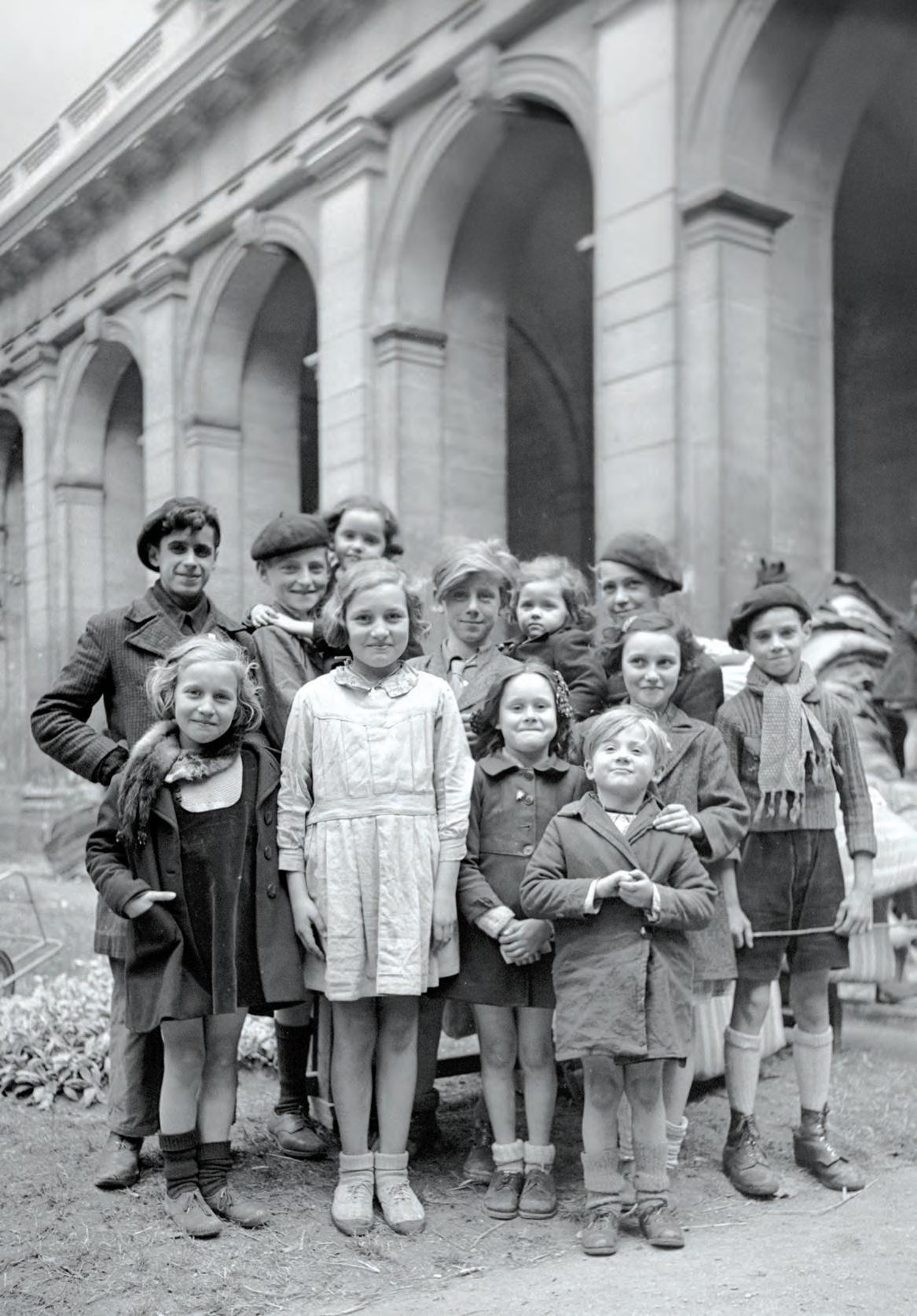
Despite living amid the battle for Caen, France, this group of local children is all smiles for Canadian photographer Ken Bell on July 10, 1944.
See page 52
18 A WAR BY ANY OTHER NAME
A look back at the key Canadian battle of the Korean War and the conflict’s future implications 75 years after it began
By Stephen J. Thorne
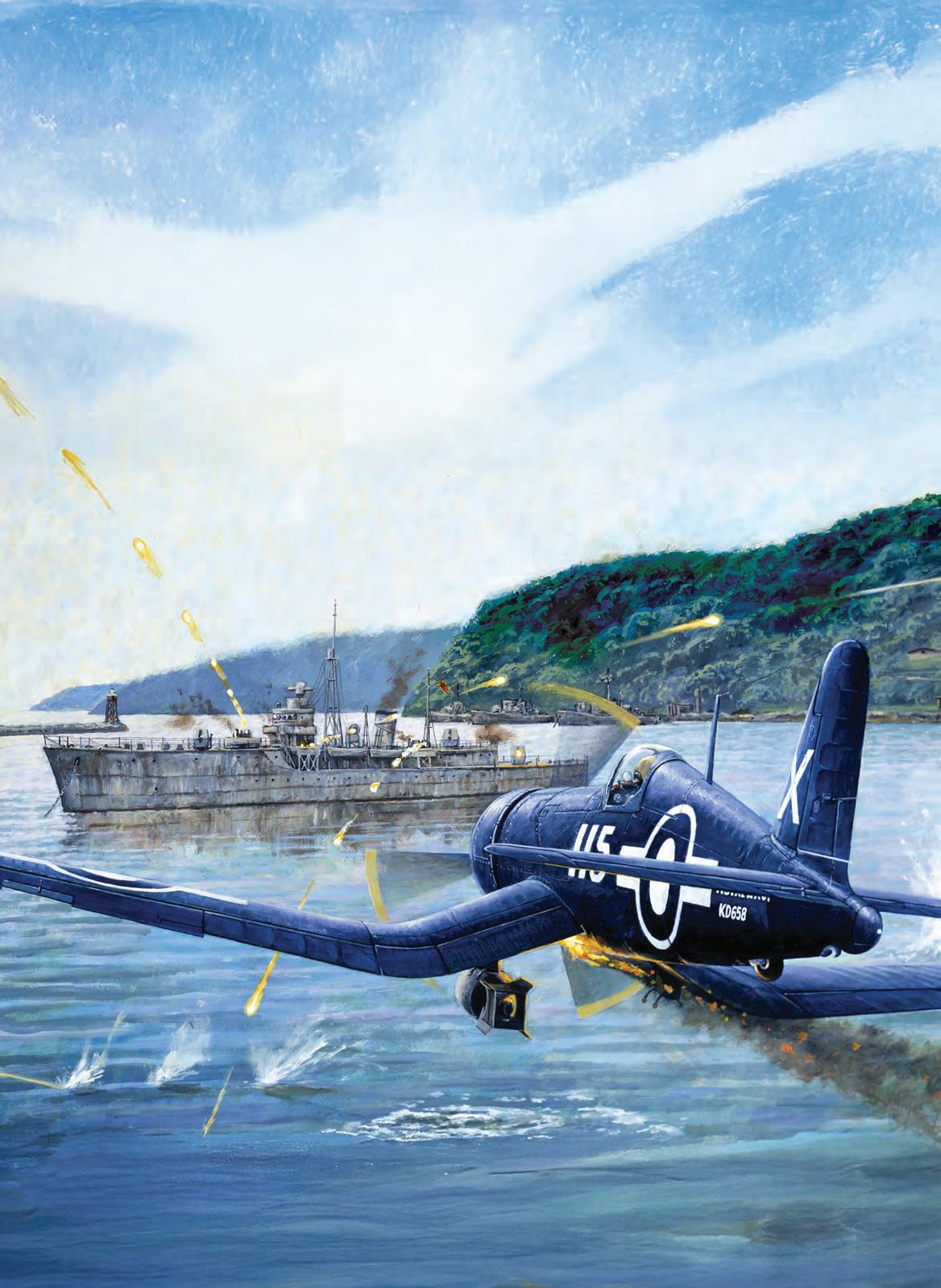
24 A FORMIDABLE PILOT
The legacy of Robert Hampton Gray
By Brad St. Croix
28 VILLAIN OR VICTIM?
For Japanese Canadian Kanao Inouye it’s a complex tale
By Alex Bowers
34 AFTERMATH
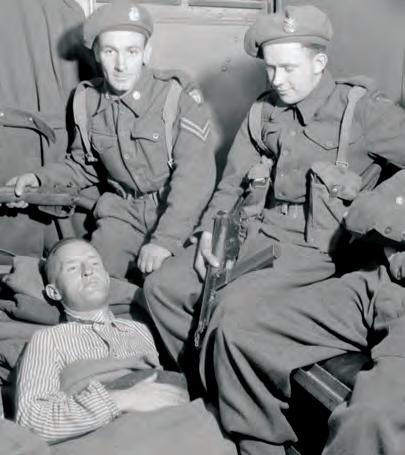
The trials and tribulations of the Canadian Army Occupation Force in Germany in 1945-1946
By J.L. Granatstein
40 NO KNOWN GRAVE?
Tracking the final resting place of Canadian Battle of Britain casualty John (Jack) Benzie
By Andy Saunders
46 NOT AGAIN
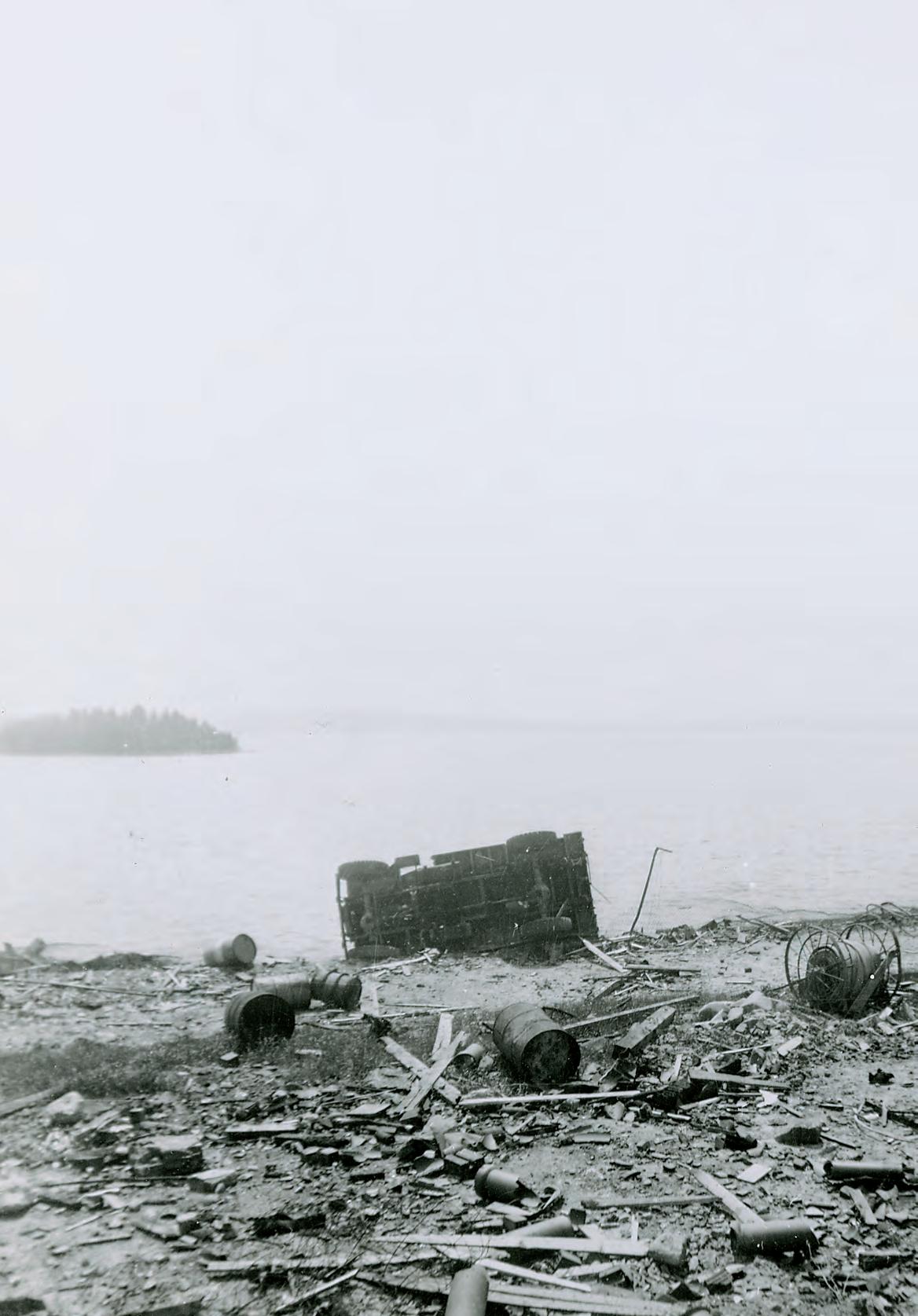
A fiery footnote in history, the July 1945 Bedford Magazine explosion almost became a second Halifax disaster 27 years after the first
By Alex Bowers
52 BACK TO THE FRONT
Canadian war photographer Ken Bell returned to European battlefields several times after the Second World War to reshoot some of the people and landscapes captured during the conflict
Words by Carla-Jean Stokes

THIS PAGE
An army truck lies on its side after the first explosion at the Bedford Magazine near Halifax in July 1945.
Nova Scotia Archives ON THE COVER
Artist Donald Connolly depicts pilot Robert Hampton Gray’s attack on a Japanese destroyer escort in Onagawa Bay on Aug. 9, 1945. The ship was sunk, but Gray died when his plane was shot down. He posthumously received the Victoria Cross for his actions.
Donald Connolly/CWM/19880046-001
the U.S. need to drop the atomic bombs on Japan?
J.L. Granatstein


Board of Directors
BOARD CHAIR Sharon McKeown BOARD VICE-CHAIR Berkley Lawrence BOARD SECRETARY Bill Chafe DIRECTORS Steven Clark, Randy Hayley, Trevor Jenvenne, Bruce Julian, Valerie MacGregor, Jack MacIsaac Legion Magazine is published by Canvet Publications Ltd.


ADMINISTRATION MANAGER
Stephanie Gorin
SALES/
ADMINISTRATIVE ASSISTANT
Lisa McCoy
ADMINISTRATIVE ASSISTANT
Chantal Horan
ADMINISTRATIVE AND EDITORIAL CO-ORDINATOR
Ally Krueger-Kischak
GENERAL MANAGER Jason Duprau
EDITOR
Aaron Kylie
ASSISTANT EDITOR
Michael A. Smith
SENIOR STAFF WRITER
Stephen J. Thorne
STAFF WRITER
Alex Bowers

ART DIRECTOR, CIRCULATION AND PRODUCTION MANAGER
Jennifer McGill
SENIOR DESIGNER AND PRODUCTION CO-ORDINATOR
Derryn Allebone
SENIOR DESIGNER
Sophie Jalbert
DESIGNER
Serena Masonde


Advertising Sales CANIK MARKETING SERVICES NIK REITZ advertising@legionmagazine.com
MARLENE MIGNARDI marlenemignardi@gmail.com OR CALL 613-591-0116 FOR MORE INFORMATION
Ankush Katoch
Published six times per year, January/February, March/April, May/June, July/August, September/October and November/December. Copyright Canvet Publications Ltd. 2025. ISSN 1209-4331
Subscription Rates
Legion Magazine is $13.11 per year ($26.23 for two years and $39.34 for three years); prices include GST. FOR ADDRESSES IN NS, NB, NL, PE a subscription is $14.36 for one year ($28.73 for two years and $43.09 for three years). FOR ADDRESSES IN ON a subscription is $14.11 for one year ($28.23 for two years and $42.34 for three years).
TO PURCHASE A MAGAZINE SUBSCRIPTION visit www.legionmagazine.com or contact Legion Magazine Subscription Dept., 86 Aird Place, Kanata, ON K2L 0A1 Call 613-591-0116 or toll-free 1-844-602-5737.
The single copy price is $7.95 plus applicable taxes, shipping and handling.
Change of Address
Send new address and current address label, or, send new address and old address. Send to: Legion Magazine Subscription Department, 86 Aird Place, Kanata, ON K2L 0A1. Or visit www.legionmagazine.com/change-of-address. Allow eight weeks.
Editorial and Advertising Policy


Opinions expressed are those of the writers. Unless otherwise explicitly stated, articles do not imply endorsement of any product or service. The advertisement of any product or service does not indicate approval by the publisher unless so stated. Reproduction or recreation, in whole or in part, in any form or media, is strictly forbidden and is a violation of copyright. Reprint only with written permission.
PUBLICATIONS MAIL AGREEMENT NO. 40063864
Return undeliverable Canadian addresses to Legion Magazine Subscription Department 86 Aird Place, Kanata, ON K2L 0A1 | magazine@legion.ca
U.S. Postmasters’ Information
United States: Legion Magazine, USPS 000-117, ISSN 1209-4331, published six times per year (January/February, March/April, May/June, July/August, September/October, November/December). Published by Canvet Publications, 866 Humboldt Pkwy., Buffalo, NY 14211-1218. Periodicals postage paid at Buffalo, NY. The annual subscription rate is $12.49 Cdn. The single copy price is $7.95 Cdn. plus shipping and handling. Circulation records are maintained at Adrienne and Associates, 866 Humboldt Pkwy., Buffalo, NY 14211-1218. U.S. Postmasters send covers only and address changes to Legion Magazine, PO Box 55, Niagara Falls, NY 14304.
Member of Alliance for Audited Media and BPA Worldwide. Printed in Canada.
We acknowledge the financial support of the Government of Canada. Version française disponible.
From time to time, we share our direct subscriber list with select, reputable companies whose products or services we believe may interest our subscribers. To opt out of receiving these offers, please send your request, including your full name and address, to magazine@legion.ca. Alternatively, you can write to Legion Magazine, 86 Aird Place, Kanata ON K2L 0A1, call 613-591-0116, or call toll-free 1-844-602-5737.
“It
’s quite encouraging to see that Canadians are paying more attention to defence and security issues,” the defence chief, General Jennie Carignan, told members of The Royal Canadian Legion’s leadership during a meeting in late April, two days before the federal election (also see page 60).
Owing no doubt in large part, if not entirely, to U.S. President Donald Trump’s repeated references to Canada as America’s “51st state” and his administration’s deranged tariff policy, Canadians seemingly took a renewed interest in the country’s sovereignty, manifest in national defence as a top campaign issue.
Both the minority-winning Liberals and the narrow-margin opposition Conservatives made several promises related to military investment during the election. And “analysts don’t see a whole lot of difference between the defence platforms of the two major parties,” wrote Chris Lambie of the National Post on April 26.
“WE HAVE A NEW U.S. ADMINISTRATION THAT’S ADOPTING A TOTALLY DIFFERENT POSTURE, AND WE HAVE TO ADJUST TO THAT.”
As a handy reference, here’s a brief summary of what Prime Minister Mark Carney’s Liberals pledged:
• a n $18-billion increase in defence spending over four years to meet NATO’s two per cent gross domestic product spending target;
• t he creation of a single agency to handle military procurement (the party made the same promise during the 2019 campaign);
• pay raises for military members, as well as to “rapidly (increase) the stock of highquality housing on bases across the country and (ensure) access to primary child care and health care—including mental health supports—for serving members and their families”;
• a modernization of the recruitment process “by streamlining security clearances and applying online, so that more applicants can get trained, faster”;
• a nd, to “integrate the Canadian Coast Guard into our NATO defence capabilities” to “exceed our commitment to spend at least two per cent of GDP on defence.”
“I think we need to be prepared to be underwhelmed by how much can change in just the next four years,” David Perry, president of the Canadian Global Affairs Institute, told the National Post. “The current defence procurement cycle, as an example, runs about 15 years from projects starting to being completed.”
Perry added that despite the promises, he didn’t expect much to change.
Ken Hansen, a military analyst and former navy commander, essentially agreed. “When the pinch is on for money due to things like COVID or trade wars,” said Hansen in the Post article, “then that’s where they’ll squeeze to get some money out so they can smear it around somewhere else.”
Preliminary data from Elections Canada indicated voter turnout was 68.66 per cent, a six per cent increase from 2021 and the highest it’s been since 1993. Clearly, something got Canadians to the polls. And it’s hard to imagine that Trump wasn’t a big part of that.
“We have a new U.S. administration that’s adopting a totally different posture,” General Carignan also told Legion leaders last April, “and we have to adjust to that.”
A nd so, Canadians who remain appalled by Trump, passionate about the country’s sovereignty, and invested in Canada’s military, may wish to heed the defence chief’s words—and likewise hold their newly elected MPs to their promises. L



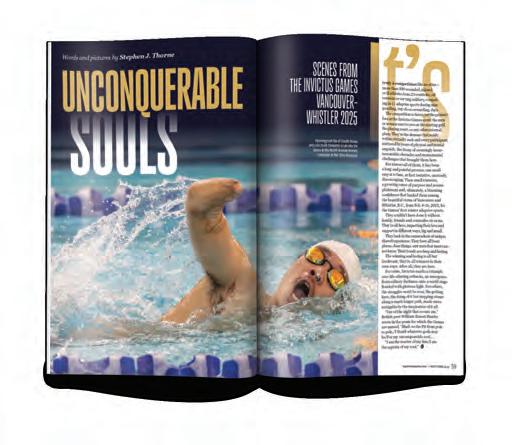
was really pleased to read the article about the Invictus Games held in Whistler and Vancouver this past February (“Unconquerable souls,” May/ June). It brought back many fantastic memories and, as a Games volunteer, it was an absolute thrill to have been part of such a unique and special sporting event. Meeting so many veterans and their families from around the world made it
The editorial from 1935 (“War — Neutrality — Canada,” May/June) is a reminder that ignoring the lessons of history is very dangerous. Politicians on both sides of the House have ignored the needs of Canada’s military for far too long. Canada depended on the United States, and it now needs to re-arm or face becoming Trump’s cherished 51st state. Wake up Ottawa!
PETER MARKLE
STOUFFVILLE, ONT.
Being a Newfoundlander by birth, I was particularly interested in the articles, “Who knit ya,” by Stephen J. Thorne, and “Somme memorial,” by Don Gillmor, in the May/June edition. I suspect that Gillmor’s article may have been edited down to fit the space because there was a misleading fact that requires clarification. While the Newfoundland Regiment did send a first contingent of 537 men to Britain for final training on Oct.13, 1914—who despite the slight lack of precision in the title became
Comments can be sent to: Letters, Legion Magazine , 86 Aird Place, Kanata, ON K2L 0A1 or emailed to: magazine@legion.ca
all that much more special. One thing the article didn’t mention was that almost 2,900 applications were received and 1,900 international volunteers were chosen, many of whom were veterans as well. The Games wouldn’t have been possible without them. If the Games ever return to Canada, I will be first in line to volunteer again.
TED USHER COURTENAY, B.C.
known as the “First 500”—they were joined by a second group, which departed Newfoundland on Feb. 5, 1915, and a third, which left on March 22, to bring the regiment up to full strength before leaving for Gallipoli.
The second contingent, of which my grandfather, Howard Leopold Morry, was a member, also included roughly 500 men, while the exact number in the third contingent isn’t well documented. But, suffice to say, at least 1,076 officers and men landed on Kangaroo Beach in Suvla Bay on Sept. 20-21, 1915, to lend support to other British Empire forces who had arrived in Gallipoli on April 25, 1915.
CHRISTOPHER MORRY GREELY, ONT.
The claim that “Moscow, now under Vladimir Putin, is responsible for saving NATO in modern times, not Donald Trump” (“Face to Face,” March/April) is the kind of tortured nonsense that comes from Trump Derangement Syndrome. By pressuring his freeloading partners to step up their collective defence, Trump gave
new life to a moribund organization. Millions of Ukrainians have suffered and died in an unwinnable war. Trump’s iron will and adroit diplomacy will save Ukraine, too.
GARY M c GREGOR LADNER, B.C.
I have just finished reading your article “Unto the breach” (March/April) and I would like to point out that LanceCorporal Fred Fisher was a member of the 13th Battalion, The Black Watch (Royal Highland Regiment) of Canada.
WILLIAM R. SEWELL POINTE-CLAIRE, QUE. L
In “Humour Hunt” (May/June), an editing error changed the word “destore”—to remove naval gear and supplies from a vessel— to “destroy.” As it turns out, the original message was likewise confused. The joke’s on us.
3 July 1931


11 July 1990
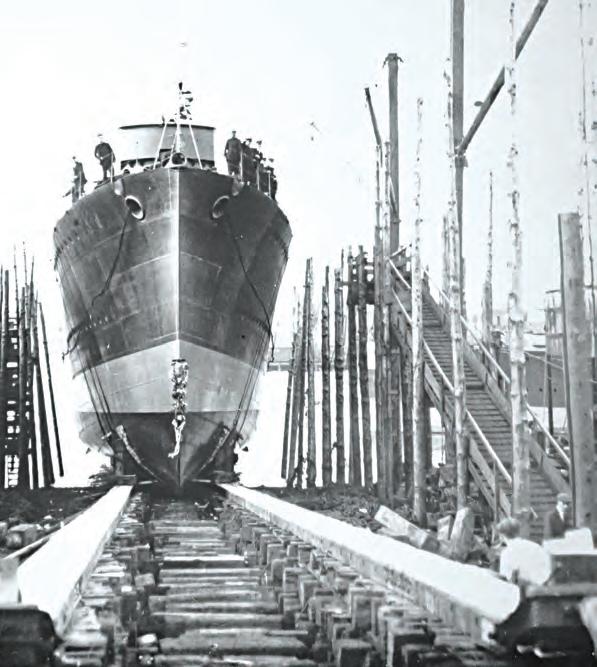
The first vessels specifically built for the Royal Canadian Navy, HMCS Saguenay and HMCS Skeena, complete their maiden voyages to Halifax. Both were commissioned at Portsmouth, England.
4 July 1944
Canadian forces advance under heavy fire toward Carpiquet airport on the outskirts of Caen, France.
5 July 1900
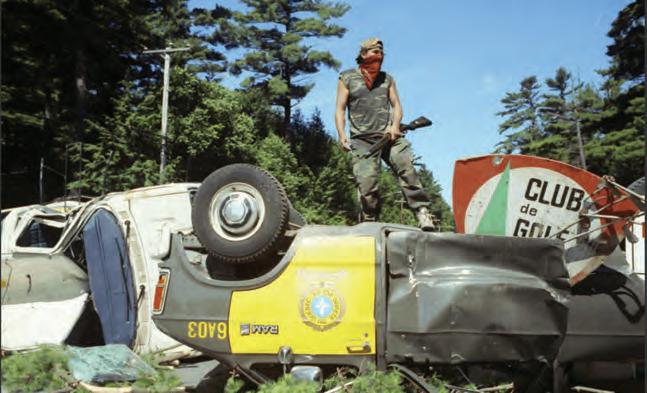
The Sûreté du Québec tries to dismantle a Mohawk blockade near Oka, Que. One officer is shot and killed, marking the start of the Kanesatake Resistance, also known as the Oka Crisis.

20 July 1871
B.C. joins Confederation on the promise of a rail link and representation in Parliament.
24 July 1927
The Menin Gate memorial to the missing in Ypres, Belgium, is unveiled.
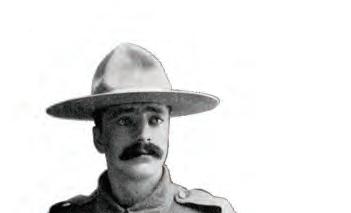
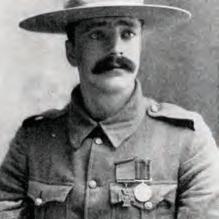
For actions during the Boer War, Sergeant Arthur Richardson of Strathcona’s Horse earns the Victoria Cross. It’s the first VC awarded to a member of a Canadian unit.
7 July 1942
Operation Rutter, the original plan for the Dieppe Raid, is cancelled for numerous reasons, including reports of bad weather.
10 July 1943

1906
Charles K. Hamilton completes first powered and directed flight in Canada at Montreal flying a dirigible.
14 July 1976
Canada formally abolishes the death penalty.
July 16 1945
An atomic bomb is tested in New Mexico (see “Face to Face,” page 58 and “O Canada,” page 96).
17 July 1812
British forces capture U.S. Fort Mackinac, which was unaware war had been declared.
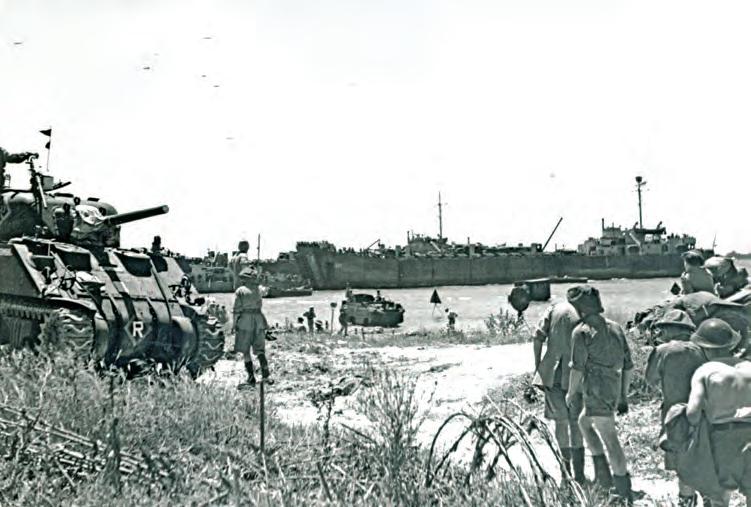
Operation Husky, the Allied invasion of Sicily, begins. 1st Canadian Infantry Division’s participation represents the country’s first sustained commitment to the ground war against Germany.
25 July 1937
Two RCAF aircraft from 7 Squadron begin a month-long tour of the Arctic with Governor General Lord Tweedsmuir.
27 July 1953
An armistice ends three years of fighting in the Korean War. Some 26,000 Canadians served; 516 died and more than 1,200 were wounded.
28 July 1884
The Settlers’ Union issues a manifesto of grievances contributing to tensions that ultimately lead to the 1885 NorthWest Resistance.
29 July 1982
The CF-18 Hornet reaches Mach 1.6 on its first test flight in St. Louis.
30 July 1960
Prime Minister John Diefenbaker announces Canada will make a substantial contribution to a United Nations intervention in Congo.


1 August 1834
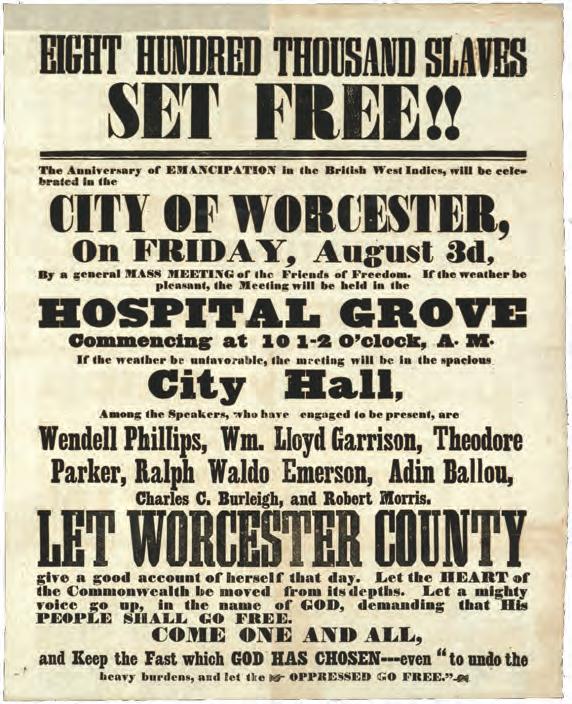
The Slavery Abolition Act takes effect, outlawing servitude across the British Empire.
2 August 1951
HMCS Athabaskan sails for its second tour of duty in Korean waters.
3 August 1961
Tommy Douglas is elected leader of the New Democratic Party at its founding convention.
6 August 1945
An American nuclear bomb devastates the Japanese city of Hiroshima.
8 August 1918
In conjunction with other Allied forces, the Canadian Corps launches a major attack to the east of Amiens, France, beginning a period of operations known as The Last Hundred Days.
9 August 1945
Lieutenant Robert Hampton Gray of Nelson, B.C., an RCNVR pilot, sinks a Japanese destroyer escort in Onagawa Bay. He is posthumously awarded the Victoria Cross (see “A Formidable pilot,” page 24).
10 August 1840
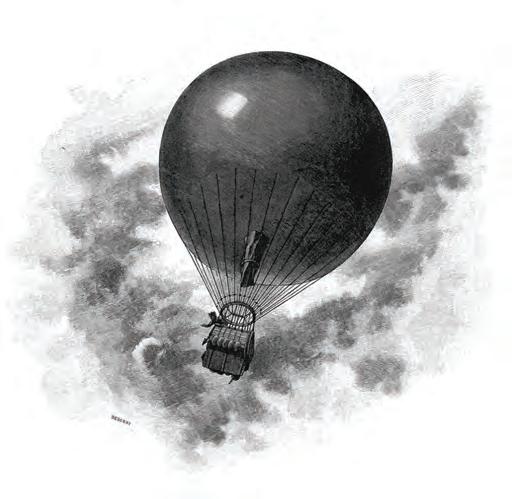
Louis Anselm Lauriat completes Canada’s first manned flight— in a hot-air balloon—in Saint John, N.B.
11 August 1755
British BrigadierGeneral Charles Lawrence orders the expulsion of the Acadians.
13 August 2008
Two Canadian aid workers, Jacqueline Kirk and Shirley Case, are killed in a roadside ambush in Afghanistan.
16 August 1812
The Americans surrender Fort Detroit to forces led by Major-General Isaac Brock.
18-20 August 1944
After days of fighting, Major David Currie accepts the surrender of German troops at Saint-Lambert-sur-Dives, France. He earned the Victoria Cross for his actions.
22 August 2006
A suicide bomber crashes into a Canadian military patrol in southern Afghanistan, wounding three and killing Corporal David Braun and a local girl.
25 August 1875
15-18 August 1917
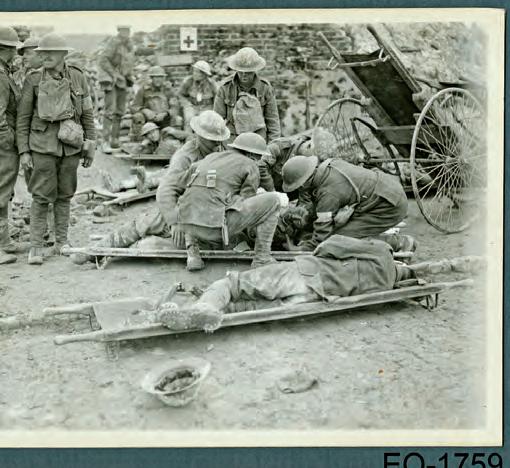
Canadians capture Hill 70 at a cost of 9,000 casualties.
The Gazette; Wikimedia; CWM/ 199220044-995; LAC/PA-141664; Boston Public Library/Wikimedia; Backyardhistory.ca; CWM/19920085-663; Kylee Gardner/DVIDS/ Wikimedia
The North-West Mounted Police establish Fort Brisebois at the confluence of the Bow and Elbow rivers in Alberta. It’s renamed Fort Calgary the following year.
28 August 1928
Punch Dickins begins a 12-day, 6,400-kilometre pioneering flight in a float-equipped Fokker airplane over northern Canada.
29 August 1917
A mob of 5,000 begins a two-day riot in Montreal in protest of conscription.
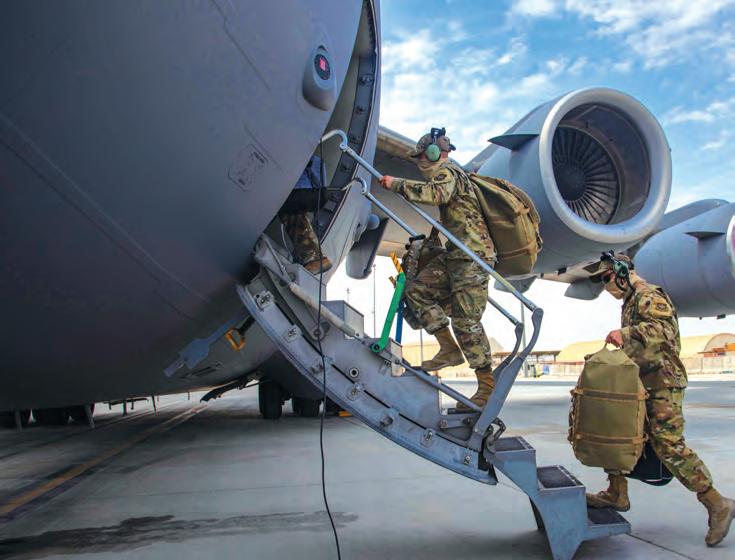
The last U.S. troops leave Afghanistan, ending the nearly 20-year war.

What does life look like after the military? Perhaps you’ve started a new career, moved to a different city, or are balancing your income after a medical release. Now is the time to get expert financial advice on how to live better now and in the future.
Here are some of the things SISIP can help you with:
More money in your pocket. Financial success starts with managing your monthly cash flow. We’ll help you maximize your income, minimize your taxes, and make the most of your financial resources.
A path to your goals. Nothing can grow your money like a diversified, tax-smart investment portfolio. We’ll design a customized roadmap that lays out what you want to achieve and how you’ll get there.
Protection for your loved ones. Insurance provides cash to your loved ones when you are not able to do so. We’ll analyze your situation and recommend the ideal type and amount of protection for you.
As a veteran, you can talk to SISIP about financial advice, investing, insurance, pensions, and more. We exclusively serve Canadian Armed Forces members, veterans and their families both online and at bases and wings across Canada. You can count on us for unbiased advice because our financial experts are accountable to you and nobody else.

SISIP is here to help you make the right ones. Your pension. Your investments. Your insurance. Your cash flow. Your next career move. And beneath it all, a single question: “Am I making the right choices for my family and my future?”
That’s where SISIP comes in. SISIP has been serving CAF members and veterans for more than 50 years. Our only goal is to help you make confident, informed decisions about your finances. Here are a few ways we can help:
• Understand your pension options. Should you take a deferred annuity, an annual allowance, or a transfer value? We can walk you through your options and help you choose what’s right for your timeline and goals.
• Plan your transition. Starting a new career or moving to a new city? We’ll help you prepare your budget, manage your savings, and anticipate what comes next.
• Keep your insurance coverage. You have 60 days after releasing to switch to SISIP’s Insurance for Released Members without medical re-qualification. Don’t let your protection lapse without reviewing your options.
• Stay invested in your future. We can help you build a long-term plan that fits your new life stage, your new income, and your long-term goals.
• Get support when you need it. If you’re medically released, CAF long-term disability insurance can help you recover and retrain. We’re here to help you navigate the process and access the support you’re entitled to.
• Talk to experts who know. You’re still part of the CAF community, and we’re still here for you. From life insurance coverage to investing in retirement, your SISIP advisor is always just a phone call or email away. At SISIP, our financial advisors understand military benefits, pensions, and pay structures in a way most civilian advisors simply can’t. We know how to navigate the transition from full-time service to civilian life, and we’re ready to help you chart your next mission.
Just made the leap? Let’s talk.
Visit sisip.com or call 1-800-267-6681 to connect with your local SISIP advisor.

By Alex Bowers
e’re not providing mental health support services,” said TryCycle Data Systems founder John MacBeth. “We’re providing human connection,” he told a gathering of Legionnaires in August 2024.
In an increasingly digital world, authentic human connection has become a rarity. And just as modernity may hinder people’s sense of community, it may also be the anecdote needed, says MacBeth, for veterans to reach their optimal selves.
The evidence is in the Burns Way, an online peer-support tool for veterans developed by TryCycle Data and endorsed by the RCL, which since its launch has facilitated invaluable connections.
MacBeth’s vision was fully realized on Jan. 15, 2025, when the Burns Way opened its proverbial doors to veterans seeking comfort, guidance and camaraderie, as well as those best placed to offer it.
Its name honours the legacy of retired private Earl Burns Sr., who, on Sept. 4, 2022, died protecting his family and community amid a stabbing spree at Saskatchewan’s James Smith Cree Nation.
“We want individuals to build confidence in getting help for themselves through speaking to someone who’s worn their boots,” explained project lead Cameron MacLeod, “whether it’s RCMP, Canadian Armed Forces or a family member.”
Users, whether via the mobile app or on the Burns Way website, can hone their search for advocates most closely aligned with their own lived experiences.
“We want them to find the peer advocate who meets their needs, rather than just a peer advocate, explained MacLeod.
More than 200 applicants volunteered their time and services when the recruitment campaign began in November 2024, at least 50 of whom were initially selected to undertake standard and mental health first aid training prior to connecting with a fellow veteran.
The not-for-profit Burns Way, which steers clear of automated robots and artificial intelligence, or AI, that many public-facing parts of organizations currently use, recognizes the importance of anonymity and security as two vital factors that can often influence a veteran’s willingness to seek support. Thus, in delivering free, 24-hour assistance, the online portal requires neither an email address nor login details. Additionally, those choosing to create personalized profiles do so with a guarantee that no one else can access their information.
Only that which is voluntarily divulged to a peer advocate is known about an individual user. Once that conversation ends, the record is permanently deleted.
The fact that its users can remain anonymous addresses a major
concern of many former service personnel. The Burns Way also doesn’t fit the traditional mould of mental health services. It’s “not a crisis line,” MacLeod asserted. “Obviously, [under such circumstances], the peer advocate will respond. They’d then try to reduce the person’s anxiety, referring them to more formal support if intervention is required.
“[Our program] is not therapy, even if it might occasionally be therapeutic.”
Despite this, every peer is certified by Opening Minds, an affiliate of the Mental Health Commission of Canada, each having completed its “Mental Health First Aid— Veteran Community” course.
Elsewhere, MacLeod noted, the question of funding looms large. “From the outset, TryCycle Data Systems has supported the entire thing. They’ve invested more than three quarters of a million dollars into the Burns Way in cash and in-kind. So, we’re really looking to getting the program funded in a way that makes it sustainable.”
In June 2023, a proposal was submitted to VAC requesting $9.5 million annually for three years. To date, no formal commitment has been made.
“We know government is bound by rules, but they’ve been generous with their time and have worked with us to try and find a way of making this happen— we’ll have to wait and see.”
Following the success of the Talking Stick app, a previous TryCycle initiative that matches Indigenous Peoples in Saskatchewan with fellow Indigenous advocates, Macleod is hopeful the Burns Way will similarly flourish.
Regardless, one aspect of its mandate will remain: cultivating safe and secure support for Canadian veterans and their families.
“If you know of someone who’s struggling out there,” said MacLeod. “Tell them about us. Let them know someone is ready to listen. L

Enjoy up to 50% off accommodations at more than one million hotels worldwide when you sign up*—and it’s FREE! That’s incredible savings for you, your family and your friends.
Plus, a portion of all proceeds from hotel bookings at Legion Travel assist The Royal Canadian Legion and its efforts to support Veterans.
STAY, SAVE and SUPPORT—scan the QR code or visit legiontravel.ca/magazine today!

Free Membership
Sign up for instant access to amazing hotel deals with no hidden fees.
Exclusive Savings Travel in style or on a budget. Get access to up to 50% off hotels*, with our exclusive unpublished rates.
Travel Your Way
Book at over one million hotels in 155,000 cities in 220 countries. The world is your oyster.
By Stephen J.Thorne
quarter century ago, an unidentified Canadian soldier killed at the seminal First World War Battle of Vimy Ridge was ceremonially exhumed from his grave 8.5 kilometres away in Cabaret-Rouge British Cemetery and brought home to Canada.
Vimy, because it was there, in France in April 1917, that all four divisions of the Canadian Corps fought together for the first time, claiming—under unprecedented Canadian leadership—a victory that would propel the country to its rightful place in the war, and the world. Brought home, because Canadians—indeed, all secure, free-living people—need reminding of what it took, and still takes, to keep them secure and free.
More than 18,000 of the over 66,000 Canadians killed in the Great War were never identified, their names listed on the Canadian National Vimy Memorial (11,285) and the Menin Gate in Belgium (6,940). This soldier was destined to represent them all and the 27,000 who remain unidentified from the Second World War, 16 from Korea and undetermined others from the Boer War and other conflicts.
On May 28, 2000, the remains were laid in state at the Hall of Honour in Parliament before
they were interred in the shadow of the National War Memorial to lie in anonymity forever. It was the culmination of years of effort by The Royal Canadian Legion.
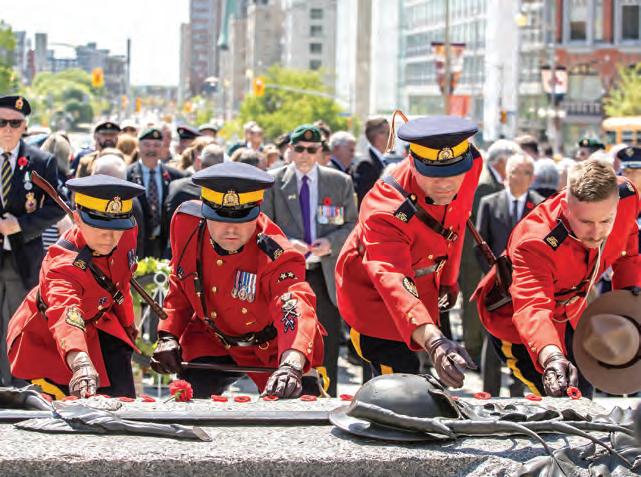
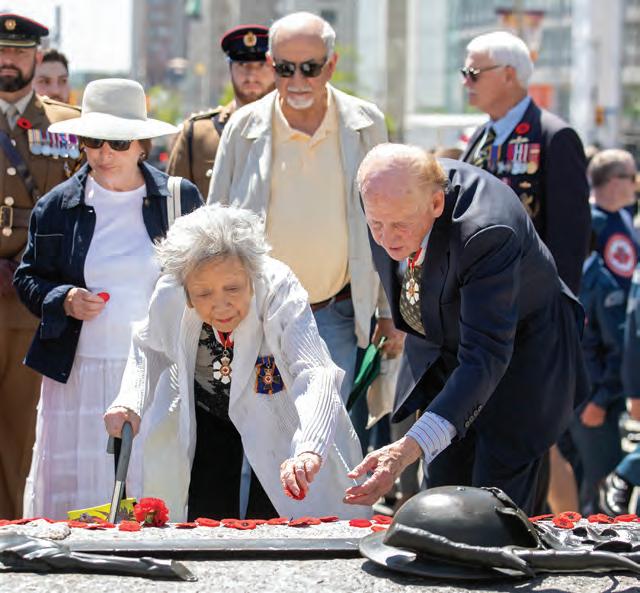
During the succeeding 25 years, the Tomb of the Unknown Soldier has become a focal point where, awakened by Canadians’ renewed sacrifices in Afghanistan, thousands of attendees have laid their poppies at the conclusion of the annual Remembrance Day ceremonies.
And, on May 28, 2025, veterans, serving military, dignitaries, schoolchildren and Legionnaires
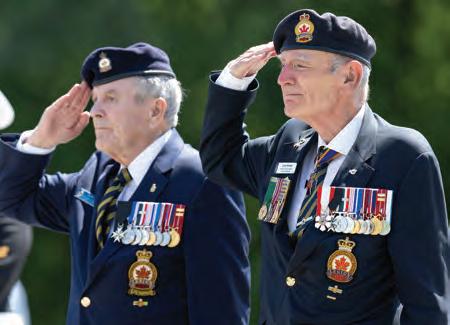
Mounties place poppies on the Tomb of the Unknown Soldier (above). Retired brigadiergeneral Duane Daly, former Legion dominion secretary, and retired vice-admiral Larry Murray, Legion grand president, salute after placing their poppies on the tomb (left).
gathered to pay tribute to the Unknown Soldier and all his comrades, and lay their poppies on his concrete sarcophagus.
Gov. Gen. Mary Simon was there. So was former governor general Adrienne Clarkson, who had delivered a stirring speech at the tomb’s dedication 25 years earlier (see Legion Magazine May/June 2025).
“We cannot know him,” she said then. “And no honour we do him can give him the future that was destroyed when he was killed. Whatever life he could
> Check out the Front lines podcast series! Go to legionmagazine.com/en-frontlines
have led, whatever choices he could have made are all shuttered. They are over.
“We are honouring that unacceptable thing—life stopped by doing one’s duty. The end of a future, the death of dreams.”
Twenty-five years on, a chaplain with the Canadian Armed Forces, Lieutenant (N) Katherine Walker, delivered her own poignant words as Clarkson looked on.
“There are places that ask something of us,” Walker told the crowd. “Places we cannot pass by casually. This is one of those places.”
The Legion’s grand president, retired vice-admiral Larry Murray, spoke. So did retired brigadiergeneral Duane Daly who, as RCL dominion secretary at the time, first proposed the tomb idea after an eye-opening trip to South Africa.
There, he had found Canadian war dead buried where they fell, their graves—often single plots in farmers’ fields—marked by the granite stones that had served as ballast aboard the ship that brought them to their deaths so far from home.
Daly related the story of how Legion efforts to bring an unidentified soldier home for burial at the National War Memorial were
“THERE ARE PLACES THAT ASK SOMETHING OF US. PLACES WE CANNOT PASS BY CASUALLY. THIS IS ONE OF THOSE PLACES.”
stonewalled by successive governments, who pointed to Britain’s Unknown Warrior, interred at Westminster Abbey on Armistice Day 1920, saying he represented all the British Empire.
“Accepting the reality of the situation, the Legion remained undaunted,” said Daly, “and decided to take on the task of repatriating an unknown soldier itself” as a millennial project. A national survey reflected “overwhelming support” for the idea.
Design and costs posed major challenges from the outset: The initial budget was $500,000. It ended up costing nearly $2 million, much of it from federal coffers, but not because the federal government endorsed the endeavour. It didn’t.
Departmental budgets were arranged to ensure that it was adequately funded.
In a 20th anniversary interview with Legion Magazine, Daly said three public servants were critical to the initiative: Gerry Wharton, director ceremonial at Public Works and Government Services, came up with the design concept; Brad Hall of the Canadian Agency of the Commonwealth War Graves Commission, led the remains recovery in France; and Marc Monette, director of Public Works, Parliamentary Precinct, oversaw construction of the tomb and its placement. He also ran the design competition, won by Canadian artist Mary-Ann Liu.
Attention to detail was critical, from ensuring the granite came from the same Quebec quarry as the rest of the monument to finding a suitable gun carriage to transport the remains from Parliament Hill to the final resting place. The RCMP provided a gun carriage and mounted escort for the funeral cortège.
The soldier’s original stone marker was brought from Plot 8, Row E, Grave 7 in the Cabaret-Rouge cemetery to the Memorial Hall in the new Canadian War Museum where, at 11 a.m. each Remembrance Day, a beam of sunlight shines through a narrow window and illuminates it.
“This tomb is one eventuality of armed conflict,” said Walker. “And it reminds us that peace does not erase the traces of war.
“We gather here—not to glorify war, but to bear witness to its reality, and to honour what was asked of those who served. We gather to express how what they gave has immense value. That defines and allows for the very freedoms we now get to live out.” L
By David J. Bercuson
These days, Canadians have good reason to hit back at U.S. President Donald Trump and boycott American products from Heinz ketchup to Teslas. When it comes to Canada’s security and defence, however, Canadians ought to think very carefully about where their future lies and what measures they must take to maintain the country’s sovereignty and security.
Canada’s modern defence relations with the U.S. date back to the summer of 1940 after France was defeated by Germany and the North American continent was suddenly threatened by Nazi power. At that time, Canada was at war with Germany, but the U.S. was still neutral.
Nevertheless, President Franklin D. Roosevelt and Canadian Prime Minister Mackenzie King met at Ogdensburg, New York, on the south shore of the St. Lawrence River to initiate a new direction for both countries given the new threats to the world.
The pair agreed that the defence of North America demanded a joint Canada-U.S. arrangement and created the Permanent Joint Board on Defense (PJBD), which would initiate collaborative plans for continental security and report directly to the prime minister and the president. The agreement was renewed in 1946 by Resolution 37 of the PJBD to co-ordinate North American defence against the threat of
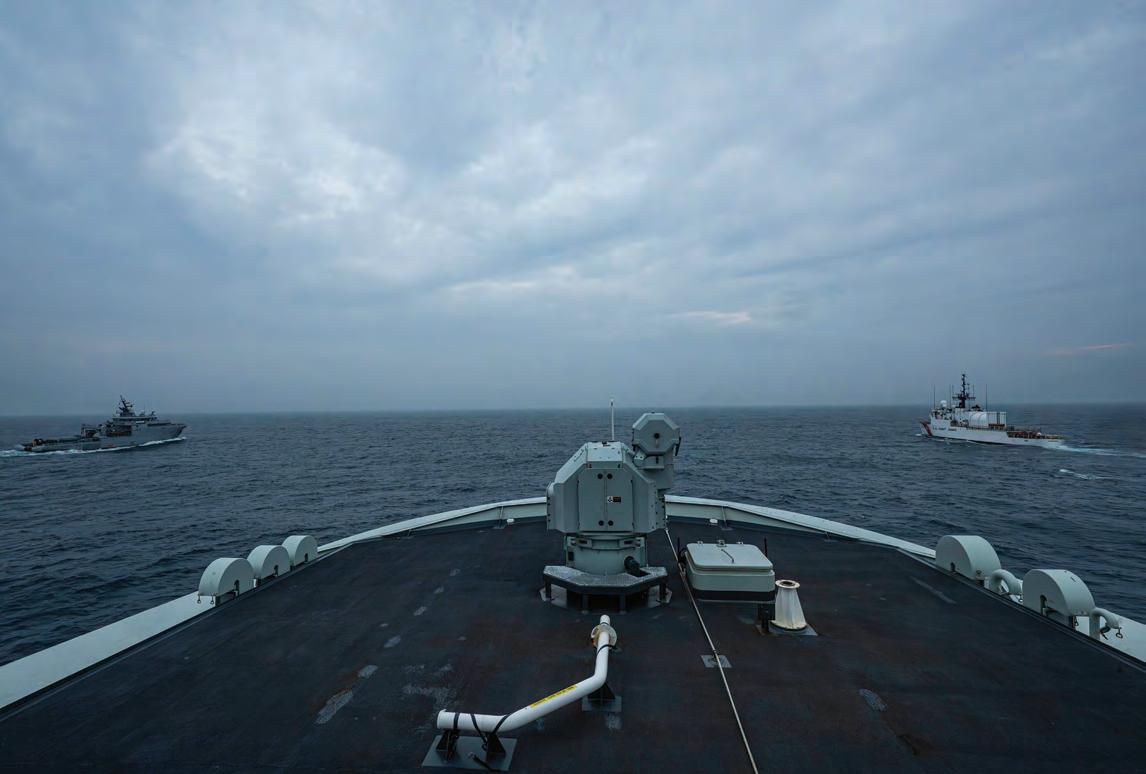
HMCS Harry DeWolf maritime task group, including French and U.S. naval vessels, in the North Atlantic on Aug. 11, 2023.
communism spreading under the influence of the Soviet Union.
This tie between the two coun tries was further strengthened by the creation of Norad in 1957. Now, there are hundreds of Canada-U.S. arrangements that govern shared security, dictated by the fact that the nations share a continent and by values of democracy. No president or his regime can invalidate those two basic facts.
As angry as Canadians may be with the current U.S. president’s lack of respect for their countries’ shared history, heritage and accomplishments, they must also understand that they rely on American satellites and radars to protect their aerospace, will soon rely on America’s help to secure Arctic sovereignty, in part by obtaining the best-in-class polar icebreakers, and not forget that the U.S. is their greatest investor. Exports to the U.S. accounted

for 19 per cent of Canada’s gross domestic product in 2023, which is by far the most common destination country for Canadian goods (70 per cent of all Canadian exports are destined for the U.S.).
How does such integration affect basic policy decisions? First, it can’t risk the existing positive working relationship between the Canadian and U.S. militaries. Second, the infrastructure and strategies to defend the continent must continue to be transborder, especially for air defences, sea approaches and the Arctic frontier. Plus, the ability to proffer military help in times of extreme natural disasters must continue. It also means that the time has
with a population of just 40 million. But that means Canada can’t afford to defend its borders and the world’s longest coastline alone. No matter the political stance of the administration in Washington, Canada must always make continental defence a priority, so that the U.S. won’t question its northern neighbour’s commitment to it.
In response to Trump’s Canadian sovereignty-related ramblings, the federal government has explored aligning itself with Europe when it comes to defence and security. What nonsense. Europe
create the sort of international defence structure that already exists in North American would likely take the better part of a decade, if it’s even possible.
Canadians must remember, there’s a reason their country has looked to the U.S. for defence equipment since the early 1950s: because it’s very good, if not the best, readily attainable, and owing to the transborder defence arrangements, is easily interchangeable.
So, buy Australian wines rather than American ones and vacation in the Caribbean instead of Florida or Arizona. But, now isn’t the time to disrupt the defence agreements that have kept North Americans safe and secure since the end of the Second World War. L



Korean
A look back at the key Canadian battle of the Korean War and the conflict’s future implications 75 years after it began | Stephen J. Thorne

Ask many a Korean War veteran what they remember most about their time near the 38th parallel and they’re as likely as not to tell you something about topography, sweltering heat or bitter cold.
Ask the 1,500 men of the 3rd Battalion, Royal Australian Regiment (3 RAR), and 2nd Battalion, Princess Patricia’s Canadian Light Infantry (2 PPCLI), what they remember most, and those still living will likely take you back to the peaks overlooking the picturesque Kapyong Valley.
It was there, on the road to Seoul, that the 118th Division of the Chinese People’s Volunteer Army (PVA) launched the main element of its spring offensive in April 1951.
The Canadians and the Aussies were at the tip of the defensive spear, poised to bear the brunt of the three-day onslaught by up to 20,000 Chinese soldiers. Today, the battle is widely regarded as the most significant action fought
by either allied army in Korea, and Canada’s most famous battle since the Second World War.
Chinese casualties had begun to rise under relentless artillery strikes ordered by the supreme Allied commander on the peninsula, newly appointed U.S. General Matthew B. Ridgway.
The momentum of the war was shifting, and Kapyong was a lynchpin.
South Korean troops were establishing positions at the northern end of the Kapyong Valley when the PVA’s 118th and 60th divisions launched a local offensive at 5 p.m. on April 22.
Facing pressure all along the front, the South Koreans soon gave ground and broke, abandoning weapons, equipment and vehicles as they streamed southward out of the mountains. By 11 p.m., the South Korean commander had lost all communication with his units. At 4 a.m. the
next day, supporting New Zealand t roops were withdrawn, only to be sent back, then withdrawn again by dusk. The South Korean defences had collapsed, and on their way out they let the Canadians know the Chinese were coming.
“It was then, about mid-afternoon, that the rumour of the collapsing front acquired a meaning,” Captain Owen R. Browne, officer commanding ‘A’ Company, wrote in 2 PPCLI’s regimental journal.
“From my arrival until then both the main Kapyong Valley and the subsidiary valley cutting across the front had been empty of people. Then, suddenly, down the road through the subsidiary valley came hordes of men, running, walking, interspersed with military vehicles—totally disorganized mobs. They were elements of the 6th ROK (Republic of Korea) Division which were supposed to be ten miles forward engaging the Chinese. But they were not engaging the Chinese. They were fleeing!
“I was witnessing a rout,” continued Browne. “The valley was filled with men. Some left the road and fled over the forward edges of “A” Company positions. Some killed themselves on the various booby traps we had laid, and that component of my defensive layout became worthless….
“We knew then that we were no longer 10-12 miles behind the line; we were the front line.”
Some 40 million people died in the First World War; at least 70 million in the Second. By the time Soviet-backed North Korean forces crossed the 38th parallel into South Korea on June 25, 1950, folks didn’t want to hear any more about war.
And, so, when a U.S.-led United Nations coalition stepped in on the Korean peninsula, President Harry S. Truman and Prime Minister Louis St-Laurent called it a “police action,” an “intervention.”
The terms didn’t sit well with those who were there.
“There were 516 [Canadian] military guys dead over there,” George Guertin, a radio operator aboard HMCS Huron at the time, told Legion Magazine
“I don’t call that a ‘police action.’ Just an ugly little war.”
In fact, no war was ever declared, and for the next 40 years or so those happenings on the Korean peninsula were officially referred to as “the Korean Conflict.” There was a Cold War, all right, but God forbid another hot one.
To most all but those who fought it, Korea was “The Forgotten War.”
In Canada, the combatants weren’t formally recognized as war veterans until the late 1980s, when Ottawa decided the war was, in fact, a war. And it wasn’t until
1991 that veterans were awarded Korean War service medals.
Seven years later in the U.S., which provided the bulk of resources to the war effort, President Bill Clinton signed Public Law 105-261, Section 1067, which declared the “Korean Conflict” would henceforth be called the “Korean War.”
Semantics? No. The change had ripple effects throughout the coalition of countries that made up the UN force in Korea. It influenced such things as pensions and compensation for veterans, including the 26,791 Canadians who served.
Groups such as the Korea Veterans Association of Canada, which wasn’t formed until the 1980s, stepped up efforts to get vets the support they needed—and deserved. With numbers dwindling, the group folded in 2021 and was replaced by the more centralized and descriptive Korean War Veterans Association of Canada.
The recognition deeply affected many who had long felt their service had been taken for granted, if it had been recognized at all. While Vietnam War veterans would return to America to a hostile anti-war welcome in the 1960s and early ’70s, Korean War veterans of the 1950s got almost no public reception whatsoever.


Korea vets endured passive hostility in the form of veterans’ organizations that refused to recognize their service, resisted incorporating the Korean War on cenotaphs and generally belittled their contributions, all while overlooking the fact that about 16 per cent of all those who served in Korea also served in the Second World War. They knew what war was, and what occurred on the Korean peninsula between June 25, 1950, and July 27, 1953, was by all first-person accounts a war.
And the Patricias were decidedly in it.
With the disconcerting prospect of a superior force closing fast and ROK troops still pouring past them, the Canadians started digging trenches and positioning themselves on Hill 677 and along the 1.5-kilo metre ridge connected to it.
They were on the west side of the Kapyong River. On the other side of 677, atop Hill 504, were the Aussies, dug in and ready for a fight.
The New Zealand 16th Field Regiment was in artillery support, with troops of the British 1st Battalion, Middlesex Regiment, at the rear along with three platoons of the U.S. 72nd Heavy Tank Battalion—15 tanks—alongside the main road that split the valley.
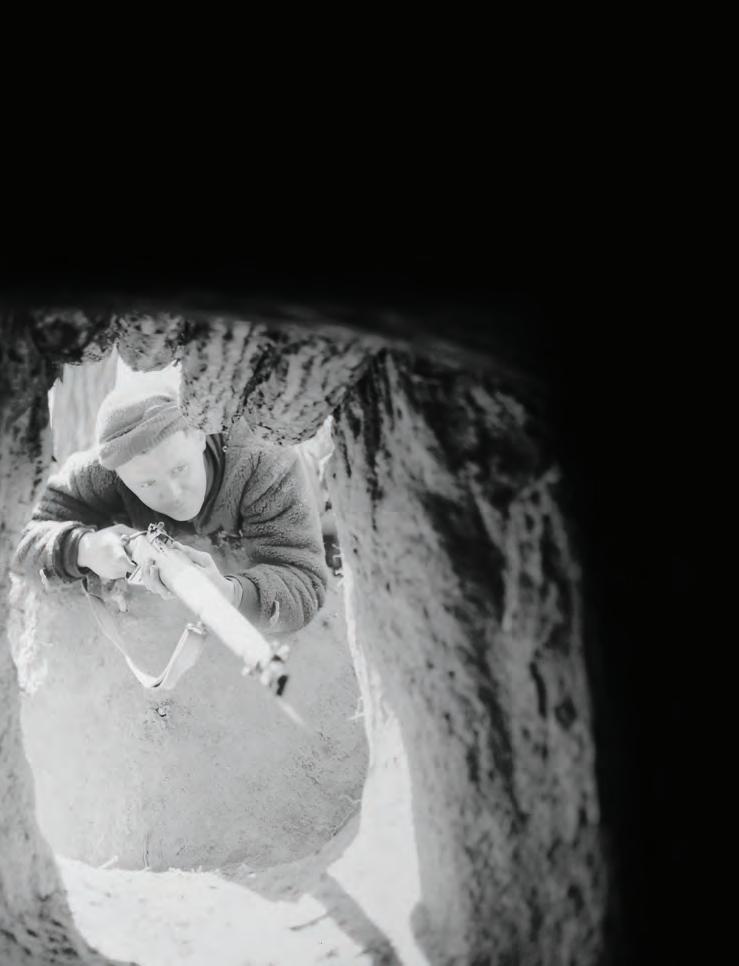
“United Nations mountain warriors won their spurs today, holding their front and refusing to budge even though outflanked and encircled.”

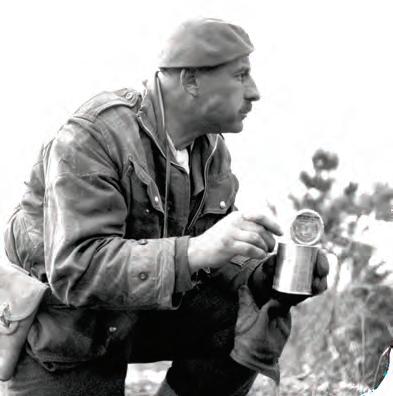
“No retreat, no surrender,” the Patricias’ British-born commander, Colonel James Riley Stone, told his men.
The Chinese struck 504 first, engaging the Aussies of 3 RAR, infiltrating the brigade position, then hitting the Canadian front.
“They’re quiet as mice with those rubber shoes of theirs and then there’s a whistle,” said Sergeant Roy Ulmer of Castor, Alta. “They get up with a shout about 10 feet from our positions and come in.”
Waves of massed Chinese troops sustained the attack throughout the night of April 23.
The Australians and Canadians were facing the whole of the Chinese 118th Division. The battle was unrelenting through April 24.
“The Chinese employed all their familiar battle procedures in the attack—whistles, bugles, a banzai chorus, concerted action on the word of command and massed assaults followed one another in swift succession,” reported Bill Boss of The Canadian Press. “This was
familiar only by description for these United Nations troops who until now had fought mainly an advancing war against token resistance.
“Now it was grim reality.”
The fight devolved on both fronts into hand-to-hand combat with bayonet charges.
“The first wave throws its grenades, fires its weapons and goes to the ground,” explained Ulmer, who previously served as a company sergeant-major with The Loyal Edmonton Regiment during WW II.

“The country went from a war-torn, impoverished nation to a global industrial powerhouse in just two generations.”
“It is followed by a second, which does the same, and a third comes up. Where they disappear to, I don’t know. But they just keep coming.”
The Australians, facing encirclement, were ordered to make an orderly fallback to new defensive positions late on the 24th.
The Patricias were surrounded, too. “But they held,” wrote Boss.
Captain John Graham Wallace (Wally) Mills of Hartley, Man., a WW II veteran fighting his first action as a company commander, ordered his ‘D’ Company men into the slit trenches. Then the unit directed artillery and mortar fire on its own position several times during the early morning hours of April 25 to avoid being overrun.
“Guns and mortars rained hell on that hill from 2 a.m. to 6 a.m.,” Boss wrote, his censored copy of the day void of identifying specifics such as battalion and company.
“Torrents of hot metal fragments decimated the Chinese ranks,” said an account by The Loyal Edmonton Regiment Military Museum.
The Chinese kept hitting Ulmer’s position until 4 a.m. By then, the forward platoon had almost exhausted its ammunition.
“The sergeant hurled his bayonetted rifle like a spear at his enemy,” Boss reported. “While two gunners stood up and gave covering fire from the hip, the remainder withdrew—but only 50 yards. There the company continued the fight, dividing the remaining ammunition and holding out until the enemy pressure relented.
“I counted 17 dead Chinese within inches and feet of those troops today and approximately 50 graves of enemy buried in the heat of battle. There were uncounted enemy dead
where an intended rear and flank attack was thwarted.
“Another company fought at close quarters against waves of Chinese troops. This company shot and grenade[d] the enemy until its ammunition ran out.”
As the sun rose, 2 PPCLI, cut off from the rest of the UN forces, still held Hill 677. The Chinese had withdrawn. Ten Canadian soldiers were dead and 23 wounded.
Australian losses were 32 killed, 59 wounded and three captured. The New Zealanders lost two killed and five wounded. Chinese losses were pegged at between 1,000 and 5,000 killed and many more wounded.
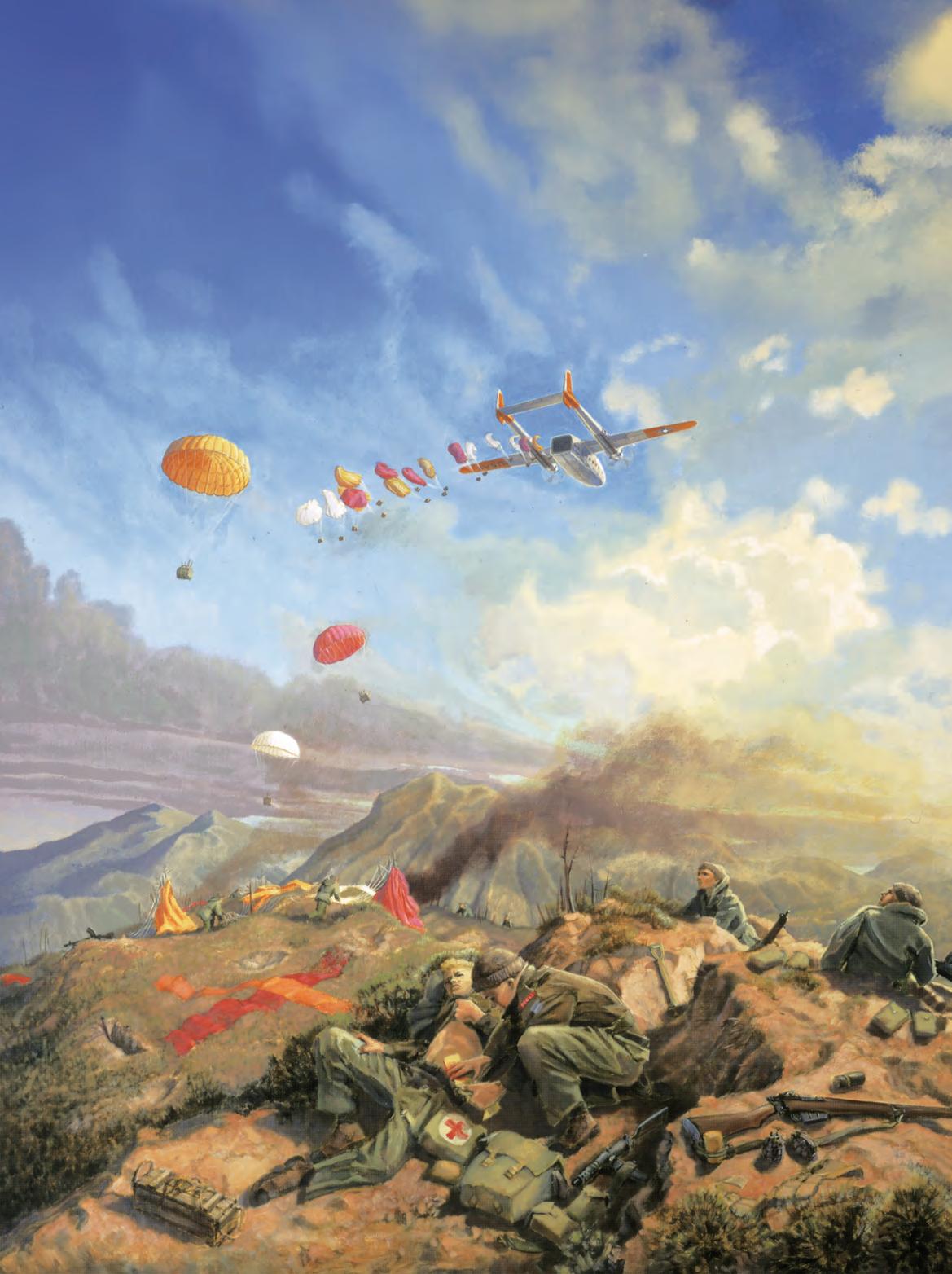
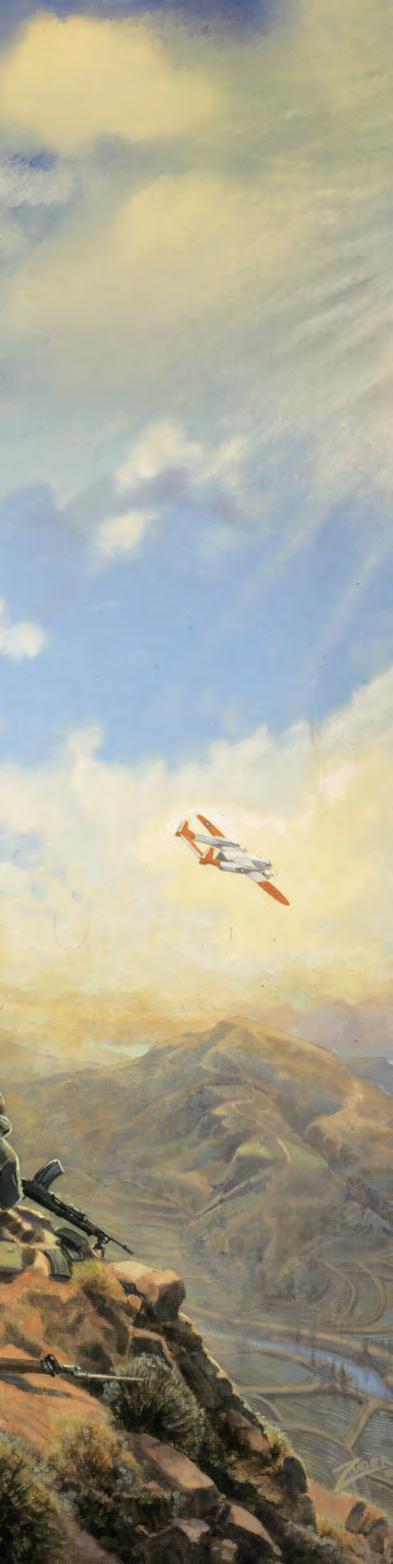
That morning, U.S. transport planes dropped food, water and ammunition to the exhausted Patricias.
“United Nations mountain warriors won their spurs today, holding their front and refusing to budge even though outflanked and encircled,” began Bill Boss’s April 25 wire service account of the battle, placelined West Central Sector, Korea.
“It was a knock-down, drag-out battle with wave after wave of Chinese Communists who did everything but drive them from their positions.”
Five Patricias received valour medals and 11 were Mentioned in Dispatches for their actions at Kapyong. Mills, the commander of the unit that had called in the mortars and artillery on its own position, would be awarded the Military Cross for his actions.
A war, indeed.
Despite the belated shift at home four decades later, the recognition afforded Korean War veterans by Canadians pales in comparison to the gratitude and gestures the people and government of South Korea
have afforded them. The Koreans have awarded them medals, hosted pilgrimages and thrown annual parties in their honour.
South Korean representatives are unfailing in placing wreaths at the National War Memorial in Ottawa to mark Remembrance Day and anniversaries associated with the war and armistice. Visiting South Korean presidents take the time to pay their respects by placing wreaths no matter the season. President Yoon Suk Yeol did so in September 2022.
Some 2.5 million Koreans died, were wounded or disappeared during the three-year war, while 10 million families—a third of the population—were separated. Industry and infrastructure were gutted on both sides. By war’s end, Seoul had been taken and retaken four times. The sprawling city was left a ruin. South Korea had lost 17,000 businesses, factories and plants, 4,000 schools and 600,000 homes. The gross national product had declined 14 per cent and total property damage was estimated at US$2 billion.
Its air force virtually erased, the North bore the brunt of the fighting after September 1950. The U.S. Air Force dropped more than 350,000 tonnes of conventional bombs and almost 30,000 tonnes of napalm on North Korean cities, and fired 313,600 rockets and 167 million machine-gun rounds.
The North Korean leader, Kim Il Sung, said the country’s economy had been destroyed. It had lost 8,700 industrial plants, 367,000 hectares of farmland, 600,000 houses, 5,000 schools, 1,000 hospitals and 260 theatres.

Historian James Hoare reported that the North’s national income in 1953 was 69.4 per cent that of 1950; electricity production was reduced to 17.2 per cent of 1949 levels, while coal was down to 17.7.
“There had been a huge loss of able-bodied men either killed or who fled South,” wrote Hoare.
“Effectively, therefore, apart from the end of the fighting, both sides found themselves in the summer of 1953 with nothing to mark and nothing to celebrate.”
Some “conflict.”
Yet, for South Korea at least, the end of the war would mark the gradual beginning of a new age. The country would rebuild and far surpass anything it had known or could have expected before in terms of development and prosperity. It’s now a cultural phenom, a tech giant, and Seoul a sparkling jewel of southeast Asia.
“The country went from a war-torn, impoverished nation to a global industrial powerhouse in just two generations,” wrote Chung Min Lee in a November 2022 essay for the Carnegie Endowment for International Peace.
“Before this turn of events, no one could have imagined that South Korean actors would win an Oscar and an Emmy or that K-pop would reach a global audience.
“A country that relied on U.S. aid until the 1960s is now investing tens of billions of dollars
to build new electric vehicles, next-generation batteries, and semiconductors in the United States.”
While South Korea has its problems, too, it’s in its triumphs that the veterans of the Korean War take pride. They may not have left behind a united Korea, but their war preserved the South’s freedom and, ultimately, its means to prosper.
In a Dec. 1, 1953, telegram to the U.S. State Department, Arthur H. Dean, special U.S. envoy to the postarmistice political conference, effectively laid blame for the impending failure to reach a peace at the feet of South Korea’s president at the time, Syngman Rhee, who had refused to sign the hard-earned armistice and wanted to continue fighting.
“Rhee is presently very querulous,” wrote Dean. “Thinks he was tricked into armistice. Now thinks defense pact and economic program are dishonorable bribes to him not to unify Korea by force.
“He sees his lifetime dream of a unified Korea rapidly fading.”
Dean said he had the “distinct impression Rhee now feels the free world does not deserve a fighting Korea, that the rest of us have lost
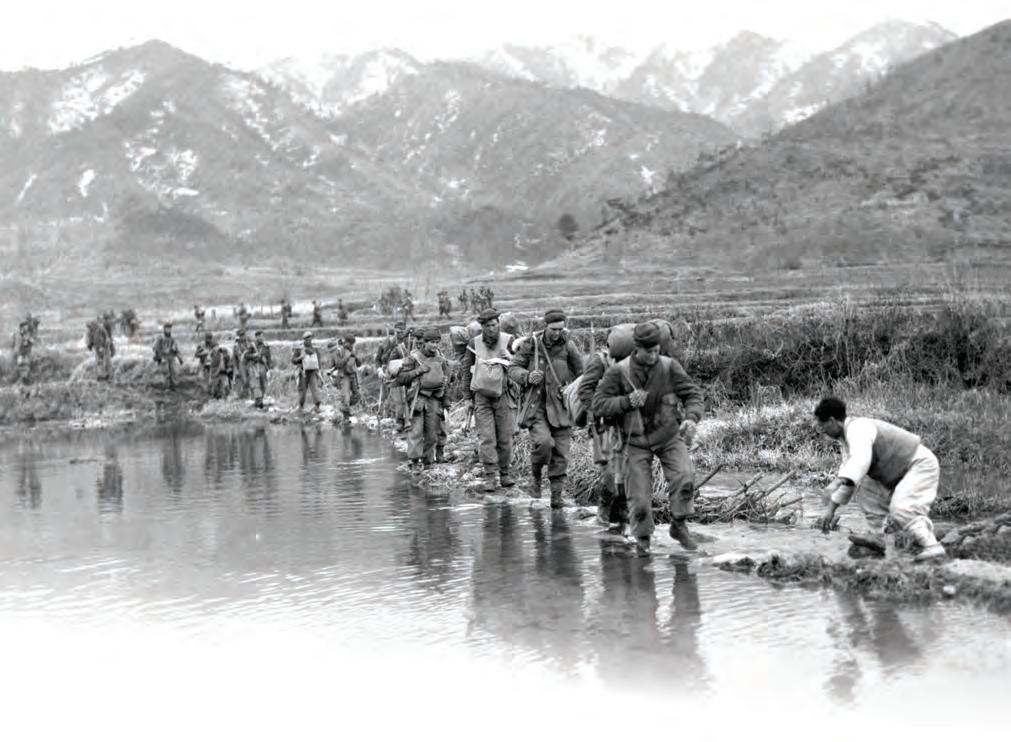
Korean ration-bearers pause near an active Royal New Zealand Artillery battery en route to 2 PPCLI positions.
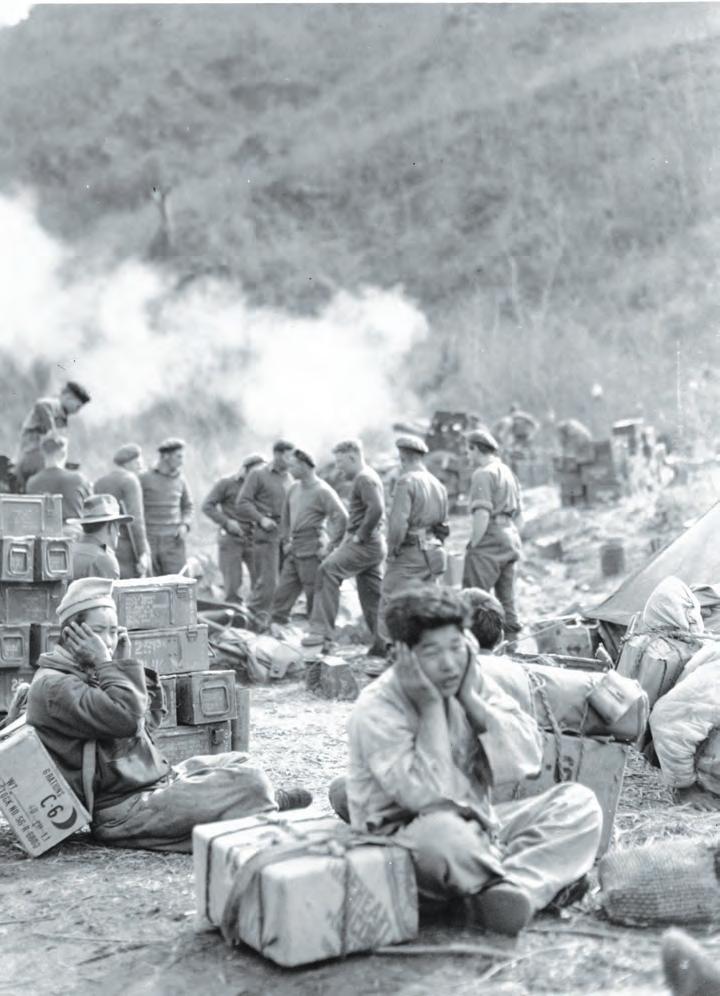
our courage to fight Communism and he would be glad to see us go.
“He recites in detail every bit of concession we made to get an armistice and in working out a demilitarized zone and he is convinced, if we do not fight, [a peace conference] will merely result in yielding up one concession after another by our side to a final surrender of all Korea. Any constructive suggestions by us are, of course, outright concessions to Communists in [South Korean] view.”
And, so, the North of Kim Jong Un today remains a hostile neighbour— a hoarder of nuclear weapons, a source of regional instability, and a continuing threat to world peace.
It has conducted multiple missile tests and at least six times announced it will no longer abide by the armistice. It has violated its terms dozens of times, including via military attacks. Both sides conduct provocative military exercises.
In December 2022, five North Korean drones crossed the demilitarized zone into South Korea. South Korea scrambled helicopters and fighters to intercept them.
A South Korean helicopter fired on one of the drones, but none are known to have been taken down.
A UN investigation concluded both sides violated the armistice.
Some have advocated an armistice as the most efficient means to end the current fighting in Ukraine. But in a December 2022 essay, the Seoul-based American analysis site NK News said the example set by the Korean armistice doesn’t bode well for success in Eastern Europe.
“The Korean War armistice wasn’t meant to last forever, but an end-ofwar declaration, let alone unification, looks less and less likely every year,” wrote analyst James Fretwell.
“And that may be the key lesson to draw from the Korean War precedent: While ending active hostilities, the armistice laid out no clear path for a formal peace or unification. The result has been undying division— whether anyone wants it or not.” L

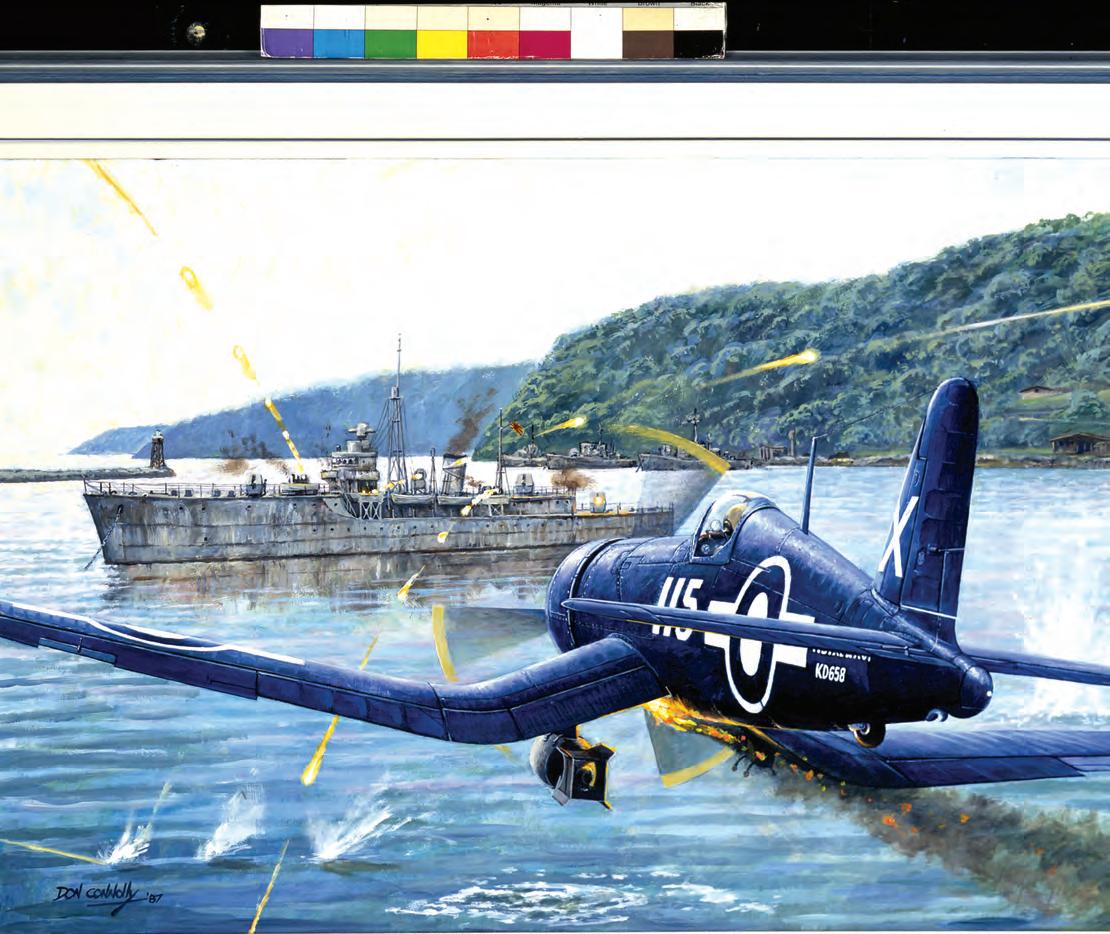
Artist Don Connolly depicts pilot Robert Hampton Gray attacking the Japanese ship Amakusa in Onagawa Bay on Aug. 9, 1945.

tBy Brad St. Croix
The Second World War in the Pacific began as it ended, with Canadians in the face of enemy fire. As the Canadians in the Battle of Hong Kong were some of the first Allied forces to fight against the Japanese in December 1941, Lieutenant Robert Hampton Gray of the Royal Canadian Naval Volunteer Reserve (RCNVR) was one of the last in August 1945.
Gray, like the defenders of Hong Kong and many other Canadians in the Pacific during WW II, ended up in that faraway theatre in a roundabout way.
From Trail, B.C., Gray enlisted in the RCNVR in July 1940 as an ordinary seaman. Soon after entering service, he was one of many enlistees chosen to go to Britain to train as a potential officer. A delay led him to transfer to the Fleet Air Arm to learn the ropes as a naval aviator. His training brought him back to Canada to Kingston, Ont., for a time in 1941. His subsequent service took him around the world. Gray served in Britain, South Africa and East
Africa before being transferred to 1841 Naval Air Squadron aboard HMS Formidable in August 1944. He was assigned to fly a Vought F4U Corsair with the group.
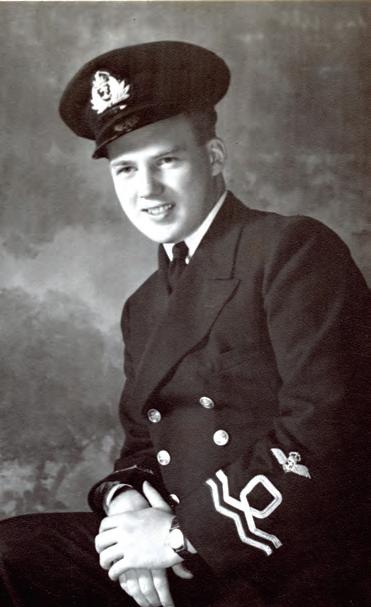
report that covered Gray’s first six months aboard Formidable. Lieutenant-Commander R.E. Jess, also an RCNVR aviator serving with the Fleet Air Arm,
“It is considered that with more sea experience he should develop well and be in every way suitable for higher Air Command.”
After being aboard Formidable for only a few weeks, Gray was Mentioned in Dispatches for his role in an attack on the German battleship Tirpitz on Aug. 29, 1944.
Gray’s leadership potential was quickly noted, and he was promoted to lieutenant and given command of a flight, comprised of four Corsairs. “It is considered that with more sea experience he should develop well and be in every way suitable for higher Air Command,” said a February 1945
said that despite Gray looking quiet “he was obviously the fighter type—aggressive almost to the point of recklessness. He had to be good to be a fighter pilot and he had to be good to do the things he did and live as long as he did.”
In April 1945, Formidable joined the British Pacific Fleet. The aircraft carrier supported the operation against Okinawa by attacking Japanese airfields and aircraft in the Sakishima Islands. On April 16 and 17, Gray led his flight in
Ipatrolling the area over the islands to protect other aircraft attacking ground targets. They encountered no enemy planes on either day.
On April 20, there was much excitement as Gray’s flight thought it had spotted an enemy aircraft, but it turned out to be a friendly Liberator bomber. For the rest of April and into May, 1841 Squadron continued these uneventful missions protecting other planes.
On May 4, Formidable faced one of the great scourges of the Allied navies during the war. It was attacked by two kamikaze aircraft.
“I really do think that I will be home before the end of this year and I hope to stay at home when I come next.”
The first hit the ship, while the second was shot down.
“Okinawa is, of course, the place where the Americans are having such a terrible time,” wrote Gray in a letter to his parents that same day. “It is fairly hard flying but not dangerous. We have had some trouble with the Japanese suicide bombers but have suffered very little damage.”
By July 1945, Formidable and its aircrews began to attack the Japanese main islands. Gray led a flight of planes that strafed airfields in the Tokyo area on July 18. Six days later, he led an attack on ships in the Japanese inland sea that damaged one merchant ship, and strafed two seaplane bases and an airfield.
On July 28, despite poor flying conditions due to rain and heavy clouds, Gray led another assault on the inland sea, where he bombed a Japanese destroyer, which was later reported to have sunk.
“For determination and address in air attacks on targets in Japan,” he was awarded the Distinguished Service Cross. Because of his exemplary service in the Pacific, Gray was recommended for promotion to acting lieutenant-commander on July 31, 1945. His service record noted the advancement was deserved because Gray continued “to show his ability and skill as flight commander and has led his divisions in recent operations with undoubted success. Energetic and resourceful in his other duties and can always be relied on. A brave skilled and reliable pilot in action.”
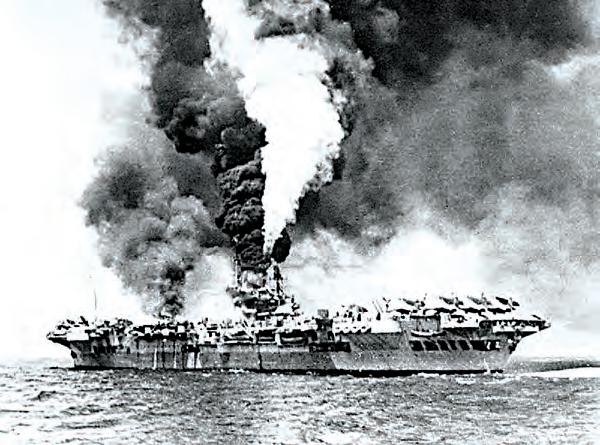
For his actions at Onagawa Bay, Gray was posthumously awarded the Victoria Cross. “Lieutenant Gray has constantly shown a brilliant fighting spirit and most inspiring leadership,” read his citation. Gray was the first and only member of the RCNVR to be awarded a VC. His was also the last Canadian VC-earning action.
His abilities as a pilot, of course, were well known to those who served with him.
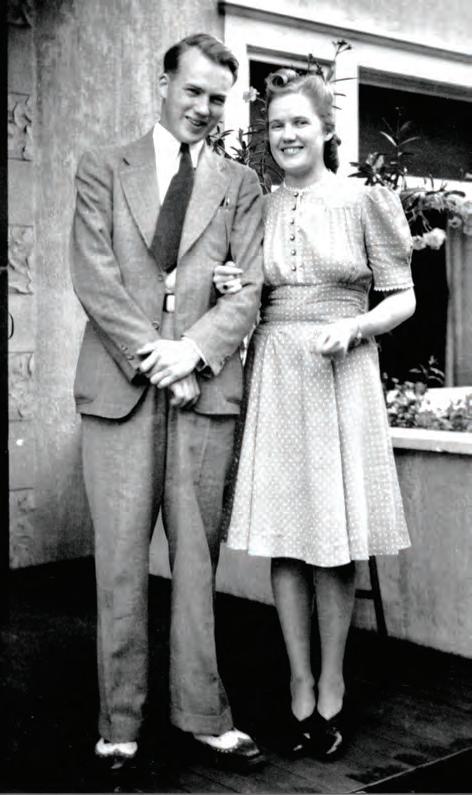
“You will undoubtedly be hearing about us on the news,” Gray wrote to his parents on July 15, 1945. “I will be with those who are mentioned but do not worry, please. I really do think that I will be home before the end of this year and I hope to stay at home when I come next.”
On Aug. 9, 1945, around 8:30 a.m., Gray’s flight took off from Formidable. They were assigned to attack Japanese positions and aircraft at Matsushima airfield, located on the northern end of Japan’s main island near Sendai. Having discovered most of the airfield and aircraft there had already been destroyed, Gray turned his attention to vessels he had spotted in Onagawa Bay.
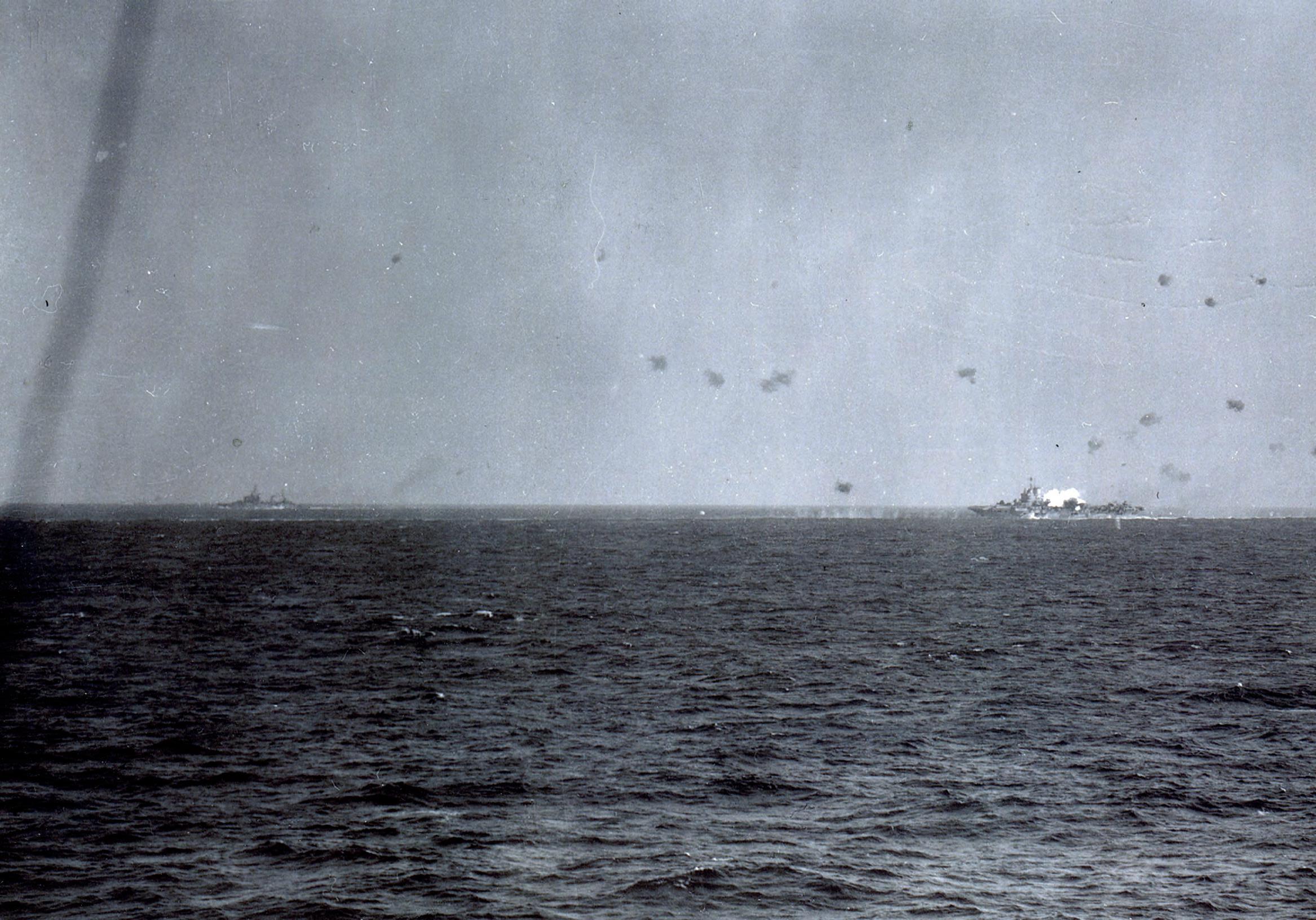
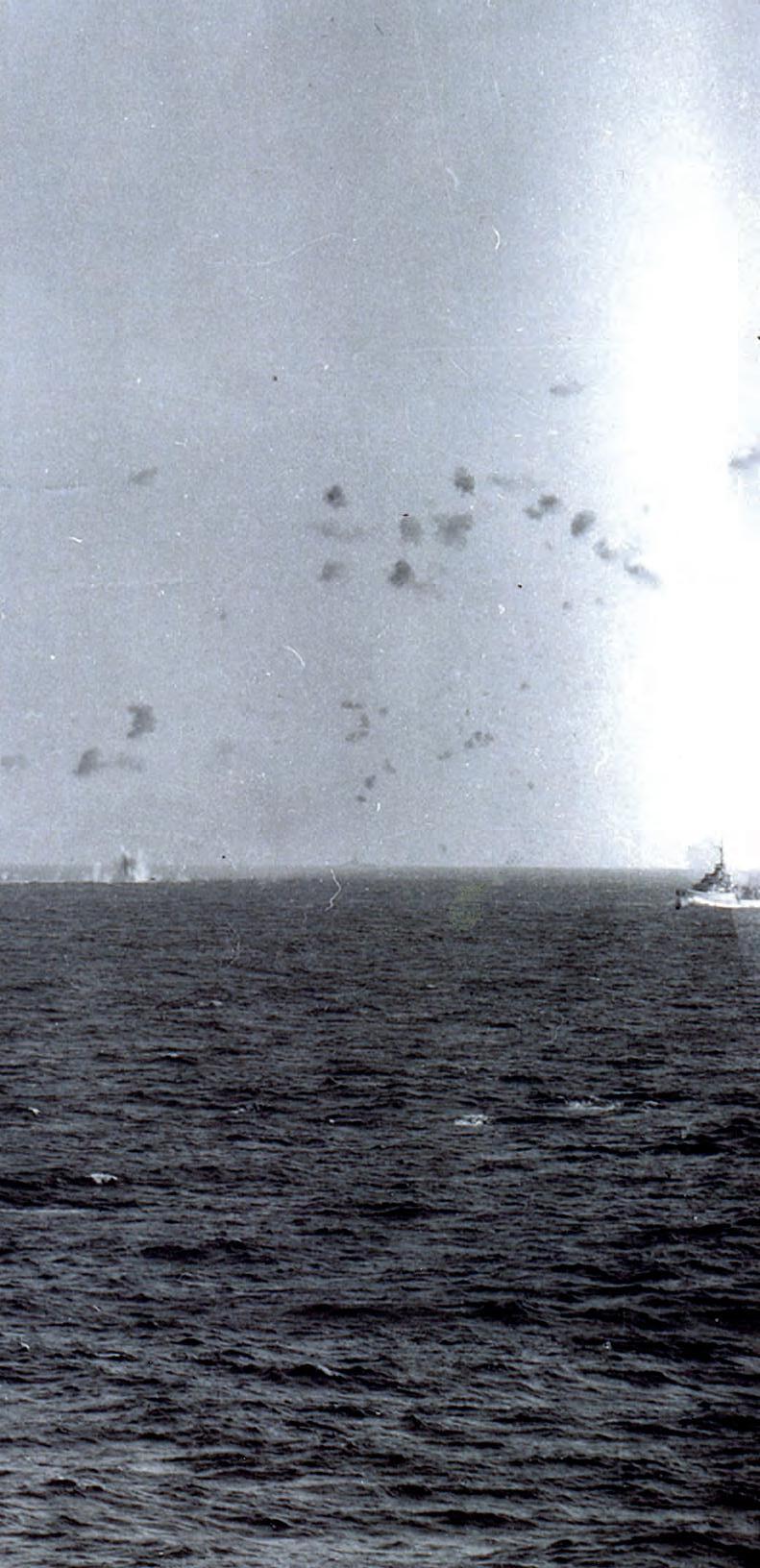
As the flight approached the bay, it took heavy anti-aircraft fire from shore batteries and at least five warships. Around 1 p.m., Gray peeled away from the formation and dove solo toward the Japanese Etorofuclass destroyer escort Amakusa. As Gray pressed an attack, his Corsair burst into flames, but he held steady until he was about 50 metres from the ship. He then released several bombs. At least one of them struck amidships, quickly sinking Amakusa.
“The bottom fell out of life on board after it happened and the victory when it came seemed so hollow somehow.”
Gray crashed into the bay moments later. This “fearless bombing run” cost him his life. His body and aircraft were never found. He was one of the last Canadians killed in action during the war.
Gray’s loss was heavily felt by those who knew him. In a letter to Gray’s parents detailing his final flight, Lieutenant-Commander Richard Bigg-Wither, commander of 1841 squadron, wrote: “That is the story—it hurts very much to write about. The bottom fell out of life on board after it happened and the victory when it came seemed so hollow somehow. He was so well loved by us all and simply radiated happiness wherever he went.”
In addition to his VC and DSC, during his service Gray was awarded the 1939-1945 Star, Atlantic Star, Africa Star, Pacific Star, Defence Medal, Canadian Volunteer Service Medal with clasp, and War Medal 1939-1945. It’s a unique medal set for a Canadian WW II veteran.
Gray has since been memorialized around the world. He is commemorated, along with 3,266 other Canadian war dead lost at sea, on the Halifax Memorial, as well as in many other communities across Canada. A monument to Gray was also unveiled near the location of his final attack and death, in Onagawa in 1989. It was damaged in the 2011 earthquake and tsunami but was repaired and moved to high ground near the town hospital the following year.
And Gray’s legacy continues to be honoured by the Canadian Armed Forces. HMCS Robert Hampton Gray, the RCN’s sixth Harry DeWolf-class offshore patrol vessel, was launched on Dec. 9, 2024. L
By Alex Bowers


Betrayal lies at the heart of the Treason Act 1351. Enacted during the reign of King Edward III (January 1327-June 1377), the medievalera law, still on the British statute books, protected the sovereign and his bloodline, punishing those who conspired against his rule.
?To “imagine the death” of His Majesty, “levy war” upon his divine authority, or “be adherent to the King’s enemies” were among the offences punishable by death according to the Norman French-language edict technically legislated in 1352.
The Treason Act was set not in stone, but on parchment. Its provisions were amended numerous times during the centuries, yet its framework largely remained the same.
In the Canadian colonies, it was used against Crown subjectsturned-American sympathizers during the War of 1812, its judgement applied by varying degrees ranging from imprisonment to hanging. It was similarly enforced amid the Upper and Lower Canada rebellions of 1837-1838, as well as after the 1885 North-West Resistance, facilitating the contentious execution of Métis leader Louis Riel.
Seldom without public controversies or legal complications, not to mention frequent moral incongruities, the age-old Treason Act endured one of its greatest tests at the 1945 trial of William Joyce, an American-born and Irish-raised Nazi propagandist known as Lord Haw-Haw for his anti-British radio broadcasts.
Joyce, an odious fascist who unquestionably deserved punishment for his actions, claimed he owed no allegiance to George VI since he wasn’t a British citizen. Despite this, prosecutors argued that his possession of a British passport under false pretences constituted loyalty to the Crown. Lord Haw-Haw was hanged.
Could someone be a traitor to a country not their own?
To what extent could nationality be open to interpretation? Had justice been legitimately served?
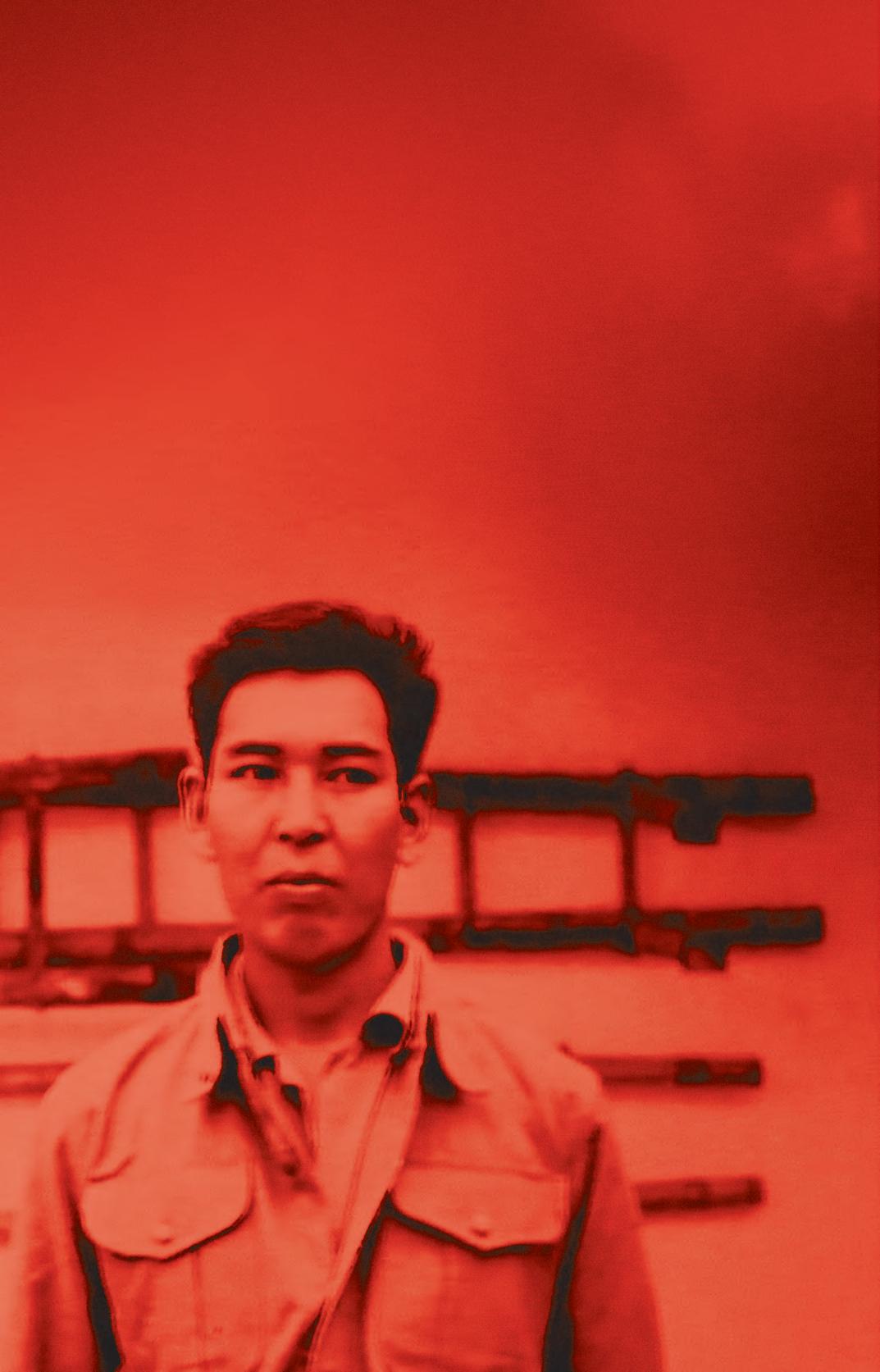
Such questions would be asked anew of Japanese-Canadian Kanao Inouye, nicknamed the Kamloops Kid for his British Columbian birthplace and Slap Happy Joe for his brutality against Canadian prisoners of war while serving Japan during the Second World War. Potential answers meanwhile, were, and are, unsettlingly nuanced.
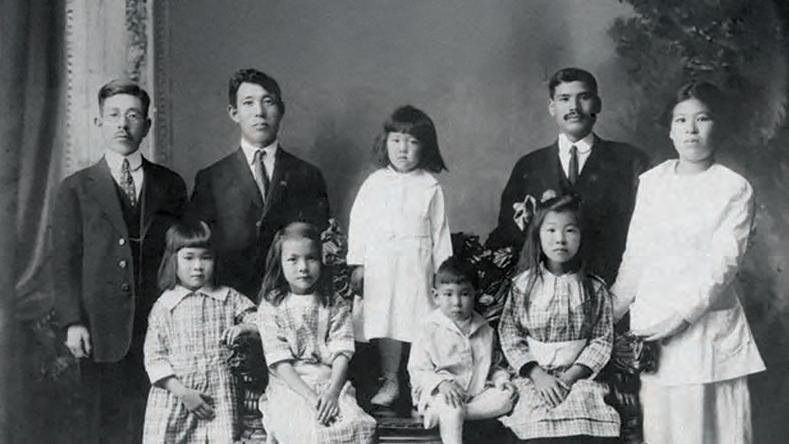
A young Kanao Inouye with his family and, years later, in British custody in 1945 (opposite page). William Joyce after his arrest in Germany near the end of WW II (below ).
The duality of Kanao Inouye began in Kamloops, B.C., on May 24, 1916. Born that day, the fifth child and first son of Tadashi and Mikuma Inouye, the young boy’s parents were both Issei—first-generation Japanese immigrants—to Canada.
Tadashi, or Tow, served in the Canadian Expeditionary Force during the Great War, including at Vimy Ridge and Passchendaele, earning the Military Medal.
Back home, Mikuma registered Kanao’s birth with Japanese consular authorities, entitling him to a Japanese passport in what would later prove a fateful decision.
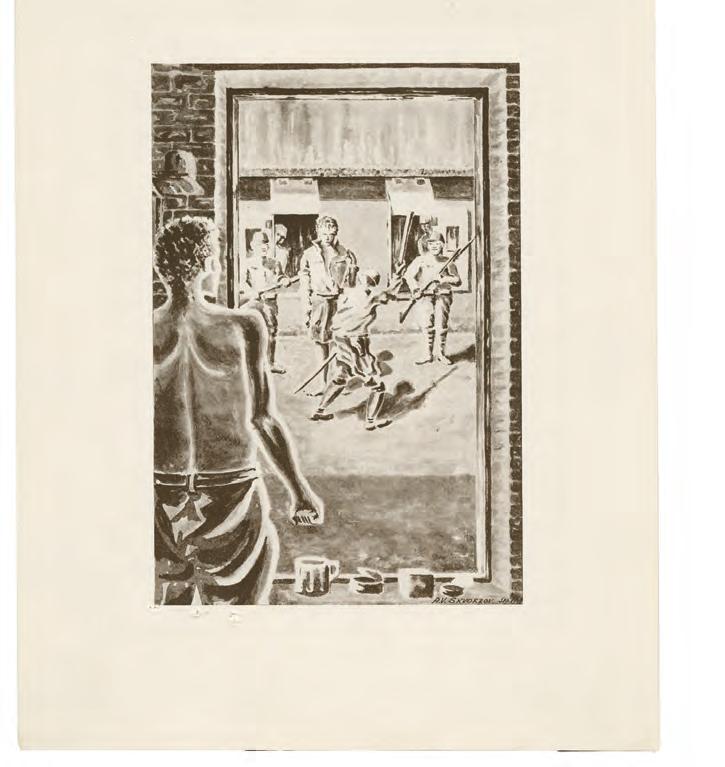

The household moved to the Vancouver area in time for Inouye to start school. His father, now a prosperous merchant in the import-export business, subsequently took the entire family to visit his ancestral homeland.
Tragedy struck when the patriarch died in Japan on Sept. 10, 1926. The late Tadashi had nevertheless afforded his son his first taste of Japanese culture.
Inouye remained an unremarkable student upon his return to Canada. Around 1935, with few other prospects, he again travelled to Japan for further education. There, the youthfully naive Nisei—a term applied to second-generation Japanese-North Americans— reportedly struggled to overcome perceptions of being a foreigner.
Inouye, perhaps unsurprisingly, was no stranger to overtly racist and xenophobic attitudes, having once been rejected from a child’s birthday party for being a so-called “little yellow bastard.” Nor were nativist views, misguided as they were, unfamiliar to him and, indeed, countless other Canadians of Japanese heritage.
Perhaps what he hadn’t expected was for the discrimination to persist in Japan.
On March 1, 1937, however, Inouye was conscripted into the
“YOUR MOTHERS WILL BE KILLED. YOUR WIVES AND SISTERS WILL BE RAPED BY OUR SOLDIERS AND ANYONE RESISTING WILL BE SHOT !”
masse—his former tormenters, as he saw it. Housed in awful conditions, enslaved by their Japanese captors, and deprived of adequate provisions, the hundreds of imprisoned compatriots were far from home.
Inouye intended to remind them of that.
Imperial Japanese Army, where he officially swore allegiance to Emperor Hirohito. A brief stint in Manchuria was eventually cut short by ill health.
Discharged on medical grounds in 1939, Inouye attempted a return to education until the same ailment prompted his withdrawal. He was now, seemingly, at his nadir. But like so many, the outbreak of war changed everything.
When Canada’s 1,975-strong ‘C’ Force, predominantly comprising The Royal Rifles of Canada and The Winnipeg Grenadiers, were thrust into the ferocious Battle of Hong Kong—a fight they would lose—Inouye had no notion of what impact it would have on his life. On Christmas Day 1941, the Allied garrison surrendered the British colony, with 1,689 Canadians among those captured.
Inouye was called to serve the emperor once more, now as a civilian interpreter.
With fluent English-speaking skills, the B.C.-born translator was clearly an asset. He first worked within Hong Kong’s Japanese Army headquarters before being reassigned to the island’s Sham Shui Po PoW camp in mid-November 1942.
It was here, for the first time in six years, that Inouye came face to face with Canadians en
“All Canadians will be slaves as you are now,” reportedly declared Inouye, later relayed by Signalman William Allister, to PoWs at Sham Shui Po, suggesting that Japan’s rising sun would soon fly proudly over Ottawa. “Your mothers will be killed. Your wives and sisters will be raped by our soldiers and anyone resisting will be shot!”
Accounts vary, some more corroborative than others, concerning the true extent of Inouye’s cruelty, but the fact he was sadistic in his treatment of Canadian prisoners was, and is, undeniable. “His craving for vengeance was awesome,” said Allister.
The Royal Rifles’ Henry Lyons recalled receiving a “son of a whore beating” for failing to retrieve a plank. The interpreter broke his collarbone with a rifle butt.
Inouye caught Gaston Oliver of the Grenadiers trading supplies with a sentry, forcing him to stand for two days and nights holding a full water bucket in front of him at arm’s length. Guards struck him with belts any time he faltered.
When Grenadier Arthur (Art) Ballingall didn’t salute a general— he had been carrying a water basin—Inouye struck him with the side of his sword. The Canadian PoW spent two months recovering in hospital with broken teeth.
For about two days, Inouye allegedly tortured Grenadier Jim Murray, tying him to a pole and beating him before then wedging lit cigarettes into his nostrils.
Not even men of the cloth were safe from Inouye’s ire, witnesses attested. Amid a diphtheria outbreak at the camp, during which period Vatican-supplied drugs hadn’t yet arrived, chaplain Eric Green inquired into their whereabouts. Lieutenant Frank Power watched helplessly as Inouye brutally laid into the Catholic padre.
The Japanese-Canadian interpreter had well and truly earned his dubious moniker as Slap Happy Joe, but it was his reputation as the Kamloops Kid that would endure. Far from outright dismissing his Canadian roots, he instead used them to his advantage, sneaking up on PoWs and criticizing the Japanese in unaccented English. If anyone agreed before he revealed the ruse, Inouye punished them.

The most consequential incident took place on Dec. 21, 1942, when British and Canadian prisoners assembled for roll call. Finding the Grenadiers’ ‘D’ Company two men shy, Captain John Norris took full responsibility for their absence by stepping toward the camp commandant. Inouye took control.
Living up to his moniker, Slap Happy Joe punched and pushed Norris to the ground. “Get up, you world conqueror,” he was reported to have said, “and take it like a man.”
Inouye, shifting blame elsewhere, next turned to Major Frank Atkinson. Kicking the Canadian in the knee, the interpreter was finally ordered to desist.
Remarkably, as a hospitalized Norris feared he might lose his sight in one eye—he didn’t—Inouye resolved himself to apologize for the assault; it went unaccepted.
The damage had been done, less to the victim and more to the perpetrator.
Inouye’s perceived vengeance spree ended in September 1943 after he was transferred out of Sham Shui Po. The following year, he joined the Kempeitai. Japan’s military police force had once tortured Inouye during his student days, but now, he could be the one inflicting techniques such as waterboarding on suspected Allied spies and Hong Kong residents. He continued serving as a police interpreter until February 1945. By that stage, with Allied victory inevitable, the walls had started to close in.
Inouye was one of 18,000 enemy personnel still in Hong Kong when the Japanese surrendered. With the island again a British colony, malnourished prisoners were freed from their camps, including 369 Canadians from Sham Shui Po. Others had been relocated, but in all, some 264 detainees of ‘C’ Force died. Many survivors wouldn’t forget the Kamloops Kid.
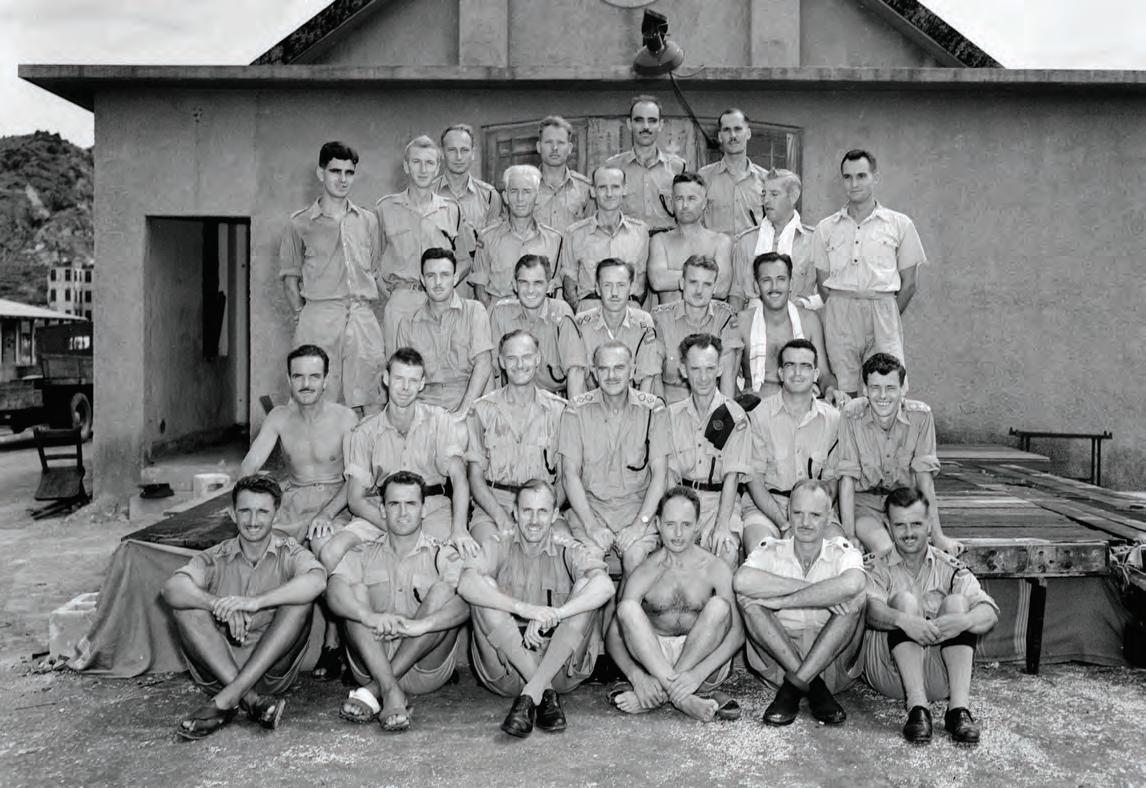
Around Sept. 10, 1945, Canadians at Ohashi PoW camp, located on the Japanese mainland, awaited their official liberation. The men were impatient to get home, understandably so, but news of their repatriation hadn’t been forthcoming.
Disappointed though they were, there was still cause for celebration: Word had reached Ohashi that Kanao Inouye, an all-too-familiar name among numerous prisoners, had been arrested the day before. The camp soon erupted in cheers.
Meanwhile, the mood in Ottawa was far less jubilant as authorities debated their involvement in planned Japanese war crime trials. Both Britain and the U.S. had expressed willingness to accommodate Canadian investigations, yet the federal government seemed to drag its heels until it eventually caved in to public pressure.
In January 1946, cabinet approved the Canadian War Crimes Liaison Detachment – Far East.
Headed by Lieutenant-Colonel Oscar Orr, the entire section
comprised just eight men. Of these, only four were officers, with second-in-command Major George Puddicombe the representative in Hong Kong.
Among their duties was bringing the Kamloops Kid to justice, supported by some 200 affidavits from former prisoners directly mentioning Inouye. Despite the lack of evidence that he had killed or disabled anyone, Puddicombe sought the death penalty for the Japanese-Canadian on the grounds of committing war crimes.
On May 22, 1946, the accused stood before a British military court presided over by Lieutenant-Colonel J.C. Stewart. The judge laid out three charges against Inouye, two related to his Dec. 21, 1942, actions and a third for his alleged conduct in the Kempeitai. The defence under Lieutenant John Reeves Haggan entered a not guilty plea.
Prosecuting officer Puddicombe launched into the case with a heavy reliance on affidavits, not least of former Canadian PoWs Norris

and Atkinson. Nevertheless, the testimonies from Inouye’s tenure in the Kempeitai proved the most damning.
Chinese witness Lam Sik, a w ireless operator once seized by t he military police, recounted Inouye attaching electrical wires to his ears before announcing, “This time, you are the wireless operation.” Rampal Ghilote, an Indian civil servant and accused Allied spy, recalled being hung from a beam by his hands. Mary Power, wife of another accused spy, remembered Inouye burning her with lit cigarettes until “I fainted and wet myself.”
Scrambling for an appropriate defence, Haggan attempted to portray Inouye as a victim of a Japanese culture, society and hierarchy in which he had merely been following orders. The tactic, combined with Inouye’s dismissals, lies and own accusations, failed to move the jury, nor indeed did the assertion that he had actually, or supposedly, cherished his prewar life on Canada’s West Coast.
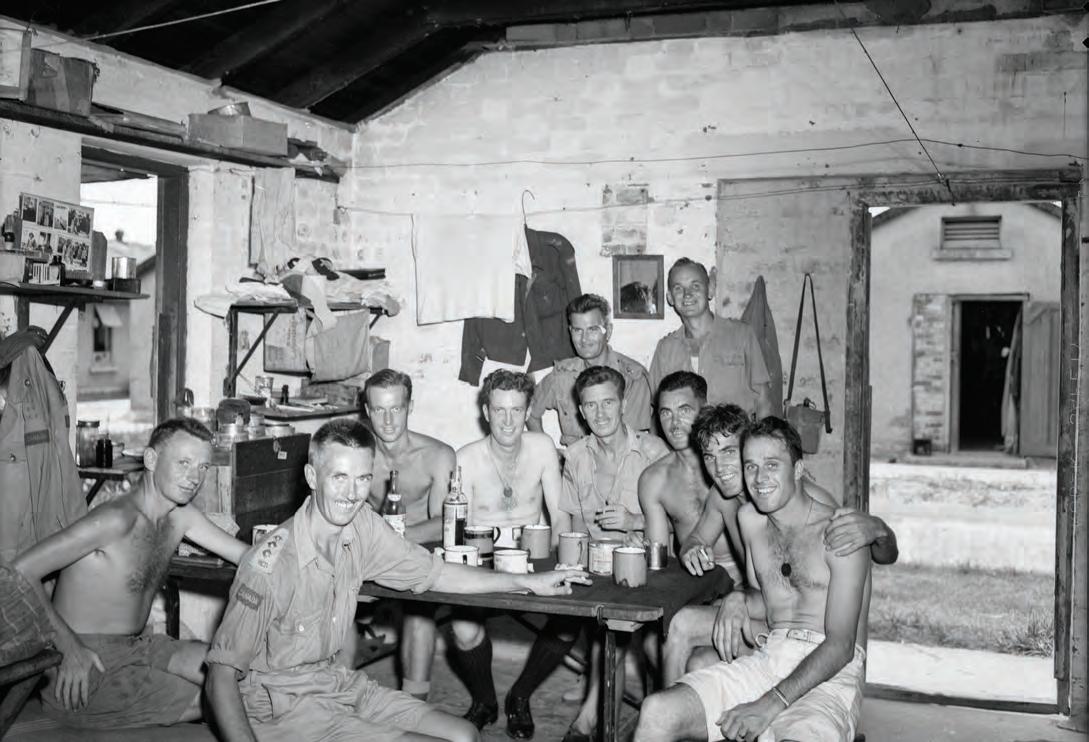

The overall proceedings likewise had shortcomings, perhaps most notably in affording the defence negligible time to muster witnesses for its argument.
Such matters had long been disregarded. After some five days, Inouye, the Kamloops Kid, was found guilty on all charges.
“By your barbaric acts,” declared the court in delivering the death sentence, “you have destroyed your right to live.”
The noose awaited Inouye should he not appeal.
In a desperate attempt to avoid what seemed like the inevitable, Haggan petitioned that a military court held no jurisdiction over his client. His reason: Inouye was a Canadian citizen and, thus, a British subject as opposed to a foreign war criminal.
The ploy worked—almost too well—and the verdict was annulled.
In its place, however, law officials brought forward a new charge, one that acknowledged his nationality and the sufficient authority of a civil court to try the accused.
Inouye, in pleading not guilty to nearly 30 counts under the guidance of lawyer Charles Loseby, was now a suspected traitor according to the Treason Act 1351.
That trial began on April 15, 1947, presided over by judge Henry Blackall. Prosecuting the civil case was Henry Lonsdale and two police inspectors, while the jury, according to one witness, primarily comprised “whites and Chinese” of the Hong Kong citizenry who, two years earlier, had endured Japanese oppression.
In glaring contradiction to the defence’s previous stance, the former interpreter argued that he identified only with his ancestral heritage, that his childhood in B.C. was horrific, and that his mother had registered his birth with Japanese consular authorities. Inouye also suggested that in previously pledging his allegiance to Emperor Hirohito, he had effectively ceded any loyalty to the British Crown.
Such arguments fell short. Unlike the controversial case of William Joyce, or Lord Haw-Haw, there was little doubt of Inouye’s British subject status. It was likewise evident that the accused had taken no legal steps to formally renounce his citizenship after moving to prewar Japan. That he might have been too young or poorly educated at the time to understand the process wasn’t taken into account.
The fact that Inouye technically remained Canadian trumped any defence to the contrary, regardless of claimed allegiances or dual-citizenship nuances. He might have been an Emperor’s acolyte, but he was condemned as an enemy of the King.
For a second time, Inouye was sentenced to death.
At around 7:00 a.m. on Aug. 26, 1947, 31-year-old Inouye was escorted from his Stanley Prison cell. His fate, despite a series of last-ditch efforts, was sealed. It mattered not that he had recently obtained documents attesting to his Japanese civil status previously unavailable during the court case. It mattered
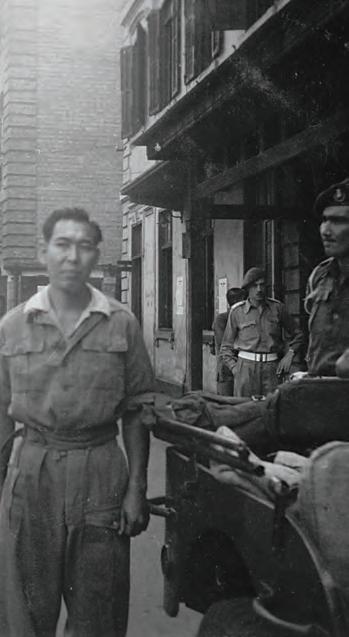
not that he had pleaded with the governor of Hong Kong, the Privy Council in London, nor the King of England himself. He would die for his Britishness, for his birthplace on Canadian soil. Any notion of Japanese civil status was deemed a moot point.
As Inouye approached the gallows, one thing remained irrefutable: the once-torturer of Canadian PoWs, suspected Allied spies and Hong Kong residents deserved punishment for his heinous crimes. The former interpreter had been objectively, unquestionably, cruel and abusive. Though he likely hadn’t killed anyone, the psychological damage wrought on his victims would outlast him.
Equally, however, some Japanese war criminals had received far more lenient sentences for far worse atrocities. They, too, were destined to outlast Inouye.
The prisoner, resigned to his imminent demise, cried out a final salute to the emperor: “Banzai.” Then the trap door was dropped, and the rope went taut.
So fell the Kamloops Kid. L
By J.L. Granatstein
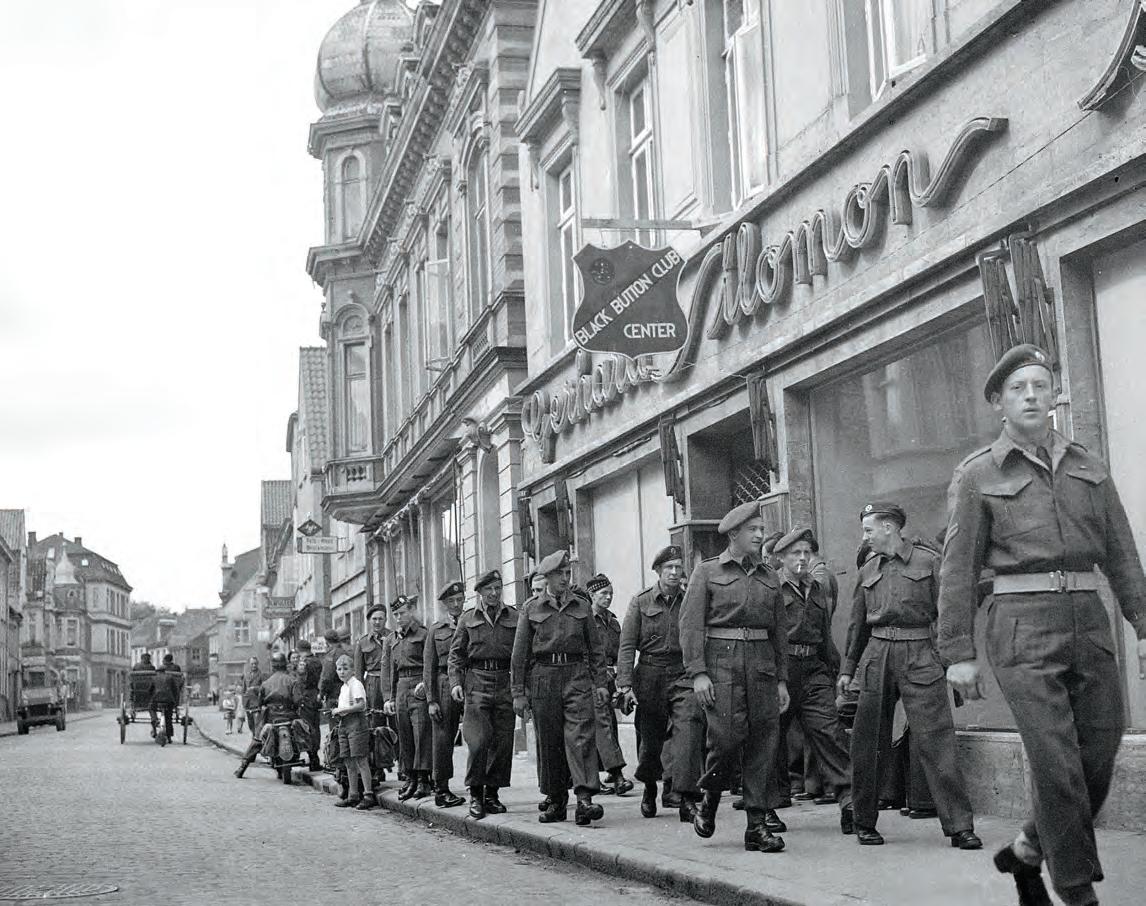


Asthe end of the war in Europe neared, the Liberal government had to decide on several critical military issues. What would Canada’s role be in the war against Japan after Germany was defeated? How would soldiers be repatriated and in what order? What part, if any, would Canada have in the occupation of Nazi Germany?
An answer to that last question came in December 1944. Canada would create an infantry division and assign 13 Royal Canadian Air Force squadrons to contribute to the occupation of the fallen Reich. Much like the infantry division that was to be formed to fight in the Pacific, the Canadian Army Occupation Force (CAOF) was intended to be made up of volunteers who planned to make the army their career. If, as anticipated, too few men stepped forward, then key personnel and soldiers with low repatriation points would be assigned to the division.
In the end, volunteers numbered 565 officers and 5,595 other ranks, and the ranks of the 3rd Division (CAOF), as it was to be called, were filled out by 631 officers and 13,280 other ranks low on the repatriation scale.
Soldiers of the Canadian Army Occupation Force in Aurich, Germany, in late August 1945 [left ]. A warning sign in Wyler, Germany.
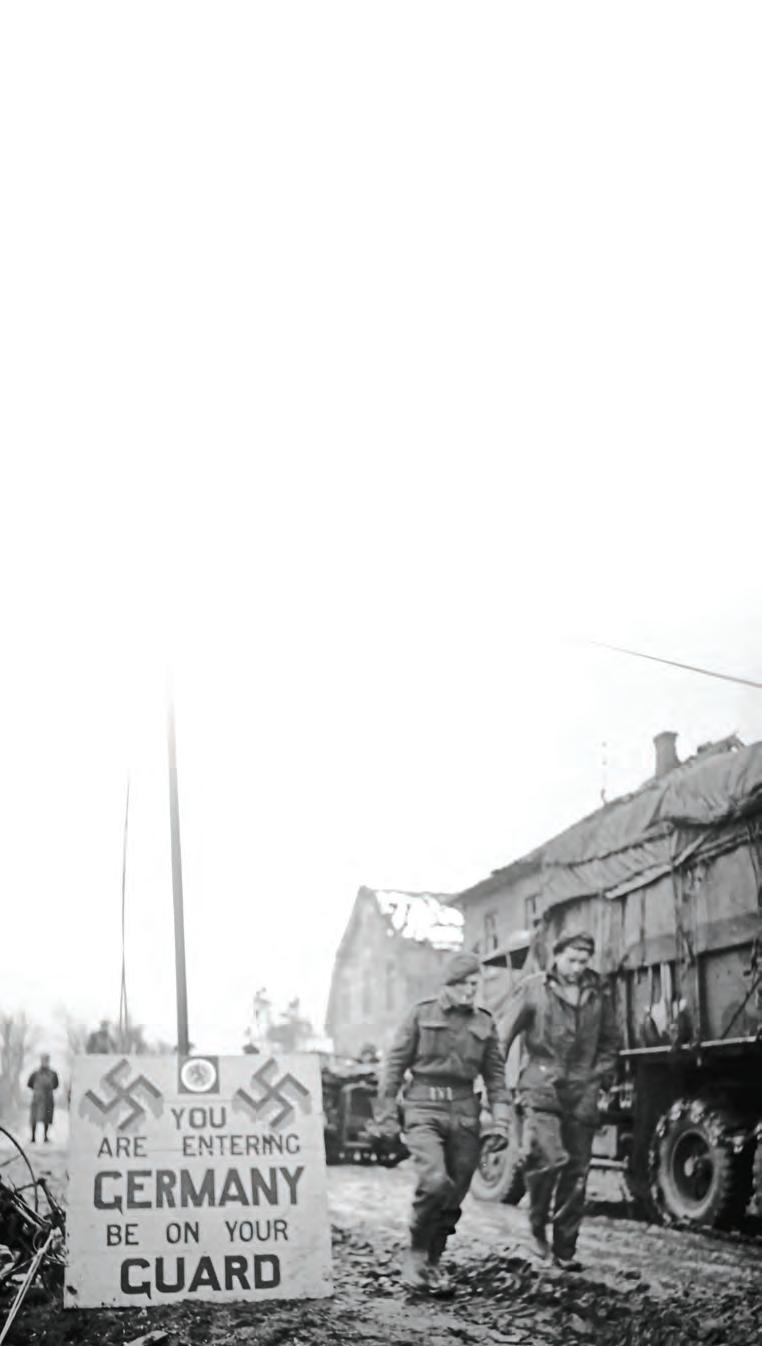
Ottawa understood that conscripts shipped to Europe in the last five months of the war would also be included in the CAOF. The 3rd looked like a wartime division— three brigades each with three infantry battalions, artillery regiments, and the full array of arms and services staffed by 20,071 all ranks. If necessary, it could fight, for no one knew what the Germans might do.

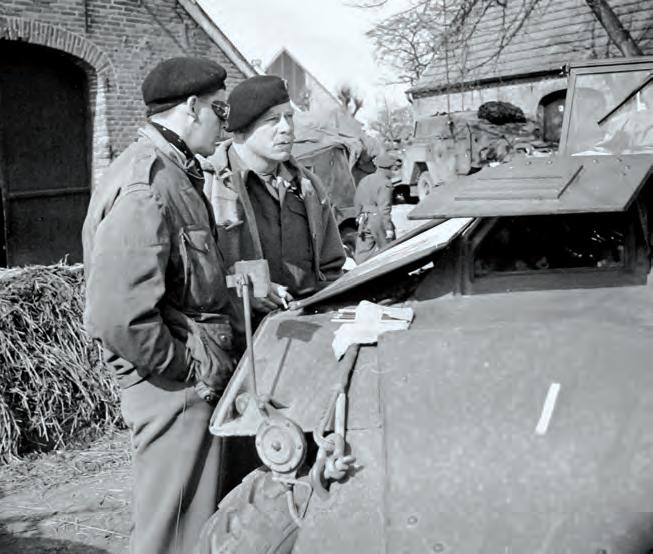
“To gain and hold the respect of all Germans as well as with other occupying forces required constant supervision and irreproachable discipline.”
Soldiers of the Canadian Army Occupation Force check IDs in Aurich, Germany, in August 1945.
Brigadier Robert Moncel and Major-General Christopher Vokes [above].
The Canadians had fought in Northwest Europe as part of the 21st Army Group under Field Marshal Bernard Montgomery, and it was agreed from the outset that the CAOF would operate under XXX British Corps in the Emden-Wilhelmshaven area of northwest Germany. There was no fixed timeline, but the government knew that London was financially strapped and would want Canada to remain as long as possible.
Still, many of the soldiers farthest down the repatriation list desired to get home and, as other men of First Canadian Army left Europe as quickly as shipping could be found for them, the more difficult it would become to support a relatively small force a long way from Canada. Finally, with the British, Americans, Soviets and French each overseeing policy toward the defeated enemy in their own zones, Canada, whatever its contribution to victory might have been, wasn’t going to be consulted by the great powers on the Germans’ fate.
Commanding the CAOF was MajorGeneral Christopher Vokes. He had gone overseas a major, led a brigade in the invasion of Sicily and, by late-autumn 1943, commanded 1st Canadian Division in Italy. After December 1944, he headed the 4th Canadian Armoured Division in Northwest Europe.
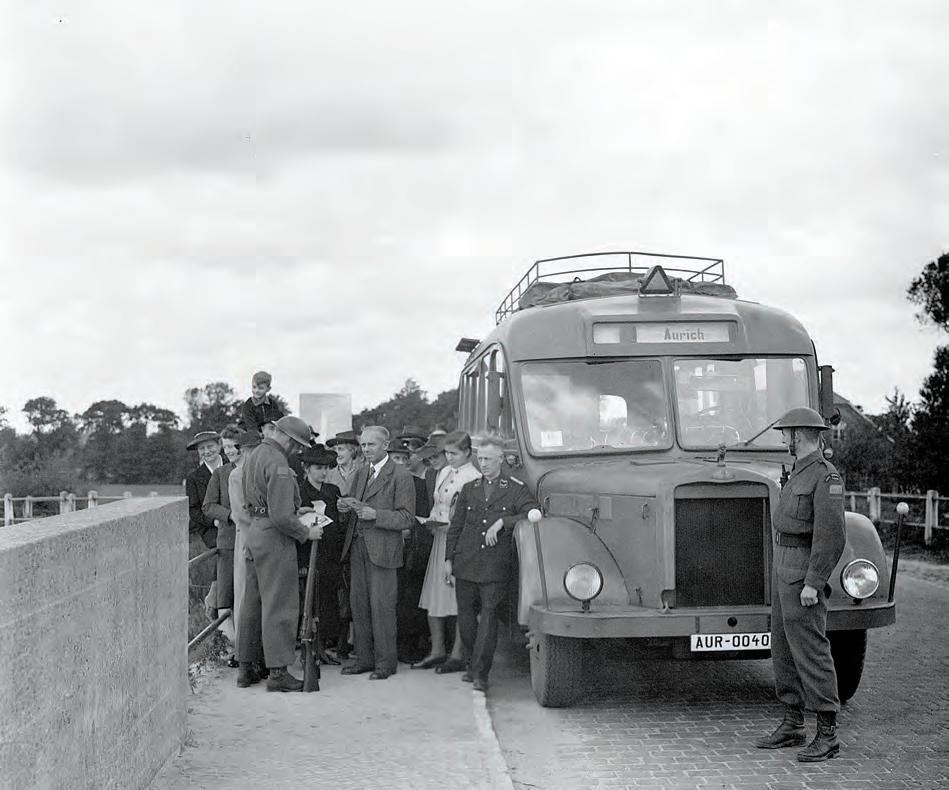
other occupying forces required constant supervision and irreproachable discipline. 3 Cdn Inf Div (C.A.O.F.),” he said, “was to be the ‘show piece’ of the Canadian Army.”
In fact, Brigadier Robert Moncel said Vokes ran his Occupation Force like a warlord and, he added, held riotous parties.
The CAOF’s assigned tasks were wideranging, including everything from the disarmament of the Wehrmacht and the elimination of the Nazi Party to the evacuation of Allied prisoners of war and looking after displaced persons. In the longer term, the occupiers were also charged with the re-education of German youth and ensuring that Germans had no opportunity of reviving their ability to make war.
The occupation force worked with the army’s military government officers, which had been established the day the Allies entered Germany in 1945, and also with its civil affairs teams. The priority was to screen and send home surrendered German soldiers. Soon, every other day, 3,000 members of the Wehrmacht were processed and sent off. But many German soldiers had either escaped custody or avoided being taken prisoner. Those individuals had to be found and screened to determine if they had been in the SS and/or if they were war criminals.
To capture these men, the CAOF organized “swoops,” co-ordinated military operations carried out at night and without warning. A location would be surrounded and, at first light, a thorough check would be made of all inhabitants. Anyone without proper discharge papers or who gave cause for suspicion were to be handed over to the military government personnel or detained as a prisoner of war.
The next task, which was even more difficult, was to help the tens of thousands of displaced persons and refugees in the CAOF’s area. The Nazi regime had established concentration camps throughout its territory. Extermination facilities were farther to the east, but camps such as Bergen-Belsen near the Canadian-controlled region shocked everyone who viewed the piles of dead and the abysmal physical condition of survivors. Now, those individuals needed health care and had to be returned home or, if that wasn’t possible, given a place to stay until their ultimate destination was determined.
There was also imported labour, brought to the Reich to work in factories or farms,
some voluntarily, though many more as slaves. Those from western Europe were typically sent home easily; the difficulties arose, however, with people from eastern Europe. Many had been brutally treated and wanted revenge on the Germans before going home. Poles in particular sought vengeance against civilians, and there were instances of lootings, violent thefts, sexual assaults and killings. The CAOF did its best to restore order, and it was eventually forced to establish an isolation camp on Borkum Island for such offenders.

The Canadians were tasked with helping concentration camp survivors, like these women held at Bergen-Belsen.
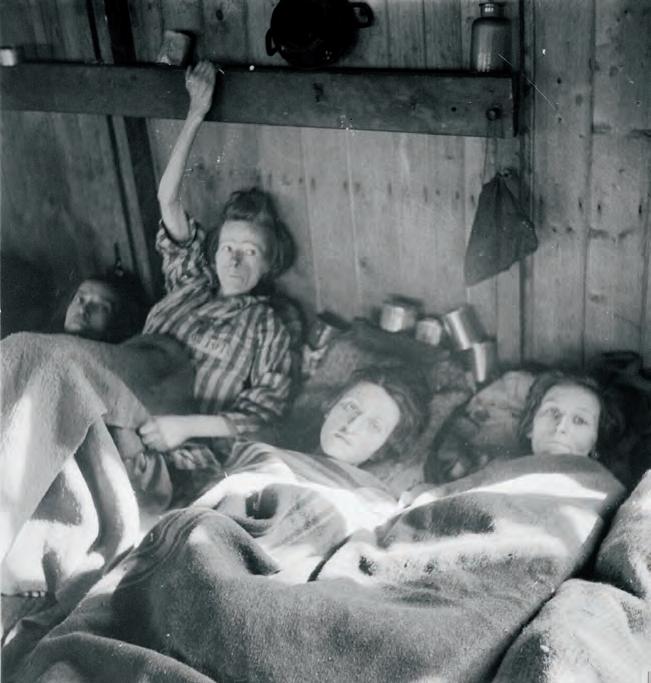
Then there were some 2,000 Soviet PoWs, who had been starved and brutalized in prison camps. Now, many were roaming free. Allied agreements stipulated these soldiers were to be repatriated to the U.S.S.R., and the military government had “the facilities for returning [them] to Russia,” detailed the CAOF’s war diary. But “either through ignorance or a desire to remain in Germany they had not taken advantage of them.” As a result, the CAOF “have now been ordered to assist in this repatriation.”

Soviet soldiers harass a German woman.
Canadian Private Murray Dorey gives chocolate to local kids in Aurich, Germany, in August 1945.
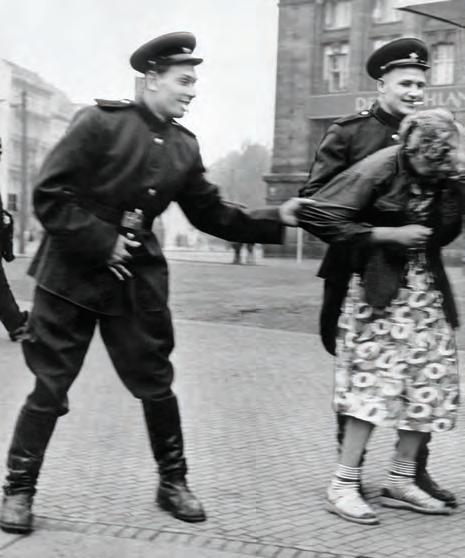
Sometimes, the Canadians showed little sympathy to the civilians, and some even cheered on the former
PoWs for giving “these Jerries a bit of their own medicine.”
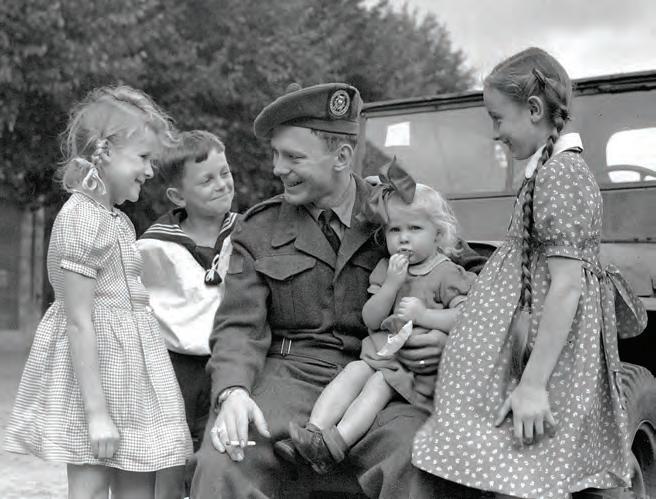
The Soviets tried to evade authorities and take revenge on the Germans. The CAOF sent out patrols to help prevent crimes, on one occasion rounding up 30 Soviets who were looting farms, raping girls and women, and murdering civilians. But sometimes the Canadians showed little sympathy to the civilians, and some even cheered on the former PoWs for giving “these Jerries a bit of their own medicine.” One soldier put it in even stronger terms: “the Russians were kicking the shit out of German civilians.”
It had been a long, hard war the Nazis had forced on the world, and only the most serious crimes were prosecuted. Most displaced persons or escaped PoWs faced little or no punishment, and the Soviets were eventually returned home.
Despite the reprisals, the attitude of the Germans in the Canadian area of occupation was generally satisfactory. Most of the older population were resigned to their unhappy situation. The war had been lost, but it wasn’t their fault, they claimed; it was only because of Hitler’s unfortunate error in attacking the Soviet Union before finishing off Britain. But, among males under 30, those fully indoctrinated with 12 years of Nazi ideology, Canadian officials believed, there remained a simmering hatred of the victors. And the Germans generally avoided co-operating with them.
This wasn’t helped by the non-fraternization orders issued by Field Marshal Montgomery. There were to be no relations of an informal kind with the population, no liaisons with women, no candy to children. Violation of these orders could lead to punishment for the soldiers, which was unquestionably harmful to morale.

The soldiers could see that children (and their parents) were hungry and wanted to help in the months after the surrender when food was scarce and little more than 1,500 calories a day per person were available. But as Major Elmer Bell wrote home from Germany, giving children chocolate “would be the thin edge of the wedge to fraternization and eventual undoing of all the proceeds of our losses and sacrifices.”
The struggles of German civilians could be, and were, exploited. Cigarettes were hard to find, and Canadian soldiers could barter their free smokes for the likes of expensive cameras, liquor, jewellery, art, binoculars and watches. Anything, it seemed, was available
for 100 to 1,500 cigarettes. This was small beer, though, in comparison to the stolen army equipment, clothing and foodstuffs that were peddled to the black market. It was spring 1946 before this was said to be checked (“due to other responsibilities which took a higher priority,” the CAOF war diary noted).
The Canadians also wanted to socialize. Stanley Winfield of the RCAF wrote that while the no-fraternization order was in effect, “the frauleins took definite advantage of this order and saw only the wonderful opportunity of ‘getting even.’ They would go for a stroll where they knew Allied soldiers would be…and appear as vivacious and desirable as they possibly could.”
Temptation was hard to resist. And with ample supplies of cigarettes as currency, many soldiers got what they wanted. Still, few were punished. Nonetheless, CAOF soldiers frequently took their leaves in the Netherlands or nearby Denmark where the natives were friendly, women were interested in them, and cigarettes still opened doors. Men could pay for a weekend in Amsterdam or Copenhagen, including food, drink, lodgings and female companionship, for just 2,000 smokes.
By mid-July 1945, however, reality finally set in, and the no-fraternization order was
relaxed and effectively eliminated. The decree from XXX British Corps said, with presumably unintended humour, that “You may now talk to all German persons in public places and on the streets because by intercourse between the two people it is hoped to lead the Germans into a Democratic way of life…do not enter their homes or entertain them in yours.”
Still, there were reports that German women were threatened by their compatriots if they went out with Canadians. But cigarettes were a powerful reward for the risk, and soon many soldiers had formed liaisons. By February 1946, the CAOF war diary noted that: “Fraternization is increasing and even officers are holding whispered conversations of ‘that beautiful blonde’ they saw downtown. Several men,” the entry went on, “had expressed their desire to marry German girls.”
Presumably they had managed to “enter their homes.”
Despite repeated British requests that the Canadians remain in Germany, Ottawa decided that the commitment would end in early 1946. The first troops departed for England on March 23; the last soldiers left on June 8. The CAOF had done its duty, and soon all the Canadians were home. The war was at long last over. L
While not formally part of the Canadian Army Occupation Force, Canadian troops also served in immediate postwar Germany in the so-called Berlin battalion. Drawn from units in the Netherlands awaiting repatriation, men from The Argyll and Sutherland Highlanders, Les Fusiliers Mont-Royal and The Loyal Edmonton Regiment were detailed to represent Canada at the British victory parade in the German capital on July 21, 1945.
Housed in a retirement home in the devastated city, the soldiers had few formal duties other than practising their drill and smartening up their kits. They were otherwise free to see the ruined sights. One soldier, Sergeant Kurt Loeb, wrote that he found souvenirs in the Reich Chancellery, including personal correspondence files of Germany’s minister of interior from early in the war. And every soldier, it seemed, had a collection of German medals.
The so-called Canadian Berlin battalion marches in the city on July 20, 1945.

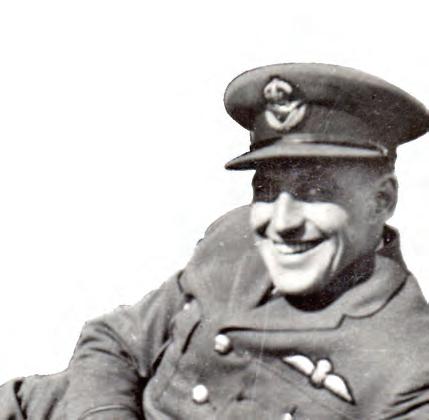
By Andy Saunders



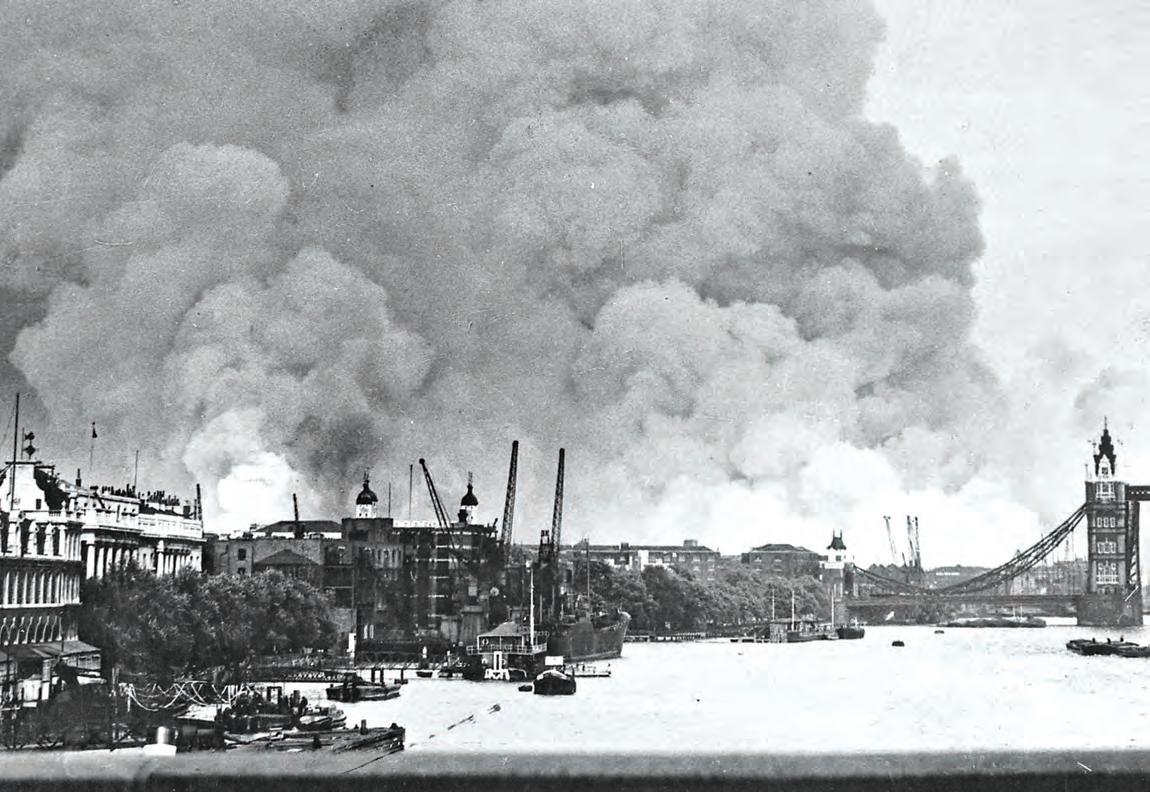

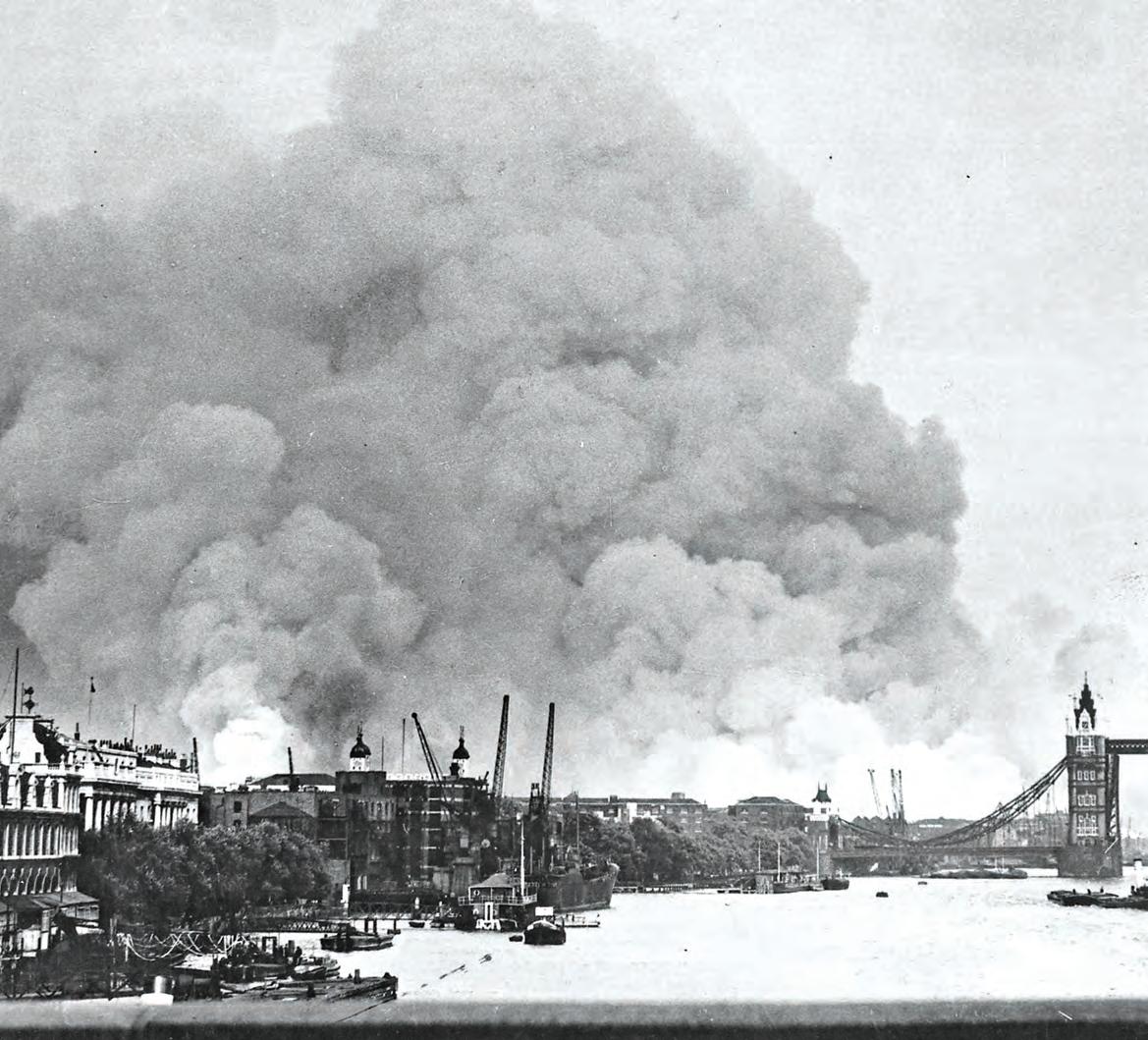

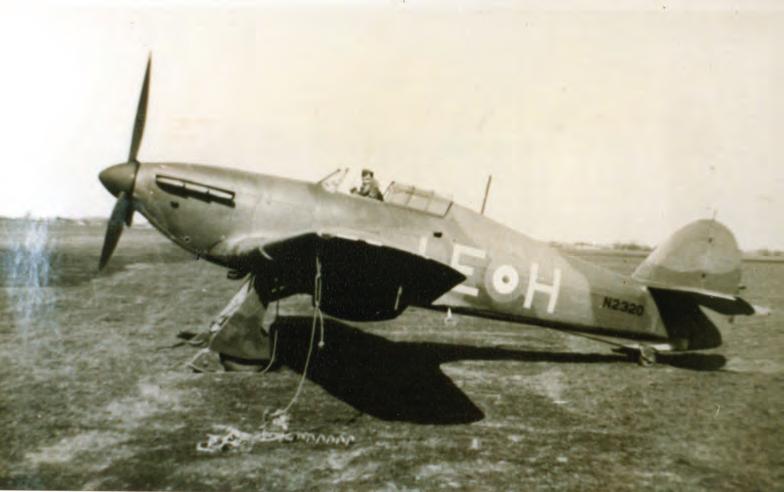

DDuring the late afternoon of Sept. 7, 1940, waves of German aircraft advanced inexorably up the Thames estuary and menacingly headed toward London. What had been the Battle of Britain was about to morph into the Blitz as bombers pounded the east end of the city, docklands and oil storage facilities. It signalled a shift in German tactics—away from attacks focused on aircraft factories, airfields and infrastructure of Royal Air Force Fighter Command. With the RAF defenders desperately working to keep the bombers from the capital, engagements between Fighter Command and the Luftwaffe spread across vast swathes of the skies to the east and northeast of London. The fighter squadrons tried to reach the bombers through screens of escorting Messerschmitt Bf 109s and Bf 110s. Losses on both sides were significant.
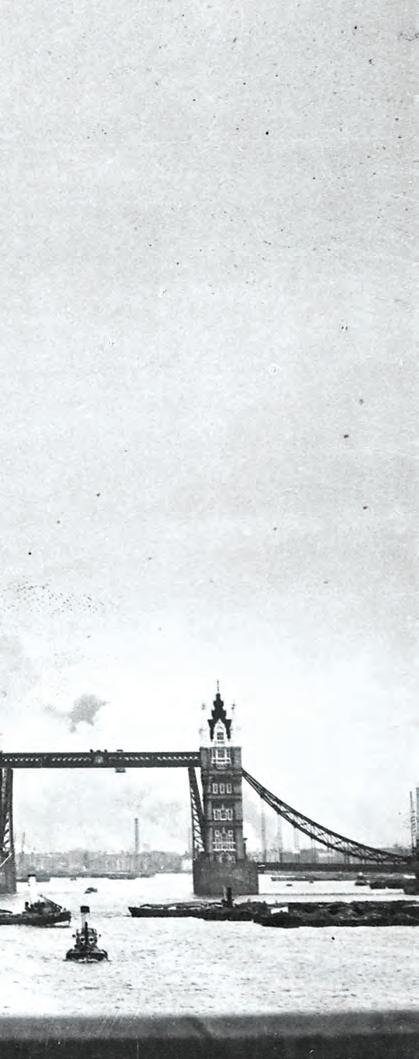
The Hurricane exploded in a meadow alongside the railway at Blackacre. Those who rushed to the scene found little apart from a deep crater.
Among those to join the fray was 242 Squadron, scrambled from RAF Duxford near Cambridge. Famously, the unit was led by the enigmatic and legless Douglas Bader. Although not a Canadian squadron, many of its pilots were Canadians.
Most of what happened in 242 Squadron’s frantic battle that afternoon can be pieced together from its operations record and from combat reports of the pilots who survived. But one detail is hard to pin down: what happened to the one 242 pilot who failed to return that day?
No one on the squadron had seen what happened to him. On the ground, though, watchers stood transfixed by the spectacle of RAF fighters wading into swarms of enemy aircraft. Suddenly, out of the whirling fracas and chattering machine guns, a Hurricane fell away from the battle, plummeting earthward in a screaming dive. The plane’s descent quickly tilted to near vertical; its fiery passage marked by a trail of smoke.


Those watching from the village of Theydon Bois in Essex hoped that a parachute would blossom above them. It didn’t. Instead, the Hurricane exploded in a meadow alongside the railway at Blackacre. Those who rushed to the scene found little apart from a deep crater and scattered fragments of the airframe.
Wisps of smoke rose from the gash in the soil and ammunition exploded from the wreckage. And strewn around the lip of the crater were shreds of a bloodied RAF uniform.
Eventually, police and army guards abandoned the site, official action limited to clearing away a few scraps of debris. Meanwhile, the locals moved on, and nature healed the scar on the landscape, as it always had.
Overhead, battles continued to rage. There would be many more casualties such as this, with losses of personnel becoming a critical factor in the battle’s outcome.
A common misconception has it that Britain stood alone during the perilously dark days of 1940—a time when the very survival of the country and its vast Empire seemed very much in doubt. However, in the time that followed the early war defeat in France and the withdrawal of the British Expeditionary Force from Dunkirk, Britain was anything but on its own. By the summer of 1940, thousands of soldiers, sailors and airmen had fled their occupied homelands in Europe and had managed to reach Britain’s shores to continue the fight against Nazi Germany. Significant among these refugees were large numbers of trained pilots, aircrew and ground crew who were ultimately assimilated into the ranks of the RAF.
Many of these men were absorbed into the ranks of RAF Fighter Command which, by July 1940, was haemorrhaging pilots through combat losses. In short, its lifeblood was draining away.
Among the more than 20 Canadians killed in the Battle of Britain was John (Jack) Benzie.
The infusion of foreign pilots was a game changer.
Aside from the influx of pilots from Poland, Czechoslovakia, France and other European nations, Britain’s global empire fed even more fliers into its defence. Indeed, no less than 15 other countries made up the band of men whom Winston Churchill later called The Few. Canada’s contribution to the Battle of Britain included 117 pilots and aircrew, making it one of the largest national groupings among the nearly 3,000 Allied men in the fight.
Among the more than 20 Canadians killed in the battle was John (Jack) Benzie. He was already in Britain and serving in the RAF when the U.K. and France declared war on Sept. 3, 1939.
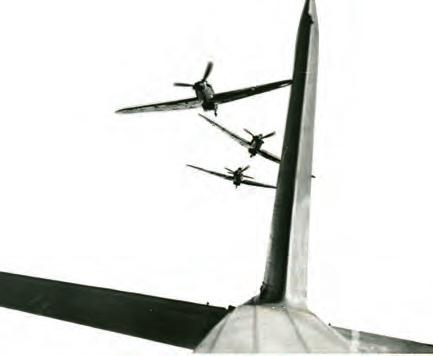


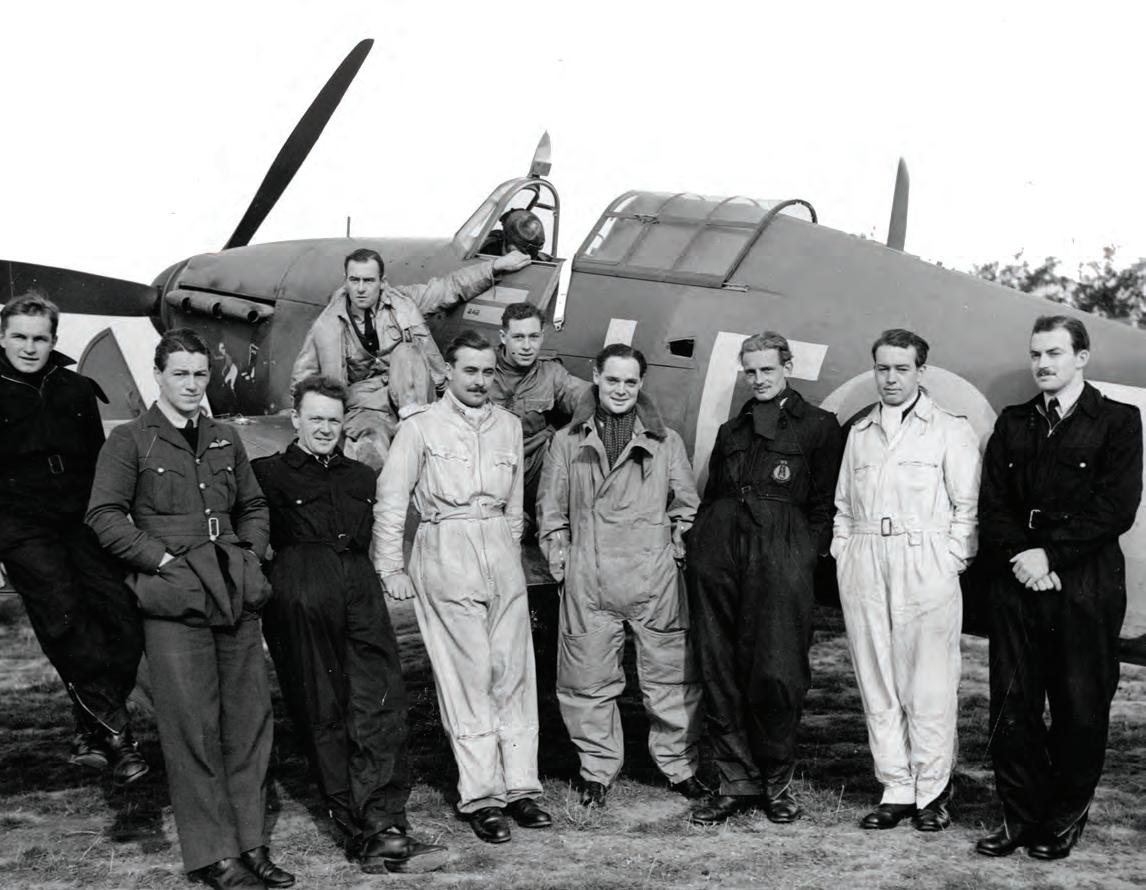

The squadron’s diary for Sept. 7, 1940, has details of the day’s action, with a reference to Benzie merely a footnote: “Pilot Officer J Benzie, missing.”
Benzie poses for a photo in France in May 1940 (above). Men of his 242 (Canadian) Squadron, RAF, including Douglas Bader (fourth from right) in September 1940 (opposite bottom). American Pete Brown, serving with 242, readies for takeoff. Hurricane fighters line up during training.




in early 1940. He then went with the squadron to France in May. It was there that he got his first taste of combat. He was also shot down on the 23rd, an episode he recorded in his diary.
“Left Manston 1:45 PM with two squadrons of Hurricanes escorting Blenheims well into German lines near Cambrai and Arras,” wrote Benzie. “We ran into a bunch of ME 109s escorting a convoy of Dorniers.”
The Germans attacked. Benzie fired at two of the 109s, but missed. Return fire damaged his wingtip. With limited speed and manoeuvrability, he made for the clouds to escape. After reemerging from the cover, he spotted three 109s.
He dropped in behind one and emptied his ammunition on it.
“Long streams of petrol and smoke came from this aircraft, and he made a steep turn and spiralled to earth,” noted Benzie, who headed back for the clouds with “the two other 109s...hot on my tail.
“I tried every manoeuvre I could,” he wrote, “but just before I reached the clouds a burst of incendiary bullets entered the cockpit and hit my left leg.”
As Benzie headed back to base, his cockpit began to fill with smoke and his engine started to misfire. He decided he had no choice but to abandon his aircraft over Lens, France.
“I ripped off the safety straps and emergency panel and then the engine stopped,” wrote Benzie. “I steered the plane away from the city and at 800 feet I jumped out. I was machine gunned by French ground troops on the way down but fortunately not hit.”
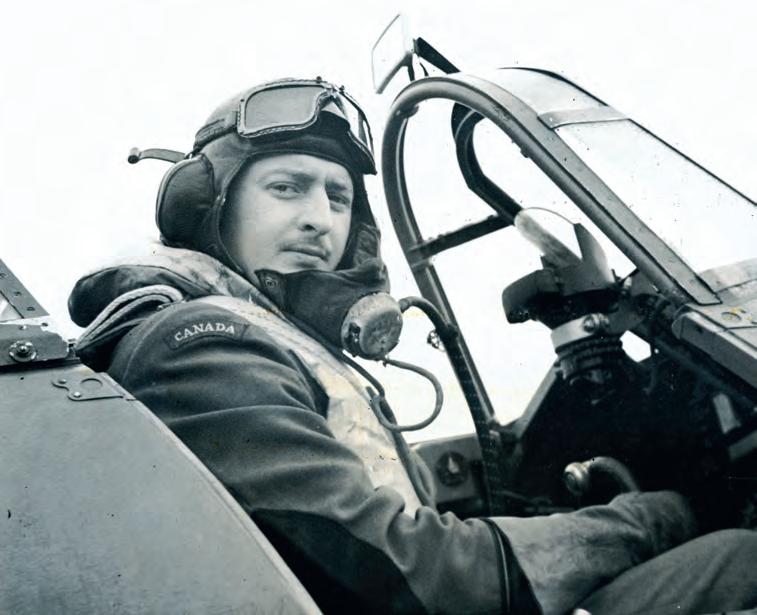
He landed in a field outside of Harnes. Locals attacked him, thinking at first he was German, but finally one of the Frenchman understood his English and he was taken to a casualty clearing station. Three days later, he left Dunkirk in a convoy back to Britain.
On July 11, one day after the start of the Battle of Britain, Benzie had sufficiently recovered to rejoin 242. He was quickly thrown back into the fray during the summer and into early September.
The squadron’s diary for Sept.7, 1940, has details of the day’s action, with a reference to Benzie merely a footnote:“Yellow 2, Pilot Officer J Benzie, missing.”
More than 30 years later, local memory of the 1940 crash at Blackacre had faded and largely been forgotten. However, metal detectorists searching for Roman coins in that same field in the mid-1970s stumbled across parts of what they believed to be aircraft wreckage. They contacted the now defunct London Air Museum to report their find.
Visiting the site, the museum’s John Tickner and Tony Graves pinpointed the crash site, which lay in a sloping field just alongside the London Underground line at Blackacre. Based on debris near the surface, the pair quickly established the aircraft bits belonged to a Hurricane. The museum team secured permission to dig and carried out an excavation in 1976. Five and a half metres deep they found a Rolls-Royce Merlin engine and wreckage from a cockpit—and the skeletal and burnt remains of its unfortunate pilot.
Among their meagre finds was an insignificant looking brass connector assembly. And roughly scratched into the surface of it: “Benzie.”

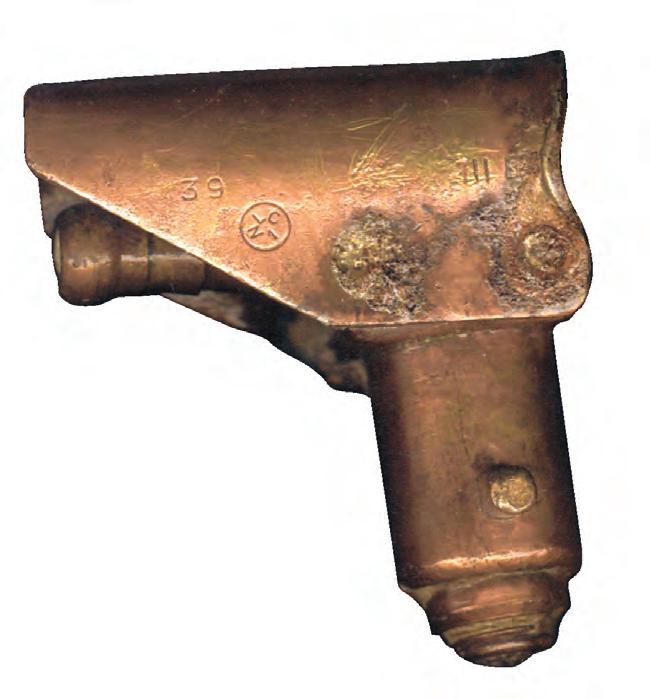
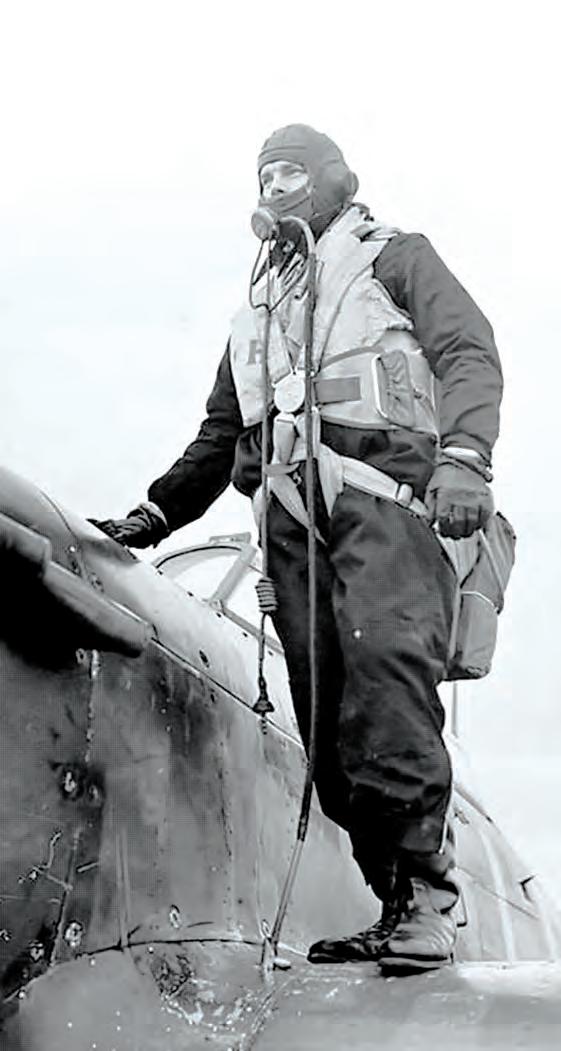
The airframe and its occupant had been very badly burned, and despite extensive searching, nothing was found to identify either the plane or its pilot. Thus, the British Ministry of Defence declared the man unknown, and he was buried on July 15, 1977, at Brookwood Military Cemetery in Surrey.
Of course, the aircraft was likely the one that had crashed
in the area on Sept. 7, 1940. But, there were three missing Hurricane pilots who had been lost and remained missing from air battles that day: FlightLieutenant Hugh Beresford and Flying Officer Lancelot Mitchell of 257 Squadron—and Benzie. Three years after the discovery at Blackacre, Beresford’s remains were recovered and identified at a crash site on the Isle of Sheppey. Then, when the




London Air Museum exhibited items from the Blackacre site, they described them as from Hurricane P2962—the aircraft in which Benzie had been lost.
Of course, the museum knew then that Beresford had been identified. And it had taken the view that it was reasonable to assume that Mitchell, flying in the same squadron as Beresford, was lost in the same action and had probably been shot down in the same area. So, the conclusion that the Blackacre crash involved Benzie was reasonable. But the story didn’t end there.
In September 1981, a team of air force enthusiasts and experts (including members of the 1976 recovery group) re-excavated the Blackacre crash site in the hopes of discovering additional clues that might help definitively identify the plane’s pilot. Among their meagre finds was an insignificant looking brass connector assembly.
It was the connector from a pilot’s oxygen mask hose that plugs into the supply socket in the cockpit. Pilots commonly marked this equipment with their name for hygiene reasons. And roughly scratched into the surface of this one: “BENZIE.” At last, here was
evidence that would seemingly connect Benzie to the crash and lead to his name being inscribed on that headstone at Brookwood.
Unfortunately, the Ministry of Defence saw it differently. It took the view that such equipment could be shared or left in an aircraft that wasn’t being flown by the individual named on it. Thus, it had adopted a policy where identification couldn’t be determined by such evidence alone.
Then, on June 21, 2001, the RAF’s Air Historical Branch wrote: “According to our records, P2962 was shot down over the Thames Estuary at 1645 hrs on 7 September 1940. It was believed to have crashed near Theydon Bois in Essex.”
If nothing else, here was confirmation anew—and official at that—that Benzie’s Hurricane was thought to have been lost near the tiny hamlet where the unknown remains were found in 1976.
Today, on the 85th anniversary of the Battle of Britain, Benzie is still officially listed as missing with no known grave. But the evidence strongly suggests that the burial at Brookwood Military Cemetery, Plot 22, Row E, Grave 1,
holds his remains. And his family hasn’t given up on having his final resting place properly marked. Meanwhile, with no known grave in the land he died defending, Benzie does have a significant memorial in his native Canada. A lake in northwestern Manitoba was named in his honour in 1953. It’s likely that Benzie Lake is the largest monument to any of Churchill’s Few. L
The grave believed to hold the remains of Benzie. An unidentified pilot of 242 Squadron poses on the wing of his Hurricane in September 1940 (opposite ). Hurricane fighters on patrol.
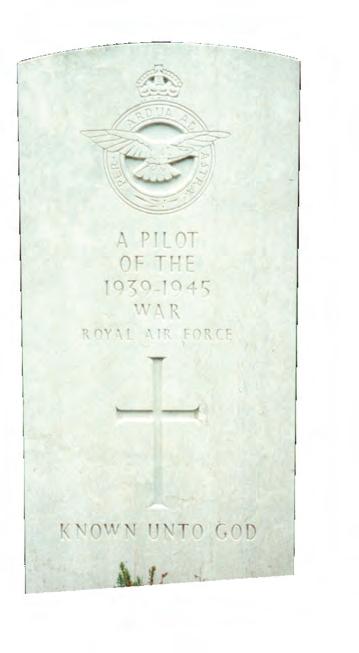
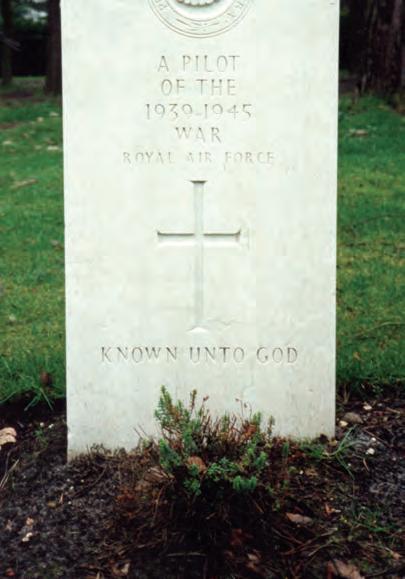
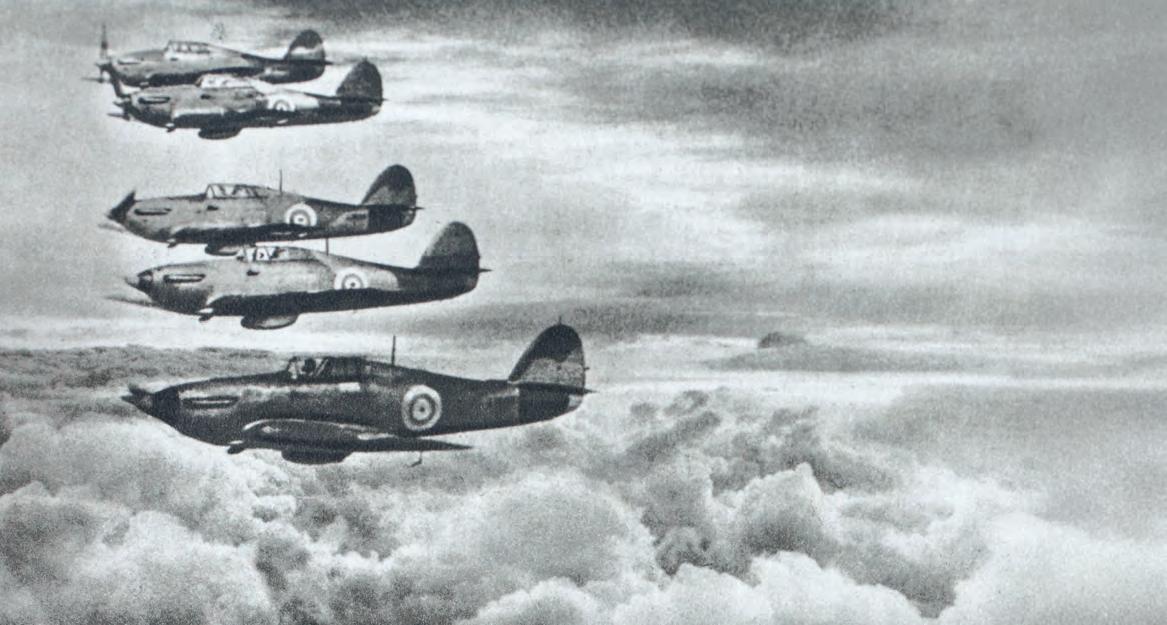


Captain Owen Robertson had few concerns on July 18, 1945, as he and his wife dined out at Halifax’s Nova Scotian Hotel. Having served as both commander of His Majesty’s Canadian Dockyard and King’s Harbour Master since 1943, the 38-year-old officer originally from Victoria merely wished for a brief respite from his ongoing duties.
The war in Europe—if not the war overall—was over. Royal Canadian Navy personnel and vessels were beginning to transition back to peacetime conditions, a laborious task supervised by Robertson. But not tonight; tonight was his to savour.
That was until an almighty cacophony reverberated across the city’s harbour. The ensuing concussion propelled dust out of the air conditioning units, leaving most stunned patrons and hotel staff with no doubt that something terrible had happened.

Robertson rose, his six-feetseven-inch frame striking its usual imposing stature, and bolted toward the hotel’s top floor. There, the aptly nicknamed Long Robbie stared in horror as a mushroom cloud formed above Bedford Basin. His fears, alongside those of innumerable locals still haunted by the Dec. 6, 1917, Halifax Explosion, had seemingly been all but confirmed.
Robertson appeared to be witnessing a second Halifax disaster.
Almost 30 years had passed since that cruellest of winter days when two ships, one laden with about 2,925 tonnes of explosives bound for First World War battlefields, collided in Halifax Harbour. The result was the largest humanmade explosion at the time.
Some 2,000 lives had been lost and 9,000 more were injured. Even physically unscathed survivors were left traumatized by the
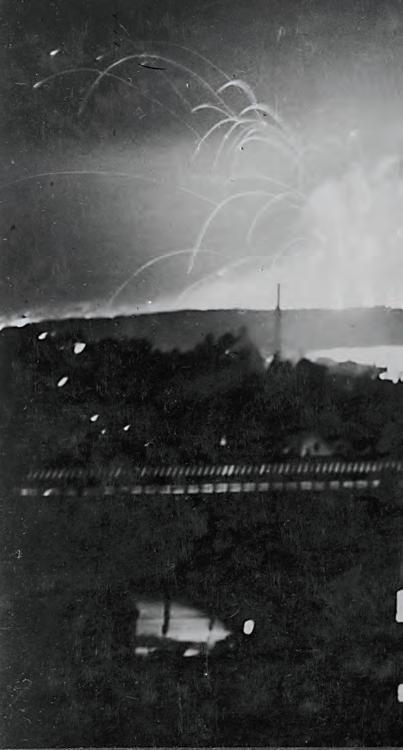


atrocious events, long since seared into the collective memories of residents and those in neighbouring Dartmouth. Perhaps unsurprisingly, a proportion were paranoid that history might repeat itself. Thankfully, it hadn’t—at least not yet. There had, however, been a couple of close calls, itself unsurprising in the strategically vital port brimming with munitions.
On April 10-11, 1942, the Allied freighter SS Trongate, carrying a volatile wartime cargo, was scuttled by HMCS Chedabucto after the merchant vessel caught fire. Using non-explosive practice shells to sink the ship, the Canadian minesweeper’s actions, combined with the early hour they took place, prevented large-scale panic.
Canadian authorities averted another major incident in
November 1943, when a fire started in the boiler room of the munitionsloaded American freighter Volunteer. Captain Robertson had joined efforts in battling the inferno, clambering aboard the burning vessel with several first responders and attempting to extinguish the flames. A subsequent explosion launched the dockyard commander out of one of the ship’s hatches, a somewhat lucky escape for him that ultimately claimed the life of another. He then relieved the inebriated and obstructive skipper— albeit through an American liaison officer—and ensured that the Volunteer was piloted out of the danger zone and scuttled. Roberson was awarded the George Medal for his part in the action.
Halifax had been far from quiet since then. The May 7-8, 1945,
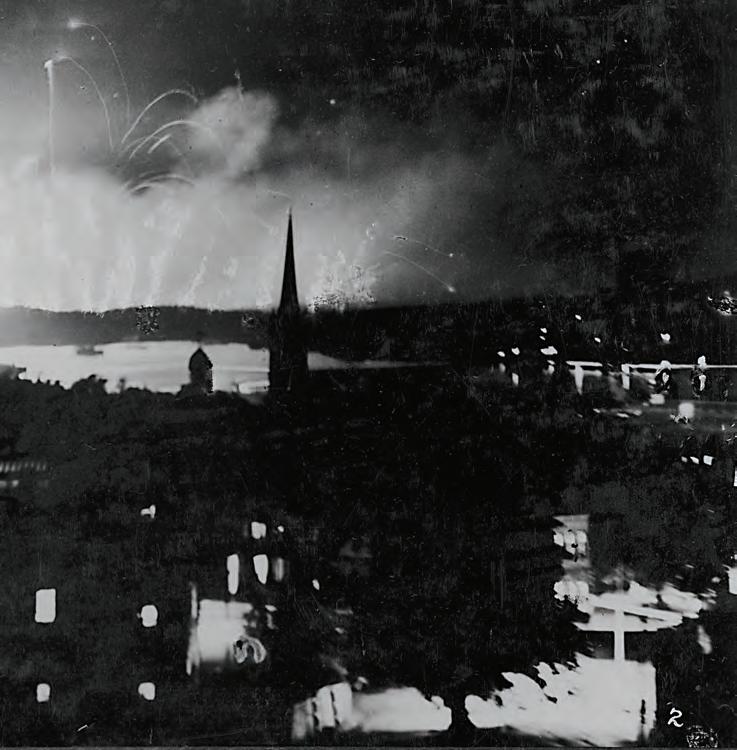
VE-Day riots had further soured relations between citizens and military authorities, particularly with the RCN. In replacing 2,624 pieces of plate glass, restoring 207 pillaged businesses and repairing an additional 564 establishments, naval ratings had since become, rightly or wrongly, a primary source of city-wide ire, which persisted into the summer.
But, Haligonians had good reason to believe the worst was over. A true catastrophe had failed to materialize, instead confined to fiction via the silver screen. Wartime moviegoers had apparently enjoyed The Yellow Canary, a 1943 film in which a Nazi espionage organization tries to orchestrate a second Halifax disaster. The plot was deemed improbable, and was, but the movie nevertheless proved relatively successful. It was just a story, after all; a bit of harmless entertainment.
A far more likely, if similarly explosive, finale to the conflict awaited.
The Bedford Magazine, an ordnance storage facility nestled against its namesake basin roughly six-and-a-half kilometres from downtown Halifax, had been built in 1927, initially for all military branches before becoming an exclusively RCN site.
Positioned on a rocky, wooded slope near Burnside, authorities had expanded the facility by mid 1943. It boasted a series of brick buildings surrounded by earth and concrete ramparts, the bunkered design intended to ensure that if one structure exploded, the others would be secure.
The magazine, which employed around 500 personnel in late 1944, received stores via water and rail. Two principal jetties in the north and south served inbound and outbound vessels, each with sheds for storage and pumps for firefighting.

When proper procedure was adhered to, the fence-enclosed site was as safe and efficient as any that dealt with ordnance could be—except these weren’t ordinary times. The end of hostilities in Europe had brought about a rush to de-ammunition surplus ships and demobilize their crews as quickly as possible, a politically motivated decision that seldom accounted for the strict regulations.
The rules had once stipulated that only one vessel could unload its arsenal onto a jetty at a time; now, in mid 1945, up to three ships were jostling for space while their deadly cargo littered the wharves. The recent closure of the St. John’s, Nfld., Magazine further normalized laxity as its stocks were shipped to Bedford.
With little room left inside, naval personnel stacked approximately 80 depth charges, 400 hedgehog anti-submarine bombs, cordite charges, anti-aircraft shells and small-arms ammunition on the south jetty, its overflow stowed on adjacent barges.
Bedford Magazine had all the makings of a proverbial powder keg. Elsewhere, tinder was provided in the form of bone-dry grass and brush amid a heatwave.
Just a spark was needed to light the flame.
Able Seaman Henry Craig of Mosside, Ont., might have believed the bloodshed was, or at least was about to be, over. He perhaps thought he had survived the worst conflict in human history, one that had claimed the lives of 45,000 Canadians and Newfoundlanders.
Between 6:30 and 6:40 on the evening of July 18, 1945, the 33-year-old was on guard duty in the magazine compound when he spotted a fire raging on the south jetty, apparently spreading fast.
“I’m going down to see if I can put it out!” he shouted at a nearby
comrade as he darted toward the blazing wharf.
It was already too late. Within seconds, Craig was engulfed in an explosion that flung his body 180 metres inland; authorities found his remains three days later.
In the meantime, white-hot fragments and burning propellants cut through the air in every direction. Personnel were knocked off their feet and buildings turned to rubble. Within the wider radius, houses were knocked off foundations, windows shattered in Rockingham and other municipal communities, and the initial report could be heard 45 kilometres away, akin to the rumble of a distant thunderstorm.

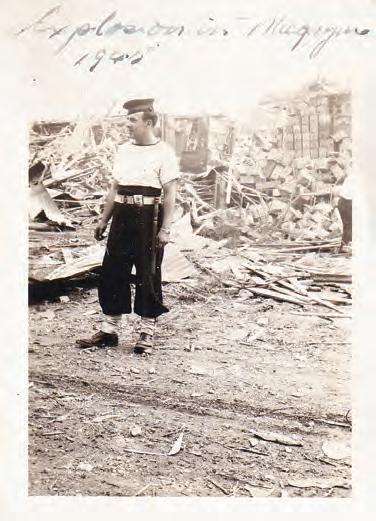
Reporter Jeff Jefferson witnessed a fiery cloud rising into darkened skies. He had been using his binoculars by sheer coincidence, likening what he observed to a “sheaf of wheat.” Shortly after, the odd spectacle “mushroomed into a ball of reddish flame, and a huge ball of black smoke soared into the air above it,” he wrote.
It was the same horrific sight that Captain Robertson could see.
Halifax Harbour was awash with myriad vessels—destroyers, corvettes, frigates, minesweepers, submarines and smaller craft— raising anchor and making for the Narrows where, three decades earlier, the epicentre of the last disaster had occurred. It now served as an escape route out of the Bedford Basin to open waters.
Despite the mass seabound exodus, the fire boats James Battle and HMCS Rouille steered toward the danger. There, they confronted the magazine’s burning stocks nearest the shoreline

Robertson stared in horror as a mushroom cloud formed above Bedford Basin. He appeared to be witnessing a second Halifax disaster.
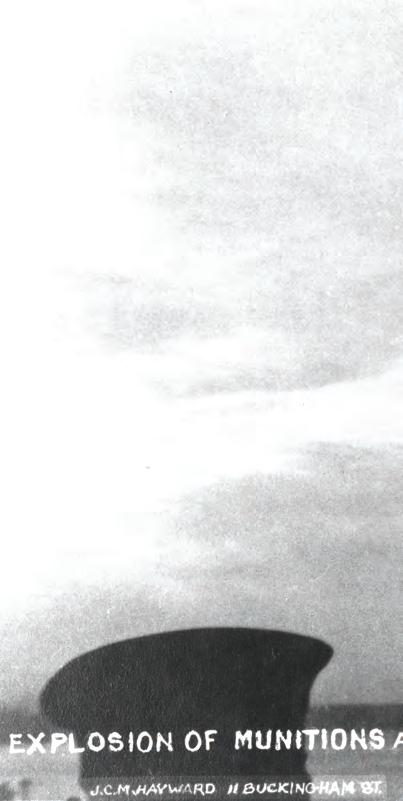

while, inside the facility, scores of personnel mobilized to douse flames with buckets, hoses and anything else remotely usable.
Their combined efforts were hampered by cooking-off ammunition and shrapnel careening through the air, a threat that persisted for the duration of the struggle. Naval firefighters, together with their municipal and volunteer counterparts, nevertheless braved the inferno, their wounds attended to by a single nurse.
They had a common goal; if the fire reached one of the main bunkers housing 50,000 depth charges, Halifax might cease to exist.
“Some of the experts,” the journalist Jefferson wrote of the avoided scenario, “claim everything would have been
levelled right down to Point Pleasant Park.”
It was, in other words, a race against time, the alternative being a horrendous repeat of the 1917 disaster.
Captain Robertson knew this, too, having left his hotel dinner to take command at the scene. He had barely taken stock of the situation when a reinforced concrete building blew up, hurling him into a pond and out of immediate harm’s way for what seemed like the second time in his charmed life.
Long Robbie extricated himself from his watery soft landing and got back to work. During the ensuing hours, he maintained order where possible, “hopping from jeep to ditch when discretion demanded it.” His praise was reserved solely
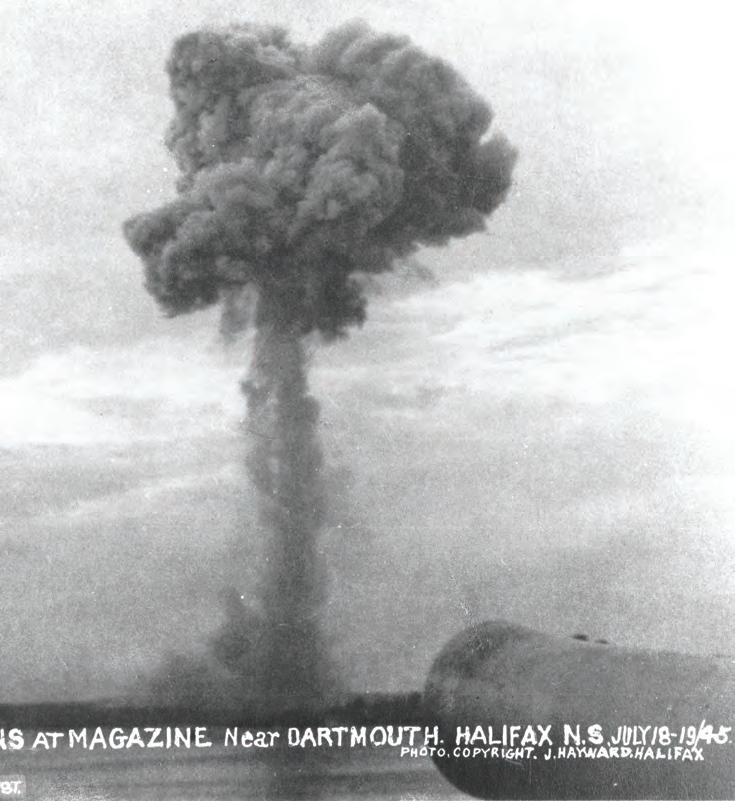
for those firefighters caught in the fray, “trying to save a big magazine…loaded with explosives.”
And the night was only just beginning.
Ace Foley, a radio broadcaster for Nova Scotia’s CHNS station and, on July 18, the announcer for the baseball game at Halifax’s Wanderers Grounds, knew something was amiss. He had heard the explosion and seen the pillars of smoke. He now watched as the stands began to empty of spectators.
But the game continued—and so did Foley, continuing his playby-play as a palpable uneasiness fell over the remaining crowd. Soon he was frequently interrupting his commentary to broadcast orders for personnel to report to base. Finally, if belatedly, the game was cancelled.

A mushroom cloud forms over the Bedford Magazine as munitions explode— and the aftermath.
Across two cities, where confusion and uncertainty reigned supreme, uniformed Canadians did what they could to assist—and in doing so, began the process of restoring their relationship with locals. On a Halifax-Dartmouth ferry, personnel prevented fear-stricken passengers from jumping overboard. Others, including Russell Harkness of the Provost Corps, drove civilians out of urban districts to open spaces such as Halifax Common, where glass—a horrendous killer and maimer when shattered in 1917—was less of an issue.
At 9 p.m., naval headquarters instructed all people living between North Street and Bedford Basin to evacuate. The mandate was later extended to more than half of the city, as far south as Quinpool Road. Similar orders were given to every Dartmouth resident and in total 125,000 people abandoned evening meals for congested roads and streets out of a potential blast radius.
Smaller explosions frayed the nerves of temporary refugees spending the night in fields, parks and public gardens. Emergency shelters were opened in both cities, supported by the Canadian Red Cross. At the Halifax Armoury, representatives distributed some 3,700 blankets to those who sought sanctuary and an additional 700 to citizens sleeping outdoors in Dingle, Francklyn and Point Pleasant parks.
Most Haligonians chose to leave the peninsula entirely, weaving around smashed windows only recently repaired after the VE-Day riots. Cars, heaving under the weight of valuables and furniture, navigated passengers past outbound pedestrian traffic. Vast swaths of Dartmouth were transformed into a ghost town.
Yet, a strange sense of order prevailed throughout the evacuations. Residents voiced their fears, false rumours spread freely, but the overall panic level seemed muted. For many, not least the thousands gathered on Citadel Hill, watching the drama play out before their eyes was one last adventure of the war.
Others felt differently, especially following a series of large explosions that jolted the senses of countless civilians. Jefferson recounted three such blasts through the night and into the early hours of July 19, the worst of which occurred at 3:55 a.m.
“I remember seeing the blazing red sky,” he recorded. “Within ten minutes, as we hugged the ground, another explosion punctured the dawn.”
The latest report—caused when the inferno reached 360 depth charges and bombs—could be heard as far away as Yarmouth County, N.S., 350 kilometres away. Meanwhile, the cloud reflection created by the flames was visible on the provincial highway
from Truro to New Glasgow and beyond to Antigonish.
But, with the fading smoke came the realization that the crisis had finally peaked. Whatever had happened at Bedford Magazine, authorities had regained control.
Captain Robertson’s first responders, including the fire boats James Battle and Rouille, had successfully prevented a catastrophe. Fighting through a maelstrom of bullets, shells and more—all in the absence of enemies—the men and women who endured the relentless ordeal had prevailed. This was not a second Halifax disaster.
As residents slowly, cautiously, filtered back, they were afforded a chance to survey the destruction wrought. Several houses had been left in ruins, their roofs crumbled and their doors caved in. Barrington Street looked like it had on VE-Day, if not worse. At the northernmost tip in Africville, a Black community hard hit back in 1917, the damage was again extensive, if less severe. North Dartmouth had likewise suffered a battering from successive shockwaves.
But, compared to what it could have been—and, at least according to some, almost was—the sight that greeted most civilians came as a relief. Windows and mirrors could be replaced. Minor breakages
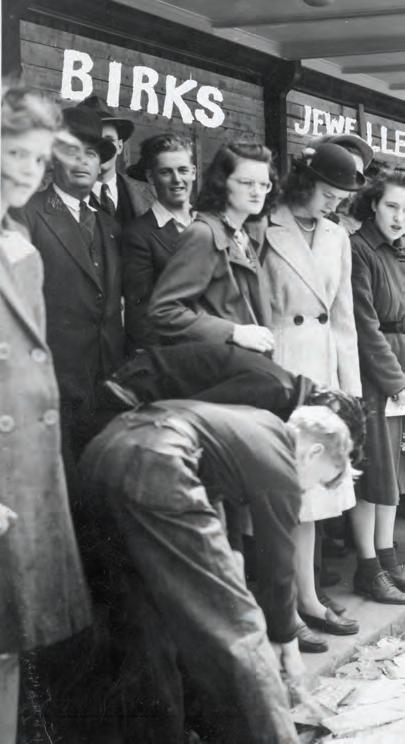

Lacking substantive evidence for any one theory, the naval inquiry conceded that they were “unable to attribute direct blame to any person or persons.”

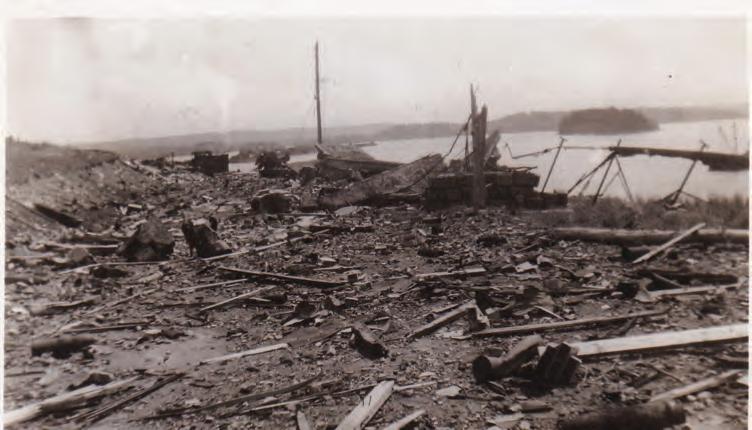
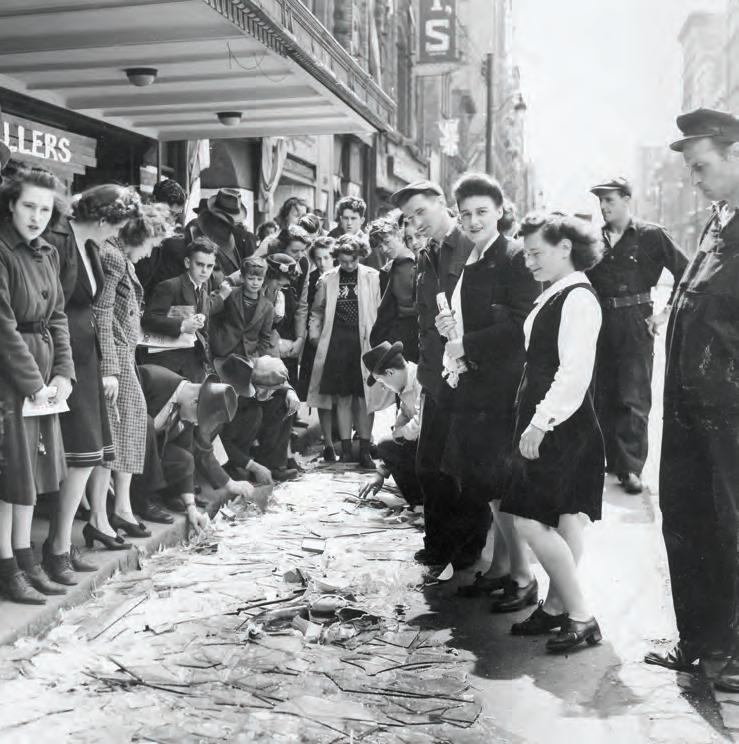
could be repaired. And $4 million worth of compensation would eventually be provided to all claimants within three years.
The luckiest Haligonians returned home to little more than a cold dinner from the night before. One understandably distressed woman lamented over the loss of her heirloom china. Another found a dozen eggs splattered on the kitchen floor.
It was a different story at Bedford Magazine, where approximately 50 per cent of the buildings had been destroyed or badly damaged.


The south jetty, where the fire had started, no longer existed, save for a scattering of charred and broken wood. A significant proportion of stores saved from the flames, meanwhile, had instead been flooded to prevent a major escalation. Of greatest concern was the live ordnance strewn well beyond the site’s confines, hidden in undergrowth or submerged underwater. The sudden emergence of a minefield would ultimately require a five-year recovery operation; between July 18 and Oct. 1, 1945,
some 2,000 tonnes of ammunition was shipped and dumped at sea.
Miraculously, however, Henry Craig was the incident’s sole fatality, his deeds recognized with a posthumous Mentioned in Dispatches.
That the Bedford Magazine explosion had inflicted so few casualties was almost entirely due to the courage, fortitude and professionalism of all first responders. Hungry, thirsty and exhausted from their efforts, the firefighters deserved a rest.
Captain Robertson radioed naval headquarters and put in a request for sustenance. “What we would have welcomed,” he said, “was lettuce and ice cream—maybe sandwiches—but good old Central Victualling Depot sent us a slab of beef and a sack of raw potatoes.” Furious, the sleep-deprived commander radioed in again.
Through open channels, Roberton cursed the person responsible, threatening to have the culprit’s “balls for a necktie.”
Ice cream and sandwiches soon arrived.
About half of the magazine’s buildings were in ruin following the blasts. Crowds gather around broken glass on Barrington Street in Halifax.
A naval inquiry found that overstocked stores, unsatisfactory regulation adherence, supervision and enforcement issues, and the wooden construction of the jetty were among the factors that contributed to the inferno and subsequent explosions. Aside from theories, however, officials stopped short of asserting an original fire source.
Investigators noted that the most “probable origin” was “unauthorized smoking and carelessness with respect to disposal of ignited smoking materials.” Other suggestions ranged from spontaneous combustion to a barge stove fire to the striking of primer caps during “the shifting of insecurely piled ammunition.”
Lacking substantive evidence for any one theory, the naval inquiry conceded that they were “unable to attribute direct blame to any person or persons.” The entire matter was dropped. Thus, even today, no widely excepted explanation has emerged.
Like recollections of a thunderstorm from the night before, the excitement of the July 18-19, 1945, Bedford Magazine explosion inevitably waned. Lives had not been upended in the same way as on Dec. 6, 1917, ensuring the incident became little more than a footnote in history—a far better outcome than the alternative.
Despite that reality, remarked reporter Jefferson in an article written shortly after the events, “tonight lightning proved that it can strike twice in the same place.” L
Canadian war photographer Ken Bell returned to European battlefields several times after the Second World War to reshoot some of the people and landscapes captured during the conflict
By Carla-Jean Stokes
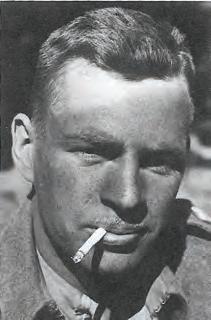
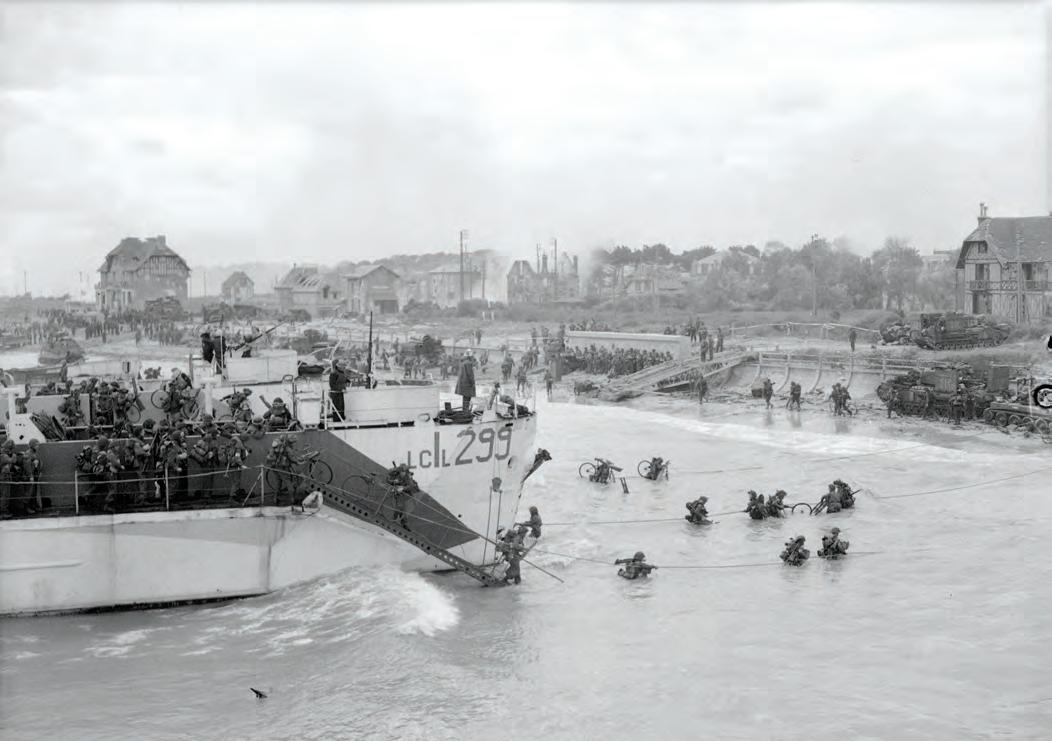
Personnel of 3rd Canadian Infantry Division land at Bernières-sur-Mer, France, on D-Day. Years later, families frolic at the same spot.
June 6, 1944, Ken Bell landed at Juno Beach with colleagues from the Canadian Army Film and Photo Unit (CFPU). This was Bell’s first exposure to the Second World War battle sites of northwestern Europe—sites he would return to and re-photograph for the next four decades.
Bell was drawn, repeatedly, back to the battlefields in the postwar period to show the contrast of wartime and peaceful landscapes. Interestingly, his books are of photographs, but they are not about photographs. Instead, his work indicates a belief in images both as historical documents and as a method to visually represent a healing process.
Born in Toronto in 1914, Bell took up photography in high school. He hoped to become an architect, but continued to work as a photographer through the Depression to earn money. Before WW II, Bell had worked at several studios.
In 1943, Bell was hired by Canada’s Directorate of Public Relations. He travelled throughout the country shooting scenes of military training and special events. In May 1944, Bell was transferred to the CFPU and was made a liaison officer of The Highland Light Infantry of Canada. After D-Day, Bell followed Canadian troops inland from Juno Beach toward Germany.
Five years later, Maclean’s magazine commissioned Bell to return to peacetime Europe to rephotograph the landscapes of the Second World War. Bell retraced the route of the Canadian Army on a motorcycle, shooting subjects with the same composition as the wartime images. He even met some of the same people he had photographed during the war.
Bell planned to spend two weeks in Europe, but eventually
stayed for two months. The work remained with him even longer. In 1953, he used the images for his photographic book Curtain Call.
“The war photographs depict the miseries and ravages of war and show countries destroyed and in despair,” Bell wrote in the book’s preface. “But everywhere an effort was being made to do everything possible to wipe out the scars of war.”
He used his camera as a tool to investigate what that process looked like.
The battlefields kept calling Bell back. He returned to Europe in 1969 to take photographs for his second book, Not in Vain (1973). Bell later admitted that he wasn’t satisfied with it and began working on another book in 1983. The result was The Way We Were (1988). It was Bell’s final re-photography publication, and shares many characteristics with his previous works—including images from more than 20 of the same sites he had been to during the war and each time afterward.
All of Bell’s books include images by other photographers, though they aren’t always credited. The Way We Were was the first of Bell’s books to include images taken in places he had never served during the war, as well as Canadian Army film stills, and photographs from other combatant nations. By re-photographing events at which he hadn’t been present, Bell positions the images made by his colleagues as straightforward windows to the past. But it’s important to remember the layers of choices that formed Bell’s books. From the events he shot, to the locations he revisited, to his selection of photographs, to the final printed page, all are less a window to the past and more a window to Bell and how he viewed the war and the act of representing war through photography.
Spanning nearly four decades, Bell’s body of work allows viewers to critically examine a photographer’s role in the telling of history—an approach that’s essential in a world that remains saturated with photographs of war. L
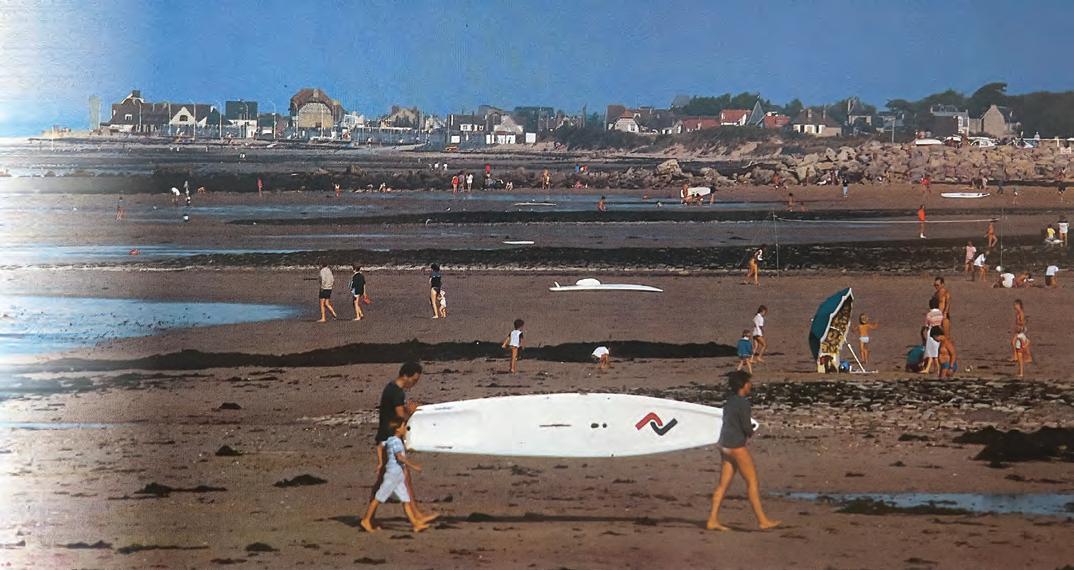
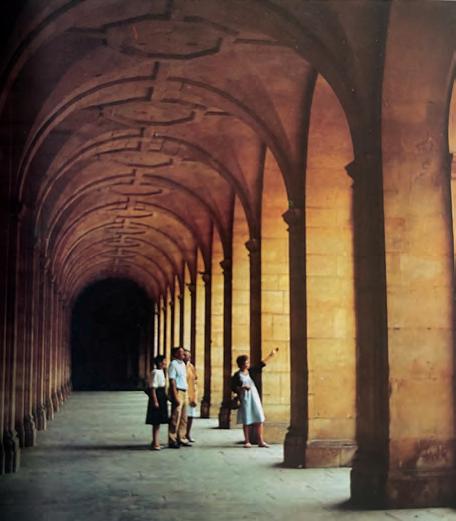
Five years later, Maclean’s magazine commissioned Bell to return to peacetime Europe to re-photograph the landscapes of WW II.
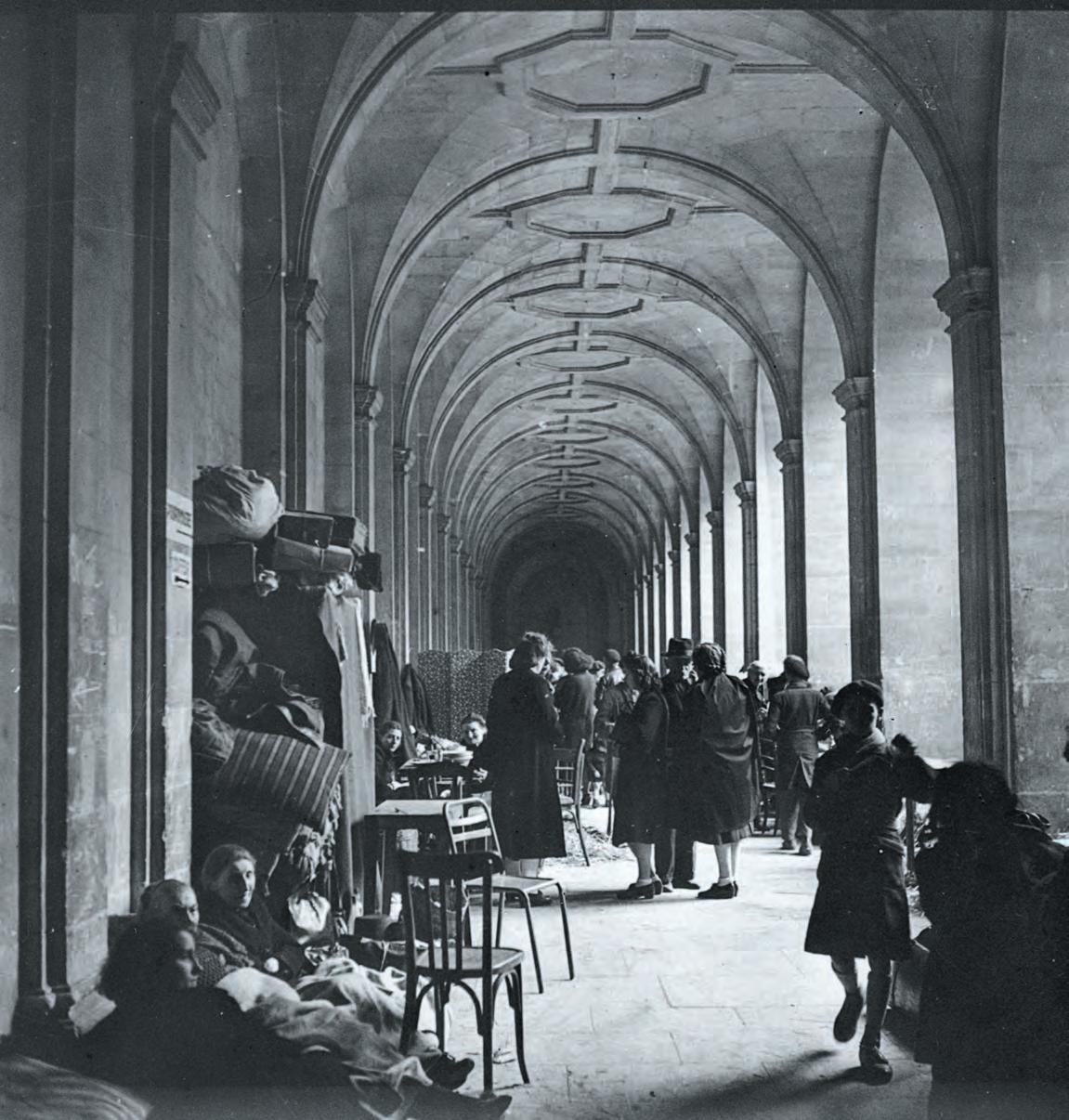
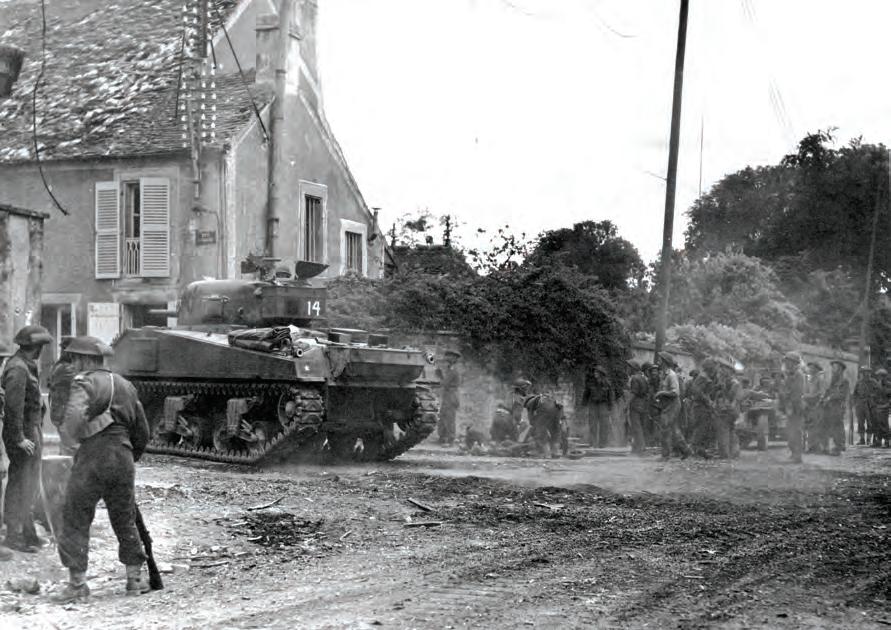
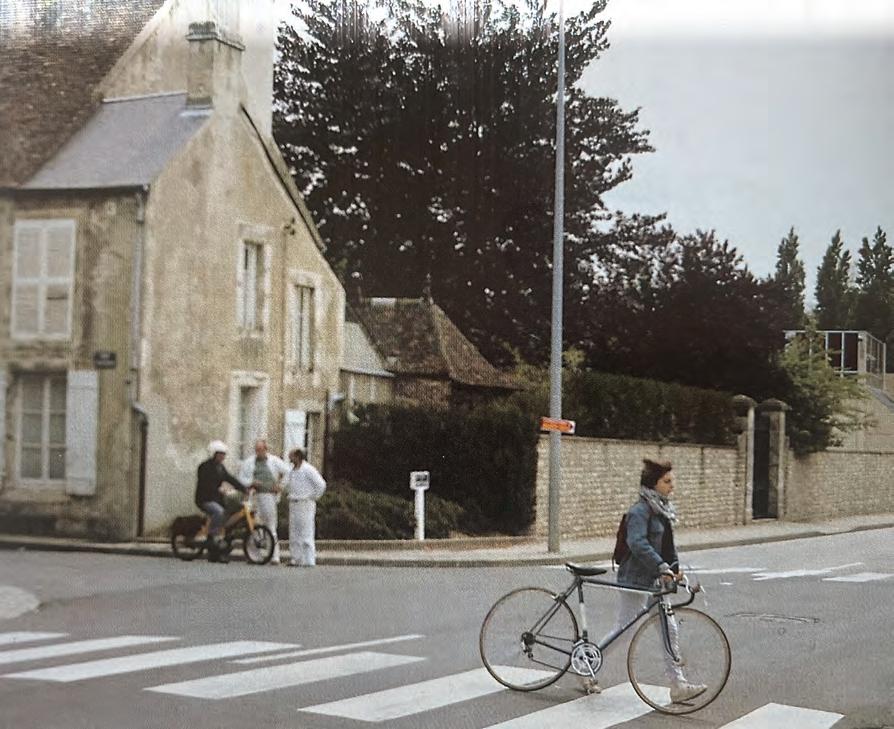
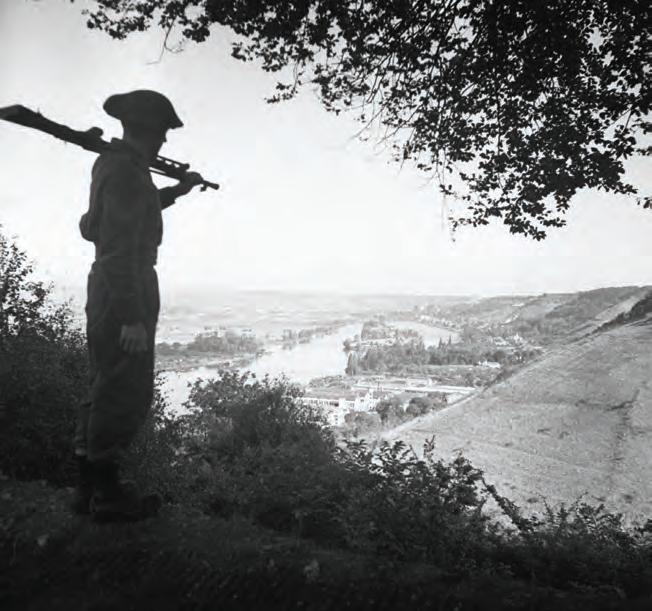

Sergeant B. Shaw looks out over Rouen, France, on Aug. 31, 1944. Decades later, a similar vantage appears serene without the soldier.
Canadian and American soldiers meet in Elbeuf, France, on Aug. 27, 1944. Youngsters and their guardians walk the same stretch of the village years later.
“The war photographs depict the miseries and ravages of war and show countries destroyed and in despair.”
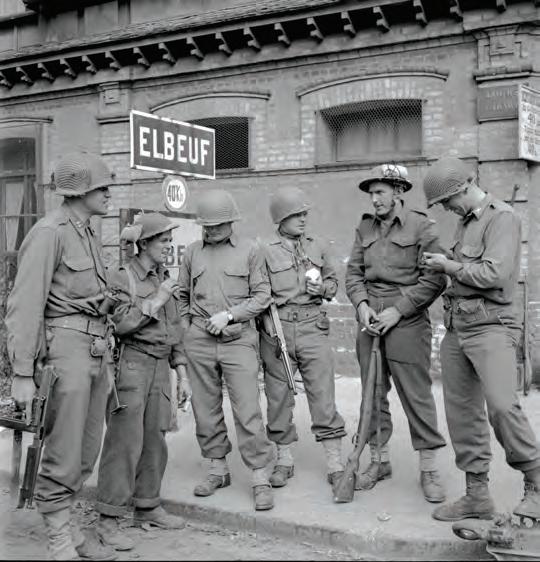
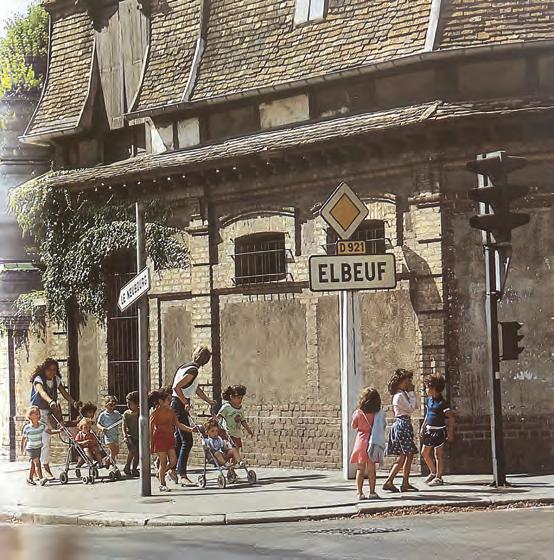
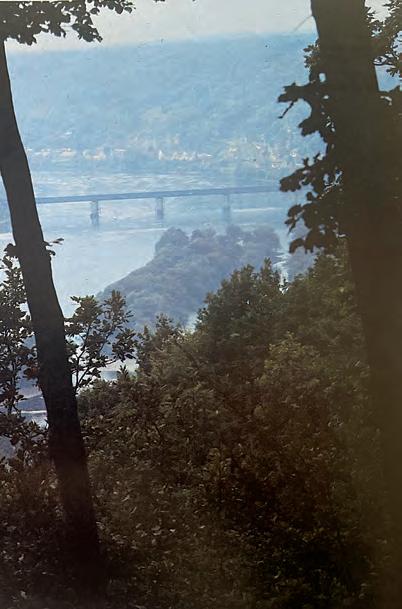
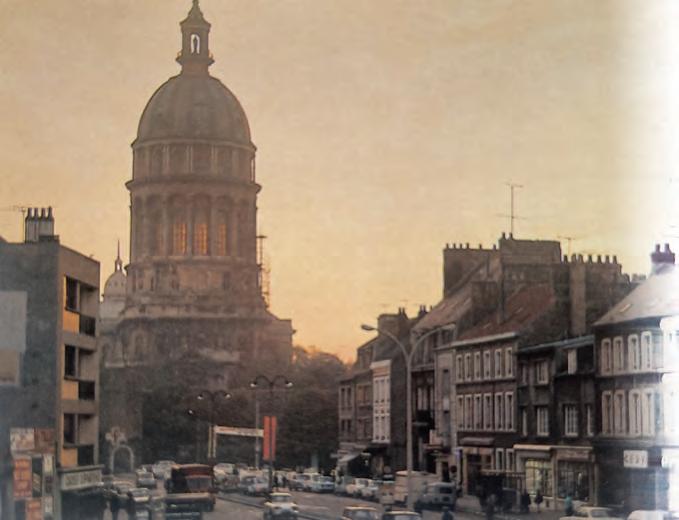
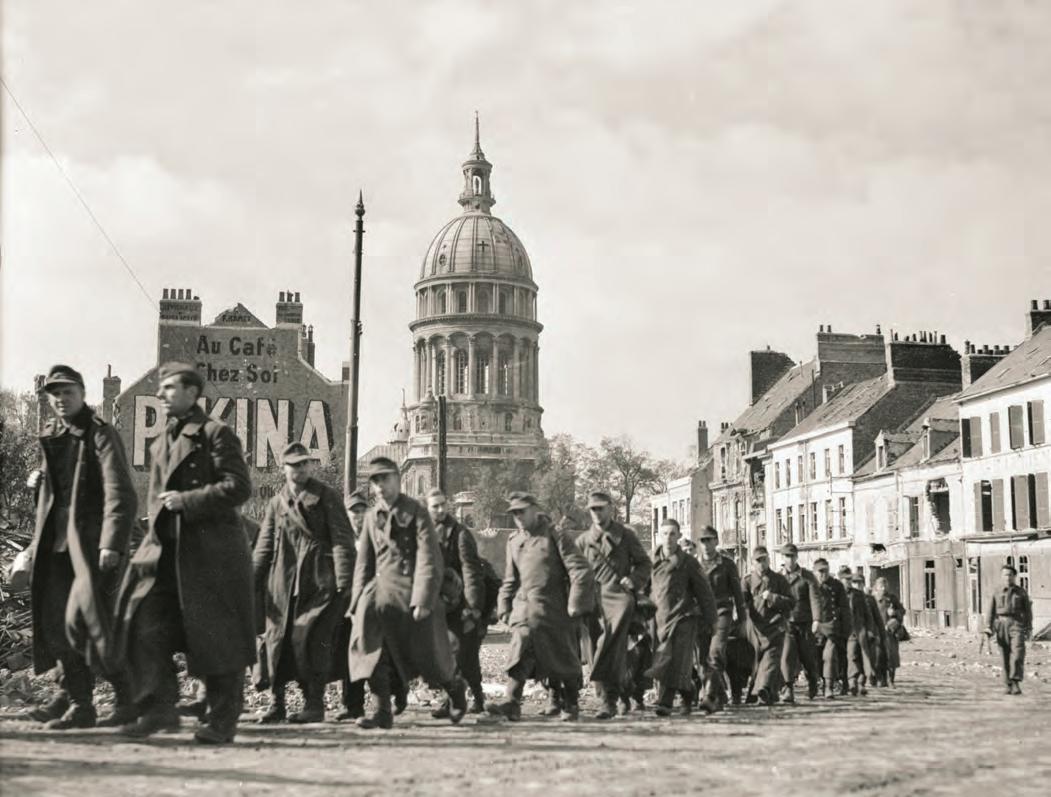
Boulogne-sur-Mer, France, at peace [ top], while on Sept. 19, 1944, German prisoners are marched away.

Astens of thousands of Canadians celebrated the end of the Second World War in Europe in May 1945, the country was facing another fight half a world away in the Pacific. After six long years, the prospect of continuing the conflict loomed large. The Pacific War was still raging in the spring of 1945.
While the U.S. and its allies were winning it, there were no illusions about how hard the battle would be as they neared the islands of Japan. And Canada was part of it. The country had lost 290 Canadians in the Battle of Hong Kong in 1941. And 1,418 prisoners captured during that battle were still being held in the jungles of Asia waiting to be liberated (another 264 died while captive).
As people danced in the streets across Canada on VE-Day, soldiers, aircraft and ships were still in the fight on the other side of the world. And the Pacific War would loom large in the June 1945 federal election.
While Liberal Prime Minister Mackenzie King campaigned on a pledge to have only one division created from volunteer veterans sent to Japan as part of Operation Downfall, Progressive Conservative leader John Bracken promised to use conscription to fill the need.
King won the election, but he knew that the invasion of Japan, scheduled to begin in late 1945 and to continue well into 1946, was going to be a terrible and bloody campaign. King committed to fully support the U.S. in the Pacific. But could he keep his assurance to send only volunteers?
If King couldn’t get the crew of a ship already in the Pacific to stay in the fight, how could he convince soldiers who had just returned home from the war in Europe to join a bloody campaign in Japan?
THE
DEATH TOLL FROM
THE BOMBS
WAS AN ESTIMATED 150,000-250,000.
IT’S BELIEVED TO BE ONE-FIFTH THE LOSSES THAT AN INVASION OF JAPAN WOULD HAVE SUSTAINED.
Near the end of the war in Europe, the Canadian government had also changed its staffing policy for all ships in the Pacific theatre. Any servicemen heading there had to re-volunteer. On May 7, 1945, the crew of HMCS Uganda, stationed in the Pacific, voted overwhelmingly not to re-enlist; 605 of t he 907 men wanted to go home.
The recently re-elected prime minister was potentially facing a new conscription crisis, one that threatened to sink his party as it had the Conservatives after they introduced conscription late in the First World War. King may not have necessarily wanted conscription, but it was going to become necessary soon enough.
Then, everything changed.
On Aug. 6, 1945, the U.S. dropped an atomic bomb on Hiroshima. Three days later, a second A-bomb was unleashed on Nagasaki.
Within days, the Japanese surrendered and the Pacific War was over. The death toll from the bombs was an estimated 150,000250,000. A terrible figure, but it’s believed to be one-fifth the losses that an invasion of Japan would have sustained.
Should the American have dropped the atomic bombs on Japan? Yes. It ultimately saved hundreds of thousands of lives far from home, and likely saved Canada from being torn apart by another conscription crisis. L
> To voice your opinion on this question, go to www.legionmagazine.com/FaceToFace

Aug. 9, 1945, Nagasaki, Japan, 11:02 a.m. The world goes white—a million suns exploding before a three-yearold’s eyes. Then nothing. Yasujiro Tanaka wakes buried beneath the wreckage of his home. His face is misshapen, his left ear forever deaf from the force of the blast. In the years that follow, his younger sister lives in constant pain, her failing kidneys requiring dialysis three times a week.
Tanaka’s story isn’t unique; it’s one of thousands. In 1945, the U.S. dropped two atomic bombs on Japan, effectively changing the world. In the span of mere days, they killed some 210,000 people, mostly civilians, including children. This doesn’t include the untold number of those who died later due to radiation exposure. In perspective, the Nazis murdered six million Jews throughout the Second World War. In three days, the Americans killed 3.5 per cent of that.
The atomic bombings of Hiroshima and Nagasaki were unnecessary, inhumane and strategically flawed. A key justification for them is that they forced Japan to surrender and prevented a costly American-led Allied invasion. However, Japan was already nearing defeat at the time. It had been crippled by a naval blockade and
CRAIG BAIRD
is host of the “Canadian History Ehx” podcast, which also airs as a weekly radio show coast to coast on the Corus Radio Network. Baird’s first book, Canada’s Main Street, was published this past May.
relentless firebombing campaigns that had devastated major cities.
And the argument that dropping the A-bombs was necessary to prevent a Soviet invasion of Japan is specious. The U.S.S.R. declared war on the Japanese on Aug. 8, two days after the bombing of Hiroshima. And the Japanese Supreme War Council only convened after the Soviet invasion of Manchuria on Aug. 9 (and coinciding with the second atomic bomb).
THE ARGUMENT THAT DROPPING THE BOMBS SAVED AMERICAN LIVES IGNORES VIABLE
Indeed, many experts argue that Japan’s surrender had as much to do with fear of the Soviets as the impact of the A-bombs. Had the Americans pursued further diplomatic negotiations, Japan might have surrendered without the need for nuclear destruction.
Beyond this, the argument that dropping the bombs saved Allied
is a Grade 12 student in the literary arts program at Ottawa’s Canterbury High School. She was a member of the school’s 2025 provincial-level Ethics Bowl team.
lives ignores viable alternatives. A demonstration A-bomb could have showcased the powerful new weapon without killing civilians. Why weren’t the bombs dropped on unpopulated areas or on strictly military targets to avoid mass civilian casualties? Plus, Japan’s primary surrender condition was the retention of Emperor Hirohito, which the U.S. ultimately granted.
Beyond the immediate destruction, the bombings set in motion the nuclear arms race and the Cold War, a conflict that continues to cast shadows over modern global politics. The U.S. wished to save American lives but, given the Cold War and its related proxy conflicts, they hardly succeeded.
Recognizing the bombings as unnecessary and inhumane isn’t just about understanding history— it’s about shaping the future. The decision to use nuclear weapons set a precedent that continues to influence global power structures, military interventions and the ethics of warfare. If history is a guide, it must acknowledge the U.S. had less deadly alternatives—and chose not to take them.
No one, and certainly no child, should ever have to experience the devastation that Yasujiro Tanaka and so many others did. L
By Aaron Kylie
By Aaron Kylie
By Stephen J. Thorne
By Stephen J. Thorne
By Aaron Kylie
rom Canadian sovereignty and international trade wars to the emergence of new global spheres of influence, dealing with the impact of U.S. President Donald Trump was a common theme among reports and presentations as The Royal Canadian Legion’s Dominion Executive Council (DEC) met this past April.
Grand President Larry Murray, however, began his opening address by paying tribute to the contributions of former Dominion First Vice-President Garry Pond, who had relinquished his position due to health issues. “He impressed me from the beginning with his strong values-based leadership, servicebefore-self approach and always wise and thoughtful council,” said Murray. “Many thanks, Garry, for your outstanding service to Canada, to the Canadian Armed Forces, and The Royal Canadian Legion.”
Murray later installed Sharon McKeown, a life member of Pte. Joe Waters Branch in Milton, Ont., as the new First Vice, and Jack MacIsaac of Charlottetown Branch as a new Vice-President, to address Pond’s vacated position.
The grand president noted that the concluding comments of his opening would be a bit different than normal. “I don’t think we’re living in normal times,” said Murray. “I think that Canada could use a little more of the reassuring presence of the Legion
during these challenging times as we confront unprovoked attacks on our sovereignty and economic well-being by the current U.S. administration. I believe there may be more we can do during this crisis.”
In his welcome, Dominion President Berkley Lawrence also raised concerns about the country’s changing relationship with its southern neighbour. Of particular note in Lawrence’s address, as well, he mentioned a productive informal meeting with Veterans Affairs Minister Élisabeth Brière this past March, whom he reported “seemed very honest in her willingness to work with the Legion.”
Immediately following the opening comments, DEC welcomed the defence chief, General Jennie Carignan, as a guest speaker. Before she spoke, she accepted the position of Honorary Dominion Vice-President with the Legion. General Carignan gave a brief speech, then answered questions for 40 minutes.
Legion Grand President Larry Murray and President Berkley Lawrence flank newly installed Vice-President Jack MacIsaac. Defence chief General Jennie Carignan addresses the council. Developer Sam Biasucci shares insights on the $32-million reimagining of Ontario’s Sault Ste. Marie Branch.
“I assume [this honorary] position with immense pride,” said Carignan. “Your support, and the support of Canadians, is very crucial at this time. It’s quite encouraging to see that Canadians are paying more attention to defence and security issues.”
Carignan described the Canadian Armed Forces as being in a state of transformation and mobilization.
“When we look at the global environment, we realize the world has changed,” said Carignan. “We have states now that deliberately invade other countries and have malicious intentions. And, finally, we have a new U.S. administration that is adopting a totally different posture now and we have to adjust to that.”
The CAF is responding by changing how it operates. While stability, combat and counter-insurgency operations were the norm during the last 30-plus years, noted Carignan, “this is not our reality anymore. We are getting back into large-scale conflict, which fundamentally needs different capabilities.”
The defence chief also addressed the CAF’s longstanding recruitment challenges. She noted that recruitment outpaced attrition by 2,000 in 2024, and that she expected the regular forces to be at their full strength of 71,500 by 2028-2029.
“We need to pick up the pace,” said Carignan, “because we have not been keeping up with the pace of our adversaries.”
After Carignan’s address, the council conducted Legion business. Dominion Treasurer Jill Carleton reported that Dominion Command ended 2024 with total net revenue of $897,242, and a gain of $1.7 million on unrealized investments. Dividends and interest earned increased by 30 per cent.
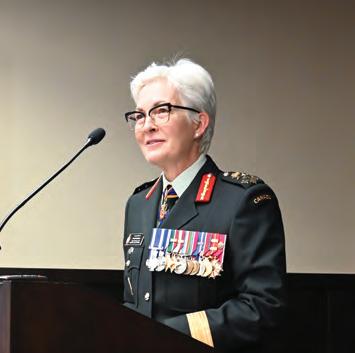
“IT’S QUITE ENCOURAGING TO SEE THAT CANADIANS ARE PAYING MORE ATTENTION TO DEFENCE AND SECURITY ISSUES.”
The supply department finished the year with $3,370,074 in sales, four per cent under the budget expectation. The Canada Post strike in late 2024 hindered merchandise sales during the crucial holiday shopping season, though sales were up by 42 per cent in early 2025—a trend HQ staff attributed to a recent surge in national pride.
Meanwhile, Legion membership continues to grow. For the third consecutive year, membership revenue increased, generating $6,212,649. In total, 256,046 memberships were processed for the calendar year ending in 2024, up five per cent yearover-year. Early data from 2025 suggests the trend will continue.
In keeping with the growth theme, Sam Biasucci, president of SalDan Construction Group, spoke to DEC about his company’s key role in the recent $32-million reimagining of Ontario’s Sault Ste. Marie Branch.
The new nine-storey complex, boasting Legion facilities on the main floor along with a 108-rentalunit apartment tower, opened in fall 2024. The branch, which still owns the land, partnered with the developer and the federal government in the project. Rent from tenants will not only help maintain the branch, but further its support of veterans. Its membership grew from 530 beforehand to nearly 900 today.
“I’ll make one thing clear: we get paid,” Sam Biasucci told DEC.
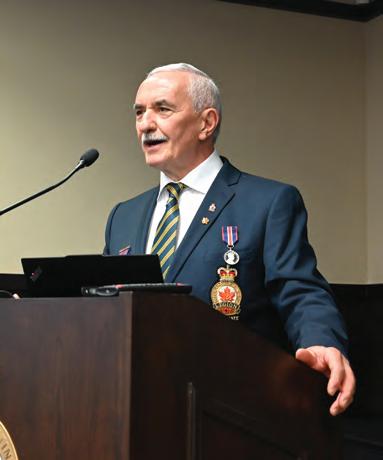
“How we maintain the integrity to it is a different story. It can be done without being a parasite of the system. [Legion branches] can actually do this and be successful.”
The Veterans, Services and Seniors Committee chair Lawrence provided updates on the group’s work. Among those efforts, it continued to advocate for the elimination of the archaic legislation known as the “marriage over 60” or “gold-digger” clause, which forces veterans who marry after 60 to forego up to half their pensions if they want to guarantee payments to their spouses after they die. The committee also continued to advocate for a streamlined system of benefits and programs to eliminate the confusion caused by multiple initiatives, including the Pension Act, the New Veterans Charter and the Well-Being Act DEC also approved funding to a variety of projects aimed at supporting veterans. The A.T.H.E.N.A. Program, an online fitness initiative for female veterans, received $26,300. The Mood Disorders Society of Canada was given $93,056 to support its peer support workshops and mental health webinars geared toward veterans. Hero Lodge, a fishing and hunting getaway in the N.W.T., was provided $5,000 to cover the cost of groceries for veterans participating in
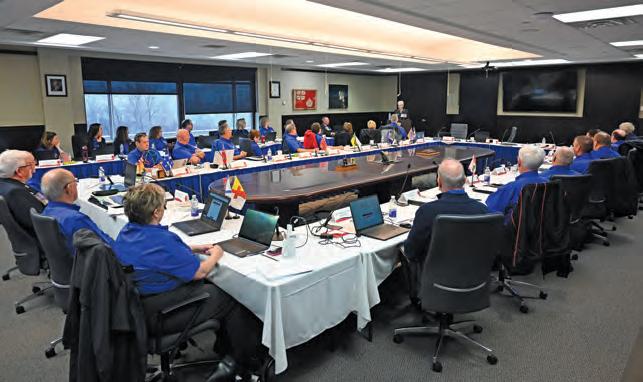
five-day excursions. And Ways to Well-being got $12,000 for its veterans’ support partnership program.
In its report, the charitable Legion National Foundation also announced funding of various initiatives, including: $200,000 to Veterans’ House Canada to contribute to the construction and furnishing of its new building in Edmonton dedicated to helping veterans experiencing homelessness; $25,000 to the Juno Beach Centre Association; and $17,000 to King’s University College.
There were two other particularly noteworthy committee reports.
The Poppy and Remembrance Committee highlighted its latest initiatives, including the Legion’s new online “Plan a Remembrance Day Ceremony” tool for schools, the redesign and expansion of its digital pay tribute boxes program, a 2025 trial of cardboard poppy donation boxes and the renewal, for the remainder of the year, of the Legion’s partnership with Amazon (in which select Poppy Store items are available through the digital marketplace).
Meanwhile, the Ritual, Awards and Protocol Committee recommended a change to Legion dress. The wearing of the Legion supply department Canada flag pin—on the outside of the Support our troops pin and levelled to it—for an initial period of two years (limited by existing bylaws) was approved.
In other updates, Sports Committee chair Trevor Jenvenne reported that the national cribbage event was held April 25-27 at the Whitby, Ont., Branch (also see page 66), and Last Post Branch in Port Stanley, Ont., was set to host Dominion darts May 2-4 (also see
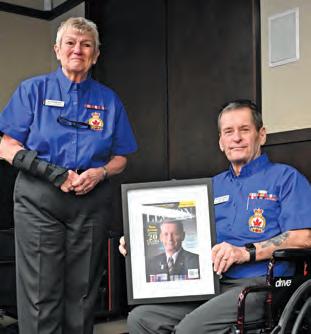
page 64), and the eight ball championships were cued up for the Fredericton Branch May 23-25.
And, as it did in 2024, Calgary will host the 2025 Legion National Youth Track and Field Championships, scheduled from Aug. 6-12. Regina will host the event in 2026 and 2027. The centenary Dominion Convention, meanwhile, will be held Aug. 22-26, 2026, in Winnipeg.
And, the Legion is set to host the Royal Commonwealth Ex-Services League triennial conference in Ottawa from June 28-July 3. The league includes 52 ex-service organizations from 46 current and former Commonwealth countries that promote the welfare of veterans and their dependents.
Reports by provincial command presidents, meanwhile, revealed several common themes, including partnerships, research, veterans’ homelessness, longterm care beds for veterans and stolen valour, among them.
“Our command continues to support the HiMARC (Heroes in Mind, Advocacy and Research Consortium) program through the University of Alberta,” reported
The Dominion Executive Council in session. First Vice Sharon McKeown presents Tom Irvine, outgoing president of Quebec Command, with a token of appreciation for his 20-plus-year tenure on the council.
Alberta-N.W.T. President Rosalind LaRose, of the veteran-focused research and education initiative. She added that her command had also joined forces with B.C./ Yukon Command in developing a service dog program.
Saskatchewan President Carol Pedersen highlighted her province’s $1.5- million program to fund renovations and updates to veterans’ service club buildings, and her command’s work in addressing veteran homelessness, noting specifically facilitating a trauma specialist. “The impact we have seen with it is incredible,” said Pedersen in her report. “The feedback from veterans and spouses have only been positive. Most, if not all, say they can actually see the future.”
Quebec President Tom Irvine spoke passionately about the importance of identifying and rooting out instances of stolen valour in the organization. He established a provincial committee to deal with the issue shortly after assuming his current position in 2022.
“The committee has handled nearly a dozen cases involving suspected violations of the RCL’s stolen valour policy,” said Irvine in his report. “These findings highlight the crucial need for continuous vigilance to preserve the integrity of our organization, and the trust of our members.”
Irvine knows the importance of both characteristics well. President Lawrence made a special presentation to Irvine in honour of his 20-plus-year tenure with DEC.
“When I was [Dominion Command] president during the COVID years, I can proudly say that not one branch closed because of COVID during my term,” said Irvine. “The leadership team that we had handed out $3 million from our reserves, which is all paid back. I think that was my biggest accomplishment.” L
oyal Canadian Legion Dominion Command continues to monitor the findings of Veterans Affairs Canada’s most recent Community Health Needs Assessment report. Its goal was to develop an inclusive, holistic vision of the health and well-being of Canadian veterans, with the purpose of providing them, health researchers, decision makers and service partners with comprehensive and accessible community wellness data. Various sources were involved in collecting and analyzing the information. The results will help guide future policy, research and resource allocation,
while reducing barriers and increasing health equity.
Collaboration with, and among, the veteran community is essential to developing trust and meaningful partnerships among veterans, advocacy groups and all levels of government. The report identified how veterans can use their unique qualities and military experiences (e.g., resilience, discipline and resourcefulness, etc.) for their well-being.
While 23 priorities were identified, Dominion Command considers the following four items key to real and meaningful change:
• reducing reliance on primary care providers for VAC
application processes and health-care access;
• streamlining VAC bureaucracy, improving trust and accountability and strengthening co-ordination between health-care systems;
• improving access to healthcare providers with military cultural competency and trauma informed approaches to care;
• a nd increasing financial support for veterans and their families and caregivers. For assistance with accessing VAC benefits, please contact RCL’s veterans services at veteransservice@legion.ca or toll-free at 1-877-534-4666. L






By Stephen J. Thorne
Nova Scotia/Nunavut executed an unprecedented sweep of all 27 games to run away with The Royal Canadian Legion’s 2025 national team darts title in Port Stanley, Ont., the first weekend in May.
Coady Burke, Jason Smith, William (Willie) MacIsaac and Sheldon Fudge pulled off the feat on the final day of competition hosted by Last Post Branch in the picturesque lumber and fishing town on the banks of Lake Erie, 220 kilometres southwest of Toronto. Teams from all 10 Legion commands participated.
Burke and Smith, from Lakeside Branch outside Halifax, won the 2024 doubles championship in Laval, Que., but they both agreed the team title was more satisfying, and not just because of the sweep.
“It’s such a harder game when you play fours,” said Smith. “There’s no flow and you have to wait God knows how long before you [throw]. So, to win it and not lose a leg? Insane.”
Martin Tremblay of Dorval Branch in Quebec won the singles title with 21 wins, including three-game sweeps of his last five opponents, while Dalton Desmarais and Bryce Book from B.C./Yukon took the doubles championship. In a reverse of the 2025 results, the Kamloops, B.C., pair were part of the B.C./Yukon squad that took the 2024 team title.
Both the doubles and team champions said chemistry played a fundamental role in their respective successes.
“I always view these team events and doubles events as chemistry,” said Book, who won the 2019
doubles title with brother Connor in Nova Scotia. “If you don’t have chemistry with your partner, you’re not going to do very well.
“And with all the bad shots we had today—and we had lots—we don’t get down on each other and we work through that and come up with the right way to win.”
The pair swept five opponents while racking up 20 victories,
three more than second-place Newfoundland and Labrador. Manitoba-Northwestern Ontario placed second in singles, with 18 wins, while Quebec was runner-up in the team competition with 21.
Desmarais called his doubles collaboration with Book his best in 10 years of playing darts.
“Great chemistry which, like he said, is very, very important.”
Nova Scotia’s Burke said his fourman team was feeling the pressure “100 per cent” as the prospect of a clean sweep became evident.
“The last two rounds is when it really kicked in,” he said. “And every leg, I can tell you…everyone was feeling the pressure, because it turned into a whole different thing. Not only did we know we won…we wanted to go undefeated.”
Smith said team competition is usually a bigger challenge chemistry-wise, but not for these guys. “It should be more difficult but they’re all local guys, we’ve known them forever, so they’re our best friends,” he said. “And that’s how we won.”
With more than 500 members in a town of just 3,000, the Port Stanley branch is thriving. Each summer Sunday between 1 and 5 p.m., it hosts a garden party on the common in front of the building, complete with live music, tents, tables and a barbecue. With the help of 16 volunteers,
it brings in hundreds of patrons every sunny week. When it rains, the branch opens its doors.
Branch President Rich McClenaghan, a 79-year-old retired autoworker, joined the Legion at his veteran father’s behest years before moving from nearby St. Thomas in 1991. He’s worked the bar, managed donations and cooked in the kitchen. Wife Janice is the branch public relations officer.
McClenaghan said volunteers rallied around the two-day darts championships and contributed mightily to their success. The schedule was well-organized and events went off like clockwork, ending on time and without snags. Ontario Command President Derek Moore acted as scorekeeper throughout.
“Thank God for the volunteers,” said McClenaghan. “They’re just incredible.” L
By Stephen J. Thorne
Paulette Lebel was blissfully unaware of her destiny when she set out in late April on a 1,300-kilometre journey from the former mill town of Red Rock in northern Ontario to Whitby, just east of Toronto, to play cribbage.
Lebel thought she had won The Royal Canadian Legion’s district singles title at Sioux Lookout back in March. She thought she was headed for provincials in the former WW II spy centre and manufacturing hub just off the Highway of Heroes.
In fact, she had already won the Manitoba-Northwestern Ontario title at Sioux Lookout; Whitby, it turned out, was for all the marbles. The next thing Lebel knew, she was national champion, and the pride of Red Rock.
“I’m still on a high,” the 74-yearold retired waitress said after winning 17 of 18 games in her first nationals’ appearance. “My little town of Red Rock, we’re lucky if we have 500 people in there. And to do this, to represent your town, it’s unbelievable.”
It was just the first victory for Manitoba-Northwestern Ontario, whose foursome of Janet Raymond, Allan Rose, Gloria Smith and Jennifer Lussier out of the suburban Winnipeg branch of West Kildonan took the team title at Whitby RCL branch.
The doubles champions were no surprise. Representing B.C./ Yukon, perennial winners and transplanted Newfoundlanders Richard Falle and Barry Dillon of Prince Edward Branch in Victoria won their eighth doubles title in the last 10. Overall, it was their ninth and 10th titles respectively.
Ontario sports chair Walter Stevens and Whitby, Ont., Branch President Bobbie Simmons congratulate the 2025 singles cribbage champion, Paulette Lebel of Red Rock, Ont. (top). Kim Van Hoof of the Whitby Branch L.A. (above, centre) inserts herself into a photo with branch First Vice Doug MacLean, President Bobbie Simmons, Past President and secretary Bernie Bucking, Debbie Asselstine of Veterans’ Services and Second Vice Ron Asselstine. Stephen J. Thorne/LM
“YOU’VE GOTTA HAVE SKILL; YOU’VE GOTTA KNOW WHICH CARDS TO THROW IN THE CRIB, WHICH CARDS TO KEEP.”
Perennial doubles champions Richard Falle and Barry Dillon of Prince Edward Branch in Victoria, representing B.C./Yukon, win again. Team champions Allan Rose, Gloria Smith, Jennifer Lussier and Janet Raymond of West Kildonan, Man., Branch. Whitby Branch’s Sharon Silver entertains Karen Bruens of the Alberta-N.W.T. crib team.
Falle, 76, said he wants number 10 before he considers retiring from national competition. Dillon, 63, said “I’ll do this till I drop.” He’s already teaching his girlfriend the game so they can continue when Falle steps away.
The two Newfoundlanders have played together for 20 years. “I’ll stick with him,” said Dillon. “He’s my Newfie buddy, right?”
Lebel started playing crib, at her father’s insistence, when she was eight.
“We played almost every day— every day, sometimes two, three times a day,” she said. “There was lots to do but when Dad said, ‘let’s play crib,’ we had to play crib.
“Dad taught me everything I know.”
The mother of three said the game is all about the luck of the draw, but then described all the “little things” that make a champion.
“You’ve gotta have skill; you’ve gotta know which cards to throw in the crib, which cards to keep,” she said. “And if the cut comes up, you’ve gotta make sure you’re the lucky one to get that cut. You’ve gotta watch your runs with your opponent.
“You’ve gotta watch all the little things.”
Lebel edged out second-place Hughie Gibbons of St. Mary’s, N.L.,
and third-place Doris Ann MacKinnon of Souris, P.E.I. Second in doubles was Quebec (Chomedey Branch in Laval), followed by P.E.I. (Souris), while B.C./Yukon (Cranbrook) took second in the team event. Quebec (Chomedey) and Saskatchewan (Melville) tied for third.
Now part of the urban sprawl that is Toronto, Whitby still maintains a smalltown feel. During the Second World War, it was the location of Camp X, a secret spy training facility established by William Stephenson, the “Man Called Intrepid.” L
By Aaron Kylie
London, Ont., the early 20th century headquarters of Canada’s Military District No. 1, hosted the 53rd Ontario Command Convention. On May 11-13, 451 accredited delegates holding 758 proxy votes gathered to elect new officers, debate resolutions and hear updates on provincial programs. Leadership was a key theme, manifest in reports on various veterans’ programs and branch activities.
A remembrance ceremony at the Victoria Park cenotaph in the heart of the city started the proceedings. Master of ceremonies and convention committee co-chair Brenda Deacon recited the Act of Remembrance. Among those placing wreaths were Tom Friesen on behalf of Memorial (Silver) Cross families, London West MPP Peggy Sattler and London-Fanshawe MPP Teresa Armstrong for the province of Ontario, Dominion Command President Berkley Lawrence, Ontario Command President Derek Moore, Ontario Command Ladies’ Auxiliary President Sharon Crown, and London Deputy Mayor Shawn Lewis.
Delegates then paraded a short distance to the DoubleTree by Hilton London hotel, site of the convention, for the opening ceremonies. The parade was led by four veterans travelling aboard Poppy, the new bus of the city’s veteran care centre, the Parkwood Institute. During the opening, Padre Bill White led
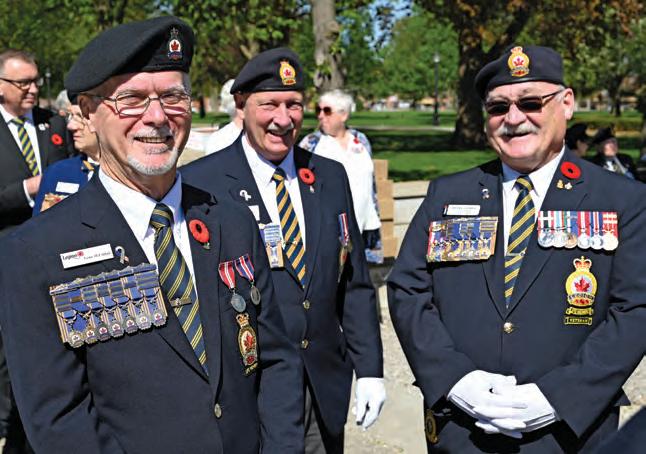
delegates in prayer, while bugler David Cunningham played “Last post” on the same instrument his grandfather used during the Battle of Vimy Ridge. And London Mayor Josh Morgan welcomed the convention. The gathering then got down to its business agenda.
President Derek Moore reported on several highlights from his three-year tenure. He emphasized the work of Ontario Command’s homeless veterans’ initiative, which has now assisted more than 1,200 individuals, as well as its efforts with the related Military Veterans Wellness Program
(more below), in which police services across the country lead work to identify and assist veterans experiencing homelessness.
Moore also mentioned some challenges, most notably that despite increasing membership, the number of volunteers for leadership positions hasn’t grown at the same pace. “Many branches are still relying on those old, true and reliable members who volunteer to do almost everything,” said Moore. “We have more newer members, most of whom are younger in age, now let’s try to retain them and find a way to get them involved.”
Throughout the convention, committees presented reports on their work.
In the Leadership Development Committee report, chair Lynn McClellan noted the importance of developing future executive members, and the invaluable tools available to branches to facilitate that goal. “I cannot overstate the importance of Legion training,” said McClellan. “If we are successful at teaching our members at branch level, we are more apt to cultivate good leaders at zone and district levels. The future of the Legion depends on well-trained and well-informed members.”
Ontario Command executive director Pamela Sweeny presented both the Honourary Treasurer’s and the Ways and Means committee reports on behalf of treasurer Ed Pigeau. After 20 years without an increase in the Ontario Command portion of the Legion membership fee, a $4 increase, effective 2026, was proposed to address the burgeoning costs of nearly everything in the interceding years. Following an impassioned discussion, delegates voted to accept the addition.
Mark Rogers presented the Membership Committee report, noting that the number of Legionnaires in the province has increased in all districts. In total, there are 87,663 members as of March 2025, up about 2,500 since 2022. “Our long-term growth, as noted by Dominion Command, is with younger members,” wrote Rogers in his report. “We can see that the marketing toward getting new members has worked.”
Elections took place throughout the convention, beginning with McClellan of Elora Branch being acclaimed president. Crystal Cook of Sutton West Branch was elected first vice over Mark Rogers of Ridgetown Branch. Rogers declined being added to the five nominees for three vice-president positions, which included Dean Weir of Wiarton
Branch, Jack Gemmell of PerthUpon-Tay Branch in Perth, Caroline Mayo of Lord Elgin Branch in St. Thomas, Rick Preston of Milton Wesley Branch in Newmarket and John Dufort of East Toronto Branch. On the second ballot, delegates elected Gemmell, Preston and Weir. The election for the honourary treasurer position pitted incumbent Pigeau of Thessalon Branch against Terry Jacobs of Kanata Branch and Sharleen Sissons of Chelmsford Branch, with the latter taking the role. Sitting chair Ron Goebel of Carleton Place Branch was challenged by Amanda Grant of Bayport Branch in Port McNicoll, but retained his position. The vice-chair position was hotly contested, taking three ballots to re-elect Ron Crown of Grand Bend Branch over Eric Ross of Goderich Branch, Greg Kobold of Brighton Branch and Pat Thompson-Perry of Pte. Joe Waters Branch in Milton.
Beyond election excitement, other highlights of the convention included:
• A presentation by Constable Aaron Dale of the Toronto Police Service, co-founder of the Military Veterans Wellness Program. “We started recognizing military veterans in crisis that were suicidal or homeless,” he said. “But we also recognized that Toronto police officers didn’t understand how to connect to suffering military veterans.” The initiative has now been adopted by other forces across Canada, as well as by the Australian Federal Police and in Ukraine;
• Guest speakers Kevin Trites and Kaitlyn Stephenson, from the southwestern Ontario division of the Operational Stress Injury Social Support network;
• Veteran Lawrence Christensen shared insights into how service dogs have helped him with posttraumatic stress disorder. He was joined on stage by other veterans and their canine companions,
all recipients of service animals through Wounded Warriors Canada and Ontario Command’s Operation Service Dog initiative.
A special guest, eight-year-old Nash Guest, who to date has raised more than $25,000 for the program, presented an additional donation for $1,300 and received a standing ovation from delegates.
Meanwhile, Legion national President Berkley Lawrence brought updates from Dominion Command, highlighting membership growth, the evolution of the Legion’s annual poppy campaign and the organization’s advocacy work. The former counted its third straight annual increase, up five per cent year-over-year, said Lawrence. With regard to the poppy, he noted the forthcoming cardboard donation boxes to replace plastic ones, among other initiatives. And with the latter, he stressed the group’s efforts to address sexual trauma in the Canadian Armed Forces.
“People recognize that what we do is important,” said Lawrence, “and they want to be part of it. It’s also what you do in your communities that makes people want to join. The events you hold, the welcoming spaces you provide and the modernization of your branches.”
Following the installation of new officers, President McClellan addressed delegates. “The theme I chose for this convention was respecting the past and embracing the future. Over the last 100 years, we’ve assisted thousands of veterans. We have given millions of dollars to countless charities and causes. We’ve been able to maintain the important presence of our branches in nearly 390 communities across Ontario,” he said.
“But we can’t sit back and dwell on the past. Our veterans need our assistance today, just as much as they always have. Knowing the dedication of our members, I believe that with good management, great ideas and hard work we can succeed for another 100 years.” L
Volunteering in the community
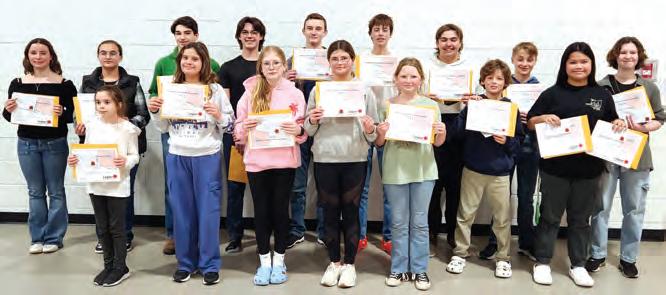
Winners
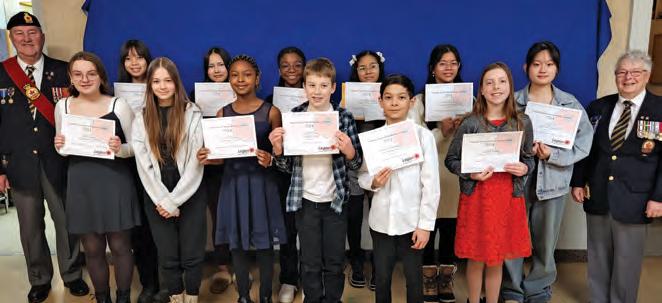
President Christine Simpson of
presents Diane Bourgeois with a Certificate of Merit for her work expanding branch membership by 62 members in 2024.
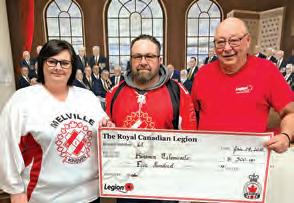
Bruce Morris of Robert Combe VC Branch in Melville, Sask., presents $500 to Melissa and Steve Kirwan, representing the Saskatchewan Kinsmen Telemiracle TV fundraiser. DIANE HACK
A plaque commemorating the Canadian crew of Lancaster ME 750 is unveiled in the village of Siddington, England, with a ceremony attended by descendants of the crew, local officials, Royal Air Force air cadets and NATO officers.
Members of Dr. C.B. Lumsden Branch in Wolfville, N.S., celebrate its reopening after a four-year closure.
Doug Cormier of Amherst, N.S., Branch presents $1,000 to Amherst Wesleyan Church representative James Jordan for the installation of an electric chair lift.
Cribbage co-ordinator Murray Dawson of Dieppe Branch in Waverley, N.S., stands alongside provincial crib championship winners Sheila Pickrem, Chuckie Wagner, Bernadette Palmer and Wendy Havenga.

Rhiannon Osborne from St. John’s, N.L., receives a provincial bursary from Newfoundland and Labrador Command.
Janis Boone of Botwood, N.L., Branch presents $550 to representative Archie Rice of the Twomey Health Centre Legion Action Committee and Veterans Pavilion.
Curtis Skiffington of Clarenville, N.L., Branch presents winner of the provincial intermediate poster, essay and video contest Raegan Snook with her certificate and $100.
Bram Churchill of Port Blandford, N.L., Branch presents a Certificate of Appreciation to retiring CO Blanche Hicks of RCSCC 310 Clode Sound sea cadets.
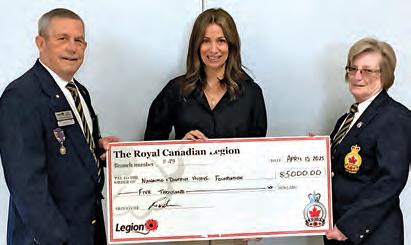
President Rod Wilkins and First Vice Shona Rowe of Mount Arrowsmith Branch in Parksville, B.C., present $5,000 to representative Tina Moreira of the Nanaimo and District Hospital Foundation.

North Burnaby, B.C., Branch President Wilson Gurney and Trudy Black (second right) present $5,000 to the Seton Villa Retirement centre, represented by Michele Cook, Stephen Graham and MP Terry Beech.
Dominion President Berkely Lawrence and Branch President Paulette Morrissey cut the ribbon to open Harbour Grace, N.L., Branch’s new building.
Gordie Martin of Britannia Branch in Victoria receives a Quilt of Valour.
Gordon Quanage of Britannia Branch in Victoria receives a Quilt of Valour.
Valley elementary students receive a tour of
conducted by
First Vice Allan Light and President Steve Robinson of Tumbler Ridge Branch in Chetwynd, B.C., present $3,250 to Tumbler Ridge Outdoor Recreation Association representatives Adriana Alves, Sherri Lynn Hewitt, Tim Croston and Ashley Maddison.

First Vice Allan Light and President Steve Robinson of Tumbler Ridge Branch in Chetwynd, B.C., present $3,250 to Tumbler Ridge food bank representatives James and Lydia Mannion.
Onoway, Alta., Branch President Richard Moses and First Vice Cliff Cottingham congratulate Rich Valley Elementary School’s Nash Hove for winning first place in the junior poem category of the Legion literary contest. JEAN MOSES
Aldergrove, B.C., Branch’s Doug Hadley, Katrina Quinn and President Deb Gray present $9,500 to WO1 Venktes, Flt. Sgt. Olivier, WO2 Malhi and Capt. Gandouin of the 746 Lightning Hawk Squadron.
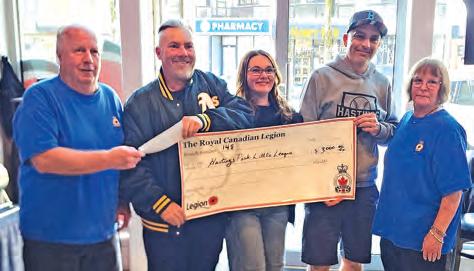
North Burnaby, B.C., Branch Second Vice Ken Roed and member Mavis Roed present $3,000 to Hastings Park Little League representatives L.J. MacVicar, Heather Boal and Jason Raulette.
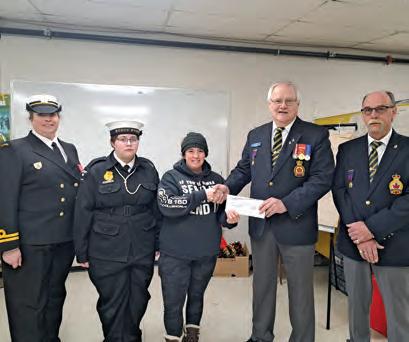
Alta., Branch members Bob McRae and Mike Kruesel present $5,000 to Navy League representatives Lieut. (N) S. Atkinson, MC M.
Ken French of Fairview, Alta., Branch presents $9,000 to Peace River Alberta air cadet squadron’s Cpl. Gabriel Glennie and Sgt. Keegan Blohm.
JIM SHARKEY
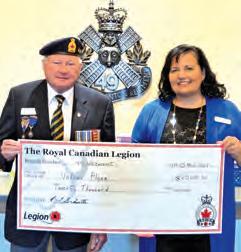
President Ralph Schutte of Whitecourt, Alta., Branch presents $20,000 to Valour Place, represented by Sylvie Keane. ELAINE McDERMID
Stony Plain, Alta., Branch’s Pat Hale and President Gord Morrison welcome new members Frank Florkowich, Gilles Grondin, James and Trish Ruddy, Greg Schroh, Lina Grondin and Steve Newton.
President Don Ebett of High Prairie, Alta., Branch presents $2,700 to 539 RCACS representative Flt. Sgt. Kaliska Chalifoux.
TAMMY NAPIER
Padre Brian MacDonald of Fredericton Branch presents $1,250 to Sub-Lt. Adele Theriault of the 130 Fredericton sea cadets, alongside Cdt. Kreuger and MC Milley.
LEAH SPENCER
Paul Bennett of Spruce Grove, Alta., Branch receives a Quilt of Valour presented by representative Barb Goodall. KRISANNE SZAKACS
Kathy Campbell, First Vice Bill White and Sarah Davies of Peninsula Branch in Clifton Royal, N.B., present Lisa Fraser, Laura Stoddard and Principal Ellen Whittaker-Brown with $1,000 toward the MacDonald Consolidated School Breakfast Program.
Padre Brian MacDonald of Fredericton Branch presents $1,250 to CWO J.P. Savoie of the 242 Fredericton army cadet corps. LEAH SPENCER
Ralph LeBlanc and President Terry McCauley of N.B. Command award Jaylin McPhee with first place in the senior colour poster category of the Legion poster contest.
Kathy Campbell of Peninsula Branch in Clifton Royal, N.B., presents $1,000 to the 140 Kingston army cadet corps, represented by Morgan Pelletier (back), Alexander Yahavi, Joss Saunders. Roenan Gallant (front), Mithic Furrow and Lieut. Cheryl Donnelly.
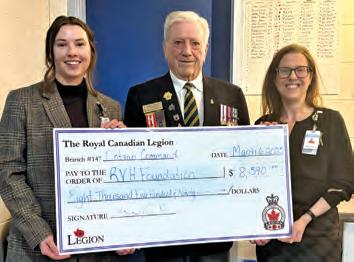
President Marcel Vigneault of Dr. W.C. (Bill) Little MM Branch in Barrie, Ont., presents $8,590 on behalf of the Ontario Command Branches and L.A. Charitable Foundation to Royal Victoria Regional Health Centre representatives Brittany Wilson and Julie Corcoran.
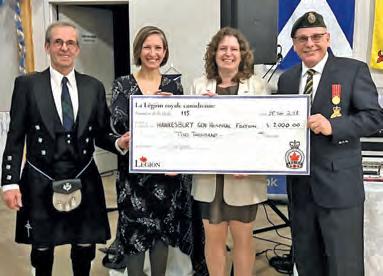
John Dalgarno and Robin Pelletier of Hudson, Que., Branch present $2,000 to the Hawkesbury General Hospital Foundation, represented by Eve de Grosbois and Erin Tabakman.
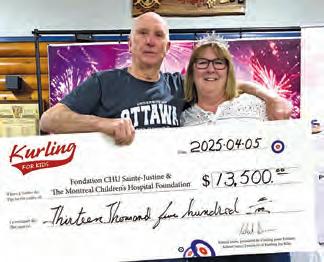
President Laura Derry of Auclair Branch in Otterburn Park, Que., presents $13,500 to Montreal Children’s Hospital, represented by Tom Langton.
L. DERRY
President Laura Derry of Auclair Branch in Otterburn Park, Que., presents $1,500 to representative Terrance Deslange of Quebec Command for the Wounded Warriors initiative. L. DERRY
President Tom Briggs, Laura Briggs and David Lamon of Matthew J. Dawe Memorial Branch in Kingston, Ont., present $6,500 to University Hospital Kingston Foundation representatives Stephanie Samms and Brent Wilson.

On behalf of the Ontario Command Branches and L.A. Charitable Foundation, President Lloyd Cull and Ron Chassie of H.T. Church Branch in St. Catharines, Ont., present $5,412 to Hotel Dieu Shaver representatives Louise Dillon, Shelby Ellis, Stacy Hancharyk and Kristina Manzi.
President Bob Lively and Joe Potts of East Hamilton Branch present representative Judith Drost Store with $7,283 toward St. Joseph’s Healthcare Foundation.
Ted Mabb, President Steve Walkom and First Vice Russ Copeland of Mitchell, Ont., Branch present $10,000 to St. Joseph’s Healthcare Foundation representative Lisa Giroux.
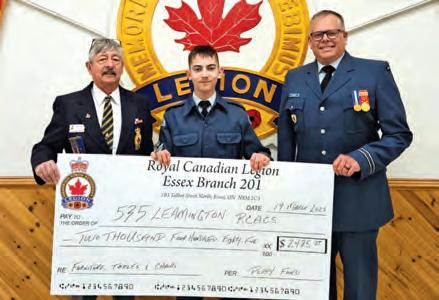
Erroll Caza of Capt. Brien Branch in Essex, Ont., presents $2,485.37 to Cpl. Corbin Azzopardi and Capt. Garnet Eskritt of the 535 Leamington air cadets.
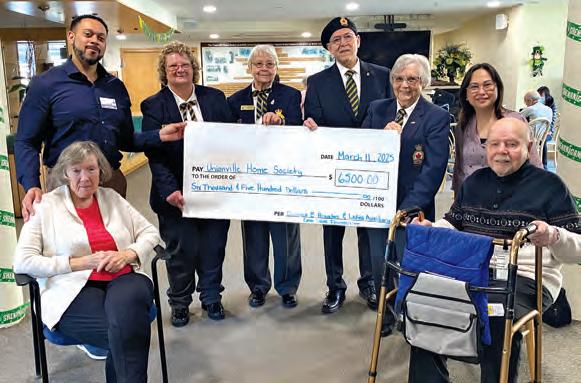
On behalf of the Ontario Provincial Branches and L.A. Charitable Foundation, members of Stouffville, Ont., Branch and Richmond Hill, Ont., Branch present $6,500 to staff and members of the Unionville Home Society.
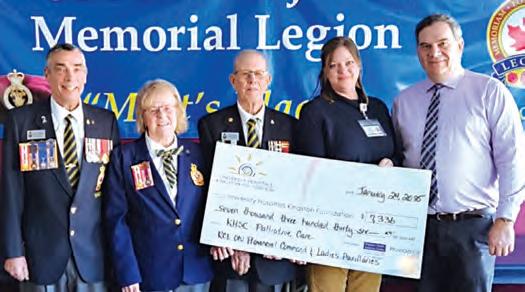
On behalf of the Ontario Command Branches and L.A. Charitable Foundation, President Tom Briggs, Laura Briggs and Dave Lamon of Matthew J. Dawe Memorial Branch in Kingston, Ont., present $7,336 to Kingston Health Sciences Centre representatives Lori Van Manen and Brent Wilson.
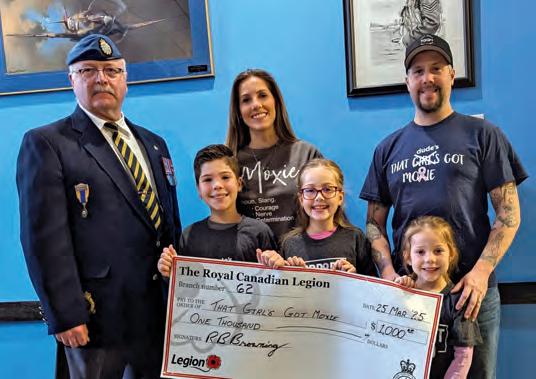
Second Vice J.P. Presley of Chatham, Ont., Branch presents $3,000 to 59 Legion Highlanders army cadet corps representatives Kevin Shaw, Sgt.-Maj. Lucy Thrift and CO D.J. Pardoe.
Second Vice J.P. Presley of Chatham, Ont., Branch presents $3,000 to 294 air cadets representatives WO Jeremiah Laroque and Officer Vicki Eskritt.


First Vice Yves Bouchard and Peggy Nancarrow of Trenton, Ont., Branch present $1,000 each to Andrew Hutchinson of Community Living Quinte West, Mary LaBine of the Canadian Mental Health Association Hastings Prince Edward, and Craig Oliver of the Trenton Care and Share Food Bank.
Newbury, Ont., Branch President Rick Close presents funds to Capt. Vikky Broad of the 2884 army cadets.
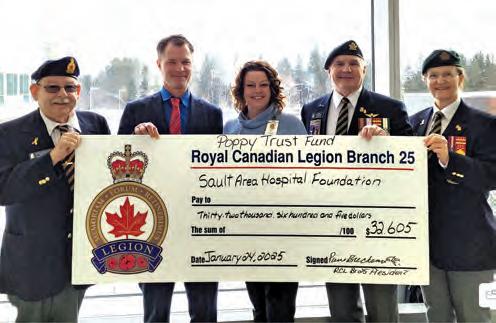
Sault Ste. Marie, Ont., Branch’s Chuck Febbraro, President Pierre Breckenridge and Pascale Crépault-Breckenridge present $32,605 to Sault Area Hospital Foundation representatives John R. Farrell and Terese Martone.
Ty Seeley and Don Swerdfeger of Rideau Lakes Branch in Portland, Ont., present awards to Waylon Gorr, Valentina Boles and Macey Spencer for the District G public speaking competition.
President George Garrard of Capt. Fred Campbell VC Branch in Mount Forest presents $1,000 to the 895 Fred Campbell VC air cadets, represented by Flt. Sgt. Liam Miller, LAC Kurt Leies and Capt. Mark McGee.
President Don Davidson of St. Joseph’s Villa receives $20,824.77 from Jim Byron of Valley City Branch in Dundas, Ont.
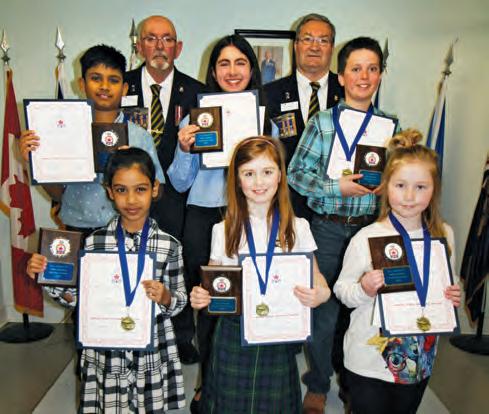
Winners of the District G public speaking competition are awarded cerificates by Deputy Commanders Ty Seeley and Don Swerdfeger of Rideau Lakes Branch in Portland, Ont.
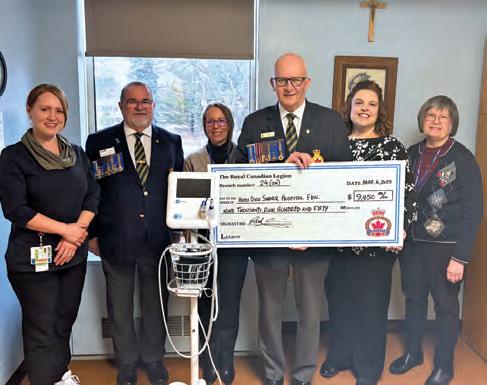
President Lloyd Cull and Ron Chassie of H.T. Church Branch in St. Catharines, Ont., present $9,450 to Hotel Dieu Shaver Hospital, represented by Shelby Ellis, Stacey Hancharyk, Kristina Manzi and Louise Dillon.
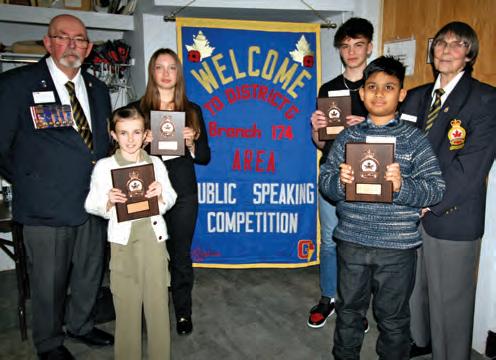
Arnprior, Ont., Branch public speaking competition winners Ainsley Perez (back), Waylon Gerr, Lennox Cybulski-Hollett (front) and Di Tejasveer Persoo are presented certificates by branch members Ty Seeley and Marie Gordon.
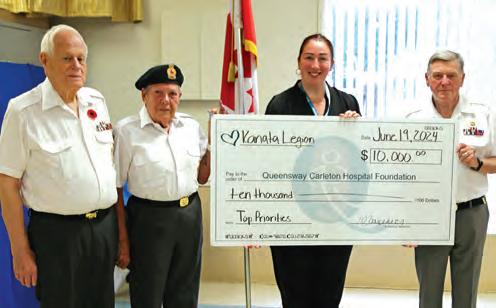
George Pollock, President Mary Jo Gauthier and Dennis Hearn of Kanata, Ont., Branch present $10,000 to the Queensway Carleton Hospital Foundation, represented by Katie Barrett.

Kirkland Lake, Ont., Branch President John MacDonell, accompanied by Magic of Christmas executives Michelle Whelan, Carol Penfold and Heather Taylor-Sandrin, unveil renovations to the branch funded through the Magic of Christmas program.
On behalf of the Ontario Command Branches and L.A. Charitable Foundation, Bancroft, Ont., Branch President Stacy Talsma (centre), along with First Vice Larry Shattraw and secretary Caroline Davis, present $6,696 to representatives Larisa Toma and Denise McCormick of Centennial Manor.
Judy Heasman and Lynn Deering of the Marmora, Ont., Branch present $6,458 to the Municipality of Marmora and Lake Medical Centre, with Councillor Jane Lakatos, John Connoly, Dr. Payman Charkhzarin, Dr. Geoffery Sinton and Mayor Jan O’Neill attending.
Provicinal senior dart champions from Sunset Post Branch in Victoria Harbour, Ont., Al Lea, Mike Desroches, Jim Pearson and Mark Simms pose with their plaque, accompanied by provinical sports officer Walter Stevens and District A sports chair Leonard Drouillard.
On behalf of the Ontario Command Branches and L.A. Charitable Foundation, Kapuskasing, Ont., Branch President Debbie Morin presents $5,455 to staff and members of North Centennial Manor.
On behalf of the Ontario Command Branches and L.A. Charitable Foundation, President George Garrard of Capt. Fred Campbell VC Branch in Mount Forest, Ont., presents $6,500 to the Louise Marshall Hospital Foundation, represented by Terry Ellison.

Tex Kiser, Kevin Farris and President Harry Hamilton of Port Colborne, Ont., Branch display handcrafted wooden poppies, sold for a fundraising initiative that generated $2,167 toward the Poppy Fund.
Ben Pearce and President Judy McNutt of Streetsville Overseas Veterans Branch in Mississauga, Ont., present $10,000 to representative Tooba Nasir of the Trillium Health Partners Foundation.
East Hamilton Branch President Bob Lively and Joe Potts present St. Joseph’s Villa Foundation representatives Don Davidson and Meg Lyu with $6,604 on behalf of the Ontario Command Branches and L.A. Charitable Foundation.

On behalf of the Ontario Command Branches and L.A. Charitable Foundation, Wingham, Ont., Branch representatives Jim Saint, Bonnie Ross, President Rose McKague and Linda Gray present $6,500 to the Wingham and District Hospital Foundation, represented by Nicole Duquette-Jutzi.
Wellington, Ont., Branch members Mitch Smith, Buck Buchanan, Ron Ellis, President Peter Campbell and Ken How install a plaque for the Vimy Ridge oak tree in Wellington Park.
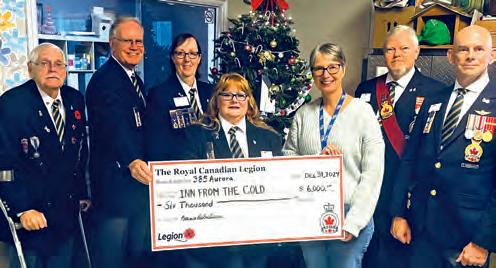
Members Norm Wright, Claude Arcand, Lori Hoyes, Bonnie Robertson, Chris Duncan and Stephen Boyne of Col. Fred Tilston VC Branch in Aurora, Ont., present $6,000 to representative Ann Watson of the Inn From the Cold shelter.
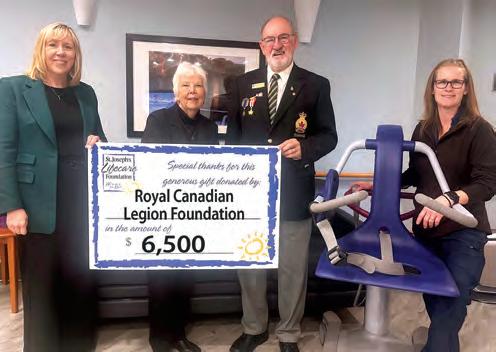
On behalf of the Ontario Command Branches and L.A. Charitable Foundation, Sandy Wallace (second left) and President Ron Butcher of Dunsdon Branch in Brantford, Ont., present $6,500 to the St. Joseph’s Healthcare Foundation, represented by Julie Powell and Donna Douglas.
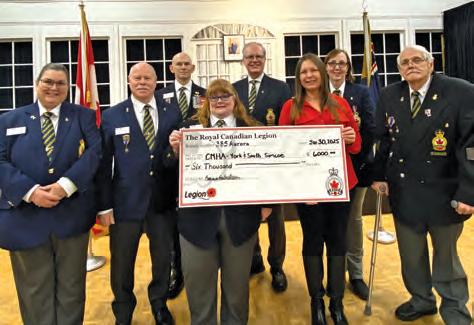
President Bonnie Robertson and accompanying members of Col. Fred Tilston VC Branch in Aurora, Ont., present $6,000 to Canadian Mental Health Association York and South Simcoe representative Vicky Hatzopoulos.
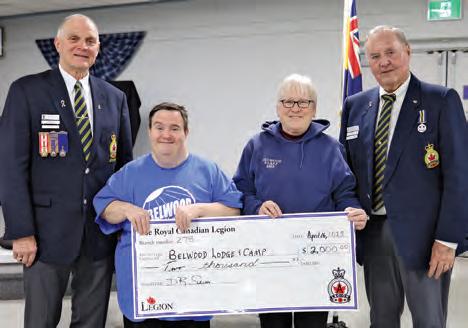
Fergus, Ont., Branch President Randy Graham and Don Seim present $2,000 to the Belwood Camp and Lodge, represented by Mike Patteson and Cathy Bruner.
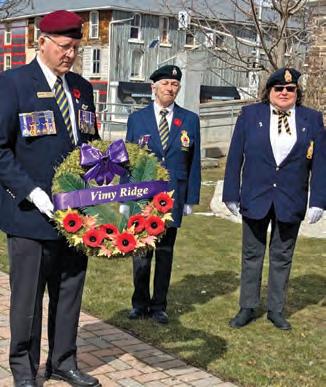
Ont.,
Norm Marion, accompanied by Penny Lawrence-Judges and Dianne Sauvé, places a wreath in memory of the soldiers who fought and died at Vimy Ridge in 1917.
100th Birthday.
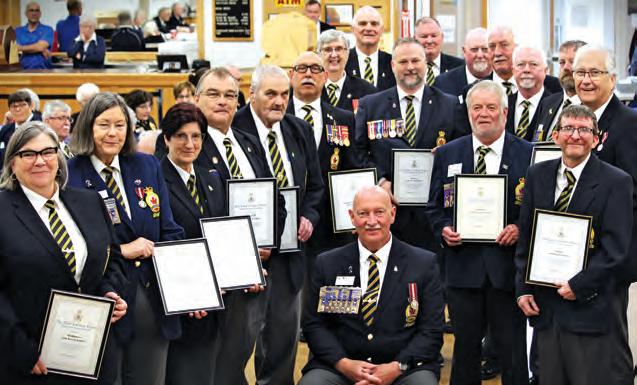
anniversary certificates.

Wellington, Ont.,
presents
to C.M.L.
School Principal Kathryn Acorn and students for the Food for Learning program.
House Canada.
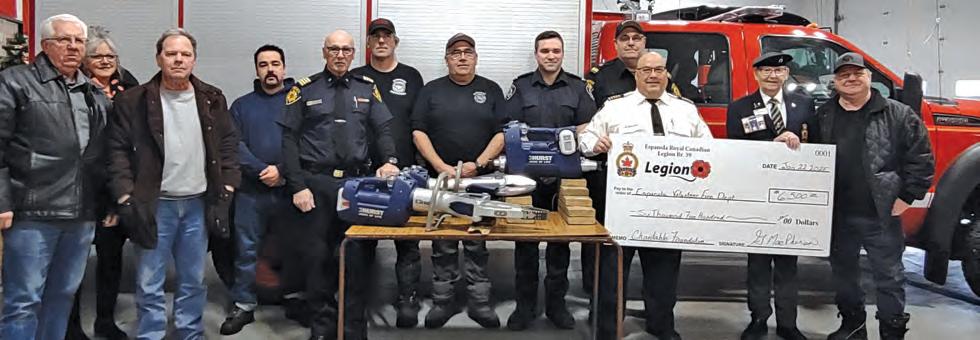
Sarnia, Ont., Branch’s Bruce Browning presents $2,000 to representatives John and Sharon Little of Talk To Me Johnny Sarnia, an organization raising awareness for veterans’ mental health.
President David Doucette of Lt.-Col. E.W. Johnstone Branch in Kensington, P.E.I., presents Naill Curley with his third-place provincial award and second-place branch award in the colour poster division of the Legion poster contest.
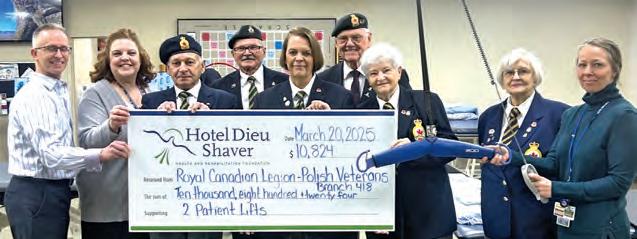
Bogdan Wilk, Second Vice Richard Bucko, Third Vice Yvonne Glowacki, President Stefan Wieclawek, Mira Ananicz and Sabina Glowacki of Polish Veterans Branch in St. Catharines, Ont., present $10,824 to the Hotel Dieu Shaver Rehabilitation Centre, represented by Dr. McMillan, Kristina Manzi and Stacey Hancharyk.
Richard Barnes, Mike Roberts, Dylan Jenkins and Marshall Holden of Kingston Branch in New Haven, P.E.I., receive a trophy celebrating their provincial darts win from Vice President Gordon Perry.
President David Doucette of Lt.-Col. E.W. Johnstone Branch in Kensington, P.E.I., presents Charlie Jollimore with his second-place provincial award and first-place branch award in the colour poster division of the Legion poster contest.
President Vic Renouf of Slovak Branch in Thunder Bay, Ont., presents Aidan Matyasovszky of Lakehead University with a $1,000 bursary.
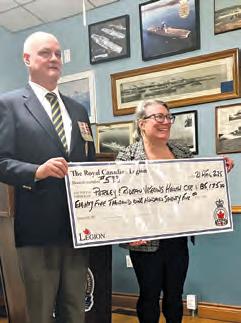
President Jake McDavid of Bells Corners Branch in Nepean, Ont., presents $85,175 to Perley Health Foundation representative Michelle Gravelle.
President Sue Gaudette of Atikokan, Ont., Branch presents $2,000 to the Atikokan Youth Centre, represented by Pauline Jolicoeur and Rebecca James.

Elkhorn, Ont., Branch L.A. President Kay Thompson and President Garth Mitchell present $7,000 to the Elkhorn Early Learning Centre, represented by Sydney Stonehouse, Trista Hayward and Angie Stonehouse.
President George Garrard of Capt. Fred Campbell VC Branch in Mount Forest presents representative Terry Ellison of the Louise Marshall Hospital Foundation with $6,500 on behalf of the Ontario Command Branches and L.A. Charitable Foundation.
The L.A. of Port Arthur Branch in Thunder Bay, Ont., present $1,500 to the Canadian Mental Health Association. Those present included Branch President Katriina Myllymaa, the Canadian Mental Health Association’s Daniel Sabble and L.A. ways and means chair Nancy Singleton. Bells Corners Branch in Nepean, Ont., presents $10,000 to each of the 640 Royal Canadian army cadet corps, the 2332 Major EJG Holland VC army cadet corps and the 2870 Dragoons.
Fredericton, N.B., Branch Padre Rev. Brian MacDonald presents $1,250 to the 333 Lord Beaverbrook air cadet squadron, represented by Captain Patrick Brunelle.
President David Doucette of Lt.-Col. E.W. Johnstone Branch in Kensington, P.E.I., presents Kalei Ross with her certificates for first place at branch level and second place provincially for her black-and-white poster in the Legion poster contest.
Send your photos and news of The Royal Canadian Legion in action in your community to your Command Correspondent. Each branch and ladies auxiliary is entitled to two photos in an issue. Any additional items will be published as news only. Material should be sent as soon as possible after an event. We do not accept material that will be more than a year old when published, or photos that are out of focus or lack contrast. The Command Correspondents are:
BRITISH COLUMBIA/YUKON: Graham Fox, 4199 Steede Ave., Port Alberni, BC V9Y 8B6, gra.fox@icloud.com
ALBERTA–NORTHWEST TERRITORIES: Donna Ganzon, 2020 – 15 Street NW Calgary, AB T2M 3N8, abnwtsubmissions@abnwtlegion.com
SASKATCHEWAN: Tara Brown, 2267 Albert St., Regina, SK S4P 2V5, admin@sasklegion.ca
MANITOBA: George Romick, 320 Admiral Court, Thunder Bay, ON P7A 8B5, romickg@tbaytel.net
NORTHWESTERN ONTARIO: George Romick, 320 Admiral Court, Thunder Bay, ON P7A 8B5, romickg@tbaytel.net
ONTARIO: Julie Stephens, 2 Malibu Lane, Fenelon Falls, ON K0M 1N0, juliestephenslegion25@gmail.com
QUEBEC: Mary-Ann Latimer, 105-2727 rue St. Patrick, Montreal, QC H3K 0A8, msmarts@bell.net
NEW BRUNSWICK: Harold Wright, 2-299 Main St., Saint John, NB E2K 1J1, foulis20@gmail.com
NOVA SCOTIA/NUNAVUT: Mary Phillips, 319 East Broadway, South Bar, NS B1N 3J9, maryp7910@gmail.com
PRINCE EDWARD ISLAND: John Yeo, 657 Rte. 19, Meadow Bank, PE C0E 1H1, islander657@yahoo.ca
NEWFOUNDLAND AND LABRADOR: Brenda Slaney, Box 5745, St. John’s, NL A1C 5X3, bslaney@nfld.net
DOMINION COMMAND ZONES: EASTERN U.S. ZONE, Gord Bennett, 803-190 Cedar St., Cambridge, ON N1S 1W5, Captglbcd@aol.com; WESTERN U.S. ZONE, Douglas Lock, 1531 11th St., Manhattan Beach, CA 90266, douglock@fastmail.com
Submissions for the Honours and Awards page (Palm Leaf, MSM, MSA and Life Membership) should be sent directly to Legion Magazine, 86 Aird Place, Kanata, ON K2L 0A1 or branchnews@legion.ca.
TECHNICAL SPECS FOR PHOTO SUBMISSIONS
DIGITAL PHOTOS—Photos submitted to Command Correspondents electronically must have a minimum width of 1,350 pixels, or 4.5 inches. Final resolution must be 300 dots per inch or greater. As a rough guideline, colour JPEGs would be between 0.5 megabytes (MB) and 1 MB.
PHOTO PRINTS—Glossy prints from a photofinishing lab are best because they do not contain the dot pattern that some printers produce. If possible, please submit digital photos electronically.
FRENCH INSERT—To receive a French insert of Legion Magazine content, please contact MagazineSubscriptions@legion.ca or call 613-591-3335.
EMIL OLSON
Kennebecasis Br., Rothesay, N.B.
Kennebecasis Br., Rothesay, N.B.
JIM DAVIS
Stephenville Br., N.L.

ERNIE GADZIG
Fort Malden Br., Amherstburg, Ont.

EARL AGGETT
Coe Hill Br., Ont.

BRIAN SAVOY
Stevenson Building Br., Richibucto, N.B.
JOHN GARDNER
Kennebecasis Br., Rothesay, N.B.
GLYNN FARDEN
Matthew J. Dawe Memorial Br., Kingston, Ont.
SYLVIA SELL Renfrew Br., Ont.
JIM SUMMERS
Peterborough Br., Ont.
BLAIR FORSYTHE
Kennebecasis Br., Rothesay, N.B.
Kennebecasis Br., Rothesay, N.B.
GARY GROULX
Sault Ste. Marie Br., Ont.
Fort Malden Br., Amherstburg, Ont.
Coe Hill Br., Ont.

Kennebecasis

West

Lord

Sault Ste. Marie Br., Ont.
Lord
Riverside


55 years 65 years 70 years 80 years 75 years 60 years
Page 82 of the May/June edition contained a misprinted name. Instead of Lorraine Irvine-Ways, the correct name is Lorraine Irvine-Hastings. Additionally, page 86 contains a misprinted name of Renault Fenske, the correct name being Renault Hammond.
ALBERTA-N.W.T.
DOUGLAS DELORME
St. Albert Br.
CONNIE LEE MORTON
Mayerthorpe Br.
BRITISH COLUMBIA/ YUKON
STEVE MacDONALD Salmo Br.
PETER SCHIMMEL Salmo Br.
MANITOBANORTHWESTERN ONTARIO
BRIAN NAZARKO
Springfield Br., Hazelridge, Man.
NEW BRUNSWICK
NORM SHORT
Peninsula Br., Clifton Royal
NEWFOUNDLAND AND LABRADOR
KEVIN POWER
Brigus Br.
NOVA SCOTIA/ NUNAVUT
STEPHEN MacLENNAN
Cape Sable Br., Clark's Harbour
DONALD HUSSEY
Whitney Pier Br., Sydney
CHARLENE PLUME
Trenton Br.
JEFF PAULIN
East Toronto Br.
JOE MacDONALD
Beaver Valley Br., Clarksburg
CHRISTOPHER MURPHY
Westboro Br., Ottawa
HOWARD TAIT
Elliot Lake Br.
VERNA STOLZ
Hearst Br.
DORIS ERMEL
Hearst Br.
JEAN BERUBE
George Pearkes VC Br., Summerside
KENNETH E. NOBLE
St-Eustache Br., Deux-Montagnes
CHARLES A. McFARLINE—Seeking photos of Sgt. Charles Alson McFarline (1892-1915), serving with Lord Strathcona’s Horse (Royal Canadians). Please contact Doreen Barnes at 613-345-3365.
PARADE—The 103rd Anniversary Warriors’ Day Parade will take place on Aug. 16, 2025, 10:30 a.m. at the Canadian National Exhibition in Toronto. The parade will commemorate the 80th Anniversary of the end of WW II and the liberation of the Netherlands. Details at www.thewarriorsdayparade.ca.
MEDALLION —In search of a new home for a Dutch government medallion commemorating veterans who attended a 1984 ceremony celebrating the liberation of the Netherlands. Seeking those involved in the effort, or those connected through family. Please contact Kelvin Desplanque at kelvin.desplanque@NuElck.com.
REUNION - 18—(Thunder Bay) Service Battalion, 50th Anniversary Reunion, Sept. 27, 2025, Contact Gerry at gerrymk@tbaytel.net.
HONG KONG VETERANS ASSOCIATION—80th Anniversary of VJ-Day Reunion, Aug. 14-17, 2025, Contact Kathie Carlson at kathie60john62@hotmail.com, 403-327-2799.






J.L. Granatstein
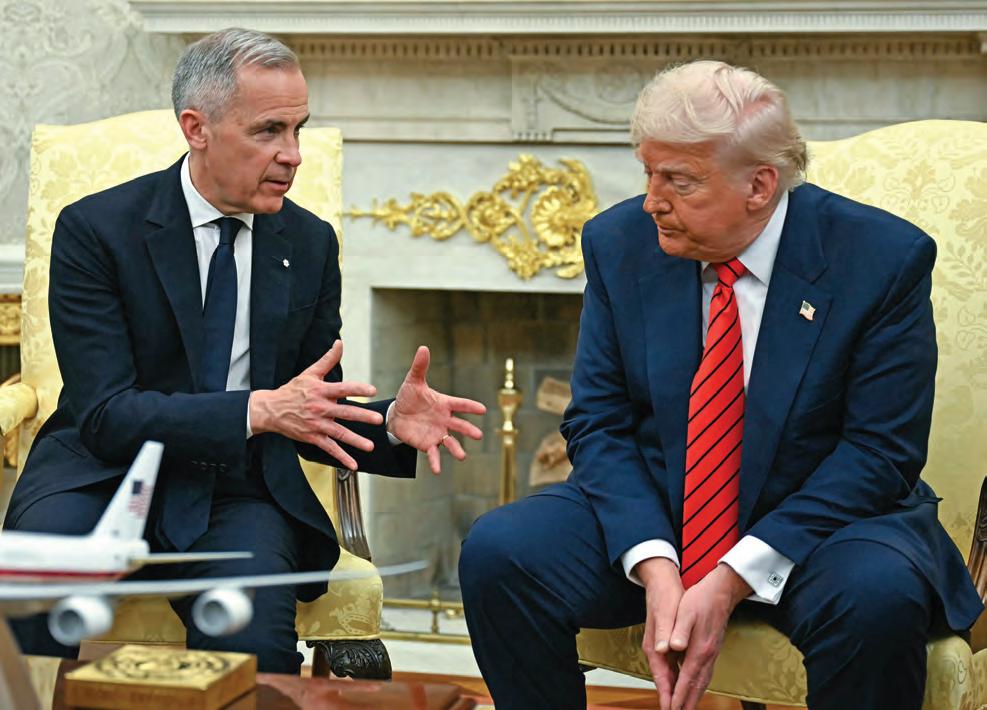
Has the 150-plus year friendly relationship between Canada and the U.S. really come to an end?
From best friend to enemy in a few months? How can this be possible? And is it even true?
Since Donald Trump returned to the White House in January 2025, Canada’s relations with the U.S. have been in a serious state of flux. President Trump has talked
about annexing Canada, altering the border and fulfilling American manifest destiny. He repeatedly referred to the country as “the 51st state” and frequently called Justin Trudeau, then in his last days as prime minister, governor. And he wasn’t joking, Trudeau said. Trump genuinely meant it.
Media stories subsequently began to circulate that the U.S. administration was considering ejecting Canada from the Five Eyes intelligence-sharing consortium linking Ottawa with the U.S., Britain, Australia and New Zealand. And, Norad, the key fixture in North American defence for six decades, was also rumoured to be a potential casualty of reconsiderations of cross-border military collaboration.
The reaction to these Trumpian stances in Canada was striking. “Elbows up,” referencing how late NHL great Gordie Howe played hockey, became a rally cry on social media. And Ontario Premier Doug Ford took to wearing a “Canada is not for sale” cap. Then Canadian
shoppers began rejecting U.Smade goods, especially in grocery stores, searching for homegrown alternatives. Plus, Canadian visits to the U.S. dropped dramatically, down 17 per cent year-over-year in March 2025, nearly 1 million fewer individuals making the trip. Meanwhile, Trump’s MAGA supporters repeated and reinforced his message. At border crossings, U.S. customs officials became more rigorous in their inspections, turning away Canadian citizens who might have been born in Iran or Afghanistan and searching cellphones for anti-Trump messages. Academics receiving research funding for joint projects with American scholars suddenly had to fill in forms declaring that none of their work would be affected by diversity, equity and inclusion initiatives. The U.S. political landscape changed so quickly that some experts said it was moving toward an autocracy.
President Trump inspired an outburst of Canadian nationalism and anti-Americanism not seen since the 1988 “free trade” election.
Canada wasn’t the only target of such Trump ramblings. He demanded that Panama give control of the Panama Canal back to Washington. And he said that Greenland should be annexed by the U.S. in the interest of American security. With Russian and Chinese designs on the Arctic, only acquiring or, if necessary, seizing the large polar island would keep the U.S. safe. It didn’t seem to matter that Greenland, an autonomous territory of Denmark, is, like Canada, a member of NATO. Nor did the fact that Denmark and Canada had both fought alongside U.S. troops during the two-decadelong war in Afghanistan. It was as if madness had seized the occupant of the White House.
President Trump blaming Ukraine for starting the war with Russia added to the sense of anarchic policy-making in the U.S.—and cast the future of NATO in doubt.
Then came Trump’s tariffs, initially leveled against Canada largely in response to the “flood” of fentanyl headed south to the U.S. Remarkably, however, U.S. Customs and Border Patrol data indicated that less than 0.1 per cent of the deadly drug—just 27 kilograms—seized in the country came from Canada. No matter: tariffs would still be slapped on Canadian goods in the interest of American national security.
Then in early April, Trump imposed tariffs on autos and parts (along with numerous other products) made in almost every country (including Canada) except Russia, Belarus and North Korea. Most economic experts could make little sense of the move and in the days to follow, stock markets around the world plunged. Many observers indicated the result would be a global recession or even a repeat of the 1930s Depression.
The Canadian response to all this was to promise to spend more on defence and to seek new trading partners.
Both the Liberals and the Conservatives pledged to reach NATO’s two per cent of gross domestic product spending minimum on military someday, just as the U.S. said five per cent should be the goal. As for trade, about 75 per cent of Canadian trade these days is with the U.S. To move away from that, even with higher tariffs, is sure to be difficult. Prime Minister John Diefenbaker
tried to transfer 15 per cent of Canadian trade from the U.S. to Britain in 1957, but the plan fizzled. Pierre Trudeau’s attempts to broaden Canadian trade to Europe and Asia in the 1970s likewise had minimal impact. The U.S. is nearby, rich, and the trade links have held firm. Will it really be any different in 2025?
And is the U.S. really the enemy? Trump is acting like one, but very few believe he will go beyond using economic threats as weapons against Canada. Plus, public opinion polls indicate Americans have little interest in annexing Canada— in an early spring 2025 survey, 60 per cent said they had no interest in it, while another 32 per cent said they would only support the idea if Canadians wanted it. Even a Republican-dominated Senate voted in favour of a resolution that forbade hitting Canada with tariffs because of false claims it’s a major fentanyl supplier.
In early April, Prime Minister Mark Carney said that Canadian co-operation with Washington on defence and security would continue, but that he would try to assemble a “coalition of like-minded countries” as an alternative to U.S. trade.
“If the United States no longer wants to lead, Canada will,” said Carney. “The 80-year period when the United States embraced the mantle of global economic leadership, when it forged alliances rooted in trust and mutual respect and championed the free and open exchange of goods and services, is over. While this is a tragedy, it is also the new reality.” So, it is. But the road ahead remains perilous. L
Cumulogranitus: Air force slang for one of those pesky clouds with a mountain inside.
Stan Heather of Toronto sends this story. In June 2012, 34 WW II veterans flew to Britain for the dedication and unveiling of the Bomber Command Memorial in London.
On their first evening, four of them decided to go to a fine dining establishment. They found a beautiful restaurant and listened as the waiter outlined the specials. One of the patrons mentioned, “I’d love fish and chips.” Everyone, including the waiter, laughed. When the food arrived, under silver domes, the first dish unveiled was an order of fish and chips, complete with mushy peas. The restaurant had dispatched someone to a chip shop down the street to bring back a special dinner. It was much enjoyed.
The perils of recruit school. The sergeant looks over a gaggle of new soldiers. “Anybody here interested in music?” After a pause, two hands rise tentatively. “I play guitar, sergeant,” says one rookie. “Me, too, sergeant,” says the other. The sergeant’s eyes light up. “Great. Get down to the mess on the double. They’re waiting for you to move the piano.”
Aircraft manufacturers have tended to christen their products with catchy names like Spitfire, Thunderbolt and Hellcat. The people who fly them, on the other hand, have tended to apply their own labels. Often, their nicknames are less than complimentary. Here are a few labels given to planes flown by the Royal Canadian Air Force at one time or another. Dollar 19, the C-119 Flying Boxcar, 1950s.
Flying Banana, the Vertol-Piasecki H-21 helicopter, 1950s. Named for the distinctive bend in its fuselage.
Flying Porcupine, the Short Sunderland flying boat, WW II. It was so named by the Germans because it was studded with machine-guns.
> Do you have a funny and true tale from Canada’s military culture? Send your story to magazine@legion.ca
Hallybag, the Handley Page Halifax bomber, WW II.
Lizzy, the Westland Lysander, WW II.
Mossie, the De Haviland Mosquito, WW II.
Pregnant Duck , the Lockheed Hudson patrol bomber, WW II. It had a plump outline.
Pregnant Frog, the Grumman Goblin, a biplane fighter, WW II. It was not a sleek aircraft by any stretch of the imagination.
Steam Otter, the De Havilland Canada Otter. It got this nickname, suggesting old technology, after the appearance of its successor, the turbo-prop Twin Otter, known as the Twotter.
Stoof, the Grumman Tracker; from the official U.S. Navy designation S2F, 1960s-70s.
Strainer, the Vickers Stranraer flying boat, WW II.
Stringbag, the Fairey Swordfish biplane torpedo bomber, WW II; named because of the variety of equipment it could carry, reminding pilots of the multi-purpose string shopping bags used at the time.
Sword, the North American F-86 Sabre, 1950s.
What-a-Pity, the Westland Wapiti light biplane bomber, 1920s-1930s.
Wimpey, the Vickers Wellington bomber, WW II. Named after J. Wellington Wimpey, a character in the Popeye cartoons of the day.
The U.S. Navy is a dry service, with no alcohol on its vessels. That has often led American officers to wangle invitations to British or Canadian ships to get a drink in the mess.
In 1942, a Canadian corvette was escorting a convoy to Boston from Halifax when it was joined by a U.S. Navy blimp as an air escort. The blimp, an ancestor of those that drift over today’s sporting events, flashed a signal: Hello, always glad to see you, even though we are a dry Navy and you are a wet one.
The corvette replied: “If you’re thirsty, come alongside.”
The balloon changed course and, in a moment, was floating directly overhead. A bucket came down on a long rope and the captain sent someone to fetch a half dozen bottles of beer, which were quickly hoisted aloft.
The blimp returned to its station, signalling: Here’s to you, Canadian Navy. We’ll make sure you are very well protected.
The convoy reached Boston without incident.
A Canadian who was seconded to the British army with NATO in Germany in the 1950s recalls an evening in the mess with a very senior officer who had come to inspect the local units.
He was being briefed by his aide about a big parade to be held the next day. The aide said he would write the various necessary commands on a small card that the general could consult.
The general was having none of that. “Oh, no. I’ll just mumble some mumbo-jumbo. The soldiers know what to do. They won’t let me down.”
And they didn’t.
THE FIRST DISH UNVEILED WAS, AN ORDER OF FISH AND CHIPS, COMPLETE WITH MUSHY PEAS.
We have all heard of gremlins. But few know that there are several different kinds of gremlins:
The Ampless drains batteries. The Creeper tampers with instrument needles, making them creep about. The Petrol Boozer causes fuel problems. Zero puts ice on the wings. Shorty creates problems in electrical circuits.
A Widget is a baby gremlin.
Everyone knows Murphy’s Law: If anything can go wrong, it will go wrong.
But there is also a Second Law: If everything is proceeding on time, within budget and without any failures, you have overlooked something.
And a Third Law, too: If there is a possibility of two or more things going wrong, the first to go wrong will be that which has the worst consequences. L
by Malcolm Jones

By Mark Zuehlke
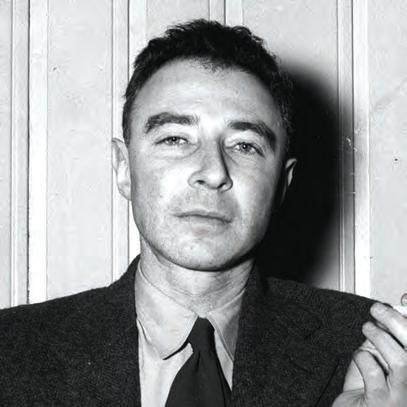
Two scientists led the race between the U.S. and Germany
the atomic bomb
J. ROBERT OPPENHEIMER
AtTHE TOWER VAPORIZED. A HUGE ORANGE AND YELLOW FIREBALL
5:30 a.m. on July 16, 1945, J. Robert Oppenheimer and other leading figures involved in the Manhattan Project witnessed the first nuclear detonation of a plutonium bomb in a remote corner of the Alamogordo Bombing Range, 338 kilometres south of Los Alamos, N.M. Oppenheimer, director of the Manhattan Project’s Los Alamos Laboratory, had been appointed in the fall of 1942 to lead America’s effort to design and construct the world’s first atomic bomb. Now, the time had come to see whether theory could become reality.
consciousness as the ultimate symbol of power and awesome destruction.
“We knew the world would not be the same,” Oppenheimer wrote later. “A few people laughed, a few people cried. Most people were silent. I remembered the line from Hindu scripture, the BhagavadGita…‘Now I am become Death, the destroyer of worlds.’ I suppose we all thought that, one way or another.”
“‘Now I am become Death, the destroyer of worlds.’ I suppose we all thought that, one way or another.”
—J. Robert Oppenheimer
Oppenheimer wasn’t confident, betting $10 that the bomb wouldn’t work. Others present feared the explosion might ignite the atmosphere, potentially destroying New Mexico or even the entire world. The device was mounted at the top of a 30-metre-high tower for the test—named Trinity by Oppenheimer. Precisely on time, the bomb exploded. The tower vaporized. A huge orange and yellow fireball stretched skyward and spread. Then a second, narrower column rose to form the distinctive mushroom cloud that was to be thereafter imprinted on human
In less than three years, Oppenheimer had led the American drive to develop an atomic weapon through to fruition. It was a stunning achievement and likely wouldn’t have been possible if he hadn’t been in charge. Oppenheimer was an exceptional theoretical physicist who had already been deeply involved in research the previous year to determine how much fissionable material—such as uranium-235 or plutonium-239—would be necessary to yield a viable weapon. This was the puzzle the Los Alamos team solved.
Originally, the Manhattan Project was intended to develop two bombs for use against Germany. The war in Europe, however, was won before the weapons were ready. Japan was then targeted. On Aug. 6, 1945, the only Manhattan Project bomb built from rare weapons-grade uranium, Little Boy, struck Hiroshima. Nagasaki was then destroyed by a plutonium bomb—Fat Boy— on August 9. The nuclear age had begun. L
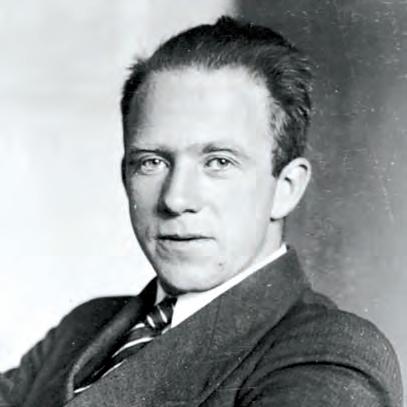
WERNER HEISENBERG

“Idon’t believe a word of the whole thing,” Werner Heisenberg said upon hearing that the U.S. had dropped an atomic bomb on Hiroshima. Having been awarded the Nobel Prize in Physics in 1932, Heisenberg was considered one of Germany’s leading physicists.
In 1942, Albert Speer, Reich minister of armaments and war production, had made Heisenberg the scientific head of Germany’s nuclear program. Heisenberg warned Speer that developing a functional bomb wouldn’t be possible until at least 1945 and would require a massive investment of money and other resources. Speer’s enthusiasm for the project was lukewarm. To avoid being blamed should the project fail to deliver, he never fully briefed Hitler on it.
Heisenberg was no administrator, so the German project lacked the efficient leadership and co-ordination that J. Robert Oppenheimer managed to bring to the Manhattan Project. In another 1942 meeting chaired by Speer, Heisenberg created a stir when he cited the amount of uranium-235 required to create a bomb. Various scientists and officials countered that no such weapon was possible.
Heisenberg later wrote that the “government decided that work on the reactor project must be continued, but only on a modest scale. No orders were given to build atomic bombs.”
Heisenberg’s team never produced a successful chain reaction, nor a process for enriching uranium. They failed to consider substituting plutonium for the rare uranium-235 and they based their entire project on utilizing heavy water to slow and control the fission process rather than— as Oppenheimer did—using graphite as the moderator. This last factor proved a fatal flaw.
Germany’s only heavy water source was from a plant in Vemork, Norway. On Feb. 28, 1943, a Norwegian commando raid damaged the facility’s heavy water section. Although the plant was repaired, the Allies knew what the Germans were doing there and subjected it to repeated aerial bombardment that prevented its return to full capacity.
THE GERMAN PROJECT LACKED THE EFFICIENT LEADERSHIP AND CO-ORDINATION THAT J. ROBERT OPPENHEIMER MANAGED TO BRING TO THE MANHATTAN PROJECT.
“The whole structure of the relationship between the scientist and the state in Germany was such that although we were not 100% anxious to do it, on the other hand we were so little trusted by the state that even if we had wanted to do it, it would not have been easy to get it through,” Heisenberg wrote in 1946 while detained by the Allies.
The Germans slogged along, while the Americans—believing they were in a race—sprinted to the finish line and carried the day. L
“Work on the reactor project must be continued, but only on a modest scale. No orders were given to build atomic bombs.” —Werner Heisenberg
By Alex Bowers
fter Britain was cut off from European supplies in 1940, her people and her fighting men were saved from starvation by Canadian food,” declared Canadian Prime Minister Mackenzie King in a September 1942 radio address.
Certainly, Britain’s plight had galvanized citizens across the agricultural Dominion. Food production had thus acceler ated to support the Empire and Canada’s own armed forces, heeding the age-old axiom that an army marches on its stomach. By war’s end, Canadian exports to the U.K. accounted for some 57 per cent of British wheat and flour—having peaked at 77 per cent in 1941—39 per cent of bacon rashers, 24 per cent of cheese, 15 per cent of eggs and 11 per cent of evapo rated milk. It did, however, come at a cost for Canadians at home.
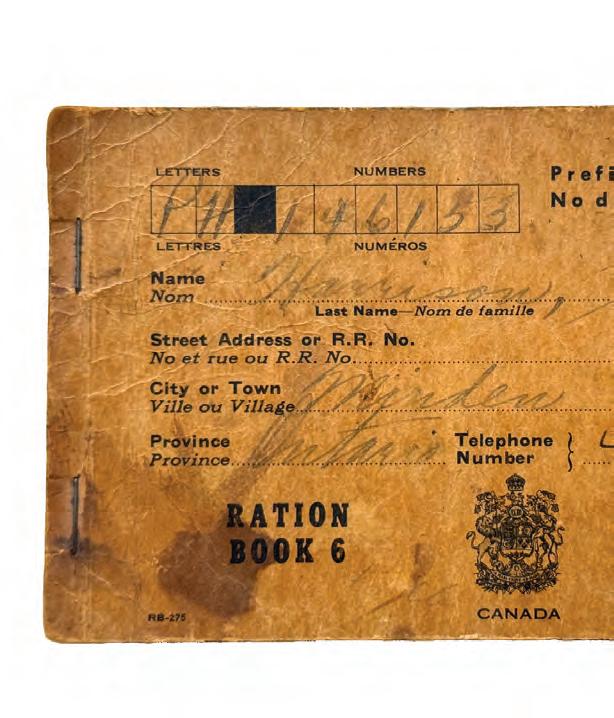
“The war effort made people hungry,” explained the Canadian War Museum’s military historian and wartime agricultural expert Stacey Barker. “We needed more food—and we needed that food to be distributed

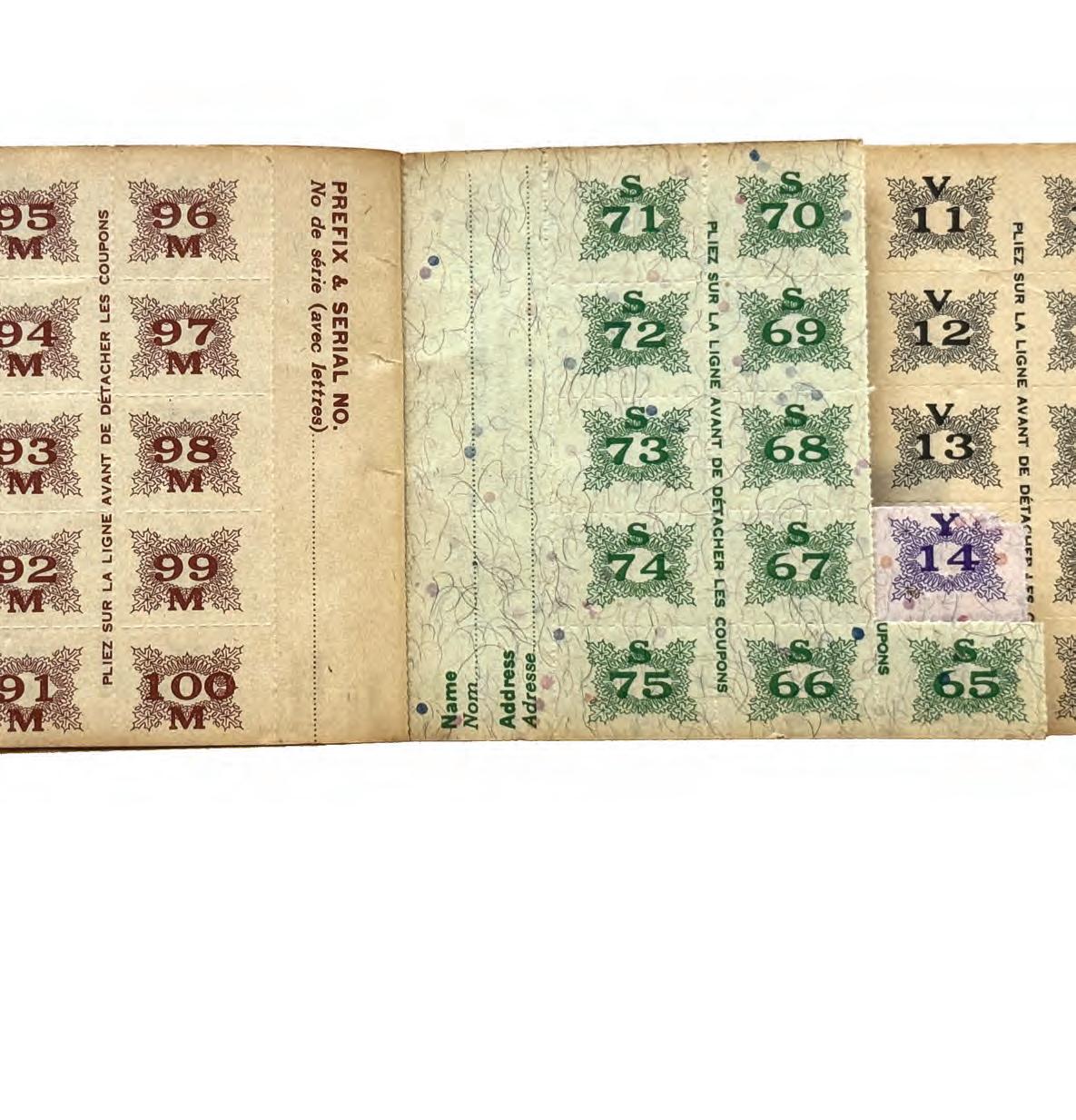
requests for citizens to voluntarily limit their consumption of scarce items, including sugar. “That’s the first commodity Canada rationed in January 1942,” said Barker, “as about 80 per cent of sugar was imported—a significant amount of which came from Japanese-controlled areas in the Pacific.”
When the honour system failed to produce the desired results, the Wartime Prices and Trade Board implemented coupon rationing. During the ensuing months and years, not only sugar but tea, coffee, butter, preserves and certain meats were restricted. Gasoline was also conserved, creating issues in transporting non-rationed goods.
Despite this, noted Barker, “Canada got off lightly compared to Britain.”
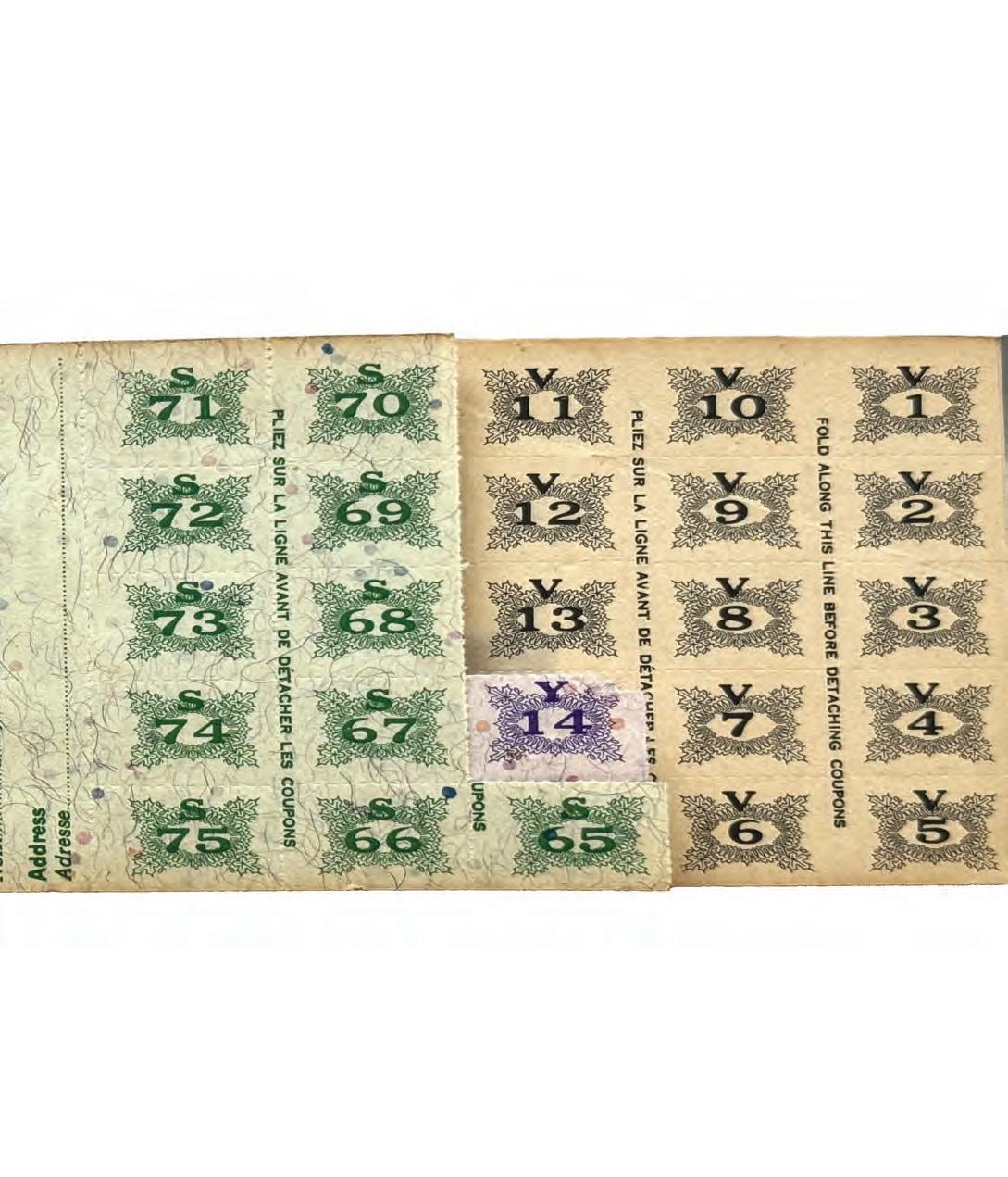
Ration Book 6 circa 1946. Like the entire series, it included coupons for limited resources such as butter. Meat tokens were introduced in 1945.
After a brief period of using temporary ration cards, authorities distributed an estimated 11 million ration books—the first of six series—in August 1942.
“Ration Book No. 1 was a pocket-sized booklet with your name on the cover and coupons inside for various commodities,” continued Barker. “The different colours depended on the commodity, so red for sugar, green for tea and coffee, and there were blue, brown and black coupons that officials assigned to goods as needed.
“Canadians would visit a store to purchase sugar, for instance, and the retailer would detach the
5
Approximate number of years that rationing was in place in Canada
20
Approximate number of years that rationing was in place in the U.K.
6 Series of Canadian WW II ration books
11 million Number of ration books distributed to Canadians
75,000 Estimated number of remote-living Canadians exempt from rationing
When the honour system failed to produce the desired results, the Wartime Prices and Trade Board resorted to coupon rationing.
requisite number of coupons when they made the purchase, which couldn’t exceed more than one pound or a two-week supply of sugar.”
Successive ration books, all broadly similar in appearance, were printed to reflect the fluctuating availability of foodstuffs as the war progressed.
Of course, abundance didn’t miraculously return on VJ-Day, with some measures persisting into the postwar period. When Ration Book No. 6 was introduced in 1946, Canadians had grown weary of the shortages, even if items such as eggs, flour and chicken were never restricted. Rationing officially ended in 1947.
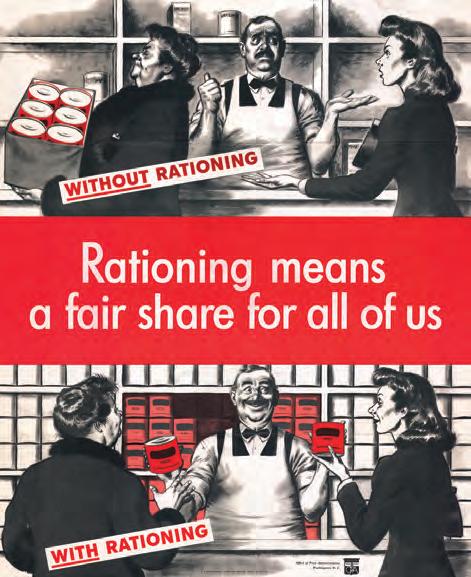
“Canada didn’t suffer the same fate as many parts of the world,” said Barker. “Our cities, for one, weren’t flattened by bombs. Rationing in the country, along with all the rules and regulations—and there were tons of them—amounted more to a mild inconvenience than that which befell other nations. Canadians, though not always in lockstep, generally perceived rationing as a common cause for the war effort.” L

By Don Gillmor
December
1942, a group of scientists led by Enrico Fermi demonstrated the first controlled nuclear chain reaction in an abandoned squash court at the University of Chicago. The race to build the first atomic bomb had begun.
Find many more stories in our O Canada special issues, NOW available in our SHOP!



One of the first items the Manhattan Project, as the initiative was known, needed was a supply of uranium. Much it came from a mine on the shores of Great Bear Lake, N.W.T. The Eldorado mine, owned by Gilbert LaBine, had been closed at the outset of the Second World War. In 1942, LaBine received a phone call from C.D. Howe, minister of munitions and supply, who said: “I want you to reopen. Get together the most trustworthy people you can find. The Canadian Government will give you whatever money is required…. And for God’s sake don’t even tell your wife what you’re doing.”
By the end of 1943, Eldorado, now owned by the government, had produced the 60 tonnes of uranium oxide the Americans needed.
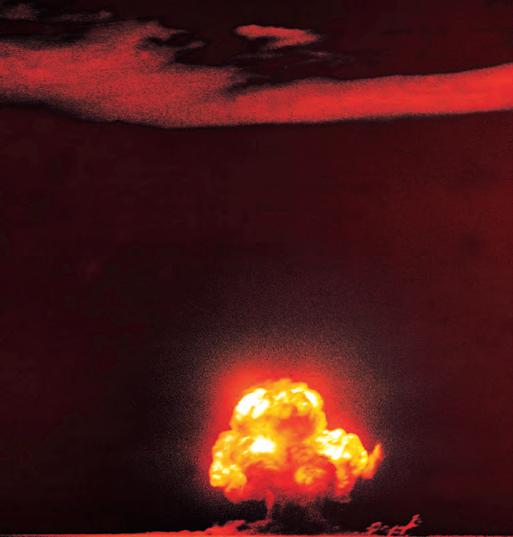
“NOW I AM BECOME DEATH, THE DESTROYER OF WORLDS.”
The ore was mined by local Dene who were paid $3 a day to haul 45-kilogram sacks of radioactive ore out of the mine and put it on barges on the Mackenzie River.
Howe offered the Americans Alberta as a test site for the first atomic bomb, but they preferred New Mexico. Dozens of scientists and military personnel went to Los Alamos and worked feverishly for two and a half years.
Robert Oppenheimer, a left-leaning American physicist with no experience in administrating a large project, was to spearhead the initiative.
Oppenheimer proved to be the perfect candidate. At dawn on July 16, 1945, the first nuclear bomb was tested near Alamogordo, N.M. Scientists and military personnel watched as the now familiar mushroom cloud rose into the sky.
Years later, Oppenheimer looked back on that moment and noted: “We knew the world would not be the same.” He quoted from the Hindu text, Bagavad Gita, “Now I am become Death, the Destroyer of Worlds.”
The project’s scientists were joyful about the breakthroughs in physics, but ambivalent about the fact they were creating a weapon. “We had somehow thought it would not be dropped on people,” Oppenheimer said later.
But on Aug. 6, 1945, a bomb labelled “Little Boy” was unleashed on the Japanese city of Hiroshima. Three days later, another bomb, this one called “Fat Man,” hit Nagasaki. The death toll from the two cities was estimated from 150,000-250,000.
When faced with the destruction and suffering of Hiroshima and Nagasaki, Oppenheimer wondered if the living might not envy the dead.
The Japanese weren’t the only casualties of the atomic age. The Dene miners who had delivered the uranium, often coated in its dust, died of cancer at frightening rates. Their settlements on Great Bear Lake became known as the “Villages of Widows.” L





















Now you can finally have all of the soothing benefits of a relaxing warm bath, or enjoy a convenient refreshing shower while seated or standing with Safe Step Walk-In Tub’s FREE Shower Package!


✓ First walk-in tub available with a customizable shower
✓ Fixed rainfall shower head is adjustable for your height and pivots to offer a seated shower option
✓ High-quality tub complete with a comprehensive lifetime warranty on the entire tub
✓ Top-of-the-line installation and service, all included at one low, affordable price Now you can have the best of both worlds–there isn’t a better, more aff ordable walk-in tub!