

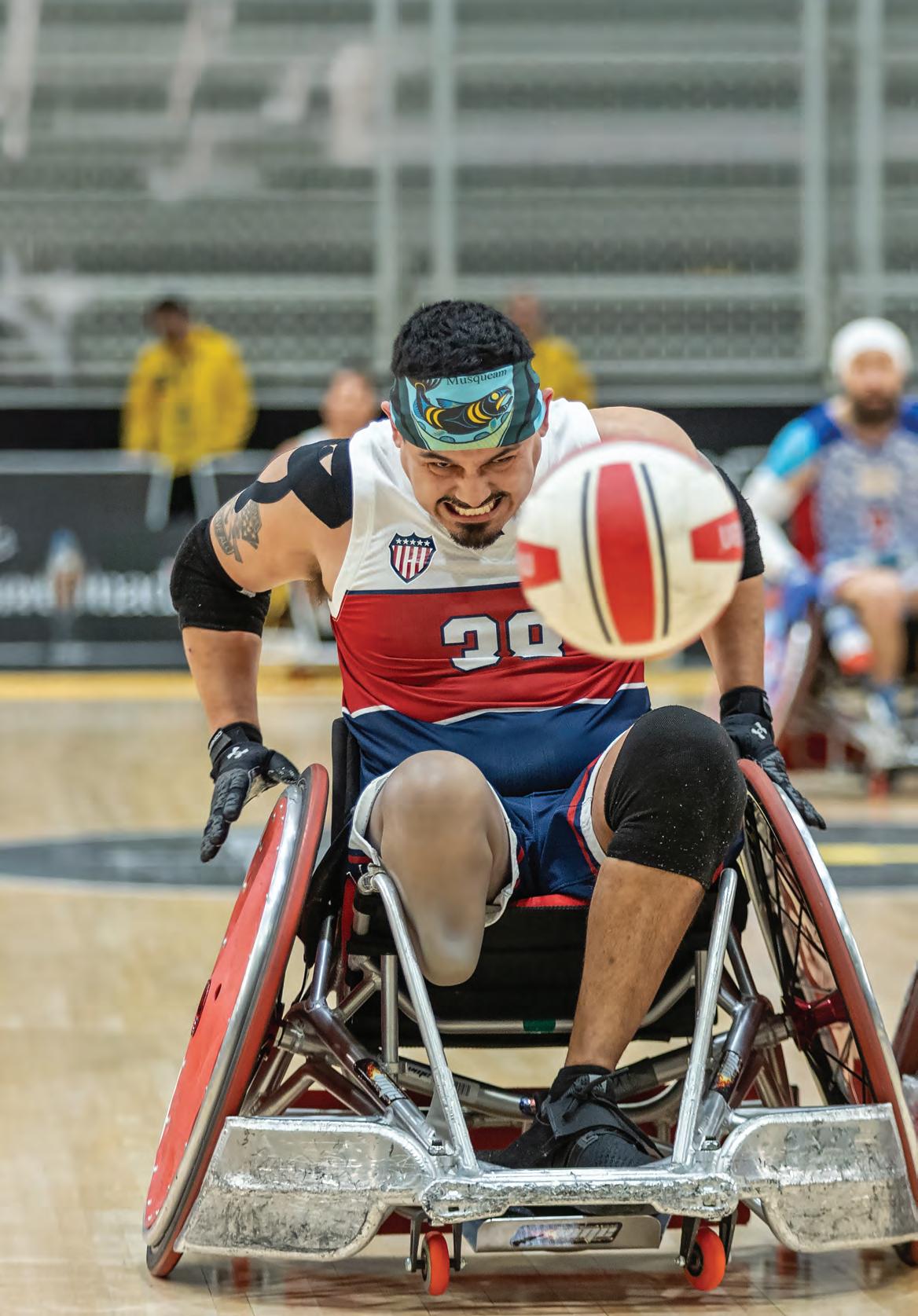
Michael Villagran of the U.S. wheelchair rugby team chases down the ball versus France at the 2025 Invictus Games in Vancouver. A retired U.S. Army specialist, Villagran lost his right leg to a Taliban bomb in 2012.
See page 58
18 WHO KNIT YA?
How the Second World War road to victory in Europe changed Newfoundland By
Stephen J. Thorne
26 GOING OVERBOARD
Looking back on the Halifax VE-Day riots
By Alex Bowers
34 THINK AGAIN
Re-examining Canada’s role in D-Day
By Marc Milner
38 SPIRIT SQUAD
Solving the mystery of how a seemingly random bomber crew photo ended up in the archives of a small-town Ontario school library By Wendy van Leeuwen

42 OPERATION IMPACT
20 years ago, Canada joined the international fight against Islamic State militants
By Mark Zuehlke
48 A EULOGY FOR CANADA’S UNKNOWN SOLDIER
25 years ago, on May 28, 2000, the governor general delivered this speech at the ceremony unveiling the country’s Tomb of the Unknown Soldier By
Adrienne Clarkson
52 THE AMERICAN INVASION
How the British and their Canadien subjects turned back the 1775-76 attack on the Province of Quebec
By Serge Durflinger
58 UNCONQUERABLE SOULS
Scenes from the Invictus Games Vancouver-Whistler 2025
Words and photography by Stephen J. Thorne
THIS PAGE
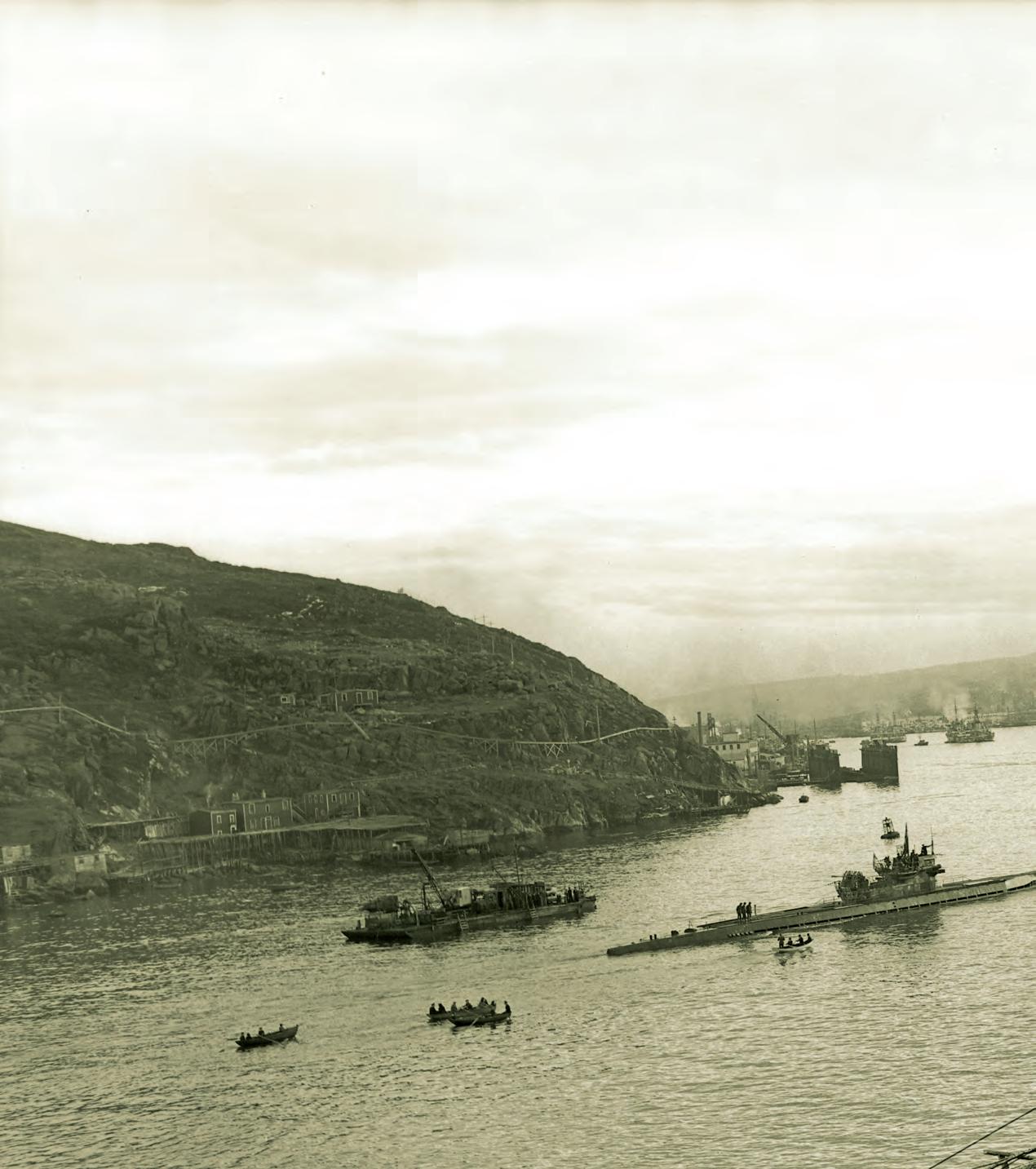
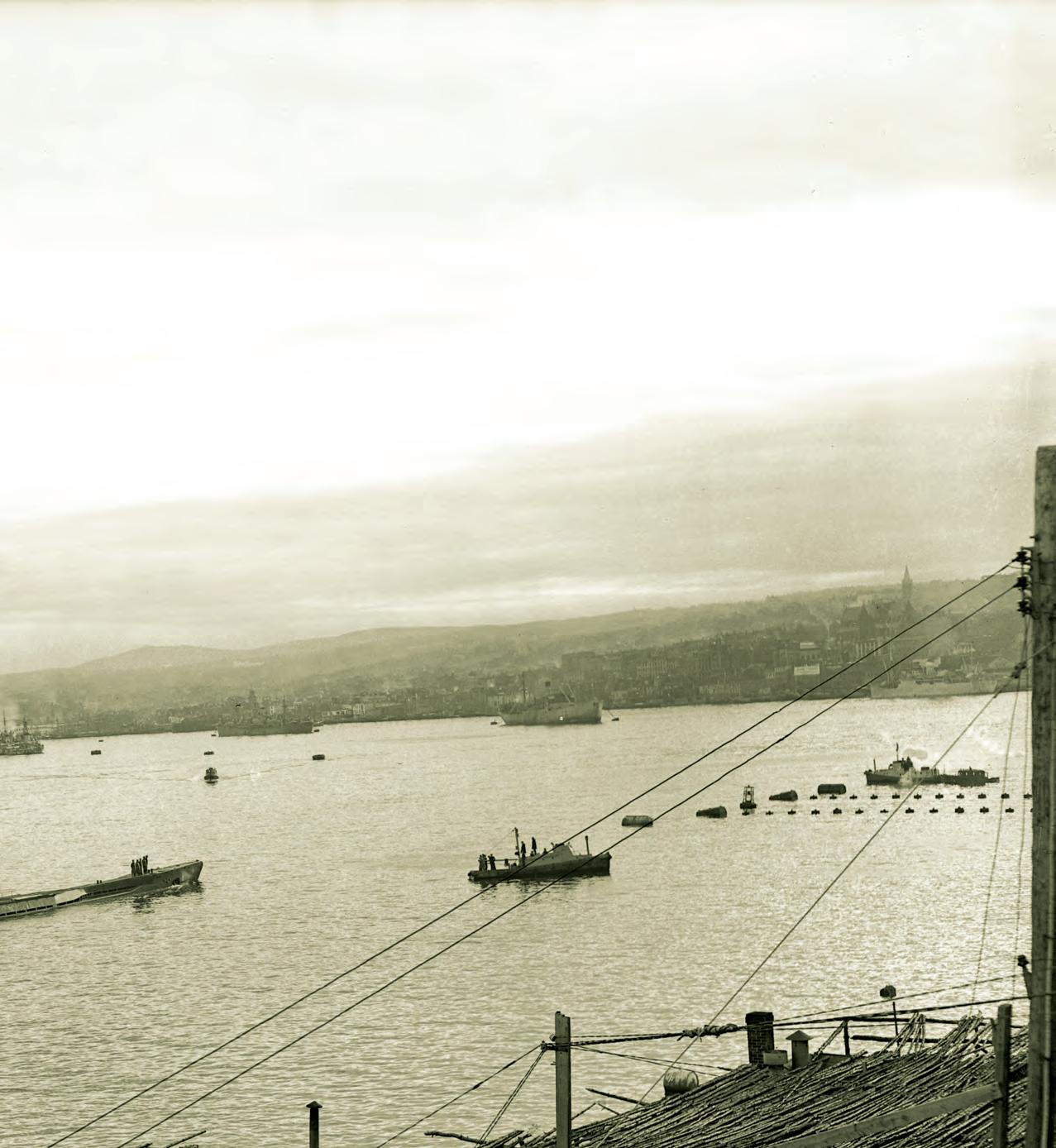
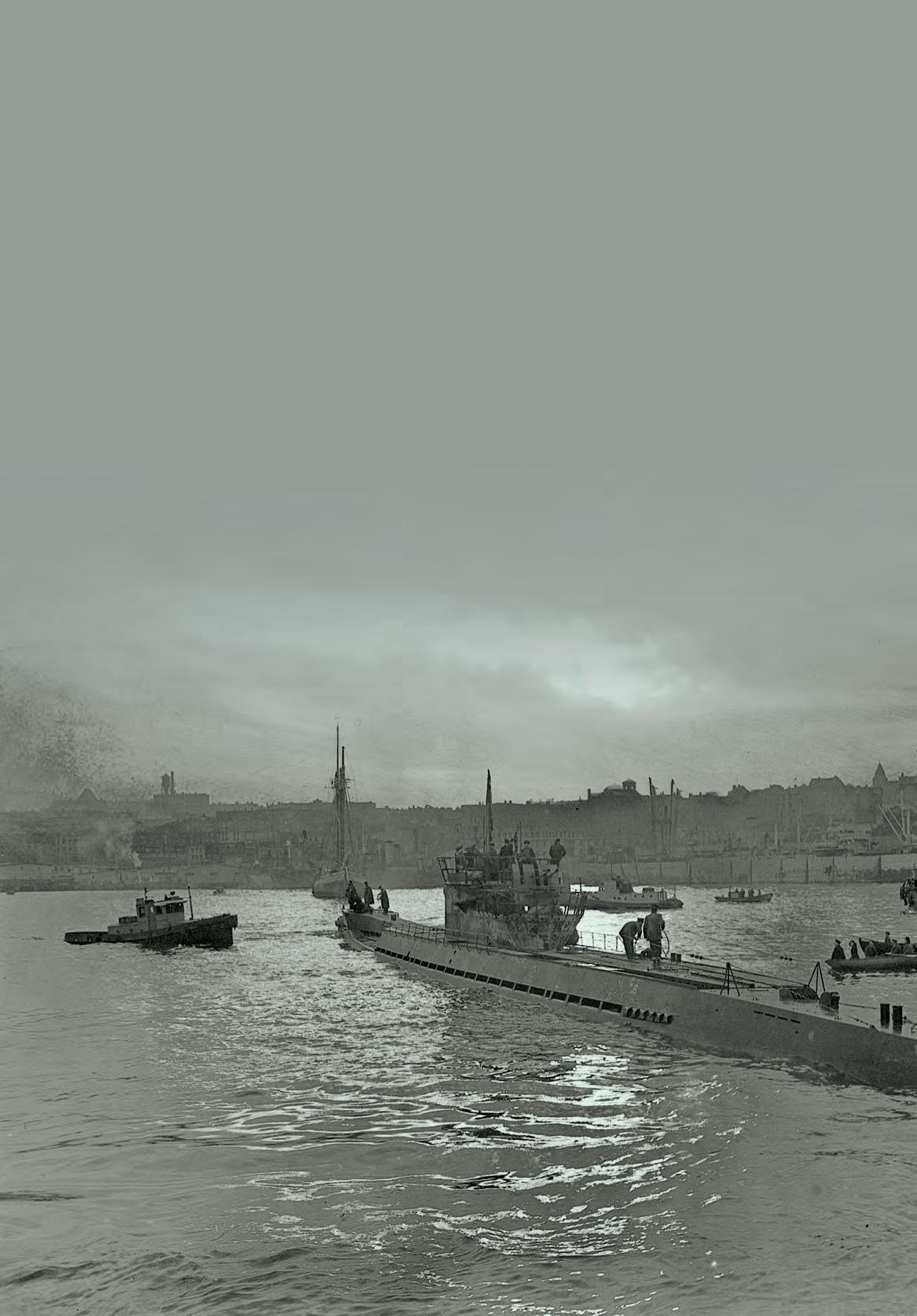
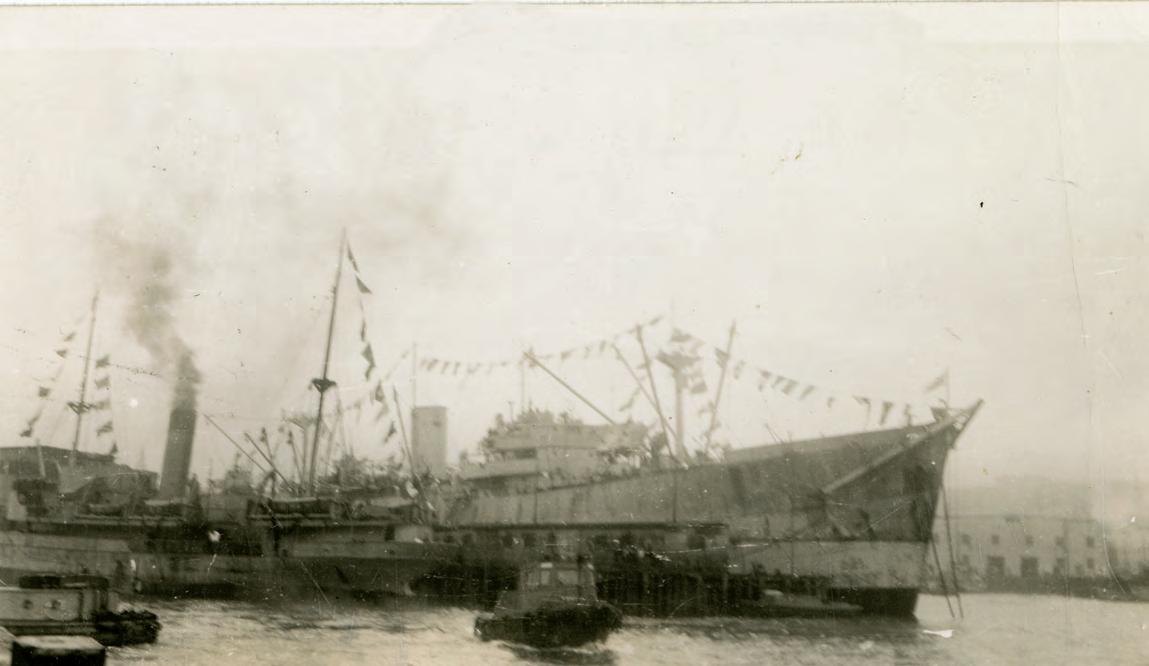
U-190 is escorted into the harbour at St. John’s, Nfld., on June 3, 1945, after surrendering to the Royal Canadian Navy weeks earlier. Gerald P. Murison/DND/LAC/PA-128268
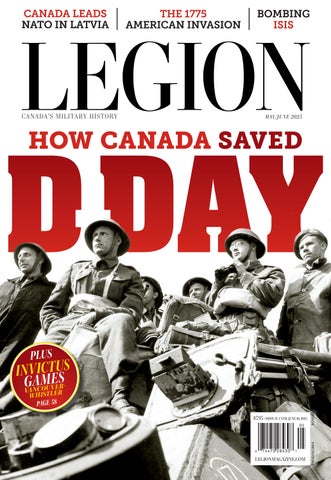
ON THE COVER
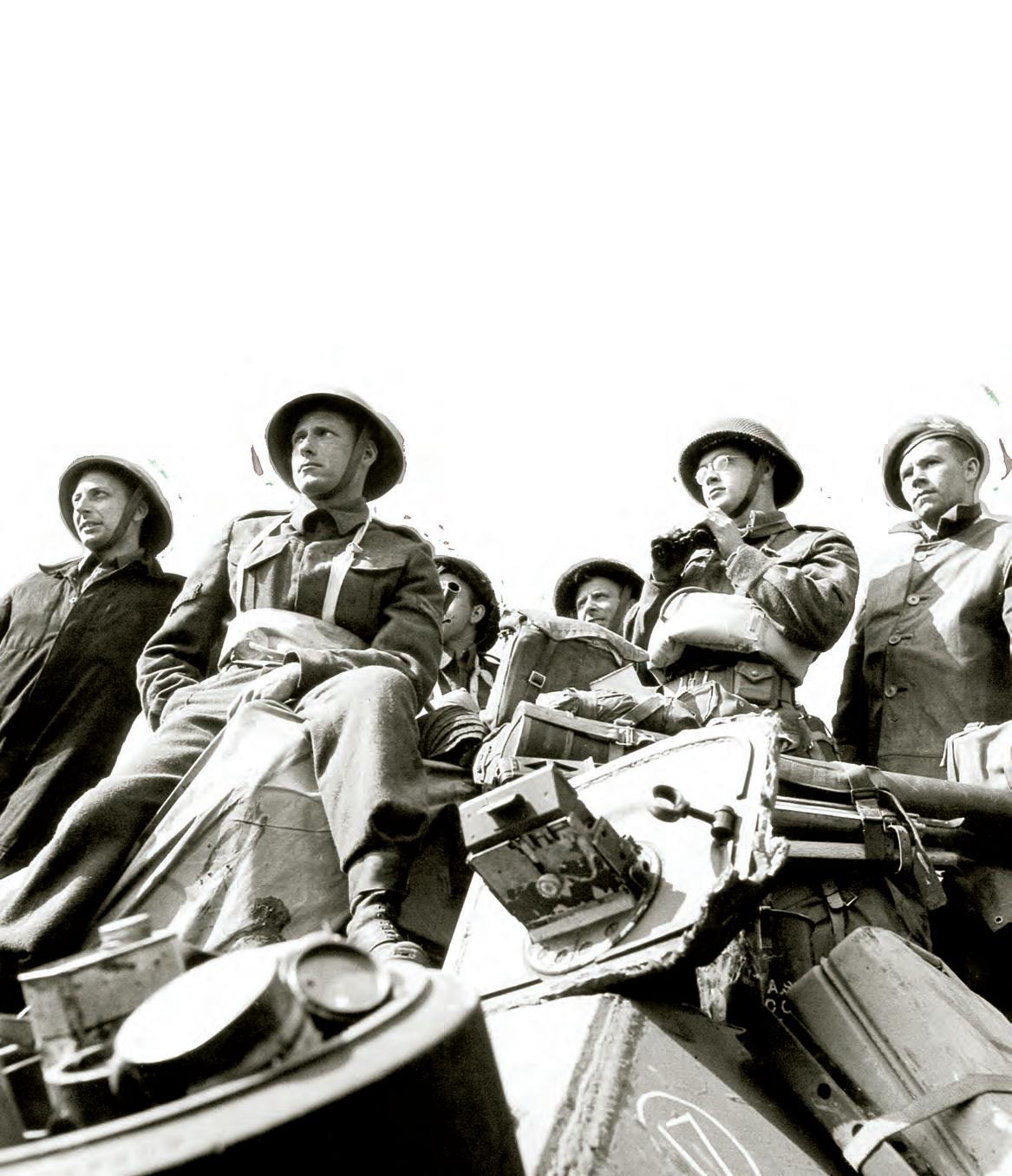
Personnel of The Royal Canadian Artillery approach Bernières-sur-Mer, France, on D-Day, June 6, 1944. Ken Bell/DND/LAC/PA-137523

12
MILITARY HEALTH MATTERS
From shunned to celebrated By Alex Bowers
14 FRONT LINES
Guilty by association? By Stephen J. Thorne
16
EYE ON DEFENCE
Fool’s game By David J. Bercuson
32 FACE TO FACE
Were naval leaders to blame for the Halifax VE-Day riots? By Alex Bowers and Stephen J. Thorne
88 CANADA AND THE NEW COLD WAR
On the flank By J.L. Granatstein
90 HUMOUR HUNT
Decoding typo By John Ward
92 HEROES AND VILLAINS
Douglas Haig and Crown Prince Rupprecht By Mark Zuehlke
94 ARTIFACTS
Canada’s U-boat By Alex Bowers
96 O CANADA
Somme memorial By Don Gillmor


Vol. 100, No. 3 | May/June 2025
Board of Directors
BOARD CHAIR Garry Pond BOARD VICE-CHAIR Berkley Lawrence BOARD SECRETARY Bill Chafe Steven Clark, Randy Hayley, Trevor Jenvenne, Bruce Julian, Valerie MacGregor, Sharon McKeown Legion Magazine is published by Canvet Publications Ltd.
GENERAL MANAGER Jason Duprau
EDITOR
ADMINISTRATION MANAGER
Stephanie Gorin
ADMINISTRATIVE ASSISTANT
Lisa McCoy
ADMINISTRATIVE ASSISTANT
Chantal Horan
ADMINISTRATIVE AND EDITORIAL CO-ORDINATOR
Ally Krueger-Kischak

Aaron Kylie
ASSISTANT EDITOR
Michael A. Smith
SENIOR STAFF WRITER
Stephen J. Thorne
STAFF WRITER
Alex Bowers

ART DIRECTOR, CIRCULATION AND PRODUCTION MANAGER
Jennifer McGill
SENIOR DESIGNER AND PRODUCTION CO-ORDINATOR
Derryn Allebone
SENIOR DESIGNER
Sophie Jalbert DESIGNER
Serena Masonde


Advertising Sales
CANIK MARKETING SERVICES NIK REITZ advertising@legionmagazine.com
MARLENE MIGNARDI marlenemignardi@gmail.com
OR CALL 613-591-0116 FOR MORE INFORMATION
SENIOR DESIGNER
Dyann

Published six times per year, January/February, March/April, May/June, July/August, September/October and November/December. Copyright Canvet Publications Ltd. 2025. ISSN 1209-4331
Subscription Rates
Legion Magazine is $13.11 per year ($26.23 for two years and $39.34 for three years); prices include GST. FOR ADDRESSES IN NS, NB, NL, PE a subscription is $14.36 for one year ($28.73 for two years and $43.09 for three years). FOR ADDRESSES IN ON a subscription is $14.11 for one year ($28.23 for two years and $42.34 for three years).
TO PURCHASE A MAGAZINE SUBSCRIPTION visit www.legionmagazine.com or contact Legion Magazine Subscription Dept., 86 Aird Place, Kanata, ON K2L 0A1 or phone 613-591-0116. The single copy price is $7.95 plus applicable taxes, shipping and handling.
Change of Address
Send new address and current address label, or, send new address and old address. Send to: Legion Magazine Subscription Department, 86 Aird Place, Kanata, ON K2L 0A1. Or visit www.legionmagazine.com/change-of-address. Allow eight weeks.
Editorial and Advertising Policy
Opinions expressed are those of the writers. Unless otherwise explicitly stated, articles do not imply endorsement of any product or service. The advertisement of any product or service does not indicate approval by the publisher unless so stated. Reproduction or recreation, in whole or in part, in any form or media, is strictly forbidden and is a violation of copyright. Reprint only with written permission.
PUBLICATIONS MAIL AGREEMENT NO. 40063864
Return undeliverable Canadian addresses to Legion Magazine Subscription Department 86 Aird Place, Kanata, ON K2L 0A1 | magazine@legion.ca
U.S. Postmasters’ Information
United States: Legion Magazine, USPS 000-117, ISSN 1209-4331, published six times per year (January/February, March/April, May/June, July/August, September/October, November/December). Published by Canvet Publications, 866 Humboldt Pkwy., Buffalo, NY 14211-1218. Periodicals postage paid at Buffalo, NY. The annual subscription rate is $12.49 Cdn. The single copy price is $7.95 Cdn. plus shipping and handling. Circulation records are maintained at Adrienne and Associates, 866 Humboldt Pkwy., Buffalo, NY 14211-1218. U.S. Postmasters send covers only and address changes to Legion Magazine, PO Box 55, Niagara Falls, NY 14304.
Member of Alliance for Audited Media and BPA Worldwide. Printed in Canada.
We acknowledge the financial support of the Government of Canada. Version française disponible.
On occasion, we make our direct subscriber list available to carefully screened companies whose product or services we feel would be of interest to our subscribers. If you would rather not receive such offers, please state this request, along with your full name and address, and email magazine@legion.ca or write to Legion Magazine, 86 Aird Place, Kanata ON K2L 0A1 or phone 613-591-0116.
ar clouds are darkening on the international horizon. What is Canada’s position? No Canadian wants war—no sensible Canadian. That is an indisputable fact. As a nation Canada will never of itself do anything knowingly to provoke war. We desire to live at peace. But, alas for the tragedy that seems inevitably to pursue defenceless nations, their misfortune and extinction have been due to their living in a world made up of powerful people whose ideals are not quite so lofty.
THAT PAYMENT WOULD BE EITHER THE ANNEXATION OF CANADA OR, AT THE VERY LEAST, A HUGE SLICE OF OUR TERRITORY.
How less secure is the expectation of perpetual peace for a nation that has direct economic contacts with almost every other country in the world and whose interests, in great part, are in conflict with theirs? No different from other nations, Canada has engaged actively and aggressively in economic warfare. And someone has said that this is inevitably the prelude to armed conflict.
I have frequently read and heard that “even if the British Navy can not protect Canada, the United States will not permit Canada to be invaded or Canadian trade destroyed.” This doctrine is the counsel of the weakling, the product of a painful inferiority complex. Apart altogether from the contempt it engenders among selfrespecting Canadians, it is a fool’s paradise.
In the first place, Canada has no undertaking that the United States would do anything of the sort. The United States is dominated by a national sentiment. If the United States is indisposed to jeopardize that, the man must be a lunatic who imagines the republic will jeopardize it for the sake of Canada.
But, assume by an impossible stretch of the imagination, that the United States became altruistic to the point of insanity and decided to “Protect Canada.” Would the service be rendered for nothing? It has to be remembered that we do a great deal of bragging about our inexhaustible resources and the great potential wealth that lies concealed beneath the surface of our soil. Services costing American lives, American ships and American money would have to be paid for. That payment would be either the annexation of Canada or, at the very least, a huge slice of our territory. We should keep continually in mind that priceless story in the Scriptures of the man who cast out one devil and took in seven.
We render no service, either to ourselves or our country by sidestepping these unpleasant facts. We are utterly and absolutely defenceless. In the past 15 years, anyone who let a peep out of him to promote national security was pounced upon by professional and amateur pacifists who branded him a “militarist” and an “enemy of peace.” The popular thing has been to court the illusion of perpetual peace, to forget the lessons of history and to proclaim that a disarmed nation, by virtue of its defencelessness and the high moral principles it incorporates, is much safer from aggression than a nation not disarmed.
This is an excerpt from a piece originally published in the September 1935 edition of The Legionary magazine, this publication’s predecessor. L

“Letters” (March/April), retired lieutenant-colonel John McNair rightly takes issue with some of the arguments put forward by certain opinion writers in the magazine as they pertain to issues of defence preparedness. He is right to concur with them that more needs to be done in resourcing the military in areas of recruiting, retention and procurement. However, he’s also correct to point out that columnists David J. Bercuson and J.L. Granatstein, among others, continually fail to provide concrete solutions.
Your magazine continues to impress me. I had a great chuckle reading “Beaver fever” (March/ April) and the line “like many Canadians the beaver is industrious and lacks a dental plan.” Yet, I have a negative response to “beaver fever” as I contracted it a few years ago and it still lingers in my digestive system.
WILL PERRY
VIA EMAIL
Comments can be sent to: Letters, Legion Magazine , 86 Aird Place, Kanata, ON K2L 0A1 or emailed to: magazine@legion.ca
If they are being honest with Canadians, they must propose just how much more we will be asked to pay in federal income tax. They might indicate, too, which current federal transfers to provinces, including for health care and equalization, they want to see reduced. Also, they forget to mention that under prime minister Stephen Harper Canada’s defence spending fell below one per cent of gross domestic product at one point. Lots of blame to go around.
GAVIN PUGH REGINA
As usual, I quite enjoyed opening my latest copy of Legion Magazine and devouring the content. However, as a proud owner of a Lynx scout car, I wanted to point out that the vehicle you identified as a Staghound in “First Troop, Charlie Squadron, Royal Canadian Dragoons” (March/April) is actually a Ford Lynx 11.
PETER DUGGAN
VIA EMAIL
I read with great interest “Ripples of service” by Alex Bowers in the January/February issue. After my military service, I provided musical services with four regimental bands between 1955 and 1988. The groups were deeply involved in Canadian military and Canadian affairs. In the mid-1990s, 12 out of 16 bands were eliminated, thereby cutting one of the most culturally

interesting and important functions dear to military and Canadian authorities. Incidentally, the Canadian Armed Forces dropped from 78,000 to 62,000 members around that time. That indicates to me that music making in the military may have played a greater role than previously thought.
NICOLAS DE VRIES DARTMOUTH, N.S.
After general Roméo Dallaire’s service to the Canadian military, specifically to the United Nations during Rwanda’s brutal civil war, Canadians should be ashamed that national archives and library institutions allowed his collection to leave the country and go to the United States Military Academy West Point (re “Oh, Canada,” January/ February). To say Canadians haven’t been supportive of our military for many years is an
understatement, and this is just another example.
As a Canadian whose grandfather and great-uncles served in the First World War, whose father served in Bomber Command during the Second World War, whose brother was a career soldier during the Cold War, whose husband served in the Royal Canadian Air Force, and whose nephew is presently serving in our armed forces, which included a mission in Afghanistan, I want to apologize to General Dallaire and thank him for his service to our country. “Oh, Canada,” indeed.
CHRISTINE LANG
SHANTY BAY, ONT.
Well, Canadians no doubt did fight well in South Africa (re “Face to Face,” September/ October 2024, “Should Canadians continue to pay tribute to



the Boer War?”). No doubt they fought like Canadians. However, there was nothing glorious about the Boer War. It was one of the last big grabs of an already fading empire. It just was naked British aggression.
DENNIS PEACOCK CLEARWATER, B.C.
I just read your excellent article “The Plan” in the March/April Legion Magazine. A caption in the story mentioned that the British Commonwealth Air Training Plan pilots completed training on Harvard 4s built by Canadian Car and Foundry. In fact, wartime Harvards were built by Noorduyn in Montreal. Canadian Car and Foundry built Harvard 4s for training at their plant in Fort William, Ont., in the early 1950s.
GERRY KOSORIS
KAKABEKA
FALLS, ONT. L

1 May 1888

8 May 1945
On Victory in Europe Day, a ceasefire takes effect at 11 p.m. after the Germans formally surrender.
9 May 1937
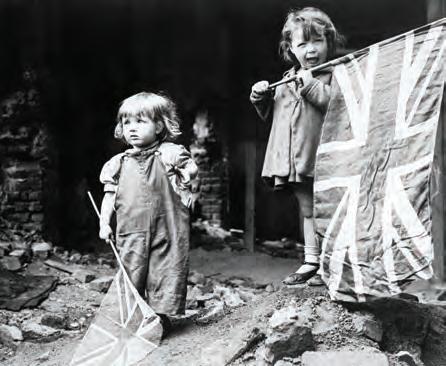
The Canadian Coronation Contingent stands sentry at St. James and Buckingham palaces in England, the first Canadian military personnel to do so.
10 May 1915
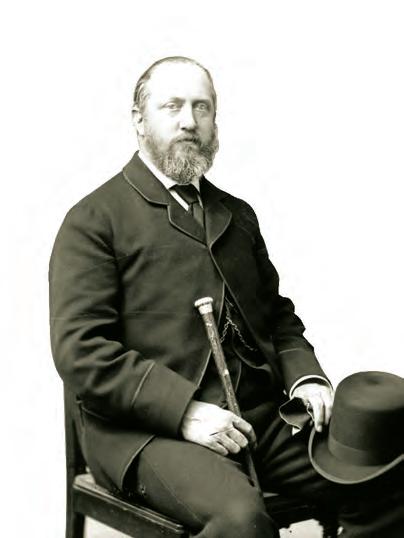
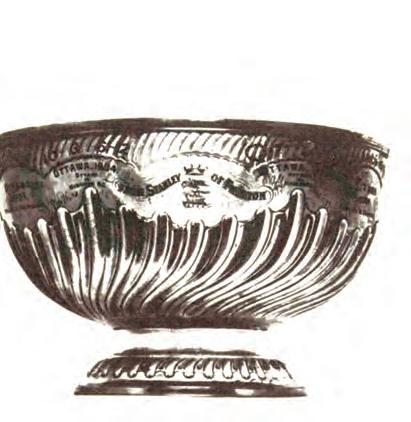
Lord Stanley appointed Governor General of Canada; serves from June 11, 1888, to September 6, 1893, and later donates hockey’s Stanley Cup.
2 May 1945
U-2359 is sunk by British, Norwegian and Canadian Mosquito aircraft.
4-5 May 1971
A clay landslide destroys 40 homes and kills 31 residents of Saint-JeanVianney, Que.; three members of the Canadian Armed Forces are decorated for daring rescues.
The Curtiss Aviation School in Toronto begins training pilots; 128 military airmen graduate before it closes in 1916.
13 May 1861
Queen Victoria asks her subjects to remain neutral in the U.S. Civil War.
4 May 1943
18 May 1785
The communities of Parrtown and Carleton amalgamate to form Saint John, N.B., Canada’s first incorporated city.
Trainee navigator Kenneth Spooner takes over for an unconscious pilot, saving three lives, but crashes. He is posthumously awarded
19 May 1918
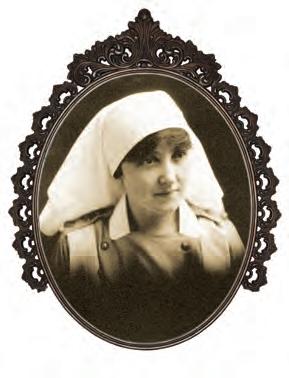
Lieutenant Katherine MacDonald is the first Canadian Nursing Sister killed in action, at No. 1 Canadian Hospital, Étaples, France, during an enemy air raid.
20 May 1971
Francis Simard is given a life sentence for the murder of Quebec Labour Minister Pierre Laporte, kidnapped by the Front de libération du Québec.
28 May 1916
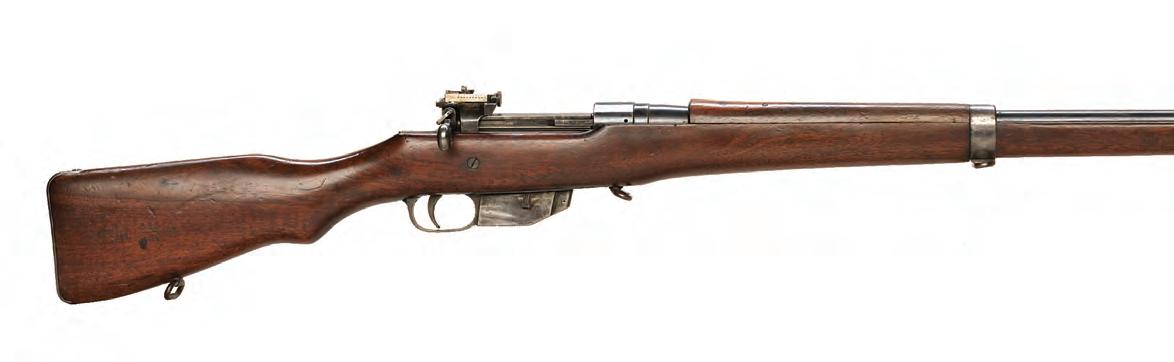
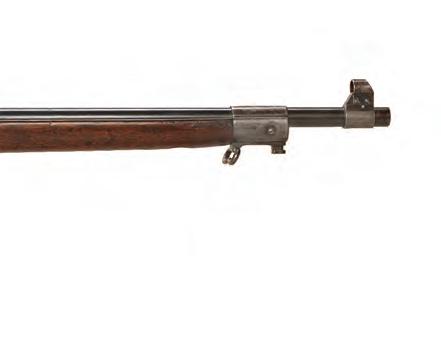
The Canadian government is advised to abandon the Ross rifle, which often
7 May 1867
Dr. Campbell Douglas of Grosse Île, Que., leads three trips through heavy surf in Little Andaman Island, Bay of Bengal, to rescue several men. He is awarded the Victoria Cross.

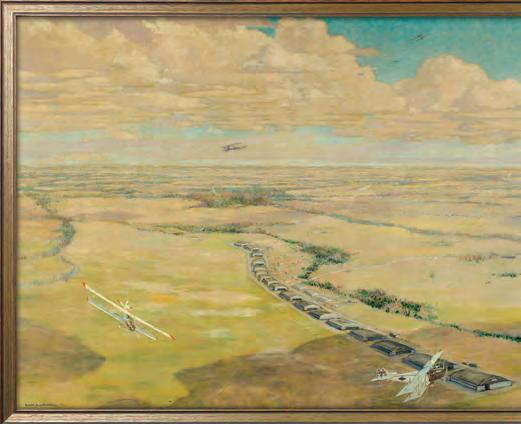
1918, resumes at Camp Borden near Barrie, Ont.
17 May 2006
Captain Nichola Goddard is the first female Canadian soldier killed in combat.
30 May 1915
The German Fokker Eindecker (monoplane) aircraft is fitted with synchronized machine guns that fire through the arc of the propeller blades.
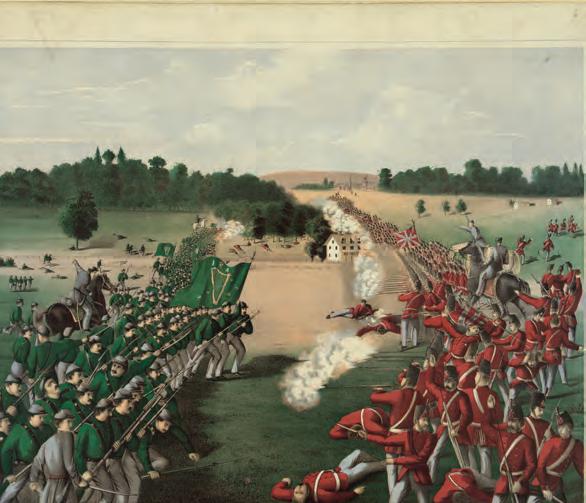
1 June 1866
2 June 1916
Canadian positions are hit by German shellfire at the northern edge of Sanctuary Wood, near Ypres, Belgium.
3 June 1885
In the Battle of Loon Lake (in present-day Saskatchewan), NorthWest Mounted Police led by Major Sam Steele attack Cree warriors. Part of the North-West Resistance, it is the last military engagement fought on Canadian soil.
13 June 1916
12 June 1940
The 1st Brigade of the Canadian 1st Division lands in France; they are forced to leave days later when France surrenders to the Nazis.
Troops under command of MajorGeneral Arthur Currie counterattack at Mount Sorrel in Belgium, restoring front lines at the cost of 8,000 Canadians killed, wounded or captured.
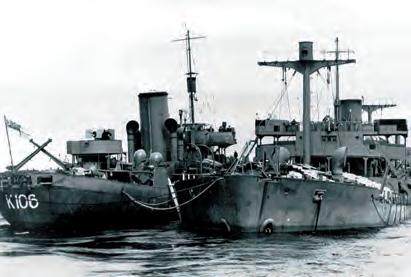
HMCS Edmundston rescues 31 crew from SS Fort Camosun after an attack by a Japanese submarine off the coast of Washington.
21 June 1951
The Royal Canadian Regiment, Lord Strathcona’s Horse and Royal Canadian Horse Artillery patrol in Korea.
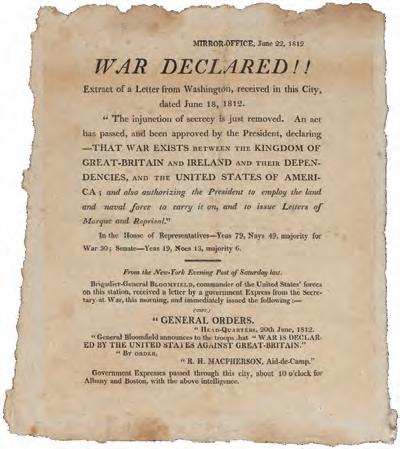
23 June 1812
Great Britain revokes the restrictions on American commerce, thus eliminating one of the chief reasons for going to war.

4 June 1742
The naval ship Le Canada,
14 June 1617
The first French family to cultivate land in Canada settles near today’s Quebec City.
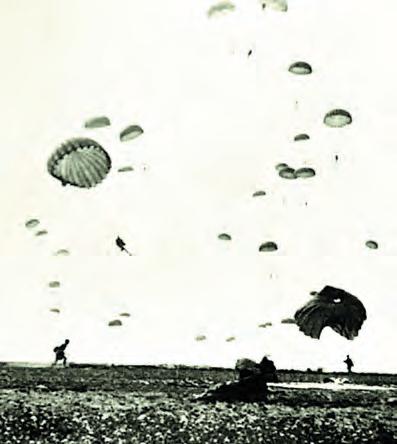
16 June 1993
Canada withdraws its peacekeepers from Cyprus, ending a 29-year mission during which more than 25,000 Canadians served and 28 lost their lives.
17 June 1932
25 June 1950

North Korea invades South Korea.
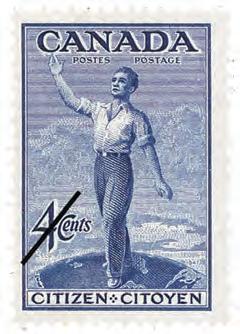
26 June 1945
Canada is one of 50 countries to sign the United Nations Charter. On Oct. 24, the UN replaces the League of Nations, which was created by the Treaty of Versailles in 1919.
27 June 1946
The Canadian Citizenship Act receives royal assent. Effective Jan. 1, 1947, it confers citizenship on all Canadians, regardless of their place of birth.
29 June 1996
Oil tanker Cymbeline explodes in Montreal.
From the Space Shuttle Columbia, Canadian astronaut Robert Thirsk talks with students at Maple Grove Education Centre in Nova Scotia.
By Alex Bowers

Desiderates Meliorem Patriam. “They desire a better country.” It’s the Latin motto of the Order of Canada, and what appointees are said to exemplify. Diane Pitre, a veteran of the Canadian Armed Forces, 2SLGBTQI+ purge survivor, and now member of the Order, embodies that sentiment. It was 2018, and Diane Pitre was a special guest for a film screening in her home province of New Brunswick. Family members were in attendance, aware, if only to a certain degree, that she featured in the documentary called The Fruit Machine
Directed by Sarah Fodey, the film details the events and impacts of the 2SLGBTQI+ purge that robbed many thousands of Canadian Armed Forces personnel of their dignity, identity and livelihoods from the 1950s to the 1990s.
The documentary’s title, aside from being a derogatory reference toward people of the 2SLGBTQI+ community, refers to a genuine, governmentsanctioned device that could purportedly reveal the sexuality of test subjects who, after being shown pornographic pictures, were determined to be “homosexual” if their pupils dilated.
Canadian veteran Pitre was never hooked up to the machine, its use having been phased out in 1967 for its scientific infeasibility, but she still had her own story to tell.
“I went on stage afterward,” she recalled, “and everyone was shocked. I spoke to my family as if we had forgotten the audience. My aunt asked, ‘Why didn’t you tell us?’ I replied, “because I didn’t want to lose you like I’d lost so much else.”
Pitre had wanted to serve her country since she was a child. In light of her father’s absence— he died when she was just three months old—Pitre always admired her uncles, one a Second World war veteran of The North Shore (New Brunswick) Regiment and the other having fought in Korea before becoming a peacekeeper.
Pitre wished to follow in their footsteps, enlisting at age 18 on Nov. 9, 1977, whereupon she commenced her training to become an air frame technician.
“It was everything I ever dreamed of,” she recalled—until it wasn’t.
Believing at the time she conformed to stringent societal norms surrounding sexuality, Pitre knew “nothing at all” about the CAF’s discriminatory policies toward 2SLGBTQI+ personnel. Seemingly, she had little reason to.
For several decades, however, the Canadian government believed certain individuals were more vulnerable to being targeted by Soviet blackmail. Armed with flawed logic that the so-called “character weakness”
of 2SLGBTQI+ members could lead to the release of state secrets, supposed suspects within the military, RCMP and federal public service endured investigations, persecution and ostracization.
The human rights-suppressing campaign became known as the Purge, and it employed many of the same tactics against fellow Canadians that authorities feared the Soviets were using. Pitre was just the latest of an untold number to undergo interrogation.
“I was instructed to go to Halifax without knowing why, and two guys picked me up at the airport. They were completely silent as they drove me to an undisclosed wooded area in an industrial park. I wondered if I was in with the wrong people.
“They got out the car at a warehouse and started questioning me: ‘Who’s the man in the relationship?’ ‘Do you masturbate in front of a mirror?’ Questions like that.”
Pitre was released after three days. Though temporarily permitted to remain in the military, she lost her security clearance on “suspicion of being a homosexual” and was thus forced to retrain as a supply technician. Nevertheless, on Sept. 24, 1980, having been subjected to incessant surveillance, Pitre was discharged.
“I had done a good job and was going to be promoted to corporal before my time, but a captain told me that wasn’t happening and threw my papers in the garbage.
“I left the base totally devastated. I was disconnected. It was surreal. How could I be a threat to my country for just wanting to serve? Why would Canada do that?”
Change arrived in 1992 following the precedent-setting court case of veteran and Purge survivor Michelle Douglas, who sued the Defence Department for infringing on her rights. The historic lawsuit led to Douglas receiving a settlement of $100,000
and, ultimately, the revoking of Canadian Forces Administrative Order 19-20, the policy that helped enable the harmful practices.
But for too many, the damage had already been done. Lives had been ruined during successive decades; others lost to suicide. What’s more, discrimination wouldn’t just end overnight. Pitre, who had dedicated years to advocating for an official apology, was joined by a growing number of voices demanding greater justice.
Nov. 28, 2017, proved to be the turning point. That day, a class action filed against the government on behalf of Purge survivors reached a settlement, which was ratified in June the following year, of $145 million. The compensation package, which awarded between $5,000 and $50,000 to most claimants while committing to reconciliation and memorialization measures, accompanied the assurance that service records would include disclaimers regarding the nature of discharges.
That same day, Prime Minister Justin Trudeau stood in the House of Commons and delivered the words Pitre had long waited—and fought—for.
“To the victims of the Purge… we betrayed you. And we are so sorry,” he announced. “You were not bad soldiers, sailors, airmen and women. You were not predators. And you were not criminals. You served your country with integrity, and veterans you are.”
For Pitre, who embraced the apology even if its lateness “made me a bit angry,” the fight continues. In 2019, she founded the Rainbow Veterans of Canada to “provide a supportive and safe space for CAF veterans impacted by the LGBT Purge along with other CAF veterans who identify as 2SLGBTQI+, while educating and advocating for the rights, benefits and recognition our members deserve.”
As the Rainbow Veterans’ co-chair, Pitre considers placing a wreath at the National War
Memorial as one of her “proudest accomplishments.” In the same capacity in 2024, she joined representatives in symbolically breaking the ground for the 2SLGBTQI+ National Monument due to be completed and unveiled later this year in Ottawa.
“We worked so hard to make ourselves better for Canada because we were told we were not worthy of Canada,” said Pitre. “We were a disgrace, we were a threat. But now, with the work we’ve all done, I can finally see that it was about making Canada better.” L

Eighty years on, Dutch name
425,000 suspected Nazi collaborators
The Netherlands National Archives is opening its files on some 425,000 suspected Nazi collaborators eight decades after the Holocaust took the lives of 102,000 Dutch Jews.
War In Court, a project of the Netherlands-based Huygens Institute, released a list of the names online after a law restricting public access to the archive expired Jan. 1, 2025. The archives’ more detailed digitized versions were expected to follow.
“This archive contains important stories for both present and future generations,” the institute said in a statement. “From children who want to know what their father did in the war, to historians researching the grey areas of collaboration.”
The institute is helping digitize 32 million pages of dossiers that include details on suspects and witnesses, as well as members of the Dutch Nazi party and some 20,000 Dutch citizens who enlisted in Nazi Germany’s armed forces.
Comprising files from the Special Criminal Jurisdiction, which began investigating suspected collaborators in 1944, the archive also contains the names of people acquitted. The expired law has
Collaborators and moffenmeiden (‘Kraut girls’) are rounded up and publicly humiliated by the Dutch Resistance following the liberation.
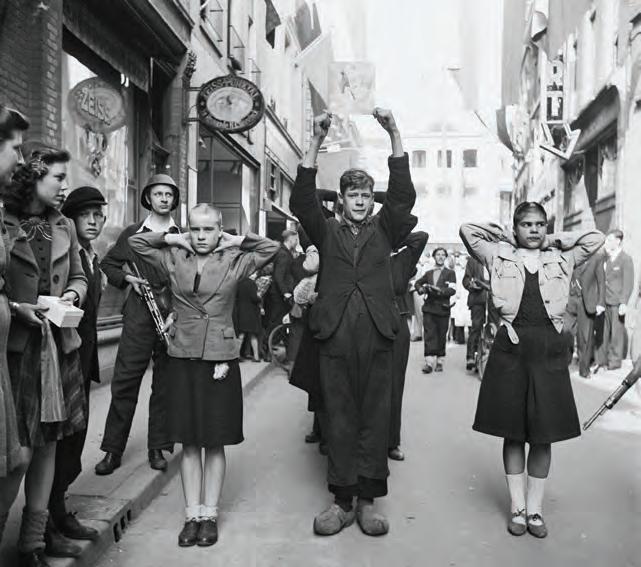
been described as more restrictive than Italy’s, an Axis country whose wartime past is far more controversial than the Netherlands’.
Seventy-five per cent of the Netherlands’ Jewish population was deported to death camps between 1940 and 1945. While stories abound of heroic attempts to hide Jews from SS squads, collaborative police, Dutch bounty hunters and others, the darker stories of betrayals by neighbours, friends and co-workers are less known.
Historian Hans Renders of the University of Groningen told the BBC that only about 15 per cent of collaboration cases went to court. “So, if a name appears in the [archive], it is not certain that the person was ‘wrong.’”
A planned online release of the first eight million pages of detailed scans was postponed after the Dutch data protection authority intervened. All documents are expected to be digitized by 2027.
People with a research interest, including descendants, journalists and historians, have been able to submit requests to consult the actual files at the national archives. Now the public can, too.
The forces of Nazi Germany invaded the Netherlands in May 1940. Five years of brutal occupation followed, during which at least 106,000 Dutch Jews were robbed of their property and belongings and transported to death camps such as Auschwitz and Sobibor.
The identification and roundup of Dutch Jews was largely enabled by the efforts of a Dutch public servant, Jacobus L. Lentz, head of the Population Registration Office in the Hague.
The history is still fresh in the Netherlands and throughout much of Europe, where a total of six million Jews were systematically killed in what
> Check out the Front lines podcast series! Go to legionmagazine.com/en-frontlines
the Nazis dubbed the “Final Solution.” Another six million Roma, political foes, people with disabilities and other minorities across Europe died in Nazi gas chambers and by other means.
The most famous of the Netherlands’ wartime Jews was to be Anne Frank, the young girl whose diary chronicled two years in hiding before she and her family were outed to authorities. Frank, 15, died with her sister in a concentration camp in 1945.
Who betrayed her family remains a mystery—and still a sensitive topic.
In 2022, Amsterdam-based publishers Ambo Anthos ceased printing and recalled the book The Betrayal of Anne Frank: A Cold Case Investigation after an outcry over its findings.
Researched by a team of historians and investigative
experts and written by Canadian Rosemary Sullivan, the book said it’s likely Arnold van den Bergh, a Jewish notary in Amsterdam, gave up the Franks to save his own family. The accusation spawned a wave of criticism from experts who contend there’s not enough evidence to reach such conclusions.
According to the Dutch central statistics bureau, in 1939—the year the Second World War broke out—the Netherlands’ population was 8.7 million, making just under five per cent of the country suspected collaborators.
While the vast majority of those named are dead, the move after so many years is certainly not without controversy in the Netherlands for several reasons, foremost among them relatives’ concerns over what they might disclose.

The Dutch government in wartime exile developed laws to prosecute suspected collaborators after the peace; some 156,000 faced varying punishments, while 329,000 cases were settled without prosecution and dismissed.
Separate archives were merged once the Special Criminal Jurisdiction concluded its work in the early 1950s. The consolidated dossiers and files were named the Central Archives of the Special Administration of Justice (CABR).
They were under the purview of the Dutch justice ministry until 2000, when the files were transferred to the national archives.
Said national archives director Tom De Smet: “Collaboration is still a major trauma. It is not talked about. We hope that when the archives are opened, the taboo will be broken.” L





By David J. Bercuson
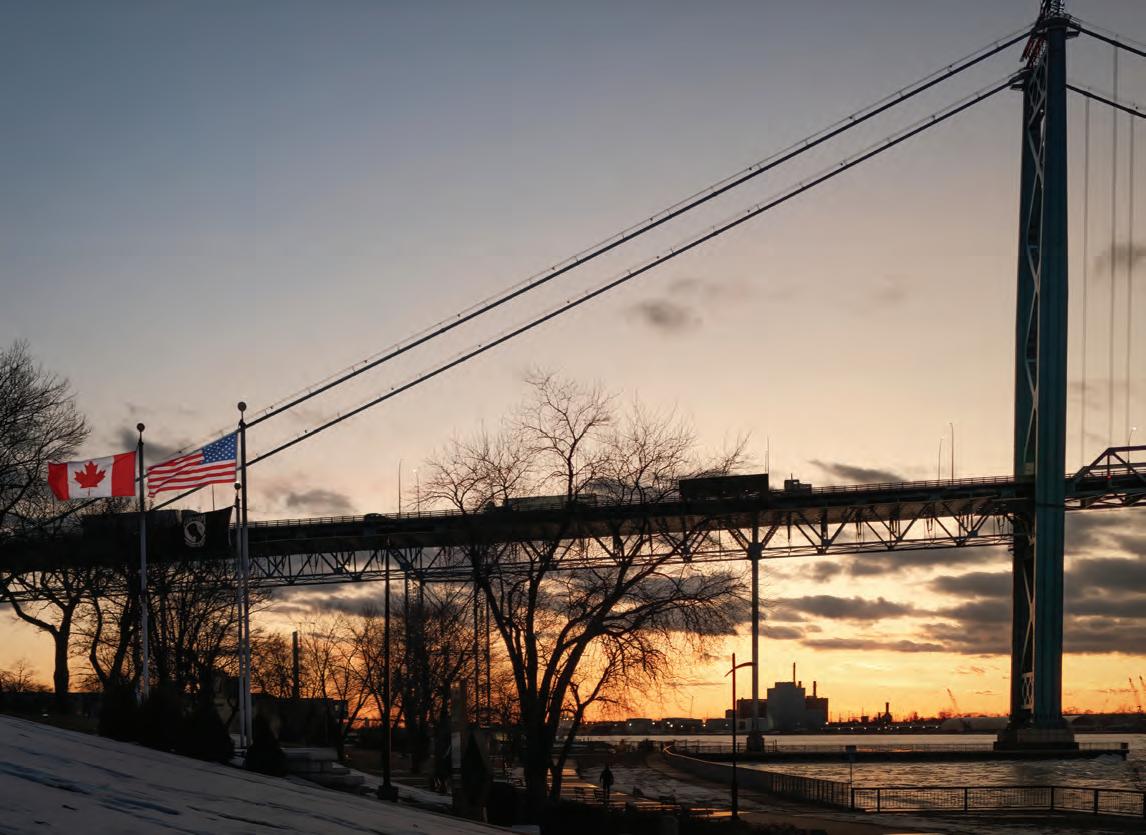
When U.S. President
Donald Trump started a trade war by imposing a 25 per cent tariff on almost all Canadian goods bound for his country (with the notable exception of only 10 per cent on Canadian oil, gas and electricity), he fired the opening salvo of a conflict that Canada hadn’t anticipated.
It’s clear from Trump’s words that he has little regard for Canada’s sovereignty; no respect for a country, like his, that went from living under Britain’s thumb to being one of the more influential, secure and selfsustaining nations on Earth. Indeed, he seems to think that Canada is some sort of factitious creation that shouldn’t exist and that should join the tender mercies of the U.S.
“You get rid of that artificially drawn line, and you take a look at what that looks like,” said Trump in a January 2025 news conference. “That would be really something.” He followed the remark with a social media post including a map that erased Canada.
What does a trade war have to do with Canadian defence? Everything.
It’s the latest aggression in a series, including, but not limited to, threats to Canada’s Arctic region manifest by the growth and modernization of Russia’s military in the North and China’s stated designs on exploiting the area’s resources; and, as the National Cyber Threat Assessment 2025-2026 stated, “Canada is
confronting an expanding and complex cyber threat landscape.”
The country has done little to address these challenges, while it has spent (and borrowed to spend) nearly $300 billion on social welfare programs (nearly half of all government spending).
Canada’s defence spending as a percentage of its gross domestic product (GDP) ranks it among the bottom six NATO members— and one of the countries below it is Iceland, which has no military. While Canada has been pressed for years by its NATO allies to increase its military budget, the answer has always been delay, delay, delay. NATO countries agreed in 2014 to commit two per cent of their GDP to military expenditures.
At the time, Canada was spending less than one per cent of its GDP on defence. In 2024, it spent 1.37 per cent. In July, it promised to meet the mark by 2032.
That’s no way to earn respect in a world where power is largely measured by what a state can do to protect itself and to project strength to advance causes that it considers vital to itself and its allies.
The causes advanced by Trump for this war—illicit fentanyl and illegal immigrants flowing from Canada to the U.S.—are completely fabricated. Statistics from U.S. Customs and Border Protection indicate that just 43 pounds of fentanyl were seized at the Canadian border in 2024—about 0.2 per cent of the total border authorities caught. Meanwhile, about 1.5 per cent of people caught illegally entering the U.S. entered from Canada, according to American border officials.
Of course, at this moment, no one knows how this trade war will progress. But, buying Canadian wherever possible should be one
rallying point of the country’s defence. True, many goods we use in Canada—everything from orange juice to F-35 fighter aircraft—come from the U.S., but most of Canada’s other NATO allies also build reliable weaponry. (As for oranges, Israel and Brazil produce some good ones.)
The trust that Canada thought it had been building with the U.S. during times of both war and peace since the middle of the 19th century has been broken. When the British colonies that preceded Canada adopted the U.S. rail gauge and the decimal currency at least a decade before Confederation, it was a sign of where Canadians believed their future lay.
Canadians bled beside Americans during two world wars, in Korea and in Afghanistan. Canada supported the democratic and self-governing values the U.S.


espoused, which on a global level were first championed by President Woodrow Wilson, who, in an address to Congress in February 1918 said: “What we are striving for is a new international order based upon broad and universal principles of right and justice.”
But, given the current president’s rhetoric, Canada would do well to be suspicious of modern American leadership.
“The United States will once again consider itself a growing nation,” Trump said in his inauguration address this past January. “One that increases our wealth, expands our territory…and carries our flag into new and beautiful horizons.”
The two countries share the majority of a continent. But, most of the northern half belongs to Canada, and it’s safe to assume that Canadians will always “stand on guard.” L



Second World War

By Stephen J. Thorne

Nestled away on the top two floors of a four-storey stone-andbrick building overlooking the St. John’s waterfront, just a few metres from the Newfoundland National War Memorial, is a piece of Second World War history unlike any other.
Fifty-nine precarious steps up the back of the former warehouse, the Seagoing Officers’ Club, established by Captain Rollo Mainguy—a B.C. native commanding Canadian navy destroyers in the British colony of Newfoundland—is the stuff of legend.
Opened in January 1942, the warm-wooded refuge with its planked floors and beamed ceilings became home to a growing number of crests, etchings and artifacts deposited by its clientele on behalf of their ships.
On virtually every vertical surface emerged a unique gallery of the Battle of the Atlantic, a time when Newfoundland had, for all intents and purposes, become the “Gibraltar of America” that its former prime minister, Robert Bond, predicted it would be.
War was transforming the world—including this grand island affectionately known as The Rock.
“Perhaps nowhere…was there a garret exactly like the Crow’s Nest,” wrote Joseph Schull in his 1950 book Far Distant Ships. “Reminiscences went round the world, and doubtless still are on the wing, of the loud and smoky room where ships’ crests and bells and trophies hung thick on the
Captain Rollo Mainguy in the Seagoing Officers’ Club in September 1942.
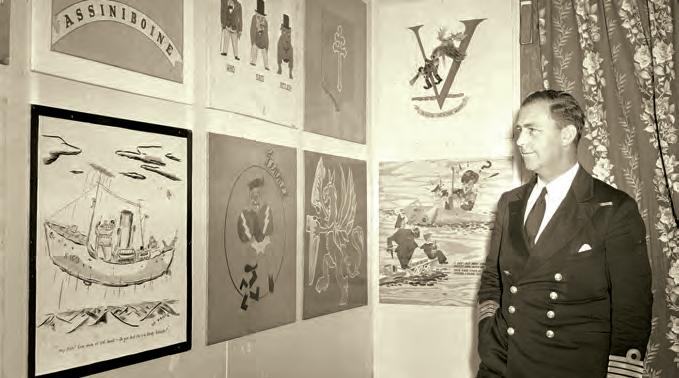
A retreat and a respite for Allied naval and merchant marine officers between sailings on the North Atlantic run, it became forever known as the Crow’s Nest after a Canadian army colonel, gasping from his upward trek, mopped his beaded brow and uttered the immortal words: “Crikey, this is a snug little crow’s nest.”

wall and where women were allowed on Tuesday nights only, provided they do not clutter up the bar.”
The club is still there, now a refurbished Canadian national historic site, a living testament to the ships and men who fought the war’s longest battle and, by their presence alone, acted as catalysts helping usher the island into the modern world.
Among the Crow’s Nest artifacts is the periscope from U-190 (see “Artifacts,” page 94), one of the last German subs to surrender, on May 11, 1945—three days after VE-Day. Canadian warships brought the boat into St. John’s before it was moved, examined and scuttled off Halifax—but not until the periscope was salvaged and eventually brought back to the port where, for many, the war began, and ended.
Poking out of the building’s roof, the signature element of the U-boat war now provides, not the silhouette of another victim, but a sweeping view of downtown St. John’s and a sheltered, tranquil harbour populated by fishing trawlers, oil service vessels and coast guard ships—all of it very different from what came before.
For those fortunate enough to be granted passage through its door, the Crow’s Nest is an intimate history of an era of great turmoil and transformation. But the living legacy of WW II in Newfoundland can be found in virtually every corner of the province where the wartime forces of Canada and the United States, in very tangible and lasting ways, changed the course of the former colony’s history.
The Jan. 24, 1934, telegram from a magistrate in the outport of Burgeo, Nfld., to the justice minister on the other side of the island amounted to a desperate cry for help.
“ABOUT FORTY MEN [CAME] TO ME IN STARVING CONDITION,” it said.
“I CONSULTED RELIEVING OFFICER WHO INFORMS ME NOTHING CAN BE DONE THEIR ALLOWANCE WILL NOT BE DUE TILL EIGHTH AND NINTH FEBRUARY STOP IMPOSSIBLE THESE FAMILIES EXIST FOURTEEN DAYS WITHOUT FOOD STOP CAN ANY ARRANGEMENTS BE MADE HELP OUT SITUATION IF NOTHING I FEAR CONSEQUENCES.”
Government documents in Ottawa were describing Newfoundland as Canada’s “first line of defence” and “the key to the western defence system.”
There were few phones. It would be another 31 years before the broad, U-shaped arc of the Trans-Canada Highway would connect Port aux Basques on the island’s southwest corner to St. John’s, 900 kilometres away in the southeast.
Remote, weatherbeaten and chained to the make-and-break of a fickle fishery controlled by a handful of merchants in St. John’s, Depression-era Newfoundland was a Dickensian nightmare, and worse, for a disproportionate number of its 289,000 residents.
“Newfoundland was hit very hard by the Great Depression,” Carmelita McGrath wrote in Desperate Measures: The Great

Depression in Newfoundland and Labrador, a 1996 history produced by the province’s writers’ alliance.
“Many people were out of work or had very low wages. Hunger was a real problem…. More and more people were forced to apply for public relief.”
“The dole,” as it was known, didn’t come in the form of cash; it consisted of what were essentially food stamps redeemable at local merchants for specific goods.
“Many people said that you could not live on the dole. Often, people ran out of food before their next ‘relief order’ would allow them to get more. Most people hated the dole. They wanted work. They wanted to choose what they ate.”
McGrath describes how the Depression upset the delicate balance that was survival in Newfoundland at the time: life on the edge.
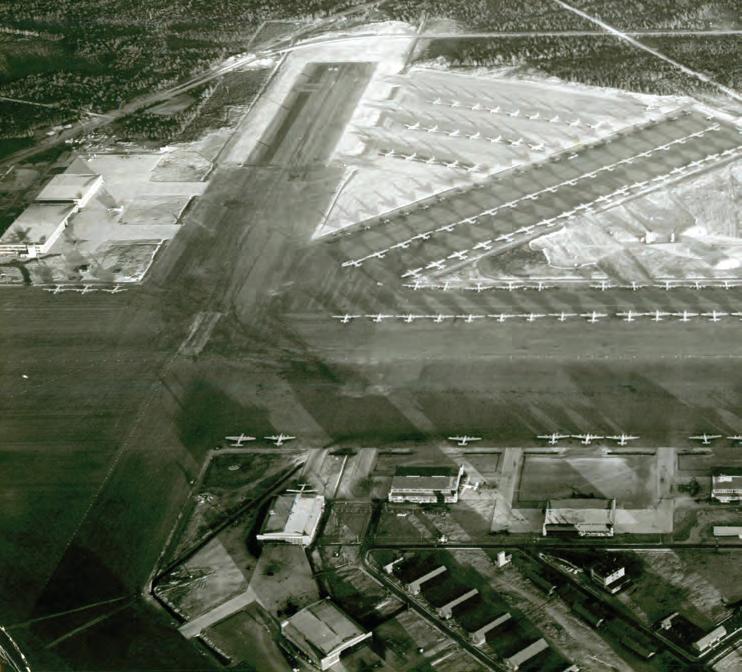
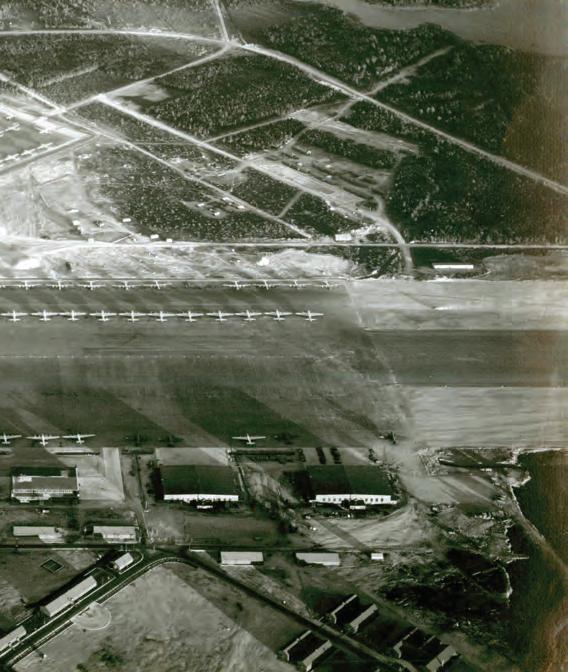
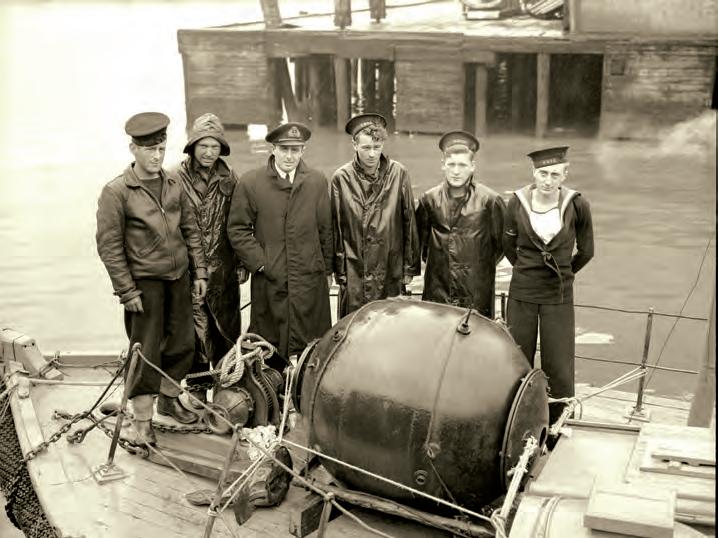
Dozens of planes, mostly bombers, line the Tarmac at the Royal Canadian Air Force base in Gander, Nfld., in 1944. Naval personnel of S.S. Miss Kelvin pose with a recovered mine in St. John’s, Nfld., in July 1942.

“On one side of this edge is a certain amount of security,” she explains. “There is enough food, decent housing, heat and comfort. On the other side of the edge there is little security, hunger, poor housing, cold and discomfort.
“During the Great Depression, more and more people were pushed over the edge.”
Largely descendent from British, French, Spanish and Portuguese fishermen, Newfoundlanders are a rugged, passionate people. Eventually, dissatisfaction—indeed, desperation—boiled over. There were demonstrations, riots, even looting.
The government, however, was up to its ears in debt.
Newfoundland had given up its status as a dominion of the British Empire in 1934 to be governed by a six-member commission appointed out of London. Now a colony, it was kept afloat by loans and grants from the British Treasury.
It all changed in the spring of 1940 when, after defeating virtually all of western Europe, Hitler’s forces stood poised to invade Britain.
On this side of the pond, government documents in Ottawa were describing Newfoundland as Canada’s “first line of defence” and “the key to the western defence system” should the Nazi advance come this far.
As for Newfoundland itself, the colony was all but defenceless. It had virtually no troops, no guns, no fortifications, and the government didn’t have the funds to provide them. Britain was in no position to help.
On Nov. 10, 1940, seven Hudson bombers manufactured in Burbank, Calif., took off from the airport at Gander and headed out into the night across the Atlantic. They were the war’s first transatlantic ferry flights, 13 years after Charles Lindbergh made his famous solo crossing.

The crews disembarked the next morning—Remembrance Day— at Aldergrove, Northern Ireland, wearing poppies. “At a single stroke, Newfoundland had become ‘one of the sally-ports of freedom,’” says a Canadian War Museum history.
Indeed, “in a very short time,” wrote historian Paul W. Collins in a 2015 paper for the provincial government, “Newfoundland boasted five military and civilian aerodromes, two naval bases, two seaplane bases, plus five army bases.”
During the next five years, tens of thousands of Canadian and American military personnel were to be posted throughout the island and Labrador.
“As the Colony’s entire population stood at less than 300,000 and Newfoundland’s capital (and largest) city boasted a mere 40,000 souls,” wrote Collins, “this ‘friendly invasion’ held tremendous economic, social, and political repercussions for Newfoundland— many still felt today.”
“This infusion of cash into the Newfoundland economy had a huge impact on the people of Newfoundland both directly and indirectly.”
Overlooked as a “liability” when Confederation was struck in 1867 (Newfoundlanders didn’t want Canada, either), the island was now regarded as an “essential Canadian interest” and an important part of the “Canadian orbit.” Prime Minister Mackenzie King argued in September 1939 that not only was the defence of Newfoundland “essential to the security of Canada,” but guaranteeing the colony’s integrity would actually assist Britain’s war effort.
Ottawa, however, did not act until Nazi Germany overran France and British soldiers were driven off the beaches of Dunkirk, at which point it dispatched a battalion of The Black Watch of Canada to protect Newfoundland’s Botwood seaplane base and the airfield at Gander, where it also stationed five Douglas Digby bombers and crews from 10 Squadron, Royal Canadian Air Force.
Shortly after, Canadian contractors started building Camp Lester on the outskirts of St. John’s. Brigadier Philip Earnshaw, the newly appointed Commander, Combined Newfoundland and Canadian Military Forces, arrived in November.
By the end of 1940, nearly 800 Canadian soldiers were posted throughout the Newfoundland capital and surrounds, ready to defend against any German attack. Canadian troops would also protect Lewisporte (considered a likely enemy insertion point), Rigolet and Goose Bay Air Station (the world’s largest airport by 1943). They also operated artillery and radar installations along the coasts of both the island and mainland.
The Royal Canadian Navy arrived in Newfoundland and set up a Naval Examination Service to control shipping entering St. John’s Harbour.
The British were woefully short of destroyers for convoy escort duty after losing significant numbers during the doomed Norwegian Campaign the previous winter, in the evacuation at Dunkirk in May, and at the outset of the Battle of Britain when the Luftwaffe was attacking Channel shipping.
Prime Minister Winston Churchill appealed to U.S. President Franklin D. Roosevelt in May 1940 for “forty or fifty of [his] older destroyers” to fill the breach until new construction replaced the losses.
Roosevelt was amenable, but the Japanese attack on the American base at Pearl Harbor was still more than 18 months away and the U.S. was officially neutral. A simple transfer would contravene international law and inflame isolationist sentiment in the U.S.
As a solution, Churchill proposed that Britain, as a gesture of friendship, lease base sites on British territory in the Western Hemisphere to the Americans, and Washington reciprocate with the requested destroyers.
“Unfortunately, such a remedy was a bit too subtle for American policymakers, who preferred a more direct and documented swap,” wrote Collins. “This presented the British with difficulties of their own as a straight exchange of assets could alienate the territories concerned, as well as upset many in the United Kingdom.”
Ultimately, a compromise gave the British their gesture and the Americans their business deal. Leases were given “freely and without consideration” in Newfoundland and Bermuda, while similar facilities were traded in Jamaica, Trinidad, British Guyana, St. Lucia and Antigua for the 50 destroyers.
The United States would go on to develop facilities in Newfoundland at St. John’s (Fort Pepperell/ Camp Alexander), Argentia (Argentia Naval-Air Station/Fort McAndrew), Gander, Stephenville (Harmon Air Force Base/Camp Morris) and Goose Bay.
There were also numerous artillery/radar sites granted around the island. By war’s end, tens of thousands of U.S. servicemen were stationed throughout Newfoundland and Labrador, and hundreds of thousands of U.S. military personnel and passengers had passed through the various American facilities throughout the colony.
By the summer of ’42, Collins reports, the Canadians had turned St. John’s into a well-defended harbour and home base for the five corvettes, two minesweepers and four Fairmile patrol boats of the Newfoundland Defence Force.
It was also home to the Newfoundland Escort Force, renamed the Mid-Ocean Escort Force—about 70 warships protecting the transatlantic convoys ferrying personnel and materiel to the war fronts. It would also include British escorts sailing out of the U.S. naval base at Argentia, on Newfoundland’s south coast.
Two Canadian corvettes, Chambly and Moose Jaw, recorded the force’s first U-boat kill, U-501, off the southeast coast of Greenland in September 1941. It was during this action that the recently commissioned Moose Jaw famously rammed the damaged sub, ending the German’s first and only war patrol (11 of 48 crew died).
Near Torbay, outside St. John’s, the RCAF had begun building an airbase that in postwar years would become the province’s main airport. Canadian military aircraft protected the city, and the iron ore mines on Bell Island, and patrolled convoy routes east of Newfoundland.
The RCAF group headquarters took up residence alongside the navy at the Newfoundland Hotel in St. John’s. RCAF Air Station Torbay opened in October 1941 with two runways; four
Hudson bombers arrived from Nova Scotia in November.
Passenger traffic between Canada and Newfoundland and the railway known as the “Newfie Bullet” had become so congested that in February 1942 the Commission of Government approved regular Trans-Canada Airlines service to and from Canada.
The RCAF developed more facilities at Gander and Goose Bay and made use of the island’s two American aerodromes. RCAF personnel also ran an expanding number of radar stations and an early-warning system.
By 1943, some 5,000 Canadian navy personnel were stationed in St. John’s. Thousands more were at the Buckmasters’ Field Naval Barracks just outside the city. Others would eventually be billeted at new facilities in Harbour Grace, Bay Bulls, Botwood, Corner Brook, and Red Bay and Goose Bay in Labrador.
“The most stunning impact of all this military activity was economic,” declared Collins. “During the fall of 1943 (the peak year of construction) over 20,000 Newfoundlanders were employed in building the various facilities.
Personnel pass the time at Royal Canadian Air Force Station Gander, Nfld., circa 1945.
“Over the course of the war years, the U.S. invested $114,000,000 (USD) on their facilities in Newfoundland, and the Canadians $65,000,000 (CAD). Further, military personnel rose to upwards of 29,000 (13,000 US, 16,000 CA) in 1943, all of whom purchased local goods and services.
“This infusion of cash into the Newfoundland economy had a huge impact on the people of Newfoundland both directly and indirectly.”
In 1939, Collins continued, nearly 50,000 Newfoundlanders received some form of government assistance; by 1942, for the first time since the Commission of Government was struck in 1934, unemployment was “virtually wiped out.”
Tens of thousands of Newfoundlanders were working on base construction, support and supply. While the Americans tended to supply their bases via direct shipments from the U.S., the Canadians sourced theirs locally.
The cost of living rose dramatically during the war years. Though the Commission of Government tried to implement wage-and-price controls, local employers were still forced to match wages paid by the two occupying forces or lose workers.
“Whereas pre-war, only the merchant, professional and political/bureaucratic elite of the Colony could afford a comparable standard of living to that of the United States and Canada, by 1942, most residents of Newfoundland now tasted the benefits of the booming wartime economy.”
Government revenues, mainly from customs and excise taxes, also rose considerably during the war years. In 1939, the expected deficit was $4 million ($84.6 million in
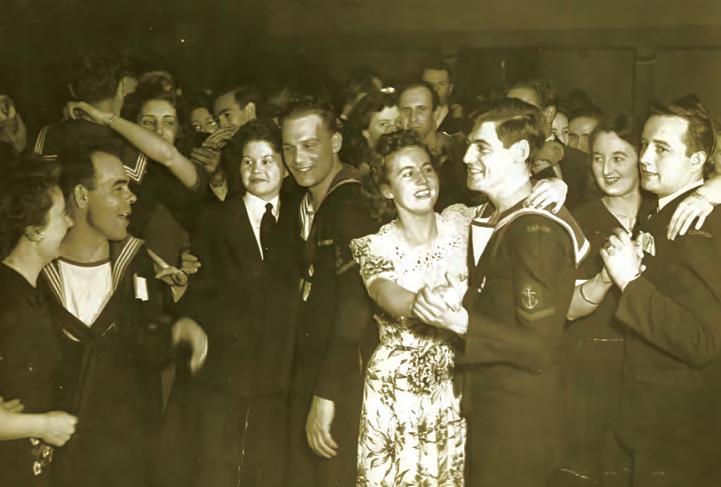
Dancers celebrate VE-Day aboard HMCS Burlington in St. John’s, Nfld. Allied merchant ships in the harbour decorated with flags mark the end of the war in Europe.
2025 Canadian dollars). The 1940-41 fiscal year yielded a surplus of $796,531 ($15.3m) on revenues of $16.3 million.
In 1941-42, the commission recorded a $7.2-million surplus (about $131.8 million in 2025 Canadian dollars) on revenues of $23.3 million; in 1942-43 it had a $3.7-million surplus ($66.3M) on revenues of $19.5 million; in 1943-44, it came in with a $6.4-million surplus ($113.9M) on $28.6 million in revenues; and in the final fiscal year of the war, it recorded a $7-million surplus ($123.8M) on revenues of $33.3 million.
By war’s end, the Newfoundland government had a cumulative budgetary surplus of some $29 million (about $512 million in 2025).
At 10:30 a.m. on May 8, 1945, the siren atop the Newfoundland Hotel began wailing as it had every Thursday morning since 1939, reminding citizens that they were at war. On this joyous Tuesday, however, it marked the end of the greatest conflict the world had ever seen.
In homes across the city, in coastal outports, and at outposts in Labrador, families, service personnel and others gathered around radios to listen as Aubrey MacDonald of the Broadcasting Corporation of Newfoundland held a microphone out a window of its top-floor studio in the Newfoundland Hotel. The streets of the city were flooded with celebrants.
“You are hearing the rejoicing, the unabated rejoicing of our people in St. John’s which has followed spontaneously the great announcement by Prime Minister, Mr. Winston Churchill, that the war in Europe has ceased in an Allied victory,” he said.
“Listen to the whistles, the steamers, the church bells, as our people greet them in great jubilation. The town is bedecked with bunting. Flags are flying. And just now, our people are releasing the pent-up emotions in a torrent of joyous emotion.
“The war in Europe is over!”
And so, too, to a large degree, were the days of Newfoundland’s failing economy and starving populace.
The revenues from its wartime boom had allowed the commission to make significant investments in education, infrastructure, health care, pensions for disabled veterans and their families, and even loans and gifts to Great Britain.
The colony also inherited vast amounts of military property and infrastructure. In St. John’s alone, this included two hospitals, the RCN/RCAF headquarters, a naval barracks complex, a tactical training centre and numerous other area properties.
RCAF Air Station Torbay eventually became St. John’s International Airport.
St. John’s Harbour was also transformed. Once what Collins describes as “a tangle of decrepit wharves and finger-piers,” the RCN brought the moorings along the harbour’s Southside to naval standards—in most cases upgrading the owners’ properties with paving, fencing, access, etc. The navy built new facilities such as HMC Dockyard, now the Port of St. John’s shipping terminal,
and a fuel tank farm, which was sold to Imperial Oil in 1946.
Three hospitals—in Gander, Botwood and Lewisporte—were added to the health-care system. A fourth, the U.S. Memorial Hospital in St. Lawrence, was officially opened on D-Day’s 10th anniversary, a gift from the U.S. government to the people of St. Lawrence and Lawn who rescued and cared for survivors of the February 1942 disaster in which two U.S. naval vessels, Pollux and Truxtun, ran up on nearby rocks in a storm.
Hundreds of kilometres of roads were laid during the war. The Newfoundland Railway was expanded with new rail lines and rolling stock. Modern communications systems were installed and augmented, navigational beacons were upgraded, and Long Range Navigation (LORAN) added.
During succeeding decades, the Americans—and to a lesser degree the Canadians—closed facilities at St. John’s, Argentia, Botwood, Lewisporte, Gander, Stephenville and Goose Bay, passing title to federal, provincial or municipal governments.
Collins says the social impact of the war’s “friendly invasion” was also substantial.
“With the arrival of thousands of young men in communities throughout Newfoundland, many away from home for the first time, social interaction between the genders was inevitable,” he wrote.

“Scores of local women attended the various functions both on the bases themselves…and also at local entertainment facilities and hostels that sprang up at St. John’s and communities across the Island.”
Marriages, pregnancies—and sexually transmitted diseases— increased dramatically until U.S. authorities stepped in and prohibited local marriages, even sentencing some love-struck young bucks to prison terms.
“The Canadians, while not encouraging such unions, did not prohibit them, and seldom did a week go by that the St. John’s Evening Telegram did not announce an engagement or marriage between ‘a local girl’ and a visiting serviceman.”
When it was over, locals tended to join their spouses in Canada or the United States. Some would return to Newfoundland and raise families.
The friendly invasion changed Newfoundland and its people, who in turned changed the “invaders,” many of whom had never been far beyond their own villages and towns.
The colony never returned to dominion status. In 1948, fearful the United States would make a play for ownership of what was now recognized as a strategic chunk of North American territory, Britain and Canada conspired to omit the American option from two referendums on the colony’s future.
With Joey Smallwood at the helm, confederation with Canada edged out British rule and outright independence in a result whose legitimacy is in some quarters debated to this day. Newfoundland entered Confederation on March 31, 1949.
For years, it would be considered a “have-not” province, the breeder of Alberta oil workers and recipient of billions of dollars in equalization
“The war in Europe is over!”
payments from its wealthier siblings. Until, that is, offshore oil and gas propelled the renamed province of Newfoundland and Labrador to a payer between 2008 and 2024.
In today’s changing and onceagain increasingly volatile world, the province’s strategic importance, at the intersection of the Arctic and eastern approaches to the continent, cannot be overstated.
Nor can the value of its people who, in 75 years, have changed Canada, too.
“Among English-Canadians, at least,” author and historian Gwynne Dyer, a dyed-in-thewool Newfoundlander, wrote in a 2003 royal commission report on the province’s place in Canada, “Newfoundlanders have come to be seen as a slightly different breed of human beings who add interest and value to the Canadian mix.
“There is a clear perception among urban Canadians in particular that both the place and its people are in some sense special. If you were to press them as to what that really means, they would reply using



Able Seaman Donald Albert Douglas, like all liberty-loving Canadians, was jubilant at the news: the bloodshed in Europe—if not the war overall—had finally ended.
It mattered not that the May 7, 1945, announcement had been leaked earlier than authorities had intended. Cheers soon rang out across the city of Halifax and neighbouring Dartmouth as spontaneous celebrations erupted in the streets.
The 19-year-old from Belleville, Ont., who was serving in the Royal Canadian Naval Volunteer Reserve thought little of his duties aboard HMCS Cobalt. Who, anyway, would need a sick berth attendant when the greatest issue, both over the coming hours and on VE-Day, was ensuring that service personnel and civilians alike savoured the moment?
Douglas reflected on his parents and how they would mark the historic occasion back home. He wondered, too, what he would write of his own experiences.
His medical skills, it would transpire, were destined to be critical. The young corvette crewman’s next letter to family, meanwhile, would be laced less with exuberance
and gratefulness and more with horror, angst and sheer disgust.
“If we live to be 100,” he penned in the immediate aftermath of what was to become the Halifax VE-Day riots, “…we’ll shudder at the thought of it.”
The Maritime port had long been a powder keg.
Effectively on the front lines throughout the Battle of the Atlantic, Halifax was a hub of wartime activity from the conflict’s onset. Allied convoys transporting munitions, supplies and troops assembled and departed from its harbour; local industry was booming; and civilians grew accustomed to the sea of uniforms.
As soldiers, sailors and airmen flooded into the city, the overall population swelled by an estimated 60 per cent between 1939 and 1944. Initially, these military men and women received a warm Nova Scotian welcome, but such hospitality was eventually replaced by ambivalence.
One of the primary causes was a fundamental lack of accommodation. Halifax’s infrastructure couldn’t keep pace with the rapid growth of Canada’s forces and, thus, had maintained its prewar, small-town semblance. Service personnel sought billets within the city, competing with civilians in a bidding war that bred contempt. Most landlords were fair in rent
Aprices, although the more devious inflated rates for uniformed newcomers, who often found themselves sardined into small apartments under spartan living conditions.
The situation became so dire that plans were hatched to place posters at Canadian railway stations urging visitors to avoid Halifax unless on official business. It was, according to one naval officer, an “overcrowded hellhole.”
Another issue was an increase in rationing. Partly due to the city’s enormous military presence—some 13,000-18,000 naval personnel alone resided there by May 1945—Haligonians felt these shortages more acutely than most. Then there was alcohol. Antiquated liquor laws meant that personnel had startingly few opportunities to enjoy a drink. Wet canteens on base and government stores in Halifax were perhaps the best options, but even those came with certain limitations, not least the ban on liquor possession and consumption in barracks.
Those less fazed by legality could instead visit bootleggers and speakeasies.
Once, the privately-owned Ajax Club had quenched the thirst of innumerable sailors, only for Halifax’s temperance lobbyists to force its closure in early 1942. That perceived slight against naval ratings was neither forgiven nor forgotten.

“If we live to be 100,” he penned in the immediate aftermath of what was to become the Halifax VE-Day riots, “…we’ll shudder at the thought of it.”
Resentment between residents, who became jaded by the strain on local facilities, and military members, who felt gouged by landlords and stifled by archaic rules, continued to fester, occasionally exhibited in alcohol-fuelled offences ranging from vandalism to property destruction to theft and assault.
On Dec. 2, 1944, a tram became the target of naval ire, having come to epitomize all that was considered wrong with Halifax. The streetcars were old, congested and uncomfortable, not to mention scarce. Inebriated sailors smashed windows and damaged the vehicle’s interior.
The incident further shook public trust in military and civic authorities whose shared role it was to counter escalating displays of misdeeds and indiscipline.
There was even precedent for precaution. At the time of the Great War, the arrest of a drunken sailor

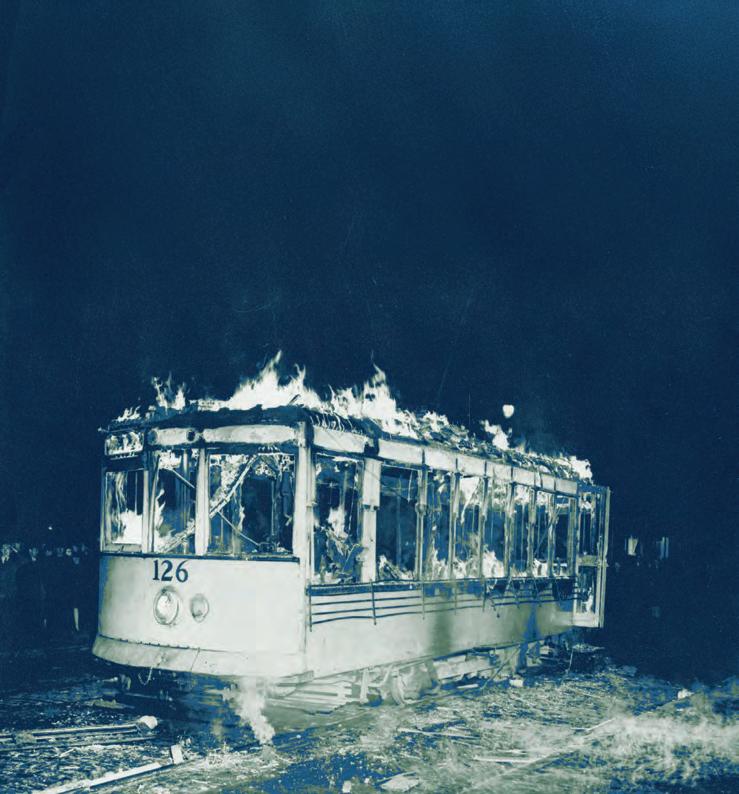
A streetcar, set ablaze by rioters, burns on the evening of May 7, 1945. Despite the signs of trouble, RearAdmiral Leonard W. Murray allowed sailors free rein on VE-Day.
on May 25, 1918, resulted in City Hall being besieged; then, on Feb. 18-19, 1919, a racially motivated mob rampaged through the streets after a returning war veteran abused a Chinese restaurateur.
The question was what could be done this time around?
Preparations for VE-Day had begun in September 1944 amid hope that the war would be over by Christmas.
Municipal and military officials gathered for a series of meetings spanning several months, their collective goal to co-ordinate celebratory plans and, above all else, to ensure that jubilations couldn’t descend into violent unrest.
A committee was appointed to organize efforts, headed by Civil Defence Director Osborne R. Crowell. Other key figures
involved in preparations included Mayor Allan MacDougall Butler (who succeeded Jack Lloyd in May 1945); Police Chief Judson Jeffrey Conrod; Captain C. Balfour, commanding officer of the local naval barracks; Lieutenant-Commander Reg Wood, who led the navy shore patrol; and Rear-Admiral Leonard W. Murray, commanderin-chief of the Canadian Northwest Atlantic Command, the only Canadian to preside over an Allied operational area. Thanksgiving church services, remembrance ceremonies, military parades and firework displays were all agreed upon in due course. However, these genteel affairs were then combined with a slew of decisions that would prove fateful. Committee chair Crowell focused less on arranging entertainment and more on curtailing boisterousness. Elsewhere, Chief Conrod met with the provincial liquor commission and, together, discussed whether alcohol-selling outlets should close on VE-Day, a measure ultimately adopted. Naval barracks commander Balfour, meanwhile, announced “open gangway,” meaning that naval ratings not on duty could join in the merrymaking at will. Such perceived free rein was arguably aided by the navy shore patrol’s Wood, who intended for his men to stay in reserve to answer emergency calls in force rather than have them monitor the streets. This move was approved by Murray, who planned to curb arrests for fear of “a serious riot.”

The measures didn’t cease there. Soldiers and sailors were implicitly discouraged from participating in civic events, with Murray maintaining the belief that having wet canteens open could “go a long way towards keeping the crowds of service personnel off the streets where they might do harm.” Those who did venture farther afield would find 44 of 55 eateries and all 11 theatres closed on VE-Day, deemed a necessity by most establishment owners, despite some pleas to the contrary, after realizing that the stretched-thin police were ill-equipped to provide protection.
Whereas the Canadian Army and Royal Canadian Air Force imposed strict schedules and rules of conduct on their garrisons, the Royal Canadian Navy’s guidelines were comparatively lax. Nevertheless, it took more than a sailor’s presence to cultivate discontent.
Added to the spectre of anarchy was mayoral inexperience and, of course, the frayed nerves of a war still being fought in nearby waters until May 7, 1945.
The question now was whether the guardrails would hold.
It started as it was always meant to start.
Spilling into the streets for an impromptu party, Haligonians ignored dense fog and torrential rain to mark victory in Europe, even if VE-Day was earmarked for the following day, May 8. The clouds later parted as bunting sprouted from windows, flag masts and telephone poles, only amplifying the jovial atmosphere throughout Halifax.
Mayor Butler declared the 7th a civic holiday before promptly removing his car from the area for “security reasons.” Though most service personnel remained on duty, more than 9,000 naval ratings were expected to join the evening festivities.
In the meantime, the planned shuttering of cinemas, cafés
and restaurants went ahead. Liquor stores likewise closed, freeing bootleggers to charge a premium of $15 per two-bit bottle of rye. Plus, in accordance with the agreed-upon police policy, enforcers prepared to gather and respond to trouble in strength.
That trouble seemed almost negligible until 9 p.m. when the wet canteen at the primary naval barracks at HMCS Stadacona shut down. The site had been well stocked with 6,000 bottles of beer, and the drunk naval ratings now released into the streets sought new methods to sate their feisty mood.
What would appear then than one of the despised streetcars. The naval shore patrol’s Wood glimpsed the disturbance from a Stadacona window, mustered 30 officers and hurried to the scene. He discovered the tram had escaped with minor damage. But it was merely the beginning of an exceedingly long night.
On Citadel Hill’s eastern slope, a crowd of 15,000 marvelled at a two-hour fireworks display launched from Georges Island and naval vessels. During the quieter interludes, however, came the equally distinct din of smashing glass.
Sailors, joined by scores of civilians, ran amok through downtown Halifax. The naval ratings harassed streetcars along Barrington Street by disconnecting their electricity supply, leaving them stranded to the whims of well-lubricated mobs. Hundreds of rioters surrounded one tram, ejected its driver and passengers, shattered windows, tore out seats and attempted to topple it. They eventually set it ablaze.
The task of restoring order fell to a police squad driven to the scene by Constable Fred Nagle. His arrival did little except fuel greater chaos. Nagle himself sustained injuries when the mob flipped his vehicle, forcing all other passengers to make a hasty exit while he remained trapped. The officer watched in unbridled horror as
a sailor set the police wagon on fire. Caught in an inferno, Nagle’s bids for freedom were prevented by an individual shoving him back into the car. Thankfully, if belatedly, another sailor saw sense and pulled him out.
The next target soon became the firefighters tackling the flames, as rioters hacked at water hoses with axes stolen from the fire truck. Perhaps fearing the onset of sobriety, the crowd then shifted its attention to plundering the liquor stores.
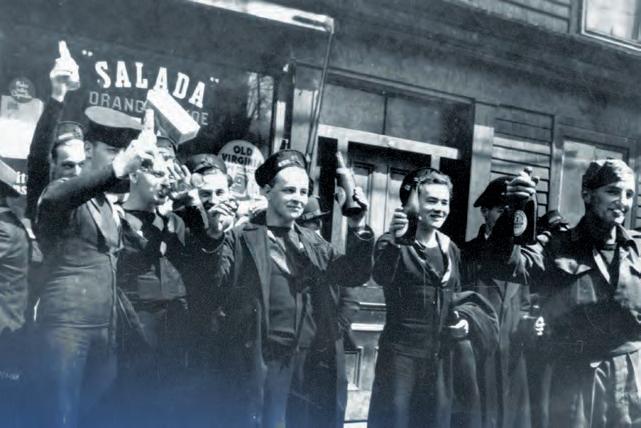
The outlet on Sackville Street was the first hit when three merchant mariners threw a flagpole through the plate-glass storefront. Two more shops, on Hollis and Buckingham streets, were looted around midnight. The overwhelmed police, powerless to halt proceedings, stared impotently as the horde of uniforms and civilian accomplices extricated thousands of wine, beer and spirit cases.
The pandemonium continued with a range of criminal acts, from robbing the Wallace Brothers’ shoe store to foiled efforts to dump Nagle’s gutted patrol wagon into the harbour. Finally, in the early hours of May 8, the disorder fizzled out.
But the worst was yet to come.
Memories of the Great War riots paled compared to what Haligonians confronted on their streets the next morning. Due to the lateness of the previous night’s events, many had been unaware of the destruction wrought. They saw it now.
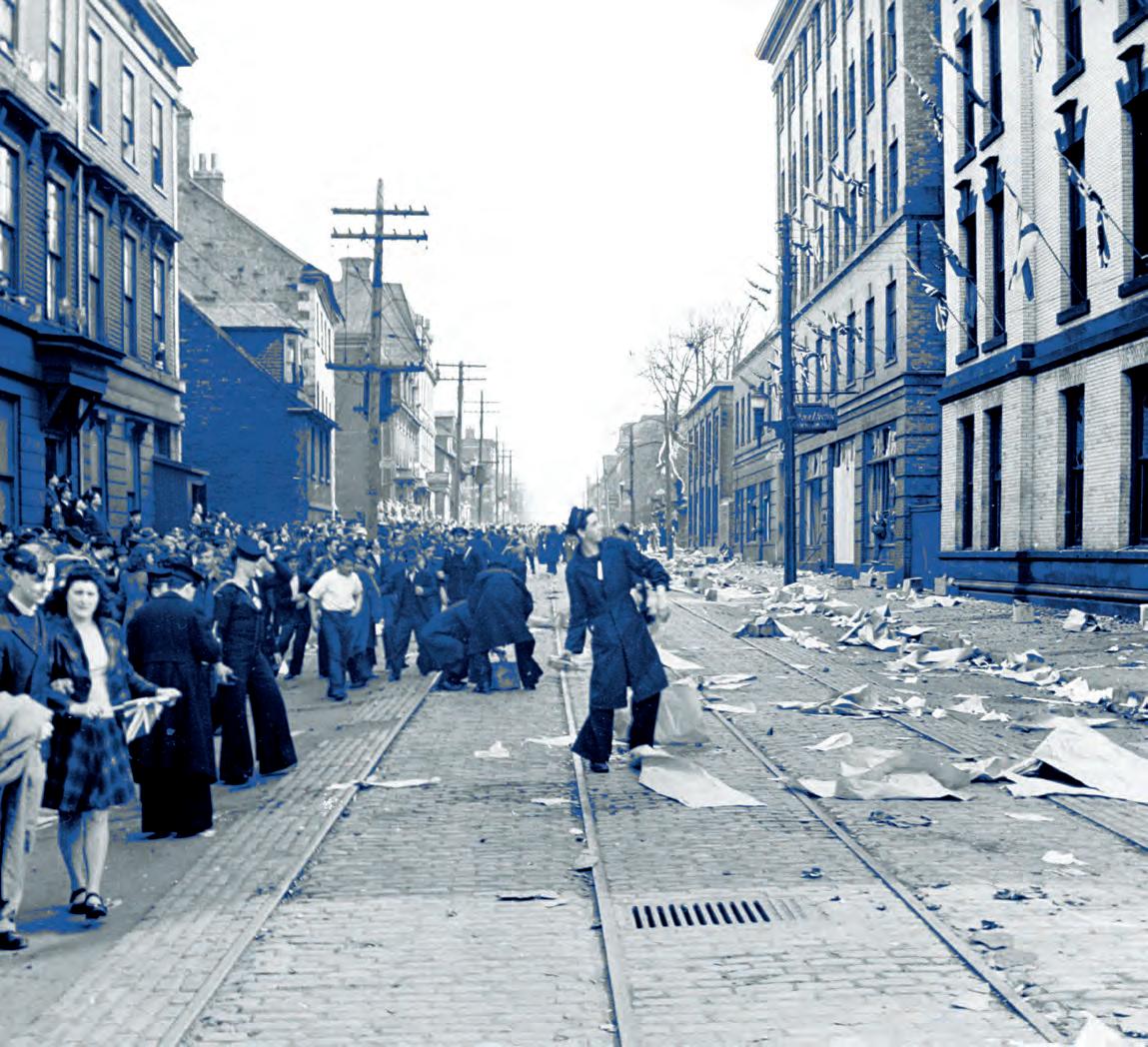
The signs were everywhere: shattered glass, strewn merchandise, devastated storefronts, and the wretched stench of stale booze, vomit and charred wood. Then there were the perpetrators, some of whom lay drunk in the gutters. As such, legitimate concerns were raised about whether the scheduled VE-Day celebrations would provoke further unrest. Rear-Admiral
“I’m ashamed that I’m in the Services and that I’m Canadian and I don’t mind telling you.”
Murray, who inexplicably hadn’t been informed about the previous evening’s rampage while it took place, had since been apprised of the situation. He determined that his sailors still deserved their day; they had fought for it.
Mob mentality began anew shortly after 1 p.m., when the naval barracks’ wet canteen ran dry, once again forcing naval ratings into the streets. The men first vented their frustration on the canteen itself, hurling bottles and rocks at its windows. They then shifted their focus to a tram on Barrington Street.
Hijacking the streetcar, nearly 150 intoxicated sailors clambered inside or perched outside, with the remainder of the throng following behind as it lumbered downtown. Their numbers were eventually augmented by personnel of the Women’s Royal Canadian Naval Service, civilians and even children. They joined in smashing windows en route before abandoning the wrecked tram.
Additional streetcars, liquor outlets and shops soon faced the same fate. But, perhaps the most significant misfortune befell Keith’s Brewery, when a thirsty, 4,000-strong horde descended on its Lower Water Street warehouse. Despite having barricaded the gate, security couldn’t protect the complex’s entire perimeter. Two dozen rioters breached it, emboldening hundreds more to swarm through. Colonel Sidney Oland, the brewery’s owner, resolved himself to the path of least resistance, offering free cases of stock. The decision paid off as satisfied intruders left the business largely undamaged.
“This is to thank you for your service to your country,” remarked Oland in donating 118,566 bottles of beer to the swarm as it formed an orderly queue.
Drunkenness, theft and vandalism weren’t the only crimes and misdemeanours taking place throughout Halifax. At Cornwallis Park (since renamed), for instance, couples were engaged in public fornication. Elsewhere, sailors sold stolen liquor in a cemetery.
Yet, the band played on at the Garrison Grounds ceremony, where about 20,000 Haligonians gathered for the scheduled events. Murray, who attended the service, devised a plan for the parade’s 375 naval ratings to march downtown. There, they would assist the shore patrol and police in quelling the violence.
And it may have worked, too, had someone thought to tell the parade officer in charge. Instead, 100 peeled off from the march and joined the rioters.
To make matters worse, Chief Conrod neglected to order his own officers to stay on duty after their shifts ended. The accidental oversight meant that 40 men—an entire platoon’s worth—returned to their homes at 4 p.m.
Seaman Donald Albert Douglas, HMCS Cobalt ’s 19-year-old sick berth attendant, wouldn’t receive the same luxury, having been tasked with erecting an emergency ward to treat the wounded. The sailor laid claim to a “clear conscience” amid the turmoil as his short-staffed team “worked like pack horses.”
At 7 p.m., Douglas and two assistants “who were nearly sober” commandeered an army ambulance
and headed into Halifax. Weaving past shattered glass, the trio saw “shoes, boots, chesterfields, clothes, cash registers, pots, pans and nearly everything you could imagine on the street.”
Their first patient was unconscious after “someone had taken the jagged end of a broken bottle and just slashed his face to pieces.”
The team had just heaved the man into the ambulance when a soldier approached and offered to drive.
Countless others—including naval ratings—likewise volunteered their services across the city, whether in quelling the riots or providing medical assistance.
Over the next few hours, Douglas’ mismatched band of helpers made repeated trips into Halifax and provided aid to dozens.
“I got one fellow,” he wrote later, “who had had a broken bottle shoved into his back and twisted till it made a hole.”
Enough was enough for civic and military authorities. Mayor Butler, who had proposed enacting martial law without success, and Murray, who had at last conceded that more needed to be done, declared VE-Day celebrations over at 6 p.m. and imposed an overdue curfew two hours later. Bolstered by shore patrol officers armed with 150 axe handles and an incoming army contingent from Debert, N.S., both leaders boarded a sound truck and, touring the streets, ordered everyone to return home or back to base.
The streets of a battered Halifax began to empty, perhaps due to the authoritative voices that bellowed through speakers— or perhaps because the rioters were all rioted out.
Regardless, it would be one hell of a hangover.
“I’m ashamed that I’m in the Services and that I’m Canadian and I don’t mind telling you,” wrote a disillusioned Douglas to his parents on May 9, 1945.
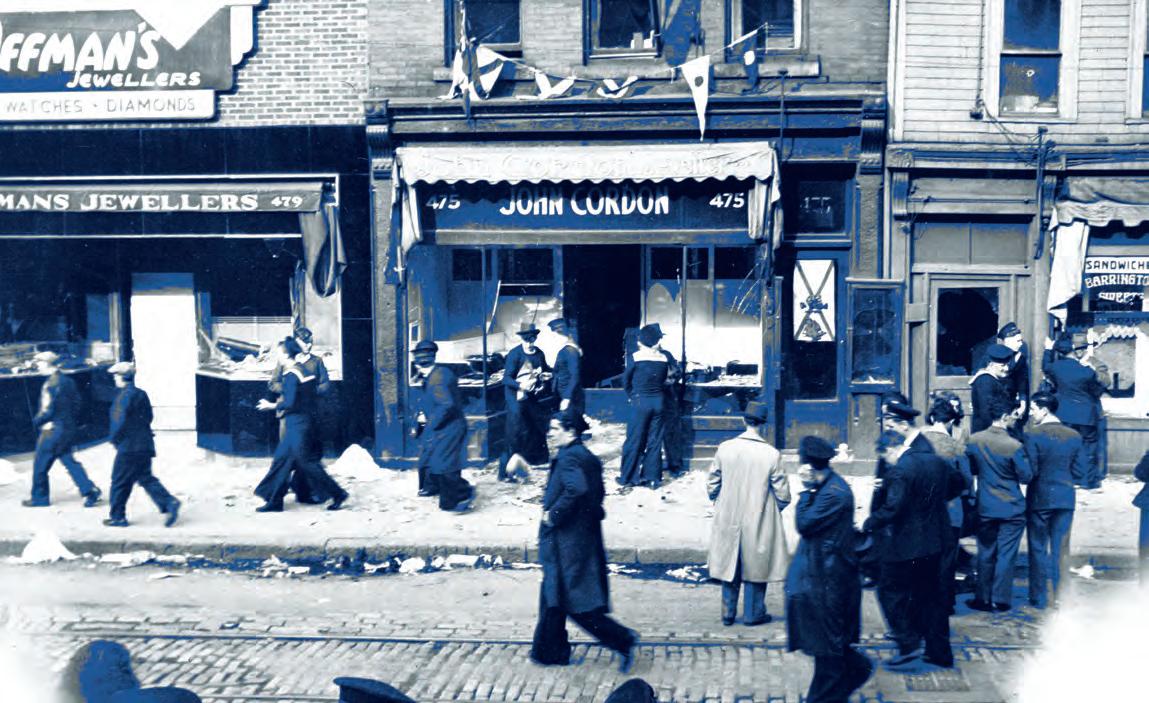
Service personnel and civilians alike walk past looted businesses in Halifax on VE-Day.
Emotions were evidently high in the aftermath of the Halifax VE-Day riots, but one question was already at the fore: who was to blame?
Crammed into jail cells were masses of miscreants, 152 of whom had been arrested for drunkenness and another 211 for the likes of robbery, looting and possession of stolen goods. Those goods included 6,987 beer cases, 1,225 wine cases, and 55,392 spirit bottles from the liquor commission of Halifax; another 30,516 quarts of beer from Keith’s Brewery; and an additional 5,256 quarts of beer, 1,692 quarts of wine, and 9,816 spirit quarts from the commission in Dartmouth, where a smaller riot had occurred. Plus, 207 businesses pillaged and another 564 establishments damaged.
Were these imprisoned individuals the sole perpetrators of a destructive spree costing some $5 million? No, it would be deemed—it went higher than that.
Two people had died during the two chaotic days, while at least 29 sustained serious injuries, with many more minor ones.
Someone, surely, in the upper echelons of command would need to take responsibility for such casualties, not to mention the physical carnage.
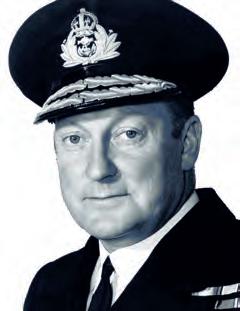
That person became RearAdmiral Murray, who, through a Royal Commission inquiry under Justice Roy Kellock—a militant teetotaler—endured an estimated 2,243 questions only to be later found at fault for virtually the entire debacle.
It was a view that corresponded with an ever-broadening consensus that sailors, who indeed comprised a sizable proportion of rioters, had mainly been left to their own devices while naval authorities and, therefore Murray, remained passive.
That was probably true to a certain degree, but the verdict failed to recognize the unique and unfortunate circumstances that made it possible. Civic authorities—from the municipal to the federal level—had done little to relieve pressures placed on overcrowded Halifax. The city’s military-civilian relationship was at an all-time low when the riots broke out—with
Haligonians sharing a proportion of fault for that deterioration. And the fateful decisions, actions (and inactions) of others, be they in positions of power or simply on the streets, contributed to the disorder. It mattered not: a scapegoat had been chosen.
An unrepentant Murray was relieved of command. With his hard-earned reputation forever tarnished—rightly or wrongly—the former rearadmiral committed himself to self-imposed exile in England, where he subsequently retrained to practise law. The renowned Battle of the Atlantic veteran died on Nov. 25, 1971, at age 75.
Halifax’s naval bonds were repaired with time. The heroic RCN response to the July 18-19, 1945, Bedford Magazine explosion did much to restore that relationship, with sailors playing a vital role in mitigating its impact. It almost certainly helped, too, that the city’s VJ-Day celebrations, when they at last occurred on Aug. 15, 1945, were a far quieter— and less riotous—affair. L

Knowing your people is a fundamental tenet of good leadership—knowing their capabilities, shortcomings, foibles, their collective state of mind.
That navy brass in the Halifax of May 1945 believed concerts and sports would mollify thousands of antsy sailors, most of whom had just survived the longest battle of the war, was at best naive, at worst negligent.
And once things went south on Halifax streets, the navy did little to stop it.
“The disorders which actually occurred on May 7 and 8 owe their origin, in my opinion, to failure on the part of the Naval Command in Halifax to plan for their personnel,” wrote Justice Roy Kellock, head of a royal commission on the riots.
Kellock said the situation escalated and continued for two days because navy brass allowed it to. He said they were “passive” and left remedial action until it was too late.
Typical of grey old 1940s Halifax, city police were ill-equipped to address the onslaught, during which mostly navy ratings caused some $5 million in damages (more than $88 million today). Two people died.
Sailors, merchantmen and others forced to spend any appreciable time in Halifax during the war years were already exasperated by the
Stephen J. Thorne says YES
lack of amenities “the most important port in the world,” as a British admiral described it, had to offer.
A primary staging point for transatlantic convoys delivering personnel and materiel to the war front, the historic seaport was overcrowded and underserviced. There were no bars— speakeasies abounded, however, and there were liquor stores.
All this as the city’s population nearly doubled and lineups, sometimes hours-long, became the norm at restaurants, clubs and movie theatres.
“THE DISORDERS… OWE THEIR ORIGIN… TO FAILURE ON THE PART OF THE NAVAL COMMAND IN HALIFAX.”
Haligonians were exasperated, too.
When the war ended, organizers suspended tram service to discourage sailors from going downtown. Liquor commission outlets, restaurants, retailers and movie theatres shut down.
Undoubtedly aware of this, Rear-Admiral Leonard W. Murray, the only Canadian to command an Allied theatre of conflict in either
world war, nevertheless believed his boys deserved a celebration.
After Germany capitulated on May 7, he overruled his senior officers and allowed 9,500 of his men to go ashore for the night with the mild admonition that they should be “joyful without being destructive or distasteful.”
One reporter compared the result to “London after a blitz.”
The riots might have ended there, but Murray was incomprehensibly not informed of the events until he saw the morning papers. He assumed his sailors were being unfairly blamed and refused to rescind the standing order allowing another 9,500 to go ashore for the official VE-Day festivities on May 8.
By the time it was over, 303 arrests had been made, 564 businesses damaged and 207 establishments looted; liquor commissions and a brewery had been cleaned out.
The navy handed Murray a relatively mild rebuke, but a naval board of inquiry declared that the riots “cannot be attributed to any one cause but rather to a series of events which led a normal body of men, prepared to celebrate in an innocuous manner, to disorders of a serious nature.”
Which recalls another tenet of good leadership: The buck stops here. L
At10:30 a.m.
on May 7, 1945, news leaked across Halifax and neighbouring Dartmouth that the war in Europe was over. Crowds soon thronged the streets in unbridled jubilation.
Unfortunately, municipal and military authorities weren’t in a party mood. Over the preceding months, having anticipated the imminency of VE-Day, a planning committee under Civil Defence Director Osborne R. Crowell made several fateful decisions: liquor outlets and theatres, as well as most eateries, would close; off-duty sailors were given free rein to join in the events with minimal guidelines; the undermanned and illprepared naval shore patrol would remain in reserve rather than monitor the streets; and arrests would be curbed to avoid a “serious riot.”
Such measures ranging from the strict to the lax—and most poorly conceived—had many authors. The results, meanwhile, were as predictable as they were avoidable.
In a strategic East Coast port city of festering tensions, where a justified influx of personnel had limited housing opportunities, increased ration shortages, and fundamentally frayed nerves, almost all warning signs had gone unheeded.
> To voice your opinion on this question, go to www.legionmagazine.com/FaceToFace
is an award-winning journalist, editor and photographer and Legion Magazine’s senior staff writer. He has reported on the downfall of South African apartheid and from war fronts in Kosovo and Afghanistan.
Thus, for two days, Halifax endured alcohol-fuelled violence, debauchery, looting and civil unrest. Errant military personnel—including a significant proportion of sailors—ran amok through the streets. Two died amid the destructive chaos, and an additional 29 suffered serious injuries.
THE INQUIRY SELDOM ACKNOWLEDGED THE UNIQUE CIRCUMSTANCES THAT MADE THE RIOTS POSSIBLE
At a subsequent inquiry into the riots, Justice Roy Kellock—a teetotaler—blamed naval authorities for failing to control their sailors. The proceedings made Rear-Admiral Leonard W. Murray, renowned commander-in-chief of the Canadian Northwest Atlantic Command, a scapegoat. Murray, who inexplicably wasn’t kept abreast about the first day of rioting, but had fewer excuses for the second day, deserved a degree of blame. He had played an influential role in the VE-Day planning. Perhaps of greater consequence, the rear-admiral responded slowly, passively and inadequately to events on the ground.
is Legion Magazine’s staff writer. A history writer with a passion for Canada’s military, Bowers has also written for U.K. publications, including History of War, All About History and Britain at War, among others.
Nevertheless, the inquiry seldom acknowledged the unique circumstances that made the riots possible, perhaps even inevitable. Gouging landlords, profiteering merchants, woeful public transport and lacking infrastructure contributed to an environment that bred contempt between civilians and military personnel. Archaic liquor laws, maintained to appease temperance lobbyists, left uniformed men and women scrambling for limited alternatives. Then there were the other planners, the other authors, of the eventual carnage. From closing venues synonymous with celebration to enforcing weak policing measures, municipal and military officials—including those in the Royal Canadian Navy—helped create the perfect storm of resentment. Remember, too, that Murray’s sailors, a considerable number of whom helped rather than hindered law enforcement officers, weren’t the sole culprits in wreaking havoc. Haligonians of all ages and backgrounds, not to mention scatterings of army and air force personnel, likewise committed myriad crimes. It has often been stated that success has many fathers, but failure is an orphan. Never has that been truer, unjustly so, than during the Halifax VE-Day riots. L
By Marc Milner
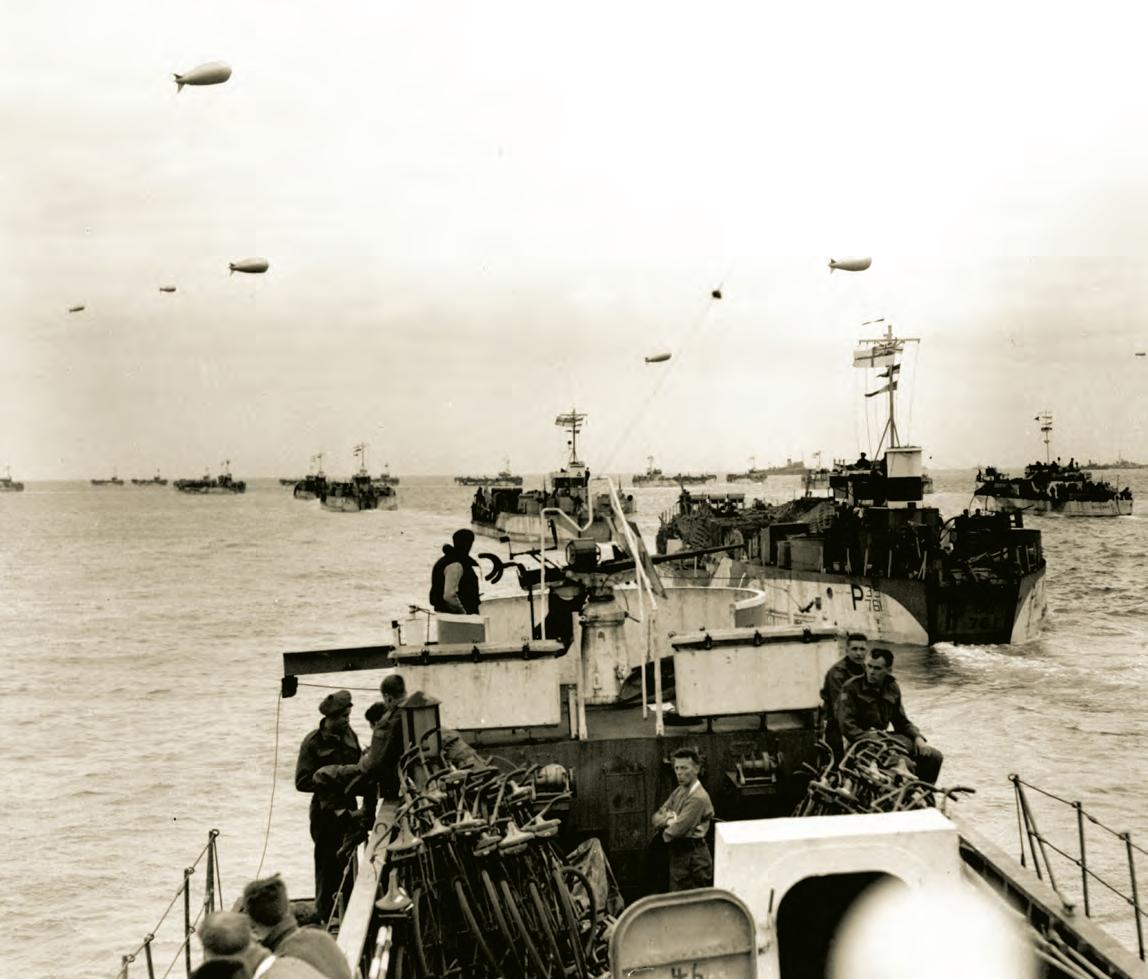

Canada got passing mention in the 2024 international media coverage of the 80th anniversary of the D-Day landings on June 6, 1944. That’s what Canadians have come to expect. Everyone knows that the U.S. and U.K. carried the burden during Operation Overlord, the most decisive act of the Second World War. On the surface, Canada’s role was modest: one of the five seaborne assault groups, one of eight if you count the three divisions, too.
But Canadians did all right that day: 3rd Canadian Infantry Division got the farthest inland of any of the assault group. It was a very Canadian accomplishment, no flap, no flourish; no real need for the international press to note much more than that. Except that, Canada’s role in the success of D-Day was vastly more important than most realize—or perhaps are prepared to admit.
As it turns out, 3rd Division was the most powerful Allied formation to land on D-Day—bar none. It had to be. The Canadian task, according to its operation order, was to stop the probable enemy counterattack on the beaches. When the planners under Brigadier Freddie Morgan, chief of staff, Supreme Allied Command, reviewed the threat to Operation Overlord in late 1943, they identified a major German armoured attack in the days immediately following D-Day as the gravest peril. They also identified the key ground: the rolling plains north and west of Caen.
The Allies expected German panzer divisions to roll down either side of the Mue River across open farmland to Courseulles-sur-Mer to stop the landings. This, in fact, was precisely what Generalfeldmarschall Erwin Rommel, commanding the German defence of the French coast, planned to do.
Rommel wanted four panzer divisions astride the Mue by May 1944. By June 8, two days after the landings, he had most of three there, with two more en route. Not surprisingly, Rommel’s first visit to the Normandy front was to the Mue River valley: by the afternoon two days after
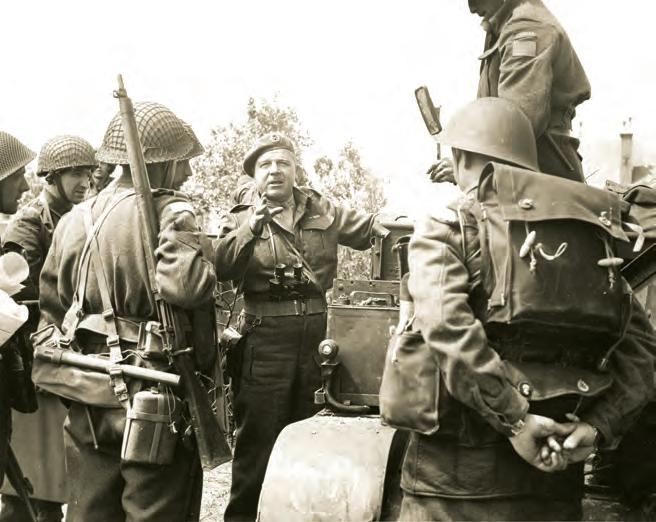
the landings he was within range of smallarms fire of The Royal Winnipeg Rifles as he tried to co-ordinate the panzer assault.

To defeat this danger to Operation Overlord, 3rd Canadian Infantry Division was given enormous firepower. It commanded twice the amount of field artillery typical for a British Commonwealth division, 144 guns in all. And 96 of the guns were self-propelled M7 105mm, supported by enough observation post, forward observer and command tanks to form a full armoured regiment.
The Canadian division also commanded a medium artillery regiment of sixteen 4.5-inch guns and 48 17-pounder anti-tank guns of British I Corps, all backed by a Canadian armoured brigade and the division’s own anti-tank regiment. Between June 7 and 10, this firepower was used to fight off repeated assaults by the 21st Panzer, the 12th SS Panzer and the Panzer Lehr divisions, and prevented I SS Panzer Corps from launching its main assault.
In short, in the days immediately following June 6, 3rd Canadian Division shielded Operation Overlord from the only attack that could have destroyed it.
Major-General Rod Keller addresses personnel of 3rd Canadian Infantry Division on D-Day, while Canadian landing craft motor toward France. D-Day mastermind Brigadier Freddie Morgan, chief of staff, Supreme Allied Command (below ).

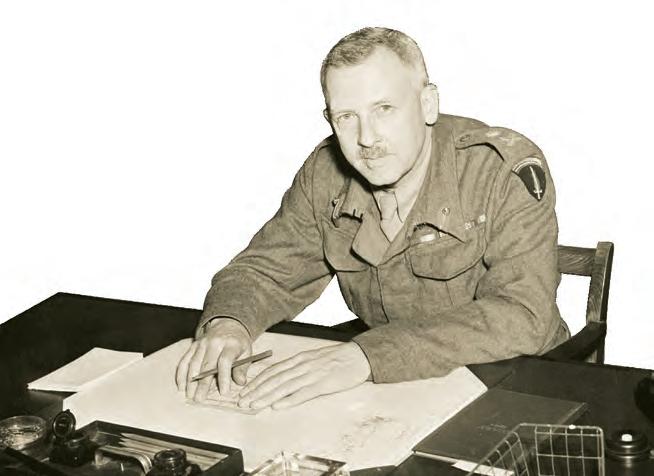
Supreme Allied Command meets in early 1944.
General Andrew McNaughton led First Canadian Army between 1941 and 1944. His force played a key role in the threat of invasion against the Germans.
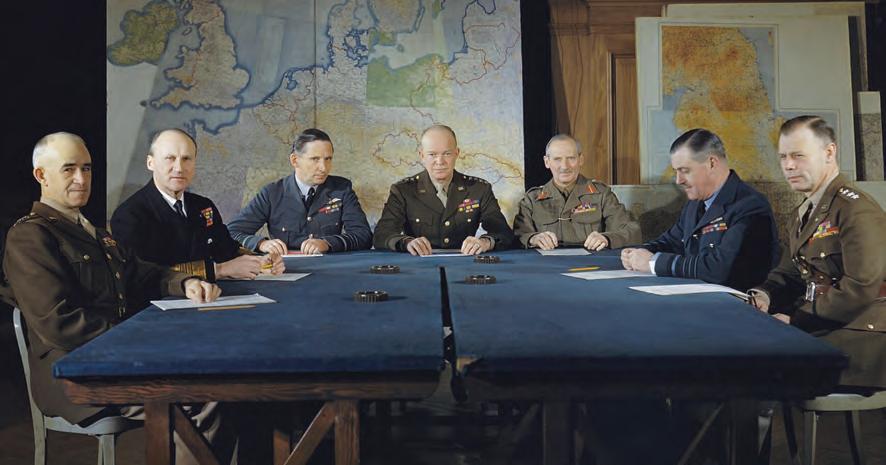
The Canadian role in securing the survival of Overlord didn’t stop there, however.
Between 1941 and 1944, First Canadian Army, led by General Andrew McNaughton, was the most complete and battle-ready formation available to launch a second front.
“McNaughton’s Dagger,” as it was labelled, played a key role in the enduring threat to the Germans of a sudden Allied descent on France in 1942-43. Its power and advanced state of readiness also put it at the heart of planning for Operation Overlord.
By December 1943, Morgan’s strategy called for First U.S. Army to lead an assault, with First Canadian Army to follow as a breakout force. Second British Army would arrive at some later stage. Under this plan, about half of the Allied front would have been held by First Canadian Army (with a British corps under its command) within 50 days of landing.
alongside British Second, and First Canadian Army slipped out of the narrative.
Or so it seems. The Germans, of course, knew nothing of the politics of First Canadian Army’s removal from a lead role in Overlord. That allowed it to become a key part of Operation Fortitude South, the D-Day deception that held the German 19th Army in France’s Pas-de-Calais region and prevented it from shifting south to help defeat the Normandy landings.
This ruse is usually attributed to the American General George Patton, whom— we are told—the Germans feared. Patton is roundly trumpeted as commander of the fictitious First U.S. Army Group (FUSAG), which the Allies had led the Germans to believe was slated to land in Pas-de-Calais.
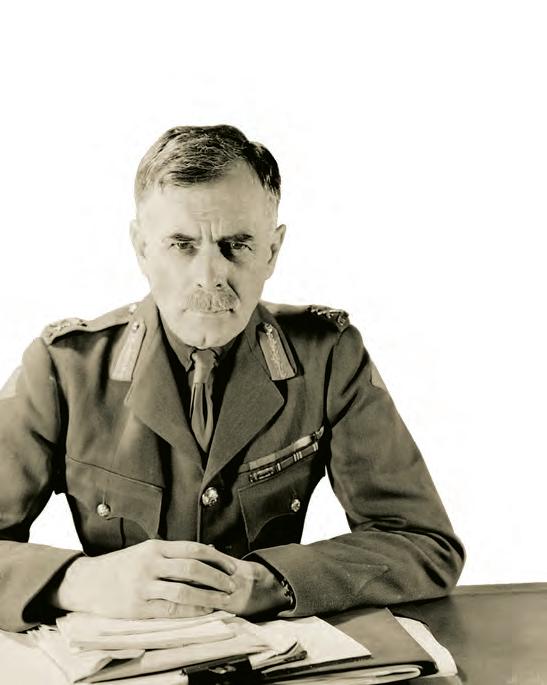
In late 1943, Canadian politicians, anxious to get their army into battle before the Germans quit, conspired to send half of McNaughton’s Dagger to fight in Italy. That wrecked Morgan’s plan.
But, the Overlord ground force commander, General Bernard Montgomery, wasn’t content with Morgan’s strategy anyway. Plus, the British were unlikely to have ever let the Americans and Canadians conduct the operation without them. So, Montgomery’s expanded D-Day plan of early 1944 made Overlord an AngloAmerican two-army assault, U.S. First

The problem with giving Patton credit is that there’s no evidence of his role in Fortitude South until June 12, when German intelligence confirmed that he had replaced Omar Bradley in command of FUSAG. In ways that historians have never explained, Patton’s role in what became Fortitude South II, the continuation of Fortitude after the landings in Normandy were secure, has been conflated into a key role in the entire deception.
According to the postwar British government report on Operation Fortitude by Roger Hesketh, a staff member of the section that developed it, the key element in the deception before and immediately after D-Day was First Canadian Army.
The Germans still expected it to lead the charge, and since II Canadian Corps of McNaughton’s Dagger was garrisoned in Kent, directly across the Channel from Pas-de-Calais, it made sense that
it would make the short hop to where the Allies’ main force was expected to land.
In fact, First Canadian Army was the designated assault formation of FUSAG: II Canadian Corps would land first, with an American corps—under Canadian command—as the follow-up force. The movements, radio exercises and special agent “reveals” of Operation Fortitude as outlined by Hesketh highlight the Canadian role. He wrote nothing of Patton.
As the Germans rushed armoured forces west after June 6 to push back the landings in Normandy, 2nd Canadian Division conducted amphibious training on England’s River Medway, a muddy tide-swept waterway that resembled the Scheldt and the entrance to Antwerp—the other place where the Germans anticipated a landing, and a place which the Canadians had developed plans to attack.

It seems, then, that the real value of Canada’s contribution to D-Day and Operation Overlord is that it preserved the landings from destruction.
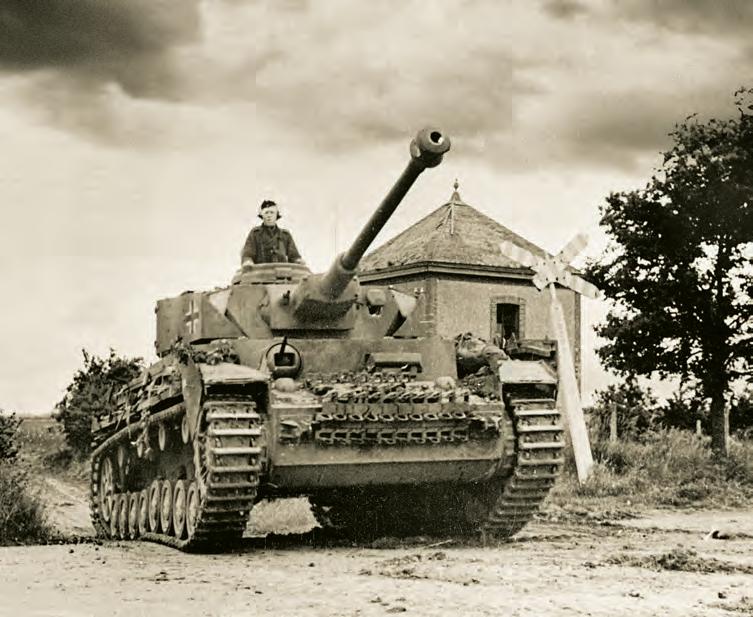
So, on June 8, as 2nd Canadian Division cleaned off its vehicles and loaded them into assault vessels along the Thames, double agents of the British alerted the Germans that the landing in the Pas-de-Calais was imminent. The next day, German domestic and international short-wave radio announced that “Combined action is being expected somewhere between Dunkerque and Ostend. For this, special Canadian troops are in readiness….”
Based on that threat, German high command redirected the panzer reinforcements en route to Normandy to the Pas-de-Calais in the early hours of June 10. The redirection of these armoured forces was so important that a retired senior American corporate lawyer and former U.S. Army intelligence analyst, Thomas (T.L.) Cubbage, rummaged through the British archives in the 1980s to assess the veracity of Hesketh’s account. He confirmed it.
Cubbage concluded that the diversion of panzer forces to Pas-de-Calais was a
moment that “turned the tide of history.”
The rump of McNaughton’s Dagger did that. Cubbage, like all historians of his era, was unaware that 3rd Canadian Division had already defeated all attempts by I SS Panzer Corps to break through to the sea. It seems, then, that the real value of Canada’s contribution to D-Day and Operation Overlord is that it preserved the landings from destruction. If you accept Cubbage’s conclusion, then between June 6-9, 1944, Canada’s army changed the course of the war.
Canadians might ponder that not-somodest accomplishment when they next gather to commemorate D-Day.
Marc Milner’s latest book, Second Front: Anglo-American Rivalry and the Hidden Story of the Normandy Campaign, will be published by Yale University Press in May 2025. L
A
German Panzer IV tank in Normandy.
Second World War
By Wendy van Leeuwen

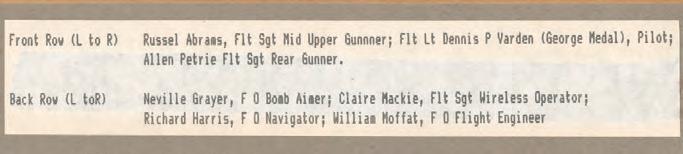


The seven men in the faded photograph squint into the sunlight as they pose by the wing of a Lancaster bomber. Likely taken in the spring of 1945, the photo has fascinating historical connections to the small town of Listowel, Ont., during the Second World War.
The framed image is part of the modest archives of the Listowel District Secondary School library. Its recent rediscovery prompted several questions. Why was the photo donated? Is there a local connection to any of the seven crew members or to the plane?
A handwritten notation on the back of the photo’s frame indicates that it was donated by Neil Schade on April 21, 1988. Schade died in May 2020 at the age of 92, in Brussels, Ont., 30 kilometres west of Listowel. His obituary stated that he was affectionately known as “Mr. Lanc.” He would have been 16 in 1944, so not really too young, just borderline. to serve in the Second World War, but had been a Lancaster bomber enthusiast, hence the moniker, and had a wealth of knowledge about the iconic aircraft.
and they were instrumental in changing the outcome of the Second World War.
“The successes of Bomber Command were purchased at a terrible cost,” says the Bomber Command Museum of Canada. “Of every 100 airmen who joined Bomber Command, 45 were killed, six were seriously wounded, eight became prisoners of war, and only 41 escaped unscathed (at least physically).
Of the 120,000 who served, 58,000 were killed including over 10,000 Canadians.”

Schade’s son, Don, remembered his father speaking of the crew in the photo as his friends.
“Al Petrie was a rear gunner. Richard Harris was an Englishman. Dad corresponded with him until Alzheimer’s stole his memories,” said Don.
Allen Petrie is front right in the photo. Next to him crouches pilot Dennis Varden. To his left is Russel Abrams, mid-upper gunner. In the back row, left to right, stand bomb aimer Neville Grayer, wireless operator Claire Mackie, navigator Richard Harris and flight engineer William Moffatt. All survived the war. But none were from the area.
So, if they weren’t local lads, why donate the photo to the school? Perhaps there was a connection to their plane? The aircraft partially visible in the photo is clearly a Lancaster, the heavy bomber relied upon by Royal Air Force Bomber Command for nighttime bombing campaigns over Europe from 1942 until VE-Day. People from 60 countries served in Bomber Command, many of them from Commonwealth nations, including Canada,

Of the 7,377 Lancasters built for the war effort, 3,932 were lost. Still, the Lancaster proved to be Bomber Command’s most successful aircraft. In September 1941, a decision was made to also manufacture them in Canada, out of range of German bombers. In total, 430 Lancs were built at Victory Aircraft in Malton, Ont., then headed across the Atlantic. Each was coded with three letters and a registration consisting of two letters and three numbers. In the school library’s photo, the letters NA-S are visible, and to the far right, a faded “KB,” indicating that this plane was built in Canada. Could it have been the Lancaster purchased by the townspeople to support the war effort?
The March 29, 1945, Listowel Banner told that story.
“Listowel citizens raised $374,100. The bomber was purchased and named ‘Listowel, Ont.’ It is now travelling the highways of the air over enemy territory.”
“In November, 1944, Canada launched its Seventh Victory Loan. Listowel’s first objective was $283,000. Then the happy thought came that Listowel should raise the objective to $350,000 and buy a Lancaster bomber to be presented to the RCAF. The promise was then made that if Listowel would raise $350,000 a new Lancaster bomber would come off the assembly lines, the crest of Listowel would be painted on the bomber and that it would fly across the Atlantic to join that vast armada of the air that is doing such a grand job in bringing victory to the forces of freedom. That promise has been fully kept. Listowel citizens raised $374,100. The bomber was purchased and named ‘Listowel, Ont.’ It is now travelling the highways of the air over enemy territory.”
There is a justifiable note of pride in the article. The amount raised was a tremendous sum for a town of about 3,000 people in 1944, when the average annual income was $2,500.
Some sources describe the bomber purchased by the town as being named “Spirit of Listowel.” It served for the last couple of months of the war with 428 Squadron, RCAF, based at Middleton St. George, England.
“Spirit of Listowel,” however, was coded NA-V, so it’s not the plane in the picture. So, the one in the image is another Lancaster, but which one?
An important clue was hidden under the frame at the right-hand edge of the photo: the faded beginning of a number 8 following the KB. So it must be NA-S KB864, which also served with 428 Squadron, beginning in February 1945.
Historian and artist Clarence Simonsen said that this plane was a very popular subject for photos because of its nose art,
which was painted by Sergeant Thomas Walton. On one side of the nose, Walton, who served as wireless air gunner on this bomber, recreated Alberto Vargas’ January pin-up girl from the 1945 Esquire calendar.
The plane itself was nicknamed “Sugar’s Blues,” after a popular jazz dance tune that was a favourite of its American-born pilot, Pilot Officer Latumer. A reproduction of the fuselage of “Sugar’s Blues,” complete with nose art painted by Simonsen, is displayed at the Bomber Command Museum of Canada in Nanton, Alta.
“Spirit of Listowel” and “Sugar’s Blues” were among 288 Lancs returned to Canada. The latter participated in a cross-country bond tour in the summer of 1945 to raise money for the ongoing war effort in the Pacific. Many of the returning planes, including the former, were ferried to Nova Scotia, to 661 Heavy Bomber Wing of Tiger Force based in Yarmouth. The intention was to reorganize and retrain the crews and repaint and refit the bombers to ready them for operations in the Pacific by December. The war ended in August, however, and Tiger Force was disbanded. Subsequently, 160 of the Lancasters were moved to Alberta and placed in longterm storage, where both “Spirit of Listowel” and “Sugar’s Blues” were eventually sold for scrap metal.
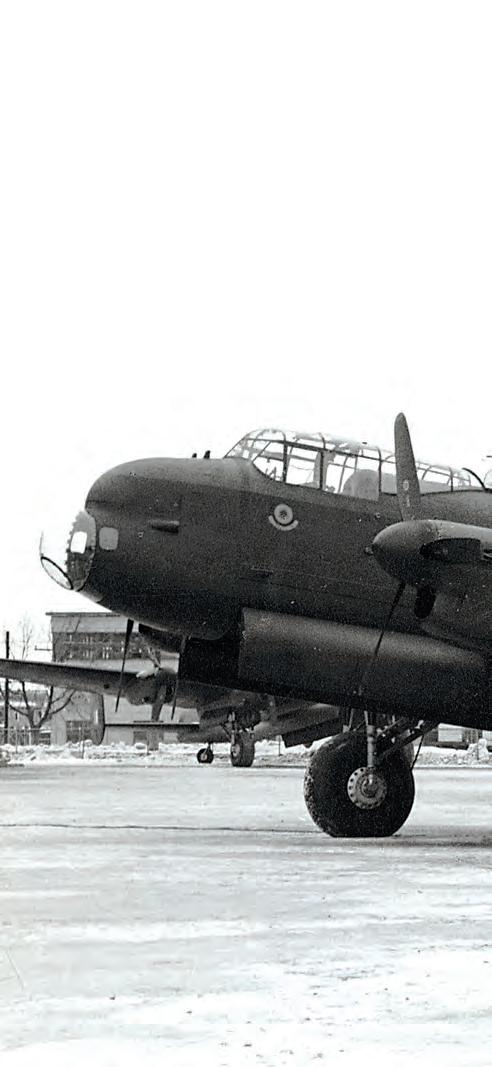

After arriving in Nova Scotia at the beginning of June, crews were immediately given a month’s leave.
Flight Lieutenant Dennis Varden, the pilot in the photo, hurried home to his wife Clare in Montreal, with instructions to report back for duty in July. Then, on June 30, 1945, an 11-man RCAF crew from No. 6 Ferry Unit based in nearby Dorval took off to deliver a Canadian-built B-24 Liberator to the RAF in England. But the plane crashed near the runway and burst into flames. Varden rushed to the scene.
He pulled two survivors from the flaming wreck, then managed to rescue a third. He then recovered two dead crewmen. Two other survivors were still trapped in the plane amid the burning hot metal. Varden’s wife brought him water, which he used to help cool the metal while he worked to save the men. He eventually freed them, suffering burns to his hands in the process. He only ceased his efforts when others arrived on the scene and took over.
For his actions, Varden was awarded the George Medal, which recognizes acts of bravery by civilians or military personnel not under enemy fire, on Feb. 21, 1947.
That might be the end of the story, but the faded operations record books archived at the Bomber Command Museum provided the final pieces needed to solve the puzzle of the photograph. They include hundreds of entries detailing daily missions: bombing runs,

bad weather, damaged aircraft, targets destroyed, and the names of crew members.
The records for 428 Squadron indicate that Varden and the rest of his crew shown in the photograph were posted as a unit to the squadron on Feb. 28, 1945, and flew numerous missions during the next two months. On April 10, 1945, Varden and his crew were sent out on a nighttime bombing run over Germany, which was noted in the log as a “good attack” with minimal damage to the aircraft. That aircraft was KB899, “Spirit of Listowel.”
In the one and only recorded bombing run carried out by the Lancaster bomber purchased by the people of Listowel, the pilot in this photo, Varden, and most likely the six men with him, served as its crew.
Spirit of Listowel’s crew had posed for the photo in front of another bomber— mystery solved. L
The Lancaster bomber purchased by the citizens of Listowel, Ont. The plane’s eventual pilot, Flight Lieutenant Dennis Varden, and his wife Clare, helped save the crew of a B-24 that crashed near Montreal in June 1945.

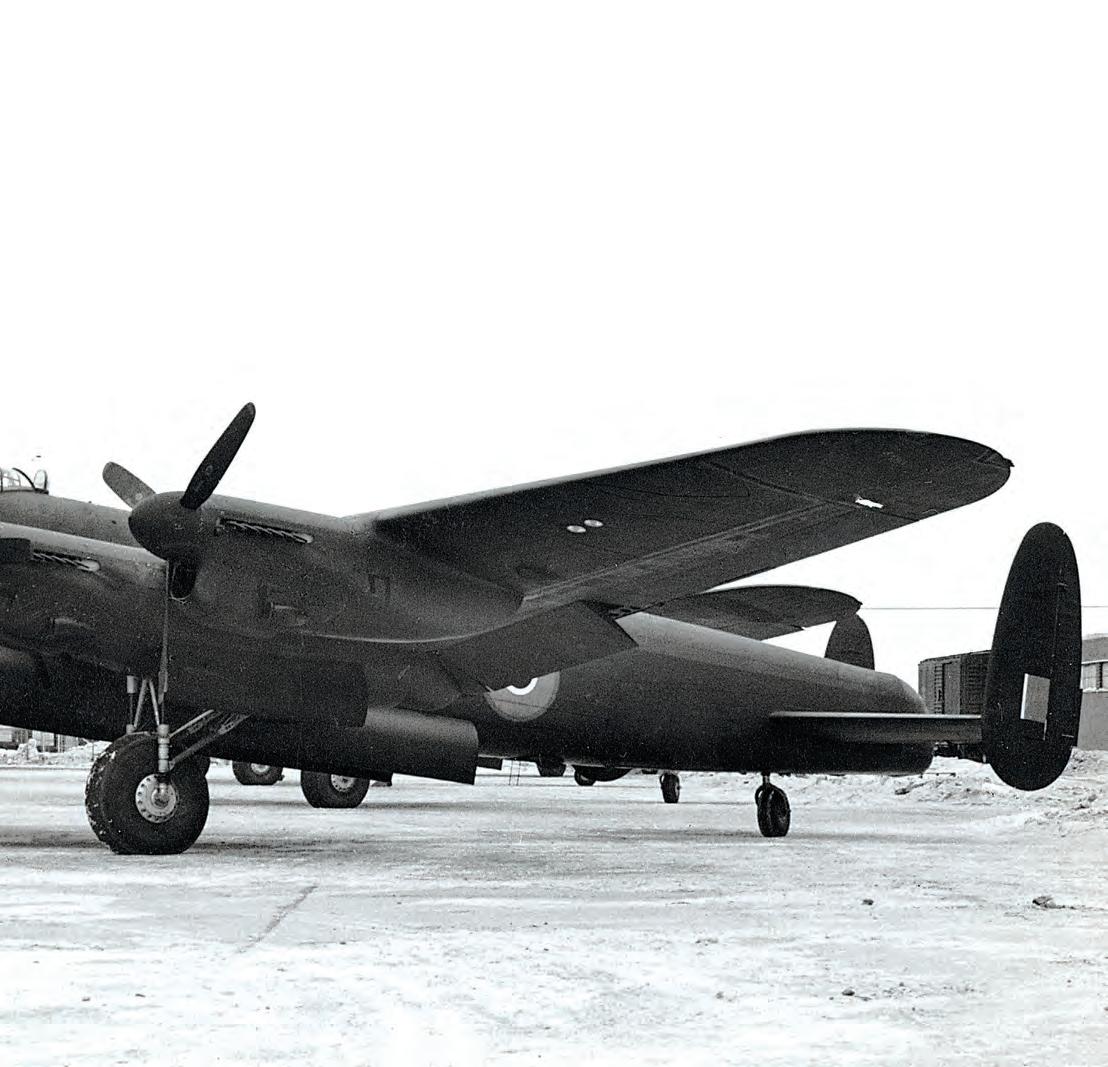
BY MARK ZUEHLKE
THE INTERNATIONAL FIGHT AGAINST ISLAMIC STATE MILITANTS
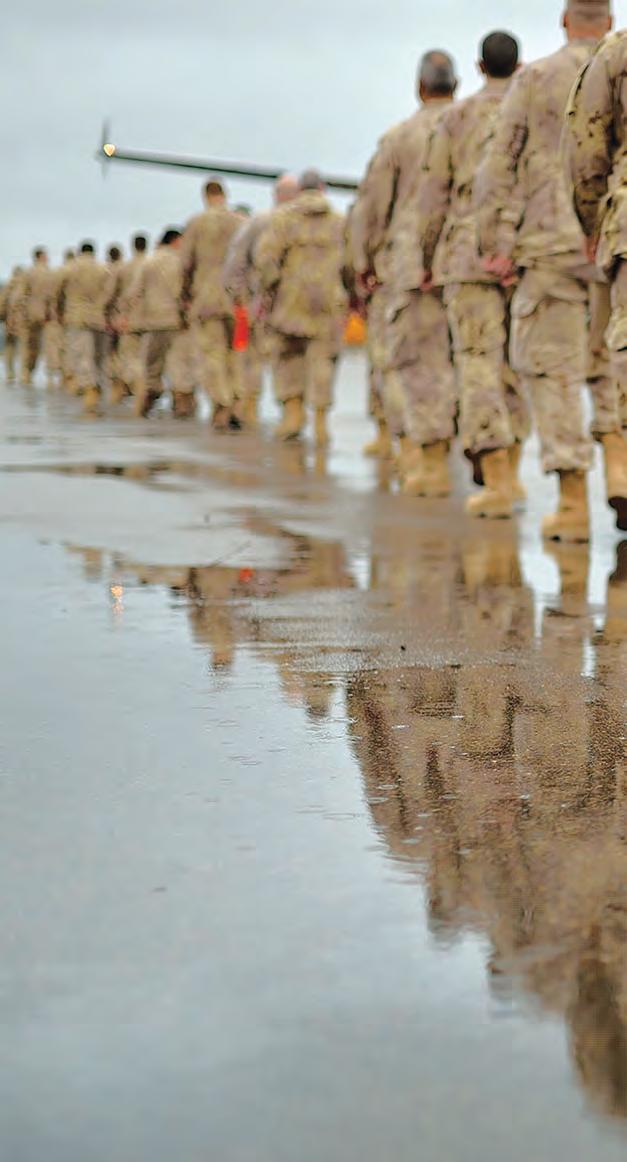
the repressive Syrian regime of Bashar al-Assad collapsed in December 2024, the situation in the Middle East was thrown dramatically into flux.
Having governed with an iron fist for 24 years, Assad’s ouster poses many challenges to security in the region. No sooner had the deposed dictator fled the country than both the U.S. and Israel launched waves
of air strikes in the region aimed at destroying various weapons and other materiel that could be of use to terrorist organizations.
The U.S. also stated its purpose for the attacks was, in large part, to deny the Islamic State of Iraq and the Levant, also known as ISIL or ISIS, the opportunity to regain the influence it had in Syria a decade earlier. Even as ISIS lost
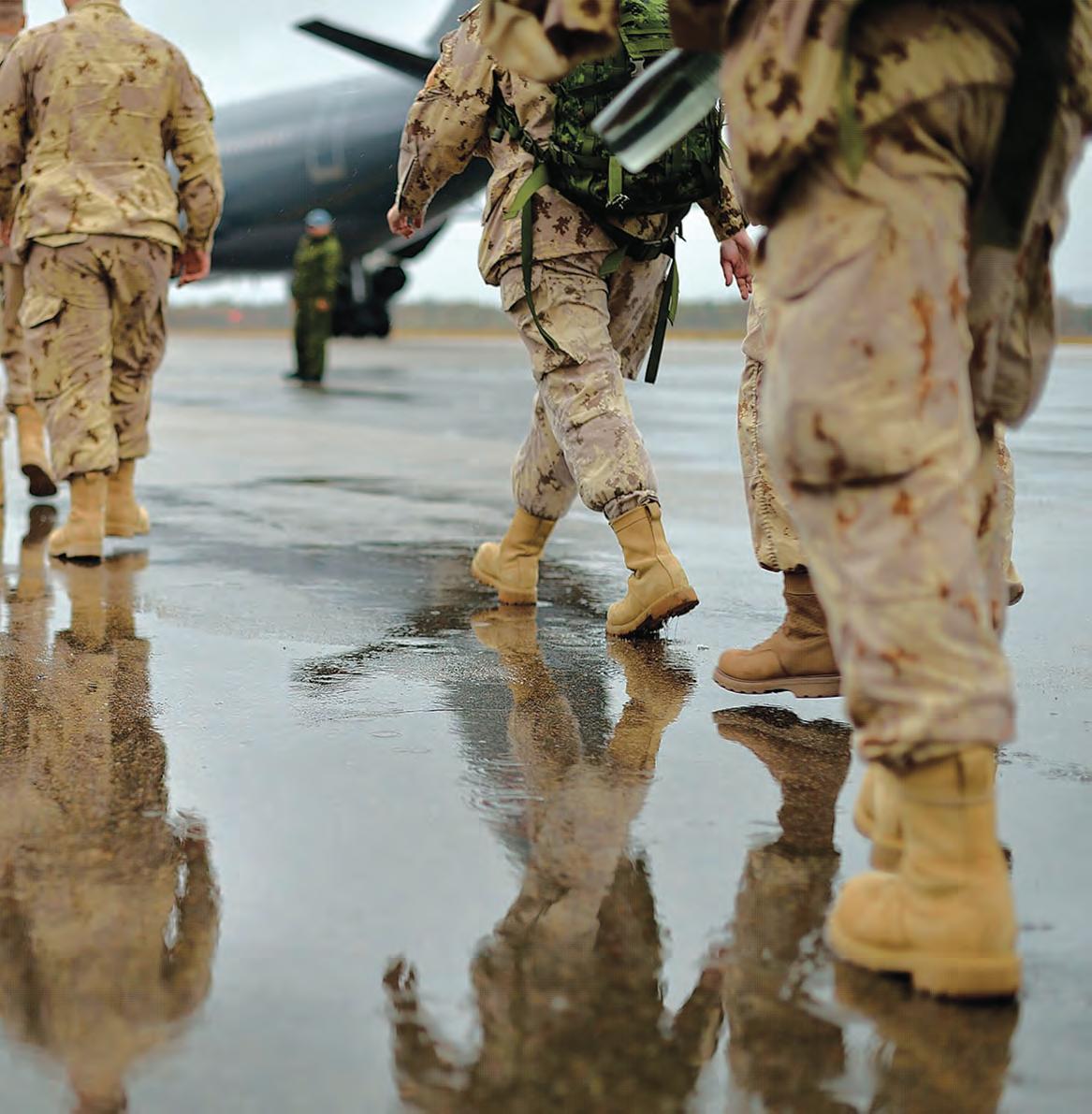
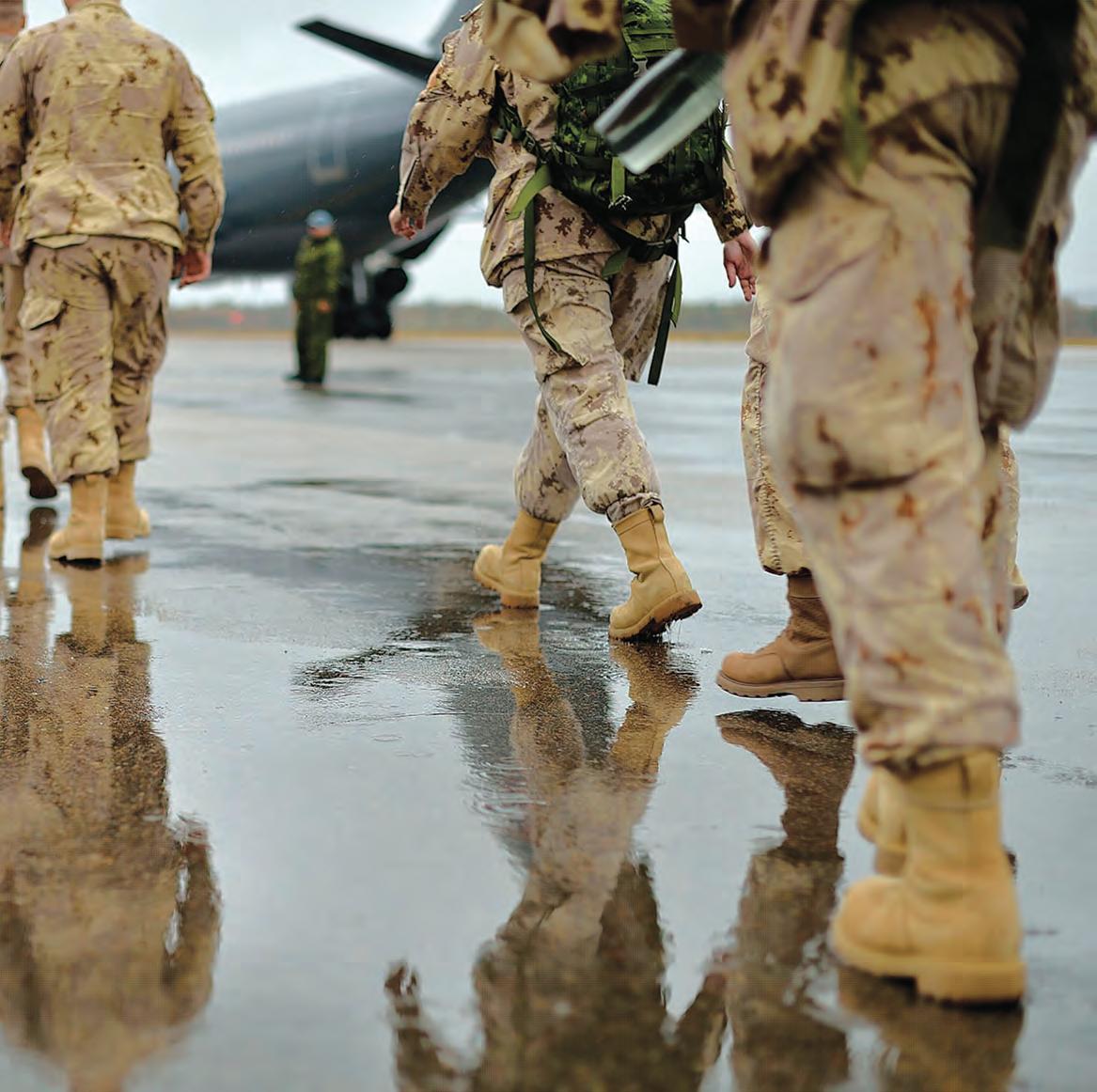
Canadian Armed Forces members board a C-150 Polaris at 14 Wing Greenwood, N.S., on Oct. 23, 2014, en route to the Middle East to support Operation Impact. its grip on lands within Syria and neighbouring Iraq, the U.S. had maintained a military presence to prevent any resurgence of its strength. Canada also maintained a military presence in Iraq, Jordan and Lebanon, intending to build its military capability to provide stability and security in the area. This mission was extended in 2023 to March 31, 2025.
The roots of Canada’s role can be traced back to September 2014 when an international coalition of 83 countries and five international institutions—the Arab League, the Community of Sahel-Saharan States, the European Union, Interpol and NATO—formed to defeat ISIS.
Originating in 1999, ISIS had a stated goal of creating
a worldwide Islamic caliphate. It began to pursue this objective in the wake of national instabilities in Syria and Iraq in 2014. Advancing rapidly, its fighters— who came from all over the world, including Canada—captured Fallujah, Iraq, in January 2014, Mosul, Iraq, in June 2014, then advanced rapidly through other areas of Iraq and Syria.
Millions of people were displaced or brutally suppressed. Thousands died—either murdered by ISIS members or due to a rampant humanitarian crisis. Iraq’s already tenuous stability was undermined, and the geopolitical security of the Middle East at large was endangered.
The international response sought to defeat ISIS on all fronts. Its main impetus came on Aug. 7, 2014, when U.S. President Barack Obama authorized targeted military intervention in Iraq. This led to a campaign that supported Iraqis in pushing ISIS back from 98 per cent of the territory it had seized. Consequently, 7.7 million people were liberated from its oppressive occupation.
Key to that pushback was the deployment of coalition air assets in support of ground forces, mostly comprised of both government and non-government allies and coalition special forces units. Canada’s involvement at ground level included up to 830 Canadian Armed Forces personnel assigned to the Combined Joint Task ForceOperation Inherent Resolve. It was through this U.S.-led force that the multinational coalition focused operations on ISIS in Iraq and Syria.
Canada’s role in the air effort, meanwhile, was at first limited to the delivery of military supplies to Iraq. Between Aug. 28 and Sept. 26, 2014, Royal Canadian Air Force C-17 cargo planes made 25 flights to deliver 725,000 kilograms of donated military supplies.
In the meantime, on Sept. 5, Prime Minister Stephen Harper announced that several dozen, mostly special operations forces, personnel would join U.S. forces in Iraq. Fourteen days later, the U.S. government requested that Canada provide additional support. Following an early October debate in the House of Commons, Canada approved RCAF warplanes to join coalition attacks on ISIS in Iraq.
The deployment happened quickly, implying that planning had already been well advanced for this role. On Oct. 28, six CF-18 Hornet fighter-bombers, a CC-150 Polaris aerial tanker and two CP-140 Aurora reconnaissance and surveillance aircraft arrived at Canada’s hub in Kuwait.
The fighters were initially from 4 Wing in Cold Lake, Alta., but a wing from Quebec also soon arrived. The CC-150 was from 8 Wing in Trenton, Ont., and the CP-140s came from 14 Wing in Greenwood, N.S. They began operations on Oct. 30.
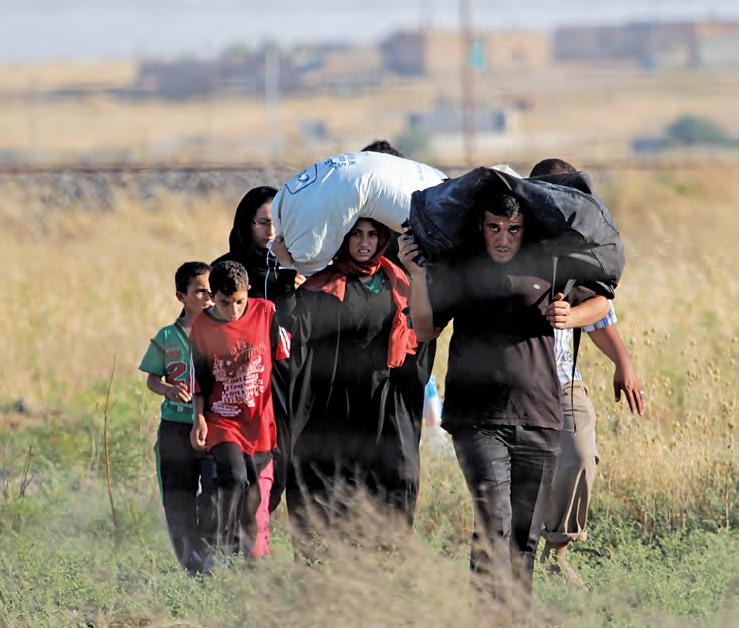
The first mission was uneventful. Two Hornets flew a six-hour mission west of Baghdad and encountered no viable targets; a CP-140 spent six hours gathering intelligence over northwestern Iraq to develop a better sense of the battle space in which coalition aircraft would fight; and the Polaris delivered almost 50,000 pounds of fuel to coalition aircraft in about the same time span.
Canada’s air force had made its mark in the first day, integrating well into what was designated as the Middle East Stabilization Force.
On Nov. 2, two CF-18s destroyed ISIS targets identified as heavy engineering equipment and vehicles with GBU12 500-pound laserguided bombs west of Fallujah. It was a four-hour mission requiring refueling from the Polaris. This was the first time CF-18 Hornets had dropped bombs against hostile targets since the 2011 war to oust Libya’s Muammar Gaddafi.
Operations continued almost daily thereafter, with Canadian aircraft supporting 8,000 troops from Iraqi security forces. The Iraqis launched a major offensive in late November to drive ISIS out of the Sinjar Mountains where many thousands of Yezidi refugees were sheltering.
The Canadians often struck ISIS targets, but they also helped deliver humanitarian relief.
A prime example: on Nov. 20, CF-18s provided cover for a Royal Australian Air Force C-130J Hercules transport aircraft, which was bringing supplies to about 30,000 people trapped by ISIS in the mountains. Using parachutes, the Australians dropped basics such as food and water from low-flight levels. To protect the lumbering transport from surface-to-air missiles, the CF-18s flew nearby—ready to strike any detected launchers.
“After orbiting the area overhead and seeing people waiting for the drop from the Hercules, it was nice
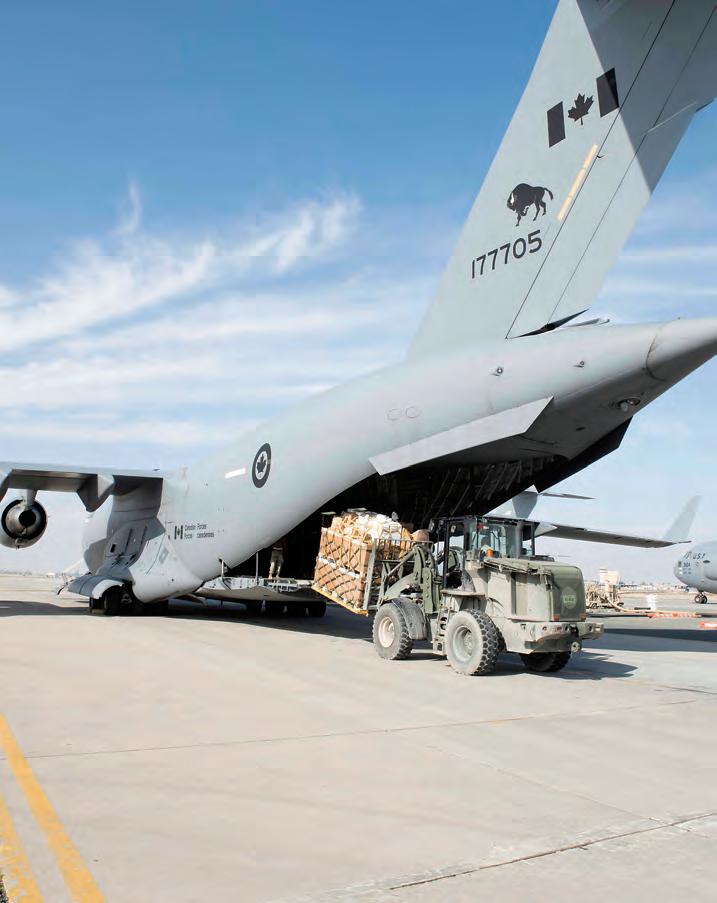
CANADA’S ROLE IN THE AIR EFFORT, MEANWHILE, WAS AT FIRST LIMITED TO THE DELIVERY OF MILITARY SUPPLIES TO IRAQ.
to finally see the pallets of aid touch the ground and see people rush out to retrieve them,” said a pilot from 425 Tactical Fighter Squadron, 3 Wing, in Bagotville, Que.
CF-18 fighters also launched strikes with 500- and 2,000-pound bombs against heavy weapon positions, bunkers, ISIS vehicles and choke-point roadblocks along mountain roads.
“Given the Iraqi forces’ relatively light arms, it’s rewarding to contribute our heavy weapons to achieve effects on the ground,” said a 4 Wing pilot. It was his first overseas mission, and he found it “rewarding to employ my training after four years as a CF-18 pilot toward aiding in the defeat of an enemy like ISIL.”
Many of the targets had been identified by the long-range reconnaissance and surveillance Auroras. Their crews located them, then each was assigned to appropriate coalition air asset for an attack. Afterward, the Auroras would conduct battle damage assessments that either wrote off the target or confirmed the need for additional strikes.
“We had a high mission tempo during the operation and the technicians were working hard to make sure we got airborne,” reported one Aurora crew member. Once in the air, he said, the aircraft “has really been shining on this mission and our crew members have been able to maximize the effectiveness of the camera, radar, and other sensors in the fight. ISIL is having a hard time hiding.”
Supplies are unloaded from a Canadian Forces CC-177 at Ali Al Salem Air Base in Kuwait on Nov. 26, 2018. Syrian civilians flee to Turkey in June 2015 amid the Islamic State attacks.
Enabling the CF-18s and other coalition fighter-bombers to remain close to the operations in the mountains, the Polaris air-to-air refuellers circled nearby, ready to offload hundreds of thousands of pounds of fuel to thirsty aircraft that otherwise would have had to return to base to tank up.
On Dec. 18—almost a month after the offensive began—reports that ISIS had been driven out of the Sinjar Mountains prompted a large exodus of Yazidi refugees out of the range. The following day, RCAF CF-18s struck ISIS vehicles and a hardened rocket emplacement between Mosul and Sinjar, near the town of Tal Afar. On Dec. 19, Iraqi forces reached the Sinjar Mountains and established a humanitarian corridor that enabled aid to flow through to those who remained trapped.
“Each day I flew over the area, you could see the line advancing as the Iraqi forces pushed forward,” recalled one CF-18 pilot. “You could also see a definite improvement in Iraqi forces’ abilities.”
While the December RCAF strikes focused on the Sinjar Mountains, other targets were also hit. On Dec. 21, an RCAF attack struck an ISIS improvised explosive device production factory and storage area in Fallujah.
With the new year, the campaign continued with sorties that struck terrorist targets on an almost daily basis through the summer. By September, however, the tempo slowed with monthly sortie rates ranging from 10 to 18.
In mid-November 2015, Iraqi security forces engaged in a drawnout gunfight with ISIS outside the war-battered city of Kirkuk. ISIS fighters had pinned security
A gunner keeps watch from a CH-146 Griffon helicopter during a surveillance flight near Erbil, Iraq, on March 2, 2017. Two CF-18 Hornets taxi en route to an Operation Impact mission on Jan. 17, 2015.
troops down with heavy machinegun fire when a pair of CF-18s roared in and dropped a bomb that missed the target. Although a guided munition, it malfunctioned and exploded in an open field. A day later, another strike near Mosul targeted an ISIS munitions factory. The bomb, however, struck off course—destroying the factory, but also a nearby dairy. Five to 13 civilians were killed.
As early as January 2015, reports had surfaced that some other Canadian air strikes had also inadvertently struck civilian targets. This led to a Defence Department investigation into one particular incident, where between six and 27 Iraqi civilians may have been killed in a Jan. 21 bombing during a battle for a key highway near Mosul.
The CF-18 strike was aimed at a sniper/heavy machine-gun position on the roof of a building within an ISIS-held compound. Following the attack, a Kurdish fighter, allied with coalition forces, reported the civilian casualties to special forces operatives. Ultimately, the investigation concluded there was insufficient evidence to verify the allegation.
In a statement, Brigadier-General Lise Bourgon, commander of the Canadian mission, didn’t rule out the possibility of civilian
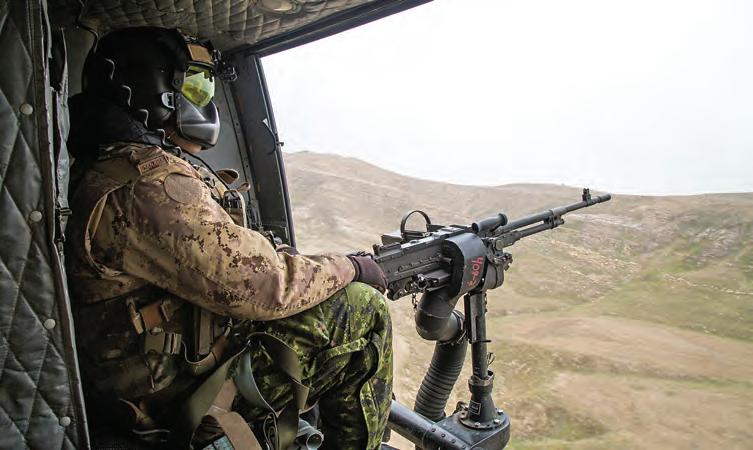
casualties. “For the six months that I was there, I can tell you I saw no evidence that there were civilian casualties in a strike. Am I telling you that I can guarantee that there was not a civilian casualty? I’m not going to guarantee that.”
During the 16-month Canadian air campaign, a total of 606 precision-guided bombs were released and the Defence Department reported that 17 of those had strayed off course. The RCAF said it had “no information” that any air strikes, either accurate or otherwise, killed or wounded civilians. Major Isabelle Bresse underscored that to the CBC.
“No weapons system is 100 percent accurate. On rare occasions, weapons systems are affected by meteorological conditions or experience malfunctions,” she said.
Canadian defence analyst Eric Morse added that that margin of error fit what should reasonably be expected from a mechanical
“GIVEN THE IRAQI FORCES’ RELATIVELY LIGHT ARMS, IT’S REWARDING TO CONTRIBUTE OUR HEAVY WEAPONS TO ACHIEVE EFFECTS ON THE GROUND.”
point of view. “When you go into the granularities of warfare,” said Morse, “you begin to wonder how clean the hands must be and how clean they may be.”
It was undoubtedly that granularity that led recently elected Prime Minister Justin Trudeau’s government to end the air-combat mission on Feb. 15, 2016.
During the campaign, CF-18 Hornets flew 1,378 sorties, which included 251 air strikes—246 in Iraq and five in Syria. The 606 bombs were directed at 267 fighting positions, 102 equipment and vehicle targets and 30 military facilities.
The CP-140 Auroras, meanwhile, conducted 881 sorties through to Dec. 11, 2017, and the Polaris refuellers logged 1,166 sorties until Jan. 24, 2019. Since then, RCAF aircraft have continued moving cargo and personnel to support coalition operations in the area.
The decision to withdraw the CF-18s from a combat role in Iraq proved unpopular. Polls consistently showed that most Canadians disagreed with it. On April 4, 2017, Iraqi officials also expressed their displeasure with the withdrawal. Regardless, ISIS controls no territory in the Middle East today. But, it continues to operate as a terrorist organization—potentially ready to exploit any opportunity to reclaim its former prominence. L
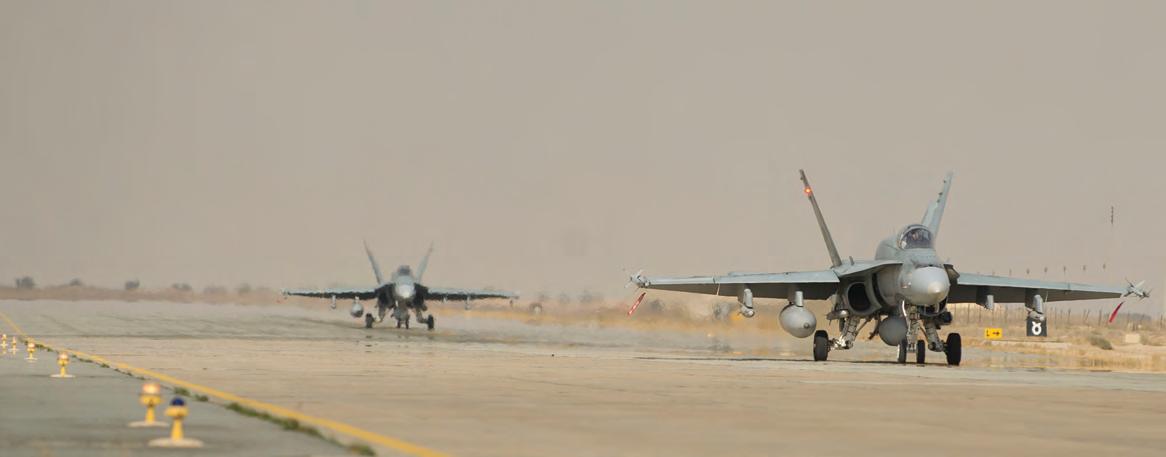

Enjoy up to 50% off accommodations at more than one million hotels worldwide when you sign up*—and it’s FREE! That’s incredible savings for you, your family and your friends.
Plus, a portion of all proceeds from hotel bookings at Legion Travel assist The Royal Canadian Legion and its efforts to support Veterans.
STAY, SAVE and SUPPORT—scan the QR code or visit legiontravel.ca/magazine today!

Free Membership
Sign up for instant access to amazing hotel deals with no hidden fees.
Exclusive Savings Travel in style or on a budget. Get access to up to 50% off hotels*, with our exclusive unpublished rates.
Travel Your Way
Book at over one million hotels in 155,000 cities in 220 countries. The world is your oyster.
25 years ago, on May 28, 2000, the governor general delivered this speech at the ceremony unveiling the country’s Tomb of the Unknown Soldier
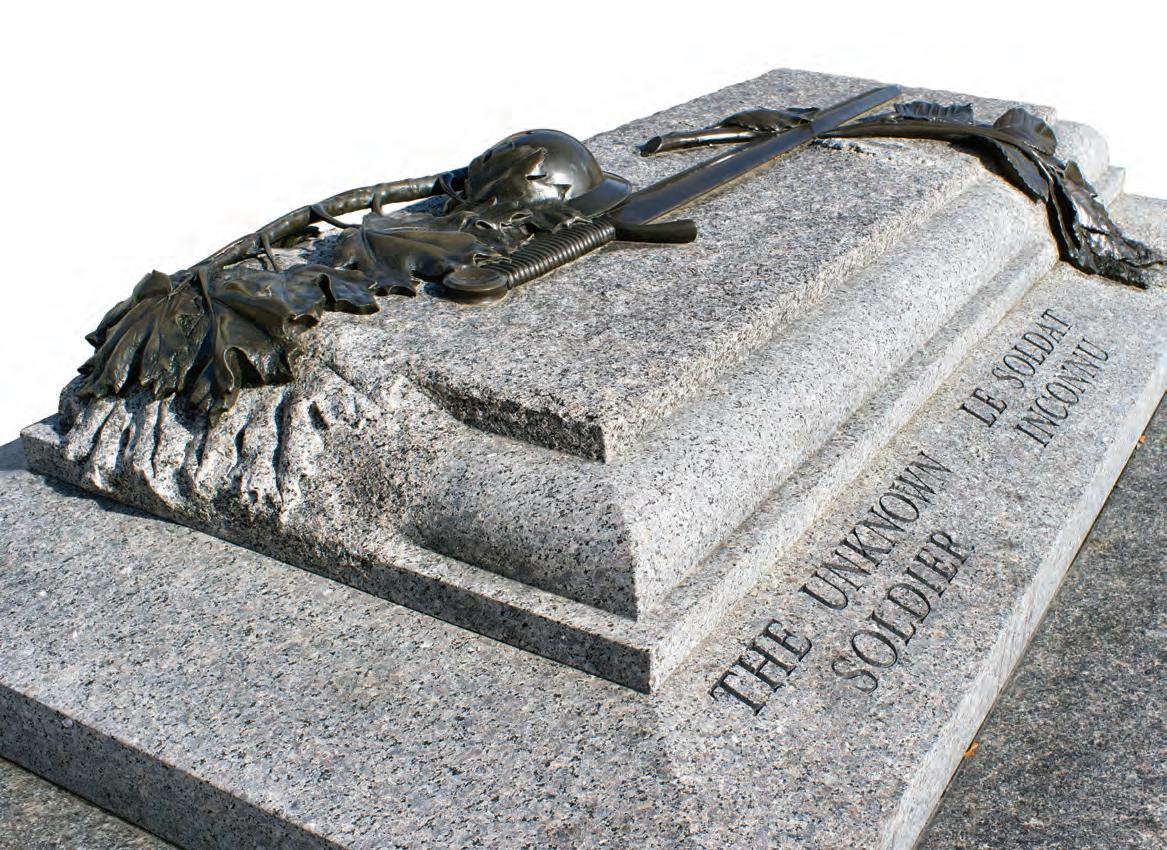

By Adrienne Clarkson
Wars are as old as history. Over two thousand years ago, Herodotus, wrote, “In peace, sons bury their fathers; in war, fathers bury their sons.” Today, we are gathered together as one, to bury someone’s son. The only certainty about him is that he was young. If death is a debt we all must pay, he paid before he owed it. We do not know whose son he was. We do not know his name. We do not know if he was a MacPherson or a Chartrand. He could have been a Kaminski or a Swiftarrow. We do not know if he was a father himself. We do not know if his mother or wife received that telegram with the words “Missing In Action” typed with electrifying clarity on the anonymous piece of paper. We do not know whether he had begun truly to live his life as a truck driver or a scientist, a miner or a teacher, a farmer or a student. We do not know where he came from.
Was it the Prairies whose rolling sinuous curves recall a certain kind of eternity?
Was he someone who loved our lakes and knew them from a canoe?
Was he someone who saw the whales at the mouth of the Saguenay?
Was he someone who hiked in the Rockies or went sailing in the Atlantic or in the Gulf Islands?
Did he have brown eyes?
Did he know what it was to love someone and be loved back?
Was he a father who had not seen his child?
Did he love hockey? Did he play defence?
Did he play football? Could he kick a field goal?
Did he like to fix cars? Did he dream of owning a Buick?
Did he read poetry?
Did he get into fights?
Did he have freckles?
Did he think nobody understood him?
Did he just want to go out and have a good time with the boys?
We will never know the answers to these questions. We will never know him. But we come today to do him honour as someone who could have been all these things and now is no more. We who are left have all kinds of questions that only he could answer. And we, by this act today, are admitting with terrible finality that we will never know those answers. We cannot know him. And no honour we do him can give him the future that was destroyed when he was killed. Whatever life he could have led, whatever choices he could have made are all shuttered. They are over. We are honouring that unacceptable thing—a life stopped by doing one’s duty. The end of a future, the death of dreams.
No honour can give him the future that was destroyed when he was killed. Whatever choices he could have made are all shuttered.

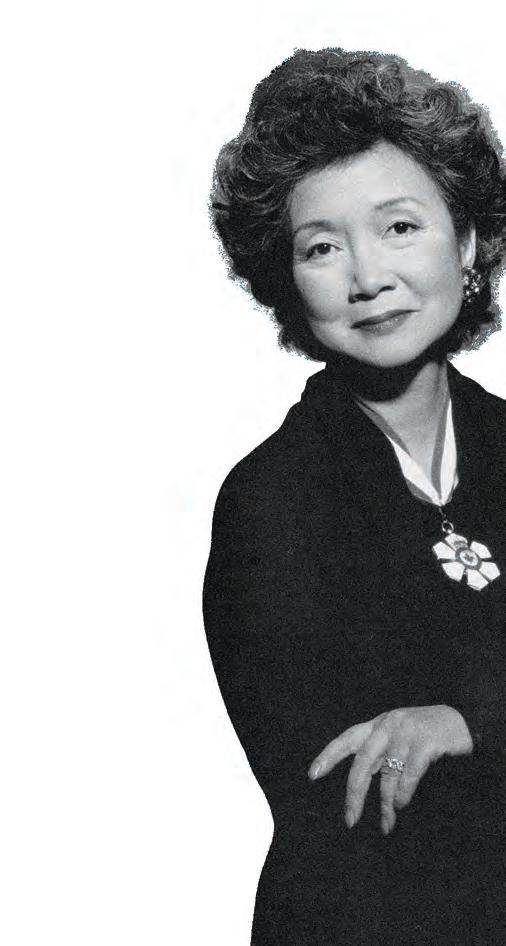

In honouring this unknown soldier today, we are embracing the fact of the anonymity and saying…he has become more than one body, more than one grave.
Yet we give thanks for those who were willing to sacrifice themselves and who gave their youth and their future so that we could live in peace. With their lives they ransomed our future. We have a wealth of witnesses in Canada to describe to us the unspeakable horror and frightening maelstrom that war brings. What that First World War was like has been described in our poetry, novels and paintings. Some of our greatest artists came out of that conflict, able to create beauty out of the hell that they had seen. The renowned member of the Group of Seven, F.H. Varley, was one of those artists. Writing in April 1918 he said:
“You in Canada…cannot realize at all what war is like. You must see it and live it. You must see the barren deserts war has made of once fertile country…see the turned-up graves, see the dead on the field, freakishly mutilated—headless, legless, stomachless, a perfect body and a passive face and a broken empty skull—see your own countrymen, unidentified, thrown into a cart, their coats over them, boys digging a grave in a land of yellow slimy mud and green pools of water under a weeping sky. You must have heard the screeching shells and have the shrapnel fall around you, whistling by you—seen the results of it, seen scores of horses, bits of horses lying around in the open—in the street and soldiers marching by these scenes as if they never knew of their presence. Until you’ve lived this…you cannot know.”
It is a frightening thing for human beings to think that we could die and that no one would know to mark our grave, to say where we had come from, to say when we had been born and when exactly we died. In honouring this unknown soldier today, through this funeral and this burial, we are embracing the fact of the anonymity and saying that because we do not know him and we do not know what he could have become, he has become more than one body, more than one grave. He is an ideal. He is a symbol of all sacrifice. He is every soldier in all our wars. Our veterans, who are here with us today, know what it is to have been in battle and to have seen their friends cut down in their youth. That is why remembrance is so necessary and yet so difficult. It is necessary because we must not forget and it is difficult because the pain is never forgotten.
And the sense of loss, what this soldier’s family must have felt is captured in a poem by Jacques Brault, the Quebec poet who lost his brother in Sicily in the Second World War, and wrote “Suite Fraternelle”:
I remember you my brother Gilles lying forgotten in the earth of Sicily…
I know now that you are dead, a cold, hard lump in your throat fear lying heavy in your belly I still hear your twenty years swaying in the blasted July weeds…
There is only one name on my lips, and it is yours Gilles
You did not die in vain Gilles and you carry on through our changing seasons
And we, we carry on as well, like the laughter of waves that sweep across each tearful cove…
Your death gives off light Gilles and illuminates a brother’s memories…
The grass grows on your tomb Gilles and the sand creeps up
And the nearby sea feels the pull of your death
You live on in us as you never could in yourself
You are where we will be you open the road for us. [interpretation of original French poem]
When a word like Sicily is heard, it reverberates with all the far countries where our youth died. When we hear Normandy, Vimy, Hong Kong, we know that what happened so far away, paradoxically, made our country and the future of our society. These young people and soldiers bought our future for us. And for that, we are eternally grateful. Whatever dreams we have, they were shared in some measure by this man who is only unknown by name but who is known in the hearts of all Canadians by all the virtues that we respect— selflessness, honour, courage and commitment.
We are now able to understand what was written in 1916 by the grandson of Louis Joseph Papineau, Major Talbot Papineau, who was killed two years later: “Is their sacrifice to go for nothing or will it not cement a foundation for a true Canadian nation, a Canadian nation independent in thought, independent in action, independent even in its political organization—but in spirit united for high international and humane purposes….”
The wars fought by Canadians in the 20th century were not fought for the purpose of uniting Canada, but the country that emerged was forged in the smithy of sacrifice. We will not forget that.
This unknown soldier was not able to live out his allotted span of life to contribute to his country. But in giving himself totally through duty, commitment, love and honour he has become part of us forever. As we are part of him. L
“Is their sacrifice to go for nothing or will it not cement a foundation for a true Canadian nation?”


By Serge Durflinger
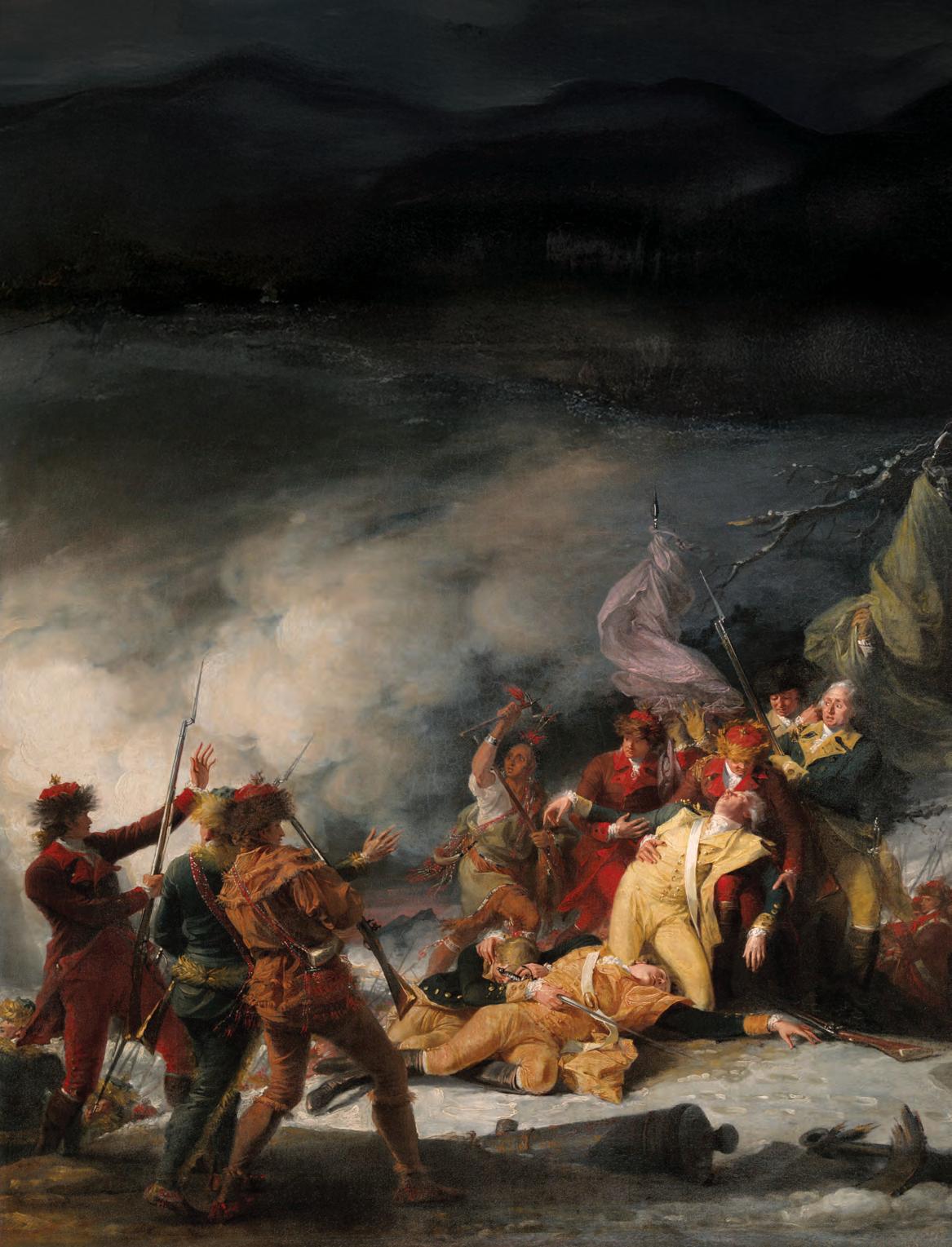
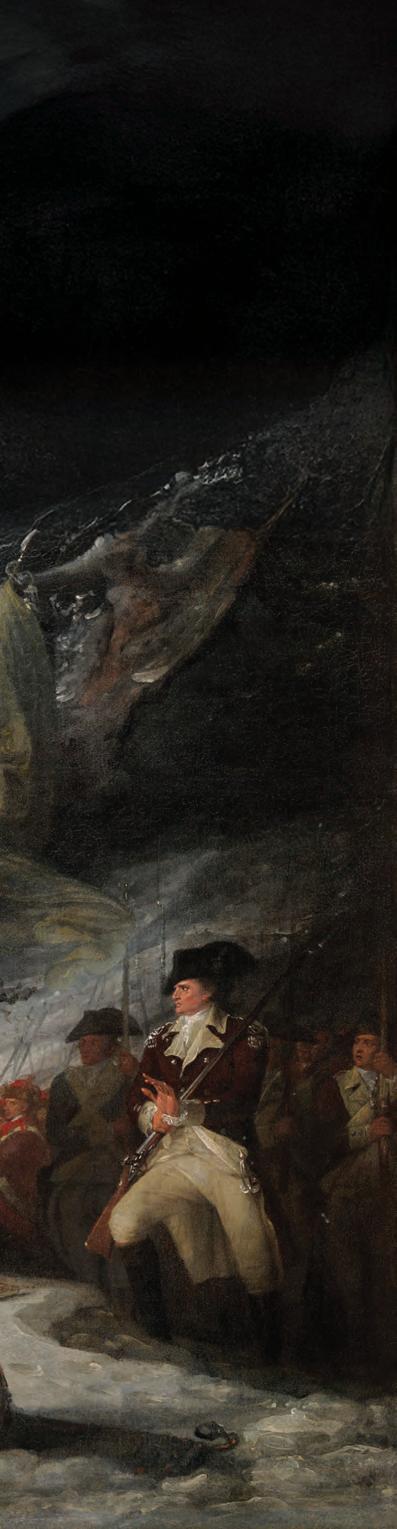
British Major-General Guy Carleton, governor of Quebec, led the defence of Canada.
CANADIEN
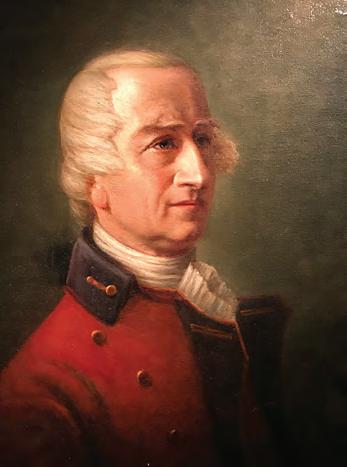



1775-76, Canada very nearly became one of the American colonies. Its fate would hinge on a cold morning battle in a snowstorm at the gates of Quebec.
Sixteen years earlier, British forces had defeated the French on the Plains of Abraham and occupied the fortress of Quebec. France ceded Canada to Britain in the 1763 Treaty of Paris and consigned New France’s nearly 70,000 inhabitants to British, Protestant rule. Britain had obtained a French-speaking Catholic colony, the Province of Quebec (commonly referred to by contemporaries as Canada), without loyalty to the new regime or its king. The Canadiens feared for their way of life.
The Governor of Quebec, Major-General Guy Carleton, was worried about growing discontent in the American colonies. He was
also unsure of the position the Canadiens would adopt in the event of an American revolt. The province had few defences, and Carleton needed the backing of the influential Catholic clergy and local aristocracy, the seigneurs, whom he felt capable of dissuading the Canadiens from joining an American insurrection.
Accordingly, Carleton was instrumental in the British Parliament’s passing of the Quebec Act, 1774, which guaranteed the rights of the Catholic Church, the rights of Catholics to hold office and the continuance of the French legal and land tenure systems in Quebec. The act also greatly extended the boundaries of the Province of Quebec, to encompass the Great Lakes region all the way west to the confluence of the Mississippi and Ohio rivers. The move essentially blocked the mainly coastal 13 American colonies from western expansion. The Quebec Act seemed a betrayal to the rebellious Americans. They saw Britain as the enemy and Canada as potentially easy prey.
Carleton was also keenly aware that there were American sympathizers among the 2,000 British colonists in the province, especially since many had moved north from the American colonies. This was especially true of the British merchant class who were unhappy because the Q uebec Act threatened their commercial and political power.
In 1774-75, American agents spread anti-British propaganda among the Canadiens, arguing that through revolution they would be liberated from British rule. But they also reminded the Canadiens, threateningly, that the latter were “a small people, compared to those who with open arms invite you into fellowship.”
The American rebels, then, could also come as conquerors, not liberators.
Perhaps the best that the British and Americans could hope for was the neutrality of the Canadiens, who watched their former enemies slide toward fratricidal conflict.
Ticonderoga
Lake George

Brigadier-General Richard Montgomery assumed command of the American attack in September 1775.




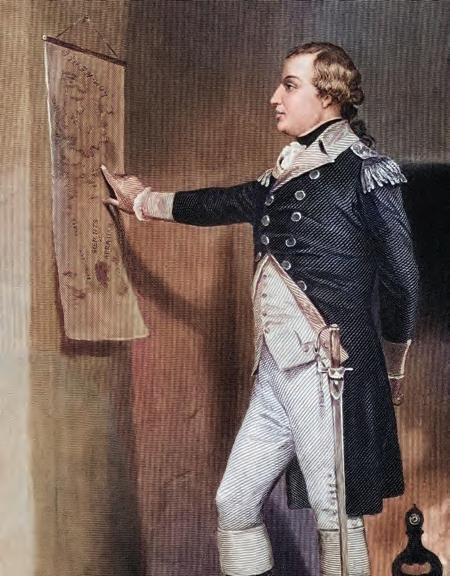
River
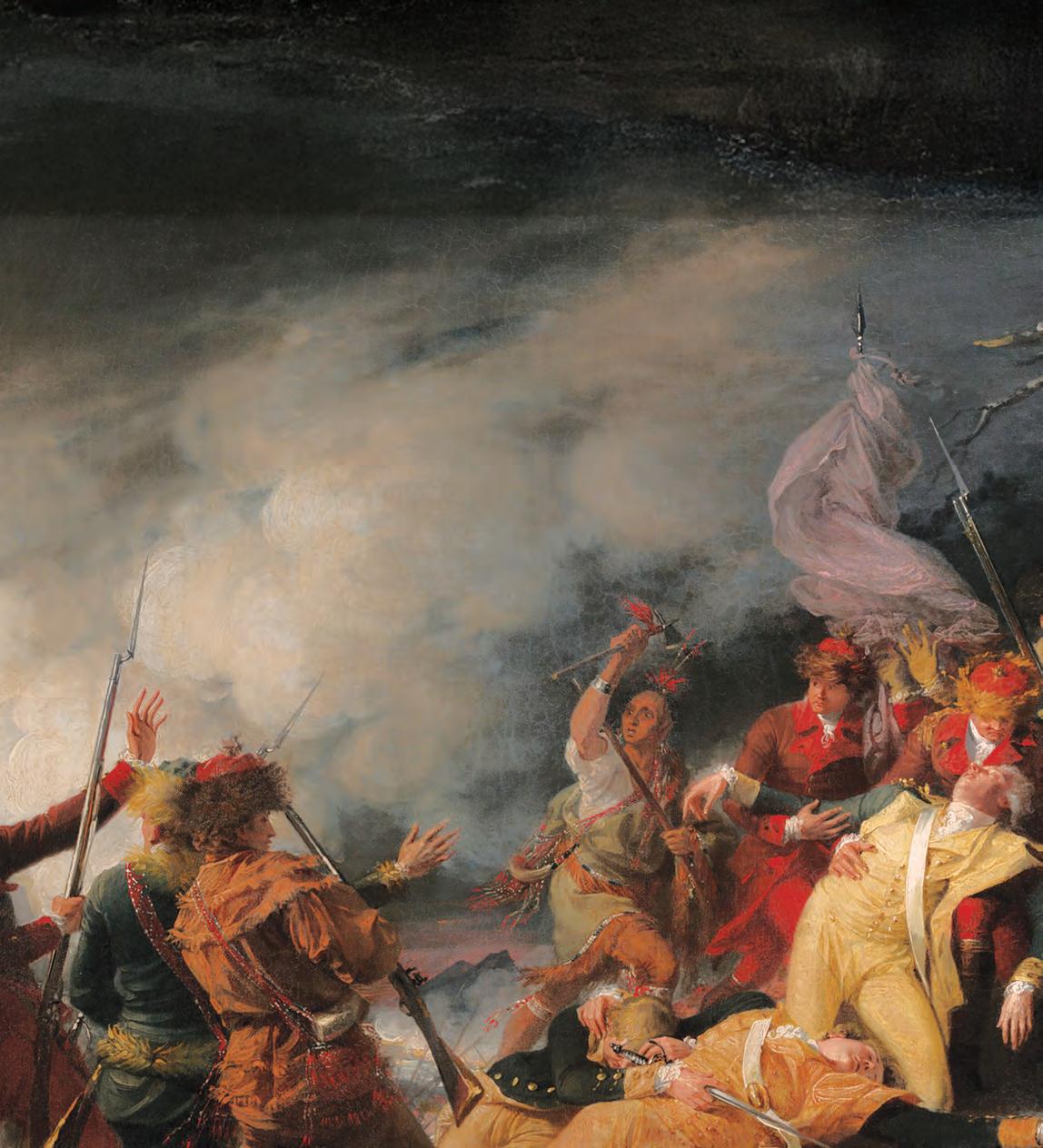
The American Revolution began in April 1775 with fighting at Concord and Lexington. Events moved quickly. In May, American forces seized British forts at Ticonderoga and Crown Point, traditional launching points for attacks into Canada.
The American Continental Congress decided to invade Canada to encourage revolt there and to prevent the British from using it as a base for attacks against the rebels in New York and Massachusetts. Congress ordered Major-General Philip Schuyler at Ticonderoga to seize the British fort at St. Jean, then Montreal.
Carleton commanded only 944 regular forces spread throughout Quebec, most garrisoning forts along the Richelieu River. What he desperately needed was the support of the militia made up of Canadiens and loyal British settlers. But French speakers proved hesitant, notwithstanding the clergy’s call to arms.
More positively, the experienced Lieutenant-Colonel Allan Maclean raised a new, very reliable regular unit, the Royal Highland Emigrants, consisting mainly of Scottish Highlander settlers recruited in Canada. Many were combat veterans and immediately available for the province’s defence.
On Aug. 30, a force of about 2,000 mainly inexperienced New Yorkers left Crown Point for St. Jean. They arrived five days later depleted by sickness, their commander Schuyler himself too ill to continue. Brigadier-General

ARNOLD’S ROUTE Sept. 11 - Nov. 8, 1775
MONTGOMERY’S ROUTE Aug. 30 - Dec. 2, 1775
Richard Montgomery assumed command and laid siege to the fort. Carleton staked almost everything on the defence of the fortification at St. Jean as Montreal’s walls were very weak and were unlikely to withstand a determined attack. The St. Jean fort was garrisoned by 512 regulars, 20 Highland Emigrants and 90 Canadien militia. Its commander, Major Charles Preston, held out as long as he could.
But, on Oct. 17, the British 20 kilometres to the north swiftly surrendered to a small American force. With its many supplies captured by the invaders, any hope of relieving St. Jean ended. Preston surrendered on Nov. 3 after a heroic resistance, and most of Carleton’s best troops were now prisoners.
Perhaps sensing the turning tide, some of the 900 Canadien militia in Montreal began to drift away, much to Carleton’s bitter


disappointment. Meanwhile, other Canadiens joined the invaders. The population’s attitude was a result of perceived British weaknesses and the likelihood of their defeat. Carleton believed that “every Individual seemed to feel our present impotent Situation.” Why take up arms for the British and then incur a victor’s wrath? Most Canadiens instead stayed on the sidelines.
To make matters worse, Carleton learned that a force of Americans commanded by Colonel Benedict Arnold had reached Pointe-Lévy, on the St. Lawrence River opposite Quebec City, on Nov. 8. They had travelled some 500 kilometres by boat and on foot over the rugged and largely uninhabited wilderness of upper Massachusetts (now Maine) following the Kennebec and Chaudière rivers.
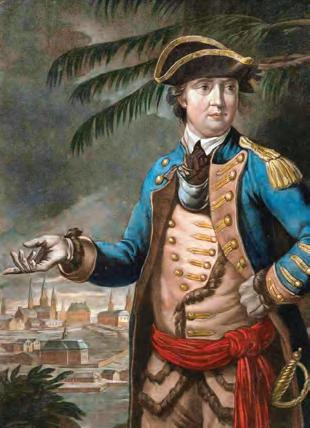


Historian George Stanley marvelled at the Americans’ epic “feat of endurance” and their abilities to navigate “over trackless swampy wastes, through rivers choked with ice and over dangerous rapids, the men suffering from cold, hunger and exposure.” It had taken them seven weeks and of the 1,050 men from
The QuebecAct seemed a betrayal to the rebellious Americans. They saw Britain as the enemy and Canada as potentially easy prey .
Massachusetts, Pennsylvania and Virginia who had begun the trek, only about 700 remained, the others having turned back, become lost or perished. They were exhausted and starving, their clothes in tatters, and some soldiers had survived by making soup from their leather shoes and belts; many suffered from debilitating dysentery.
Once in Canada, they purchased supplies from the Canadiens at exorbitant prices. On Nov. 13-14, Arnold’s force assembled 40 small craft and crossed the St. Lawrence. Their ranks too few to besiege Quebec City, after several days the invaders established a camp at Pointe-aux-Trembles, 32 kilometres to the west, and awaited Montgomery’s arrival from the southwest.
American Colonel Benedict Arnold led a separate force to Quebec City, which was attacked on Dec. 31, 1775 (below ).
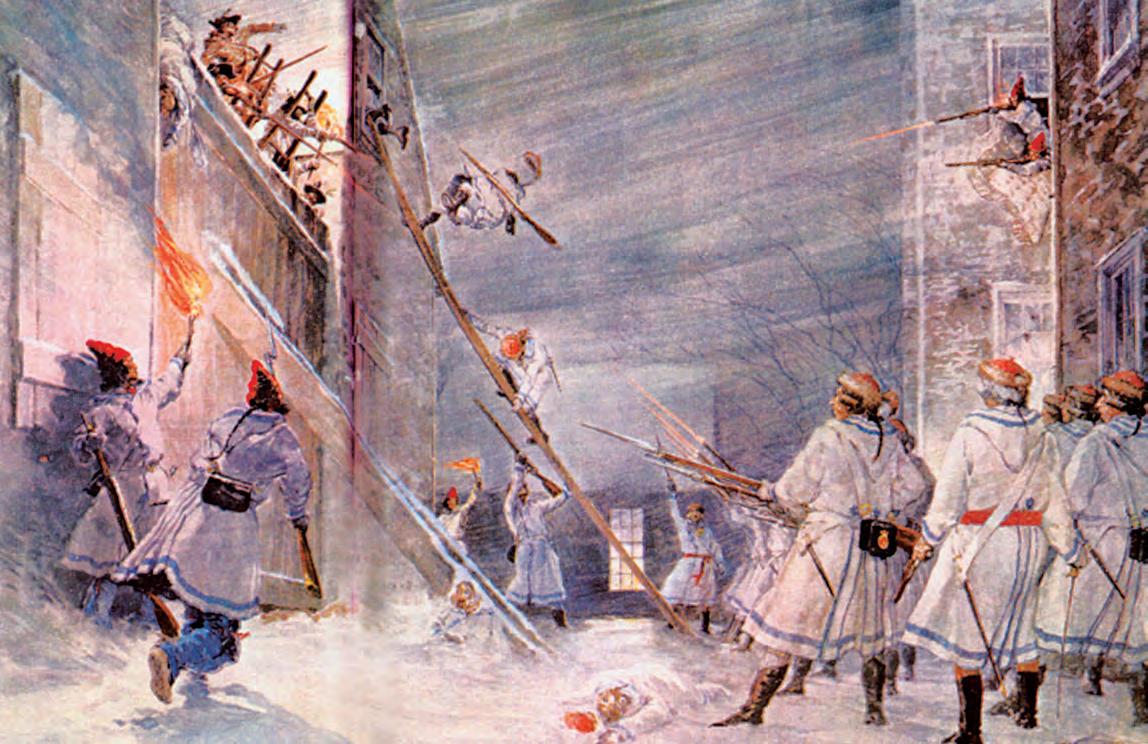
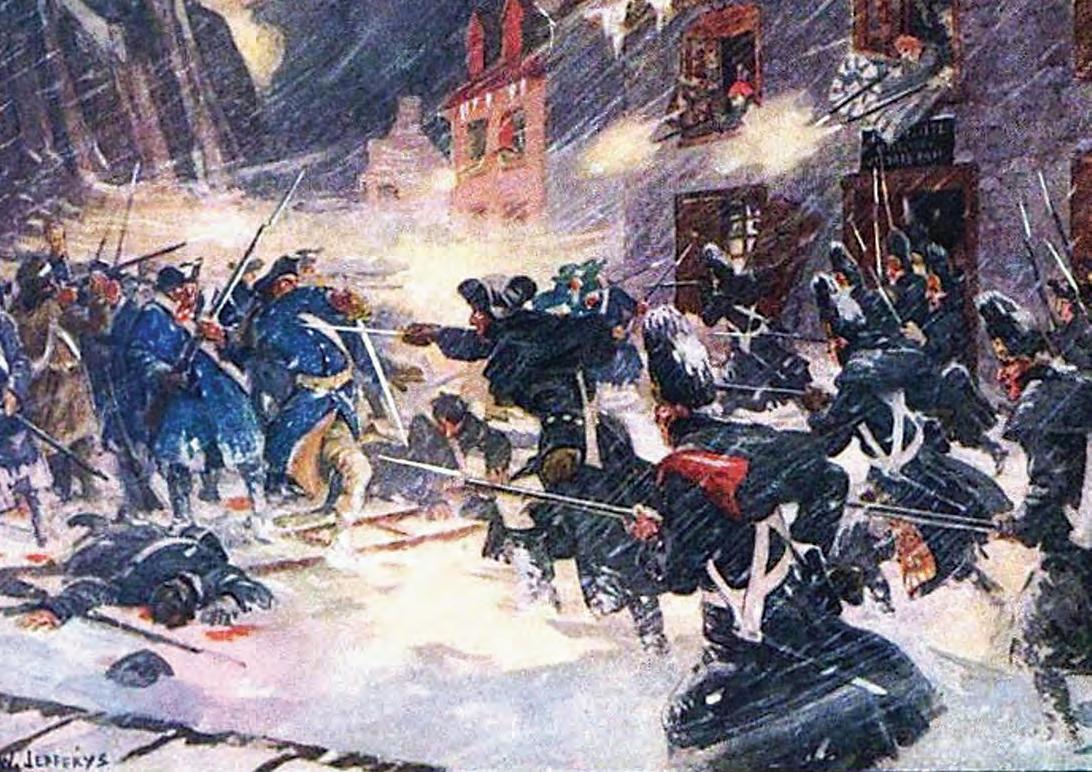
Montreal was indefensible and surrendered on Nov. 13 without a struggle. Carleton, disguised in farmer’s clothing, escaped to Trois-Rivières in a boat piloted by Canadien oarsmen and, continuing his journey aboard a small vessel, arrived in Quebec City on Nov. 19.
Meanwhile, with the need to garrison Montreal and other points, coupled with the effects of sickness and expiring enlistments for many of his troops, Montgomery had only about 660 men left: 300 from the New York regiments, 200 hastily recruited Canadiens and 160 miscellaneous others. He had with him four 9- and 12-pounder cannons and six mortars, and winter clothes and provisions for Arnold’s men.
Montgomery finally joined Arnold in early December. Days later, they attempted to besiege Quebec City. But the Americans’ small guns and mortars had no effect, and the city’s cannons were of a greater calibre and range than those of their assailants.
Quebec City was key to the defence of Canada, but was almost without any regular troops. So, Carleton had to count on the militia, the Emigrants, crews from ships in harbour and untried citizen volunteers.
“I should flatter myself,” he wrote to the Earl of Dartmouth, “[that] we might hold out, till the Navigation opens next Spring, at least till a few Troops might come up the River.” But he despaired: “I think our Fate extremely doubtful.”
It was a grim assessment.
Still, safe behind the walls of the city, from where he never contemplated straying, Carleton had almost 1,800 men at his disposal including 70 regulars, 230 Highland Emigrants, 35 Royal Marines, 120 artificers, 543 Canadien militia, 330 British militia, about 395 seamen and miscellaneous other soldiers. The city of 8,000 was also well provisioned with food and firewood. And Carleton ejected
all those British and Americans whom he considered disloyal.
The barely 1,000 Americans faced a daunting task. They were beset by cold, sickness (including deadly smallpox) and insufficient shelter. More than 100 muskets belonging to Arnold’s men were unusable and all troops were short on ammunition, powder and supplies. The 200 Canadiens among his ranks seemed halfhearted and some deserted.
Compounding Montgomery’s problems were the terms under which many of his men had been enrolled. Some would be free of any further service after Dec. 31 and indicated their intentions of leaving. Their departure would end the Americans’ hopes of seizing Canada’s capital. Montgomery had to assault the city as soon as possible.
The attack was launched at 4 a.m. on Dec. 31. It was cold, windy and snowing heavily, obscuring the Americans’

One British officer rejoiced that it had been, “A glorious day for us, as compleat (sic) a little victory as ever was gained.”
advance. Montgomery organized a pincer movement along the base of Quebec’s cliffs and ramparts to seize the Lower Town prior to scaling the promontory to overcome the fortifications and attain the Upper Town. It was a very ambitious, desperate plan, as he surely knew.
Montgomery’s Canadiens launched a feint from the Plains of Abraham while he led 300 New Yorkers from the west along the river road below the commanding heights of Cap Diamant. Meanwhile, Arnold’s 600 troops swung down from the northwest along the cliffside in the Saint-Roch neighbourhood with its twisted streets and harbourside warehouses.
Disaster struck immediately. At the first road junction to the Lower Town, Montgomery’s force encountered a tall palisade barricade running from the cliffside to the water’s edge. Immediately behind it was a blockhouse manned by 30 Canadien militia and 17 British militiamen and seamen, the latter in charge of four small cannons dominating the approach.
The Americans made a hole in the palisade and some advanced toward the blockhouse, Montgomery in the lead. When the attackers were 45 metres away, the defenders unleashed concentrated grapeshot and musket fire, killing Montgomery, two officers and several other men. The Americans retreated; this part of the attack was over.
Arnold’s luck was little better. His men encountered their first barricade across the narrow rue du Sault-au-Matelot. It was
defended by 30 militia and three cannons. After a stiff fight, the Americans captured the position, but Arnold was shot in the leg and evacuated. Captain Daniel Morgan assumed command and pressed on to the next barricade, which was unguarded.
While Morgan waited for the rest of his men to catch up, the British, Emigrant and Canadien forces had time to rally and properly defend the position with 200 men. The attackers were unable to scale the 3.6-metre wall with their ladders while under heavy fire and were caught in the narrow streets where they sustained heavy losses.
Canadien and British troops then sortied from the Porte du Palais, recaptured the first barricade, and caught the invaders in the rear. Fighting lasted for several hours but, realizing the hopelessness of their situation, the Americans surrendered at 10 a.m.
In total, some 400 were captured, including Morgan, and it’s likely another 100 were killed or wounded. British and Canadien casualties, on the other hand, amounted to five killed and 14 wounded. One British officer rejoiced that it had been, “A glorious day for us, as compleat (sic) a little victory as ever was gained.”
This was the American rebels’ first defeat of the Revolutionary War.
Carleton controversially elected not to sortie from Quebec and finish off his enemy, despite the British forces outnumbering the Americans 3:1.
Arnold, now in command, lost another 100 men who left after the expiration of their enlistments and had barely 700 men remaining,
An artist depicts British and Canadien soldiers fighting back Americans at rue du Sault-au-Matelot, Quebec City, on Dec. 31, 1775.
including the sick and his halfhearted Canadiens. He maintained light artillery fire into the town and awaited reinforcements from Montreal. They arrived steadily throughout the next several months. These new troops eventually totalled 2,500, but many weren’t in fighting condition and couldn’t mount a serious siege.
The American commander-inchief, General George Washington, insisted that Canada be captured before the start of the navigation season. But it wasn’t to be.
On May 5, 1776, the first British warship appeared near Quebec City with reinforcements. “The news soon reached every pillow in town, people half-dressed ran down to…feast their eyes with the sight of a ship displaying the union flag,” said one British officer of the moment. The Americans retreated in near panic to Sorel, ready to ascend the Richelieu. Soon, 40 more British ships with 9,000 troops arrived in Quebec City.
Carleton’s strengthened forces advanced to Trois-Rivières. In June, the reinforced Americans renewed their offensive there, but stout British defences blunted the attack, and some 200 Americans were captured. There were still 5,000 Americans in Canada, but they continued to be ravaged by smallpox, suffered constant desertions, and the Canadiens had become far less friendly.
“Let us quit…and secure our own country before it is too late,” wrote Arnold from Montreal to General John Sullivan, the new American commander in Canada.
The invaders evacuated Sorel and Montreal, retraced their steps south along the Richelieu, and returned to their own territory. Canada had rejected the American Revolution. L
Words and pictures by Stephen J. Thorne
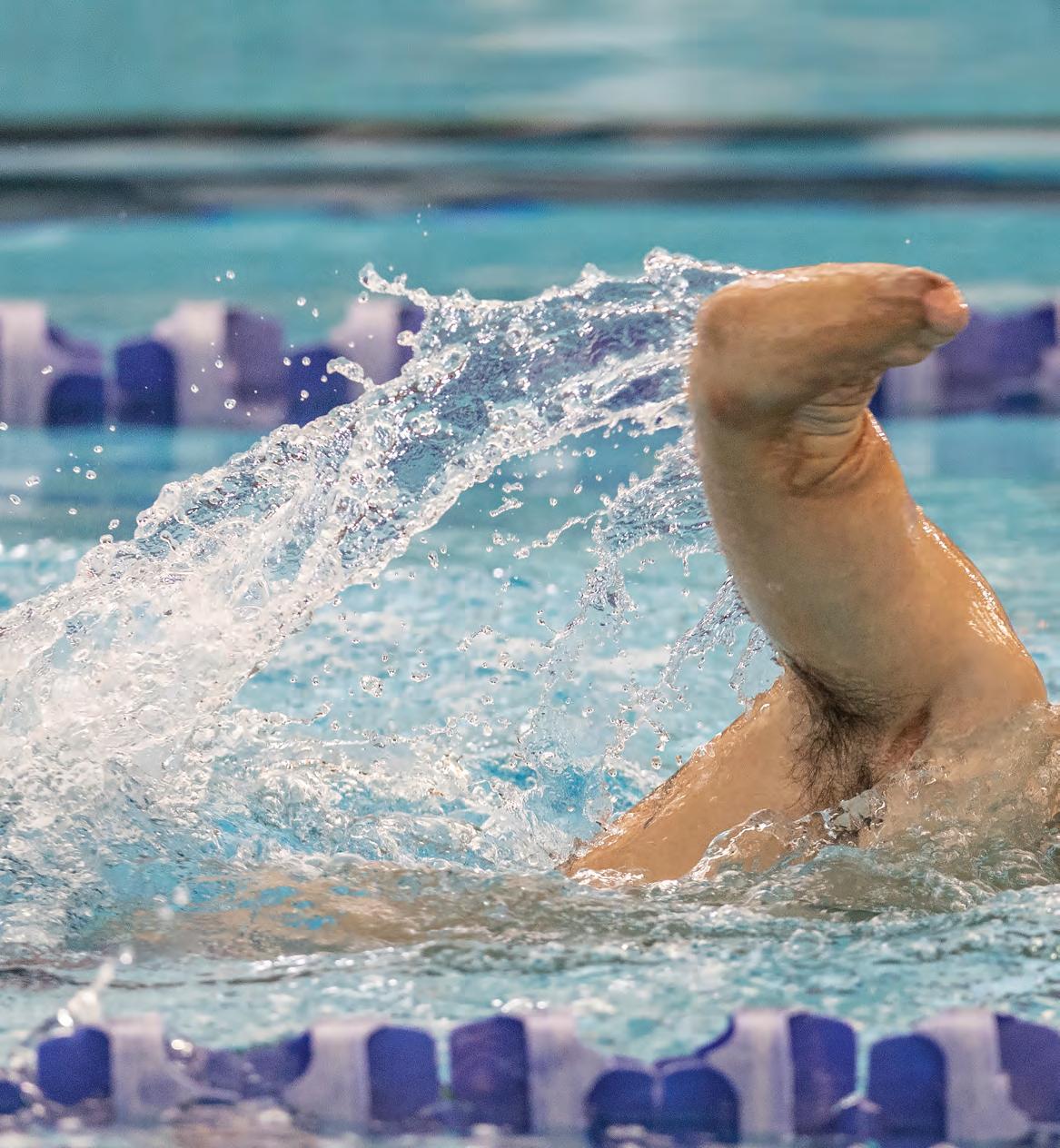
Hyeongyoon Na of South Korea, who lost both forearms to an electric fence at the North Korean border, competes in the 50m freestyle.
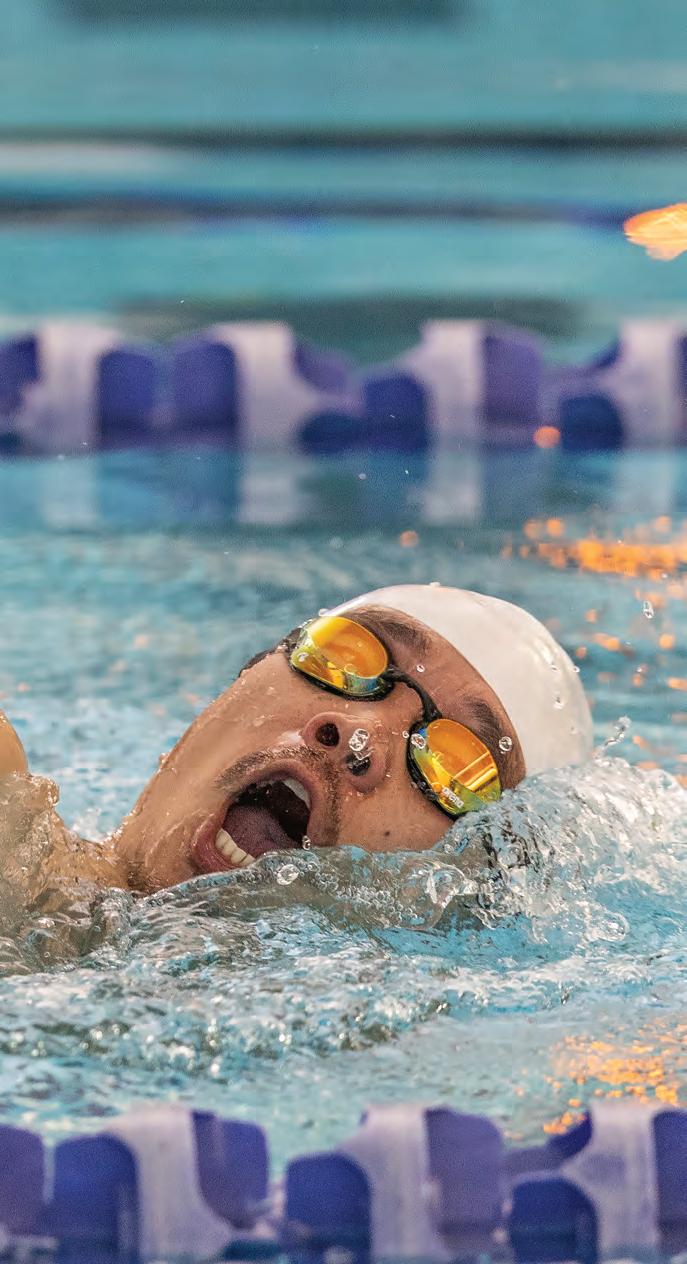
truly a competition like no other— more than 500 wounded, injured or ill athletes from 23 countries, all veterans or serving military, competing in 11 adaptive sports during nine gruelling, but oh-so-rewarding, days.
The competition is fierce, yet the primary foes at the Invictus Games aren’t the men or women next to you on the starting grid, the playing court, or any other external place. They’re the demons that reside within virtually each and every participant, nurtured by years of physical and mental anguish, the litany of seemingly insurmountable obstacles and monumental challenges that brought them here.
For almost all of them, it has been a long and painful process, one small step at a time, at first tentative, unsteady, discouraging. Then small victories, a growing sense of purpose and accomplishment and, ultimately, a blooming confidence that landed them among the beautiful vistas of Vancouver and Whistler, B.C., from Feb. 8-16, 2025, for the Games’ first winter adaptive sports. They couldn’t have done it without family, friends and comrades-in-arms. They’re all here, imparting their love and support in different ways, big and small.
They bask in the camaraderie of unique, shared experience. They have all been places, done things, met tests that most cannot know. Their bonds are deep and lasting.
The winning and losing is all but irrelevant; they’re all winners in their own ways. After all, they are here.
For some, Invictus marks a triumph over life-altering setbacks, an emergence from solitary darkness onto a world stage flooded with glorious light. For others, the struggles won’t be over, the getting here, the doing of it but stepping stones along a much longer path, made more navigable by the inspiration of it all.
“Out of the night that covers me,” British poet William Ernest Henley wrote in the poem for which the Games are named, “Black as the Pit from pole to pole,/I thank whatever gods may be/For my unconquerable soul….
“I am the master of my fate/I am the captain of my soul.” L
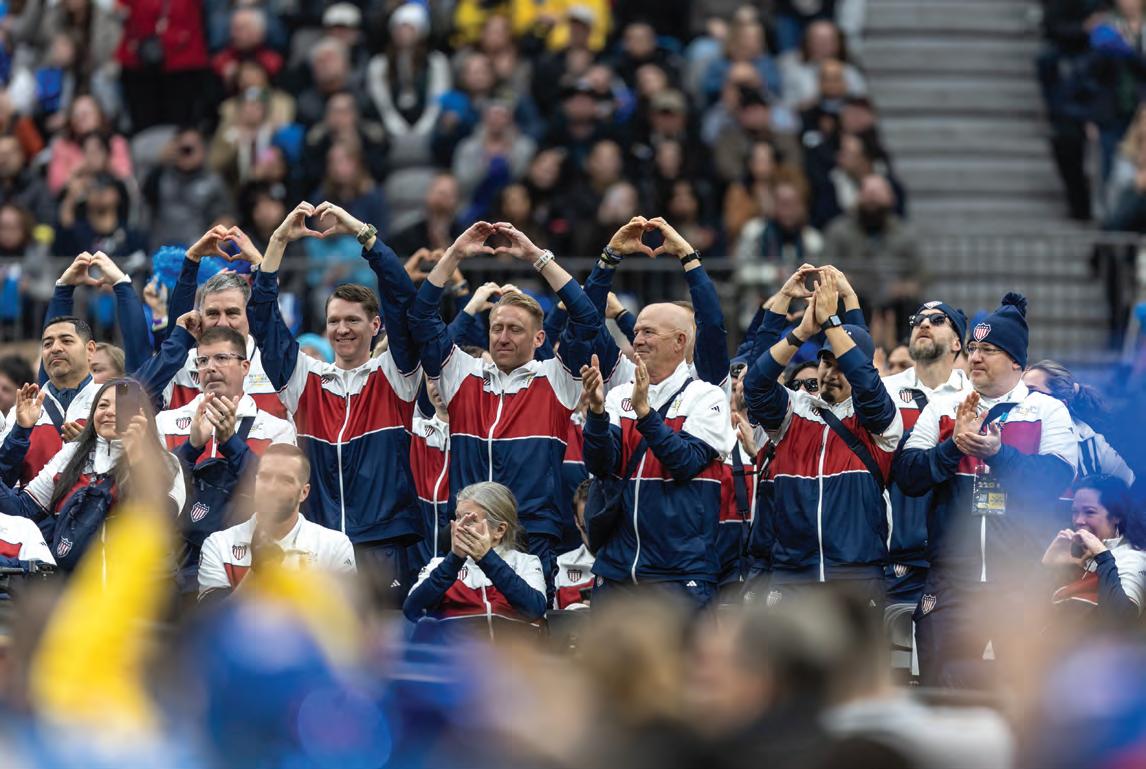
In one of the most moving moments of the Games, U.S. athletes stood and showed their love for their Canadian comradesin-arms after they were met with a smattering of boos during the opening ceremonies' parade of nations.
Prince Harry congratulates Oleksii Horb of Ukraine after his silver medal finish in the men's novice IAS1-sit ski at Whistler. The Ukrainians finished 1-2 in the event, won by Serhii Hordiievych.
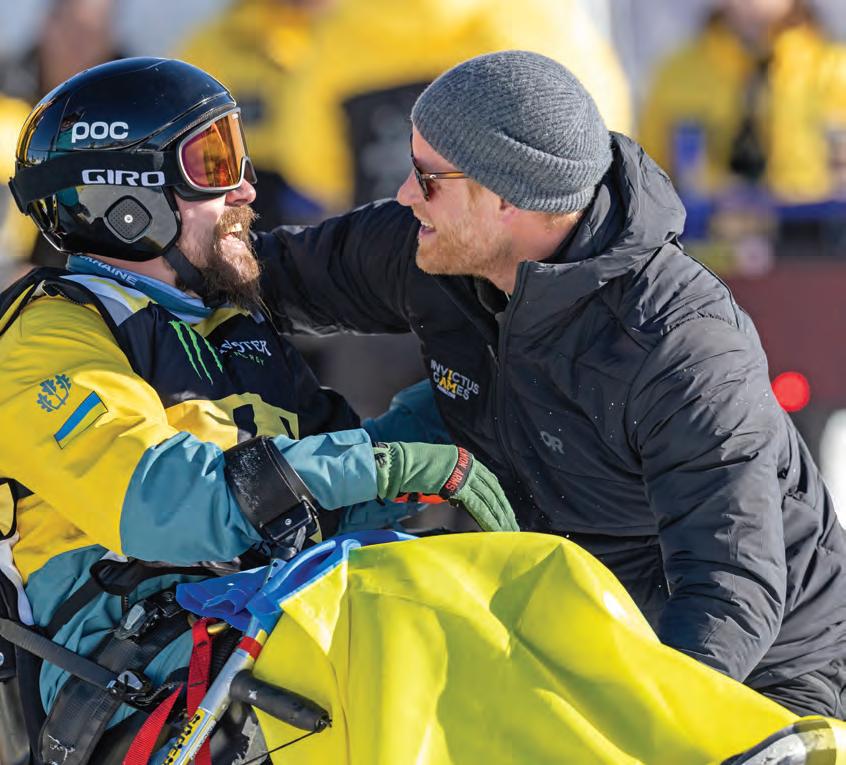
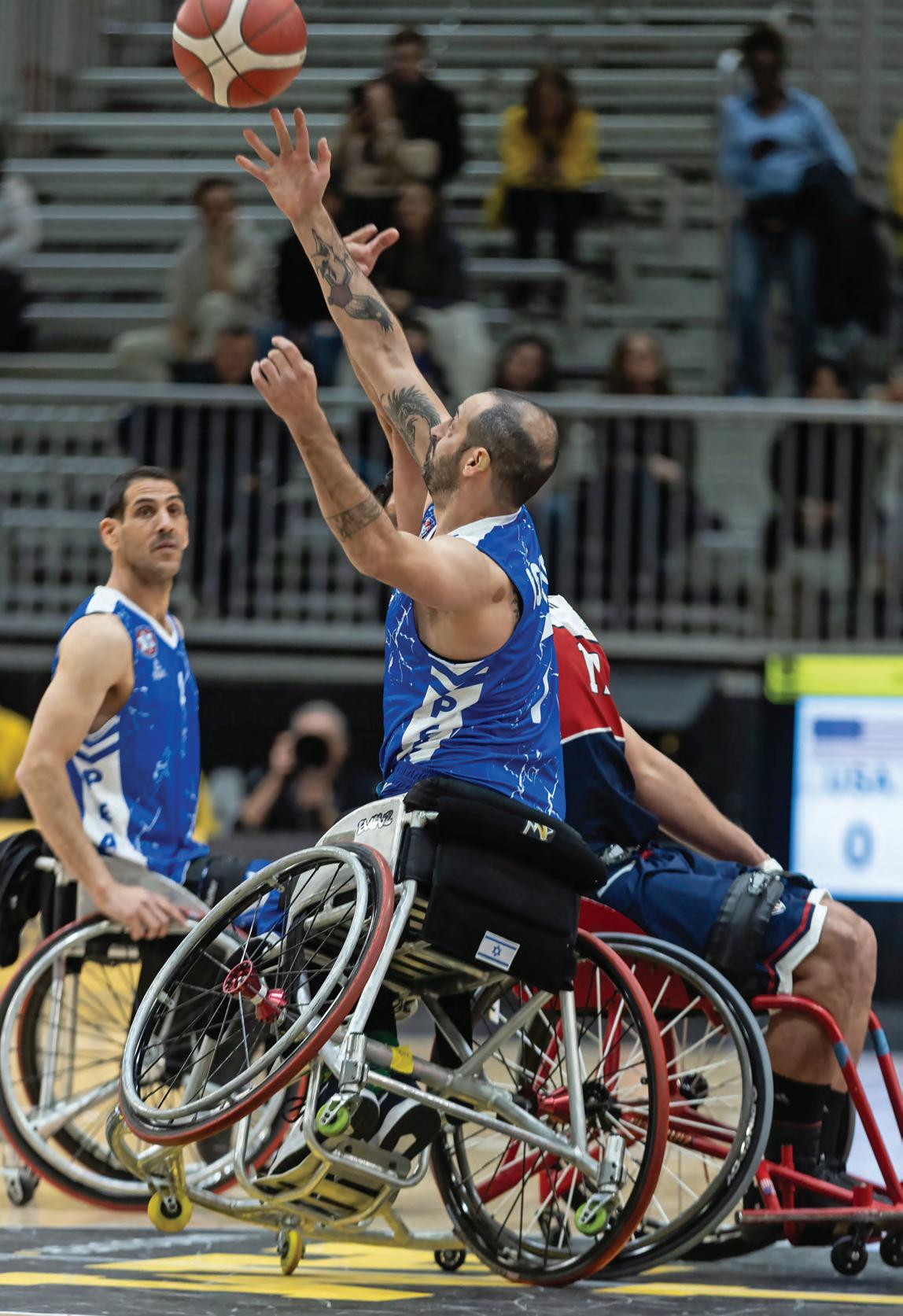
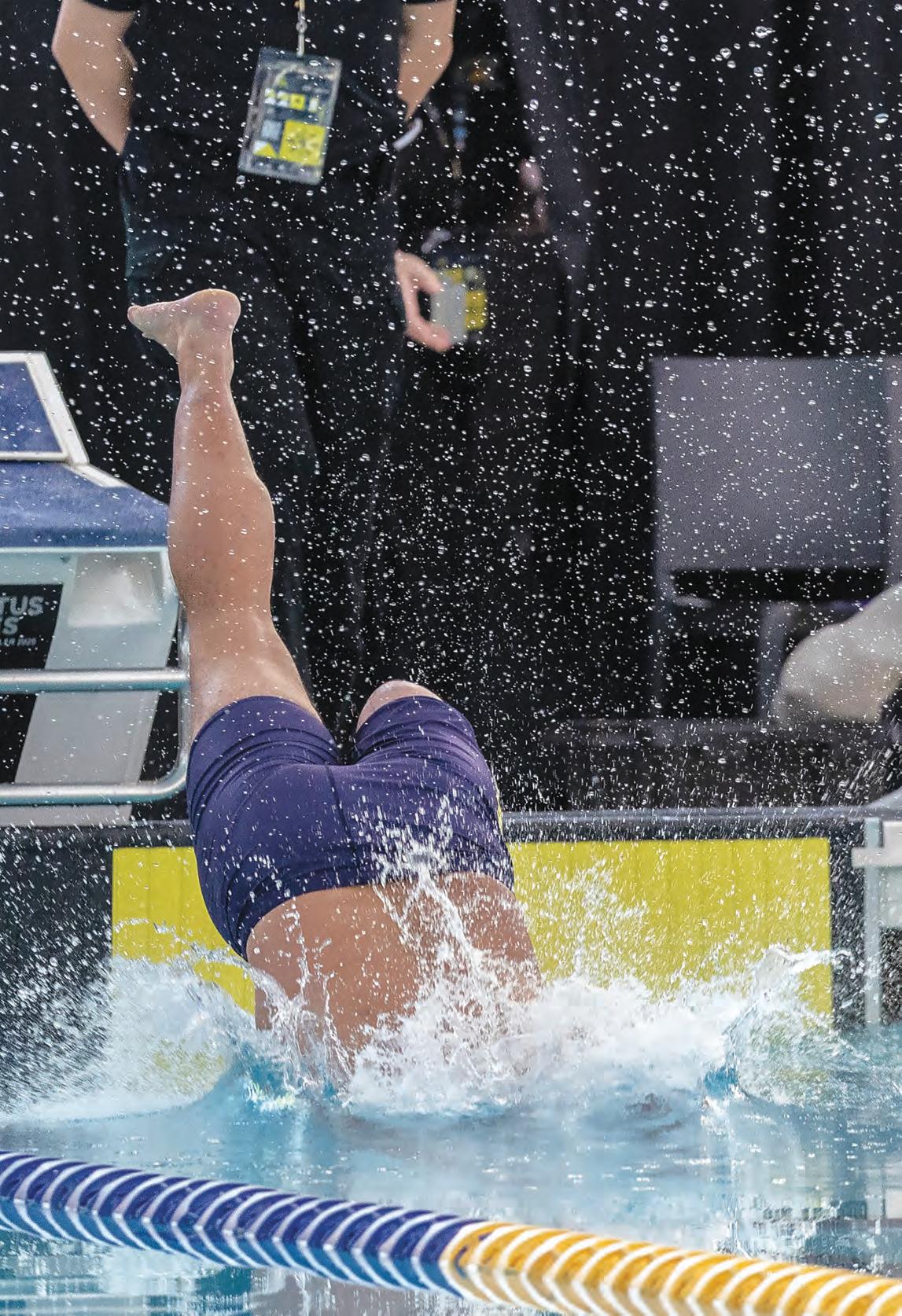
THEY BASK IN THE CAMARADERIE OF UNIQUE, SHARED EXPERIENCE. THEY HAVE ALL BEEN PLACES, DONE THINGS, MET TESTS THAT MOST CANNOT KNOW.
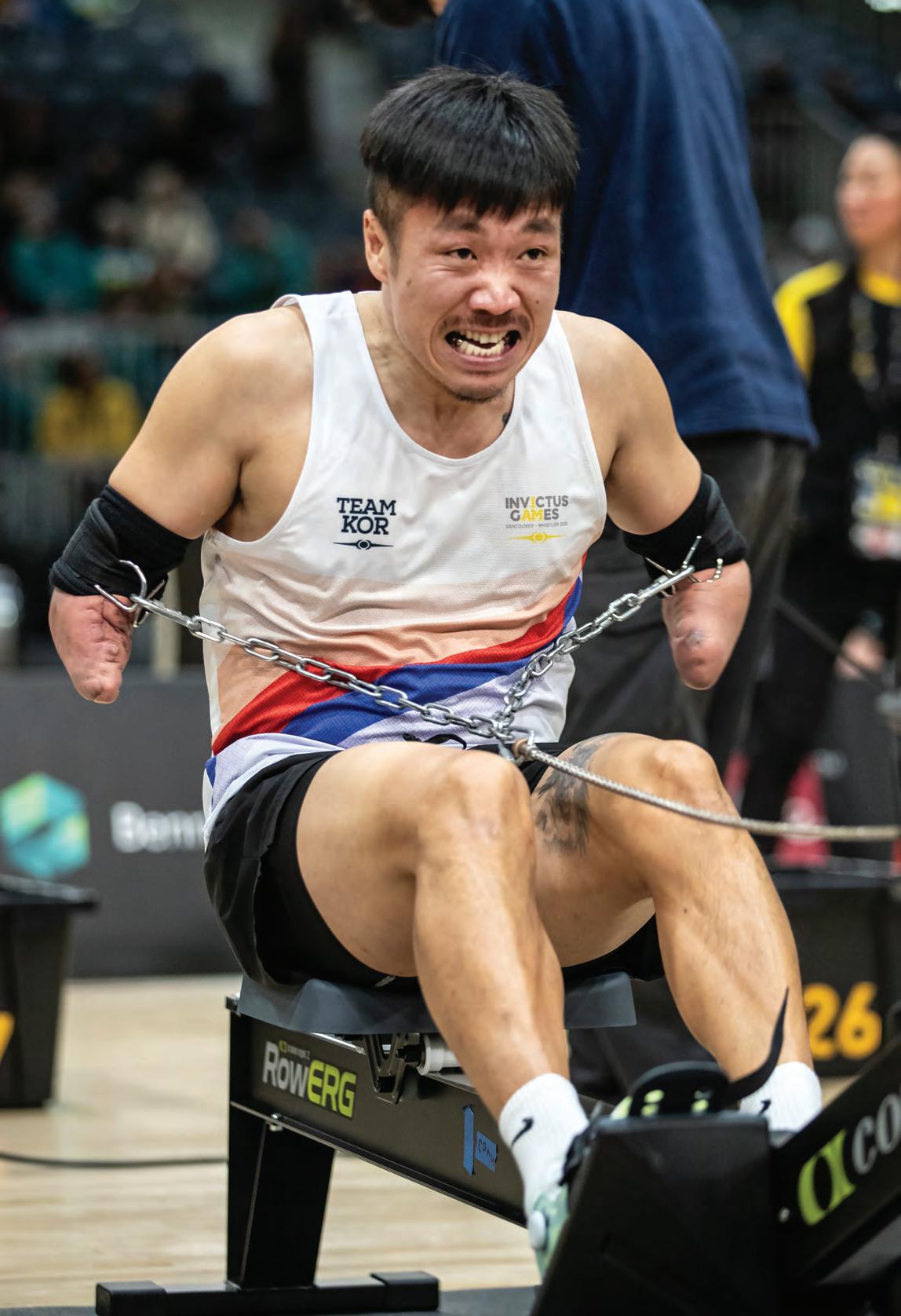
Hyeongyoon Na of South Korea was a multidisciplinary athlete at the Invictus Games, competing in swimming and the IR3 four-minute endurance rowing race.
A powerhouse on offence and defence,
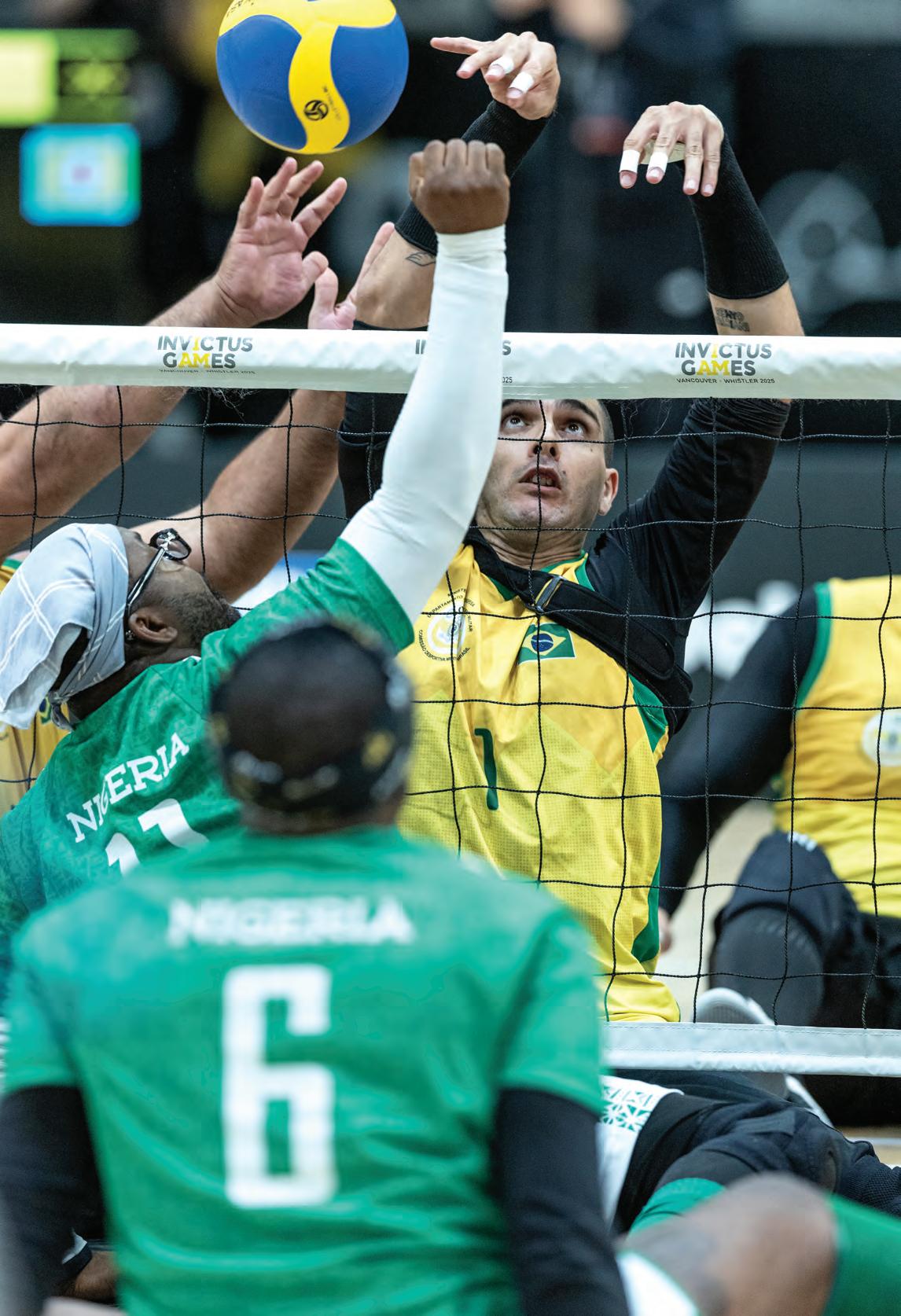
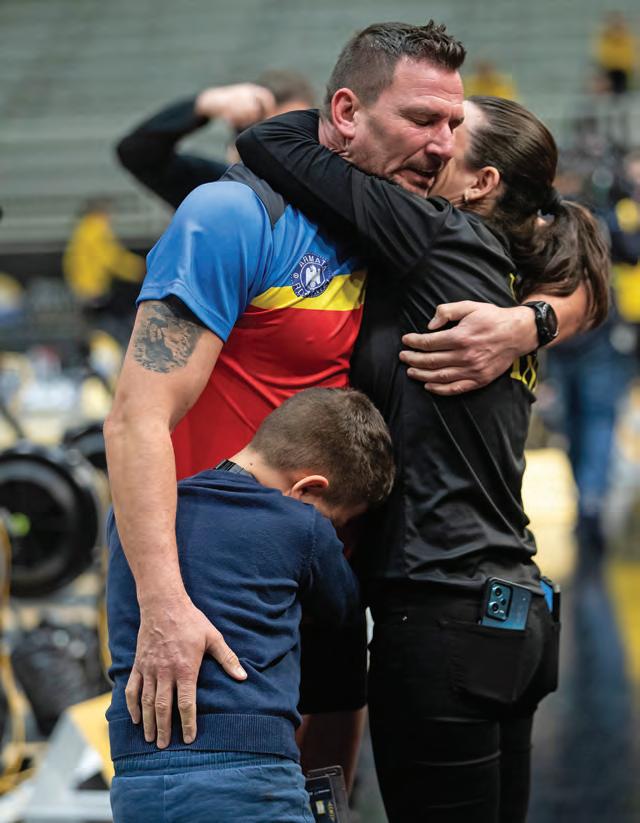
Petrisor Onea of Romania gets hugs and kisses from wife Laura and son Mihai after finishing the IR6(M) four-minute endurance rowing race.
James Cairns, who lost his lower leg to a sniper while serving with the British Royal Yorkshire Regiment in Afghanistan, proposed to girlfriend Hannah Wild after the U.K. team's wheelchair basketball game versus Colombia. Britain lost the game but Cairns won her heart. She said yes.
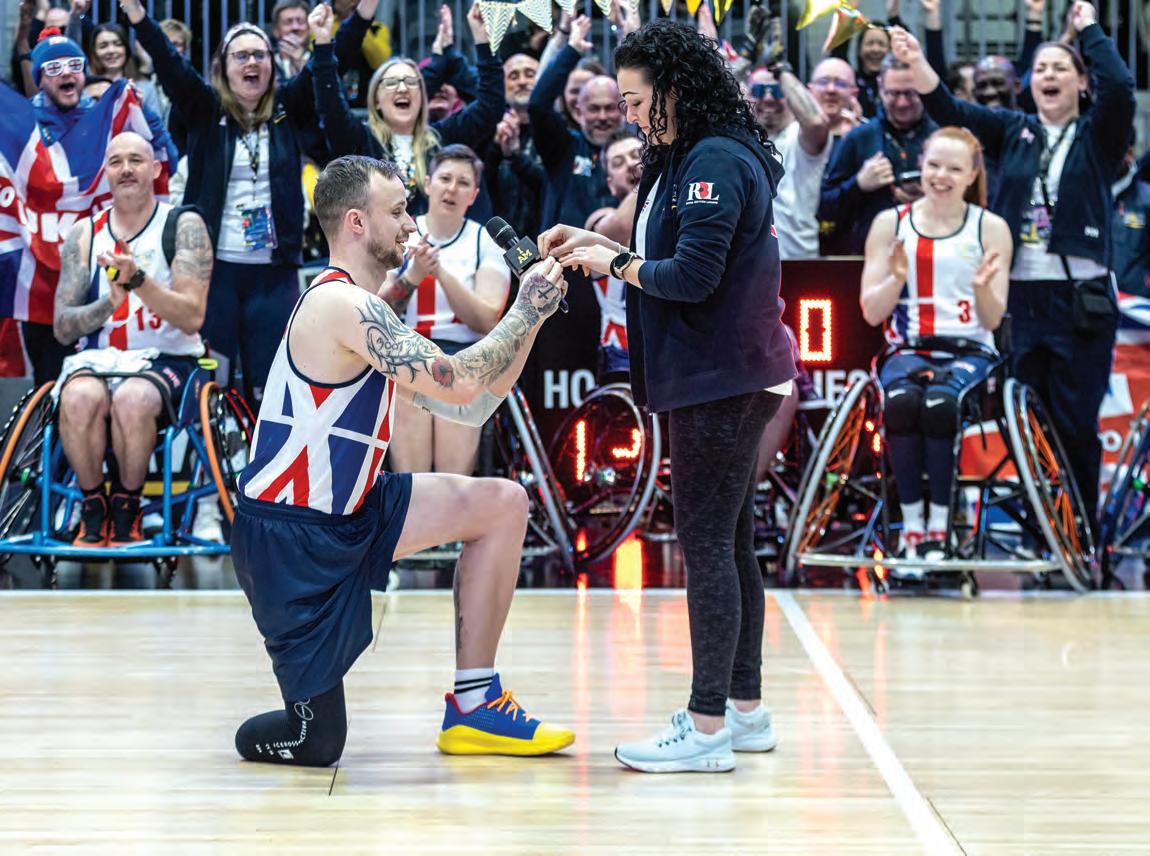


By Nujma Bond
anada’s veterans, both military and RCMP, and their families are at the core of everything The Royal Canadian Legion’s 270,000 members do. The Legion is the country’s largest veteran support and community service organization, and the strength of its membership allows for incredible accomplishments at its national headquarters. Notably, the membership increased by five per cent year over year, with more than 44,000 new and reinstated members—a modern-day record.
“You have been truly an ‘Earth Angel’ to me.” Such reactions from veterans helped by the Legion are deeply moving and a reminder of the potentially life-changing nature of its work. Similar feedback received throughout the year reflects the efforts of the Legion’s national and provincial service officers.
“I am extremely grateful for all the hard work you have done and dedicated to my case,” one veteran told a service officer about their Veterans Review and Appeal Board (VRAB) process. “No matter what happens from here, I feel that I’ve won just by the acknowledgement of the board members of my injury.”
Said another veteran’s family member in appreciation for help acquiring a new scooter: “This has given him the confidence
to travel around town, giving him independence and allowing him to be more social once again. Again, I wish to say thank you from the bottom of our hearts.”
In 2024, service officers had thousands of interactions with veterans and submitted more than 3,200 first applications and departmental reviews to Veterans Affairs Canada. They handled almost 250 entitlement reviews, appeals and reconsideration requests to VRAB. These processes can be daunting to navigate alone, and the Legion’s officers assist at no cost, member or not.
More highlights of the critical work accomplished at the national level: the veterans services department worked closely with Veterans Affairs Canada transition centres to help ease the strain of leaving the service by guiding and assisting those dealing with related claims or benefits; the department developed a new process to better help veterans in the North receive assistance through provincial commands; and the department strengthened relations with organizations assisting service members dealing with “hidden” medical issues, such as cancers or traumatic brain injuries that can be linked to their work, to help streamline the path to support.
Evidence-based research helps Canada implement new tools to assist veterans. In collaboration
with the Canadian Institute of Military and Veteran Health Research, the Legion awarded its inaugural $50,000 PhD research scholarship to Raphaelle Merlo, a student at Université Laval in Quebec City looking into optimizing psychological care for veterans.
“I hope to be able to improve the quality of life and psychosocial functioning of serving military personnel, in particular, by helping to reduce wait times on waiting lists for operational stress clinics in Canada,” said Merlo.
In advocacy work, national headquarters made recommendations to numerous groups, including VAC, the RCMP and the Veterans Consultation Assembly. In 2024, the latter agreed to focus on three key issues: traumatic brain injury, partial entitlements for veterans, and the misalignment between the Pension Act and the Veterans Well-being Act. Meanwhile, a media opinion piece titled “Veterans, mental health, and the service dog connection” highlighted Ontario Command’s Operation Service Dog, which has provided more than $2 million to train the animals and connect them with veterans.
The Legion also supported organizations with similar mandates, providing another significant donation to the National War Museum to help tell the stories of veterans, funding the Canadian version of educational books for children to help them understand life as a veteran, and supporting hands-on programs that assist veterans such as the fly-fishing initiative Heroes Mending on the Fly Canada and volunteering opportunities at Camp Aftermath.
The Legion’s veterans services team also worked to expand the Military Veterans Wellness Program in Toronto that helps verify the military service of veterans experiencing homelessness and facilitates connecting them with a provincial command for local support.
Strategic marketing and communications helped grow membership for a third year in a row, increased the Legion’s profile, and further highlighted remembrance.
Canada’s largest broadcasters donated significant airtime for a new Remembrance Day public service announcement. The media is crucial to sharing insights, and stories published in 2024 illustrated how the Legion helps veterans, clarified confusion related to prayer at national and local Remembrance Day ceremonies and helped promote the “ad blackout” on Nov. 11, in which thousands of digital advertising signs across Canada went black for two minutes at 11 a.m. Traditional and social media also helped increase awareness of the availability of lapel poppies, particularly through a pilot project with online retailer Amazon whereby individuals could donate to have a lapel poppy delivered to their home.
Other initiatives, meanwhile, helped educate and increase donations and membership, such as tools for branches during National Legion Week events in September
and the increasingly popular website that lists hundreds of Legion-organized Remembrance Day ceremonies across the country, which grew to nearly 900 entries.
The Legion held its biennial Dominion Convention in 2024, the first in-person in six years due to complications related to the pandemic. Nearly 1,000 delegates and participants gathered in Saint John, N.B., for the event, the first held there since 1928. Delegates voted in a new Dominion Executive Council and got updates from internal committees and external collaborators.
The Legion’s online Poppy Store, meanwhile, faced several challenges throughout the year, including port, rail and Canada Post strikes. Still, it maintained unparalleled customer service, shipping more than 53,000 orders. New products included Legion cross-body bags, a ceramic ornament, a new mug, sports caps, a navy cardigan, a PopSocket for cellphones and luggage tags. Such merchandise helps maintain visibility of the Legion’s brand while while helping to fund its work.
Delegates gather at the Legion’s 49th Dominion Convention in Saint John, N.B., in August 2024.
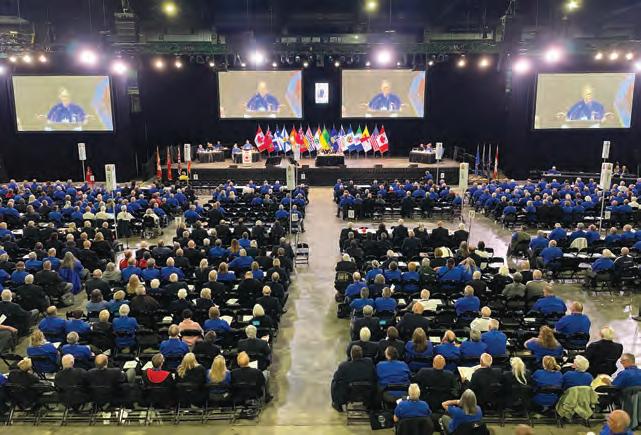
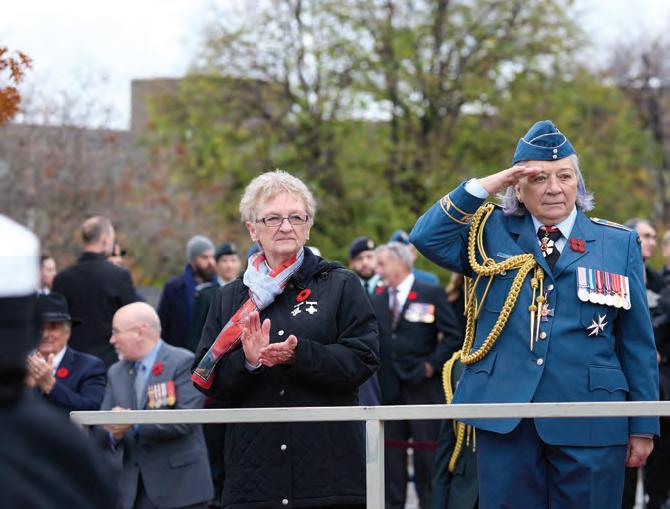
Strategies such as digital membership cards, attracting new and reinstated members, automated renewal campaigns and strong member support contributed to membership growth again in 2024. The membership department responded to nearly 70,000 emails and calls throughout the year.
Since its launch in 2020, the MemberPerks program has saved members $2.82 million dollars on a range of products and services, and more than 45,000 members have now registered for this savings initiative.
The Legion remains a guardian of remembrance, and once again presided over Canada’s national Remembrance Day ceremony at the National War Memorial in Ottawa. An estimated 40,000 people attended the event, while millions watched online or on television. Highlights included odes to the 100th anniversary of the Royal Canadian Air Force, the 80th anniversary of D-Day, and the National Memorial (Silver) Cross Mother—the latter named annually by the Legion and who places a wreath on behalf of all mothers and families who have lost a child in service to Canada.
The Legion also produced a new free, downloadable
National Memorial (Silver) Cross Mother Maureen Anderson and Gov. Gen. Mary Simon at the national Remembrance Day ceremony in Ottawa. Alexia Jones and Anieu Chan celebrate at the 2024 National Youth Track and Field Championships in Calgary.
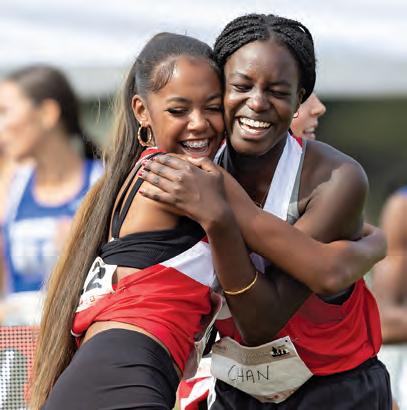
Remembrance Day planning guide for teachers. And the National Youth Remembrance Contests, held in collaboration with the Legion National Foundation, helped honour Canada’s fallen through visual art, writing and videography.
The Legion distributed millions of biodegradable poppies as part of its national Poppy Campaign. The final total is yet to be calculated, but more than $700,000 alone was raised through tap-enabled donation boxes, with all funds returning to the communities in which they were donated. Large and small corporate supporters were also instrumental to the campaign through measures such as point-of-sale donations.
The 2024 National Youth Track and Field Championships held at Calgary’s McMahon Stadium attracted nearly 1,000 participants who competed in a range of events, gaining experience, learning about remembrance and setting the stage for potential futures in other elite games. The city will host again in 2025.
Legion national sports championships also took place in several cities, with titles awarded in cribbage, darts and eight-ball.
An exciting milestone is around the corner: the 100th anniversary of the organization’s inception on July 17, 1926. Projects to be unveiled include commemorative items in the Poppy Store and written and visual commemorations. Stay tuned to the Legion’s communications channels for updates.
The Legion will hold its centennial Dominion convention in Winnipeg, site of the first event. And in July, Ottawa will host the Royal Commonwealth Ex-Services League conference.
Of course, in 2025 advocacy will continue to be at the forefront, with a renewed push for critical items that affect veterans. Meanwhile, the Poppy Campaign will evolve to include cardboard poppy boxes to help eliminate more plastic. And a new remembrance crosswalk design has been created that branches can encourage their local communities to adopt to help recognize veterans.
In 2024, the Legion promoted remembrance widely and accomplished a great deal for Canada’s veterans, their families and communities—all thanks to its members, volunteers, supporters, community and corporate partners. L
or 100 years, Dominion and Provincial command service officers (CSOs) have been at the heart of The Royal Canadian Legion’s support of veterans and their families. They work tirelessly to help them navigate the complex systems of service and benefit eligibility.
One of their key responsibilities is to counsel and aid those seeking disability compensation by ensuring they have the required documentation for making the strongest claim possible.
The job of a CSO isn’t over if an applicant is denied. They continue to advocate through every step of
the process, including appeals. Applicants receive continuous support in preparing to face the Veterans Review and Appeal Board (VRAB). Their expertise can help simplify the process and strengthen applications.
More than 7,500 veterans and their families benefited from the service of CSOs in 2024, including: almost 3,500 first applications and departmental reviews were submitted to Veterans Affairs Canada for thousands of medical conditions such as hearing loss and tinnitus, mental health conditions and musculoskeletal issues with lower backs, hips, knees and ankles; over
160 review hearings, appeals, and reconsiderations to the VRAB were represented, or solely conducted, by CSOs during the year; and 800-plus claims or appeals were withdrawn after counselling with a CSO. (It’s not unheard of for a veteran to change their mind about applying or appealing for benefits and services.)
At their core, CSOs are dedicated to easing any sense of burden veterans and their families feel by guiding them through the oftcomplicated benefit system. If you need assistance, contact the RCL’s veterans services at veteransservices@legion.ca or by calling 1-877-534-4666 toll free. L

$377,993
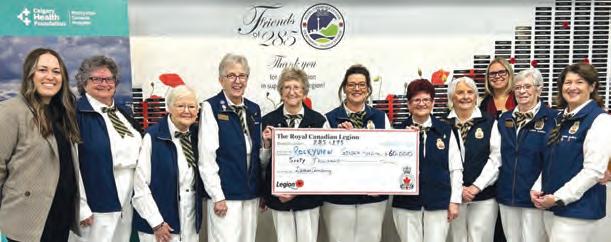
L.A. members of Centennial Branch and Forest Lawn Branch in Calgary join efforts to present $30,000 each to the Rockyview General Hospital emergency department, represented by Charlotte Howe. WENDY DYPOLT

President Ben MacRae and Darcy Hood of Vulcan, Alta., Branch present $3,475.75 to Angie Thiessen and Andrea Hutchinson of the Vulcan regional food bank. BEN MacRAE
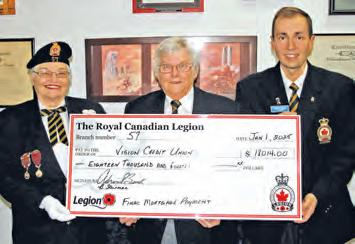
Camrose, Alta., Branch L.A. President Grace Thorpe, Barb Steinman and President Adrian Zinck present $18,014 to pay off the mortgage on their facility.
MURRAY GREEN
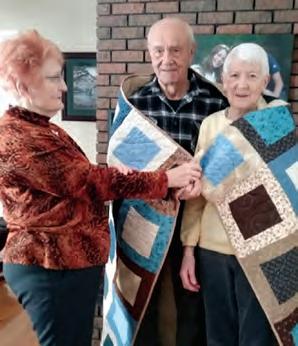
Valerie McCloskey of Salisbury, N.B., Branch presents Ray and Theresa Jones with a Quilt of Valour. JUDY ALLEN
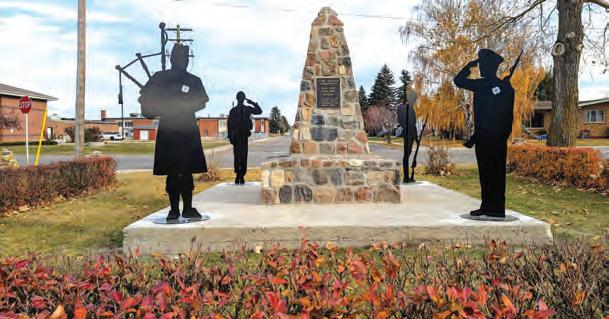
New steel figures are added
celebrates his 100th birthday.
the

Jane Buck of Jervis Bay Memorial Branch in Saint John, N.B., presents poster contest winner Cali Daly of Champlain Heights Elementary School, accompanied by teacher Wendy Hanson, with her prize.

Branch and L.A. members prepare Christmas baskets for members of the community.
Treasurer Pat Gabriel of Jervis Bay Memorial Branch in Saint John, N.B., presents $4,200 each to representatives of local air and army cadet corps.
Daryl Perry, President Ryan Seguin and Leo Doiron of Shediac, N.B., Branch present Maryeve Allain, Melanie Breau, Jacob LaForest, Jena-Luc Gautreau and Livia Charlotte Jones with $1,000 bursaries. TOSH LEBLANC
Sgt.-at-Arms Adam Mallaley and Ron Melvin of Herman Good VC Branch in Bathurst, N.B., present $1,240 each to Capt. Karen Theriault and Capt. Wendy Melanson for their cadet units.
GRAHAM WISEMAN
Sgt.-at-Arms Adam Mallaley, Danny Glendenning and Robert Godin of Herman Good VC Branch in Bathurst, N.B., present students at École Le Domaine-Étudiant with awards for participation in the Legion poster contest.
GRAHAM WISEMAN
President LeRoy Gamble of George Pearkes VC Branch in Summerside, P.E.I., presents the Legionnaire of the Year award to Roy Matthew.
President LeRoy Gamble of George Pearkes VC Branch in Summerside, P.E.I., presents $3,000 to Heather Matheson of the Prince County Hospital Foundation.
James Williams and Susan Williams of the West Prince Legion Zone, P.E.I., present $500 to Caring Cupboard food bank representative Doug Leblanc. SUSAN WILLIAMS

President Lloyd Wiseman of Clarenville, N.L., Branch presents $2,000 to Tina Mitchell of the Salvation Army.

Peggy Ashton, President John Gates, Patrick Ashton and Leonard Block of Slocan Valley, B.C., Branch present $525 raised at a pancake breakfast to Chantel Smith of the W.E. Graham Community Service Society.

President George Molnar
presents a first-place award to Aasiyah Mughal for the senior poem in the Legion literary contest.

Doreen Wakeham, Bill Dilny, Marie Raymond and Jennifer Pinsent Barnes of Pleasantville Branch in St. John's, N.L., deliver proceeds from the First Annual Christmas Food Drive to Divine Mercy Food Bank.
and
Padre Brian Kirby of Bowser, B.C., Branch presents $500 to WO2 Harry Phukjit of 893 Beaufort air cadet squadron.
First Vice Dave Joyce of Lynn Valley Branch in North Vancouver, B.C., presents $1,000 to Carol Nelson of the Lynn Valley Elementary Parent Advisory Council.
Rod Wilkins of Mount Arrowsmith Branch in Parksville, B.C., presents Cleo Gordon and Maura Staples with top awards in the Legion poster and literary contests.
Maya Lemus presents $455 from a St. Andrews High School fundraiser to Trafalgar/Pro Patria Branch representatives George Anderton and Bill Wilson in Victoria, B.C.
President Vicki Jones (left) and Ken Hearn of Seaview Centennial Branch in Lantzville, B.C., present the Legionnaire of the Year award to Joan Mezzatesta.
President Roy Buchanan and Vice-President Jenny Neuwirth of Alberni Valley Branch in Port Alberni, B.C., present $4,000 each to Deb Wood and Sarah York of ADSS High School.
Frank and Joan Mezzatesta of Seaview Centennial Branch in Lantzville, B.C., present awards to 2024 Legion poster and literary contest winners.

Leslie Driemel and President Dorothy Hunt of Fort Rupert Branch in Port Hardy, B.C., present Jordan Windsor of North Vancouver Island Zone the top award for her intermediate colour poster submission in the 2024 Legion poster contest.
President Roy Buchanan and Vice-President Jenny Neuwirth of Alberni Valley Branch in Port Alberni, B.C., present $2,000 to the Port Alberni Island Dancers, represented by Heather Ramsey.
Leslie Driemel of Fort Rupert Branch in Port Hardy, B.C., presents Kayley McGhee of the Port Hardy Junior Canadian Rangers with first prize in the Legion North Vancouver Island Zone intermediate poem contest.
First Vice Dave Joyce of Lynn Valley Branch in North Vancouver, B.C., presents $2,000 to Sandra Lee, manager of North Shore Crisis Services Society.
Members and friends of North Burnaby, B.C., Branch present $5,000 toward the Jasper, Alta., Branch to assist with costs related to summer wildfires.
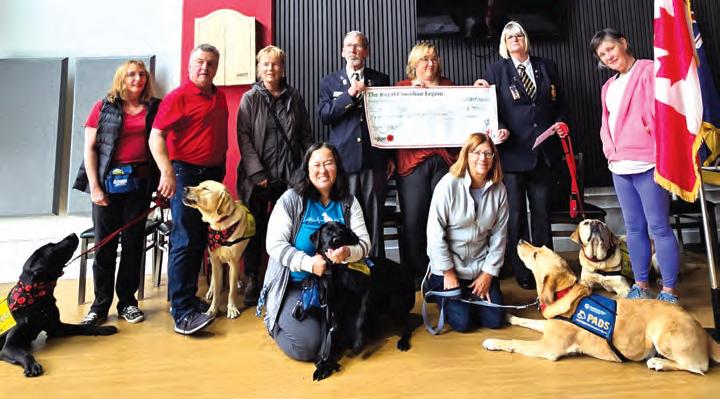
Members of North Burnaby, B.C., Branch present $7,500 to co-ordinators and volunteers at the Pacific Assistance Dogs Society.
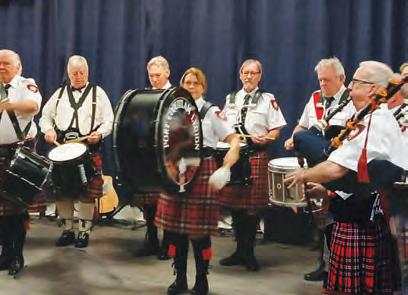
Coquitlam Community Pipe Band members perform at a Robbie Burns Night fundraiser for the Port Coquitlam, B.C., Branch.
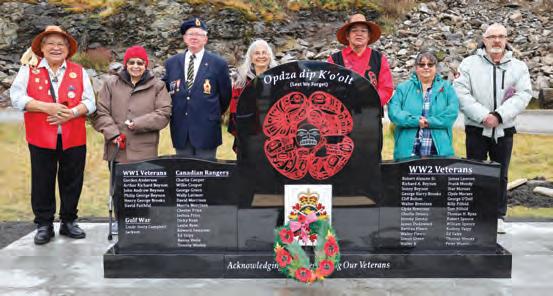
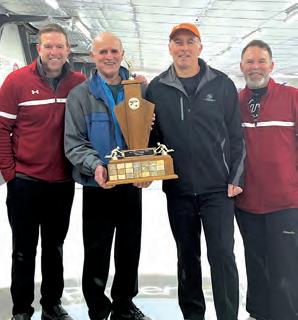
Nova Scotia Legion curling bonspiel winners Jeff Hoeg, Bob Hoeg, Sherman Jackson and Corey Burbine of River Hebert, N.S., Branch display their trophy.
Wakaw, Sask., Branch’s Ken Husnik, Darlene Antoshkiw, President Paul Denis, Noel Brunanski and Gloria Sibernagel present Saskatchewan Valley Hospital Foundation representative Doug Ebert $10,000.
Members of Lt.-Col. Charles Forbes Branch in Quebec City celebrate their Poppy Campaign fundraising efforts, which collected $101,400.50. ALCIDE MAILLET
Barry Silk, Kevin deDelley, Chris Hibbin and Kevin Edwards of Moose Jaw, Sask., Branch take first place in the provincial curling bonspiel.

and
and

Diamond Jubilee chair Ken Fisher presents President Gord Cramb of Brockville, Ont., Branch $3,000.
Hanover, Ont., Branch
President Steve Stewart presents $4,000 to Salvation Army food bank representative Danielle Feltham.
Gary Dobin of Milton Wesley Branch in Newmarket, Ont., displays 22 shoe boxes filled with items to be delivered to members aboard HMCS Ottawa, currently deployed in the South Pacific.

On behalf of the Ontario Command Branches and L.A. Charitable Foundation, members of the Preston and Hespeler branches in Cambridge, Ont., present $7,348.40 to Saint Luke’s Place, represented by CEO David Bakker, Mirielle Tessier and Eric Ross.
President Paul Gaudet (fourth from right), D.W. Smith and Doug MacNeil of Mount Dennis Branch in Toronto welcome new members Richard Marks, Robert Marks, Gerald Shannon, Filippo Isabella, Larry Penney and John Curran.
President Stan Halliday, Sherry Wilson and Nicole Handspiker-Adams of Pembroke, Ont., Branch present $6,500 on behalf of the Ontario Command Branches and L.A. Charitable Foundation to Leigh Costello and Claire Johnson of the Pembroke Regional Hospital Foundation.

President Glen Hanley and member Paul Parker of Paisley, Ont., Branch donate $500 toward the Homes for Heroes project.
Second Vice J.P. Presley and President Len Maynard of Chatham, Ont., Branch present $1,000 to Chatham-Kent Salvation Army representative Larry Bridger.
Second Vice J.P. Presley and President Len Maynard of Chatham, Ont., Branch present $1,000 to Reach Out Chatham-Kent Shelter representative Margery Muharrem.
Oshawa, Ont. Branch euchre winners Joe Dezio, Josephine Dezio, Colleen Munro and Glen Munro display their award plaque.

Members of Midland, Ont., Branch present the Midland Fire Department with $6,500 on behalf of the Ontario Command Branches and L.A. Charitable Foundation.
Perry Esler, Kate Palmer and Jennifer Frew (right) of Orillia Soldiers Memorial Hospital receive $6,500 from President Richard Purcell, L.A. President Beverly Brennan and Brian Robertson of Orillia, Ont., Branch, presented on behalf of the Ontario Command Branches and L.A. Charitable Foundation.
On behalf of the Ontario Command Branches and L.A. Charitable Foundation, Ralph McMullen of Brockville, Ont., Branch presents $6,000 to Nancy Nesbitt-Boucher of the Sherwood Park Manor Foundation.
Richard Lynn and President Lyle Brennan of Barrhaven Branch in Ottawa present John McCrae Secondary School students with $2,000 toward school trips to Europe to commemorate Vimy Ridge and the liberation of the Netherlands.
President Greg Walbeck and Cheryl BabcockMcMahon of Renfrew, Ont., Branch present $1,000 to Cpl. Alexander Tracey and Brendan Dillon of the 653 Champlain air cadets.
President Steve Stewart of Hanover, Ont., Branch presents $2,000 to the Light On Main community kitchen.
Terri-Lynn Lafreniere, Sheila Davidson, Una Golding and President Joel Chandler of Peterborough, Ont., Branch present $7,096 to Fairhaven Foundation representatives Nancy Rooney, Phil Aldrich and Nancy Ross.
Timothy Andrews and Freda Owen of Victory Branch in London, Ont., present $7,780 to Amanda Mesko of DeafBlind Ontario.
President Anne Frankish of Coldwater, Ont., Branch presents $1,000 to Coldwater food bank representatives Donna Packer and Brenda Yule. NORM MARION
Second Vice Sharon Hope of Paisley, Ont., Branch presents $500 to Gail Dupuis, Marita Hagedorn and Karen Schnurr of New Millenium Quilt Guild.

President Lea Anna Woods of Stirling, Ont., Branch presents Deputy Chief Bruce Farquhar and Chief Derrick Little of the Stirling Rawdon Fire Department with $6,567 on behalf of the Ontario Command Branches and L.A. Charitable Foundation.
Ford Scussons and President Donna Latulippe of Thessalon, Ont., Branch present $6,500 to Jenny Daoust representing Algoma Manor Nursing Home.
President Yvonne Glowacki, Michael Miasek, Sabina Glowacki, Stefan Więcławek, Jack Gemmell, Richard Bucko and Rose Czartowski of Polish Veterans Branch in St. Catharines, Ont., announce the construction of their new building.

Peggy Wiens, Diane Fitzgerald and President Tracey Nichol of Maj. Andrew McKeever Branch in Listowel, Ont., present Jackie Matthews with a second-place award for her senior poem in the Legion literary contest.
President Randy Graham and members Sherri Fleming and Dianne Martin of Fergus, Ont., Branch present awards to Legion poster and literary contest winners.
James Cohen and First Vice Cassandra Anderton of Queen’s Own Rifles Branch in Toronto present $6,500 to Becca Darbyshire of the Sick Kids Foundation on behalf of the Ontario Command Branches and L.A. Charitable Foundation.

President Michel Denis of Georges Vanier Branch in Hawkesbury, Ont., presents $500 to Raymond Boucher of L’Orignal food bank.
President John MacDonell of Kirkland Lake, Ont., Branch presents $4,800 to staff and cadets of the 288 air cadets.
On behalf of the Ontario Command Branches and L.A. Charitable Foundation, members of West Ferris Branch in North Bay, Ont., in partnership with Callander, Ont., Branch, donate $6,500 to Tammy Morison of the North Bay Regional Health Foundation.

L.A. First Vice Sandy Newham and L.A. President Lorraine Irwin of Chatham, Ont., Branch present $500 to Food Basics manager Jeremy Clifford, matching donations for Toonies for Tummies, a school lunch program.
Brighton, Ont., Branch L.A. President
Dottie Worobetz, President Glenn Irving and Astrida Chalmers present $6,500 to Lindsay Butcher Dodds of the Trenton Memorial Hospital Foundation.
Napanee Navy League President Gill Ashworth and Matt Batten are presented $5,000 by President Gord Walsh and Peggy Sunstrum of Lt.-Col. Harry Babcock Branch in Napanee, Ont.
On behalf of the Ontario Command Branches and L.A. Charitable Foundation, President Rob Mabee, Richard Ferrow, Brad Bailey and L.A. member Betty White of Hillcrest Memorial Branch in Ingersoll, Ont., present $6,500 to Alexandra Hospital.
President John MacDonell of Kirkland Lake, Ont., Branch distributes cheques from the recent Ride for Veterans poker run to President Cheryl PinkertonSims of Montreal River Branch in Elk Lake, Ont., and President Don Martin of Haileybury, Ont., Branch, alongside senior bureau officer Hank Moorlag.
Stefan Wieclawek (right) presents $500 from the 162 Ridley College cadet corps to Polish Veterans Branch in Catharines, Ont., representatives Yvonne Glowacki, Richard Bucko and Mira Ananicz.
Chuck Febbaro, Pierre Breckenridge and Pascale Crépault-Breckenridge of Sault Ste. Marie, Ont., Branch present $32,605 to Sault Area Hospital Foundation representatives John Farrell and Teresa Martone.
John Presley and Len Maynard of Chatham, Ont., Branch present $6,750 to Chatham-Kent Health Alliance on behalf of the Ontario Command Branches and L.A. Charitable Foundation, represented by Tracy Oswald, Marianne Burke and Emily Sellner.
Second Vice J.P. Presley and President
Len Maynard of Chatham, Ont., Branch present $1,000 to Food Basics manager Jeremy Clifford, matching donations for Toonies for Tummies, a school lunch program.
Leslie Rogers, Dean Joncas and Lorraine Irvine-Ways of Campbellford, Ont., Branch present $10,000 to John Andras and Kathy Mountain of Campbellford Memorial Hospital.
President Shawn MacNeil of Leslie Sutherland Branch in Corunna, Ont., presents $1,000 to members and leaders of the Corunna Girl Guides.

Tom Boyd, Mike Germain and President Shawn MacNeil of Leslie Sutherland Branch in Corunna, Ont., present $500 to the Mooretown Lady Flags Girls Hockey Association.
Barry Lewis of Shelburne, Ont., Branch alongside Elizabeth Russell, L.A. President Susan Simpson, President Chuck Simpson, Tammy Middleton and Barry Kimber of Col. Fitzgerald Branch in Orangeville, Ont., present $6,500 on behalf of Ontario Provincial Command and L.A. Charitable Foundation to Tania Alexander and K.C. Carruthers of Headwaters Health Care Foundation.
Karen Popadynec, L.A. President Carol Mitchell and President Joan Anderson of Sutton, Ont., Branch present $4,109 to Laura Parsons (left) of DeafBlind Ontario Services.

First Vice Yves Bouchard and Peggy Nancarrow (right) of Trenton, Ont., Branch present $1,000 to Chris Little of New Life Women’s Home, Laura Lee Brady of Habitat for Humanity and Sue Tripp and Fred Jordan of the Quinte Region Legion Track and Field Club. GLORIA JOHNSON

President Mike Benson of Belleville, Ont., Branch presents $6,400 on behalf of the Ontario Command Branches and L.A. Charitable Foundation to Hastings County Long Term Care representatives Taunia Mitobe and Jennifer McCaw.
President Anne Frankish and First Vice Kari Malmström of Coldwater, Ont., Branch present $1,000 to Coldwater Public School.
NORM MARION
Ted Mabb, Darlene O’Donnell, President Steve Walkom, Dick Frier, Russ Copeland and Rennie Copeland of Mitchell, Ont., Branch present $5,000 to Vicky Wolfe-Hinz of Mitchell and Area Community Outreach for the West Perth Transit mobility bus program.

First Vice Yves Bouchard and Peggy Nancarrow of Trenton, Ont., Branch present $1,000 to Danielle Barnes of Trenton/Belleville Quilts of Valour. GLORIA JOHNSON
Peggy Wiens, Diane Fitzgerald and Tracey Nichol of Maj. Andrew McKeever Branch in Listowel, Ont., present a third-place certificate to Christopher Arand for the colour poster in the Legion poster contest.
President Bonnie Close
and Gerry
of
President
Ont., Branch present $6,763.78 to Scott Gawley and Martha
of Four Counties Health Services.
Jim Hogg and John Greenfield of Bowmanville, Ont., Branch present $12,000 to Clarington air cadets representative Catherine
President Scott West of Campbellford, Ont., Branch presents Campbellford Memorial Hospital’s Catherine Holt $6,500.
Ontario Provincial Command President Derek Moore receives $25,000 for Ontario’s Leave the Streets Behind program from Dan Bailey of Epic RaceWear.
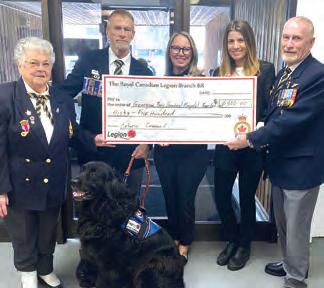
L.A. President Mary Lefaive, President David Sampson and First Vice Pat White of Penetanguishene, Ont., Branch present $6,500 to Robyn Blanchet and Victoria Evans of the Georgian Bay Hospital Foundation.
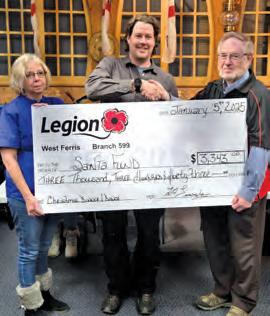
President Laughlin Trowsdale of West Ferris Branch in North Bay, Ont., presents $3,343 to the North Bay Santa Fund, represented by Sue Godfrey and Jeff Richardson.
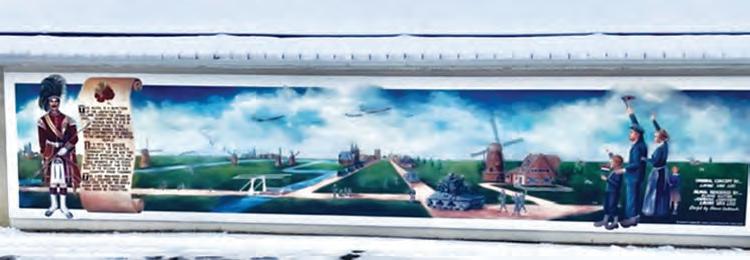
The Capt. Brien Branch in Essex, Ont., displays a refurbished mural depicting the liberation of the Netherlands during the Second World War, acknowledging members of The Essex Scottish Regiment for their involvement. WENDY PULLEYBLANK-CUNNINGHAM
First Vice George Romick of Port Arthur Branch in Thunder Bay, Ont., presents $2,500 to cadet J. Cleland at the 2294 & 2511 Royal Canadian Army cadet corps Christmas mess dinner.

L.A. President Margaret Highfield presents $10,000 to President Ron Baschuk of Flin Flon, Man., Branch.
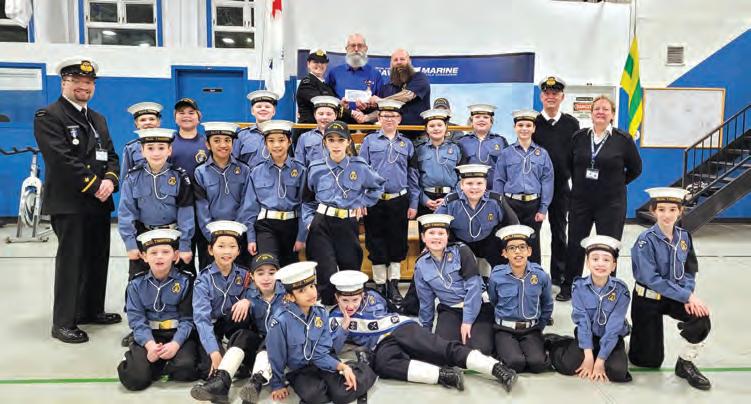
First Vice George Romick of Port Arthur Branch in Thunder Bay, Ont. presents $5,000 to the “Thunder” Navy League cadet corps.
Salisbury, N.B., Branch’s Albert Jackson receives a Quilt of Valour.
Sgt.-at-Arms Adam Mallaley, Michael White and Danny Glendenning of Herman Good VC Branch in Bathurst, N.B., present Sofia Mofitt, Maish Hennessy, Zoe Herbert, Marieve Renee Dionne and Enzo Lanteigne with awards in the Legion poster and literary contests.
President Ben MacRae and Ken Creed of Vulcan, Alta., Branch present top awards to Addison Peterson and Autumn Jackson in the Legion poster and literary contests.
President Roy Buchanan and Shannon Doré of Alberni Valley Branch in Port Alberni, B.C., congratulate Matthew Myrfield for his top prize in the Legion poster and literary contests.
President Roy Buchanan and First Vice Jenny Neuwirth of Alberni Valley Branch in Port Alberni, B.C., present $3,000 from a branch bingo event to Meals on Wheels, represented by Gina Burgraf and Dawna Sawyer. Rob and Leslie Driemel of Fort Rupert Branch in Port Hardy, B.C., present $4,250 to the Wounded Warrior Run, represented by director Jelena Radinovic.
Fort Rupert Branch in Port Hardy, B.C., presents $2,000 to the Hardy Bay Seniors Center Society.
George Romick and Doreen Cummine of Port Arthur Branch in Thunder Bay, Ont., present $1,100 to the Thunder Bay Professional Fire Fighters, represented by Melissa Geils and Alex Dzuba.
Jim Hogg and John Greenfield of Bowmanville, Ont., Branch present $5,000 to the Bowmanville Salvation Army, represented by Joyce Shaw and Allison Schizkoske, and $6,000 to the Bowmanville sea cadets, represented by Catherine Lokietek.
Ken Gillis of Toronto’s Mount Dennis Branch presents $1,000 to the Salvation Army York Community Centre, represented by Steven Manuel, and $5,000 to the Governor General’s Horse Guards army cadet corps #2402, represented by Capt. Steve Bedford.
On behalf of the Ontario Command Branches and L.A. Charitable Foundation, Ed Corbett, Rosa Palazzo, Bev Pearson and Paul Gaudet of Toronto’s Mount Dennis Branch present $6,000 to the Humber River Health Foundation.
Magic of Christmas representatives Michelle Whelan and Heather Taylor-Sandrin present Kirkland Lake, Ont., Branch President John MacDonell with $45,000 for branch upgrades.
Members of Trenton, Ont., Branch honour Sydney Johnson and Aidan Crawford, who brought back several gold, silver and bronze medals from the Legion National Youth Track and Field Championships.
Kinsman Club President Steve Benoit and members Michael Rasenberg, Denis Laderoute, Jim Gilbert, Dave Tidbury and Don Staples present Brockville, Ont., Branch President Gord Cramb with $1,000.
Peggy Wiens, President Tracey Nichol and Diane Fitzgerald of Maj. Andrew McKeever Branch in Listowel, Ont., present awards to Ronella Wilting, Nadine Norris and Jaymin Brubacker, winners in the Legion poster and literary contests.
Send your photos and news of The Royal Canadian Legion in action in your community to your Command Correspondent. Each branch and ladies auxiliary is entitled to two photos in an issue. Any additional items will be published as news only. Material should be sent as soon as possible after an event. We do not accept material that will be more than a year old when published, or photos that are out of focus or lack contrast. The Command Correspondents are:
BRITISH COLUMBIA/YUKON: Graham Fox, 4199 Steede Ave., Port Alberni, BC V9Y 8B6, gra.fox@icloud.com
ALBERTA–NORTHWEST TERRITORIES: Donna Ganzon, 2020 – 15 Street NW Calgary, AB T2M 3N8, abnwtsubmissions@abnwtlegion.com
SASKATCHEWAN: Tara Brown, 2267 Albert St., Regina, SK S4P 2V5, admin@sasklegion.ca
MANITOBA: George Romick, 320 Admiral Court, Thunder Bay, ON P7A 8B5, romickg@tbaytel.net
NORTHWESTERN ONTARIO: George Romick, 320 Admiral Court, Thunder Bay, ON P7A 8B5, romickg@tbaytel.net
ONTARIO: Roy Eaton, 567-294B North Channel Dr., Little Current, ON P0P 1K0, reaton@on.legion.ca
QUEBEC: Mary-Ann Latimer, 105-2727 rue St. Patrick, Montreal, QC H3K 0A8, msmarts@bell.net
NEW BRUNSWICK: Harold Wright, 2-299 Main St., Saint John, NB E2K 1J1, foulis20@gmail.com
NOVA SCOTIA/NUNAVUT: James Leadbeater, 4129 New Waterford Highway, New Victoria, NS B1H 5T4, james.leadbeater@hotmail.com
PRINCE EDWARD ISLAND: John Yeo, 657 Rte. 19, Meadow Bank, PE C0E 1H1, islander657@yahoo.ca
NEWFOUNDLAND AND LABRADOR: Brenda Slaney, Box 5745, St. John’s, NL A1C 5X3, bslaney@nfld.net
DOMINION COMMAND ZONES: EASTERN U.S. ZONE, Gord Bennett, 803-190 Cedar St., Cambridge, ON N1S 1W5, Captglbcd@aol.com; WESTERN U.S. ZONE, Douglas Lock, 1531 11th St., Manhattan Beach, CA 90266, douglock@fastmail.com
Submissions for the Honours and Awards page (Palm Leaf, MSM, MSA and Life Membership) should be sent directly to Legion Magazine, 86 Aird Place, Kanata, ON K2L 0A1 or branchnews@legion.ca.
TECHNICAL SPECS FOR PHOTO SUBMISSIONS
DIGITAL PHOTOS—Photos submitted to Command Correspondents electronically must have a minimum width of 1,350 pixels, or 4.5 inches. Final resolution must be 300 dots per inch or greater. As a rough guideline, colour JPEGs would be between 0.5 megabytes (MB) and 1 MB.
PHOTO PRINTS—Glossy prints from a photofinishing lab are best because they do not contain the dot pattern that some printers produce. If possible, please submit digital photos electronically.
FRENCH INSERT—To receive a French insert of Legion Magazine content, please contact MagazineSubscriptions@legion.ca or call 613-591-3335.


50 years






Brig.-Gen.

Brig.-Gen.





In “Long Service Awards” (January/February) an erroneous 55-year submission for Mel Mizzi of Sault Ste. Marie, Ont., Branch was published with a photo of Clyde Healey instead. We apologize to all involved. Mizzi's correct recognition was included in the September/October 2024 issue.

55 years



CHESLEY LADOUCEUR Arnprior Br., Ont.
HAROLD M cMEEKIN Kapuskasing Br., Ont.

ROLAND McEWEN Sault Ste. Marie Br., Ont.



BETTY LAIDLAW
Eastern Marine Br., Gaetz Brook, N.S.

BILL LAYMAN
Qualicum Beach Br., B.C.

RICHARD PAUGH
Qualicum Beach Br., B.C.
CHALMERS, WILLIAM—Seeking great-grandfather’s CEF First World War medals and other military items. Service No. 163808. Contact Laurie Sim, 11314 Nelson Rd., Morrison, Ill. 61270 USA. 309-716-7969. canuk1718@gmail.com.
CIA MEMBERS —Retired colonel Doug Johnson is seeking members for a group revitalizing the Canadian Infantry Association. Interested infantry members can reach out at info@ducimus.army.
ROSS, JEFF—Member of the RCN possibly stationed close to Toronto starting in 1970-1971 when Ross was 20-21 years old. Looking for any information available, either from those who served with Ross or Ross himself. Peggi Hohnstein, peggilou@yahoo.ca, Apt 1, 55 Manitoba St., St. Thomas, Ont., N5P 3A3.
SAUVE, DONALD —ABRM onboard HMCS Saguenay from 19691970. Left the navy mid to late 1970s to work as a field technician for Transport Canada in Norman Wells, N.W.T. Close running mate looking to reconnect. Byron Mullett, MSCT ret., RCN. 66 Clermont Crescent Dartmouth, HRM, N.S. B2W 4P1, 902-434-4118.
WEBB, CHRIS —RCAF pilot of 416 Squadron, graduated from RMC in 1975 as an aircraft systems engineer. Please contact John Purdy, 705-788-4606. PO Box 130, Kearney, Ont., P0A 1M0.
ALBERTA
LAUREEN BOWMAN
Vulcan Br.
MICHAEL SHOPKA
Vulcan Br.
ALLAN GORZITZA
Vulcan Br.
DON McNAIR Onoway Br.
RICHARD McCULLOUGH Onoway Br.
DALE CHAMPIGNY Oak Lake Br.
MURRAY OLIVE Oak Lake Br.
PAT RAMPTON Oak Lake Br.
NEW BRUNSWICK
ROBERT LUCCI
Cape Tormentine Br.
JOSEPHINE SCOTT
Cape Tormentine Br.
RUSSELL SCOTT
Cape Tormentine Br.
TERRY MURPHY
Cape Tormentine Br.
SONNY McCARRON
Cape Tormentine Br.
BRUCE GREENHAM
Twillingate Br.
IAN SIMPSON
Waterford Br.
Although most Canadians may not realize it, the country is stationing troops in Latvia. Similarly, many Canadians may not even know where the nation is or why it’s important.
A country with a population of nearly two million people, Latvia is located on the east coast of the Baltic Sea. Long part of the Russian Empire, the country became independent after the Great War. It was absorbed by the Soviet Union early in the Second World War, a relationship that lasted until the collapse of the U.S.S.R. Independent again as of 1991, Latvia, along with its Baltic neighbours, Estonia and Lithuania, joined NATO in 2004.
In 2014, after Russia invaded and annexed Crimea, a part of Ukraine, NATO devised measures to defend its Baltic and eastern European members against further possible incursions.
Canada played a role, deploying ships, troops and aircraft to the region. In 2017, the Canadian Armed Forces became the lead partner in NATO’s enhanced
Forward Presence Battle Group in Latvia, with 455 soldiers in the country. They were soon joined by contingents from Albania, the Czech Republic, Denmark, Iceland, Italy, Montenegro, North Macedonia, Poland, Slovenia, Spain and Slovakia. And this past January, Sweden, which joined NATO in March 2024, sent troops to Latvia, rotating with the Danish infantry battalion.
The Canadian presence has since increased to some 1,600, including infantry, artillery, a tank squadron, headquarters and support elements. Ottawa has pledged to increase the commitment to 2,200 soldiers by 2026 and to increase the force’s strength further in the event of a direct Russian threat or attack.
Latvians, meanwhile, have expanded their military, in part through conscription, and will field a brigade alongside what since July 2024 is called the Multinational Brigade, headed by Canada. A new NATO force headed by Sweden is to be formed in Finland, an alliance member since April 2023. Along with similar organizations in Lithuania, led by Germany, and Estonia, led by the U.K., the Baltic brigades are directed by Multinational Division North, commanded by a Danish general.
The relatively small forces of the Latvian Multinational Brigade and the Latvian army (like their counterparts in Lithuania and Estonia) likely couldn’t withstand a major Russian assault—unless,
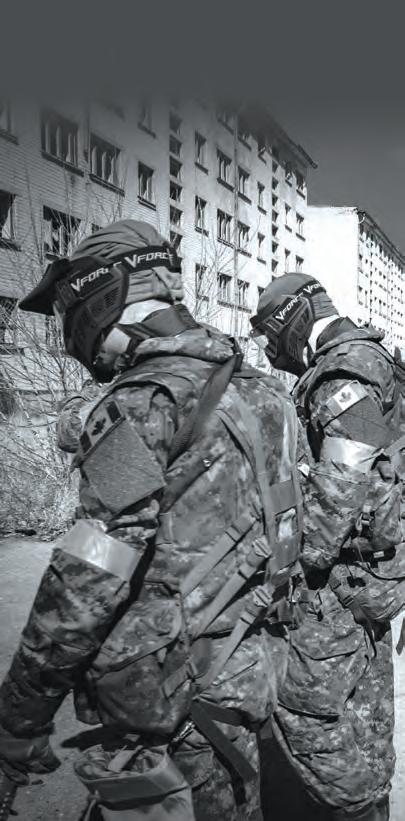
and until, NATO members honour their collective commitment that an attack on one is an attack on all. In other words, the NATO brigades are a tripwire—attack and the weight of the entire alliance will be mustered.
The Canadian contingent, it must be noted, faces problems. Given the state of the CAF, notably its recruitment and retention challenges and its equipment deficiencies, maintaining and sustaining the Latvia commitment is difficult.
The plan is to have roughly 80 per cent regular force personnel and 20 per cent reservists in Latvia on six-month rotations. But with the regular infantry battalions and armoured and artillery regiments below strength, it becomes difficult to deploy soldiers every 18 months or so, disrupting routine training and families’ lives. The same issue exists with reserve units.
Big reserve organizations may have strengths of 200-300 soldiers, but only 100 may turn up any given week. If a unit is tasked to send 10-15 soldiers to Latvia, it could do so readily the first time. But, the second rotation, likely 18 months later, might not be so easy. Making matters
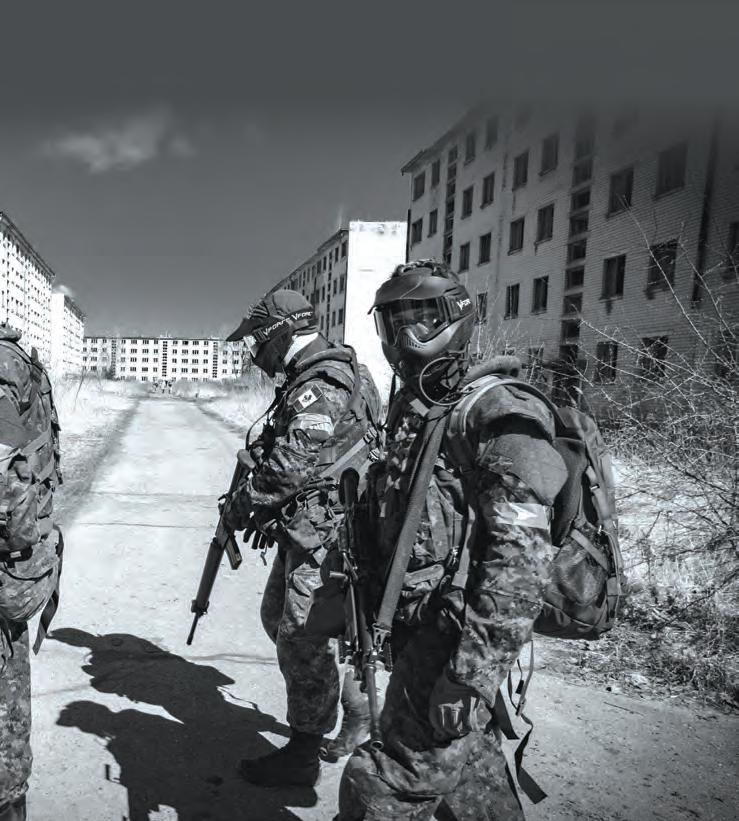
worse, reserve funding is being decreased as the CAF struggles with its budget. This impacts every reserve unit across the country.
So, too, does the government’s delay in meeting the NATO standard of two per cent of gross domestic product for defence spending. (Canada has indicated it will meet that goal by 2032.) Meanwhile, morale among CAF personnel isn’t strong, and the Latvian deployment—unlike the war in Afghanistan two decades ago—isn’t spurring enlistment.
Furthering difficulties is that some of the weaponry being provided to the Canadian-led Latvian brigade hasn’t yet been provided to units in Canada. Thus, the essential
training necessary to use it must be carried out in Latvia. Not an ideal situation. And more than half of the anti-tank weapons purchased from an Israeli manufacturer didn’t work properly in field tests. Of course, even after its equipment losses in Ukraine, the Russian military still has armour aplenty. There are other challenges, too. Early in their deployment, the Canadians were being smeared by Russian-sponsored online propaganda, particularly worrisome given that almost half a million Latvians, some 26 per cent of the country’s population, are of Russian descent (though they don’t necessarily support Moscow’s views). The force also lacks drones
Canadian soldiers conduct an exercise in Skrunda, Latvia, in April 2018, as part of NATO’s enhanced Forward Presence Battle Group.
and weapons to counter them, as well as anti-air missiles. In January 2025, a defence department spokesperson told Legion Magazine that the first air defence systems were to arrive in Latvia early in the year, while initial operational capacity of the counterdrone equipment was to be reached by the end of that month.
Even more serious are the concerns over directing, and possibly fighting with, a brigade consisting of 13 disparate national contingents. NATO has tried hard for years to standardize operational procedures and equipment throughout its member states, but this remains incomplete.
Can a Canadian truck’s hitch pull a Czech trailer, for instance? Or can an Italian radio operator communicate with a North Macedonian subunit and be readily understood? Can all the bugs be worked out?
The first Latvian Multinational Brigade exercise, in November 2024, put 3,500 troops in the field and was designed to test such potential problems, but no results have been made public yet. Indeed, each of NATO’s eight multinational formations are facing similar issues.
Thus, there are challenges for every NATO member. All are being urged to spend more on defence and increase their troop strengths. The general view, repeatedly expressed by NATO’s civilian and military leadership, is that the alliance is in a prewar period.
If Russia prevails in Ukraine, there are fears that eastern Europe and the Baltic states might be next. Whether NATO is up to the challenge is uncertain.
Whether Canada is up to the challenge is even more so. L
John Ward
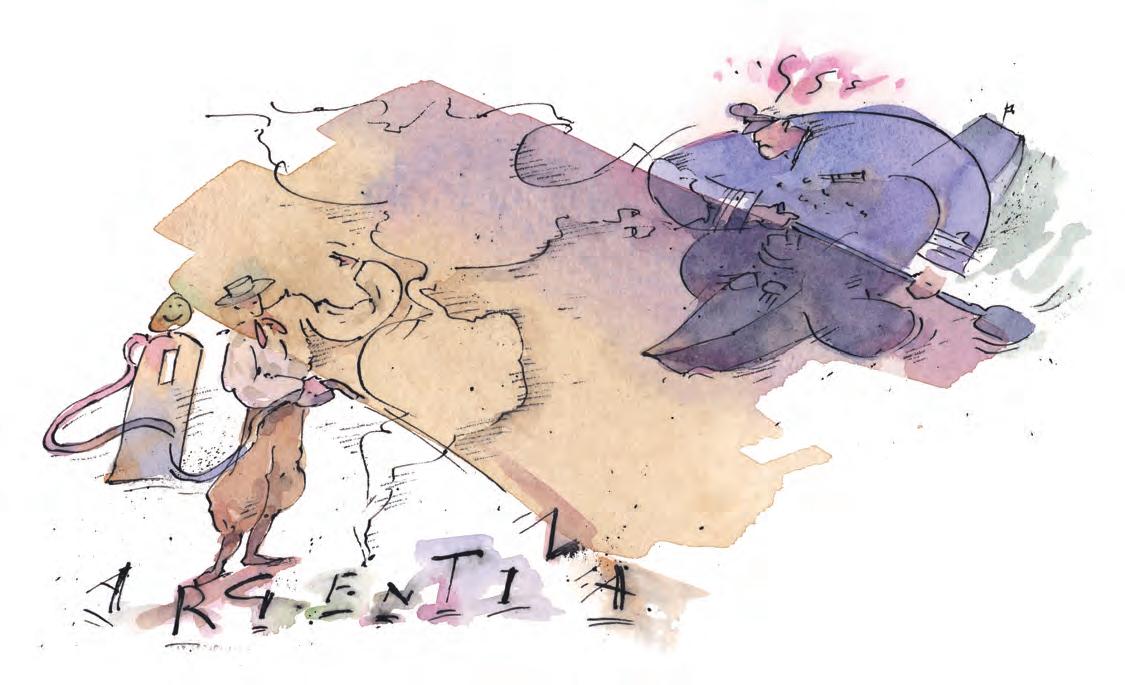
and the signals officer hastily decoded the message again. This time, the order was to proceed to Argentia, an American base on Newfoundland’s Avalon Peninsula, which was much closer than South America.
Inwartime, communications must be kept secure. Even though codes and ciphers are commonplace, they still manage to produce their own set of problems. Take the case of a Canadian corvette that ran short of fuel southeast of Newfoundland.
The ship notified the authorities ashore and asked permission to proceed to the nearest port. In due course, a reply arrived ordering the ship to sail immediately to Argentina. The captain erupted in fury
Some wealthy businessmen donated their yachts to the navy early in the Second World War. Some of the vessels were converted into patrol boats and were serviceable, including one, HMCS Raccoon, that was torpedoed and sunk with all hands by a U-boat in the Gulf of St. Lawrence in 1942.
As new corvettes and minesweepers came into service, the converted yachts were returned to their owners. Normally, they would be sent to a naval yard, which would remove their wartime additions, restore them to their original condition and hand them over.
> Do you have a funny and true tale from Canada’s military culture? Send your story to magazine@legion.ca
One of these vessels was slated to be returned and was ordered to a yard that was told to “destroy” it, meaning to remove all naval gear and supplies. In due course, the former owner arrived to collect his yacht and found there was little left except the hull. Angry questions were asked, at which point the offending signal was produced. Luckily, the little ship could be restored to its original condition.
Navy padres fill a variety of roles, but during the Second World War, they were also charged with censoring seamen’s mail. Some padres found this a handy way to measure morale. One clergyman found an interesting comment in one letter that may have suggested a need for some Bible study classes. The sailor wrote: “The padre told us on Sunday that Dan and Beersheba were two places in the Holy Land. Gosh, he’s spoiled it. I always thought they were man and wife, sort of a romance. Like Sodom and Gemora.”
During the Korean War, padres moved between ships to minister to their flocks. On one occasion, two chaplains, one Protestant and one Catholic, were flown to a Canadian destroyer by helicopter. After brief services, they left in the same fashion, with one officer noting: “It lacked the picturesqueness of Elijah’s departure, but was impressive in its own way.”
A tale passed on from the Italian Campaign and an anonymous regiment includes the story of what initially seemed a hopeless soldier. A comrade described him as “short, awkwardly built, dressed like a sack of wheat pinched in the middle by a web belt, with gaping anklets and a permanent, good-natured grin.” Nothing, not new uniforms, frequent pressings, the help of his mates or the wrath of the sergeant major could produce an acceptable parade ground standard in the fellow.
Eventually, the regiment gave up and tucked him away in the rear rank of the rear platoon.
However, he fell in love with the Bren gun, and, despite its 10-kilogram weight and the additional heft of its spare magazines, he refused to be parted from it. His trousers may have been baggy, and his anklets may have gaped, but his Bren was always immaculate.
To the surprise of all, in combat he turned out to be a first-class shot and a tower of strength to his comrades.
Stewart Bull, who served with The Essex Scottish during WW II, left an account of his experiences, including his effort to improve his regiment’s Bren gun carriers, also known as Universal Carriers. These were small, tracked vehicles used for a variety of tasks in most Canadian regiments.
Bull, after working with them at Camp Borden, came up with some ideas. He went down to Windsor, Ont., where Ford was producing the carriers and found the manager of production.
He told him that the brakes weren’t strong enough, the bogie wheels frequently broke and the tail light was too exposed and easily knocked off. The Ford man wrote everything down and Bull went back to Borden, where all hell broke loose.
He was summoned before his colonel who chewed him out in no uncertain terms: “Who do you think you are?” he shouted. Suggestions like his should be made to the colonel, who would pass it on to Ottawa, where authorities would consult various users of the carriers. If the feedback was deemed valid, it would be passed on to Ford, which would change its design.
“I thought I was trying to help to win the war, sir,” said Bull.
“You were just being a bloody nuisance,” the colonel replied. “Now go back to your regiment and forget about trying to make suggestions to the army."
Bull stopped making suggestions. L
By Mark Zuehlke
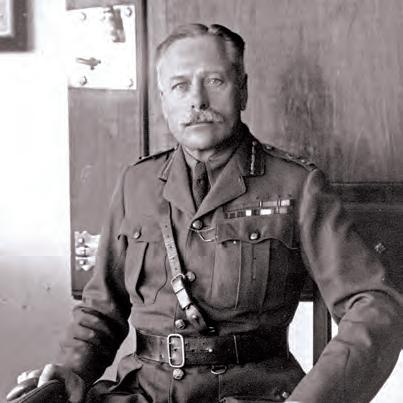
uring the May 15-25, 1915, Battle of Festubert, General Douglas Haig attempted to punch British First Army through the heavy defences held by Crown Prince Rupprecht’s Sixth Army. The offensive had been ordered by British Expeditionary Force commander-in-chief Field Marshal John French to take pressure off a renewed French Tenth Army effort to seize Vimy Ridge.
Haig knew he faced a network of killing zones, where 15-metre-deep belts of barbed wire would funnel his infantry into ground and machine guns could overlap their fire.
To demolish the German positions, Haig proposed “a long methodical bombardment…by heavy artillery…before Infantry are sent forward to the attack.” Only when the guns had fully destroyed these defences would he commit the infantry.
“I gave orders to Sir Douglas Haig to curtail his artillery attack and to strengthen and consolidate the ground he had won.”
—Field Marshal
John French
To gain more depth of penetration the process would be repeated as necessary. This “deliberate and persistent attack” would cause the enemy to “be gradually and relentlessly worn down by exhaustion and loss until his defence collapses.”
Festubert marked a joint decision by French and Haig that winning ground would henceforth be less important to victory than inflicting greater attrition on the enemy.

On May 13, 443 howitzers and guns unleashed a 60-hour bombardment, firing more than 100,000 shells. Then, on the night of May 15-16, British and Indian troops attacked. A hard fight secured a small breach, which the Germans accepted after a failed counterattack.


Seeing this as a sign of success, Haig ordered a hasty assault by 1st Canadian Division’s 3rd Brigade and the British 2nd Division’s 4th Guards Brigade. Met by German artillery, the attack soon stalled. By May 20, 2nd Canadian Brigade had relieved the 3rd and renewed the assault in the late afternoon.
Unable to identify his objective from the poorly drawn map he was provided, Brigadier Arthur Currie sought a delay. This was refused and withering fire shredded the ensuing attack.
On May 22, Haig visited Canadian division headquarters and expressed dissatisfaction with its performance. He insisted the Germans be immediately driven from their positions. Repeated doomed attacks followed until French ordered a halt on May 25.
The Field Marshal instructed Haig “to consolidate the ground…won.”
Other than capture of the village of Festubert, little could be shown for the 16,000 troops lost. For their part, the Canadians had won just 600 metres at a cost of 2,468 casualties. L
>



At
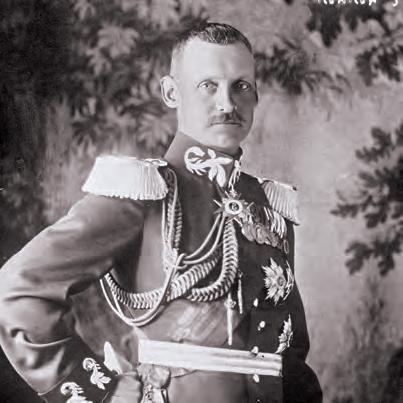
AtFestubert, Crown Prince Rupprecht’s Sixth Army had a singular task—stop the British. His overriding mission was to similarly prevent the French Tenth Army’s larger and more ambitious offensive aimed at taking Vimy Ridge. Meticulous preparation enabled him to succeed in both objectives.
The Crown Prince of Bavaria, and heir to the free state’s throne, Rupprecht had risen to the rank of generaleutnant in 1906 and taken command of the Bavarian Army Corps. By 1915, he was considered the most competent German royal commander.
In preparing for the forthcoming battle with the British army, Rupprecht knew he faced a serious personnel shortage because higher command had sent most of his reserves to support a combined AustrianGerman offensive in Galicia. This left Rupprecht with just two reserve divisions in the British sector.
Weak in numbers, Rupprecht decided holding the line depended on strong defences. His troops more than doubled the width of barbed-wire entanglements. Carefully sited to cover these, each battalion positioned its two machine guns to fire through steelrail loopholes near ground level. Meanwhile, a quick-reaction force was positioned in dugouts 200 metres from the front.
One kilometre farther back, concrete machine-gun posts were placed 1,000 metres apart. These would serve as rallying
points for retreating and reserve troops to assemble and organize a renewed defence.
Such thorough preparation proved successful. General Douglas Haig’s massive artillery bombardment failed to shatter the German line and the ensuing British, Indian and Canadian infantry attacks were blocked with little ground lost.
DOUGLAS HAIG’S MASSIVE ARTILLERY BOMBARDMENT FAILED TO SHATTER THE GERMAN LINE.
Rupprecht’s observations on the failed British Somme offensive of July 1916 could equally be applied to the Battle of Festubert. “Our losses in territory may be seen on the map with a microscope. Their losses in that far more precious thing—human life—are simply prodigious.”
While German high command may have differed with him, Rupprecht was willing to surrender ground rather than slavishly adhering to the strict doctrine whereby immediate counterattacks were to be launched to recapture positions lost.
“Amply and in full coin [dead and wounded] they paid for every foot of ground we sold them,” Rupprecht wrote. “They can have all they want at the same price…. It saddens us to exact the dreadful toll of suffering and death that is being marked on the ledger of history, but if the enemy is still minded to possess a few more hectares of blood-sodden soil, I fear they must pay a bitter price.” L
“They
paid for every foot of ground we sold them.”
—Crown Prince Rupprecht
By Alex Bowers
Shortly after VE-Day, U-190 surrendered to the Royal
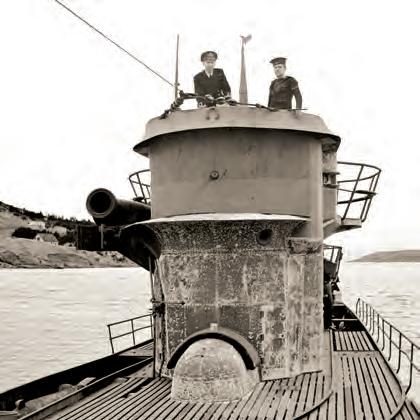

y-boat men!” announced Kriegsmarine Großadmiral (grand admiral)-turned-leader of Nazi Germany Karl Dönitz in a May 4, 1945, radio communiqué, “A crushing [Allied] material superiority has forced us into a narrow area. A continuation of our fight…is no longer possible. Undefeated and spotless you lay down your arms….”
A food- and fuel-depleted U-190, a Type IXC/40 U-boat launched in June 1942, was travelling to any still-German-controlled port in Norway when it heard the news. Oberleutnant zur See Hans-Erwin Reith promptly relayed the order to jettison all remaining ammunition into the Atlantic Ocean.
Missing from the arsenal was an acoustic torpedo, which had struck HMCS Esquimalt on April 16, a mere three weeks earlier.
Sunk just outside Halifax harbour, some 44 crew perished.
The minesweeper was the last Canadian vessel lost to enemy action during the Second World War. It was also only the second— and last—kill credited to U-190.
“For us, the war was over,” recalled German chief engineer Werner Hirschmann.
On May 11, HMCS Victoriaville and HMCS Thorlock intercepted U-190 some 800 kilometres off Cape Race, Nfld. Thirty Canadian sailors boarded it, relieving most of its 54-strong crew, excluding those required to manoeuvre it to port. Twenty-two-year-old Hirschmann was among the German sailors put to that task. They were the lucky ones, along with the 90 U-boats escorted into U.K. ports by the end of May, another 47 into German and Norwegian ports, five into U.S. harbours and two to Canada. Meanwhile, of the 40,900 German sailors sent to sea in nearly 1,000 U-boats, an estimated 28,000 were killed and some 700 boats destroyed—an operational loss of about 70 per cent.
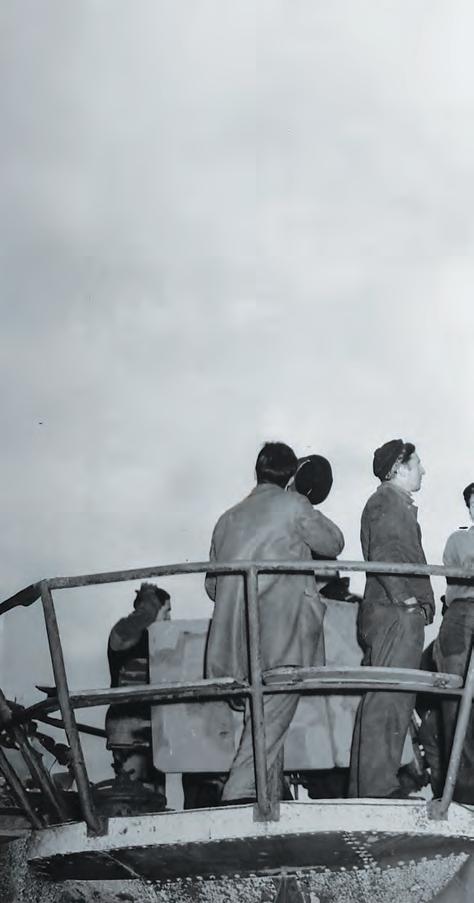
“In war’s final year,” said Ted Barris, author of Battle of the Atlantic: Gauntlet to Victory, “life expectancy of a Kriegsmarine submariner was fewer than 100 days.”
Of course, the Allies had suffered, too, including 24 Canadian

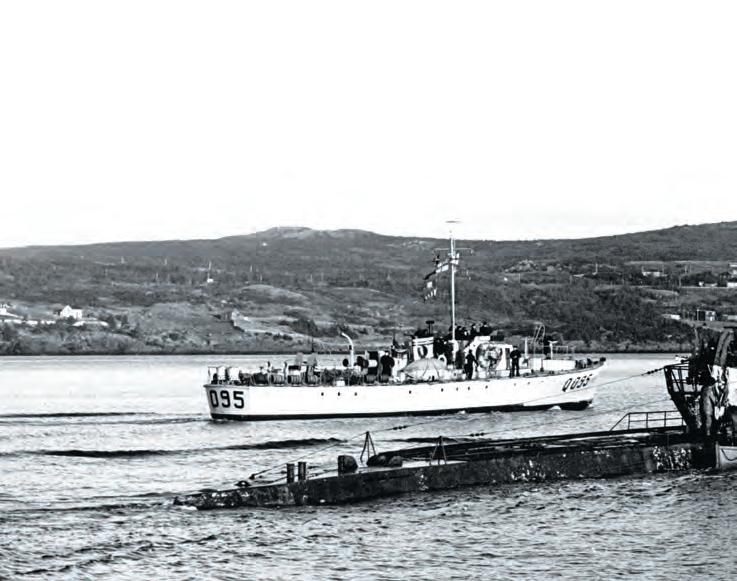

The White Ensign flies above the Kreigsmarine flag on U-190 near St. John’s, Nfld., in June 1945.
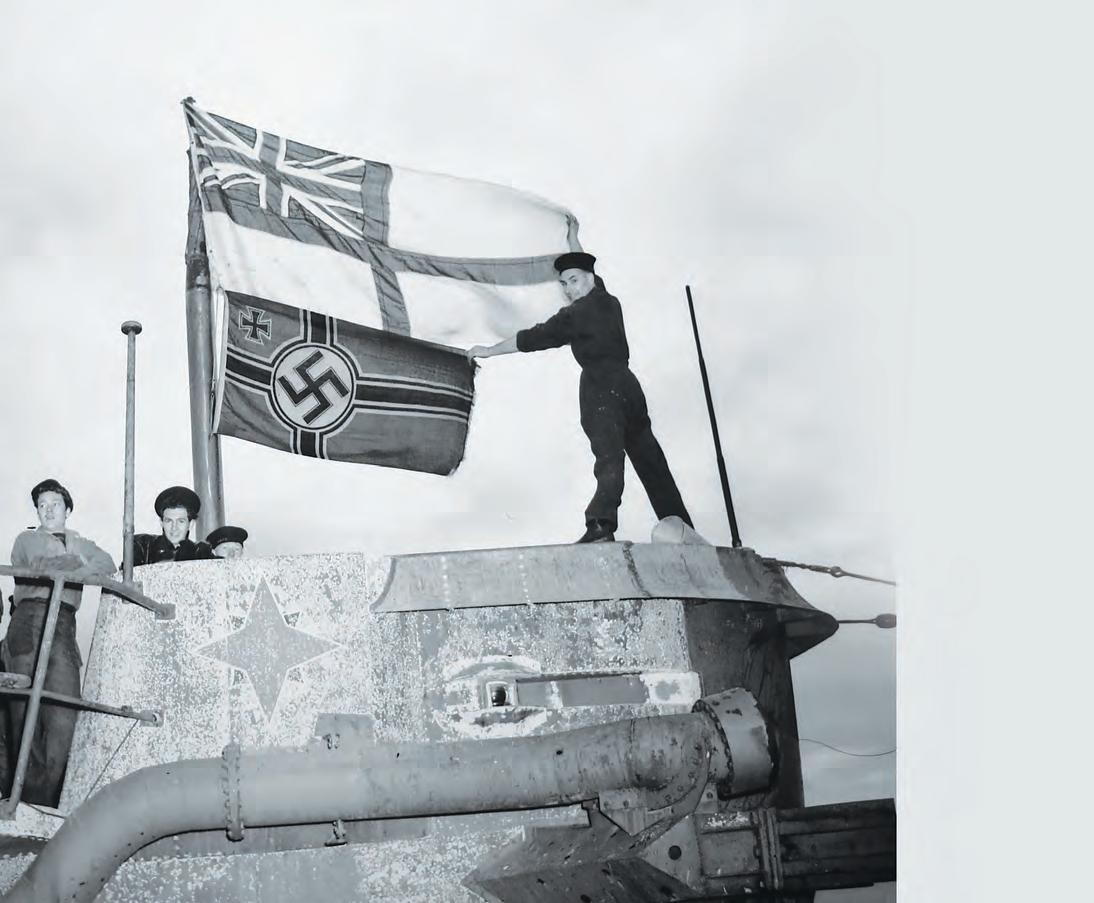
“A continuation of our fight is no longer possible. Undefeated and spotless you lay down your arms.”
warships sunk and 2,024 sailors dead. Hirschmann expected the sinking of Esquimalt to not be easily forgiven.
Despite this, the chief engineer was surprised by the reception he received from his adversaries,

6
Patrols carried out by U-190
7,605
Tons of Allied shipping sunk by U-190
19
Minutes it took for U-190 to sink near Esquimalt ’s wreck
62
Years that the Crow’s Nest Officers’ Club has housed U-190 ’s periscope

Hirschmann’s time as a prisoner of war. The U-boat was soon commissioned into the Royal Canadian Navy as HMCS U-190 and embarked on a publicity tour.
After two years, however, it had outlived its usefulness and became fodder for target practice.
who proudly flew the White Ensign from U-190, but otherwise treated him and his fellow crew members with respect.
U-190 docked at Bays Bull, Nfld., on May 14, marking its official surrender and the beginning of
On Oct. 21, 1947, Canadian naval authorities launched Operation Scuttled, reportedly to train postwar recruits. Towing HMCS U-190 to the scene of Esquimalt ’s sinking, warships and aircraft delivered a symbolic coup de grâce. Thus, predator and prey came to rest together.
Hirschmann later immigrated to Canada and became friends with Esquimalt survivor Joe Wilson.
On Nov. 7, 2019, the former German chief engineer died at the age of 96, by then a Canadian citizen.
Since 1963, U-190 ’s periscope has been preserved at the Crow’s Nest Officers’ Club in St. John’s, N.L.
“Our artifacts have proven to be a pathway in the reconciliation process,” said the club’s Gary Green, “and seeing veterans from both sides connect over them is a truly moving experience.” L

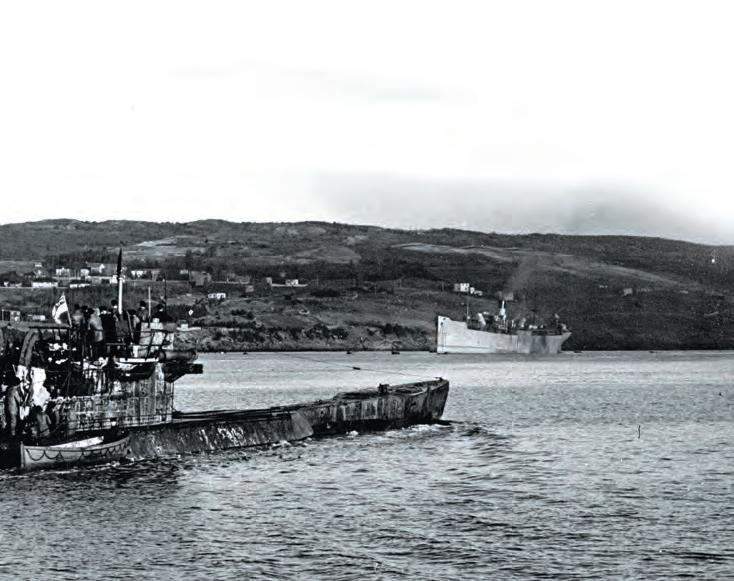

By Don Gillmor
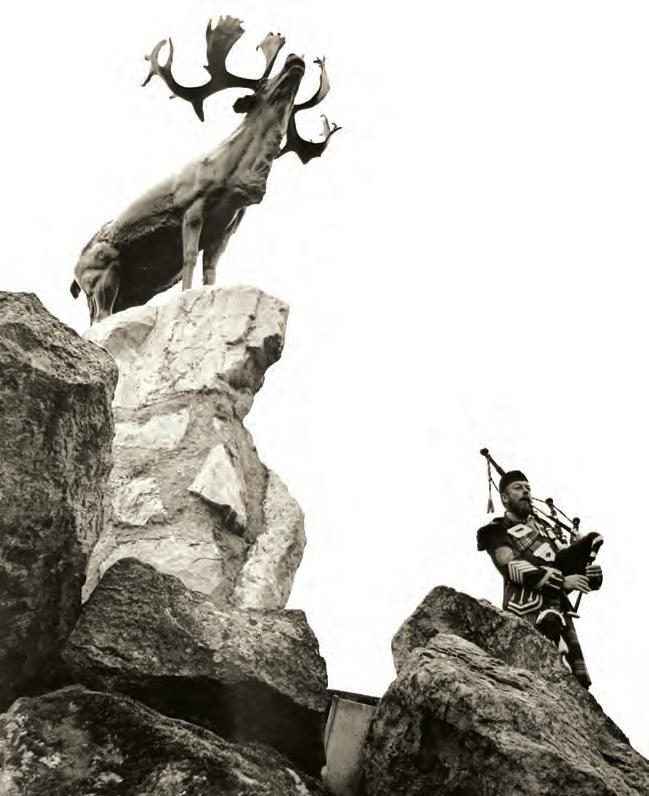

capabilities. They hadn’t, and the Brits were mercilessly cut down by machine-gun fire.
The 1st Newfoundland Regiment, which consisted of 800 soldiers, was at the village of Beaumont-Hamel. Despite the carnage, they were ordered to advance. At 9:15 a.m. they left their trenches. Within 30 minutes, the regiment was decimated: 710 casualties—386 wounded and 324 dead. Only 68 men answered roll call the following morning. It took days for the survivors to recover the dead and bury them.
Nearly 20,000 Allied soldiers lost their lives that day, with 37,000 wounded, the worst loss in British history. The Germans suffered 8,000 casualties. It was the greatest military catastrophe of the war.
“There were no waverers, no stragglers, not a man looked back,” said British General Aylmer Hunter-Weston in saluting the courage of the Newfoundlanders. “It was a magnificent display of trained and disciplined valour, and its assault only failed of success because dead men can advance no further.”



When war broke out in 1914, Newfoundland was a dominion of the British Empire. It didn’t have an army, but within months, 537 officers and soldiers volunteered and left to train in England. In the spring of 1916, they were in Gallipoli, Turkey, but left to join the offensive in France. They walked into a slaughterhouse. In February 1916, Joseph Joffre, commander-in-chief of the French forces, and Douglas Haig, commander of British troops in France, decided on a large offensive that combined both their forces. It would be the first time they fought together. They chose the Somme valley as the site for this experiment. It began at 7:30 a.m., July 1, with 100,000 British soldiers advancing into no man’s land in long, orderly lines. In the days leading up to the assault, Allied bombers had attacked German positions. The hope was that the bombs had severely compromised the Germans’ defensive
This last phrase spoke to the futility of the offensive. The Battle of the Somme ended five months later. The Germans, who would go on to call the battle das Blutbad (the Bloodbath), lost 660,000 soldiers. The Allies lost a similar number and gained just 13 kilometres of ruined, blood-soaked land.
Despite the debacle at Beaumont-Hamel, Newfoundland men continued to volunteer for the war. The Royal Newfoundland Regiment (it was given the Royal designation after the battles of Cambrai and Ypres) eventually raised 6,241 men. Many were wounded and 1,306 gave their lives. Because of Newfoundland’s small population, almost everyone on the island was directly affected, losing a friend or loved one.
The first Memorial Day to honour those who served was held in St. John’s in July 1917. The battlefield outside BeaumontHamel is now a Canadian national historic site that boasts a bronze statue of a caribou, the emblem of the Royal Newfoundland Regiment. It was unveiled 100 years ago, on June 7, 1925, by Haig. The caribou stands over the field where so many were lost. L
Think about the things you loved to do that are dif cult today — going for a walk or just sitting comfortably while reading a book. And remember the last time you got a great night’s sleep?
As we get older, health issues or even everyday aches, pains and stress can prevent us from enjoying life.
So what’s keeping you from having a better quality of life?
Check all the conditions that apply to you.
Personal Checklist:
Insomnia
Diabetes Mobility Issues
Lower Back Poor
Then read on to learn how a Safe Step Walk-In Tub can help. Feel better, sleep better, live better
A Safe Step Walk-In Tub lets you indulge in a warm, relaxing bath that can help relieve life’s aches, pains and worries.










A Safe Step Tub can help increase mobility, boost energy and improve sleep.

It’s got everything you should look for in a walk-in tub:
• Heated Seat – Providing soothing warmth from start to nish.
• MicroSoothe® Air Therapy System – helps oxygenate and soften skin while offering therapeutic bene ts.
• Pain-relieving therapy – Hydro massage jets target sore muscles and joints.
• Safety features – Low step-in, grab bars and more can help you bathe safely and maintain your independence.
• Free Shower Package – shower while seated or standing.