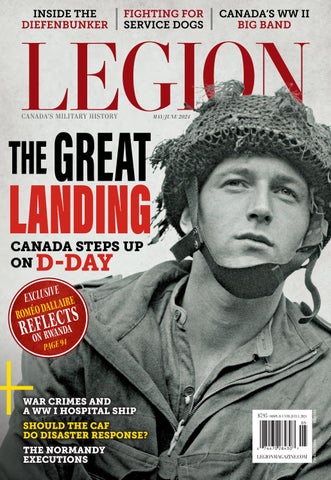
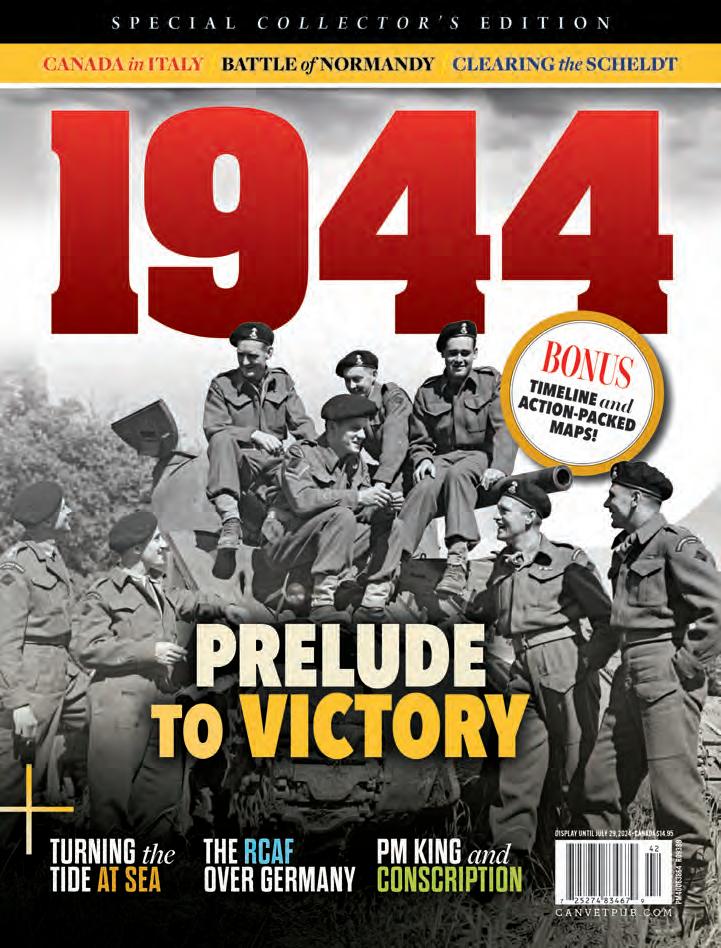
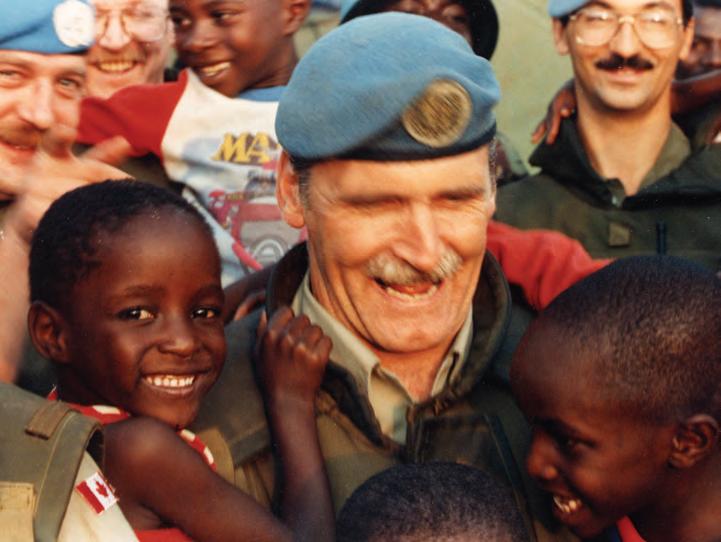
The year 1944 begins well for the Allies after German defeats in Stalingrad, North Africa and Sicily. Italy has been invaded and dictator Benito Mussolini deposed. The bomber offensive is dealing a mighty blow to the Nazi war machine. Allied fortunes in the Atlantic have shifted. And in the Pacific, the American island-hopping campaign is inching toward Japan. The war is far from over, but the Axis is clearly losing at last. It is time to strike what will prove to be the decisive blow in Europe.
THE POWER OF THE DOG
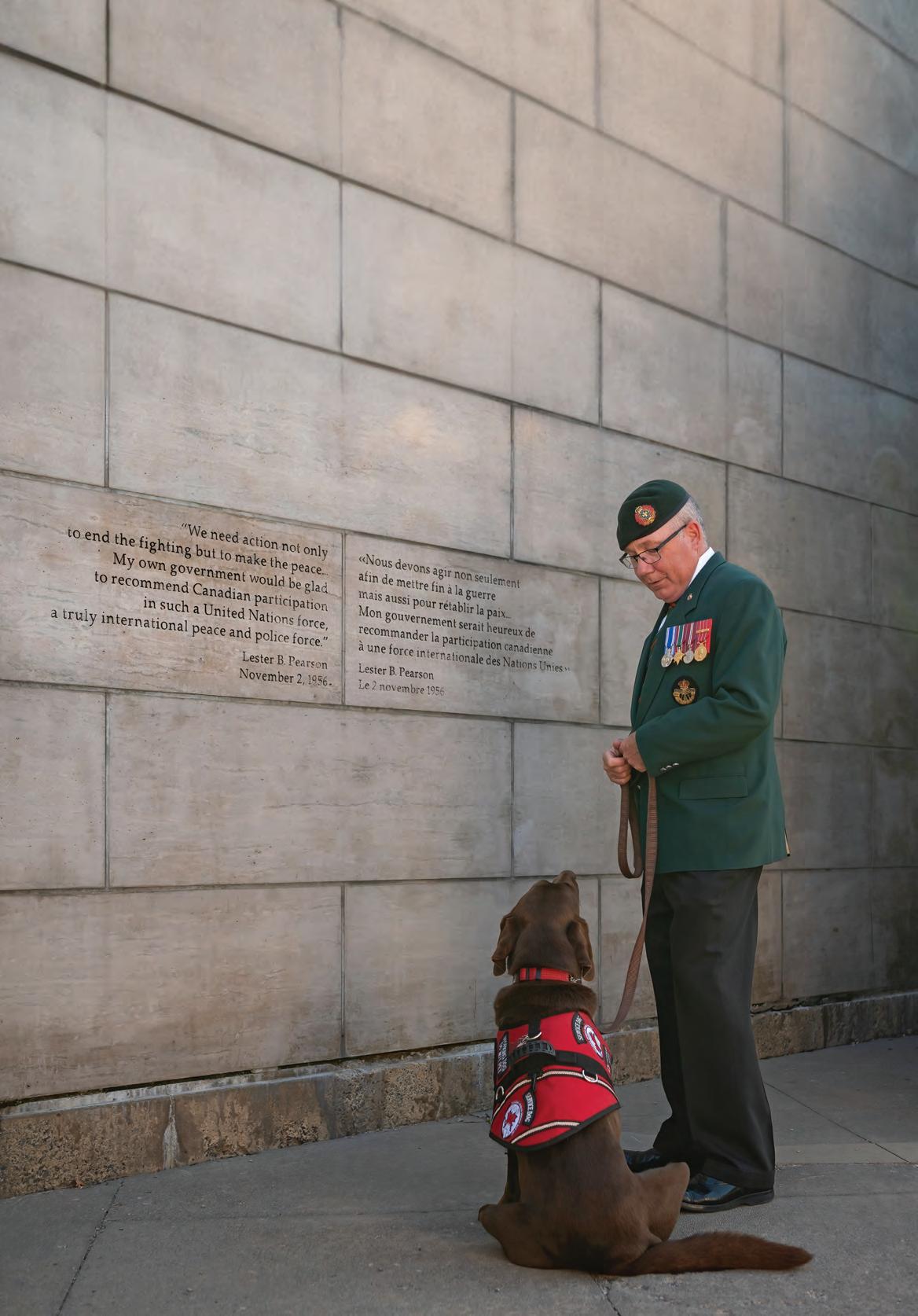
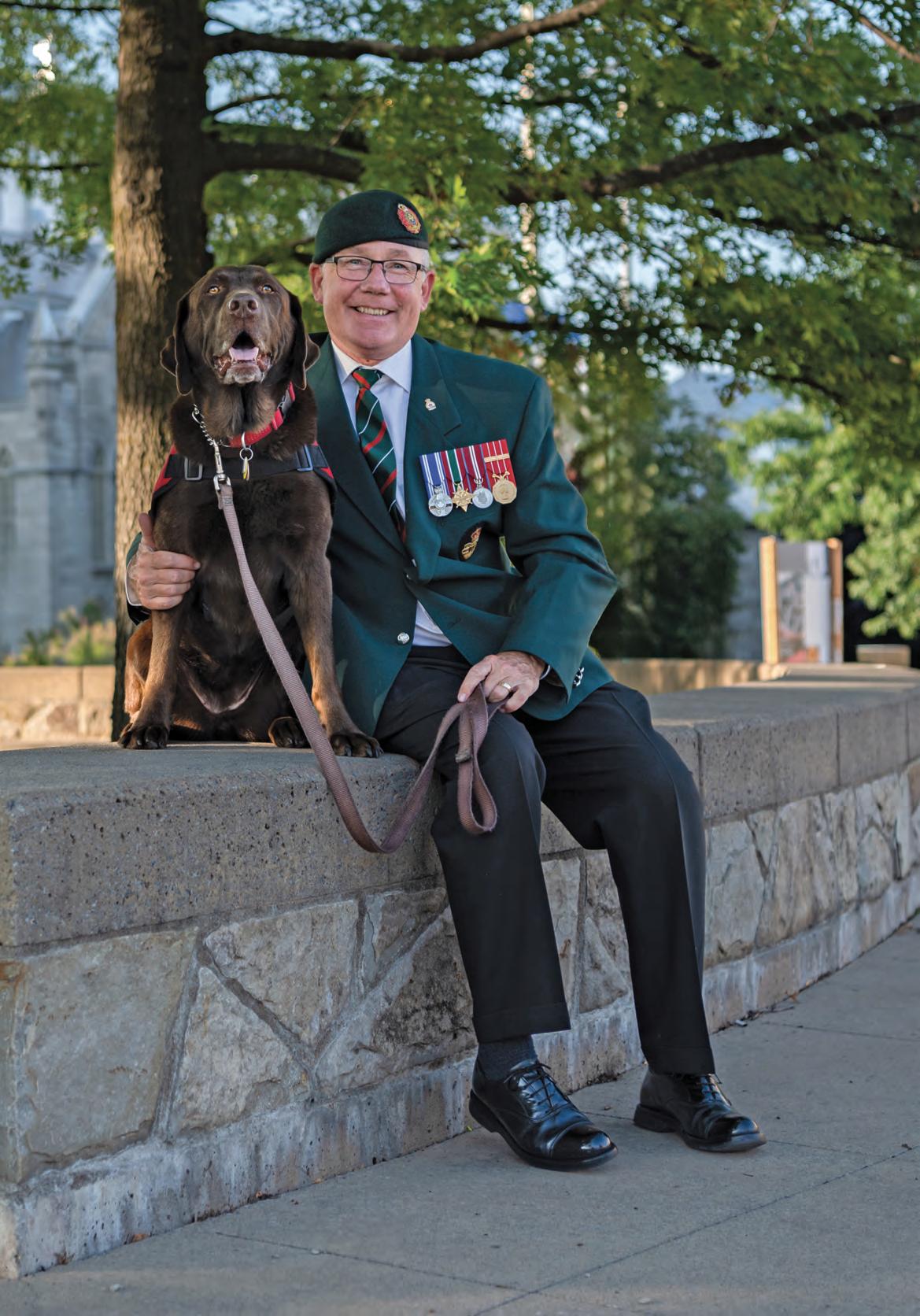
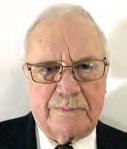
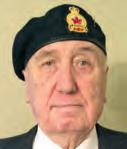
Reverend R.M.A. (Sandy) Scott and his service dog Mandy visit the Peacekeeping Monument in Ottawa.
See page 32
Josée Lavoie
Features
18 THE GREATEST LANDING
Reliving the role Canada played on D-Day
By John Boileau
26 “SIGHTED TWO SUBS, SANK SAME”
The bomber crew that made history on June 7/8, 1944
By Mark Zuehlke
32 THE DOGS OF POSTWAR
How mental health service animals help veterans. And a look at the decade-long struggle to have Veterans Affairs Canada fund them.
By Paige Jasmine Gilmar
40 BLAST FROM THE PAST
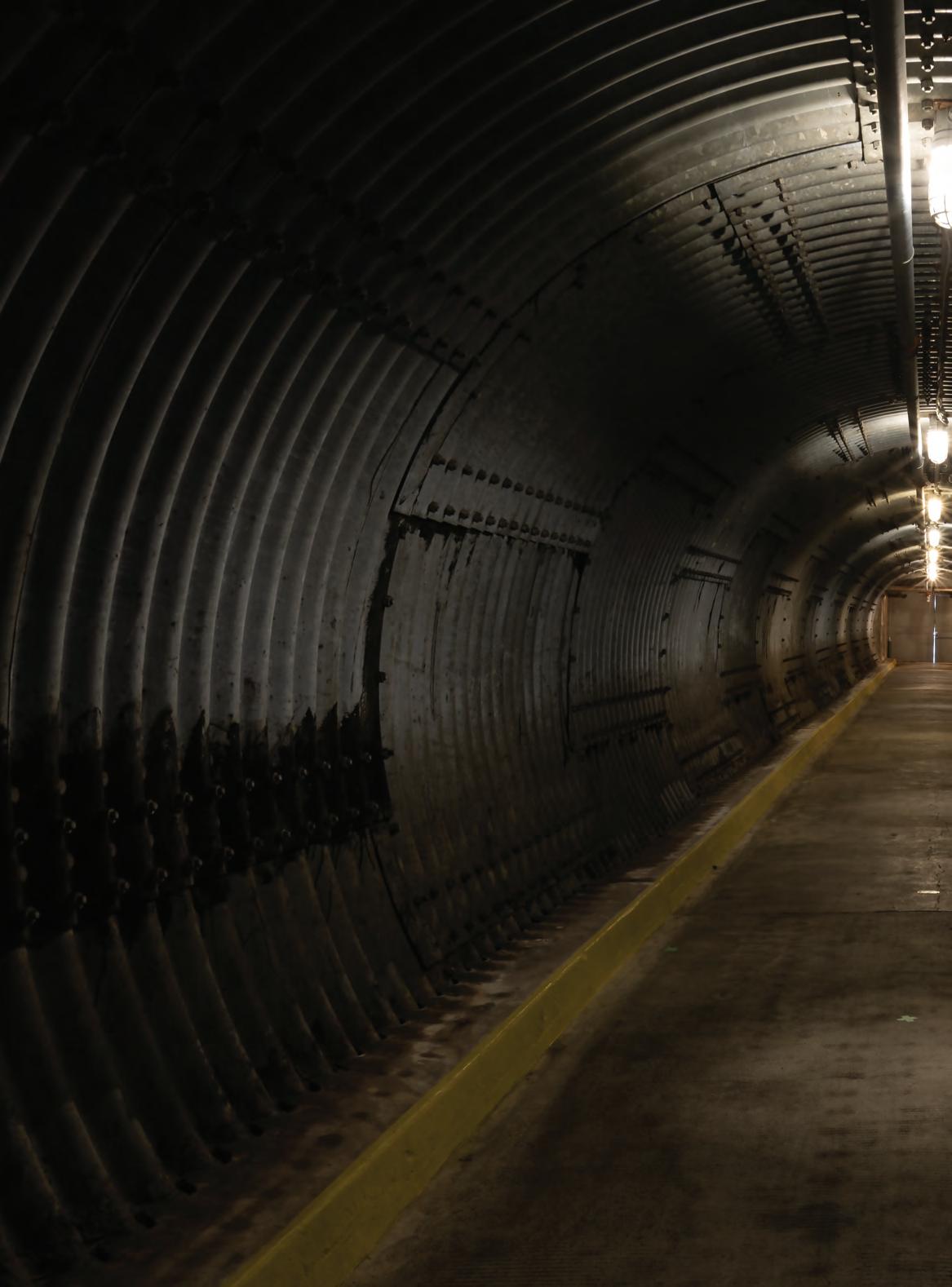
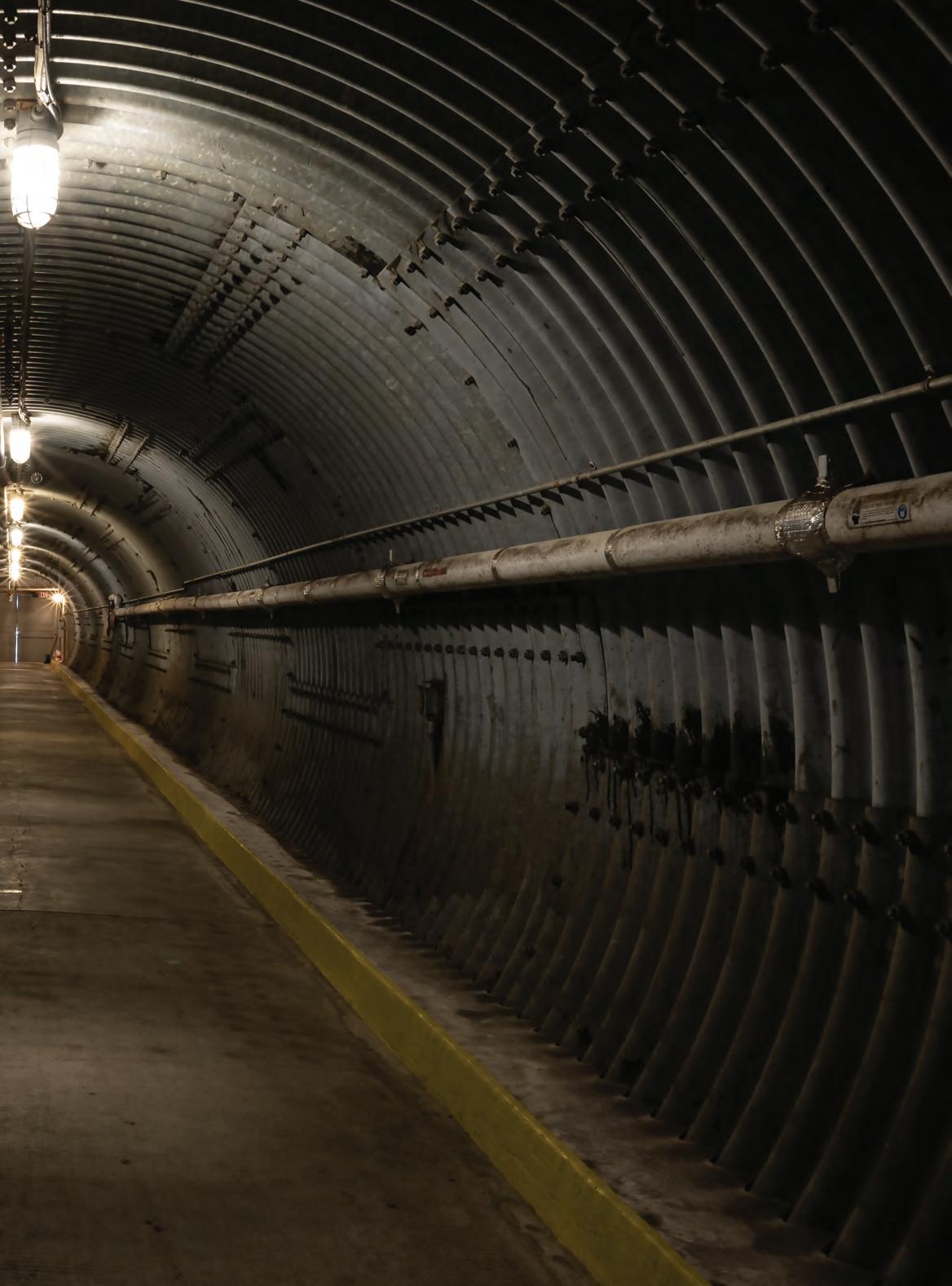
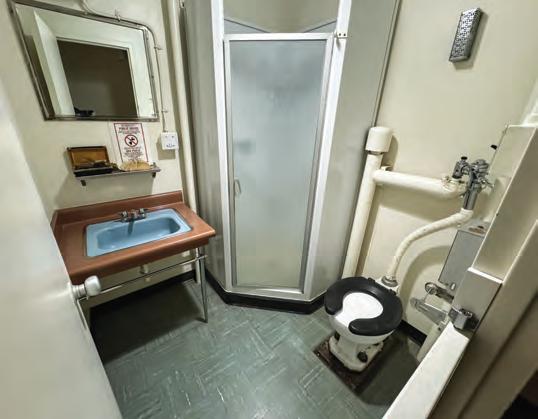
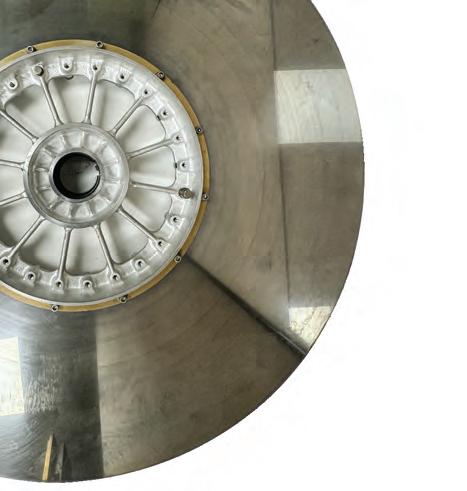
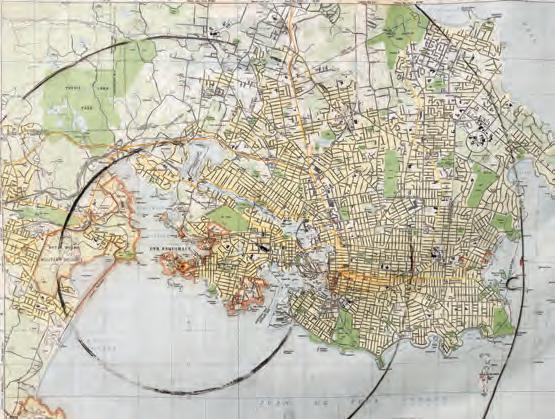
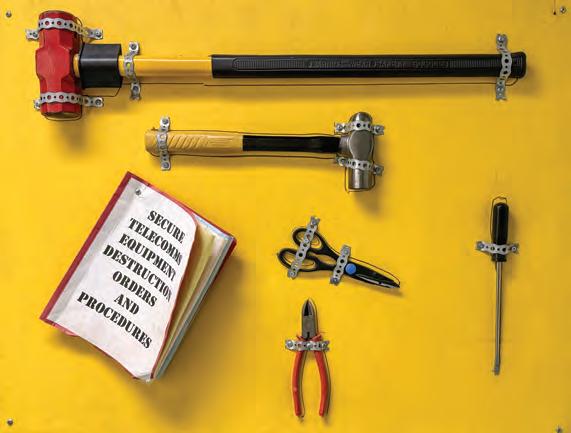
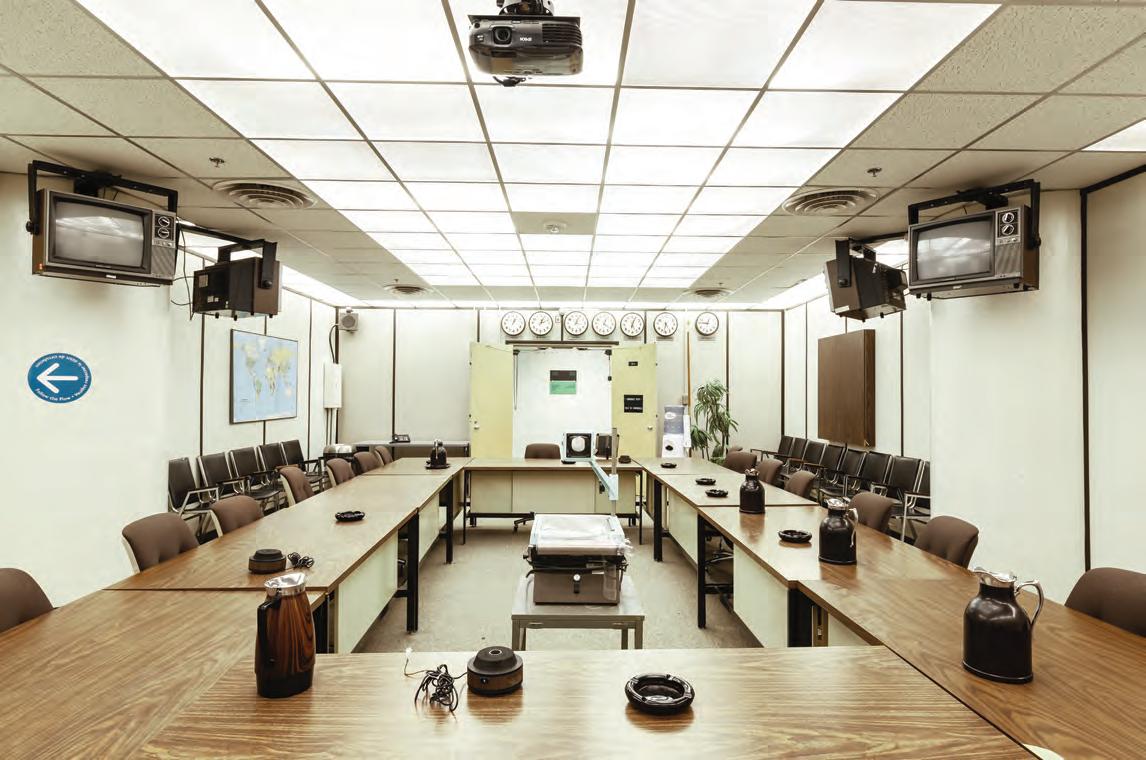
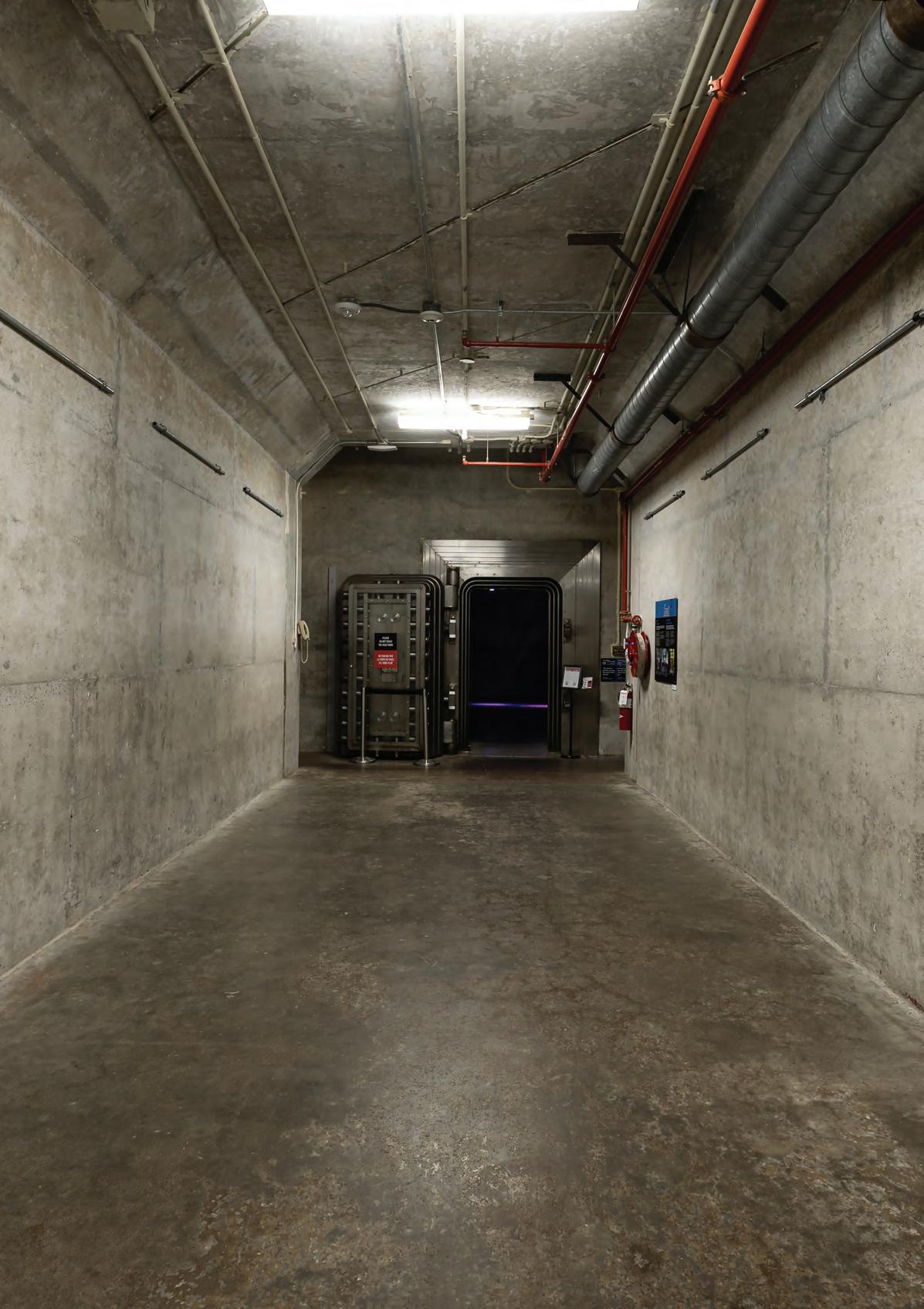
Inside the Diefenbunker, Canada’s Cold War emergency government headquarters By Stephen J. Thorne
50 CRIMINAL INTENT
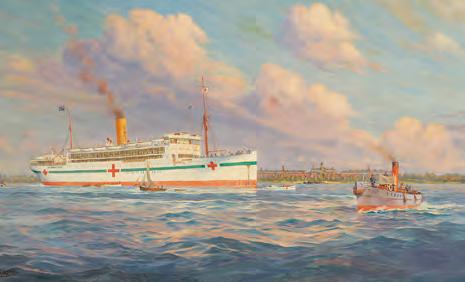
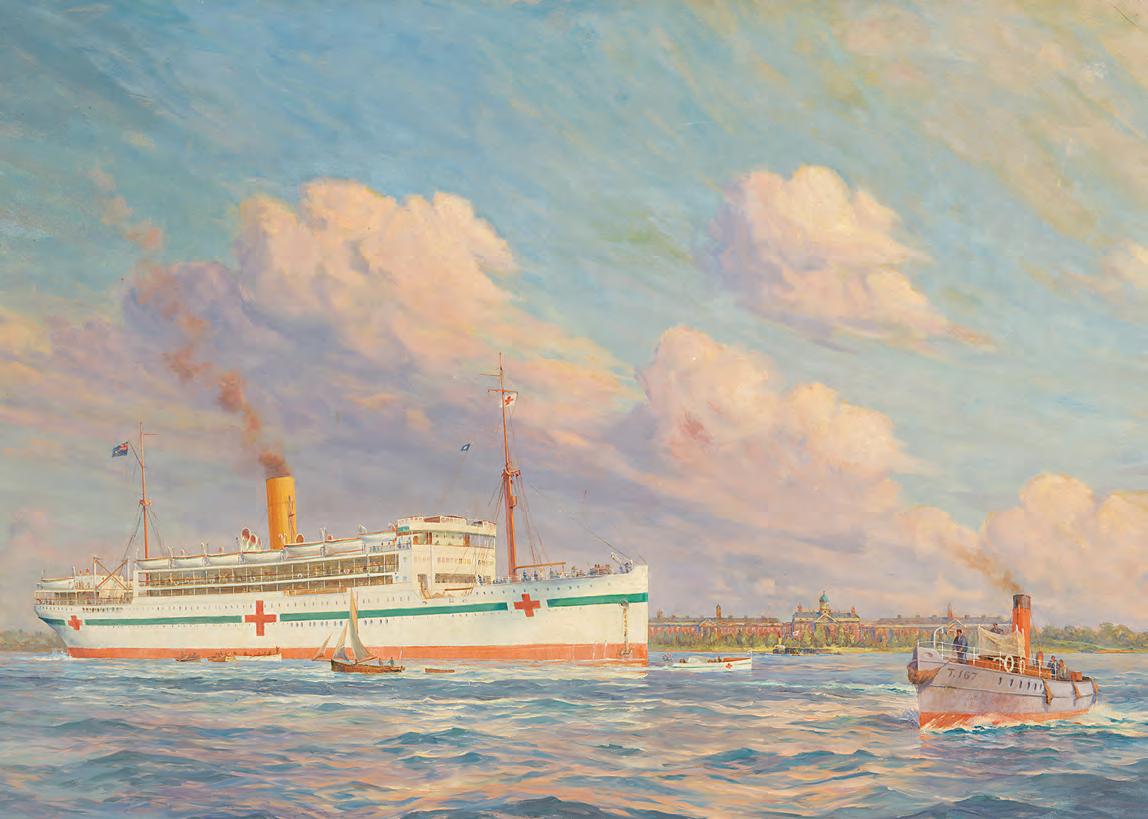
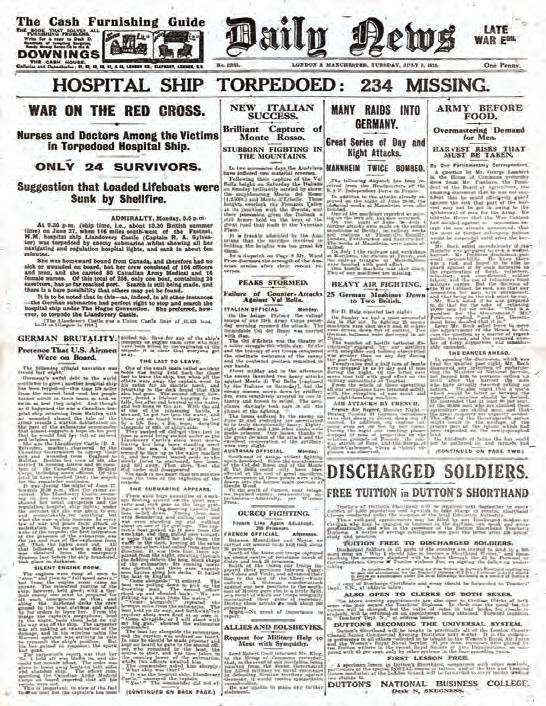
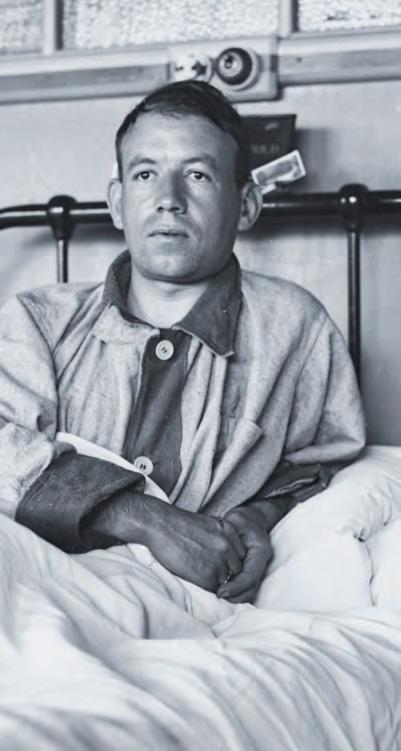
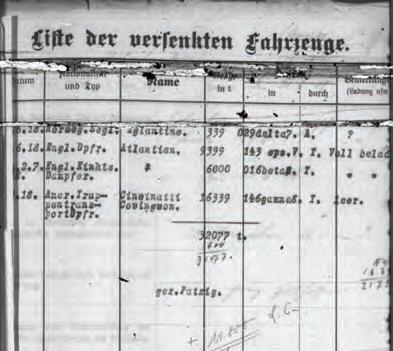
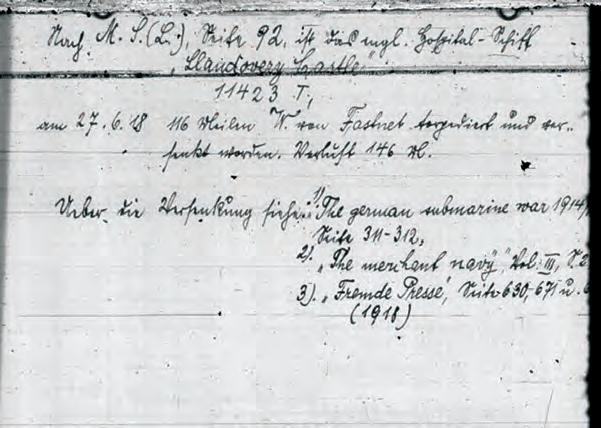
The Great War attack on a Canadian hospital ship that helped set war crimes’ precedent
By Nate Hendley
56 SENTIMENTAL JOURNEY
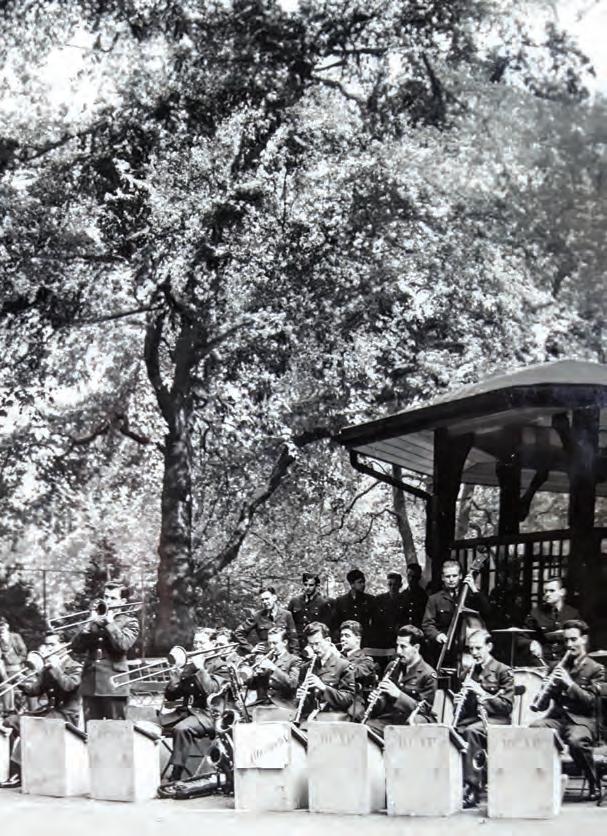
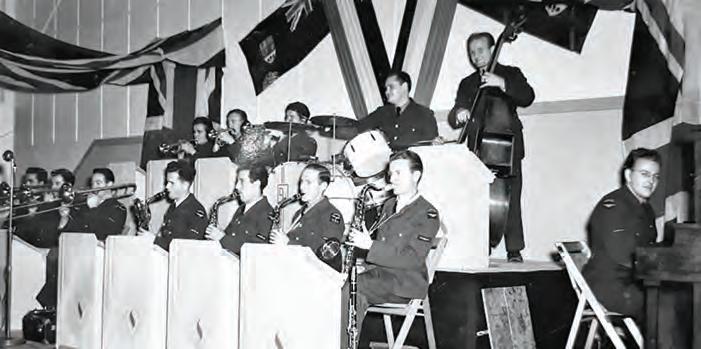
Recalling a little-known Second World War service band that brought its music to Canadian and Allied troops wherever they were, including the front lines
By Andy Sparling
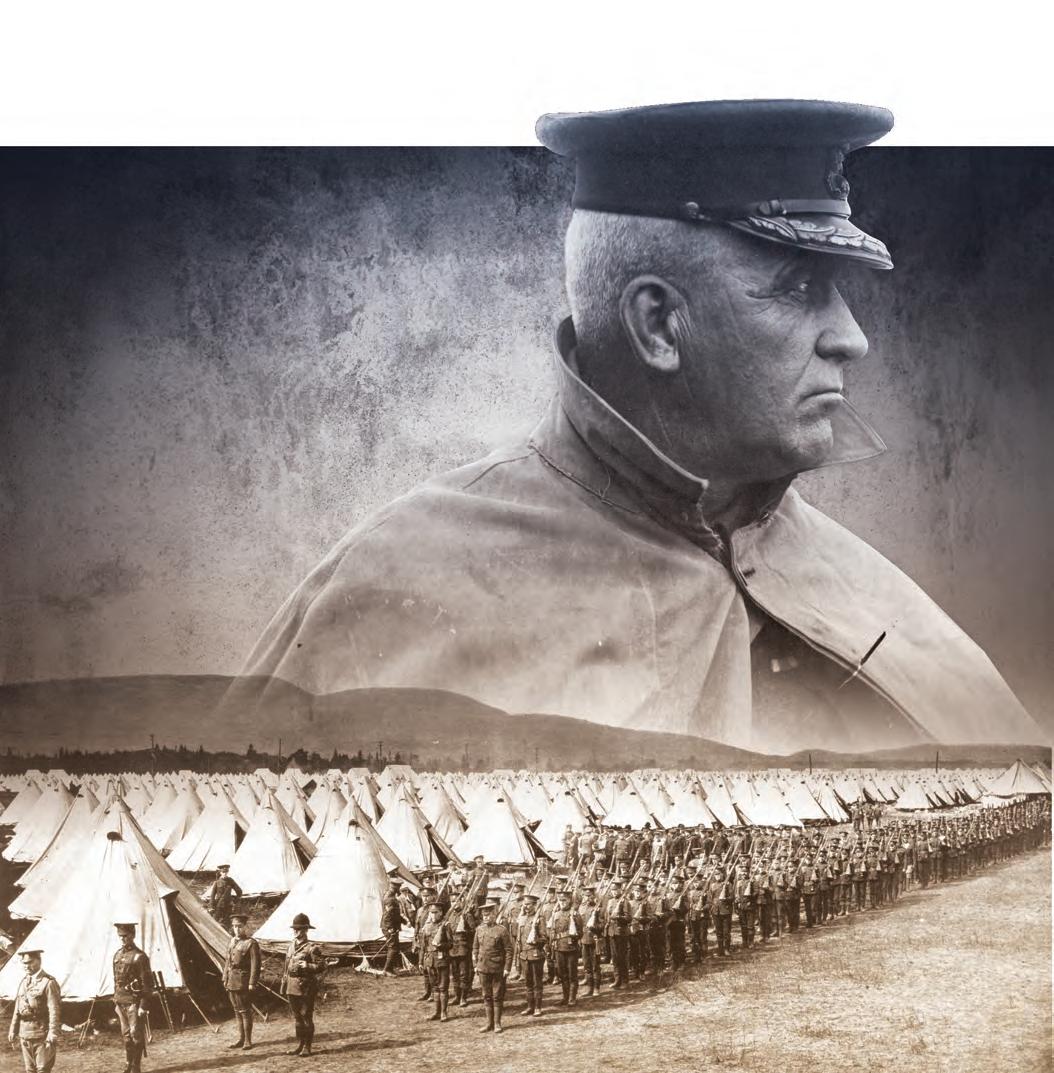
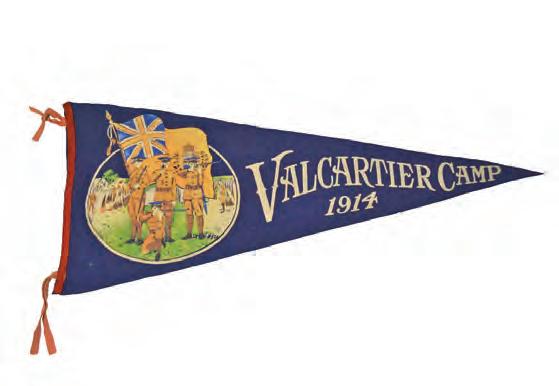
64 THE MIRACLE OF VALCARTIER
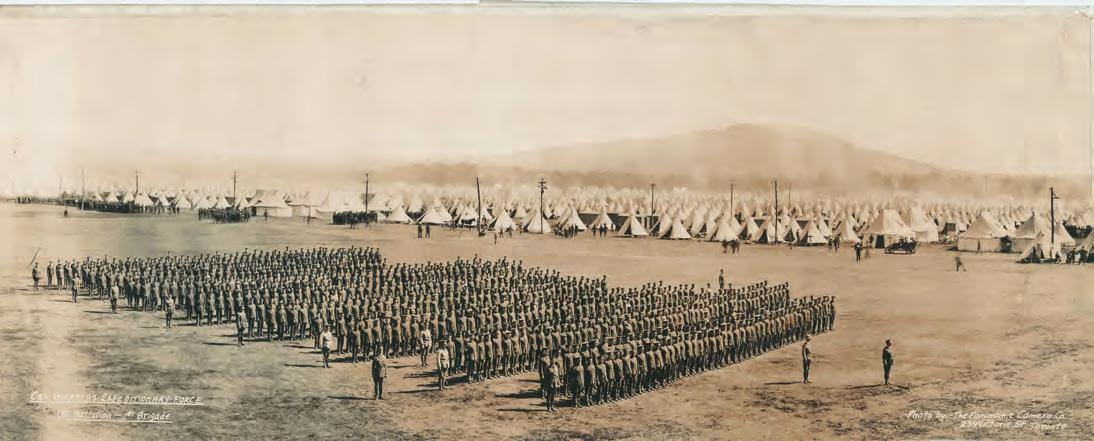
A training camp for the Canadian Expeditionary Force emerged seemingly overnight By
Serge Durflinger
The CANEX tuck shop at the Diefenbunker east of Ottawa is a time capsule of popular 1960s-era products.
Stephen J. Thorne/LM
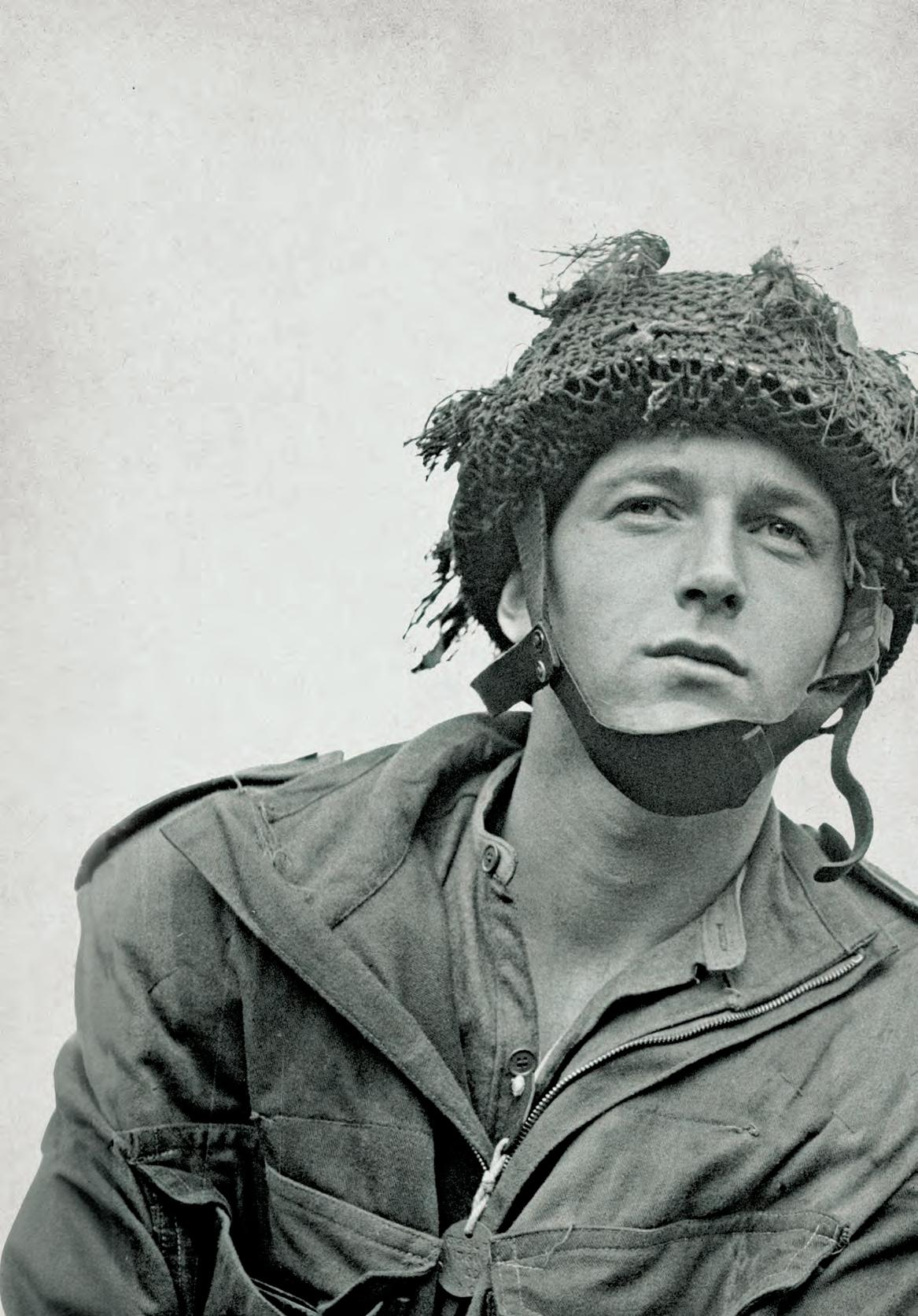
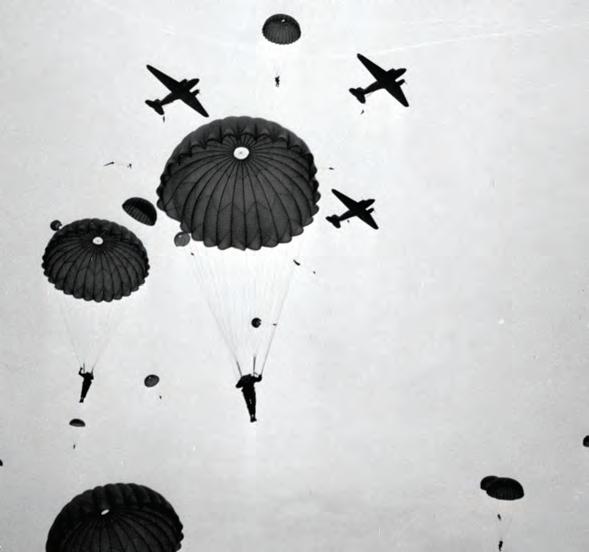
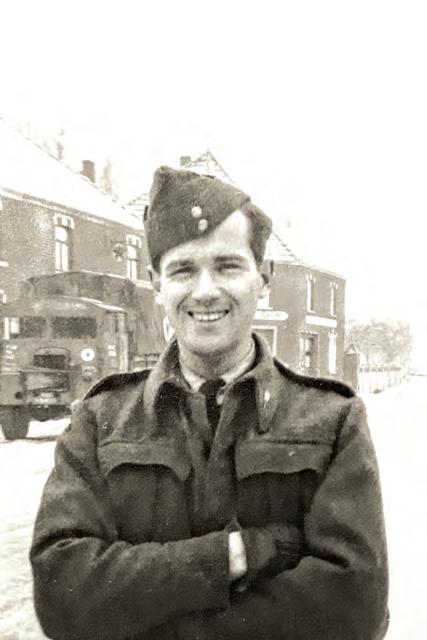
An unidentified paratrooper of the 1st Canadian Parachute Battalion in England in June 1944—117 members of the battalion’s ‘C’ Company were among the first Allied soldiers to invade France on D-Day.
Sergeant Elmer R. Bonter/DND/LAC/PA-193085
Should Canada replace its military as the first line of response to domestic disasters?
GREAT MINDS TAKE NOTES
Vol. 99, No. 3 | May/June 2024
Board of Directors
BOARD VICE-CHAIR Bruce Julian BOARD SECRETARY Bill Chafe DIRECTORS Tom Bursey, Steven Clark, Thomas Irvine, Berkley Lawrence, Sharon McKeown, Brian Weaver, Irit Weiser Legion Magazine is published by Canvet Publications Ltd.
GENERAL MANAGER Jason Duprau
EDITOR
ADMINISTRATIVE
SUPERVISOR
Stephanie Gorin
SALES/
ADMINISTRATIVE ASSISTANT
Lisa McCoy
ADMINISTRATIVE ASSISTANT
Chantal Horan
Aaron Kylie
ASSISTANT EDITOR
Michael A. Smith
SENIOR STAFF WRITER
Stephen J. Thorne
STAFF WRITER
Paige Jasmine Gilmar
ART DIRECTOR, CIRCULATION AND PRODUCTION MANAGER
Jennifer McGill
SENIOR DESIGNER AND PRODUCTION CO-ORDINATOR
Derryn Allebone
SENIOR DESIGNER
Sophie Jalbert
DESIGNER
Serena Masonde
Advertising Sales
CANIK MARKETING SERVICES
TORONTO advertising@legionmagazine.com
DOVETAIL COMMUNICATIONS INC mmignardi@dvtail.com
OR CALL 613-591-0116 FOR MORE INFORMATION
SENIOR DESIGNER AND MARKETING CO-ORDINATOR Dyann Bernard WEB DESIGNER AND SOCIAL MEDIA CO-ORDINATOR
Ankush Katoch
Published six times per year, January/February, March/April, May/June, July/August, September/October and November/December. Copyright Canvet Publications Ltd. 2024. ISSN 1209-4331
Subscription Rates
Legion Magazine is $9.96 per year ($19.93 for two years and $29.89 for three years); prices include GST.
FOR ADDRESSES IN NS, NB, NL, PE a subscription is $10.91 for one year ($21.83 for two years and $32.74 for three years). FOR ADDRESSES IN ON a subscription is $10.72 for one year ($21.45 for two years and $32.17 for three years).
TO PURCHASE A MAGAZINE SUBSCRIPTION visit www.legionmagazine.com or contact Legion Magazine Subscription Dept., 86 Aird Place, Kanata, ON K2L 0A1 or phone 613-591-0116. The single copy price is $7.95 plus applicable taxes, shipping and handling.
Change of Address
Send new address and current address label, or, send new address and old address. Send to: Legion Magazine Subscription Department, 86 Aird Place, Kanata, ON K2L 0A1. Or visit www.legionmagazine.com/change-of-address. Allow eight weeks.
Editorial and Advertising Policy
Opinions expressed are those of the writers. Unless otherwise explicitly stated, articles do not imply endorsement of any product or service. The advertisement of any product or service does not indicate approval by the publisher unless so stated. Reproduction or recreation, in whole or in part, in any form or media, is strictly forbidden and is a violation of copyright. Reprint only with written permission.
PUBLICATIONS MAIL AGREEMENT NO. 40063864
Return undeliverable Canadian addresses to Legion Magazine Subscription Department 86 Aird Place, Kanata, ON K2L 0A1 | magazine@legion.ca
U.S. Postmasters’ Information
United States: Legion Magazine, USPS 000-117, ISSN 1209-4331, published six times per year (January/February, March/April, May/June, July/August, September/October, November/December). Published by Canvet Publications, 866 Humboldt Pkwy., Buffalo, NY 14211-1218. Periodicals postage paid at Buffalo, NY. The annual subscription rate is $9.49 Cdn. The single copy price is $7.95 Cdn. plus shipping and handling. Circulation records are maintained at Adrienne and Associates, 866 Humboldt Pkwy., Buffalo, NY 14211-1218. U.S. Postmasters send covers only and address changes to Legion Magazine, PO Box 55, Niagara Falls, NY 14304. Member of Alliance for Audited Media and BPA Worldwide. Printed in Canada.
We acknowledge the financial support of the Government of Canada. Version française disponible.
On occasion, we make our direct subscriber list available to carefully screened companies whose product or services we feel would be of interest to our subscribers. If you would rather not receive such offers, please state this request, along with your full name and address, and e-mail magazine@legion.ca or write to Legion Magazine, 86 Aird Place, Kanata ON K2L 0A1 or phone 613-591-0116.
Dog
“W fight
THE LACK OF ACTION RESEMBLES SO MANY OTHER BUREAUCRATIC FUMBLES IN CANADA’S MODERN MILITARY.
e’re not asking the question anymore if the dogs work—at least my team isn’t—because we already have very strong evidence.” So said Linzi Williamson in November 2023, as quoted in this issue’s feature story on veterans using mental health service dogs (see “The dogs of postwar,” page 32), an assistant professor in the department of psychology and health studies at the University of Saskatchewan. “It’s about trying to optimize and figure out the best path forward,” she continued, “not just for the veterans, but for the dogs.”
Williamson has co-published several studies on the topic in scientific journals during the last few years. Her conclusion is echoed by research by the University of South Australia, the University of Adelaide and Military and Emergency Services Health Australia published in March 2023.
“Almost 90 per cent of veterans reported improvements in their post-traumatic stress, depression and anxiety 12 months after being matched to an assistance dog,” its authors said in a release. “This study provides clear evidence that assistance dogs can play a key role in a veteran’s recovery from posttraumatic stress and other mental health conditions, supporting existing treatments.”
So, while experts from around the world are convinced that service dogs can help veterans, and veterans themselves have anecdotally reported the same for more
than a decade—as Defence Minister Erin O’Toole himself acknowledged in 2015— Veterans Affairs Canada still won’t fund their use. Its rationale? Its own research, despite finding “positive impacts for veterans with PTSD after acquiring the service dog including decreasing nightmares, improved sleep, fewer depressive symptoms and more social integration in the community,” had “limited results.”
Common sense be damned—the use of service dogs dates to the ninth century and the animals have been used to aid with psychiatric conditions for some three decades now—and scientific evidence ignored. The lack of action resembles so many other bureaucratic fumbles in Canada’s modern military (see “procurement, equipment, etc., etc., etc.”).
In the case of service dogs for veterans, not only is there an apparent lack of proof of effectiveness, according to VAC, but there’s also the hot potato issue of national training standards. Despite being tasked to develop them by the department in 2015, the Canadian General Standards Board, the federal agency responsible for such matters, announced, after three years of deliberation, it would not do so. It claimed its members were unable to reach a “consensus.” This despite the existence of several federal and provincial/territorial laws governing service dogs already.
The situation is, pardon the pun, a dog’s breakfast. VAC spokesperson Alex Wellstead told the CBC in 2018 that the department would, in the absence of rules from the federal board, develop its own. “We’re working to put in place standards, rapidly,” he said, “so that veterans have access to properly trained psychiatric service dogs.”
Six years later…nothing. Canadian veterans deserve better. Those who need service dogs should have them now. Let VAC prove they don’t work. All evidence suggests they do. L
I Give thanks
am a retired history teacher and a member of the Col. John McCrae Memorial Branch in Guelph, Ont. I thoroughly enjoyed reading Paige Jasmine Gilmar’s article on retired captain Trevor Greene (“It takes a village,” March/April). It inspired me to write you and thank Paige for a wonderful piece of writing, along with Greene for his service.
touching to read the new Veterans Village in Surrey, B.C., in article “It takes a village.” As a current associate member and past secretary, I have personally seen how service the Forces, both domestic and abroad, affects the physical and psychological well-being of those currently
Advertisement
Comments can be sent to: Letters, Legion Magazine , 86 Aird Place, Kanata, ON K2L 0A1 or emailed to: magazine@legion.ca
serving, as well as veterans. Our current Legion branches are literally and figuratively showing their age. The sidebar “Branching out” describes fully the state we find ourselves in. I truly hope that the Legion Veterans Village can be replicated across Canada.
SANDRA FIORONI TORONTO
Money problems
In response to Paul Whittaker’s letter in the March/April issue. I think the main point should be that money should be spent on giving our existing forces the best of updated equipment. It seems no ruling government is willing to step up and pay the price for the best. The present government seems insistent on giving away tens of millions of dollars to other countries and ignoring the basic needs of its military and citizens. Canada’s forces deserve the best.
BILL SHOLDICE
MISSISSAUGA, ONT.
Let them rest
After reading Face to Face (“Should Canada repatriate its war dead?” November/December 2023), I think of my father who was a British sergeant in the
4th Battalion, Gordon Highlanders. He was taken prisoner in 1940 at Dunkirk and died on June 4, 1944. My mother received information of his burial site and vowed one day to visit with my stepfather. It turns out his grave was moved. My point is that if my father’s body had been repatriated, I am sure my mother would have spent many years at the graveside. I doubt she would have remarried, and her life would have been bleak. I say let these men rest. My father now has “no known grave” and is listed on the huge British War Memorial in Dunkirk. We don’t need a grave to remember him. He is cherished.
GWEN ST. ONGE VIA EMAIL
Follow the leader
Regarding your article “Canada’s Longest War” (March/
April) about Afghanistan: As a veteran of the conflict in A fghanistan, I was both heartbroken and distressed to see our country’s sacrifice of blood, tears and sweat thrown away so casually when the United States ultimately pulled out of Afghanistan. In retrospect, they showed a lack of the necessary political willpower to win the war over the course of 20 years’ worth of multiple administrations with conflicting agendas. It was a veritable yo-yo of troop surges and cutbacks eventually resulting in the collapse of Afghanistan back into the hands of the Taliban.
If I have any advice to offer future C anadian governments thinking of joining the United States in military conflicts, it would be, don’t bother. They have proven themselves to be an unreliable ally.
CHRIS HARRIS AIRDRIE, ALTA.
Broken arrow
The Avro Arrow was Canada’s greatest aircraft design, being the most advanced in the world at the time of its debut (Heroes and Villains, January/February). Unfortunately, the Arrow’s cancellation was short-sighted and resulted in Canada’s loss of technical brilliance with the engineers involved in its development emigrating to the United States. Once again, Canada was duped by others into thinking that Canadians’ brilliance did not matter.
PETER FORSBERG SMITHVILLE, ONT.
Legion of honour
After reading the editorial in the March/April issue, I was extremely upset with the reminder of Jess Larochelle’s Victoria Cross turn-
down. When being inducted at ecutive and general Legion meet ings, and at all other Legion events, the following line is al ways repeated: “Lest we forget, lest we forget.” According to Lieutenant-Colonel Carl Gauthier and the Directorate of and Recognition, it we should forget after a number of years. Sorry guys, I do not intend to do that. I will continue to remember and respect my uncle Morris Walker who was killed in cle Robert (Moose) Fumerton who was a war ace and nel who stood up for Canada.
IAN WALKER MISSISSAUGA, ONT.
Flashback
Back in the mid 1960s, as a corporal in the RCAF, I was posted to the Canadian Liaison Staff in London, England. Little did I know at the time, residing in the SE-9 section of England, and travelling to work on the Dartford Loop Line, that I was so close to the wartime base of Kenley, which had been home to the lone RCAF squadron in Britain at that time.
the sense back then to seek out more secrets ravaged by the war. I will treasure those days, even more so now, having read Stephen J. Thorne’s stirring account, which included the ghosts of all those Spitfires and Hurricanes that were outnumbered by the enemy. Thanks to all who served.
CAPT. (RET’D) SAM NEWMAN LONDON, ONT.
CORRECTION
The April 3 On This Date (March/April) stated that Zevenaar was a German town. In fact, it is Dutch and is near the border of Germany.
Exclusive HIGHLIGHT
from LegionMagazine.com
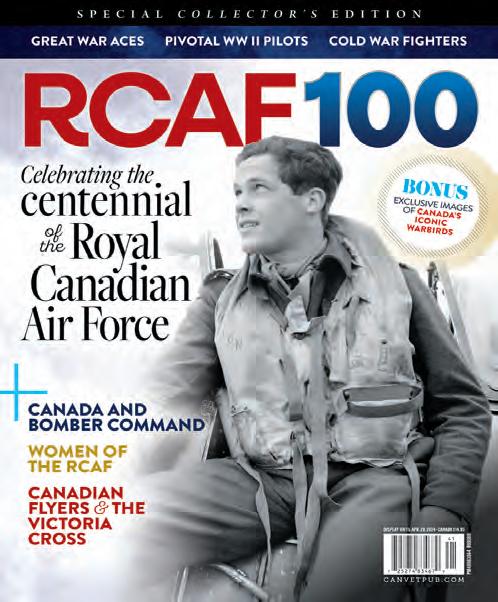
With a country so vast and wild, it was only natural that Canadians took to the skies early and often. The First World War proved the catalyst that propelled Canada’s fledgling aviation industry to new heights. Versions of a new military flying force came and went until—a century ago, in April 1924—the Canadian Air Force was granted royal title by King George V. Its grey-blue uniform has become iconic, as did the aces and the warbirds they flew, such as the Spitfire, Hurricane and Lancaster. In honour of the RCAF reaching the century mark, Legion Magazine published a special collector’s issue titled RCAF 100:
Celebrating the centennial of the Royal Canadian Air Force, which can be purchased online or on newsstands. The collector’s issue takes readers through the storied history of the RCAF, the women who helped shape it and, of course, the Canadian flyers who earned the Victoria Cross. Accompanying the collector’s issue is an interactive website that allows readers to scroll through the history of the RCAF and admire the iconic warbirds up-close-and-personal. Legion Magazine has also released a YouTube video, narrated by staff writer and photographer Stephen J. Thorne, honouring the
Get notified of all the latest updates on legionmagazine.com by signing up for our weekly e-newsletter at www.legionmagazine.com /newsletter-signup
growing legacy of Canada’s iconic air force. Listen as Thorne describes the many accomplishments of the RCAF and its members, and transports viewers on the wings of warbirds flown by
1 May 2002
HMCS St. John’s joins the Canadian Naval Task Group, part of the multinational anti-terrorism campaign in the Persian Gulf.
2 May 1915
Lieutenant Alexis Helmer is killed by shellfire near Ypres, Belgium. His death inspires Major John McCrae to write “In Flanders Fields.”
6 May 1915
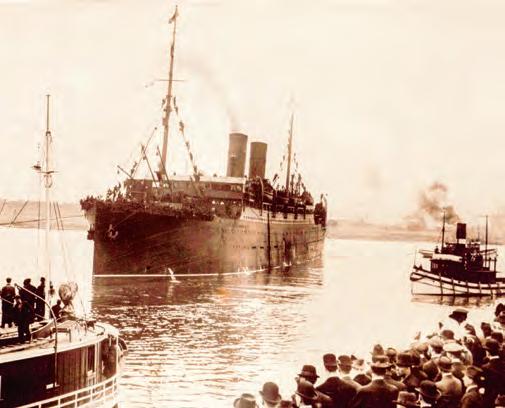
Filled with fresh troops, SS Metagama leaves Montreal for England.
10 May 1915
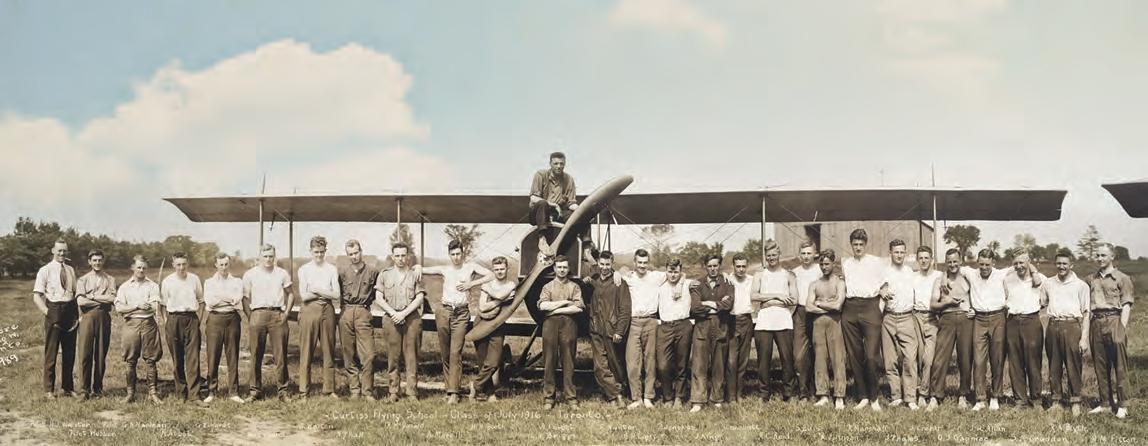
The Curtiss Flying School in Toronto begins training military pilots.
11 May 1717
The forerunner to the Montreal Stock exchange, the Canadian Commercial Exchange, is founded.
12 May 1937
The Canadian military participates in the crowning of King George VI.
14 May 1804
7 May 1945
The unconditional surrender of the German Third Reich is signed at Supreme Headquarters, Allied Expeditionary Force at Reims in northeastern France.
8 May 1945
Millions take to the streets around the planet to celebrate the end of the Second World War in Europe.
Meriwether Lewis and William Clark embark from the American Midwest on an expedition to the Pacific coast of North America.
15 May 1885
Canadian Métis leader Louis Riel is captured in the aftermath of the Battle of Batoche in the NorthWest Territories (presentday Saskatchewan).
16 May 1951
China launches the second part of a spring offensive in Korea, but the UN forces a stop to the attack within days.
17 May 1944
1st Canadian Infantry Division faces strong German opposition in the advance toward the Hitler Line in Italy.
19 May 1911
Parks Canada, the world’s first national park service, is established as the Dominion Parks Branch under the Department of the Interior.
24 May 1941
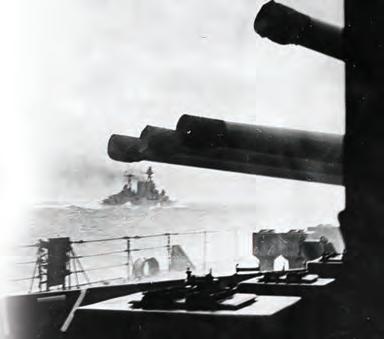
German battleship Bismarck sinks the pride of the Royal Navy, HMS Hood, killing all but three of its crew.
26 May 1940
The Siege of Calais ends with the surrender of the British and French garrison.
27 May 1941
The German warship Bismarck is sunk.
28 May 1940
Norwegian, French, Polish and British forces recapture Narvik in Norway in the first Allied infantry victory of the Second World War.
June
10 June 1957
John Diefenbaker leads the Progressive Conservative Party of Canada to an upset victory in the federal election, ending 22 years of Liberal government.
11 June 1940
The Siege of Malta begins with a series of Italian air raids.
13 June 2002
The United States withdraws from the Anti-Ballistic Missile Treaty.
2 June 2008
Under machine-gun fire in Afghanistan, MCpl. Brent Gallant uses his body to shield a wounded comrade. He is awarded the Medal of Military Valour.
4 June 1939
The MS St. Louis, carrying 963 German Jewish refugees, is denied permission to dock in Florida, after already being denied by Cuba. Forced to return to Europe, more than 200 of its passengers later die in Nazi concentration camps.
6 June 1944
Canadian, British and American forces land on the beaches of Normandy on D-Day.
14 June 1919
John Alcock and Arthur Whitten Brown depart from St. John’s, Nfld., on the first nonstop transatlantic flight.
16 June 1745
A New England colonial force aided by a British fleet captures Louisbourg.
8 June 1944
Putot-en-Bessin, France, west of Caen in Normandy, is temporarily lost after an attack on the 7th Canadian Infantry Brigade, then retaken by The Canadian Scottish Regiment.
9 June 1954
The RCAF’s Korean War airlift ends, after 599 trans-Pacific flights carrying 3,500 tonnes of freight and 13,000 personnel.
17 June 1940
RMS Lancastria is attacked and sunk by the Luftwaffe near Saint-Nazaire, France. At least 3,000 die in Britain’s worst single-ship maritime disaster.
18 June 1990
Nelson Mandela, vicepresident of the African National Congress, addresses Parliament.
20 June 1877
Alexander Graham Bell installs the world’s first commercial telephone service in Hamilton.
21 June 1734
In Montreal, New France, a slave known by the French name of Marie-Joseph Angélique is put to death, after she was convicted of setting the fire that destroyed much of the city.
23 June 1961
The Antarctic Treaty comes into force. The continent is declared a scientific reserve and military activity is banned.
27 June 1918
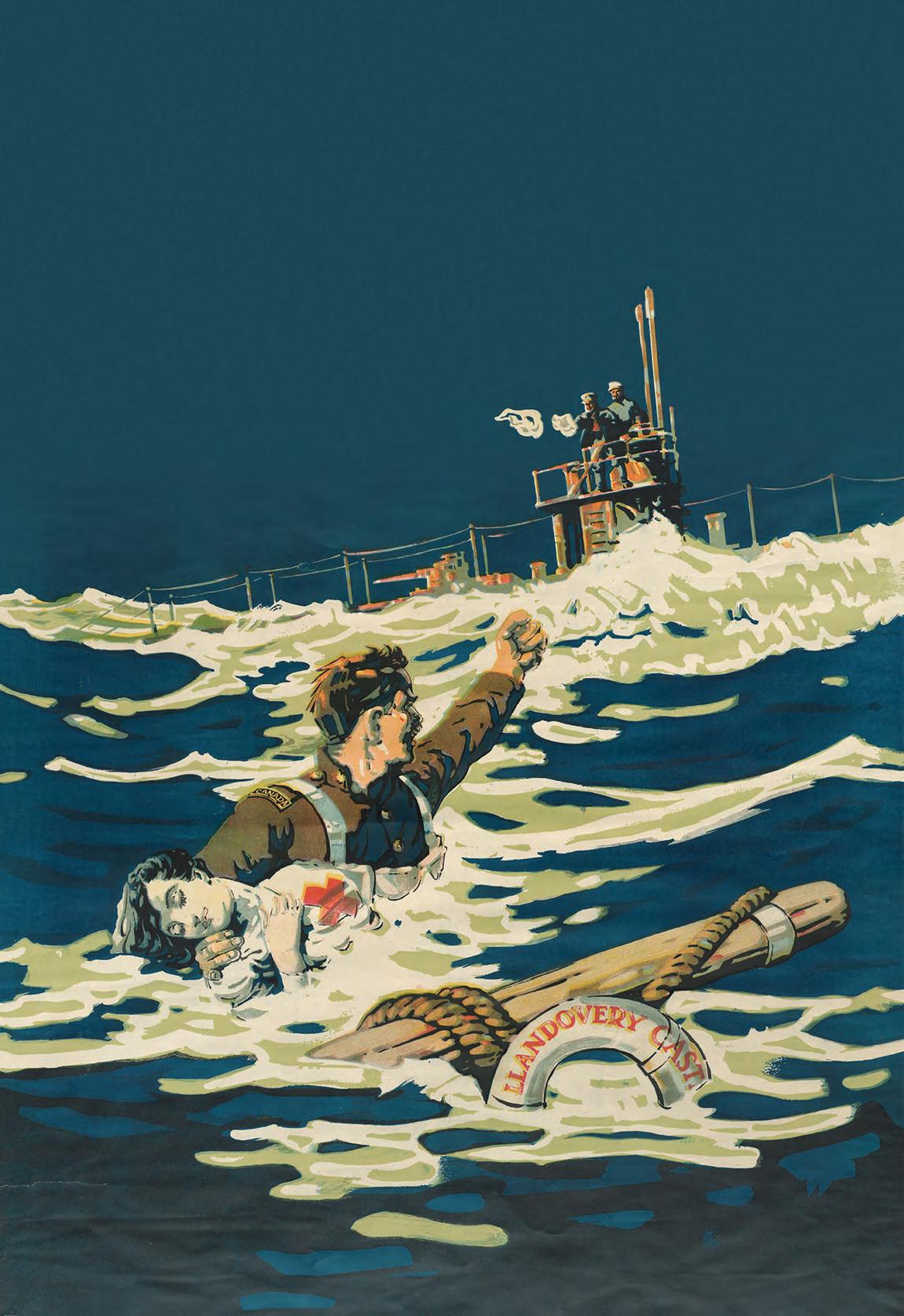
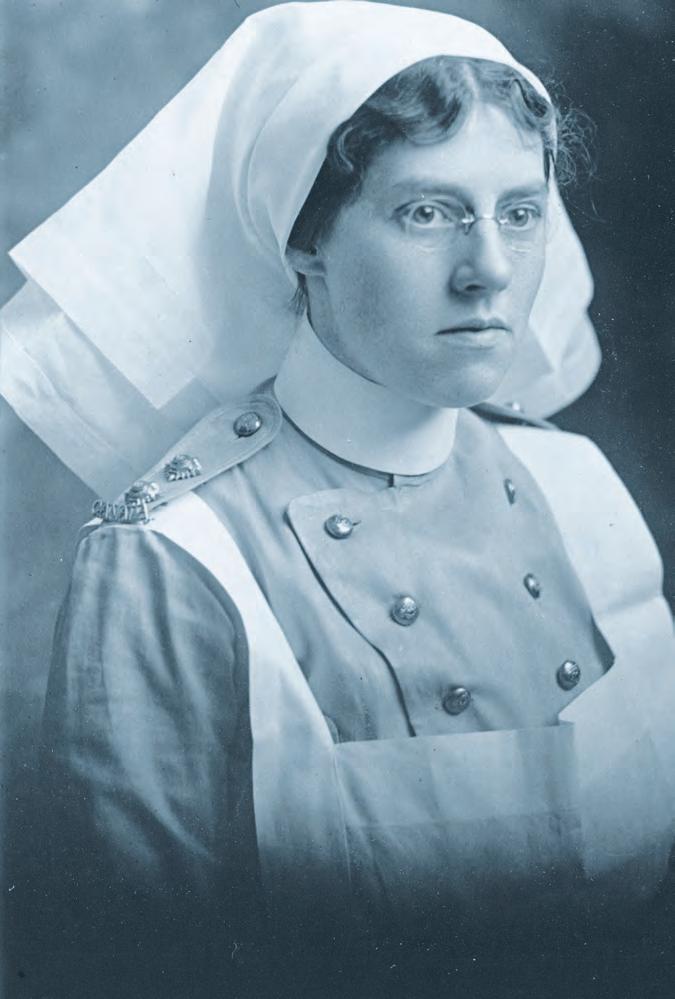
Fourteen nursing sisters are among the 234 who die when the Canadian hospital ship Llandovery Castle is torpedoed by a U-boat (see “Criminal intent,” page 50).
28 June 1944
RCAF Spitfires down 26 enemy aircraft over Normandy.
MILITARY HEALTH MATTERS
By Paige Jasmine Gilmar
Disheartening data
Latest survey of military sexual misconduct reveals little change
When Statistics
Canada published the results from the 2022 Survey of Sexual Misconduct in the Canadian Armed Forces in December 2023, the report’s insights were gloomy. However, one stat in particular stood out: the rate of sexual assault in the CAF had more than doubled. Collecting voluntary responses from some 1,960 regular force members from October 2022 to January 2023 as part of the military’s continuing mission to monitor and address sexual misconduct, StatCan found that the rate of sexual assaults was 3.5 per cent in 2022. In previous surveys, conducted in 2016 and 2018, the rate hovered at about
Powers
Off National Average Rates
1.5 per cent. What’s more, the rate of reported sexual assaults was down from 2018, with only one in five members disclosing such misconduct. The low rate may stems from victims believing that revealing such incidents wouldn’t make any difference, an opinion that was more widely noted in the recent survey.
“It is very disheartening,” said senator and veteran Rebecca Patterson to Legion Magazine
Such figures paint a shadowy picture of the CAF, especially since numerous policies and programs have been introduced since 2014, including the now-defunct Operation Honour and the current Path to Dignity and Respect, to help reduce, and bring awareness of,
sexual misconduct in the military. But, according to one author of the report, these numbers aren’t entirely representative of the survey’s data.
“The results from the survey do suggest that the CAF’s programs seem to be working incrementally since the first time we did the survey in 2016,” said StatCan analyst Adam Cotter.
As is the case with most studies, the survey’s complexity can’t easily be captured in a headline.
Based on regular force member responses, the report found that the most common misconduct was unwanted sexual touching—and it occurred more often among those who were younger, Indigenous, disabled or not heterosexual.
These results were compounded by lower rates of reporting and a higher frequency of members believing that disclosure wouldn’t make a difference. Additionally, 48 per cent of respondents were dissatisfied with the responses from authorities. And 66 per cent of those who made reports said they faced some nature of negative consequence as a result, the most common being exclusion, bullying or teasing. Other consequences, not
directly associated with revealing sexual misconduct, included greater feelings of anxiety and depression, negative reactions of victims’ families and increased consumption of alcohol or drugs.
There was progress, however. For example, just 67 per cent of regular force members reporting seeing, hearing or experiencing sexualized or discriminatory behaviour in the previous 12 months, a drop from 70 per cent in 2019 and 80 per cent in 2016. The report also noted that the higher rate of sexual assault might be attributable to a larger segment of personnel seeing sexualized or discriminatory behaviour as more problematic than before.
The efficacy of the CAF’s sexual misconduct programs, however, is best illustrated by the proportion of those who intervened when witnessing sexualized or discriminatory behaviours, a rate that increased in every behavioural category in 2022.
“I actually think that the fact that people are even acknowledging that this has occurred to them,” said Patterson, “[shows] that there is an incredible sensitivity to this.”
Promisingly, the majority of miliary personnel believe that those who commit sexual misconduct are held accountable, with 66 per cent strongly or somewhat agreeing. Moreover, nearly all respondents (96 per cent) indicated there was zero place for sexual misconduct in their unit.
Most impressively, 75 per cent strongly or somewhat agreed that the culture surrounding sexual misconduct had improved since joining the military.
The report noted that numerous factors could have impacted the results, such as alterations in terminology (i.e., changing “sexual behaviour” to “sexual misconduct” in survey questions) and cultural shifts. Similarly, the
Defence Department’s newer policies, such as repealing the duty to report and the continual transition of sexual offences from the military to the civilian justice system, may affect its future results.
Still, Patterson pointed to the bigger meaning of the surveys.
“Do I think great work has been done? I absolutely do. That message always gets lost,” she said. “The vast majority of members of the Canadian Armed Forces want nothing but the best for the people that they work with.”
Canadians who are heading south this winter
Sabre-rattling on the Korean peninsula
InJanuary, North Korean leader Kim Jong Un abandoned his country’s long-held goal of reunifying the Koreas, calling for a constitutional change to identify South Korea as its “number one hostile state,” escalating tensions between the two countries.
Addressing North Korea’s rubber-stamp parliament, Kim said he no longer believed peaceful reunification was possible. He accused the South of attempting to foment regime change and promoting reunification by stealth.
“We don’t want war, but we have no intention of avoiding it,” he claimed.
The Koreas have technically been at war since June 25, 1950, when Soviet-backed North Korean forces crossed the 38th parallel into South Korea. The peninsula was occupied by the Japanese during the Second World War and partitioned by its American and Soviet liberators in 1945.
An armistice ended the fighting in 1953, but no peace treaty was ever signed. Tensions have waxed and waned ever since.
Now North Korea’s state-run news agency, KCNA, has reported that Pyongyang is closing three agencies overseeing unification and tourism between the Koreas.
“The two most hostile states, which are at war, are now in acute confrontation on the Korean
North Korean President Kim Jong Un has broken with long-held policy and declared he no longer believes peaceful reunification with the South is possible.
peninsula,” KCNA said after Kim appeared to end decades of official policy aimed at reconciliation and reunification. “The reunification of Korea can never be achieved with the Republic of Korea.”
Kim said a war would “decimate” South Korea and deal an “unimaginable” defeat to its biggest ally, the United States, which has some 28,000 troops stationed in the country.
“In the event of war on the Korean peninsula, I think it is also important to reflect on the issue of completely occupying, suppressing, and reclaiming [South Korea] and incorporating it into the territory of our Republic,” Kim said.
South Korean President Yoon Suk Yeol accused Pyongyang of being “anti-national” and condemned a recent missile launch and live-fire exercise near the countries’ maritime border. He warned provocations would invite retaliation on a “multiplied scale.”
Even before Kim’s declarations, a paper published in the online journal 38 North called the situation on the Korean peninsula “more dangerous than it has been at any time since early June 1950.”
“That may sound overly dramatic, but we believe that, like his grandfather in 1950, Kim Jong Un has made a strategic decision to go to war,” experts
Robert L. Carlin and Siegfried S. Hecker wrote in the journal examining the North’s affairs.
“We do not know when or how Kim plans to pull the trigger, but the danger is already far beyond the routine warnings in Washington, Seoul and Tokyo about Pyongyang’s ‘provocations.’”
They said that policy—to normalize relations with the United States—was diminished when, in Pyongyang’s eyes, successive U.S. administrations pulled away from engagement.
“During the Barack Obama Administration, the North made several attempts that Washington not only failed to probe but, in one case, rejected out of hand. There is much debate in the United States whether the North was ever serious, and whether dialogue was simply a cover for developing nuclear weapons.”
The authors also point to the failure of Kim’s second summit with former U.S. president Donald Trump, held in Hanoi in August 2019, to normalize relations with the Americans. They call it “a traumatic loss of face for Kim.”
Signs that North Korea was breaking with past policy have been mounting since mid-2021, they wrote. While China-North Korea relations are cool, ties with Russia, especially militarily, have developed steadily.
In their analysis, the authors say Washington and Seoul cling to the belief that their alliance backed by “ironclad” deterrence will keep Kim on the status-quo trajectory.
“In the current situation, clinging to those beliefs may be fatal,” they wrote. “The evidence of the past year opens the real possibility that the situation may
have reached the point that we must seriously consider a worst case—that Pyongyang could be planning to move in ways that completely defy our calculations.”
They estimate North Korea has as many as 50-60 nuclear warheads deliverable on missiles that can reach all of South Korea, virtually all of Japan, and the U.S. territory of Guam, home to two American military bases.
“If, as we suspect, Kim has convinced himself that after decades of trying, there is no way to engage the United States, his recent words and actions point toward the prospects of a military solution using that arsenal,” they said.
“If that comes to pass, even an eventual US-ROK victory in the ensuing war will be empty. The wreckage, boundless and bare, will stretch as far as the eye can see.” L
By David J. Bercuson
Threatassessment
Is Canada’s military ready if rising international tensions erupt?
In
late 2023 and early 2024, the faint sound of the drums of war have been emanating from Europe and the United States. In December 2023, German Defence Minister Boris Pistorius said: “We Europeans must engage more to ensure security on our own continent…we have about 5-8 years to catch up, in terms of armed forces, industry and society.”
Pistorius is not the only one making such statements.
The 2023 Congressional Commission on the Strategic Posture of the United States, for instance, warned that unless the U.S. begins what is essentially a serious mobilization, modernization and expansion of its armed forces, it won’t be able to meet the growing geopolitical threat Russia is presenting these days. Not only are the Russians continuing to press their war against Ukraine, but the country’s arms production is increasing—so much so, more than a half million jobs
were created in the industry in the past two years. Plus, Russia has increased its military spending, with President Vladimir Putin approving a 22.3 per cent year-over-year increase for 2024, for a total of $500 billion.
There are three obvious possibilities for major war in the next few years. The most serious is the possibility that Russia succeeds in conquering Ukraine, annexes it and pushes on against the NATO member Baltic states of Estonia, Latvia and Lithuania, all, like Ukraine, once part of the Russian-dominated Soviet Union. Then there’s the possibility for war following a Chinese invasion of Taiwan. Lastly, there’s a risk that should Iran develop the nuclear capabilities it has been pursuing for years, allied militant organizations such as the Yemen-based Houthis, the Lebanon-based Hezbollah and the Gaza-based Hamas might more confidently increase attacks on Israel, the U.S. and other
western countries, and such fighting could quickly escalate. Taken together, these prospects far outweigh the dangers the West faced during the Cold War when the threat of nuclear confrontation was at least diminished by the reality of mutual assured destruction in any war between the U.S. and the U.S.S.R.
It’s impossible to predict what Russia, China or Iran and its allies might do in the coming years. Historical trends are rarely straightforward. But in the face of the unpredictable Donald Trump possibly being elected for a second term as U.S. president—and given his criticisms of NATO—Europe must take much more of the defence burden on itself than it has at any time since the end of the Second World War. What about Canada? Rising international tensions come at a time when the country’s military is almost as small and under equipped as it was in the late 1930s
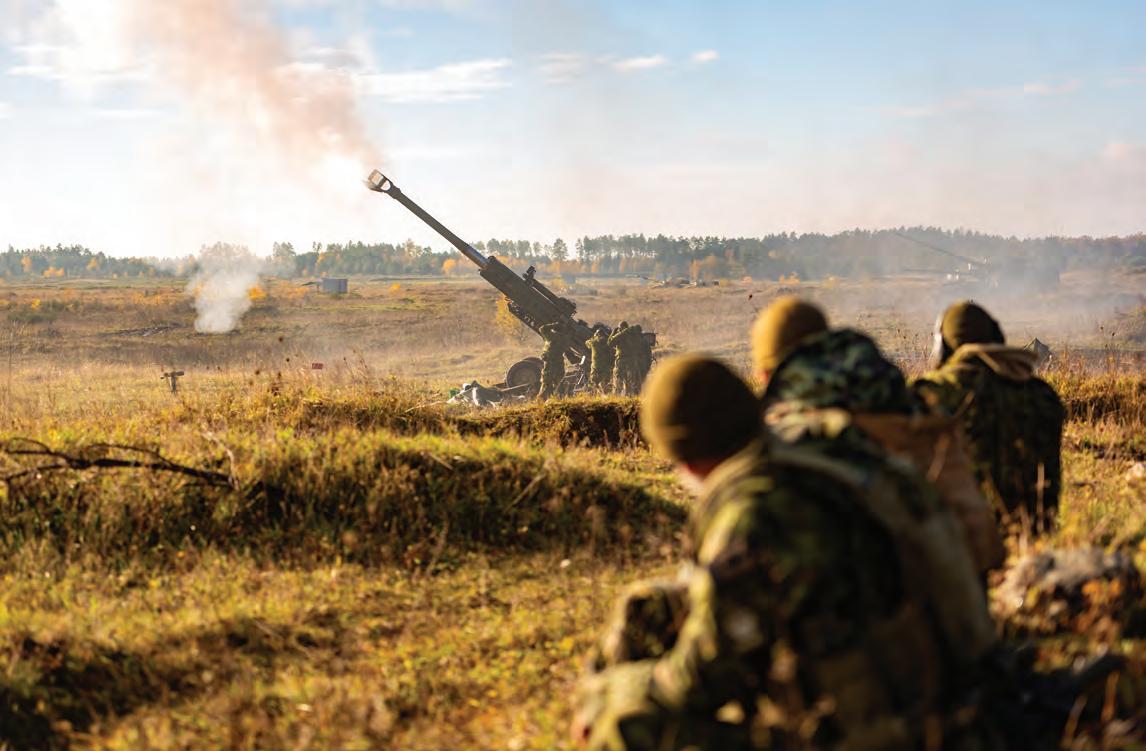
Canadian and Polish soldiers serving with NATO conduct a live fire exercise with a M777 Howitzer in Poland in November 2023.
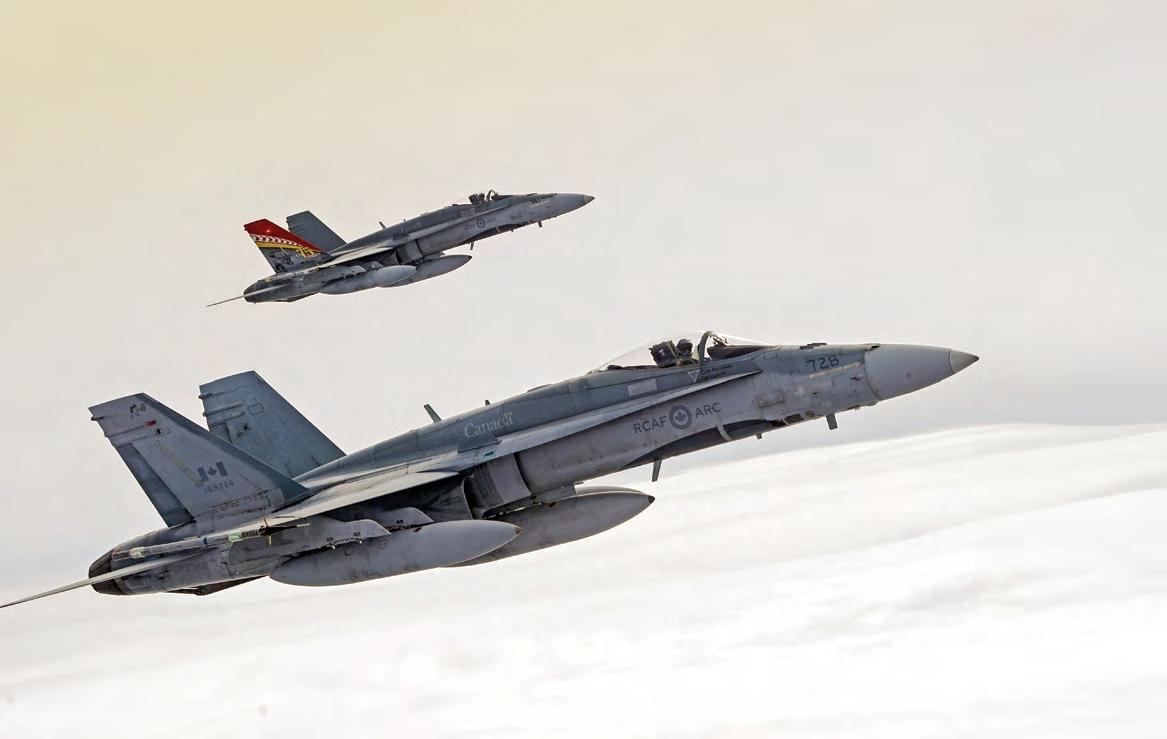
when the fascist powers—Germany, Italy and Japan—were marching inexorably toward war. While the Royal Canadian Navy has plans for new surface combatants, submarines and combat-capable supply vessels, most of them won’t be ready for at least 10 years. The Royal Canadian Air Force will begin to acquire F-35 stealth fighters to replace the CF-18s that first entered service in the 1980s, but it won’t get them for at least five years. The government has also ordered the Boeing P-8 maritime reconnaissance aircraft, but that too will take years to arrive. New armed drones are to arrive on a similar timeline.
The army, meanwhile, has been without a dedicated antiaircraft defence for more than a decade, possesses virtually no modern armour and still relies on the M777 artillery piece from the mid-1990s. All three services are short personnel.
The situation parallels that of 1935 when General Andrew McNaughton, retiring as chief of the general staff, composed a memo for Prime Minister Mackenzie King outlining the deficiencies and sad state of Canada’s military when the fascist powers were clearly preparing for war. King didn’t read the memo for almost two years but, when he did, he reluctantly agreed to begin to increase defence spending. The navy soon acquired several destroyers from Great Britain; Canadian Car and Foundry in Fort William, Ont., (now Thunder Bay) began to produce Hurricane fighter planes; and the army began to seriously consider making Bren guns in Canada under license, purchase trucks and even considered building a Canadian tank—the Ram.
RISING INTERNATIONAL TENSIONS COME WHEN CANADA’S MILITARY IS ALMOST AS SMALL AND UNDER EQUIPPED AS IT WAS IN THE LATE 1930S WHEN THE FASCIST POWERS WERE MARCHING TOWARD WAR.
Even so, Canada went to war in September 1939 almost completely dependent on British equipment. It took years to establish a respectable armed forces, and given the current debilitating cut to an already modest national defence budget, Canadians can expect more of the same military shortfalls during the next decade.
Perhaps Senator Raoul Dandurand was correct when he declared at the League of Nations in the early 1920s that Canada “lives in a fireproof house, far from flammable materials.”
Let’s hope for Canada’s sake that’s still true a century later. L
SECOND WORLD WAR
D-DAY PART
THE GREATEST L ANDING
BY JOHN BOILEAU
RELIVING THE ROLE CANADA PLAYED ON D-DAY
half past 3 o’clock this morning, the government received official word that the invasion of Western Europe had begun. Word was also received that the Canadian troops were among the Allied forces who landed this morning on the northern coast of France. Canada will be proud to learn that our troops are being
supported by units of the Royal Canadian Navy and the Royal Canadian Air Force. The great landing in Western Europe is the opening of what we hope and believe will be the decisive phase of the war against Germany.”
—Prime Minister Mackenzie King, national radio broadcast, 8 a.m. EST, June 6, 1944
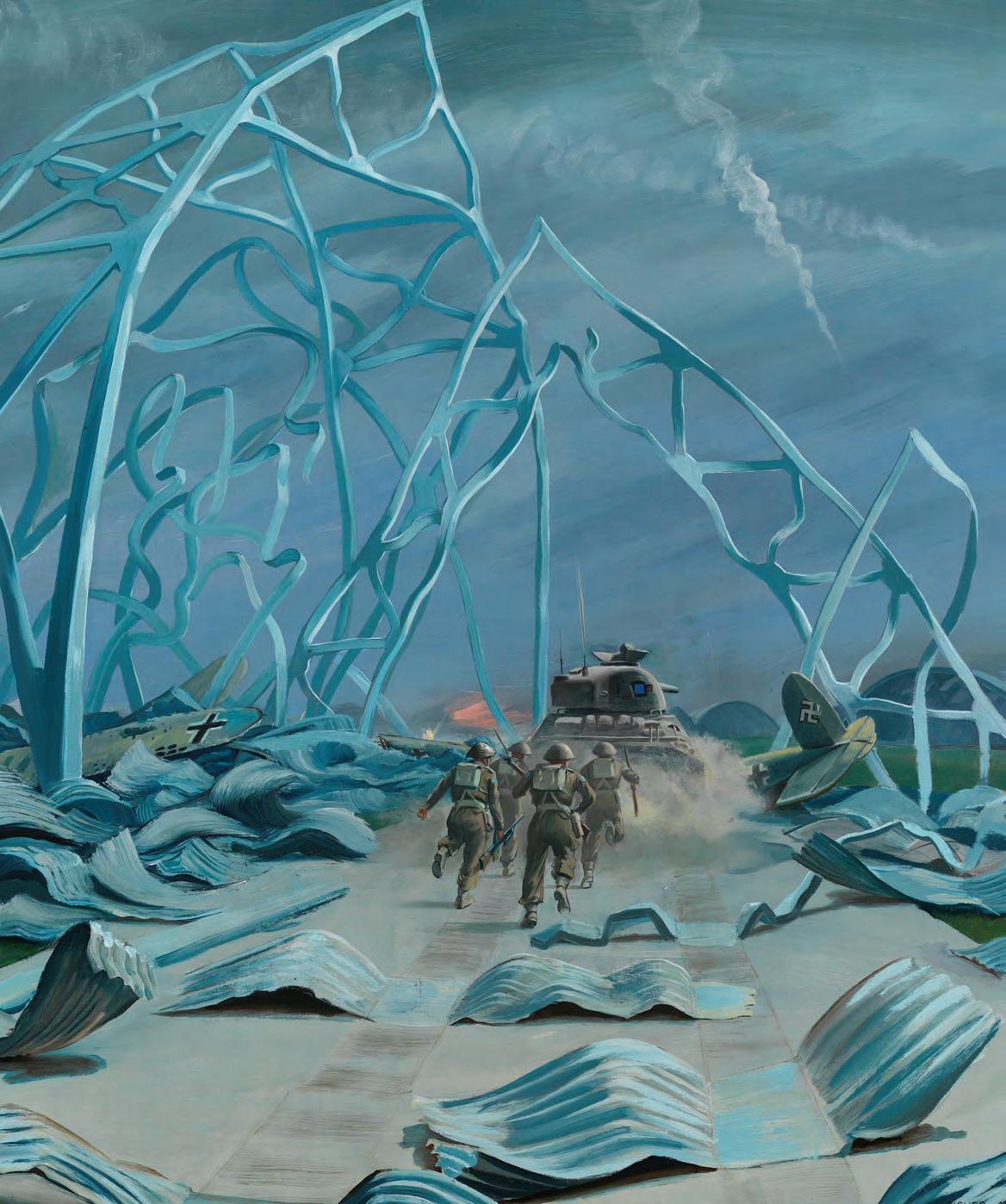
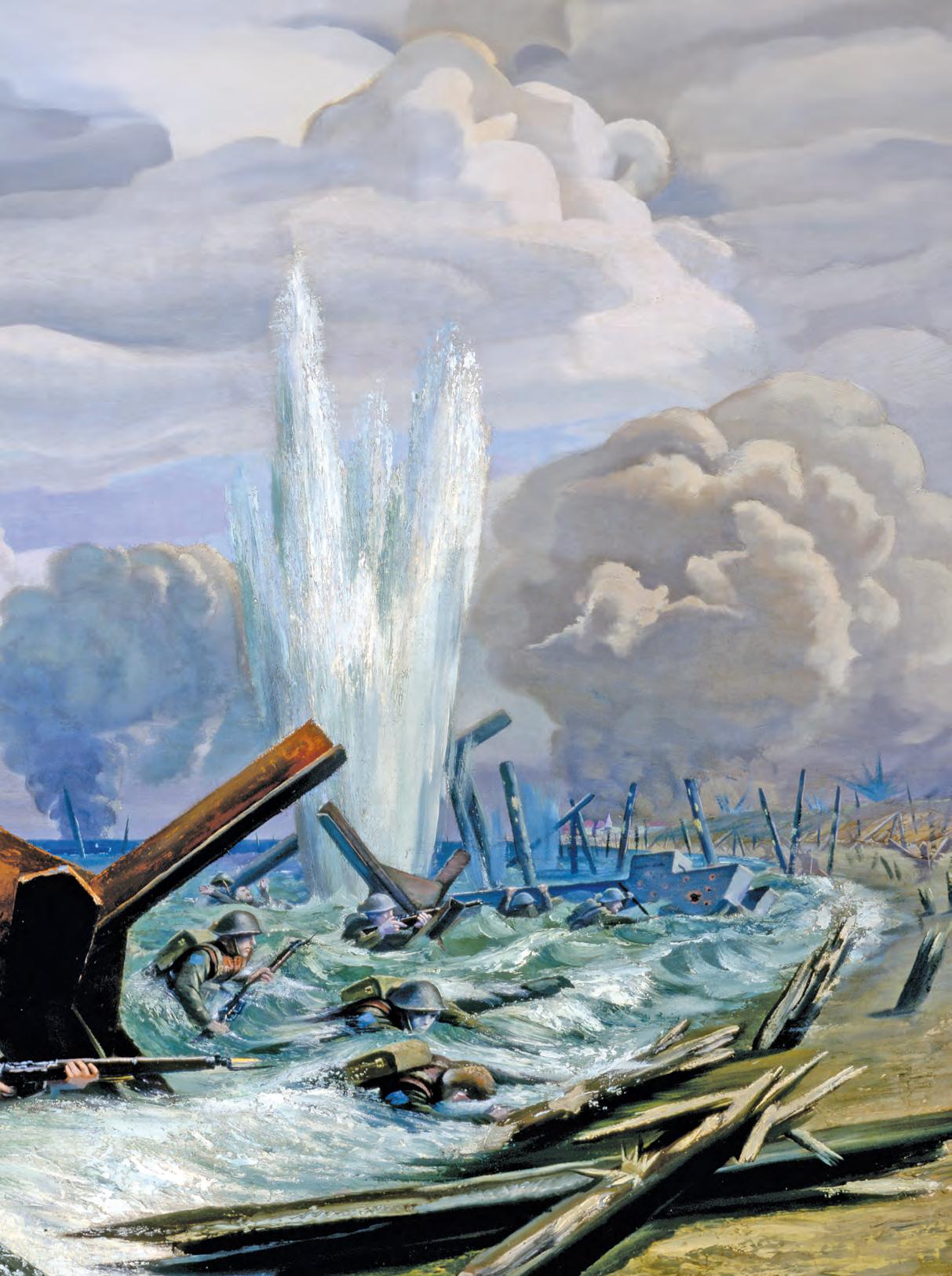
Captain Orville Norman Fisher depicts the D-Day assault. “The noise was unbearable,” he said.
The long-awaited day had finally arrived. After more than two-and-a-half years of planning, pinprick raids to test German defences, buildup of men, materiel and equipment in Britain, disagreements over assault areas, deception plans and last-minute weather concerns, the essential return to the European continent by Allied forces had commenced.
Despite Allied invasions of North Africa and Italy, the Soviet Union insisted another front was necessary to reduce German pressure on their homeland. In late 1943, the British and Americans agreed to open a second major front in France. As a result, the largest amphibious invasion in history was conceived: Operation Overlord.
The scheme called for assaults on five landing areas (not beaches as is often erroneously stated) along a 100-kilometre stretch of Normandy coastline by 156,000 men in six infantry divisions, supported by armoured units. From west to east, the U.S. 4th Infantry Division would land at Utah, the American 1st and 29th at Omaha, the British 50th at Gold, the Canadian 3rd at Juno and the British 3rd at Sword. Airborne landings by the U.S. 82nd and 101st airborne divisions would take place on the western flank, while the British 6th Airborne Division (including the 1st Canadian Parachute Battalion) would land on the eastern one.
Meanwhile, the Germans were acutely aware that an Allied invasion of northwest Europe was inevitable. In its simplest terms, it boiled down to a question of where and when.
In response, the Germans fortified the coast of Europe from the Franco-Spanish border in the south to the northern tip of Norway. Known collectively as the Atlantic Wall, it consisted of hundreds of kilometres of barbed wire and anti-tank ditches, millions of mines and tens of thousands of bunkers garrisoned by hundreds of thousands of soldiers, who manned mortars, machine guns, anti-tank weapons and artillery pieces.
Due to increasing demands placed on Germany by the war in the east, many sections of the Atlantic Wall were staffed by second-rate soldiers, including older men, those with medical conditions and converted prisoners of war. Plus, there was a lack of co-operation between the various groups responsible for the wall, a situation only partially resolved with the appointment of Field Marshal Erwin Rommel as commander of German army forces in northern France.
The design for the Allied campaign involved a far-reaching deception plan collectively known as Operation Bodyguard. Its aim was to make the Germans think the invasion would occur somewhere other than Normandy.
Aerial and beach reconnaissance was carried out along the length of the northwestern European coastline, with more occurring outside of Normandy to make the Germans believe the invasion would take place elsewhere.
Similarly, Allied bombing and fighter operations systematically isolated Normandy from rapid German reinforcement. Like the aerial reconnaissance missions, however, more were carried out in other areas as part of the overall ruse.
Two fictitious armies were created to carry out this feint, code-named Operation Fortitude. The First U.S. Army Group was based in Kent in southeast England under Lieutenant-General George Patton. France’s Pas de Calais area, the closest point to Britain, was its purported target. The British Fourth Army, meanwhile, was stationed in Edinburgh, Scotland, to create the impression that it would invade Norway in conjunction with a Soviet attack.
Communication specialists simulated radio traffic between these armies.
Dummy tanks, trucks and other vehicles constructed of wood, canvas and other materials were strategically placed to create the impression of a buildup of equipment prior to an invasion.
Among the first Allied soldiers to invade France were 117 members of ‘C’ Company, 1st Canadian Parachute Battalion. They jumped just after midnight on June 6, part of the lead element of Britain’s 3rd Parachute Brigade, dropped in advance as pathfinders to mark jump zones for the paratroopers who were to follow them.
The drop did not go as planned. Adverse weather conditions, poor visibility and other factors conspired to scatter the Canadians over a wide area, with some soldiers far from their intended drop zone. Twenty-year-old paratrooper Jan de Vries ended up several kilometres from his planned landing spot. “I wondered where the heck I was when I hit the ground,” he recalled. “I spent all night trying to find my way in the dark toward my rendezvous point near the coast, dodging enemy patrols the whole way.”
AMONG THE FIRST
ALLIED SOLDIERS TO INVADE FRANCE
WERE 117 MEMBERS OF ‘C’ COMPANY, 1ST CANADIAN PARACHUTE BATTALION.
Despite these difficulties and stiff German resistance, the paratroopers set out to accomplish their assigned missions over the next few hours. But the cost was high. Of the 541 paratroopers who landed in Normandy, 34 were killed or wounded within the first 24 hours. Another 82 were captured, while several others were missing.
A few kilometres to the west of the Canadian’s drop zone, the Juno landing area stretched along eight kilometres of beach and included the seaside villages of Vaux, Graye-sur-Mer, Courseulles-sur-Mer, Bernières-sur-Mer and Saint-Aubin-surMer. Once ashore, infantry battalions of the 3rd Canadian Infantry Division under Major-General Rod Keller and Sherman tanks of the 2nd Canadian Armoured Brigade under Brigadier Bob Wyman were to advance inland about 15 kilometres and link up with British units on either side of Juno.
In outline, the first wave was to consist of infantry battalions from the 7th and 8th brigades, each accompanied by Sherman tanks. Their job was to secure the beachhead, establish exits from the shoreline and advance to the high ground west of the city
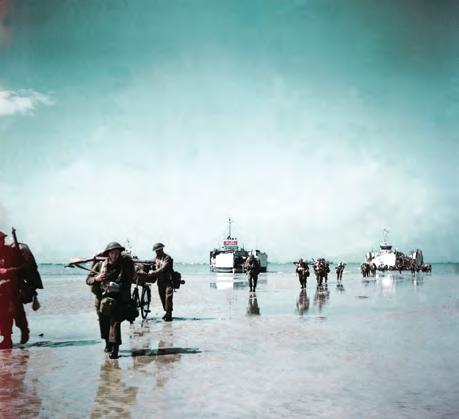
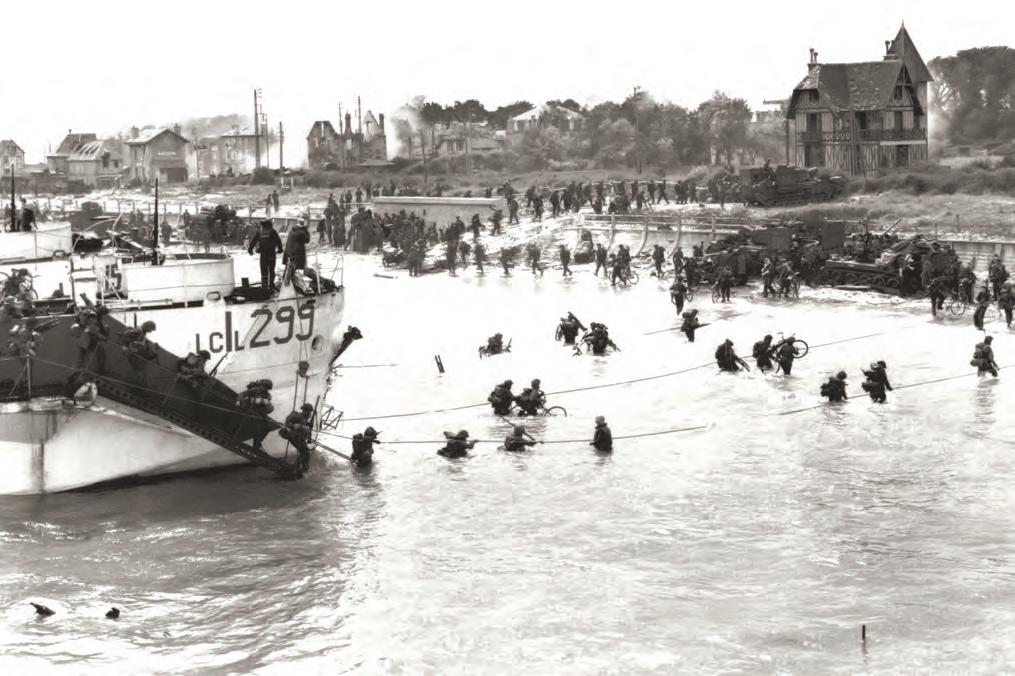
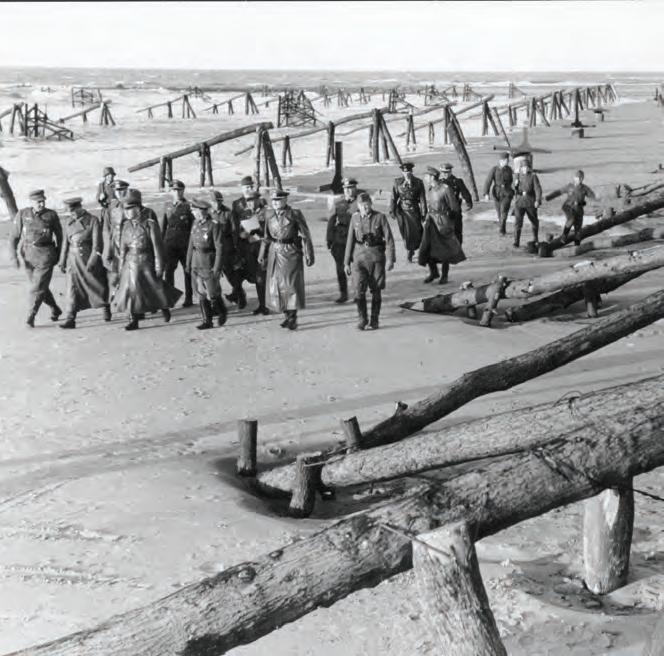
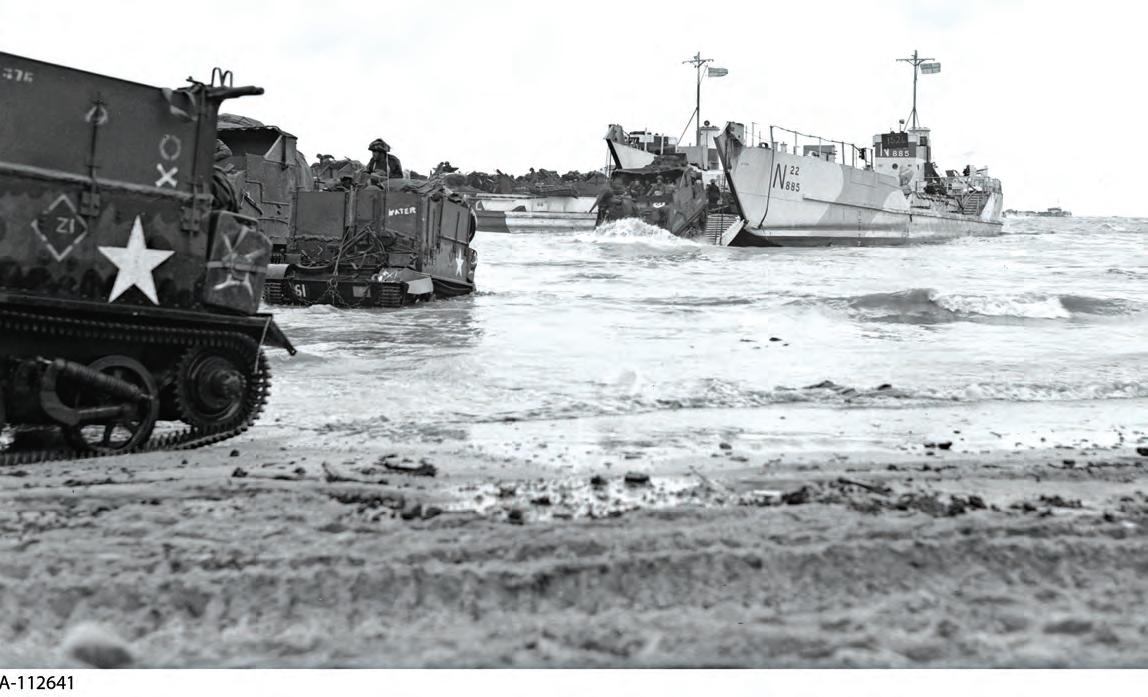
Troops of the 9th Canadian Infantry Brigade (Stormont, Dundas and Glengarry Highlanders) head ashore at Bernièressur-Mer, France, on June 6, 1944 (opposite top). In April 1944, German officers inspect their defences at what became the Canadian landing area (opposite bottom), while personnel of the 1st Canadian Parachute Battalion train for the invasion in February 1944.
of Caen some 15 kilometres inland. In the second wave, the 9th Brigade’s infantry battalions planned to land with tanks and proceed inland to reinforce the lead brigades in anticipation of a German counterattack.
As so often happens in military planning, everything did not go according to plan.
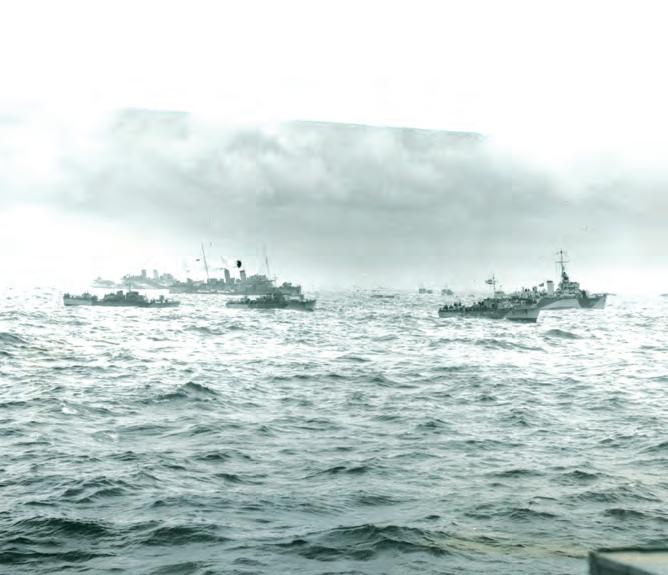
Naval and air support for the landings was massive. An armada of more than 6,900 ships formed up in ports in the south of England. Canadian naval participation in the largest seaborne attack in history consisted of 10,000 sailors in 109 ships, several of which were outside the immediate invasion area.
As the ships left British ports, minesweepers cleared the channels ahead of the fleet. Off the landing areas, destroyers provided fire support, while landing ships, infantry (medium), carried landing craft assault (LCA), the latter each capable of holding a platoon.
ROYAL CANADIAN NAVY SHIPS OFF NORMANDY ON D-DAY
DESTROYERS: HMC ships Algonquin and Sioux LANDING SHIPS, INFANTRY (MEDIUM): HMCS Prince Henry, carrying the 528th Flotilla of eight landing craft assault (LCAs), and HMCS Prince David, carrying the 529th Flotilla of six LCAs BANGOR-CLASS MINESWEEPERS: HMC ships Bayfield, Blairmore, Caraquet, Cowichan, Fort William, Malpeque, Milltown, Minas, Mulgrave and Wasaga (31st Flotilla); HMCS Thunder (4th Flotilla, Royal Navy); HMC ships Georgian, Guysborough, Kenora and Vegreville (14th Flotilla, Royal Navy);and HMCS Canso (16th Flotilla, Royal Navy)
LANDING CRAFT, INFANTRY (LARGE): 260th, 262nd and 264th Canadian Flotillas, each with 10 Royal Navy landing craft manned by RCN personnel MOTOR TORPEDO BOATS: 29th and 65th Flotillas, with eight and seven
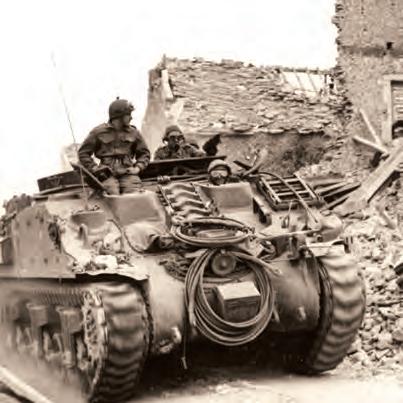
Landing craft, tank (LCT), each transported three specially modified amphibious duplex drive (DD) Sherman tanks. The addition of an inflatable canvas screen and two propellors allowed each tank to “swim” ashore so it could arrive on the shoreline with the infantry.
Some 11,000 aircraft were allocated to Overlord, resulting in a 35:1 ratio in favour of the Allies.
As it turned out, Allied fighter aircraft did not encounter many Luftwaffe planes over Normandy on June 6, leaving Canadian and other Allied aircrew largely as spectators of the massive invasion.
The three Typhoon squadrons of 143 Wing saw the most action on D-Day, as each of them flew three ground-attack missions against defences on the Gold, Juno and Sword landing areas during the initial assault. An early evening armed reconnaissance by the wing resulted in strafing and bombing attacks against enemy tanks, trucks and troop carriers, which resulted in the loss of three aircraft and a pilot in 440 Squadron.
Meanwhile, as the Canadian flotilla approached Juno, a barrage of gunfire saturated the coast. Destroyers and specialized landing craft fired their heavy guns and rockets. Simultaneously, 96 self-propelled 105mm guns of four artillery regiments, embarked on 24 LCTs, zeroed in on specific fortified positions along the beaches. The 105s fired above the LCAs for 30 minutes.
But, as the soldiers who landed at Juno on D-Day quickly discovered, the preliminary naval and air bombardments had caused little damage to enemy positions ashore, manned by soldiers of the 716th Infantry Division, a coastal defence formation.
As the LCAs approached the shore ahead of the rest of the invasion fleet, Sergeant-Major Charlie Martin of the Queen’s Own Rifles of Canada suddenly realized his horizons had been reduced considerably. “All that remained within sight was our own fleet of ten assault craft,
moving abreast in the early-morning silence…. We had never felt so alone in our lives.”
The units of the 7th Brigade under Brigadier Harry Foster, supported by tanks of the 1st Hussars, had Courseulles as their objective. The town was one of the most heavily fortified along the entire Normandy coast.
One strongpoint had a 75mm and an 88mm gun, plus two 50mm ones. Two more 75mm guns covered the town’s flanks, while 12 machine-gun pillboxes and concrete mortar emplacements added to the German defences.
The Royal Winnipeg Rifles landed at their sections of Juno, known as “Mike Red” and “Mike Green” at 7:49 a.m., only to find the enemy defences on the west side were unscathed by the bombardment. As the unit’s war diary noted: “The bombardment having failed to kill a single German soldier or silence one weapon, these companies had to storm their positions ‘cold’ and did so without hesitation…. Not one man flinched from his task.”
Overcoming such heavily fortified positions required tank support. The Sherman tanks of ‘A’ Squadron, 1st Hussars, had launched 1,375 metres offshore while under fire. The leading Shermans arrived shortly after the infantry and brought much-needed direct fire on a well-defended 75mm position in support of an attack by ‘B’ Company.
ROYAL CANADIAN AIR FORCE SQUADRONS OVER NORMANDY ON D-DAY
SPITFIRES (DAY FIGHTER): 401, 403, 411, 412, 416 and 421
SPITFIRES (TOP COVER): 402, 441, 442 and 443
SPITFIRES (RECONNAISSANCE): 400
TYPHOONS (GROUND ATTACK): 438, 439 and 440
MUSTANGS (RECONNAISSANCE): 414 and 430
MOSQUITOS (NIGHT FIGHTER): 409 and 410
‘B’ Company succeeded in its task, but at a heavy price. By the time the position was taken, it was down to a captain and 26 men. Meanwhile, the accompanying engineer assault party from the 6th Field Company lost two-thirds of its 39 men.
To ‘B’ Company’s right, ‘D’ Company jumped from its landing vessels into waist-deep water and waded ashore toward some sand dunes. With the assistance of five Shermans, it captured German positions along the dunes, then headed inland toward the town of Graye-sur-Mer.
‘A’ and ‘C’ companies landed afterward and moved to pre-assigned objectives. Along the way, they mopped up any enemy positions still intact.
‘C’ Company of The Canadian Scottish Regiment had been detached from its parent unit to take part in the first wave. Its mission was to attack a pillbox on the extreme right flank of Juno, the area code-named “Mike Green.” It landed to find the enemy position abandoned.
The company moved on to its next objective, a protected field gun battery at a chateau. The Canscots quickly overran the position.
On the 7th Brigade’s other area of the beach, “Nan Green,” The Regina Rifle Regiment landed at 8:05. Like the Winnipeggers, they had two companies in the assault and two in reserve. While ‘A’ Company attacked a strongpoint and held the enemy’s attention, ‘B’ Company was able to land unopposed and enter Courseulles. With the assistance of Shermans and Royal Engineer assault vehicles, it began to clear the town.
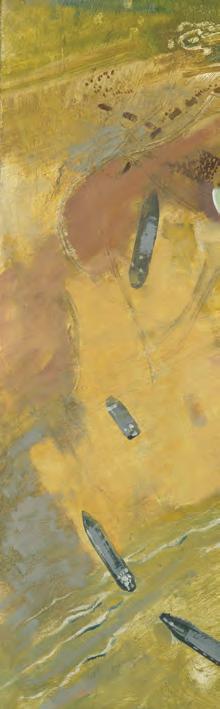
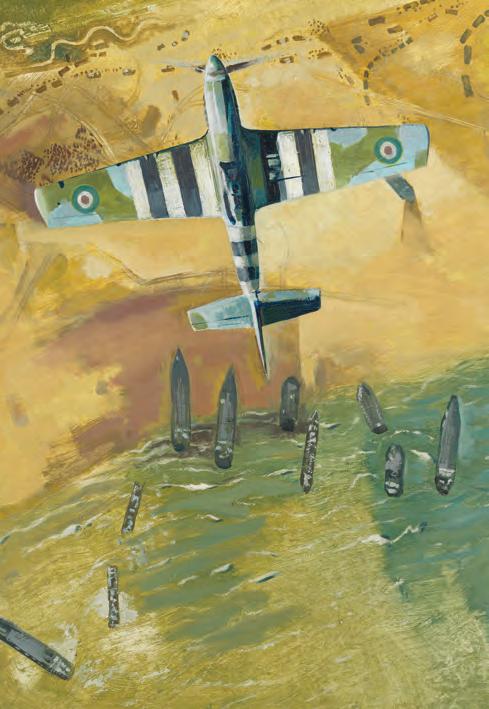
Flight Lieutenant Eric Aldwinckle depicts the invasion action from above. Infantry ships, motor torpedo boats and a minesweeper off the port beam of HMCS Prince David just before dawn on D-Day (opposite).
AS SO OFTEN HAPPENS IN MILITARY PLANNING, EVERYTHING DID NOT GO ACCORDING TO PLAN.
Meanwhile, ‘A’ Company had outflanked the German beach position and began to move inland, but was forced back to the area of the enemy strongpoint. With armoured support, the company finally secured the position at 2 p.m.
When the Reginas’ reserve companies landed, the incoming tide had covered several of the beach obstacles. As a result, the LCAs carrying ‘D’ Company struck underwater mines, leaving less than 50 men to move inland. ‘C’ Company fortunately landed safely, and the two companies advanced to successfully capture the bridge at Reviers.
Troops of Le Régiment de la Chaudière disembark from landing craft at Bernières-sur-Mer, France, on D-Day.
Although a beachhead had been secured, not all Canadian soldiers moved off the landing areas as soon as they should have, especially at Courseulles. This was due to limited exits through the seawall, sand dunes, mines and other obstacles, which required specialized equipment and troops that were not immediately available in sufficient numbers.
But some exits were created through the extraordinary efforts of soldiers such as Sapper John Duval of the Royal Canadian Engineers’ 16th Field Company. At about 9:30 a.m., Duval, an armoured bulldozer operator, single-handedly created three vehicle exits over the seawall within 20 minutes, under heavy mortar and small arms fire. He received the Military Medal for his efforts.
While 7th Brigade was carrying out its mission, to the east Brigadier Ken Blackader’s 8th Brigade was engaged in similar tasks.
The Queen’s Own was assigned the area known as “Nan White” at Bernières-sur-Mer, while The North Shore (New Brunswick) Regiment landed on “Nan Red” at Saint-Aubin-sur-Mer.
At Bernières, the Queen’s Own faced a field gun and four concrete machine-gun nests stretched along 275 metres of seawall. The two leading companies were supposed to land to the right of the position to capture it from a flank, but wind had pushed the landing craft to the left and ‘B’ Company landed in front of the position.
Armoured support was delayed due to rough seas, which required the LCTs to beach their Fort Garry Horse tanks rather than launch them offshore, so ‘B’ Company attacked the enemy defences alone. Half of the company was killed or wounded in the first few minutes. As had happened elsewhere along the shoreline, ‘B’ Company’s battle allowed ‘A’ Company to get off the beach, but it got pinned down once over the seawall. Heavy fighting followed as the company slowly overcame enemy resistance.
The Queen’s Own reserve companies landed 25 minutes after the assault companies. ‘D’ Company met little resistance, its commander Major James N. Gordon describing the enemy as “mere boys” who “ran away.” As a result, they cleared the beach in four minutes and moved on to the southern end of Bernières.
Half of the LCAs carrying ‘C’ Company (and battalion headquarters) struck mines, forcing survivors to swim or wade ashore. By 8:45 a.m., both reserve companies were moving toward the far end of Bernières and the reserve battalion, Le Régiment de la Chaudière, had landed.
The Queen’s Own gained a double distinction in the action. The unit broke through the Atlantic Wall in less than an hour, but it also suffered the heaviest losses of any Canadian battalion on D-Day: 61 killed and 76 wounded.
Meanwhile, the North Shores landed to the left of the Queen’s Own at 8:10. The unit’s primary target was a fortified 50mm gun position in Saint-Aubin-sur-Mer in the centre of the battalion’s sector.
‘B’ Company was to capture the nest by moving south and taking it from the rear, but naval and aerial gunfire had failed to damage the position. Plus, as they had with the Queen’s Own, the Fort Garry Horse tanks supporting them landed late due to the rough seas and were not immediately available.
Salvation took the form of a battalion 6-pounder anti-tank gun, which took out a pillbox. The unit’s 2-inch mortars joined in the attack just before Garry’s tanks arrived to complete the mission.
To the west, ‘A’ Company faced tough opposition as it cleared the beach, but it persevered and linked up with the Queen’s Own around 9:50. ‘C’ and ‘D’ companies landed at 9:45, cleared the western half of the town and advanced inland toward Tailleville to clear another defensive post.
Units of 9th Brigade under Brigadier Doug Cunningham were in reserve and did not land until about noon. The Highland Light Infantry of Canada, The Stormont, Dundas and Glengarry Highlanders and The North Nova Scotia Highlanders came ashore at Bernières, along with tanks of the Sherbrooke Fusiliers. A massive traffic jam greeted them, which delayed their move off the beach until noon.
At that time, Canadian soldiers began to advance inland on a broad eight-kilometre front. They moved steadily forward throughout the day and by nightfall had established an uneven, but connected, defensive line about six kilometres from the coast. The Canadians had reached Creully in the west and Villons-les-Bussons in the east.
Despite facing one of the toughest landing areas, the Canadians had penetrated further inland than the troops of any other country. But their magnificent achievement was costly. Of the approximately 14,000 Canadians who landed on D-Day 1,096 became casualties, including 381 killed.
For most of the Canadians involved, D-Day was their first battle of the war. Soldiers from across the country—the Maritimes, Quebec, Ontario, the Prairies and the West Coast—had faced a battle-hardened, experienced enemy. Like their fathers a generation earlier, the Canadians didn’t lack courage.
Several weeks of tough fighting followed, including powerful German armoured counterattacks during the next few days, before the battle for Normandy concluded near the end of August. The Canadians’ actions on the beaches and fields of Normandy helped lead the way to the final and total collapse of Hitler’s much-vaunted ThousandYear Reich less than a year later. L
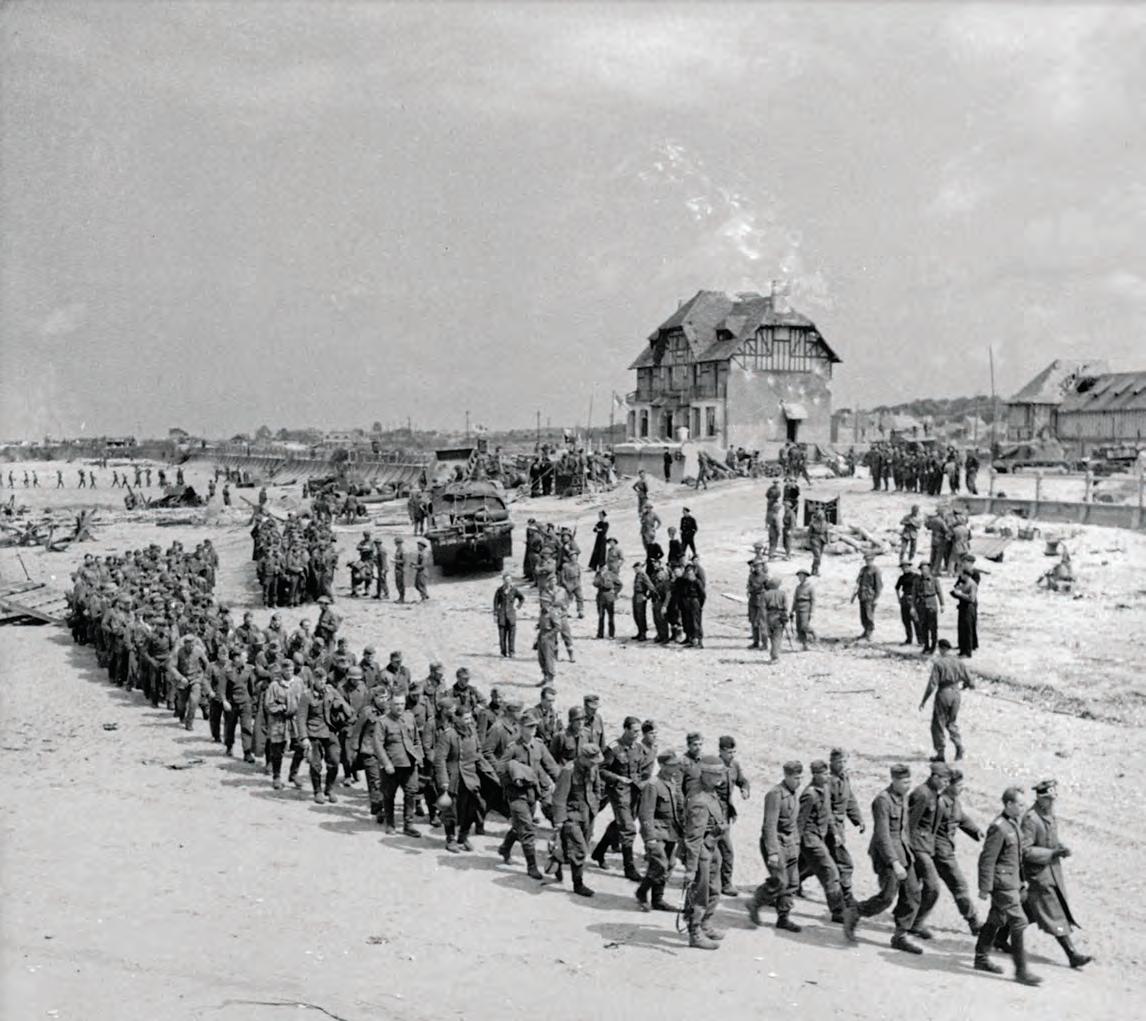
German prisoners captured by Canadian troops on D-Day are escorted to landing craft on Juno Beach.
SECOND WORLD WAR
D-DAY PART
BY MARK ZUEHLKE
SUBS, SANK SAME ”
THE BOMBER CREW THAT MADE HISTORY ON JUNE 7/8, 1944
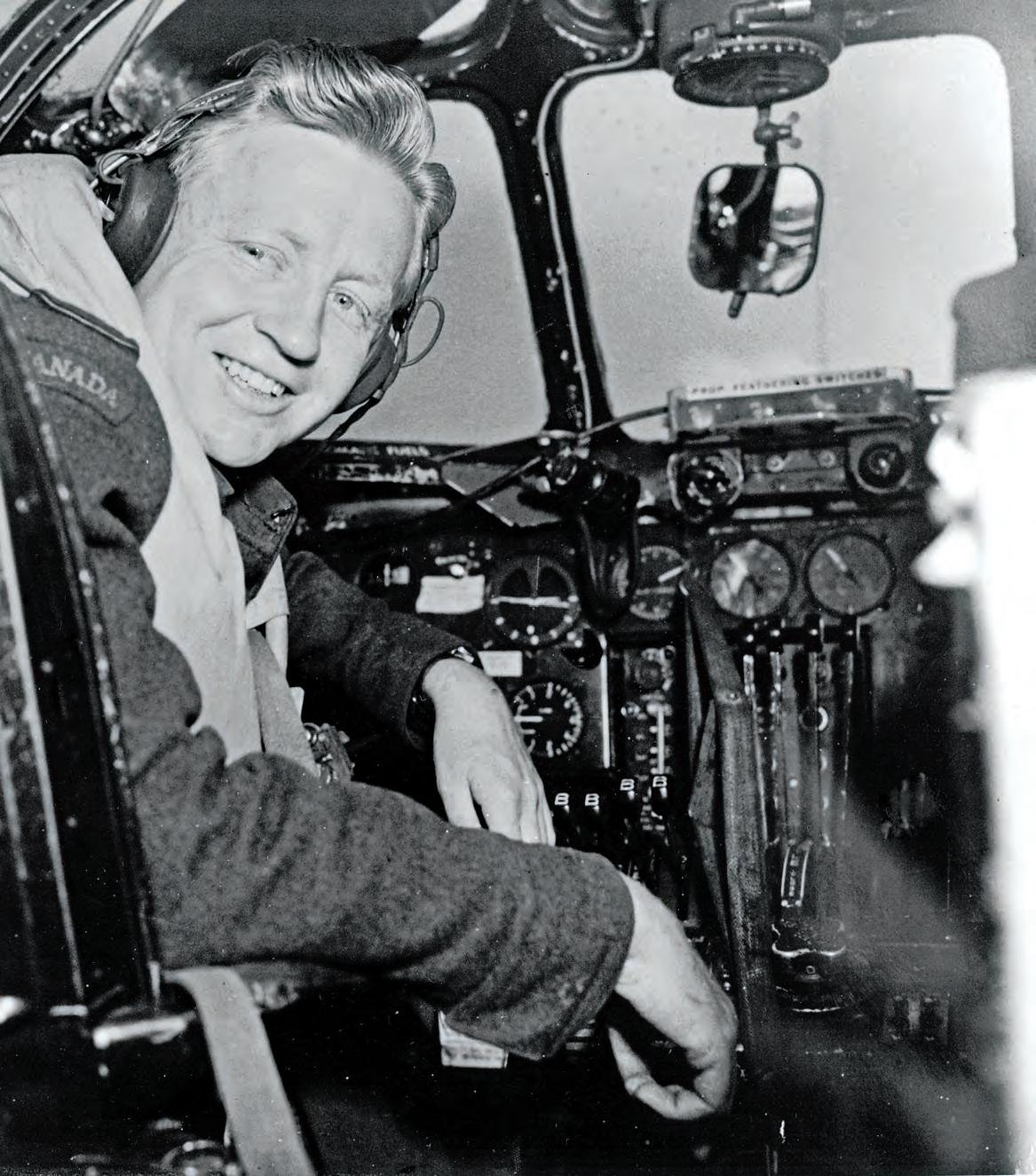
Flying Officer Kenneth Owen (K.O.) Moore and his crewmates from 224 Squadron took out two U-boats in the English Channel on June 8, 1944.
the runway at St. Eval, Cornwall, in southwestern England. As part of Royal Air Force Coastal Command’s 224 Squadron, Moore was flying a “cork” patrol.
“We were to keep the U-boats from getting mixed up with the [densely concentrated] landing forces,” said Moore in a 2004 interview. “Because once that happened all hell would break out. Nobody would know who was friend or foe.”
The No. 224 Liberators were to close the southern approaches to the English Channel to submarines coming from French ports in the Bay of Biscay. With about 30 missions to their credit, the 10-man crew aboard “G-George” were veterans of North Atlantic convoy-protection missions where, in March 1944, they had crippled a U-boat.
This night, however, the 10 men—seven of whom were Canadian—were jumpy
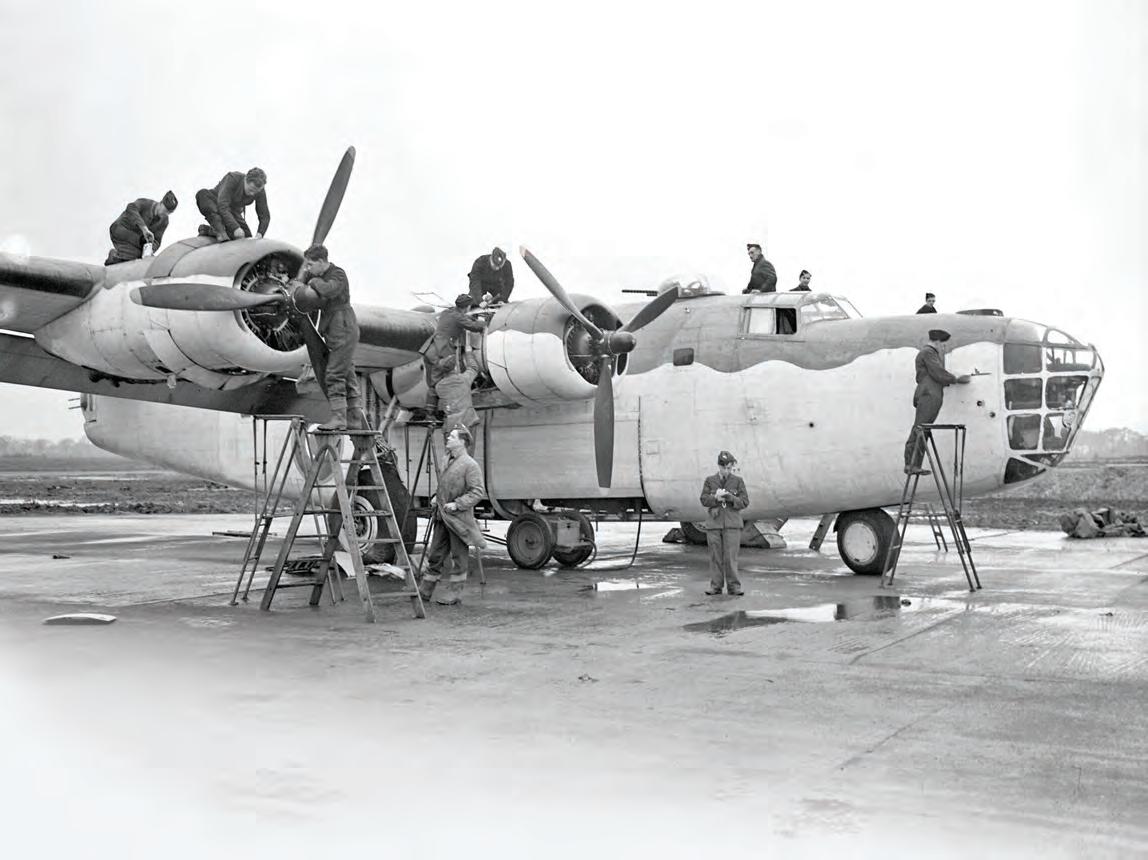
Personnel conduct an inspection of a 224 Squadron Liberator in England in December 1942.
and hyper-vigilant. Just two weeks earhad been part of a four-plane night operation dropping flares off Saint-Nazaire to simulate an approaching invasion. Although their flight had been entirely uneventful, the other Liberators had disappeared without trace. Moore worried that the Germans had developed some secret means of vectoring night fighters against the Liberators.
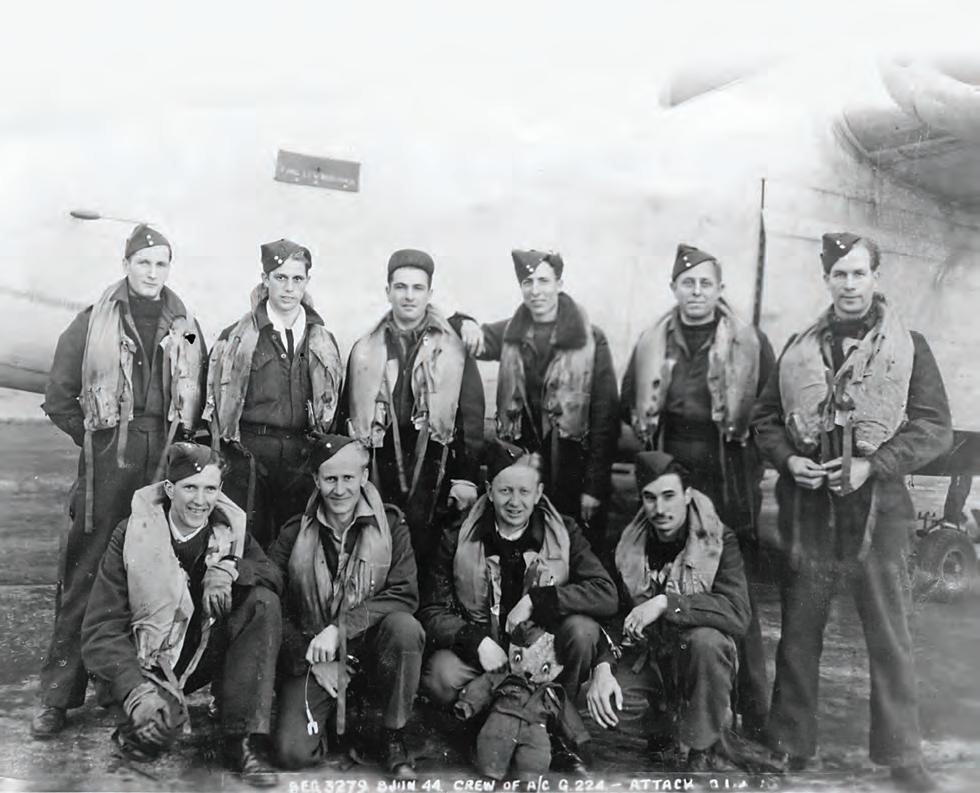
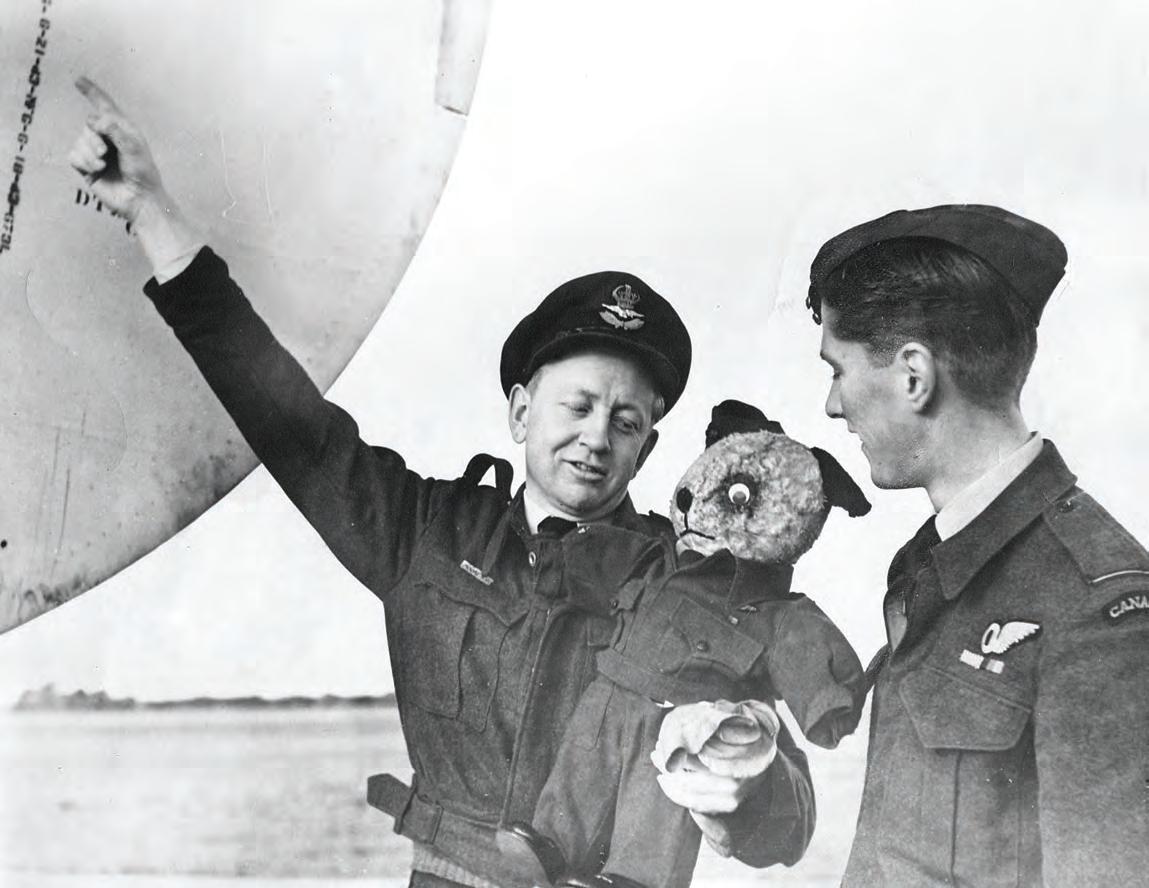
Moore hoped their lucky mascot, a teddy bear called Dinty, would work its charm. The Canadians had purchased the bear in a Montreal bar and had a tailor make a customized RCAF uniform for it just before they flew a Liberator overseas to England. Often positioned front and centre in crew photographs, Dinty also flew each mission.
For the June 7 operation, the Liberator carried a dozen 250-pound Mark XI Torpex depth charges and a 600-pound acoustic homing torpedo. Since they were hunting surfaced U-boats, the charges were set to detonate just below the surface.
Born in Rockhaven, Sask., on Aug. 11, 1922, Moore had quit a Vancouver department store job to enlist shortly after he turned 19 in 1941. Joining the RCAF with just a high school education, Moore aspired to become an aircraft mechanic. Urged on by the Edmonton processing depot’s officers, he took aircrew qualification tests, breezed through every exam, then trained as a pilot in the British Commonwealth Air Training Plan.
From Canada, he reported to an operational training unit in Nassau, Bahamas, to learn to fly Liberators in an anti-submarine role, then returned with his six Canadian crew to Canada before he was deployed to Britain. In England, a Scotsman, an Englishman and a Welshman joined the team.
The Liberator was ideally suited to anti-submarine operations. Its four powerful engines and signature long, tapered wing atop the fuselage enabled the aircraft to carry a 5,000-pound weapon load across a flying range of 5,300 kilometres (3,300 miles). For anti-submarine operations, the retractable belly turret was exchanged for an air-to-surface radar unit. The bomber was also capable of up to 16.5 hours of patrol time, making it a game changer in protecting Atlantic convoys.
“WE WERE TO KEEP THE U-BOATS FROM GETTING MIXED UP WITH THE LANDING FORCES. BECAUSE ONCE THAT HAPPENED ALL HELL WOULD BREAK OUT.”
The crew cut its teeth prowling Atlantic skies, becoming fast friends in the process. Moore considered them a team of equals. Their patrols took them from Hampshire, England, to the mid-Atlantic gap—a section of ocean previously unreachable by Allied aircraft based in North America, Iceland or Britain. These patrols were so long that two pilots and two navigators were required to support each other. There was a flight engineer and five wireless/radar operators who also operated the Liberator’s five machine guns.
In 1943, 224 Squadron relocated to St. Eval and turned to English Channel and Bay of Biscay operations. These missions still ran between 10 and 12 hours, so the crew size was maintained.
Just hours after their historic feat, the Liberator crew, and their luckycharm mascot Dinty, pose for a photo on June 8, 1944.
On the night of June 7, G-George was in a spread-out formation that enabled each plane to pass over a given spot of the Channel approaches every 15 minutes. There had been a full moon at low tide on June 6, so it still brightly illuminated the sky the following evening. Visibility was excellent. The Liberators operated at an altitude of 152 metres (500 feet), allowing them to drop to attack altitudes in seconds.
Just after 2 a.m., Warrant Officer William Foster—overseeing the air-to-surface radar—reported a sighting ahead. Moore told Foster to shut down the radar to
MOORE AND HIS CREW SOON
LEARNED THEY HAD MADE AVIATION HISTORY—THE WAR’S ONLY DOUBLE SUBMARINE KILL BY A SINGLE BOMBER ON A SINGLE PATROL.
prevent detection by the enemy. Shoving the Liberator down to 61 metres (200 feet), he passed the sighted position at top speed. Off to the flank, Moore saw a U-boat on the surface and began a slow 360-degree turn to gain a stern-on attack angle.
Standard operating procedure called for attacks from an altitude of 91 metres (300 feet), but Moore had no intention of complying. “We were losing airplanes,” he recalled. “We took the attitude in my crew” that because of that doctrine, the Germans would know that was the altitude “they’re going to be attacked from.”
Dropping to just 15 metres (50 feet), Moore started his approach. The Liberator was so low that the four big props lifted a thick wake as it roared over the water.
“There weren’t any steep turns involved, so you were pretty well set up and my little rule of thumb was that I kept the stuff going over the cockpit. If the enemy shellfire was going over top of it, you knew you were all right.”
Moore raced toward the U-boat at 360 kilometres per hour (190 miles per hour).
From the front turret, navigator Flying Officer Alec Gibb thought the submarine “looked as if it were painted on white paper.” It was a Type VIIC U-boat that had been up-gunned in early 1944 so that it was throwing out fire from a 37-millimetre M42 automatic gun and two double-barrelled 20-millimetre guns.
From his position, Gibb fired the dual 12.7-millimetre Browning machine guns. One German sailor clutched his stomach and pitched forward. The others on the boat’s hull dove for cover.
Then, second navigator, Warrant Officer J. (Jock) McDowell, peering through the bombsight, punched the release button and six depth charges perfectly straddled the U-boat three to a side.
“Oh, God, we’ve blown her clean out of the water!” the rear gunner yelled as the plane passed over. Moore hauled the Liberator around and saw water heaving up from explosions and “distinct patches of black oil in the dark sea. In the patches were dark objects, almost certainly bodies.”
Allied intelligence identified the U-boat as U-629. Some German sources indicate the U-boat might have been U-441, which was also lost that night—regardless, all 51 sailors aboard perished in each case, so confirmation is impossible.
About 10 minutes after the first attack began, Foster reported another contact just off the French island of Ushant. It was dead ahead. Ordering the radar silenced again, Moore began another 15-metrehigh (50 foot) approach. McDowell spotted the German sub. It was up moon and slightly to port. Moore turned to the attack and the nose-gunner opened fire.
German anti-aircraft gunners immediately fired back. Navigator Gibb watched “a perfect fan of tracer from the conning tower” come toward them. But as Moore
expected by his streamed harmlessly overhead. Seconds later, six depth charges were released. Four landed on one side of the U-boat, two on the other.
Normally, a U-boat caught by such a straddle broke apart, but this time the sub dropped just and continued chugging along with oil trail ing in its wake. Then Warrant Officer Don Griese in the upper turret shouted: “She’s going down! It’s like a Hollywood picture!”
Banking for another pass, Moore saw the U-boat’s bow sticking vertically out of the sea. Then, slowly, U-373 slid straight down and was gone. Flying over the site, the Liberator’s spotlight shining bright, Moore spotted three dinghies crowded with sailors floating amid debris and a thick oil slick.
THE CREW CUT ITS TEETH PROWLING ATLANTIC SKIES, BECOMING FAST FRIENDS IN THE PROCESS.
“Sighted two subs, sank same,” Moore radioed back to base. Despite the laconic message, Moore and his crew knew they had achieved something remarkable. They were slapping each other on the back and laughing. A night when they had feared illluck was instead filled with good fortune.
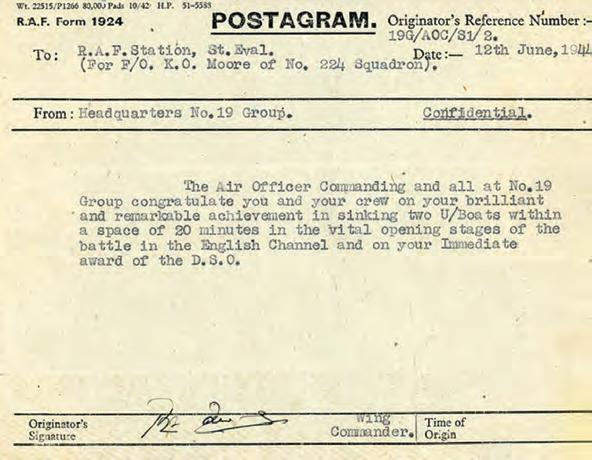
Moore and his crew soon learned they had made aviation history—the war’s only double submarine kill by a single bomber on a single patrol. Moore was awarded a Distinguished Service Order and a U.S. Silver Star. Foster and McDowell each received a Distinguished Flying Cross. Flight Engineer Sergeant J. Hamer earned a Distinguished Flying Medal.
Moore put G-George down on the runway at 7 a.m. He and the crew were swarmed by hundreds of base personnel, including the group captain. No. 224 airman Martin Bowman rode with Moore in a van back to the billets.
“He was too tired to talk,” wrote Bowman in his memoir. “When we arrived at the mess he went off to sleep. About three hours later I saw him carrying plates of fish and chips to the other members of his crew still in their beds.”
Moore, mascot Dinty and a colleague. Moore was awarded the Distinguished Service Order for his role in the war’s only double submarine kill by a single bomber on a single mission.
THE DOGS OF POSTWAR
BY PAIGE JASMINE GILMAR, WITH PHOTOGRAPHY BY JOSÉE LAVOIE
“I’m
HOW MENTAL HEALTH SERVICE ANIMALS HELP VETERANS. AND A LOOK AT THE DECADE-LONG STRUGGLE TO HAVE VETERANS AFFAIRS CANADA FUND THEM.
going to get theological on you.”
The playful line came from the mouth of Reverend R.M.A. (Sandy) Scott, an army chaplain who joined the Canadian Armed Forces in 1979, continuing a military legacy from his maternal family dating back to 1914. Originally serving in a naval reserve unit, he eventually transferred to the North Saskatchewan Regiment as its chaplain. Scott spent more than 24 years in the reserves.
Sporting rectangular, thin-rimmed glasses, a meditative demeanour and a shock of white hair, he looks the part of a man of God through and through.
He knew life, its bits and brokenness, through spiritual eyes, and the Lord’s word was his means of expressing what he saw. And amid the beams of afternoon sun peeking through the lush red pines and balsam firs at the Canadian Veteran Service Dog Unit training centre in White Lake, Ont., God felt present.
“You can experience God’s grace and healing,” said Scott while sitting on a
lounge chair inside a curtained gazebo. “These are two really important things theologically in terms of people’s faith.
“I believe God’s grace works through dogs.”
While some might have shrugged off the unorthodox prospect, Scott, the centre’s fundraising committee chair, kept an earnest sparkle in his eye. He recounted a story.
His friend’s dog had recently passed, so he decided to read a book about a man who had also lost his canine companion. “This guy in the book was grieving in the same way,” said Scott. “While grieving, he had a vision, where Jesus came to him with a group of dogs. His dog came out of that pack and greeted him.
“And Jesus said, ‘I lent this dog to you for a while. These are all my dogs. I send them to help people. This is part of my grace and my healing.’”
At that moment, Scott’s emotions bubbled over, his voice trembling in the cool September breeze. “That’s how I’ve experienced it. My dog is a gift, a gift from the Divine.
“This dog is beyond.”
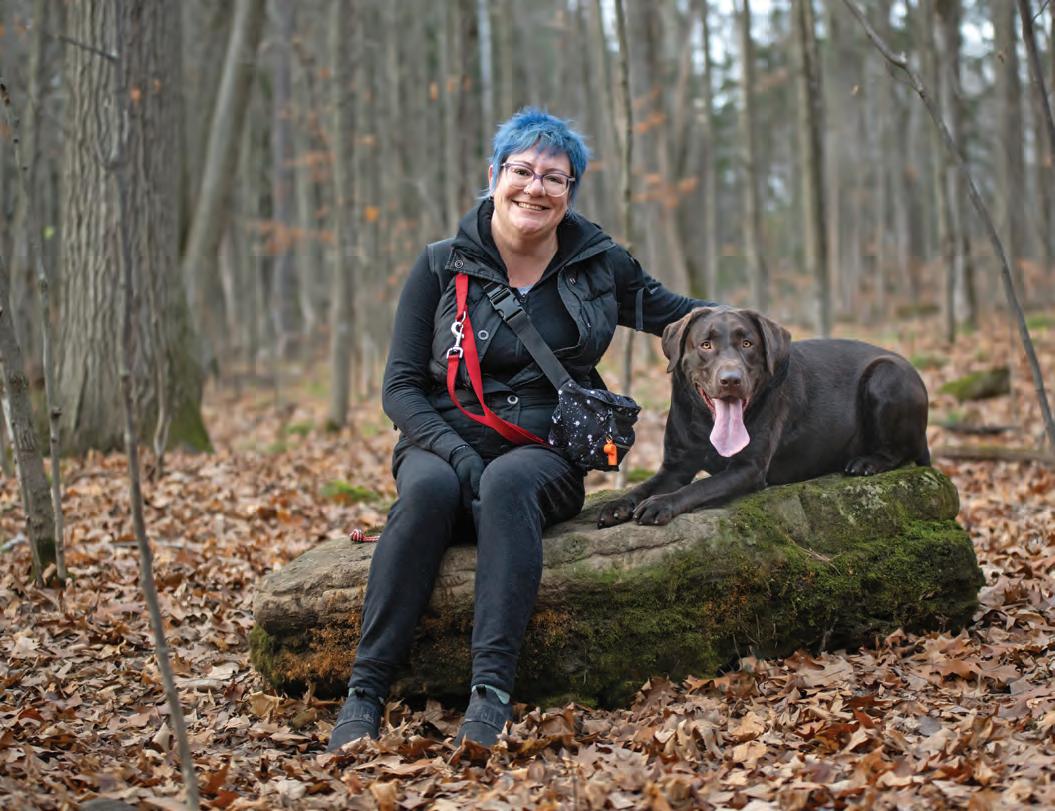
Reverend R.M.A. (Sandy) Scott poses with his service dog Mandy at the Peacekeeping Monument in Ottawa.
“ I BELIEVE GOD’S GRACE WORKS THROUGH DOGS.”
Scott’s chocolate brown lab, a service dog named Mandy, sat coiled at his feet. His therapist had referred him to the centre in 2016. He had been diagnosed with post-traumatic stress disorder. As chaplain, the death notifications and repatriations that followed during the War in Afghanistan had taken their toll.
Researchers in Canada have reached similar conclusions. “We’re not asking the question anymore if the dogs work— at least my team isn’t—because we already have very strong evidence,” said Linzi Williamson, an assistant professor in the department of psychology and health studies at the University of Saskatchewan. “It’s about trying to optimize and figure out the best path forward, not just for the veterans, but for the dogs.”
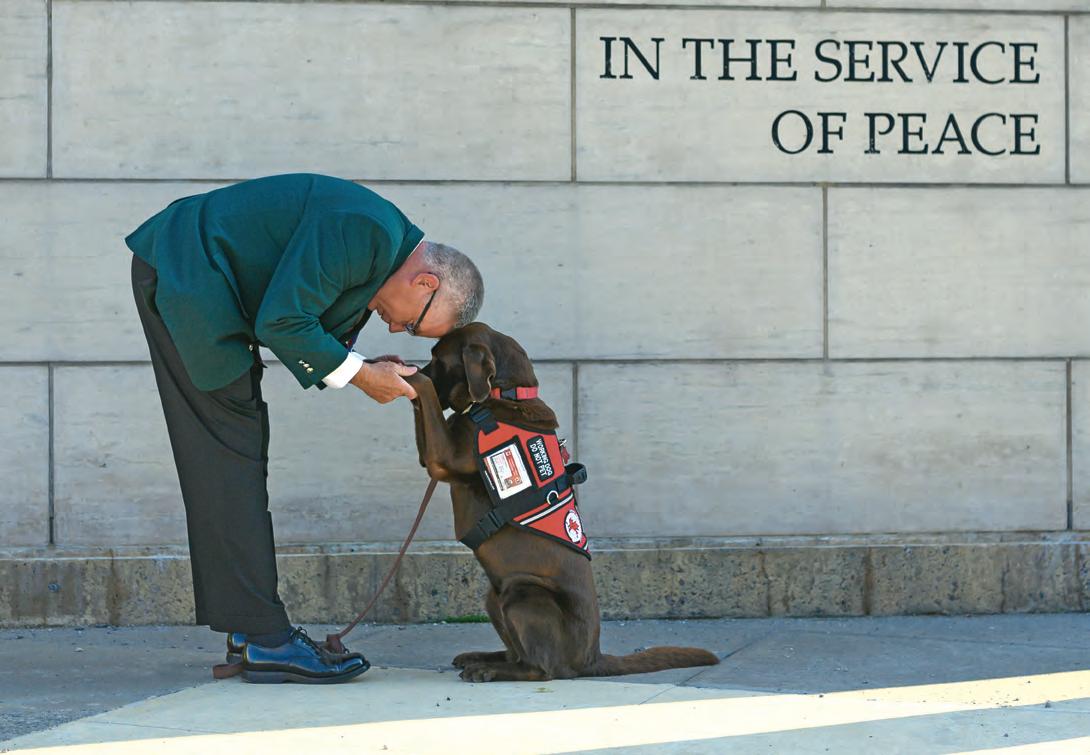
Scott and Mandy share a quiet moment.
“I had lots of problems, but because I was a clergyman, I couldn’t face them, and you had to keep up a facade,” said Scott. “So, my first marriage fell apart, and after that, it just was a cascade of horrible events.
“I was afraid. I was terrified.”
Mandy changed Scott’s life, however, in ways only a service dog can.
Service dogs have been used to aid the visually impaired for centuries. Today, there’s increasing evidence that the animals can help alleviate psychiatric conditions in veterans. A 2023 study facilitated by the University of South Australia, University of Adelaide and Military and Emergency Services Australia found that 90 per cent of veterans reported improvements in their PTSD, anxiety and depression within a year of working with a specifically trained dog.
Despite such results and a commitment nearly a decade ago by Veterans Affairs Canada to establish national training standards, former CAF members such as Scott are still fighting to have VAC pay for their service dogs.
Showing her age only by the slightest token—grey hairs—Mandy remains as sharp as ever. Even with her service vest off, she appeared keenly aware of Scott’s needs.
“She’s reminding me right this minute, ‘We’re here. Stay grounded. Stay with me,’” said Scott.
Moments later, Scott’s wife Rae-Anne popped her head into the gazebo. Smiling with what seemed to be the most delightful secret, she said: “When you spell the word ‘dog’ backward, what do you get?”
The effects of PTSD are not easily undone, but Scott’s life had been touched
and transformed by a dog’s love. At first, he was skeptical. Having trouble even going to the gym three times a week, Scott wondered why his therapist would recommend the help of a service dog.
“I said, ‘I can’t even take care of myself, let alone a dog,’” said Scott.
But Rae-Anne thought there was more to service dogs than just another four-legged responsibility. Scouring the internet, she came across the White Lake centre, and Scott’s therapist provided him a referral. Rae-Anne recalls the moment Scott first met the spunky brown dog: “That was the first time I saw him smile in years.”
Slowly, Scott discovered that Mandy provided him with something he had been missing for a while: routine. With every 7 a.m. wake-up call and morning and evening walk that Mandy fastidiously managed, PTSD’s cardinal symptoms of shame, guilt and self-deprecation began to fade. With this new schedule, Scott slept better, went out in public more, took fewer medications and became more physically and emotionally fit. Scott also lost 20 pounds within the first few weeks of working with Mandy.
“Mandy makes me a better person,” said Scott. “She makes me easier to live with. My wife doesn’t have to worry about me.
“This dog provides a lifestyle that’s healthy. And you can’t buy a lifestyle.”
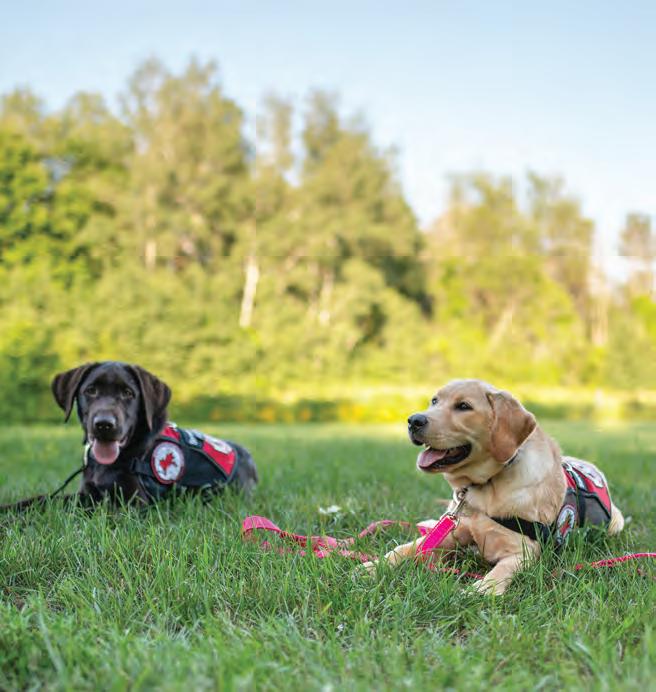
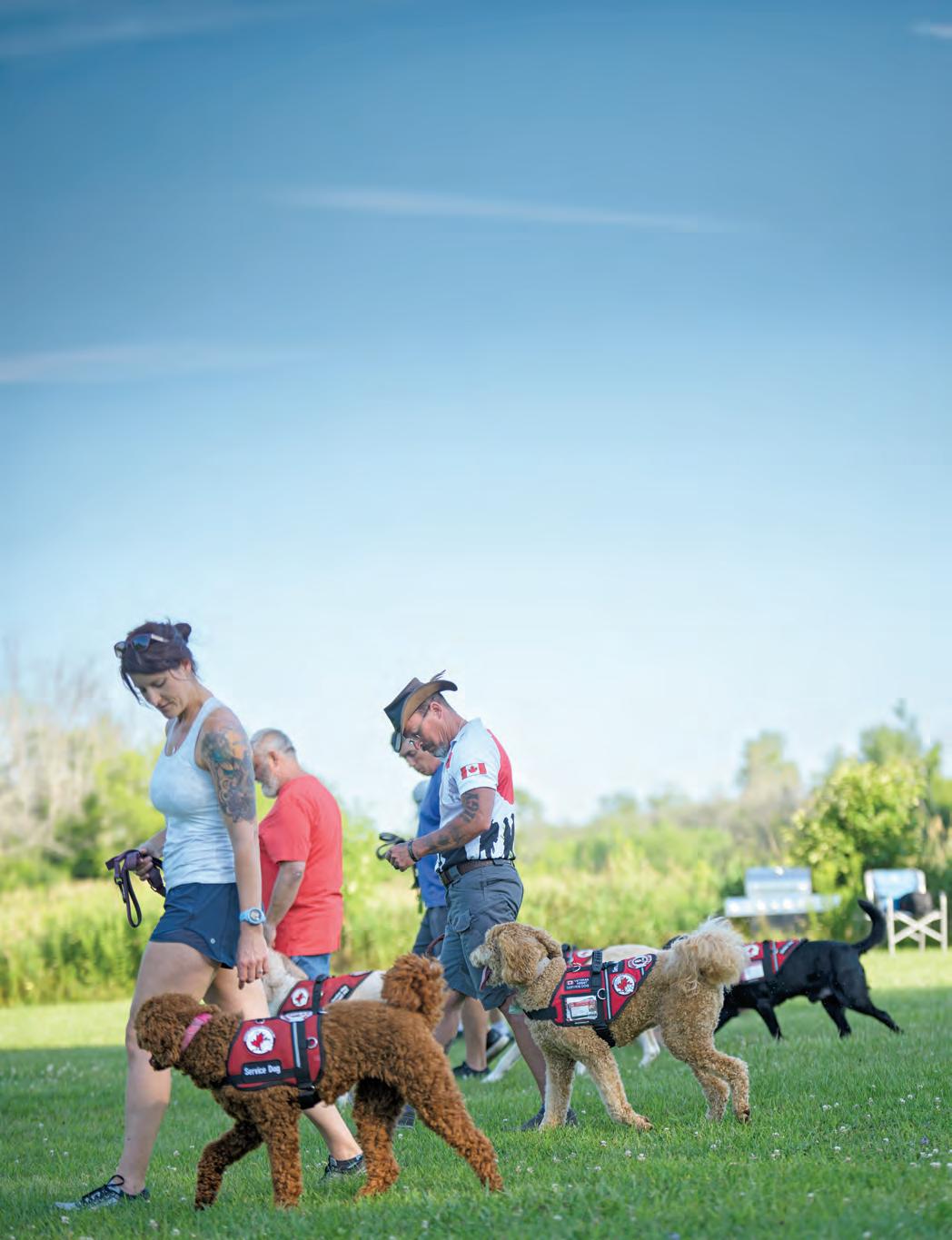
Founded in 2012, the White Lake centre is a veteran-run charity that not only trains puppies and dogs for service, but also coaches veterans and first responders on how to work with them—for free. Its board of directors, responsible for advising on training standards and unit-specific programs, is comprised of veterans and first responders, dog trainers and a consulting psychologist.
“The dog trainers know the dog, the psychologist knows the person and the veterans that sit on the intake committee know the experience,” said Scott. “This is the difference with our dog unit compared to other service dog programs.”
The centre’s operating principles have helped save the lives of veterans more than once, with the unit issuing social welfare checkups for those showing signs of relapse— or worse. It keeps close contact with its clients even after they graduate from the program. And it requires them to meet with the unit at least four times a year for check-ins.
“We take care of each other,” said Scott. “And it’s membership for life as long as you want to be one of us.”
Working with Assistance Dogs International, a globally recognized authority in providing training principles for service dogs, the centre achieves impressive feats with its charges.
“We have dogs that pick up canes. We have dogs that open doors, grab pill bottles,” said the centre’s president, retired sergeant Dwayne Sawyer, who spent 23 years in the CAF. “It’s very important for us to find every little thing that that person needs help with so that we can build the perfect dog for them.”
For more than 15 years now, veterans’ organizations such as the White Lake training centre have asked that VAC endorse the use of service dogs and fully incorporate them into the varied mental health services it covers. But the pleas remain unanswered.
In the October 2022 government response to the standing committee on Veterans
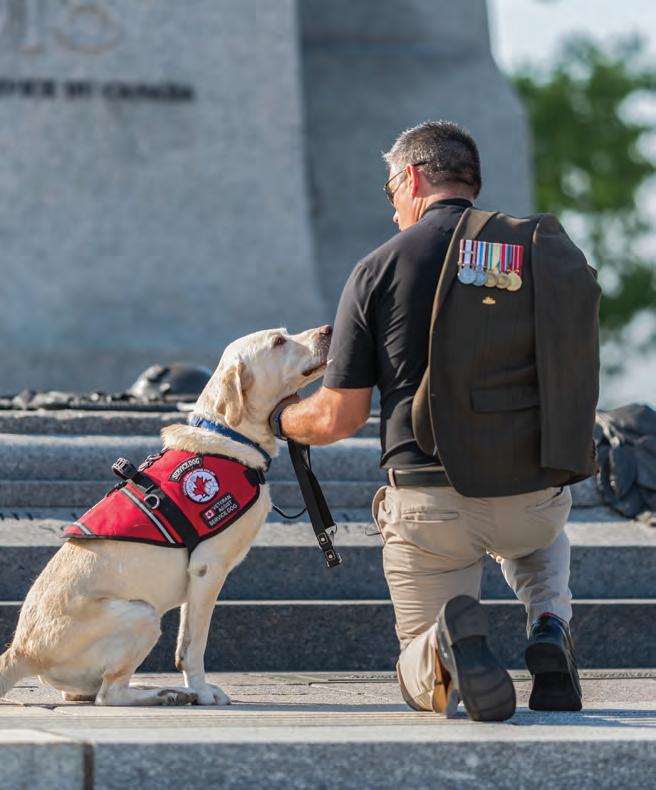
Retired sergeant Dwayne Sawyer and his service dog Rex at the National War Memorial in Ottawa.
“
THE STUDY CLEARLY PROVES THAT SERVICE DOGS, REGARDLESS OF WHETHER THEY PROVIDE PSYCHIATRIC OR EMOTIONAL SUPPORT, HELPED TO IMPROVE THE LIVES OF VETERANS.”
Affairs sixth report, “Incorporating Service Dogs into the Rehabilitation Program of Veterans Affairs Canada,” VAC acknowledged that “service dogs provided a reduction of PTSD symptoms, a moderate long-lasting reduction of depressive symptoms and a significant increase in the subjective feeling of well-being related to overall quality of life.”
However, the 2015 VAC-funded research project conducted by the Canadian Institute for Military and Veteran Health Research to which it attributed that response was ultimately dismissed as having limited results as nearly half of the participants—13 of 31—did not complete the study. Further, VAC’s chief psychiatrist, Alexandra Heber, told the standing committee on Veterans Affairs 18 months earlier that, “having a psychiatric service dog does not in any way have the evidence behind it to call this a treatment or a therapy.”
“[VAC] is saying there’s no clinical evidence,” said Scott. “That’s not an answer. It is an answer if you’re a politician.
“Guide dogs have been helping human beings for 300 years. There’s not going to be that [one] decisive clinical study,” he continued. “It’s insulting to think that that’s going to happen.”
The standing committee report also called on VAC to “support and promote the creation of national standards for service dogs in Canada. However, the department seemingly distanced itself from that initiative, too.
VAC responded that that “must come from industry itself and must employ the knowledge and expertise of such organizations as the Canadian General Standards Board.”
But as veteran Phil Ralph postulates, is it not the government’s distinct responsibility to create and regulate such services?
“This is what governments are supposed to do,” said Ralph, director of health services for Wounded Warriors Canada, a national mental health service provider that, among other things, runs a service-dog program in conjunction with The Royal Canadian Legion’s Ontario Command for veterans suffering with PTSD and operational stress injuries.
“An Aspirin’s purity is all regulated [by Health Canada]. But a dog, which is specially trained to give a person their independence and re-engagement with society and work on their life skills, is not regulated at all,” explained Ralph from Wounded Warriors’ headquarters in Whitby, Ont. “That’s kind of contradictory.”
Without standards, sham training programs and get-rich-quick breeders persist in the business. One veteran told Legion Magazine she had been duped by a couple of shady service-dog providers; she lost $2,000 and never heard from them again. Additionally, fake or improperly trained dogs undermine the public’s support for the service, especially if those dogs injure someone or destroy property.
“That’s just Fluffy in a vest,” said Ralph.
Veteran Tina Sharp, a member of the Canadian Veteran Service Dog Unit, and her service dog Stoker.
Coincidentally, in June 2015, Veterans Affairs Minister Erin O’Toole announced that national standards would be set for service dogs that assist veterans with mental health conditions such as PTSD. Up to $340,000 was approved to create the standards, while pilot research on veteran service dogs was provided $500,000 in funding.
“We expect this work will confirm what veterans have been telling us about the benefits of psychiatric service dogs—how these dogs have improved their quality of life,” said O’Toole nearly a decade ago. “The Government of Canada is committed to supporting research to achieve better outcomes for veterans with PTSD and other mental conditions.”
The federal government’s Canadian General Standards Board was tasked with the work, in consultation with veterans’ groups and members of psychiatric service dog training organizations.
But after deliberating for three years, it withdrew its intent to produce a national standard. The reason? A spokesperson for VAC told the CBC at the time that the board was unable to reach a consensus.
Ralph asserted that the enterprise was cursed from the start, as getting dog trainers to agree on a common approach to their work is difficult. “Everybody does it a little differently,” he noted.
“They had to get pretty well unanimous consent of all the players at the table,” Ralph continued. “So that was the reason that it really fell apart.”
Other disagreements included whether standards should be open or closed, how accessibility to service dogs could change after the regulations were introduced and how service dogs can address specific mental health issues.
Meanwhile, the U.S. has taken conclusive steps toward integrating service dogs into veteran health care.
In 2020, the U.S. Department of Veterans Affairs published a comprehensive report on psychiatric service dogs. “The study clearly proves that service dogs, regardless of whether they provide psychiatric or emotional support, helped to improve the lives of Veterans with mental health problems,” wrote MP Emmanuel Dubourg, chair of Canada’s standing committee on Veterans Affairs, in a subsequent report on the topic. In 2021, President Joe Biden signed the Puppies Assisting Wounded Servicemembers for Veterans Therapy Act.
The PAWS Act, as it’s known, provides the opportunity for veterans with PTSD to train potential service dogs, with the goal that the work will assist veterans in managing their symptoms. The five-year pilot program “will help explore the benefits of service dog training and [provide] the data we need to make recommendations on the way forward,” said U.S. Veterans Affairs Secretary Denis McDonough.
“There are many effective treatments for PTSD,” he continued, “and we’re looking at service dog training as an adjunct to those options to ensure veterans have access to resources that may improve their well-being and help them thrive.”
Rory Diamond, CEO of K9s for Warriors, the largest provider of mental health service dogs in the U.S., told National Public Radio the trained animals also save the government money, as veterans using them are less likely to need expensive prescription drugs, use fewer health services overall and more often return to school or work. “So, it’s a win, win, win.”
One U.S. politician called such programs “transformational.”
A pair of prospective mental health service dogs pause for a break during a training event.
Trainers march their charges through an exercise in which the dogs are off leash and must stay by their handler’s side.
“VAC is currently reviewing its approach to mental health service dogs, and will continue to monitor emerging Canadian and international research, including results of the [U.S. Veterans Affairs] five-year pilot project,” noted the federal government in the October 2022 response to the standing committee’s report. Meanwhile, Wounded Warriors Canada and the Canadian Veteran Service Dog Unit continue to offer hope for veterans and first responders looking for a service dog.
The former has developed its own service-dog resources for veterans and their health-care providers, such as guidelines for when the animals should be prescribed. The outline includes helpful information and tips on getting a service dog, and a form for veterans and medical professionals to fill out together to ensure that it is a correct step in treatment. True Patriot Love, a foundation working to support military members, veterans and their families, is also a great source of information on the topic.
“It’s like medication, right?” said Ralph. “Everybody doesn’t react the same way to the same pills at the same time and at the same dosage. It’s the same thing with service dogs.”
Once it has been determined that a service dog could help, contacting a reputable provider such as Wounded Warriors or the Veteran Service Dog Unit is the next step. Businesses that operate by the “buy-your-own-dog” principle should be
avoided because the animals may not have successfully completed training for service.
“You’ll feel injured again,” said Ralph. “You’ll feel betrayed again.”
Doing your own research is the most important step say the experts. Speak with veterans who have benefitted from service-dog programs and ask as many questions as possible of medical professionals and the animal providers. It’s also critical that a veteran ensure they’re ready for the commitment.
“Everything in this world is buyer beware,” cautioned Ralph.
Back at White Lake, hours had passed. Hours of small talk, big talk and yet another heart-to-heart. The sun’s glow now diluted by the looming blues and blacks, Scott’s dog Mandy still sat dutifully by his side.
The pair had come a long way, together taming the beast of trauma. Now, he knew peace that had been nudged and tugged along by providence in a vest.
“I understand who I am, my brokenness and the stupid things I’ve done,” said Scott. “I’m a better person because of love.”
And maybe that’s what’s missing in modern health care. At the end of the day, amid life’s varied challenges, people need grace and healing, love and spirit. And you can’t get a prescription refill on that.
“Love changes everything,” said Scott.
At that moment, doting and attentive in her usual way, Mandy’s love for Scott seemed to radiate in every glance, whine and nuzzle. A creature of miracles, a therapy unlike any other. In an embrace with a smiling Scott, an iconic image emerged—that of a man and his best friend. L
2024 Veterans BENEFITS GUIDE
INSIDE THE DIEFENBUNKER, CANADA’S COLD WAR EMERGENCY GOVERNMENT HEADQUARTERS
WORDS AND PHOTOGRAPHY
BY STEPHEN J. THORNE
BLAST FROM THE PAST
The blast tunnel that serves as the entrance to the Diefenbunker is designed to funnel shockwaves in one end and out the other. This image shows half the tunnel, from the spot where recessed doors allow access to the facility.
IT’S
revealing commentary on Canada’s constitutional commitment to “peace, order and good government” that, in the event of nuclear holocaust, the country’s Cold War-era politicians and bureaucrats were expected to keep calm and carry on far below ground.
Deep in the recesses of the former Canadian Forces Station Carp near Ottawa, better known as the Diefenbunker, nameplates still identify the provisional offices of such seemingly peripheral ministries as Fisheries and Oceans, Employment and Immigration and, more pointedly perhaps, Health and Welfare.
Mirrors gave patrolling guards a preview of what was around corners in passageways surrounding the Bank of Canada vault. Government offices never had to be used.
Some four storeys down, beyond the decontamination showers and Geiger counters, around the corner and down the hall from a modernist-style cafeteria and a CANEX still stocked with Brylcreem and Aqua Velva, there lies a massive vault in which 725 tonnes of the country’s gold could be stored behind a 12-tonne door.
Decontamination showers and Geiger counters were at the ready. A CANEX tuck shop sold cigarettes, snacks and necessities, such as aftershave and Brylcreem. Cupboards and pantries serving the modernist-style cafeteria were stocked with enough fresh food and rations to sustain 535 people for 30 days.
It was here, in this 300-room, 9,300-square-metre, reinforced concrete bunker and fallout shelter where 535 civil and military authorities, sans loved ones, were to take up residence beneath a gravel pit and run the country had the Red Menace launched nuclear missiles on North America.
Ironically, Prime Minister John Diefenbaker—who sanctioned the bunker’s construction in 1959—never set foot in the place, and is said to have vowed he never would, declaring he couldn’t leave behind his beloved wife Olive.
His resolve was never put to the test. The closest it came was during the 1962 Cuban Missile Crisis, when Diefenbaker’s administration created plans to move government operations underground.
The prime minister’s quarters included a small bed, a spartan bathroom and offices for the leader and his secretary. A 1970s-era computer disc drive the size of a coffee table stored just five megabytes, a fraction of a modern cellphone’s capacity. A map shows the destruction zones of a nuclear strike on Esquimalt, B.C. Tools were on hand to destroy sensitive equipment should the site be overrun. The war cabinet room.
PRIME MINISTER
JOHN DIEFENBAKER— WHO SANCTIONED THE BUNKER’S CONSTRUCTION IN 1959—NEVER SET FOOT IN THE PLACE.
At a time when Canadian schoolchildren were conditioned to periodic air-raid drills, bunker personnel were reminded daily of the threat’s immediacy and implications.
The 115-metre-long blast tunnel that served as the facility entrance was designed to withstand an explosion equivalent to five million tonnes of TNT from as close as 1.8 kilometres away. Midway along the passage, recessed 1.8-tonne doors take you into the actual facility and its decontamination showers.
A map on the wall of a room two storeys underground shows the estimated blast zone of a nuclear warhead dropped on the naval base at Esquimalt, B.C. A sledgehammer and other tools were on hand to destroy sensitive equipment should the site be overrun during an invasion.
The infirmary was equipped with beds and 1950s-era medical equipment. A typical kitchen had all the amenities a 1960s homemaker could want. The women’s washroom had sinks and mirrors aplenty. The surgery was stocked with enough equipment to address most trauma injuries. The Bank of Canada vault (opposite) could hold 725 tonnes of gold behind its 12-tonne door.
Living in spartan, shared accommodations, rotating staff were subjected to constant scrutiny and warnings of more shadowy manifestations of the enemy from behind the Iron Curtain.
“Hostile intelligence agents are searching for personnel susceptible to subversion,” declares a poster splayed across a desk in the Civil Situation Centre. “Do not leave yourself open to exploitation: alcohol abuse, gambling, black market, bribery, drug abuse, sexual promiscuity.”
One of nearly 50 so-called “Emergency Government Headquarters” built under Diefenbaker’s Continuity of Government plan, the bunker existed as a communications and civil defence hub until 1994. It’s now a Cold War museum and the sprawling bank vault is a theatre and conference/reception hall. L
“DO NOT LEAVE YOURSELF OPEN TO EXPLOITATION: ALCOHOL ABUSE, GAMBLING, BLACK MARKET, BRIBERY, DRUG ABUSE, SEXUAL PROMISCUITY.”
CRIMINAL intent
BY NATE HENDLEY
C
THAT HELPED SET WAR CRIMES’ PRECEDENT
Canadian hospital ship Llandovery Castle was approaching the coast of Ireland on the evening of June 27, 1918, when a torpedo from a German U-boat exploded on its port side.
The vessel was travelling from Halifax to England to bring ill and injured Canadian servicemen back home to recuperate. Since a return voyage was planned, Llandovery Castle wasn’t transporting any patients when it was hit. But there were still more than 250 people on board: a British crew and 94 members of the Canadian Army Medical Corps (CAMC).
The ship’s forward momentum intensified flooding through the hole left by the blast. Captain Edward Sylvester rang the engine room to stop, then reverse the engines, but there was no response—the men in that section were either dead or incapacitated. The 152-metre
vessel kept plowing ahead, even as it rapidly sank. Telegraph equipment in the Marconi room had also been damaged in the blast, so a distress message couldn’t be sent. Sylvester gave the order to launch lifeboats.
Under the Hague Conventions— prewar treaties that tried to regulate combat—hospital ships could be stopped and searched, but weren’t to be attacked. The vessels were to be painted white with green horizontal stripes interspersed with red crosses and be brightly lit at night so they could be identified. And they were not to carry armed soldiers, munitions or weaponry.
Llandovery Castle was abiding by these strictures, but U-86 commander Helmut Patzig didn’t care. His crew would later testify they knew their target was a hospital ship from its lights, but Patzig attacked it nonetheless.
In 1917, the German Imperial Admiralty had authorized its U-boat fleet to strike all Allied vessels in the Mediterranean Sea and a stretch of water from the English Channel to the North Sea, including hospital ships, which it alleged were smuggling weapons and soldiers. Llandovery Castle wasn’t in either location, but no matter.
CAMC staff and the ship’s crew desperately tried to launch
C THE GREAT WAR ATTACK ON A CANADIAN HOSPITAL SHIP
lifeboats, a difficult task given the ship’s forward movement. One lifeboat, with 14 nursing sisters aboard capsized, and all drowned. Only a few of the boats got off before the ship disappeared underwater, minutes after being hit.
The submarine surfaced and approached the lifeboats. An English-speaking German crew member ordered some of the survivors onto the U-boat, one at a time, to be interrogated. Major Thomas Lyon of the CAMC fell awkwardly on the steel deck of the U-boat after leaping from his lifeboat. He broke his foot in the process.
“You are an American flight officer,” accused the Englishspeaking submariner.
“No. We never carried anything but patients,” replied Lyon, wincing in pain.
The other survivors said the same thing: contrary to Patzig’s suspicions, Llandovery Castle wasn’t transporting pilots or munitions. Eventually, U-86’s commander
SOLDIERS DON’T HAVE TO OBEY “PALPABLY CRIMINAL” ORDERS, A PRINCIPLE
“CONCISELY SET FORTH IN THE DECISION AT LEIPZIG IN THE LLANDOVERY CASTLE CASE.”
conceded that the ship hadn’t been doing anything illicit. The attack was unjustifiable, which meant Patzig had committed a serious breach of Hague rules.
Patzig ended the interrogations, sent most of his men below deck and returned the survivors to their lifeboats. Then, with the help of Lieutenants John Boldt and Ludwig Dithmar, he directed a gunner to shell the boats with the sub’s 10.5cm deck gun. Patzig seemed determined to kill all the witnesses to his war crime.
A single lifeboat, containing six CAMC personnel and 18 British crew members, including Lyon and Captain Sylvester, escaped the massacre. They were rescued two days later by a British destroyer on patrol. News of the attack, based on survivor testimony, caused a global furor.
“Hospital Ship Willfully Sunk” blared the front page of the San Francisco Examiner.
“There is something peculiarly infamous in a stealthy attack on a hospital ship. The vessel is not armed. It carried no fighting men. It is helpless…the inhuman monster who commanded the submarine knew exactly what he was doing,” The Philadelphia Inquirer argued in an editorial.
Speaking at the 1918 Imperial War Conference in London, England, Prime Minister Robert Borden deplored “the sinking of our hospital ship [and] the murder of nurses and doctors.”
“A wild beast is at large, and it is no use arguing or attempting to reason with it. We must destroy it. We must set our teeth until this end is achieved,” added British MP Bonar Law during the International Parliamentary Conference in the U.K.
In a grim irony given its role as a healing ship, “Remember the Llandovery Castle!” became the battle cry of Canadian soldiers at
the Battle of Amiens in August 1918. The bloody campaign helped lead to the Armistice in November, followed by the Treaty of Versailles, which officially ended the war in June 1919. Among other provisions, the agreement demanded that German leaders be tried for war crimes.
The postwar government in Berlin wasn’t eager to hand over German citizens for trials with Allied tribunals, so it suggested a compromise. War crime trials could be held at the German Imperial Court of Justice (Reichsgericht) in Leipzig. The Allies could provide lists of suspects, witnesses and evidence, while Germany handled prosecutions and defence. An agreement was reached, and the Leipzig war crimes trials commenced in early 1921. Only a handful of cases—one of which involved Llandovery Castle—were heard.
Commander Patzig couldn’t be tracked down, so German authorities abruptly arrested Boldt and Dithmar and built a case around them instead. When their trial opened on July 12, 1921, the lieutenants were unrepentant.
“I obeyed my commander. His orders were law. I am not guilty,” testified Boldt.
Llandovery Castle survivors were among the witnesses for the prosecution. Captain Sylvester had died of heart failure a year earlier, but Major Lyon was available. Boldt and Dithmar’s trial had been so
Major Thomas Lyon and Sergeant Arthur Knight (bottom, left and right) of the Canadian Medical Army Corps were two of just 24 survivors. The Leipzig war crimes trials (left) heard the case of Llandovery Castle
hastily arranged, however, that Lyon had only a few days to rush from his home in Vancouver to Leipzig.
After travelling thousands of miles, Lyon “furnished the sensation of the trial by immediately abusing the infamous and cowardly methods used by the submarine commander. He vehemently attacked Captain Patzig for the sinking of the helpless ship,” reported the Vancouver Sun.
The German court pondered the testimony and evidence entered, then delivered its verdict four days after the trial started. While largely ignoring the initial torpedo attack, the justices convicted Boldt and Dithmar for their role in the attempted murder of survivors. In its ruling, the court set two precedents: war crimes should be judged by international standards and following orders is not a defence for committing illegal acts in wartime.
“The firing on the boats was an offence against the law of nations. In war on land the killing of unarmed enemies is not allowed… similarly in war at sea, the killing of shipwrecked people, who have taken refuge in lifeboats, is forbidden,” said the judges.
While Patzig directed the shelling, his order did “not free the accused from guilt,” the judgement continued. “The subordinate obeying such an order is liable to punishment, if it was known to him that the order of the superior involved the infringement of civil or military law.”
Boldt and Dithmar were sentenced to four years apiece, but quickly escaped from jail with the help of supporters. Due in part to this dismal outcome, the Leipzig trials were regarded as a failure and Llandovery Castle was largely forgotten.
By the 1920s, the Canadian public wanted to move on from the slaughter of the Great War. While victories at Vimy Ridge and Passchendaele were lauded, there seemed little glory or gain from the Llandovery Castle sinking. The Halifax Explosion, which resulted in an outpouring of assistance, became the wartime tragedy commemorated by Canadians.
Timing and cynicism also contributed to this cultural amnesia. Llandovery Castle was sunk late in the war, giving the Allies only a few months to use the atrocity as propaganda. By contrast, Lusitania, a British passenger liner with a contingent of American passengers, was torpedoed by a U-boat in May 1915. The Allies had years to depict its sinking and the deaths of nearly 1,200 as an example of German barbarity.
After the war, the public learned that the Allies had also engaged in acts of dubious morality. While they had condemned Germany’s policy of unrestricted submarine warfare in which merchant ships were sunk without warning, the Royal Navy had blockaded German ports to prevent vessels from delivering everyday supplies, resulting in mass starvation. And, despite furious denials during the war, Lusitania had indeed been carrying materiel.
The controversial 1930 Canadian antiwar novella Generals Die in Bed by Charles Yale Harrison implied that Llandovery Castle wasn’t playing by the rules either. In the story, an officer graphically recounts
PATZIG SEEMED DETERMINED TO KILL ALL THE WITNESSES TO HIS WAR CRIME.
the Llandovery Castle sinking to motivate his troops. At the book’s end, however, the narrator discovers that Llandovery Castle was also transporting war munitions. There is no evidence this was true; the ship was inspected twice before leaving Halifax on its final journey and subsequent reports didn’t indicate anything amiss. On an earlier voyage, a patient’s attempt to smuggle souvenir swords on board caused an administrative uproar. Still, the novel helped obfuscate already dimming memories of the Llandovery Castle tragedy.
The war diary of U-86 commander Helmut Patzig makes no mention of the U-boat’s attack on Llandovery Castle. Private William Pilot (left and opposite bottom, with other crew aboard the ship) survived the ordeal, though Lieutenant Colonel Thomas Macdonald (immediate left), commander of the Canadian Army Medical Corps, did not. Canadian nursing sisters (opposite, left to right) Anna Stamers, Christina Campbell, Rena McLean, Jessie McDiarmid and Carola Douglas all drowned in the sinking.
In the 1940s, however, prosecutors started taking careful note of the Leipzig verdict as they prepared for a new round of war crimes trials. State Prosecutor Colonel N.K. Dunayev referenced the Llandovery Castle case at the Kharkov trial—the first war crimes proceeding against Nazis. Held in December 1943 in what is now Kharkiv, Ukraine, the trial pitted three German defendants and a collaborator against a Soviet military tribunal. Charged with massacring civilians and prisoners, the accused insisted they were just following orders.
When it was his turn to speak, Dunayev cited “the atrocious sinking of the British hospital ship Llandovery Castle” and subsequent trial.
Boldt and Dithmar had also been following orders, but the Leipzig court made clear “that did not absolve them of responsibility, as there could be no doubt that the accused realized the dishonourable and criminal nature of their commander’s intention,” said the colonel.
Despite misidentifying Llandovery Castle as British, Dunayev’s point stood, and the four defendants were convicted and hanged.
The constitution of the International Military Tribunal, which was created to prosecute the Axis leadership after the Second World War, specifically disallowed obedience to superior
orders as a defence, except in mitigation of sentencing.
The same principle guided the Peleus trial in Hamburg, Germany, in the fall of 1945. Held before a British military court, this eerily familiar case involved crew members and the commander of U-852. They were accused of trying to gun down survivors of Peleus, a steamship the sub had torpedoed. The crew said they were acting under orders, but the court rejected this defence and they were convicted.
“Much reliance was placed in the Peleus case, both by the Prosecutor and by the Judge Advocate, on the decision of the German Supreme Court in the case of the hospital ship ‘Llandovery Castle,’ delivered in 1921,” stated a United Nations War Crimes Commission summary.
SS death squad members at the 1947-1948 Einsatzgruppen trial in Nuremberg also cited superior
orders to deny culpability for mass murder. Brigadier General Telford Taylor, chief counsel for the prosecution of the presiding American military court, quashed this defence.
Soldiers don’t have to obey “palpably criminal” orders, a principle “concisely set forth in the decision of the Supreme Court at Leipzig in the Llandovery Castle case,” stated Taylor.
The SS men were all found guilty and sentenced to death or prison terms.
The Geneva Convention of 1949 consolidated and strengthened previous treaties governing wartime conduct. Once again, attacks on hospital ships were forbidden.
The principles established at Leipzig helped shape the legal foundation of the International Criminal Court, empowered in 2002 to prosecute war criminals around the world. The court rejects the superior orders defence and views war crimes as violations of international norms and law.
It might have been some solace to those lost on Llandovery Castle that their fate would lead to the universal legal axiom that people who commit war crimes should be held responsible for their actions. L
Nate Hendley is a Toronto-based journalist and author. His latest book, Atrocity on the Atlantic, offers a full account of the sinking of Llandovery Castle.
By Andy Sparling
RECALLING A LITTLE-KNOWN SECOND WORLD WAR SERVICE BAND THAT BROUGHT
JOURney SeNTIMEnTAl
ITS MUSIC TO CANADIAN AND ALLIED TROOPS WHEREVER THEY WERE, INCLUDING THE FRONT LINES
Eighty years ago, on Dec. 22, 1944, the young musicians of the RCAF Streamliners dance/jazz orchestra came under German fire as they rode in a truck to a gig just 230 metres from the front lines during the Battle of the Bulge. My dad Phil Sparling was one of them. He was 22 at the time.
“We played for troops who were heavily armed and each time the doors opened, everyone would look around and point their rifles at the door—just in case they were Germans,” recalled drummer Don Hilton.
Guitarist Len Coppold said: “you could practically feel the Germans’ breath.”
About a week later, early on New Year’s Day, they dodged death again during a German air attack that destroyed 50 planes on the ground and a barracks they were to have stayed at near Nijmegen, Netherlands.
Ten months later, they picked up human bones and saw emaciated survivors at the Bergen-Belsen concentration camp, where Allied forces were struggling to deal with the aftermath of the Nazi Holocaust.
Mortar fire, bullets, air attacks and concentration camps weren’t what Dad and his buddies thought they had signed up for.
I asked Dad several times about his Streamliner memories. He barely mentioned any of those experiences. Then, he died. Wanting to know more, I dug into what knowledgeable others consider one of Canada’s greatest bands.
The Streamliners began in 1941 at the RCAF’s No. 1 Technical Training School in St. Thomas, Ont. Three enlistees from Clinton and Goderich, Ont.—Dad, Jack Perdue and Bill Carter—were learning how to maintain aircraft. They started “jamming” in their spare time. One thing led to another, and three years later, they were part of a band so good, the legendary Glenn Miller himself declared it “the best jazz band in Europe—next to mine!”
The RCAF Streamliners dance/jazz orchestra entertains Canadian service members during the war (opposite). The author’s father Phil (left) played sax in the group.
The Streamliners perform at 21 Club in Brussels (below).
Courtesy of Andy Sparling
THE RCAF STrEaMLINeRs
PAT RICCIO: reeds, music director, arranger, Toronto
BILL CARTER: trumpet, conductor, Goderich, Ont.
JACK (JAKE) PERDUE: reeds, Clinton, Ont.
PHIL SPARLING: reeds, Clinton, Ont.
FRANK PALEN: reeds, Woodstock, Ont.
BOB BURNS: reeds, Toronto
CLAUDE LAMBERT: trumpet, Wyoming, Ont.
FRASER LOBBAN: trumpet, Owen Sound, Ont.
CHARLIE OVERALL: trombone, copyist, Ottawa
M.O. (MEL) SMITH: trombone, Lang, Sask.
BILL BEBBINGTON: trombone, St. Thomas, Ont.
JACK FALLON: bass, London, Ont.
DON HILTON: drums, Toronto
LYLE KOHLER: piano, Ottawa
LEN COPPOLD: guitar, Montreal
GEORGE LANE: vocalist, Windsor, Ont.
A dozen of the Streamliners pose for a photo. The band plays in Lincoln’s Inn Fields park in London, across the street from the RCAF Overseas Headquarters.
Swing was king in 1941 and the big-band craze in the U.S. led by Miller, Benny Goodman and Tommy Dorsey was spreading to Canada. The conditions were ripe for the St. Thomasbased trio to attract other musicians, some with professional experience, to their fledgling group.
Miller himself volunteered for the U.S. army and put together an overseas band that would delight big-bandcrazy American military personnel. The Streamliners gradually morphed into a similar kind of unit.
In 1943, the Streamliners were posted to Gander, Nfld., where constant rehearsing and performing under the direction of leader/arranger Pat Riccio turned them into
a rock-solid, tight-as-a-drum swing ensemble. After hearing the band, RCAF leadership decided it would be deployed overseas to provide fighting Canadian men and women worldclass entertainment—their ultimate taste of home.
They arrived in Liverpool, England, in August 1944. It was a busy and bewildering time, as described in written memories Dad left me:
“Assignments to billets, many shows, dances, recordings and concerts, with the attendant unloading, jolting in trucks to various venues, and everywhere evidence of men and machines pouring into that incredibly small country inhabited by incredibly bighearted people. Seven-hour
train rides (standing mostly) to bases in Cornwall and Devonshire and Wales; ferry from Stanraer across the Irish Sea to Belfast and various Irish camps mostly starting with “Bally;” many visits to Bomber Command bases in Yorkshire, including some American ones where we gluttonized on peaches and eggs and steak.”
During the next 17 months, the band played more than 400 dances and concerts throughout the U.K. and Europe. There were about 20 BBC studio broadcasts for Allied troops around the world and shows with major stars of the day such as vocalists Vera Lynn, Anna Neagle, Gloria Brent and jazz violinist Stéphane Grappelli.
The Streamliners finished second to the Major Glenn Miller Army Air Force Band—the military version of his popular civilian band—in a BBC popularity poll among Allied service personnel, which earned them a double-billing one night with the American superstar’s band in London.
Miller and a few of his musicians watched the Streamliners performance at the Queensberry All-Services Club in the city. According to both drummer Hilton and guitarist Coppold, they saluted the Canadians on stage. A few days later, Dec. 15, 1944, Miller went missing on a flight over the English Channel. Neither his body nor the plane were ever found, and
the circumstances of his death are still unknown.
Other features of life in London in 1944 were the Luftwaffe bombings of the “Baby Blitz” early in the year and nightly V-1 and V-2 rocket attacks later in the year. Combined, the strikes claimed nearly 5,000 lives, and the Canadian musicians had several close calls.
Trumpeter Claude Lambert escaped with his life one night. Heading out for a pub, he came to an intersection, and unsure of which way to go, turned left. He didn’t find the pub, but soon afterward a V-2 crashed into the street on the right, destroying the whole block.
“Really scary,” said Coppold of the raids. “When the V-1s got close, and that
THE LeGeNDARy GLeNN MILLeR HIMSelF DECLaReD
IT
“THe BeST BAND IN EUROPe—NeXT To MINe!”
motor went off, you didn’t know whether they were going to explode on top of you or down the street a bit, and there would always be a big explosion. So, you might get three or four of those coming every night, and then you’d get a V-2…I mean, they came in so high you couldn’t see them, you had no idea. It wasn’t a soft and easy time for us, nor for the Brits, who, I’m tellin’ you, were so strong and optimistic coming out of those subways in the morning and going back to work.”
On Dec. 18, 1944, the Streamliners flew across the Channel to Eindhoven, Netherlands, to begin a month-long tour close to the front lines. Canadian troops were a big part of the Allied effort to drive the Nazis back east to Berlin, and the band’s mission was to provide them with momentary escape when possible.
Four days later, they were under fire at Grave Bridge near Nijmegen. A week later, very early on Jan. 1, 1945, the Nazis came calling again with an air attack.
“All of a sudden, we heard thundering and bullets and aircraft zooming in and out
Courtesy of Andy Sparling
AfTeR THE WAr, DuRING A SECOND TOUR OF FRANCE, BeLgIUM AND GeRMANY, THe ENTIRe BANd WITNEsSeD THE HoRRoR’S
aFTERMATH AT THE BERGEN-BELsEN CONCENTRATION CAMP.
An early incarnation of the Streamliners performs in Gander, Nfld., early in the war.
going after the aircraft on the tarmacs,” related Coppold in 2020 of the New Year’s Day seige. “They destroyed about 50 planes that never got off the ground. We were all okay. We’d stuck together, glad we were still alive. But the Germans killed a lot of ground crew that day.”
After the war, during a second tour of France, Belgium and Germany, the entire band witnessed the horror’s aftermath from the BergenBelsen concentration camp. Some 50,000 prisoners, most of them Jews, had died at the facility as a result of disease, brutality and hunger. During the Streamliners’ visit, many of the 60,000 Bergen-Belsen detainees alive at the time of the site’s liberation were at a
nearby facility for displaced persons, as British and Canadian forces tried to care for them as the first step in a plan for their resettlement.
“What you saw…people [the survivors]…they were everywhere,” said Coppold. “Lying down, or on their knees, with dirty clothes, the stench…couldn’t compare with anything. I never saw one child among the survivors, but we saw a lot of kids’ clothing, some of it stuck in the fences. I’ll never forget it.”
A couple of months later, the Streamliners’ overseas deployment ended. A couple of them—bassist Jack Fallon and saxophonist Bob Burns—stayed in Europe and carved out impressive
careers in British jazz circles, playing with mega-stars such as Duke Ellington and Sarah Vaughan. Both Fallon and Burns can be heard on Beatles’ recordings; Fallon plays a fiddle solo in “Don’t Pass Me By,” and Burns is the lead clarinetist on “When I’m Sixty-Four.”
Leader/arranger Riccio and drummer Hilton were prominent postwar musicians in Toronto. But most, like my dad, came home, found other employment and only played in bands on the side for the rest of their lives.
As he boarded the Île de France for the homeward crossing in January 1946, Dad savoured the band’s five-year meteoric success. But not for long. “It was time to sweep it all under a mat, and get on with the rest of our lives,” he wrote in his memoir to me before he died. “The twanging of all those guitars soon swept the big bands away.”
To the end of his life, Dad neither described nor expressed any emotion about the tough moments I now know he experienced. The closest he came were these words about the band’s popularity among the troops in the recollections he penned:
“Some heroes. Always felt sheepish when guys who fought and killed and lived in terror in planes and trenches started applauding us.”
I asked him once if he would ever like to go back to England.
“No thanks,” he said. “The last time I was there, somebody tried to kill me.” L
Courtesy of Andy Sparling
Celebrating Canada
Makes a great GIFT!
O Canada Classic Ball Cap
A lightweight, low profile, six panel structured cap with a pre-curved bill, trucker mesh and adjustable snap tab closure for excellent fit.
*
O Canada Bucket Hat
Maple Syrup Candles
The perfect candle—hand-poured in Canada with yummy scents of cooked butter, roasted nut, cinnamon, cloves, sweet caramel and creamy vanilla. Organic soy wax burns clean. 16 oz. Classic Tin
Timelessly cool, a bucket hat is a must-have in any wardrobe—the perfect accessory to top off an outfit. S/M or L/XL
Canvas Sling Bag —Oh the places we’ll go This 100% cotton canvas bag is the perfect tote for the beach, picnic or boat. The thick drawstring cord cinches shut and a zippered pocket holds your phone and shades. Only 2499* each
Warbirds Mug
Limited edition white ceramic mug commemorating the 100th anniversary of the RCAF. Includes photos of Spitfire and Lancaster vintage aircraft by Stephen J. Thorne.
All of Canada’s provinces and territories have had devastating forest fires to deal with in the past year. In late August 2023, the Canadian Interagency Forest Fire Centre reported 1,069 active fires; more than half were listed as out of control. In many cases, the Canadian Armed Forces were called in to assist when the fires overwhelmed local resources.
With such devastation becoming increasingly frequent, many people have called for the creation of a national firefighting service of specially trained members who could fly in to take control when called upon.
This has raised the question of whether the CAF should be replaced as the first agency called in to respond to a natural disaster. I would argue no.
In recent years, the forces have responded to forest fires, floods, mudslides, avalanches, ice storms and high winds— all things which required welltrained responses. The CAF should be the agency that’s called.
The most important attribute of the CAF is to be prepared. That can’t be done solely by training and going on exercises here at home or in co-ordination with Allied countries. The forces
Should Canada replace its military as the first line of response to domestic disasters?
Tom MacGregor says NO
need to do important, useful work that may even have an element of danger to it.
A natural disaster requires all the skills that CAF personnel learn, short of firing their weapons. First, responding to a natural disaster, no matter the
A NATURAL DISASTER REQUIRES ALL THE SKILLS THAT CAF PERSONNEL LEARN
situation, requires an immense amount of planning. It calls for proper reconnaissance and the gathering of intelligence to properly evaluate the situation. Considering the logistics, equipment and resources that will be needed is also critical. A domestic disaster also calls into use local reserve forces, giving reservists
much-needed experience in dealing with an actual crisis.
These are not battlefields, either real or simulated. These are real crises involving innocent people. There are ordinary Canadians who are suddenly faced with leaving their homes and valuables. They must be moved, sheltered, directed, protected and sometimes even rescued. Often food and clothing must be supplied, followed by addressing their medical needs.
Certainly, some responses involve an element of danger, especially fighting an out-ofcontrol forest fire, for instance.
This is good experience as valuable training is put to the test in measuring the risk and allotting the proper resources to minimize that threat. And the dangers are real. These are not live-fire exercises that can be halted should anything go wrong. If something does go amiss, it must be dealt with on the spot in a timely manner.
The Canadian Armed Forces are not specifically trained to fight forest fires, but they do have a record of responding to them, just as they have with floods, ice storms and other disasters. There’s no need for specialized forces to deal with each of these situations. The CAF is the right one to call. L
> To voice your opinion on this question, go to www.legionmagazine.com/FaceToFace
Twenty-five years ago, on Jan. 13, 1999, Toronto was under siege. More than 118 centimetres of snow had fallen since Jan. 2 in what became known as “Snowmageddon.”
With the latest dump of 27 centimetres, Mayor Mel Lastman called the city’s second emergency in 10 days and appealed to Defence Minister Art Eggleton, himself a former Toronto mayor, for military relief.
Some 400 soldiers, armed with shovels, subsequently arrived aboard armoured vehicles in one of the Canadian military’s most ignominious moments. Their mission—shovelling sidewalks—became a running joke across the country.
But now, post-Afghanistan, the Canadian Armed Forces are being called on to meet domestic crises more than ever. With changing climate, bigger and more frequent wildfires, more extreme weather events and flooding—along with the recent COVID pandemic—it’s the military, with its labour pool and expertise in co-ordinating complex logistics, that the stricken turn to when they need help.
“Over the past decade, Canada has become more reliant on the CAF to respond to domestic emergencies, which are growing in frequency,” Royal Military College
TOM MacGREGOR worked as a writer and editor at Legion Magazine for more than 30 years. Prior to that, he worked for The Huntsville Forester, Edmonton Sun and Maclean’s. He continues to write about veterans and military history.
professors Christian Leuprecht and Peter Kasurak wrote in a 2020 paper for the Waterloo, Ont.based Centre for International Governance and Innovation.
They reported that the CAF performed 30 domestic missions between 2011 and 2020 compared to six between 1990 and 2010. In 2023, it deployed hundreds of personnel to tackle wildfires in Alberta, Nova Scotia, Quebec, Ontario, B.C. and the Northwest Territories, some on multiple occasions.
“IF THIS BECOMES OF A LARGER SCALE, MORE FREQUENT BASIS, IT WILL START TO AFFECT OUR [COMBAT] READINESS.”
For the military, firefighting and flood management is “now becoming a routine occurrence, which it had not been in the past,” the former defence chief, Jonathan Vance, told the Commons defence committee in 2018. So much so, that military plotters have factored seasonal disasters into their annual planning cycles. In March/April, it’s floods; July/August, wildfires.
STEPHEN J. THORNE
is an award-winning journalist, editor and photographer and Legion Magazine’s senior staff writer. He has reported on the downfall of South African apartheid and from war fronts in Kosovo and Afghanistan.
All this with a military that’s understaffed (by an estimated 16,500 personnel) and underfunded (recently asked to cut nearly $1 billion from its budget) in virtually every area. By December 2019, the domestic demand was already so great the army chief, thenlieutenant-general Wayne Eyre (now defence chief), said: “If this becomes of a larger scale, more frequent basis, it will start to affect our [combat] readiness.”
A couple of months later, with COVID killing hundreds of abandoned elderly, more than 1,700 CAF personnel were sent to work in long-term care homes (!) while another 22,000 were placed on standby. In total, the Canadian military received 155 requests for assistance during the pandemic.
The answer to the rising demand isn’t the military. It’s veterans—leaders and experts who could form the core of a fulltime civilian agency responsible for domestic crisis and disaster response: planners, logistics specialists, engineers, medics, pilots, heavy-equipment operators.
In these tense times, especially, Canada’s military must be given the resources and the consideration to do what most of its members signed up to do: defend the country. L
Stephen J. Thorne says YES
By Serge Durflinger
miracle of Valcartier The
A
TRAINING CAMP FOR THE CANADIAN EXPEDITIONARY FORCE EMERGED SEEMINGLY OVERNIGHT
When the British Empire joined the war against Germany on Aug. 4, 1914, Canada’s indefatigable, rule-bending 61-year-old Minister of Milita and Defence, Colonel Sam Hughes, immediately discarded existing mobilization plans in favour of a general call to arms.
He ordered all 226 militia units across the country to enlist men for the Canadian Expeditionary Force and ship them to Valcartier, about 25 kilometres northwest of Quebec City. The problem was, there was nothing there. Everything had to be built from scratch, but Hughes was convinced
that it could be done. It proved chaotic, controversial and magnificent. Luckily in 1913, the government had purchased 1,777 hectares of sandy farmland on the east side of the Jacques-Cartier River nestled among forested hills as an eventual training camp for Quebec-based units. Hughes seized upon the site due to its proximity to a port.
Beginning Aug. 8, lumberjacks felled trees and prepared the land, while 400 workers built roads,
cookhouses, medical and firefighting stations and numerous temporary buildings. They installed eight kilometres of water pipes, a large sanitary system and water pumps to provide 5.7 million litres of chlorinated water a day.
Telephone, telegraph and postal services were established. A massive camp space for at least 7,000 tents was laid out for the men to live in while they trained. Perhaps most impressive was the world’s largest rifle range—four kilometres long with 1,500 board targets.
The camp was wired for electricity and a five-kilometre railway spur was built to the village of Saint-Gabrielde-Valcartier to connect to Quebec City. Everything was improvised and unprecedented, but Hughes’ faith in the country’s patriotic response was rewarded.
On Aug. 18, the first volunteers arrived by train. Three days later there were 4,200. Many of the men arrived without uniforms or equipment and everything from rifles and ammunition to cutlery and saddlery was shipped to the camp. The men were medically examined, attested and outfitted as soon as supplies arrived. Valcartier Camp became one of Canada’s largest cities, eventually accommodating a peak of 32,665 men. At least
6,767 horses, intended for transport purposes, the cavalry and the artillery, were held in poorly prepared corrals and, twice, horses escaped and stampeded through the facility.
Military drill and physical fitness commenced immediately, and the mass of men was organized into sixteen 1,000-man battalions. There were also cavalry, artillery, engineer, ordnance, medical,
rule hung like a dark shadow over camp,” wrote Frederick Scott, the senior army chaplain present. Hughes’ refusal to allow alcohol in the camp didn’t help his popularity among the men.
Still, newspaper magnate John Bayne Maclean, no friend of Hughes, wrote that “any man who had done what he had in…organizing the…Contingent should
Minister of Defence and Militia Sam Hughes (opposite top) spearheaded the creation of the First World War training camp at Valcartier, Que. (opposite bottom).
“There was no loafing at Valcartier;” wrote visitor Elisabeth Flagler MacKeen, “it seethed and hummed like a hive.”
The challenges were worsened by the disruptive and overbearing Hughes, who meddled in everything and believed himself better than the 80 professional army trainers working non-stop. He even personally demonstrated bayonet fighting to the amazed soldiers.
“It seemed that his personality and his despotic
Valcartier proved chaotic, controversial and magnificent.
uniformed men took place in the presence of the governor general and the prime minister. About 9,500 civilian visitors, some family members of the troops, proudly witnessed the grand event.
In the last days of September, the men, horses and mountains of supplies were transported to Quebec City for embarkation. Thirtyone ships gathered at Gaspé and, on Oct. 3, the men of the first contingent, the Valcartier originals, left for overseas. And their fates. L
Just weeks after the war began, the Canadian Expeditionary Force’s 1st Battalion 1st Brigade was on parade at Valcartier (below).
By Stephen J. Thorne
Defence faces massive budget cuts
By Stephen J. Thorne
By Michael A. Smith
By Nujma Bond
he federal government is slashing defence spending by $2.5 billion over the next three years, but officials hope to mitigate the impact by prioritizing new equipment acquisitions and improving continental security.
Defence Minister Bill Blair and the defence chief, General Wayne Eyre, said March 4 that, as the largest organization in the federal government, Defence has a significant role to play in helping to “reduce spending and find long-term savings that will ensure key priorities for Canadians are well-supported in the years ahead.
“We are committed to finding ways to make our operations more efficient and making sure that our dollars are concentrated on achieving our top defence priorities,” they said in a joint statement. “Some reductions will not have an impact, or immediate impact, on the dayto-day work of the Defence Team.”
Ottawa’s departmental plan, tabled in the Commons on Feb. 29, outlined spending reductions of $810 million in fiscal 2024-25, $851 million in 2025-26, and just under $908 million a year beginning in 2026-27.
The defence cuts are part of a planned overall reduction in federal spending of $15.4 billion over five years. DND’s 2023-24 estimates stood at $26.5 billion.
The statement says the department will achieve its cost-cutting goals by reducing travel expenses, professional services spending, general operating and fiscal framework costs and as yet undetermined reductions in other areas.
“Our guiding principle throughout this is to minimize the impacts and to direct Defence spending toward top defence and government priorities, which include increasing military capabilities, achieving our vital recruiting objectives, supporting our people and their families, and building a more modern, viable combat-ready force.”
Yet the military’s capital budget and NATO spending are increasing marginally.
The department is in the midst of its most ambitious—and needed— equipment upgrades in decades, including new ships, fighter jets, helicopters and vehicles.
At 1.38 per cent, however, military spending in Canada continues to lag behind NATO’s benchmark target of two per cent of member countries’ gross domestic product (GDP).
Despite pressure from the United States and NATO’s secretary-general, Prime Minister Justin Trudeau has refused to publicly commit to the target, which CBC’s Murray Brewster reports would require annual increases of up to $18 billion.
Citing leaked documents, The Washington Post reported last year that Trudeau told NATO allies Canada would never meet the spending target.
At a February meeting with his Canadian counterpart in Warsaw, Polish Prime Minister Donald Tusk said all 32 NATO members will eventually have to fulfill the pledge, made at the organization’s 2023 summit in Vilnius, Lithuania.
“I don’t want to break the rules of hospitality, but I’m convinced that
IN THE NEWS
sooner or later [meeting the target] will take place in every NATO member country,” said Tusk, whose administration leads the alliance in proportionate defence spending at 3.9 per cent of its GDP, outdoing even the Americans’ 3.7 per cent.
“It’s not because some politician wants it or not,” he said. “It’s because it’s our commitment, so we should do it.”
Former U.S. president Donald Trump, who will likely challenge Joe Biden for a second term in November, has said he would encourage Russia to “do whatever the hell it wants” to NATO countries that don’t invest enough in their own defence.
The Canadian defence cuts come as tensions mount in virtually every key area of the world, including Europe, the embattled Middle East, and the Pacific Rim, where China is flexing its muscles in the waters off Taiwan.
With Russia’s continuing war of aggression in Ukraine, the European Union was considering a “co-ordinated defence industrial strategy” to insure the continent’s “defence industrial readiness.”
“We need to have the defence systems and equipment ready when they are needed and in the quantities that are needed,” said a March 5 statement from the European Commission.
French President Emmanuel Macron has even openly discussed the possibility of sending European troops to Ukraine, which would be a major escalation in Europe’s largest ground war since 1945.
“Nothing should be ruled out,” Macron said on Feb. 26. “We will do anything we can to prevent Russia from winning this war.”
The comments brough the ire of Russian President Vladimir Putin, who said his country will fight Western expansion and defeat NATO on its own territory, possibly triggering a nuclear war in the process.
“The so-called West with its colonialist tendencies is striving not only to contain our development but they are intent on destroying us and using our space for whatever their purposes are, including Ukraine,” said Putin.
“They are preparing to strike our territory and using the best possible forces, most effective forces, to do so. But we remember the fate of those who tried to invade our territory and of course their fate will be much more tragic than anything that we could face.
“They have to understand that we also have weapons. Weapons that can defeat them on their own territory and of course all this is very dangerous because it could actually trigger the use of nuclear weapons. Do they not understand that?”
Meanwhile, three surveys published in March suggested Canadians are more concerned about the state of the country’s military than they have been in years.
Data released by the Angus Reid Institute suggest a growing proportion of Canadians—29 per cent—
are choosing military preparedness and the country’s place on the world stage as their top political priority, up from just 12 per cent nearly a decade ago.
“Slightly more than half (53 per cent) [of those polled] say Canada should increase its spending level to two per cent or beyond,” said the random survey of 2,427 Canadians. It is considered accurate to plus or minus two per cent, 19 times in 20.
A separate recent survey, conducted by Pollara Strategic Insights with an equal margin of error, found 34 per cent of respondents supported defence spending increases.
Some 66 per cent of those polled by EKOS Research Associates on behalf of the Canadian Association of Security and Defence Industries said more money should be spent on defence.
Said EKOS: “There is a view that Canada’s position on the world stage has eroded sharply and that our relatively poor performance is linked to problems with how our defence and security capabilities are responding to deepened challenges.” L
Some CAF members claiming health issues for benefits, says review team
By Michael A. Smith
Military health specialists are concerned about the number of soldiers at Canadian Forces Garrison Petawawa claiming mental and other health issues for the purpose of receiving a higher financial payout from the government, along with a medical release.
A review of the operational standards of the garrison’s mental health clinic warns that the “CAF has ‘incentivized illness’ with its current structure of remuneration for medically released members versus what voluntary or retired members can expect.”
The assessment, which was completed in May 2022, but not made public or reported on until the Ottawa Citizen did this year, notes that more members who complain about mental health issues have compensation or release at the forefront of their mind.
The review team claims that there is a pattern of soldiers attempting to secure health benefits before returning to civilian life in areas such as the Ottawa Valley that lack similarly compensating jobs.
“All of this contributes to an ill demographic,” says the assessment team.
Several clinicians in the area say members discuss through “the Petawawa grapevine” the importance of ensuring their mental health care includes psychiatric involvement as it would increase potential payouts.
The memo, however, acknowledges that many members experience negative mental health
effects directly related to the intense operational routine on base, which compounded with the base’s isolated location, and an increase in sexual trauma cases, has strained medical resources.
Soldiers are not the only ones burning the candle at both ends with little relief in sight. Medical staff report low levels of morale and high rates of burnout due to the lack of personnel and resources available to adequately address the increase in mental health
Members who walk through the clinic doors with the focus on compensation and a medical release consume both resources and time. It isn’t unheard of for members to not let up until they receive a specific diagnosis on their file. “Sometimes the relatively well individuals can take up more resources than the very ill individuals,” notes the assessment team.
It’s long been known that CAF members face a multitude of mental health challenges that seem to only be increasing.
THE MESSAGE MEDICAL STAFF SAY THEY REPEATEDLY HEAR FROM LEADERSHIP IS “DO MORE WITH LESS.”
needs. It also doesn’t help that over the past few years numerous suicides have taken place at Garrison Petawawa and there is still no protocol to help affected clinic staff.
Like many rural and underserved areas of the country, it is a challenge to recruit and retain experienced staff to deal with the unique caseload. But the competency of the medical staff was not at issue, as “reviewers were genuinely impressed by the passion and commitment staff demonstrated for client care.”
The message medical staff say they repeatedly hear from leadership is “do more with less.”
A 2021 study published in The Canadian Journal of Psychiatry surveyed current and former CAF members in 2002 about the prevalence of mental health disorders in their life. The same group was asked again in 2018.
Fifty-four per cent of current and former CAF members surveyed in 2018 said they experienced at least one mental disorder in their life; up from 27 per cent in 2002.
Twenty-two per cent of members and veterans surveyed in 2018 said they have experienced multiple mental disorders simultaneously. In 2002 only three per cent made the same claim. L
CAF ombud calls out chain of command
IN THE NEWS
The military’s independent overseer told the House of Commons defence committee in late February that he doesn’t think he’s as autonomous as he should be. Gregory Lick, ombud for the Canadian Armed Forces and the Department of National Defence, said it’s not appropriate that his office reports to the same organization it’s responsible for monitoring.
“I can use the media, absolutely. I can talk to all different political parties,” said Lick. “But is that really how ministerial accountability should work? I don’t believe so.”
The office of the ombudsman for the CAF and DND was created in 1998 to increase openness and transparency in how the
organizations are run and to ensure the fair treatment of concerns raised by staff and their families. It currently reports to the defence minister, though Lick argued it should be accountable solely to Parliament. He also noted that Canada is the only member of the Five Eyes intelligence alliance (with the U.S., U.K., Australia and New Zealand) that hasn’t legislated independent military oversight.
Such legislation would ensure that the office wouldn’t be compelled to give information to a military board of inquiry or in court, for instance.
“Without legislation, my organization is subject to oversight and investigation by the same department it is mandated to oversee,” said
Lick. “The conflict here is obvious.”
Lick first called for such a change in a position paper provided to the defence committee in 2021. It included draft legislation to enact the shift.
NDP MP Lindsay Mathyssen introduced a private member’s bill in November 2023 to address Lick’s concern, but it has not advanced in the House. Meanwhile, earlier in February, Defence Minister Bill Blair told the committee that a forthcoming bill to amend the National Defence Act would not include the change.
Lick’s tenure as ombud ends on July 3 and at press time the government hadn’t indicated who would fill the position. L
Class-action settlement: miscalculation of disability payments
Inearly January, the Federal Court approved settlement in a class action involving the calculation and underpayment of disability benefits for veterans of the Canadian Armed Forces and Royal Canadian Mounted Police.
The case, launched in January 2019 on behalf of more than 330,000 veterans who receive disability benefits, argued that several errors had been made by Veterans Affairs Canada in its calculations for annual increases in monthly disability payments dating back to 2002. As a result, hundreds of thousands of veterans and their surviving family members were underpaid each month.
Later this year, veterans who currently receive disability pensions directly from VAC and whose past payments were miscalculated will automatically receive settlement payments by direct deposit or cheque. Veterans or survivors who don’t currently receive disability pensions directly will have to file a claim form.
Veterans for whom the settlement applies will receive a one-time payment of approximately two per cent of the total amount of their affected benefits received between Jan. 1, 2003, and Dec. 31, 2023. Most payments are estimated to be less than $5,000, with an average payout of $2,455.53; 40 payments exceed $35,000, however. The total estimated value of the
agreement is at least $435 million and up to $817 million.
More information about the settlement, eligibility and payments is available at the website veteranspensionsettlement.kpmg.ca.
“We think that it is important that all veterans receive all benefits that they are entitled to,” Daniel Wallace, one of the lawyers representing the class in the case, told Legion Magazine. “Unfortunately, many veterans who were underpaid have since passed away. We have designed a simplified process for the deceased veterans’ estates and family members to make claims. We encourage all those who think that they may be eligible to visit the administrator’s website and make a claim.” L
2023-Service officers at work
Last year proved to be another busy year for professional Legion Command Service Officers (CSOs) in all provincial commands and at Dominion Command.
Legion CSOs completed 3,230 first applications and departmental reviews to Veterans Affairs Canada in 2023 for veterans, including both serving or released members of the Canadian Armed Forces and the Royal Canadian Mounted Police and their families. This is an increase of more than 12 per cent from 2022. They also participated in or represented at 180 entitlement reviews, entitlement appeals and requests for reconsideration in 2023.
In addition, CSOs counselled out or withdrew 1,006 applications and/or appeals last year. The reasons for withdrawal are varied and may include a lack of a confirmed or permanent diagnosis,
or the member or veteran simply decides not to pursue. Despite the withdrawal, after each veteran’s file is thoroughly reviewed, a CSO can often suggest other benefits the veteran may not know about and assist with instructions to VAC.
Last year, 3,656 actions were taken to assist veterans with VAC and consisted of recommending many different avenues to pursue, including reassessments of already entitled conditions, to submit additional claims, and providing information about other VAC and community programs and services. Much more assistance was provided through the toll-free line, general emails and via outreach and could conservatively double the actions noted above.
In addition to their office work, CSOs are also on the road. They meet with members, veterans and their families in Legion branches and the Canadian Armed Forces
GALLERY
Transition Centres across the country. They also speak at various Second Career Assistance Networks on various CAF bases and stations to advise about their services and how CSOs can help during service and after release.
It was an extremely busy year in 2023 and we do not anticipate any decrease in applications or requests for help in 2024. The first few months of this year have demonstrated the need to help is greater than ever.
If a member or a veteran is in receipt of benefits from VAC, would like to receive benefits from VAC, or has questions about benefits, it is recommended that they contact a CSO to review their file. Call 613-591-3335 or toll-free at 1-877-534-4666 to speak with a service officer, email us at veteransservices@legion.ca, or visit our website www.legion.ca to contact a CSO in your area. L
IN THE NEWS
Cyber threats up, defences down, reports suggest
By Stephen J. Thorne
Anational assessment warns state-sponsored cyber programs pose increasing threats to Canadians’ security, all while an internal review says the military’s cyber force is handicapped by staff shortages, lack of training and too much bureaucracy.
The latest cyber threat assessment by the Canadian Centre for Cyber Security, the country’s technical authority on such matters, says China, Russia, Iran and North Korea along with cyber criminals are developing more sophisticated and potentially disruptive technologies to infiltrate critical information and infrastructure.
“There’s been a rise in the amount of personal, business and financial data available online, making it a target for cyber threat actors,” says the 2023-24 paper.
“This trend towards connecting important systems to the Internet increases the threat of service disruption from cyber threat activity. Meanwhile, nation states and cybercriminals are continuing to develop their cyber capabilities.”
The threats include espionage, disinformation campaigns and theft.
Yet internal Defence Department documents obtained by the Ottawa Citizen suggest the military’s cyber force is hindered by a lack of staff and training as well as security clearances that take far too long.
The paper’s David Pugliese writes that DND has struggled to meet seven-year-old government intentions to boost training and recruit specialists to address cyber attacks.
“The shortage of personnel is hampering the Cyber Force’s capacity to plan and implement
a solution, risking cyber initiatives,” says the evaluation, acquired through access to information law. “Cyber positions are being allocated across DND/ CAF yet there remains a shortage of personnel to fill them.
“Security clearance processes and timelines have adverse impacts on ensuring cyber units are adequately staffed and able to perform their duties. The extended timelines for security clearances hinder the Cyber Forces from performing essential functions and cause inefficiencies for personnel.
“Rapid changes in technology, late inclusion of cyber considerations and the procurement process itself limit the capability of cyber projects to efficiently support CAF Ops.”
National Defence censored a version of the review it published online in July 2021.
It told the newspaper that the Canadian Armed Forces “continues to advance the capacity and capabilities of its military Cyber Force.”
The Centre for Cyber Security document, meanwhile, warns that state-sponsored cyber programs in China, Russia, Iran and North Korea “pose the greatest strategic cyber threats to Canada.”
“State-sponsored cyber threat activity against Canada is a constant, ongoing threat that is often a subset of larger, global campaigns undertaken by these states,” it said. “State actors can target diaspora populations and activists in Canada, Canadian organizations and their intellectual property for espionage, and even Canadian individuals and organizations for financial gain.
“We have observed cyber threat actors’ use of misinformation, disinformation, and malinformation (MDM) evolve over the past two years…. We assess that Canadians’ exposure to MDM will almost certainly increase over the next two years.” L
Veteran well-being, growing membership and a youth ambassador
By Nujma Bond
The Royal Canadian Legion is proud to have the largest veteran support and community service organization in the country. Thanks to nearly 260,000 members—many of them active volunteers—it accomplished a tremendous amount over the past year to improve the well-being of veterans.
For the second consecutive year, the Legion’s national headquarters saw new membership growth, following a slow decline over three decades. Membership is what facilitates the organization’s support of Canadian veterans and their families. The Legion’s focus on new and reinstated members meant that 43,000 people joined.
With renewed growth comes renewed energy and it is percolating throughout the organization well into 2024. Last year, the organization continued to directly assist veterans, planned and held Canada’s National Remembrance Day ceremony, shared topical opinions with media, and advocated for change on behalf of veterans.
The Legion brought on a new ambassador who acted as a role model for youth learning about the importance of remembering our veterans, through sport.
SERVING VETERANS AND THEIR FAMILIES
The primary goal of the Legion is to serve veterans and their families. That assistance can take many forms, from emergency housing to helping a family member access mental health support.
MAKING A DIFFERENCE IN 2024
Any veteran, Legion member or not, can visit a branch or make a call to receive help from a service officer at no charge. In 2023, Dominion Command service officers provided advice and prepared and submitted more than 3,200 first applications and departmental reviews to Veterans Affairs Canada. They prepared 180 entitlement reviews, appeals and reconsideration requests. They also provided grants for essential items such as food, medication and emergency shelter.
As part of their work, officers regularly and proactively reached out to veterans to advise them of new benefits they might be entitled to, or reminders about existing entitlements. Once again, the Legion heard excellent
feedback from veterans and their families, such as this:
“My life has settled…I would not be in this position had it not been for (the local service officer) and Canadians supporting the Legion’s Poppy Campaign.”
“I sent some emails to your (national service officer) office to open a new claim, and it made me reflect on how incredibly helpful you have been and the stress you alleviated knowing you were available to provide guidance and support!”
RESEARCH, ADVOCACY AND PARTNER SUPPORT
The Legion is a strong proponent of research that can lead to better outcomes for veterans, and again partnered with the Canadian Institute of Military
Ambassador Mike Trauner (right) speaks to a competitor’s family at the 2023 Legion National Youth Track and Field Championships.
IN THE NEWS
and Veteran Health Research to provide the $30,000 Royal Canadian Legion 2023 Masters Scholarship to a student pursuing the topic of “moral injury” in veterans. The Legion also announced its new $40,000 PhD research scholarship to study veteran physical or mental well-being.
Not only does the Legion advocate in the media, but it also works behind the scenes through letters, conversations with leaders and government-related advisory group hearings about issues affecting veterans. The Legion shared insights related to women who serve, a national veteran employment strategy, health needs assessments, costly housing and the transition from military life among other areas of focus.
Work continued with the Military Veterans Wellness Program to help police verify the military service of homeless veterans encountered while patrolling, allowing the Legion to expedite assistance.
The Legion supported organizations in their parallel quests to help veterans or promote remembrance. In 2023, it donated $100,000 to the Juno Beach Centre for its initiative to honour and remember the contribution of our ethnically diverse society and provided close to $100,000 for a national project by the University of Alberta to support and enhance resilience in families of veterans.
NATIONAL HEADQUARTERS OPERATIONS
Departmental operations underpin most of what the organization achieves at a national level.
The Legion’s Poppy Store handled 51,000 parcels and introduced various new products such as door and lawn ornaments, a poppy pen and a gold-plated poppy pin. Anyone who buys an item from the Poppy Store not only visually reflects their support for our veterans, but they also enable Legion operational activities.
Dominion President Bruce Julian announces Kathryn Reeves as the recipient of the Royal Canadian Legion Masters Scholarship. A sentry from the Ceremonial Guard stands next to the Tomb of the Unknown Soldier (below).
As a trusted information source for national and regional journalists, the Legion spoke out on topical issues such as veteran homelessness, the need for gender equality in disability
WITH RENEWED GROWTH COMES RENEWED ENERGY AND IT IS PERCOLATING THROUGHOUT THE ORGANIZATION WELL INTO 2024.
Marketing and communications efforts contributed significantly to Poppy Store sales, and yearover-year membership growth, and to the successful launch of the first annual National Legion Week—a time for branches to open doors, share what they do and welcome new members. A new website resource listing more than 800 (and counting) Legion-organized remembrance ceremonies also grew.
claims, the national poppy campaign, and the Legion’s Poppy Store. The organization is seeing a shift in social media comments from unconstructive some years ago, to constructive today.
The Legion membership department handled a high volume of calls and emails and saw greater use of modernized tools such as the auto renewal program and digital membership cards. Since the MemberPerks program began in 2020, new and returning members have saved $1.9 million buying partner products and services.
INTERNATIONAL SUPPORT
The RCL’s headquarters worked on behalf of several benevolent funds and international entities such as the Royal Commonwealth Ex-Services League and helped distribute assistance to more than 60 veterans and widows in over a dozen Caribbean countries in 2023, providing at least two meals per day. Other help included the provision of poppy materials, and office equipment to branches.
Courtesy of Nujma Bond; Metropolis
PROMOTING REMEMBRANCE AND THE NATIONAL POPPY CAMPAIGN
The promotion of remembrance is a key pillar. Headquarters considered and approved projects such as banners of remembrance and street signage. The 2023 edition of the National Youth Remembrance Contests took place, led by the Legion National Foundation, and administered by the Legion’s national office alongside branches. A new website and a new video category complemented the poster and literary contest.
For a second year, the Legion distributed millions of biodegradable poppies as part of its National Poppy Campaign. Forty corporate supporters worked in tandem with local branches to help ensure people could access poppies widely and tap-enabled donation boxes alone raised nearly $500,000 for branch poppy trust funds.
The Legion launched the 2023 version of “Poppy Stories.” People could visit poppystories.ca, scan their lapel poppy and learn the stories of Canadian veterans— this year, Canadian peacekeepers. A creative new “advertising blackout” campaign had signs across the country go black at 11:00 a.m. on Remembrance Day and replaced with 11-11-11 as another means of encouraging remembrance. During the Legion’s Poppy Drop, poppy images “fell” from the Peace Tower on Parliament Hill and the nearby Senate of Canada building, and other landmarks were illuminated across the country.
The Legion organized and held the country’s national Remembrance Day ceremony at the National War Memorial in Ottawa on Nov. 11, welcoming close to 30,000 spectators, with millions watching online or on television. The event also commemorated the 75th anniversary of the first United Nations peacekeeping mission and highlighted Canada’s National Memorial (Silver) Cross Mother. Gloria Hooper represented all mothers and families who have lost a loved one in military service to Canada and placed a wreath on their behalf.
SUPPORTING YOUTH AND PROMOTING CAMARADERIE THROUGH SPORT
The Legion’s annual National Youth Track and Field Championships returned to Sherbrooke, Que., for a second year. Hundreds of athletes from across Canada arrived, competed, and left with an array of medals and experiences to last a lifetime, including leadership skills, new friends, and new knowledge about the rest of Canada. National
member sports championships in cribbage, darts and eight ball also brought together Legion members from across the country for friendly competition.
LOOKING AHEAD
As the new year begins, the Legion will continue to develop its own National Homeless Veterans Program and will push government for a national strategy to combat veteran homelessness. It will advocate for improvements to long-term care and call for the acquisition of modern tools for veterans in the field.
Expect growing membership and a website revival. The Legion will further safeguard its poppy insignia as a symbol of remembrance. The 2024 Legion National Youth Track and Field Championships will take place in Calgary, and will once again welcome veteran and Invictus gold medallist Mike Trauner as the games’ ambassador.
Work is well underway for the 2024 Dominion Convention taking place in Saint John, N.B., where delegates from across the country will elect a new Dominion president and executive team. The Legion will also plan for hosting the 2025 Royal Commonwealth Ex-Services League conference in Ottawa in 2025.
As always, the Legion extends its gratitude to the countless volunteers, partners, supporters and all members who enable the work undertaken to support veterans, their families, and communities across the country. L
An attendee places their poppy on top of the Tomb of the Unknown soldier following the National Remembrance day ceremony (left). The 2023 National Memorial (Silver) Cross Mother Gloria Hooper places a wreath during the 2023 national Remembrance Day ceremony. Medals from the 2023 Legion National Youth Track and Field Championships. Courtesy of Nujma Bond;
Volunteering in the community
SNAPSHOTS
Volunteering in the community
Legion branches donate more than $227,496 to their
President Ted Davies of Sooke, B.C., Branch presents $1,000 to the Wounded Warriors Run BC.
First Vice George Molnar (left), gaming chair Bill MacKenzie and President Laurie Grubb of Mount Benson Branch in Nanaimo, B.C., present $1,500 to Michel Morin of Nanaimo Search and Rescue.
President Bruce Angus and Vice-President Mark Johnston of Salt Spring Island Branch in Victoria present $5,000 to resident Hedley Cullen and co-chairs Terri Orser and Dave Sinclair of Veterans House Victoria.
President Roy Dewar of Mount Arrowsmith Branch in Parksville, B.C., presents $5,000 to manager Tina Lutz of Nanaimo Regional General Hospital.
Second Vice Ken Roed (left) and President Bob Smith of North Burnaby, B.C., Branch present $10,000 to recording secretary Mavis Roed of the Volunteer Cancer Drivers Society.
Peter Chec of North Burnaby, B.C., Branch presents $2,000 to Simone Brandl (left) and Alex Munroe of the Long Table Society of North Burnaby, which supports seniors and new immigrants.
Secretary Marty Moore (left) and Sgt.-at-Arms Jim Sanders of Deloraine, Man., Branch present a Quilt of Valour to veteran Bob McCutcheon who served 25 years in the Canadian Army. BOB CARLSON
President Norm Armitage and First Vice Kim Hong of Armstrong, B.C., Branch present $5,000 to Pleasant Valley Secondary School as a thank you for volunteering at the Legion’s IPE Fair parking lot.
Veterans liaison Gary Robertson, executive Bill MacKenzie, President Laurie Grubb, service officer Joann Walton and Past President Lew Forth of Mount Benson Branch in Nanaimo, B.C., present $2,500 to representative Tina Lutz of the Nanaimo Hospital Foundation.
L.A. President Penny Irving and Sgt.-at-Arms Karen Locke of Lancaster Branch in Saint John, N.B., present $10,000 to the branch, accepted by President Grant Clark, Al Enman and Ian Potter. IAN POTTER
President Mike LeBlanc of Shediac, N.B., Branch presents $2,000 to Heather Richards, executive director of the Vestiaire St-Joseph Inc. Banque Alimentaire & Magasin/Food Bank & Store. TOSH LeBLANC
President Eugene Godin and Wilmond Turbide of Herman Good VC Branch in Bathurst, N.B., present poetry and poster contest prizes to Place des Jeunes Middle School students Jacob Robichaud, Enzo St. Pierre, Kael Hache, Maxime Vienneau and Mia Gauvin. GRAHAM WISEMAN
Fergus, Ont., Branch donates $16,574.72 to the Groves Memorial Hospital Foundation on behalf of the Ontario Command Branches and L.A. Charitable Foundation. Representing the Legion are provincial President Derek Moore, branch President Brian Bielby and branch Past President Randy Graham.
Air Force veteran and Coldwater, Ont., Branch, member and muscle car fanatic Tim Beaudoin and wife Sandra display the very personalized Quilt of Valour he recently received.
NORMAN MARION
John Dalgarno and Sgt.-at-Arms Robin Pelletier of Hudson, Que., Branch present $2,000 to the Hawkesbury and District General Hospital Foundation, represented by Erin Tabakman.
ROD HODGSON
Fay Tait, Howard Tait, Len Kutchaw and President Al Warman of Elliot Lake, Ont., Branch donate $2,000 to the Elliot Lake Foodbank, represented by Jan Towns.
Sir Sam Hughes Branch in Lindsay, Ont., presents Garrison Petawawa with $5,000, primarily to help the families of the helicopter crew involved in a training accident.
Cathy Ireland of Newbury, Ont., Branch presents a donation to the 2884 Engineers Royal Canadian army cadets’ MWO Kenzie DeWaele.
President Anne McArthur of Coldwater, Ont., Branch presents $300 to Geraldine Taylor-Cook for the local Breakfast with Santa initiative.
NORMAN MARION
Don Butland and Steve Stewart of Hanover, Ont., Branch present $3,500 to the Salvation Army Food Bank, represented by Cody Brown and Cindy Steadman.
Dan Lisk, Ontario Command President Derek Moore and Road to Recovery founder Lino Di Julio raise $332,000 for the Legion’s homeless veterans program, Operation: Leave the Streets Behind.
CAROLYN McCAUL
Thessalon, Ont., Branch presents $2,723.38 to the Thessalon Fire Department on behalf of the Ontario Command Branches and L.A. Charitable Foundation. From left are Jamie Lawrence, branch President Donna Latulippe, foundation chair Francine Grasley and officers.
Darlene McTavish of Blind River, Ont., Branch presents $1,000 to the Blind River Food Bank, represented by manager Steve Wells, treasurer Sue Pelletier and volunteer Brenda Ludgate.
Tom Marks, treasurer Lila Pelkey and President Valerie Clark of Lord Elgin Branch in St. Thomas, Ont., present $3,000 to the VON Ontario Student Nutrition Program, represented by Melissa Kempf.
Fay Tait, Harold Tait and President Al Warman of Elliot Lake, Ont., Branch present $6,000 to the St. Joseph’s Hospital Foundation, represented by William Elliott.
Pierre Facette of Eastview Branch in Vanier, Ont., presents Christmas gifts to Perley Health residents Daniel Pecore and Jean-Louis Roy, both veterans.
Fergus, Ont., Branch takes part in the Fergus Santa Claus parade for the first time in years.
Hornepayne, Ont., Branch L.A. donates $5,000 to the branch.
Levis Lalancette of Col. Talbot Branch in Aylmer, Ont., presents Gail Graham with the Legionnaire of the Year award.
President Ron Realesmith (left) and Les Jones of Sarnia, Ont, Branch present Kathy McBride with the Legionnaire of the Year award.
Don Butland and Steve Stewart of Hanover, Ont., Branch present $1,000 to Chapman House, represented by Patti Golem.
President Kev Parle of Kirkland Lake, Ont., Branch presents $3,000 to the local Salvation Army Community and Family Services, represented by director Jacob Moore.
First Vice Toni Russell and President Elaine Hall of A.C. McCallum Branch in Niagara Falls, Ont., present $2,000 to the local YWCA Shelter, represented by Kala Mayer, Leslie Bernard, Lisa Rice and Britt Kannegieter.
President Laura Depatie of Capreol, Ont., Branch presents $299 to the Capreol Junior Voyagers U10 Baseball team.
President Laura Depatie of Capreol, Ont., Branch presents $1,100 to the Capreol Bread and Roses Food Bank, represented by Susan McKay.
First Vice President Toni Russell and President Elaine Hall of A.C. McCallum Branch in Niagara Falls, Ont., present $2,000 to Nightlight Youth Services, represented by Shaunna Morris and Krista Bird.
President Pierre Breckenridge, L.A. President Rosemarie Colasacco and Ontario Command Branches and L.A. Charitable Foundation chair Chuck Febbraro of Sault Ste. Marie, Ont., Branch present $5,900 to Sault Area Hospital staff Paul Nanne, Mindy Lindstedt and Teresa Martone.
President Ron Realesmith of Sarnia, Ont., Branch presents $3,000 to the Sarnia Legion Pipe Band.
Liaison Reginald Medina (left) and Ron Phillips of Maj. W.D. Sharpe Branch in Brampton, Ont., present
$5,000 to 132 Spitfire Royal Canadian air cadet squadron, represented by its senior cadet, WO1 Arnav Divekar, and commanding officer, Capt. Seerat Pershad.
Heather Atkins of Lt.-Col. John Foote VC Branch in Grafton, Ont., presents firefighter Regan Doucette with $1,500 for Alnwick/ Haldimand Fire Rescue.
Ontario Provincial Command Chair Ron Goebel and Past President Peter Schaffer of Carleton Place, Ont., Branch watch as Mayor Toby Randell (second left) presents a veterans banner to 102-year-old WW II RCAF veteran Gordon Standing. Also attending are banner project manager Linda Pond and Standing’s son, Tom.
Wellesley Poppy Project donates $1,100 to the New Hamburg, Ont., branch poppy campaign. From left are branch President Bill Pearson, Ross Eichler, Jane Eichler and Gary Bender, along with the poppy project’s Wendy Richard, Beth Schlueter and Barb Nowak.
President Jerry DeRochie of Maj. W.D. Sharpe Branch in Brampton, Ont., pictured with Second Vice Robert Walsh, receives a 45-year service award from the City of Brampton.
President Ted McCarron of Milton Wesley Branch in Newmarket, Ont., Zone E2 charitable foundation’s Linda Hautala and L.A. President Linda Mugford present $17,599.98 to DeafBlind Ontario Foundation, represented by its major gifts director, Susan Manahan. The donation was made on behalf of the zone charitable foundation.
L.A. member Cathy Santos and President Russ Nesbitt of Alliston, Ont., Branch present $8,128.93 to Stevenson Memorial Hospital Foundation, represented by development manager Louise Jones.
Dave Patterson of H.T. Church Branch in St. Catharines, Ont., welcomes new members Raymond Putman, Sylvain Legault and Donald Mook.
President James Cameron and First Vice Colin Gilbank of Sir Sam Hughes Branch in Lindsay, Ont., present $11,000 to the 2817 Hastings and Prince Edward Regiment, Royal Canadian army cadets, represented by RSM Thomas Elliott, its commanding officer, Capt. Jason Broughton and deputy commanding officer Capt. Darrin Leuty.
Nancy Belanger and First Vice Firmin Pigeon of Chatham, Ont., Branch present $1,000 to Toonies for Tummies, represented by Food Basics manager Jerome Clifford.
Benjamin Pearce and President Judy McNutt of Streetsville Overseas Veterans Branch in Mississauga, Ont., present $5,000 to ErinoakKids, represented by Fiona D’Silva-Coelho.
Veterans from Varnavair Branch in Tillsonburg, Ont., accept a cheque for $16,309.92 from the four local Tim Hortons locations raised through their holiday smile cookie campaign and donated to the Tillsonburg Legion Poppy Trust Fund.
President Len Maynard of Chatham, Ont., Branch presents $1,000 to Chatham Hospice.
Benjamin Pearce and Larry Scullion of Streetsville Overseas Veterans Branch in Mississauga, Ont., present $35,000 to Trillium Health Partners Foundation, represented by development officer Tooba Nasir.
June Elliott, Michel Luiko, Yvon Doiron, Third Vice Steve Morin, First Vice Michel Denis, Second Vice Gerry Woodard and President Jack Hume of Georges Vanier Branch in Hawkesbury, Ont., present $10,000 to HGH Foundation on behalf of the Ontario Command Branches and L.A. Charitable Foundation. The foundation is represented by its executive director Erin Tabakman.
Stratford, Ont., Branch President Steve Zurbrigg (left), along with other Legion members, presents $10,000 to Stratford General Hospital on behalf of the Ontario Command Branches and L.A. Charitable Foundation.
President Fred Cosgrove and Past President Shirley Ruttan of Central Muskoka Branch in Bracebridge, Ont., present $13,200 to South Muskoka Charitable Foundation, represented by development officer Kathryn Devlin.
Col. Fitzgerald Branch in Orangeville, Ont., presents $9,500 to Headwaters Health Care Foundation on behalf of the Ontario Command Branches and L.A. Charitable Foundation. From left are branch President Chuck Simpson, Max Felice, foundation board member Chris Stewart, Orangeville Hospital President and CEO Kim Delahunt, L.A. President Sue Simpson and Barry Kimber, Past President and service officer.
Eric Coles and Janet Coles of Osgoode, Ont., Branch present $3,000 to Rideau Veterans Residence, represented by Courtney Rock, Perley Health Foundation development director, and Delphine Haslé, Perley Health Foundation executive director.
President David Wunder and Past President Sandra Hilts of Foam Lake, Sask., Branch present $1,000 to administrative assistant Bethalynn Rush of the Foam Lake Jubilee Nursing Home and $670 to the Legion’s homeless veterans program, Operation: Leave the Streets Behind. JANE KARAKOCHUK
New members join Sault St. Marie, Ont., Branch.
District 2 Commander Sharon Erickson of Moose Jaw, Sask., Branch presents a plaque to the winners of the provincial curling championship, the Brewm Masters from Carlyle, Sask.
Brenda Drost of Saint Anthony Branch in Bloomfield, P.E.I., presents $1,000 to President Rick Cameron of the West Prince Caring Cupboard. LYNDA CURTIS
Denis Gallant (left) and Past President Don Irving of Saint Anthony Branch in Bloomfield, P.E.I., present $2,500 to Julie Kennedy and Ron MacWilliams to help furnish a room at senior living facility, The Willows. LYNDA CURTIS
CORRESPONDENTS’ ADDRESSES
Send your photos and news of The Royal Canadian Legion in action in your community to your Command Correspondent. Each branch and ladies auxiliary is entitled to two photos in an issue. Any additional items will be published as news only. Material should be sent as soon as possible after an event. We do not accept material that will be more than a year old when published, or photos that are out of focus or lack contrast. The Command Correspondents are:
BRITISH COLUMBIA/YUKON: Graham Fox, 4199 Steede Ave., Port Alberni, BC V9Y 8B6, gra.fox@icloud.com
ALBERTA–NORTHWEST TERRITORIES: Bobbi McCoy, 2020 – 15 St. NW, Calgary, AB T2M 3N8, bobbi-mccoy@shaw.ca
SASKATCHEWAN: Tara Brown, 2267 Albert St., Regina, SK S4P 2V5, admin@sasklegion.ca
MANITOBA: George Romick, 320 Admiral Court, Thunder Bay, ON P7A 8B5, romickg@tbaytel.net
NORTHWESTERN ONTARIO: George Romick, 320 Admiral Court, Thunder Bay, ON P7A 8B5, romickg@tbaytel.net
ONTARIO: Roy Eaton, 567-294B North Channel Dr., Little Current, ON P0P 1K0, reaton@on.legion.ca
QUEBEC: Mary-Ann Latimer, 105-2727 rue St. Patrick, Montreal, QC H3K 0A8, msmarts@bell.net
NEW BRUNSWICK: Harold Wright, 2-299 Main St., Saint John, NB E2K 1J1, foulis20@gmail.com
NOVA SCOTIA/NUNAVUT: James Leadbeater, 4129 New Waterford Highway, New Victoria, NS B1H 5T4, james.leadbeater@hotmail.com
PRINCE EDWARD ISLAND: John Yeo, 657 Rte. 19, Meadow Bank, PE C0E 1H1, islander657@yahoo.ca
NEWFOUNDLAND AND LABRADOR: Brenda Slaney, Box 5745, St. John’s, NL A1C 5X3, bslaney@nfld.net
DOMINION COMMAND ZONES: EASTERN U.S. ZONE, Gord Bennett, 803-190 Cedar St., Cambridge, ON N1S 1W5, Captglbcd@aol.com; WESTERN U.S. ZONE, Douglas Lock, 1531 11th St., Manhattan Beach, CA 90266, douglock@fastmail.com
Submissions for the Honours and Awards page (Palm Leaf, MSM, MSA and Life Membership) should be sent directly to Michael A. Smith, Legion Magazine, 86 Aird Place, Kanata, ON K2L 0A1 or magazine@legion.ca.
TECHNICAL SPECS FOR PHOTO SUBMISSIONS
DIGITAL PHOTOS—Photos submitted to Command Correspondents electronically must have a minimum width of 1,350 pixels, or 4.5 inches. Final resolution must be 300 dots per inch or greater. As a rough guideline, colour JPEGs would be between 0.5 megabytes (MB) and 1 MB.
PHOTO PRINTS—Glossy prints from a photofinishing lab are best because they do not contain the dot pattern that some printers produce. If possible, please submit digital photos electronically.
FRENCH INSERT—To receive a French insert of Legion Magazine content, please contact MagazineSubscriptions@legion.ca or call 613-591-3335.
LONG SERVICE AWARDS
50 years
NORM TRAFFORD New Hamburg Br., Ont.
COLONEL (RET'D) IAN PURDIE
H.T. Church Br., St. Catharines, Ont.
DANNY LITTLE
H.T. Church Br., St. Catharines, Ont.
BRIAN BABINEAU Waterford Br., Ont.
EDGAR MELHUISH
Bay Ridges Br., Pickering, Ont.
JOHN HODDER Little Current Br., Ont.
LES PAULITSKI Hanover Br., Ont.
GERRY EICHLER New Hamburg Br., Ont.
TOM LOCKHART H.T. Church Br., St. Catharines, Ont.
KEITH MacDONALD Waterford Br., Ont.
HARRY BLINKHORN Waterloo Br., Ont.
LAWRENCE BINGEMAN New Hamburg Br., Ont.
RON PIKE Hanover Br., Ont.
PAM HALLMAN New Hamburg Br., Ont.
BRIAN FLETCHES Last Post Br., Port Stanley, Ont.
BILL BREWER Waterford Br., Ont.
PHYLLIS (SUE) LAMONT Hanover Br., Ont.
KEITH EARL Waterford Br., Ont.
GEORGE WARE Hanover Br., Ont.
ALBERT (RED) DEEVES Hanover Br., Ont.
DAVE WICKENDEN Upper Rideau Br., Westport, Ont.
HARVEY P. TRUAX Nakusp Br., B.C.
ALEXANDER BIALOSH Montarville Br., St-Bruno, Que.
BRITISH COLUMBIA
MARY KERR
Qualicum Beach Br.
MARY QUENNELL
Qualicum Beach Br.
DAVE WOOD
Armstrong Br.
ONTARIO
SUSAN Mc AREE
Riverside Br., Windsor
JAMIE BAATNES Dunnville Br.
JIM DUNN
Riverside Br., Windsor
DAVID McLEAN
Acton Br.
CATHERINE MUNDAY
Acton Br.
PATRICK GRAHAM
Acton Br.
DAVID MALONEY
Acton Br.
Canadian Wildlife
The majestic Moose is extremely strong and can travel easily across any terrain throughout Canada’s boreal forests and wetlands.
Vintage Warbirds
The Hawker Hurricane was a stalwart of the Second World War, fighting in every theatre of operations.
Canadian Wildlife
Red foxes are found in all of Canada’s provinces and territories. Their favourite habitats include woodland edges, farmlands and prairies.
Vintage Warbirds
The Avro Lancaster emerged in 1942 to become the most feared heavy bomber of the European campaign.
Diminishing
returns
Canada’s armed forces appear mired in mediocrity
TTwo Royal Canadian Air Force CF-18 Hornets fly over Alaska during an exercise in August 2019.
he Canadian Armed Forces are seemingly in terminal decline. The personnel numbers are dropping, recruitment is slow, equipment is becoming obsolescent and the procurement system continues to be a mess. More remarkable still: in a time of growing global tensions, the defence budget is being cut by $900 million. Is all this an exaggeration? Nope. The Navy’s frigates are nearing their final days, and the replacements are not even taking form yet. And ship crews are short sailors. The Royal Canadian Air Force now can’t spare a few CF-18s to dispatch to a NATO exercise, and it has had to purchase clapped-out F-18s from the Royal Australian Air Force to solidify squadron aircraft strength and use the leftovers for parts. Meanwhile, the army’s infantry battalions are understrength and thousands of personnel have left the forces since 2020.
The CAF has a ceiling of 71,500 regulars across the three services. But officially it has only some 63,000 men and women on strength. Former defence chief Rick Hillier, however, believes that number is higher than the reality, telling Global News 18 months ago that the available strength is nearer to 45,000. Just how bad is the situation? Consider the RCAF. At its peak in the 1950s, the air force had more than 54,000 personnel and top-of-the-line Sabre jets serving with NATO. As of Oct. 31, 2023, the RCAF had 13,460 regulars and 2,031 reservists. It flies four squadrons of CF-18s, already almost 40 years old. These were first-rate aircraft when they were acquired but, despite updates, they cannot compete with the modern fighters of possible adversaries. It’s highly unlikely they would be deployed abroad regardless because currently there are reportedly only 37 pilots trained to fly the aging CF-18s. There
is a global shortage of airline pilots these days and well-trained Canadians can readily find work. The situation is so dire that pilots are being sought overseas by the RCAF, but there are no signs of a flood of applicants. Aircraft technicians are also in short supply.
The federal government has indicated that these personnel shortages are temporary, and Canada has agreed to acquire 88 F-35s from the U.S. The expensive fighters—estimated at $74 billion, including purchase price, lifetime maintenance and operations—were first considered by the Conservative government of Stephen Harper in 2010 and denounced by the Liberals during the 2015 election as untested, expensive and unnecessary, but subsequently ordered by the latter government nonetheless. The first four aircraft are to arrive in 2026 with the remainder on hand by 2032-2034. One might wonder if the RCAF will have any pilots by then.
It’s not only fighters and pilots that the RCAF needs, however. The Russians, despite the war with Ukraine, are building up their strength in the Arctic, as are the Chinese, who are sending more shipping through the Arctic each year. But the RCAF has just four Twin Otters in Canada’s Far North. That said, there are emergency airstrips in the region where fighters or C-130 Hercules and CC-177s carrying supplies and personnel can land. How these runways would withstand a conflict is uncertain.
The CAF does have a few unarmed drones. These are not enough—the Russian invasion of Ukraine has irrefutably demonstrated the value of, and the dangers posed by, armed and reconnaissance unmanned aerial vehicles. Any country that does not have its head stuck in the sand would be investing in the production of these new weapons. Canada has ordered American armed drones to be delivered by 2028 for some $5 billion. There is no sense of urgency in the procurements, though, and Canadians must hope they don’t need to fight anyone before the equipment arrives.
Then there’s the RCAF’s search-andrescue mission. There are no SAR aircraft based in the North and very few in more temperate areas of the country. If a large passenger aircraft crashed in the Arctic, it would take the RCAF hours to reach the scene using C-130 Hercules and helicopters from southern Canada. Then it would take
equally long periods before survivors could be flown out. Almost certainly American aid from Alaska would be required.
Very simply, this is inadequate. The purchase of 16 CC-295 Kingfisher aircraft from Airbus for $2.9 billion was intended to improve the system, but the plane has been plagued with problems and the project, 20 years in planning and production, won’t be complete until 2025-2026.
Finally, there’s Norad, operated jointly by the U.S. and Canada since 1958. Canada’s CF-18s make up the main RCAF contribution to the partnership, but the warning systems are equally important. In 2022, the two countries agreed to upgrade the detection abilities, with Canada committing $38.6 billion during the next two decades to help do so. This will include cloud-based command and control, updated radars, improved weapons systems for the RCAF’s future F-35 fighters and more infrastructure for a greater number of CAF personnel in the North. If carried to completion, these updates should help Norad meet new threats from Russia and China.
Significantly, no mention was made in any of the recent announcements about Canadian participation in the U.S. ballistic missile defence, which is overseen by the Americans’ Northern Command. Canada has had opportunities to join that initiative since 2005, but it continues to choose not to participate.
THE CURRENT GOVERNMENT HAS EFFECTIVELY PROCLAIMED THAT NATIONAL DEFENCE ISN’T A PRIORITY.
If a government’s prime directive is to protect its people and its territory, recent Canadian governments don’t seem to have built the systems to reliably do so. The current government, in power since 2015, has effectively proclaimed that national defence isn’t a priority and that there’s little, or no, chance it will ever honour its pledge to NATO to spend two per cent of the country’s gross domestic product on its military. The Opposition has made no indication it will do any better. All Canadians hope for peace, but desire is no defence against aggression. And there are powerful enemies out there. L
Catching flak
The English language has a lot of phrases and idioms that came from the military. Some examples: Lock, stock and barrel: The main components of a flintlock musket.
A cup of Joe: In 1913, Josephus Daniels, the secretary of the U.S. navy, banned alcohol from warships, The sailors were left to drink “a cup of Joe.”
Flak: It’s a short form for the German word Flug(zeug)abwehrkanone, an anti-aircraft gun. Hence the modern use of catching flak.
Bite the bullet: To make a hard decision. There are two possible origins. One, it comes from the U.S. Civil War where soldiers undergoing amputations were offered a soft lead bullet to bite on to help deal with the pain. The second: from the British army when soldiers being flogged were given a bullet to bite.
In the early 1950s, the new North Atlantic Treaty Organization decided it needed a permanent, integrated force in Europe to counter the threat of the Soviet Union and its Warsaw Pact allies. Canada decided to contribute a brigade group to be based in Germany, and more than 100,000 Canadians served there between 1951, when the first brigade landed, and 1993, when the last troops were withdrawn.
Along the way, there were many trials and tribulations. In 1950, Canada had organized a special force to send to Korea, but the recruiting process had been haphazard. One recruit was discovered to be an amputee. Another was deaf. The force for Europe was better chosen, but still had its problems. Its equipment was a mix of American and British gear.
Uniforms were also a mismash. The issue beret, which came in a variety of colours including dark blue, white and various shades of red, was described as “a monstrosity.” And there were no field uniforms, other than mechanics’ coveralls. Canada finally got around to issuing combat clothing (a first for peacetime) in 1965.
> Do you have a funny and true tale from Canada’s military culture? Send your story to magazine@legion.ca
Navy, the first women to carry the King’s commission in any of what now might be called the Commonwealth navies.
Early on, logistics were a problem, too, as Canada initially had to rely on its allies, which led to problems.
“The rations were something,” said one veteran who served there. “British rations. Camouflaged bully beef. Camouflaged Brussels sprouts. They would do anything to camouflage it, but it was the same old garbage.”
The system also led to political problems, especially after British quartermasters found a bargain and purchased a quantity of canned salmon from the Soviet Bloc. Some of it was sent to the Canadians. However, the defence critic happened to be visiting and discovered the “commie” chow. Political hell erupted both in Germany and at home and the fish vanished from the menu.
At one point, the Canadians also discovered they weren’t the only force dealing with bilingualism. A senior Canadian officer went to a briefing with his NATO commander, a Belgian officer. The orders were first delivered in Flemish, which took 45 minutes. The general then switched to French, which took 50 minutes. He then said he would repeat everything in English for the benefit of the Canadians.
The Canadian commander was appalled.
“Please don’t bother, sir,” he reportedly said. “I understood the orders in French and if we have them in a third language, I am afraid the war will be over before we get into it.”
During the Second World War, about 6,500 young women enlisted in the Women’s Royal Canadian Naval Service. There were known as Wrens. They served as sick bay attendants, cooks, mechanics, drivers, signallers, radar operators and communications specialists, among other jobs. About 1,000 served abroad.
Enlistment began in 1942 and the first class of Wren officers graduated that September and 22 of them were commissioned as officers of the Royal Canadian
A training base was set up in a former reform school for girls (didn’t that provoke bad jokes!) located in Galt, now part of Cambridge, Ont. HMCS Conestoga, as it was called, was considered a full-fledged naval establishment and its commanding officer, Commander Isabel Macneill, was the only woman not a member of the Royal Family who rated being piped when boarding or departing a naval ship.
Wrens came home with a lot of tales of their adventures.
Three were serving in London when they tried to flag a ride from a passing army vehicle. They were horrified when they realized the driver was a British lieutenant-colonel. They were even more astonished when they recognized him. It was actor David Niven.
Another young woman was ordered to take notes at a disciplinary hearing aboard a corvette, which was moored alongside three other vessels. After negotiating a series of ladders and clambering over gunwales she said she finally realized why Wren underwear consisted of black bloomers tied off at the knee. “It was probably a disappointment to the sailors,” she said years later.
IT’S A SHORT FORM FOR THE GERMAN WORD FLUG(ZEUG)ABWEHRKANONE, AN ANTI-AIRCRAFT GUN. HENCE THE MODERN USE.
And finally, to end where we began, some more military terms: Barrack stanchion: A sailor who spends a lot of time ashore.
BOHICA: An acronym for, “bend over, here it comes again.”
Club Ed: The Canadian Armed Forces detention barracks in Edmonton.
Dit: A rumour.
Bad dit: A rumour that doesn’t pan out.
No shit dit: A rumour that does pan out. L
Illustration by Malcolm Jones
HEROES AND VILLAINS
By Mark Zuehlke
AtINTERROGATED IN TURN, EACH SOLDIER WAS EXECUTED AFTERWARD.
“On the night of 7/8 June, 1944, 18 Canadian soldiers were murdered in this garden while being held as prisoners of war.” —memorial plaque at Abbaye d’Ardenne
&CANADIAN PoWs
7:40 a.m. on June 7, 1944, the North Nova Scotia Highlanders supported by tanks of Les Fusiliers de Sherbrooke struck out from near Villons-les-Buissons to seize what had been the final Canadian June 6—D-Day—objective. The column was to race 8.5 kilometres through Buron and Authie to Carpiquet airfield. Almost immediately, the North Novas and Sherbrookes were hit by a 12th SS Panzer Division (Hitlerjügend ) counterattack directed by Standartenführer Kurt Meyer.
The Canadian force was shredded. Many soldiers were taken prisoner and the fanatical Hitler Youth embarked on a random spree of murders through to June 11 that claimed the lives of 156 Canadian prisoners. At Authie, 37 soldiers were executed. Others were butchered at Buron and other locations or killed while being marched to the garden of the Abbaye d’Ardenne. The latter consisted of a Gothic church and several buildings enclosed within walls. Meyer had established his local headquarters here given that the church’s towers provided excellent observation beyond the Canadian front line to Juno Beach.
While the Canadians in the compound were being formed into a column on June 7 to march to a holding pen at Brettevillesur-Odon, German military police picked 10 at random and locked them in a room already occupied by a badly wounded North Nova, Lance Corporal Hollis McKeil.
Interrogated in turn, each soldier was executed afterward. Six had their heads smashed in with a cudgel, while the other five were killed by a gunshot to the head. Four had served in the same Sherbrooke tank—Lieutenant Thomas Windsor and troopers James Bolt, Harold Philip and Roger Lockhead—while two other Sherbrookes were among the murdered. The rest were North Novas.
The killing at the compound continued. On June 8, near noon, seven West Novas captured in fighting around Authie and Buron were interrogated, then taken to the garden where they were shot in the back of the head with machine pistols. It’s also believed that on June 17 two more Canadians—both Stormont, Dundas and Glengarry Highlanders—were executed here.
A monument was unveiled at the site on D-Day’s 40th anniversary. Its inscription reads: “On the night of 7/8 June 1944, 18 Canadian soldiers were murdered in this garden while being held as prisoners of war. Two more prisoners died here or nearby on June 17. They are dead but not forgotten.” L
&KURT MEYER
>
Between
June 7-11, 1944,
156 Canadian prisoners were murdered by Hitler Youth
From an Abbaye d’Ardenne church tower, Standartenführer
Kurt Meyer watched Canadian infantry and tanks advance toward Carpiquet airfield. Commanding the 12th SS Panzer Division (Hitlerjügend)’s 25th Panzergrenadier Regiment, Meyer was directing operations aimed at stopping the Canadian D-Day advance. The 33-year-old Nazi unquestioningly believed in the Aryan race’s superiority. He was confident his mostly teenaged soldiers could throw the “little fish back into the sea.”
During the night, Meyer had readied his battalions to push back. On June 7, however, the Canadians were moving through Buron toward Authie in an obvious thrust to the airport. “My God! What an opportunity!” Meyer later wrote. “The tanks are driving right across II Battalion’s front! The Unit is showing its unprotected flank. I give orders to all battalions, the artillery and the available tanks. ‘Do not shoot! Open fire on my orders only!’”
Minutes later, Meyer unleashed II Battalion to drive the advancing force back to Authie. After that, he would commit the rest of the 25th Regiment’s battalions. “The objective. The coast,” he declared. Just as Meyer planned, a pitched battle overwhelmed the North Nova Scotia Highlanders and supporting Sherbrooke Fusiliers.
Large numbers of Canadian prisoners were soon gathered at the Abbaye d’Ardenne. On the battlefield, meanwhile,
many surrendering Canadians were being murdered. Some of this slaughter was perhaps spurred by Meyer having reportedly told his soldiers just before the invasion they should use the coming battles to retaliate for Allied bombing of German cities.
The first round of murders at the abbey happened close to the room from which Meyer was directing operations. It’s not known if he was aware of these killings. On June 8, however, seven North Novas were marched by two SS troopers into the compound. When these soldiers reported to Meyer, he angrily asked: “What should we do with these prisoners? They only eat up our rations.”
HE WAS CONFIDENT HIS MOSTLY TEENAGED SOLDIERS COULD THROW THE “LITTLE FISH BACK INTO THE SEA .”
After whispering instructions to another officer, Meyer loudly announced: “In the future no more prisoners are to be taken!” The seven Canadians were murdered in the abbey’s garden.
At a trial in December 1945, Meyer was convicted of responsibility for some of these murders and sentenced to death. The punishment was subsequently commuted to life imprisonment. In 1951, however, Meyer was transferred from a Canadian prison to one in West Germany, then released on Sept. 7, 1954. He died in 1961. L
“What
should we do with these prisoners? They only eat up our rations.” Standartenführer Kurt Meyer
Pennon of peace
The small flag flow on Roméo Dallaire’s truck during his command of the 1990s UN mission in Rwanda is an important symbol
The Juno Beach Centre in Courseulles-sur-Mer, France, welcomed an important addition to its “Faces of Canada Today” exhibit recently: the pennon used by LieutenantGeneral Roméo Dallaire during his 1990s United Nations mission in Rwanda. Attached to his truck for the duration of the operation, the flag is a poignant example of the Canadian Armed Forces’ dedication to peace, a concept that matters now as much as ever as violence and conflict increase again around the world.
“Peacekeeping missions are more difficult to accomplish,” Dallaire told Legion Magazine “We took casualties on the ground, but we also had many more casualties of the mind.”
Dallaire was born shortly after the Second World War in Denekamp, Netherlands, to a Canadian soldier and his Dutch war bride. He moved to Canada at six months old and grew up in Montreal. Dallaire joined the army in 1963, then attended the Royal Military College of Canada
This pennon flew on Lieutenant-General Roméo Dallaire’s truck during his 1990’s United Nations mission to Rwanda. It’s now part of Juno Beach Centre’s “Faces of Canada Today” exhibit.
in Kingston, Ont., graduating in 1970. He rose through the ranks to brigadier-general by 1989. Despite his decades of military experience, however, Dallaire later told the CBC he left “a large part of [his] soul” in Rwanda. By 1993, Rwanda was consumed by civil war between the country’s Tutsi and Hutu ethnic groups. The UN had first arrived to monitor the border with Uganda after Tutsi extremists known as the Rwandan Patriotic Front invaded Uganda. The Ugandan president called on the UN to help prevent reinforcements from joining the radicals during negotiations to address the incursion, but the force it sent was modest at best.
(2); Corinne Dufka/courtesy Roméo Dallaire
Dallaire was appointed force commander and supported by one Canadian officer and 81 unarmed military observers. And while the mission had an authorized strength of nearly 2,600 troops, by April 1994 there were just 270 peacekeepers. He often drove in his truck, the UN pennon waving from it, to distract himself from the “limitations put on peacekeepers
by the UN regarding intervention and self-defence,” as U.S. Technical Sergeant C. William Strong put it in a 2020 article for American Intelligence Journal.
After warning UN leaders of imminent mass killings of Tutsis by Hutu extremists, Dallaire’s request to use the force to prevent the impending violence was refused. Dallaire disobeyed a subsequent command to withdraw in the hopes of protecting those his forces could, but still up
“I still say a large part of my soul is in Rwanda.”
—Retired general Roméo Dallaire
46x32
Size in centimetres of Dallaire’s Rwandan mission pennon
10
Length in months of Dallaire’s command in Rwanda
5,000
Estimated number of child soldiers in Rwanda during the 1994 genocide
37
Years Dallaire served in the Canadian Armed Forces
to 800,000 Tutsis and moderate Hutus were brutally murdered, many by children recruited by the extremists. Dallaire’s flag is seen by some as a heart-rending symbol of the mission’s catastrophic failure.
“I’ve been under 20 years, nearly, of therapy,” Dallaire told CBC on the 25th anniversary of his Rwandan mission. “They have tried, by every means possible to take away my guilt.” His debilitating moral injuries have resulted in four suicide attempts. Finding a way to “master a desire to live,” Dallaire is now the author of four non-fiction books and a humanitarian. He established the Child Soldiers Initiative in 2007, which became the Dallaire Institute for Children, Peace, and Security in 2020. Dallaire also served as a senator from 2005-2014.
“I hope the flag’s perceived as a reference,” said Dallaire of his memento that’s now in the collection of Canada’s Second World War museum in France, “that Canadians should be given the opportunity to sustain peace.” L
Don Gillmor
W TINKER TAILOR SOLDIER CSIS
ith their horses and iconic red serge dress uniforms, the Royal Canadian Mounted Police have traditionally been a symbol of order and decency. And for more than a century, the RCMP was the nation’s security service. They quelled the North-West Resistance in 1885 (as the North-West Mounted Police), dealt with the Gouzenko Affair in the 1940s and the Munsinger Affair in the 1960s.
But in 1984, after RCMP officers were found to have used illegal tactics, including unwarranted break-ins, the McDonald Commission recommended a new civilian spy agency be set up. The Canadian Security Intelligence Service (CSIS) was created by an act of Parliament and replaced the RCMP on issues of security, espionage and terrorism.
When CSIS was formed, new oversight protocols were put in place. But intelligence is a tricky business, and agencies around the world habitually skirt or cross legal lines. The argument for such conduct from the U.S. Federal Bureau of Investigation and the CIA and Britain’s MI5 and MI6 is that this is necessary to keep their country safe from rogue operators and hostile nations.
THE SPY BUSINESS IS A COMPLEX, OFTEN DIRTY,
GAME.
Canada’s intelligence service lacks the cinematic appeal of its British counterpart, which has James Bond as its avatar (in a 2018 speech, CSIS director David Vigneault said: “I look nothing like Daniel Craig, and I did not arrive here in an Aston Martin. I’m just as disappointed as you are— on both fronts.”) And CSIS lacks the notoriety of the U.S. Central Intelligence Agency (CIA). Initially, what CSIS did best was anonymity. But that didn’t last.
And so it was in Canada. In 2020, Federal Court Judge Patrick Gleeson criticized CSIS for “a degree of institutional disregard for—or at the very least, a cavalier institutional approach to—the duty of candour and regrettably the rule of law.” His 150-page decision called for a comprehensive review of the agency. Meanwhile, CSIS complained of being underfunded and ill-equipped to deal with increasingly sophisticated espionage and terrorist plots. “Our Act sets technological limitations on intelligence collection that were not foreseen by the drafters of the legislation in 1984,” said Vigneault, “and unduly limit our investigations in a modern era.” He also noted that both China and
Russia were “aggressively” targeting Canada for both political and economic reasons and the country needed to be prepared.
In 2022 and 2023, documents showing the Chinese had a network in place to interfere with Canadian elections were leaked to several media outlets, causing both security and political turmoil, and threw CSIS into a fresh crisis.
The spy business is a complex, often dirty, game. Threats to national security have become increasingly complicated and multifaceted, causing security agencies around the world to scramble to adjust, using whatever means possible.
As John le Carré notes in his book Tinker Tailor Soldier Spy, with its central character George Smiley: “It’s the oldest question of all, George. Who can spy on the spies?” L