✓ First walk-in tub available with a customizable shower
✓ Fixed rainfall shower head is adjustable for your height and pivots to offer a seated shower option
✓ High-quality tub complete with a comprehensive lifetime warranty on the entire tub
✓ Top-of-the-line installation and service, all included at one low, affordable price
TTunnel vision
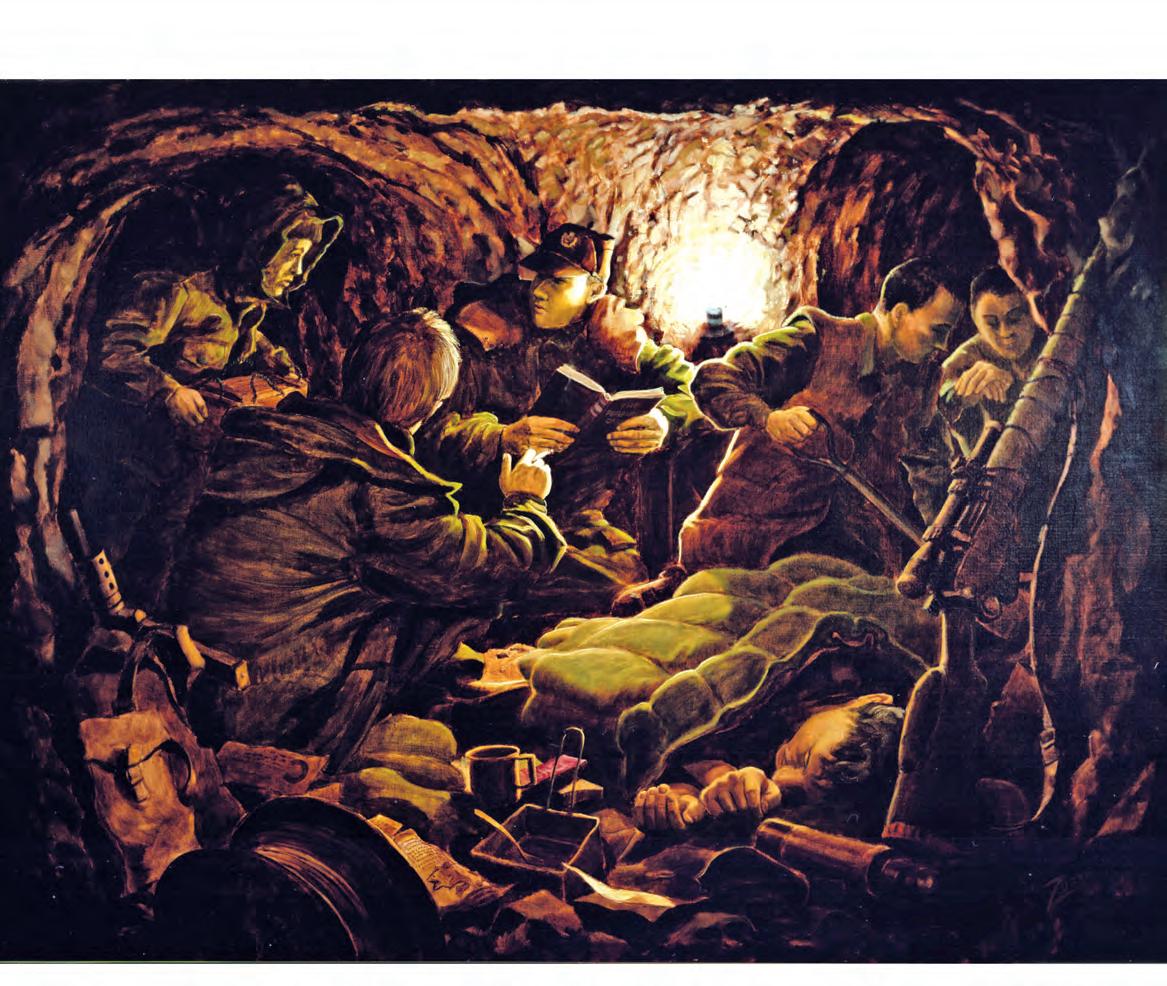
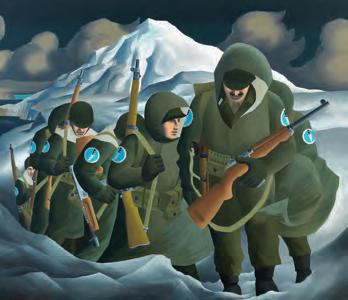
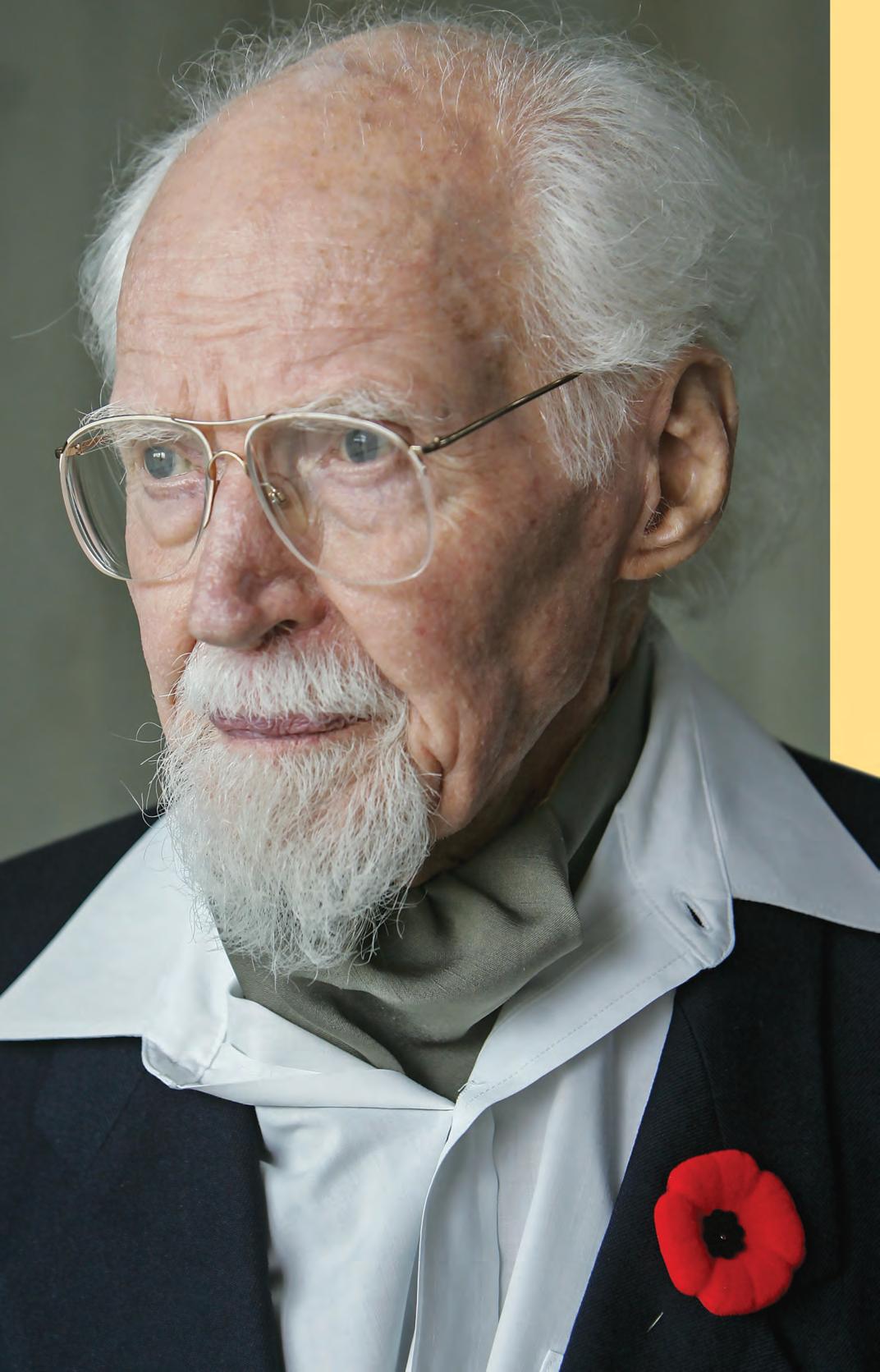
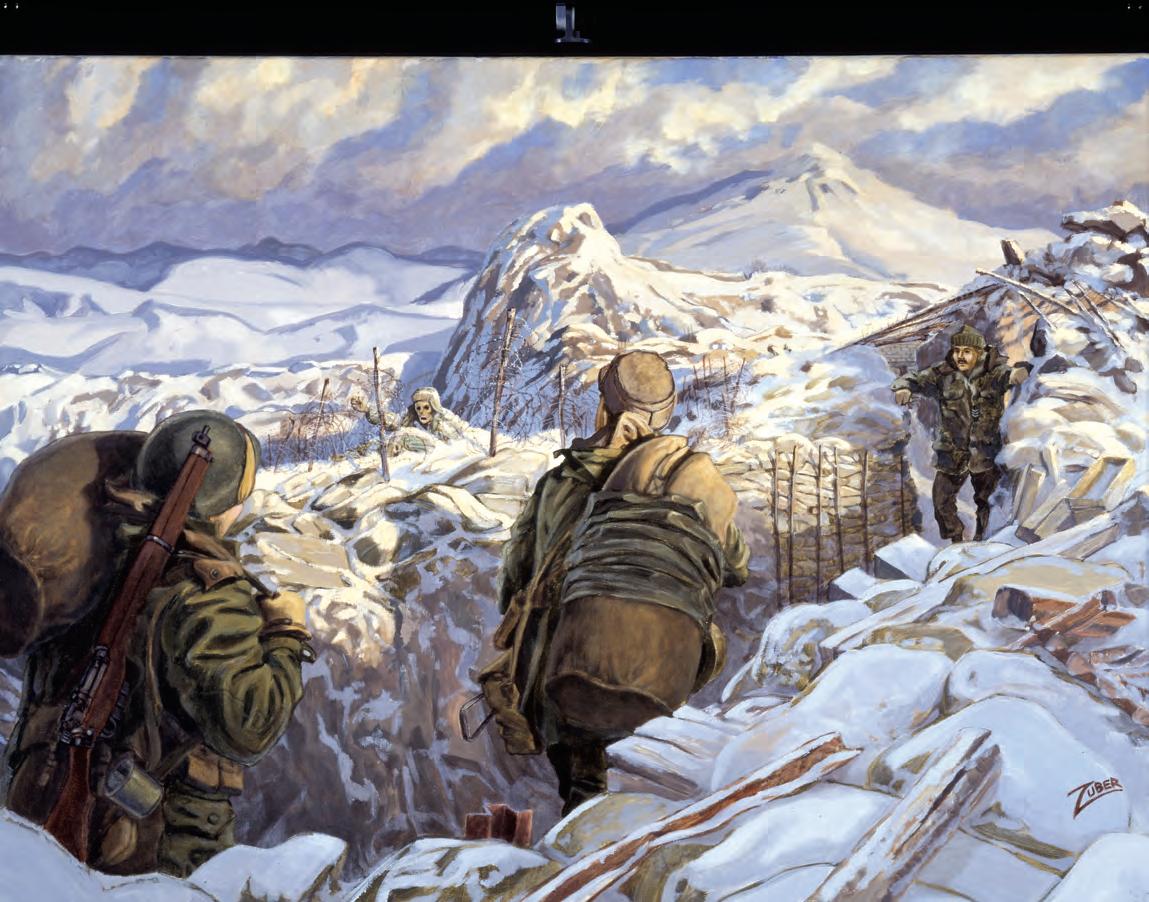
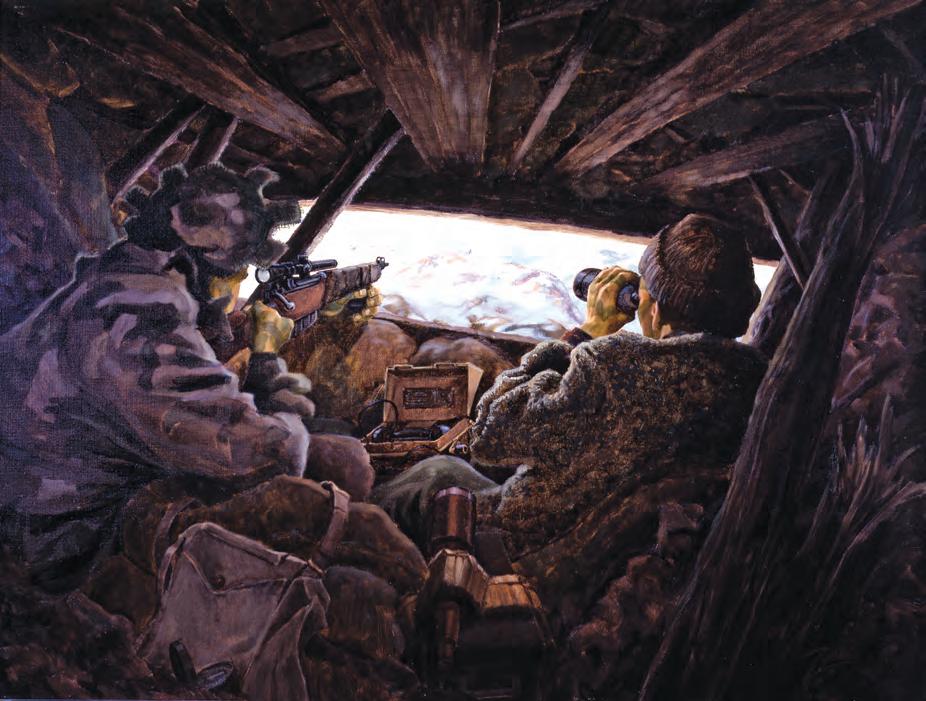
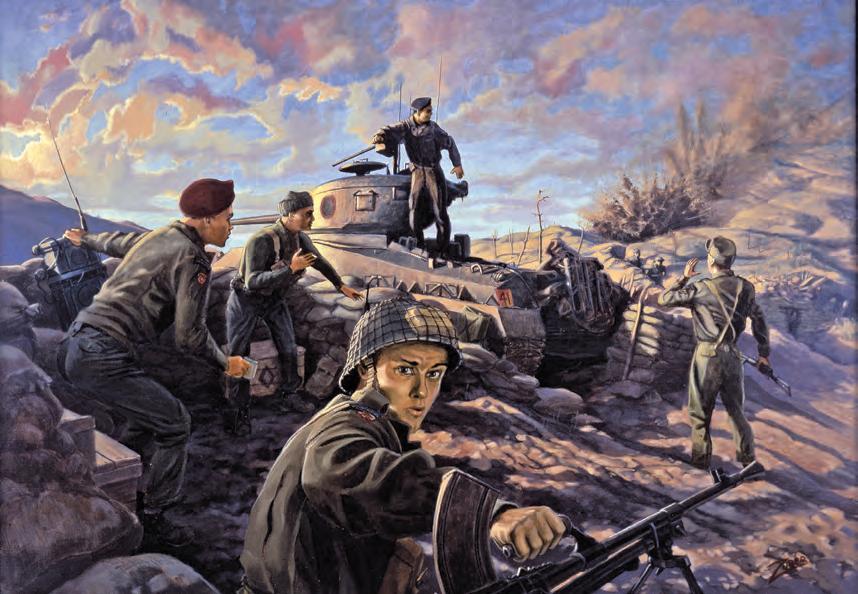
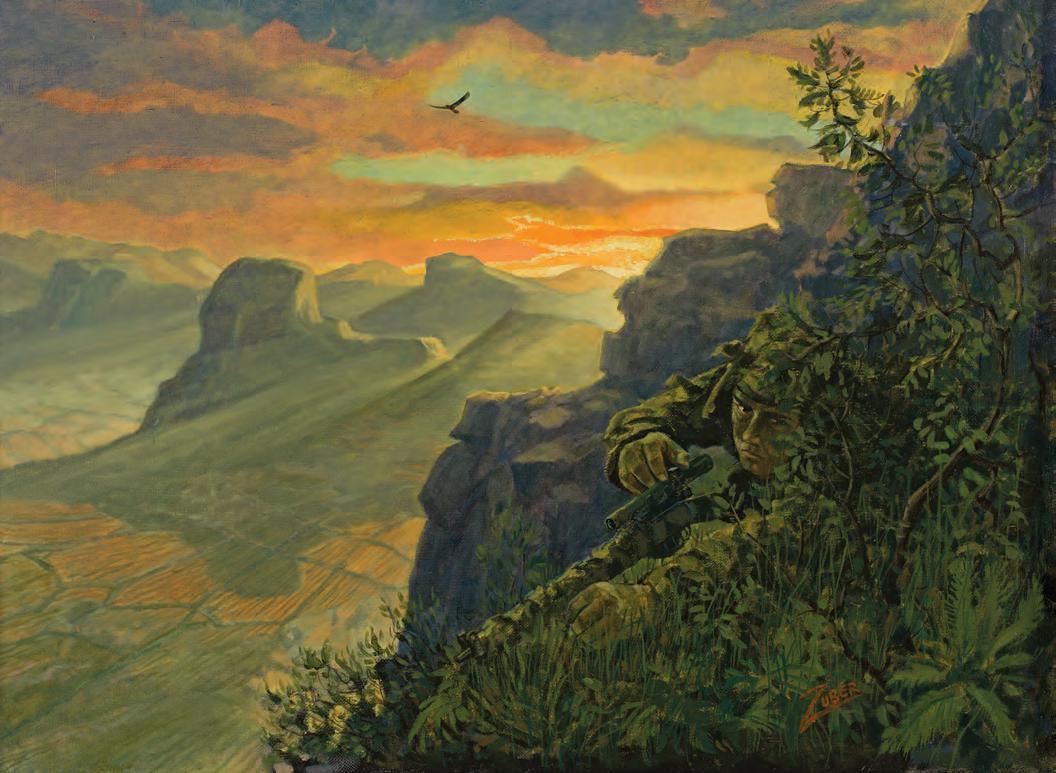
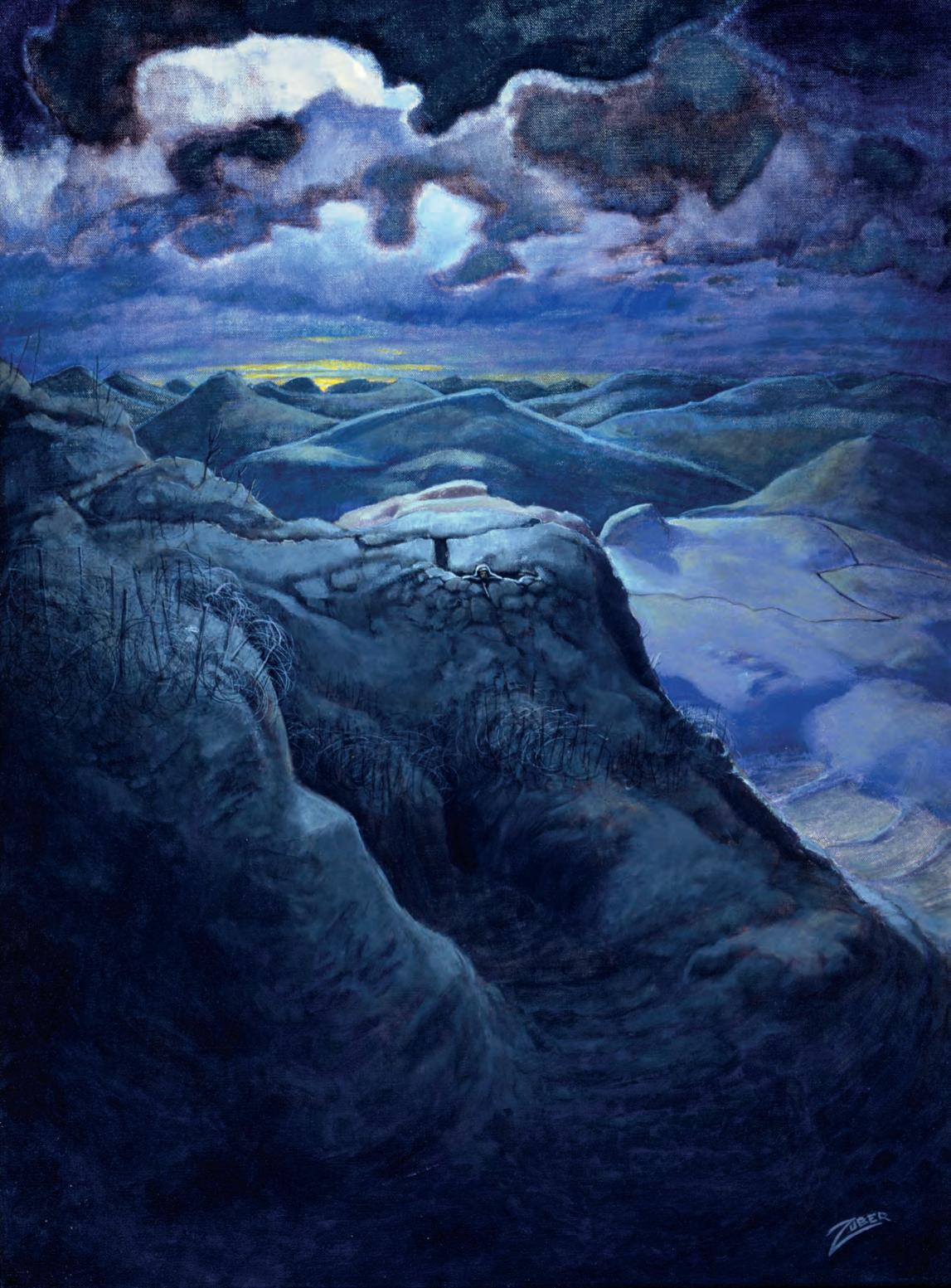
Ted Zuber depicts members of his unit in an underground hovel on a New Year’s Eve during the Korean War.
See page 50
Features
18 WEATHER WAS THEIR WORST ENEMY
Looking back at Canada’s role in the little-known Aleutian Islands Campaign
By Paige Jasmine Gilmar
24 THE PIG THAT NEARLY CAUSED A WAR
How a dead hog once led the U.S. and the British Empire to the brink of battle off the coast of Vancouver Island
By Tim Cook
30 LINE BRAWL
New Brunswickers and Mainers “fought” over the international boundary in the so-called Aroostook War
By Terry Fallis
34 “WE HAVE THE WATCH”
Norad has seen many changes during its 65-year existence, but what does the future hold?
By John Boileau
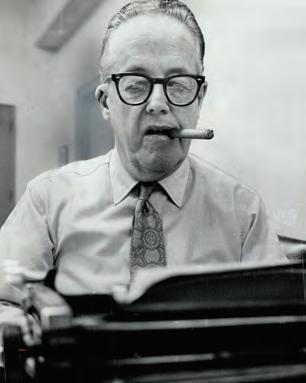
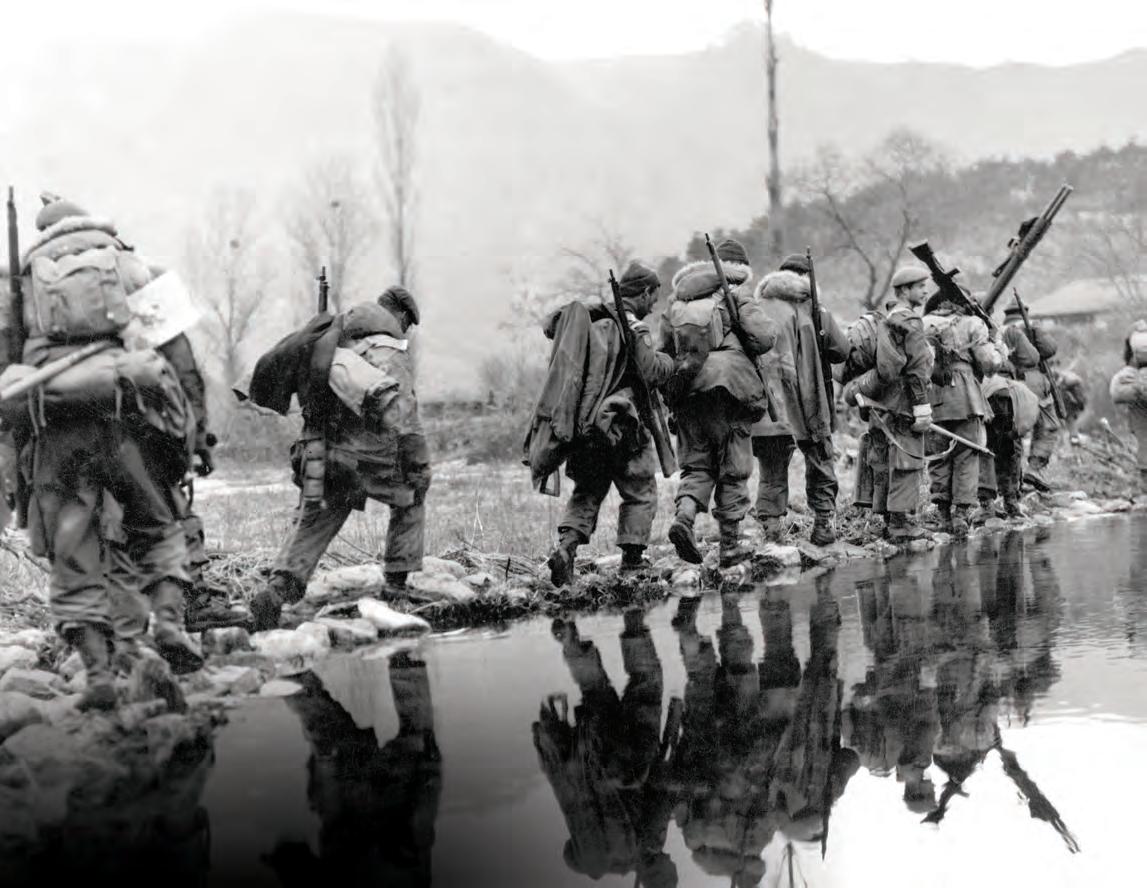
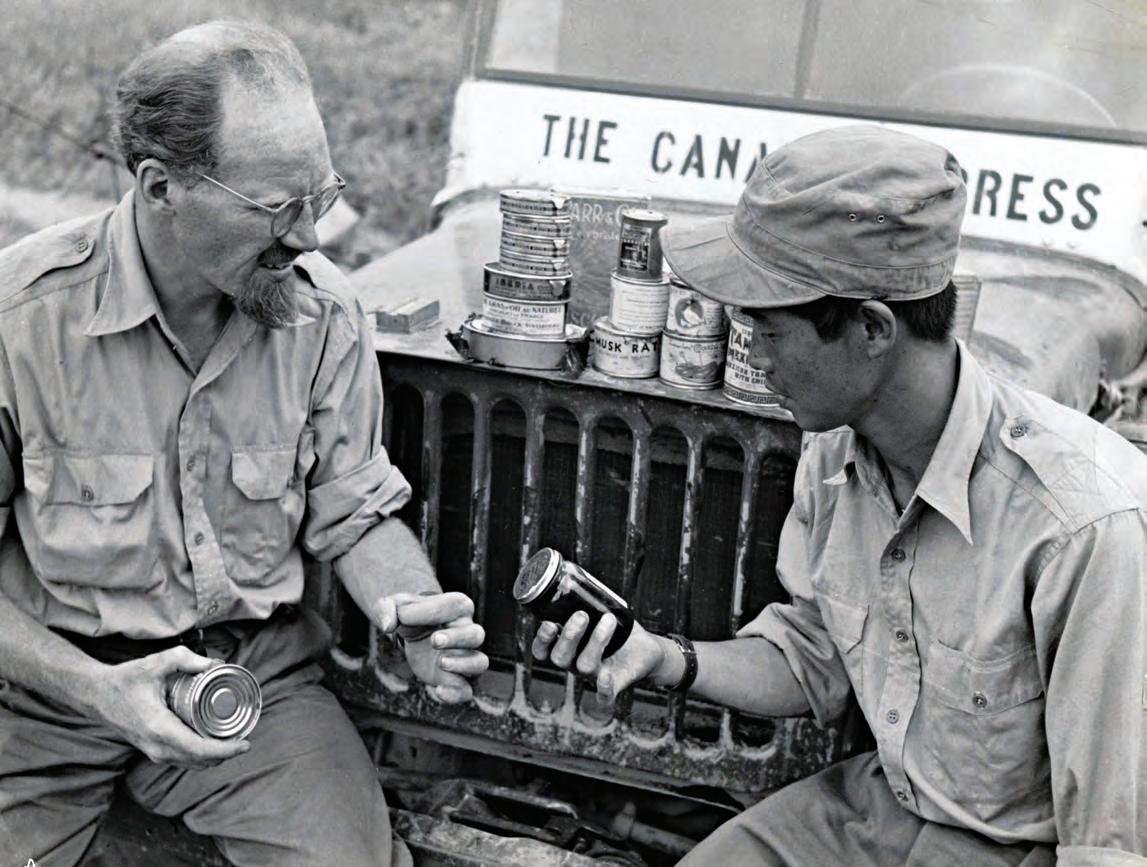
44 WITH THE CANADIANS IN KOREA
The colourful life of war correspondent Bill Boss
By Stephen J. Thorne
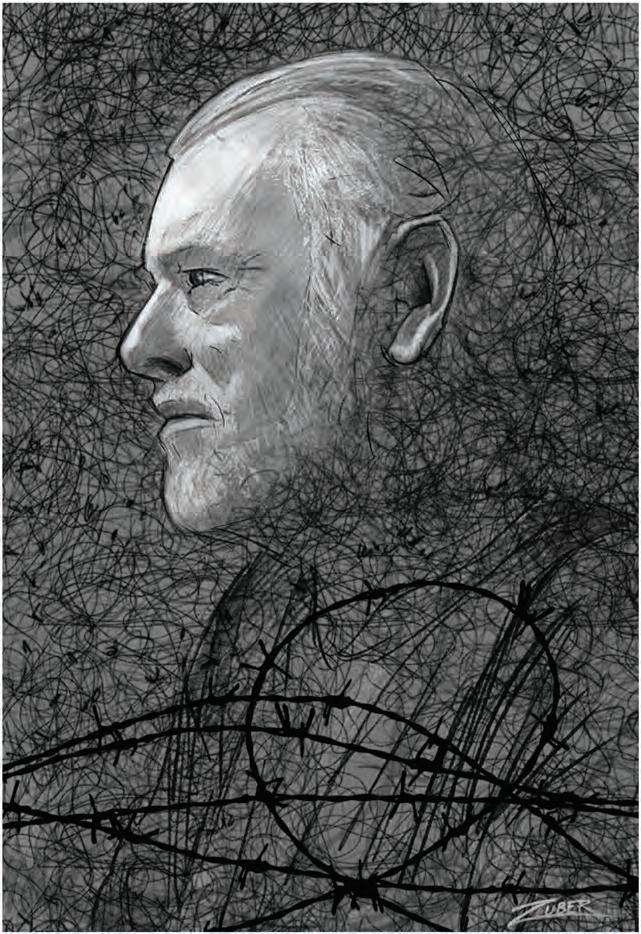
50 THE FIGHTING ARTIST
Years after the conflict, sniper Ted Zuber became the Canadian war artist for Korea
By Stephen J. Thorne
PHOTO
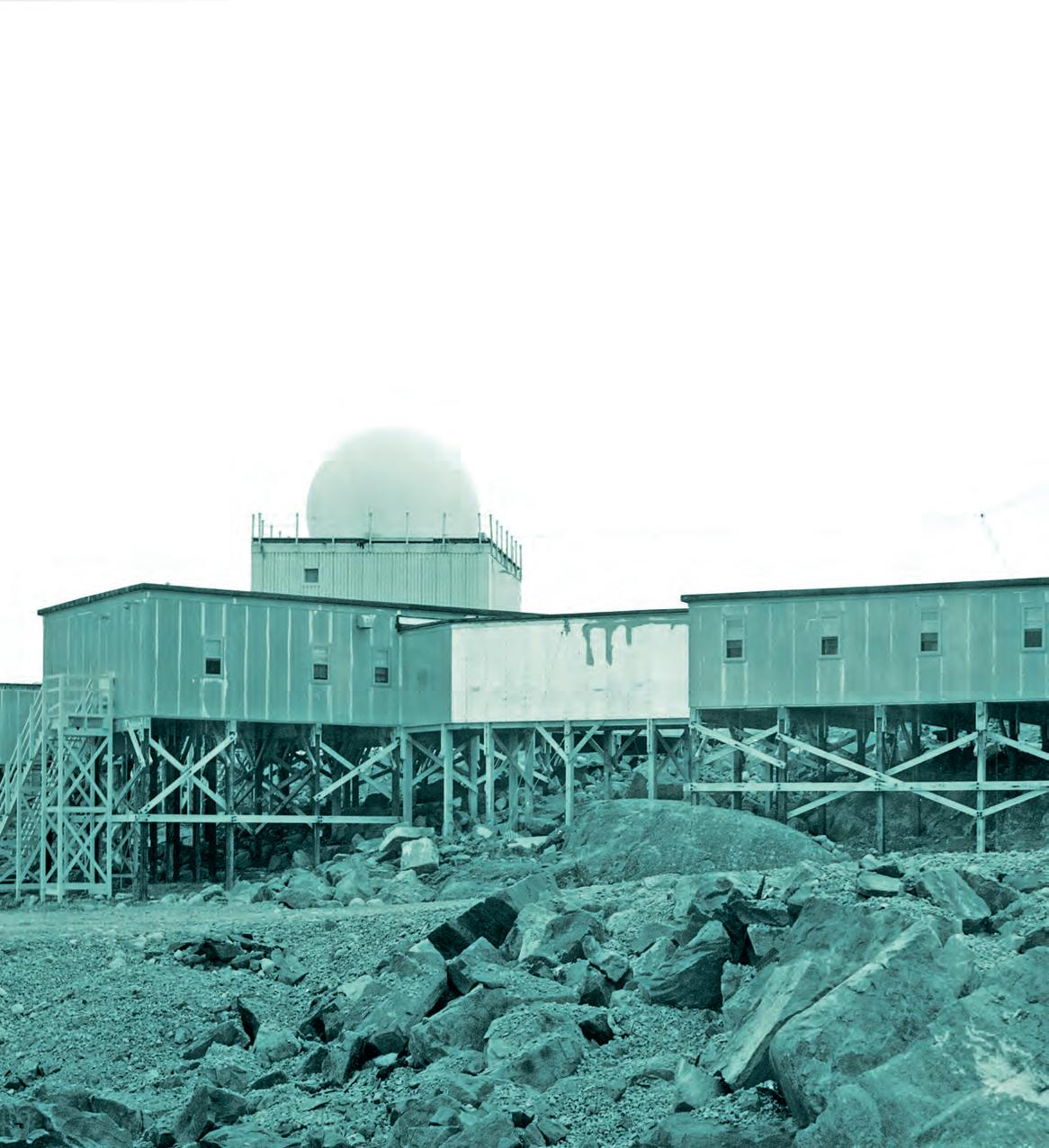
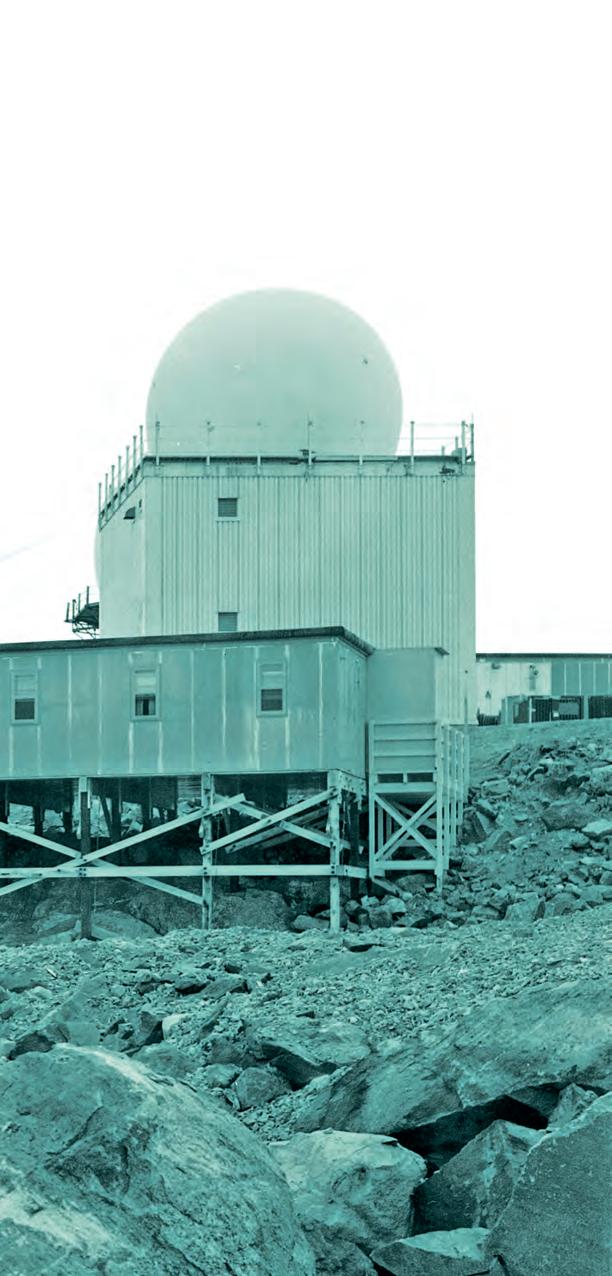
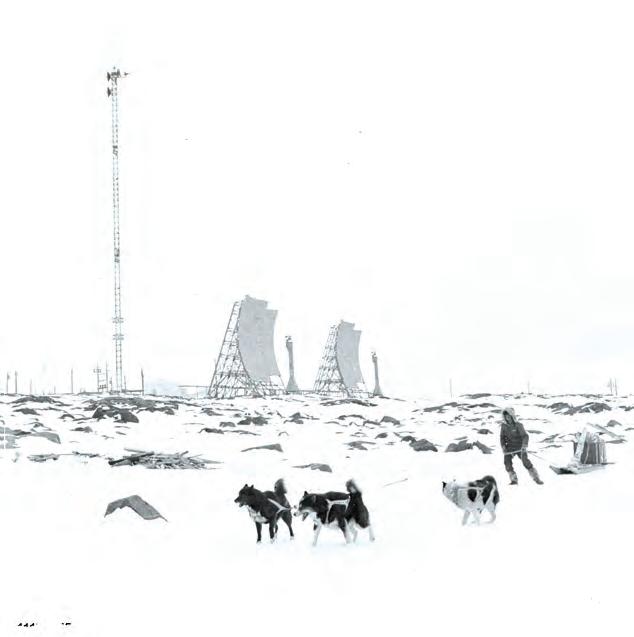
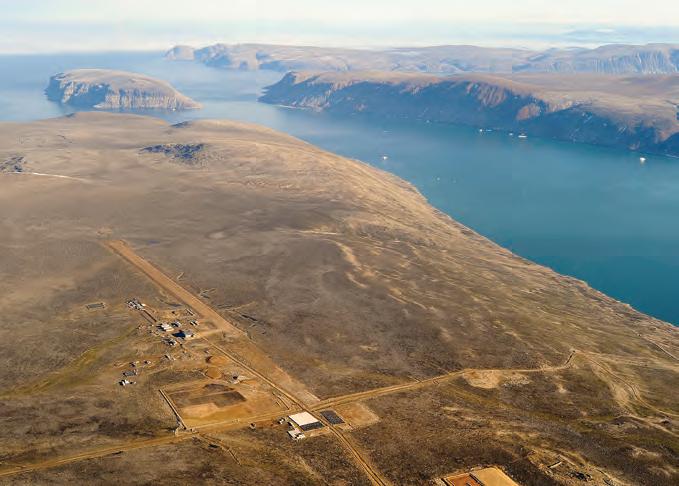
The Pinetree Line radar station in Iqaluit in the late 1950s. Rosemary Gilliat Eaton/LAC/e010836248
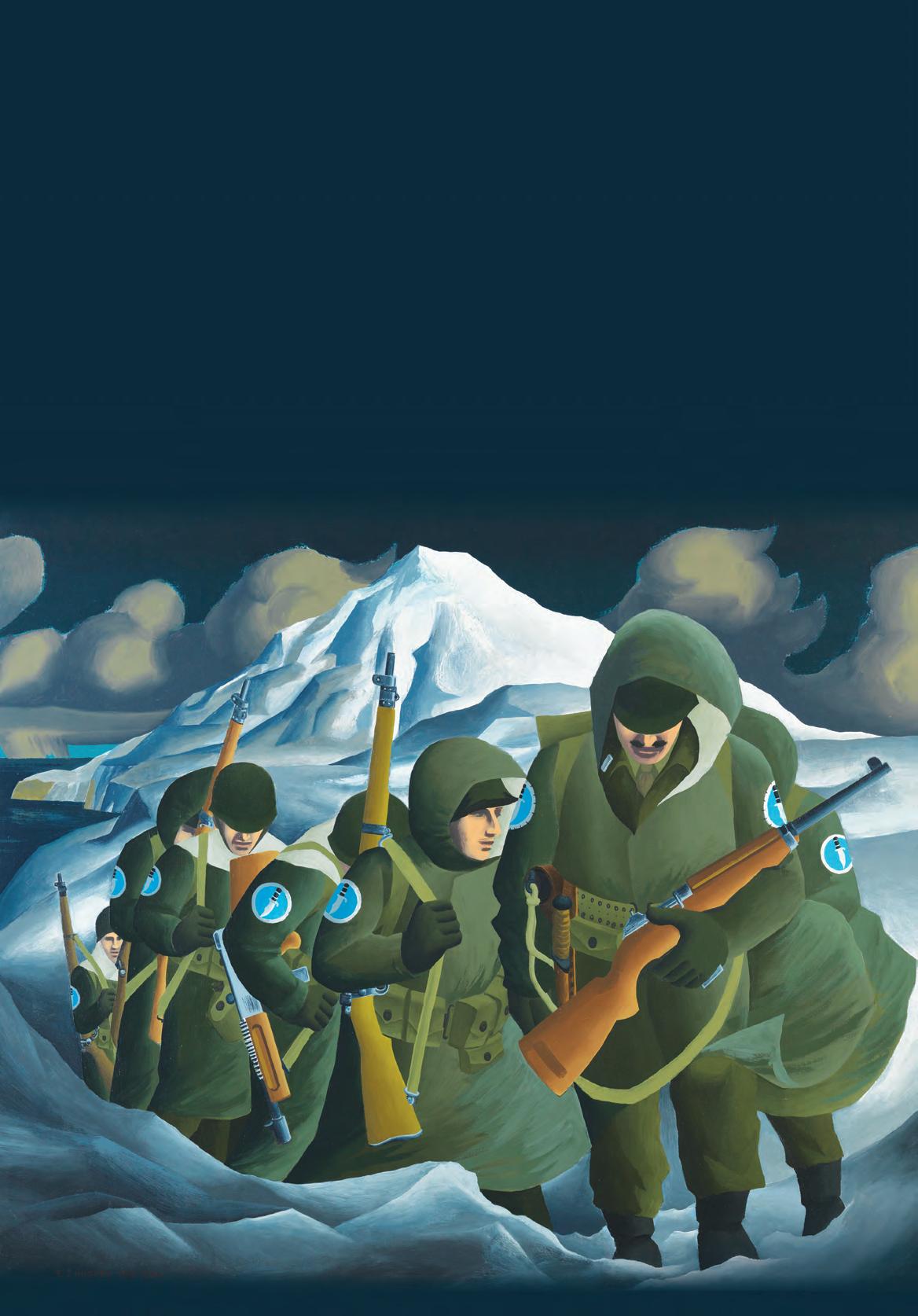
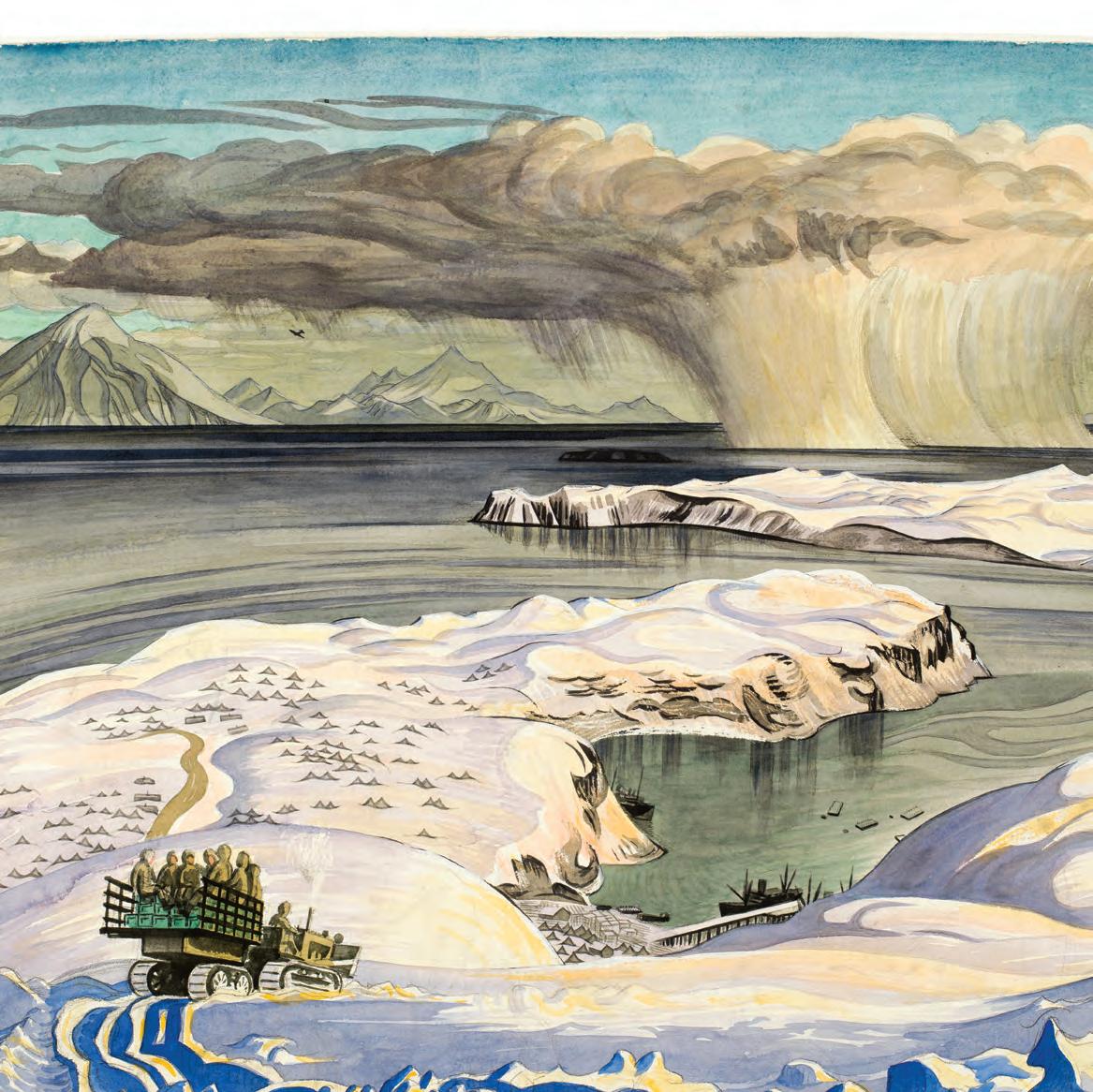
ON THE COVER War artist E.J. Hughes depicts the 13th Canadian Infantry Brigade landing on the Alaskan island of Kiska during the Aleutians Campaign in August 1943. Captain Edward Jones (E.J.) Hughes/CWM/19710261-3877
COLUMNS
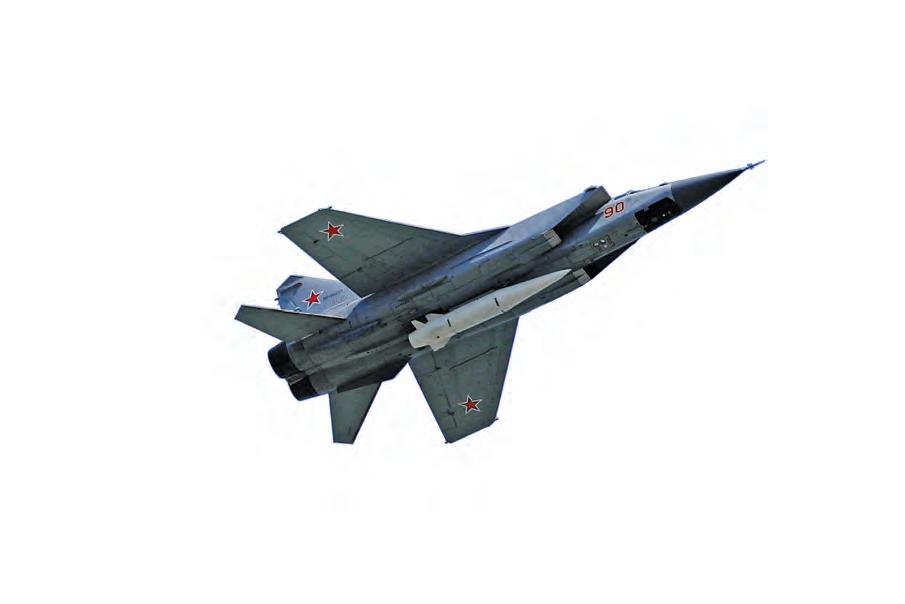
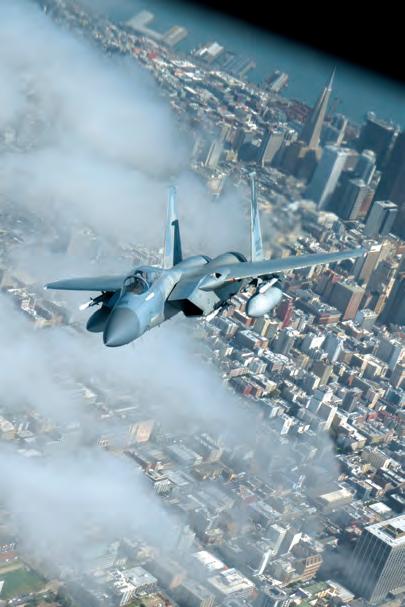
Is it a good idea for Canada to join the U.S. global missile defence system?
Ernie Regehr and James Fergusson
CANADA AND THE NEW COLD WAR
point
The story of a sword
Queen’s own pirate
Vol. 98, No. 3 | May/June 2023
Board of Directors
BOARD CHAIR Owen Parkhouse BOARD VICE-CHAIR Bruce Julian BOARD SECRETARY Bill Chafe
DIRECTORS Tom Bursey, Steven Clark, Thomas Irvine, Berkley Lawrence, Sharon McKeown, Louise Tardif, Brian Weaver, Irit Weiser
Legion Magazine is published by Canvet Publications Ltd.
GENERAL MANAGER Jason Duprau
INTERIM
ADMINISTRATIVE
ROSS MUNRO
SUPERVISOR
Lisa McCoy
INTERIM
ADMINISTRATIVE ASSISTANT
Jonathan Harrison
ADMINISTRATIVE
SUPERVISOR
Stephanie Gorin (on leave)
STAFF WRITERS
Paige Jasmine Gilmar
Stephen J. Thorne
ART DIRECTOR, CIRCULATION AND PRODUCTION MANAGER
Jennifer McGill
SENIOR DESIGNER AND PRODUCTION CO-ORDINATOR
Derryn Allebone
Advertising Sales
CANIK MARKETING SERVICES
TORONTO advertising@legionmagazine.com
DOVETAIL COMMUNICATIONS INC mmignardi@dvtail.com
OR CALL 613-591-0116 FOR MORE INFORMATION
Published six times per year, January/February, March/April, May/June, July/August, September/October and November/December. Copyright Canvet Publications Ltd. 2023. ISSN 1209-4331
Subscription Rates
Legion Magazine is $9.96 per year ($19.93 for two years and $29.89 for three years); prices include GST. FOR ADDRESSES IN NS, NB, NL, PE a subscription is $10.91 for one year ($21.83 for two years and $32.74 for three years). FOR ADDRESSES IN ON a subscription is $10.72 for one year ($21.45 for two years and $32.17 for three years).
TO PURCHASE A MAGAZINE SUBSCRIPTION visit www.legionmagazine.com or contact Legion Magazine Subscription Dept., 86 Aird Place, Kanata, ON K2L 0A1 or phone 613-591-0116. The single copy price is $5.95 plus applicable taxes, shipping and handling.
Change of Address
Send new address and current address label. Or, new address and old address, plus all letters and numbers from top line of address label. If label unavailable, enclose member or subscription number. No change can be made without this number. Send to: Legion Magazine Subscription Department, 86 Aird Place, Kanata, ON K2L 0A1. Or visit www.legionmagazine.com. Allow eight weeks.
Editorial and Advertising Policy
Opinions expressed are those of the writers. Unless otherwise explicitly stated, articles do not imply endorsement of any product or service. The advertisement of any product or service does not indicate approval by the publisher unless so stated. Reproduction or recreation, in whole or in part, in any form or media, is strictly forbidden and is a violation of copyright. Reprint only with written permission.
PUBLICATIONS MAIL AGREEMENT NO. 40063864
Return undeliverable Canadian addresses to Legion Magazine Subscription Department 86 Aird Place, Kanata, ON K2L 0A1 | magazine@legion.ca
U.S. Postmasters’ Information
United States: Legion Magazine, USPS 000-117, ISSN 1209-4331, published six times per year (January/February, March/April, May/June, July/August, September/October, November/December). Published by Canvet Publications, 866 Humboldt Pkwy., Buffalo, NY 14211-1218. Periodicals postage paid at Buffalo, NY. The annual subscription rate is $9.49 Cdn. The single copy price is $5.95 Cdn. plus shipping and handling. Circulation records are maintained at Adrienne and Associates, 866 Humboldt Pkwy., Buffalo, NY 14211-1218. U.S. Postmasters send covers only and address changes to Legion Magazine, PO Box 55, Niagara Falls, NY 14304.
Member of CCAB, a division of BPA International. Printed in Canada.
We acknowledge the financial support of the Government of Canada. Version française disponible. On occasion, we make our direct subscriber list available to carefully screened companies whose product or services we feel would be of interest to our subscribers. If you would rather not receive such offers, please state this request, along with your full name and address, and e-mail magazine@legion.ca or write to Legion Magazine, 86 Aird Place, Kanata ON K2L 0A1 or phone 613-591-0116.
Uniformed decisions
An
Ottawa-based charity fronted by Canadian military officers working to send non-lethal aid to Ukraine is facing allegations of mismanagement and providing Ukrainian troops with second-rate equipment —at times doing the work in uniform and citing their official positions in their charitable efforts.
Mriya Aid is a registered not-forprofit dedicated to helping Ukraine defend itself against Russian aggressions. It has collected more than $3 million worth of medical supplies, non-lethal military equipment and humanitarian aid.
Now there are rumblings that not all the equipment was delivered, that some of the supplies are of inferior quality and that some charity members are profiting off the war.
The Ottawa Citizen reported that one board member resigned from Mriya Aid, saying the
organization had lost oversight of some of its representatives.
The charity’s chair, LieutenantColonel Melanie Lake, “unequivocally and emphatically” denied the allegations.
But that’s beside the point. Active military personnel have no business participating in private efforts to supply the armed forces of other countries. The officers involved—and certainly the departmental bosses who gave them the go-ahead—should know better.
At least four officers of the Canadian Armed Forces are volunteering with Mriya Aid; two are on its board of directors. All point out they are acting in a personal capacity as private citizens.
However, the Citizen reported this past January that at least two officers have attended charityrelated events in uniform and referenced their military ranks
in Mriya Aid presentations. Lake’s military service is highlighted on the organization’s website.
In its dress regulations, the CAF describes the uniform as identifying “all personnel as members of a cohesive, armed body in the service of Canada” and as “the primary means by which the public image of the CAF is fashioned.”
In November, the vice-chief of the defence staff, Lieutenant-General Frances Allen, banned military personnel from wearing uniforms during civilian court proceedings unless they are testifying on behalf of the military or the Crown in a military capacity. The concern? Doing so could unduly reflect on the military and intimidate or influence judges, juries or witnesses at trial.
The idea of active, uniformed military officers using their status in the service of a military cause outside that for which they enlisted smacks of conflict of interest.
The federal government has committed more than $1 billion in military assistance to Ukraine since Feb. 24, 2022. Private charities continue to do their work. CAF personnel should defer to the civilians doing it. L
Latest partner promises a good night’s sleep
The Royal Canadian Legion’s exclusive Member Benefits Package (MBP) has always promised deals that let you rest easy. Its latest partner, Ultramatic, pledges that literally.
Canada’s leader in adjustable beds, specialty mattresses and pillows, Ultramatic has sold more than 200,000 of its specialized products. It boasts free delivery almost anywhere in the country. And with over 30 years in the business, its customer service reps are industry experts. Ultramatic mattresses are designed and manufactured in
Canada and its adjustable beds are covered by an industryleading 25-year warranty.
To enjoy exclusive benefits from Ultramatic on the cost of mattresses, adjustable bases and lift chairs, call 1-800-373-8887 and mention you’re a Legion member, or visit www.ultramaticsleep.com.
The MBP also offers discounts for automotive repairs and consultation services, travel packages and specially designed travel insurance, online prescriptions as well as on retirement living, cellphone plans, eyewear, funerals and much
more. Other MBP partners include PEARL Fleet Vehicle Management, Blowes and Stewart Travel, Pocketpills, IRIS Eyewear, Medipac Travel Insurance, belairdirect car and home insurance, Rogers, HearingLife, Arbor Memorial, Canadian Safe Step Walk-in Tub Company, CHIP Reverse Mortgage, Revera and MBNA Canada Bank.
Discounts from the everexpanding roster of MBP partners are yet another bonus of Legion membership, exclusive savings that combined can easily cover the member fee. L
Ultramatic is proud to partner with The Royal Canadian Legion in our mission to help older Canadians live a fuller life: Improve Your Sleep. Elevate Your Life!
Ultramatic is Canada’s leader in living-in-place home furnishings, allowing older adults to live longer, healthier and happier in their homes. Ultramatic’s roots shoot from our iconic Adjustable Beds and Mattresses. With over 200,000 adjustable beds sold since our beginning, Ultramatic has been improving the sleep of Canadians for decades.
A good night’s sleep can impact your physical and mental wellness: improving your health mood, memory, and energy. Our customers have discovered that Ultramatic sleep systems not only let you sleep better, but also allow you to live a fuller life.
With more than 1,001 positions, our beds and chairs adjust to you – your every shape and your every mood. So go ahead and pick the perfect position for sleeping, reading, watching TV, or simply surfing the internet!
Pair your adjustable bed with one of our supremely comfortable mattress models. Our mattresses
are built with the latest in mattress technology, like NanoGel™, a trail-blazing material that prevents the sleep surface from overheating; or EcoPur Foam™, an environmentally-friendly foam that contributes to the circular economy and can reduce your carbon footprint.
In addition to our trademarked adjustable beds, Ultramatic carries Power Lift Recliners, Walk-in Bathtubs and Powered Wall Beds – all made in Canada to the highest quality levels.
As a member of The Royal Canadian Legion, you and the members of your household are eligible to receive exclusive benefits toward the cost of mattresses, adjustable bases and lift chairs.
For over 40 years, Ultramatic has built an unrivalled depth of trust and connection, helping Canadians take control of their sleep, health and lives. We hope you will take advantage of this partnership and all the benefits Ultramatic offers. Elevate your Life with Ultramatic.
I Medal haul
was interested in the editorial in the March/April issue regarding the awarding of decorations (“Pro Valore” ). I have been a Canadian citizen since 1970, but during the Second World War I served in the British navy as a signalman, mainly in the North Sea and the Atlantic. On D-Day, I was privileged to be assigned to Juno Beach on various ships where I helped deliver ammunition to the Canadian forces. Since I was a Brit, I received award medals from the British government and the Royal Navy. On D-Day’s 75th anniversary in 2019, I was awarded the Chevalier de l’Ordre national de la Légion d’honneur from
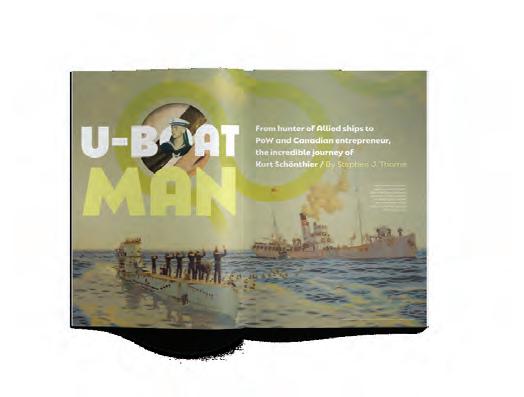
The feature “U-boat man” (March/April) reminded me of my own encounter with a former Nazi. I toured South Africa in 1974 on a Rotarian-sponsored cultural exchange. The tour ended with a safari to the Etosha Pan in South West Africa (now Namibia) on Angola’s border. While in the capital Windhoek, I billeted with a former U-boat captain who was captured in the Mediterranean when his sub was depth charged. He insisted on hosting me to return the kindness he had received in Canada during the three years he spent in a
Comments can be sent to: Letters, Legion Magazine , 86 Aird Place, Kanata, ON K2L 0A1 or e-mailed to: magazine@legion.ca
France. And the Canadian government did give me a letter of citation, which I value. The striking thing for me was the international flavour of the whole event, and something to remember in serving Britain, Canada, the U.S. and other countries in Europe. We were all in it together regardless of where the decorations came from.
Canadians should absolutely have their own medals, but they should also be allowed to accept and wear decorations from other countries.
STAN SMURTHWAITE ELMIRA, ONT.
prisoner-of-war camp in Alberta. He drove me into the desert to a diamondmining town called Swakopmund, where we proceeded to drink too much beer while singing “Ien Prosit.” I have forgotten his name, but I remember he was part of the successful movement toward Namibia’s later independence from South Africa.
EARL CHERRINGTON
VICTORIA
Star war
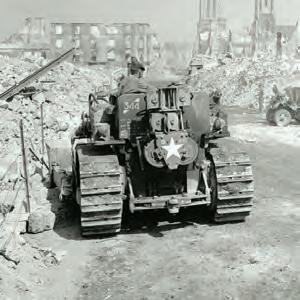
The caption on page one of the March/April issue reads: “Using American equipment, Canadian combat engineers move rubble from a street in Caen, France, in August 1944.” The Allied command decided that all vehicles in the invasion of Normandy on June 6, 1944, would have white
stars displayed in prominent positions. This was done because many American, British, French and Polish troops would be involved, if not in the initial landings, in followup divisions as the beaches were secured. The white star identification was taught to all troops so that friendly fire incidents could be prevented between inexperienced Allied forces. Similarly, all Allied aircraft had white invasion stripes painted on their wings.
NINO CHIOVELLI EDMONTON
CORRECTION
The Sikorsky helicopter pictured in “On this date” (March/April) was an S-55 and not an S-51.
Exclusive HIGHLIGHT
It has become known as the Forgotten War. A war that was not even called a war until decades after the last gun was put down. A war that technically has not ended yet. The Korean War.
Legion Magazine staff writer Stephen J. Thorne interviewed some of the few living Korean War veterans, gathering some of their stories about the three-year
conflict. His collection of powerful interviews from a dying breed of soldiers can be read in an online, interactive story at https://legionmagazine.com/features/ korea-the-war-without-end starting July 1.
Scroll through photos that will transport you to the Kapyong area and listen to the voices of veterans who, when they were barely adults, fought for democracy and peace in a foreign land. Their stories, their sacrifice, their honour, now live forever in their own words.
Get notified of all the latest updates on legionmagazine.com by signing up for our weekly e-newsletter at www.legionmagazine.com /en/newsletter-signup
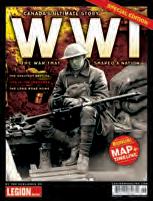
It was the closest the cold war came to heating up, and the first test of the UN’s authority and capability. Understand
the conflict in new ways with exclusive maps and timelines, and see rare photos of what life at war, and in prisoner-of-war camps, looked like.
If you want to get an even closer look at the action and learn more about the Canadians, Americans, Aussies and Brits who played a critical role in upholding the liberty of South Koreans, get a copy of the latest special issue from Canada’s Ultimate Story, Korea: The War without End, on newsstands now. L
on top of any other discounts, savings and benefits customers are already eligible for at belairdirect.
To take advantage of this offer, simply call us and mention you are a Legion member to get your exclusive premium.
10 May 1990
The Canadian Space Agency is created.
11 May 1944
Canadian tanks support the attack on German lines in Italy’s Liri Valley.
12 May 1937
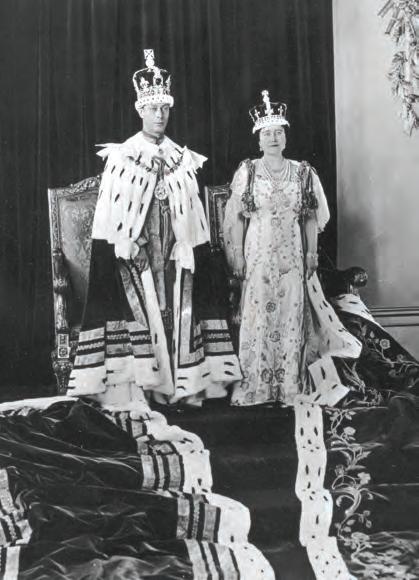
The Canadian military participates in the coronation of King George VI after his brother, Edward, abdicated.
13 May 1945
5 May 1862
Mexico repels the French forces of Napoleon III at the Battle of Puebla, a victory now celebrated as the national holiday Cinco de Mayo
7 May 1944
HMCS Valleyfield is hit by a homing torpedo from U-548 and sinks southeast of Cape Race, Nfld., leaving 125 dead.
German submarine U-899 officially surrenders to the Royal Canadian Navy near Shelburne, N.S., becoming the only German sub to surrender in Canadian waters during the Second World War.
8 May 1945
As the Allies accept Germany’s surrender, Europeans erupt in celebration of the end of the Second World War on the continent.
9 May 2014
A National Day of Honour marks the end of Canada’s military mission in Afghanistan.
16 May 1945
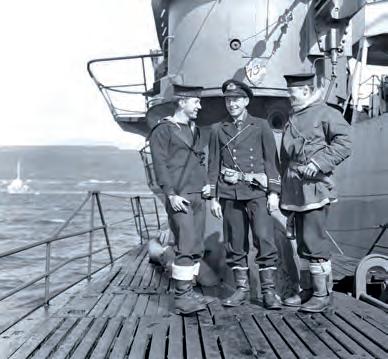
HMCS Matane is sent to escort 14 surrendered U-boats from Norway to Scotland.
17 May 1929
Test pilot Jack Caldwell becomes the first Canadian to save his life by parachute when his Vedette suffers engine failure and he is forced to jump.
18 May 1966
Terrorist Paul-Joseph Chartier is killed in the Parliament Buildings by a bomb he intended to throw into the House
19 May 1845
John Franklin begins his ultimately doomed voyage in search of a Northwest Passage.
21 May 1939
The National War Memorial is unveiled by King George VI in Ottawa.
23 May 1944
Canadians break through the Hitler Line in Italy’s Liri Valley.
26 May 2004
Labrador Inuit overwhelmingly support a land-claim agreement that leads to establishing Nunatsiavut, a regional Inuit government in Newfoundland and Labrador.
30 May 2007
MCpl. Darrell J. Priede of Burlington, Ont., is among seven NATO soldiers killed in a Chinook helicopter crash in Afghanistan. The chopper was reportedly attacked by Taliban fighters.
31 May 1997
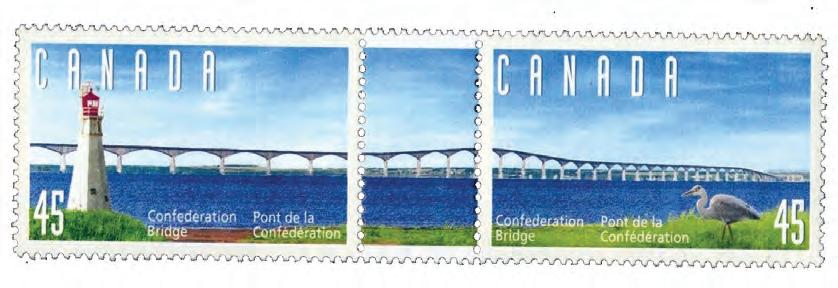
Prince Edward Island and the Canadian mainland are officially linked by the Confederation Bridge.
June
13 June 1898
4 June 1940
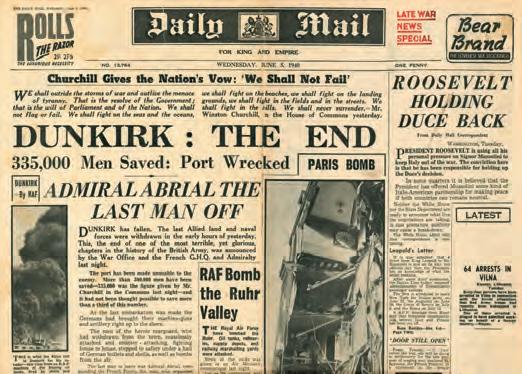
The evacuation from Dunkirk is completed. Six Canadians die in the battle.
5 June 1981
The first case of AIDS is reported.
6 June 1944
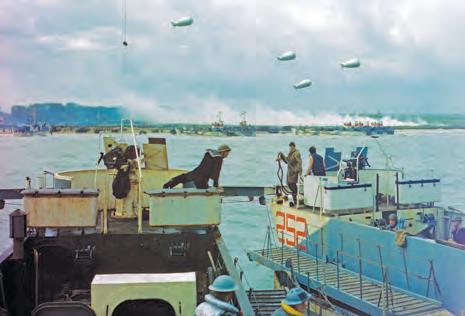
Nearly 160,000 Allied soldiers land in Normandy, France, on D-Day.
10 June 1999
The Kosovo War ends.
11 June 1847
Explorer John Franklin dies aboard HMS Erebus, ice-bound in the Arctic.
12 June 1941
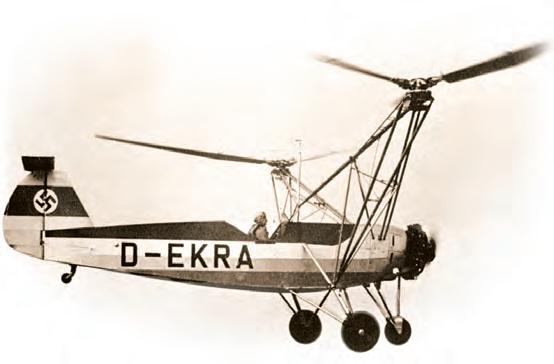
26 June 1936
The twin-rotor Focke-Wulf Fw 61, the world’s first helicopter, lifts off.
After a gold rush, the Yukon joins Confederation, becoming Canada’s second territory.
14 June 1841
The first session of the Parliament of the Province of Canada is opened by Baron Sydenham in Kingston, Upper Canada.
27 June 1946
The Canadian Citizenship Act, which confers citizenship on all Canadians, regardless of place of birth, is passed. It would come into force the following year.
Rail yards at Schwerte, Germany, are targeted in the Royal Canadian Air Force’s first bomber attack of the Second World War.
15 June 1891
John Abbott is sworn in as Canada’s third prime minister, the first born on Canadian soil.
16 June 1914
Valcartier Garrison is created in anticipation of the First World War.
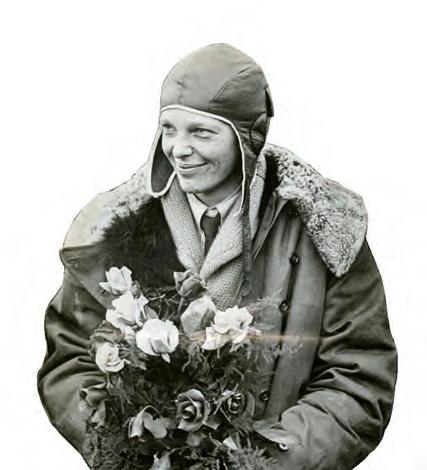
17 June 1928
Amelia Earhart becomes the first woman to fly solo across the Atlantic.
18 June 1815
Napoleon suffers a shattering defeat at the Battle of Waterloo.
22 June 1813
Laura Secord walks 32 kilometres to warn the British that the Americans are planning an attack.
28 June 1914
Archduke Franz Ferdinand of Austria is assassinated in Sarajevo, igniting the First World War.
29 June 1922
France grants Canada land surrounding Vimy Ridge for a memorial park; the Canadian National Vimy Memorial is unveiled there in 1936.
By Paige Jasmine Gilmar
Sexual
healing
“He
‘picked up’ more than a girl.” This was the beginning line of a PSA issued by the Canadian government during the Second World War.
Typical sensationalism, but the meaning of those words, written over a cracked, crimson skeleton, is unmistakable: It’s a warning against venereal disease (VD). But VD wasn’t just a side-effect of WW II, it has been a little talked about battle waged by soldiers for centuries. Today, however, that’s starting to change.
But in the mid-19th century, VD was a military problem that transcended cultures, countries and classes. The French called gonorrhea “la goutte militaire.” The British, meanwhile, mandated inspections and incarcerations of female civilian carriers in the 1860s. And many years later, militaries experienced much the same during the world wars. Those conflicts created an unprecedented separation of male and female populations, sparking transformative moments for gender and sexuality identities. But with newfound experiences came newfound risk.
During the First World War, the Canadian Expeditionary Force was the top conduit for VDs in the Allied forces, averaging almost double the infection rates of Australian and British soldiers during the winter of 1914. By 1915, 28.7 per cent of the CEF was infected with a VD.
Soldiers have long encountered venereal diseases. Modern health strategies, however, are helping to limit them
There was another wave of VD during the Second World War. Canada’s labour force lost more than half a million days due to VD. But unlike during the Great War, the country was equipped with a powerful antidote to counter the threat: the Health League of Canada. Founded by Captain Gordon Bates after WW I, the league was a direct response to calls for help with VD. It prioritized sex education, just with a slight twist typical for its time: based on high moral standards.
BY 1915, 28.7 PER CENT OF THE CEF WAS INFECTED WITH SOME TYPE OF VD.
“[The Canadian military] very much wanted to…improve the morality of…soldiers and encourage them not to seek out sexual partners that they weren’t married to,” said health and medicine historian Catherine Carstairs.
Rather than focus on testing and treatment, chastity and moral sex education reigned supreme, with most programs failing to understand that military men often turned to sex to cope with the intense stress of war. And being diagnosed with VD was seen as a “character flaw,” meant to be punished, not treated.
During both world wars, infected military men could expect pay freezes, medical segregation, fines and neither canteen nor entertainment privileges while in treatment, with many left in claustrophobic medical centres equally as punishing. In the First World War, for instance, the venereal ward of the Military Base Hospital in Toronto would bar windows and entrances to keep patients from escaping. Degrading and often ineffective methods of diagnosis were routine at the time, such as the “short arm parade” where male genitalia were forcibly inspected for VD.
The Canadian military also conducted contact-tracing on potential military or civilian sources of VD, and even operated surveillance and patrols in areas believed to have high infection rates. Indeed, it labelled some such regions as completely “out of bounds” for soldiers.
“Particularly, we do want the men to [realize] the importance of obtaining the name and address of any and every girl companion,” wrote a draft memorandum about contact-tracing to the First Canadian Army. “The girls will be flattered.”
In a letter home, one private wrote, “every damn place is out of bounds to the Canadians… Most of the boys are wondering if Canada will be ‘Out of bounds.’”
Carstairs points out how women with VD were particularly targeted during the Second World War, being subjected to horrific, unnecessarily painful gynecological
examinations. “That can be quite a demeaning process in and of itself,” said Carstairs. “It [this treatment] seems to have stemmed from the fact that these women deserve to be punished for their sins.”
As individuals with VD were treated like second-class citizens, stigma, silence and secrecy shrouded their diagnosis and treatment.
A major survey on VD between 1838-1939 found that most military members had negative views of VD.
This history continued into the 21st century, albeit with a new name: sexually transmitted infections (STIs).
In 2018, the rates of STIs among men in the Candian Armed Forces were double that of their civilian counterparts. STIs such as chlamydia, syphilis and gonorrhea were on the rise in young males of the CAF, while rates among serving women and older men remained low and stable.
A lack of STI awareness and prevention was particularly damaging to members. Over the years, however, the CAF has introduced new and improved programs to address the issue, after seeing the success such initiatives have had in other militaries.
At recruit training centres in the U.S., for instance, the number of STIs are decreasing as contraceptive use and knowledge about safe sex is increasing with the implementation of modern, stigma-free programs. These initiatives often included secondary prevention strategies such as mass screening and online and social media educational presentations about STI transmission, symptoms and prevention.
“[Such work] has evolved over time…to something that is a bit more empowering of individuals towards making healthy choices,” said Dr. Vincent BeswickEscanlar, a CAF physician.
Beswick-Escanlar noted that CAF initiatives include education on risk factors and symptoms of
STIs. The programs also work to destigmatize and emphasize the importance of treatment. Plus, access to contraceptives and medical care are now widely available. The action is showing promising results.
As the CAF continues to adapt to the needs of its members,
Beswick-Escanlar and many other health professionals hope that STI rates among younger military men will begin to decline with more education.
“Sexual health is part of your health,” said Beswick-Escanlar. “Take it seriously.” L
MEDIPAC TRAVEL INSURANCE
For Canadians who are heading south this winter
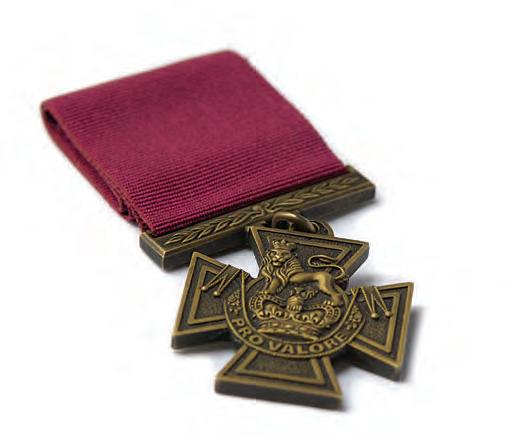
Are politics at play in bestowing Canada’s Victoria Cross?
M Award show
ilitary brass insists that the awarding of valour decorations—in this case, the Victoria Cross—is a merit-based exercise rooted in fact and timeliness, but history suggests otherwise.
Politics, racism, colonialism and other flaws and frailties have figured in the process since Queen Victoria created the medal for all ranks in 1856.
Now a retired public servant, who worked in the military’s Directorate of Honours and Recognition for almost a decade, says that in the Canada of 2023, a modern-day “two solitudes” is fuelling a debate over the first Canadian Victoria Cross.
The original British VC was awarded to almost 100 Canadians, the last for actions in 1945. It was eliminated in Canada when Ottawa
began overhauling the Canadian honours system in 1972. With the VC on the chopping block, Liberal Prime Minister Pierre Trudeau said Canadians should receive only Canadian decorations.
A new awards system was adopted and Canada established its own VC years after Conservative Prime Minister Brian Mulroney struck a committee to study the issue in 1987.
Twenty Stars of Military Valour, the second-highest Canadian gallantry decoration, were awarded for actions in Afghanistan. But National Defence Headquarters recently refused to consider an upgrade for the most prominent of them, Jess Larochelle, because of a time limit imposed by a Britishborn king, George VI, in 1950.
Furthermore, Canada adopted its own limit on valour awards, specifically, requiring nominations
within two years of the action for which they were considered.
And so, three decades, and one long war, after it was struck, the Canadian VC remains elusive, its ultimate status unknown.
The former bureaucrat, who spoke to Legion Magazine on condition of anonymity, described what he says is preventing the awards and review processes from taking their natural course.
“We have Canada’s two solitudes,” he said. “Liberal nationalism and Conservative monarchism. And to a certain extent, military identity has been the victim of Canada’s two solitudes and, clearly, Liberal nationalism is winning, based on demographics.”
It was Liberal governments that nurtured Canada’s national identity through the 1960s into the 1970s.
Some initiatives were good— replacing the Union Jack with the Maple Leaf Flag; patriating the Constitution and creating the Charter of Rights and Freedoms—while others fell short: unifying the Canadian Armed Forces in 1968, outfitting them in one uniform, and reconfiguring the regimental system.
Mulroney’s governments restored more traditional and distinct army, navy and air force uniforms, though they maintained the forces’ unified structure.
In 2011, Stephen Harper’s Conservative government renamed the Forces’ three environmental
commands to reflect their original designations: Air Command reverted to the Royal Canadian Air Force; Maritime Command went back to the Royal Canadian Navy; and Land Force Command became the Canadian Army.
The changes aligned with other key Commonwealth countries whose militaries use the royal designation and restored more traditional uniform insignia. The unified command structure did not change, however, and the services still have no separate legal status.
Lawyer and former Tory leader Erin O’Toole, whose bid to strike a committee to review potential VC actions was defeated in the Commons last spring, says he’s drafting a response to the limitation arguments.
“They are completely bogus and have no basis in law or prac-
WANTED
TRUDEAU WILL ELIMINATE THE MILITARY’S BRITISH TRAPPINGS ONCE AND FOR ALL.
tice in Canada for a number of reasons,” he wrote in an email.
“The most obvious is the fact the Mulroney government repatriated the VC in the 1990s.
“The Canadian VC has never been awarded…so the [military’s] reliance on a long-passed King is interesting but wrong.”
The bureaucratic source, who played a key role in implementing the changes more than a decade ago, predicts Prime Minister Justin
Trudeau will eventually eliminate the military’s British trappings once and for all—the VC included.
“There’s a definite core of people in government who don’t want Victoria Crosses awarded,” he said. “I believe Canada didn’t issue a VC, not because we didn’t have a soldier or soldiers do the right things to get a VC. It’s because we within government saw the Star of Military Valour as being the equivalent and we issue our own medals and not foreign medals.
“All those Canadian awards were created to be the equivalent of the old Military Cross, the old Military Medal, the old Distinguished Service Order,” he explained. “They were all created as Canadian equivalents to distance us from the Crown. It was a political decision, not a decision based on evaluation.” L
By David J. Bercuson
Pacific pacts
Despite its new Indo-Pacific Strategy, Canada remains out of military alliances in the region
Like its navy, now the largest in the world in terms of sheer number of ships, China is rapidly expanding its influence in the Indo-Pacific. In the face of this, the United Kingdom, the United States and Australia set out to grow their naval presences in the region.
In September 2021, the countries announced a trilateral treaty, awkwardly dubbed AUKUS, aimed at tying the nations closer together and to provide Australia with the technical knowledge to speed up its acquisition of nuclear-powered submarines. Canada, however, was not included in the pact.
When the treaty was first announced, Ottawa dismissed the country’s absence by pointing
to its presence in the “Five Eyes” intelligence group that includes the three AUKUS nations and New Zealand. Indeed, lately it seems that every time a new coalition of nations forms to counter growing international threats, Canada insists that the “Five Eyes” is really the only alliance that matters. It isn’t anymore.
For example, in late 2022 the “Quad,” a loose diplomatic coalition of Japan, Australia, India and the U.S.—formally known as the Indo-Pacific Quadrilateral Dialogue—began to move toward a more formal, NATO-like arrangement to counter China.
The U.K., with its two new aircraft carriers, will undoubtedly be invited to join, too.
In January 2023, Vice-Admiral Bob Auchterlonie, head of Canadian Joint Operations Command, told The Canadian Press that he’s concerned about Canada’s absence from AUKUS. As he put it, “when you start talking about advanced technology… artificial intelligence, machine learning, quantum…these are conversations we need to be a part of.”
Of course, Ottawa is saying little about its AUKUS absence because…what can it say? Canada clearly has interest in the
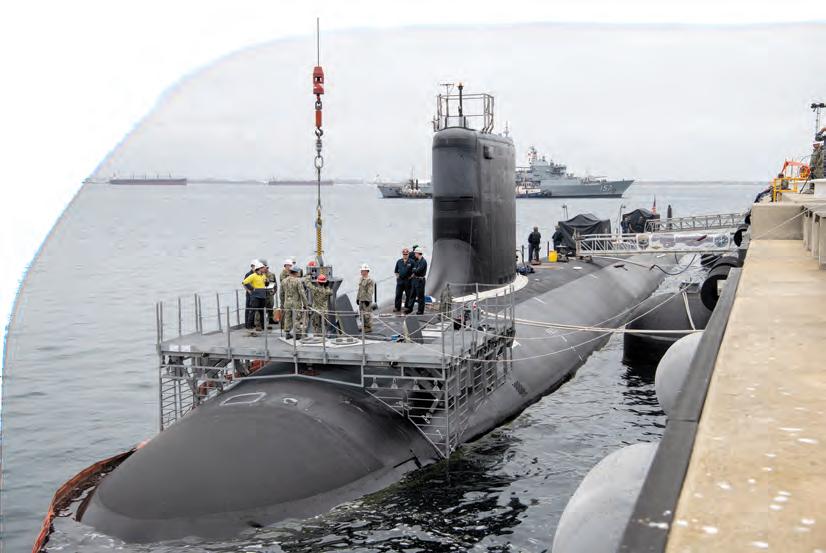
The USS Mississippi conducts an exercise with the Royal Australian Navy in the Indian Ocean in late 2022.
region given that it has issued its own Indo-Pacific policy paper. Is it possible Canada was excluded from AUKUS and the Quad because it’s a middling defence nation and didn’t want to be a part of either alliance to avoid the embarrassment of its own military pitfalls?
Instead of putting its defence and policy failures front and centre for all to see, the government would rather have Canadians talking about child dental care than the defence of the nation.
There is no point in rehashing the many failures of Canada’s defence and procurement policy— they’ve been well documented. Nor is it helpful to belabour the delays in rebuilding the country’s navy, acquiring new fighter planes or even whispers about
new submarines with under-ice capabilities. Fifteen years ago, Canada had a meaningful presence in Afghanistan during the war against the Taliban. Today, the country doesn’t even contribute a single ship to the NATO naval effort.
Avoidance has been a recurring pattern when it comes to Canadian defence during the past century—to ignore the issue until a crisis arises, then rush to catch up.
Canada’s current defences are in a greater mess than they were in the early 1990s when huge spending cuts were made at the end of the Cold War in an attempt to contain the
As senior defence officials, such as Auchterlonie and chief of the defence staff, General Wayne Eyre, become increasingly open about Canada’s lack of defence readiness in these challenging times, and more and more stories about the country’s military weakness are appearing in the press and social media, some Canadians, it seems, are clearly beginning to take notice.
Canada has long struggled with balancing a dream welfare state with strong armed forces. It’s now past time to prioritize the latter. L
No. 2 Construction Battalion
On July 5th, 1916, the No. 2 Construction Battalion was authorized. It was Canada’s first and only Black battalion. The Royal Canadian Legion is proud to commemorate these men and their legacy, as they were willing to lay down their lives for their country despite the injustice and discrimination they faced.
Weather was their
enemy worst
By Paige Jasmine Gilmar
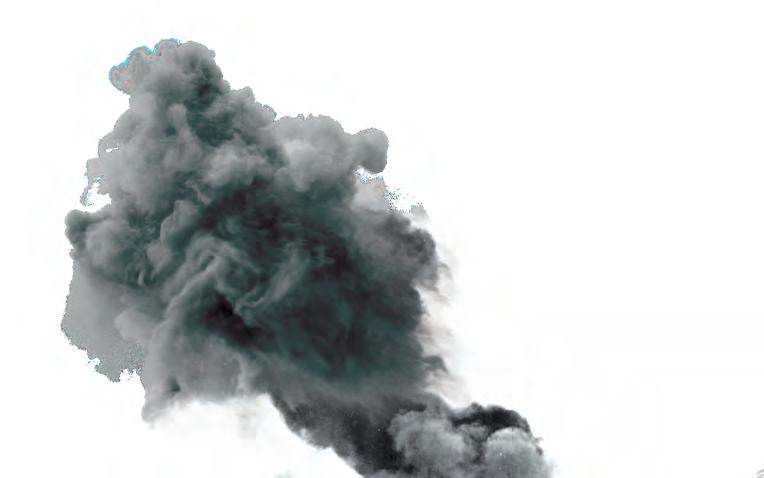
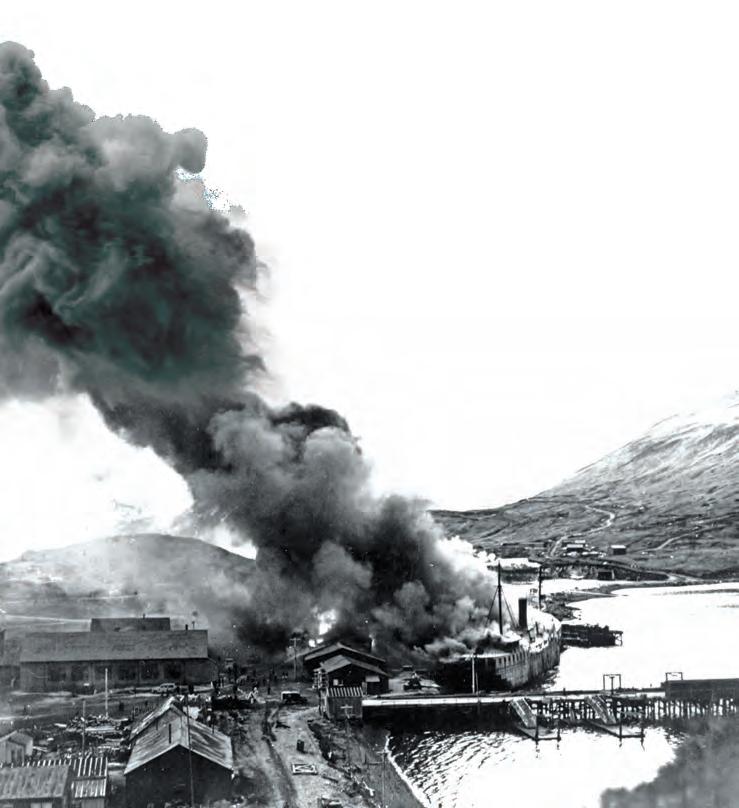
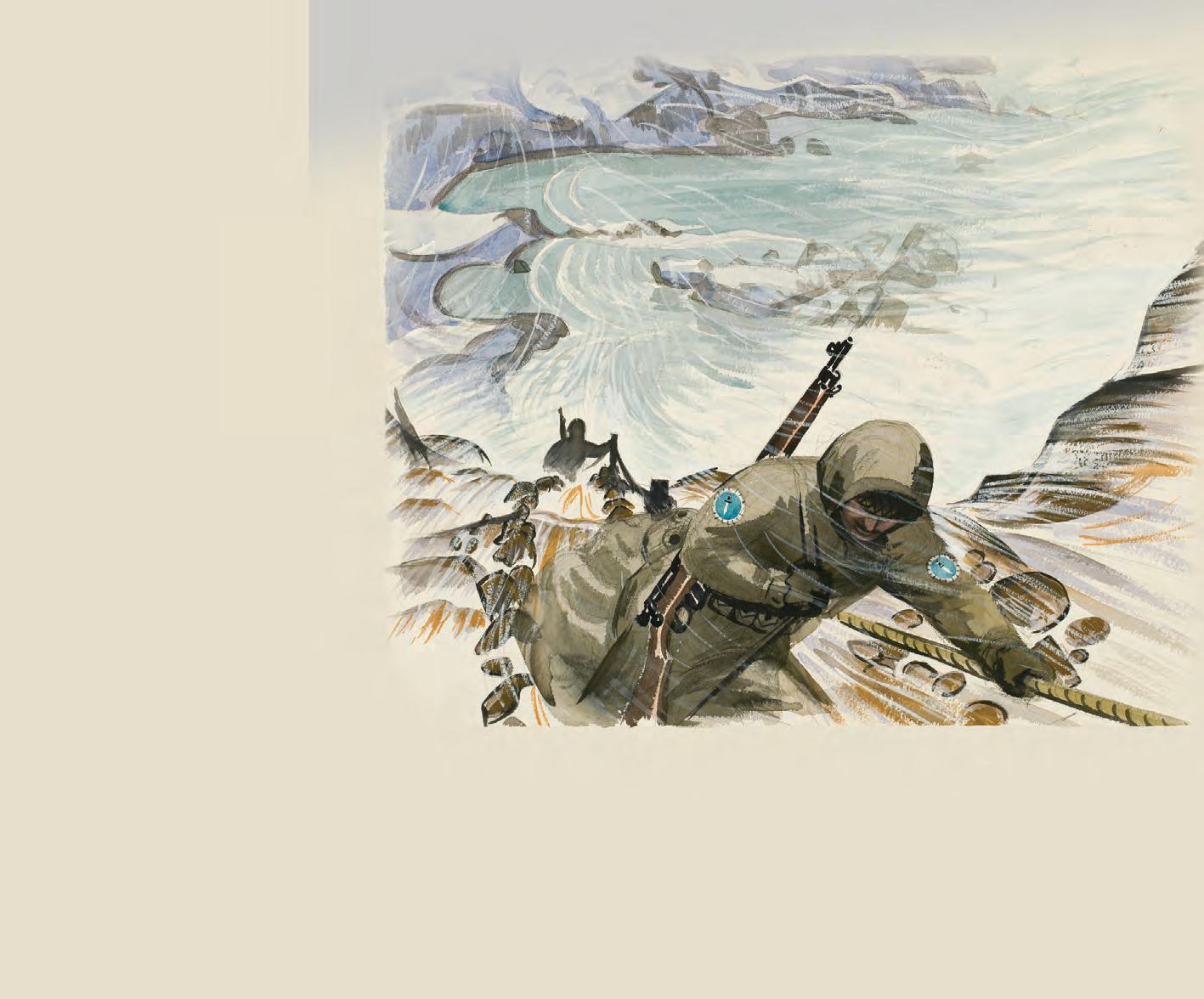
Captain E.J. Hughes depicts a snowstorm passing as soldiers head to Alaska’s Kiska Harbor (opposite). Smoke rises from the state’s Dutch Harbor after a Japanese bombing attack on June 3-4, 1942 (below).
The campaign took place from June 1942 to August 1943. It started when the Japanese bombed, then seized, the sparsely populated Attu and Kiska islands. Historians believe the move was designed to either divert American troops from the central Pacific or hinder the U.S. from invading Japan through Alaska.
Looking back at Canada’s role in the little-known Aleutian Islands Campaign
Alaska’s Aleutian Islands have a violent beauty to them, crowned with steep cliffs, 2,000-metre-plus-high mountains and active volcanoes, all protected by the white horses of ocean waves. Cold and brooding, the islands stand in hushed resistance between life and death.
Many don’t know, however, that this archipelago to the southeast of the Bering Sea had a place in the memories of some Second World War veterans. Like toy soldiers stored in an attic, the Aleutian Islands Campaign is largely forgotten.
Canadians were called on to help the Americans, and the Allies ultimately prevailed, battling as much with the land as they did with the Japanese.
“Weather was their worst enemy,” said Karen Abel, former historical consultant for the U.S. National Park Service whose grandfather Robert W. Lynch was a Royal Canadian Air Force fighter pilot who served in the Aleutians with No. 111 (Fighter) Squadron. Indeed,
most of the Canadian casualties were caused by the weather.
The campaign was one of the deadliest in the Pacific during the war and the only action fought on North American soil. Canada’s contribution was its army’s second largest in the Pacific theatre. Still, it’s considered the “Forgotten Battle.”
Said Abel: “144,000 people were stationed up there, and nobody knows.” But the memories still live.
Just months after its surprise strike on Pearl Harbor, Hawaii, on Dec. 7, 1941, the Japanese launched another offensive in the eastern Pacific, bombing the U.S. naval facility at Dutch Harbor on Amaknak Island in the Aleutians on June 3-4, 1942.
The Japanese invaded nearby Kiska Island days later, on June 6, and Attu Island the following day. The invaders met little resistance from the local Indigenous Aleuts who were subsequently sent to internment camps. The Japanese proceeded to set up defences and within a year, there were 5,400 troops on Kiska, 2,500 on Attu.
“This enemy incursion into the North American zone was necessarily a source of grave anxiety to Canada as well as the United States,” wrote Colonel Charles P. Stacey in his official history of Canada’s role in the Second World War.
“[It was] the weirdest war ever waged,” said a B-24 bomber pilot who participated in the campaign. And given the limited strategic value of the island chain, along with its frequent storms, high winds and relatively barren landscapes, there might be stock in that depiction.
The Americans responded with air attacks on the islands, and worked to occupy others closer to them themselves. Canada, meanwhile, already had one RCAF squadron serving in Alaska at the time, at Annette Island at the state’s south end. Small forces of the Canadian Army, including anti-aircraft gunners and an aerodrome defence company soon joined them. And two other RCAF squadrons were en route; Max Crandall among them.
Born about 32 kilometres from Ponoka, Alta., in a district that was once called Chesterwold, Crandall was a farm lad with a brain for mechanics.
“I was a country boy in every sense of the word, a child of the Western Canadian farm,” wrote Crandall in his memoir Farm Boy Goes to War, one of the few firsthand Canadian accounts of the Aleutian Campaign.
Albertan to the core, his parents ran a farm, harvesting hay and grains and raising horses, pigs and cows.
“We had a great attachment for the land,” said Crandall. “The philosophy of morality, honesty, integrity, love of family and thoughts for others…was very much adhered to.”
To Crandall, though, living off the land didn’t just inspire character—it came with the hands-on knowledge of working with machines. That
combination of attributes made Crandall and other farm boys prime soldier material.
Machinery and its production matured into a powerful force during the Second World War. The dawn of mass production, better vehicles and advanced electrical transmission allowed for a new type of war.
The Industrial Revolution had transformed agriculture by the 1920s and ’30s, so recruiters turned to young men from rural communities for enlistment in the Second World War.
“These young boys grew up with and knew the basics of modern machinery,” noted Crandall. “They also knew how to work and how to survive under the most trying circumstances.”
And trying circumstances they were. The ’30s played dirty on Canadian farming, with little money and even less food to be spared. As many as 750,000 farms across Canada were lost to drought, pests and the nation’s economic collapse in the Great Depression.
“In 1939, it must have seemed that the depression would never end,” noted Bill Eull, a retired psychologist behind the 111 Squadron history project website (see “Keeping the Aleutians Campaign alive,” page 23).
“Especially farm workers, having had a decade of discouragement.”
Dirt poor, Crandall and others like him were hungry for opportunity, believing war was the way to the educational and employment advancement. But there was more, too.
“The natural desire for people to fight and win; the yen for adventure,” said Crandall. “It must have been the glory of the fight—that indefinable something that makes young people sacrifice their lives for ‘love and glory.’”
Crandall enlisted at 19.
It was an ordinary Sept. 10 for Crandall and many other Canadian farmhands in 1939. Chesterwold wasn’t much for radio access, leaving it up to the Ponoka townies, Edmontonians and the like to irrigate the trickles of news they gathered. On that day on Crandall farm, Canada’s declaration of war had yet to stop the bushels from bowling.
So it was that Crandall’s brother Jay, who ran his own radio business, came to relay the news.
“Many of us were at home but none said much,” said Crandall. Four of his brothers subsequently enlisted before he did, too.
Crandall mulled the idea of what war role fit him best, but his penchant for planes gave him a hint. Calgary’s RCAF recruiting centre, however, gave him another.
“They didn’t really want me in aircrew anyway; everyone wanted to be a pilot,” said Crandall.
Settling for ground crew, Crandall became an armourer after five weeks of basic training in Toronto and armament school in Mountain View, Ont. He was posted to 111 Squadron in Patricia Bay, B.C., in February 1942.
“The biggest casualties were people who had…frozen limbs.”
“It had to have been a stroke of luck, for…a finer group of servicemen, on the whole, you wouldn’t find anywhere,” wrote Crandall.
No. 111 had been formed in November 1941, the third of six units originally meant to be shipped to Europe. But when the Japanese attacked Pearl Harbor, those plans changed. In December 1941, the squadron had been sent west to Patricia Bay, near the present site of the Victoria International Airport.
On the Aleutian Islands, nature was the enemy to anyone, Allied or Axis. Indeed, as Stacey wrote: “the enemy led a precarious and uncomfortable existence.”
Canadians such as Crandall boarded the SS Catala in Sidney, B.C., on June 6, 1942, and hopscotched up coastal islands toward Alaska. But when the ship docked at Annette Island, any expectations of a battlefield worth dying on faded fast in rain and fog.
“Disappointment reigned supreme,” said Crandall.
Not more than a day later, Crandall was seabound again, this time on the Denali to Anchorage. And the closer 111 Squadron got to its station, the rougher the water became.
“When the waves started to look like mountains and the propeller of the Denali would come out of the water and spin around in the air…[there were] some very pale faces,” recalled Crandall.
The dangers of flying, sailing or simply existing on the Aleutian Islands came from its own unique geography where the Arctic freeze of the Bering Sea meets the warm waters of the Kuroshio, or Japan, Current.
“We get four seasons in five minutes,” Flying Officer Ronnie Cox told The Canadian Press of the conditions. Stacey noted: “Aleutian airmen found the weather more dangerous than the Japs.”
The combatants faced tough conditions, including frequent snow, rain, sleet storms, fog and dreaded williwaws, violent squalls that blow offshore from mountainous coasts. One pilot recalled a time when, after getting out of his plane to talk to the ground crew, he turned around to find his aircraft upside down.
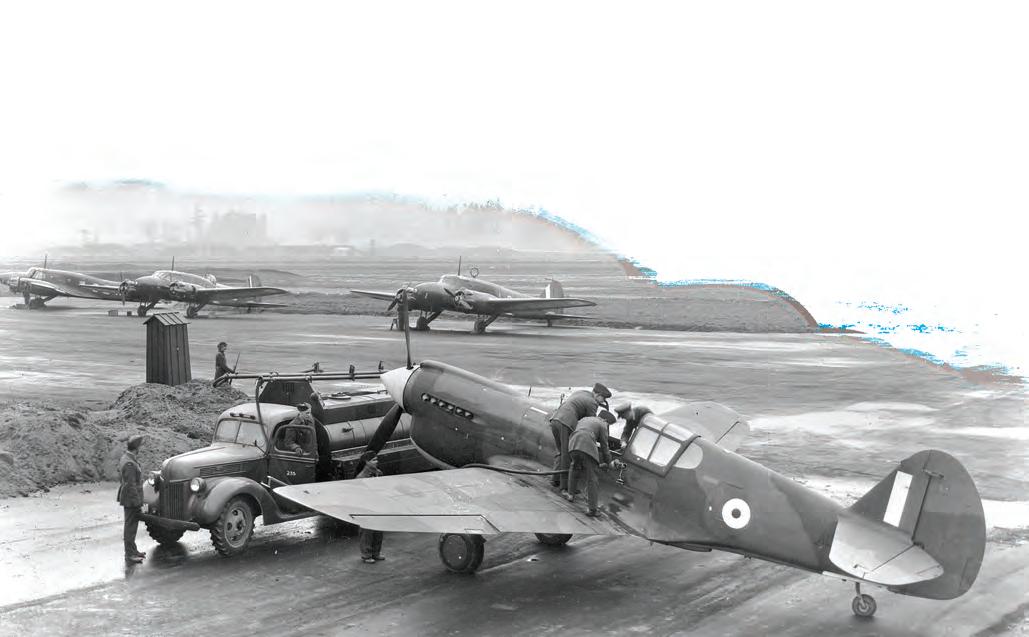
A Hughes watercolour illustrates soldiers using a guide rope to get back to camp amid the Aleutians’ blistering winds (above). A Kittyhawk of 111 Fighter Squadron refuels at Patricia Bay, B.C. (opposite).
“One writer has referred to this area as the birth place of the winds,” said Crandall, “and I have no reason to contradict his assessment.”
Two RCAF squadrons, 111 and No. 8 (Bomber Reconnaissance), eventually staged at Umnak, then Amchitka, islands—the latter just 130 kilometres from Kiska. Their role was primarily defensive, comprising a couple of flight operations with the U.S. Army Air Forces’ 11th Fighter Squadron. Otherwise known as “flagpole flying,” their day-to-day action consisted of reconnaissance patrols and intercepting both unidentified aircraft and radio transmissions. All the while, the Canadians wanted something more.
“They were chafing to get into action,” wrote Eull.
Crandall and some other members of 111 were stationed at Umnak, where the RCAF’s duties included daily dawn-todusk aerodrome patrols and evening discussions about war strategy with American pilots.
But the living conditions weren’t just minimalist when Crandall arrived—they were primitive. Their tents weren’t built for the climate, so the men slept without proper insulation, buffeted by the winds and with rain seeping in. Plus, some reported not receiving Arctic-rated sleeping bags until two or three weeks into their stay, making the cold, wet ground an unfortunate mattress.
“144,000 people were stationed up there, and nobody knows.”
One of the veterans said, “To this day, I still can’t eat a sweet potato,” recalled Abel. Alcohol was equally scarce, and many men resorted to drinking lemon extract, shoe polish or “torpedo juice”—pure alcohol allegedly from used torpedoes— to get a buzz.
On top of that, many went without the standard parkas, shoepacks and winter gloves; troops were often left to wear field jackets, Blucher boots and wristlets.
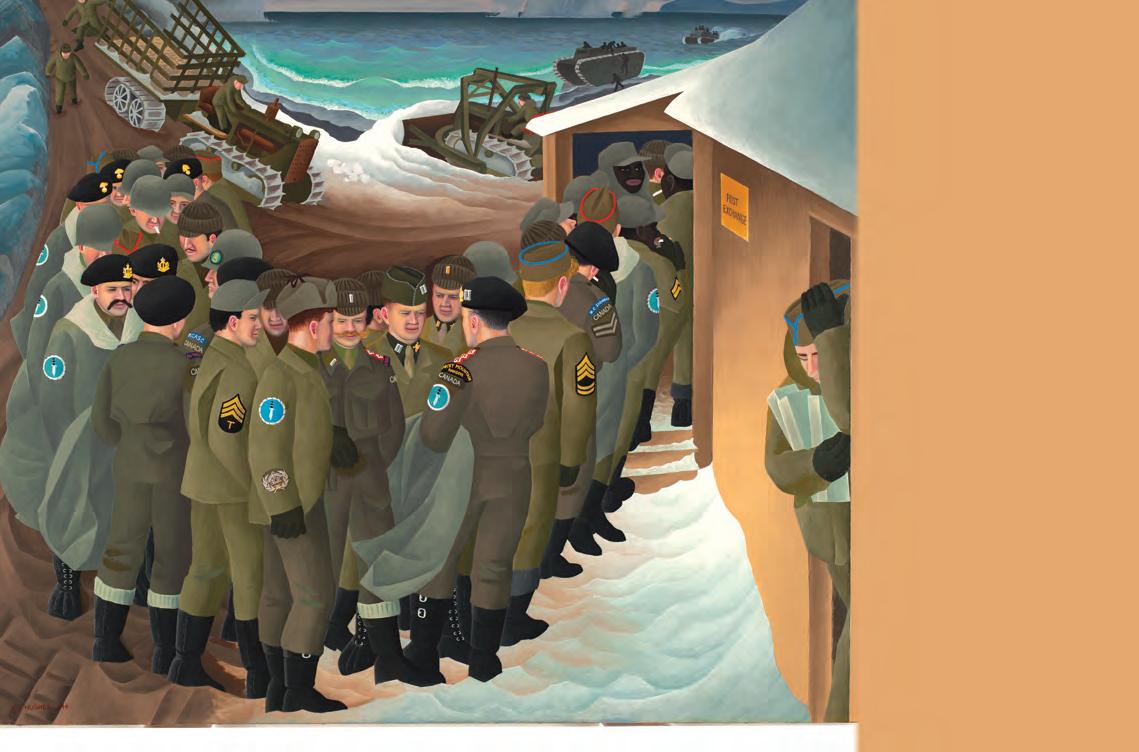
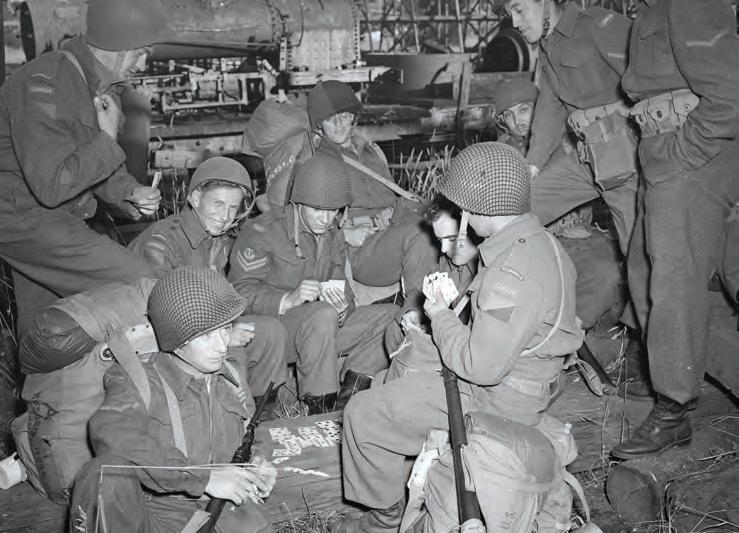
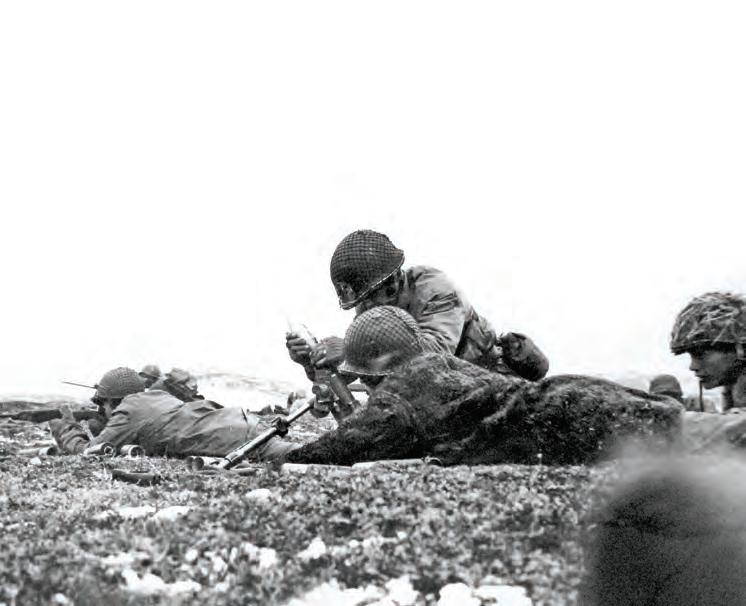
Hughes depicts soldiers at a canteen on Kiska Island in 1944 (left). Members of the 13th Canadian Infantry Brigade play cards in July 1943 while waiting to advance on the island. (opposite top). American soldiers during the attack on Attu Island (opposite, bottom left).
The mess hall was no escape from the cold either. “It was just an open-air tent,” said Abel. “One veteran said they’d have to slop all of their food together on their mess tray and eat in the cold or bring it back to your tent [but] by then, it would get cold.”
But hot food wasn’t common anyway, with canned sweet potatoes or peaches the dietary status quo. Shipments, however, would sometimes go awry, leaving the men to eat the same food day after day—or simply nothing at all.
“Those guys went north with clothing…suitable for warm weather,” remarked Eull. “The biggest casualties were people who had…frozen limbs.”
In those days, some truly felt like they were living on mud and glory— and that made not only the body a casualty, but the mind as well.
Wrote Crandall: “We were just waiting for sunshine.”
Dark skies can make for dark minds, especially when they are left to their own devices.
“With persistent intermittent rain and never a ray of sun, some depression set in,” reported
Crandall. “There was nothing to do and nothing to read.”
While volleyball and some hockey were reportedly played, a crushing boredom and severe isolation persisted throughout the island, with connections to civilian life weak and weathered.
“We could expect to get mail about once a month or a little better,” said Crandall.
Not surprisingly, this took a toll on morale, leaving minds to wander to maddening places. Medical officer Robert J. Cowan of 111 said that men would often appear in the medical tents for wounds that were a bit more difficult to spot.
“For some of them the stress of the isolation, the absence from their families, and other problems were taking a toll,” said Cowan.
“The real problem here, of course, was the old phenomenon known in the north nearly a half century earlier as cabin fever,” said Crandall, “and its side-kick, loneliness.”
Crandall noticed the particular effects the conditions had on senior non-commissioned officers. Many NCOs would often build doors and walls to their tents out of packing crates, and sometimes, that makeshift shelter became their late-night target practice.
“They began shooting through the door and it
became risky business,” wrote Crandall. “It was just the sheer loneliness of their position.”
Even through rough times, the soldiers found unique ways to improve each other’s lot. Crandall claims to be responsible for borrowing the idea of pitching tents in holes from the Americans to help keep out of the elements.
In October 1942, Crandall’s unit moved to Kodiak Island, where conditions improved tremendously for the unit, finally having access to restaurants, libraries and entertainment. His squadron would stay at Kodiak until the end of the Aleutian Campaign.
“Kodiak was…like an oasis in the desert,” said Crandall.
During their time there, 111 was responsible for protecting the U.S. naval base.
With the Allied bombing campaign ineffective in evicting the Japanese from the islands—and with a local naval blockade similarly futile—the Americans launched a ground assault on Attu on May 11, 1943. Some 15,000 U.S. troops participated in the two-plus-week battle.
“It ended in complete annihilation of the Japanese defenders, who made their final Banzai charge on 28 May,” wrote Stacey. “The Americans took eleven prisoners; all the rest were killed in action or committed suicide.” Some 2,500 dead.
With Attu in Allied hands, plans were quickly made to recapture Kiska. And Canada stood to take a much larger role. Its contribution included the Canadian component of the First Special Service Force and four infantry battalions:
The Canadian Fusiliers (City of London Regiment), The Winnipeg Grenadiers, The Rocky Mountain Rangers and Le Régiment de Hull. The 24th Reserve (Kootenay) Field Regiment, Royal Canadian Artillery, and some smaller units completed the group. It totalled 4,800 troops.
But when they went ashore on Aug. 15, they met no resistance. Within a couple of days, it was clear that the Japanese had evacuated. By Aug. 24, the island was declared secure by the Americans, thus ending the campaign. Not a single Canadian died.
While members of 111 Squadron such as Crandall never saw explosive fighting in the Aleutians, they did witness its impacts, with many Canadian troops meeting with American soldiers post-battle. As one of the squadron’s acting sergeants recounted to his son: “It must have been rough. Those commandos were a tough bunch.” L
Keeping the Aleutians Campaign alive
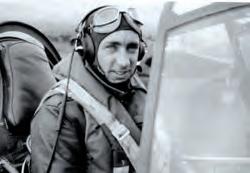
“I’m not a historian by nature,” said Karen Abel, “I’m a historian by passion.” Abel runs the blog, “Florida Beaches To The Bering Sea,” where she shares wartime documents from her grandfather, RCAF 111 (Fighter) Squadron fighter pilot Robert W. Lynch (below), and interviews with dozens of families, to document the Aleutian Islands Campaign. Her efforts have been recognized by numerous publications and the Smithsonian’s National Air and Space Museum.
Bill Eull, meanwhile, uses his website dedicated to the 111 Squadron (www.rcaf111fsquadron. com) to bring the relatives of more than 50 families affected by the Aleutian Campaign together. He has also amassed a detailed database of those who served in 111.
1 8 5 9
A WAR that nearly caused THE PIG
How a dead hog once led the U.S. and the British Empire to the brink of battle off the coast of Vancouver Island
W BY TIM COOK
ar was narrowly averted between the British Empire and the United States in 1859 over the killing of…a pig. It occurred on San Juan Island, about 12 kilometres east of Vancouver Island.
There was no shortage of bad blood between the U.S. and the British Empire in the 19th century. And the British colonies in presentday Canada were often caught in the middle—and always a potential battleground. A war started over the slaughter of swine would have ranked as one of the more absurd conflicts in history, but it could still have taken the lives of countless soldiers, sailors and civilians.
The confrontation was charged with historical grievances and expansionist urges, made worse by reckless adventurism and misplaced notions of honour. It eventually calmed through cool military professionalism. The Pig War, as it came to be known, is a reminder that fragile peace can always be broken by the acts of a few impulsive glory seekers.
Bad neighbours
Britain and the U.S. carried deep wounds from the American Revolution, which were scratched raw by the War of 1812. While peace treaties reduced the chance of another war, there were several minor conflicts between the U.S. and British North America in the 1830s. While the political and military leaders in Washington
and London did not want a war, a war might still find them.
The U.S. had grown steadily in power, population and size, expanding with fervour and systematically driving Europeans from its territory throughout the first half of the 19th century. Many Americans were motivated by the idea of manifest destiny, a term coined in the 1840s to describe the spread of American exceptionalism, show the world the power of democracy and merge all of North America into the U.S.
As part of this march, the U.S. waged wars against Indigenous Peoples, and annexed Texas, California and large parts of Mexico. With the U.S. having expanded southward and across the continent to the Pacific, the northern border with the British Empire became a vexing situation for many Yankee politicians, soldiers and expansionists.
Rivals
After the 49th parallel was agreed to as a border between British North America and the U.S. from Lake of the Woods to the Rocky Mountains in 1818, there were only a few contentious geographical spaces left to be surveyed. The largest such swath of land was the area west
of the Rockies, stretching from the southern border of presentday Oregon to present-day Yukon. The area had been jointly occupied by Britain and the U.S. since the early 19th century, with no agreement on where the border lay. The key sticking point was the Strait of Juan de Fuca, home to some 100 islands between the mainland and Vancouver Island.
In what is now British Columbia, the Hudson’s Bay Company (HBC) was the power on the northern side of the 49th parallel, along with Indigenous Peoples whose lands the Europeans were slowly making their home through treaty, displacement and war.
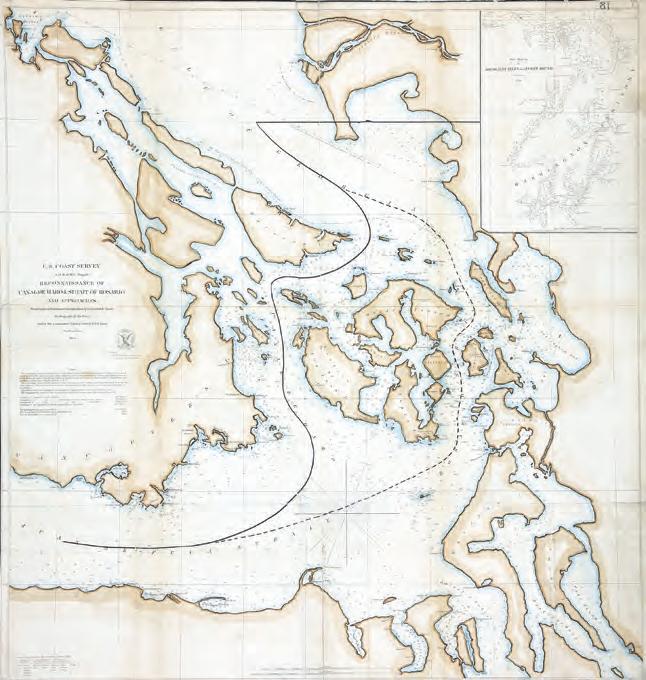
As several thousand Americans filtered into the Pacific northwest by the early 1840s, the region became a point of potential conflict. The 1846 Oregon Treaty helped relieve some of the pressure, though. It established the border from the Rockies to the West Coast along the 49th, with the exclusion of Vancouver Island. But the agreement included ambiguous language about the Gulf of Georgia, or the “de Fuca’s Straits” as it was called. Most problematic, it did not delineate the water border between Vancouver Island and the American mainland to the east.
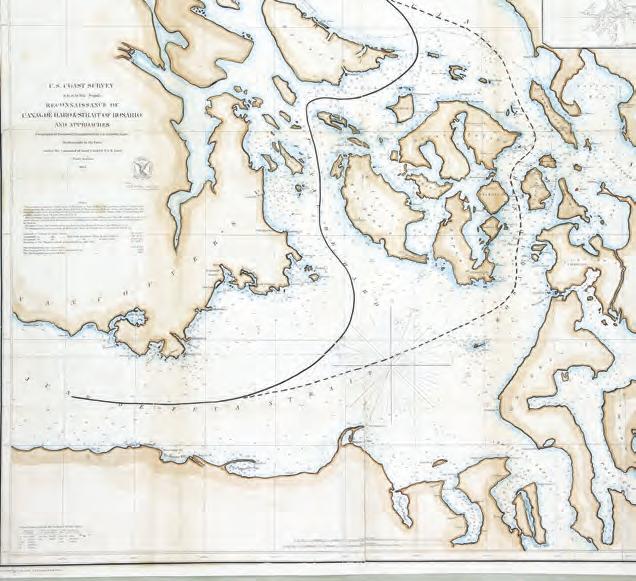
The few accurate maps of the time showed three possible routes through the waterway. The Rosario Strait was nearest the American territory, the Haro Strait was closer to Vancouver Island, and a third route passed to the east of San Juan Island and between
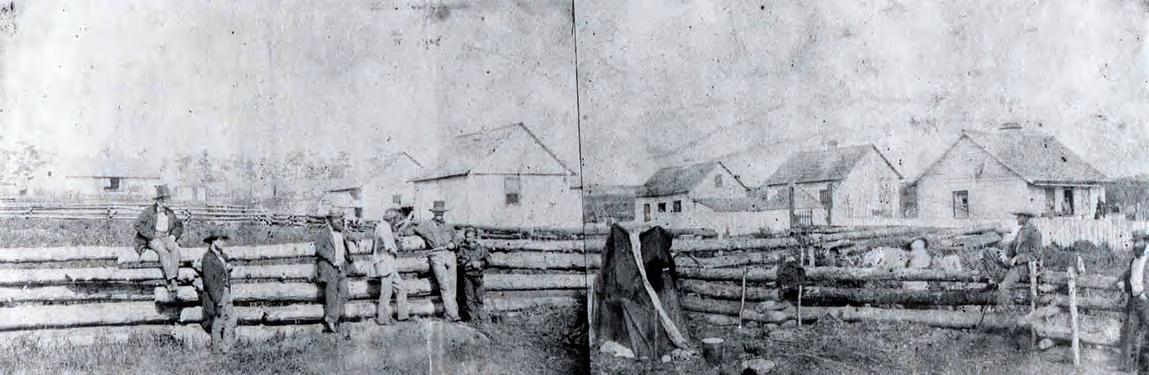
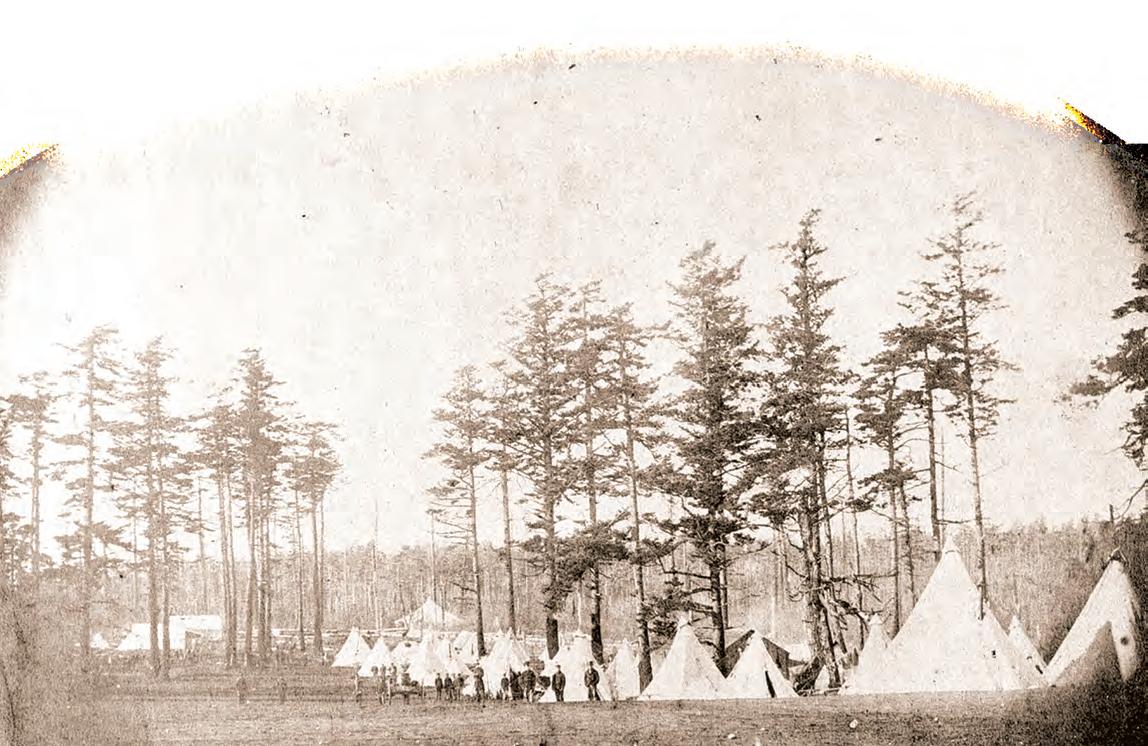
The Hudson’s Bay Company farm on San Juan Island during the height of the Pig War in September 1859.
Lopez and the Orcas Island. With these three channels through the straits, where would the border be established? And would the islands be British or American? With no agreement, the boundary decision was put on hold.
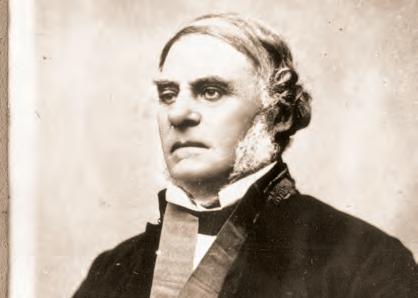
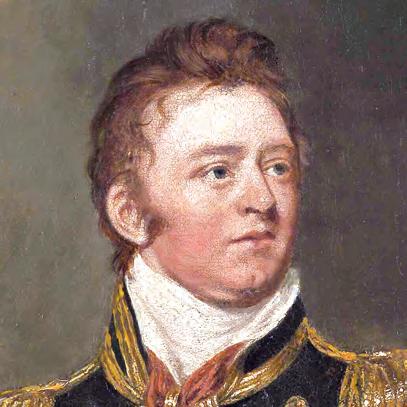
As additional attempts to establish a boundary failed, British Captain James Prevost wrote in 1856 that the loss of San Juan Island could “prove fatal to Her Majesty’s Possessions in this quarter of the Globe.” Both the British and Americans saw possession of the islands as strategically advantageous to protect against invasion—or to launch an attack.
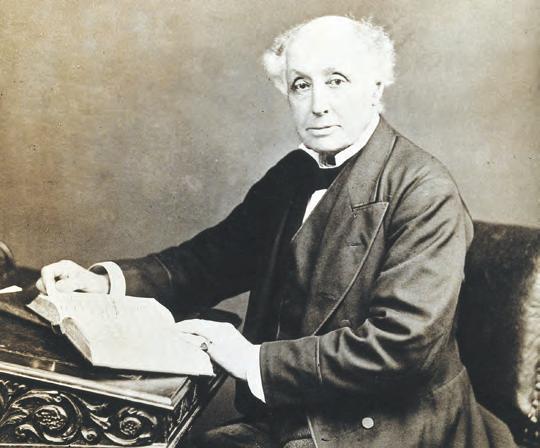
The experienced, canny and ruthless James Douglas was the British leader in the area. He had worked his way up through the ranks of the HBC, was appointed governor of the Colony of Vancouver Island in 1851 and, in 1858, also became governor of the Colony of British Columbia. He was wary of the Americans in the region—people “of a class hostile to British interests”—and, beginning in the early 1850s, he encouraged British
CUTLAR CAME UPON A LONE HOG ROOTING IN HIS GARDEN. ENOUGH WAS ENOUGH. HE SHOT IT DEAD.
settlement of islands in the Gulf of Georgia with land grants, believing that occupation would strengthen future boundary negotiations.
At the time, there were only a few dozen Americans and Brits on San Juan, together with several thousand sheep, cattle and pigs. An HBC sheep farm was the primary British claim on the island in the early 1850s. However, after
the discovery of gold in the Fraser River region in 1857, thousands of American prospectors flocked to the area, bringing prosperity—and chaos. The rowdy miners only confirmed and deepened Douglas’ anti-Americanism.
The death of a pig
An American gold seeker, Lyman Cutlar, was the man who nearly started the Pig War. After failing to find his fortune in B.C., the Kentucky frontiersman drifted south to try his hand at farming on San Juan Island. The British representatives on the island kept an eye on him and the other small bands of American farmers.
While Cutlar found some success in farming, several animals owned by the HBC—notably wandering pigs—took to eating his vegetables. Cutlar repeatedly chased the
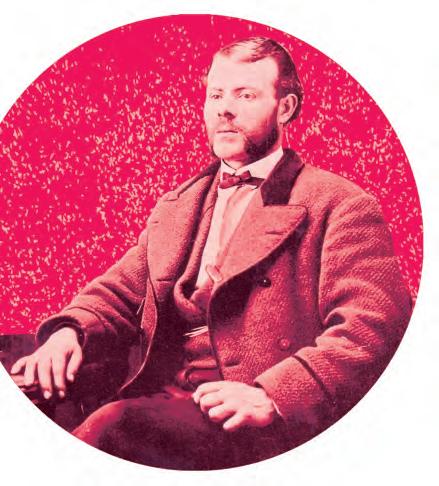
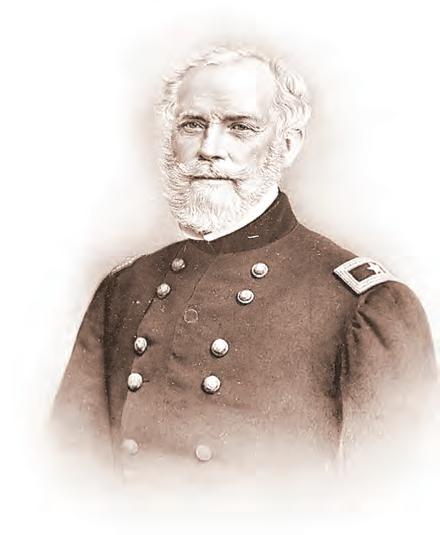
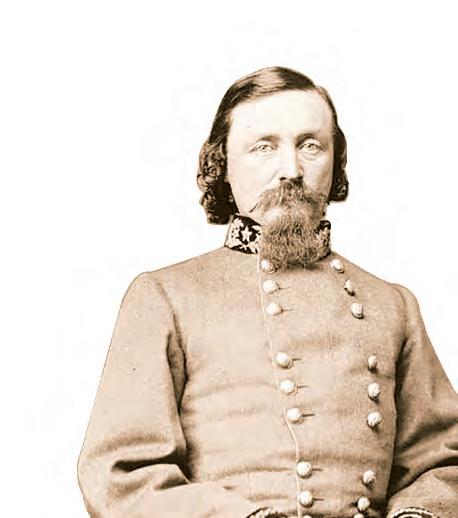
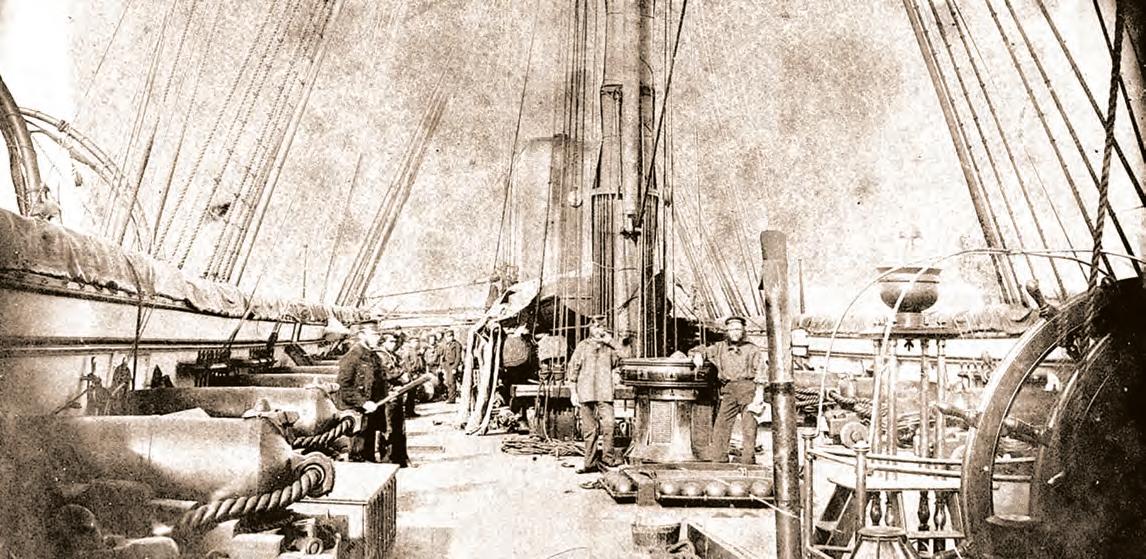
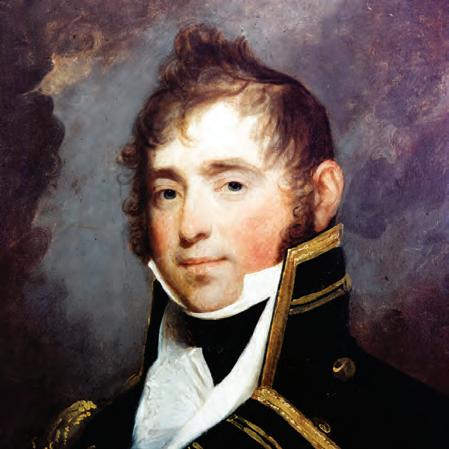
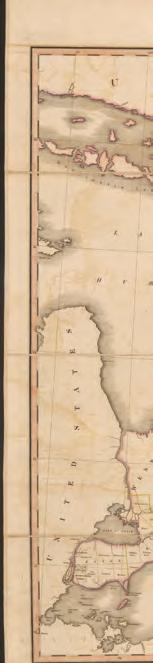
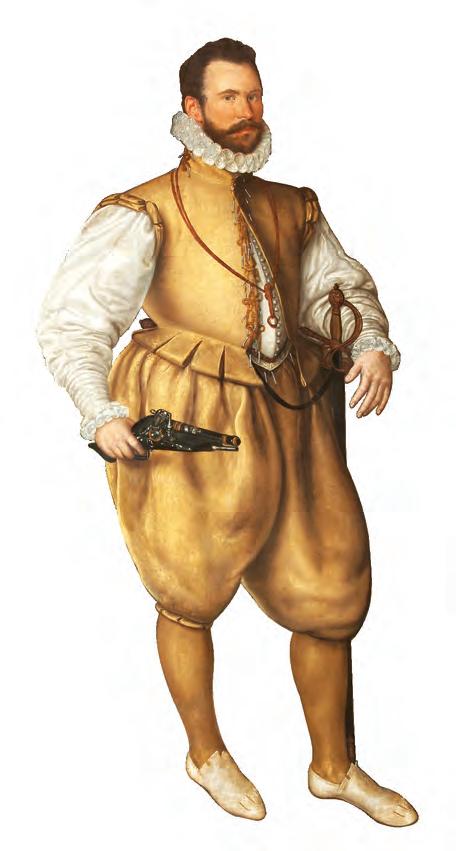
British Captain James Prevost (opposite top) wrote in 1856 that the loss of San Juan Island “could prove fatal” to the Empire in the region. British Columbia Governor James Douglas (opposite bottom) subsequently encouraged settlement of area islands (map). Charles Griffin (below, left) oversaw the HBC post on San Juan, where U.S. Brigadier-General William S. Harney (right) moved soldiers in 1859 (bottom). They were led by Captain George Edward Pickett (below, right).
animals off, but on a warm June 15, 1859, Cutlar came upon a lone hog rooting in his garden. Enough was enough. He shot it dead.
Cutlar had immediate regrets. Aware he may have crossed a line, he walked to the local HBC authority, Charles Griffin, and confessed to having killed the animal. After justifying his actions, he offered to pay for the pig. Griffin, who had been marooned on the island for some time and perhaps seething at his lowly position, flew into a rage.
Cutlar was threatened with eviction. And, while the pig was worth about $10, the HBC man demanded $100 for it. Cutlar, now equally angered, stalked off, refusing to pay a penny for the slain swine. Fired up over the slight and carrying anti-American grievances, a party of British men converged on Cutlar’s farm demanding retribution. The American stood firm, backed by his rifle. Who had authority? If the island was British, he could be arrested, with
one HBC man describing Cutlar as a “lawless intruder.” If it was American territory, however, the HBC had no jurisdiction. What laws applied? They were at a standstill.
Escalation
The situation intensified when Brigadier-General William S. Harney, then in command of the Department of Oregon (the U.S. army division overseeing the area), got involved. He was known as a hothead with hair-trigger anger who had brutally slaughtered Oceti Sakowin (Sioux) during one battle. Even in the rough and tumble American army, Harney stood out for having been court-martialed four times, usually for acting rashly and wrongly. Adding to this potent and unstable mix, Harney was a vocal hater of the British. He was the wrong man to keep things cool. Harney ordered a small detachment of soldiers to the island in mid-July 1859. Captain George Edward Pickett, then a largely unknown soldier who later became famous for his Confederate charge at the Battle of Gettysburg during the A merican Civil War, would lead it.
The arrival of Pickett’s garrison of 60-plus soldiers near the HBC sheep farm on July 27 was a worrisome challenge to the British, made all the worse by Pickett’s order that only U.S. law would be recognized on the island. This led to much anger in B.C., where the colonists felt the Americans were bullying the HBC farmers and slighting British honour. Governor Douglas asked the Royal Navy to uphold British rights and sovereignty. He was spoiling for a fight. William Peck, an American army engineer stationed on the island, wrote, “[it] is feared a collision will occur.”
A TENSE STANDOFF
ENSUED AS THE ROYAL NAVY CONSIDERED BLOWING THEM OUT OF THE WATER.
Confrontation
The Royal Navy’s HMS Tribune, a 31-gun 2,000-ton steam frigate, and HMS Satellite, armed with 21 guns, arrived off San Juan in a show of force at the end of July. Soon the warships had their many cannons directed on Pickett’s encampment, which he had illadvisedly laid out in full view. While colonists in B.C. demanded retribution for the American actions, noting the Yanks needed to be taught a lesson, the senior Royal Navy commander, Captain Michael de Courcy, told Douglas he did not seek a battle, even though British sailors and mariners vastly outnumbered the Americans.
As the outgunned Pickett scrambled to move his camp and dig in, the swaggering Harney remained belligerent. On Aug. 1, more American reinforcements arrived by ship. A tense standoff ensued as the Royal Navy considered blowing them out of the water. Instead, the British again responded with restraint and allowed another hundred-plus Americans to go ashore unimpeded, though several additional British warships arrived, for a total force of five vessels and more than 1,000 soldiers and marines. Facing total naval dominance, Pickett
observed: “They have a force so much superior to mine that it will be merely a mouthful to them.”
While neither the American nor British governments wanted war, much was left to the soldiers and sailors on the spot. There was a long history of American filibusters starting local wars and dragging the nation into conflict. San Juan might be another battle started by irresponsible soldiers seeking glory.
Washington reacts
The slow movement of news also contributed to the potential conflict. It took about a month for messages to travel from San Juan to Washington and about six weeks for communiques to reach London. And, so, the crisis of early August 1859 only reached the two capitals in September.
The cabinet of President James Buchanan was fearful of a war with Britain, especially with tension mounting between northern and southern states over slavery, which had already led to terrible bloodshed.
While both the British and American press were quick to howl for a restoration of honour and a comeuppance for the opponent, the Buchanan cabinet
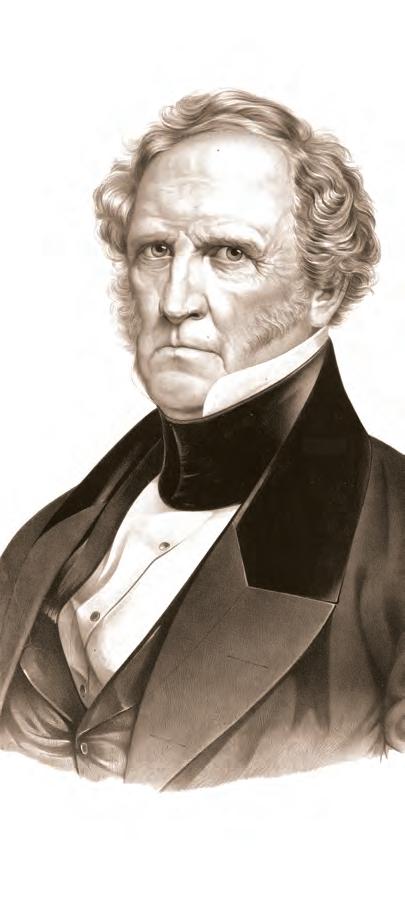
was alarmed at the potential war. It ordered its greatest soldier to the far-flung corner of the country, hoping that the commander of the U.S. army, Winfield Scott, a hero of the Mexican War, would bring much-needed expertise (also see “The great Pig War pacificator,” right). Harney blanched at the idea of Scott’s arrival because the two had a long and difficult history that included Scott having once court-martialed Harney for insubordination.
After a month of travel, Scott arrived on the Columbia River on Oct. 20, 1859, where he met the governor of the Oregon Territory and General Harney. News of his diplomatic voyage had reached the Americans, Royal Navy officers and British colonials beforehand, and there was new hope the general might find a compromise.
Compromise
Governor Douglas and Lieutenant-General Scott conferred and after negotiations, most of Pickett’s soldiers were removed from the island by the end of November, just as some of the British warships pulled back to Esquimalt. Common sense prevailed and the showdown
The Royal Navy sent steam corvette Satellite (opposite) and steam frigate Tribune to San Juan shortly after U.S. troops arrived on the island. The Americans dispatched Mexican War hero Lieutenant-General Winfield Scott (right) to quell rising tensions.
de-escalated. San Juan would return to being jointly occupied, with an urging for diplomats and surveyors to tackle the boundary issue—with compass and map rather than rifle and cannon.
Scott exited the region on Nov. 11, 1859, surprisingly leaving Harney in command (although on his long trip home, he laid plans to have him transferred to another front where he could cause less harm). Still, the area remained a powder keg. Even after the compromise, the long delay in communication led London to call for a remilitarization of the island. This, too, might have led to war.
The senior British naval officer, Rear Admiral Robert Baynes, a veteran of the 1815 Battle of New Orleans and commander of the 84-gun ship HMS Ganges, sensibly refused the order, and kept the peace through less confrontational acts. Baynes told Governor Douglas that he would not “involve two great nations in a war over a squabble about a pig.”
The Americans, meanwhile, continued to stir up trouble, with General Harney ordering Pickett back to the island. Some thought Harney ached for a war in hopes of kickstarting a political career. Whatever the case, this move caused a new round of grievance, but fortunately, not the same level of threat.
Eventually two small garrisons, one British and one American, were stationed on the island. And the San Juan rift was overtaken by southern U.S. states seceding from the Union to form the Confederate States, and eventually starting the U.S. Civil War.
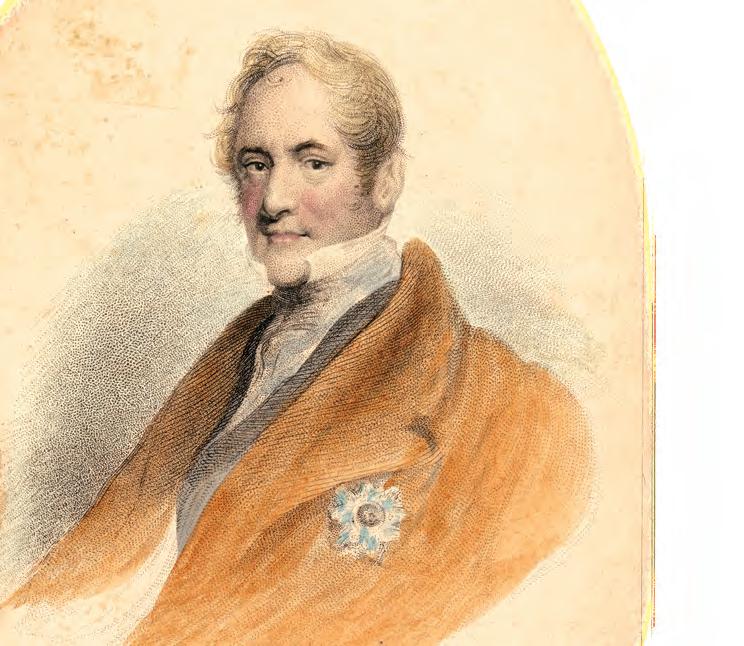
Rear Admiral Baynes received a knighthood in April 1860 for his long service and “good sense and prudence” in the Pig War. General Harney was sidelined during the Civil War, but had a surprising role in aiding several Indigenous nations negotiate treaties with the U.S. in the 1860s.
Resolution
When the Union and the secessionist South went to war in April 1861, Britain studied its options. It might support the South to weaken the North, and it certainly needed Southern cotton for its factories. But there were few politicians in London who wished to support the odious slave system. Britain and the colonies of British North America decided to remain neutral, although they were nearly dragged into war on several occasions. The war did compel Canadians to think more seriously about their security, a key factor in driving the colonies toward Confederation in 1867.
But what of San Juan and the possibility of future assassinated pigs leading to war between Canada, Britain and the U.S.? After the 1871 Treaty of Washington settled many of the differences that arose from the Civil War, the Americans and British (who continued to conduct foreign affairs for the young Dominion of Canada) submitted their duelling claims over San Juan to German Kaiser Wilhelm I the following year. The Kaiser had unified the German states through blood and iron, and now the conquerer became the judge. After experts studied maps and heard arguments, the Kaiser awarded San Juan Island to the U.S. in October 1872, with the boundary passing through Haro Strait.
The slain swine had long been forgotten, the only casualty in this imbroglio. But its death was a warning of the fragility of peace. The San Juan conflict was also a cautionary tale of how rogue soldiers and irresponsible adventurers can drag countries into war. It was a lesson, too, in how calm, professional and prescient men of war, in this case Admiral Baynes and General Scott, could avoid unnecessary conflict. L
THE GREAT Pig War pacificator
A veteran of the War of 1812, Major-General Winfield Scott played a key role in training the ragtag American army after its early humiliating defeats at the hands of Indigenous warriors, British and Canadian soldiers. Scott emerged from the war as a hero. In 1838, Scott was again rushed to the Canadian border to ensure that rebel-supporting Americans did not provoke a war. After tremendous success on the battlefield during the Mexican War (1846-48), Scott continued to serve in many capacities, remaining popular with American soldiers who affectionately called him “Old Fuss and Feathers.”
By the Pig War of 1859, he was the foremost American general of his generation, holding the rank of lieutenant-general and enjoying the moniker of the “Great Pacificator.” There was no better person to send to the Pacific northwest, even though he was in poor health, grossly overweight and 73 years of age. There would be no going hog wild on his watch.
Terry Fallis
“FOUGHT” OVER THE INTERNATIONAL BOUNDARY IN THE SO-CALLED AROOSTOOK WAR HOME FRONT By
Line brawl
NEW BRUNSWICKERS AND MAINERS
Ilike to think, as a relatively well-informed Canadian with an interest in history, that I’m at least aware of my country’s major military conflicts. I have read about Canadians’ courageous service in the Great War, the Second World War and Korea. My chest swells with pride around Canada’s peacekeeping missions. Canada’s role in NATO has earned international respect, irrespective of former U.S. president Donald Trump’s jabs.
But I must confess, I knew nothing about the Aroostook War back in 1838-39. That may be because back then, Canada was not yet a sovereign nation. It was known then as British North America. But still, you would have thought I might have heard something about it. I mean it was a “war” after all. Or was it?
After researching the topic, I’ve decided it was simply easier to refer to it as the Aroostook War, rather than as the Aroostook international incident, or the Aroostook border dispute, or perhaps the Aroostook territorial demarcation debate.
None of those names seems to wield the hard-hitting impact of that all-powerful word “war.” So, let’s go with the Aroostook War, shall we? Perhaps it doesn’t matter that nary a shot was fired. Even “skirmish” seems too violent a word to describe it.
Hold on. I know you might be a bit confused about all of this—I know I was—so let me provide some much-needed context within which we can then examine what has become known as the Aroostook War.
During the Napoleonic Wars, Britain had a surging need for timber, particularly for building naval vessels for their fight with France. Unfortunately, a French blockade prevented the Brits from buying timber from their traditional suppliers, the Baltic states. So, England looked westward to its North American colonies.
New Brunswick in general, and its Aroostook Valley in particular, provided seemingly endless white pine forests that yielded perfect masts for British naval vessels. New Brunswick timber exports soared to represent two-thirds of total provincial exports and helped to establish a flourishing lumber industry. This, of course, spawned competition as timber interests in southern Maine and Lower Canada showed up in New Brunswick to snag some of the action.
That all sounds like a market economy the way it ought to work. But—and it’s a very big
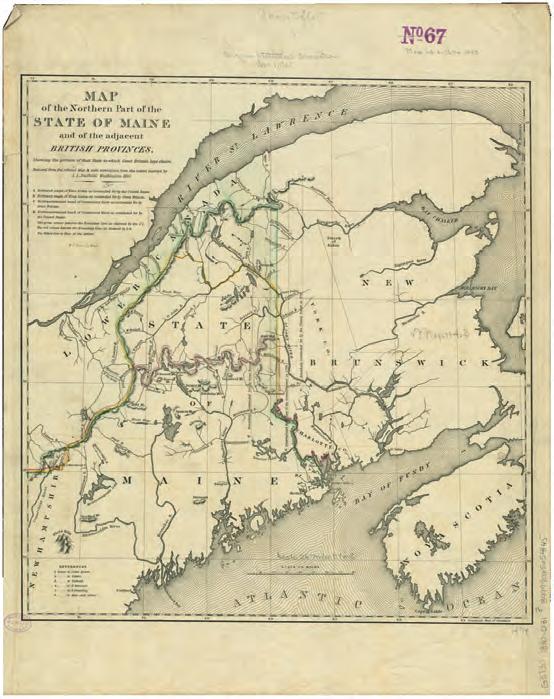
but—at the time, this particular part of New Brunswick was disputed territory. You see, when the Treaty of Paris in 1783 ended the Revolutionary War between the British and the United States, the border separating the latter and the North American colonies of the former, specifically between New Brunswick and Maine, was never clearly defined and became a source of contention and acrimony for decades.
In the years that followed the signing of the Treaty of Paris, several official commissions and other attempts at negotiated settlements still left the actual placement of the New BrunswickMaine border in dispute with prime timber lands claimed by both sides.
Fortunately, the governments of both countries did not consider this little patch of disputed territory—while important symbolically and certainly critical to the locally affected communities—to be worth shedding blood over, so they agreed to continue to try to reach a negotiated compromise.
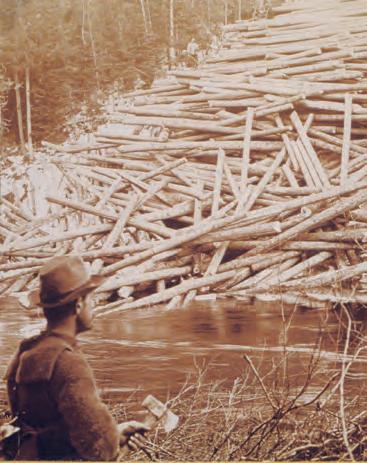
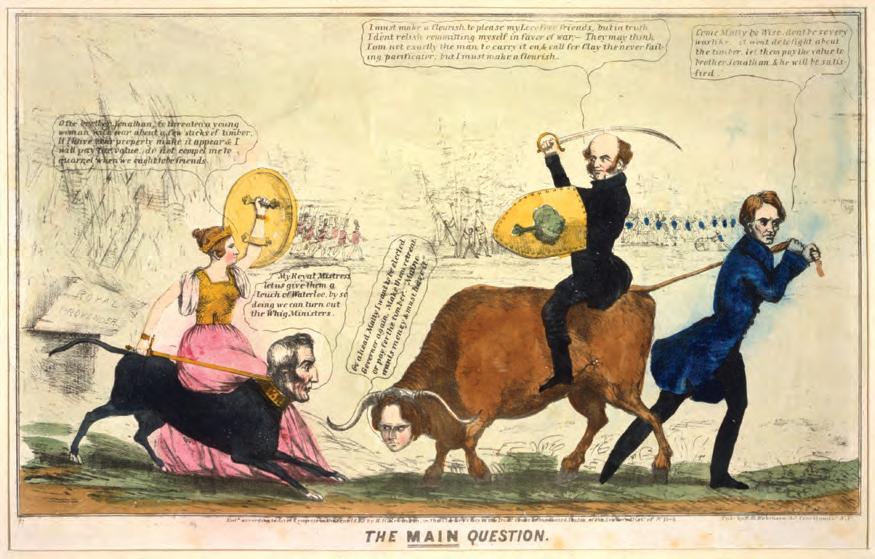
Years after the dispute between New Brunswick and Maine, the Aroostook River region was still a logging hot spot (above). A political cartoon (below) from the time of the conflict depicts Queen Victoria with a Duke of Wellingtonheaded dog facing off against an ox with the face of Maine Governor John Fairfield being ridden by U.S. President Martin Van Buren.
Governor Fairfield sent
in his state militia, leading to what could only be termed a "standoff."
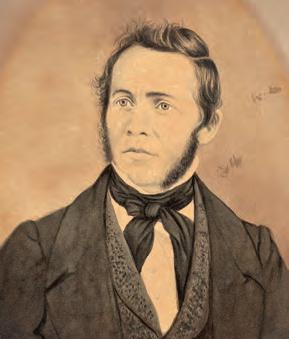
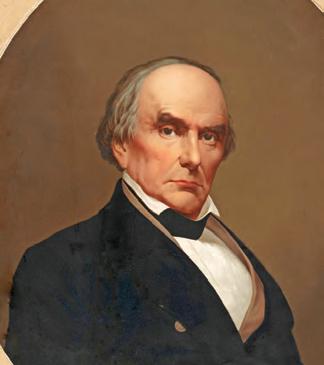
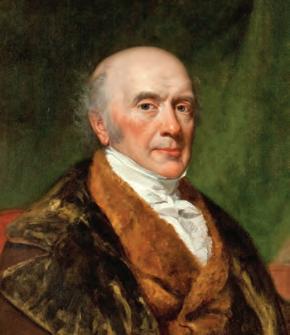
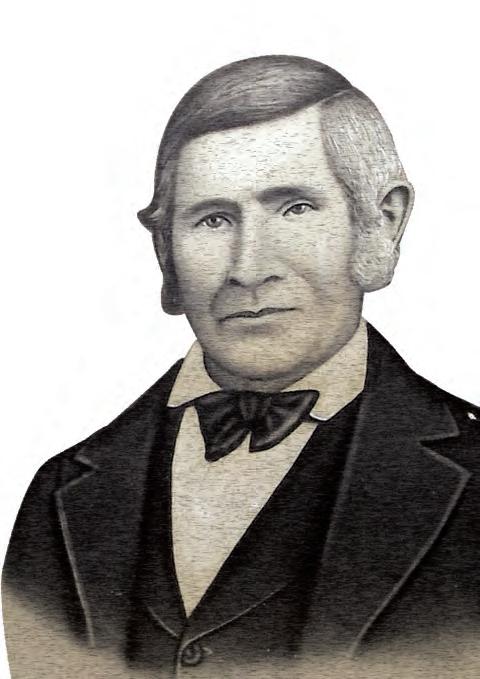
Governor Fairfield (right) sent men to arrest New Brunswickers logging in the disputed territory (below) in early 1839. American Daniel Webster (opposite top) and Brit Alexander Baring (opposite bottom) negotiated a treaty that settled the boundary in 1842.
Many more years were spent by even more commissions in attempts to resolve the matter, if not amicably, at least begrudgingly. From 1816 to 1821, yet another joint British-American commission utterly failed, again, to define a national border to the satisfaction of Maine and New Brunswick. Some 38 years after the Treaty of Paris, the territorial dispute was still unresolved.
This left all those living in the disputed region, including Brits, the French and Americans, increasingly angry. They all began agitating and backing up their respective claims on the land.
Emboldened by Maine’s statehood in 1820, settler John Baker began spoiling for
a fight. He undertook various acts of civil disobedience in the contentious territory, defying the British authorities. He even urged the French in the region to reject British rule. Baker’s efforts, or antics depending on your perspective, continued for years.
Finally, on July 4, 1827, Baker unilaterally proclaimed the independence of what he called the Madawaska Republic, recognizing only the authority of the United States. For the Brits, that was a step too far.
They arrested Baker, threw him in jail for eight months and eventually at trial, found him guilty of sedition and conspiracy, sentencing him to an additional two months in jail and fining him 25 pounds. (I know what you’re thinking: don’t you find him guilty first, then imprison him? Well, that’s not the way it went down.)
This seemed to bring the matter to a head, which is just what Baker wanted. The British and American governments then paid a visit to King William I of the Netherlands and asked him to, once and for all, mediate an end to the dispute and finally define the New BrunswickMaine border.
The good king decided that the Saint John River was the logical boundary. Both London and Washington were prepared to close the book on this nagging irritant and accept the solution. Regrettably, the citizens of Maine were not. They flatly rejected the proposal and refused to relinquish one square inch of the contested territory.
By 1838, tensions escalated further, and armed conflict seemed inevitable. Newly elected Maine Governor John Fairfield was worried and/or angry about “provincials” (you know, New Brunswickers) illegally logging within what he considered to be Maine’s borders. So, in early 1839 he sent what can only be described as an armed posse, under the leadership of one Rufus McIntire, to the Aroostook Valley to arrest New Brunswick loggers. Here’s where our simmering pot boiled over.
The governing authorities in New Brunswick declared Maine’s actions
an invasion and summarily dispatched troops to the region. Before they arrived, New Brunswick loggers—legendary tough guys—had already armed themselves, turned the tables on McIntire and arrested him. He was transported to Woodstock, N.B., for what was euphemistically called an “interview.”
Of course, when Governor Fairfield learned of this, he was none to pleased. Okay, he was apoplectic. He sent in his state militia, leading to what could only be termed a “standoff.”
Clearly neither the British nor the American governments believed this minor territorial irritation to be war-worthy considering the mutually profitable trading relationship between the two countries, so—once more unto the breach—a final, final, final negotiated resolution was attempted, yet again, this time through the co-operative efforts of American Daniel Webster and Brit Alexander Baring, 1st Baron Ashburton.
In 1842, their work yielded the Webster-Baron Ashburton Treaty, which at last divvied up the disputed territory between the British and Americans.
What an ordeal! It started with the ambiguously worded Paris Treaty of 1783 and was finally resolved in 1842—a 59-year odyssey. It is worth noting that no one died in the so-called Aroostook War. Not one soul. Although, it was reported that an old-fashioned, knock ’em down, drag ’em out donnybrook broke out in an Aroostook Valley tavern.
Apparently, New Brunswick loggers did not react well when a member of the Maine militia raised his glass to toast his home state. It was reported to have been quite a tussle. So, while no shots were fired in anger, some punches were evidently thrown.
(I’m not kidding about this.) The theories that have gained at least some modest credence include freezing to death, being run over by an army supply wagon or being killed by a horse he had gone to feed. An article in a 2003 issue of Wired magazine also mentions the possibility that Smith drowned in a nearby pond, now known as Soldiers Pond.
Having researched the Aroostook War for this humble article, I fully understand why so few of us had ever heard of the conflict. And I still can’t really explain how it came to be known as a “war.”
Any NHL hockey game presents more violence in 60 minutes of ice time than was seen in the nearly 60-year-long dispute that became known as the Aroostook War. There’s always a winner when the Leafs and the Canadiens play, even if it takes a shootout.
In the Aroostook War, there was no shootout. Rather, it ultimately required
It was reported that an old-fashioned, knock ’em down, drag ’em out donnybrook broke out in an Aroostook Valley tavern.
There were non-combat casualties, however. We ought to spare a thought for the one soldier commemorated by the Daughters of the American Revolution for losing his life during the Aroostook War. A granite marker was erected alongside Route 2A near Haynesville Woods, Maine, to honour Private Hiram T. Smith and his sacrifice.
No one can say for sure just how Smith died, but my research has provided what one might call informed speculation.
the goodwill of Webster and Baring, along with a pencil and map of the Saint John River, to end the longstanding territorial dispute. And to this day, I’m not sure which side won. L
Terry Fallis is a bestselling novelist and two-time winner of the Stephen Leacock Medal for Humour.
BY JOHN BOILEAU
THE WATCH WE HAVE ” “
NORAD HAS SEEN MANY CHANGES DURING ITS 65-YEAR EXISTENCE, BUT WHAT DOES THE FUTURE HOLD?
When U.S. military officials publicly shared news of a suspected Chinese spy balloon floating some 18,000 metres over Montana early this past February, they indicated that the North American Aerospace Defense Command (Norad) had been tracking
it for several days. It was Norad’s most noteworthy moment since 9/11. In the following days, the organization identified three other mysterious objects floating over the continent, including a small, cylindrical object that was shot down by a U.S. F-22 fighter jet over the Yukon on the orders of Prime Minister Justin Trudeau. In a week, Norad had shown what it does and how.
When Canada and the United States formally established the North American Air Defense Command (Norad) on May 12, 1958, it was to protect against a possible Soviet air attack during the height of the Cold War. But it was not the first bilateral defence agreement between the two countries. That occurred on Aug. 18, 1940, when Prime Minister Mackenzie King and President Franklin D. Roosevelt signed the Ogdensburg Agreement, which created the Permanent Joint Board on Defence.
The board, comprised of Canadian and American military personnel and civilian
research scientists, was a forum for communication between the two countries and to deliver assessments about “the defence of the north half of the Western Hemisphere.” Although created during the Second World War (even though the United States was not yet a belligerent), the board was intended to be a permanent organization and to outlast the war.
The membership of the board expanded in recent years to include representatives from Public Safety Canada and the U.S. Department of Homeland Security.
The next step in bilateral continental defence arrangements was the establishment of the Military Co-operation Committee in 1946. The committee is the main strategic connection between Canadian and American joint military staffs.
The establishment of Norad followed, and it’s the most comprehensive of all bilateral defence agreements between the two countries. Although it came about after a series of meetings between representatives of Canada and the U.S., Norad had its beginnings in unilateral actions taken by the Americans to create a defensive air shield against possible attacks by longrange, manned Soviet bombers.
Delegates attend the first meeting of the Canada-U.S. Permanent Joint Board on Defence in August 1940 (opposite), a precursor to Norad. Its early collaborations included building three radar networks, the Pinetree Line, the DEW Line (above left) and the Mid-Canada Line (above). The radars, and Norad, aimed to protect North America against possible Soviet air attacks from the likes of its Myasishchev M-4 long-range bomber (below).
In the late 1940s, the United States Air Force (USAF) created Air Defense Command, which, in 1954, morphed into the triservice Continental Air Defense Command. As American planners looked toward the future, it became obvious co-operation with Canada was a necessary part of continental defence.
Early collaboration consisted of building three radar networks across Canada. The first was the Pinetree Line, which became operational in 1952-53. Eventually, it consisted of 44 long-range radar stations, augmented by several “gap
filler” sites. Stations were manned either by Royal Canadian Air Force or USAF personnel. The stations stretched across Western Canada at roughly the 53rd parallel, and the 50th parallel in the east. An extension along the eastern seaboard ran from Nova Scotia up the coast of Newfoundland and Labrador to the Northwest Territories (present-day Nunavut).
The Pinetree Line cost $450 million to construct, of which Canada paid $150 million. Its stations closed over a period of several years, beginning in the mid-1980s. The last ones shut down in 1991.
PINETREE LINE
Canadian divers prepare for an underwater survey during work on the DEW Line in 1957 (right), while local Inuit children pose with workers near a DEW Line site a year earlier (below). Men oversee Mid-Canada Line radar (opposite top). Canadian Air Marshal Roy Slemon was the first deputy commander of Norad (opposite bottom).
Construction of the second of the radar networks, the Distant Early Warning (DEW) Line, began in December 1954. The DEW Line became operational on July 31, 1957—just 32 months after the decision was made to build it. The size and scope of the construction of the DEW Line in the Far North presented unknown challenges.
At the time, not much information was available about conditions in the Canadian Arctic, including topographical data, climatology, soil conditions, oceanography and construction difficulties. Settlements consisted of scattered Inuit villages, Hudson’s Bay Company posts and remote weather stations.
tundra to the eastern shore of Baffin Island at roughly the 69th parallel, about 300 kilometres north of the Arctic Circle.
The construction of the DEW Line was the largest project ever undertaken in the Canadian Arctic. It took about 25,000 people to build the line and cost $750 million.
and left several communities with permanent infrastructure, including core aviation facilities, it “was not conceived with the specific needs of Inuit in mind.”
The line consisted of an integrated chain of 63 staffed radar and communications stations, which stretched some 4,800 kilometres from the coast of northwestern Alaska across northern Canadian
The DEW Line’s construction left a “mixed legacy” according to Natan Obed, president of Inuit Tapiriit Kanatami, a national Inuit organization. Although it provided employment for Inuit
Meanwhile, defence officials from both countries had been discussing the integration of air defence plans. Details of a comprehensive agreement were determined and Norad was the result. The new command stood up on Sept. 12, 1957, with headquarters at Ent Air Force Base in Colorado Springs, Colo.
Norad’s motto is “We have the watch.” From the beginning, Norad’s commander was a USAF general, while the deputy commander was an RCAF air marshal (lieutenant-general after the unification of Canada’s forces).
Nine months after Norad launched, Canada and the U.S.
announced the formalization of the agreement on May 12, 1958. Part of the pact specified periodic review, which ensured Norad could adapt as the threats to the two nations changed with time and technological advances.
Meanwhile, a third string of radar defences, the Mid-Canada Line
(MCL)—also known as the McGill Fence—was conceived in the early 1950s, but did not become fully operational until January 1958. This chain was intended as a second line of detection for any enemy aircraft that had penetrated the DEW Line.
Inserted between the DEW and Pinetree lines, it consisted of eight staffed sector control stations and 90 unstaffed Doppler detection stations along the 55th parallel. It stretched some 4,000 kilometres from British Columbia to Labrador and cost about $225 million to build.
Although the construction of the MCL didn’t encounter the same problems associated with building the DEW Line, it was a difficult job in the rugged subarctic tundra of rocky bush, countless lakes and unforgiving muskeg. Within a few years, however, the MCL was shut down. The reason? Improvements in technology and the design of jet aircraft made the MCL no longer economically feasible or strategically necessary. The western sites were decommissioned in January 1964, while the eastern ones closed in April 1965.
A NEAR RUN THING
Air Marshal Roy Slemon (1904-1992) was the first deputy commander of Norad. Slemon was born in Manitoba and joined the Canadian Air Force in 1923, where he became one of the first Canadian pilots to earn wings in peacetime. During
the Second World War, he served in Britain and became deputy commander of No. 6 (RCAF) Group of the Royal Air Force Bomber Command. By the end of the war, he was the deputy air officer commanderin-chief of the Royal Canadian Air Force overseas.
Slemon became the RCAF’s chief of air staff in 1953, then Norad deputy commander in
1957. On Oct. 5, 1960, radar signals from Thule, Greenland, suggested a missile attack from the Soviet Union was taking place. On learning Soviet Premier Nikita Khrushchev was at the United Nations, Slemon chose not to order a retaliatory strike. This was fortuitous, as the signals were later found to be radar beams bounced off the rising moon.
DEW Line
During the 1960s and 1970s, the threat from the Soviet Union quickly became more dangerous. The Soviets amassed a stock of intercontinental and sealaunched ballistic missiles and created an anti-satellite capability. As one observer noted, the northern radar chains could now “not only [be] outflanked but literally jumped over.”
In response, the USAF soon developed space-surveillance and missile-warning systems. They provide global detection, tracking and classification of objects and activities in space. These systems came under Norad control when they became operational.
In 1981, the “air” in Norad’s name was changed to “Aerospace.”
Between 1986 and 1992, the original radar stations of the Pinetree and DEW Lines were replaced by a chain of 50 new radar sites of the North Warning System (NWS). Some DEW Line sites were closed, while others were folded into the NWS. For those that closed, a lengthy cleanup process followed, which included the removal of toxic waste from 21 of the sites.
All NWS locations are remotely monitored from North Bay, Ont. The radar capabilities of the NWS have largely been overtaken by modern weapons technology, in particular advanced cruise missiles and hypersonic weapons.
The end of the Cold War in 1991 initiated major changes for Norad, driven by a strategy review.
OPERATION NOBLE EAGLE
There has only been one successful manned aircraft attack against the United States—and it came from within. The terrorist attacks of Sept. 11, 2001, which used four hijacked commercial airliners, resulted in 2,996 deaths, $10 billion to $20 billion in immediate property damage
and thousands of short- and long-term injuries. It also profoundly changed the way we travel by air, perhaps forever. It was also a wake-up call for Norad. Previously, the command’s mission to protect continental airspace was oriented to look outward. After 9/11, it was updated to
Although the threats had changed, they had not gone away. They also included new possibilities, such as cruise missiles or similar weapons being used by terrorists. To protect North American airspace against such dangers, Norad plans envisaged enhanced ground-based radar and airborne early warning and control system aircraft to detect missiles—and the planes to shoot them down.
New initiatives affected Norad in the early 2000s. As a direct result of 9/11, the U.S. Department of Defense stood up U.S. Northern Command, or USNORTHCOM, on Oct. 1, 2002. This new command plans, organizes and carries out homeland defence and civil support missions. It is integrated and aligned with Norad, while its commander also oversees Norad. Canada and the U.S. have renewed and extended the Norad agreement several times. In 2006, the agreement was signed in perpetuity and added an important third mission: maritime warning. This new responsibility allows Norad to gather information related to the offshore areas and approaches to the two countries, identify potential marine threats and warn of any attacks against the continent.
A U.S. F-15C Eagle fighter jet participates in a simulated air defence over San Francisco in 2021.
include threats that could originate in the U.S. or Canada. Codenamed Operation Noble Eagle, Norad works with the Federal Aviation Administration in the U.S. and its Canadian counterpart, Nav Canada, to enforce temporary flight restriction areas (TFRs). If a pilot enters a TFR, Norad responds.
The
site at Cape Dyer, Nunavut, awaits the cleanup of toxic materials in 2012.
BALLISTIC MISSILE DEFENCE
In February 2005, Prime Minister Paul Martin announced Canada would not participate in the U.S. ballistic missile defence program, which disappointed the country’s key ally. Then,
The NWS has long been overdue for substantial upgrading and, although successive Canadian governments have stated it’s a priority, nothing had been done until recently. In January 2022, Canada awarded $592 million for a seven-year preventative and corrective maintenance contract for the NWS to an Inuit-operated
in May 2022, Defence Minister Anita Anand stated Canada would examine the possibility of joining the American initiative as part of a major review of continental defence.
“We are leaving no stone
The U.S. conducts a test to intercept a medium-range ballistic missile near Hawaii in 2013 (this image). Today, Norad is concerned about the threat of hypersonic missiles, such the one carried by this Russian Mikoyan MiG-31 fighter jet (below).
unturned,” Anand added, promising she would have more to say in the months to come. (Also see “Face to face,” on page 40.)
upgrading or replacing the NWS remained. In the fall of 2021, Norad commander, General Glen VanHerck, warned top Canadian government and military officials that the threat hypersonic missiles posed to continental security made it “very challenging” for him to carry out his mission. Arctic defence specialist Rob Huebert, meanwhile, believes the Russia aerospace and maritime danger to North American security “is real and it’s growing” and agrees the NWS is no longer adequate.
Although many details are absent, defence analyst James Fergusson expects most of the money will be spent in the North. Minister Anand also said northern and Indigenous communities would be involved in the project from the start.
For Huebert, the main concern is timing. Is the government “going to follow through with quick action or are we going to see more delays?” he asks. Given Russia’s invasion of Ukraine, he hopes the government “will move fast.” L
Richard Lauten/ Toronto Star via Getty; Senior Airman Lawrence Sena/U.S. Department of Defense; Jessica Kosanovich/U.S. Department of Defense; Sefa Karacan/ Anadolu Agency/Getty
The U.S. ground-based mid-course missile defence system, known as GMD, is deployed to protect the U.S., and potentially all of North America, from nuclear-armed intercontinental ballistic missiles—it’s the system Canada is considering joining.
The first thing to understand about GMD, however, is that it’s not intended for, or capable of, defending against Russian and Chinese ballistic missile attacks— a limitation confirmed in the 2022 U.S. National Defense Strategy.
Indeed, GMD also offers no defence against Russian and Chinese cruise and hypersonic missiles—both are out of reach of GMD interceptors designed to stop incoming warheads in outer space. GMD’s 40 interceptors in Alaska, plus four in California, are focused only on blocking a limited attack from rogue nations (namely, North Korea).
It turns out GMD addresses fewer than three per cent of nuclear warheads worldwide aimed at North America. And defending against even that tiny fraction of the threat is not a sure thing. The Pentagon makes only this modest claim for GMD: it can “help mitigate damage to the homeland and help protect the US population.” Certain protection is not possible.
Is it a good idea for Canada to join the U.S. global missile defence system?
Ernie Regehr says NO
In any attack, some nuclear warheads would likely get through the defences.
GMD also undermines arms control. Without strict controls on missile defence to bolster U.S. assurances that GMD is not directed at Russia’s nuclear deterrent forces, negotiating a new pact that goes beyond the current U.S./Russia New START Treaty would be difficult.
IN SHORT, GMD HELPS TO DRIVE A NEW AND DESTABILIZING ARMS RACE.
Russia and China are both concerned that the current GMD infrastructure could, in the future event of technological breakthroughs or changes in U.S. policy, facilitate a sudden surge in missile defences that could undermine their own ballistic missile deterrents. Hence, the Russian and Chinese focus on developing long-range cruise missiles and hypersonic systems against which
GMD interceptors are powerless. In short, GMD helps to drive a new and destabilizing arms race.
When considering GMD, some Canadian military analysts focus on the program’s operational connection to Norad. This U.S.Canada joint command is responsible for, among other roles, early warning of a missile attack, relying on U.S. hardware, but involving Canadian personnel. U.S. Northern Command, however, is responsible for GMD interception operations, and Canadian personnel are excluded. Joining GMD, they argue, would remove this command structure complication, but Norad’s primary missions are joint air defence and maritime surveillance, the command structures for which are clear.
GMD offers little protection from global nuclear threats, exacerbates a technology-driven arms race and undermines arms control—all of which counsels against Canada joining it. Because there is no reliable defence, responding to nuclear threats has come down to preventing attack through deterrence.
Given that the threat of mutually assured annihilation can never be a satisfactory foundation for long-term security, the only safe, viable solution to the existential nuclear threat is urgent arms control and disarmament. L
> To voice your opinion on this question, go to www.legionmagazine.com/FaceToFace
Ground-based missile defence is a reality. And Canada has little, if any, access to information about the capabilities, value and utility of GMD, particularly relative to the defence of the country and the continent in co-operation with the United States. While Canada, via Norad, provides warning of a ballistic missile attack, the “defeat” side falls solely to unilateral U.S. decisions.
The current American continental GMD system is under U.S. Northern Command. While it is twinned with Norad, it excludes Canadian personnel, and thus Canada, from any access to U.S. operational GMD plans. Whether the U.S. would defend Canadian cities from a limited ballistic missile attack emanating from North Korea is unknown, as are the conditions under which it might do so. This is a U.S.-only decision, and the Americans have made it clear that unless Canada agrees to participate, it doesn’t have the right to know.
This alone dictates that Canada should participate to gain some access to U.S. thinking and plans, regardless of how the subsequent detailed negotiations turn out.
Beyond this fundamental logic for participating, two
ERNIE REGEHR is a senior fellow in Arctic security and defence at the Simons Foundation and co-founder of Project Ploughshares.
JAMES FERGUSSON is the deputy director of the Centre for Defence and Security Studies at the University of Manitoba and author of Canada and Ballistic Missile Defence, 1954-2010: Déjà vu all over again
James Fergusson says YES
perceptions that the country is a liability in continental defence.
FAILURE TO PARTICIPATE IN GMD WILL LIKELY HAVE SIGNIFICANT REPERCUSSIONS FOR CANADA
Second, given the new threats posed by advanced long-range cruise and hypersonic missiles and the current modernization of Norad and continental defence, the U.S. is moving rapidly to integrate its air and missile defence capabilities. In other words, the longstanding separation of air and missile defence is ending. Norad is in the missile defence world, and failure to respond will marginalize it, ceding Canada’s defence to the U.S.
recent developments further reinforce why it’s pressing to avoid the marginalization of Canada and Norad in the North American defence relationship.
First, if the U.S. builds a new GMD site in the U.S. northeast to defend against future threats from the east, Canadian territory will become essential to its operational effectiveness. Specifically, this will require, at minimum, a forward tracking and battle-damage assessment radar to support the interceptor site. Failure to participate in GMD will likely have significant repercussions for Canada by generating
Not joining the GMD would suggest the Canadian government is not interested in defending Canadian cities from a limited nuclear ballistic or hypersonic missile attack. And there is a misguided belief that Canada’s adversaries would never attack the country and that protecting Canada is a U.S. responsibility.
While the costs to meet Canada’s goal of assigning the GMD mission to Norad are unknown, that’s no reason the country should remain in the dark. Signalling to the U.S. publicly that Canada wants to participate in GMD opens the door for a well-informed policy decision. And the U.S. would have little choice but to respond positively given the importance it attaches to allied participation in GMD. L
was supposed
the
Korea: The forgotten war Korea: The forgotten war sheds light on the third major war of the 20th century. Includes archival images, a timeline and five maps.
Twenty-five great Canadian aviators
From early birds to astronauts, every one of these nationally celebrated and lesser-known flyers has made important contributions to Canada’s aviation heritage.
Vimy: The birth of a nation
The hard-fought WW I Battle of Vimy Ridge is sometimes called “the birth of the nation.” In April 1917, the Canadian Corps fought together for the first time and achieved success where others had failed.
The Royals: The fight to rule Canada** Everything you need to know about Canada’s royal heritage from the earliest kings and queens who dispatched explorers to the New World to the modern British monarchy.
Bringing the stories of Canada to life like never before
*Conditions apply. 40% off back issues expires June 30, 2023.
Victoria Cross
The most famous decoration for courage in the Western world, the Victoria Cross has been awarded to dozens of Canadians and the lore behind the VC is sprinkled with strange and heart-wrenching stories.
The
was
Canada and the Great War: The
From Ypres in April 1915 through to the Hundred Days campaign, Canadian soldiers experienced one fierce ground battle after another.
When the First World War started in 1914, Canada’s population was less than 8 million, yet more than 620,000 enlisted. Many of the surviving soldiers share their stories in this special issue.
World War I: True stories from Vimy to victory
More compelling stories from the First World War are told in memoirs by surviving Canadian soldiers.
Passchendaele: Canada’s brutal victory
The Canadian Corps was thrust into a battlefield of mud and craters to help Allied forces in the Battle of Passchendaele—Canada’s third major victory of 1917.
Crime: Canadian style
Take a trip to Canada’s seedy underbelly and meet the perpetrators of some of the country’s most notorious felonies and misdemeanors.
Canada and the Second World War: The battles Canadians played pivotal roles in many of the most important and costly conflicts of the Second World War. Includes large battle map.
Canada’s Ultimate Story engages readers with captivating stories of Canadian events and fascinating people from our earliest days to present times and editions are filled with little-known facts and trivia relating to our great country.
Liberating Normandy: The road to victory
Battle of Normandy
the beginning of the end of the Second World War in Northwest Europe.
Battle of the Atlantic The Royal Canadian Navy played a pivotal role in this critical campaign, which raged on open and treacherous seas from September 1939 to May 1945.
battles
The Somme The Somme examines the role of the Newfoundland Regiment and the Canadian Expeditionary Force in the monumental First World War battle that took place in France from July 1 to Nov. 18, 1916.
War Photos War Photos showcases the stunning images and rare photos from the men and women who went into battle with only a camera.
War Stories: True stories from the First World War
Battle of the Pacific: Courage in the Far East Canada’s war in the Pacific began on Dec. 7, 1941, when Japanese aircraft attacked the U.S. navy base at Pearl Harbor, Hawaii.
O Canada: The history of our home and native land O Canada tells our story from First Peoples through to our achievements in space. Intro by Canadian comedian and author Rick Mercer.
WW I: The war that shaped a nation
It
to be the war to end all wars but
Great War was the most brutal era in Canadian history.
The march to victory: Canada’s final 100 days of the Great War
The Canadian Corps fought several great battles before Germany surrendered, ending “the war to end all wars.”
John McCrae and the Battles of Flanders
John McCrae—doctor, gunner and poet—was shaken by the battlefield death of a friend in May 1915, and wrote the poem “In Flanders Fields” in tribute. The poem remains today a renowned symbol of remembrance.
Canada and the Great War: Liberation
In the final five weeks of the First World War, Canadian soldiers liberated more than 200 cities, towns and villages in France. “They were so glad to see us,” said one Canadian soldier, “they wept with joy.”
O Canada: The best of everything Find out what really makes our country tick. Packed with Canadian people, places, wildlife, cities, culture, feats and innovations. Intro by Canadian comedian Ron James.
1945: Canada and the end of the Second World War
The year 1945 started with a massive German bomber attack on Allied airfields. But the Allies soon pushed back and Canadian troops led the advance across Belgium and into the Netherlands. The endgame was at hand.
O Canada: How Canada was shaped by war and peace
Since the First Peoples arrived on this continent, the place that would be called Canada has been shaped by conflict and co-operation. The impacts of war and the bounties of friendship echo through the story of Canada.
Battle of Ortona
Late in 1943, Canadian troops attacked the German-held Italian city of Ortona. In fierce fighting, Canada pushed up Italy’s east coast and prevailed.
Canadians in the Battle of Britain By July 1940, Europe had fallen under Hitler’s advance. Before the Luftwaffe could cross the English Channel, their pilots had to master the skies over Britain. British, Commonwealth and other pilots awaited them. “The Few” included 112 Canadians.
How Canada conquered Vimy Ridge
The Great War had been raging for nearly three years by the time the Canadian Corps captured Vimy Ridge in April 1917. Many historians consider this important battle a defining moment for Canadian troops and our country.
1943: The Allies gain the advantage in the Second World War
With the 1943 invasion of Sicily, shifting fortunes in the Battle of the Atlantic, bombing successes over Germany and a significant boost in materiel production at home, that is about to change.
D-Day: The free world fights back
It was the spring of 1944 and the Allies could not wait any longer. British, American and Canadian forces would land on five beaches on France’s Normandy coast in the early hours of June 6, 1944.
Canada and the Victoria Cross
No one ever set out to earn a Victoria Cross, which is awarded for “valour in the face of the enemy.” They were mostly spontaneous acts in the heat of battle. Of 98 Canadian recipients, 36 received their award posthumously.
Defining Battles of the War of 1812
Early on June 23, 1812, British and American warships exchanged the first shots of the War of 1812. For the next two-and-a-half years, the two sides waged war. The Americans thought taking Canada would be a cakewalk. It wasn’t.
O Canada: Discover your land Big land, bigger oceans, huge mountains, wide waterways and wildlife wilderness— Canada offers breathtaking vistas in every direction. Intro by Canadian comedian Cathy Jones.
Canada’s great naval battles
The sea brought explorers, colonizers and navies from Europe to North America—as well as rivalries and wars. Join naval historian Marc Milner as he retraces Canada’s history—all from a nautical perspective.
Battle of the St. Lawrence: U-boats attack
It is 1942, and the U-boat war that has been raging in the North Atlantic spills into the Gulf of St. Lawrence and onto the river itself. For the first time since the War of 1812, lives are lost to hostile action in Canadian waters.
Experience a piece of Canada in every issue.
Canada and the brutal battles of the Somme The Battle of the Somme lasted 141 days, from July 1 to Nov. 18, 1916. For the Canadian Corps, the Somme was a coming of age, setting the stage for their seminal victories to follow.
O Canada: Greatest Canadians
The greatest Canadians have come from across this great country, their influence spanning its history and reverberating across place and time. Some are household names—others are little known outside their fields. All made a difference, leaving their indelible mark on Canada and the world beyond.
WITH THE CANADIANS
THE COLOURFUL LIFE OF WAR CORRESPONDENT BILL BOSS
Stephen J. Thorne
Pierre Berton called him one of the toughest war correspondents he ever knew, a trusted and familiar newsman who “ate censors for breakfast.”
In 2020, an Ontario firm auctioned off the estate of Gerard William Ramaut (Bill) Boss, 13 years after he died of pneumonia in an Ottawa hospital, age 90. The collection of art, books, photographs, newspaper clippings, letters, telegrams, mementoes and press credentials showed the man known affectionately by his wire-service initials “bb” to generations of Canadian Press reporters and editors for what he was—an eclectic, highly cultured, much-travelled and multi-talented writer, raconteur and Renaissance man of the highest order.
Born May 3, 1917, in Kingston, Ont., Bill Boss was the epitome of foreign correspondents— “a man with a mission,” one of many articles about him said—who roved the world’s hot spots in goatee, khakis, silk scarf and black beret.
“The Bill Boss byline has always been a trusted and familiar one to Canadian newspaper readers,” Berton wrote in the Toronto Star in 1958.
“I got to know him in Korea, and he was the toughest reporter I encountered there. He wasn’t only tough physically, he was tough in other ways. He was as fiery as his red beard.”
Boss’s career with the national news service was a relatively brief 14 years, but the legacy he left behind as one of the wire service’s legendary war correspondents endured until he died.
bb
Affectionately known to staff at The Canadian Press by his initials, Bill Boss was a notoriously tough war correspondent. He covered every major Canadian battle of the Korean War.
bb
Stephen J. Thorne
“I GOT TO KNOW HIM IN KOREA, AND HE WAS THE TOUGHEST REPORTER I ENCOUNTERED THERE.”
He was among the elite of Second World War reporters, ranking alongside the likes of Ross Munro and Bill Stewart of The Canadian Press, Matthew Halton and Peter Stursberg of CBC and Charles Lynch of Reuters.
“Bill Boss is the last of the generation of Canadian Press correspondents from the Second World War who did a remarkable job of reporting from the battlefields of Europe and the Pacific,” said Scott White, the Toronto-based editor-in-chief of The Canadian Press at the time that Boss died in October 2007.
“Boss built his own legend in Korea, where he was seen as the senior Canadian correspondent during the entire conflict. The stories about him at Canadian Press are truly the stuff of legends—even 60 years after the fact.”
Boss was more than a journalist. A member of the Canadian News Hall of Fame with degrees in arts and philosophy, he spoke French, Italian, German, Dutch and Russian, along with a little Korean and Japanese, as well as his native English.
He played piano and organ, arranged and composed music, and conducted symphony orchestras in Canada, Italy and the Netherlands.
As a journalist, he worked for the Ottawa Citizen and The Times in London before serving a stint with the Canadian army in Italy as a public relations officer, often escorting journalists to the front.
After two years, Lieutenant Boss was “drafted” out of the army by Canadian Press chief Gil Purcell to report as a civilian on the Allied advance through Italy and Northwest Europe. How Purcell, a former war correspondent who was known to wield great influence in high places, managed to convince military authorities to let Boss go, remains a mystery. But Boss seized the opportunity.
“It was a terrific break for me,” he recalled years later. “As soon as the appointment was made official and I was free of army red tape, I grew a beard.
“My feeling was that brass hats might be interviewed by umpteen correspondents and never remember one of them. But they couldn’t forget a man with a red beard.”
And they didn’t.
Gillis (Gil) Purcell served 24 years as general manager of CP. He somehow convinced Boss, a Second World War conducting officer at the time, to join the illustrious ranks of CP war correspondents.
Berton said some military public relations officers lived in terror of Boss.
“He fought like a tiger to get his copy out, and to report things as he saw them,” wrote Berton. “Some high-ranking officers hated him and, on occasion, tried to have him thrown out of Korea because he wrote certain unpalatable things about the army there.
“But Boss wouldn’t be budged. He holds the Korean endurance record for war correspondents.”
Indeed, the intrepid bb covered every major Canadian battle of the three-year war, acting not only as a front-line reporter, but what yet another story about him described as an “unofficial entertainment officer, rumour-spiker, father confessor, shopping-service director and messing officer.”
His authoritative reporting from Korea broke the mould. Boss didn’t rely on formal briefings from the brass and their spokesmen for his stories; he got the lowdown directly, with his own eyes and ears and from the troops who did the fighting—a testament to the trust and respect the soldiers had for him, his commitment and his reporting.
“Canadians fought until their ammunition was exhausted, then hurled their rifles with bayonets attached like spears into the attacking Chinese when the 2nd Battalion, Princess Patricia’s Canadian Light Infantry stopped the latest Chinese offensive cold in its tracks in Korea’s west central sector,” he wrote after the monumental Battle of Kapyong, where some 1,500 troops, largely Canadian and Australian, turned back 10,00020,000 Chinese in April 1951.
The story, placelined “With the Canadians in Korea,” included graphic descriptions of the fighting by the Patricias themselves, including how the enemy’s rubber shoes allowed them to move “quiet as mice” until they were right on top of the Canadian trenches.
“He fougHt like a tiger to get His copy out, and to report tHings as He saw tHem.”
“They would keep on coming in waves,” a sleepy, grimy and unshaven Sergeant Roy Ulmer of Castor, Alta., told Boss. “There’s a whistle, they get up with a shout about ten feet from our positions and come in.
“The first wave throws its grenades, fires its weapons and goes to ground. It is followed by a second which does the same, and a third comes up. Where they disappear to, I don’t know. But they just keep on coming.”
Later, about the time of the fighting around the hill known as Little Gibraltar, a Patricias sergeant would admit to him how the Chinese artillery barrages and banzai-style attacks were unnerving to his fresh troops.
“The Communists are using much more artillery now and sometimes it gets hard to just sit and take it,” he said. “My fellows are good, fairly new, and sometimes they get jittery during the shelling, and if the Chinese come in and attack, they get excited during the grenade throwing.”
Boss’s estate sale was peppered with pictures from the 1950-53 conflict, where he earned the 1951 National Newspaper Award (NNA) for feature writing with a story recounting the travails of a Canadian soldier from the time he was wounded to his repatriation to Canada.
Two years later, Boss was awarded a second NNA, this
time for what was then called “staff corresponding,” (overseas reporting) with a series of stories from Moscow.
But one of Boss’s greatest coups is not recognized by any award or official record. He’d just landed in Pusan, Korea, with the Princess Patricia’s Canadian Light Infantry—the first Canadians in— and the resilient, ever-resourceful Boss wanted to shake his reliance on military authorities to get where he wanted to go. To do so, he needed transportation.
So, Boss went to the quartermaster and said he needed Scotch enough for “the CP,” never exactly specifying that it was The Canadian Press, not the command post, that wanted the alcohol.
A company of the Princess Patricia’s Canadian Light Infantry advances on enemy positions in March 1951. Boss followed them everywhere.
The quartermaster provided him with Scotch enough for an entire company, or about 120 men. Boss took the Scotch and traded it for a tent, a generator, a trailer and a jeep, which went down in the annals of wire-service lore as “The CP Jeep.” He subsequently established what was arguably the war’s first press office.
One well-known picture in the auction sale showed him and a young Korean hoarding cans of food on the jeep’s hood, with “The Canadian Press” declaring his status on a banner below the windshield.
“Each of the correspondents had their own style of reporting and writing,” White said. “Bill did both with drama and flair—a characteristic he kept right until the end.”
In his later years, bb served as an adviser to White on the wire service’s coverage in Afghanistan, where it maintained correspondents throughout the entire war.
“He had a healthy mistrust for authority when it came to the reporter-military relationship,” Scott said at the time, “and that wisdom still applies today.”
Between wars and after, Boss reported from all over Europe, Africa and Asia. He worked in all the wire service’s North American bureaus, from Vancouver to New York, where he played organ in St. Patrick’s Cathedral.
A self-professed lifelong bachelor, Boss eventually left The Canadian Press to become a public relations man—a shameful sellout, according to Berton.
One of his last stories was written for Veterans Affairs Canada during a 2004 reunion tour of Canadian battlefields and war cemeteries in Italy, many of them bearing uncanny resemblance to the mountainous Korean peninsula.
“They had climbed and fought in the very sight of the Germans higher up the mountains hereabouts, who were determinedly, but unavailingly, trying to oppose their advance,” he wrote from the mountain-top graveyard at Agira in Sicily, where 490 Canadian soldiers are buried.
“It seems so appropriate that this beautifully-kept cemetery should be way up there at an altitude akin to that at which their lives were seized.”
Bill Boss and a Korean, possibly a translator, sort through a stash of goods on the hood of “The CP Jeep.”
BOSS ON KOREA
THIS STORY BY BILL BOSS WAS PUBLISHED BY THE CANADIAN PRESS ON APRIL 26, 1951.
EPIC ACCOUNT OF CANADIAN STAND WHICH STOPPED RED ATTACK COLD
(The following account of Canadian action in Korea was delayed by censorship, which prevented the release of unit identification during a critical period.)
By BILL BOSS C.P.
Staff Writer - With the Canadians in Korea.
(CP) -- Canadians fought until their ammunition was exhausted, then hurled their rifles with bayonets attached like spears into the attacking Chinese when the 2nd Battalion, Princess Patricia’s Canadian Light Infantry stopped the latest Chinese offensive cold in its tracks in Korea’s west central sector.
Brunt of the initial attack was borne by a company under Major Vince Lilley of Hamilton, when the Chinese advanced wave upon wave to storm the Canadian positions. The Canadians were guarding the approaches to the vital Chun-chon-Seoul highway, in the hills three miles [5 kilometres] to its north and near the villages of Kail and Cheryoung. They took their positions when the Chinese troops were streaming back from a front that
had sagged 20 miles [32 kilometres] in the initial 25 hours, a retreat so disorganized that the vanguard of the Chinese force got in among them and into the holding positions established by the 27th British Commonwealth Brigade.
BOGGED DOWN ultimately by a stubborn British and Australian stand, April 24th, the Chinese diverted their weight in the sector to an assault on the hills held by the Patricias.
The first slit trench attacked in the sector was commanded by Cpl. G.R. Evans. It was on the hump of a hog’s back spur occupied by a platoon under Lieut. Harold Ross of St. Catharines, Ont., and jutting out from the main line of Lilley’s ridge.
(Cpl. Evans, who enlisted in Vancouver and whose next-of-kin live in Norwich, Norfolk, England, was reported killed in action in a casualty
list issued at Ottawa May 1. Lieut. Ross apparently had recovered from wounds suffered earlier in the campaign. He was listed as wounded in the first Korean casualty list issued at Ottawa, March 2. It listed his next-of-kin as his father, Henry Ross, Winnipeg.)
Said Sgt. Roy Ulmer of Castor, Alta., Ross’ platoon sergeant: “Just before dark we saw them coming out of the hills to the north. But once night fell, we lost sight of them. “They’re good night fighters, and are well on top of you with those rubber shoes of theirs before you know it; quiet as mice.
“They came in on Evans first. He spotted them just as the first wave was coming in. He put up a fire fight that lasted an hour and held them off.
“THEN THEY tried McLennan’s (L/Cpl. Neil McLennan of Ottawa). They got on top of Mac’s and he opened up and held
them off until one of his men was hit in the stomach with a grenade. All the time they were mortaring us—just to keep us interested. Mac’s men brought the wounded man back to platoon headquarters, where they jumped into the slit trenches and fought with us from there.”
Still sleepy after the battle, grimy and unshaven, Ulmer, a former companysergeant-major with the Loyal Edmonton Regiment during the Second World War, continued: “They would keep on coming in waves. Just like the description we’d heard.
“There’s a whistle, they get up with a shout about ten feet from our positions and come in.
“The first wave throws its grenades, fires its weapons and goes to ground. It is followed by a second which does the same, and a third comes up. Where they disappear to, I don’t know. But they just keep on coming.” L
Read more about Canada’s role in the Korean War in Korea: the war without end available from Canada’s Ultimate Story online at canadasultimatestory.com and on newsstands starting May 1.
THE FIGHTING
artist
YEARS AFTER THE CONFLICT, SNIPER TED ZUBER BECAME THE CANADIAN WAR ARTIST FOR KOREA
Stephen J. Thorne
Canadian troops encounter the remains of a Chinese soldier (opposite) on the perimeter of their position near the 38th parallel dividing the Koreas. The piece is entitled “Welcome Party.”
As a teen soldier fighting in the Korean War, Ted Zuber wanted to be a sniper. He also happened to be a painter and, therefore, something of an individual and a loner. The autonomy of sniper work attracted him. But the jobs were all filled.
The Chinese People’s Volunteer Army changed all that in November 1951, wiping out his battalion’s entire sniper unit with artillery strikes during the notorious fighting at Hill 355. And so, Zuber became a sniper.
“The portrait is derived from an original song my father wrote about his exploits as a soldier in Korea,” said Ted’s son Tom. The song describes the daily chore of replacing barbed wire destroyed by Chinese artillery.
Two months later, the Montreal native was peering through a rifle scope at an enemy position just a few hundred metres away in the snow-covered hills near the 38th parallel dividing the Koreas, when a pair of Chinese soldiers appeared. Zuber fired twice, dropping both men, one after the other.
Shortly after, a third Chinese soldier cautiously rose from the trench waving a white flag. Zuber eased off on the trigger while two others appeared and
fetched one of the casualties before returning to cover.
The flag man “must have been terrified because he’s been told to go out there and expose himself to that Canadian sniper and wave the flag hoping I will obey it,” Zuber told the Canadian War Museum a few months before he died in 2018.
“I had a chance, for a few moments, to be an honourable—I’m going to cry—to be an honourable human being. And I never would have shot any of these people under a white flag, ever.”
Zuber was an artist—an illustrator—and, while he performed the surgical task of cold killer on the Korean peninsula, he did so with an artist’s sensibility. Some soldiers kept journals, wrote letters or fashioned trench art from the detritus of war. In the quiet moments, Zuber would sketch.
That artist’s sensibility would cost him later as he struggled with what we now know as post-traumatic stress disorder. He eventually resorted to his art to deal with his demons, digging out the old sketches and creating vivid illustrations of what he saw and experienced during the 1950-53 war.
The war museum has 182 prints, drawings and paintings by Zuber in its massive Beaverbrook Collection of war art, including 15 paintings and 20 drawings he did based on his time in Korea. L
“ I never would have shot any of these people under a white flag, ever.”
A U.S. navy Corsair breaks the morning stillness in Zuber’s “Land of the Morning Calm” (this image). In “Reverse Slope” (opposite top), Zuber depicts the daytime disposition typically adopted by Canadian troops along the Jamestown Line. They would withdraw from front-line trenches to rest before returning to the action at night. In “First Kill—The Hook,” Zuber shows a sniper and his scout at work in January 1953.
Soldiers of ‘B’ Company, The Royal Canadian Regiment, react to an artillery attack on Oct. 23, 1952, in “Incoming” (above). The 45-minute bombardment was among the heaviest Canadians endured in Korea. A Tribal-class destroyer (top) does its work along the North Korean coast in the painting “Daybreak.” U.S. air force planes drop supplies at Kapyong (opposite), where 1,500 Canadian and Australian troops turned back 10,000-20,000 Chinese soldiers in April 1951.
In Zuber’s painting “The Bowling Alley” (right), a machine-gun crew peers out over the valley for which it was named, where UN forces defeated the opposition in early fighting. “The Hunters” (below) captures a sniper in the golden hour. “I wonder who those guys were that I killed,” Zuber said in 1999. “I just remind myself, ‘hey Ted, you know what the hell it was all about.’”
An infantryman keeps watch in “Silent Night” (opposite).
He eventually resorted to his art to deal with his demons.
By Nujma Bond
Growing membership and new initiatives
By Nujma Bond
By Stephen J. Thorne
By Stephen J. Thorne
army of volunteers helped serve veterans, their families and communities across Canada in 2022. Volunteer dedication enabled the Royal Canadian Legion to pull through ongoing pandemic challenges that would otherwise have been insurmountable.
The Legion’s strong membership base is its foundation; its 250,000 members once again allowed the organization to achieve some amazing things. Last year, the organization’s membership also grew year over year for the first time in more than three decades. It welcomed over 35,000 new and reinstated members.
Member engagement, public relations, new project innovation and advocacy efforts underpinned the varied accomplishments at the national level. This collective work helped produce public and media interest, membership growth and ultimately it helped facilitate actions across the country to support veterans.
SERVING VETERANS AND THEIR FAMILIES
Over the course of 2022, Dominion Command service
officers helped with disability applications and appeals, and provided individual grants for essential items such as food, fuel, clothing, medication and emergency shelter.
The veterans services department received excellent feedback last year from veterans who finally got disability benefits after years of rejection—primarily after they were alerted to changes in policies at Veterans Affairs Canada. These included items related to additional pain and suffering compensation and additional claims for medications for post-traumatic stress.
Veterans services was also involved in some new initiatives last year, such as the Burns Way Project to help ensure Indigenous veterans receive the mental health care they deserve. And programs supported by the Legion, such as Operation VetBuild, held more group meetings and were another important means of helping support veteran mental health and well-being.
Last year the Legion also continued its international support of veterans and their widows in Caribbean countries, including helping with meals and repairs to a home that provides care and protection. The Legion, as the
IN THE NEWS
contact for Allied veterans and their widows on this continent, also distributed assistance on behalf of benevolent funds and entities such as the Royal Commonwealth Ex-Services League.
RESEARCH AND ADVOCACY
As a result of the ongoing disability claims backlog at VAC, the Legion received more calls and complaints from veterans. While it could not hasten the process, the Legion advocated for immediate change with a letter requesting action by the federal government and through participation in media discussions on the topic.
Other advocacy included supporting the creation of a Platinum Jubilee medal to honour citizens who have made a difference and opposing the construction plan for condos on Juno Beach in France. The organization also highlighted the high cost of housing for Canadian Armed Forces personnel in various regions. And it continued to monitor the outcome of former Supreme Court Justice Louise Arbour’s independent review into sexual misconduct and harassment in the military, lending its voice in support of actions to ensure lasting change.
The Legion’s yearly Masters Scholarship was awarded again through the Canadian Institute for Military and Veteran Health Research. Martine Southall, a clinical psychology student at the University of Manitoba received the $30,000 grant for her work to better understand treatment outcomes in veterans with PTSD who use medicinal cannabis. The Legion has been advocating for research on this topic for years.
Last year, a $75,000 donation was also made to the Concussion Legacy Foundation for research into head injuries and brain health.
Veterans participate in Operation VetBuild (opposite), a wreath placed during the 2022 National Remembrance Day Ceremony (below) and an ad for the new “Poppy Stories” initiative (bottom).
NATIONAL HEADQUARTERS OPERATIONS
The Legion’s visible successes in 2022 reflected the organization’s background operations. Continued modernization of the membership program included the introduction of a digital membership card and access to an even greater number of benefits through the MemberPerks program and Member Benefit Partners, which offer substantive savings at thousands of businesses across the country. Members have saved more than $1 million since the program was launched in 2020.
Thousands of people also purchased products through the Legion’s online store (www. poppystore.ca) or at their local branch—some 35,000 parcels were delivered in 2022. New products included an LED light, commemorative pins (including one to mark the passing of Queen Elizabeth II), and a new tote bag. All purchases help facilitate the organization’s goals. National marketing and communications efforts, meanwhile, resulted in significant engagement throughout the year, with media requesting the Legion’s input on topical matters, bolstering awareness of both the Legion’s mission and the National Poppy Campaign. Plus, more than one million communications pieces, including direct
mail and email, were sent to members, branches and the public.
The Op Harmony committee continued to support the Legion’s renewed focus on equality, diversity and inclusivity by examining new policies and programs to help the organization further strengthen relations with a host of traditionally marginalized groups.
And headquarters also identified a record 1,600-plus poppy trademark violations, the use of the poppy image or selling poppy-branded remembrance products without permission. A national news story helped highlight the issue and some large online retailers pledged to help eliminate such activity.
PROMOTING REMEMBRANCE AND NATIONAL POPPY CAMPAIGN
For the first time in its history, the iconic lapel poppy became biodegradable, as did the organization’s wreaths. The former are now made of paper and cotton velvet, while the latter are composed of several biodegradable materials, including moss and bamboo.
The launch of these new items was a huge step in the organization’s move to become more environmentally friendly. Similarly successful was the “Poppy Stories” initiative that debuted in 2022. People can scan a lapel poppy with a smartphone to connect to the story of a Canadian veteran—a short summary of who they were and where they served. It was a unique new way to connect people with those who have served the country.
The 2022 National Poppy Campaign began when Governor
General Mary Simon accepted the first poppy at Rideau Hall in midOctober. The campaign officially got underway on Oct. 28 with traditional poppy boxes available at nearly 30,000 locations across the country, along with 1,000 Pay Tribute “tap to give” boxes that provide touchless donation.
The Legion also had more corporate partners supporting the National Poppy Campaign, particularly through point-ofsale donations in their locations. The Digital Poppy presented by the Legion National Foundation allowed donors to dedicate a poppy online. More than 6,000 people participated in the program, raising almost $200,000.
The sixth edition of the Legion’s Virtual Poppy Drop took place with 117,000 virtual poppies falling on the Peace Tower on Parliament Hill and on the Senate of Canada building. Other landmarks across the country, such as Niagara Falls and the Calgary Tower, were illuminated at various times near Remembrance Day in a collective show of reverence.
The National Remembrance Day Ceremony was held in Ottawa in full splendour, including a grand veterans’ parade and a CF-18 flypast. The 80th anniversary of the Dieppe Raid was acknowledged and included a flypast of vintage aircraft. At the base of the Tomb of the Unknown Soldier, a Red Ensign flag believed to have been carried by a Canadian soldier at Dieppe, lay in honour of the sacrifices made. It garnered much attention. The late Queen Elizabeth II’s own military service was poignantly remembered with a special wreath. Canada’s 2022 National Memorial (Silver) Cross Mother, Candy Greff of Alberta, also placed a wreath at the ceremony on behalf of all mothers who have lost a child while serving the Canadian military.
Last year, the Legion made a $100,000 donation to the Canadian War Museum for a project that will share memories and postwar experiences of veterans and their families. And the Legion’s annual National Youth Track and Field Championships returned with the Dieppe Raid as its theme of remembrance. Hundreds of young athletes from across the country competed in Sherbrooke, Que., under a scorching sun.
LOOKING AHEAD
With 2023 underway, the Legion has already celebrated a
Governor General Mary Simon pins a poppy on a veteran (far left); 2022 National Memorial (Silver) Cross Mother Candy Greff places a wreath at the National War Memorial (left); and the Legion National Youth Track and Field Championships attracted athletes from across the country (bottom).
significant milestone: it processed the one millionth membership online since it first became possible to sign up virtually in 2017. Meanwhile, a new email tool is in development to help branches share news and keep members informed about activities.
The Legion will continue to support veterans and their families and advocate for changes and programs that will make their lives better. New educational tools are in the works, including a youth-focused website and video contest. And the Legion’s Pilgrimage of Remembrance will be back this summer.
Planning has also already begun for the 2023 Legion National Youth Track and Field Championships and 2023 Dominion member sports championships. Details will be shared soon, too, for the 2024 Dominion Convention in Saint John, N.B. And watch for new Poppy Store products.
The Legion remains thankful for its many members, partners and supporters who together give the organization its strength and facilitate all it does to support veteran well-being.
Know someone with a servicerelated disability or question? Refer them to 1-877-534-4666. Have an interesting member story to share? Email publicrelations@ legion.ca. Want to join us? Visit Legion.ca, membership@legion.ca or call Member Services at 1-855-330-3344.
Nujma Bond is the manager of communications at the Legion’s National Headquarters. L
Nujma Bond/The Royal Canadian Legion; Marc Fowler and Melody Maloney/Metropolis Studio; Nujma Bond/The Royal Canadian Legion
Sharon Adams named 2022 Ross Munro Award recipient
IN THE NEWS
By Stephen J. Thorne
Recently retired Legion Magazine staff writer Sharon Adams has been named the 2022 recipient of the Ross Munro Award for outstanding reporting on Canadian defence matters.
Adams was recognized for the expansive and authoritative body of work she compiled on military health, medicine, technology, research and veterans’ issues during her 15-year career at this publication.
“Her work on post-traumatic stress, moral injury, brain injury, suicide, mefloquine and sexual misconduct brought clarity, empathy and authority to the conversations and helped break the silence,” said the citation from the Conference of Defence Associations Institute (CDAI).
A native of Yakh, B.C., her award-winning health- and welfare-related features
“SHARON’S WRITING WAS DEFT, WITH A STRONG EMPATHY FOR THE UNIQUE CHALLENGES INDIVIDUALS EXPERIENCING GIVEN ISSUES FACE.”
afforded rank-and-file Canadians a thorough, absorbing and eminently readable accounting of the critical issues facing Canada’s military today.
Two of her long-form magazine articles, “Cold comfort” and “Prisoners of war,” were transformed into stand-alone web features that received gold prizes
at the Canadian Online Publishing Awards (COPA). Adams won a National Magazine Award for her work on PTSD in 2014 and recently earned another top prize at COPA.
Without “the generosity and trust of the many veterans and serving CAF members who bravely shared their stories,” Adams said it would be impossible to share their important narratives. “To them I owe my thanks, and this award.”
“Sharon’s writing was deft, with a strong empathy for the unique challenges individuals experiencing given issues face,” said Legion Magazine editor Aaron Kylie. “Journalists devoted to the wellness beat are few in Canada. Military health reporters rarer still. Indeed, Sharon was likely the country’s only journalist so devoted to the topic.”
Adams retired on Dec. 22, 50 years after she was hired by Ross Munro himself at the Edmonton Journal.
She is the third Legion Magazine staffer to receive the award. Stephen J. Thorne, then a reporter for The Canadian Press, was the first recipient in 2002 and the late Adam Day received it in 2012, both for reporting out of Afghanistan.
Named for the lead correspondent of The Canadian Press in Europe during the Second World War, the Ross Munro Award is presented by the CDAI, a defence and security think tank. It recognizes Canadians whose writing or imagery demonstrates “professional excellence and objectivity in coverage of national defence and security issues, providing insight, analysis or examination of the context.” L
Russia no ‘paper tiger,’ warns Norad commander
By Stephen J. Thorne
While China poses a “long-term, longpacing challenge,” the head of North American Aerospace Defense Command, or Norad, says the current primary military threat to North America is Russia.
“Right now, what I would say from an information space and a cyber domain, [China and Russia] are certainly peer competitors,” U.S. Air Force General Glen VanHerck told the annual Ottawa Conference on Security and Defence on March 9.
“But the true threat, I think the military threat right now is Russia…because they have the kinetic capability, the nuclear capability, the power projection capability in their bombers, their submarines as well.
“So that keeps us totally employed each and every day, just tracking them.”
The forum is sponsored by the Conference of Defence Associations Institute, an Ottawabased think tank. Experts from around the world assemble to
discuss a range of related issues. China, Russia and Ukraine were regularly mentioned during the two days of speeches, panel discussions and fireside chats.
VanHerck, who’s logged more than 3,200 hours in aircraft such as the F-35A fighter and B-2A and B-1B bombers, suggested Russia’s woeful performance since it invaded Ukraine 13 months ago detracts from its true capabilities.
Russian President Vladimir Putin claimed his “special operation” would last three days when he sent some 150,000 troops toward Kyiv on Feb. 24, 2022.
Since then, Ukrainian forces claim more than 629,000 Russian casualties, including some 157,000 killed. As of March 10, 2023, their daily update claimed they had destroyed 3,448 Russian tanks, 6,742 armoured combat vehicles, 2,475 artillery pieces, 18 ships and boats, and almost 600 helicopters and other aircraft.
“There’s discussion about Russia potentially being the paper tiger from what we’ve seen
GALLERY POSTERS
Fill
in Ukraine and the problems that they’ve had,” cautioned VanHerck. “But I would highlight that they’ve been just as active, if not more active, globally in the air domain, the surface domain, and the maritime realm—and the subsurface domain—projecting power around the globe.”
The latter evidently alludes to the fact there are more than 10,000 underground military facilities worldwide and, while underground warfare was a key component of 20th century wars worldwide, its role in future conflicts will only grow.
Indeed, subterranean warfare has underscored several Ukrainian military successes as they use tunnel networks to provide sanctuary for civilians and deny Russian forces control of major cities.
“Such networks allow small units to move undetected by aerial sensors and emerge in unexpected locations to launch surprise attacks and then essentially disappear,” Paul J. Springer, a professor of comparative military studies at Air University, wrote for The Conversation in April 2022.
“For an invader who does not possess a thorough map of the subterranean passages, this can present a nightmare scenario, leading to massive personnel losses, plummeting morale and an inability to finish the conquest of their urban objective.”
At sea, Russian submarines capable of carrying 40 nucleararmed cruise missiles have expanded their operations into the Pacific. China will compound the threat as it develops its technology, said VenHerck.
VINTAGE
“WE’RE GOING TO HAVE A PERSISTENT THREAT OFF BOTH COASTS AND THAT WILL TAKE AWAY OUR DECISION SPACE.”
“I would like to say that China is eight to 10 years behind Russia from a kinetic standpoint,” said the Norad boss. “But now is the time to take action.
“We’re going to have a persistent, proximate threat from two peer competitors off both coasts and that will take away our decision space from our senior leaders, and we have to be aware of that.”
The immediate concern with China is the threat its cyber
warriors pose to commandand-control capabilities, to critical infrastructure and to culture through social media.
Canada’s defence chief, General Wayne Eyre, said the rules-based international order is the source of our peace and prosperity, and “rarely has it been threatened the way that it’s being threatened now.”
“We know now that we have enemies who won’t stand down against anything to hurt our
values, even our way of life, enemies that will aspire to a world where democracy, liberty and civil liberties ruled under the weight of tyranny,” he said.
“Russia…has demonstrated that it’ll go to any lengths— brutal, unforgiving lengths—to undermine sovereignty, democracy and liberal values.
“The fact that Russia’s military ambitions in Ukraine have so far failed is tribute to the unconquerable spirit of the Ukrainian people and the solidarity of their allies and friends, including us here in Canada.”
Canada has committed more than $1 billion in military assistance to Ukraine since the Russian invasion. Combined with direct financial, humanitarian and other assistance to the wartorn country, total Canadian aid exceeds $5 billion. L
Disability assessments and reassessments from VAC
Did you know that if you have received a favourable decision for a disability award, Pain and Suffering Compensation, or a Pension, you are eligible for periodic reassessments?
If an application to Veterans Affairs Canada for a disability benefit is successful, meaning a medical condition either developed during, or was aggravated by, service or resulted from another condition for which you already receive VAC benefits, you will receive disability entitlement and an assessment.
Entitlement means that VAC agrees the medical condition is wholly or partially related to
service. The assessment, meanwhile, will determine the extent of the current disability and how it affects your daily life.
Once you have entitlement for disability benefits and an assessment is completed, you can request a reassessment if the condition(s) change. Medical conditions, however, are not normally reviewed if it has been less than two years since the last assessment. That said, if a disability has worsened and there is new medical evidence to show that, a reassessment can be requested anytime by contacting VAC or a Legion command service officer. After a review of the situation, that individual
will follow up on your behalf to arrange an examination.
Under the Pension Act, if your disability assessment has been in effect for three years or more and you’re 55 or older, any pensioned disability can’t be reduced. If, however, you’re younger than 55 and a reassessment determines the medical condition(s) have improved, your pension could be reduced. Regardless, if you’re not satisfied with a recent assessment decision, you should consider contacting a command service officer for advice on an appeal. And if a disability has worsened, contact a command service officer to arrange a reassessment. L
SNAPSHOTS
Volunteering
Volunteering
Service officer Steve MacLennan of Whitney
First Vice Robert MacIntosh of Breton Branch in Sydney Mines, N.S., presents $800 bursaries to Rebecca Handley, Emma Larade and Dylan Campbell. CYRIL HATCHER
Port Morien, N.S., Branch hosts the 10th Annual Polar Dip, attended by a record 96 swimmers, who raised $8,800 for area playgrounds. PAM MARTELL
Pier Branch in Sydney, N.S., presents $600 to Robert Monahan of 187 Whitney Pier air cadets. MARY PHILLIPS
President Doug Legere (right) of Joggins, N.S., Branch presents a Quilt of Valour to service officer Jim DesBarres.
Second World War veteran Elias Gaudet attends the unveiling of 65 banners placed on street lights in Arichat, N.S., by Isle Madame Branch. DAVE FORGERON
Nova Scotia/Nunavut Command President Donna McRury visits Alberta and is filled in on the history of St. Albert, Alta., Branch by its former sgt.-at-arms, Al Robbins. JAMES LEADBEATER
President Howard Gibson of New Germany, N.S., Branch congratulates (from left) Julia Oickle, Giselle Spidle, ShayLynn Carver-Lohnes, Whitman Hyson, Lee-Ann Hunter and Heather Deering on receiving bursaries.
President Eugene Godin of the Herman Good VC in Bathurst, N.B., presents $1,000 to Capt. Wendy Melanson of 1242 Maurice Cormier de Petit-Rocher army cadet corps, accompanied by Natalie Melanson of the group’s Civilian Parents Association. GRAHAM WISEMAN
Assistant Sgt.-at-Arms John Savitzki of Jervis Bay Memorial Branch in Saint John, N.B., presents awards to students at Prince Charles School for their colour posters. H.E. WRIGHT
Poster chair Jane Buck and assistant Sgt.-at-Arms John Savitzki of Jervis Bay Memorial Branch in Saint John, N.B., awards students at Bayside Middle School with $100 for their colour posters. H.E. WRIGHT
MARILYN DESBARRES
HOWARD GIBSON
Bill Fallon of Sunny Brae Branch in Moncton, N.B., presents $6,000 to Ian Gunn for the new Elmwood Cemetery cenotaph.
N.B. Command President Andre Royer (left) and Past President Mark Northrup present the Legionnaire of the Year award to Ella Porelle of McAdam Branch. DEREK SQUIRES
President Brian Eisan and Past President Harold DeFazio of Kennebecasis Branch in Rothesay, N.B., present prizes to the poster contest winners.
North Shore District Commander Virginie Dubé presents a cheque from New Brunswick Command’s Community Services Fund to Rita May Gates, president of the Bathurst Arts Society. Also present is President Eugene Godin of Herman Good VC Branch in Bathurst, N.B. GRAHAM WISEMAN
Tom Daigle (left) of N.B.’s Northumberland-Kent District presents the Legionnaire of the Year award to Marcel Thibodeau of Miramichi Branch.
MARIANNE HARRIS
Sgt.-at-Arms Roger R. Robichaud of Tracadie, N.B., Branch and North Shore District Commander Virginie Dubé present $1,500 to Wanita McGraw, president of les petits déjeuner de la Péninsule.
MARC COMEAU
President Ralph LeBlanc of Lower Southampton Branch in Nackawic, N.B., and Kim Van Mourik of Quilts of Valour Canada present a quilt to Korean War veteran Eugene Stairs.
Service officer Brenda Cripps of Prince Albert, Sask., Branch presents a Quilt of Valour to Second World War veteran Clarence Jackson. ALAN JACKSON
Past President Al Mooney of Alberni Valley Branch in Port
presents poster and literary
L.A. member Laura Hyrich of Brandon, Man., Branch presents $1,500 to administrator Amanda Fast of Prairie Oasis Senior Centre for the Meals on Wheels program.
to
Sgt.-at-Arms Rob Gardener (left), secretary Olwen Demidoff and Past President Gerry Bramhill of Delta, B.C., Branch present $15,000 to Annual Giving manager Shari Barr (left) and executive director Lisa Hoglund of the Delta Hospital and Community Health Foundation.
Nancy Singleton (left) and President Katriina Myllymaa of Port Arthur Branch in Thunder Bay, Ont., present $1,000 to firefighters Kevin Missere (left) and Jesse Desforges of the Thunder Bay Professional Firefighters’ Toys for Tots. GEORGE ROMICK
Laurie Carter, Gerry Clark, Philip Powers, Char Arnold, Bonnie and John Watters of Lord Elgin Branch in St. Thomas, Ont., display toys for the Christmas Care program.
Sgt.-at-Arms Nigel Osborn (left) and President Gord Machej of Henderson Highway Branch in Winnipeg present $500 to Mike Pagtakhan of Fort Garry Horse cadets.
Walkerton, Ont., Branch youth education chair Rich Henry presents awards for the poster and literary contests.
Alberni, B.C.,
awards
St. John Paul II Catholic School students.
John Grosvenor (left), President Len Maynard and Second Vice Firmin Pigeon of Chatham, Ont., Branch present $5,000 to Chatham-Kent Hospice, represented by executive director Jodi Maroney.
Scott Martin (left) and President John Grozelle of Lt.-Col. John Foot VC Branch in Grafton, Ont., present $1,000 to Corps 88 army cadets, represented by Sgt. Julia Groves and WO Christopher Howes.
Capt. Brien Branch L.A. in Essex, Ont., collects toys for the local food bank.
President Bruce Ferguson and Second Vice Tena Miller of Renfrew, Ont., Branch present $1,000 to Christina Ouellet of the Renfrew and District Food Bank.
President Glen Hanley of Paisley, Ont., Branch presents $600 to Paisley Central School, represented by Alicia Mariano.
George Brunsden of Galt Branch in Cambridge, Ont., celebrates his 100th birthday.
Veteran Karin Bonany receives a Quilt of Valour at Thessalon, Ont., Branch.
President Ralph McMullen and Rodney Carr (right) of Brockville, Ont., Branch present $5,566 to Rev. Mike Read of Saint Lawrence Anglican Church for the Ukraine Relief Fund.
Sgt.-at-Arms Richard Lewis (left), membership chair Sharon McKeown and First Vice Dan Philip welcome new members to Pte. Joe Waters Branch in Milton, Ont.
Valerie Clark, Alma Finley, Linda Davis and Nancy Miller of Ontario Zone A-7 present Christmas gifts to co-ordinator Marg Sharpe for the veterans at Parkwood Institute.
Second Vice Marg Murphy of Coldwater, Ont., Branch delivers gloves and toques to local school secretary Susan MacMillan.
First Vice Ian Stubbs of Col. Talbot Branch in Aylmer, Ont., presents $1,000 to the No. 153 Varnavair Royal air cadets squadron, represented by Sergeant Nolan Gear and the CO, Capt. Michael Neff.
Treasurer Sue Taylor (left) and secretary Rick Shropshall of Harry Miner VC Branch in Clinton, Ont., present $1,000 to the Clinton Skating Club, represented by assessment chair Laura Bruinsma and president Valerie Dalton.
welcomes 17 new members.
Veteran John Lefave of Thessalon, Ont., Branch receives a Quilt of Valour from representative Shawna DePlonty.
Pte. Joe Waters Branch in Milton, Ont.,
President Ed Schelenz (right) and cadet liaison officer Patrick Mackinson of Barrhaven Branch in Ottawa present $5,000 to the 2958 1st Anti-tank Regiment Royal Canadian Army cadets, represented by Capt. Konrad Shourie.
Ontario Command President Derek Moore (right) and First Vice Lynn McClellan present $400,000 for Operation Service Dog to Phil Ralph, director of health services at Wounded Warriors Canada.
Past President John Cormier and Sgt.-at-Arms Bob Chambers of Leslie Sutherland Branch in Corunna, Ont., donate $500 to the Mooretown Silver Stick hockey tournament, represented by chair Rick Harris.
Harry Miner VC Branch in Clinton, Ont., presents the Mid-Huron Huskies minor hockey team with $5,000.
Cheryll Barr of Coldwater, Ont., Branch presents the first place Junior essay award to Isla List and the second place award to Michael Ryther.
Past President Stew Taylor and President Sue Riley of Hensall, Ont., Branch present Anna Brock with a 101st birthday cake.
Gisele Pharand (left) and Adrienne Lemieux of Dr. Fred Starr Branch in Sudbury, Ont., present $3,000 to the Sudbury Hospice Foundation, represented by executive director Julie Aube.
Dennis Schmidt (left), Randy Carroll and Past President John MacDonald of Goderich, Ont., Branch present $3,500 to the Goderich air cadets, represented by Capt. Christine Lapp.
President Jeff Paulin (centre) of East Toronto Branch presents $4,000 to Toni-Ann Campbell and the CO, Capt. Anthony Lam of the 337 Queen’s York Rangers cadets.
Members of the Harry Miner VC Branch in Clinton, Ont., executive pose with participants in the branch-level public speaking competition.
First Vice Adrian Williams (left) and Second Vice Ron Jewell of Lord Elgin Branch in St. Thomas, Ont., present $8,500 to the St. Thomas Elgin General Hospital Foundation, represented by Sheila Daniel.
L.A. President Pat Connors and First Vice David Thompson of Col. John McCrae Memorial Branch in Guelph, Ont., present $10,000 to The Foundation of Guelph General Hospital CEO Julie Byczynski.
Bill Wells and President Trish Gander of Merritton Branch in St. Catharines, Ont., present $500 to the Niagara Peninsula Foundation for Children toward the purchase of a sledge hockey sled. Representing the foundation are player Chase Myres and chair Jast Foster.
President Ed Schelenz (right) and cadet liaison officer Patrick Mackinson of Barrhaven Branch in Ottawa present $5,000 to the 40 Faulkand Royal Canadian sea cadets, represented by Lieut. (N) Robert Desnoyers.
Youth education chair Rich Henry of Walkerton, Ont., Branch presents awards to winners in the branch-level public speaking competition.
Members of Maj. Walter Barnard Branch in Delhi, Ont., present the Delhi Rockets minor hockey team with $700.
L.A. President Lisa Stewart of Hornepayne, Ont., Branch presents $9,440 to Hornepayne Community Hospital CEO Heather Jaremy-Berube on behalf of the Ontario Command Branches and L.A. Charitable Foundation.
Charles Davis of Riverside Branch in Windsor, Ont., celebrates his 100th birthday with daughter Terri Davis-Fitzpatrick.
President Jack Hume (from left), Third Vice Judy Chambers and Second Vice June Elliott of Georges Vanier Branch in Hawkesbury, Ont., present
$10,000 to the Hawkesbury and District General Hospital Foundation, represented by executive director Erin Tabakman.
Glenna Hibberd of Paisley, Ont., Branch presents Fern McFadden with a Quilt of Valour made by The New Millennium Quilt group.
Ontario Command President Derek Moore (right) and First Vice Lynn McClellan present $136,741 to Good Shepherd Ministries homeless shelter in Toronto, represented by executive director Aklilu Wendaferew along with navigation team members Marla Newman and Scott McMahon.
L.A. secretary-treasurer Susan Fleming, L.A. President Rose Lafont and Lisa Rousselle of Renfrew, Ont., Branch present $1,000 to Hospice Renfrew, represented by executive director Marjorie Joly.
Kathy Ferris, Gail Graham and President Kein Holborn of Col. Talbot Branch in Aylmer, Ont., present $1,000 to 741 Elgin air cadets, represented by the CO, Capt. Catherine White.
of Col. A.G. MacDonald Memorial Branch in Alexandria, Ont., present $5,000 to the Glengarry Memorial Hospital Foundation, represented by chair Pamela Andre.
President Brian Beilby and Fred Nightingale of Fergus, Ont., Branch present zone-level awards for the poster and literary contests to Keisha Vanleewen, Liah Fry, Kenzie Dykstra and Austin Bultina.
Members of Col. A.G. MacDonald Memorial Branch in Alexandria, Ont., present $1,500 to the North Glengarry Fire Department on behalf of the Ontario Command Branches and L.A. Charitable Foundation.
Dominion Vice-President Sharon McKeown (left) and youth ed chair Alma Gildea of Pte. Joe Waters Branch in Milton, Ont., congratulate Anaya Chaudhary (from left), Ishita Agrawal and Ruby Kporwody on winning the public speaking contest.
President Bob Day and L.A. secretary
Marilyn Devlin of Perth-Upon-Tay Branch in Perth, Ont., present public speaking awards to junior winner Oliver Russell (left), primary winner Brooklyn James and primary second-place winner Jacob Stone.
Pte. Joe Waters Branch in Milton, Ont., welcomes 16 new members.
Duncan McDonald (from left), Second Vice Kevin Nixon, Brian Caddell, President Stuart Nixon, Lee Robinson, Third Vice Bruno Lalonde and executive member Marty Doyle
membership
Officers and executive members of Mallorytown, Ont., Branch surround Leeds-Grenville-Thousand Islands and Rideau Lakes MPP Steve Clarke as he opens the newly renovated kitchen, completed with the financial assistance of a Trillium Grant.
President Jack Hume (left) and First Vice Gerald Woodard of Georges Vanier Branch in Hawkesbury, Ont., present $750 to the Hawkesbury Central Food Bank, represented by financial advisor Robert Lefebvre and president Jeanne Charlesbois, along with volunteers.
Kubica and Third Vice
Branch in St. Catharines, Ont., present poster and literary awards to Hannah Brannon, Emma Craig, Laila Langelaan and Norah Scott.
President Brian Bielby and Randy Graham of Fergus, Ont., Branch present $4,000 to the newly formed 492 Lorne Scots army cadet corps, represented by cadet Rachel Nijenhuis, Capt. Darren Storey and Colten MacLeod-Carberry.
Oshawa, Ont., Branch hosts a Family Day Kids Workshop event with more than 70 children, parents and volunteers participating in assembling, painting and decorating toys supplied by Oshawa Home Depot.
Sault Ste. Marie, Ont., Branch
chair Calvin King welcomes 12 new members.
Julia
Richard Bucko of Polish Veterans
MLA Ernie Hudson (left) presents President Alan Curtis of Saint Anthony Branch in Bloomfield, P.E.I., with the provinical Platinum Jubilee Medal. LYNDA CURTIS
Marie T. Godfrey of Lachute, Que., Branch presents $500 to the local cadet corps, represented by its CO, Capt. Lummis.
Protocol officer Ed Belanger and committee chair Rena Rutledge of Edgerton, Alta., Branch present $1,180 to Lieut. Walter Weir of 3003 Battle River army cadets.
Gale Mueller and George Dalton of George Pearkes VC Branch in Summerside, P.E.I., present a $1,000 bursary to Tori DesRoche. KAREN GAMBLE
First Vice Gayle Mueller (right) and Pauline Walker of George Pearkes VC Branch in Summerside, P.E.I., present a $500 bursary to Wilson Lecky. KAREN GAMBLE
Legionnaires from Trois-Rivières, Que., Branch distribute Christmas sweets to senior members.
DANIEL BERGERON
MLA Heather Sweet presents the Queen’s Platinum Jubilee Medal to Kingsway Branch members in Edmonton.
Greenfield Park, Que., Branch unveils a mural in tribute to the Armed Forces. GORDON LIPPIATT
André Gosselin, Éric de Wallens and Serge Ouellet of Trois-Rivières, Que., Branch present $750 to Christian Marcot, director of the Museum of World Culture.
NEWS
NEW BRUNSWICK:
Sackville, N.B., Br., received a model of HMCS Sackville Sackville is the town’s namesake and was constructed at the St. John Drydock. Today Sackville is dockside each summer in Halifax.
ONTARIO
Waterford, Ont., Branch presents 50-year awards to Jim Charters, Bill Owen and Ian Smith.
Brig.-Gen. G.H. Ralston Br., in Port Hope, Ont., presents 50-year medals to Ken Baldock, Dave Williams, Richard Austin, Ron Kinsey, Jim McIvor and William McIvor Jr., and a 55-year award to Wayne Stephens. Ajax, Ont., Branch presents a 55-year award to Tom Cakette. Goderich, Ont., Branch presents a 55-year award to John Vollick.
PRINCE EDWARD ISLAND
To honour veterans, members of the social club at Wellington, P.E.I., Branch made wooden tables that bear the logos of the merchant navy, the Royal Canadian Navy, the army, the Royal Canadian Air Force and the Royal Canadian Mounted Police. The tables were built by RCAF veteran Gilles Labonté.
BRITISH COLUMBIA/YUKON
The K. Knudtson Branch in Osoyoos, B.C., held a breakfast for the Military Police National Relay Team, who are raising money for blind children. The branch donated $1,000.
CORRESPONDENTS’ ADDRESSES
Send your photos and news of The Royal Canadian Legion in action in your community to your Command Correspondent. Each branch and ladies auxiliary is entitled to two photos in an issue. Any additional items will be published as news only. Material should be sent as soon as possible after an event. We do not accept material that will be more than a year old when published, or photos that are out of focus or lack contrast. The Command Correspondents are:
BRITISH COLUMBIA/YUKON: Graham Fox, 4199 Steede Ave., Port Alberni, BC V9Y 8B6, gra.fox@icloud.com
ALBERTA–NORTHWEST TERRITORIES: Bobbi McCoy, 2020 – 15 St. NW, Calgary, AB T2M 3N8, bobbi-mccoy@shaw.ca
SASKATCHEWAN: Tara Brown, 2267 Albert St., Regina, SK S4P 2V5, admin@sasklegion.ca
MANITOBA: George Romick, 320 Admiral Court, Thunder Bay, ON P7A 8B5, romickg@tbaytel.net
NORTHWESTERN ONTARIO: George Romick, 320 Admiral Court, Thunder Bay, ON P7A 8B5, romickg@tbaytel.net
ONTARIO: Mary Ann Goheen, Box 308, Gravenhurst, ON P1P 1T7, magoheen@sympatico.ca
QUEBEC: Paulette Cook, 105-2727 rue St. Patrick, Montreal, QC H3K 0A8, pcook@qc.legion.ca
NEW BRUNSWICK: Harold Wright, 2-299 Main St., Saint John, NB E2K 1J1, foulis20@gmail.com
NOVA SCOTIA/NUNAVUT: Marion Fryday-Cook, 2450 Highway 3, RR #1, Chester, NS B0J 1J0, mfrydaycook@hotmail.com
PRINCE EDWARD ISLAND: John Yeo, 657 Rte. 19, Meadow Bank, PE C0E 1H1, islander657@yahoo.ca
NEWFOUNDLAND AND LABRADOR: Brenda Slaney, Box 5745, St. John’s, NL A1C 5X3, bslaney@nfld.net
DOMINION COMMAND ZONES: EASTERN U.S. ZONE, Gord Bennett, 803-190 Cedar St., Cambridge, ON NIS 1W5, Captglbcd@aol.com; WESTERN U.S. ZONE, Douglas Lock, 1531 11th St., Manhattan Beach, CA 90266, doug.lock@verizon.net.
Submissions for the Honours and Awards page (Palm Leaf, MSM, MSA and Life Membership) should be sent directly to Michael A. Smith, Legion Magazine, 86 Aird Place, Kanata, ON K2L 0A1 or magazine@legion.ca.
TECHNICAL SPECS FOR PHOTO SUBMISSIONS
DIGITAL PHOTOS—Photos submitted to Command Correspondents electronically must have a minimum width of 1,350 pixels, or 4.5 inches. Final resolution must be 300 dots per inch or greater. As a rough guideline, colour JPEGs would be between 0.5 megabytes (MB) and 1 MB.
PHOTO PRINTS—Glossy prints from a photofinishing lab are best because they do not contain the dot pattern that some printers produce. If possible, please submit digital photos electronically.
FRENCH INSERT—To receive a French insert of Legion Magazine content, please contact MagazineSubscriptions@legion.ca or call 613-591-3335.
As a Member of the Royal Canadian Legion, you get up to 100% drug coverage ($0 out-of-pocket expense) for the next 6 months when you transfer your prescriptions to Pocketpills pharmacy, and keep 10% additional coverage thereafter.**
DON WATERS
H.T. Church Br., St. Catharines, Ont.
ROBERT SPECK
H.T. Church Br., St. Catharines, Ont.
ROBERT SEMPLE
Harry Miner VC Br., Clinton, Ont.
JIM LOCKHART
H.T. Church Br., St. Catharines, Ont.
CATHY SEMPLE
Harry Miner VC Br., Clinton, Ont.
DAVE BELL
Courtenay Br., B.C.
IAN STUBBS
Col. Talbot Br., Aylmer, Ont.
FRANK THORBURN
McAdam Br., N.B.
ERNEST TAYLOR
H.T. Church Br., St. Catharines, Ont.
EDWARD THORBURN McAdam Br., N.B.
KEITH COLES
H.T. Church Br., St. Catharines, Ont.
DANTON SWAN
McAdam Br., N.B.
ROLAND DEMERS Riverside Br., Windsor, Ont.
RUSSELL GOAD Bay Ridges Br., Pickering, Ont.
LOST TRAILS
JAMES, CHARLES HERBERT—Seeking family of First World War soldier born Jan. 22, 1895, in Bristol, England. Enlisted July 14, 1915, in Moose Jaw, Sask., Badge No. 427481. Sailed from Halifax on Oct. 23, 1915, with the 16th Canadian Battalion. Served 14½ months in France; wounded in action, fracturing right femur and was hospitalized Aug. 15, 1917-June 24, 1919. Discharged June 30, 1919. Wife Susie James and three children: Charles Henry, Delbert James and another unidentified. Died April 5, 1961. Contact Eileen Gerber, 70 Caleb Street, Port Perry ON L9L 1K1, eileengerber@hotmail.com, 905-985-8286.
BARRY FLANIGAN Tweed Br., Ont.
PETER MEROLA TVS Br., Vancouver
KANDYS MEROLA TVS Br., Vancouver
CATHERINE SHCAFF TVS Br., Vancouver
DAVE BELL Courtenay Br., B.C.
By J.L. Granatstein
Starting point
Canada’s new Indo-Pacific Strategy marks a foundational change
Foreign Affairs Minister
Mélanie Joly released the federal government’s policy on the Indo-Pacific on Nov. 27, 2022. Making the point that Canada has clear national interests in the area, Joly’s paper noted that half of new Canadians come from the Indo-Pacific and one in five Canadians have ties to the region, including Chinese, Indian, Filipino, Vietnamese, Korean and Japanese Canadians. It clearly makes sense for Canada to seek to broaden ties, increase trade and cast as much power as it can muster into an area of the globe that’s certain to become both more important and more affluent in the next several decades.
It is, of course, China that is of greatest concern to Ottawa today, and the statement describes China as an “increasingly disruptive global power.” Given that Prime Minister Trudeau’s “sunny ways” were expected to create harmony with Beijing when he took power in 2015, this is a significant change—and a belated recognition of reality.
Even so, Canadians should understand that this policy statement came about because of pressure from U.S. President Joe Biden’s administration. As Jonathan Berkshire Miller, director of the Macdonald-Laurier Institute’s Indo-Pacific program, observed, the statement “does not mean we agree with the Americans on everything, but what happens in the Indo-Pacific, as it pertains to the United States, is existential for Canada as well.
“For instance, if the U.S. is involved in significant competition or conflict in the region, Canada is intimately involved, whether it is through our Five Eyes relationship, the fact that we are neighbours, our trade dependency with the U.S., etc. It does not mean we need to mimic the Americans on all things China, but we do need to recognize that this is our reality.”
Still, the policy is only worth the paper it’s written on if it points to the major issues at hand and is followed by concrete changes. Canadians will see about the policy’s implementation over the next few years, but the statement did overlook some serious issues.
China’s Xi Jinping regime has been committing genocide against the country’s Uyghur Muslim population, putting adults in “re-education” camps and imposing draconian controls upon them. This drew only two brief mentions in the government statement. China’s large diplomatic representation in Canada—it has nearly as many accredited personnel in its Canadian embassy and consulates as the United States and Great Britain do—meanwhile wasn’t noted.
What are these diplomats doing? If we believe Canada’s security and intelligence agencies, they have been spying on Canadian industry and seeking dual-use military technology, work on artificial intelligence and super computers, and successfully suborning politicians and other influential individuals, both Chinese Canadian and otherwise.
And, despite the prime minister’s claim that he was not briefed on election interference by Chinese diplomats in 2019 and 2021, the Canadian Security Intelligence Service and the RCMP have publicly testified before parliamentary committees that they did so.
As former diplomat Charles Burton has said, the Chinese Communist Party’s United Foreign Work Department “has an explicit policy of encouraging persons of ethnic Chinese origin to participate politically in democratic legislatures and seeks to influence important individuals who participate in the policy process in democratic countries, including Canada.
“They want politicians in Canada, while they are in positions of public trust, to not support policies that go against China’s overall interests and international agenda. The party seeks to make individuals of influence feel that they may be rewarded after retirement, which could include appointments to firms that do business with China.”
Not a word of this deliberate subversion of Canadian democracy appeared in the government’s policy statement.
Even China’s pressure on Taiwan, the independent offshore nation that Beijing claims is theirs, drew scant notice. If there is a single flashpoint in the Indo-Pacific that could lead to a major conflict that will surely involve Canada, it is this.
One might have expected Ottawa to pledge to increase its military role in the region— and it did: one frigate currently based in the Atlantic will be shifted to the Pacific. Beijing
must be shaking in its boots. But the statement did not push for Canada to be included in the U.S.-Australia-Japan-India security “quad” or the U.S.-Britain-Australia IndoPacific defence accord. Given the state of Canada’s military, the country might have little to contribute today, but a pledge to spend much more might possibly have secured a seat at the international table for Canada. Again, there was little about such intentions. There are, however, indications Ottawa might be serious about Chinese interference in Canada: the government announced plans to toughen up its foreign investment rules, which could prevent Chinese firms
HMCS Regina and HMCS Winnipeg conduct an exercise with the Japanese Maritime Self-Defence Force ship Ashigara in August 2020.
THERE ARE, HOWEVER, INDICATIONS OTTAWA MIGHT BE SERIOUS ABOUT CHINESE INTERFERENCE IN CANADA.
from buying Canadian rare mineral mining companies or grabbing intellectual property; in mid-November 2022, a multi-party group of MPs on the procedure and House affairs committee agreed to investigate the allegations of election interference; and Ottawa has launched an effort to seek opinions on establishing a foreign agent registry that would make former politicians, corporate lawyers and academics working for other nations in Canada declare such roles.
All these initiatives would be progress.
Similarly, the RCMP is investigating the role of Chinese police stations in Toronto and elsewhere in the country that claim to be helping Chinese nationals in Canada, among other services, renew their driver’s licences. And Global Affairs Canada has apparently asked the Chinese ambassador to explain this unauthorized intrusion.
Naturally, Beijing was not pleased with these moves or with the tone of Joly’s statement. It was perhaps not “nuanced” enough. If so, the statement hit the right notes, even if it was less detailed than some would prefer.
Thus, Canada’s Indo-Pacific Strategy is a start. As Miller noted, “If you compare where the government was standing on this issue three or five years ago with the document that was just released, we have come a long way.” L
The hairy private
Afemale polar bear born at the Toronto Zoo on Remembrance Day 2015 is the official mascot of the Canadian Armed Forces.
The bear, Juno, was named after Canada’s D-Day beach. The CAF say it is “a living example of the bravery, tenacity and strength of Canadian soldiers who were instrumental in the success of D-Day operations on the shores of Normandy in 1944.”
Initially a private, the bear has since been promoted twice and is now an honorary master corporal.
Retired commander Fraser McKee of Toronto recalls a memorable ceremony of the naval reserve on HMCS York. The 120-member ship’s company was
drawn up on the inside parade deck with medals, swords and a band.
To begin the proceedings, the commanding officer mounted the dais ready for “Colours,” the hoisting of the white ensign. Because the ceremony was indoors, the bundled flag would be run out on a three-metre staff projecting from a balcony and at the proper moment, a tug on the lower hoist would let the folds unfurl.
McKee reported to the CO that all was ready and marched to his assigned spot.
Signalman at the hoist on the balcony: “Colours, sir.”
McKee: “Make it so. Bugler, sound the Still.
“Guard, present arms.”
The band began “O Canada.”
The flag slid up the staff, the signaller tugged the lower hoist and the red-andwhite X-ray flag dropped free. Wrong flag.
> Do you have a funny and true tale from Canada’s military culture? Send your story to magazine@legion.ca
INITIALLY A PRIVATE, THE BEAR HAS SINCE BEEN PROMOTED TWICE
The company stood amazed. The CO cast a jaundiced eye on the scene.
“Guard, shoulder arms,” shouted McKee.
The hapless signaller was called on the carpet.
“But sir, in the flag locker they looked the same when all rolled up.”
McKee was having none of that. “You should look where you take it from. Never be duty signalman again.”
Gilbert Scott, who served with the Scots Guards and whose father served with the Royal Canadian Army Service Corps and 2nd Canadian Division in the Second World War, shares a family anecdote about his dad: “One of his duties was to collect rations for his battalion, including a tot of rum for each soldier.
“On one occasion, after picking up supplies, he halted the convoy a short distance from the provision’s depot. He had arranged to stash several bedsheets and some empty containers on one of the trucks. He and his crew took the rum jars and smashed them. They used the sheets to strain out the broken glass and collected the rum in the containers.
“Back at the depot, he explained that the truck had hit a rough patch and the rum jars broke. Since he had the broken shards to prove it, he was issued another full rum ration and the battalion got double their rum that week.”
Retired lieutenant general Guy Thibeault has passed on a tale of a very ungrateful turtle. Here it is: “As vice chief of the defence staff, there were always obligations to meet with military attachés and foreign diplomats in support of our bilateral
defence relations. With an early morning meeting with the newly accredited ambassador of one of our partner nations, I was anxious to get to the office and get ready for his excellency’s arrival.
“My usual route to work along Ottawa’s Rideau Canal was, for some unknown reason, stalled and when it was apparent that I might be late, I hopped out of my car to see what was going on. In full dress uniform, I walked past the line of vehicles and found a large turtle sitting in the middle of the road.
“‘For goodness’ sake’, I thought to myself, ‘what is wrong with these people?’ I picked up the pizza-sized turtle and moved it out of harm’s way. I went back to my car smiling and waving to folks in the waiting cars feeling proud as a Canadian Forces member doing a good deed by saving this turtle and getting traffic going.
“Back in my car and moving again, I was feeling quite smug when I was struck by a horrific, awful smell and realized that the turtle had pooped all over the front of my tunic, pants and shoes. I can honestly say that I have never smelled anything worse.
“I arrived at National Defence Headquarters 15 minutes before the meeting and rushed up to my offices where, luckily, I had a change of uniform, all except shoes. Not wanting to spread the putrid smell in my office, I changed into a clean uniform in my aide-de-camp’s cubicle, then commandeered his footwear.
“The call with the ambassador went well, although I wonder what he thought about the odd residual smell that undoubtedly was in the air, or if he noticed my aide standing smartly outside my office door in his stocking feet.” L
HEROES AND VILLAINS
By Mark Zuehlke
BROKE
OnMarch 21, 1813,
Royal Navy Captain Philip Broke sailed from Halifax to Boston Harbor aboard HMS Shannon, accompanied by HMS Tenedos. The two 38-gun frigates started lurking outside the harbour on April 2, intent on engaging any American warships that attempted to pass them.
BROKE WAS SPOILING TO FIGHT CHESAPEAKE
Thick mists on April 30 allowed USS P resident and Congress to evade them. That left USS Constitution, which was undergoing a major overhaul, and USS Chesapeake, another 38-gun frigate in the harbour. On May 25, realizing Chesapeake was unlikely to venture forth while two ships waited, Broke resupplied Shannon from Tenedos and ordered the latter back to Halifax.
&
After seeing Chesapeake preparing to sail on June 1, Broke sent a written challenge to its commander, Captain James Lawrence. “I request you will do the favour to meet the Shannon…to try the fortune of our respective flags.”
“I request you will do the favour to meet the Shannon.”
—Captain Philip Broke
Broke was spoiling to fight Chesapeake He had commanded Shannon since Aug. 31, 1806. The ship’s previous record had been mediocre, but Broke instituted an exacting training program that transformed its crew into a highly efficient fighting force. While Royal Navy gunnery was often poor, Broke led his sailors in daily gun drills and personally paid for sufficient powder to allow twice weekly live-fire exercises. In action, Broke insisted on the crew’s absolute silence so they would quickly hear and act on his orders. Discipline, precision and obedience dictated the routine.
Before the message reached Chesapeake, however, Lawrence sailed. Instead of running seaward, the American sought to engage. Several hours passed before Chesapeake closed on Shannon’s starboard quarter. At 5:50 p.m., Broke fired a devastating broadside that tore away sails and killed the sailors at Chesapeake’s wheel. The two ships collided, and Shannon’s forward guns raked the American with grapeshot. Broke led a boarding party onto Chesapeake. After a fierce close-combat fight left Lawrence mortally wounded and half his crew casualties, the Americans surrendered. Broke, meanwhile, had been felled by a blow to the head from a musket butt. The action lasted just 11 minutes.
Chesapeake was returned as a prize to Halifax where Broke was awarded a hero’s welcome for delivering a victory after a string of American successes over the Royal Navy. Broke returned Shannon to England in fall 1813. The repercussions of his wound prevented a return to active duty. He was promoted to rear admiral on July 22, 1830. Broke died on Jan. 2, 1841, when surgery to address his injury failed. L
PHILIP BROKE
&
During the war of 1812, two naval captains engaged in a deadly two-ship duel LAWRENCE
JAMES LAWRENCE
Captain James Lawrence assumed command of USS Chesapeake in mid-May 1813. Lawrence’s exploits commanding the sloop USS Hornet in actions against British ships had made him an American hero.
For its part, Chesapeake was renowned for providing one of the sparks that eventually ignited the War of 1812: on June 22, 1807, HMS Leopard had engaged Chesapeake when its commander refused to allow the British to search the frigate for Royal Navy deserters. Chesapeake had been seized after a 10-minute action that left three of its crew dead and 18, including the captain, wounded. The British removed four supposed deserters.
Since open hostilities broke out in 1812, Chesapeake had served in a U.S. squadron that captured several British merchantmen before sailing to Boston for a refit.
Promoted to captain in March 1813 with assignment to command the New York Navy Yard, Lawrence reluctantly accepted new orders to helm Chesapeake. Many of its sailors were refusing to re-enlist due to a dispute about the distribution of prize money for ships they had captured.
Ordered by Secretary of the Navy William Jones to quickly put to sea to patrol for British supply ships, Lawrence replaced a quarter of the crew with raw recruits—many who had never fired cannons or small arms. He and half the officers
were also new to Chesapeake. Yet, just weeks later, on June 1, Lawrence set sail.
As a general rule, U.S. naval ships avoided engaging the Royal Navy because their primary mission was to prey on British shipping. Accordingly, Lawrence could have been expected to try evading Shannon. Hoping to goad Lawrence to give battle, Captain Broke issued the challenge never received.
So far, Lawrence had always prevailed against British adversaries. He emerged from the harbour confident of another victory. The ensuing fight was a disaster for the Americans. Lawrence was fatally wounded by a gunshot. Carried to the surgery below decks, he cried, “Don’t give up the ship.” Then, when it became apparent the battle was lost, he ordered, “Fight her till she sinks.”
SO FAR, LAWRENCE HAD ALWAYS PREVAILED AGAINST BRITISH ADVERSARIES.
The war’s bloodiest naval battle by then had already ended with the American flag struck. Between them, the two ships suffered some 250 men killed or wounded, including nearly 150 Americans. Lawrence died four days later as Chesapeake was sailed to Halifax. Upon arrival on June 6, his body was wrapped in an ensign and given full military honours. L
“Don’t
give up the ship. Fight her till she sinks.” —Captain James Lawrence
The story of a sword
How Billy Green’s 1812 sabre keeps history alive
“William Green did his duty,” wrote James Crooks in all the statutory minimalism warranted by an 1820 affidavit.
A portrait depicts Billy Green (top) who, as a young man, helped guide British troops to the Battle of Stoney Creek in 1813 (right). Lieutenant-Colonel John Harvey (opposite) gave Green a sword (above) for the task.
The five-word token was an application for a land grant based on Green’s military service in the War of 1812. But what exactly did the man known as Billy do?
Some tout the scout from Stoney Creek, Upper Canada, in legendary proportions, seamlessly transforming into a Laura Secord-like savior. For instance, upon erecting a monument to honour Green in 1938 at the Stoney Creek Cemetery, The Mail and Empire newspaper wrote, “And so Canada remained British… due to the cool-headed, yet audacious courage of
Billy Green, the farm lad who was God’s instrument in saving Upper Canada.” Others, however, chalk it up to generational mythbuilding. James Elliott, a journalist and the author of Strange Fatality: The Battle of Stoney Creek, 1813, calls “balderdash” on Green. “[Billy’s story was] part of the great patriotic awakening of the 1880s
to give Stoney Creek and Hamilton a War of 1812 hero,” Elliott wrote in The Hamilton Spectator in 2009. Regardless, the debate over Green’s legacy is proof of his enduring impact—a story carried in his sword.
On Feb. 4, 1794, Green was the first white child born in Stoney Creek. A Loyalist, Green would often be found climbing trees, imitating animal calls and enriching his geographical
“And so Canada remained British… due to the cool-headed, yet audacious courage of Billy Green.” —The Mail and Empire
knowledge of Stoney Creek and the Niagara Escarpment—bush skills that would later be vital to his contributions in the War of 1812. When war was declared on June 18, 1812, Green was 18.
A year later, Green’s brother-inlaw, Isaac Corman, ran into U.S. troops who had invaded the Niagara Peninsula. Corman was arrested for refusing to tell the Americans where local Indigenous warriors were. He was later released and given the evening’s countersign so that he could return home. Corman met Green on his way and told him the password. Green rode to Burlington Heights to share the intelligence with the British. Initially skeptical, the British army soon decided to launch a surprise attack on the Americans. But navigation through the woods was obscured by fog, so before the troops left, British Lieutenant-Colonel John Harvey gave Green a corporal’s sword and asked the local wild child to help lead the way to Battlefield Creek. Though the Battle of Stoney Creek lasted no
more than 45 minutes, it was a key victory for the British.
The symbolic sword, meanwhile, was passed on by four generations of Green’s family. Today, it’s in the collection of the Stoney Creek Historical Society’s Reference Library and Archive.
Besides the monument at the Stoney Creek Cemetery, Green was also memorialized on the
during the battle
Well-known songs memorializing Green’s role in the War of 1812
Battlefield Monument in 1913, and he received numerous accolades from the government and local newspapers. Today, a local waterfall, an elementary school and songs by Woody Lambe, Stan Rogers and George Fox are named in his honour.
Larger than life story or not, Billy Green the scout, sword in hand, was there in 1813. L
O CANADA By
Don Gillmor
In own PIRATE THE QUEEN’S
the sixteenth century, Spain was the dominant force of global exploration; they had established colonies in the Caribbean, Mexico and as far north as Florida. The British, meanwhile, were reduced to claiming other nation’s explorers as their own (Italian Giovanni Caboto became John Cabot). London was content with itself and had little interest in the rest of the world.
FROBISHER WAS A GIFTED SALESMAN AND FOUND BACKING FOR A THIRD VOYAGE.
Artist Cornelis Ketel depicts explorer Martin Frobisher around the time of his 1576 Northwest Passage expedition.
*Find many more stories in our O Canada special issues, NOW available in our SHOP!
This changed in 1576 when Queen Elizabeth I commissioned Martin Frobisher to find a route to China. Spain had become the richest nation in Europe, largely from the gold it had plundered in the New World. Elizabeth, one of Britain’s shrewdest rulers, realized her country had to get in on the action.
Frobisher was a muscular, short-tempered adventurer who had been arrested for piracy three times. Of the elusive route to China, he said: “It is still the only thing left undone whereby a notable mind might be made famous and remarkable.”
In the spring of 1576, Frobisher sailed from London on the Gabriel. When he got to the eastern entrance to the Northwest Passage, he decided that America was on his left, and the continent of Asia was on his right; he had found
the route. This belief was confirmed when he saw a group of Inuit paddle up to his ship; he assumed they were Asians.
He sent five crewmen to row ashore with the Inuit. They landed out of sight of the ship. None of them was ever seen again. Frobisher went ashore and searched, but didn’t find any trace of his men.
Frobisher kidnapped an Inuk who approached their rowboat in a kayak and took him back to England as proof that he had found Asia. On the voyage back, the man bit off his own tongue. When they got to England, the Inuk shot swans with a bow and arrow on Queen Elizabeth’s lawn at Hampton. He died a few weeks later.
While his “Asian” prisoner had perished, Frobisher had also returned with mineral samples that contained gold. He went on a second expedition, this time in search of the precious metal. He was shot in the buttock with an Inuit arrow, mined 200 tonnes of ore, and kidnapped a man, woman and child. Like their predecessor, they all died within a month of arriving in England. English assayers were doubtful about the quality of the ore, but Frobisher was a gifted salesman and found backing for a third voyage. He intended to establish a permanent settlement, but the ship carrying the lumber sank, and the crew of another deserted and sailed back to England. Frobisher returned with 1,100 tonnes of what turned out to be iron pyrite—“fool’s gold.” His reputation in tatters, he went back to the lucrative occupation of pirating, taking gold from the Spanish. In 1588, his reputation was restored when he was a commander in the epic British victory over the Spanish Armada, and he was knighted for his efforts. In 1594, while William Shakespeare was forming his first theatre company, Frobisher was shot while fighting the Spanish and died of his wounds. L
CF One is the gateway to your best life.
For all you’ve done in service to our country, continue to enjoy a membership designed to help you live your best life.
Whether you’re looking to explore the world or your neighbourhood, we’re here to help you find savings and activities tailored to your sense of adventure.