

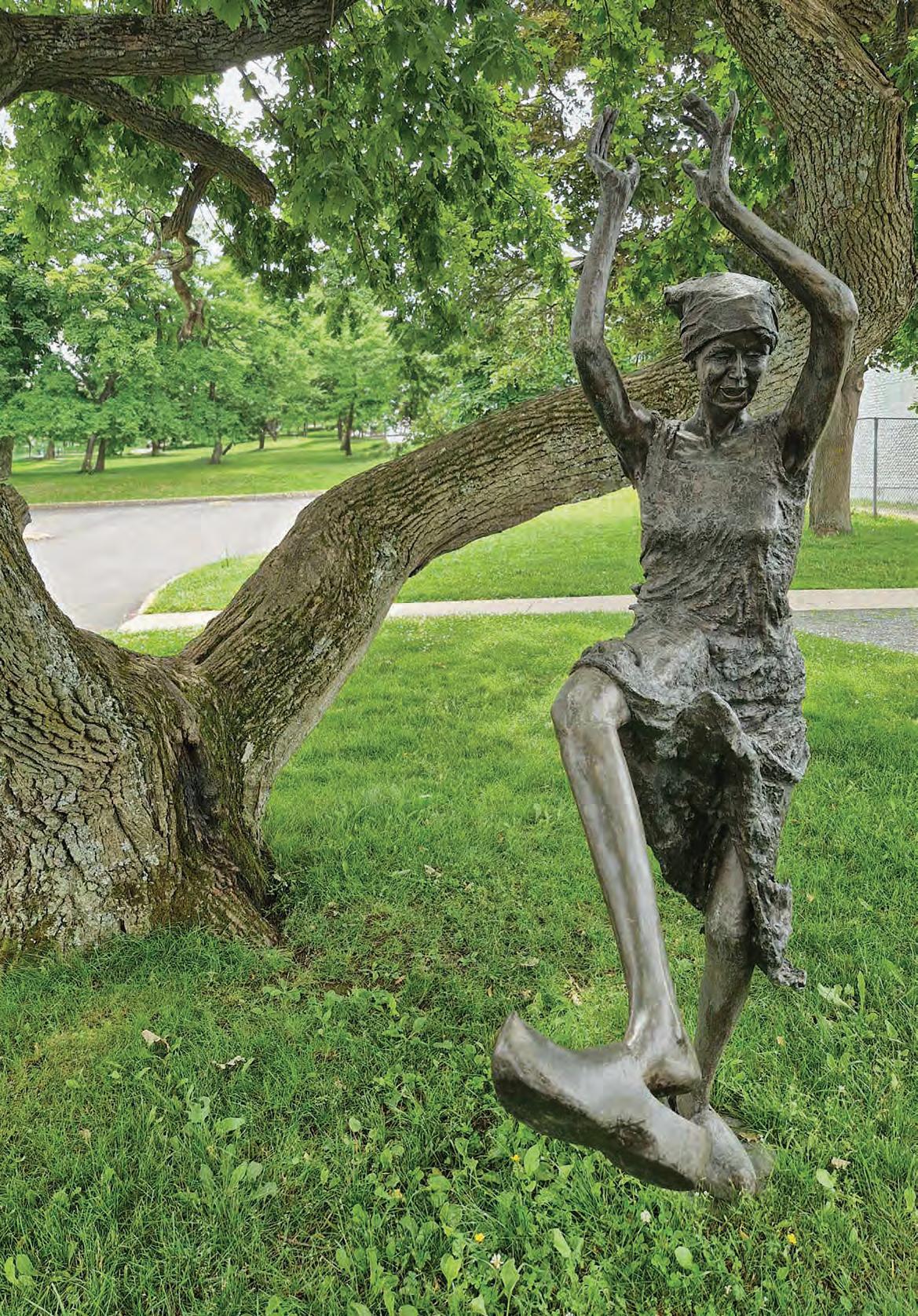
This bronze statue of Mona Parsons, the only Canadian female civilian imprisoned by the Nazis during the Second World War, was created by Dutch-Canadian artist Nistal Prem de Boer and unveiled on May 5, 2007, in Parsons’ hometown of Wolfville, N.S. It depicts an emaciated Parsons dancing after her successful escape.
See page 44

16 UNTO THE BREACH
As the Germans unleashed warfare’s first major gas attack, untested Canadian troops hold a critical gap in the front during the Second Battle of Ypres
By Alex Bowers
24 CRERAR’S CAMPAIGN
General Harry Crerar oversaw just one major battle—but the decisive early 1945 advance into Germany’s Rhineland was critical to ending WW II
By Mark Zuehlke
32 FIRST TROOP, CHARLIE SQUADRON, ROYAL CANADIAN DRAGOONS
Recollections from the diaries of a Canadian who helped liberate the Netherlands
By Charles Wilkins
40 REGRET TO INFORM YOU
How the widow of a WW II soldier killed in action got the news
By Stewart Hyson
44 MOED EN VERTROUWEN
It means courage and confidence in Dutch. Mona Parsons, the only Canadian woman to be imprisoned by the German army during the Second World War, embodied the phrase.
By Alex Bowers
50 THE PLAN
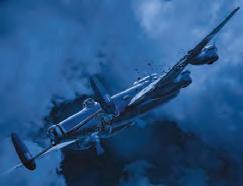
Canada’s instrumental role in WW II’s British Commonwealth Air Training Plan
By Stephen J. Thorne
56 ART OF THE WARHORSE
First World War images of the trusty steeds in action
By Stephen J. Thorne
66 FISH CREEK IN FIRST PERSON
A visit to the site of one of the key battlegrounds of the 1885 Resistance offers a new perspective on the fight for the Canadian West
By Russell Hillier
THIS PAGE
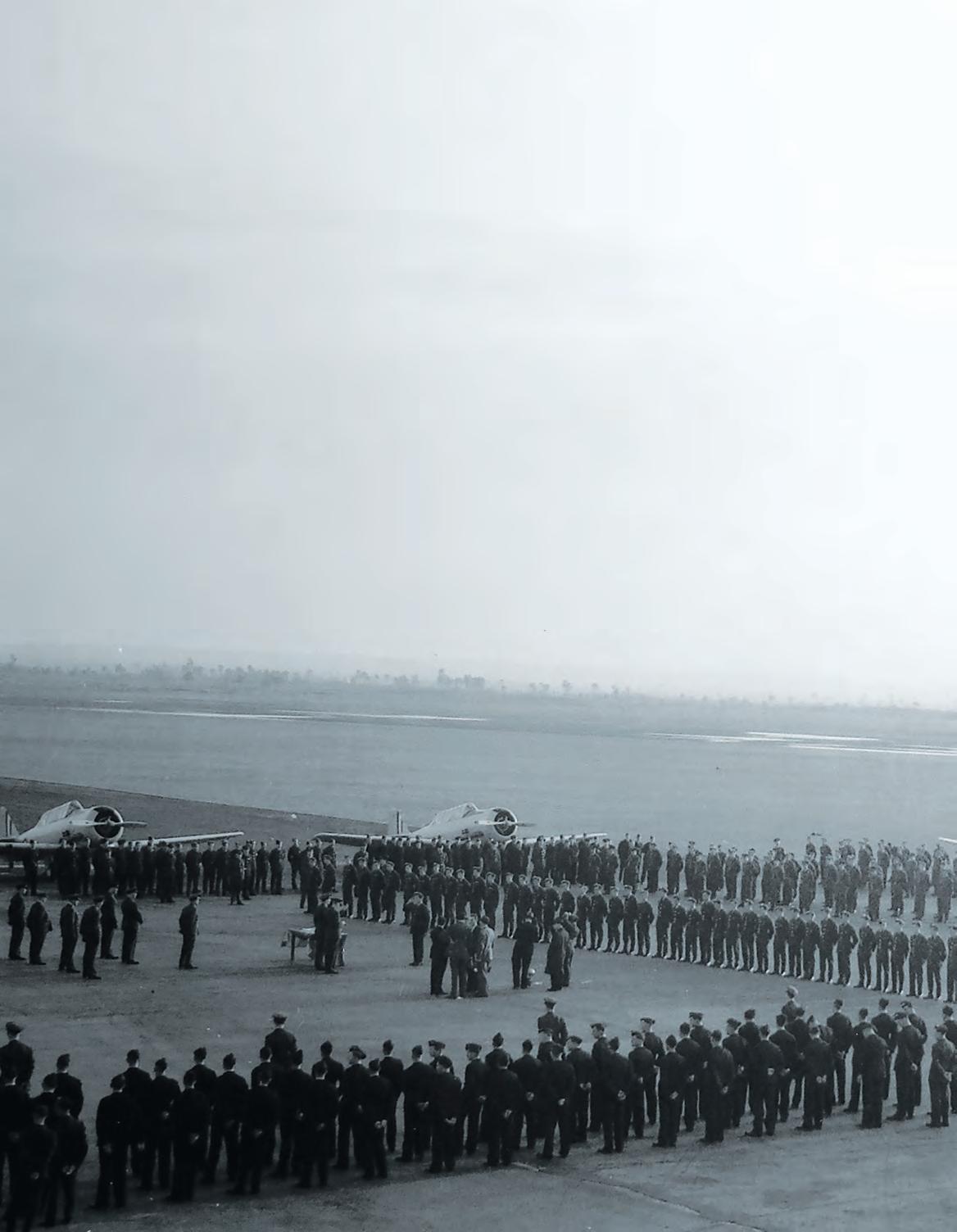
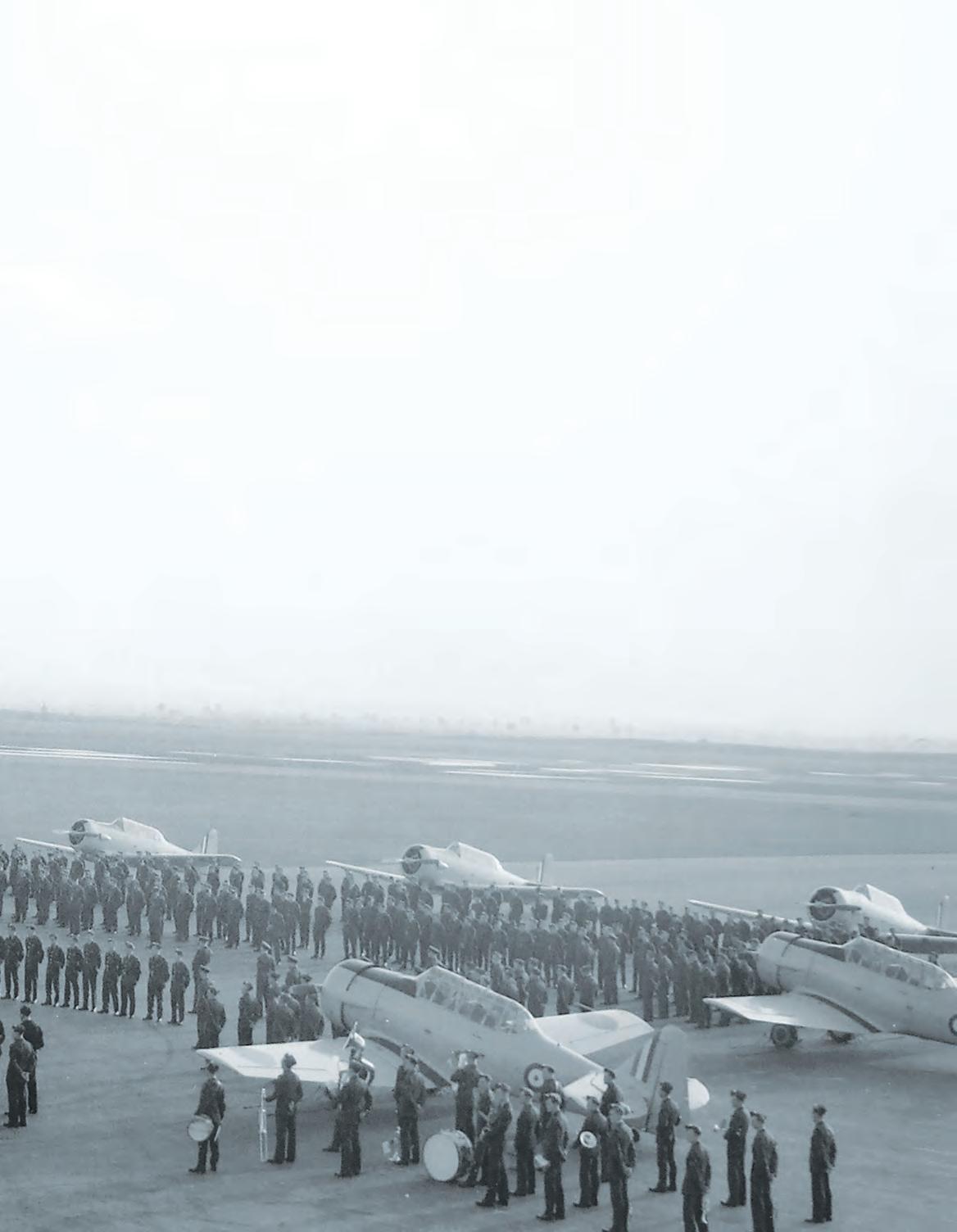
Graduating pilots of the British Commonwealth Air Training Plan receive their wings at Ontario’s Camp Borden on May 16, 1941. DND/LAC/3232905
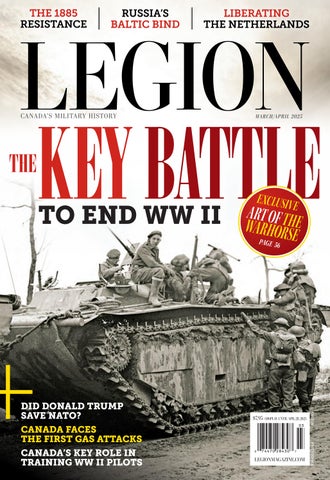
ON THE COVER
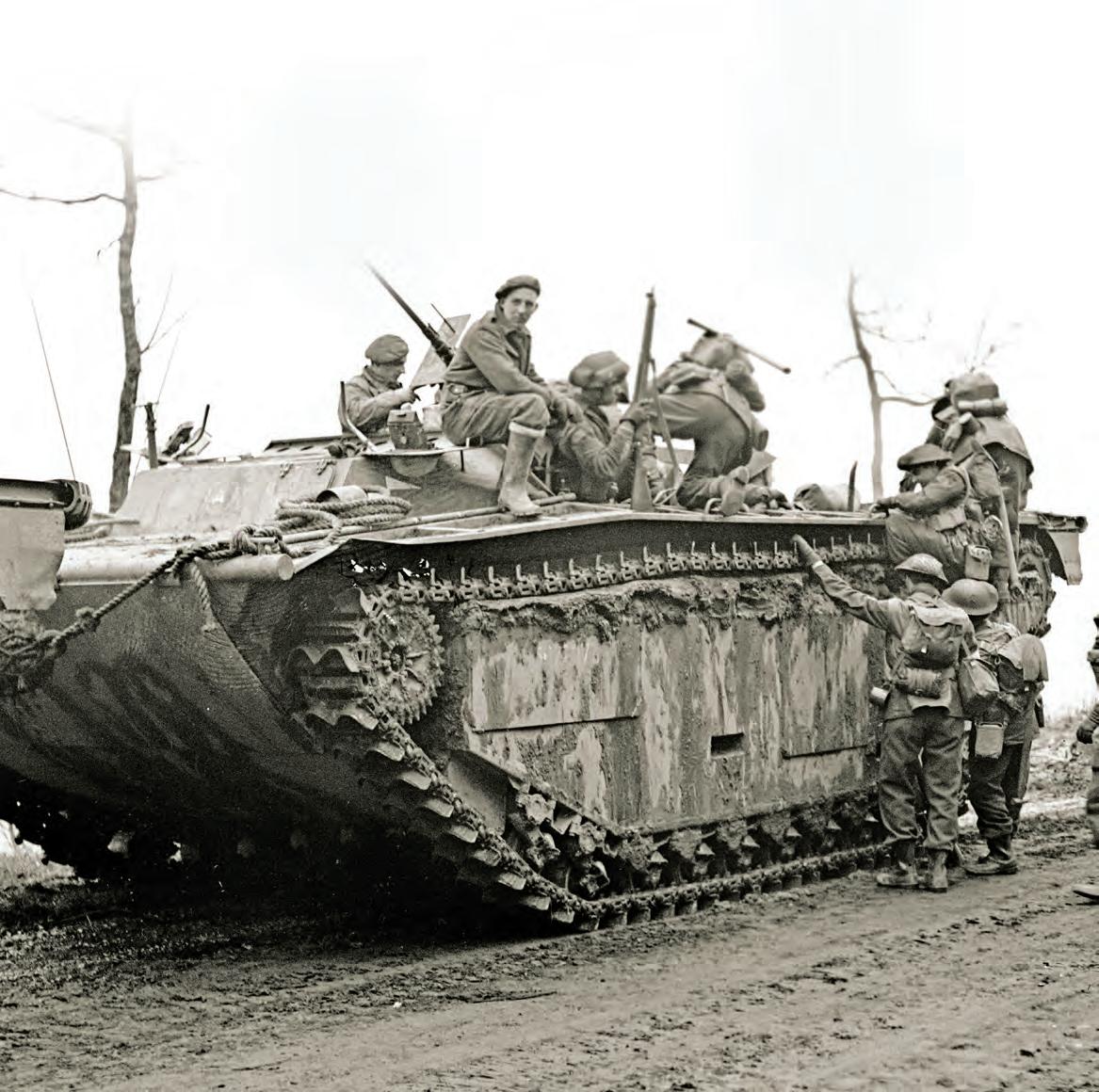
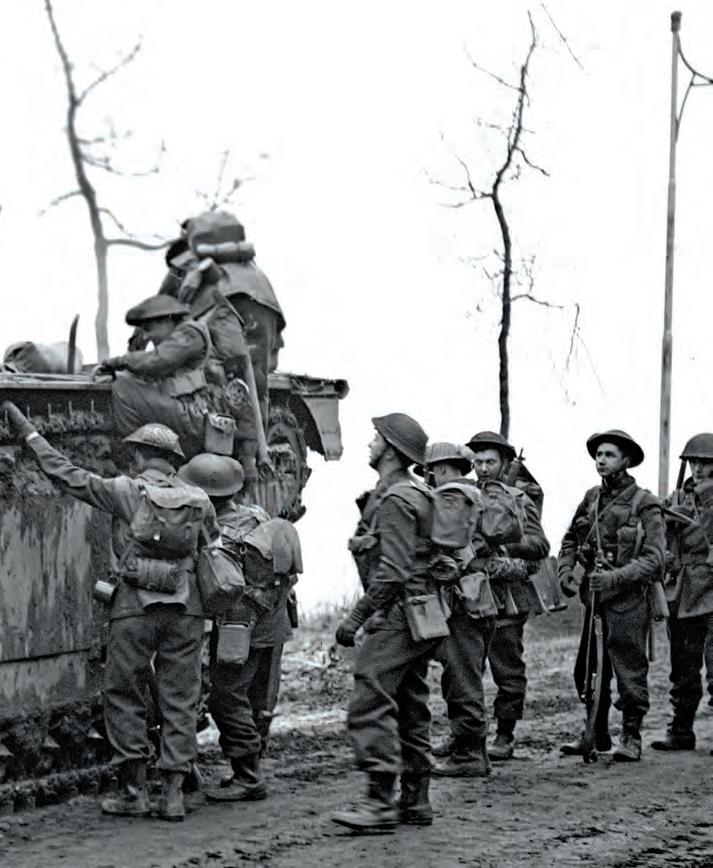
Infantrymen of The North Shore (New Brunswick) Regiment board an Alligator amphibious vehicle near Nijmegen, Netherlands, at the start of Operation Veritable on Feb. 8, 1945. Colin McDougall/DND/LAC/PA-190818
save

Vol. 100, No. 2 | March/April 2025
Board of Directors
BOARD CHAIR Garry Pond BOARD VICE-CHAIR Berkley Lawrence BOARD SECRETARY Bill Chafe
DIRECTORS Steven Clark, Randy Hayley, Trevor Jenvenne, Bruce Julian, Valerie MacGregor, Sharon McKeown
Legion Magazine is published by Canvet Publications Ltd.
GENERAL MANAGER Jason Duprau
EDITOR
ADMINISTRATION MANAGER
Stephanie Gorin
SALES/
ADMINISTRATIVE ASSISTANT
Lisa McCoy
ADMINISTRATIVE ASSISTANT
Chantal Horan
ADMINISTRATIVE AND EDITORIAL CO-ORDINATOR
Ally Krueger-Kischak



Aaron Kylie
ASSISTANT EDITOR
Michael A. Smith
SENIOR STAFF WRITER
Stephen J. Thorne
STAFF WRITER
Alex Bowers

ART DIRECTOR, CIRCULATION AND PRODUCTION MANAGER
Jennifer McGill
SENIOR DESIGNER AND PRODUCTION CO-ORDINATOR
Derryn Allebone
SENIOR DESIGNER
Sophie Jalbert DESIGNER
Serena Masonde


Advertising Sales CANIK MARKETING SERVICES NIK REITZ
613-591-0116 | 416-317-9173 | advertising@legionmagazine.com
MARLENE MIGNARDI 416-843-1961 | marlenemignardi@gmail.com OR CALL 613-591-0116 FOR MORE INFORMATION
SENIOR DESIGNER AND MARKETING CO-ORDINATOR
Dyann Bernard
WEB DESIGNER AND SOCIAL MEDIA CO-ORDINATOR
Ankush Katoch

Published six times per year, January/February, March/April, May/June, July/August, September/October and November/December. Copyright Canvet Publications Ltd. 2025. ISSN 1209-4331
Legion Magazine is $13.11 per year ($26.23 for two years and $39.34 for three years); prices include GST. FOR ADDRESSES IN NS, NB, NL, PE a subscription is $14.36 for one year ($28.73 for two years and $43.09 for three years). FOR ADDRESSES IN ON a subscription is $14.11 for one year ($28.23 for two years and $42.34 for three years).
TO PURCHASE A MAGAZINE SUBSCRIPTION visit www.legionmagazine.com or contact Legion Magazine Subscription Dept., 86 Aird Place, Kanata, ON K2L 0A1 or phone 613-591-0116. The single copy price is $7.95 plus applicable taxes, shipping and handling.
Send new address and current address label, or, send new address and old address. Send to: Legion Magazine Subscription Department, 86 Aird Place, Kanata, ON K2L 0A1. Or visit www.legionmagazine.com/change-of-address. Allow eight weeks.
Editorial and Advertising Policy
Opinions expressed are those of the writers. Unless otherwise explicitly stated, articles do not imply endorsement of any product or service. The advertisement of any product or service does not indicate approval by the publisher unless so stated. Reproduction or recreation, in whole or in part, in any form or media, is strictly forbidden and is a violation of copyright. Reprint only with written permission.
PUBLICATIONS MAIL AGREEMENT NO. 40063864
Return undeliverable Canadian addresses to Legion Magazine Subscription Department 86 Aird Place, Kanata, ON K2L 0A1 | magazine@legion.ca
U.S. Postmasters’
United States: Legion Magazine, USPS 000-117, ISSN 1209-4331, published six times per year (January/February, March/April, May/June, July/August, September/October, November/December). Published by Canvet Publications, 866 Humboldt Pkwy., Buffalo, NY 14211-1218. Periodicals postage paid at Buffalo, NY. The annual subscription rate is $12.49 Cdn. The single copy price is $7.95 Cdn. plus shipping and handling. Circulation records are maintained at Adrienne and Associates, 866 Humboldt Pkwy., Buffalo, NY 14211-1218. U.S. Postmasters send covers only and address changes to Legion Magazine, PO Box 55, Niagara Falls, NY 14304.
Member of Alliance for Audited Media and BPA Worldwide. Printed in Canada.
We acknowledge the financial support of the Government of Canada. Version française disponible.
On occasion, we make our direct subscriber list available to carefully screened companies whose product or services we feel would be of interest to our subscribers. If you would rather not receive such offers, please state this request, along with your full name and address, and email magazine@legion.ca or write to Legion Magazine, 86 Aird Place, Kanata ON K2L 0A1 or phone 613-591-0116.
orale wins wars, solves crises, is an indispensable condition of a vigorous national life and equally essential to the maximum achievement of the individual.”
So wrote historian Arthur Upham Pope in the December 1941 edition of The Journal of Educational Sociology. He went on to quote Napoleon’s dictum that “in war morale forces are to physical three to one.”
It seems little has changed. “Maintaining morale in military operations is a vital element in maintaining the resilience and determination of members of the armed forces,” wrote Mioara Șerban in the March 2024 edition of Security & Defence Quarterly.
“THE BIGGEST DIFFICULTY WITH ATTRACTING RECRUITS, MAY BE THE CAF ITSELF.”
So, while there’s a glimmer of hope that Canadian military chaplains ranked morale among the country’s forces as “mixed” in 2024—upgraded from “mixed to low” the year before—defence department officials ought still to be very concerned about the issues continuing to dog the esprit de corps among Canada’s military members.
In the Oct. 29, 2024, briefing to defence chief General Jennie Carignan, growing workload, lack of housing and shortages of equipment were noted as continuing to contribute to the lagging mood. In some regions, lack of childcare and difficulties in finding doctors also impacted morale. (Improvements in pay and efforts to modernize the military were said to have helped boost attitudes.)
“Chaplains have reported that members are experiencing fatigue and low morale, largely due to personnel shortages,” the briefing, a copy of which was obtained by the Ottawa Citizen, noted. “Members frequently express concern about being tasked with duties or responsibilities beyond their rank.”
All this comes amid a recruitment crisis, with the Canadian Armed Forces short some 16,000 members of its authorized strength. Just weeks into her command, Carignan identified recruitment and retention of personnel her top priority. In August 2024, the defence chief issued a joint statement on the matter with CAF Chief Warrant Officer Bob McCann.
“We have had the privilege of working alongside many of you, witnessing your dedication and professionalism,” wrote the duo. “This spirit defines the CAF and makes us a respected institution at home and abroad.
“Without a strong and dedicated workforce,” they continued, “all the best capabilities, training, and plans mean very little.”
Of course, the two issues—morale and recruitment/retention—are intrinsically linked.
“The biggest difficulty with attracting recruits,” wrote Major Ian A. Creighton in a 2024 paper for a Canadian Forces College course, “may be the CAF itself.
“Years of neglect and chronic underfunding have contributed to the deterioration of equipment and infrastructure, which degrade operational capability and capacity. The result is not just a tarnished image but calls into question the legitimacy of the CAF.”
Indeed, the very challenges reportedly behind the sagging morale.
Legion Magazine supports a strong Canadian military, one that’s esteemed by Canadians and around the world. But no recruitment strategy will work until the attitude of the CAF’s rank-and-file is improved.
Want to improve morale? It’s simple. Listen to what you’re being told. Don’t overburden them. Ensure they get homes. Provide them with reliable equipment. If you build it, they will come. L
read with interest
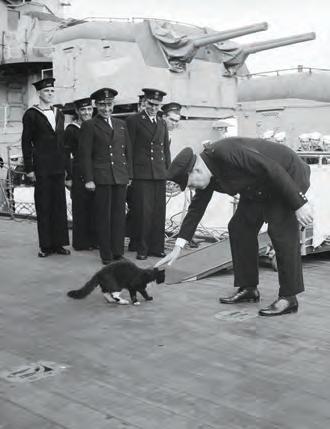
Stephen J. Thorne’s Front Lines column “Unsinkable Sam” (November/December 2024). As a quirk of history, it’s worth noting that if Oscar/ Sam had been aboard Bismarck he would have been facing off against three English cats who were aboard HMS Prince of Wales. Blackie, for one, would later be seen being shooed away from the
As a former Royal Canadian Air Force fighter pilot, I am appalled, embarrassed, ashamed and angered over the way our military, especially our air force, has been neglected by successive governments. The last nine years under Prime Minister Justin Trudeau have been particularly abhorrent. It started with Trudeau’s campaign promise to not buy F-35 fighters recommended by the previous Conservative government. That was in 2015. Now, nearly a decade and billions of dollars later, the defence department is buying the very same aircraft. Meanwhile, the country only has about 40 combat-ready pilots. But, never mind, it’ll train new pilots to fly them. But wait, Canada just deactivated its pilot training squadron. No matter, it will just have one of its allies, such as the United States, train them. At great cost.
One of the prime responsibilities of the federal government is to keep Canadians safe. The current government has abrogated that responsibility. Hopefully, a responsible
government that will correct the shameful degradation in equipment and personnel of Canada’s military will win the forthcoming election.
RICHARD KISER
CALGARY
I have noted in your magazine criticism of the federal government relating to the state of the Canadian Armed Forces (all of the defence department, really). Columns by David J. Bercuson, J.L. Granatstein and others have laid out the many shortfalls. It’s perfectly justified criticism. But, I haven’t read a single word t hat offers a real solution.
On recruitment: what about compulsory military service? It has been talked about, but what about some analysis? Other countries are considering it again, having ditched it years ago. On procurement: other than complain, what can be done now?
Maybe it’s time to stop complaining and start to suggest a way forward. Your staff are as expert as a nyone in government, and some of them have
Comments can be sent to: Letters, Legion Magazine , 86 Aird Place, Kanata, ON K2L 0A1 or emailed to: magazine@legion.ca
feet of Winston Churchill during a meeting in Newfoundland during the Second World War.
MICHAEL RALPH ST. JOHN’S, N.L.
Ed note: Read more about Blackie and other military ship cats at www.legionmagazine.com/ in-defence-of-cat-ladies-andgentlemen-the-tale-of-unsinkablesam-and-other-seafaring-felines.
military experience. I would like to see some well-considered suggestions or proposals.
RETIRED LT.-COL. JOHN M c NAIR KINGSTON, ONT.
Ed note: Numerous readers responded to “The B’ys Back” (September/October 2024) by Assistant Editor Michael A. Smith to point out that Newfoundland’s Red Ensign was not an official flag, but rather a merchant marine tool used to denote a ship’s origin, and questioned why it was used during the repatriation ceremonies for Newfoundland’s unknown soldier. From 1904 to 1931, the Dominion’s Red Ensign— which included the colonial badge—was used so commonly by government and civilians that it was considered the de facto flag. And during the First World War, families of Newfoundland soldiers and sailors killed in action received letters of notice with two flags adorning them: the Red Ensign and the Union Jack. On May 15, 1931, the Newfoundland legislature officially adopted the Union Jack as the colony’s official flag. L
The origins of Legion Magazine can be traced back almost 100 years to the publication of the first issue of The Legionary. The magazine took its current name in 1972. In the intervening years, the ways it shared stories evolved. And in recent times with the advent of digital technologies, it expanded its offerings to include immersive and interactive web stories, topical videos narrated by Canadian icons and a podcast series.
The latest change is the introduction of a new weekly web post. “The Briefing” features Q&A interviews conducted by staff writer Alex Bowers with a who’s who of the Canadian military experience

Get notified of all the latest updates on legionmagazine.com by signing up for our weekly e-newsletter at www.legionmagazine.com /newsletter-signup
and culture—both high profile and under-the-radar experts. From veterans to serving personnel, from politicians to professors, from historians to curators, from authors to advocates and more, Bowers’ discussions will delve into all aspects of Canada’s military history.
To get notified about each week’s latest interview (and much more), sign up for Legion Magazine’s e-newsletter, if you haven’t already, at www.legionmagazine. com/newsletter-signup. L
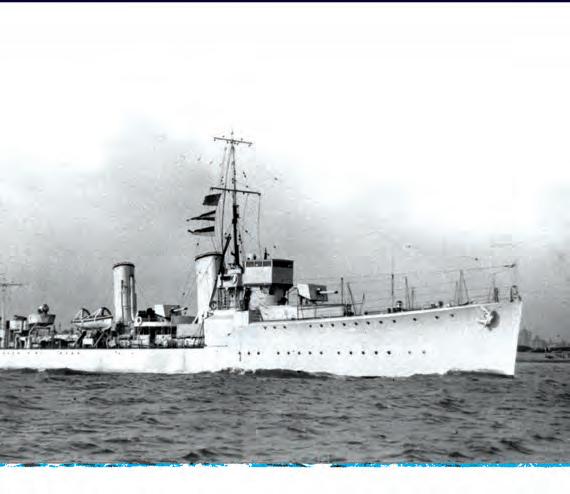
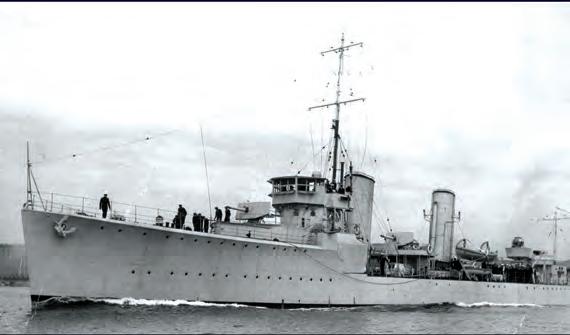
1 March 1928
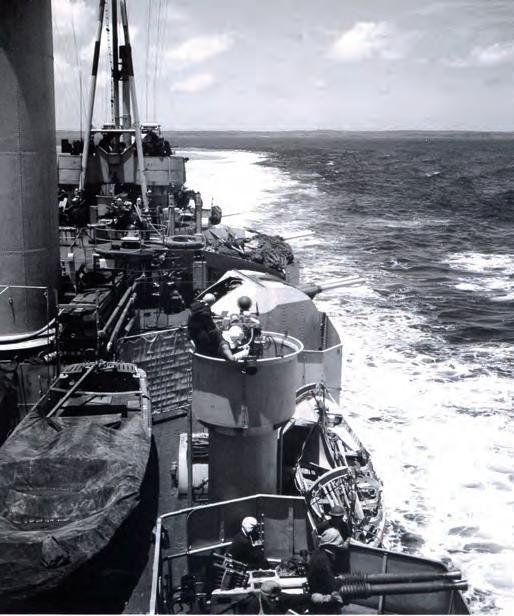
Two British destroyers are transferred to the Royal Canadian Navy and renamed HMC ships Vancouver and Champlain
2 March 1951
National Defence publishes its first Korean War casualty list. Today, the names of 516 Canadians are inscribed in the Korean War Book of Remembrance.
5 March 1995
The Canadian Airborne Regiment officially disbands; its 600 paratroopers parade one final time.
7 March 1951
In the Korean War’s Battle of Maehwa-san, two companies from 2nd Battalion, Princess Patricia’s Canadian Light Infantry, assault and secure Hill 532.
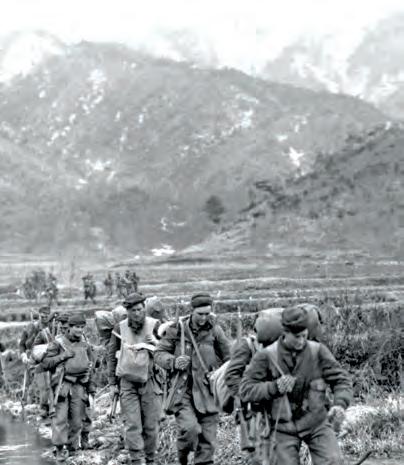
8 March 1996
The United Nations peacekeeping mission in Rwanda ends in failure after more than two years.
9 March 1812
A British spy’s letters are presented to the U.S. Congress, sparking the War of 1812.
11 March 1876
Sub-Constable John Nash becomes the first member of the North-West Mounted Police to die on duty. He is accidentally killed in Fort Macleod, Alta.

24 March 1975
The beaver becomes an official symbol of Canada.
12 March 1908
Toronto native F.W. (Casey) Baldwin becomes the first Canadian to fly a heavier-than-air flying machine in Hammondsport, N.Y.
13 March 1915
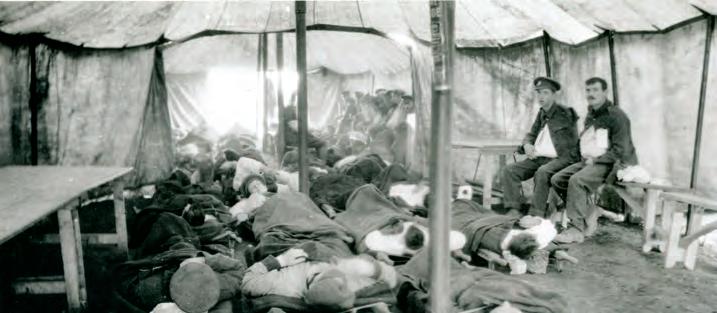
No. 2 Canadian General Hospital crosses the English Channel to France.
25-26 March 1952
Chinese forces attack a Princess Patricia Canadian Light Infantry platoon holding Hill 132 and a Royal Canadian Reserve outpost on Hill 162. They end up withdrawing as the Canadians hold their positions. Eight Canadians die, while 13 are wounded.
17 March 1945

HMCS Guysborough is torpedoed and sunk by U-868 in the Bay of Biscay off France, resulting in 51 casualties.
20 March 1944
General Harry Crerar assumes command of First Canadian Army. He will go on to lead troops into France, Belgium, the Netherlands and a final assault on Germany.
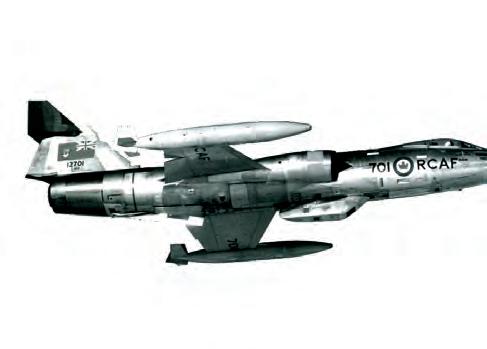
takes delivery of the first Canadair CF-104 Starfighter.

3 April 1916
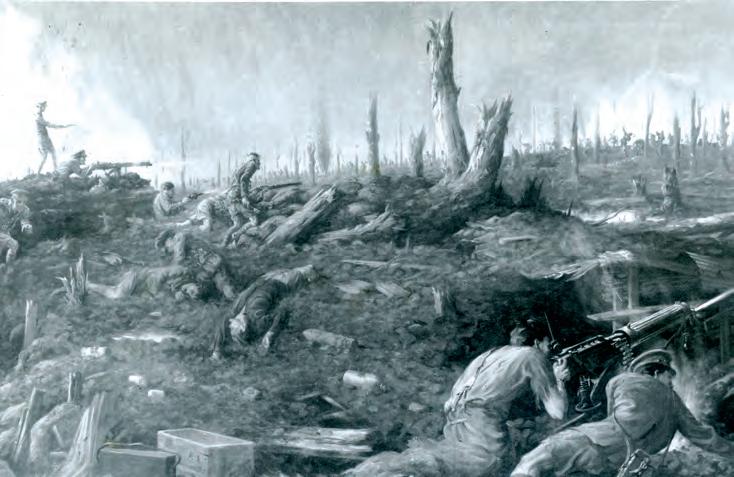
2nd Canadian Division relieves British troops at the Battle of the St. Eloi Craters in its first major engagement of WW I.
5 April 1955
Winston Churchill resigns as U.K. prime minister.
7 April 1868
Thomas D’Arcy McGee, one of the Fathers of Confederation, is assassinated by Fenians in a rare Canadian political assassination, and the only one of a federal politician.
10 April 1972
13 April 1945

Canada and more than 70 other countries agree to ban biological weapons.
12 April 1961
Soviet cosmonaut Yuri Gagarin becomes the first human to travel into space and orbit Earth, aboard spacecraft.
Private Léo Major rushes a German position after the death of his friend and almost singlehandedly liberates the Dutch city of Zwolle.
15 April 1993
George Frederick Ives, last known survivor of the Boer War, dies at 111.
18 April 1910
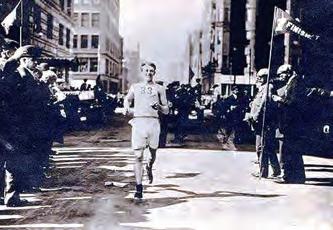
The 14th Boston Marathon is won by Canadian Fred Cameron with a time of 2:28:52.
19 April 1904
The Great Fire of Toronto destroys most of the city.
20 April 1934
Heinrich Himmler is appointed assistant chief of the Gestapo, Nazi Germany’s secret police, in Prussia.
21 April 1945
Allied forces capture Ie Shima, Okinawa, in five days.
22 April 1963
Lester B. Pearson is sworn in as Canada’s 14th prime minister.
23 April 1949
The Chinese Red Army captures Nanjing.
24 April 1974
The U.S.S.R. performs a nuclear test at Sary Shagan.
25 April 1945
A bombing mission on Obersalzberg, Germany, is the final combat operation for the majority of Bomber Command squadrons involved.
26 April 1933
Jewish students are barred from attending school in Germany.
27 April 1959
The last Canadian missionary leaves the People’s Republic of China.
By Alex Bowers
was one of those strange coincidences,” explained Cheryl Forchuk, assistant scientific director at the Lawson Health Research Institute in London, Ont.
“I happened to be at one of our [homeless] shelters talking to people about strategies to lift them out of poverty, and two individuals were veterans. We had an interesting conversation about the difficulties of transitioning to civilian life.”
Forchuk left the shelter with that conversation vivid in her mind. It remained with her the next day at a committee meeting in Ottawa where, in a curious turn of events, the broad topic of veterans without permanent housing surfaced.
One thing led to another, and “we were able to get funding to do Canada’s first national study related to veterans experiencing homelessness,” said Forchuk.
Travelling coast to coast to interview dozens of veterans, Forchuk and her research team began developing principles based on the accumulated feedback.
Among the conclusions was the need for a housing-first model
that would stabilize service members by providing housing before any other issue is tackled.
“From all the homeless projects we’ve done, it’s clear that people can’t deal with their problems while they’re still on the street,” said Forchuk.
Equally important is peer support. Many veterans expressed the desire for greater assistance from people who understood the military and homelessness.
Forchuk’s study also determined the need for veterans to maintain structure in accessing homeless services.
“If I heard it once,” she said, “I heard 100 times the phrase ‘loosey-goosey’ [when discussing homeless shelters]. While these sites are trying to be accommodating, they couldn’t be more opposite to military routine. There are no rules, there is no specific breakfast time, and the veterans often need that.”
Forchuk’s team likewise encountered hurdles, not least a fundamental lack of Canadian research and an overreliance on U.S. research. This, of course, wasn’t an American shortcoming
in acknowledging the military culture differences between both countries; rather, it was a decidedly Canadian omission in factors of contextualizing veterans’ homelessness north of the border.
Where U.S. studies suggested that post-traumatic stress disorder was a leading cause of homelessness, Forchuk found that many Canadian veterans tied their challenges to alcohol dependency, in part the result of the Canadian military’s drinking culture.
It was, the team recognized, a complex addiction issue that benefited from a harm reduction over an abstinence model of treatment. Nevertheless, in laying bare the glaring cross-border divide, it became increasingly evident that a similar one-size-fits-all strategy extended to demographic disparities within Canada itself.
“I was really concerned about the lack of women [represented in the study],” said Forchuk, who identified female veterans in only two locations before the research findings were published in 2015. “I made a point of talking to them regularly, and they said that the systems were really set up for men.”
In 2018, a national survey tallied roughly 32,000 people experiencing homelessness in 61 communities across Canada (both in sheltered and unsheltered locations, as well as in various transitional programs), 19,536 of whom actively participated in the project; 4.4 per cent of respondents said they were veterans of the Canadian Armed Forces; of those, 82.7 per cent were male and 14.1 per cent female.
What were the exclusive lived experiences of the latter? How can they be addressed and why had so few come forward when research was carried out prior to 2015?
Now, with $1.2 million in federal government funding, Forchuk’s team is in the process of finding answers by conducting first-of-itskind research that focuses on the experience of female veterans.
Like with the previous study, Forchuk’s team is continuing to travel across Canada—to locations selected in partnership with The Royal Canadian Legion and other veteran-serving groups— for an expected four-year period. Their aim is to gather information that could ultimately shape programs, inform policies and, fundamentally, provide tailored solutions for female veterans.
Already, conversations with former personnel have highlighted some of the issues, explained Forchuk.
“In London, for example, many [female veterans] had kids where it wasn’t good to take them into a group environment [of shelters]. More recently, new programs offer tiny homes that just aren’t suitable for kids.”
“Some women,” she added, “are dealing with sexual trauma. So, to put them in a room or
building full of men, let alone if they have kids, is not appropriate.”
However, with hopes for interviewing at least 100, ideally 150, female veterans, Forchuk is wary about generalizing their respective experiences.
“I don’t want to say, ‘This is a solution for all women,’ she said. “We must drill down. We must understand the differences between having kids and not having kids, between Indigenous and nonIndigenous individuals and between trans women. We might say that these are some broad experiences, but they must be further condensed.”
And yet, challenges identified in Forchuk’s first study linger— namely, affording individuals the space to self-identify as veterans. It is, seemingly, one area where there’s little difference between male and female interviewees, noted Forchuk: “Many feel they don’t deserve the title [of veteran]

because of how far they’ve fallen. They feel it’s part of their recovery to reclaim that status again.”
As much as peer support has been emphasized, the role civilians play in helping veterans, regardless of sex or gender, cannot be diminished.
“The Legion is a huge partner [in finding would-be candidates],” said Forchuk, “but everyone can assist. If someone asks to borrow your couch because they’re in a situation, talk to them. If someone is doing super well now, but they had been homeless, have them reach out as it could be a way of helping other women.”
Homing in on solutions is, unsurprisingly, the cornerstone of the study, although the Lawson Health Research Institute also recognizes the profound importance of giving female veterans a long-overdue voice.
“It’s about hearing people’s stories,” suggested Forchuk. “It’s about bearing witness, of knowing they’re out there.” L





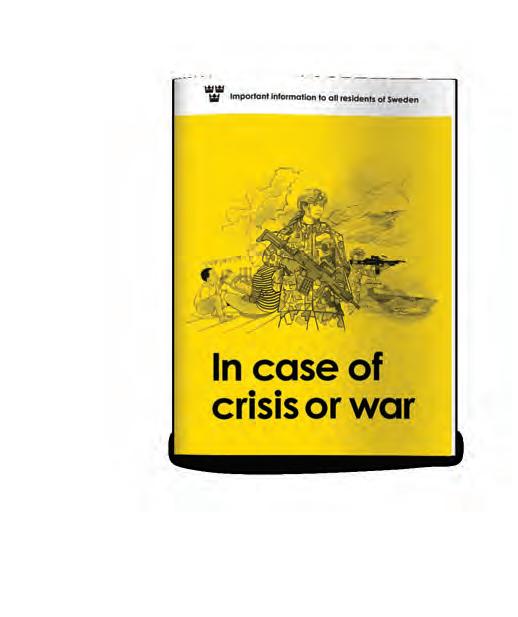
Asthe rhetoric escalates and violence spreads, Nordic countries have issued formal instructions to their citizenries on how to prepare for war and other crises.
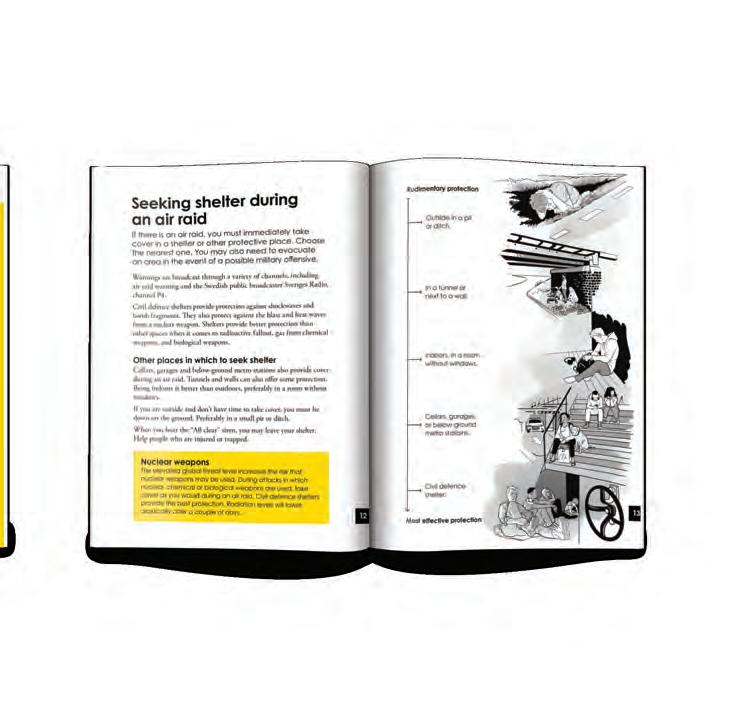
“ We live in uncertain times,” declares a Swedish government booklet distributed to households across the country. “Armed conflicts are currently being waged in our corner of the world.
“If Sweden is attacked, everyone must do their part to defend Sweden’s independence—and our democracy…. In this brochure, you learn how to prepare for, and act, in case of crisis or war.”
Tensions mounted recently after Russian President Vladimir Putin lowered the threshold for a nuclear strike. The move followed a Ukrainian strike deep inside Russia with U.S.-made ATACMS missiles— supersonic conventional weapons.
The Moscow doctrine deems any attack by a non-nuclear power supported by a nuclear power a joint attack, and any attack by one member of a military bloc an attack by the entire alliance.
Announced on Nov 1,000th day of the Ukraine war, Russia also included a broader definition of what constitutes a mass attack on the motherland from aircraft, cruise missiles and unpiloted drones.
The war has entered what some Russian and western officials say could be its final and most dangerous phase as Moscow’s forces advance at their fastest pace since the first weeks of the invasion. And it’s doing so amid post-election uncertainty over the future of critical U.S. support to Ukraine.
The current state of U.S.Russia relations has been termed an all-time low, or their worst at least since the 12-day Cuban Missile Crisis of 1962.
“Now the danger of a direct armed clash between nuclear powers cannot be underestimated,” said Sergei Ryabkov, Russia’s deputy foreign minister overseeing arms control and U.S. relations. “What is happening has no analogies in the past, we are moving through unexplored military and political territory.”
Sweden’s “In case of crisis or war” has been updated due to what the government in Stockholm describes as a worsening security situation.
in size due to what the government in Stockholm calls the worsening security situation.
“Military threat levels are increasing,” it warns. “We must be prepared for the worst-case scenario—an armed attack on Sweden.
“We can never take our freedom for granted. Our courage and will to defend our open society are vital, even though it may require us to make certain sacrifices.”
It says Sweden is already under attack from cyber warriors, disinformation campaigns, terrorism and sabotage.
Swedish authorities produced a similar document, “If War Comes,” during WW II. It was updated during the Cold War.
But one message has since been prioritized: “If Sweden is attacked by another country, we will never give up. All information to the effect that resistance is to cease is false.”
Finland, Norway and Denmark— all bordering on the strategic Baltic Sea—have also issued
> Check out the Front lines podcast series! Go to legionmagazine.com/en-frontlines

pamphlets, booklets and/or online advisories addressing the spectre of crises, including war, and how to respond to them.
Sweden joined NATO in 2024 after Moscow expanded its war in 2022. Finland had joined a year earlier, while its neighbours, Norway and Denmark, like Canada, are founding members of the defensive alliance.
Finland already has a long history with Moscow’s hegemonic aspirations, dating to the Finnish War of 1808-’09 when Russia invaded and took what was then the eastern part of the Kingdom of Sweden. It formed the Grand Duchy of Finland, an autonomous piece of the Russian Empire.
The empire collapsed during the Russian Revolution of 1917. Finland seceded and declared its independence. A civil war ensued, pitting German-aided conservatives on one side and Bolshevik-backed socialists
on the other, resulting in full, if not fragile, sovereignty in May 1918.
On Nov. 30, 1939, Joseph Stalin’s Red Army launched a costly invasion into Finland aimed at creating a buffer around Leningrad.
By the time the fighting stopped and a treaty was signed, threeand-a-half months had passed and Moscow had gained more territory than it had demanded prewar.
But in a scenario that sounds uncannily familiar in these Ukrainian war times, Finnish defenders knocked out almost 2,000 Russian tanks. The Soviets had lost up to 168,000 soldiers killed or missing and more than 207,000 wounded or sick.
Moscow’s prestige had taken a hit, while Finland’s was elevated.
“Finland has always been…prepared for the worst possible threat, war,” says its digital brochure,


“Preparing for incidents and crises.”
“Military defence is built on conscription and the support of the whole society to national defence. All Finnish citizens have a national defence obligation, and everyone plays an important role in defending Finland.”
The online document addresses varying degrees of defence, outlines civilian responsibilities, describes the minute-long rise and fall of an air-raid warning, and points people to civil defence shelters.
“Everyone aged 18 or over but under 68 living in Finland is obliged to participate in rescue, first aid, maintenance and clearing tasks or other civil defence tasks.”
Ilmari Kaihko, associate professor of war studies at the Swedish Defence University, told the BBC that his native Finland, which shares a significant border with Russia, “never forgot that war is a possibility.” L




ust weeks after he was elected for a second term as U.S. president, but nearly two months before his inauguration, Donald Trump threatened to raise tariffs on Canadian imports by 25 per cent. Surely, it’s only a matter of time until he pressures Canada to do more militarily to help safeguard North America and the West at large.
With the U.S. engaged in an arms race with China, which has been increasingly asserting its sovereignty claims over international waters, the Russian invasion of Ukraine and the instability in the Middle East, the world grows more dangerous.
some $13 billion over five years and $4.4 billion annually after that. Then there was the national child-care plan introduced in 2021 that the parliamentary budget officer estimated will cost close to $28.3 billion by the end of next year. In these three initiatives alone, Ottawa has added billions to t he national budget; the national debt, meanwhile, is already an estimated $1,532.3 billion.
Go to our website, email us, or call us to schedule an appointment
call: 1 877 866 VETS (8387) email: info@urogenvet.com www.urogenvet.com
This past November, for instance, the federal government implemented a GST break which runs until mid-February and will cost between $1.5 and $2.7 billion. That largesse followed a new national dental care program, which was rolled out at the end of 2023 and had an estimated price tag of
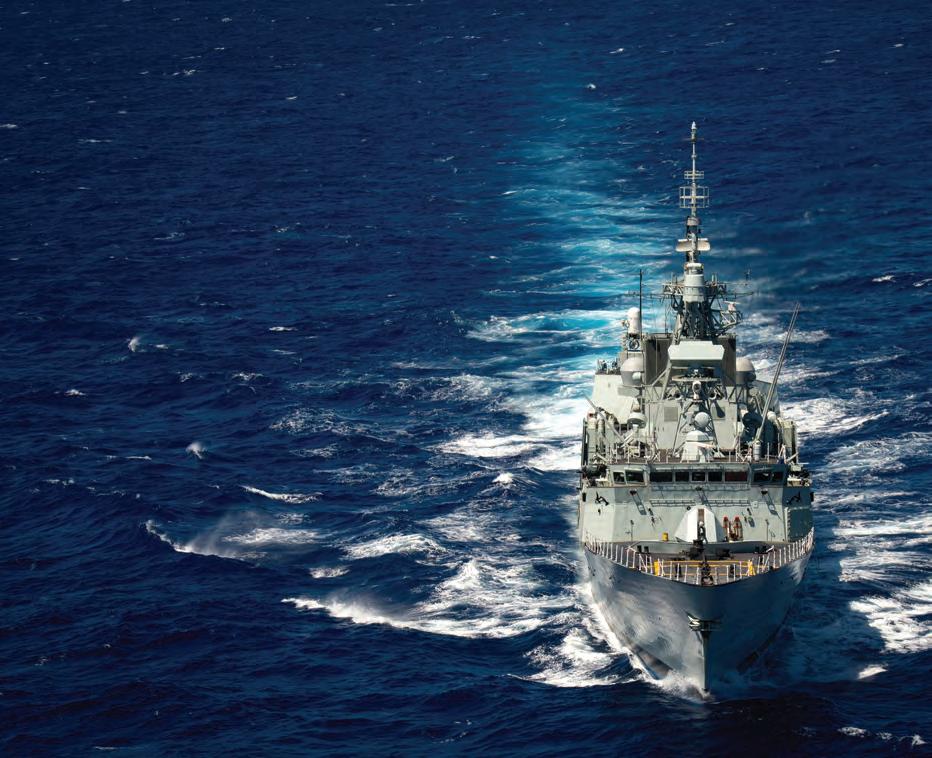
And for defence? The feds promised in July 2024 that the country will spend two per cent of its gross domestic product (GDP) on its military by 2032—seven years from now. In the meantime, Canada will continue to rely on its fleet of 12 30-plus-year-old Halifax-class frigates, its four 1980s-era submarines with no under-ice capability, and the 30-year-old fleet of tactical helicopters. Note, too, the country has no real troop air defences and has a deficit of some 16,500 military personnel. Even though there were 70,080 applicants in 2023-24, only 4,301 were accepted.
The state of Canada’s defences has gotten so bad that Defence Minister Bill Blair has made clear his willingness to increase his department’s budget much quicker.
“My goal is to do it as quickly as possible,” Blair told CBC in late January, “and I’m increasingly confident we’ll be able to.”
Indeed, facing continuing criticism of military spending in the days immediately following Trump’s January inauguration, Blair indicated the government would meet the two per cent target by 2027, five years earlier than promised.
“We’ve been working hard to accelerate that spending to get the job done,” Blair continued. “But that’s in Canada’s national
interests, it’s not just in response to threats made by what we’ve always considered our closest ally and friend.”
Still, Canada will have to face the inevitable: how to achieve the two per cent of GDP minimum? There are no easy solutions, especially for a government that continues to bloat the country’s debt with tax breaks and new social programs.
Sure, dental care is a worthy cause for Canadians who don’t already have it. And so is child care. But, in light of the geopolitical powder keg around the world right now, it would seem Canada doesn’t have its priorities straight. Indeed, should some disaster occur in the North that the country can’t handle because it has neither the
ships nor the aircraft to respond adequately, will Canada continue to undermine its sovereignty by begging others for help?
The country’s priorities are set by the federal government, one that long ago decided that investing in social programs was far more important t han the nation’s defence. Canadians can get rattled at Trump’s sometimesridiculous pronouncements, but when business and trade groups, premiers, and many everyday Canadians realize the country isn’t doing enough for its own defence, it also becomes apparent something must be done.
If Trump has his way, as he often does, something will change—and soon. L



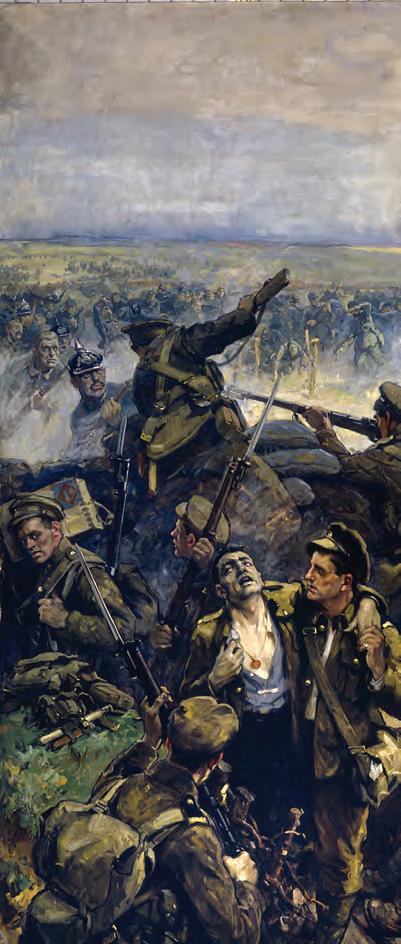
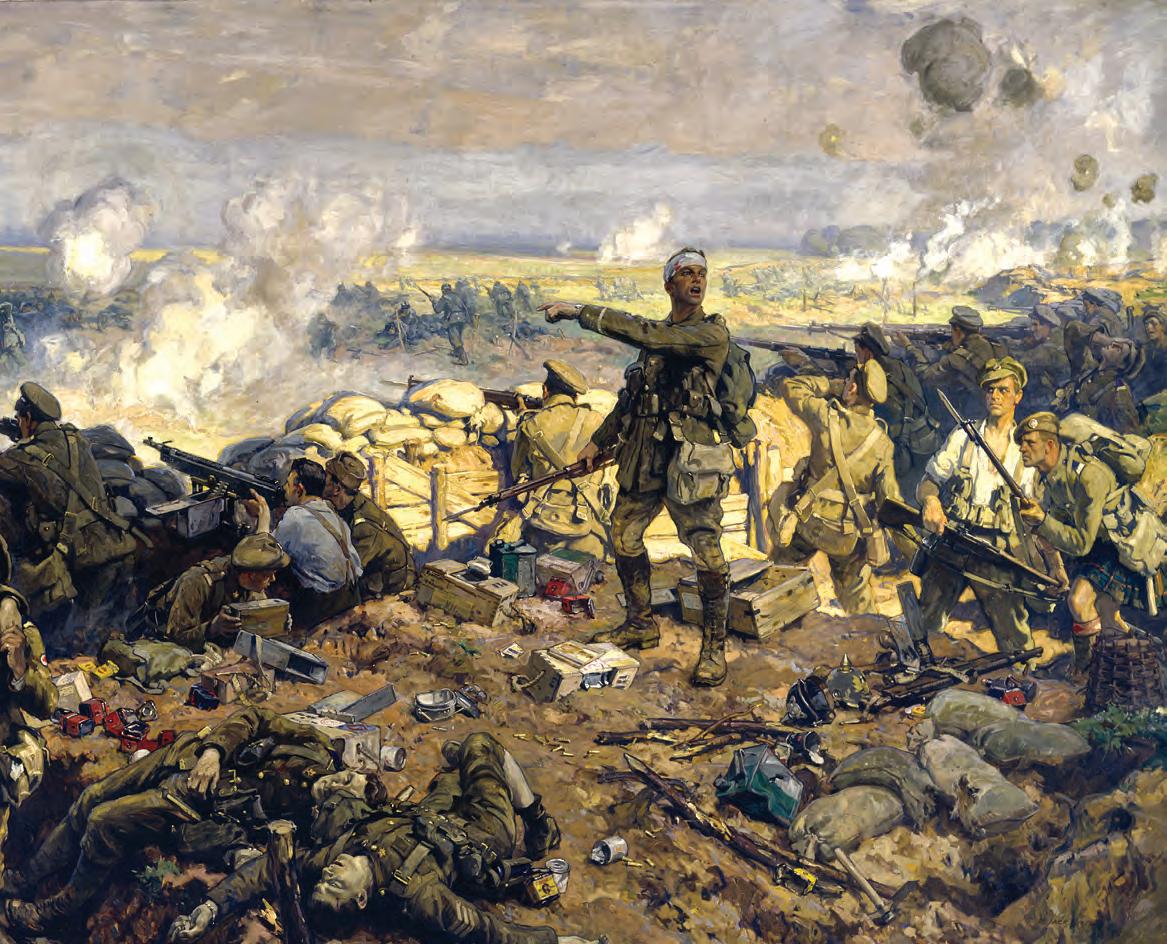
As the Germans unleash warfare’s first major gas attack, untested Canadian troops hold a critical gap in the front during the Second Battle of Ypres
By Alex Bowers
Gas! Gas! Quick, boys! An ecstasy of fumbling Fitting the clumsy helmets just in time; But someone still was yelling out and stumbling And flound’ring like a man in fire or lime… Dim, through, the misty panes and thick green light, As under a green sea, I saw him drowning.
—from “Dulce Et Decorum Est” by Wilfred Owen
“The very essence of spring was in the air,” wrote Canadian Lieutenant-Colonel George Nasmith about Belgium’s Ypres salient on April 22, 1915. “I felt as if I had to go out into the open and watch the birds and bees, loll in the sun, and do nothing.”
An analytical chemist from Toronto, the 4' 6" intellectual had been deemed ineligible for combat service due to his small stature. Undeterred, he had instead received authority to organize a laboratory for testing the troops’ drinking water.


On April 22, having travelled close to the Allied front line “to see what ‘No Man’s Land’ was like,” Nasmith ran into his friend Captain Francis Scrimger, the medical officer of the 14th Battalion (Royal Montreal Regiment). Sharing pleasantries, he and another comrade eventually pushed on until “our attention was attracted to a greenish yellow smoke ascending from the part of the line occupied by the French.”


Without any sense of urgency, both lit cigarettes and observed the expanding cloud as it drifted


forward at roughly eight kilometres an hour. It was only after Nasmith noted that it contained streaks of brown that he grew more concerned.
“That must be the poison gas that we have heard vague rumours about,” he surmised as the reality dawned on him. “It looks like chlorine, and I bet it is.”
And it was coming straight
The sight was horrifying omewhat expected horror.
Essentially outlawed by the Hague Conventions of 1899 and 1907, neither the Central Powers nor ntente were outright opposed to the use of poison gas. An ambitious Germany, however, was the first to act on it on a large scale.
Experiments with weak irritants had previously fallen short of expectations. German chemist Fritz Haber then stepped up with the idea of using chlorine. Moreover, to circumvent the convention’s stipulation that gas must not be fired from exploding shells, he suggested releasing it through trench-installed hoses.
The intended target would be the Ypres salient. Considered a symbol of Allied tenacity, the front there jutted into German territory and acted as a buffer zone for the logistically critical Channel ports. Eliminating the salient would have enveloped as many as 50,000 Entente troops, including the relatively fresh and largely inexperienced 1st Canadian Division that defended part of the line.
Artist Jack Richard depicts action during the Second Battle of Ypres. A British war poster circa 1915.
There were other motivations, but fundamentally, the first mass use of lethal chemical warfare was perceived as a means to break the deadlock on the Western Front. Combined with artillery
barrages and numerically superior forces, the Germans hoped that gas could eradicate the proverbial thorn in their side.
The Canadians were barring the way by mid-April 1915, wedged between the British 28th Division on the right and North African






“That must be the poison gas that we have heard vague rumours about. It looks like chlorine, and I bet it is.”
in places, seeped into every crevice, penetrating shell hole after shell hole before rolling through the 45th Algerian and 87th French Territorial defences.
“One had a sensation as if some beautifully horrible natural event was taking place,” recalled Leisterer of the sight. “The impression was tremendous.”
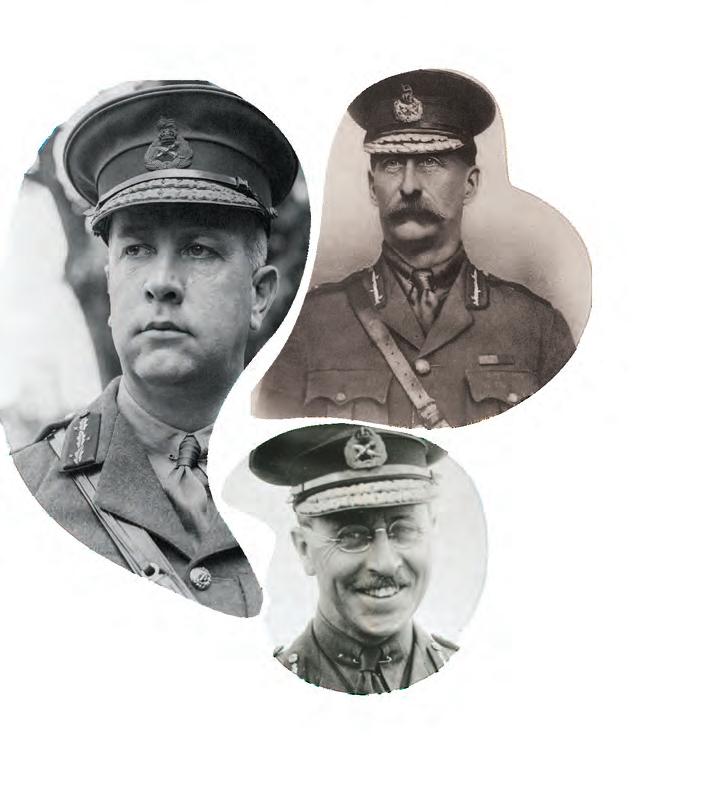
The three infantry brigades of 1st Canadian Division were led by brigadier-generals Arthur Currie, Malcolm Mercer and Richard Turner. The cover of a late May 1915 issue of British newspaper The Sphere depicts gassed troops in the trenches.
infantrymen of France’s 45th (Algerian) Division on the left. The formation’s overall command fell to British-born Lieutenant-General Edwin Alderson. Nevertheless, its three infantry brigades were led by Canadians: brigadier-generals Malcolm Mercer (1st Brigade), Arthur Currie (2nd Brigade) and Richard Turner (3rd Brigade), the latter a Victoria Cross recipient for actions during the Boer War.
As the enemy installed more than 5,730 steel canisters brimming with 160 tonnes of chlorine behind parapets and sandbags and waited for the right moment to turn on the taps, the Allies tried to confront the growing evidence of what was to come.
On April 13, German Private August Jäger deserted to the French lines, where he revealed information about the cylinders. He further explained that the enemy’s upcoming offensive would be signified by three red flares dropped from an

the gas. It proved unsuccessful.
Nervous anticipation built during the subsequent days until finally, if devastatingly, a German spotter plane fired the three red flares on the 22nd. With it came an intense artillery bombardment against the Entente lines and the city of Ypres itself. Worse, at around 5 p.m., the cloud of gas emerged, bolstered by an advantageous wind. It was, in the eyes of Fritz Haber, “a way of saving countless lives.”
German Sergeant Leisterer watched the hundreds of gas canister valves open with morbid fascination. Following a distinctly ominous hissing noise, the soldier of Reserve-InfanterieRegiment 233 then watched as the “whitish gas drifted from the long tubes over the parapet. Soon it took on a yellowish green colour, rolling in an interminable cloud, sneaking across the earth towards the [Entente] trench.”
The monstrous haze, stretching some six kilometres and reaching up to 30 metres high
In reality, the effects were as heinous as they were almost instantaneous. Inhaled fumes damaged and destroyed the alveoli—tiny air sacs in the lungs—and caused fluid discharge that impaired oxygen exchange. The chlorine mixed with these bodily fluids and water vapour to form tissueburning hydrochloric acid.
Victims began to drown within themselves, seared from the inside out. Screaming and begging for mercy, some French and North African soldiers dropped their rifles and fled only to drag out their misery by running in the wind’s direction; others writhed on the ground in agony, choking and vomiting greenish slime.
“Their eyeballs [were] showing white,” described McNaughton as a six-kilometre gap opened in the Entente line. “They literally were coughing their lungs out.”
Nine Canadian artillerymen who had been in the Algerian sector were killed, their fate a slow and ugly one amid the lethal cloud.
Elsewhere, entire Canadian battalions had mere minutes to prepare for their own dose, although the gas had gradually dissipated by that stage, sparing most from its deadliest effects. Despite this, irritated eyes were still rubbed


raw as blurry, yet unmistakable, figures appeared on the horizon. The Germans were advancing. And it was up to 1st Canadian Division to stop them.
The enemy threat was met by force, dashing German expectations that the Ypres salient would fall with ease after unleashing their not-so-secret weapon.
The Canadians, together with surviving Algerians, fought on.
Among those in the firing line were the men of 13th Battalion (Royal Highlanders of Canada), who quickly shifted their defensive axis to plug the gap on their flank. Aside from a few overrun positions, the outnumbered troops held their ground.
Back at 3rd Infantry Brigade headquarters, an increasingly disorientated BrigadierGeneral Turner struggled to maintain order. The VC holder was proving to be the wrong man for the hour. Orders from his HQ, which was also under fire, sometimes varied from panicky to confused to entirely out of touch with events on the ground. Unfortunately, his shortcomings were most felt by the troops engaged at the front.
Fisher was but one example. The 14th Battalion machinegunner had poured rounds into the German ranks since the attack had commenced. When all other crew members were killed, the St. Catharines, Ont., native refused to retreat. In doing so, Fisher bought time for the Canadian artillery to withdraw to safer positions.
seized several British guns. From midnight on April 22-23, the 10th and 16th battalions counterattacked in an audacious yet flawed offensive. Advancing in the dark, the 1,600-strong force encountered an unmarked fence within sight of the strongpoint objective. The men overcame the hurdle, but not without alerting its German occupiers.
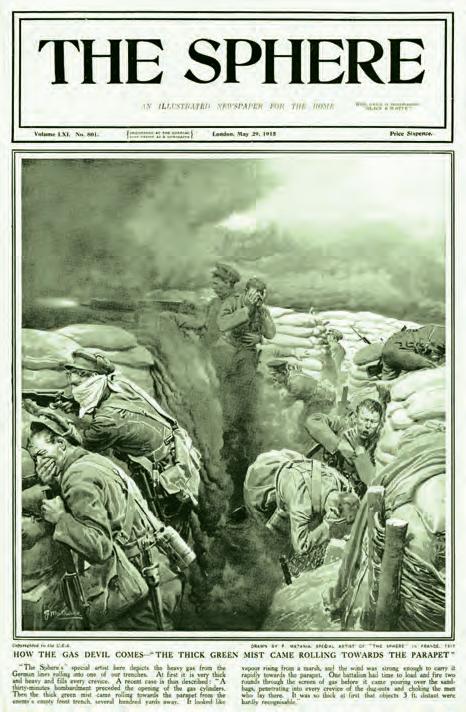
Those same soldiers, still retching from the gas, learned to rely less on brigade-level instructions and more on the men beside them on the parapet. Fighting in often isolated and desperate pockets, the Canadians struggled to turn the enemy tide.
In such dire circumstances, the heroics of individual soldiers— both seen and unseen—occurred throughout the salient. Nineteenyear-old Lance-Corporal Fred
He was later killed in the battle, his body never recovered. He received the Victoria Cross for his actions, Canada’s first of the war. Three more VCs were presented to Canadians for efforts at Second Ypres. Deserving though each recipient was, many brave acts went unnoticed, unrecorded and unrewarded.
Alas, German inroads were still being made, notably at Kitcheners Wood where enemy forces had
Flares, then muzzle flashes, illuminated the Canadian soldiers caught out in the open. Enduring a hail of small-arms fire, the t wo battalions launched a bayonet charge, sustaining horrendous casualties until they reached the forest. Survivors took few prisoners, but they did recapture four British artillery pieces. The Canadian defence of Kitcheners Wood would continue to be a bloodbath. Another scene of devastation took place atop Mauser Ridge, a Germanheld position overlooking the entire battlefield.
Brigadier-General Mercer’s 1st and 4th battalions were tasked with dislodging its enemy defenders. When French support failed to materialize, however, the 6 a.m. assault on April 23 descended into chaos, with the Canadian troops having to cover around 1,500 metres in broad daylight.
“Ahead of me I see men running,” recounted 1st Battalion’s Private George Bell. “Suddenly their legs double up and they sink to the ground. Here’s a body with the head shot off. I jump over it. Here’s a poor devil with both legs gone, but still alive.” More than 900 casualties were sustained during the doomed attack.
Command miscalculations aside, the Canadian infantry was having to deal with the ever-inefficient Ross rifle, a weapon prone to jamming that could fail men at the
least opportune moment—usually after rapid-firing in the heat of battle. It wasn’t uncommon for troops to discard these rifles, replacing them with British Lee Enfields or even German Mausers when available. Most weren’t so lucky, left to hope that their primary source of protection would hold out.
By nightfall on April 23, the Entente overall—and the Canadians, in particular—were also holding out. There had been gains and losses, tactical victories and defeats, but Ypres remained in friendly hands for the time being. With British reinforcements having plugged gaps in the line, all was not yet lost. Even German prisoners appeared to express grudging respect for their adversaries, one of whom later remarked to his Canadian captors: “You fellows fight like hell.”
Armed with chemistry, Lieutenant-Colonel Nasmith— still suffering from the gas attack on the 22nd—found a different means to fight.
Being caught in that menacing cloud had come with its upsides, if only from a purely scientific perspective, as he was now inclined to believe that chlorine had been combined with “perhaps an admixture of bromine” as an extra irritant.
Through coughs and splutters, Nasmith reported his findings to Allied officials, becoming the first person to formally identify the gas’ chemical compounds. He wouldn’t be the last to gain such insights borne of first-hand experience.
At around 4 a.m. on April 24, the Germans launched a second gas attack against the Canadian lines, primarily directed at 8th and 15th battalions. The blanket of death was smaller yet denser than before, but it was also widely anticipated.
Canadians with scientific back grounds, having seen brass buttons tarnished green two days earlier, warned that the discolouration
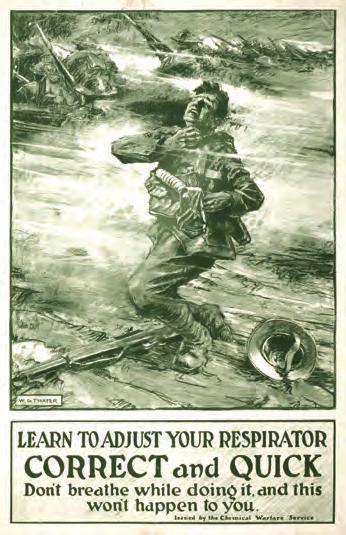
could result from chlorine. Soldiers familiar with the smell of chlorinated water in tea-making were just as capable of identifying the substance. Jointly, these independent intuitions left men scrambling for improvised respirators, typically a cloth or handkerchief soaked in ammonia-rich urine to neutralize hydrochloric acid. Anyone unprepared or unwilling to perform such an unpleasant act of self-preservation risked an agonizing death.
This crude method saved most— but not all—victims, with many survivors plagued by health challenges for the rest of their shortened lives. More pressing was the German horde again advancing toward the battered and bruised defenders. Canadian formations throughout the salient offered a stout resistance, ensuring the enemy paid for every inch of ground. Yet slowly, incrementally, the sheer weight of German opposition became overwhelming as some gassed troops began to buckle.
Communications had broken down. So, too, had much of the command structure. And while
there remained strongholds, the floodgates had opened.
The situation wasn’t helped by Brigadier-General Turner, who, in his battle-fatigued state, misinterpreted divisional orders and pulled his men back amidst a bitter struggle. Unable to disengage the enemy as they withdrew, the Canadians were thrust into a maelstrom and harassed further in new, weaker positions.
But for every folly, there was heroism. Lieutenant Edward Bellew, the 7th Battalion (1st British Columbia) machine-gun officer, played a vital role in the fighting retreat. Disregarding his own wounds, he and a comrade spat rounds into the German force until his loader was killed and he ran out of ammunition. Bellew next destroyed the spent weapon under fire, retrieved a rifle with bayonet attached, and charged at the enemy, somehow surviving to be captured. He earned the Victoria Cross.


Like falling dominoes, 3rd Brigade’s withdrawal mounted pressure on Lieutenant-Colonel Currie’s 2nd Brigade, prompting its commander to make the controversial decision of leaving his men to personally request British assistance. Destined for greatness later in the war, his judgment on April 24 was, and is, hotly debated.


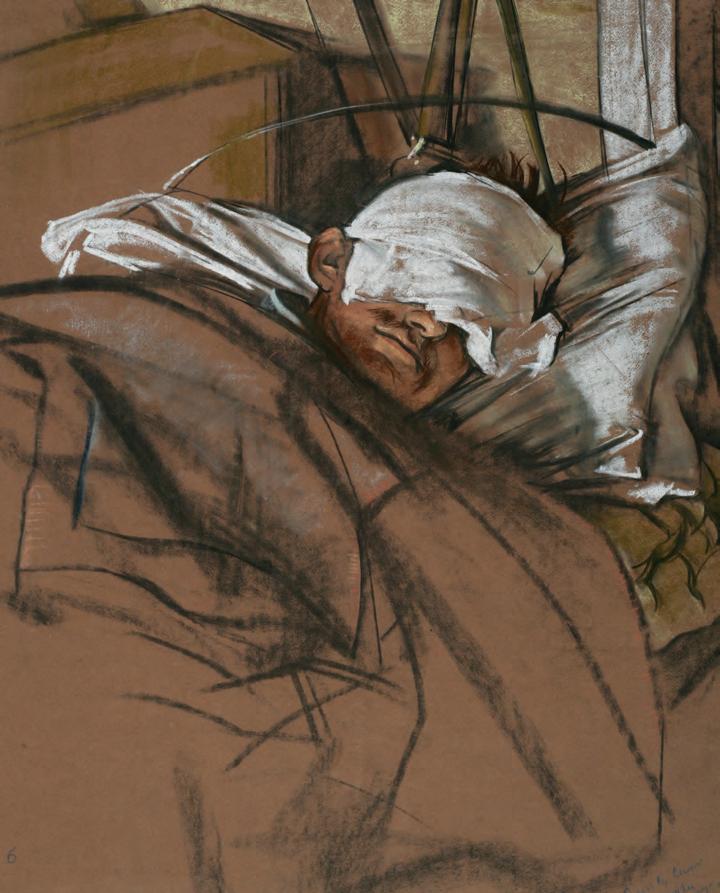


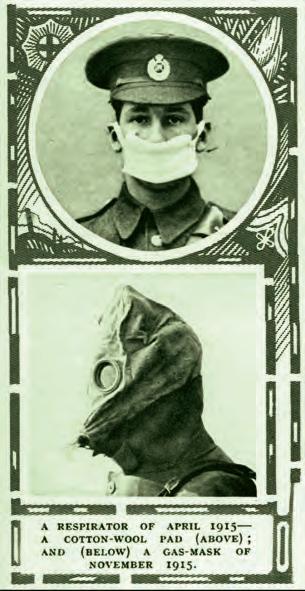
Artist Eric Kennington depicts a blinded soldier recovering from the effects of mustard gas. The early evolution of 1915 gas masks.

Anyone unprepared or unwilling to perform such an unpleasant act of self-preservation risked an agonizing death.
consciousness, where the Second Battle of Ypres would eventually stand with the Somme, Vimy Ridge and Passchendaele as a symbol of Canadian fortitude. In holding the line, these men had sacrificed much for a salient far from home.
“When the people of the little villages through which we passed saw the name ‘Canadian’ on our car,” remembered LieutenantColonel Nasmith, “they nudged each other and repeated the word ‘Canadian.’ It was the name in everybody’s mouth those days, for it was now general knowledge that the Canadian division had thrown itself into the gap and stemmed the German rush to Calais.”
It had come at a cost of 6,036 Canadian dead, wounded and captured.
Survivors left behind friends, comrades and parts of themselves they could never retrieve. For John Armstrong of 3rd Canadian Field Artillery, the horrors he encountered were encapsulated by a lone, injured horse walking past “with just the lower part of a man’s body in the saddle. From the waist up there was nothing.”
Further horrors lay ahead before the battle ended on May 25, 1915, by which point numerous individual engagements had taken their toll on the Entente forces. For Princess Patricia’s Canadian Light Infantry, that month’s Battle of Frezenberg became a particularly harrowing clash when the unit was almost annihilated in defence of the Ypres salient. Nevertheless, like the Canadian veterans of
remainder of the battle, attended hundreds of patients without rest. On April 24, having learned that hundreds more lay dying in forward positions, the doctor went to them. Scrimger saved lives well into the next day, all under heavy fire, until his position became untenable, leaving him with little choice except to evacuate the wounded. When one injured captain couldn’t be transported, Scrimger stayed with him as artillery fire edged closer, setting the building ablaze. The slight medical officer carried the soldier away, past enemy patrols, to the relative safety of another aid station. His gallant efforts were later acknowledged with the VC. Courage came in many forms during the Second Battle of Ypres, from the privates in the trenches to the gunners and stretcherbearers in the field. Mistakes had been made, but almost all the Canadians had stood tall in their first major fight of the war. Each soldier found ways to cope with what they had experienced. For Lieutenant-Colonel John McCrae, mourning the loss of a friend, it was in writing a soon to be famous poem. L
Among the families impacted by the more than 6,500 Canadian casualties during the Second Battle of Ypres were the Braithwaite sisters of Hamilton: Marjory, Mary and Dorothy. Two of the trio married officers in the First Canadian Contingent.
Marjory married Lieutenant Trumbull Warren, a Royal Military College graduate, president of Toronto’s Gutta Percha & Rubber company and member of the 48th Highlanders of Canada. Trumbull went overseas with the 15th Battalion (48th Highlanders of Canada) as a captain and the unit’s adjutant.
Mary wed Captain Guy Melfort Drummond, the son of wealthy Montreal industrialist George Alexander Drummond, a partner in Redpath Sugar. The younger Drummond was a successful businessman, too, and a prewar officer in Montreal’s Black Watch. When the war broke out, the newly married Drummond volunteered to go overseas as a member of the 13th Battalion (Royal Highlanders of Canada).
By John Boileau
On April 20, after Canadian units had occupied positions along the Ypres salient, a huge German howitzer shell wounded Warren near Ypres’ Cloth Hall. He died shortly afterward. Drummond was allowed to attend his brother-in-law’s burial.
Drummond returned to the trenches on April 22, just as the Germans launched the Second Battle of Ypres. As he led an attack to close a gap in the line caused by the collapse of French colonial troops overcome by the first major gas attack, a bullet struck him in the neck. Drummond died instantly and today lies in Belgium’s Tyne Cot Cemetery. Marjory and Mary became widows within two days of each other.
Their unmarried sister Dorothy sailed from Canada to offer support to her siblings. She travelled on Lusitania and marked her 25th birthday aboard on May 5. Two days later, the cruise liner was torpedoed by U-20. Dorothy survived in the water for a short time, but eventually drowned. Her body was never recovered; a large stone cross marks her empty grave in Hamilton.
In England, Drummond voluntarily reverted to the rank of lieutenant to serve at the front. In April 1915, he was in Belgium’s Ypres salient as a company second-in-command. While their husbands served at the front, Marjory and Mary moved to England, a practice followed by many officers’ wives.
Toronto for service personnel, for which she was appointed an Officer of the Order of the British Empire.
Marjory and Mary became widows within two days of each other.
Mary also remarried, to British Captain Tom Stoker, a relative of Bram Stoker of Dracula fame. L

Three Canadian soldiers watch as a plume of smoke from an artillery shell rises above the rubble-strewn city of Ypres, Belgium.



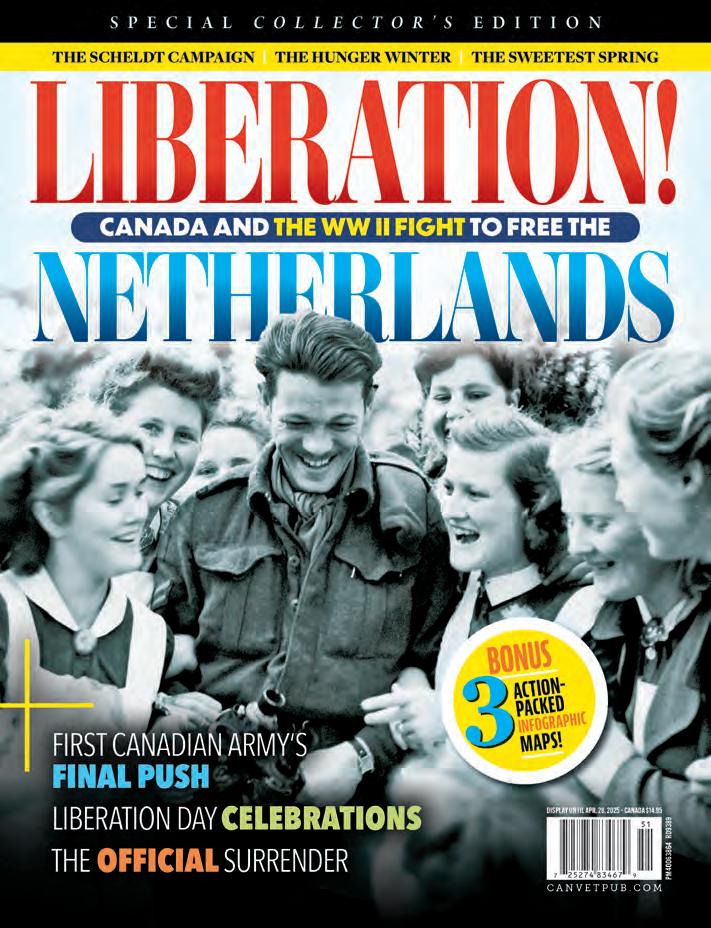
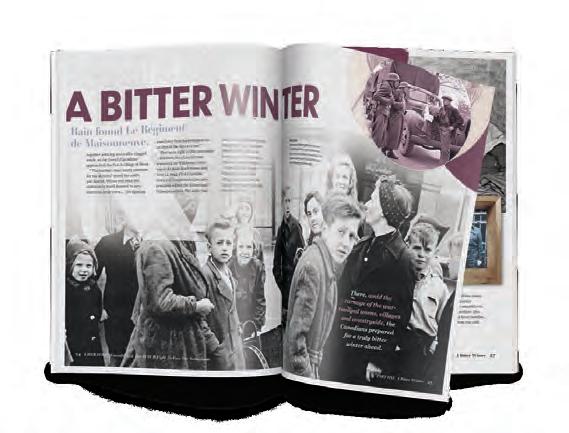
In the fall of 1944, Canadian troops led bitter fighting to secure access to the critical port of Antwerp, freeing the Scheldt estuary and the approaches to a key supply hub as Allied forces prepared to enter Germany and bring the Second World War to an end.
The Scheldt victory also liberated a sliver of the occupied Netherlands, but more epic combat lay ahead. Ultimately, the year 1945 will prove a happy one, as the sufferings of the Dutch populace, ravaged by almost five years of hardship and a bitterly cold winter of starvation, are brought to a bloody end.
Now available on newsstands across Canada!


GENERAL HARRY CRERAR OVERSAW JUST ONE MAJOR BATTLE—BUT THE DECISIVE EARLY 1945 ADVANCE INTO GERMANY’S RHINELAND WAS CRITICAL TO ENDING WW II
By Mark Zuehlke

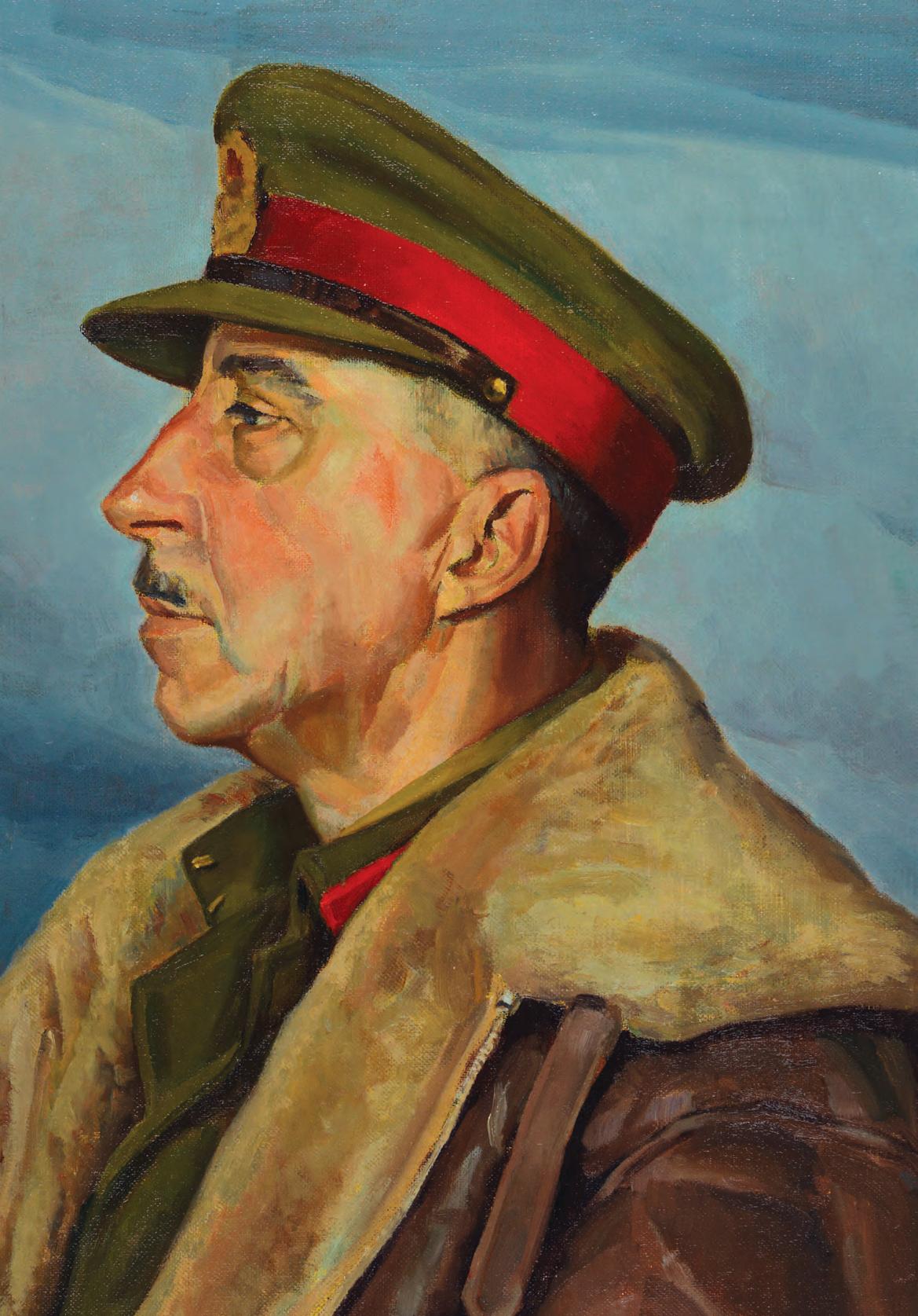
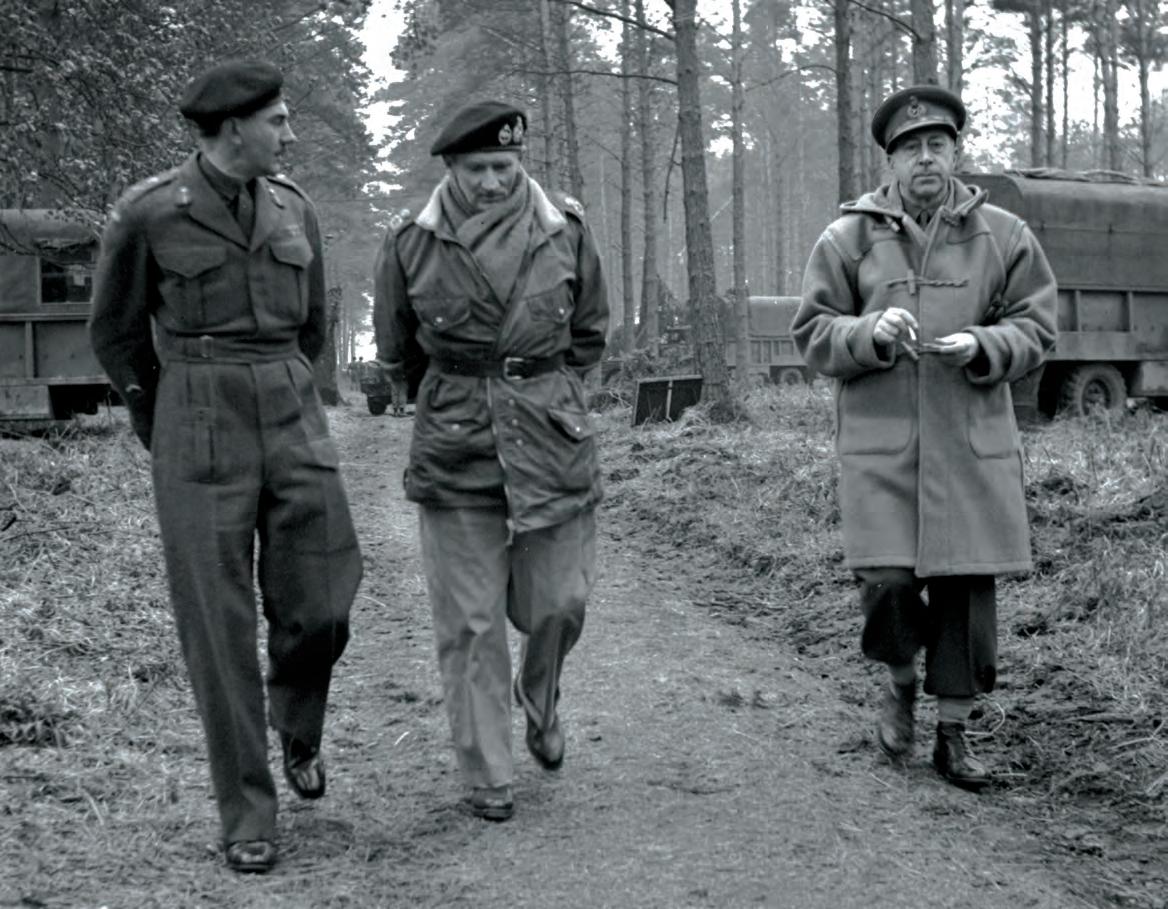
ONIn February 1945, Lieutenant-General Guy Simonds and Field Marshal Bernard Montgomery meet with General Harry Crerar (above, right , and opposite bottom). Crerar with infantrymen afield.
Jan. 16, 1945, Field Marshal Bernard Montgomery summoned General Harry Crerar to his tactical headquarters. In his usual terse manner, Montgomery told Crerar the time had come for the Allies to engage the Germans in “a potentially decisive…operation.” That operation was the Rhineland Campaign, which aimed to capture a narrow wedge of ground south of the Rhine River that ran to the east of the Netherlands’ Groesbeek to Wesel—a distance of about 65 kilometres.
This would be the first part of Germany targeted by the Allies. First Canadian Army’s Crerar was to lead the British-Canadian advance southeast from Groesbeek along the Rhine’s southern shoreline to link up with a U.S. Ninth Army drive northeast from
the Maas River to Wesel. What was anticipated to be a large number of German divisions concentrated to hold this ground would be crushed between the two closing Allied armies.
At the same time, this region of the Rhineland would provide British 21st Army Group with a launching point to cross the Rhine. Once on the opposite bank, the British would push into Germany’s industrial Ruhr valley, while the Canadians would move westward into the Netherlands to begin liberating it.
Crerar wouldn’t just have First Canadian Army’s II Canadian Corps and I British Corps under his command. Added in was Lieutenant-General Brian Horrocks’ XXX Corps from British Second A rmy.
This was going to be a juggernaut smashing into the Germans on a very narrow front. Montgomery hadn’t given t he task to Crerar willingly. It fell to the Canadian because of the alignment of the British forces.
The Canadians were on the 21st Army Group’s left flank, so—as the man on the ground— Crerar had to command. Montgomery’s relationship with Crerar had been fraught since the Canadians had come under Montgomery’s command in southern England. Montgomery also considered Crerar incompetent.
Miles Dempsey. It was a move that suited both corps’ commanders, Canadian Lieutenant-General Guy Simonds and British LieutenantGeneral John Crocker. Each had their own issues with Crerar’s competency and personality.
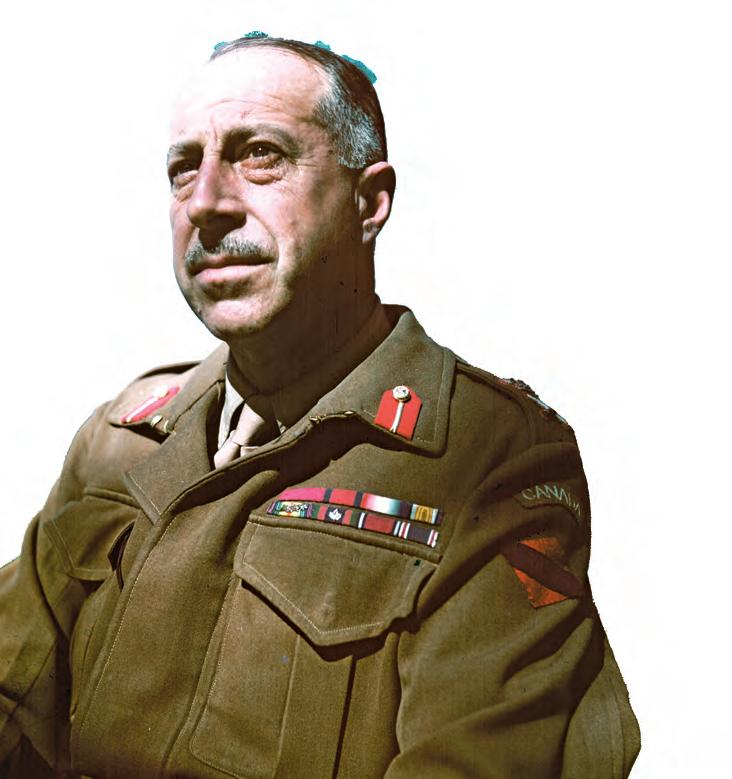
At 55, Crerar was a Great War veteran who had ascended to army command via a series of staff positions. He had put in a brief stint leading I Canadian Corps in Italy, but this only further soured his relationship with then-Eighth Army commander Montgomery. The corps command had been a necessary step for Crerar to become Canada’s overseas army commander.
HORROCKS SOON HELD THE CANADIAN IN HIGH REGARD. HE CONSIDERED CRERAR “MUCH UNDERRATED, LARGELY BECAUSE HE WAS THE EXACT OPPOSITE TO MONTGOMERY.”
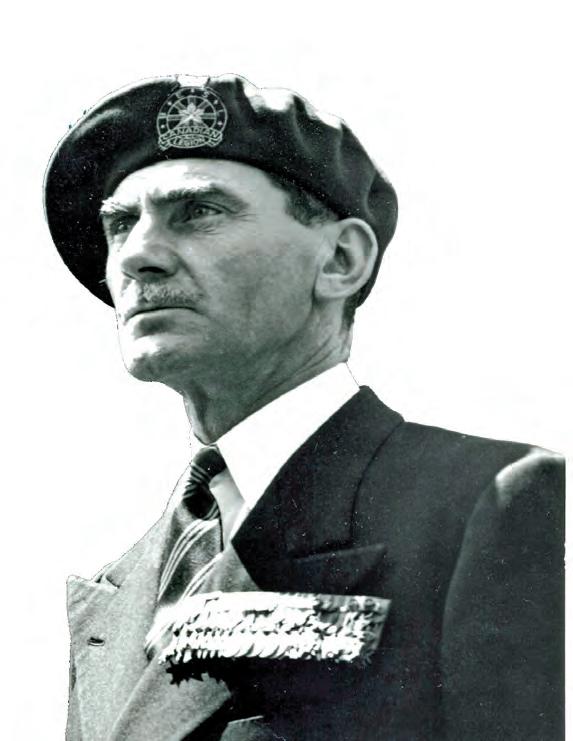
Crerar was methodical, hardworking, and detail oriented. He favoured multi-page, complex operational directives, the very kind of products shunned by Montgomery. In his manner and dress, he was formal and a stickler for regulations. Montgomery, meanwhile, favoured informal dress and had a habit of wearing a black beret, even though he had never served in an armoured regiment.
While Crerar and Montgomery were polar opposites, the Britishborn Simonds tended to mimic Montgomery, including wearing the same headwear. Montgomery had long considered Simonds a protege and respected his abilities as a soldier and commander. This meant he was happy that Simonds was effectively in command of the Canadians in Normandy. Simonds,
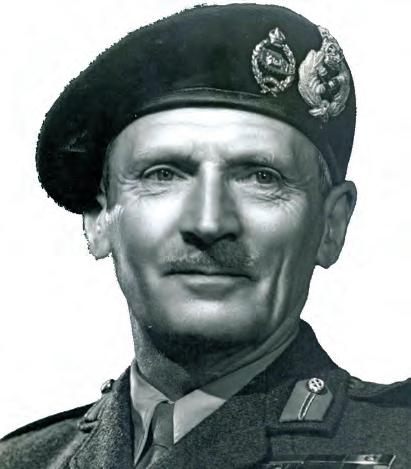
Monty wrote, was “far better than Crerar” and “the equal of any British Corps Commander.”
Crerar, he noted on the other hand, was “very…stodgy, and… very definitely not a commander.”
For his part, Crerar seethed that Montgomery’s clear attempts to keep him away from his army reflected the “Englishman’s traditional belief in the superiority of the Englishman.” No “Canadian…is ever rated as high as the equivalent Britisher.”
Montgomery, however, couldn’t keep Crerar isolated for the war’s duration. Accordingly, on July 23, 1944, Crerar established an army headquarters in Normandy. Due to the narrow battlefield, however, Simonds continued directing II Corps operations in the drive to Falaise and in ultimately closing the gap that
consigned thousands of Germans to either death or capture.
Thereafter, the Canadians advanced up the French coast under Crerar. Save for a short pursuit of German divisions to the Seine, what was to be known as the Channel ports Campaign required little direction from army headquarters. Instead, it consisted largely of sieges by individual divisions of port cities—such as Le Havre, Boulogne and Calais.
Crerar’s major battlefield debut should have come during the Sept. 13-Nov. 6, 1944, Scheldt Campaign, which aimed to open the huge Belgian port of Antwerp to Allied shipping. On Sept. 25, just as that operation was developing into a major fight, Crerar was diagnosed with dysentery and a possible blood disorder and evacuated to England. He wouldn’t
recover until Antwerp was open and the guns had fallen silent.
First Canadian Army spent a harsh winter holding a line from Walcheren Island in the Netherlands along the south bank of the Maas River (as the Dutch called the Rhine there) east to near Groesbeek by the German border. Fighting was sporadic and isolated, but still costly at times for both sides. Meanwhile, on Dec. 16, Crerar had started planning Operation Veritable— the offensive into Germany’s Rhineland—at Montgomery’s direction. That initiative, however, fizzled immediately: a German offensive smashed into the Ardennes region the very same day and had the thin American line there reeling. The ensuing Battle of the Bulge became the focus of all Allied activity at the time and raged through to Jan. 16, 1945.
The original plan for Veritable was to have been launched sometime in January when the
battlefield and approaches to it would have still been frozen, enabling tanks and vehicles to move relatively easily across the hardened ground. The German offensive had thwarted that, and Montgomery consequently selected a Feb. 8 start. After the worst winter weather Europe had experienced in 50 years, lingering rains and melting snow were expected to render the battlefield a muddy quagmire.
But, from General Dwight D. Eisenhower, the supreme commander of the Allied forces in Europe, down the ranks, the Allies were in a hurry to seize the Rhineland and prepare for the advance into Germany’s heartland.
At Canadian army headquarters, Crerar and his staff faced an unprecedented logistical challenge. With three corps under his command, Crerar had at his disposal 449,865 soldiers as opposed to the army’s normal compliment of about 150,000.
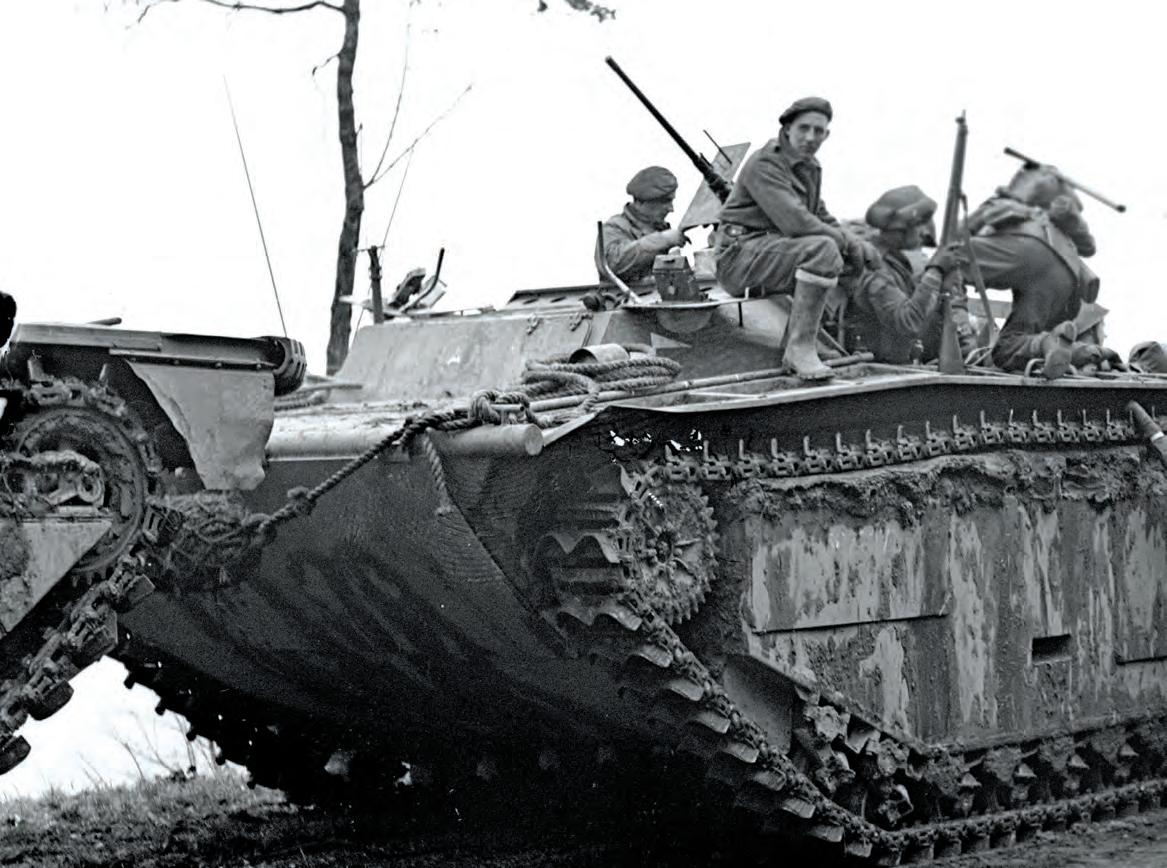
Infantrymen of The North Shore (New Brunswick) Regiment board an Alligator amphibious vehicle at the start of Crerar-led Operation Veritable on Feb. 8, 1945. Canadian Guy Simonds (opposite left) tended to mimic British commander Bernard Montgomery while Crerar was their polar opposite.
Montgomery had bolstered XXX Corps to five infantry divisions, two armoured divisions and four armoured brigades. Second British Army, meanwhile, was stripped down to four divisions and three independent brigades. Everything else went to Crerar.
Now, Crerar’s penchant for detailed planning proved invaluable. The army’s requirements were vast and needed to be identified and precisely provided. Ammunition of 350 different varieties ranging from 105-millimetre shells to .303-calibre rifle cartridges had to be assembled. Awed, Crerar noted that if all this ammo “were stacked side by side and five feet high, it would line a road 30 miles.”
The numbers were staggering: 2.3 million rations, 5 million litres of petrol for just the first four days, 13,000 kilometres of communication cables, 85,000 smoke generators, some 800,000 maps and 500,000 aerial photos. More than 35,000 vehicles soon jockeyed toward position with 1,600 military police trying to prevent gridlock. And in addition to maintaining roads suffering from increasing wear and tear, engineers built new ones crudely surfaced by laying logs side by side. This required 18,000 logs and, while providing bumpy going, prevented vehicles from miring in mud.
The sheer might under Crerar’s command was necessary for success. With no chance of achieving surprise, the army would launch a frontal assault against well-prepared and strengthened positions—initially the vaunted Siegfried Line.
Horrocks and his ballooned XXX C orps were to open Veritable w ith only 3rd Canadian Infantry Division advancing on its left flank. As the launch date approached, Horrocks fought an unexplainable illness that made him irritable. Horrocks was impressed that Crerar patiently excused his bad-tempered behaviour.
In fact, Horrocks soon held the Canadian in high regard.
He considered Crerar “much underrated, largely because he was the exact opposite to Montgomery. He hated publicity, but was full of common sense and always prepared to listen to the views of his subordinate commanders.”
Crerar also showed an ability for grasping and considering the complexities of the modern battlefield. He carefully monitored the logistical expansion. Endless hours were spent establishing, Crerar
wrote, that “the technique of the fire preparation for the assault was worked out in order to ensure the closest possible integration of movement with overwhelming fire both from artillery and the air…I gave instructions to my senior officers that once the operation began, commanders… must be seized with…keeping the initiative, maintaining the momentum of the attack…through the enemy without cessation.”
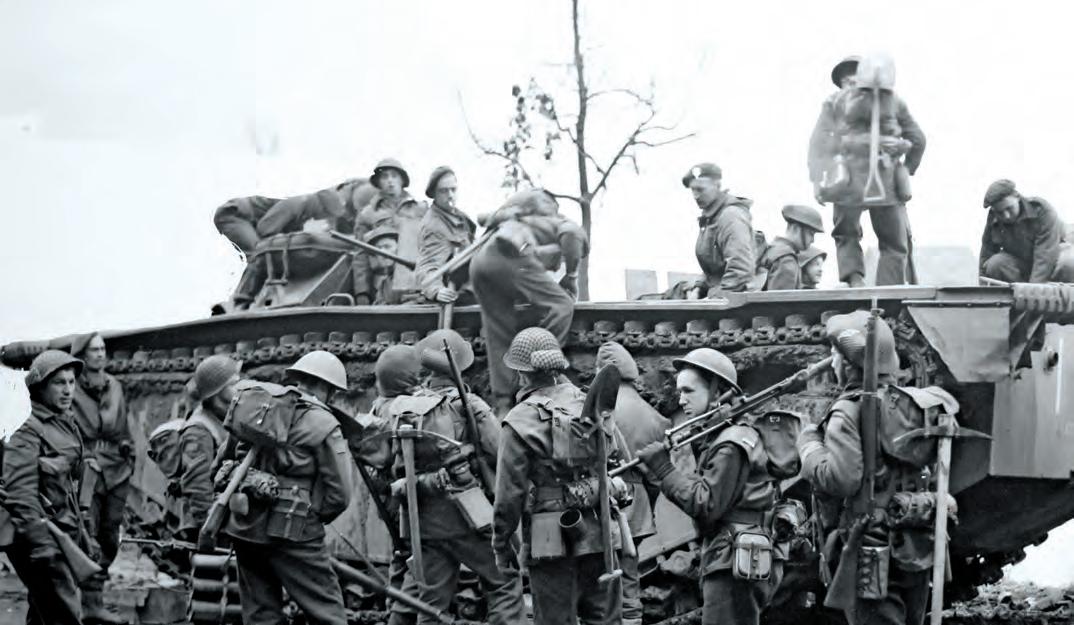
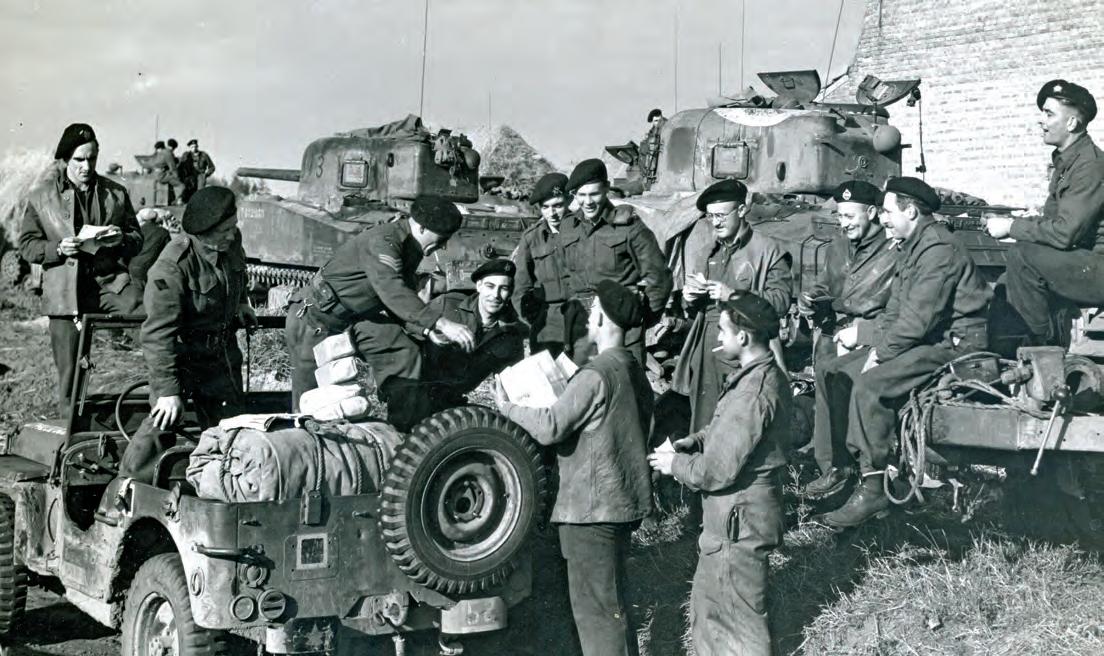
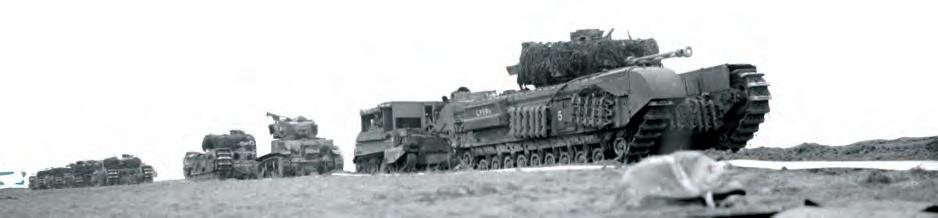
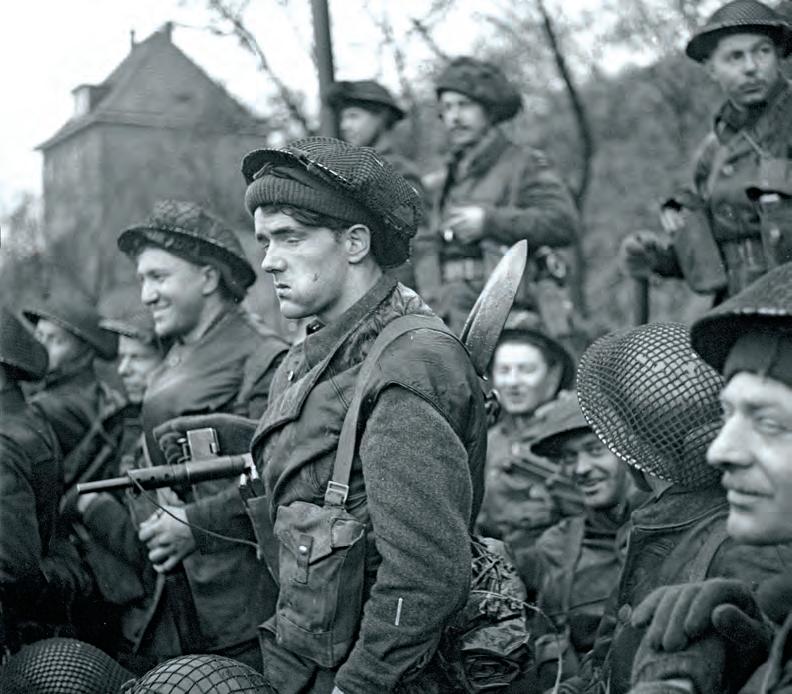
Members of The Royal Winnipeg Rifles leave Niel, Belgium, on Feb. 9, 1945 (right). A column of Churchill tanks and other vehicles advance at the start of Operation Veritable the previous day (opposite top), while Canadian infantrymen assemble near Nijmegen, Netherlands, that day (opposite bottom).
Ground objectives were to be seen as no more than a means to an end. Before the attack, every soldier was to be briefed so he understood his tasks and their importance to achieving victory.
Crerar repeatedly made it clear that while winning the Rhineland was important, the greater purpose of Veritable “was to destroy the enemy.” Defeating the Germans was insufficient, Crerar and his headquarters staff reiterated. They must be killed or taken prisoner. Therein lay true victory, because this would leave the enemy so weakened that capturing the rest of G ermany should go quickly.
On Feb. 8 at 10:30 a.m., following a prolonged artillery and aerial bombardment that had pounded German positions throughout the Rhineland, Crerar unleashed the massive juggernaut stationed on the Dutch-German border. Fifty thousand soldiers, supported by 500 tanks and 500 of the specialized tanks of British 79th Armoured Division, led. As the Canadians and British slammed into the defending Germans, the battle descended into nightmare with heavy casualties on both sides.
There was to be no surcease, no pause. As one infantry battalion ran out of steam or was shredded by enemy fire, another leapfrogged it. On the left, 3rd Canadian Infantry Division—already nicknamed “the water rats” for its role fighting in the flooded terrain of the Scheldt— used amphibious Buffaloes and Weasels to move through a wide swath of submerged land after the Germans had blown dikes along the Rhine River. After two days of hell, however, the Siegfried Line—built over years to defend the Rhineland—was broken.
The Germans fell back into a series of prepared defensive lines that had to each be taken in turn. As their casualties mounted, the overall intent of the offensive was achieved. More German divisions were fed in because Hitler refused to cede any of his country’s ground. One after another, Germany’s best remaining divisions in the west were committed—and slaughtered. When Veritable ran out of steam on Feb. 22 in front of a road running north to south from Calcar to Goch, Germany, Crerar allowed a brief pause. Four days later, he launched Operation
Blockbuster, led mostly by the Canadians. In front of the dense Hochwald Forest, it seemed the advance might falter—the woods bristling with Germans holding entrenchments with fanatical determination. But Crerar threw more Canadian battalions into the narrow Hochwald gap, and they fought through and took Xanten. Nearby, they met up with U.S. Ninth Army and ended the campaign.
The Allies paid a terrible cost in the campaign—15,634 casualties, 5,304 of which were Canadian. The German decision to defend the Rhineland proved a disastrous folly. First Canadian Army took 22,239 prisoners with another 22,000 killed or suffering long-term wounds. Including those taken and killed by the Americans, total German losses were tallied at 90,000. Thereafter, First Canadian Army fought smaller engagements while advancing through the Netherlands and into northern Germany. There would be no other major campaign for Crerar to plan and fight. But in the Rhineland, he won his battle. The end of the war would soon follow. L
BY CHARLES WILKINS

By
the time First Troop, Charlie Squadron, of The Royal Canadian Dragoons reached the northern Netherlands in late April 1945, the Second World War was into its final days, and the Netherlands had been under savage Nazi occupation for five years.
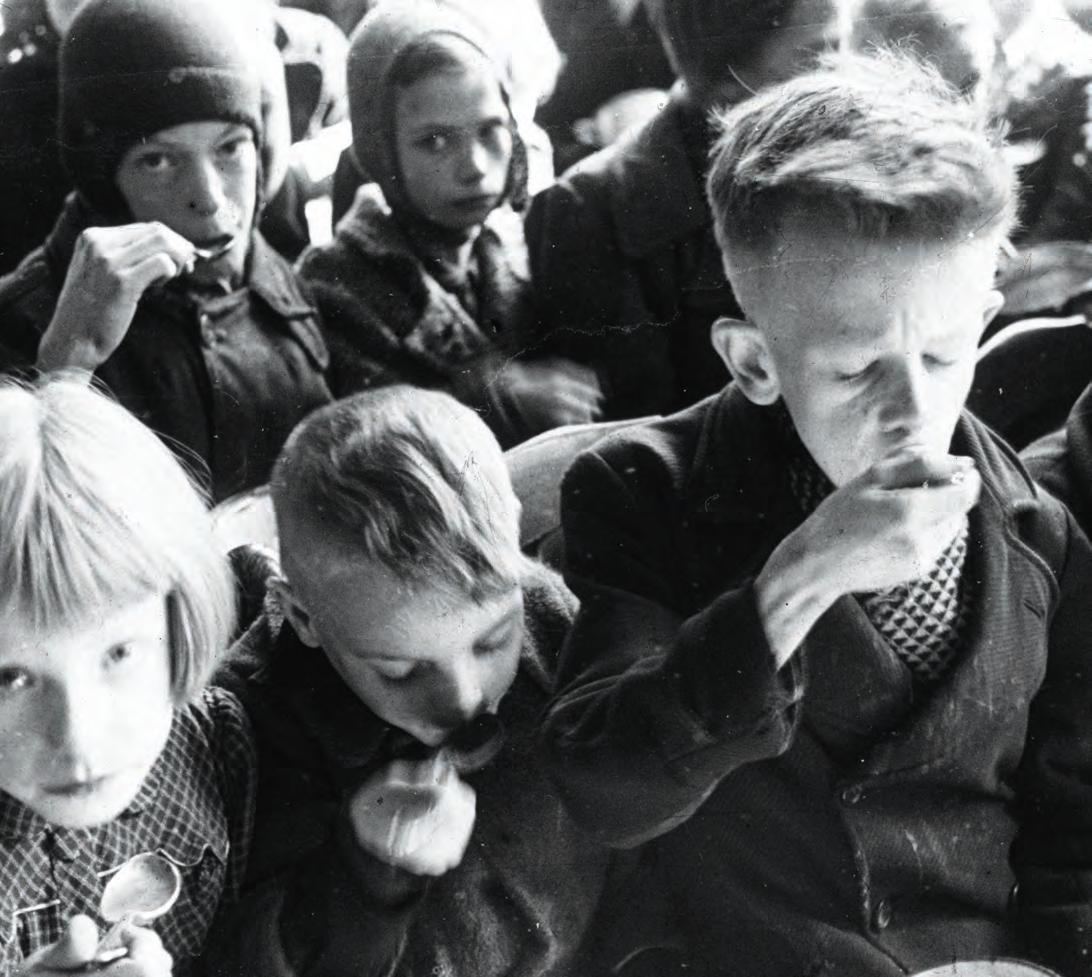
In cities such as The Hague and Amsterdam, where the Germans had set up blockades to prevent the arrival of food, an average of 300 Dutch citizens a day were dying of starvation.
On farms, both in the Netherlands and across the border in Germany, Dutch captives, some of them adolescents, were performing slave labour to produce food for the German military—and were barely fed themselves.
In German factories, Dutch and eastern European prisoners, invariably under armed guard and sometimes shackled to the machinery, produced battle gear and munitions for the German fighting forces.

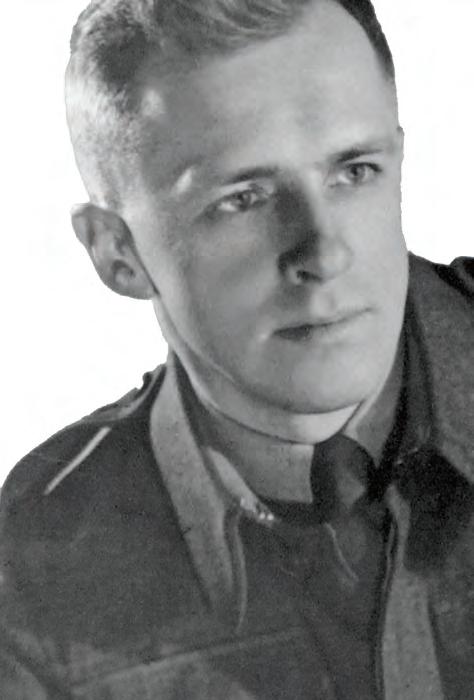
My dad, Lieutenant Charles Hume Wilkins—Charlie, to the men in his platoon—was part of First Troop, Charlie Squadron, and the diary he kept as the Canadians rolled deep into northern Holland paints a rousing and memorable picture not just of the horrors experienced by the Dutch under Nazi occupation, but of the sheer joy, the wild sense of celebration that exploded among the Dutch citizens as the Canadians appeared, sweeping the last of the occupying Nazis either back across the border into Germany or into prisoners’ cages, where the captured German soldiers got a taste of the treatment they themselves had been dishing out.
“And, indeed, they had been dishing it out,” wrote my dad in a late-April diary entry that goes on to describe a reconnaissance mission he led into the west German borderlands near the village of Friesoythe. In their armoured cars, the Canadians came across a rundown concentration camp, where the Nazis had locked Polish and eastern European prisoners in crowded cages and left them more or less to starve.
“Mere bags of skin and bone,” my dad called the prisoners, noting that “the newspaper stories of atrocities were coming true before our eyes— but they were still hard to believe.”
With the arrival of the Canadians, northern Dutch towns such as Steenwijk and Franeker were freed not just of uniformed German soldiers, but of the presence of the reviled Gestapo, the Nazis’ plain-clothed secret police. In Steenwijk, members of my dad’s platoon captured a Gestapo agent who had been responsible for the deaths of several local boys and locked him in a truck, barely able to prevent the townsfolk from tearing the truck apart in their ambition to tear up the agent himself.
As celebrations welcoming the Canadians rocked the thousandyear-old city of Leeuwarden in the north, a young man named Freddy Ringnalda invited my dad to dinner at his parents’ home. While the family and their Canadian guest ate a sumptuous celebratory meal, Fred explained to my dad that

six months earlier he had escaped Gestapo agents who had come to the factory where he worked, intending to arrest him and put him to slave labour in a nearby German munitions factory.
Fred had escaped the secret police by the narrowest of margins when a factory foreman caught wind of the Gestapo’s approach and, as they were entering the factory by the front doors, ordered Freddy to lie down on a wheeled dolly, covered him with a tarp, and spirited him by elevator into the basement and out a shipping door at the back of the building.
Not that Freddy’s escape brought any sort of real freedom; he was obliged, rather, to spend the remainder of the war hiding in a musty and lightless attic under the eaves of his parents’ home.
Some of the diary’s tales describe events so theatrical and satisfying and, for my dad at least, so personal that their outcomes and the people involved would affect his life for decades to come.
Near Heerenveen, for example, a battle-weary Dutch Resistance fighter, “just a kid but a strong one,” named Pete Toxapeus approached Charlie Squadron, offering muchwelcomed services as a translator and navigator, and proceeded to facilitate the Canadians’ journey on a landscape where they knew neither the language nor the geography nor the social customs. So appreciative was my dad of Pete, and vice versa, the two remained friends long after the war. Indeed, during the 1950s, Pete crossed the Atlantic by ocean liner for the sole purpose of reuniting with and, in effect, thanking my dad.
However, in those last brutal days of the war, travelling with the Dragoons, the young resistance fighter was a kid known less for amicability than for toughness and fearlessness—and for a trait not always noted, much less emphasized, in more formal or discreet histories of the war: that of a low-key desire for vengeance, at an all but personal level.
FOR AMICABILITY THAN FOR TOUGHNESS AND FEARLESSNESS— AND FOR VENGEANCE.

Pete’s aptitude for payback was triggered not just by the plight of his own people, but by the mistreated or enslaved citizens of half a dozen other countries occupied and brutalized by the Nazis. On a mop-up excursion across the border in Germany, for example, Pete and the Canadians learned of a German farmer who had been ruthless in his treatment of several Czech and Polish prisoners, including an 11-year-old Polish boy. On April 28, 1945, my dad recorded that “Pete paid an early morning visit to the erring farmer, and put him into a state of fright that he will remember as long as he remembers anything.”
Given the oppression suffered by the Dutch, it’s no wonder that when their Canadian liberators got to, say, Leeuwarden, a city of more than 100,000 people, the Canadians were surrounded by screaming children and teenagers throwing bouquets of tulips; and by young women who, clad in their spring dresses, hair flying, took the non-plussed Canadians in their arms, encouraging them to dance, to feast, to party in streets packed, day and night, with celebrating Netherlanders.
“At about noon the day after our arrival in Leeuwarden,” wrote my dad, “we rode away towards the east, and in a couple of hours reached a tiny village called Oldekerk. Here, too, there was a fiesta going on in honour of the liberation, and all afternoon and evening the grassy field where we harboured was full of admiring men and women. As in Leeuwarden, the girls here were lovely; half the men in the troop fell in love with somebody before the day was out.”
While the romance, as presented by the diary, is both sweeping and dream-like, it’s also humanized and anchored by the most meticulous and homey of details. “Towards supper-time,” wrote my dad, “I brought out a round of Dutch cheese that Fred Ringnalda had given me as a parting gift, and proceeded to cut a good-sized wedge out of it in the well-known Canadian manner. There were half a dozen girls crowding our picnic site and they all burst out laughing, took the cheese away from me and showed me how to shave a piece off, very thin, as the Dutch do.
“I couldn’t help admitting that they were right—the shavings seemed to have a more delicate flavour than a bigger piece.”
The diary describes the Dutch celebrants as “all but maniacal in their desire for whatever tobacco
the Canadians had to share,” and notes the capability of the young men and women to roll “an Oldekerk slim,” a cigarette “barely thicker than a toothpick,” but nonetheless significant to the v illage’s robust celebrations.
“Meanwhile, out on the road,” the diary continues, “the celebrating Dutchmen crowded around the armoured cars and climbed onto the sides, pleading for cigarettes— to the point where it was almost disastrous to give one away, in that the gift brought twenty more men clutching for the coveted tobacco.”
As the narrator of all this drama and history—and, in a sense, curator of the diary—I must pause for a moment to say that the reason for publishing the story now, during the spring of 2025, is that exactly 80 years have passed since the Dragoons, among other Canadians, rolled into the Netherlands; since my dad sat by Dutch roadsides and barns, or in the safety of his armoured car to pen the extraordinary diary that brings to life that final Canadian mission of the Second World War.
One of the diary’s most adamant and prevalent motifs, I must emphasize, was that the march into the Netherlands was a story not just of triumph and romance, but of caution and suspicion and fear. Pockets of Nazi soldiers still hid in the villages, or along the roads, determined to inflict a last crack of the whip on the allied enemies of the Reich.
In one village, the Germans piled tree trunks across the road. When my dad got out to begin clearing them, the road exploded within metres of him, and the air was full of lead. “I was lucky to escape back into the armoured car,” he wrote, “by pounding on the side door until my gunner, Braden, opened it and I dove inside.”
On the same day, the Canadians came to a gathering of Dutch women and children parading beneath a
Red Cross banner strung across the road. “We sent a scout forward, who came running back, head down, with word that behind every tree up ahead, a Jerry infantryman was waiting with a faustpatrone [a hand-held anti-armour weapon, capable of piercing an armoured car]. The Dutch villagers had been forced to parade beneath the Red Cross sign as a means of dissuading the Canadians from firing as we approached.”
At the town of Holten, due east of Amsterdam, Charlie Squadron encountered what the diary describes as “a pocket of fierce loyalists to the Reich,” eventually forcing them to raise the white flag of surrender on the village church tower.
“When our infantry brought back prisoners, we were surprised to discover they were just teenagers, paratroopers, who had fought like madmen, holding up the Canadian armoured car advance with dogged courage; one soldier cannot help admiring another, and I could hardly do less than admire such determination.”
It is not your average soldier who writes so appreciatively of the courage and persistence of his opponent. My dad, I hasten to add, was not an average soldier (one could ask, what soldier is?).
Back home in Canada, he was a poet, an opera-lover, a birdwatcher. He loved books (by the time he was 16, he had read every one of the approximately 300 novels in the Hespeler, Ont., library). A descendant of peace-loving Quakers, he wasn’t only non-violent, but almost pathologically non-competitive.
When I was a boy, I remember him speaking with pride about having participated in the mile-run at a high school track meet and having been happy to finish last. At board games, he deliberately let others win.
Where real battle was concerned, however, he had a knack, had what U.S. astronauts would eventually
ONE OF THE DIARY’S MOST PREVALENT MOTIFS WAS THAT THE MARCH INTO THE NETHERLANDS WAS A STORY NOT JUST OF TRIUMPH AND ROMANCE, BUT OF CAUTION, SUSPICION AND FEAR.
call “the Right Stuff.” He had taken a demotion from captain to lieutenant so that he could get overseas and fight. During the Italian Campaign, he was Mentioned in Dispatches for what was termed his “exceptional bravery in battle.”
At the same time, he harboured a vulnerability and wasn’t afraid to say so. One afternoon in the central Netherlands, a German munitions truck blew up within steps of his platoon’s position, sending shrapnel and flame 40 metres in all directions. “As I stood in the turret of my Stag trying to regain my composure,” he wrote in his diary that night, “I lapsed suddenly into a kind of shivering fit—it seemed to me that all my nervous fiber had come unstrung, and that I was standing there, surviving, by will-power alone.”
The only thing I ever heard him say in the way of self-credit, if not exactly self-praise, was that in his role as a lieutenant, platoon leader and reconnaissance man, he never asked one of his men to do anything that he wasn’t willing to do himself. And he backed it up. Years later, my dad’s gunner, Jim Braden, who was visiting our home in Deep River, Ont., reported to me that my dad had one night belly-wriggled across a field, under heavy German fire, to fix a communications wire, while his platoon watched from safety.
Understandably, he was popular with his men.
Meanwhile, I have sometimes wondered what motivated him
to keep such a detailed diary, when for most soldiers just staying alive and sane was a sufficient challenge during the five-year nightmare that was World War II.
The short answer, I have come to believe, is rooted in childhood trauma, specifically in the simple but devastating fact that his mother died the day he was born in 1912. As a boy, lacking the nurturing he would have received from his mother, he found comfort and emotional structure in stories, in reading and, eventually, in storytelling and writing.
In the same sense that literature brought a kind of order and sustenance, as well as humour, to his isolated existence as a child, his compulsion to keep a diary about his life in the trenches and on reconnaissance—to convert it into written stories—became a kind of ordering and managerial principle for the chaos and suffering that surrounded him during the war. I suspect, too, it helped dispel what my dad once described as “the sense of futility, sometimes meaninglessness, that at one time or another haunts every soldier who ever took a bullet or piece of shrapnel, or fired at an enemy or went into battle, period.”
For most of my life, I didn’t even know the diary existed. And my dad (who during the years after the war despaired of his battle experience sometimes to the point of considering suicide) said almost nothing about what he had encountered in Italy or the Netherlands.
Then, out of the blue, a Dutch scholar named Edwin Meinsma contacted me in late 2022 with word that he was writing a book about the Canadians’ role in liberating his home territory of Friesland in the northern Netherlands. He had obtained a diary, I believe from the Canadian War Museum, in which the writer, a Lieutenant C.H. Wilkins, recorded his experiences in helping rid the Netherlands of Nazis in 1945.
Edwin wanted to quote the diaries in a book he was writing about the role of The Royal Canadian Dragoons in the liberation. He had seen the name Wilkins in battle reports, had discovered, using the internet, my own existence as a writer, and was contacting me, wondering if the two Wilkinses were related. More importantly, he sent me the diaries.
It was a Hamilton psychiatrist who first suggested to me that, in writing the story, my dad had created a kind of cartography for
the psyche and memory, a way of interpreting the madness and hence locating a measure of understanding, even solace, where otherwise none would have existed.
The diaries also provide, of course, a wealth of insights and perspective on the broader backdrop to war: on how a soldier sees his enemy, how he views the landscape on which the battles are fought; understands fear, camaraderie, leadership; sees what it is to be but the smallest of parts in a vast, all but inanimate army on the march in a war that perhaps not even the generals entirely understand.
As the impatient Charlie Squadron awaited orders for its advance into the Netherlands, my dad wrote: “It is not given to t he submerged ninety-nine percent of the army to plan its own
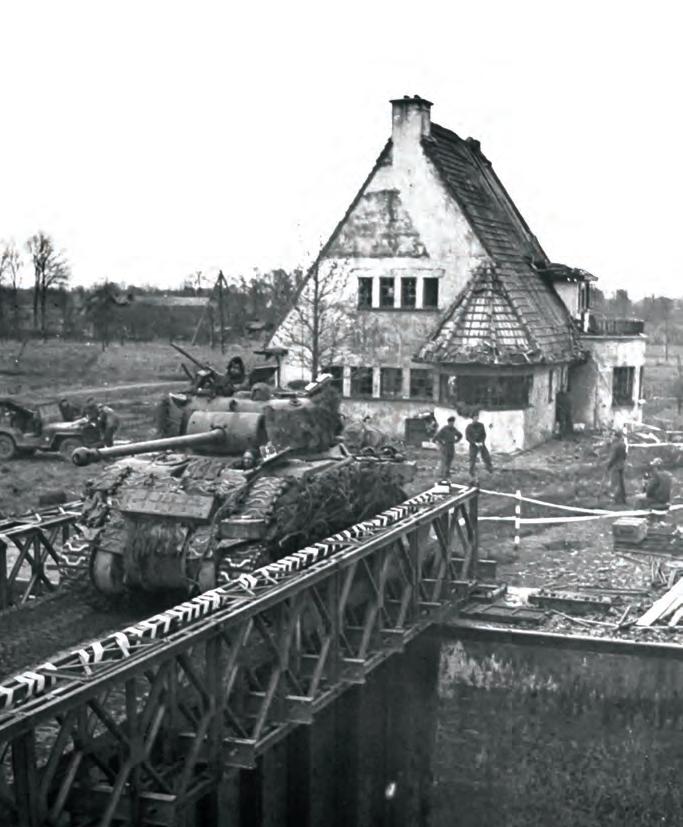
future or to know what is planned for it. Meanwhile, a rumour is the breath of life to a soldier. It need not be true; the more preposterous the more readily we accept it. But we are pessimists; the belief prevails that the army, that huge, intangible, and all-powerful elephant will fool you if it can.
“Meanwhile, our wait was livid with rumours: we were headed north; were headed east into Germany; were to be replaced by another detachment; were waiting for reinforcements. The rumours followed one another, tripped over themselves, cancelled each other out; they grew and expanded, and were in the end swallowed up by bigger rumours.”
One of the beauties of the diary is that, against the enormity of the war, it regularly homes in on the smallest and most human of details. Near Okkenbroek, in the central Netherlands, for example, it reports that “the mail came up that night, including a book of cartoons clipped from the New Yorker magazine and sent to me by my cousin. There is something exhilarating, something happily absurd, about reading a joke book as you shelter from enemy fire in a trench on the front line.”
As First Troop prepared to enter Steenwijk to rout out a handful of Nazi snipers, the diary reports that “in preparation, we checked our maps, fueled up the Stag, and had a quick brew-up.”
Of tea.

Tanks cross a Bailey bridge at the Netherlands’ Twenthe Canal on April 4, 1945.
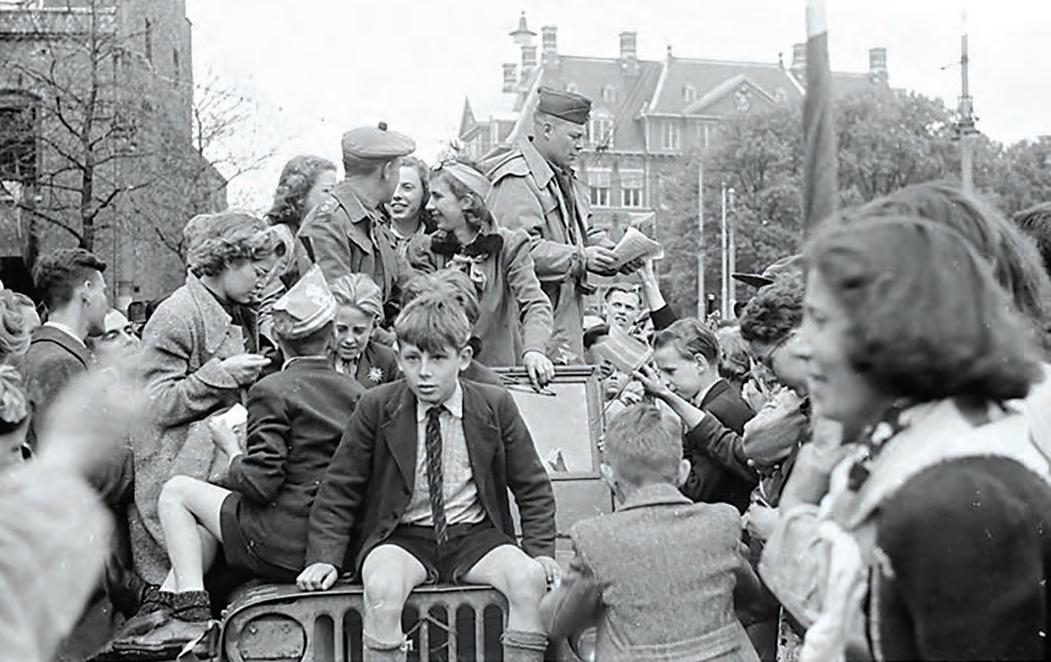
As for the big picture, the diary is most decidedly about the liberation of the Dutch people, the grand celebration and, by extension, the loving and supportive relations that to this day bind Canada and the Netherlands. At the same time, in the depths of its revelations, it’s about something darker, something more telling: which is to say, the incomprehensible force that had ensnared the two countries in the war in the first place.
We are talking, of course, about the Nazis, the German military— or, more accurately, the ghost of the German military, which in the spring of 1945, as the Canadians moved north toward Heerenveen and Leeuwarden, still haunted and obsessed both the Dutch citizens and their Canadian liberators.
In the Dutch village of Wolvega, my dad conversed amicably with a man he described as “elderly, gentle, soft-spoken.... However, when I asked him what the Dutch had found to say to the Germans when they met them, his face stiffened, and he replied coldly, ‘We did not see them!’”
For my dad, even a German corpse possessed a kind of
“THERE WAS A FIESTA GOING ON IN HONOUR OF THE LIBERATION, AND ALL AFTERNOON AND EVENING THE FIELD WHERE WE HARBOURED WAS FULL OF ADMIRING MEN AND WOMEN.”
bedevilment and mystery: “I never quite lost the morbid interest I had in seeing their quiet bodies. A live German, too, had a little of the fascination of a wild animal; it is not easy to think of your dreadful hidden enemy as a man like yourself.”
In describing a mop-up foray into the German villages across the border from the Netherlands, the diary notes, “there was something eerie about this stricken land, something one could feel, a sense of mysteries suddenly explained, or of a shocking exposure of hell on earth. It was different from anything I had ever felt in Italy, where the German had been out of his element.
“Here, we were on his home ground and could look into his
shattered windows, pass by his aspiring Gothic churches, see the colour of the flowers in his gardens, know something about his life at home. It was a deeply unsettling experience; there were no friends for us, as there had been among the Italians; here every hand was against us; none was to be trusted.”
As the war entered its final days, the diary turned away from the Germans and, again, toward the long-suffering Dutch who could not do enough to support the work of the arriving Canadians. At the town of Dieverbrug, where a key bridge had been blown up by the retreating Nazis, half the able-bodied men in the community turned out and created a kind of causeway of
boats across the canal, and laid loosely bolted planks across their decks, sufficient to support First Troop’s 12-tonne Staghounds.
“Lieutenant Dick Rigby warned all the crews to open their car doors before crossing in case a car should break through and the occupants have to escape under water.
However, all the cars made it, and in the villages to the north, the Dutch clambered onto every vantage point from which they could see us and holler their welcome. There were flags on the lamp posts and buildings, and orange banners representing the ancient House of Orange, all of it more like a carnival than a war.”
Upon re-entry into Leeuwarden, First Troop was met by an “almost hysterical patrol” of Dutch Resistance men. “Near the main square, Major Veitch ordered us to wait until the Colonel could come up and officially enter the city. From his position above the fray, he didn’t know of course that stopping was a hazard; immediately, we were overwhelmed by a crush of people— hundreds of them, hollering and banging on our cars. From the open turret, I watched a boy tear down a German signpost and throw it in the river, while the crowd screamed.”
Late in the afternoon, Charlie Squadron retired to an outlying village, where they received orders to chase a straggle of Nazis from a nearby woods.
“We were just about to start our cars when an order came countermanding the first order, and instead we advanced to Harlingen, then Franeker where, because we could not stay the night and thereby could not guarantee the town’s safety, the Resistance would not allow Dutch flags to be flown. But the crowd was wild.
German and Hungarian prisoners ride a Staghound armoured car near Sögel, Germany, on April 10, 1945 (right). Locals crowd around Canadian soldiers in The Hague on May 6, 1945.
“In the town square, where we stopped, several thousand people gathered around us and spontaneously raised their voices in the Dutch National Anthem. There was something soulful and hair-raising about it all; and for the first time in five years, the enemy could do nothing to prevent it. For me it was one of the most moving experiences not just of the war but of my life to that date.”
On May 4, a rumour reached Charlie Squadron that the war was about to end. “The next morning,” reported my dad, “we got the signals sergeant to hook up a radio set, and as we sat and listened, the blessed words came over the air that Montgomery had received the surrender of all enemy troops in northwest Germany and the surrounding regions. It was like eating apple pie with whipped cream—too good to be true. Nobody could quite fathom it.”
For the next few days, Charlie Squadron gathered up prisoners in half a dozen towns just across the Dutch border in Germany. They held their victory party in the railway station in Ihrhove, with what the diary discreetly calls “all necessary adjuncts to celebration.”
On May 8, still in Germany, my dad and his platoon listened to the speeches made in London in celebration of VE-Day. “The King,
Mr. Churchill, and numbers of others added their voices to the mountain of tributes paid to the troops who had done the fighting. But these sentiments seemed strangely remote and inconsequential to us; I suppose they sounded better to our families at home.
“Soldiers are hard to impress; they develop a kind of shell around their emotions, that no amount of public speaking, however sincere, can penetrate.”
A few days later, Charlie Squadron moved south through Papenburg and Westerbork to a tiny rural Dutch village—“among the cows and trees and little red brick houses,” as my dad described it, “We were on Allied soil again, and had done our jobs, both for the world and for the Dutch. And of course for ourselves.
“It occurred to me, and has occurred to me since, that we perhaps did our job for the Germans as well. We dared to believe the future would be better for them too. Whatever the case, the war was over. Our guns sat empty. Orders had ceased.”
First Troop, Charlie Squadron, Royal Canadian Dragoons, was going home. L
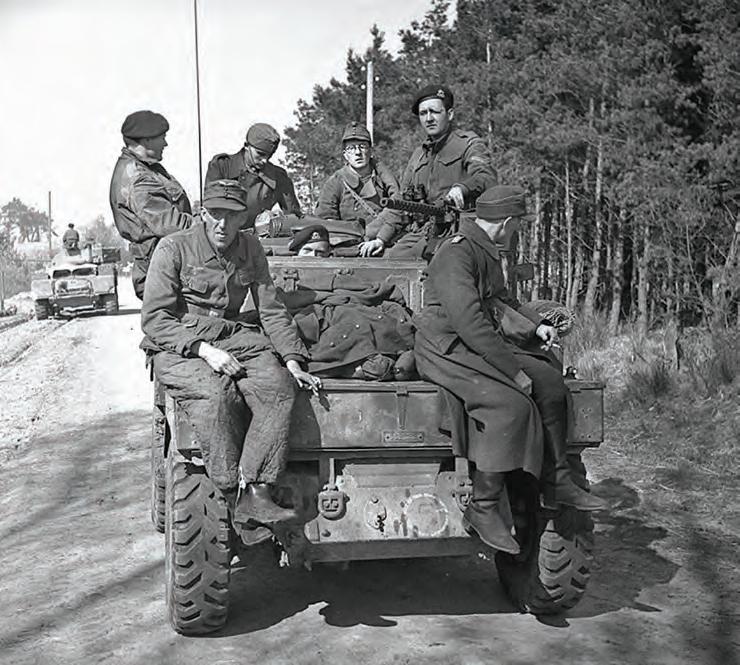
How the widow of a WW II soldier killed in action got the news

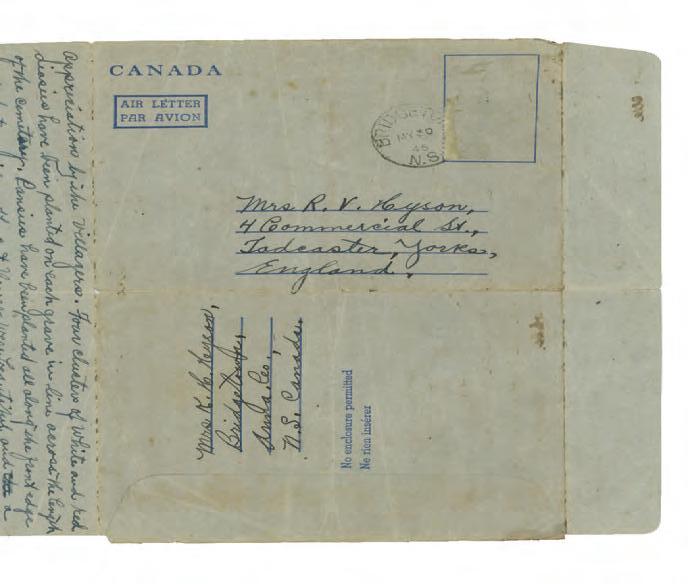
BY STEWART HYSON
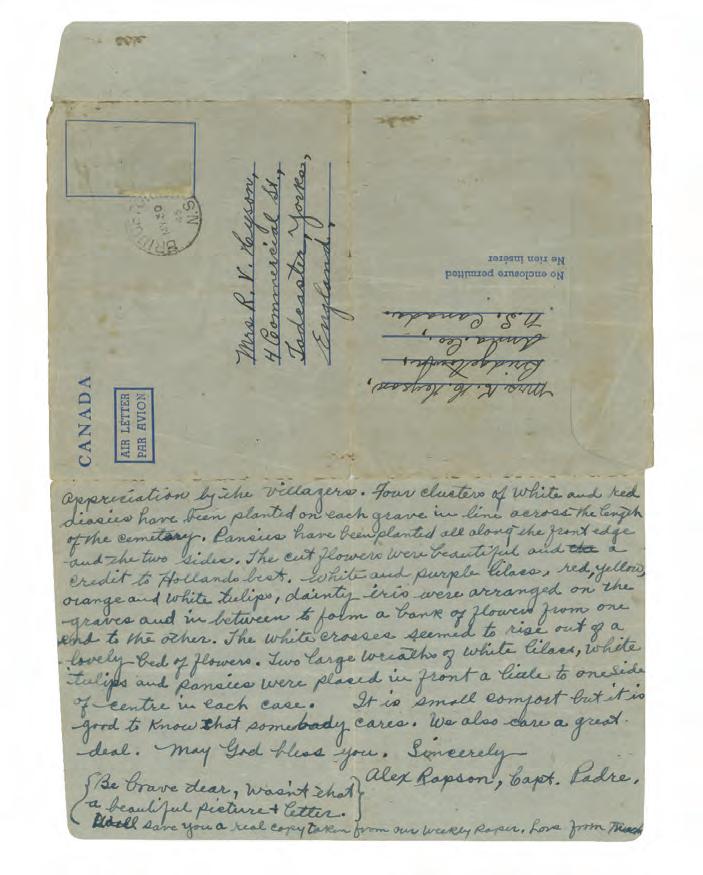
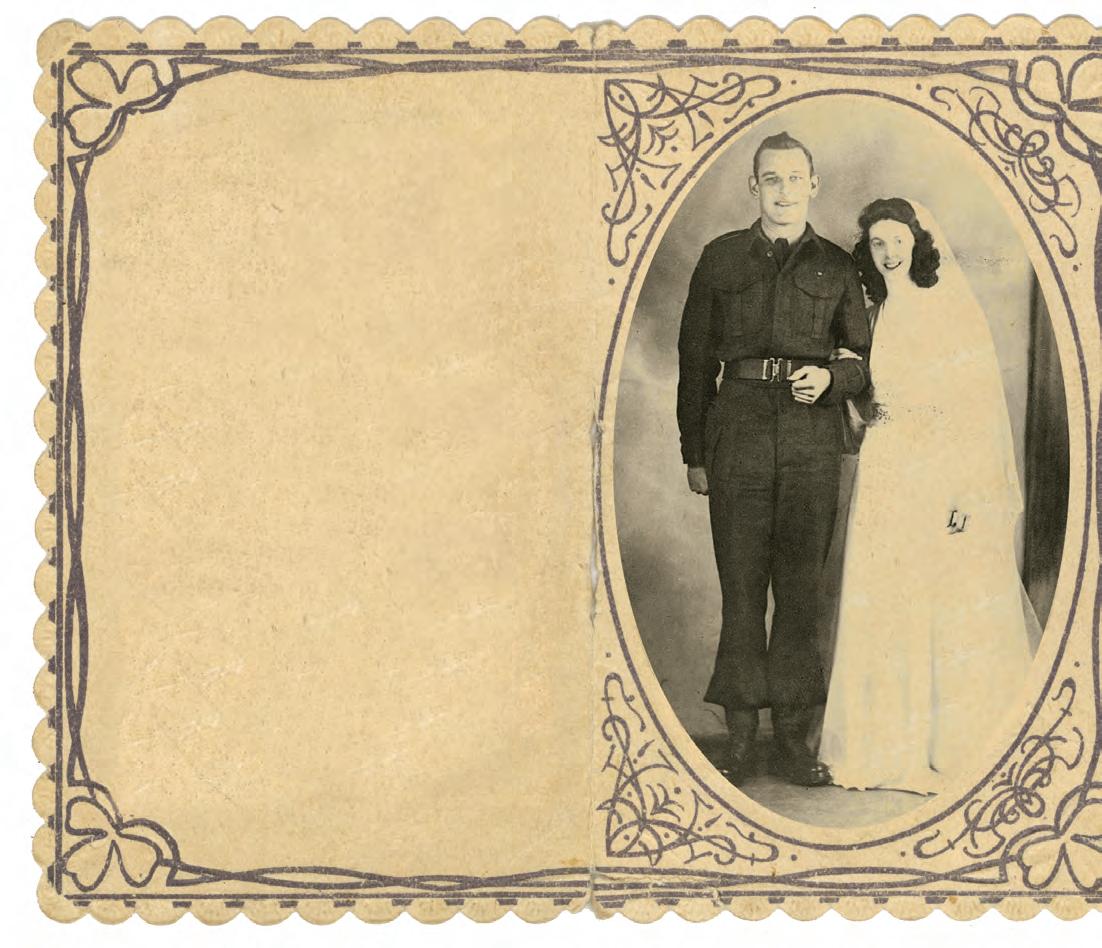
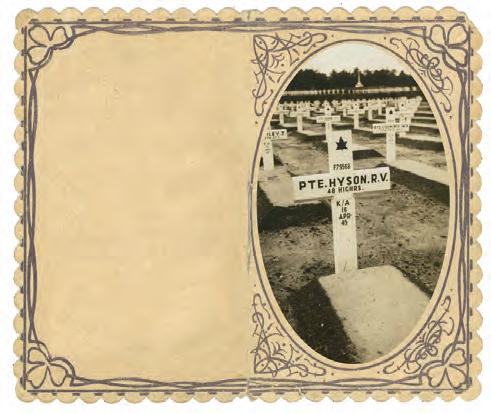

Telegrams to Kathleen Hyson from late-April 1945.


MMay 8, 2025, looms significantly on the horizon as the 80th anniversary of the official end of the Second World War in Europe. Not necessarily a joyful celebratory occasion, but more of a time to reflect on the deadliest conflict in human history. A time to remember those who perished during that, and other, conflicts.
To die during a military campaign is a real possibility faced by soldiers, not to mention a consequence of warfare for civilians, too. However, when it comes to casualties of war finding a final resting place—to rest in peace—there’s no assurance.
The term closure is now commonly used to refer to the process whereby the deceased are treated with care and dignity in line with social customs. During the 2001-2021 war in Afghanistan, for example, it became customary to repatriate the remains of Canadians killed in action for burial, to allow family members and close friends to have a measure of closure. This practice wasn’t used during earlier conflicts on foreign soil, as is evident by the presence of numerous war cemeteries around the world established over the years by the Canadian government and the governments of other countries.
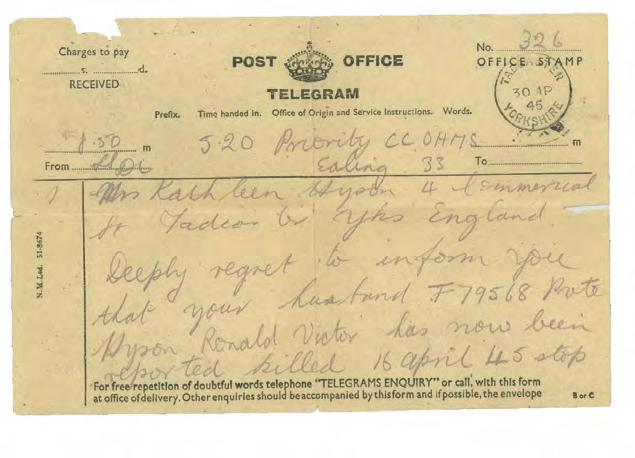
While the personal element of closure may have been absent in the past, the essence of it, caring and recognition, was still present, albeit in a different way.
After my birth father Ronald V. Hyson was killed during the Second World War in April 1945, he was twice buried temporarily before he came to rest at last in the Netherlands’ Holten Canadian War Cemetery. His situation is probably similar to thousands of other Canadian soldiers who died overseas and sheds a light on a little-known reality.
In a way, the story starts with my mother’s receipt of the dreaded telegram. A telegram delivered to an Allied home during WW II usually foretold of a soldier that was dead, missing or who had been taken prisoner. Wives and families receiving one were so aware of what they typically meant, there was little need to read them.
Still, the hand-written message she received on April 26, 1945, came as a shock.
“Deeply regret to inform you that your husband F75568 Pte Hyson Ronald Victor has been reported dead believed killed in action 16 April 45.”
Robert Murdoch, Ronald’s captain, writes to Kathleen after her husband’s death.
Short, to the point, but far from sweet. It was a wartime ritual repeated so many times each day that there was little room for any personal touch.
My mother looked at this telegram, and looked again, with the disbelief that only such a harsh message can induce. More importantly, she detected that something was wrong, although it wasn’t immediately apparent what the problem was.
Ron, a Canadian soldier serving with the 1st Battalion, 48th Highlanders of Canada, and my mother Kathleen, a Yorkshire lass, had been married in England on Nov. 3, 1944. Afterward, he returned to the front. It was obviously difficult for my mom to face the fact that she was now a widow after only five and a half months of marriage, but
While the personal element of closure may have been absent in the past, the essence of the it, caring and recognition, was still present.
she still had a nagging feeling that there was something mistaken in the telegram. Finally, it hit her. The service number wasn’t Ron’s. She knew it by heart. So, possibly the whole message was an error?
A second telegram arrived four days later, but without the word “believed” and with Ron’s correct service number (F79568). It’s not known how the service number error was made with the first telegram. Regardless, the subsequent message was clear: there was no longer any doubt that Ron had been killed in action.
Being five months pregnant, my mother was riled up enough to take pen in hand and contact Ron’s immediate superiors. It was her way of seeking closure.
She received hand-written letters back from Ron’s captain, Robert Murdoch of ‘C’ Company, 48th Highlanders of Canada, and from padre Captain Alex Rapson that provided her some clarity. They detailed how Ron had been killed, provided information about his two temporary burials and offered some words of comfort.
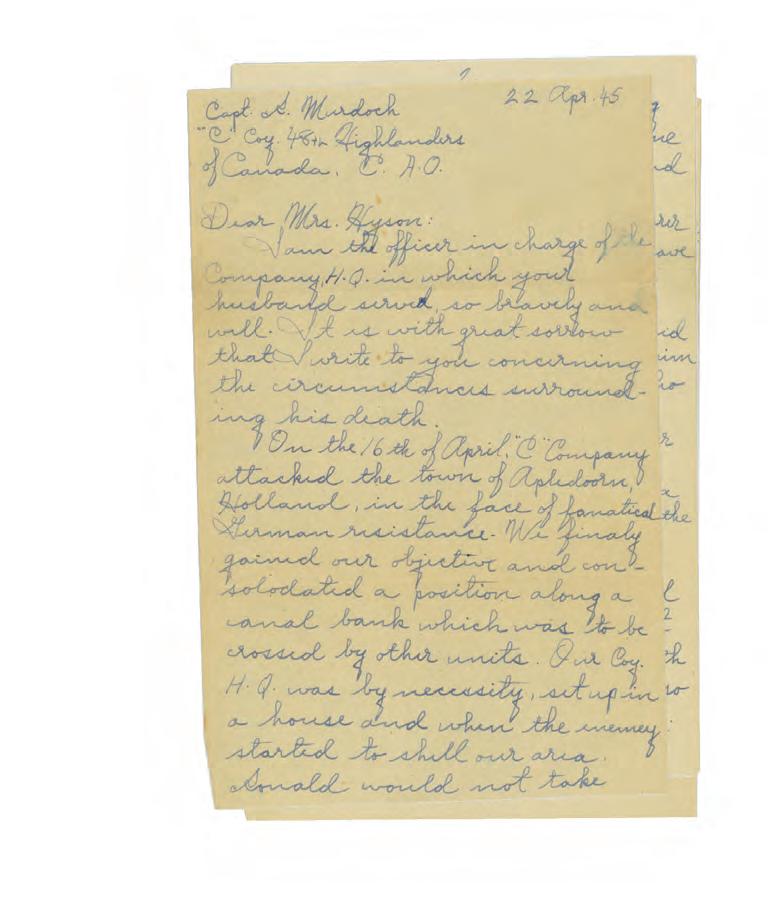
During the Battle of Apeldoorn, ompany had achieved its objective rossing the IJssel river to reach the Dutch v illage of Wilp. There it established a headquarters in a farmhouse. When it was hit by shellfire a short time later, Ron was a casualty—unconscious and probably dead by the time stretcher-bearers took him to a nearby regimental aid post to be seen by a doctor who made the final call.
Padre Rapson arranged for Ron and other fallen soldiers to be taken to what Captain Murdoch described as “a pleasant and quiet spot” as their first temporary resting place until the end of the battle. Once the hostilities ceased in the area, Rapson conducted a formal service on April 26, 1945, for the 19 members of the 48th Highlanders who had died in the Wilp area.
This formal burial (albeit second temporary) was on top of a dike that’s a few metres away from a street that runs through the village of Wilp. Rapson’s vivid description of the ceremony brings it to life. Each grave was marked by a small white cross with hole area immersed in a rich display of daisies, pansies, tulips and irises of diverse colours (red, purple, yellow, orange and white)—the crosses, he wrote, “seemed to rise out of a lovely bed of flowers.”

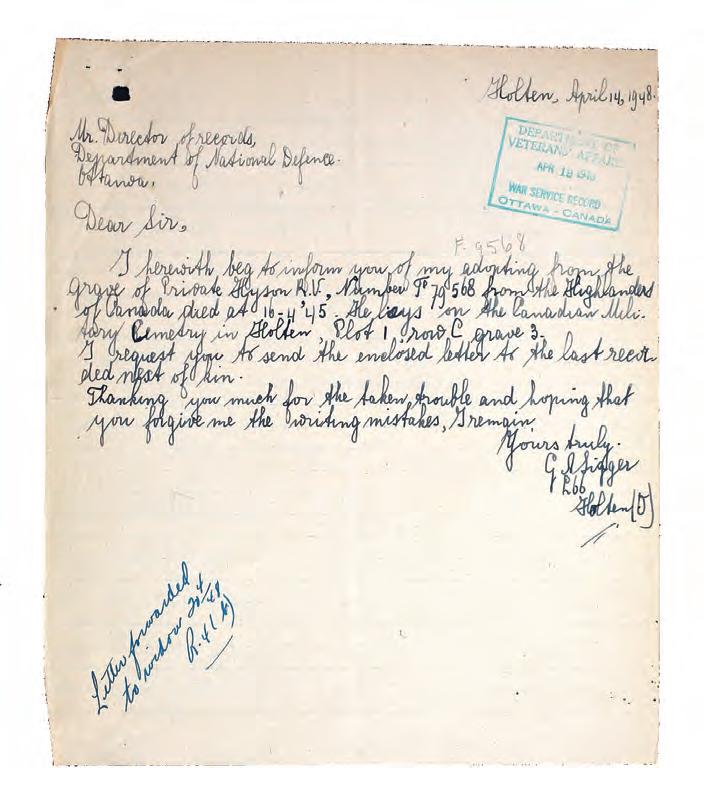
After the war, the remains of deceased soldiers were eventually collected from small local graves across Europe, such as the one at Wilp, and transferred to centralized military cemeteries for final burials. It was a respectful way to treat those who had died.
The men buried temporarily in Wilp, and others killed in the nearby area around Apeldoorn, were moved to the Holten Canadian Military Cemetery. A central Cross of Sacrifice there is surrounded by the remains of 1,382 personnel.
Today, inscribed headstones have replaced the wooden crosses. A carpet of turf now grows over the walking paths around the headstones, too. Flowers may be deposited by visitors and caretakers on a small patch of soil at the base of each headstone. Special ceremonies are held on veteran-related occasions at the Holten cemetery, and annually on the Netherlands’ Liberation Day (May 5) and on Christmas Eve, when each grave is lit by a candle.
A little over a month before receiving the plot picture from Veterans Affairs, my mother got a letter from a Dutch boy named Bennie Sigger. Out of gratitude to the Canadians
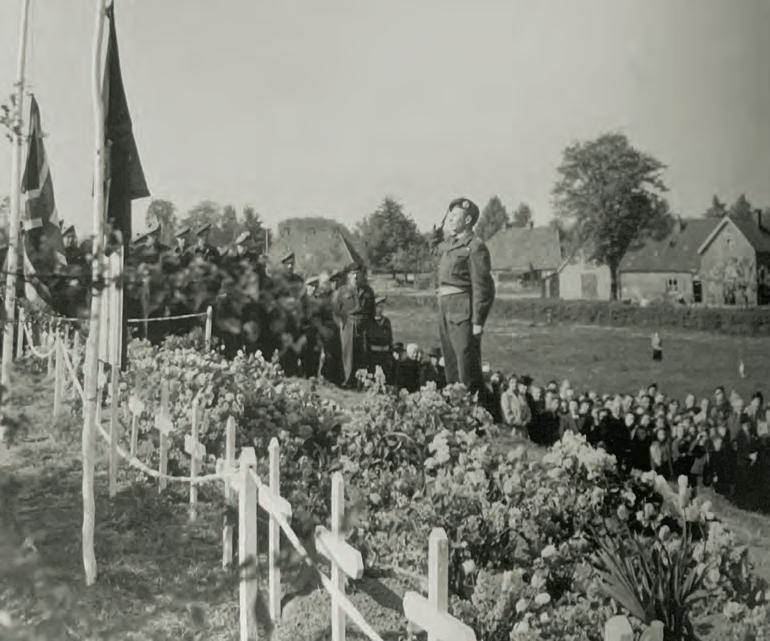
When it first opened in 1948, the grave markers were white wooden crosses, which included the soldier’s name, regiment and date of death. Each plot was rectangular to accommodate the full length of a soldier’s body with the soil covering it rising a few centimetres above the surrounding ground. The top of each grave was covered by what looks to be a layer of beach-like sand.

who had helped liberate them, the residents of Holten had each volunteered to “adopt” a soldier’s grave to look after it. Sigger had adopted Ron’s plot. Many letters, and now emails, have continued to maintain this special link between Sigger and my family.
A black-and-white photo of Ron’s plot was sent to my mother by Veterans Affairs on June, 24, 1948; no doubt, similar images were sent to the nearest next of kin of all buried soldiers.
The 48th Highlanders, the federal government and people of the Netherlands have had their moments of closure with the soldiers who served them. But what about my mother? She received partial closure over the years from the occasional correspondence, but it wasn’t until visiting Ron’s grave in 1994 that she finally laid him to rest. L
Dutch citizen Bennie Sigger writes to Kathleen after “adopting” her husband’s grave. Members of The 48th Highlanders of Canada honour their comrades, including Ronald, killed near, and originally buried in, Wilp, Netherlands, as locals look on.

CANADIAN WOMAN TO BE IMPRISONED

SECOND WORLD WAR, EMBODIED THE PHRASE.
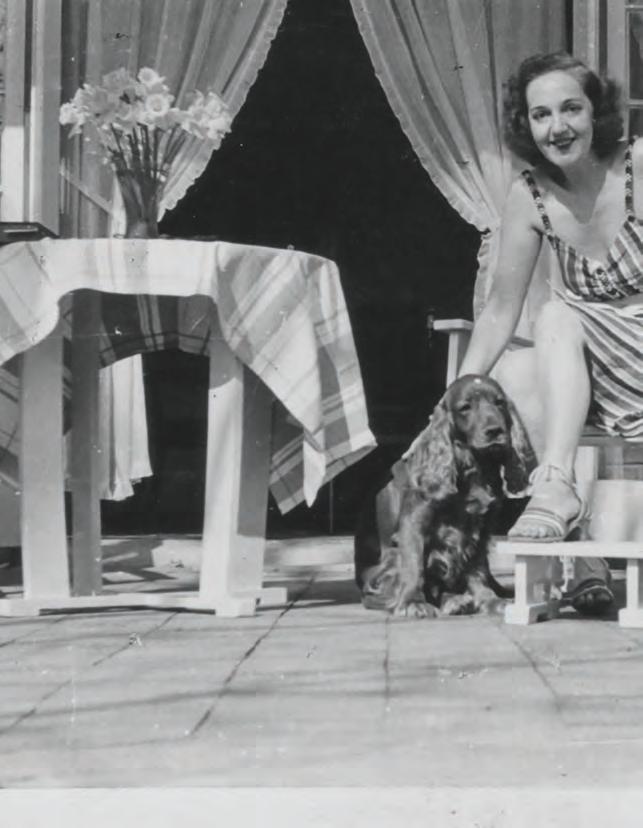
Mona Parsons started Day 1,272 in Nazi captivity and watched in horror as the nearby men’s prison exploded into flames. No one inside the ruin survived.
Allied aerial bombs continued to fall that March 24, 1945, targeting the aerodrome and rail links of the German city of Vechta. Nevertheless, collateral damage seemed inevitable, and the women’s detention centre might be next.
Neither Parsons, a 44-year-old Canadian detainee, nor any of her fellow inmates knew that Operation Plunder—the Allied vaulting of the Rhine River—had commenced. Held in cold and damp cells for more than three years, the former Broadway chorus girl and nurse was lucky if she knew what day it was.
Amid the chaos, however, came opportunity when the German prison director ordered the gates opened and offered all detainees a choice: either stay and risk a fate similar to their male counterparts or take their chances outside, where Allied aircraft were still whipping up a firestorm.

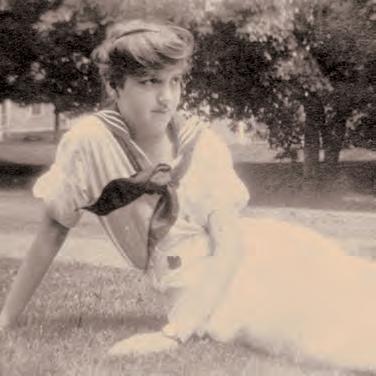
Parsons looked at her friend, 22-year-old Dutch baroness and resistance member Wendelien van Boetzelaer. This was the moment they had both been waiting for. Grabbing each other’s hands, they ran.
The stranger-than-fiction tale of Mona Parsons began on Feb. 17, 1901, when she was born in Middleton, N.S., to Norval and Mary Parsons. Later living in nearby Wolfville, her first brush with conflict came at 13, when she volunteered with a Camp Fire Girls group to make clothes for Belgian babies during the Great War, where her father and her brothers, Gwynne and Ross, were serving.
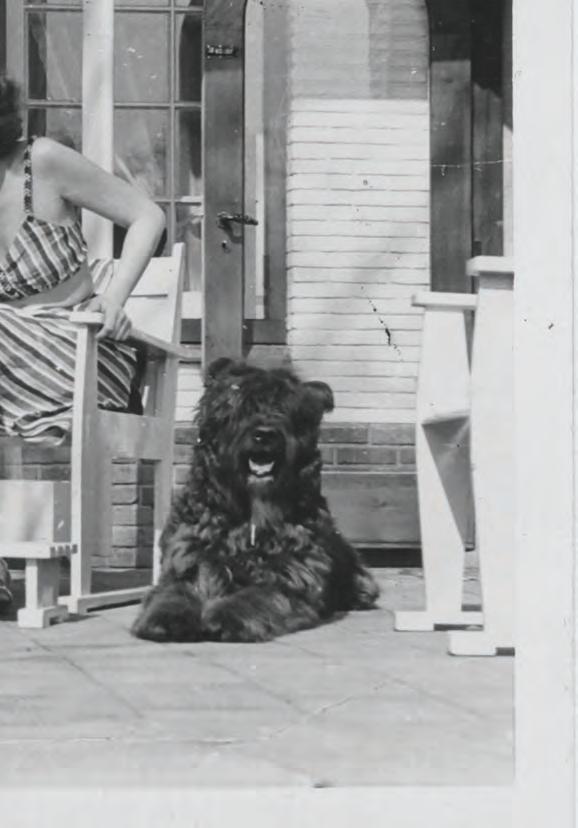

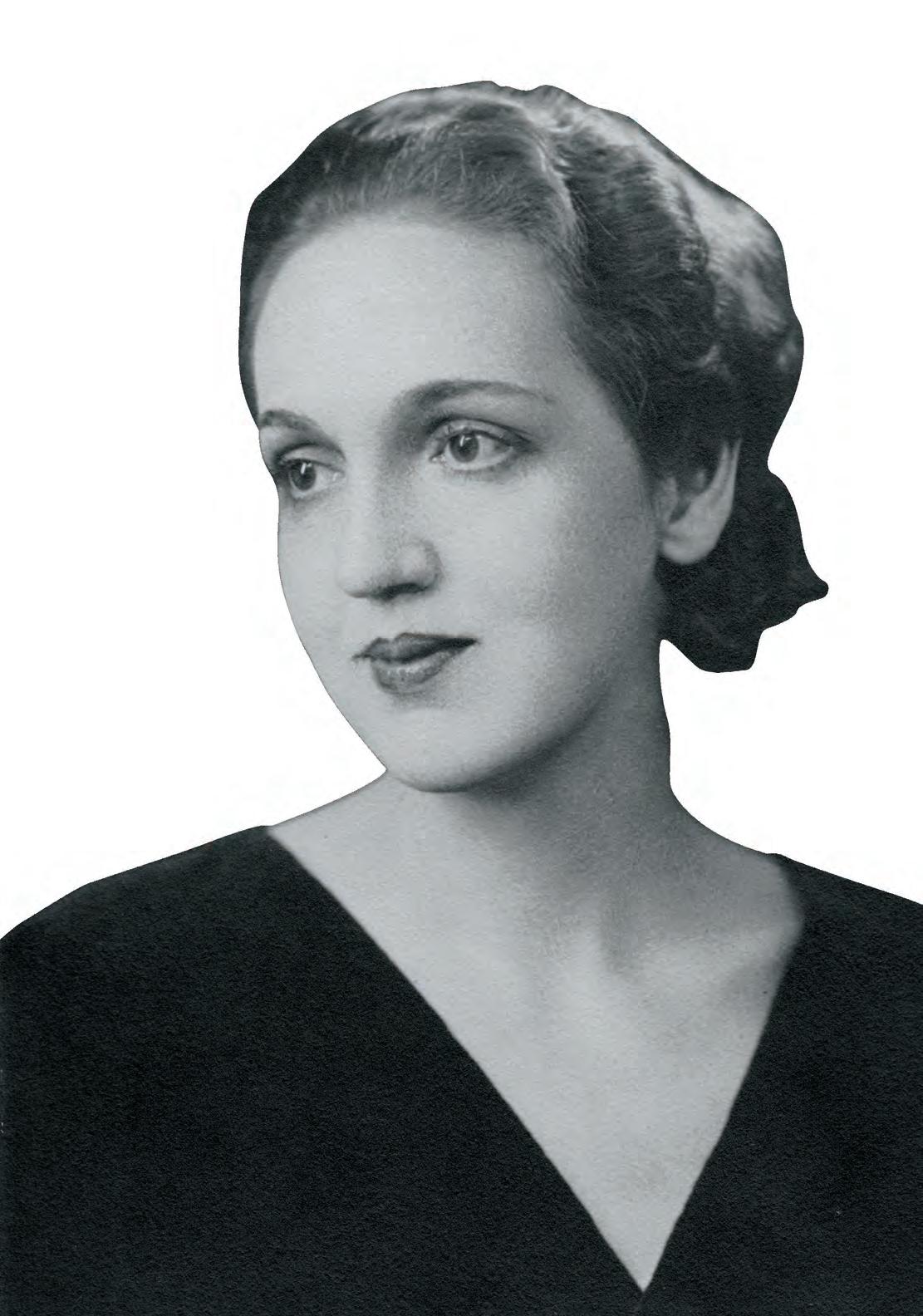

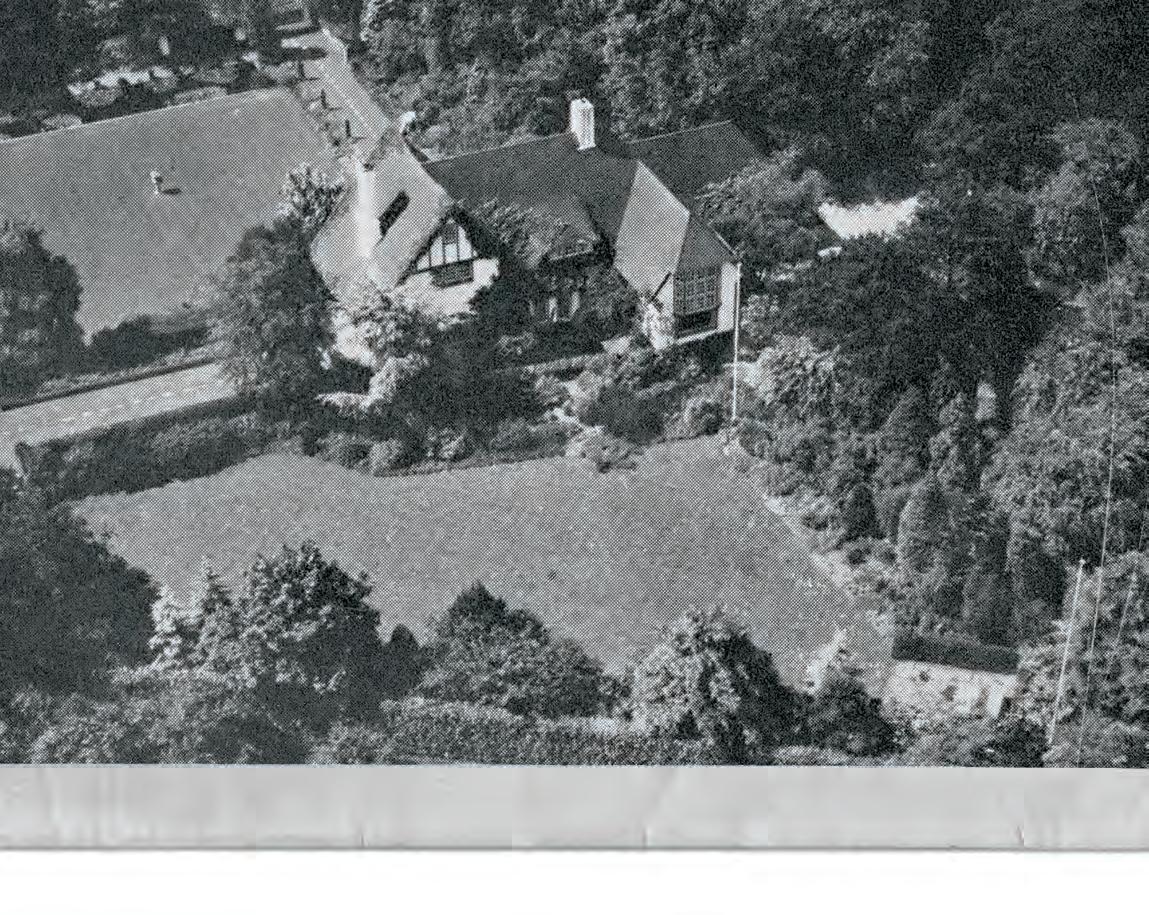
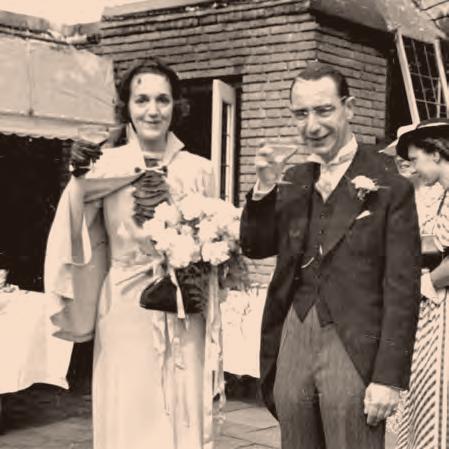
Parsons and husband Willem Leonhardt on their wedding day on Sept. 1, 1937. The couple’s home in Laren, near Amsterdam, in 1938.
Meanwhile, the young Maritimer nurtured a passion for performing arts, ultimately pursuing a career in music, dancing and acting in the U.S. Alas, her aspirations of becoming a theatre star were never fully realized. Spurred on by the death of her mother in 1930—and perhaps the Great Depression’s impact on the Broadway scene—she retrained and worked as a nurse.
In February 1937, Parsons’ life took a dramatic turn after she was introduced to Dutch millionaire businessman Willem Leonhardt. The two hit it off almost immediately and, following a months-long courtship, they were married on Sept. 1, 1937, in the Netherlands, where the couple decided to live.
Parsons, who took her husband’s name, spent the next two years as a wealthy socialite. When not entertaining guests at her large, lavish house named Ingleside in Laren (near Amsterdam), she enjoyed leisurely mornings with breakfast in bed, gardening, shopping and spending time with her two dogs.
It wouldn’t last. On her second wedding anniversary, the Nazis invaded Poland. Britain responded by declaring war on Germany two days later, stoking fears in neighbouring European countries.
“[T]he worst has happened,” wrote Parsons in a letter to her father at the time, expressing unwillingness to leave: “My place is here.”
Despite having acquired Dutch citizenship, the fact that Parsons was Canadian-born— and, therefore, a British subject—came with grave risks if Hitler decided to invade the Netherlands. Willem purchased her passage back to Canada, but she refused to leave her husband behind and returned the ticket.
On May 10, 1940, European fears were realized when an overwhelming German blitzkrieg swept through the Netherlands, France, Belgium and Luxembourg. The Dutch army fought to expel the wouldbe occupiers, but the brutal bombing of Rotterdam on the 14th, which killed hundreds, forced the country’s hand.
A surrender was finalized the next day, plunging Holland into a five-year darkness under Nazi-installed governor Arthur Seyss-Inquart. During those bleak and bitter years, the Dutch endured countless hardships, from the theft of wealth and cultural property to the enslavement of hundreds of thousands of their men.
Some 104,000 Dutch Jews were also destined to be murdered by the Nazi regime, and a further 20,000 would die in the 194445 famine known as the Hongerwinter (Hunger Winter). More still would be killed for attempting to resist the occupation.
Yet resist they would—including the Leonhardts.
The German prison director ordered the gates opened and offered the detainees a choice: stay or they could take their chances outside.
Joining a small but growing underground network of like-minded individuals, the couple offered their home as a hideout for downed Allied airmen who “stayed for maybe a few hours or perhaps a night before going off somewhere else,” wrote Parsons. Their efforts, just one link in a much larger chain that smuggled crews out of the country, were fraught with considerable risk.
Never was that truer than on Sept. 19, 1941, when Mona and Willem received a dinner invitation to their friends’ house in A msterdam. Less a social call and more a plea for assistance, the Leonhardts departed the meal with two British flyers. Their car was stopped at several German checkpoints on the way home. Leaning on the couple’s upper-class credentials, they passed through each without incident as the airmen relied on their false identity papers.
Royal Air Force navigator Richard Pape and flight engineer William (Jock) Moir hid away for six days at Ingleside, occupying the vacant servants’ quarters on the top floor. It was an unusually long stay, but it would be the least of their concerns.
Unbeknownst to the Dutch resistance, their chain had been infiltrated. Pape and Moir were captured before reaching England. Worse, pressure increased on the group itself as the Germans closed in on it.
On Sept. 29, Parsons returned from the dentist to find the Gestapo had called in at Ingleside. Informed by a contact that they were due back any minute, the former Broadway actress prepared to get into character. Her shmoozing endeavours, however, were in vain. She was escorted out of her home and into incarceration.
Deprived of food and sleep, bullied and threatened by her captors who employed numerous interrogation techniques, the undeterred Nova Scotian refused to buckle. Unfortunately, however, the evidence against her became even more damning.
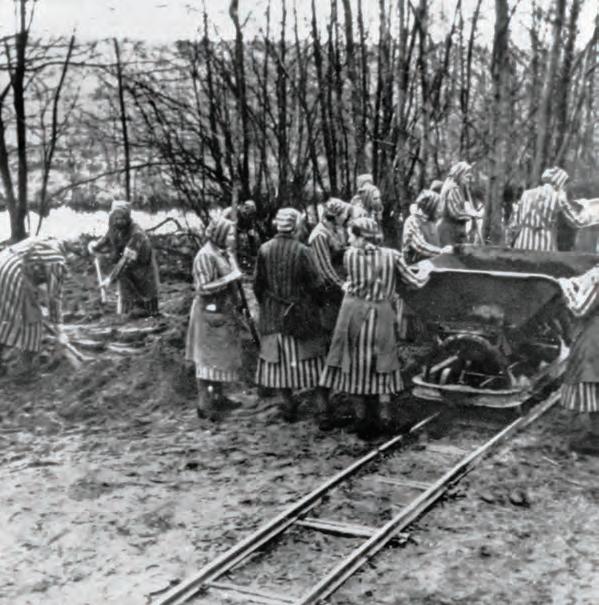
A sole source of comfort was the knowledge that Willem had so far evaded capture, confirmed by exchanged notes snuck out to her contacts. In these scribbled messages, Parsons had enquired about the welfare of her non-existent cat Wimpy. She learned he had escaped twice, but was safe.
Spending almost three months confined to a cell on a bed of straw, Parsons awoke on Dec. 22, 1941, to news that her trial was about to commence. There, struggling to comprehend the German-language proceedings, she was sentenced to death.
As quoted in Andria Hill-Lehr’s biography of Parsons, the defendant recalled of the moment: “I knew that all eyes were on me, expecting me to burst into tears. I was determined not to humble myself before any of them. As I left the courtroom, I put my heels together and bowed toward the judge, the prosecutor and my German counsel...‘Guten morgen, meine herren’ (Good morning, gentleman), I said.”
Parsons’ gracious yet quietly defiant composure impressed the tribunal head, who advised her to appeal the sentence. She did and her punishment was commuted to life in prison.


Female prisoners work near Ravensbrück concentration camp in Germany.
They approached a man only to notice he wore a Nazi armband. It was too late to turn back. When he offered his home, the women felt they had to accept.
It was better than a firing squad or the rope, although Parsons held no illusions of what lay in store for her. Still, when later thrust into a brief and bittersweet reunion with Willem after his capture, she whispered in Dutch to him under the suspicious glare of the prisoner guards: “Moed en vertrouwen ”
Courage and confidence.
Transferred to multiple German detention centres during the subsequent years, Parsons and fellow female inmates were enslaved by the Nazis, forced to perform labour duties when not confined to their cramped, unhygienic living quarters.
At one facility, she was tasked with peeling sticky paper off reusable cardboard cartons, while she scraped the crumbs out of empty food boxes, attempting to placate her hunger. Elsewhere, an assignment of peeling potatoes afforded her the chance to sneak out leftovers, which she then shared with the other detainees. When no food scraps were available, Parsons described imaginary recipes in mouthwatering detail to boost morale within the dingy, dreary, disease-ridden prison cells.
Never one to submit passively, the Nova Scotian also found ways to resist her c aptors, utilizing sabotage in the work she was forced to carry out. In knitting socks for German soldiers, she carefully crafted each pair to cause discomfort among troops on the march. As part of the production line for manufacturing enemy bomb ignitors, she shoddily spliced the wires.
On Feb. 6, 1945, Parsons was transferred to Vechta prison. Her latest—and last—detention would be a comparatively short one, eased by her friend Baroness van Boetzelaer who had escaped twice before. The next time, she explained to Parsons, rather than travel west toward the Netherlands, she would go north first. They would get their chance together.
Through smoke, flames and debris, beset by the ever-ominous drone of Allied bombers, the two women bolted toward the unknown on March 24, 1945.
They needed shelter—and fast.
Whether driven by foresight or adrenaline, Parsons and van Boetzelaer determined that the nearby German aerodrome, notwithstanding the aerial bombardment laying waste to its infrastructure, could offer sanctuary in one of many concrete pillboxes. Their gamble initially paid off. Running between bunkers, they encountered a German soldier taking cover in a dugout. Somehow, van Boetzelaer convinced the young trooper they were on a work detail outside the Vechta prison confines and would immediately return once the air raid ended. They ran again.
It was merely the beginning of their arduous journey to Holland.
Most pressing was Parsons’ limited ability to blend in with the crowd.
Having started to learn German in captivity, she still spoke with a distinctly Canadian accent that could reveal the ruse. The fugitives concluded that Mona should pose as a woman with mental health challenges, a risk itself because of Nazi policies on what they perceived to be “undesirables.”
With few, if any, other options available, it was deemed the best solution. Feigning an aunt-niece relationship to account for their age difference, the duo set out in the rough direction of the partially Allied-liberated Netherlands.
Inclement weather, inadequate footwear, and an incessant dread of getting caught were just some of the hurdles confronted on their long march through the German heartland. Parsons and van Boetzelaer sought food and lodgings from the locals, often performing chores in return without arousing suspicion. In one village, however, they approached a man only to notice he wore a Nazi armband.
It was too late to turn back. When the local police officer offered his home to the supposed refugees, the women felt they had to accept to avoid raising questions. Keeping a low profile, they spent a harrowing night fearing for their freedom.
Finally, from the German border town of Rhede, Parsons and her Dutch comrade could see Holland. From blagging their way through a German checkpoint
to constantly dodging Allied air raids, their ordeal appeared to be almost over.
But not quite. A lack of accommodation meant that the duo was separated, leaving Parsons to maintain her persona without van Boetzelaer to speak for her. The Nova Scotian actress struggled on. Securing bed and board in a German farmhouse, she waited for the right moment to cross, aware that she probably had just one shot.
In the meantime, fighting around Rhede reached a fever pitch as the Allies gained ground. Parsons and her host family were soon forced into the cellar while German troops engaged in a fierce rearguard action. When the patriarch was killed by artillery fire, Parsons intended to help bury him until Polish soldiers appeared, doubtless a sight for sore eyes, and urged the townsfolk to make for Holland.
Parsons didn’t need to be told t wice.
The Netherlands she entered couldn’t have been starker than the one she left behind. Surrounded by the devastation of war and famine, she limped on to the Dutch town of Vlagtwedde and, amidst the rubble, spotted a familiar uniform.
It was almost beyond belief: Mona Parsons of Wolfville, N.S., had stumbled upon Canadian soldiers from none other than The North Nova Scotia Highlanders.
German officers’ billet over the preced ing years, Parsons strove to pick up the pieces of her past with one of her surviving dogs, the remnants of her garden plots, and, from June 22, 1945, her husband.
significant toll on his physical and mental health. Despite Parsons’ best efforts as a one-time nurse, he died on April 8, 1956.
Canadian widow in Holland. After more than a year of considering her options, she boarded a ship bound for Nova Scotia in late 1957, initially settling in Halifax
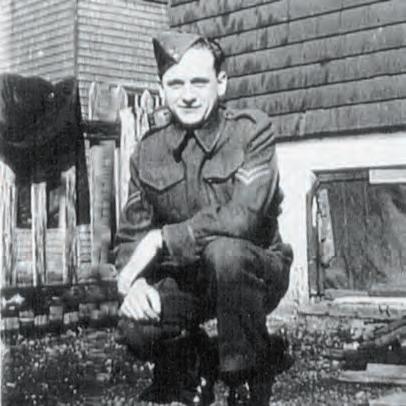
Carrying a mere 87 pounds on her 5′8″ frame, her feet bloodied and bandaged from the daring breakout from Germany, Parsons’ tale proved equally inconceivable to her compatriots. Though the gift of chocolate from Bedford, N.S., was a heartening gesture, less so was a trip to Canadian Army Rear Headquarters in the German town of Oldenburg—near where her escape began.
Misgivings aside, it was here that Parsons’ story was validated. It was here, too, that she encountered a sea of friendly faces she had known from what felt like a lifetime ago. And it was here that she reunited with Major-General Harry Foster, a childhood friend and Canadian divisional commander. They would meet again. Parsons had been liberated by her old neighbours.
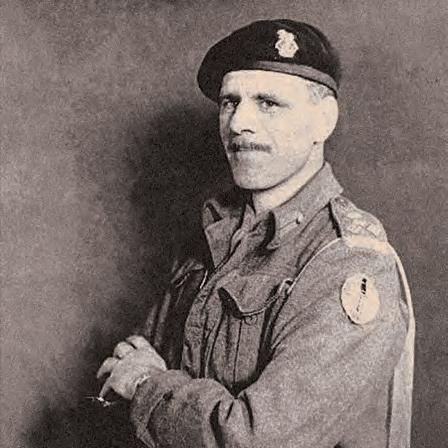
and, two years later, marrying retired major-general Harry Foster. The couple remained together until Harry died in 1964.
Parsons returned to Wolfville, finding solace in the community of her formative years, where she had learned to dance, sing and play music, where she had once aspired to fame on stage, and from where much of her remarkable journey had started. Her life had not turned out as expected—but rarely had it been boring.
In the fall of 1976, Parsons was hospitalized with health complications exacerbated by a severe chest infection. In her delirious state, she mistook her darkened room for a Nazi prison cell. On Nov. 28, at age 75, she bade farewell to Nova Scotia for good.
A resister to her last breath. L


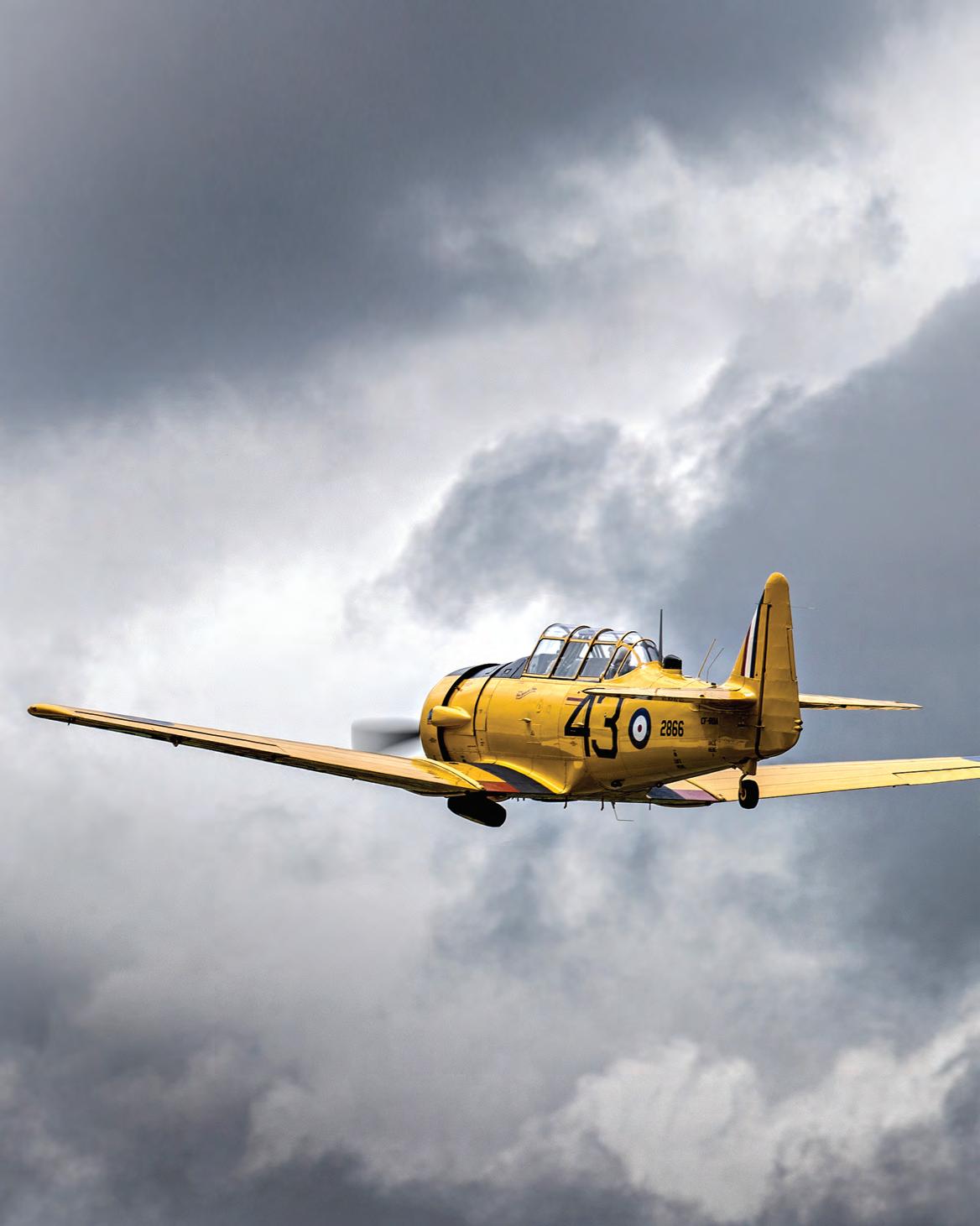
Stephen J. Thorne
Canada’s instrumental role in WW II’s British Commonwealth
Air Training Plan
The British Commonwealth Air Training Plan trained 131,533 aircrew, 72,835 of them Canadian. Many pilots concluded their flight training on the Canadian Car and Foundry Harvard 4 (opposite). Fred Ashbaugh (above), a bomber pilot, was among the first recruits to complete the program.
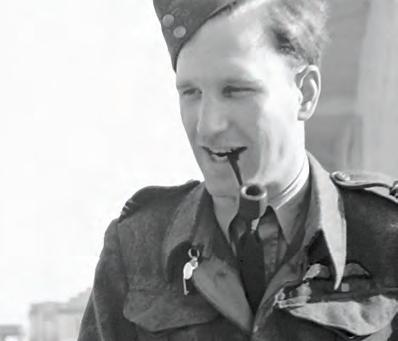
Imbued with a lifelong, albeit simmering, passion for flight, Fred Ashbaugh’s first impressions of the British Commonwealth Air Training Plan were disconcerting, if not discouraging.
The Alberta farm boy had enlisted as a 21-year-old in 1940 because “we were at war and I d idn’t like what the Germans were doing.” The air force, he said, seemed the best option.
The unprecedented scheme to turn Canada into a vast training ground for wartime aircrew was just months in the making, and recruits were funnelling through a lone staffing depot in Toronto.
Designated No. 1, it was anything but. Located in the Coliseum Building on the Canadian National Exhibition grounds, it accommodated up to 5,000 personnel.

“It was quite a shock,” Ashbaugh recalled in a 2009 interview, part of the Canadian Military Oral History Collection compiled by University of Victoria historian Reginald H. Roy. “We were in the cow barn and we were doubletiered. There was just a mass of people in there…. The food was terrible. Really, it was shocking.
“They had some sort of an arrangement with a caterer, and he could make the best rubber eggs you’ve ever had in your life. The one t hing that was really good about it was that you could have all the milk you could drink. And all bread and butter you could have. But the rest of the food was terrible.”
Those early days were everything military but the flying and fighting. The recruits learned to bathe, shave, shine boots, polish buttons, maintain uniforms and follow orders. There were two hours of physical education every day and instruction in marching, rifle drill, foot drill, saluting and other routines.
There would soon be four more collection points—in Brandon, Man.; Edmonton; Quebec City; and Lachine, Que. The food even got better. But by then Ashbaugh was a few steps closer to the war front and an eventual 62 combat missions over Nazioccupied Europe piloting Stirling and Wellington bombers.
More depots were eventually added: in Picton, Ont.; Swift Current, Sask.; Penhold, Alta.; and Souris, Man. Two Women’s Division depots were established, in Toronto in October 1941, and Rockcliffe, Ont., a year later.
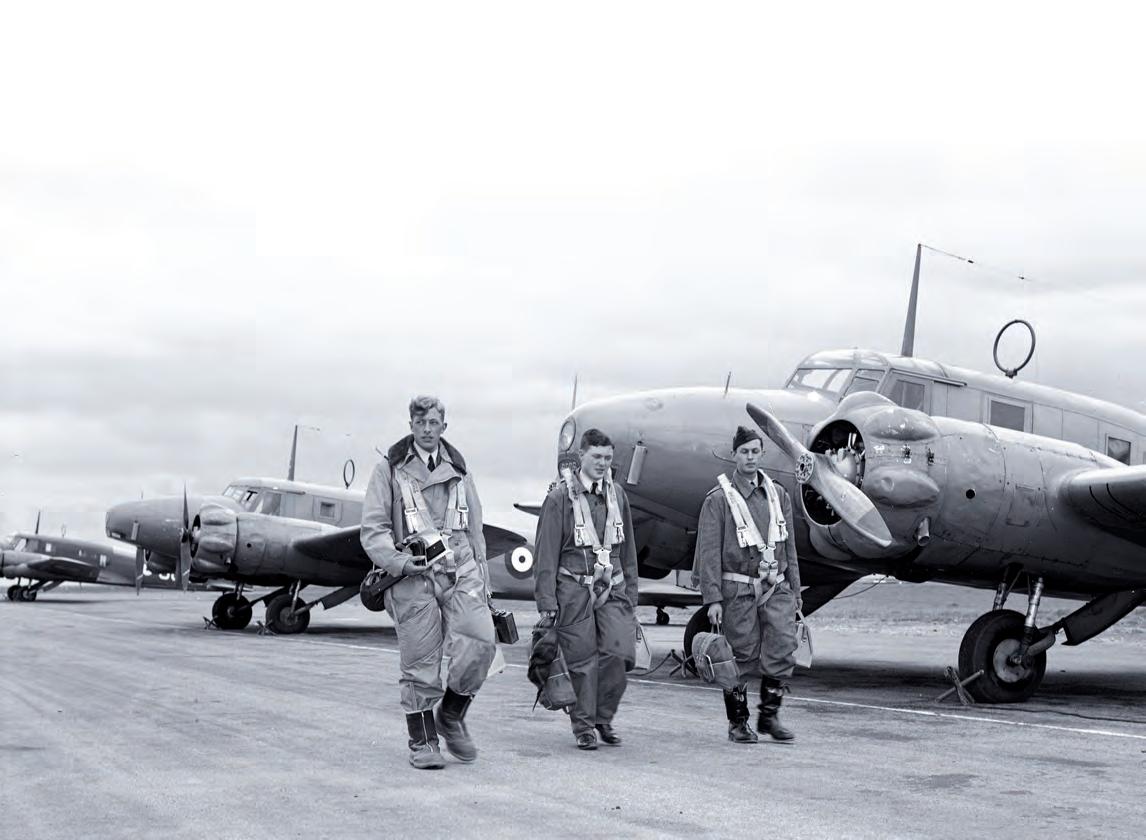
“I think he was trying to find out if I got sick or not, which I didn’t…. I got a big bang out of it.”
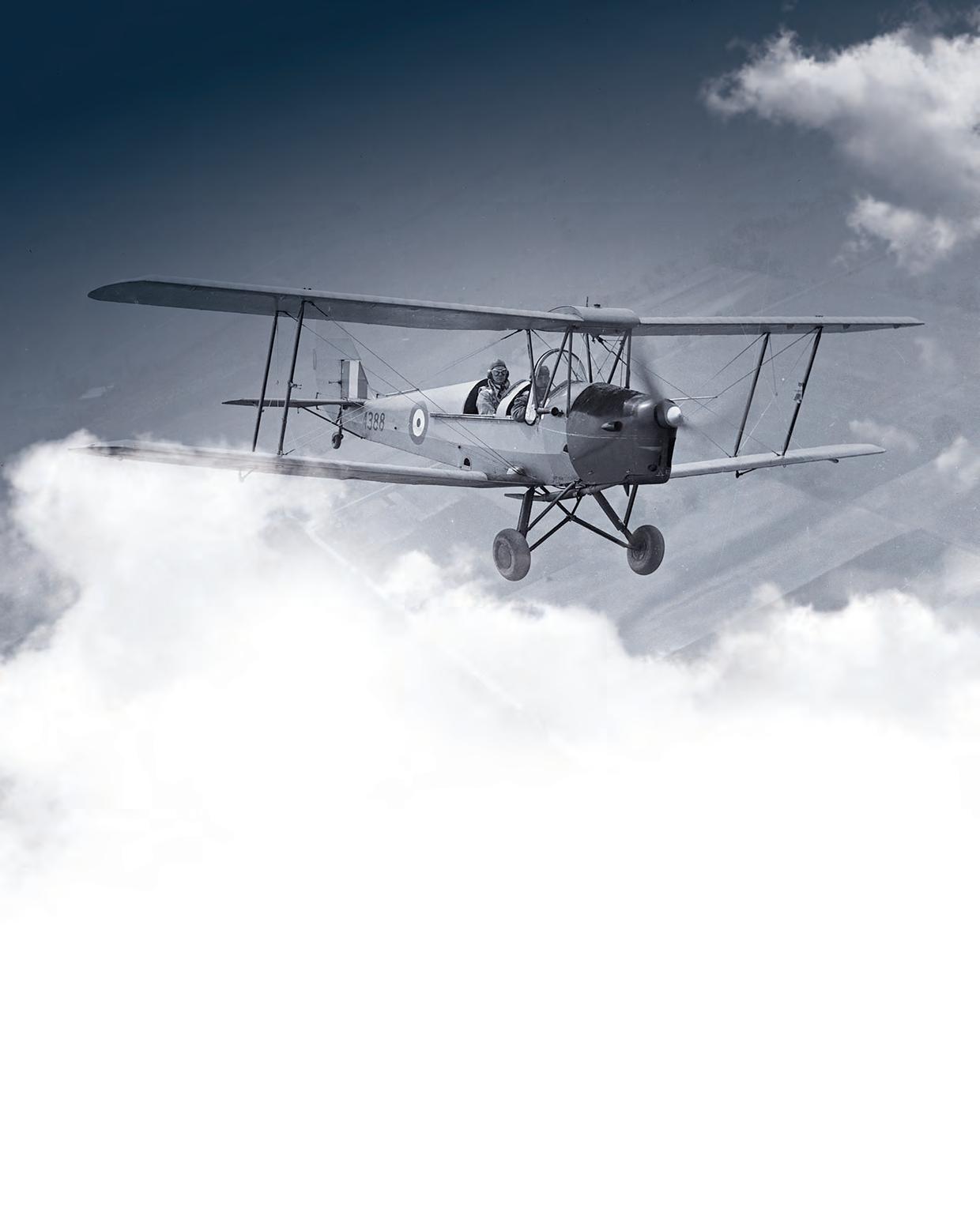
France had become the last domino to fall in the Nazis’ blitzkrieg campaign westward across continental Europe. Between May 26 and June 4, some 338,226 Allied soldiers, mostly British, had been evacuated from the beach at Dunkirk, the bulk of their arms and equipment left behind for the invaders to plunder.
Britain lay just across the Channel, shaken and vulnerable—the prospective crown jewel in Hitler’s conquest. By early July, the first stages of a German invasion were taking shape, as the Luftwaffe escalated a campaign to destroy Britain’s air forces before launching an amphibious assault on England’s beaches a few kilometres away.
The writing had been on the wall for months. And military planners foresaw what now seems obvious— that the British Isles wouldn’t be a good place to train badly needed pilots and aircrew. An alternative was needed. Canada stepped up.
On Dec. 17, 1939, Canada, Britain, Australia and New Zealand signed an agreement to create the British Commonwealth Air Training Plan— the BCATP, or simply “The Plan.”
Canada was chosen because of its flyable weather, wide-open spaces,
ample fuel supplies, aircraft and parts production capacity, its relative proximity to both the European and eventual Pacific theatres of war, and the lack of an enemy threat.
The ambitious initiative originally called for three training schools, 13 elementary flight training schools, 16 service flying training schools, 10 air observer schools, 10 bombing and gunnery schools, two air navigation schools and four wireless schools. The government built 7,000 hangars, barracks and drill halls.
Most training schools had three runways, each 30 metres (100 feet) wide and 762 metres (2,500 feet) long. Enough concrete was used in creating them all to build a two-lane-wide highway from Ottawa to Vancouver.
The Plan’s $2.2 billion in costs (the purchasing power of about $43 billion in 2024 dollars) was shared among the four governments, though Canada picked up t he bulk of it, $1.6 billion ($36 billon today).
At its peak in late 1943, 104,000 BCATP staff were
Many pilots took their first flight on the Tiger Moth, such as this one flying out of RCAF Malton, Ont.
operating 107 schools and 184 support units at 231 locations across Canada. The Plan employed 3,540 aircraft and even trained exiled Norwegians, Poles and Free French.
Canada would become what U.S. President Franklin D. Roosevelt called, “the aerodrome of democracy.”
The first Canadian training course got underway in Toronto on April 29, 1940, turning out 39 graduates five months later, all of whom remained in Canada as instructors or staff pilots. Three dozen Canadian observer graduates from the Trenton, Ont., school formed the first overseas deployment, in October 1940. Recruits were given a standard aptitude test, the Royal Canadian Air Force Classification Test. Remedial high school education brought 17- and 18-year-old trainees up to the RCAF academic level. Trainees were often assigned “tarmac duty” to keep busy. Some were sent to factories to count nuts
and bolts; others were portioned out to flying schools and other RCAF facilities to perform guard work, clean, paint and polish equipment. Tarmac duty could last several months or more.
Ashbaugh, who would become a decorated bomber pilot, was even dispatched to New Brunswick for 28 days of standing guard duty.
Pre-Aircrew Education
Detachments were established on university campuses across the country to provide education in mathematics, physics, English and other subjects requested by t he RCAF for aircrew recruits lacking the necessary education. They greatly reduced the percentage of later failures.
After 4-5 weeks, a selection committee decided whether trainees would be placed in the aircrew or ground crew streams. Wireless air gunner candidates were dispatched directly to a wireless school; air observer (navigator) and pilot candidates went to one of seven Initial Training Schools, where they would spend the first four weeks of their 26-28-week program.
They were subjected to a battery of tests, including an interview with a psychiatrist, a four-hour M2 physical examination, a session in a decompression chamber, and a “test flight” in a Link Trainer.
“The whole series was an interview,” said Ashbaugh. “The instructors were watching everybody all the way along… writing their little notes.”
Back in the classroom, the pilot and air observer candidates were taught navigation, flight theory, meteorology, officer duties, air force administration, algebra and trigonometry.
Then it was on to Elementary Flying Training School—there were 32 of them—where flying clubs gave trainees 50 hours of basic flight instruction over eight weeks on simple trainers such as the de Havilland Tiger Moth, the Fleet Finch or Fairchild Cornell.
Graduates of the “learn-to-fly” program went on to a Service Flying Training School for 16 weeks, meted out in an eight-week stint with an intermediate training squadron, six weeks with an advanced training squadron, and two weeks at one of 30 Bombing and Gunnery Schools, all run by the RCAF or the Royal Air Force. Fighter pilot prospects trained in North American Harvard and Yale aircraft. Bomber, coastal or transport pilot trainees attended separate schools where they learned multi-engine flying in Airspeed Oxfords, Avro Ansons and Cessna Cranes.
Navigator trainees spent eight weeks at one of 10 Air Observer Schools, a month at Bombing and Gunnery School (there were 11), and a month at Navigation School (six). The Air Observer Schools were operated by civilians under contract to the RCAF—CP Airlines, for example, ran Nos. 7, 8, and 9, though the instructors were RCAF. Dead reckoning and visual pilotage were the basic navigation techniques throughout the war years. Training in Avro Ansons, aspiring navigators used aeronautical charts, magnetic compasses, watches, trip logs, pencils, Douglas protractors and the Dalton Dead Reckoning Computer, a round manual device— not at all like a modern computer.
Two Air Gunners Ground Training Schools, in Trenton, Ont., and Quebec City, were formed to meet a critical shortage of aerial gunners overseas. They gave a six-week preparatory course in the use, care and maintenance of heavy machine guns along with drill, physical training and small-arms training.
Wireless air gunners spent 24 weeks at Wireless School learning the theory and application of wireless communications, including signalling with lights and flags as well as radio. They finished with four weeks at a Bombing and Gunnery School.
General Reconnaissance Schools trained pilots and air observers in ocean patrol. Pilots spent the last 8-14 weeks at Operational Training Units (OTUs), where they learned to fly warbirds such as the Hawker Hurricane or Fairey Swordfish. They were taught by actual combat pilots who had been posted to OTUs after their operational tours—not all of them particularly pleased to be there.
At 21 years old, Ashbaugh would have been a relative senior among recruits.
He remembered the food and living conditions at the elementary flying schools as “pretty rough.”
“It was terrible,” he said. “But the flying instructing and the ground instructing were very good.”
His first flight was in November 1941 aboard a Fleet Finch with an instructor named Moon, who did a loop and threw the plane into a spin—“I think he was trying to find out if I got sick or not, which I d idn’t…. I got a big bang out of it.”
His first solo came in a Fleet Finch after 11 hours of in-flight instruction.
“It was pretty scary. Here you are, you’re up there all alone, you’ve got 10-12 hours in and you’ve got to bring this thing down in one piece. So, after you got it down—big sigh of relief.
“It was quite exciting and it was quite gratifying.”
Ashbaugh left Jan. 4, 1941, for service flight training in Summerside, P.E.I.
“We were the very first course in Summerside,” he told Roy. “When we got there, there were no instructors, there were no aircraft, there was no nothing.”
The place was commanded by a flying officer who, lacking staff to train his flock, granted the whole lot 48-hour passes. “We said ‘sorry, we don’t have any money.’ Something had gotten screwed up on our pay and we hadn’t been paid.
“So, he made an arrangement with the bank that he give us all a cheque for $5—imagine this, $5 for a 48-hour pass. He says [to the bank man ager], ‘now I don’t have that much money in the bank, would you cover it?’
“And the bank man ager, of course, says ‘yes.’ Because we were God’s chosen children, first airmen with our little white flashes.
“We all went down into the village and cashed our $5 cheques. And most of us spent the whole weekend in Summerside and went back to the station with money in our pockets because the people took us in. They were just wonderful to us. The hotel was charging 25 or 50 cents for a room.”
The aircraft—Harvards—didn’t arrive until two weeks later. “It was like going from an Austin to a Mercedes,” said Ashbaugh. “Here, you’ve got a great bunch of instruments in front of you, where in a Fleet Finch you had a needle, a ball and an airspeed indicator.
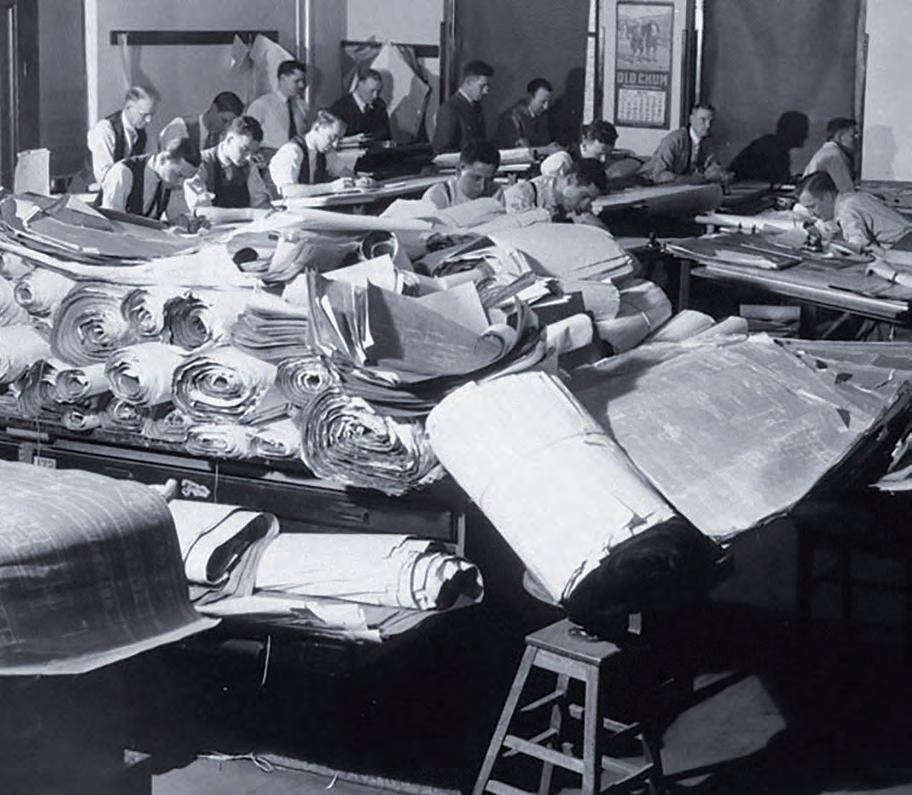
“And, of course, it was quite a powerful aircraft and it was fully aerobatic. Oh, it was a beautiful machine to fly—a little tricky, but beautiful.”
The course, half of the trainees Dominion Newfoundlanders in the RAF, went smoothly— no prangs, no washouts and no known conflicts with the locals.
Ashbaugh earned his wings on April 9, 1941.
The dry province (it didn’t repeal Prohibition until 1948) approved an allotment of half a bottle of booze per graduate and the mayor and lieutenant-governor threw a party for the new pilots, one of whom was going out with the mayor’s daughter.
The group moved out on April 25. Heavy snow plagued the trainee group that followed them; several banged up aircraft and one missed the Island altogether,
At its peak in late 1943, 104,000 BCATP staff were operating 107 schools and 184 support units at 231 locations across Canada.
making a successful belly landing on the Gaspé peninsula.
Unlike most of his classmates, who were promoted to officer ranks and remained in Canada to become instructors, Ashbaugh, a sergeant at t he time, shipped out for England, expecting to be a fighter pilot. The powers that be had other plans.
“When we got over there, they wanted bomber pilots, not fighter pilots…. I was a little older and so therefore I was supposed to be more stable, I guess, and [was sent] into the bomber stream.”
He arrived in Liverpool, England, in late June 1941 and boarded a train to Bournemouth
the following morning, then moved after a week to train as second pilot on the twin-engined Wellington, his plane piloted by an Australian, along with three British crew. It was his first experience with a Commonwealth crew.
His first flight in a Wellington was July 27, 1941—20 minutes, a circuit and a landing. Most flights were cross-country, but on Aug. 7 an engine quit, and they ended up in the Celtic Sea, 200 kilometres off England’s southwest coast.
“We all got away with it except the wireless operator because when you come down in the sea, it’s just like hitting a brick wall,” he said. “It’s bloody awful.”
Their first posting was in four-engined Stirlings, but the crew was broken up and moved around.
By the luck of a coin flip, their Australian pilot, Flight Sergeant Clarence Henry Muir, ransferred to a Bomber Command squadron as a second pilot. He arrived at his new posting on a Saturday. By Sunday, he was dead.
Ashbaugh was crewed up as second pilot aboard a couple quadron Stirlings soon ust a few missions in, he got his own plane with his own crew. He had 150 hours ying time in his logbook.
His first mission as a command pilot came on April 10, 1942, he German-occupied port at avre, France, where he dropped sixteen 500-pound bombs from 4,800 metres (16,000 feet).
He would soon come to know well the rigours of searchlights, flak, night fighters—and early navigation. “A lot of turnip fields got bombed.” And many more enemy installations.
Fred Ashbaugh died Jan. 2, 2019. He was 99 years old. He and wife Pat had been married 73 years.
The 91-metre, airfoil-shaped memorial wall at the British Commonwealth Air Training Plan Museum in Brandon, Man., bears the names of 19,256 Commonwealth aircrew killed during those stormy years of history’s bloodiest conflict. Some 856 trainees died during The Plan’s five years of operation. By 1944, however, the rate of fatal accidents was down to one per 22,388 hours of flying time.
Terminated on March 31, 1945, the British Commonwealth Air Training Plan remains one of the largest aviation training programs in history. It was responsible for nearly half the crewmen to serve with Commonwealth air forces during WW II—131,533, to be exact, 72,835 of them Canadian. L
131,533 British and Commonwealth aircrew trained
72,835 graduates joined the Royal Canadian Air Force, including 25,747 Canadian pilots, 12,855 navigators, 6,659 air bombers, 12,744 wireless operators, 12,917 air gunners, and 1,913 flight engineers
42,110 joined the Royal Air Force, including 448 Poles, 677 Norwegians, 800 Belgian and Dutch, 900 Czechs, 2,600 Free French
9,606 joined the Royal Australian Air Force
7,002 joined the Royal New Zealand Air Force
5,296 joined the Royal Navy Fleet Air Arm
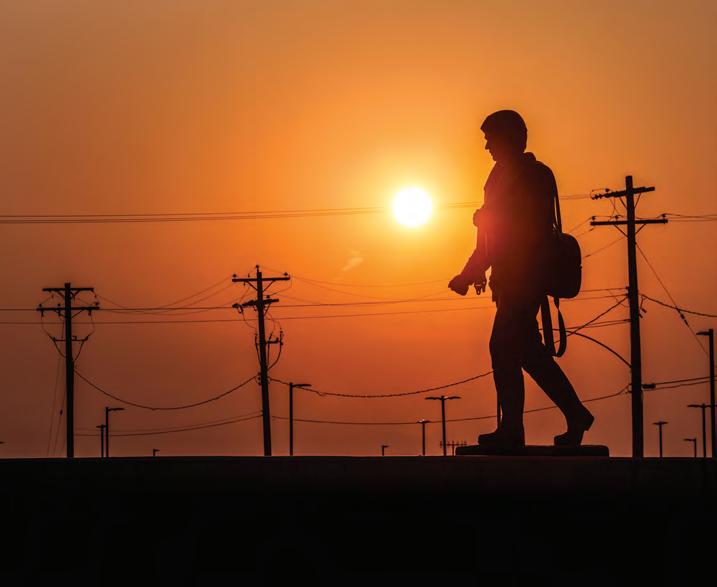
The airfoil-shaped memorial wall at the British Commonwealth Air Training Plan Museum in Brandon, Man., with its bronze statue of a pilot, lists all 18,039 Canadian aircrew killed while serving in the Second World War.
By Stephen J. Thorne
The First World War marked the beginning of the end for the warhorse. While their use as beasts of burden continued through WW II, largely on the Eastern Front, cavalry began a precipitous decline in The Great War.
British cavalry were among the first units to see action in WW I, but they didn’t last. The war’s most impactful weapon—the machine gun—along with the mud and barbed wire of trench warfare would ultimately spell the end for horse-mounted military.
One of the last successful cavalry charges on the Western Front took place at the Somme—on July 14, 1916, when the 20th Deccan Horse, an Indian cavalry unit, attacked a German strongpoint at High Wood. Armed with lances and
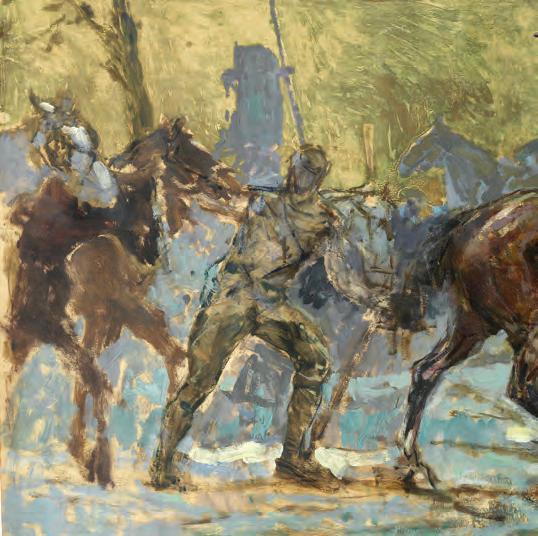
despite an uphill climb, enough horsemen reached the woods to force some Germans to surrender.
The cost, however, was high: 102 of the attackers were killed, along with 130 horses. Two months later, the tank debuted alongside Canadian and other Allied troops at the Battle of Courcelette. Cavalry encounters continued, on the Eastern Front especially, for some time yet, but war would never be the same.
Mounted units such as Lord Strathcona’s Horse (Royal Canadians) and The Fort Garry Horse, formerly the 34th Regiment of Cavalry, would gradually transition to mechanized armour. The warhorse was relegated to the drudgery and indignity of heavy work, hauling supply wagons, ambulances, lumber, artillery pieces and more.
The Canadian Expeditionary Force used 24,134 horses and mules during the course of the war in France and Belgium.
The British Army alone employed 1.2 million horses. It had just 25,000 at its disposal in 1914; it bought another 115,000 under the compulsory Horse Mobilisation Scheme, depicted early in the movie War Horse
From 1914 on, 500 to 1,000 horses were shipped to Europe each day; 130,000 of them came from Canada. The British Army spent the equivalent of $5 billion in today’s currency on buying, training and delivering horses and mules.
Whole industries were dedicated to feeding, doctoring and maintaining them. By 1917, Britain had more than 368,000 horses employed on the Western Front—still not
Painted by Alfred Munnings between 1918 and 1919, this study for a never-completed mural depicts soldiers and horses transporting wounded, led by a white-veiled nurse in a blue uniform. Munnings was attached to the Canadian Cavalry Brigade for part of his service and became celebrated for his horse paintings.
“Goodbye, Old Man” by Italian master illustrator Fortunino Matania depicts a soldier bidding farewell to his mortally wounded horse. It was commissioned by the Blue Cross Fund, a charity established for the benefit of horses wounded in war and used by several animal relief agencies.
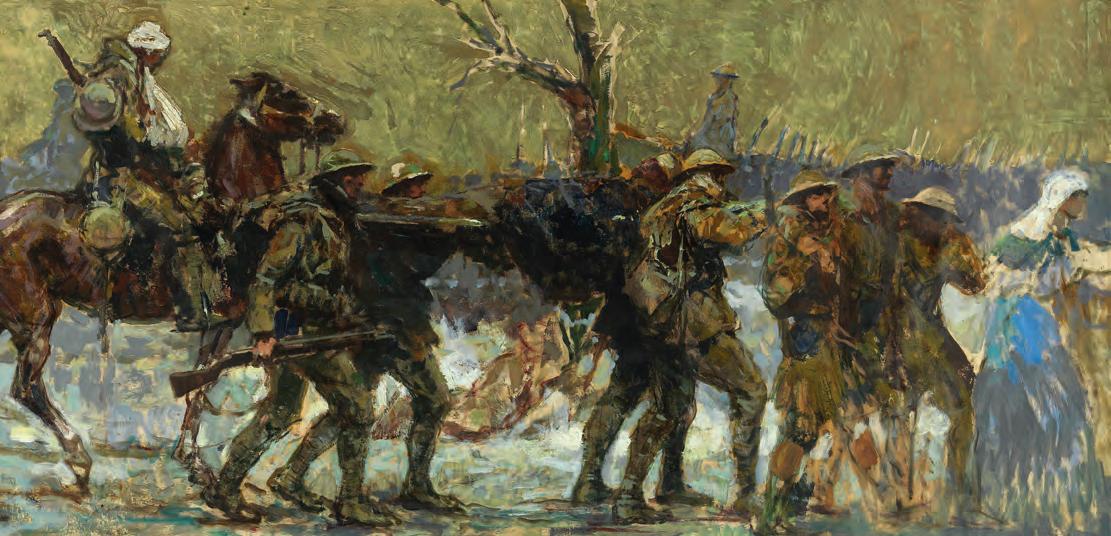
enough, apparently, as some troops were told that the loss of a horse was of greater tactical concern than that of a soldier.
Nevertheless, the troops loved them, and horses often boosted front-line morale. But their waste and their carcasses also contributed to poor sanitation and the spread of disease.
The animals suffered terribly. They were mutilated by artillery fire, plagued by skin disorders and blinded and burned by poison gas. Procuring fodder was a major challenge and Germany, enduring blockade shortages, lost many horses to starvation. Even the U.S. Army was in dire need of horses just months after joining the fight.
The losses were staggering. Some 7,000 horses were killed on a single day by long-range shelling during the Battle of Verdun in 1916.
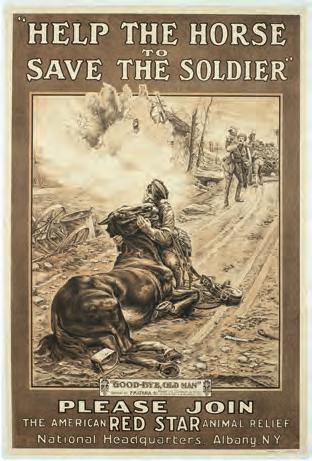
By war’s end, 2.5 million had been treated by war veterinarians and eight million had d ied, three-quarters of them from extreme conditions. The heavy-hauling Clydesdales suffered the most. It took six
to 12 just to pull a single field gun through the notorious mud.
On June 8, 2018, the War Horse Memorial was unveiled in Ascot, England. It’s the first national memorial dedicated to the millions of United Kingdom, Commonwealth and Allied horses, mules and donkeys lost in the Great War.
“It pays tribute to the nobility, courage, unyielding loyalty and immeasurable contribution these animals played in giving us the freedom of democracy we all enjoy today, and signifies the last time the horse would be used on a mass scale in modern warfare,” says the memorial website.
The Beaverbrook Collection of War Art at the Canadian War Museum is replete with depictions of horses at war. Here, some of the finest examples from the First World War. L
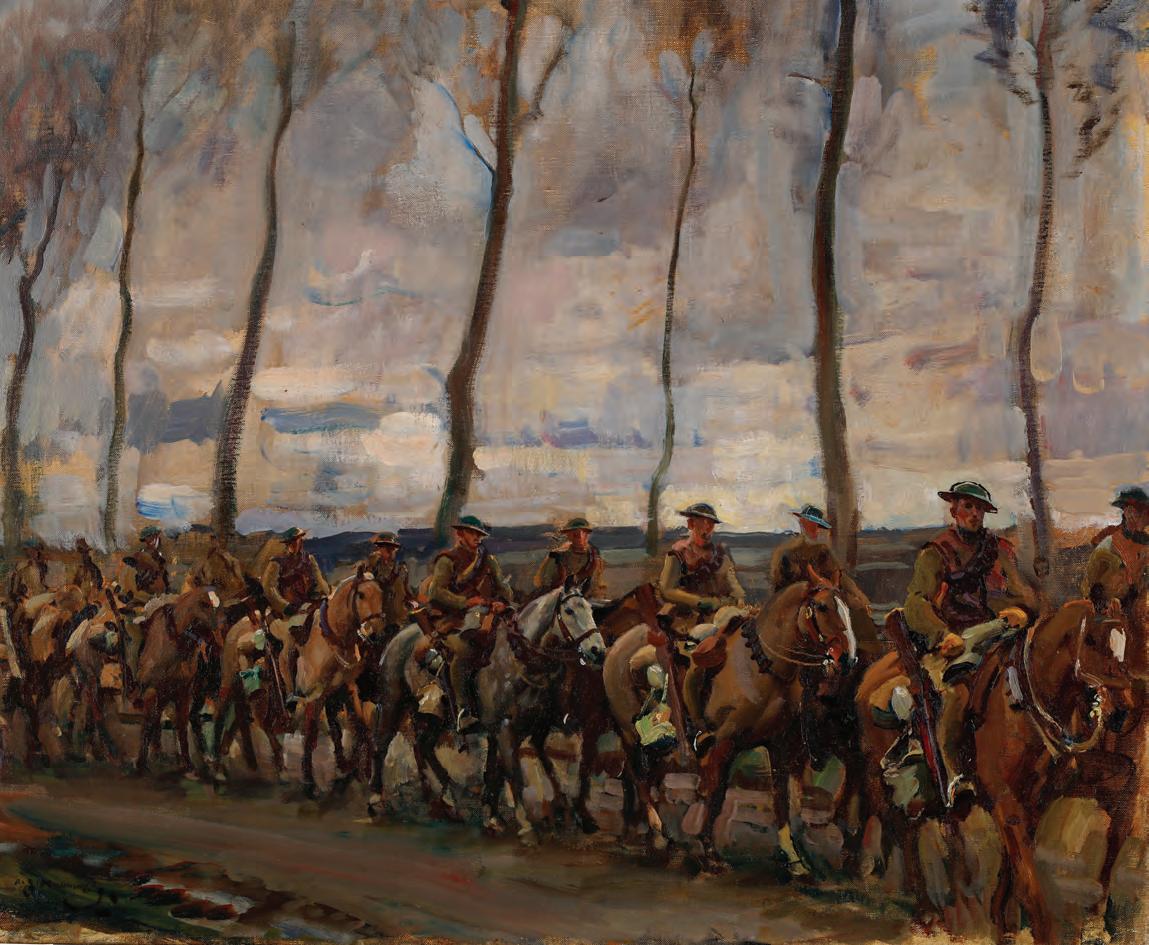
“Fort Garrys on the March” depicts The Fort Garry Horse on a road somewhere on the Western Front. The army reserve unit arrived in France in February 1916. It fought in France and Flanders as part of the Canadian Cavalry Brigade until the war’s end. The regiment’s Lieutenant Henry M. (Harcus) Strachan was awarded the Victoria Cross for his actions at the Battle of Cambrai on Nov. 20, 1917. A Scottish-born homesteader from near Wainwright, Alta., Strachan was 33 years old when he assumed command of ‘B’ Squadron after his commanding officer was killed by machine-gun fire. With Strachan leading the way and unaware that large-scale cavalry action had been abandoned, the squadron cut its way through a line of infantry on a heavily
camouflaged road at the Germanheld village of Masnières, France, only to be confronted by a four-gunned German field battery. They charged and rode down or sabred the gunners. More German infantry fired on them and again Strachan led a charge. They broke through, taking fire and suffering casualties as they rode. With fewer than 50 men and only five unwounded horses, they sheltered in a sunken road outside the town. Strachan realized there was to be no support, so he had the horses cut loose and he led the unit in a fighting withdrawal, scattering four groups of German troops as they went. He brought all his unwounded men in, along with 15 prisoners. King George V awarded the newly minted Captain Strachan the VC on Jan. 6, 1918.
“A Mobile Veterinary Unit in France” shows the Canadian Army Veterinary Corps near the front. Formed in 1910 with seven sections from Calgary to Halifax, 73 veterinary officers and 780 enlisted of the corps treated more than 24,000 horses overseas. One of its veterinarians, Captain Harry Colebourn, born in London and immigrated to Winnipeg, is best known for donating a bear cub to the London Zoo. He named it “Winnie” for his adopted home after buying it in White River, Ont., on his way to the Canadian Forces base at Valcartier, Que. The bear would become the inspiration for A.A. Milne’s Winnie-the-Pooh. The regiment received its “Royal” designation eight days before the war ended. Responsible for returning 80 per cent of the animals under its care to active duty, the vet corps was ultimately disbanded in 1940 to save $10,334.
This unfinished piece depicts a Canadian trooper of Lord Strathcona’s Horse (Royal Canadians) and his trusty steed. The regiment fought as infantry and as mounted cavalry during the 1914-1918 war. By the Second World War, it had become a full-blown armoured regiment based in Edmonton. It deployed the first Canadian armoured troops to Afghanistan.
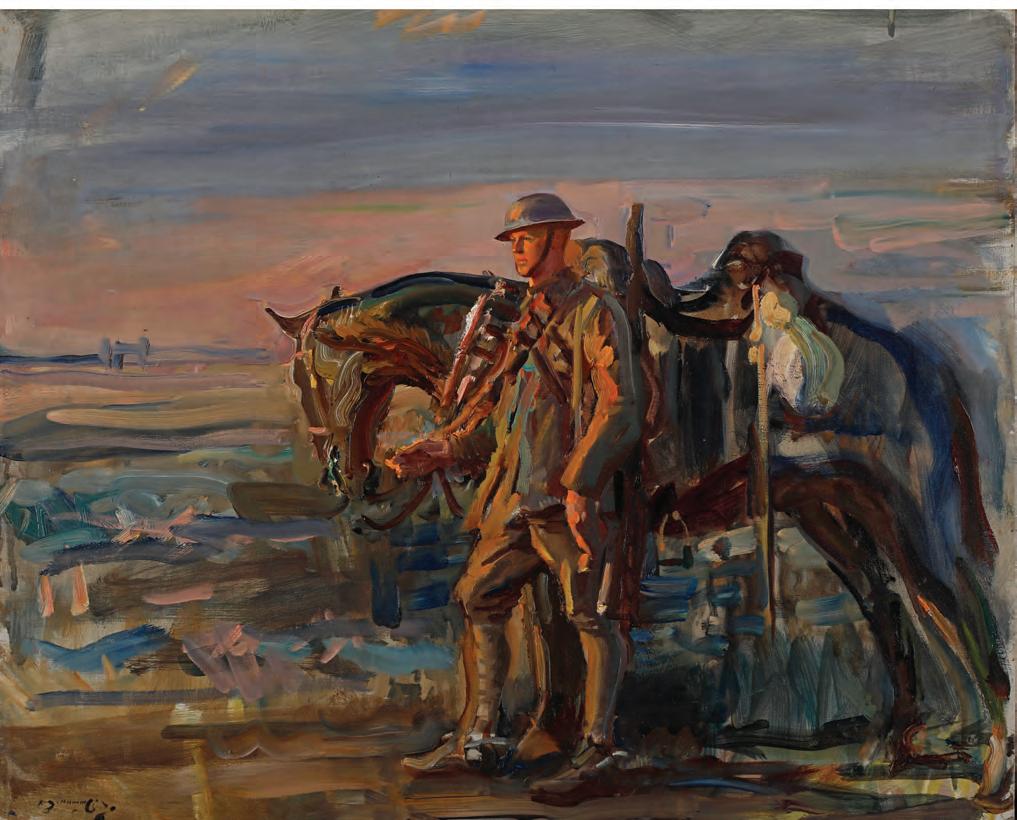
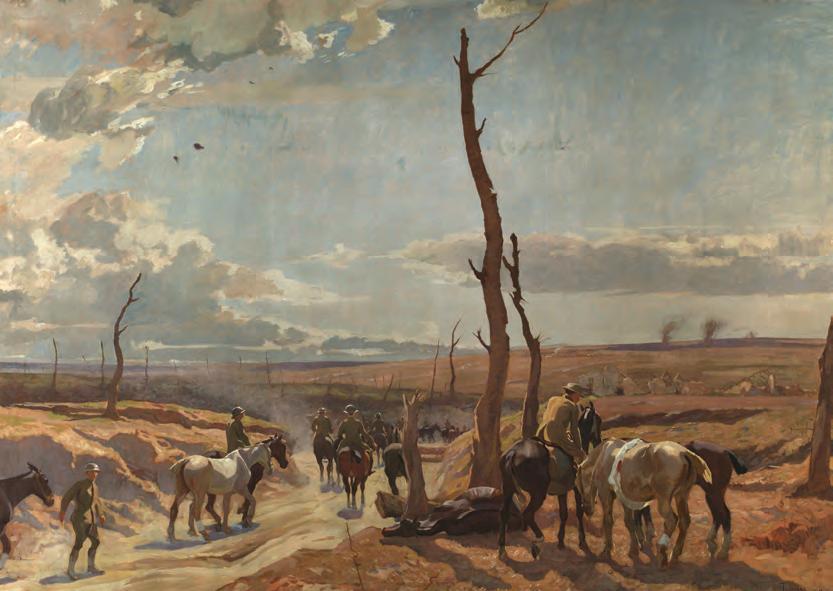
Nearly three-quarters of the Canadian cavalry involved in this attack against German machine-gun positions at Moreuil Wood in France on March 30, 1918, were killed or wounded—including Lieutenant Gordon M. Flowerdew of Lord Strathcona’s Horse (Royal Canadians), who was awarded the Victoria Cross for leading the charge. The cavalry, however, remained behind the lines for much of the war, unable to break the trench deadlock and of little use at the front. During the German offensives of March and April 1918, however, the cavalry played an essential role in the open warfare that temporarily confronted retreating British forces.
“The Sulphur Dip for Mange” depicts veterinarians of the Canadian Army Veterinary Corps treating horses for mange, a skin disease caused by parasitic mites. The veterinary corps set sail for England with Canada’s first contingent in October 1914. Most of English artist Algernon Talmage’s paintings were based on time spent near Quéant, on the Hindenburg Line in France, in 1918.
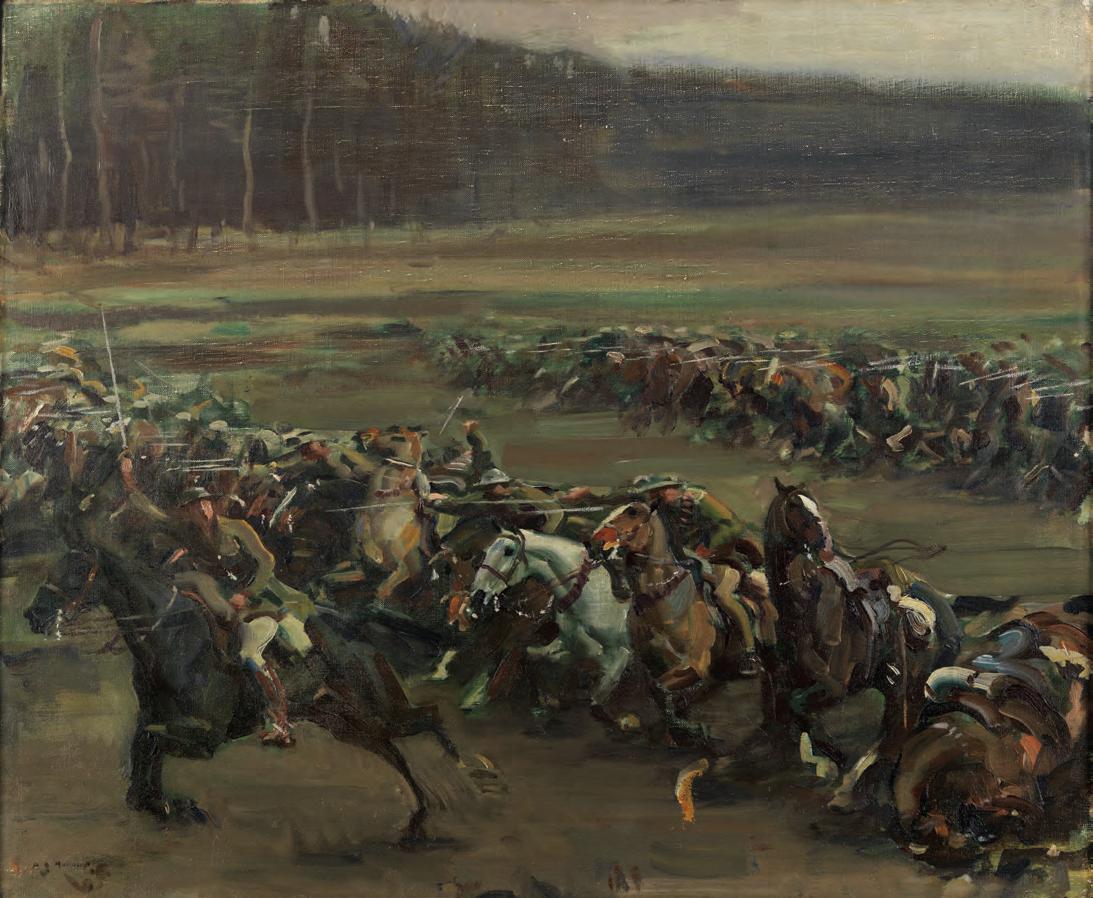
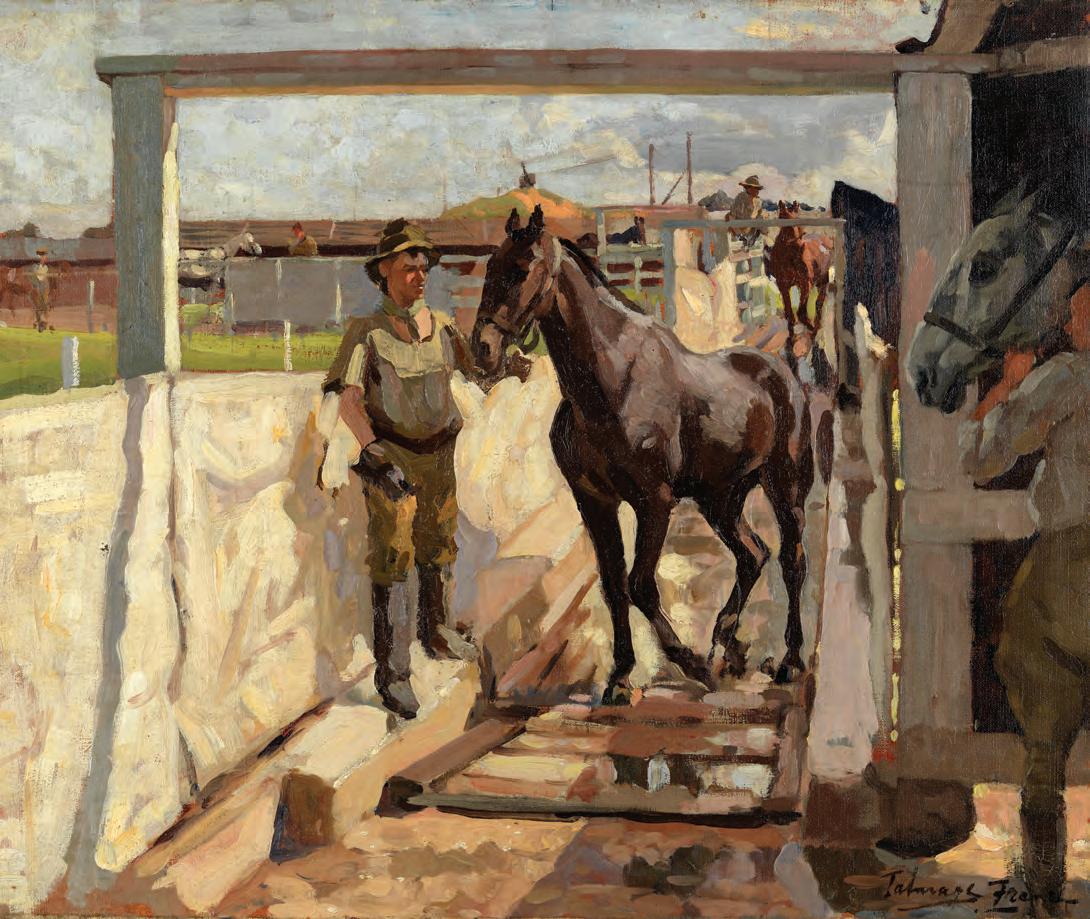
The Canadian Forestry Corps was created on Nov. 14, 1916—its circular badge topped by a beaver superimposed on a pair of crossed axes, with “Canadian Forestry Corps” around the edge. At the centre of the circle is a maple leaf with the Imperial State Crown. Nicknamed the “Sawdust Fusiliers,” they were responsible for harvesting the huge amounts of wood needed on the Western Front—for duckboards, shoring timbers, crates. The British government concluded that there was nobody more experienced or qualified in the British Empire to harvest timber than the Canadians. They harvested trees in England, Scotland and France. Horses were integral to their work, and the corps invited Munnings to tour their camps, where he produced drawings, watercolours and paintings.
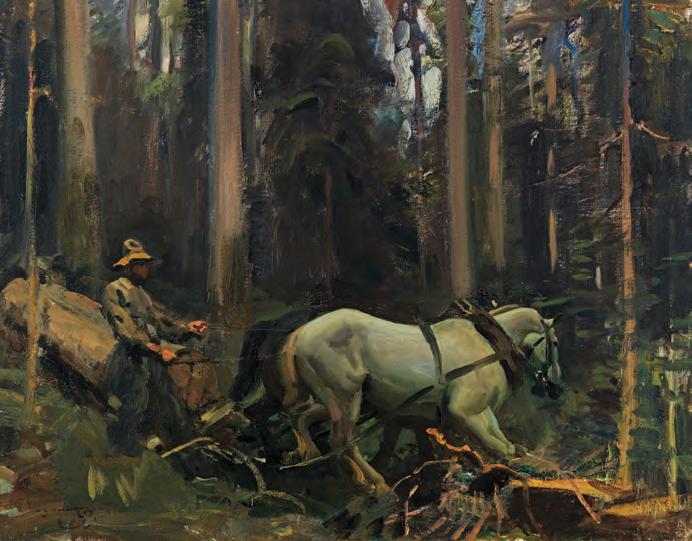
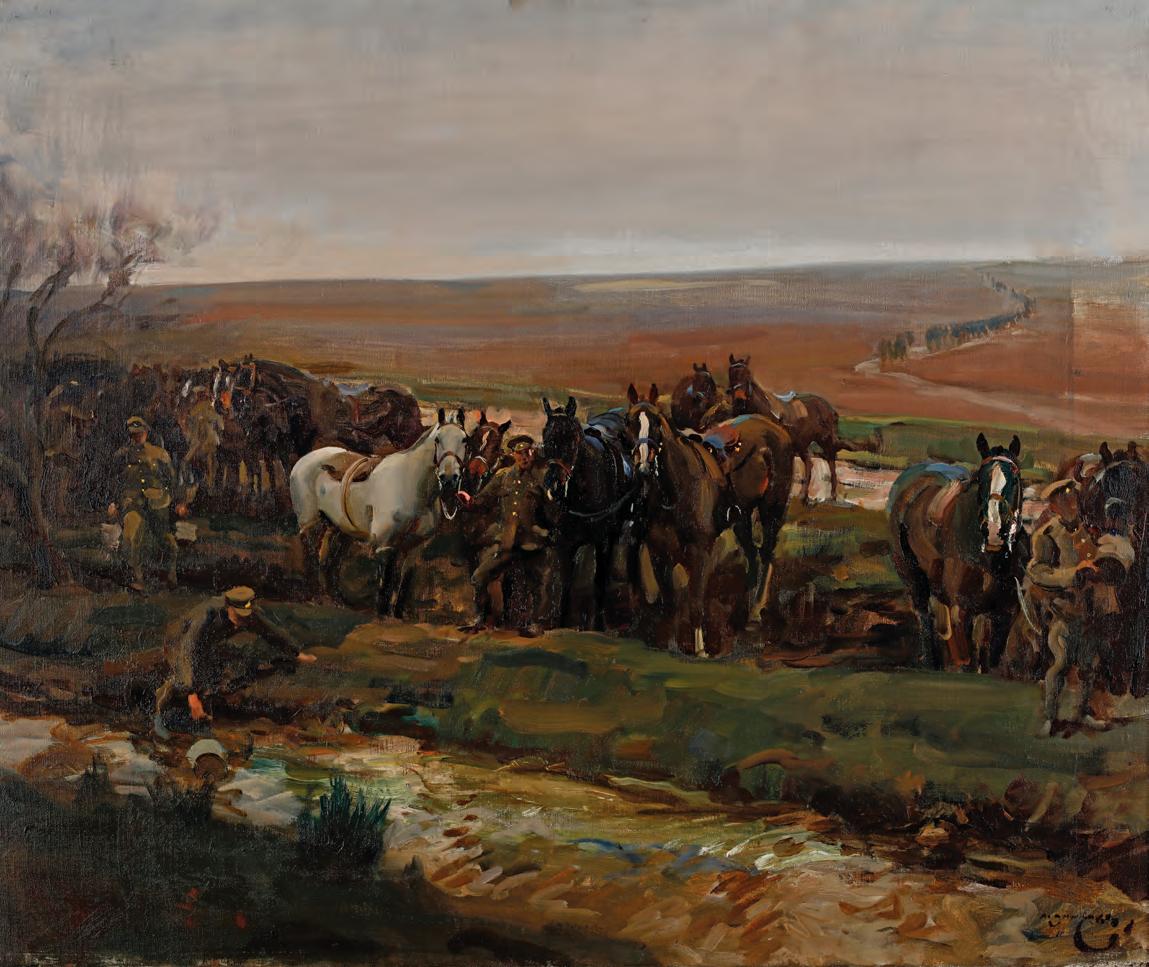
Titled “Horses and Chargers of Various Units,” this painting depicts horses apparently taking a water break. A soldier on the left is filling a bucket from a stream. More troopers approach carrying buckets while others keep the horses in check. Bastien and Munnings’ classical style was well suited to First World War art and tended to convey mood more than the illustrators’ medium.
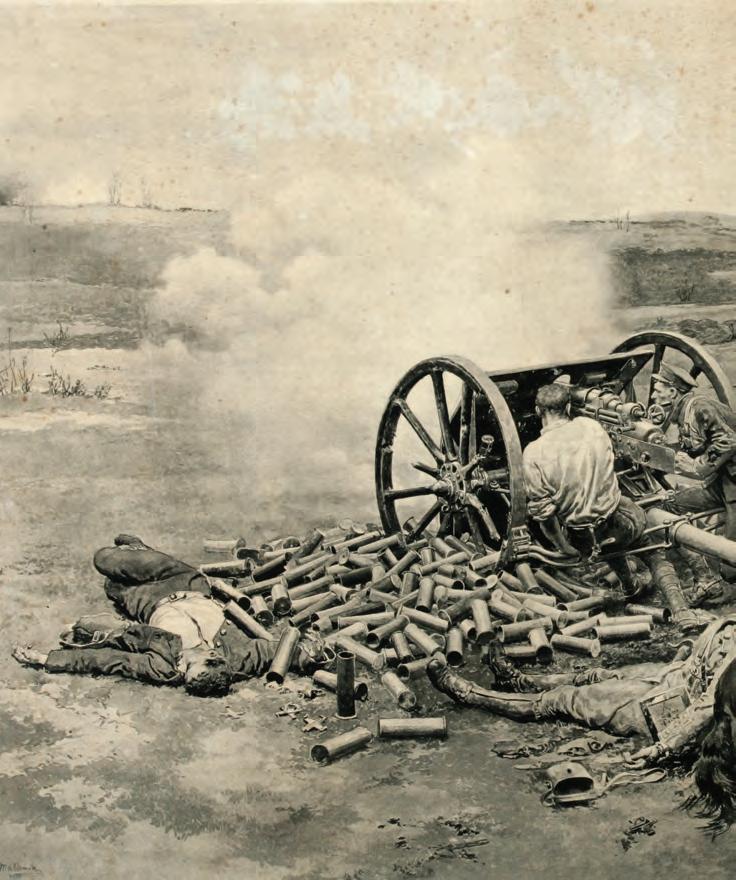
Ready to attack, Canadian cavalry assemble in a wooded area. In November 1916, Canadian-born Max Aitken, Lord Beaverbrook, founded the Canadian War Memorials Fund and eventually commissioned Alfred Theodore Joseph Bastien and 115 other artists to paint some 900 scenes of Canada at war. The collection was supplemented with war art from the Second World War and the postwar period, right up to Canada’s war in Afghanistan. The Beaverbrook Foundation chose the Canadian War Museum to be stewards of this extraordinary war art collection and continues to be one of the museum’s most generous donors.
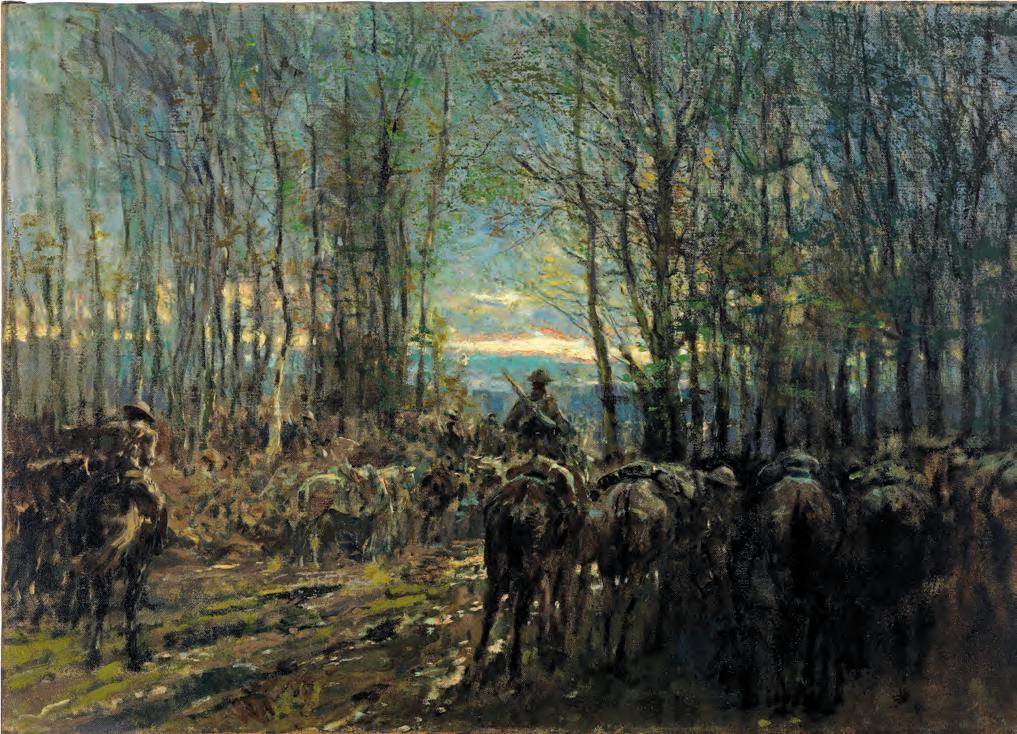
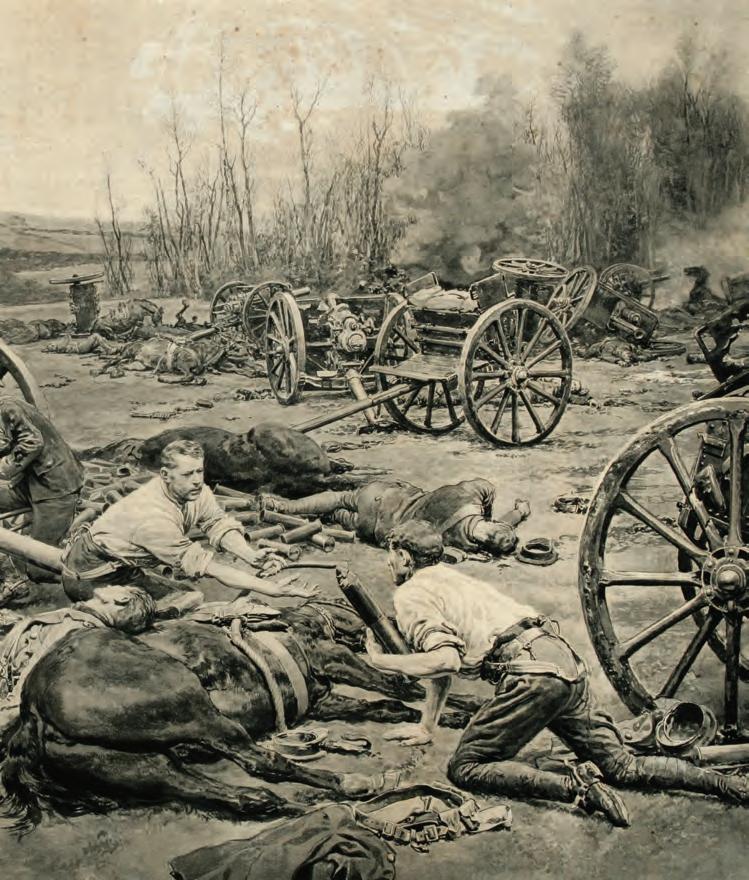
On Sept. 1, 1914, during the withdrawal of British and French forces following the Battle of Mons in Belgium, a German cavalry division attacked a British cavalry brigade about half its size at the French village of Néry. Within minutes, the British guns were all but wiped out. But a single 13-pounder of ‘L’ Battery, Royal Horse Artillery, kept up a steady fire for two-and-ahalf hours against a full battery of German guns. British reinforcements finally arrived, counterattacked and forced a German retreat. Three gunners—Captain Edward Bradbury, Battery Sergeant-Major George Dorrell and Sergeant David Nelson—were awarded the Victoria Cross. Mons remained in German hands until it was liberated by Canadian troops on the last morning of the war, Nov. 11, 1918.

“Y
our leadership on defence spending has really helped to make a difference,” NATO Secretary-General Jens Stoltenberg told Donald Trump in May 2018, a little more than a year into his fi rst term as U.S. president.
During the visit to the White House, Stoltenberg praised Trump for pushing member countries to spend more on their militaries. “All allies are increasing their defence budgets,” he noted.
“Do you give me credit for that?” asked Trump.
“You have helped to do that,” responded Stoltenberg.
Indeed, more than helped.
Prior to the president’s bombastic 2017 threat to pull the U.S. out of NATO, the organization’s influence had become a shadow of its former Cold War self, manifest by the dwindling defence spending of its members. While each had agreed in 2006 to a guideline of setting aside two per cent of gross domestic product (GDP) on their militaries, by 2014 just three countries were doing so.
Following a rebuke by Trump of his allies’ financial contributions in July 2018, they agreed to spend more, and he said that the U.S. withdrawal from NATO would be “unnecessary.” By 2023, 11 of 30 members were meeting the two per cent goal.
While previous U.S. presidents had made the same request, only Trump’s threat that Americans would no longer tolerate failure to c ontribute adequately to a c ommon defence got action. By t he time he left office in 2021, NATO members were spending $130 billion more on their militaries than when he was elected.
“ALMOST 80 PER CENT OF THE NEW SPENDING BY THOSE COUNTRIES IS DUE TO COMMITMENTS MADE DURING TRUMP’S PRESIDENCY.”
“NATO data shows that nonU.S. members are projected to spend $510 billion more than they did in 2016 (excluding Finland and Sweden, which were not members in 2016),” wrote Marc A. Thiessen in The Washington Post in July 2024.
“That means almost 80 per cent of the new spending by those countries is due to commitments made during Trump’s presidency,” he added. “The defense investment success…is primarily a Trump achievement.”
Still, Trump’s not done. While campaigning in February 2024,
he said that he would encourage Russia to do “whatever the hell they want” to NATO members not meeting their spending obligation.
Said Trump: “NATO was busted until I came along.”
Now, some may argue the Russian invasion of Ukraine in February 2022 kick-started NATO’s revival. And while it did motivate Finland and Sweden to join the alliance, its members had begun dramatically increasing their defence spending in 2017— in c onjunction with Trump’s first presidency and his demands for the hikes. And well before Russia started showing indications of its “special military operation.”
One would be hard-pressed to even connect the boosts to Russia’s 2014 annexation of Crimea; the following year marked an all-time spending low by non-U.S. NATO members.
“President-elect Trump demonstrated strong U.S. leadership throughout his first term in office,” wrote NATO’s Stoltenberg this past fall, “a term that turned the tide on European defence spending…and strengthened Alliance capabilities.
“He will be welcomed,” he continued, “by a stronger, larger, and more united Alliance.”
Indeed, thanks to Trump him self. L
> To voice your opinion on this question, go to www.legionmagazine.com/FaceToFace

One must remember why the North Atlantic Treaty Organization was created in 1949. Joseph Stalin’s Soviet Union had occupied eastern Europe and the Baltic states by the end of the Second World War and had installed Communist governments in almost all of them. Czechoslovakia was free for a time but a de facto putsch in 1948 forced it under Soviet control, too. Democratic countries of the world were fearful that Moscow still wasn’t satisfied and, led by the U.S., Britain, Canada and the Benelux nations (Belgium, the Netherlands and Luxembourg), called for an alliance to stand against the Soviet moves. The North Atlantic Treaty, signed on April 4, 1949, was the result. The USSR was responsible for the creation of NATO. And Moscow, now under Vladimir Putin, is responsible for saving NATO in modern times, not Donald Trump. Russia seized Crimea from Ukraine in 2014 and sponsored separatist movements that seized effective control of much of the country’s eastern provinces beginning that same year. This alarmed NATO members, as did Putin’s increasingly belligerent geopolitical statements.
Elected U.S. president in November 2016, Donald Trump
AARON KYLIE is the editor of Legion Magazine and the former associate publisher and editor-in-chief of Canadian Geographic. He is also the author of the Biggest and Best of Canada: 1000 Facts and Figures
J.L. Granatstein says
wasn’t especially troubled by Putin’s behaviour, however, and even publicly, and repeatedly, expressed his admiration for the Russian president’s strong leadership. So, too, did many other Republican party members. Trump also had a fraught relationship with the government in Kyiv and, while the U.S. sent some military aid during his tenure, America did relatively little to assist the Ukrainians.
NATO WAS INDEED MUCH STRONG THAN IT HAD EVER BEEN. THE REASON? NOT DONALD TRUMP, BUT VLADIMIR PUTIN
Indeed, as a proponent of the “America First” nationalist policy, Trump spent much time calling NATO “obsolete” and chiding its members for not spending enough on defence, calling them freeloaders who were piggybacking on U.S. military spending.
“You didn’t pay,” he stated. “In fact, I would encourage [the Russians] to do whatever the hell they want.” For the most part (with Canada a notable exception),
J.L. GRANATSTEIN has written dozens of books, including Who Killed Canadian History? and Canada’s Army: Waging War and Keeping the Peace. He is the former director and CEO of the Canadian War Musuem.
frightened NATO members slowly began to reach, or in some cases even exceed, NATO’s two per cent of GDP defence-spending goal.
Trump was defeated in 2020, the rival Democratic party taking power under Joe Biden. His administration offered more aid to Ukraine, but worried about provoking Moscow into nuclear attacks or even a world war.
Putin soon upped the pressure on Ukraine, launching a full-scale invasion in February 2022 that Ukrainians gamely resisted, with the Russian military revealed as something of a hollow shell.
Nonetheless, the invasion terrified Europe, and historically neutral Finland and Sweden joined NATO; at the same time, most members continued to increase their defence spending. The result? NATO was indeed much stronger than it had ever been as both a military alliance and as a political grouping of democracies. The reason, however? Not Donald Trump, but Vladimir Putin.
Trump is now back in the White House, his views much the same, if not hardened since his first term. His respect for Putin remains, and he claims he can end the war in Ukraine.
The real question now is this: Can NATO survive Trump? L
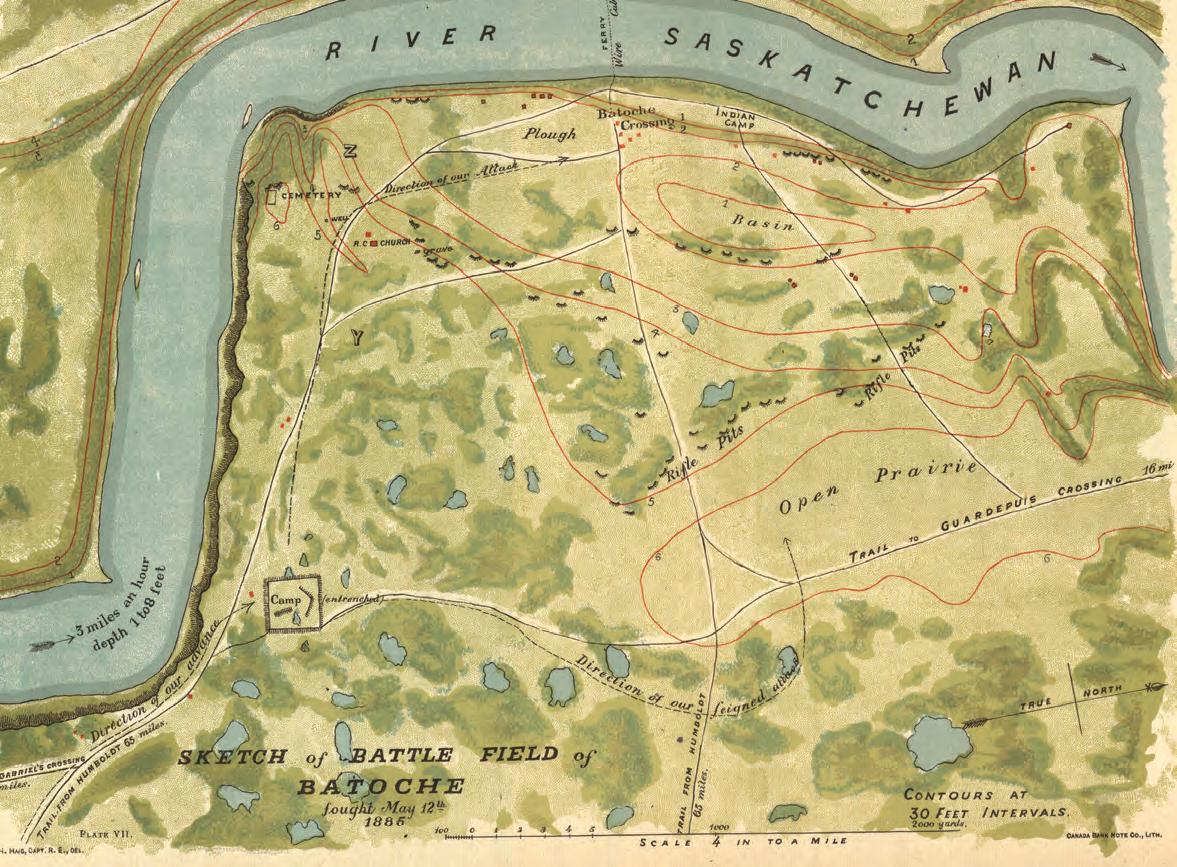
A VISIT TO THE SITE OF ONE OF THE KEY BATTLEGROUNDS OF THE 1885 RESISTANCE OFFERS A NEW PERSPECTIVE ON THE FIGHT FOR THE CANADIAN WEST
BY RUSSELL HILLIER
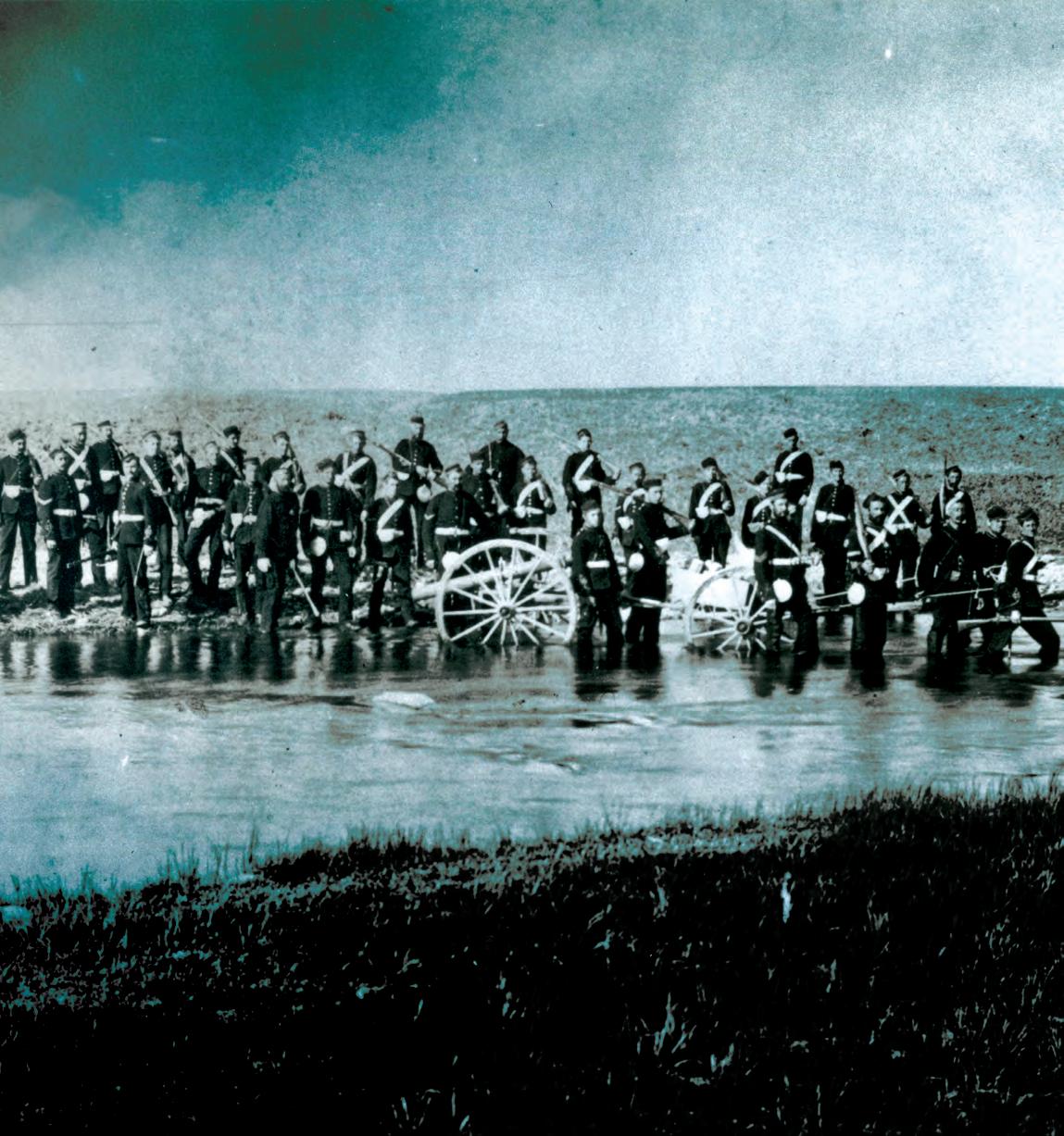



Men of the Halifax Provisional Battalion cross a stream near present-day Swift Current, Sask., in 1885. The Canadian soldiers’ camp after the 1885 Battle of Fish Creek. Louis Riel and Gabriel Dumont led the Métis resistance.
AA lone coyote caught my eye as I left Calgary. It was panting in the scorching heat and wearing a sly smile as if in on a secret joke. Perhaps it found my journey amusing. Most did find it odd.
About 650 kilometres east in the middle-of-nowhere Saskatchewan is a relatively little known, and even less travelled, battlefield called Fish Creek. It was a key engagement in the 1885 NorthWest Resistance. It’s where Canada’s hastily assembled army under General Frederick Dobson Middleton was bloodied at the hands of Métis forces led by Louis Riel and Gabriel Dumont. I had been teaching about the conflict for years and I felt compelled to go beyond the textbooks and see the site with my own eyes. In truth, I had no idea what to expect.
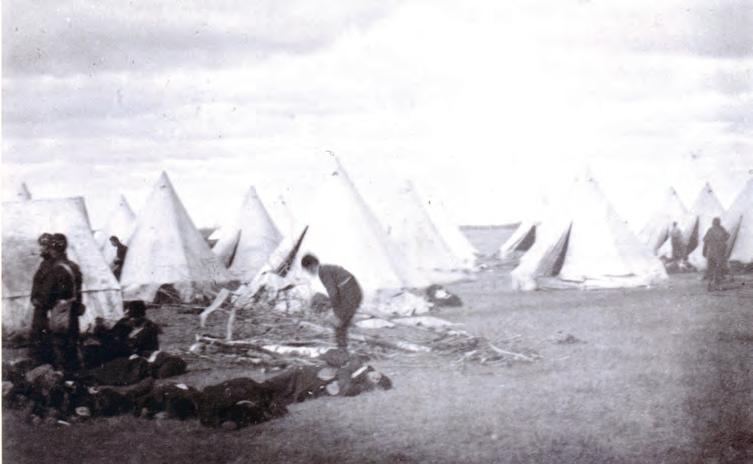
It took Middleton and his Canadian contingent of militia and volunteer soldiers about a month to mobilize and reach the field of battle by April 24. Fortunately, Google Maps said my own journey would be considerably less strenuous: about six-and-a-half hours’ driving time. With the coyote in the rear-view mirror, I commenced to follow the blue line of direction on the cracked screen of my phone.
A coffee would be nice, but I passed the chance in Calgary, telling myself there would be a Tim Hortons somewhere ahead. And as my eastbound odyssey got under way, the scale of geography took hold. The distance, so small on the map, felt much longer on the road—miles clicking through a dry, indistinguishable flatness with the odd driveway into a field with no home. A fence line here. A pronghorn there. Definitely no Tim Hortons anywhere.
relate. There was, to my eyes, both a nothingness and a sameness to this big place and in the passing frieze of generic grasslands and crops that inevitably started to play tricks on your mind. I wondered if perhaps I had crashed in the ditch some miles back and was stuck on some purgatory road without end.
I wondered, too, of the First Peoples, fur traders, and NorthWest Mounted Police (NWMP) deserters riding through this land. How lonely it must have been. How dead one would have been if one’s horse stepped in a gopher hole. It looked to be a thirsty land and not one that you can easily walk out of.
At some point, I crossed the fourth meridian and pulled over. Now in Saskatchewan, I looked back from whence I had come.
A flatter plain you’ve never seen, the horizon far off and dissolving into a thin blue seam of haze.

Lieutenant Richard Cassels of the NorthWest Field Force described the landscape fittingly in his diary, writing about the prairie and the “peculiar” effect of the “dreary yellow flatness.”
I rolled on, past small towns and farmland before the city of Saskatoon came into view. I had heard it was nice here, but the sun was setting, and I wanted to get some sleep in order to optimize my battlefield tour the next day. Seven hours after seeing that smirking coyote, I checked into a hotel for the night in Warman, Sask.
At breakfast, there was a collection of travellers sitting over plates of rubbery scrambled eggs and sausages. A man at the coffee station told me he was from Florida heading north in search of lake trout and walleye. I wished him


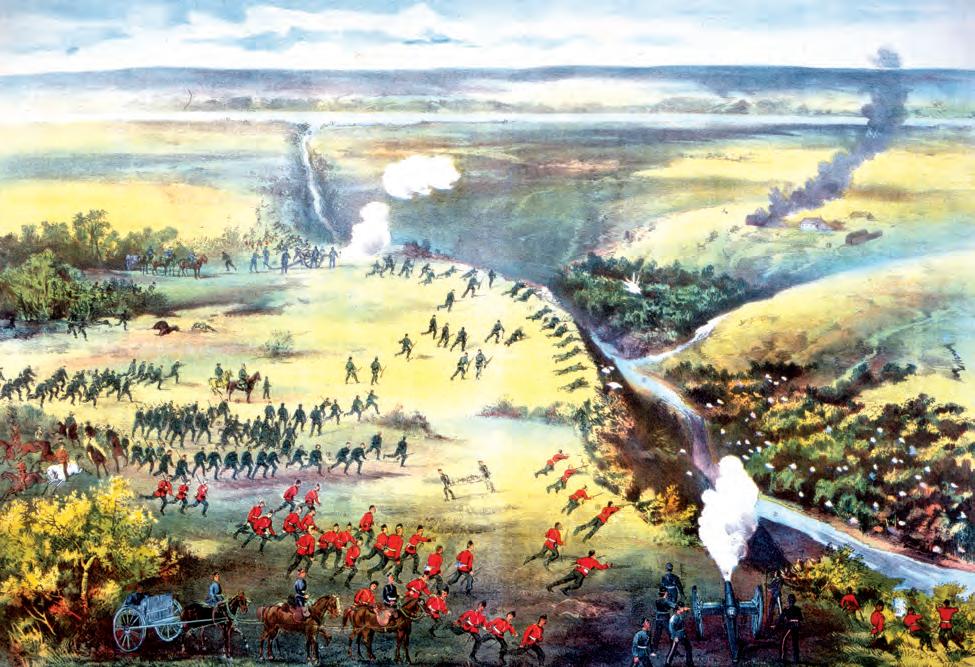
luck and got back to consulting Google Maps for the most efficient route to the Fish Creek battlefield.
I began by heading north on Highway 11, also known as Louis Riel Trail, then impulsively turned right onto yet another straight-line gravel road. An inland ferry got me across to the eastern bank of the South Saskatchewan River. It’s not the most direct path, but to follow in Middleton’s and Dumont’s footsteps, it’s the way.
After all, Middleton used the South Saskatchewan to shuttle troops and supplies for his column’s march to Batoche, where the Métis had returned after a short battle with the NWMP at Duck Lake on March 26. Of course, at the time, the exact whereabouts of the Métis force was unknown to him, so the Canadian command moved divided up both banks of the river. They would have passed near where I crossed, and I imagined Dumont’s scouts hidden in the nearby timber and grasses.
The South Saskatchewan is a decent-sized river, about the same width as the Bow in Calgary and
the ferry man who had waved me down to the loading dock told me the water is little more than 1.2-metres deep in most places. I was the only passenger, and he asked about my Alberta plates. I detected no interest when I told him why I was visiting.
My crossing took less than five minutes, but I could see how making the passage in 1885 in flatbottomed boats wouldn’t have been easy. Once the shooting started at Fish Creek, it took Middleton hours to ferry over the reinforcements he desperately needed.
I continued on, up a verdant embankment and back onto the prairie. There was a final “National Historic Site” sign pointing north and I followed the road for some time. There are no houses here today and I didn’t see another car, the remoteness of the place seemingly not far removed from 1885. I arrived at an empty parking space of mowed grass in a field. Like Middleton’s frostbitten and weary men, I would like to think that in some small way I shared in the hardships of reaching this
place, having driven seven hours on a lonesome road with no coffee.
The first thing I noticed at Fish Creek, or Tourond’s Coulee, as it’s also often called, is the scale of the battlefield. Textbooks note that Dumont, commander of the Métis force, positioned his troops in the ravine and I had envisioned a small gully where you could perhaps throw a stone over to the other side. In reality, the coulee is huge, with heaving terrain anomalous to the flat fields I had driven through earlier. From one edge to the other is far greater than the range of an accurate rifle shot, especially by 1885 standards. You get a sense of this by looking at the opposing crest, where deer and life-sized metal cut-outs of advancing Canadian infantrymen appear small, even with the help of binoculars.
In a land void of many features, the coulee was an obvious location for Dumont to ambush the Canadians. As I stood at the spot of the Métis firing line, I could see that to counterattack the


position, the Canadian infantry had to cross prairie with no cover. In 1885, Métis riflemen were in foxholes and trenches concealed with thick timber and scrub. Once the Canadians crested the lip of the coulee, they would have had to stumble down often steep and exposed embankments before reaching the creek bottom. You can’t see the South Saskatchewan River from the battlefield, but it’s not far off and the tributary that gives name to this place twists wide and deep through the valley.
In many places, sharp bends in the creek forced the Canadians to plunge through the waterway multiple times, all the while being sniped at by their hidden combatants. Maintaining much effective cohesion in such circumstances would have been difficult.
It has been reported that Dumont wanted to entice the bulk of the Canadian force into the bottom of the coulee where they would have been sitting ducks.
Lithographic artist Fred Curzon depicts the 1885 Battle of Fish Creek (opposite). The Canadian army served under General Frederick Dobson Middleton. The Canadian camp near Batoche.
With the aid of concealed riders on the flank, Dumont said he would “ride them down like buffalo,” once the enemy broke and ran.
The problem for Dumont was that Middleton wasn’t such a bad general either. He was your blue chip, slow-and-steady stock that paid dividends if you gave him enough time. The old war horse was getting on in years by 1885, but the 60-year-old came to the campaign having previously quashed colonial rebellions in New Zealand and India. For his part in the latter, Middleton had been recommended for the Victoria Cross.

At Fish Creek, he moved methodically and conservatively, sending scouts forward to flush
Rather than the fight Dumont had envisioned, the battle on the ground where I stood devolved into a day-long sparring match, the Canadians probing Métis lines looking for gaps and weaknesses along the heights. I don’t think, however, that the topography here was ever going to allow for a breakthrough against the Métis in 1885, a determined force with their backs against the wall.
The individual Canadian soldiers knew this, if Middleton didn’t. They balked at orders to launch full-scale assaults into the coulee and the old general was reportedly furious, referring to his own men as cowards for their reluctance to advance.
Had Middleton been able to concentrate his entire force on the Métis side of the South Saskatchewan River, the outcome may well have been different. Yet throughout the battle, Canadian soldiers from the opposite shore arrived piecemeal on small boats and were fed directly into the line of fire or sent on flanking missions.
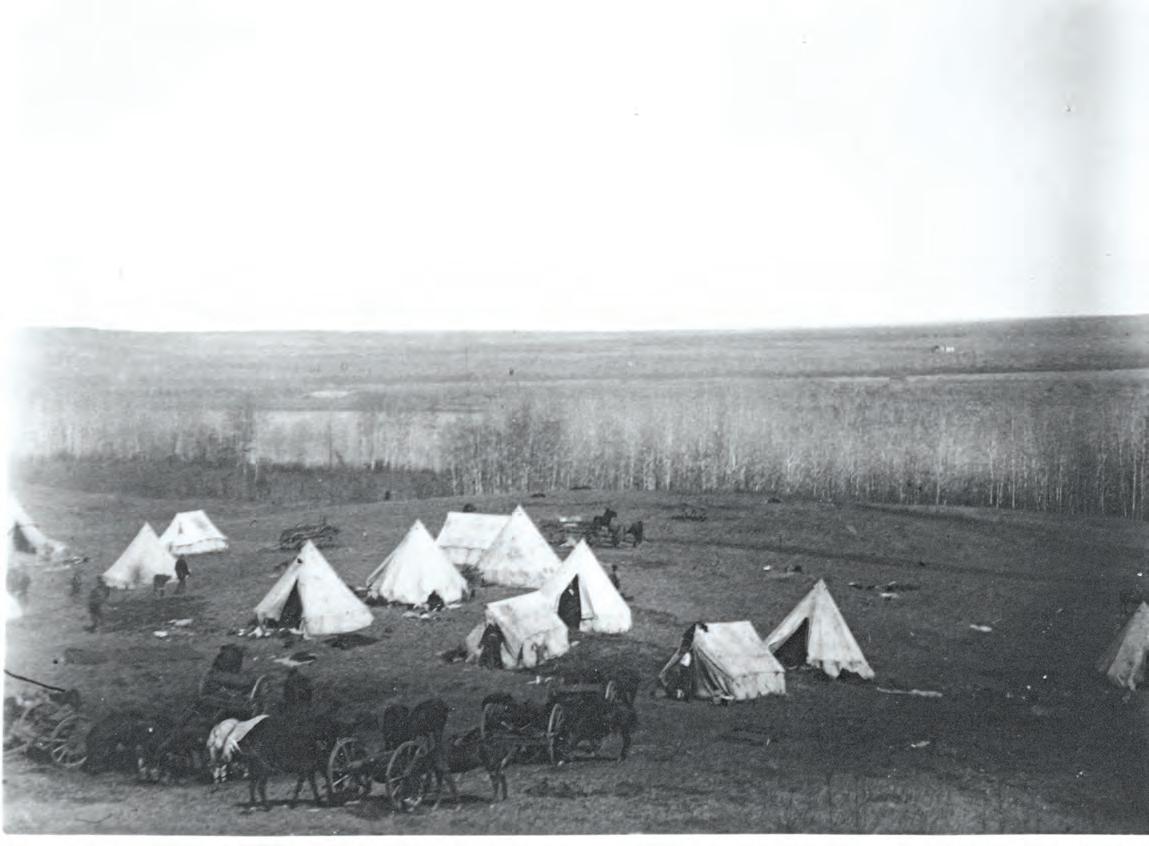
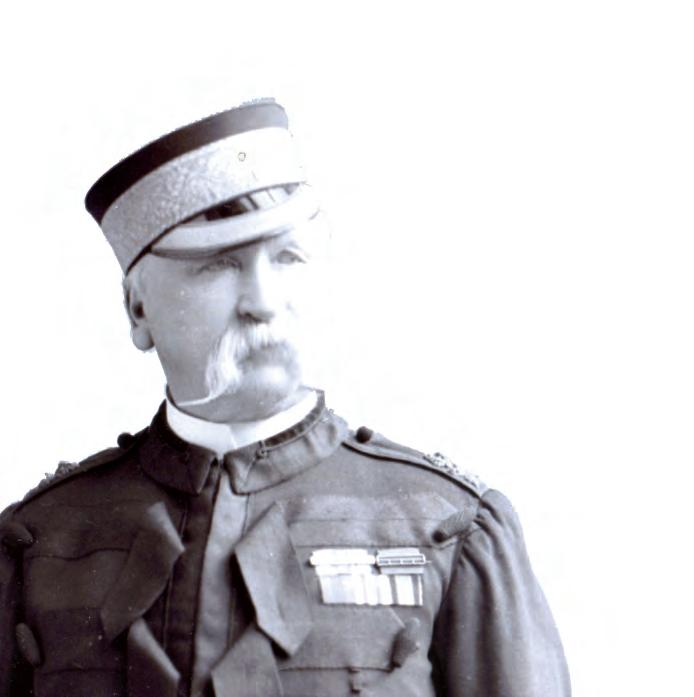
Dumont had planned. Middleton didn’t walk into the battle with a clear picture of what he was up against, but he wasn’t stumbling
But, as I walked the lines, it was evident the latter manoeuvres were doomed to fail, too. If anything, the coulee becomes more dramatic as it gets closer to the South Saskatchewan and in the other directions is flat ground with no cover. Plus, the Métis were a mounted force and, though outnumbered, they could move swiftly to any part
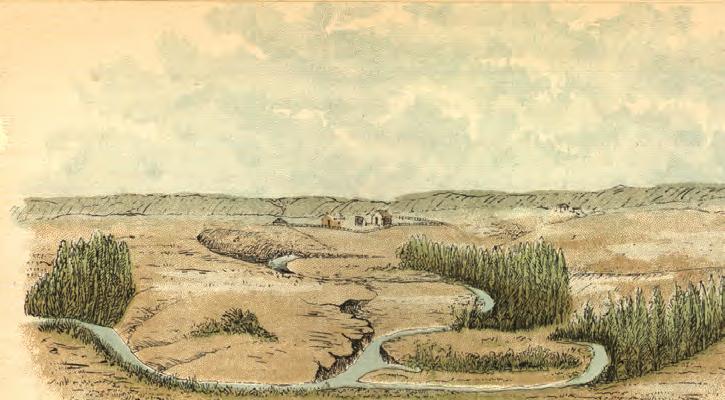

A Canadian gun emplacement at Fish Creek. An artist depicts the Battle of Batoche, where the Métis made their last stand in early May after retreating from Fish Creek.
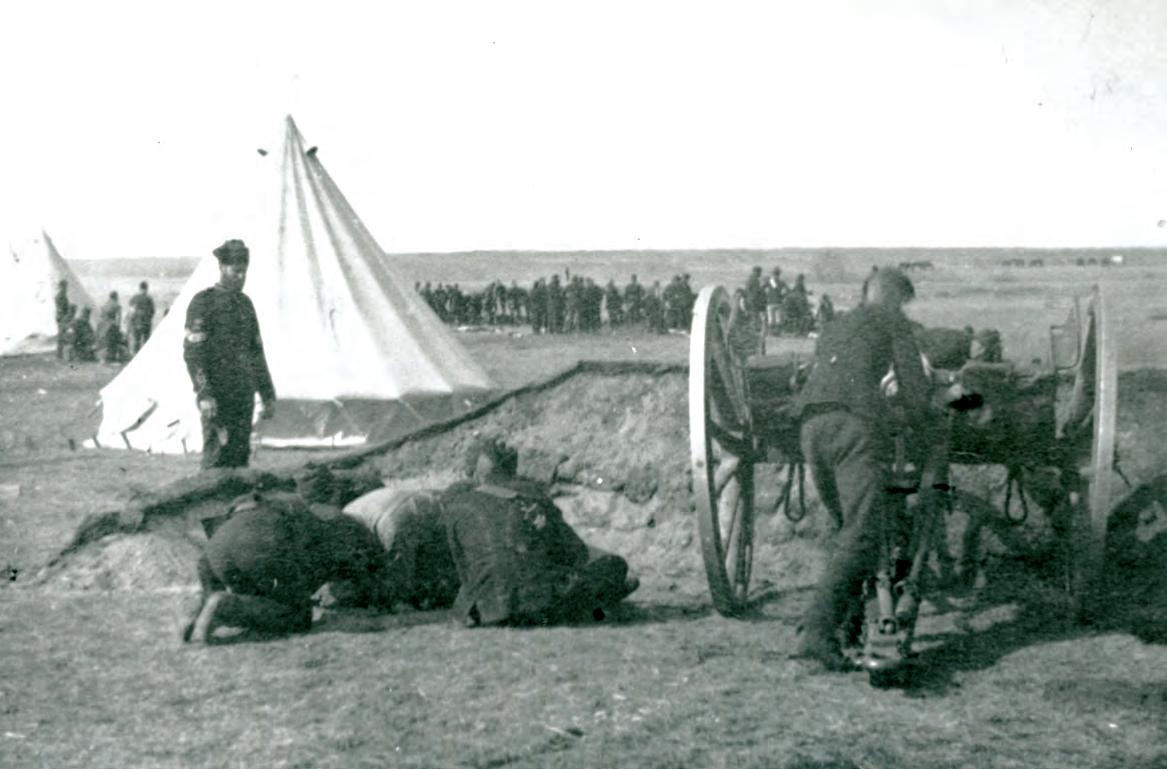
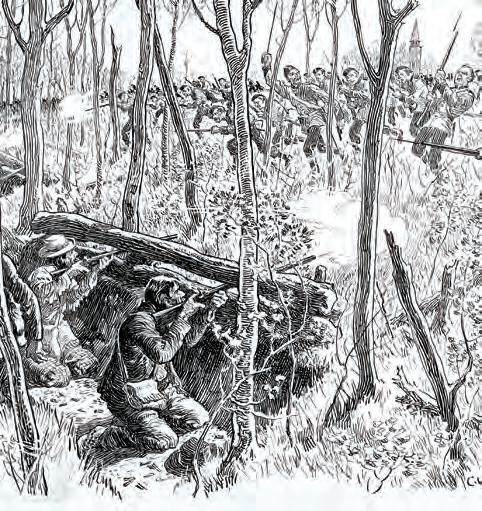
of the line that was threatened before the Canadians got there in sufficient numbers.
By late afternoon on the 24th, both sides had had enough. Middleton abandoned his advance and retreated toward the river with six dead and 49 wounded. At the same time, Dumont could assemble just 50 Métis riders. Like the green Canadian soldiers who refused to move in front of enemy rifle pits, quite a few Métis apparently figured on quitting early to fight another day.
Like the combatants that day, I had nearly had enough, too. It was hot, my water was nearly done, and the deer flies were feasting on my neck. But, there was one last thing I wanted to see. Despite
signage, I found Middleton’s camp at the end of a short drive and a 10-minute walk through tick-infested fields. In a clearing above the river is a stone cairn and smaller white headstone, commemorating gunners De Manolly, Cook and Chas Armsworth. Where the other Canadian dead lay isn’t clear. asn’t entirely surprised to see the larger monument overgrown by shrubs, but I noted at least some effort had been made to take care of the site where Middleton regrouped and drilled his neophyte charges in the battle’s aftermath.
As I took in Middleton’s campsite, I thought about what brought these men, both Canadians and Métis, to this point 140 years ago. For the latter, the answer is straightforward: They were defending their homes and families against a foreign imperial power. The men fighting were but a minority of their people, and I wondered how differently the battle would have played out if more of their brethren had joined.
But what of the Canadians?
The rank and file at Fish Creek weren’t conscripted rabble from the East. Many were middle-class, educated men, some of them
literally sneaking onto boxcars as troop trains rolled out of Toronto’s Union Station. They were cheered by crowds numbering in the thousands and greeted as heroes at every stop along the way. Was it merely a sense of adventure calling them to this place where I had stood? There’s nothing more joyous in war, as the road thereto, but I think there’s more to it.
In an era of toppling statues and navel-gazing over perceived past rights and wrongs, it’s dif ficult to relate to the patriotism of 1885. The best I can say is that men on both sides of the coulee likely believed in different visions of what Canada could be.
I had come to this battlefield hoping to find some truth about the resistance and to better know the place by visiting it. I believe I did. The remoteness, the scale, the vast prairie and the mighty river are best understood with your own eyes.
But more importantly, I’m left with questions. How many of us would fight for what we believe in today and are we worthy of the idea of Canada? I hope this country isn’t merely a place on a map, a geographical expression.
In a nearby field, I saw a coyote trotting toward a shaded tree line. I took it as a sign, swept away the ticks burrowing into my socks and made for my truck.

By Stephen J. Thorne
By Stephen J. Thorne
By Aaron Kylie

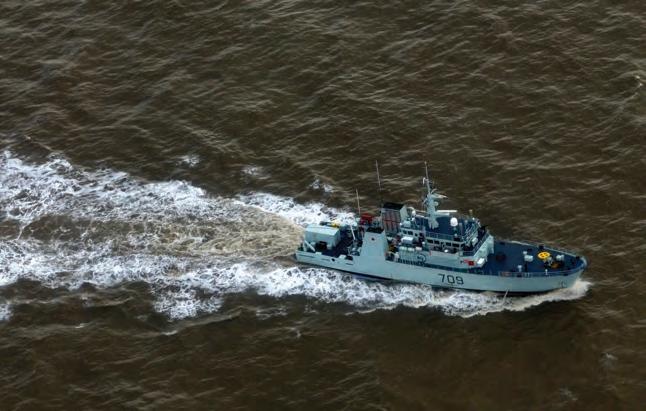
1984, Canadian soldiers visited a small, barren island in the middle of the Kennedy Channel between Greenland and Ellesmere Island.
Jurisdiction over Hans Island had been the subject of a mild dispute between Canada and Denmark since 1973, when the two countries agreed to redefine their overlapping seabed boundaries in the area, leaving ownership of the 1.2-squarekilomentre rock in limbo.
The soldiers didn’t arrive expecting a fight. Rather, they planted a Maple Leaf Flag and left a bottle of Canadian whisky— a lighthearted assertion of Canadian sovereignty over what, to most outside observers, was an inconsequential stone slab.
The Danish minister of Greenlandic affairs responded in kind, coming to the island
a few months later, hoisting a Danish flag and leaving a bottle of schnapps with a letter stating “Welcome to the Danish Island.”
Thus began what became known as the “Whisky War,” a jocular toand-fro during which the friendly NATO allies took turns raising flags and leaving behind bottles of booze associated with their homelands.
The whimsical border dispute— and 17 years of negotiations—came to an end on June 14, 2022, when Canadian, Danish and Greenlandic officials gathered in Ottawa to sign a treaty dividing the island roughly in half, thus creating a land border between Canada and Denmark.
It also ensured Inuit in both countries can move freely about the island and surrounding
ice and waters, a vital hunting ground since the 14th century.
“I think it was the friendliest of all wars,” said Foreign Affairs Minister Mélanie Joly at the time. The treaty, she added, is “a win for Canada, a win for Denmark and Greenland, and a win for Indigenous Peoples.”
But while Denmark’s parliament ratified the treaty in December 2023, Canada’s has not yet done so.
In a sweeping new Arctic foreign policy strategy announced Dec. 6, 2024, the federal government promises to tie that loose end and “finalize the implementation of the boundary agreement between Canada and the Kingdom of Denmark regarding Tartupaluk (Hans Island).”
It is among the simplest fixes the document undertakes— a stark contrast, for example, to its intention to launch boundary negotiations with the United States on the strategic and potentially resource-rich Beaufort Sea, which U.S. President Donald Trump
apparently covets (along with the rest of Canada and Greenland).
The strategy aims to address more serious issues largely brought about by Russia’s continuing invasion of Ukraine and climate change, which is expected to render the Arctic Ocean “an increasingly viable shipping route between Europe and Asia” by 2050. NonArctic states—most particularly, China—are showing increasing interest, and presence, in the Arctic.
“The North American Arctic is no longer free from tension,” says the strategy. “Canada must work even closer with its closest ally, the United States, to maintain a secure North American homeland. Canada should also be closer than ever to its Nordic allies.”
It declares effective diplomacy “critical for shaping the international environment to defend
and advance Canadian national interests; it is a first line of defence for Canada’s national security. Canada’s fundamental defence and security goal is to prevent and defuse potential crises before they can develop into conflict.”
Ottawa was to appoint an Arctic ambassador to better represent Canadian interests. It also intends to open new consulates in Alaska and Greenland, initiate an Arctic security dialogue with like-minded states, and further support science and research related to Arctic security and science.
Meanwhile, Canada, it says, is making investments to ensure that its military has the capabilities required to operate in “an evolving geopolitical context.” By 2030, it adds, Canada will have almost tripled its defence spending from 2015. L




While far from meeting its targets, the Defence Department’s 202324 year-end report, released this past December, indicated modest gains in some aspects of military’s readiness—though it also noted setbacks in other areas.
“As a result of the work done during this reporting year on the defence policy update, Our North, Strong and Free (ONSAF), the government announced significant new investments in April 2024,” wrote Defence Minister Bill Blair in the document’s introduction. “These investments will support Canadian Armed Forces (CAF) members, modernize military equipment and infrastructure, protect Canada’s sovereignty in the Arctic and North, strengthen our role within the North Atlantic Treaty Organization (NATO), and advance the Indo-Pacific Strategy.”
But the results have been slow to materialize.
Just 29 per cent of Canadian Armed Forces operations are capable of being conducted concurrently, a two per cent increase over the prior year, but far off the “at least 90 per cent” goal. That same target was set for the percentage of CAF elements ready for operations, but only 67 per cent met the criteria (a six per cent increase over 2022-23).
The report noted that key medical, communications and logistics operational elements limited the ability to conduct concurrent operations, while “equipment shortfalls, a shortage of personnel in several key trades, and the inability to sustain forces for significant lengths of time” hampered overall availability.
Meanwhile, only 45.73 per cent of key maritime assets were serviceable to meeting training and
By Aaron Kylie
readiness requirements (down from 51.2 per cent the previous year).
The goal? At least 60 per cent. Just 49 per cent of land equipment and 48.9 per cent of the aerospace fleet met the same criteria, down from 56 per cent and 43.88 per cent, despite targets of 80 and 85 per cent.
“The Royal Canadian Navy did not meet its serviceability targets due to aging fleets, the introduction of new platforms, and crew availability,” said the report. It credited the army’s shortfall “primarily due to years of insufficient National Procurement funding as well as the aging and increasingly obsolete fleets,” while it noted scheduled maintenance, a limited number of qualified technicians and an ongoing transition to new equipment hampered the Royal Canadian Air Force.
Report also included details on recruitment and retention, an ongoing challenge for the military, which continues to lag some 14,600 personnel short of its authorized strength.
The percentage of the regular force strength that’s filled increased marginally year-over-year (to 89.1 per cent from 88.7), while the reserves grew by almost 2.5 per cent, standing now at 77.58 of their authorized number.
The document noted a 72.9 per cent shortfall of personnel in critical occupations, up nearly three per cent from the previous year.
Overall, intake outstripped attrition—by 215 personnel.
The report also seemingly supported a 2024 force assessment by military chaplains, revealed in an Oct. 29, 2024, briefing to defence chief General Jennie Carignan, that labeled morale as “mixed.” The departmental results included survey findings that indicated just 30.4 per cent of personnel “feel that the Canadian Armed Forces provides a reasonable quality of life for service members and their families.” That was down from 43.2 per cent a year earlier.
“The CAF faced difficulties in meeting several readiness targets due to technical challenges, shortages in personnel, equipment and materiel, and the age and condition of some fleets,” the report summarized.
It noted that the department is working with government and industry to address the issues, and pointed to key investments, such as the new F-35 fighter jets, armoured combat support vehicles and air defence systems, as concrete evidence of improvements. L
Late last year, the federal government announced the creation of a new bar for the Special Service Medal. Called DISTANTIA, it will recognize those who participate in and have a direct impact on overseas operations from remote locations (especially Canada) using technology. It will be available once it has been struck, and applications have been received and validated.
Veterans Affairs Canada raised pensions, awards and allowances paid under the Pension Act by 2.6 per cent in 2025. VAC adjusts the rates for disability pensions and allowances on Jan. 1 each year. This year’s increase is based on the Consumer Price Index in accordance with the Pension Act.
The extent of disability is expressed as a percentage, with a total disability assessed at 100 per cent. When a pensionable disability is assessed at less than 100 per cent, the pension is proportionally less. The following are examples of the 2025 pensions paid monthly.
Payment to a pensioner whose disability is assessed at less than five per cent is made on a one-time-only basis.
Disability awards under the Veterans Well-being Regulations may be paid as a lump sum, annual payments or in a combination of these options.
War veterans allowance paid to low-income clients is adjusted quarterly on Jan. 1, April 1, July 1 and Oct. 1. The following are the current rates.
eterans have made immense sacrifices in the service of their country, and it’s only fair that they are provided with the benefits and support that ensure their physical, emotional and financial well-being. However, for many veterans and their families, navigating the intricate world of Veterans Affairs Canada benefits, compensation and assistance programs can be confusing and stressful.
The Royal Canadian Legion has service officers at the national and provincial levels who are highly trained professionals with government security clearance that
can help ease this burden. These experts are committed to guiding and assisting veterans, including those still serving, members of the RCMP, and their families, through the often overwhelming bureaucratic process of accessing the benefits and services they’re entitled to. Unfortunately, some organizations exploit the physical, emotional and financial vulnerabilities of veterans by charging service fees or taking a percentage of benefits awarded. Some groups may also claim to offer free help, but often profit in some way from veterans’ hardships, rather than offering genuine assistance.
This isn’t only unethical, it’s also morally wrong. Veterans deserve free and trustworthy assistance in accessing their benefits. Many of these organizations merely help veterans fill out forms—tasks that can easily be done with the free professional help of the Legion’s service officers, VAC personnel or other reliable groups.
The Legion’s service officers, in particular, are trusted allies who provide invaluable advocacy, which makes a significant impact on the lives of those who have served Canada. You can contact one by calling 1-866-534-4666 or via email at veteransservices@legion.ca. L

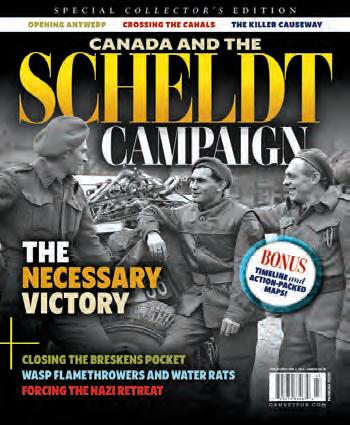
Volunteering in the community
Legion branches donate more than
$268,636 to their communities
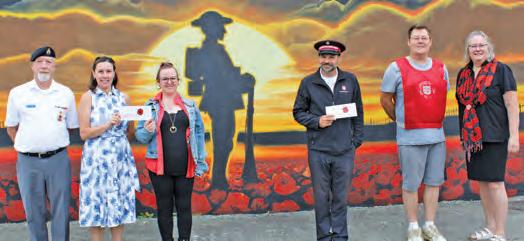
Alberni Valley Branch in Port Alberni, B.C., presents $1,000 to Abbeyfield seniors residence and $4,000 to the Salvation Army. Pictured are Branch President Roy Buchanan (left), Abbeyfield representatives Tracy Adams and Cara Beatty, Salvation Army representatives Michael Ramsey and Lloyd Kelly, and branch member Shannon Doré. SONJA DRINKWATER
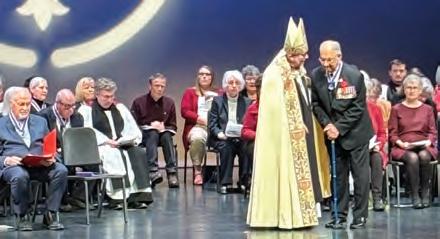
Executive member and Second World War veteran
Percival Smith of White Rock Branch in Surrey, B.C., receives the Order of the Diocese of New Westminster from the Bishop of New Westminster, Rev. John Stevens.
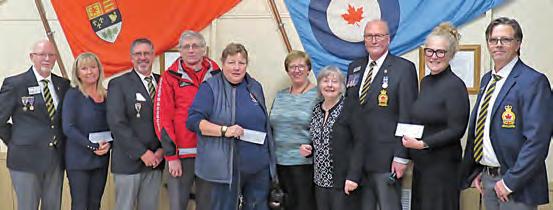
Qualicum Beach, B.C., Branch presents a collective $13,000 to Arrowsmith Search and Rescue, the Salvation Army, the Society of Organized Services, Parksville/Qualicum Haven House, Oceanside Stroke Recovery Centre and Operation Freedom Paws Canada.
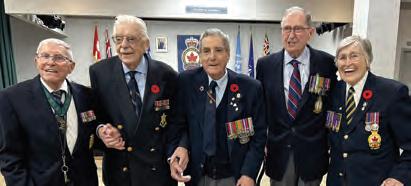
Centennial Branch in Calgary hosts its centenarians at the Veterans’ Dinner in fall 2024. Pictured are George Morash (left), Bryce Chase, Bob Roseneder, Glenn Traub and Life Member Irene Burd. WENDY DYPOLT
President Lynne Ward (centre) of Heart Mountain Exshaw Branch in Exshaw, Alta., joins Linda Lemery in presenting $500 to the Exshaw Fire Benevolent Society, represented by Exshaw Fire Chief Karl Eve.
KIM SALEKIN
President Lynne Ward of Heart Mountain Exshaw Branch in Exshaw, Alta., presents $1,000 to the Veterans Association Food Bank, represented by executive director Marie Blackburn and Tommy Benjamin. KIM SALEKIN
Stony Plain, Alta., Branch presents $80,000 to local organizations supporting veterans, seniors, youth and community. Among those represented here include Camp Health, Hope & Happiness; Stony Plain Kinsmen Club; Veterans Association Food Bank of Edmonton; 299 Mackenzie sea cadets; Light Up Your Life Society; Tri-Cala Adult Learning Association; Parkland Food Bank; High Hopes Birthday Celebration; IKare4Kids Society; 755 Parkland air cadets; Parkland Music Festival; Pioneer Art Club; the Meals on Wheels Society; bursary and Quilt of Valour recipients; and branch members. PAT HALE

President Kent Griffiths of Centennial Branch in Calgary, poppy chair Pat Lomenda and poppy co-chair Rose Scagnetto (far right) accept $13,547.25 from local Real Canadian Superstores represented by Tina Hawryluk.
WENDY DYPOLT
Rimbey, Alta., Branch secretary Al Lewis presents $500 to PO1 of the Red Deer sea cadets.
LANCE HANNESSON

Camrose, Alta., Branch poppy chair Gord Pasiuk congratulates Camrose A&W manager Sheri Fitzgerald and staff for raising $474 during 2024’s Poppy Campaign.
MURRAY GREEN
WO2 I. Taylor of Wetaskiwin air cadet squadron #42 receives $8,000 from Wetaskiwin, Alta., Branch representative Laurie Fairlie and cadet liaison officer Rick Towler. RICK TOWLER
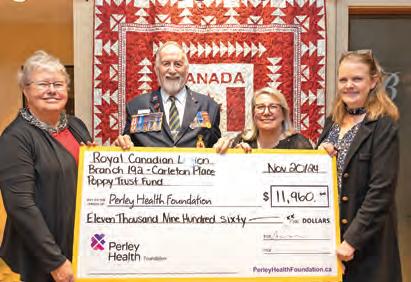
Capt. A. Roy Brown Branch in Carleton Place, Ont., donates $11,960 to Perley Health Foundation. Pictured are branch member Carole Pascoe, Barry Pascoe of Zone G6, Perley foundation executive director Delphine Haslé, and its chair, Sheila Venman.
Richard Dobson presents $445 to Paisley, Ont., Branch President Glen Hanley on behalf of the crokinole club, to be used for Paisley community support.

Hespeler Branch in Cambridge, Ont., presents $2,000 to Saint Luke’s Place, a long-term veterans’ care facility. Attending are CEO David Baker, fundraising and development director Amy Ross, and the branch’s Sue Brent, Lynda Hagedorn and Paul O’Krafka.

Wayne McGregor of Byron-Springbank Branch in London, Ont., presents $25,000 toward the construction of a statue for the Springbank Park Soldiers Memorial, represented by project committee member Dan Doroshenko.
John Lapenna is presented with the Sam Bukator Legionnaire of the Year award by Chippawa, Ont., Branch President Wayne Hardwick.

Third Vice Richard Lynn, Second Vice Angel Guy and First Vice Bert Boehme of Barrhaven Branch in Ottawa present the Perley Health Foundation with $20,000.
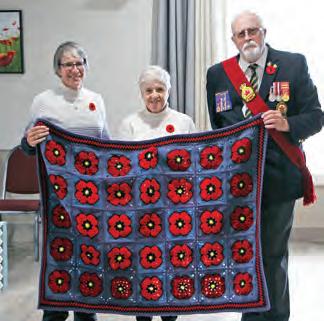
of
Streetsville Overseas Veterans Branch in Mississauga, Ont., donates $5,000 to ErinoakKids. Pictured are secretary Ben Pearce, Fiona D’Silva-Coelho of ErinoakKids and President Judy McNutt.
President Lyle Brennan and Third Vice Richard Lynn of Barrhaven Branch in Ottawa present $5,000 to Interval House of Ottawa, represented by Saweena Seth.
Wawa, Ont., Branch dedicates their new war memorial at the entrance of the Michipicoten Memorial Community Centre.

Treasurer Linda Imbeau of Trenton, Ont., Branch presents $300 to the Quinte West Fire Department for the Coats for Kids Program, represented by fire prevention officer Sarah Potts, program co-ordinator Jay Alexander and firefighter Cory McKerracher.

Treasurer Linda Imbeau of Trenton, Ont., Branch L.A. presents $300 to Annette Marr for the local Adopt-A-Child Program.

Georges Vanier Branch in Hawkesbury, Ont., presents $1,000 to Groupe Action/Maison de la Famille Hawkesbury. Pictured with Anik Joly, Nathalie Brisbois and Tracy Wilson of La Maison de a Famille are Branch President Michel Denis, Second Vice Steve Morin and Third Vice Gerry Woodard.
Korean War veteran Bill Cutting and President Jim Copp raise the Maple Leaf at the grand opening of the HepworthShallow Lake Branch in Hepworth, Ont. The old building burned down in 2022.
President Julie Gardner and Bonnie Cardinal of St. Joseph Island Branch in Richards Landing, Ont., present $8,000 to the Township of St. Joseph Island’s personal support workers’ program, represented by program lead Janet McLeod, personal support workers Sherry Rogers, Jenny Enns and Beth Kwon, and nurse Stacie Koch.
Streetsville Overseas Veterans Branch in Mississauga, Ont., presents $10,000 to the Streetsville Derbys Junior Hockey Club. Pictured are secretary Benjamin Pearce, President Judy McNutt, First Vice Jack Porter and Reg Pitts with club representatives Adrianne Fekete, Matthew Romanick and Nico Fekete. The funds were raised by branch volunteers in association with Rama Gaming House.
Madeline MacGregor of Col. John McCrae Memorial Branch in Guelph, Ont., presents $10,000 to Anne MacKay of Hospice Wellington.
Paisley, Ont., Branch President Glen Hanley presents the students of Celtic Academy Irish Dance Canada with $200 toward their trip to the national championships in Toronto.
Alan Miller and David Thompson of Col. John McCrae Memorial Branch in Guelph, Ont., present $10,000 to Andrew Moore of St. Joseph’s Health Centre Foundation.
President Rose Austin of Walkerton, Ont., Branch presents students of Walkerton District Community School with $5,000 toward their 2025 trip to Canadian battlefield cemeteries in Europe.

Paisley, Ont., Branch President Glen Hanley presents $2,000 to Bruce County Public Library, represented by Brandy Patterson (centre). The funds were proceeds from the annual golf tournament, organized by Paul Parker (left) and wife Susan, and Bonnie and Jeff Tanner.
MacDonald Branch in Kincardine, Ont., presents $5,000 to the area’s Special Olympics program. Attending are Branch President Jim McDonald, athletes Rosie Laidler and Richard Wright, coach Shannon Allen, athlete Jackie McDonald and branch charity chair Russ Crook. GLENN BOOKER
Sgt.-at-Arms Jim Byron of Valley City Branch in Dundas, Ont., presents $2,000 to Capt. Sean MacNamara for the 735 Firebird Squadron Dundas air cadet corps.
PAUL WRIGHT
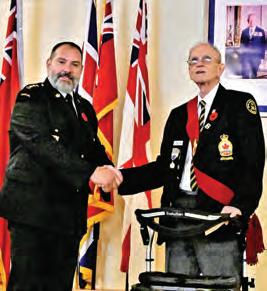
Sgt.-at-Arms Jim Byron of Valley City Branch in Dundas, Ont., presents $2,000 to Capt. Nelson Vieira for the 2865 Hamilton Wentworth Artillery army cadet corps. PAUL WRIGHT

Geraldine Logan, Brendan McGlynn and Vicki Bateman of Stirling, Ont., Branch present a $500 bursary to veteran Amelie Cote.
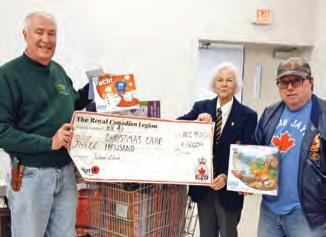
Lord Elgin Branch in St. Thomas, Ont., donates $3,000 to Christmas Care. Attending are Christmas Care representative Carl Bagshaw, Branch President Val Clark and member Ray Wise.
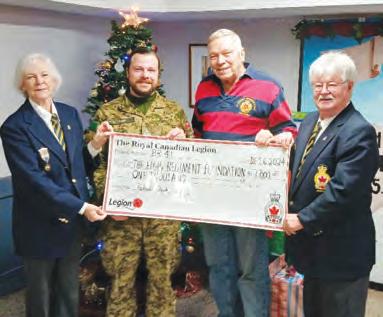
Lord Elgin Branch in St. Thomas, Ont., donates $1,000 to the Elgin Regiment Foundation. Attending are Branch President Val Clark, Sgt. Peter Shaw, retired Lt.-Col. John Hampson and First Vice Tom Marks.
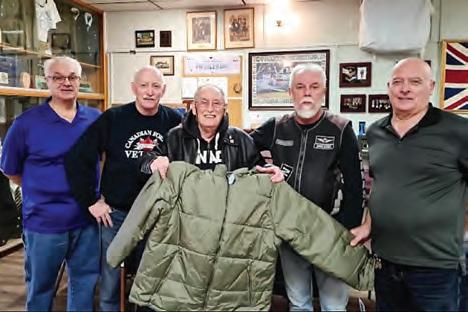
Chatham, Ont., Branch veteran Jim Setterington (centre) receives a winter coat from David Mercer of the Commandos Canada MC. Also attending are branch service officer Mark Schrank, Branch President Len Maynard and poppy chair J.P. Presley.

Glen Hanley, President of Paisley, Ont., Branch presents $500 to the local food bank, represented by organizer Carol McCulloch and Pastor Zack Thorton of the Missionary Church.
Sgt.-at-Arms Jim Byron of Valley City Branch in Dundas, Ont., presents $5,000 to Sub-Lieut. Michael Harris for the RCSCC Dundas sea cadet corps. PAUL WRIGHT
Sutton West, Ont., Branch holds its annual appreciation dinner for area veterans.

President Gerald Mullins and poppy chair Joan Cripps of Chatham Branch in Miramichi, N.B., present $5,000 to Judy Losier, director of The Dr. Gerard and Judy Losier Family Foundation.
Eugene Godin and Edmund McMullen of Herman Good VC Branch in Bathurst, N.B., are presented with Quilts of Valour by Martine LeBlanc.

President Gerald Mullins and Joan Cripps of Chatham Branch in Miramichi, N.B., present $5,000 to Joanne Sellars, executive director of the Miramichi Regional Hospital Foundation.
Tom Townsley of H.T. Church Branch, St. Catharines, Ont., presents $1,000 on behalf of the golf team to Branch President Lloyd Cull.
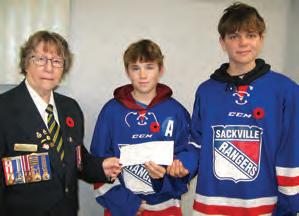
Sackville, N.B., Branch makes a donation to the U15 Sackville Legionnaire Rangers minor hockey club.
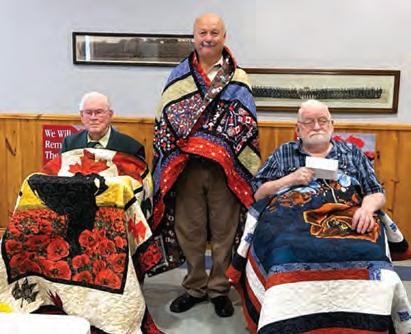
Salisbury, N.B., Branch hosts a Quilts of Valour presentation. Attending are recipients Ron Whilen (left), Arden Langille and Darrell Sutherland. JUDY ALLEN
New Brunswick Command President Tony Chevalier presents $5,000 to the NB Military Family Resource Centre in Oromocto, N.B., represented by family program co-ordinator Laura Stilwell and the centre’s executive director, Lindsay Gallagher. HEATHER BANKS
At Chatham Branch in Miramichi, N.B., member and RCMP veteran Tim Hoban presents $15,000 to Branch President Gerald Mullins for the new building fund.
Third Vice Daryl Perry and President Ryan Seguin of Shediac, N.B., Branch present $1,000 to Operation VetBuild Shediac, represented by Roger Smith. MRS. RITA DOIRON-MACALEESE
President LeRoy Gamble of George Pearkes VC Branch in Summerside, P.E.I., joins executive member Elma Noye in presenting $250 to the Kinsmen Club, represented by Eric Ferrish. KAREN GAMBLE
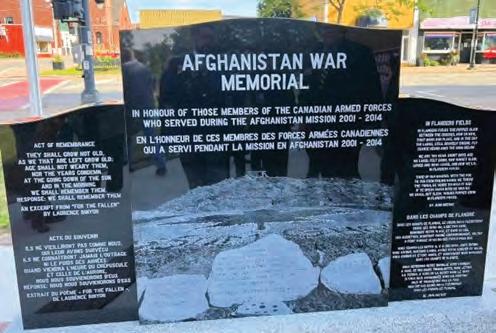
Members of Amherst, N.S., Branch gathered for the unveiling of a new Afghanistan War Memorial in the downtown. The back of the monument lists all 158 members who lost their lives during the war.
Dominion President Berkley Lawrence (standing) joins Carbonear, N.L., Branch poppy chair Gary Davis (left) and remembrance chair David Hollett for the 2024 poppy campaign.
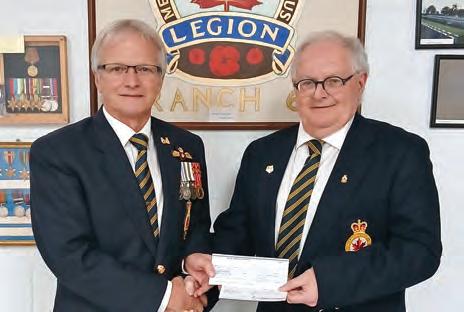
President Peter Mattall (right) of Tatamagouche, N.S., Branch presents $1,626.95 to Spurgeon Stewart of 596 Phoenix air cadet squadron, along with $400 in recognition of the fundraising efforts carried out by the Cadet Parent Committee members.
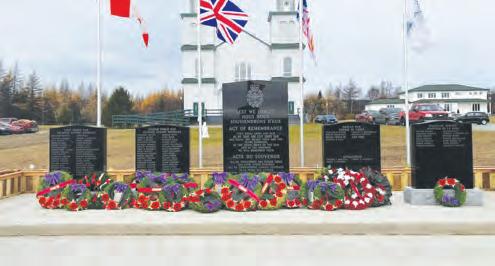
Despite the previous closure of Bay D’Espoir Branch in St. Alban’s, N.L., a passionate group of Legion and community members helped refurbish the local War Memorial for the continuance of Remembrance Day ceremonies.
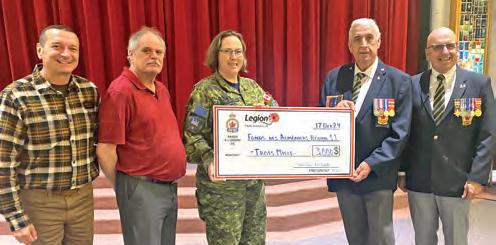
President Yves Lavoie and Christian Munger of Richelieu Branch in St-Jean-sur-Richelieu, Que., present $3,000 to the Chaplains’ Fund of the Saint-Jean Garrison. Receiving the cheque are Padre Michel Lafleur; Christian Coulombe, co-ordinator of administrative services, chaplaincy; and Maj. Maria-Christina Codina, senior chaplain. P. GARNEAU
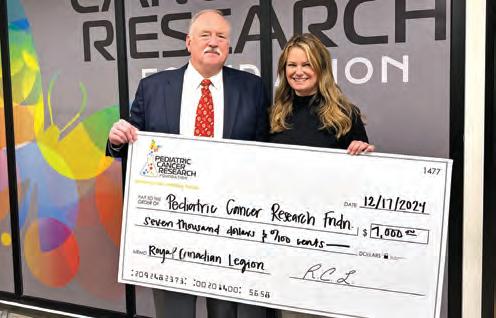
Larry Dalphy of Western U.S. Zone in Manhattan Beach, Calif., Branch presents $7,000 to Danielle Fragalla, CEO of the Pediatric Cancer Research Foundation in Orange County, Calif.
Send your photos and news of The Royal Canadian Legion in action in your community to your Command Correspondent. Each branch and ladies auxiliary is entitled to two photos in an issue. Any additional items will be published as news only. Material should be sent as soon as possible after an event. We do not accept material that will be more than a year old when published, or photos that are out of focus or lack contrast. The Command Correspondents are:
BRITISH COLUMBIA/YUKON: Graham Fox, 4199 Steede Ave., Port Alberni, BC V9Y 8B6, gra.fox@icloud.com
ALBERTA–NORTHWEST TERRITORIES: Donna Ganzon, 2020 – 15 Street NW Calgary, AB T2M 3N8, abnwtsubmissions@abnwtlegion.com
SASKATCHEWAN: Tara Brown, 2267 Albert St., Regina, SK S4P 2V5, admin@sasklegion.ca
MANITOBA: George Romick, 320 Admiral Court, Thunder Bay, ON P7A 8B5, romickg@tbaytel.net
NORTHWESTERN ONTARIO: George Romick, 320 Admiral Court, Thunder Bay, ON P7A 8B5, romickg@tbaytel.net
ONTARIO: Roy Eaton, 567-294B North Channel Dr., Little Current, ON P0P 1K0, reaton@on.legion.ca
QUEBEC: Mary-Ann Latimer, 105-2727 rue St. Patrick, Montreal, QC H3K 0A8, msmarts@bell.net
NEW BRUNSWICK: Harold Wright, 2-299 Main St., Saint John, NB E2K 1J1, foulis20@gmail.com
NOVA SCOTIA/NUNAVUT: James Leadbeater, 4129 New Waterford Highway, New Victoria, NS B1H 5T4, james.leadbeater@hotmail.com
PRINCE EDWARD ISLAND: John Yeo, 657 Rte. 19, Meadow Bank, PE C0E 1H1, islander657@yahoo.ca
NEWFOUNDLAND AND LABRADOR: Brenda Slaney, Box 5745, St. John’s, NL A1C 5X3, bslaney@nfld.net
DOMINION COMMAND ZONES: EASTERN U.S. ZONE, Gord Bennett, 803-190 Cedar St., Cambridge, ON N1S 1W5, Captglbcd@aol.com; WESTERN U.S. ZONE, Douglas Lock, 1531 11th St., Manhattan Beach, CA 90266, douglock@fastmail.com
Submissions for the Honours and Awards page (Palm Leaf, MSM, MSA and Life Membership) should be sent directly to Legion Magazine, 86 Aird Place, Kanata, ON K2L 0A1 or magazine@legion.ca.
TECHNICAL SPECS FOR PHOTO SUBMISSIONS
DIGITAL PHOTOS—Photos submitted to Command Correspondents electronically must have a minimum width of 1,350 pixels, or 4.5 inches. Final resolution must be 300 dots per inch or greater. As a rough guideline, colour JPEGs would be between 0.5 megabytes (MB) and 1 MB.
PHOTO PRINTS—Glossy prints from a photofinishing lab are best because they do not contain the dot pattern that some printers produce. If possible, please submit digital photos electronically.
FRENCH INSERT—To receive a French insert of Legion Magazine content, please contact MagazineSubscriptions@legion.ca or call 613-591-3335.


50 years














55 years

60 years

65 years
70 years


KEN ALBERT
Stratford Br., Ont.
Middleton Br., N.S.
PRINCE EDWARD ISLAND
GAYLE MUELLER
George Pearkes VC Br., Summerside
ONTARIO
WES CHAMBERS
Harry Miner VC Br., Clinton
RUSS BERRY
Harry Miner VC Br., Clinton
PAT LAFFERTY
Harry Miner VC Br., Clinton
BRIAN ATKINSON
Harry Miner VC Br., Clinton
SHIRLEY CHALMERS
Harry Miner VC Br., Clinton
RITCHIE COX
Harry Miner VC Br., Clinton
RICK SHROPSHALL
Harry Miner VC Br., Clinton
LILLIAN McNAMEE
Brockville Br.
DAVE CODY
Brockville Br.
DON CORNEIL
Brockville Br.
ALBERTA
BERNADETTE DALPE
Smoky Lake Br.
NOVA SCOTIA
YVONNE LEDUC
Eastern Marine Br., Gaetz Brook

STAFF CAR—Seeking information on a 1940 Ford of Canada staff car sent abroad early in the Second World War. During restoration, a driver’s handbook was found inside identifying the vehicle as WD Vehicle C M 195242 and the name Pte. Dickson. J., B84077 E Section. Seeking details on this type of staff car and the serviceman. Contact William Purchase, 21 Oak Avenue, Worlingham, Beccles, Suffolk U.K. NR34 7DN; bill.purchase@hotmail.com.
NAVAL RESERVE SQUADRONS—Seeking information on VC-920, VC-921, VC-922, VC-923 and VC-924 pertaining to pilots, observers, maintainers, logbooks, pictures or artifacts. Contact Stephen Porrior, 151-2645 Innes Road, Ottawa ON K1B 3J7; seafury1@gmail.com; 613-700-7843.



The country’s invasion of Ukraine has in turn weakened its access to a critical sea
Russia’s brutal war in Ukraine has changed the world. The myth of an allpowerful Red Army, fostered during WW II and the Cold War, has been shattered in clumsy, costly attacks, the scouring of jails to recruit criminals for military service, widespread corruption, and badly maintained equipment.
By autumn 2024, it’s believed that some 700,000 Russian soldiers had been killed, wounded or captured. During the war, Russia has typically sustained more than a thousand casualties each day. The country’s economy, staggered by the costs
of the conflict and subsequent sanctions imposed on it by the West, has seen inflation rapidly increase and the standard of living decline for ordinary families.
Still, Russian President Vladimir Putin seemingly remains popular at home—he garnered an incredible 88.48 per cent of votes in the country’s March 2024 election—but a year earlier
the International Criminal Court issued a warrant for his arrest related to alleged war crimes in Ukraine.
Simply put: the invasion hasn’t been good for Putin, for Russians or for the country’s military and its reputation.
It also hasn’t done anything positive for Russia’s strategic geopolitical position in Europe, particularly around the Baltic Sea. Finland and Sweden, two historically neutral nations, have cast aside that posture and joined NATO for fear of Moscow’s intentions. That, along with some related factors, have put Russia in a Baltic bind.
Finland shares a 1,340-kilometre-long border with Russia and has a historic distrust of its neighbour. Helsinki has mandatory conscription for men, some 900,000 trained reserves, reliable tanks and modern armoured personnel vehicles, and it can put
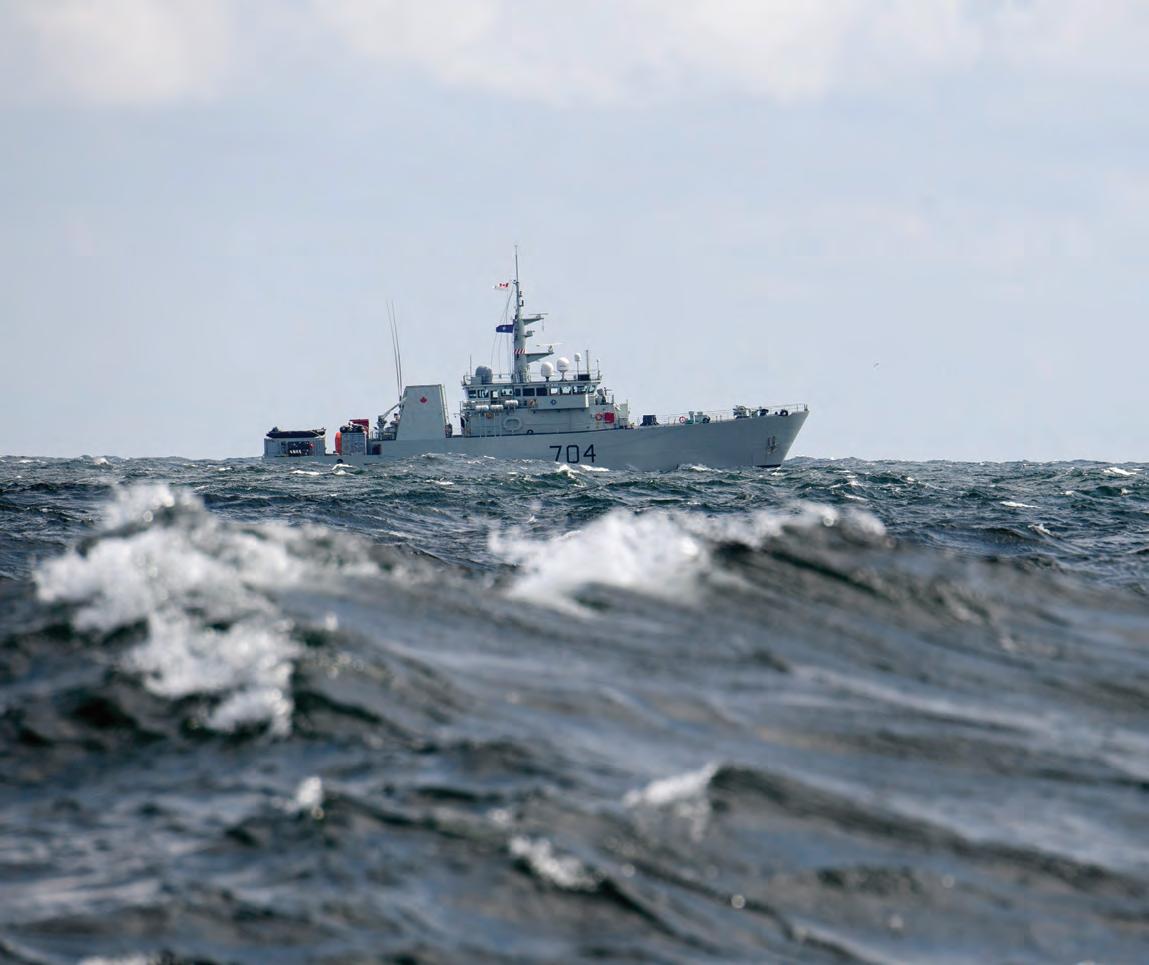
280,000 soldiers in the field. It also has a modern air force with F-35s soon to be in service, and a small but well-trained navy equipped primarily with missile boats and minesweepers.
Finland’s defence budget already exceeds the NATO standard of two per cent of gross domestic product (GDP), plus its military spending continues to rise. With the latest generation of F-35s in Poland, Norway and Denmark, NATO’s air superiority in the Baltic region is clear.
Meanwhile, Sweden, with a population of 10.6 million (almost twice that of Finland), is the most populous of the Nordic countries. Its defence spending is slated to hit 2.4 per cent of its GDP this year, funding that’s projected to continue to rise. It, too, has had conscription since 2017, one of the largest defence industries in Europe, powerful domesticallybuilt Gripen fighter aircraft, and a well-trained navy with corvettes, minesweepers and submarines. And both Sweden and Finland have made substantial contributions of military equipment and funding to Ukraine, ranking sixth and ninth among countries providing such aid (valued at $4.2 billion and $2.4 billion, respectively).
Most importantly, perhaps, the addition of Finland and Sweden to NATO means the western alliance members combined, specifically Poland, Germany, Denmark, Estonia, Latvia and Lithuania, now oversee the coastline of almost the entire Baltic Sea. Russia has, for all practical purposes, lost the ability to use the waterbody for military or naval purposes. Russian surface ships sailing from Saint Petersburg could be subject to observation (or potentially attack) the moment they put to sea, and submarines, while they might have a small chance of manoeuvring undetected, would likely need extraordinary good luck to make it to the North Atlantic.
Murmansk on the far northern coast has now become Russia’s main naval base in the west. Norway, Sweden and Finland can all bring air power to bear on t his region, and winter weather there makes naval operations difficult (as Canadian and Allied sailors and merchantmen well remember from wartime convoy operations to support the Soviet Union’s efforts against Germany).
The Baltic countries of Estonia, Latvia and Lithuania, with a c ombined population of just six m illion, all border Russia and, after WW II were occupied by, and became part of, the Soviet Union. As a result, all have substantial numbers of Russian-speaking citizens. The push in all three nations to regain their independence in the late 1980s contributed to the collapse of the Soviet Union, and each country continues to fear Russian retribution.
As NATO members, the organization has stationed troops in e ach nation to help allay those concerns, its Article 5—an attack on one member being considered an attack against all—a hopeful deterrent to Russian aggression.
Canada, as the lead NATO partner in Latvia, has some 1,900 troops stationed there, equipped with armour and artillery. And Ottawa has pledged to increase the contingent on the ground to 2,200, the strength of a small brigade. However, given Canada’s defence funding challenges and its personnel shortages in the army, maintaining that commitment is likely to make other major deployments difficult, if not impossible.
Then there’s Kaliningrad. Known as Königsberg until it was annexed and renamed by the Soviet Union after WW II, the 15,000-square-kilometre region with a Baltic coastline is bordered by Poland and Lithuania. While it’s a Russian territory, it’s not contiguous, located about 500 k ilometres east of Russia itself.
While it’s well protected by some 25,000 troops, nuclear-capable missiles, artillery and armour, it is, for all practical purposes, indefensible. Poland’s large, modern military (bolstered by annual defence spending of five per cent of its GDP) and NATO airpower would likely make short work of the enclave’s defences.
Despite its difficulties in Ukraine, Russia remains a formidable military power, not least because of its nuclear capabilities. But, in the last five years, NATO’s strength has dramatically increased.
More of its member countries spend at least two per cent of GDP on defence each year (Canada, notably, not among them), and modern equipment, better training and more personnel on the ground, at sea and in t he air have made the alliance stronger. Plus, its members are as politically united as ever.
Russia’s war against Ukraine galvanized the countries of Western Europe. Putin’s invasion of the nation, whatever its ultimate outcome, has backfired badly. It strengthened NATO and alerted western governments to how ruthless his Russia could be. Simply, it was a mistake of epic proportions. L
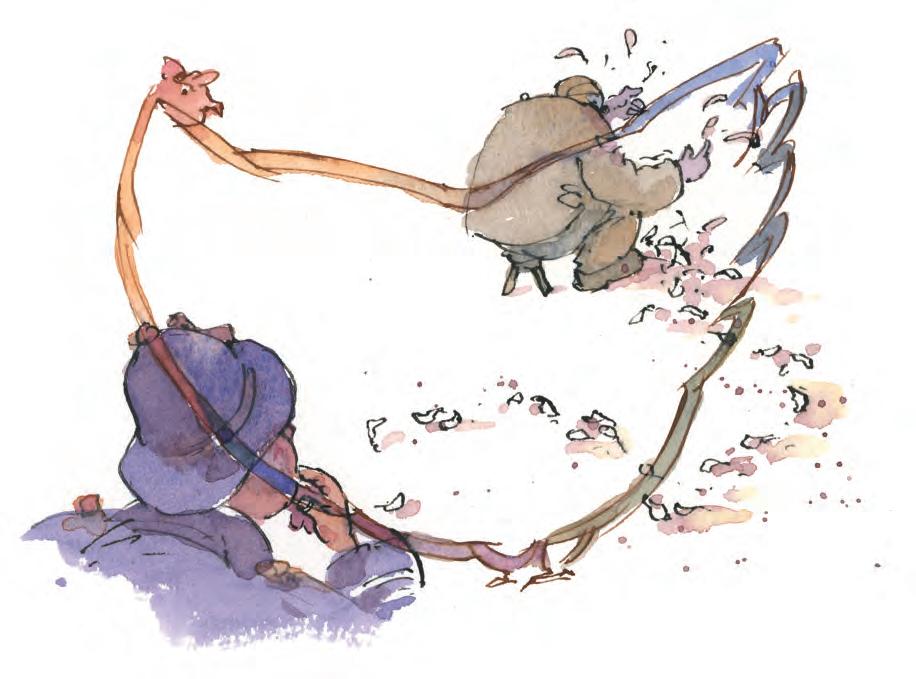
During the Second World War, the Canadian Army newspaper, The Maple Leaf, brought news and entertainment to soldiers when not much else would. It covered items from war news, sports scores and cartoons to little bits of this and that. In 1944, Canadian troops fighting in northwest Europe were treated to a story from Britain.
It seems an alert constable investigating a farm theft followed a trail of feathers right to a billet in a nearby Canadian
base, where he found a culprit plucking a bird. When the miscreant was hauled before the local magistrate, he tried for a bit of leniency by claiming the ol’ drunkard defence. The judge wasn’t buying it.
“I have considerable difficulty catching a chicken when I’m completely sober,” he said, before handing down a fine of t wo pounds and ordering a 30-shilling restitution payment. That would have been about $17 Canadian, a stiff fine for a soldier earning $1.30 a day.
People who complain about military red tape should know it’s not a new phenomenon. I’m told that the Royal Canadian Air Force once had a requisition voucher that stores would not release anything without. The real problem came when a staff sergeant’s office ran out of the forms. He then discovered that to get new vouchers, he needed one of them, which, of course, he didn’t have. He is said to have run screaming from his office.
> Do you have a funny and true tale from Canada’s military culture? Send your story to magazine@legion.ca
During the Second World War, the Women’s Royal Canadian Naval Service, or Wrens, enlisted nearly 7,000 women starting in 1942. Wrens served across Canada, the U.S. and Britain and worked on clerical and administrative duties, coding and signalling, among other tasks. They also produced a news publication, a 50-page pamphlet issued every two months and distributed to various stations.
Each detachment had a correspondent who submitted an account of the local activities and news. The Tiddley Times as it was called (“tiddley” is navy slang for “neat” or “smart”), was a popular item and often in short supply at far-flung bases. The Ottawa publisher that printed it was often forced to cut content drastically for multiple reasons. The navy wouldn’t go for more than 50 pages per issue and the wedding announcements started to take up a lot of space. In t he June/July 1944 issue, for instance, the wedding section took up more than two pages, despite each article being trimmed to little more than names and location.
The editors were reduced to pleading: “Did you SEE the space we have had to give to weddings? For pity’s sake girls, go easy. Think of your little “Tiddley” and either refuse the man until the war is over OR petition the Navy for 100 pages. One or the other.”
William Sargent served in the RCAF from 1941-45. He encountered a problem with his name following a promotion. The phone rang one day and he answered: “Corporal Sargent, here.” The officer on the line took a moment, then shouted: “Don’t you know what the hell you are? Are you a corporal or a sergeant?”
Sargent explained that he was both and the caller was mollified. But the problem continued and only got worse with further promotions to sergeant, then flight sergeant. He sympathized, though, with another fellow whose name was Tew, with the initials A.C. He was an aircraftman, second class. So, he, of course, was AC2 A.C. Tew.
Then there was the guy named Major.
In the fall of 1967, Ron Neal was a young corporal in The Lincoln and Welland Regiment and one of several hundred militia sent on a month-long
“I HAVE CONSIDERABLE DIFFICULTY CATCHING A CHICKEN WHEN I’M COMPLETELY SOBER.”
exercise in Germany. He was attached to Delta Company, 2nd Battalion, Royal Canadian Regiment.
“We were issued with new combat field uniforms, a rifle, sleeping bag but no air mattress,” he said. “I went into Soest, the closest town, and purchased the best air mattress that was available at the military store.
“Several days before leaving, the company sergeant major came to me and said the commander, who had been transferred from the Guards, wanted to see me at 1300 hours sharp. What had I done? I couldn’t eat lunch because I thought I was going to jail.”
The commander had just one question: “How much for the air mattress?”
“To this day,” said Neal, “I don’t remember what I said, but I came back to Canada without an air mattress.”
An engineer detachment cleared a path through a Second World War minefield and posted a biblical warning to follow the cleared lane: “Ponder the path of thy feet and let all thy ways be established. Turn not to the right hand, nor to the left. Remove thy feet from evil.” Proverbs 4:26-27. L
By Mark Zuehlke
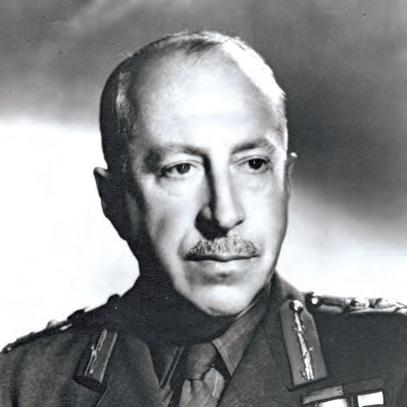
efore First Canadian Army’s Feb. 8, 1945, Rhineland offensive, General Harry Crerar worried that the elaborate deception plan intended to disguise the intentions of his gathering forces was failing.
CRERAR FRETTED THAT THE GERMANS HAD REALIZED WHAT WAS REALLY UNDERWAY.
His strategy intended to lull 1st Fallschirmjäger Army commander General der Fallschirmtruppe Alfred Schlemm into believing the troops facing him on the Rhineland’s western border consisted of no more than a couple of Canadian divisions capable of launching only a diversionary attack. Rather, the Allies hoped Schlemm would think the first major offensive against Germany in 1945 would be initiated by U.S. Ninth Army well to the east and the Second British Army about 50 kilometres east.
a full-scale advance into Germany’s heartland—and end the war in Europe. Crerar fretted that the Germans had realized what the plan was and were positioned to meet it.
His concern arose on Jan. 20 when a Canadian patrol took three prisoners who turned out to be from 2nd Fallschirmjäger Regiment’s 3rd Battalion. Shortly thereafter, the regiment’s other two battalions were identified as having moved into the facing front line. Then, 7th Fallschirmjäger Division was located in a position so as to be able to serve as a nearby immediate reinforcement.
On Feb. 6, with the British forces on the move and increasingly visible, Crerar decided the jig was up.
“I had to assume [German] aircraft… had observed the unavoidable signs of our enterprise.”
—General Harry Crerar
Movement of British XXX Corps and several other Second British Army formations to concealed positions near Nijmegen and Groesbeek, Netherlands, was carefully conducted to avoid detection. On Feb. 5, however, this juggernaut that was to join the Canadians in launching the offensive began moving to start lines.
The operation, code-named Veritable, was to seize the Rhineland. From t here, the Rhine River could be crossed to allow
“I had to assume [German] aircraft… had observed the unavoidable signs of our enterprise [with] the many hundreds of vehicles and tanks.” The Germans, he w rote, likely “had a shrewd suspicion that I was going to attack in the Reichswald sector. But in surveying the enemy’s problems…I decided that there was little he could do to improve his situation.”
The Germans would have to fight with the forces on hand. That, Crerar determined, gave him a huge edge. This proved the case. The German front was quickly pierced and—although it was a hard and costly slog forward— on Ma rch 10, the Rhineland had fallen. L
Byearly February, General der Fallschirmtruppe
Alfred Schlemm a nd his two superiors knew an offensive somewhere along their front was imminent. They disagreed, however, about where the attack would fall.
Generalfeldmarschall Gerd von Rundstedt and Generaloberst Johannes Blaskowitz believed that U.S. Ninth Army would attack from Roermond, Netherlands, in conjunction with British Second Army advancing from Venlo—all well east of the First Canadian Army front at Nijmegen.
Schlemm believed, as he later told Allied interrogators, that the main thrust would be delivered by the Canadians punching south through the Reichswald Forest. Everything else was a diversion to throw the Germans off. When Schlemm advanced this argument, von Rundstedt and Blaskowitz assured him there was no evidence of large troop concentrations near Nijmegen.
“The worst that could be expected there,” he was told, “was a holding attack launched by two or three Canadian divisions.”
Schlemm’s patrols contradicted his theory, as they “failed to reveal the presence of any formation in the vicinity other than Canadian.” Yet, he trusted his instincts. Saying “signs of movement through Nijmegen were not merely a blind,” he anticipated an attack in that vicinity between Feb. 6 and 12.
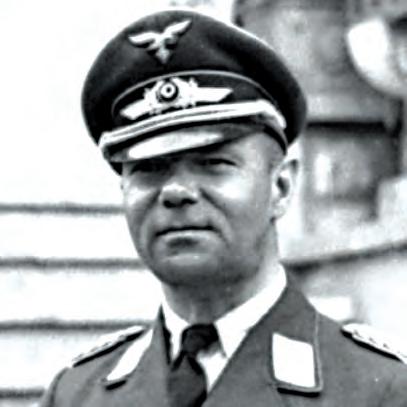
On Feb. 8, the campaign began. Within a d ay, Schlemm could prove the Canadiandirected offensive was the offensive.
“We were wrong,” Blaskowitz admitted, and hurriedly ordered 7th Fallschirmjäger Division to reinforce Schlemm’s front. By the 9th, the division was coming into the line, but Schlemm’s situation only worsened.
Hitler personally intervened with an order that no ground in the Rhineland was to be surrendered without his authorization. Schlemm realized that he “merely became a receptacle for the passing of orders. The…battle from that time on was to become… a nightmare of excuses, entreaties and explanations.”
Schlemm wanted to build lines facing First Canadian Army “and retire slowly from position to position exacting as heavy a price as possible for every loss of ground.” Permission to do so, however, was refused and he was instead ordered “to stand where [he] was and not yield an inch.”
WITHIN A DAY, SCHLEMM COULD PROVE THE CANADIAN-DIRECTED OFFENSIVE WAS THE OFFENSIVE.
The consequences were inevitable. Whenever a Canadian or British unit broke “through vital positions…[Schlemm had] to make a hasty adjustment to the new situation,” said his interrogation report.
But there was no saving the situation. The Canadian-British juggernaut ground relentlessly onward and the Rhineland’s fall was inevitable. L
“The
battle was to become a nightmare of excuses, entreaties and explanations.” —General Alfred Schlemm
By Alex Bowers
An
American 1812 war prize, the return of the Mace of Upper Canada to Ontario symbolized the evolution of cross-border relations
“During the War of 1812,” declared U.S. President Franklin D. Roosevelt on May 4, 1934, “the Mace of the Parliament of Upper Canada, or Ontario, was taken by United States Forces at the time of the battle of York, April 27, 1813. That Mace, which had been the symbol of legislative authority at York (now Toronto) since 1792, has been preserved in the United States Naval Academy at Annapolis.”
Made from soft wood, perhaps fir or pine, and measuring 142 centimetres long (4′8″), the centuries-old Yankee plunder was, despite its symbolic value to Anglo-Canadian governance, deemed primitive in appearance. Chroniclers often described it as gilded and decorated red in parts; but, it was merely painted gold.
However, in seizing it on that fateful April day, explained Ewan Wardle of the Fort York National Historic Site, “the soldiers and sailors of the young [U.S.] republic were snubbing the majesty of the Crown—of King George III himself.”
Maces were once a favoured weapon of the Middle Ages, especially Medieval-era martial bishops who, bound by canonical law, couldn’t use blood-letting arms such as swords. A club, therefore, could honour
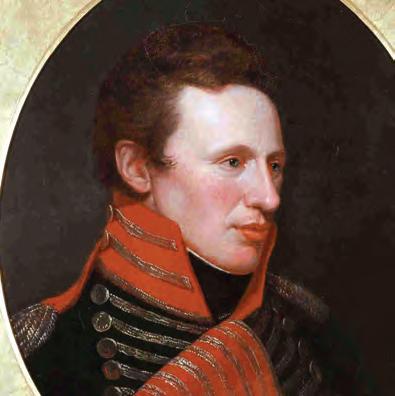
oaths to God while providing clergymen with a suitable defence against helmeted and armoured opponents.
As early as the 13th century, maces took on ceremonial reverence, later evolving into symbols of legislative authority for speakers of the British parliament and, ultimately, starting in the 18th century, within the British Empire’s Canadian colonies.
By 1813, the Mace of Upper Canada resided in York after the provincial c apital moved from Newark (modern-day Niagara-on-the-Lake, Ont.) in 1796.
In York , having travelled across Lake Ontario aboard an estimated 14 ships, a force of some 2,700 American soldiers and sailors began their April 1813 attack.
The numerical superiority of the invaders, commanded by Brigadier-General Zebulon Pike, against British General Roger Sheaffe’s 700-strong defence quickly became apparent. For the Canadian militiamen, Mississauga and Ojibwa warriors, and 300 dock workers protecting York, it was clearly a lost cause.
The Mace of Upper Canada became a prized war trophy of American BrigadierGeneral Zebulon Pike (inset left) after he defeated British General Roger Sheaffe at the Battle of York in April 1813 (opposite).


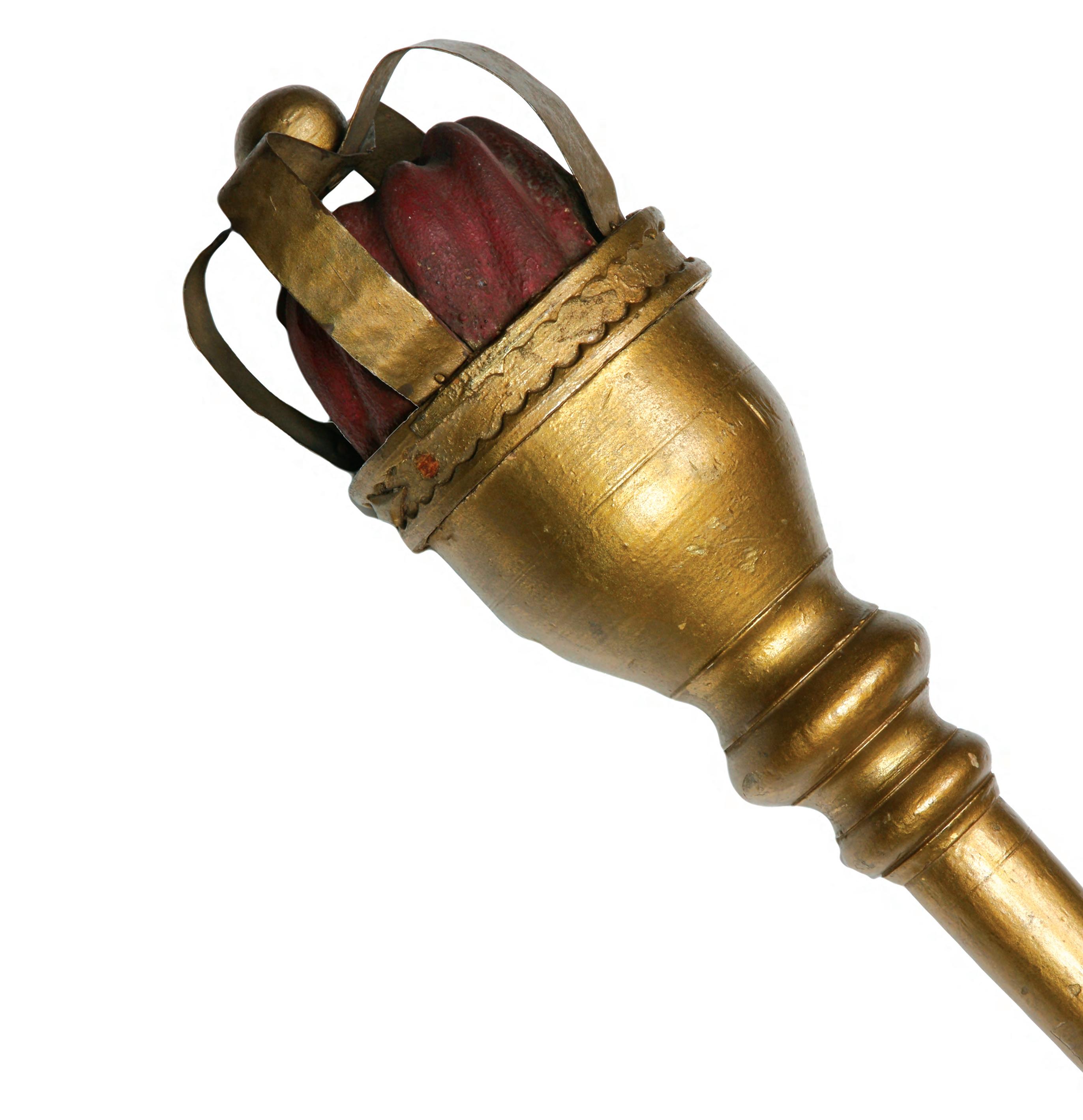
1.2
Approximate length of the Mace in metres
2,500

12 Diameter of the Mace’s crown head in centimetres
Estimated currency in pounds stolen from York’s treasury during the battle
121
Years that the Mace remained in American hands
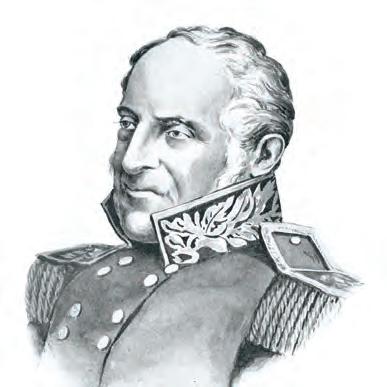

18 Parliamentary sessions held at the Legislative Assembly of Ontario (post-Confederation) before the Mace was returned

Prior to torching York’s government buildings, several symbolic items, including the mace, became spoils of war.
And British resistance at Fort York couldn’t stem the tide. Realizing the hopelessness of the circumstances, Sheaffe ordered a retreat to Kingston—but not before setting alight a gunpowder magazine.
The ensuing explosion killed Pike, who died with his head resting on a c aptured Union Jack. Infuriated, t he Americans and their Canadian sympathizers started razing the town.
Some 2,500 pounds was also stolen from the treasury; dismantled parts of the warship Duke of Gloucester were captured; and, prior to torching York’s government buildings, several symbolic items, including the Mace, became spoils of war.
The British had their revenge by burning Washington, D.C., the following year, but Upper Canada’s legislative regalia stayed in the U.S. for 121 years, until July 4, 1934, coinciding with the unveiling of a memorial in Toronto dedicated to A merican losses at the Battle of York.
“Since the agreement of 1817,” said Roosevelt earlier in urging the return of the plundered artifact, “the two countries have…maintained no hostile armaments on either side of their boundary; and every passing year cements the peace and f riendship between [their] peoples.”
Although previously replaced—indeed, more than once—the Mace of Upper Canada is now displayed at the Legislative Assembly of Ontario in Toronto. L

By Don Gillmor
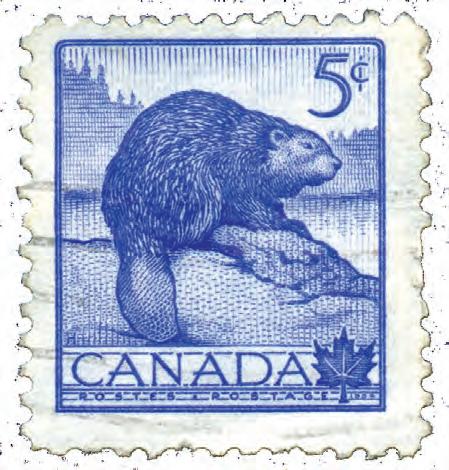
beaver became Canada’s national symbol on March 24, 1975, when the National Symbol of Canada Act received royal assent. Castor canadensis was already a de facto emblem, found on ancient totem poles, featured on the nation’s first postage stamp, issued in 1851, and appearing on various coats of arms (Manitoba’s, Alberta’s and Toronto’s, among others).
LIKE MANY CANADIANS, THE BEAVER IS INDUSTRIOUS AND LACKS A DENTAL PLAN
Find many more stories in our O Canada special issues, NOW available in our SHOP!



From a European perspective, the fur trade was the foundation of the country, and the beaver was the foundation of the fur trade. Europeans came to the land that would become Canada looking for gold that never materialized, a passage to the East that remained elusive, and settled finally on the beaver. They kept moving farther west in search of new pelts, and outposts of the Hudson’s Bay Company gradually turned into towns and cities.
Still, it was a long, uncertain road to official national symbol and the beaver remains unpopular in some quarters. In 2011, Conservative senator Nicole Eaton, whose cottage dock was stubbornly occupied by beavers, said the emblem was “a dentally defective rat” and “a 19th century has-been.”

in fashion history. But in 1824, the silk hat was introduced. It took 20 years for the silk headwear to really catch on, but by the middle of the 19th century, the beaver topper was the fashion equivalent of bell bottoms with a peace symbol on them, the fur trade was in decline and the beaver almost extinct.

Senator Eaton argued that the beaver should be replaced by the majestic polar bear. She isn’t the first to feel a national symbol was a mistake. Benjamin Franklin argued that America’s national emblem, the bald eagle, “is a Bird of bad moral character.” He argued that the goofy, outsized wild turkey was “a much more respectable Bird” and would have been a better choice.
As a symbol, the beaver has certain strengths though. It’s found in every region of the country, so it’s politically acceptable. And like many Canadians, the beaver is industrious and lacks a dental plan (their teeth are orange because of an iron-rich coating). It’s a keystone species because it can shape the landscape, which then accommodates other species, roughly in line with Canada’s immigration policies.
Environmentally, it means well (contributing to biodiversity by providing habitat for other species), but is also destructive (its dams can result in flooded farmland), a stance that matches the typical government approach.



She had a point. The beaver is a rodent, the largest in Canada, and second largest in the world (next to the capybara). Still, the rodent family isn’t one of nature’s most distinguished. And it is a has-been, fur-wise. The beaver hat was popular for more than 200 years, one of the most remarkable runs
The polar bear is a glorious mammal, visually striking, its cubs adorable. But it’s an apex predator and, from a geopolitical standpoint, Canada isn’t. Canadians are hewers of wood and drawers of water, and what personifies that better than the beaver? L