
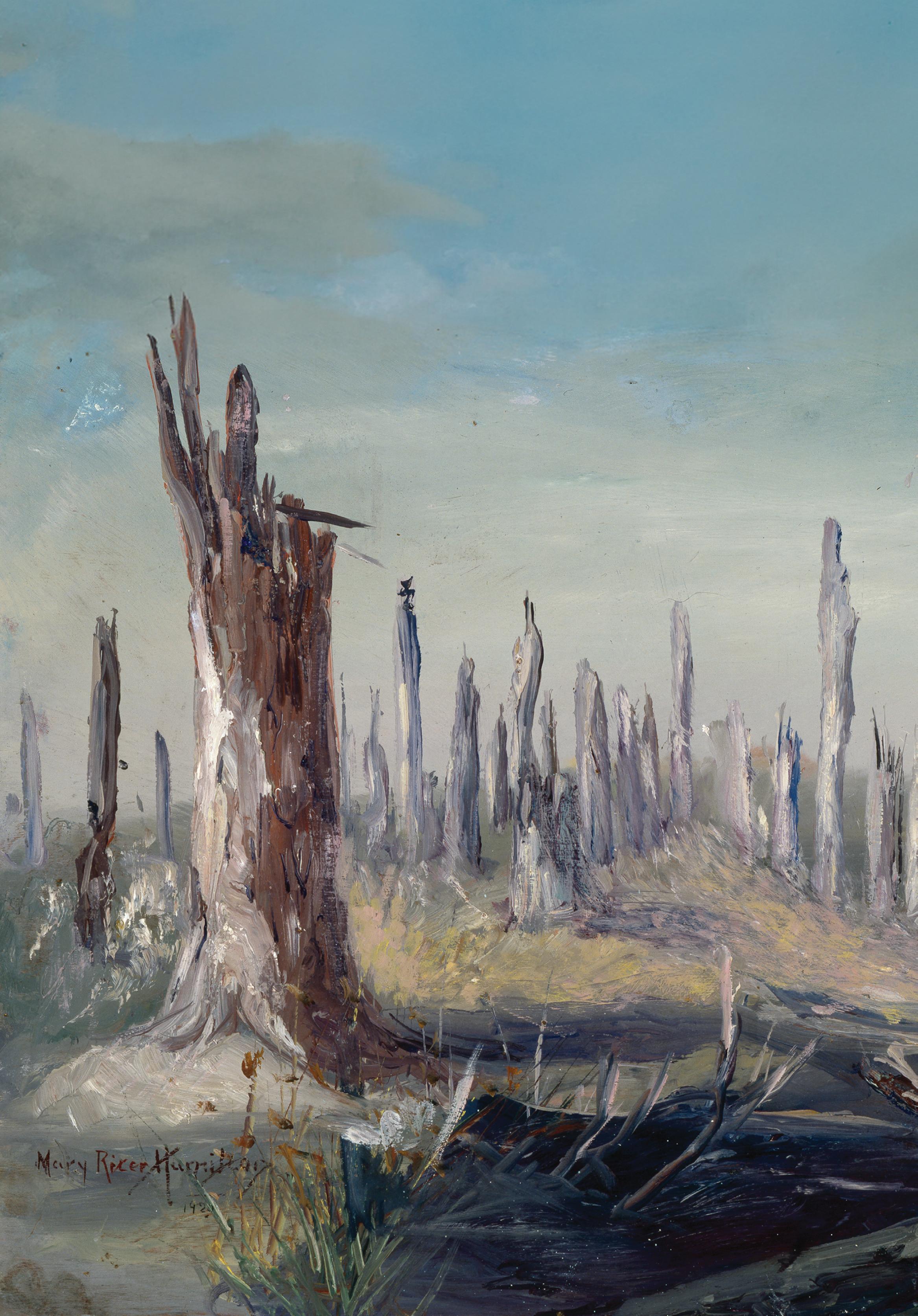
Regarded as Canada’s first female battlefield artist, Mary Riter Hamilton painted “Sanctuary Wood, Flanders” in 1920 during a postwar tour of the Western Front.
See page 52
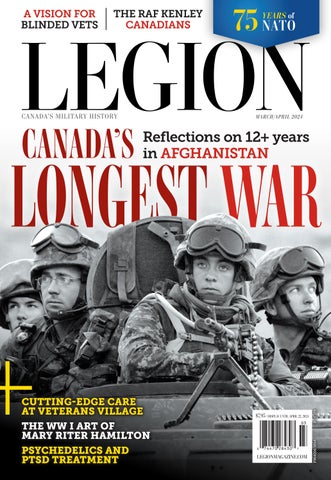
Reflections on the country’s role in Afghanistan 10 years after it left
Story and photography by Stephen J. Thorne
28 IT TAKES A VILLAGE
The new Legion Veterans Village in Surrey, B.C., is offering unheralded opportunities for military health care
By Paige Jasmine Gilmar
34 THE GHOSTS OF KENLEY
Reliving the Canadian connections to a critical Royal Air Force base Story and photography by Stephen J. Thorne
42 SECURITY SYSTEM
For 75 years, the North Atlantic Treaty Organization has worked to quell conflict By
John Boileau
52 DRAWN TO WAR
The First World War art of Mary Riter Hamilton By Irene
Gammel
60 THE BLIND SIDE
How soldiers who suffered vision impairment in the Great War changed the outlook for their lot By Serge
Durflinger

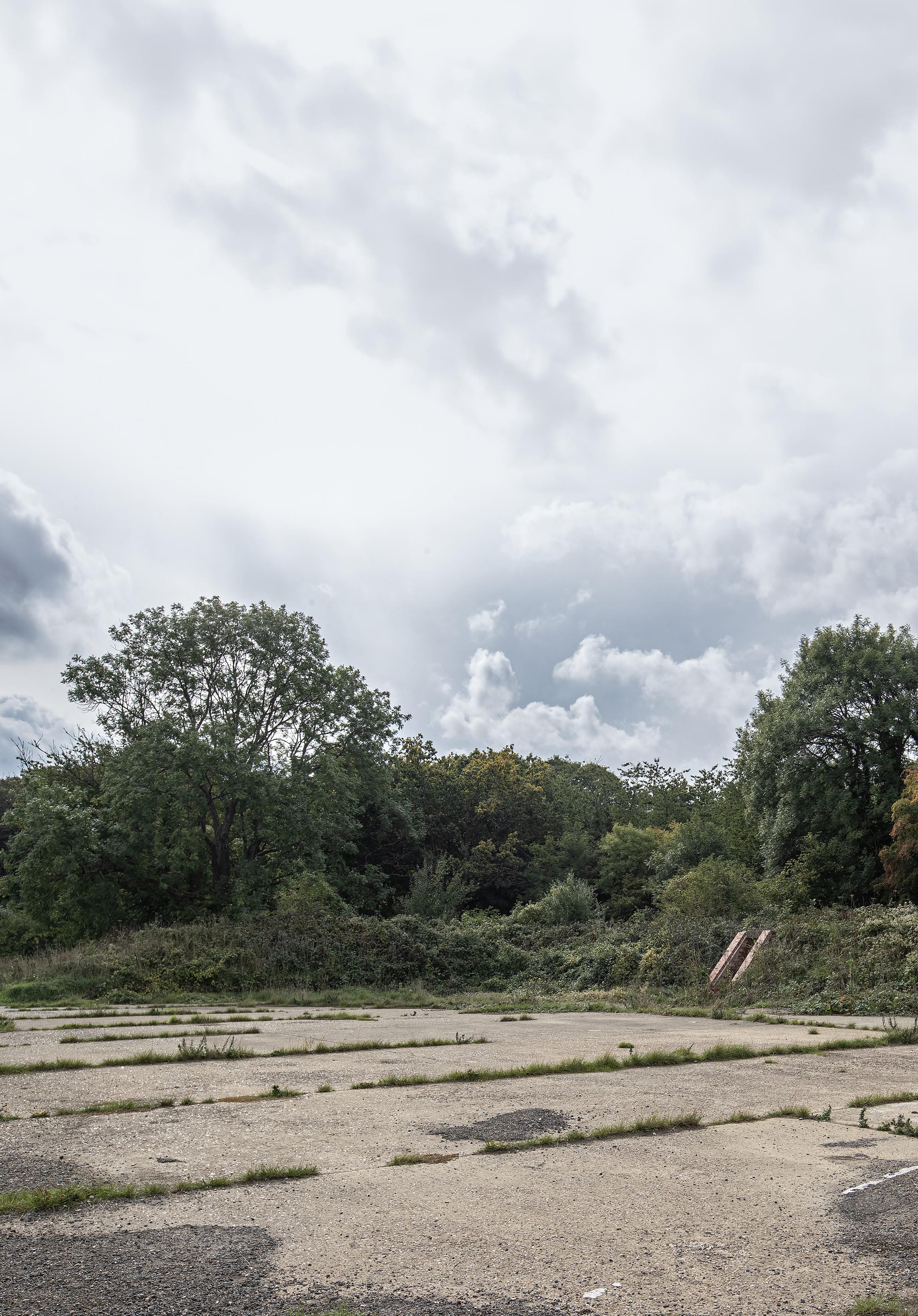
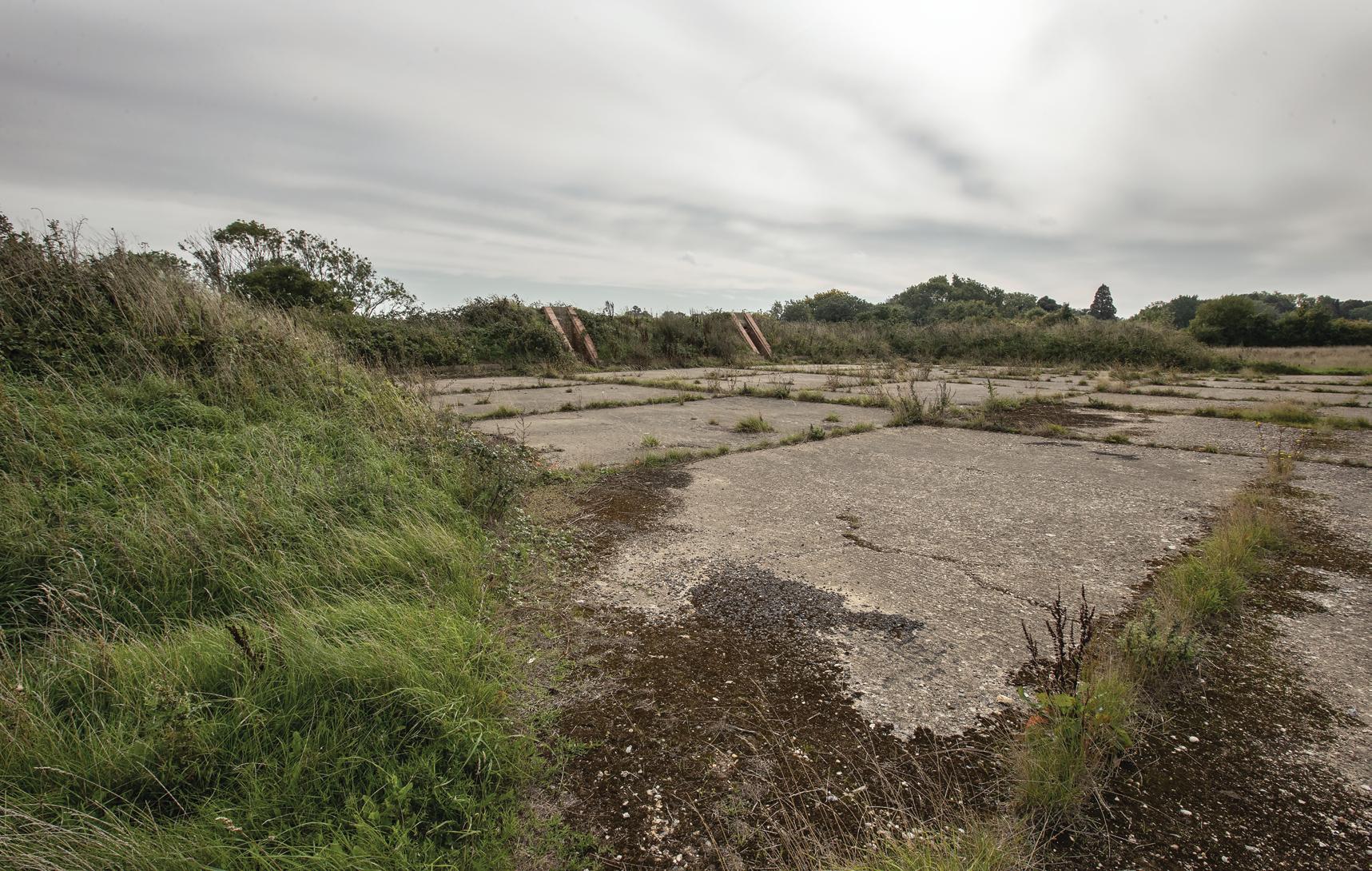
Overgrown berms surround a Second World War blast pen at the dormant Royal Air Force base in Kenley, England. Stephen J. Thorne/LM
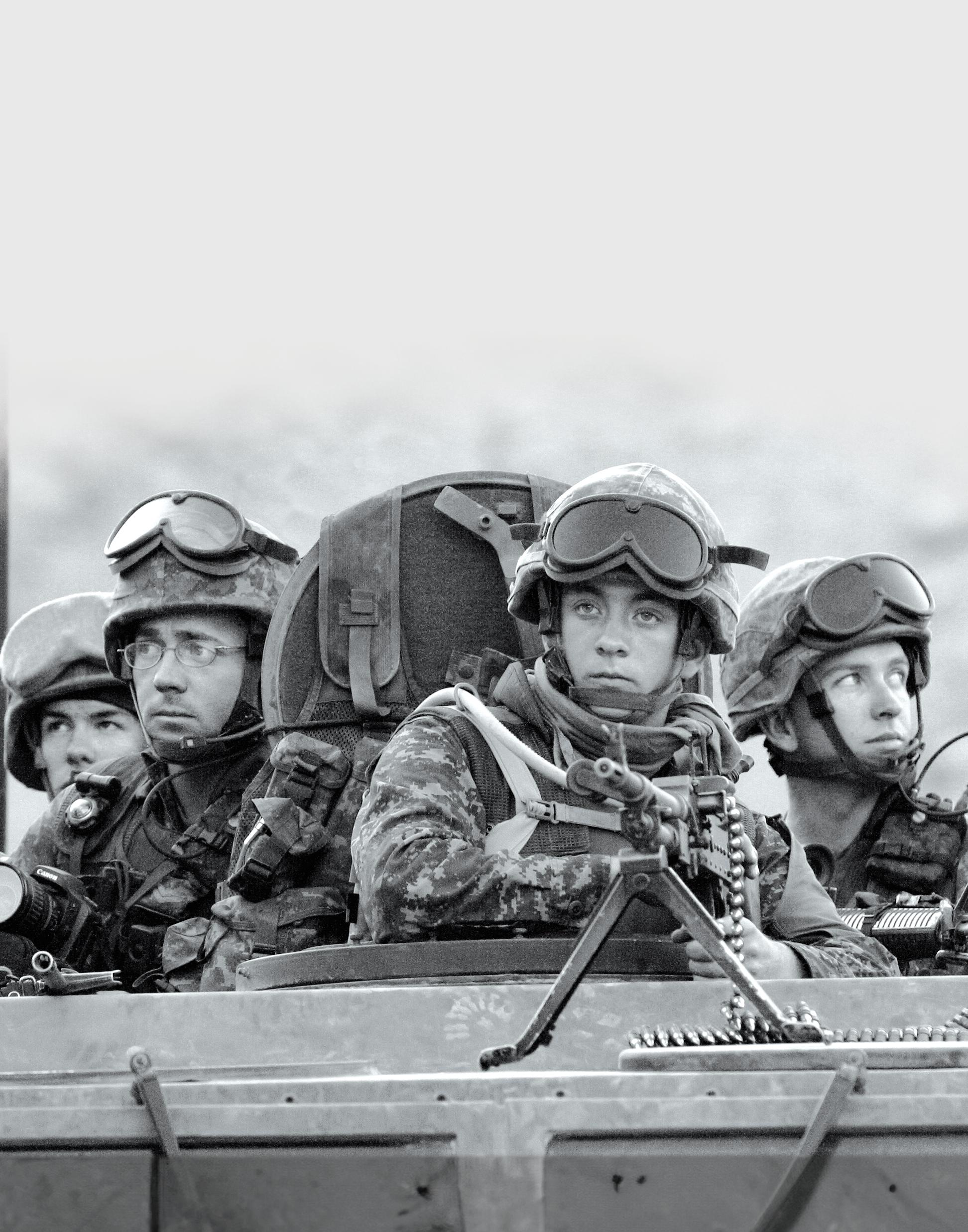
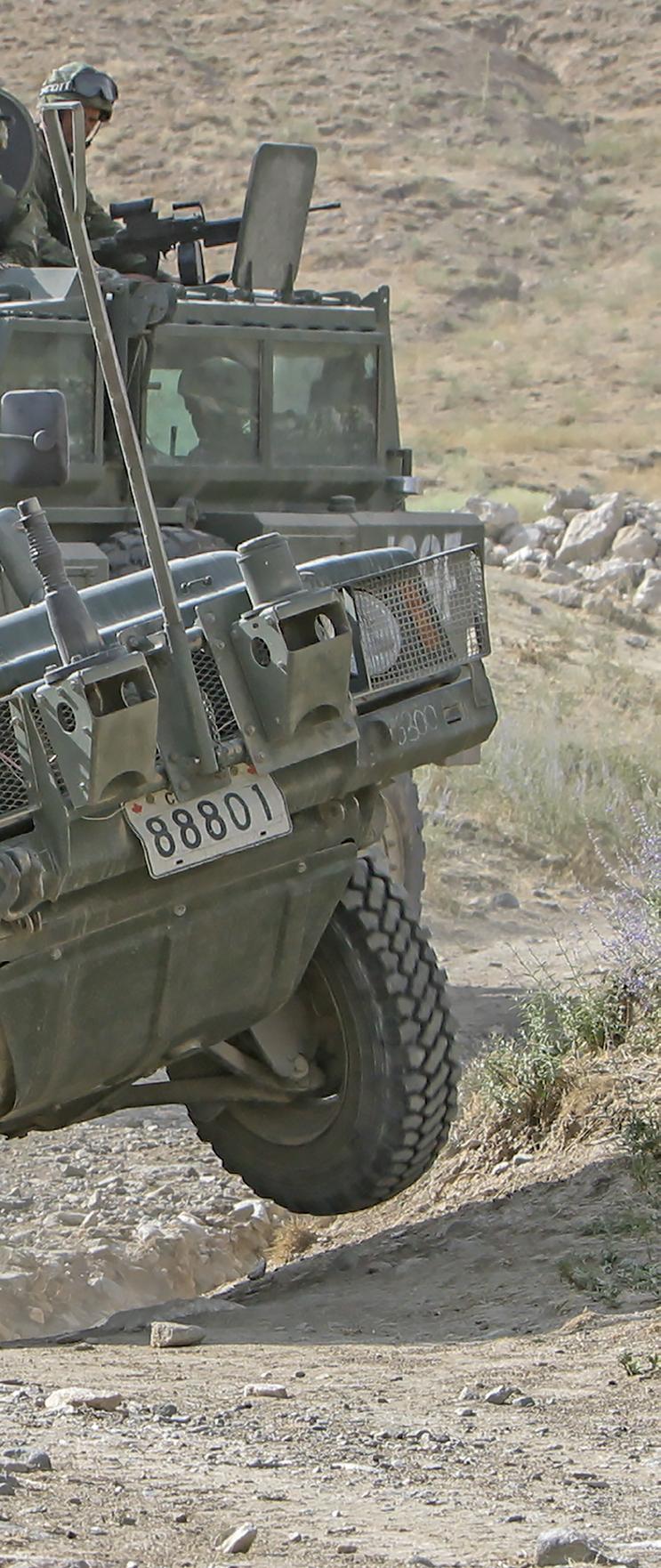
Members of the 3rd Battalion, The Royal Canadian Regiment Battle Group, conduct a reconnaissance patrol in Afghanistan in 2003. The gunner, Sergeant James (Jimmy) MacNeil, was killed in 2010 during his fourth deployment to the country. Warrant Officer Mark Boychuck (second from left) died in 2019 at Canadian Forces Base Gagetown in New Brunswick. He had served three tours in Afghanistan and one in Bosnia. Stephen J. Thorne

BOARD VICE-CHAIR Bruce Julian BOARD SECRETARY Bill Chafe DIRECTORS Tom Bursey, Steven Clark, Thomas Irvine, Berkley Lawrence, Sharon McKeown, Brian Weaver, Irit Weiser
Legion Magazine is published by Canvet Publications Ltd.
GENERAL MANAGER Jason Duprau
EDITOR
ADMINISTRATIVE
SUPERVISOR
Stephanie Gorin
SALES/
ADMINISTRATIVE ASSISTANT
Lisa McCoy
ADMINISTRATIVE ASSISTANT
Chantal Horan

Aaron Kylie
ASSISTANT EDITOR
Michael A. Smith
SENIOR STAFF WRITER
Stephen J. Thorne
STAFF WRITER
Paige Jasmine Gilmar


ART DIRECTOR, CIRCULATION AND PRODUCTION MANAGER
Jennifer McGill
SENIOR DESIGNER AND PRODUCTION CO-ORDINATOR
Derryn Allebone
SENIOR DESIGNER
Sophie Jalbert
DESIGNER
Serena Masonde

Advertising Sales
CANIK MARKETING SERVICES
TORONTO advertising@legionmagazine.com
DOVETAIL COMMUNICATIONS INC mmignardi@dvtail.com
OR CALL 613-591-0116 FOR MORE INFORMATION

SENIOR DESIGNER AND MARKETING CO-ORDINATOR
Dyann Bernard
WEB DESIGNER AND SOCIAL MEDIA CO-ORDINATOR
Ankush Katoch

Published six times per year, January/February, March/April, May/June, July/August, September/October and November/December. Copyright Canvet Publications Ltd. 2024. ISSN 1209-4331
Legion Magazine is $9.96 per year ($19.93 for two years and $29.89 for three years); prices include GST.
FOR ADDRESSES IN NS, NB, NL, PE a subscription is $10.91 for one year ($21.83 for two years and $32.74 for three years). FOR ADDRESSES IN ON a subscription is $10.72 for one year ($21.45 for two years and $32.17 for three years).
TO PURCHASE A MAGAZINE SUBSCRIPTION visit www.legionmagazine.com or contact Legion Magazine Subscription Dept., 86 Aird Place, Kanata, ON K2L 0A1 or phone 613-591-0116. The single copy price is $7.95 plus applicable taxes, shipping and handling.
Send new address and current address label. Or, new address and old address, plus all letters and numbers from top line of address label. If label unavailable, enclose member or subscription number. No change can be made without this number. Send to: Legion Magazine Subscription Department, 86 Aird Place, Kanata, ON K2L 0A1. Or visit www.legionmagazine.com. Allow eight weeks.
Opinions expressed are those of the writers. Unless otherwise explicitly stated, articles do not imply endorsement of any product or service. The advertisement of any product or service does not indicate approval by the publisher unless so stated. Reproduction or recreation, in whole or in part, in any form or media, is strictly forbidden and is a violation of copyright. Reprint only with written permission.
PUBLICATIONS MAIL AGREEMENT NO. 40063864
Return undeliverable Canadian addresses to Legion Magazine Subscription Department 86 Aird Place, Kanata, ON K2L 0A1 | magazine@legion.ca
United States: Legion Magazine, USPS 000-117, ISSN 1209-4331, published six times per year (January/February, March/April, May/June, July/August, September/October, November/December). Published by Canvet Publications, 866 Humboldt Pkwy., Buffalo, NY 14211-1218. Periodicals postage paid at Buffalo, NY. The annual subscription rate is $9.49 Cdn. The single copy price is $7.95 Cdn. plus shipping and handling. Circulation records are maintained at Adrienne and Associates, 866 Humboldt Pkwy., Buffalo, NY 14211-1218. U.S. Postmasters send covers only and address changes to Legion Magazine, PO Box 55, Niagara Falls, NY 14304.
Member of CCAB, a division of BPA International. Printed in Canada.
We acknowledge the financial support of the Government of Canada. Version française disponible.
On occasion, we make our direct subscriber list available to carefully screened companies whose product or services we feel would be of interest to our subscribers. If you would rather not receive such offers, please state this request, along with your full name and address, and e-mail magazine@legion.ca or write to Legion Magazine, 86 Aird Place, Kanata ON K2L 0A1 or phone 613-591-0116.
“L
ooking for Canadian veterans.”
The request was simple enough.
Late this past November, the French Embassy in Canada issued a communique searching out Canadian veterans still living who took part in the liberation of France 80 years ago. “He could be eligible for the Legion of Honour, the highest national French distinction,” it continued.
IT’S HARD TO FATHOM THAT NO CANADIAN HAS ENGAGED IN ACTIONS WORTHY OF THE COUNTRY’S TOP MILITARY HONOUR IN NEARLY 80 YEARS.
Weeks later, French Ambassador Michel Miraillet presented Second World War veteran Jim Spenst, 97, the decoration during a small ceremony in his hometown of Estevan in southern Saskatchewan. Spenst enlisted with the Royal Canadian Army Service Corps on Remembrance Day 1943 at just 17. He went overseas in June 1944 and helped transport materiel to troops in Belgium and France before returning to Canada in December 1945. “I went in a boy and came out a man,” said Spenst.
“This is a nice day for me, and it was an extraordinary opportunity,” said Miraillet after the presentation. “It’s very symbolic. The French have not forgotten what the Canadians did during the First World War or the Second World War.”
As France prepared to commemorate the 80th anniversary of D-Day, it was, and is, actively working to identify more veterans who qualify for the honour. The distinction cannot be awarded posthumously. During the last decade, nearly 1,300 Canadians have received the medal.
“I think that it’s tremendous for France to recognize the great work that our veterans do,” local Conservative MP Robert Kitchen told Discover Estevan following the ceremony.
Canada’s Victoria Cross, meanwhile, the country’s highest military decoration, has never been awarded—31 years after it was established in February 1993. And its British predecessor, created by Queen Victoria in 1856, was last earned by a Canadian, Lieutenant Robert Hampton Gray, in August 1945. Still, nearly 100 Canadians received it. So, it’s hard to fathom that no Canadian has engaged in actions worthy of the country’s top military honour in nearly 80 years. Even more so when a foreign country is searching out the last living Canadians to have fought on its soil in the Second World War to grant them its highest commendation—no matter their sacrifice.
Legion Magazine has covered for years now the campaign to have Jess Larochelle’s October 2006 actions in Afghanistan, recognized with the awarding of the first Canadian VC. Although alone, severely wounded and under sustained enemy fire in an exposed position, he provided covering fire to protect the lives of many of his comrades.
Larochelle received the Star of Military Valour for his conduct. But despite an effort backed by a 15,000-name petition, the endorsements of at least three living VC recipients and several highprofile former Canadian soldiers to have the award upgraded, Lieutenant-Colonel Carl Gauthier, head of the military’s Directorate of Honours and Recognition, told Legion Magazine last year that a timelimit technicality on bravery decoration nominations means it will never happen. Larochelle died this past August.
Fortunately for living WW II vets, France is ensuring they know how much their service meant before it’s too late. L




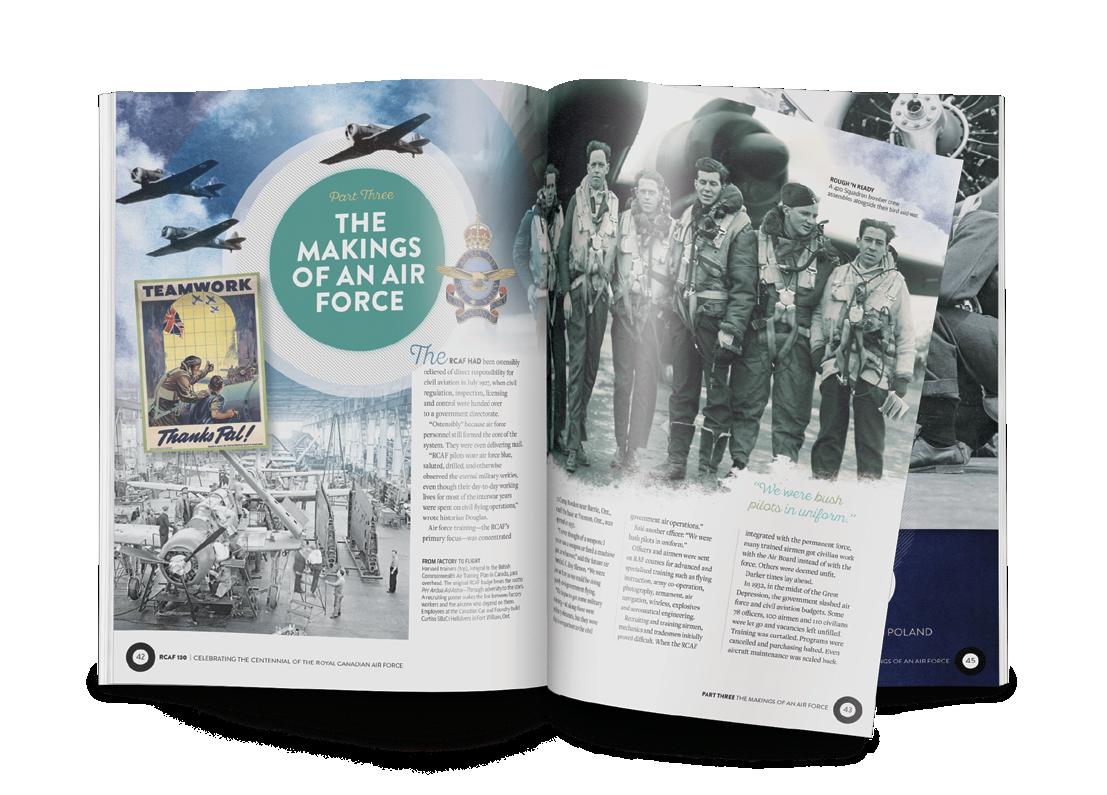

On the wings of a burgeoning aviation culture of hinterland stick jockeys, airmail pilots and high-flying adventurers, the Royal Canadian Air Force emerges from 100 years of war and peace as a respected, if not feared, hunter, protector and humanitarian presence in troubled skies the world over. The fascinating story of the RCAF is one of passion, promise and perseverance. Now
find the argument for Canada to buy more weapons and increase spending on the war machine curious coming from some Legion Magazine contributors (“Eye on defence,” “Face to Face” and “Canada and the New Cold War,” January/ February). The wonky British subs Canada bought and spent millions on to manage two weeks of use in 2023 should be a sign that the country needs to rethink its strategy. The option of having nuclear-powered subs
I agree with Assistant Editor Michael A. Smith (“Face to face,” January/February). Yes, we do need nuclear submarines. My neighbour in Sooke, B.C., is an electrician on Canada’s current subs and tells me they are poor and outdated. Canada needs to go to nuclearpowered submarines for its next fleet of the vessels, full stop. I spent seven years in two separate stints posted to CFB Esquimalt. During the time, I had neighbours working on HMCS Victoria counting with their fingers the number of days, not months, they spent underwater. It’s disgusting!
MASTER CORPORAL KELLY CARTER RED DEER, ALTA.
with nukes aboard so that, should the mainland be obliterated, Canada could still do damage to the other side is addled logic.
Given the magazine’s coverage of sick and elderly veterans, its writers are surely aware that millions in Canada don’t have access to a family doctor. Why is that? Can Canada as a civilized country not train enough doctors? When my family moved to the country in 1974, we had the choice of three family doctors. There was also a post office,
Comments can be sent to: Letters, Legion Magazine , 86 Aird Place, Kanata, ON K2L 0A1 or emailed to: magazine@legion.ca
There are several problems with Peggy Mason’s argument about nuclear-powered submarines. First,
bus service, railway, four gas pumps and general stores, even a laundromat in our community. Plus, a public school, three working sawmills within 24 kilometres, a craft store and more. All now gone.
The country has progressed into a backwater where people have the option of booking to see a nurse practitioner once a week by appointment. My point is simply: spend it on what we need and drop out of the war machine.
PAUL WHITTAKER GILMOUR, ONT.
it seems she is bent on appeasing the Chinese, ignoring the main reason for the subs, Canada’s Arctic sovereignty. Second, she talks about the cost, disregarding the fact that our defence is shamefully underfunded and a budget increase is needed whether we get the subs or not.
PIERRE ST. AMANT
LEFAIVRE, ONT.


I would like to suggest Legion Magazine readers send emails to bill.blair@parl.gc.ca or postage free letters to “Hon. Bill Blair, PC, MP, Defence Minister, House of Commons, Ottawa,” in support of Indigenous war hero Tommy Prince being promoted posthumously to Lieutenant (“O Canada,” January/February). He was denied that rank three times because of his heritage. He was entitled to that field promotion, so Canada should give it to him now.
JOE KOOPMANS
EDMONTON
I just read the article “Should Canada repatriate its war dead?” (“Face to Face, November/ December 2023). To my utter surprise, writer Paige Jasmine Gilmar referenced the lost love of her grandmother, Lois Mae’s, “soon to be husband,” George Henry Lloyd from Wingham, Ont. He was my uncle. My grandma, Minnie, his mother, took his death especially hard and yearned to visit his grave in Harrowgate, England. My grandparents finally made the trip across the Atlantic in the early 1950s. I had the privilege to get there twice, as well. I was
For almost four years, the forces of Nazi Germany occupied Europe while the Allies fought in Africa and the Pacific. But on the night of July 9-10, 1943, the Canadians, fighting as an independent unit for the first time, at the insistence of Prime Minister Mackenzie King and the Canadian military headquarters in Britain, slogged into the interior of Axis-occupied Sicily as part of Operation Husky. It was the first stage of the Allied liberation of Europe.

not aware of Lloyd’s fiancé until I read the article. I can’t explain why, but this revelation makes me feel so relieved and happy that he had this connection. It must have been a huge comfort to him knowing he had her in his life, imagining his future with her while in training. Your article conjured up many emotions. I have profound respect for the men in my family who served and sacrificed so much for us.
JOHN WELWOOD KINCARDINE, ONT.
Get notified of all the latest updates on legionmagazine.com by signing up for our weekly e-newsletter at www.legionmagazine.com /newsletter-signup
Six weeks later, the fighting in Sicily ended, on Aug. 17—one month, one week and one day after it began. Fascist Italian troops and the forces of Nazi Germany were eradicated in Sicily, Mediterranean transit routes were opened to Allied merchant ships for the first time since 1941, and mainland Italy became the Allies’ next objective. Learn more about Operation Husky with Legion Magazine’s new five-part interactive website. Scroll through maps, images and primary sources that tell the story of the events that changed the tide of war in Europe and cemented Canada’s role in it. Check it out at https://legionmagazine. com/features/operation-husky/.
There’s an accompanying video, too, narrated by Canadian survival expert Les Stroud, that relates Canada’s part in Sicily. Watch it at www.youtube.com/ LegionMagazine. L
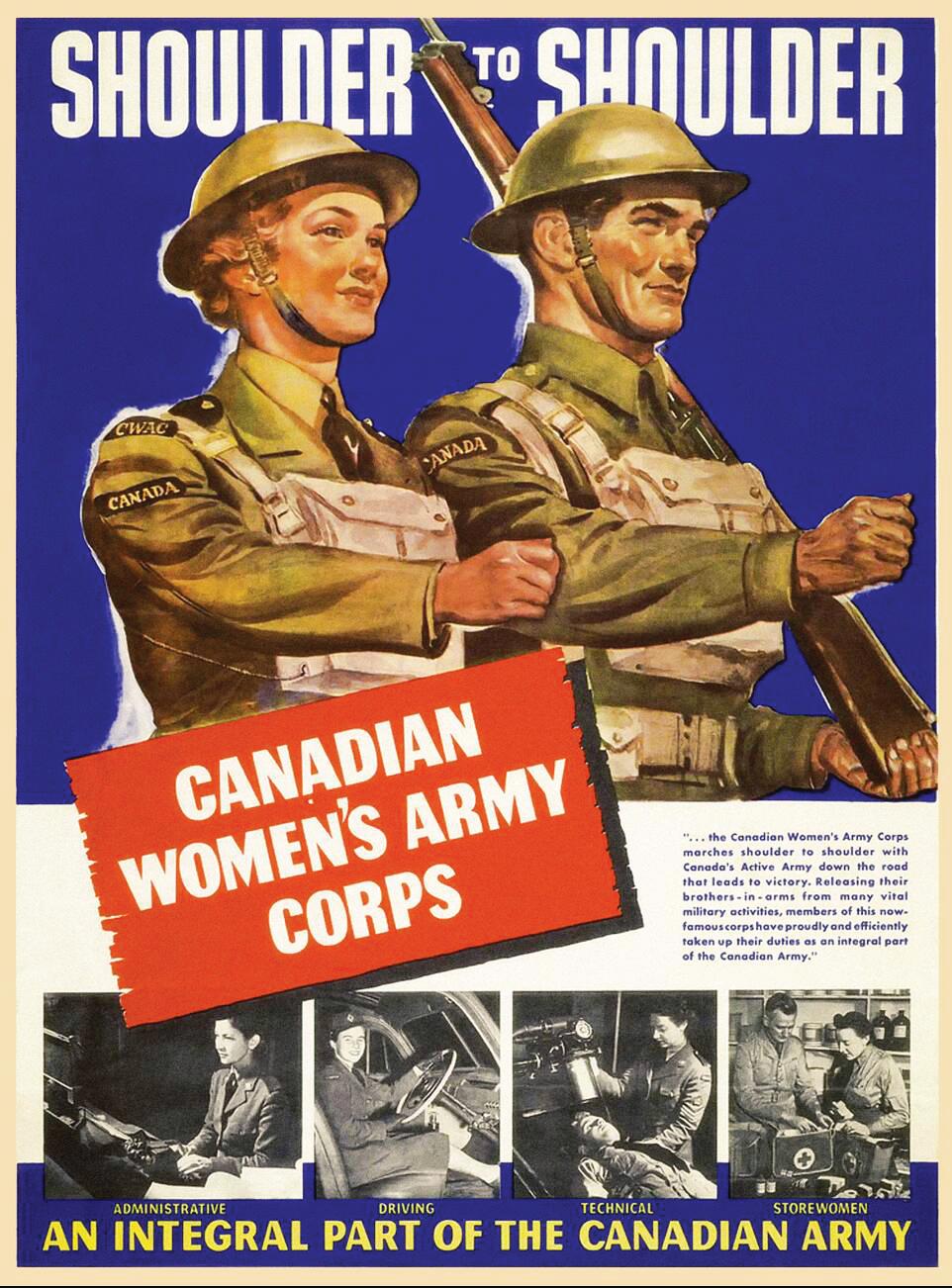
1 March 1942
The Canadian Women’s Army Corps is granted full army status and becomes an integral part of the Canadian Militia. Prior to this, only nursing sisters were admitted into the country’s armed forces.
2 March 2011
HMCS Charlottetown heads for Libya to provide humanitarian assistance amid civil war.
3 March 1838
A small British force led by Capt. George Browne intercepts and repulses American invaders near Pelee Island, Upper Canada.
8 March 2001
The Royal Canadian Navy authorizes women to serve on submarines.
9 March 1925
The first Royal Air Force operation conducted independently of the British Army or Royal Navy is led by Wing Cmdr. Richard Pink.
10 March 1944
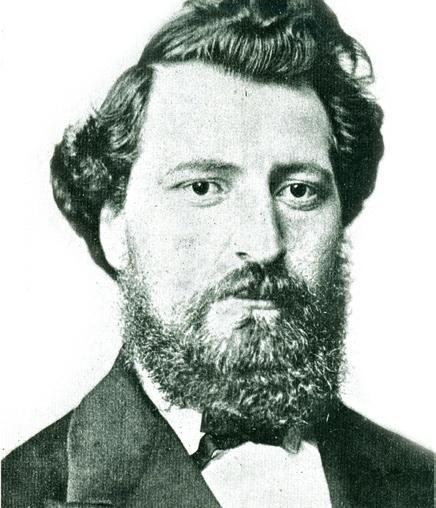
HMC ships St. Laurent, Swansea and Owen Sound, along with HMS Forester, destroy U-845 in the North Atlantic.
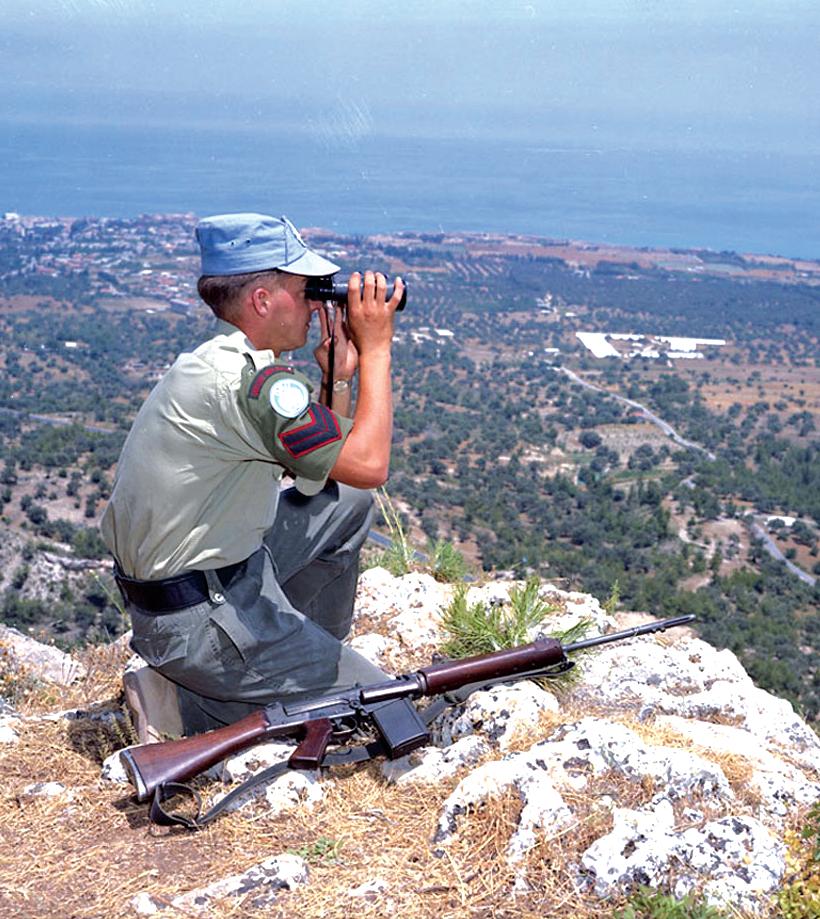
12 March 1964
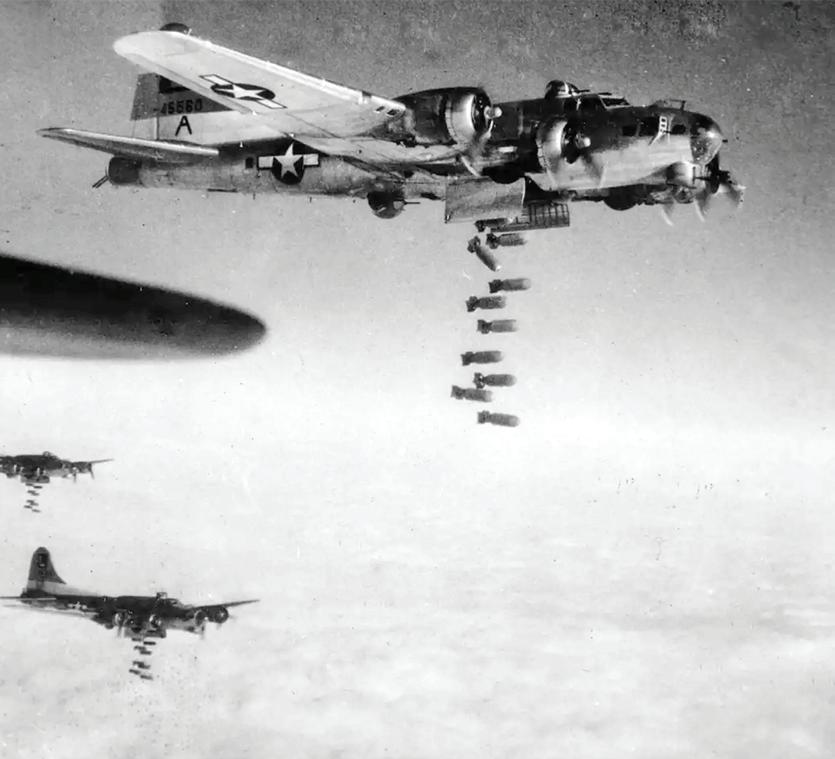
5 March 1945
Some 700 Allied bombers destroy Chemnitz, Germany.
7 March 1936
Nazi Germany sends troops into the Rhineland, bordering Belgium, violating the Treaty of Versailles.
Canada commits peacekeepers to the United Nations mission in Cyprus; more than 25,000 personnel serve there over the next 29 years.
13 March 1951
18 March 1885
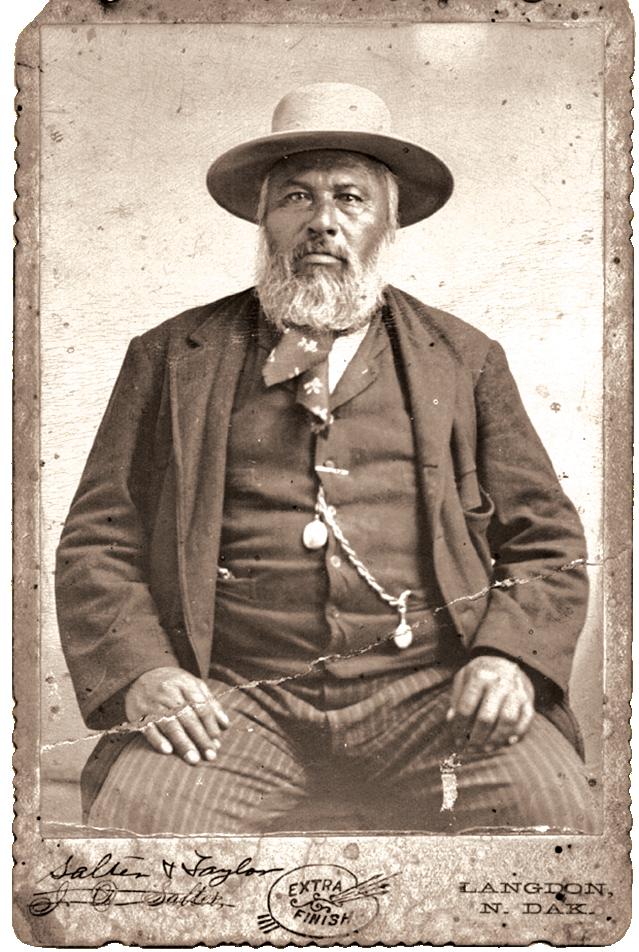
Métis at Batoche, Sask., are warned that Canadian soldiers are on their way to arrest Louis Riel and Gabriel Dumont.
19 March 1964
Sgt.-Maj. Walter Leja receives the George Medal for bravery in dismantling FLQ bombs in Montreal.
23 March 1965
Fifteen RCAF aircrew are killed when their Argus patrol plane crashes during a night exercise off Puerto Rico.
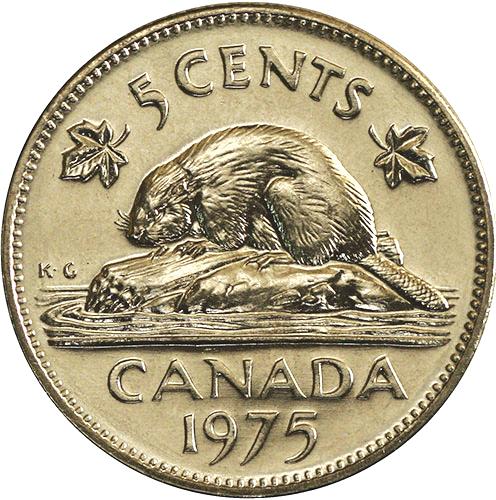
24 March 1975
The beaver becomes an official symbol of Canada.
27 March 1918
Wounded several times in an aerial dogfight in which he shot down three enemy planes, Alan Arnett McLeod crash-lands in no man’s land. He is awarded the Victoria Cross.
Communist forces begin a withdrawal across all fronts in the Korean War.
14 March 1984
NASA announces Marc Garneau as one of seven astronauts on space shuttle Challenger Later that year Garneau became the first Canadian to go to space.
15 March 1990
RCMP officer Baltej Singh Dhillon becomes the first officer to be allowed to wear a turban in uniform.
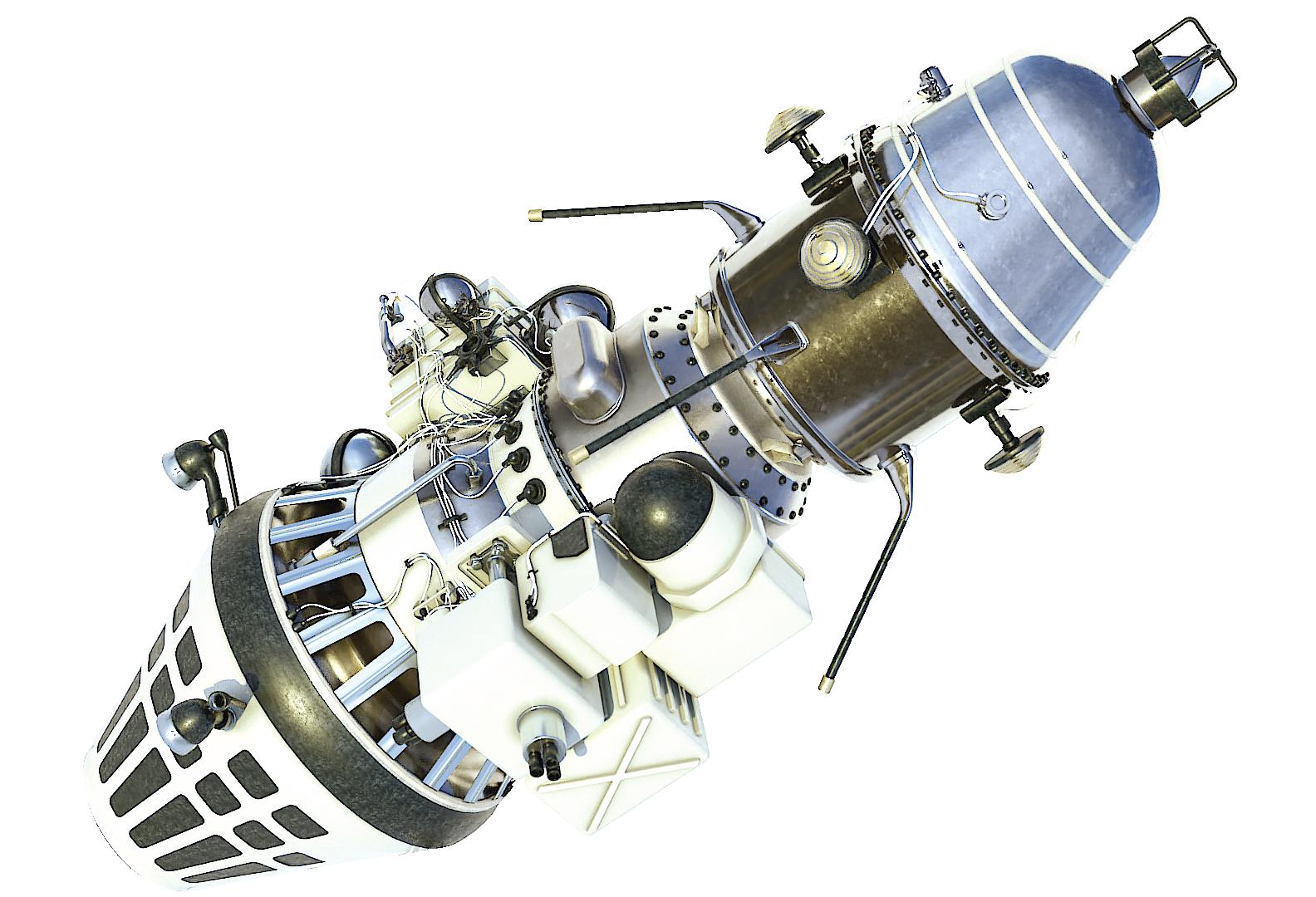

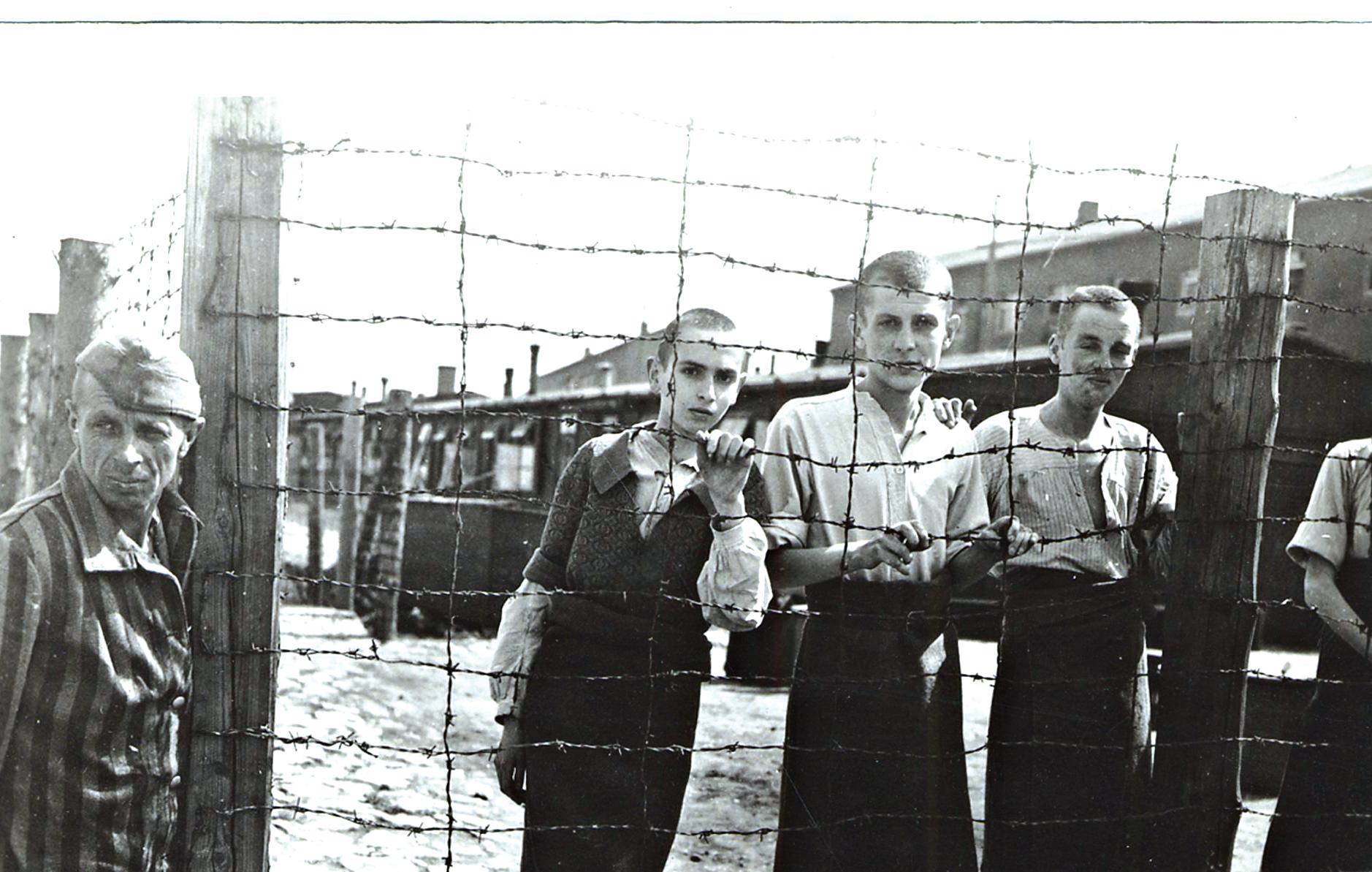
1 April 1924
The Royal Canadian Air Force is established.
2 April 1885
Cree warriors, led by war chief Wandering Spirit, kill nine settlers at Frog Lake as part of the NorthWest Resistance in what was then the District of Saskatchewan.
3 April 1945
The First Canadian Army captures the German town of Zevenaar.
4 April 1949
The North Atlantic Treaty, which forms the legal basis of NATO, is signed by member countries. (Also see “Security system” on page 42.)
7 April 1991
HMC ships Athabaskan, Protecteur and Terra Nova return home from service in the Persian Gulf War.
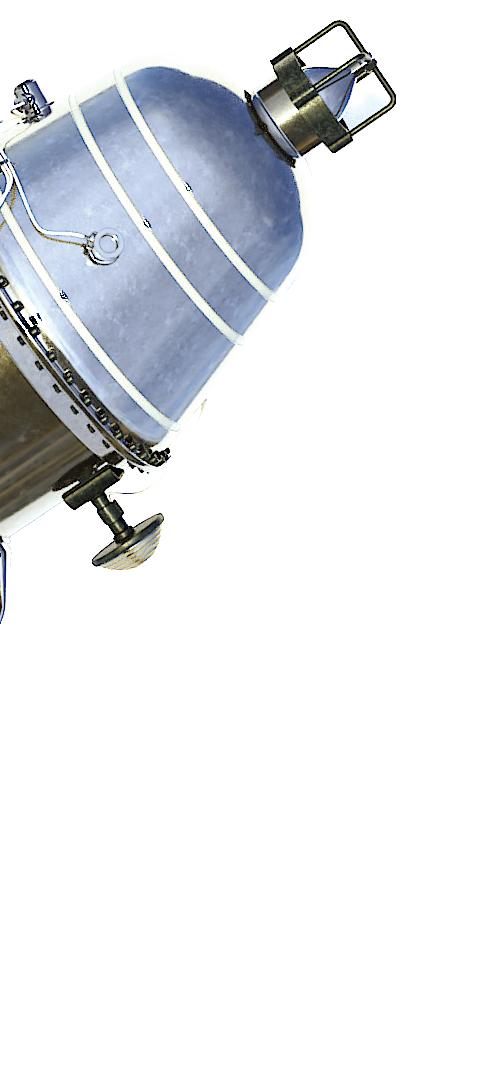
10 April 1945
The Nazi concentration camp of Buchenwald near Weimar, Germany, is liberated by U.S. troops.
18 April 1943
No. 14 Squadron, RCAF, supports the U.S. Eleventh Air Force bombing Japanese installations on Kiska in Alaska’s Aleutian Islands.
20 April 1953
Prisoners of war are exchanged between North Korean and United Nations forces at Panmunjom as Korean War fighting grinds to a halt.

13 April 2011
Under a hail of bullets, Cpl. Brian Belanger drags a wounded Afghan soldier to cover and administers first aid after an ambush in Afghanistan. He is awarded the Medal of Military Valour.
16 April 1945
Canadian minesweeper Esquimalt is torpedoed by German submarine U-190 off Halifax and sinks before it can send a distress signal; 44 die, while survivors are rescued by HMCS Sarnia
21 April 1997
The CAF launches Operation Assistance in response to flooding along Manitoba’s Red River.
24 April 1992
The United Nations establishes a peacekeeping mission to Somalia in which Canada would infamously participate.
25 April 1915
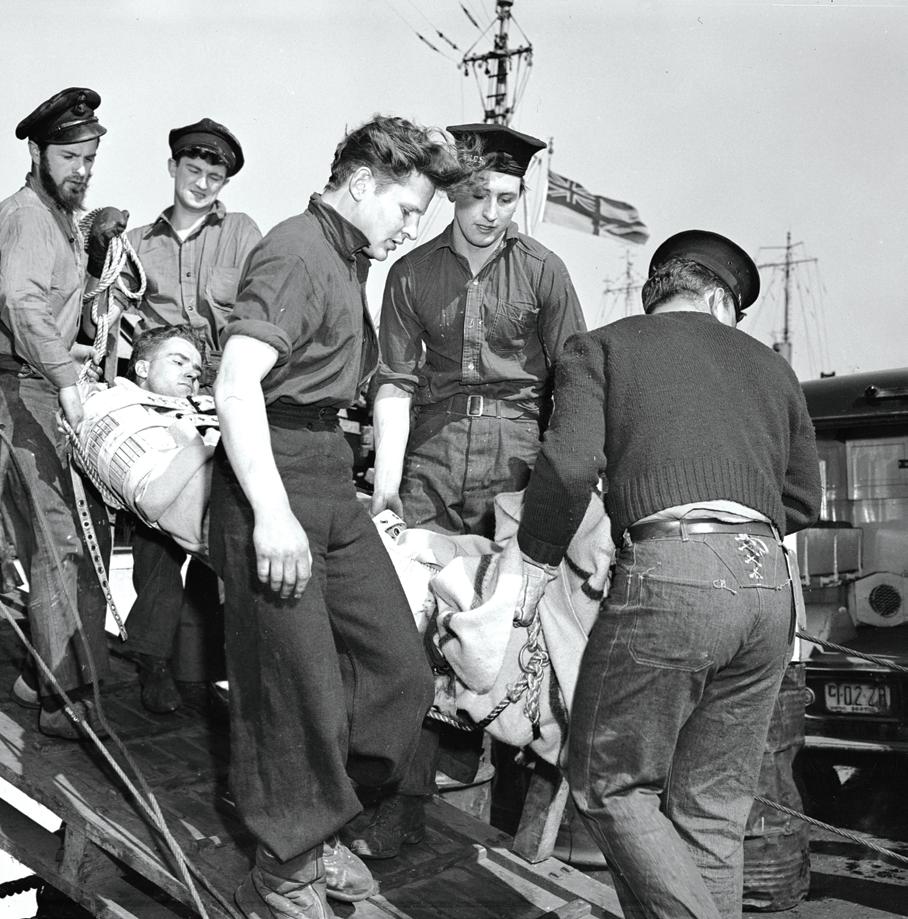
Under heavy fire at Saint-Julien, Belgium, Capt. Francis Scrimger protects a wounded officer with his own body. He receives a Victoria Cross for his action.
27 April 1942
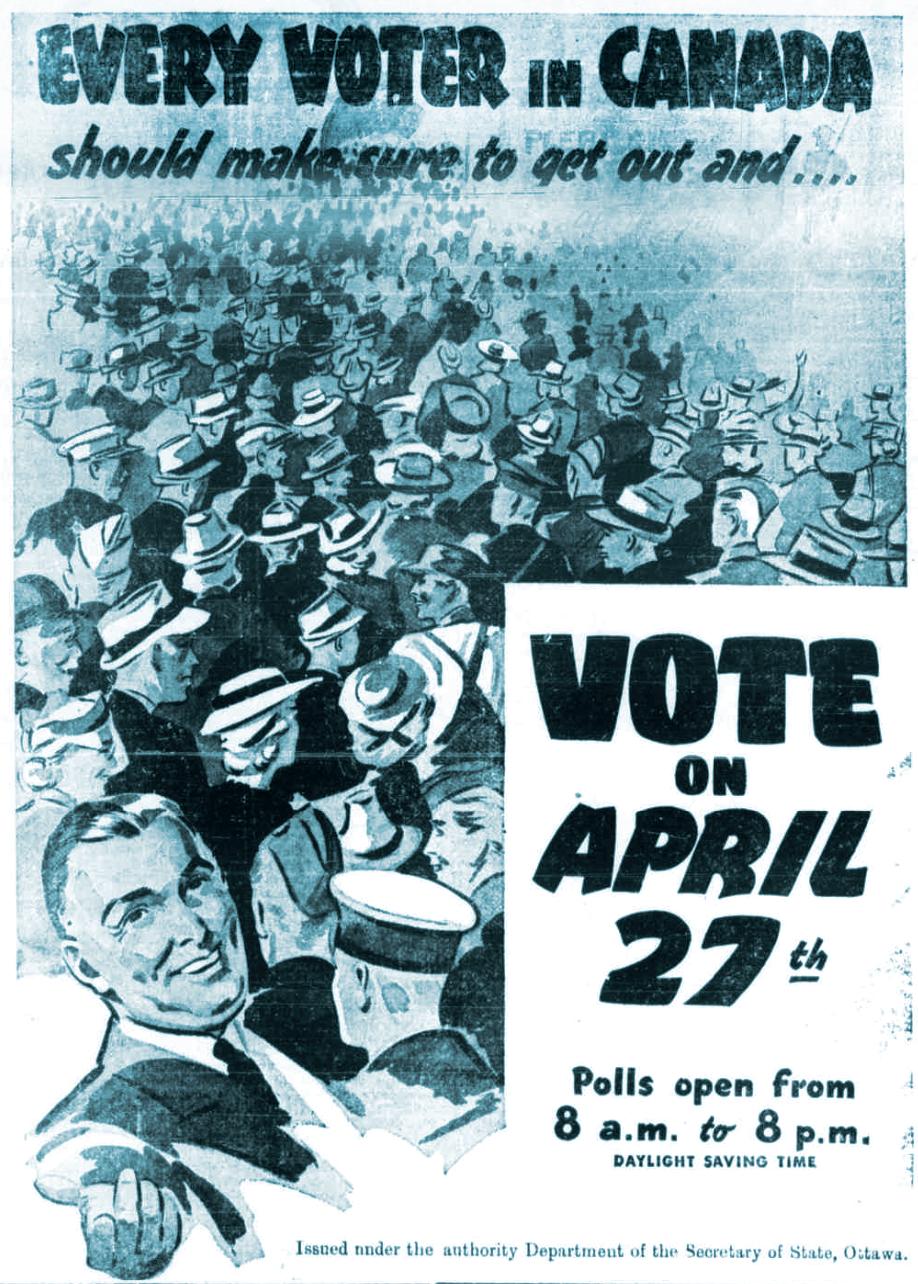
Quebec votes “Non” in a national conscription plebiscite.
By Paige Jasmine Gilmar

Hallucinogens such as ketamine appear to help address PTSD, but Veterans Affairs Canada won’t fund clinical trials to test them
Two hundred and fifty per cent. That’s how much higher the rate of suicide for male Canadian veterans under the age of 25 is than for the general population according to Veterans Affairs Canada. It’s a dramatic statistic that suggests a dramatic new approach to treatment might be needed.
Other veteran demographics don’t fare much better, with suicide among female veterans 200 per cent higher than the general population and male veterans over age 25 at 50 per cent higher. The situation is attributed to high frequencies of post-traumatic stress disorder and operational stress injuries (OSIs), and traditional therapeutic techniques have done little to counter the problem. Indeed, the remission rate for PTSD and OSIs is stagnant at 30-40 per cent. Still, Veterans Affairs Canada sticks by the typical psychotherapeutic approaches as the be-all and end-all, the infallible panacea until something conclusively better shows up.
But the something better VAC has been waiting for may have already arrived; in fact, it has been an option for years. The use of
medically prescribed psychedelic drugs for severe, treatmentresistant PTSD or OSIs are yielding promising results in preliminary studies. So much so, that in a November 2023 report on the topic, the Senate subcommittee on veterans affairs recommended that VAC immediately implement a robust research program on psychedelics to “ensure…that those veterans most likely to benefit from it are given access to treatment with the best scientific support available.”
Introduced in the 1960s, the psychedelic ketamine allows people to feel detached from their body or environment, while also relieving pain. Used widely in pediatrics, emergency medicine and intensive care, ketamine has been named an essential medicine by the World Health Organization for its versatility and high-ranking safety profile. When ketamine was shown to hold rapid antidepressant effects in a 2000 study, it kickstarted what Canada’s largest ketamine provider, the Canadian Centre for Psychedelic Healing, called the “psychedelic renaissance.”
“I did a ketamine treatment with a patient, and in one treatment, 70 per cent of his symptoms went away. And within two treatments, he had no symptoms,” said Dr. Mario Nucci, the centre’s founder. “I just can’t do that with any other form of care.”
Ketamine hacks into the areas of the brain responsible for thoughts and feelings while in a resting state and rewires unconscious and uncontrollable thinking patterns. It helps create new and additional connections in the brain.
Randomized control trials have shown that the drug provides benefits for chronic PTSD, obsessive-compulsive disorder, social and generalized anxiety disorders, chronic pain, treatmentresistant depression, addiction and eating disorders. With success rates as high as 70-80 per cent, the Psychedelic Healing centre suggests that ketamine is a therapeutic goldmine for OSIs and has even launched its own pre-pilot study on PTSD remission rates in Canadian veterans using ketamine therapy. “Veterans don’t allow for chinks in their armour,” said Ian Ruberry, the centre’s CEO. “It takes the ketamine to let that guard down so that they can feel safe.”
Canadian veteran Corey Pettipas is an activist for ketamine therapy. He served nearly 13 years with the Royal Canadian Navy, starting in April 2008, first as a naval combat information operator and then as an electrical technician. From the Gaddafi uprising in Libya to South American drug busts, Pettipas was unnerved by the moral mess that often came with intelligence operations. He was medically discharged with PTSD in 2021.
“My PTSD is really complicated because it has a lot to do with information and seeing how people used the information we had in an abusive way, how it needlessly put lives at risk,” Pettipas told Legion Magazine. Discussions
about suicide were frequent on his ship, especially after one of his shipmates overdosed.
After his release, Pettipas experienced a number of therapies and suffered debilitating side-effects from many of the associated drugs. He also felt as though he was being chastised and shamed during some psychotherapy sessions. But after his service dog was injured and a friend died of a fentanyl overdose, Pettipas was finally prescribed something that actually helped: ketamine. “I was shown how beautiful I was in those first sessions,” he said. “I was handed my autonomy on a golden platter.”
Even in the face of scientific studies supporting its effectiveness, VAC maintains that psychedelic psychiatry isn’t an “evidencebased practice.” And Alexandra Heber, its chief psychiatrist, noted
in the Senate report that “based on our review of the literature and deliverations...[we] do not recommend the use of psychedelics or psychedelic-assisted psychotherapy at this time.” VAC, meanwhile, did not immediately respond to a Legion Magazine request for further comment.
The Senate report said VAC was “ill-suited to the leadership role it should be taking,” stating that its inability to adopt new practices such as psychedelic therapy is unnecessarily putting lives at risk in favour of a wait-and-see approach. VAC’s inaction is particularly noteworthy when both the U.S. and Australia have funded studies on the clinical usage of psychedelics.
Pettipas’ situation is a direct result of VAC’s stance. Its policy only covers the costs of ketamine therapy for treatment-resistant depression and it won’t cover



psychotherapy that takes place during ketamine treatment or if the treatment is prescribed for conditions such as PTSD. VAC has deemed Pettipas ineligible under both criteria. “They are adopting a wait-and-see policy because being progressive costs money,” said Pettipas.
His wellness has been impacted by his ongoing struggle to have VAC cover the cost of his ketamine therapy. He said the organization owes him thousands of dollars and he’s prepared to take VAC to court to recoup his expenses and have the treatment recognized for his condition.
“I sacrificed so much for my country that I can sacrifice myself now,” said Pettipas. “To prop this door open with my heart and soul so other veterans can get this psychedelic therapy that’s going to save their lives.” L
“When our brother passed away, we reached out to Ultramatic for advice on reselling his Ultramatic twin bed. [Beds still working after 40 years!]
Maria answered our call. She suggested we consider donating the bed to a Veteran. So she kindly researched the contact information for several Legion branches in our area of BC.
Since our family members have a long history of military service and Legion membership, we were immediately in support of this idea.
We are very impressed with the culture of care at Ultramatic and their willingness to go the extra distance to support not only their customers but also Veterans in need.”

OnApril 22, 1915, Canadian and Algerian troops holding the line on the Ypres Salient watched as an ominous yellow-green cloud rose from the opposing German trenches and, carried by a light northeast wind, approached low and slow.
The cloud was, in fact, more than 160 tonnes of poisonous chlorine gas and as it rolled over the French colonials on the Canadians’ left flank, the Algerian soldiers began choking and gasping for air. Some turned and ran, but the gas followed them. The nearest Algerians made for the Canadian trenches across the road.
“Our trenches were shortly filled with them crowding in from out left,” said Lieutenant-Colonel
Ian Sinclair of the 13th (Royal Highlanders of Canada) Battalion. “They were mostly blind and choking to death, and as fast as they died were just heaved behind the trench.”
The attack during the Second Battle of Ypres—the first successful incidence of modern chemical warfare—had the desired effect, opening a 6.5-kilometre gap in the Allied line, which the Canadians promptly filled as best they could. But the Germans were unprepared for such success and their advance stopped short.
Two days later, it was the Canadians’ turn as a six-metrehigh wall of gas swept over their trenches north of the Belgian trade centre that had become a


roadblock to the German advance to the sea. The town is known today by the Flemish Ieper (EE-per).
“The Canadians…got badly gassed,” recalled Bert Newman of the Royal Army Medical Corps. “In the end you could see all these poor chaps laying on the Menin Road, gasping for breath.”
In their first two weeks of fighting around Ypres, the Canadians suffered some 6,000 casualties, a third of the division. A thousand lay dead on the battlefield, many of them gas victims.
“On the front field one can see the dead lying here and there, and in places where an assault has been they lie very thick on the front slopes of the German trenches,” Canadian LieutenantColonel John McRae wrote less than two weeks before he authored the poem, “In Flanders Fields.”
Gas attacks directly killed or wounded nearly 1.3 million soldiers in the First World War.
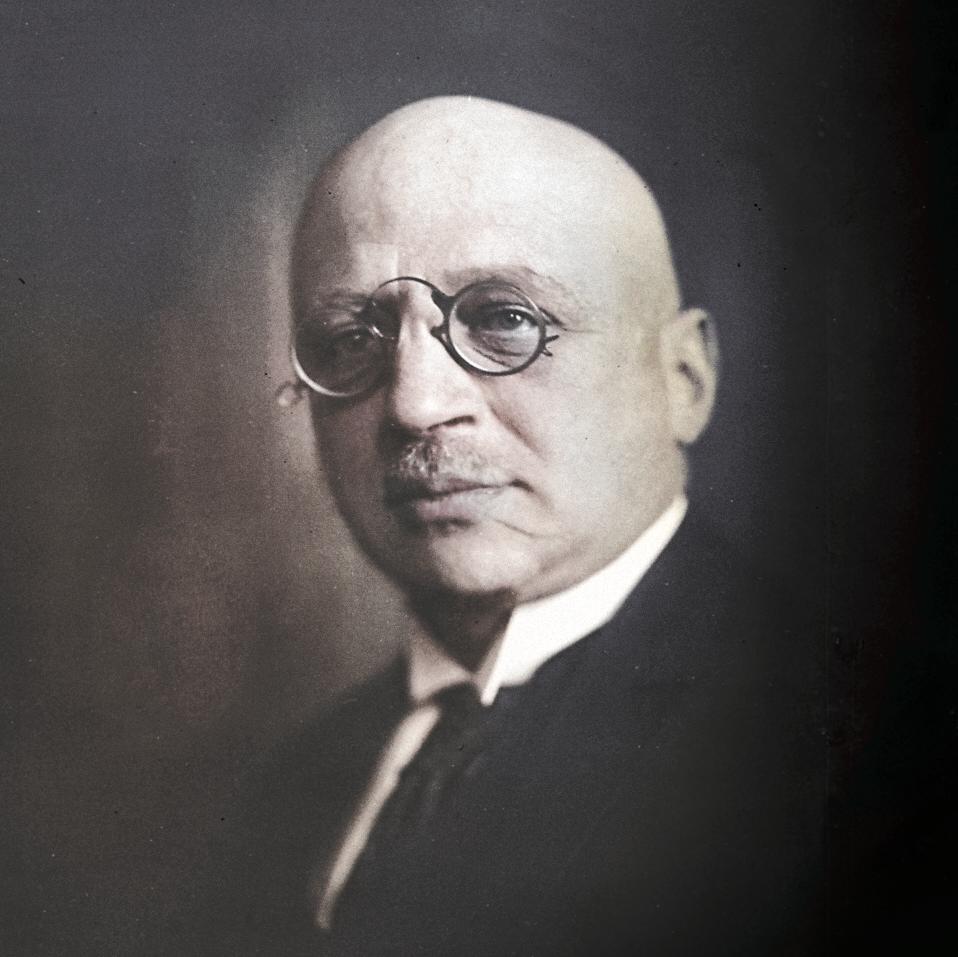
Fritz Haber, the German scientist who came up with the diabolical weapon, is a study in contradiction, a Jew who converted to Christianity in 1892 to secure his
> Check out the Front lines podcast series! Go to legionmagazine.com/frontlines
career, whose work not only caused misery and death to untold numbers of people in two world wars, but also saved—and continues to save—countless millions. A scientific institute in Israel bears his name.
In 1918, three years after his weapon was introduced on the battlefield at Ypres, Haber was awarded the Nobel Prize in Chemistry for developing the HaberBosch process, a method of synthesizing ammonia from nitrogen and hydrogen that remains fundamental to the large-scale synthesis of fertilizers—and explosives.
Developed with German chemist and engineer Carl Bosch, Hader’s fertilizer process proved a milestone in the annals of industrial chemistry. The production of nitrogen-based products such as fertilizer and chemical feedstocks, previously dependent on extracting ammonia from limited natural deposits, now became possible using an easily available, abundant base—atmospheric nitrogen.
The ability to produce far larger quantities of nitrogen-based fertilizers in turn supported much greater agricultural yields. Today, the annual world production of synthetic nitrogen fertilizer based on the Haber-Bosch process exceeds 100 million tonnes and the food base of half the world’s population depends on it.
Yet Haber was a fanatical nationalist whose chemical weapons development is said to have contributed to the May 1915 suicide of his first wife, trailblazing scientist and women’s rights activist Clara Immerwahr.
He continued working on chemical weapons even after the 1918 armistice. Two of his children killed themselves after WW II, before which Zyklon A, a pesticide developed at Haber’s institute, spawned Zyklon B, the chemical the Nazis used to exterminate more than a million Jews and other “undesirables” in the 1940s.
In a not-so-improbable twist of fate, several members of his extended family died in Nazi concentration camps.
Despite his contributions to the German cause, his Jewish ancestry caught up with him and, after 1933, Haber lived out his life in exile.
Haber once said, “during peacetime a scientist belongs to the world, but during wartime he belongs to his country.” A veteran of mandatory service 25 years earlier, Haber rejoined the military at the outbreak of WW I. He was promoted to captain and appointed head of the war ministry’s chemistry section.
He immediately assembled a team of more than 150 scientists and 1,300 technical personnel. A special gas-warfare troop was formed (Pioneer Regiments 35 and 36) under the command of Otto Peterson. Haber and Friedrich Kerschbaum served as advisers. Haber recruited physicists, chemists and other scientists to the cause.
Future Nobel laureates James Franck, Gustav Hertz (both in physics) and Otto Hahn (chemistry) served as gas troops in Haber’s unit. Haber seized on chlorine gas largely because it was heavy and settled downward. His teams also developed other deadly chemicals for use in trench warfare, including mustard gas.
Haber was on hand when the chlorine was released outside Ypres. He defended the weapon against accusations that it was inhumane, saying that death was death, regardless of how it was inflicted.
In his studies of the weapon’s effects, Haber noted that exposure to a low concentration for a long time often had the same effect— death—as exposure to a high concentration for a short time. He formulated a simple mathematical relationship between the gas concentration and the necessary exposure time. This relationship became known as Haber’s rule.
Haber died in January 1934, at just 65 years old. He has remained the object of much criticism from the science community for his involvement in developing chemical weapons.
Yet in 1981, the Minerva Foundation of the Max Planck Society and the Hebrew University of Jerusalem established the Fritz Haber Research Center for Molecular Dynamics, based at the Institute of Chemistry of the Hebrew University. Its purpose is the promotion of Israeli-German scientific collaboration in the field of molecular dynamics. The centre also houses the Fritz Haber Library. L
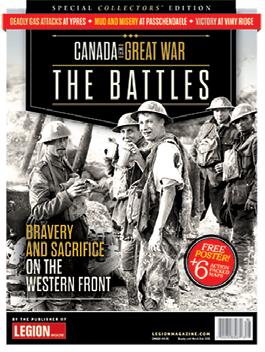
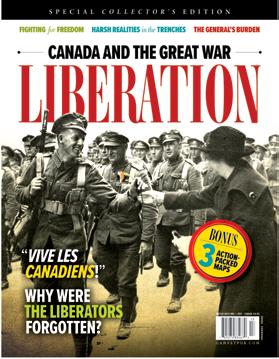
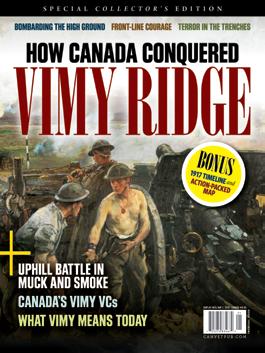
By David J. Bercuson
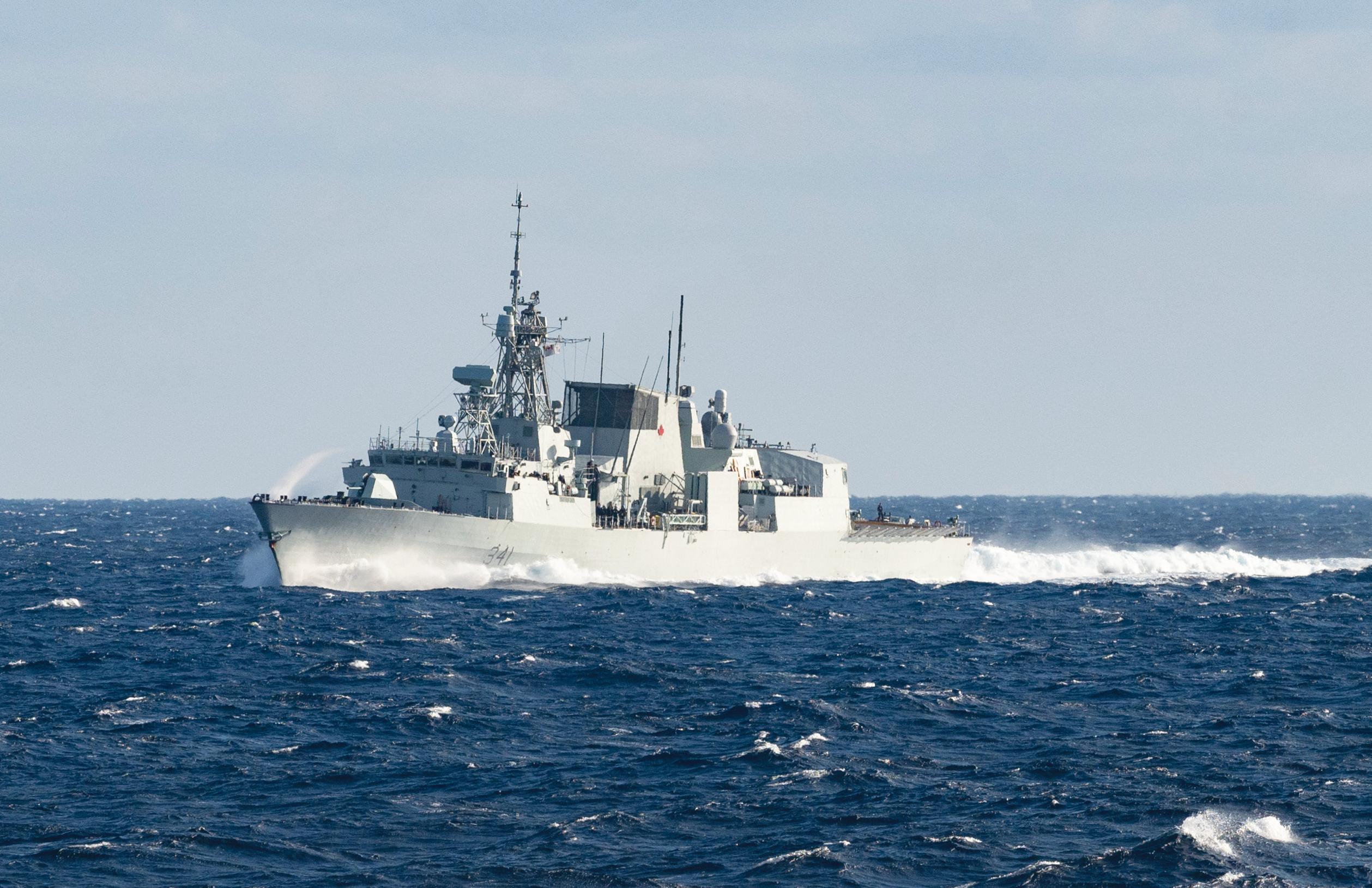
While everyday Canadians are otherwise preoccupied, the country’s navy is
Last fall, Vice-Admiral Angus Topshee, commander of the Royal Canadian Navy, released a YouTube video warning that the navy is in a critical state with old ships and a serious shortage of sailors to operate them. He also told a defence leadership symposium that the navy “could fail to meet readiness commitments.”
Topshee’s message can’t be a surprise to anyone who has watched the decline of the RCN during the last two decades. For a nation as dependent as Canada is on maritime trade—at least 20 per cent of the country’s $757.4 billion in exports travel by sea—the navy’s collection of small-but-highly-capable modern Halifax-class frigates, old-but-still-functioning command
destroyers, Kingston-class coastal defence vessels, obsolete Britishbuilt, diesel-electric submarines, and oiler/replenishment vessels was a minimum requirement. Today, that minimum can’t be reached. And it won’t be for at least another decade, if not longer, based on the current plans for upgrades and replacements.
The frigates, while trusty, are now out-of-date, as are the Kingston-class vessels. Plus, there’s currently only one oiler/replenishment ship, a converted merchant that’s barred from any conflict zone; the submarines are barely functioning, having tallied just 228 sea days combined since 2019, and while there are two new Arctic offshore patrol vessels in service, they can’t operate in the winter
and they have already encountered problems with engine-cooling and drinking-water systems. On top of the equipment shortcomings, the navy is 1,200 personnel short of requirement, with vacancy rates in some positions above 20 per cent.
It’s bold for Admiral Topshee to tell the public how bad the situation is. But it may be worse: none of the projected replacement vessels— two new oiler/replenishment ships and 15 surface combatant vessels, are even being built yet. And while the navy is pushing for new submarines, there seems to be no plan for acquiring them, or ensuring that they can operate under ice—a critical function for working in the Arctic. Canada’s navy is falling to pieces. And nothing but money—boatloads of it—can save it.
Canadians can blame the country’s sclerotic military procurement program for the problem. But even if that mysterious witches’ brew of a challenge
was solved, the basic issue would remain. For decades, Canada has consistently prioritized social welfare programs, such as dental and pharma care, over defence. Indeed, national security isn’t treated with any urgency. In fact, the defence budget is slated for a nearly $1-billion cut.
Canadians choose every day to live in this wonderful country, but the politicians they vote for don’t spend as much as they could on defence and all three services suffer the consequences. So, why not let it all go, save some money and nestle under the tender wings of the United States?
The Americans fund defence at a far greater rate anyway.
A fine idea in theory, but perhaps not in execution. In a Wall Street Journal article published last December with the headline “The U.S. Can Afford A Bigger Military. We Just Can’t Build It,”
Greg Ip argued, in a nutshell, that China can build ships far more quickly than the Americans.
“In terms of industrial competition and ship building, China is where the U.S. was in the early stages of World War II…we just don’t have the industrial capacity to build warships…in large numbers very fast,” Ip was told by Eric Labs, a navy analyst for the U.S. Congressional Budget Office.
What that means for Canada is simple. Add Canada’s Pacific, Atlantic and Arctic coasts—combined, the longest coastline in the world—to the U.S. Navy’s areas of responsibility and its capacity
to watch, guard and defend would shrink its overall ability dramatically. And that’s not even accounting for the U.S. Navy’s current global commitments. It would get stretched very thin very fast, particularly when China is outbuilding the U.S. every year.
Should Canadians not shoulder a reasonable share of responsibility for the defence of the country’s own waters? Does Canada not need to contribute to guarding freedom on the seas in troubled parts of the globe? The answer is simple. The country needs to prioritize the welfare state of its navy. L


STORY
AND PHOTOGRAPHY
BY STEPHEN J. THORNE

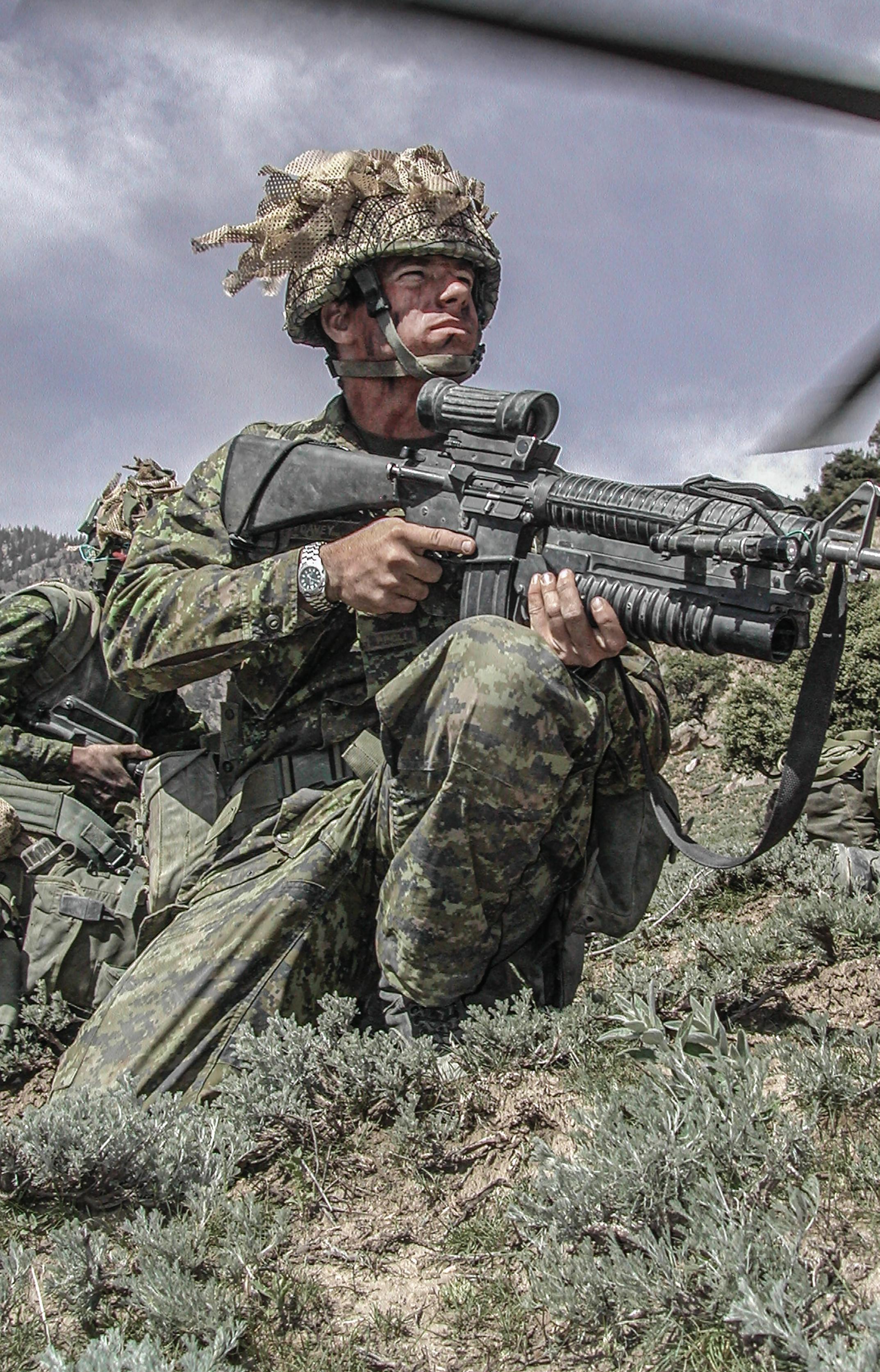
Members of the 3rd Battalion, Princess Patricia’s Canadian Light Infantry Battle Group land in the embattled region of Tora Bora, Afghanistan, on May 4, 2002, just metres from the spot where Osama bin Laden was last confirmed alive by Westerners before he was killed by a U.S. Navy SEAL team in May 2011.
OOver the course of three Canadian army tours in their parched and war-ravaged homeland, Alex Watson came to know and respect the longsuffering Afghan people for their courage, resilience, devotion and unfailing courtesy.
As a CiMiC (civilian-military cooperation) officer, Watson became intimately acquainted with the citizens and culture Canadian troops were sent to protect.
Ten years after Canada withdrew its troops from Afghanistan, with the country now in the hands of the Taliban and 20 years of progressive reforms gone in a virtual instant, Watson’s reflections over a series of interviews are poignant reminders of the conflicting legacies left by Canada’s longest war.
In Kandahar in 2002, he was a young captain with the 3rd Battalion, Princess Patricia’s Canadian Light Infantry Battle Group. He was among the first Canadians charged with the task of reaching out to Afghan villagers, fostering trust and cultivating a network of informal allies, not to mention alert eyes and ears.
The relationships he developed were unique.
“I loved it,” he told Legion Magazine. “There is not a single place in the world where I would rather have been doing my job.

NOT A SINGLE AFGHAN, IT SEEMED, WAS IMMUNE TO WAR’S IMPACT OR HAD ESCAPED THE
.
“I view it as nothing less than a privilege that I got to do the job that I did in Afghanistan, to meet the Afghans that I met—some of whom are lifetime friends—and, the biggest privilege of all, to command Canadian soldiers in combat.”
Afghans were entering their third decade of war at the time, having survived the 1979 Soviet invasion and almost 10 years of internal strife that followed. After the Soviets left, the country was gripped by a series of civil wars that ended with the Taliban, who ultimately opened Afghanistan’s borders to militant leader Osama bin Laden and his al-Qaida terrorists-in-training.
“The past quarter century devastated this country more than any other on earth,” former U.S. diplomat G. Whitney Azoy wrote


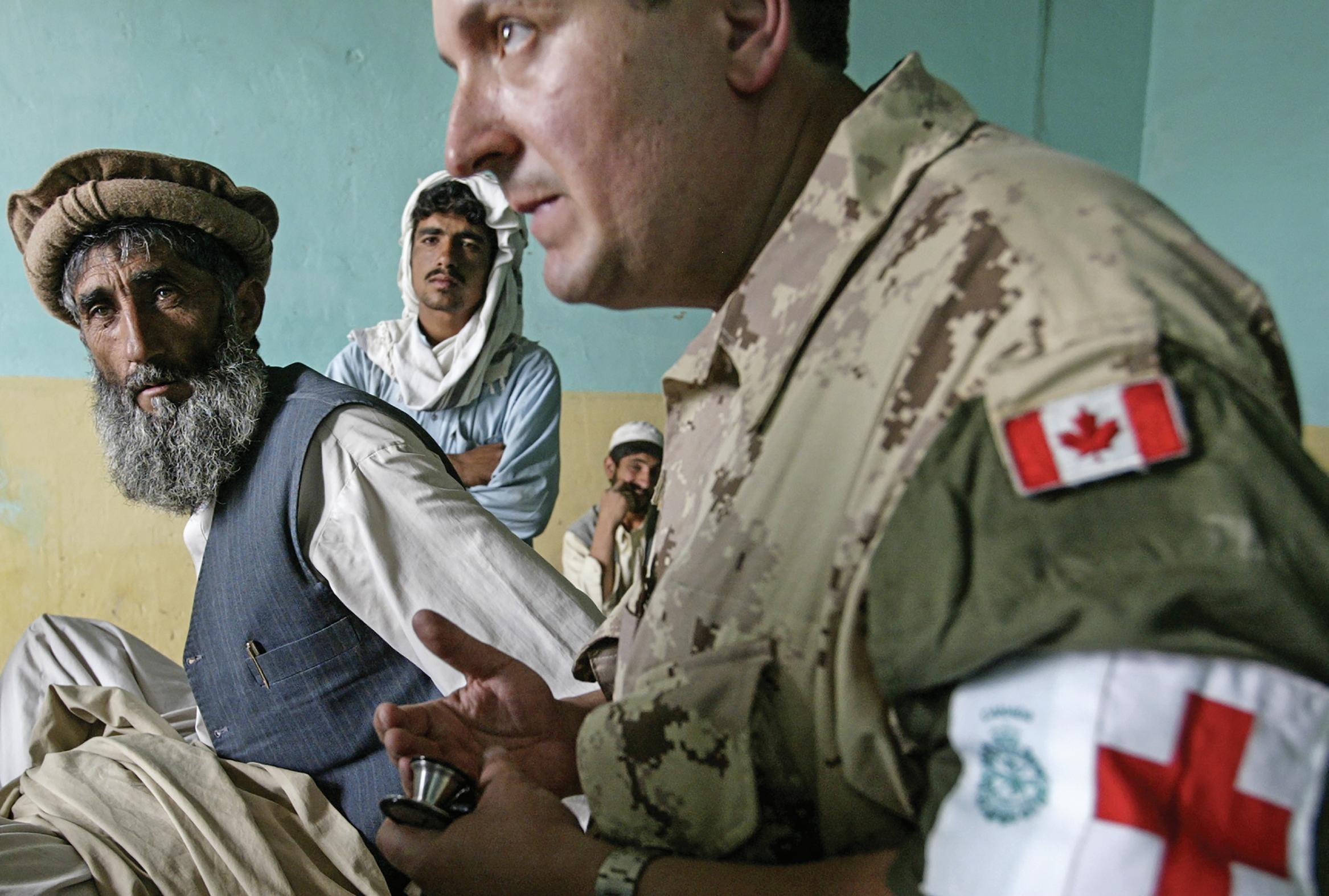
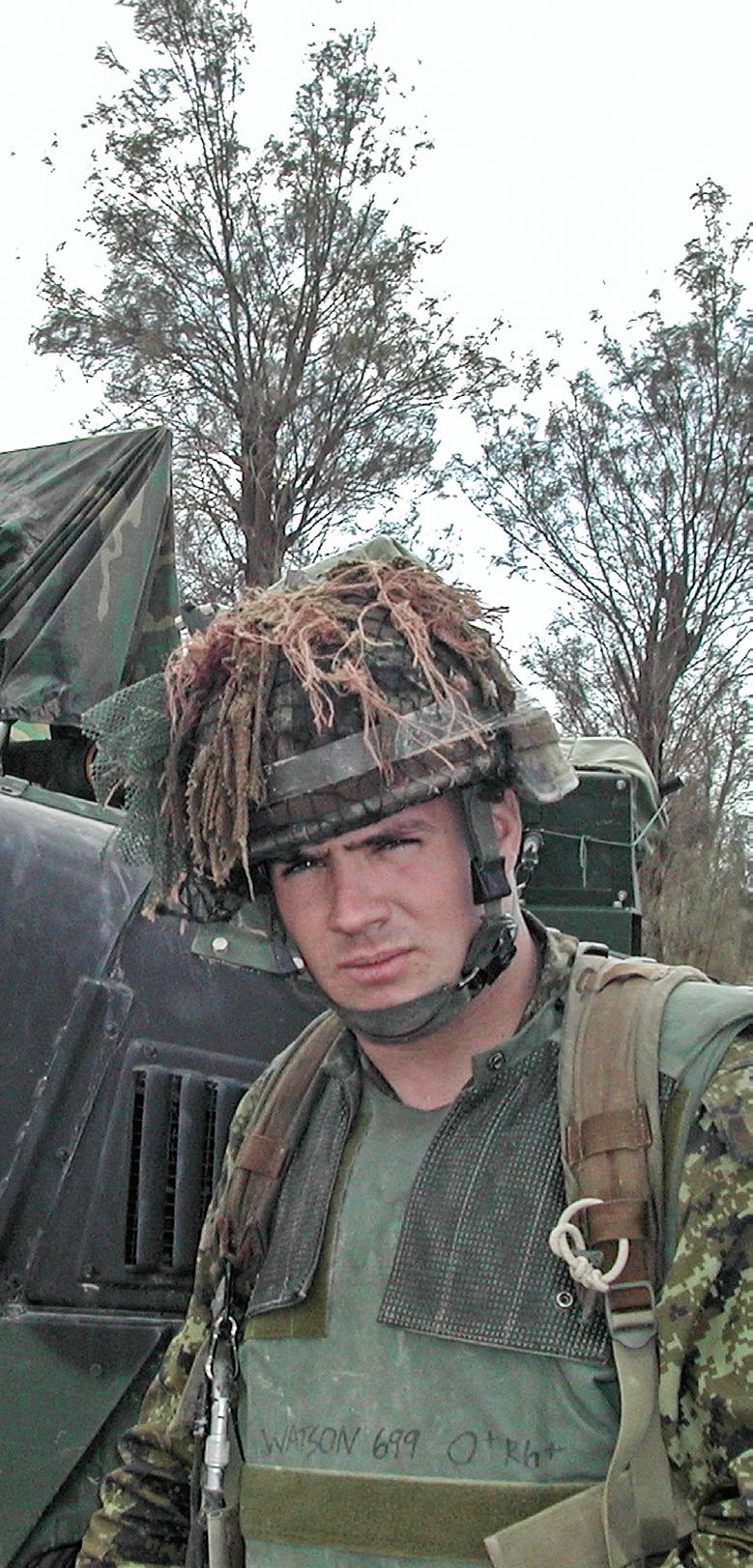
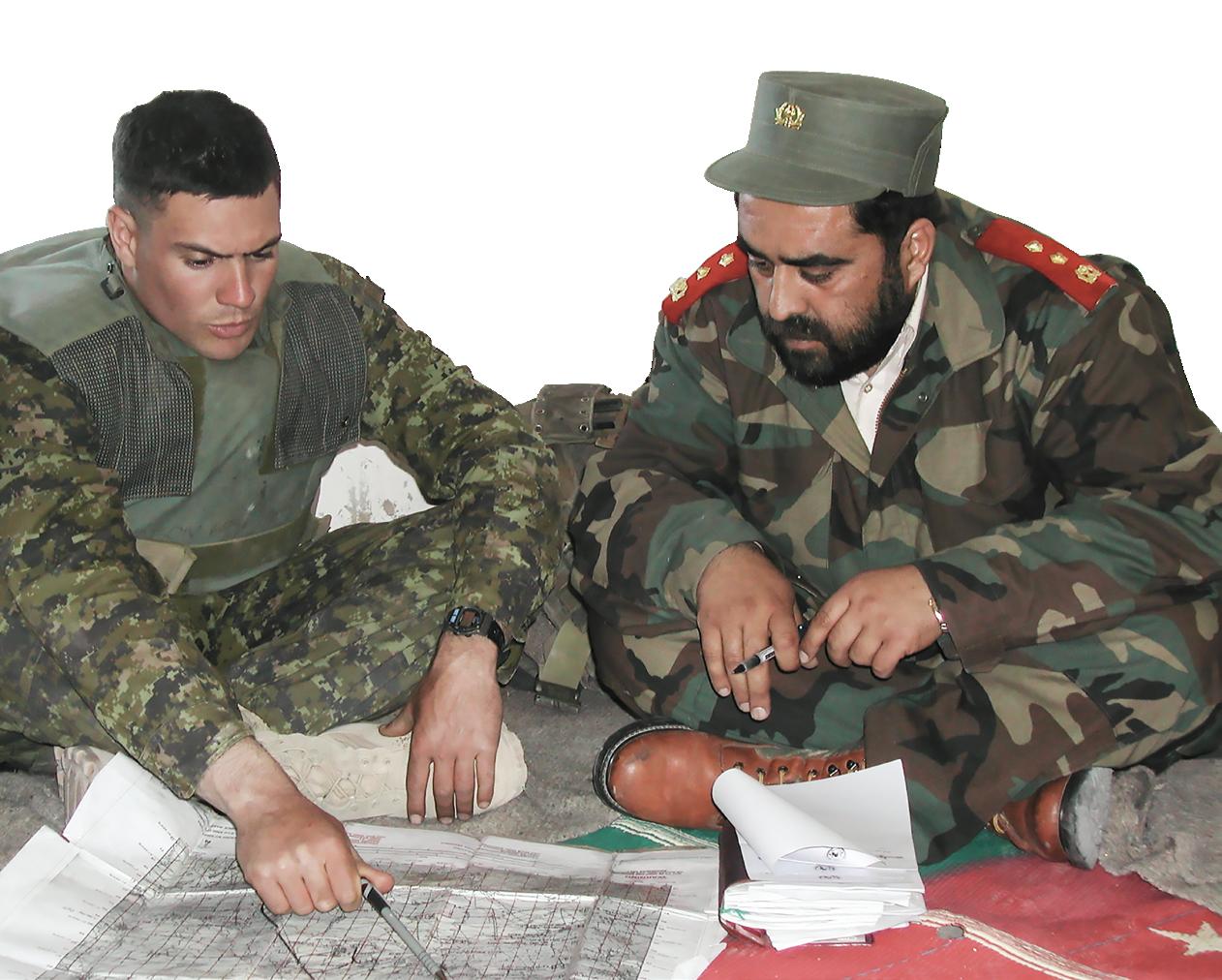
Captain Alex Watson (below and opposite) did three tours in Afghanistan, liaising with local commanders and elders in 2002 before mentoring an Afghan National Army battalion through multiple firefights. Captain Americo Rodrigues (above), an army doctor attached to the 3rd Battalion, Royal 22e Régiment Battle Group, conducts a medical clinic in a remote Afghan village in 2004.
in 2002 for the second edition of his book Buzkashi: Game and Power in Afghanistan. “No country in all history has proven more resilient. No people alive today are more worthy of admiration, respect, and support.”
As a 10-year drought neared its end, Afghanistan was caught up in the post-9/11 war that was supposed to set it free. It was Watson’s job, in part, to convince Afghanis that the coalition forces of which he was part were not simply following the waves of Mongol, Macedonian, British and Soviet invaders who had come before.
The country was in ruin, its neighborhoods reduced to rubble, its infrastructure gutted and its landscape peppered with more than 10 million landmines.
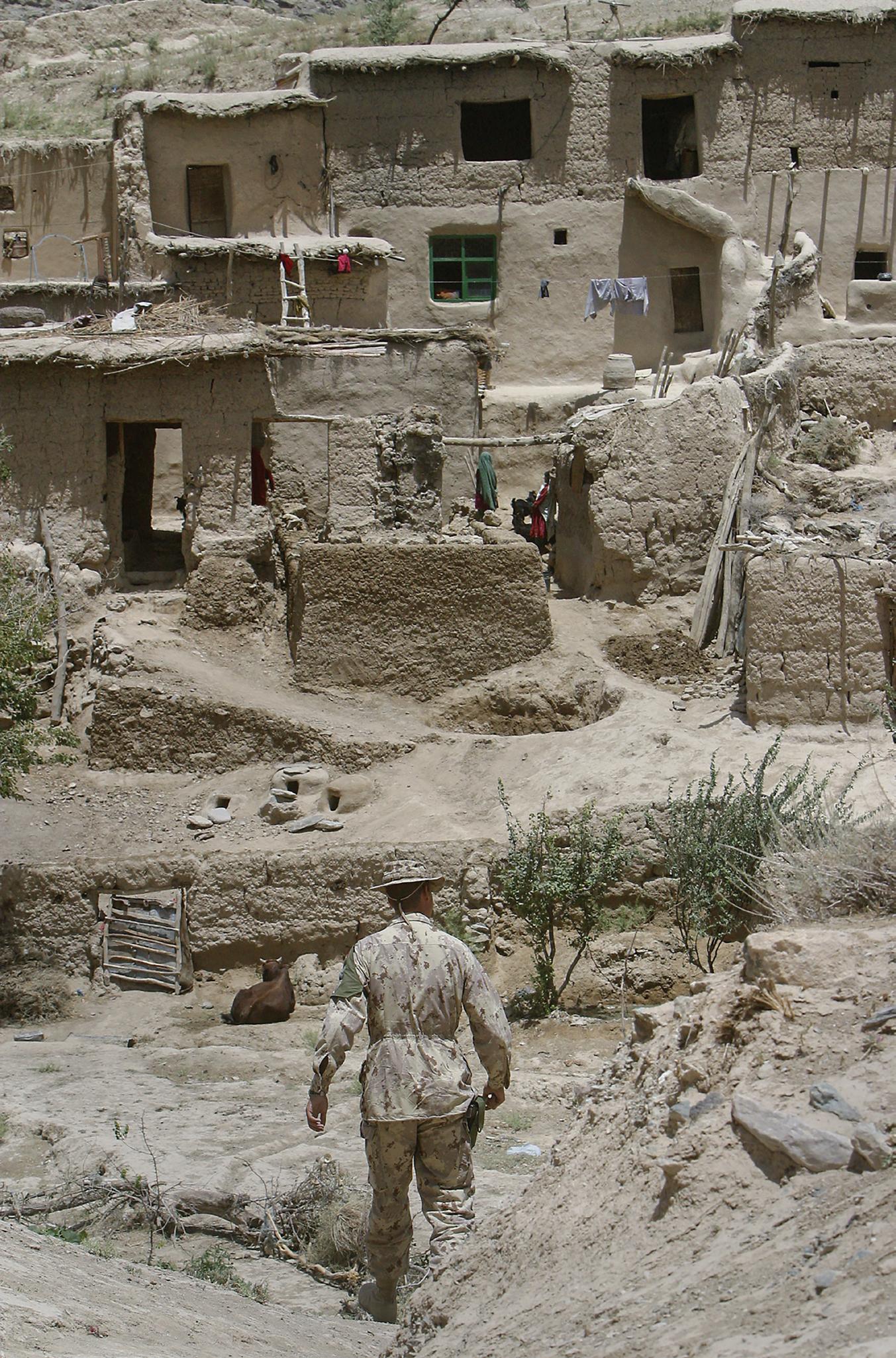
The dusty villages surrounding Kandahar and beyond, some without so much as a water well, were populated by stoic survivors of war, injury, disease, poverty, drought and malnutrition. The life expectancy of Afghan males in 2002 was 47 years. The infant mortality rate was among the world’s highest. They remain so.
“I did often think that I was looking back on how western society would have looked several hundred years ago,” Watson recalled. “I was reading a book about medieval Europe and how probably if you were walking down the street in Europe at that time many people would have broken bones that had never been set. Or the consequences of ravaging disease, if it hadn’t killed them, would be visible in scars that
“I VIEW IT AS NOTHING LESS THAN A PRIVILEGE THAT I GOT TO DO THE JOB THAT I DID IN AFGHANISTAN , TO MEET THE AFGHANS THAT I MET.”
had never properly healed. Looking at the Afghans, you saw a much rougher society [than ours]…. People lived with permanent discomfort.”
Not a single Afghan, it seemed, was immune to war’s impact or had escaped the devastation of profound loss. Death, in all its forms, was everpresent. Still, they moved forward, scratched livings from nothing, built homes from the cracked clay beneath their feet and rebuilt lives out of the tragedy and hardship.
They managed this not because life in Afghanistan was cheap, said Watson, but because it was the only way they knew how to cope. Islam’s rites of quick burial helped, but Watson said Afghans also seemed to “force upon themselves a more limited period of mourning because they had to.”
Soldiers commented repeatedly on how industrious and resourceful a people the Afghans were. Unlike some others they had protected as UN peacekeepers in other parts of the world, seasoned Canadian troops found Afghans reluctant to allow others to do work they could do themselves.
True to the traditions of the dominant Pashtun culture that had
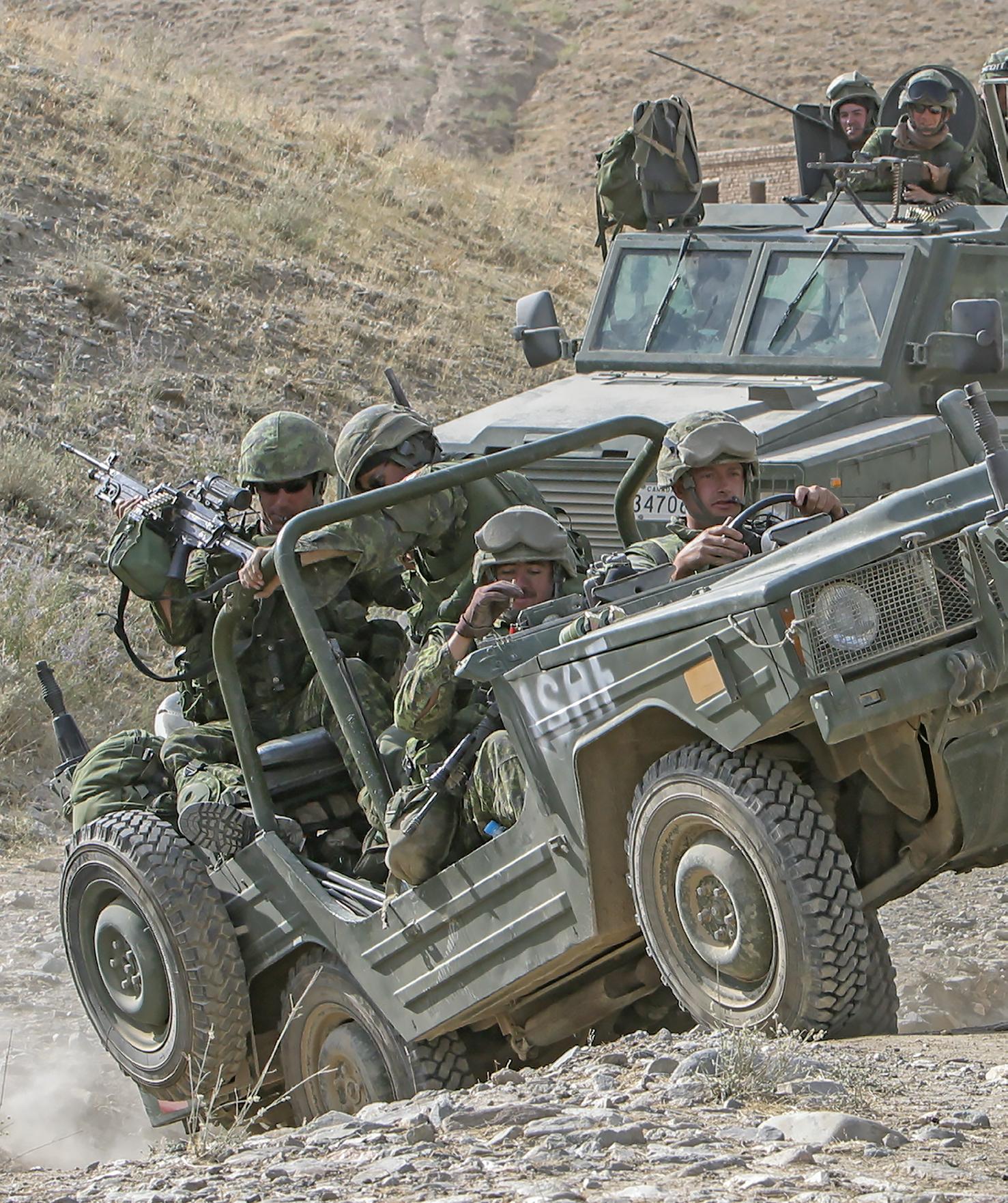
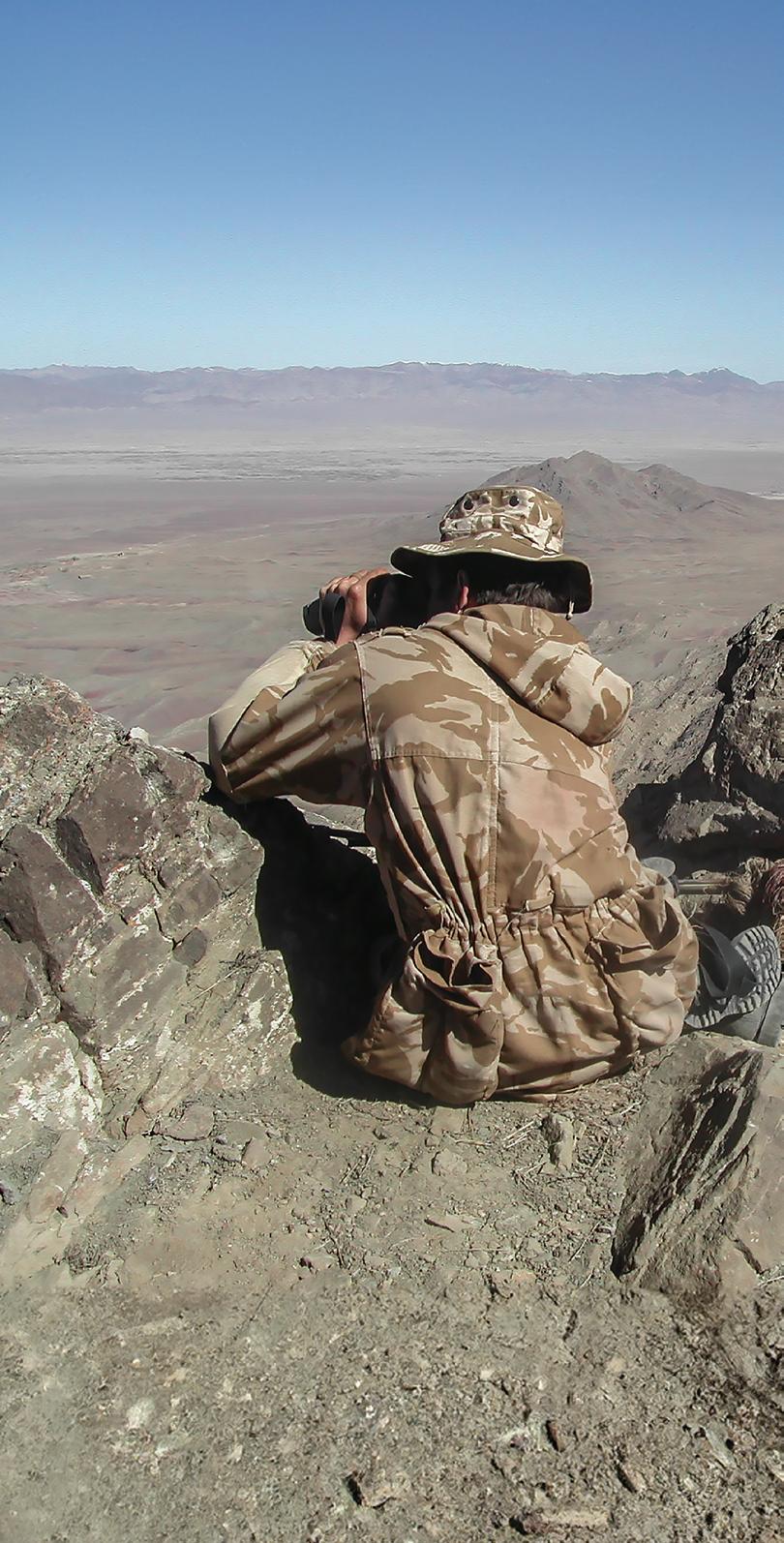
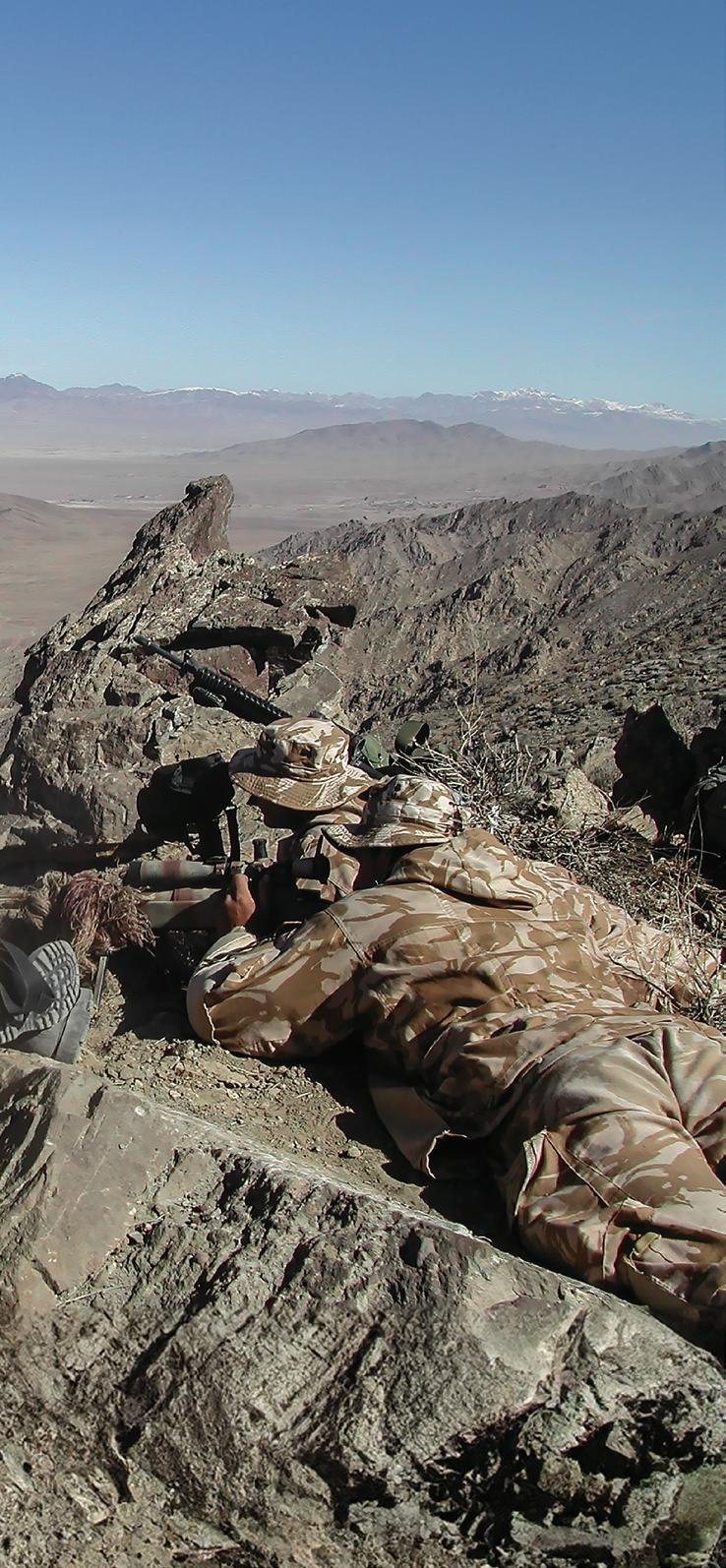
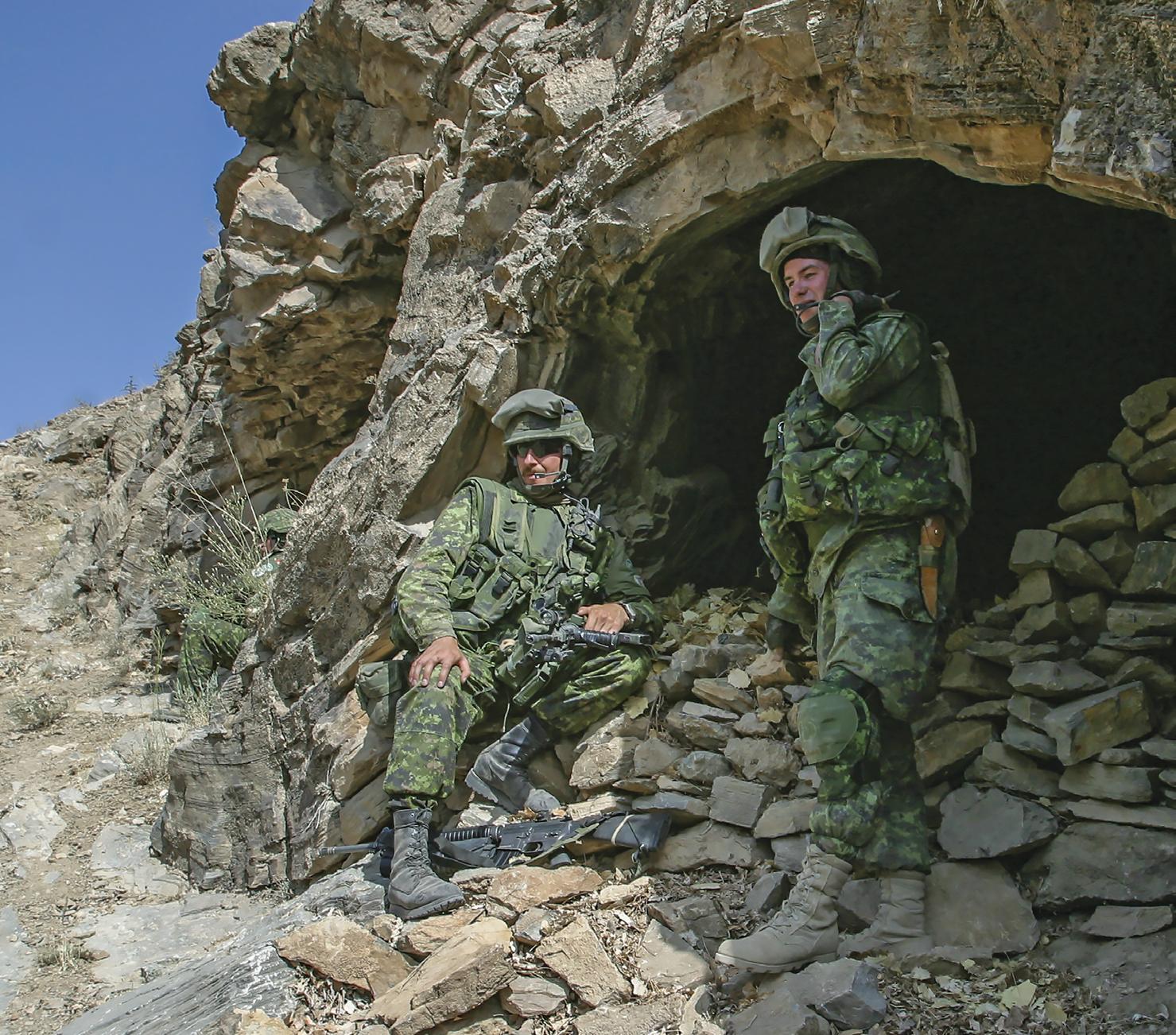
Reconnaissance troops from the 3rd Battalion, The Royal Canadian Regiment Battle Group conduct a mountain patrol west of Kabul in 2003. A Canadian sniper team from the 3 PPCLI Battle Group, wearing specialized British fatigues, surveys the terrain near the Afghan-Pakistan border.
thrived on the frontiers of the land for centuries, Afghans opened their homes to Watson and others, serving guests acid-strong tea and whatever foodstuffs they could muster, despite their own hardships and sufferings. They lived by the tenets of Pashtunwali, an ancient code of conduct predating Islam whose central dictum is hospitality to all, regardless of race, religion or economic status. Under Pashtunwali, a guest must not be harmed nor surrendered to an enemy.


Kandahar had been a waypoint on the Silk Road, and Afghans remain to this day born-and-bred traders, machinists and merchants.
“Everything became a dealmaking process,” said Watson. “Everything was subject to negotiation. I found that initially maybe jarring. Then I started to enjoy it. I didn’t take offence that everything became a bargaining opportunity.
“They could sell sand to a camel, I think. I admired that sort of entrepreneurial aspect to their society, although I got taken to the cleaners a few times due to my own naïveté.”
On his third tour in 2009, Watson, by then a major, was given a small company of Canadian troops and assigned to mentor an Afghan National Army battalion which, for all intents and purposes, he commanded.
Having fought alongside Afghan militia and national soldiers alike, he already respected the Afghans’ “very principled, faith-driven” warrior culture—not savage and incendiary like that of al-Qaida and Islamic State militants.
The men in his battalion, though largely from the ethnically distinct north, treated civilians in the south ethically and respectfully, and they proved effective at gathering intelligence. They were light and quick. Their practised eye could pick out bombs and other threats better than their Canadian mentors.
Watson recalled walking ahead of about 200 Afghan and Canadian troops along a high-risk route in Zhari district when suddenly two young Afghans scurried past him with metal detectors in hand, determined that their Canadian would not step on a landmine.
“That sort of affection and two-way loyalty, I remain very, very touched by,” he said. “It’s that very tangible fraternal bond between soldiers and it’s something I don’t really have in my life now outside of my own family.”
Watson left the army in 2016, two years after Canada’s withdrawal.
He is now a federal drug and gang prosecutor, married with children.
At the time of Canada’s withdrawal in 2014, University of Ottawa international affairs professor Roland Paris was already dismissing military claims that the mission had been a success.
“This much seems clear: the international mission to stabilize Afghanistan following the toppling of the Taliban regime in 2001 has not succeeded,” he wrote in the March 2014 issue of Policy Options, the online journal of the Institute for Research on Public Policy. “Early hopes for a democratic renewal gave way to mounting disillusionment, corruption and violence.
“Although important gains were achieved in national development indicators—including the number of children in school, women’s rights, and access to health care— these improvements rested heavily on the presence of an enormous foreign military and a deluge of aid money, all of which is now waning.”
As the last American and other coalition troops withdrew in 2021 and the conclusive Taliban offensive gained momentum, retired major Brian Hynes, who served two tours in Afghanistan, in 2002 and 2004-2005, said it felt “like Srebrenica all over again.”
The United Nations had declared the besieged enclave in eastern Bosnia a “safe area” under the protection of Canadian peacekeepers when Bosnian Serb troops massacred more than 8,000 Bosniak Muslim men and boys in July 1995.
Afghanistan’s collapse was “not a surprise,” said Hynes, who was with The Royal Canadian Regiment when it became the first UN force in Srebrenica in 1993.
Afghanistan was “a lost cause from the get-go because we were never staying,” he said. “That’s the message, really: If you’re going to go to war, you’re either there for the whole thing or you don’t go.”
“THIS
MUCH SEEMS CLEAR: THE INTERNATIONAL MISSION TO STABILIZE AFGHANISTAN FOLLOWING THE TOPPLING OF THE TALIBAN REGIME IN 2001 HAS NOT SUCCEEDED.”

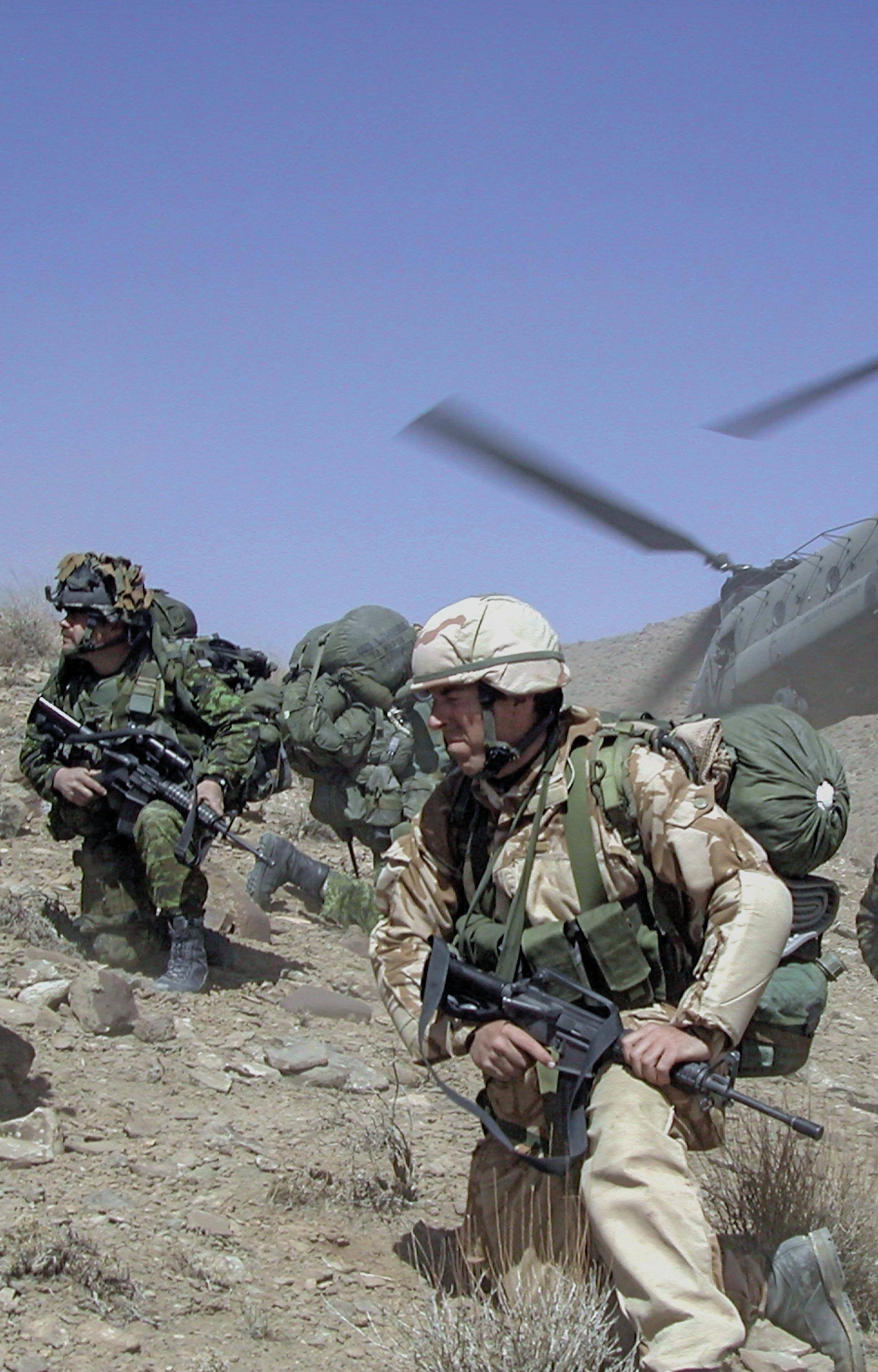
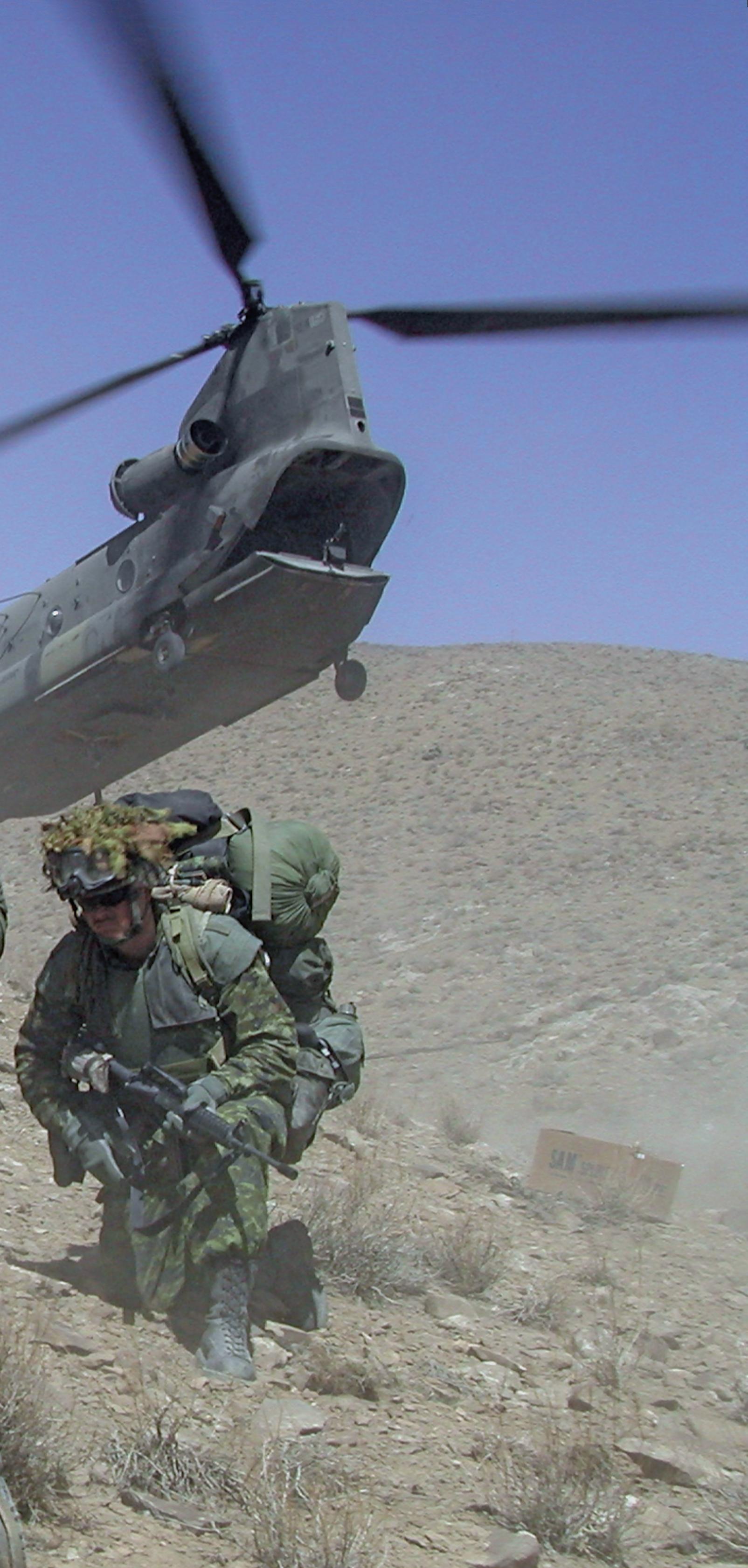
It’s March 13, 2002, and 3 PPCLI, including a Canadian sniper in British fatigues, launches Canada’s first combat assault since the Korean War on a mountain called the Whale’s Back.

As Afghan National Army units collapsed, their troops simply laying down their weapons and going home while Talib fighters took district after district with relative ease in their march to Kabul, Watson said he had conflicting feelings.
“One is this emptiness, this ennui, about wasting a decade of my life,” he said. “The second is a great fear and sadness for the people of Afghanistan, for whom I developed great affection.
“Third is that I’m fired up. I wish I were there, with my guys and my Afghan battalion, 1/1/205. My team didn’t lean on U.S. air power in 2009-2010, and we wouldn’t need to again. We could take them with small arms, just like last time.
“I realize realistically I’m old and battered, but I still feel that surge for combat in a righteous cause.”
Today, with social reforms and other progress stifled under a harsh fundamentalist regime, he still thinks of those youthful, underdeveloped Afghan troops, their big eyes peering out from beneath oversized Kevlar helmets, trusting absolutely in his commitment, education, judgment and equipment.
“I struggle to this day, philosophically in an existential sense, because every time that I planned an independent operation for my Afghan battalion and then led that operation, an Afghan soldier was either horribly wounded or died,” he said.
“The trite answer is that’s the nature of the job. But these were like little dudes; they were teenagers, man. And I don’t have the answers for what sort of expenditure of resources is appropriate to achieve a mission.
“I do know that every single area I operated in is all under Taliban control now. So, I guess I’ve answered my own question.”
A member of the 3 R22R Battle Group approaches a village north of Kabul.
Desert cam uniforms weren’t available at the outset of Canada’s participation in Afghanistan, but the faded and dusty forest green proved ideal in much of the country’s terrain.
“ THERE HAS BEEN LITTLE INSTITUTIONAL RECKONING , NO LESSONS-LEARNED REPORTS—AT LEAST NONE THAT WAS PROACTIVELY PUBLICLY RELEASED.”
More than 40,000 Canadian soldiers, sailors and aircrew served in Afghanistan. At least 158 are known to have been killed in action, along with a diplomat, four aid workers, a government contractor and a journalist. Thousands of other Canadians were wounded and dozens of veterans of the conflict have since died by suicide.
The mission cost taxpayers more than $18.5 billion and the country spent another $3.9 billion on humanitarian assistance.
“Many Canadians seemed to think that a victory in Afghanistan would be ours to achieve,” said Tom Bradley, who served two tours with Lord Strathcona’s Horse (Royal Canadians). “But the victory parade was never ours to have; it was the Afghans who would achieve that goal. The Afghans
would determine the time and place and what it would look like.
“Unfortunately, despite years of advance warning that the patience of the electorate in the West was running thin and that the military and political support for Afghanistan would come to a close, it seems that the Afghan political class and their supporters in the West choose to avoid looking at what the consequence of this change would mean for both the Afghan people and their country.
“Instead, they chose a standard political solution: pretend it’s not going to happen and carry on as if change only happens to others,” added Bradley, who retired from the regular force a lieutenantcolonel in 2011. “Unfortunately, the Afghans will now pay the price for that hubris.” And did.
“There has been little institutional reckoning, no lessons-learned reports—at least none that was proactively publicly released,” Renée Filiatrault wrote seven years after Canadians left Afghanistan. “But a reckoning is necessary so that mistakes are not repeated and successes might be.”
Filiatrault, who served as a foreign service officer in Afghanistan with Task Force Kandahar in 2009-2010 and is now advising her fourth defence minister, said returning diplomats and other civil servants had little opportunity to share what they learned.
“Some didn’t even have jobs to come back to. Those who did confronted issue fatigue from officials around them who no longer wanted to hear about Afghanistan and discouraged references to it.
“The lack of caretaking of this expertise, and of people generally, meant the government struggled to retain the right people and to recruit those interested in hardship postings or conflict resolution in the future. A cadre of officials with civilian-military and intheatre experience was lost.”
There has since been an exodus of knowledge and experience from Canada’s troubled armed forces, and the defence minister’s newest adviser says Canadian bureaucrats and legislators retained little from the war in Afghanistan.

She said the lack of expertise was even more stark on the political side, and it has gotten worse. “Politics is a game for the young, and roles are temporary,” she said. “Most current advisors were not out of grade school on September 11, 2001.” L
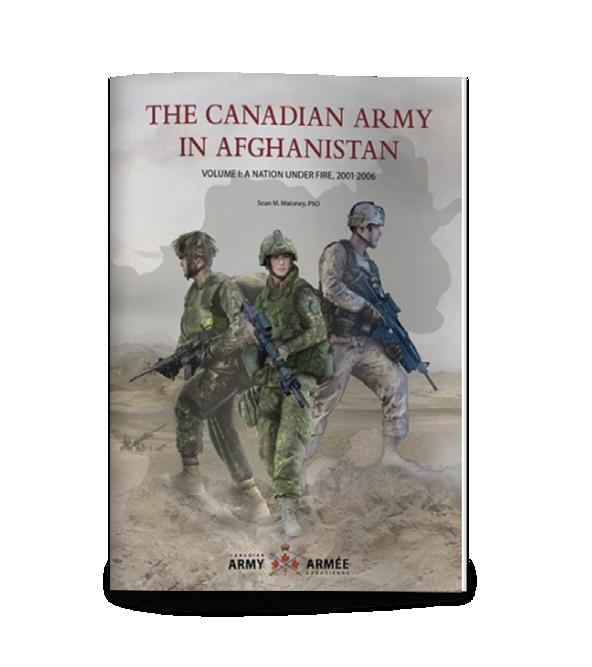
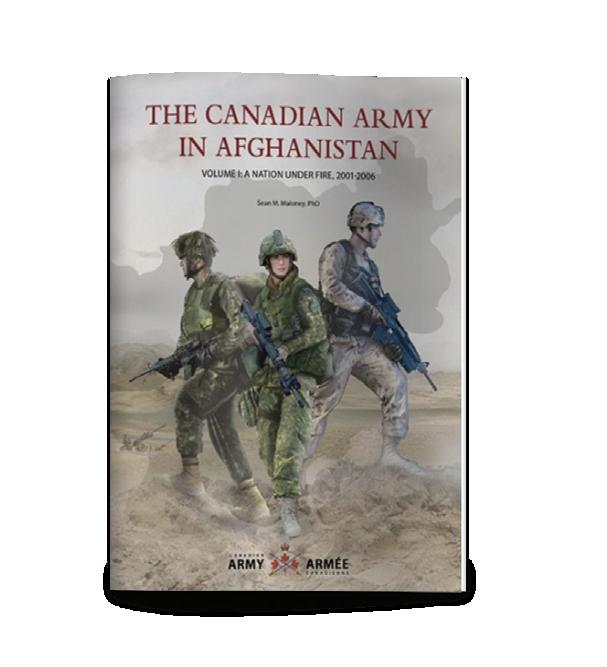
Written by Royal Military College historian Sean Maloney, The Canadian Army in Afghanistan, a comprehensive, in-depth account of Canada’s war in Afghanistan, was quietly published by the federal government last summer. But only 800 English and 800 French copies of the three-volume history were printed, making its availability limited. However, after many veterans complained, the books were posted online this past November. Visit www.Canada.ca and search for “The Canadian Army in Afghanistan” to access the series.

Retired captain Trevor Greene stood stage-left, a laser-like focus on the opposite side of the platform. Fitted with a backpack and waist-down exoskeleton, he cut a formidable figure, an iron soldier, if you will, set against the harsh hues of LED lighting and a white curtain backdrop. It was Sept. 17, 2015, at Simon Fraser University’s Surrey, B.C., campus and Greene was going to walk in public for the first time in nearly a decade. Deployed to Afghanistan with the Seaforth Highlanders of Canada in 2006, Greene’s journalism experience made him a suitable choice for a civil-military cooperation officer. Tasked with securing and expanding infrastructure assistance to villages throughout the war-ravaged Kandahar province, Greene was having tea with the elders of Shinkay on March 4, 2006. He had removed his helmet in respect.
But a 16-year-old member of the Taliban interrupted the meeting, thrusting a home made axe into Greene’s head. The ambush and ensuing chaos consumed the village. The assail ant was quickly dispatched by the



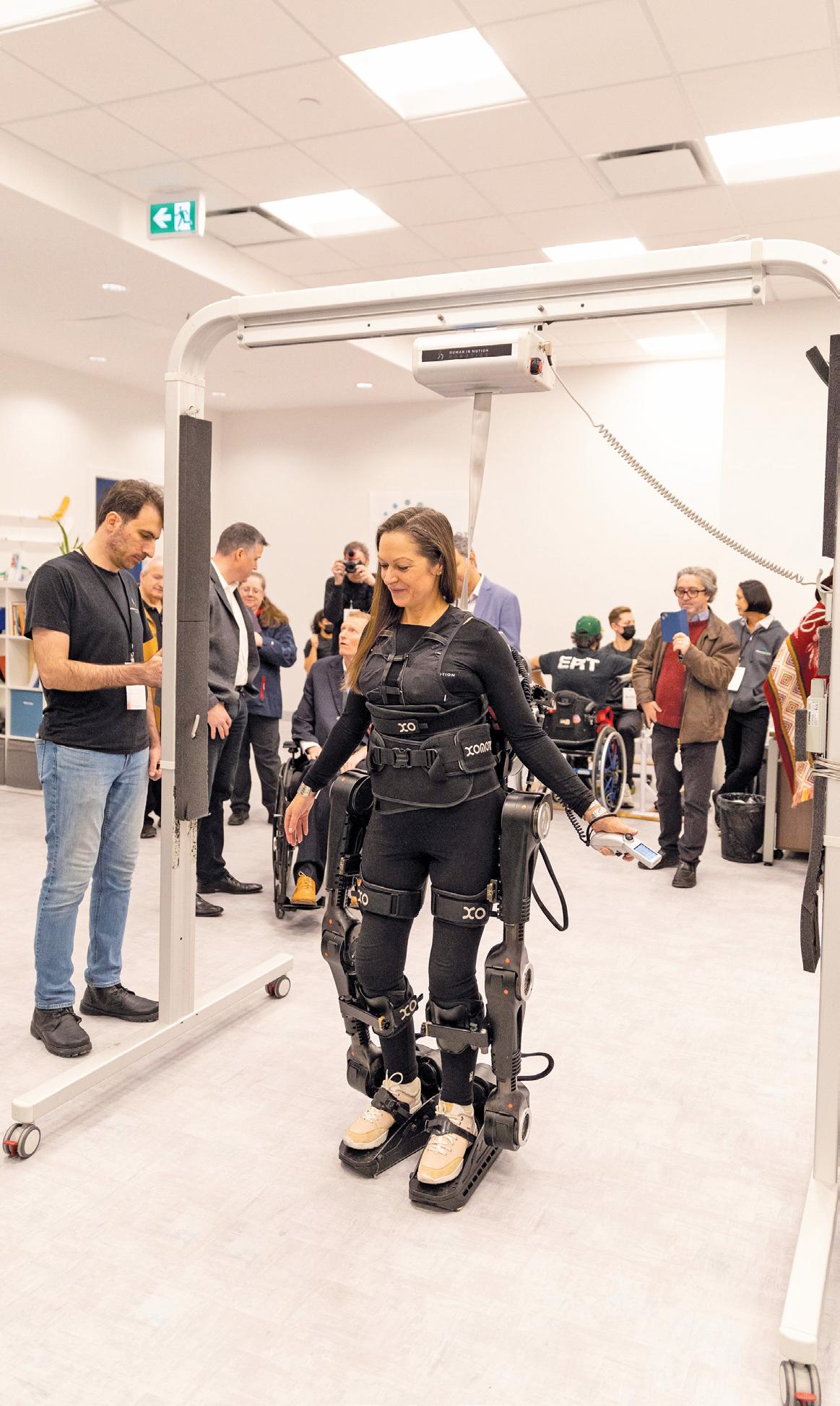
Retired captain Trevor Greene, fitted with a robotic-like exoskeleton from the waist down, walks across a stage at Simon Fraser University’s Surrey, B.C., campus on Sept. 17, 2015. The new Legion Veterans Village in Surrey aims to offer veterans such as Greene similar advanced medical care.

Coupled with post-traumatic stress disorder, Greene was left riddled with health challenges that made day-to-day life incredibly difficult. But, Greene defied all odds, thanks to months of surgeries, therapies and alternative treatments.
“It was wonderful working with Trevor. He was such a hard worker,” said Pauline Martin, one of Greene’s physiotherapists and the CEO of Neuromotion, a B.C.based chain of rehabilitation clinics that offer the latest technologies for
those with severe neurological conditions. “He wanted answers to questions about what he could do to get better at home, what he could do to fix things.”
Greene’s robotic exoskeleton—built by Israeli-based ReWalk Robotics and funded initially through Project Iron Soldier, a campaign first spearheaded by Grade 12 student Rebecca Lumley and The Royal Canadian Legion’s
“THE REGULAR HEALTH-CARE SYSTEM IS NOT EQUIPPED TO ADEQUATELY SUPPORT A VETERAN .”
B.C./Yukon Command—stimulated and exercised his lower body while building new neural pathways for physiological and psychological recovery.
Legion Veterans Village is a $312-mil lion project that provides integrated health care and housing for veterans and first responders. Located in the heart of downtown Surrey, the building celebrated its grand opening in February 2023 after years of planning, design and construction.
“We’ve been unwavering,” said Rowena Rizzotti, a founder and current leader of the facility. “We’ve met every single Monday morning for eight years.”

Greene decided to put his healing to the test that day on stage in 2015. With Debbie guiding his walker and ReWalk training director Jay Courant stabilizing his exoskeleton’s movements, Greene took about 14 paces to the podium.
“His inspiration is his purpose right now,” said Martin. “It’s really valuable. Seeing other people working so hard is motivating.”
Funded by the RCL’s local Whalley Branch, the provincial government and Lark Group of Companies, a locally based development and construction firm, the village boasts a multi-faceted staff, many of whom were impressed after witnessing the community’s ability to fundraise to address gaps in veteran health care.

Surrounded by other dignitaries, President Tony Moore of The Royal Canadian Legion’s Whalley Branch cuts the ribbon at the Veterans Village grand opening on Feb. 8, 2023.
While his first steps were understandably a little uneven, Greene found his stride and moved confidently toward centre stage. After completing the milestone feat, Debbie slowly helped turn Greene to face the audience to reveal a smile—a grin born from pride and happiness of achieving what once seemed improbable.
The local Legion then announced that Greene soon wouldn’t be the only veteran capable of similar such advances; others could receive the same state-of-the-art health care through a new, revolutionary project: the Legion Veterans Village.
“The regular health-care system is not equipped or prepared to adequately support a veteran,” noted Rizzotti, who trained as both a nurse and a paramedic and has more than 35 years of experience in executive leadership in the industry.
Unlike the U.S. Veterans Health Administration, which provides integrated, veteran-specific health care, former CAF members are funneled into a system with long waiting times, confusing paperwork and red tape that often leaves them frustrated.
“When you leave the service and become a civilian, you essentially are just like any other Canadian,” said Rizzotti. “And so, a primary care physician, a rehabilitation provider, a mental health practitioner and other agencies don’t talk to each other.

“For a veteran who has suffered as a result of their service, it’s very difficult for them to navigate that system, and there’s no support and assistance really.”
Plus, because some general practitioners who veterans are matched with have little exposure to military-specific health concerns, they can deliver inferior treatment. And that can lead some veterans to develop a mistrust for health-care providers.


“Veterans fall between the gaps, and some of that is what results in tragic outcomes,” said Rizzotti.
Before Greene got involved with Project Iron Soldier, for example, he was part of this unfortunate narrative—his initial doctor dismissed his prospects for recovery. But Greene’s walk across the stage, and the village’s initiative at large, prove that anything is possible.
Wanting to help inspire other veteran success stories like Greene’s into existence, Rizzotti’s team met with close to 100 clinicians, veterans and veteran families when the project first launched to learn about the most critical challenges in veteran health care and housing. Rizzotti was determined to understand every issue and pitfall.
“It was very raw. It was very honest,” said Rizzotti of the feedback they received. “Leaving the service, they felt quite abandoned.
“We’re really not supporting them the way they need to be supported, yet we still have expectations that they’re going to show up and support us.”
Rizzotti’s team then defined generalizable trends from the responses that it hoped to remedy and spent the next four years building a consortium of stakeholders.
“It needed every single type of partner because of the project’s complexity,” noted Rizzotti.
After approving Michael Green Architecture’s building design in September 2019, a two-phase construction plan was initiated. Its design inspired by the Canadian National Vimy Memorial, the first stage was completed in four years. The 20-storey
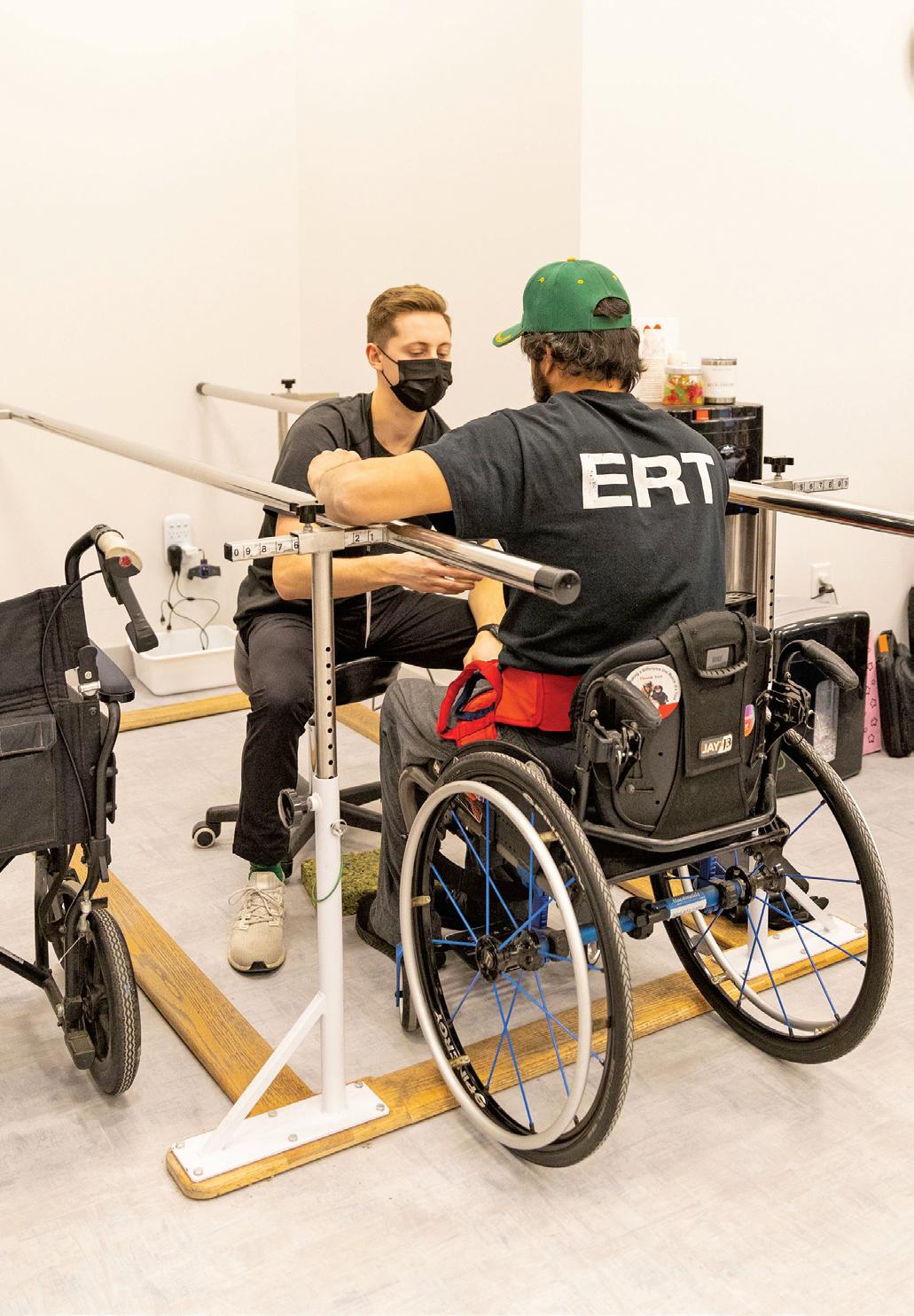
building, boasting red-and-black design accents, includes 91 affordable units, 171 regular apartments, the new Whalley Legion Branch and a Centre of Clinical Excellence, a cutting-edge health facility for veterans and first responders.
The affordable units are owned and operated by VRS Communities, a nonprofit housing service. There are studio and one- and two-bedroom suites, 10 of which have features to aid mobility, such as wheelchair accessible kitchens and bathrooms. The apartments, all with modernist design, are available to anyone, but preference is given to veterans, first responders and Legion members.
In part an attempt to help address veteran homelessness, Rizzotti recognizes that just because the units are lower than market price, doesn’t mean veterans can afford them.
“The market is so high right now that even the affordable housing is still too costly,” said Rizzotti.
While many of the affordable apartments are currently vacant, VRS is working with Veterans Affairs Canada and other agencies on further subsidies for the many veterans interested in the housing and health care.
“We’ve been working on a number of applications to generate more support for veterans having financial hardships,” said Rizzotti.
The facility includes 91 affordable modern apartment units, available to anyone, but with preference given to veterans, first responders and Legion members. Its Centre of Clinical Excellence, meanwhile, promises cuttingedge health services for veterans and first responders.

“WE WANT TO MAKE SURE THAT VETERANS AND FIRST RESPONDERS HAVE THE BEST OF THE BEST ACCESSIBLE TO THEM.”

On the other hand, the building’s regular units have proved popular. Both the affordable and regular apartments have a symbiotic relationship, with the hundreds of thousands of dollars generated from the latter going into veteran housing and health care.
The Whalley Legion hall that opened in 1960 to much fanfare was, 60 years later, in need of a facelift. The new open-concept, 975-square-metre facility at Legion Veterans Village boasts an upscale casual dining restaurant and bar, full-service kitchen, cadet assembly hall, banquet room, lounge and billiards area, and a military library. And with its streamlined architectural designs, it’s a community centre for the modern age.
“Legions are always likened to old men in dark and dingy places drinking beer,” said branch President Tony Moore. “Now, we still drink beer, but it’s not dark and dingy. It’s beautiful.”
Careful consideration and craftsmanship can be found throughout the facility,
most notably from the illuminated, handcarved glass of the Vimy Memorial that leaves a sparkle and glow in visitors’ eyes when they first walk into the branch.
But perhaps what makes the new facility so special is its associated Centre of Clinical Excellence, which hosts arguably one of the most integrated continuums of veteran health care programs in Canada.
“We’re seeing people being taken out of wheelchairs and getting to walk for the first time,” said Moore. “That is really fantastic.”
Operated by an interdisciplinary health-care group that uses state-ofthe-art digital technology to personalize its patient services, the centre focuses on advancing evidence-based care.
Lorne Friesen, the centre’s chief executive officer, noted that the team is developing services that will offer patients virtually continuous connection to their health-care providers. For instance, clients may wear heart-rate monitors that will provide data simultaneously to the centre. Other devices
could allow the centre’s practitioners similar real-time contact with their patients on a range of other medical issues, too.
“We will be rendered one of the first organizations in Canada to be able to offer this full suite of services,” said Friesen.
No bureaucratic bilge in sight, veterans and first responders can be easily matched with a range of medical professionals that specialize in their treatment. The centre offers primary care, lifestyle medicine, mental health, addiction and chronic pain services, a dental practice and the aforementioned Neuromotion clinic that worked with Trevor Greene.
Neuromotion is best known for its robotassisted gait rehabilitation and robotic legs. The company also has other innovative technologies to help get former military personnel moving again, all of which co-ordinate and refine motor skills and movements.
According to Friesen, the centre’s revolutionary medical care will also include pioneering procedures for psychological conditions, such as sensory reality pods for ultra-realistic exposure therapy and ketamine therapy, which uses a psychedelic drug known to help with treatment-resistant depression.
“We’ve made a very large investment in technology to support the centre,” said Friesen. “We want to make sure that
veterans and first responders have the best of the best accessible to them.”
The centre is also a hub for academic institutions, offering internships and training for those studying engineering, neuroscience or social sciences. Under the guidance of top leaders from the University of British Columbia, Simon Fraser University, Vancouver Coastal Health and the CAF, the facility aims to become a hotbed of research.
“We want to research and publish all of our findings because we want to be able to shift current practices,” said Rizzotti. “We want to demonstrate that these improvements can happen.”
Only a few months after the facility’s grand opening, the research program received a big boost with $500,000 in funding from VAC for a personalized therapeutics program focused on treating long-COVID symptoms in veterans.
With the first phase of Legion Veterans Village complete, its second is now underway: an additional 26-storey tower that will include 400 more condominium apartments, the sale of which should generate even more funding for the village’s veteran facilities.
“It’s already doing amazing things,” said Rizzotti, “and it’s going to do extraordinary things.” L
Legion Veterans Village may serve as a model for the next evolution of Royal Canadian Legion branches. So says one of the facility’s founders, Rowena Rizzotti, and Whalley Legion branch President Tony Moore, whose group was one of the key funders of the project.
While Legion halls have survived for nearly 100 years as key local community centres, the existing business equation in many places of bars and meat draws is showing its age. Replicating the Veterans Village concept elsewhere could help modernize
local branches, grow membership and prevent branch closures.
It might also attract younger veterans by providing a one-stop shop for health care, housing and a sense of community. Local branches, meanwhile, would get consistent funding from members, governments and developers.
“There’s a new generation of veterans, and the old Legion model isn’t necessarily conducive to the younger population,” said Rizzotti.
Legion membership rates could also get a boost from associated health-care programs, particularly
given that those offering such services are eager to share them with military families as well as nonmilitary Legion members. Indeed, the concept has also caught the interest of some existing Legion members in other parts of the country.
“We received hundreds of inquiries from veterans across the country,” said Rizzotti. “Our hope and our dream is to share our model as a template in hopes of replicating it. We want to create a movement where we are impacting veterans’ lives across Canada.”
At Veteran Village’s grand opening, partner companies in the facility’s health centre displayed some of the advanced technology they’re working with for clients, like robotic legs. The building also includes the Legion’s new Whalley Branch.
by Stephen J. Thorne
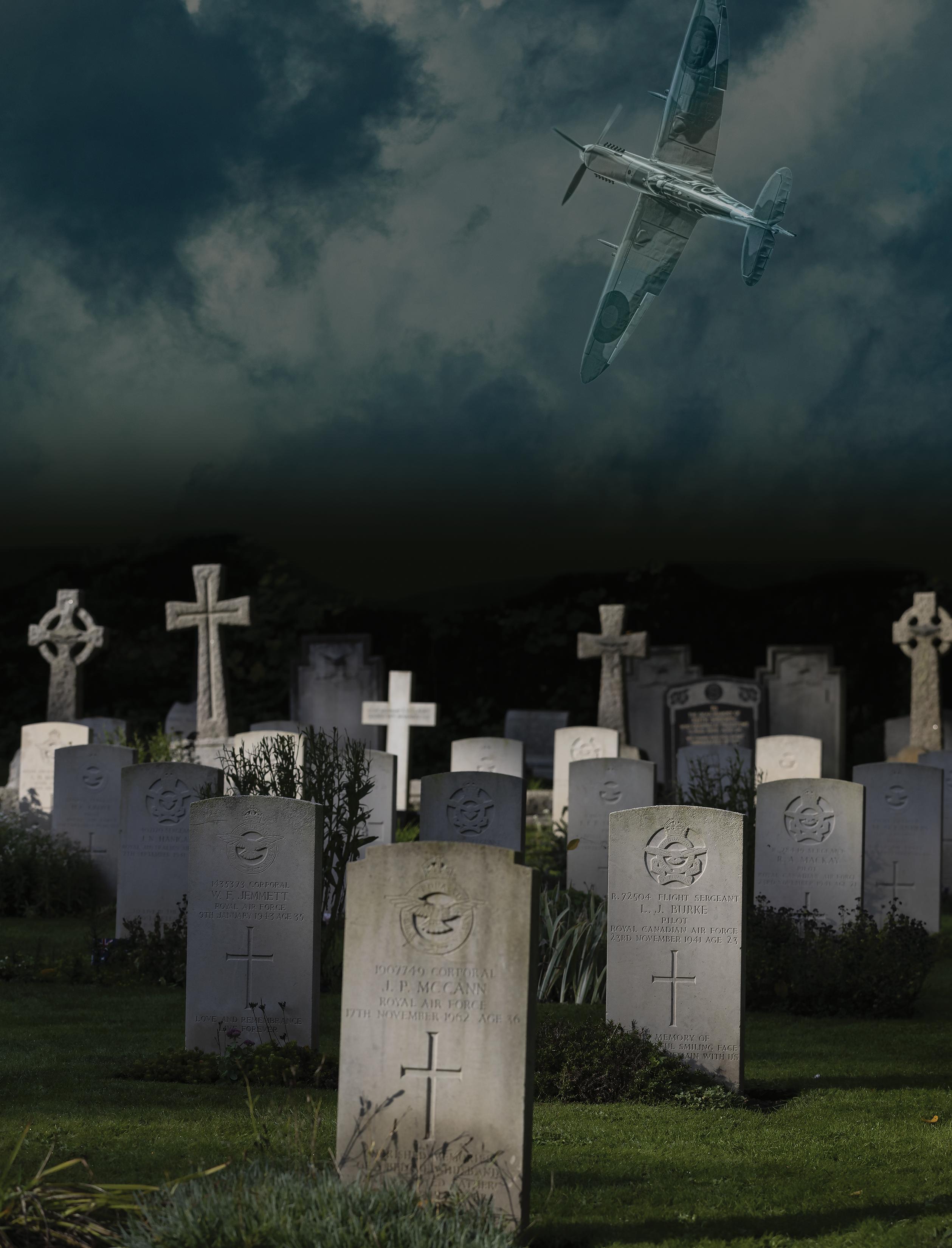
Thirty-eight WW II pilots and ground crew lie is the Whyteleafe churchyard in Kenley, including Canadian Spitfire pilot Leonard Burke. Blast pens (opposite) are among the remnants of the once-critical air force base.

It’s Aug. 15, 1940. The Battle of Britain has been raging in the skies over the English Channel and the home islands for more than a month, the criss-crossing contrails of Spitfires and Hurricanes, Bf 109s and 110s weaving chaos high above.
Hermann Göring’s Luftwaffe is trying to neutralize a desperate Royal Air Force and its Allies before Adolf Hitler launches a Channelborne invasion of the last bastion of democracy in Europe. The continent has fallen, and German fighters and bombers have taken up residence at airfields all over occupied France.
Already a veteran of the Battle of France, 19-year-old Corporal Frederick Victor (Vic) Bashford of Portsmouth, England, is an aircraft electrician with 615 Squadron, a local auxiliary unit stationed at Royal Air Force Kenley.
The First World War airfield is perched on a hilltop, on the fringes of London in the verdant county of Surrey, England. It overlooks the hamlet of Kenley and neighbouring Croydon to the north and the village of Whyteleafe in the south.
The site’s Canadian connections date to its earliest days in the summer of 1917, when the Canadian Forestry Corps felled trees and cleared land on Kenley Common after it was requisitioned under the Defence of the Realm Act of 1914.
Now, with another world war upon them, Bashford and the pilots and maintainers of 615 have been a busy lot. Kenley is at the front line of one of the great battles in British history, among three airfields along with Croydon and Redhill that will form 11 Group, Sector B. The region will bear the brunt of the German onslaught.
The airfield at Middle Wallop, 120 kilometres west, was hit hard the previous day. Two 615 pilots, Peter Collard and Cecil Robert Montgomery, are among the dead.
On this day, Squadron Leader Ernest A. (PeeWee) McNab of 1 Squadron, Royal Canadian Air Force, is flying with an RAF unit on his first combat mission and shoots down a Dornier bomber over the Thames estuary.
Hundreds of German aircraft have been attacking airfields and radar stations throughout the exhausting day—Hawkinge, Lympne and Manston; Rochester, Eastchurch and Worthy Down; Rye, Dover and Foreness.
Out over the English Channel, the air fighting is furious and, in many cases, the Allied pilots are vastly outnumbered.
It’s sometime around 6 p.m. when Bashford wanders over to Whyteleafe Bank, the bluffs overlooking the village in the valley below. In the distance, he hears the faint buzz of airplanes approaching from the south.
As the hum gradually approaches a roar, Bashford
strains to see whether the aircraft are friends or foes. He counts 15. He notes that they’re twin-engine planes, perhaps friendly Bristol Blenheims. But then he makes out the long canopies, the tapered, shark-toothed noses and engine cowlings, and—the dead giveaway— the twin stabilizers on the tails.
It’s clear they’re not friendly. They’re heavily armed, bomb-laden German Bf 110s, fighter-bombers known as Zerstörer (destroyers) coming up the valley low and fast.
From his vantage point on the bluffs, Bashford is soon looking down on the squadron as it passes, the black crosses on the wings and fuselages, the swastikas on the stabilizers clear just metres away. He can see the faces
KENLEY IS AT THE FRONT LINE OF ONE OF THE GREAT BATTLES IN BRITISH HISTORY.
of the two-man crews, the pilots peering forward, the rear-facing gunners positioned mid-fuselage. They belong to Gruppenstab/ Erprobungsgruppe (test wing) 210, based in Marck, near Calais, France, a few short kilometres from the narrowest point of the Channel. It will be their leader’s final mission. They bypass Kenley—indeed, they may not even realize it’s there, flying as they are below the ridgeline—and continue seven kilometres north to Croydon, home to the lone RCAF squadron in Britain at the time. As it happens, 1 Squadron is away training, minus its two senior officers, temporarily seconded to the RAF. Some historians will later argue that Kenley was the intended target that day, mistakenly missed as the Germans instead rained devastation on the Croydon airfield and its surrounding London suburb. Regardless, both sides pay a heavy price. Hurricanes from Croydon and nearby Biggin Hill bring down most of the Germans, including the unit commander Hauptmann Walter Rubensdörffer and his gunner.
Some of the attacking aircraft crash into the heavily populated suburbs around Croydon and Purley. The Bourjois perfume factory takes a direct hit; 60 people die and more than 180 are injured. The Aug. 15 raid is the first to hit Greater London, causing waves of grief and anger.
The hilltop airfield at Kenley is targeted three days later in what is supposed to be a staged attack led by a dozen Junkers 88s, followed by 27 Dornier 17s, then nine lowflying Dorniers of the Luftwaffe’s 9th Staffel out of Cormeillesen-Vexin in northern France.
Poor weather, however, plays havoc with the complex operation, delaying some aircraft and hampering their form-up near Calais.
The Dorniers of the 1st and 3rd Gruppen are six minutes late, but overtake the Junkers of the 2nd Gruppe anyway. This has ominous consequences for the low-flying 9th Staffel, which arrives at Kenley first and finds the airfield disconcertingly intact and ready for a fight.
Bashford, who had been conducting routine aircraft inspections that morning, first sees three Dorniers
barely clear the top of the hangars. He watches as the four-inch antiaircraft gun, some 50 metres away, opens fire. It’s about 1:15 p.m., and he’s sprinting for the air-raid shelter in the back of a blast pen.
Led by Hauptmann Joachim Roth, the planes are coming in at 30 metres—so low that the station armourer, Warrant Officer Edward George Alford, can clearly see their crews and fires two futile rounds from his service revolver.
Four of the German aircraft are nevertheless destroyed by ground fire and fighters; the rest are all damaged. But their handiwork is devastating to Kenley. And there’s more to come.
“After the low level attack had passed over, I went up on to the roof of the Armoury and found that no one was hurt but one of the armourers had burnt his hand through catching hold of the barrel of the G.O. Gun to recock it to remedy a stoppage due to a misfire,” Alford writes later. “I told him to report to the Sick Bay, but a glance in that direction told me that no such place existed.”
The onslaught resumes minutes later as the main group of 27 Dorniers begins high-altitude
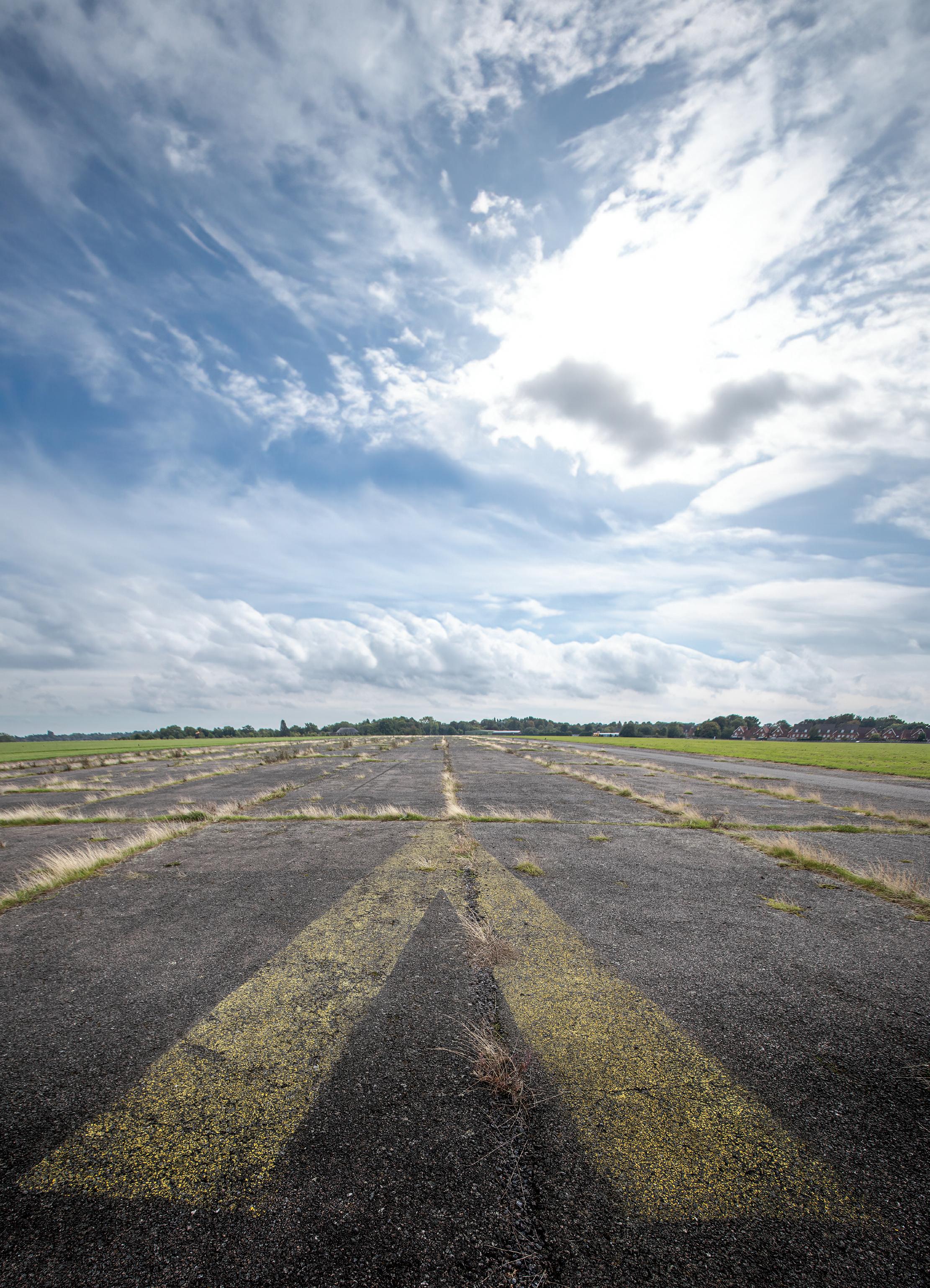
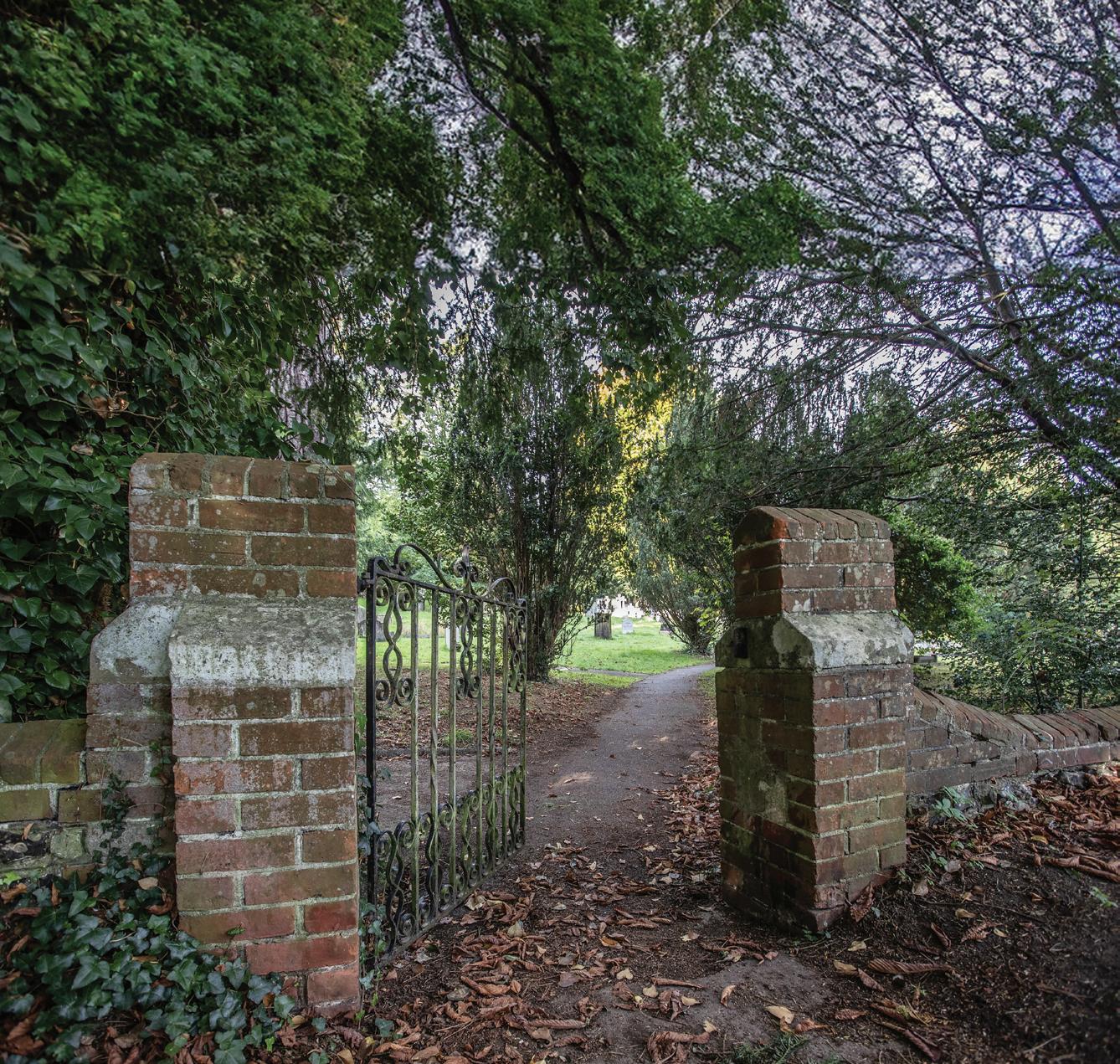
Faded markings and cracks sprouting grass dot the base’s aged runway. Many of the WW II personnel would undoubtedly have passed through the gate to the local cemetery en route to the airfield.
bombing. More than 150 explosives miss the airfield and wreak death and destruction on the surrounding area, hitting railway lines and damaging roadways. Houses in Whyteleafe and Caterham are destroyed or badly damaged.
By the time the last flight of Junkers 88 dive bombers arrive, Kenley airfield is a smoking ruin. The last wave of Germans head for their alternative target, 25 kilometres away at West Malling.
Bashford emerges from the shelter to find the hangars burning, their contents destroyed. The man who had driven the ground crew back from lunch, believed to be Leading Aircraftman Thomas Holroyd from Liverpool, is slumped behind the wheel of his lorry, killed instantly by a Dornier’s bullet that had entered through the open passenger-side window and hit him in the face. The lorry itself is undamaged.
Five new Hurricanes, still awaiting their squadron markings, sit riddled with bullets and shrapnel outside the hangars.
One Kenley pilot is killed in the air, another on the ground, along with nine aircraftmen and two soldiers.
Throughout the day, the Luftwaffe targets airfields at nearby Biggin Hill, Hornchurch, North Weald, Gosport, Ford and Thorney Island, along with the radar station at Poling.
German losses are tallied at 69-71 aircraft destroyed, 31 damaged, 94 crew killed and 40 captured. The Allies lose 27-34 fighters in the air and 29 on the ground; 62 aircraft are damaged; 10 pilots are killed. Aug. 18, 1940, comes to be known to both sides as The Hardest Day.
Croydon and Kenley will rebuild. Kenley, in fact, is dispatching fighters the next day after the craters are filled in and Alford earns a George Medal cleaning up the 150 unexploded bombs that litter the airfield. Kenley—indeed, the whole area— is critical to Britain’s defence.
Over the next two months, the Battle of Britain tapers off. By the following spring, Hitler has turned his attention eastward to the Russian steppe, the air war has shifted to the continent and the Allied bombing campaign is escalating. The airfields of southern England, especially, become home to dozens of Commonwealth and other Allied fighter squadrons, including Canadian. During the war, eight RCAF units take up residence at Kenley alone, along with British, Australian, Kiwi, Polish, Czech, Belgian and American.
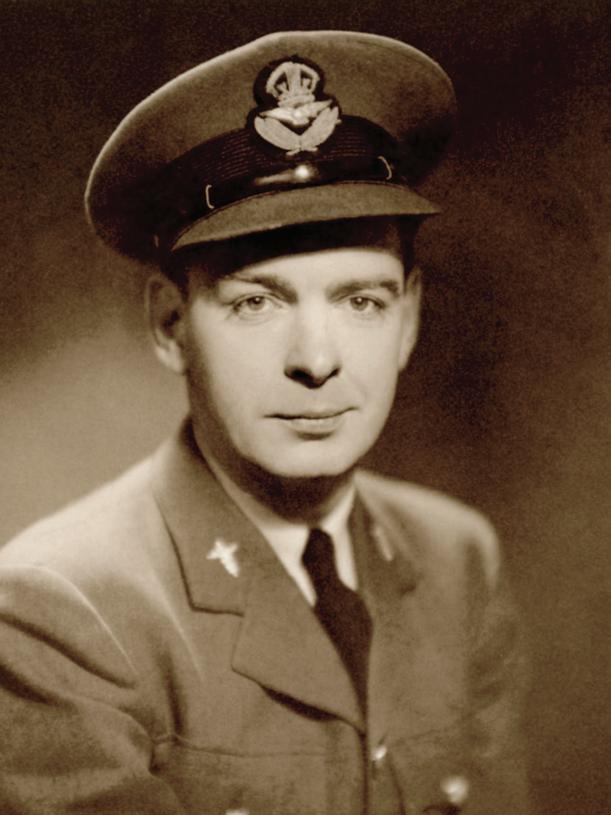
Beginning in the summer of 1942, my father, an RCAF medical officer, was posted with 401 or 416 squadrons at Kenley, Redhill and Biggin Hill, all within a 20-kilometre radius—20 minutes, more or less, by train from London’s Victoria Station. In all, he spent 31 months overseas with fighter, maritime and bomber squadrons in England, Scotland and Northern
Ireland, tending to airmen of multiple nationalities. He was even summoned to care for a member of the extended Royal Family while serving with Bomber Command at Topcliffe, England, in 1944.
Like so many before and after him, Flight Lieutenant Edward L. Thorne likely arrived at Whyteleafe Station and humped his duffel along the winding laneway up Whyteleafe Hill toward RAF Kenley. Perhaps, as some did, he took a short detour along Church Road to the Whyteleafe (St. Luke) Churchyard, with its “Airmen’s Corner,” in which 38 WW II dead are now buried.
A Canadian motorcycle driver and two pilots lie there: Sergeant Leslie Burk of Lindsay, Ont., Flight Sergeant Leonard Joseph Burke of Tignish, P.E.I., and Sergeant Ross Alexander MacKay of Vancouver. Many more died

“IF I HAD A PENNY FOR EVERY PERSON WHO HAS COME UP TO ME AND PROUDLY SAID THAT THEIR HOUSE HAD CANADIANS BILLETED THERE, I’D BE A RICH WOMAN.”
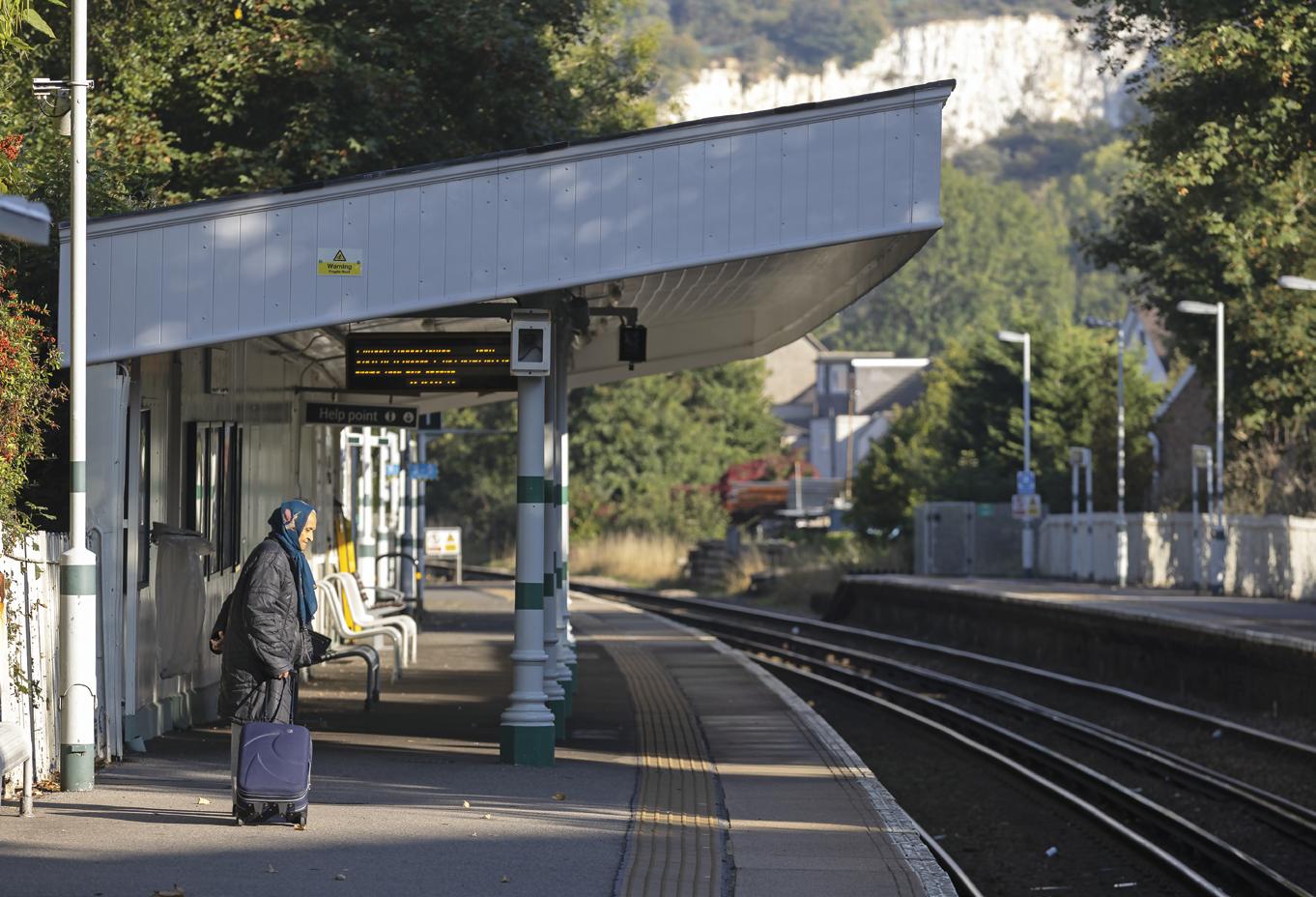
flying out of Kenley, their remains buried in far-flung parts of the British Isles, France, Belgium, the Netherlands and Germany. Others were lost and never found.
Kenley boasted some of the great British and Commonwealth pilots, including the legless British ace Douglas Bader, Canadian aces George (Buzz) Beurling, Hugh Godefroy and Lloyd (the Angel) Chadburn, along with the RCAF’s first Black-Canadian commissioned officer and fighter pilot, 401’s Junius Hokan of St. Catharines, Ont., who died in September 1942.
Then there was the leading Allied ace in Europe, Briton Johnnie Johnson, who amassed 34 aerial victories along with seven shared, three shared probables, 10 damaged, three shared damaged and one destroyed on the ground. His victims were all German fighters—14 Bf 109s and 20 Focke-Wulf Fw 190s, the most kills of the vaunted German aircraft credited to a single pilot.
But Johnson, who shot down a 190 and shared in the destruction of a 109 over the Dieppe beaches during the ill-fated amphibious raid of August 1942, will forever be remembered for his time commanding Canadians at Kenley, where he was given the call sign “Greycap” and, as was the custom with wing commanders, had his initials, JEJ, painted on the side of his Spitfire IX.
He took charge of the Kenley Spitfire wing, which included Canadian squadrons 403 and 421, in early 1943. By September, his tally was 21 and his Canadian Kenley wing, now known as the Wolfpack, had accounted for 60 more victories. Johnson would lead Canadians again later in the war.
By the time my father arrived, the area was “swarming with Canadians,” says Linda Duffield, a theatrical costume designer by trade and an amateur historian with a passion for local wartime research. The RCAF posted 47 squadrons overseas during the war.
“They were at Biggin Hill and there were Canadian army units at Caterham barracks and loads of other units camped out in the woods, etc.,” says Duffield.
“If I had a penny for every person who has come up to me and proudly said that their house had Canadians billeted there, I’d be a rich woman. The truth is that many of the houses were vacant because the civilians were recommended to evacuate if they lived within a certain radius of the airfield.
“So, there were loads of empty houses and they were out to use when they dispersed the personnel off the base.”
Gliders now fly out of Kenley. It’s a serene, peaceful place, even though the remnants of its wartime role are still evident.
Like many, Flight Lieutenant Edward L. Thorne arrived at Kenley to the local train station. Amateur historian Linda Duffield speaks the international sign language of flight.
I met Duffield on social media. She was running a Facebook page on behalf of the Kenley Revival Project, a lottery-funded effort to “preserve and protect” what it describes as the war’s most intact fighter airfield. Now she’s my guide as I complete a pilgrimage to the place where my father was posted with Chadburn and Godefroy. Duffield’s the daughter and the niece of RAF servicemen; her mother was a Wren, Women’s Royal Naval Service. They were all aviation buffs.
“I became fascinated with Kenley because it has this quietly expectant atmosphere,” she says in her distinctly English lilt. “The gliders feel like the sighing ghosts of all those Spitfires and Hurricanes. Sometimes it feels like the place itself has never given up the hope that the fighter boys will return home one day.
“For me that’s more powerful than any museum and it’s what made me want to find out who those men and women were and what they went through.”
Before ascending the hill to RAF Kenley, we visit the railway stop—a simple station building and platform—and the churchyard cemetery, where the morning light casts long shadows and illuminates the pale tombstones in a golden glow.
The airfield itself is set back from the road, through a steel gate and up a driveway lined with brick buildings. If not for the signage, one might not realize an airfield is there at all.
Walking the aged runways, their markings faded and cracks sprouting grasses and flowers, it’s not hard to envision the Kenley of the 1940s and a blue-uniformed Flight Lieutenant Thorne—“Doc Thorn” in Arthur Bishop’s book Winged Combat—going about his duties as squadron medical officer.
The concrete blast pens, built last-minute to varying criteria and sizes in early 1940, remain in place around the perimeter of the field. At least one of their walls is pitted with what looks suspiciously like machine-gun fire. There are gun emplacements made from sewer pipes.

Duffield takes me inside a spider-infested air-raid shelter at the back of one blast pen. It’s dry inside, and there’s still graffiti and art on the walls. It was all “built in a hurry, but done well,” says Duffield. “The blast pens and surviving gun emplacements, etc., at Kenley tell this story of ingenuity in desperate times. They just had to do their best with what they had. That attitude of ‘what have we got and how can we use it to best effect’ made a deep impression on me.”
As Duffield points to the spot where Bashford stood on that late-summer evening in 1940, the image she describes emerges vivid in my mind. I can almost see and hear the German aircraft passing. After a lifetime reflecting on my late father’s stories, of pouring through his wartime photo album, exploring books and watching and rewatching the ITV series “Piece of Cake” (my dad, whose RCAF may have been modelled on the RAF,
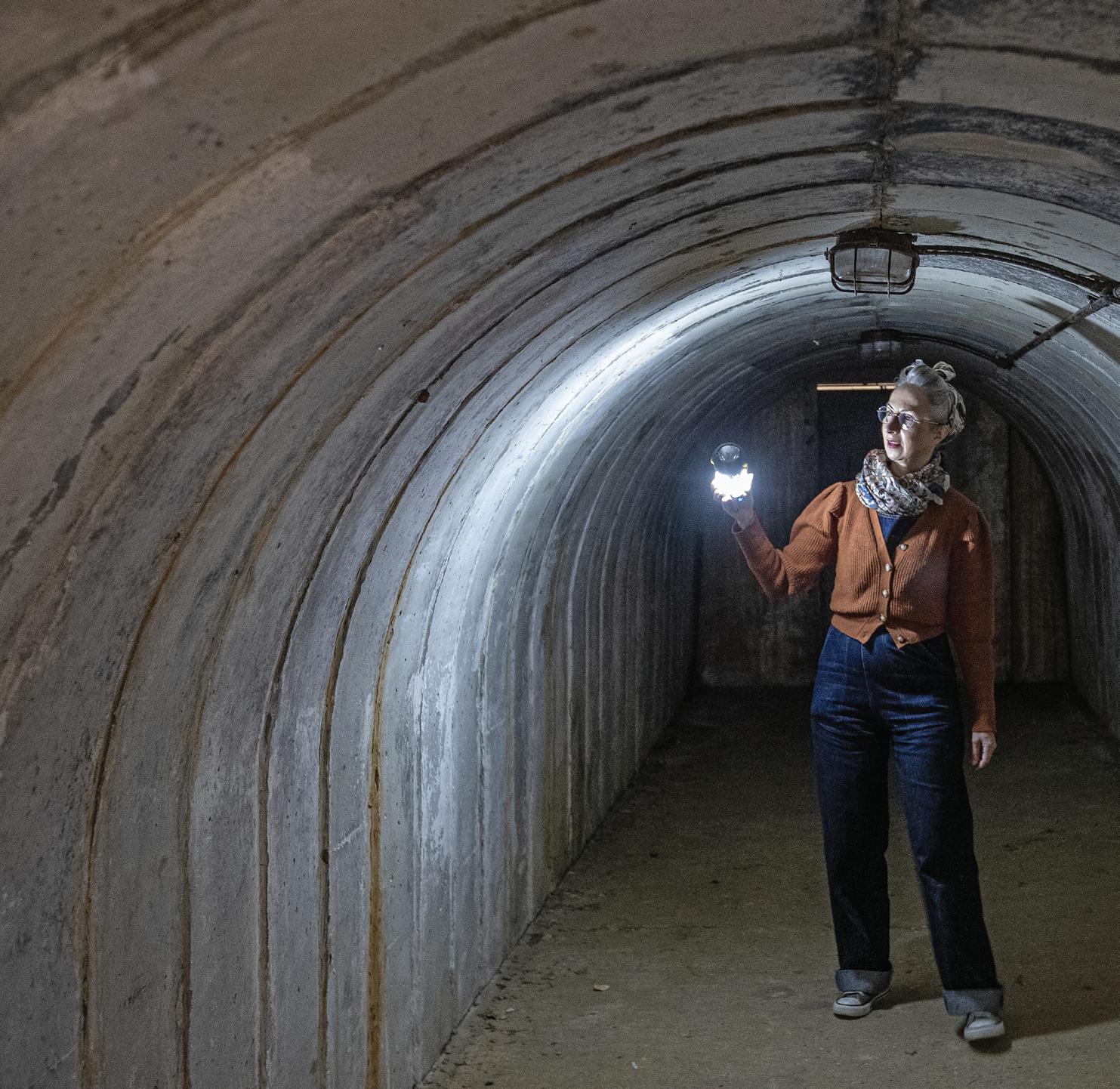
but apparently wasn’t beset by the rivalries and class consciousness depicted in the show, disliked it intensely), it feels as if Britain’s war has come alive around me.
Indeed, like the historical novelist Patrick O’Brian, author of the Master and Commander books about Horatio Nelson’s 18th-century navy, the youthful Duffield knows the place and time so well, one can’t help but feel as though she had been there eight decades ago herself. The stories just flow, like she’s been transported to today by time machine.
The officers’ mess, still missing one of its original bay windows lost during the Aug. 18 raid, stands to one side of the airfield, fenced off, but still relatively intact. It’s slated for development as luxury housing, its facade to be maintained by law.
The squash court, the officers’ domain, is nestled alongside a gun emplacement, a trench still evident among the vegetation. Inside, the court itself has long since been commandeered for storage. A pilot’s
footlocker sits among paintings and boxes, his name stenciled on the lid.
The RAF Association Portcullis Club, a modest museum/bar, occupies the oldest building still standing at the site. It dates to 1917, when Kenley was No. 7 Aircraft Acceptance Park, bringing in aircraft parts by rail and truck from area factories, such as Sopwith in Kingston, 20 kilometres away.
Planes were assembled here, instruments calibrated, guns tested and the final products test-flown before they were ferried out to squadrons on the Western Front.
The Portcullis Club building itself, about half its original size since a second runway was built in 1939, first housed an experimental photographic unit staffed by about 60 personnel. They flew their own aircraft, developing specialized cameras and lenses for aerial reconnaissance.
The building became the electrical stores during the Second World War, and later was used as the families club for station and
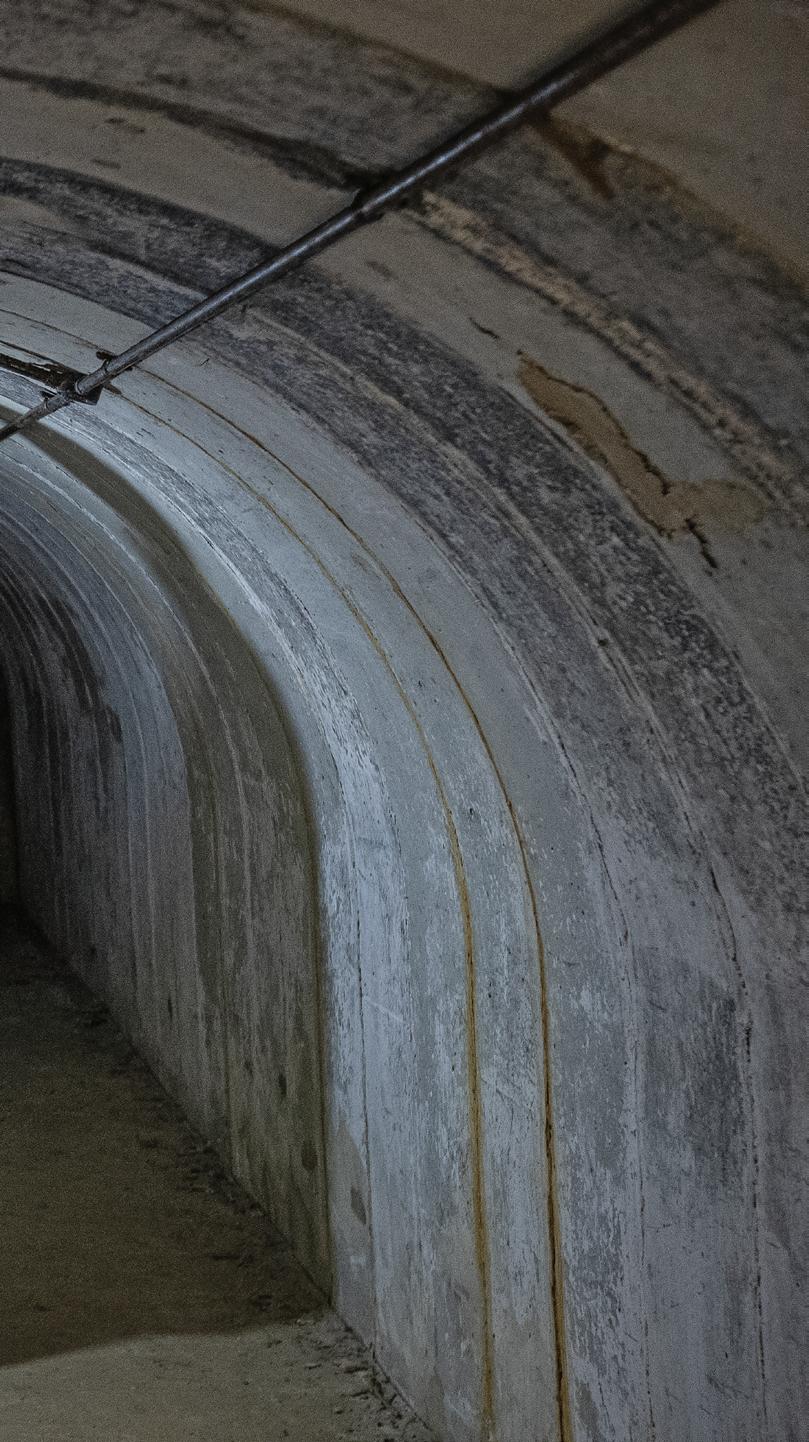
The officer’s mess remains intact beyond the runway where flowers push through the cracks. Duffield leads the way in one of the base’s air-raid shelters. A memorial to local wartime medical staff in nearby Croydon.
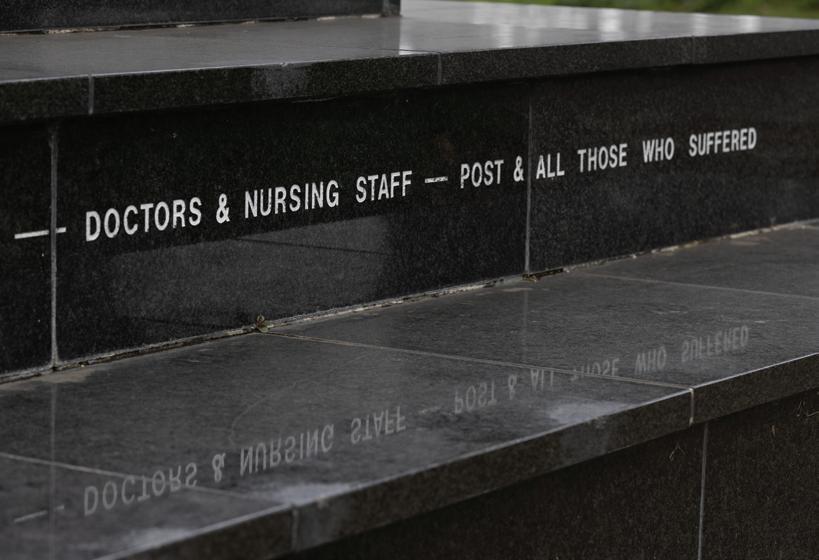
service personnel billeted at Kenley while filling administrative posts in central London. It eventually became the local RAF Association branch. “Although there are very few veterans amongst the membership now,” says Duffield, “the area has such a long, and proud, military history that links to the RAFA have been maintained.
“You find a lot of families in the area who settled here after some ancestor served at RAF Kenley or the Guards Depot in Caterham.”
Bashford, the electrician who watched the 110s fly up the valley and survived the attack on Kenley three days later, would go on to accompany 39 Hurricanes to the Soviet Union in August 1941. They were the first of nearly 3,000 destined for the Soviet defence of Murmansk, transported by aircraft carrier in the initial Arctic convoy delivering materiel to the Russian seaport.
Bashford was later posted to the Middle East, and served in Egypt, Palestine, Iraq and Greece before he was demobilized in January 1946. He died in 2023, aged 102.
Among my father’s Kenley contemporaries, the Canadian ace Chadburn was killed in a mid-air collision with another Spit over France one week after D-Day. Hugh Godefroy succeeded Johnnie Johnson as 127 Wing commander and survived the war to study medicine, graduating from McGill University in Montreal. In 1983, he published his memoir, Lucky 13, a vivid account of life at RAF Kenley. He died in 2002, aged 82. Johnson served in the RAF for another 20 years after the war, then created a housing trust and a foundation for disabled charities in Douglas Bader’s name. He later collaborated with aviation artist Robert Taylor on some of the painter’s most celebrated works. Johnnie Johnson died in 2001 at 85.
Kenley, Redhill and Biggin Hill were part of the Thorne family lexicon until my father died in 2003, aged 90. L
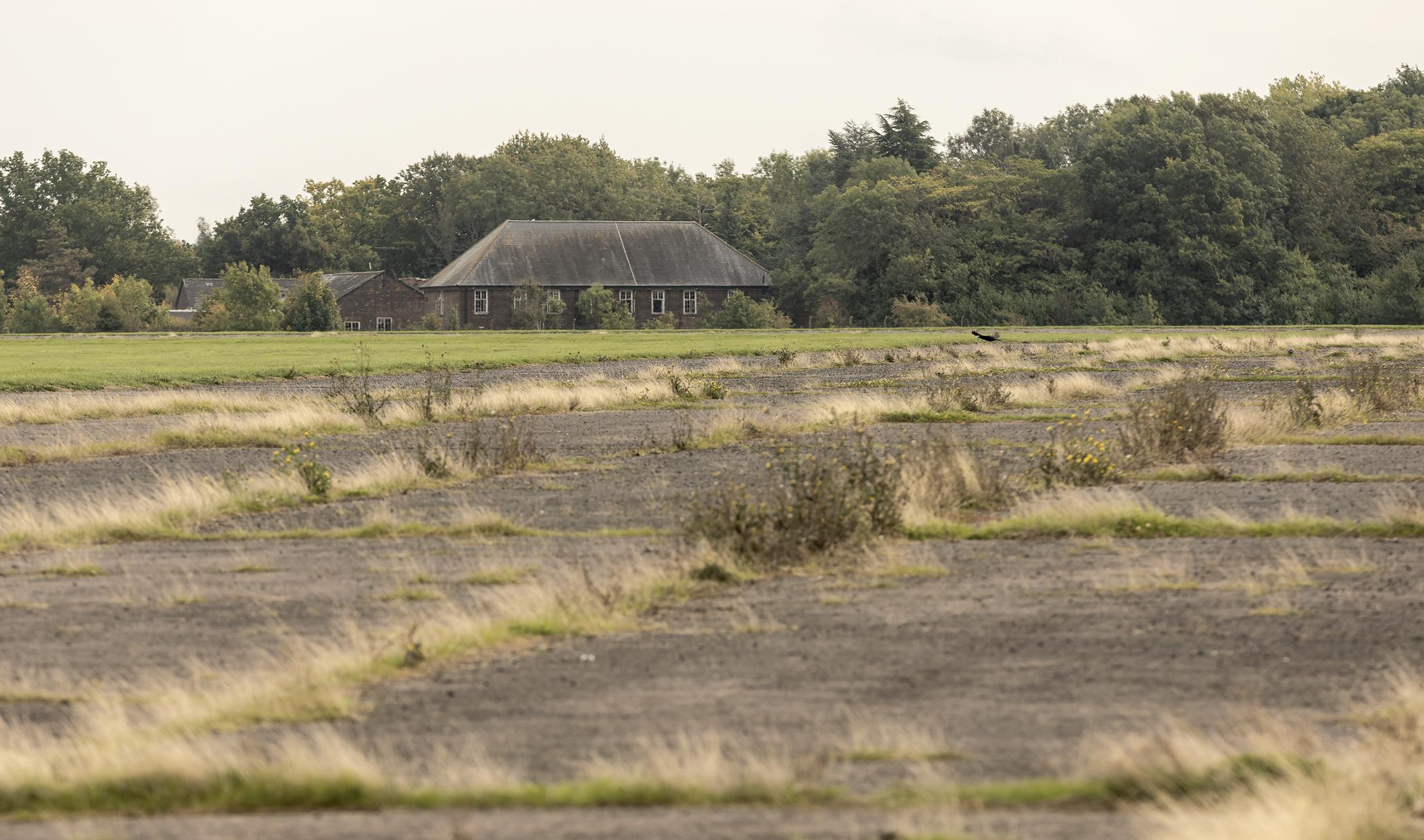

FOR 75 YEARS, THE NORTH ATLANTIC TREATY ORGANIZATION HAS WORKED TO QUELL CONFLICT

By John Boileau
Inthe aftermath of the Second World War, much of Europe lay in ruins. In stark contrast to the vibrant Europe of today, the burntout shells of several cities and towns dotted the continent. The conflict’s death toll was staggering—approximately 19 million civilians and 17.5 million military personnel.
Rationing, refugee camps and malnutrition were daily facts of life. The mere act of survival was a struggle.
In the summer of 1940, the Union of Soviet Socialist Republics, the USSR, absorbed the three formerly independent Baltic states of Estonia, Latvia and Lithuania. They also took over part of Romania and established it as the Moldavian Soviet Socialist Republic. By the time the war ended, Soviet troops had occupied several eastern and central European countries, including the eastern part of Germany.
At the time, the challenge of what to do about a defeated Germany loomed large on the Allies’ agenda. Germany had been divided into four occupation zones, with British, French and American sectors in the west making up two-thirds of the country and a Soviet one in the east comprising the other third. The former capital of Berlin, although deep inside the Soviet-controlled zone, was similarly divided into four parts.
Of course, the Allies had competing philosophies and the main difference centred on reparations. While all Allies had initially agreed on penalties, the Soviets took them to an extreme. They completely dismantled some German factories and moved them to the USSR and confiscated the production of those left behind.
Additionally, the Soviets were to supply food from their largely agricultural eastern zone to the rest
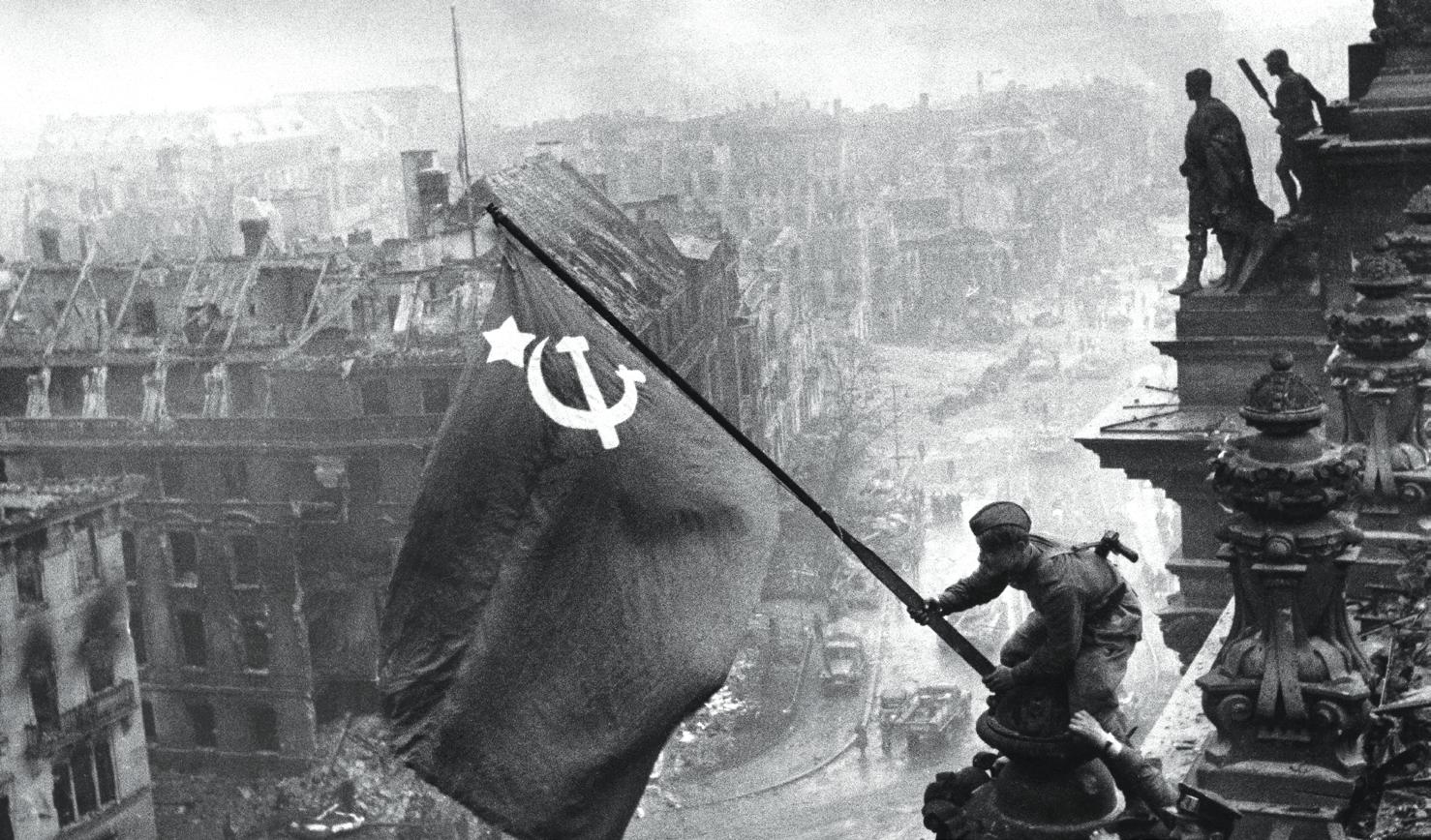
Soviet soldiers in Berlin in 1945. Tensions between the USSR and its western Allies after the Second World War helped lead to the creation of NATO. Its representatives, including Prime Minister John Diefenbaker, gather for a conference in Paris in December 1957.
of Germany, in return for a share of the reparations from the western zones. They never did. Forced to feed Germans in their sectors from their own economies, the western Allies reversed their views and now supported the re-establishment of German industry to allow the Germans to feed themselves. The Soviets opposed this move.
When the western powers would not let the USSR claim any more reparations from their zones, cooperation went downhill rapidly. The administration of the zones began to diverge. On Jan. 1, 1947, Britain and the U.S. unified their zones into a new territory called Bizonia, which further exacerbated East-West tensions.
Then in March and April, the foreign ministers of the four occupying powers failed to reach agreement on peace treaties with Germany and Austria. At the same time as the meeting, the Truman Doctrine, which declared that the U.S. would provide support to all democracies threatened by authoritarian entities, further alienated the Soviets.
The strategic East-West alliance of the Second World War that had defeated fascism was irretrievably broken in the face of growing postwar hostilities. The Cold War had begun in earnest; the Iron Curtain was a reality.
“…the kind of world-view, the kind of beliefs, and the social structure that would probably prevail in a state which was at once unconquerable and in a permanent state of ‘cold war’ with its neighbours.”
—George Orwell, Oct. 19, 1945
“From Stettin in the Baltic to Trieste in the Adriatic, an iron curtain has descended across the continent.”
—Winston Churchill, March 5, 1946 Who said that?
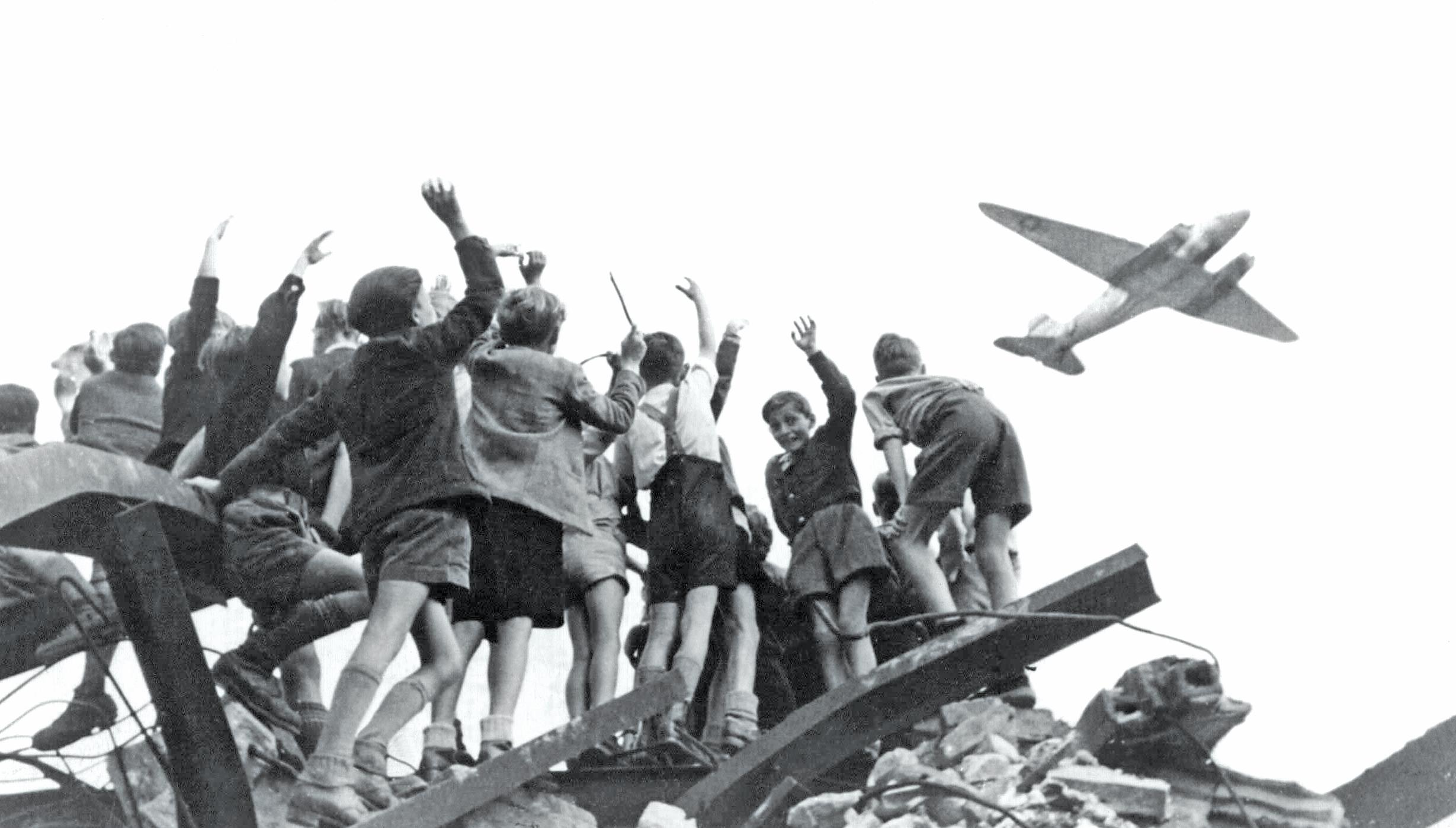
Meanwhile, the western Allies commenced planning for a new Germany consisting of their occupation zones. When the Soviets learned of these plans in March 1948, they withdrew from the Allied Control Council, which had been established to co-ordinate occupation policy between zones.
In June, without informing the Soviets in advance, British and American officials brought in a new currency for Bizonia and West Berlin. In retaliation, the Soviets issued their own as well. In the face of Soviet hostility, the western Allies feared their occupation zones in Berlin would be subsumed into Soviet-controlled East Germany.
During the war, the city had been pounded by Allied bombing raids, reducing it to rubble. Starvation loomed and adequate shelter was sparse. The black market overshadowed the economic life of the city.
Allied fears were justified. On June 24, Soviet forces began a blockade of all rail, road and
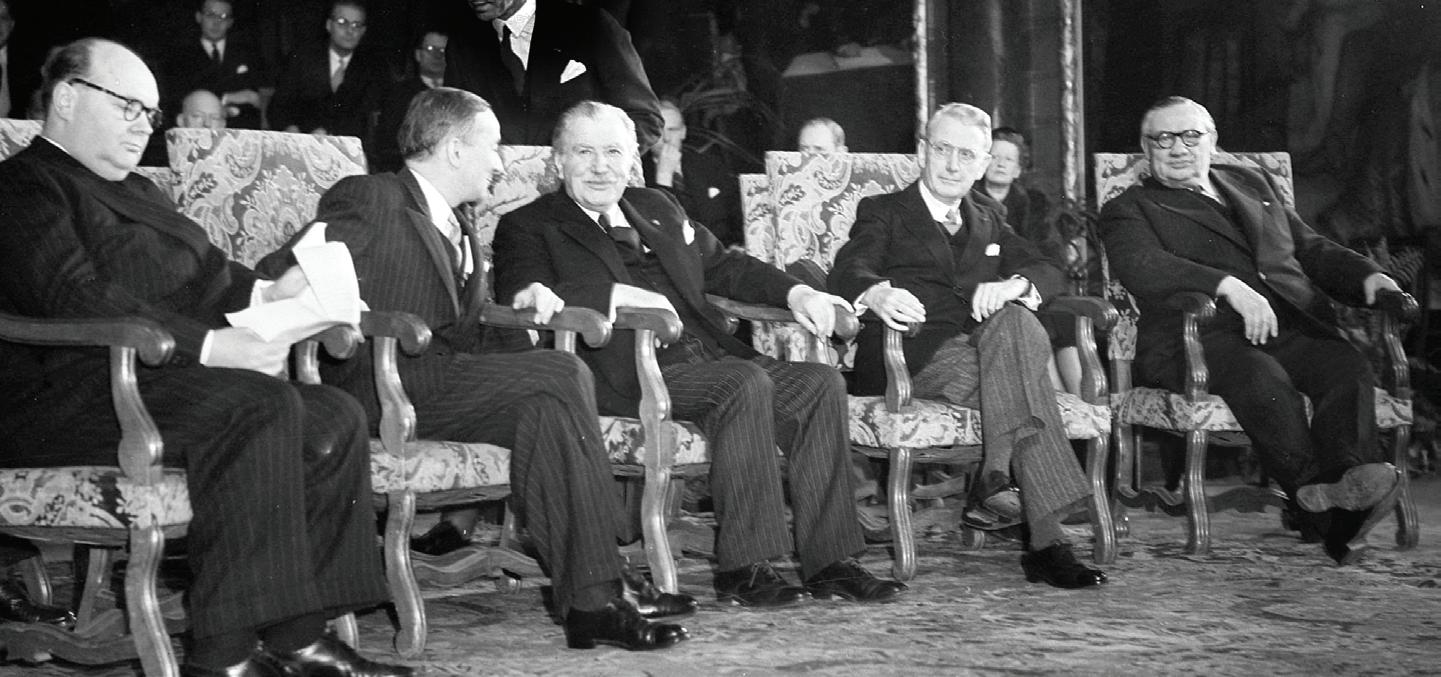
canal links to West Berlin. The first crisis of the Cold War had just erupted. In response, Britain and the U.S. initiated an airlift of food and fuel to West Berlin from Allied airbases in western Germany.
The response to the Berlin blockade showed the USSR that the Allies could supply the beleaguered city by air indefinitely. On May 11, 1949, the Soviets lifted the blockade.
Meanwhile, between 1946 and 1948 and concurrent with these provocations, the USSR had
supported Communists across Europe, who threatened democratically elected governments. The result was the establishment of hardline Communist states based on the Soviet system of government in Poland, Czechoslovakia, Yugoslavia, Hungary, Romania, Bulgaria and Albania.
In many ways, the Berlin blockade was the final straw for some European countries. On March 17, 1948, the U.K., France, Belgium, Netherlands and Luxembourg
signed the Treaty of Brussels, an alliance established in response to an American request for greater European co-operation. Its defence arm was headquartered in the Château de Fontainebleau south of Paris and was headed by Field Marshal Bernard Montgomery.
Coupled with the growing tensions between the USSR and the West, fear of further Communist expansion, the need for collective security against the Soviets, the Berlin blockade and the Treaty of Brussels, the North Atlantic Treaty Organization, NATO, was created on April 4, 1949. Canada, the U.S., the U.K., France, Belgium, Netherlands, Luxembourg, Denmark, Norway, Iceland, Italy
and Portugal were the original signatories to the North Atlantic Treaty, signed in Washington, D.C.
NATO has been, and continues to be, one of the most effective mutual defence treaties in history. Yet opposition to the threat presented by the USSR was only one of the three pillars that led to its creation. Beyond discouraging Soviet dominance, NATO was also conceived to prevent a renewal of nationalist militarism in Europe and support European political integration.
The central tenet of NATO is contained in Article 5 of the treaty: “an armed attack against one or more…shall be considered as an attack against them all” and each
Boys in West Berlin wave to a U.S. plane delivering food to the Soviet-blockaded territory in early 1948. The blockade triggered the Treaty of Brussels, signed by representatives from the U.K., France, Belgium, Netherlands and Luxembourg on March 17, 1948 (opposite bottom), then the North Atlantic Treaty, which was signed by Prime Minister Louis St-Laurent on behalf of Canada on April 30, 1949 (below).
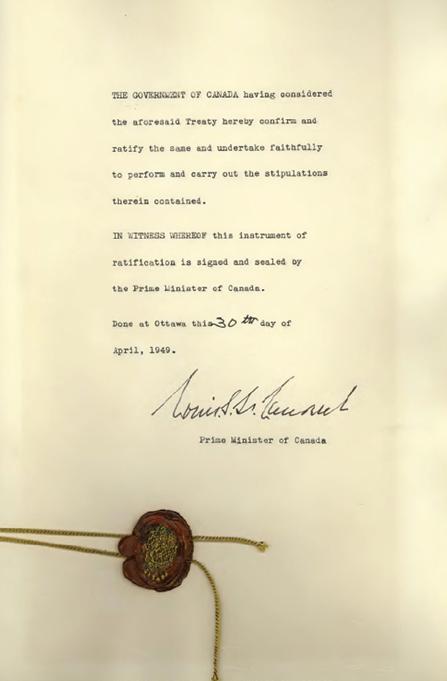
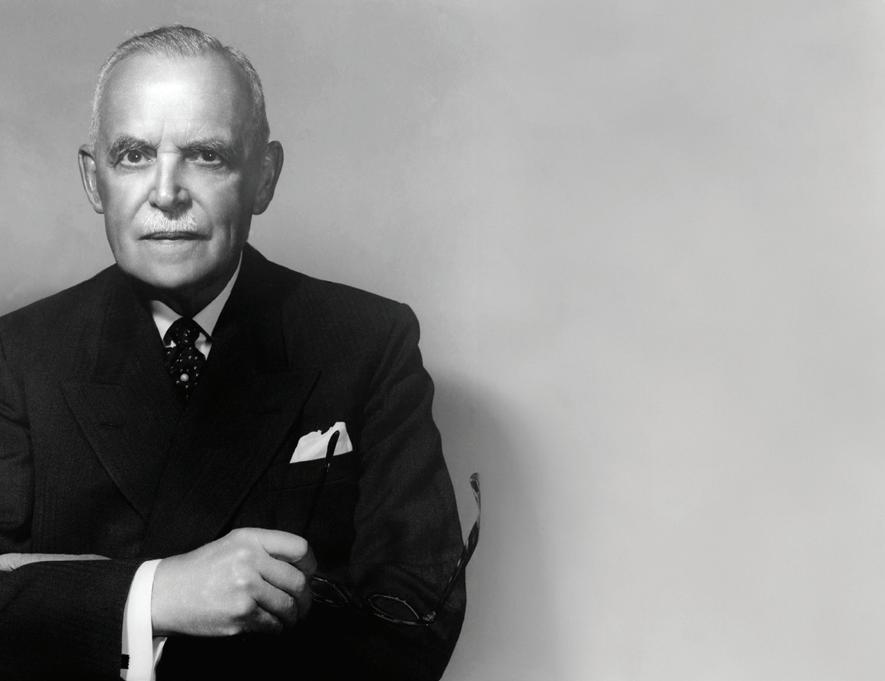
member state will assist those attacked by taking “such action as it deems necessary, including the use of armed force.”
The NATO agreement established the organization’s oldest body: the North Atlantic Council. The council is the main decision-making group, and its policies reflect the collective will of all NATO members.
Four months after its creation, the alliance established a military committee to provide defence advice to the council. The committee is NATO’s senior military authority and gives direction to its strategic commanders.
The chair of the committee is elected from among the NATO member chiefs of defence. The term of office was originally for a year, but since 1958 has generally been two to three years.
All the original signatories (except Iceland and Luxembourg), plus some of the later members, have provided the chair of the committee. Canada filled the chair three times.
GENERAL CHARLES FOULKES was a battlefield commander during the Second World War. In 1951, he became the first chairman of Canada’s Chiefs of Staff Committee. Foulkes was the third chair of NATO’s Military Committee and served from 1952-1953.
ADMIRAL ROBERT FALLS served in the Royal Canadian Air Force during the Second World War and transferred to the Royal Canadian Navy afterward. He was the first naval officer to be appointed chief of the defence staff in 1977. Falls chaired the committee from 1980-1983.
GENERAL RAY HENAULT began his air force career as a CF-101 Voodoo pilot, but spent most of his flying time in helicopters. He was defence chief from 2001-2005 and the committee’s chairman from 2005-2008.
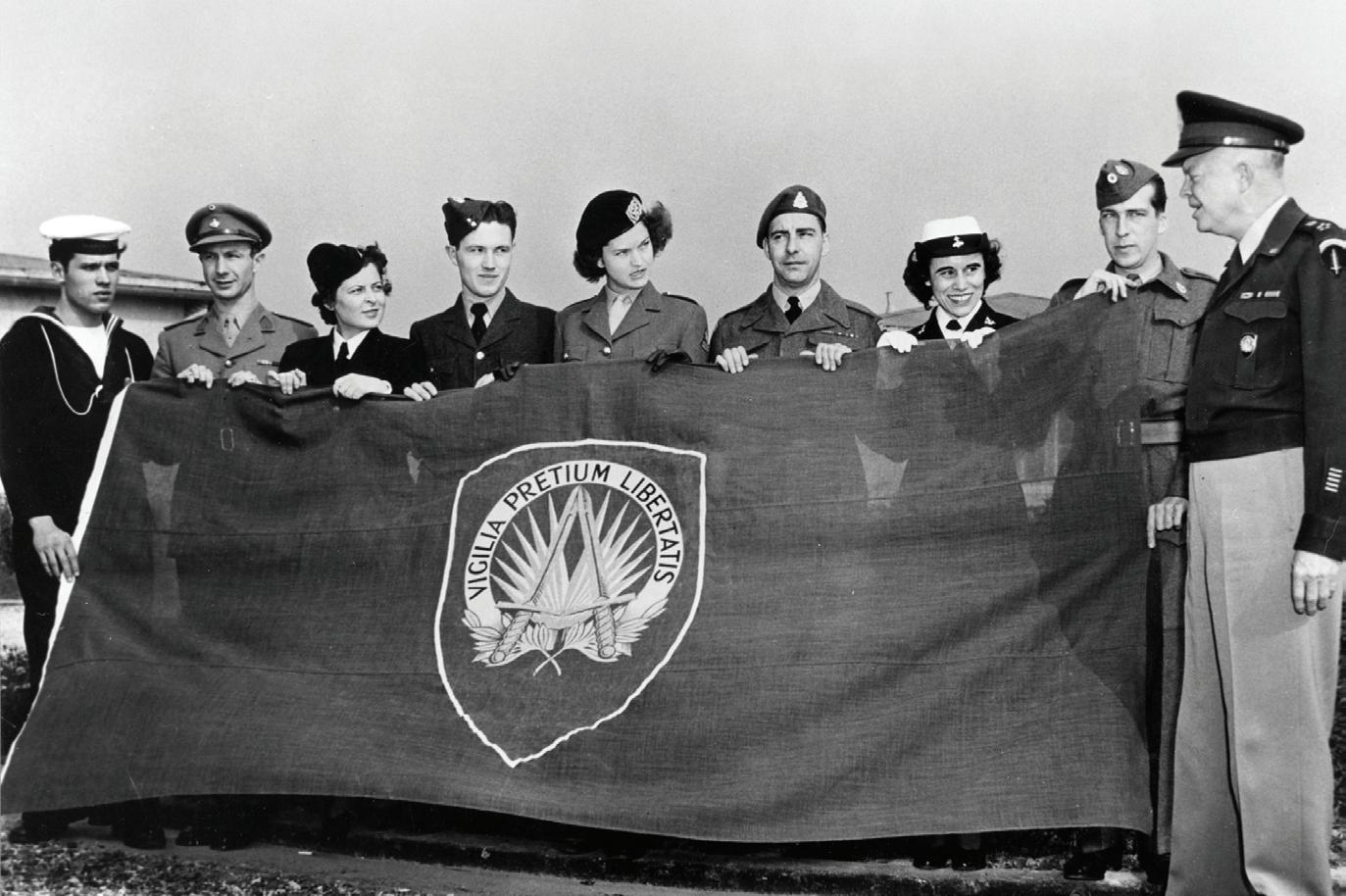
Initially, NATO did not have an integrated command structure that could co-ordinate its actions. This changed dramatically with the detonation of the atomic bomb by the USSR on Aug. 29, 1949, and the invasion of South Korea by North Korea on June 25, 1950. NATO quickly established a consolidated command structure. Known as Supreme Headquarters Allied Powers Europe, it built new facilities near Versailles after four months in Paris.
U.S. General Dwight D. Eisenhower became the first supreme allied commander Europe in December 1950. The position has always been held by an American, who is also commander of the U.S. European Command.
In February 1952, NATO created a permanent civilian secretariat in Paris. Its first secretary general was former British general Lord Hastings Ismay, who had been Churchill’s primary wartime adviser. Ismay is famously credited with saying NATO was created “to keep the Soviet Union out, the Americans in, and the Germans down.”
The secretary general chairs the council. Secretaries general have come from a number of countries, but have always been European.
As the first major conflict of the Cold War, the Korean War caused NATO countries to significantly increase their armed forces. Additionally, all members except Iceland (which has no armed forces) and Portugal, including
soon-to-join Greece and Turkey, provided resources. Canada was the third largest contributor of troops after the U.S. and the U.K.
AS THE FIRST MAJOR CONFLICT OF THE COLD WAR, THE KOREAN WAR CAUSED NATO COUNTRIES TO SIGNIFICANTLY INCREASE THEIR ARMED FORCES .
THE COLD WAR and fear of possible Soviet aggression resulted in Canada increasing its defence budget significantly and stationing troops in Europe. Beginning in 1951, Canada’s commitment eventually grew to a powerful mechanized brigade group stationed in West Germany and an air division of four modern fighter wings in France and West Germany.
Additionally, Canada committed infantry battalion groups to Allied Command Europe Mobile Force. These troops were stationed in Canada, but could quickly deploy to Europe if necessary.
Canada’s stationed commitments in Europe were halved starting in 1967 and co-located in the Black Forest area of West Germany. When some NATO allies criticized this decision, the government formed the Canadian Air-Sea Transportable Brigade Group in 1968. The group was stationed in Canada, but could theoretically deploy to Norway on 30-days’ notice during times of tension.
The commitment ended in 1987, and formally closed in 1993 with the end of the Cold War and the return of army and air force units to Canada.
Although not stationed in Europe, between 1955 and 1964 the Royal Canadian Navy received 20 world-class destroyer escorts. Known as the “Cadillacs,” these Canadian-built, anti-submarine warfare vessels could handle the harsh conditions of the North Atlantic.
In 1970, RCN ships began to serve tours in NATO’s Standing Naval Force Atlantic, an integrated flotilla to provide the alliance with an immediate reaction naval force for emergencies. In 2005, this group was renamed Standing NATO Maritime Group 1.
At the same time, the Standing Naval Force Mediterranean was renamed Standing NATO Maritime Group 2 and began to include RCN ships. Canadian officers have commanded both forces.
THE BERLIN WALL was one of the most iconic symbols of the Cold War. The barrier physically—and ideologically—divided Berlin from 1961 to 1989. Constructed by East Germany, the Wall cut off West Berlin from East Germany and East Berlin.
The barrier consisted of guard towers along 3.6-metre-high concrete walls topped with barbed wire, accompanied by a wide “death strip” containing anti-vehicle trenches, strips of nails and other defences.
Before the Wall, about 2.5 million East Germans had fled to West Germany, which threatened to destroy their country’s economy. In response, East Germany built the Wall to close off its citizens’ access to the West.
The Wall prevented almost all such movement. More than 100,000 people tried to escape over it; some 5,000 succeeded. At least 191 people were killed attempting to circumvent it.
The Wall “fell” in November 1989, part of the astonishingly rapid demise of Communist governments in Eastern Europe and the reunification of Germany.
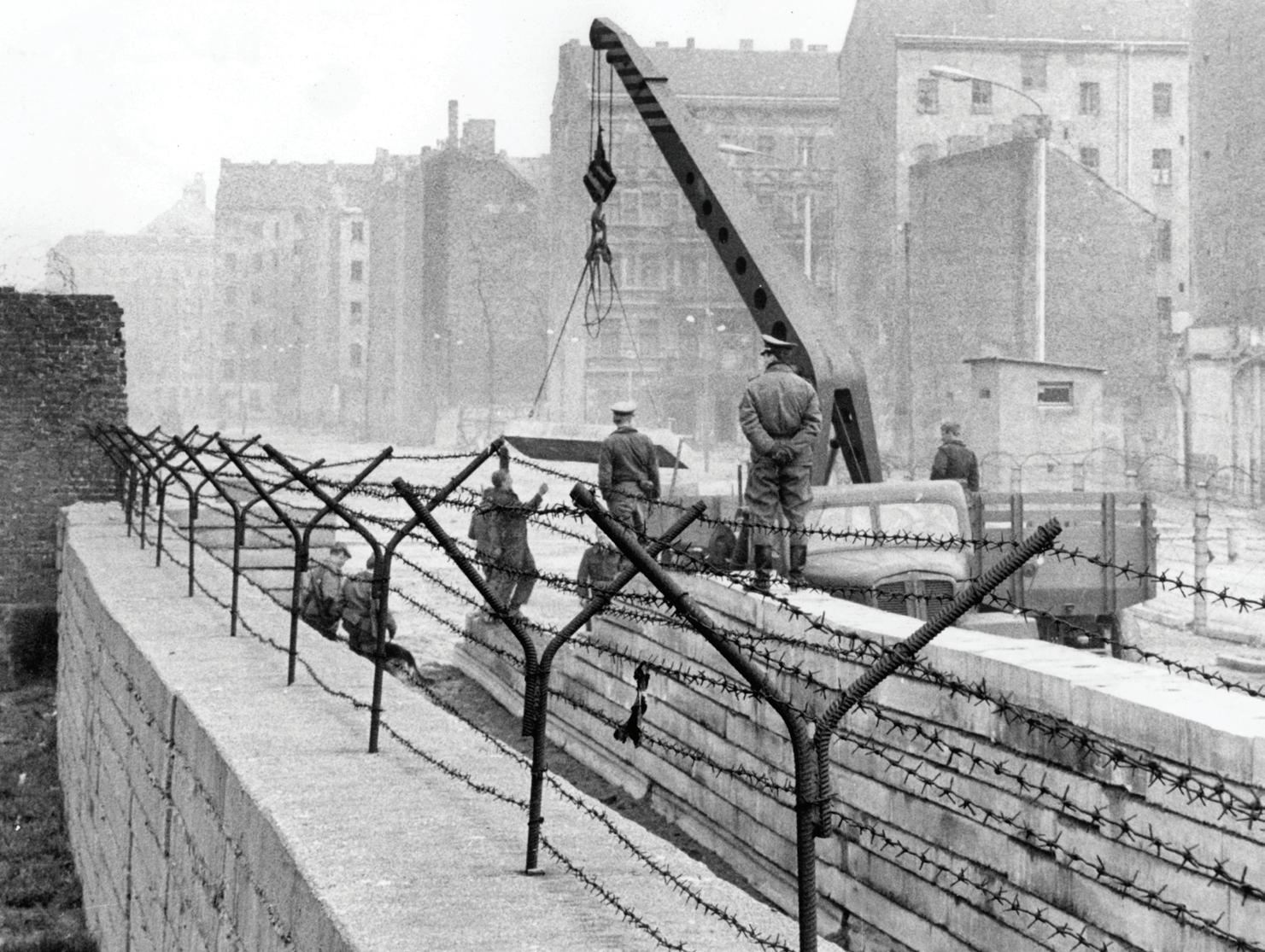
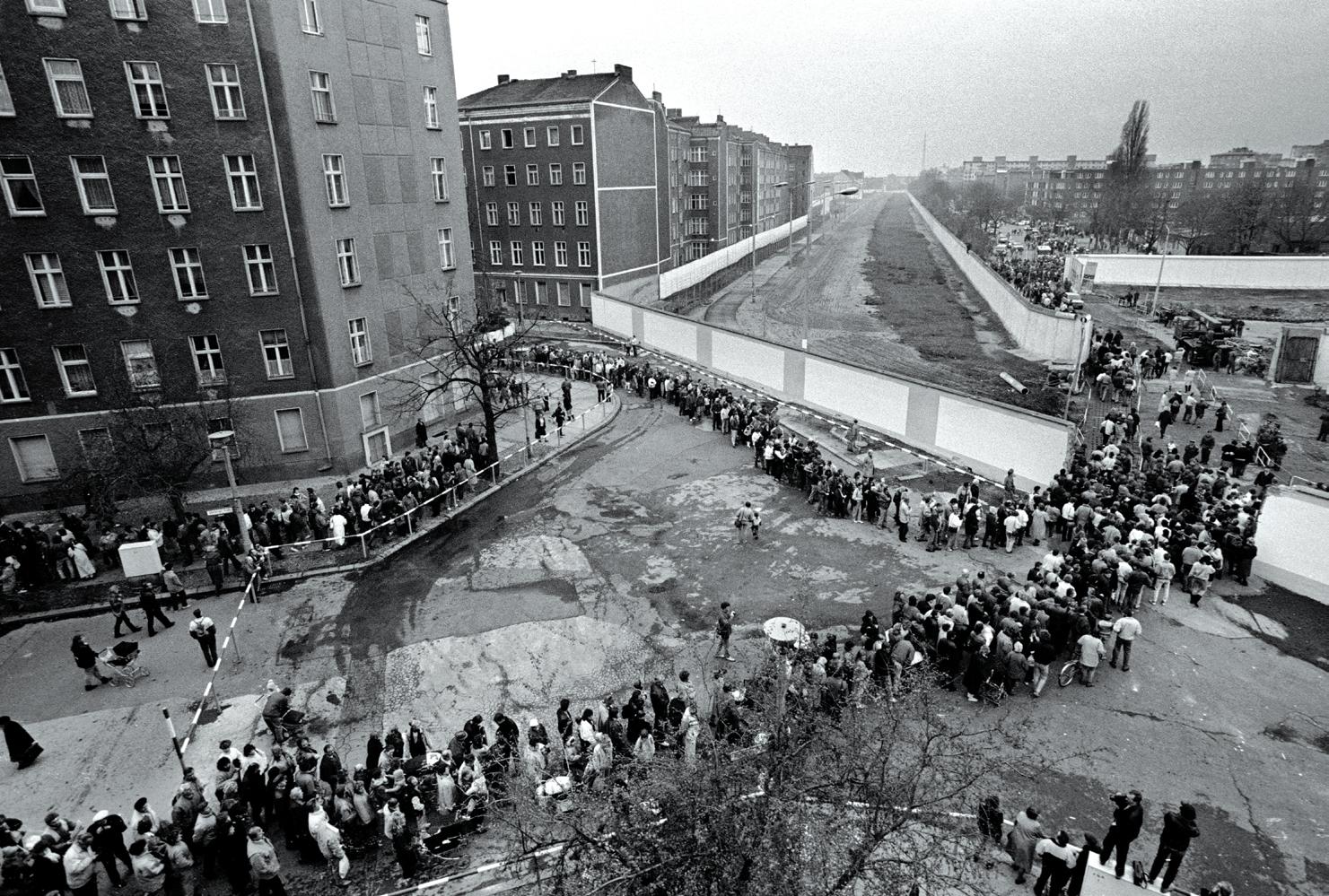
U.S. General Dwight D. Eisenhower, then NATO’s supreme commander, unveils the organization’s first flag in October 1951. Workers build a second barrier as part of the Berlin Wall in 1967. Thousands of East Berliners cross to West Berlin after the Wall was breached in November 1989.
In 1952, Greece and Turkey were admitted to NATO, followed by West Germany in 1955 and Spain in 1982. The admittance of West Germany coincided with the creation of a rival NATO regional alliance. The Warsaw Pact consisted of the USSR and its satellite states of East Germany, Poland, Czechoslovakia, Hungary, Bulgaria, Romania and Albania (which withdrew in 1968).
Although theoretically based on collective decision making, in practice the Soviets dominated the pact and made most of its decisions. The treaty also professed non-interference in the domestic affairs of member states, yet the USSR used it to justify its suppression of popular dissent in Hungary in 1956, Czechoslovakia in 1968 and Poland in 1981.
In February 1966, French
President Charles de Gaulle announced that France would withdraw from NATO’s integrated military structure while remaining a member of the alliance. This entailed moving all NATO forces from France, including Royal Canadian Air Force units. It also meant a move to Belgium: NATO headquarters to Brussels and supreme headquarters to Casteau, near Mons.
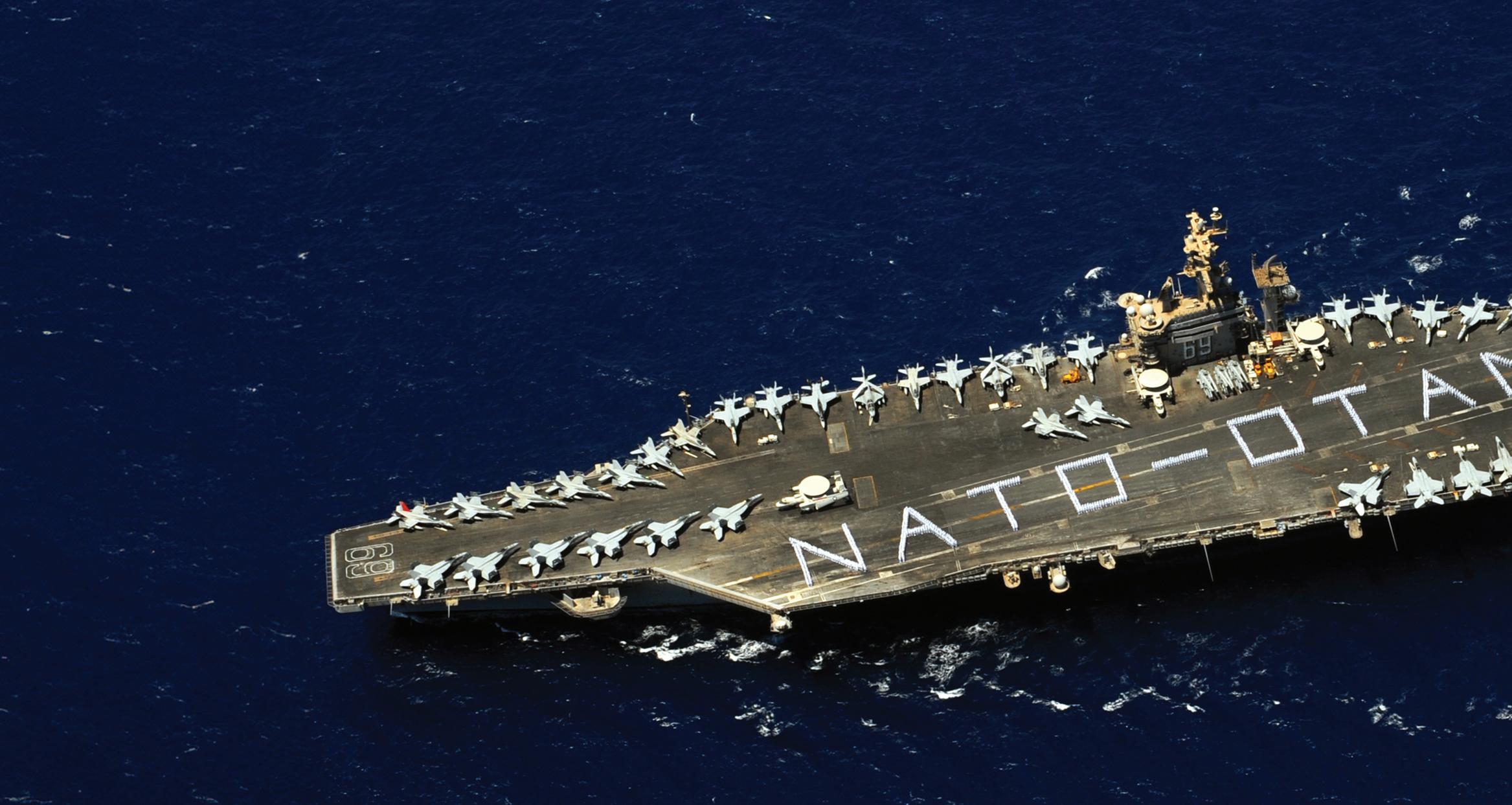
NATO was successful throughout the Cold War in deterring military aggression and its collective forces were not involved in any military engagements. But the end of the Cold War changed the old order and new threats emerged alongside long-standing ones.
NATO transformed with the danger, moving from an exclusively defensive alliance to a proactive one. Between 1990 and 1992, before its first major crisis response operation in the Balkans, the alliance conducted several minor military operations, mostly involving increased airborne warning and control system flights.
The fall of the Soviet Union and the Communist-dominated states of Eastern Europe led the constituent nations of the Federal Republic of Yugoslavia to declare their independence. This began in June 1991 with Slovenia and
Canadian peacekeepers on a NATO-led mission in Croatia (right). Sailors aboard the USS Dwight D. Eisenhower gather to spell NATO-OTAN in 2009 during the War in Afghanistan. Tanks of 4 Canadian Mechanized Brigade Group, perhaps Canada’s most visible symbol of its involvement in NATO, advance in Germany in 1979. Finland (opposite top) is NATO’s newest member.
Croatia, followed by Bosnia and Herzegovina, North Macedonia, Montenegro, and Serbia.
After the breakup of Yugoslavia, the UN, NATO and the European Union provided peacekeepers.
The first NATO commitment was Operation Joint Endeavour in December 1995 with the 60,000-strong Implementation Force. Its aim was to enforce the Dayton Accords, which ended the war in Bosnia.
Concurrently, NATO operated a maritime blockade of the region and enforced a no-fly zone.
The Implementation Force ended its work in December 1996 and was immediately replaced by the NATO Stabilization Force.
It consisted of about 12,000 troops who were to assist Bosnia and Herzegovina in becoming a democratic country. The force was steadily reduced in size and the mission was handed over to the European Union in late 2004.
Meanwhile, NATO also enforced a no-fly zone over Bosnia and Herzegovina starting in October 1998. When its warnings were ignored, the alliance launched a 78-day bombing campaign to force Serbia to stop its attacks against Kosovo.
In March 1999, NATO established a security force in Kosovo. It was successful and is steadily reducing in size until the country’s own units can take over.
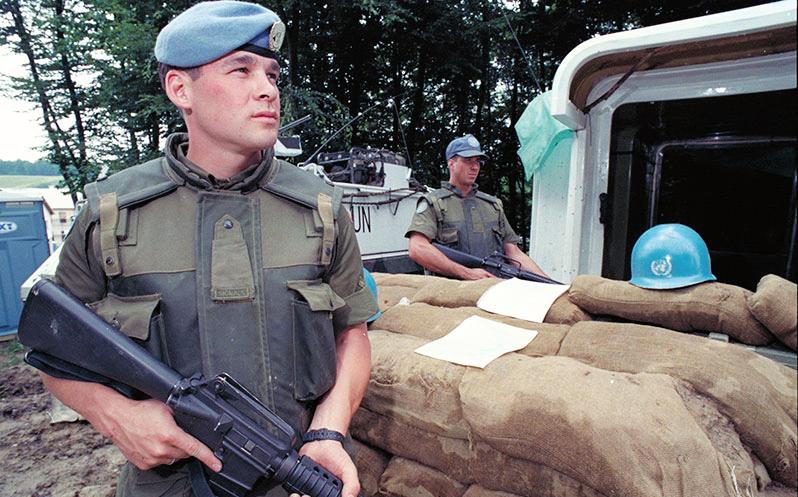
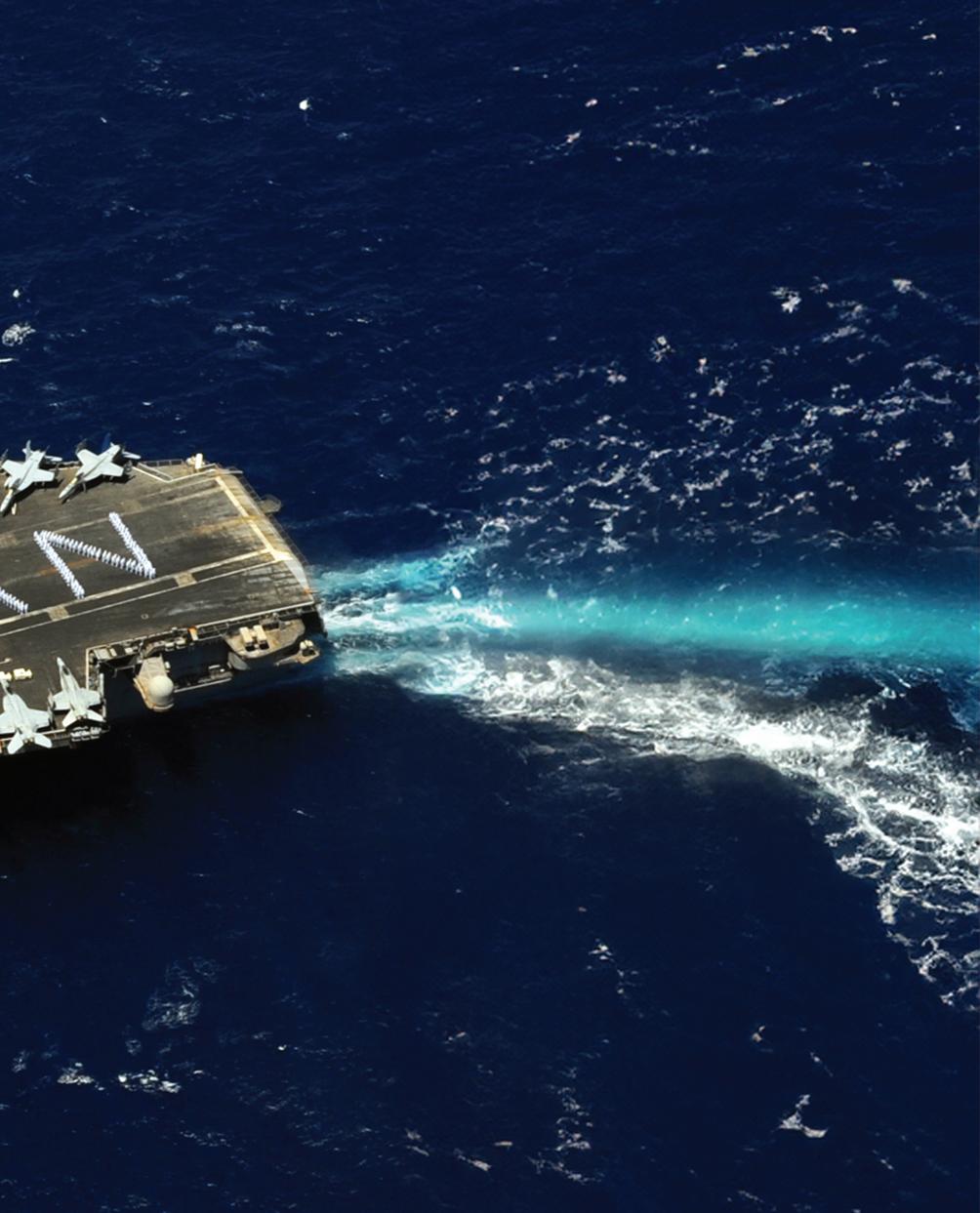

countries in Europe, particularly those of the former Soviet Union. Thirty-four
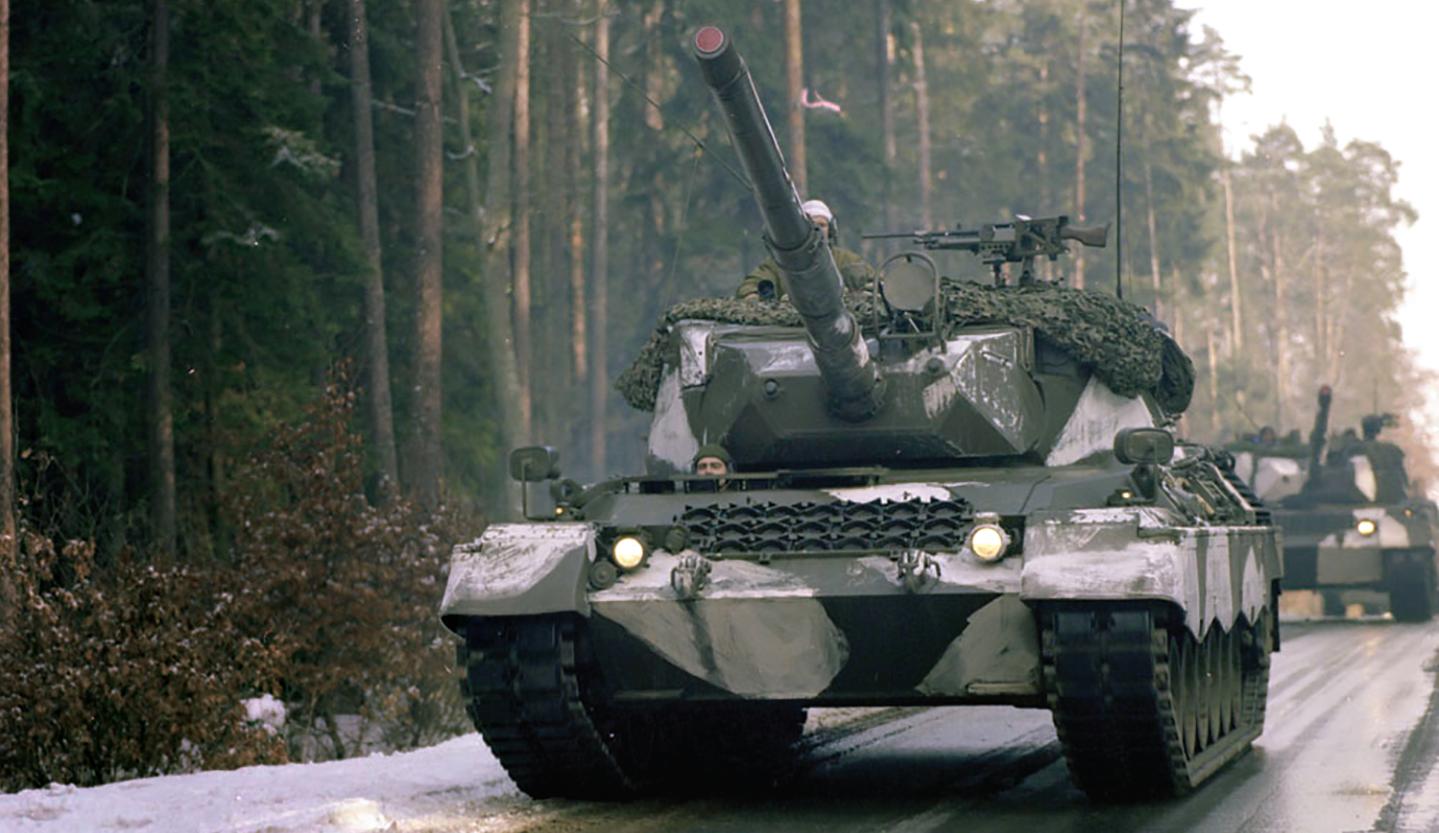
In August 2001, NATO launched a month-long initiative to collect weapons from the ethnic Albanian minority in Macedonia, who had been attacking government forces. Canada contributed to all NATO missions in the Balkans. Some 40,000 Canadians served there for either NATO, the UN or the European Union.
To date, NATO’s Article 5 has been invoked only once. Less than 24 hours after the 9/11 terrorist attacks in the U.S. that killed almost 3,000 people, NATO invoked the clause as an act of solidarity with the Americans.
U.S. forces immediately commenced operations in Afghanistan
when the ruling Taliban refused to hand over Osama bin Ladin, the attack’s mastermind. This was followed by the commitment of military resources by several NATO and non-NATO countries to the subsequent war.
Starting in August 2003, NATO led the UN-mandated International Security Assistance Force in Afghanistan. Its mission was to create conditions for the Afghan government to exercise its authority throughout the country and increase its security forces’ capacity.
That operation ended in December 2014 and the next month the alliance commenced training Afghan security forces to fight
countries eventually joined, including Russia and the constituent republics of the former USSR, Warsaw Pact members and several traditionally neutral European countries. The partnership program has assisted various nations in joining NATO.
NATO’s newest member is Finland (which joined in 2023), while Sweden is expected to become the alliance’s 32nd member once Hungary ratifies its application. Other newer members include North Macedonia (2020), Montenegro (2017), Albania and Croatia (2009), Bulgaria, Estonia, Latvia, Lithuania, Romania, Slovakia and Slovenia (2004) and Czechia and Hungary (1999).
terrorism and maintain security in the country. That concluded in September 2021 when NATO suspended all support to Afghanistan. Canada contributed military resources to NATO missions in Afghanistan from the beginning. The country’s combat role ended, however, in 2011, and the last Canadians left in March 2014 (see “Canada’s longest war” on page 18). More than 40,000 Canadian Armed Forces personnel served in Afghanistan.
Today, threats posed by the Russian invasion of Ukraine, China’s regional expansionism along with terrorism, climate change, regional instability, technological advances and cyber security are among the major challenges for NATO. The alliance, however, has been successful in realizing its aim of collective security for the last 75 years. As such, its shared approach remains the best bet for western countries to overcome any potential problems of the future. L

“Inthe councils of government, we must guard against… the military-industrial complex,” said U.S. President Dwight D. Eisenhower in his farewell address in January 1961. Yes, the famed general, Second World War supreme allied commander in Europe and supreme commander of NATO himself warned of the perils of the relationship between a country’s military and its defence industry and the subsequent influence on public policy.
Still, today the U.S. leads the world in military spending— more than $800 billion in 2023. Some argue its entire economy is tied to its military. So, it’s little wonder the Americans led the charge to have fellow NATO members spend a minimum of two per cent of each country’s gross domestic product (GDP) on defence, as they all agreed to do in July 2023. But while Ike’s nation ignored his warning, Canada shouldn’t. It can’t simply pour money into its military to appease a NATO complex.
Why? For starters, competing with the Americans here is a lost cause. In 2023, the U.S. devoted 3.49 per cent of its GDP to its military, according to NATO. Canada spent just 1.38 per cent. Most NATO members, in fact, allocated under two per cent.
Just 11 of 30 were above the threshold—eight of them Russian neighbours. Coincidence?
Also of note: how NATO members calculate defence expenditures isn’t consistent. What one country considers operations maybe another’s personnel. “These differences demonstrate the difficulty of using this type of measurement to determine real levels of military investment and financial support,” wrote Colonel John Alexander in the Canadian Military Journal in 2015. “A target of 2 percent of GDP for defence spending is a crude measurement.”
“A TARGET OF 2 PERCENT OF GDP FOR DEFENCE SPENDING IS A CRUDE MEASUREMENT ”
Alexander also wrote that “a percentage target in no way addresses how the money is being spent. Canada…has long contended that it is not strictly about how much the military is funded, but…how efficiently those funds
are being expended.” Indeed, Canada has historically provided NATO with what it has requested. Greece, meanwhile, which spent 3.49 of its GDP on defence in 2023—ranking third among NATO members—contributes little to the alliance’s missions.
Canada should spend more, of course. But the NATO minimum is a red herring. To meet it, the country would have to more than double its current budget to some $55 billion. This while its deficit is already $40 billion. Plus, spending that money isn’t simple.
“It would require a fundamental rethink; it is a massive influx,” retired lieutenant-general Mike Day, a former special forces commander, told the Toronto Star in 2022.
The influx would demand more personnel, this at a time when Canada’s forces are already struggling to fill the ranks, short an estimated 16,500 personnel. It could mean new equipment, too, but military procurement issues continue to dog the forces. It seems likely that more money would mean more problems.
“You don’t have that surge capacity,” Craig Stone, an emeritus associate professor of defence studies at the Toronto-based Canadian Forces College, told CBC in July 2023, “because you don’t have the workforce to do it.” L
> To voice your opinion on this question, go to www.legionmagazine.com/FaceToFace

Does it matter if Canada fails to meet the NATO funding minimum? Does it matter if the Canadian Armed Forces are understrength, ill-equipped and saddled with a failed procurement system? Yes, it matters.
First, Prime Minister Justin Trudeau agreed at a NATO meeting in Lithuania in July 2023 that Canada would meet NATO’s two per cent threshold. Still, that Trudeau had previously said privately Canada would never honour that pledge took away the credibility of his signature to the agreement.
Second, when Anita Anand was defence minister, she seemed to be pressing for more money for the military, but now as president of the Treasury Board, she cut $1 billion from the defence budget. This resulted in angry, frustrated speeches from defence chief General Wayne Eyre. It must have shocked Canada’s NATO partners, too.
Indeed, the state of Canada’s military has already hurt the country’s international standing. Ottawa was excluded from the AustralianAmerican-British deal on nuclear submarines and research. It was left out of the U.S.-India-JapanAustralia Quadrilateral Security Dialogue. And in November 2023, Ottawa couldn’t join U.S. President Joe Biden’s Indo-Pacific
AARON KYLIE is the editor of Legion Magazine and the former editor-in-chief and associate publisher of Canadian Geographic. He is also the author of the Biggest and Best of Canada: 1000 Facts and Figures
J.L. Granatstein says YES
Economic Framework of 15 trading partners to, among other things, lower carbon emissions, a subject close to Trudeau’s heart.
In other words, Canada’s allies and trading partners are shutting it out. And while the country’s military shortcomings may not be the only reason, it certainly ranks high with allies concerned about increasing tensions with China, Russia, Iran and North Korea.
“THE TRUDEAU GOVERNMENT’S VIEW [IS] THAT ITS MILITARY IS MORE OF A SOCIAL PROJECT THAN A FIGHTING FORCE. ”
How did Canada get into this mess? Historically, wartime aside, Canadians have always preferred social programs to defence spending. The current government has concentrated on dental care benefits, housing programs, funding for journalism organizations and reconciliation with Indigenous groups, all worthy causes and initiatives that might appeal to voters across the country. But facing a slowing economy and a rising deficit, there doesn’t seem to be enough money for defence.
has written dozens of books, including Who Killed Canadian History? and Canada’s Army: Waging War and Keeping the Peace. He is a former director and CEO of the Canadian War Museum.
But for any government, the first national interest must be the security of the country and its people. Canada’s second national interest should be to get along with the U.S. But when it comes to Canada’s military, the Americans are concerned. “Widespread defence shortfalls hinder Canada’s capabilities,” said a Pentagon document leaked in April 2023. “It is straining partner relationships and alliance contributions.”
In July 2023, The Wall Street Journal was even more blunt in an op-ed piece: “the Trudeau government’s view [is] that its military is more of a social project than a fighting force.” Canada has “long been a freerider off the U.S. military, which it knows stands guard over North America…. Canada’s military is so degraded that even its role in peace-keeping missions has waned.” Ouch.
The newspaper added that “NATO needs members that keep their commitments, and the nations of the G-7 have an obligation to lead the way. If Canada [won’t], then the G-7 should consider a replacement. Poland, which now spends 3.9% of GDP on defense, would be a candidate.”
This mess must be cleaned up. The place to start is by honouring Canada’s financial commitments to NATO. L
The Fi R s T W OR l D WAR ART OF M AR y Ri T e R hAM ilTON
By Irene Gammel
Mary Riter Hamilton’s “No Man’s Land, 1920.”
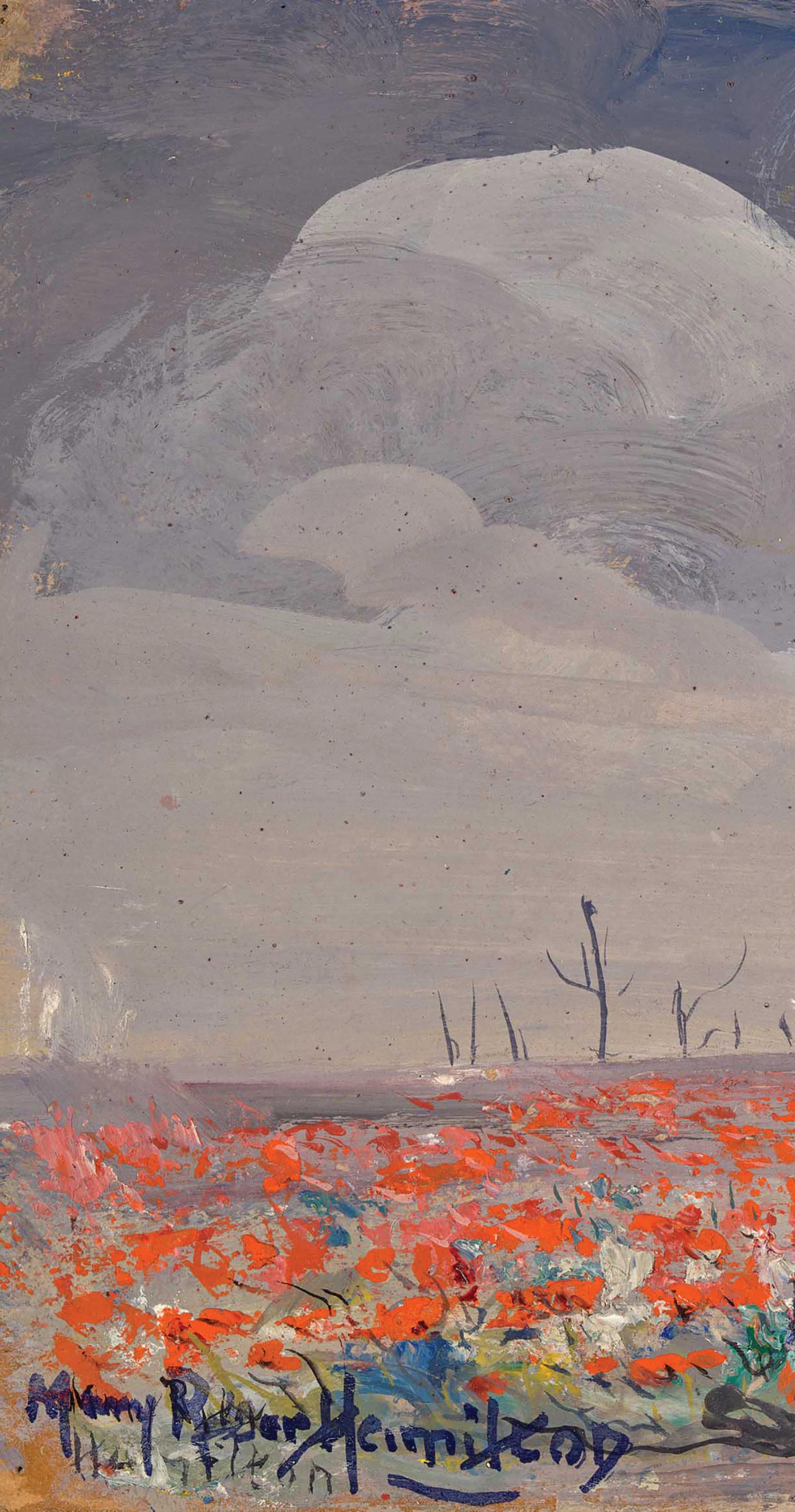
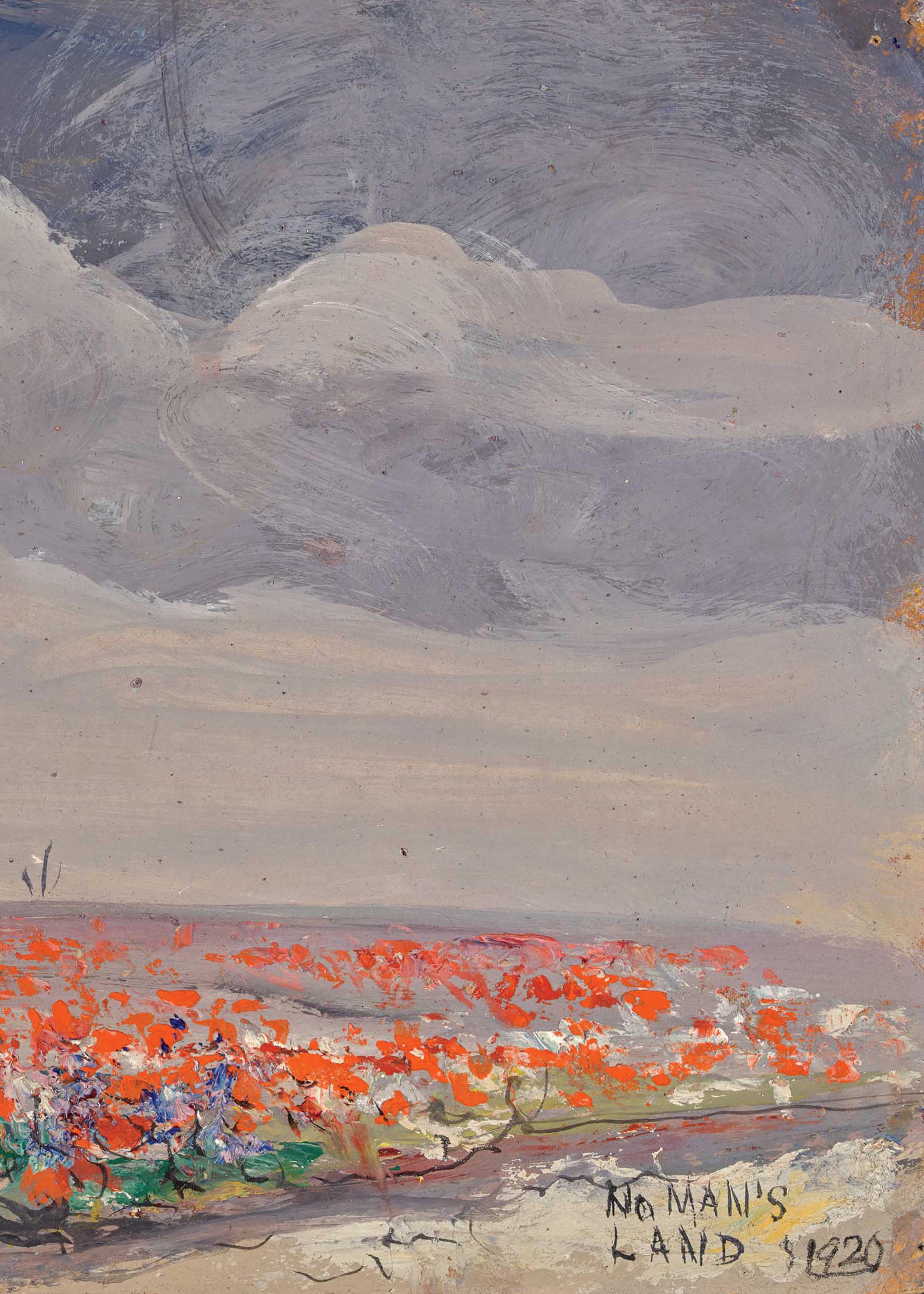
Hamilton’s “War Material.” A photograph of the artist in B.C. circa 1913-14 (bottom) and during her visit to the Western Front in 1919.
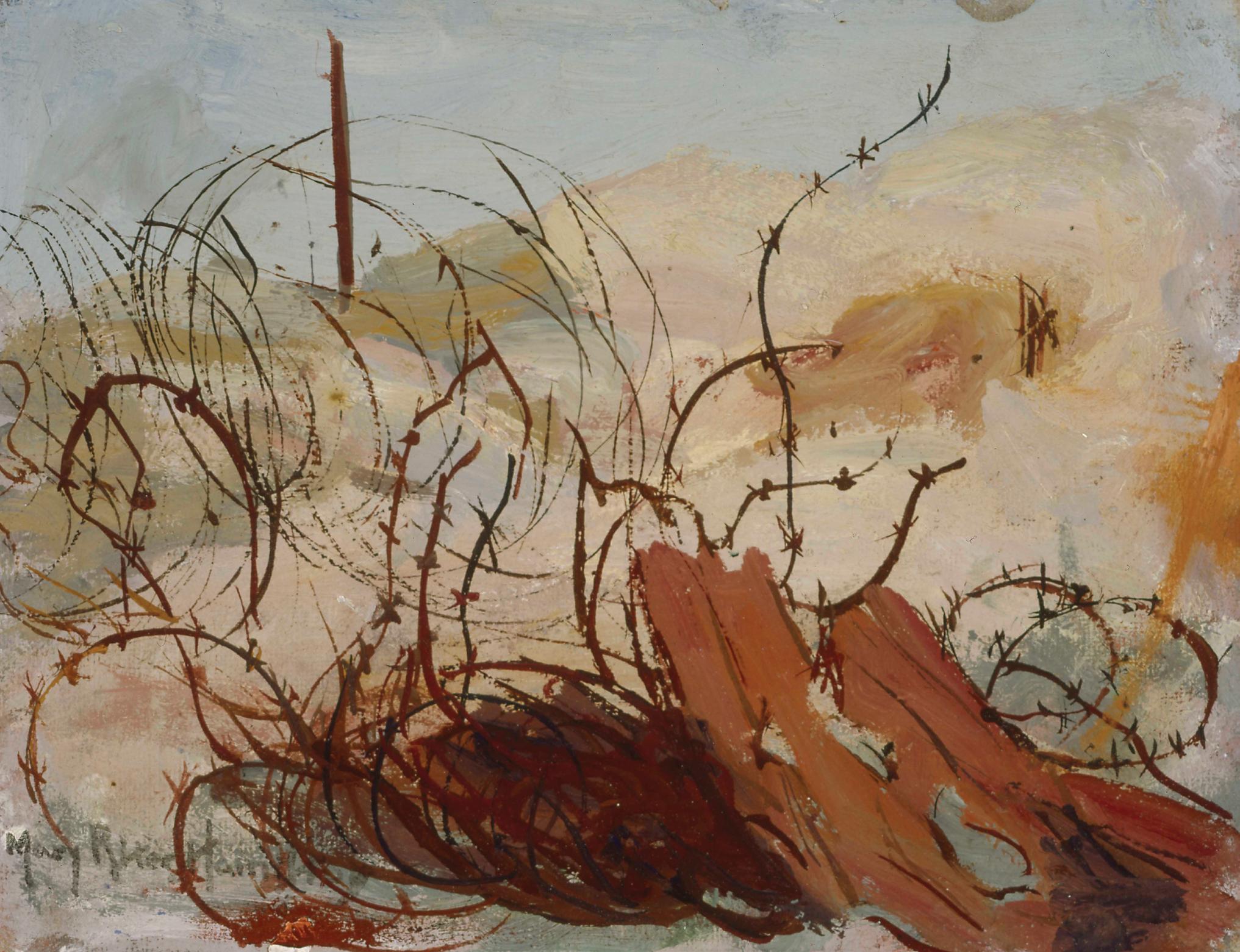
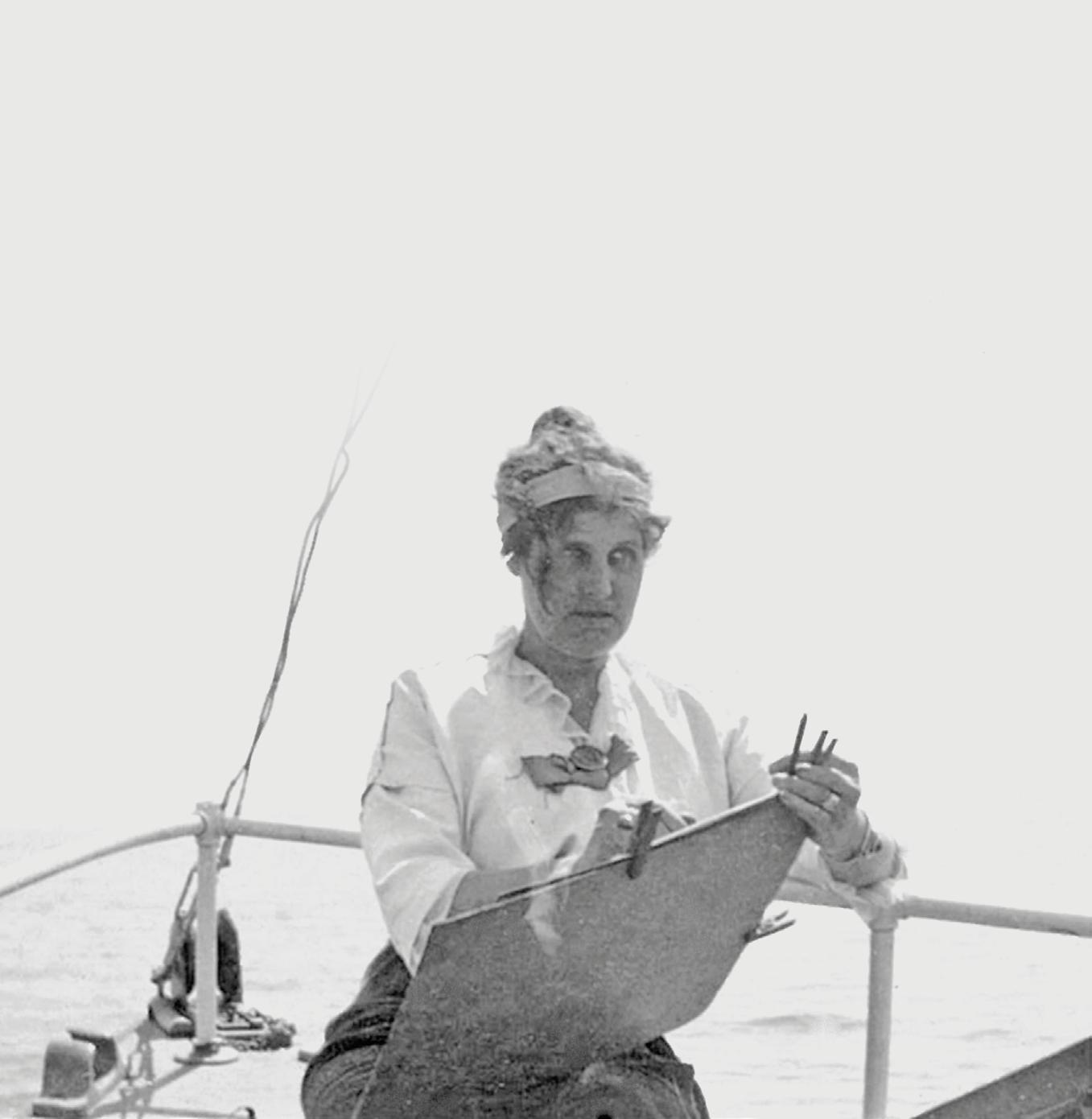
“I cannot talk , I can only paint.” The motto driving the Canadian battlefield painter Mary Riter Hamilton during her First World War expedition conveyed a sense of urgency.
Despite rejections in May 1917 and January 1918 from the Canadian War Memorials Fund, Hamilton, born in 1867, remained resolute in her pursuit to become a war artist. In early 1919, she secured a commission from the Amputation Club of British Columbia to document the postArmistice Canadian war sites in Europe. Embarking on this venture at the age of 51, she boldly presented herself as 35 on her passport. Having first reinvented herself as a painter after her husband’s death, defying the sexist and agist boundaries, this was a signature move.
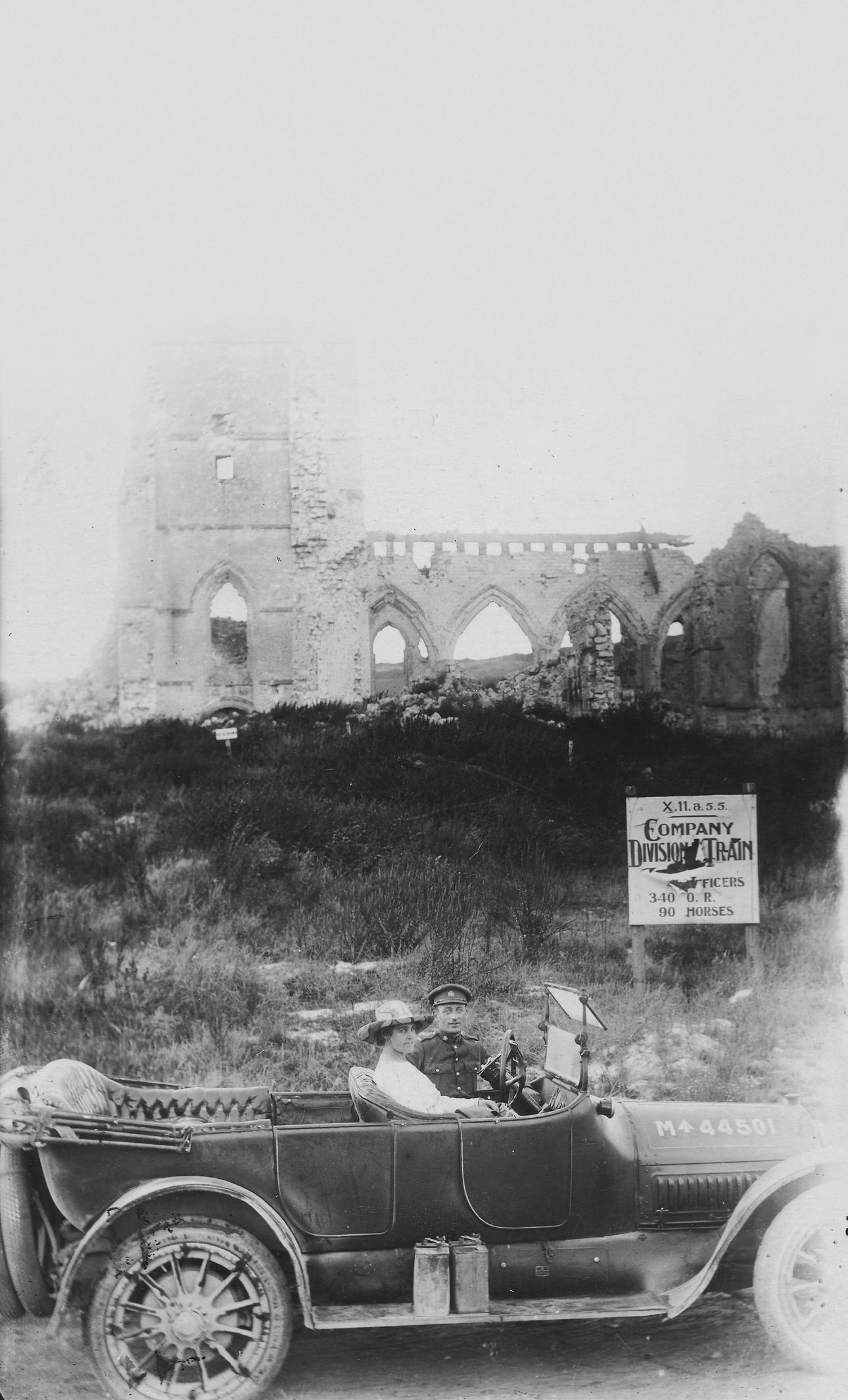
From April 1919 to November 1921, Hamilton visited the postwar trenches and bombed villages of northern France and Belgium, painting and drawing her own witnessing of places where Canadian soldiers had fought and perished. Despite desolation, dangers and hardships, the result was an exceptional collection of 320 war paintings and sketches in oil, as well as drawings in pencil, charcoal and a few etchings.
Hamilton’s motivation for her singular expedition becomes clear in her candid words: “It is hardly
necessary to say—certainly it is unnecessary to say it to those who knew this area at that time—that the work was done for love; for the love of those who had fought and fallen ‘in Flanders’ fields’; for love—and, if it might be, to help perpetuate the memory of the sacrifice, and to comfort, if possible, some who were bereft.”
Hamilton’s deep sense of purpose stemmed from a series of personal tragedies, including the early deaths of her husband, son, sisters, brother and her niece Matilda Green,
“IT IS HARDLY NECESSARY TO SAY—CERTAINLY IT IS UNNECESSARY TO SAY IT TO THOSE WHO KNEW THIS AREA AT THAT TIME—THAT THE WORK WAS DONE FOR LOVE .”
who served as a war nurse in Étables, France. Those losses manifest her deep empathy and her commitment to documenting the immense scale of death. Her art being her primary focus of expression, her widowed and childless status gave her freedom to undertake her expedition without family restrictions. While a rare photo shows her in a car [2], mostly she walked on foot, criss-crossing enormous distances and navigating through wartorn swampy landscapes, often filled with unexploded ordnance. Her experience in the trenches and amid the desolation of ruined villages served as a catalyst, profoundly transforming both Hamilton and her artistic style. What sets her apart from conventional war artists is her phenomenological approach.
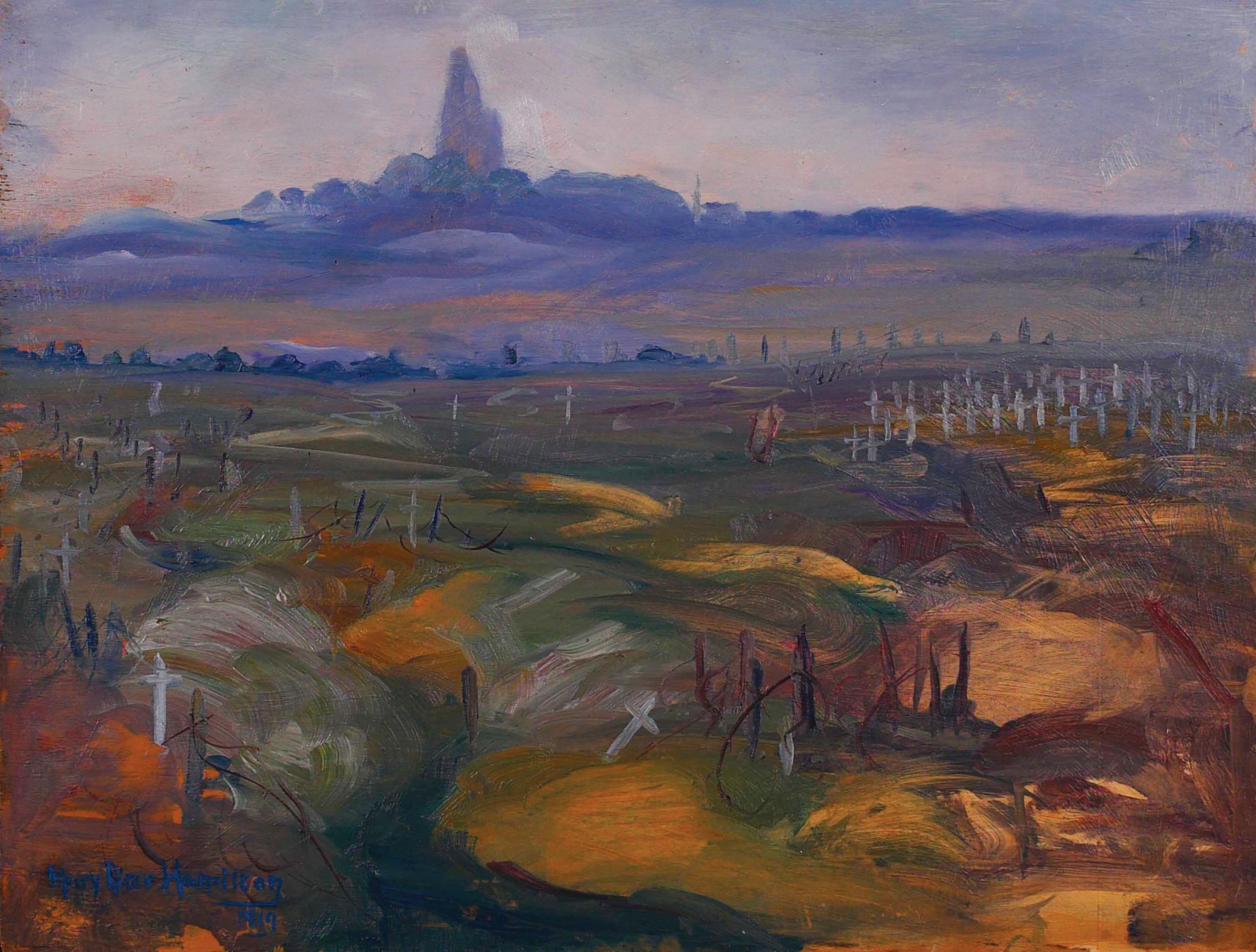
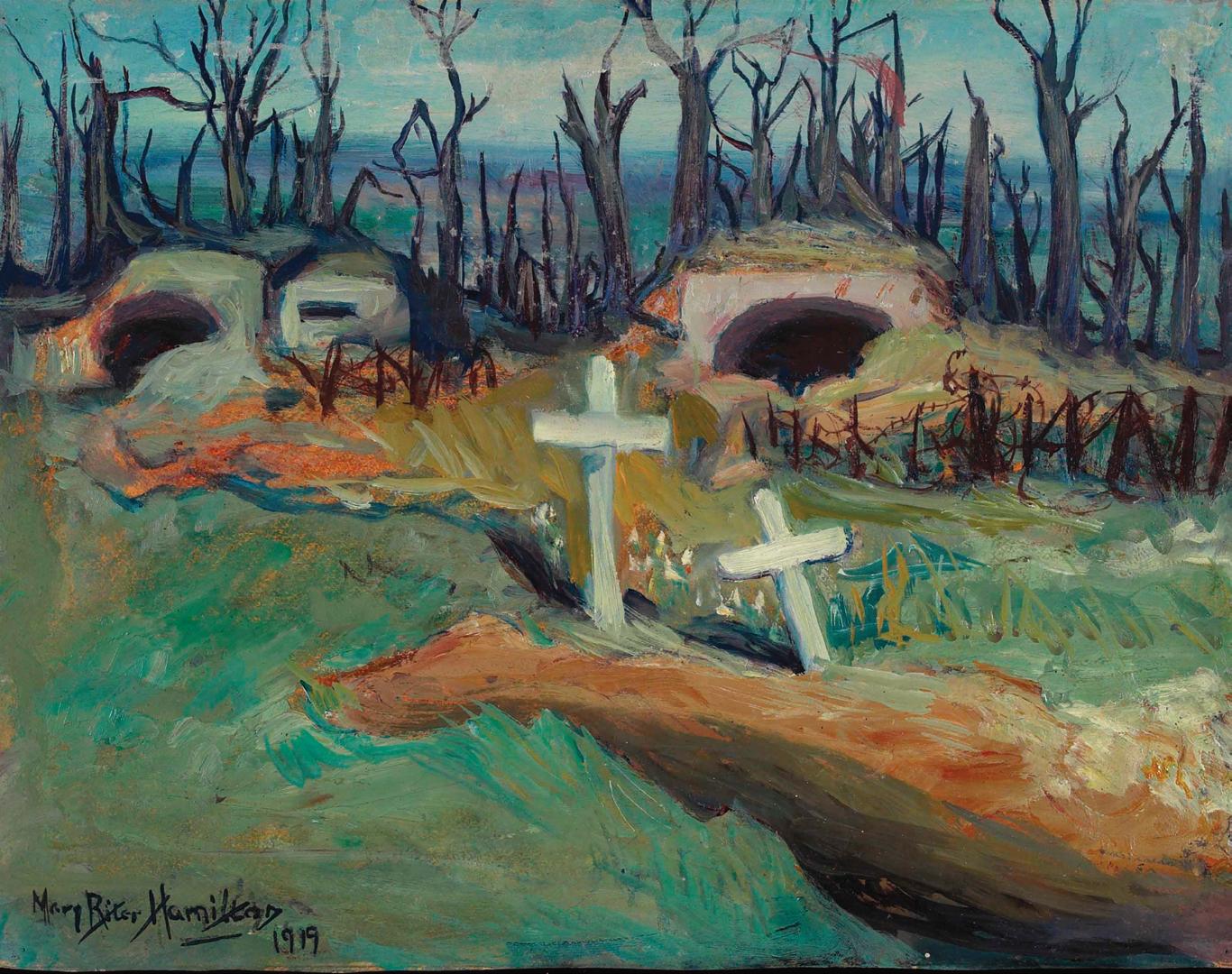
Living in a primitive shack at Écurie in the southern district of Vimy Ridge, she recorded, and warned of, the consequences of war. Confronting the overwhelming scale of death, she straddled the line between documentation and aesthetics, while mourning the dead. Hamilton eschewed showing bodies (as seen in Frederick Varley’s work) and the purely formal visualization of war with modernist aesthetics (as with David Milne’s art).
Many of Hamilton’s works depict cemeteries and often singular falling crosses, as depicted in “Battlefields from Vimy Ridge, Lens-Arras Road” [3] and “Gun Emplacements, Farbus Wood, Vimy Ridge,” [4] where gravity seems to drag the memorial and
“Yes, it was like living in a grave Yard .”
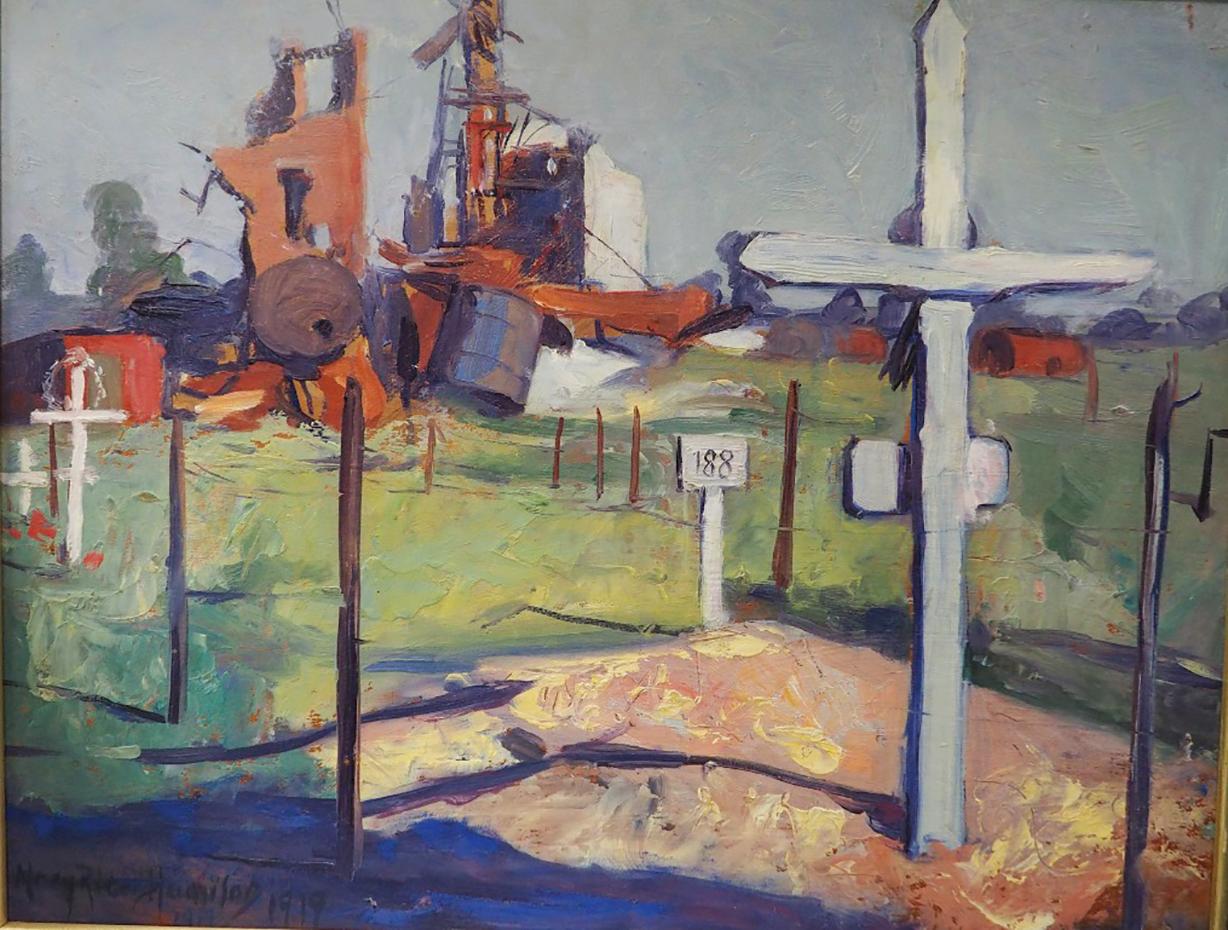
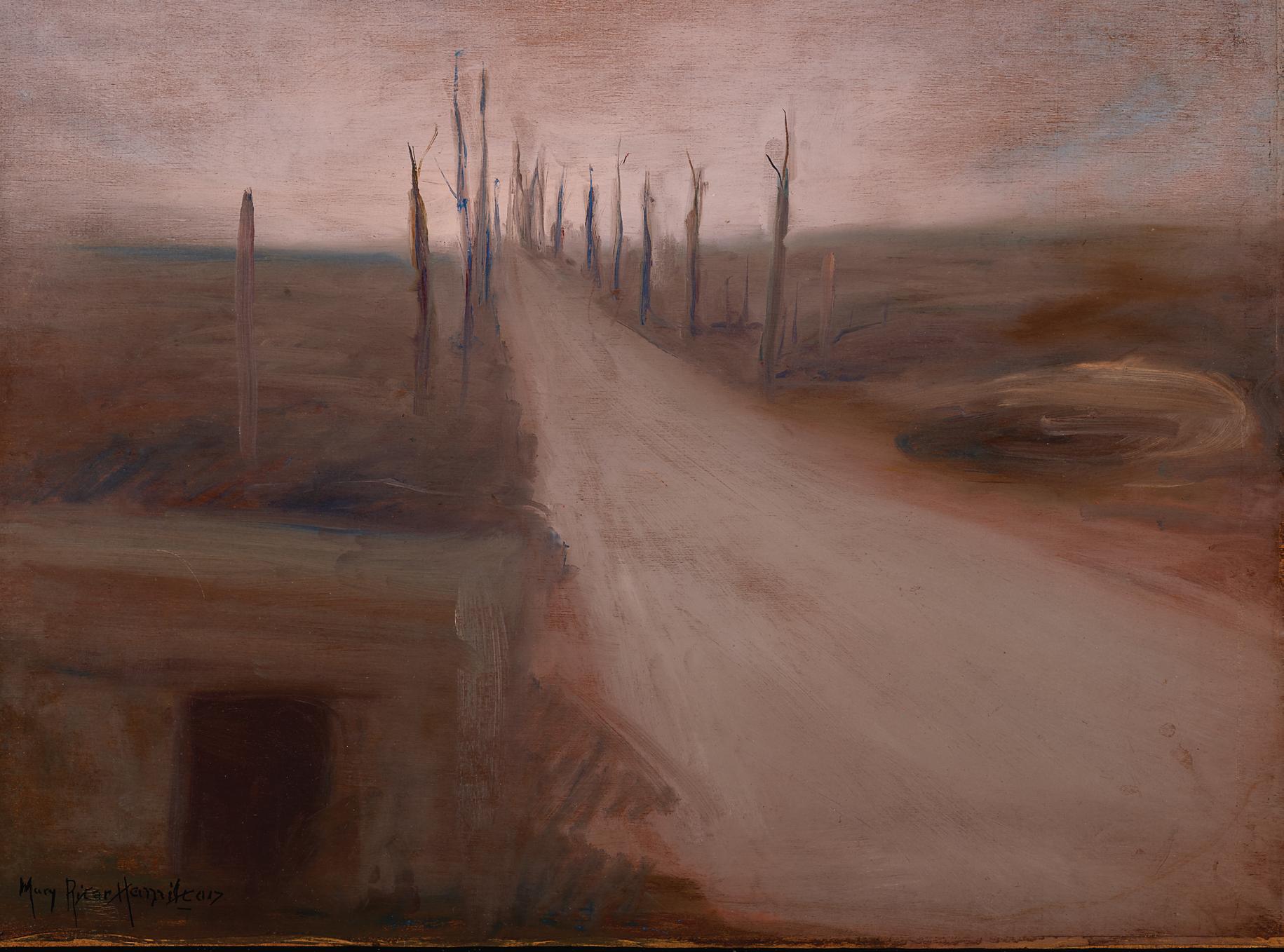
its associated memories toward oblivion. Other pieces include observers underscoring the ethical dimension of bearing witness to destruction and death without averting the gaze.
In her painting “Sugar Refinery at Écurie,” [5] Hamilton integrates her own presence as a self-aware observer into the narrative, where a new grave emerges in her immediate surroundings, close
to her own hut. Employing the photographic shadow technique reminiscent of a snapshot, her silhouette subtly occupies the canvas’s left periphery—her arm casting bold strokes of paint with a palette knife. The vivid custardyellow grave and the commanding upright cross on the right, compel viewer’s engagement, establishing a disconcerting proximity. In this artwork, Hamilton depicted the
unsettling nature of her encounter, spanning the realms of the living and the dead, resonating with her retrospective reflection: “Yes, it was like living in a graveyard.”
At the Somme, [6] where she occasionally overnighted in pillboxes, she painted the desolation on cardboard and on wood reclaimed from hospital screens. She painted small, intimate scenes that ask the viewer to step close.
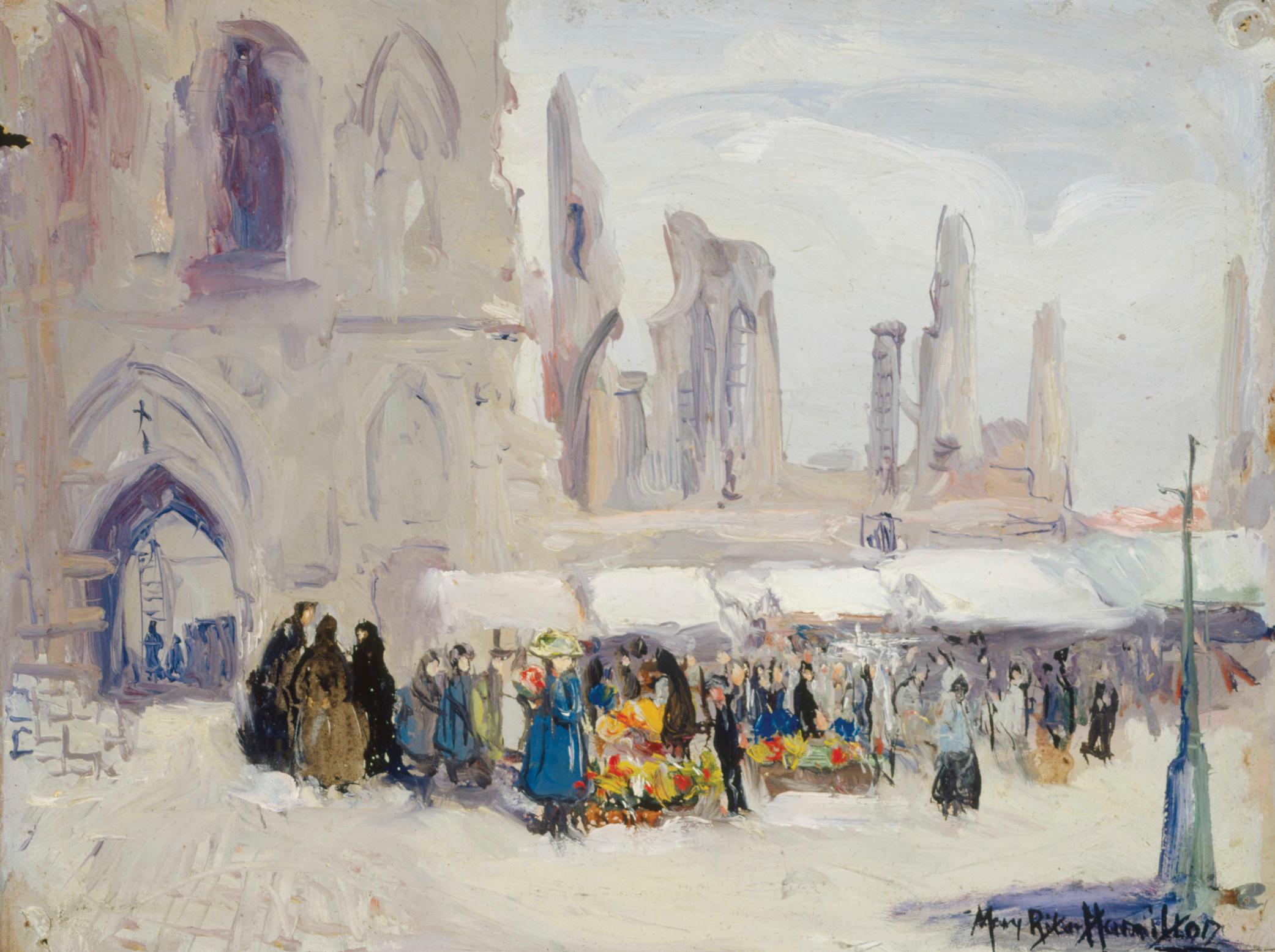
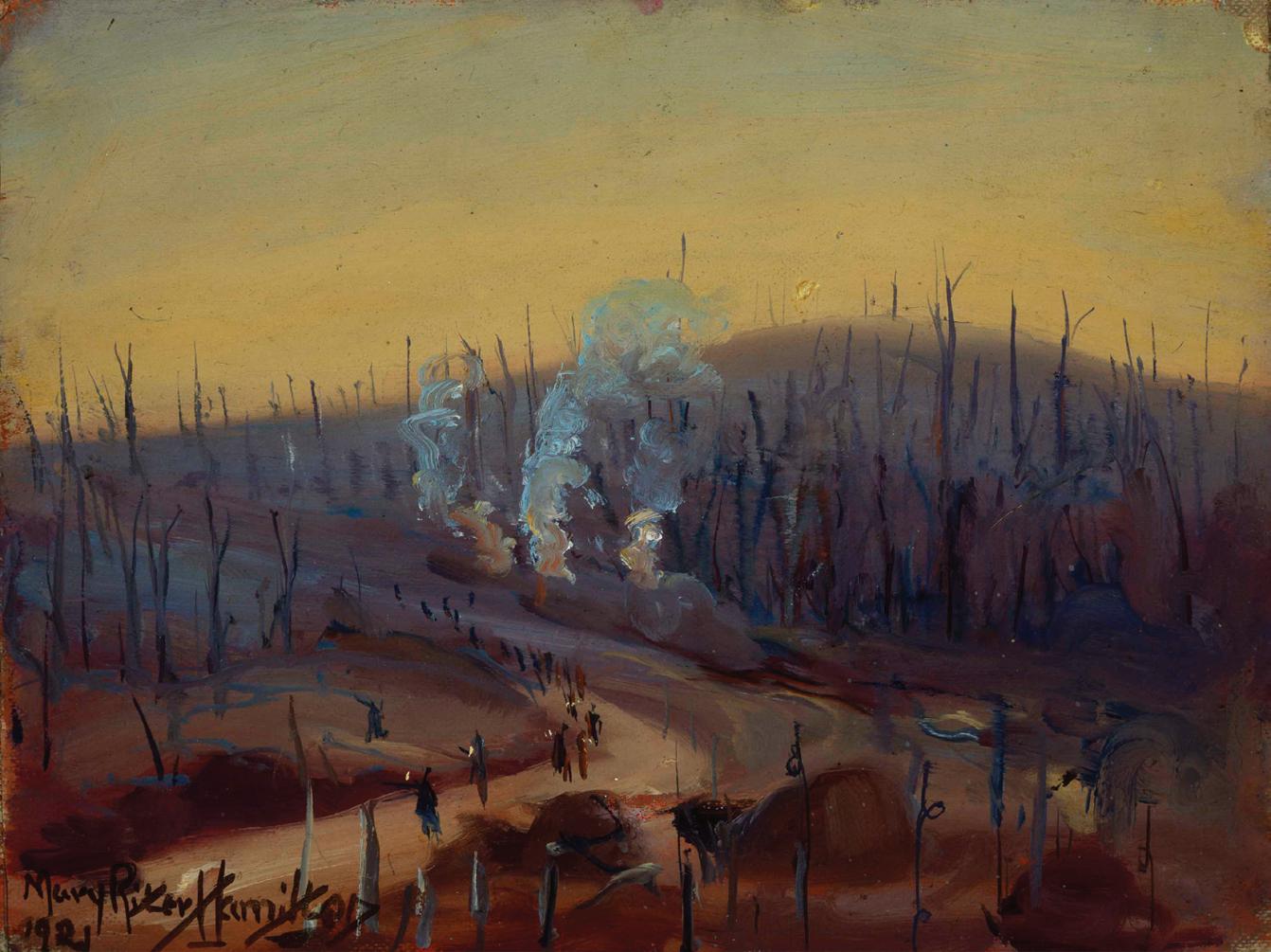
In contrast, in more populated areas such as the towns of Arras, France, and Ypres, Belgium, [7] Hamilton centred her attention on themes of reconstruction, a pivotal facet of her oeuvre. These works— often depicting widows with their children at marketplaces—highlight the resilience of survivors.
Conversely, one of her late works, “Clearing the Battlefields in Flanders,” [8] documents a group of uniformed labourers filing along a path that trails to the left. They carry lit torches to clear the fields by burning tree debris, breathing the toxic fumes. They are diminished by the decimation and the uncanny darkness of the scene. Hamilton’s signature is a visual reminder that she herself lived in the bottomless pit. [9]
The risks she undertook had enduring consequences, manifesting as symptoms now recognized
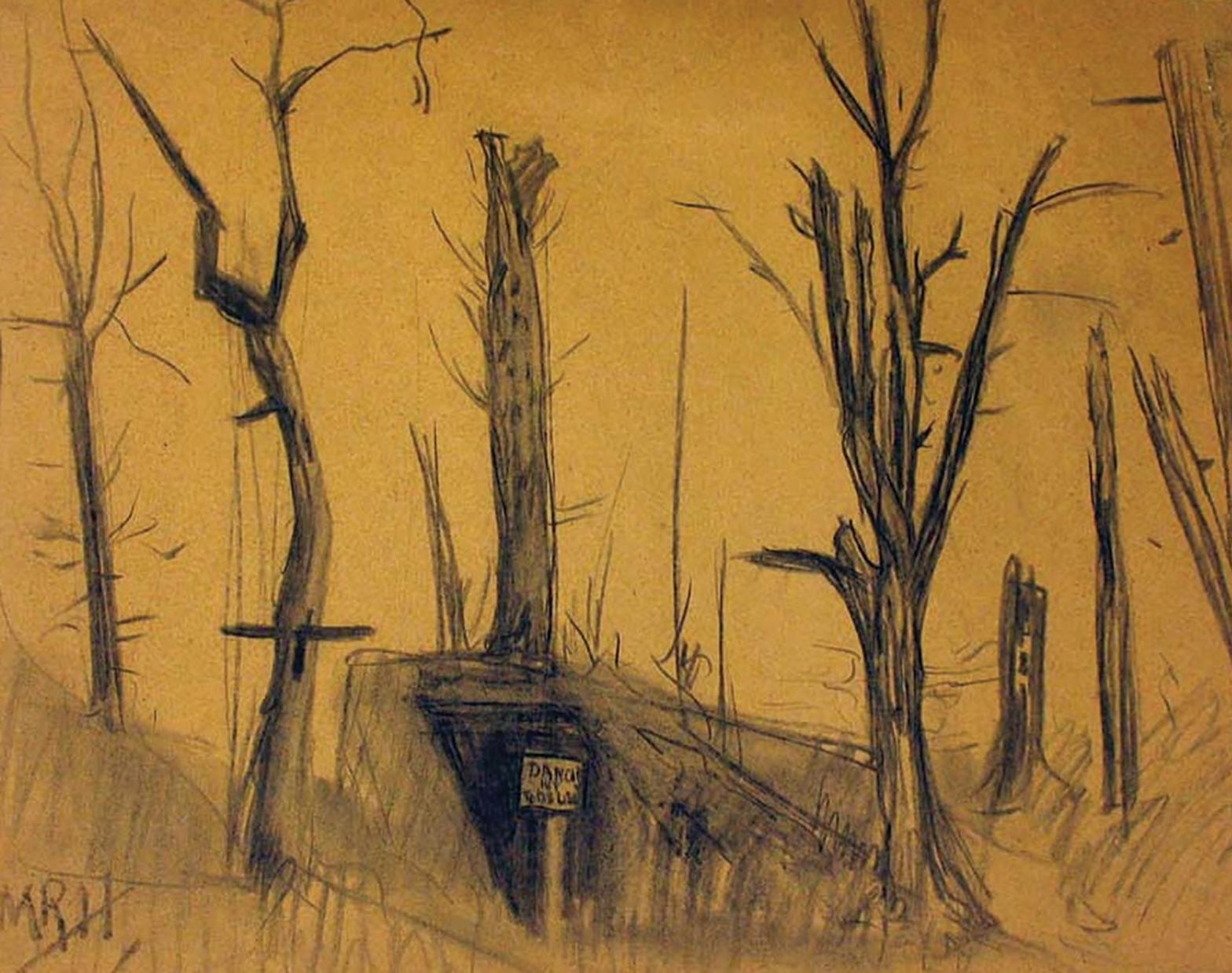
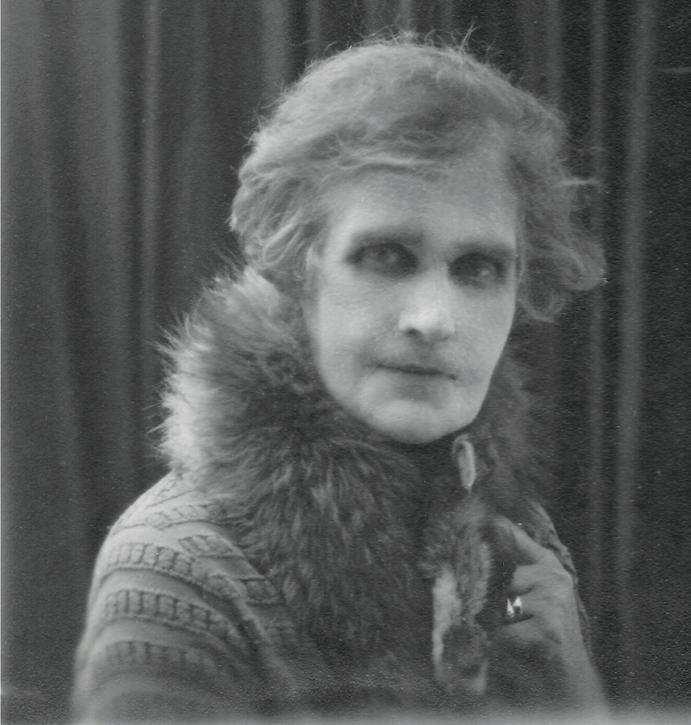
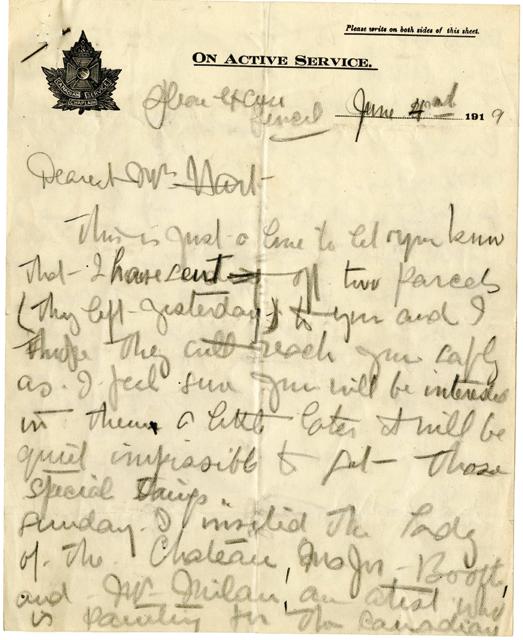
as post-traumatic stress, albeit without an official diagnosis of shell shock. A mental breakdown terminated her expedition in late 1921. A photo shows her looking aged and emaciated [10].
Although she enjoyed remarkable international success—exhibiting her battlefield work at the Paris Opera House and receiving the Ordre des Palmes académiques from the French government in 1922, and the gold medal for her hand-painted batik scarves at the prestigious International Exhibition of Modern Decorative and Industrial Arts in Paris in 1925—her recognition
Hamilton’s signature is a visual reminder t H at s H e H erself lived in t H e bottomless pit.
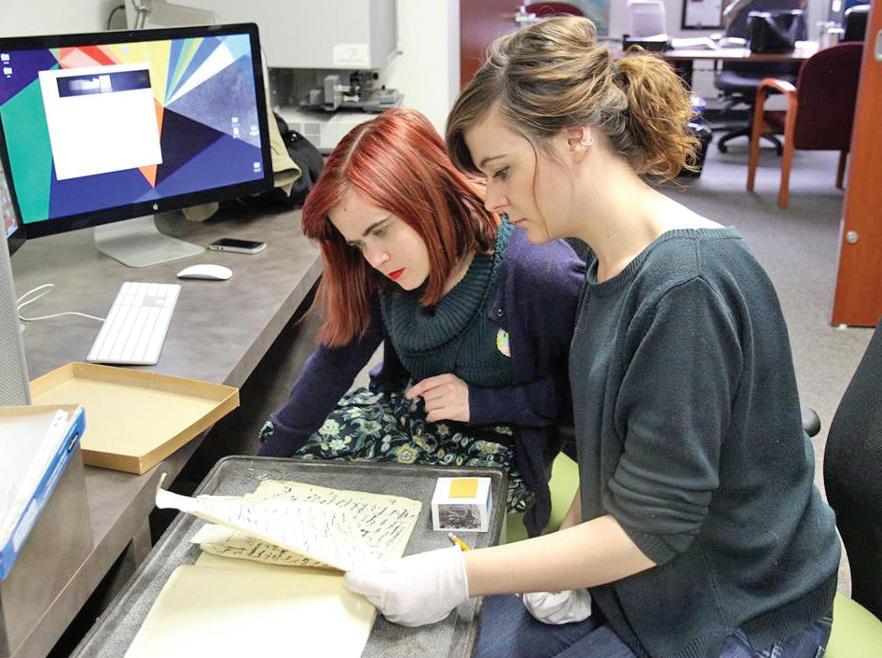
in Canada was largely neglected despite donating 227 war paintings to Library and Archives Canada.
Given the magnitude of the col lection and the gaps in her archive, telling Hamilton’s story presents a daunting task. The discovery of Hamilton’s battlefield letters to her patron Margaret Janet Hart, now preserved at the Modern Literature and Culture Research Centre at Toronto Metropolitan University [11], however, help fuse Hamilton’s voice with her paintings to tell the story of an exceptional woman and artist and her extraordinary expedition.
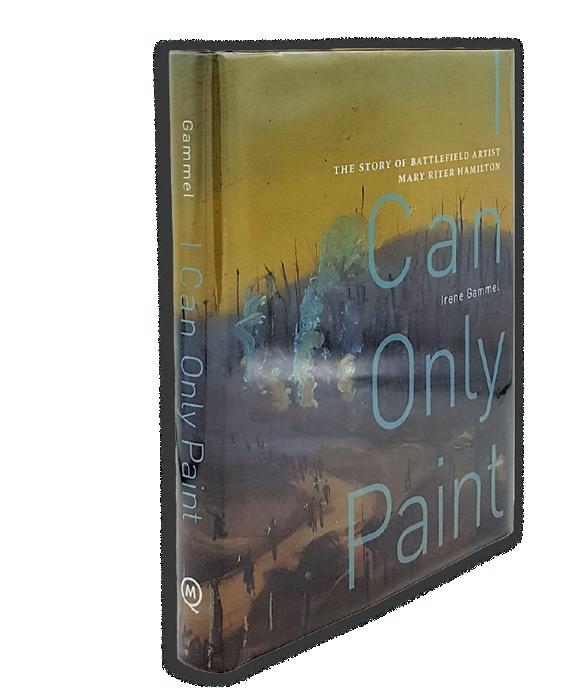
This article is based on research conducted for Gammel’s book, I Can Only Paint: The Story of Battlefield Artist Mary Riter Hamilton. L

By Serge Durflinger
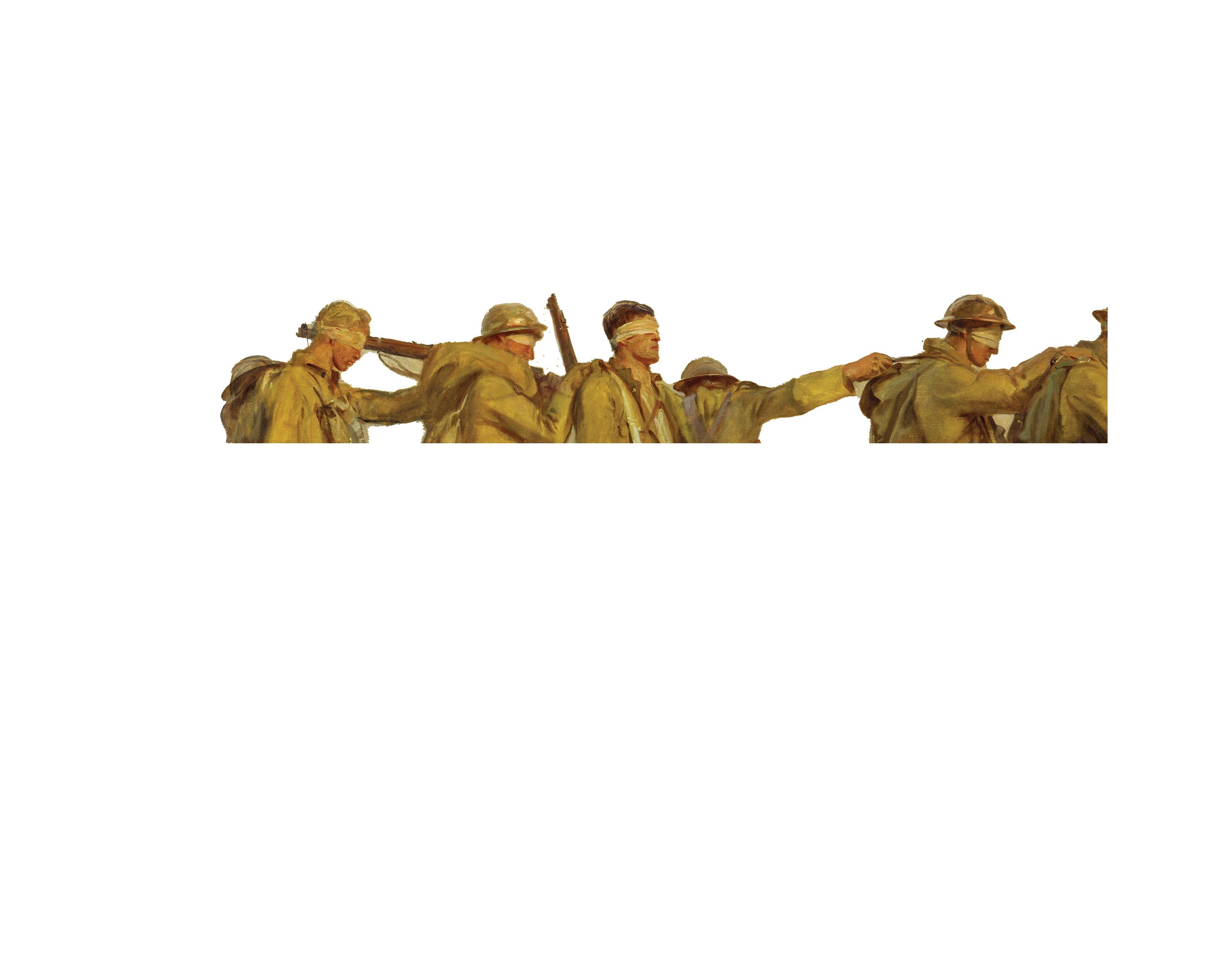
HOW SOLDIERS WHO SUFFERED VISION IMPAIRMENT IN THE GREAT WAR CHANGED THE OUTLOOK FOR THEIR LOT the early 20th century, Lorne Mulloy was a household name in Canada. In December 1899, Mulloy, then a 24-year-old teacher from Winchester, Ont., volunteered with the Canadian Mounted Rifles during the Boer War. One year later, he was back

Inin Canada a celebrated Imperial and Canadian hero, having been awarded the Distinguished Conduct Medal, the secondhighest military decoration for enlisted men behind the Victoria Cross. He had been presented to Queen Victoria and hailed in the press throughout the Empire.
But Mulloy had paid a price: he had been blinded by an enemy bullet. Known as the “Blind Trooper,” Mulloy was Canada’s first war-blinded casualty of the 20th century. His postwar career
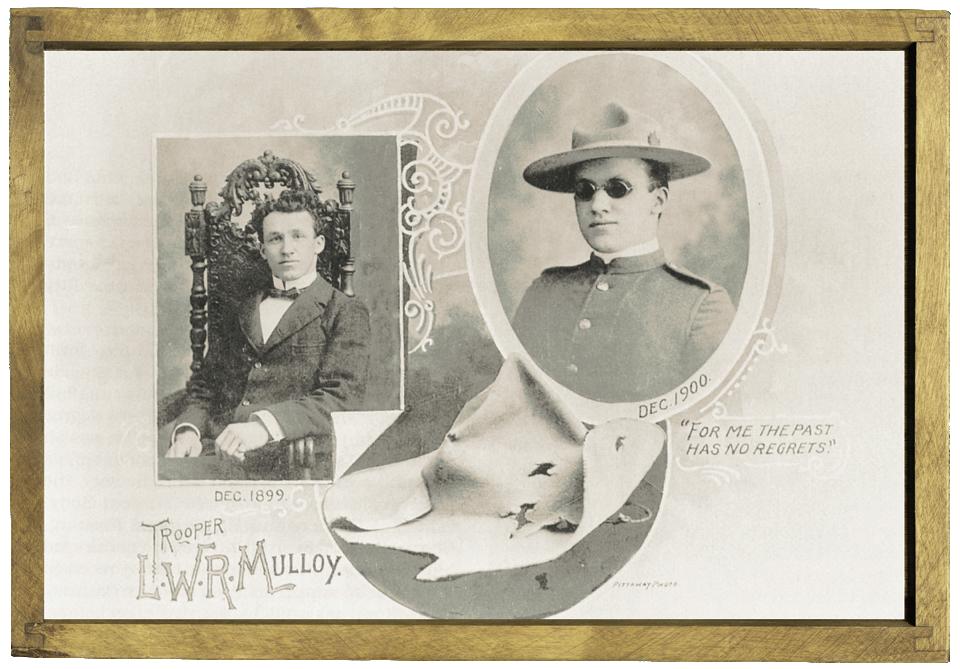
A painting by John Singer Sargent depicts Allied troops who had been gassed, many with bandages covering their eyes. “Blind Trooper” Lorne Mulloy, Canada’s first war-blinded casualty of the 20th century (left). Arthur Pearson (below), blind himself, established the St. Dunstan’s Hostel for Blinded Soldiers and Sailors in London during the early months of the First World War.

as a professor of military history at the Royal Military College of Canada, his many speaking engagements and his involvement in public affairs showed what Canada’s war-blinded veterans could achieve. With “self-mastery and self-reliance,” Mulloy wrote, his blindness could be overcome.
But when the First World War broke out in 1914, Canada had no plans for dealing with mass casualties, and certainly none for caring for blinded soldiers. Canada’s first blinded casualty of the war was
But Mulloy had paid a price: he had been blinded by an enemy bullet.
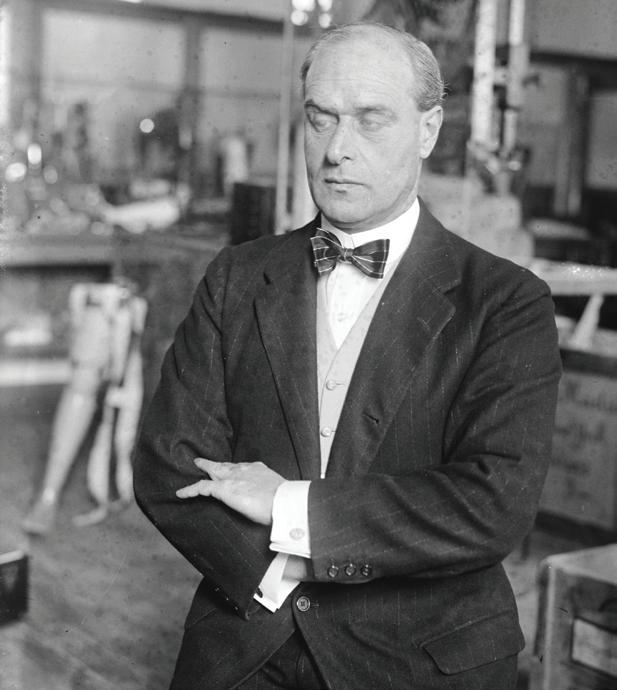

Lance-Corporal Alexander Viets, of Digby, N.S. While serving with the Princess Patricia’s Canadian Light Infantry outside Ypres in
May 1915, a German mortar bomb exploded beside him, blinding him and inflicting numerous other wounds on his face.
As optical impairments and blindness mounted among British and Canadian troops, plans soon emerged to provide employment training to make them as independent as possible upon discharge. Britain’s National Institute for the Blind offered its services. It was headed by philanthropist Arthur Pearson, a newspaper magnate who had lost his sight.

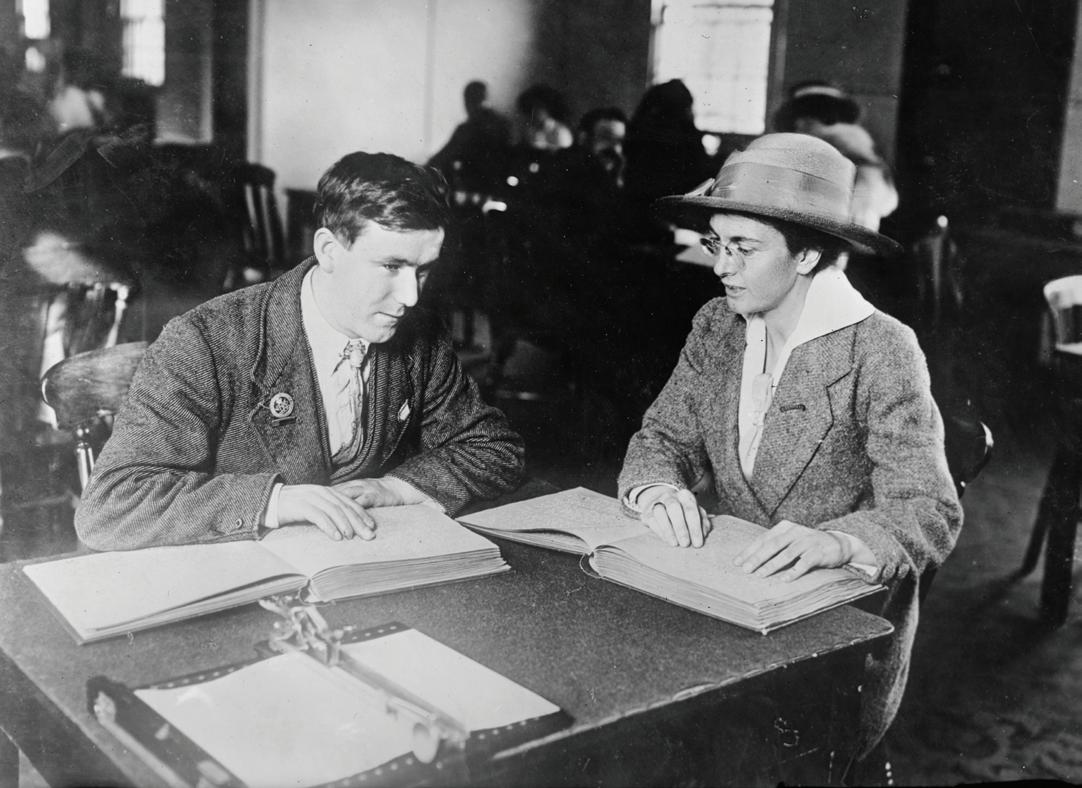
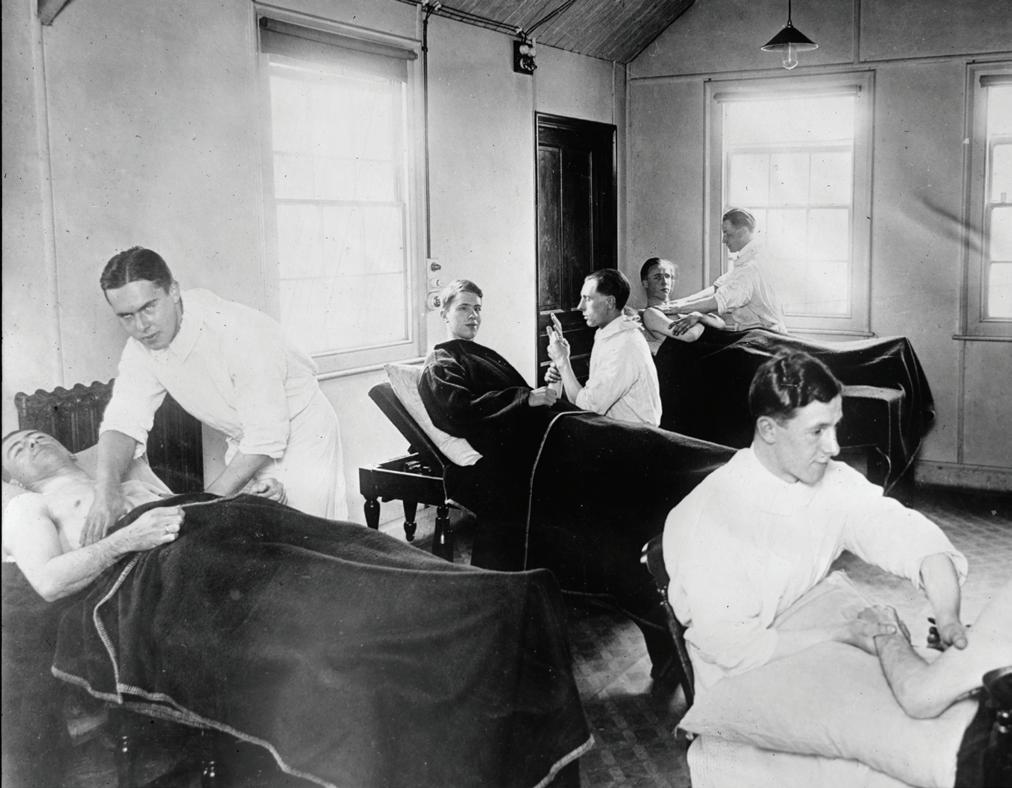

In the early months of the First World War, Pearson established the St. Dunstan’s Hostel for Blinded Soldiers and Sailors with spacious facilities in Regent’s Park, London, in March 1915. It was soon the world’s leading readaptation centre for the blind. The typical occupations of the blinded—broom making and basket weaving—evolved to

include more challenging and potentially lucrative skills. The men learned braille and obtained vocational training in cobbling, typewriting, shorthand, poultry farming, rug making and massage, or physio, therapy, the latter a niche occupation for the blind.
In Canada, there were no such facilities and most of the country’s
war-blinded soldiers attended the courses and programs at St. Dunstan’s in London, including those who had returned to Canada before 1918. In March 1916, Viets graduated from the hostel and, by October, he had moved to Toronto and found a job working as an agent for the Imperial Life Assurance Company of Canada. Ultimately, he made it a career.
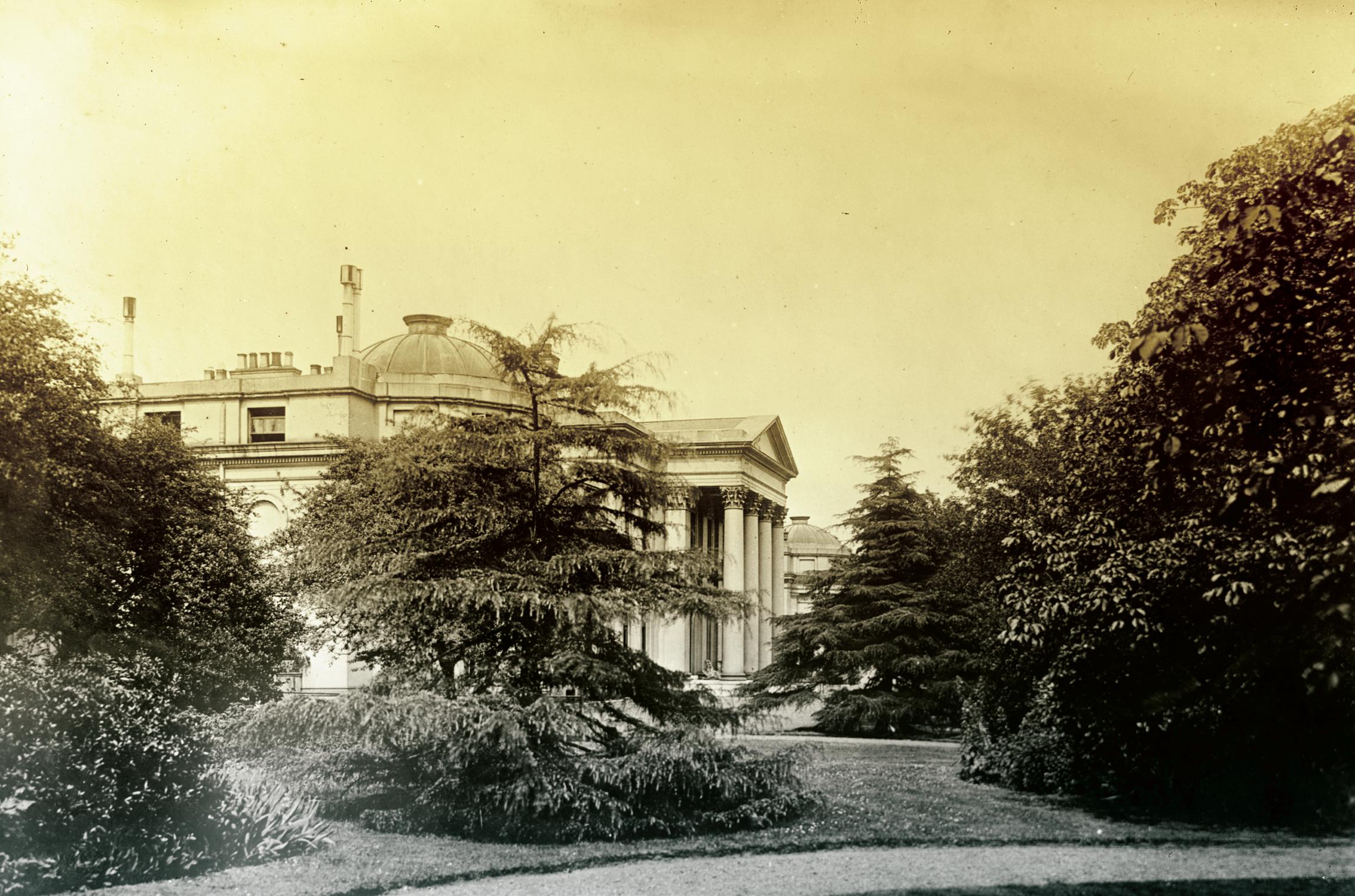
Their dogged advocacy would lead to breakthroughs in the organization and care of the country’s war blinded.

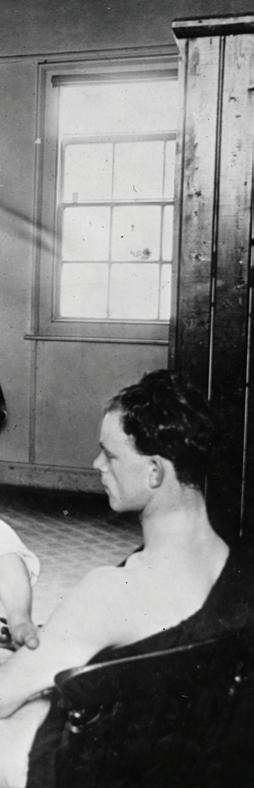
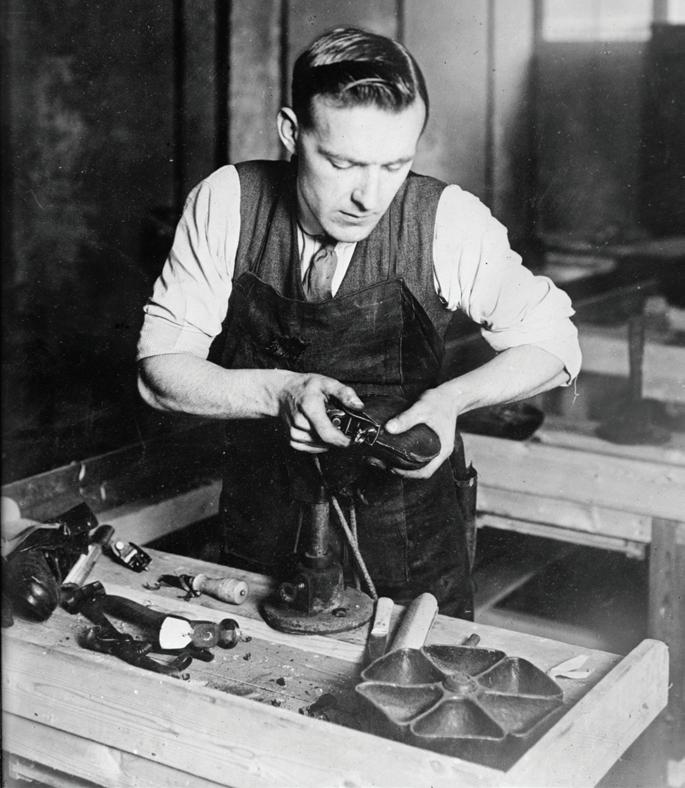


Lieutenant Edwin A. Baker, from Collins Bay, near Kingston, Ont., was one of Canada’s most remarkable First World War veterans. Eventually known to royalty, world statesmen and his veteran comrades, Baker’s international fame was acquired as an eloquent advocate for the blind—and blind veterans in particular.
Baker served overseas with the 6th Field Company, Royal Canadian Engineers. On the night of October 10-11, 1915, at Kemmel, Belgium, about 10 kilometres south of Ypres, he recalled that sniper’s bullet left him “to the mercy of the darkness.” He was 22.
Commissioners. Their dogged advocacy would lead to breakthroughs in the organization and care of the country’s war blinded.
At St. Dunstan’s (opposite bottom), veterans acquire skills such as (from opposite top) braille, massage therapy and cobbling.
In September 1916, Baker graduated from St. Dunstan’s eager to succeed in life and help others overcome similar afflictions. Within a month, he was working in Toronto as a typist. Baker, however, was appalled to discover no government employment opportunities, after-care support or even understanding of the needs of blinded veterans existed in Canada.
Baker and Viets became close friends and combined forces in helping their blinded comrades reintegrate into civilian life and obtain specialized help from Canada’s Military Hospitals Commission and, later, the Board of Pension
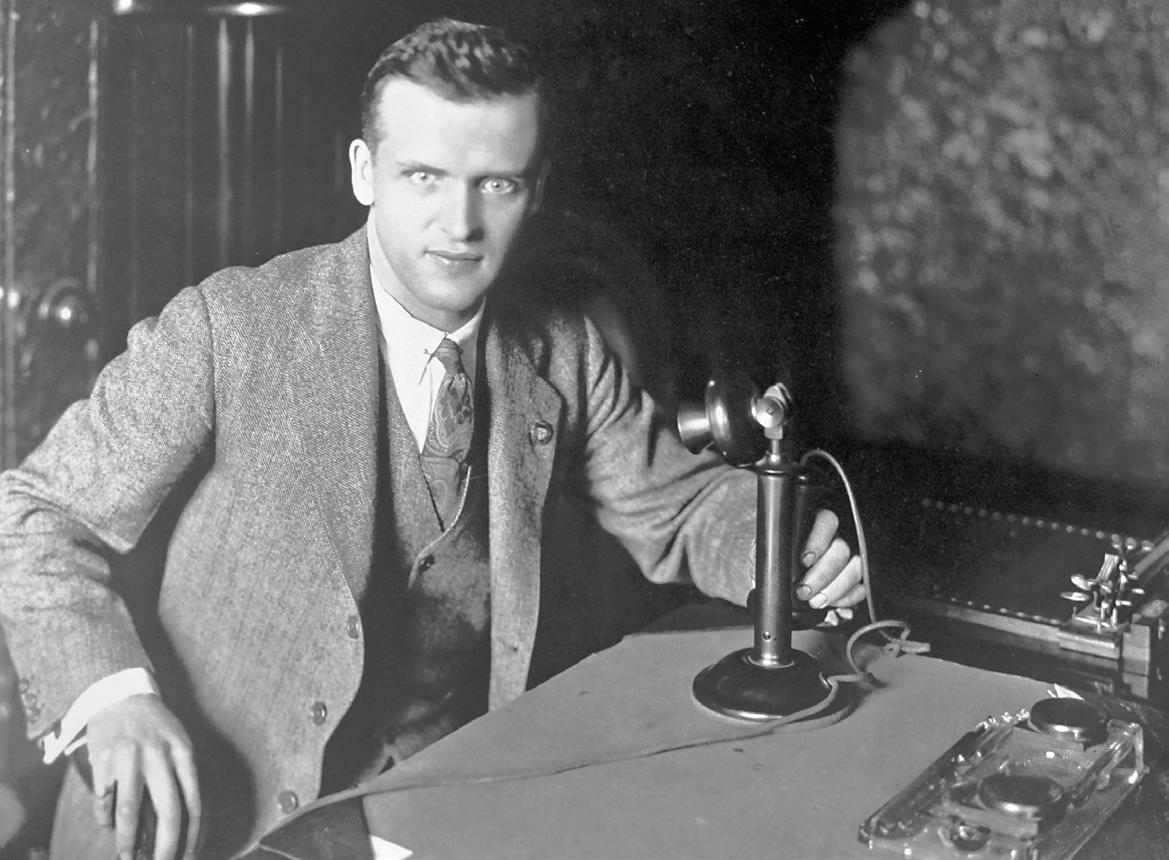
The causes of blindness in soldiers included gunshot and shrapnel wounds, as well as optic atrophy caused by poison gas— particularly mustard gas—and detached retinas resulting from the concussive effects of artillery fire.
“I felt a slight sting in my right temple as though pricked by a red-hot needle—and then the world became black,” wrote Private James Rawlinson, who was blinded at Vimy in June 1917. “Night had sealed my eyes.”
Others were blinded by training accidents or disease.
The growing number of blinded veterans pressed Ottawa for a firm commitment to provide better pensions and after-care so that they could live with dignity. In March 1918, the war-blinded veterans and their associates from the Canadian Free Library for the Blind founded the Canadian National Institute for the Blind (CNIB) in Toronto. Baker served as vice-president until 1920, then managing director until 1962, while Viets and a soldier from Saskatchewan, Harris Turner, joined the executive committee.
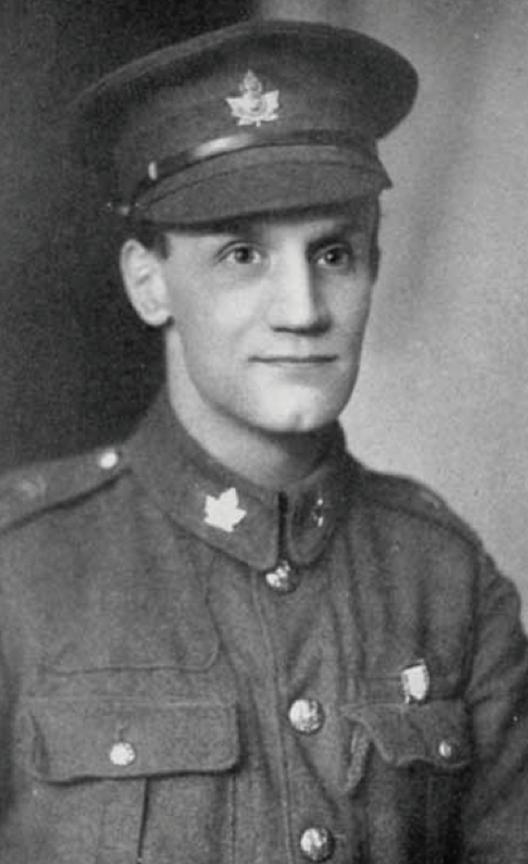


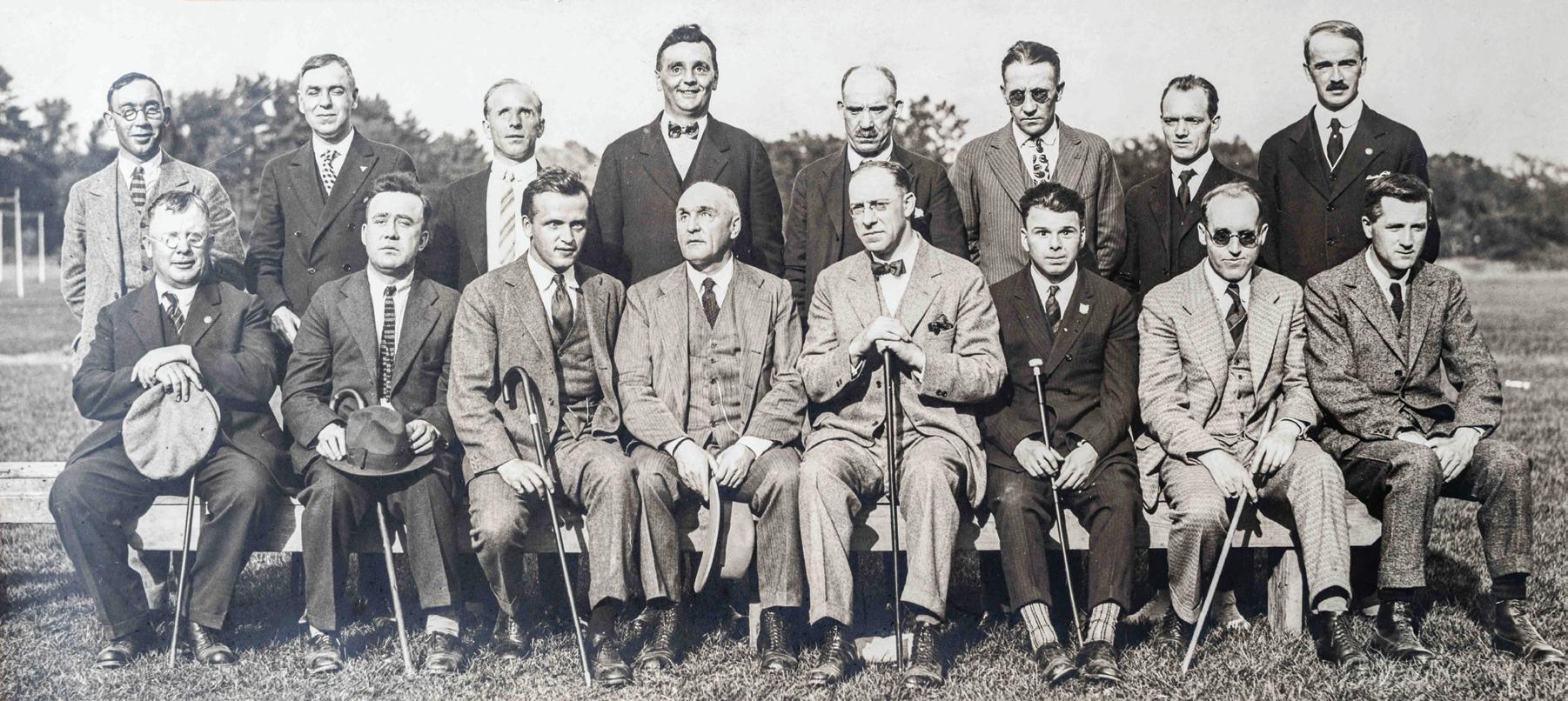
The organization’s basic philosophy was to restore independence for the blind. Its first mandate was to provide job and social readaptation training under contract to the Department of Soldiers’ Civil Re-establishment (DSCR). Veterans subsequently received job training, special equipment and even money to travel.
The stigma many Canadians associated with the blind began to change, thanks to how these patriotic men had ennobled the impairment. “If as the result of our blindness the public will become interested in and have sympathy for the civilian blind, the affliction will have been well worthwhile,” remarked one blinded soldier. He believed, too, that the national institute was “a memorial to the gallantry and sacrifices of the Canadian soldiers who have lost their sight in the war.” This heralded a new beginning in the relationship between the sighted and the blind in Canada.
In August 1918, Baker was hired by the DSCR to administer policies relating to the ongoing vocational training and after-care of Canada’s war blinded. He met with dozens of blind veterans, assessed their needs and assisted them through their pension applications. But he wanted nothing less than to create a mini version of St. Dunstan’s.

Pearson Hall became the men’s main rehabilitation centre and served as a club where they could socialize with others .
In October 1918, the CNIB leased an elegant home at 186 Beverley Street in downtown Toronto using funds from the department—which purchased it outright the following year for the institute. Fifteen men began their training there immediately, their stays also paid for by the department.
In January 1919, the centre was formally opened by Arthur Pearson, and named Pearson Hall in his honour. The building became the men’s main rehabilitation centre and served as a club where they could socialize with others.
By the war’s end, some 1,347 Canadian soldiers had suffered some form of visual impairment, though only 139 required vocational retraining because of blindness. Due to the discovery of subsequent cases and delayed
sight loss, the final tally of blinded Canadians from the First World War approached 200. Half had trained at St. Dunstan’s and many of the remainder at Pearson Hall.
In 1922, blinded veterans formed the Sir Arthur Pearson Club of Blinded Soldiers and Sailors to serve as a lobby group for blinded veterans and as a social organization for comrades who understood each other’s experiences. The club continued to serve the war blinded for almost a century.
“Despite the loss of sight in early manhood and, in many cases, serious additional disabilities,” stated Baker in 1948, “this group of young men has provided an inspiring demonstration…that, despite blindness, the remaining talents can be usefully applied where there is a determined spirit.” L
Makes a great GIFT!

O Canada Classic Ball Cap
A lightweight, low profile, six panel structured cap with a pre-curved bill, trucker mesh and adjustable snap tab closure for excellent fit.
Only 2299*

O Canada Bucket Hat
Maple Syrup Candles
The perfect candle—hand poured in Canada with yummy scents of cooked butter, roasted nut, cinnamon, cloves, sweet caramel and creamy vanilla. Organic soy wax burns clean. 16 oz. Classic Tin

Timelessly cool, a bucket hat is a must-have in any wardrobe—the perfect accessory to top off an outfit. S/M or L/XL
Only 2499*
Only 1999* Only available in the Shop
4 oz. Travel Tin with lid Only 1199*

GO AWAY I'm reading Mug and Sock Set
Only 3899* Made for all-day

Includes a sturdy, etched 15 oz. mug and cozy pair of Do these socks make me look Canadian? socks.

White Campfire Mug and Sock Sets


Choose from: I like moose and maybe 3 people 15 oz. ceramic mug and I moose be dreaming socks or Pre-coffee = grizzly bear 15 oz. mug and Do these socks make me look Canadian? socks.
Only 3299* /SET
By Stephen J. Thorne
By Stephen J. Thorne
By Stephen J. Thorne
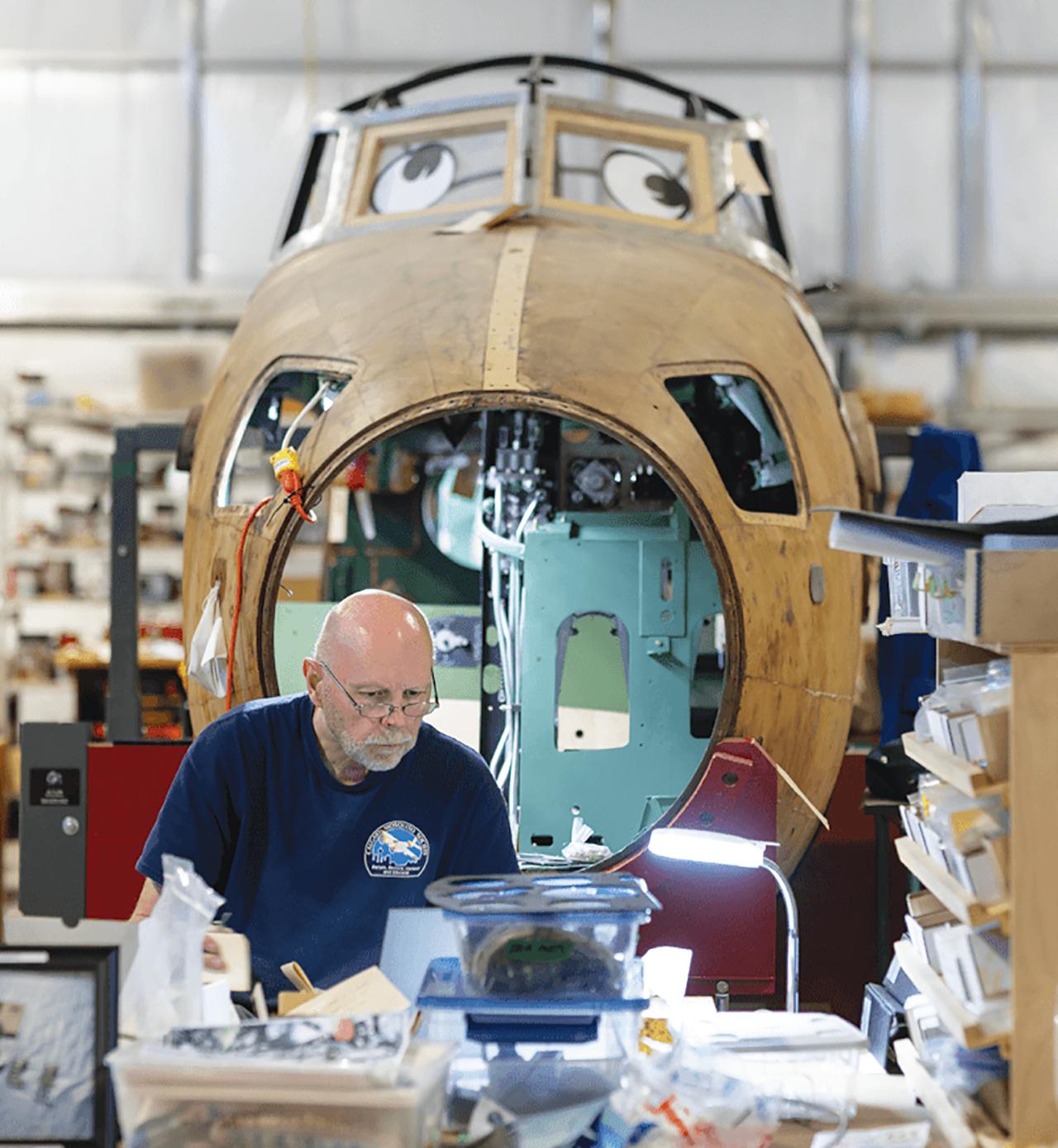
By Stephen J. Thorne


eep in the recesses of a packed airplane hangar in Nanton, Alta., aircraft enthusiasts are bringing a legendary warbird back to life.
They are master craftsmen and problem solvers, innovators and artisans, all working toward a common goal—resurrecting one of the most intriguing warbirds of the Second World War, an all-wood, twin-engine de Havilland Mosquito.
Largely stripped of parts by the time the Calgary Mosquito Aircraft Society got its hands on it, the plane’s caretakers have searched worldwide to find the scarce materials and vanishing expertise to rebuild the aircraft. They’ve been at it 11 years and it will take 10 more to get Tail No. RS700 (CF-HMS) to non-airworthy taxi status.
Some of these aging aviation wizards will not live to see the finished
product but there’s no place they would rather be than in the depths of the Bomber Command Museum of Canada, surrounded by RollsRoyce Merlin engines and working alongside restored icons of the past.
“Aircraft maintenance guys form the bulk of our restoration group,” said Richard de Boer, founding president of the Calgary Mosquito Aircraft Society. “They’re thrilled to be able to work on this airplane.
“It’s kind of a crowning achievement. The opportunity to work on a Mosquito and to apply their lifelong-acquired skills is rare—and valued.”
RS700 is one of only 31 Mosquitos still in existence. Just four are airworthy; only two are actually flying, one of which is based at KF Aerospace in Kelowna, B.C. Technically speaking, the Calgary plane was never exactly a warbird.
Calgary Mosquito Aircraft Society volunteer Andy Woerle works away under the watchful eyes of aircraft No. RS700, now in mid-restoration.
Both it and its sister aircraft in Kelowna were once owned by Spartan Air Services, which won a federal government contract in the mid-1950s to capture the first 3D aerial mapping of the entire country.
Produced by Airspeed Ltd. at Hampshire, England, in 1946, RS700 was among the last Mosquitos built under wartime contracts. It spent four years in storage before it was converted to a prototype of what would become the PR.35 high-altitude, pressurized photo-reconnaissance aircraft.
The “Calgary Mosquito” served three years in the Royal Air Force, survived two fires and was awaiting disposal when Spartan picked it up along with 14 others, five of which it scavenged for parts.
Dressed in the company’s silver with red trim, RS700 photographed large swaths of the country from 1956-1960, one of just four Spartan Mosquitos to survive the ordeal. It also conducted aerial surveys in Colombia and the Dominican Republic.
Grounded over concerns about rot in the wing spar, the plane was bought by Lynn Garrison of Calgary for $1,100. Garrison wanted to start a national air museum, but the venture never got off the ground.
Arriving in Calgary aboard a CN train, the aircraft sat in an oil field pipe storage yard for several years before 403 (Reserve) Squadron took it in 1968.
It wasn’t until the early-1970s that the plane finally found a home inside a hangar, where volunteers removed what was left of its tattered fabric. Two years later, assets of the failed air museum were sold to the city, including the Mosquito and five other aircraft. Stewardship was transferred to the Calgary Aerospace Museum.
In 1989, the plane was taken out of storage and shipped to Cold Lake, Alta., where members
“IT’S KIND OF A CROWNING ACHIEVEMENT FOR SOME. IT’S A FEATHER IN THEIR CAP. THE OPPORTUNITY TO WORK ON A MOSQUITO AND TO APPLY THEIR LIFELONG-ACQUIRED SKILLS IS RARE—AND VALUED.”
of 410 Squadron, RCAF, planned to restore it to the type’s original military configuration. The plan faltered a year later and the Mosquito was returned to Calgary.
RS700 languished for two more decades until the city council awarded its restoration to de Boer’s newly formed society. The work was subsequently moved to the Bomber Command Museum.
It’s difficult, painstaking labour— stripping rotten, weather-worn plywood sheets from the salvageable wooden strips, called stringers, that form the skeletons of the wings.
Replacing plywood may sound straightforward, but a Mosquito’s plywood, with its agonizingly specific material, thickness and weight requirements—even specifications dictating the direction of the grain in different parts of the plane—is nearly impossible to find.
Just the tops of the wings require 13 sheets of Baltic birch plywood, three-ply in five different specifications—1.5-6mm thick, each composed of three veneers, or layers, ranging from 0.5-2mm apiece.
“The other thing that’s very significant in the Mosquito…is the grain direction of each sheet because it affects their strength and flexibility,” said de Boer.
“So every sheet of plywood that we’ve purchased for this airplane is custom-made and custom-ordered for its thickness and grain direction.”
Each original plywood sheet was stamped by the manufacturer with a code number and date— Spec BS 6 V.3 1944, for example. The technical document that describes the plywood runs about 25 pages,
defining how tight the grain has to be, how much moisture it should retain and even what glue to use.
In addition to adhesive, the wood is attached to the skeleton by 40,000 hard-to-replace inchand-a-quarter, No. 5 slotted-head brass screws, 25,000 of them on top of the wings alone. Each is spaced to precise specs.
“Today, there is only one mill in the world that will make British Standard 6 V.3 plywood and, ironically, that mill is in Austria,” birthplace of the Führer himself.
de Boer proudly points to a spanking new sheet of plywood stamped BS 6 V.3 and declares that it’s “made to the exact same specifications as what de Havilland used on their airplanes in 1940.”
“We are particularly proud of the fact that we are going as authentic as we possibly can,” he says.
Yet the process only grows in complexity. The plywood, air-freighted from Austria, was $850 a 10×15-foot (3×4.5-metre) sheet when the team bought its first batch for the fuselage and tail surfaces a decade ago. The price has since nearly tripled.
And when they tried to order plywood for the wings in 2022, the Austrian mill told them they couldn’t supply it anymore because the source material comes from northern Russia, and Vladimir Putin’s invasion of Ukraine has brought Westernallied trade with Russia to a halt.
So de Boer went on a year-long, worldwide quest to find another mill that could do the job, before he tracked down one in New Zealand that builds brand-new Mosquito airframes and had an expert able to mill him what he needed. L
By Stephen J. Thorne
Edwin John Davis, 37, left his job as a glass worker to sign up with the Canadian Expeditionary Force in Valcartier, Que, on Sept. 22, 1914.
He was among the 70 per cent British-born war volunteers in the first contingent of Canadians— from Wales, to be exact. He had served six years in the 41st Infantry Regiment based in Cardiff before emigrating to Canada, though it appears he may have been living south of the border in Virginia and came north when the First World War broke out.
At 37, he was a relatively young widower, and a relatively old soldier. He stood five-foot, three-and-a-quarter inches when he was assigned to the 1st Battalion (Ontario Regiment).
The unit headed overseas with the first convoy departing the Gaspé coast on Oct. 3, 1914. The 1st Battalion arrived with the others at Plymouth Hoe, England, 11 days later.
Private Davis’s war didn’t last long—just seven paycheques, was all.
After training on Salisbury Plain, the 1st had shipped off to France, where it trained some more before joining the fighting outside of Ypres in western Belgium in the spring of 1915. A 24-square-kilometre salient had formed around the medieval trade centre and the 4.4 million Allied troops that stood between the 5.4-million-strong German army and the sea.
It was here where Canadians would see their first front-line action of the conflict, spreading themselves thin to defend a 6.5-kilometre gap that opened on their left flank on April 22, 1915, after the Algerian troops who manned it were all
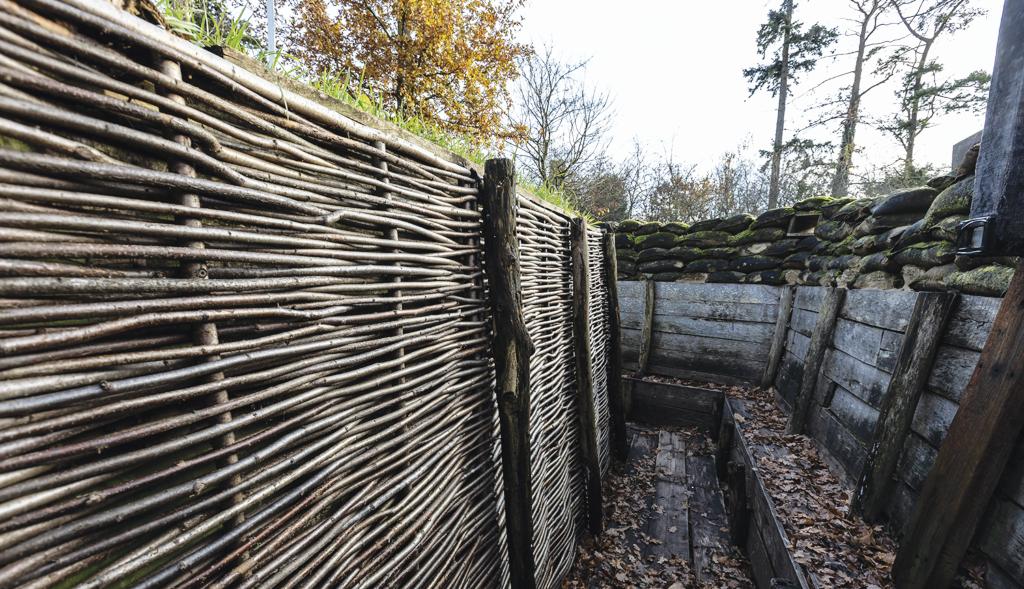
but wiped out by chlorine gas. It was the first chemical attack of modern warfare, and the Canadians received a dose of the new weapon two days later. They held the line.
Details of Davis’s death are sketchy. His service record confirms he was killed in action between April 22 and 23, 1915. Under place of death, it states “In the Field.”
The Passchendaele Museum has launched a program called Names in the Landscape that locates the places where unknown soldiers died. It reported Davis met his end near Foch Farm in Pilkem, just north of Ypres and east of the Canadian positions between Saint-Julien and Gravenstafel.
A June 2, 1915, report by a Major Beattie says he was “buried east side of Ypres to Pilkem road near shrine about 400 yards from where Pontoon Bridge crosses over road. Share grave with 16 others who fell at the same time.”
During the night of April 22-23, the 1st Canadian Infantry Brigade marched out of its reserve billets
shortly after 3:15 a.m. to help deal with the emerging crisis at the front. Davis’s 1st Battalion, along with the 4th (Central Ontario), were to launch a counterattack around dawn against German positions along the east-west line of the Mauser Ridge.
“The attack, designed to stabilize the front, lasted for most of the daylight hours of 23 April,” Andrew Iarocci, a historian at London’s University of Western Ontario, wrote in his 2003 paper, “1st Canadian Infantry Brigade in the Second Battle of Ypres: The Cases of 1st and 4th Infantry Battalions, 23 April 1915.”
“Upon first examination it seems to conform to the stereotype of ‘unprepared’ Canadians being thrown haphazardly into hopeless battle that is so often associated with the earlier war years.”
But Iarocci challenged those who blamed the high Canadian casualty rate and loss of ground at the Second Battle of Ypres on training that had been undermined by poor weather, excessive leave, rampant sickness and a shortage of instructors.
A reconstructed German trench on the grounds of the Passchendaele Museum in Flanders, Belgium.
The attack on Mauser Ridge was typical of so many futile actions of the time—a suicidal charge across 1,400 metres of largely open ground.
Simon Augustyn, a historian and research officer with the Passchendaele Museum, described the gentle slope between Kitchener’s Wood and the Yser Canal as “the ideal springboard for renewed German attacks.”
At first, their progress was good—the Canadians’ right flank had covered half the distance to their objective in 20 minutes. “All goes well so far,” reported the 1st Battalion commander, Lieutenant-Colonel Frederic William Hill.
But the Germans were holding their fire until the Canadians were within 500 metres. Indeed, soon after Hill’s message was received, all hell broke loose on Mauser Ridge.
“Without preparatory artillery shelling, at dawn, the Canadians made an easy target,” wrote Augustyn.
The French had failed to advance on the Canadians’ left as planned. The Canadians were asked to fill the vacuum, but they were taking casualties and under heavy fire halfway up the slope.
At 10:50 a.m., the 4th Battalion’s Lieutenant-Colonel Arthur Percival Dearman Birchall, a native of Gloucester, England, seconded to the CEF, sent a dispatch informing command that the “whole line is now digging in.
“Line extends from YPRESPILKEM Road to I think about 600 yds. East of road. Casualties are heavy,” he wrote.
“We reached a point about 450x from German Trenches As all my companies are up in line and I cannot well move them to a flank in daylight I cannot extend our road [line] towards Canal unless absolutely necessary.”
IAROCCI CHALLENGED THOSE WHO BLAMED THE HIGH CANADIAN CASUALTY RATE AND LOSS OF GROUND AT THE SECOND BATTLE
Captain Malcolm Alexander Colquhoun of Brantford, Ont., officer commanding ‘B’ Company, 4th Battalion, was already down to half his men by the time they were ordered to dig in.
Hill reported that only 100 men from his company were available as reserves—far too few to fill the gap. The open flank was reported closed just after 11 a.m., however, when brigade informed the Canadian battalions that the French “now have five battalions between you and the canal.”
The French were well to the rear of the Canadian firing line, and the Canadians had difficulty linking up with them. To make matters worse, it wasn’t until after noon that Birchall established contact with them and learned that only 50 men were attempting to fill the gap, not five battalions.
The 1st and 4th were under fire the entire day. The Canadians resumed their attack in the afternoon, advancing less than 200 metres before they were halted, and Birchall was killed, under withering fire. “He went up the field just as if there was not a war on,” Frank Betts wrote in a letter home, “and the bullets, shrapnel, Johnsons [large German shells] and war shells were as thick as hail.”
Private A.W. Wakeling of 4th Battalion, described how his ‘B’ Company was told to take a German trench at 5 a.m.
“We had been lying down behind a hedge, and we no sooner showed ourselves than a terrible fire was opened up, machine gun, rifle and shrapnel,” he wrote. “It came from all directions on our front and both flanks; our boys went over in dozens.
“It took us just one hour to take the trench the French had lost.
Only 250 of us were left and five officers. We lost about 700 men and 20 officers that morning.... In my platoon, 55 started and only 11 of us reached the trench.”
Iarocci says Wakeling overestimated the 4th Battalion casualties: the records show 18 officers and 487 other ranks killed, wounded or listed as missing.
Regardless, “the worst was yet to come during the day,” wrote Wakeling. “We had no artillery behind us and we had to hold the trench at all costs.
“The artillery started shelling us right away to drive us out.... Towards evening our artillery came into action and reinforcements from the British Army.”
Augustyn said no headway was made but the counterattack did prevent the German advance from Mauser Ridge to the south.
Davis’s 1st Battalion was relieved on the 24th.
Temporary battlefield graves were often obliterated in the repeated fighting and territory often changed hands over the course of the war. Remains were lost or pummeled beyond recognition in the relentless artillery strikes and mud before recovery teams could return and relocate them to formal, centralized cemeteries.
Augustyn’s museum team identified the graves of 11 Canadians buried at the Pilkem site, along with the wartime grave of Birchall, one of the senior Canadian officers listed on the Menin Gate.
The memorial’s stone panels bear the names of 54,395 British and Empire soldiers killed in the salient whose bodies were never identified or found, including 6,928 Canadians.
The memorial proved too small to contain the names of those whose bodies were never identified or found, so the names of 34,984 British declared missing after the arbitrary date of Aug. 15, 1917, were inscribed on the Tyne Cot Memorial instead. The Menin Gate also does not list the names of the missing from New Zealand and Newfoundland. They are honoured on separate memorials.
Iarocci writes that the deaths of Davis and so many others cannot be blamed on Birchall and Hill. The search for blame, he says, inevitably turns to commanders at brigade, division and beyond “for ordering a ‘suicidal’ frontal attack and for failing to properly liaise with flanking units.”
“The former criticism has been levelled against British and French commanders many times during the last 80 years, but once again, the reader is challenged to come up with an alternative course of action under the circumstances.”
With most of Belgium already occupied, Iarocci notes, Ypres had become symbolically important to the Allies, particularly since the British Expeditionary Force had made its stand there in the autumn of 1914. The town was a strategic gateway to the Channel ports that needed to be defended so the British could protect supply routes.
“Allied leaders elected to stand their ground and senior commanders were compelled to function within these parameters,” writes Iarocci. “As the German attack gained ground
YOU SERVING YOU is written
Ounder a cloud of chlorine gas, hints of panic appeared in the Allied ranks.
“It was deemed necessary to counterattack, throw the enemy off balance, and gain time to reinforce. Senior officers did their best to reshape plans in this fluid situation. Thus, there was no demand from above that Birchall carry through the initial assault at all costs once it had gone to ground before reaching its objective.
“When Canadian Divisional headquarters learned of the high losses that Birchall’s force was suffering, it ordered 1st Brigade to dig in and await further reinforcement. After receiving these orders from brigade, Birchall and Hill acted accordingly.”
German forces would never come closer to Ypres than they did in April 1915. L
ne part of the Legion’s mission is to serve all veterans. As Canada’s largest veteran organization with more than 253,000 members, enhancing the well-being and quality of life for all former military members and their families is prominent in the Legion’s advocacy. As such, it supports the comprehensive review that was recently conducted by the standing committee on veterans affairs about the experience of women veterans. The committee’s purpose is to examine all matters regarding the mandate, management and operation of Veterans Affairs Canada. This study in particular aimed to analyze all aspects of life during service that may affect women’s health and well-being afterward, including treatment
of injuries, transition to civilian life, physical differences, occupational and environmental health risks to the female body, lack of research and economic impacts.
The women who participated in the study discussed individual experiences, the lack of womenspecific research and health care, and systemic problems they face.
Veteran Carolyn Hughes, director of veterans services at the Legion’s national headquarters, noted, for example, that various sexual dysfunctions, including anorgasmia, have affected women veterans with service-related mental health conditions for decades, but have been largely ignored. Men in the same situation, however, have received disability benefits. VAC has now acknowledged this and Hughes encouraged it to continue
the integration of gender-based analysis in its research and all new policies and guidelines.
More work still needs to be done on the issue, of course. A one-sizefits-all approach does not work for everyone. The Canadian Armed Forces, the RCMP and VAC must recognize the gaps the current framework has with regard to the needs of women. Denying these veterans’ claims because the cause, or severity of their conditions, falls outside of existing policies or based on male standards is discriminatory and does more harm, both physically and mentally.
The Legion looks forward to the final report and recommendations of the standing committee. It remains committed to advocating for, and improving the lives of, all veterans. L
For Métis veteran Floyd Power, trekking across Canada’s North searching for the lost graves of Indigenous veterans has become a life’s work.
Based in Yellowknife, the retired warrant officer finds no greater satisfaction than uncovering unmarked or incomplete graves, tracking down names, interviewing families, Rangers and Elders, and exploring service histories.
The payoff comes a year or more later when families, colleagues and communities gather to pay their respects as a familiar grey granite headstone—usually bearing appropriate Indigenous iconography—is placed on a plot, finally granting an oft-longdeparted veteran their due.
“It is challenging,” acknowledged Power, who served 32 years in the army and is among the volunteer researchers featured in a 19-minute film, The Indigenous Veterans Initiative—Finding Unmarked Graves, produced by the program creator and chief sponsor, the Last Post Fund.
“I am a member of The Royal Canadian Regiment and our regimental philosophy is never pass a fault. It’s the right thing to do and the philosophy of my regiment holds true in correcting this fault.”
The Last Post Fund introduced the Indigenous Veterans Initiative in 2019 as part of its overall mission to ensure that all veterans have a dignified funeral and burial, along with a military gravestone.
The fund’s executive director Edouard Pahud conceived the idea after Quebec amateur historian Yann Castelnot compiled a list of 250,000 Indigenous personnel who had served with American or
By Stephen J. Thorne
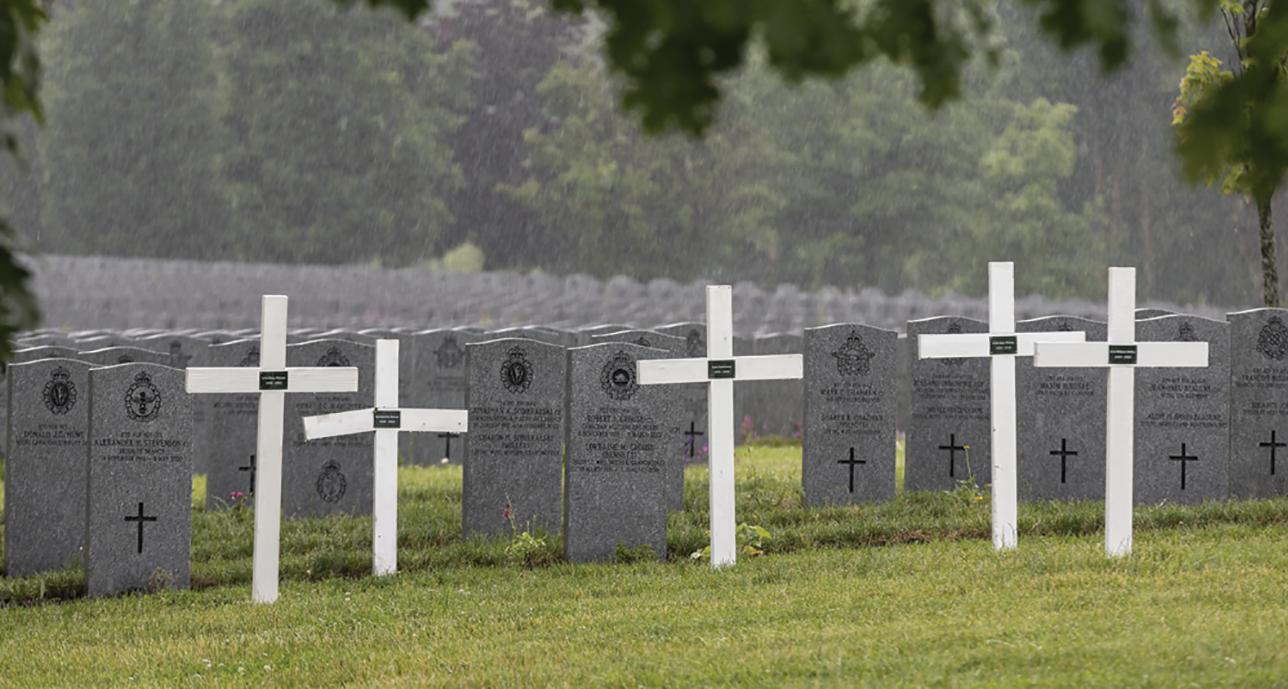
“I SAW THAT LIST AND I THOUGHT A LOT OF THOSE PERSONS WHO SERVED MUST BE IN UNMARKED GRAVES.”
Canadian forces since Europeans first arrived on the continent.
“I saw that list and I thought a lot of those persons who served must be in unmarked graves,” said Pahud.
So, the fund’s Indigenous research began.
The Indigenous initiative has its special challenges: a disproportionate number of the country’s 12,000-plus Indigenous veterans are believed to lie in unmarked graves, partly due to the economic plight their families faced. Yet just a small number of Indigenous communities are collaborating with the project.
“Some communities know about our program, some don’t,” said its co-ordinator Maria Trujillo. “The word just wasn’t getting out to them that we existed.”
Four years into it Pahud says his organization has “only touched the tip of the iceberg.”
About 200 Indigenous markers have been installed in remote
communities—and a few overseas— and some 300 more are on order.
Trujillo said there is a sense of urgency surrounding the program because many of the graves are marked by wooden crosses, which are weathered and fading.
“Also, a lot of the Elders who hold the knowledge about where a person is buried, they’re passing away.”
Working with Veterans Affairs Canada and the Commonwealth War Graves Commission, the 114-year-old Last Post Fund has, overall, identified and placed headstones on nearly 8,000 unmarked graves, with another 2,000 applications in-house. Over its history, it has helped nearly 150,000 vets dating from the Boer War, both world wars and Korea through present-day.
The National Field of Honour in Pointe-Claire, Que., owned and managed by the Last Post Fund since 1930, is the final resting place of more than 22,000 Canadian and Allied veterans and their loved ones. L
Veterans Affairs Canada raised pensions, awards and allowances paid under the Pension Act by 4.4 per cent in 2024. VAC adjusts the rates for disability pensions and allowances on Jan. 1 each year. This year’s increase is based on the Consumer Price Index in accordance with the Pension Act.
The extent of disability is expressed as a percentage, with a total disability assessed at 100 per cent. When a pensionable disability is assessed at less than 100 per cent, the pension is proportionally less. The following are examples of the 2024 pensions paid monthly.
Payment to a pensioner whose disability is assessed at less than five per cent is made on a one-time-only basis.
Disability awards under the Veterans Well-being Regulations may be paid as a lump sum, annual payments or in a combination of these options.
War veterans allowance paid to low-income clients is adjusted quarterly on Jan. 1, April 1, July 1 and Oct. 1. The following are the current rates.
Legion branches donate more than $127,442
their
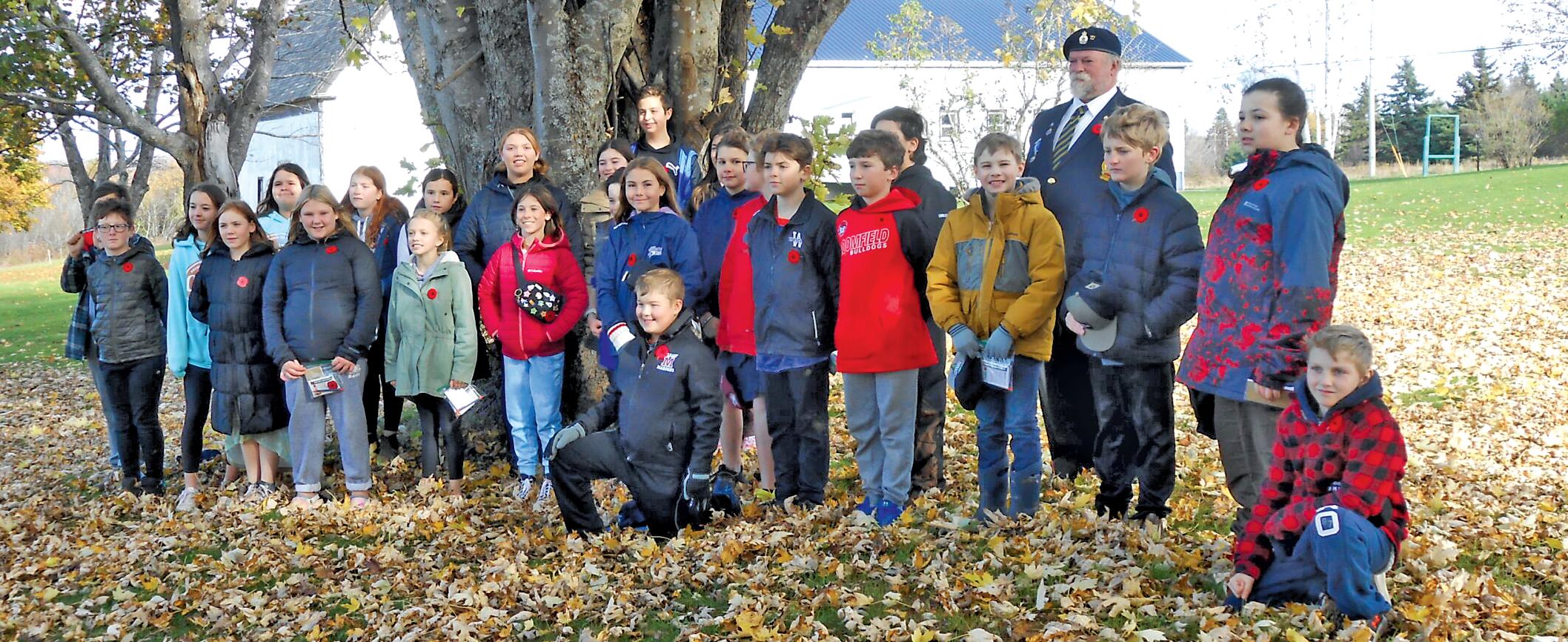
Brian Arsenault of Saint Anthony Branch in Bloomfield, P.E.I., along with Bloomfield Elementary School students, place Canadian flags on the graves of veterans at St. Anthony’s Catholic Cemetery. LYNDA CURTIS
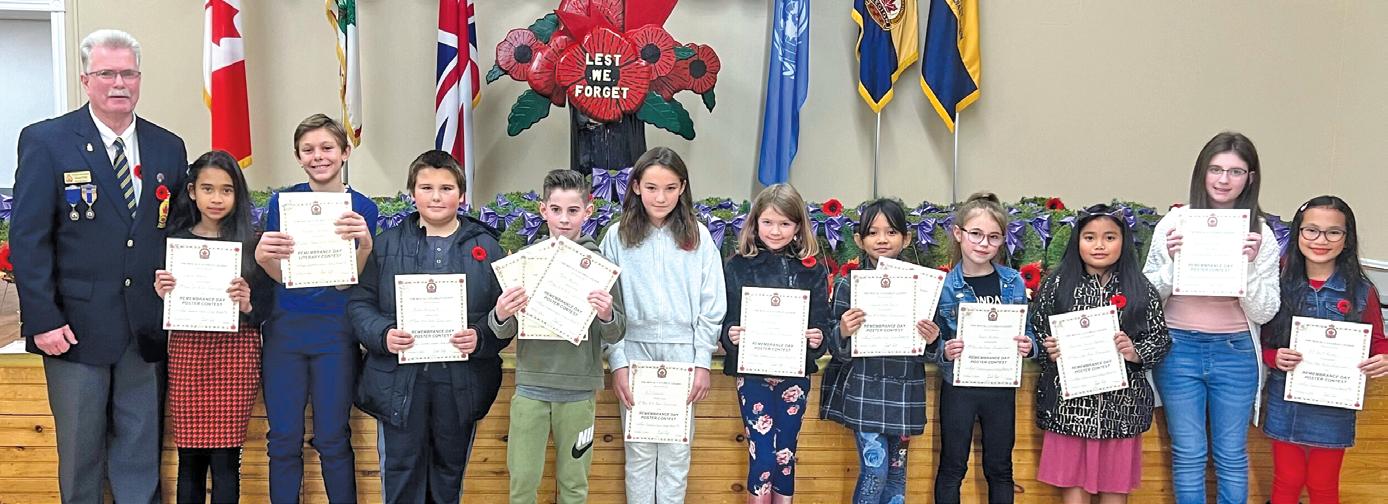
President Grant Gay of O’Leary, P.E.I., Branch presents poster and literary contest awards to (from left) Elaine Emvalino, Kayden Delaney, Tucker Arsenault, Matao Burden, D.J. Clements, Fiona Morton, Louise Lane Capili, Kayah Burden, Samanatha Denisse Arambulo, Ashylynn Mullen and K.C. Ann M. Rosetta of O’Leary Elementary School. G. ARSENAULT
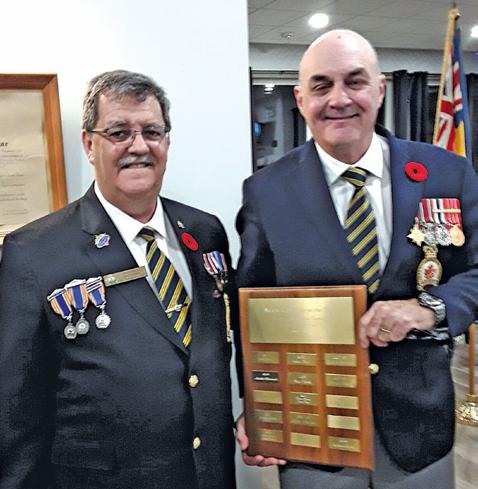
President David Perry of Souris, P.E.I., Branch presents the Legionnaire of the Year award to Andy MacIntosh.
President LeRoy Gamble and First Vice Gayle Mueller of George Pearkes VC Branch in Summerside, P.E.I., present a $500 bursary to Cotton Steele. KAREN GAMBLE
Donald MacDonald of O’Leary, P.E.I., Branch presents the Legionnaire of the Year award to Past President Grant Gay. GRANT GAY
Mario Henry, Laurie Henry (not pictured) and Pieter Valkenburg of Borden-Carleton Branch in Borden, P.E.I., place Canadian flags on the graves of veterans in nine cemeteries and four cenotaphs. PIETER VALKENBURG
President LeRoy Gamble (third from left) and secretary-treasurer Karen Gamble of George Pearkes VC Branch in Summerside, P.E.I., present Legionnaire of the Year awards to Jean and Jody Berube. KAREN GAMBLE
West Prince, P.E.I., Zone Commander James Williams presents $1,000 to chair Eva Rodgerson of the O’Leary Community Hospital Foundation to help the hospital purchase medical equipment.
Dave Joyce of Lynn Valley Branch in North Vancouver, B.C., presents $3,100 to commissioner Steve McTaggart, Fenneke Tjallingii-Brocken, Christopher Gawlick and Amber Akerberg of 21st Capilano Scout Group for first-aid radio transmission boosters.
West Prince, P.E.I., Zone Commander James Williams of Lt.-Col. E.W. Johnstone Branch in Kensington, P.E.I., presents $1,000 to chair Dave Pizio and vice chair Krystyna Pottier of Western Hospital in Alberton, P.E.I., to help the hospital purchase medical equipment.
Jean Gardener and Sgt.-at-Arms Rob Gardener of Delta, B.C., Branch presents $2,861 to parent support committee president Wendy Yamazaki, Capt. Dave Smith and WO Sager Tagger of 1867 Seaforth Highlanders army cadet corps.
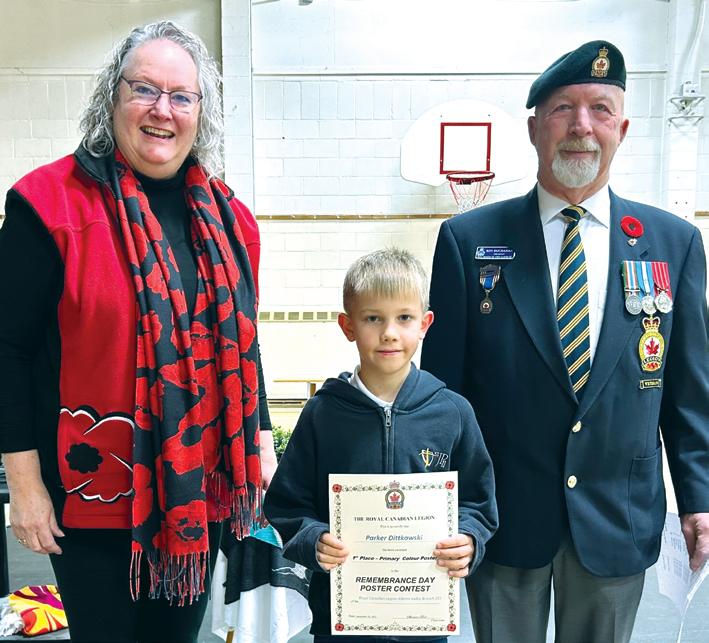
President Roy Buchanan and poppy chair
Shannon Dore of Alberni Valley Branch in Port Alberni, B.C., present the local first-place award in the national primary colour poster contest to Parker Dittkowski of John Paul II Catholic School.
Dave Joyce of Lynn Valley Branch in North Vancouver, B.C., presents $5,000 to Peter Haigh of North Shore Search and Rescue to assist in life-saving missions throughout the province.
President Roy Buchanan of Alberni Valley Branch in Port Alberni, B.C., presents $4,164 to Tour de Rock representative Steve Robinson for the Cops for Cancer event.
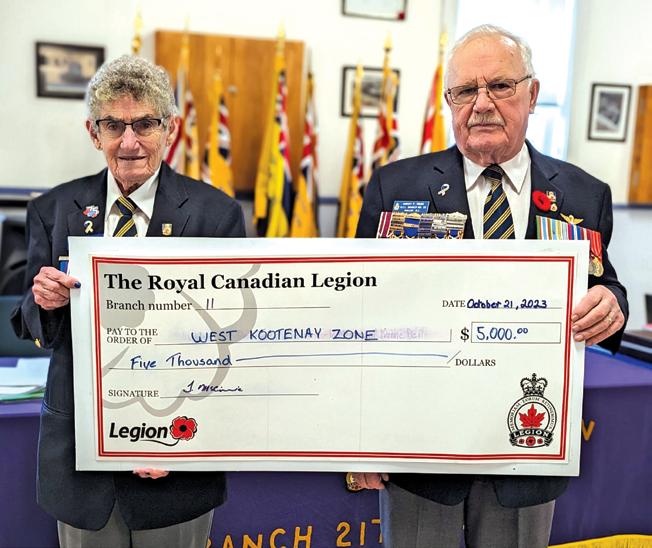
Donna Price of Trail, B.C., Branch presents $7,750 to past zone commander Harvey P. Truax, co-ordinator of the 11th annual motorcycle ride to raise money for veterans.
President Roy Buchanan and poppy chair Shannon Dore of Alberni Valley Branch in Port Alberni, B.C., present the local first-place award in the national intermediate essay contest to Elena Veilleux of John Paul II Catholic School.
L.A. Past President Yvonne Chartrand presents $1,500 to First Vice Sue Hodges at Mount Arrowsmith Branch in Parksville, B.C., while Sgt.-at-Arms Roy Dewar looks on.
Second World War veteran and Legion pipe band member Jim Crombie of Diamond Head Branch in Squamish, B.C., receives a Quilt of Valour from the Squamish Quilters Guild on his 100th birthday.

President Rob Driemel of Fort Rupert Branch in Port Hardy, B.C., presents $1,000 to the Port Hardy Harvest Food Bank.
Ron Roy of Lower Southampton Branch in Nackawic, N.B., receives a Quilt Of Valour, accompanied by sons Brent and Danny and daughter Collene. ROSS CARRUTHERS
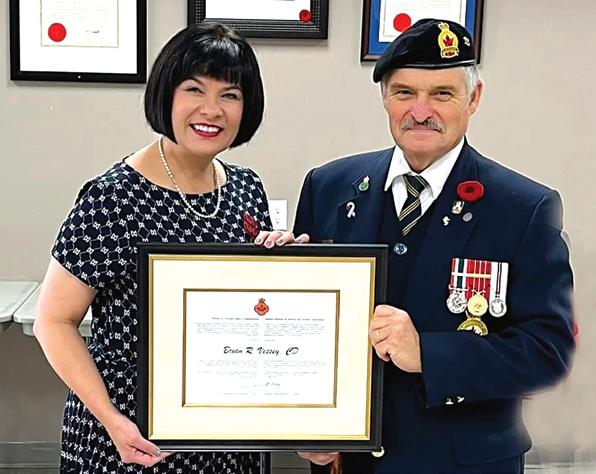
Brian Vessey of Oromocto, N.B., Branch is awarded the Minister of Veterans Affairs Commendation from Minister Ginette Petitpas Taylor. Vessey served 25 years in the Royal Canadian Electrical Mechanical Engineers and more than 30 in the Legion, including as a branch service officer and executive member.
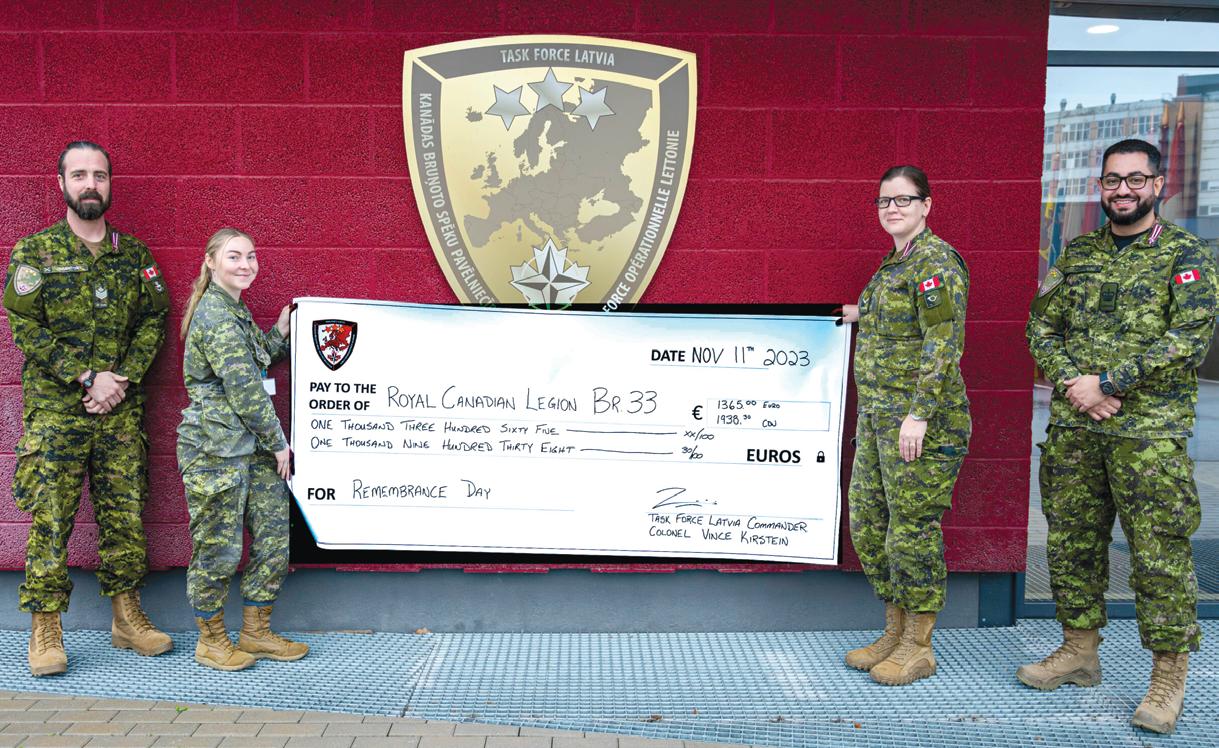
receives $1,938 from the troops
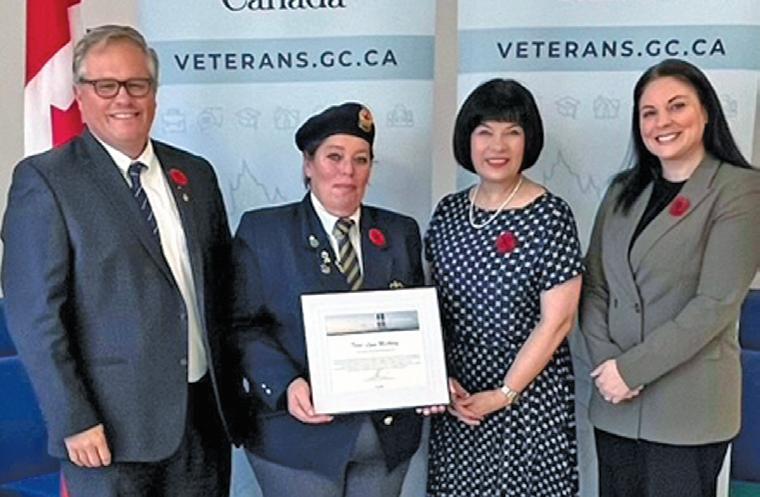
Veterans Affairs Canada recognizes Terri-Lynn McAuley of Oromocto, N.B., Branch for her support to the veterans community while the VAC Oromocto office was closed. From left are Assistant Deputy Minister Steven Harris, First Vice McAuley, Veterans Affairs Minister Ginette Petitpas Taylor and Fredericton MP Jenica Atwin.
President Sharon Braye of Springdale, N.L., Branch presents $1,000 to Steven Jewer of the Green Bay Food Bank.
Past president Bill Meadus of Clarenville, N.L., Branch presents $2,000 to Sherri Popwell of the Salvation Army Christmas Hamper campaign.
New Brunswick Command President Antonin (Tony) Chevalier presents $5,000 to Robyn Mullin of the Veteran Family Program at the Military Family Resource Centre in CFB Gagetown.
President Bill Meadus and Past President Jackie Vokey of Clarenville, N.L., Branch present third place in the poster and literary contest to Layan Ali of Riverside Elementary.
Evan O’Brien of Ferryland, N.L., presents a donation of $700 to President John Blackwood of Mount Pearl Park-Glendale Branch in Mount Pearl, N.L. O’Brien gives tours of war exhibits and donates the proceeds to local Legions.

President Sharon Braye (left) and Natasha Colborne of Springdale, N.L., Branch present $1,000 to the Springdale Salvation Army Happy Tree campaign.
Jenna Smith of Swan Valley Regional Secondary School stands in front of a mural she painted for the Swan River, Man., Branch.
President Katriina Myllymaa of Port Arthur Branch in Thunder Bay, Ont., and L.A. ways and means chair Nancy Singleton present $1,500 to executive director Volker Kromn of the Regional Food Distribution Association. GEORGE ROMICK
President Neil Griffith of Swan River, Man., Branch presents $5,000 to Swan River mayor and Swan Valley Health Facilities Foundation chair Lance Jacobson for a new CT scanner at the Swan Valley Health Centre.
L.A. bursaries chair Anne Pages of Port Arthur Branch in Thunder Bay, Ont., presents $400 bursaries to Aiden Masdcu, Julia Hunter, Raija Myllymaa and Ava Myllymaa. GEORGE ROMICK
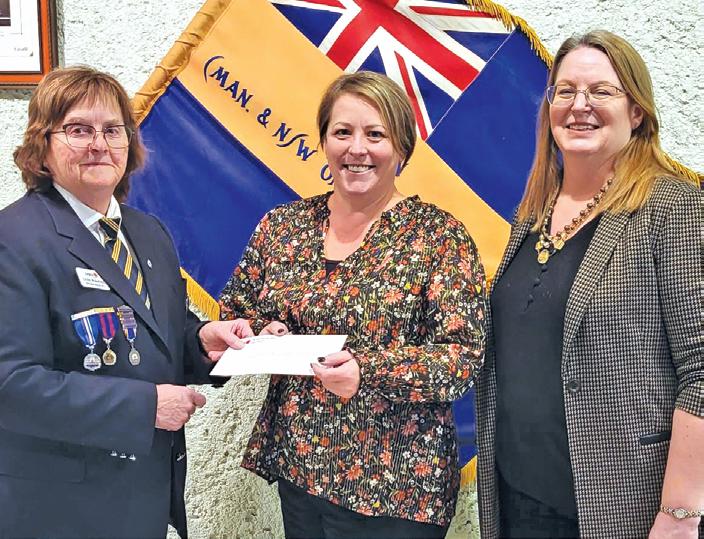
Second Vice Linda Wakefield of Brandon, Man., Branch presents $2,843.42 to Vicki Ketch and Sharon Robinson of Rideau Park Personal Care Home.
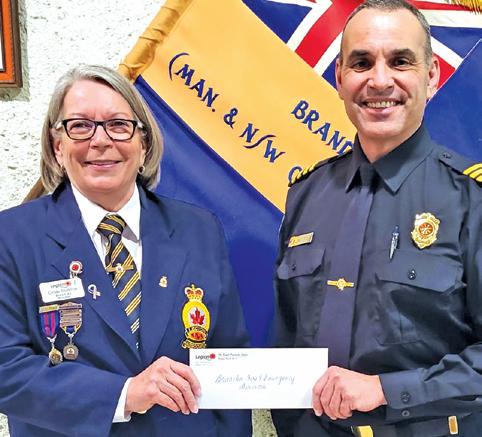
Past President Cindy Stumme of Brandon, Man., Branch presents $5,248.12 to Deputy Fire Chief Marc Lefebvre of Brandon Fire and Emergency.
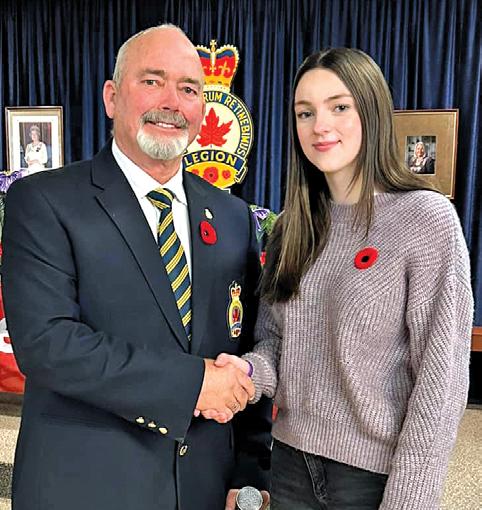
President Neil Griffith of Swan River, Man., Branch presents a $1,000 bursary to Neva Zamzow of Swan Valley Regional Secondary School.
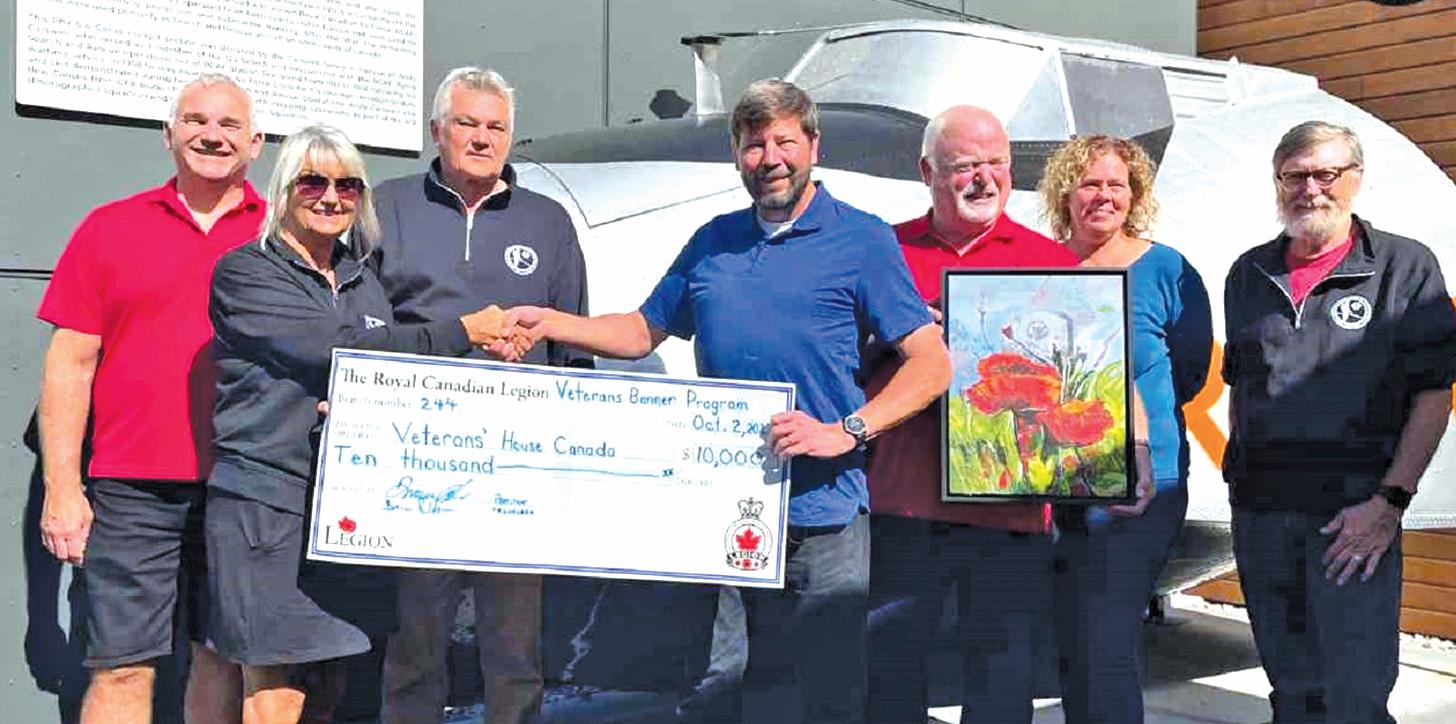
Sue Doran, chair of the veterans banner program at Perth-Upon-Tay Branch in Perth, Ont., is joined by committee members as she donates $10,000 to Alan Mulawyshyn, deputy executive director of Veterans House Canada.
President Ken Vosper, along with Diane Dickenson (left), Sharon Seebach and Jessica Consitt of Mitchell, Ont., Branch presents $10,000 to the Stratford Perth Rotary Hospice, represented by board member Heather Bryan.
President Jack Hume and First Vice Michel Denis of Georges Vanier Branch in Hawkesbury, Ont., present $1,000 to Vankleek Hill food bank rep Mike McGurk.
Ways and means chair Steve Grenning of Trenton, Ont., Branch presents $1,000 each to Trent River public school secretary Kim Hutchinson, Principal Marc Garneau of école secondaire publique Chantal McAlpine, and to the president of Kinclub of Trenton, Sharon MacKay.
Sgt.-at-Arms John Greenfield of Bowmanville, Ont., Branch presents $3,000 to Salvation Army representatives Joyce Shaw (left) and assistant pastor Carolyn Kitney.

L.A. treasurer Linda Scott-Imbeau of Trenton, Ont., Branch presents $200 for the Adopt-A-Child program, represented by Lisa Kypers-Schroedter.
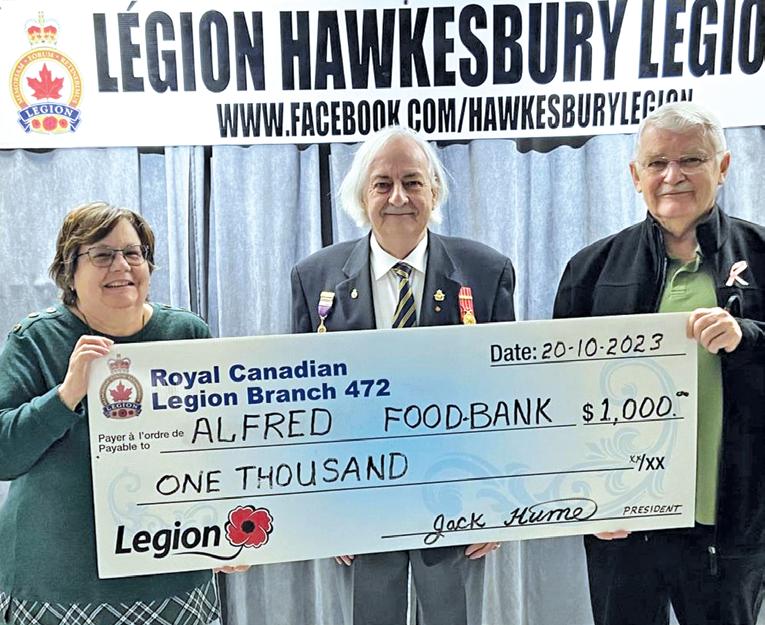
First Vice Michel Denis of Georges Vanier Branch in Hawkesbury, Ont., presents $1,000 to Alfred Food Banks reps Diane Sauve and Raymond Bouchard.
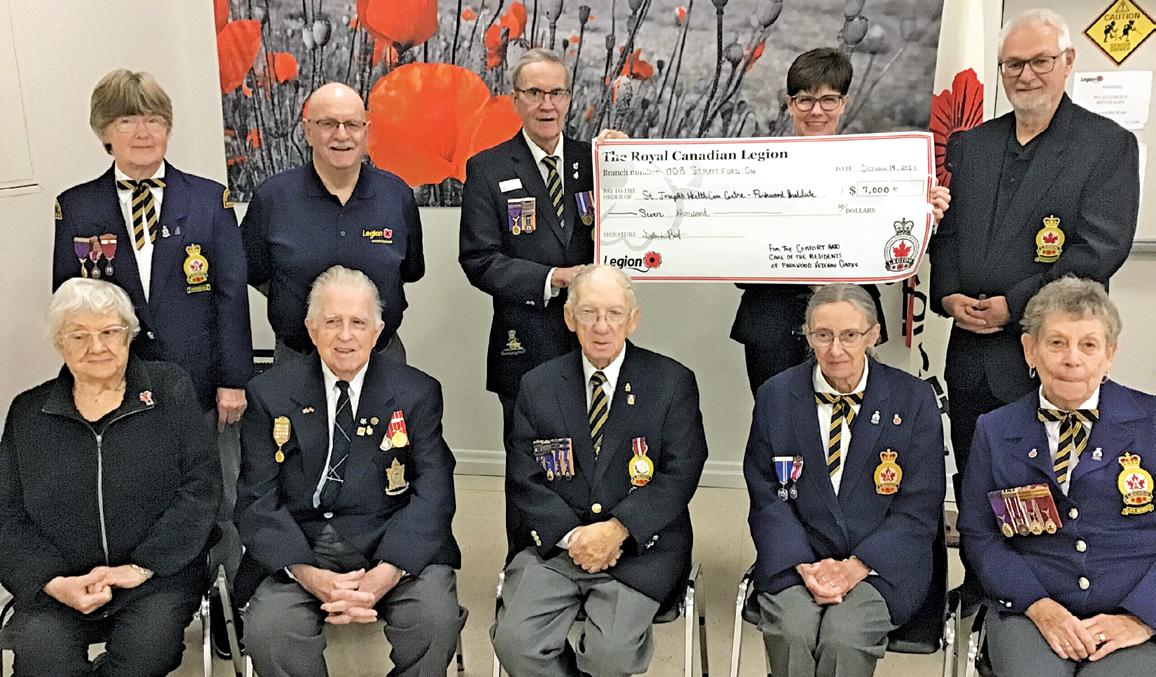
President Steve Zurbrigg of Stratford, Ont., Branch, with members of the poppy committee, presents $7,000 to St. Joseph’s Hospital Health Centre, represented by Sarah Wayrauch.
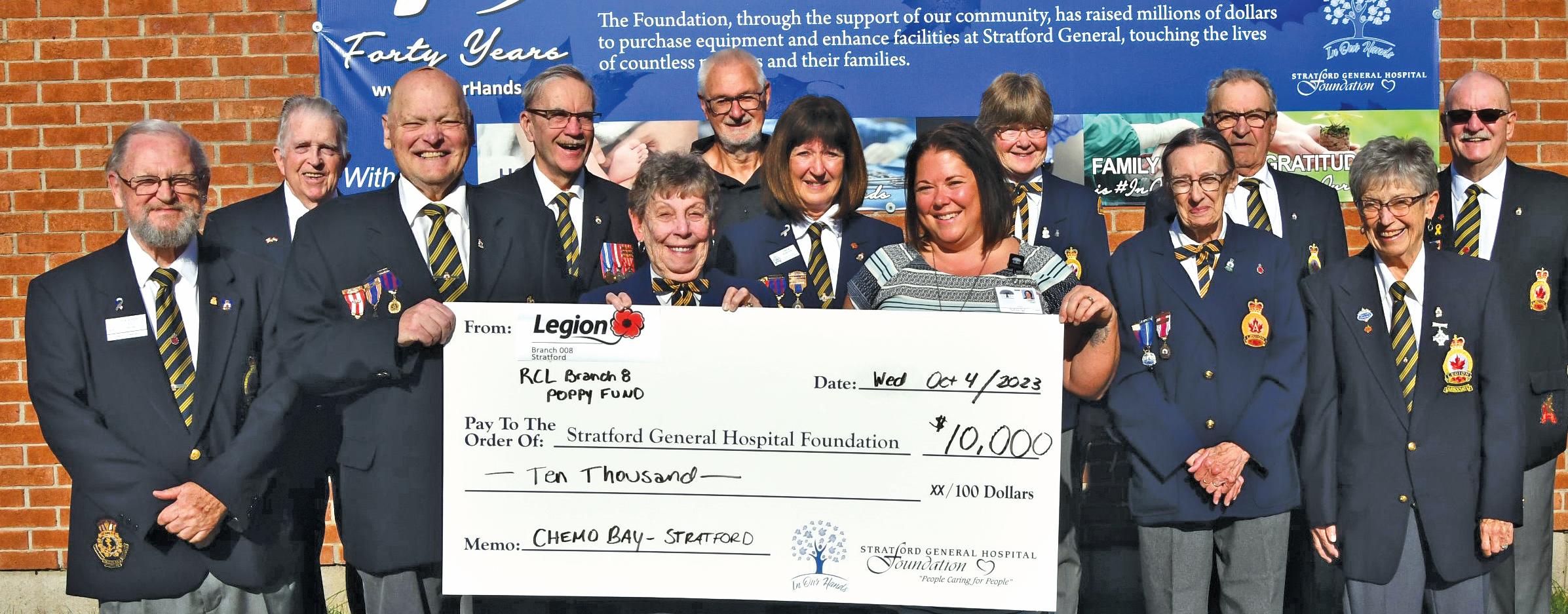
President Steve
and poppy chair Dale Bast with members of the
committee at Stratford, Ont., Branch, present $10,000 to the Stratford General Hospital Foundation, represented by executive director Cheryl Hunt.
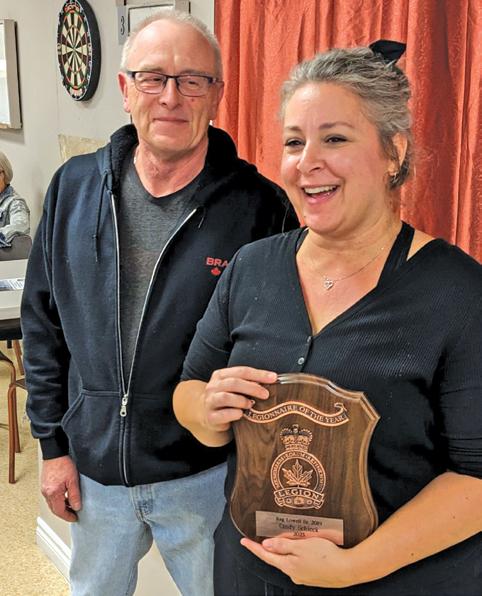
At the Reg Lovell Branch in Glencoe, Ont., Cindy Schieck receives the Legionnaire of the Year award from President Frank Gosnell.
Sgt.-at-Arms John Greenfield of Bowmanville, Ont., Branch presents $10,000 to Clarington 172 Squadron cadets, represented by sponsoring committee chair Catherine Lokietek.
Bill Murphy (left) and Past President Brian Goss of Richmond, Ont., Branch present $1,000 to the St. Philip Church Knights of Columbus winter coats for kids program, represented by Shawn Murphy.

Lotto chair Holly Thompson of Limestone City Branch in Kingston, Ont., presents $3,000 to St. Vincent de Paul executive director Judy Fyfe.

President Leo Lund of Limestone City Branch in Kingston, Ont., presents $500 to Kingston Humane Society executive director Gord Hunter.
President Yvonne Glowacki of Polish Veterans Branch in St. Catharines, Ont., along with Ontario District B Commander Jack Gemmell, Ontario Command vice-president Diane Condon and veterans service officer Stefan Wieclawak, welcomes new members Dana Metcalf, Elizabeth Czartowski and Christina Blaszynski.
Richmond, Ont., Branch Sgt.-at-Arms Boyd Dulmage presents $750 to local food bank representatives Jane Perron and Judy Wagdin.
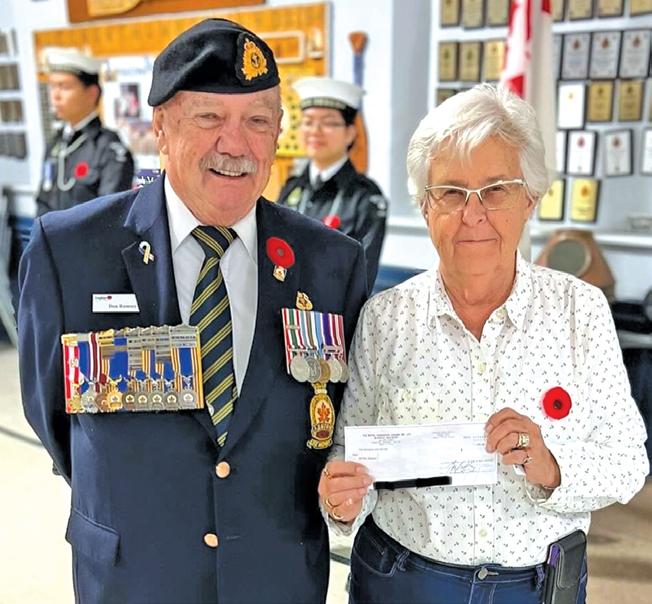
Second Vice Don Ramsey of Cobourg, Ont., Branch presents $1,000 to Northumberland Navy League president Evelyn Van Der May for the 116 Skeena sea cadet corps.
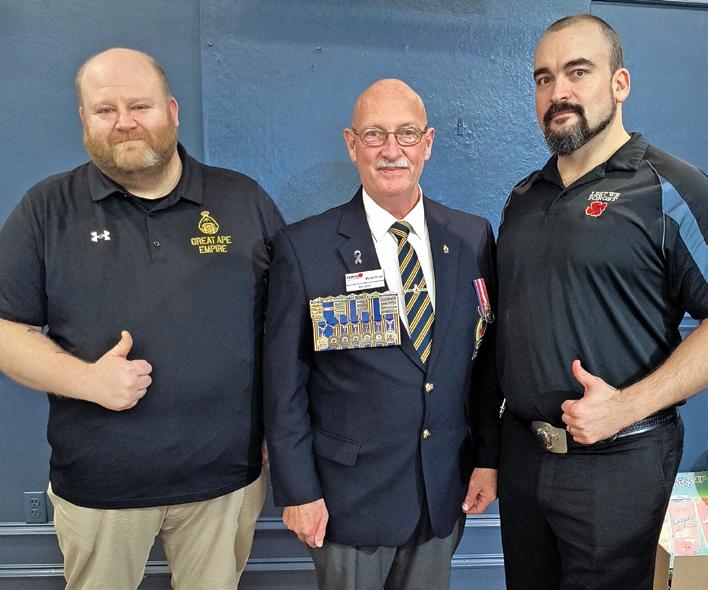
Ontario Command President Derek Moore with Ruck to Remember fundraising organizers Dan Lisk and Lino Di Julio after they raised $332,000 for Operation: Leave the Streets Behind, a support program for homeless veterans.

President Glen Hanley of Paisley, Ont., Branch presents $400 to Kayla McLelland, Karen McCullough, Amanda Small and Allison Howcroft from the community enhancement committee for the local 2024 150th anniversary celebrations.
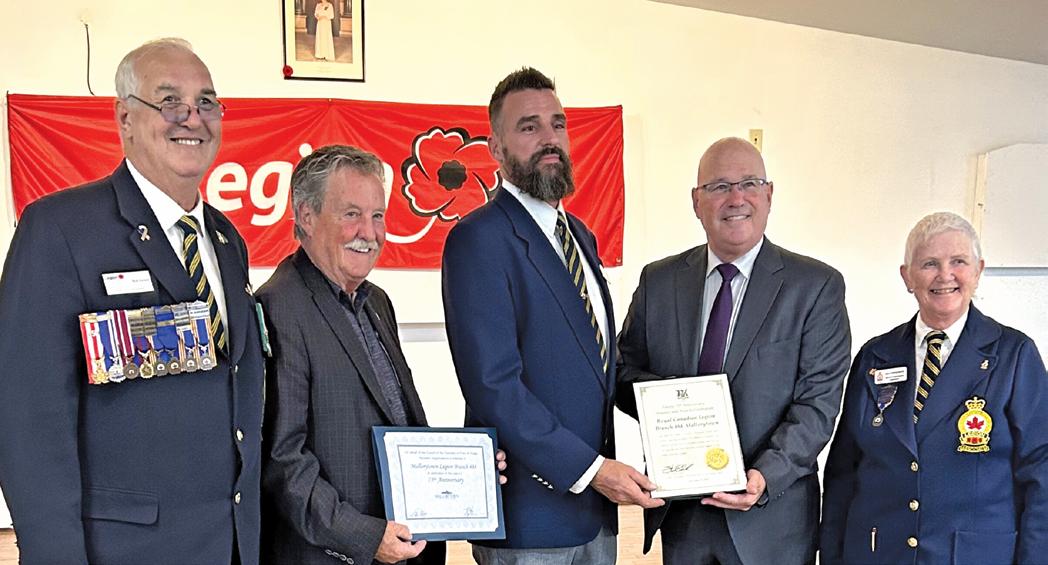
Mallorytown, Ont., Branch celebrates its 75th anniversary. From left are Zone G-2 Commander Rob Fernell, Front of Yonge Township Mayor Roger Haley, Second Vice Derek Systma, Leeds-Grenville-Thousand Islands MPP Steve Clark, and anniversary chair Jan Stephenson.
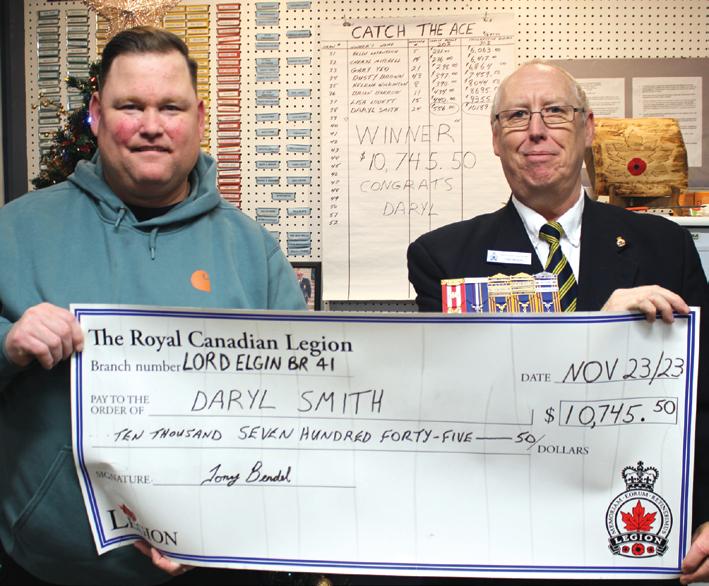
Chair Tony Bendel of Lord Elgin Branch in St. Thomas, Ont., presents Daryl Smith with $10,745.50 in winnings from the branch’s first catch the ace lottery.
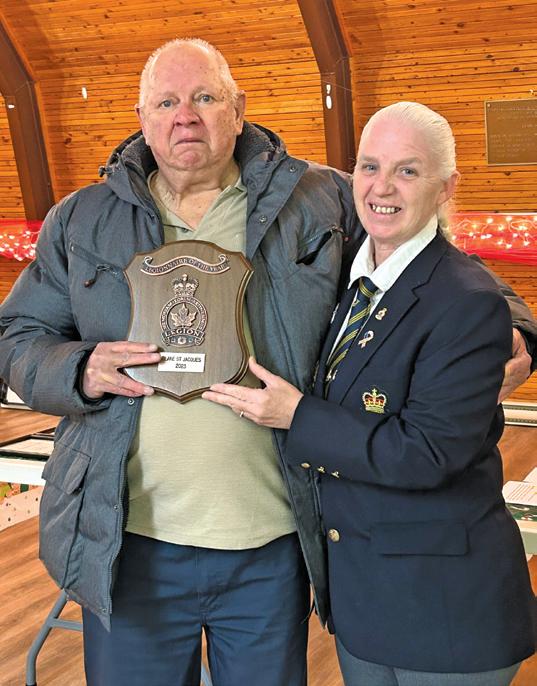
Past President Ruth Eadie of Little Current, Ont., Branch presents Blake St. Jacques with the Legionnaire of the Year award. ROY EATON
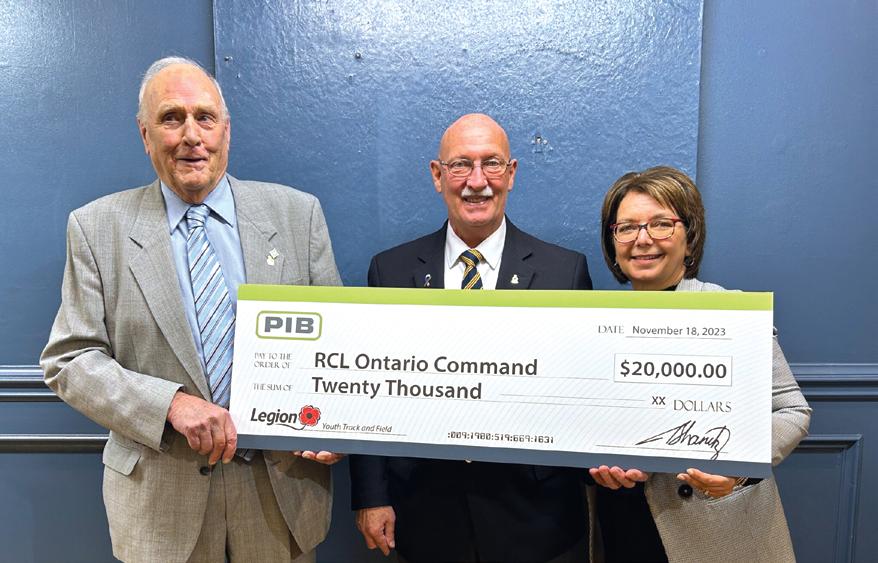
Kelly Smith of Programmed Insurance Brokers and Darlene Shantz, company president and CEO, donate $20,000 to Ontario Command’s National Youth track and field program, represented by Ontario Command President Derek Moore.
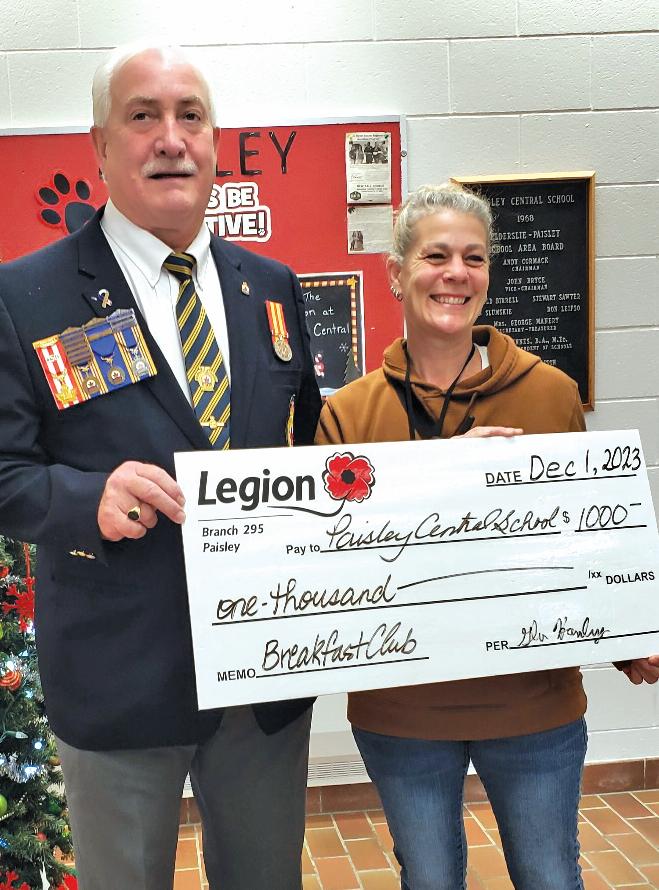
President Glen Hanley of Paisley, Ont., Branch presents $1,000 to Mel LeClair for the Paisley Central School Breakfast Club.
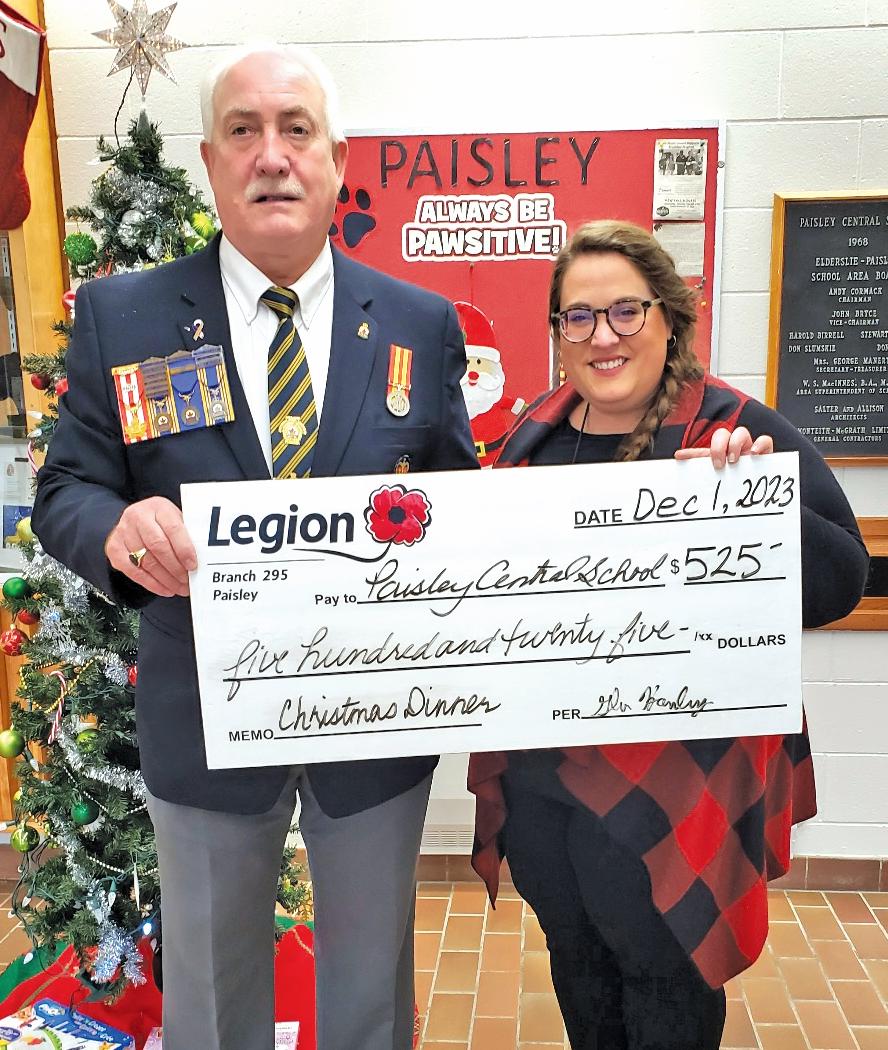
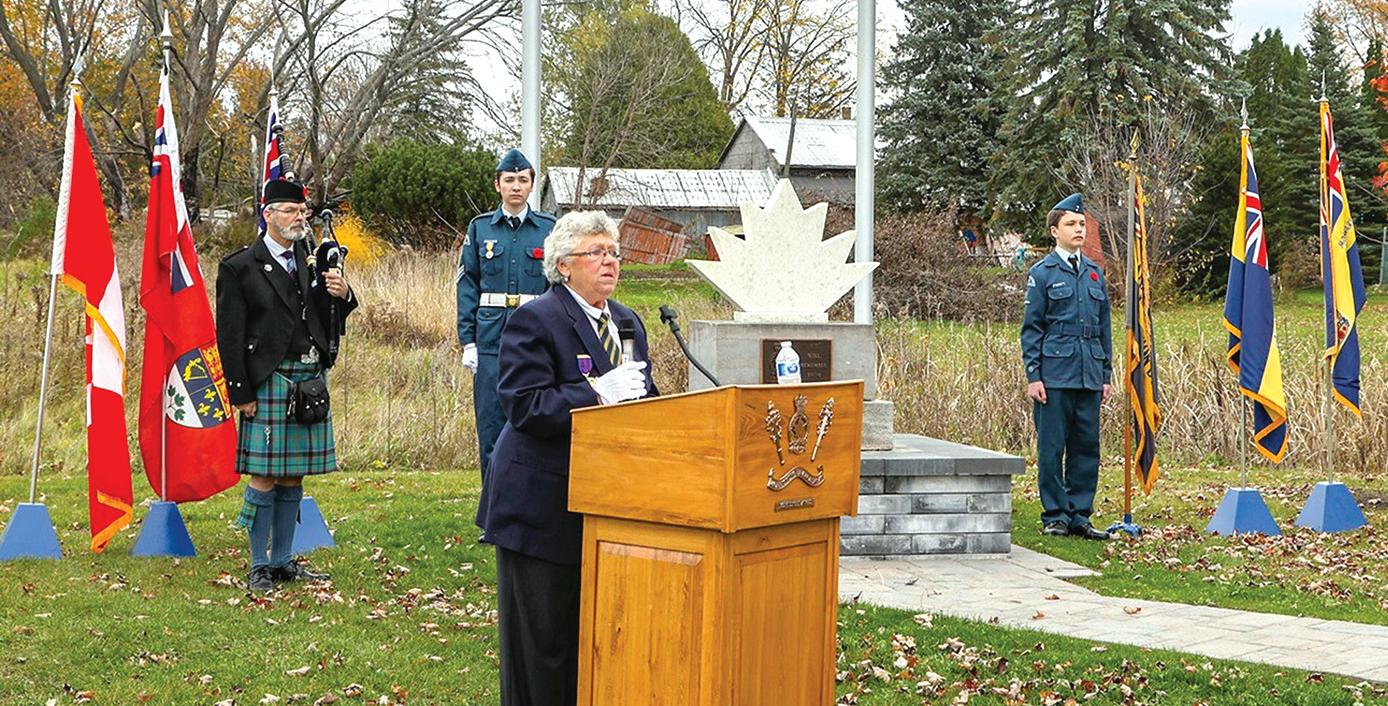
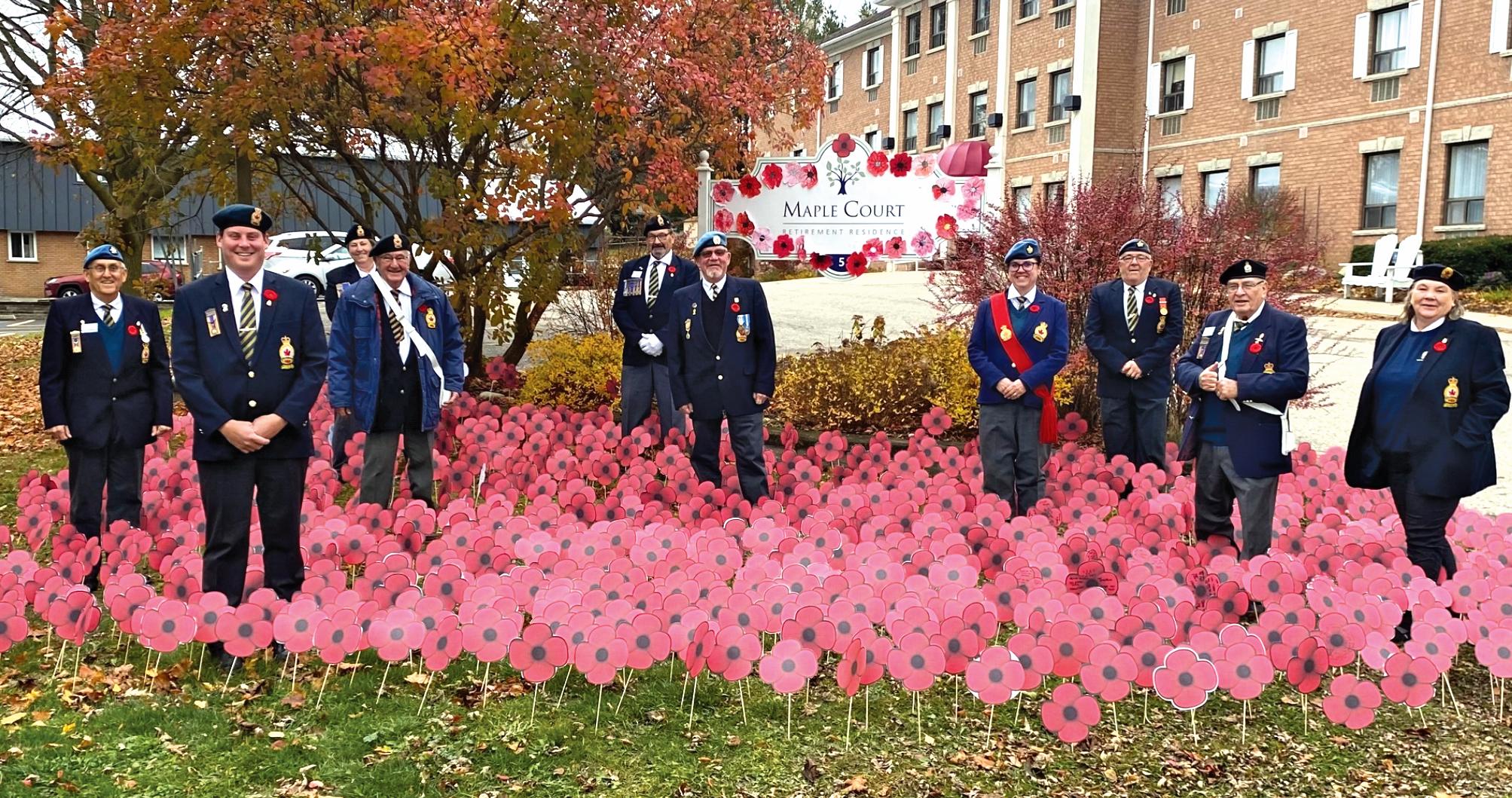
Veterans and members of Walkerton, Ont., Branch stand among poppies created by local schoolchildren and set up in front of Maple Court Retirement Residence.
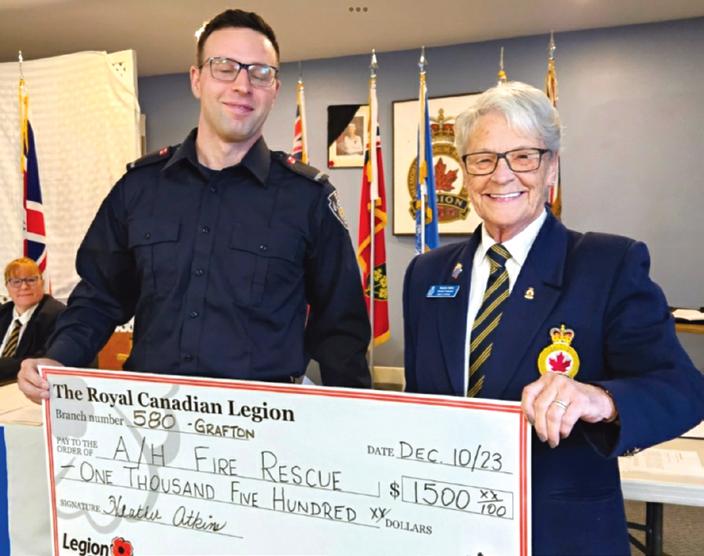
Bingo chair Heather Atkins of Lt.-Col. John Foote VC Branch in Grafton, Ont., presents $1,500 to Alnwick/Haldimand Fire Rescue, represented by firefighter Regan Doucette.
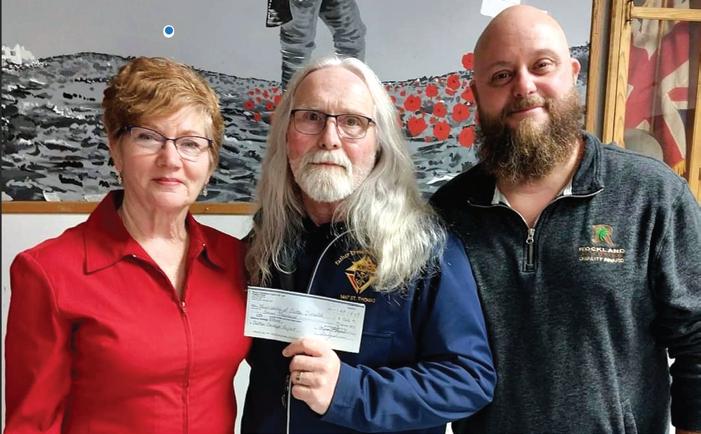
Adam Freeman and poppy committee chair Karen Goncalves of West Elgin Branch in West Lorne, Ont., present $7,000 to the Dutton Cenotaph Project. Accepting the donation is Blair Ferguson.
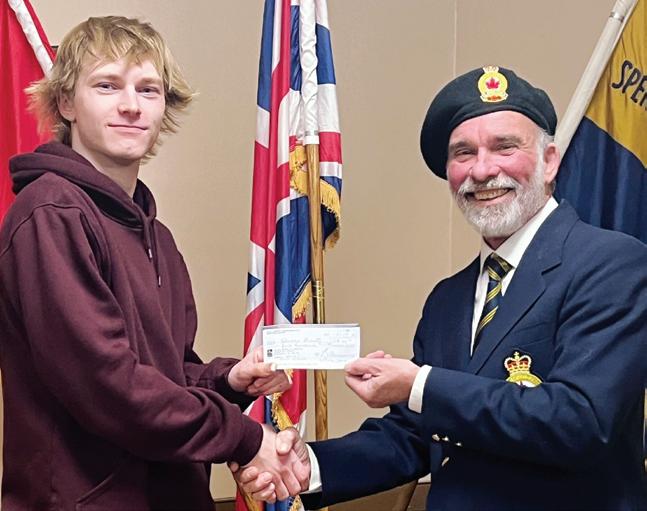
Justin Schmitz receives a bursary from Spencerville, Ont., Branch President Tom Lillico.
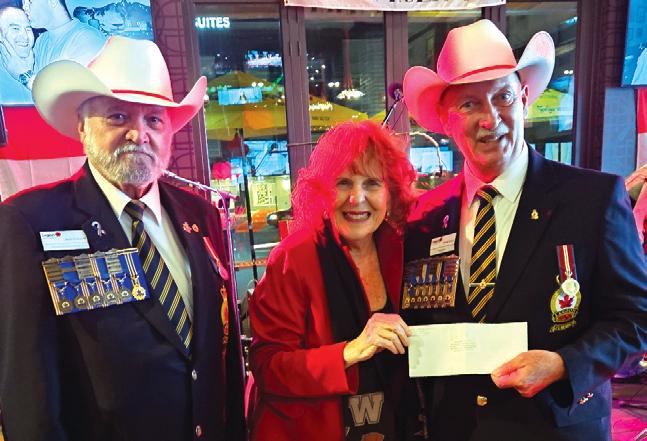
Former Alberta lieutenant-governor Lois Mitchell, part-owner of the Calgary Stampeders, donates $2,500 to the Joe Sweeney Fund. Receiving the donation are Alberta-N.W.T. District B Commander Jack Gemmell and Ontario Command President Derek Moore.
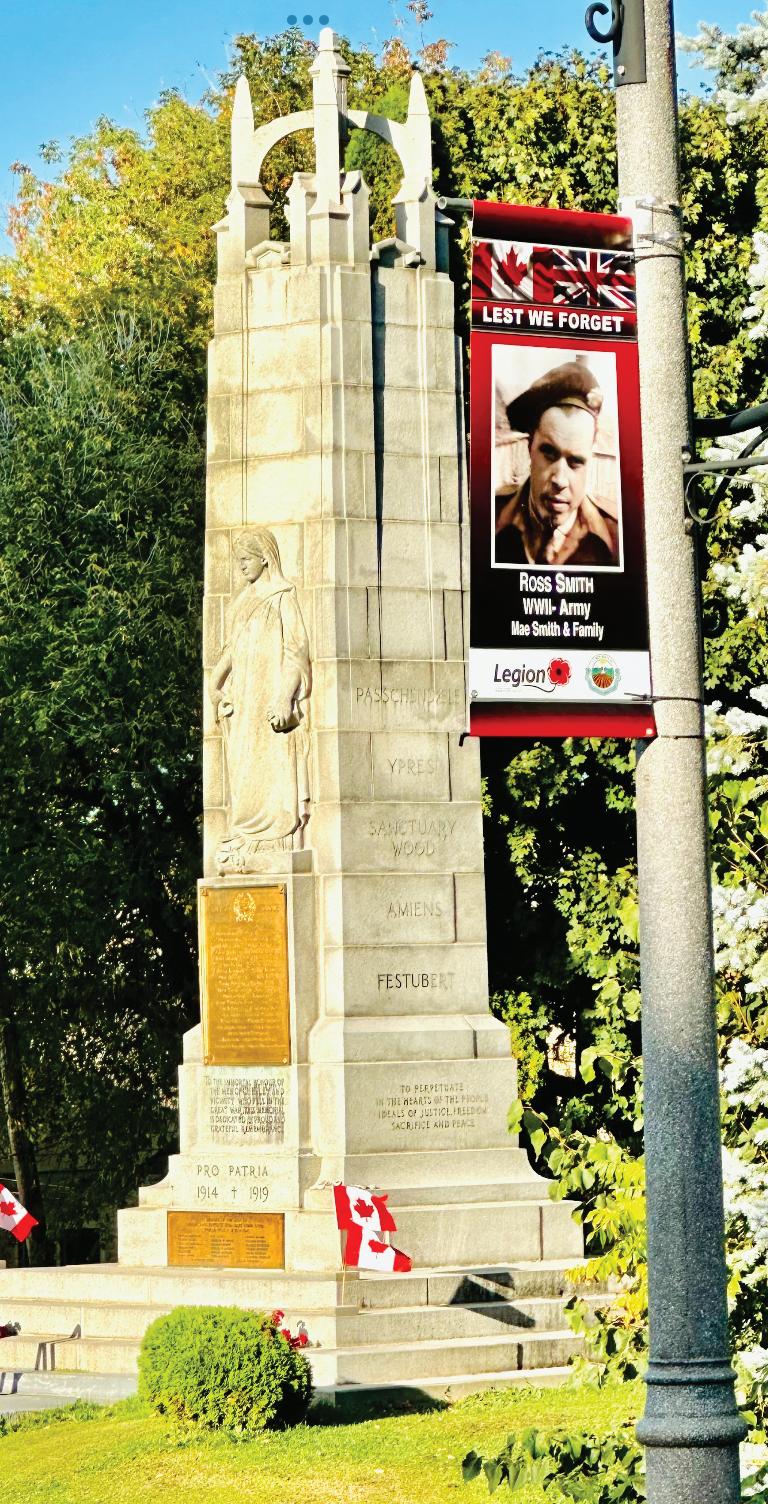
Chesley, Ont., Branch and the town honour local veterans with 28 veteran banners.
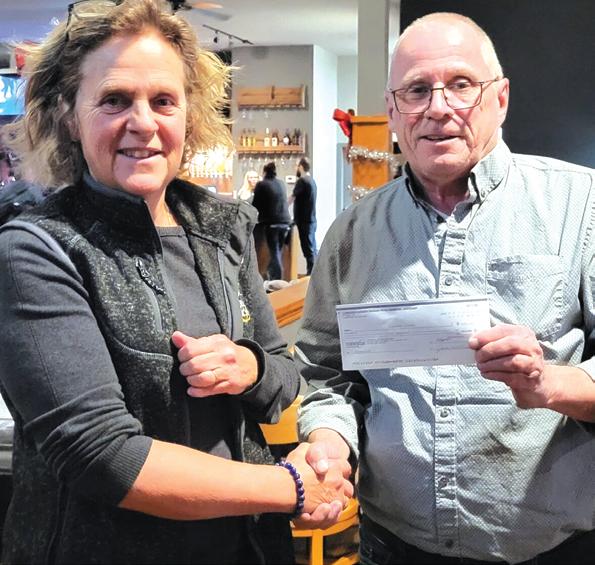
Past President Chris Valgardson of Lumsden, Sask., Branch presents $500 to the Lumsden and District Lions Club Christmas Hamper program. CHRIS
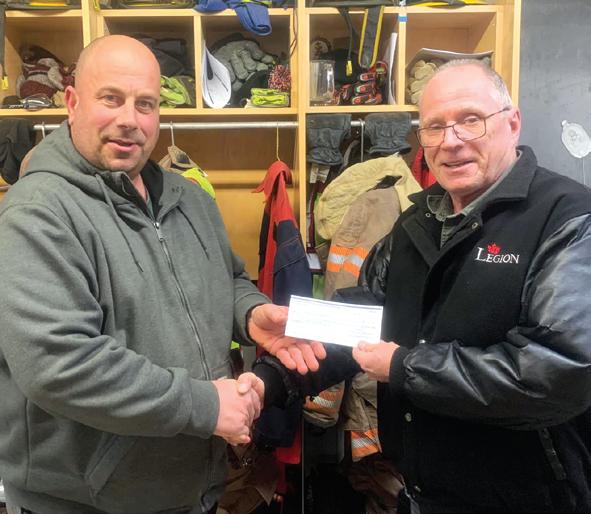
Past President Chris Valgardson of Lumsden, Sask., Branch presents $1,000 to Chief Jeff Carey of the Lumsden Fire Department to assist in purchasing a new rapid response vehicle.
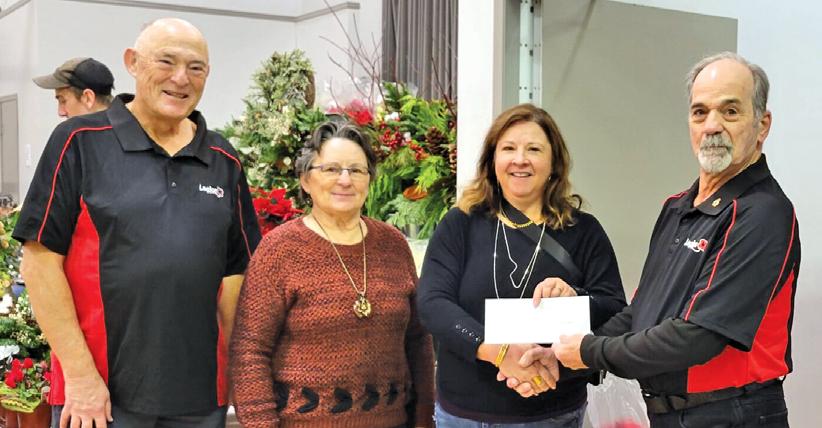
Past President Jack Jones (left) and President Paul Danis of Wakaw, Sask., Branch present $500 to committee chair Rita Goller-Varga and president Darla Oleksyn of Lions Food Bank. JACK JONES
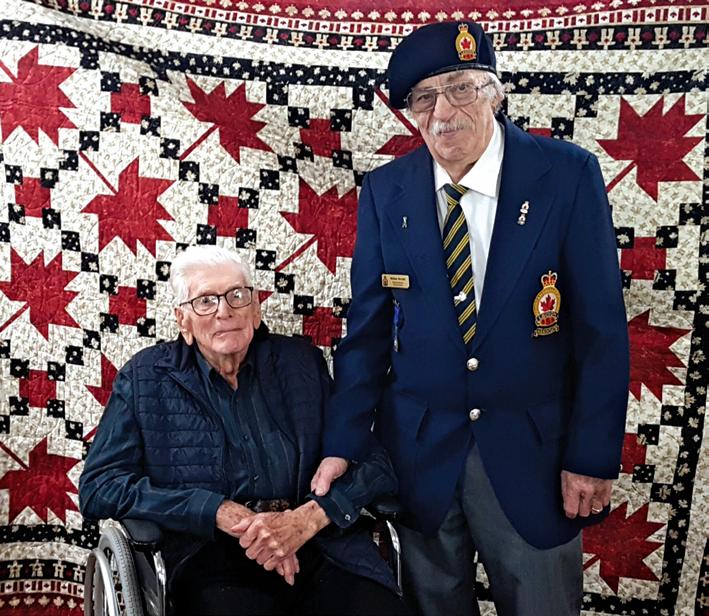
and
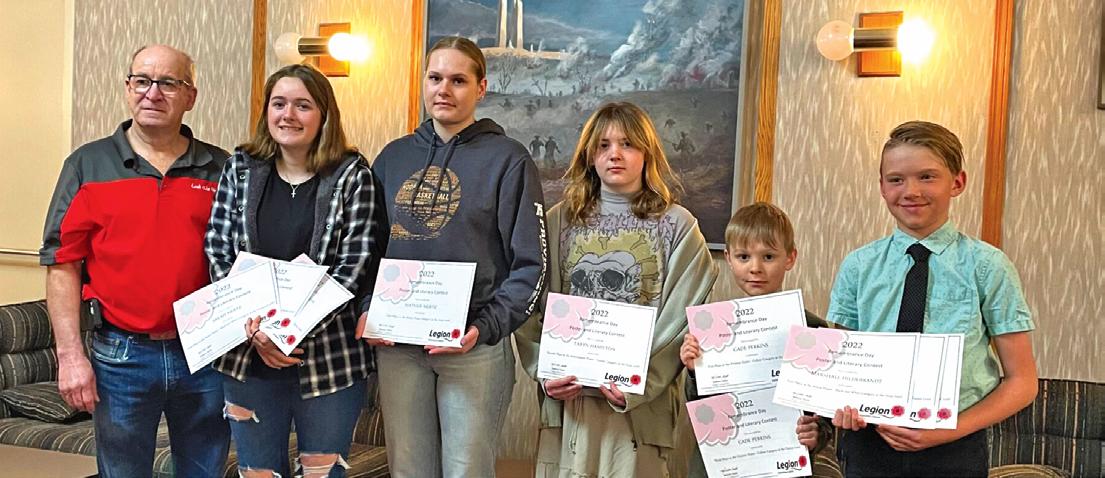
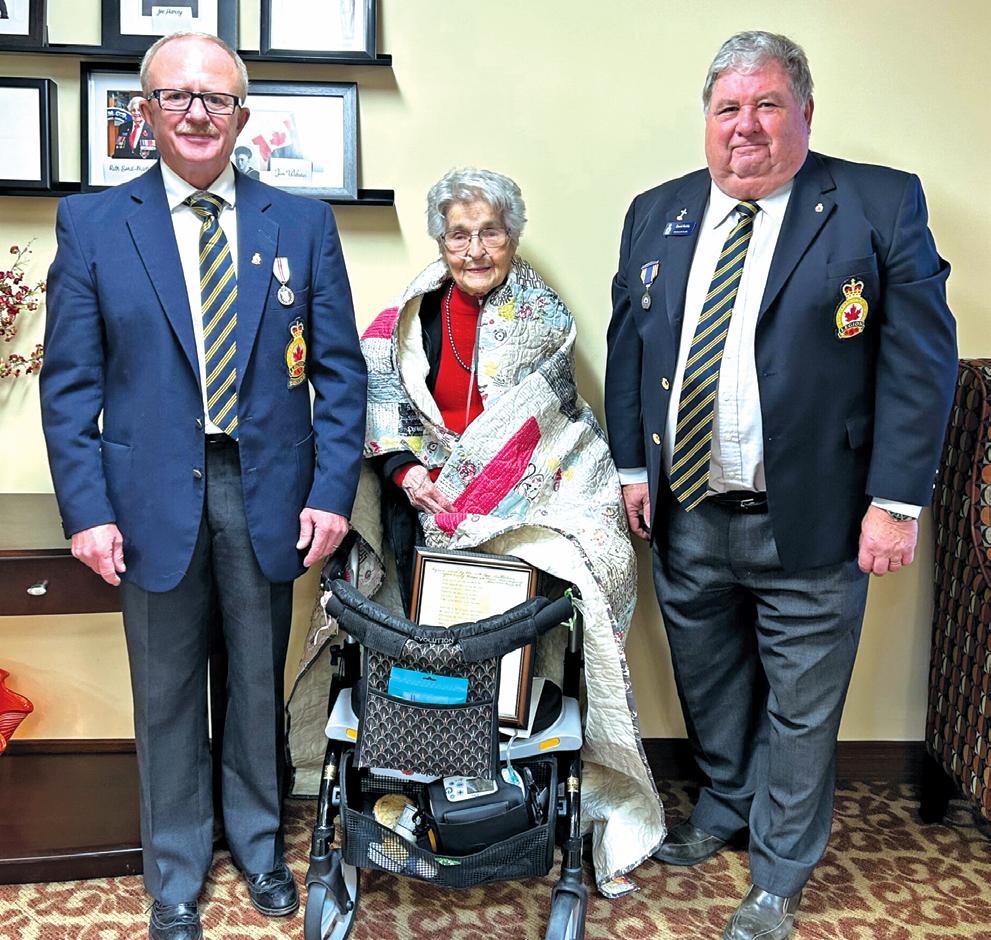
Bill
and
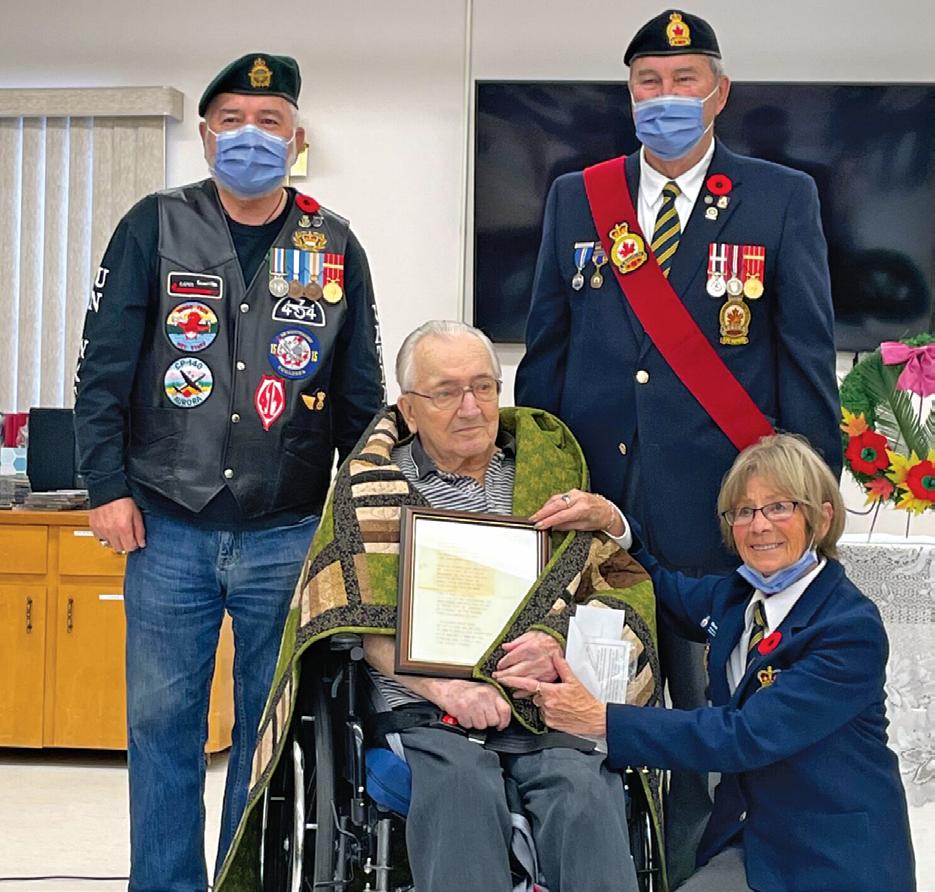
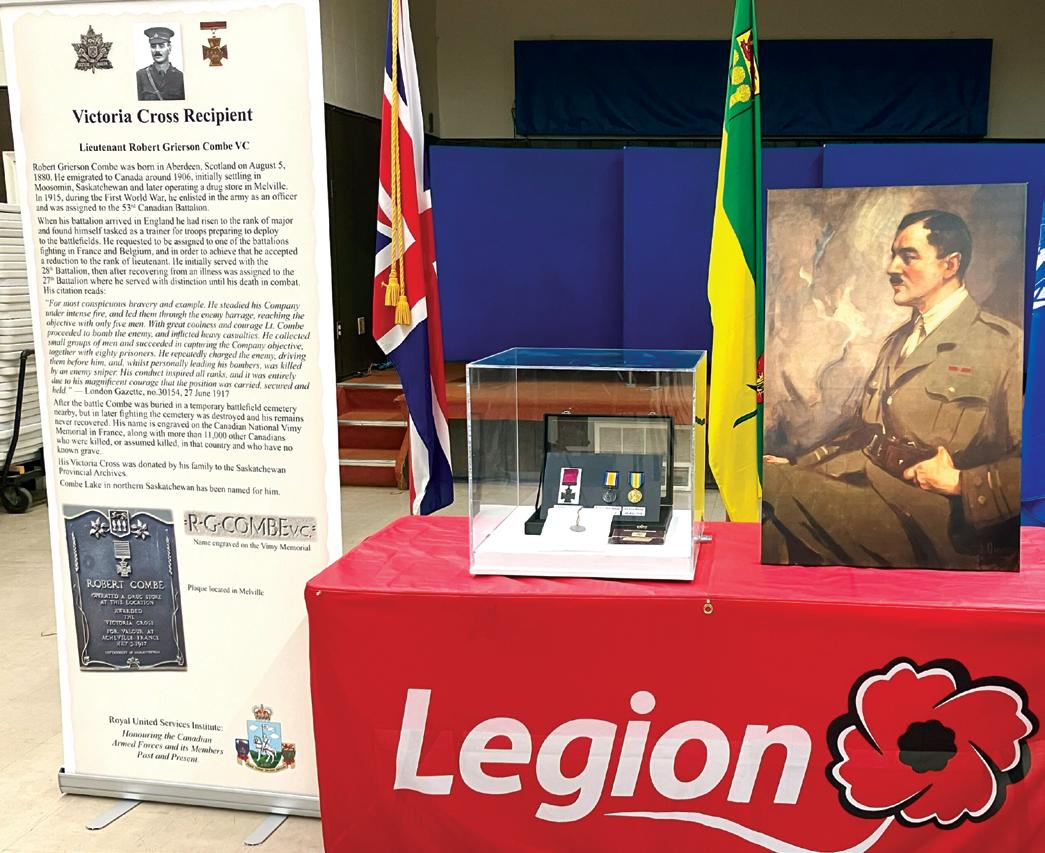
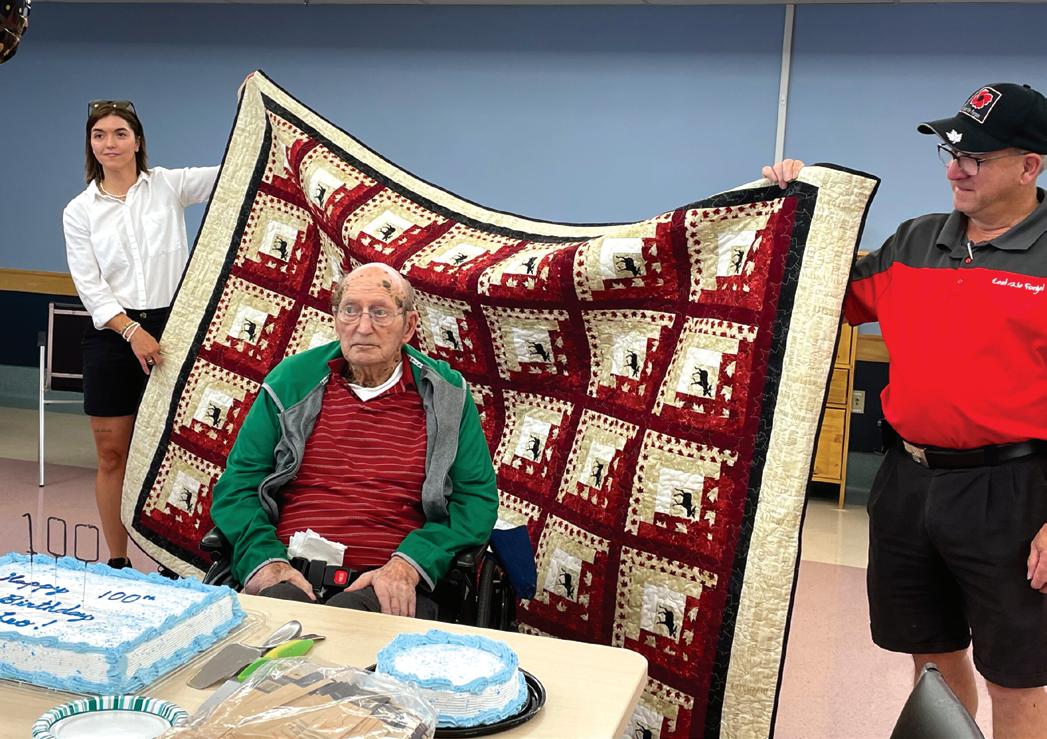
Past President Niki Sokolan and President Donald Hogemann of Humboldt, Sask., Branch present navy veteran Leo Saretsky with a Quilt of Valour for his 100th birthday. SHERRY HOGEMANN
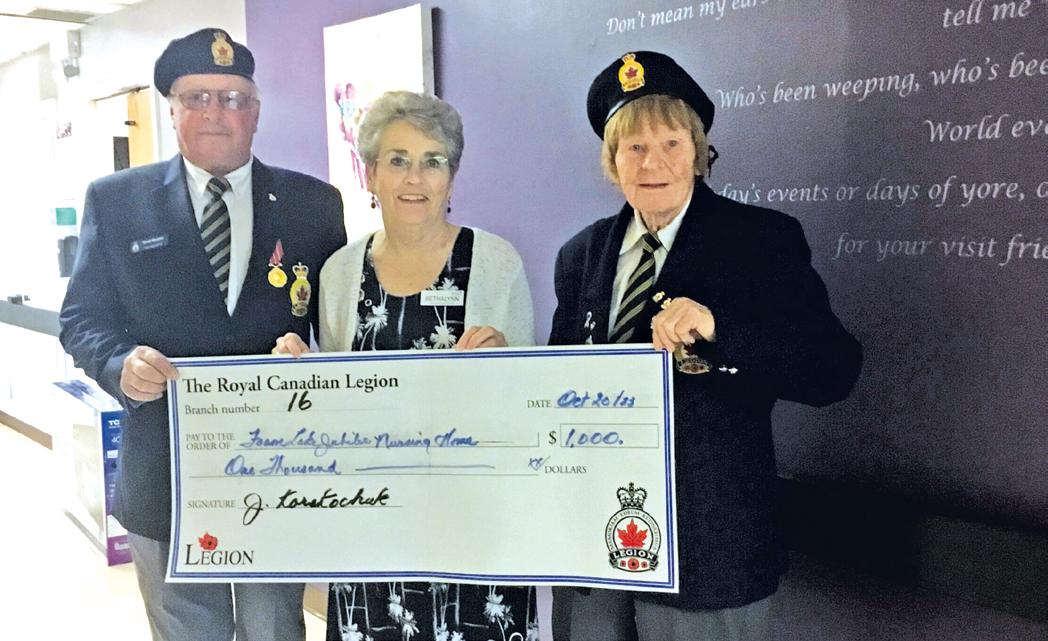
David
Send your photos and news of The Royal Canadian Legion in action in your community to your Command Correspondent. Each branch and ladies auxiliary is entitled to two photos in an issue. Any additional items will be published as news only. Material should be sent as soon as possible after an event. We do not accept material that will be more than a year old when published, or photos that are out of focus or lack contrast. The Command Correspondents are:
BRITISH COLUMBIA/YUKON: Graham Fox, 4199 Steede Ave., Port Alberni, BC V9Y 8B6, gra.fox@icloud.com
ALBERTA–NORTHWEST TERRITORIES: Bobbi McCoy, 2020 – 15 St. NW, Calgary, AB T2M 3N8, bobbi-mccoy@shaw.ca
SASKATCHEWAN: Tara Brown, 2267 Albert St., Regina, SK S4P 2V5, admin@sasklegion.ca
MANITOBA: George Romick, 320 Admiral Court, Thunder Bay, ON P7A 8B5, romickg@tbaytel.net
NORTHWESTERN ONTARIO: George Romick, 320 Admiral Court, Thunder Bay, ON P7A 8B5, romickg@tbaytel.net
ONTARIO: Roy Eaton, 567-294B North Channel Dr., Little Current, ON P0P 1K0, reaton@on.legion.ca
QUEBEC: Mary-Ann Latimer, 105-2727 rue St. Patrick, Montreal, QC H3K 0A8, msmarts@bell.net
NEW BRUNSWICK: Harold Wright, 2-299 Main St., Saint John, NB E2K 1J1, foulis20@gmail.com
NOVA SCOTIA/NUNAVUT: James Leadbeater, 4129 New Waterford Highway, New Victoria, NS B1H 5T4, james.leadbeater@hotmail.com
PRINCE EDWARD ISLAND: John Yeo, 657 Rte. 19, Meadow Bank, PE C0E 1H1, islander657@yahoo.ca
NEWFOUNDLAND AND LABRADOR: Brenda Slaney, Box 5745, St. John’s, NL A1C 5X3, bslaney@nfld.net
DOMINION COMMAND ZONES: EASTERN U.S. ZONE, Gord Bennett, 803-190 Cedar St., Cambridge, ON N1S 1W5, Captglbcd@aol.com; WESTERN U.S. ZONE, Douglas Lock, 1531 11th St., Manhattan Beach, CA 90266, douglock@fastmail.com
Submissions for the Honours and Awards page (Palm Leaf, MSM, MSA and Life Membership) should be sent directly to Michael A. Smith, Legion Magazine, 86 Aird Place, Kanata, ON K2L 0A1 or magazine@legion.ca.
DIGITAL PHOTOS—Photos submitted to Command Correspondents electronically must have a minimum width of 1,350 pixels, or 4.5 inches. Final resolution must be 300 dots per inch or greater. As a rough guideline, colour JPEGs would be between 0.5 megabytes (MB) and 1 MB.
PHOTO PRINTS—Glossy prints from a photofinishing lab are best because they do not contain the dot pattern that some printers produce. If possible, please submit digital photos electronically.
FRENCH INSERT—To receive a French insert of Legion Magazine content, please contact MagazineSubscriptions@legion.ca or call 613-591-3335.
50 years
years
years
years
PRINCE EDWARD ISLAND
JAMES WILLIAMS Ellerslie Br.
NEW BRUNSWICK
LEON SAVOIE St. Croix Br., St. Stephen
BRITISH COLUMBIA/YUKON
ARLENE KING Qualicum Beach Br.
JOYCE SMITH Courtenay Br.
TONY SPIERINGS Richmond Br.
SASKATCHEWAN
BRIAN MORRIS Robert Combe VC Br., Melville
ONTARIO
DARLENE GRAHAM Beachville Br.
KEN PELLOW Beachville Br.
RAY THORNTON Beachville Br.
MARY TRELFORD Tara Br.



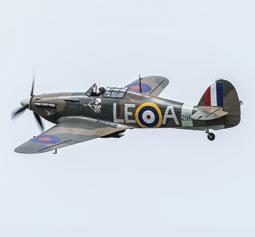


This past September, Canada’s diplomatic relations with India ruptured. The cause? The murder of Canadian citizen Hardeep Singh Nijjar in B.C. Nijjar supported calls for an independent Sikh homeland in northern India known as Khalistan. The killers, according to Prime Minister Justin Trudeau, were Indian intelligence agents. If true, this crime on Canadian territory by personnel of a foreign government is an unacceptable breach of the country’s sovereignty. India has denied the accusation. But there’s another side to this story. Why are many Sikhs in Canada pushing for an autonomous state in a foreign country? Many have been in Canada for years and a great number are citizens. Why does the flame of Sikh nationalism continue to burn so brightly? Naturally enough, this concerns the Indian government, which remembers that in 1985 Canadian supporters of Khalistan blew up an Air India plane travelling from Toronto to London, killing all 392 aboard. New Delhi also recalls that the Canadian investigation of the mass murder was botched.
It’s not only Indians in Canada, however, who intervene in their birth country’s politics and conflicts. Canadian Tamils supported a long and bloody civil war against Sri Lanka’s government. Serbs and Croats fought on the streets of Toronto during the breakup of Yugoslavia 30 years ago and a Croat who had lived in Canada for 20 years returned “home” and became Croatia’s defence minister. Somali immigrants clashed in cities across Canada over political disputes in their homeland last September. Canadian Jews pressured Ottawa for years to move Canada’s embassy from Tel Aviv to Jerusalem. But how can Canada establish its own foreign affairs policies among such diverse interests?
Interestingly, in 1939, a young officer in the Department of External Affairs was tasked with studying what to do about German pro-Nazi and Italian Fascist Canadian residents in the event of war. Norman A. Robertson’s report recommended the government block the import of seditious propaganda, stop its advertising in
pro-authoritarian newspapers and conduct tax audits of suspected Nazis and Fascists.
Robertson also suggested means to foster in immigrants a greater understanding of Canadian norms. He recommended English or French classes for newcomers, as well as access to social workers, legal aid, medical care, and the use of the CBC and the National Film Board as key communication tools. He further argued that immigrants should be integrated into the country’s political parties, as well as churches and other organizations. His goal, he wrote, was a “positive affirmation of the concept of Canadian Citizenship based on loyalty & domicile and a repudiation of ‘blood & soil.’” Unfortunately, the coming of war meant that Robertson’s propositions were essentially forgotten.
Even in the decades after the Second World War, little was done to implement Robertson’s suggestions. Yes, there were, and are, members of Parliament from many diasporas in Canada. And, yes, immigrants have done well in all facets of the country’s society. But, still for some, balancing the best interests of their adopted land with the politics of a homeland, is a challenge.
Canada’s political parties bear some responsibility for this. All parties have cultivated support from different cultural groups, successfully by the Conservatives for most of Stephen Harper’s time as prime minister and subsequently by the Liberals under Justin Trudeau. Indeed, Liberal wins in 24 of Canada’s 29 ridings with the highest percentage of racialized Canadians in the Greater Toronto Area and Lower Mainland B.C. were key in propelling the party to power in 2015.
Omer Aziz, a former Liberal advisor on foreign policy, wrote bluntly in The Globe and Mail this past September that he had watched how the battle for votes of Indo-Canadians had distorted the country’s “long-term priorities,” and how “politicians, who never understood South Asia or India anyway, were pandering in lowest-common-denominator ways in B.C. and Ontario suburbs, and playing up ethnic grievances to win votes.
“This was especially true within internal Liberal Party politics,” Aziz continued, “meaning that we could hardly focus on foreign policy and strategy without factoring in which ridings might be lost
because a certain group might be upset.”
It wasn’t only the Liberals who politicized foreign policy. The Conservatives did much the same as did the New Democratic Party led by Jagmeet Singh, a Sikh who was denied a visa by the Indian government in 2013.
“Canada should have at least begun to take steps to ensure our land was not used for terrorist financing—a reasonable demand, given that the overwhelming number of Canadian Sikhs are peaceful and uninterested in using violence to create a separate Sikh homeland,” said Aziz. The only problem, he noted, “was Mr. Trudeau did not want to lose the Sikh vote to Jagmeet Singh.”
This matters for much more than Canadian politics. India is becoming an increasingly important strategic partner of the U.S., Britain, Australia and many other Western countries for its potential role in Indo-China relations. India’s economy, population and global influence are growing. So, what will Canada do? Will Ottawa, no matter the party in power, cater to Sikh separatists or will it strengthen its economic ties to India? Perhaps even more important, will it avoid disrupting international efforts to align India with the West? These are the important questions.
“ WE COULD HARDLY FOCUS ON FOREIGN POLICY AND STRATEGY WITHOUT FACTORING IN WHICH RIDINGS MIGHT BE LOST BECAUSE A CERTAIN GROUP MIGHT BE UPSET.”
Of course, for its part, India must find a more diplomatic way to deal with hard problems.
But for Canada, the real problem remains establishing foreign policy in its own best interests without being overly influenced by the politics of other countries, which so many Canadians continue to hold close to their hearts. Time may help, but if the country fails to make efforts to address this, it will likely ensure both more foreign interference and more domestic trouble. This can’t continue. L
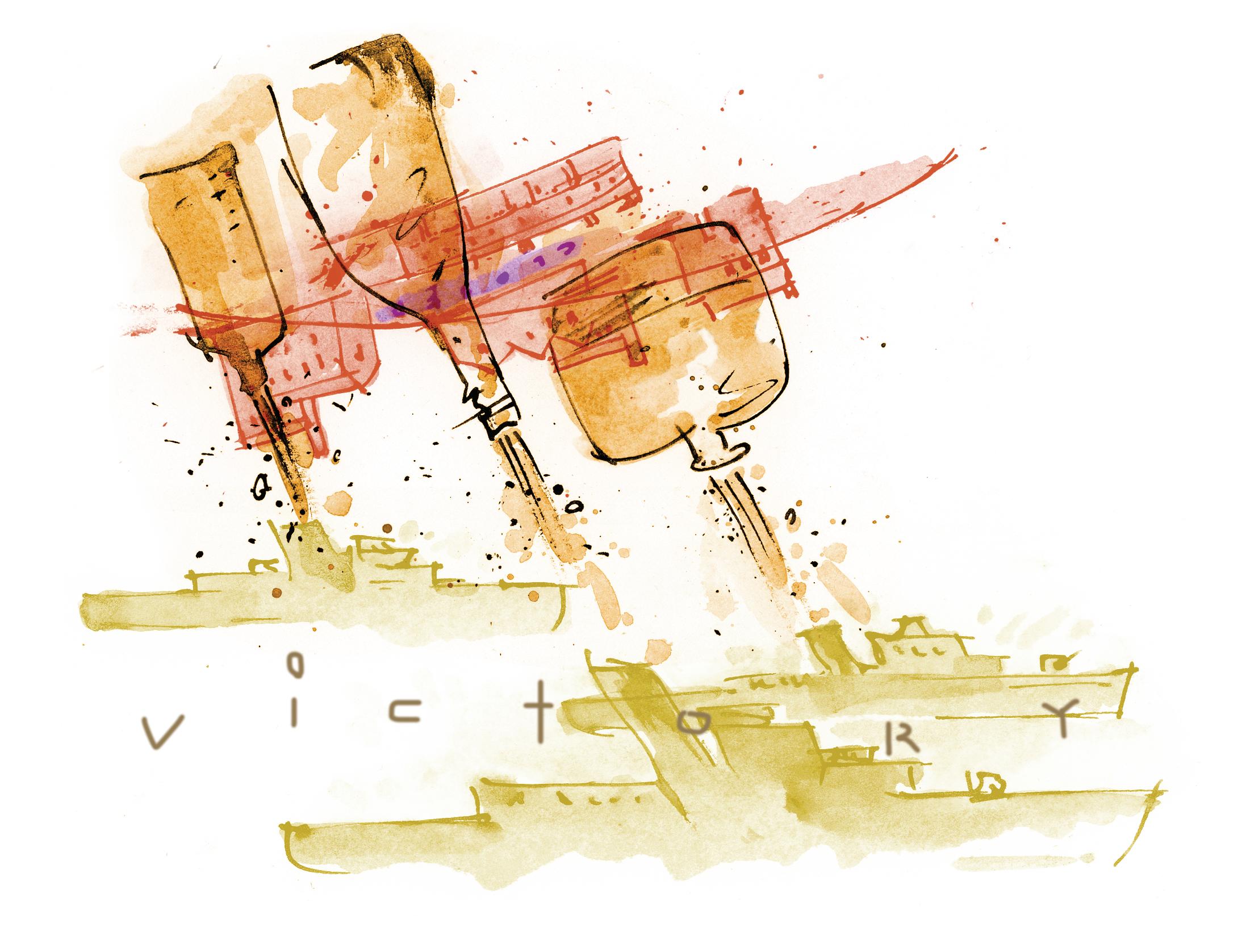
Although Halifax was a major port for the Royal Canadian Navy during the Second World War, there was no love lost between the city, known as “Slackers,” and the navy. The civilians saw the servicemen as an unruly and unwanted addition to their community. The sailors saw the town as cold and unfriendly. There were few places to get a drink or enjoy some entertainment. Matters came to a head in May 1945, when VE day celebrations produced the Halifax riot. While thousands of sailors looked to celebrate, the city shut down. Movie theatres, restaurants and shops closed. The streets were empty. Whether the problems started with civilian troublemakers or angry sailors
was never clear, but eventually the streets erupted. When the smoke cleared, the Liquor Commission in Halifax had lost 6,987 cases of beer, 1,225 cases of wine, two cases of alcohol and 55,392 quarts of spirits. The commission in Dartmouth was short 5,256 quarts of beer, 16,692 bottles of wine and 9,816 bottles of liquor. Keith’s Brewery was robbed of 30,516 quarts of beer.
I heard a story about a fellow who juryrigged an electric kettle using scrounged up bits and pieces on a Canadian airbase in Britain. It was a welcome addition to the billet as it could boil a gallon of water in four minutes. But, it could be treacherous. “It wouldn’t pass CSA standards. You didn’t dare plug it in unless it was full of water or else it would just melt.”
It seems there was a Canadian airman in Britain who was sent on leave in the summer of 1944, but decided he wanted to see action. He hitchhiked south to an English Channel port, scored travel to France and got to the front where military police rounded him up. They were puzzled, however, about what to do with him. He had a pass and
> Do you have a funny and true tale from Canada’s military culture? Send your story to magazine@legion.ca
was legitimately on leave. He wasn’t a deserter. He hadn’t violated any laws as far as they could tell. They shrugged and sent him back to England. At least he did get to see the front lines.
The Women’s Royal Canadian Naval Service, whose personnel were known as Wrens, was established in 1942. The British had a roughly equivalent service, but its members were auxiliaries. The Canadians, meanwhile, were considered part of the RCN and a Wren officer held the King’s commission.
Getting the service going, however, was a challenge. Uniforms were scarce, so when members of the first training group went on parade, inspecting officers had to turn a blind eye to those marching in sandals. One Wren in Halifax remembered being stopped by an older woman on the street. The matron said she was so pleased that “the lassies of the Salvation Army” had a new uniform hat. By the end of the war, 7,000 women had served as Wrens working in Canada, the U.S. and Britain, as well as Newfoundland, which wasn’t then a part of Canada and so was considered an overseas post.
A young seaman serving on a wartime Canadian corvette overstayed his leave by three days and was hauled before his captain for discipline upon his return. He explained that he was about to board a train to port when his grandma collapsed, which forced him to miss the trip. He couldn’t leave until she was safe, could he?
His tale had moved the young sub-lieutenant assigned to the case, but it didn’t seem to sway the captain, who read the riot act to the quavering sailor and sentenced him to be confined to the ship for 14 days. It was only later that the sub-lieutenant realized that the ship was due to sail on convoy duty the following day and would be at sea for at least two weeks. The punishment was simply duty as normal, and the sub-lieutenant made a mental note about the ways of commanding officers.
Some military slang to ponder: Amphibious training: Take the afternoon off and hit the beach. Brain housing group: A skull. Careborne: A search and rescue tech. Chairborne: The air force (clearly army slang).
The Cowering Inferno: National Defence Headquarters.
The Horny Horse: The Saskatoon naval reserve division, HMCS Unicorn. NATO standard: Tim Horton’s double-double.
Navy gravy: Ketchup.
THE CIVILIANS SAW THE SERVICEMEN AS AN UNRULY. THE SAILORS SAW THE TOWN AS COLD AND UNFRIENDLY
The alphabet has a lot of letters that sound very much alike, including Bee, Cee, Dee, Gee, Eff, Ess, Jay, Kay, Em, En. Militaries have long tried to get around that problem by using clear words to replace confusing letters. Anyone in the forces is familiar with the NATO phonetic alphabet—Alpha, Bravo, Charlie, Delta, etc.—but it only dates to 1956.
Britain and the Commonwealth at one time had their own system including Ack, Beer, Charlie, as well as Freddie, George, Monkey, Nuts, Pip and Yoker. During the Second World War, an American system was adopted, too, including Able, Baker and Charlie through Nan, Option, Prep, Sugar, Tare and Uncle. The NATO standard followed.
Quippy quotes…
“Never before have so many stood in line so long for so little.” An inscription on the wall outside the mess at HMCS Stadacona
A friend has warned me never to ask a navigator what time it is. He says “the reply will be something like, ‘in 10 seconds it will be 12:34 and 30 seconds.’ All I wanted to know was whether I was late for lunch.” L
By Mark Zuehlke
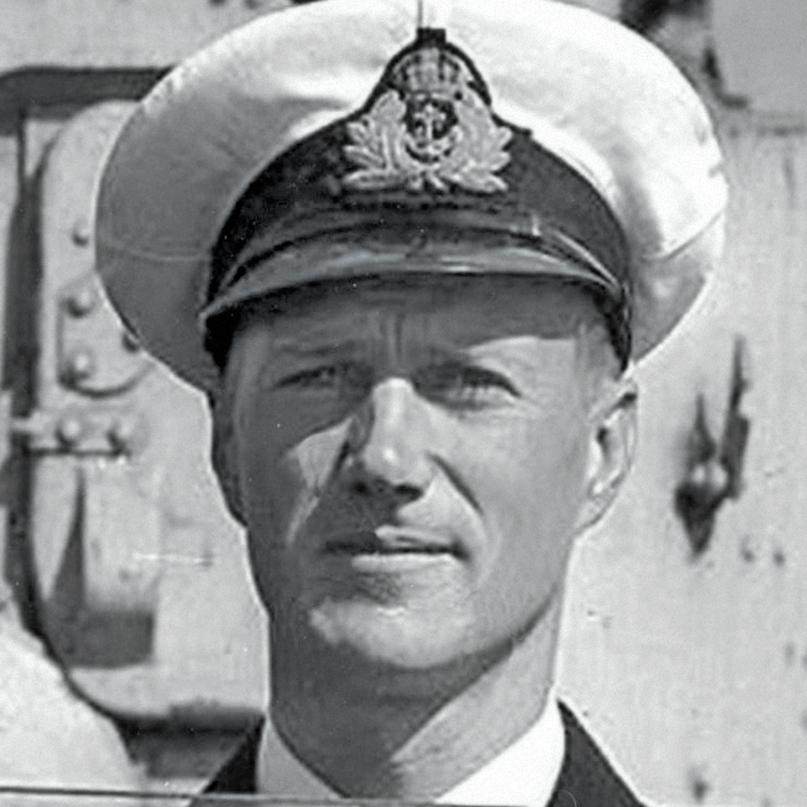
OnAug. 6, 1942,

Acting LieutenantCommander John Stubbs was aboard HMCS Assiniboine, which was escorting a North Atlantic convoy, when the ship engaged a U-boat at close range. After an exchange of fire seriously damaged both boats, Stubbs’ vessel rammed and sunk U-210. Naval historical officer
“
.”
“Stubbs never took his eye off the U-boat, and gave his orders as though he were talking at a garden party.”
—Naval historical officer Gilbert Tucker
Gilbert Tucker described first-hand how Stubbs
“never took his eye off the U-boat, and gave his orders as though he were talking at a garden party.” Tucker added that Stubbs’ handling of Assiniboine was “a masterpiece of tactical skill,” carried out while the bridge was “deluged [by] machine gun bullets.” Stubbs was awarded a Distinguished Service Order for his actions. He was promoted to lieutenantcommander on May 1, 1944, following a year ashore and returned to sea at the helm of Tribal-class destroyer Athabaskan On April 25, 1944, Task Force 26 sailed from Plymouth, England. It consisted of the cruiser HMS Black Prince and four Tribals— HMS Ashanti and the Royal Canadian Navy’s Athabaskan, Haida and Huron. At 2:10 the following morning, the force intercepted three Type 39 torpedo boats (Elbings) of the 4th Torpedobootsflotille commanded by Korvettenkapitän Franz Kohlauf.
Although designated torpedo boats, Type 39s were actually small destroyers. Their main armament consisted of four 4.1-inch guns and six 21-inch torpedo tubes, making them formidable opponents. In a chaotic action, Athabaskan and Haida engaged Kohlauf’s command vessel, T-29 turning its decks into a mass of flames. Joined by the other destroyers, the combined gunfire sent T-29 to the bottom.
Three nights later, Athabaskan and Haida met the two remaining Elbings. In an exchange of torpedo salvos, Athabaskan was struck on the port side. At the same time, shellfire from Haida caused so much damage to T-27 that its captain deliberately ran the vessel ashore. An explosion, meanwhile, set Athabaskan’s main fuel bunker aflame.
“It looks quite serious. Am steering aft,” Stubbs radioed Haida. With the fire spreading rapidly, Stubbs ordered the crew to abandon ship just before a magazine of 4-inch ammunition exploded. Those sailors not killed in the explosions, took to the sea. The badly burned Stubbs swam among the sailors, rallying them by singing “Wavy Navy Roll Along.”
Haida rescued 42 men before Stubbs warned it off, shouting: “Get away Haida. Get clear.” Haida’s motor cutter picked up six others and the Germans rescued 85. The remaining 128 men—including Stubbs—perished. He was posthumously awarded the Distinguished Service Cross for the April 26 sinking of Kohlauf’s T-29. L

Onthe night of Oct. 22-23, 1943, Korvettenkapitän Franz Kohlauf’s 4th Torpedobootsflotille was escorting German blockade runner Münsterland through the English Channel. Alerted by Allied intelligence, the British dispatched a strike force led by the cruiser HMS Charybdis and accompanied by two U-class destroyers, Grenville and Rocket, as well as four Hunt-class destroyers, Limbourne, Wensleydale, Talybont and Stevenstone. Kohlauf had five Type 39 torpedo boats (Elbings) under his command. Detecting the British force by hydrophone, Kohlauf raced to make contact. Although there was bright moonlight, Kohlauf used the backdrop of a rain squall for partial concealment. At a range of just 2,000 metres, Kohlauf spotted Charybdis. Thinking the cruiser was engaging, Kohlauf ordered a battle turn to starboard with T-23 and T-26 unleashing 12 torpedoes. One struck Charybdis on the port side. Losing power, it began to list. Kohlauf’s remaining Elbings were still turning and two fired their torpedo complements. This salvo finished Charybdis and also sunk Limbourne Kohlauf was awarded the Knight’s Cross of the Iron Cross. His citation noted that, “by way of a clever battle maneuver, [Kohlauf] was able to bring his ships to…where their torpedoes would be certain to hit. Through his personal bravery, Kohlauf was…able to over-
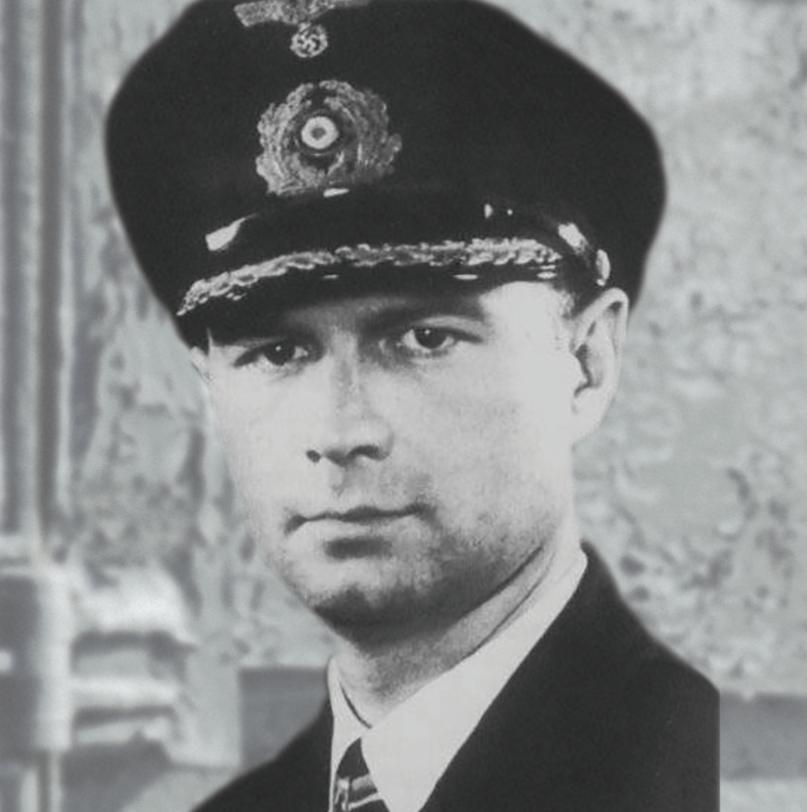
come the critical situation and accomplish a tactical success of extraordinary proportions.”
During early 1944, even after suffering some losses, Kohlauf’s flotilla remained a constant threat to Allied shipping in the Channel. The losses, however, meant that when his flotilla was intercepted on April 25, it numbered only three Elbings.
Surprised, Kohlauf attempted to escape by increasing speed and reversing course. At 2:20 a.m. on the 26th, HMS Black Prince fired illumination rounds that enabled the destroyers to see and engage the Elbings.
At around 3 a.m., Kohlauf’s T-29 was struck by a full salvo fired by either HMCS Athabaskan or Haida. Its rudder damaged, T-29 veered out of control. The two destroyers circled with guns blazing from a range of 4,000 metres. The gun crews on T-29 lashed back, but were unable to match the Canadian rate and accuracy of fire.
SOON THE ELBING WAS ABLAZE FROM BOW TO STERN. SHELLS DESTROYED ITS BRIDGE, KILLING KOHLAUF.
Soon the Elbing was ablaze from bow to stern. Shells destroyed its bridge, killing Kohlauf. The surviving crew scuttled the boat. T-29 was the largest enemy vessel to that date sunk by Canadian forces. The commander of Black Prince wrote that “this… engagement had done much to enhance the already high morale of the ships and men of the ships companies engaged.” L
“Through his personal bravery, Kohlauf was…able to accomplish a tactical success of extraordinary proportions.” —Knight’s Cross of the Iron Cross citation for Franz Kohlauf
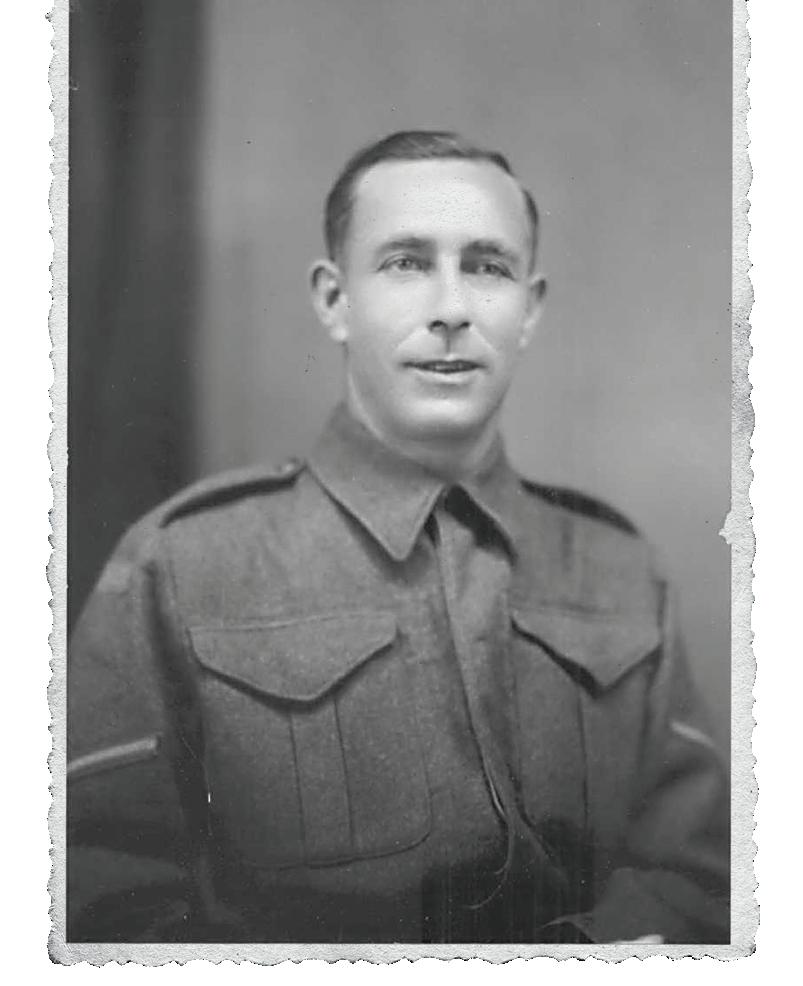
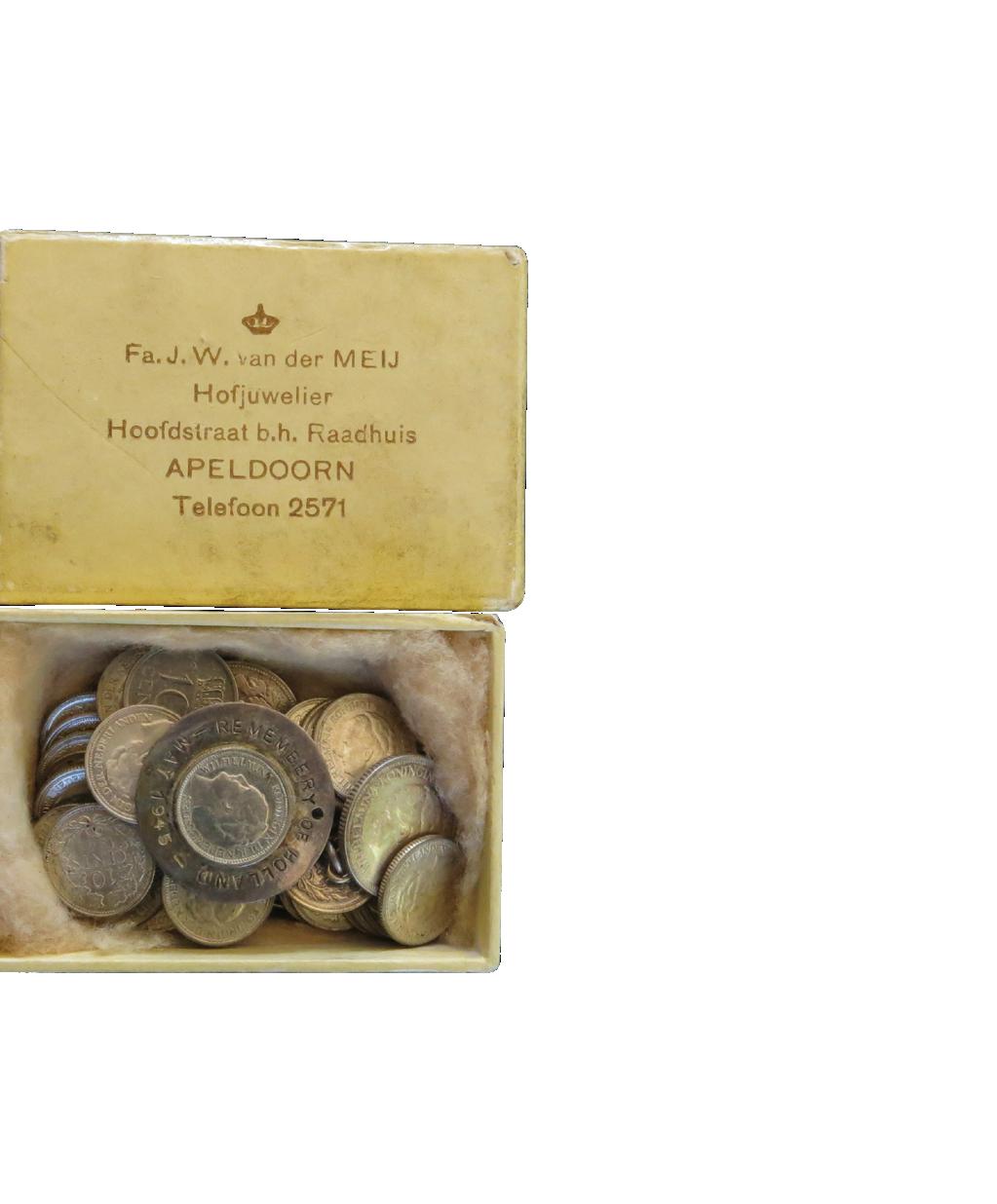
Nearly 80 years later, a Canadian soldier’s family is reunited with his Second World War treasures
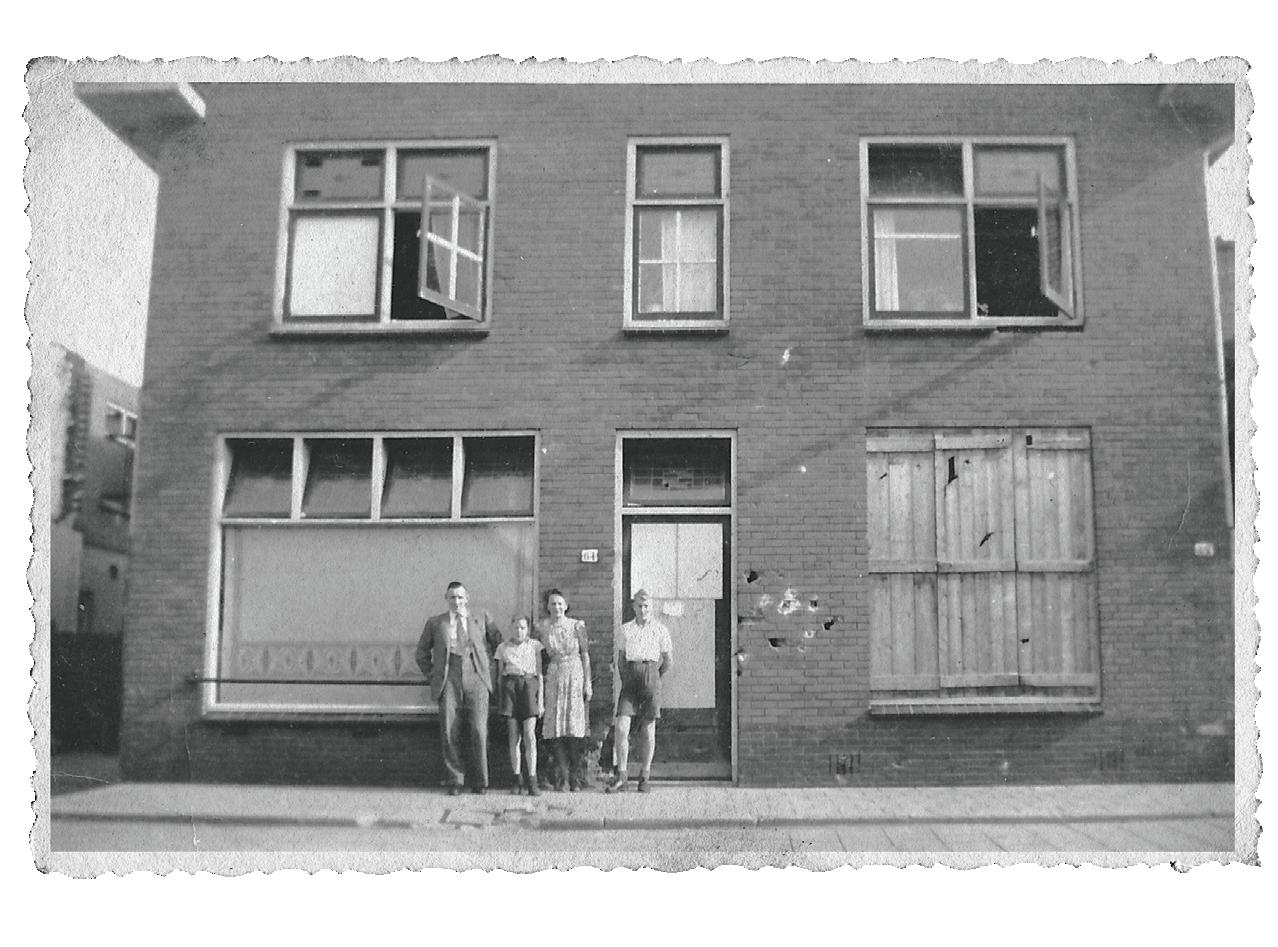
In2018, Martijn van Essen finally had an answer to the source of the Second World War relics in his grandfather’s attic.
It had been a decades-long quest to find out more about the artifacts that had hung over his head since the age of 14 in Apeldoorn, Netherlands. There were ammunition boxes and blankets, but nothing as intriguing to van Essen and his grandfather, Herman, as the 69 centimetre by 47 centimetre olive-green chest, or footlocker,
Regiment who helped liberate the Netherlands from Nazi Germany.
“I was excited to learn about the stories he left behind,” said van Essen.
with the hand-painted name “Cpl. L.M. Brinkman” on it.
For years, the pair had worked to identify Brinkman, interviewing local WW II survivors, only to find one dead end after another. Following Herman’s death in 2009, however, van Essen finally had an “Aha” moment.
Friends scouring service records from Library and Archives Canada for van Essen had learned who the chest’s owner was: Lawrence Milton Brinkman, a Canadian corporal with the Essex Scottish
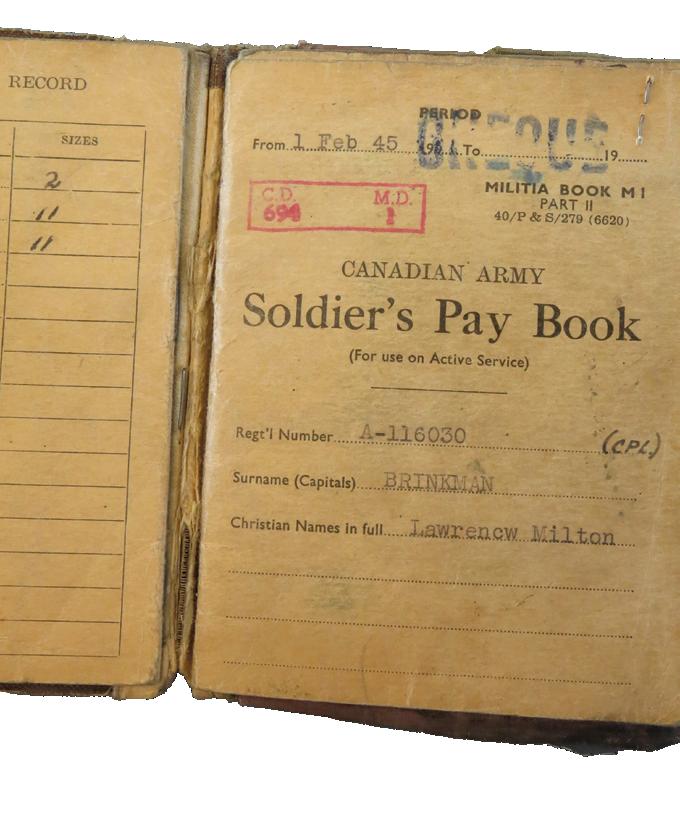
On April 12, 1945, the Canadians launched Operation Cannonshot, and the 1st Canadian Infantry Division was tasked with crossing the IJssel River to free parts of northern and western Netherlands. Pushing westward, Apeldoorn was liberated five days later. Herman, then a young boy, witnessed frequent firefights, aerial bombings and the work of Canadian soldiers who were quartered at his home. The Canadians befriended Herman, giving him chocolate, teaching him how to smoke and, of course, leaving behind such historical treasures.
“My grandfather was proud of the footlocker,” said van Essen.



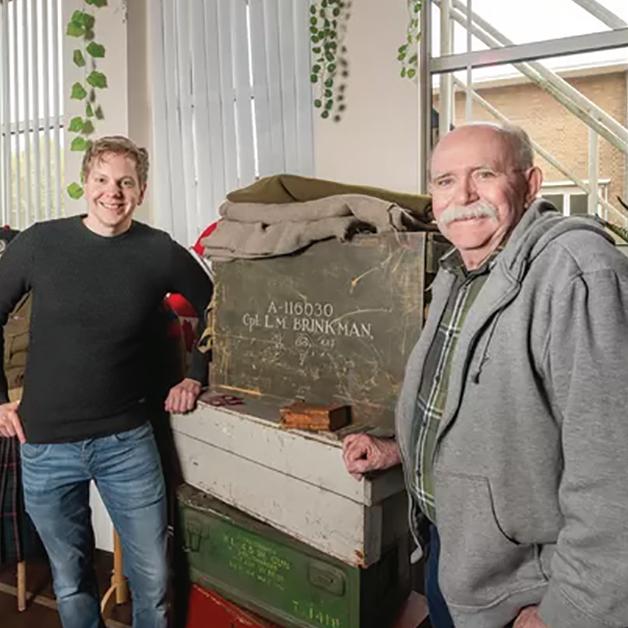
“I was excited to learn about the stories he left behind.”
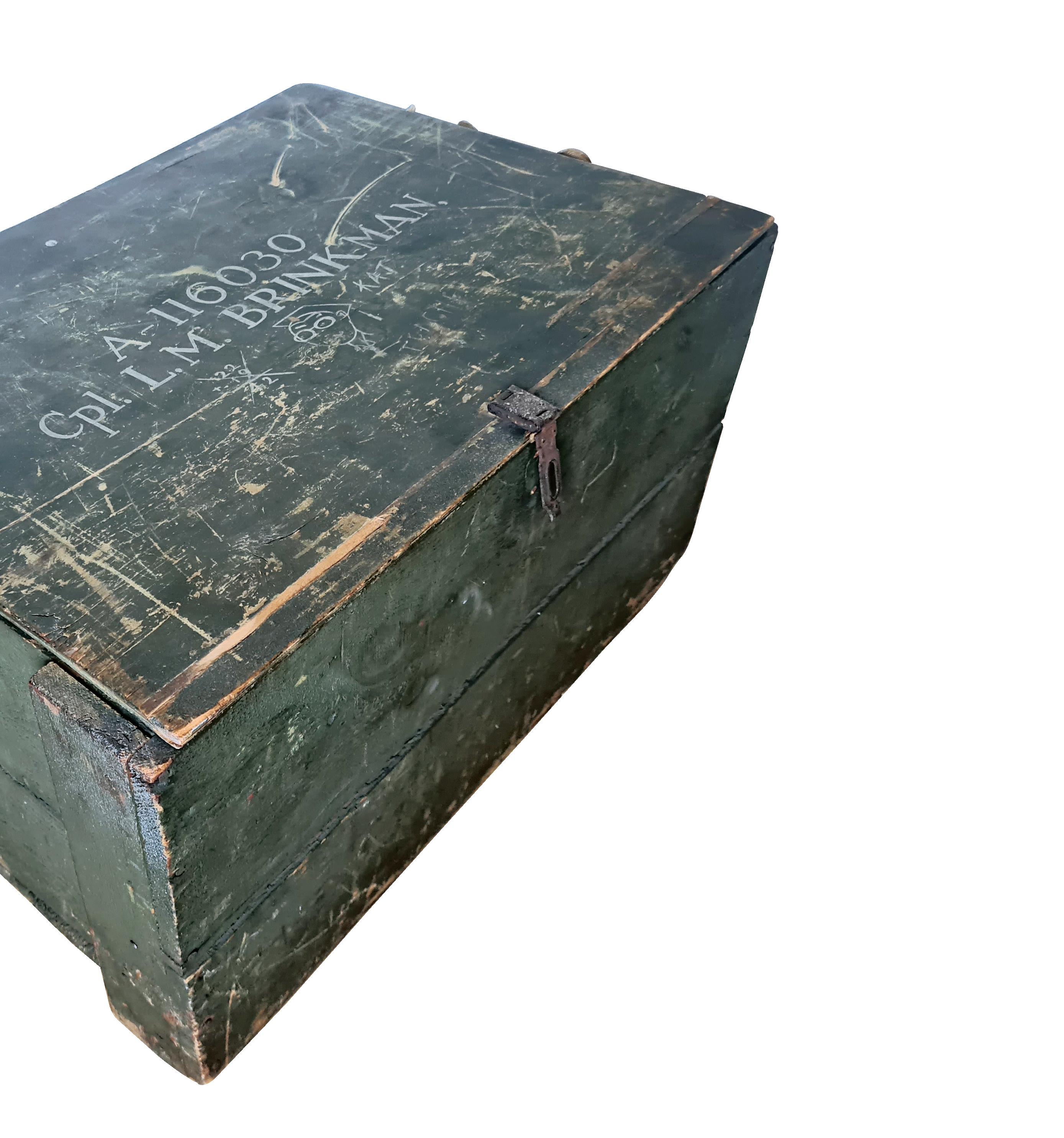
Number of years the van Essen family kept Corporal Lawrence Martin Brinkman’s footlocker
11.7
Weight in kilograms of Brinkman’s trunk
6
Approximate number of items left in the chest, including some blankets, an ammunition box and a captured German toolbox
69 x 47
Length and width in centimetres of Brinkman’s locker

Born on May 6, 1907, Brinkman worked at the Ford Motor Company in Windsor, Ont., until volunteering to join the miliary in September 1942. First assigned to the Royal Canadian Ordnance Corps,
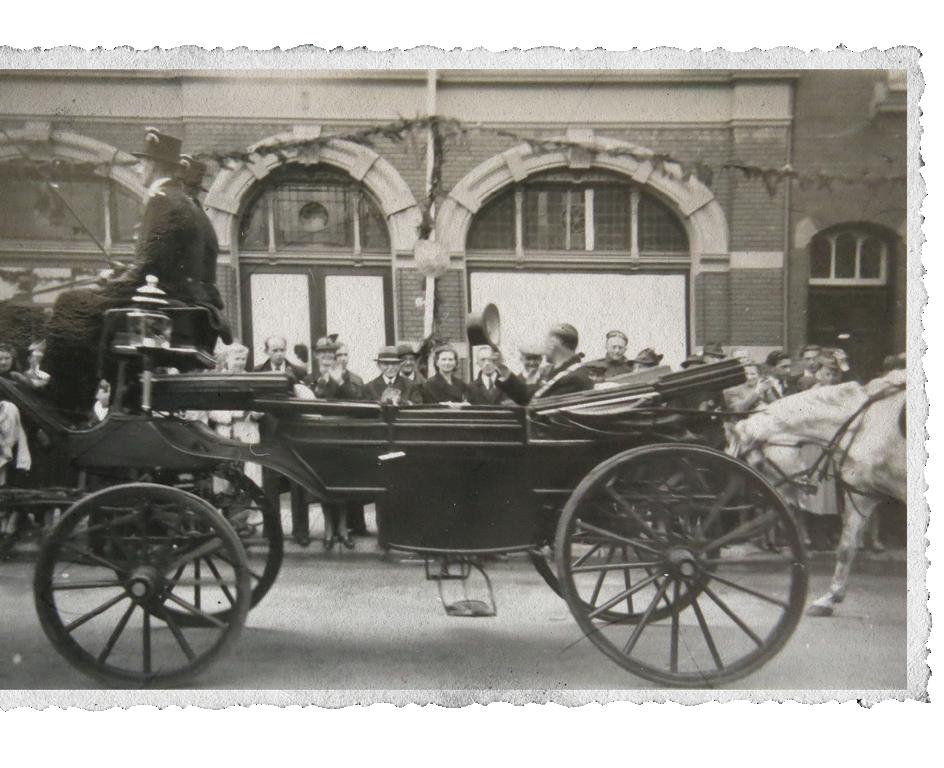
Brinkman soon transferred to the Essex Scottish Regiment, a Canadian militia unit which had suffered significant losses in the Dieppe Raid. Promoted to corporal, Brinkman was appointed to the regiment’s educational section as an assistant, receiving numerous awards for his wartime contributions.
After contacting Brinkman’s children Lynne and Barry in 2022 via ancestry.ca, van Essen learned even more about the footlocker, including the items it once held.
While the chest contained common items such as photos, money, a pay/ service record book and European souvenirs, it also included such uniquely Apeldoornian mementoes as a picture of the wartime mayor, postcards of the city and a box from a local jewelry store.
Video calls and emails between van Essen and Brinkman’s children eventually turned into an in-person visit in the spring of 2023, liberation season in the Netherlands. Barry Brinkman arrived to an appreciative welcome in Apeldoorn.
Meeting Barry, van Essen finally felt like he understood who Brinkman might have been as a person. “Maybe by getting to know Barry, I could imagine how Lawrence was—a nice, funny guy.” L

By Don Gillmor
The early part of the race to the New World involved mainly the Spanish and the English, though England dropped out of the effort after John Cabot’s 1497 trip to Newfoundland. It was too preoccupied at home with religious strife, wars and domestic politics. The
“I AM RATHER INCLINED TO BELIEVE THAT THIS IS THE LAND GOD
A hand-coloured woodcut depicts Jacques Cartier arriving in Canada in 1534.
Spanish, meanwhile, had success in the southern hemisphere, claiming territory and bringing back gold.

So, it fell to Jacques Cartier to find the elusive passage to Asia for France. In 1534, he set off from St. Malo, reaching Newfoundland in 20 days, arriving on May 10. He sailed north to Labrador, where he gave his now famous assessment of this new country: “I am rather inclined to believe that this is the land God gave to Cain.”
than 40 canoes filled with Mi’kmaq approached and surrounded a vessel that was exploring the coast.



In 1523, King Francis I of France felt his country should get into the colonial game. He helped finance an expedition to the New World hoping to find a passage to the Orient, or at least gold. It was led by Giovanni da Verrazzano, who was born in Tuscany but moved to Dieppe. Verrazzano explored North America’s east coast as far north as Newfoundland, claiming all of it for France. He returned in 1527 and 1528, venturing further south this time. In the Lesser Antilles, he went ashore, was captured by locals and killed.
Cartier was aware of Verrazzano’s fate, so he was wary of contacting any Indigenous Peoples. Plus, there was a general climate of fear in France at the time. French historian Robert Mandrou wrote that fear was the dominant emotion in 16th century France: fear of poverty, of starvation, of war and of the supernatural, all of which informed Cartier’s interactions.
His first encounter went well though. Locals approached in canoes, indicating they were interested in trade. “We likewise made signs to them that we wished them no harm,” Cartier wrote in the ship’s log, “and sent two men ashore, to offer them some knives and other iron goods and a red cap to give to their chief.”
A subsequent encounter didn’t go as well. More
“All came toward our longboat, dancing and showing many signs of joy, and of their desire to be friends,” Cartier wrote. But the number of people made him nervous, his fears resurfaced and he ordered his men to shoot over their heads with two small cannons.
The Mi’kmaq retreated. Cartier had more luck with the St. Lawrence Iroquoians, who he encountered at the Baie de Gaspé. Their relationship was good until Cartier’s men put up a large cross and knelt before it. The Iroquoian chief, Donnacona, approached Cartier’s ship in a canoe and delivered a speech, pointing to the cross, evidently worried that Cartier was using it to lay claim to the land, a worry that would eventually be borne out.
Cartier bartered with various Indigenous Peoples, but the most valuable thing he received in return was knowledge of the land, a knowledge that allowed Cartier and his men to survive their first harsh Canadian winter. L























✓ First walk-in tub available with a customizable shower
✓ Fixed rainfall shower head is adjustable for your height and pivots to offer a seated shower option
✓ High-quality tub complete with a comprehensive lifetime warranty on the entire tub
✓ Top-of-the-line installation and service, all included at one low, affordable price