Legion members and their families can benefit from an exclusive discount on their car, home, condo and tenant’s insurance, on top of any other discounts, savings and benefits customers are already eligible for at belairdirect.
To take advantage of this offer, simply call us and mention you are a Legion member to get your exclusive premium.
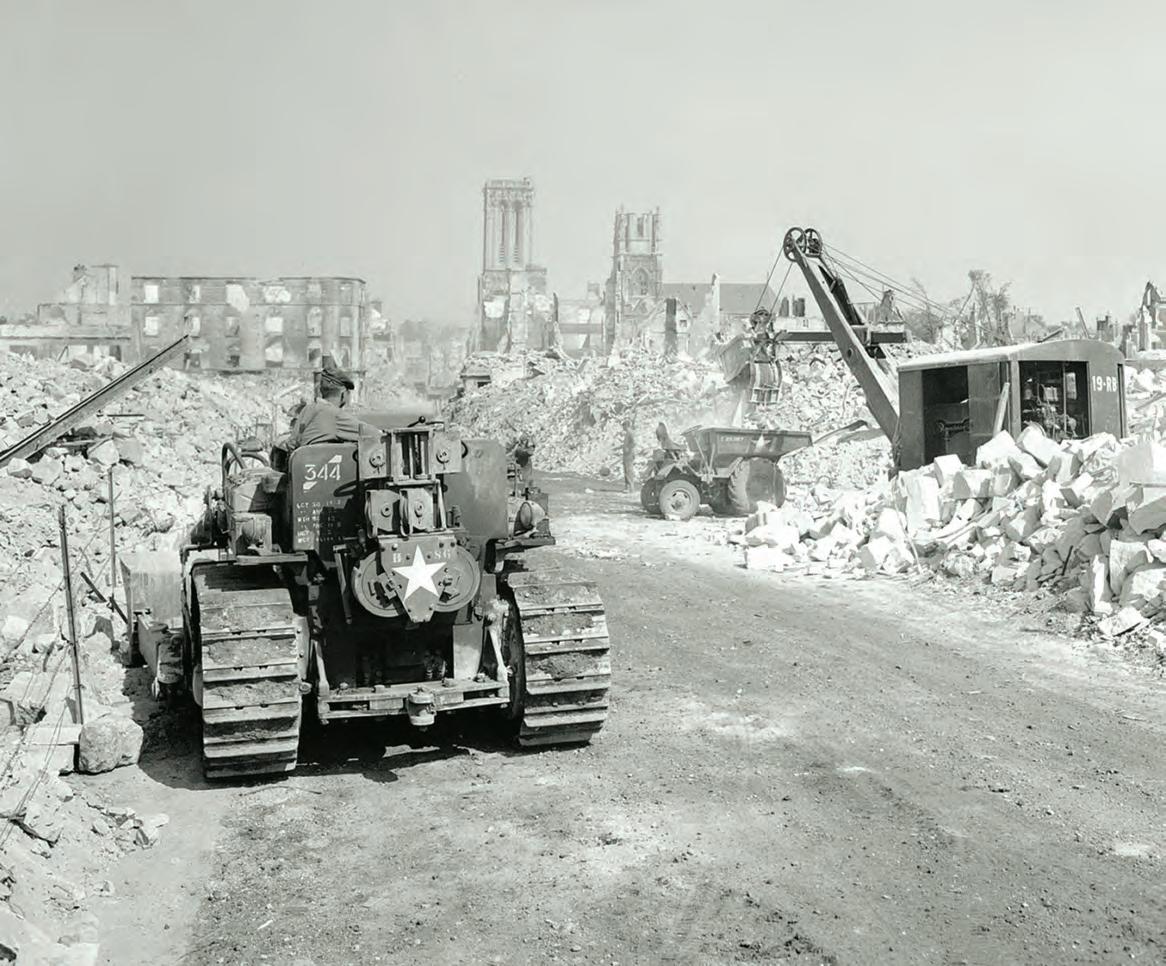
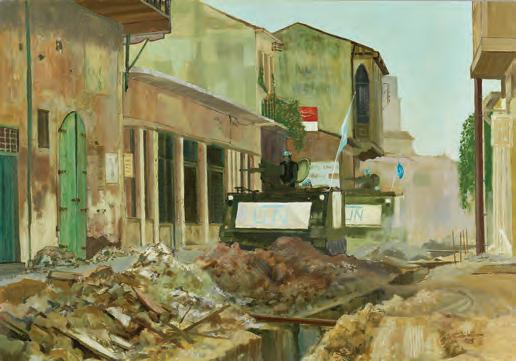
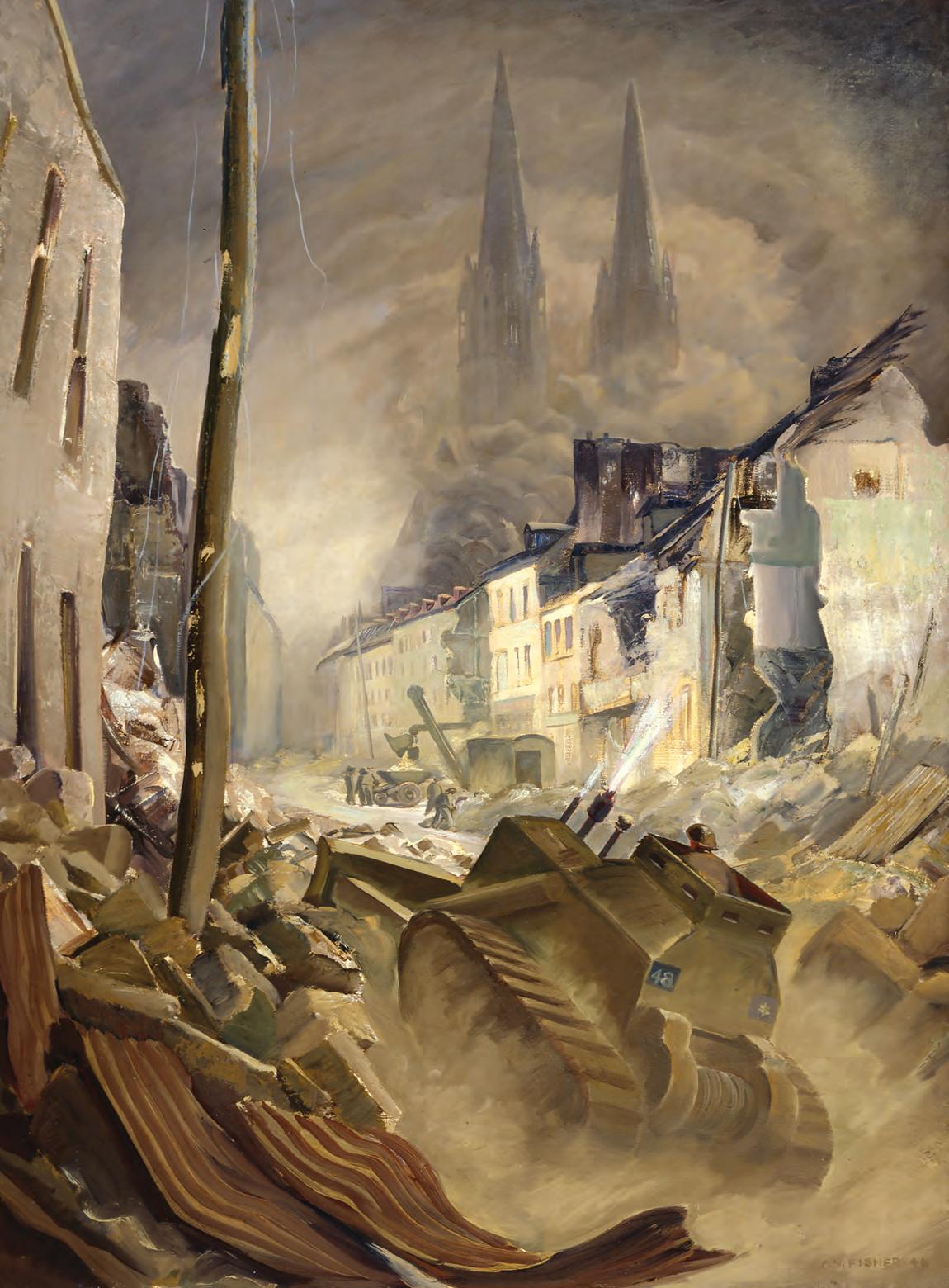
Clearing the way
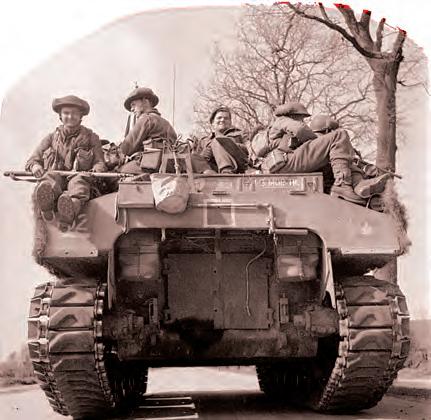
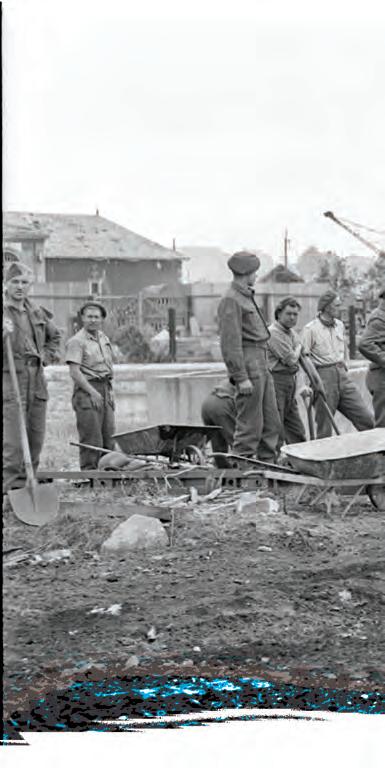
Using American equipment, Canadian combat engineers move rubble from a street in Caen, France, in August 1944.
See page 32
C
Features
18 IN THEIR FATHERS’ FOOTSTEPS
Ninety pilgrims walked more than 60 kilometres through Dutch towns and countryside to learn more about the Canadians who liberated the Netherlands
By Sharon Adams
24 U-BOAT MAN
From hunter of Allied ships to PoW and Canadian entrepreneur, the incredible journey of Kurt Schönthier
By Stephen J. Thorne
32 THE BRIDGES OF CAEN
How George Gilbert Reynolds and the 23rd Field Company, Royal Canadian Engineers, played an important role in the liberation of Europe
By Aaron Kylie
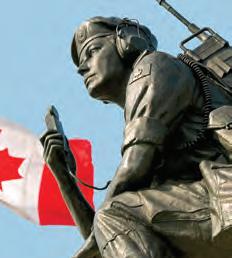
38 THE PEACEKEEPING PROGRESSION
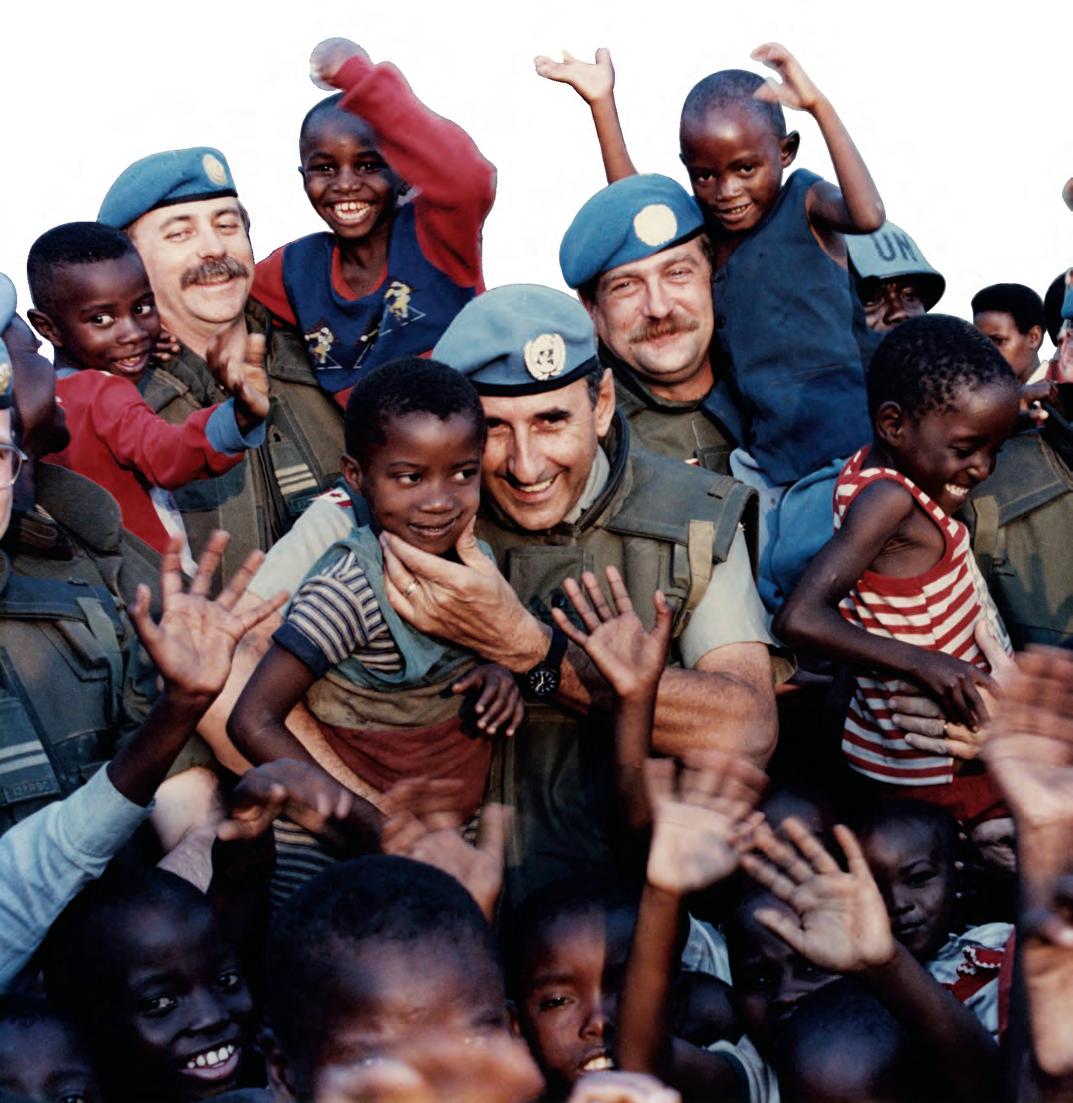
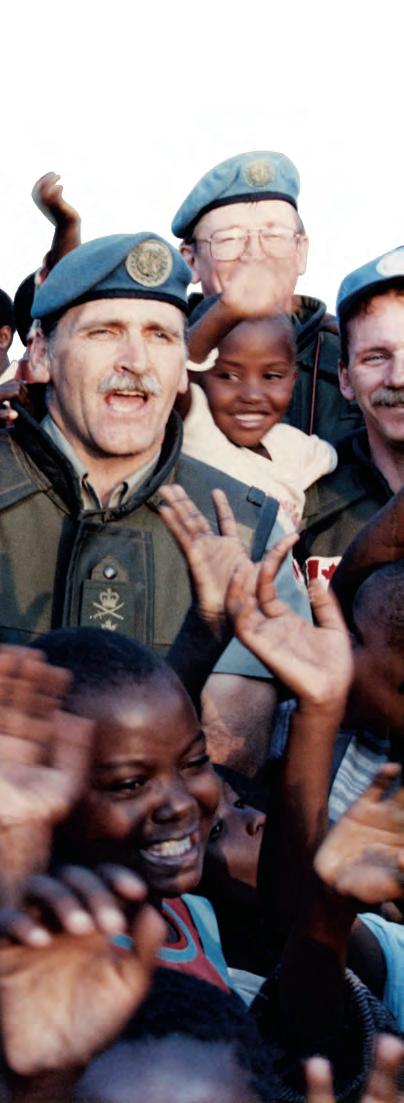
Reflecting on the role of children in peace and security as the global conflict resolution plan celebrates its 75th anniversary
By Roméo Dallaire with Shelley Whitman
48 THE LONG WAIT
In the early years of the Second World War, Canadian troops trained, trained and trained some more, and saw little action
By J.L. Granatstein
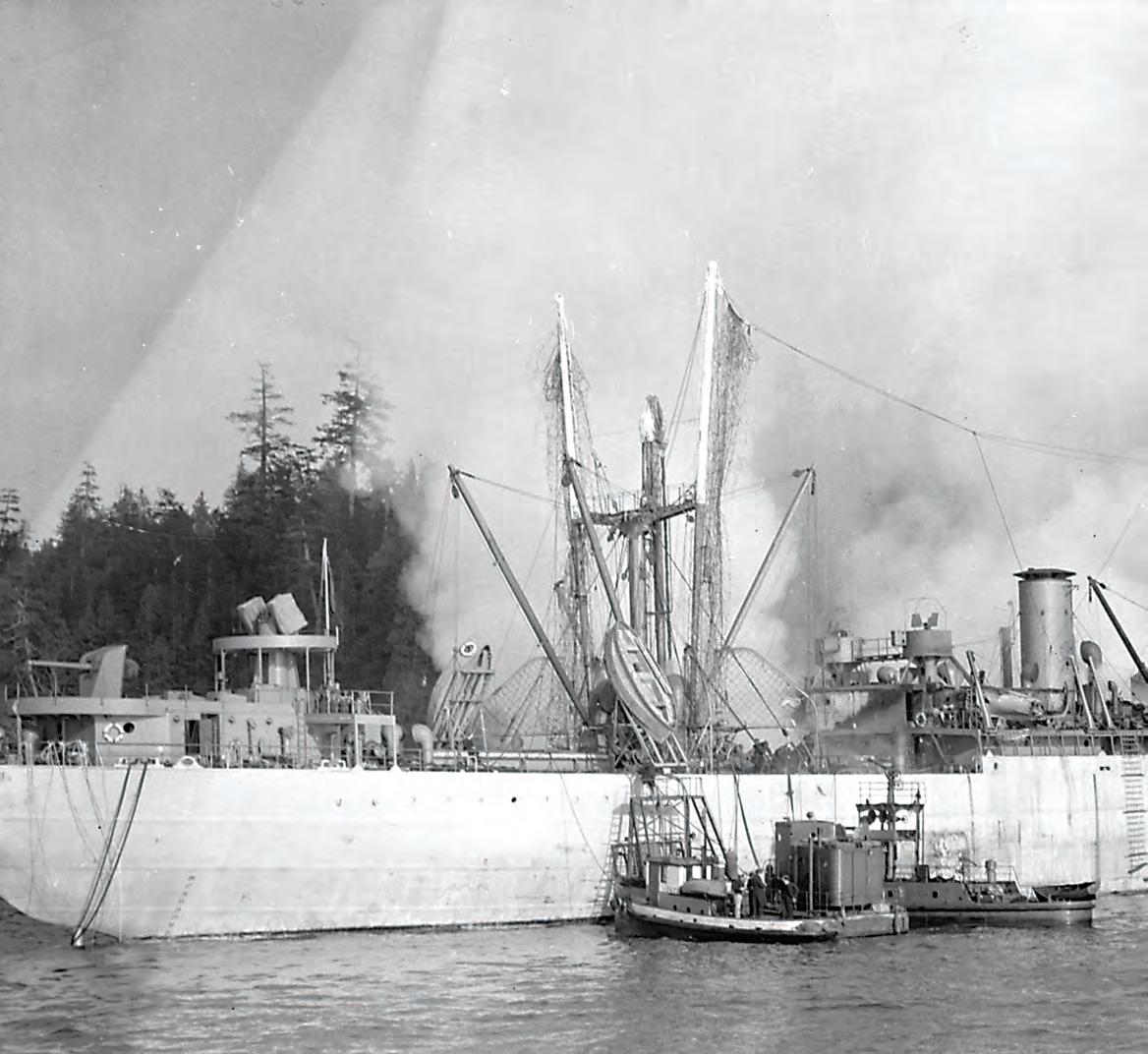
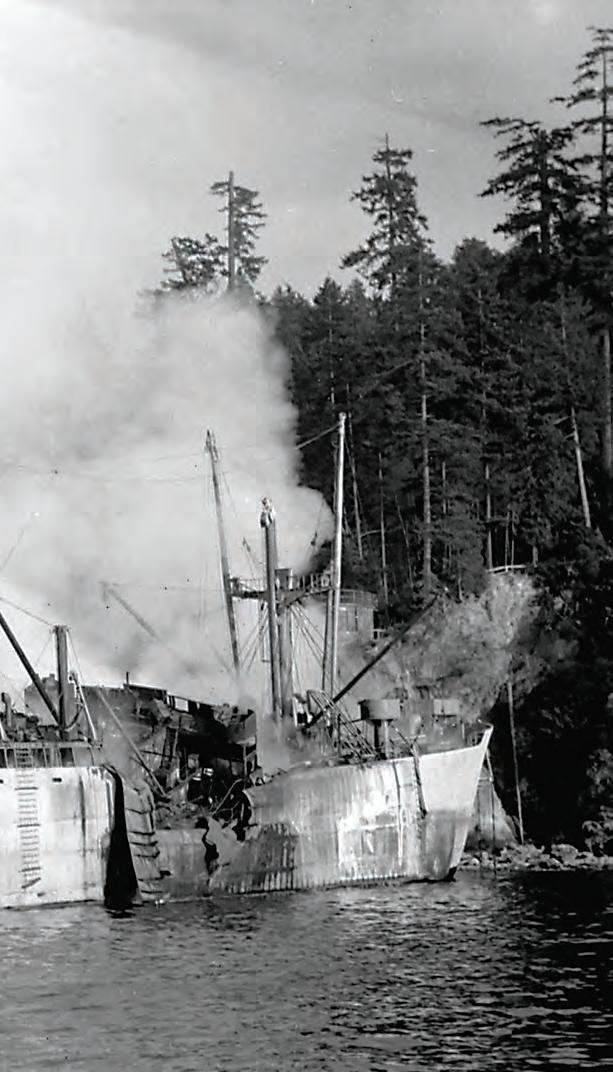
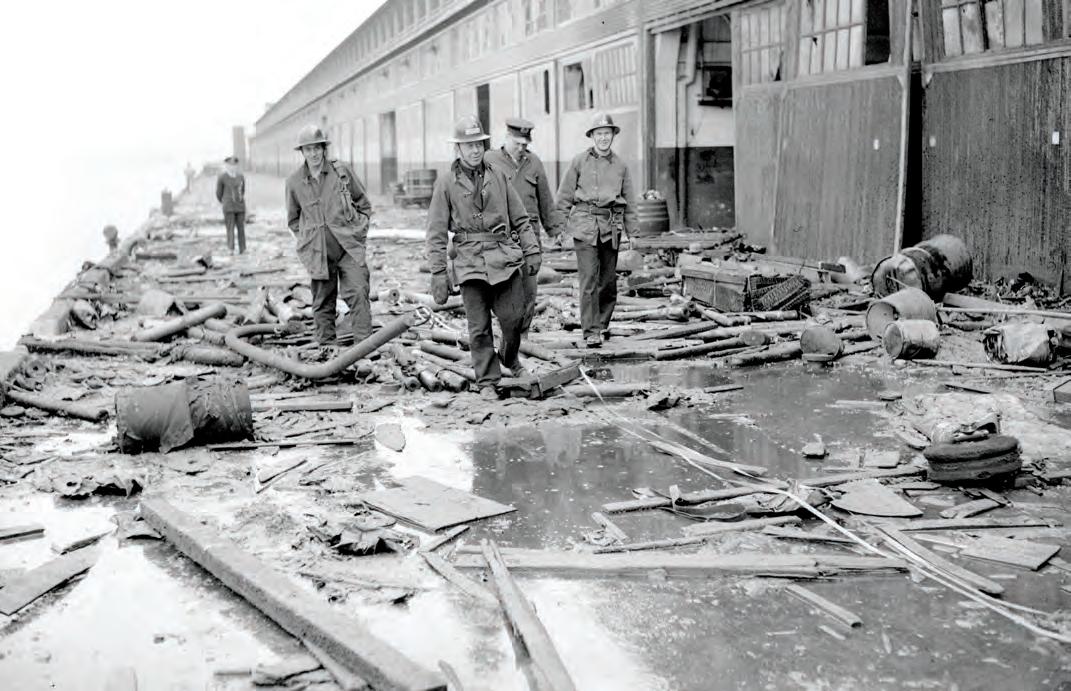
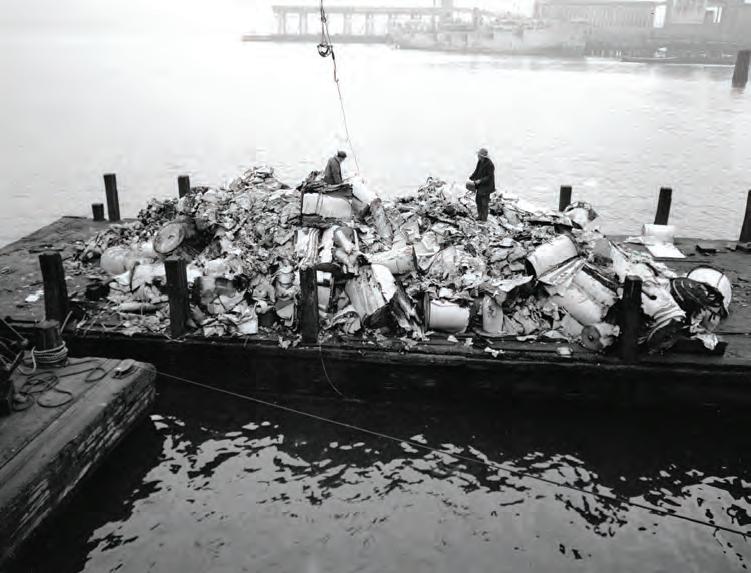
52 “FIRE AT NUMBER 3 HATCH!”
How Vancouver’s 1945 Green Hill Park disaster reminded Canadians of the Halifax Explosion almost 30 years earlier By Alex Bowers
THIS PHOTO
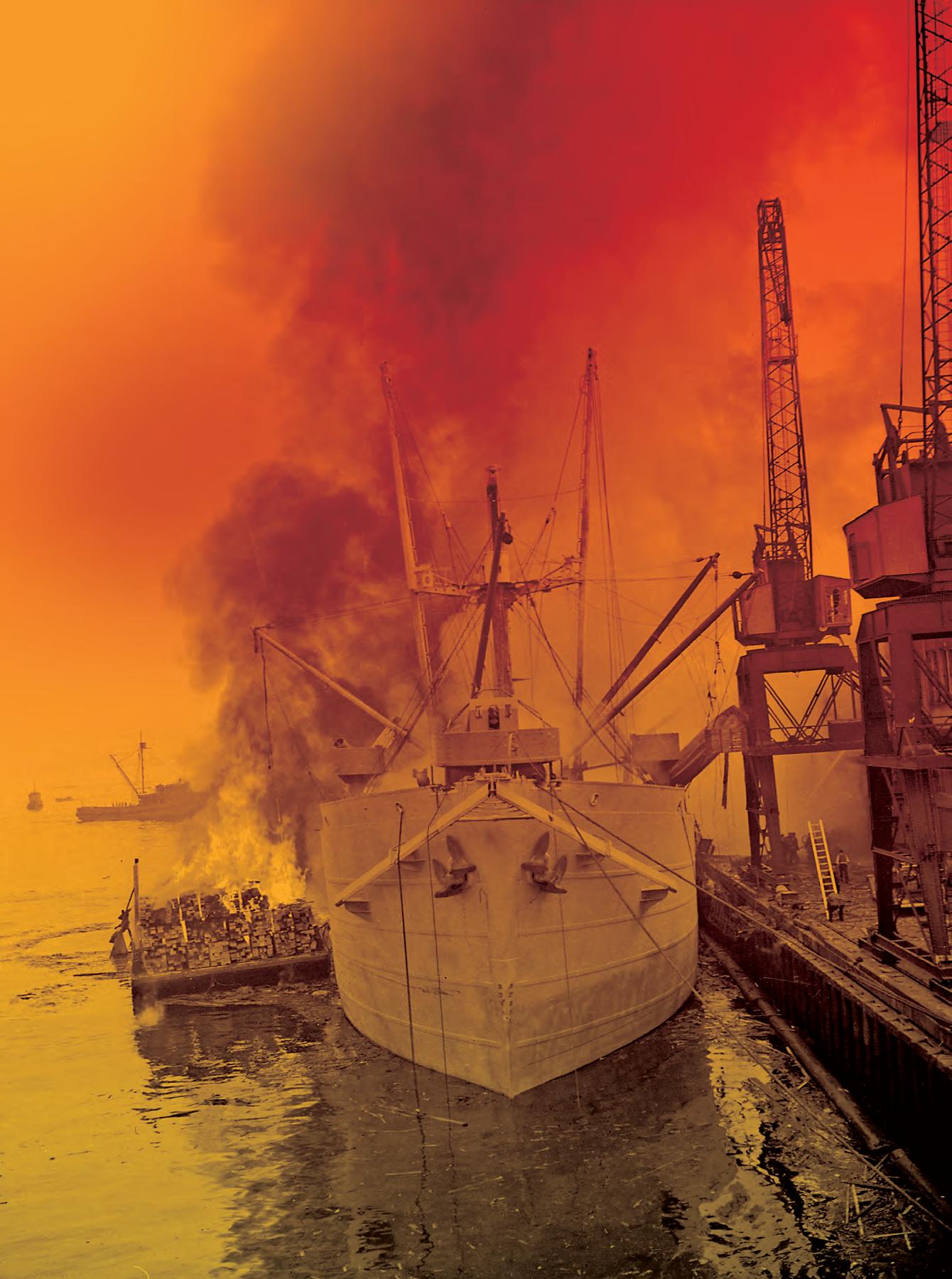
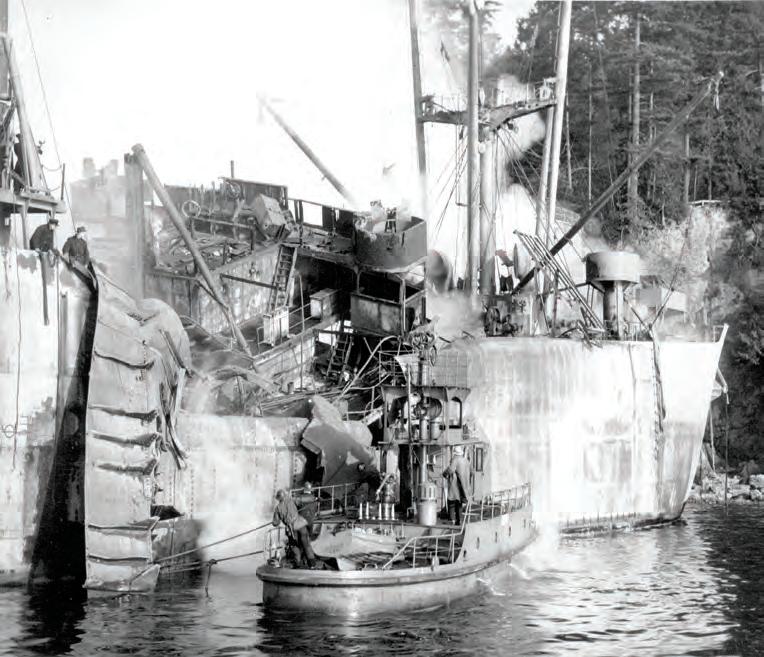
Merchant ship Green Hill Park smolders hours after an explosion rocked its No. 3 hold in Vancouver Harbour.
Don Coltman/City of Vancouver Archives/686-3604
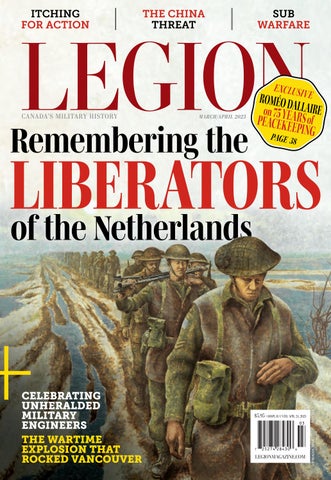
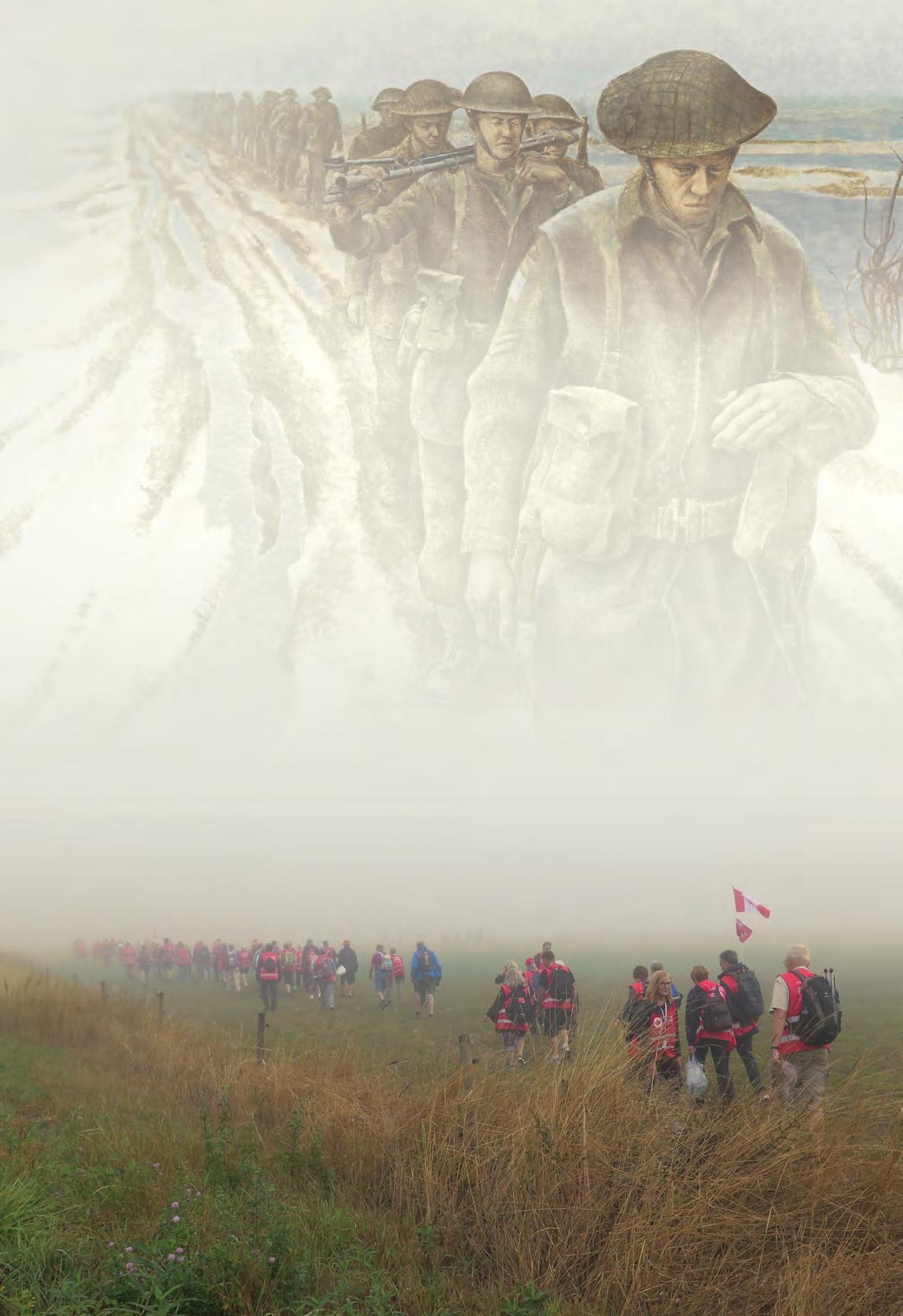
THE COVER
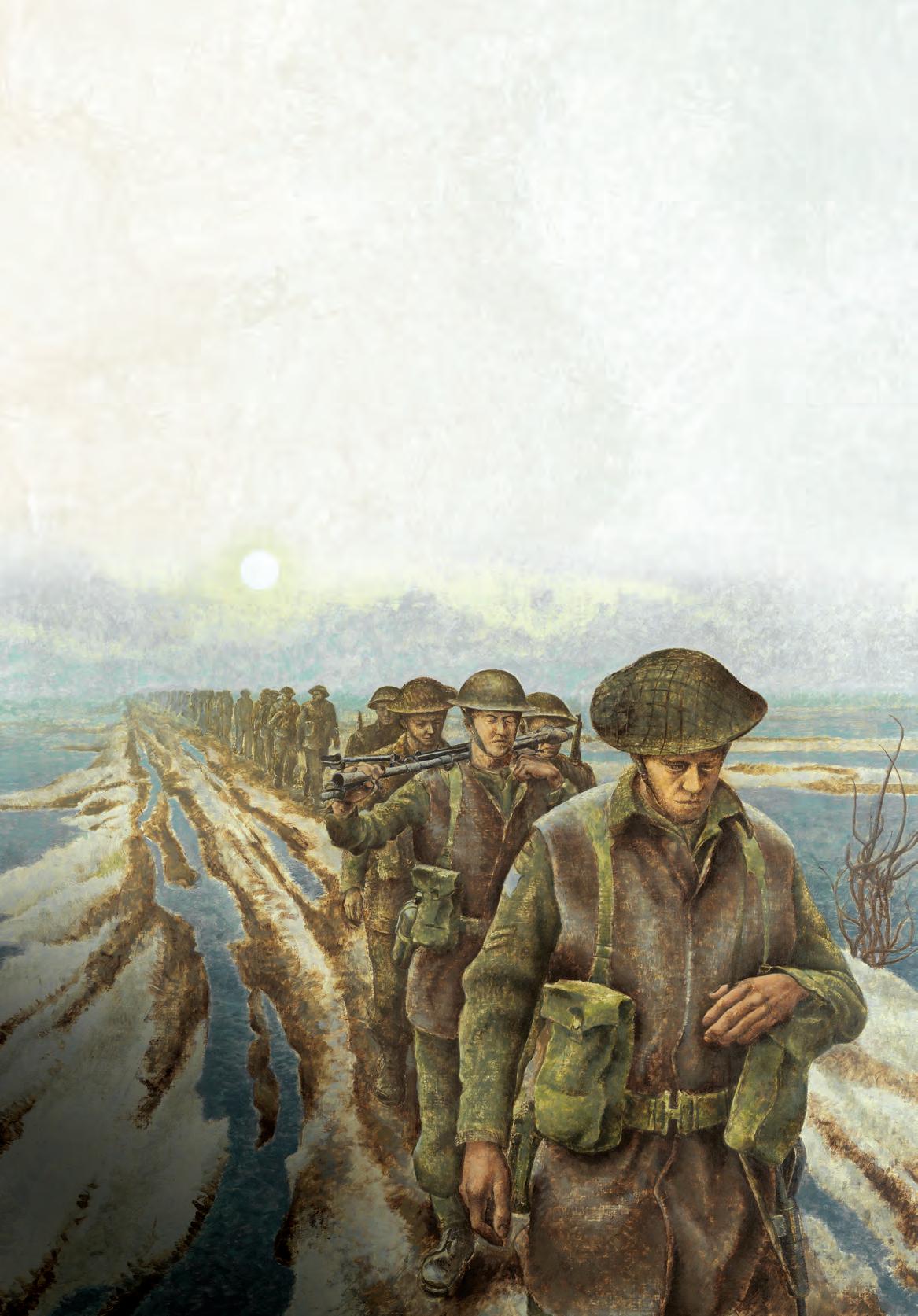
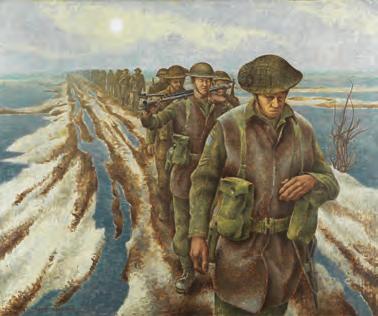
Captain Alex Colville depicts the 3rd Canadian Division marching near Nijmegen during the liberation of the Netherlands in January 1945.
Captain Alex Colville/CWM/19710261-2079
Should Canada continue to participate in peacekeeping?
Like
fish on the banks
Vol. 98, No. 2 | March/April 2023
Board of Directors
BOARD CHAIR Owen Parkhouse BOARD VICE-CHAIR Bruce Julian BOARD SECRETARY Bill Chafe DIRECTORS Tom Bursey, Steven Clark, Thomas Irvine, Berkley Lawrence, Sharon McKeown, Louise Tardif, Brian Weaver, Irit Weiser
Legion Magazine is published by Canvet Publications Ltd.
GENERAL MANAGER Jason Duprau
EDITOR
Aaron Kylie
ASSISTANT EDITOR
Lisa McCoy
INTERIM
ADMINISTRATIVE ASSISTANT
Jonathan Harrison
ADMINISTRATIVE SUPERVISOR
Stephanie Gorin (on leave)
Michael A. Smith
STAFF WRITERS
Sharon Adams
Paige Jasmine Gilmar
Stephen J. Thorne
ART DIRECTOR, CIRCULATION AND PRODUCTION MANAGER
Jennifer McGill
SENIOR DESIGNER AND PRODUCTION CO-ORDINATOR
Derryn Allebone
DESIGNER
Sophie Jalbert
Advertising Sales
CANIK MARKETING SERVICES TORONTO advertising@legionmagazine.com
DOVETAIL COMMUNICATIONS INC mmignardi@dvtail.com OR CALL 613-591-0116 FOR MORE INFORMATION
Dyann Bernard
WEB
Ankush Katoch
Published six times per year, January/February, March/April, May/June, July/August, September/October and November/December. Copyright Canvet Publications Ltd. 2023. ISSN 1209-4331
Subscription Rates
Legion Magazine is $9.96 per year ($19.93 for two years and $29.89 for three years); prices include GST. FOR ADDRESSES IN NS, NB, NL, PE a subscription is $10.91 for one year ($21.83 for two years and $32.74 for three years). FOR ADDRESSES IN ON a subscription is $10.72 for one year ($21.45 for two years and $32.17 for three years).
TO PURCHASE A MAGAZINE SUBSCRIPTION visit www.legionmagazine.com or contact Legion Magazine Subscription Dept., 86 Aird Place, Kanata, ON K2L 0A1 or phone 613-591-0116. The single copy price is $5.95 plus applicable taxes, shipping and handling.
Change
of Address
Send new address and current address label. Or, new address and old address, plus all letters and numbers from top line of address label. If label unavailable, enclose member or subscription number. No change can be made without this number. Send to: Legion Magazine Subscription Department, 86 Aird Place, Kanata, ON K2L 0A1. Or visit www.legionmagazine.com. Allow eight weeks.
Editorial and Advertising Policy
Opinions expressed are those of the writers. Unless otherwise explicitly stated, articles do not imply endorsement of any product or service. The advertisement of any product or service does not indicate approval by the publisher unless so stated. Reproduction or recreation, in whole or in part, in any form or media, is strictly forbidden and is a violation of copyright. Reprint only with written permission.
PUBLICATIONS MAIL AGREEMENT NO. 40063864
Return undeliverable Canadian addresses to Legion Magazine Subscription Department 86 Aird Place, Kanata, ON K2L 0A1 | magazine@legion.ca
U.S. Postmasters’ Information
United States: Legion Magazine, USPS 000-117, ISSN 1209-4331, published six times per year (January/February, March/April, May/June, July/August, September/October, November/December). Published by Canvet Publications, 866 Humboldt Pkwy., Buffalo, NY 14211-1218. Periodicals postage paid at Buffalo, NY. The annual subscription rate is $9.49 Cdn. The single copy price is $5.95 Cdn. plus shipping and handling. Circulation records are maintained at Adrienne and Associates, 866 Humboldt Pkwy., Buffalo, NY 14211-1218. U.S. Postmasters send covers only and address changes to Legion Magazine, PO Box 55, Niagara Falls, NY 14304.
Member of CCAB, a division of BPA International. Printed in Canada.
We acknowledge the financial support of the Government of Canada. Version française disponible.
Pro Valore
For all his stormy relations with the military, Pierre Trudeau got at least one thing right: the former prime minister said in 1972 that deserving Canadian soldiers, sailors and air force personnel should receive only Canadian decorations.
A host of British medals were subsequently struck from the Canadian honours’ system, including the highest of them all, the Victoria Cross.
The decision was reinforced on April 17, 1982, when the Constitution was repatriated, and Canada officially ceased to be a dominion of Britain. A new, Canadian, honours’ system was slow to materialize.
MONCUR’S GROUP SAYS THERE ARE MORE CASES— HISTORICAL AND RECENT— THAT WARRANT FURTHER CONSIDERATION.
In 1987, Prime Minister Brian Mulroney asked the deputy director of the Chancellery of Canadian Orders and Decorations to study the issue. It wasn’t until two years after Australia established its own VC in 1991, however, that Ottawa declared a supreme Canadian award for valour, retaining the name in part at the behest of The Royal Canadian Legion. New Zealand followed suit in 1999.
Bruce Beatty, a Royal Canadian Air Force veteran and graphic designer who has crafted some two dozen official Canadian decorations, including the Order of Canada’s distinctive snowflake, went to work on a new VC.
Beatty’s Canadianization of the medal incorporated a new motto, the Latin “Pro Valore” instead of “For Valour,” thus avoiding the challenge of fitting two official
languages on it. The cross is cast from bronze donated by Queen Elizabeth II, along with metal from the 1867 Confederation Medal and each Canadian region.
The Star of Military Valour (SMV) and the Medal of Military Valour, ranking two and three in military precedence, were also instituted. The early 2000s war in Afghanistan marked the first time either was awarded.
But while the Aussies awarded four new VCs and the Kiwis one—all for actions during the war on terror—no Canadian has received its country’s highest valour recognition since Lieutenant Robert Hampton Gray, a navy pilot, earned a posthumous British VC in August 1945.
The last living Canadian recipient—Ernest Alvia (Smokey) Smith, who earned his during the Italian Campaign—died 18 years ago.
Valour in the Presence of the Enemy, a group of military veterans and supporters headed by Afghanistan vet Bruce Moncur and fronted by former defence chief Rick Hillier, wants to change that.
It first took up the case of Private Jess Larochelle, who received an SMV for his actions while severely wounded in a 2006 enemy attack in Afghanistan (see “Danger close,” March/April 2022). Larochelle’s case has been under review for more than a year now, but Moncur’s group says there are more cases—historical and recent— that warrant further consideration.
The group’s call for a board to review potentially under-recognized combat actions, backed by a 14,129-name petition, came before Parliament in May 2022 via a detailed proposal from Conservative MP Erin O’Toole.
The motion, which required unanimous consent, was voted down by the Liberal caucus. It’s unclear where the issue now stands.
It’s simply an unacceptable state of affairs. The likes of Francis Pegahmagabow, Jeremiah Jones, Edward Mastronardi and Larochelle deserve better. It’s time politicians took the issue in hand and asked the experts to take a deep dive into the country’s military past. Canadian veterans deserve no less. L
FOUNDED BY VETERANS FOR VETERANS
R Happy new year?
eading the January/ February issue was quite depressing because of the stories on the continuing government neglect of the Canadian Armed Forces, the lack of housing for CAF members, understaffed military
A league of their own
I just read the article “Promises, promises” (Editorial, January/ February) and since Canada is increasing its immigration numbers up to half a million, and with city shelters currently out of space, and thousands left on the streets and in tents, there needs to be more mainstream media coverage of the country’s military shortfall in housing and recruitment.
JACK WHITE
KITPU
FIRST NATION, N.L.
Fallout Boy
I was employed as a radio operator at Uranium City Airport, which was located adjacent to the Eldorado community during the events described in “Satellite fallout” (January/February). The fireball trail of the COSMOS breakup was seen from the airport at about 6 a.m. The trail proceeded in a north-northeast direction until it disappeared. The military located the major sources of radiation 320 kilometres southwest of Baker Lake, N.W.T. (now Nunavut).
T. ROGERS REGINA
Comments can be sent to: Letters, Legion Magazine , 86 Aird Place, Kanata, ON K2L 0A1 or e-mailed to: magazine@legion.ca
numbers, and the aging equipment of the navy as detailed in “The sinking feeling” by J.L. Granatstein. Canada needs to address these priorities. The best offence is a good defence!
BILL SHOLDICE
MISSISSAUGA, ONT.
I very much enjoyed reading June Coxon’s article on Molly Lamb Bobak (“A league of her own,” January/February). It brought me back to my time at the University of New Brunswick in the early 1960s, when her husband, Bruno, was appointed as artist-in-residence. Together, they played a very active part in the schools’ art community and in the province.
Although Molly was the first “official” female Canadian war artist, another woman is actually the country’s first female war artist. During the First World War, established painter Mary Riter Hamilton applied to be a war artist. She was told women couldn’t be sent to the front lines, but only paint scenes on the home front. She ended up travelling alone to the European battlefields in March 1919, funded by the forerunner of The War Amps organization.
Between 1919 and 1922, Hamilton painted more than 350 works. Unable to sell her paintings when she returned to Canada (likely because of the destruction she portrayed in contrast to the popular style of the Group of Seven), she donated them to Canada’s national
archives. Her paintings are the largest collection of Canadian First World War art by a single artist.
JOHN BOILEAU
BEDFORD, N.S.
Brave hearts
I read with interest “The Valour Nine” (November/December 2022) about the soldiers recognized for bravery in the Battle of Passchendaele. My dad was a “runner” in the Black Watch that took part in the battle. He told me how he used to carry messages back to the Canadian line and the Germans opening fire on him causing him to jump in a shell hole to escape. In my opinion, they were all heroes.
WILFRED MADER
BARRINGTON PASSAGE, N.S. L
CORRECTIONS
In the January/February issue “Snapshots,” two individuals were misnamed: Life Member Award recipient Jean E. Wynot of East Toronto Branch; and Doug Brunton of Barrhaven Branch in Ottawa who received his 50 Years Long Service Award. We apologize for the errors.
Legion Magazine staff writer Stephen J. Thorne was nominated for Best Photo Journalism in the 2022 Canadian Online Publishing Awards (COPA) for his piece Small blessings: Military marks National Indigenous Peoples Day in Ottawa Thorne documented the June 21, 2022, ceremonies in the nation’s capital through more than two dozen
captivating images for his “Front lines” blog, which appears weekly on the magazine’s website. A smaller selection of images from the day was published in the November/December 2022 issue in the feature “Indigenous icons.” If you haven’t seen it already, check out the larger collection of photography online at www.legionmagazine.com/ smallblessings.
Be sure to visit the site regularly to read Thorne’s blog, which in recent months has covered a diverse range of topics from the conflict in Ukraine to war horses, and the politics of military archeology to UFOs.
Meanwhile, former staff writer Sharon Adams, who retired this past December after 15 years with the publication, was also nominated for a 2022 COPA. The online version of her feature “A way
Advertisement
Get notified of all the latest updates on legionmagazine.com by signing up for our weekly e-newsletter at www.legionmagazine.com /en/newsletter-signup
forward,” which detailed how the Canadian Armed Forces are dealing with recent sexual misconduct challenges, was up for Best Investigative Article. (The same article appeared in the July/August 2022 issue.)
Winners of the 2022 COPAs were announced on Feb. 9, 2023, after this issue went to press.
Coincidentally, illustrator Robert Carter received a Gold award from the Society of Illustrators Los Angeles Juried Annual Show in the editorial category in early 2023 for the artwork he created that accompanied Adams’ story. See both works at www.legionmagazine.com/ awayforward. L
March
10 March 1944
HMC ships St. Laurent, Swansea and Owen Sound and HMS Forester sink U-845 in the North Atlantic.
1 March 1633
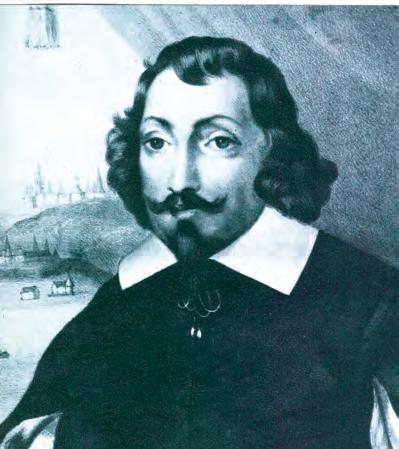
Samuel de Champlain becomes the first governor of New France.
2 March 1951
The Department of National Defence publishes its first Korean War casualty list. The names of 516 Canadians are inscribed in the Korean War Book of Remembrance
4 March 1943
12 March 1930
First World War ace Billy Barker dies in a plane crash.
14 March 1916
Women are granted the right to hold office and vote in Saskatchewan provincial elections.2
24 March 1917
The Canadian Cavalry Brigade begins a four-day advance on a 20-kilometre front east of Péronne, France.
HMCS Shediac and HMCS St. Croix sink U-87 in the North Atlantic.
6 March 1945
Operation Spring Awakening, the last major German offensive of the Second World War, begins.
7 March 1866
In anticipation of a St. Patrick’s Day attack by the Fenian Brotherhood, John A. Macdonald puts 10,000 volunteer militia on alert.
8 March 1975
Canada observes its first International Women’s Day.
9 March 1915
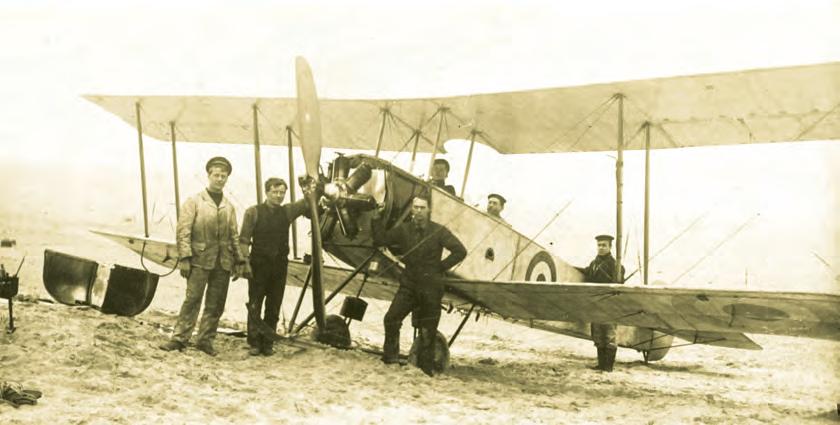
Redford (Red) Mulock is the first Canadian to qualify as a pilot in the British air services.
20 March 1944
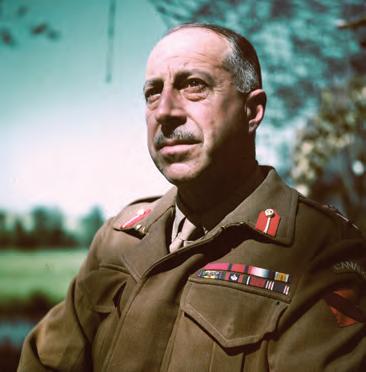
Lt.-Gen. Harry Crerar takes over as commander of First Canadian Army.
22 March 1916
The Newfoundland Regiment arrives in France from Egypt and the Dardanelles and prepares for the Battle of the Somme.
25 March 1944
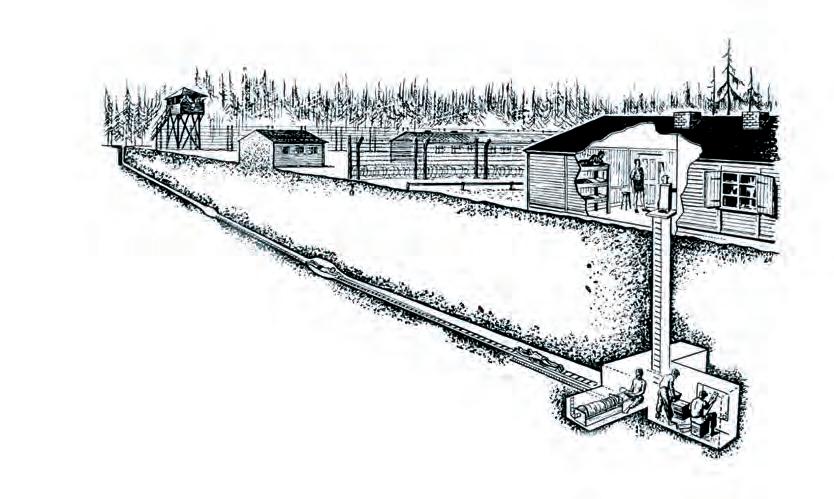
Seventy-six Allied airmen exit a German PoW camp, aided by tunnel king Royal Canadian Air Force Lieut. Wally Floody in what becomes known as The Great Escape.
28 March 1979
Radioactive steam begins leaking from a nuclear plant at Three Mile Island, Pa.
29 March 1973
The last American troops leave South Vietnam.
31 March 1949
Newfoundland joins Confederation and becomes Canada’s 10th province.
April
5 April 1947
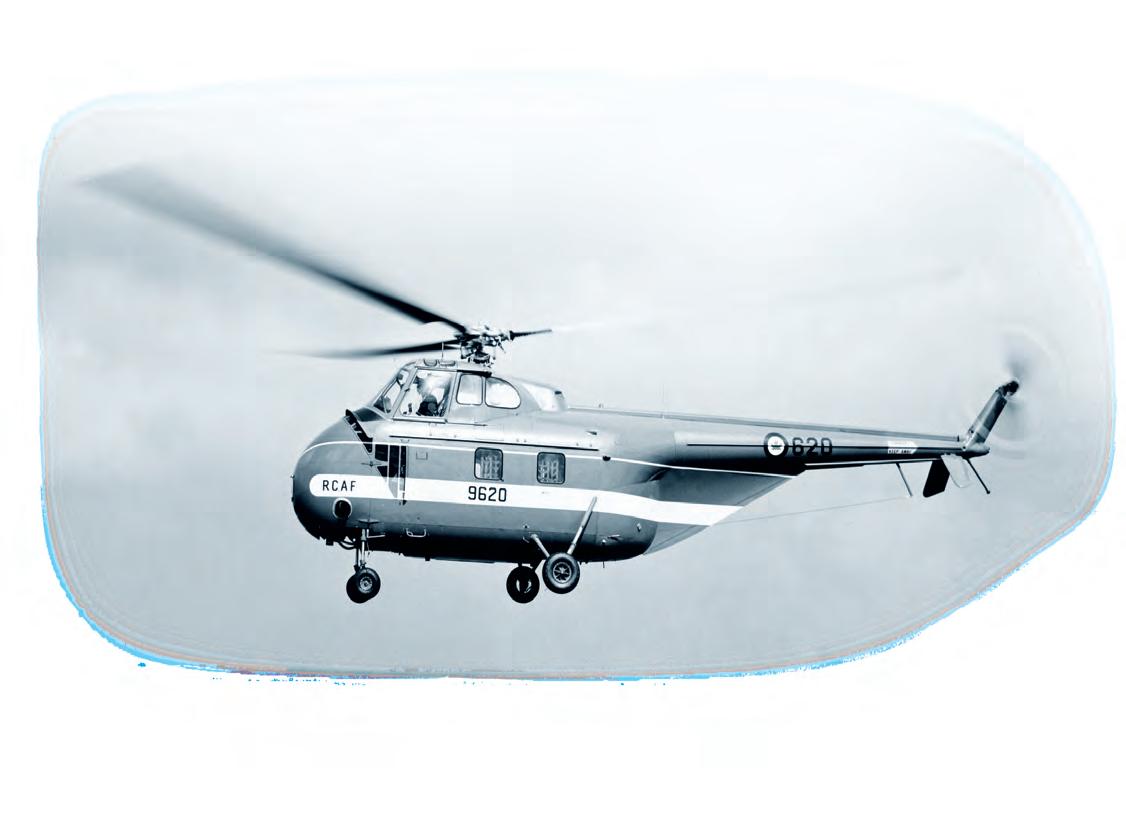
The first of seven Sikorsky helicopters, to be used for search and rescue, is received by the Royal Canadian Air Force.
6 April 1917
The United States declares war on Germany, officially entering the First World War.
8 April 2007
Six Canadian soldiers die after their vehicle hits an improvised explosive device in Afghanistan.
10 April 1900
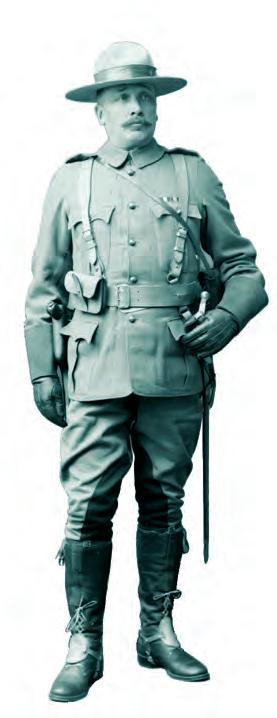
Lord Strathcona’s Horse (Royal Canadians) arrive in South Africa under the command of Sam Steele.
11 April 2007
M.Cpl. Allan Stewart and Tpr. Patrick James Pentland are killed in Taliban attacks near Kandahar, Afghanistan.
12 April 1946
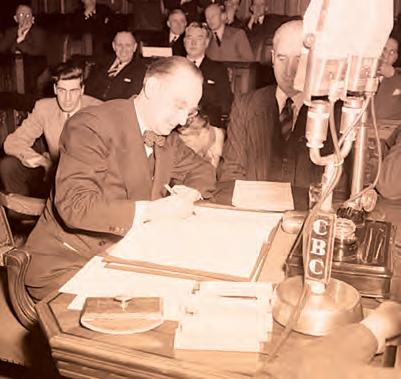
Harold Alexander is sworn in as Canada’s 17th governor general.
13 April 1942
The Royal Canadian Air Force 417 “City of Windsor” Squadron is transferred to Egypt to join the fighting in the Middle East.
14 April 1974
The Canadian government dispatches a brigade headquarters to Cyprus. By the end of the month, there are 1,150 Canadian peacekeepers on duty.
15 April 1953
HMCS Crusader establishes a record, destroying three trains on the Korean coast. It ends the war with four.
19 April 1978
Canadian forces arrive as part of the United Nations Interim Force in Lebanon.
22 April 1885
North-West Mounted Police Inspector Francis Dickens reaches Battleford during the North-West Resistance.
16 April 1945
The Canadian Army takes Groningen, Netherlands, after a four-day battle.
17 April 1892
Alexander Mackenzie, Canada’s second prime minister, dies at age 70.
23 April 1943
Britain asks Canada to help in the Battle of the Mediterranean.
24 April 1992
The United Nations establishes the peacekeeping mission to Somalia.
26 April 2015
The Candian military’s Disaster Assistance Response Team deploys to Nepal after an earthquake.
30 April 1945
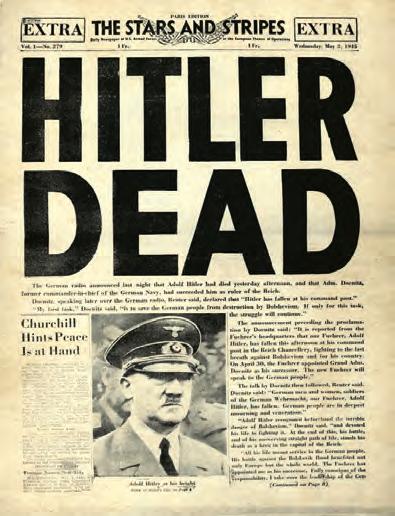
Adolph Hitler dies by suicide.
By Paige Jasmine Gilmar
Fighting “soldier’s disease”
How service dogs may offer hope to veterans challenged by PTSD and opioid addiction
War wounds don’t always bleed—at least not in the same red mess. Sometimes, a wound sits in silence; it festers and can overcome a soldier in an invisible chain reaction. And because it’s not as obvious as a leg ready to go under a surgical saw, it’s subtle, unseeable and shielding. It’s the mind, and it’s suffering all the same.
The American Civil War’s industrial overtones made conflict more violent than ever before, and without the soft pillow of painkillers, soldiers were left to bear the pain of surgery sober. But thanks to one German scientist’s discovery 60 years earlier, there was a solution: morphine.
Troops of the time would enter medical tents to trade gangrene for addiction, one disease for another. This unfortunate side effect from rudimentary medical treatment soon came with a code word—“the soldier’s disease.”
Today, soldiers are still dealing with the same basic issue, but the drugs have changed. Fortunately, a new treatment option is showing promising results in early trials.
According to one 2013 study, for instance, the prevalence of diagnosed opioid abuse is about seven times higher in the U.S. Veterans Health Administration than commercial health programs,
DESPITE THIS CONNECTION, THERE ARE RELATIVELY LIMITED RESEARCH-BASED TREATMENT OPTIONS THAT TACKLE COEXISTING PTSD AND SUBSTANCE ABUSE CHALLENGES.
placing a significant financial strain on social services. It’s likely there’s a similar discrepancy in Canada. Regardless, Canadian Armed Forces members and veterans are no less likely to be impacted by the nation-wide opioid crisis than the general public.
Indeed, when Kelly Russell retired from the CAF, the military’s treatment plan included opioids and 52 other medications. “I was a walking pharmacy,” said Russell, who had served for 32 years and was awarded the Order of Military Merit. When Russell was released, she was left to deal with her post-traumatic stress disorder and a traumatic brain injury and concussion syndrome, along with other injuries.
“Every single veteran in our wee family have either been on opioids, heavy use of alcohol and some cocaine,” said Russell.
According to Veterans Affairs Canada, PTSD is the most common
type of operational stress injury (OSI) among veterans today.
Darren Reid, vice-president of The Royal Canadian Legion’s OSI section, said mental health is a huge issue he witnesses daily.
And while awareness of PTSD has increased over the last 50 years, discrimination still exists, and veterans still delay therapy due to the stigma associated with it. With medicinal treatment now a key option, soldiers sometimes turn to the self-made therapy of unhealthy coping mechanisms.
“The biggest problem with mental health [illness],” said Reid, “is leaving it untreated.”
VAC has found that 50 per cent of male veterans with chronic PTSD and 25 per cent of their female counterparts have reported problematic alcohol and substance use. A medical literary review analyzing more than 47 years’ worth of research on opioid abuse in
individuals with PTSD surmised that opioids’ popularity among veterans could be because it alleviates some of the disorder’s symptoms, such as anxiety, guilt and aggression.
Neuroscientists have even confirmed a neural link between PTSD and opioid abuse: they both affect the same parts of the brain. While PTSD decreases activity in those areas, opioids increase activity, which helps to temporarily eliminate PSTD symptoms.
Despite this connection, there are relatively limited researchbased treatment options that tackle coexisting PTSD and substance abuse challenges.
That’s why researchers Colleen Anne Dell and Linzi Williamson are proposing a supplemental treatment for veterans with both disorders: service dogs.
In a 2017 survey, 88 per cent of Canadians struggling with addiction
reported that animals were instrumental in their recoveries—which Dell and Williamson report as well.
In a two-year study run by Dell, veterans with both PTSD and opioid use/abuse were matched with psychiatric service dogs. The veterans reported a decrease in a host of PTSD and substance abuse symptoms, stating how they were able to stay “present and in the moment.”
And even in the wake of personal traumas, such as death or divorce, veterans showed surprising resilience when their dogs were in tow.
“My wife kicked me out, went through a divorce, almost lost my kids and my dad committed suicide. And even through all of that, I am still able to handle everything because of the dog,” one veteran reported to clinical interviewers.
Russell said her dog Spot helped her reduce her medications to 12 pills—and no opioids.
Russell, who soon became a member of Williamson’s research advisory committee, thereafter established K9RR Academy, a not-for-profit program that trains and matches veterans with service dogs.
“K9RR pays for food, shots and fixing of all dogs for the first year, there is no cost to the veteran,” she said.
“The bond, it’s huge between animal and person,” said Reid. “It’s just love and affection.”
While studies on service dogs as an additional treatment option for veterans with PTSD and addiction challenges are still new and not without their limitations, researchers and veterans alike have great hope for what these “battle buddies” can offer.
“Well, we are truly a team,” one veteran reported. “I couldn’t imagine life without [my dog], I really couldn’t.” L
Identify this NASA launches UFO study
he U.S. National Aeronautics and Space Administration has launched a nine-month study into UFOs or, as the world’s leader in space exploration calls them, UAPs (unidentified aerial phenomena).
The 16-member team includes professors, scientists, an oceanographer and others who study space. Their work began Oct. 24, 2022, with an eye to the future.
“The independent study team will lay the groundwork for future study on the nature of UAPs for NASA and other organizations,” the agency said in a statement.
“To do this, the team will identify how data gathered by civilian government entities, commercial data, and data from other sources can potentially be analyzed to shed light on UAPs. It will then recommend a roadmap for potential UAP data analysis by the agency going forward.”
Coming on the heels of the first public congressional hearing on UFOs in half a century, plus Pentagon plans to create an office to track UAP reports, the study will focus solely on unclassified data. A full report is to be released publicly later this year.
NASA first announced the study this past June, saying the limited number of unexplained UFO sightings “makes it difficult to draw scientific conclusions about the nature of such events.”
“NASA believes that the tools of scientific discovery are powerful and apply here also,” said Thomas Zurbuchen, associate administrator for the Science Mission
Directorate at NASA Headquarters in Washington. “We have access to a broad range of observations of Earth from space—and that is the lifeblood of scientific inquiry.
“We have the tools and team who can help us improve our understanding of the unknown. That’s the very definition of what science is. That’s what we do.”
The organization has said there is no evidence that UFOs are extraterrestrial in origin. A U.S. government report released in June 2021.
The government document said there is no evidence of aliens, but acknowledged 143 UAP cases since 2004 that could not be explained.
Many were observed by U.S. military aircrew, whose onboard equipment recorded apparent objects moving with inexplicable speed, agility and acceleration.
In some incidents, the objects disappeared into the sea, prompting U.S. legislators to declare that “cross-domain transmedium threats to the United States national security are expanding exponentially.” A “cross-domain transmedium” threat is, by Pentagon definition, an object able to move from water to air to space in inexplicable ways.
While the June report was short on answers, it did offer a range of possibilities, including conjecture that UFOs could be
part of a secret U.S. government or military project. It did not, however, cite any such cases.
Nor could it back up suggestions they could be products of clandestine programs in other countries with advanced aerial capabilities, such as Russia or China.
Last July, the Pentagon announced it was opening the All-domain Anomaly Resolution Office to investigate unexplained aerial threats.
The U.S. military has a lengthy history of chronicling and investigating UFO sightings. The first U.S. Air Force program to investigate UFO sightings was mounted in 1947.
Called Project Blue Book, it probed 12,618 reported sightings over two decades. By the time the project ended in 1969, around 700 sightings were still categorized as “unidentified,” according to the U.S. National Archives.
Canada has also long maintained both military and civilian files on UFO sightings. Federal government officials agreed in June 2022 to share information about UFOs with their American counterparts.
NASA’s independent study team is led by David Spergel, former chair of the astrophysics department at Princeton University in New Jersey.
“Given the paucity of observations, our first task is simply to
gather the most robust set of data that we can,” said Spergel. “We will be identifying what data—from civilians, government, non-profits, companies—exists, what else we should try to collect, and how to best analyze it.”
NASA noted the importance of acquiring extensive data since they say UFOs are both a national security and an air safety concern and, as such, align with established agency responsibilities.
Said Zurbuchen: “Understanding the data we have surrounding unidentified aerial phenomena is critical to helping us draw scientific conclusions about what is happening in our skies. Data is the language of scientists and makes the unexplainable, explainable.” L
By David J. Bercuson
Strategy session
Canada unveils hollow plan for China and the Indo-Pacific region
It’s
estimated that by the year 2040, half of the world’s gross domestic product will be generated in the region stretching from the Pacific island nations to India, says Canada’s long awaited Indo-Pacific Strategy.
The document, released on Nov. 23, 2022, is a comprehensive review of Canada’s trade, defence and intelligence strategy with the 40 nations and economies in the area.
Given Canada’s 27,300-kilometre-long Pacific coast, its growing trade with countries in the region, the increasing number of Canadians with familial ties and the growing challenges that China poses to all nations nearby, it’s high time for Canada to formulate a plan for dealing with the nuances of conducting business in the Indo-Pacific.
Although the Strategy provides great detail about how Canada will expand its relations in the region, it completely fails to outline a realistic Canadian military posture.
All of Canada’s ties with the Indo-Pacific are endangered by China’s growing military power, along with its aggressive foreign and defence policies during the last decades. From the expansion and modernization of China’s nuclear weapons arsenal, to its growing naval fleet (now the world’s largest) and its coercive tactics in engaging with neighbouring nations such as the Philippines, Indonesia, Japan and others, China is endangering peace in the Pacific region.
Japan, Australia, South Korea, India and the United States have increased their military presences and alertness for the better part of
a decade now. Canada has not to the same extent because it cannot. It’s good for Canada to aim to expand relations with nations in the area, but when the country cannot bring a credible military presence to the region—and countries there are well aware of Canada’s military weakness— Canada’s grandiose ambitions are revealed for what they are: hollow.
The defence portion of the Indo-Pacific Strategy devotes several pages to Canada’s plans to bolster its military presence, but what those plans amount to are the shifting of a single additional Halifax-class frigate from the Atlantic to the Pacific.
There is nothing said about upgrading Canada’s sea surveillance with the purchase of the P8 Poseidon aircraft to replace its aging Aurora propeller planes; nothing about acquiring and deploying modern submarines; nothing about completing new replenishment and supply ships for its navy; nothing about expediting the replacement of
the Halifax-class frigates that are now three decades old.
In fact, a Canadian Press story from this past August revealed that Canada’s frigates have been absent from NATO naval forces for the past eight years.
Tim Choi, a recent doctoral graduate from the University of Calgary’s Centre for Military, Security and Strategic Studies, told CP: “It’s the unavoidable consequence of forcing a small fleet to concentrate more resources into a smaller time frame which results in more time required to recuperate.”
David Perry of the Canadian Global Affairs Institute, meanwhile, pointed out in the same article that although Canada has 12 frigates, “only a handful are available to deploy at any given time.”
So, if six are available, and
three are deployed in the Atlantic or close to the area where Russia threatens NATO’s eastern flank, that leaves three for the Pacific. Canada’s chief of the defence staff, General Wayne Eyre, has
any sort of large-scale operation due to a lack of personnel and equipment. In that same story, Defence Minister Anita Anand was quoted as having told CTV’s “Question Period”
IT WOULD BE A “CHALLENGE” TO LAUNCH ANY SORT OF LARGE-SCALE OPERATION DUE
recently taken every opportunity to tell the Canadian public how low prospects for the Canadian Armed Forces have sunk. In a news story published the day before the Indo-Pacific Strategy’s release, Eyre told Canadians that it would be a “challenge” to launch
Legion and Arbor Alliances
that Canada should “be able to walk and chew gum at the same time” in balancing its NATO commitments and promoting peace in the Indo-Pacific. What Anand doesn’t seem to realize, is that it isn’t the gum that is missing, it’s Canada’s teeth. L
In their
fathers’ footsteps
Ninety pilgrims walked more than 60 kilometres through Dutch towns and countryside to learn more about the Canadians who liberated the Netherlands
Story and photography by
Sharon Adams
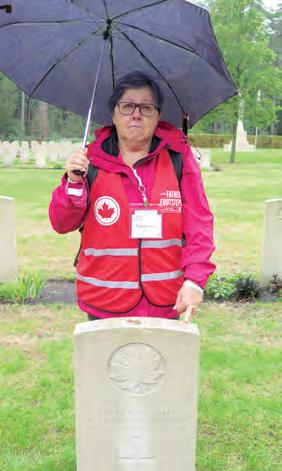
TThe tears fell nearly as heavily as the rain when Denise Rousseau finally fulfilled the promise made years ago to her dying father Fernand.
It was the final day of the In Our Fathers’ Footsteps (IOFF) pilgrimage to the Netherlands and the last commemorative ceremony, this one at Bergen-opZoom Canadian War Cemetery.
There, by happenstance, she came across the grave of Regis Rousseau.
“He was my father’s cousin,” said Rousseau, of Laval, Que. “They joined together and trained together. Eventually they were split up. Dad heard about Regis passing and all his life we wanted to find him.”
In 1983, her father made his own pilgrimage and searched for Regis’s grave.
“He was sort of convinced Regis was buried in Groesbeek (Canadian War Cemetery).” But the grave was not there. “My father was hoping we would find his cousin, which we did not before he passed. I made a solemn promise to him that I would try to find him.”
She searched the graves again on the pilgrimage, first in Groesbeek and again in Holten, before she finally found Regis’s headstone in Bergen-op-Zoom.
“Totally by accident,” she said, tears flowing freely. “That’s why it’s so emotional on this last day to find him and to be able to keep my promise.”
Regis Rousseau was among more than 7,600 Canadians who lost their lives during the battles to end the brutal five-year Nazi occupation of the Netherlands. But some 150,000 Canadians and Newfoundlanders who served there returned home,
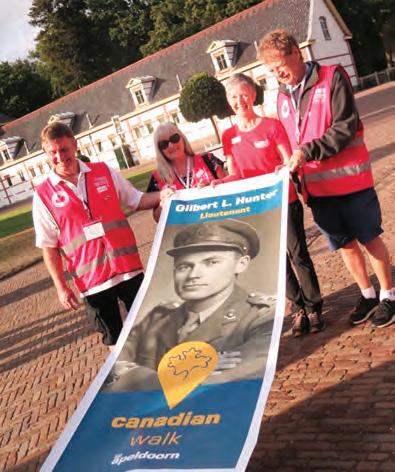
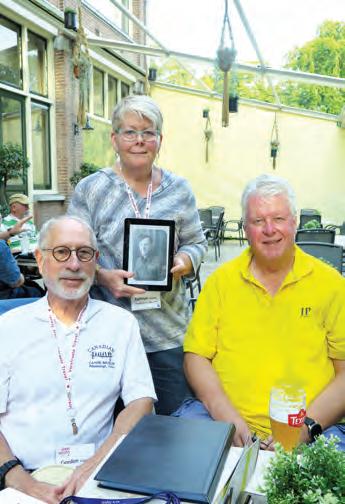
Denise Rousseau sheds tears at Regis Rousseau’s gravesite. Bill Hunter, Marilyn Shepherd, Karen Hunter and Philip Kirby display a poster of Lieutenant Gilbert Hunter gifted to them by Dutch citizens. Tour participants march through the countryside (opposite), much as their forefathers had during the war, as depicted in this painting.
including Lieutenant Gilbert Hunter, who had a fruitful career in Toronto before a long retirement in Ontario’s Muskoka region, where he died in 2009.
Like many Second World War veterans, Gilbert rarely talked to his family about his experiences. But on his 80th birthday, he gave his daughter Karen Hunter, of Guelph, Ont., a memoir of his service, sparking her interest in his military career.
father’s experiences, to walk in his footsteps. She soon realized others shared a similar ambition and came up with the idea for the In Our Fathers’ Footsteps pilgrimage. Hunter had the help of many Dutch volunteers, particularly Peter van der Meij, of Uden, logistics coordinator for the pilgrimage. He and his wife Ans hosted Hunter’s family on their earlier visits and a warm cross-Atlantic, multi-generational friendship blossomed.
Plans for the trip in 2020 were delayed by the pandemic, but 89 people signed on for the IOFF pil-
Regis Rousseau was among more than 7,600 Canadians who lost their lives during the battles to end the brutal five-year Nazi occupation of the Netherlands.
“When they came home, they were too overwhelmed to process it, and they weren’t encouraged to talk about it,” said Hunter. “For many years they didn’t understand why we would want to know about it. You know, ‘it was in the past and nothing could be changed.’ And they wanted to resume their lives.”
Hunter wanted to go to the Netherlands to learn about her
grimage in September 2022. They walked more than 60 kilometres across the countryside, along trails and roads and through villages and towns. Along the way, they learned some history and participated in ceremonies at monuments, battlefields, gravesites
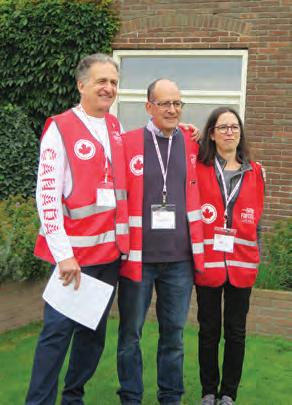
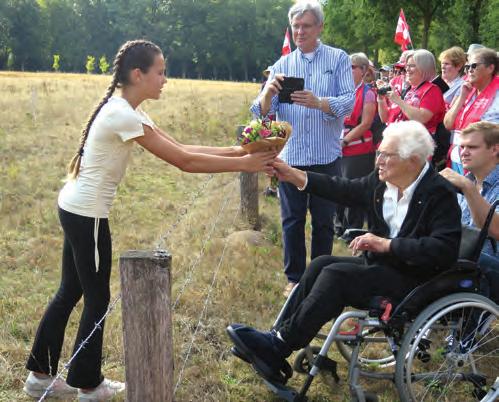
Elliott, Jonathan and Risa Shiff traced the fate of a great uncle; Antje van Gietenbeek hands flowers to her granddaughter; German bunkers disguised as houses; Harm Kuijper (right) helped Gordon Loomes and Kathryn Jordan track her father’s regiment.
and cemeteries. They joined in many joyful celebrations as well.
Among the pilgrims were brothers Jonathan Shiff of Jerusalem, and Elliott Shiff of Toronto, who were continuing their long search for the story of their great-uncle, Sergeant Harry Bockner, of Guelph, Ont.
Bockner went overseas in October 1942 and fought through the entire Italian campaign. He went to the Netherlands with the 1st Canadian Division in March 1945. He was killed April 11.
“All we knew of him were two pictures hanging on the wall,” said Elliott. In the 1990s, he came across boxes containing more than 1,000 letters his
grandmother had received from Bockner, her youngest brother.
The Shiffs came to know their great-uncle through the letters. “They were entertaining at times, at times funny and other times disturbing,” said Elliott. But they were also quite profound. “Harry was a man who came to a much deeper understanding of his own life, under the most difficult circumstances imaginable.”
The brothers discovered that before the war, Bockner had been the life of the party, “sometimes ones to which he had not been invited.” He worked in the fur business before enlisting at the age of 31. They traced his service through England and Italy and
wanted to know more about his experiences in the Netherlands.
In 2005, Elliott placed an advertisement in Legion Magazine’s “Lost Trails” section and received five messages, including three from soldiers who had fought with Bockner. One of them was Gilbert Hunter, who had trained with Bockner and served with him in Italy and the Netherlands.
Bockner had taken shelter in a barn during a German attack as Canadians crossed the IJssel River to establish a bridgehead near Zutphen. He was killed by shrapnel there. Hunter had helped load Bockner’s body onto a truck and had visited his grave twice.
Van Gietenbeek’s
grandchildren placed flowers on markers representing the Canadian graves.
When the Shiffs said they’d like to visit the spot, Hunter said, “I know exactly where you need to go.”
In April of 1945, when Bockner was under attack, schoolboy Johan Wolters was hunkered down with his mother and father in the basement of their farmhouse. Realizing their house and barn were targets, the family fled during a break in the shelling. Now a great-grandfather, Wolters recalls seeing Bockner’s body being loaded into the back of a truck as his family ran to a nearby wood.
The Shiff brothers received a warm welcome from the Wolters family when they first visited in 2007, and again during the 2022 IOFF pilgrimage.
Bockner is buried in Holten Canadian War Cemetery, but the brothers knew he had been reinterred. Where was he originally buried?
Word was put out in the community of Dutch people who support remembrance of Canadians and eventually it reached the ear of Antje van Gietenbeek, explained van der Meij. “She said, ‘I know the spot.’”
After the war, she lived in the house next to the field where temporary graves were dug for 11 Canadians. Every day on her way to school, she would put flowers on the graves, including Bockner’s.
Van der Meij organized a ceremony in that same field during the pilgrimage. Van Gietenbeek’s grandchildren placed flowers on markers representing the Canadian graves and the Shiff brothers shared Bockner’s story and said prayers in Yiddish.
“My uncle Harry always wanted to travel after the war,” and visit the land that became Israel in
1948, said Jonathan. The brothers visited Bockner’s grave at Holten again during the 2022 pilgrimage, where Jonathan spread some dirt and stones he had brought from Jerusalem. Elliott and his wife Risa did likewise with earth and stones from Canada.
Also, at the Holten cemetery, pilgrim Kathryn Jordan, of Niagara-on-the-Lake, Ont., spread some of her father’s ashes. Her dad, John Jordan, served in the Stormont, Dundas and Glengarry Highlanders (the Glens) and, after the war, “became quite a historian,” said Kathryn.
Although John spoke about his experiences with his family and regularly participated in annual remembrance ceremonies in his local community, he wanted no fuss made over himself.
“He was a shy man and very humble,” said Kathryn. “He always said the heroes were the boys that were left behind. I had a chance to stand at the grave of a boy who was left behind,” a member of her father’s regiment. “It was a special place to spread the ashes to honour those boys and my father.”
Harm Kuijper, a member of the Warnsveld Memorial Committee and of The Liberation of the Netherlands Branch of The Royal Canadian Legion, has developed a website (ww2memorial.nl) that co-ordinates names of the fallen with topographical maps of regimental movement overlaid on a current map. Kuijper’s interest in war history expanded in 2005 to include Canadians when Zutphen named some streets in honour of Canadian liberators.
“I was able to determine where
regiments were located and, in some cases, where a soldier was killed,” he said. “Everything came together like one big puzzle.”
The path of the Glens regiment is documented on the website, so he was able to guide Kathryn and her partner Gordon Loomes to many of the places her father knew.
Remembrance is part of the fabric of the Dutch people, Kuijper said, and care is taken to pass it on to the next generation. Liberation of the whole country is celebrated on May 5, but each village marks its own liberation day, and many have services on dates important to Canadians.
“Monuments are adopted by schools and families adopt graves of soldiers,” he said. “You can be invited to give a (school) lesson—it’s common.”
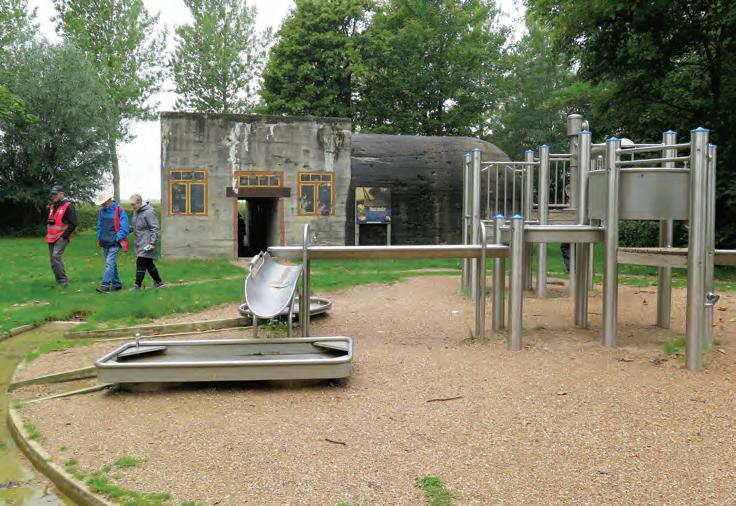
The war is such a part of Dutch culture that near Groede, a family amusement park incorporates German bunkers that had been camouflaged as houses, with curtained windows painted on the concrete exteriors. Children climb around on the play structures near the bunkers. But play can be interspersed with a history lesson as families tour the bunkers and read the poster boards describing wartime activity.
In the smallest villages, on the loneliest roads, pilgrims came across people who had stories of their liberation to share.
Marius Bakker’s family survived the war by cooking tulip bulbs. He still digs up bullets, bombs and grenades in his garden in the village of Woensdrecht, where he serves on council.
Riek Albert de la Bruheze was a child in Zutphen during the war and remembers the noise, the fear and staying in a bomb shelter. She came out to a park in Doetinchem to watch the Canadian pilgrims arrive, she said through an interpreter.
“They know what happened here,” she said, pointing to the welcoming people who lined the streets with Canadian place names.
The Fort Garry Horse stayed on in the city after the war, helping to build houses using materials recycled from buildings destroyed during the bombing and intense fighting. They also left a Sherman tank as a memorial in Canadapark. The neighbourhood is named after the regiment.
Nel Erlee came to a ceremony along a narrow lane near Vorden and shared her story of Canadians giving her a much-needed lift. As German blockades caused food supplies to dwindle in the west of Holland, her father sent her to a farm in the east, where there was more food. She was 16 when the area was liberated by Canadians.
“They enjoyed the fresh vegetables I gave them,” and in exchange, or maybe just kindness, repaired her shoes. Erlee told them she was desperate to rejoin her family
in the west, who had just come through the Hunger Winter.
“Important this is,” she said, speaking English slowly. “They brought me all the way back home. In a jeep. From the east to the west.”
Geert Polak, who hid in a basement as a boy with his family during bombing raids and battles, has tended some graves in Bergen-op-Zoom Canadian War Cemetery for 50 years.
Now in his mid 80s, he ensures flowers are placed on those graves every year on the anniversary of the soldiers’ deaths and on Canadian Remembrance Day.
These and many other stories were soaked up by pilgrims. Most came to the Netherlands simply to learn more about the area where their father or uncle or grandfather had served.
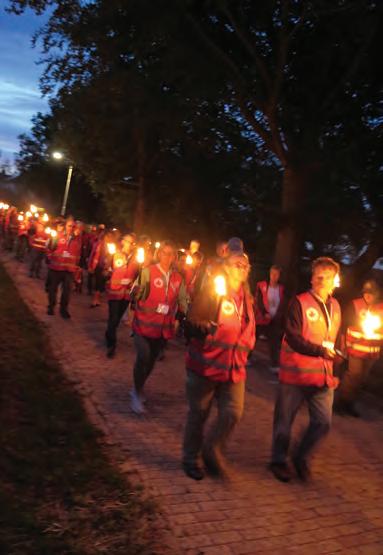
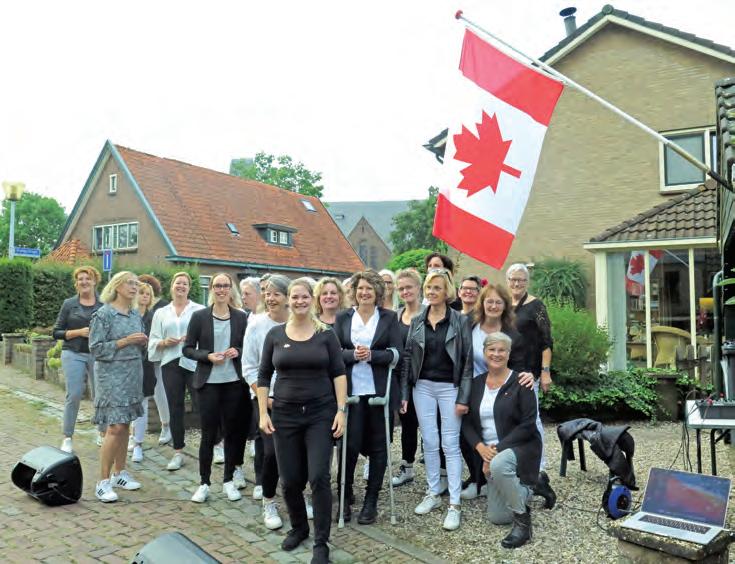
Clockwise from top left: Nel Erlee shares wartime memories; Linda Webb displays her father’s war diary; pilgrims on a candlelight march; Greg Mulatz and Brad Hrycyna enjoy the reception in Apeldoorn. One of four choirs (opposite) that performed for tour participants in Etten.
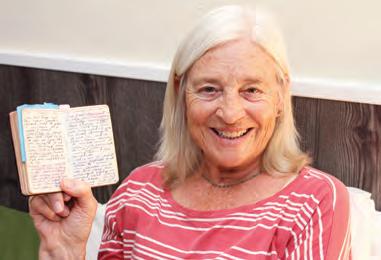
Linda Webb of Saint John, N.B., brought along the diary her father, Major Paul Maurice (Frenchy) Blanchet, wrote in the Netherlands in 1945.
“I had already followed his footsteps in Italy in 2013 on the 70th anniversary of the landing in Sicily,” she said. Webb was able to visit many of the places mentioned in his diary during the pilgrimage, and even stayed in a hotel in Ehzerwold that had been converted from a military hospital where her father may have been treated for dysentery.
Veterans Brad Hrycyna and Greg Mulatz of Regina wanted to expand their knowledge of Canadian war history, adding to what they had learned in half a dozen tours of battle sites in Italy, France and Belgium.
Veteran Brian Budden of Mississauga Ont., who had served with the Queen’s Own Rifles of Canada, wanted to learn more about where his grandfather served in addition to paying respects at graves of men from his regiment.
The IOFF pilgrimage began in Canada on Sept. 5, when the Canadian Remembrance Torch, commissioned by Hunter, was lit from the Centennial Flame on Parliament Hill. The torch was designed by engineering students Yuvraj Sandhu, Sebastian Tattersall and Anna Esposito of Hamilton’s McMaster University. Each carried the torch in turns throughout the trip.
The torch was passed on in a ceremony at Het Loo Palace in Apeldoorn to Princess Margriet of the Netherlands, for use in Dutch
commemoration. The flame, contained in a special case for the flight over the Atlantic, was used to light the torch that led the marchers and played a central role in remembrance ceremonies.
For the pilgrims, remembrance also took the form of getting a sense of what it might have been like for the Canadians who fought in Holland at the end of the Second World War. Then, troops encountered frequent rain, snow and mud, and subsequently, were often wet and cold. The pilgrims got a similar experience in spades on their first 20-kilometre march, which began in Megchelen in the pouring rain.
On the bright side, no one was shooting at them.
The pilgrims walked more than 60 kilometres in total during the trip, through towns and villages, across country fields and along lonely roads, following routes Canadian troops travelled during the liberation of the Netherlands. Volunteer guides shared wartime history along the way.
They stopped at many memorials dedicated to Canadians, old and new. In May 2022, a monument was unveiled commemorating 500 people, including Canadian troops and aircrew, who died near Genkoppen en Wisch during the war. Meanwhile, in the village of Warnsveld, population 8,390, pilgrims visited a small cemetery where five Canadians are buried. The village donated a maple tree at the cemetery and dedicated a plaque to honour Canadians. Each grave had flowers the day of the visit.
The pilgrims also soaked up history at exhibitions both large, such as the Canadian wing at the Bevrijdingsmuseum (Liberation Museum) Zeeland in Nieuwdorp, and small, like the collection Christian Harkink transports in the back of his van to events he knows Canadians will attend.
“I learned more about the adventures my dad went through,” said
Canadian
flags were hanging everywhere: from flagpoles in people’s front yards, in shop windows and even on the sails of windmills.
Joanne Edey-Nicoll of Langley, B.C., of her father Alexander Edey. “When he was alive, he didn’t talk about it.”
Edey-Nicoll knew her dad had been wounded in 1945 and may also have been treated in the Ehzerwold hospital. She had been told how much the Dutch people appreciated what the Canadians did. “But nothing prepared me for the welcome we got,” she said.
On May 4, Dutch people remember the war dead and place flowers on the graves of Canadian and other allies. They party to celebrate their freedom the following day.
Pilgrims got their first taste of that as they marched in formation behind the City of Apeldoorn Pipes and Drums into Etten. Excited people crowded the sidewalks. Canadian flags were hanging everywhere: in people’s front yards, in shop windows and even on the sails of windmills. Four choirs put on performances.
Similar greetings (minus the choirs) were repeated everywhere the pilgrims stopped.
“I was overwhelmed at the reception,” said Jordan. “The streets were crowded with people laughing and clapping. These people have no idea who we are, whether my dad died or came home, what in fact any connection I had. Yet, we were Canadians, and they were happy to see us.”
Canadians who thought the long marches might wear off some pounds had those hopes dashed, for whenever they stopped marching, locals gave them delicacies—savoury bitterballen, orange liqueur, wine and cheese and pastries. Lots of pastries.
That warm welcome should reassure Canadians who worry that because the link to Second World War veterans is fast disappearing, the relationship with the Dutch people will, too.
The Dutch once thanked Second World War veterans in person. Now they thank the children of those veterans—really any Canadian—for the service and sacrifice of the men and women during the Second World War.
Will the friendship between the Netherlands and Canada ever fade? “Not if I have anything to do with it,” said Kuijper. L
U-BOAT
From hunter of Allied ships to PoW and Canadian entrepreneur, the incredible journey of Kurt
Schönthier
/
By Stephen J. Thorne
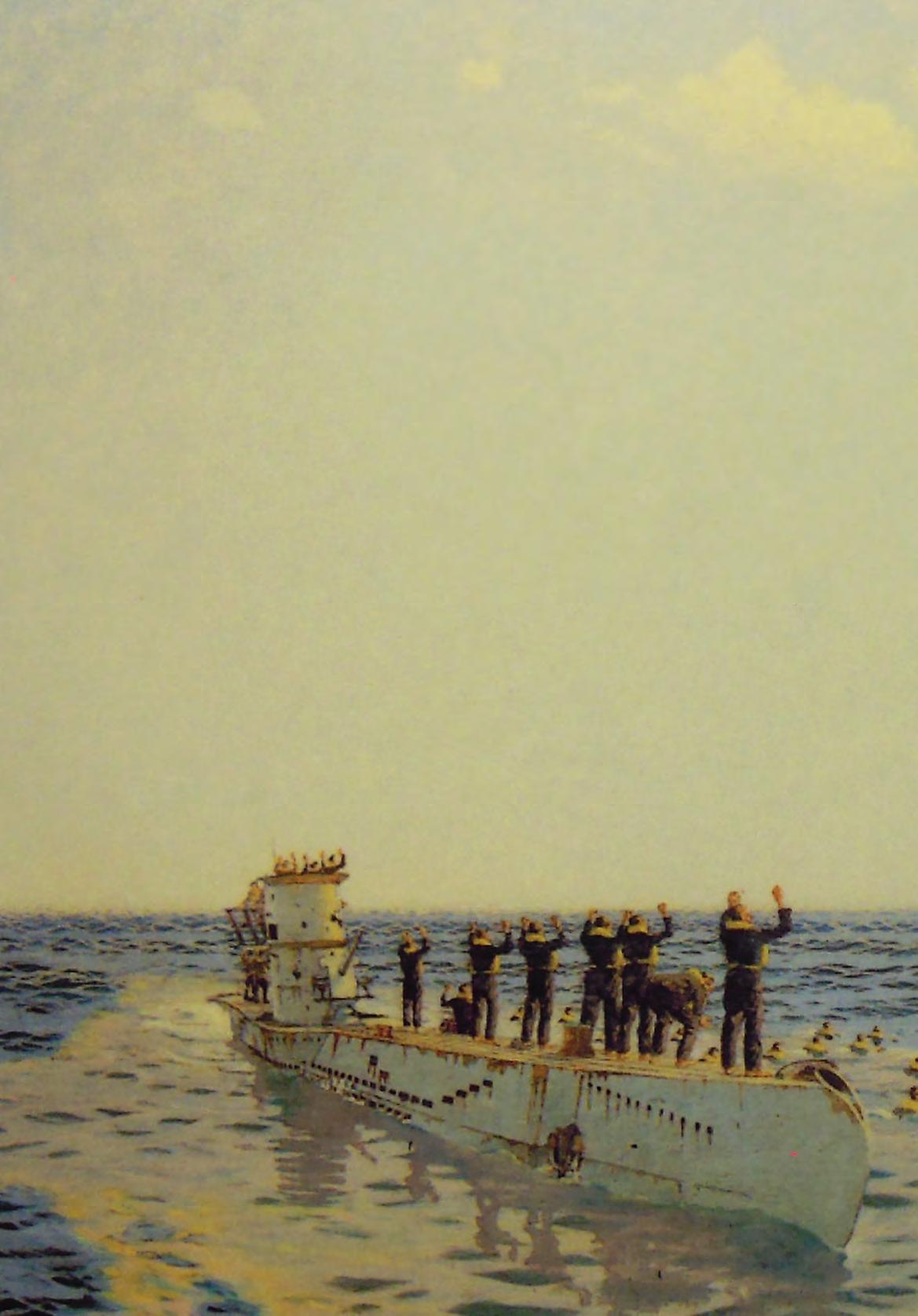
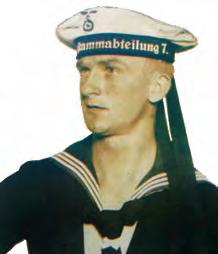
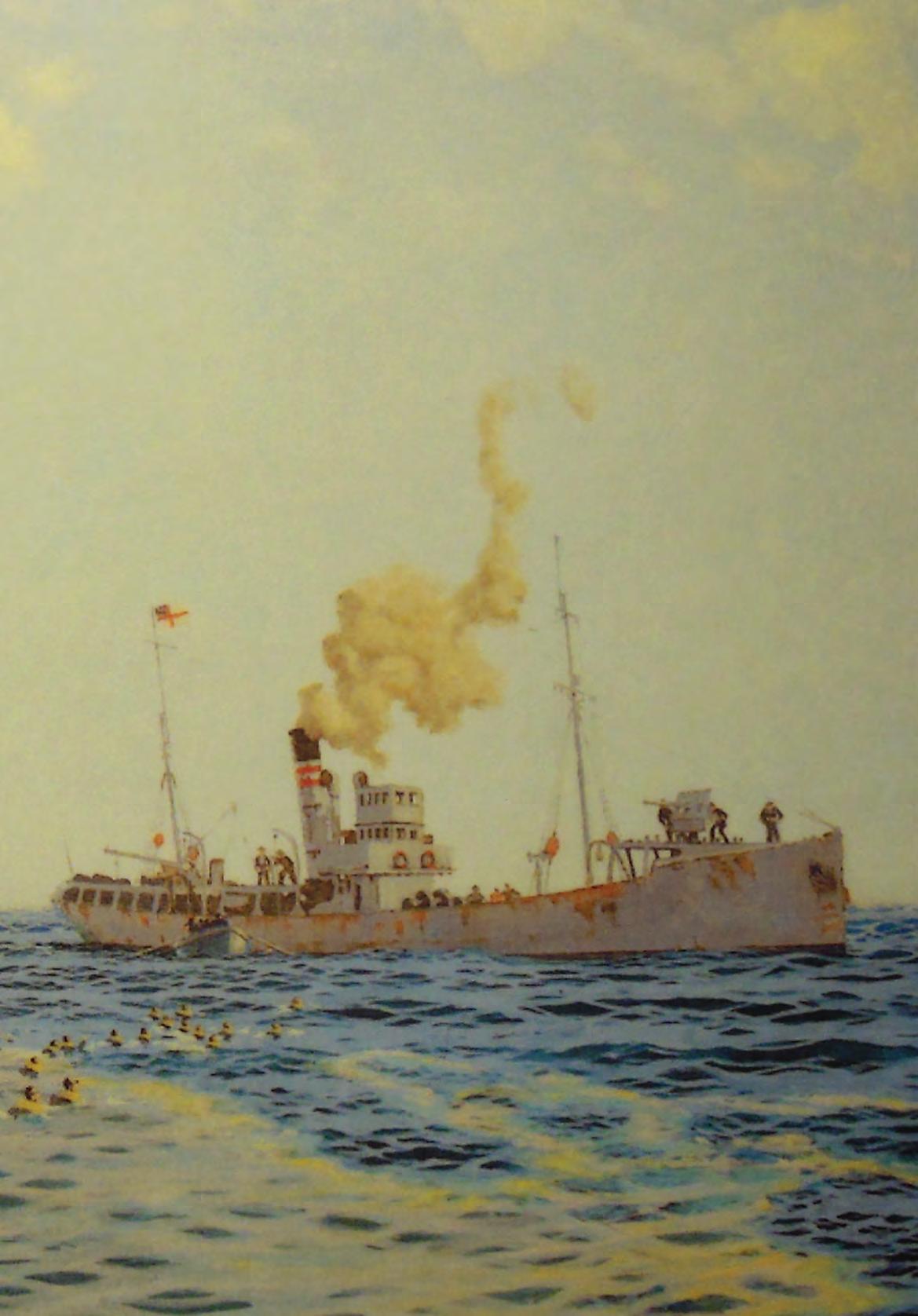
Kurt Schönthier’s Canadian saga began in pitched battle with the British anti-submarine trawler Lady Shirley southwest of Tenerife, Spain. The brief encounter ended with the rescue of Schönthier (inset) and 44 of his crewmates.
Schönthier, the sub’s wireless operator, recalled in a memoir he wrote in 2001.
Kurt Schönthier and his crewmates aboard U-111 were eight days out of the German port at Wilhelmshaven when the order came from their skipper: “Both engines, three-times full-speed ahead!”
They were southwest of Reykjavik, Iceland, and the Type IXB U-boat, on its maiden war patrol, was about to encounter its first prey: the British steamer Somersby
A veteran of some half-dozen wartime crossings of the North Atlantic, Somersby, with 7,500 tonnes of grain in its hold, had joined a convoy at Halifax, then apparently broke off ahead of schedule bound for Kingston upon Hull, England.
U-111 was on the surface in a rough sea. Their leader, Kapitänleutnant Wilhelm Kleinschmidt, was one of only two men aboard older than 30.
“Within seconds, the diesels answered with their roaring, hammering voice,”
“The violently crashing breakers against the conning tower, and the strong vibration of the entire boat due to the increased revolutions, transmitted a sense of accelerating speed, putting the whole crew into the spirit of the hunter.”
It was May 13, 1941. The U-boats were peaking, making a critical dent in the supply lines to Britain. But developing Allied technology and tactics would soon begin to close the gap and what would become known as “the First Happy Time” would come to an end.
Shortly before U-111 sailed, word had come down that four subs had been sunk, three of them skippered by the greatest captains in Admiral Karl Dönitz’s fleet of unterseeboots—Otto Kretschmer in U-99, Günther Prien in U-47 and Joachim Schepke in U-100. Kretschmer survived, as did Joachim Matz in the fourth sub, U-70.
“The devil is loose in the Atlantic,” wrote Schönthier. “Gone! All on the same convoy! They (Tommies) must have developed some new detecting devices.
“It gave us the creeps, thinking they outsmarted those old foxes.”
Somersby was making good speed and, Schönthier noted, a ship that can run faster than the average convoy often dared to run alone.
U-111 swung out in an arc, attempting to gain a position ahead of the ship for an attack. Twenty-six torpedoes, each packing some 280 kilograms of explosives, were stored aboard the sub—under the floor plates, on the floor and on the deck
K
“ONLY SOMEONE COMPLETELY INSANE COULD LIKE A WAR. THUS, MOST WHO ARE INVOLVED WOULD LIKE TO END IT.”
above, as well as inside the four launch tubes in the bow and two in the stern.
Crew had to “crawl on top of the torpedoes to reach our berths…we actually slept, ate, and lived on top of, beside, behind and underneath…those so-called ‘eels.’
“Now is your time, U-111, to prove that you are not a pup anymore; that you have learned the skill to hunt, to chase, to kill,” he wrote. “You know that your strength is your invisibility and your perseverance.
“If you are detected, you are no longer the hunter. You would not only risk losing your prey, but could become the hunted yourself. Thus, keep your distance, young wolf, don’t lose your victim, and run…run…!”
And run they did. Even at that, it took U-111 half a day to reach their desired position. At 11:41 a.m., Kleinschmidt ordered his forward torpedo room to fire.
Schönthier and crewmate Heinz Kuenne, stopwatch in hand, were in the sound room. Kuenne started the timer. After what Schönthier described as an “eternity” of a few seconds, Kuenne removed his headphones and whispered: “Now.”
“An explosion shuddered our boat, as if he had triggered this with his word. He looked over to me, our eyes met for a few seconds, and without a word spoken, he left the room with a slightly shaking head.” Schönthier sat grim-faced.
The record indicates that Somersby was hit amidships by one of two torpedoes. An hour later, Kleinschmidt fired a coup de grâce. The ship capsized and sank bow-first, its rudder high out of the water. All 43 aboard were picked up by a Greek merchant ship and landed at Loch Ewe, Scotland, their lives spared.
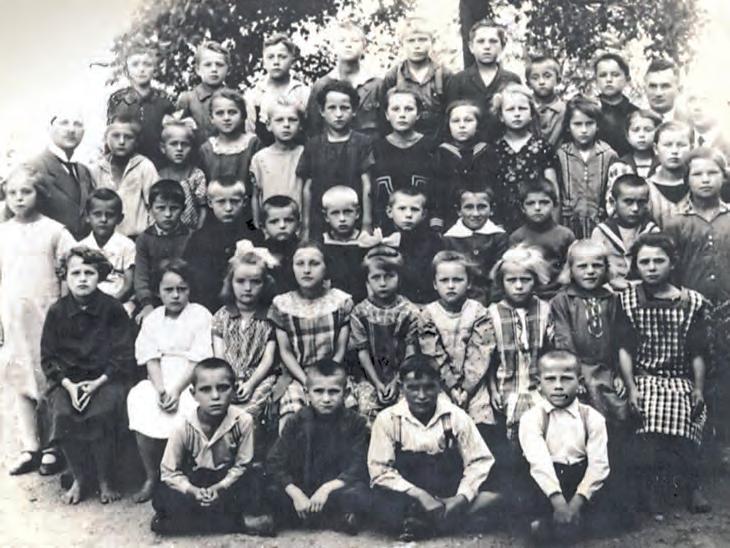
Schönthier grew up on a dairy farm outside the eastern German village of Grün Hartau or, as he wrote, Gruenhartau. It was then a “Nazi fortress” near the Polish and Czechoslovakian borders; it is now the Polish town of Zielenice.
Schönthier’s father was an obersturmführer, a first-lieutenant leading a 180-man platoon in the Nazi party’s paramilitary Sturmabteilung, or SA. Schönthier’s sympathies at the time, later abandoned, were a product of his upbringing and peer pressure.
“To be a member of the Hinterjugend? It was the in-thing for Gruenhartau’s kids,” he wrote. “We didn’t like the Reds or the Sozies (socialists) because our elders didn’t, and we wanted to wear the same uniform as our fathers did.”
Raised on stories of the Kaiser’s navy, Schönthier joined the Kriegsmarine in 1937, a romantic who dreamed of seeing the world, not conquering it. He had no inkling of what lay ahead.
“Only someone completely insane could like a war,” wrote Schönthier. “Thus, most who are involved would like to end it.”
Neither surrender nor a negotiated peace was a realistic expectation in 1941,
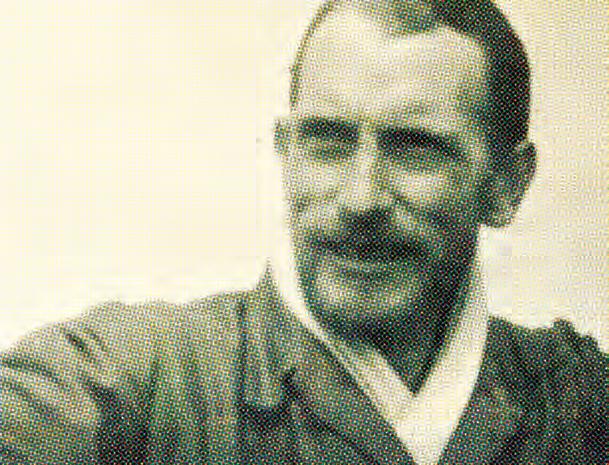
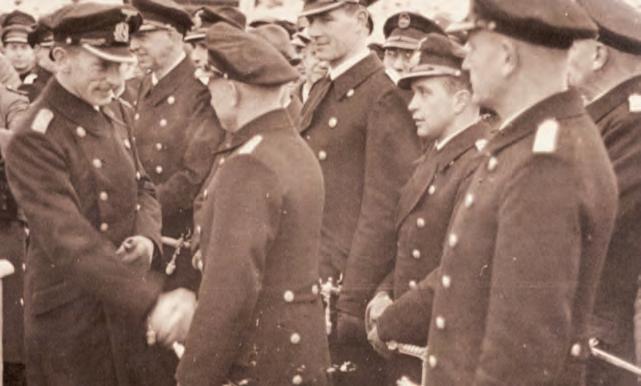
Kapitänleutnant Wilhelm Kleinschmidt (opposite top) is congratulated by Kriegsmarine brass (opposite bottom) as he assumes command of U-111 in December 1940. Schönthier is pictured (back left) with classmates (below) at his public school in Gruenhartau in 1929.
in the spring of 1943—the Allied effort buoyed by the code breakers of Bletchley Park, enhanced sonar technology and long-range aircraft. As tonnages withered, U-boat losses began a relatively steady rise.
“The only thing that ever really frightened me was the U-boat peril,” British Prime Minister Winston Churchill wrote in his postwar memoir. “How much would the U-boat warfare reduce our imports and shipping? Would it ever reach the point where our life would be destroyed?
“Here was…only the slow, cold drawing of lines on charts, which showed potential strangulation.”
In these high times, the U-boat men had panache, an unparalleled esprit de corps. There was a mystique to conducting warfare from within the cloak of invisibility afforded by the ocean depths. They reveled in their filth, their beards and their successes. They were celebrated heroes back home. But the U-boat life in cramped quarters, over long patrols in hostile waters, was hard and, as the losses mounted, it lost much of its lustre.
“WE PARTICIPATED IN THE VAIN ATTEMPT [TO FIND] ANY SURVIVORS, BUT ONLY COUNTLESS LIFE JACKETS REMINDED US OF THE CRUEL BATTLE.”
however. “Thus, we had to win, meaning to kill and destroy as fast and as much as possible to bring this madness to an end.”
For the U-boat men of U-111, the task was clear: bring Britain to its knees by denying it its lifeblood.
The gross registered tonnage of ships lost to U-boats would begin a precipitous decline
Soon, Schönthier would bid farewell to his brother and father for the last time. On Oct. 4, 1941, he and his crewmates would abandon their sinking U-boat southwest of Tenerife, Spain, far from their German homes.
He would spend six years behind barbed wire and, when he finally returned to the fatherland, everything had changed. Canada would become his home.
A week after its maiden success, with an additional damaged merchant to its credit, U-111 encountered a “giant,” heavily escorted convoy. Kleinschmidt reported it to U-boat headquarters, or BdU, and alerted other U-boats in the area.
He was ordered to stand off, maintain contact with the enemy ships and send dummy signals to enable the approaching battleship Bismarck and the heavy cruiser Prinz Eugen to close.
The plan was for Bismarck and its 38cm guns to lay waste to the convoy. It was a fateful decision, unleashing the mighty battleship. Its breakout from the port at present-day Gdynia, Poland, into open waters would result in a fatal confrontation with the Royal Navy.
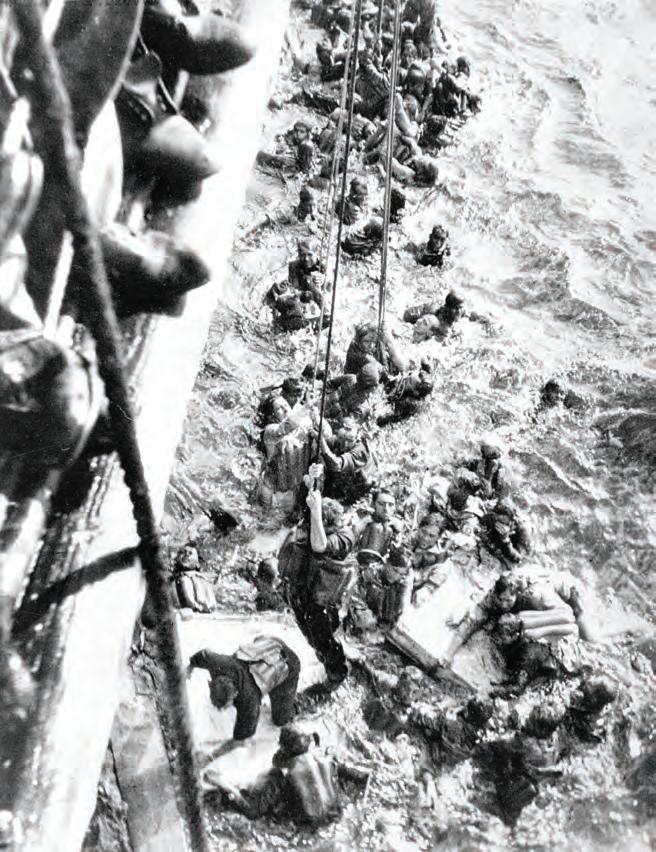
Crippled by a torpedo from a carrier-borne Swordfish aircraft and pounded by RN ships, the great vessel was scuttled on May 27, 1941, less than a year after it had been commissioned. HMS Hood was lost in the epic sea battle in which some 2,100 German sailors were killed and about 110 captured; Allied losses numbered 49 killed.
“We participated in the vain attempt [to find] any survivors,” Schönthier wrote, “but only countless life jackets, torn from the bodies by rough sea, reminded us of the cruel battle.”
The Kriegsmarine’s surface operations were never again a significant factor in the Second World War.
U-111 refuelled and replenished at sea, then resumed patrolling North Atlantic waters. The boat’s forward lookouts soon detected a puff of smoke on the horizon. Unawares, a ship was coming directly to them.
U-111 logged another victim—the British steam merchant Barnby, a straggler from Convoy HX-126 out of Halifax with 6,600 tonnes of flour aboard. One crewman, 29-year-old cook John Fletcher of Whitby, England, died of exposure and exhaustion in a lifeboat. The other 36 crew and eight gunners would make landfall at Reykjavik, Iceland.
The U-boat went west to Newfoundland and the Strait of Belle Isle, where it spent more than three foggy weeks conducting weather research, dodging icebergs and slowly exhausting its fuel supply.
With everything running low, they returned to the U-boat base at Lorient, France, making port early on July 7. As the grey streak on the horizon slowly turned to green, and the coloured rooftops appeared “like ornaments,” a light breeze from the east “carried a perfume-like scent over to us, emanating from millions of flowers of Brittany’s meadows.”
It was an unforgettable aroma to olfactory systems that had been under assault by the stench of fuel, grease, mould and body odour for nine long weeks.
After a month ashore, including two weeks with family in Gruenhartau, Schönthier peered out through the train window, looking upon his father,
brother Guenther and the village steeple. He would never see them again.
U-111 departed for its second patrol on Aug. 14, 1941. In September, it would sink two ships, the Dutch motor merchant Marken near Brazil on the 10th and the British-owned Cingalese Prince in the middle of the South Atlantic near the equator 10 days later. All 37 crew aboard the former survived; 57 of 77 on the latter died.
In early October, after some close calls, which included an encounter with the British submarine Clyde, U-111 was headed back to port. It was not to be.
A wireless message arrived instructing the German boat to make for waters 220 nautical miles southwest of Tenerife, Spain, where it was to find a disabled 10,000-ton steamer and a sea-going tug. They never did find the steamer, or a tug. Instead, they stumbled upon the British anti-submarine trawler, Lady Shirley. Kleinschmidt was convinced it was the prey they were seeking.
As U-111 encountered its supposedly crippled enemy, Schönthier was stationed at the sound detector in the bow of the boat instead of his usual spot in the radio room at the centre. The reassignment saved his life.
As soon as he made his first sound scan, it became evident that there was something drastically wrong. A ship was closing fast.
“Four splashes, and seconds later the explosions that fatally wounded U-111 threw us around, accompanied by a deafening thunder, amplified a hundredfold by my sound device. My eardrums!”
Schönthier was stunned and deafened. He turned to find an empty boat behind him. He removed his headphones and heard machine-gun fire. Then a muffled explosion.
“Are we shooting? Did we surface?”
He hurried back. The radio room was empty. He heard yelling from the control room. A hand reached up through the bulkhead. He knew the man, a recent addition, Heinz Steffeck. Schönthier took hold of him, but it was of no use.
“I let his lifeless body glide to the floor planks between the radio room and Captain’s bed, and saw that his right side from the shoulder down to his hip was terribly mutilated. The sweetish smell of burnt flesh and gun powder brought me to the brink of vomiting.”
A gun battle was raging topside. Schönthier would have been up there in the middle
Survivors from the German battleship Bismarck are pulled aboard HMS Dorsetshire on May 27, 1941. About 110 crew survived the battle; some 2,100 died.
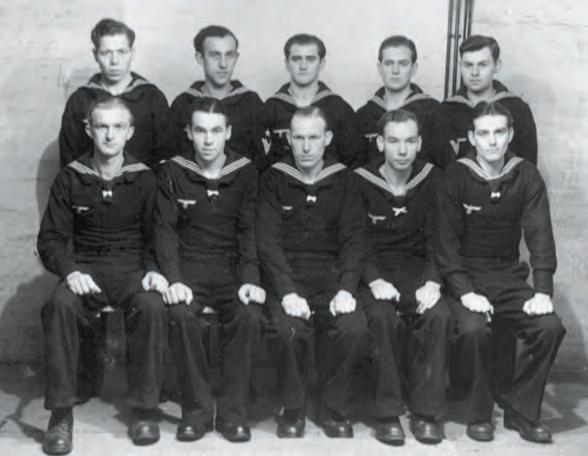
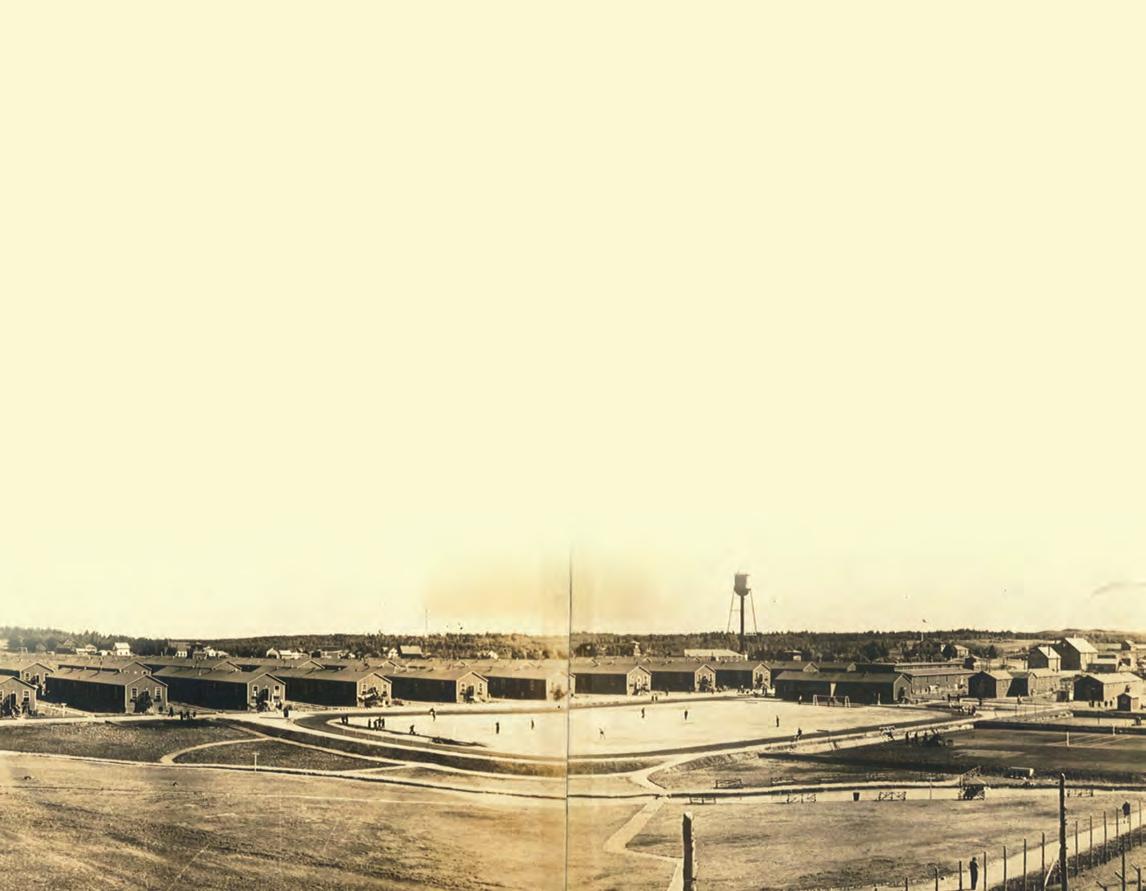
Schönthier (front left) is pictured with naval school classmates (below). He spent time at PoW Camp 23 in Monteith, Ont. (bottom).
of it had he been at his usual station and, by now, he would likely have been dead.
All but one on the bridge had already been killed by a direct hit from Lady Shirley’s four-inch gun—seven dead, including the skipper Kleinschmidt and Steffeck, who was delivering ammunition and fell back below when the shell struck.
Another shell hit just behind the boat’s 105mm deck gun, severely wounding two men. The engines were dead; the boat was flooding. The chief engineer, Wulff, issued the order: “Leave the boat, everybody!”
U-111 was sinking and Schönthier was searching frantically for a life jacket.
Grabbing one, he rushed up the ladder to the conning tower. Kleinschmidt’s upper body lay sprawled alongside the periscope. He had been torn in half. Another crewman was sitting upright, “a huge hole clean through his chest.”
Schönthier made his way across four more mutilated bodies and down the ladder to the deck astern. Not 400 metres away was the small ship flying the British naval ensign. Between them, U-111 crew were swimming for their lives. Others were dragging the wounded into the water with them.
As Schönthier swam, a crewmate yelled: “Our Fuehrer! Our Fatherland! U-111! Hurrah!” The others yelled back, “Hurrah!” and Schönthier turned to see their boat, its bow vertical, slowly slide beneath the waves.
For the next six years, Schönthier’s home was a series of prison camps, first in England, then Canada—the land of “milk and honey, trees and lumberjacks.”
Some 34,000 German prisoners of war would be held in Canada between 1939 and 1945, and beyond. Schönthier first went to Monteith in northern Ontario; then to camps elsewhere in the province, to Alberta and back again. He did a stint at a farm at Fingal in southwestern Ontario, where he lived and worked virtually as a family member, and ended his Canadian captivity where it started, in Monteith.
“Join the Nazis and see Canada!” was a favourite joke among their guards. The PoWs were treated well.
He read, attended classes and studied agriculture; he learned English, performed odd jobs, did kitchen duty and even worked for lumber operations in Ontario and Quebec. And he wrote and read and re-read letters from his fiancée Erna.
News came that his brother Guenther had died in France and, as the war drew to its conclusion, he read the newspaper accounts as Soviet troops overran Gruenhartau. The region, the site of heavy fighting in the closing months of the war, would be ceded to Poland by the time Schönthier left Canada.
The PoWs were shown films from the concentration camps—compulsory viewing.
“I am quite sure that nobody from us POWs knew anything about the happenings inside those Concentration camps,” Schönthier wrote. “We were just as stunned and disgusted about it as anybody in the world.”
Shortly before he was to leave Canada, he got his first letter in more than a year from Erna. “I am waiting for you, Kurt!” she wrote.
As authorities began repatriating the PoWs, appeals went out from farm organizations
“THIS GIRL JUMPED OFF HER BIKE, AND THEN WE HELD EACH OTHER AND COULDN’T SAY A WORD… NOT ONE WORD.”
and lumber companies seeking Germans willing to remain in Canada as free men to work on farms and in lumber camps. Schönthier said half the remaining prisoners expressed interest. He considered the opportunity, but wanted to find his family, see his home and gauge Erna’s feelings first.
Besides those who stayed, many more would return to Canada to live.
When Schönthier finally reached England, he was deemed “not ‘ripe’ politically” to be sent home. He hadn’t seen Erna in six years. He was in a lumber camp when he had ordered their wedding rings from the Eaton’s catalogue and had worn them both since. Erna and his mother were in western Germany. His father was in a Polish prison.
But Schönthier’s convictions bought him another eight months imprisoned in England, where he worked in a kitchen and performed maintenance work at an airbase near London.
Eventually, he abandoned Nazism and politics altogether. “I learned that in most cases, people that are choosing this line for their living are power hungry beings who very seldom keep their great promises.”
He was moved to a transit camp and then, on Aug. 14, 1947—six years to the day since U-111 had left Lorient on its last patrol—headed for the train station, the docks and on to Rotterdam and home.
His mother was in Oldenburg, Germany. He got a ride from the train station aboard a horse-drawn wagon, eventually pulling up in front of the house where she was staying. A woman was standing on the back of a wagon, shovelling peat moss.
“This is my mother!” Schönthier stammered as he leaped to the ground and over the fence. She turned to look and nearly fell. Schönthier took her in his arms.
“You look healthy, my boy,” she said. “This makes me very happy.”
Two hours later, he was waiting at the roadside when there appeared a woman on a bicycle. He hadn’t seen Erna in more than six years but, still, her blond hair was unmistakable.
“I didn’t know I could yell with such a loud voice,” he wrote. “I started to run.
“This girl jumped off her bike and let it run into the ditch, and then we held each other and couldn’t say a word…not one word and, yet, we were saying so much!”
They were married three months later. Schönthier took a farm job and, in October 1949, Erna gave birth to the first of their three children, Rainer. Eight months later, in June 1950, his father died in a Polish prison. He was to have been released in August.
Life in Germany finally brought home to Schönthier the degree to which Germans had been misled and exploited by Hitler and his cronies. They were hard times and Schönthier, for one, had lost his birthplace and the land where he’d been raised. That made it easier to decide to move to Canada.
In January 1951, Schönthier and his family—including his mother—boarded the Canadian Pacific ship Beaverbrae and left for Canada and a new life.
They settled in New Sarum, Ont. Erna waitressed. Schönthier farmed and worked odd jobs before opening an autobody shop. They had two more children.
Later on, the couple took their children on a trip to Germany. Afterward, daughter Kathy turned to them and said: “Mom, Pop, thank you for coming to Canada.”
Wrote Schönthier: “This sentence confirmed that we had followed the right road.”
He died in 2016, age 96. He and Erna were married for 68 years.
Kurt Schönthier’s self-published memoir, The German Immigrant, is available on Amazon.ca. L
The love of Schönthier’s life was wife Erna (above). The couple was apart for more than six years during the war, then began a 68-year marriage three months after they reunited in Germany in 1947.
The bridges of Caen
By AARON KYLIE
How George Gilbert Reynolds and the 23rd Field Company, Royal Canadian Engineers, played an important role in the liberation of Europe
WWhile there are imposing monuments and serene cemeteries marking the contributions of Canadian soldiers during two world wars throughout Europe, keen-eyed visitors may also spy less subtle traces of their impact across the continent. One such sign sits unassumingly on the south bank of the Orne River at the corner of Montalivet and Rue Rosa Parks in Caen, France: Pont Capitaine George-Gilbert-Reynolds.
The tram bridge is in the port city in northern France’s Normandy region, located about 20 kilometres south of where some 14,000 Canadian troops landed at Juno Beach on D-Day. It was dedicated to Reynolds, second-in-command of the 23rd Field Company, Royal Canadian Engineers (RCE), in 2019 during events commemorating the 75th anniversary of the invasion that launched the liberation Europe. Reynolds was killed in action on July 23, 1944, in the city’s Vaucelles district.
“There is a profound relationship between the people of this region who suffered so grievously and the Canadian soldiers who paid such a terrible price in freeing France,” said Charlie Angus, who attended the ceremony with about a dozen then-active combat engineers and 23rd Field Company veteran Frank Krepp. “In Normandy, young
Notably, it was not the first time a bridge in Caen had been named in honour of Captain Reynolds’ inspirational contributions.
The role of combat engineers in the liberation of Europe is often overshadowed by the heroic actions of aerial aces, the sacrifices of high seas sailors or the herculean efforts of infantrymen. However, the builders, known as sappers, are military specialists in the field fortification work that the whole enterprise relied on. During the Second World War, they provided battle maps, repaired and built roads and airfields, cleared mines, roadblocks and other debris, filled in craters and anti-tank ditches and built headquarters, barracks, hospitals and bridges. From 1943-45, engineers facilitated the advance—often in the face of enemy fire—alongside other combat troops to open routes for tanks and infantry.
It’s lesser-known stories such as this and, naturally, much more heralded reports, too, that Liberation Route Europe (LRE), a transnational memorial trail that connects Second World War sites across Europe, highlights in its work. A certified Cultural Route of the Council of Europe, LRE connects people, places and events that mark the continent’s liberation during the conflict. The organization is developing
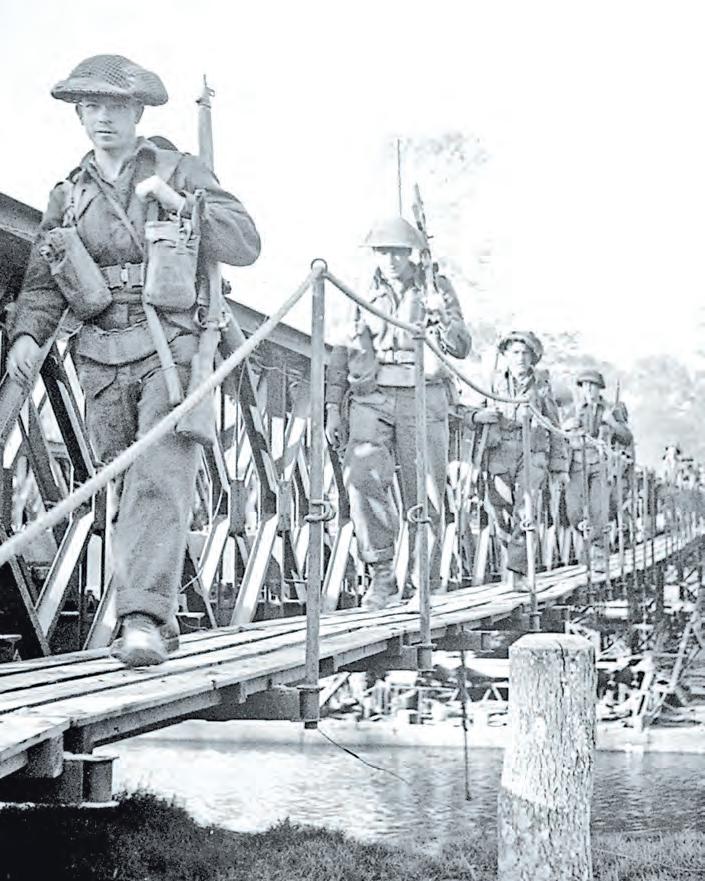
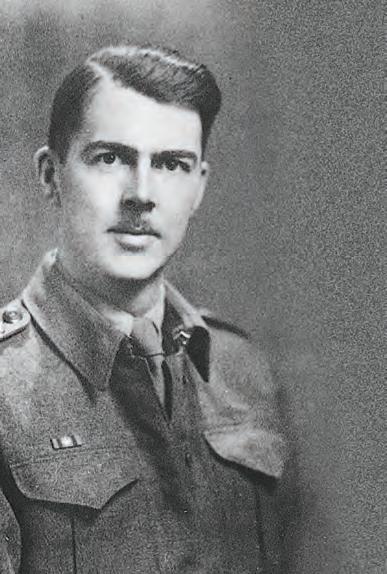
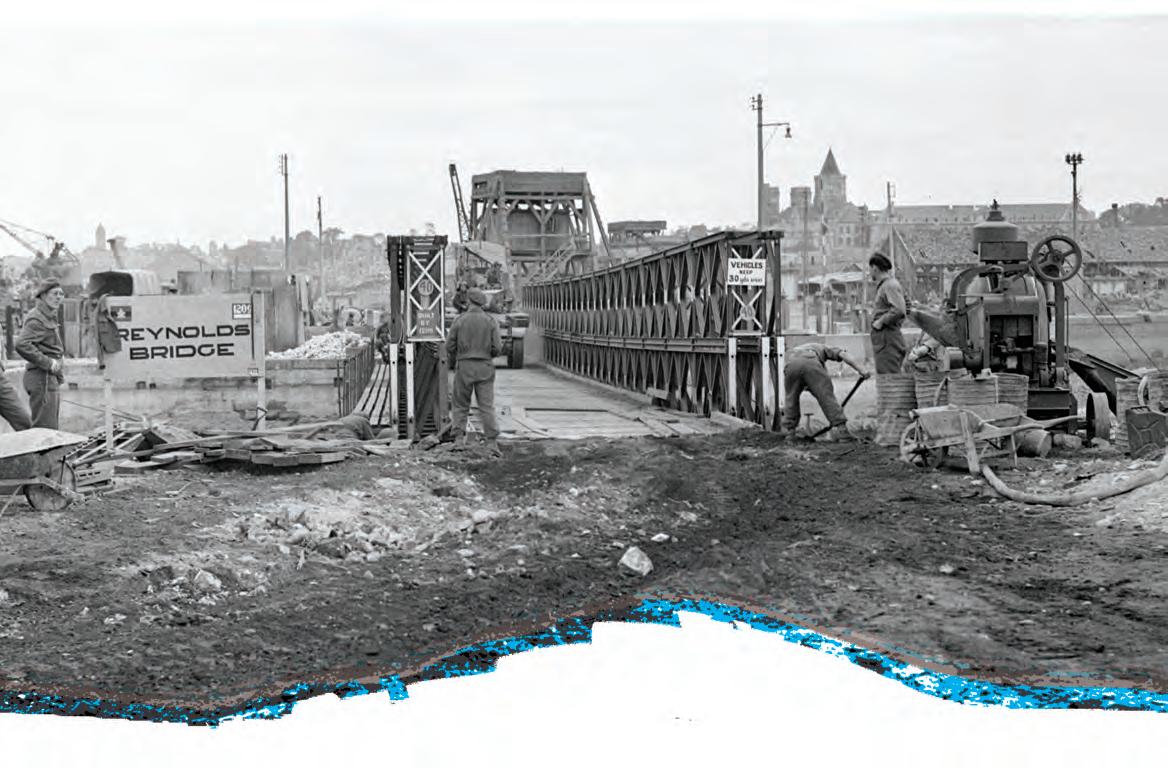
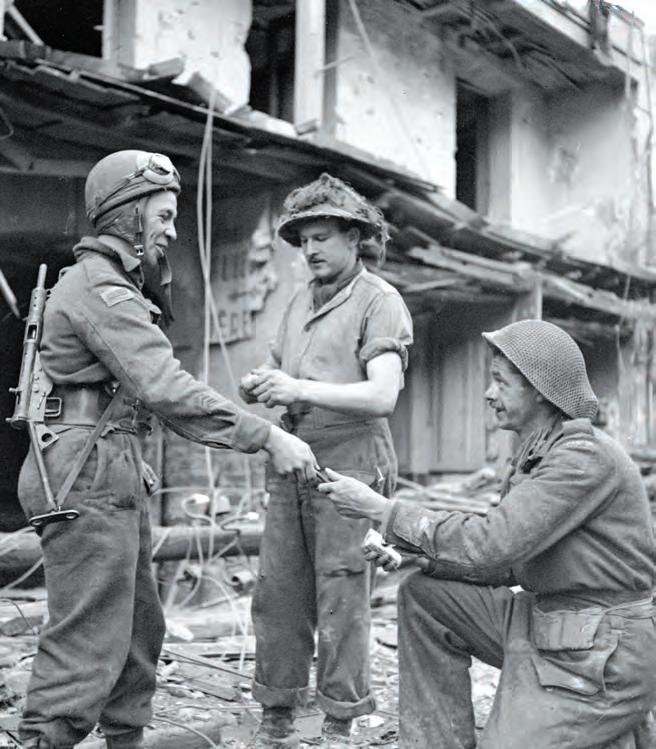
A tank crosses the bridge (above) built by the 23rd Field Company, Royal Canadian Engineers, and named in honour of its second-incommand, Captain Gilbert Reynolds (opposite right), who had died days earlier in late July 1944 in Caen, France. En route to the city, Canadian infantrymen traverse another bridge constructed by the RCE (opposite left).
“There
is a profound relationship between the people of this region and the Canadian soldiers who paid such a terrible price in freeing France.”
a network of trails throughout Europe that trace the Allied advance across some 10,000 kilometres. Its website and a new mobile app feature symbolic markers called “Vectors of Memory,” which visitors can use to connect with well-known events and personal stories and experiences. (Also see “Liberation way” on page 37.)
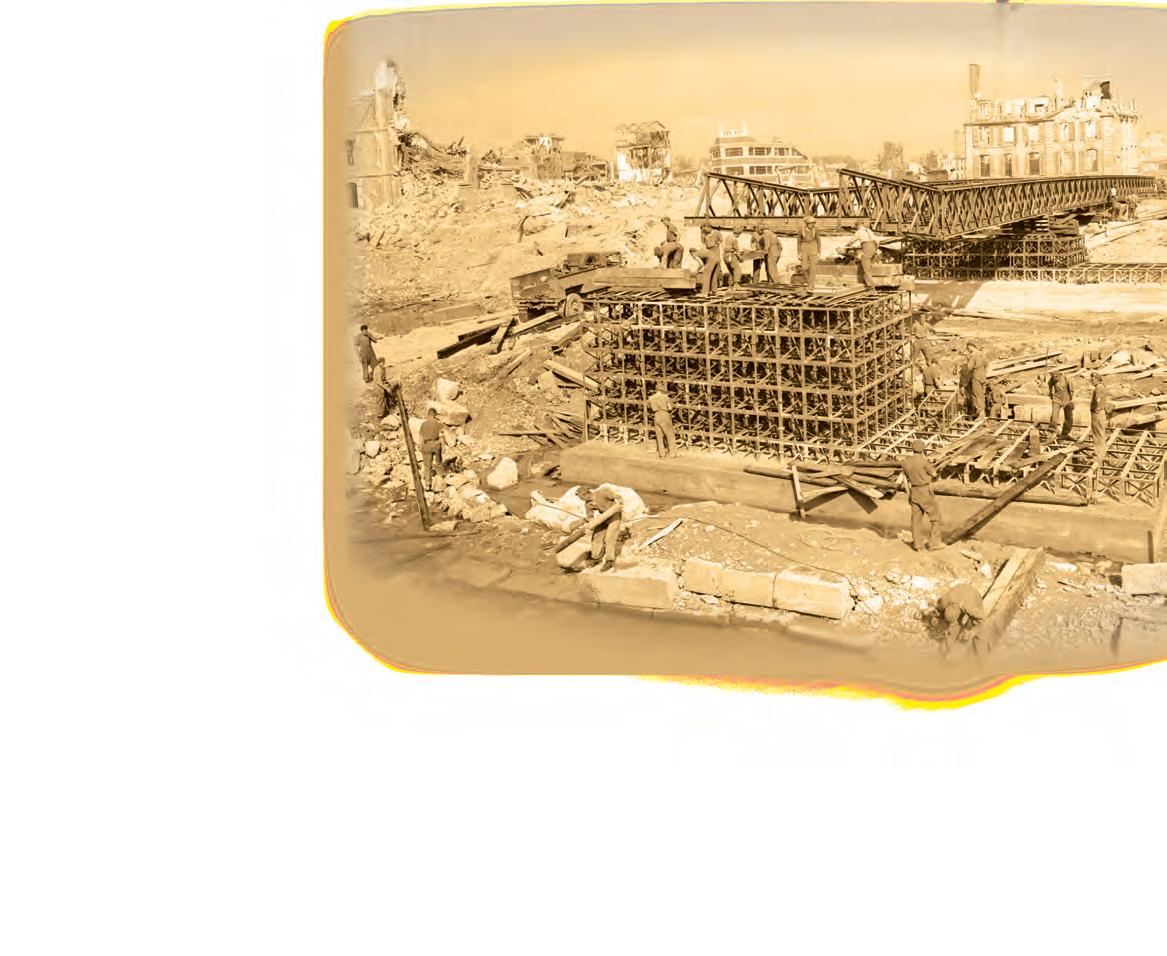
The five bridges the 23rd constructed in Caen in July 1944, are a crucial connection to the past, the liberation and the largely unheralded role of the builders in the battle.
George Gilbert Reynolds was born in Winnipeg just months before the outbreak of the Great War, on March 21, 1914. He attended Kelvin Technical School, a high school just south of the Assiniboine River in the city’s Crescentwood neighbourhood. While the original castle-like facility was replaced in 1964, the school still exists today at the same location—now a historic site of Manitoba. Reynolds is one of hundreds of former students and teachers killed in the world wars. The school’s motto: Courage, truth, right.
Before attending the Royal Military College and Queen’s University in Kingston, Ont., during the 1930s, Reynolds had studied pre-engineering at the University of Manitoba. “This would seem to account for his ability to assimilate engineering subjects with greater ease than some,” noted a yearbook entry from his Kingston days. During five years at university, the nearly six-foot, 180-pound Reynolds, boasting the handsomeness of a young Tom Selleck, notably played in all inter-company games, as well as tennis. He graduated with a degree in civil engineering in 1938.
Reynolds enlisted at age 25 on Aug. 31, 1939, the day before Germany invaded Poland. He had spent the year prior working for the Hydro-Electric Power Commission of Ontario in Bala, Hudson and Toronto’s Leaside neighbourhood. He married Grace Eleanor Cowdry in December 1940 and went overseas briefly from January to April 1942. Back in Canada, Reynolds was promoted to captain and took the commander’s course. His May 1943 Student Officers Report Form stated: “Keen and aggressive. Excellent officer with good capabilities.”
In February 1944, he bid his wife of three years goodbye and returned overseas.
Caen is considered the political, economic and cultural centre of northern France. Located just south of the English Channel, the city is renowned for its historic architecture. Much of it was built during the reign of William the Conqueror in the second half of the second century, including the imposing Château de Caen, a castle and fortifications on high ground near the city centre.
Some 70 per cent of Caen was destroyed in early July 1944 as Allied forces bombed the city after their plan to capture it on D-Day was delayed by weeks in the face of tenacious German resistance. Less than half of its 60,000 inhabitants remained in the city at the time, half of those living in temporary shelters or nearby caves.
When the first British and Canadian troops arrived in the city on July 9, many of Caen’s narrow streets were blocked, the stone buildings lining them having crumbled into mounds of rubble. Some 1,500 civilians were wounded; 3,000 were dead, including hundreds buried amid the debris. The way forward needed to be cleared.
Enter the 23rd and Reynolds. Like him, much of the company was also from Winnipeg. They landed on Juno Beach on July 11, the shoreline still chockablock with offloading ships, the waves lapping the shore with debris and bodies not yet
Captain Orville Fisher depicts engineers and infantry clearing a road through Caen in July 1944 (opposite). Members of the Royal Canadian Engineers place demolition charges during the work (below).
heart of Caen, all the while wise to booby traps and sniper fire. The company was regularly under fire as it worked its way slightly southeast toward the Orne River.
They cleared a path they dubbed “Andy’s Alley,” which, depending on the source, was either named in honour of General Andrew McNaughton, also a civil engineer, or Lieutenant William A.B. Anderson, a general staff officer at the time. The route would later be named Avenue Triomphale, then Avenue du Six Juin.
Once at the river, the 23rd started building five Bailey bridges across the Orne. The Bailey, a prefabricated truss bridge, had been developed by the British near the start of the war and was used extensively throughout the conflict in such situations. Its modular design was light enough to be transported by truck and lifted into place by hand, but sturdy enough to carry the weight of a tank.
Soon, Monty’s, Winston and Churchill bridges, along with a fourth unnamed one,
anti-tank device—ironically, Canadian army officers had ranked it their top weapon during the war. Reynolds’ Service and Casualty Form summarized his death dismayingly: “killed by a flying fragment while observing a demolition at 1500 hrs this 23 July 44.”
At 2 a.m. on July 26, the fifth Bailey bridge was taking traffic. The 23rd had cleared a way through the levelled city and built five crossings on the Orne in a little more than two weeks. The engineers christened the last bridge in the name of their fallen captain: Reynolds’ Bridge. Soon, as an article in The Winnipeg Tribune put it, the link was facilitating “heavy tanks to push on and crush Nazi resistance south and east of the city.” A senior sapper of the 23rd sent a picture of the bridge to Reynolds’ parents back in Winnipeg. In it, a Sherman tank of the British 7th Armoured Division, the renowned “Desert Rats,” is crossing the Orne en route to battle.
The day the photo was taken, a column of tanks crossed the river for hours.
The 23rd followed across in support of the 4th Canadian (Armoured) Division. After the Germans were chased from the Falaise Pocket south of Caen, the Canadians moved to the northeast to traverse the Seine River in late August.
At Pont-de-l’Arche, about halfway between Paris and Le Havre, the sappers joined the assault crossing of the river. They had had considerable training in England on British storm boats, which, supported by artillery and mortar fire, they used to ferry infantry troops of the 4th during the operation. The east bank secured, the 23rd built a 33-metre Bailey bridge over the Seine in less than a day.
The company went on to support the Allied advance into Belgium and the Netherlands.
In the latter, they were instrumental in the nighttime evacuation of the encircled and weakened British 1st Airborne Division on the Lower Rhine River.
The bridges, however, stand testament to the critical contributions of the 23rd Field Company, RCE. The Pont Capitaine GeorgeGilbert-Reynolds in Caen is a modern-day memorial linking to their story and their role in the liberation of Europe.
The bridge crosses the Orne in nearly the same place Reynolds’ Bridge did in 1944. And while it may be new, it harkens the sentiment expressed in The Winnipeg Tribune article sharing news of its predecessor’s naming: “In Normandy today stands a memorial to a Winnipeg officer— built by himself in the midst of battle, that the battle might be won.” L
Liberation way
Liberation Route Europe is a network of Second World War historic sites, museums and more throughout the continent that help visitors connect to the conflict in greater detail through symbolic markers (“Vectors of Memory”), its website (www.liberationroute.com) and a new mobile app. Here’s a small selection of highlight locations.
British Normandy Memorial
Located near Ver-sur-Mer, France, this site, which opened in June 2021, records the names of 22,442 servicemen and servicewomen under British command who died on D-Day and during the Battle of Normandy in 1944. www.britishnormandymemorial.org
Juno Beach Centre Renowned as Canada’s Second World War museum, the 21-year-old cultural centre in Courseulles-sur-Mer, France, is steps from the notorious shoreline and boasts outstanding permanent and temporary exhibits. www.junobeach.org
Mons Memorial Museum In central Mons, Belgium, this museum includes First and Second World War artifacts from the city’s collection that explore the relationship between civilians and the military. en.monsmemorialmuseum.mons.be
Jack’s Wood/Bastogne War Museum Explore the foxholes and history of the Battle of the Bulge in the Ardennes Forest near Foy, Belgium. Nearby, in Bastogne, delve into compelling interactive exhibits about the region’s Second World War history. www.bastognewarmuseum.be
Royal Canadian Engineers work on Monty’s Bridge in Caen (opposite), which was built in eight days. The new British Normandy Memorial in France (bottom left) and a reconstructed Sherman M4 tank at the Overloon War Museum in the Netherlands. (below).
Overloon War Museum This centre in Overloon, Netherlands, boasts an incredible collection of more than 100 Second World War vehicles and planes, including 2,000 pieces of wreckage from a crashed Lancaster bomber laid out in the aircraft’s silhouette. www.oorlogsmuseum.nl
Freedom Museum This facility in Groesbeek, Netherlands, focuses on cross-border, multi-perspective WW II history in the context of the 20th century and current events. www.freedommuseum.com
Groesbeek Canadian War Cemetery
This site near Nijmegen holds the largest number of Canadian war dead in the Netherlands—2,338 graves—and is also the largest Commonwealth war cemetery in the country.
Fletcher Hotel Erica After Nijmegen was bombed in early 1944, this lodging in Berg en Dal, Netherlands, became a refuge for the homeless. It also has a secret entrance to a basement space that may have been used to hide people. www.hotelerica.nl/en
Members of the United Nations Assistance Mission for Rwanda (below)— including its commander, majorgeneral Roméo Dallaire (right)—pose with local children in 1994. Canadian peacekeepers on patrol with the United Nations Emergency Force in Egypt in 1962 (right).
Reflecting on the role of children in peace and security as the global conflict resolution plan celebrates its 75th anniversary
My youngest memories are of playing with toy soldiers. I was always drawn to the honour and chivalry of the warrior ethic. So, I joined the Canadian Armed Forces as my father had. My training for classic war was eventually adapted to apply to new peacekeeping missions, but the pride of the uniform—green or blue—remained the same.
Of course, facing young boys and girls who had been abducted and forced to
fight, or had been subjected to horrific sexual violence, was not what I expected to face when I took command of the UN Assistance Mission for Rwanda in 1993.
The noble warrior ethic to protect, to assess a situation strategically and act with clarity, was challenged when faced with a child recruited and used in war. I could not comprehend the world turning its back on the slaughter of 800,000 human lives in only 100 days.
Canadian soldiers with the UN Peacekeeping Force in Cyprus patrol a street in Kyrenia in 1964 (right), while children play around the force’s armoured vehicles in Nicosia (opposite).
Canadian peacekeepers visit an orphanage in Cambodia in the early 1990s (below). Dallaire visits a childfriendly civilian protection site in Juba, South Sudan, in 2015 (opposite bottom).
The need for UN peacekeeping to be innovative, effective and accountable is as critical today as it was 75 years ago.
Peacekeeping is an imperfect tool that can never meet all needs or expectations. There are times when UN peacekeeping missions are prevented from, or fail to carry out, their mandates, thus putting into question the effectiveness or relevance of the system.
But, the alternative is unthinkable. The need for UN peacekeeping to be
innovative, effective and accountable is as critical today as it was 75 years ago when the concept was first introduced. According to the Institute for Economics and Peace, the overwhelming majority of the 20 least-peaceful countries face at least one catastrophic ecological threat. And most of the countries with the highest
ecological threat rating currently suffer from conflict deaths and have moderate to high ratings for intensity of internal conflict. Therefore, countries must not abandon their efforts to work together to pursue global peace and security.
Bold initiatives are currently in place to improve the UN’s capacity to advance political solutions and
support sustainable peace, improve the protection of civilians, as well as the safety of peacekeepers. So, we must not lose hope that change is possible.
Canada had a critical role in the establishment of UN peacekeeping, and more than 125,000 Canadians have served in UN peace operations. Not
surprisingly, Canadians consider peacekeeping part of the country’s identity. While there has been a steady decline of the country’s personnel contributions to such missions, Canada has supported those initiatives with expertise, policy guidance and innovation.
Part of this collaboration comes from the work of the Dallaire Institute,
Sudanese women wait to register for a referendum in South Sudan in late 2010 (below).
Canada was among several countries on the UN mission supporting the initiative. Canadian soldiers pass supplies to children in Portau-Prince in 2013, during the UN Stabilization Mission in Haiti (opposite).
through its efforts to build and strengthen the capacity of peacekeepers to prepare for missions where the recruitment and use of young girls and boys, whether in fighting or support roles, is likely to occur.
Canada also hosted the 2017 UN Peacekeeping Defence Ministerial in Vancouver, where the country contributed to the evolution of UN peacekeeping through two major initiatives: the Elsie Initiative to increase women’s participation in UN peace operations; and the Vancouver Principles on Peacekeeping and the Prevention of the Recruitment and Use of Child Soldiers. The Dallaire Institute helped draft the latter, and to date, 105 nations have endorsed it.
The most recent UN Secretary-General Annual Report on Children and Armed Conflict lists seven states and 48 non-state groups that committed grave violations against children in armed conflict in 2021.
The Vancouver Principles aim to empower UN member states to undertake early, effective and co-ordinated action to prevent the recruitment and use of minors as soldiers. This issue remains critical for the children involved, the peacekeepers who must face them and the global community that wishes to stop cycles of violence and generational conflict.
By endorsing the plan, UN members acknowledge the unique and far-reaching challenges with regard to child soldiers, and commit
to prioritizing the prevention of this human rights violation. Doing so will help ensure that all peacekeepers—military, police and civilian—know how to interact with such children so everyone is kept out of harm’s way.
As I know first-hand, the moral injuries resulting from exposure to grave atrocities can be catastrophic. The Dallaire Institute was created with the unique premise that preventing violence against children requires a dual lens: focused on prioritizing protection of children, as well as understanding the significant operational impacts on those in front-line roles.
This anniversary of peacekeeping is an opportunity to rethink the approaches
to peace and security, the related priorities and how people can break cycles of violence globally. Canada’s contributions to address the challenges of empowering women’s meaningful engagement in UN peace operations, as well as prioritizing children are producing tangible, proactive changes to international missions.
The Vancouver Principles are motivated by the conviction that preventing the recruitment and use of children as soldiers is not a peripheral issue to peacekeeping, but rather, is critical to achieving overall mission success and to setting the conditions for lasting peace and security.
We recognize that by focusing on the protection of minors, pushing their
well-being higher up on the international peace and security agenda, and making them a priority, the international community can begin to address the fragile situations that threaten the world’s most vulnerable.
The road is long, however, and the UN, civil society and academia must continue to provide new approaches to preventing
conflict. Peace is possible, conflict is preventable and children deserve to be at the heart of our motivations.
A retired lieutenant-general and former senator, The Honourable Roméo Dallaire is founder of the Dallaire Institute for Children, Peace and Security. Shelly Whitman is the institute’s executive director. L
This anniversary of peacekeeping is an opportunity to rethink the approaches to peace and security.
Bringing the stories of Canada to life like never before
Victoria Cross
The most famous decoration for courage in the Western world, the Victoria Cross has been awarded to dozens of Canadians and the lore behind the VC is sprinkled with strange and heart-wrenching stories.
War Stories: True stories from the First World War
When the First World War started in 1914, Canada’s population was less than 8 million, yet more than 620,000 enlisted. Many of the surviving soldiers share their stories in this special issue.
The Royals: The fight to rule Canada** Everything you need to know about Canada’s royal heritage from the earliest kings and queens who dispatched explorers to the New World to the modern British monarchy.
World War I: True stories from Vimy to victory More compelling stories from the First World War are told in memoirs by surviving Canadian soldiers.
Passchendaele: Canada’s brutal victory
The Canadian Corps was thrust into a battlefield of mud and craters to help Allied forces in the Battle of Passchendaele—Canada’s third major victory of 1917.
The
Canadian Navy played a pivotal role in this critical campaign, which raged on open and treacherous seas from September 1939 to May 1945.
Battle of the Pacific: Courage in the Far East Canada’s war in the Pacific began on Dec. 7, 1941, when Japanese aircraft attacked the U.S. navy base at Pearl Harbor, Hawaii.
Crime: Canadian style
Take a trip to Canada’s seedy underbelly and meet the perpetrators of some of the country’s most notorious felonies and misdemeanors.
O Canada: The history of our home and native land O Canada tells our story from First Peoples through to our achievements in space. Intro by Canadian comedian and author Rick Mercer.
Canada and the Second World War: The battles Canadians played pivotal roles in many of the most important and costly conflicts of the Second World War. Includes large battle map.
From early birds to astronauts, every one of these nationally celebrated and lesser-known flyers has made important contributions to Canada’s aviation heritage.
Vimy: The birth of a nation
The hard-fought WW I Battle of Vimy Ridge is sometimes called “the birth of the nation.” In April 1917, the Canadian Corps fought together for the first time and achieved success where others had failed.
The march to victory: Canada’s final 100 days of the Great War
The Canadian Corps fought several great battles before Germany surrendered, ending “the war to end all wars.”
*Conditions apply. 40% off back issues expires April 30, 2023.
Canada’s Ultimate Story engages readers with captivating stories of Canadian events and fascinating people from our earliest days to present times and editions are filled with little-known facts and trivia relating to our great country.
Liberating Normandy: The road to victory The Battle of Normandy was the beginning of the end of the Second World War in Northwest Europe.
Battle of the Atlantic
Royal
Twenty-five great Canadian aviators
The Somme
The Somme examines the role of the Newfoundland Regiment and the Canadian Expeditionary Force in the monumental First World War battle that took place in France from July 1 to Nov. 18, 1916.
War Photos War Photos showcases the stunning images and rare photos from the men and women who went into battle with only a camera.
O Canada: The best of everything Find out what really makes our country tick. Packed with Canadian people, places, wildlife, cities, culture, feats and innovations. Intro by Canadian comedian
John McCrae and the Battles of Flanders
John McCrae—doctor, gunner and poet—was shaken by the battlefield death of a friend in May 1915, and wrote the poem “In Flanders Fields” in tribute. The poem remains today a renowned symbol of remembrance.
Canada and the Great War: Liberation
In the final five weeks of the First World War, Canadian soldiers liberated more than 200 cities, towns and villages in France. “They were so glad to see us,” said one Canadian soldier, “they wept with joy.”
Battle of Ortona Late in 1943, Canadian troops attacked the German-held Italian city of Ortona. In fierce fighting, Canada pushed up Italy’s east coast and prevailed.
1945: Canada and the end of the Second World War
The year 1945 started with a massive German bomber attack on Allied airfields. But the Allies soon pushed back and Canadian troops led the advance across Belgium and into the Netherlands. The endgame was at hand.
O Canada: How Canada was shaped by war and peace
Since the First Peoples arrived on this continent, the place that would be called Canada has been shaped by conflict and co-operation. The impacts of war and the bounties of friendship echo through the story of Canada.
D-Day: The free world fights back It was the spring of 1944 and the Allies could not wait any longer. British, American and Canadian forces would land on five beaches on France’s Normandy coast in the early hours of June 6, 1944.
Canada’s great naval battles
The sea brought explorers, colonizers and navies from Europe to North America—as well as rivalries and wars. Join naval historian Marc Milner as he retraces Canada’s history—all from a nautical perspective.
How Canada conquered Vimy Ridge
The Great War had been raging for nearly three years by the time the Canadian Corps captured Vimy Ridge in April 1917. Many historians consider this important battle a defining moment for Canadian troops and our country.
land
oceans, huge mountains, wide waterways and wildlife wilderness—
breathtaking
Canada and the brutal battles of the Somme
The Battle of the Somme lasted 141 days, from July 1 to Nov. 18, 1916. For the Canadian Corps, the Somme was a coming of age, setting the stage for their seminal victories to follow.
Defining Battles of the War of 1812
Early on June 23, 1812, British and American warships exchanged the first shots of the War of 1812. For the next two-and-a-half years, the two sides waged war. The Americans thought taking Canada would be a cakewalk. It wasn’t.
O Canada: Greatest Canadians
Whether artists or scientists, athletes or social activists, writers, explorers or innovators, greatness elevates us all. To dream. To inspire. To live better lives. The greatest Canadians have come from all across this vast and beautiful country, their influence spanning its history and reverberating across place and time. Some are household names, forever woven into Canadian lore. Others are little known outside their fields. More than 200 are covered in this lavish issue. All made a difference, leaving their indelible mark on Canada and the world beyond.
Battle of the St. Lawrence: U-boats attack
It is 1942, and the U-boat war that has been raging in the North Atlantic spills into the Gulf of St. Lawrence and onto the river itself. For the first time since the War of 1812, lives are lost to hostile action in Canadian waters.
Experience a piece of Canada in every issue.
Makes a great gift!
Order today!
O Canada: Discover your
Big land, bigger
Canada offers
vistas in every direction. Intro by Canadian comedian Cathy Jones.
Ron James.
Fifty-five. That was the number of Canadian personnel on UN peacekeeping missions in September 2022. While more than 125,000 Canadians have served as international peacekeepers since the late 1940s (an average of about 1,600 per year), the latest stat shows that the country is no longer invested in the program. It’s time to reallocate the resources, particularly given the Canadian Armed Forces’ problems with recruiting and retaining members.
This past October, chief of the defence staff, General Wayne Eyre, issued a formal directive to CAF leaders to “maintain and grow our Force.” He noted in a message accompanying the directive that the Department of National Defence and the CAF must “make sure we are putting our energies into priority areas” and that Canada needs to maintain its national security obligations.
Given the international climate today, prioritizing the home front seems judicious—if not essential. But it’s not new either.
“Peacekeeping was always a sideline activity for the Canadian Armed Forces,” wrote retired general Lewis Mackenzie in the Toronto Star a few years ago. He also noted that between the 1960s and the 1980s, Canada had about
Should Canada continue to participate in peacekeeping?
Aaron Kylie says NO
1,500 soldiers on UN missions at any time, while it also had up to 10,000 troops stationed with NATO in Germany and France.
Meanwhile, retired general Roméo Dallaire, arguably the country’s biggest proponent of peacekeeping, has said: “Canadian soldiers are first and foremost specialists in combat.”
than those from 75 years ago, when peacekeeping, as largely envisioned by Lester Pearson, started to have a role in maintaining global order.
Today, it’s clear that global military alliances, such as NATO, have superseded that role—that armed response from allied countries to any enemy attack, or even the threat, is now a superior measure.
“THE PEARSONIAN PEACEKEEPING ERA IS…TRULY OVER.”
In essence, these positions reinforce what has been referred to as the “peacekeeping myth.”
While Canada has had a dwindling number of peacekeepers for nearly 25 years, many Canadians still believe that participation in such missions plays a key role for the country’s military and in its global affairs. Just a decade ago, 20 per cent of Canadians named peacekeeping as the most positive contribution the nation makes to the world.
In reality, international conflicts today are vastly different
“The Pearsonian peacekeeping era is…truly over,” wrote former defence minister Peter Mackay in a January 2018 article for Policy Options. “That romantic vision of blue-helmeted troops must now,” he continued, “join the other cherished military symbols and artifacts in the National War Museum in Ottawa.”
Mackay noted that that “model is now associated with increased risk, ineffectiveness, human rights failures and loss of life.” He pointed to the success of NATO and other coalition efforts in Bosnia from 1992-1995 and Kosovo in 1998-1990 as “more organized” and “better directed.”
Dallaire has already sounded a death knell for Canadian peacekeeping, when he said in a recent interview: “This is an outright abandonment. Any description that tries to minimize that is creating a falsehood in Canada’s position.” L
> To voice your opinion on this question, go to www.legionmagazine.com/FaceToFace
Ina statement on National Peacekeepers’ Day this past August, Prime Minister Justin Trudeau proclaimed that “Canada remains an important contributor to UN peacekeeping.”
Contributing only 55 peacekeepers to UN missions and ranking 71st out of 121 countries may lead one to quibble with Trudeau’s definition of “important contributor,” but his proclamation is indicative of how many Canadians view—or want to view—the country on the world stage. Canada should be a supporter of international peacekeeping, not only because it helps to make military spending palatable domestically, but it also bolsters Canada’s foreign policy.
Peacekeeping operations, as the PM recognizes, “strengthen the rule of law, protect civilians, uphold human rights, and advance peace and stability.” Canada’s support of these policy initiatives can be traced back to the first articulation of its international relations by foreign minister Louis St-Laurent in 1947. What Trudeau did not mention, is that peacekeeping is also in Canada’s national interest.
In the early 1990s, Canada was the largest contributor to UN peacekeeping, deploying more than 3,300 personnel. Since then, however, Canada’s participation has been in steady decline.
AARON KYLIE is the editor of Legion Magazine and the former editor-in-chief and associate publisher of Canadian Geographic. He is also the author of the Biggest and Best of Canada: 1000 Facts and Figures
MICHAEL CARROLL is a diplomatic historian and chair of the humanities department at MacEwan University in Edmonton. He is the author of Pearson’s Peacekeepers: Canada and the United Nations Emergency Force, 1956-67
PEACEKEEPING OPERATIONS “ STRENGTHEN THE RULE OF LAW, PROTECT CIVILIANS, UPHOLD HUMAN RIGHTS, AND ADVANCE PEACE AND STABILITY.”
Now this is not to imply that the Canadian military has been sitting idle. In the early 2000s, the U.S.led mission in Afghanistan was a major focus of the Canadian military, and there are currently about 1,300 Canadian soldiers deployed on various non-UN operations around the globe. The focus has turned from UN peacekeeping to military missions under the aegis of other multilateral institutions. Still, Canada continues to fall short of NATO obligations to spend two per cent of gross domestic product on defence.
Peacekeeping is a banner under which Canada’s military can seek increased funding as it’s an
expenditure that has traditionally been supported by a majority of Canadians, including Quebecers.
Peacekeeping has evolved from observation forces in the days of Lester Pearson to, at times, becoming active combatants. While the mission in Afghanistan was never a peacekeeping operation, the Canadian public generally saw the country’s participation as more akin to peacekeeping than war. Minimizing conflict, saving lives and making dangerous places safe has always been the aim of Canadian military missions abroad.
Canada’s peacekeeping efforts have also been intrinsically interwoven with the nation’s foreign policy. Advocating for women in peacekeeping with the Elsie Initiative is a natural extension of Canada’s feminist foreign policy and many peacekeeping operations fit nicely into the international relations pillar recently articulated by Deputy Prime Minister Chrystia Freeland to aid those countries caught “in between” autocracy and democracy.
Boots on the ground in UN missions has always been a strategy for Canada to gain international credibility, as well as to foster goodwill domestically for Canada’s armed forces. L
Michael Carroll says YES
The long
wait
By J.L. Granatstein
The soldiers of the 1st Canadian Division arrived in England before the end of 1939, and each year during the Second World War, more Canadian troops came. The overseas force eventually grew to three infantry and two armoured divisions and two armoured brigades. One infantry brigade from the 1st Division was put on standby to fight in Norway in May 1940, but the War Office in London cancelled the deployment. The Germans soon occupied the country.
Another brigade from the 1st landed in France on June 12
and 13—after Dunkirk—but received orders to return to Britain shortly afterward as French resistance to the blitzkrieg collapsed. There was a minor raid in August 1941, when some 500 infantry from the 1st Division landed on Spitsbergen, a northern Norwegian island, and successfully destroyed coal mines and removed civilians.
Finally, 50 soldiers from the Carleton and York Regiment formed part of a raiding force that attacked enemy positions at Hardelot, near Boulogne, France, in April 1942. Through mischance,
Canadian infantrymen board a ship in Halifax on Dec. 7, 1939, en route to Britain (left). The 1st Canadian Division arrives in London later that month (opposite). It would be years before the Canadians would see significant action.
In the early years of the Second World War, Canadian troops trained, trained and trained some more, and saw little action
the Canadians did not disembark, and the raid was unsuccessful.
After some two-and-a-half years in Britain, the Canadians had yet to see any fighting. “What does your soldier do?” one British woman was supposed to have asked a friend. “He’s not a soldier,” came the reply, “he’s a Canadian.” That smarted.
So, what did the growing numbers of Canadian soldiers do in Britain? They trained, trained and trained some more. The men of the 1st Division had arrived largely unprepared and unequipped for war. Robert Kingstone, a young lieutenant in the artillery, later recalled, “We had some small arms. But, for instance, the officers didn’t have a revolver…. There were some rifles, Enfields and bayonets, but virtually, 1st Division consisted of soldiers only.”
Canada was unprepared for war because the tiny armed forces had
received little funding or training in the two decades since the end of the Great War. The men did their individual training, practised section and platoon tactics, and gradually learned how to fire their artillery and drive on British roads. They were certainly not battle worthy, as the Canadian Corps commander Lieutenant-General Andrew McNaughton claimed. When the aforementioned Norwegian and French enterprises were abandoned, the units were lucky to have not faced the Germans. The subsequent divisions that came to England were somewhat better trained when they arrived, but they too, required much more preparation for war.
But, after the fall of France, the British troops that had been rescued at Dunkirk were so weak and disorganized that the Canadians were possibly the best equipped and best trained of the forces defending Britain. As Kingstone put it, by then “1st Division was the only real equipped force in the British Isles. And Lord knows, we were pretty green. However, for morale reasons, they moved us all over England and Wales. We ended up on the south coast where we manned beach defences.”
As the invasion threat declined in 1941, the Canadians moved off the beaches and trained some more. And they needed it. Gunner Alan Troy recalled his battery’s training: “From arrival in September 1940 until we left for a concentration area near Dover in May of 1944, pending departure for Normandy, it was all go. We took part in live firing practice, course shoots, technical shoots, battery fire movements, anti-tank practice, divisional concentration and barrages. Training in one form or another was always a priority.”
However, A. Bruce Medd, an artillery captain, remembered being in a convoy that “arrived at Ashdown Forest in the afternoon. We stayed there until the evening and then we were sent back. We were supposed
to have guides,” he continued, “but evidently that didn’t happen. The convoy got lost. It was a real lesson to us. From then on we learned how to map read and carried maps with us.”
Navigation in England was a challenge. As Gerald Andrews, then a lieutenant in the Royal Canadian Engineers, put it in a letter home in August 1940: “The whole country is stripped of all signposts, place names…it is a real job to pilot a convoy of army vehicles from one place to another.” But, he said, “My experience with maps has enabled me to act as ‘navigator’ of these land convoys.”
The root of the problem was that responsibility for training had been farmed out by General McNaughton to his subordinate commanders in the divisions, brigades, battalions and regiments. These officers were largely Great War veterans, men who had served with distinction at the front and in the interwar militia. Their experience was out of date and there was no one to push them hard.
McNaughton was not interested in training so much as in tinkering with weapons and scientific gunnery, and the division commanders under him—Generals George Pearkes of the 1st Division, Victor Odlum of the Second and Charles Basil Price of the Third—were personally courageous, but unable to push training. Some regimental commanders refused to send their officers and noncommissioned officers (NCOs) on courses for fear they would be snatched away; other units, Major Bert Hoffmeister of the Seaforth Highlanders remembered, had no training manuals unless officers purchased them.
Meanwhile, the troops were bored and frustrated, preoccupied with leave, local women and a desire for cigarettes to give as gifts or to barter with. Bombardier Harry Clark wrote his parents that: “You don’t have to worry about me picking up with ‘strange women’ as you call it, because even if I do go out with any girls they have to be the best, because I am a mighty particular man.”
Most Canadians did not seem as particular. Private Edward Bryer of the Queen’s Own Cameron Highlanders told his family that “cigarettes and tobacco and papers are very scarce. You can buy English Cigarrettes [sic] here but they are drier and not like ours at all.”
Cigarettes “are vital” one officer wrote to his mother, and almost every soldier urged family and friends to send taxfree smokes—300 cigarettes could be sent overseas for $1.
Most of the men were young and not well educated, but they could drive. They had joined up to fight the Germans and they were eager to learn. Artillery Officer Elmer Bell
“I am working like Hell here we are taking our Basick [sic] Training all over only twice as hard.”
wrote home that “this life isn’t so bad apart from homesickness. All the boys would like to get it over with and get back to Canada, but they don’t want to go back without licking Jerry and I think they can do it.”
The situation did not begin to change until December 1941 when Lieutenant-General Bernard Montgomery took over the command in which the Canadians served. Montgomery was one of the few British senior commanders who had done well in France in 1940. He could see the Canadians were good material, so he began to inspect their units, talking to officers and NCOs.
He was not amused. He looked at Pearkes, noted he was brave and would likely die waving his sword leading a frontal attack. Price, a dairy owner back home, should be sent back to Canada “where his knowledge of the milk industry will help on the national war effort,” said Monty cruelly. No one he deemed inefficient—including brigadiers, lieutenant-colonels and regimental sergeant majors—escaped the lash.
McNaughton had had few options in picking leaders, of course. The prewar Permanent Force (see “The in-between,” January/ February 2023) had been tiny with only about 455 officers in a
4,200-man force. The militia was more than 10 times the size, but almost wholly untrained. There was hardly enough talent for an operational brigade, and McNaughton did understand that only experience could create vigorous commanders.
The present cadre, McNaughton said, was “a cover crop, to help the younger men through the wilting strains of the first responsibilities, in the same way that older trees are used to shelter saplings through the heat of the day.” To his credit, he identified some able younger officers— Guy Simonds, Bruce Matthews, Christopher Vokes, Charles Foulkes and Daniel Spry, for example—who, along with others, rose as the “cover crop” as older officers were returned to Canada for less strenuous commands.
By the autumn of 1941, the soldiers began Battle Drill training, a tough course that aimed to harden the soldiers and imprint on them the minor tactics they would need in action. They practised fire and movement over and over, and they ran physically demanding obstacle
courses while live ammunition was fired over their heads. And the soldiers toughened up.
“I am working like Hell here we are taking our Basick [sic] Training all over only twice as hard,” Gunner Stanley Evans wrote to his wife. “We have wrote [sic] test after test and now we are going on a root [sic] march. We went for a five mile run the other day and another today so maby [sic] you will have a man when we come back.”
At the same time, Montgomery demanded large, complex training exercises that tested the troops’ stamina and their commanders’ abilities to plan and lead. The troops had been on exercises that reinforced road movement and anti-invasion operations, but Monty began to assess them in big offensive operations. Exercise “Tiger” in May 1942 pushed everyone hard. Some men marched 400 kilometres in a week, while their senior officers’ reputations were made and unmade.
Simonds, the brigadier-general staff of 1st Canadian Corps, for example, did well, and Monty noticed. Montgomery, not McNaughton, was turning the Canadians into soldiers by professionalizing their training. There was another issue
He was a stickler for the rules
governing how his soldiers would be used in the war. The War Office couldn’t simply tell Canadians where to fight. McNaughton was determined to keep his divisions together for the inevitable attack on France, something that greatly annoyed the British who had begun to have doubts about the Canadian’s ability to command in battle. Some Canadians had similar reservations, including General Harry Crerar who had been chief of the general staff in Ottawa and by 1942 was commanding the 2nd Division and then I Canadian Corps.
It was Crerar, the senior officer overseas while McNaughton was on leave in Canada, who pressed the War Office to give Canadians the main role in the Dieppe Raid. Crerar believed that unless Canadians saw action, their morale would crack.
The raid in mid-August 1942 was a disaster. One infantry battalion, the Essex Scottish, put 553 men on the main beach at Dieppe and only 53 returned to England. The rest were killed or captured. Those dreadful numbers were roughly similar in all the units. Dieppe had been
intended to give the troops a taste of action, but it shattered some units. Some soldiers, however, made the best of it: “I often wonder what you think of the raid at Dieppe,” James McKie of the Princess Patricia’s Canadian Light Infantry wrote. “I think we’ll be getting going one of these days soon now and it can’t come soon enough for me either. It’ll be a tough job but I have a lot of faith in these guys here and I know they will be just as tough as any squarehead if they get half a decent sort of break.”
Dieppe, perhaps, should have been interpreted differently. Canadian troops (and British planners) needed to be much better trained before they could successfully fight the Wehrmacht. Fortunately, there was more time before the troops would see continuous action.
The 1st Infantry Division and the 1st Army Tank Brigade participated in the Sicily invasion in July 1943, and they were joined by the 5th Armoured Division and I Canadian Corps Headquarters at the end of the year. The First Canadian Army had been split up, leaving only the 2nd and 4th divisions and the 2nd Armoured Brigade in England, and McNaughton had been forced out by the end of 1943.
The army’s training continued until the invasion of Normandy on June 6, 1944. Only then would the long wait truly be over. L
Prime Minister Mackenzie King speaks with Major-General George Pearkes in London in 1941 (opposite top). A Canadian soldier secures his gun to a bicycle during training in England in April 1943 (opposite), while Canadian infantrymen take part in an exercise in May (left). Members of the Royal Canadian Army Medical Corps rehearse for the Dieppe Raid in England in August 1942.
“Fire at number hatch!
How Vancouver’s 1945 Green Hill Park disaster reminded Canadians of the Halifax Explosion almost 30 years earlier
The SS Green Hill Park burns after an explosion on March 6, 1945.
Just before noon 1945, 16-year-old Ordinary Seaman George Conway-Brown entered the mess of SS completed his work replacing emergency rations and equip ment in the vessel’s lifeboats and rafts, he settled down beside fellow crew members for a soup lunch.
The 10,000-ton Victory-class merchant ship—constructed by Burrard Dry Dock shipyard in 1943 and owned by the Park Steamship Company, a Crown corporation— was alive with activity, as was much of Vancouver Harbour on that overcast Tuesday. On Pier B.C., where Green Hill Park loading had almost been completed ahead of its voyage to Australia.
The ship’s cargo consisted of lumber, newsprint, tinplate and aircraft parts, as well as about 108 tonnes of sodium chlorate—a weed killer—in 2,000 steel drums, seven tonnes of pyrotechnic flares, 50 barrels of whisky and a considerable number of mustard pickle cases, among other items.
Green Hill Park a small provincial park in Nova Scotia, had braved enemy sub marine-infested waters twice before, circumnavigating the world unharmed, excluding a bar fight in South Africa that the teenaged Conway-Brown remembered all too well.
But there was little time to recount such tales when the unmistak able sound of commotion came from the deck. Someone shouted, “Fire at number three hatch!”
feet, then barraged by a hailstorm of shattered glass that swept through nearby buildings and streets.
Reporters at The News-Herald became aware of the soon-to-be story when the windows of their editorial rooms rattled. Meanwhile, the trembling office of labour lawyer John Stanton suggested to him that something terrible had happened on the waterfront. A client within earshot compounded the sentiment when they invoked the 1917 Halifax Explosion, a munitions catastrophe that had claimed nearly 2,000 lives during the First World War.
Fellow Vancouverites might have been forgiven for wondering the same when a dark mushroom cloud began rising above the city.
Conway-Brown opened his eyes to an inferno. There was no time to stare in horror, so he ran for shelter beneath the upper gun deck alongside other crew members hiding from falling debris. The survivors scoured their surroundings for a potential escape route, but there was no appealing option short of jumping overboard to an uncertain fate.
Meanwhile, 17-year-old Seaman Alfred Coombs was prepared to take his chances. He had been close to No. 3 hold when the initial blast had flung him against the galley. Now at the bow, he jumped over the side, then clung to a stowed anchor. He managed to grasp a hanging rope and shimmied himself into the water. Once there, though, another man fell on top of him, sending him under the oil-spattered waves.
In
the Green Hill Park
Gasping for air, Coombs surfaced into a sea of blackened driftwood. A breakwater log floated within swimming distance, which he made for amid the carnage of Green Hill Park’s stowed flares, set off by the blaze and firing off in every direction. He hid until the cacophony subsided.
Finally, Coombs headed for the wharf and was hauled onto dry land. Yet he soon felt numb, his legs started to fail him and he collapsed into the arms of a firefighter. The nearby rescuers removed his clothes, provided him with a blanket and caught the attention of an ambulance to help treat his shock and eventually transport him to St. Paul’s Hospital. He was in safe hands.
Safety was far from a guarantee back on the stricken Green Hill Park. With its lumber cargo caught in the explosion’s ensuing flames, the fear of imminent death crept into the souls of everyone still aboard. Hope arrived in the form of the harbour rescue craft Andamara, operated by Able Seaman Neil MacMillan. Mere minutes after the
blasts, the small ship was stationed under its larger, crippled counterpart, ready to receive survivors who slid down ropes from above, including a grateful Conway-Brown.
More vessels were en route to help, the tugboat R.F.M. operated by Captain Harry Jones, one of the first among them. It would be joined by Glendevon, Squamish, Maple Prince and an unnamed aircraft vessel for the swiftly drawn plans to remove Green Hill Park before she inflicted further destruction to the waterfront or worse.
disaster’s immediate aftermath, numerous Vancouver residents feared an enemy attack had transpired.
thousands of tons of water flooded it. Still, the ship remained ablaze and smoldering for two days.
This was not the Halifax Explosion in size or intensity, nor was it comparable to the more recent Bombay (Mumbai) Explosion of 1944 that had devastated the Indian port and killed between 800 and 1,300 people.
The journey, fraught with risk for the tugs, took them beneath the Lions Gate Bridge, past Prospect Point in Stanley Park and to Siwash Rock. Accompanied by the fire boat J.H. Carlisle and the fire barge Louisa, the escorting entourage managed to beach Green Hill Park at Siwash Rock, whereupon
However, the damage wrought was extensive, the Vancouver Sun later remarking that the Canadian Pacific Railway docks “looked nothing less than a scene from war-torn Europe.”
There were some minor similarities to the Halifax Explosion, not least that in the Green Hill Park disaster’s immediate aftermath, numerous Vancouver residents feared an enemy attack had transpired—except that the
Japanese were the prime suspects on Canada’s West Coast rather than the Germans blamed on the East Coast 30 years earlier. In neither instance was an enemy bombing the case, with both theories refuted in due course.
Thankfully, though still tragically, the death toll would not mirror Halifax in that eight had
A fire boat attends to the smoldering Green Hill Park (opposite left). Investigators explore the ship’s interior (opposite right), while a local surveys damage to a nearby building from the blast.
perished aboard the vessel—longshoremen Donald G. Bell of B.C., 34; Joseph A. Brooks of N.B., 51; William T. Lewis of Wales, 46; Merton McGrath of N.S., 46; Montague E. Munn of P.E.I., 57; and Walter Peterson of N.B., 56. The seamen killed were Julius Kun of Hungary, 41, and Donald Munn of Scotland, 54. Most had died of fourth-degree burns, their bodies unrecognizable when they were retrieved from the ship.
Conway-Brown was one of the lucky ones. He had lost his personal belongings and money, but he walked from Andamara’s deck and into the city, traipsed across the Cambie Bridge toward West Coast Shipbuilders, and told his father, who worked there, that he was alive.
Sabotage, incendiary bomb, friction and spontaneous combustion were all proposed as causes of the explosions in the hours, days and weeks after the incident.
The Green Hill Park was refloated, repaired, resold and renamed (Phaeax II and Lagos Michigan, respectively) under different owners before it was sold for scrap in 1967. But in the immediate aftermath of the explosions, tensions remained high.
Canadians demanded answers; their protests, amplified by the International Longshoremen’s and Warehousemen’s Union and the Canadian Seamen’s Union, would result in a full inquiry.
The hearings opened on March 26, just weeks after the explosion. They were presided over by Justice Sidney Smith, Captain Samuel Robinson and Steamship Inspector Hugh Robinson (unrelated to his colleague).
Representing the unions was John Stanton, the labour lawyer whose office had been shaken in the shockwaves. He, alongside his colleagues, intended to piece together the events that led to the explosions and, perhaps, lay blame at the feet of the 22 individuals named as parties.
Over 18 sessions, the inquiry determined that there were indeed a significant number of parties at blame, some of whom hadn’t been named as such at the beginning.
Green Hill Park’s Captain John Wright had escaped formal declarations of potential culpability, but he volunteered a story in which he admitted overlooking the knowledge that sodium chlorate was a hazardous material that shouldn’t, under any circumstances, be stowed with combustibles. Subsequent statements by the ship’s master alluded to a lax attitude and more serious shortcomings on that fateful day.
Furthermore, Port Warden Captain Carl R. Bissett, a named party, had been responsible for inspecting ships and their cargo to ensure they met regulations for seaworthiness. Upon checking No. 3 hold ahead of departure, he signed off on what he perceived to be satisfactory stowage. In reality, handbook rules decreed that no more than nine tonnes of sodium
The Green Hill Park explosion left debris throughout the vicinity. Workers load destroyed cargo from the ship onto a barge (below).
chlorate should be allowed in any one hold—there were 12 times that in the compartment.
Chief Officer Alan Horsfield, meanwhile, had the authority to overrule loading plans, though he was deemed ignorant of the cargo’s dangers. He had shown gallantry by staying aboard the burning ship with two crew members to secure towing lines, a factor that probably saved him from the inquiry’s full ire. He, along with Carl Bissett, Canada Shipping Company’s acting manager Kenneth M. Montgomery, its marine superintendent Alexander S. Galt, its marine supercargo Charles T. Heward and “one or more longshoremen working in No. 3 ’tween deck,” were instead censured for their involvement. The non-party Capt. Wright was said to be “gravely in default” during the proceedings.
The ship remained ablaze and smoldering for two days.
The commission had heard enough testimony to recognize the role of human error in the four blasts that had rocked Vancouver. Its attention now turned to mistakes not previously suggested that could have caused the explosions.
Fifty whisky barrels in relative seclusion sparked curiosity as thoughts drifted to what sparked the fire. Could it be that someone had broached the liquor, lit an open flame and accidentally dropped it?
Little in the way of concrete evidence could prove that siphoning had taken place, and the notion alone incensed the longshoremen.
Still, in the eyes of legal authorities, the discovery of a jacket with hot water bottles sewn inside and lunch pails with specially soldered compartments for holding liquids made a compelling case that there had at least been an intent to broach the overproof and inflammable alcohol.
Concluding the inquiry, the official report stated that “…we think there was…a space giving access to the whiskey barrels, and that it was here that a match was lit and through some unhappy chance was dropped.”
In 1980, a 91-year-old longshoreman made an admission. When he and another dock worker found themselves in the hospital together in the 1950s, the second man confessed that a passage had been cleared to the liquor on Green Hill Park, allowing room to siphon and drink in secret. Whisky, he explained, had been spilled on the floor by an inebriated longshoreman, who proceeded to strike a match to see better.
An uncovered truth or a mere rumour? Regardless, the cause of the Green Hill Park disaster remains a mystery. L
With Allied successes in North Africa and at Stalingrad, along with a building momentum against the Japanese in the Pacific, 1943 begins with unprecedented wartime optimism. American industrial production is building Allied might and troop convoys are bringing tens of thousands of personnel to Britain monthly.
But Canada’s role and influence in the Second World War has so far been limited, marked by the disasters at Hong Kong and Dieppe. With the 1943 invasion of Sicily, shifting fortunes in the Battle of the Atlantic, bombing successes over Germany and a significant boost in materiel production at home, that is about to change.
Now available on newsstands across Canada! Pick up your copy today!
By Michael A. Smith
DND and CAF slow to implement ombudsman’s recommendations
By Michael A. Smith
By Sharon Adams
anadian Armed Forces Ombudsman Gregory Lick released a report in late October 2022 that heavily criticized the military’s treatment of injured reservists and Canadian Rangers. The report states that in the past five years, nine recommendations have been made and none have been fully implemented.
“Certainly, I’m disappointed that they haven’t been able to action or make progress on all the recommendations,” said Lick in an interview with The Canadian Press.
In recent years, it has been more common for reservists and Rangers to take up unfamiliar roles, as they have been used to respond to natural disasters and pandemic problems domestically. The most recent deployment of about 700 part-time military personnel was to Atlantic Canada after the post-tropical storm Fiona wreaked havoc in the region.
Their increased responsibilities have highlighted the need for the CAF to ensure their post-service health and well-being. The changes also shine a light on the recruitment challenges that have plagued the military for years now.
The disparity in care and services reservists and Rangers receive compared with full-time CAF members is not new. Four separate investigations between 2015 and 2017 identified gaps in reporting, treating and compensating illnesses and injuries for reservists and Rangers, the latter often working primarily in northern communities. After each case, the military said it would prioritize implementing whatever was needed.
“That has yet to happen,” said Lick.
His report came in the midst of a public recruitment crisis that has left the CAF with about 10 per cent of its roles vacant. The problem has forced defence chief General Wayne Eyre to halt all non-essential personnel activities. Instead, he has indicated the military’s priority is to recruit and retain new members.
Lick’s October report highlighted three recommendations that it said should be priorities moving forward:
• provide equitable access to timely decisions regardless of factors such as the applicant’s gender and language, and triage applications based on health and financial need;
IN THE NEWS
• ensure that family members, including former spouses, survivors and dependent children, have access to federally funded mental health treatment when the illness is related to conditions of a family member’s military service, independent of the veteran’s treatment plan and regardless of whether the veteran is being treated;
• a nd, amend the Veterans Wellbeing Act to permit a single CAF member with no dependent children to designate a family member to apply for and receive the death benefit.
Lick believes addressing these challenges, among others, will help relieve some of the recruitment stress the CAF faces. If the military can improve its track record on such issues and show it’s committed to the safety and wellness of reservists, Rangers and their families,
LICK BELIEVES ADDRESSING THESE CHALLENGES, AMONG OTHERS, WILL HELP RELIEVE SOME OF THE RECRUITMENT STRESS THE CAF FACES
then more personnel may decide to stay in uniform, and more new people may enlist, said Lick.
In his final report of the year in December, Lick said improvements had been made on some of the recommendations from the October report.
For instance, medically released members now retain their mental health benefits and related services while their applications for veteran supports are processed—previously, vets lost that interim coverage. Plus, DND and the CAF have now ensured that relevant information for medically released members
is available to them on the military career transition web page.
However, navigating the benefits system is complex and more needs to be done to help in easing the access to services and resources, said Lick’s report. Also, support for members and their families is not yet standardized as every case and individual has different needs and wants.
The role of the CAF ombudsman is to ensure the fair treatment of military members. Since 2007, the ombudsman has made a total of 95 recommendations, 69 per cent of which have been fully implemented. L
A will reflects your final wishes
Acurrent will is the easiest and most effective way to tell your loved ones how to honour your funeral wishes and how you want your property and possessions to be distributed after you die. It can take away the worry and stress of these decisions by letting your family know exactly what to do. Even if you don’t have much money or property, it’s still important to have a will so you can name an executor and make it clear who you want making decisions on your behalf. Upon your death, if a will does not exist, your nearest relatives
will share in your estate under most provincial and territorial laws. Depending on how complicated your estate is, however, your relatives may need to hire a lawyer and go to court to deal with it, and sometimes, a government agency will get involved to make sure that it’s dealt with properly. Using a lawyer is not necessary, but because a will is a legal document, you may wish to have it prepared by one. Will kits and guides can help you get organized, but they can’t deal with everything. A lawyer can ensure your documents are prepared and witnessed accurately and represent
your true wishes. In Quebec and British Columbia, a notary public can also prepare a will. If you have a completed will, a loved one should know how to locate it. As your life changes and your circumstance evolve, so may your will. It’s important to review it every five years to ensure it still represents your wishes.
The Government of Canada website provides information about wills and estate planning here: www.canada.ca/en/financialconsumer-agency/services/ estate-planning/will-estateplanning.html. L
A look at 2023 benefit rates for veterans
Veterans Affairs Canada raised pensions, awards and allowances paid under the Pension Act by 6.5 per cent in 2023. VAC adjusts the rates for disability pensions and allowances on Jan. 1 each year. This year’s increase is based on the Consumer Price Index in accordance with the Pension Act.
DISABILITY PENSIONS UNDER THE PENSION ACT
The extent of disability is expressed as a percentage, with a total disability assessed at 100 per cent. When a pensionable disability is assessed at less than 100 per cent, the pension is proportionally less. The following are examples of the 2023 pensions paid monthly.
Payment to a pensioner whose disability is assessed at less than five per cent is made on a one-time-only basis.
MONTHLY ALLOWANCES PAID UNDER THE PENSION ACT
PAIN AND SUFFERING COMPENSATION
Disability awards under the Veterans Well-being Regulations may be paid as a lump sum, annual payments or in a combination of these options.
WAR VETERANS ALLOWANCE
War veterans allowance paid to low-income clients is adjusted quarterly on Jan. 1, April 1, July 1 and Oct. 1. The following are the current rates.
Military culture change may take some time says defence minister
By Sharon Adams
Defence Minister
Anita Anand presented the government’s response to the May 2022 report on culture change and sexual misconduct in the Canadian Armed Forces to Parliament this past December. The plan will serve as a road map to implement the spring document’s 48 recommendations.
But in separate appearances before the House of Commons defence committee that same day, the report’s author, former Supreme Court of Canada justice Louise Arbour, chided the government for dragging its heels on instituting changes, while Anand said it is moving as quickly as is prudent.
Anand reported that work is proceeding on all the recommendations and action has been taken on 17 of them so far, including:
• t he appointment of Jocelyn Terrien on Oct. 24, 2022, as external monitor to oversee and report on government implementation of the changes;
• establishing an independent legal assistance program, including financial aid, to help victims in cases going to military or civilian courts;
• a ligning CAF policy with definitions in the Criminal Code of Canada, Canada Labour Code and the Canadian Human Rights Act. In addition, the Canadian Human Rights Commission will now investigate complaints of sexual harassment and discrimination based on gender in the CAF;
• shortening basic military training from 10 weeks to eight and redesigning it to strengthen inclusivity, character and professional conduct. Screening tools and processes are being researched to identify, assess and deal with problematic attitudes on cultural and gender-based issues early in the recruitment process. However, a recommendation for a probationary period will require legislative change.
After-the-fact scrutiny by external agencies is not as effective in culture change as involving those agencies in planning changes, she said. She highlighted action on changes at the military colleges to clarify her point.
The two colleges, which produce future leaders, have hypermasculine cultures and are rife with sexual misconduct, said Arbour. Altering culture at these institutions or re-educating leaders in civilian universities would help facilitate overall change.
“It is now seven months after the production of my report,” noted Arbour, “and we’re still at the stage of examining parameters and terms of reference.”
FOR HER PART, ANAND SAID THE RESULT WILL BE DIFFERENT THIS TIME AROUND
Arbour told the House of Commons national defence committee that most of the action involved setting up internal reviews, committees, task forces and studies. “The method of implementation is the businessas-usual of sending it back to another review, another committee.” That “misses entirely the central point of my report,” said Arbour, “which is the need for CAF to open up to a lot more external, not only scrutiny, but input.”
Arbour was largely concerned about the overall approach to her recommendations.
“To be candid, I was concerned that my recommendations would find their place in the graveyard of recommendations, which is heavily populated in the Canadian Armed Forces and the Department of National Defence.”
For her part, Anand said the result will be different this time around. There will be independent oversight and regular reports to measure progress.
Still, Arbour took particular issue with the slow action on the transfer of Criminal Code military sexual crimes to civilian police and courts. But Anand said it will take time to thrash out challenges posed by the handover. Provinces, territories and municipalities, with already overtaxed systems,
are concerned about their ability to absorb more cases and how cases outside Canada could be handled.
But in her earlier presentation, Arbour questioned the need for extra resources because there are only about 30 military sexual crime cases each year across the whole country.
In 2022, the military sent 97 cases to civilian police, who declined to act on 40 of them. Arbour said this jurisdictional conflict could be ended simply by directing all new cases to civilian police and courts. If military and civic leaders lack the political will
to make that happen, legislative changes could be made, said Arbour.
But it will take time—possibly years—for those changes.
“Culture change will not happen overnight, and it cannot happen from the top down,” said Anand. “It will only succeed if it is a team effort.
“It would be imprudent of me to simply provide a date to this committee and to Canadians,” she continued. “The purpose of this report is not only to respond to the recommendations, but to lay a foundation for an institution where all members will be respected and protected.”
The Royal Canadian Legion is satisfied with Anand’s strategy.
“We will continue to monitor this government plan as it progresses and look forward to the day when we see an environment in which all members of our Canadian Armed Forces can perform their duties without fear of sexual misconduct or misconduct of any sort,” said Dominion President Bruce Julian. “Institutional and cultural change have clearly been necessary for some time, and we hope this renewed commitment will be the long-awaited solution.” L
Former Royal Canadian Legion Dominion president Pat Varga, who lobbied hard for necessary changes to the New Veterans Charter during her tenure, died on Dec. 16, 2022, at the Royal University Hospital in Saskatoon. She was 75.
Varga was born in Saskatoon where she spent most of her childhood. Her father, who was in the Royal Canadian Navy, later moved the family to various parts of Canada. Varga grew up playing competitive baseball, as did her mother who is in the Saskatchewan Baseball Hall of Fame.
After graduating from high school in Saskatoon, Varga also enlisted in the navy and was first stationed in Cornwallis, N.S.
She joined the Legion in Marshall, Sask., before transferring to Coleville Branch where she later became a life member.
After the birth of her daughters, Varga moved with her family to Lloydminster, Sask., working in human resources at Lakeland College. After 18 years there, she worked for Carlton Trail College in Humboldt, Sask.
Upon retirement, Varga and her husband, Lorne, moved to Unity, Sask., where she established
Pat Varga 1947-2022
a human resources consulting company, Varga Professional Services. She began moving through the ranks of Saskatchewan Command, serving as president from 1999-2001.
Varga was elected a Dominion vice-president in 2002 and became Dominion president at the national convention in Winnipeg in 2010.
During her time in office, the Legion was heavily involved in negotiations to bring in improvements to the Canadian Forces Members and Veterans Re-establishment and Compensation Act, known as the New Veterans Charter. With Prime Minister Paul Martin’s Liberal government
2006. The act was renamed the Veterans Well-being Act in 2018.
During her term, Varga was invited to Halifax to take part in the International Fleet Review attended by Queen Elizabeth II in recognition of the RCN’s centennial in 2010.
After her term as Dominion past president, she remained an integral part of Saskatchewan Command, where she chaired several committees. She was particularly devoted to the Paws for Veterans program, which provides service dogs to veterans in need, especially those with post-traumatic stress disorder. She also chaired the Leave the Streets Behind committee, which is devoted to getting homeless veterans into residences and providing them with mental
After her term as Dominion past president, she remained an integral part of Saskatchewan Command, where she chaired several committees.
in danger of being forced to fight a spring election in 2005, Varga spearheaded a letter-writing campaign to get branches to contact their local MPs demanding the legislation be passed.
Among the changes to the new legislation was that a veteran receiving a lump-sum payment would have the option of accepting the lump sum, having it split into annual payments, or some combination of the two. In the end, it was one of the few pieces of legislation that was passed before Martin’s minority government was defeated in early
health support, and the initiative that provides a safe place for veterans to meet or have lunch to share their experiences.
Outside of Legion work, she volunteered for the Wounded Warriors Weekend program. It brought veterans from all over Canada to Saskatchewan for a weekend of fishing and camaraderie.
Varga was predeceased by her first husband Jack Larner and daughter Lee Olson. She is survived by her husband, daughters Melody and Kacie and five grandchildren. L
SNAPSHOTS
Volunteering
At the presentation of $5,000 to Greenfield Park, Que., Branch from the L.A. are (from left) Branch President Cheryl Moores, Shirley Miller and L.A. representative Patricia Wallace.
Volunteers who worked to renovate Auclair Branch in Otterburn Park, Que., enjoy a celebration dinner.
Dominion sports representative Norman Shelton (centre) congratulates winners of the 2022 Quebec provincial crib tournament (from left) Chuck Washburn, Kelly Washburn, Eric Larsen and Guenter Kalisch.
Poppy fund chair Pierre Deschambeault of Arthabaska Branch in Victoriaville, Que., rings the bell for the 51 veterans buried in the Plessisville (St. Calixte) Cemetery during a remembrance ceremony.
President Stéphane Vincent, Pierre Trottier and Second Vice Lucien Desbiens of Trois-Rivières, Que., Branch present $1,000 to Centre Le Havre, represented by Jacynthe Laing.
ERIC DE WALLENS
Doris Hamelin (left), director of the Grain d’Sel food bank, receives $1,000 from Joyce Gravel, Claude Gravel and Margaret Cross of Auclair Branch in Otterburn Park, Que.
President Marc Daupin of Coaticook, Que., Branch presents Rolland Lamontagne a 100th birthday gift, financial assistance for the purchase of an electric scooter.
President Henry Sobchyshyn of Regina Branch presents a $2,000 bursary to Pte. Johnathon Crowe.
President Trevor Bancarz of Robert Combe VC Branch in Melville, Sask., presents the Legionnaire of the Year award to Diane Stulberg. GERALD HACK
The last 42 of 122 banners honouring local veterans have been installed in downtown Arvida in the final phase of a commemorative project supported by Arvida Branch in Jonquière, Que.
President Jack Jones of Wakaw, Sask., Branch presents $500 to Lions Club
President Terry Olesyn for the Wakaw food bank.
BETTY ESKDALE
JACK JONES
President Bill Flahr of Nutana Branch in Saskatoon, presents a Quilt of Valour to veteran Kevin Hicks. CARALEE KING
Loa Titman of Viscount, Sask., Branch stands next to the new Plunkett War Memorial that her branch helped erect. LOA TITMAN
Chris Pettypiece
and Sharon
of
Hospice Society receive $3,500 from President Al Ridgway of Delta, B.C., Branch, and its executive.
President Al Ridgway of Delta, B.C., Branch presents $1,000 to Bruce Bouchard of St. Paul’s Foundation for support of Brock Fahrni Pavilion, home to 148 residents, many of whom are veterans.
Treasurer Dan Zazelenchuk of Kyle, Sask., Branch receives $3,000 from Brian Knight of Kyle Seniors Association for a new branch furnace. DAN ZAZELENCHUK
President Alain Chatigny of Campbell River, B.C., Branch presents $1,000 to Salvation Army Captain Violet Hopkins for the Red Kettle Campaign.
Cadet liaison Padre Brian Kirby of Bowser, B.C., Branch presents $700 to WO James Vernon (left) representing 1726 Canadian Scottish Regiment army cadets and CPO1 Ian Pedersen of 189 Port Augusta sea cadets.
President Alain Chatigny of Campbell River, B.C., Branch presents $1,000 to Mike Beston for the Knights of Columbus Christmas Hamper.
(left)
Farrish
Heron
Brian Kirby of Bowser, B.C., Branch presents $700 to PO Sophia Krucik of 169 Admiral Yanow navy league cadets.
President Lawrence Belyea of Marysville Branch in Fredericton presents $6,925.60 to the local Veterans Health Unit, represented by nurse Carol Travers.
DEREK KIRBY
North Shore District Commander Virginie Dubé (right) accompanied by (from left) Sgt.-at-Arms Rock Lanteigne, President Jean-Pierre Chenard and project chair Armel Lanteigne of Caraquet, N.B., Branch present $1,000 to Joanne Chiasson for the Matelot Généreux Park of the Community School L’Escale des Jeunes of Bas Caraquet.
Secretary-Treasurer Derek Kirby of Marysville Branch in Fredericton presents $6,000 from the L.A. Trust Fund to the city's Dr. Everett Chalmers Regional Hospital, represented by nurse Janet Paquin of the neonatal intensive care unit. DEREK KIRBY
Sgt.-at-Arms John Savitzski of Jervis Bay Memorial Branch in Saint John, N.B., presents $600 to Carol Bertin, co-ordinator of the Vineyard Pantry, accompanied by President Jean Stevens of Saint John and Fundy Region Seniors Inc. H.E. WRIGHT
At the presentation of a wheelchair to Ecole Terre Des Jeunes in Paquetville, N.B., from Caraquet, N.B., Branch and Gérard Lemay of Tracadie, N.B., Canadian Tire are (from left) school director Hélène Morais, North Shore District Commander Virginie Dubé, Branch President Jean-Pierre Chenard and Chairman Armel Lanteigne.
Campbellton, N.B., Branch President Raymond Gallant presents $1,500 to Wayne McWilliams of the Campbellton Nursing Home.
Teacher James Cole presents a $250 bursary to Hartland Community School graduate Owen Green on behalf of Hartland, N.B., Branch.
GLORIA FOSTER
Dave Gullage (right) of
Branch presents $1,000 to Salvation Army
Major Cecil Matchum for the organization’s Christmas appeal.
President Archie Campbell
President Bill Meadus
Branch presents $1,000 to Bruce Mercer of the Discovery Health Care Foundation.
John Horwood, Arch Rice, N.L. Command
Second Vice Janis Boone, President Law Power of Botwood, N.L., Branch and legislator Pleaman Forsey unveil a monument in Veterans Peace Garden at Dr. Hugh Twomey Health Care Centre.
(at podium) of Erickson, Man., Branch introduces new members (from left) Darren Dauphinais, Tami Johnson, Sue Riediger, Shirley Wareham, Margaret Neuls and Gladys Ullberg.
L.A. ways and means chair Nancy Singleton (left), and Don Pawlett (right), treasurer of Port Arthur Branch in Thunder Bay, Ont., present $1,500 to Regional Food Distribution Association director Volker Kromm.
of Clarenville, N.L.,
Clarenville, N.L.,
President Gerald Fontaine of Morris, Man., Branch presents Walter Sorokowski with the 80-year service pin.
LeRoy Gamble and First Vice Gayle Mueller of George Pearkes VC Branch in Summerside, P.E.I., presents a $500 bursary to Kali Delaney. K. GAMBLE
Service officer Wendell
Costain of Saint Anthony Branch in Bloomfield, P.E.I., presents a $500 bursary to Ben Perry. LYNDA CURTIS
wish Second
a happy 100th
First Vice Gayle Mueller and Chuck Grady of George Pearkes VC Branch in Summerside
P.E.I., present a $500 bursary to Callie McAlduff. K.
veteran
Poppy chair Wayne Duffy (left) and First Vice Dave Long (right) of Vimy Branch in Halifax present $5,000 to Halifax Rifles 2841 army cadets, represented by cadet MWO Madison Melanson and Captain Rick Adams. DAVE LONG
Bowmanville, Ont., Branch service officer
John Greenfield presents $2,700 to Navy League President Margaret Boustead for Navy League and sea cadets.
GAMBLE
President Dave Gallant of Wellington, P.E.I., Branch (left), and members
Dave Blacquiere, Theresa Gallant, Paul Gallant, Earl Arsenault, Roger Arsenault and Gerald Arsenault
World War
Edmond Arsenault
birthday. G. ARSENAULT
President Dave Graham of Perth Regt. Veterans Branch in St. Marys, Ont., presents $1,500 to Adam Turner on behalf of St. Marys Minor Hockey Association.
Ontario District F hospital trust chair Don Ramsey (centre) presents $18,673.52 to Ed’s House Northumberland Hospice Care Centre.
John Greenfield of Bowmanville, Ont., Branch presents $20,000 to Bowmanville Hospital Foundation, represented by Bethany Matovic.
President Steve Thomas (left) and honours and awards chair Dave Williams of Oakville, Ont., Branch present the Legionnaire of the Year award to Stuart Stoddart.
Paisley, Ont., Branch President Glen Hanley (centre) presents $5,000 to the Paisley
committee
President Bernie Bucking of Whitby, Ont., Branch receives a certificate commemorating the branch’s 95th anniversary from Deputy District F Commander Linda Battams.
Bursary chair Sharron Jarvis (centre) of Riverside Branch in Windsor, Ont., presents $1,000 bursaries to Kristin Ashe (left) and Jaclyn Drouillard.
President Dave Graham (right) and L.A. president Marion Golz of Perth Regt. Veterans Branch in St. Marys, Ont., present groceries, toys and $3,959.90 to Jennifer Morris of the Salvation Army.
President Les Jones and Laurie Chafe of Sarnia, Ont., Branch present $27,300 to Bluewater Health Foundation, represented by executive director Kathy Alexander.
President Glen Hanley of Paisley, Ont., Branch presents $4,000 to Alicia Mariano for a local student breakfast program.
District F - Zone 1 Deputy Commander Steve Ball (left), Tom Shotton and President Alan Haward (far right) of Bowmanville, Ont., Branch congratulate John Greenfield on receiving the Legionnaire of the Year award.
President Ed Schelenz of Barrhaven Branch in Ottawa presents $10,000 to Bruno Perrior of Roger Neilson House.
President Frank Gosnell of Reg Lovell Branch in Glencoe, Ont., presents $500 to Society of St.Vincent de Paul representative Kristina Glasgow for the Christmas hamper food drive.
First Vice Ross Seip (left) and President Shane Lynch of Donnybrook Branch in Dorchester, Ont., present $5,000 to Mary Ellen Player of Victorian Order of Nurses.
President Rose Austin (left) of Walkerton, Ont., Branch presents $2,000 and canned items to Walkerton & District Food Bank manager Dianne Waram for the Christmas food drive.
President Ken Thompson (right) and Catch the Ace chair Tom Noonan of Capt. Fred Campbell VC Branch in Mount Forest, Ont., present $8,500 to Mount Forest Louise Marshall Hospital Foundation director Terry Ellison.
President Ted McCarron and First Vice Linda Hautala of Milton Wesley Branch in Newmarket, Ont., present $3,500 to the Newmarket Minor Softball Association, represented by (from left) the Newmarket Stinger, Jenny Burton, Noelle Hearty, Grace Graham and executive director Glenn Burton.
Past President Jack Wallace (left) and President Ron Butcher (right) of Dunsdon Branch in Brantford, Ont., present 50 Years Long Service Medals to Don Schutt and Al Brunsdon, accompanied by his service dog.
Ruck to Remember members (from left) Lino Di Julio, Dave Ward and Joey Dimauro present $287,087 for the Homeless Veterans Program to Ontario Command President Derek Moore.
First Vice Fern Taillefer of Dr. W.C. (Bill) Little MM Branch in Barrie, Ont., receives the Veterans Ombudsman Commendation.
Col. John McCrae Memorial Branch in Guelph, Ont., welcomes 25 new members.
President Paul Thorne of Goderich, Ont., Branch presents $1,000 to Huron County Pride, represented by its president, Matt Hoy.
At the presentation of $12,854 to the Belleville General Hospital Foundation for purchase of an endoscopy light source are (left): Belleville, Ont., Branch President Shirley Stewart; Army, Navy and Air Force President Terry Law; Erin Hewitson of Belleville General Hospital Foundation; RCAF 418 Wing President Murray Hope; BGHF executive director Steven Cook; Pat Hope of 418 Wing and Brian Woodley of ANAF.
Alliston, Ont., Branch poppy chair Tim Dougherty and President Maryann Edwards present $5,000 for the CFB Borden Seasonal Sharing Basket Campaign to co-ordinators Pam Carbonneau and Sgt. Christopher Walsh.
Zone C-1 Commander Jon Corbett (left) and District C Commander Dean Weir of MacDonald Branch in Kincardine, Ont., congratulate Jim McDonald on receiving the Legionnaire of the Year award.
Capt. Rod Pettigrew (left) and Capt. Jeff Fry of 11th Field Regiment help Col. John McCrae Memorial Branch in Guelph, Ont., plant seven maple trees as part of the Queen’s Green Canopy project commemorating the late Queen Elizabeth II’s 70th anniversary on the throne.
Edith MacFarlane of Brockville, Ont., Branch celebrates her 100th birthday.
President Paul Thorne of Goderich, Ont., Branch presents $5,000 to the Huron Women’s Shelter, represented by Jane Hartley.
Membership chair Lee MacNeil (left) of Mount Dennis Branch in Toronto welcomes new members Wayne Benson, Steve Menezes, John Lee, Ed Fleming, Sandra and Vince Albert, and Tammy Desroche.
L.A. president Charlene Plume
accompanied by auxiliary members of Trenton, Ont., Branch, presents $200 to Craig Olivier, manager of the Care & Share Food Bank and $100 to communications manager
At the ribbon-cutting ceremony for the new Cobourg, Ont., Branch are (from left) Northumberland-Peterborough South MPP
David Piccini, Branch President Rod Ingersoll, Ontario Command President Derek Moore, L.A. President Normalee Teskey and Phillip Lawrence, MP for Northumberland-Peterborough South.
President Tony Plaus and poppy chair
Joan Westgate of Watford, Ont., Branch present $7,500 for the Leave the Streets Behind homeless veterans program.
Joyce DeCoste receives the Legionnaire of the Year award from President Jeff Burns of Port Dalhousie Branch in St. Catharines, Ont.
75 Barrhaven
President Jack Hume (left) and sports officer Yves Paquette of Georges Vanier Branch in Hawkesbury, Ont., present $500 to Groupaction Snowsuit Fund, represented by executive director Judith Gour.
President Brian Atkinson (right) of Harry Miner VC Branch in Clinton, Ont., and secretary Rick Shropshall present $400 to Crystal Brennan-Yeo for the Healthy Snacks program at St. Anne’s Catholic Secondary School.
(left),
Sandi Ramsay of Hospice Quinte.
President Ed Schelenz of Barrhaven Branch in Ottawa, with committee members behind him, presents $5,000 to the
Air Cadet Squadron, represented by volunteer director Russell Lucas and Major Matthew Alle, CD (far left).
President Charlene Plume (centre) and secretary-treasurer Gloria Johnson of the Trenton, Ont., Branch L.A. present $200 to Quinte West Fire Department, represented by firefighter James Belej, Captain Jay Coxwell and firefighter John Lawrence.
Charlene Gill (left) and Edna Hagan of H.T. Church Branch in St. Catharines, Ont., congratulate Betty Smith on her 104th birthday and 70-year long service award.
Ontario Command President Derek Moore (left) accepts $9,000 from PIB Insurance CEO Bruce Burnham for the provincial track and field program.
CORRESPONDENTS’ ADDRESSES
Send your photos and news of The Royal Canadian Legion in action in your community to your Command Correspondent. Each branch and ladies auxiliary is entitled to two photos in an issue. Any additional items will be published as news only. Material should be sent as soon as possible after an event. We do not accept material that will be more than a year old when published, or photos that are out of focus or lack contrast. The Command Correspondents are:
BRITISH COLUMBIA/YUKON: Graham Fox, 4199 Steede Ave., Port Alberni, BC V9Y 8B6, gra.fox@icloud.com
ALBERTA–NORTHWEST TERRITORIES: Bobbi McCoy, 2020 – 15 St. NW, Calgary, AB T2M 3N8, bobbi-mccoy@shaw.ca
SASKATCHEWAN: Tara Brown, 2267 Albert St., Regina, SK S4P 2V5, admin@sasklegion.ca
MANITOBA: George Romick, 320 Admiral Court, Thunder Bay, ON P7A 8B5, romickg@tbaytel.net
NORTHWESTERN ONTARIO: George Romick, 320 Admiral Court, Thunder Bay, ON P7A 8B5, romickg@tbaytel.net
ONTARIO: Mary Ann Goheen, Box 308, Gravenhurst, ON P1P 1T7, magoheen@sympatico.ca
QUEBEC: Paulette Cook, 105-2727 rue St. Patrick, Montreal, QC H3K 0A8, pcook@qc.legion.ca
NEW BRUNSWICK: Harold Wright, 2-299 Main St., Saint John, NB E2K 1J1, foulis20@gmail.com
NOVA SCOTIA/NUNAVUT: Marion Fryday-Cook, 2450 Highway 3, RR #1, Chester, NS B0J 1J0, mfrydaycook@hotmail.com
PRINCE EDWARD ISLAND: John Yeo, 657 Rte. 19, Meadow Bank, PE C0E 1H1, islander657@yahoo.ca
NEWFOUNDLAND AND LABRADOR: Brenda Slaney, Box 5745, St. John’s, NL A1C 5X3, bslaney@nfld.net
DOMINION COMMAND ZONES: EASTERN U.S. ZONE, Gord Bennett, 803-190 Cedar St., Cambridge, ON NIS 1W5, Captglbcd@aol.com; WESTERN U.S. ZONE, Douglas Lock, 1531 11th St., Manhattan Beach, CA 90266, doug.lock@verizon.net.
Submissions for the Honours and Awards page (Palm Leaf, MSM, MSA and Life Membership) should be sent directly to Michael A. Smith, Legion Magazine, 86 Aird Place, Kanata, ON K2L 0A1 or magazine@legion.ca.
TECHNICAL SPECS FOR PHOTO SUBMISSIONS
DIGITAL PHOTOS—Photos submitted to Command Correspondents electronically must have a minimum width of 1,350 pixels, or 4.5 inches. Final resolution must be 300 dots per inch or greater. As a rough guideline, colour JPEGs would be between 0.5 megabytes (MB) and 1 MB.
PHOTO PRINTS—Glossy prints from a photofinishing lab are best because they do not contain the dot pattern that some printers produce. If possible, please submit digital photos electronically.
FRENCH INSERT—To receive a French insert of Legion Magazine content, please contact MagazineSubscriptions@legion.ca or call 613-591-3335.
O Canada Notebook —Soft touch notebook; 80-sheet lined. Red 5.75"w x 8.25"h Only 1899* Makes a great gift!
Canadian Wildlife Notebook and Pen Combo—Two varieties: Things I moose remember; Grin. Bear it. Take notes. 6"w x 7"h Only 1499*
O Canada Journal and True North Strong and Free Pen—Soft touch notebook; 80-sheet lined. Navy 6.25"w x 8.5"h Only 2699*
Campfire Mug—Enjoy your favourite hot or cold beverage in this sturdy ceramic mug. Two varieties to choose from 15 oz., 3.5"h Only 1699* Infuser Tea Maker—Brew the perfect pot of tea with our easy-to-use tea maker. Easily sits on most teacups or mugs to pour straight from the steeper into your cup. Perfect for loose leaf tea or tea bags. PBA free 17 oz., 525 ml Only 3499* Time for tea—Discover our premium blends!
6-Tea Variety Pack
Including Wilderness Beary Berry Herbal Tea; Canadian Breakfast Tea; Okanagan Apple Spice Herbal Tea; Icewine Tea; Maple Tea and Wild Blueberry Tea
96 luxury loose leaf pyramid tea bags Only 5999*
Shop! Canada is Everyone’s Cup of Tea Mug —This large ceramic mug is perfect to cozy up with a good read. 16 oz., 6"h, matte black (also available in glossy white)
LONG SERVICE AWARDS
50 years
LEROY HARRISON
Stratford Br., Ont.
MacKAY
Port Arthur Br., Thunder Bay, Ont.
JOHN A. MacDONALD
Goderich Br., Ont.
PAUL STEEP
Goderich Br., Ont.
THOMAS A. MANDERSON
Goderich Br., Ont.
ANDREW M cCREADY
Stratford Br., Ont.
DOUGLAS H. SMITH
Goderich Br., Ont.
TOM RUFF
Tara Br., Ont.
EDWARD BRUNK
Goderich Br., Ont.
ALLAN KINGDON
Erickson Br., Man.
ELDON PAFF
Stratford Br., Ont.
KEITH COLEMAN
Tara Br., Ont.
GRAHAM YEATS
Harry Miner VC Br., Clinton, Ont.
DON TIPPERT
Goderich Br., Ont.
STEVE MEEKO
Robert Combe VC Br., Melville, Sask.
East Toronto Br., Toronto
Goderich Br., Ont.
M cMAHON
Harry Miner VC Br., Clinton, Ont.
MAURICE
WILKINSON
Goderich Br., Ont.
TURBIDE
Herman Good VC Br., Bathurst, N.B.
RON SMITH
Tara Br., Ont.
Goderich Br., Ont.
Port Dalhousie Br., St. Catharines, Ont.
TERRANCE CROWLEY
Goderich Br., Ont.
60 years
Goderich Br., Ont.
Tara Br., Ont.
Goderich Br., Ont.
Goderich Br., Ont.
65 years
Mount Dennis Br., Toronto
RODDY
WILMOND
JACK KELLOUGH
ROBERT MORRISON
CHARLIE SILSON
LARRY WEBB
TOM
BOB RUFF
JOHN HODGES
JOSEPH LEWIS
LARRY J. McCABE
Goderich Br., Ont.
WAYNE DOAK
DANIEL P. BURNS
MARKETPLACE
ELGIN R. FISHER Goderich Br., Ont. 75 years
TOM SOPER Stratford Br., Ont.
HAROLD HYNDMAN Rapid City Br., Man.
PALM LEAF
PATRICIA (PAT) SMITH
Col. John McCrae Memorial Br., Guelph, Ont.
LIFE MEMBER AWARDS
ONTARIO
JOHN R. HOY
Goderich Br.
DIANE M. THORNE
Goderich Br.
LINDA FAUBERT
Riverside Br., Windsor
JOHN ROBINSON
Pte. Joe Waters Br., Milton
GEORGIA SHAW
Pte. Joe Waters Br., Milton
BRITISH COLUMBIA
ASTRID DOIDGE
Public Service Br., Victoria
BAL SEKHA
Public Service Br., Victoria
ALBERTA
SUSAN GRAHAM St. Albert Br.
QUEBEC
PIERRE ROCQUE
Quebec
North Shore Br., Baie Comeau
BENOÎT ROY
Quebec
North Shore Br., Baie Comeau
NEW BRUNSWICK
GARY DEELEY
Marysville Br., Fredericton
DARYL ALWARD Marysville Br., Fredericton
RUTH ANNE MASSECAR Waterford Br., Ont.
REUNIONS
RALPH LeBLANC Lower Southampton Br., Nackawic, N.B.
DENNIS SCHMIDT Goderich Br., Ont.
FLEET Grand Manan Br., N.B.
STEWART Courtenay Br., B.C.
PARATROOPERS REUNION 2023—Edmonton: The Airborne Story, June 2-4, 2023. Contact Dave R. Paris, airborne-reunion-2023@shaw.ca. Website: http://www.airbornesocialclub.ca.
LOST TRAILS
FRÉCHETTE, LUCIEN—Possibly a member of the Régiment de la Chaudière. Befriended the Chirot family in Banville, France, shortly after D-Day. Lived in Montreal postwar. The Chirot family was in contact with Fréchette for some time after the war ended but eventually lost touch and now wishes to re-establish contact with him. Contact Laurence Siberry at laurencegodfroysiberry@gmail.com or Gary Campbell, 41 Newman St., New Maryland NB E3C 1M3, garcar@nbnet.nb.ca.
REQUESTS
ARGYLLS—The Argyll and Sutherland Highlanders of Canada Regimental Association seeks to connect with former members, families and supporters. Contact Terence Ryan, 341 Magnolia Dr., Hamilton, ON L9C 6N6, membership.association@argylls.ca.
BRUCE
STANLEY
Canadian security experts are concerned about the global superpower’s growing influence peddling
The China threat P
resident Xi Jinping’s People’s Republic of China continues its efforts to bring people around the globe under its influence.
The British secret services warned parliamentarians of China’s efforts to subvert their political processes in early 2022, and the American Federal Bureau of Investigation said, “The counterintelligence and economic espionage efforts emanating from the government of China…are a grave threat.”
Prime Minister
Justin Trudeau speaks with Chinese President Xi Jinping at the G20 conference in Bali, Indonesia, in November 2022.
The Canadian Security Intelligence Service has expressed similar concerns, though the federal government had been largely silent on the issue for years. But there are signs that’s beginning to change.
China’s main instrument in such interference is the United Front Work Department (UFWD), which is run by the Central Committee of the Chinese Communist Party. Its task is to gather intelligence by influencing global elites and organizations. In Canada, it largely targets Chinese Canadians who have political, media, corporate or academic clout. The aim is to ensure that these organizations and individuals are helpful to Beijing’s interests and that China’s critics are weak and divided.
Given that there are about 1.8 million Chinese living in Canada as citizens, landed immigrants or students, there are lots of potential targets for the UFWD.
Indeed, China has been successful in creating a strong pro-Beijing lobby in Ottawa. Some prominent retired politicians hold
seats on Chinese corporate boards or, through law firms, have lucrative contracts to smooth the way for such corporations to get established or to operate freely in Canada. And some senators have been noticeably pro-Beijing—senator Yuen Pau Woo said in 2021 that Canada should avoid condemning China for its human rights abuses against Uyghur Muslims because Canada had mistreated its Indigenous Peoples.
In the subsequent motion, 33 senators voted against criticizing China. A similar motion in the House of Commons in February 2021 was endorsed by a vote of 258-0—though the Prime Minister and his cabinet abstained.
Chinese nationals have also expanded their influence in research and development at Canadian universities. They have established well-funded education programs, known as Confucius Institutes, both within and separate from post-secondary facilities in Canada, provided funding for think tanks, and Chinese universities have been offering lucrative visiting professorships in fields such as avionics, nuclear science and space technology.
Some of Canada’s top research universities—notably Waterloo, McGill and Toronto— are among the most collaborative in this regard. The concern? “They’re looking for help from Canada in artificial intelligence, biotechnology, advanced materials, quantum com-
puting, all areas that can help their military,” said Margaret McCuaig-Johnston, a senior fellow at the University of Ottawa’s Graduate School of Public and International Affairs and a former member of the Canada-China Joint Committee on Science and Technology. Perhaps most importantly, the UFWD runs or sponsors disinformation campaigns directed at Chinese Canadians. During the 2019 federal election, for instance, the Chinese consulate in Toronto provided $250,000 to 11 candidates; and in 2021, Chinese-language media, notably through the social media app WeChat, were critical of federal Conservative leader Erin O’Toole and his party’s policy toward China. O’Toole claimed the coverage cost his party eight or nine seats in lower mainland B.C. and the Greater Toronto Area.
Disinformation campaigns continue today about Taiwan and Hong Kong. Sing Tao, jointly owned by a Hong Kong company and the Toronto Star, was the largest circulation Chinese-language print newspaper in Canada until last August when it went digital. Its positions on the independence of Taiwan and Hong Kong tend to support Beijing; so, too, do most other Chineselanguage media in Canada (except for Falun Gong’s The Epoch Times newspaper).
According to Jonathan Manthorpe, the leading critic of China’s influence operations in Canada, Beijing’s efforts to control the Chinese-language media have been “hugely successful.”
Beyond that, China has reportedly opened five “police” stations in Canada, part of a worldwide network of more than 50 such centres. “The main purpose of the service stations abroad is to provide free assistance to overseas Chinese citizens” in renewing driver’s licences and similar services the Chinese embassy told the CBC this past October.
Spain-based human rights group Safeguard Defenders, however, said it appears individuals from these depots are trying to persuade those accused of crimes in China to voluntarily return home to face trial.
Ottawa was apparently not informed of these stations, but it called them illegal. It summoned the Chinese ambassador and threatened to take further action if China refused to “cease and desist,” while the RCMP continued to investigate the issue.
At the same time, the Consulate-General of the People’s Republic in China in Vancouver
has created a corps of “citizen volunteers” to assist Chinese in trouble, calling this “the watchful solidarity of the Chinese people.”
The RCMP and CSIS should increase the numbers of their Chinese linguists and specialists, and their efforts to monitor the activities of Beijing’s diplomats and agents. As concern about China’s apparently aggressive intentions increases, Ottawa needs to take Beijing’s operations in Canada seriously.
To be clear, Chinese diplomats have the right to talk to Canadian Chinese, and these citizens and landed immigrants have every right to talk to China’s diplomats. But the diplomats do not have the right to threaten Canadians, and Chinese police have no right to operate in Canada without Ottawa’s consent.
China does not have the right to target Canadians who advocate for a democratic Hong Kong or an independent Taiwan. There is nothing to stop Chinese representatives from buying advertisements to tout their policies in Canada, but they can’t spread disinformation. Nor do agents of Beijing have the right to interfere in elections in this country.
THE CONCERN? “THEY’RE LOOKING FOR HELP IN ALL AREAS THAT CAN HELP THEIR MILITARY.”
Canadians are not prohibited from lobbying for Chinese corporations or the Chinese government, but the federal government should require all such lobbyists to register, and there are signs it is moving to do so. This should be done in the case of former politicians, public servants, representatives of powerful law firms, corporations and academics. Indeed, anyone on the Chinese payroll should have to declare so, as Australia and the U.S. require.
The government’s Indo-Pacific Strategy, released this past November, is a start in dealing with Chinese influence in Canada. Ottawa has promised funding to bolster intelligence and cyber security, and will, the plan says, protect “Canadians from attempts by foreign states to influence them covertly or coercively.” Unfortunately, there is no real indication that Chinese diplomats will be kept in check. More needs to be done—and quickly. L
bombing fish on the banks Like
The corvettes of the Second World War were tough little vessels, but their trappings were primitive. Fresh food typically ran out after a few days, leaving crews to dine on things like red lead (canned tomatoes) and bacon. When bad weather made cooking impossible, they turned to canned sardines and hardtack. One veteran said he and his mates were always hungry, usually seasick and obsessed with the idea of getting ashore for a square meal.
One captain, though, devised a way to improve the diet. While passing through the Grand Banks en route to St. John’s, Nlfd.,
the skipper dropped a single depth charge. In moments, the ship’s boat was recovering dozens of stunned codfish from the water. The crew dined that night on fresh fish, with second and third helpings if desired.
At the start of the First World War, Canadian soldiers were armed with the Ross rifle, a Canadian-made, .303, boltaction weapon. It was great for both snipers and civilian hunters, but it was not made for the rough and dirty world of the trenches. Exposed to mud or dirt, it tended to jam. In battle, Canadians could find themselves having to kick or hammer the
> Do you have a funny and true tale from Canada’s military culture? Send your story to magazine@legion.ca
THE SKIPPER DROPPED A SINGLE
DEPTH CHARGE. IN
MOMENTS,
THE
SHIP’S BOAT WAS RECOVERING DOZENS OF STUNNED CODFISH.
bolt open. And as a bonus, it was possible to disassemble the bolt and put it back together incorrectly, so it would not lock and, when the rifle was fired, it would fly back into the shooter’s face. Needless to say, the soldiers hated it and took every opportunity to ditch it and pick up a discarded British Lee-Enfield. The Canadians even had a song about their rifle:
Roamin’ in the trenches, Ross rifle by my side, Roamin’ in the trenches, Couldn’t fire it if I tried. It’s worst than all the rest, The Lee-Enfield I like best, I’d like to lose it, Roamin’ in the trenches.
The tale of the Stadacona shovel stretches more than 30 years and involves at least three navies and a lot of ingenuity. The story starts with a sod-turning ceremony for a new chief and petty officers’ mess at HMCS Stadacona in Halifax in 1963. The ceremonial shovel was then ensconced in a display case on the base, where it was expected to stay. Within months, however, the crew of the Royal Navy submarine Alderney snatched it and hung it up in HMS Dolphin, the submarine base at Portsmouth, England. About six months later, HMCS Athabaskan called at Portsmouth. The chiefs and petty officers had already had their orders from home: “Bring back the shovel.” They staffed a clandestine op, retrieved the shovel and restored it to its rightful place at Stadacona. A year later, it disappeared again, to resurface at HMS Dolphin. For more than three decades, the shovel was a modern Moby Dick, sought by submariners and
surface warriors alike. At various times, it had to be retrieved from Germany, New Zealand, Australia and the U.S. By 1992, it had acquired three dozen or so plaques to memorialize its travels.
The Submariners Association of Canada has kept track of the shovel and its plaques. Among them:
“Filched by the Royal Navy’s special breed of birds ‘The Wrens’ from HMAS Platypus on Sept. 8, 1985, Association of WRENS, Sydney Branch.”
“Seized through trickery and daring by Flynn and Riley, CPOs of USS Skipjack (SSN 585) U.S. submarine base, Groton, Ct., 14 March 1988.”
“Stolen back from rotten Groton, April 24, 1988.”
One of its last travels was recorded in 1993, when it returned home again from Australia and, as best determined, it now lies safe in the Naval Museum of Halifax.
A former Canadian naval officer recalls a time in 1940 when he was loaned to the Royal Navy and sent to a course at HMS King Alfred, a training base near Brighton, England. One evening, a lieutenant from the establishment had some reason to speak only to the British students and he tried to dismiss the rest: “Fall out the Colonials.” A group marched away, but the Canadians never moved. The officer shouted: “Fall out the Colonials.” The Canadians stood fast. The officer looked puzzled: “Did you hear me?” The reply came from the senior Canadian in one of the classes: “Yes, but we’re not fucking Colonials.” Point taken and thereafter, the Canadians were never addressed as Colonials. L
HEROES AND VILLAINS
By Mark Zuehlke
ARTHUR (BOMBER) HARRIS
The night of May 30-31, 1942, some 1,040 bombers attacked Cologne in the largest Royal Air Force Bomber Command raid on Germany to date. A few days later,
Air Marshal Arthur (Bomber) Harris declared his intention to cripple Germany’s war machine through massive bombardment.
GERMAN ARMAMENTS MINISTER
ALBERT SPEER CONFESSED RAF ACCURACY WAS SUCH THAT THE RAIDS SEVERELY CUT PRODUCTION.
“For the Nazis, the writing is on the wall.”
Air Marshal Arthur (Bomber) Harris
&HARRIS
concentrated in the Ruhr and a large number of the Luftwaffe’s approximately 550 night fighters were deployed for its defence.
“The Nazis entered this war under the rather childish delusion that they were going to bomb everyone else, and nobody was going to bomb them,” said Harris.
“There are a lot of people who say that bombing can never win a war…well…it has never been tried…and we shall see.”
The Americans soon initiated daylight bombing operations, while Bomber Command focused on nighttime raids. Harris predicted the Allies would unleash a “storm…over Germany…It may take a year. It may take two.
But for the Nazis the writing is on the wall.”
It was not until March 1943, however, that Bomber Command had sufficient strength to undertake a protracted campaign. The target was the Ruhr valley, Germany’s largest centre of heavy industry and coal mining. In the spring of 1943, one-third of all anti-aircraft guns in Germany were
The campaign began on March 5 when some 400 aircraft attacked the central Ruhr city of Essen. Mosquito Pathfinders deployed new radar technology and used flares to pinpoint bomb-drop marking points, enabling the attackers to see through the smog. Up to 83 per cent of payloads are said to have struck the targeted Krupp armament complex. Still, nighttime raids always entailed area bombing. More than 5,000 Essen homes were demolished, and about 450 civilians killed. Fourteen bombers were lost.
From March 5 to the last operation on July 13-14, Bomber Command conducted 22 raids on the Ruhr. Each involved hundreds of aircraft with more than 30,000 tonnes of bombs dropped in total. German armaments minister Albert Speer confessed RAF accuracy was such that the raids severely cut production of steel, aircraft and other essential materiel.
Bomber Command’s losses of 872 aircraft shot down, another 2,126 damaged and about 5,000 British and Commonwealth aircrew killed, forced Harris to end the campaign in mid 1943. Harris claimed a victory. This, he warned, was just the beginning of a prolonged Allied campaign that would lay waste to Germany’s cities, industrial complexes and transportation networks. L
&Bomber Command’s first major offensive struck Germany’s industrial Ruhr valley in early 1943
> To voice your opinion, go to legionmagazine.com/HeroesAndVillains
In GÖRING
HERMANN GÖRING
September 1939, chairman of the Reich defence council Hermann Göring spoke to a Luftwaffe assembly. Britain and France, having declared war on Germany, could potentially bomb the Ruhr’s industrial heartland. Göring brushed off the threat.
“No enemy bomber can reach the Ruhr…If one reaches the Ruhr, my name is not Göring. You can call me Meyer,” he said of the common German name.
Göring went on to promise: “I shall see to it that the enemy will not be able to drop any bombs.”
By early 1943, Göring’s assurances of Luftwaffe invincibility and that German cities and industrial complexes were safe from bombing had been discredited by the RAF Bomber Command raids that started in earnest in the fall of 1940.
Still, Bomber Command wasn’t strong enough and its focus on targeted bombing too inconsequential to hamper German war production. On Feb. 14, 1942, Britain’s Air Ministry adopted a new strategy—area bombing. Eight days later, Harris became Bomber Command’s air marshal. He wholeheartedly embraced area bombing, which aimed not only to destroy Germany’s ability to wage war, but—according to an Air Ministry directive—to also shatter the “morale of the enemy civil population and in particular, of the industrial workers.”
The Ruhr campaign was this strategy’s first full implementation. Germany’s air and ground defences proved incapable of stopping the hundreds of bombers from causing extensive destruction. By the summer of 1943, 60 per cent of all anti-aircraft guns in Germany were concentrated in the Ruhr, along with hundreds of searchlights, and the majority of Göring’s night fighters. Yet, despite climbing losses, the bombers continued to get through. In the aftermath, Hitler was furious with Göring. Germany’s high command recognized the only way to stop Bomber Command and the soon to be unleashed American daylight bombing campaign was through offensive operations against bases in Britain. Destroy these and the bombing might cease. Yet, such action was beyond Luftwaffe capability.
DESPITE CLIMBING LOSSES, THE BOMBERS CONTINUED TO GET THROUGH
Finally, Göring shifted the blame for the Allied ability to strike deep inside the Reich to his fighter pilots, accusing them of cowardice. Hitler, meanwhile, sought retaliation by unleashing V-1 and V-2 rockets to rain terror on Britain rather than increasing fighter production to regain air superiority over German skies. This left the Luftwaffe incapable of preventing Germany from being ravaged by the Allied bombing campaign. L
“I
shall see to it that the enemy will not be able to drop any bombs.”
—Hermann Göring
By Sharon Adams
Swamp
thing
Originally devised as an amphibious
Buffaloes (opposite) full of Canadian soldiers land in the Netherlands. The W design of the track (inset) helped the vehicle navigate mud and sand. The military design was based on the Roebling Alligator, which was used for civilian rescues.
ccentric
inventor Donald Roebling moved to Florida during the calm between horrible hurricanes in the 1920s and ’30s that had claimed thousands of lives and had left many people lost or awaiting rescue.
Roebling developed the Alligator, an amphibious rescue vehicle so promising it was featured in a photo essay in Life magazine in October 1937.
Large enough to hold 40 people, it moved through
the water at 2.5 kilometres per hour and its cupped metal treads grabbed sandy beaches and crawled over muddy banks. It could easily mount seaside berms, chew through trees and shrubs and claw through loose soil.
The U.S. military saw the article in Life and thought the Alligator might make a dandy landing craft. A beefed-up version, called the Landing Vehicle, Tracked (LVT) was produced, tested and ready before the U.S. entered the Second World War in December 1941.
More than 18,000 LVTs were used by the American, Canadian and British armies to transport cargo, carry assault troops and evacuate casualties. Some were armed with 20mm cannons, machine guns and flame-throwers.
British and Canadian troops mostly used the LVT-2 or LVT-4 Water Buffalo. Slow but sturdy, the Buffalo’s high sides protected troops as it moved through waterways, climbed high banks and crossed muddy fields. The Buffalo proved particularly useful in the Battle of the Scheldt.
In September 1944, the Allies had captured the port of Antwerp, which was vital to supply their push to end the war. But the Germans still held the territory to the north up the Scheldt River. They had breached the dikes, flooded the polders (land reclaimed from the sea), and dug in.
“Canadians were faced with…trying to slosh through the sodden, often flooded, beet fields or attack along the tops of the dikes.” —Charles P. Stacey
“Off the roads, movement even by infantry was difficult; movement by vehicles was impossible,” said Charles P. Stacey in the Official History of the Canadian Army in the Second World War Troops were easy targets on shorelines, the soggy, flat land in the area and on roads running along the top of dikes.
Buffaloes provided a way to land a large number of troops for an attack.
A week of intense fighting at the Leopold Canal in early October exposed a weakness on the German flank. The action was heightened to provide a distraction as troops from the North Nova Scotia Highlanders
and the Highland Light Infantry of Canada were loaded into 48 amphibious trucks and Buffaloes for an attack on the weak point.
In the dead of night on Oct. 9, the first Buffaloes “waddled down the ramp and splashed into the water,” reported Lieutenant-Commander Robert D. Franks. He expected they would be discovered since the slow-moving vehicles had a shrieking engine that broadcast their movement along the sevenkilometre route down the canal and across an inlet. But noise from shelling covered the sound.
Covered by smoke and an artillery barrage, the Buffaloes landed safely. They crossed a mud flat, a
Top water speed in kilometres per hour BY THE NUMBERS (LVT-2 WATER BUFFALO)
2,900
Payload in kilograms
24
Number of fully equipped troops per load
32
Top land speed in kilometres per hour
10
picket-studded slope, a dike and a wide drainage ditch, then offloaded men, Jeeps, carriers and anti-tank guns near the Dutch village of Hoofdplaat at the German rear.
The Canadians advanced 1,500 metres before they were discovered, an edge that allowed them to fight through and liberate Hoofdplaat and create a spearhead that permitted following troops to press farther inland. L
By Don Gillmor
Thomas D’Arcy McGee was a poet, journalist, historian, lawyer and one of the Fathers of Confederation. A hard drinker who was perennially in debt, he was praised by the archbishop of New York as being “unquestionably the cleverest man and the greatest orator that Ireland sent forth in our time.” It was McGee who convinced the substantial Irish population in Canada to support Confederation.
THE ASSASSINATION of THOMAS D’ARCY McGEE
One of the Fathers of Confederation, McGee was killed shortly after giving a speech in Parliament defending the dominion.
*Find many more stories in our O Canada special issues, NOW available in our SHOP!
He left Ireland in 1848, fleeing the famine and wanted by authorities for fomenting revolution, trying to get Ireland and Scotland to revolt against British rule. He landed in New York, but moved to Canada after observing that minorities there enjoyed “far more liberty and toleration…than in the United States.”
McGee offered a dark, largely accurate prediction for the two countries: “So long as we respect in Canada the rights of minorities, told either by tongue or by creed, we are safe. But when we cease to respect these rights, we will be in the full tide towards that madness which the ancients considered the gods sent to those whom they wished to destroy.”
In 1857, McGee was elected to the Legislative Assembly of the Province of Canada where his passionate speeches were sometimes fueled by whisky. John A. Macdonald, another passionate speaker and infamous drinker, once told McGee that the Conservative Party couldn’t afford two drunks so McGee would have to teetotal.
McGee’s last speech began at midnight on April 6, 1868, in the new Parliament of Canada. He was eloquently defending Charles Tupper, who had been attacked by
a Nova Scotia MP. “Dr. Tupper’s character has been assailed,” said McGee. “It would show but a base spirit to sacrifice the man who had sacrificed himself for the Union.” McGee’s speech, like others before it, turned into an argument in support of Confederation. “And I, Sir, who have been, and who am still, its warm and earnest advocate, speak here not as the representative of any race or of any Province, but as thoroughly and emphatically a Canadian.”
McGee left the House shortly after 1 a.m., lit a cigar and walked to Mrs. Trotter’s boarding house on Sparks Street, where he stayed while in Ottawa. His 43rd birthday was six days away and he was looking forward to returning to Montreal to celebrate with his wife and family. As he turned his key in the lock, he was shot in the head. He died immediately.
McGee had been a harsh critic of the Fenian movement, and it was assumed that the Fenians were responsible for his death. Patrick James Whelan was arrested and hanged in front of a crowd of 5,000, though he proclaimed his innocence to the end. It was never conclusively proven that Whelan was, in fact, a Fenian.
Tens of thousands of mourners turned out for McGee’s Montreal funeral.
Nearly 140 years later, former prime minister Brian Mulroney quoted one of McGee’s poems during his eulogy for former U.S. president Ronald Reagan. It was a tribute to McGee’s lasting hold on the national imagination. L
Floral Emblems
Flowers of the 13 Canadian provinces and territories are represented in beautifully illustrated watercolours.
Canadian Wildlife
Three varieties to choose from: grizzly bear, loon and timber wolf.
Winter Birch
Birches and saplings cast long shadows across a snowy stage.
Autumn Maple
Canadian autumn leaves stand out against the bright blue sky. Two varieties to choose from.
Spring Peony
With the arrival of warm weather comes the Spring Peony mailing label —a burst of vibrant fuchsia and yellow to brighten the season.
forget-me-not was adopted as the flower of remembrance by the people of Newfoundland and Labrador.
Exclusive Offers for Legion Members
Until May 30, 2023 Royal Canadian Legion Members will receive $50.00 CAD Onboard Credit for any 2023 – 2024 Azamara Voyage.
In addition, Members will receive a Bottle of Champagne as a welcome Aboard Gift.*
Until April 30, 2023 Royal Canadian Legion Members will save $150.00 CAD per person ($300.00 CAD per couple) on select vacation packages! This is an exclusive offer for Royal Canadian Legion Members when booking through BST Vacations.*
Emerald Cruises is pleased to offer Royal Canadian Legion Members savings of $125.00 per person on Rhine, Main & Danube European river cruises in 2023, when you book by May 31, 2023 through BST Vacations.*