







This program is provided by Red Wireless - your exclusive Rogers dealer. Subject to change without notice. O er only available to new Rogers mobile customers. Taxes extra. Rogers Preferred Program. Not available in stores. Membership verification is required; Rogers reserves the right to request proof of membership from each Individual Member at any time. For plans and o ers eligible for existing Rogers customers, a one-time Preferred Program Enrollment Fee of $50 may apply. Existing customers with in-market Rogers consumer plans with 6 months or less tenure on their term plan switching to the plan above are not eligible to receive this discount. This o er cannot be combined with any other consumer promotions and/or discounts unless made eligible by Rogers. Plan and device will be displayed separately on your bill. ± Where applicable, additional airtime, data, long distance, roaming, add-ons, provincial 9-1-1 fees (if applicable) and taxes are extra and billed monthly. However, there is no airtime charge for calls made to 9-1-1 from your Rogers wireless device. Plan includes calls and messages from Canada to Canadian numbers only. On the Rogers Network or in an Extended Coverage area, excluding calls made through Call Forwarding, Video Calling or similar services. © 2024 Rogers Communications.


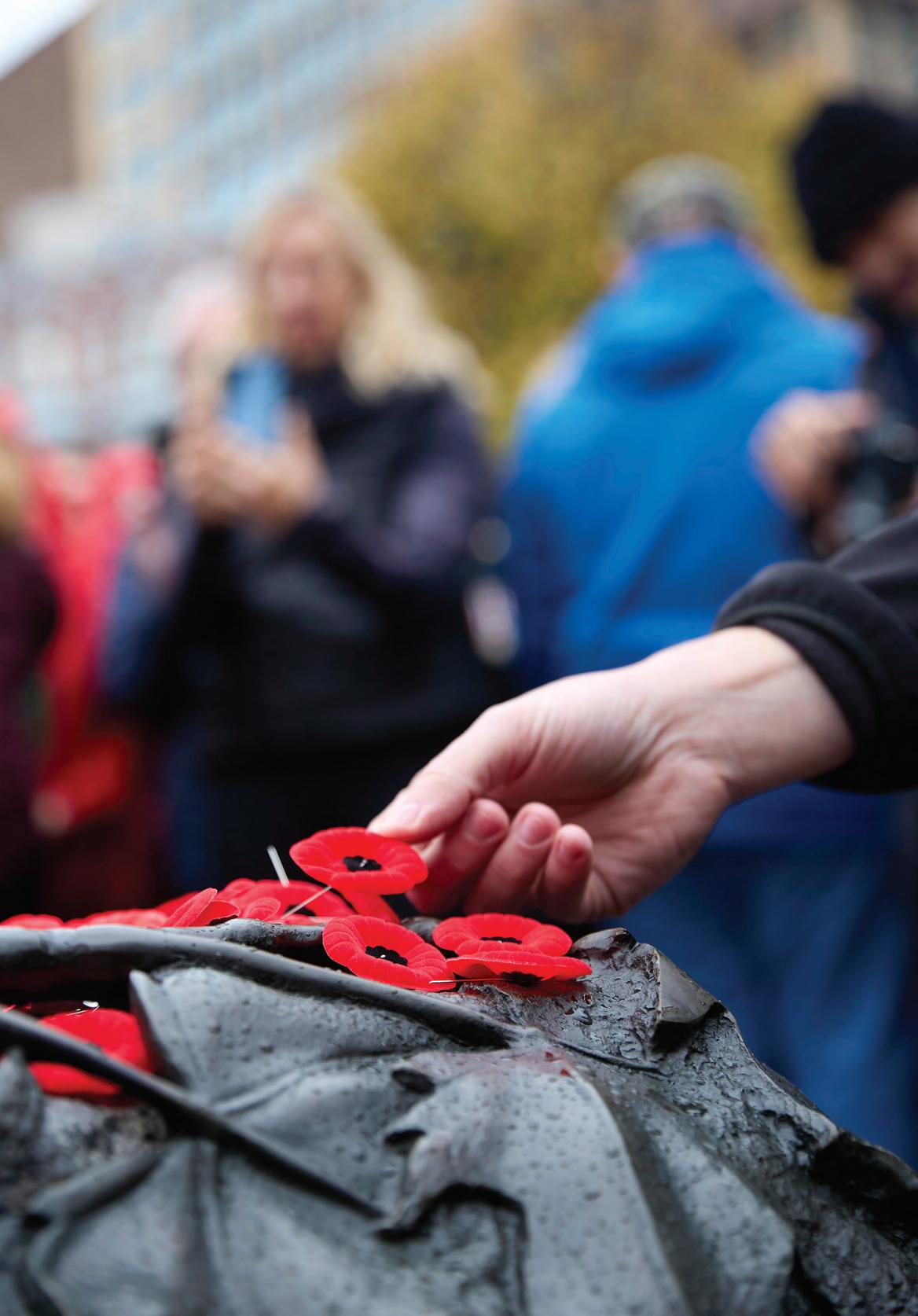
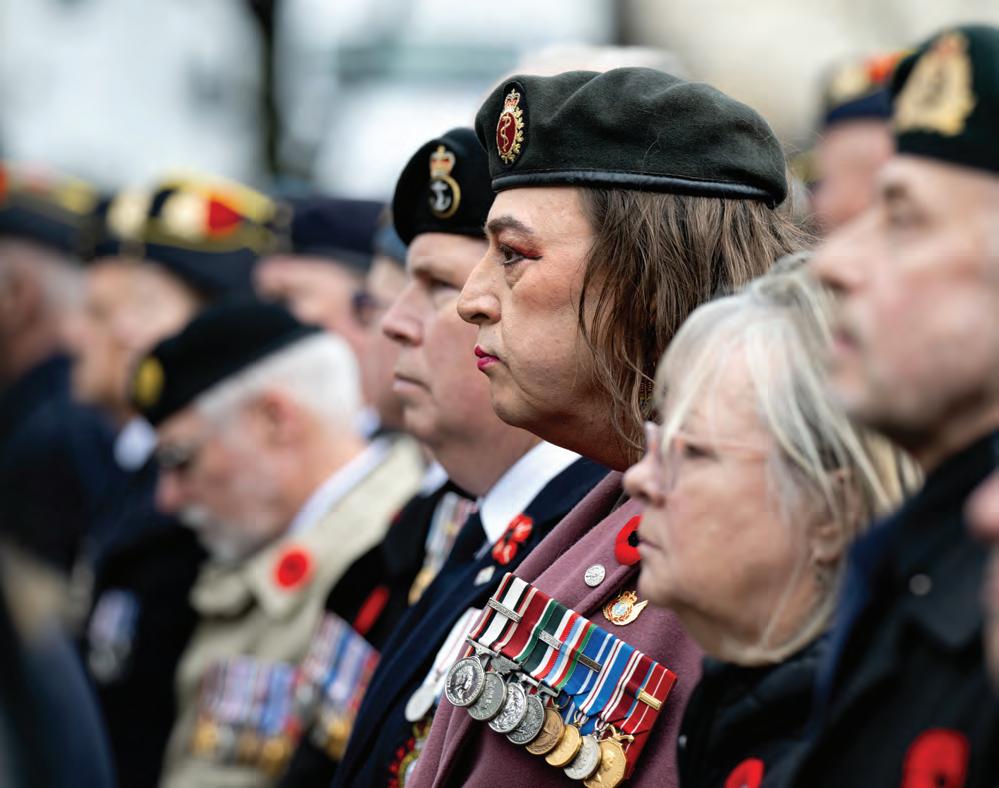
In what has become an impactful tradition of the national Remembrance Day ceremony, a person places their lapel poppy among others left on the Tomb of the Unknown Soldier after the formal event.
See page 58
20 “17 DIFFERENT KINDS OF HELL”
Canada gets its first action of the Great War
By Stephen J. Thorne
28 “CANADIAN NOW STANDS FOR BRAVERY, DASH AND COURAGE”
In their first overseas battle, Canada’s soldiers proved their mettle
By John Boileau
34 THE MOBILIZATION MEN
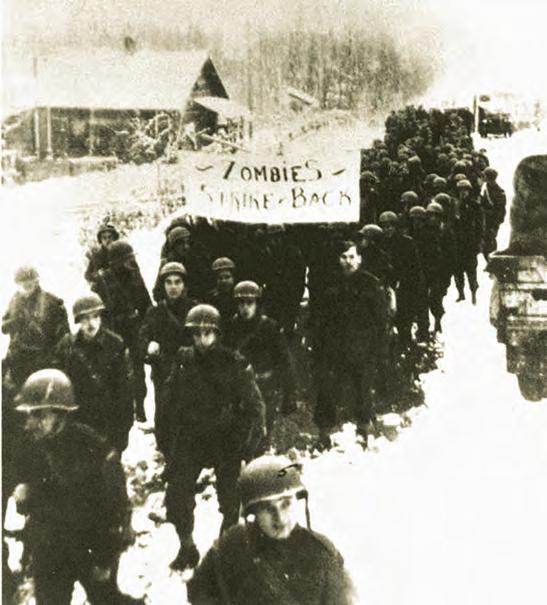
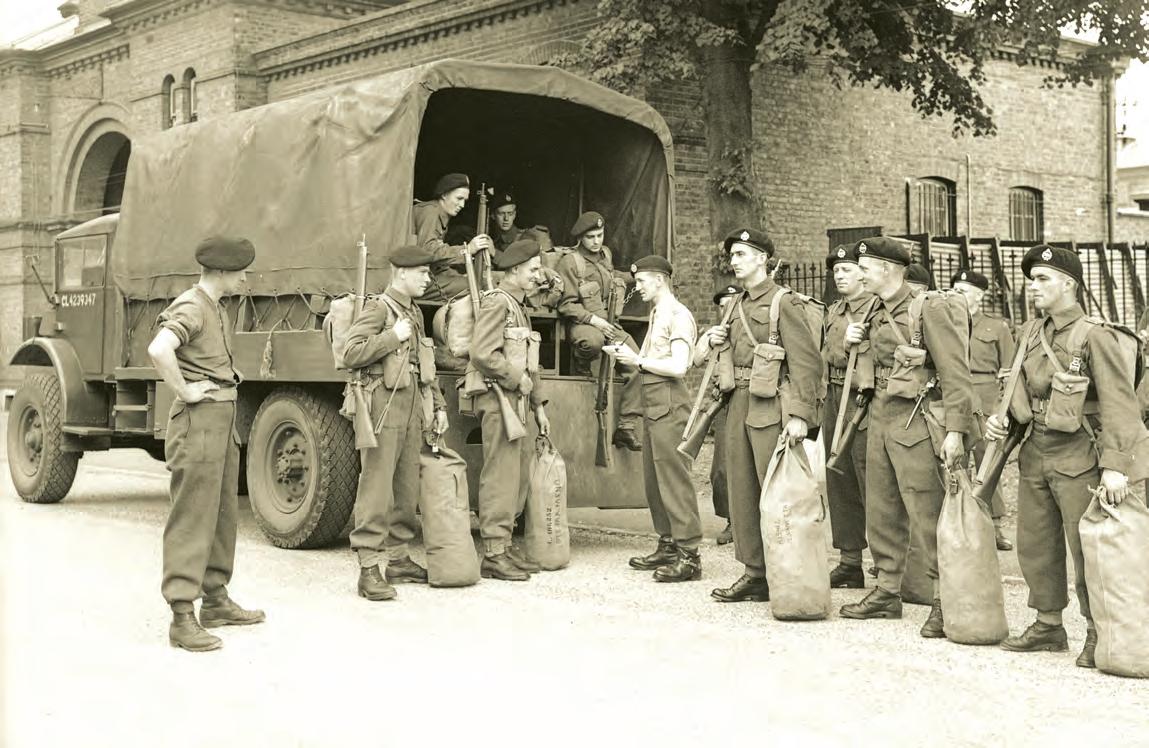
Known derisively as zombies, thousands of Canadian men were conscripted—originally for home defence—under the WW II National Resources Mobilization Act. Late in the war, many were forced to the front lines.
By J.L. Granatstein
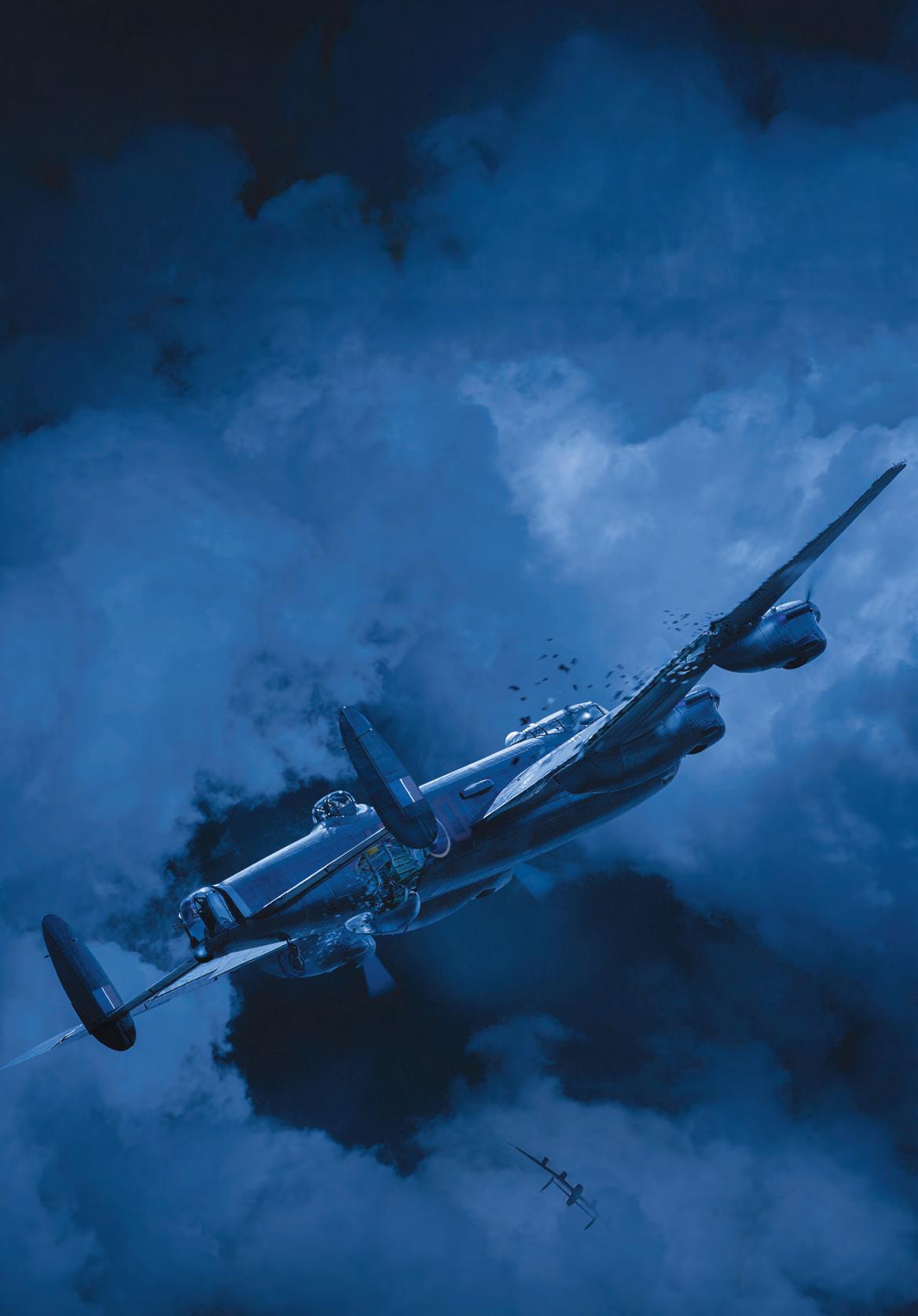
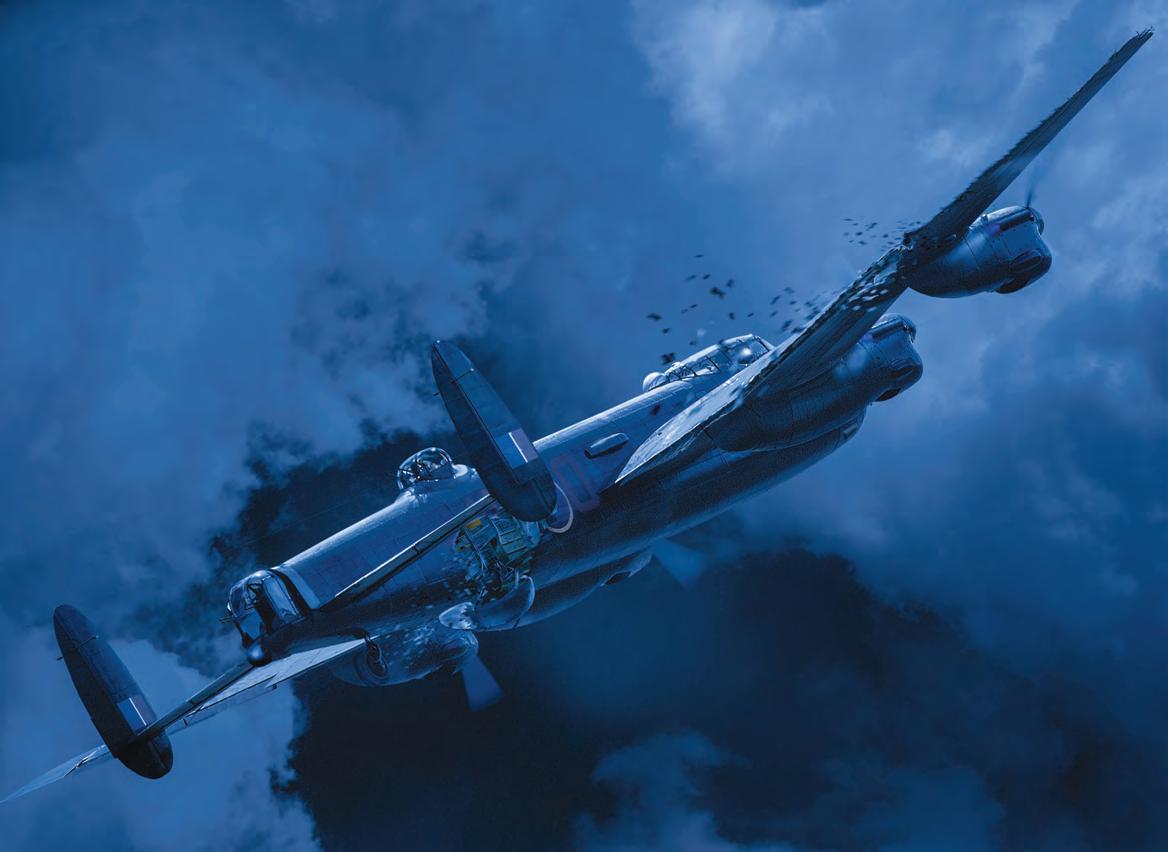
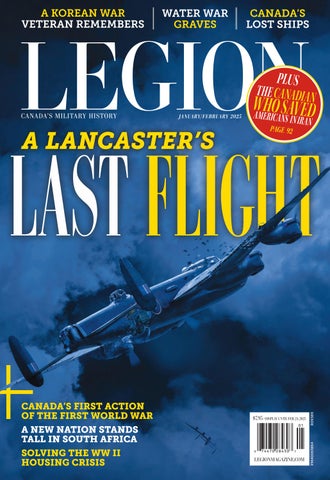
40 THE LAST SORTIE OF NN766
How one Lancaster crew met the demise of so many in Bomber Command
By Sharon Adams

46 HOME MAKERS
Facing a housing shortage as Canadians gravitated to urban centres during the Second World War, the federal government got building
By Tom MacGregor
50 REMEMBERED AT SEA
During the Second World War, Canadian editorial illustrator Bob Chambers created a series of memorial cards to honour those Allied ships and their crews that didn’t make it home
By Stephen J. Thorne
58 DEDICATION TO REMEMBRANCE
As the faces of veterans change, Canadians gathered in Ottawa for the annual ceremony to continue their commitments to honouring military sacrifice
By Alex Bowers
63 LIFETIME OF SERVICE
In Toronto, a Korean War veteran remembers Story and photography by Stephen J. Thorne
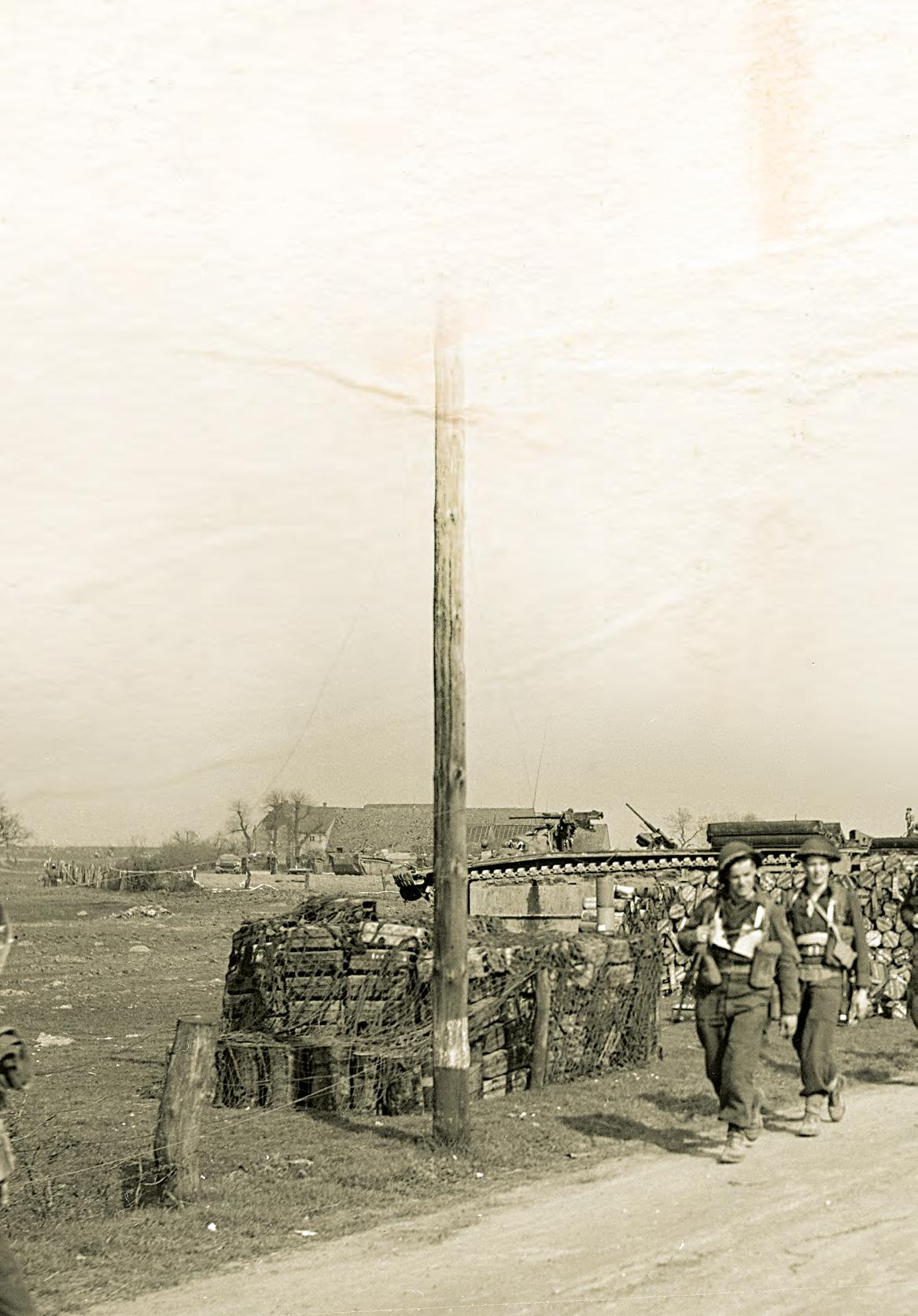


THIS PAGE
Canadian troops march toward the Rhine in Germany in late March 1945.
LAC/5180096
ON THE COVER
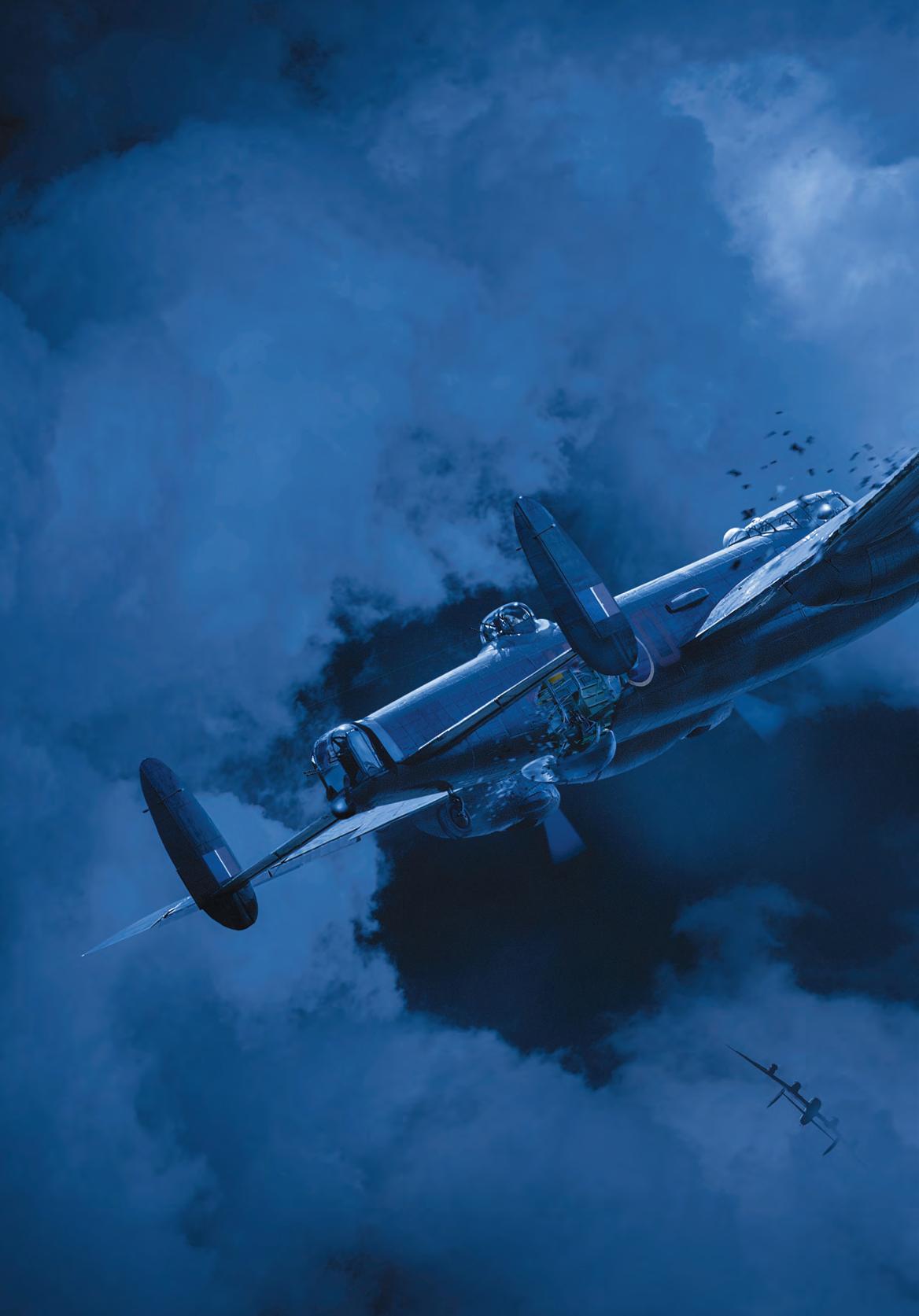
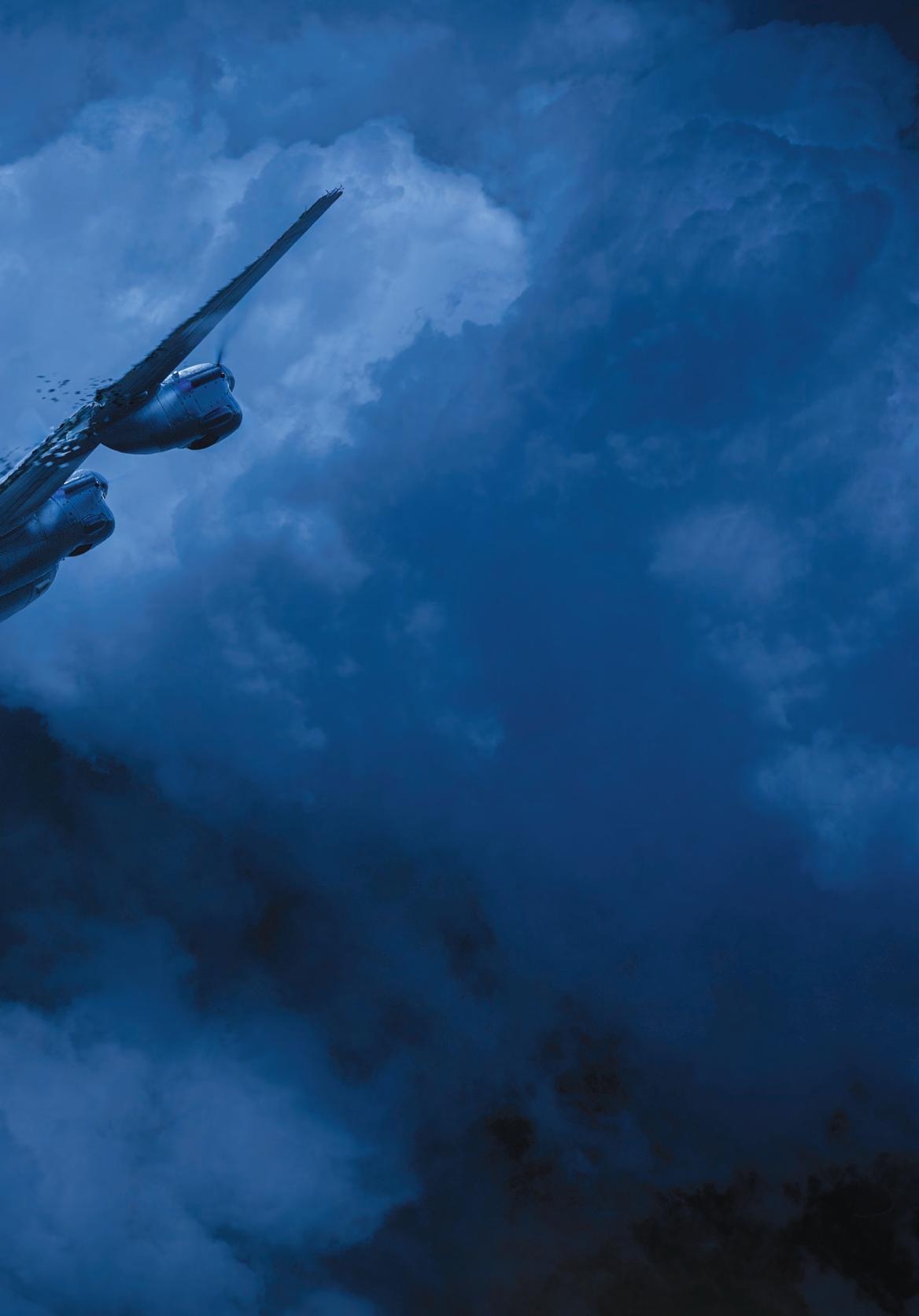
Lancaster NN766 plummets to the ground after a mid-air collision with Lancaster ND968 during an early January 1945 bombing run.
Gary Eason
56

Should Canadian ships sunk in war be considered war graves?
J.L. Granatstein



Board of Directors
BOARD CHAIR Garry Pond BOARD VICE-CHAIR Berkley Lawrence BOARD SECRETARY Bill Chafe DIRECTORS Steven Clark, Randy Hayley, Trevor Jenvenne, Bruce Julian, Valerie MacGregor, Sharon McKeown Legion Magazine is published by Canvet Publications Ltd.
GENERAL MANAGER Jason Duprau
EDITOR
ADMINISTRATIVE
SUPERVISOR
Stephanie Gorin
SALES/
ADMINISTRATIVE ASSISTANT
Lisa McCoy
ADMINISTRATIVE ASSISTANT
Chantal Horan


Aaron Kylie
ASSISTANT EDITOR
Michael A. Smith
SENIOR STAFF WRITER
Stephen J. Thorne
STAFF WRITER
Alex Bowers

ART DIRECTOR, CIRCULATION AND PRODUCTION MANAGER
Jennifer McGill
SENIOR DESIGNER AND PRODUCTION CO-ORDINATOR
Derryn Allebone
SENIOR DESIGNER
Sophie Jalbert DESIGNER
Serena Masonde


Advertising Sales CANIK MARKETING SERVICES NIK REITZ 613-591-0116 | 416-317-9173 | advertising@legionmagazine.com
MARLENE MIGNARDI 416-843-1961 | marlenemignardi@gmail.com OR CALL 613-591-0116 FOR MORE INFORMATION

SENIOR DESIGNER
Dyann
WEB
Ankush

Published six times per year, January/February, March/April, May/June, July/August, September/October and November/December. Copyright Canvet Publications Ltd. 2025. ISSN 1209-4331
Subscription Rates
Legion Magazine is $13.11 per year ($26.23 for two years and $39.34 for three years); prices include GST. FOR ADDRESSES IN NS, NB, NL, PE a subscription is $14.36 for one year ($28.73 for two years and $43.09 for three years). FOR ADDRESSES IN ON a subscription is $14.11 for one year ($28.23 for two years and $42.34 for three years).
TO PURCHASE A MAGAZINE SUBSCRIPTION visit www.legionmagazine.com or contact Legion Magazine Subscription Dept., 86 Aird Place, Kanata, ON K2L 0A1 or phone 613-591-0116. The single copy price is $7.95 plus applicable taxes, shipping and handling.
Send new address and current address label, or, send new address and old address. Send to: Legion Magazine Subscription Department, 86 Aird Place, Kanata, ON K2L 0A1. Or visit www.legionmagazine.com/change-of-address. Allow eight weeks.
Editorial and Advertising Policy
Opinions expressed are those of the writers. Unless otherwise explicitly stated, articles do not imply endorsement of any product or service. The advertisement of any product or service does not indicate approval by the publisher unless so stated. Reproduction or recreation, in whole or in part, in any form or media, is strictly forbidden and is a violation of copyright. Reprint only with written permission.
PUBLICATIONS MAIL AGREEMENT NO. 40063864
Return undeliverable Canadian addresses to Legion Magazine Subscription Department 86 Aird Place, Kanata, ON K2L 0A1 | magazine@legion.ca
U.S. Postmasters’ Information
United States: Legion Magazine, USPS 000-117, ISSN 1209-4331, published six times per year (January/February, March/April, May/June, July/August, September/October, November/December). Published by Canvet Publications, 866 Humboldt Pkwy., Buffalo, NY 14211-1218. Periodicals postage paid at Buffalo, NY. The annual subscription rate is $12.49 Cdn. The single copy price is $7.95 Cdn. plus shipping and handling. Circulation records are maintained at Adrienne and Associates, 866 Humboldt Pkwy., Buffalo, NY 14211-1218. U.S. Postmasters send covers only and address changes to Legion Magazine, PO Box 55, Niagara Falls, NY 14304.
Member of Alliance for Audited Media and BPA Worldwide. Printed in Canada.
We acknowledge the financial support of the Government of Canada. Version française disponible.
On occasion, we make our direct subscriber list available to carefully screened companies whose product or services we feel would be of interest to our subscribers. If you would rather not receive such offers, please state this request, along with your full name and address, and email magazine@legion.ca or write to Legion Magazine, 86 Aird Place, Kanata ON K2L 0A1 or phone 613-591-0116.

It’s because of members like you... that we receive letters like these:
“I can’t thank you enough for everything you did to make his last days and my life less stressful by coming to bat to help him receive deserved funding. Every penny went toward caregiving and other medical or travel expenses while he was alive and the last compassionate payment toward funeralhome expenses. I shall be indebted to you for the rest of my life.”
“Your hard work and perseverance on my behalf made it possible for me to receive a medical pension for on-going health issues. It has allowed me some peace of mind regarding my family’s well-being. In addition, the pension allows my wife and I to remain living in our own home and we are very grateful for that.”
nough is enough.
While one suspects the average Canadian bristles when their American neighbours interfere in the country’s affairs, its U.S. friends hit the mark hard with a criticism of Canada’s defence spending last year.
“We are concerned and profoundly disappointed,” wrote a bipartisan group of 23 U.S. senators to Prime Minister Justin Trudeau in May 2024, “that Canada’s most recent projection indicated that it will not reach its two percent commitment this decade,” referring to the military spending target NATO members agreed to earlier last year. “In 2029, Canada’s defence spending is estimated to rise to just 1.7 percent, five years after the agreed upon deadline of 2024 and still below the spending baseline.”
CANADA HAS LET ITS ONCE RESPECTED, EVEN REVERED, MILITARY BECOME A HOLLOW SHELL OF ANY FORMER GLORY.
The problem isn’t so much the critique, nor how accurate it is. The bigger issue is that Canada has let its once respected, even revered, military become a hollow shell of any former glory. Indeed, as it’s currently constituted, it’s more reminiscent of the ad hoc post-Confederation militia than a modern professional armed forces.
To be clear, this isn’t a criticism of the rank-and-file Canadians who’ve devoted their lives to fighting for their country. Indeed, the dwindling strength of Canada’s military is undoubtedly due in no small part to good people becoming increasingly
exasperated with their employer either appearing to simply not care about them or managing their business so poorly it feels like it.
Let us count the ways.
According to Defence Minister Bill Blair’s most recent public estimates, the Canadian Armed Forces are short at least 16,500 personnel. And about a year ago, the country’s top commander said he needed an additional 14,500 people on top of that to meet the military’s authorized strength. But that problem is easily fixed, no? No. Unfortunately, it isn’t. As our Eye on Defence columnist David J. Bercuson wrote in the September/October 2024 issue (“Recruiting agency”), Canada’s military recruitment system has been beset by issues for nearly 30 years. Today, as he wrote, it is “broken in numerous ways.” So, given three decades of problems, is it any wonder the forces aren’t up to strength? How is it possible it hasn’t been fixed?
Bercuson has also written repeatedly during the last few years about the disaster that is Canada’s defence procurement system. You name the equipment, from planes to pistols, it takes too long to get them and costs too much. The purchasing process became particularly politicized about 15 years ago, which contributed to delays and cost overruns, but it was already being managed with an outdated system then, too. The problem is evident. But a will to solve it seemingly non-existent. Combined, these issues are manifest on the ground most notably in the country’s commitment to peacekeeping. Such missions were once considered part of Canada’s identity—more than 125,000 Canadians have served in peace operations since 1956, but last year, only about 100 did. This despite the prime minister’s 2015 pledge to provide significantly more personnel to such missions.
To wit, Legion Magazine is also concerned and profoundly disappointed with the state of Canada’s military. The country deserves better, if for no other reason than to honour the sacrifices of those who’ve served it. L
December 2024 issue. My father Sergeant Geoffrey Hart was discharged from overseas duty on Dec. 5, 1944, and in early 1945 was stationed at Currie Barracks in Calgary. One of his duties was to tend to the various balloon bombs that were found throughout the West. He had been trained in handling explosives while in the First Special Service Force. He was sent East for further demolition training. After returning, he did neutralize several of these bombs near Norman Wells, N.W.T., and Watson Lake, Yukon.

Comments can be sent to: Letters, Legion Magazine , 86 Aird Place, Kanata, ON K2L 0A1 or emailed to: magazine@legion.ca
JOHN HART
MEDICINE HAT, ALTA.
J.L. Granatstein’s November/ December 2024 column (“Polar play”) laid bare the unvarnished sad truth about Canada’s supposed sovereignty. The stark reality is that the country has become a de facto American protected state. Individually and collectively, all Canadians are responsible for this indisputable abdication
of nationhood. Through neglect, indifference and the unspoken belief of American salvation when threatened, the country has surrendered its homeland security to a foreign government. Once a proud, strong and free nation, Canada has allowed its military capabilities to become so diminished, it is indisputably unable to defend itself or provide a meaningful contribution to western security through its international defence agreements. There




was a time when Canada was rightfully proud of its military heritage, its own defence and world stability, but it no longer enjoys the respect or admiration of its allies. Canada has forfeited its trust through years of military neglect and unfulfilled commitments.
If Canada ever expects to regain its position of reliability as a respected middle power on the world stage, it must explicitly provide the financial support, determination and unrelenting commitment to meet its national and international military obligations. Every Canadian must recognize and support this goal to shed the shackles of dependency on other countries. It will be a prolonged and difficult battle.
AL JONES ALMONTE, ONT.


Did you know that over 50% of men over the age of 40 suffer from erectile dysfunction?
Other symptoms that you may have could include an unwanted curve or bend or even an urgency to run to the bathroom and wake up at night frequently
We use the best technology available to treat erectile dysfunction
No pills, needles, or surgery! Ask us if your treatments may be covered by your current benefits program
Go to our website, email us, or call us to schedule an appointment
call: 1 877 866 VETS (8387) email: info@urogenvet.com www.urogenvet.com
As a Legion member and a graduate of the Royal Military College of Canada, I would like to draw your readers’ attention to some additional facts not mentioned in Don Gillmor’s “O Canada” column (“The Maple Leaf”) in the November/December 2024 edition. “One of the more well-received concepts considered by the committee,” notes the government website on the country’s flag, “was proposed by George Stanley, Dean of Arts at the Royal Military College in Kingston. Inspired by RMC’s own flag, Stanley recommended a concept featuring a single, stylized red maple leaf on a white background with 2 red borders.” I offer my salute to our college flag and to that of Canada.
CARL HUNTER WEST VANCOUVER, B.C.
I was completely shocked that there was no mention in Legion Magazine about the Canadian delegation that travelled to France in June 2024 to attend the 80th anniversary of D-Day and the Battle of Normandy events. Both veterans, my 96-yearold father-in-law was invited along with my spouse as his caregiver. It was the trip of a lifetime for my father-in-law as he has always dreamed of returning. They were also privileged to meet Princess Anne and Prince William, along with many other political representatives from both Canada and France. There were several veterans in attendance and sadly most, if not all, will not make it to another event. I believe the magazine missed a wonderful opportunity to recognize these veterans.
GAIL SPENST STURGEON COUNTY, ALTA.
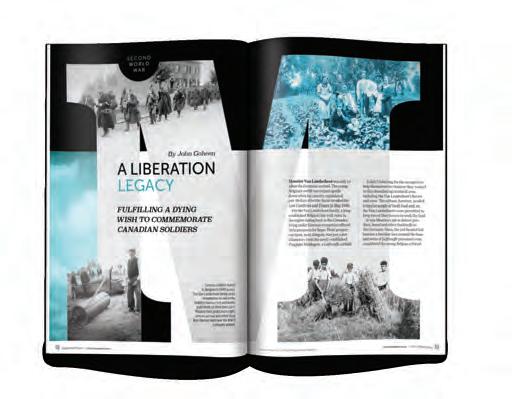
I found the article “A liberation legacy” in the July/August 2024 issue was well written and fascinating on so many levels. I’m glad this story will not be lost and will try to visit the museum the next time I’m in the area.
MIKE MECREDY BURLINGTON, ONT.
The Canadian contingent of the Nile Expedition left Halifax on Sept. 14, 1884, not 1889; also HMCS Bras d’Or vanished in 1940, not 1944 (re September/ October 2024 “On This Date”). In the November/December 2024 “Eye on Defence” column, an editing error identified HMCS Max Bernays as a Halifax-class frigate. It is, of course, a Harry DeWolf-class offshore patrol vessel. In “Moving toward 100” in the same issue, the location of the branch of former Royal Canadian Legion Dominion Vice-President Brian Weaver was incorrect. The Capt. Brien Branch is in Essex, Ont. L
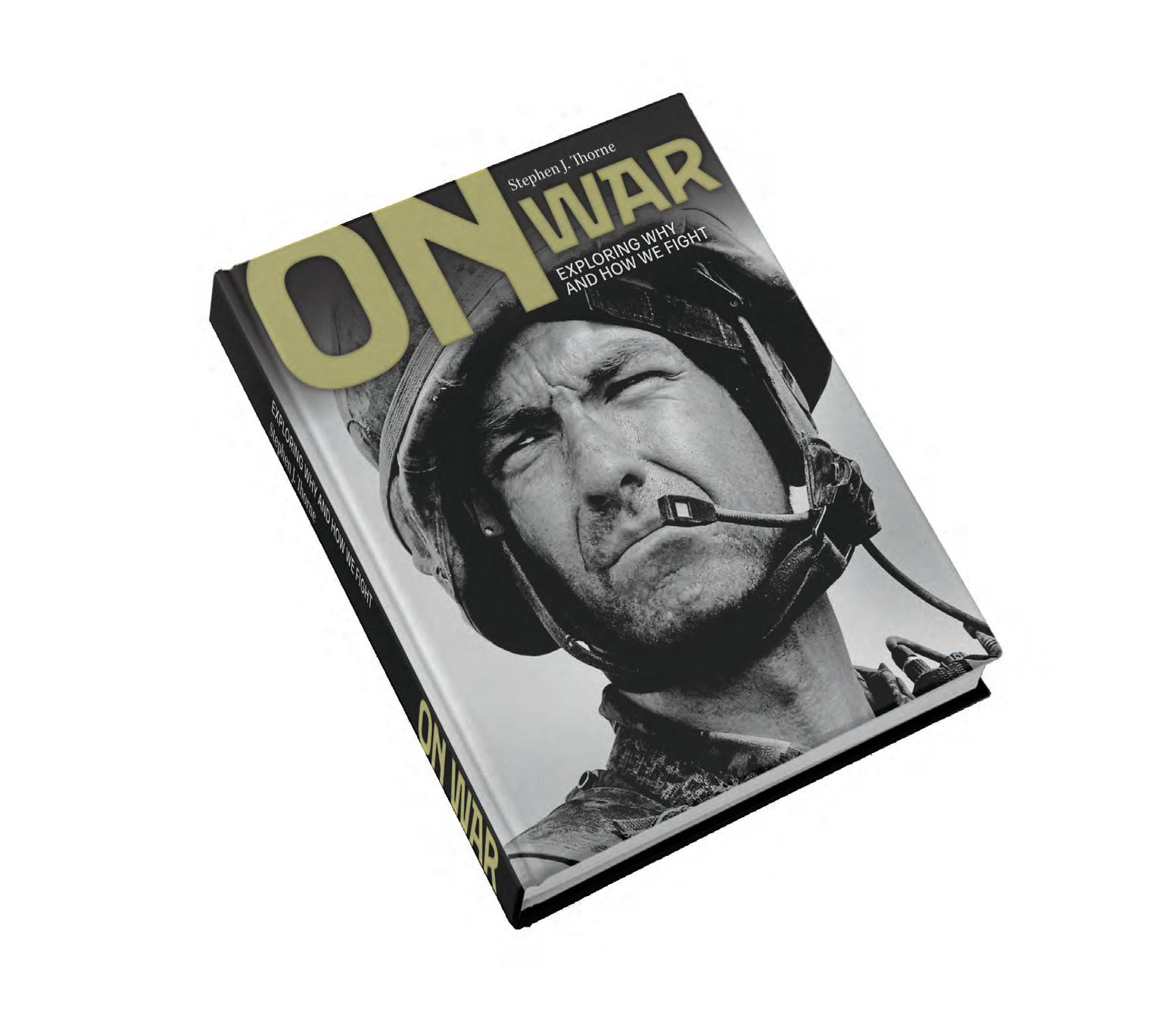
War, according to Legion Magazine senior staff writer Stephen J. Thorne, is humanity’s greatest failure. Its destruction has followed people for at least 20,000 years, with every conflict becoming more violent, more destructive and more efficient than before. Too much of the writing about war is technical facts, strategic theory and mounds of statistics. But in Thorne’s debut book, On War: Exploring why and how we fight, the former Canadian Press war correspondent who witnessed and wrote about fighting firsthand in Kosovo, South Africa and Afghanistan, addresses the humanity of such grand violence. In this curated collection of entries from his popular LegionMagazine.com
“Front lines” blog, Thorne goes beyond the numbers and jargon to delve into the deeper consequence of violence that facilitates the death and birth of countries, the obliteration of borders and the toppling of empires. The former wire-service reporter and overseas photographer explores conflict and war from fresh perspectives: how war is viewed from close and afar; front-line myths and manipulations; the puppet mastery of censorship and message control; the lifetime bonds between brothers- and
Get notified of all the latest updates on legionmagazine.com by signing up for our weekly e-newsletter at www.legionmagazine.com /newsletter-signup
sisters-in-arms, which is forged in ways that can’t be duplicated; the bitterness, sweetness, tragedies and triumphs of this most confounding element of the human condition.
A native of Halifax, Thorne has been crafting award-winning stories and photography for 40-plus years. He has reported extensively from various war and conflict zones. Learn more about and buy On War at shop.legionmagazine.com. Plus, read more of Thorne’s weekly “Front lines” missives at www.legionmagazine.com. L

21 January 1945
Maj.-Gen. William A. Griesbach, veteran of three wars, dies.

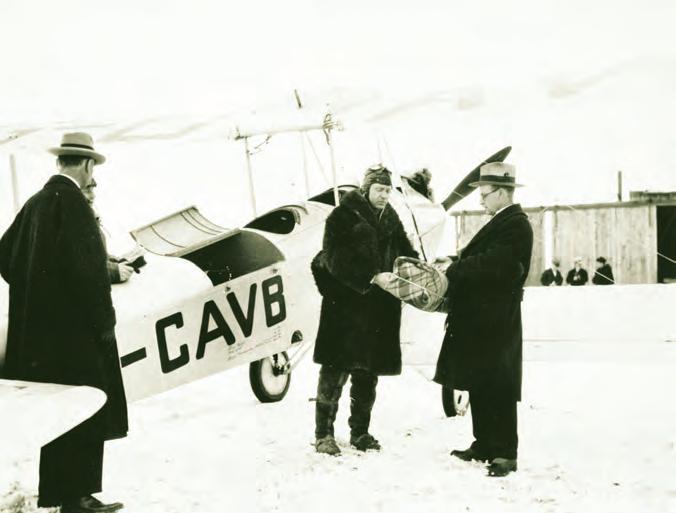
2 January 1929
W.R. (Wop) May and Vic Homer deliver a diphtheria vaccine by Avro Avian biplane to Fort Vermilion, Alta.
3 January 1962
A Royal Canadian Air Force helicopter crew rescues 23 men from a freighter stranded off Ucluelet, B.C.
4 January 1951
Seoul falls to forces from the North for the second time during the Korean War.
5 January 1945
FO Norman Pearce of Portage la Prairie, Man., destroys six enemy vehicles while serving with No. 73 Squadron.
8 January 1916
Allies complete the withdrawal of troops from Gallipoli.
11 January 1914
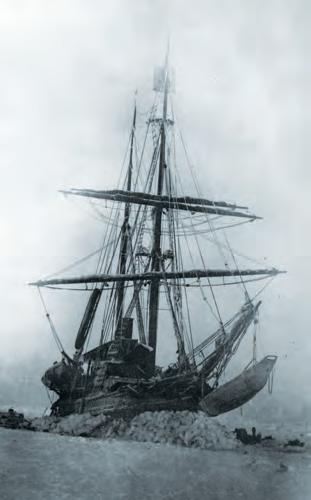
Canadian Arctic Expedition ship Karluk sinks north of Siberia, leaving its crew stranded. Capt. Robert Bartlett embarks on a 1,000-kilometre journey to find help, resulting in a September rescue.
12 January 1910
The Naval Service Act is introduced by the federal government.
13 January 1943
HMCS Ville de Québec sinks U-224 in the western Mediterranean.

14 January 1952
HMCS Uganda, the only Canadian warship to fight the Japanese, is recommissioned as HMCS Quebec


22 January 1992
Roberta Bondar blasts off on the U.S. space shuttle Discovery on an eight-day mission.
23 January 1813
Wounded Americans are killed in a massacre by First Nations warriors at River Raisin.
24 January 1942
The Wartime Prices and Trade Board rations sugar to three-quarters of a pound (340 grams) per person, per week.
25 January 1951
HMC ships Nootka and Cayuga are fired on in Korea.
27 January 1987
Col. Sheila Hellstrom is promoted to brigadier-general, becoming Canada’s first female general.
28 January 1918
Lt.-Col. John McCrae, author of “In Flanders Fields,” dies of pneumonia and meningitis in Boulogne, France.


4 February 1945
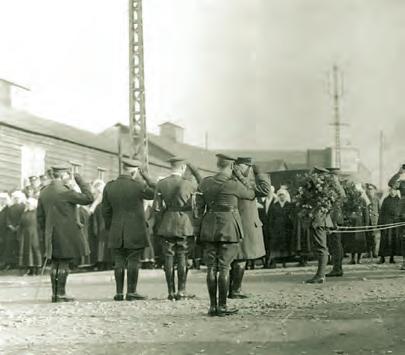
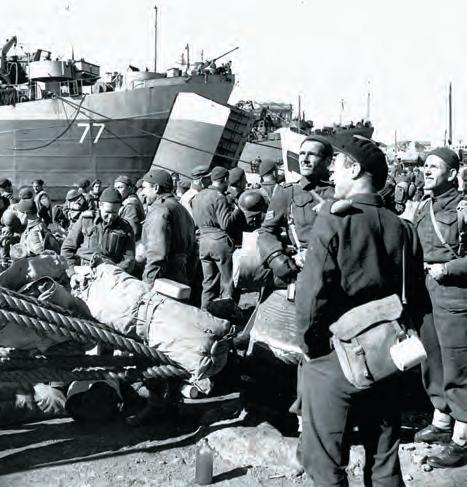
I Canadian Corps departs Italy to support the Allied advance in Northwest Europe.
5 February 1856
The Victoria Cross, the Commonwealth’s highest award for military valour, is instituted.
8 February 1944
Near Littoria, Italy, Tommy Prince, disguised as a farmer, fixes a broken communication wire right under enemy noses.
13 February 2005
Defence Minister Bill Graham announces a doubling of the 600 Canadian Forces personnel in Afghanistan.
15 February 1965
The navy lowers the white and blue ensigns for the last time on ships and shore, replacing it with the new Canadian Maple Leaf.
16 February 1944
In Burma, a wounded Maj. Charles Hoey leads his company under heavy machinegun fire to capture a vital position; he is posthumously awarded the Victoria Cross for his actions.
6 February 1919
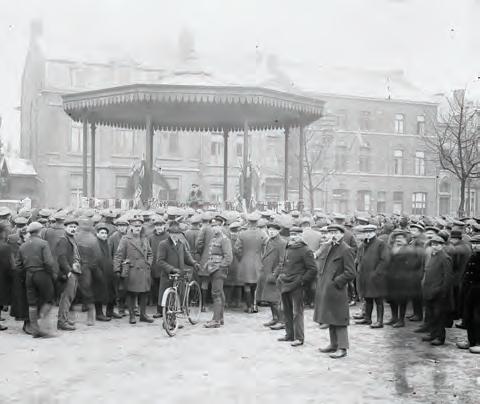
The last Canadian troops withdraw from Belgium.
7 February 1813
U.S. riflemen attack Brockville in Upper Canada, freeing prisoners, seizing stores and taking 52 hostages.
24 February 1944
HMCS Waskesiu sinks U-257 in the North Atlantic.
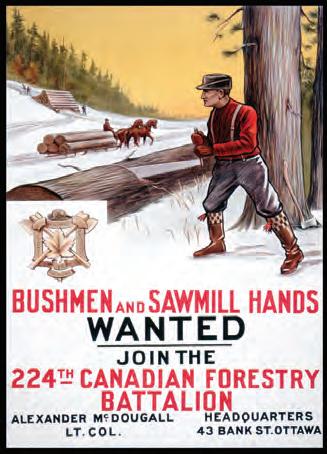
25 February 1916
The 224th Canadian Forestry Battalion is authorized by the Department of Militia.
18 February 2010
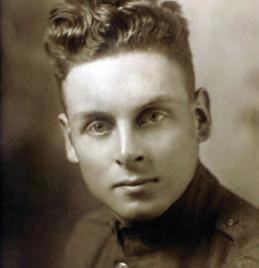
John Babcock, last living Canadian First World War veteran, dies. Wilfred Reid May/LAC/C-057809; NASA/Wikimedia; George Hubert Wilkins/LAC/3407944; CWM/19710261-1031; Guelph Museums/Wikimedia; DND; Archives of Ontario/Wikimedia; Wikimedia; DND/LAC/3522606; CWM/19790262-033
19 February 1915
The Allies begin a naval attack on the Dardanelles.
20 February 1919
The Amir of Afghanistan is assassinated for supporting neutrality during the First World War.
21 February 1916
The Battle of Verdun begins.
23 February 1909
Canada’s first piloted heavier-than-air machine flight takes off in Baddeck Bay, N.S.
26 February 1943
Prime Minister Mackenzie King decides to nationalize the brewing industry—but a year later changes his mind.
27-28 February 1915
The Princess Patricia’s Canadian Light Infantry launches its first trench raid of the war, near Ypres, Belgium (see “17 different kinds of hell,” page 20).
By Alex Bowers
How a Canadian War Museum oral history project is preserving and highlighting the post-military experiences of veterans
Able Seaman Alex Polowin’s war ended in Halifax.
Not yet 20, the D-Day veteran stared out toward the many ships “tied up with no crew,” the demobilization process well underway, and wondered, “Where now?
“That’s very, very frightening,” Polowin, a survivor of the Arctic convoys, recalled of the moment during his interview for the Canadian War Museum’s recently unveiled oral history project. “What am I going to do for the rest of my life?”
It was, and remains, a sentiment shared by countless Canadian Armed Forces members, a question not easily answered and yet, so immensely in need of addressing once military service draws to a close. It is, perhaps, a fear incomparable to that which is expected while the uniform is still on.
Such challenges have since been preserved and highlighted through the initiative entitled In Their Own Voices: Stories from Canadian Veterans and their Families.
Focused primarily on the post-military transition back to civilian life, the collection features more than 200 interviews with those whose trajectories were impacted by the Second World War and beyond to modern-day service, each account offering a personal insight into what can happen after that uniform comes off—and, potentially, contributing to a much broader blueprint for future veterans’ support.
“Most military histories end when the conflict or era being discussed
ends,” explained the project leader and the Canadian War Museum’s historian of veterans’ experience Michael Petrou. “But we understand that the ripples of war and military service continue much longer than that and typically shape the lives of veterans, as well as their families, in often profound and intimate ways.”
No stranger to such ripples, Petrou recalled his original curiosity being sparked in part by his WW II veteran grandfather, a figure he “was always fascinated by as a boy” and who
World War before returning home, only to be found by his mother hiding beneath the bed.
Or like Bruce Henwood, a former UN military observer who, in 1995, became a double below-knee amputee after his vehicle detonated a mine in Croatia and thrust him into a fight against insurers to receive the compensation he deserved.
Or Kelly Thompson, a Canadian captain compelled to enlist after the 9/11 attacks, but whose encounters with sexism and a career-altering wound left her untethered from her military identity until creative writing helped her feel grounded again.
In recording veterans’ accounts, Petrou recognized common themes across generations, conflicts and
“I SPOKE TO ONE VETERAN WHO SAID HE LIVED IN A CITY OF A MILLION PEOPLE WHERE HE FELT NO ONE KNEW WHAT HE DID.”
“right up until his death, [carried] a 1939 silver dollar in his wallet that was given to him by his high school teacher around the time he enlisted.”
Petrou rarely heard about the war’s lasting impact from his grandfather’s own lips, nor did he ever really ask much about the silver dollar he kept in his pocket.
Now, however, the In Their Own Voices project—started in early 2022 with an online exhibition unveiled in late 2024—has since captured the post-service memories, both positive and negative, of people with a similar dynamic.
People such as Max Dankner, who also served in the Second
eras, particularly that “losing someone close to you in war is universal” and how that imprints itself in a post-conflict setting. Camaraderie in the military was another oftdiscussed topic for interviewees.
Equally, the military-tocivilian workforce transition unearthed parallels.
“Veterans I’ve talked to often say that they learned useful skills in the forces,” said Petrou, acknowledging the instances where abilities were less readily transferrable.
But there were likewise marked differences.
“The Second World War veterans, for example, were part of a conflict in which almost the entire
country was involved; it was always visible,” noted Petrou. “Then you have the Afghanistan War, a conflict that we lost. I spoke to one veteran who said he lived in a city of a million people where he felt no one knew what he did.”
The diverse nature of the country, too, became a factor—and indeed an occasional challenge when Petrou travelled from coast to coast collecting first-hand accounts: “Even with over 200 interviews, it’s hard to get the totality of experience, be it anglophone, francophone, racialized communities, gender, service branches, conflicts, eras and more. To reflect that scope honestly was quite difficult.”
Nevertheless, each perspective, each story, has woven a tapestry of post-service experience that can shed light on a seldom examined aspect of military life, not only from veterans’ lips, but also those loved ones who shared in it.
In humanizing individual achievements and struggles, all the while hearing about them in their own voices, a compelling archive has been created that Petrou and the museum team hope will broaden understanding for generations moving forward.
Now is undoubtedly the time, especially for WW II-era service members.
“I interviewed somewhere between 40 and 50 Second World War veterans,” said Petrou. “Sadly, even over the last couple of years, many of them have died.”
They include Alex Polowin, whose memory lives on through the online exhibition where recordings and photographs lend a richness to his immortalized account.
Additionally, with plans underway to host a conference in 2025 and publish a “hybrid” academic-memoir book in 2026, the In Their Own Voices project will continue to grow, supported by The Royal Canadian Legion and the Legion National Foundation.
“The Legion has been a generous funder of the project,” said Petrou, “and has been a great supporter in terms of spreading the word and reaching out to people.”
Whether the archive could one day influence policy decisions is left to speculation for now. What’s certain is its potential as a valuable
resource for historians, authors, journalists, and the public, not least educators and students.
“My wish is that these transcripts and interviews have second, third, and fourth lives in ways we haven’t yet imagined,” said Petrou. “We’ll just have to see.” L

For Canadians who are heading south this winter
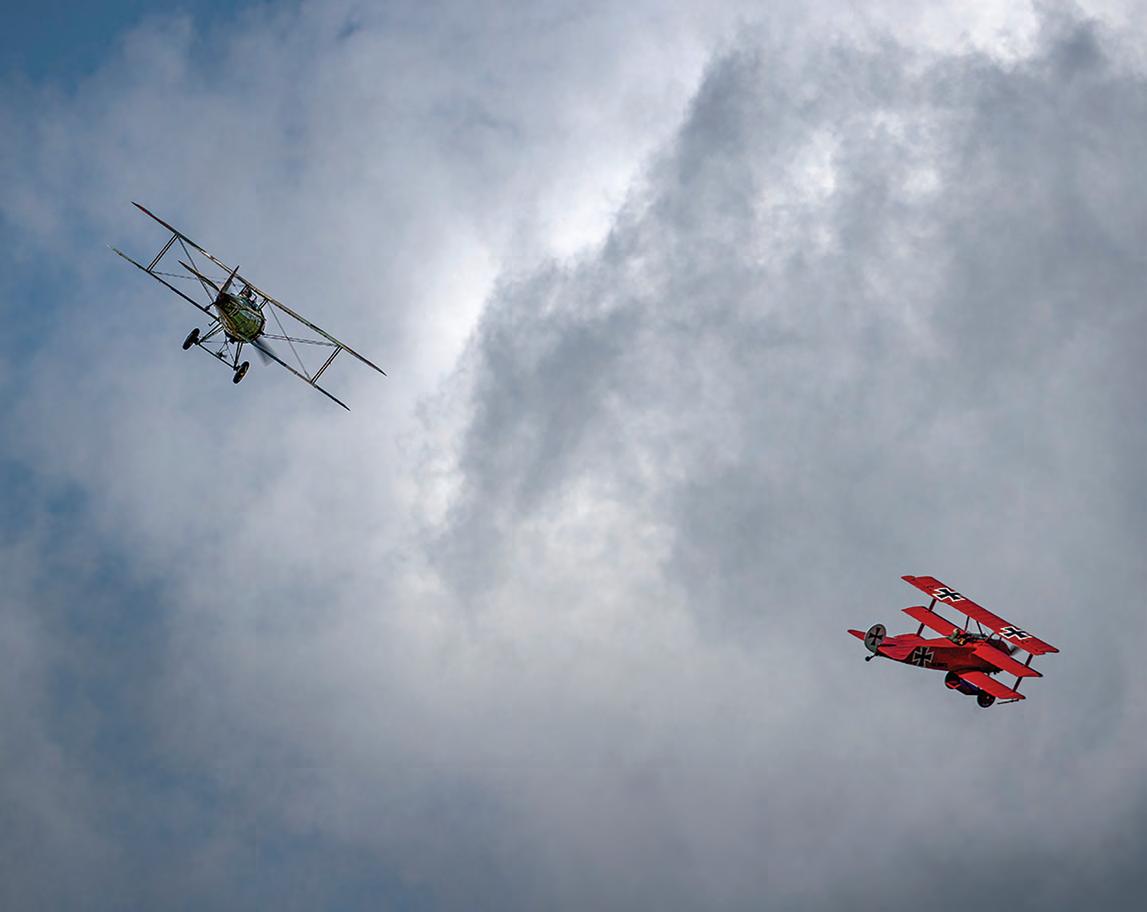
A Fokker Dr I, the WW I aircraft most associated with Germany’s legendary Red Baron, and a Sopwith 1-1/2 Strutter, both reproductions, perform at the Aero Gatineau-Ottawa air show in 2018.
There are few rivals in war who have shared the mutual regard and respect, even camaraderie, as those who flew aircraft during the First World War.
Theirs was a singular experience, the scale and intimacy of which were unique in the annals of conflict, even aviation, before or since. With it, a new chivalric tradition, vestiges of which persist to this day, was born.
Blazing trails in the skies in bare-bones, canvas-and-wood airplanes, they fought mano-amano, skill to skill, often just metres apart. And mostly without parachutes.
It was, after all, the first war in which aircraft played a major
role—initially for reconnaissance and artillery spotting, then bombing and fighting.
As fighter squadrons were formed and aerial conflict escalated, aces who scored five victories or more emerged. Personalities emerged with them, recognizable by their distinct aircraft and markings: Richthofen in his red Fokker triplane; Bishop in his Nieuport 17; Rickenbacker with his “Hat-in-the-Ring” Nieuport 28.
Early crews of rival reconnaissance aircraft exchanged nothing more belligerent than smiles and waves. As the products of their labours—death and destruction on the ground—became evident, they began tossing grenades and even grappling hooks at each other.
Battling freezing cold, buffeted by unpredictable winds and weather in flimsy, even delicate, airframes, and increasingly threatened by their rivals’ incursions, pilots began firing woefully inadequate handguns at enemy aircraft.
On Oct. 5, 1914, French pilot Louis Quenault became the first aviator to unleash machinegun fire on an enemy plane, propelling aviation into a new era. The dogfights escalated into desperate struggles over the mud-soaked trenches and wastelands of wartime Europe, the daily stakes as high as any could be.
“Now a dogfight is rather an exciting game actually,” pilot Thomas Isbell told the Imperial
Stephen J. Thorne
> Check out the Front lines podcast series! Go to legionmagazine.com/en-frontlines
War Museums. “You’d dive onto the first Hun you come across… and no sooner you’ve got your guns on him, someone else has got their guns on you.”
While soldiers on the ground wallowed in the mud, cringing under artillery bombardments and awaiting the next dreaded order to go over the top, pilots at least had days flying the wild blue—and good food and a warm bed to go back to.
At night, they would engage in the drunken, bittersweet celebrations and tributes to their fallen brethren, the ever-present prospect of fiery death or disfigurement lingering somewhere in the recesses of their collective consciousness, the price of a slight miscalculation, a moment’s loss of focus, or circumstances unforeseen. Over time, the underlying stress would do its work, chipping away at their psyches.
Still, those who flew belonged to an exclusive club whose members quickly came to understand the special place they occupied. The rare air above 10,000 feet brought on hypoxia, a potentially fatal high, but there were no borders, or rules, up there among the clouds.
In the Roberto de Haro novel Twist of Fate: Love, Intrigue and the Great War, the protagonist, a Louisiana Cajun named Quentin Norvell, describes the experience of flying in combat with the French Air Service during the First World War.
“There’s a bond between fighter pilots, even if we’re adversaries,” he says. “You see, we share the same things, the deafening noise of the engine which blots out our hearing, the speed and maneuverability of our planes, the sensation of flight, and the single purpose of defeating your opponent.
“There’s not enough time to think about hate. If I hate
anything…it’s the need for us to fight and kill each other.”
Indeed, opposing airmen went to astonishing lengths to help each other in the First World War, even warning the other side of where they were about to drop bombs and sending photographs of enemy graves.
near the Somme front in 1916.
Wilson had beaten out flames on his legs and arms after he was forced to crash-land his aircraft behind enemy lines.
Boelcke followed him down but, rather than hold him at gunpoint and send him away for interrogation, he shook
“THERE’S A BOND BETWEEN FIGHTER PILOTS, EVEN IF WE’RE ADVERSARIES.”
Alan Wakefield, head of photographs at the Imperial War Museums, told London’s Daily Mail in 2014 that such co-operation was far more common among pilots than those fighting on the ground.
“I know of cases where German pilots dropped notes and photographs of a crashed aircraft and its occupant, saying they’d buried him and asking for his name so they could make a headstone,” he said.
“In one instance, a German pilot dropped a note saying he was about to bomb an airfield and suggesting that those on the ground should get out of the way.”
Captain Gerald Gibbs, a British pilot awarded a Military Cross and two bars in six months, received adulatory fan mail from two German airmen whom he captured, then took to lunch. It was signed “with chummy German airman greetings.”
In another incident, the legendary Oswald Boelcke, regarded as the father of the German air force and the Red Baron’s mentor, formed an instant friendship with British pilot Robert Wilson, whom he shot down
Wilson’s hand, took him for coffee in the mess, and gave him a tour of his aerodrome. It was Boelcke’s 20th aerial victory.
Years later, Wilson described his encounter with Boelcke as “the greatest memory of my life, even though it turned out badly for me.”
“Flying in the First World War was almost like a gentleman’s club no matter which side you were on,” said war memorabilia auctioneer Matthew Tredwin.
“An unspoken camaraderie existed between Allied and German pilots.” L

By David J. Bercuson
Retired lieutenantgeneral Roméo Dallaire is a Canadian military icon. When he decided to donate his vast collection of letters, memos, documents and recordings in September 2024, no Canadian institution, not Library and Archives Canada or his alma mater the Royal Military College of Canada, was apparently interested in the archives. But, the United States Military Academy West Point in New York was and, thus, those Canadians who want to research the first-person accounts of the career of this extraordinary man have to go to the U.S. to do so. This is the very definition of irony.
Born in the Netherlands in 1946, Dallaire grew up in the east end of Montreal and joined the Canadian Armed Forces in 1964, attending Royal Military College and Collège militaire royal de Saint-Jean, earning a bachelor of science degree. He first came to the Canadian public’s attention in 1993 when he was appointed to command the 81-strong United Nations Observer Mission UgandaRwanda (which eventually grew to about 2,000) and the betterknown United Nations Assistance Mission for Rwanda (UNAMIR). Rwanda had been torn apart by
Major-General Roméo Dallaire speaks to the press at the UN Headquarters in New York City in September 1994 following his command of the UN mission in Rwanda.
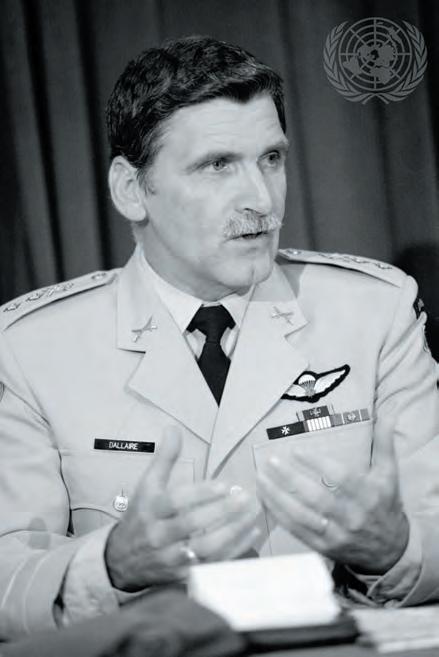
a civil war between its government, largely comprised of the country’s Hutu ethnic group majority, and the rebel Rwandan Patriotic Front (RPF), largely representative of the Tutsi ethnic minority. When UNAMIR was established, the civil war had become static, with the two sides separated by a demilitarized zone secured by troops of the Organization of African Unity.
The intention was to establish a new provisional government, bringing the RPF into a coalition with the ruling majority until democratic elections were held. UNAMIR soldiers, armed only with personal weapons, were to keep the two sides apart until that happened.
Dallaire and his assistant, Major Brent Beardsley, were the only two Canadians in the UN force. The rest of the peacekeepers consisted of 400 Belgian soldiers and a mixed group of predominantly African soldiers numbering about 2,000.
Dallaire arrived in Rwanda in late 1993 to take command of the mission. He soon discovered the Hutu were using broadcast media to set the stage for a mass attack on the Tutsi minority. Dallaire also learned that Hutu were gathering arms, mainly machetes, that were likely going to be used in the looming resumption of hostilities. He briefed the UN headquarters in New York of the situation and sought permission to take pre-emptive action, but his request was denied.
On April 6, 1994, the presidents of Rwanda and Burundi, both Hutu, died when their plane was shot down over the Rwandan capital of Kigali. Chaos ensued. Throughout Rwanda, machetearmed Hutu hunted down Tutsi and slaughtered some 800,000 people in a little more than three months until an RPF attack overran Kigali in July and the Hutu regime fled.
Dallaire was virtually powerless to stop the genocide, particularly after 10 Belgian peacekeepers were captured, tortured and murdered by the Hutu in the immediate aftermath of the presidential deaths. Belgium subsequently withdrew its troops. Dallaire’s most important action was to try to protect Tutsi wherever he and his shrinking force could actually accomplish something.
After Rwanda, Dallaire dealt with post-traumatic stress disorder. For years, he was haunted by what he had seen. In 2003, his book about the experience, Shake Hands with the Devil, was published. And, as he slowly recovered, Dallaire plunged into humanitarian work, particularly to publicize the plight of child soldiers. He also participated in the evolution of the Canadian military that continued well after
“ NO ONE IS A PROPHET IN THEIR OWN COUNTRY.”
the 1993 Somalia affair, in which Canadian peacekeepers had tortured and killed a local teen.
One of the lasting reforms to emerge from that process was the government’s decision that no Canadian military member could again receive a commission without a university degree.
Dallaire was appointed to the Senate in 2005 and served until 2014. And he has been showered
with awards and honours, largely because of his wide-ranging humanitarian efforts.
But, as Dallaire said at the event held to celebrate the donation of his archives to West Point, “there is a saying in French, that no one is a prophet in their own country.”
What has been left unsaid is that this turn of events is further proof of how apathetic Canadians are about the military history of their country. In 1994, Dallaire found himself in the middle of unimaginable horrors and despite wanting to take action, he was hamstrung by the UN bureaucracy. Now his own country has passed on his legacy to another. L
Check out David J. Bercuson’s new book, Canada’s Air Force: The Royal Canadian Air Force at 100, available now from University of Toronto Press.


Canada gets its first action of the Great War
By Stephen J. Thorne

Yfind much about Dickebusch in the annals of Canada’s First World War history. Granted, the name doesn’t have the same cachet to it as a Passchendaele, Somme or Vimy Ridge, but you would never tell that to the boys who were there.
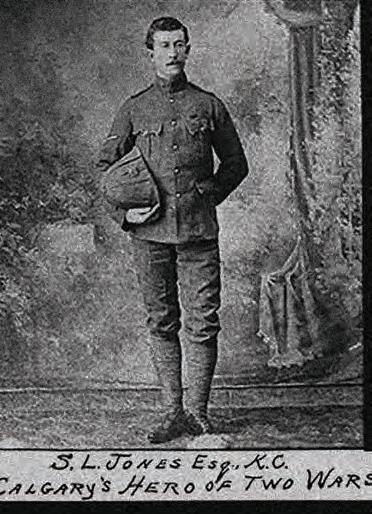
“The German guns suddenly opened on us, and for the rest of the day 17 different kinds of hell were all about us,” wrote Captain Stanley Livingstone Jones, 33, of Princess Patricia’s Canadian Light Infantry (PPCLI), the first Canuck unit to see WW I action.
After two months of training in England, the Patricias had followed the No. 2 Canadian Stationary Hospital unit into France, arriving at Le Havre on Dec. 21, 1914.
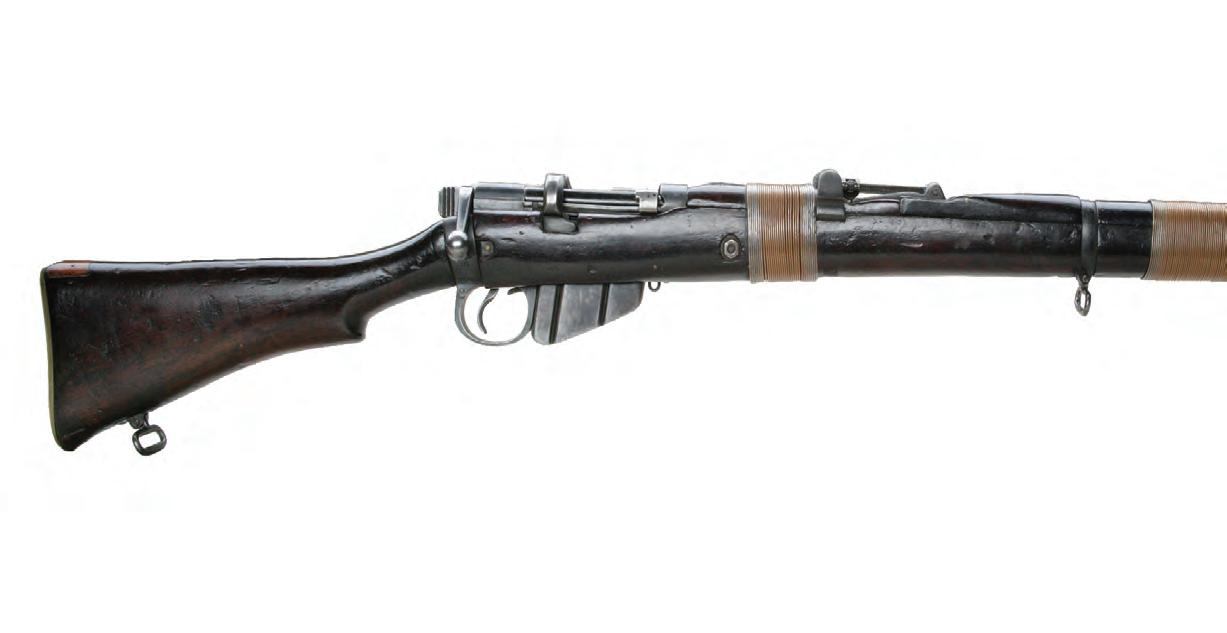
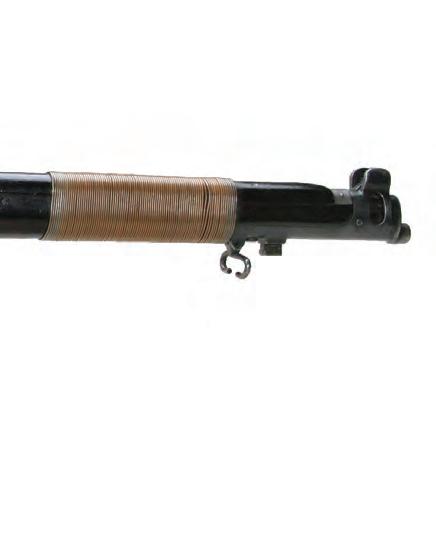
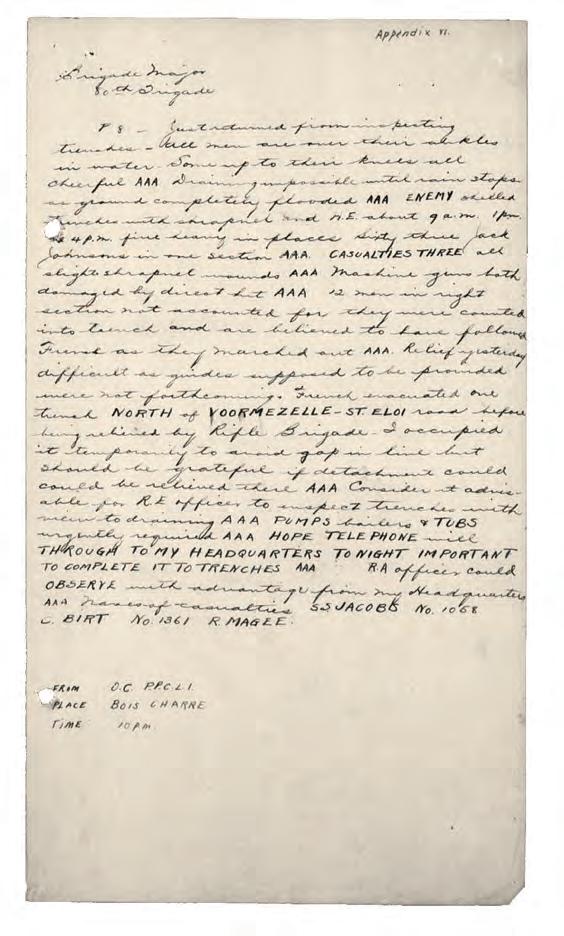
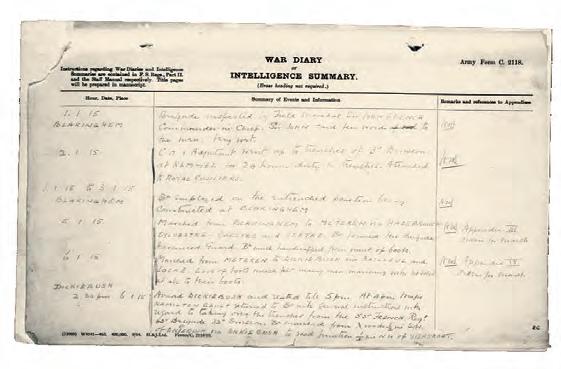
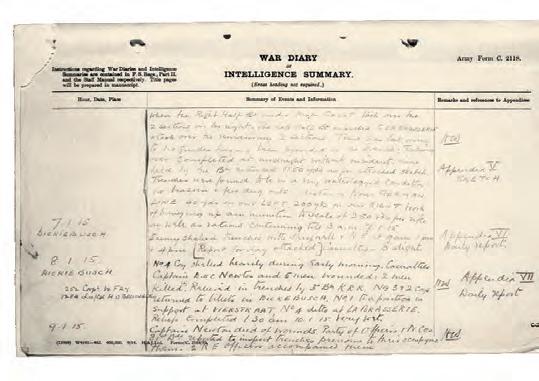
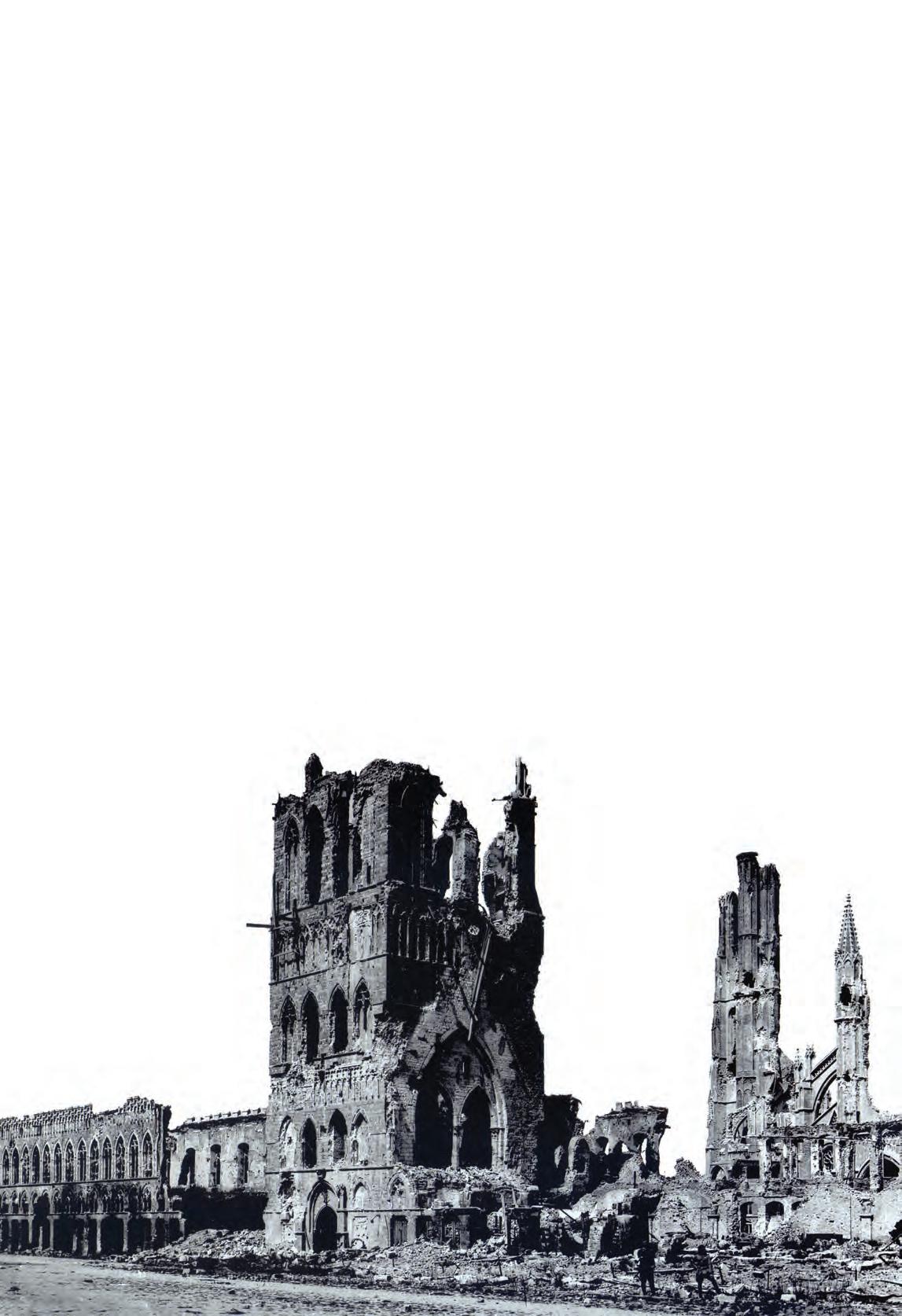
Princess Patricia’s Canadian Light Infantry fought Canada’s first battles of the Great War in January 1915 at Dickebusch near Ypres, Belgium (opposite). The unit’s war diaries (left) reference inferior equipment and replacing the infamous Ross rifle with the first Lee Enfields taken into front-line Canadian service (inset).
They were apparently illequipped when they moved into the line on Belgium’s Ypres salient on Jan. 6— thanks, no doubt, to Sam Hughes, the controversial federal minister of militia and defence whose cozy deals with suppliers and manufacturers tended to come at the fighting man’s expense.
The PPCLI had shed the troublesome Ross rifle and its nasty jamming habits in favour of the Lee-Enfield while still in England.
Clothing and footwear were another problem: Boots rotted and uniforms disintegrated in the notorious mud of the Western Front; trenching shovels were useless.
“Lack of boots much felt; many men marching with no soles at all,” says the Patricias’ war diary. “Arrived at Dickiebush [sic] and rested until 5 p.m…. The right half battalion under Major [Hamilton] Gault took over the two sections on the right…. Completed at midnight without incident.
“Trenches were found to be in a very waterlogged condition, no braisers and few dugouts. Distance from German line 40 yards on our left, 200 yards on our right.”
They were just south of the ancient trade centre of Ypres, about 15 kilometres from the French border. Here, the Allies were mounting a stand to prevent German forces from reaching Belgian and French seaports, some 35 kilometres away. The relentless shelling would reduce Ypres and its historic Cloth Hall to rubble.
The standoff would last almost the entire war, the German lines arrayed in a semicircle around Ypres, shifting with the ebb and flow of five major battles and multiple skirmishes in between.
The January 1915 action at Dickebusch appears to be one of those flare-ups, coming two months after the First Battle of Ypres, during which the German advance was stopped in October-November 1914.
There was some apprehension among the British about how the Canadians would adapt to the type and magnitude of the newly industrialized warfare, so different from their last go-round 14 years earlier in the Boer War. Any concerns, however, were soon allayed.
“This front has become a battle of inches and the slightest advance made out of the general scheme endangers our whole front,” a British officer told the Regina Leader-Post at the time.
“We were afraid the Canadians, in their enthusiasm, would carry out the rush tactics they employed so effectively in South Africa, but which would be fatal here.
“But the Patricias, rank and file, have shown themselves steady and their officers well trained.”
Indeed, for a forgotten battle, Dickebusch in January 1915 sounded pretty hot.
“Guns of every size and kind roared and spit back and forth, tipping up great holes in the earth and throwing mud and water high in the air,” Jones, himself a Boer War veteran, reported
in a Jan. 11 letter to his hometown Calgary Albertan newspaper.
“We escaped annihilation by only a few feet as the main bursts of shrapnel just cleared us.”
Two days after entering the trenches, the PPCLI took Canada’s first casualties of the war on Jan. 8.
“No 4 Coy shelled heavily during early morning,” says the history.
“Casualties Captain D.O.C. Newton and 5 men wounded: 2 men killed.”
By the time the war ended in November 1918, some 60,000 more Canadians would die, including Jones. And 172,000 would be wounded.
“TRENCHES WERE FOUND TO BE IN A VERY WATERLOGGED CONDITION, NO BRAISERS AND FEW DUGOUTS. DISTANCE FROM GERMAN LINE 40 YARDS ON OUR LEFT, 200 YARDS ON OUR RIGHT.”
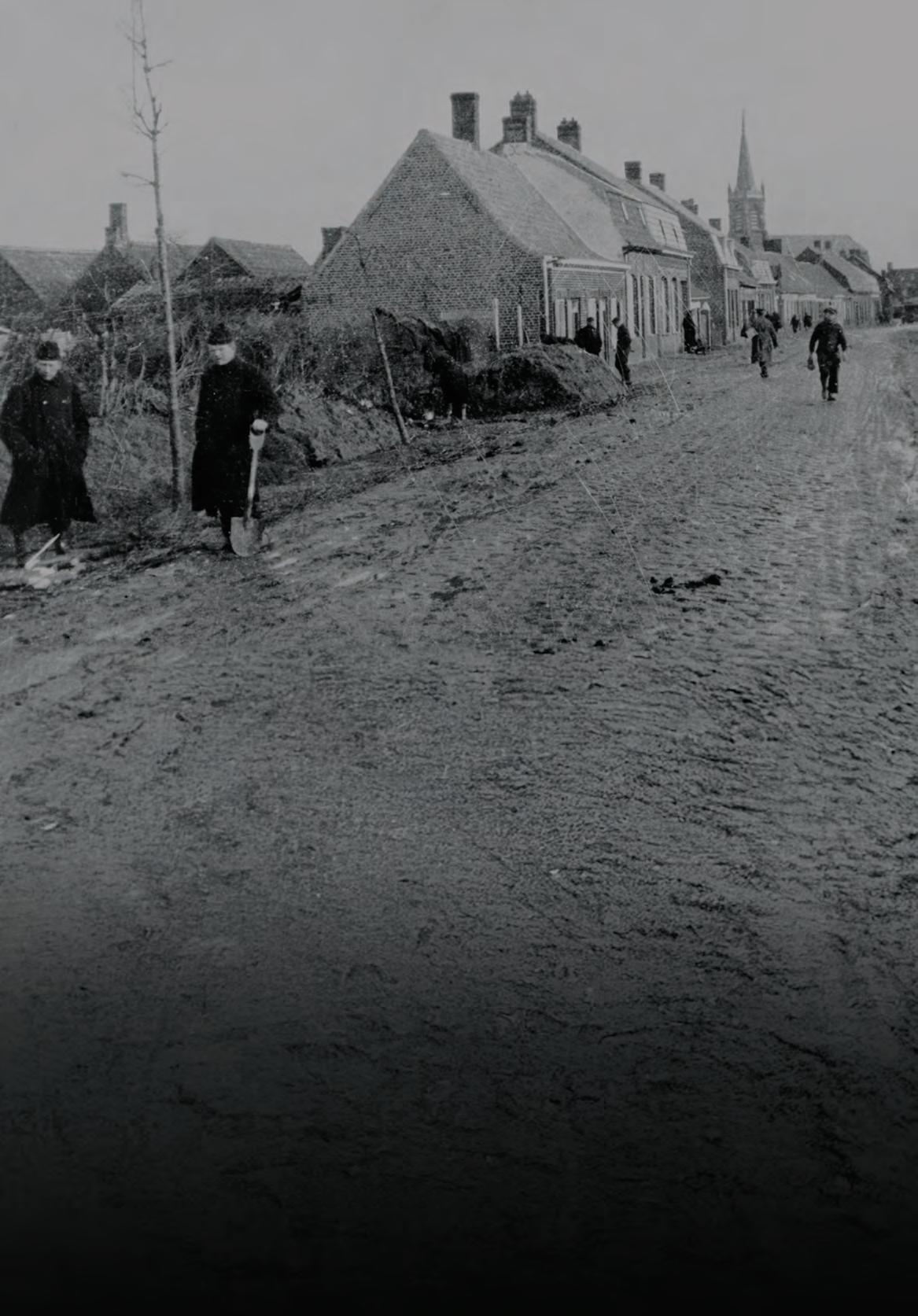
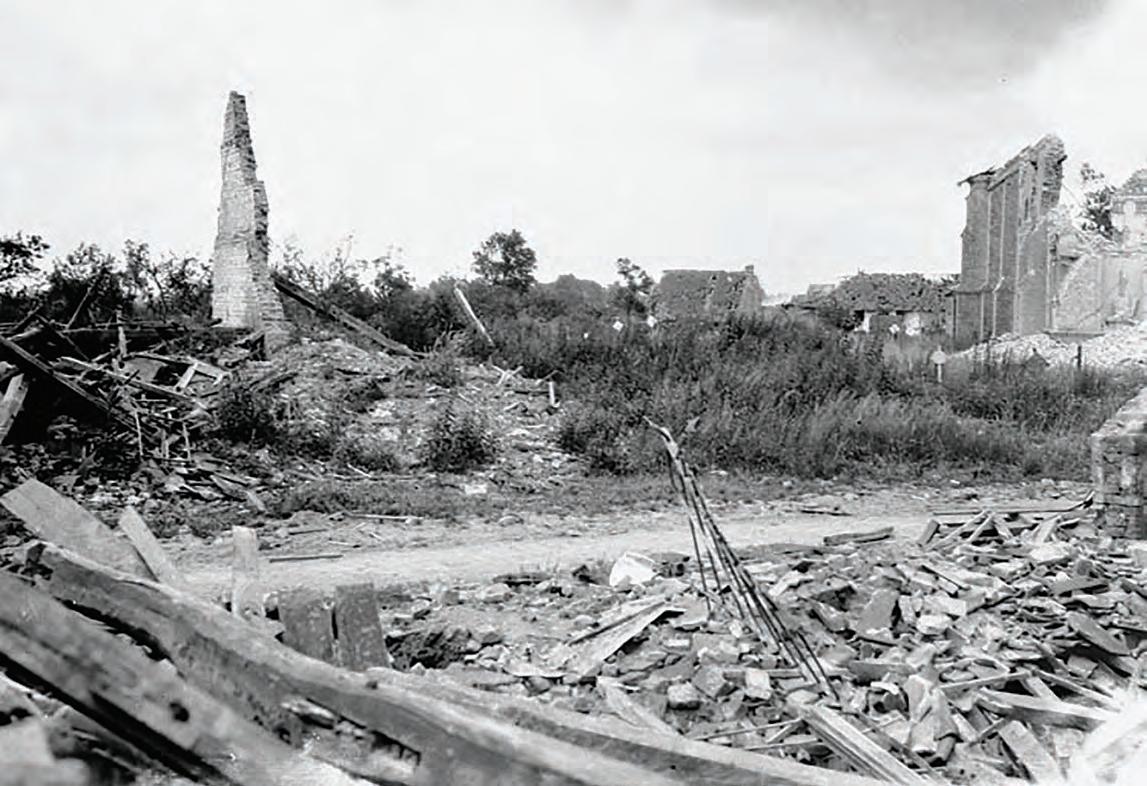
A ruined village in the Ypres salient. Stanley Jones’ service records (below) trace his war journey from recruitment to capture and death.
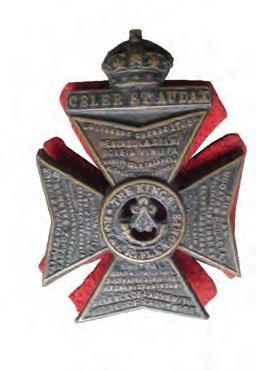
The Patricias were relieved by the British 3rd Battalion, King’s Royal Rifle Corps (see “The King’s men,” page 26), and dispatched to billets in the village of Dickebusch, or the Flemish Dikkebus. It’s part of the present-day city of Ypres (Ieper), population 35,000.
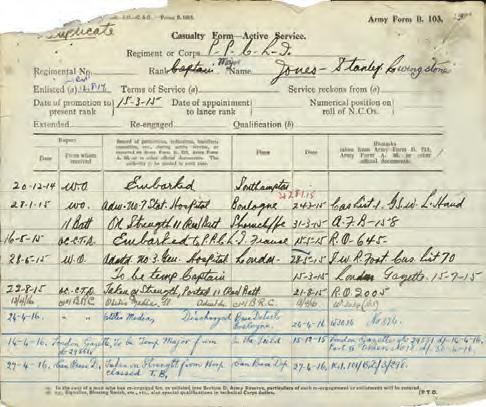
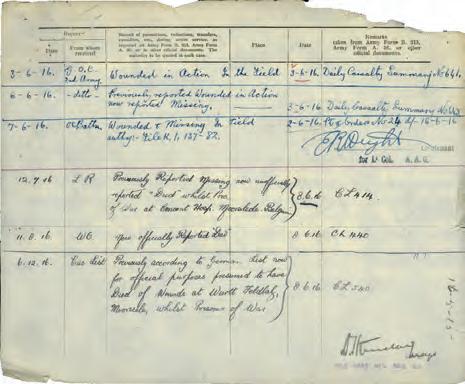
Jones would take a bullet to his left hand later in January. He was wounded again by shrapnel to his right foot in May and a gunshot wound to the left foot in September.
By now a major, he was reported wounded once more, hit by shrapnel through his left lung during a German mortar and artillery barrage near Sanctuary Wood on June 2, 1916.
He “suffered for 36 hours from his wounds with no attention but the first aid given by a comrade,” Alberta’s Crag & Canyon newspaper reported on Aug. 5, 1916.
“The Germans then captured the ground where he lay and, at the risk of their lives, removed him to hospital. They gave him every possible attention.”
Jones died in German hands on June 8. He is buried in Moorseele Military Cemetery, 20 kilometres east of Ypres. His wife Lucile had followed him overseas and was nursing at a hospital in Champigny-sur-Marne, France. It wasn’t until July 11 that she learned of her husband’s fate. The words “burnt into my head like red hot coals,” she wrote in her memoir. It was days before she could read the rest of the letters that accompanied the news. One
was from Jones, mailed on June 4, two days after he was wounded.
“We may be separated for some time but our love will always hold us together,” he wrote.
The PPCLI would fight in what is most commonly regarded as Canada’s first major action, at the Second Battle of Ypres, in the spring of 1915. It was during this fighting between April 22 and May 25 that the Germans first deployed poison gas, hitting French colonials at Saint Julien on the battle’s first day and neighbouring Canadian troops two days later.
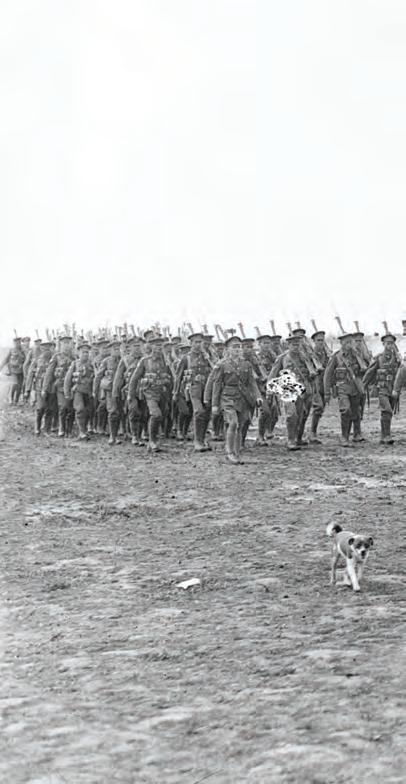
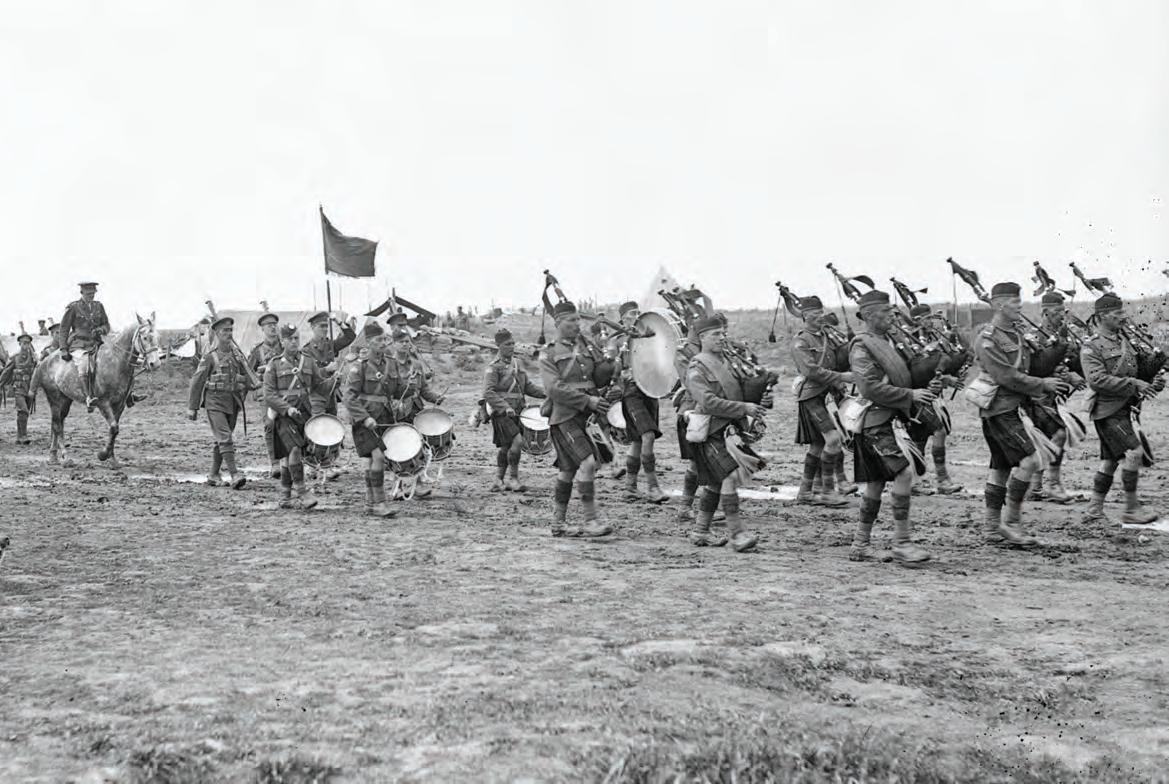
Jack Richard depicts Canadians in action at the Second Battle of Ypres in April/May 1915. Patricias march with the regimental pipes and drums in July 1917.
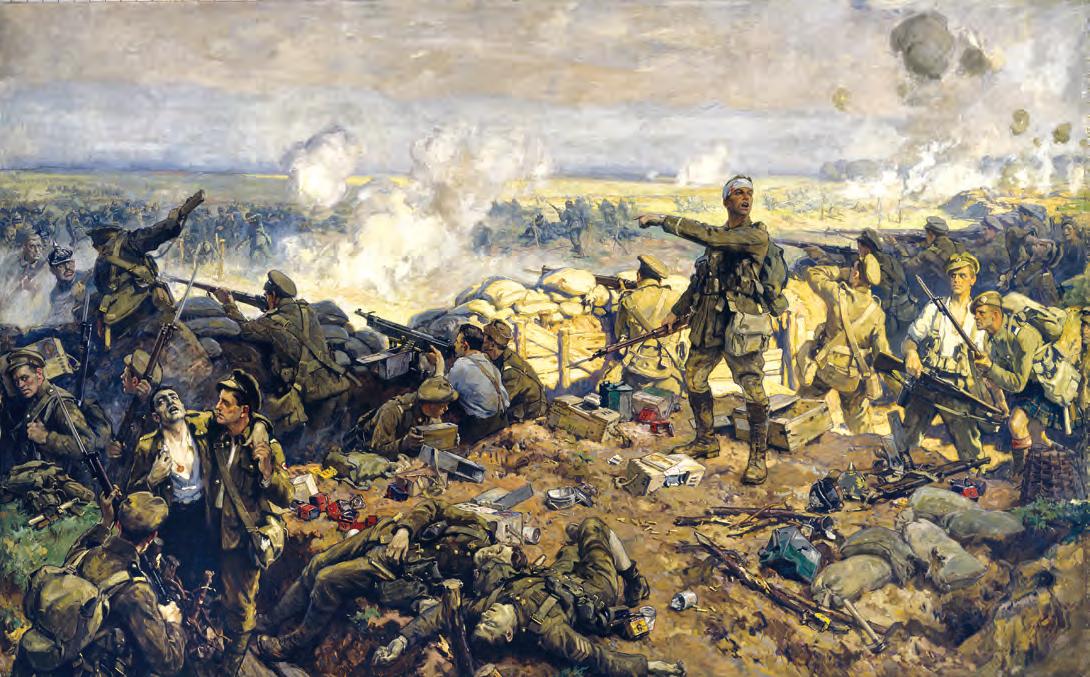
The Patricias had been on the line 12 days and taken 75 casualties, including 26 killed, when they fought a major engagement in the Second Battle of Ypres at Frezenberg in May 1915. Of 700 men who faced fire from three sides and stopped the German advance fighting from ditches and shell holes, 154 emerged in one piece under the command of the only able officer, a 39-yearold lieutenant named Hugh Wilderspin Niven, a wholesale hardware salesman from London, Ont., who had only just recovered from a bullet wound he had taken to his left forearm in March.
Niven was promoted to captain and awarded the Military Cross and the Distinguished Service Order (DSO) the following September. He would survive
a shrapnel wound to the chest in June 1916 and return to finish the war a major, receiving a bar to his DSO in January 1918. He died in 1969 at age 92.
Patricia Sergeant Walter Stamper was at Frezenberg, the PPCLI’s most celebrated battle honour and the origin of one of its unofficial mottos, “holding up the whole damn line.” Stamper wrote his wife and daughter in August 1916 after he was captured and eventually deposited in neutral Switzerland, where he would be interned for the duration.
This time, the Canadian prisoners of war didn’t get the same consideration afforded Jones.
“We were simply blown to pieces,” Stamper said. “There was just ten of us left in our Company, most of us unable to help ourselves;
those that were to [sic] badly wounded to walk they shot and bayoneted them. These, they made us lay on the ground beside them whilst they dug themselves in.
“All the time the shells and bullets were flying around us, and
“GUNS OF EVERY SIZE AND KIND ROARED AND SPIT BACK AND FORTH, TIPPING UP GREAT HOLES IN THE EARTH AND THROWING MUD AND WATER HIGH IN THE AIR.”
I can tell you I never expected to see any of you again. To amuse themselves they threw stones at us and called us swine, one of my men could not keep still as he was suffering so from a wound in the head, got up and was promptly shot by them through the stomach; he died about two hours later in great agony.
“We laid there from ten o’clock in the morning until six at night when we were fetched into the trench and robbed of everything we had. We were then taken back and threatened if we did not give information about our troops we should be shot. We were lined up three times for that purpose.”
They were eventually put on a train to Germany and given a starvation diet until relief parcels arrived and they were shipped off to Switzerland. There they were boarded in hotels and “smothered in flowers, chocolates, tobacco and cigarettes.”
In his paper “Birth of a Regiment: Princess Patricia’s Canadian Light Infantry 19141919,” historian James S. Kempling writes that the fighting that spring “marks not the death of the Originals but rather the initial birth pangs of a Regiment.”
“Nevertheless,” he continued, “by the end of the Frezenberg
battles the Patricias were in desperate condition. In May alone the battalion had 461 men struck off strength. Of these 219 had been killed and most of the remainder injured to the extent that they were unlikely to return to duty. A small number had been taken prisoner.”
The regiment would reconstitute and go on to fight at Mount Sorrel, the Somme, Vimy Ridge and Passchendaele (the Third Battle of Ypres) on into the Hundred Days Campaign that finished the war.
Of the 5,000 men who served with the regiment during the First World War, 1,300 never returned to Canada. Three Patricias would earn the Victoria Cross and the regiment would receive 18 battle honours.
During April 1916 fighting for the St. Eloi Craters five kilometres south of Ypres, elements of the Saskatchewan Rifles were billeted in reserve at the Patricias’ old haunt in Dickebusch. James Cameron McFadden’s grandfather, James Muirhead, was with the battalion.
In a Facebook post with a photo of his grandpa, great-granddad and great-uncle, who was killed at Ypres in 1916, McFadden said Muirhead rarely spoke of the war, but he was fond of one story about that favourite of infantry mascots—a dog.
“WE WERE SIMPLY BLOWN TO PIECES. THERE WAS JUST TEN OF US LEFT IN OUR COMPANY, MOST OF US UNABLE TO HELP OURSELVES.”
“Somewhere in a place that the men called ‘Dickie-Bush,’ [they] befriended a small dog, and it followed them wherever they were sent throughout the rest of the war,” wrote McFadden.
“They just called it ‘the DickieBush Terrier,’ after the place where it had joined them.
“When the war was over, they were told that they could not bring the dog home with them. One of the men scooped him up and hid him inside a duffel bag, and they all went onto the transport ship home to Canada. Grampa said that the last time he saw the dog, it was at the train station in Toronto. It was running after the man who had put it in the duffel bag.
“It followed him right up the steps onto a Pullman car, destined for a new home.” L
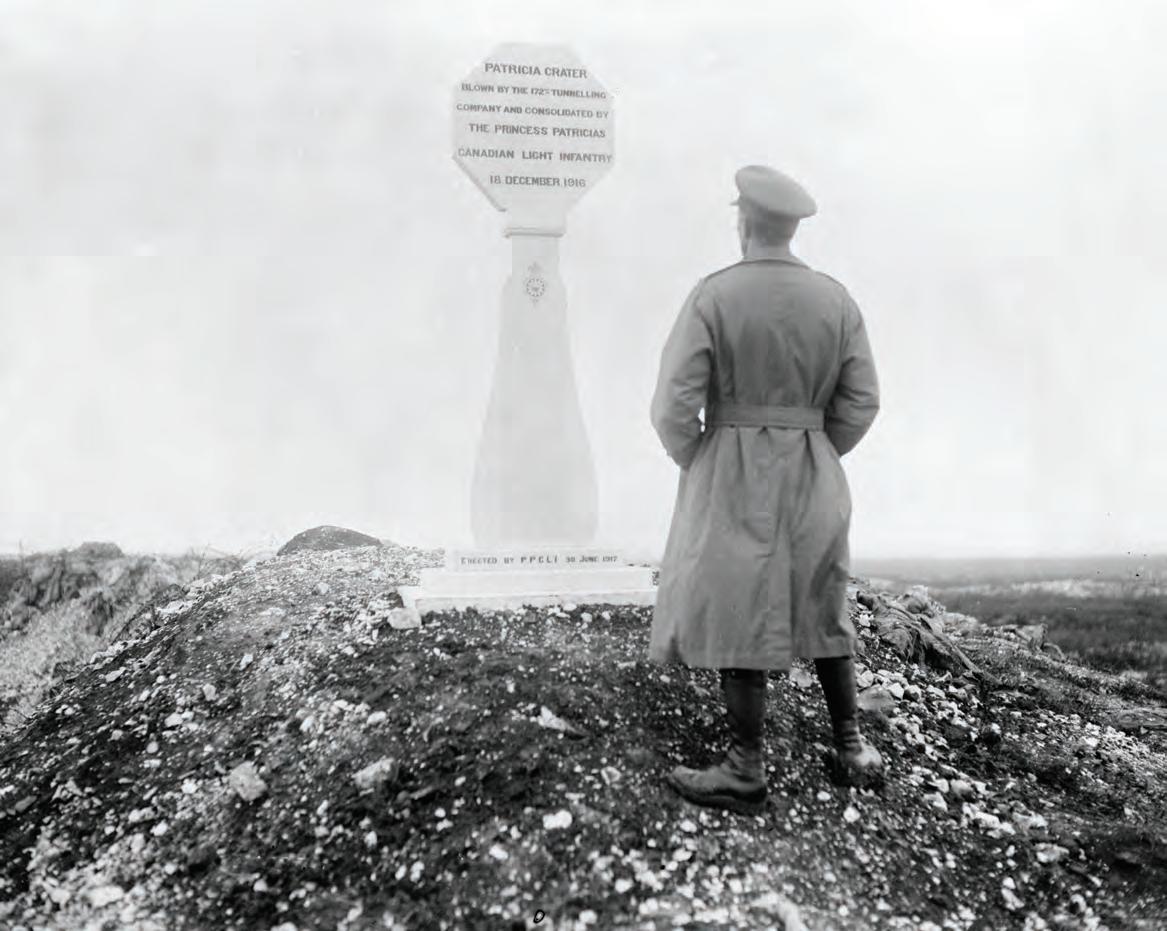
A soldier stands at a monument alongside Patricia Crater, where engineers and PPCLI took a German position during early fighting at Vimy Ridge.
Raised in 1756, the King’s Royal Rifle Corps had originally consisted of colonists recruited in British North America by what was then known as the antithetically named Royal American Regiment. This was during the Seven Years’ War— or the French and Indian War in North America. The unit existed for 200 years.

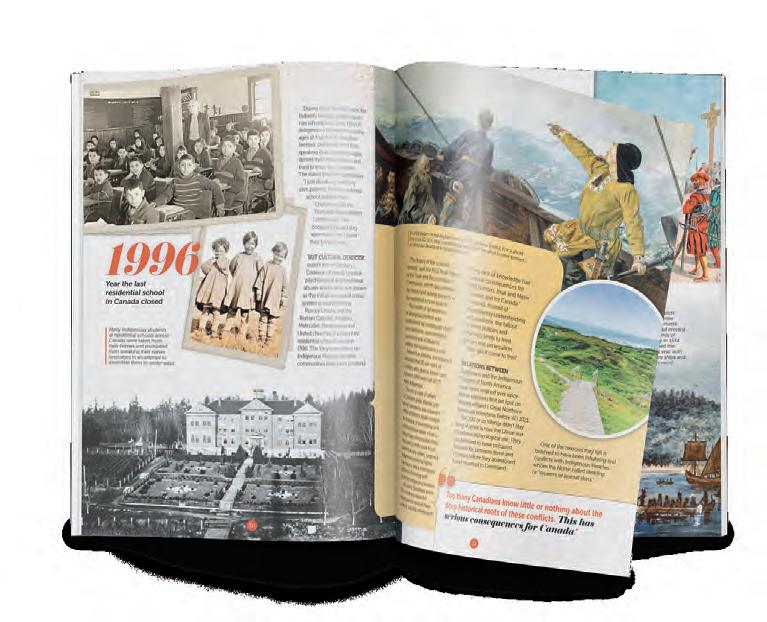
War may have made Canada, but it didn’t define it. To the eyes of many, the Great White North is the great conciliator. The objective third party. The voice of reason. The peacekeeper. During the course of 157 years— and more—the country has nevertheless made enemies and become their friend, made friends and become their enemy, and navigated relationships through good times and bad. Now, Canada’s Ultimate Story explores some of these key connections, the impact Canada had on them and their impact on Canada.
IN THEIR FIRST OVERSEAS BATTLE CANADA’S SOLDIERS PROVED THEIR METTLE
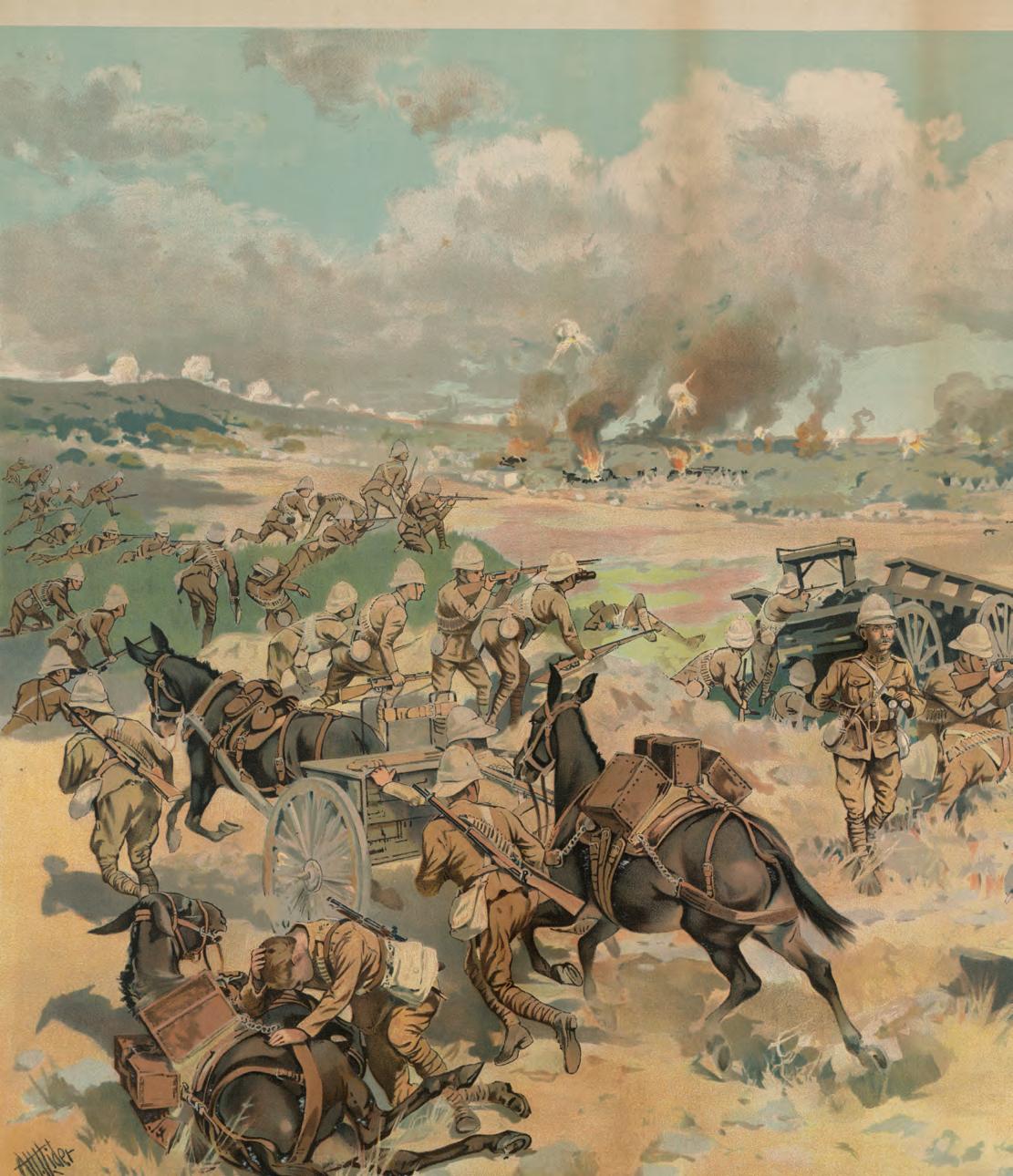

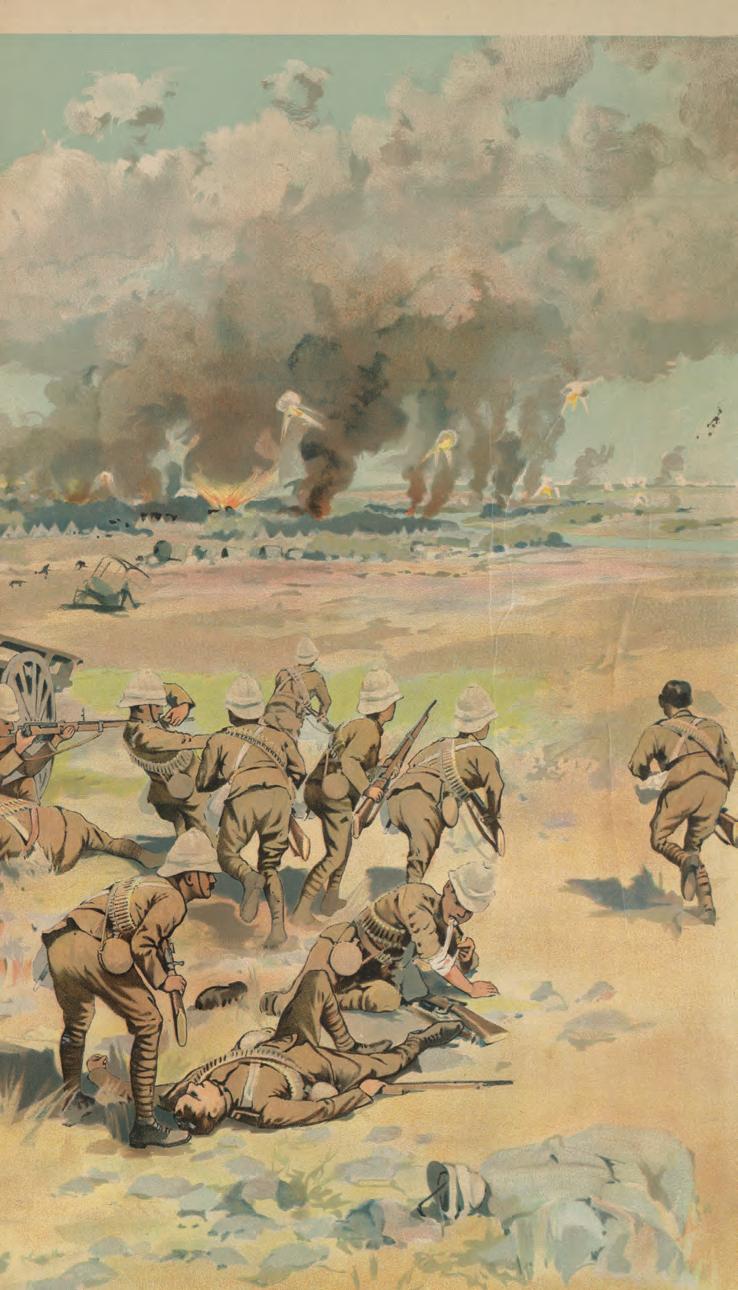
TBy John Boileau
The newspapers called it “Black Week.”
Between Dec. 10 and 17, 1899, three columns of British regulars led by experienced generals were defeated at Stormberg, Magersfontein and Colenso during the opening battles of the Boer War. Citizen soldiers of the tiny Boer republics of Transvaal and the Orange Free State caused nearly 3,000 casualties as the Brits attempted to relieve the besieged towns of Mafeking, Kimberley and Ladysmith.
The public at home was shocked, while other European powers began to question the dominance of the British Empire. But that coalition had already answered the call and contingents from Australia, India, New Zealand, South Africa and Canada stepped in to help.
The conflict, also known as the South African War, had begun just two months earlier. In the wee hours of Oct. 11, 1899, Boer troops advanced south and east into the British territories of Cape Colony and Natal at the southern tip of Africa.
Canadians were sharply divided over sending troops to assist Britain. Generally, English Canadians were supportive, while French Canadians, seeing parallels between themselves and the Boers, were not. Wilfrid Laurier, the country’s first French-Canadian prime minister, opposed sending his brethren to fight in a war in which he felt no Canadian interests were at stake. But Laurier misjudged the overall mood of the country.
Throughout the summer and fall before the war, partisan newspapers whipped the public into a frenzy of Boer bashing. Laurier finally acquiesced to public opinion, or at least that of English Canada. In mid-October, he offered to send 1,000 volunteers to South Africa. The British promptly accepted. Recruiting started immediately. The 2nd (Special Service) Battalion of the Royal Canadian Regiment of Infantry (RCR) was made up of volunteers—150 from the 1,000-man Permanent Force and the remainder from 82 militia units. Eight 120man companies were assembled in Victoria, Vancouver and Winnipeg for ‛A’ Company; London for ‛B’; Toronto for ‘C’; Ottawa and Kingston for ‛D’; Montreal for ‛E’; Quebec for ‛F’; Saint John, N.B., and Charlottetown for ‛G’ and Halifax for ‛H.’
Roberts’ praise acknowledged the Canadians as being “instrumental in the capture of General Cronjé and his forces.” The Boers reportedly dubbed them “fire eaters.”

1900. There, some 20,000 British soldiers were decimated by 8,000 Boers and forced to retreat.
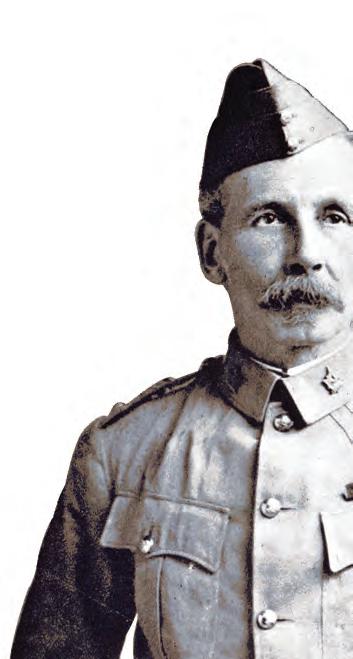
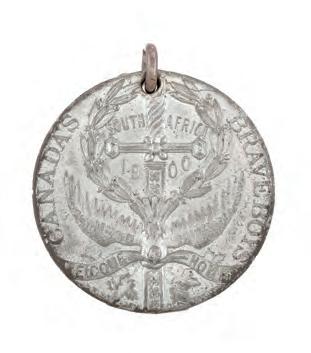
Amazingly, authorities recruited, examined, organized, clothed, equipped, assembled and dispatched overseas the 1,039-man battalion in October in just 16 days. The government selected Lieutenant-Colonel William Otter, Canada’s most experienced soldier, to command the country’s first-ever overseas expeditionary force.
When the RCR arrived in Cape Town at the end of November, the Boers surprisingly held the upper hand and had British forces bottled up in Mafeking, Kimberley and Ladysmith. The day after the Canadians arrived, they moved north by train.
After pausing for a few days at various stops en route, the RCR reached Belmont on Dec. 9, just before Black Week began. At Belmont, the Canadians trained and performed outpost duties.
The defeats of Black Week were followed by the embarrassment of Spion Kop on Jan. 24,

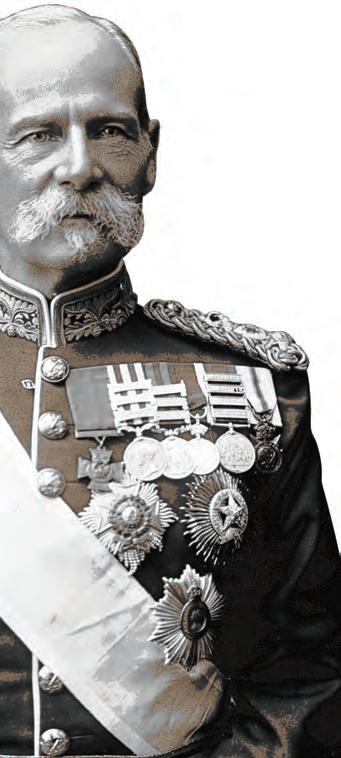
The RCR moved to Graspan and joined 19th Brigade, part of a 35,000-man British force commanded by Field Marshal Frederick Roberts, the newly appointed commander in South Africa. The diminutive, one-eyed, 67-year-old Roberts, affectionally known as “Bobs” to his soldiers and the public alike, was one of Britain’s most capable officers. He had been sent to turn the tide.
In mid-February, the RCR began a gruelling, five-day cross-country trek across the veldt under Roberts. It was marked by thirst, hunger, heat and exhaustion. Roberts’ goal was the Orange Free State capital, Bloemfontein. But a Boer force of 5,000 men under General Pieter (Piet) Cronjé stood in the way.
The two sides met at Drift, a ford at the Modder River. While

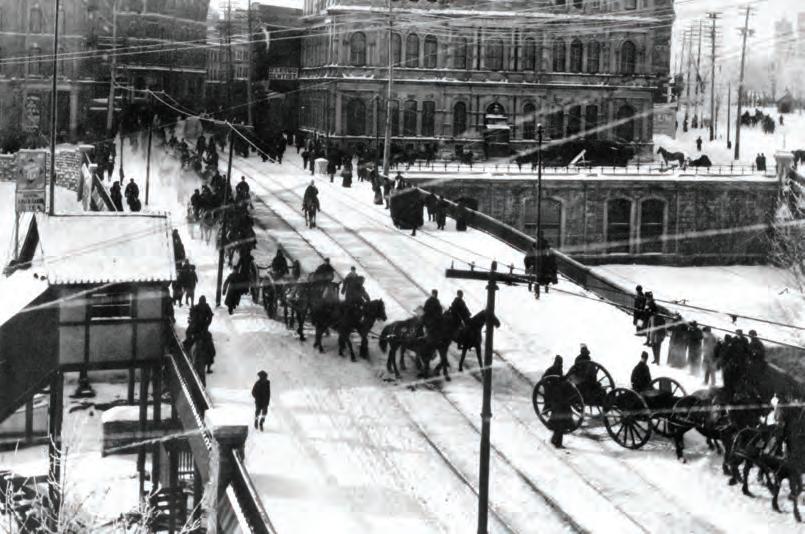
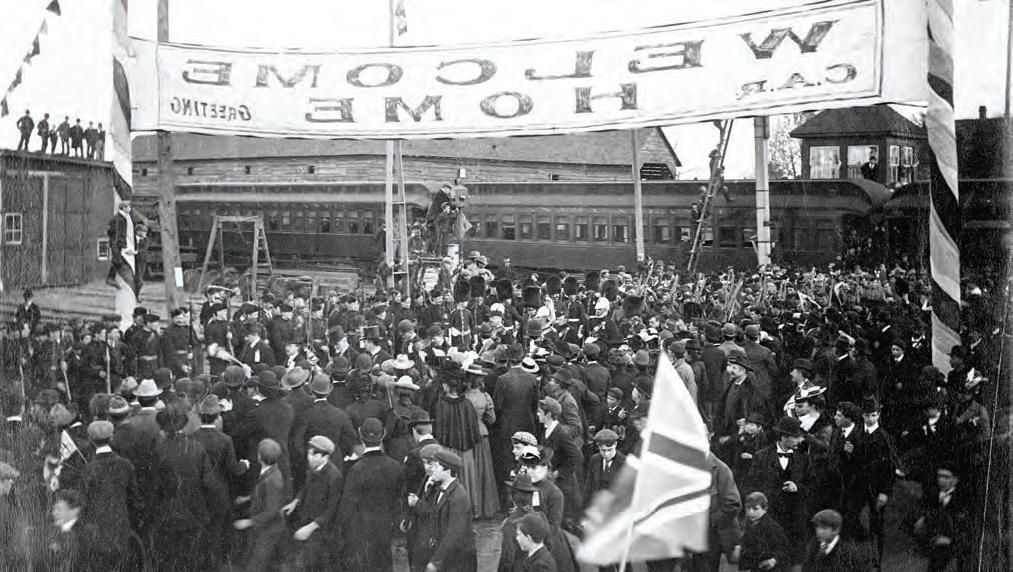
Soldiers en route to the Boer War parade in Ottawa (opposite left). After early setbacks, British Field Marshal Frederick Roberts (opposite right) took command of the Imperial forces, while Lieutenant-Colonel William Otter (opposite bottom) led the Canadian contingent. An artist depicts the British defensive line during the Battle of Majuba Hill in February 1881 (below).
Cronjé dug defensive positions into the river’s north bank, he sent his wagons and the families about three kilometres further upriver to form a protective barrier called a laager
The Canadians’ initial experiences in battle on Feb. 18 weren’t good. The desperate fighting that marked Canada’s first overseas exchange of gunfire ended in failure, with 21 killed and 60 wounded. “Bloody Sunday,” as the soldiers called it, was Canada’s costliest engagement since the War of 1812.
After another abortive attack on Feb. 20, the RCR performed various outpost duties over the next few days, designed to keep the Boers from escaping. As the British gradually tightened a noose around the Boers and shelled their positions continuously during daylight, Cronjé moved closer to the laager and dug in positions
along both sides of the riverbank. Inside the circled wagons, which stretched in a three-kilometre arc along the north side of the Modder, conditions were deplorable.
The Canadians were in rough shape, too. Sickness, wounds and death had reduced the original 1,039-man battalion to 708. Those who remained were a bedraggled looking lot. Unable to wash or shave most of the time, they had been wearing the same lice-infested clothes for two weeks. Extremes of heat and cold, as well as insufficient rations, only added to their misery.
To make matters worse, hundreds of dead Boer animals floated downstream, their decomposing bodies polluting the water and filling the air with a sickening stench. When the Canadians got the odd rest day, they washed their bodies and clothes with river
water and used it for drinking and cooking. Illness struck.
On Feb. 26, the RCR relieved a British battalion in the front-line trenches opposite the west end of the Boers, only 550 metres from the dug-in farmers. The next day held special significance for both sides.
Feb. 27 nineteen years earlier, the Boers had triumphed over the British at the Battle of Majuba Hill. Their victory secured the former’s independence and humiliated the latter. The British army was anxious to avenge that defeat.
The responsibility for the attack fell to 19th Brigade, now reinforced by additional infantry units and a company of Royal Engineers. Because the RCR held the front-line trenches, they would lead the assault, assisted by the Brits. The green Canadians were about to undertake one of the most difficult operations in warfare: a night attack.
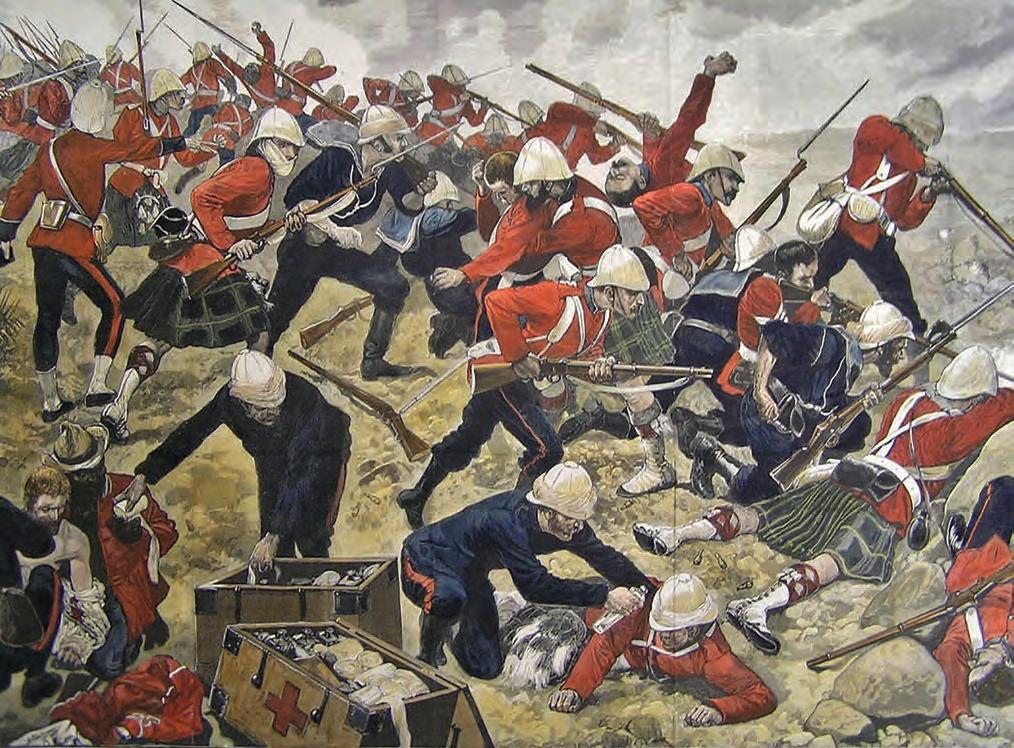
At daybreak, from the safety of their hastily dug new trenches, the tenacious Maritimers realized that they overlooked the enemy.
By 10 p.m., the forward RCR companies, ‛C’ through ‛H,’ were in position for the assault. Their trenches stretched northward for more than 300 metres from the riverbank. ‛A’ Company was sent south of the river, while ‛B’ Company was in reserve.
Shortly after 2 a.m. on Feb. 27, 500 Canadians climbed out of their trenches as quietly as possible and formed two lines six paces apart. The front line had bayonets fixed. To keep direction in the darkness, the soldiers advanced shoulderto-shoulder, “clasping the hands of those on our left and being clasped by the waist of those on our right,” according to a participant.
Around 2:45, when the Canadians were less than 100 metres from the enemy trenches, a soldier bumped into a tin can filled with rocks hanging from a wire. The primitive warning system alerted Boer sentries, who began firing. This was quickly followed by withering fire from the Boer lines as the farmers scrambled out of their dugouts. Fortunately, the sentries’ shots gave the Canadians enough time to throw themselves to the ground and avoid the worst of the barrage. British
engineers started to dig in while the Canadians returned fire.
Although the casualties from the first shots were surprisingly light, ‛F’ and ‛G’ companies, who were closest to the Boer lines, in some cases only 60 metres away, suffered the most. They sustained six killed and 21 wounded in the opening volley.
For the next 15 minutes, the two sides traded shots. The RCR front line kept up a steady fire, while the second line and the engineers dug in. Occasionally, a frustrated soldier in the second line dropped his shovel and crawled to the front rank to return a few shots in the enemy’s direction.
A few, paralyzed by fear, hugged the ground and didn’t fire at all. Suddenly, an authoritative voice from the left flank called out, “Retire and bring back your wounded!” Most of the soldiers were only too happy to oblige. The Canadian fire lessened, men stood up and ran to the rear. As they fled, fire from the Boers felled several of them.
Soldiers of ‛C,’ ‛D,’ ‛E’ and ‛F’ companies were soon crammed into their original trenches, which were now occupied by a British battalion. They remained there for
the rest of the battle. But the two companies from the Maritimes, ‛G’ under regular army Lieutenant Archibald (Archie) Macdonell and ‛H’ under Halifax militia Captain Duncan Stairs, either didn’t hear the order or purposely chose to ignore it. They stood their ground, along with a few Royal Engineers.
At daybreak, from the safety of their hastily dug new trenches, the tenacious Maritimers realized that they now overlooked the enemy. They could fire into the Boer dugouts along the riverbank, as well as into their laager.
When darkness began to fade around 4 a.m., several Boers emerged from their trenches to survey the battlefield. The Maritimers immediately opened up with well-disciplined fire that drove the enemy back into their holes. The Boers returned fire for about an hour or so, when suddenly those in the forward enemy trenches shouted out that they wanted to surrender. Initially, the Canadians continued to fire on the Boers. They had heard stories about Boers pretending to give up, only to open fire again. Around 6 a.m., a lone Boer climbed out of his trench carrying
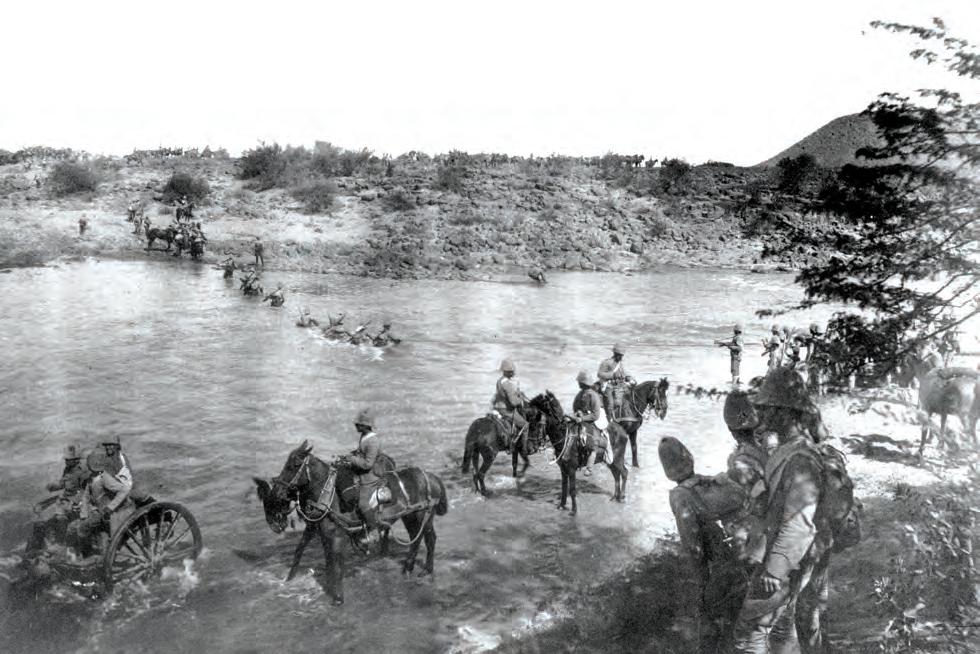
Troops of the Royal Canadian Regiment cross the Paardeberg Drift in February 1900.
a white flag and walked toward the Canadians. All action ceased. Other Boers quickly followed, surrendering to ‛G’ and ‛H’ companies.
The leading British and Canadian troops advanced warily, bayonets fixed, past the Boer trenches and into the laager. Roberts arrived to accept Cronjé’s surrender. Most Boers never forgave him for capitulating, especially on the anniversary of their great victory at Majuba. Cronjé’s untimely and unexpected capitulation, with nearly 10 per cent of the entire Boer army, opened the way for the eventual Imperial victory.
Late that afternoon, as the RCR searched the laager for souvenirs and food, an honour the British
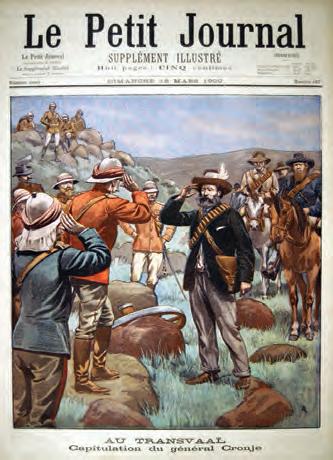
gave them in recognition of their role in the victory, Roberts rode over to congratulate the Canadians. He praised them and acknowledged them as being “instrumental in the capture of General Cronjé and his forces.” “Canadian,” he went on to state, “now stands for bravery, dash and courage.” The Boers reportedly dubbed the Canadians the “fire eaters.”
Once Roberts’ dispatches reached Britain, Canada and the rest of the Empire heaped praise on the soldiers of the RCR. Canadians had just won their first foreign
battle and the first significant Imperial victory of the war at a cost of 13 dead and 36 wounded. For his courageous actions during the battle, Private Richard Thompson was awarded a Queen Victoria’s Scarf of Honour (see “Artifacts,” September/October 2024).
The battle quickly became known as “The Dawn of Majuba Day,” avenging the earlier defeat. Many hailed it as a turning point in the conflict and the beginning of the reversal of British fortunes.
And Canadian soldiers played a full part in that victory. L
With Cronjé defeated, the RCR participated in the general Imperial advance on the Orange Free State and Transvaal capitals. By now, the Boers had decided that setpiece battles were not to their advantage and resorted to hit-and-run tactics conducted by roving bands of commandos.
On March 15, after a grueling march averaging 25 kilometres a day, the Canadians entered Bloemfontein
unopposed. Battles at Israel’s Poort, Thaba Nchu, Zand River and Doornkop Hill followed, opening the way to Pretoria. On June 5, the RCR, now reduced to 437 men, marched into the undefended Boer capital.

Lines of communications duties followed at various railroad stations until the regiment’s time was up. After almost a year in South Africa, the RCR returned to Canada and was disbanded.
KNOWN DERISIVELY AS ZOMBIES, THOUSANDS OF CANADIAN MEN WERE CONSCRIPTED—ORIGINALLY FOR HOME DEFENCE— UNDER THE WW II NATIONAL RESOURCES MOBILIZATION ACT. LATE IN THE WAR, MANY WERE FORCED TO THE FRONT LINES

By J.L. Granatstein
Conscription was the political issue of the Second World War in Canada. And despite promises by the Mackenzie King government before the war to avoid it, the fall of France and public pressure forced the feds to pass the National Resources Mobilization Act (NRMA) in June 1940, which authorized compulsory service for home defence.
But by 1944, after the D-Day invasion of France and the brutal combat in Normandy and the Scheldt estuary, casualties were high and trained infantrymen were in short supply. By November, the military was convinced that only the home defence conscripts could suffice for the needed reinforcements. King finally agreed to send 16,000 of the men who had become known by much of the public derisively as zombies—the soulless living dead of horror movies—overseas.
The pressure on the conscripts to “convert” to general service volunteers had been intense since at least 1942. And money was a factor in the efforts at persuasion. The home defence men weren’t entitled to a War Service Gratuity if they remained in Canada. If they went overseas, however, they would get an additional 25 cents for each day, $7.50 for each 30 days of service, and one week’s pay for each six months of service outside Canada. The additional remuneration was substantial.
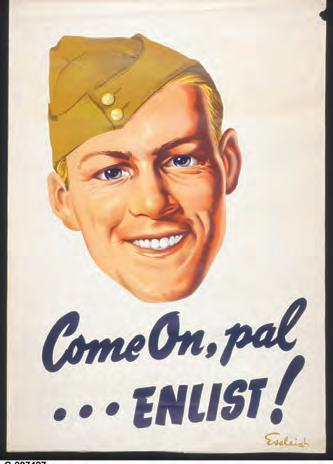
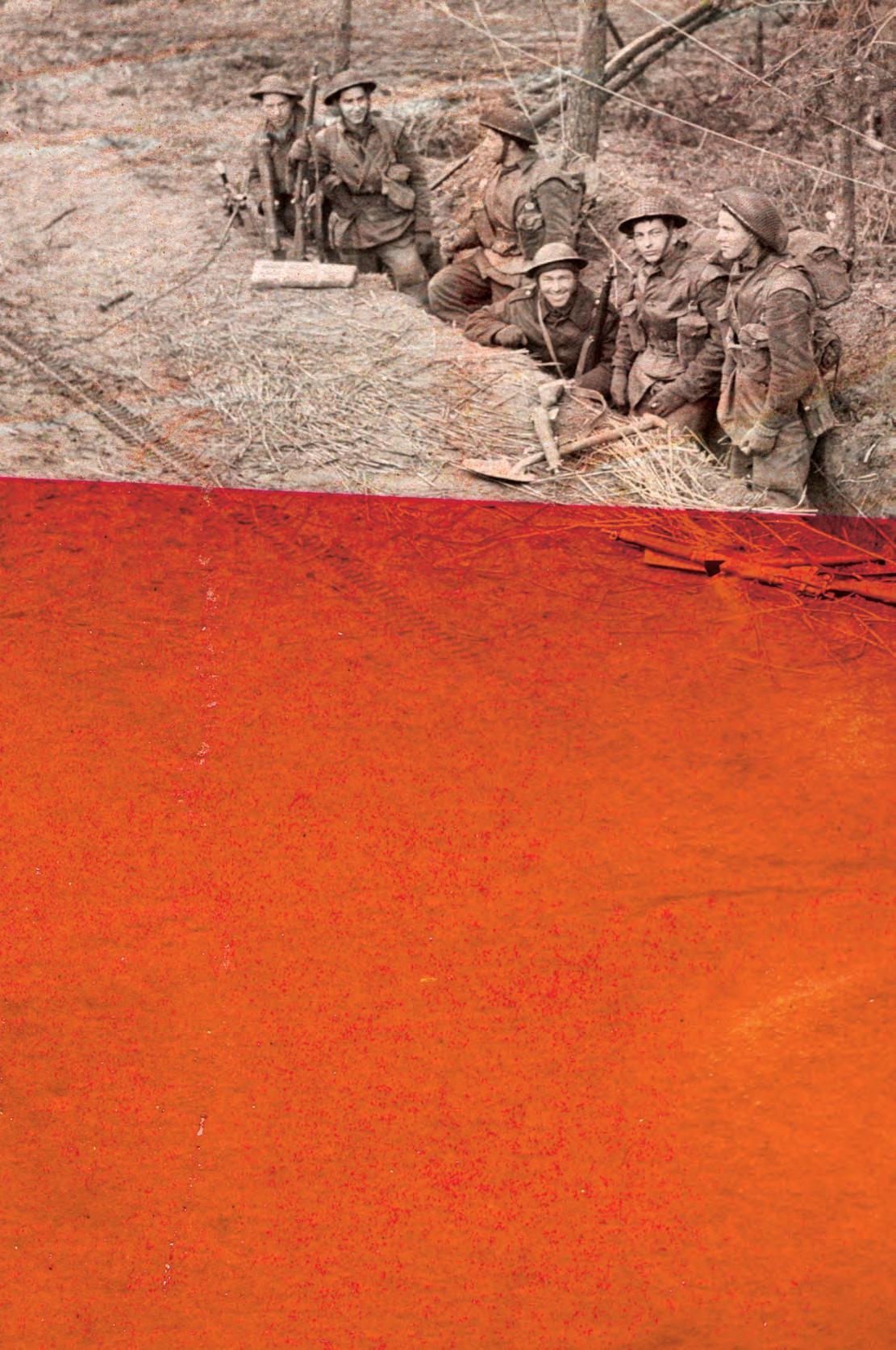
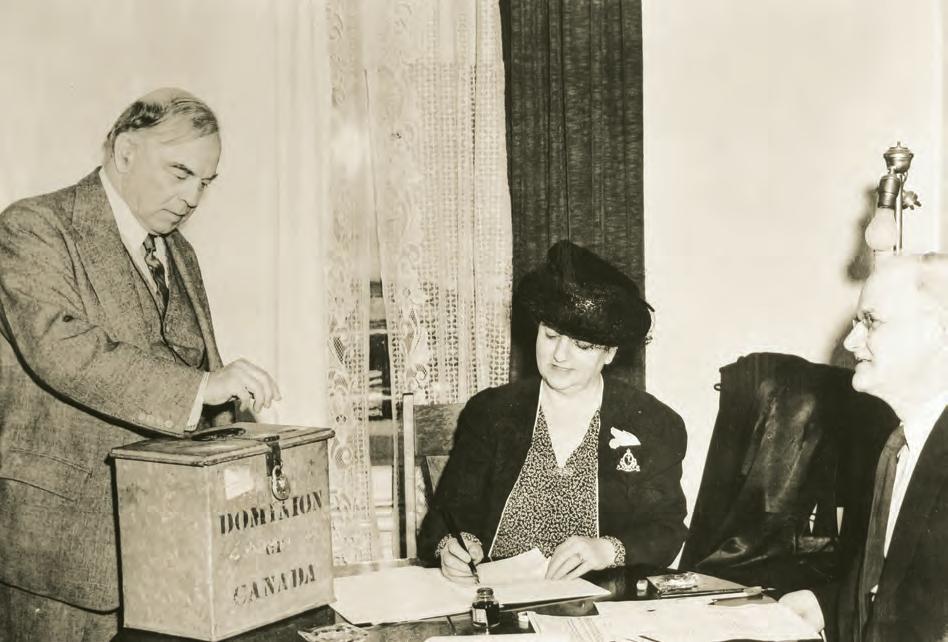
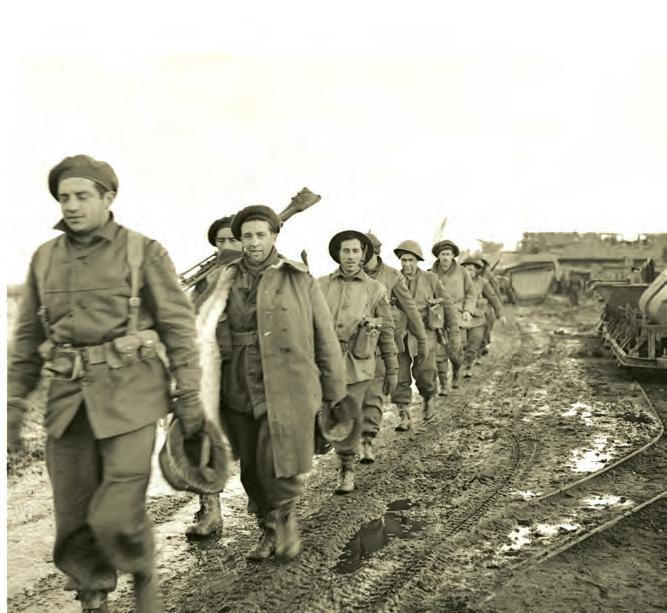
Conscripts served with units such as Le Régiment de Maisonneuve, shown (above) near Nijmegen, Netherlands, on Feb. 8, 1945. A recruitment campaign poster from 1942. Prime Minister Mackenzie King votes in the plebiscite on conscription on April 27, 1942.


Interestingly, the NRMA had much to do w ith enlistment for general service. By way of example, historian Terry Copp studied the 197 men of Le Régiment de Maisonneuve who were killed in action to determine, in part, how they had joined the war effort. Civilian volunteers numbered 130, while another three volunteered for overseas service after they received their conscription notices; 27 volunteered following their home defence service; 22 were zombies sent overseas for service; and there was no information on 15.

NOT EVERY ZOMBIE ACCEPTED THE DECISION. THERE WERE BRIEF MUTINIES IN BRITISH COLUMBIA TRAINING CAMPS. AND SOME 6,000 WENT ABSENT WITHOUT LEAVE.
Refining the data further, Copp focused on those Maisies killed in action who had enlisted in 1943-1944. There were 23 civilian volunteers; three volunteered on being called up; 16 joined after serving as home defence conscripts; 16 were zombies sent overseas; and there was no information on 14.
Of civilian volunteers then, some, and possibly many, did so when faced with home defence conscription. The same can be said about those who volunteered when they received their call-up notices. Those who converted after home defence service likely did so after being pressed repeatedly to volunteer, to get the benefits offered only to volunteers, or on being ordered overseas by Ottawa or even en route to England. Those who were ordered overseas might well have been hardline anti-conscriptionists throughout their service. What’s certain, however, is that the NRMA played an important role in persuading men to volunteer for military service.
Once the government ordered conscripts overseas, the rate of conversions, which had been stagnant for months, increased rapidly. There were 1,878 in December 1944, 1,692 in January 1945, 2,164 in February and 2,131 in March. The lure of veterans’ benefits was significant.
Men who believed in the cause but had made clear that they were only willing to fight overseas if the government had the courage to order them to do so, also converted after the government’s November 1944 decision.
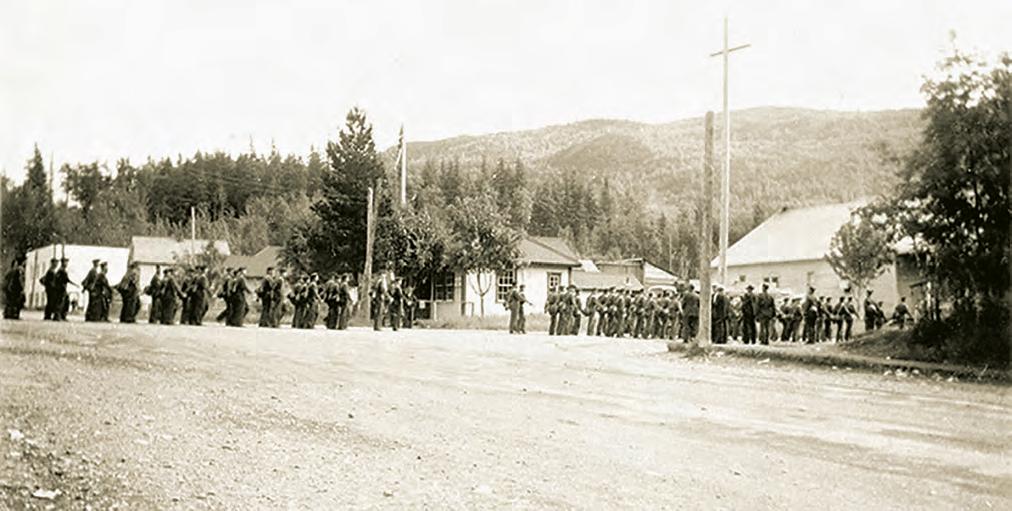
But, not every zombie accepted the government decision. There were brief mutinies in British Columbia training camps. Some 6,000 soldiers ordered overseas went absent without leave after failing to return from pre-embarkation leave, though substantial
numbers returned to their units voluntarily; some men deserted from the trains taking them to their embarkation point, abandoning their rifles and kit; and one zombie tossed his rifle into the water from the gangplank.
All this made news around the world, greatly embarrassing the government, the high command overseas and many soldiers fighting in Italy and Northwest Europe. The latter wrote letters home denouncing the cowardly zombies.
Nonetheless, the NRMA was largely a success. In all, some 154,000 men had been drafted for home defence service, and about 60,000 converted to general service, about 6,000 transferred to other services, and thousands more were discharged for a variety of reasons. By early autumn 1944, there were an estimated 60,000 conscripts still serving, some in formed units, some in training or on courses, some seconded to help bring in the harvest. Trained infantry made up 42,000 of the group.


The widespread opinion in Englishspeaking Canada was that most of the home defence conscripts were francophones, but this wasn’t correct: 30 per cent spoke only English, 20 per cent spoke only French, 24 per cent were bilingual, and 26 per cent had another first language. They also came from across the country: 25 per cent were from Ontario, 39 per cent from Quebec, 24 per cent from the Prairies, six per cent from B.C, and 6 per cent from the Maritimes.
In other words, the home defence soldiers were generally representative of the Canadian population with only a slightly higher percentage of Quebecers.
Men who didn’t volunteer to fight had many reasons. Some feared being killed or grievously wounded, a rational enough reason in a bloody war. If family members had served during the Great War, many had heard stories of the horror of the trenches and didn’t want to go through their generation’s version of hell. Some were recently married or had young children and didn’t want to be separated from their families. Some were of ethnic origins that didn’t identify with the Anglo-centric views of the military or have any sympathy for the British Empire. Some had religious or cultural reasons for resisting military service. Simply put, not every Canadian wanted to fight.
But once the decision had been taken to order the zombies overseas, General Harry Crerar, the commander of First Canadian
Army, knew that he then had to deal with the possibility that the conscripts might not be welcomed by his men. How could this very dangerous possibility be averted?
Crerar decided that integration was the answer. He sensibly ordered conscripts arriving from Canada be integrated with volunteers in the normal reinforcement stream during their training in England “in order to avoid trouble when [their] draft reached units in the field.” And to avoid distinguishing the NRMA men from volunteers, he insisted on uniformity of dress and had the distinctive serial numbers of conscripts changed to conform with those of volunteers from the same military district in Canada. References to a soldier’s mobilization status were removed from his pay book, too.
At the same time, Canadian Military Headquarters in England worried that conscript non-commissioned officers wouldn’t be acceptable to units in the field and trouble might result if such NCOs tried to give orders to volunteer soldiers. The NCOs were duly reduced in rank.
After their refresher training in England, the now mixed groups of conscripts and volunteer reinforcements began to go to the continent and to infantry units. The battalions weren’t to know which reinforcements
In November 1944, home defence conscripts protest the government decision to send them overseas (opposite top) at a training base in Terrace, B.C. (opposite bottom). Conscripts bolstered infantry units such as Le Régiment de la Chaudière, shown here marching along a dike near Nijmegen, Netherlands in February 1945.

were NRMA men, though some figured it out. Lieutenant Donald Pearce of The North Nova Scotia Highlanders wrote on March 20, 1945, that: “There is, of course, a considerable prejudice against” the zombies. “But for some reason they have made excellent soldiers, so far; very scrupulous in the care of their weapons and equipment, certainly, and quite well versed in various military skills.”

The war diarist of The Loyal Edmonton Regiment also appeared to be aware of the presence of conscripted soldiers, writing:
“During the month our [Battalion] has [taken on strength] eight officers and 167 OR’s [and], among the latter, are approx 40 NRMA personnel. These men have in no way been treated differently than any other [reinforcements], in fact the majority of the
[Battalion] is not even aware of their presence here, and in the few small actions they have engaged in so far they have generally shown up as well as all new [reinforcements] do.”
By this stage of the war, volunteer reinforcements were either young or re-mustered from other trades and given refresher training as infantry. The war diarist of The Algonquin Regiment noted that: “our newcomers are beginning to fit nicely into the family and from the interest they have shown the [battalion] to date they have erased any poor impression they may have given a few days ago and our [officers] and NCOs are now firmly convinced that we have the makings of a fighting team worthy of upholding the name Algonquin.”
The commanding officer of the regiment said as much to reporter Frederick Griffin from the Toronto Star, noting his conscripted soldiers “were just as good any reinforcements we have had.
“Actually,” the CO continued, “nobody knows in the regiment who is a draftee and who is not, and after the boys have been in action, nobody cares.”
A March 15, 1945, story by Ralph Allen in The Globe and Mail had a similar assessment. The conscripts, wrote Allen, “acquitted themselves well on all counts, according to the veterans who fight beside them” in the savage battles on the Rhine-Maas front. “[In] the few cases where home defense soldiers have been introduced to combat at the side of men who knew them to be home defense soldiers, they have been given high marks for courage, training and discipline both by their officers and by their comrades.”
By all accounts, the zombies fought just as well as their volunteer comrades, and the soldiers’ disdain for them during the conscription crisis largely disappeared.
As events developed on the battlefield in the first months of 1945, the shortage of infantrymen that had produced the manpower crisis of late 1944 vanished, too. The men of
First Canadian Army fighting in Northwest Europe, hit so hard in Normandy and on the Scheldt estuary, were effectively removed from the gruelling battles for much of November and December 1944, and all of January 1945. They were almost completely unaffected by the last German offensive in December, the Battle of the Bulge. First Canadian Corps was also moved from Italy to join up with Crerar’s army and was out of action for some six weeks in the first months of 1945. These respites allowed the reinforcement stream to catch up with, and overcome, the losses that had appeared so threatening in the autumn of 1944.

“THERE IS A CONSIDERABLE PREJUDICE AGAINST” THE ZOMBIES. “BUT THEY HAVE MADE EXCELLENT SOLDIERS, SO FAR.”
This situation on the ground meant that of the 12,908 conscripts who had proceeded overseas, only 2,463 had been taken on strength by units of First Canadian Army by VE-Day, May 8, 1945. Infantry battalions received 2,282 of these men. Of these troopers, 69 were killed, 232 were wounded and 13 became prisoners of war. Had the fighting continued longer than it did and/or had major battles caused many more casualties, additional conscripts, possibly beyond the 16,000 the prime minister had indicated were required in November 1944, would have been
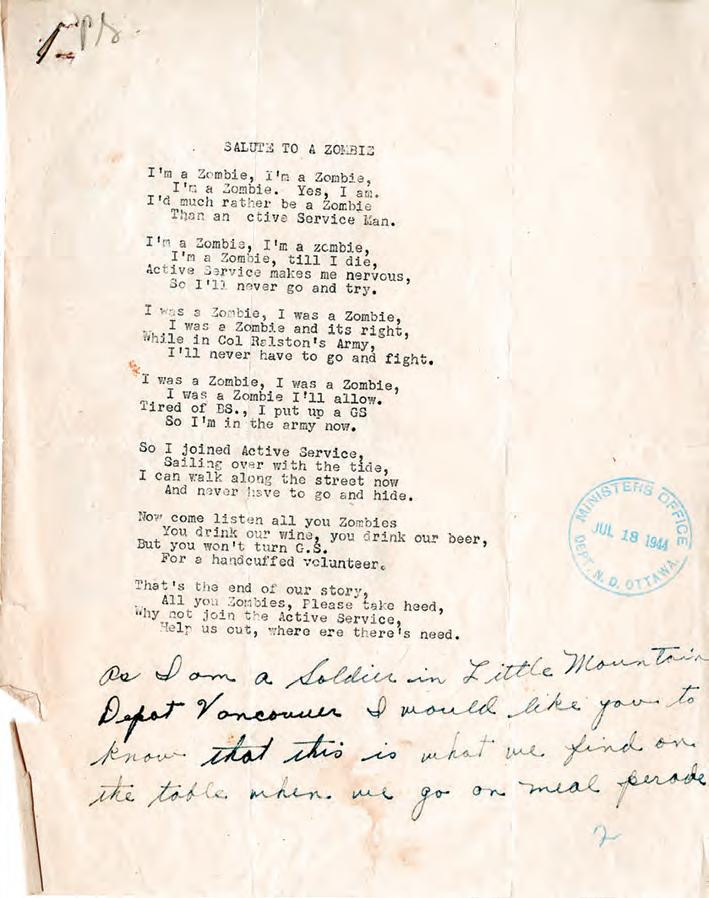
A home defence conscript sent Defence Minister Colonel James L. Ralston the copy of the lyrics to the song “Salute to a Zombie” left for him. Volunteers, such as these soldiers, continue to arrive in August 1944 as reinforcements, but too few to fill the ranks.
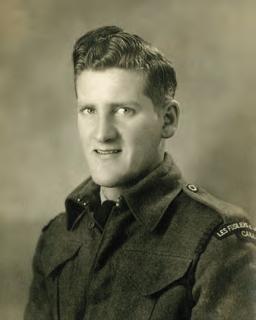
Private René Morin (left) was one of 69 conscripts killed in action overseas.
necessary. The late-war manpower crisis, in other words, disappeared even before Germany surrendered.
Private René Morin, an Acadian from Edmundston, N.B., was one of those 69 conscripts killed in action. Drafted in May 1943, Morin joined Le Régiment de Hull in B.C. after his basic training, then in January 1944 transferred to the Sherbrooke Fusiliers in May. After the decision to send conscripts overseas, he proceeded to England in one of the first waves of reinforcements. On April 7, Morin reported to the Royal 22e Régiment, which was fighting in the Netherlands near Apeldoorn. On April 14, a German hand-held anti-tank projectile struck and killed him instantly. Morin was one month shy of his 21st birthday. His time in action lasted just one week. L
How one Lancaster crew met the demise of so many in Bomber Command
By Sharon Adams
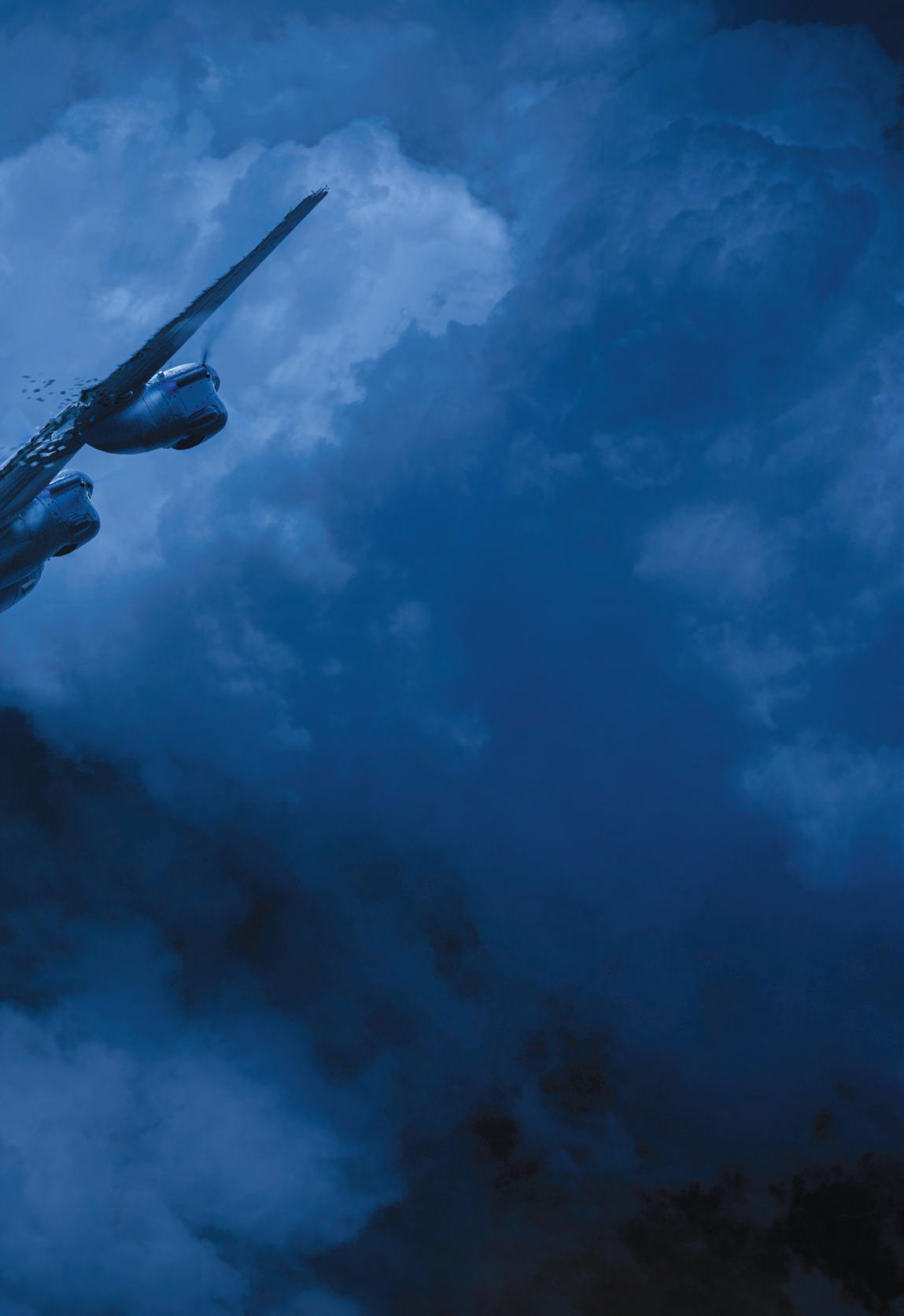

Jan. 7, 1945, nine Mosquito aircraft and 645 Lancaster bombers took off from airfields across the United Kingdom for grim duty over Munich.
Munich was a major railway hub through which Germany sent troops and materiel to other parts of Europe. It was also home to the first headquarters of the Nazi party, its wartime headquarters and site of one of Adolf Hitler’s residences.
This was the last major Allied raid on the city, which endured some 70 bombing raids during the Second World War. It was the 12th, and last, sortie for Flying Officer William John (Jim) McArthur and the mostly Canadian crew of Lancaster NN766 of Bomber Command’s 103 Squadron, Royal Air Force, based in Elsham Wolds, Lincolnshire, in eastern England.
OnThe crew had earlier finished five weeks of training in the Heavy Conversion Unit, an intensive course on how to operate the Lancasters, then had been transferred to No. 103 in November 1944.
Their first mission was on Nov. 18, and in the next seven weeks, the crew gained experience on raids over Freiburg, Dortmund, Karlsruhe, Leuna, Ulm, Mönchengladbach, Scholven, Osterfeld, Nuremberg and Hanover.
Their war ended on Jan. 7, at about 9 p.m. when residents near Hohrodberg, north of Munster, France, heard the whine of a troubled aircraft, then an explosion. The Lanc hit a hill, and its bomb load exploded, snuffing out seven young lives.
Eighty years later, the story of their aircraft has been told but a few times, while their personal histories have been shared even less, as is the case for most of the 10,673 flyers whose names appear on the granite memorial at the Bomber Command Museum of Canada in Nanton, Alta.
After the war, many veterans weren’t comfortable sharing their stories. That resulted in fewer people preserving the memories of those lost, including the crew of NN766. It’s doubtful Canadians today would ever stumble across the names of those doomed men, many of whom hadn’t yet chalked any other adult milestones before they enlisted.
They were:
❱ FLIGHT SERGEANT DONALD JOSEPH Mc AULAY of Toronto, mid-upper gunner, the youngest, who died just shy of his 19th birthday.
❱ SERGEANT ROY PERCY CANDY, 24, of Bozeat, Northamptonshire, the only British member of the crew.
❱ FLIGHT SERGEANT DONALD FLETCHER CAMPBELL , 25, the rear gunner, who hailed from Kelowna, B.C., and had served in all three services during the war. He enlisted with the Royal Canadian Navy in 1940, then after release on medical grounds and recovering, he joined The Seaforth Highlanders of Canada before transferring to the Royal Canadian Air Force.
❱ WARRANT OFFICER MILLARD HENDERSON HORNE , the 31-year-old wireless operator, was born in Iroquois, Ont., but lived with his grandparents in Gananoque while attending high school. When he enlisted, Horne and his wife resided in Kingston, Ont. He had not met his son, who was born after he went overseas in 1944. On bombing missions, Horne operated the radio and two machine guns in the Lanc’s upper turret.
❱ T HE PILOT, Mc ARTHUR , 28, was born in Winnipeg and enlisted in the fall of 1941. Prior to that, he sang with the Metropolitan and Knox choirs. In 1986, an island in Chatwin Lake, in remote northern Manitoba, was named after him.
❱ BOMB AIMER FLIGHT SERGEANT MEYER (MIKE) GREENSTEIN, 26, was a recent graduate of the University of Toronto when he joined the Royal Canadian Air Force in 1940.
❱ FLYING OFFICER RALPH JAMES (JIM) LOUGHEED, 20, the navigator, was a student at Winnipeg’s United College who listed building model aircraft and operating wireless radio among his hobbies when he joined up at 18.
OnLetters in the collection of Library and Archives Canada trace how Gladys and Dr. Morley Semmens Lougheed, parents of the latter, found out what happened to their son. They were among more than 44,000 families who received telegrams notifying them that a loved one was killed or missing in action and presumed to have died.
The day after Jim’s plane crashed, Wing Commander Alan F. Macdonald wrote his parents a letter.
“Your son was an experienced and efficient operational Navigator and a popular member of the Squadron,” wrote Macdonald. “His loss is sadly felt by us all.”
Some nine months later, on Oct. 9, a Certificate of Presumption of Death was issued, followed by a Missing Memorandum on Oct. 17 stating a nun saw a plane crash at about 9 p.m. and the bodies recovered were disintegrated and buried on the top of the mountain, with stones weighing down the plot. The pilot’s identity disc had been found.
The Canadian Casualty Branch presented a grimmer scenario on Oct. 22.
“It was snowing at the time and no bodies were found until eight days later when the snow had melted. Even then, only a few parts of the bodies, a head and a hand, all badly charred were found.”
Residents near Hohrodberg, north of Munster, France, heard the whine of a troubled aircraft, then an explosion. The Lanc hit a hill and its bomb load exploded.
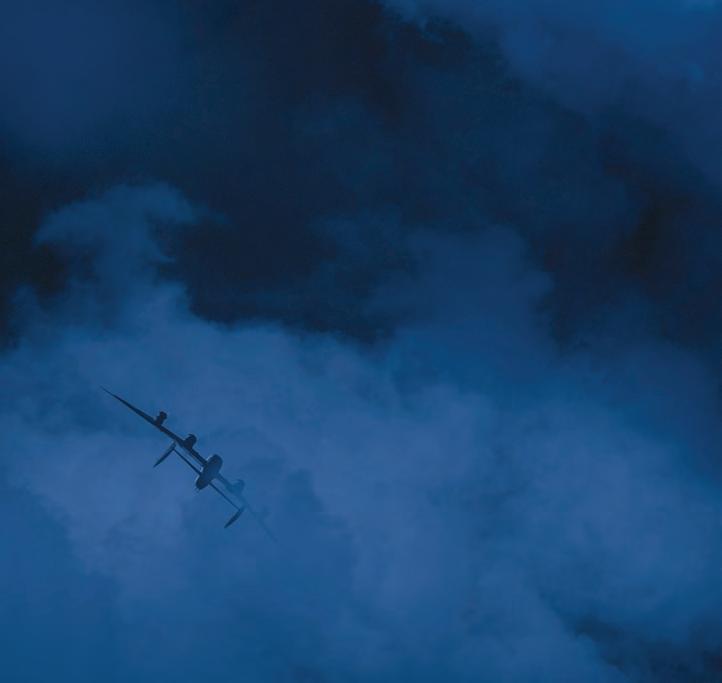
Although aircraft were given specific routes, times and altitudes, they encountered unexpected jet streams, flew through thick cloud cover often for hundreds of miles over enemy territory during which enemy fighters could appear at any time.
Unfavourable conditions increased the risk of a pilot blundering into another of the hundreds of aircraft in the formation.
Local officials were arranging to have the bodies reinterred in a nearby cemetery.
Meanwhile, Bomb Aimer Greenstein’s parents, Percy and Mary, never accepted his death, despite telegrams and letters from the government.
“It doesn’t mean they have to agree with it and they never did and they never accepted it [his death],” Hersh Gross, Mike’s nephew, said in Ellin Bessner’s Double Threat: Canadian Jews, the Military, and World War II
In 2007, the family established the Meyer (Mike) Greenstein Memorial Student Award for Writing Excellence at the University of Toronto in his memory.
The aircraft crashed and exploded, but what led to the crash? Many planes went down during the war, some without a trace, the cause of demise unknown. Mechanical failure? Or icing? Enemy action or mid-air collision?
“Tragically there were scores of spectacular mid-air collisions,” on bombing raids, wrote Lieutenant-Colonel Mark K. Wells in his master’s thesis “Aviators and Air Combat: A Study of The U.S. Eighth Air Force and R.A.F. Bomber Command.”
“Few crewmen would survive these kinds of mishaps.”
Fifteen Lancasters failed to return from the Munich raid on Jan. 8, 1945.
Canada’s War Diary 1945 lists among them two, possibly three, mid-air crashes as well as four aircraft lost, three over Germany and one lost without a trace.

Lancaster NN766 was originally listed as flying into high ground, however, it later emerged that it was involved in a mid-air collision with Lancaster ND968-G (O for Oboe). Its crew from the Australian 460 Squadron operating from Binbrook, Lincolnshire, survived the encounter and made it back to England.
The crew of NN766 are buried together in France’s Munster Communal Cemetery near the site of the bomber’s crash.

As the the bomber formation approached Munster on Jan. 7, it encountered thick cloud and heavy turbulence at 4,267 metres (14,000 feet) and the Canadian and Australian crews were among many that decided to climb higher to try to avoid it.
“It was bumpy, it was horrible,” recalled O-Oboe rear gunner Sergeant Dave Fellowes. O-Oboe emerged from the peasouper at about 4,572 metres (15,000 feet).
“There were other aircraft [ahead] who’d already gone up there and it was quite clear,” continued Fellowes.
“Then somebody said ‘Christ, we’re hit.’ And there was a crash and rending and tearing of metal and a thump. Some other aircraft had come out of the cloud just below us and struck his port wing into us right under the mid-upper turret.”

“Somebody said ‘Christ, we’re hit.’ And there was a crash and rending and tearing of metal and a thump. We heard the bombs go off when it hit the ground.”
As for the Canadians’ plane, “we think it just went into their flight deck” because it went straight down. “We heard the bombs go off when it hit the ground.”
O-Oboe went into a spin, but its pilot, Flying Officer Art Whitmarsh, wrested back control about 914 metres (3,000 feet) above the ground, regained altitude, then dropped its bombs for crew safety.
The damage was frightening. The aircraft had been ripped apart from the starboard wing, jamming the ailerons, obliterating the radar dome and almost severing the tail section. About a metre of wingtip was gone.
“Miraculously the mid-upper gunner was still in his turret,” reported Fellowes. Fearing it could fall, other crewmen used a rope to get Sergeant Ken de La Mare onto safer footing.
Fellowes was left wildly swaying in the tail section. Whitmarsh suggested Fellowes bail out, but he declined. “There was still the possibility that we could get jumped by a night fighter,” he said.
O-Oboe made an emergency landing at Manston airfield, and the crew got a look at the damage. “We thought, ‘Dear God. How did we get this aeroplane back?”’ said Fellowes. “So yeah, we considered ourselves very lucky.”
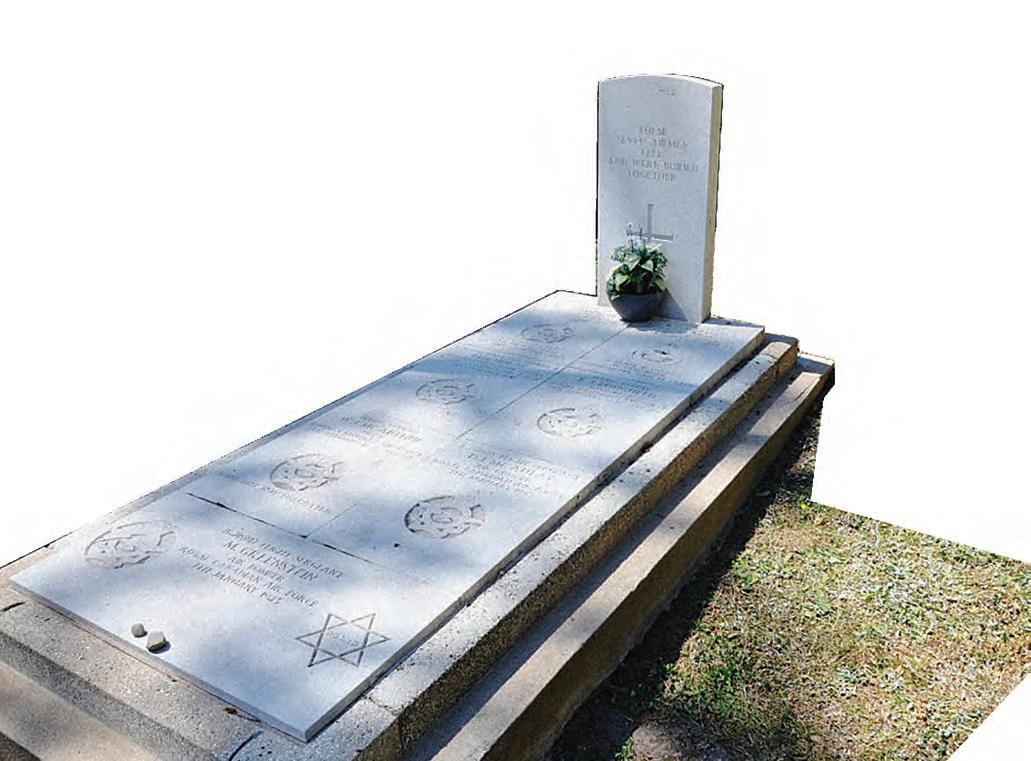
O-Oboe was repaired and it, and its crew, returned to service.
A memorial to the crew of NN766 was erected by the community of Hohrodberg, France, at the crash site. The crew’s remains were interred together in a grave in the nearby Munster Communal Cemetery. L











Facing a housing shortage as Canadians gravitated to urban centres during the Second World War, the federal government got building
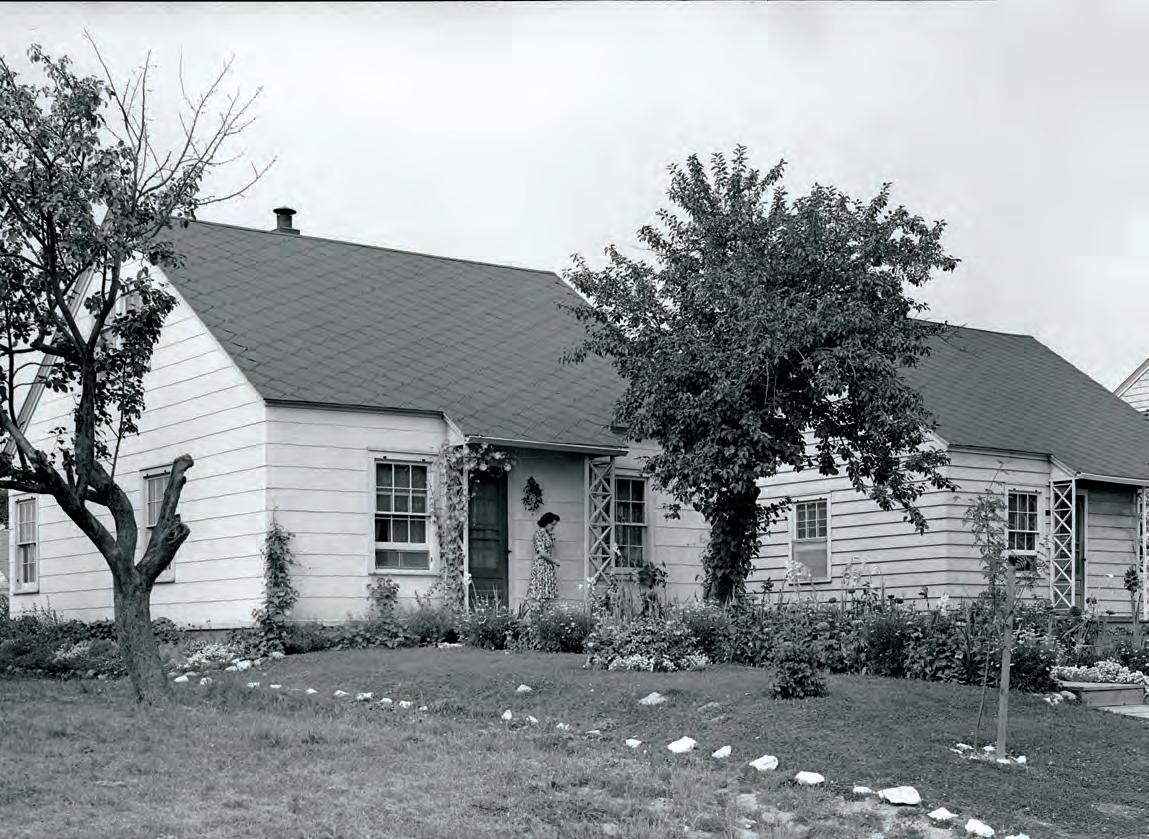
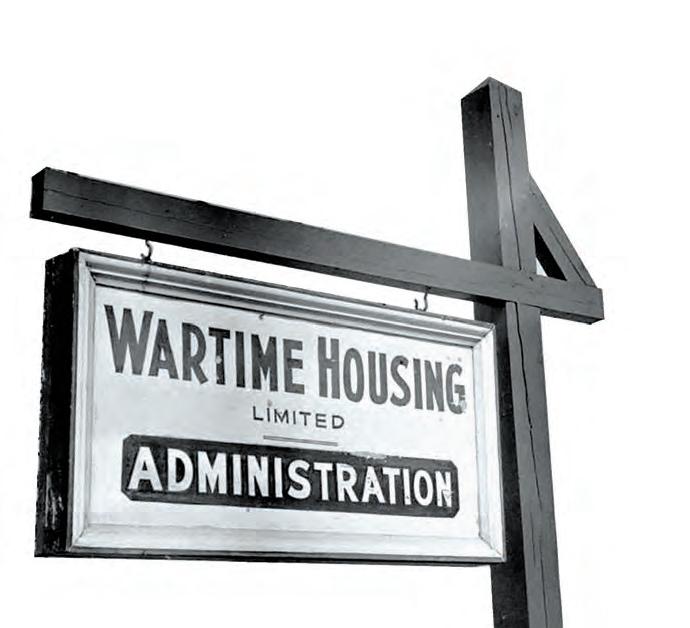
Bythe time Allied war industries were reaching their peak output and the Second World War started to turn in their favour, Canada was suffering a severe housing shortage—an estimated 500,000 units. It was caused by a large influx of workers, many of them women, moving into cities to be closer to well-paying jobs and later exacerbated when veterans began returning home, wanting to settle down and get back into civilian life.
The shortfall was caused in part, too, by the lack of employment during the Great Depression and the scarcity of skilled labour—because of the hundreds of thousands enlisted for military service— and supplies between 1942 and 1945.


Queen’s University in Kingston, Ont., said the need for housing accumulated between 1939 and 1945 was about half-a-million units, with low- and medium-income tenants experiencing the greatest need.
The federal government under Prime Minister Mackenzie King knew it had to do something to address the crisis. But, there was a question of conflicting philosophies. On one hand, there was a problem that needed an immediate state-sponsored solution. Meanwhile, the Department of Finance felt that housing, especially rental units, could better be managed by the private sector.
“A third factor was the deterioration of the existing stock,” wrote B.C. historian Jill Wade in the academic journal Urban History Review. “By 1945, many occupied dwellings in the larger Canadian cities were substandard in that they needed exterior repairs and/or lacked or shared flush toilet and bathing facilities.”
In 1942, the vacancy rate was less than one per cent. The result was overcrowding and “doubling up,” where two or more households shared the same living space. By 1944, a federal study known as the Curtis report, written mostly by Clifford A. Curtis, an economics professor at
The solution? The government would create a federal agency tasked with providing as many homes as possible. These would be temporary buildings, built quickly and were expected to be replaced shortly after the war’s end. Using the War Measurers Act and the Department of Munitions and Supply Act, Wartime Housing Limited (WHL), a Crown corporation, was established on Feb. 28, 1941. The company reported to C.D. Howe, minister of munitions and supply. It was tasked with building homes in subdivisions, preferable near war-industry sites. These houses were to be cheap, quickly built and suitable for a couple or small family to live in. The dwellings would be rented with the corporation acting as landlord.
Howe appointed Joseph M. Pigott, who oversaw administration of the familyrun Pigott Construction Company, to run the new agency. Pigott was one of many wealthy industrialists Howe recruited to Ottawa in wartime to share their expertise and work for a dollar a year. Pigott, along with his brother Roy, had turned the company started by their father from a small Hamilton-based outfit into a milliondollar business. It had become known for building the first skyscraper in Hamilton, the 18-storey Pigott Building. The company would grow even more successful after the war, overseeing construction of the Royal Ontario Museum in Toronto and the Bank of Canada building in Ottawa, among other high-profile projects.
Appropriately, street names in these subdivisions tended have a military flare, with monikers such as Marshal, Admiral or Veteran. At the time, no one dreamed these homes would make neighbourhoods with their own character, be improved on by owners once the government began selling them off and still be standing 80 years later in communities across Canada.
Of course, the dwellings had a certain conformity of appearance. The government called them “Victory” homes or “Homes for Heroes,” but the public tended to refer to them as “strawberry box homes” given their resemblance to the boxes the fruit was sold in at the time.
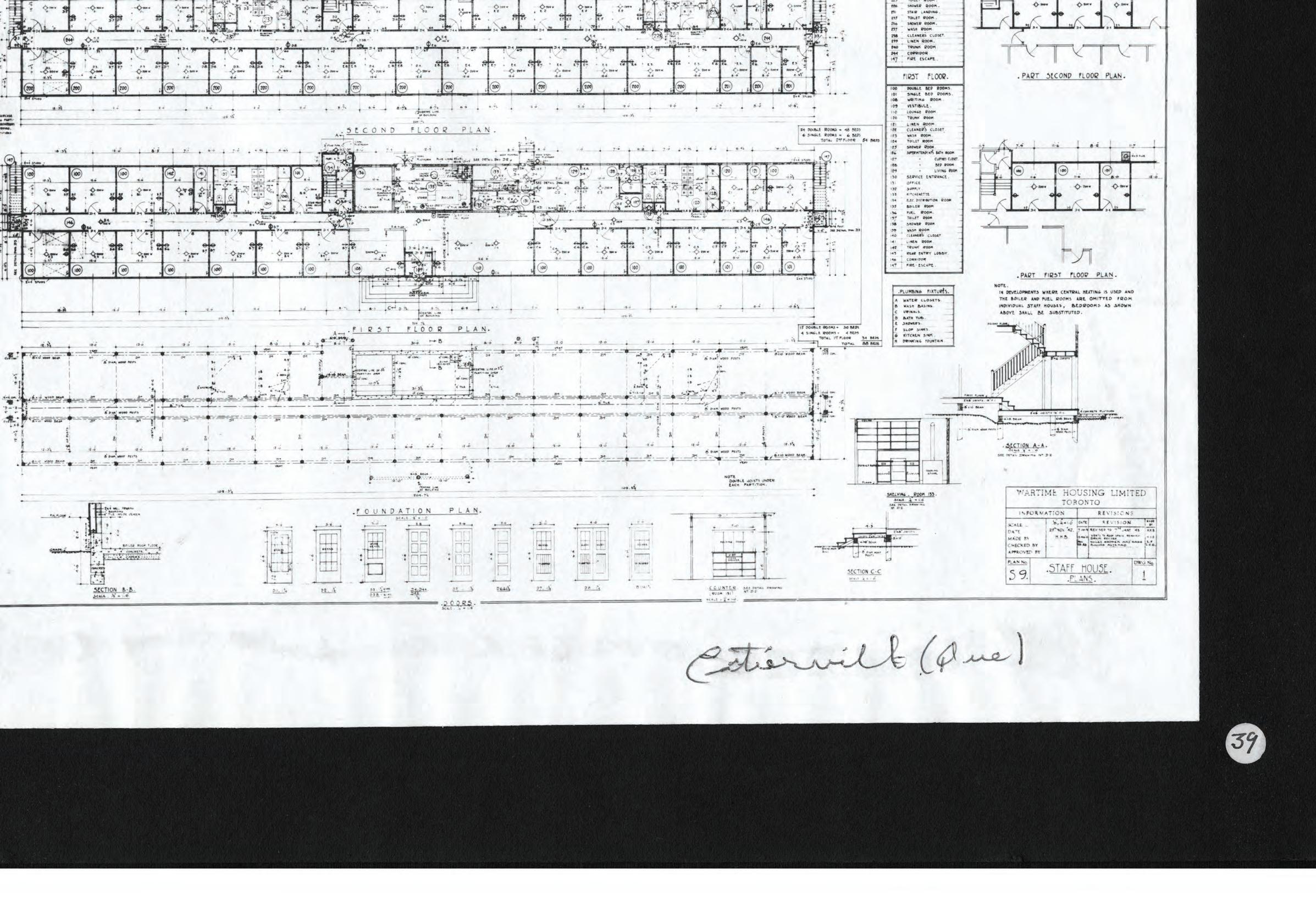

One of WHL’s first steps was to look for vacant property that could be turned into new neighbourhoods.


A worker shows the tongue-andgroove joint of a cedar plank used in construction of prefabricated wartime homes.
In Ottawa, for instance, a vacant lumberyard in the city’s west end once owned by timber tycoon John R. Booth was acquired and soon became the bustling neighbourhood of Carlington North.
“This neighbourhood dates more from the second wave of housing caused as the veterans themselves began coming home and looking for new jobs in the civilian world,” said Greg MacPherson of the city’s heritage department. Similar developments were built in the suburbs of numerous cities across the country.
WHL’s strategy was to create a catalogue of house designs for builders to select how they would create suitable neighbourhoods. Generally, the homes were bungalows and one-and-half-storey buildings. They had steeply pitched roofs, small sash windows and metal chimney stacks. Each had a living room, a kitchen and dining area, bedrooms, a bathroom and a woodshed. They were built quickly without basements since they were meant as temporary housing.
Originally, these units were intended for industrial workers who were moving into cities, and they were built near wartime plants. But the homes were also attractive to veterans returning with wounds and the large influx of war brides and their children. A second phase of construction started once soldiers began coming back to Canada, notably after the victory in Europe in 1945.
While WHL only existed between 1941 and 1947, it built almost 26,000 dwellings for workers, veterans and their families.
Bureaucrats insisted that the units weren’t low-income rentals. In the 1940s, poorer families were paying about $12 a month for housing. Pigott had no intention of subsidizing WHL tenants, who were paying between $22 and $30 a month for its homes.
Still, Finance Minister James L. Ilsley believed a peacetime government’s direct involvement in housing was socialistic and dangerous. As early as 1942, he had written to Pigott warning him that the WHL precedent was setting a “grave danger” for similar postwar programs.
Nonetheless, the initiative flourished. It had a head office in Toronto, 51 branch offices and superintending sites in 73 municipalities by 1945. It spent $50 million on new homes between 1941 and ’45.
At least one parliamentary inquiry was called to examine the efficiency and merits of the program. Pigott appeared and confidently claimed that WHL was “wellestablished” and “smoothly operating.” Parliamentarians ultimately agreed.
The conflict of philosophies, however, remained until it was eventually settled in 1947 with the creation of the Central
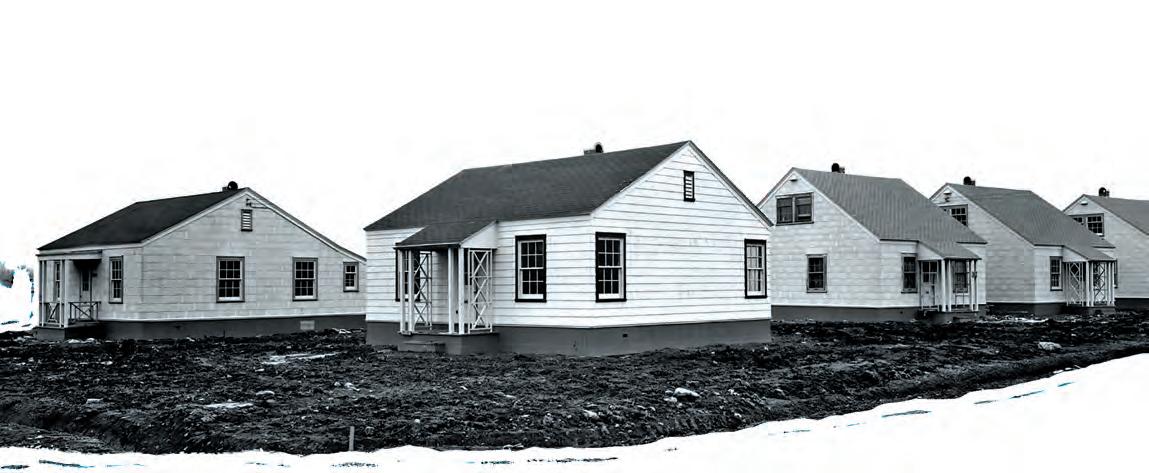
Originally, these units were intended for industrial workers who were moving into cities. BUT THE HOMES WERE ALSO ATTRACTIVE TO RETURNING VETERANS.
Mortgage and Housing Corporation (CMHC), today known as the Canada Mortgage and Housing Corporation. CMHC took over responsibility for all government housing programs. It moved quickly to sell much of the WHL inventory. By 1952, the new corporation had sold 29,452 units for $110.5 million.


The distinction gives recognition, but doesn’t impose restrictions on future change.
With Canada facing a new housing crisis—renters are facing increases double that of inflation, homelessness is rising and more than 60 per cent of homeowners with a mortgage are having trouble meeting their financial commitments—the government is now looking at the success of WHL as a possible blueprint for a 21st-century solution.
The legacy of WHL hasn’t died. Instead of disappearing with the crisis in the late 1940s, the neighbourhoods have passed into private hands and largely been maintained or improved. Residents mostly wanted to make their modest homes comfortable as they painted, built additions, planted gardens and developed local community programs.
Each has engendered a character of its own, a character its residents are proud of and don’t want to see disappear. L
Wartime Housing’s house type H.5 in Cartierville, Que., in December 1943 (above). Landscapers and construction workers complete a wartime home in Vancouver in May 1944.
But many of the WHL neighbourhoods survive today. A sizeable portion of the wartime homes built in Ottawa’s Carlington North neighbourhood still stand in more or less their original form. In 2022, the city recognized it as a “cultural heritage character area,” a distinction short of being a heritage district that would be protected under the Ontario Heritage Act.
“A study was done of the designs of the houses and looked at the streetscape itself,” said city heritage planner MacPherson.
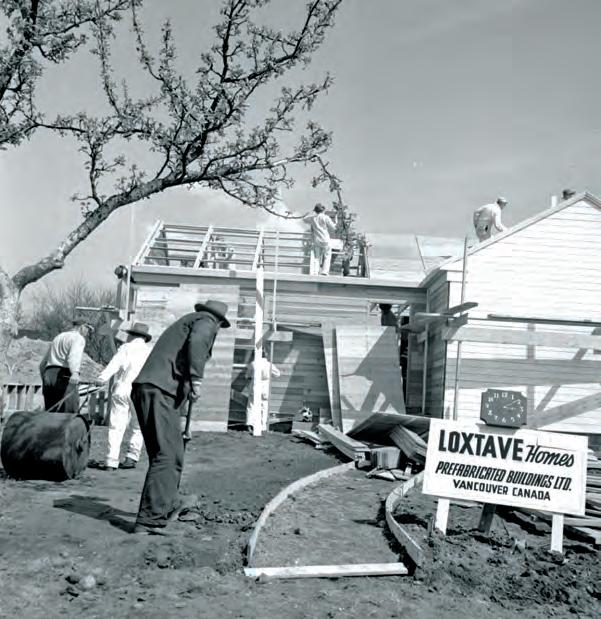
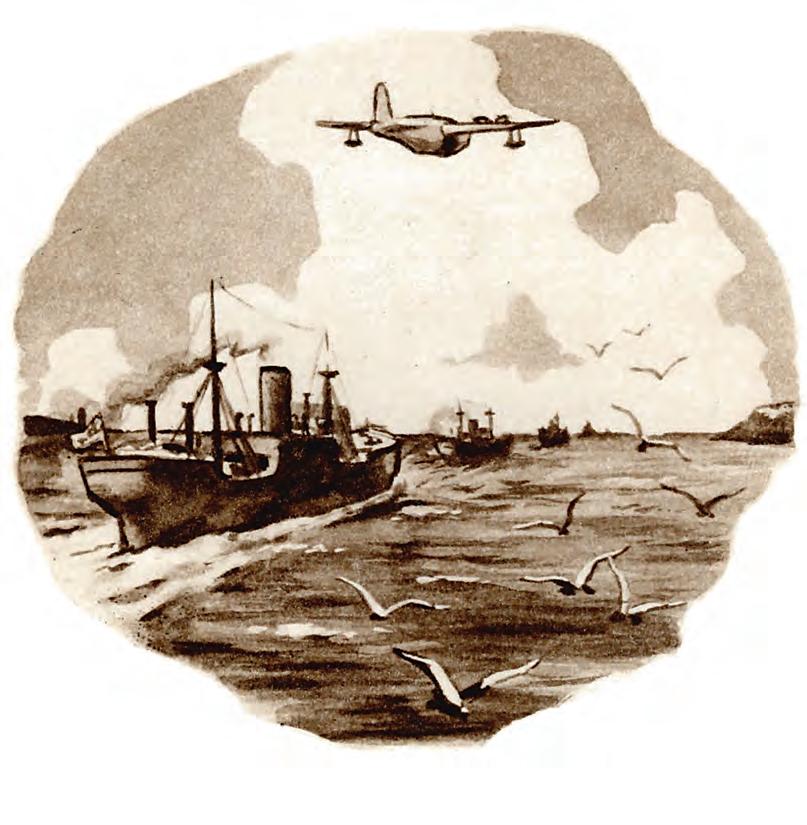
During the Second World War, Canadian editorial illustrator Bob Chambers created a series of memorial cards to honour those Allied ships and their crews that didn’t make it home
By Stephen J. Thorne

An illustration by Bob Chambers from Wartime in Halifax ( a collection of his Second World War works.
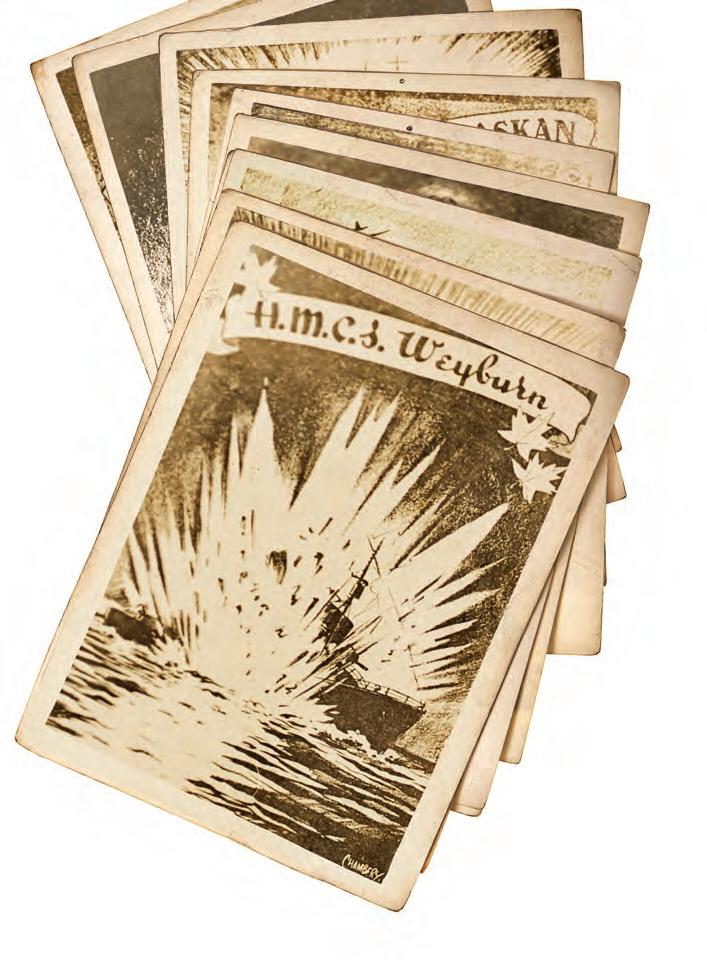
TThe Battle of the Atlantic simmered and raged throughout the Second World War as convoys of merchant vessels and warships made the slow, fitful trek across U-boat-infested waters delivering men and materiel to the Allied war effort.
A primary staging point for these assemblies, the deep, ice-free harbour of Halifax was massed with ships, the city’s streets choked with multinational merchantmen, soldiers, sailors and airmen for virtually the entire war.
For better or worse, the people of Halifax were deeply invested in the war effort as no other Canadian city. Each time Haligonians saw

a convoy off, they did so with the knowledge that some of these men they had fed and entertained, laughed and partied and danced with, wouldn’t return.
In the pages of The Halifax Herald and The Halifax Mail newspapers, celebrated illustrator and editorial cartoonist Robert (Bob) Chambers began memorializing the ships and people—military, merchant marine and civilian—lost to torpedoes, bombs and naval guns.
Some 72,000 Allied sailors, merchant mariners and aircrew lost their lives in the 2,074-day Battle of the Atlantic, including 4,600 Canadians. More than
3,500 Allied merchant ships and 175 warships were sunk.
At the height of the U-boat war 1942-43, the Allies were losing up to 100 supply ships each month.
“The only thing that ever really frightened me was the U-boat peril,” Britain’s wartime prime minister, Winston Churchill, wrote in his 1949 memoir. “How much would the U-boat warfare reduce our imports and shipping? Would it ever reach the point where our life would be destroyed?
“Here was the slow, cold drawing of lines on charts, which showed potential strangulation.”
But with mass production, technology and grit, the Allies prevailed: 767 of 1,154 U-boats were eventually sent to the ocean bottom, taking with them some 28,000 of just over 40,000 unterseeboot crew—at 70 per cent, the war’s highest mortality rate.
When it was over, Chambers’ illustrations marking the Allied losses at sea were turned into cards that were collected, put in albums, sometimes framed or propped on a shelf. Here are a few and the stories they represented.
Editor’s note:
Special thanks to Janice Bertelsen who shared Chambers’ cards her late father Allan Bertelsen had collected in his war scrapbook. Allan served in the Royal Canadian Navy during the Second World War aboard HMCS Provider and had great regard for the sacrifices of his fellow sailors. L

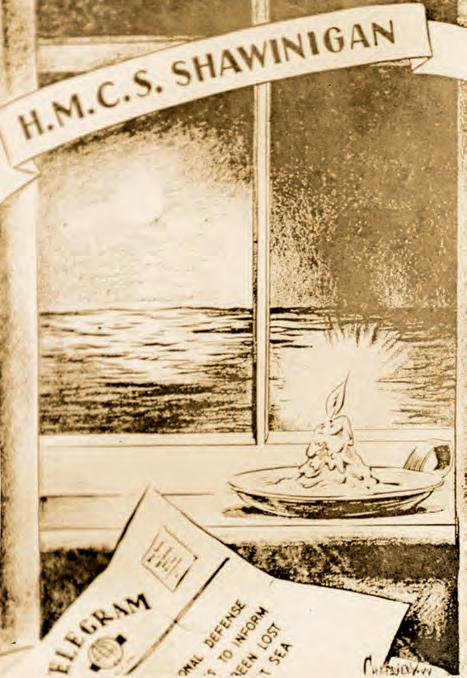
Sailing out of Sydney, N.S., HMCS Shawinigan, a corvette, was torpedoed by U-1228 while conducting an anti-submarine patrol in the Cabot Strait. All 91 crew were lost.
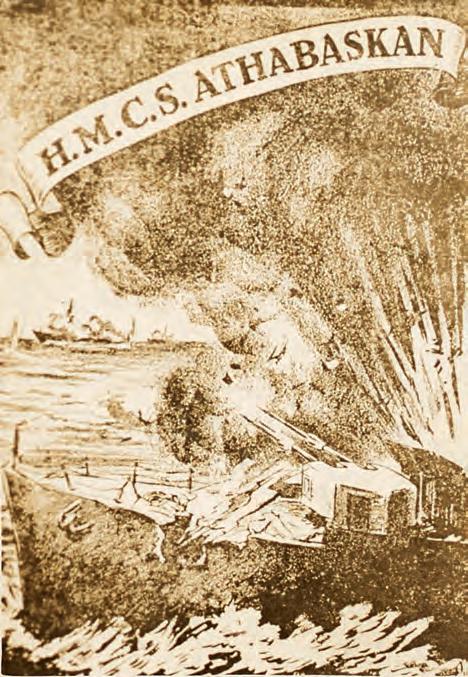
HMCS Ottawa, a River-class destroyer sailing convoy duty out of Halifax, was torpedoed and sunk in the North Atlantic by U-91; 114 crew died, 69 survived.
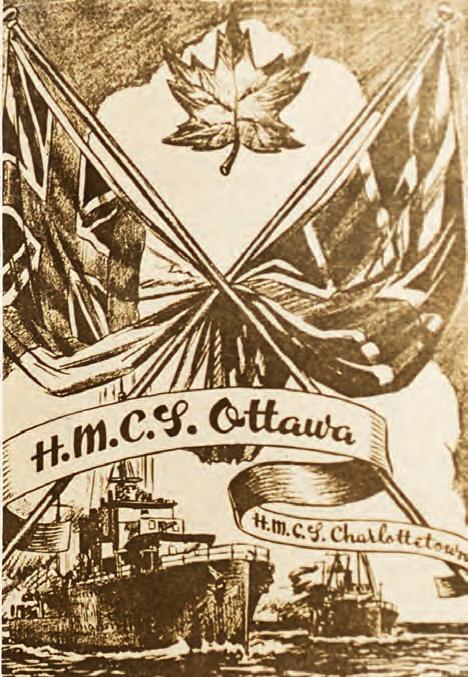

HMCS Athabaskan, a Tribal-class destroyer, was sunk on April 29, 1944, by German torpedo boat T24 at the mouth of the English Channel off the Brittany coast; 128 men, including Lieutenant-Commander John Stubbs, were lost; 127 were rescued, 83 of them taken prisoner by German minesweepers.

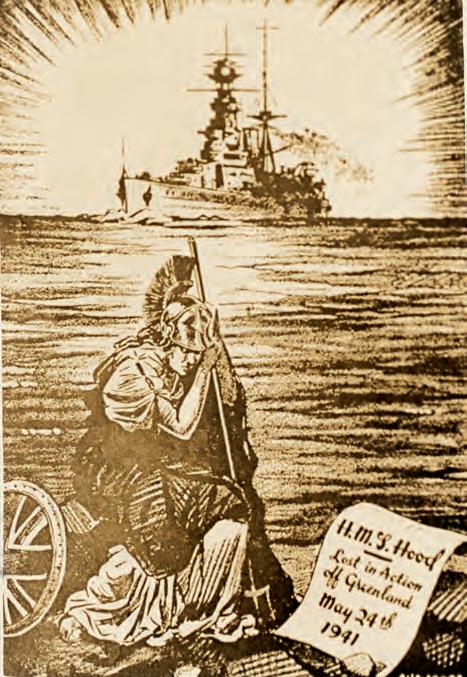
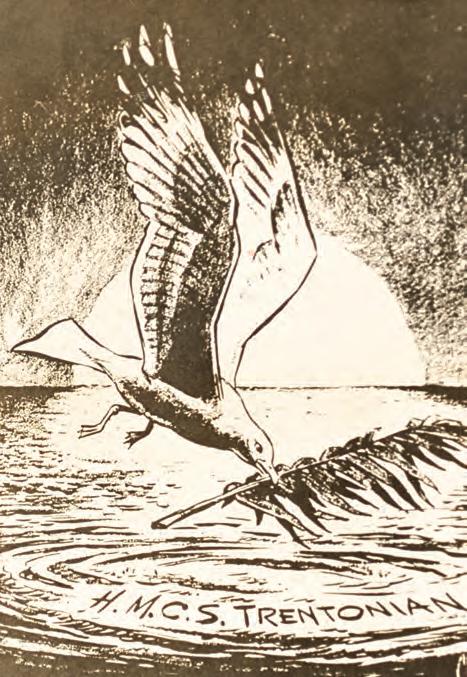
Chambers memorialized stricken British warships as well as Canadian. HMS Hood was sunk by shells from the doomed German battleship Bismarck during the May 24, 1941, Battle of the Denmark Strait. All but three of the ship’s 1,418 crew died.
HMCS Raccoon, an armed yacht, was escorting Convoy QS-33 across the Gulf of St. Lawrence on the night of Sept. 6-7, 1942, when it was attacked by U-165 Raccoon was in pursuit of the sub when it was hit by two torpedoes and sunk with all 37 hands.

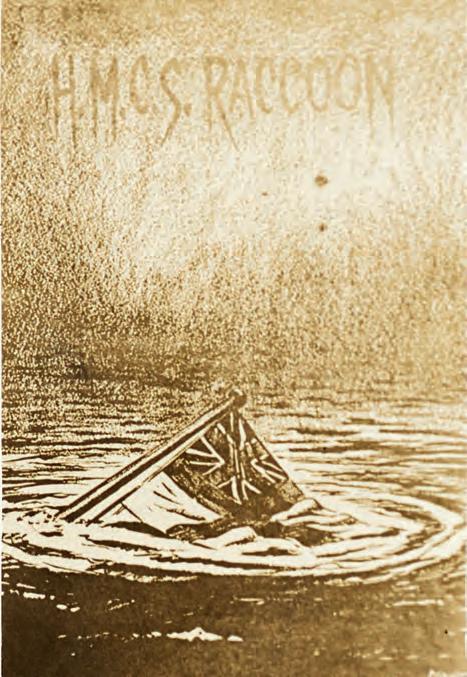
HMCS Trentonian, a corvette, was torpedoed and sunk by U-1004 while escorting a Channel convoy on Feb. 22, 1945; six crew were lost.

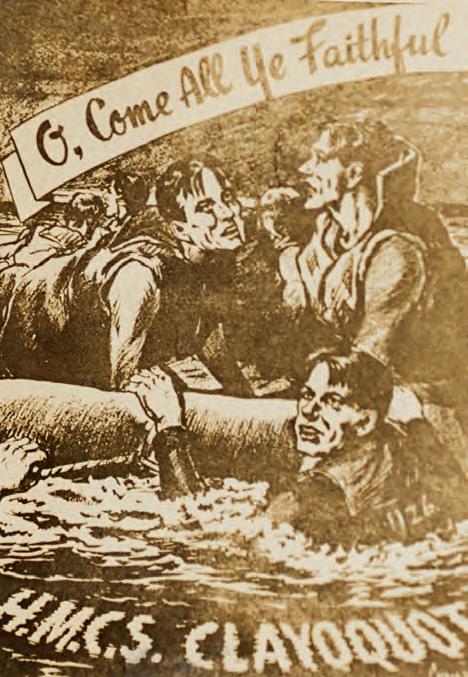
HMCS Clayoquot, a Bangor-class minesweeper, was taking station on Convoy XB-139 on Christmas Eve 1944 when it was torpedoed by U-806 five kilometres from Nova Scotia’s Sambro Island Lighthouse; eight crew were lost.
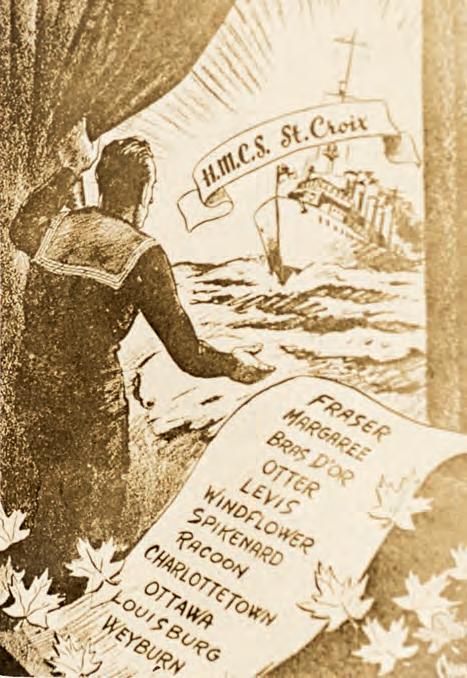
On the afternoon of Feb. 6, 1943, Convoy KMF-8 out of Gibraltar was attacked by Italian planes near Cape Tenes, Algeria. HMCS Louisburg, a corvette, was hit by bombs and torpedoes and sank within three minutes. Thirty-eight crew died.
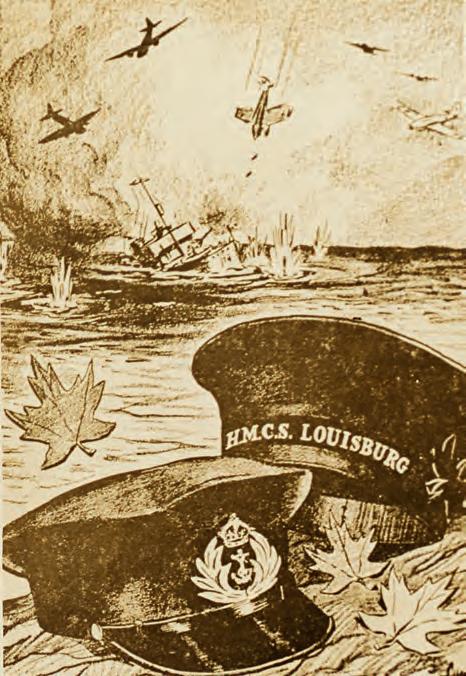
HMCS St. Croix, a Town-class destroyer, was sunk by U-305 on Sept. 20, 1943, while escorting a convoy south of Iceland. Eighty-one of 149 crew were rescued by HMS Itchen, but only one survived after Itchen was sunk by U-666 three days later.

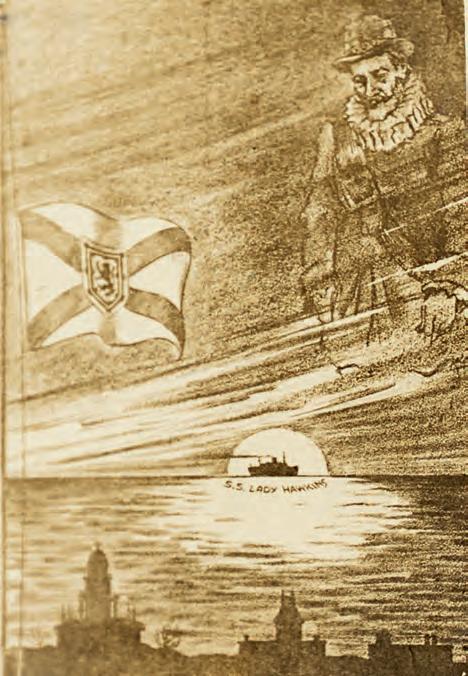
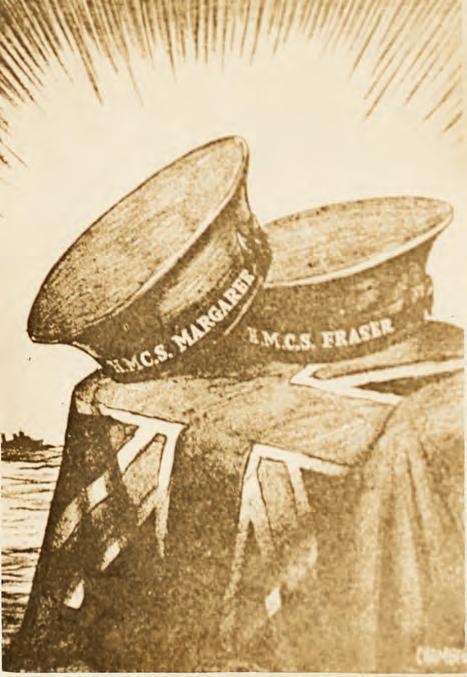
SS Lady Hawkins, a Canadian National Steamships liner out of Montreal, was sailing unescorted 240 kilometres off Cape Hatteras on Jan. 19, 1942, when it was torpedoed by U-66 Master Huntley Osborne Giffin and 250 others, including 163 passengers, died; 70 survivors were rescued after five days at sea.
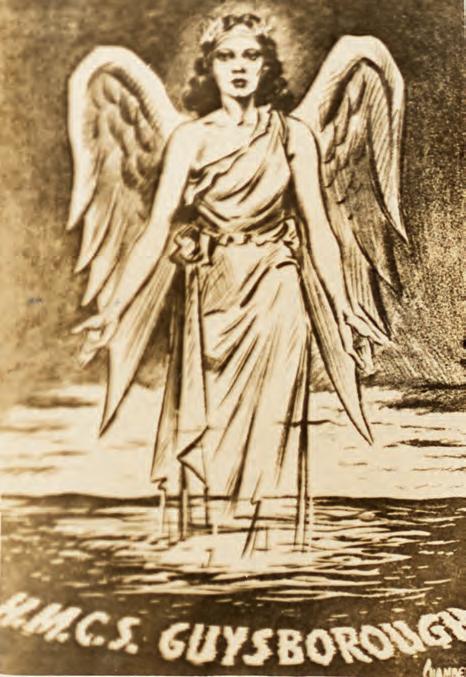
HMCS Guysborough, a Bangor-class minesweeper, was torpedoed by U-868 at 6:50 p.m. and again at 7:35 p.m. 340 kilometres north of Cape Finisterre in the Bay of Biscay on March 17, 1945. Two of 90 crew were killed outright; 51 more died of wounds or exposure on Carley floats before rescuers arrived 19 hours later.

HMCS Fraser, a River-class destroyer, broke in two and sank after colliding with the British cruiser Calcutta near Bordeaux, France, on the night of June 25-26, 1940. Forty-seven crew died; most of the survivors went down with HMCS Margaree four months later.

Sunken vessels have always lured the adventureminded since people first went to sea in ships. That grew exponentially after Europeans began travelling to the Americas in the 16th century and boatloads of treasures, in both coin and raw product, plied the Atlantic Ocean giving rise to the age of piracy. Pirates may be mostly gone now, but sunken ships still offer a trove of archeological finds and legacy bragging rights.
Such discoveries contain not just sought-after bounties, but are often the final resting place of sailors and soldiers who served their countries and deserve the respect and protection offered to war graves.
A shipwreck, whether sunk due to weather, military action, sabotage or poor navigation, faces enough threats. These lost vessels are at the mercy of ocean currents, tides, ice, pollution, marine life and the actions of other ships. How well preserved a wreck is often depends on its depth, the water temperature and the salt content of the sea.
Steel ships, such as most of those used in the First and Second world wars, disintegrate quickly in salt water, especially if sea worms can reach them. Meanwhile, deep freshwater in the Great Lakes has acted to preserve wooden ships of older wars, but they, too,
are threatened by masses of zebra mussels, whose combined weight can break a ship up.
Such relics have had a certain amount of protection over the centuries because of the depth and temperature of the water they rest in. But the late 17th-early 18th century Age of Reason ushered in an era of scientific exploration of every surface people could reach.
A SHIP THAT SINKS WITH PEOPLE ABOARD IS CONSIDERED A GRAVE. THIS TAKES ON MORE MEANING WHEN THOSE WHO DIED WERE ENGAGED IN MATTERS OF MILITARY IMPORTANCE.
Technology soon allowed scientists and archeologists the chance to access the wrecks. Many were ruthlessly salvaged to adorn museums and personal collections. Generally, such efforts were conducted under various salvage laws based on the principle that
any individual who helps recover a ship and/or its cargo is entitled to a reward equivalent to the value of the resources retrieved.
Another principle developed by sailors since the age of sail is that a ship that sinks with people aboard, whether crew or passengers, is to be considered a grave and should be left in peace.
This concept takes on even more meaning when those who died were serving as sailors, soldiers or civilians engaged in matters of military importance. Such vessels aren’t just warships. Many are civilian, too, such as the merchant marine that was so vital to Britain’s survival in both world wars. They are also civilian passenger liners, seconded into service to ferrying military across the oceans.
They are all war dead and deserve the utmost respect, like that inherent in the beautifully tended cemeteries of the Commonwealth War Graves Commission around the world.
At Canada’s most famous war grave, the Tomb of the Unknown Soldier in Ottawa, there’s a sign posted during tourist season that says: “Silence and Respect.” The fact that these ships and their passengers lie deep in water assures the silence, but it takes society to ensure the respect. L
> To voice your opinion on this question, go to www.legionmagazine.com/FaceToFace

One of the great privileges, and burdens, of being human is the ability to love, feel empathy and create bonds so potent that they become a magnet guiding a person’s moral compass. Paradoxically, those feelings can also lead to some of the most punishing pain a person can endure. The loss can leave a hole bigger than its presence. To help fill such voids and come to terms with death, cultures throughout history have had ceremonies and burials.
The act of burying one’s dead in a known and sacred spot so that loved ones can commune and pay tribute near the remains of the deceased can be traced as far back as to the Neanderthals who, over 100,000 years ago, left evidence of thoughtful burials, which was seemingly more than just a sanitary practice. It’s obvious why similar rituals are seen consistently among different groups.
Having an official grave closes the gap between those traversing the mortal plane and those who aren’t. People whose bodies aren’t found, whether they’ve been lost at sea or are missing in action, leave a physical void behind. A burial is a conscious act of laying to rest a body in a specific area, and when a ship goes down and people are at the mercy of the ocean there
TOM MacGREGOR
worked as a writer and editor at Legion Magazine for more than 30 years. Prior to that, he worked for The Huntsville Forester, Edmonton Sun and Maclean’s. He continues to write about veterans and military history.
Michael A. Smith says
NO
MICHAEL A. SMITH
is the assistant editor of Legion Magazine. A Newfoundlander, he previously worked as a reporter for CBC Radio’s “The Broadcast” and for the Ottawa Citizen. Smith is also an award-winning poet.
is no burial and no grave to be marked. No ceremony to be had at the site. So no, Canada doesn’t need to mark any sunken ships as war graves. In some ways an ocean war grave is an oxymoron.
THEIR FINAL RESTING PLACE BELONGS TO THE OCEAN, WHICH WILL MOVE IT AS IT SEES FIT. IT ISN’T STATIC.
Their final resting place belongs to the ocean, which will move it as it sees fit. It isn’t static. Instead, Canada should update the memorials that commemorate those who die at sea and include their names and the co-ordinates of where the ship went down and where it is now. Families aren’t going to go out on the water to pay respects. Designating vessels sunk in war as war graves is simply symbolic, and the symbolism doesn’t have the desired effect. The government can still protect the sunken ships and their contents by making it illegal to dive or take anything without authorization.
It would be a shame to gloss over what shipwreck victims actually sacrifice so those left behind can have a proper funeral and burial with the body of loved ones.
Note, too, we aren’t talking about recovering these people’s bodies. Many of them may no longer even be there as we imagine, since sea creatures have no doubt had their way. It’s another grim reality of war. The people who have served the armed forces and went under without reemerging to the smell of saltwater air knew that this was possible. These people are some of the best and bravest. They deserve every honour they earned and every painful sacrifice they and their families made should be humbly remembered. But making their final resting place an official war grave won’t do that. L
AS THE FACES OF VETERANS CHANGE, CANADIANS GATHERED IN OTTAWA FOR THE ANNUAL CEREMONY TO CONTINUE THEIR COMMITMENTS TO HONOURING MILITARY SACRIFICE

A veteran pauses for a moment of reflection during the national Remembrance Day ceremony.



Ellen Marie and Cesar Vanneste (right) attend the national Remembrance Day ceremony. Heather Dorward, with a photo of her late veteran father Thomas (below left), and Legionnaires Elizabeth King and Catherine Elliot Shaw, did likewise.

Cesar Vanneste was six years old when he witnessed the liberation of his Belgian village, the date—Sept. 6, 1944—having long since been etched in his mind.
“My father told me [and three brothers] to stay away from the windows,” he said. “Of course, boys being boys, we looked anyway, but we didn’t see anything.”
Now in his late 80s, the Kanata, Ont., resident recalled the moment when he at last glimpsed the Canadian and Polish soldiers who secured his community, albeit at the cost of further bloodshed in the streets after an enemy sniper opened fire.
It was a sacrifice that Vanneste, clad in a blue coat and red scarf to protect against the crisp November breeze, could never forget. Being present for Ottawa’s Remembrance Day 2024 commemorations—his 54th year of attendance, according to his similarly attired wife Ellen Marie—was one way of paying tribute to them.
around her neck, that reason was more on the surface than others.



Such was the overarching sentiment throughout the crowd of an estimated 35,000 spectators, even if each had their own private reasons for having gathered at the National War Memorial—some several hours before the formal event.
For Ottawa local Heather Dorward, a framed picture of her late veteran father hanging

“He passed away in February,” she explained of Thomas Dorward, a former NATO medical assistant once stationed in Germany, acknowledging that his later role in the reserves meant “I didn’t lose him too much” as a child. “But a lot of families lost time with their [serving] loved ones, and then some lost them altogether.”
Elsewhere, Elizabeth King and Catherine Elliot Shaw of London, Ont.—both members of The Royal Canadian Legion’s Vimy Branch— wished to honour all fallen.
“I’ve watched it on television many times,” noted Shaw, “but this is the first time in person. That makes it very special. It is a very special day across Canada.”
That it was, as spontaneous chatter between strangers,

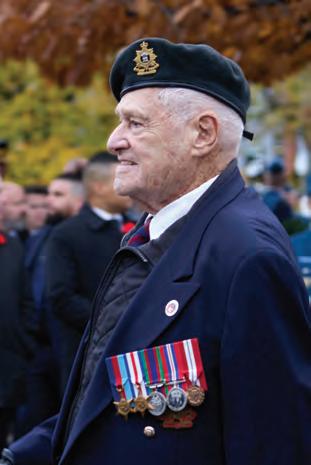





before “Last Post” was played. A spirited rendition of “O Canada,” performed by the Ottawa Children’s Choir, preceded the bugler’s haunting notes that then seemed to echo off buildings down Elgin Street.
Quiet contemplation continued during the 21-gun salute carried out by 30th Field Regiment, Royal Canadian Artillery, save for the cries of a single startled child. No one appeared disturbed by the tears, however, for many had tears of their own.
Corporal Jeffrey Steel of the Canadian Special Operations Forces Command; Master Bombardier Mikael Nicol-Charette; RCMP Sergeant Cara Streeter; Master Corporal Linda Kamenawatamin of the Canadian Rangers; and Captain Kathleen Nguyen of 1 Canadian Field Hospital.
The formal ceremony commenced just after 10:30. Prime Minister Justin Trudeau greeted RCL Dominion President Berkley Lawrence, thanking him for his service, before shaking hands with the organization’s national executive director Steven Clark.
This year’s National Memorial (Silver) Cross Mother Maureen Anderson arrived shortly thereafter wearing two crosses for
her sons, Sergeants Ron and Ryan Anderson. Both veterans of the war in Afghanistan, the brothers lived with post-traumatic stress disorder afterward, a factor that directly related to their untimely deaths. At a luncheon the previous day, Anderson had struggled to speak about her tragic losses. Lawrence met her at the Remembrance Day ceremony with a warm embrace.
Next to arrive was Gov. Gen. Mary Simon, who, as commander-in-chief of the Canadian Armed Forces, wore her RCAF uniform to mark the branch’s centenary, one of the event’s two main themes. The 80th anniversary of D-Day was the other.
As the clock neared the 11th hour, almost all the crowd stood in silence, most having done so long
Only the piper’s “Lament” could stir attendees from their musings, along with the rumble of four CF-18 Hornet aircraft during a flypast. Corporal Malcolm Horava’s playing of “The Rouse” signified the end of the silence, although the spirit captured in two minutes lingered like the artillery smoke drifting from Parliament Hill. Three versions of the Act of Remembrance were recited in short order, the first in English by Lawrence, the second in French by RCL Grand President Larry Murray and a third by Métis veteran Robert Baskey in northern Ontario Michif. Regardless of language, the sentiment moved spectators with each reading.
Then it was time for Chaplain General Guy Bélisle to offer the longheld tradition of prayers, remarking that “in the spirit of peace and gratitude, this moment prompts us to reflect on the sacrifices of our heroes and their families.
“Their action reminds us of the strength of unity; it is in that unity that we find hope and resilience in the face of the challenges our world continues to put before us.”
That unity likewise appeared to be on full display for the placing of the wreaths, carried out while the Ottawa Children’s Choir performed “In Flanders Fields.” Simon and her husband Whit Fraser initiated the tribute, followed by Anderson, Trudeau, Assistant Deputy Speaker of the House of Commons Carol Hughes, Veteran Affairs Minister Ginette Petitpas Taylor, Defence Chief General Jennie Carignan, the Legion National Foundation’s senior poster and literary contest winners, and the RCL’s Lawrence.

“In a world often divided,” he said, “the unwavering bond among our troops serves as a beacon of strength for us all. The Canadian Armed Forces reflecting our nation’s rich diversity remind us of the remarkable achievements possible when we stand together for a cause greater than ourselves.”


The rain held off for as long as it could, but droplets soon fell on the undeterred delegation left to pay their respects, including members of the diplomatic corps and various veterans’ groups. Rabbi Idan Scher, the multi-faith representative, seemed not to mind the cold and wet as he stood at the podium to give the benediction.

The choir’s singing of “God Save the King” concluded the ceremony, whereby much of the viceregal party remained to shake hands before departing the memorial. Simon then invited Anderson to join her on the reviewing stand as they observed the parade, flanked by Trudeau and Lawrence.
“Thank you, thank you, and God bless,” shouted Ellen Marie Vanneste as the veterans and active service members marched off. Expressing a heartfelt desire to stand in the exact same place at the exact same time in 2025,

for a 55th year, there was no doubt of her and husband Cesar’s shared commitment to the sacrifices of Canada’s military. They were not alone. L
On Nov. 8, 2024, a separate ceremony took place at Ottawa’s National Aboriginal Veterans Monument for Indigenous Veterans Day, recognizing the sacrifices of First Nations, Inuit and Métis military personnel across Canada. Featuring many of the traditional elements associated with Remembrance Day, the event also included the presence of the Canadian Forces Eagle Staff and the sharing of Indigenous songs.
“It was very, very important for me to be there,” said Colonel David Grebstad, deputy commander of the Canadian Armed Forces Transition Group and citizen of the Red River Métis. “And I also think it’s important to spread the word.”
More than 4,000 Indigenous soldiers served in the First World War and at least 3,000 during the Second World War, an overwhelming number of whom returned home only to endure the racism and discrimination they had left behind.
“Many were denied the benefits granted to their non-Indigenous colleagues,” explained Grebstad, who likewise operates within the Defence Indigenous Advisory Group, an organization established to represent Indigenous public service employees working for National Defence and the Canadian Armed Forces.
Today, as ever, service members from First Nations, Inuit and Métis communities contribute significantly to Canada’s military institutions, whether through NATO operations in Europe, UN peacekeeping missions or the country’s own defence.
Canadian Army commander LieutenantGeneral Michael Wright was among the guests to deliver remarks at the commemorations. Days earlier, he released a statement noting that: “We cannot change the past but we can, and must, continue to value Indigenous cultures in our work every day of the year.”


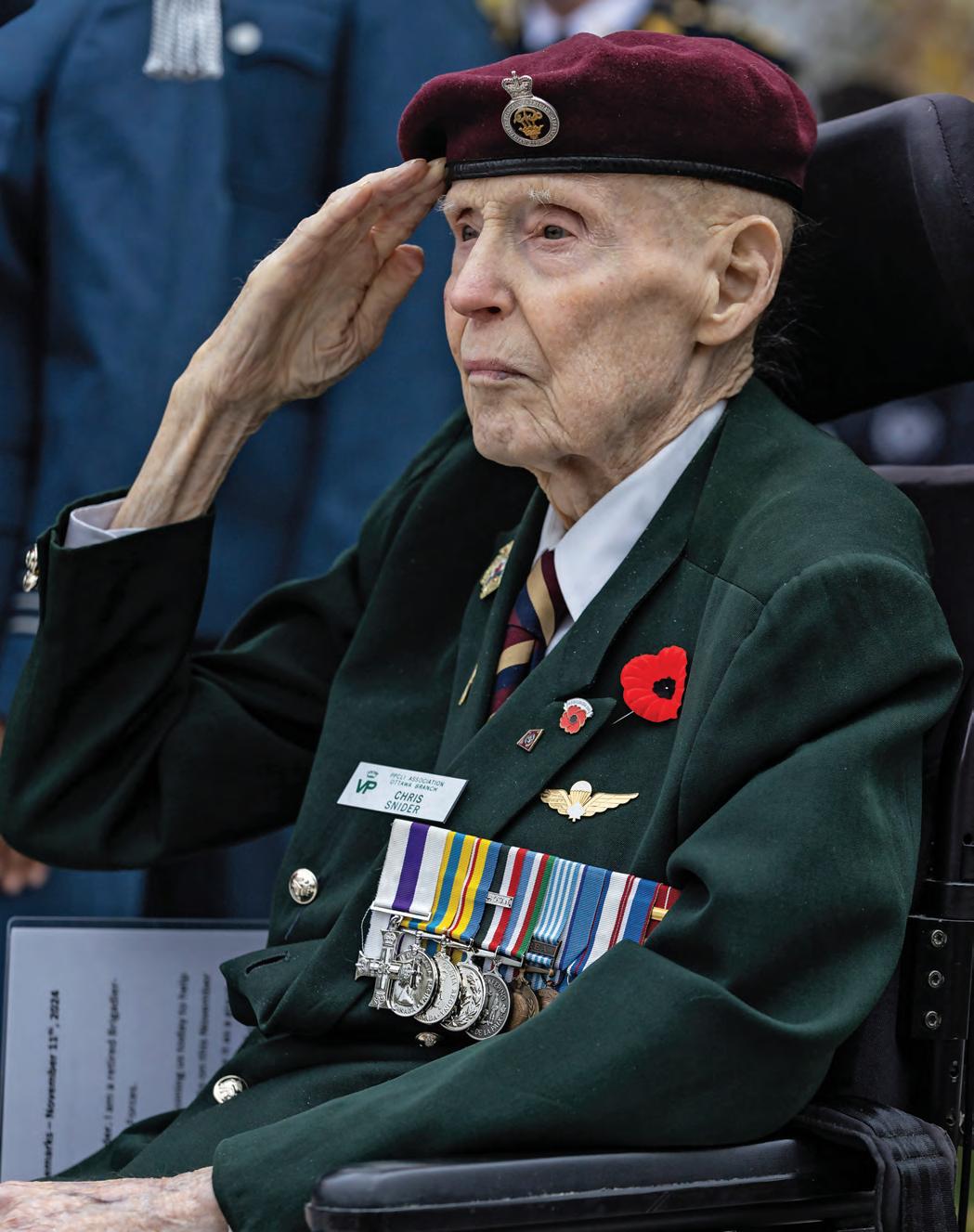
As a young second lieutenant commanding 8 Platoon, 'C' Company, 3rd Battalion, Princess Patricia's Canadian LIght Infantry, in Korea, Chris Snider of Oakville, Ont., earned a Miltary Cross for leading his 10-man patrol through two mortar attacks in enemy-infested territory.


Vintage trainers from the Canadian Harvard Aircraft Association in Tillsonburg, Ont., conducted multiple flypasts at the Sunnybrook Remembrance Day ceremony. The procession from Sunnybrook Veterans Centre was led by the pipers of 400 Tactical Helicopter Squadron, RCAF. Families, friends and Sunnybrook staff lined the walkway to the campus cenotaph, applauding veterans as they made their way to the outdoor ceremony.
Chris Snider was a 21-year-old second lieutenant commanding 8 Platoon, ‘C’ Company, 3rd Battalion, Princess Patricia’s Canadian Light Infantry, when his 10-man patrol came under fire from Chinese mortars ensconced in the hills facing them.
“WITH GREAT COOLNESS THIS OFFICER CONTINUED TO OBSERVE THE ENEMY’S MOVEMENT AND DIRECTED VERY ACCURATE ARTILLERY FIRE.”
behind them. The artillery batteries were farther back still.
“With great coolness this officer continued to observe the enemy’s movement and directed very accurate artillery fire onto the main body of twenty to thirty enemy soldiers,” said the citation for the Military Cross that Snider later recieved.
The Chinese continued their advance until the coalition artillery’s 25-pound rounds, fired from more than two kilometres back, were falling within 22 metres of Snider’s position, at which point the enemy turned back.
“A bit close,” acknowledged Snider, “but we were used to that.”
All the while, the Chinese mortar fire poured in, increasing in volume.

It was the night of April 25, 1953, and Snider had detected opposing troops approaching them in the no man’s land that formed the border between the Koreas.
The war was nearly three years old and Snider, a U.S.-born, Oakville, Ont.-raised Canadian army volunteer, had become accustomed to the whiz of rifle and machine-gun rounds zooming past and the randomness of the shells dropping in from above.
The patrol was hunkered down between the berms of a rice paddy. The rest of the battalion was well

“Without regard for his personal safety, Lieutenant Snider moved throughout his patrol area checking on the safety of his men and reassuring them,” read the citation. “When the mortar fire slackened he took one man and searched the area for enemy dead or wounded.”
All they found were bloodied bandages, Snider, now 92, said in an interview with Legion Magazine following Remembrance Day ceremonies at Toronto’s Sunnybrook Veterans Centre.



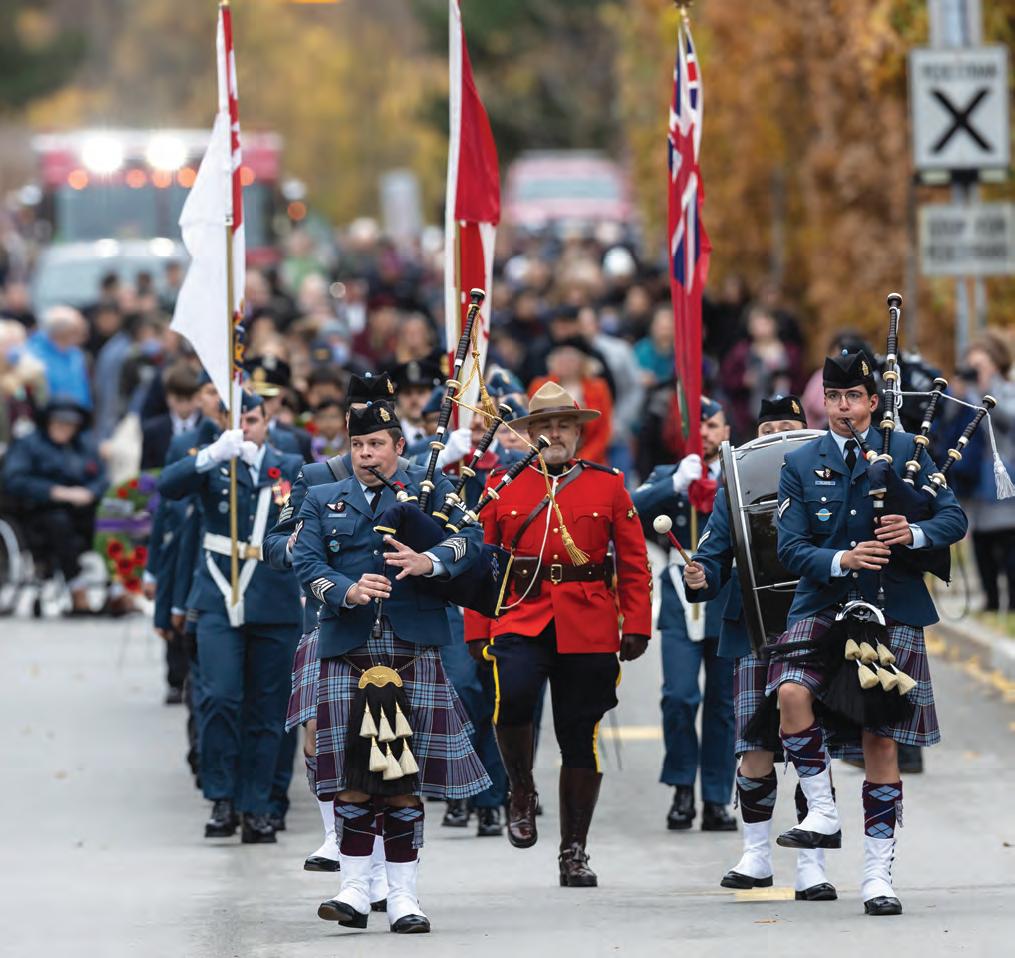
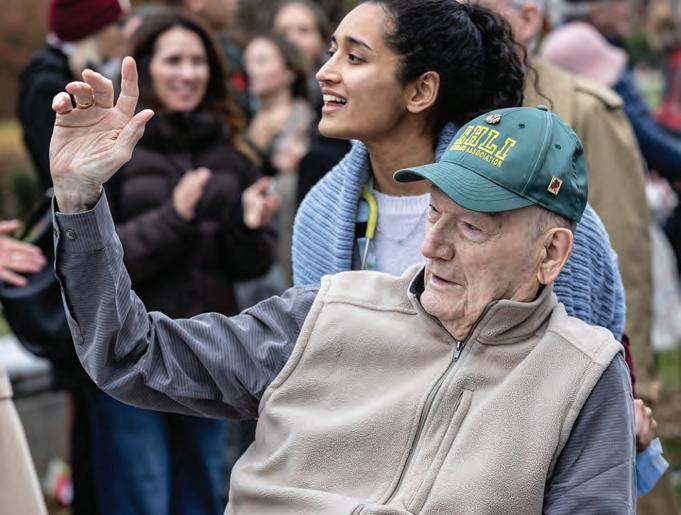


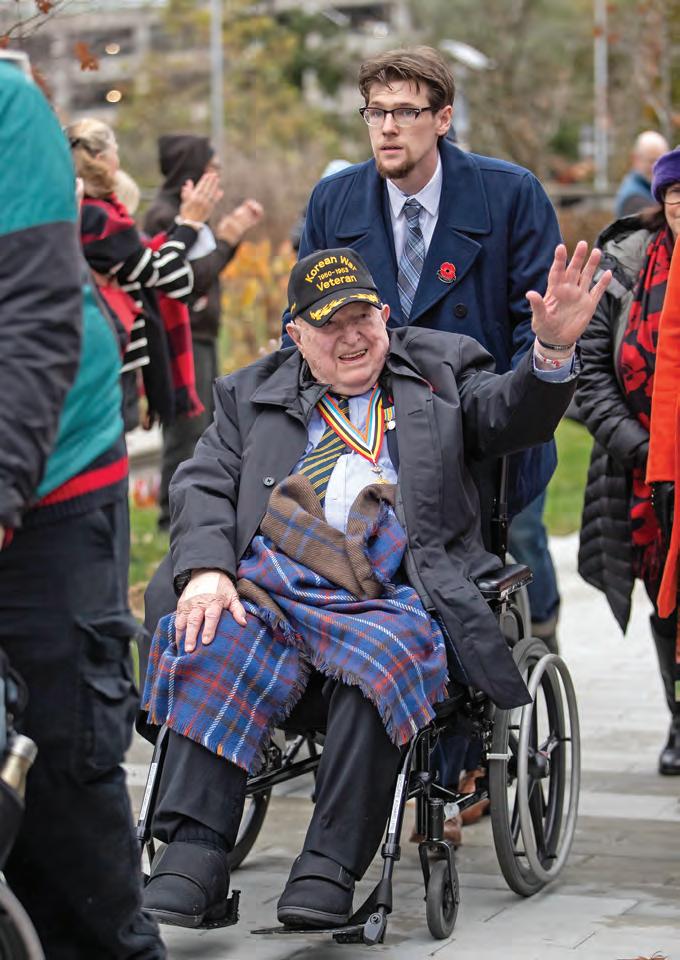
“It is our responsibility to never forget the service of Canadian soldiers, sailors, aircrew and merchant seamen both past and present.”
Sunnybrook opened in 1946 as a military hospital for Canadian service personnel returning from the Second World War. The veterans’ centre, part of the sprawling 400-hectare Sunnybrook Health Sciences Centre, is home to just less than 200 residents, more than 50 of whom are WW II veterans aged 100 or older.
and volunteers Alexandre and Jeannine Raab) for a parade to the cenotaph, where they pass among a gauntlet of applause from staff and others lining the walkway into Sunnybrook Hospital Park.
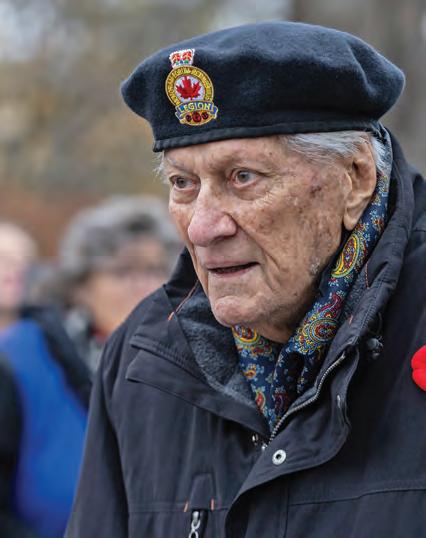
More than 1,000 family, residents and staff of Sunnybrook Veterans Centre in Toronto turned out for chilly Remembrance Day ceremonies.

of them. They would have been Chinese at that stage; some of them could have been North Koreans. It’s hard to tell.”

Each Remembrance Day, residents, their families and staff attend a private indoor ceremony, then gather outside on Raab Boulevard (named for donors
The 2024 ceremony included a rendition of Bob Dylan’s “Blowin’ In The Wind” by students of John Wanless Junior Public School and wreath-placing by members of 400 Tactical Helicopter Squadron, Royal Canadian Air Force, and students of Upper Canada College.
Back on the Korean peninsula, there would be more exploits before Snider would receive the Military Cross.
With mortars falling around and among them, and at risk of being overrun by a superior enemy force—“not without a fight,” he assured—he called in another artillery strike.
“He repeatedly exposed himself in an attempt to draw enemy small arms fire and personally searched the suspected area of the enemy,” read his citation, which included both actions. “The enemy were observed moving back to their

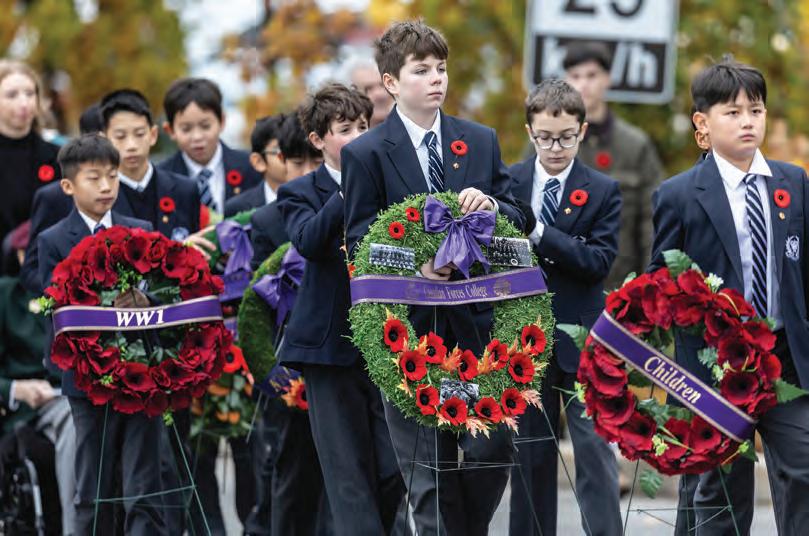
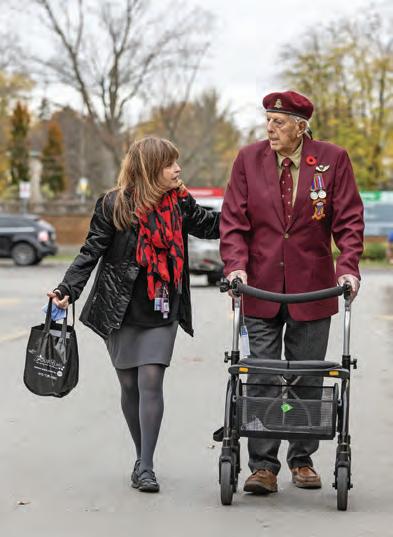
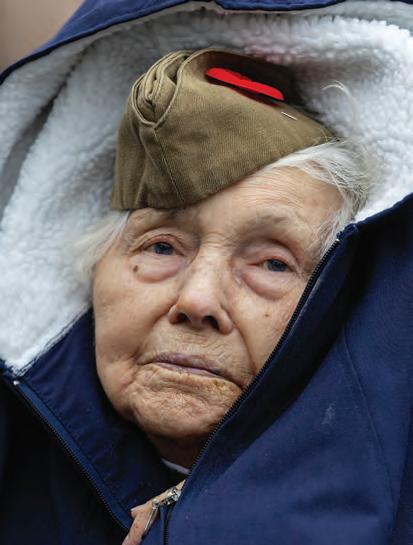

SOLDIERS, SAILORS, AIRCREW AND MERCHANT SEAMEN BOTH PAST AND PRESENT.”
own lines and he directed artillery and mortar fire on them.
“This officer’s prompt, efficient and aggressive handling of all situations was responsible for the lack of casualties and the continuation of the domination of No Man’s Land. Lieutenant Snider at all times operated according to the highest standards of the infantry and was an inspiration to his men.”
After Korea, Snider weighed his options. They came down to
returning to work as a gas jockey at a Shell service station back home or continuing to climb the officer ranks in the Canadian army. It was no contest.
A Patricia all the way, he went on to serve in Cyprus, West Germany, England, Pakistan, and as the last military attaché to the Canadian ambassador in Afghanistan before the Soviets invaded in 1979.
He served 36 years, retiring in 1987 a brigadier-general. L

Students from Upper Canada College placed wreaths during the chilly ceremony at the cenotaph on the grounds of the Sunnybrook Health Sciences Centre in Toronto. Ed Marshall, a member of WW II's 1st Canadian Parachute Battalion, raised $105,000 for Toronto Sick Kids Hospital by jumping out of an airplane at age 100 on July 12, 2024. He is accompanied on Remembrance Day at Sunnybrook Veterans Centre by his recreational therapist Jacqueline Chelsky. Sunnybrook resident Valentina Belianskaia, 102, served with Soviet forces during WW II. She died Nov. 15.
68 EXERCISE, AI AND WOMEN’S WELLBEING HIGHLIGHT LATEST MILITARY AND VETERAN HEALTH FORUM
By Alex Bowers
70 BUDGET OFFICER CLAIMS CABINET INFLATED MILITARY SPENDING FIGURES
By Legion Magazine staff
71 VETERANS RETURN TO CYPRUS TO COMMEMORATE CANADIAN PEACEKEEPERS
By Legion Magazine staff
72 LEGION’S NATIONAL EXECUTIVE DIRECTOR RETIRES
By Tom MacGregor
73 ROYAL CANADIAN LEGION’S NEW EXECUTIVE DIRECTOR LOOKS FORWARD TO THE ORGANIZATION’S CENTENNIAL
By Tom MacGregor
74 VETERANS MAY HAVE OVERPAID FOR LONG-TERM CARE
By Aaron Kylie
75 SERVING YOU
By Alex Bowers
re we building our soldiers up or are we just breaking them down?” asked Eric Robitaille, one of the opening keynote speakers for 2024’s Canadian Institute for Military and Veteran Health Research (CIMVHR) conference in Winnipeg.
A Defence Department physiotherapist who also serves as an assistant professor at the University of Toronto, his question was evidently rhetorical. Nevertheless, in revealing data about damage to the bones, joints and muscles of military personnel caused by sudden or repetitive stresses—known as musculoskeletal injuries or MSKI—it soon became clear that his words were chosen as a call to action.
“ SOLDIERS ARE LARGELY TRAINED TO GO, EVEN WHEN THEIR BODIES SUGGEST THEY SHOULD STOP.”
Sip in style with the 16 oz. classic bistro mug—perfect for your favourite beverage. Only 22.99 each + tax and shipping
mug and pretty busy mug

“Soldiers are largely trained to go, even when their bodies suggest they should stop,” continued Robitaille, joined on stage by fellow researcher Hans Christian Tingelstad for CIMVHR’s 14th annual event held Oct. 20-23, 2024.

Together, they produced startling evidence suggesting that MSKI comprised 45 per cent of urgent care medical appointments for in-garrison personnel and up to 43 per cent of the same appointments for those deployed. MSKI were also reported to be the leading cause of medical releases at some 53 per cent.
Acknowledging the impact of training for such incidents, combined with factors like overall physical capacity and health history, the physiotherapists proposed that a modified exercise program called “generating resilience to injuries through training,” or GRIT for short, could make a marked difference. Among its recommendations, explained Robitaille, was “individually, externally loaded strength training sessions, limited distance running and less frequent load marches that progressed gradually in load or distance.” Equally, the
duo advocated for ability groups whereby personnel could advance through aspects of training in an individualized manner while limiting their risks of such injuries.
The results? Over a four-year period (2019-2023), participants reported “65 per cent fewer overuse MSKI, 611 fewer limited duty days, and 22 fewer attritions” using GRIT compared to the usual—and typically nonstandardized—military routine.
“Integrated MSKI prevention strategies not only minimized MSKI risk and their burdens,” concluded Robitaille, “but holistically contributed to each soldier’s health, offering them a clear path to meeting their mandate and the [force’s] operational readiness.”
Exploring the merits of GRIT was just the start of a far larger exchange of ideas at the RBC Convention Centre, a short walk from Memorial Boulevard where the Winnipeg Cenotaph stands near the Manitoba Legislative Building. In a city brimming with rich military heritage, the assembled scientists, academic researchers, entrepreneurs, military personnel—former and serving—and others understood that their very presence, not to mention their networking efforts and presentations, could lead to better health and well-being for veterans.
More than 500 delegates from around the world were in attendance, though speakers and guests from the intelligencesharing countries known as the Five Eyes—Canada, Australia, New Zealand, the U.K. and the U.S.—were especially well represented, a sizable proportion of whom provided insights considered internationally transferable. Day 2’s keynote address was but one example. U.S. Department of Defense Senior
Research Scientist Jaques Reifman presented his examination of artificial intelligence (AI) applications for enhancing military medical readiness.
“Obviously, if we can make predictions, we can then perhaps prevent injuries and illnesses,” said Reifman. He noted that goal is now achievable as he detailed the evolution of AI in military medicine and how his team’s AI-enabled software—the only program cleared by the U.S. Food and Drug Administration for triage of trauma casualties at hemorrhage risk—works.
“Approximately 90 per cent of our service members who die on the battlefield, die of uncontrolled bleeding before ever reaching a medical treatment facility,” said Reifman. The AI analytical tool can assess vital signs to predict hemorrhage probability, affording combat medics the chance to “optimize care” for high-risk cases and thus “save lives.”
The third and final plenary on Oct. 23, meanwhile, seemed like a fitting end to the event.
“Invisible,” noted Veterans Affairs Canada’s Chief Medical Officer Dr. Cyd Courchesne. “This is the word that we’ve heard most often from women veterans since Veterans Affairs held its first women veterans’ forum in 2019.”
In introducing day 3’s keynote speaker, Courchesne went further to recognize a fundamental paucity of health research focused on female military personnel, including in Canada.
“Despite some recent progress,” she continued, “[these] veterans largely feel that Veterans Affairs Canada programs have not taken sufficient account of their particular needs and concerns.”
That wasn’t lost on presenter Dawne Vogt of the U.S. National Center for PTSD. Having conducted extensive research on
women’s health needs and concerns, her presentation highlighted the unique challenges confronting female veterans, the importance of contextualizing issues and how to ensure that adequate support is available.
This year’s CIMVHR conference marked the first awarding of the Doctoral Scholarship in Military and Veteran Health Research by The Royal Canadian Legion. On the forum’s second day, Dominion President Berkley Lawrence presented a $50,000 grant to Raphaëlle Merlo of Quebec City’s Université Laval, whose PhD research project includes evaluating the effects of self-treatment on PTSD symptoms. Merlo told Legion Magazine she was very happy to receive the funding, adding that it felt “encouraging to have other people interested in what I’m interested in.”
Meanwhile, the year’s $30,000 Masters Scholarship in Veterans Health Research, first established by the RCL and now administered by the Legion National Foundation (LNF), was presented on day 3 of the conference to retired captain SueEllen MacGowan.
“Her research has the potential to improve our understanding of brain regions implicated in post-traumatic stress disorder,” said RCL Grand President and LNF board member Larry Murray, “and specifically to determine the effectiveness of neurofeedback training and treatment—particularly for those suffering from PTSD who are resistant to pharmaceutical and other trauma treatments.”
“Part of our goal here was to really provide a framework that would help us understand factors that are of greater relevance for minoritized populations, and particularly women veterans,” said Vogt in explaining her “generalizable” findings from the U.S. “So, for example, paying attention to something like sexual harassment, which we
know women are more likely to experience than men.”
However, the scope of her research went beyond that to also examine harassment of a non-sexual nature “directed at [female personnel] because of their identity as women.” Family stress during deployment and mental health following the military-to-civilian transition were among other key issues that
disproportionally impacted female veterans, said Vogt, who, in recommending tailored solutions, said peer support “holds a lot of promise.” So, too, did the forum overall. From discourse surrounding equitydeserving groups to proposals for allowing veterans to age in place, the conference was a pledge best encapsulated by its own motto: “Serving those who serve us.” L
By Legion Magazine staff
Abudget office report says the federal cabinet inflated military spending figures, implying it falsely closed the gap between NATO requirements and Canadian defence expenditures.
“These figures are based on an erroneous GDP forecast,” said the Oct. 30, 2024, report titled “The Fiscal Implications Of Meeting The NATO Military Spending Target.”
It noted Canada would need to double its defence budget to $81.9 billion from $41 billion by 2032 to meet NATO’s two per cent of gross domestic product (GDP) minimum spending on defence. The current expenditure represents 1.33 per cent of GDP.
Cabinet “has yet to release figures detailing how it will further increase defence spending to reach the 2% target,” said the report by a team of government budget analysts.
It’s the second challenge the office has made to defence spending claims. A July report found that Defence Department figures were inflated by “lapsed appropriations”—funds that were allocated, but not spent.
Defence Minister Bill Blair defended the government’s
“WE’VE MADE IT VERY CLEAR TO OUR NATO ALLIES THAT CANADA COMMITS TO ACHIEVING THE TWO PER CENT THAT NATO HAS PRESCRIBED.”
calculations, dismissing the most recent budget office figures as simply “different numbers” reached by alternative calculations.
“We’ve made it very clear to our NATO allies,” said Blair, “that Canada commits to achieving the two per cent that NATO has prescribed.”
As a percentage of GDP, Canada’s defence spending places it 27th among the alliance’s 32 members, 23 of whom met the two per cent threshold in 2024. In terms of actual money it spends on its military, however, Canada—a founding member of the alliance—ranks 11th.
The countries ahead of it in percentage-of-GDP expenditure include Russia-neighbouring states such as Latvia, Lithuania, Bulgaria, Estonia, Finland, Hungary, Slovakia and Czech Republic—all of which Canada outspends in actual dollars.
In fact, only one country in Russia’s immediate sphere of influence—Poland, which leads all NATO members at 4.12 per cent of GDP—actually invests more in its military than Canada. And barely.
Royal Canadian Air Force Colonel John Alexander has called the two per cent figure “a crude measurement,” saying it in no way addresses how the money is being spent.
NATO members are wildly inconsistent in how they calculate defence expenditures. Canada, for example, doesn’t consider its coast guard a defence expense; other countries do. Canada counts veterans’ benefits in its calculations; others don’t.
“These differences demonstrate the difficulty of using this type of measurement to determine real levels of military investment and financial support,” Alexander wrote in a 2015 edition of the Canadian Military Journal. L
By Legion Magazine staff
e are but a group of veterans trying to honour the service and sacrifices of our comrades-in-arms and leave a legacy of Canada’s longest UN peacekeeping mission and a forgotten 1974 war for Canadians,” wrote retired colonel James Holsworth and retired majorgeneral Walter Holmes in a November 2024 statement at the outset of a government-sponsored commemorative trip to mark the 60th anniversary of the UN Peacekeeping Force in Cyprus.
Known as Operation Snowgoose, the mission began in 1964. In July 1974, the peacekeepers found themselves in the middle of a war zone between Turkish and
Greek Cypriots. Outnumbered and under attack from both sides, the UN force held key positions and defended the airport until a ceasefire was negotiated. Canada contributed a contingent of peacekeepers there until 1993, during which about 28,000 Canadians served; 28 died. It’s one of the country’s longest and best-known overseas military commitments.
To mark the milestone anniversary, a group of Canadian veterans of the mission—most in their 60s, 70s and 80s—and their families returned to the island Nov. 4-12 for tribute events. The delegation included representatives from the federal government, as well as Indigenous
Advertisement
and veterans’ organizations. They visited key sites linked to the mission and the trip culminated with a Remembrance Day ceremony at the Canadian UN Peacekeeper Memorial in Wolseley Barracks, UN Sector 2 HQ.
George Slade, 91, was the oldest veteran in attendance. He served with the Royal Canadian Corps of Signals when he was in Cyprus in 1966.
“When I was saluting, I was thinking of my father and all the others who served in the military in the past,” Slade told Eric Reguly of The Globe and Mail “I thought of all their lives, and all those who died to make our country a safe democracy.” L

By Tom MacGregor
fter five years at the helm, The Royal Canadian Legion’s national executive director Steven Clark has retired.
“My wife and I decided it was time to spend some time travelling,” said Clark. “I believe that it is important to bring new blood into an organization. After five years, it is good to have someone with fresh eyes to take over.”
Clark reflected on several successes during his time, introducing more technology, dealing with the pandemic and, especially, increasing membership in each of the past three years.
After taking hold of the reins in 2019, Clark was soon bucked into the COVID-19 pandemic.
“It was obvious that there was going to be a great strain on both the branches and the Legion overall,” he said. “Dominion Executive Council was very generous in releasing $3 million in funds to help the branches, but they were still going to need more.”
Clark said he is particularly proud of his work with Veterans Affairs Canada, other government agencies and veterans organizations to establish the Veterans Organizations Emergency Support Fund. Under the initiative, the federal government supplied $20 million to provide grants to non-profit and registered charitable organizations that support veterans and their families. Among those receiving funds were the Veterans Transition Network, Quilts for Valour, the Canadian Association of Veterans in United Nations Peacekeeping and branches of the Royal Canadian Air
Force Association, Naval Veterans’ clubs and the Polish Combatants’ Association. RCL branches received $14 million to support them through the pandemic period when revenues were low, but maintenance expenses still needed to be paid.
The pandemic also presented challenges in the administration of the Legion’s national headquarters. Staff were forced to work from home, while governments issued orders to close restaurants, shops and offices.
“We were careful to follow the guidelines issued by the health authorities,” said Clark. At the same time, the shutdown forced more reliance on technology.
“We began using Zoom to hold our meetings online.”
Once restrictions were eased, Legion staff returned to the office.
“I still believe that productivity is higher and morale is better when everyone is working where they can see each other and interact,” said Clark.
The need to adopt more technology was obvious to Clark, who made it a priority for the
Legion to innovate and adopt new tools and gadgets.
“We are continuing to hold our meetings on Zoom, which saves the expense and time of coming into Ottawa to attend the meetings. We were also producing documents online, which saved the cost of printing. For instance, at the last Dominion convention in Saint John, N.B., all the documents were online which saved the expense of printing a convention book.”
The poppy campaign also modernized. Before the pandemic, the Legion had developed electronic poppy boxes so people could tap their credit or bank cards and donate, instead of relying on cold, and now hard-to-find, cash.
“I was especially pleased with Poppy Stories, which we developed this year,” said Clark. Using a smart phone, people can scan a lapel poppy to be connected to an online story of a veteran’s war experience.
One thing Clark wished to have seen more development of is guidelines from VAC regarding service dogs.
Still, it’s the satisfaction of a legacy of consistently accomplishing the difficult task of growing membership and leaving an organization better off that allows Clark to step away with pride.
“A lot of this built on work that had already been started, but allowing memberships to be renewed online was a big step,” he said, “as was just being able to join online.” L
By Tom MacGregor
With The Royal Canadian Legion’s centennial in 2026 approaching, new national executive director Randy Hayley is hoping that more Canadians will learn about and get to know the organization better.
Hayley, who assumed the position in November 2024, is an Ottawa native who graduated from the city’s Carleton University. With his wife Heidi, they raised two now-adult daughters. Before joining dominion headquarters in 2015, Hayley spent 25 years working with national media, mostly newspapers where he specialized in circulation.
“I was involved in a lot of startups, including a call centre,” he said. “I see myself as a business-to-consumer person.”
“I SEE THE CENTENNIAL AS WONDERFUL [OPPORTUNITY] TO LET CANADIANS KNOW WHAT THE LEGION IS ABOUT.”
His experience has been mostly in administration, specifically customer service.
After 10 years in administration with dominion command, where he started as director of membership, Hayley witnessed and facilitated tangible changes within the organization.
“It was a period of transition
Stephen J. Thorne
as we began using more and more technology to make joining the Legion easier,” he said.
Among the changes he helped implement: allowing members to renew online and the introduction of digital membership cards to replace paper cards, which have to be printed every year. He was also thrilled to see membership, which had been declining for decades, start to grow. He moved up to the director of corporate services and strategic planning in February 2023, where he oversaw the development of programs, as well as the handling and administration of staff and the building itself.
As executive director, Hayley has several ambitions, including the continued modernization of the membership department.
“I have three goals. The first is to continue the excellent work the Legion does in supporting our veterans.”
Secondly, “I see the centennial as wonderful [opportunity] to let Canadians know what the Legion is about. A lot of people do not realize we are a 99 per cent volunteer organization,” said Hayley, noting this objective includes supporting the current membership team, finding new ways to support the work of Legion volunteers and veterans and doing a better job of communicating the type of work the RCL does for local communities.
Hayley’s third goal is to continue to improve the services the organization provides to veterans.
“The demographics are changing. Our members are younger with unique needs,” he said, highlighting that one of the challenges is that younger members often don’t have the time to volunteer. “It is something of which we have to be cognizant.”
Being an executive director isn’t new to Hayley. In his previous post he was also executive director of the Legion National Foundation. The foundation works with the RCL in supporting initiatives that positively impact the well-being and quality of life of Canadian veterans and their families. Its programs include the Legion National Youth Remembrance poster and literary contests, the Legion National Youth Track and Field Championships and the biennial Pilgrimage of Remembrance to Europe.
“One hundred years is a unique time in any organization,” he said. “It will be an exciting time to be here.” L
By Aaron Kylie
Millions of dollars.
Combined across tens of thousands of Canadian veterans, that’s how much the federal government may have overcharged for long-term care since at least 2005.
An analysis by CBC published Oct. 29, 2024, revealed the possible error in how Veterans Affairs Canada calculates (and calculated) what former military personnel pay for long-term care. VAC said it’s now investigating the matter (though two sources indicated to CBC that the department had known about the discrepancy for years) and a new class-action lawsuit application about the issue has been filed.
“It’s just kind of a slap in the face [to] these veterans, who’ve given all they had during the Second World War, the Korean War…then to not be looked after properly, and not to be looked after the way Parliament wanted them to be,” retired colonel Michel Drapeau, now a lawyer in Ottawa, told the CBC.
While there are exceptions, most veterans covered by VAC’s long-term care program have to cover just the cost of their accommodation and meals, a rate that is to be equal to the lowest cost of room and board in the least-expensive province. In 2024, veterans using the system paid a maximum of $1,236.90 per month, about the cost of the lowest rate available, in Manitoba. However, “province” is defined by federal law as “province or territory” and the equivalent charge is much cheaper in the Northwest Territories, where the cost in 2024 was $976. So, for 2024, veterans may have been paying $260 a month ($3,130 a year) more than they should have.
Data obtained by the CBC indicates that some veterans may have been paying more than the lowest cost in the cheapest province or territory for at least 19 years.
“WE’RE DEALING WITH SOMETHING SIMILAR AGAIN, A RATE NOT BEING APPLIED PROPERLY.”
330,000 Canadian Armed Forces and RCMP veterans. In that case, VAC had made several errors in calculating annual increases for monthly benefit payments dating back to 2002. As a result, hundreds of thousands of veterans and their surviving family members were underpaid each month.
The Federal Court approved settlement of that class action in January 2024. The total estimated value of the agreement was at least $435 million and up to $817 million. Veterans who were receiving those benefit payments from VAC directly and whose past payments were miscalculated automatically received payments last year. Veterans or family members not receiving those payments directly had to file a claim form, which can still be done until March 19, 2025, at the website veteranspensionsettlement.kpmg.ca.
Just a small number of veterans, some 1,500, are currently in long-term care according to publicly available information, Drapeau told the CBC. But 10 years ago, there were far more using the VAC system, about 6,000-14,000.
“We’re not talking about millionaires here,” said Drapeau. “I think the average Canadian would say, ‘Wow, that’s $3,000 a year. It is significant.’”
Drapeau’s law firm was among those involved in a recently settled class action related to the calculation and underpayment of disability benefits for more than
Coincidentally, in that case, VAC had undervalued pension adjustments based on the income tax rate for the province with the lowest federal/provincial rate, but didn’t account for Nunavut. Drapeau told the CBC he believes the government has erred again in not adjusting for a territorial rate.
“As far as I can see,” said Drapeau, “this time we’re dealing with something similar, a rate not being applied properly. Fundamentally, this is the same issue and the same principle.”
A statement of claim related to the class action was filed on Oct. 28, 2024, on behalf of the estate of Gordon Allan. The D-Day veteran passed away in 2022 after a three-year stay in a longterm care facility for which he paid the maximum amount. L
Traumatic brain injury (TBI) caused by improvised explosive devices and other military-related incidents are a significant issue for both active military personnel and veterans. These wounds can lead to chronic traumatic encephalopathy, or CTE, a degenerative brain disorder caused by repeated head trauma. While CTE is often associated with contact sports such as football and hockey, it also affects military personnel exposed to blasts. It causes cognitive, emotional and behavioral issues such as memory loss, depression, mood swings and, in severe cases, early onset dementia. Tragically, some
individuals with CTE have taken their own lives due to its emotional and psychological effects.
Enter the Concussion Legacy Foundation (www.concussionfoundation.ca). Its mission includes advancing scientific studies on CTE, raising awareness and pushing for policy changes to protect those at risk. Much work, however, remains to be done.
One of the foundation’s key initiatives is Project Enlist, which aims to advance research on veterans with TBI, CTE and post-traumatic stress disorder. Since the understandings of these issues are still in the early stages, the program encourages individuals to donate
their brains for research, particularly as CTE can only be diagnosed posthumously through an autopsy. Doing so can contribute to vital studies that will help improve the diagnosis and treatments for veterans. To learn more or donate, visit www.projectenlist.ca.
Service members diagnosed with brain injuries deserve support for their sacrifices to Canada. The Royal Canadian Legion urges serving members and veterans to contact a Legion service officer for assistance with any disability claims to Veterans Affairs Canada related to such wounds. Call 1-866-534-4666 or email veteransservices@legion.ca. L



Volunteering in the community
Legion branches donate more than $89,096 to their communities IN THIS ISSUE
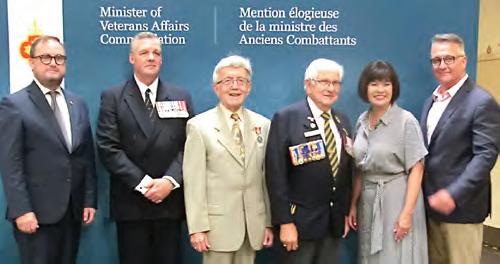
Veterans Affairs Minister Ginette Petipas Taylor (second from right), along with VAC Deputy Minister Paul Ledwell (left) and Malpeque, P.E.I., MP Heath MacDonald, presents the Minister of Veterans Affairs Commendation to Legionnaires Owen Parkhouse, Pieter Valkenburg and John Yeo. DARIA VALKENBURG
Tignish, P.E.I., Branch member Claude Caron presents member Nancy Andrews with a Quilt of Valour.
Tignish, P.E.I., Branch honours member Diane Weir with a Quilt of Valour. Looking on are her husband Alan and presenters Bernadette and Roy Pederson.
Bandy Power of Tignish, P.E.I., Branch is presented a Quilt of Valour by Claude Caron.
Tignish, P.E.I., Branch member Graeme Andrews receives a Quilt of Valour from branch member Claude Caron.
A 75th anniversary of NATO commemoration was held at Seacow Head Lighthouse in Fernwood, P.E.I., as part of the official opening ceremonies for the lighthouse. Among the NATO representatives were John Yeo (left), Atlantic Regional Director for NATO Veterans Organization of Canada; Pieter Valkenburg, PR officer for Borden-Carleton Branch in Borden, P.E.I.; and speaker Clare Hutchinson. DARIA VALKENBURG
Past President David Cosh of Kingston Branch in New Haven, P.E.I. (left), joins Provincial Command Past President Duane MacEwen in celebrating member Jean MacLean’s 100th birthday, marked with a congratulatory letter from the Dominion Command President.
P.E.I. Command Chair John Yeo celebrates the 100th birthday of Second World War veteran Lois Brown.
P.E.I. Command President Jack MacIsaac and Provincial Command Chair John Yeo mark the 75th anniversary of NATO at a commemorative event held at the Seacow Head Lighthouse in Fernwood, P.E.I., on July 10, 2024.
Manitou, Man., Branch supported the Manitoba World War One Museum on its Heritage Day called “A Day in the Trenches,” providing meals for the visitors and museum volunteers.
Montague, P.E.I., Branch
President Brian Rector (left) and member Maxine Evans (right) present $1,000 to Kings County Montague Hospital, represented by Grant McKenna. The donation will go toward the hospital equipment fund.
B. RECTOR
Margaret Skibo of Springfield Branch in Hazelridge, Man., presents National Youth Remembrance contest certificates and monetary gifts to students at Hazelridge School for their winning entries in primary and junior poster categories.

The L.A. of Port Arthur Branch in Thunder Bay, Ont., presents $1,500 to Community Clothing Assistance. Represented are Branch President Katriina Myllymaa, Vishesh Nayyar and Linda Gamble of Community Clothing Assistance, and L.A. ways and means chair Nancy Singleton.
Winnipeg Polish Branch Sgt.-at-Arms Walter Dubiel and branch secretary Ruth Erstelle present a plaque to Life Member Joseph Samus at his 100th birthday event on Aug. 1, 2024.
Herman Good VC Branch in Bathurst, N.B., receives $2,000 from the Atlantic Superstore. Pictured are Bernie Chamberlain, First Vice Danny Glendenning, Remi Chiasson, Atlantic Superstore manager Jeff Langille, Stacy Lapointe and Branch President Graham Wiseman.
John Hiscock from St. John’s, N.L., whose great-grandfather of the same name served in the Second World War, receives a provincial bursary from Newfoundland and Labrador Command.
Botwood, N.L., Branch President James Hancock (right) presents $500 to Eli Rowsell of Heroes Mending on the Fly, an organization dedicated to the physical and emotional rehabilitation of disabled active military service personnel and disabled veterans through fly-tying, fly-fishing and associated activities.
Past President Rick McGinley of Jervis Bay Memorial Branch in Saint John, N.B., presents $3,500 to Kelda Brigden of the 527 Simonds squadron sponsoring committee. H.E. WRIGHT
Past President Rick McGinley of Jervis Bay Memorial Branch in Saint John, N.B., presents $3,500 to two cadet units: 161 C.K. Beveridge squadron, represented by Pat Gabriel, and 1691 Saint John army cadets, represented by Linda Jarvis-Duguay. H.E. WRIGHT
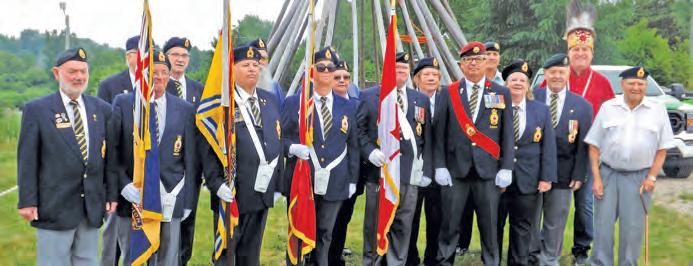
Members of Herman Good VC Branch in Bathurst, N.B., attend the Pabineau First Nation Pow Wow. Chief Terrance Richardson is a Canadian Forces veteran. In the rear are Leonard Imbeault, Harry Sullivan, First Vice Danny Glendenning, Second Vice Shirley Scott, Ann Marie Ramsay, Capt. Dean Duguay, North Shore Regiment and Pabineau First Nation Chief Terrance Richardson. In front are Branch President Graham Wiseman, John Duffy, Terry Spence, Catherine Arseneau, Tommy Jagoe, Sgt.-at-Arms Adam Mallaley, Cathy Herriott, Gerald Power and Raymond Cormier.
Herman Good VC Branch in Bathurst, N.B., presents their Legion Service Medal to PPO 1 Gabrillea Aube, 275 sea cadet corps. The presentation was made by Terry Spence, cadet committee chair. GRAHAM WISEMAN
Herman Good VC Branch in Bathurst, N.B., presents their Legion Service Medal to WO Eloik Caissie of 640 Chaleur squadron. The presentation was made by Terry Spence, the cadet committee chair. GRAHAM WISEMAN
Brian Morris of Robert Combe VC Branch in Melville, Sask., presents a $500 scholarship to Austin Wourms of Melville Comprehensive School. DIANNE HACK
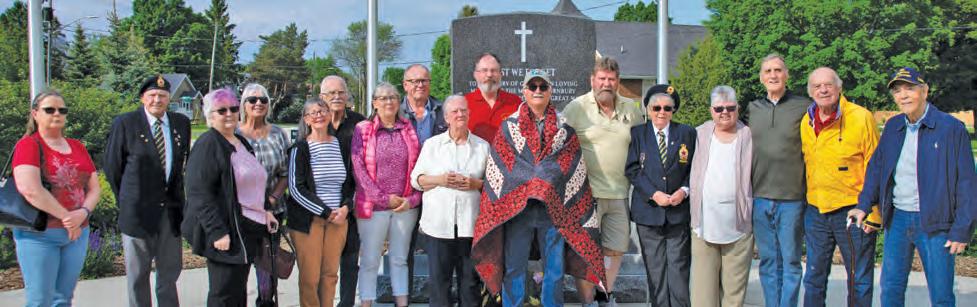

Westboro Branch in Ottawa donates $15,000 to the Perley Health Foundation. Pictured are branch First Vice Brian Cooper, foundation development director Courtney Rock and the branch’s Third Vice David Kirk.
Trenton, Ont., Branch First Vice and ways and means chair
Yves Bouchard presents $1,000 to the Hastings and Prince Edward County Humane Society, represented by executive director Marilyn Lawrie.

Eastview Branch in Vanier, Ont., donates $5,000 to Perley Health. Pictured are branch treasurer Ray Barker, Perley development director Courtney Rock, branch poppy co-chair Michel Tetreault and chair Bill Redmond.

Trenton, Ont., Branch First Vice and ways and means chair
Yves Bouchard presents $1,000 to Quilts of Valour Canada, represented by Trenton/Belleville’s Danielle Barnes.
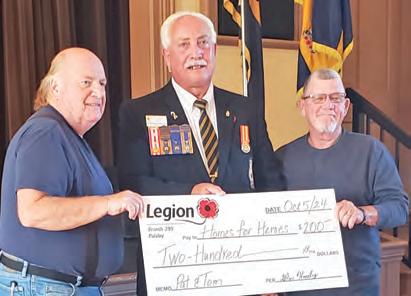
President Glen Hanley of Paisley, Ont., Branch presents $200 for Homes for Heroes to musicians PJ Mack and Tom Traversy who performed at the branch’s 85th anniversary celebration.
Ontario provincial sports chair Walter Stevens presents the trophy in the provincial elders doubles horseshoe championships to four-time winners John Valk and Larry Farwell of Brighton, Ont., Branch.
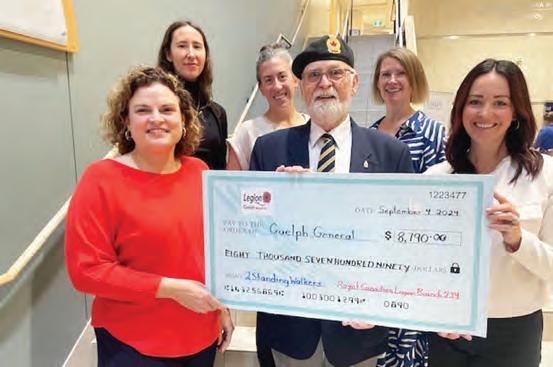
David Thompson
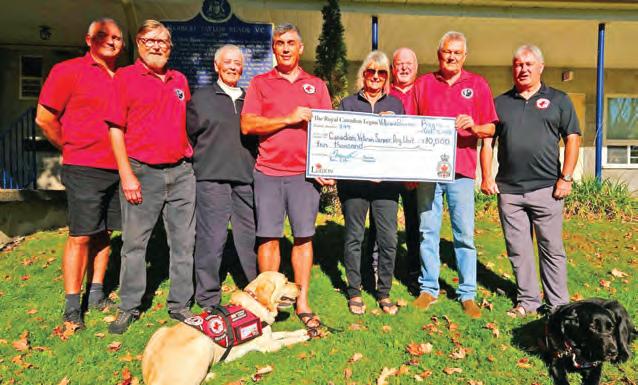
The Honour Our Veterans Banner Program at Perth-Upon-Tay Branch in Perth, Ont., presents $10,000 to the Canadian Veteran Service Dog Unit.
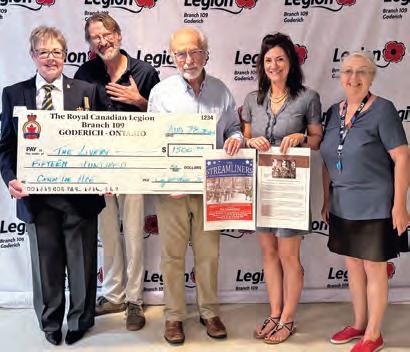
Goderich, Ont., Branch contributes $1,500 to the Livery Theatre production of Streamliners. Pictured are the branch’s Cynthia Strickland, lead actor Rob Bundy, director Duncan McGregor and Pam Stanley, RCAF 100 organizer, Huron County.
Ron Trowhill and Cathy MacVittie of Last Post Branch in Port Stanley, Ont., present $3,500 in tip monies to Hospice of Elgin in St. Thomas, represented by Dr. John Hofhuis.
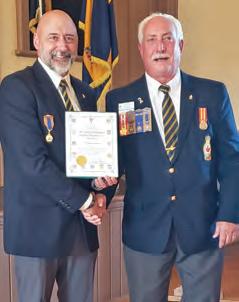
Member of Parliament and retired colonel Alex Ruff presents Paisley, Ont., Branch President Glen Hanley with a congratulatory certificate marking the branch’s 85th anniversary.
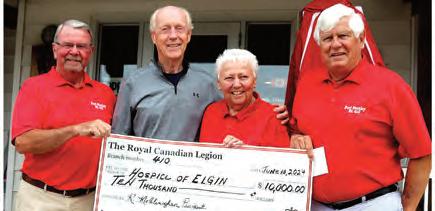
Donations chair John McCoubrey, First Vice Sherry Trowhill and President Rich McClenaghan of Last Post Branch in Port Stanley, Ont., present $10,000 to Hospice of Elgin in St. Thomas, represented by Dr. John Hofhuis. JANICE McCLENAGHAN
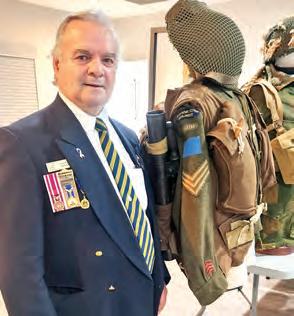
President Harvey Renaud of South Carleton Branch in Manotick, Ont., stands beside a uniform of the North Nova Scotia Highlanders similar to one worn by his father-in-law, who landed with the North Novas on D-Day. The branch conducted a ceremony commemorating the 80th anniversary of the Normandy landings.

First Vice Yves Bouchard of Trenton, Ont., Branch presents $1,000 to the Sunny Days Group Program, Brighton.
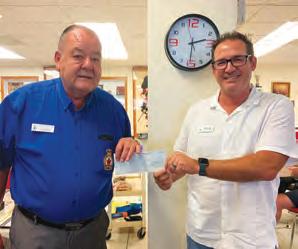
First Vice Yves Bouchard of Trenton, Ont., Branch presents $1,000 to Matt Del Grosso, donor relations manager at Hospice Quinte.
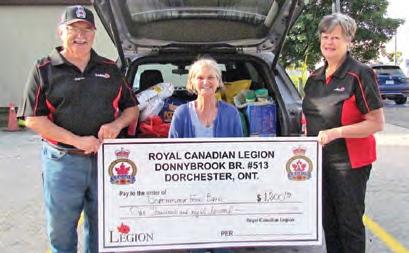
President Shane Lynch and treasurer Sjouk Lynch of Donnybrook Branch in Dorchester, Ont., present $1,800 and a trunk full of food items to the Dorchester Food Bank, represented by its director Jean Davis.
John O’Hara of Coldwater, Ont., Branch answers questions from local residents Susan and Andy Beard at the Coldwater Fall Fair.
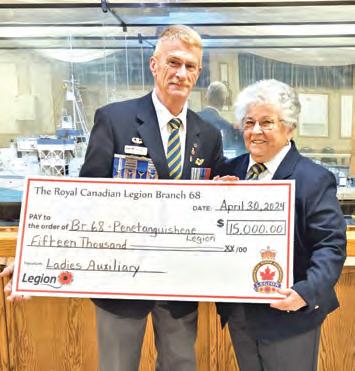
L.A. President Mary Lafaive of Penetanguishene, Ont., Branch presents $15,000 to Branch President Dave Sampson to help pay for the new roof.
First Vice Kari Malmström of Coldwater, Ont., Branch presents $500 to Lieut. (N) Greg Pardy, commanding officer of sea cadet corps Trillium.
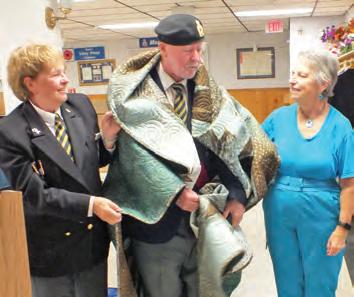
President Carol Grozelle of Elliot Lake, Ont., Branch and local Quilt of Valour representative Judy Millard present navy veteran Aubry Millard with a Quilt of Valour.
Nick and Jamie Noonan donate $3,000 on behalf of their family in honour of Nick's father Robert (Bob) Noonan, a veteran, to Brockville, Ont., Branch, represented by President Gord Gramb (centre). SHAREN TEDFORD
Fay Tait of Elliot Lake, Ont., Branch donates $2,000 to the Quilt of Valour Program, represented by local chair Judy Millard.
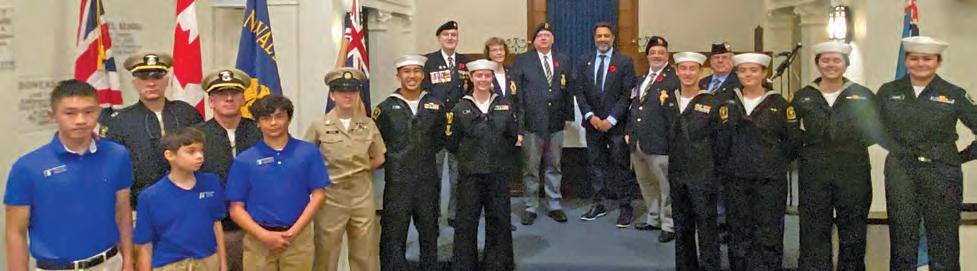

Legion member Bruce Ralph of the South Vancouver Island Zone (centre, red shirt) stands in front of the car he donated to Veterans House Victoria, which Katherian Irmscher (left) purchased after hearing of the gesture and knowing the funds will go back into the institution. Also pictured are Veterans House co-chair Terri Orser (second left), Kayla Joi Irmscher (second right), and Veterans House live-in manager Ray Belanger.
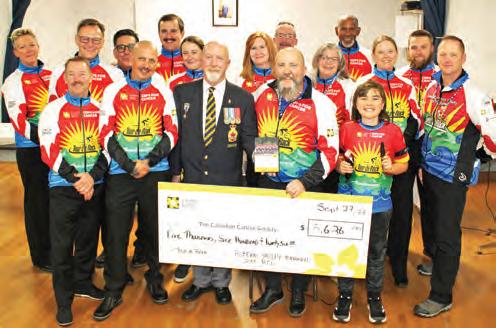
President Roy Buchanan of Alberni Valley Branch in Port Alberni, B.C., presents $5,626 to Cops for Cancer Tour de Rock. Receiving the cheque is Warren Kongus of the North Cowichan Duncan RCMP. SONJA DRINKWATER
Hope, B.C., Branch President Ian Williams congratulates Cpl. Max Chuang (left) and Cpl. Mya Ratcliffe (right) on receiving the Legion Cadet Medal of Excellence.
congratulates student Adam Osipov for his honourable mention in the provinciallevel intermediate black and white poster competition.
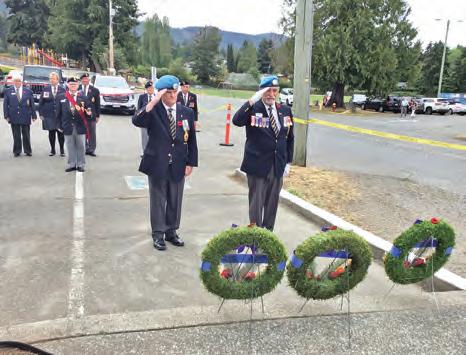
Mick Graham and Frank Mezzatesta of Seaview Centennial Branch in Lantzville, B.C., commemorate 2024’s National Peacekeepers Day.
President Roy Buchanan (left) of Alberni Valley Branch in Port Alberni, B.C., joins poppy chair Shannon Doré (right) in presenting $4,000 to the Alberni Valley Hospice Society, represented by Margaret Vatamaniuck. The funds will be used to purchase a new automatic front door at the hospice.
At Three Sisters Branch in Canmore, Alta., Jill Amatt and Chris DeCap devoted 100 hours to paint the mural on the building. SHEILA TANNER
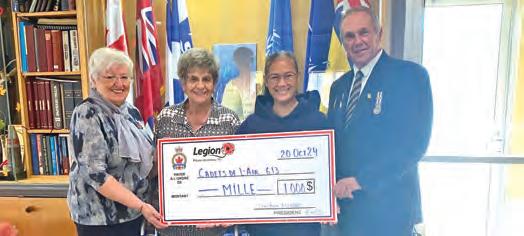
Nicole Gingras (left), Lise Tassé-Beaulieu, sponsoring committee treasurer Chantal Chan and Second Vice Michel Viens of Richelieu Branch in St-Jean-sur-Richelieu, Que., present $1,000 to the 613 squadron air cadets of St-Jean/Iberville. P. GARNEAU
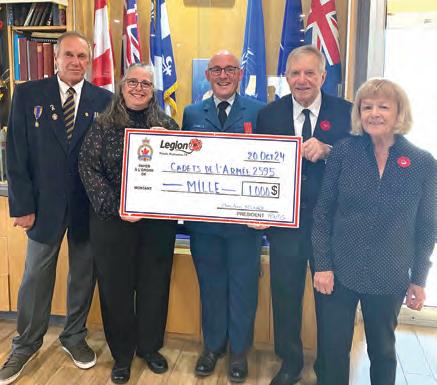
Second Vice Michel Viens (left), president of the sponsoring committee Chantal Beaumier, Deputy Commander Guillaume Lebel, Georges England and Pierrette England of Richelieu Branch in St-Jean-sur-Richelieu, Que., present $1,000 to Corps de cadets 2595 Saint-Jean. P. GARNEAU
Send your photos and news of The Royal Canadian Legion in action in your community to your Command Correspondent. Each branch and ladies auxiliary is entitled to two photos in an issue. Any additional items will be published as news only. Material should be sent as soon as possible after an event. We do not accept material that will be more than a year old when published, or photos that are out of focus or lack contrast. The Command Correspondents are:
BRITISH COLUMBIA/YUKON: Graham Fox, 4199 Steede Ave., Port Alberni, BC V9Y 8B6, gra.fox@icloud.com
ALBERTA–NORTHWEST TERRITORIES: Donna Ganzon, 2020 – 15 Street NW Calgary, AB T2M 3N8, abnwtlegion.com
SASKATCHEWAN: Tara Brown, 2267 Albert St., Regina, SK S4P 2V5, admin@sasklegion.ca
MANITOBA: George Romick, 320 Admiral Court, Thunder Bay, ON P7A 8B5, romickg@tbaytel.net
NORTHWESTERN ONTARIO: George Romick, 320 Admiral Court, Thunder Bay, ON P7A 8B5, romickg@tbaytel.net
ONTARIO: Roy Eaton, 567-294B North Channel Dr., Little Current, ON P0P 1K0, reaton@on.legion.ca
QUEBEC: Mary-Ann Latimer, 105-2727 rue St. Patrick, Montreal, QC H3K 0A8, msmarts@bell.net
NEW BRUNSWICK: Harold Wright, 2-299 Main St., Saint John, NB E2K 1J1, foulis20@gmail.com
NOVA SCOTIA/NUNAVUT: James Leadbeater, 4129 New Waterford Highway, New Victoria, NS B1H 5T4, james.leadbeater@hotmail.com
PRINCE EDWARD ISLAND: John Yeo, 657 Rte. 19, Meadow Bank, PE C0E 1H1, islander657@yahoo.ca
NEWFOUNDLAND AND LABRADOR: Brenda Slaney, Box 5745, St. John’s, NL A1C 5X3, bslaney@nfld.net
DOMINION COMMAND ZONES: EASTERN U.S. ZONE, Gord Bennett, 803-190 Cedar St., Cambridge, ON N1S 1W5, Captglbcd@aol.com; WESTERN U.S. ZONE, Douglas Lock, 1531 11th St., Manhattan Beach, CA 90266, douglock@fastmail.com
Submissions for the Honours and Awards page (Palm Leaf, MSM, MSA and Life Membership) should be sent directly to Michael A. Smith, Legion Magazine, 86 Aird Place, Kanata, ON K2L 0A1 or magazine@legion.ca.
TECHNICAL SPECS FOR PHOTO SUBMISSIONS
DIGITAL PHOTOS—Photos submitted to Command Correspondents electronically must have a minimum width of 1,350 pixels, or 4.5 inches. Final resolution must be 300 dots per inch or greater. As a rough guideline, colour JPEGs would be between 0.5 megabytes (MB) and 1 MB.
PHOTO PRINTS—Glossy prints from a photofinishing lab are best because they do not contain the dot pattern that some printers produce. If possible, please submit digital photos electronically.
FRENCH INSERT—To receive a French insert of Legion Magazine content, please contact MagazineSubscriptions@legion.ca or call 613-591-3335.





55 years

75 years
50 years







SANDRA GEORGE (MICKEY)
Whitney Pier Br., Sydney
MARY PHILLIPS
Whitney Pier Br., Sydney
BONNITTA CORBETT
Whitney Pier Br., Sydney
JEAN LEVESQUE
Whitney Pier Br., Sydney
MARIANNE ILLLSLEY
Middleton Br.
DOUGLAS MOORE
Middleton Br.
DARRELL LEIGHTON
Hants County Br., Windsor
RICHARD SMITH
Hants County Br., Windsor
BRIAN NAZARKO Springfield Br., Hazelridge
CONNIE LEE MORTON Mayerthorpe Br.
CERYL CROSS
Port Blandford Br.
GILBERT PHILIPS
Port Blandford Br.
MIRA ANANICZ
Polish Veterans Br., St. Catharines
RITCHIE COX
Harry Miner VC Br., Clinton
SABINA GLOWACKI

Polish Veterans Br., St. Catharines Advertisement
MORIN, ALPHONSE—Belgian family who befriended this Canadian soldier during WW II are trying to establish contact with his relatives. Morin was from Papineau, Que. Contact was lost while he was a patient at Hôpital Sainte-Anne in Sainte-Anne-de-Bellevue, Que. The Belgian family contact is Marianne Cauwels, 406-747 East 3rd Street, North Vancouver, BC V7L 1G8.
GILL, CLARENCE—Seeking information about Clarence Gill to return his medals after they were found at a waste site in Ontario’s Township of Lanark Highlands. Gill was born in Britain and served with the British military during WW II, then in Palestine with the Royal Army Service Corps. He’s believed to have come to Canada in the late 1940s or early 1950s and enlisted in the Canadian military, where he served at least 22 years. Contact Bob Atkinson at 9749 Hwy. 511, Lanark, ON K0G 1K0; robertatkinson123@sympatico.ca; 613-259-5270.
KEARNEY, PAUL EDGAR—Eddie Lawrence is seeking former lieutenant-colonel, chief of staff at Canadian Forces Base Gagetown in 2007. Contact Eddie Lawrence, fast_eddie6@outlook.com; 905-723-0029; 51-1100 Oxford Street, Oshawa, ON L1J 6G4.
DUGUAY, ALBERT S.—A retired Italian army captain and collector, has a WW II helmet that belonged to Albert S. Duguay, who died in 1987. He is seeking more information about the helmet’s former owner and his wartime service. He would also like to contact the Duguay family and return the helmet to them if they wish to have it. Contact: Massimo Polimeni, polimeni.mail@gmail.com; via Leonardo da Vinci, 50-57016 Castiglioncello (LI) Italy.
ARMY BANDS—Seeking photos, information, etc. on Canadian army (regular or reserve) and Royal Canadian Air Force trumpet and bugle bands, as well as drum corps, from the 1960s to present. Contact Rick Allen, 905-358-6622 or 905-807-8236; rallen8236@gmail.com.


Three in four Canadians polled in May 2023 had a negative view of the Chinese government. Given the ongoing tensions between the two countries, it’s hard to fathom that has improved much in the interim.
“It speaks to how strained the relationship is,” said pollster Nik Nanos at the time, noting that many nations engage in activities that advance their interests. But while many of them do so transparently through diplomats,
by supporting educational exchanges and research with Canadian universities and hiring lobbyists to help them, China’s approach appears “unsavoury” to some.
Indeed, the Chinese government has been practising socalled elite capture in Canada for years now. China traded paid trips, legal and business opportunities and research access to essentially secure the support of prominent Canadian political, legal and academic leaders to speak positively about and support the country’s interests. It does so largely through its United Front Work Department, which gathers intelligence on, manages relationships with, and attempts to gain influence
over high-profile individuals and organizations outside of the country. The department also aims to influence the 1.7 million Canadians of Chinese origin.
More covert Chinese interference was exercised in Canadian elections.
For instance, Chinese students attending universities here were bused to nomination meetings to support candidates favourable to Beijing. And the Conservatives insist that the 2021 election results in as many as six ridings were heavily influenced by Canadian-based, Chinese-language TV and social networks, almost all of which are owned by Beijing-friendly interests.
All of this is now under investigation by the federal Foreign Interference Commission. At least one Chinese diplomat has now been expelled from Canada.

Zhao Wei left in May 2023 over allegations he participated in intimidating a Conservative MP. And there’s more. The highsecurity National Microbiology Lab in Winnipeg dismissed two Chinese scientists in July 2019. A Canadian Security Intelligence Service report on the duo indicated that they had, among other concerning behaviours, provided Beijing “with the Ebola genetic sequence, which opened a door of convenience for China,” and let two employees of a Chinese institution “whose work is not aligned with Canadian interests” into the lab. No charges were laid. Meanwhile, cyber criminals based in China hacked nearly 10,000 devices in Canada and used them to attack government departments, corporations and individuals, seeking data on inventions, sensitive files and personal data. It’s believed that the Chinese government directs and benefits from such activities.
In trade terms, China’s massive and productive population has demonstrated it can produce both high-quality and inexpensive goods. Take electric vehicles (EVs), for instance, available in China for about $14,000, much less than EVs in Canada. In October 2024, Ottawa imposed a 100 per cent tariff on Chinese-made EVs (the U.S. did similarly in May), in an attempt to protect the billions federal and provincial governments have invested in EV-battery production. After Canada announced the move, a spokesperson for China’s Ministry of Commerce said, “China is strongly dissatisfied and firmly opposes this” and that it “severely impacted China-Canada economic and trade relations.” More tension with Beijing.
The strain is amplified, too, by China’s global ambitions. Beijing claims, for instance, that the South China Sea is its territorial waters, despite the
fact the assertion violates the United Nations Convention on the Law of the Sea. To support its position, Chinese Coast Guard vessels intimidate fishermen from the Philippines and Vietnam in international waters, for example. It has also built airstrips and garrisons on previously uninhabited islands and sandbars in the region, notably on the Paracel and Spratley islands, again in violation of the UN convention.
The result, not surprisingly, is that the Philippines is growing its military force, and western navies, including frigates of the Royal Canadian Navy, now make freedom-of-navigation sailings through the sea, often shadowed by naval vessels of the fast-growing People’s Liberation Army (PLA).
Then there’s Taiwan, where Chinese Nationalist forces fled after Chinese Communists defeated them in 1949. Taiwan has since considered itself an independent country, but Beijing, especially under Xi Jinping, China’s president since 2013, claims that it still belongs to it—and it will incorporate the island nation into China by force if necessary. Frequent military exercises on the Chinese coast and intrusions by PLA aircraft and navy ships regularly stir up trouble and raise tensions.
While the U.S. hasn’t definitively stated it will defend Taiwan if China attacks it, Ely Ratner, the U.S. Assistant Secretary of Defense for Indo-Pacific Security Affairs, said in September 2023 that “transformative achievements with Japan, Australia and the Philippines, among others, will make our force posture across the [region] increasingly distributed, mobile, resilient and lethal.”
Some defence experts now argue that China has become the most significant threat to American power and has outgunned the U.S. War between the two would be difficult to contain, could involve nuclear weapons, and would likely draw in other countries, including Canada.
For its part, Canada is also becoming worried by Chinese ambitions in the Arctic. As global warming accelerates sea ice melt, new natural resources may become accessible in the region. It’s believed China is eyeing access to such fisheries, oil and mineral deposits. Some of these are likely in international waters, others probably in Canada’s marine boundaries. Regardless, Chinese research ships have been conducting surveys in the region and China has declared itself a nearArctic state. In a 2018 Arctic policy paper, it declared an intent to be a “polar great power” by 2030.
China’s commercial shipping is also eyeing the Arctic as a costsaving route between Asia and Europe once the ice melts and navigation becomes easier. There are increased risks of pollution of the relatively pristine waters as traffic increases, which will likely affect Canada. Meanwhile, Canada has limited defences in the Arctic, and as Chinese—and Russian—interests in the region continue to grow, Ottawa will need to change its defence policies. Thus, it’s no wonder Canadian opinion on China has hardened. People can see the threat from what Globe and Mail columnist Andrew Coyne called China’s “brutal gang of thugs.” Now, the government needs to see it, too, and act to protect Canada’s interests. L
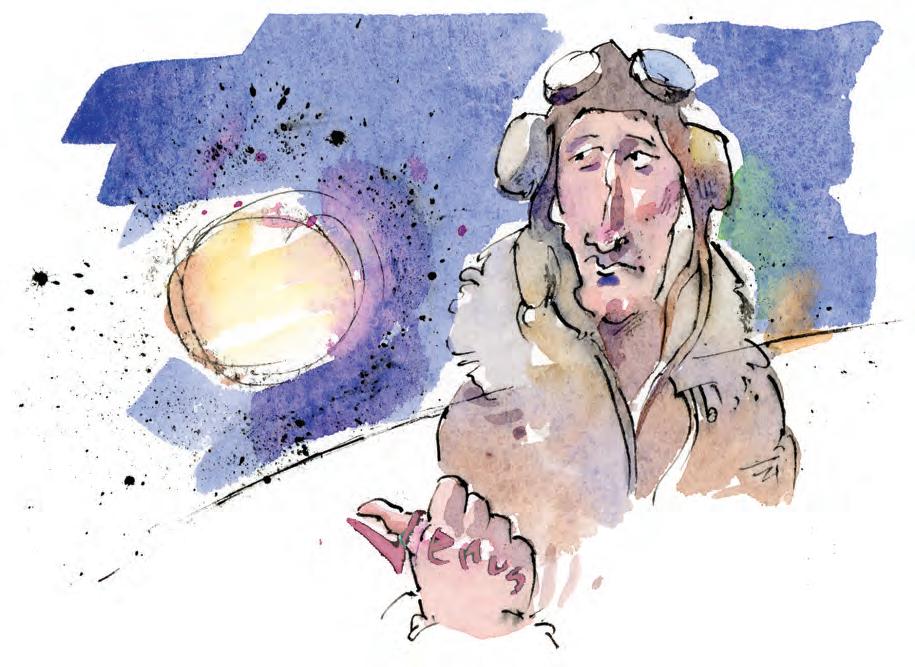
In1945, the Royal Canadian Air Force stationed a couple of squadrons of aircraft in B.C. as a defence against Japanese incendiary balloons. These had a 10-metre, hydrogen-filled paper sphere supporting a payload of four five-kilogram firebombs and a single, 15-kilogram anti-personnel bomb. The balloons were launched from coastal sites on Honshu and were designed to climb high into fast, prevailing eastwest air currents now known as the jet stream. The idea was they would drift more than 9,000 kilometres across the Pacific, crash along the Canadian and American West Coasts and ignite forest fires. More than 9,000 were sent up, but only about 300 were found or seen in Canada or
the U.S. They started no forest fires, but one of them killed six civilians in Oregon.
The RCAF scrambled high-altitude Mosquito interceptors repeatedly to deal with reported ballons. But most of the time, the planes ended up chasing the planet Venus, which was bright even in daylight that year.
A frustrated squadron diarist forced to respond to the false alarms wrote: “Surely someone at control should know sufficient astro navigation to plot the visible planets in the daytime.”
Venus kept appearing and planes kept getting sent up right through July. Japan surrendered in August.
Gary Hatchard of London, Ont., found himself singled out at a mall recently.
“Sitting with my veterans ball cap on, responding to text messages, two young boys came up to me, the first kid saying something or other to me about his dog. The second interrupts, ‘He’s not a veterinarian, he’s an army guy.’
“‘Oh,’ says the first kid and both offer handshakes and ‘Thank you.’”
> Do you have a funny and true tale from Canada’s military culture? Send your story to magazine@legion.ca
John Broughton of Kelowna, B.C., recalls an incident from his service:
“It was 1959 at RCAF Station Sainte Sylvestre, a radar site in southern Quebec. At that time, before computers, radar operations were performed manually, requiring many personnel, including both airwomen and airmen.
“One evening, a young flying officer and I were closing the messes according to our job descriptions as orderly officer and orderly corporal respectively. We had just inspected the Airmen’s Club to ensure it was secure. On our way out, the operations officer decided to check the storage area beneath the stairwell as a precautionary measure against fire. Upon opening the small door, we were both taken by surprise to discover a couple in a compromising situation.
“You can’t do that!” exclaimed the operations officer, then abruptly closed the door. Upon reflection and quickly regaining his composure, he reopened the door and added, “In here.”
During the Second World War, corvettes were the mainstay of the convoy escort system. But they could also be the bane of senior officers, especially since corvette officers, including ship’s captains, were usually reservists. They had no investment in a naval career and just wanted to finish the war and go back to civilian life. This means they were often flippant with their seniors in ways regular officers might not try.
A corvette with a westbound convoy suffered a mechanical problem and decided to turn back for repairs. This produced the following exchange:
Senior officer: “Hope you find necessary facilities in Belfast.”
Corvette: “Hope I find Belfast.”
On another occasion a corvette was sent on a brief errand, but apparently took too long.
Senior officer: “Why have you taken so long to rejoin convoy?”
Corvette: “It was uphill all the way.”
Thousands of women served in the Second World War, but they had their own separate services. There was the Women’s Royal Canadian Naval Service, known as Wrens, the Women’s Division of the RCAF
and the Canadian Women’s Army Corps, or CWAC. The Americans had similar arrangements, although women in their navy were known as WAVES, or Women Accepted for Voluntary Emergency Service. These names inspired some (poor) poets:
His wife was a WAVE and he waved at a CWAC,
The CWAC was in front, his WAVE was in back.
Instead of a wave from the CWAC, be it said.
He won but a whack from the WAVE he had wed.
“ SURELY SOMEONE AT CONTROL SHOULD KNOW SUFFICIENT ASTRO NAVIGATION TO PLOT THE VISIBLE PLANETS IN THE DAYTIME.”
A flotilla of Canadian motor torpedo boats was sailing in a line when a fog bank descended. Each boat streamed a fog buoy, a kind of float towed astern to help the following vessel keep its distance.
When the fog cleared, the buoys were hauled in. All but one, which was apparently forgotten. It went splashing along and prompted a signal from the following boat: “Tell the captain there’s no beer left in this keg.”
Poet Al Purdy enlisted in the RCAF during the war, but found himself ill-suited for the job.
He wrote a poem about his service: “I wasn’t exactly a soldier, tho, only a humble airman who kept getting demoted and demoted and demoted to the point where I finally saluted civilians. When they trustingly gave me a Sten gun, Vancouver should have trembled in its sleep.”
He said one time while on guard duty under the Burrard Street Bridge he fired an entire clip at some wild ducks. “They didn’t fly away for five minutes trying to decide if there was any danger.” L
By Mark Zuehlke

Nov. 4, 1979, an Iranian student mob stormed the U.S. embassy in Tehran taking—after releasing about a dozen—52 American hostages. Six others, however, escaped. Agricultural attaché Lee Schatz took refuge in the Swedish embassy, while five others—head of consular services Robert Anders and consular attachés Joe Stafford and Mark Lijek and their wives—sheltered at Anders’ apartment.
TAYLOR HAD ARRANGED THE EVACUATION OF 850 CANADIANS FROM IRAN JUST 10 MONTHS EARLIER.
“Hell, yes. Of course. Count on us.”
—Canadian embassy chief immigration officer
John Sheardown
Four days later, Anders phoned the Canadian embassy’s chief immigration officer John Sheardown seeking temporary shelter.
“Hell, yes. Of course. Count on us,” replied Sheardown. He immediately advised Ambassador Ken Taylor who implemented a plan whereby two stayed at his official residence while the other three sheltered at Sheardown’s house. Staff were told they were Canadian tourists.
Taylor, 45, had arranged the evacuation of 850 Canadians from Iran just 10 months earlier when the Shah of Iran’s regime collapsed. He would prove to be the right man for the task ahead.
Taylor sent a top-secret telegram to Ottawa. External Affairs under-secretary Allan Gotlieb said that “in all conscience [there was] no alternative but to concur” with sheltering the Americans. Prime
Minister Joe Clark restricted knowledge of the situation to a “need-to-know” basis.
In Tehran, meanwhile, Taylor corresponded with Washington. On Nov. 21, he took Schatz in from the Swedes because he could more easily pose as a Canadian. Schatz was added to the Sheardown household.
Getting the Americans out of Iran was becoming increasingly essential. Their presence would eventually be discovered. At the same time, the Canadian embassy had to be shut down—its role in harbouring the Americans put its personnel at risk— and staff began quietly returning to Canada.
Operation Exfiltration was initiated with forged Iranian visas created along with passport stamps couriered by U.S. authorities via Canada to Taylor. The cover story was that the Americans were members of a fictitious film company.
Early on Jan. 27, they were taken to Tehran’s airport. They passed security and immigration checks without incident and boarded a Swissair flight to safety. Taylor and the remaining embassy staff left later that day.
Two days later, the news of the American rescue broke to an outpouring of gratitude across the U.S. and Taylor became a celebrity. He received many awards and accolades, including being made an Officer the Order of Canada. He died in 2015. L

InJanuary 1979, the monarch of Iran—dying from cancer—fled Iran. An Islamic revolution ensued, and Ayatollah Ruhollah Khomeini rose to power. The revolution caused chaos across the country with separatist attacks, worker revolts and internal power struggles. In Tehran, police reported for duty, but did little to maintain public order.
Against this backdrop, U.S. President Jimmy Carter allowed the monarch to receive medical treatment in News York. Angered by what was perceived as providing the Iranian sanctuary, a group of students hatched a plan to storm the American embassy in Tehran.
One leader was 23-year-old engineering student Ebrahim Asgharzadeh. By seizing the embassy, the students hoped to pressure Carter to return the monarch to Iran to be tried for corruption.
“Our plan was one of students, unprofessional and temporary,” said Asgharzadeh later, that envisioned a simple sit-in. Claims that the Revolutionary Guard directed the attack were, Asgharzadeh maintains, false.
In Tehran’s Grand Bazaar, Asgharzadeh and some friends bought a bolt cutter prompting a salesman to speculate: “You do not look like thieves! You certainly want to open up the U.S. embassy door with it!”
The students did precisely that.
Ebrahim Asgharzadeh, one of the leaders of the hostage takers.
“Everything happened so fast. We cut off the chains on the embassy’s gate. Some of us climbed up the walls and we occupied the embassy compound very fast,” said Asgharzadeh.
Suddenly, the students found themselves with a large number of hostages that they held for “the first 48 hours of the takeover.” After about a dozen hostages were released, the remaining 52 were detained by Khomeini’s administration. Khomeini deftly used the situation to direct Iranian anger toward the U.S.
“OUR PLAN WAS ONE OF STUDENTS, UNPROFESSIONAL AND TEMPORARY.”
“There was a lot of public… support behind the move,” Asgharzadeh later recalled. “The society felt it had slapped America, a superpower, on the mouth and people believed that the takeover proved to America that their democratic revolution had been stabilized.”
The crisis dragged on well past when Canadian Ambassador Ken Taylor and his staff succeeded in spiriting six Americans who had escaped capture out of Iran.
When negotiations to release the hostages failed in early April 1980, a military rescue operation—Operation Eagle Claw—was launched on the 24th. Involving a helicopter assault, then airlift from Iran, the mission failed when a helicopter crashed into a C-130 aircraft. Five airmen and three marines died.
Renewed negotiations throughout 1980 eventually led to the hostages being released on Jan. 20, 1981. L
“The society felt it had slapped America, a superpower, on the mouth.” —Iranian hostage taker Ebrahim Asgharzadeh
Alex Bowers
thank-you note memento
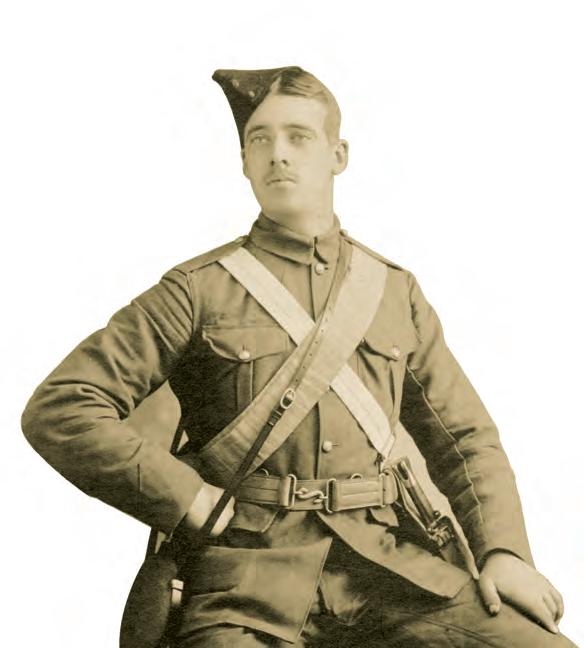
apetown joins with the Empire in feelings of heartfelt thanks,” reads the postcard gifted to Canadian Mounted Rifles (later Royal Canadian Dragoons) Sergeant Frederick Bettle, “for the signal services which Her Majesty’s citizen soldiers have rendered in upholding the Imperial authority in South Africa.”
The Boer War was not yet over, a colonial conflict that “Her Majesty” Queen Victoria never saw the end of and instead concluded under her son, King Edward VII. Nevertheless, the battles emblazoned on Bettle’s memento suggested that “Imperial authority” was indeed being upheld against the South African Republic (Transvaal) and Orange Free State.
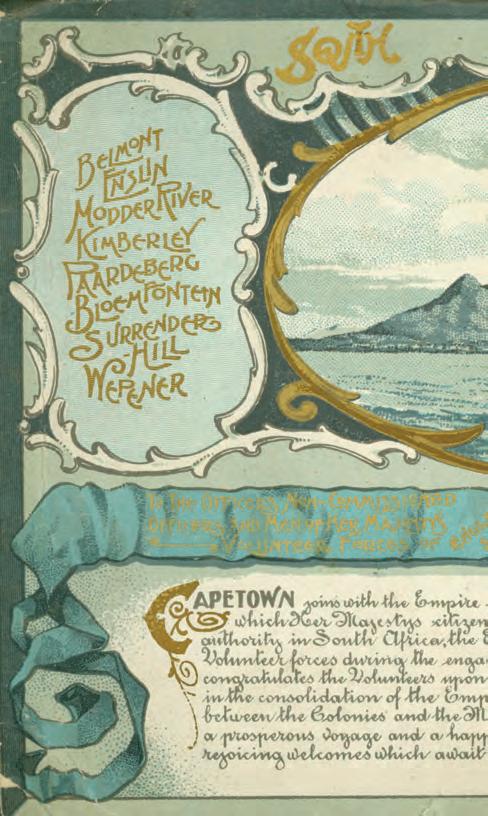


“There are two general phases of the Boer War: everything before the Battle of Paardeberg and everything after Paardeberg,” explained the New Brunswick Military History Museum’s executive director, retired captain David Hughes. “That victory became a turning point in no small part attributed to Canadian efforts.”
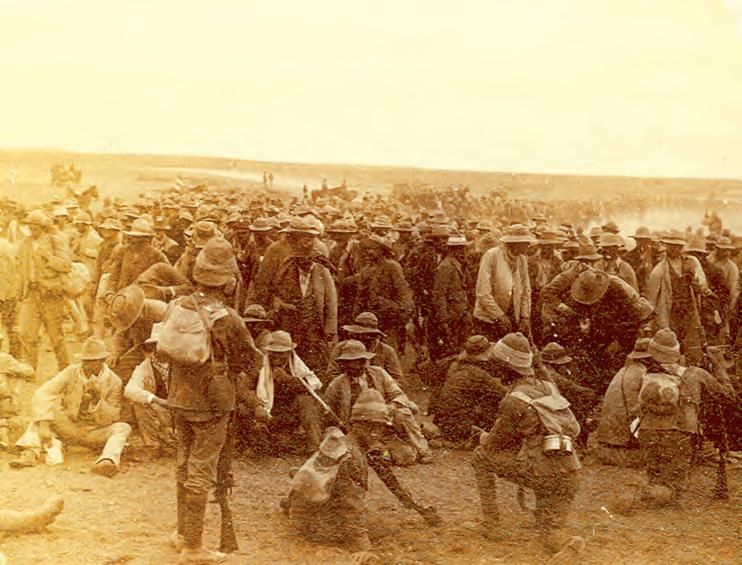
This, however, was not Bettle’s battle, although his broader service in bringing the Afrikaans-speaking Boers, descended from Dutch settlers, under the British Empire’s control evidently warranted the gratitude of Cape Town’s citizens.
“Cape Town was in Cape Colony, itself a British colony, on the southern tip of Africa,” noted Hughes. “Unlike the Boer Republics, the people of Cape Town were largely patriotic to the British cause. They were the loyal home team.”
It was the same loyalty that extended to Bettle of Saint John, N.B., replicated by many New Brunswickers. After the war’s outbreak on Oct. 11, 1899, the province’s volunteers enlisted in droves, regularly filling the
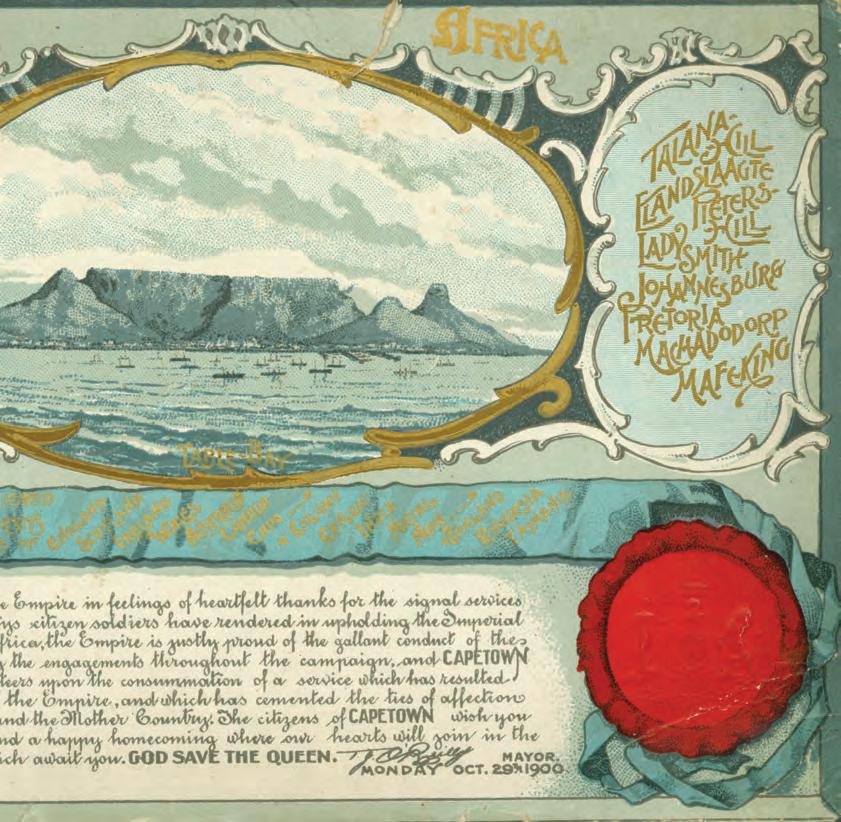
Sergeant Frederick Bettle kept this postcard from the mayor of Cape Town as a memento of his Boer War service. Boer prisoners of war (opposite bottom) after the decisive Imperial victory at the Battle of Paardeberg, in which Canadian troops played a crucial role.

BY THE NUMBERS
7,380

“Patriotic
postcards were very common during that period. Today we
frame
imperialism
differently, but it’s important that history is contextualized.”
quotas and supplementing other contingents experiencing a shortage of recruits.
The nature of the conflict was changing when Bettle arrived with Canada’s second contingent. The lessons learned at Paardeberg prompted the Boers to avoid set-piece battles, favouring guerrilla warfare that could frustrate British inroads. It was a strategy best countered by mounted troops like him.
Bettle’s precise role in the most controversial aspects of the Boer War, from engaging in Britain’s scorched earth policy to imprisoning the local civilian populace, is unknown. Likely, he fought for the same ideals
of imperialism prevalent across much of the Anglosphere—ideals encapsulated in the thank-you card congratulating him on a service to the “Mother Country” that contributed toward the “consolidation of the Empire.”
Signed by Cape Town Mayor Thomas O’Reilly, the 11.6 x 17-centimetre keepsake oozes with overt romanticism. Its artistic depiction of South Africa’s Table Bay speaks to a perceived righteous fight on distant shores, its ornate typography and banner a far cry from death and disease on the veldt.
And, yet it was, acknowledges Hughes, a product of its time—and Bettle’s artifact, along with the Boer War in its entirety, can perhaps be better understood through that lens.
Canadian soldiers and nursing sisters who served in the Boer War
560+
New Brunswickers who fought in South Africa
270
Approximate number of Canadians killed or who died from other causes during the conflict
70
Percentage of Canadian Boer War volunteers who were Dominion-born
750
Mounted troopers in the 1,289-strong second contingent
“Patriotic postcards were very common during that period. Obviously, times change, and today, we frame imperialism differently, but I still think it’s important that history is contextualized.”
The relic boasts a complex duality: it’s a snapshot of early Canada’s role in a genocidal colonial conflict, but also offers an opportunity to reflect on the moral evolution that has occurred in the century since. L

By Don Gillmor
In1845, John Franklin set out to find the Northwest Passage, still a holy grail of explorers after more than two centuries of futile searching. Most of the passage had been mapped, but the final 500 kilometres remained unexplored.
neither found any trace of Franklin.
The U.K. Admiralty pleads for help in finding the missing ships of John Franklin’s 1854 Arctic expedition.
Franklin had two ships: the aptly named HMS Terror and HMS Erebus (Greek god of the underworld and the personification of darkness). The ships were caught in ice and Franklin was forced to winter on Beechey Island. In September 1846, his vessels were again caught in ice near King William Island. They remained stuck and Franklin was forced to spend a second winter there. He died in June 1847 and the rest of his crew is believed to have perished the following year—though at the time, no one knew of their fate.
Franklin’s wife Jane pressured the British government to find her husband and, in 1850, it offered a 20,000-pound reward (roughly $5.5 million in 2025) to anyone who was able to locate and aid the crew. The search was on.





The Admiralty itself sent eight ships. A wealthy American financed an expedition that ended up trapped by ice in Baffin Bay.
The Hudson’s Bay Company sent two expeditions, but
On Aug. 23, 1850, Captain Erasmus Ommanney of the HMS Assistance found Franklin’s first winter camp on Beechey Island. The area was searched hoping to find some record of what had happened. But the mystery remained.
Now that the expedition’s general location had been found, other ships converged and located the graves of three crew members on Devon Island, each documenting the date of death, 1846.
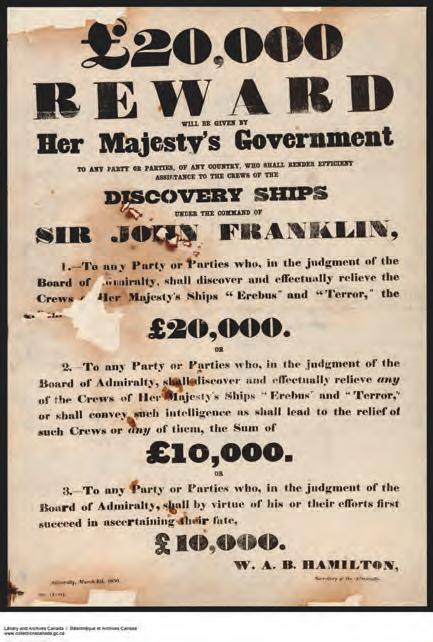
several years earlier. Other Inuit showed him inscribed silverware and Franklin’s Hanoverian order.
Yet another search went out in 1852, this time rescuing one of the would-be rescuers. Robert McClure had left in 1850 in search of Franklin and had been trapped in ice, his ship eventually abandoned.
On Jan. 20, 1854, The London Gazette declared that Franklin and his men would be considered deceased unless news to the contrary emerged in the next two months. It didn’t.
The Hudson’s Bay Company was still looking, however. In March 1854, John Rae made his fourth Arctic expedition and encountered an Inuk who told him a group of white men had died of starvation
Jane Franklin still hadn’t given up, and financed another search that discovered two messages in a tin, confirming Franklin’s death and that the ships had been abandoned on April 22, 1848.
HMS Erebus was finally discovered in early September 2014 south of King William Island. It was almost perfectly preserved, though the stern, where Franklin’s cabin was, had been destroyed by ice. There are Inuit stories of boarding the icebound vessel and finding a man seated in a dark room, clearly dead, with a smile on his face. Perhaps Franklin himself, with the rictus grin of the deceased.
HMS Terror was found two years later in Terror Bay, just north of Erebus, the mystery finally solved. L















✓
✓
✓
✓