PattieLovett-Reid

Pattie Lovett-Reid Chief Financial Commentator,
Bank



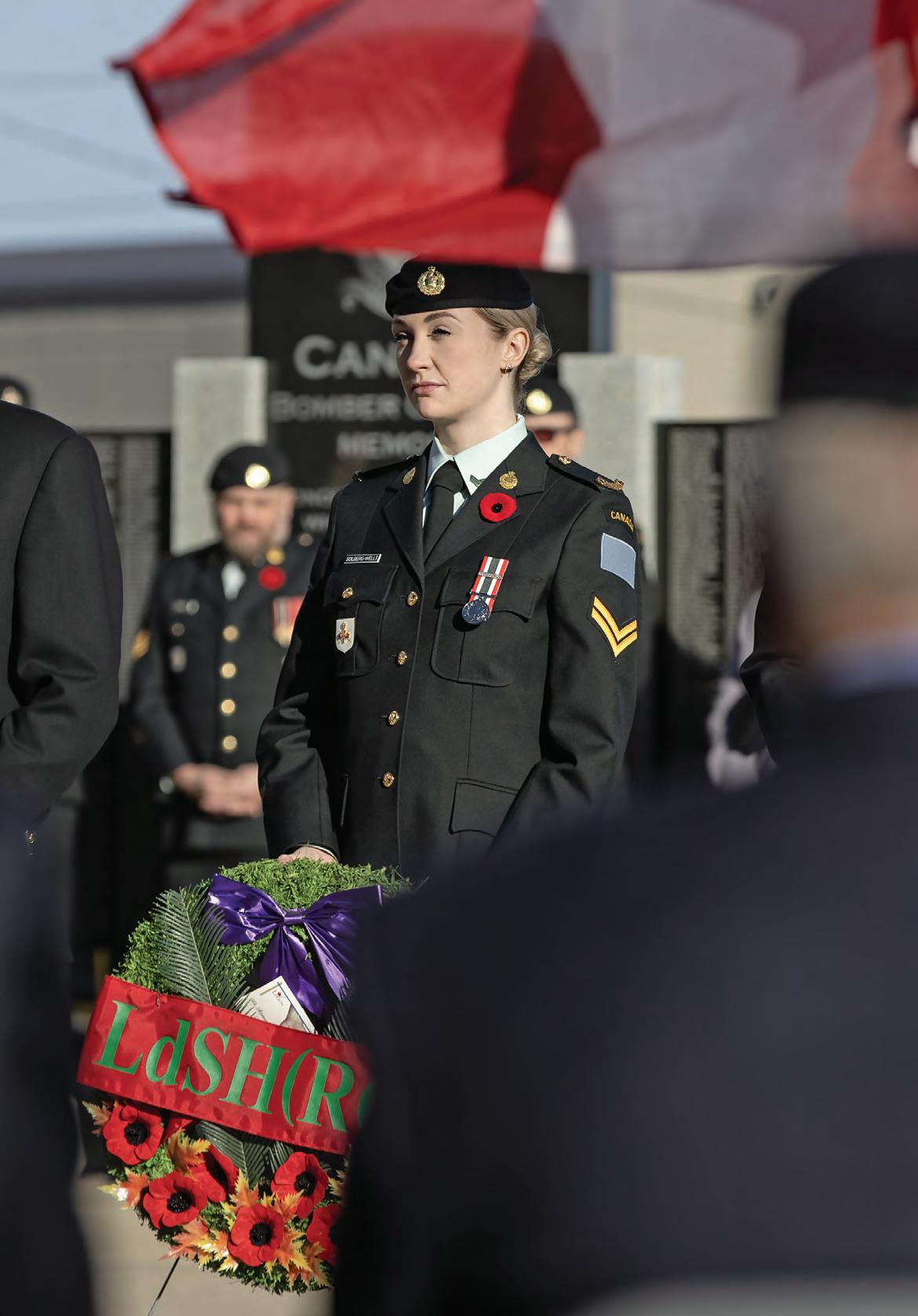
Youthful reflection
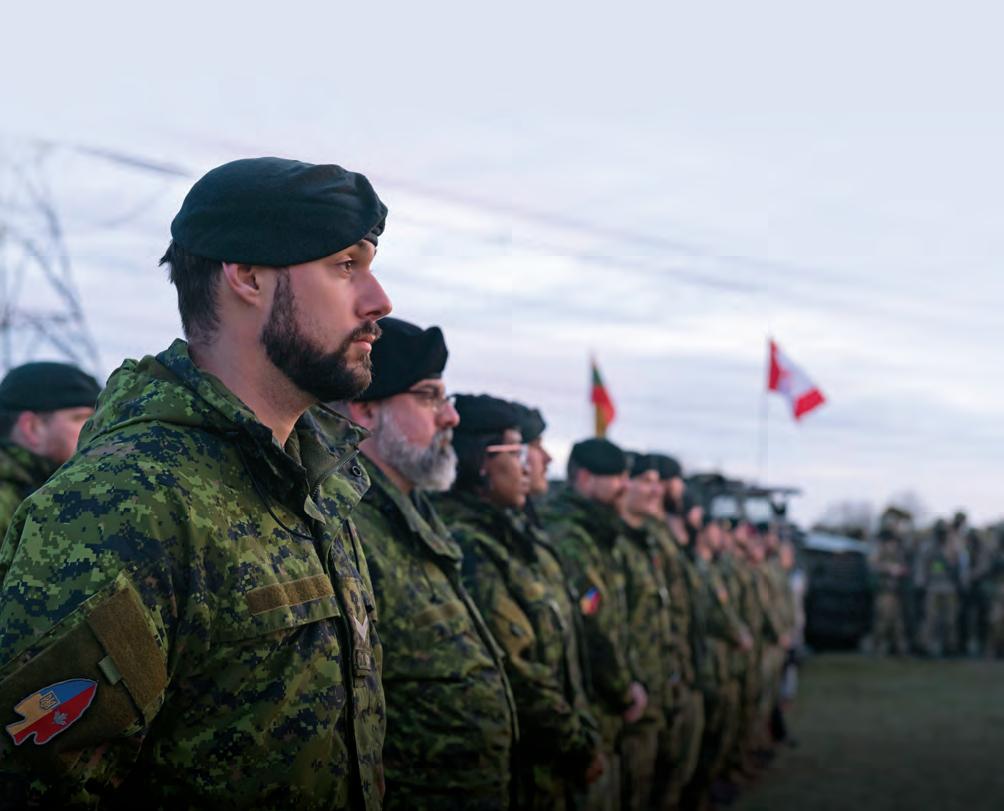
Corporal Emily Solberg-Wells, recently returned from a deployment to Latvia, waits to place a wreath on behalf of the Lord Strathcona’s Horse (Royal Canadians) at the 2023 Remembrance Day ceremony in Nanton, Alta.
See page 62
Features
20 “BRING US THE GODDAMNED CANADIAN”
How Canadian officers seconded to the British Army under the Canloan program fought for their comrades— and respect
By Alex Bowers
26 THE CASTLE
Allied prisoners of war who had a penchant for escape were often sent to Schloss Colditz—but even the legendary German keep couldn’t stop many from attempting getaways
By Ed Storey
32 ROGUE CO.
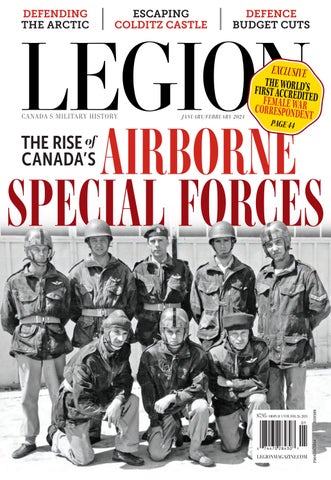
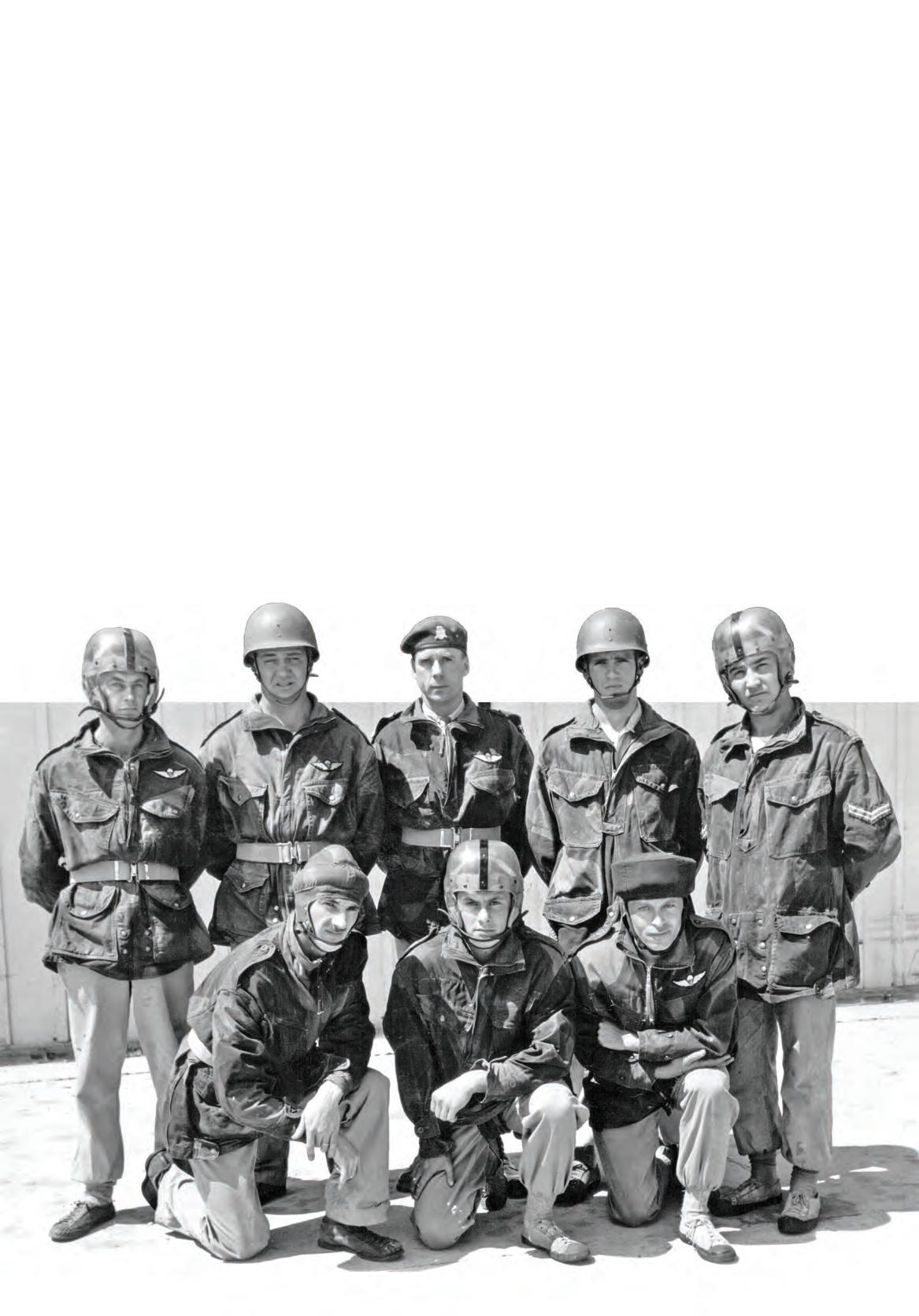
The story of Canada’s short-lived postwar Special Air Service
By Stephen J. Thorne
38 THE BACTERIUM BATTLE
How the Canadian Expeditionary Force fought for cleanliness during the Great War
By Robert Smol
44 KIT UP!
The story of Kathleen (Kit) Coleman, North America’s first female war correspondent
By June Coxon
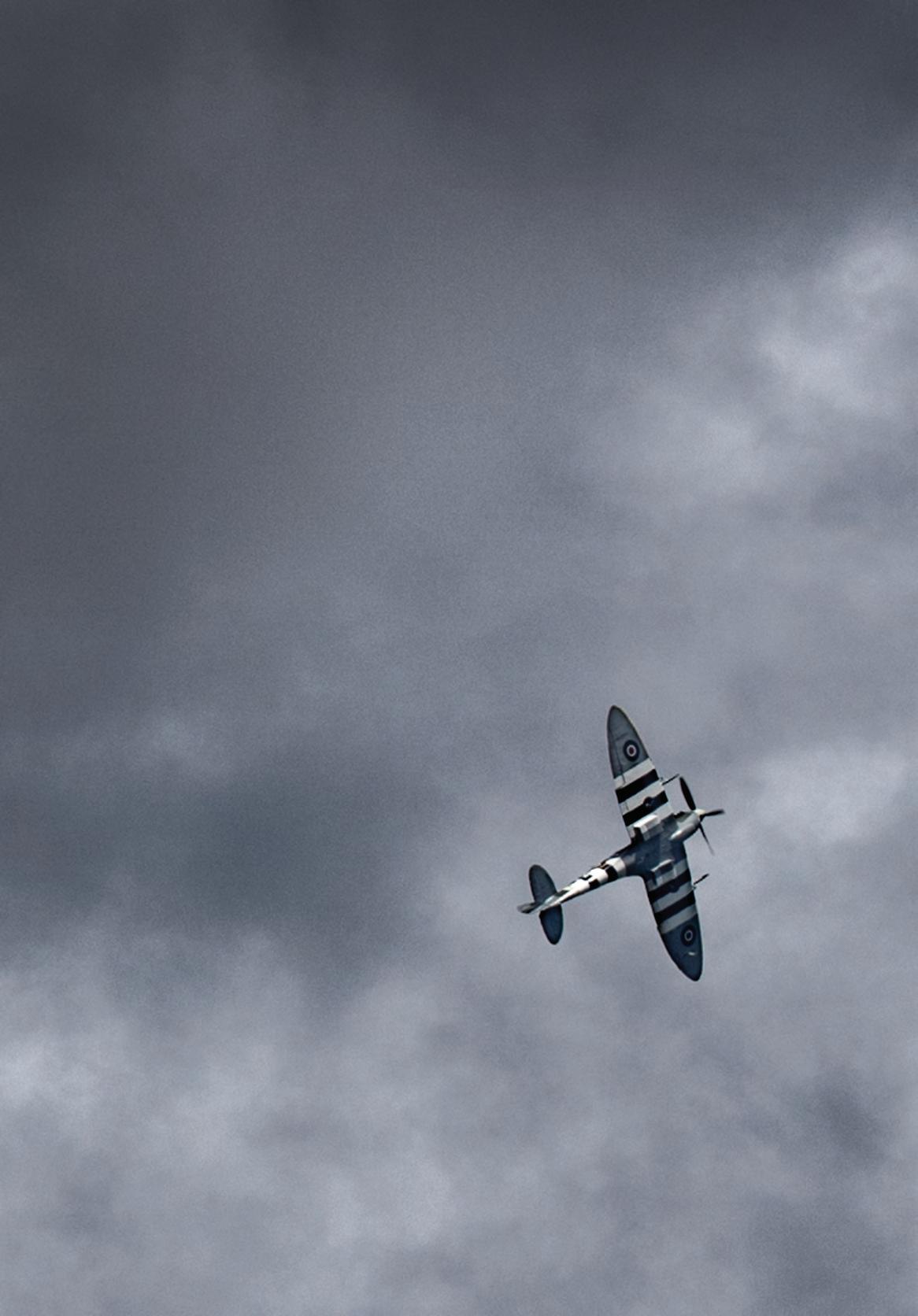
52 ICONS OF THE AIR
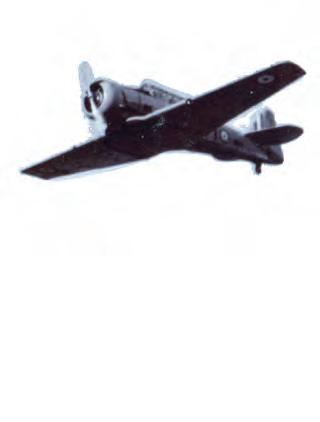
A collection of warbirds that symbolizes 100 years of the Royal Canadian Air Force
Photography and words by Stephen J. Thorne
58 REMEMBRANCE FOR ALL
A diversity of voices reflect on military sacrifice at the annual ceremony in Ottawa
By Paige Jasmine Gilmar
62 A MEMORIAL STORY
In Nanton, Alta., home of the Bomber Command Museum of Canada, Remembrance Day inspires the tale of a WW II crewman killed in action
By Stephen J. Thorne

1st Canadian Parachute Battalion Association Archives/ Bernd Horn



Vol. 99, No. 1 | January/February 2024
Board of Directors
BOARD CHAIR Owen Parkhouse BOARD VICE-CHAIR Bruce Julian BOARD SECRETARY Bill Chafe DIRECTORS Tom Bursey, Steven Clark, Thomas Irvine, Berkley Lawrence, Sharon McKeown, Brian Weaver, Irit Weiser
Legion Magazine is published by Canvet Publications Ltd.
GENERAL MANAGER Jason Duprau
EDITOR
ADMINISTRATIVE
SUPERVISOR
Stephanie Gorin
SALES/
ADMINISTRATIVE ASSISTANT
Lisa McCoy
ADMINISTRATIVE ASSISTANT
Chantal Horan
Aaron Kylie
ASSISTANT EDITOR
Michael A. Smith
SENIOR STAFF WRITER
Stephen J. Thorne
STAFF WRITER
Paige Jasmine Gilmar


ART DIRECTOR, CIRCULATION AND PRODUCTION MANAGER
Jennifer McGill
SENIOR DESIGNER AND PRODUCTION CO-ORDINATOR
Derryn Allebone
SENIOR DESIGNER
Sophie Jalbert
DESIGNER
Serena Masonde

Advertising Sales
CANIK MARKETING SERVICES
TORONTO advertising@legionmagazine.com
DOVETAIL COMMUNICATIONS INC mmignardi@dvtail.com
OR CALL 613-591-0116 FOR MORE INFORMATION

SENIOR DESIGNER AND MARKETING CO-ORDINATOR
Dyann Bernard
WEB DESIGNER AND SOCIAL MEDIA CO-ORDINATOR
Ankush Katoch

Published six times per year, January/February, March/April, May/June, July/August, September/October and November/December. Copyright Canvet Publications Ltd. 2024. ISSN 1209-4331
Subscription Rates
Legion Magazine is $9.96 per year ($19.93 for two years and $29.89 for three years); prices include GST.
FOR ADDRESSES IN NS, NB, NL, PE a subscription is $10.91 for one year ($21.83 for two years and $32.74 for three years). FOR ADDRESSES IN ON a subscription is $10.72 for one year ($21.45 for two years and $32.17 for three years).
TO PURCHASE A MAGAZINE SUBSCRIPTION visit www.legionmagazine.com or contact Legion Magazine Subscription Dept., 86 Aird Place, Kanata, ON K2L 0A1 or phone 613-591-0116. The single copy price is $7.95 plus applicable taxes, shipping and handling.
Change of Address
Send new address and current address label. Or, new address and old address, plus all letters and numbers from top line of address label. If label unavailable, enclose member or subscription number. No change can be made without this number. Send to: Legion Magazine Subscription Department, 86 Aird Place, Kanata, ON K2L 0A1. Or visit www.legionmagazine.com. Allow eight weeks.
Editorial and Advertising Policy
Opinions expressed are those of the writers. Unless otherwise explicitly stated, articles do not imply endorsement of any product or service. The advertisement of any product or service does not indicate approval by the publisher unless so stated. Reproduction or recreation, in whole or in part, in any form or media, is strictly forbidden and is a violation of copyright. Reprint only with written permission.
PUBLICATIONS MAIL AGREEMENT NO. 40063864
Return undeliverable Canadian addresses to Legion Magazine Subscription Department 86 Aird Place, Kanata, ON K2L 0A1 | magazine@legion.ca
U.S. Postmasters’ Information
United States: Legion Magazine, USPS 000-117, ISSN 1209-4331, published six times per year (January/February, March/April, May/June, July/August, September/October, November/December). Published by Canvet Publications, 866 Humboldt Pkwy., Buffalo, NY 14211-1218. Periodicals postage paid at Buffalo, NY. The annual subscription rate is $9.49 Cdn. The single copy price is $7.95 Cdn. plus shipping and handling. Circulation records are maintained at Adrienne and Associates, 866 Humboldt Pkwy., Buffalo, NY 14211-1218. U.S. Postmasters send covers only and address changes to Legion Magazine, PO Box 55, Niagara Falls, NY 14304.
Member of CCAB, a division of BPA International. Printed in Canada.
We acknowledge the financial support of the Government of Canada. Version française disponible.
On occasion, we make our direct subscriber list available to carefully screened companies whose product or services we feel would be of interest to our subscribers. If you would rather not receive such offers, please state this request, along with your full name and address, and e-mail magazine@legion.ca or write to Legion Magazine, 86 Aird Place, Kanata ON K2L 0A1 or phone 613-591-0116.
Make the most of your Legion Membership
As a Legion Member, you take pride in the fact that your membership helps support and honour Canada’s Veterans.
Did you know that it comes with benefits you can use, too? Take advantage of all the benefits that come FREE with your membership.

Renew your membership to get all these benefits and more!
MemberPerks® unlocks $1000s in potential savings on offers and deals at stores and restaurants across Canada, including national chains, local businesses and online stores. Use the MemberPerks® app, print out coupons or shop online to save on electronics, travel, fashion, entertainment and so much more!
Your membership also gives you access to additional benefits, including:
• savings and deals from our Membership Partners
• a paid subscription to Legion Magazine
• exclusive members-only items at PoppyStore.ca

Symbolic
meaning
“In
these places, recalling history has an exceptional value. Today, the burial and memorial sites of the First World War have become places of contemplation and celebration of the memory of the dead, the symbolism of which glorifies peace and reconciliation.”
“ THIS RECOGNIZES THE GLOBAL IMPORTANCE OF THESE SILENT CITIES TO ONGOING COMMEMORATION OF THE WAR DEAD.”
So said UNESCO last September upon announcing the inclusion of 139 First World War cemeteries and battlefields in France and Belgium in its list of world heritage sites.
And while the United Nations Educational, Scientific and Cultural Organization’s designation doesn’t make the locations any more important, it does serve to remind regular people the world over of the sacrifices made on these hallowed grounds more than 100 years ago—and the importance of remembrance.
The Canadian National Vimy Memorial, the Beaumont-Hamel Newfoundland Memorial and the St. Julien Canadian Memorial are among the sites with Canadian and Commonwealth connections.
“I find those cemeteries very powerful places, sites of memory and sites of mourning,” Tim Cook, chief historian at the Canadian War Museum in Ottawa, told the Ottawa Citizen following the announcement.
“You feel the weight of history there. I’ve never met a Canadian who hasn’t been physically moved by the experience,” said Cook. “The cemeteries have always held a significant and a haunting place in the Canadian imagination.”
The sites are all located on the Western Front of the 1914-1918 Great War, and vary in scale from large necropolises, with the graves of tens of thousands of soldiers of numerous nationalities, to smaller, discrete cemeteries and even singular memorials.
The proposal for the UN designation, which recognizes places of “outstanding universal value to humanity” and deserving of protection “for future generations to appreciate and enjoy,” was made by Belgian and French officials. It includes 51 areas managed by the Commonwealth War Graves Commission, such as the Menin Gate (Ypres) Memorial that bears the names of more than 54,000 soldiers whose graves are not known, and the Tyne Cot Cemetery where the nearly 12,000 burials make it the largest Commonwealth war graveyard.
“We are thrilled that a significant number of our iconic cemeteries and memorials along the former Western Front have been awarded world heritage status,” said Claire Horton, the commission’s director general.
“This recognizes the global importance of these silent cities to ongoing commemoration of the war dead,” continued Horton, “and brings with it significant, and tangible, benefits—not least the opportunity to engage wider and more diverse audiences.”
Indeed, in a day and age more than a century later when such memorials are being vandalized in protest of non-related social issues, politicians are increasingly unaware of wartime history and Canadians at large seem apathetic to the country’s military, such recognition can be integral in reminding all of the sacrifices our forebearers made in the name of peace and prosperity.
“Anything that is done to recognize the service and sacrifice of our soldiers during the First World War and after, it’s very important,” historian and author Frank Gogos told the Citizen. “And, of course, it’s all about commemorating our dead so that we don’t forget the atrocities of war.” L





It Injustice
was with great sadness that I learned of the passing of Jess Larochelle (“Obituaries,” November/December). Jess was a true Canadian hero who deserved much more than he received. I was also disappointed to read that the push to get his Star of Military Valour upgraded to the Victoria Cross was thwarted by a technicality. I wonder how many technicalities
The government’s failure to review Jess Larochelle’s commendation for bravery and to consider it be upgraded to a Victoria Cross revulsed me. How a technicality, such as “nominations for bravery decorations must be submitted within two years,” should negate Larochelle’s qualifications for the highest order, defies belief. We are talking about a true Canadian hero’s devotion

Comments can be sent to: Letters, Legion Magazine , 86 Aird Place, Kanata, ON K2L 0A1 or emailed to: magazine@legion.ca
Larochelle overlooked that day when he single-handedly saved so many lives of his pinned down company all while being severely wounded himself? Technicalities are created by, and changed by, the federal government of Canada. Tell your MP you want the application for Larochelle’s upgrade to be revisited.
EPPY M c RAE NEWBURY, ONT.
to duty under the most horrific circumstances now being judged by a Directorate of Honours and Recognition acting on the faceless direction of a military edict.
As a Canadian veteran, I’m ashamed of the current condition of Canada’s military. The lack of funding by the government is responsible for the degradation of the country’s standing force. The good news is that Canada
still has heroic patriots such as Larochelle. The bad news is the nation doesn’t know how to honour them properly. Sadly, Larochelle passed away at age 40, no doubt in part at least because of his war injuries. All the more reason his memory should be perpetuated and saluted, posthumously, with Canada’s highest military honour.
RICHARD KISER
CALGARY


Re repatriation
In the November/December issue, Paige Jasmine Gilmar made the case for repatriating Canada’s war dead (“Face to face”). While I have no concerns with repatriating bodies today, I think Gilmar overlooked many important points of world wars-era repatriation. My father was shipped overseas before I was born and died in 1944 on my parent’s seventh wedding anniversary. The last thing my mother was concerned about was flying a body across enemy-held territory or shipping it across enemy-infested seas. It was far more important to have food and fuel. Grief psychology has a place, but when a country is at war, there are far more important matters to consider than where a body is buried.
PETER GOWER KINGSTON, ONT.
Out of date
One of the greatest pleasures of being a member of The Royal Canadian Legion is receiving Legion Magazine. It has much information about well-known aspects of Canada’s military history and even more interesting items about lesser-known events. However, as of late, I find the “On this date” section to be wanting. For example, the November/ December edition had information on only 17 of 30 dates in November. This is understandable, as there is only so much space in the magazine. My concern, though, is the actual content.
Of the 17 dates, only three have a connection to Canada’s military history. The others don’t fit the magazine’s “Canada’s military history” tagline. We have an extensive military history. I’m sure there is at least one event in every date of the year where something related to Canada’s military happened.
G. PAUL KARCHA
WOLFVILLE,
N.S.







Teslica Inspire N1S
Fan mail
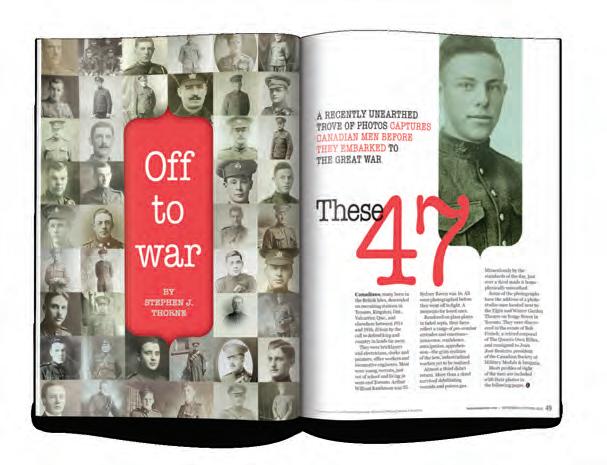
I wanted to thank Legion Magazine for the varied and wonderful articles. I first began reading the magazine because my dad, Garnet Sproule, a WW II vet, always received it. He loved the “Humour Hunt” section and the “Last Post.” When I became a social studies and history teacher, I used many of your articles and encouraged students to find out more about veterans in their families. The September/ October 2023 issue was deeply moving. The pictures and biographies of the men captivating.
JANE SPROULE GIBSONS, B.C.
Just over two years ago while at a dentist appointment, I happened upon an issue of your fine magazine. I subscribed later that evening. Whether it is page 1 or page 100, the stories ring true through every issue. These men and women
are owed a debt beyond just gratitude, rather it should be an apology from every Canadian who has, in one way or another, disparaged the country’s military. The experiences shared, painfully in many instances, speak volumes about the valour and integrity the fraternity of warriors we begrudgingly acknowledge all too infrequently. The phrase is often overused, but in sincerity say to you all “Thank you for your service.” A special nod to all those who contribute, in whatever fashion, to mold this endeavour into the polished magazine it is.
JOHN B. KEYLOR GLACE BAY, N.S.


Exclusive HIGHLIGHT from LegionMagazine.com
Railways played an integral role in many parts of the Second World War. From carrying soldiers and munitions to the front or people to safety, trains kept the war effort moving. Some were a sign of death, while others were a sign of health and hope. The latter were hospital trains. Not unique to WW II, though they were instrumental in saving lives in history’s deadliest conflict. A new book, A Different Track: Hospital Trains of the Second World War, by Alexandra Kitty, introduces
readers to the nurses who ran them and the factories that built them. At www.LegionMagazine.com
you can read an excerpt from the book and be transported to a little-known facet of the war.
Every week, the magazine’s website publishes exclusive content, including the “Front Lines” blog by staff writer Stephen J. Thorne and “Military Milestones” by staff writer Paige Jasmine Gilmar. Thorne’s missives delve into important happenings in the military

Legion and Arbor Alliances
Get notified of all the latest updates on legionmagazine.com by signing up for our weekly e-newsletter at www.legionmagazine.com /newsletter-signup
world, ranging from hunting down unmarked graves to what happens to recovered Nazi artifacts. Gilmar’s entries, meanwhile, explore significant moments in Canada’s armed history, for example, Victoria Cross recipients such as Philip Eric Bent and Colin Fraser Barron or the early struggles of the country’s navy. Plus, there are special posts, like Kitty’s excerpt. Visit www.LegionMagazine.com to read past posts or sign up for the weekly e-newsletter so that you never miss the latest content. L
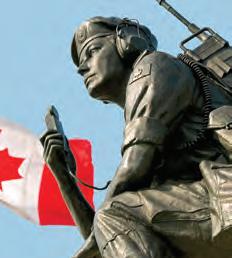
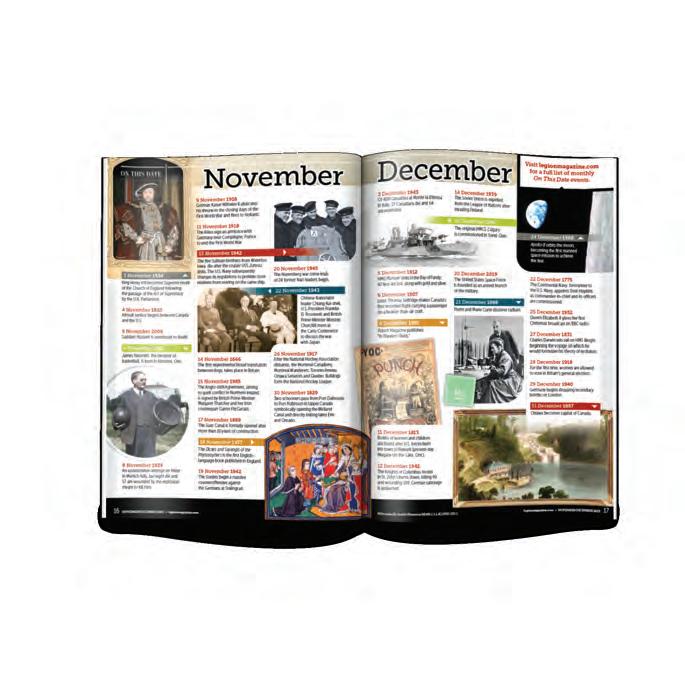
January
21 January 1945
Maj.-Gen. William A. Griesbach, Canadian-born veteran of the Boer and First and Second world wars, dies.

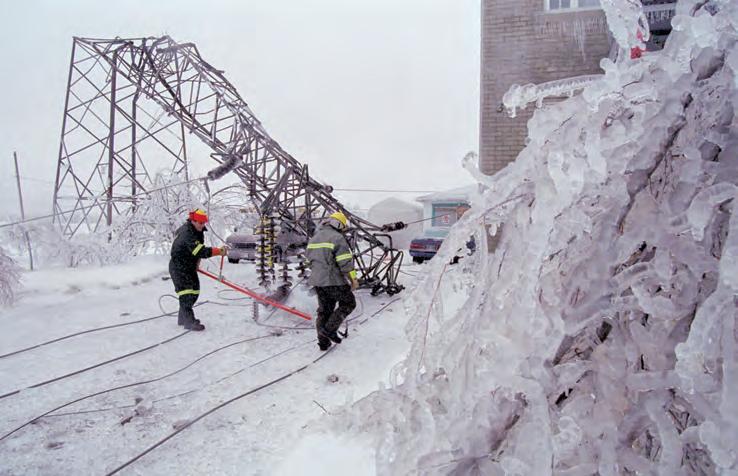
5 January 1998
Ice storm knocks out electricity in Quebec and Ontario.
7 January 2009
Trooper Brian Richard Good is killed and three other Canadian soldiers wounded by an improvised explosive device north of Kandahar, Afghanistan.
8 January 1916
Allies complete the withdrawal of troops from Gallipoli.
9 January 1953
Marguerite Pitre, the last woman executed in Canada, is hanged in Montreal for abetting the bombing of a passenger plane.
11 January 1922
22 January 1944
Allied forces establish a beachhead at Anzio, Italy.
23 January 1943
No. 164 Squadron, RCAF, is formed in Moncton, N.B.
25 January 1945
The Battle of the Bulge ends.
13 January 1942
Canadian fighter pilots arrive in Singapore, part of a force of 50 Hawker Hurricanes.
15 January 2006
A Canadian diplomat is killed and three Canadian soldiers are wounded after a suicide bomber strikes a military convoy near Kandahar, Afghanistan.
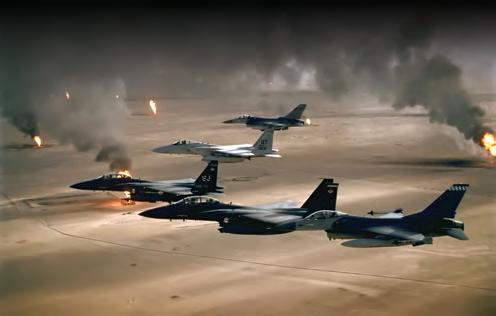
17 January 1991
Operation Desert Storm is launched against Iraqi forces occupying Kuwait.
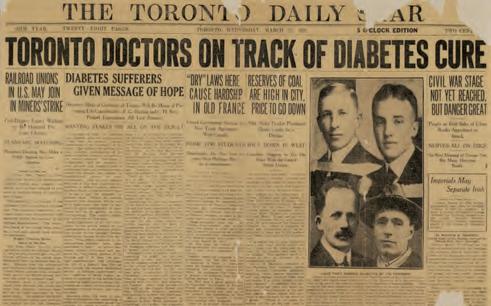
Canadian Frederick Banting uses insulin to treat diabetes in humans for the first time when he injects 14-year-old Leonard Thompson.
18 January 1995

27 January 1916
Manitoba is the first province to give women the vote and the right to run for office.
28 January 1973
Canada begins sending military personnel to Vietnam under the International Commission for Control and Supervision.
29 January 1942

A film is broadcast of a disturbing hazing by the Canadian Airborne Regiment at Canadian Forces Base Petawawa in Ontario.
19 January 1989
Canada’s first female combat soldier, Heather Erxleben, completes her training at CFB Wainwright, Alta.
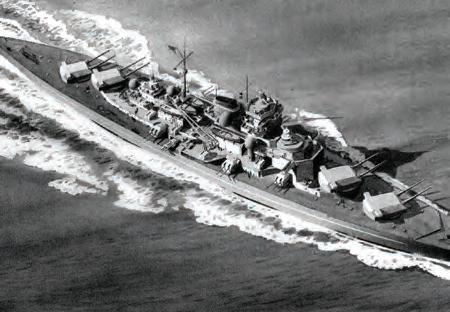
Eight Royal Canadian Air Force members are among those killed in the first bombing raid on the German battleship Tirpitz

February
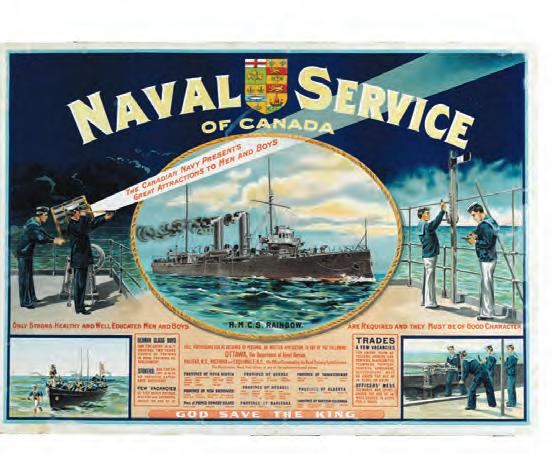
1 February 1911
Recruiting posters for the Naval Service of Canada are displayed in post offices across Canada for the first time.
2 February 1943
German forces surrender at Stalingrad.
3 February 1942
The Canadian Women’s Auxiliary Air Force is renamed the RCAF Women’s Division.
4 February 1945
I Canadian Corps departs Italy to support the Allied advance in Northwest Europe.
5 February 1944
12 February 1918
Lieutenant Hugh McKenzie’s posthumously awarded Victoria Cross for action at Passchendaele is announced in The London Gazette
13 February 1988
The Calgary Winter Olympics officially open.
14 February 1940
No. 110 Army Cooperation Squadron sails from Halifax for Britain.
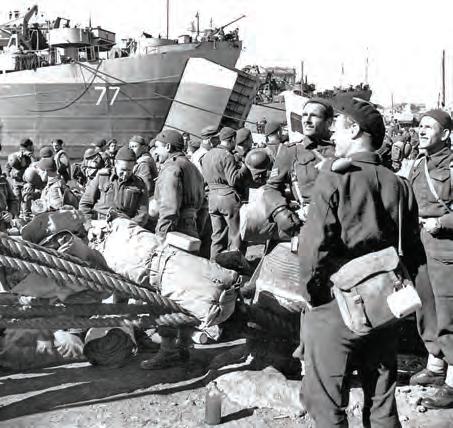
A German mortar kills 19 members of The Perth Regiment near Ortona, Italy, as they line up for supper.
7 February 1813
U.S. riflemen raid Elizabethtown, Upper Canada (present-day Brockville, Ont.). They free prisoners, seize stores and take 52 hostages.
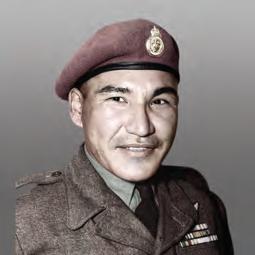
8 February 1944
Near Littoria, Italy, Tommy Prince, disguised as a farmer, fixes a broken communication wire right under enemy noses (see “O Canada,” page 96).
16 February 1944
In Burma, a wounded Major Charles Hoey leads his company under heavy machine-gun fire to capture a vital position; he is posthumously awarded the Victoria Cross.
17 February 2002
HMCS Ottawa joins the Canadian Naval Task Group, part of the multinational anti-terrorism campaign in the Persian Gulf.
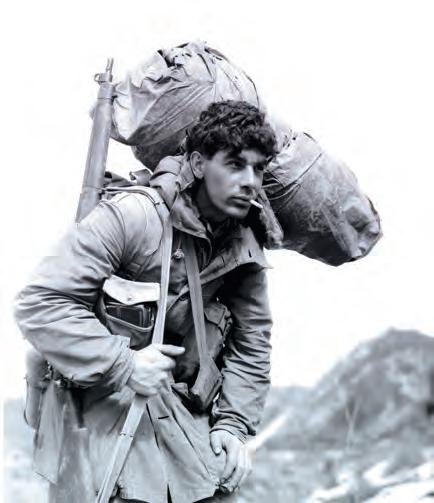
21 February 1951
The Princess Patricia’s Canadian Light Infantry advances through snow and rain north of the village of Sangsok in Korea.
24 February 1944
While escorting a convoy, the Canadian frigate Waskesiu sinks U-257 in the North Atlantic.
25 February 1932
Austrian immigrant Adolf Hitler gets German citizenship.
26 February 1938
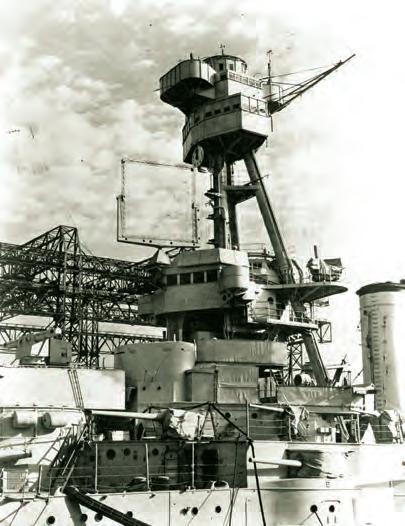
The battleship USS New York is outfitted with the first true radar device.
By Paige Jasmine Gilmar
Musical Medicine
How music therapy helps heal veterans

1999’s
youngsters grew up to a distinctly North American musical craze, which wasn’t the ragged bliss of grunge, nor the urban poetry of hip hop. For many who were born at the end of the 20th century, the fad that gave them their first taste of song was not a revolutionary new genre, but a classical one. It was dubbed the Mozart effect. It all started in the spring of 1993 at the University of California, Irvine. Researchers curious about the relationship between music and memory launched a study analyzing the effect the renowned classical composer’s music has on the brain. After playing 10 minutes of Mozart’s
“Sonata for Two Pianos in D major, K. 448” for one set of participants and silence or relaxing sounds for another, the researchers tested the spatial-reasoning skills—the ability to think about and manipulate objects in three dimensions—of both groups. Project lead Francis Rauscher and his team made a startling discovery: participants who listened to Mozart showed a sizable increase in spatial reasoning for 10-15 minutes afterward.
Though the study was quick to point out that the impact was both modest and temporary, the media mutated the Mozart effect into a panacea, with parents and journalists alike purporting that children listening to classical music could increase their IQs, grade point averages or even the possibility of getting into university.
Still, the study brought widespread credence to the age-old belief that music can positively affect a person, inspiring a new fascination for music therapy programs and music research. Without the Mozart effect, music programs such as Music Healing Veterans Canada (MHVC) might never have been created.
“The demand was there,” said Jason Costello, the organization’s co-founder and national director, “and we believed we could help.
“The best reviews I have gotten are from members who have credited the program with saving their lives,” said Costello, “giving them a tool to cope with issues they are experiencing.
Founded in 2016 by Costello, Brian Doucette and a group of Canadian Armed Forces members, the healing program uses the side effect-free medicine of music for active and retired military members ranging in age from mid-20s to mid-70s, as well as first responders, medical providers and personnel from the Correctional Service of Canada and Canada Border Services Agency.
“The variety brings such a value to the room,” said Ottawa chapter lead and veteran Ken Fisher.
Conceived from the bare-bones formula of get up, get out and play, the program consists of meeting once a week in the evening to decompress with a like-minded group and receive music instruction from a thoroughly vetted music instructor.

But the sensationalism slowed down when the public realized that enhanced spatial reasoning simply came from “enjoyment arousal.” So, if someone didn’t like Mozart’s music, they would be immune to the effect and, by the same token, someone enjoyed listening to, say, Led Zeppelin, they would experience a Led Zeppelin effect. It all came down to personal preference, because what an individual likes what mentally stimulates them.
“It’s a safe environment,” said Fisher. “Everybody understands that people are there for their own reasons.”
With three Ontario chapters— Kingston, Ottawa and Upper Ottawa Valley—and a fourth in North Bay in the works, Music Healing starts participants with a loaner guitar and a 10-week beginner program to cement the foundational knowledge of playing an instrument. Once that’s complete, the musicians can continue attending classes, jam with others and perform live if they
wish. The project is non-clinical, but its priority is tapping into music’s innately therapeutic value.
“I can tell you that music makes a difference,” said Fisher.
Indeed, numerous studies have proven that learning to sing or play a musical instrument can lower blood pressure and slow heart rates, combat cognitive decline and decrease the effects of dementia, arthritis, pulmonary disease, Parkinson’s, depression, anxiety, insomnia and more. Playing an instrument can even help fend off viruses and heal injuries faster, with consistent musical training permanently restructuring the brain for the better in most cases.
“When you’re in pain all day, it’s tough to be in a good mood all the time,” said Fisher, who has dealt with operational stress injuries himself after serving for 40 years on the regular force. “So, when I’m at Music Healing, I think it’s the fun part of my day.”
Group music lessons can be particularly effective for the psychological wellness of veterans and first responders, since research has proven that situations that safely simulate service—such as working with a group to achieve a collective goal—have therapeutic benefits.
“I miss the camaraderie that I had when I was in the forces,” said Fisher. “But at Music Healing, everybody understands that people are there for their own reasons. I don’t have to worry about people judging. I don’t have to explain anything to anybody.
“Usually, I’m the loudest singer, and I probably have the worst voice. But nobody says, ‘Shut up.’ Nobody says, ‘Hey, you can’t sing.’”
Sponsored by Spartan Wellness, a medical cannabis program serving veterans, first responders and donations from the public, Music Healing subsists off the generosity of local communities and businesses to support some 300 participants. While the initiative is not actively looking
to expand, Fisher said the Ottawa chapter is in the process of forming a partnership with the University of Ottawa’s music department.
The school plans to offer piano lessons for 18 Music Healing students while surveying the health impacts. So, while playing a musical
instrument might not guarantee a higher IQ, it does help some veterans in a meaningful way.
“I hate going out of the house, and I don’t want to leave the house on Thursday night,” admitted Fisher, “but when I get to Music Healing, I wish I could stay there forever.” L

War words
How we talk about fighting and remembrance
The language of war and remembrance is couched in euphemism, hyperbole and a healthy dose of gilded lilies. In short, a lot of overused words and hackneyed phrases that tend to glorify and obfuscate, comfort and satisfy.
In war, politicians and military mucky-mucks use alternative language to soften the reality of, or maintain support for, humankind’s greatest failure—phrases or words such as “collateral damage” for civilian casualties, “enhanced interrogation techniques” for torture, “ethnic cleansing” for genocide, and “conflict” for war.
The remembrance period is rife with such well-worn words as “sacrifice,” “bravery,” “noble,” “heroes” and that most-misunderstood of phrases, “lest we forget”—old-reliables delivered with great solemnity, earnestness and gravitas; take-homes that make people feel good about their societal debts for another year.
Most of these terms and phrases emanate from 1914-18, the first industrialized war, when combatants and non-combatants were killed in unprecedented numbers.
The scale of death and destruction, the sight of disfigured survivors in the streets of cities and towns awakened the general public to the horrors of war.
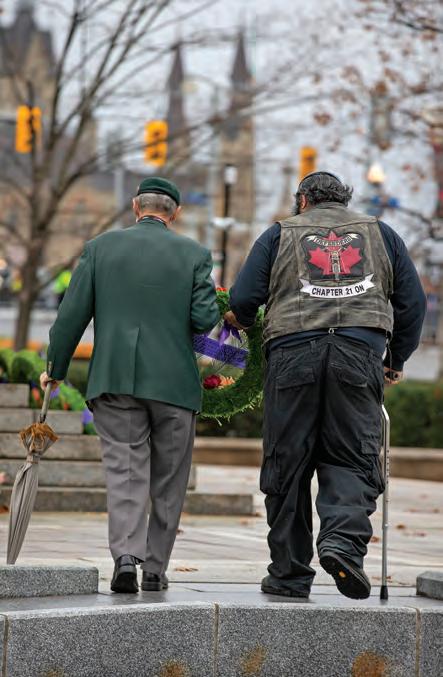
Bill Black (left), representing Korean War veterans, and James Sookbirsingh of the Submariners Association of Canada place a wreath at the National War Memorial on Remembrance Day 2020.
The “war to end all wars” also transformed war art and literature, far less of which glorified the subject in the aftermath of 20 million wartime deaths, the Erich Maria Remarque book, All Quiet on the Western Front a prime example.
But the Great War didn’t alter the language surrounding it.
The first Armistice Day was observed in 1919 after King George V circulated a Nov. 9, 1919, letter throughout the Empire calling on its dominions and territories to mark “the victory of right and freedom” and for “the brief space of two minutes, [make] a complete suspension of all our normal activities.”
This was to happen at the precise moment the Armistice ended the fighting—the 11th hour of the 11th day on the 11th month.
“During that time, except in rare cases where this may be impractical, all work, all sound
and all locomotion should cease, so that in perfect stillness the thoughts of every one may be concentrated on reverent remembrance of the glorious dead.”
And so, a tradition was born.
Of course, silence wasn’t enough. People had to talk—and not usually the people who were there but, most often, the people who sent them, and their ilk. There were politicians and preachers, poseurs and potentates.
The language was still laced with Old World ideas and phrases— the oratorical equivalent of a 19th century painting dripping with shredded battle flags and glory, rooted in a time when Britannia ruled the waves and half the world with an iron fist and navy rum.
Even the phrase “lest we forget” has its roots in ancient Biblical tradition.
“Only take heed to thyself, and keep thy soul diligently,”

says the King James Bible version of Deuteronomy 4:9, “lest thou forget the things which thine eyes have seen, and lest they depart from thy heart all the days of thy life: but teach them thy sons, and thy son’s sons.”
In 1897, Rudyard Kipling borrowed the concept in his poem “Recessional,” written for Queen Victoria’s Diamond Jubilee: Lord God of Hosts, be with us yet,
Lest we forget—lest we forget!
“Lest we forget” soon became the rallying cry for, not just Nov. 11, but what became the annual period of remembrance leading up to it. Somebody forgot, however, because in 1939 they did it all over again— a world war, that is—and this time some 53 million people died. Those speeches didn’t change and neither did the escalating cycle of war. The weapons became more
efficient, the causes more obscure, the atrocities almost mundane to an increasingly uncaring world. And, still, the language remained the same.
The speech makers would have you believe the warriors died gloriously for king and country, freedom and democracy. The fact is, many signed up not knowing what they were getting themselves into and, in the end, most fought for a more personal, indeed intimate, reason: They couldn’t, in their heart of hearts, let down the men on either side of them. That commitment, and those bonds, are deep and everlasting—a connection that only they can know.
As time passed and societal mores evolved, veterans became more candid, forthright and unvarnished in their recollections of war and their attitudes toward it.
Literacy, once the domain of the more educated officer corps, had become common by the First World War and the rankand-file wrote more explicit letters, memoirs and histories.
Media coverage of the Vietnam War brought the public to the front lines and perceptions of war evolved. Still, the language of remembrance did not.
It has been shown that a large proportion of present-day Canadians know relatively little of the country’s military history or the events that perpetuated it, and the deficit in historical awareness isn’t unique to this country.
The question is, how does a society remember something for which it has no knowledge?
The answer, it seems, lies in those same ancient texts: “Teach them thy sons, and thy son’s sons.” And daughters. L

By David J. Bercuson
Picking priorities
When will the federal government focus on defence?
Ifthere is anyone left in Canada who still believes the current government has any understanding of the importance of defence for the country, Sept. 28, 2023, should set them straight. Governments usually reserve late-week business for announcements they hope will get little attention and this one was no exception.
On that day, defence chief General Wayne Eyre and Deputy Minister of Defence Bill Matthews told the Commons defence committee that the national defence budget would be cut by about $1 billion, just as other departments will also cut their budgets in an effort to tackle the country’s
estimated $40-billion deficit for fiscal 2023-24 and the accumulated $1.13-trillion federal debt.
Coincidentally, former defence minister Anita Anand is now in charge of making this nation’s budget problem go away as the president of the Treasury Board, a position she assumed after a summer 2023 cabinet shuffle. Anand announced that she would be seeking $15 billion in cuts from departmental budgets during the next five years, a tiny fraction of Canada’s national debt.
Okay, she has to start somewhere, especially with such a profligate government. According to the Fraser Institute, Prime Minister Justin Trudeau’s Liberal
government has logged the five highest years of per-person spending in the country’s history. But given the state of the national defence budget, and the huge shortfall between what Canada needs to spend both to improve continental defence and to help strengthen NATO in the face of Russia’s aggression against Ukraine, any cuts to the defence budget are astounding.
At a meeting this past July, NATO members agreed that they must each spend “at least two per cent” of their gross domestic product on defence. Canada, represented by the prime minister himself, endorsed the resolution, despite reports that indicate he proclaimed months previously that the country would never achieve the spending target.
How does he know that? His government made the choice. And he chose long ago to make defence spending optional. Deciding not to raise the defence budget
Canadian Armed Forces personnel helping to train Ukrainian soldiers gather in the U.K. to commemorate the one-year anniversary of Russia’s 2022 invasion.
is not pre-ordained by some existential power or authority. It happens because people in power make the decision. Choices are made to spend money on health, dental and child care, and to compensate Indigenous Peoples for past wrongs, among other governmental priorities.
These may be perfectly worthwhile policy choices when a government is properly administered, when there are surpluses, when there is room to manoeuvre, when one item can be delayed a year or two or three, while another item is addressed sooner. And in the case of defence, which is one of the main reasons to have an organized government, all other choices must be second.
This is a fact that Canadian governments have forgotten since well before the end of the Cold War when Canada started
increasingly relying on the U.S. for its defence. In essence, that habit is a huge subsidy that the Americans hand Canada every year. Canadians sing about “The true North strong and free,” but it’s the Yankees who help pay for it and free up money for Canada to spend on other priorities.
On the current government’s list of spending choices, defence is not high. It seems as urgent as say, spending on national parks. If the budget for Parks Canada is going to get cut, why not defence as well? Spread out the pain that the government itself caused because of its own reckless accounting. So, it delays purchases that must be made now, and waits
to make them a decade later when the costs increase. Or they put, for instance, the country’s already out-of-date submarines into dry dock for refits. As far as the current government seems to be concerned, defence is nice to have, not need to have. So, if there are other ways to spend money, they will come first.
It is seriously time for NATO —and the U.S.—to put real pressure on the Canadian government. From sanctions to trade embargoes, Canada deserves the whipping it would surely get. And if Canadian citizens don’t enjoy the punishment, there will be another election sooner or later. L
Hearing loss can change much more than how you hear and perceive the world. Hearing aids support your brain by helping it to process sound, keeping you mentally stimulated,


By Alex Bowers
CANADIAN THE GODDAMNED BRING US
How Canadian officers seconded to the British Army under the Canloan program fought for their comrades—and respect
HEAPS
LIEUTENANT LEO HEAPS, drifting gently from the heavens in his parachute over the Netherlands, felt he shouldn’t be there.
Above him an early afternoon sun shone brightly that Sept. 17, 1944. Below, the fields of Wolfheze—a Dutch village—were bursting with sunflowers, their sight catching the 21-year-old Canadian officer’s eye.
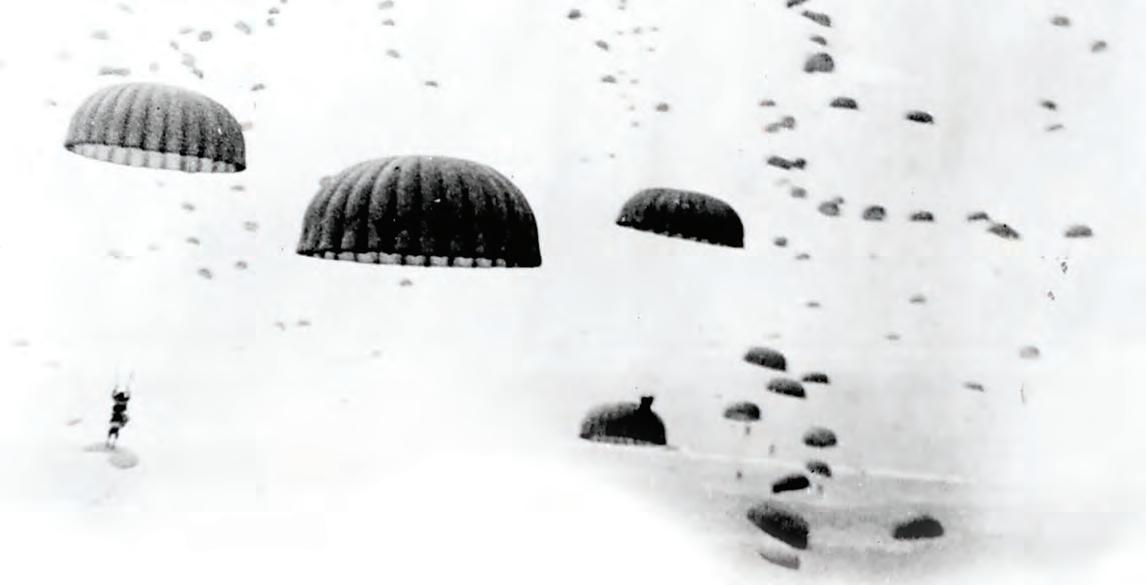
All seemed relatively quiet. No enemy gunfire; just the droning sound of innumerable C-47 transport aircraft dropping their cargo of airborne troops sent into action for Operation Market Garden.
Except Heaps of Winnipeg was neither on a Canadian mission nor even under Canadian command. This was the British 1st Battalion, Parachute Regiment, a part of the 1st Airborne Division.
And it was his first jump, ever.
Things started to unravel— literally—when Heaps’ kit bag broke loose, showering his belongings across the countryside. He then realized his trajectory was sending him toward a cluster of pine trees, their uninviting branches edging ever closer.
But it was too late.
In a sense, however, Heaps was not alone.
He, like 672 other Canadian officers seconded to the British Army under the Canloan scheme, was indeed exactly where he needed to be—even if his immediate circumstances were less than ideal.
By the fall of 1943, following a succession of costly campaigns, British forces had been plunged into an acute labour crisis. Authorities needed to fill the ranks of lieutenants and captains. No stone was left unturned.
The expansion of the Canadian Army, meanwhile, had created a surplus of junior officers, a situation caused by an almost too efficient promotion system and the disbandment of home defence formations.
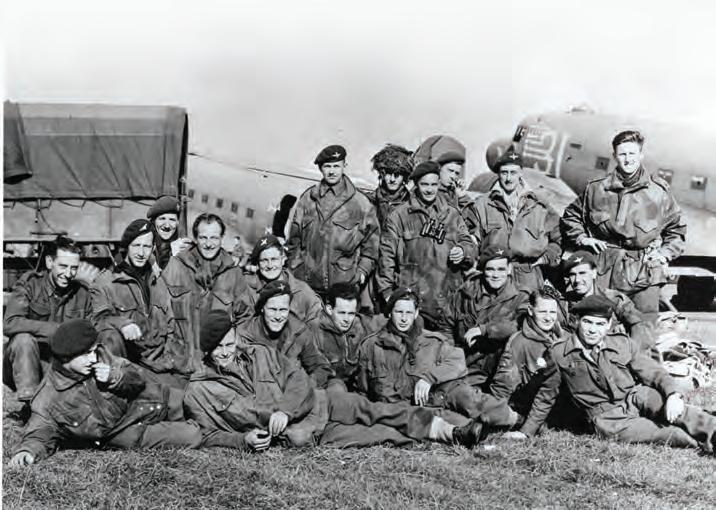
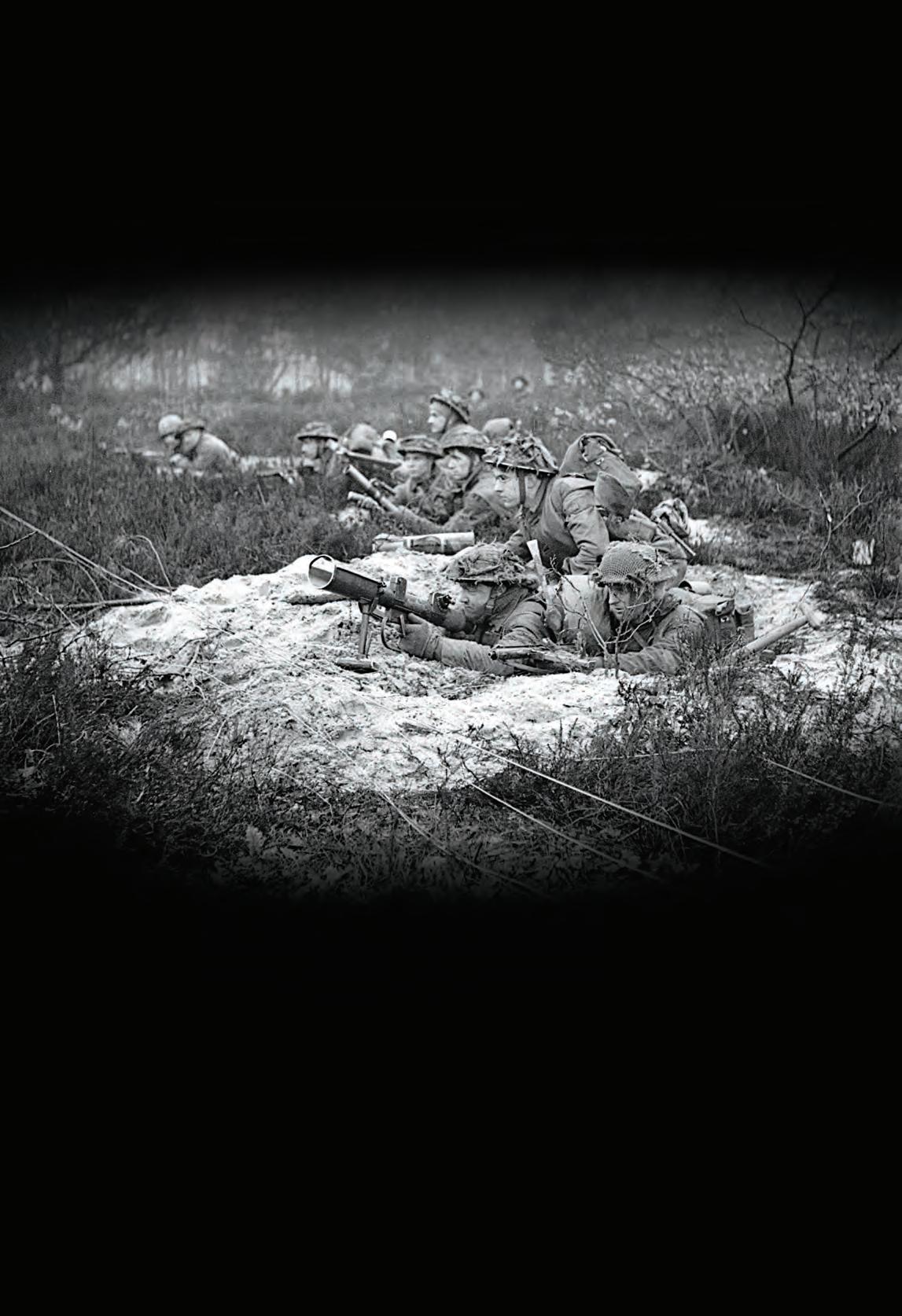
Paratroopers of the 1st Airborne Division (left), including Canadian Lieutenant Leo Heaps (below, standing far right), descend over the Netherlands in September 1944. Several Canadian officers similarly served under the Canloan program with other British units such as the 15th (Scottish) Infantry Division, shown here near Nijmegen, Netherlands, in February 1945.
It seemed only a matter of time before one of those stones was used to kill two birds, realized in full in September 1943, when Ottawa requested that the Canadian Military Headquarters in London determine whether the British Army could absorb any of these officers.
Ultimately, both countries came to an agreement.
The primary condition laid out by the British was that the bulk of the transferred officers would be subalterns (below the rank of captain), although a proportion could be captains at a rough ratio of 1:8 in favour of lieutenants.
For the Canadians, there were several conditions: that the Canloan scheme be entirely voluntary; that officers should be loaned with the understanding that they could be recalled if required; that Canada should be responsible for pay; that age limits should meet Canadian Army criteria; that their service be restricted to the European and Mediterranean theatres (excluding a few exceptions to the rule further down the line); and that Canada would select volunteers that the British Army would accept without question.
It was likewise agreed that any junior officer deemed worthy of promotion could rise through the British ranks, and any deemed unsuitable for service could be returned to the Canadian Army after a trial period.
Given estimates suggesting up to 2,000 potential candidates, not only infantry, but also a small number of ordinance officers, there were high expectations for the initiative and calls went out across the country. Many answered.
That didn’t alleviate the inevitable culture shock. Fendick and his colleagues occasionally misunderstood each other’s accents and turns of phrase.
FENDICK
LIEUTENANT REGINALD (REX) FENDICK
of The Saint John Fusiliers (Machine Gun) walked through the mess doors in Prince George, B.C., to a commotion.
All he had wanted was a hot drink and a bedtime snack after enduring hours on the bus from leave in Vancouver. Now, he was being asked if he wanted to join the British Army, a strange turn of events that Sunday in March 1944.
Tired of home defence duties and the National Resources Mobilization Act conscripts (nicknamed “zombies” for their unwillingness to serve overseas), it seemed like the perfect opportunity for someone like him.
The reasons for participating in the program, of course, differed between officers—be they naturalborn Canadians, Americans who had crossed the border, or even Britons who had emigrated prior to the war. However, as a rule of thumb, boredom and disillusionment with service in Canada were leading factors in the decision-making process, often coupled with the
fundamental desire to be part of the invasion of Western Europe.
Thus, the New Brunswicker was gone by the end of the month—along with five of his willing comrades—en route to Camp Sussex in his home province.
There, a facility designated A-34 Special Officers’ Training Centre had been established as an intensive, three-week refresher course commanded by Brigadier Milton Gregg, a WW I Victoria Cross recipient.
The centre’s syllabus stressed physical fitness, weapons training, night operations, field works— including mines and booby traps— infantry tactics, leadership and personnel management. Additionally, officers were expected to have a basic grasp of British regimental traditions and even mess etiquette.
Fendick was far from the only individual to find the instruction tedious, even if Gregg was highly respected.
It was during Fendick’s time at Sussex that he met Leo Heaps, feet planted on a desk as he tore folded paper to create a string of paper dolls. “If they’re going to treat us like
children,” Heaps reasoned, “we may as well behave like children.”
Still, the refresher course at A-34 served its purpose, providing Canloan officers with an opportunity to hone their skills and bond before departing for Britain in nine groups or “flights.”
Fendick joined the largest group of 250 officers on May 3, comprising the entire second intake, and arrived in Liverpool on May 11. From there he travelled to the Grand Central Hotel in the Marylebone area of London.
“We were assembled in a large lobby…with many small tables set up around all sides of the room, each manned by one or two British staff officers and clerks,” the young Canadian lieutenant later wrote.
“Each table had a sign over it, naming one or more British regiments. We were invited to go to the table of our choice, where we were told which regiments and battalions had vacancies, and we were invited to choose our unit.”
Pleased to find space in the King’s Own Scottish Borderers, which was affiliated with his former Saint John Fusiliers, Fendick
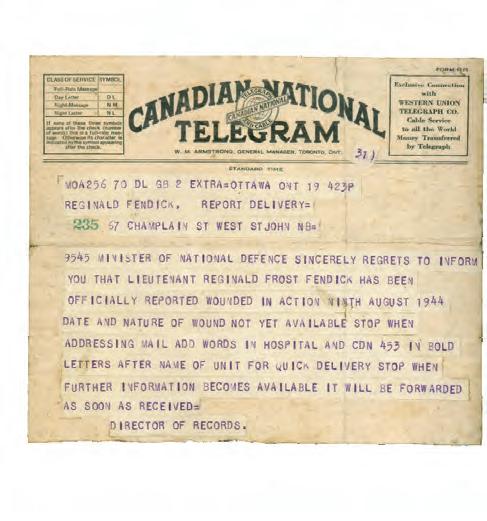
Lieutenant Reginald (Rex) Fendick served with the King’s Own Scottish Fusiliers under the Canloan program. He was wounded in August 1944, but recovered and fought again in the Korean War.
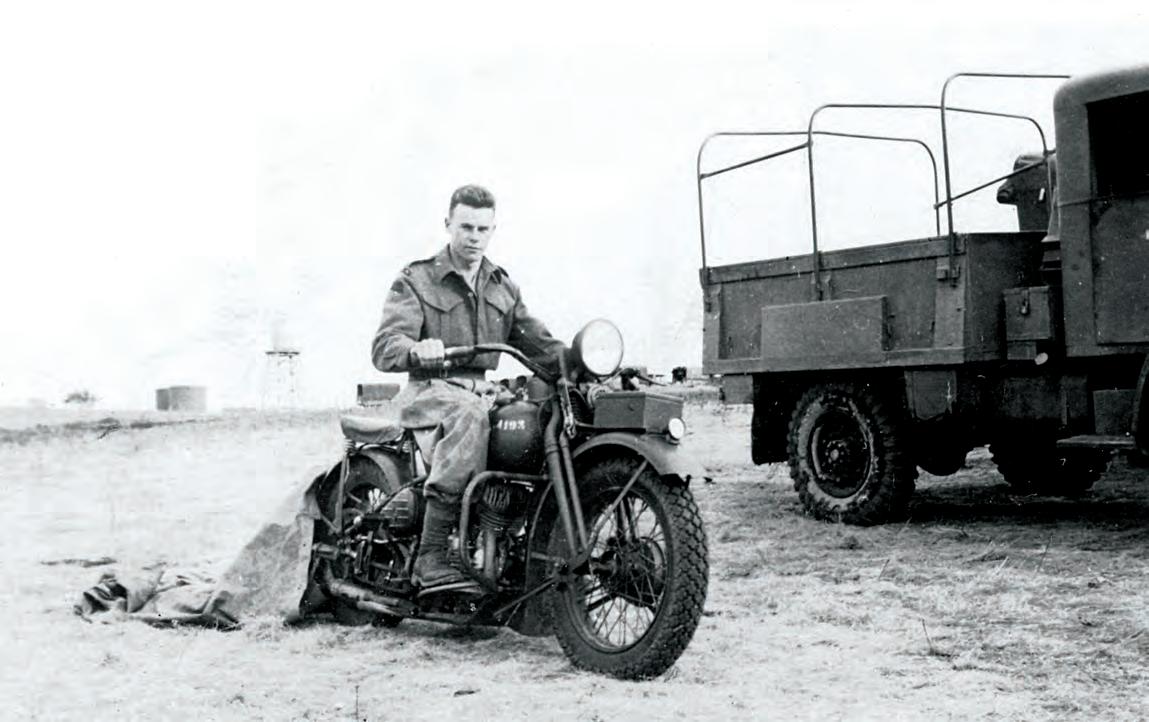
soon found himself bound for southeast England in preparation for Operation Overlord.
He, like all Canloan officers, was then provided with a distinct identification number—his being CDN 453—that became unique to the scheme, and a “Canada” flash emblazoned on his British battledress.
Where possible, successive groups of subalterns were similarly afforded the chance to join affiliated British regiments, the most successful being The Black Watch (Royal Highland Regiment) of Canada, its members joining the United Kingdom’s Black Watch. Elsewhere, soldiers from The Seaforth Highlanders of Canada served in the British Seaforth Highlanders, as did some of those once belonging to the Pictou Highlanders.
But that didn’t alleviate the inevitable culture shock. Though glad to be commanding his own platoon of lowland Scots, Fendick and his colleagues occasionally misunderstood each other’s accents and turns of phrase. At one stage, it took a Midlander English sergeant to translate.
The use of the word “colonial” by superiors also became a source of frustration among a few Canadian lieutenants and captains.
Yet despite the odd hurdle, Canloan officers adapted to their circumstances, ironed out any personal difficulties and became integral to their respective formations, earning the rightful respect of their comrades.
In Fendick’s case, his familiarization period proved short. Anticipating the need to replace casualties after D-Day, he was sent to a Reinforcement Holding Unit and instructed to wait.
His moment would come, but for now, staring out to sea from Folkestone, Fendick saw the vast armada crossing the English Channel. It was early June 1944, and the Canloan scheme was about to face its first true test.
ROBERTSON
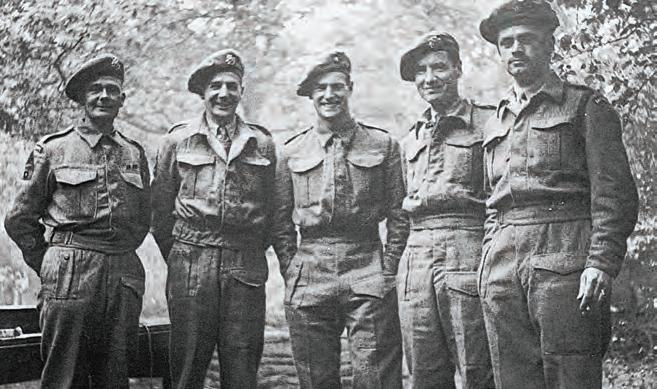
LIEUTENANT LEONARD
ROBERTSON—designated CDN 192—was in the armada.
Originally attached to The Dufferin and Haldimand Rifles of Canada, he had been posted to the 2nd Battalion, East Yorkshire Regiment.
On June 6, he hit Sword Beach, one of two Canloan platoon commanders in ‘C’ Company (the other, CND 118 Captain James (Mac) McGregor).
The landing craft ramp dropped and Robertson, along with a couple of his men, charged ahead, only to realize when it was already too late, that they had not yet reached the shore. The trio had unwittingly launched themselves into the water, its depth luckily shallow enough to recover and wade ahead.
Meanwhile, “Bullets, shrapnel and what have you was flying around like a swarm of angry bees,” the lieutenant noted.
One of his privates was struck and fell. Robertson grabbed the wounded soldier and dragged him the rest of the way, mindful of the bodies floating face down in the wake, their blood flowing freely from fatal wounds.
Unfortunately, the private was struck again.
Urgently needing to get off the beach, Robertson organized his platoon and pushed forward through the maelstrom.

It mattered not that his life, upbringing and experiences more than 4,800 kilometres away differed from those of the British troops beneath him. The moment called for leadership, and that’s what the Canadian officer could provide.
Venturing inland by June 7 brought little respite, with Robertson’s 15 Platoon and Mac’s 14 Platoon confronting a German pillbox.
“Mac had gone up to the entrance and called on them to surrender,” said Robertson. “They didn’t give him a chance, but cut him down with a burst of gun fire hitting him in the chest and stomach…Mac was dead.”
McGregor was the first Canloan officer recorded as killed in action. He would not be the last.
Between D-Day and the end of August 1944 in Normandy, 77 Canloan officers were killed or died of their wounds on patrols, in slit trenches and throughout various operations. More would come. But they had likewise established themselves to be capable and valued leaders with the clear capacity to inspire courage and fortitude in the British Second Army soldiers they commanded.
Canadian Lieutenant Leonard Robertson (above, second from left) hit Sword Beach on D-Day with the 2nd Battalion, East Yorkshire Regiment.
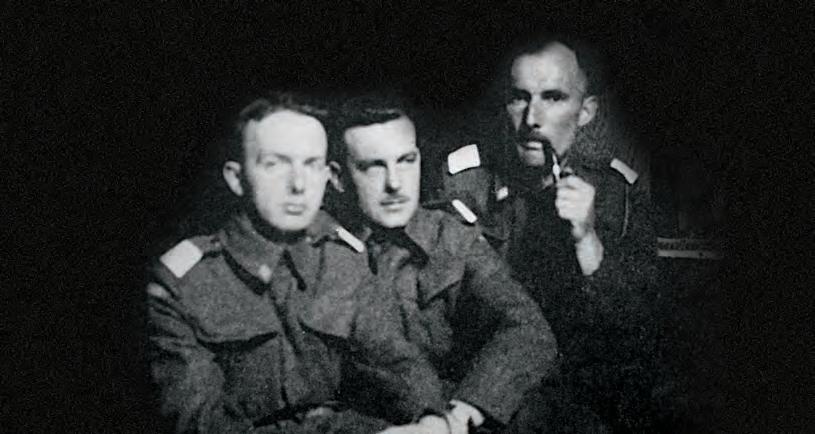
M
acLELLAN
LIEUTENANT C. ROGER
M acLELLAN—designated CDN 554—of New Glasgow, N.S., and a Canloan officer in the British 2nd Battalion, Glasgow Highlanders, was about to prove those very same capabilities in the battle for Ghent in the Netherlands.
It was Sept. 10, 1944, and his platoon had been tasked with clearing houses around the Canal du Nord.
As was the case by then with so many Canloan officers after the relentless combat of several months, MacLellan—previously of the Pictou Highlanders—had cultivated a strong bond with his men.
He needed only to wave his left arm and bellow, “Follow me,” leading from the front as always, and his sections would fall into place.
Yet it was not long until a German machine gun opened up on them in the street. Enemy rifle fire joined the cacophony, and the platoon was pinned down. But MacLellan maintained his nerve.
With his left section in position to provide covering fire, he ordered an aggressive response. Their intense pressure appeared to be tipping the scales until MacLellan’s left section spied an 88mm gun. Repeated attempts to neutralize the position seemingly failed— even with the surprise arrival of tank support. And all the while, casualties were mounting.
MacLellan ordered the evacuation of the wounded as he and
two men covered a withdrawal. The lieutenant was the last to leave, carrying his Sten and a Bren through a blanket of smoke.
Unbeknownst to the officer at the time, the platoon and armour combined had succeeded in silencing the German artillery. Noteworthy, too, had been MacLellan’s “great coolness and ability…[and] utter disregard for his own personal safety,” noted his Military Cross citation. Canloan officers across multiple British regiments earned many such accolades, including 41 Military Crosses (MC), among several other honours from the French, Belgians and Americans.
Few British soldiers, no matter the rank, doubted qualities of their Canadian numbers by that stage. In one instance, D-Day veteran Robertson—himself a Military Cross recipient—asked his men to choose between a British and Canloan officer for a replacement. Their decision was unanimous: “Bring us the goddamned Canadian.”
Moved to Geel, Belgium, after his MC-earning actions, MacLellan participated in a church parade before listening to a padre’s sermon. Midway through the service, however, he and his men felt reverberations coming from outside. Everyone filtered through the doors and stared up into the sky, awed by the sight of countless aircraft almost shrouding the horizon. It was Sept. 17, 1944.

The mossy ground cushioned Heaps’ parachuted descent.
Miraculously, he was unscathed. The Winnipegger—designated CDN 415—dusted himself off.
His duties, unlike most subalterns, were to take on special assignments at his liberty, the result of there being no other rank-appropriate positions available. The first came the next day, having been instructed to take a jeep laden with supplies and a wireless operator to Arnhem bridge.
Joined by a Dutch guide, they promptly got into trouble when the vehicle’s steering wheel came off in Heaps’ hands, hurling the three of them into an embankment—though for the most part they were unharmed.
The determined lieutenant then flagged down a Bren carrier, hitched a ride and continued into the devastated city of Arnhem.
Major-General Roy Urquhart watched with bemusement as the mismatched party arrived at his beleaguered headquarters, an encounter made stranger still when Heaps, believed by the commander to have a “charmed existence,” reported news from elsewhere along the front.
The Canadian’s role thereafter shifted from supplier to messenger. Over the coming days, Heaps acted as a vital communications link between the divisional headquarters at Hartenstein Hotel and, wherever humanly possible, the often isolated and increasingly desperate pockets of airborne troops. He even—on his own initiative—crossed the River
Canadian Lieutenant C. Roger MacLellan (left) with fellow Canloan officers Kip MacLean and Ken Coates at a training facility in June 1943.
Rhine in a dinghy more than once, intent on contacting the forward elements of XXX Corps, which was expected to bring much-needed relief to the overwhelmed force.
His luck ran out, however, while guiding the 4th Battalion, Dorset Regiment over the Rhine. The unit was set to launch a midnight attack to bolster the battered airborne, but Heaps was pinned down by enemy fire after making the crossing. Despite slipping into the water to escape, he was captured.
Heaps spent a brief period in a prisoner-of-war holding camp, undoubtedly acutely aware of his Jewishness, and befriended a couple of British prisoners.
En route via train to Germany, armed with a tiny silk map, a box of matches, a button compass, a pair of nail clippers, a blanket and a tin of chocolate, the three cut a barely man-sized opening in a carriage porthole and jumped.
But Heaps’ story would not end there.
The Canloan officer made it back across Allied lines, whereupon he received authorization to team up with the Dutch resistance and help retrieve fellow evaders in the wake of Operation Market Garden.
Not only did he receive the Military Cross for his exploits, but he left behind a legacy synonymous with the success of the Canloan program.
The Canadian Army encountered many of its countrymen serving in British units during its campaign to liberate the Netherlands, including as it moved toward the Rhine River near Xanten, Germany, in March 1945.
That small yet significant legacy, fostered by Heaps and his fellow Canloan officers, remains a great source of pride in military circles on both sides of the Atlantic—albeit largely unknown on a grander scale.
Fendick shared Heaps’ so-called charmed existence when his carrier struck a mine in August 1944. He sustained serious wounds, but was evacuated to hospital, recovered and was sent back to action. He later fought in the Korean War and eventually rose through the ranks to lieutenant-colonel.
Robertson also suffered from a series of minor wounds that required treatment. Within a couple of weeks, however, he also returned to his unit and continued to serve with distinction. One of his postwar achievements included serving as vice president for the Canloan Army Officers Association.
MacLellan returned to his education after the conflict. Qualifying as a research scientist in entomology, his work contributed considerably to agricultural pest management procedures. MacLellan likewise rejoined the service, commanding the West Nova Scotia Regiment from 1960-1962.

Finally, Heaps ran unsuccessfully for political office, but found another avenue for service when he organized efforts to assist refugees amid the 1956 Hungarian revolt—a feat he repeated with locals during the Vietnam War. In addition to becoming an esteemed art dealer, he authored several books, notably Escape from Arnhem and The Grey Goose of Arnhem. These individuals, in many respects, were fortunate. There was a 75 per cent casualty rate in the nearly 700-strong—623 infantry officers and 50 from the Royal Canadian Ordnance Corps— Canadian group seconded to British regiments in the summer of 1944. Of those, 128 never returned home. Their sacrifices have been recognized through the Canloan National Memorial in Ottawa, a similar monument at 5th Canadian Division Support Base in Gagetown, N.B., and a plaque at the residence of the British High Commissioner to Canada.
Perhaps above all else, they are remembered by the ever-dwindling number of British veterans who, recalling the outstanding leadership of their Canloan comrades, still hold Canada’s wartime contribution in high regard. L
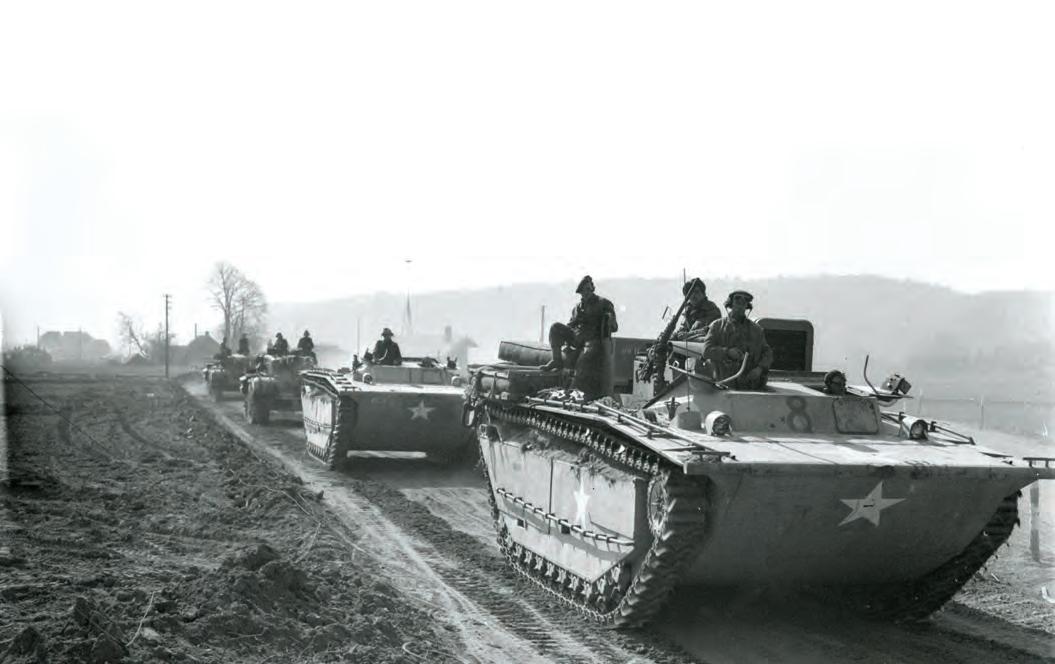
They had established themselves to be capable and valued leaders with the clear capacity to inspire the British Second Army soldiers they commanded.

Allied prisoners of war who had a penchant for escape were often sent to Schloss Colditz— but even the legendary German keep couldn’t stop many from attempting getaways
BY ED STOREY

A wartime image of Colditz Castle.
Colditz is perhaps the best known of all the Second World War German prisonerof-war camps. Several books, a movie and a television series have all immortalized Offizierslager (Oflag) IV-C
Colditz as a facility where British officer PoWs taunted (“goon-baiting” as they called it) their guards and planned elaborate escapes involving tunnels, detailed disguises and even a glider.
Many turned their plans into reality. Those who didn’t make a “home run” back to Britain but got recaptured, however, returned to face a stint in solitary confinement before reuniting with their fellow prisoners. The jail was a miserable, cramped and
Cdamp castle where a nearstarvation diet along with gloomy weather drove some of the incarcerated to madness—and others to suicide.
Schloss Colditz is in the German town of the same name near Leipzig and Chemnitz in the state of Saxony. It’s on a hill spur overlooking the river Zwickauer Mulde, a tributary of the Elbe River.
First built in 1158, the castle was destroyed and rebuilt twice, taking on its current Renaissance-era appearance between 1577 and 1591.
In its early days, the Schloss was used as a hunting lodge.
In 1694, it was expanded with a second courtyard and a total of 700 rooms.

From 1803-1829 it was a workhouse for the poor, and then it was converted into a sanatorium for wealthy patients. It served in this capacity for more than a century until the Nazis gained power in 1933. They converted the castle into a political prison.
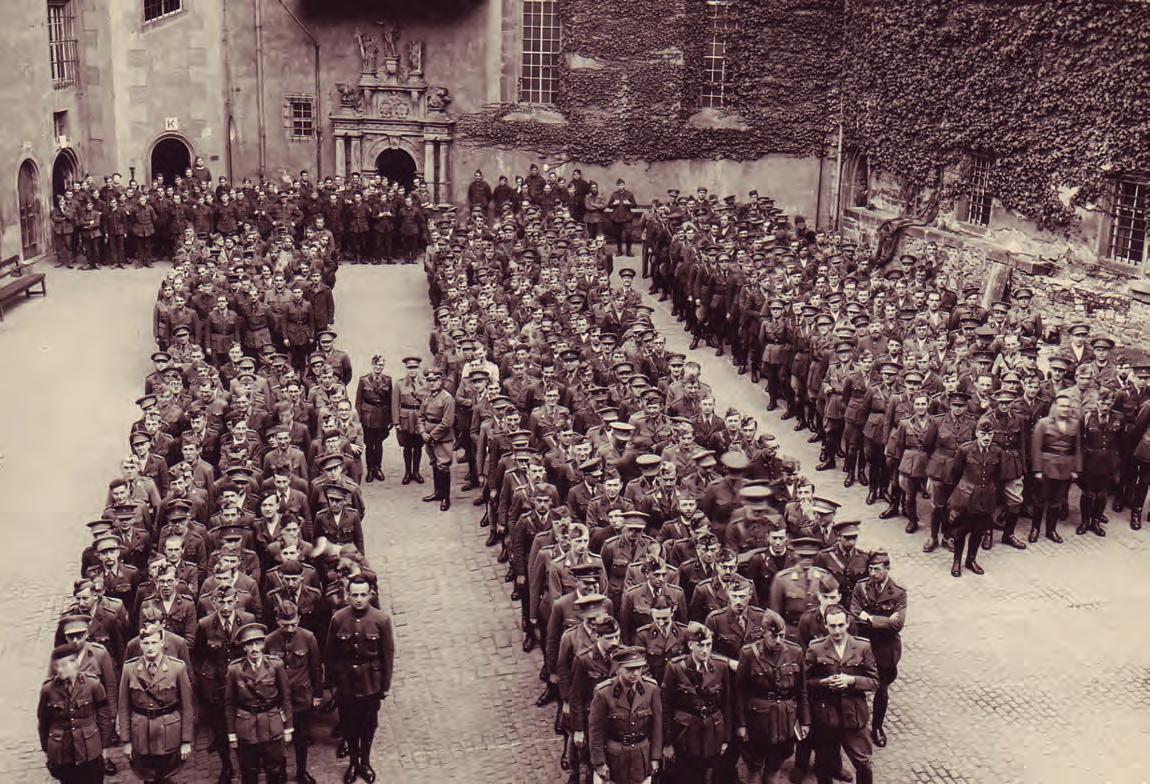
After the outbreak of the Second World War, the Schloss was transformed into a high-security prisoner-ofwar camp for officers who were escape risks or regarded as particularly dangerous. The facility’s population was initially cosmopolitan, consisting of PoWs from Poland, France, Belgium and the Netherlands. Beginning in late 1940, the first British Belgian and French prisoners gather in a Colditz courtyard.
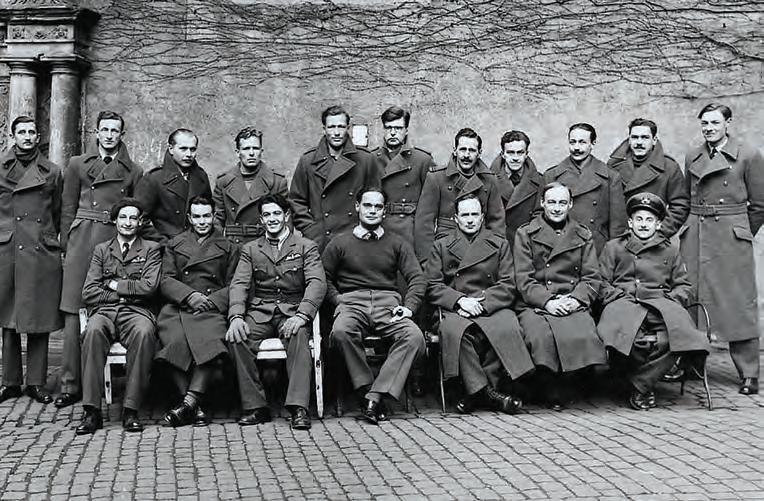
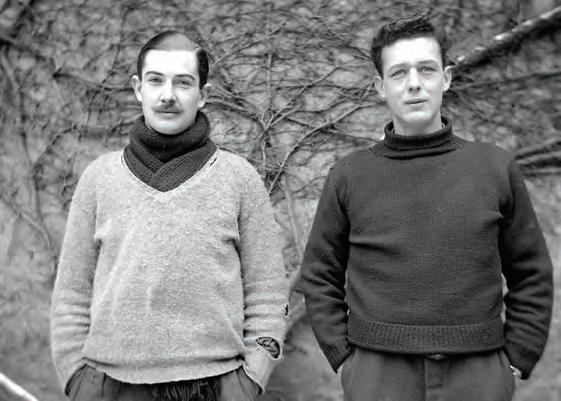
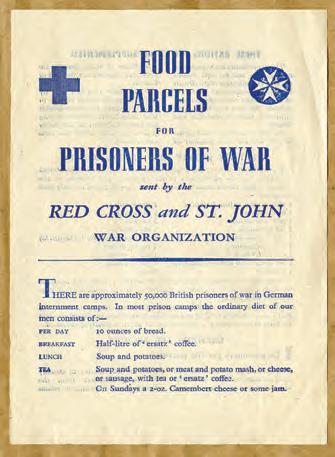
British prisoners of war at Colditz in April 1945 (above). A pamphlet detailing how Canadians could help PoWs. A prison portrait believed to be of Lieutenant C.D. Mackenzie and Canadian Pilot Officer Howard (Hank) Wardle (immediate left).
Kenneth Lockwood (far left, left), one of the first British held at Colditz, with an unidentified Polish prisoner. David Stirling (below), founder of the British Special Air Service, was one of Colditz’s most notable detainees.

began to arrive, and during the next three years each contingent competed to see who could escape most often.
By 1943, Colditz was largely a British camp with some Americans, all other nationalities having been moved to other locations. The term British, of course, was quite
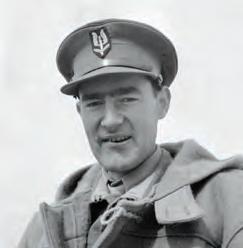
broad and encompassed Commonwealth personnel from Canada, Australia and even India. Some notable prisoners included British fighter ace Douglas Bader, New Zealand Army Captain Charles Upham, the only combat soldier awarded the Victoria Cross twice, and David Stirling, founder of the wartime Special Air Service. Along with these officers were several British of other ranks who served as cooks and batsmen and weren’t included in any of the escape plans.
One of the first Canadian prisoners at Colditz was Pilot Officer Howard (Hank)
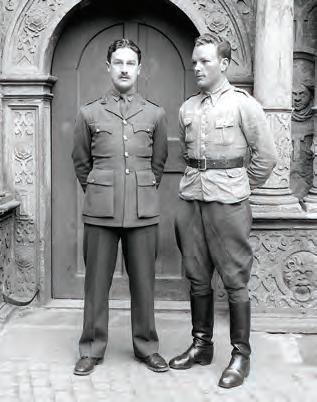
Wardle, of Dauphin, Man., who had joined the Royal Air Force in March 1939.
Wardle’s Fairey Battle light bomber had been shot down near Crailsheim, Germany, on April 20, 1940, while he was conducting a reconnaissance mission with 218 Squadron. Wardle was captured and, after being interrogated at a Luftwaffe barracks, he was detained at Oflag IX-A/H in Spangenberg, Germany. In August, he escaped the camp, but was recaptured the following day and transferred to Colditz.
On Oct. 14, 1942, Wardle, along with three British officers—including Captain


On Oct. 14, 1942, Wardle, along with three British officers, successfully escaped Colditz .

Patrick (Pat) Reid whose 1952 memoir, The Colditz Story was the basis for the film of the same name— successfully escaped Colditz. Wardle and Reid crossed the Swiss frontier at Singen, Germany, a known border weak spot, four days later.
In late 1943, Wardle made his clandestine journey to Spain, paid for by the British, arriving in the Spanish village of Canejan just before Christmas 1943. Wardle returned to England via Gibraltar on Feb. 5, 1944, and was awarded the Military Cross on May 16. He passed away in Ottawa in January 1995, aged 79.
Not all Canadians held at Colditz were as lucky as Wardle, however. Captain Graeme Delamere Black, was one of seven men of No. 2 Commando who were captured in September 1942 after Operation Musketoon, the destruction of the German-held power plant in Glomfjord, Norway. Originally from Dresden, Ont., prior to the war Black had served with the Queen’s York Rangers (1st American Regiment) and, after moving to London, he joined the South Lancashire Regiment (Prince of Wales’s Volunteers) before volunteering for the commandos. All seven of the PoW
commandos were held in Colditz before they were executed under Hitler’s Commando Order—a directive that all captured Allied commandos be killed without trial—on Oct. 23, 1942.
Years of captivity at Colditz also took a terrible mental toll on many prisoners and Flight-Lieutenant Frederick Donald Middleton of Dauphin, Man., was no exception. One of three brothers who enlisted in the RAF in 1937, Middleton’s Hampden bomber of 50 Squadron was shot down over Norwegian waters on April 12, 1940. Taken prisoner, he arrived at Colditz with Wardle after
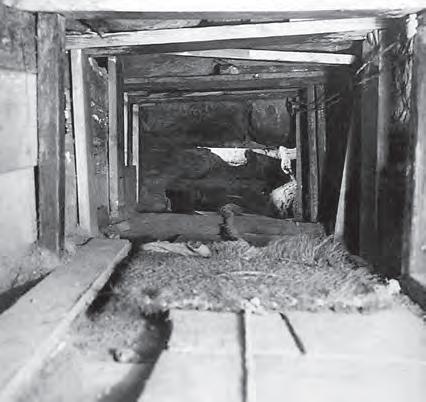
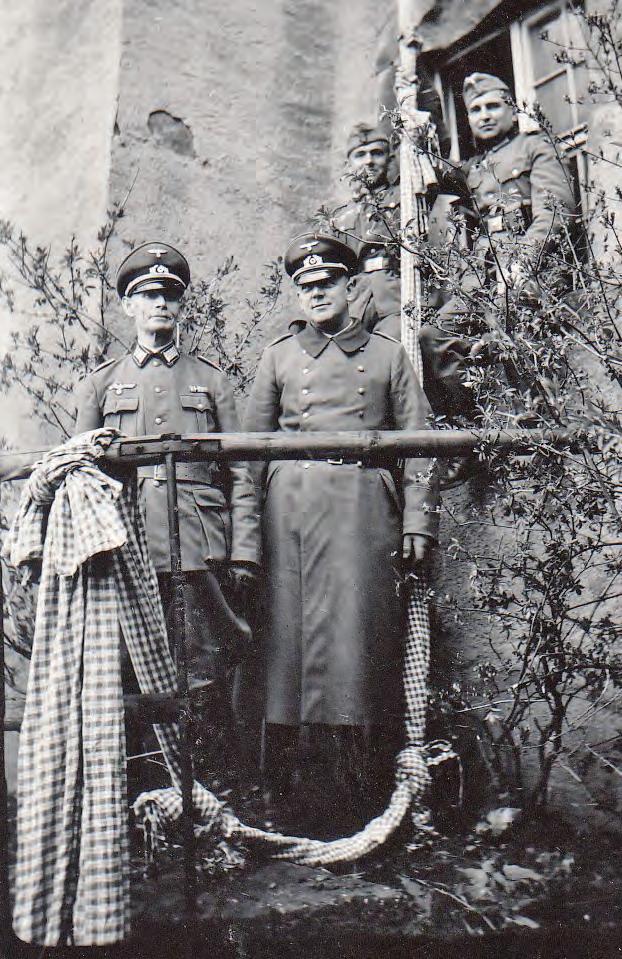
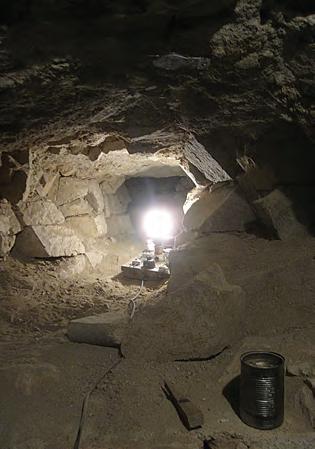
German officers pose with a rope, made of knotted bedsheets, from a failed escape attempt. French PoWs dug this tunnel—ultimately 44-metres long— under the castle’s chapel in 1942 in another foiled breakout.
As they advanced to the castle, the troops were surprised to learn that it held some 250 Allied PoWs who had been watching the whole battle from the windows.
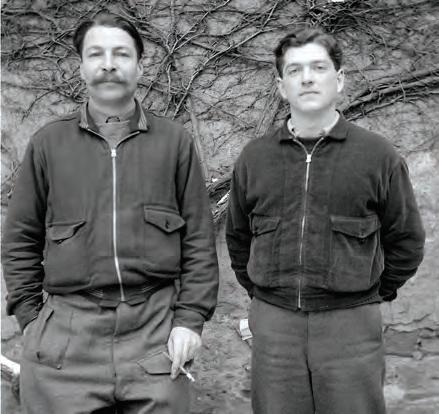

British PoWs
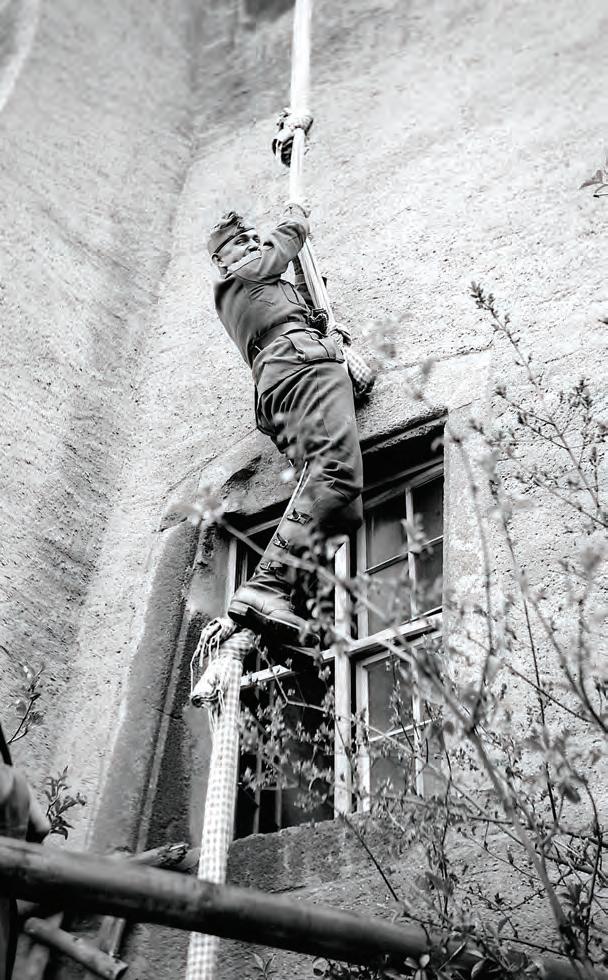
Jim Rogers and Giles Romilly (above), the latter specially guarded because he was the nephew of Winston Churchill’s wife. A Colditz guard climbs a homemade rope in re-enacting an unsuccessful escape.

an unsuccessful escape from the PoW camp in Spangenburg. While at Colditz he suffered severe depression and attempted suicide numerous times.
Middleton was then transferred to a mental hospital for PoWs and, once deemed well, he was sent to Stalag Luft III. There he helped dig the “Harry” tunnel renowned in the 1944 “Great Escape,” but the route was discovered before Middleton got his turn to use it.
In 1945, Middleton returned home a shadow of his former self, weighing less than 100 pounds and suffering what today would
likely have been diagnosed as post-traumatic stress disorder. While Middleton recovered physically and began to live a normal life to the best of his ability, he never truly regained his emotional health. Sadly, for some, there was just no escaping from Colditz.
Interned at Colditz were also several prisoners called prominente, or German for celebrities, all relatives of Allied VIPs. Two were particularly noteworthy: Giles Romilly, a journalist who was captured in Narvik, Norway, and was the nephew of Winston Churchill’s
wife Clementine; and British Commando Michael Alexander, who claimed to be the nephew of Field Marshal Harold Alexander to avoid execution, though he was merely a distant cousin.
By March 1945, the number of high-profile inmates had swollen to 21. With the Reich collapsing on all sides, they were to be used as bargaining chips with the Allies. In early April, the prominente were all transported out of the castle by the SS. After a harrowing trip south, they were liberated by the advancing American 7th Army outside of Innsbruck, Austria, in late April.
The liberation of the prison itself began on April 15, as advancing elements of the 3rd Battalion, 273rd Infantry Regiment, approached from the southwest. A sharp, day-long firefight ensued as SS troops and Hitler Youth desperately tried to stem the attack. Some
20 Americans died in the street fighting.
By the next morning, however, the Germans had left, the white flags were up and, as they advanced to the castle, the troops were surprised to learn that it held some 250 Allied PoWs who had been watching the whole battle
Return
to Colditz
For the average Canadian, Colditz is slightly off the beaten trail, located as it is in the former East Germany. The site has always fascinated me, and I first visited in the spring of 1994 while on leave during a year-long deployment with the United Nations Protection Force Headquarters in Zagreb, Croatia. I was travelling with a Belgian colleague, and we found a sleepy little town just emerging from four decades of Communist rule.
Reminiscent of the Balkans, the town was in decent shape, though
from the windows. Two days later, the freed men left the Schloss for the last time and, after spending an evening in Erfurt, they were flown back to Aylesbury, England.
The infamous Colditz Castle had finally been physically escaped for the last time. L
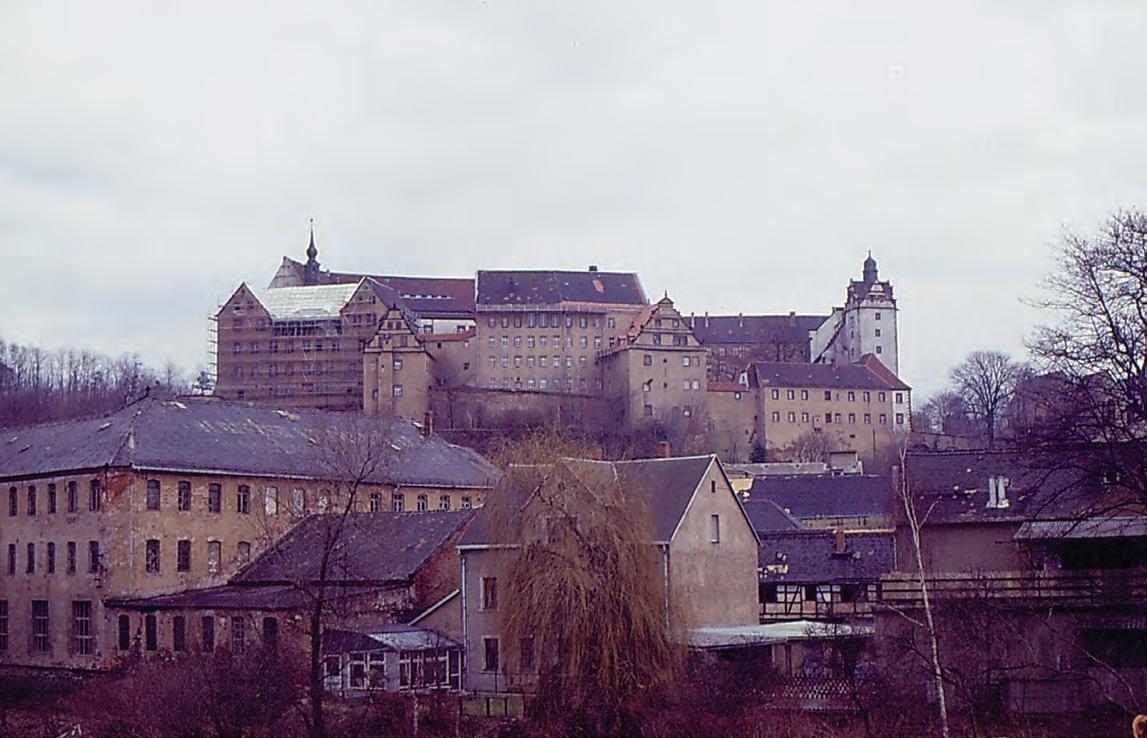
Colditz Castle (bottom) and the unsuccessful French escape tunnel (below) in more current times.
much of it needed work other than the newly established gas station and car dealership. The castle still had its foreboding wartime look, but the small museum dedicated to escape was in a building outside the walls and most of the outer courtyard rooms were being used as a youth hostel.
A return visit with my father in 2015 revealed a town that had been refreshed and modernized, boasting old-world European charm perfect for a quiet getaway. Everything was bright and shiny. The Schloss, still
a hostel, had been restored; and its updated museum, now inside the castle, had become a popular site, especially for British tourists, offering comprehensive tours by knowledgeable guides.
Ed Storey


THE STORY OF CANADA’S SHORT-LIVED POSTWAR SPECIAL AIR SERVICE
An unconventional crew of Canadian SAS Company commandos pause from their training at Rivers, Man.
During the Second World War, a desertbased commando unit of the British Army employed bold, innovative guerilla tactics to wreak havoc on German forces in North Africa. The Special Air Service and its exploits, including present-day counterterrorism, hostage rescue and other covert operations, are the stuff of rogue heroes. This is not that story.
This is the tale of the Canadian Special Air Service Company, a distinctly different organization made up of airborne soldiers whose initial role in postwar Canada was non-military: airborne firefighting, searchand-rescue and aid to the civil powers.
“The story of the Canadian SAS Company is actually surreptitious,” wrote Bernd Horn in his 2001 paper,
A Military Enigma: The Canadian Special Air Service Company, 1948-1949.
“The army originally packaged the subunit as a very benevolent organization.
“Once established, however, a fundamental and contentious shift in its orientation became evident—one that was never fully resolved prior to the sub-unit’s demise. With time, myths, often enough repeated, took on the essence of fact.”
SAS members expected to form a special operations unit practised in long-range reconnaissance, deep penetration raids through enemy lines in conventional warfare and supporting guerrilla or irregular forces in unconventional warfare.
The unit had no insignia of its own. Assembled as the Cold War was declared, its 125 infantrymen came from the country’s three regiments, some of them war veterans from the vaunted 1st Canadian Parachute Battalion or the Canada-U.S. First Special Service Force, famously known as the Devil’s Brigade.
They retained their original regimental badges and underwent rigorous preparations for their anticipated role as a highflying elite force. They trained in rope work, survival, mountaineering, improvised demolitions, skiing and foreign languages.
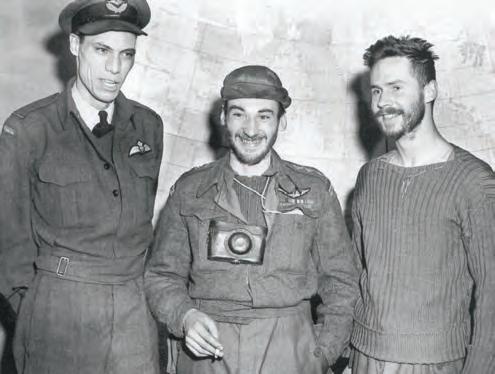
The Canadian Special Air Service Company lasted but two years, its only operations a 1947 Arctic rescue and flood relief in B.C. in 1948 .
They were chosen for their “superb physical condition…demonstrated initiative, determination and self-reliance.”
And they had to be unmarried.
“Exercises were reportedly rigorous, with scenarios usually involving an airborne raid on a fixed enemy installation,” reported canadiansoldiers.com. “At least one member of the Company was killed during a public parachute demonstration.”
They were commanded by a decorated Devil’s Brigade veteran, Captain Lionel Guy d’Artois, a temporary appointment who, after his wartime commando unit folded, volunteered to join the Special Operations Executive in 1943. He jumped into France under the codename Dieudonné and spent the rest of the war organizing, arming and operating with units of the French Resistance.
d’Artois’ tenure as acting officer commanding of the new unit proved short. The search for a permanent replacement was still going when the unit was shut down.
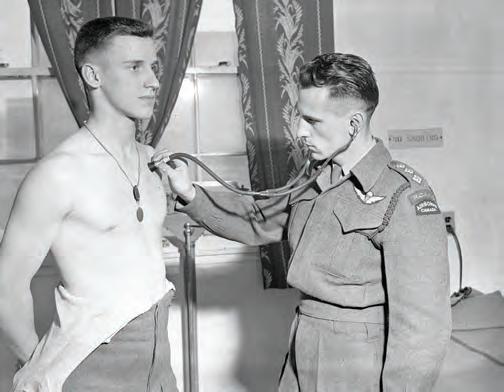
An unidentified parachute candidate (top left) undergoes a medical exam at the Canadian Parachute Training Centre in Shilo, Man., in March 1945. Captain Lionel Guy d’Artois, head of the Canadian SAS (top right, centre), was widely regarded as a grand old man of the Canadian airborne. Airborne troopers (below) board a Dakota at Rockcliffe, Ont., in 1948.
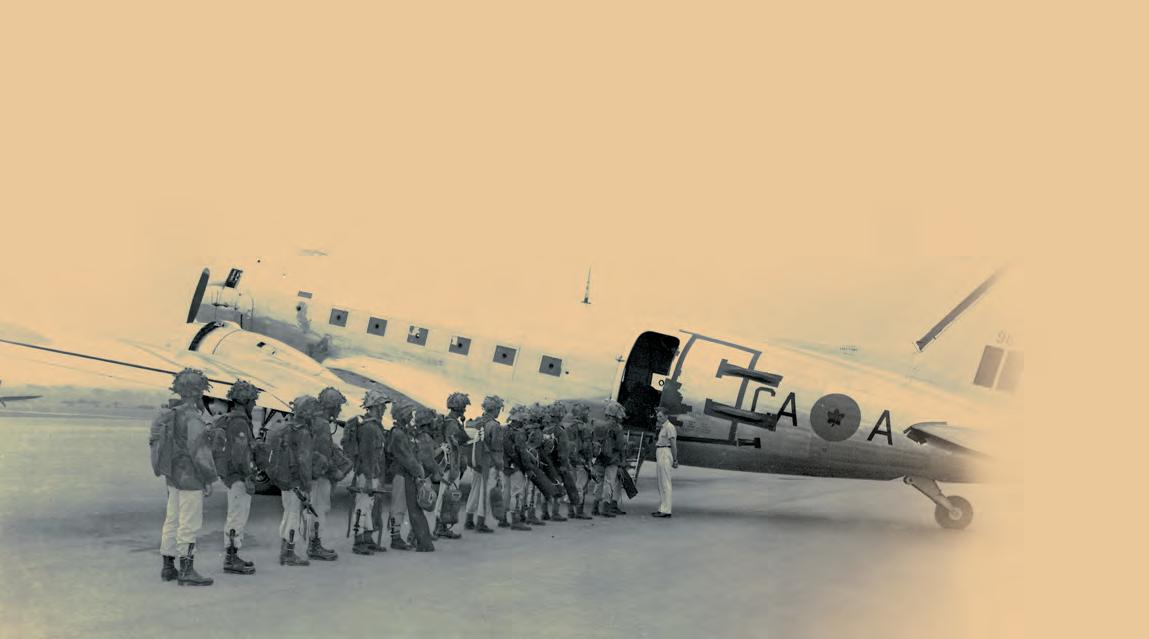

The Canadian Special Air Service Company lasted but two years, its only credited operations a 1947 Arctic rescue mission for which d’Artois, the lone SAS soldier involved, was awarded the George Medal, and flood relief in British Columbia’s Fraser Valley in 1948, the only time the service functioned as an entire unit.
The military disbanded the SAS in September 1949 and created the Mobile Striking Force, a larger and more conventional airborne unit. Some SAS members were retained as instructors, augmenting existing training establishments until the strike force was formed. Others returned to their regiments.
d’Artois went on to serve with the Commonwealth occupation force in Japan, then did an operational tour with the 1st Battalion, Royal 22e Régiment, during the Korean War.
“ Something was clearly amiss . Either the sub-unit was named incorrectly or its operational and training focus was misrepresented.”
The story of the Canadian Special Air Service Company might be all but lost to popular history, however the facts ring familiar today, when Canada’s military is mired in controversy, recruitment is languishing and the government wants to cut the defence budget by almost $1 billion.
Then, as now, the military’s role in civil affairs and crisis response was up for debate and funding was in short supply.
In the immediate aftermath of the Second World War, the powers that be in Ottawa had little concept of what they wanted to do with the country’s armed resources.
The vast, sparsely populated land that had entered the war with meagre military might ended it with the world’s third-largest navy and one of the largest air forces. Its shipbuilding industry, virtually non-existent in 1939, was among the planet’s biggest. Yet all of it was reduced to nominal strength after the fighting ended.
Even the 1st Canadian Parachute Battalion, a standout in the formative
years of airborne warfare, was disbanded six weeks after Japan surrendered. Global affairs were changing fast and so were opinions on how to address them.
“Notwithstanding the military’s achievements during the war, the Canadian government had but two requirements for its peacetime army,” wrote Horn.
“First, it was to consist of a representative group of all arms of the service. Second, it was to provide a small but highly trained and skilled professional force which, in time of conflict, could expand and train citizen soldiers who would fight that war.
“Within this framework paratroopers had limited relevance. Not surprisingly, few showed concern for the potential loss of Canada’s hard-earned airborne experience.”
In the austere postwar climate of minimum peacetime obligations, Horn added, the fate of Canada’s airborne soldiers, who would typically form the core of any commando unit, “was dubious at best.” The Canadian Parachute Training Centre in Shilo, Man., had stopped prepping new jumpers virtually as soon as the war in Europe ended in May 1945. Its future hung in the balance as it awaited a final decision on the direction the postwar army would take.
“No one knew what we were supposed to do,” recalled Lieutenant Bob Firlotte, who had been hand-picked to serve at the centre, “and we received absolutely no direction from army headquarters.”
Nevertheless, senior staff worked to keep abreast of airborne developments and
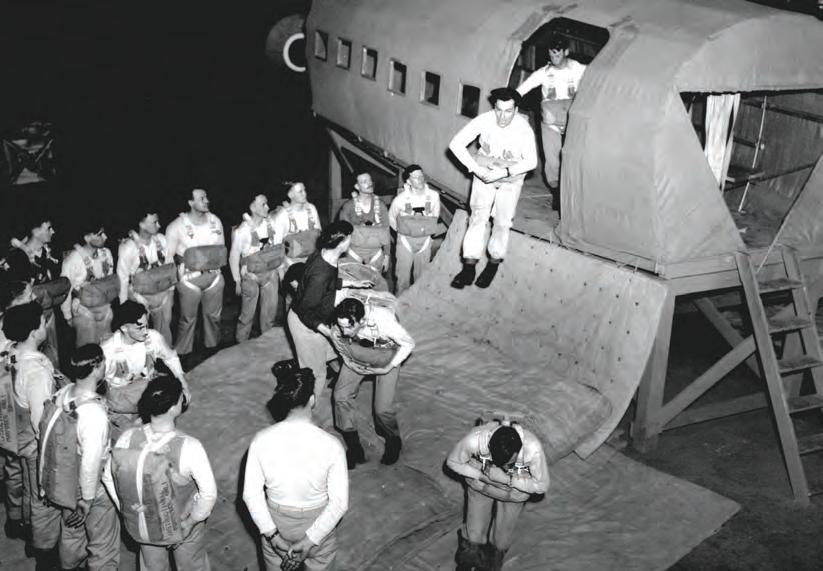
perpetuate the links forged with American and British airborne units during the war. Horn called their efforts “the breath of life” that the airborne advocates needed.
Their advocacy would eventually pay off after a National Defence Headquarters study revealed that British peacetime policy was based on training and making all infantry formations air-deliverable. Americans and Brits alike made it known they would welcome an airborne establishment in Canada capable of “filling in the gaps in their knowledge.”
These “gaps” included the problem of standardizing equipment between Britain and the U.S., and addressing the need for cold-weather research.
“Canada seemed to be the ideal intermediary for both needs,” wrote Horn. “It was not lost on the Canadians that co-operation with its closest defence partners would allow Canada to benefit from an exchange of information on the latest defence developments and doctrine.”
A test facility might not be a parachute unit, but it would allow the Canadian military to stay in the game. Ultimately, National Defence opted to form a joint parachute training school and airborne researchand-development centre in Rivers, Man.
“For the airborne advocates,” said Horn, “the Joint Air School, [later to become the Canadian Joint Air Training Centre] became the ‘foot in the door.’ More important, the JAS…provided the seed from which airborne organizations could grow.”
Still, the concept of a special operations force, which showed such promise in the fleeting Devil’s Brigade, was all but lost entering the Cold War—“a patchwork of activities, few of which were co-ordinated in any fashion,” according to Sean M. Maloney, a history professor at Royal Military College in Kingston, Ont.
Once the army’s permanent structure was established in 1947, impetus to expand airborne capability began to stir at the Joint Air School. In May 1947, the school proposed the Canadian Special Air Service Company with its clearly defined benevolent role.
The army backed the idea, calling the unit’s inherent mobility a definite public asset for domestic operations and a potential benefit to the country. The SAS, it said, would provide an “efficient life and property saving organization” capable of moving to any point in Canada in 10-15 hours—not unlike the role the military’s present-day Disaster Assistance Response Team plays on the world stage.
The official Defence Department report for 1948 noted that co-operation with the Royal Canadian Air Force in air searchand-rescue would meet International Civil Aviation Organization requirements.
The initial training cycle consisted of four phases, covering research and development (parachute-related work and field skills); airborne firefighting; air search-andrescue; and mobile aid to the civil power (crowd control, first aid, military law).
“Conspicuously absent was any evidence of commando or specialist training which
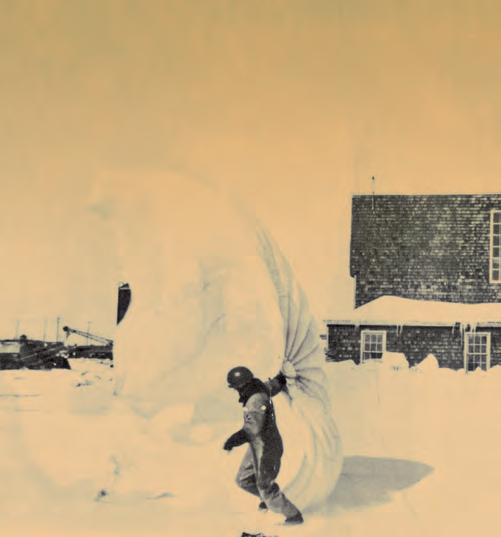
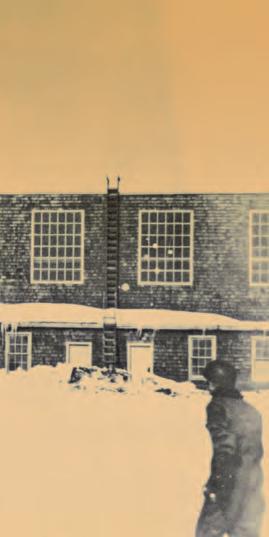
An SAS member (opposite) wrestles with his parachute after a training jump. SAS recruits practise landing rolls.

the organization’s name implied,” wrote Horn. “The name of the Canadian subunit was a total contradiction to its stated role. It was also not in consonance with the four phases of allocated training.
“Something was clearly amiss. Either the sub-unit was named incorrectly or its operational and training focus was misrepresented. Initially no one seemed to notice.”
The director of weapons and development added two additional roles when he forwarded the request for the new organization to the deputy chief of the general staff: “public service in the event of a national catastrophe” and “provision of a nucleus for expansion into parachute battalions.”
“This Company is required immediately for training as it is these troops who will provide the manpower for the large programme of test and development that must be carried out,” the proposal noted.
There was no mention of special forces or war fighting. But by October 1947, mission creep began to rear its head. Embedded in an assessment of potential benefits that the company could provide to the army was an entirely new idea.
“The formation of a SAS Company,” the report explained, “is in line with British Army Air Group post war plans; whereby the SAS is being retained as a small group integrated within the Airborne Division. This provision is to keep the techniques employed by SAS persons during the war alive in the peacetime army.”
It appeared last in the list’s order of priority but, in practice, it would soon become the primary objective.
Things changed virtually as soon as the defence chief approved the SAS proposal in January 1948. “Not only did its function as a base for expansion for the development of airborne units take precedence, but also the previously subtle reference to a war fighting, special forces role, leapt to the foreground,” said Horn.
“The shift was anything but subtle. The original emphasis on aid to the civil authority and public service functions, duties which could be justified to a war-weary government and a budget conscious military leadership, were now re-prioritized if not totally marginalized.”
Horn described the change as partially a case of gamesmanship, allowing the strong airborne lobby within the Canadian Joint
Air Training Centre and others in the army with wartime airborne experience an opportunity to perpetuate a capability that they believed was at risk.
“The Special Air Service originated during World War II when after numerous operations military authorities were convinced that a few men working behind enemy lines, could, with sufficient bluff and daring wreak havoc with supplies and communications,” said a historical report for the Joint Air School.
“Results obtained during the war assured its continued existence.”
Said Horn: “The report was not only incorrect in its assessment of the value placed on special operations type units during the war, but more importantly, it clearly reflected a war fighting rather than public service orientation.”
Each of the company’s three platoons was made up of members from one of the country’s three infantry regiments: the Royal 22e Régiment, the Princess Patricia’s Canadian Light Infantry (PPCLI) and The Royal Canadian Regiment.
d’Artois trained his carefully selected paratroopers as a specialized commando force. According to Horn, SAS vets said their commander “didn’t understand ‘no.’ He carried on with his training regardless of what others said.”
“Guy answered to no one,” said one. “He was his own man, who ran his own show.”
Higher up, however, there was varied opinion and interpretation of the unit’s role.
“The central issue remained,” said Horn. “Was the SAS Company in fact the nucleus of a larger airborne force? Was it designed to be an elite commando unit? Or was it just simply a demonstration team for the Canadian Joint Air Training Centre? Evidence exists to support each perspective.
“This confusion was merely a symptom of a larger problem, namely there was no clear understanding or agreement of the role the paratroopers were to fulfill. It was characteristic of the blight that has permeated the entire Canadian airborne experience over the years.”
The cash-strapped Canadian political and military leadership came to realize that the kind of postwar concept that was emerging among Allied nations—smaller standing forces with greater tactical and strategic mobility—could check all their boxes.
“It provided the shell under which the government could claim it was meeting its obligations, yet minimize its actual
defence expenditures,” said Horn. “In essence, possession of paratroopers could represent the nation’s ready sword.
“They afforded a conceivably viable means to combat any hostile intrusion to the North. Better still, they would be incredibly cheap, if they were maintained simply as a ‘paper tiger.’”
Not unlike its present-day commitments to NATO, Ottawa had made defence promises to its Allied partners it had not kept, particularly the Americans, to whom it was to provide an airborne/ air-transportable brigade, and its necessary airlift, as its share of the overall continental defence agreement.
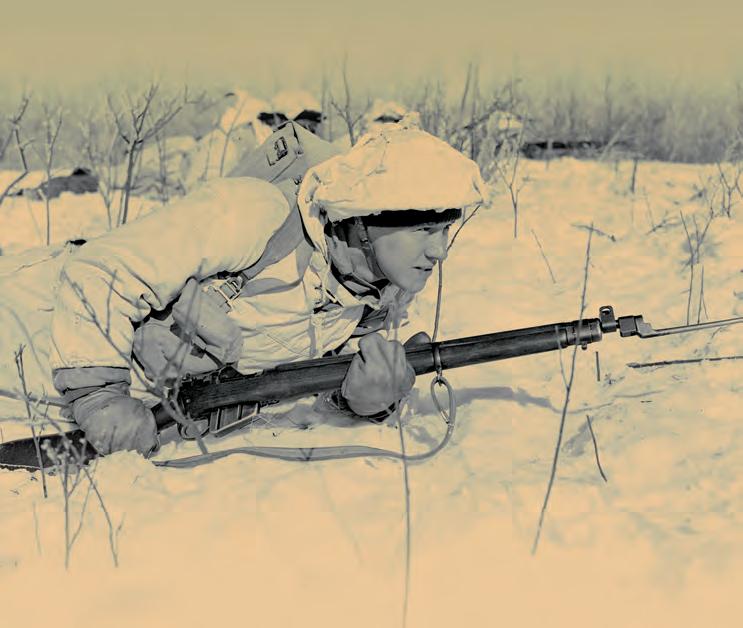
Yet, after more than two years, nothing had been done. By the summer of 1948, pressure was mounting. Finally, National Defence granted authority to start training.
Major-General Churchill Mann, the vice-chief, visited the PPCLI battalion in Calgary and asked it to convert to airborne status. Training, he told the troops, was to start in three months and must be completed by May 1949.
“The effect was profound,” Horn reported. “The unit in its entirety volunteered for airborne service. The first concrete step to establish the airborne/air-transportable brigade, as required by the 1946 Basic Security Plan, had finally been taken.”
The effect on the small SAS Company was “immediate and corrosive.” The unit initially lost its PPCLI platoon—permanently removed from the SAS and returned to Calgary to provide its parent battalion with a core of experienced para instructors.
A replacement platoon was raised from the service support trades, but the writing was already on the wall. The SAS Company was doomed. Its personnel were increasingly commandeered as instructional staff for the training scheme to convert the two remaining infantry battalions into airborne/air-transportable units.
In September 1948, with the creation of the Mobile Striking Force already underway, the director of military training demanded a reassessment of the SAS Company.
“I cannot agree with what appears to be the present concepts of the SAS Company,”
“ No one knew what we were supposed to do and we received absolutely no direction from army headquarters.”
he declared, noting the contradiction between its original intent and the actual practice.
“I feel first and foremost that its name should be changed...it is true that in war they [special forces type units] do produce a result out of all proportion to their aims, if properly employed; but they do not win battles; they are a luxury and it is very much doubted if they, in their true sense, can be recruited from our peacetime armed forces.”
A month later the defence chief announced his intention to disband the Canadian SAS Company as soon as the 22e Régiment finished its airborne conversion training, the last of the infantry regiments to do so.
The posting of personnel to the SAS Company simply dried up.
“It should be noted that, in view of the present policy, the AG [Adjutant General] Branch regards the SAS Co. as a wasting commitment and is loath to post personnel to fill existing vacancies in it,” complained the army.
There was a reprieve, however brief, but in the end Canada’s Special Air Service sputtered out of existence, its obscure legacy a link perpetuating airborne culture and skills from their wartime roots to a new generation of paratroopers. L
Paratroopers engage in winter infantry training at Shilo, Man., in 1945. Part of Canada’s SAS legacy was the postwar preservation of airborne skills and culture.
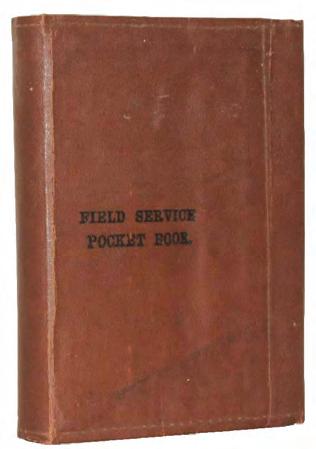


BY ROBERT SMOL
retched living conditions in a network of muddy, squalid trenches remains the most common collective image associated with the life of front-line soldiers during the Great War. One needn’t be an expert in microbiology to realize that such crowded, unsanitary conditions were a prime breeding ground for disease. Typhoid, cholera, diphtheria and dysentery, to name only a few, should have flourished in the crowded trenches, camps, hospitals and depots of the First World War, sapping the army’s manpower and ability to fight.
Yet, that didn’t happen to Canada and its Allies. Despite the high casualty rates, the First World War represented a marked departure from previous conflicts when it came to fatality statistics: disease, once the prime cause of death among soldiers during the late 19th and early 20th centuries, had lost its place as the biggest single killer of soldiers.
This was no accident or anomaly. For the Canadian Expeditionary Force, it was the result of the sanitary sections and mobile laboratories combined with command’s willingness, at all levels, to take well-being seriously.
Members of a Sanitary Section pose for a photo in June 1916. Their work was critical in helping to prevent the spread of disease on the Great War front lines, where soldiers sometimes washed in water collecting in shell holes.
A 2020 study estimAted
thAt the deaths of 450 C AnAdiAn first World WAr soldiers overseas could be At tributed to influenzA— only 0.1 per cent of the cef contingent.
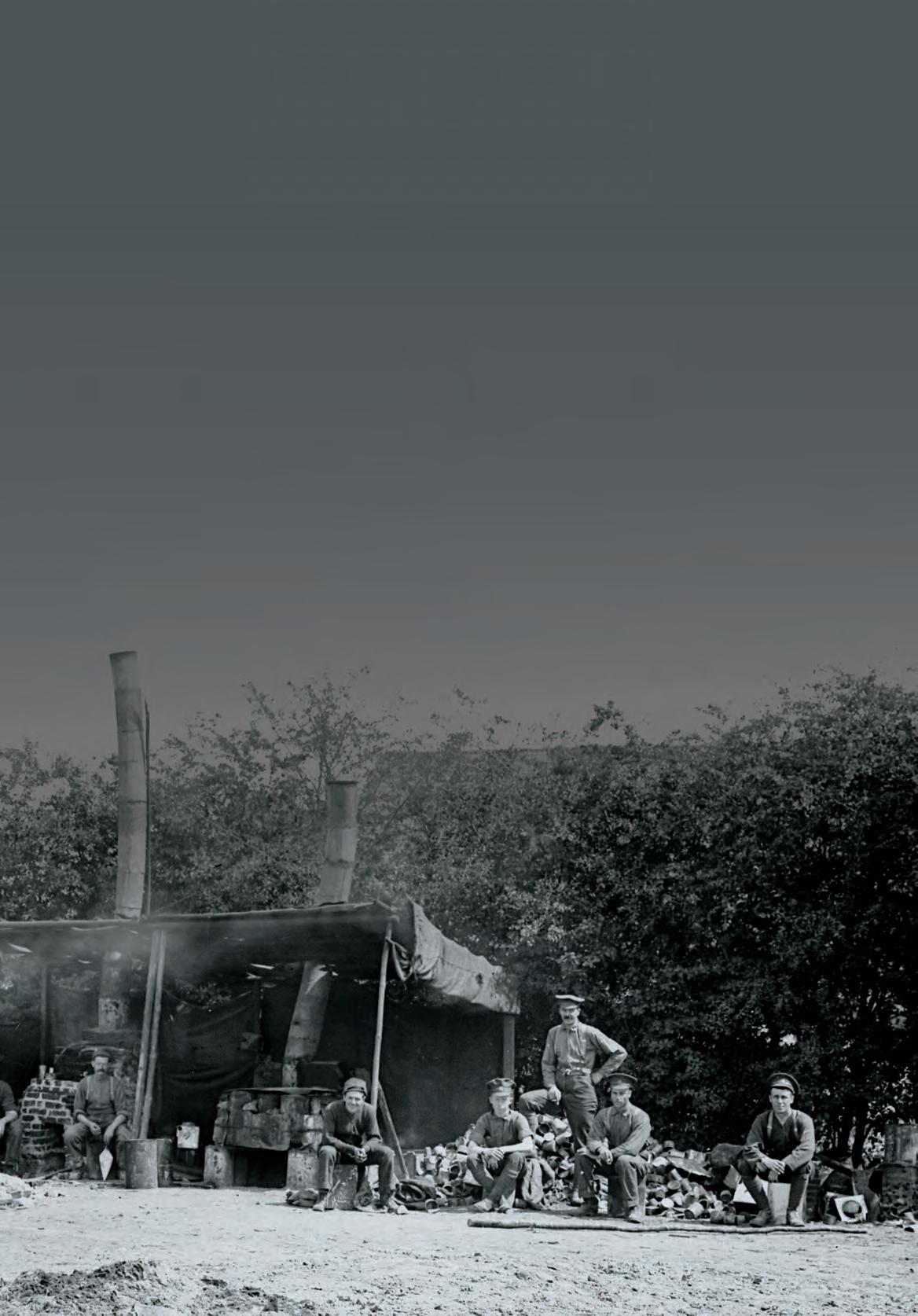

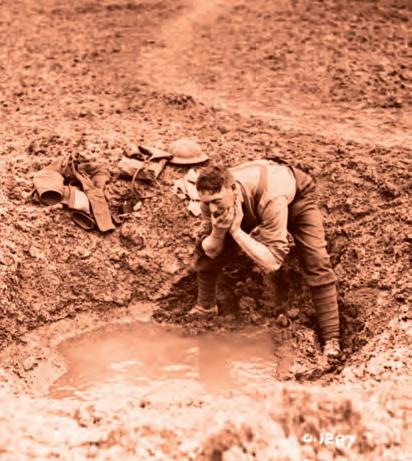
Edward Knobel/
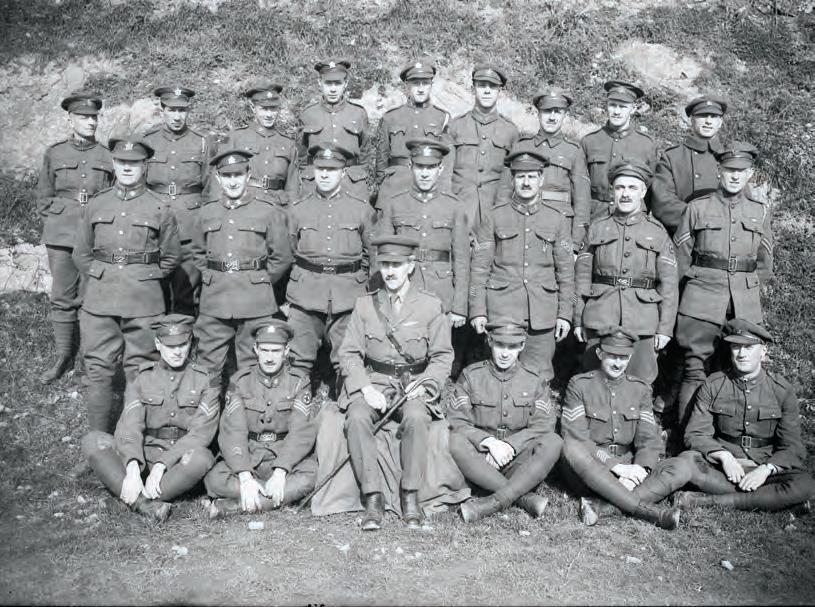
Mobilized as part of the Canadian Army Medical Corps (CAMC), sanitary sections and mobile laboratories acted as public health units in uniform. Their role, in a nutshell, was to identify, monitor, prevent and control the spread of disease in the areas of operation. Following the British example and, no doubt, aware of the threat posed by disease, Canada mobilized 10 sanitary sections and five mobile laboratories for its overseas force of 424,000 during the entire conflict. To put that commitment in perspective, if the Canadian government had made the same public health effort for the country’s population during the recent COVID-19 pandemic, the nation would have been serviced by 894 new specially mobilized federal public health units and 448 travelling laboratories. Had this public health expertise and guidance not been available from the start of the conflict, the health impact could have been considerably worse.
The armies of the time had good reason, based on generations of painful experience, to take disease prevention seriously. During the U.S. Civil War, for instance, about two-thirds of the 620,000 recorded deaths were because of disease.
The 1899-1902 Boer War, meanwhile, was also referred to at the time as the “typhoid campaign,” and with good reason: 84 per cent of imperial soldiers were, at some point, diagnosed with an infectious disease. Indeed, based on a 1911 study by the London
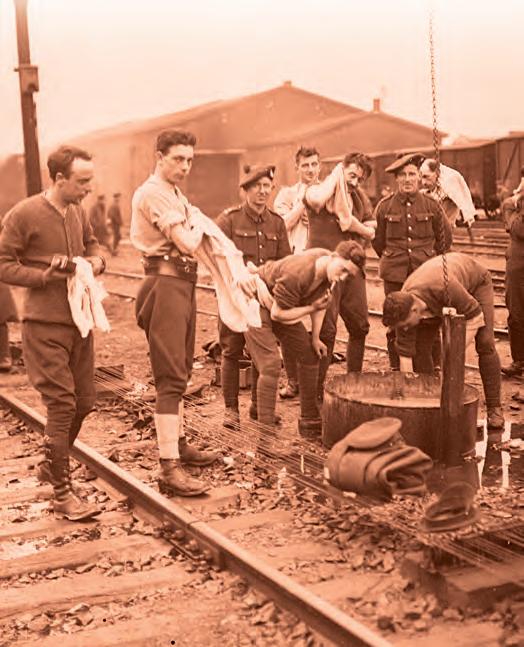
School of Hygiene & Tropical Medicine, disease accounted for 64 per cent of imperial military fatalities during the conflict. As the war progressed, that percentage worsened, increasing to 74 per cent in 1900-1901 and peaking at 78.8 per cent in 1901-1902. The study’s author, R.J.S. Simpson, summarized the seriousness of the forces’ failure to fight disease with the morbidly cheeky assertion that, moving forward, they must find a way to “teach the man that it is his duty to preserve himself from disease in order that he may have a better chance of being shot.”
Even worse than the plight of imperial and Canadian soldiers in South Africa was that of U.S. troops during the 1898-1899 SpanishAmerican War. Disease caused 88 per cent


of American service deaths, many of which took place in the training camps at home, well before the soldiers even met the enemy. By 1914, Western armies and their medical doctors could no longer claim ignorance when it came to the cause of diseases such as typhoid or scarlet fever. No longer a matter of speculation or insinuation, the scientific discoveries of the latter 19th century confirmed the microbiological origins of a growing number of diseases and, by extension, their environmental sources and means of transmission. For example, in the 1880s, German scientist Robert Koch proved the connection between micro-organisms and diseases such as cholera and tuberculosis. At the same time, doctors generally agreed on the principles and practices of investigation and reporting disease.
In British militaries, the concept of uniformed public health units servicing the army began in the early 1900s. In 1908, the first dedicated army public health unit, 1st London (City of London) Sanitary Company, was formed. It expanded into a network of subordinate sanitary sections during the war. Canada, as part of the imperial command structure, mirrored the British system, albeit without a central company, as its divisions were mobilized and sent to Europe.
As with all public health units, the precise tasking of sanitary sections and mobile laboratories depended on their location and circumstances. Units such as the 1st, 2nd, 3rd, 4th and 10th Canadian Sanitary Sections were deployed in the field with their respective
Overall, the primary responsibilities of a sanitary section included inspection of unit lines and accommodations for identification and elimination of sources of disease. Especially in front-line areas, sanitary sections were tasked with inspection, filtration and distribution of water supply. On the other end (literally and figuratively), was ensuring the safe disposal of sewage and refuse.
In both trenches and in the supporting camps and billets, sanitary sections made certain that sleeping quarters, bars, canteens and storage areas were properly sterilized and ventilated. Plus, those units assigned to camps and hospitals would routinely disinfect clothing, blankets, medical tools and hospital bedding. Regardless of their specific tasks, Canadian sanitary sections were also responsible for reporting any public health concerns.
Mobile laboratories, meanwhile, were focused on analyzing the origin of disease outbreaks such as typhoid, diphtheria, trench fever, tuberculosis and influenza. As such, they would examine pus, blood and other morbid products and would perform autopsies. And as part of their routine, mobile
No. 1 Sanitary Section in Huy, Belgium, in April 1919 (opposite top). Men of the Canadian Expeditionary Force use the “facilities” at Huy in March 1919. Near Arras, France, in August 1918, water is pumped from a dirty stream to be sterilized.
The local condiTions were described as dire, wiTh “deposiTs of fecal matter lying everywhere,” and where “ The walls of The houses are liTerally black wiTh flies.”
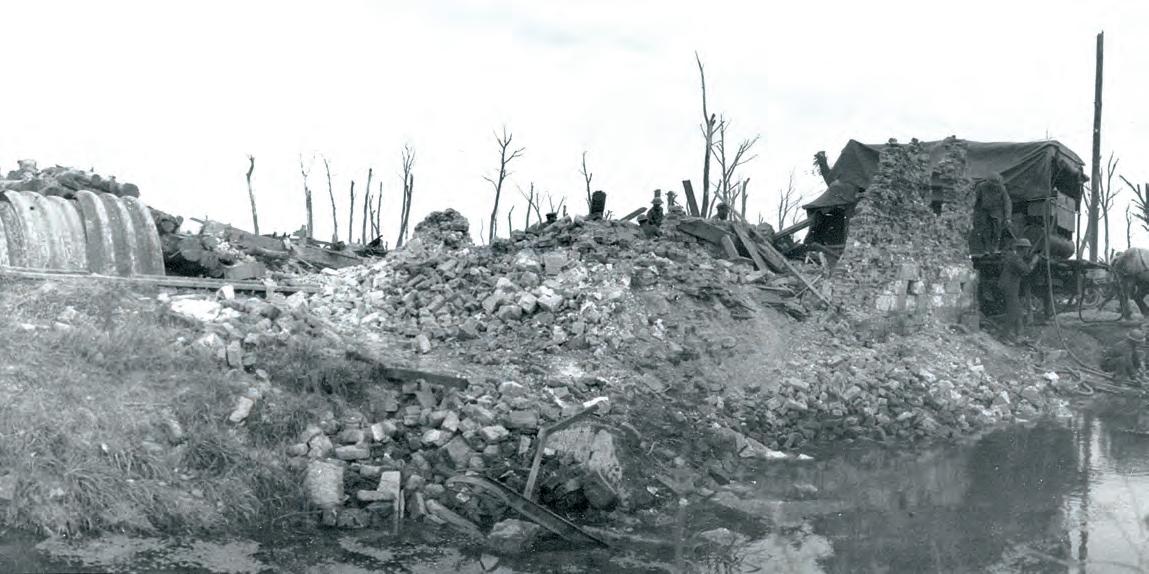

Disease, once the prime cause of Death among solDiers
During the late 19th anD early 20th centurIes , haD lost its place as the biggest single killer of solDiers .
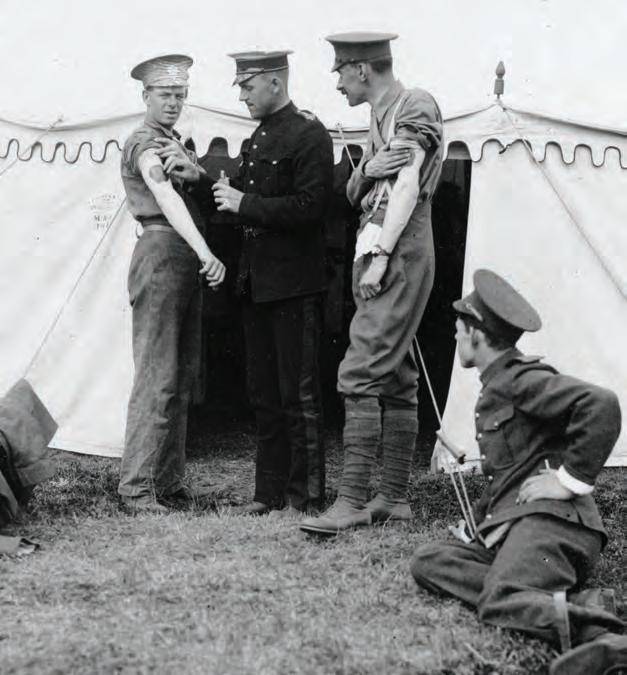
laboratories would test water supplies. With the introduction of chlorine gas as a weapon of war, mobile laboratories were unexpectedly also thrust into investigating the chemical contents of the gas used on Canadians.
Finally, as all Canadian army formations were required to routinely detail members of their units to sanitary duties, the sanitary sections and mobile laboratories also served in an advisory and educational capacity to personnel tasked with sanitary work. By 1917-1918, the Canadian Expeditionary Force’s network of sanitary sections had
already designed their own centralized training course syllabus and catalogue of sanitary applications and appliance designs.
Whatever a typical day or week was like for a sanitary section or mobile laboratory depended on the circumstances of where they happened to be at any one time. Here are just a few examples, drawn from unit war diaries and other archival sources, of the work.
No. 2 Canadian Sanitary Section was mobilized at Montreal’s McGill University in 1915 under the command of Thomas Albert Starkey, a professor of hygiene and one of many skilled academics turned CAMC officer. No. 2 was deployed to the area of KemmelLa Clytte in Belgium in October 1915, where, as was often the case, it first focused on providing safe water to the division. The situation was, in the words of Starkey, “acute.”
Shortages of drinking water prompted the men of the division to draw their water, unfiltered, from a brook that originated from behind the German lines. Working with the divisional engineers, Starkey’s section constructed an improvised filtration apparatus at a local lake where the water was chlorinated and from which a system of pipes brought the water forward to designated collection points.
In April 1916, meanwhile, while on a routine water inspection, Lieutenant-Colonel George Nasmith, the commanding officer of No. 5 Canadian Mobile Laboratory, and his technicians witnessed the close gas attack on the Canadians at Ypres, which resembled “a long cloud of dense yellowish-greenish smoke rising and drifting in our direction.”
“The gases reached us within half an hour,” reported Nasmith, “and we had diagnosed it as largely chlorine but with probably some bromine present.”
The unit immediately focused on confirming the exact composition of the gas used. Apart from their own observations, this involved interviewing and examining the wounded, as well as conducting lab tests. The results would inform what personal protection could be designed and used.
Then, toward the end of the war, No. 3 Canadian Sanitary Section, mobilized in Toronto, was following its assigned division during the Hundred Days Offensive. In mid-October 1918, as it set up camp in Douai, France, the local conditions were described in the unit’s war diaries as dire,



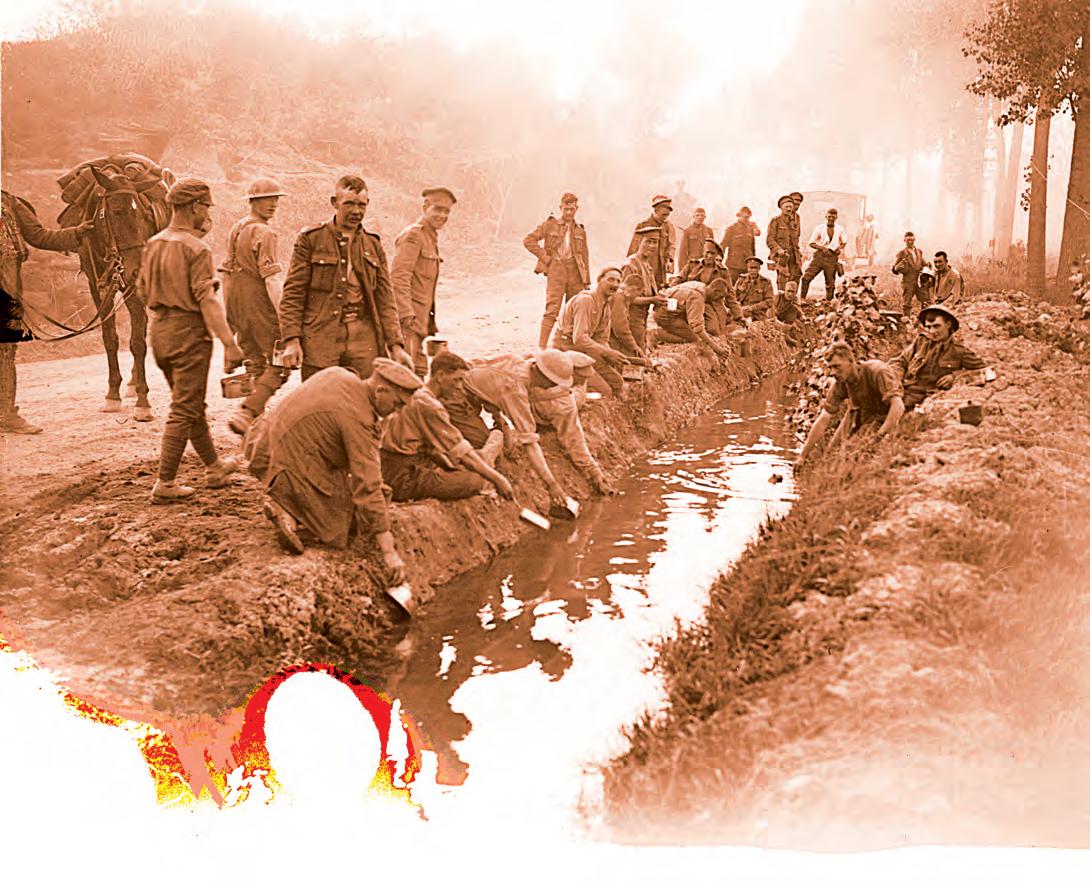
with “latrines overflowing,” “deposits of fecal matter lying everywhere,” and where “all premises contain heaps of decaying organic matter” and “the walls of the houses are literally black with flies.”
The unit spent October 19-20 constructing fly-proof public latrines and urinals and examining and labelling 16 wells in the area. The following week, its focus shifted to helping local war refugees, approximately 1,000 of whom were concentrated at the city barracks. The unit’s commander, Major Harold Orr, reassigned part of his unit to the camp.
“Large numbers of these persons have been brought in in a very weak condition,” reported No. 3’s war diary. “They have been impoverished on the German diet, and influenza had developed among them. It is probable that many more cases of influenza will develop in the next few days.
“These people are very difficult to handle, one member of a family will not permit himself to be removed to a hospital unless the whole family are taken. The children and some of the adults do not bother using latrines but defecate on the ground in exposed places. They throw their food refuse on the ground, they have no idea about cleanliness, they are very much depressed mentally.”

As detailed in the war diary of No. 3, the spread of influenza posed an additional threat to the operations of Allied armies during the final offensive. Yet, the sheer fact
that the push continued despite the disease’s presence could also be seen as a testament to the ability of sanitation units in containing and mitigating the challenge, which would have been impossible 20 years earlier.
So, while there was ample evidence of influenza’s devastating impact on civilians in Europe and North America, its effect on the Canadian Expeditionary Force, though by no means negligible, was never severe enough to compromise operational capability in the waning months of the war. A 2020 study by Robert Engen of the Canadian Forces College estimated that the deaths of 260-450 Canadian First World War soldiers overseas could be attributed to influenza—less than 0.1 per cent of the CEF contingent. Though certainly on guard against the disease, the records of the sanitary sections and mobile laboratories nonetheless took on a businessas-usual approach at the time, suggesting that policies and procedures were in place, up to date and capable of handling the challenge.
This quiet confidence, even in the face of a pandemic, is reflected in Nasmith’s memoir: “There must be some basic reason for this freedom from contagious diseases, for we know that such freedom does not come by accident.” L
Canadian soldiers fill their water bottles near Amiens, France, in August 1918. Men receive vaccinations for typhoid at Valcartier, Que., in 1915.


A portrait of journalist Kathleen (Kit) Coleman surrounded by news clippings from the 1898 Spanish-American War and commemorative coins marking 125 years since Coleman became the first accredited female war correspondent in North America.

The story of Kathleen (Kit) Coleman, North America’s first female war correspondent
By June Coxon
During her lifetime, journalist Kathleen (Kit) Coleman achieved many firsts—and she’s still doing so more than 100 years after her death.
In February 2023, the Royal Canadian Mint issued two collector coins in her honour, marking 125 years since she became North America’s—and possibly the world’s—first accredited woman war correspondent. Coleman also became the first female journalist to appear on a Canadian coin.
During her lifetime, her many other accomplishments included: the first woman journalist to write and edit a column in a Canadian newspaper, in 1889; one of 16 founders of the Canadian Women’s Press Club (now the Media Club of Canada) and its first president, in 1904; Canada’s first female syndicated columnist, in 1911.
Still, Coleman is perhaps best known for her
coverage of the SpanishAmerican War in 1898 for Toronto’s Mail and Empire. At the time, she had also become one of the best-known columnists in Canada. As a publicity brochure produced by the newspaper noted in 1896, Coleman’s column was “acknowledged to be unexcelled on this continent.”
Kathleen Coleman was born Catherine Ferguson in 1856 at Castleblakeney in Ireland’s County Galway. At 20 she entered an arranged marriage to a wealthy Irishman named Thomas Willis, 40 years her senior. Left penniless when disinherited by Willis’s family four years after his death, she worked briefly as a tutor and spent some time in France. In 1884, she immigrated to Toronto, where she selfidentified as a childless young widow who needed to make
a living. She reinvented herself, changing her name from Catherine to Kathleen and slicing eight years off her age. She worked as a secretary to support herself until marrying her boss, Edward J. Watkins. They moved to Winnipeg where their two children, Thady and Patricia, were born.
But it was an unhappy marriage as Watkins may have been, among other unpleasant things, a bigamist. When that marriage ended, Coleman dropped the surname Watkins and returned to Toronto with her two young children. At first she did odd jobs to earn a living, but she also wrote articles for local magazines, mainly Saturday Night. Coleman was hired by The Toronto Daily Mail newspaper in 1889 to write a column for the women’s pages. At first it was a short entry called “Fashion Notes and Fancies for the Fair Sex.” At the time, female journalists were typically limited to writing about recipes and fashion. And while Coleman did launch the first “lovelorn” column, she also wrote on a range of other matters including politics, business, religion and science.
Coleman penned colourful accounts of her journeys to Ireland, England, the West Indies and across North America, sometimes going undercover in other cities to write about social issues and the plight of the poor. Her column soon grew longer, filling seven pages. Called “Woman’s Kingdom,” it was eagerly read by both men and women, including Prime Minister Wilfrid Laurier.

Coleman is perhaps best known for her war correspondent feat, when she covered the Spanish-American War in 1898 for Toronto’s Mail and Empire.
Coleman was renowned for her work in Toronto’s The Mail and Empire newspaper (above).
Readers were curious about who Coleman was, but she preferred to keep her personal life private. Most of the time, she left readers guessing about whether her column was written by a woman or, as some wondered, by a man pretending to be one.
Coleman was “an avid reporter and eloquent writer” and “strikingly attractive, with chestnut gold hair and violet eyes,” wrote Linda Kay in 2012 in The Sweet Sixteen: The Journey That Inspired the Canadian Women’s Press Club. Kay added that although Coleman was one of the top female journalists of her era, she likely only earned $35 a week at the peak of her career.
After a mysterious explosion rocked the American battleship Maine in Havana Harbor on Feb. 15, 1898, the U.S. planned to invade Cuba in response. It was a pivotal event in what became the Spanish-American War, and
Coleman convinced the editor of The Mail and Empire to let her report from the front. Some considered the assignment a stunt to attract readers and Coleman was told to write “guff” as she called it. She caught the night train to Washington, forced her way into the office of the Secretary of War and asked to sail with U.S. troops to Cuba. General Russell Alger told her she would not be allowed on any American ship. He laughed at the request in general, saying a war zone was no place for a woman, because, among other things, soldiers would be wandering around with their shirts off.
“I’m going through to Cuba, and not all the old generals in the old army are going to stop me,” Coleman insisted. Alger relented and signed the paperwork to make her an accredited correspondent. Although at least one other American female journalist, Anna Benjamin, and possibly another, went to Cuba, they had not been accredited.
But Coleman’s struggle wasn’t over once she had official approval. After waiting a week (some reports say six) in a dank hotel in Tampa, Fla., she was denied passage on the press boat to Cuba because the 134 male journalists and the army commanders were opposed to having a woman in their
midst. She was also denied passage on a Red Cross ship leaving from Key West, Fla., reportedly because Clara Barton, a union nurse, took an instant dislike to her. So, Coleman was stranded in Florida, missing the front-line action.
But she eventually talked her way onto a U.S. government freighter carrying war supplies to Havana, and arrived in Cuba in July, just before the war ended. And Coleman wasn’t given any special allowances as a woman, often sleeping on the ground and eating when and where she could. When Coleman cabled back her first story to The Mail and Empire, it officially made her the first female accredited correspondent.

Her reports were described as vivid, poignant accounts of the war. She wrote about the conflict’s human cost and aftermath and what the hostilities did to both soldiers and civilians caught in the crossfire. An interview with a U.S. military official also uncovered information about a secret arms shipment to Cuban rebels. The stories she filed from Cuba made her famous.
“Her writing was marvellously vivid,” declared Ted Ferguson of Coleman’s work as a war correspondent in his 1978 book Kit Coleman: Queen of Hearts


and the subject of numerous biographies, including the 1978 book (above) by Ted Ferguson, who called her writing “marvellously vivid.”
Some examples: Coleman wrote that Spanish soldiers in a field hospital were
“living ghosts of men” with “eyes sunken far in their sockets burning like lamps on the edge of extinction.”
And following a crucial battle, she wrote: “Here in Santiago, men, nobles and commoners alike, dying in filth and stench, and uttermost squalor; lying out there on the hills for the buzzards and the crab to feed upon. There was heartbreak in the thought of it, in the sight of this hopeless suffering. We are very little creatures. Very small and cheap and poor.”
After a month in Cuba, Coleman returned to the U.S. on a troopship, helping to nurse wounded soldiers en route. General Alger invited her to go on a tour to be billed
During her lifetime, the well-respected, groundbreaking journalist helped pave the way for other early female journalists.
as the world’s first female reporter, before she went back to Canada. She agreed to address the International Press Union of Women Journalists in Washington, but declined a national tour.
While in the U.S. capital she also got married again—to Canadian doctor Theobald Coleman. They lived in Copper Cliff, Ont., (now Sudbury) before moving to Hamilton.
When Coleman returned to Canada, she adopted an anti-war stance. In addition to her war reporting, she had covered some significant news in her career, including a jailhouse interview with notorious fraudster Cassie Chadwick, an interview with French actress Sarah Bernhardt and reportage on the New York murder trial of railway baron heir Harry K. Thaw.
After a disagreement with the editor of The Mail and Empire in 1911, Coleman resigned and began selling her column to other newspapers across the country, making her the country’s first syndicated columnist. She charged $5 a column and earned more money than she had while at the Mail. Coleman died of pneumonia in Hamilton in 1915. During her lifetime, the wellrespected, groundbreaking journalist helped pave the way for other early female journalists such as Faith Fenton (also known as Alice Freeman), Ella Cora Hind and Miriam Green Ellis. Wrote Barbara M. Freeman succinctly in a 1989 biography of Coleman: she “spent most of her 25 years as a journalist walking a creative tightrope between what was considered acceptable and what was considered too daring.” L
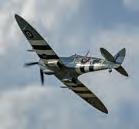


Warbirds
The Spitfire was the iconic Allied fighter aircraft in Europe during the Second World War.
Canadian Wildlife
Four varieties to choose from: grizzly bear, loon, timber wolf and moose.
Spring Peony
With the approach of warmer weather comes the Spring Peony mailing label—a burst of vibrant fuchsia and yellow to brighten the season.













Canada should not follow Australia’s decision to acquire U.S. nuclearpowered submarines because they are a sovereignty-undermining, murderously expensive, nuclear proliferation stimulant, the procurement of which risks entangling Canada further into America’s aggressive and short-sighted China containment strategy.
Canada, like Australia, is a non-nuclear weapon state party (NNWS) to the Treaty on the Non-Proliferation of Nuclear Weapons, which requires safeguards administered by the International Atomic Energy Agency (IAEA) on peaceful nuclear activities. Under the agreement, all military nuclear uses are prohibited for NNWS parties, with the exception of a “glaring and worrying loophole in IAEA safeguards” that permits them to withdraw nuclear material from international oversight for the duration of its use in naval reactors.
U.S. nuclear subs are powered by highly enriched uranium, weapons-grade material that can be used directly in warheads. The concern isn’t that Canada or Australia would use the enriched uranium for anything other than naval propulsion. Rather, it’s that aspiring nuclear powers such as Iran or Saudi Arabia might, out of reach of IAEA inspectors.
Should Canada have nuclear submarines?
Peggy Mason says NO
IT’S
ABSURD FOR CANADA TO CONSIDER EXPENDING
SUCH A LARGE PROPORTION OF ITS MILITARY BUDGET ON NUCLEAR-POWERED SUBMARINES
Then there’s the exorbitant cost. Canada has stated that it requires up to 12 conventionally powered submarines at a projected cost of $60 billion. Under the AUKUS trilateral security partnership between the U.S., U.K. and Australia, the latter will purchase up to eight American nuclear-powered subs between $268 billion-$368 billion. Bearing in mind that military procurement, especially for large projects, rarely if ever stays on budget, it’s absurd for Canada to consider expending such a large proportion of its military budget on nuclear-powered submarines.
The way that former Australian foreign minister Gareth Evans put the sovereignty problem is equally applicable to Canada: “whether, by so comprehensively further yoking ourselves to such
extraordinarily sophisticated and sensitive U.S. military technology, Australia has for all practical purposes abandoned our capacity for independent sovereign judgment.
“Not only as to how we use this new capability,” he continued, “but in how we respond to future U.S. calls for military support.”
The importance of Canada maintaining some independence in global affairs is even greater in light of the final argument against the Canadian acquisition of U.S. nuclear subs: doing so risks further enmeshing Canada in America’s destabilizing anti-China strategy in the Western Pacific.
Canada is already participating in American-led freedom-of-navigation operations and other exercises in areas close to the Chinese coast. The acquisition of U.S. nuclearpowered submarines risks greater involvement in this effort to contain China at the very time when progressive American strategists are urging President Joe Biden’s administration to move to “an active denial” defensive posture that will effectively deter potential Chinese aggression while limiting risks of rapid, and nuclear, escalation.
Canada should not follow in Australia’s misguided footsteps and seek to acquire this murderously expensive, proliferation-enhancing, sovereignty and security-undermining military equipment. L
> To voice your opinion on this question, go to www.legionmagazine.com/FaceToFace

AsCanada approaches the second quarter of the 21st century, it needs to get its priorities straight for a changing world. Arctic and marine sovereignty should be high in the lengthy list of things in which the country needs to invest. The Earth is warming and monitoring the north polar region is critical to a prosperous and secure future. Russia is already encroaching on Canada’s North with its own nuclear submarines and underwater sensors, asserting its sovereignty claims, while China is threatening expansion in the Pacific. Canada has three vast coasts to monitor, from the maritime provinces to the Arctic to the B.C. shoreline in the Pacific, and there’s only one suitable vehicle: a nuclear submarine.
The public might think Canada already has a fleet of submarines, so why the need for expensive new ones? Well, the current ones aren’t the right tools for the job. Canada’s existing Victoria-class subs were built in the 1980s, but were purchased from Britain in 1998. And the country has since spent billions on repairs. Plus, calling it a fleet makes it seem like they are ready at moment’s notice. But that’s not the case—only one is operational. Besides, they’re also due to be decommissioned
PEGGY MASON is president of the Rideau Institute, an independent foreign and defence policy research and advocacy group based in Ottawa. She served as Canada’s UN ambassador for disarmament from 1989-1995.
MICHAEL A. SMITH is the assistant editor of Legion Magazine. A Newfoundlander, he previously worked as a reporter for CBC Radio’s “The Broadcast” and for the Ottawa Citizen. Smith is also an award-winning poet.
SUCH VESSELS WOULD GIVE CANADA THE CAPABILITY TO MONITOR ITS WATERS WITH FEWER
LIMITATIONS
in the 2030s, which means Canada needs to decide soon what’s next.
Of course, needing to replace the current vessels isn’t reason enough alone for the nuclear option. But Canada’s vast and vulnerable coastline, the longest in the world, is reason enough. Nuclear submarines can stay submerged for—double-checks notes—about 20 years (!) without needing to refuel, meaning the only limitation is food, supplies and the fact that it’s inhumane to keep sailors underwater for that long. But such vessels would give Canada the capability to monitor its waters with fewer limitations, reach
depths previously unobtainable and map Arctic passageways emerging as polar ice melts. Not only does Canada need to improve its domestic defence capabilities, but it should also be collaborating with its allies. The Canadian military’s international reputation has been floundering. It routinely fails to meet NATO’s two per cent gross domestic product spending target—Canada spends about 1.3 per cent—and has been left out of important international security partnerships such as the new AustraliaU.K.-U.S. coalition. Known as AUKUS, it’s working to secure the Indo-Pacific through strategic co-operation, intelligence sharing and, notably, facilitating the former’s procurement of nuclear submarines. Could Canada not have tacked a few more onto the order?
In March 2023, then-defence minister Anita Anand said Canada was not part of AUKUS because of its lack of interest in obtaining nuclear submarines. But that decision directly limits the country’s intelligence capabilities. Canada isn’t pulling its weight in that regard and countries are noticing.
The federal government might be saving taxpayers money, but Canadians will pay one way or another if the country’s marine and Arctic sovereignty come under threat while they’re sleeping. L
Michael A. Smith says YES
SOPWITH 1½ STRUTTER
First World War Canadian pilots with the Royal Naval Air Service would know the Strutter, the first legendary Sopwith aircraft to achieve widespread use as a fighter.
ICONS OF THE
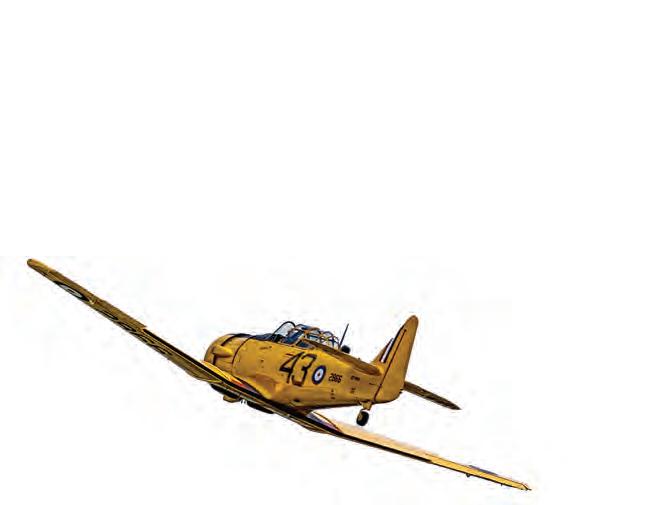
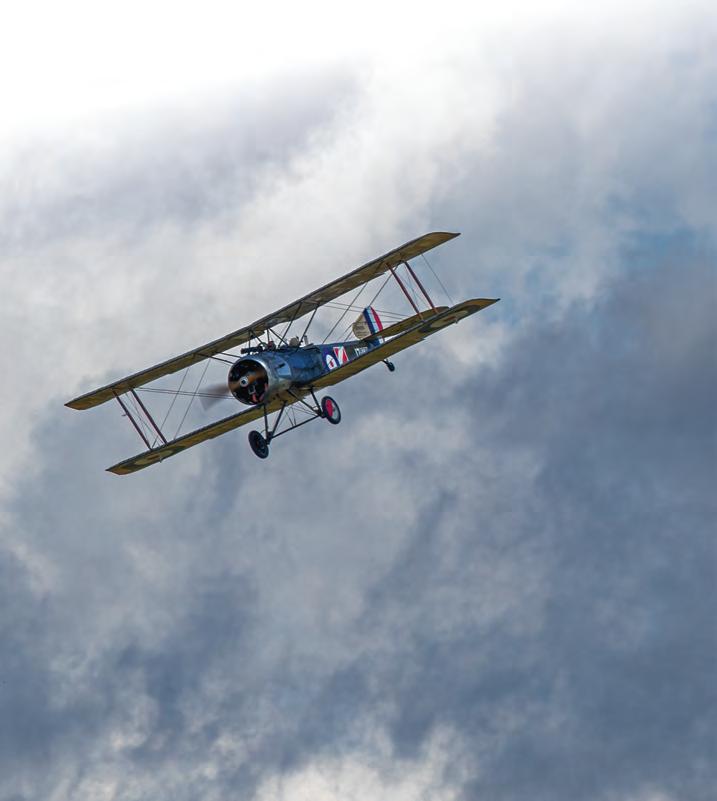
I
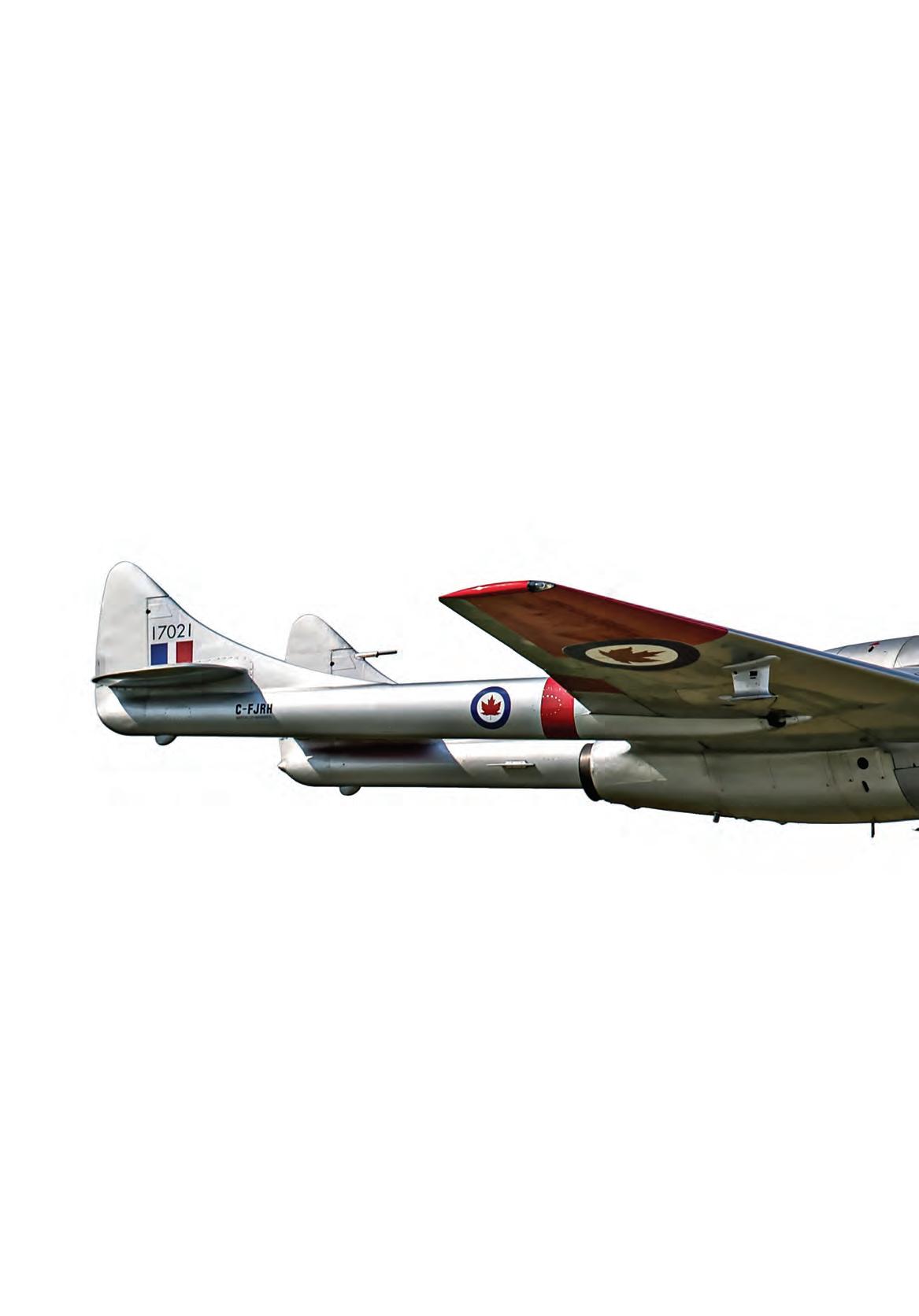
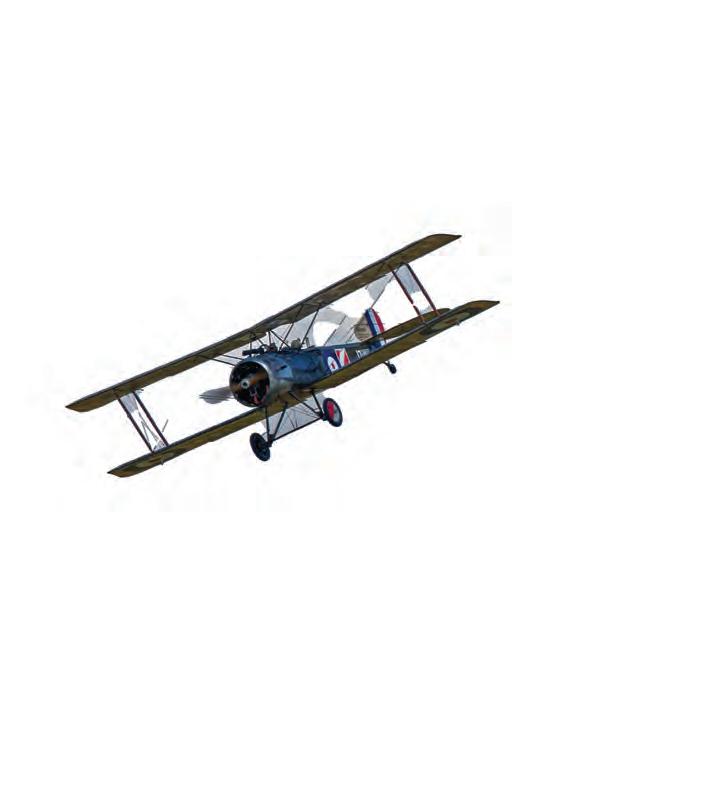
CANADIAN CAR AND FOUNDRY HARVARD 4
Nearly 50,000 Allied pilots of the Second World War earned their wings on the Harvard at British Commonwealth Air Training Plan bases across Canada.



DE HAVILLAND DH-115 VAMPIRE
Acquired as an operational fighter in 1948, the Vampire was the RCAF’s first jet. It was soon replaced by the Canadair Sabre (see page 94).
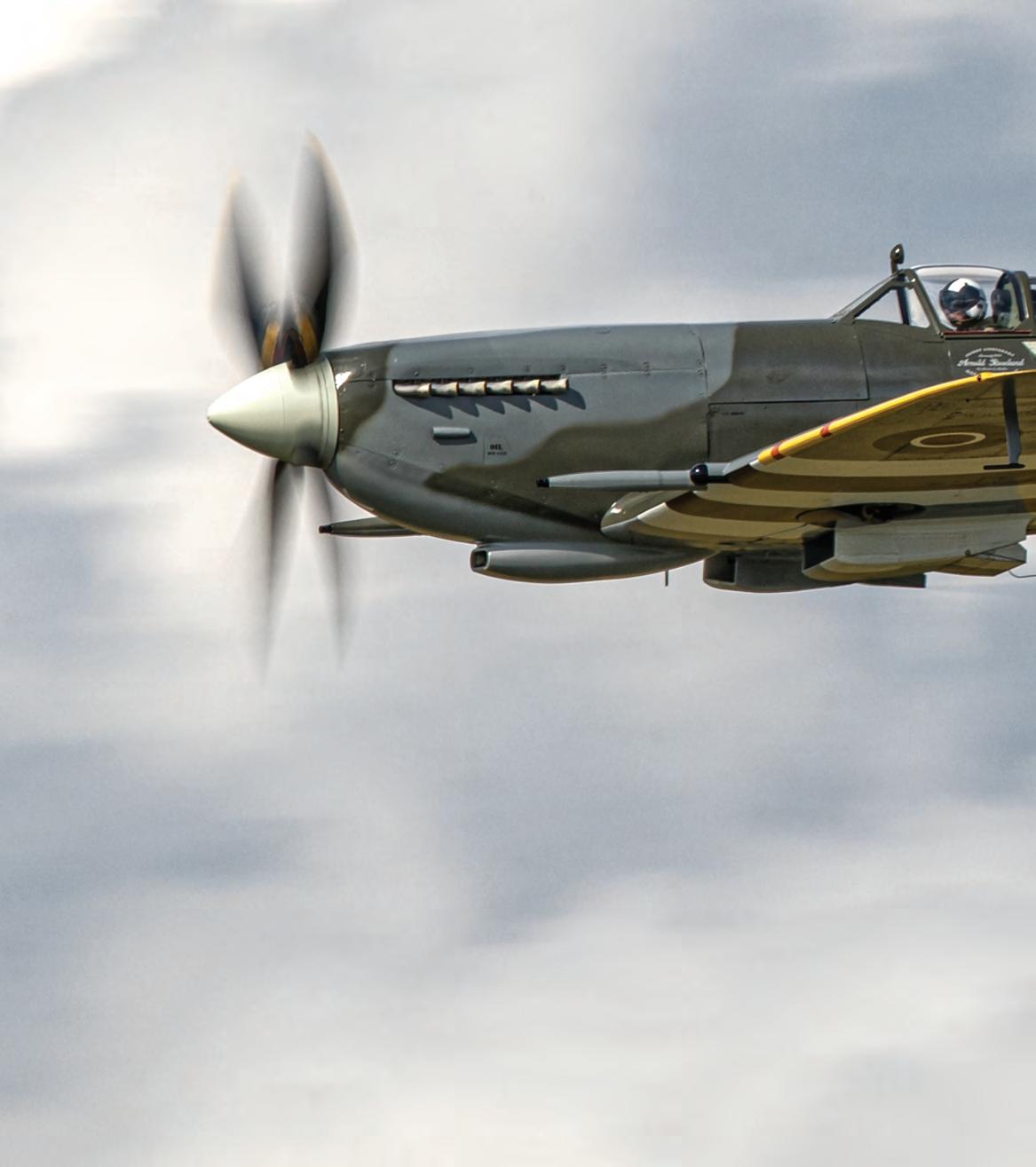
SUPERMARINE SPITFIRE MK IX
Often considered the most beautiful aircraft ever built, more than 22,000 Spitfires were produced in nearly 30 variants before, during and after WW II. Its signature elliptical wing was designed by Canadian aerodynamicist Beverley Shenstone.
A
AT ITS PEAK IN 1944, THE RCAF WAS THE FOURTH-LARGEST AIR FORCE IN THE WORLD.
DOUGLAS C-47 DAKOTA
The Dakota was a WW II workhorse, dropping paratroopers, delivering supplies, transporting troops, evacuating wounded and towing troop-carrying gliders. RCAF crews even flew C-47s to supply Chinese forces resisting the Japanese.
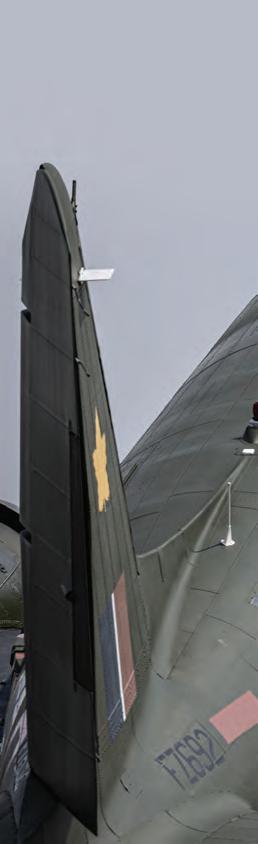
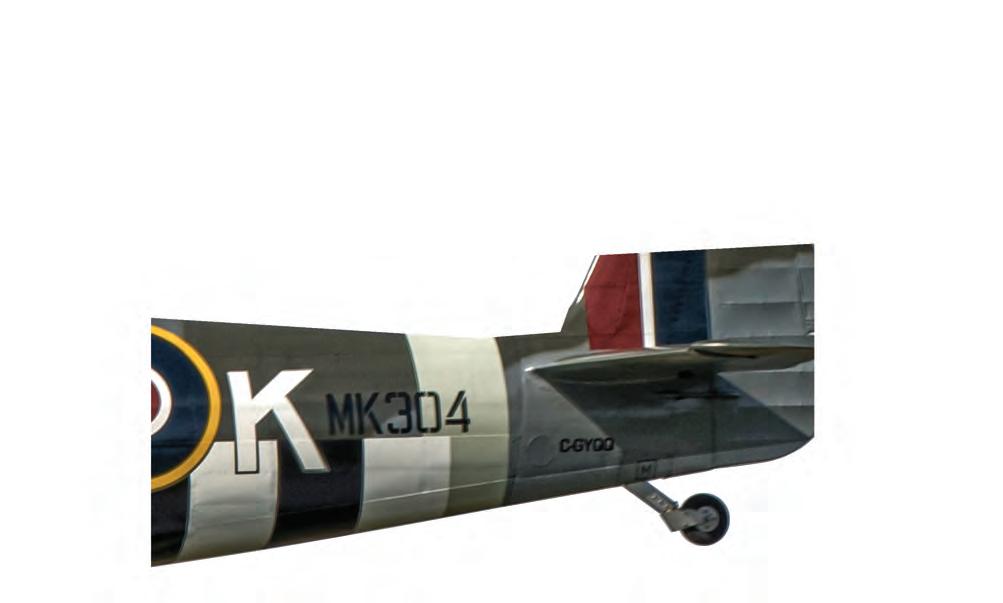
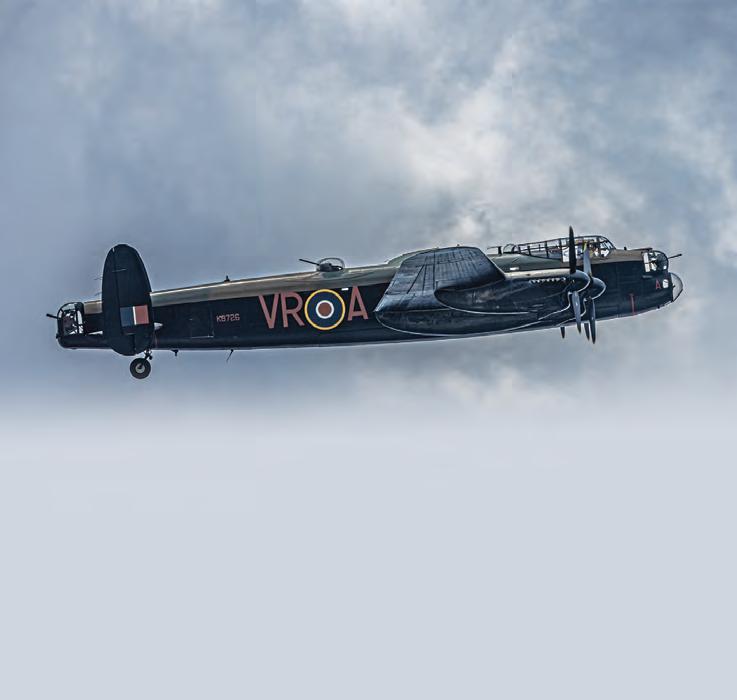
AVRO LANCASTER
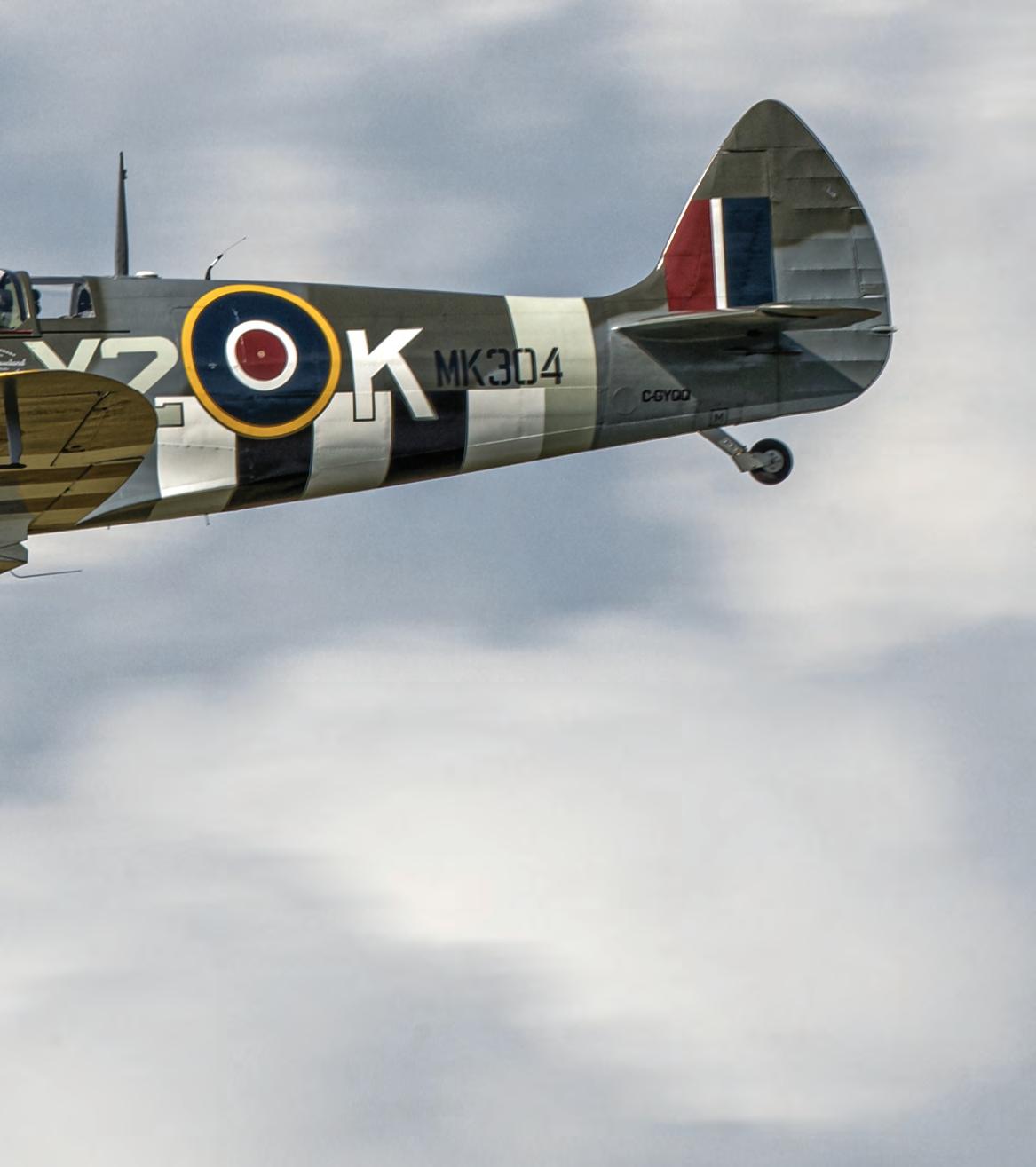
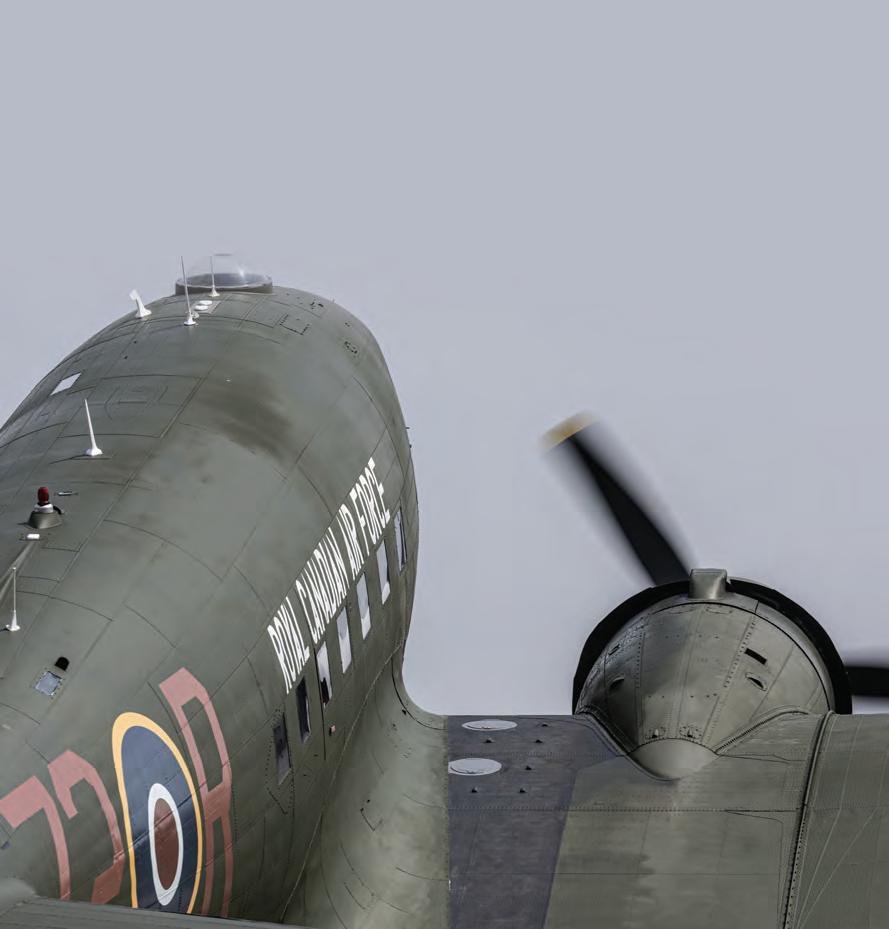
An icon of Bomber Command’s nighttime raids on Germany’s industrial war machine, the Lancaster was a mighty beast. Crewed by British and Commonwealth airmen, it delivered the biggest payloads of the European campaign.
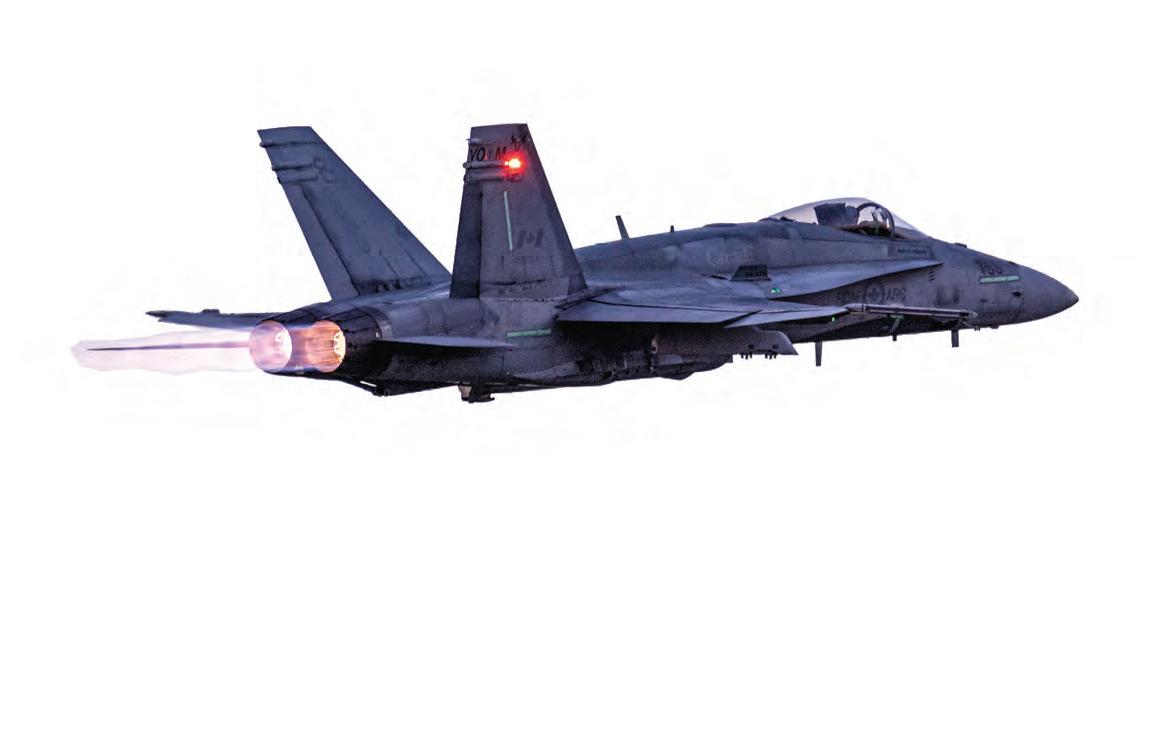
TMc DONNELL DOUGLAS CF-18 HORNET
This multi-tasking Canadian variant of the American F/A-18 began RCAF service in 1982, replacing three Cold War stalwarts: the CF-104 Starfighter, CF-101 Voodoo and CF-116 Freedom Fighter. It’s to be retired later this decade.
THERE IS NO DENYING THAT PILOTS AND AIRCREW OF THE AIR FORCE WE KNOW TODAY FORGED ITS REPUTATION ON THE PLANES OF WW II.
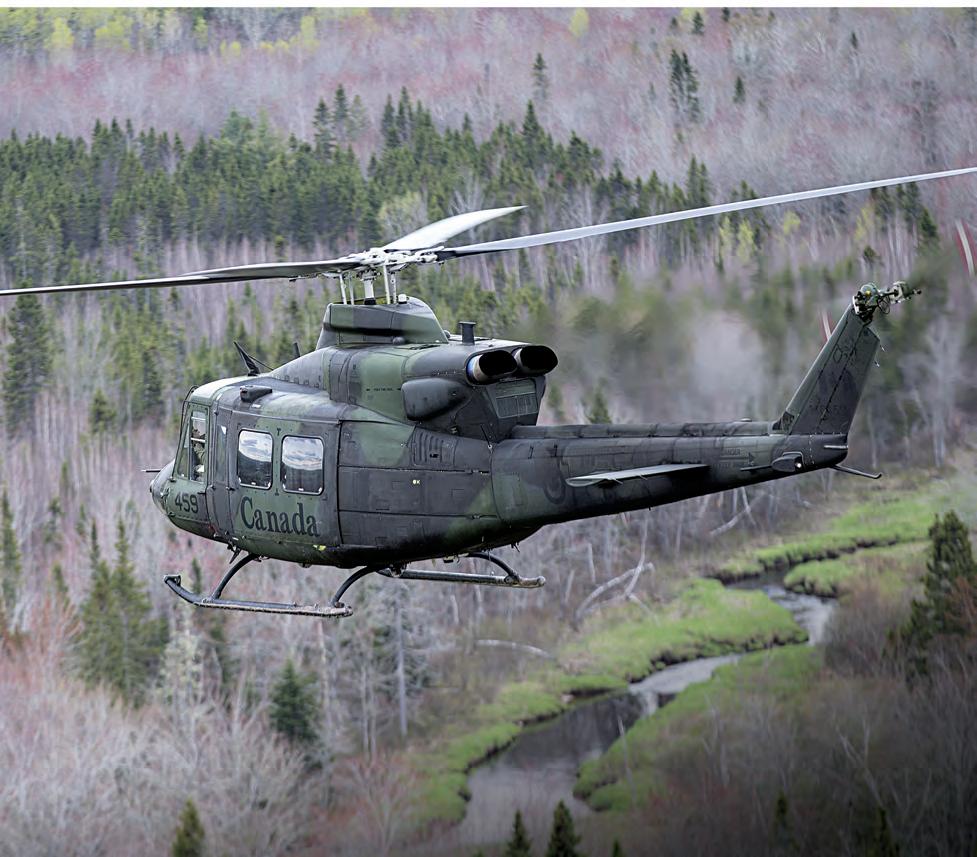
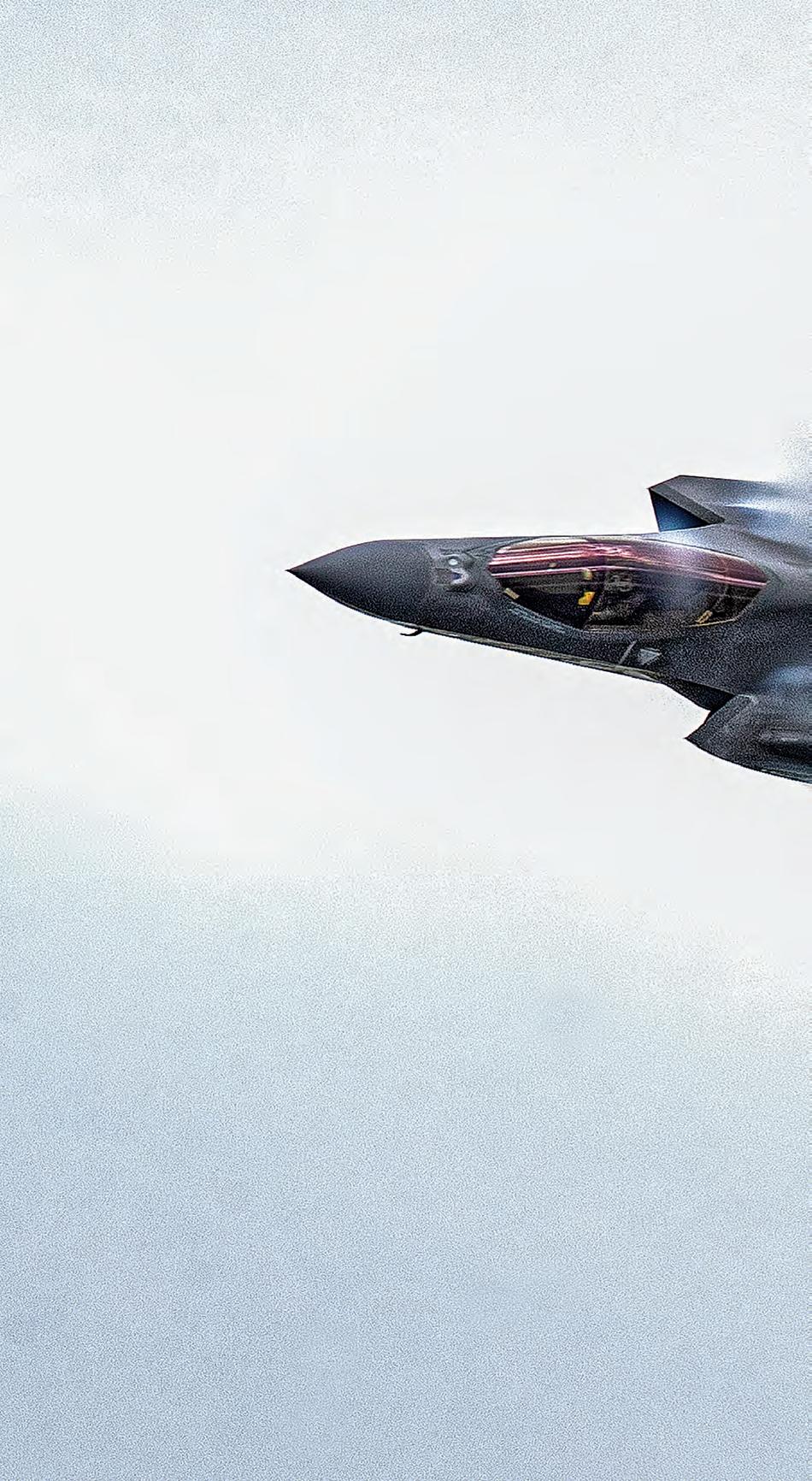

LOCKHEED MARTIN F-35 LIGHTNING II
The federal government confirmed in January 2023 that it would replace the RCAF’s CF-18s with 88 F-35s at an estimated cost of $19 billion. The first delivery of four aircraft is slated for 2026.
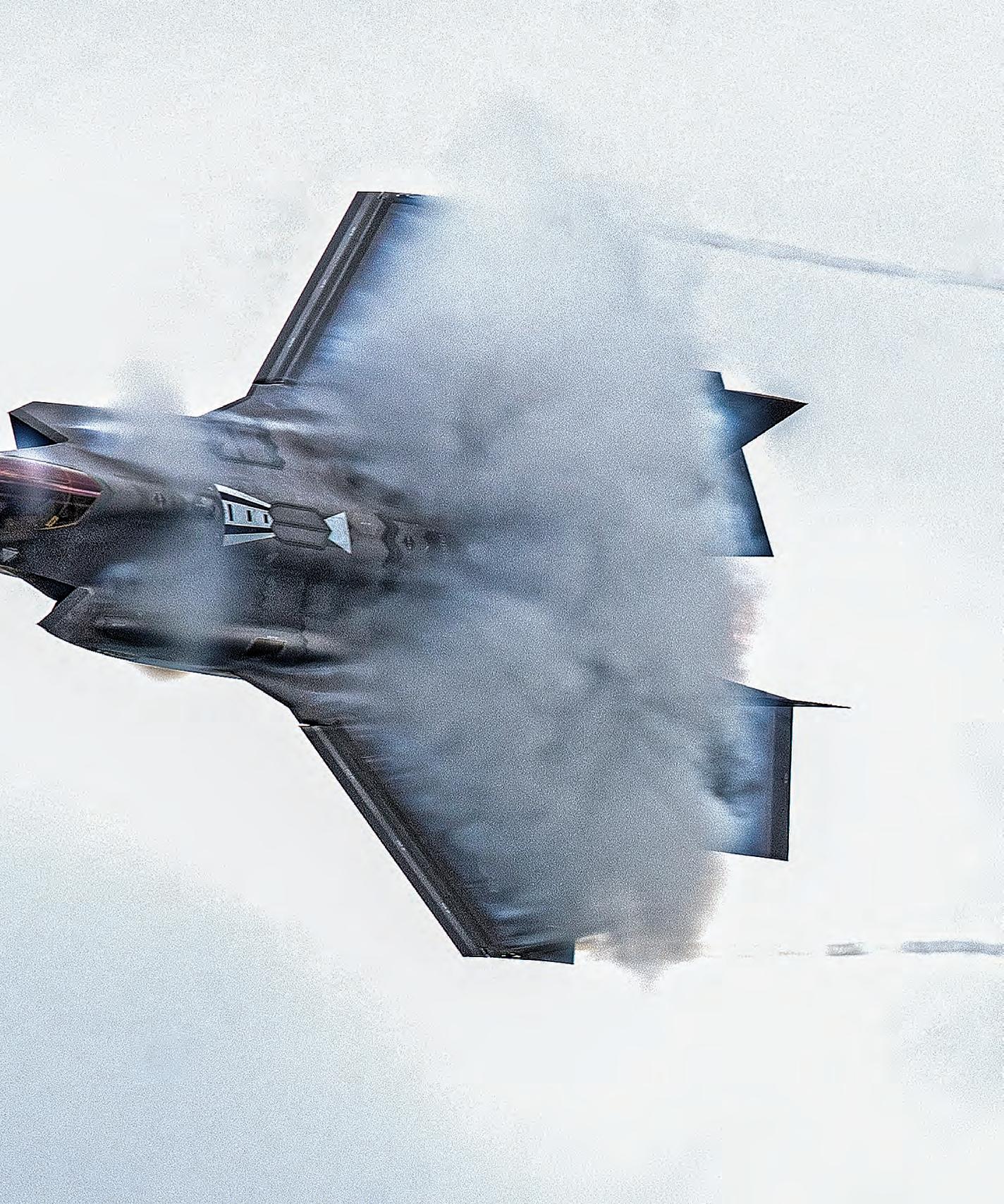
BELL CH-146 GRIFFON
The CH-146 is a versatile, well-used helicopter, its roles including aerial firepower, reconnaissance, search-andrescue and aero-mobility. Crewed by three, it can carry up to 10 troops and cruise at 220-260 km/h.
> Available Feb. 1! Canada’s Ultimate Story RCAF 100th Anniversary special edition. See details on page 7.
By Paige Jasmine Gilmar
Remembrance for all
A DIVERSITY OF VOICES REFLECTS ON MILITARY SACRIFICE AT THE ANNUAL CEREMONY IN OTTAWA
The heartbeat of Canada was heard along Ottawa’s Elgin Street, played at a steady rhythm by the Central Band of the Canadian Armed Forces. Throngs of people gathered around the National War Memorial on a cold, bright morning, rosy-cheeked and shivering in silent anticipation for Ottawa’s 2023 Remembrance Day ceremony. Some stood behind the barriers, while others sat on the rooftops of nearby office
buildings, each attendee with their own story about how the CAF’s lifeblood invariably mixed with theirs.
As Elgin filled with military branches and members of all kinds, there was diverse representation throughout this year’s national event, marked by new campaigns, new language and new faces. The unofficial theme was fitting, too, in conjunction with acknowledging the 75th anniversary of peacekeeping, a reminder of the military’s many functions and sacrifices. Plus, with
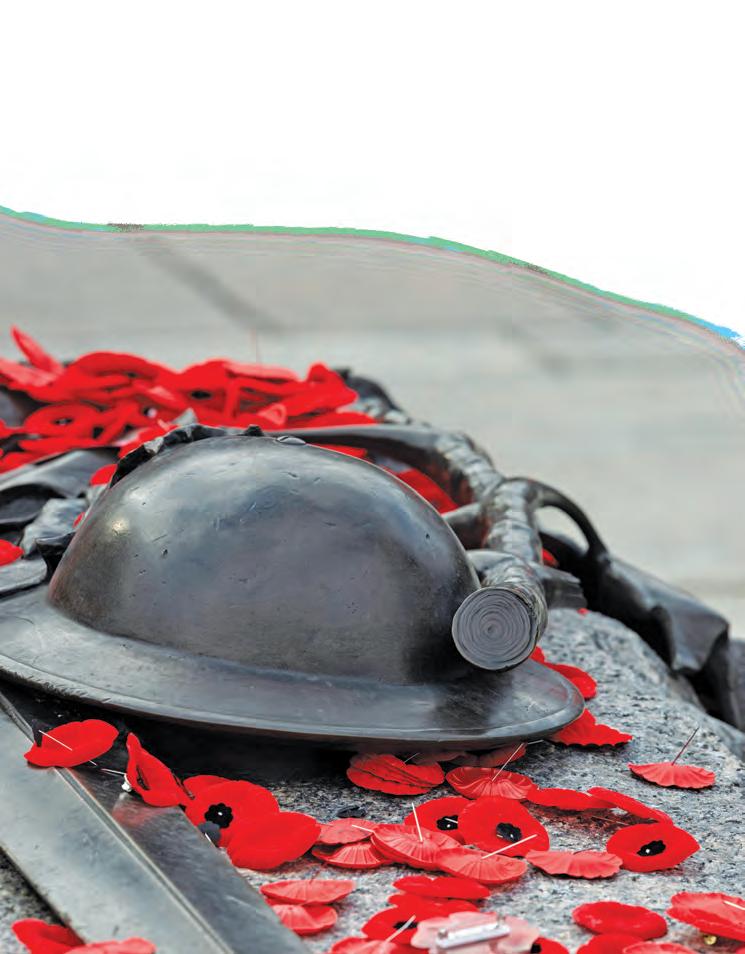
topics such as mental health, service families, Indigenous representation and more featured in speeches, the capital’s ceremony intimated that the act of remembrance is for everyone. When the massed pipes and drums reached the National War Memorial and fell silent, the sun dipped behind the clouds as the official ceremony began. Present were the speaker of the Senate Raymonde Gagné, Minister of Veterans Affairs Ginette Petitpas Taylor and defence chief General Wayne Eyre, along with this year’s top cadets and the senior winners of The Royal Canadian Legion’s poster and literary contests. The crowd stood still, waiting for the arrival of special guests, including Governor General Mary Simon, Prime Minister Justin Trudeau and 2023 National Memorial (Silver) Cross Mother Gloria Hooper. Hooper’s son Christopher (Chris) Holopina was the first Canadian peacekeeper killed on duty during the country’s 1990s mission in Bosnia.

The national Remembrance Day ceremony attracted a crowd including veterans and serving members (right). Gloria Hooper (middle), the 2023 National Memorial (Silver) Cross Mother, pauses to reflect after placing a wreath. The event’s special guests greet the parade (bottom). Poppies cover the Tomb of the Unknown Soldier afterward.
A fun-loving prankster born in Russell, Man., Holopina’s childhood interests included toy soldiers, doodling and general mischief. “Anything we could do for fun, we did it!” said Hooper. Enthralled by the military as a youngster, Holopina joined the reserves at 16, eventually becoming a sapper for 2 Combat Engineer Regiment based in Petawawa, Ont.
Serving in Cyprus and Croatia throughout the early to mid-90s, Holopina died in a vehicle accident during his tour in Bosnia while enroute to rescue British soldiers stranded in a minefield. Representing all military parents and their families, Hooper was honoured to symbolically support those who have struggled with “the feeling of having a child gone.”
And just as Hooper remembered her son, thousands of attendees recalled their parents, grandparents and aunts and uncles in the CAF. For Louise and David Doucette of Yarmouth, N.S., that recognition couldn’t be more welcome. “People should remember the big sacrifice veterans’ families went through,” said David. While the families of military members are often forgotten about during policy-making, veteran health discussions and more, Louise said she’s noticed greater steps toward including military families in CAF decisions. “It’s nice to see everybody included,” she said. “The more inclusion the better. It seems to be more inclusive now than it was even 10 years ago.”
Louise’s father Marc d’Entremont served for four years during the Second World War, including helping to liberate the Netherlands. He brought the war back home with him, however, likely suffering from what we know today as post-traumatic stress disorder. “When he heard gunshots on TV, he had to go outside,” recalled Louise. d’Entremont died when Louise was only nine years old, and he never had the opportunity to attend the national Remembrance Day
HOOPER WAS HONOURED TO SYMBOLICALLY SUPPORT THOSE WHO HAVE STRUGGLED WITH “THE FEELING OF HAVING A CHILD GONE.”
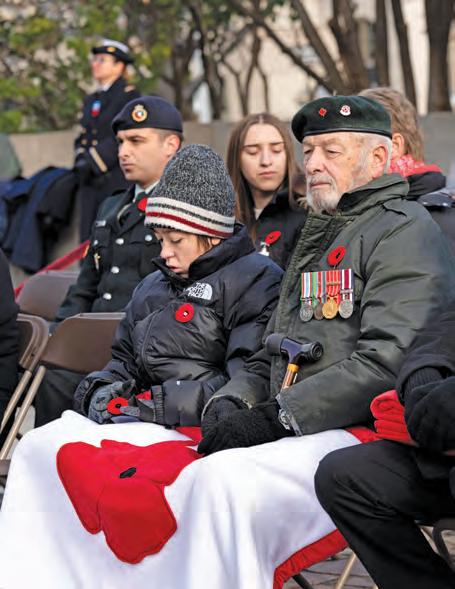
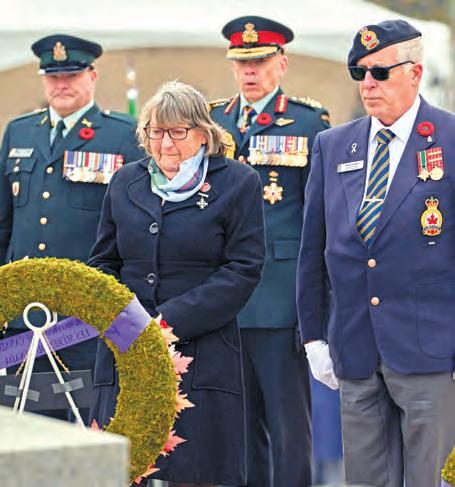
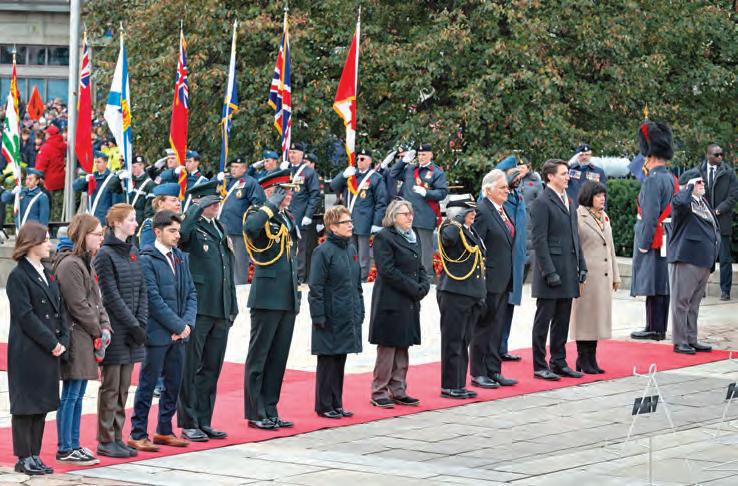
Marc Fowler + Melody Maloney/Metropolis Studio
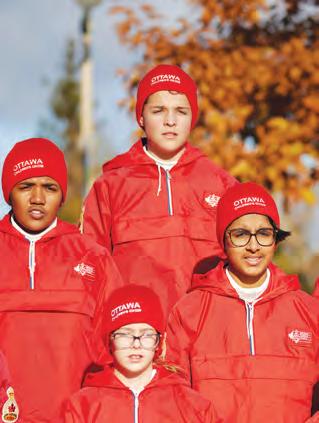
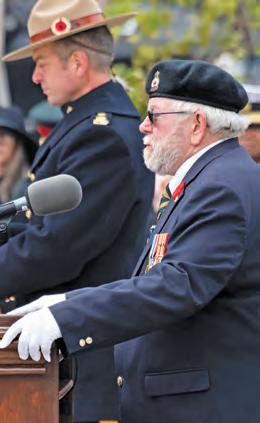
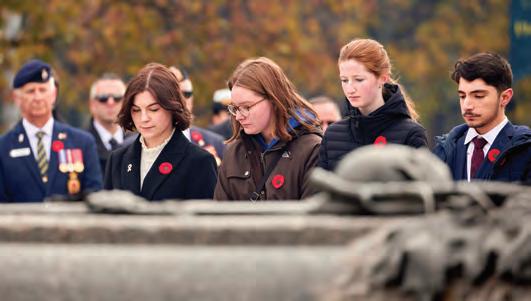
ceremony. Holding a laminated picture of her father close to her heart, Louise noted that thanks to her trip to Ottawa, “he is attending right now.”
“IT’S THE UNIFORM AND HOW YOU ACT IN IT THAT MAKES YOU A SOLDIER .”
After the special guests arrived, the Ottawa Children’s Choir and the Central Band performed “O Canada,” which was followed by “Last Post.”
As Master Corporal James Langridge performed the solemn tune on his trumpet, the first shot of a 21-gun salute was fired by the 30th Field Regiment, Royal Canadian Artillery. And while the Royal Canadian Air Force’s CF-18 Hornets couldn’t perform a flypast due to weather conditions, silhouettes of birds, rattled by the shots, took to the skies in their own aerial display.
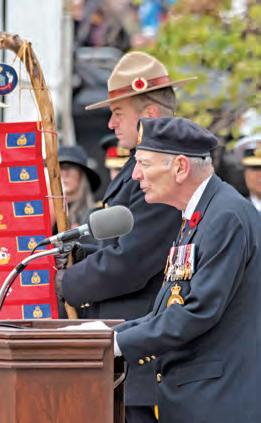
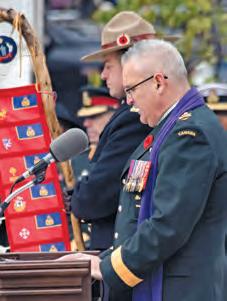
After the lilting “Lament” and “The Rouse,” the Act of Remembrance was recited in English by the Legion Dominion President Bruce Julian, in French by the Legion Grand President Larry Murray and in Ojibwe by Chief Petty Officer 2nd Class Patrick Stevens. For Algonquin-born attendees Maria Wabie and Jennifer Thivierge of Notre-Damedu-Nord, Que., the inclusion of Indigenous language and military members held special significance.
“It’s an amazing feeling to see that representation,” said Wabie, whose uncle served in the Korean War. “I literally have tears in my eyes just thinking about it. Our people are fighting for our freedom.”
“I didn’t hear a lot about Indigenous military members in the past,” said Thivierge, whose family has served in the Canadian military for multiple generations. “It means a lot. More
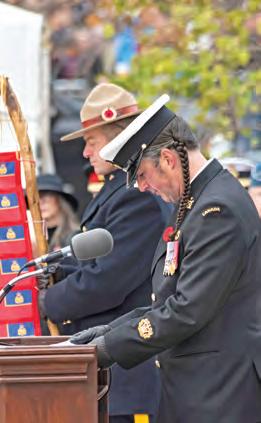
clockwise from top left: Members of the Ottawa Children’s Choir; Legion Dominion President Bruce Julian; Legion Grand President Larry Murray; Chief Petty Officer 2nd Class Patrick Stevens; cadets gather under the virtual “wall of honour;” a young attendee; Chaplain General Guy Bélisle; Royal Canadian Legion national poster and literary contest winners.
people are coming to the Remembrance Day service. A lot of younger members in our community are joining.” Wabie and Thivierge also noted that the greater Indigenous representation in national events gives them a stronger sense of cultural pride and confidence. “We’re learning our culture again,” said Wabie, an education assistant. “When we did the ceremony at our school, we sang ‘O Canada’ in Algonquin.”
Following the Act of Remembrance, Chaplain General Guy Bélisle began prayers, a feature of the ceremony that fell under some scrutiny. Bélisle had issued a directive a month earlier that dissuaded military chaplains from using “God language” in public ceremony, and the decision received some criticism, including from Roman Catholic
Bishop Scott McCaig, a member of the Interfaith Committee on Canadian Military Chaplaincy.
While the directive’s intent was to ensure greater inclusion of faith- and non-faith participants during events, a temporary ban was placed on the new guideline. In fact, McCaig didn’t shy away from overtly religious language during this year’s benediction, emphasizing the importance of enjoying “religious liberty to live both privately and publicly.”
Ceremony attendee Chief Petty Officer 1st Class Adam Thibodeau, however, believed the controversy shouldn’t undermine inclusivity’s importance.
“Diversity goes a long way in future warfare,” he said. “If we’re always singleminded and not creating an inclusive atmosphere, then we’ll never have the people to help us win that next battle and next war.
“If you haven’t got diversity and inclusivity, you aren’t embracing all the goodness out there,” observed Thibodeau, who has experienced numerous foreign cultures during 36 years of service.
“It’s the uniform and how you act in it that makes you a soldier.”
Originally from Plaster Rock, N.B., Thibodeau comes from a family with a rich military history; both his grandfathers served in the Second World War.
Grandfather Donald Alexander received the Bronze Cross from Queen Wilhelmina for his service in the Netherlands.
Thibodeau noted he is satisfied with the CAF’s strides toward diversity and inclusivity, but said he would like to see children more involved in Ottawa’s Remembrance Day, especially since they hold such a special place in the memories of soldiers. “The image of children waving has a lot of meaning to people in uniform,” said Thibodeau, recalling youngsters he had met during work in Rwanda.
“Often when people are waving to you in operations, as opposed to just staring you down or looking the other way,” he continued, “it means that you’re in a safe place, and you’re amongst friends.”
After the dignitaries placed wreaths, the Ottawa Children’s Choir marked the end of the 2023 national Remembrance Day ceremony with “God Save the King.” As the sun emerged from the clouds, a line from the benediction stood out in capturing the essence of the event: “When we look at our veterans,” said Bishop McCaig, “we are looking at the very best of Canada.” L
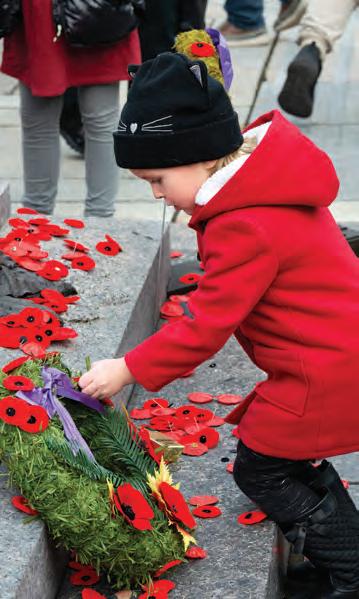
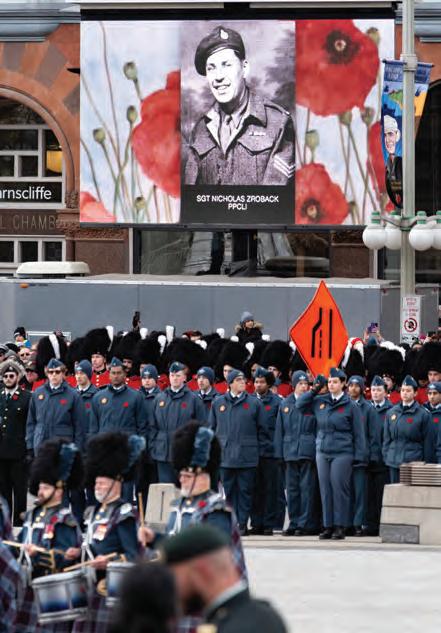

Trulynational
The Royal Canadian Legion’s national headquarters organizes the country’s official Remembrance Day ceremony and in doing so, it continues to integrate aspects that help people across the country feel part of it.
This year, for instance, in addition to the virtual “poppy drop,” in which falling poppy images were projected onto the Centre Block of Parliament Hill from late October until Nov. 11, other iconic sites across the country were lit red during the same period in symbolic remembrance, including Toronto’s CN Tower, Niagara Falls, Vancouver’s BC Place Stadium, the Calgary Tower and the Samuel De Champlain Bridge in Montreal.
Legion HQ also organized a virtual “wall of honour,” which projected the images of more than 2,400 deceased veterans from across the country on large video screens near the National War Memorial before the ceremony.
And this year for the first time, the Legion collaborated with national advertisers to have thousands of digital signs across the country share a Remembrance Day message at 11 a.m. on Nov. 11 for two minutes.
Said Legion Dominion President Bruce Julian: “We hope this initiative will help remind people no matter where they may be at that moment of how important it is to remember the sacrifices of our fallen Canadian veterans.”
By Stephen J. Thorne
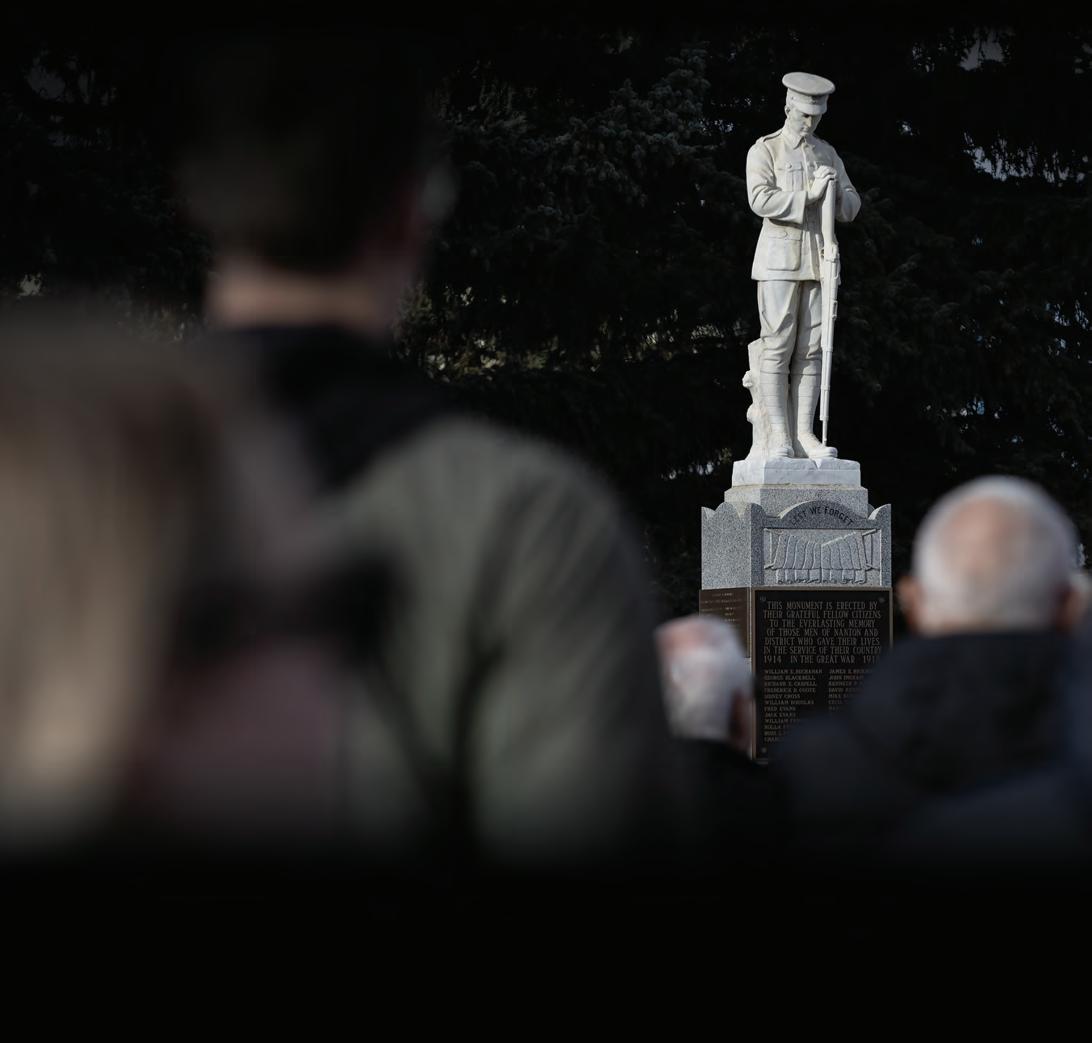
A memorial story
IN NANTON, ALTA., HOME OF THE BOMBER COMMAND MUSEUM OF CANADA, REMEMBRANCE DAY INSPIRES THE TALE OF A WW II CREWMAN KILLED IN ACTION
A big wind blew across the Alberta prairie almost as soon as Nanton’s Nov. 11 ceremony ended. The dead bomber boys of the Second World War, their 10,673plus names etched on a black granite memorial, could rest easy. There would be no flying this day.
An ominous cloud bank lingered over the snow-covered Rockies a few dozen kilometres to the west while, in Nanton, all hell broke loose.
Ceremonial flags snapped to attention, then tilted and tipped; wreaths rolled across the lawn fronting the town cenotaph like tumbleweeds and, along Highway 2

stretching 92 kilometres north to Calgary, cars drifted into ditches and road signs snapped off at their bases.
The dust-up didn’t seem to bother many of the 300-400 people who had crowded seven-deep around the angelic white marble soldier standing atop a grey granite base. It bears the names of 25 area men who died in the First World War, seven of whom fought at Vimy Ridge, and 24 more killed in WW II.
After the Remembrance ceremony, many wandered over to the Bomber Command Memorial, walked the length of its wall and surveyed the names. Some ventured
into the adjacent Bomber Command Museum of Canada itself. Others lingered at the monument, despite the wind, and pointed out names.
Among them was David, who highlighted the name Harry Llewellyn Davis to his aunt, Colleen Oshanek. David didn’t want his last name used.
A tail gunner aboard the twin-engine Wellington bomber HE 568 of 420 Squadron, RCAF, Warrant Officer 2nd Class Davis was Oshanek’s uncle. A farm boy from Acme, Alta., northeast of Calgary, he was reported missing the day she was born, June 1, 1943. He was 24 years old.
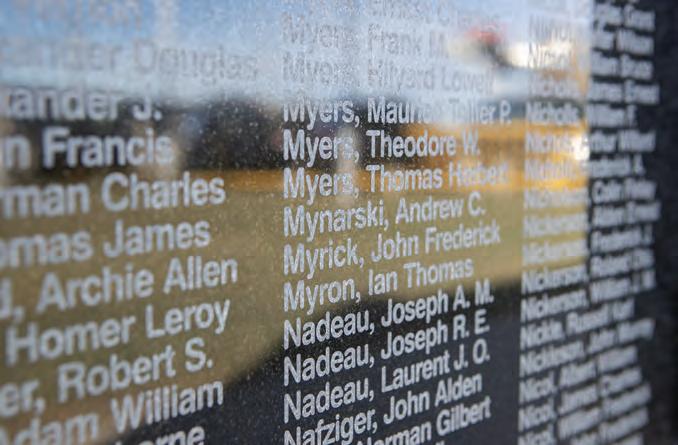
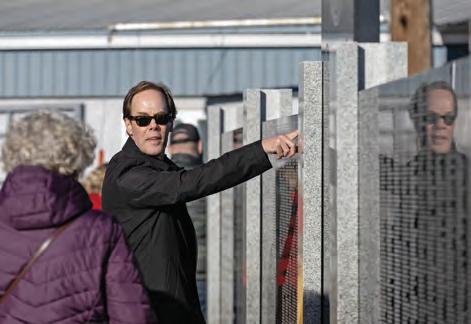
“I never did know him,” said Oshanek, who heard Davis’s name spoken among family throughout her childhood, but knew almost nothing of his story.
His plane was one of 20 Wellingtons transiting from Royal Air Force Portreath in Cornwall, England, to their new base at Ras El Maa, Morocco, where they were to join the pre-invasion bombing campaign against Sicily, mainland Italy and key Axis-held islands.
The Afrika Korps, along with the Panzer forces previously commanded by the Desert Fox, Generalfeldmarschall Erwin Rommel, had just fallen to Lieutenant-General Bernard Montgomery’s Eighth Army in North Africa. The campaign in Europe was set to begin.
Two of the Wellingtons never made it. They were intercepted over the Bay of Biscay by five Ju 88 heavy fighters out of Lorient, France.
Between 300 and 400 people turned out for the Nov. 11 ceremony in Nanton, Alta. (opposite). Victoria Cross recipient Andrew Mynarski is among the nearly 10,700 names on Canada’s Bomber Command Memorial (left). David points out Harry Davis’s name to Colleen Oshanek (below left). Calgarians Sam and Alexandra Dodd (below right) attend the event each year; his grandfather, Flight-Lieutenant Donald Sanders of Salter, Sask., flew Halifax, Wellington and Lancaster bombers. The HE 568 crew (bottom, from left): Sodero, King, Hubbell, Davis and Hollowell.
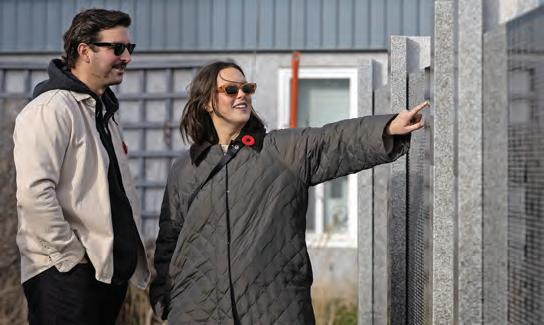
Davis’s plane was shot down in flames by the Luftwaffe flight leader, Oberleutnant Hermann Horstmann of 13/KG 40. It was 8:05 a.m.
“I SAW THE REAR GUNNER BAILING OUT, BUT HIS PARACHUTE WAS ALSO BURNING. NO SURVIVORS WERE SEEN, ONLY WRECKAGE .”
All seven aboard the Wellington were killed, including two ground crew hitching a ride to their new digs. In addition to Davis, they were: the pilot, Flight Sergeant Alexander Theodore Sodero, 21, of Sydney, N.S.; the navigator, Flying Officer George Henry Hubbell, 32, of Arnprior, Ont.; the bomb aimer, Pilot Officer William Robert King, 22,
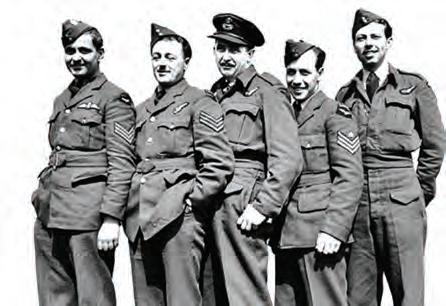
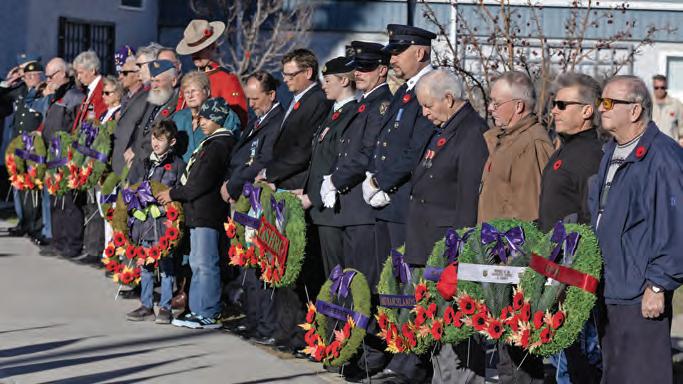
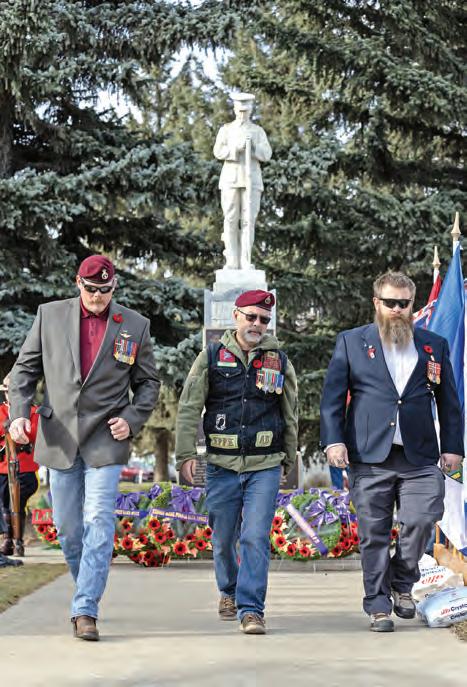
of Kingston, Ont.; the wireless operator/air gunner, Pilot Officer Robert Spencer Hollowell, 24, of Wolseley, Sask.; and the two ground crew, Leading Aircraftman Thomas Robert Brookes, 23, of Montreal and Corporal James Foster MacKenzie, 34, of Red Deer, Alta. Minutes later the Germans attacked the second aircraft, Wellington HE 961 piloted by Flying Officer Gordon Saunders McCulloch, 29, of Hamilton. Also aboard were his four aircrew and two ground crewmen.
“I had to break off my first attack because of the enemy plane’s evasive actions and I had got into its rear turret’s field of fire and got a lot of machine gun fire,” reported Horstmann’s rottenflieger (wingman), Unteroffizier Heinz Hommel. “During this first action, my plane was hit by one bullet in the port wing.
“A short time after that, I was able to get into a favourable position and attacked head on from above, watching the cannon and machine gun hits in the enemy plane’s starboard wing,” continued Hommel.
“From a distance of 100 metres, I saw a tongue of fire coming out from the starboard wing which became even larger.
“Soon the whole wing was ablaze and then broke off. The plane went into a spin and exploded on hitting the water. I saw the rear gunner bailing out, but his parachute was also burning. No survivors were seen, only wreckage.”
Indeed, the remains of both Canadian crews and their passengers were never recovered. Their names all appear on the memorial outside the museum in Nanton.
There was no shortage of wreaths for the Nanton ceremony. Members of the Canadian chapter of the Nam Knights Motorcycle Club (bottom left) placed a wreath on behalf of Canadians who served with U.S. forces in Vietnam.
They are also listed on the Runnymede Memorial in Surrey, west of London. It includes the names of 20,450 Commonwealth aircrew, 3,050 Canadians, who died with no known grave. Horstmann was killed in action the following December; Hommel was wounded just weeks before the war ended.
Nanton lies at the heart of British Commonwealth Air Training Plan country. The wartime project trained 131,500 aircrew at 107 schools and 184 support units in 231 locations across Canada.
Elementary Flying Training School No. 5 lay 28 kilometres north of Nanton at High River. In Vulcan, 40 kilometres east, was Service Flying Training School No. 19 and, early on, Flying Instructor School No. 2. Service Flying Training School No. 15 was located at Claresholm, 40 kilometres south. They were among a dozen-plus training plan sites in Alberta alone.
Training aircraft in their distinctive “BCATP yellow,” piloted by recruits from Canada, Britain, Australia and New Zealand, were a common sight during the war years, particularly over the Prairies. Nanton was no exception.
In his book, A Thousand Shall Fall, author Murray Peden recalls how he and fellow student Francis Plate would book simultaneous solo sessions and arrange to meet “over some town in the aerobatics area—usually Nanton—where we would proceed to take turns topping the other’s performance.”
The town of about 2,200 is located amid rolling farms and ranchlands. Its Royal Canadian Legion branch is small—just 39 members, including a few Cold War and peacekeeping veterans. They average over 70 years old and buried their last WW II veteran, a sailor, several years ago.
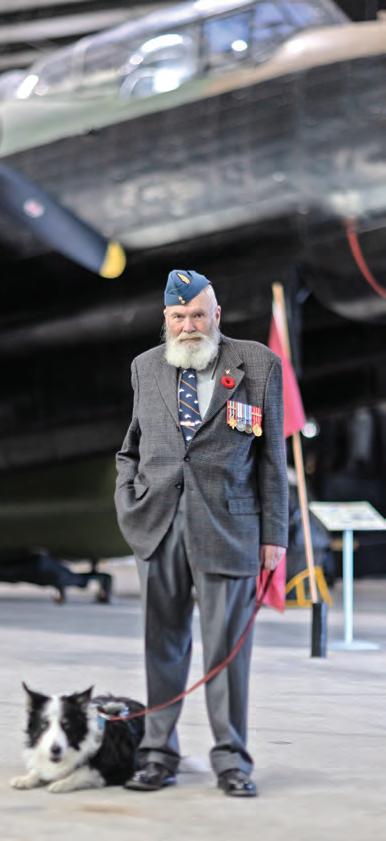
Formed in 1919 when the organization was still known as The Great War Veterans’ Association, the Nanton Legion has never had its own building, and has no facility at all now. It still meets once a month, however, at the Town & Country Kozy Korner, a seniors’ centre next door to the museum.
“Remembrance Day is our claim to fame,” said the branch secretary-treasurer, Marylou Slumskie, the daughter and niece of WW II veterans, who also happens to be the Kozy Korner treasurer. “The town relies on us to plan and organize and do it.
“The Bomber Command Museum has been very gracious and generous, permitting us to form here, meet here, get prepared here prior to going out to the cenotaph.”
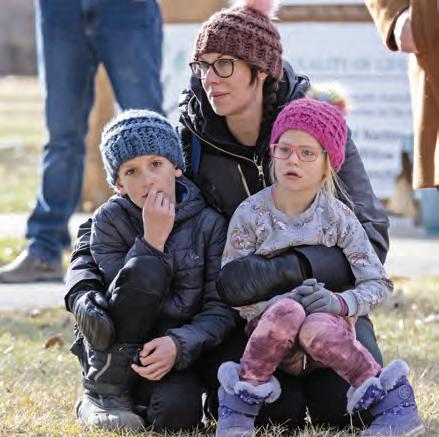
“ REMEMBRANCE DAY IS OUR CLAIM TO FAME ,” SAID THE BRANCH
S ECRETARY-TREASURER, MARYLOU SLUMSKIE, THE DAUGHTER AND NIECE OF WW II VETERANS.
In fact, Legion members are an integral part of the extensive museum and its activities, running a booth at regular events that feature one of only 17 surviving Avro Lancaster bombers worldwide—two are airworthy; the museum’s Lancaster is not, but its four functioning Rolls-Royce Merlin engines are another rarity.
Unlike either of the flying Lancs, the Nanton version retains its interior configuration to wartime standard, complete with a fully equipped wireless station, singleseat cockpit and other details.
It bears the FM 159 (F2-T) markings of Squadron Leader Ian Bazalgette, a Calgary native who earned a Victoria Cross after he was killed trying to land his crippled aircraft and save two of his wounded crew on Aug. 4, 1944.
Bruce Beswick (left) flew Buffalos, F-5s and CF-18s during a 25-year career in the Royal Canadian Air Force. A mom and her children huddle against the prairie wind.
Museum curator Karl Kjarsgaard, Slumskie’s husband, called the Nanton Legion the museum’s “right-hand man.”
Branch President Brian Stapley, a retired plumber, gas fitter and steam fitter—and Kozy Korner president—has lived his whole life in Nanton. So did his father Lawrence, a Second World War combat engineer. His mother was a war bride. Both were Legion members.
How do they keep it going?
“By a lick and a prayer,” said Stapley.
In the local cemetery lie 215 veterans. Each year, local Grade 9 students help the Legionnaires place white crosses with poppies beside each marker. The oldest plot among them is the resting place of Hans Henry Anderson, a veteran of the 1898 Spanish-American War. Neither the Americans nor the Last Post Fund would provide him a headstone, so the Legion paid for one from its casino earnings.
The Legion has added RCMP, peacekeeping and Afghanistan plaques to the world wars and Korea plaques that were already on the monument. In 2017, on the 100th anniversary of Canada’s most famous battle, the Nanton Legion unveiled a Vimy commemorative bench near the cenotaph. And nine years ago, it acquired a descendent sapling of the famed Vimy oaks and planted it nearby.
Said Slumskie: “It’s struggling in the Alberta climate, but it’s still hanging in.” L
By Paige Jasmine Gilmar
Cutting-edge research highlights 2023 military and veteran health forum
By Paige Jasmine Gilmar
By Michael A. Smith
By Stephen J. Thorne
By Michael A. Smith
By Sharon Adams
By Stephen J. Thorne
has marked a new number that I identify with—nine,” said Brent MacIntyre, panelist and a former sergeant of peer support for the Ottawa Police. “Nine members who I’ve worked with have completed suicide. But this one has changed me.”
The bubbly energy that accompanied the families’ roundtable and opening remarks of the Canadian Institute for Military and Veteran Health Research (CIMVHR) 2023 Forum in Gatineau, Que., in October grew quiet. MacIntyre, the first of the panelists to speak on integrating and advancing health research and care for veterans and public safety personnel, recounted the moment when one of his colleagues took his own life.
“My heart races,” said MacIntyre. “My world collapses.”

theme is different, this year focusing on families, feminism and health system resiliency and collaboration. There was a full slate of keynote speakers, workshops and breakout sessions with leading researchers on veteran families, military sexual trauma, moral injury and more.
The opening day’s afternoon session highlighted the paradigmshifting research of Chris Edwards, the 2022 Banting Award recipient. A PhD candidate at the University of Ottawa, Edwards’ work on the impact childbirth has on musculoskeletal injury in female Canadian Armed Forces’ members raised the eyebrows of even the most seasoned professionals in the room.


Not a sound was heard in the room, with all 900-plus attendees, the largest gathering in the event’s history, grasping onto MacIntyre’s every word. “Not all trauma is life-limiting. However, all trauma requires care and support for recovery.”
MacIntyre’s address embodied the heart and spirit of this year’s forum, one marked with difficult conversations, heartfelt reflections and proposed solutions for better and brighter veteran health care. Each year’s conference
Her research indicated that female personnel perform better physically after childbirth—even after musculoskeletal injuries— than women who haven’t had kids, disproving the stereotype that delivery can negatively and permanently impact women’s military careers.
Noting that elite female runners have a similar experience, Edwards stressed the need for more research on this largely understudied population.
“If we’re telling others that after you’ve given birth, you’re not going to be able to be as fit as you were before,” said Edwards, “mentally, that is a huge barrier.
And if that’s not true, we need to change that story right away.”
IN THE NEWS
Edwards’ presentation concluded with the announcements of two 2023 awards: the Dr. Mark Zamorski Award, which provides $10,000 to a postgraduate student to enhance their research in veteran health, went to the University of Regina’s Blake Boehme for his study of post-traumatic stress disorder in Canadian veterans; and The Royal Canadian Legion Masters Scholarship, which supports a master’s-level student specializing in veteran research with $15,000, was given to Katherine Reeves of Halifax’s Mount Saint Vincent University for her work on the intergenerational impacts of military service related moral injury.
Legion Dominion President Bruce Julian followed the awards by announcing a new RCL doctoral-level scholarship for 2024, which will provide $50,000 over two years to PhD veteran research.
Day 2, Margaret Bourdeaux, a Harvard research director for the Program in Global Public Policy and Social Change, introduced her talk on health system resiliency by reflecting on Canada’s refugee crisis following the Second World War. She noted that the dilemma sparked a period of health-system growth that was meant to withstand the pressures of past international conflicts. Bourdeaux indicated Canada must do that again now in response to the 2022 Russian invasion of Ukraine.
Highlighting that attacks on health facilities were becoming more common, Bourdeaux asserted that such strategies break civilians’ will and can impact fighting readiness, especially since the CAF often relies on civilian health-care systems when abroad.
To mitigate such challenges, Bourdeaux called for Canada to move from threat-based public-health policy to a
“IF WE’RE TELLING OTHERS THAT AFTER YOU’VE GIVEN BIRTH, YOU’RE NOT GOING TO BE ABLE TO BE AS FIT AS YOU WERE BEFORE…MENTALLY, THAT IS A HUGE BARRIER.”
resiliency-centred strategy. The change can be made, she said, by defining and protecting core functions of the health-care system through engagement and collaboration in disaster management. By doing so, Canada can better ensure health-care access for CAF members abroad, along with preventing the domestic system from being interrupted by diverted funds or cyberattacks.
Said Bourdeaux: “My colleague’s mantra is ‛assume the boom.’”
The event’s final presentation came from Sumitra Muralidhar, the director for the United States Department of Veterans Affairs’ Million Veteran Program.
Launched in 2011, the revolution ary initiative integrates lifestyle surveys and medical records of nearly a million veterans. It was the first of its kind and is the larg est genomic database in the world.
“It’s mind-blowing,” said Muralidhar. “We actually see our research being translated into care.”
The program also boasts the biggest nutrient database and the largest cohort of African ancestry in the world. Combined, the data can be used to identify key genetic factors that can predict heart disease, post-traumatic stress disorder, opioid sensitivity and more in veterans. The project has generated more than 350 published scientific papers and is currently running pilot studies on prostate cancer and hereditary cholesterol conditions.
“This did not happen by waving a magic wand,” Muralidhar concluded. “This is the blood, sweat and tears of people across the country.” L


Chaplain general’s briefing offers insights into a range of issues
By Michael A. Smith
The military’s chaplain general says morale among Canadian Armed Forces’ members is the lowest in recent memory and is causing some to the leave the ranks, noting that military families are looking for support to help subsidize the cost of living and ease their burdens. But the help they’re receiving isn’t enough.
A July 2023 report by BrigadierGeneral Guy Bélisle to Defence Chief General Wayne Eyre, first publicized by CBC this past October, noted that “the increasing lack of affordable housing, the rising cost of living, and staff shortages all contributed to exacerbating the tensions and challenges being experienced by members and their families.”
These factors are leading to an increase in the number of uniformed personnel making career changes.
“The past six months have been very difficult for many CAF members and their families as they struggle to

find a way forward through the economic, social and cultural realities and changes that are confronting all Canadians in these uncertain times,” explained Bélisle in the briefing note.
Bélisle, however, warned that the changes to the allowance program “will have a significant negative impact” on members and determine whether they
BÉLISLE, HOWEVER, WARNED THAT THE CHANGES TO THE ALLOWANCE PROGRAM “WILL HAVE A SIGNIFICANT NEGATIVE IMPACT ON” MEMBERS
One change that is contributing to “CAF leaders and members feeling more undervalued and underappreciated than at any point in recent memory,” said Bélisle, is the recent change in the housing allowance.
The new subsidy is based on salary and doesn’t factor in the cost differences in various Canadian communities.
It’s estimated that about 28,000 members now qualify for the allowance, about 6,300 more than before. But, about 7,700 are now ineligible and thousands of others are receiving smaller monthly payments. The government indicated the changes will save about $30 million a year.
To lessen the sudden impact on those losing money, National Defence said it would gradually reduce the monthly payments until July 2026.
Brigadier-General Virginia Tattersall, director general compensation and benefits, said last year that the changes are about “being equitable,” and will help more junior ranking members than before.
“seek advancement, postings, or remain in the CAF.”
Charities, such as the military family support foundation Together We Stand (TWS), have helped alleviate financial stress, noted Bélisle.
“Despite such generosity, support from organizations like TWS can only be viewed as a short-term solution for members who are facing increased significant financial and other issues,” his report said.
Bélisle’s briefing was not all doom and gloom, however. Cultural and policy changes within the military that were intended to curb sexual misconduct and regain trust in leadership seem to be gaining more acceptance he said.
“On the positive side, some members have noted that their workplace appears to be getting psychologically safer, and that there is less of a taboo now on communicating issues,” wrote Bélisle.
The chaplain general’s opinion on the low state of military morale coincides with a personnel shortage—some 16,500 members—and new marketing strategies that aim to address it. L
Government ignoring plight of Afghan translators: Ombudsman
IN THE NEWS
By Stephen J. Thorne
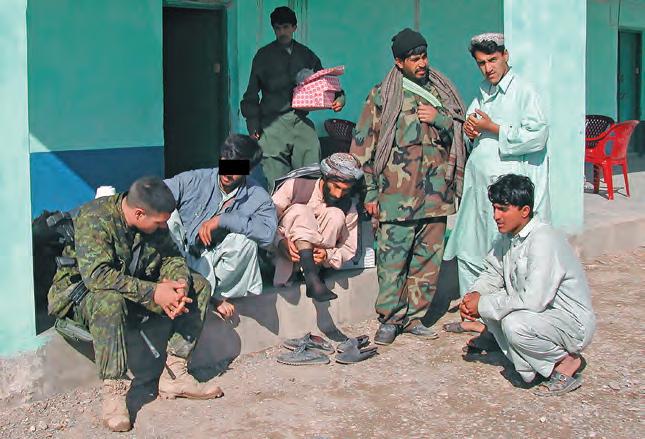
The military ombudsman has called out the federal government for ignoring the plight of former Afghan translators who put their lives and those of their families on the line working alongside Canadian forces during 13 years of war.
In a Sept. 29, 2023, letter to Defence Minister Bill Blair, Gregory Lick said 15 of the former “language and cultural advisers” now living in Canada had contacted his office since July complaining that claims they filed with the Workers Safety and Insurance Board of Ontario (WSIB) have not been adequately addressed.
“To date, their efforts to seek treatment and care for their mental and physical needs sustained while supporting our troops have been met with inaction,” said the letter, published on the ombudsman’s website. “Both medical treatment and injury financial compensation have been inadequate or non-existent.”
Many Afghans, and some Pakistanis, did multiple tours
MANY SERVED MORE THAN FIVE YEARS “WITHOUT PAUSE OR RELIEF.”
translating and advising Canadian troops between December 2001, when the country’s first special forces soldiers arrived in the war zone, and March 2014, when the mission ended and the last training cadre left. Canada withdrew its combat troops in 2011.
During their service, many of the so-called language and cultural advisers (LCAs) and their families were threatened. Several were killed, executed or wounded by the Taliban; others were left with multiple mental and physical health issues.
Ottawa initially provided refuge to those facing proven threats due to the work they did for Canada, bringing in about 800 former translators and family members
Captain Alex Watson converses with Afghan villages through a translator, his face obscured to protect him from retribution.
before the program expired in 2011. About 7,500 more, including family members, have arrived in Canada since the war ended in a Taliban victory in August 2021.
Some translators spent more time on combat operations than the troops they worked for. They did dangerous jobs, gathering intelligence, monitoring communications, warning of impending attacks, and helping commanders better understand local culture. But they were contract employees and ineligible for equivalent federal benefits, even though most who came here have become Canadian citizens.
“While an appeal process is underway for some,” wrote Lick, “the facts of this matter demonstrate a lack of government support for these Canadians. This is poised to become a shameful chapter in Canada’s military history.
“The care for these former Language and Cultural Advisors is a moral obligation, and their well-being is a Government of Canada responsibility.”
Lick said military intelligence recruited them and that troops who served with them described them as essential to operations. He said many served more than five years “without pause or relief,” and received accolades and commendations from successions of task force leadership.
They were initially told that they would be working strictly inside the relatively safe confines of Kandahar Airfield, Lick said,
Stephen J. Thorne
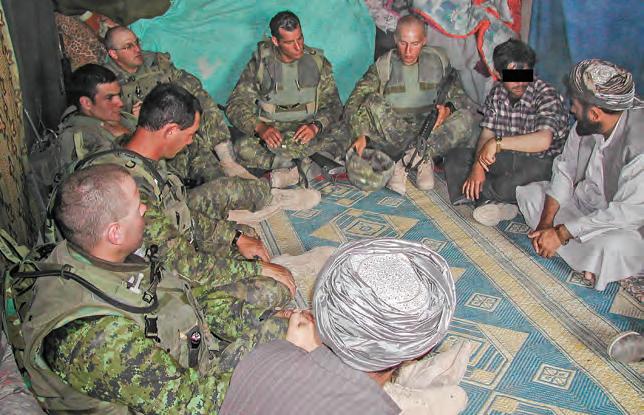
but “within days” found themselves in forward operating bases, villages, convoys and battle zones.
“Knowing the inherent risks associated with their essential work in supporting deployed members of the CAF, appropriate efforts were not undertaken to ascertain the LCAs’ welfare post-deployment,” the ombudsman wrote.
“Despite efforts within Assistant Deputy Minister Human Resources (Civilian) Total Health Management to assist these former LCAs by validating the nature of their specialized and dangerous work, the WSIB adjudications have so far been unfavourable to the LCAs and could indicate that the WSIB is not adequately calibrated for these deliberations.”
Seventy-five years after the legendary tradition began, the Calgary Grey Cup Committee joined forces with The Royal Canadian Legion to use its annual pre-CFL championship game pancake breakfast to highlight the work of Canadian veterans.
Part of the festivities in the week preceding the football final, the Calgary group has flipped flapjacks for fans of the game in Western hospitality style since 1948. This past November, however, the Cowtowners partnered
Lick said media coverage and public response to their plight has shown “overwhelming” public as well as rank-and-file military support for the translators.
“Despite recent efforts by the Department to provide validation to WSIB in support of their claims, meaningful relief has not been forthcoming. Leaving this issue unresolved serves neither the Government of Canada, the former LCAs, nor Canadians’ interests.”
WSIB caseworkers overruled assessments by psychiatrists and social workers in dismissing benefits claims by more than a dozen former interpreters last spring.
The board subsequently agreed to review the cases.
A WSIB spokesperson told CBC
Pancake day
with the RCL for the first time to recognize not only former Canadian Armed Forces’ members and their families, but the work of the Legion in supporting them at the inaugural Royal Canadian Legion – Calgary Grey Cup Committee Stampede Breakfast.
In addition to free hotcakes and sausages, the event, held at the Mount Hamilton Legion branch in Hamilton on the Thursday before Canada’s 2023 “big game”—the 110th—was attended by CFL Commissioner Randy Ambrosie, CFL cheer teams
Watson (third soldier on left) and other members of the 3 PPCLI Battle Group meet with villagers near Kandahar in 2002. Their translator’s face has been obscured to protect him from retribution.
the agency has been working with 17 claims involving former military language and cultural advisers. The ombudsman had been in contact with 15 of them.
“We are working as quickly and thoroughly as possible,” Christine Arnott, WSIB public affairs manager, told CBC News. “Sometimes, reaching a determination can take longer than we’d like as we need to obtain medical, employment and other relevant information from many years ago.”
Arnott said decisions would be made before Christmas and would contain detailed explanations for the advisers to consider.
Blair said he’d met with the ombudsman and is looking for a solution.
“We understand that they worked for us, and we want to make sure that we help them in every way possible.”
The federal government was aiming to have brought in a total of 40,000 Afghans between August 2021 and the end of 2023. The most recent figures had the number at 37,000. L
and the High Steppin’ Daddy band, as well as veterans, Legion officials and more. Donations to the Legion’s annual poppy campaign were encouraged.
“The Legion is excited to join forces with the Calgary Grey Cup Committee to honour Canada’s veterans at the Grey Cup Festival,” said RCL President Bruce Julian. “This event is a great opportunity for members of the community and visiting fans of the Grey Cup to come together, enjoy a delicious breakfast and celebrate our veterans.” L
Stephen J. Thorne
Mental health resources lacking says Ombud
IN THE NEWS
Primary reservists participating in domestic operations are not having their mental health needs met, says a 2023 report conducted by the National Defence and Canadian Armed Forces’ Ombudsman Gregory Lick.
The report titled “Hidden Battles” published this past September, is based on an investigation launched after concerns were raised regarding “possible inconsistencies in mental health assessments and medical care for Primary Reserve members before, during, and after a domestic operation,” said Lick in a written statement.
While the effects of overseas operations on the mental health of service members are widely documented, the impact of domestic work is not, partly due to the belief that missions at home are less traumatic than those abroad. However, as the frequency and strength of natural disasters increase, resulting in many of the CAF’s 28,500 reservists playing vital roles in combating fires, floods, searchand-rescue missions and even helping in crises such as the COVID-19 pandemic, it is becoming increasingly important to document the effect of such work.
The primary reserve “consists of predominately part-time professional CAF members, located throughout Canada, who respond with appropriate notice to conduct or contribute to CAF defence and security objectives domestically, on the continent, and internationally.” And the CAF’s involvement in domestic natural disaster response has broadly doubled every five years since 2010.
By Michael A. Smith
While those deployed domestically may not be in traditional conflict zones, they are still potentially exposed to traumatic and graphic situations. For instance, one reservist who was deployed to support long-term care facilities in Ontario and Quebec in the spring of 2020 is anonymously quoted in the report: “The young reserve [members] were not emotionally ready for this kind of operation. They were told they would manage road control, but then they were suddenly brought to Montreal to help out [with] the long-term care homes. They worked with people who died [and] they were not prepared for that.”
Protocol is in place to evaluate mental health needs prior, during and after operations, but the report found that primary reservists working domestically aren’t receiving a consistent approach to them.
About 65 per cent of all members didn’t receive a medical screening related to their most
SOME RESERVISTS SAID THAT THE CANADIAN FORCES HEALTH SERVICES
“TURNED THEM AWAY IN TIMES OF CRISIS.”
recent domestic operation. And just 38 per cent of those who said they’d had a medical screening within the last year were reservists. Such evolutions are particularly important for the part-timers as they tend to have fewer interactions with leaders who can help identify challenges.
The investigation also found that before domestic operations, 48 per cent of those surveyed said they needed mental-health support, but did not request it. Meanwhile, 53 per cent were in the same situation during operations and 37 per cent afterward. Reservists made up about half of all those numbers.
Consistent screening and followups are critical to maintaining health, wrote Lick, since issues can appear months, or even years, after an operation is complete. An authority with the Canadian Joint Operations Command explained in the report that “Regular Force members have direct access to CAF systems. For Reserve Force members it is more complicated. They may not be fully aware of resources still available to them.”
The report indicated that proactive and supportive leadership would be key to addressing the issue. It noted that reserve force leaders, clinical administrative staff and health providers are not overly knowledgeable about the mental health resources available. Indeed, 29 per cent of this group was unaware of the accessibility and eligibility of such supports. And some reservists said that the Canadian Forces Health Services “turned them away in times of crisis because some administrative staff and care providers did not fully understand their entitlements to care.”
This lack of knowledge, even with the same screening processes, put reservists at a disadvantage when compared to their regular force colleagues, said the report. Even in cases where members know they are qualified for resources and know where to receive them, the report states that many cannot take advantage of “them due to the geographic distance from their local Reserve Force unit.”
The assumption that domestic deployment is not very traumatic and there’s a need to rush to the job may have caused many reservists to skip their premission medical assessments. “I was a little bit surprised in terms of the amount of times that risk assessments were not
done,” said Lick at a media conference to release the report.
The report made six recommendations it indicated should be implemented by the fall of 2025 to help ensure primary reservists’ mental health needs are taken care of:
• formalize all post-deployment check-ins for domestic operations;
• strengthen oversight of mental health screenings;
• expand virtual care services to offer mental health services in locations that don’t have them and to better support reservists during core clinic hours;
• ensure compliance with training on mental health supports and reserve force entitlements for all those involved in the administration and provision of health care;
• improve knowledge and awareness of mental health supports available to all reservists before, during and after domestic operations;
• and complete the ongoing review of the mental health services needs of equity-deserving groups.
Lick noted that recommendations from three previous investigative reports between 2016 and 2017 have yet to be implemented and stressed that it’s becoming more important than ever to take care of reservists serving domestically.
“In Canada, we increasingly rely on our part-time reserve force [in] responding to natural disasters,” said Lick. “But we do not always provide them with the mental health support they need before and after operations.” L
Status report on military sexual misconduct
By Sharon Adams
The unfolding drama of sexual misconduct in the Canadian Armed Forces has moved on from the startling revelations in the media of three years ago into courts, military workplaces and the political arena.
While much remains to be done to implement all 48 recommendations of the 2022 Independent External Comprehensive Review by former Supreme Court justice Louise Arbour, significant steps were taken, and significant lessons learned, in 2023.
Defence Minister Bill Blair announced this past August that regulations governing the duty to report sexual assault and misbehaviour will be repealed this winter. That rule took away
survivors’ control over reporting and created moral dilemmas for bystanders to report misconduct even when survivors didn’t want to.
This change will not limit the ability to report, but will allow members to “choose the best path forward, with due consideration for the well-being of those impacted,” said Lieutenant-General Jennie Carignan, chief of military professional conduct and culture.
Blair also announced that CAF members are free to pursue sexual harassment or discrimination complaints through the Canadian Human Rights Commission or the CAF grievance and harassment processes.
Among the lessons learned thus far in the military’s attempt
to address sexual misconduct issues is how hard it can be to turn investigation and prosecution of criminal sexual assault cases over to civilian justice systems, as was recommended in Arbour’s report. National Defence is working with provincial, territorial and municipal governments on the handover, but some already overburdened jurisdictions are reluctant to take on the extra load.
As of May 2023, the military referred 93 cases to other police forces, but 29 were declined. In August 2023, a civilian court judge stayed charges in one of the first cases transferred to civilian courts because it violated the rights of the accused to a trial within reasonable time, as guaranteed by
IN THE NEWS
the Canadian Charter of Rights and Freedoms. Cases must be completed in provincial court within 18 months of charges being laid. But the clock started ticking when charges were initially laid in the military system, said Alan Okros, a professor at the Royal Military College in Kingston, Ont., whose research focuses on leadership, gender equality and diversity.
“But the civilian system still has to do its due diligence before proceeding,” he said.
Some high-profile cases against senior military leaders accused since 2021 of sexual assault or misconduct have wended their way through courts martial and civilian trials.
Vice Admiral Haydn Edmundson, accused of a 1991 sexual assault, pleaded not guilty and faces trial in civilian court in 2024.
Lieutenant-General Steven Whelan faced court martial in October 2023 on allegations of an inappropriate relationship with a subordinate and altering her performance review. The case was withdrawn after email evidence was ruled inadmissible.
Former defence chief Jonathan Vance pleaded guilty to obstruction of justice in civilian court in 2022 and received a conditional discharge in connection with an investigation into allegations of a long-standing inappropriate relationship with, and interfering in the career of, a subordinate.
The Canadian Forces National Investigation Service, meanwhile, found insufficient evidence to lay charges under the Criminal Code or military service code against ViceAdmiral Art McDonald, accused of sexual misconduct and relieved of command in 2021. However, the service reported, that does not mean the allegation had no merit.
In other developments: the Military College Review Board has started its examination of military education; funding was expanded to provide more community-based
AS
OF MAY 2023, THE MILITARY
REFERRED 93 CASES TO OTHER POLICE FORCES, BUT 29 WERE DECLINED.
sexual assault centres to serve military personnel across Canada; the Sexual Misconduct Support and Resource Centre was relieved of monitoring and training responsibilities and refocused on survivor support, including veterans, Defence Department employees and military family members and prevention research; the resource centre launched a fund to provide military and civilian victims legal advice and help with legal fees and has begun research into perpetrators of sexual misconduct to aid development of preventive measures; and the military, which has funded academic research on sexual misconduct for years, has opened its internal study reports to academics, thus avoiding duplication of work that has already been done.
In May 2023, Jocelyne Therrien, the external monitor appointed to oversee implementation of Arbour report recommendations, filed her first report.
Despite progress on many fronts, the military lacks “an overall strategic plan…to ensure that the resources are aligned to priorities.” Instead, she said, the military agenda has been driven by availability of resources and capacity issues.
She also noted much progress.
The office of the chief of professional conduct and culture is “making a difference” by providing unit commanders “a place to go for advice on how to deal with situations as they arise.”
As well, the conduct chief has initiated training about sexual misconduct and hateful conduct, diversity, equity and inclusion to be delivered to all ranks throughout
their careers. And selection of recruits and the handling of their misconduct are being better managed noted Therrien.
“Choosing recruits who embody an ethos of inclusion is one way to ultimately achieve a harassment free workplace, along with swift release of individuals who exhibit unacceptable behaviour,” the report said.
While waiting for legislative and regulatory changes to enable establishment of a probation period, the military is reviewing ways to screen recruits and is releasing from basic training those “who present problematic attitudes and behaviour,” such as sexism and racism.
In addition, the Canadian Forces Leadership and Recruit School, responsible for basic training of about 5,000 recruits a year, has redesigned its curriculum to “support a more robust learning of the values and ethics of the CAF.”
“I have witnessed a significant level of tangible activity within DND/CAF as it responds to the hundreds of recommendations from external reviews,” Therrien said.
“The challenge…is to manage the projects and initiatives…to prioritize the changes that will bring fundamental reform in a timely manner.”
Proof of success ultimately will be whether the number of sexual assaults and incidents of misconduct decrease and if National Defence employees and uniformed members see improvements.
“It is too soon to tell if that is happening,” said. Therrien.
Therrien’s second report was expected to be issued after this edition of Legion Magazine went to press. L
Canada’s underwater prospects foundering
By Stephen J. Thorne
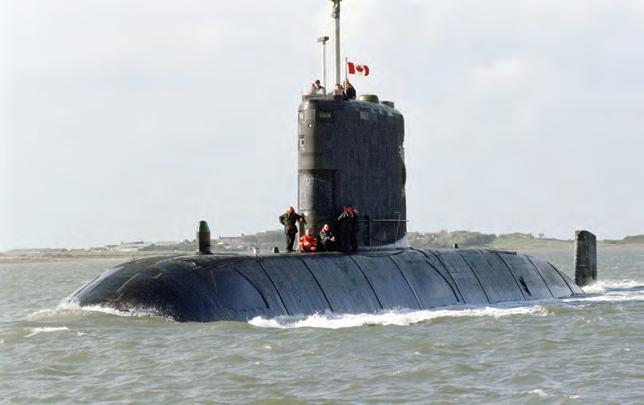
There has been little progress on replacing Canada’s aging fleet of navy submarines, only one of which has been to sea in several years, according to statistics provided to Legion Magazine by the Department of National Defence.
While talk of nuclear replacements has been just that—talk—only one of the country’s four Victoria-class subs, HMCS Windsor, has sailed operationally since 2021, logging 43 days in 2022 and 14 in 2023.
The navy has acknowledged it’s short of sailors. It says it takes 503 submariners to run the fleet. It acquired 140 between 2019 and 2022 and only half had completed basic qualifications by October 2023.
But other problems have beset the 1980s-era diesel-electric submarines. In fact, they have given the navy fits since it began acquiring the vessels formerly known as Upholder-class boats from the Royal Navy in 2000—most recently in September, when a seawater storage tank aboard Windsor sprung a leak while it was on a crew training exercise off Nova Scotia, forcing the boat back to its home port of Halifax.
THE GOVERNMENT IS RUNNING OUT OF TIME IF IT WANTS NEW SUBMARINES READY BEFORE THE CURRENT ONES ARE RETIRED.
Three sailors were reported to have suffered minor injuries.
The boat was struck by similar misfortune during its 2001 Canadian sea trials, when minor flooding forced it into an early refit.
Purchased at the bargainbasement price of $750 million, the Victoria-class vessels encountered serious electrical problems and mechanical issues from the start that limited their active service and the scope of their deployments.
In October 2004, a crewman aboard Chicoutimi died after a big wave hit while a lower hatch was open, thrusting 2,300 litres
of water into the boat and causing electrical explosions that led to a series of major fires. Nine sailors were injured.
The Liberal government’s defence policy paper, “Strong, Secure, Engaged,” issued months after it was first elected in 2016, said the operational life of each Victoria-class boat would be extended by an additional life cycle, or about eight years.
The related upgrades are already underway and will ensure the boats’ “survivability against future threats” into the 2030s, notes a Defence Department summary.
Janes, the world authority on all things ship-related, reported in August that requests for proposals to conduct a Phase 2 modernization of the current fleet, including new sonar and periscopes, were expected by year’s end. The subs’ galleys are also to be upgraded. In total, there are 17 projects in various stages of development or consideration under the modernization program.
All four vessels were in a series of “deep-maintenance cycles,” which would present opportunities to install new equipment under the long-term modernization, reported the publication.
“The [modernization] work packages are being introduced in two phases,” it said. “The first phase will remove obsolescent equipment and address maintenance issues, while the second phase will see improvements to situational awareness and habitability.”
Meanwhile, the navy is pitching the purchase of up to 12 new submarines at a cost of $60 billion. The defence chief, General Wayne Eyre, told a conference in March 2023 that he was advocating submarines to be included in the government’s next defence policy update, which is expected soon.
The navy has been calling for replacements since July 2021. It will take at least 15 years to design and build new vessels.
Retired navy officer Adam MacDonald, now an adviser with Global Affairs Canada, said in March 2023 that the government is running out of time if it wants new submarines ready before the current ones are retired.
“Most people who really study this are basically saying there has to be a determination if you want to have a continuous submarine capability,” MacDonald said. “So, you basically need a decision now or within the next year or so.”
The Ottawa Citizen reported in April that the navy had created the Canadian Patrol Submarine Project, or CPSP.
“The CPSP is examining all conventional options available, gathering information, and conducting an analysis of potential submarines capable of meeting the Royal Canadian Navy’s requirements,” Defence spokesman Dan Le Bouthillier told the newspaper.
“The CPSP does not commit the government to any specific course of action, but is intended to facilitate an
SERVING YOU
Tinformed decision when required.”
The typically mired Canadian effort comes as the United States, Britain and Australia put submarines at the heart of the new defence pact, AUKUS, which aims to deter Chinese ambitions in the Indo-Pacific.
Australia plans to buy three to five Virginia-class nuclear-powered attack submarines with help from the U.S. and Britain. The Australian government projects the program will cost between $268 billion and $368 billion over 30 years. L
1-877-534-4666, or
The Burns Way
he Royal Canadian Legion’s mission is to serve all veterans and communities in the country and to promote remembrance. With 1,350 branches and a large volunteer base, the RCL is the cornerstone of many communities throughout Canada. As the nation’s largest veteran-support organization, enhancing the well-being and quality of life for all veterans and their families is of great importance.
Accessing mental health and wellness services in particular can be a challenge, and every veteran has unique needs. Identifying those who require help and providing support to them must be done on an individual basis.
And their location, as well as their cultural and linguistic identities, are added factors that must be understood and addressed when planning assistance.
Like the Legion, the Aboriginal Veterans Autochtones, the Assembly of First Nations, and the Federation of Sovereign Indigenous Nations are committed to helping veterans. With support from the former groups, the Legion and the latter organization signed an agreement in early 2023 to collaborate to address these needs.
The Burns Way initiative uses technology to anonymously connect veterans with trained peers and clinical supports. It creates
a safe and welcoming online environment in the hopes of comforting ingrained fears and apprehension, while filling service gaps for those who live in rural or isolated areas. It seeks to build trust and puts veterans in control of their wellness journeys.
The Burns Way was named after veteran Earl Burns, who died in September 2022 while protecting his family and community when his former son-in-law stabbed numerous people on the James Smith Cree Nation and in the nearby village of Weldon, Sask.
The Legion is fully committed to assisting this emerging initiative. To learn more about it, visit www.theburnsway.ca. L
HMCS Windsor leaves Faslane, Scotland, for Halifax in 2003. The boat is the only one in Canada’s four-member submarine fleet to log sea days since 2001 (per chart, right).


a. Monarch Summer Silk Scarf—Never underestimate the power of a great accessory. Our 100% silk scarf fits the bill no matter the weather or time of year. 34.5" x 34.5"
b. Bee House Scarf—Add a burst of Canadian florals including Scarlet Beebalm, Lavender, and Sweet Alyssum. And look closely, you’ll find the humble honey bee, a vital and important pollinator in our ecosystem. 23" x 65" Only 3499





SNAPSHOTS
Volunteering in the community
Legion branches donate more than $130,400
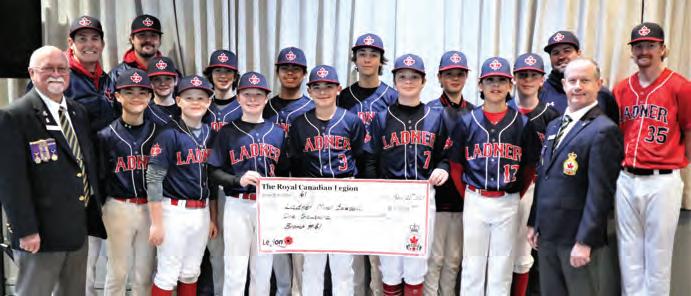
President Al Ridgway and treasurer Russell Ford of Delta, B.C., Branch present $1,000 to coaches Doug Miller (left rear), Bryan Hudie, Mike Hughes and Sean MacDonald of the Ladner 13U AAA Red Sox.
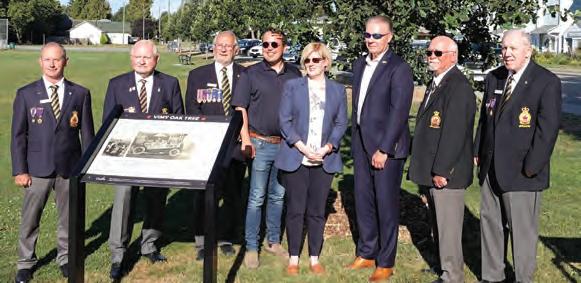
Treasurer Russell Ford (left), Past President Gerry Bramhill, First Vice Bob Taggart, President Al Ridgway and life member Tom Easton of Delta, B.C., Branch and local councillor Dylan Kruger, MP Carla Qualtrough and Mayor George V. Harvie memorialize the Battle of Vimy Ridge through the presentation of “Vimy Oak” trees that descended from the acorns of the battleground.
Central Vancouver Island Zone Commander Achim Sen presents Ken Griffith, Past President of Mount Arrowsmith Branch in Parksville, B.C., with the Legionnaire of The Year award.
Executive Grace Browning, representative Mike Stolb and President Wilson Gurney of North Burnaby, B.C., Branch present $3,000 to COO and acting CEO Scott Stewart of New Chelsea Society and president Bill Summersgill of Winch House.

Executive Grace Browning, President Wilson Gurney and First Vice Trudy Black of North Burnaby, B.C., Branch present $4,000 to senior officer Teresa Zaitsoff of the Burnaby Hospital and Fellburn Care Centre.
Service officer Gary Robertson (left), executive members
Carol Breitenbach, Matt McCann, Jane Holmgren, Bonny McCann, Sgt.-at-Arms Mike Tomashiro-Howard, President Laurie Grubb and Past President Lew Forth of Mount Benson Branch in Nanaimo, B.C., attend the Battle of Britain memorial service at the 808 Wing Royal Canadian Air Force Association.
Slocan Valley, B.C., Branch presents $1,000 to Sayre Knight of Columbia Basin Alliance for Literacy for Books for Kids. Pictured are Peggy Ashton (left), Steve Baal, John Gates, Sayre Knight, Leonard Block, Delaine Hird, Don Gingras, Will Gorrissen (back), Elaine Lindsay, Heather Burns, Eunice Ludlow and President Patrick Ashton (front).
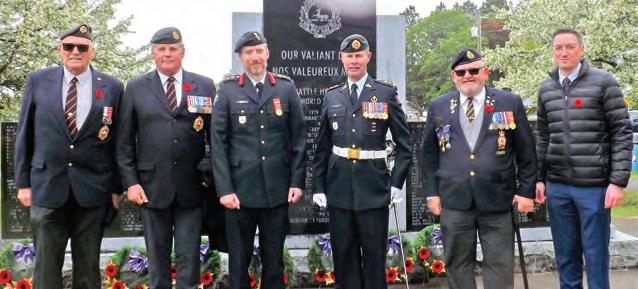
Herman Good VC Branch in Bathurst, N.B., holds its annual commemoration of the North Shore (NB) Regiment’s D-Day landing. Pictured are Lt.-Col. Stephen Bass, Jake Bell, Col. G.M.W. Kennedy, Lt.-Col. Mark Flint, branch President Eugene Godin and Brandon Savage, president of the Regimental Association. GRAHAM WISEMAN
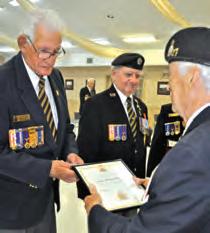
Capital District Deputy Commander Ralph LeBlanc, accompanied by life member Gary Deeley, presents a life membership certificate to Peter Clark of Marysville Branch in Fredericton.
DEREK KIRBY
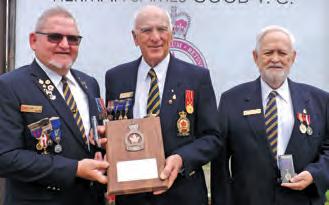
President Eugene Godin of Herman Good VC Branch in Bathurst, N.B., presents a plaque to the bursary and essay committee’s Wilmond Turbide and a branch service medal to Michael White. GRAHAM WISEMAN
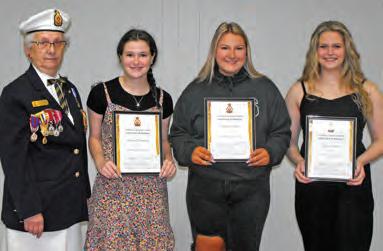
President Sandra Thomas of St. Croix Branch
Junior L.A. in St. Stephen, N.B., presents $500 bursaries to St. Stephen High School grads Rebecca Dougherty, Ashlynn Dufour and Keanah Spooner. GERALDINE LEAVITT
Treasurer Malcom Smith and President Elaine Hall of Niagara Falls, Ont., Branch present $2,000 to Birchway Niagara women’s shelter, represented by development director Amanda Braet.
Provincial Sports Chair Walter Stevens, Provincial Vice Chair Ron Crown and the tournament host, District A Sports Chair Jerry Rilett, congratulate Debra-Lee Roberts and Gary Robinson of Maj. W.D. Sharpe Branch in Brampton, Ont., for winning the provincial mixed-doubles darts title.
Rob Butchart of Paisley, Ont., Branch presents $2,000 for the Ruck to Remember fundraiser, represented by organizer Lino Di Julio.
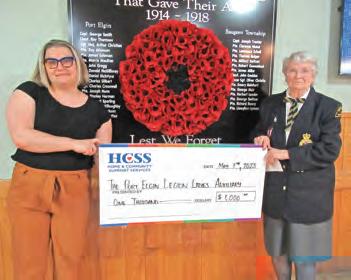
Merly Cramp of Port Elgin, Ont., Branch L.A. presents $1,000 to Home and Community Care Support Services, represented by Rachel Taylor.

Lucknow, Ont., Branch President Marilyn Scott presents $600 to students at Lucknow Central Public School for playground equipment.
Dave Patterson welcomes new members to H.T. Church Branch in St. Catharines, Ont.
Kari Malstrom (centre) and John O’Hara of Coldwater, Ont., Branch chat with Karen Way at the branch promotion booth at the Coldwater Fall Fair.

First Vice Ernie Bremner (left) and Past President Chris Pickering of Fred Gies Branch in Kitchener, Ont., present $8,000 to the Freeport Campus of the Grand River Hospital Foundation on behalf of the Ontario Command Branches and L.A. Charitable Foundation. The hospital foundation is represented by donor success manager Ashley Dobson.
Second Vice Henry McCambridge, treasurer Ray Barker and Sgt.-at-Arms Raymond Hotte of Eastview Branch in Vanier, Ont., present $4,000 to Air Cadets Squadron No. 51, represented by Capt. Lawrence Tung and Kathleen Lemire.
The washer toss team of Rob Madore and Carl Bowden from Almonte, Ont., are congratulatd by District G Sports Chair Maddie Fernell (left) and Provincial Sports Chair Walter Stevens after winning the provincial title.
Donation chair John McCoubrey (left) and President Rich McClenaghan of Last Post Branch in Port Stanley, Ont., present $10,000 to Hospice of Elgin in St. Thomas, Ont., represented by donor relations and admin assistant Charlotte Smith and Dr. John Hofhuis.

Hanover, Ont., Branch President Dan Haverson (left) presents $1,500 to Saugeen Hospice chair Kelly Fotheringham.
Treasurer and Youth Ed Chair
Ron Wilson (left) and President John Champion of Waterloo, Ont., Branch present Nancy Ge with the top award in the national intermediate black and white poster contest.
Veterans service officer John Greenfield of Bowmanville, Ont., Branch presents $5,900 to No. 279 Bowmanville sea cadets rep Marg Boustead.
President Rich McClenaghan (left) and donations chair John McCoubrey of Last Post Branch in Port Stanley, Ont., present $10,000 to the St. Thomas Elgin General Hospital Foundation, represented by CEO Karen Davies, administrative co-ordinator Tammi Campbell and hospital VP Tonya Sheldon.
President Hack Hume (left) and First Vice Michel Denis of Georges Vanier Branch in Hawkesbury, Ont., present $1,000 to the Hawkesbury Central Food Bank. Accepting the donation is Mayor Robert Lefebvre and food bank director Jeanne Charlebois.
Dan Gibson, President Valerie Clark, First Vice Adrian Williams and Linda Davies of Lord Elgin Branch in St. Thomas, Ont., present $2,500 to Sarah Coleman and Kim McCaw for the St. Thomas Elgin Food Bank.
District G Sports Chair Maddie Fernell and Provincial Sports Chair Walter Stevens present Brandon Wheater of Brig. O.M. Martin Branch in Toronto with a plaque after his singles win in the provincial washer toss tournament.
First Vice Michel Denis (in rear), secretary June Elliott, Second Vice Gerry Woodard and President Jack Hume of Georges Vanier Branch in Hawkesbury, Ont., present $500 to the Hawkesbury General Hospital Foundation, represented by Evelyn Bernique.
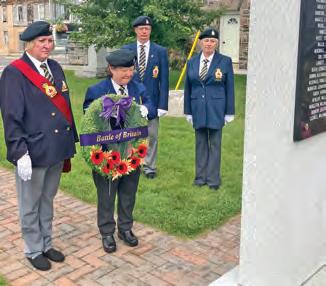
Sgt.-at-Arms Debbie Southorn and President Anne McArthur of Coldwater, Ont., Branch commemorate the Battle of Britain.
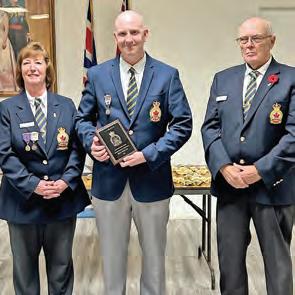
President Pat Irish (left) accompanied by honours and awards chair Wayne Hardwick (right) of Chippawa Branch in in Niagara Falls, Ont., present First Vice Ryan Molloy with the Legionnaire of the Year award.
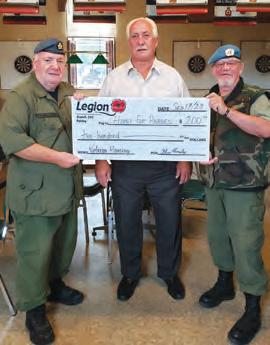
President Glen Hanley of Paisley, Ont., Branch presents $200 to Homes for Heroes reps Pat McNinch (left) and Tom Traversy.
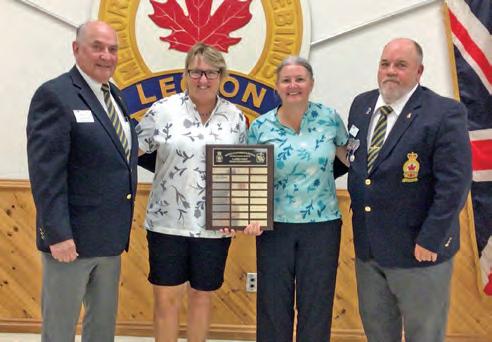
Samantha Williams and Margot Gillespie of Wheatley, Ont., Branch won the provincial ladies golf championship and receive congratulations from Provincial Vice-Chair Ron Crown (left) and Provincial Sports Chair Walter Stevens.
Golfers Scott Jones and Stewart White of Lefory-Bell Ewart Branch in Lefroy, Ont., receive awards from Provincial Vice-Chair Ron Crown (left) and Provincial Sports Chair Walter Stevens following the provincial golf tournament in Essex, Ont.
Provincial Vice-Chair Ron Crown (left) and Provincial Sports Chair Walter Stevens present Rod Sachs and Brian Kaye of Maj. Andrew McKeever Branch in Listowel, Ont., with the provincial seniors team golf award.

Poppy chair Ron Chassie of the H.T. Church Branch in St. Catharines, Ont., presents $12,800 to Hotel Dieu Shaver Hospital, represented by senior development officer Kristina Manzi (left) and inpatient nursing manager Jody Gowling.
President Ken Vosper, along with Diane Dickenson (left), Sharon Seebach and Jessica Consitt of Mitchell, Ont., Branch, presents $20,000 to West Perth Village Seniors’ Community, respresented by administrator Leeanne Davidson.
Treasurer Sabina Glowacki, President Yvonne Glowacki and member Halina Wieclawek of Polish Veterans Branch in St. Catharines, Ont., participate in a hospital fundraiser.
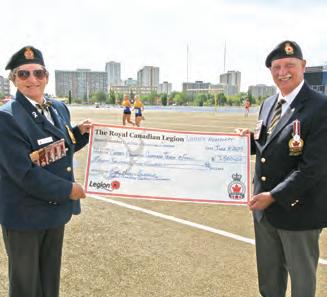
Ontario Command L.A. President Kathy Moggy presents $7,500 from the provincial Ladies Auxiliaries to Ontario Command President Derek Moore for the provincial youth track and field program.
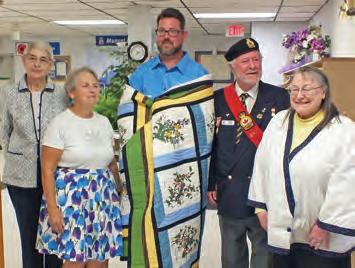
A Quilt of Valour, made by Ann Ralph (left), is presented to veteran Mike Johnson by Judy Millard, Elliot Lake, Ont., Branch Sgt.-at-Arms Aubrey Millard and Carolee Gross.
Second Vice Bob Elliott of Pte. Joe Waters Branch in Milton, Ont., presents $2,000 to the 2990 Lorne Scots Royal Canadian army cadets, represented by its commanding officer Capt. Satish Tarachandra and support committee chair Dr. Sameer Kapar.
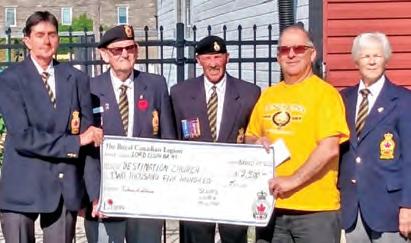
Linda Davies, First Vice Adrian Williams, house chair Dan Gibson and President Valerie Clark of Lord Elgin Branch in St. Thomas, Ont., present $2,500 to the Destination Church school lunch program, represented by Jim Clark.
President Frank Gosnell of Reg Lovell Branch in Glencoe, Ont., presents $500 to Oakland Cemetery Board representative Bob Davenport.
Trenton, Ont., Branch L.A. President Charlene Plume (left) accompanied by L.A. treasurer Linda Scott-Imbeau and Branch L.A. liaison Steve Grenning, present $200 each to the Stan Klemencic Care Centre, represented by executive director Petra Lepage, and the Quinte West Fire Department Coats for Kids program, represented by firefighter Jay Alexander.
Jack Fraser (left), Gary Macpherson, Ray Constantineau and Colin Pick (front) of Espanola, Ont., Branch conduct the unveiling of street signage in three languages, English, French and Anishinaabe, at a main intersection in town.
Veteran Jim Stanton receives a Quilt of Valour from quilter Paula Walsh (left) at the Fish, Fun & Folk Festival in Twillingate, N.L.
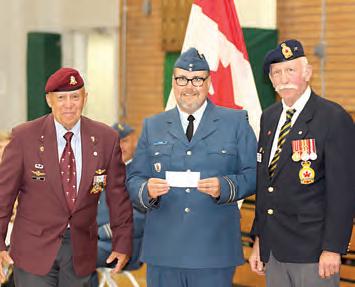
Ed Smith (left) and President Jim Kennedy of Shoal Lake, Man., Branch present $800 to Capt. Kevin Salmi of 317 Royal Canadian air cadet squadron.
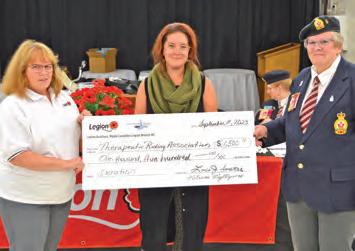
President Katriina Myllymaa (left) and L.A. President Lois Foster of Port Arthur Branch in Thunder Bay, Ont., present a $1,500 cheque to Michelle Pintar of Thunder Bay Therapeutic Riding Association. GEORGE ROMICK
Poppy chair Roy Crozier, President LeRoy Gamble and First Vice Gayle Mueller of George Pearkes VC Branch in Summerside, P.E.I., present a $500 bursary to Olivia McNeill of Athena Regional High School. KAREN GAMBLE
Marg Skibo of Springfield Branch in Hazelridge, Man., presents awards to Olivia George of Oak Bank Elementary for a winning junior essay at branch, zone, district and provincial levels of the Legion poster and literary contests.
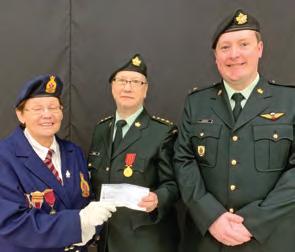
L.A. President Margaret Highfield of Flin Flon, Man., Branch presents $500 to Capt. Laurel Mymko and Lieut. Justin Cowan of 2328 Royal Canadian army cadet corps.

President Vic Renouf and Jeanetty Jumah of Slovak Legion Branch in Thunder Bay, Ont., present $20,000 to the Thunder Bay Regional Hospital. Half the donation was for the hospital’s cardiac services, while the other half was for the Lions vision care centre.
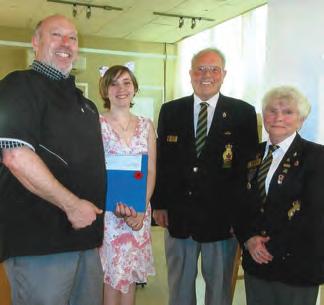
Chuck Grady, President LeRoy Gamble and First Vice Gayle Mueller of George Pearkes VC Branch in Summerside, P.E.I., present a $500 bursary to Willow Reis of Athena Regional High School. KAREN GAMBLE
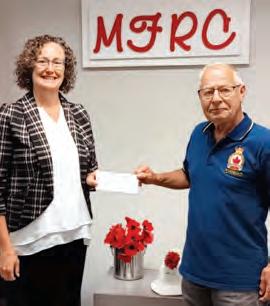
President Brian Rector of Montague, P.E.I., Branch presents $1,000 to executive director Leona Conrick of the P.E.I. Military Family Resource Centre.
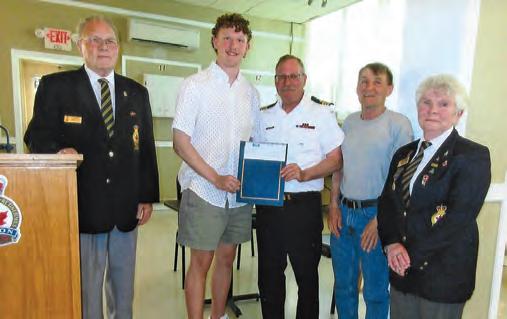
Lt.-Cmdr. Peter Gallant and Ford Gallant, with President LeRoy Gamble and First Vice Gayle Mueller of George Pearkes VC Branch in Summerside, P.E.I., present the Joe “Coke” Gallant Perpetual Bursary to Benjamin Plourde.
KAREN GAMBLE
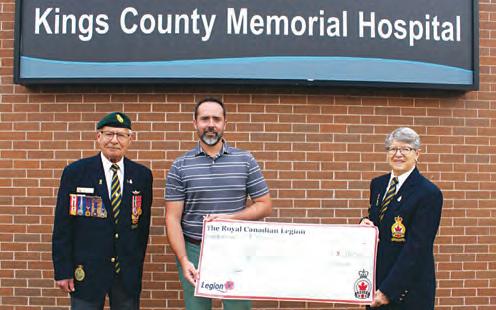
Maxine Evans of Montague, P.E.I., Branch presents $1,000 to Kings County Memorial Hospital, represented by the director of clinical services Grant McKenna.
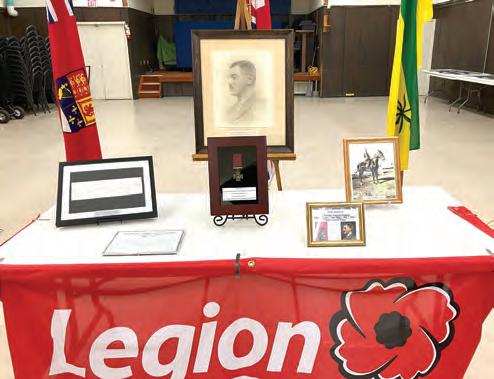
Robert Combe VC Branch in Melville, Sask., celebrates the 50th Anniversary of receiving its name.
CORRESPONDENTS’ ADDRESSES
Send your photos and news of The Royal Canadian Legion in action in your community to your Command Correspondent. Each branch and ladies auxiliary is entitled to two photos in an issue. Any additional items will be published as news only. Material should be sent as soon as possible after an event. We do not accept material that will be more than a year old when published, or photos that are out of focus or lack contrast. The Command Correspondents are:
BRITISH COLUMBIA/YUKON: Graham Fox, 4199 Steede Ave., Port Alberni, BC V9Y 8B6, gra.fox@icloud.com
ALBERTA–NORTHWEST TERRITORIES: Bobbi McCoy, 2020 – 15 St. NW, Calgary, AB T2M 3N8, bobbi-mccoy@shaw.ca
SASKATCHEWAN: Tara Brown, 2267 Albert St., Regina, SK S4P 2V5, admin@sasklegion.ca
MANITOBA: George Romick, 320 Admiral Court, Thunder Bay, ON P7A 8B5, romickg@tbaytel.net
NORTHWESTERN ONTARIO: George Romick, 320 Admiral Court, Thunder Bay, ON P7A 8B5, romickg@tbaytel.net
ONTARIO: Roy Eaton, 567-294B North Channel Dr., Little Current, ON P0P 1K0, reaton@on.legion.ca
QUEBEC: Mary-Ann Latimer, 105-2727 rue St. Patrick, Montreal, QC H3K 0A8, msmarts@bell.net
NEW BRUNSWICK: Harold Wright, 2-299 Main St., Saint John, NB E2K 1J1, foulis20@gmail.com
NOVA SCOTIA/NUNAVUT: James Leadbeater, 4129 New Waterford Highway, New Victoria, NS B1H 5T4, james.leadbeater@hotmail.com
PRINCE EDWARD ISLAND: John Yeo, 657 Rte. 19, Meadow Bank, PE C0E 1H1, islander657@yahoo.ca
NEWFOUNDLAND AND LABRADOR: Brenda Slaney, Box 5745, St. John’s, NL A1C 5X3, bslaney@nfld.net
DOMINION COMMAND ZONES: EASTERN U.S. ZONE, Gord Bennett, 803-190 Cedar St., Cambridge, ON N1S 1W5, Captglbcd@aol.com; WESTERN U.S. ZONE, Douglas Lock, 1531 11th St., Manhattan Beach, CA 90266, douglock@fastmail.com
Submissions for the Honours and Awards page (Palm Leaf, MSM, MSA and Life Membership) should be sent directly to Michael A. Smith, Legion Magazine, 86 Aird Place, Kanata, ON K2L 0A1 or magazine@legion.ca.
TECHNICAL SPECS FOR PHOTO SUBMISSIONS
DIGITAL PHOTOS—Photos submitted to Command Correspondents electronically must have a minimum width of 1,350 pixels, or 4.5 inches. Final resolution must be 300 dots per inch or greater. As a rough guideline, colour JPEGs would be between 0.5 megabytes (MB) and 1 MB.
PHOTO PRINTS—Glossy prints from a photofinishing lab are best because they do not contain the dot pattern that some printers produce. If possible, please submit digital photos electronically.
FRENCH INSERT—To receive a French insert of Legion Magazine content, please contact MagazineSubscriptions@legion.ca or call 613-591-3335.
LONG SERVICE AWARDS



50 years









GLEN NORMAN Last Post Br., Port Stanley, Ont.
SHARON VAN DYCK Last Post Br., Port Stanley, Ont.
KATHY OKE Bowmanville Br., Ont.
DOUGLAS MUNROE Westboro Br., Ottawa
TERRANCE W. FINDLAY Westboro Br., Ottawa
LEONCE LeBLANC Westboro Br., Ottawa
JAMES L. SMITH Westboro Br., Ottawa
WILLIAM HEWITT Westboro Br., Ottawa
MAURICE WOOD Westboro Br., Ottawa
GERRY BRAMHILL Delta Br., B.C.
GORD FINLEY Last Post Br., Port Stanley, Ont.
MICHAEL FENNEY Last Post Br., Port Stanley, Ont.
BRIAN FLETCHER Last Post Br., Port Stanley, Ont.
RAY VAN DEN NIEUWENHOF Rossland Br., B.C.
RICHARD COBOURN Bowmanville Br., Ont.
WAYNE MURPHY Bowmanville Br., Ont.
IAN ESTABROOKS Delta Br., B.C.
RICHARD LITTLE Bowmanville Br., Ont.
TOM WRIGHT Bowmanville Br., Ont.
DAVE FERGUSON Bowmanville Br., Ont.
HAROLD HOWE Delta Br., B.C.
RON WILSON Waterloo Br., Ont.
JIM WELSH Bowmanville Br., Ont.
LARRY STAUB Courtenay Br., B.C.
JAMIE PAIGE Waterloo Br., Ont.
JOHN PEARSON Bowmanville Br., Ont.
RUSS WREGGITT Courtenay Br., B.C.
years 70 years
J. PROUDLOVE Courtenay Br., B.C.
DOROTHY RICHARDS Bowmanville L.A., Ont.
PALM LEAF
SAM BROWN
LIFE MEMBER AWARDS
BRITISH COLUMBIA
DON TAYLOR
Qualicum Beach Br.
JOE MacDOUGALL
Qualicum Beach Br.
ROBERT STEVENS
Qualicum Beach Br.
SHIRLEY GALLOP
Qualicum Beach Br.
DIANE OAKEY
Qualicum Beach Br.
JOHN ARCHER
Qualicum Beach Br.
JILL STEFF
Qualicum Beach Br.
BOB DRINKWATER
Qualicum Beach Br.
LIZ LANE
Qualicum Beach Br.

LARRY LANE
Qualicum Beach Br.
ELIZABETH HIERONYMI Bowser Br. ONTARIO
PATRICIA IRISH
Chippawa Br., Niagara Falls

From the quirky to the revolutionary, Canadians take pride in distinctly Canadian people, places and things. Poutine, peameal bacon and peanut butter; the Canadarm and the pacemaker; Gordon Lightfoot and Banting and Best; Superman and Winnie-the-Pooh. Not to mention the diversity and vast expanse of this beautiful country.
Castlegar-Robson Br., B.C.
True north strong?
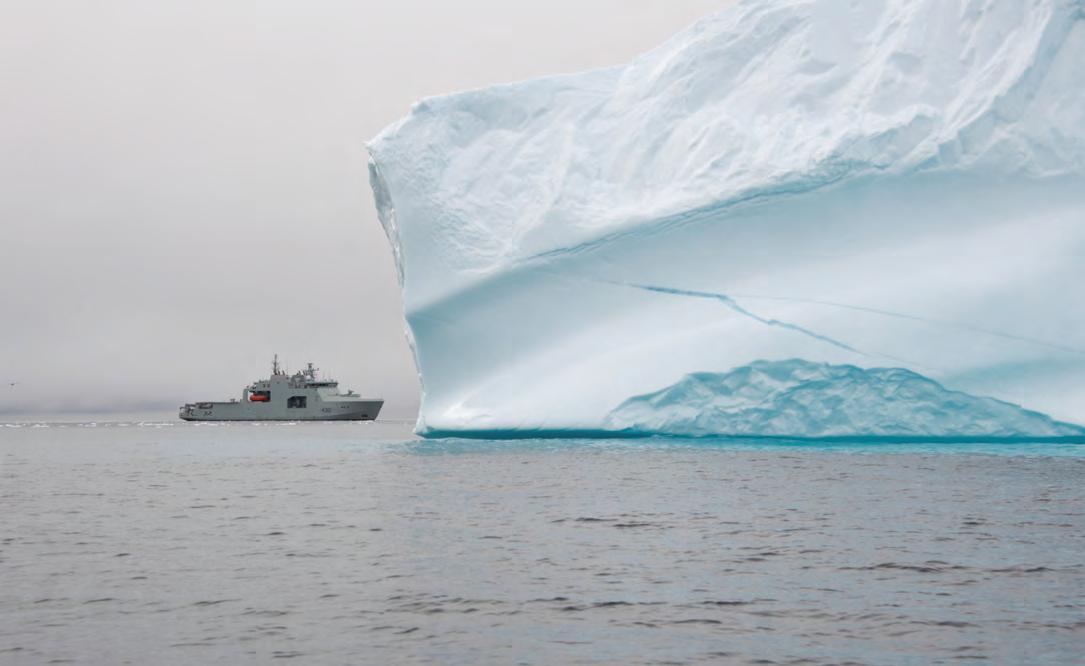
Is Canada doing enough to protect its Arctic?
The Arctic is becoming more important each day. The ice is melting at a faster rate and by the mid-2030s, Canada’s narrow Northwest Passage will scarcely be used if the ocean is ice free. This means that ship traffic, already substantial, will likely increase dramatically, and vessels from China are almost certain to be the biggest users.
Always wary of China, Russia might not be pleased by this at the best of times. But with the ongoing war in Ukraine and Moscow’s increasing dependence on Beijing for political and military support, there’s little chance Russia seriously objects. Plus, China already gets Russian natural gas from Arctic ports.
Beijing is certainly showing growing interest in the region despite having no nearby territory. It already has observer status in the intergovernmental Arctic Council—which has not met since the Russian invasion of Ukraine—and is building a heavy icebreaker (its third), which will have deep-diving submersibles capable of cutting pipelines and cables. China has
also planted listening devices in Arctic waters that can track American and British submarines. (Canada has no such capabilities and so will be unable to monitor the underwater activities of friend or foe.)
And warships in Beijing’s rapidly expanding navy will surely follow its cargo vessels.
At the same time, Russia is moving quickly to rebuild its military presence in the Arctic, placing missiles, nuclear submarines and warships, troops, aircraft, radar installations and longer-range drones there and improving infrastructure.
For obvious reasons, this Russian and Chinese activity concerns the Pentagon, which is once again turning a focus on the Arctic. The U.S. is increasing its military strength in Alaska and advancing its co-ordination with NATO allies, particularly new member Finland and prospective member Sweden. Nordic allies are also combining their air forces.
Where does this leave Canada? To put it bluntly: out of it. Canada is increasingly not thought of as a reliable partner in North
American defence—or defence generally.
As Christopher Sands, an expert on Canadian affairs at the Wilson Institute think-tank in Washington, recently put it: “Call us when you have some money on the table because otherwise, we don’t want to hear what you think.”
Of course, Canada has agreed to upgrade its Norad defences and is purchasing F-35 fighter jets that will be able to operate in the North. These investments, however, will take years to materialize. Canada has also commissioned three new Arctic offshore patrol ships and will eventually have eight in total (six in the Royal Canadian Navy and two in the Coast Guard). But these lightly armed vessels with limited capacity to move through ice aren’t warships.
And the RCN’s four submarines weren’t designed with under-ice capabilities. The admirals are pressing for new subs, but they’re unlikely to arrive soon. And they likely won’t be nuclear-powered, a critical characteristic for operating under ice.
No polar icebreaker has been built in Canada for five decades and, while one has been contracted and a second might be, it will be years before these ships are in the water. Meanwhile, in 2007, the federal government announced it would build a naval facility at Nanisivik on Nunavut’s Baffin Island, but its completion has been repeatedly delayed—under both Conservative and Liberal governments—and it’s not expected to be fully operational now until 2025. The base will also only operate in summer.
For the moment, then, Canada’s Arctic capabilities are limited. The Canadian Rangers, largely comprised of about 5,000 Indigenous reservists, conduct some 100 patrols in the vast North each year; the Royal Canadian Air Force’s 40-year-old interceptor aircraft are increasingly outof-date; and the regular force’s “Team North” includes only some 300 military and civilian personnel based out of Yellowknife, Whitehorse and Iqaluit.
“We say nice things but do not invest,” one former defence official told Reuters this past summer about Canada’s Arctic security commitments. And the country’s allies say: “Show us the money.”
Indeed, it’s no longer just the U.S. who are unhappy with Ottawa. NATO increasingly worries about the Russians and the
Chinese, and as Sands noted, “there’s the Canadian Arctic, which I think most in NATO recognize as the weakest link in our front.
“And Canada’s domain awareness,” he continued, “let alone ability to respond if there were a threat, is so low.”
Why does this matter? It means Canada’s international credibility is limited, not helped at all by media reports that Prime Minister Justin Trudeau privately told NATO that the country will never meet the organization’s defence-spending target of two per cent of gross domestic product. Ottawa’s bromides that Canada is pulling its weight in the alliance by helping Ukraine and in defending Latvia when it can supply only a handful of tanks for the former and can’t contribute more troops for the latter—or aircraft for NATO air exercises—don’t fly either. And if Canada loses credibility on defence, it carries over into foreign policy in general.
HMCS Harry DeWolf, the first of Canada’s new Arctic and offshore patrol vessels, sails near Pond Inlet, Nunavut, in August 2021.
CANADA HAS GONE BACKWARD AND MATTERS LITTLE TO ITS ALLIES—AND
EVEN LESS WITH ITS FOES.
Starting in 1945, Canada was proud to be classed as a middle power, not as prominent as the U.S. or U.K., but still influential in peacekeeping and mediation. It had some clout and mattered in Korea, with NATO, at Suez, with the United Nations and in various multilateral councils of the world. Then about a decade ago, the newly elected Trudeau told Canadians this: “Many of you have worried that Canada has lost its compassionate and constructive voice in the world over the past 10 years. Well, I have a simple message: we’re back.”
Instead, Canada has gone backward and matters little to its allies—and even less to its foes.
An August 2023 Ipsos poll conducted for Global News indicated that Canadians are fretting about the state of Canada’s military—half said it isn’t adequately funded. And more than two-thirds of Canadians reported that China’s actions in the Taiwan Strait and Russia’s invasion of Ukraine had them concerned about the military’s readiness.
The country’s leaders, though, hardly seem to care. This neglect can’t continue. L
Dressed down
Canadians have been a puzzle to British military authorities for more than a century. During the Second World War, Field Marshal Bernard Montgomery commanded several Canadian campaigns. But even he had problems. While Montgomery was never a stickler about uniforms (he wore several cap badges on his beret and usually sported a pullover and corduroy trousers), he did have a problem with one Canadian he encountered during the Sicilian Campaign. The man was driving a bulldozer while wearing a looted top hat. And nothing else. The fellow might still have gotten away with it if he had not greeted Montgomery by raising his hat, bowing and addressing him as “Boss.”
A Royal Air Force intelligence officer on a Royal Canadian Air Force base in 1943 or 1944 was debriefing bomber crews after a mission and encountered a Canadian gunner whose most pressing concern was to finish his 30 operations and go home.
The Brit asked him if he had seen any Germany fighter aircraft. He admitted he had seen an Me 110.
“Did you open fire?”
“No.”
“Did the Me 110 open fire?”
“No.”
“For God’s sake, why not?”
“I figured he was trying to get his 30 trips in, like me.”
During the early part of the war, a lot of British and Canadian aircrew were sergeants. It was eventually decided to commission them and the RCAF acted quickly. Newly minted pilot officers were entitled to an allowance of 85 pounds sterling (then about $400) to buy new uniforms. One Canadian took his allowance in crisp notes and headed off to London, traditional home to military tailors. He arrived back at his station 10 days later, still wearing his sergeant’s kit.
“Why didn’t you buy a new uniform?” he was asked.
“Ran out of money.”
> Do you have a funny and true tale from Canada’s military culture? Send your story to magazine@legion.ca
Douglas Warren was a decorated wartime RCAF flyer and stayed with the force after the war. He went on to fly F-86 Sabre jets with the U.S. air force in Korea. He was also seconded to a German air force training unit. Warren had shared credit for one aircraft shot down during the Second World War, but his German second-in-command, Erich Hartmann, had a better record. He was the world’s alltime ace of aces, credited with 352 kills.
In the 1950s, Canada began sending troops and air personnel to serve with NATO in Europe. Many were stationed in Germany and the military decided to tackle the language barrier by issuing booklets of conversational German. These listed dozens of phrases, which were supposed to be helpful, including:
Ich spreche nicht Deutsch. (I do not speak German.)
Spricht jemand hier englisch?
(Does anyone here speak English?)
Es ist sehr dunkel draussen (It is very dark outside.)
Hilfe! Retten sie mich. (Help! Save me.)
Wohin fährt dieser zug?
(Where is this train going?)
Dieser anzug gehört nicht mir. (This suit is not mine.)
Schrumpfen sie nicht meine socken
(Don’t shrink my socks.)
During the Second World War, people had to ration many foodstuffs, with a complicated system of coupons covering the purchase of coffee, tea, sugar, butter and meat. People were limited to two pounds of meat, eight ounces of sugar (although people could apply for extra sugar to make fruit preserves), one ounce of tea OR four ounces of coffee each week. Other foods, including eggs, cheese and fish, were not rationed, but
THE MAN WAS DRIVING A BULLDOZER WHILE WEARING A LOOTED TOP HAT. AND NOTHING ELSE
were often in short supply. Booze was also rationed (one pint of hard spirits, one quart of wine or 12 quarts of beer every two weeks), which meant a windfall for bootleggers.
The government encouraged rationing with pamphlets and posters, one of which warned:
“Better pot luck with Churchill today, than humble pie with Hitler tomorrow. Don’t Waste Food.”
Nicknames have long been a part of military life, and Canadian units have a lot. The 8th Canadian Hussars (Princess Louise’s), for example, are also known as the Crazy 8s. The 4th Princess Louise Dragoon Guards are the PLUGS. The Royal Winnipeg Rifles were long known as the Little Black Devils, and the Hastings Prince Edward Regiment were the Hasty Ps. There are the Ash Cans (the Argyll and Sutherland Highlanders of Canada), and the Lincs and Winks (The Lincoln and Welland Regiment), as well as the Algoons or Gunks (The Algonquin Regiment) and the Rileys (the Royal Hamilton Light Infantry).
The penchant for nicknames was a legacy from the British, whose Royal Scots regiment (the 1st Regiment of Foot and the oldest regiment in the British army) has long been known as Pontius Pilate’s Bodyguard.
There was a regiment, now long gone, known as the Prince of Wales Leinsters Regiment (Royal Canadians), which was nicknamed the Maple Leaves.
One of the strangest British nicknames was attached to The Royal Mercian and Lancastrian Yeomanry, a reserve unit formed in 1992 and disbanded in 2014. During its short life it was known as the Romulans, a nickname clearly bestowed by Star Trek fans. L
HEROES AND VILLAINS
By Mark Zuehlke
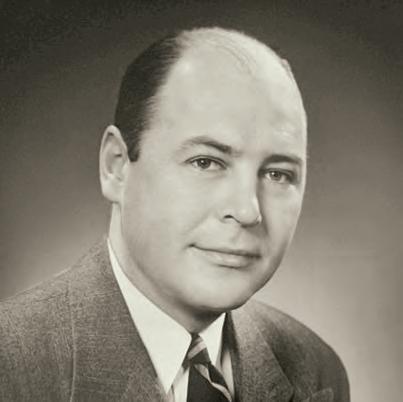
CRAWFORD GORDON JR.
OnMarch 25, 1958, the first Avro Arrow conducted a 35-minute test flight, followed nine days later by the fighter breaking the sound barrier. This proved the plane was one of the world’s most advanced military aircraft. Yet, even as the Arrow found its wings, it was doomed.
POUNDING ON DIEFENBAKER’S DESK, HE DEMANDED THE ARROW BE SAVED
&GORDON
had launched the first intercontinental ballistic missile. Those feats soon led Britain to declare interceptor aircraft such as the Arrow obsolete. Meanwhile, Ottawa was questioning the project’s runaway costs.

“We are convinced that when the review takes place the Arrow will be ordered into production.”
—Crawford Gordon Jr.
On March 31, 1958, Conservative Prime Minister John Diefenbaker turned a minority government into a majority in a snap election just 10 months after he had broken 22 years of Liberal rule. The Arrow program was a key Liberal initiative and the company’s president Crawford Gordon Jr. had close ties to the party. Gordon had previously been recruited by Minister of Munitions and Supply C.D. Howe as a “dollar-a-year man”—one of many Canadian titans of industry enlisted to work cheaply for the government during the Second World War— tasked with harnessing Canada’s industrial might for the war. Postwar, Howe picked Gordon to head the Department of Defence Production, which eventually led to overseeing the Arrow’s development.
Under Gordon, the fighter developed stunningly fast—28 months from initial drawings to rollout on Oct. 4, 1957. The achievement was outshone, however, by the Soviet Union’s launch of Sputnik 1, the first space satellite, the same day. Plus, less than two months earlier, the Soviets
In September 1958, Diefenbaker’s government announced the Arrow program would be reviewed the following spring. A furious Gordon met Diefenbaker for the first and only time on Sept. 17. A heavy drinker and chain-smoker, Gordon stormed into the room. As one government aide reported, Gordon was “incoherent, like a person demented.” Pounding on Diefenbaker’s desk, he demanded the Arrow be saved. The PM dismissed him outright.
G ordon, however, refused to give up, appearing shortly afterward on CBC.
“I want to stress emphatically that the Arrow program has not been cancelled…On the contrary, the prime minister’s statement says the program is to continue…we are convinced that when the review takes place next March the Arrow will be ordered into production.”
The hammer fell earlier than expected, on Feb. 20, 1959, when Diefenbaker declared the Arrow’s termination in the House of Commons. Gordon’s response was immediate. He announced over the factory loudspeaker: “Notice of Termination. There will be no work for you.” On Black Friday, 14,000 employees were terminated and Canada’s aviation industry was devastated. Gordon never recovered. On Jan. 26, 1967, he died in New York City from liver failure. L
&
In 1958, the Avro Arrow’s maker faced off against the Prime Minister
DIEFENBAKER

WJOHN DIEFENBAKER
hen John Diefenbaker’s Conservatives swept to a majority in March 1958, the Avro Arrow’s cancellation seemed inevitable. Its $1.1-billion price tag appalled the prime minister. And since the Arrow had been a pet Liberal project, Diefenbaker was also intensely suspicious of the Liberalaligned executives at Avro—particularly its president Crawford Gordon Jr.
An eloquent orator, Diefenbaker presented himself as a spokesman for common Canadians abandoned by the Liberal establishment. The self-styled “man from Prince Albert” was determined to cut government spending, while simultaneously expanding national development—particularly in the North.
The Arrow, meanwhile, was losing support within the Canadian military. With attention swinging toward the perceived need for weapons to counter Soviet missile development, Diefenbaker’s defence minister, retired majorgeneral George Pearkes, and Chiefs of Staff Committee chair General Charles Foulkes recommended abandoning the Arrow in favour of new American-built, nuclear-warhead capable Bomarc IM-99 surface-to-air missiles.
When Diefenbaker announced the Arrow review in September 1958, Avro launched an extensive publicity campaign advocating for the project’s continuation. This move “shocked” Diefenbaker. “If,” he said, “the government decided to continue development, it would be accused of giving in to a powerful lobby.”
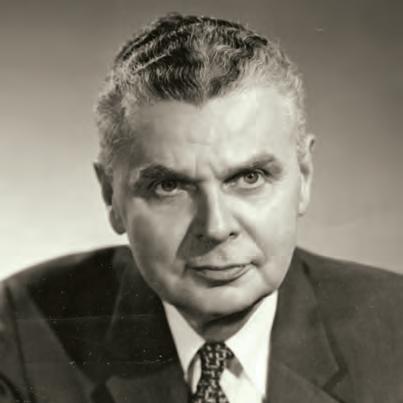
Increasingly, Diefenbaker also argued the Arrow was obsolete. “There is no purpose in manufacturing horse collars when horses no longer exist,” Diefenbaker said after the British military declared the era of Arrow-like interceptor aircraft over.
Diefenbaker declared the Arrow terminated in the House of Commons on Feb. 20, 1959. Abandoning the jet dogged his government, however.
Many Canadians felt the project’s demise dealt a near-mortal blow to part of the national dream and reflected a lack of courage and vision in developing a national defence policy.
THE ARROW, MEANWHILE, WAS LOSING SUPPORT WITHIN THE CANADIAN
MILITARY
In the June 1962 election, the Arrow’s cancellation contributed to the Conservatives being reduced to a minority. Seeking to reverse his failing fortune, Diefenbaker called a snap election on April 8, 1963. His Conservatives bowed to a Liberal majority.
Beforehand, on Jan. 25, 1963, Diefenbaker defended the Arrow’s cancellation in the House. “Some people talk about courage. Well, we took a stand in reference to the Arrow. No one wanted to take that stand. As I look back on it, I think it was one of the decisions that was right. Here was an instrument, beautiful in appearance, powerful, a tribute to Canadian production…this instrument that… would have contributed little, in the changing order of things, to our national defence.” L
“There is no purpose in manufacturing horse collars when horses no longer exist.” —Prime Minister John Diefenbaker
The
rom 1951 to 1963, the CL-13 Sabre was the Royal Canadian Air Force’s front-line “dog-fighter.” But the Canadian-built aircraft may be best remembered by everyday Canadians for its five years of flight in domestic airspace, decked in flashy gilt that became symbolic of the RCAF’s first official national aerobatics team: the Golden Hawks.
Enchanting more than 15 million Canadians and Americans during 317 performances, the Golden Hawks set the bar for their successor, the Snowbirds, all while inspiring untold numbers of young people to enlist in the air force.
Retired lieutenant-colonel Dan Dempsey, author of A Tradition of Excellence: Canada’s Airshow Team Heritage, was one of many Canadian adolescents inspired by the Hawks. During his career he led the Snowbirds in their 20th anniversary and 1,000th official performance and he even flew an F-86 Sabre in Golden Hawks livery in 2009.
“What they were trying to do was inspire kids to do something special with their lives,” said Dempsey.
Formed on March 1, 1959, to mark the 50th anniversary of powered flight in Canada and the 35th anniversary of the RCAF’s formation, the Golden Hawks were originally meant to last only until later that year. Due to their immense popularity, however, garnering $1 million in publicity in 1959 alone, the team continued performing air shows for half a decade.
One Toronto Star Weekly headline called them “The Glamour Boys of the Air Force.” Indeed,
Golden Hawks pilots achieved celebrity status for their grace and skill in the sky.
But on Feb. 7, 1964, the Golden Hawks were disbanded due to budget cuts.
“It was like taking a spear through the heart,” said Dempsey.
Regardless, the aerial ballet team might never have taken off if it weren’t for its aircraft of choice, the CL-13 Sabre. Dempsey attributed the Golden Hawks’ success to the aircraft: “The airplane itself was legendary.


“The airplane itself was legendary.”
—Retired
lieutenant-colonel Dan Dempsey
“It was the best day fighter in the world.”
The CL-13 was a Canadian version of the North American F-86. When the federal government chose it for RCAF service, North American Aviation and Canadair joined forces to manufacture 100 F-86As, designated the CL-13 Sabre Mk 1. Canadair’s next model, the Mk 2, included an “all flying” tail plane and flat windscreen. The Mk 5 was the first production version equipped with a Canadian engine, the Orenda 10. Boasting 6,355 pounds of thrust, the Orenda
required modifications to the fuselage and engine mounts.
The Mk 5 also included small wing fences and a fixed leading edge to improve high-altitude performance. The model, however, had trouble with low-speed handling.
While the Golden Hawks initially flew Mk 5s, they ended up flying superior Mk 6s. With an Orenda 14 engine, 7,275 pounds of thrust and wing leading slats,
the Mk 6 could easily perform the Golden Hawks’ trademark stunts.
Equipped with top-tier aircraft, pilots and ground crew, the Golden Hawks rivalled the U.S. Navy Blue Angels and the U.S. Air Force Thunderbirds and never had a serious incident during a performance.
Said one Golden Hawks audience member: “[They were] the best team there was anywhere, full stop.” L
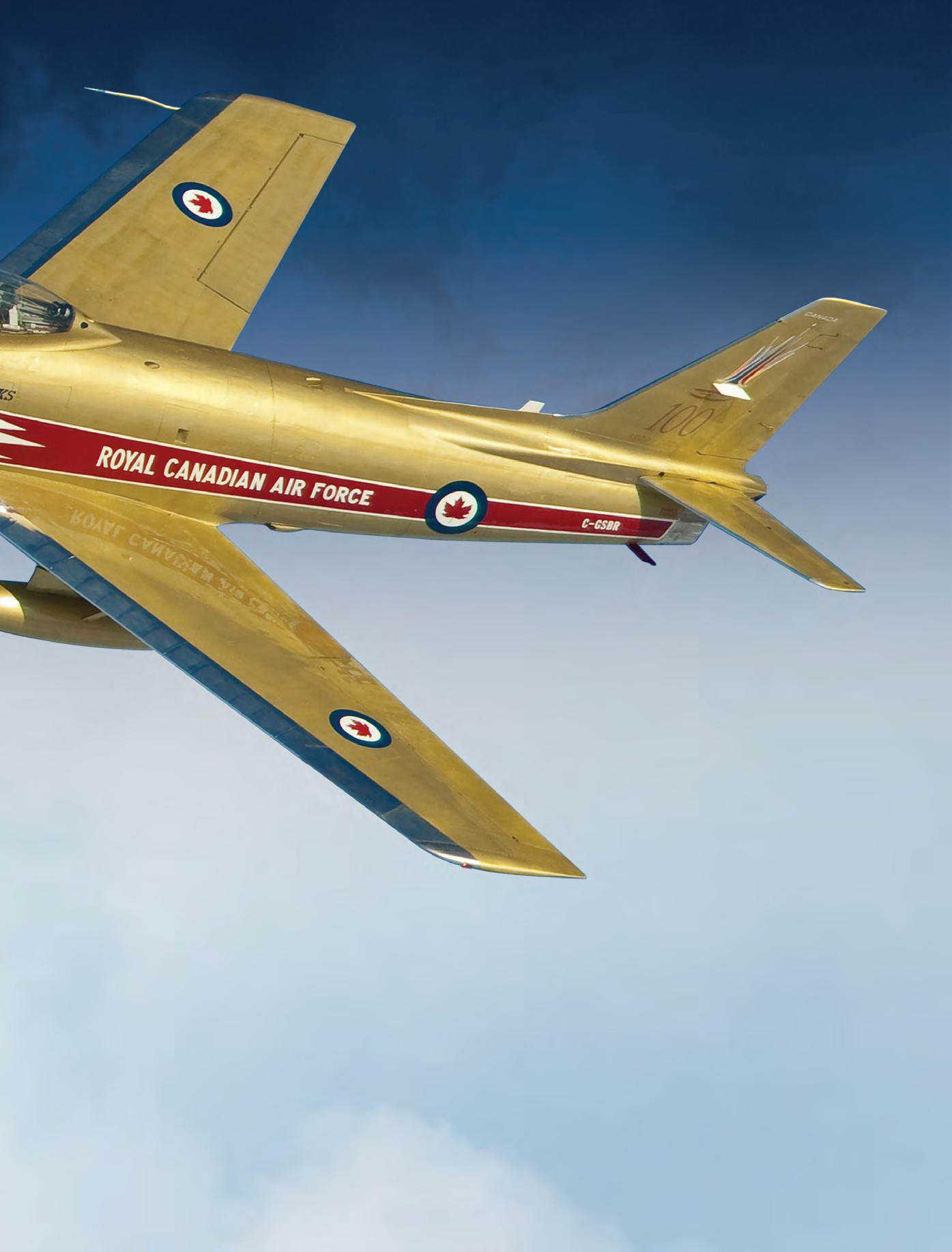

O CANADA

By Don Gillmor
TOMMY PRINCE
In
1968, Hollywood made a movie about the Devil’s Brigade, the name German soldiers gave to the elite Canada-U.S. First Special Service Force. Tommy Prince was part of that legendary unit, portrayed in the film as “Chief.” Born in a tent in Petersfield, in Manitoba’s Interlake region, Prince was from the Brokenhead Ojibway Nation and became one of Canada’s most decorated war heroes.
“ALL MY LIFE I HAD WANTED TO DO SOMETHING TO HELP MY PEOPLE RECOVER THEIR GOOD NAME.”
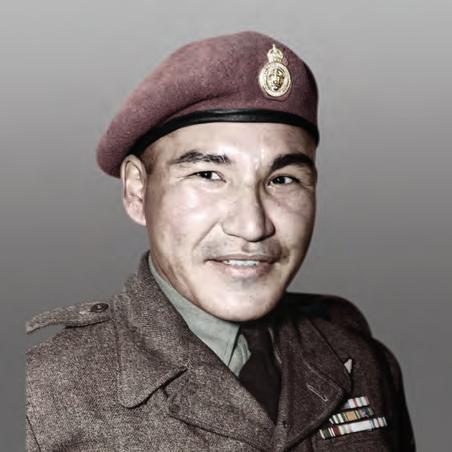
Prince’s exploits during the war resulted in the destruction of German tanks and the capture of more than 1,000 German prisoners. After the war, he was received in Buckingham Palace by King George VI, who presented him with the Military Medal. He also received the U.S. Silver Star Medal (one of only 59 Canadians to receive it) and several other decorations.





Prince learned to trap and hunt from his father, and he put those skills to good use during the war. In 1944, he ran a communications line to an abandoned farmhouse that was 200 metres from a German artillery position. He used his position to report on enemy movements until the line was severed during shelling. By that point, the Germans had advanced to the farmhouse. Prince disguised himself as a local farmer and walked out among the German soldiers. Bending down and pretending to tie his shoes, he repaired the wire right under their noses.
After the war, Prince returned to Canada, where as an Indigenous man, he still wasn’t allowed to vote in federal elections and, despite his service, didn’t receive the same benefits as other veterans. He lobbied the federal government to abolish the Indian Act and became an advocate for Indigenous rights. “All my life I had wanted to do something to help my people recover their good name,” he said. “I wanted to show they were as good as any white man.”
Prince returned to the army to fight in the Korean War, and he was part of the first Canadian unit to land there. His role was similar to the one he had in the Second World War, leading
small groups into enemy territory, launching attacks, then retreating. He did two tours in Korea before being wounded, once again distinguishing himself and once again was decorated for his actions. In all, he received 11 medals in the two wars. His heroism continued once he got home when he saved a man from drowning in Winnipeg. But the home front proved to be more challenging than the front lines. The battles he couldn’t win were against racism and the restoration of Indigenous rights. He spent the last years of his life living in a Winnipeg Salvation Army shelter and died on Nov. 25, 1977, at the age of 62.
In death, he was once more the decorated war veteran. Members of the Princess Patricia’s Canadian Light Infantry served as his pallbearers and more than 500 people attended his funeral, including Manitoba’s Lieutenant Governor Francis Laurence (Bud) Jobin, and consuls from the U.S., France and Italy. A symbol of courage, he was embraced once more. L
How a Safe Step Walk-In Tub can change your life
Remember when…
Think about the things you loved to do that are dif cult today — going for a walk or just sitting comfortably while reading a book. And remember the last time you got a great night’s sleep?
As we get older, health issues or even everyday aches, pains and stress can prevent us from enjoying life.
So what’s keeping you from having a better quality of life?
Check all the conditions that apply to you.
Personal Checklist:
Insomnia
Diabetes Mobility Issues
Lower Back Poor Pain
Then read on to learn how a Safe Step Walk-In Tub can help. Feel better, sleep better, live better
A Safe Step Walk-In Tub lets you indulge in a warm, relaxing bath that can help relieve life’s aches, pains and worries.

A Safe Step Tub can help increase mobility, boost energy and improve sleep.

It’s got everything you should look for in a walk-in tub:
• Heated Seat – Providing soothing warmth from start to nish.
• MicroSoothe® Air Therapy System – helps oxygenate and soften skin while offering therapeutic bene ts.
• Pain-relieving therapy – Hydro massage jets target sore muscles and joints.
• Safety features – Low step-in, grab bars and more can help you bathe safely and maintain your independence.
• Free Shower Package – shower while seated or standing.















Legion members and their families can benefit from an exclusive discount on their car, home, condo and tenant’s insurance, on top of any other discounts, savings and benefits customers are already eligible for at belairdirect.
To take advantage of this offer, simply call us and mention you are a Legion member to get your exclusive premium.